SOUTH AFRICAN PHARMACEUTICAL & COSMETIC REVIEW
May 2018 | Volume 45 | Number 5
www.pharmacos.co.za
Turnkey project management, innovative gas piping and
telemetry solutions to protect your assets
Reduce and prevent signs of skin ageing
IN-COSMETICS GLOBAL:
Bigger and better in Amsterdam Versatility in the aerosols industry
Launched a new product in 2017/18?
ENTRIES NOW OPEN
Contact Natalie Da Silva: natalie.dasilva@newmediapub.co.za | +27 (0)11 877 6281
Contents SOUTH AFRICAN PHARMACEUTICAL & COSMETIC REVIEW
May 2018 | Volume 45 | Number 5
17
w w w.pharmacos.co. za
5 NEWS
Save water and stay hygienic with Initial
IMCD appointed new distributor for DFE Pharma
6 PRODUCT NEWS
Your partner in compliance, quality and safety
What’s new in South Africa
8 EVENTS
Highlights from in-cosmetics Global 2018
Bacteria and skin care
13 AEROSOLS
AMA stalwart passes away
Protect your assets with Gas Piping Services
Puregas completes new storage vessel installation
Compliance remains a priority at Chemlink SA
United in the middle
18 ANTI-AGEING
26
Vital microbiome research from Lipotec
ChemSystems markets novel eye area peptide
Patented molecule protects skin from stress
Life force of rice drives unique innovation
Zuplex launches new botanical extracts
Effective mass market actives from Codif
How to develop unique microbiome claims with CLR
31 PHARMA FOCUS: TECHNOLOGY AI platform offers game changer in personalised medicine Beyond the lab in pharma innovation and access
35 ETHNIC CARE
30 INDUSTRY INSIGHT Overcome online pricing issues with BMi and BlackCurve
Quench thirsty roots with proven ingredients
Croda gains next level consumer insight
41 W IE V E PackagingR Volum May 2018 |
e 44 | Number
5
RICAN SOUTH AF
47
PROTECT YOUR PAYLOAD
cos.co.za www.pharma
44 Carton & Board Sappi’s ultimate board for premium packs Six trends shaping the market
47 Cold Chain
d ar pe f o rb sha o pe ds tureging a P ren e fu cka t th a
Packaging
Packs proven to protect sensitive cargo
p
49 ASSOCIATION NEWS The latest news from Coschem
ns ain solutio Cold ch egrity ain product int maint
ppi completes
Sa n CPG acquisitio
P C Review | MAY 2018 |
3
SOUTH AFRICAN PHARMACEUTICAL & COSMETIC REVIEW
From the editor
THE TEAM
An exploration of innovation
A
EDITORIAL Editor: Abby Vorster +27 (0)11 877 6038 abby.vorster@newmediapub.co.za
msterdam has always been on
Merck’s interactive on-stand activities and
Assistant Editor: Aarifah Nosarka +27 (0)11 877 6209 aarifah.nosarka@newmediapub.co.za
my bucket list, mainly because
new launches from Chemyunion and Silab
Layout & Design: Kirsty Thomas
it’s tulip, windmill, cheese and
among others.
Contributors: Núria Almiñana, Júlia Comas, Raquel Delgado, Heidi Kruger, Olga Laporta, Sabrina Mizael, Anna Momméja, Marie Ollagnier, Harald van der Hoeven
Stroopwafle heaven. In April, I
While April was an upbeat month for the
got to tick this destination off my bucket
cosmetics industry, it marked a sad time
ADVERTISING
list when I travelled to Amsterdam for
for the aerosols industry with the passing
in-cosmetics Global with Henkel South
of Mike Naude. Mike played a major role in
Sales Executive: Carla Melless +27 (0)83 260 6060 carla.melless@newmediapub.co.za
Africa’s R&D manager, Lutendo Magina.
shaping the South African aerosols industry
Henkel SA won the 2017 P C Review/
from a compliance and safety perspective;
Symrise New Product Competition which
his contributions are celebrated on page 13
includes flights, accommodation and entry
in our aerosols feature. We also look at the
Sales Executive: Candida Giambo-Kruger +27 (0)71 438 1918 candida.giambo-kruger@newmediapub.co.za
into the show.
engineering and gas industry expertise of
INTERNATIONAL SALES
Gas Piping Services and Liquitel. You can
Germany/Austria/Switzerland: Eisenacher Medien Erhardt Eisenacher +49 228 249 9860 info@eisenacher-medien.de
Apart from the beautiful, sunny weather we had for the entire week and meeting
also read about how Puregas has reached
the friendliest Europeans ever, Amsterdam
the end of the installation journey of its new
hosted the biggest in-cosmetics I have ever
mounded 500m storage vessel.
attended. For three days, I walked up and
3
Right off the back of in-cosmetics Global,
down seven busy halls, learning about new
our anti-ageing feature is jam packed with
innovations, happy to see familiar faces
innovations set to tighten, brighten and
from the South African cosmetics industry
renew skin while reinforcing natural beauty.
and interviewing international industry
Turn to page 18 now to read about novel
experts. A lot of the knowledge I gained at
microbiome research and new claims in
the show is featured in this edition, in the in-
this interesting category, peptides extracted
cosmetics review on page 8. You can read
from quinoa and rice, an anti-stress skin care
about Evonik’s and Mibelle’s Gold awards,
ingredient, well-priced and substantiated mass market actives, and new South African botanical extracts. Technology takes centre stage in the pharma focus on page 31. We look at how Artificial Intelligence provides pharma manufacturers with vital information for personalised medicine and how technology advances have paved the way for improved access to lifesaving medicines. In our regular PACKAGING REVIEW
EDITORIAL ADVISORY BOARD Consultant, drbaileys.com
Prof Dr Aubrey Parsons
4
Circulation Manager: Felicity Garbers +27 (0)21 701 1566 felicity.garbers@newmediapub.co.za PUBLISHING TEAM General Manager: Dev Naidoo Publishing Manager: Natalie Da Silva +27 (0)11 877 6281 natalie.dasilva@newmediapub.co.za Production Controller: Rae Morrison Art Director: David Kyslinger JOHANNESBURG OFFICE New Media Publishing, Ground floor, Media Park, 69 Kingsway Avenue, Auckland Park, 2092 Tel: +27 (0)11 877 6111, Fax: +27 (0)11 877 6198 POSTAL ADDRESS PO Box 784698, Sandton, Johannesburg, 2146 Published on behalf of Media24 by New Media Publishing (PTY) Ltd. MANAGING DIRECTOR Aileen Lamb
Bridget McCarney
chain packaging industry segments
EXECUTIVE DIRECTOR
with interesting reads on trends, design
John Psillos
innovations and game changing high
NON-EXECUTIVE DIRECTOR
performance packaging developments.
Irna van Zyl HEAD OFFICE New Media House, 19 Bree Street, Cape Town 8001 Tel: +27 (0)21 417 1111, Fax: +27 (0)21 417 1112 Email: newmedia@newmediapub.co.za PO Box 440, Green Point, Cape Town 8051
Enjoy the read!
Consultant, Cosmetic Solutions
John Knowlton
Vivian Frittelli
Prof N T (Raj) Naidoo
| MAY 2018 | P C Review
CIRCULATION
CHIEF EXECUTIVE OFFICER
Professor Emeritus, Faculty of Health Sciences, Nelson Mandela University
CTFA - The Cosmetic, Toiletry & Frangrance Association of South Africa GBM - Generic and Biosimilar Medicines of Southern Africa
Taiwan: Ringier Trade Media Sydney Lai +886 4 2329 7318 sydneylai@ringier.com.hk
both the carton and board and cold
CEO of the Generic and Biosimilar Medicines of Southern Africa
P C Review is the official journal of:
Italy: Ngcombroker Giacomo Rotunno +39 370 101 4694 g.rotunno@ngcombroker.com
section (page 41), Aarifah Nosarka covers
Dr Trevor Baillie
Past-President, Society of Cosmetic Chemists SA
Sales Executive: Anita Raath +27 (0)82 976 6541 anita.raath@newmediapub.co.za
COSCHEM - The Society of Cosmetic Chemists of South Africa HPA - The Health Products Association of Southern Africa AMA - The Aerosol Manufacturers’ Association of South Africa
Pharmaceutical Cosmetic Review is published by New Media Publishing 11 times a year and circulates to manufacturers, packers and distributors of pharmaceuticals, health products, cosmetics, detergents, soaps, toiletries and allied products. The journal is an up-to-date source of reference for company directors, factory and production managers, marketing executives, engineers, import agents, buyers and research personnel. While precautions have been taken to ensure the accuracy of its contents and information given to readers, neither the editor, publisher, or its agents can accept responsibility for damages or injury which may arise therefrom. All rights reserved. © Pharmaceutical Cosmetic Review. No part of this publication may be reproduced, stored in a retrieval system or transmitted in any form or by any means, photocopying, electronic, mechanical or otherwise without the prior written permission of the copyright owners. Pharmaceutical Cosmetic Review is printed and bound by CTP Printers - Cape Town. Copyright: all rights reserved. ISSN 0257-8719
NEWS
WATER WISE HYGIENE SOLUTIONS FROM INITIAL
DFE Pharma
changes its SA distributor
HYGIENE IS EVERYONE’S problem, and not
twice a day, because the Eco Cap contains odour
engaging it is certain to lead to significant health
and bacteria neutralising bio-enzymes. Not only is
EXCIPIENT MANUFACTURER, DFE
issues. But how do we tackle hygiene when water
odour eliminated, but you could save up to 3 000
Pharma has appointed IMCD South
is scarce? Under level 6b restrictions, businesses
percent on your water usage (based on a building
Africa as its new distributor in the
in Cape Town need to show a saving of 45 percent
with 20 male users).
country. Previously, it had worked
on their water consumption compared to the same period last year.
For the toilet bowl, you can prolong intervals between flushing by spraying No Flush after
closely with Brenntag South Africa. The decision to appoint IMCD SA
urination. This spray contains bio-enzymes that
forms part of DFE Pharma’s drive to
services for workplace and washroom areas in
break down uric acid and neutralise odour. The
centralise its distributor management
manufacturing facilities, shops and offices etc. The
pleasant lemongrass scent and blue dye fragrance
activities. This will enable the
company has committed to helping individuals and
and colour the water between flushes. Disposing
company to continue managing the
businesses see out the current water crisis without
of urine-soaked toilet paper in a compact disposer
service levels of its distributors to the
compromising on essential hygiene.
bin also helps save water. Initial will then dispose of
users of its excipients.
Initial is a leading specialist in hygiene
To save water and stay hygienic, you can use hand sanitisers instead of washing hands using
this paper hygienically and in line with government
The new distribution agreement has been effective since 1 January.
waste regulations.
tap water, which can use up to six litres of water in
For waterless surface cleaning, Intial offers an
However, Brenntag South Africa
one minute; that’s a litre every 10 seconds. Switch
Eco Clear Spray is a bio-enzyme cleaner that is safe
remains the preferred source for
to a waterless hand sanitiser spray instead of soap
for all surfaces, neutralises odour and kills bacteria.
Pharmacel MCC.
to ensure that you continue to prevent crosscontamination without the use of water.
The foam hand sanitiser from Initial
Kreason Gopalan, IMCD South Africa’s industry manager for
Initial offers a range of options, including
pharmaceuticals, and his team are
its Signature unit or Betasan sanitiser
available to industry to discuss the
stand, or individual 500ml foam hand
changes in more detail. DFE Pharma is a global leader
sanitiser bottles.
in excipient solutions for oral solid
Deep cleaning using a high pressure hose can use 50 to 75 litres of water
dose and dry powder inhalation. The
in just five minutes. Initial’s Ablution
company is recognised for its quality,
Hygiene Treatment requires minimal
expertise and support. Excipient excellence is what
water due to the use of bio-enzyme preparations, and antibacterial fogging
guides DFE Pharma on its way
uses virtually no water to disinfect large
to developing the best possible
bathroom spaces. Antibacterial Fogging
excipient solutions for all its
will be offered to all Initial’s Ablution
customers worldwide.
hygiene customers free of charge during the Cape water crisis. Installing Eco Caps in your urinals means they only need to be flushed
Add up to 15% to the bottom line of your business with BlackCurve, in partnership with BMi Research Making pricing decisions in real time
RESEARCH
insights to grow
www.bmi.co.za @BMi_Research
y 30 da FREE trial
Global Practice • Local Knowledge t: +27 11 615 7000 f: +27 11 615 4999 e: blackcurve@bmi.co.za
Smarter Pricing • Greater Prots www.blackcurve.com @blackcurveHQ
P C Review | MAY 2018 |
5
STREET Silky hair
with shea spray Long & Lasting has launched an Oil Sheen Spray Shea Butter Infusion. This lightweight formulation gives an instant silky smoothness and shine to weaves, wigs, braids, natural and relaxed hair. It’s ideal to combat excessive dryness without masking the natural texture of hair and provides a protective layer that allows natural movement and bounce. Connect with Long & Lasting on Facebook,
Reveal your natural beauty EcoProducts has created BaoCare, a 100 percent pure and natural skin healing range using baobab oil as the hero ingredient. Radiance is the first offering in the BaoCare range for luminous skin with an ageless glow. Using a luxurious blend of oils, Radiance is specifically formulated for the mature 40+ skin. The product is available in 10 and 50mℓ packs at all good independent health shops, the Wellness Warehouse outlets and online at www. faithful-to-nature.co.za and www.baocare.co.za. The other products in the BaoCare range are a 100 percent pure baobab oil, tissue oil, eczema skin care and acne skin care.
www.facebook.com/LongandLastingSA, for more info about the brand’s hair care products.
Fresh, feminine and spicy Folli Follie’s new perfumes range from spicy to sweet, fruity and fresh, offering something for everyone. Folli Follie Fresh is deliciously sweet-smelling and undoubtedly irresistible. Folli Follie Floral Feminine is a floral, timeless lovable fragrance that characterises the carefree moments of life. Folli Follie Spice is an overtly dynamic, mysterious and spicy scent that will lead you to the art of seduction. These fragrances are available in 30 and 50mℓ EDP bottles.
Happy and healthy hair
to the max
A sun cream for summer and winter, Team Dr Joseph’s new SPF30 is highly effective.
Get happy and healthy hair with Sorbet Drybar’s
It is formulated with innovative UVA
new collection of shampoos and conditioners,
and UVB filters and ingredients such as
intensive care treatments, styling aids and serums.
buddleja and sea buckthorn, both known
These hair care essentials are suitable for all hair
for their highly reparative and protective
types, from coloured to curly hair. The products
properties. This sunscreen is optimised
are paraben-free, pH-balanced,
for maximum sun protection and skin
enriched with essential oils and
hydration – especially in the cooler, drier
antioxidants, and formulated
winter months when a combination of
using the latest in hair care
cold weather and heaters radically dry
technology. The new hair care
out the skin. Team Dr Joseph skin care
collection is sold nationwide at
products are available in South Africa
Sorbet Salons, Sorbet Drybar’s
from www.futurethis.co.za.
and Clicks stores.
6
Sun protection
| MAY 2018 | P C Review
June
2018
DIARY 2018
ood f
SOUTH AFRICAN PHARMACEUTICAL & COSMETIC REVIEW
RE V IE W
WHAT'S ON IN
SOUTH AFRICAN
SAPICS Conference 10 to 13 June Century City, Cape Town www.conference.sapics.org
2018 SUBSCRIPTION FORM
in-cosmetics Korea
Please complete in block letters, select your subscription option, and return this form, along with your payment to:
13 to 15 June Coex Convention & Exhibition Centre, Seoul www.korea.in-cosmetics.com
NEW MEDIA PUBLISHING (Pty) Ltd, PO Box 440, Green Point, Cape Town 8051 Tel +27 21 701 1566. Fax 086 529 6468.
Coschem Fragrance Seminar 20 June Coschem offices, Randpark Ridge, JHB www.coschem.co.za
SUBSCRIPTION OPTIONS (please tick) 1 YEAR
2 YEAR
Food Review Pharmaceutical
Cosmetic Review
R791
Food Review + Pharmaceutical
Cosmetic Review
R514
R514 R931
R791 R1416
CPHi
Full Name:...........................................................................................
20 to 22 June SNIEC, China www.cphi.com
Designation: ........................................................................................ Company: ........................................................................................... Postal Address:...................................................................................
July
Propak China
11 to 13 July SNIEC, China www.propakchina.com/en
KZN Industrial Technology Exhibition 24 to 26 July Durban Exhibition Centre, KZN www.kznindustrial.co.za
.................................................................Code:................................. Country: .............................................................................................. Tel: (
August
Main activity of company:................................................................... Approximate number of employees: .................................................. VAT No: ............................................................................................... ❑ I would like to receive the newsletters and feature announcements via email and may be added to the mailing lists. Signature:............................................................................................
Please select your preferred method of payment:
❑
Coschem Ladies Day 15 August Avianto, Muldersdrift, JHB www.coschem.co.za
Direct Deposit (Fax this form together with a copy of your deposit slip to: +27 086 529 6468 Payee:
Bank:
Acc No:
New Media Publishing (Pty) Ltd .
Nedbank Seapoint
1069321540
Branch Code: 10-69-09-00
❑
Credit Card (Mastercard & Visa only) Name of card: ............................................................................. Expiry Date: ................................................................................ Card Number: .............................................................................
Coschem Sun Care Trends & Regulations Morning Refresher 1 August Coschem offices, Randpark Ridge, JHB www.coschem.co.za
) ..................................
E-mail:.................................................................................................
Cosmoprof North America 25 to 27 July Las Vegas, USA www.cosmoprofnorthamerica.com
)....................................... Fax: (
CVC Number............................................................................... Date: ........................................................................................... Signature:....................................................................................
❑
TAX INVOICE REQUIRED Note: The above prices are applicable to South Africa only. International rates available on request.
P C Review | MAY 2018 |
7
Bigger and better in Amsterdam
In-cosmetics Global has retained its position as the premium industry event. This year, 773 suppliers displayed their latest ingredients – 11 percent exhibiting for the first time – and 100-plus hours of educational sessions took place in Amsterdam from 17 to 19 April. The jam-packed Sustainability Corner, which featured daily talks by industry leaders in different aspects of sustainability
T
from major cosmetics manufacturers such as Unilever, Amka, Estée Lauder, Coty, Union Swiss, L’Oréal, Procter & Gamble and Johnson & Johnson attended the show to identify new ingredients and learn about the trends set to shape their future NPD. The daily re-admittance figures underlined the industry’s commitment to the show. Over the three days, in-cosmetics Global recorded a significant
he 2018 edition of the event attracted 9 392 unique visitors, seven percent more than last year’s show in London, UK, with international attendance increasing by 19 percent to
account for 88 percent of all visitors. Representatives
growth in total attendance with 18 207 visitors, up 12 percent from 16 319 in London. in-cosmetics’ first smart event, which enabled visitors to collate exhibitor literature digitally with a single tap of their smart badge, delivered innovation in abundance, with an exhibition that once again housed the world’s leading personal care industry suppliers.
Skin and hair health Chemyunion, represented in South Africa by Chemgrit SA, launched a variety of functional ingredients and actives for male grooming, hair care, product preservation and emulsion stability. New tests using Raman technology to evaluate hair structure allowed the company to create Seriliss RA, which straightens and simultaneously protects hair with superior and proven performance. This effect is possible due to a highly effective protein complex that promotes the preservation of cystine and permeation of sericin – a double mechanism of action responsible for increasing hair strength.
Chemgrit Cosmetics realize that people are the key to our success, our customers, suppliers and personnel are our future. We believe in operating our business with integrity, efficiency and service excellence. CHEMGRIT COSMETICS (PTY) LTD 7 HAROLD FLIGHT ROAD, JET PARK, BOKSBURG, 1459. 011 397 4455 / 082 853 7589
8
| MAY 2018 | P C Review
care for their skin and hair using fun textures. A Good Start includes five formulations to improve scalp and hair health, target moisturisation and nourish and exfoliate the hair and scalp. The Wash Forward concept breaks rules and is inspired by indie brands. It includes four cleansing formulations with unique textures and benefits while focusing on the consumer’s wellbeing and sustainability. Fixate Keratin is a new functional
The united Lubrizol and Lipotec exhibition stand
Designed to meet the needs of male skin, the company launched 4MAN, which is composed of hop, liquorice, red algae extract, Gallic rose, panthenol and menthol. It also launched Hebeatol
ingredient from Lubrizol. This thermal
DID YOU KNOW?
activated hair treatment uses nonformaldehyde and non-glyoxylic
Floor space at in-cosmetics Global acid chemistry and is validated by 2018 increased by four percent salon tests on different hair types. to 16 634m2. This is the biggest in Fensebiome Peptide from the show’s history, providing even Lipotec is a new active developed more opportunities for cosmetics to strengthen skin, particularly manufacturers to source new ingredients. during exposure to urban
CG, a functional ingredient that
environments. This heptapeptide helps
acts as a broad-spectrum antimicrobial
reinforce the skin’s microbial and physical
agent and is compatible with several cosmetics
barrier function, preventing dehydration, which is
formulations, including micellar waters, wet wipes
a key concern of sensitive skin.
and mascaras.
Lipotec has also launched Lumicease blue
The company also introduced Powderfeel
ingredient. Obtained using biotechnology, this
WR to facilitate the formulation of multiple
ingredient activates opsins on the skin and
textures from fluid to butter in a cold process.
promotes adaptive responses to prepare the skin
It is an O/W emulsifier based on Pickering
for future exposure to light.
SymMollient PDCC is a silky emollient for modern formulation concepts
emulsion technology, which offers
In South Africa, Lipotec’s local agent is
high stabilisation efficiency and
Savannah Fine Chemicals while Lubrizol is
reduced environmental impact and
represented by Carst & Walker.
processing costs.
Wise Beauty 3.0 A united focus
Symrise presented new products as well as
For the first time since the two
products that have proven themselves over
companies merged, Lubrizol and
time in the industry. These are combined in
Lipotec exhibited on one stand at in-
the company’s new concept Wise Beauty
cosmetics. They promoted three new
3.0, developed for a new generation of
concepts for beauty and personal
wise consumers.
care applications and a series of new
SymControl Care is extracted from green algae
functional and active ingredients.
using blue biotechnology. It regulates skin’s
The Expected the Unexpected concept
sebum production, strengthens the barrier and is
engages millennials with seven formulations to
appropriate for oily and sensitive skins.
BOTANY TO BODY Stem Cells Hydroglycerine Extracts Propylene Glycol Extracts Hydrosols Organic Essential Oils Essential Oils Specialized Actives Indigenous Extracts Indigenous Oils
10
| MAY 2018 | P C Review
Quick sample delivery
Technical assistance
Small MOQ’s (1kg to 5kg)
CONTACT CHANTAL O’BRIEN–DE VILLIERS
072 731 3909 www.materiamedica.co.za
Competitive prices
SymMollient PDCC is a silky emollient for modern
Innovations on display
formulation concepts and SymOleo Vita7, an elixir
Based on its experience
that protects against hair damage.
in biotechnology, Evonik
The company also celebrated the 25th
succeeded in bringing
anniversary of Hydrolite 5 at the show. Symrise
Rheance One to market
revolutionised personal care with the launch of
following several years
Hydrolite 5 in 1992. With its less is more approach,
of extensive research.
this unique moisturiser, efficacy booster and
Manufactured exclusively
solubiliser enhances modern formulations.
from sugar using a natural
Dr Gerhard Schmaus, vice president global
fermentation process, the
innovation in Symrise’s cosmetic ingredients
product will ensure gentle yet
division, explains: ‘We are proud to have brought
effective cleansing. Evonik
such a versatile and effective ingredient to the
won Gold for Rheance One in
market so early. This success drives us to keep
the in-cosmetics Innovation
working on modern variations and applications of
Zone Best Ingredient Awards in the category Best
Hydrolite 5 for our customers and consumers.’
Functional Ingredient.
Effect pigments and actives
product. The cell-free Lactobacillus extract
Merck presented its innovative effect pigments
Skinolance promotes the natural balance of the skin’s
and active ingredients. At its massive and iconic
flora to strengthen skin’s barrier function and protect
exhibition stand, experimental stations allowed
against roughness and dryness.
visitors to explore its products and enjoy a
The company also launched a microbiotic
Hairflux is its new olive-based ceramide that
personalised skin care experience. The first station
enables the effective care of damaged hair and
was the Active Solutions where visitors answered
irritated scalp with a single active ingredient. This
a short questionnaire to guide them in choosing
product is also based on natural ingredients and
from a range of innovative and natural ingredients
involves a gentle manufacturing process.
that are specifically selected to meet individual skin demands.
A bird’s eye view of the Merck stand and sheer volume of people who attended the show
Tego Pep UP is a new tetrapeptide that increases the collagen production of the skin and the fibre
Evonik’s personal care team celebrates winning Gold for Rheance One
The Functional Fillers experimental station focused touching, feeling and creating, allowing visitors to explore a broad selection of multifunctional fillers from the RonaFlair range. It also featured Merck´s new luminous matte pigment Ronastar Black Allure. The company also presented Eusolex S, the newest member of its light protection portfolio. Eusolex S is a key organic UV filter with high efficiency UVA and UVB absorption as well as excellent photo stability. Turning Heads is Merck’s new hair care trends kit launched at the show. It features products based on the latest trends in hair care, such as a black beard cream and temporary hair colour products.
Evonik_Skinolance_65hX177w.indd 1
2018/04/24 12:06:39 PM
P C Review | MAY 2018 |
11
enhanced. Ecobiotys is a patented active ingredient (INCI: Yeast Extract), which Megan Jones from Meganede says is ideal for the South African market. Silab won Bronze in the in-cosmetics Innovation Zone Best Ingredient Awards in the category Best Active Ingredient.
Novel anti-ageing concept MossCellTec No. 1 from Mibelle Biochemistry, a Carst & Walker principal, presents a novel anti-ageing concept based on cell nucleus health. It is also the first active ingredient from biotechnologically produced moss. Mosses were the first plants to conquer the land about 470 million years ago. They used their extraordinary adaptation abilities to survive from the prehistoric age until today. The interactive formulation gave attendees a handson opportunity to formulate with the latest ingredients on the market
production of the extracellular matrix to achieve
MossCellTec is an innovative technology that makes
a lifting effect. Tego Enlight was developed as a
it possible for consumers to benefit from those
means of natural skin brightening. Its two plant-
extremely resilient properties. The active is based on
based ingredients are complementary.
the protonema culture of Physcomitrella patens. It
Evonik’s Silica Business Line also took part in
maintains cell nucleus health, which is a completely
the show display additives that can be used for
novel anti-ageing concept. The cell nucleus
stabilising Pickering emulsions thanks to their special
contains the DNA and is involved in regulating
surface modification. Aerosil R 816 and Aerosil R 974
essential cellular processes. Extensive studies show
can be used to transform a wide range of different
that MossCellTec No. 1 activates the lamin A gene
emollients into PEG-free and silicone-free emulsions.
responsible for the nuclear envelope structure and the nuclear transport gene RanBP17. Both genes
Plant microbiota for skin
are down-regulated in aged keratinocytes. It also
Silab, represented in South Africa by Meganede,
supports the skin’s adaptation to climatic stresses
launched Ecobiotys at the show. Bio-inspired
both in vitro and in vivo.
by the regulating capacity of Nectarobiota, the
MossCellTec No. 1 strengthens skin against urban
floral nectar microbiota, Ecobiotys is the result of
aggressors and climatic changes and improves
Silab’s unprecedented approach to R&D in the
its hydration, barrier and homogeneity in just two
cosmetics industry, using the microbiota of plants
weeks. Due its highly innovative nature, the active
to develop an active ingredient that can act on the
has received two gold innovation prizes. First was the
skin microbiota.
BSB Innovation Prize for Cosmetics in the category
Obtained from the yeast Metschnikowia reukaufii,
Most Innovative Raw Material and most recently,
isolated from the nectar of the porcelain flower
Mibelle won Gold in the in-cosmetics Innovation
Hoya carnosa, Ecobiotys specifically rebalances the
Zone Best Ingredient Awards in the category Best
microbiota of mature skin by reinforcing the immune
Active Ingredient.
and mechanical barriers of the skin. It also acts on
In-cosmetics 2019 will take place in Paris, France
the distribution of bacterial communities. The quality
from 2 to 4 April. Visit www.in-cosmetics.com/global
of the skin barrier is improved and the complexion
for more information. •
MossCellTec™ No. 1 Enhances cell nucleus function for resilient skin Carst & Walker is the proud supplier for Mibelle in South Africa
For more information contact Tiffany de Astui at Tiffany.deastui@carst.co.za 011-489-3639 or 082-892-9731
12
| MAY 2018 | P C Review
AEROSOLS
Farewell to an industry leader Michael Peter Naude 11 January 1944 – 24 March 2018
Mike Naude, as he was fondly known to members of The Aerosol Manufacturers’ Association (AMA), passed away peacefully on 24 March. His passion for the South African aerosols industry and perseverance for safety and compliance helped shape the industry to where it is today.
Buyer’sguide 30 years, having been inaugurated as
Two of the most
executive director, Nick Tselentis wrote
the first executive director in 1988, serving
notable were
of Mike’s unwavering dedication to the
in this position for 23 years,’ he said. Mike
the introduction of the Code of
association and industry at large.
then handed over the role to Nick, but still
Practice, allowing the drive for compliance
continued supporting the association in an
to be more attainable for members,
admin role until he died.
and the extremely successful training
THE
I
n a letter to all AMA members, its
‘As many members know Mike has
been the foundation of the AMA for over
Mike was a humble, passionate and fun spirited man who will be greatly missed by the aerosols industry
programmes, which to date have seen
An improved industry
more than 1 200 delegates attending.
In 1988, CFCs were a major media and
Mike was a humble, passionate and fun
industry concern and it was imperative
spirited man who will be greatly missed by
that the AMA formalise its structure and
the aerosols industry. ‘I’m sure every single
response. This was when Mike stepped up
member has fond and personal memories
and took on the role of executive director.
of their time spent with him,’ Nick added.
During his tenure he was responsible for
‘Thank you, Mike for all your years of loyalty
numerous improvements within the industry.
and dedication to the AMA.’ •
2017/2018
THE
Buyer’sguide 2018/2019
The directory for manufacturers of food, beverages, pharmaceuticals, cosmetics, toiletries, packaging and the printing industry
Available online: www.thebuyersguide.co.za Buyers Guide 2018.indd 1
2018/05/07 3:09 PM
P C Review | MAY 2018 |
13
AEROSOLS
Give it gas
Advanced applications for the aerosols industry
The engineering and gas industry experience of GPS puts this consultancy at the forefront of providing turnkey and customisable gas detection and telemetry solutions to the aerosols industry. Abby Vorster finds out more about this innovative company from GPS’ director, AJ De Wet.
C
hemicals like LPGas – which is
Due to our experience and qualifications,
used by aerosol manufacturers
we progressed into LPGas bulk storage
– plant design and the level of
design. We have consulted on the design,
automation within plants have
supply and installation on various projects.
The GPS team: Sean, Remone, Brandon, Nolene, Andre Roux, Miguel and AJ De Wet with Alcina, Dalene and Semone in the front
changed dramatically over the years. These
Our projects have grown to constructing
developments have had a direct effect on
the full gas infrastructure for manufacturers
ideal for businesses of any size and provide
the supply chain requiring companies to
and housing developments up to the
complete remote monitoring and control
improve their processes and facilities with
point of use in the customer’s plant. At the
of a site or plant from any location. ‘For
quality, compliance and safety in mind.
same time, we have been a supplier of
example, an operator or manager can
gas detection systems to many industries,
reduce the speed on a conveyor remotely
including aerosol manufacturers.’
using our turnkey or customisable solutions,’
Gas Piping Services (GPS) and its affiliate business, Liquitel are experts in engineering,
he explains.
with a combined 55 years’ experience in the gas and related industries. Both companies
Technology engineering
are equipped to help aerosol manufacturers
The company has grown with the needs
and their suppliers move with the times to
of the industries it serves and in 2017, GPS
enable better quality finished products,
launched an affiliate business, Liquitel.
enhanced customer service and a safer
‘Our main focus is plant monitoring and
and more compliant aerosols industry.
engineering telemetry using a wide
De Wet comments: ‘The company started
range of instruments and GSM network
with LPGas bulk installations and gas
interface,’ says Andre Roux, MD of Liquitel.
installer training for various gas companies.
‘Telemetry covers more than 60 percent of our physical operations. This is driven by IoT and applicable to any industry or plant that requires
With Liquitel’s new, compact and costeffective systems, even the smallest of operators can benefit from remote plant monitoring
remote monitoring of storage levels, gas detection, O2 levels, temperature or any other
Roux says the demand for cloud-based monitoring in manufacturing is on the rise. It offers unmatched plant control, flexibility to the small to medium sized business owner,
processing
an additional set of eyes for the bigger
equipment.’
multinational business, ultimately minimising
Liquitel’s solutions are
downtime and optimising runtime. Technology now plays a major role in the gas industry. ‘Although there has always been some technology linked to the industry, historically it was mainly found at
The GPS team provides turnkey project management solutions for LPGas bulk storage sites among other things
14
| MAY 2018 | P C Review
major refineries and depots where cost was never an issue,’ De Wet comments. While telemetry to monitor liquid levels, flow rates and other critical operations is not
AEROSOLS
INDUSTRY FIRSTS AND MAJOR MILESTONES 2009 GPS introduces PEX-AL-PEX piping into the gas industry.
2010 The company designs, supplies and installs a 270m3 LPGas and
2012 The PLC display of the tanker metering system from GPS
The company launches a technology division,
50 000ℓ diesel storage facility for Nampak Bevcan in Angola.
GPS Technology. It also installs the speciality gas infrastructure at SABS’ new laboratory in Groenkloof, Pretoria.
2013 2014 GPS designs the 16 000 000ℓ LPGas
The company introduces the first Coriolis truck meter into the LPGas industry.
import terminal for Avedia Energy at Saldanha Bay Harbour.
2015 GPS is awarded a contract for gas
2015 Shield Chemicals commissions GPS to design and
infrastructure from Balwin Properties,
install its aerosol gassing room with a detection
resulting in seven projects throughout
and ventilation system, flammable liquid store and
South Africa.
its gas storage facility at its premises in Apex, Benoni.
2017 new, Roux says the cost has always been exorbitant and beyond budget for most small to medium companies. With Liquitel’s new, compact and cost-effective systems,
The company is appointed as a consultant to manage gas infrastructure at both the Sasol HQ and Discovery HQ buildings in Sandton, Johannesburg. GPS Technology divests from GPS and becomes a separate entity called Liquitel.
even the smallest of operators can benefit from remote plant monitoring. ‘Our systems have full programmable and two way functionality,’ he adds. ‘A major advantage is you don’t have to install costly monitoring
Bank of LPGas vapourisers supplying gas to leading ceramics manufacturer, Multotec
software as it is web-based. All you need
and it prevents critical operational failures
to access your information is a username
like run-dries. We can also provide legal
and password.’
compliance audits based on SANS standards and local bylaws, which are
One stop shop
not only applicable to aerosol production
GPS and Liquitel offer a one stop shop.
plants but also to major producers and
Together, the companies supply and install
suppliers of hazardous chemicals,’ De
gas detection systems with plant controls via
Wet continues.
controller or PLC systems. They also perform
The future holds great possibilities for
annual gas detection calibration and
GPS and Liquitel with De Wet and Roux
certification; design, supply and install full
targeting 200 percent growth in the gas
gas storage facilities, including flammable
and fuel tanker telemetry market. They also
liquid stores and gassing rooms for aerosol
plan to grow the storage depot telemetry
production lines.
business within Liquitel to more than
‘We can offer aerosol propellant suppliers
500 sites in the next two years. •
a tanker metering system that delivers in kilograms and issues the customer with an on-site density printout of the delivery. We were the first company to introduce this system, which is ideal for quality and inventory control, planning and scheduling,
Gas Piping Services – aj@gasps.co.za (www.gasps.co.za) Liquitel – andre@liquitel.co.za (www.liquitel.co.za)
Monitoring vapour flow meter
P C Review | MAY 2018 |
15
AEROSOLS
The new mounded 500m3 storage vessel and existing 400m3 storage vessel mounded during the recent installation at Puregas
Committed to industry growth
I
n September 2014, Puregas embarked
Due to the size of the storage vessel
on a journey to safeguard its core
the EMS, MHI and EIA approvals were
business. Grant Gascoigne, the
subject to stringent safety requirements.
we had started with the initial planning
company’s technical manager reveals
We also used the opportunity to modernise
and approval processes. Installation
how Puregas remained aligned with its
and upgrade some of the other areas in
was completed and the storage vessel
vision to be a leading supplier of aerosol
the propellant processing plant. The project
commissioned during December 2017, while
propellants in southern Africa.
included:
the entire plant upgrade project will be
• the installation of the new mounded 500m3
completed by June 2018.
Having experienced numerous refinery scheduled and unscheduled shutdowns resulting in decreased propellant availability, Puregas started the process of installing extra butane storage that would improve supply to its customers as well as give the company the ability to store imported product, which was becoming a
storage vessel • mounding of an existing 400m3 storage vessel • installation of fixed rail and road loading arms • improving the emergency shutdown system with built in redundancy.
The project was aimed at meeting our customers’ demands, which we strive to do with safety and integrity. During this project we worked closely with the Emergency Services and other government departments, further cementing our positive relationship with these stakeholders.
significant part of its business. So the journey
All these features are world class and
began of the installation of a 500m³ bulk
significantly reduce the safety risk in storing
commitment to our customers and
butane storage vessel.
and operating the propellant plant.
specifically those operating in the aerosols
The process started by obtaining approval
This investment highlights Puregas’
industry. We are confident this investment
The journey to upgrade
will significantly enhance our ability to
as well as the required approvals for the
Equipment orders were placed in January
guarantee continuity of propellant supply
Major Hazardous Installation (MHI) and the
2017 and we broke ground on 3 May last
during times of inconsistent and poor
Environmental Impact Assessment (EIA).
year, almost two and a half years after
product availability. •
Working together to create
Pure Excellence T 011 903 9760 • F 011 903 9766 www.puregas.co.za • info@puregas.co.za
16
| MAY 2018 | P C Review
Business with Integrity Committed to Safety & Quality
from the Local Emergency Services (EMS)
ADVERTORIAL
Your partner in
Since the first section of the plant was
compliance, quality and safety
commissioned in March 2014 with three automatic filling lines, a second factory has been constructed. This houses five additional semi-automatic filling lines; a labelling section; a brand new antiperspirant spray plant; a beautiful canteen and cloakroom with lockers, changing areas and showers for the staff; a goods in process store and a separate finished goods store with pallets ready for delivery or collection.
Manufacturers play a crucial part in driving economic growth. Yet their futures are being put under pressure by clients demanding price cuts which reduces margins. P C Review chatted to Gordon Howell of Chemlink SA about these challenges and how its aerosol filling business is growing despite these challenges. By Abby Vorster
C
hemlink SA was launched in 2015 to meet the aerosol filling needs of
PEOPLE FOCUSED Based in Randvaal, within the Midvaal region
smaller businesses and corporate
of Gauteng, Chemlink SA’s aerosol filling plant
companies. Howell is one of four co-
has been constructed from the ground up with
owners of this contract filling business, along with
safety and pleasing aesthetics in mind.
Richard Hallam and Mike Maree (ex Carbotec),
It has a state of the art shutdown
and Andre du Plessis (ex Spraymate). Together,
system with gas sensors. In
they have 150 years’ combined experience in the
the event of a gas leak,
aerosols industry. ‘Our plant was developed in line
an alarm sounds at
with EU compliance requirements and with safety
20 percent detection
as a top priority. We strive to maintain these high
and at 40 percent, an
standards and welcome any visits or audits,’ he
automatic systematic
comments. ‘Unfortunately, compliance, quality
shutdown occurs via
and safety come at a price, yet we’ve chosen to
solenoids throughout the
invest in this segment of the industry, rather than
factory and ultimately to
having our clients run the risk of a product recall
Chemlink provides permanent employment to 27 people from the local community. Another 27 individuals have been trained in teams to spread the earning ability among the local community.
DRIVEN TO MEET CLIENTS’ NEEDS Chemlink SA is an accredited member of the Aerosol Manufacturers’ Association of South Africa (AMA) and Howell is a director and the longest serving member of the association. With its capabilities, experience and available capacity to meet customers’ needs, Chemlink SA has very little down time. When machines go down, they are immediately replaced with stand-by units and the faulty ones, personally repaired or restored overnight to fully operational condition by du
the gas tanks.
Plessis. He is fanatical about
amounting to millions of Rands.’
maintenance and fully operational
While suppliers continue to do their best in
One of the gas sensors – these are located everywhere in the plant
terms of securing supply and excelling at customer service, Howell says corporates and wholesalers
machines, which, at Chemlink SA, are state of the art. ‘We are pedantic about quality and safety and
or brand owners are under major pressure from the retail sector to reduce their margins. ‘Sadly,
have excellent relationships with our suppliers.
between the manufacturer and the aforementioned
No matter how big or small our customers are,
entities, there isn’t an equitable profit margin for all
our motto remains the same: we take care i.e.
the players.’
customers are really everything – all of which play a crucial role in sustaining South Africa’s aerosol industry,’ concludes Howell.
One of the automatic filling lines at Chemlink SA
Tel: +27 (0)16 365 5150 E-mail: gordon@flashgordon.co.za
CHEMLINK SA IN NUMBERS: • monthly capacity of two
million units
• producing 800 000 to one million units per month •e ight
lines in operation, three are fully automated and the other five semi-automatic three lines are ready for operation when needed • a third factory is being built with a series of bonded storage areas for flammable liquids as well as a • an additional
The gassing room at Chemlink SA is separate from the central production area in line with safety and EU compliance requirements
facility for another three semi automatic packing lines.
P C Review | MAY 2018 |
17
ANTI-AGEING
Reinforce urban skin by reconnecting with the origins Urbanisation has reduced our interaction with nature and triggered the prevalence of inflammatory disorders and skin sensitivity. Lipotec’s new Fensebiome peptide helps strengthen vulnerable urban skin by promoting a healthy microbiome and reinforcing skin’s barrier function. Júlia Comas, Olga Laporta, Marie Ollagnier, Núria Almiñana and Raquel Delgado reveal how. previous contact to modern lifestyles,
the other, twice a day. Several microbiome
provided an opportunity for vital microbiome
parameters were assessed after seven days
research. The research compared the
of treatment.
Yanonami skin microbial genome to
The diversity of skin bacteria was
that of urban individuals, who had a
determined using the Shannon index.
reduced connection to nature and higher
After the active treatment, the index value
antimicrobial practices. Results suggested
showed a higher increment compared to
the exposure to modern lifestyles may induce
the placebo, indicating increased bacterial
alterations in the cutaneous microbiota, such
diversity that leads to improved skin health.
as a reduction in bacterial diversity, which
The relative abundance was evaluated
could make skin prone to sensitivity and
at the phylum and family taxonomic levels.
discomfort.1
At the end of the treatment, the active
A vital function of the skin microbiota is
ingredient helped increase the relative
to contribute to skin’s role as a protective
abundance of the beneficial bacterial
barrier; this can occur through different
phylum of Proteobacteria by 15.2 percent
iscomfort, fragility, dehydration,
mechanisms. Through direct competition for
(p<0.01) and reduce Firmicutes phylum by
scaliness and redness are all
space and nutrients, beneficial bacteria can
21.3 percent (p<0.01). At the family level, it
characteristics of sensitive
cause the exclusion of potentially harmful
helped increase the relative abundance
skin. Its intolerance to external
bacteria2. The reciprocal interaction of
of Moraxellaceae by 6.4 percent (p<0.01).
aggressors has increased in consumers in
microbiota with keratinocytes helps enhance
It also showed a 25.1 percent reduction in
most urban areas. This evidence suggests
the innate immune response, allowing
Staphylococcaceae (p<0.001).
reduced exposure to nature may be related
pathogen recognition to prevent their
to an increase in the risk of inflammatory
invasion, while promoting maintenance.3, 4
D
skin conditions. Yet the skin of our ancestors,
Fensebiome peptide (INCI: Aqua,
A predictive microbial functional profile was obtained and represented by KEGG pathway mapping. The peptide helped
who were in closer contact with nature, was
Caprylyl Glycol, Acetyl heptapeptide-4)
enhance bacterial metabolic pathways
more resilient.
is a heptaptide, available in South Africa
related to energy, lipids, amino acids,
from Savannah Fine Chemicals, which is
carbohydrates and vitamins, which have
hunter gatherer village in the Amazon
intended to strengthen urban exposed skin
been detected in the skin of isolated
jungle, whose people did not have any
by reinforcing microbial and physical barrier
populations and could promote the external
The discovery of an isolated Yanomami
0 Days
7 Days
function and preventing
Placebo
dehydration. The efficacy
supply of nutrients to the skin. A panel of 18 female urban subjects aged
of the active ingredient was
between 26 and 50, who presented dry skin
evaluated through several in
on the legs, applied a cream containing
vivo and in vitro tests.
one percent Fensebiome peptide solution
1% Fensebiome peptide solution
on one shin and a placebo on the other,
In vivo tests and results
twice a day for seven days. Samples of the
A metagenomics analysis
stripping and visualised by fluorescence.
was performed on 21 female
The active treatment decreased sloughed
urban volunteers aged
corneocytes by 18.6 percent (p<0.05),
between 18 and 59. They
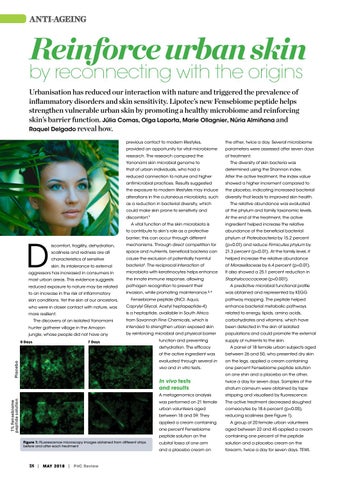
reducing scaliness (see Figure 1).
applied a cream containing
Figure 1: Fluorescence microscopy images obtained from different strips before and after each treatment
18
| MAY 2018 | P C Review
stratum corneum were obtained by tape
A group of 20 female urban volunteers
one percent Fensebiome
aged between 22 and 45 applied a cream
peptide solution on the
containing one percent of the peptide
cubital fossa of one arm
solution and a placebo cream on the
and a placebo cream on
forearm, twice a day for seven days. TEWL
ANTI-AGEING Control
was evaluated after surfactant damage
treated with a medium were used as the
which the peptide helped decrease by
control and reconstructed human epidermis
27.8 percent. These results suggest an
models incubated with 0.02 mg/mL SDS
improved protective effect on the physical
and the medium were used as a positive
barrier to prevent dehydration.
control for barrier disruption. A biotin
Fensebiome peptide
tracer was added at the bottom of the
In vitro tests and results
epidermis models for 30 minutes to allow
The active ingredient is proven to promote
its inside-out diffusion. The presence of the
the adhesion of beneficial skin microbiota.
tracer in the different layers was assessed
Human keratinocytes were pre-incubated
by quantifying microscopy images. Biotin
for 24 hours with 50μg/mL Fensebiome
penetration was inhibited by 64.8 percent
peptide or with culture medium as the
(p<0.0001) compared to the positive control,
control. After 24 hours, the dye was added
control. The epidermal cells were exposed
suggesting a reinforced barrier that can
to the epidermis models for 10 minutes and
to a mixture of S. epidermidis labelled
resist damage induced by SDS.
its diffusion across the epidermis evaluated
with green fluorescence and inactivated
The intercellular lipids were evaluated
Figure 2: Keratinocytes nuclei (blue) pre-incubated with only the medium or the active treatment, showing adhesion of S. epidermidis (green) and of S. aureus (red)
using microscopy imaging. A decreased
red-fluorescently labelled S. aureus. The
by measuring the outside-in diffusion of
penetration of tracer dye was observed
adhesion of each type of bacteria to
toluidine blue dye from the epidermal
despite the presence of SDS, suggesting a
the keratinocytes was determined by
surface. Reconstructed human epidermis
strengthening of the barrier that prevents
fluorescence microscopy (see Figure 2). The
models were treated with 0.02mg/ mL
alterations by chemical aggressors.
active treatment favoured the adhesion of
SDS, to induce a disruption of the stratum
Go to www.pharmacos.co.za/
S. epidermidis with respect to the potentially
corneum, in the presence or absence of
anti-ageing/2217 for the full length
pathogenic S. aureus in keratinocytes.
50μg/mL Fensebiome peptide. Models
technical article on Lipotec’s new
treated with a medium were used as the
Fensebiome peptide.•
Stratum granulosum and stratum corneum integrity dye penetration assays
REFERENCES:
were performed to indicate TEWL in vitro. Reconstructed human epidermis models were incubated for 24 hours with 50μg/ mL
1. Clemente J, et al. The microbiome of uncontacted Amerindians. Sci. Adv. 1:e1500183, 2015. 2. Chiller K, Selkin B, Murakawa G. Skin microflora and bacterial infections of the skin. Journal of Investigative Dermatology Symposium Proceedings. 6(3):170-174, 2001.
Fensebiome peptide and 0.02mg/mL
3. Sanford J, Gallo. Microbial Symbiosis with the innate immune defense system of the skin. J Invest Dermatol. 131(10): 1974–1980, 2011.
sodium dodecyl sulfate (SDS). Skin models
4. V on Herzen L, Hanski I, Haahtela T. Natural immunity. EMBO reports. 12(11):1089-1093, 2011.
Reconnect with your origins for healthier skin
Restores urban and sensitive skin by reinforcing its physical barrier and achieving a microbiota similar to that of our ancestors living in closer contact with nature
Increases
Aids in
microbiota diversity
preventing dehydration
Offers healthy and
protected skin
SAVANNAH Fine Chemicals (Pty) Ltd Tel: +27 (11) 856 4500 I www.savannah.co.za E-mail: info@savannah.co.za
www.lipotec.com All trademarks owned by The Lubrizol Corporation or its affiliates. © 2018 The Lubrizol Corporation.
2018_112 fensebiome P&C Review 177x130 OK.indd 1
16/4/18 11:17
P C Review | MAY 2018 |
19
ANTI-AGEING
De-puff, renew and reshape the eyes
N
aturePep Quinoa (INCI:
in a formulation, twice daily, for 28 days.
Chenopodium Quinoa
The active ingredient also reduced eyelid
Seed Extract) from Tri-K is
folds by 13 percent and eyelid roughness
a dual acting superfood
by 15 percent.
derived natural peptide that is clinically proven to visibly reduce under eye bags and puffiness. The small peptides in the active ingredient provide powerful performance to support the structural integrity of the skin and break down fat under the
Features and benefits
DID YOU KNOW?
Based on dual acting
natural peptides for multiA night time eye treatment is ideal functional performance, because skin regroups overnight NaturePep Quinoa has when its defence against environmental stressors is not on high alert. An been developed using effective eye treatment can help quinoa – an ancient replenish under eye hollows, grain and sustainable reduce sunken shadows and firm the eye contour. plant source.
eyes. This innovative product also diminishes eyelid creases and
It upregulates TGF-ß1 to support structural integrity of the
folds while reducing roughness for lifted
skin and stimulates adipocyte lipolysis to
ageless eyes.
break down fat under the eyes.
Available in South Africa from
The small peptides provide powerful,
ChemSystems, NaturePep Quinoa is
age-defying performance with
globally accepted, non-GMO and
statistically significant clinical results after
naturally gluten free. This proven
28 days. •
ingredient has been tested in a series of in vivo studies. Results showed a 37 percent reduction in eyelid folds after applying two percent NaturePep Quinoa
ChemSystems – www.chemsystems.co.za Tri-K – www.tri-k.com
BENEFITS Visibly reduces under eye bags & puffiness for well rested eyes ADVANTAGES Upregulates TGF-ß1 to support structural integrity of the skin Stimulates adipocyte lipolysis to break down fat under the eyes
Diminishes eyelid creases & folds to lift & reshape the eyes Reduces eyelid roughness for ageless skin
Small peptides provide powerful, age-defying performance Statistically significant clinical results after 28 days
20
| MAY 2018 | P C Review
Shonna Twynham Product Manager Telephone: 27119221830 Mobile: +27(0) 79 372 0761 Fax: +27(0) 11 976 1706 Email: Shonna.Twynham@chemsystems.co.za Website: www.chemsystems.co.za
ANTI-AGEING
Patented molecule
guards skin from stress
Are you looking for a cosmetics active ingredient that provides skin with relief from day to day stresses? Bel-Even from DSM sustainably rebalances the skin’s own stress management system.
W
facial skin elasticity significantly improved by 15.7 percent versus a placebo. Bel-Even helps to increase skin density after four and 12 weeks use. The higher skin density is a result of increased
hether its job related,
protein content
relationship conflicts,
(mostly collagen) in the dermis.
or a busy lifestyle, stress has become a
patented a new active ingredient
constant part of our lives. Skin naturally responds to periods of stress with the formation of more cortisol through 11ß-HSD1enzyme. This release of cortisol, the so called stress hormone, is a normal and healthy adaptation reflex. However, cortisol can turn into an enemy of the skin if it remains in excess over a long period of time.
weeks of application,
that inhibits in vitro 11ß-HSD1. It was specifically developed for skin care
DID YOU KNOW?
applications using a rational design approach. BelEven rebalances the negative, long term
Stress can cause flare ups and effects of stress on skin worsen pre-existing conditions and visibly reduces such as eczema and psoriasis. When people are stressed, a flood of the signs of a stressful hormone cortisol can tank their lifestyle for fuller, immune system, taking toll on suppler looking skin with their skin and Zen. Source: improved elasticity and www.allure.com barrier function.
The active was also proven to protect skin during a stress test. Using 10 μM of Bel-Even active, prevented UV-induced collagen III damage by inhibiting 11ß-HSD1 enzyme In the study, stress was defined as change of weather conditions to cool and dry from October to December in Switzerland. TEWL of facial skin increased due to seasonal stress in the placebo group. An increase in TEWL means the skin barrier becomes weaker. In the Bel-Even group TEWL remained low and the skin barrier was stable. The skin was better protected against external stress factors.
Beyond using stress coping techniques, consumers are interested
Proven effective
in skin care treatments and products
The effects of one percent Bel-Even
ingredients from DSM are available in South
that work to both help the skin deal with
were tested on ageing parameters and
Africa from Chempure. •
stress and reverse any negative effects.
barrier stability during a three month,
These include skin thinning, loss of
placebo controlled study on 30 female
elasticity and barrier weakening.
subjects aged between 50 and 65.
With Bel-Even (Biphenyl Azepanyl Methanone), DSM has designed and
Results showed the active improves skin elasticity and density; after 12
Bel-Even and other actives and functional
Chempure – www.chempure.co.za DSM – www.dsm.com/personal-care
P C Review | MAY 2018 |
21
ANTI-AGEING
Protect skin with the life force of rice Blue Oléoactif is a new antipollution and anti-blue light active from Hallstar. The company harnessed the life force of rice to provide a safe, innovative and eco-friendly solution to new anti-ageing skin care demands.
22
A
vailable in South Africa from Millchem, Blue Oléoactif is sourced from
Blue Oléoactif could be used in facial skin care,
black, red and brown rice using a patented Oléo-éco-
extraction process. It is biomimetic, eco-designed, 100 percent vegetal, safe and Cosmos certified. The active effectively protects skin’s cells from urban pollution and blue light and boosts their defence mechanism. Blue Oléoactif gives skin the power
Innovative research
DID YOU KNOW?
colour cosmetics and hand and body care products. The active ingredient is composed of complementary
Blue light exposure generates skin pigmentation that is sometimes more pronounced than hyperpigmentation from UV exposure. Source: Hallstar
to protect itself and the ability to detoxify. It regulates hyperpigmentation caused by blue
phytomolecules sourced from rice and soy bean oil. To determine the efficacy of Blue Oléoactif on boosting skin cells’ repair system and reducing ROS, Hallstar conducted an ex vivo study on
skin explants from two different Caucasian women, aged 55 and 57. The company used an
light, effectively boosts cell repair and protects DNA
exclusive cosmeto-genomic technique; positive
and other cellular components of the damaging
results are available on request from Millchem
effects induced by urban pollution. The active is
and Hallstar. •
also proven exceptionally efficient in preventing and repairing reactive oxygen species (ROS) formation and damage induced by urban pollution and blue light.
| MAY 2018 | P C Review
Hallstar – www.hallstar.com Millchem – www.millchem.co.za
ANTI-AGEING
The power of
nature captured for beautiful skin
There is a new range of South African botanical extracts on the market, which target ageing, dry and dull skin, wrinkles, redness, inflammation, puffiness and pore size reduction. These actives from Zuplex are available locally from Botanichem.
Z
Athrixia phylicoides
well as to reduce wrinkle depth. Miramor is an extract developed from the leaves of the Moringa or ‘miracle tree’. It assists with reducing transepidermal water loss helping increase skin hydration. It also reduces skin roughness, wrinkles and scaliness, and revitalises skin to reveal a younger and healthier appearance.
uplex Botanicals (Zuplex) is
are supported by comprehensive dossiers.
Miramor also minimises the
a South African producer of
This is significant for local formulators and
effects of blue light and UV
botanical ingredients. Its new
manufacturers. They will now have the
pollution on skin which lead
range includes several exciting
option to use locally sourced botanical
to oxidative stress.
Harpagophytum procumbens
and innovative botanical extracts aimed
ingredients that are internationally
at the global cosmetics industry. The
recognised but at affordable prices, without
the African botanical Harpagophytum
company was established to add value
the additional expense of transport and
procumbens or ‘devil’s claw’. Modern
to unique and established botanicals
import duties.
environmental conditions with prevalent
through the manufacture of standardised
Rosacalm is a targeted extract of
atmospheric pollution, extreme weather
extracts using innovative technologies. It
Actives in focus
patterns and stressed lifestyles can result
is vertically integrated and offers services
Atriclear, a natural botanical extract
in damaged, distressed skin. Rosacalm is
from cultivation to the final preparation
sourced from the herbaceous shrub Athrixia
targeted at relieving redness, inflammation
of extracts.
phylicoides, has been clinically tested to
and puffiness and restoring a youthful glow.
All Zuplex’s new products have undergone independent efficacy testing in Europe and Image A shows Myrothamnus flabellifolius in a dried out state, and B shows the revived plant after rainfall
refine and improve skin texture by reducing
Bao-Active C, as its name indicates,
pore apertures while firming and toning the
is derived from the pulp of the baobab
skin leaving it soothed and feeling smoother.
fruit. This extract has pronounced anti-
It was also short listed for an in-cosmetics
oxidant properties while the complex set
Global 2018 Innovation Zone Green
of additional nutrients promotes rapid and
Ingredient Award.
sustained cell regeneration. It has been
Myravive is derived from the leaf of the
used for thousands of years to recharge
Myrothamnus flabellifolius or ‘resurrection
and revive the skin. The high levels of
plant’, which appears to die completely
vitamin C in baobab fruit provide a natural
during drought and resurrects itself after
way to prevent wrinkles associated with
rainfall, returning to a lush and green state.
photo-ageing. •
This miraculous ability to rehydrate and revive itself has inspired its use in cosmetics as an anti-ageing agent for skin hydration, firmness, smoothness and elasticity as
Botanichem – www.botanichem.co.za Zuplex – www.zuplex.co.za
P C Review | MAY 2018 |
23
ANTI-AGEING
Proven natural actives for mass market skin care Codif presents two mass market actives inspired by K and J beauty market trends. While the company has a reputation for producing premium actives for personal care, it has recognised a need for well-priced, mass market actives with substantiation.
S
added to the cultivation (oxidant
MM100 (view of the surface hydration state)
stress) to enhance the protective
as well as visual rating of the face by a
molecules. The cultivation is
beautician in terms of the suppleness of the
collected and transformed through a
skin, softness and hydration aspect. Long
thermal hydrolysis.
term tests also involved macrophotographs
This extract contains seawater,
of the eye contour. Data revealed the
polysaccharides (rhamnose, xylose,
mask containing Rodacea PE increased
glucuronic acid and galactose),
hydration by 61 percent and improved
a small amount of phospholipids
suppleness and softness by 30 percent.
(fragments of cell walls) and a
The lotion containing one percent active
small amount of glycoglycerolipids
induced a significant improvement in the
(monogalactosyl diglyceride and
cutaneous hydration.
digalactosyl diglycerid). Like Snail Filtrate, Rodacea is able
Earth marine water
to promote numerous cutaneous
A French aquaculture society which
mechanisms. It stimulates the physical
breeds juvenile turbot used to export
nail Filtrate is an ingredient
defence, oxygenation, antioxidant
these fish to Asia, but they had a very high
extracted from a defensive
defence, anti-microbial defence,
mortality rate. By using Earth Marine Water
liquid secreted by a mollusc
regeneration of the skin; firmness,
instead of sea water for the transportation
(snail). It’s been used as
suppleness and softness of the skin
of fish, the pisciculturist noticed they had
and hydration.
a better survival rate. Scientists have
a solution for skin care products to protect, restore, renew and hydrate.
In vitro tests were carried out to
The popularity of beauty products
also discovered that microalgae have
show Rodacea’s efficacy on collagen
a better growth rate in Earth Marine
containing snail extract kicked off
synthesis. The results are available on
Water confirming its protective and vital
a few years ago, driven by trends in
request. Two sets of in vivo tests were
environmental capabilities. This inspired
the Asia Pacific region. Yet certain
also conducted. The first involved the
Codif to study this unique water to better
factors have prevented the growth
application of a facial mask containing
understand it.
of the Snail Filtrate trend such as a
two percent Rodacea PE for 15 minutes;
demand for more ethical behaviours
the second saw the application of a
minerals and springs up at the surface
and vegan and religious concerns.
lotion containing one percent Rodacea
of Noirmoutier, a small authentic and
Snail Filtrate repels western European
PE on the face twice daily for 14 days.
preserved island off the Atlantic coast
consumers and many consumers
Both sets of tests were then
do not want to use products
evaluated by measuring skin
derived from animals. The snail mucus extraction doesn’t correspond with ethical behaviours because it involves submitting the gastropods to extremely stressful conditions for a
DID YOU KNOW?
Rodacea and Earth Marine Water are both available in South Africa from Vantage Specialty Chemicals.
period of time. Codif’s Rodacea is said to be the new generation of Snail Filtrate. It’s a total extract of the microalga Rhodella violacea. This unicellular eukaryote, with a size between eight and 14μm, belongs to the Rhodophyceae class and is naturally present in the temperate waters of Europe, North America and Asia. The alga is cultivated in photobioreactor with sea water enriched with nutrients. H 2 0 2 is
24
| MAY 2018 | P C Review
hydration using MoistureMap
Earth Marine Water is enriched with
located in the west of France, in the Vendée region. This is where it is collected by Codif Technologie Naturelle. The clear green waters of Noirmoutier at low tide
ANTI-AGEING It is a deep sea water that penetrates the crust and becomes a ground sea water. It goes through the different geological layers and absorbs large amounts of useful minerals. Noirmoutier is a massive natural area with predominantly salt marshes and banks, sand dunes and evergreen oak forests, making it a favourable place for plant and animal species. The island is referred to as the
Like Snail Filtrate, Rodacea is able to promote numerous cutaneous mechanisms
Island of Mimosas, due to its climatic
as much production of free radicals as thermal water. Additional tests were conducted to measure the protection offered against cigarette smoke and exhaust fumes. These tests showed positive results in cellular protection and anti-inflammation. More detailed results are available. For the in vivo tests, a facial mask containing two percent Earth Marine Water G was applied on the face for 15 minutes. This resulted in a reduced number
temperateness, which allows for
human dermal fibroblasts stressed with a
of pores as well as an immediate glow to
year-round flowering of Acacia
depleted medium and treated with 0.1 to
the skin. A second test was conducted
debealta (mimosa).
0.5 percent of both seawater and Earth
by applying a lotion containing one
Marine Water (=0.2 to one percent of Earth
percent Earth Marine Water G to the face
variances to seawater in terms of
Marine Water G). The cellular viability
twice daily for 14 days. An evaluation of
solution macroelements yet it is richer in
was measured using MTT testing. Other
carbonylated proteins on D-squam with
microelements such as Manganese, Zinc,
tests included stressing human dermal
a probe, clinical rating of skin colour as
Columbite and Lithium. Iron, Manganese
fibroblasts with a depleted medium as
well self-evaluation of volunteers was
and Zinc are implicated in the antioxidant
well as H 2 0 2 and treating them with 0.1 to
done. It was noted that Earth Marine Water
defence especially via enzymes such
0.5 percent of each water (=0.2 to one
promoted clarity, luminosity and a healthy-
as SOD. These compounds are essential
percent of Earth Marine Water G). The
looking complexion within one week. •
for cellular respiration, oxygen transport,
cellular viability was then measured using
skin integrity and the metabolism of
the MTT test. After stress exposure, cells
amino acids.
treated with Earth Marine Water recovered
Earth Marine Water has a few
To prove the advantages of Earth Marine Water, in vitro protocol involved
vitality faster and greater than with thermal water. These cells also avoided twice
Codif – www.codif-tn.com Vantage Specialty Chemicals – kim@lipo.co.za
P C Review | MAY 2018 |
25
ANTI-AGEING
Bacteria and skin care
united in the middle Cosmetics and the skin microbiome is a challenging subject. Harald van der Hoeven from CLR Chemisches Laboratorium helps us understand the role of the skin microbiome and how to develop novel claims using the company’s proven ingredients.
Probiotic bacteria are different from the microbes on our skin
B
acteria and the skin microbiome remain hot topics in the cosmetics
improvement of the composition of the skin microbiome has cosmetics relevance. For instance, ‘suitable for ageing or sensitive skin’. To accomplish this, it is important to thoroughly understand the skin microbiome and its role. The good microbes on our skin protect us is a well-known fact, but their role does not stop there. At least some species in the skin
industry and it looks like they
microbiome interact with differentiating
are going to continue to
be the centre of attention for a long time. The concept of good bacteria, many of which live on the skin, resonates with consumers. However, on a scientific level, the skin microbiome is still an extremely challenging topic. Most cosmetics claim ‘mildness’
DID YOU KNOW?
keratinocytes in the epidermis. They strengthen the skin’s immune capabilities, barrier function and
Probiotics are fuelling a toxin-free its ability to manage and control skin care revolution. Dermatologists, the microbiome. S. epidermidis brands and consumers are interested is generally recognised as in probiotic based topical products to address and correct a multitude of one of the good bacteria and skin conditions including premature has been called a probiotic, ageing, acne, hypersensitivity, thanks its ability to interact dullness, rosacea and with keratinocytes with positive inflammation.
to the skin microbiome or having a ‘balancing effect’ yet ‘improving in the industry. This claim should resonate with consumers and is of great interest to the
| MAY 2018 | P C Review
interesting approaches and claims where the
against the colonisation of bad bacteria. This
the skin microbiome’ is a claim rarely seen
26
cosmetics industry. The challenges lie in finding
outcomes. This is food for thought and an interesting and important realisation for the cosmetics industry. The skin microbiome is also important because it protects against UV-induced
ANTI-AGEING
Figure 1: Reduction of IL-10 expression after UV irradiation
Figure 2: Increase of IL-12 expression after UV irradiation
efficacious and safe in use. Conceptually they fit into the skin microbiome trend and have a relevant activity. Probiotic lysates positively influence both the physical and immunological barrier function of the skin. A lysate of Bifidobacterium longum (INCI: Bifida Ferment Lysate; trade name: Repair Complex CLR PF) has already been in use in cosmetics for more than 30 years and is proven to act against UV-induced immunosuppression, analogous to the effects of the skin microbiome, as mentioned above. Through
immunosuppression. UV light not only damages
the interaction with keratinocytes it was shown that
skin cells, but also reduces the ability of the skin
the production of immunosuppressive Interleukin-10
cells to repair damage, which is essentially an
(IL-10) was reduced (see Figure 1, which shows the
immunological process.
expression of IL-10 in human keratinocytes after
Understanding these important properties of the
UV irradiation with three J/cm² UVA + 0.3J/cm²
skin microbiome is of great interest to the cosmetics
UVB) allowing for the increase in IL-12 (see Figure
industry. The interaction between a healthy skin
2, showing IL-12 expression in human keratinocytes
microbiome and the keratinocytes shows a striking
after UV irradiation with one J/cm² UVA + 0.1 J/cm²
similarity to the interaction between the lactic acid-
UVB). IL-12 is immune-strengthening and described
producing probiotic bacteria in our gut and the
as important in inducing DNA repair processes. This
epithelial cells on which they reside.
outcome of the use of Repair Complex CLR PF was also proven both in vitro and in vivo (data not shown).
Probiotic skincare This already big category continues to grow. Most
Improve skin renewal
brands that market or claims their products as
This analogy between the effects of a lysate of
‘probiotic’ or ‘containing an active ingredient based
probiotic bacteria and the skin microbiome is just
on probiotic technology’ are formulated with lysates
one example. Another one is a lysate of Lactococcus
of probiotic bacteria.
lactis (INCI: Lactococcus Ferment Lysate; trade
Probiotic bacteria live in symbiosis with us in our gut – they need us and we need them. The Figure 3: Acceleration of skin renewal
and improves the skin renewal processes. Its
similar function for skin as
positive influence on the differentiation processes is
probiotic bacteria has for
remarkable (data not shown). These effects were also confirmed in in vivo studies,
gut. Probiotic bacteria are,
where it was shown that three percent ProRenew
however, different from the
Complex CLR improves the desquamation process, a
microbes on our skin. They
fundamental part of the differentiation process (data
would not survive when
not shown).
placed on our skin, at least
In another study, after removing stratum corneum
not for long. The skin surface
by tape stripping, the treatment with three percent
is cool and desiccated –
ProRenew Complex CLR allowed for a quicker
an environment in which
recovery of the skin barrier properties and an
probiotic bacteria are not
accelerated renewal of the stratum corneum (see
able to survive.
Figure 3). Strikingly, ProRenew Complex CLR was
Interestingly, lysates of probiotic bacteria have successfully been
| MAY 2018 | P C Review
showed ProRenew Complex CLR both accelerates
skin microbiome has a
the epithelial wall in our
28
name: ProRenew Complex CLR). In vitro experiments
also able to improve the production of AMPs, like cathelicidin and ß-defensin-1 (see Figure 4). Like Repair Complex CLR PF, ProRenew Complex
used in many cosmetics
CLR’s effects on skin are essentially similar to that of
products for decades. They
a healthy skin microbiome. This includes helping the
have proven themselves
skin in keeping its microbiome healthy. Healthy and
in the marketplace as
functional skin has a healthy skin microbiome.
ANTI-AGEING Figure 4: Stimulation of cathelicidin and ß-defensin-1
Supporting and improving the skin microbiome implies supporting and improving the skin’s epidermal renewal processes, in particular differentiation, and its ability to counteract UV-induced
ABOUT Harald van der Hoeven is the technical marketing director at CLR Chemisches Laboratorium, a Berlin-based company that develops, manufactures and markets innovative and high quality cosmetics actives for skin and hair care.
immunosuppression. This can be achieved with ProRenew Complex CLR (Lactococcus Ferment Lysate) and Repair Complex CLR PF (Bifida Ferment Lysate), which can be sourced in South Africa from IMCD. Their mechanism of action is identical to that of the commensal good skin bacteria. It is for good reason these good skin bacteria are called
Proven to support
probiotic. Lysates of probiotic bacteria are
The skin itself is the most important factor in
a potent and proven support for the skin in
improving or balancing the skin microbiome. If
maintaining and improving its homeostasis
the skin loses its ability to successfully support the
and microbiome. •
Healthy and functional skin has a healthy skin microbiome
skin microbiome, the microbiome will suffer. A good example for this is atopic dermatitis, where the lack of the ability to sufficiently produce AMPs leads to S. aureus starting to overgrow the other bacteria.
CLR Chemisches Laboratorium – www.clr-berlin.com IMCD South Africa – www.imcdgroup. com/worldwide/south-africa
Crest Chemicals
Representing ABITEC on products for ageing skin Hydro~Kote® Captex® Sterotex® Pureco® Caprol® Capmul® Nutri Sperse®
Contact us: Johannesburg (011)254 3300, Cape Town (021)534 3140, Durban (031)9025324, East London (043) 726 8713 and Port Elizabeth (041)453 1981 Crest chemicals.indd 1
2018/04/30 8:02 AM
P C Review | MAY 2018 |
29
INDUSTRY INSIGHT
Get online pricing right with advanced software
Pricing is the primary challenge of all online retailers. BMi Research in partnership with BlackCurve is offering a holistic pricing solution to brand owners, manufacturers and retailers in both the cosmetics and pharma industries.
P
ricing is a business-critical
real time purchasing decisions. This leaves
activity. Getting it
online and traditional retailers as well as
right – provided the
brands in a challenging
data and pricing are
position in terms of how they
accurate – is more than likely
present consistently optimal
to result in an increase in sales
price offerings.
and profits. Get it wrong and
It’s one challenge to have
you jeopardise your brand’s
accurate competitive pricing
future sustainability.
data at hand, while having
BMi Research and BlackCurve, a global price management company,
a single price management Gareth Pe
recently announced a
platform to effectively execute ar son
the company price strategy is quite another.’
partnership that will combine best practices in pricing management
Price intelligently
with price trend expertise to offer client’s a
In a business environment where
holistic pricing solution.
88 percent of online retailers have
BlackCurve offers a software system
indicated the increased importance of
that allows for the uploading of sales
pricing, BlackCurve allows brand owners
and pricing data via Excel or CSV. It uses
to determine the best selling price for
machine learning, advanced mathematics
all products. This is made possible by
and an excellent user interface (UI) to
analysing competitor pricing, ensuring that
make for easy, fast and profitable pricing,
they neither under nor over-sell, improving
finding the ideal price for every product.
sales and margins.
Cloud based, the software offers a live feed
Pricing is often a laborious and complex
that supports pricing being set in advance.
process, which impacts sales. As an
This means the system can be operated
automatic software system, BlackCurve
remotely and all changes are automated.
eliminates time consuming manual
‘Never before have businesses faced
processes that use significant resources
more challenging times from a selling
and are susceptible to human error. The
price accuracy perspective,’ says Gareth
leading edge software technology allows
Pearson, CEO at BMi Research. ‘Cash
for continuous monitoring and price
strapped, price sensitive customers
changes that can be made in real time,
extensive pricing and promotional data
replacing manual processes where the
at their disposal enabling them to make
majority of pricing is not optimal.
The system
Philip Huthwa
ite
takes data such as inventory, products and costs and applies rules that align to business objectives including desired margins, website performance, price elasticity, commercial plan, competitor position and stock levels to create real time, automated price optimisation. Multi-channel pricing is key to most pricing strategies. BlackCurve applies pricing strategies to every channel used by clients – from websites to market places and geographic regions. Products are priced intelligently, which helps clients find the right price using pricing rules aligned to their particular business objectives. Private labels are managed using private label pricing rules to create a better pricing position while maximising returns. In addition, retailers can make use of BlackCurve to amplify entire ranges of products at optimal prices, instead of merely their key lines.
Ideal for FMCG International customers already using BlackCurve include Appliance House, Clever Boxes, Electrical World, Merck, Ribble and Little Blue Van Logistics. Various South African sectors will be targeted including apparel, grocery, pharmacies, outdoor and camping, high tech and other online offerings including manufacturers and distributors of FMCG products. ‘Automating price processes offers the added advantage of saving time by freeing staff from spending their time doing manual pricing each week,’ reveals Philip Huthwaite, BlackCurve founder and CEO. ‘We look forward to bringing our price management optimisation technology to the South African market and are delighted to have BMi Research exclusively represent it. There is no doubt smarter pricing will help drive the revenue and profitability of BMi Research’s customers.’ •
BlackCurve – www.blackcurve.com BMi Research – www.bmi.co.za
30
| MAY 2018 | P C Review
PHARMA FOCUS//Technology
Gain insight
into the immune system using AI CytoReason is an immune-focused AI technology company that generates insights to reveal complex patterns in a variety of biological data. This information is vital to pharma manufacturers and game changing for personalised medicine.
U
sing an Artificial Intelligence model of the
hospitals, the company proved
immune system, CytoReason looked into
strength in predictive insights
genomic data of patients that responded
into TNF drugs, effectively
to treatment from anti-inflammatory drugs
cutting costs, time and risks
such as Remicade versus those that did not respond.
for pharma companies during
Comparing the results, the company discovered
their development cycle. It also
specific biomarkers in blood and tissue samples
prevents safety issues, creates a more
which predicted who would and would not respond
personalised medical experience and
to anti-TNF drugs such as Remicade in the future.
reduces unnecessary prescriptions.
Typically the process to determine whether
‘Leveraging our platform and proprietary data,
a patient was responsive to anti-TNF drugs like
we offer our pharma partners an unparalleled
Remicade took over three months and was
resource, becoming their system
dependant on trial and error, exposing the patient
immunology sounding board,’ says
to potential side effects and unnecessary costs.
David Harel, co-founder and
In the first public demonstration of its technology,
president of CytoReason. ‘Our
CytoReason used three different publicly available
proprietary machine-learning
and independent clinical trials to study the RNA from
engine enhances its performance
lesion tissues to see what the difference was in those
with each new dataset introduced.
who responded to the anti-TNF treatment to those
Our platform enables innovative
who did not. Discovering what the differences were
big-data analysis, focusing on solving mysteries in
through the use of its AI technology, CytoReason was
immune related disorders and therapies, affecting
able to determine when a pharmaceutical product
the cost of target identification, reducing the risk of
will and will not be effective.
clinical trials, and bringing the world closer to an affordable personalised medicine.’ •
An unparalleled resource As the leading AI platform for autoimmune diseases and cancer-immunotherapy, CytoReason provides
CytoReason – www.cytoreason.com
immunologists with a system level view of immune responses. In a blind validation from various top
COMPANY SNAP SHOT FOUNDED IN 2016, CytoReason uses its AI model of the immune system to generate biological insights. Rooted in
CLINICAL EXPERIMENTAL DATA - Cell and protein measurements - Gene expression and epigenetics - Microbiome PRIOR KNOWLEDGE PUBLIC - Published literature - Trial data repositories - Patent database
over a decade of academic research, the science behind CytoReason is well published and clinically validated. From new cancer immunotherapies to autoimmune and neurodegenerative research, the company is supporting the boldest attempts to improve health outcomes by generating
CELL CENTERED MODEL
PRIOR KNOWLEDGE PROPRIETARY - Trained immune interactions model - Internally-generated measurements - Animal model translational learning
- Within data type analysis - Across data type analysis
biological insights. These insights can be translated into faster and more beneficial drug development cycles as well as improve patient outcomes. Among CytoReason’s customers are some of the largest global pharma companies and research organisations.
DISCOVERY/R&D ANALYSIS - Pathway and target identification - Proprietary and literature target/ pathway validation - Preliminary safety and off-target effect
CLINICAL ANALYSES - Non-Responders’ stratification - MOA and adverse events - Indication prioitization for given pathway - Companion Diagnostics (biomarkers)
P C Review | MAY 2018 |
31
PHARMA FOCUS//Technology
Access to healthcare
advanced through new technology Developments in way pharmaceuticals are manufactured and used have improved treatments, saved lives, cured diseases and created greater access to healthcare for more people. But the quest for new therapies, improved efficacy and getting medicines to patients faster requires constant innovation and solutions beyond the laboratory. By Heidi Kruger
A Another exciting new technology being used is hot melt extrusion
dvances in manufacturing, serialisation,
‘Non profit organisation, Right to Care, partnered
labelling, shipping and distribution
with Gauteng Health Department to create
while still ensuring sustainable
a pharmacy dispensing unit inspired by ATM
business practices have contributed
machines,’ says Solomon. ‘This technology gives
to the boom in the global pharma market.
patients suffering from chronic illnesses their meds in
According to the International Federation of
under three minutes.’
Pharmaceutical Manufacturers Association, the
The machine is driven by sophisticated
global pharmaceutical market will reach nearly USD
technology but still has a human touch as
1,430 billion by 2020 with ‘pharmerging’ countries
patients are assisted by tele-pharmacists. Once
accounting for 25 percent of global spending on
a pharmacist uploads a patient’s prescription
pharmaceuticals by 2020, compared to 23 percent
onto the system, the patient can use his or her
in 2015.
ID book and a pin to access the machine and choose the prescription, which is dropped into the
Improved access South Africa’s unique burden of disease means that
collection slot. Similar dispensers have also been introduced in
those involved in the domestic manufacture and
Dubai and the USA where they are hailed for being
supply of pharmaceuticals know only too well the
more efficient than pharmacists while still abiding
demands associated with creating access while
by regulations.
competing in pressurised market conditions. Yusuf Solomon, business development executive
Imperial Logistics has embarked on a healthcare supply chain solution in Malawi which will see the
at Pharma Dynamics, explains how the invention
installation of solar energy at 85 healthcare facilities
of a pharmacy dispensing unit has created
in the country. The project will provide hospitals
more efficiency and convenience for patients
with 100kW solar panels, as well as panel arrays
and pharmacists.
and photovoltaic systems. This project will also
Examples of ATM medicine dispensers
32
| MAY 2018 | P C Review
PHARMA FOCUS//Technology include solar powered street lights at hospitals, solar geysers and air conditioning.
AI in manufacturing Solomon says that technology is also allowing for shorter manufacturing time, thanks to advances such as 3D printing Yu su f So
and Artificial Intelligence (AI).
lomon
‘AI capability will assist in sifting through massive
Spectroscopic Solutions for the Validated Pharmaceutical Industry
amounts of scientific data. This could allow drug manufactures to significantly shorten the manufacturing time. AI combined with 3D printing could potentially allow specific dosage forms to be manufactured per individual need,’ he continues. ‘This could revolutionise the entire value chain within the industry. In the future we may see the end customer potentially printing their own medicine.’ According to Ajay Pal, senior director of manufacturing at Cipla South Africa, another exciting new technology being used is hot melt extrusion. This involves applying heat and pressure to melt ingredients together to form granules for next
ALPHA
FTIR Spectrometer www.bruker.com/alpha
TANGO
FT-NIR Spectrometer www.bruker.com/tango
step operation. Technological innovation has also enabled the production of multi-layered tablets, made up of two to four layers, which have different release profiles and APIs, making more effective combinations in tablets possible. These tablets could be more efficient for patients having to take several medications at the same time. Although it is difficult to produce new drugs that improve on existing ones, current treatments are hindered by a lack of patient compliance due to the burden of taking many medications at once.
Serialisation on packaging
BRAVO
Handheld Raman Spectrometer www.bruker.com/bravo
Today, more and more countries are being required to produce sophisticated barcoding on all pharmaceutical products in order to track and trace medicines for logistical efficiency, due to a growing concern about counterfeit drugs. Solomon explains: ‘Pharmaceutical serialisation is the tracking and tracing of the passage of prescription drugs through the supply chain from manufacturing to dispensing. This is generally accomplished through automated, electronic means, and is legally required in many countries. It involves such company practices as recording, authenticating,
OPUS Software supports traceable Reference Standards Instrument Qualification according to USP, PhEur, JP Internal Validation Unit (IVU) for automated OQ & PQ Full 21 CRF part 11 support for Data Security, Integrity, Traceability
maintaining and sharing accurate records of items prior to dispatching.’ Regulations for serialisation are becoming a priority for pharmaceutical manufacturers and supply chain partners globally. Both developed and developing countries have already implemented regulations for serialisation or are doing so. In South Africa new regulations call for labels with clear barcodes to be attached to all medicines intended for human use, so that the medication can be more easily identified and tracked.
Today´s regulated pharmaceutical laboratories must comply with extensive regulatory requirements. Bruker offers together with its high-end FTIR, FT-NIR and Raman spectrometer line comprehensive system validation tools to achieve systematic and costeffective compliance.
Contact us for more details www.bruker.com/optics
Counterfeiting pharmaceuticals can cause serious harm and can happen in many ways, including mislabelling medication and selling medication which does not
Innovation with Integrity
FTIR/FT-NIR/Raman
have the active ingredient which might instead have dangerous chemicals.
P C Review | MAY 2018 |
33
PHARMA FOCUS//Technology According to the World Health
Imperial Health Sciences recently completed a worldclass expansion at its Centurion facility in Gauteng
Organization (WHO) an estimated one in 10 medical products in low-and middle-income countries is substandard or falsified with anti-malarials and antibiotics among the most commonly reported substandard and falsified medical products. Tracking and tracing medicines also enables advanced analytics programmes, which could provide insights into consumption patterns, geographical locations, as well as marketing effectiveness. ‘Serialisation will become mandatory in
DID YOU KNOW?
Biologics, biosimilars and nonoriginal biologic products are increasing their share of the global pharma market and dominating sales. For example, in 2002 biologics accounted for 11 percent (US$46 billion) of global packs (cartons) and sales, but projections for 2017 show inserting the patient that biologics will expand to information sheet. ~20% (US$212 billion) of global sales. ‘Cartonators have
Europe in 2019 which means all packaging of products will require
automated, built in systems which verify product details by
Biosimilars or ‘follow on’ biologics have been embraced by most developed countries and many emerging nations as a cost control measure. According to the handbook on biosimilars, produced by the European Medicines Agency, the
unique printing per pack (which) will
recognising and proof reading each
introduction of biosimilars has brought
complicate the supply chain and drive
packaging component,’ he says.
costs down not only through utilisation of
up cost. This will potentially take place in SA around 2024,’ says Solomon.
Pal adds that automated quality
these drugs but also through competitive
management systems like Trackwise
price reductions of the originator
and the Laboratory Information
counterparts. According to the Biosimilars
verification and inventory identification is
Management system are aimed at
Council, biosimilars are expected to rise to
one of the latest advances in technology.
improving compliance and efficiency
$387 billion by the end of 2019, increasing
The 2D symbol can store a large amount
of pharma manufacturing. These
by 10.6 percent compound annual
of information to record important data
involve one system for tracking and
growth rate.
such as expiry dates, use by dates and
reporting on the quality of products in
when the product must go through a
an automated work flow process.
According to Pal, 2D coding for
quality driven recall programme. Data Matrix symbols can be applied directly
Advances in biotechnology include personalised medicine, which uses information about a person’s genes,
Biotechnology
proteins and environment to prevent,
Biologics have revolutionised the
diagnose and treat disease. In cancer,
treatment of many diseases, such
it is used to understand more about the
as cancers, rheumatoid arthritis and
genetics of a cancer and the differences
packaging operations have become
Crohn’s disease and are increasing in
in the genes of cancer cells. For example,
highly automated through the use of
importance. Globally, in 2016 nine out
Herceptin works on breast cancer which
cartonators, which not only involves
of the top 10 pharmaceutical products
is high in a protein called HER2, but not
packaging of the primary product but
were biologics. But these drugs are
for breast cancers that do not have
also packaging it into patient ready
complex and expensive.
this protein.
on the product or packaging and can be read in any language. Pal says that over a period of time
Advances in biotechnology include personalised medicine, which uses information about a person’s genes, proteins and environment to prevent, diagnose and treat disease 34
| MAY 2018 | P C Review
As the name implies, they are derived from biological sources or
Sustainability on the rise
living organisms – human, animal
Pal says businesses are aiming to be more
and microorganisms – and are
environmentally friendly by utilising clean
complex mixtures manufactured
solar energy, rain water harvesting, reducing
using biotechnology, under controlled
landfill burden by waste classification and
conditions. Driving the cost is the
moving to paper free electronic systems like
development of these therapies,
e-log book and e-batch records.
which in some cases takes between
Imperial Health Sciences’ three-in-
10 and 12 years and costs in excess of
one project proved that environmental
US$1 billion before being introduced
sustainability could go hand in hand
to market. The costs associated with
with financial benefit. This project, which
biopharmaceuticals contributes
saw three business operations being
to mounting and unsustainable
consolidated into one site, resulted in power
healthcare in developed markets and
consumption savings, reduced electricity
in developing markets create a barrier
demand, a reduction in transportation and
to access.
a financial benefit to its clients. •
ETHNIC CARE
Proven ingredients for thirsty roots and fragile tresses Seppic’s Sabrina Mizael, emollients product manager for beauty care and Anna Momméja, beauty care active ingredients expert, discuss innovative ingredients to address the moisturisation, shine, curl definition and anti-frizz needs of African hair. Paradoxically,
greater for African women than
it is also the
it is for any other consumer
most exposed to
group. They use a wide and
stressful processes
diverse spectrum of hair products and
like mechanical
looks and love using them. They also
forces, combing
visit salons more regularly than their
and chemical
European counterparts.
treatments.
The African hair care segment is a big
The intense
market. According to a Euromonitor report,
ellipticity of the
between 2010 and 2015 hair care was
follicle growing
among the fastest growing categories of
parallel to the scalp
products sold in South Africa, with sales
provides a high
climbing 38 percent during that period.
degree of curliness.
African hair is known to be the most
Due to this, the hairs
fragile, dry and brittle hair type and
wrap around each
requires more care and attention.
other, resulting in
Figure 1: Emosmart V21 – hair shine measurement vs Phenyl Trimethicone
39
Hair shine scoring (luster)
T
he importance of hair care is
38
Hair shine measurement before and after rinse off treatment
*
* Untreated hair tresses Treated hair tresses
37
36
35
1% Emosmart V21
1% EMOGREEN L15 1% Phenyl Trimethicone
®
THINK HAIR CARE? THINK KAHLWAX. KahlWax offers a great variety of natural waxes for hair care products such as oils, conditioners or masks. Re-envision your hair care formulations – with solutions and services that meet your requirements exactly and with ingredients that naturally fulfill consumer wishes, such as an impressive combability and manageability. KahlWax. The ingredients for care. WWW.KAHLWAX.COM
info@savannah.co.za | www.savannah.co.za
2018-05 Ad_PC_May_KahlWax.indd 1
16.03.18 09:35
P C Review | MAY 2018 |
35
ETHNIC CARE
Figure 2: Emosmart V21 hair shine measurement vs Phenyl Trimethicone
is to nourish and protect
Figure 3: Emosmart V21 anti-frizz effect on curly hair at 80 percent hygroscopic conditions
the hair from external aggressors caused by
Frizz measurement
Untreated
twists, braids and locks,
2% Dimethicone (350 cps)
and combing.
2% Emosmart V21 500
Biodegradable oil
400
-34%
Volume (cm³)
-45%
Emosmart V21
Phenyl Trimethicone
300
targeting curly hair
200
needs. Emosmart V21 is a biodegradable oil for
100
shine, frizz control and 0
T3HRS
stress. So, it’s vital to have
combing hair becomes a challenge and
good grooming habits
requires time, patience and determination.
to prevent damage and
Detangling African hair often results in
keep African hair healthy,
mechanical stress for the hair follicle and
resistant and shiny.
fibre. An alternative is to straighten
Ideal hair care products for African hair are those with a
the hair. But the
light and non-greasy
different processes
texture which enhance
to achieve straight
style and condition the
hair, be it chemical
hair. Brand owners and
or mechanical,
manufacturers need
are not exactly
to factor in additional
healthy and
vast R&D on hair care and offers two ingredients
serious tangles. The simplest gesture of
weakening of the hair
Seppic has been doing
combing whilst Xylishine
T24HRS
is a sugar based active
Women are embracing their curls and natural hair texture
ingredient for moisture, shine, repair and curl definition. The readily biodegradable oil has attractive sensory properties and hair care efficiency and is a good alternative to silicones. Emosmart V21 as an inert fluid oil is compatible with extreme formulation conditions. It is not sensitive to oxidation, pH change or oxidising/ reducing media. Seppic performed several
market demands when producing hair
tests with Emosmart V21 to compare
invariably lead
care products. These include the trend
its performance to silicone oils. Shine
to damage.
towards clean cosmetics in line with
performance was evaluated with only one
Styling habits
consumers’ concerns regarding the
percent Emosmart V21 in a classic rinse
also cause
safety and toxicity of various ingredients.
off conditioner formulation. The results
damage.
They also expect more environmentally
showed a significant increase in hair shine
Since the
friendly, natural and simple products,
versus the untreated hair tress after just
hair fibre
free from harmful materials. The natural
one application. The market reference,
hair movement is another trend growing
Phenyl Trimethicone has also been tested
structure, it cannot
worldwide and popular in Africa, where
(see Figures 1 and 2).
repair damage
women are embracing their curls and
caused by external
natural hair texture. The challenge then
Nexa Light Nexa Bold
is a non-living
Oils are also used in hair care treatments to prevent frizz or to control
Specially formulated to help soothe, heal and enhance new and existing tattoos. Manufactured by Zinplex Cosmeceuticals (Pty)Ltd for and on behalf of House of Zinplex (Pty)Ltd t: 086 111 9462 • f: 012 803 9283 • e: cosmeceutical@zinplex.co.za
36
| MAY 2018 | P C Review
Terms and Conditions Apply
ETHNIC CARE
Figure 4: Emosmart V21 wet combing performance vs market benchmarks
Figure 5: Xylishine water balance and hair
Dry hair:
DULL
rough brittleforked
Reference After treatment
150
Moisturized hair:
SHINE strong
softness
easy to manage
135 120
Exit of hair moisture
Closed scales
75 60 45
Wet envir onment
30
Penetration of ambient water
↑
↑
90
Open scales
↑
105
Dr y envir onment
↑
Mean combing force required (gram force)
Mean combing force required versus untreated hair tresses
15 -92%
0
Emosmart V21 (2%)
-91%
-91%
Dimethicone (350 cps) (2%)
Mineral oil (2%)
hair volume. To evaluate Emosmart V21
the required combing force after only
Emosmart V21 is an environmentally
in the most extreme conditions, a
one application by approximately 90
friendly and easy to use emollient with
test was performed on hair tresses
percent. It can therefore be claimed
excellent biodegradability. Thanks to its
subjected to 80 percent humidity for
as a true alternative to market
efficiency to improve hair fibre appearance,
up to 24 hours. At two percent in a rinse-off formulation, the
benchmarks (see Figure 4).
DID YOU KNOW?
ingredient is more efficient than dimethicone for frizz
seeking for silicone oil alternatives and for
conducted by professional
rinse off or leave on products.
hairdressers on 15
African women are looking volunteers. Emosmart V21 for an alternative to relaxers to curly hair after only one (two percent) wear their hair naturally curly. Less application. Emosmart demonstrated an harsh styling alternatives such as V21 also shows a ability to replace two perms, dry curls, blow outs and afros are also on the rise as 34 percent reduction of percent silicone oil natural hair becomes the frizz effect after 24 hours (dimethicone) in a rinse off mainstream. and volume control on
(see Figure 3).
formulation. The formulation
Because combing is also a
it is the solution the hair care industry is
A use test was also
with Emosmart V21 was selected
Mixture of sugars The second ingredient, Xylishine is dedicated to shine, moisture and repair. It recently won the award for the best hydrating/moisturising active ingredient at PCHi 2018 in Shanghai. Xylishine is a mixture of sugars from plant based and marine origins. The marine sugars come
key step in managing African hair,
by the professionals as their favourite
from an alga, the channelled wrack,
the ingredient was also tested for wet
product and the one they would
and have the ability to retain water and
combing performance in comparison
prefer to use in their hair salon. They
resist desiccation. The vegetable sugars
to dimethicone and mineral oil.
evaluated Emosmart V21 to be as
are sourced from wood and based on
Emosmart V21 (used at two percent
good as dimethicone in improving hair
xylitol. The combination of marine and
in a rinse-off formulation) decreases
appearance and touch.
plant based sugars targets the control
• Contract manufacture of bath/body/beauty/anti-ageing products • We have no brands of our own and therefore do not compete with our customers • Offer a turnkey operation from concept to launch of all products • Formulation development for local and international markets • Perform stability/micro testing for all products • Source new packaging locally and internationally • Sun protection
Tel: +27 (0)12 803 7999/+27 (0)12 803 0761/+27 (0)83 285 8830 Email: andre@serendipitytoiletries.com/ madelein@serendipitytoiletries.com | www.serendipitytoiletries.co.za
Serendipity.indd 1
2018/04/05 12:07 PM
P C Review | MAY 2018 |
37
ETHNIC CARE
Figure 6: Xylishine deep moisturising properties in leave on or rinse off applications
Figure 7: Xylishine hair shine and curl definition in vivo after one leave on application
Percentage of deep moisture reserves within hair
After 1 leave on application
+30%**
vs damaged hair
8
6.62 7.33
+9%*
+7%*
vs damaged hair
vs placebo
5.62
+16%* vs placebo
6.14
*p<0.05 vs placebo **p<0.01
4
Healthy hair
Damaged hair
Damaged hair + 1 leave on 3% Xylishine
Damaged hair + 10 leave on 3% Xylishine
of the water balance in order to increase
Placebo
Scoring
*p<0.05 vs placebo
Hair shine
Curl definition
7.5
5
An in vivo test was then carried out using
Xylishine and Emosmart V21 can be
hair shine. Indeed, mechanical and/
professional hairdressers. Seppic tested a
used in rinse off and leave on formulations.
or chemical damage to hair induces
leave-on formulation with three percent
These ingredients are especially well
disturbances, which leads to dry and
Xylishine on curly hair and evaluated
designed for treating and meeting
brittle hair and frizz (see Figure 5). Seppic
shine and curl definition. Hair shine was
the needs of curly hair. Both products
performed several tests to evaluate the
improved by seven percent in comparison
are available in South Africa from CJP
efficacy of Xylishine on different hair types
to a placebo, whereas curl definition was
Chemicals and can be used together or
and in different applications.
improved by 16 percent versus placebo
in combination with other emollients to
(see Figure 7).
achieve top performing formulations and
In a first step, the active ingredient was tested at three percent on tresses
These results prove Xylishine offers a
to measure the deep moisturisation of
natural solution to moisture and enhance
hair. Results exhibited an increase in the
the visual aspect of curly hair. These
deep moisture reserves by 30 percent
criteria are especially interesting for
on damaged hair as of healthy hair with
consumers who choose to wear their hair
a single leave on application, and an
naturally curly.
increase of nine percent on damaged
Based on natural sugars, Xylishine
hair after 10 rinse off applications (see
is readily biodegradable and easy to
Figure 6). In parallel, an additional test on
formulate. Thanks to its efficacy to control
tresses demonstrated a repairing effect
water balance, the active ingredient is
with 27 percent smoothed cuticles after just
an ideal solution to provide shine and
one application.
moisture to fragile, dry and brittle hair.
consumer desirable end products. •
REFERENCES: •C élia F. Cruz et al. Human hair and the impact of cosmetic procedures: a review on cleansing and shape-modulating cosmetics. Cosmetics. 2016,3,26. • P hilip Kingsley, The hair bible, 2012 • w ww.euromonitor.com/hair-care-in-south-africa/ report
CJP Chemicals – www.cjpchemicals.co.za Seppic – www.seppic.com
100 % pure organic
Moringa Oil
M
oringa is known as the ‘Miracle Tree’ due to its impressive range of uses. Moringa oil contains important minerals and is an excellent source of protein, vitamins, amino acids and fatty acids (Omega 6 & 9). Botanica’s Moringa trees grow in Limpopo and the oil is produced on site. Moringa oil has well-known cosmetic value and is widely used in hair care formulations.
CONTACT US T: +27 71 925 5870 E: info@botanica.africa W: www.botanica.africa
Moisturises the scalp
Strengthens hair
Promotes hair growth
Possible applications: Shampoo, hair conditioning, scalp moisturising & beard oil.
38
| MAY 2018 | P C Review
ETHNIC CARE
Real insights drive relevant solutions for natural hair Croda South Africa’s drive to provide the right solutions for natural African hair is constantly being enriched. The company hosted a natural hair care bloggers lunch on 10 February to learn more about what it takes to care for textured and curly hair.
only after the natural hair movement started, where these bloggers saw pictures of ladies embracing their natural hair, that they realised their hair can actually look the same.’ McCallum is active on social media and follows hundreds of bloggers on Instagram. ‘These women are empowering themselves with the knowledge needed to help other ladies who want to grow their natural hair.’ So 15 bloggers joined a small team of four Croda South Africa employees at Punchinello’s Mediterranean Restaurant at the Southern Sun Monte Casino in Johannesburg to discusses their needs and the challenges they face in growing and maintaining curly and textured natural African hair.
Educate and empower Conversations around natural hair started about three years ago and have gained immense momentum in the market. Croda is following this movement with
Some of South Africa’s most influential natural hair care bloggers with employees from Croda SA
I
a large amount of effective ingredients it could offer t was marketing manager, Chantal McCallum’s idea to engage with these women who face real and recent struggles with their hair. ‘I am constantly looking for new ways to learn as much
as I can from these amazing African women. It’s only in the last few years that they have experimented with natural hair, and with the controversial history surrounding African hair, consumers have struggled to find a reliable ‘go to’ that understands what it takes to look after natural hair,’ she explains. ‘It was
HARD FACTS ON MULTICULTURAL HAIR CARE 1500s African women are stripped of their identities.
1880s Hard combs are introduced to the market.
1950s
1800s They are denied access to hair care supplies.
1900s Hair growth products are launched.
George E Johnson launches Johnson Products, focusing on the African American male hair care market.
1980s The jheri curl becomes a popular hair style.
2010 The natural movement makes a global comeback.
and healthy natural hair. ‘Our goal is for Croda to be known as the company that truly cares about natural hair. Croda is passionate about consumer education and empowering African women in their hair care needs,’ comments McCallum. Like any blogger, African hair care bloggers are product junkies. They own so many products and review them as they hit the shelves. Because of their knowledge and influence, their followers are eager to buy and try the products they review. McCallum says Joan from Jems of a Natural (www. jemsofanatural.com) is a key influencer who is very active at all the natural hair networking events. ‘These hair meet ups happen often; organisers rent a venue, invite all interested parties from brands to bloggers and the public to talk everything hair,’ she explains. ‘Joan is an amazing lady. She is an executive PA and blogs during her spare time to empower women.’ Joan’s blog says she is a healthy hair enthusiast – intrigued, inspired, encouraged and in love with
1970s
awareness and the influx of natural hair products
South Africa witnesses the Black
in South Africa and Africa as a whole. ‘Curls are
Consciousness Movement.
beautiful. Rock that fro’, says Joan on her blog.
1990s
its education. ‘It’s so important to help these ladies
Poetic Justice makes it big at the box office.
achieve their hair care goals and educate them as
2015 natural movement.
| MAY 2018 | P C Review
that help African women achieve more manageable
hair. She is excited by the increase of natural hair
Africa follows global trends embracing the
40
manufacturers to produce good quality products
If there’s one thing McCallum is fanatical about
we go along,’ she concludes. •
Croda South Africa – www.crodapersonalcare.com
PackagingREVIEW SOUTH AFRICAN
May 2018 | Volume 44 | Number 5
www.pharmacos.co.za
d r a pe o a of b h r s e e s p r g d a u n P ren fut agi t he ck t pa
Cold chain solutions maintain product integrity
Sappi completes
CPG acquisition
NEWS
Create magic with packaging SOUTH AFRICA HAS been using recovered paper and board as an alternative fibre in papermaking since 1920. Although our country recycles around 68.4 percent of paper, cardboard and cartons, less than 10 percent of offices and businesses recycle their used paper products. The Paper Recycling Association of South Africa confirms that the annual paper recovery rate has sustained two percent year on year growth since 2012 and was at 68.4 percent last year. This surpasses the global average of 58 percent.
Reliable labellers for pharma packs
The flexibility of folding cartons allows you to design curves and create innovative packaging that differentiates your products from competitor brands. In the words of Marcel Heinze, key account manager for sales of premium packaging at Edelmann, ‘the art of packaging development is one that creates magic through additional nuances and technical features at every glance’. The technical challenge lies in creating a design that appears simple but is actually quite complex. Choosing paperboard not only provides more options for creating unique structural designs but is also a cost saving option. Don’t miss this month’s focus on new developments and trends in carton and board packaging on page 44. Enjoy the read! Assistant Editor Aarifah.Nosarka@newmediapub.co.za
POSITIONED TO SERVE THE SA MARKET FULL SERVICE SUPPLIER of glass, plastic, metal containers and closures, Berlin Packaging and Bruni Glass recently announced the completion of the acquisition
The vial and bottle labeller
of England-based packaging equipment supplier, Erben. Erben brings its dedicated operations to South Africa and California
LSS LABELLING SYSTEMS (LSS) will showcase its
with its capsules business and operates www.thebottlejarstore.co.uk for
solutions at Achema, taking place in Germany from
convenience quantities.
11 to 15 June. The company will present machines
Berlin Packaging is a US$2.6 billion global supplier of rigid packaging products
for tamper evident and vial and bottle labelling. There
and services to all types of customers across all sectors. The company has a
will be a press demonstration in Hall one on 12 June
stronghold in North America, where it has operated since 1898. Its European
between 10:30 and 11:30.
headquarters are in Milan, Italy. Berlin acquired Bruni Glass, a supplier of premium and speciality glass containers and accessories in 2016. ‘For more than 10 years, Erben has had a full service team in Cape Town,
LSS is a subsidiary of Germany-based Logopak. The company has developed a standard vial and bottle labeller and tamper evident labeller. These machines are designed with high attention to simple and safe
supplying quality packaging containers and closures. We see significant
operation, precision in labelling and safe and secure
opportunities to expand in South Africa and beyond,’ says Jeremy Lagomarsino,
product handling. Easy function overview, inspection
executive VP of business development and strategy at Berlin Packaging.
and control, easy line clearance and ergonomics are
Since the completion of the Erben acquisition, the company has a combination of offices spread throughout Europe, Italy, France, Spain, UK, China, North America and South Africa. ‘MD Sasha Erben leads an extraordinary company that not only shares our
also significant features of both labellers. As of February 2019, the European Falsified Medicines Directive (FMD) 2011/62/EU will be mandatory for the pharma industry within the EU. The
focus on quality, service and results for customers, but also has a culture that
new tamper evident labeller from LSS complies with
delights in serving and growing powerfully in the marketplace. Adding the
the directive and ensures tamper proof security of
company to the Berlin enterprise shows our commitment to acquire the best
cartons. As an option, a laser or inkjet printer and a
businesses in the packaging industry along with our proven approach to organic
vision system of any brand can be integrated to provide
growth,’ says Andrew Berlin, chairman and CEO of Berlin Packaging.
each carton with a unique identification for track and trace and serialisation. The machine is operated with a
Roberto Del Bon, owner of Bruni Glass; Sasha Erben, MD at Erben; Andrew Berlin, CEO at Berlin Packaging and Gino Del Bon, executive chairman of Bruni Glass
user friendly HMI. The flexible solution handles cartons ranging from 50 to 220mm in width, 15 to 120mm in height and 40 to 120mm in length. A small footprint allows the machine to fit into any production area. The vial and bottle labeller can be used for labelling a variety of smaller cylindrical products made of glass or plastic with a product diameter between 14 and 35mm and a minimum height of 30mm. The machine labels up to 250 vials or bottles per minute. It runs as an off-line or in-line unit. Its vision inspection of both the label and vial, or bottle ensures maximum safety.
42
| MAY 2018 | Packaging Review
NEWS
SAPPI ACQUIRES CHAM PAPER GROUP MARCHESINI TO ESTABLISH NEW BEAUTY DIVISION THE GROUP WILL soon establish a new facility dedicated to the beauty industry near its headquarters in Pianoro, Italy to serve the growing global cosmetics packaging market. Marchesini continues to focus on the cosmetics industry
THE COMPANY RECENTLY announced
serving as platform for
that all conditions precedent relating
organic growth and
to the procurement of the speciality
The acquisition will add
Group (CPG) have been fulfilled
€183 million of sales
and completed.
and approximately
The transaction includes the
€20 million of earnings
acquisition of CPG’s Carmignano
before interest, taxes,
and Condino Mills in Italy, its digital
depreciation and
imaging business located in Cham,
amortisation before
Switzerland and all brands and
taking into account synergies. It
know- how.
also builds on investments currently
The deal brings with it many
Steve Binn
ie
underway to increase specialities and
benefits, including:
packaging papers capacity at Sappi’s
• support for Sappi’s diversification
Somerset, Maastricht and Alfeld Mills,
with internal and external lines. One of the newest entries
strategy and Vision2020 goal
to the organisation is Dumek. This small family run business
to expand in higher margin
in Bologna, Italy, specialises in designing and building
growth segments
cosmetics processing machinery.
further acquisitions.
paper business of Cham Paper
• strengthening Sappi Europe’s
and unlocksgrowth potential for CPG. ‘I am very pleased that we have been able to finalise this acquisition so quickly. We are now able to move
specialities and packaging papers
with speed to combine Cham’s strong
produce emulsions (creams and milks), serums, oils and
footprint and skills with an added
brands, employees and assets with
balms, gels and lotions are further completing the range of
160 000t of speciality paper
Sappi’s global presence. Our existing
Dumek’s vacuum turbo emulsifiers and melters used to
machines of the Marchesini Group at its new beauty division.
• increasing Sappi’s relevance in
and new customers will benefit from
This division is expected to take the company’s cosmetics
specialities and packaging papers,
a broader range of products coupled
share of the total turnover from six to 20 percent.
opening up new customers and
with our well-established excellent
markets to its existing products and
customer service. This transaction
growing with remarkably flexible stand-alone solutions, which
generating economies of scale
strengthens Sappi’s specialities and
are not only perfect for the market but also commercially
and synergies
packaging papers business both in
The group’s cosmetics packaging production area is
competitive. Some of its machines are designed specifically for the cosmetics packaging industry. These technologies were showcased at Cosmopack in
• gaining greater ‘share of wallet’ with valued brand owners • accelerating innovation and new product development
Bologna from 15 to 18 March. MGSA consulting is the Marchesini agent in South Africa.
• improved near term profitability and
Waste disposal shortcuts add to environmental challenges The Vlakfontein landfill
UNLIKE MANY DEVELOPED
Europe and globally, improves our profitability and is another significant milestone towards realizing our Vision2020 goal,’ says Steve Binnie, CEO of Sappi.
‘Reputable waste management companies often
countries that operate within
guide their clients on ways to reduce waste. We
a regenerative system referred
develop strategies to divert significant portions of
to as a circular economy,
waste away from landfills. This includes a rebate
South Africa only recycles 10
system to incentivise recycling. When disposal
percent of its waste. Due to
is necessary, reputable providers can be trusted
several factors, our country
to ensure this is managed responsibly,’ says Reg
still employs a predominantly
Gerber, the national landfill manager at Averda
linear or ‘take-make-dispose’
South Africa.
approach. Considering that
When consumers employ unlicensed or non-
most waste is destined for landfills, the promotion
compliant providers, they have no control over where
of responsible disposal practices remains crucial
waste ends up.
for environmental sustainability. According to
Mismanaged landfills and dumps present
Averda, a waste management provider in South
a number of risks including air pollution and
Africa, under pricing in the industry is a significant
groundwater contamination. When rain falls on
barrier to the development of green waste
landfill sites, the organic and inorganic constituents
management solutions. This is compounded by
are dissolved, forming a leachate, which can
a high number of unlicensed or non-compliant
contain toxic metals such as ammonia, organic
waste handlers who undercut prices by skirting
compounds and pathogens. Any leakage can result
legislative requirements.
in groundwater contamination.
Packaging Review | MAY 2018 |
43
CARTON & BOARD
Algro Design SBB hits all the right notes
Do you want the ultimate board providing printing precision, outstanding optical results and increased shelf impact? Look no further than Sappi’s solid bleached board as an ideal solution.
I
ts Algro Design is a one side double-
Algro Design was used for Lumene’s Wheel of Light line cosmetics packaging
coated solid bleached board (SBB) with a remarkable silky touch that’s perfect for
lamination on solid and corrugated boards. It has no washboarding effect, sports a fresh and clean look, high resistance to ageing and comprises cartonboard bulk and stiffness compared to other liners. A recent ProCarton ECMA Awards finalist, the packaging for Lumene’s Wheel of Light line cosmetics is a concept developed by Edelmann and a British design team. Lumene is a Finnish skin care and cosmetics brand. The goal of the packaging was to emphasise a brand story highlighting the exceptional pure nature and yearly light cycle of the Scandinavian landscape with special visual and physical features. to the Nordic clean nature, pure arctic
The Algro Design provides excellent
selected for the cartons. The surface
water and extraordinary light from the
printability and runnability, good drying
characteristics and excellent converting
midnight sun during summer months.
conditions, maximum processing
Sappi’s Algro Design was the material
capabilities of the SBB perfectly
‘For Nordic people, light is absolutely
efficiency, superior whiteness and high UV
represented the Nordic values of purity,
vital, giving us strength for the long and
light fastness. Suitable for offset, screen
simplicity and authenticity. The result was a
dark winters. This sensation of being
and flexo printing, it has excellent shaping,
powerful and coherent design concept for
bathed in sunlight is what we would like
print and converting properties.
all Wheel of Light packs.
the customer to feel when she discovers
Its end uses are lamination to
Lumene products on the shelf. The white
corrugated and solid board for the
CONCEIVE TO ACHIEVE
carton from Sappi represents our Nordic
manufacturing of display-POS material,
Marcel Heinze, key account manager for
way of life of purity and authenticity,’ says
promotional material, gift boxes, folding
sales of premium packaging at Edelmann
Kristina Enqvist, packaging development
boxes, graphic applications and high-
says the art of packaging development
director at Lumene.
quality packaging.
additional nuances and technical
MASS PRODUCTION OF UNIQUENESS
intensive investment programme to enable
features at every glance.
The Edelmann team designed a total
the company to produce speciality papers
of seven different types of packaging in
and boards in an even larger quantity. Its
creating a design that appears
different sizes and versions for Lumene.
innovative product line is distinguished
simple, but is actually quite complex.
These included folding cartons with
by consistent high quality owing to its
The clever micro embossing on every
internal chambers, trays, gift packages,
holistic knowledge of paper production,
Lumene pack reflects brilliant natural
integrated height compensation for
the constant development of individual
light, varying with the angle of view.
the bottom and lid, and much more.
recipes and state of the art technology of
This creates a natural, noble and
Sappi’s Algro Design in weights of 350
its papermaking machines. The company’s
high quality effect appealing to the
and 380g/m2 were used. Each box is
coated and uncoated speciality papers
observer’s senses and one that could
printed on both sides in five to eight
as well as the SBB are highly regarded due
only be achieved with the pure, bright
colours using offset printing. The exterior
to their unique surface. These surfaces
white surface of Algro Design.
sides were finished with a matte/gloss
guarantee excellent and highly efficient
effect, embossed foil printing with micro
processing, finishing and printing. •
Sappi has in recent years carried out an
is one that creates magic through
The technical challenge lies in
The idea behind the new branding carton boxes for Lumene is to pay tribute
embossing and blind embossing.
Sappi – www.sappi.com
44
| MAY 2018 | Packaging Review
The ideal cosmetic packaging solution Sappi’s Paperboard is your complete solution for premium packaging and graphic applications in the cosmetic industry. Recognised for superior whiteness and a remarkable silky touch, Algro Design offers brand owners brilliant colour reproduction, increased shelf impact and unique brand differentiation. Manufactured from a renewable resource, our packaging papers are recyclable and certified with international environmental certification bodies. For more information on our market-leading packaging papers, please visit www.sappi.com
CARTON & BOARD
SIX TRENDS
shaping beauty packaging PACKAGING REVIEW digs into key elements shaping the future of personal care packaging.
B
rand owners and consumers alike are in search of packaging presenting functionality, strong
brand identity opportunities, small pack sizes, innovative design with unique features and reduced use of resources using a clever design. Paperboards make eye-catching and prestigious packaging stiff without adding weight. They are especially suitable for
Metsä Board’s paperboard for cosmetics
special effects such as hot foil stamping, foil lamination, embossing and protecting
and anti-pollution. Packaging should
the go. There is also a greater need for
the product inside. Fresh fibres are
therefore support health-inspired
beauty and personal care products
naturally pure and clean, and boards
brand identity and consumers’
that are easy to carry in a handbag
made from them also have excellent taint
informational needs.
or through airport security control.
and odour properties.
2. S ustainability – a growing demand for more naturally derived ingredients
Functionality requires clever packaging design and smaller pack sizes.
SMARTER PACKS
in products as well as for product
Metsä Board understands trends and
safety, traceability and friendliness to
intelligent packaging can be used
global factors affecting the beauty and
the environment. Products based on
to improve the brand experience.
personal care market, which is forecast to
natural wood fibres offer
grow at a rate of five percent to 2021. The
excellent alternatives to
company outlines the following trends:
more carbon intensive
1. Wellness – a more holistic approach
products. Traceability of all
to healthy living, beauty, nutrition,
raw materials is essential in
exercise, mental wellbeing and lifestyle
ensuring product safety.
are seen as an entity. Wellness-focused
3. Conscious consumers
priorities impact consumers’ beauty
appreciate ethical,
routines and product choices such
trustworthy brands –
as free from, natural, organic, detox
sustainability in packaging increases the need for innovative designs and
5. Digitalisation – mobile apps and
These include apps
Mobile apps and intelligent packaging can be used to improve the brand experience
the use of renewable, recyclable, biodegradable, reusable,
recommending the perfect shade for each skin tone or technologies ensuring authenticity of the product. Connected packaging can act as an interface between the consumer and the product, offering a pathway to augmented reality with videos and further information about the product.
6. Micro-moments – packaging that
certified and lightweight materials.
is well-designed, fit-for-purpose and
Producing lighter paperboard requires
surprising, delights consumers. It gives
lower quantities of raw materials for the
immediate gratification. Packaging
same application. Lighter packaging
can respond to these needs with
means reduced environmental impacts
personalisation and wow-elements.
as they consume less energy, water and
The South African agent for Metsä Board is
raw materials.
Paper Force. •
4. Functionality – busy lifestyles have changed consumers’ habits. They now look for products that offer ease of dispensing and can be applied on
46
| MAY 2018 | Packaging Review
Metsä Board – www.metsaboard.com
COLD CHAIN PACKAGING
Protect your payload Don’t let minor temperature excursions or factors compromise the integrity of your products. Invest in high quality cold chain packaging that will protect your cargo from bad weather, jostling and unpredictable situations. Aarifah Nosarka explores the latest available solutions.
C
old chain packaging plays a critical role in the global
Sealed Air’s insulating box liner solution
delivery and transportation
of temperature sensitive products for the pharmaceutical and biotech industries. Sealed Air, a secondary packaging provider, ensures the safe and secure distribution of temperature sensitive pharmaceuticals, chemicals, and perishables. The company supplies protective solutions that insulate against temperature changes, control vibration, optimise cube, reduce void fill and minimise freight costs. There are multiple assurance solutions available. Among these are Kevothermal vacuum insulated panels and TempGuard insulated carton liners.
THE TRADITIONAL ROUTE
to EPS and PU. These are often used
Conventional thermal insulating
VACUUM INSULATED PANEL
materials contain expanded
Kevothermal insulation vacuum
polystyrene (EPS),
panels use patented technology to
polyurethane (PU)
achieve previously unattained levels
and foil laminated
of commercial thermal insulation.
foam or inflatable
Kevothermal insulation begins as a
plastic bubble.
nanoporous powder, which is pressed
EPS has a thermal
for the same day, two to six hour
DID YOU KNOW?
delivery windows. The Kevothermal material offers a thermal
A higher R-value of cold packs mean there is a higher thermal insulation performance of the materials.
conductivity of 0.0036W/ mK with 40 R-value per inch or centimetre. So, for the same amount
into a board of the desired thickness. It is
conductivity in the range
cut to size, encapsulated in a protective
of 0.035 to 0.045W/mK with
barrier film and vacuum sealed, which
three to four R-value per inch
creates a vacuum insulation panel.
or centimetre. With the use of
Its thinner wall construction allows for
gel packs, EPS boxes can offer one to
times more efficient than a PU thermal
smaller cube sizes and reduced weights,
two days of temperature assurance
shipper. Kevothermal insulation can
resulting in lower freight costs without
between two to eight degrees
be used for long haul shipping of
compromising performance. The panel
Celsius. PU is more efficient than EPS,
pharmaceuticals for up to seven days
sizes are custom manufactured to suit
which offers thermal conductivity
or more and during extreme weather
specific customer requirements. A silver or
in the range of 0.022 to 0.024W/mK
conditions when paired with the
white outer plastic film covers the panels
with four to seven R-value per inch
correct refrigerants.
providing a water and oxygen barrier
or centimetre.
resistant to handling and abrasion. It is also easy to clean. Standard boxes can be supplied fully assembled with an inner
PU boxes can offer between three to five days’ temperature assurance. Foil laminated foam or inflated
of gel packs used, a Kevothermal shipper is approximately 10 times more
efficient than EPS. It is also six
A RECYCLABLE ALTERNATIVE TempGuard is an insulated, curbside insulative material developed for
and outer carton, or provided flat for
bubble packs exhibit lower thermal
shipping temperature sensitive goods.
customer assembly.
insulation performances compared
It fits securely inside corrugated boxes
Packaging Review | MAY 2018 |
47
COLD CHAIN PACKAGING
va-Q-tec’s thermal containers
recyclability, it is an ideal choice for last and other containers and offers product
mile shipments.
protection during transit. The product’s thermal insulation is
ENERGY EFFICIENT INSULATION
constructed from heavy-duty kraft paper
Va-Q-tec, a developer, manufacturer
containing a uniform inner padding.
and provider of thermal insulation panels
It is highly customisable and can be
recently received an important and
optimised through thermal modelling
wide reaching European patent for its
to meet the needs of one and two day
passive pallet size containers with vacuum
shipping. It has been tested to meet
insulation panels (VIPs) and phase
International Safe Transit Association
change materials (PCMs).
7E certification standards to ensure contents maintain proper temperatures. It works with refrigerants ranging from gel packs to phase change materials. TempGuard’s inner padding consists of fibrous material. Tiny pores between cellulose fibres are too small to support heat convection so the overall heat transfer rate is reduced significantly. This makes the material a good insulator.
The innovative high performance packaging from va-Qtec sets new quality benchmarks in pharma logistics VIPs and PCMs are used for reliable
addition to its insulative properties, the
and energy efficient insulation and
solution’s padding cushions all items
temperature control, especially for
to minimise damage during handling
temperature sensitive freight and long
and transit. Owing to its 100 percent
haul transportation in passive containers. The European Patent EP 2 876 389 B1
UNDERSTAND THE COLD CHAIN COLD CHAIN REFERS to a subset of the total supply chain involving the production, storage and distribution of products that require some level of temperature control in order to retain their key characteristics and associated value. The term cold chain originates from the terminology for the ‘chain of custody’ in the production, packaging, distribution and control of temperature sensitive products. This includes the traditional areas of supply chain, to include raw material acquisition, transformation and manufacturing process, packaging and product protection, storage and distribution. Source: www.pharmamanufacturing.com
is valid in Germany, UK, France, Italy, Liechtenstein and Switzerland and covers the va-Q-tainer product series. All va-Q-tainers enable the transportation of temperature sensitive goods in compliance with international regulations primarily for the pharma and biotech industry. These containers ensure temperature stability for more than five days. There is no requirement of external energy sources, irrespective of the climate zone and season in which transportation occurs. The company’s container technology can maintain temperatures for up to 10 days or more in moderate climate conditions. ‘The patent we have now received reflects the strength of our patent
48
| MAY 2018 | Packaging Review
industrial property rights. It confirms our expertise and technical USP in the passive container area as well as protects our company’s value,’ says Dr Joachim Kuhn, founder and CEO of va-Q-tec. According to Dr Roland Caps, also a founder and head of R&D at vaQ-tec, says the patent comprises an overall technical concept for passive thermal containers. ‘Without this patent, it is barely possible to produce an economically and technically functional high performance container. This patent also highlights the massive performance advantage of our solution compared to active (c. Factor 3) and other passive (c. Factor 2) containers, which do not use the now patented technology.’
It has an R-value of 3.7 per inch or centimetre, which is at parity to EPS. In
portfolio comprising more than 120
Based on its VIP and PCM technology, va-Q-tec has designed the va-Qtainer product series to include four container sizes. The market for temperature controlled transportation is highly regulated and complies with international Good Distribution Practice (GDP) standards. The innovative high performance packaging from va-Q-tec ensures seamless cold chain conformity and sets new quality benchmarks in pharma and temp chain logistics. ‘Imitators and competitors will now have to survive without some important thermal and mechanical functions,’ adds Dr Kuhn. ‘The competition seems to be interested in the now legally protected technology and the highly energy efficient containers, which are produced from it. We detected competitors are offering patent infringing products. Obviously, we will take further steps to defend our technology,’ he concludes. •
Sealed Air – www.sealedair.com Va-Q-tec – www.va-q-tec.com
ASSOCIATION NEWS//
HOW TO UNDERSTAND
biodegradability testing and claims Coschem’s lecture evening on 11 April provided insight into biodegradability testing and claims. The presenter was Heidi Duveskog, director of Contextualize.
1
It is necessary to influence and ensure that regulatory agencies take a harsher look at how products are marketed
2
globally. South Africa does not have a biodegradability testing standard at the moment and most of the claims made locally are based on tests done abroad. Formulations are generally qualified based on certification of the raw material components used. However, the fact that the individual components are biodegradable does not guarantee
3
that the final product will be biodegradable.
KNOW THE LIMITS The complexity of biodegradability testing was also considered in terms of the factors influencing tests and outcomes like the chemical characteristics, solubility and product
T
microbial preservation. A product claim he aim of the talk was to give an
based on one biodegradation test standard
overview of what biodegradability
can only be related to that specific level of
means in terms of its definition and
biodegradability. For example, if a product
1
B ridget MacDonald of Coschem, Heidi Duveskog of Contextualize and Liezanne van der Walt of Juniperberry Cosmetics
2
Verushka Moodley of Protea Chemicals, Kim MacCallum of Vantage Specialty Chemicals and Bernies Maebana of Protea Chemicals
3
Frankie Luke of Evonik, Angelika Sachman of Dabur South Africa, Conny Oberrautor of CIO Consulting and Lyn Wilson of Amka Products
testing. Simply put biodegradability means:
is readily biodegradable according to
‘to be consumed by micro-organisms and
OECD 301B, you cannot extrapolate the
to return to compounds found in nature’.
claim to another test standard, such as
Just because a product is naturally derived,
OECD 302B. The same claims cannot
it doesn’t mean that it is biodegradable.
be made due to the differences in how
it is important to consider the type of
Buzzwords like ‘bio-based’, ‘environmentally
the methods are designed to measure
biodegradability needed, whether toxicity
friendly’ and ‘green’ are used to suggest
biodegradation. There is good agreement
is a concern and if there are specific
a material produced from a plant,
between the standard test methods (OECD,
regulatory requirements to be met. •
animal or vegetable resource will more
ASTM and ISO methods); the methods are
easily biodegrade when disposed of in
simply adapted by the
nature than synthetic materials. This is not
relevant regulatory agency
necessarily true.
for specific applications.
More events in May
Current regulations
STANDARDISATION IS KEY
require biodegradability
Don’t miss out on Coschem’s events
Due to the proliferation of green marketing
claims to be based on
and networking opportunities in May.
claims, knowing the various biodegradable
aerobic biodegradation,
The society is hosting its Skin Care
tests and certifications has become
which typically measures
Supplier Day on 16 May at its offices
important to brand owners, suppliers and
oxygen consumption,
in Randpark Ridge, Johannesburg. On
manufacturers in the cosmetics industry.
CO2 production and the
22 May, Coschem will host its 22nd golf
Duveskog discussed their usefulness in
state of inorganic carbon
day at Zwartkops Country Club in
positioning products more effectively in
intermediates. Before
Pretoria. Send an e-mail to bridget@
the market and to understand competitor
making a claim about a
coschem.co.za for more information.
claims better.
product’s performance,
P C Review | MAY 2018 |
49
Teatime ent to yourse mom lf a a nd ke a en T jo y
TO ADVERTISE IN c r ou ol
Anita Raath Sales executive
m ing
+27 (0)82 976 6541
: e in Carla Melless Sales executive
+27 (0)83 260 6060
Candida Giambo-Kruger Sales executive
ADVERTISERS' INDEX
+27 (0)71 438 1918
BMI Research.............................................5.........www.blackcurve.com
Evonik...................................................... 11.........www.evonik.com
Botanica Natural Products.......................38.........www.botanica.africa
IMCD SA..................................................27.........www.imcdgroup.com
Bruker SA.................................................33.........www.bruker.com/optics
Materia Medica........................................10.........www.materiamedica.co.za
Carst & Walker......................................... 12.........www.carst.co.za
Millchem.................................................22.........www.millchem.co.za
Chem Systems.........................................20.........www.chemsystems.co.za
Professional Gas Piping Services.......... OFC.........www.gasps.co.za
Chemgrit Cosmetics..................................8.........www.chemgritcosmetics.coa
Puregas................................................... 16.........www.puregas.co.za
Chemlink................................................. 17.........gordon@flashgordon.co.za
Sappi SA..................................................45.........www.sappi.com
Chempure...............................................21.........www.chempure.coza
Savannah Fine Chemicals.................. 19, 35.........www.savannah.co.za
CJP Chemicals........................................23.........www.cjpchemicals.co.za
Serendipity Toiletries................................37.........www.serendipitytoiletries.co.za
CLR Chemisches Laboratorium..................9.........www.clr-berlin.com
Symrise................................................ OBC.........www.symrise.com
Crest Chemicals......................................29.........www.crestchem.co.za
Vantage Speciality Chemicals..................25.........www.vantagegrp.com
Croda SA.................................................39.........www.croda.com
Zinplex Cosmeceutical............................36.........www.zinplex.co.za
50
| JANUARY 2018 | P C Review
Online
INDUSTRY WEB REVIEW ESSENTIAL SPECIALISED PRODUCTS
COSCHEM
Supplier of cosmetic and personal care ingredients.
Visitors to the Society of
Ingredients include; Bioferments, Botanical Extracts, Delivery
Cosmetic Chemists’ website will
Systems, Enzymes, Functional Actives, Silicones, Emollients,
find information on membership,
Emulsifiers, Meadowfoam Seed Oil & Derivatives, Abyssinian and
educational programmes
other Oils, Shea and other Butters, Aliphatic Hydrocarbons, Lanolin
(specific details pertaining to the
& Derivatives
Cosmetic Science Diploma), as well as the society’s objectives
Tel: 010 595 9690 Email: info@esp-sa.co.za www.esp-sa.co.za
of promoting professionalism and higher technical skills in the cosmetics and toiletries industries.
www.coschem.co.za
COSMETIC INGREDIENTS Ingredients include: African oils I Hyaluronic acid I Treated pigments I Treated inorganic sunscreens I Encapsulated organic sunscreens I Plant
Glass distributors & importers of specialist glass bottles and
and animal proteins and specialised protein derivatives I Brown
closures. We are official distributors for Consol Glass. Dalgen is
seaweed I Natural actives and rheology modifiers I Anti-dandruff
your one stop packaging shop, specialising in pharmaceutical &
agents I Concentrates
cosmetic containers. We are able to service all areas in Africa.
www.cosmetic-ingredients.co.za
Tel +27 (0)31 569 4288 Fax +27 (0)31 569 4294 Email sales@dalgen.co.za or purchasing@dalgen.co.za www.dalgen.co.za
FORMPAK
BRB SILICONES
For over 40 years Formpak has supplied specialised processing,
The largest independent producer in the world of
packaging and printing machinery to the pharmaceutical, cosmetic, plastic, glass, chemical, food and dairy industries.
Tel +27 (0)11 828 8870/1/2 Fax +27 (0)11 828 8880 Email haase@formpak.com or service@formpak.com www.formpak.com
core and specialty silicones, BRB offers a wide range of solutions with unique benefits in skin, body and hair care and colour cosmetics.
www.brb-international.com
LOOK GOOD FEEL BETTER
QUANTUM COLOURS SA
Look Good Feel Better, a global cosmetic industry programme
Your No. 1 industry leader
offers support to cancer patients focusing on emotional and social
for the most comprehensive
needs and well being.
ranges of both synthetic and
At 2 hour interactive workshops held in oncology units across
natural colours – used in food,
SA, cosmetics are used as tools
pharmaceutical, cosmetic and
to address visible side effects of
industrial applications.
treatment to assist patients to restore
Tablet coatings – manufactured,
self-esteem and face the world
supplied and marketed globally
with confidence.
under our trade name PHARMASPEC™ - FC
www.lgfb.co.za
www.quantumcolours.co.za
“ Hair Aficionados Curly & coily. Wild & manageable. Shiny & sleek. Hair has its own individual personality. Understanding multi-ethnic hair, developing tailored scent and care concepts, that’s how we’re offering just the right formula for every individuals crown and glory. We interweave our knowledge about hairy trends and type-specific hair care with our deep hair expertise and are thus facilitating permanently gorgeous and healthy hair. www.symrise.com
”