LUMEN
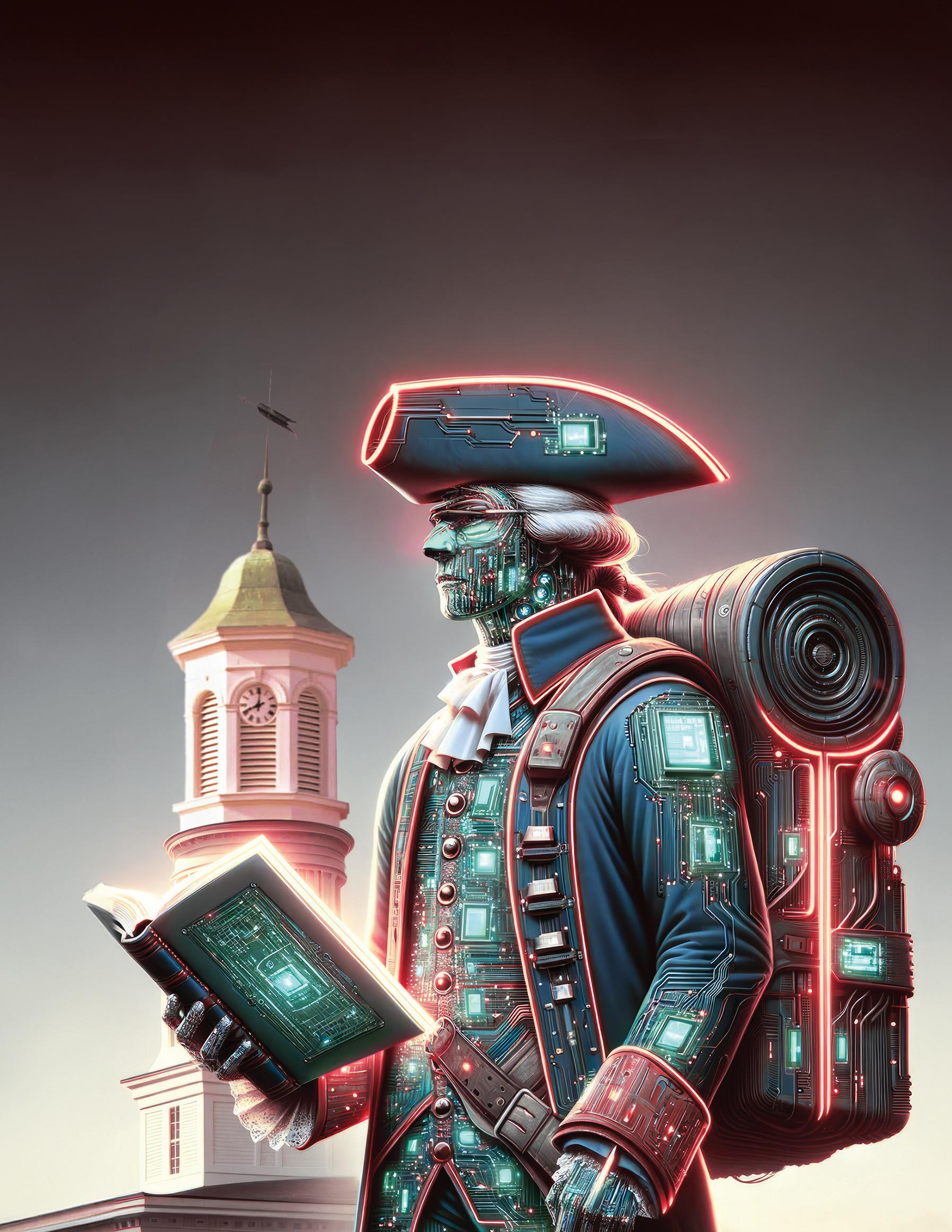
Looking For ward:

SPRING 2 0 2 4 AI-generated image
AI at NA
by
FROM THE EDITORS This issue of LUMEN is also available online. To view the interactive experience, visit:
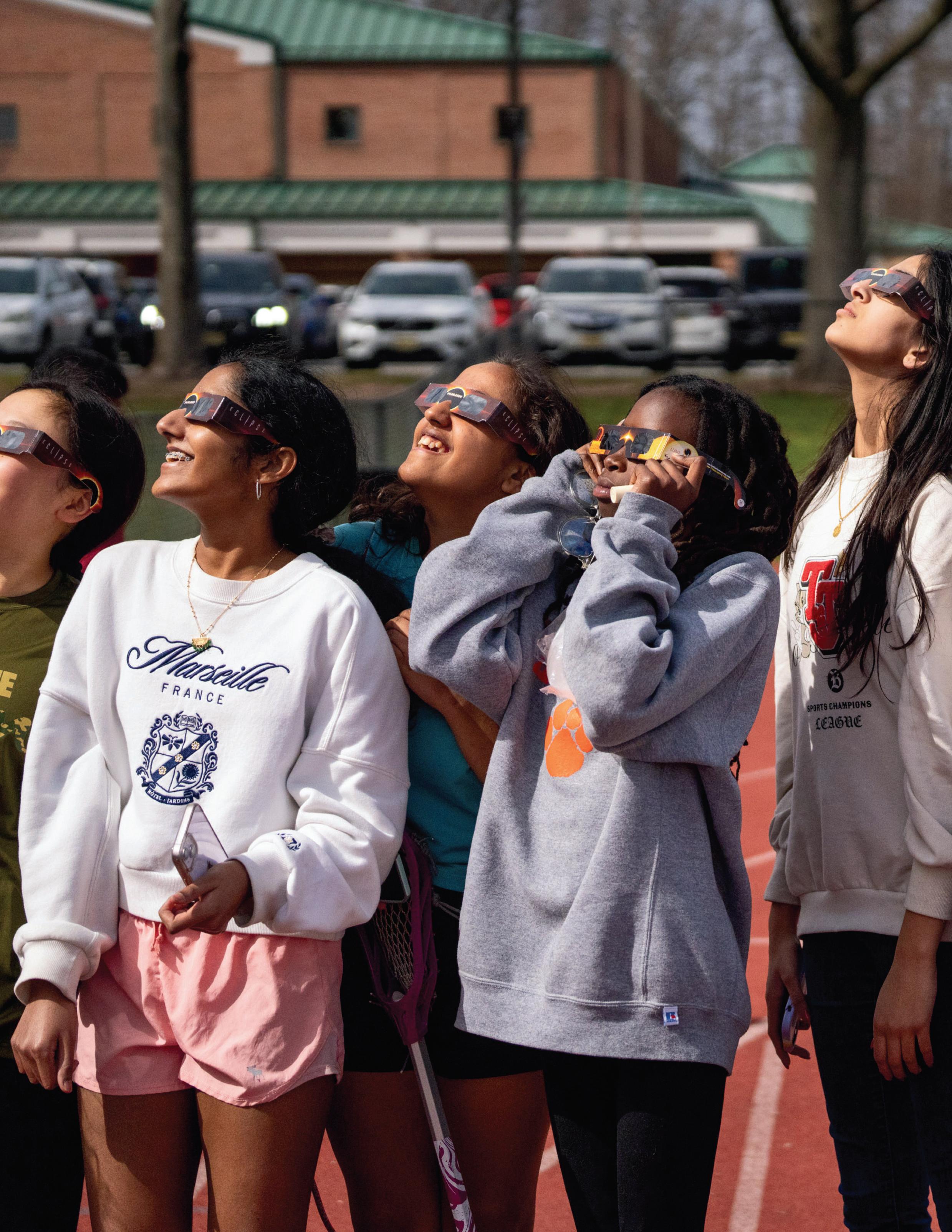
Solar
old
Newark Academy students, faculty
staff joined together for another historic moment — to watch the total solar eclipse
2024!
www.newarka.edu/lumen
Spectacle! As if turning 250 years
wasn’t enough,
and
on April 8,
Photo
James Worrell



CORRECTIONS: Upper School English Teacher
Susan Reid was omitted from the Faculty Focus section of the Fall 2023 issue of LUMEN. Additionally, we incorrectly identified a photo on page 32. The ID of “Lydia Masterson”should have been “Lisa Swanson.” We apologize for these errors.
SPRING 2024 CONTENTS FEATURE 27 Artificial Intelligence: The Technological Revolution at Newark Academy IN THIS ISSUE 4 NA News 10 250th Anniversary 14 NA Arts 17 NA Athletics 21 Community Service 23 Faculty Focus 38 STEM 43 Alumni News 48 Class Notes VISIT NA on the web at www.newarka.edu LIKE NA on Facebook @newarkacademy FOLLOW NA on X @newarkacademy FOLLOW NA on Instagram @newarkacademy FOLLOW NA on LinkedIn @newarkacademy
Photo created by Shutterstock AI
LUMEN SPRING 2024

Donald M. Austin Head of School
Lou Scerra Chief Strategy Officer
EDITORS
Dr. Renée Walker
Director of Communications and Marketing
Julie Kayzerman
Assistant Director of Communications and Marketing
ASSISTANT EDITORS
David Beckman
Evan Nisenson ’99
Lou Scerra
Barbara Sine
DESIGNER
Symmetre Design Group
COVER ART
Dalle-E 3 via Dan Gold
BOARD OF TRUSTEES
Executive Committee
Samuel W. Croll III ’68
Chairman
Lawrence G. Cetrulo ’67
Secretary
Marika Alzadon ’89
Donald M. Austin
John H. Bess ’69
Patricia Budziak
Lauren Hedvat ’01
Wayne D. Kent ’85
Robert Marcus
Trustees
Rohit Bawa ’93
Debra Caplan
David Castelblanco
David Crall
Dr. Ajay Dhankhar
Lorraine Dias-Sotiriou
Robert Fink
Karen Guy-Smith
Millwood Hobbs, Jr.
Rebecca Moll-Freed ’94
Basel Kayyali
Andrew Kogan ’90
Lisa Powers
Michael Rockoff ’87
Rasheea S. Williams Hall ’95
Dr. Kalenah Witcher ’87
Elizabeth Christou Woodall
Emeriti
Louis V. Aronson II ’41
William Bloom
Paul Busse ’38*
Robert Del Tufo ’51*
William D. Green ’69
David Hardin ’73
William D. Hardin ’44*
Nancy Baird Harwood ’75
Kim S. Hirsh ’80
Jeffrey Kaplan
K. Kelly Marx ’51
Joseph P. McGrath ’81
David D. McGraw ’77
John L. McGraw ’49*
Jonathan D. Olesky ’74
Ellen Polaner
Robert S. Puder ’38*
Gary Rose
Julianne Rose
Robert H. Silver
William T. Wachenfeld ’44
Jane Wilf
*Deceased
Newark Academy
Office of Communications and Marketing
91 South Orange Avenue, Livingston, NJ 07039
Telephone: (973) 992-7000
Email: communications@newarka.edu www.newarka.edu
LUMEN is produced twice a year by
FROM DONALD M. AUSTIN, HEAD OF SCHOOL

Our Path Forward
What does the future hold for 250-year-old Newark Academy?
While much of this anniversary year has been a celebration of our rich history, this milestone also invites us to consider the changing needs of our students as we chart our path forward. The provocative cover image depicting a futuristic Minuteman may at first feel jarring, but the truth is that AI is already changing much about how we process information, generate texts and images, and learn. These disruptive shifts create opportunities for innovations in the classroom, some of which are presented here. At the same time, they raise questions about which “traditional” skills may no longer need to be learned in the same way.
Defining and effectively teaching essential skills will require striking the right balance between traditional approaches and those that can be enhanced by artificial intelligence.
The profiles in these pages show our graduates working at the cutting edge of new technologies, teachers harnessing AI in their classes, and students experimenting in the sandbox with ChatGPT
2 LUMEN I SPRING 2024
the Newark Academy Office of
and Marketing.
Communications
Can You Find the Red-Winged Blackbird?

and other tools. The capacity to adapt is one of the keys to Newark Academy’s longevity, and we are once again at an inflection point where schools that do so effectively will provide superior education for their students.
I invite you to read tributes to Von Rollenhagen, who is retiring after 40 years of distinguished service to Newark Academy. Von began as a popular teacher and coach, and in his two decades as Dean of Faculty hired many of the excellent teachers on our faculty today. Through his advocacy for teachers, he elevated standards and supported faculty professional development. A wonderful role model and mentor for students and teachers alike, Von embodies the best of Newark Academy.
Wishing you all the best for the summer season.
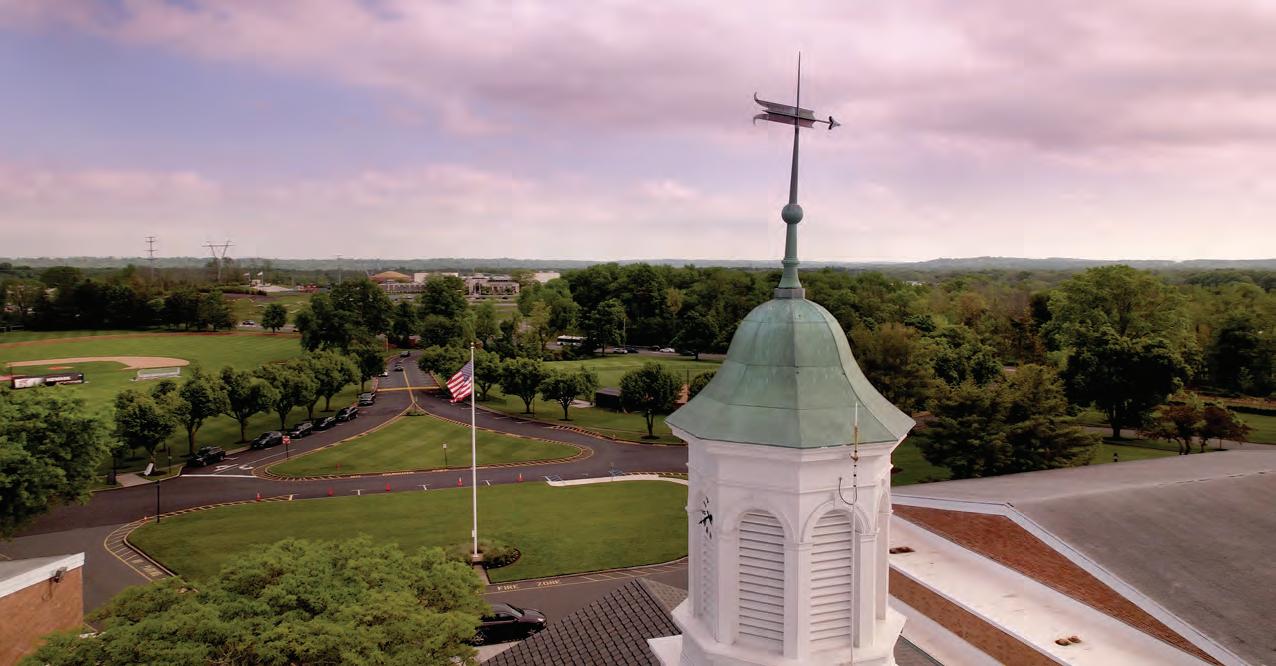
For many years, the annual return of the red-winged blackbird to the Newark Academy campus was announced by former Assistant Head for Academic Affairs, Dean of Faculty and Archivist Blackwood “Blackie” Parlin during Morning Meeting, heralding the arrival of spring. While Blackie retired in 2017, this beloved tradition continues and remains one of many unique traditions beloved by generations of NA students.
In each issue of LUMEN, there is a hidden red-winged blackbird (see above) located somewhere in the pages of the magazine. Can you find it?
Once you spot it, email us at communications@newarka.edu by June 30, 2024, with its location to be entered for a chance to win NA SWAG!
3 NEWARK ACADEMY
Red-winged blackbird illustration by Tess Kesler ’22.

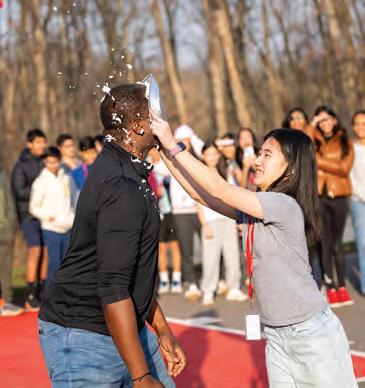
Pi Day!
On Pi Day (March 14, i.e., 3.14), NA Middle Schoolers got to pie their math teachers in the face!

Creative Cuisine
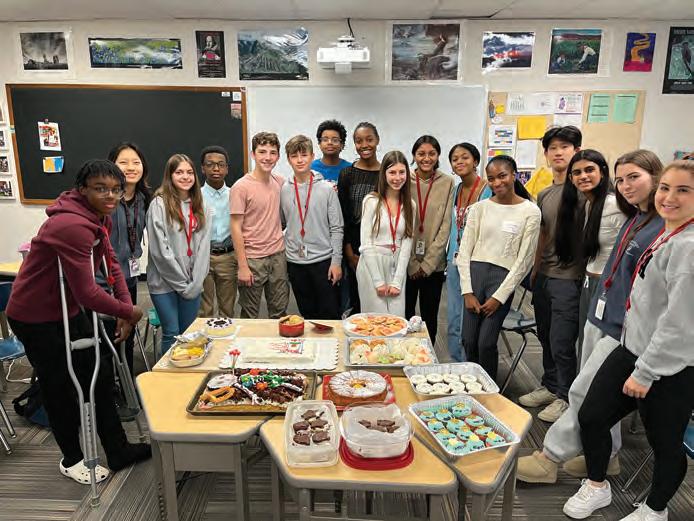
Inspired by food motifs, students in Ms. Mahoney’s ninth grade Literature and Composition class cooked, baked and decorated food items that related to the texts they read during the fall semester.
#CreativeCuisine
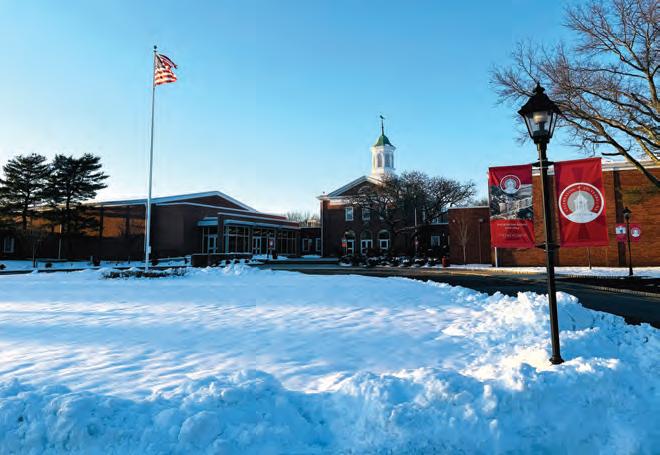
Snow Day
Winter wonderland on campus!
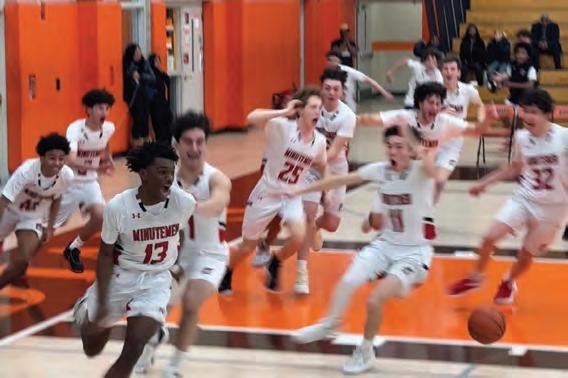
Buzzer Beater
Down by 2 with 2 seconds left on the clock … BUZZER BEATER from Jaden Simon ’25!
#NAallday

4 NA NEWS I SOCIAL MEDIA HIGHLIGHTS
Follow Us to Stay Updated on All Things NA Instagram: @NewarkAcademy Facebook: @NewarkAcademy X: @NewarkAcademy LinkedIn: @NewarkAcademy
Photo by Brian Stephenson
NA Sophomores Win CONGRESSIONAL APP CHALLENGE
By William Corprew ’20
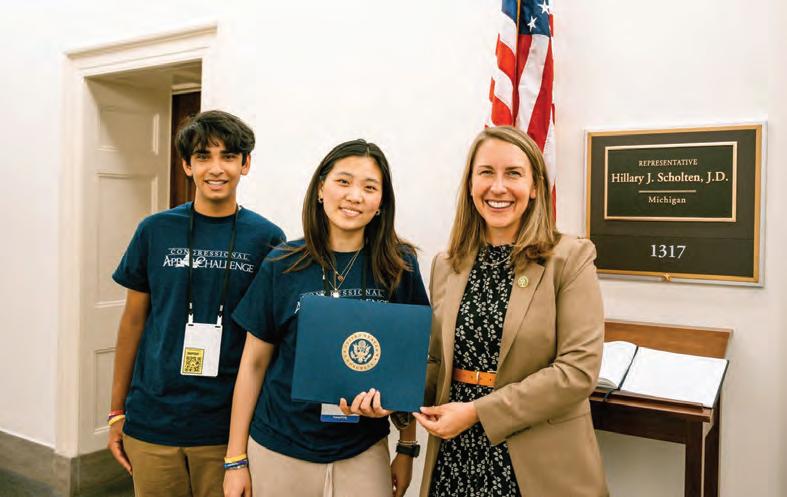
Newark Academy sophomores Alexis Zhang ’26 and Aadit Shrivastava ’26 were named winners of the 2023 Congressional App Challenge, in which high school students compete to make the best application in their congressional district.
mental health and taking mindful steps daily,” says Alexis. “Overall, the website is a valuable tool for anyone looking to enhance their mental wellbeing through self-reflection and positive habit-building.”
The duo was inspired by their personal experiences to create an easy, healthy and effective tool for self-care.

“During this process, we had many candid conversations about our shared frustration with stress-inducing methods of self-care that often make it harder to improve mental health,” Aadit says. “We noticed that many existing platforms and approaches were overly complex, demanding or overwhelming. Our goal was to create a platform that takes the burden out of self-care and, instead, makes it an enjoyable and effective journey toward better mental well-being.”
Alexis and Aadit took the top prize in the third congressional district in Michigan with their app TranquilTally, which seeks to improve teens’ mental health through guided journal prompts and mood-tracking.
The team competed in the Michigan district because Alexis resided there during the summer, when most of the app development took place.
“TranquilTally offers a simple and stress-free approach to improving
Our goal was to create a platform that takes the burden out of self-care and, instead, makes it an enjoyable and effective journey toward better mental well-being.”
With the help of NA Computer Science Teacher Andrew Alford, Alexis and Aadit worked together to make TranquilTally a reality. It took a few months to develop the framework for an innovative yet feasible idea, but once their plan was in place, they dove into coding the user interface and database backend with systems such as HTML, CSS, JavaScript, PHP and MySQL.
In April, Alexis and Aadit traveled to Washington, D.C., to demo TranquilTally for members of the House of Representatives at the U.S. Capitol Building during the #HouseofCode, a STEM expo event for the competition winners.
5 NEWARK ACADEMY NA NEWS
– Aadit Shrivastava, ’26
Aadit Shrivastava ’26 and Alexis Zhang ’26 present their app TranquilTally to Congresswoman Hillary J. Scholten.
Strategic Plan 2023 — 2027: PUTTING PEOPLE FIRST A Plan for the Future of Newark Academy
Newark Academy’s Board of Trustees launched the 2023-2027 strategic plan, Putting People First, based on the feedback of over 150 community members. The plan builds on the institution’s many strengths, while offering an aspirational and inspirational roadmap for the future. Please find a top-level summary of the plan below:
1 GOAL

Support
Renew our commitment to providing all faculty and staff with the resources and support to grow, succeed and thrive throughout their careers
Synthesize, coordinate, expand and communicate institutional efforts around innovative, skills-based teaching and learning, cementing Newark Academy as a leader among independent schools
Recommit to efforts to ensure that Newark Academy’s administration, faculty and staff reflect the diversity of our student body through an evaluation and revision of institutional hiring and retention practices

Faculty & Staff – Our Greatest Asset 2

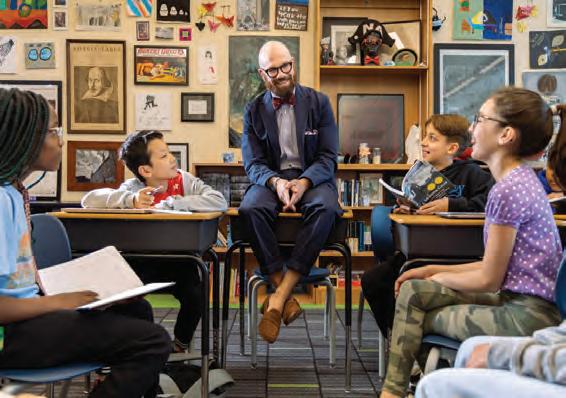
Prioritize an Excellent Student Experience

Evaluate and “refresh” student life to improve its design and implementation, ensuring that the holistic experience is joyful, healthy, equitable, inclusive and meaningful
Renew commitment to excellence beyond the classroom
NA NEWS
GOAL
6 LUMEN I SPRING 2024

3
GOAL Promote Authentic & Meaningful Community Engagement
Establish deep, lifelong connections with Newark Academy alumni
Cultivate our historical connection with the city of Newark
Continue to identify ways to engage parents and promote their understanding of the school’s mission, programs and approach

4

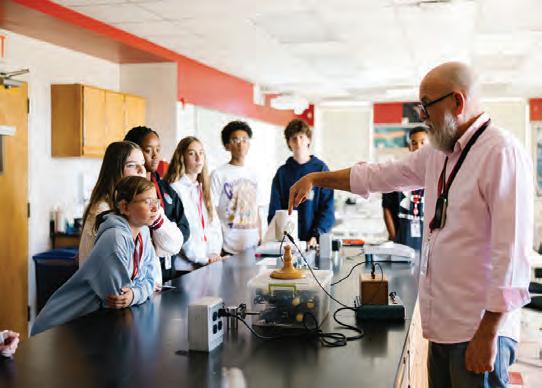
GOAL Commit to Impactful Spaces & Sustainable Practices


Create and institute a “top-down, bottom-up” institution- wide sustainability plan
Create an updated Campus Master Plan to ensure a clear timeline and appropriate allocation of resources to address facility needs in service of the student experience and the needs of faculty and staff
Formulate a plan to ensure the long-term financial sustainability of the institution
STRATEGIC PLANNING COMMITTEE OF THE BOARD OF TRUSTEES
Patricia Budziak, Chair
Donald M. Austin
Tom Ashburn
Catherine Atwell
John H. Bess ’69
David Castelblanco
David Crall
Samuel W. Croll III ’68
Ajay Dhankhar
Basel Kayyali
Traci Osterhagen Brock
Lou Scerra
Jeff Vinikoor
Kalenah Wichter ’87
Scan the QR code to read the full strategic plan
7 NEWARK ACADEMY
Newark Academy’s Board Highlighted in Independent School Magazine
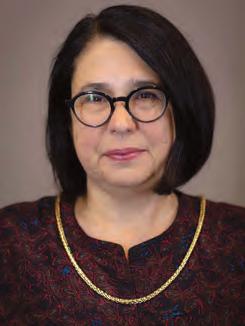
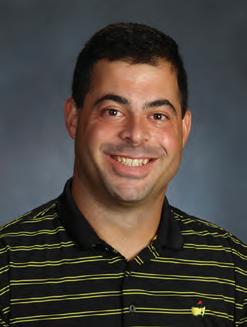
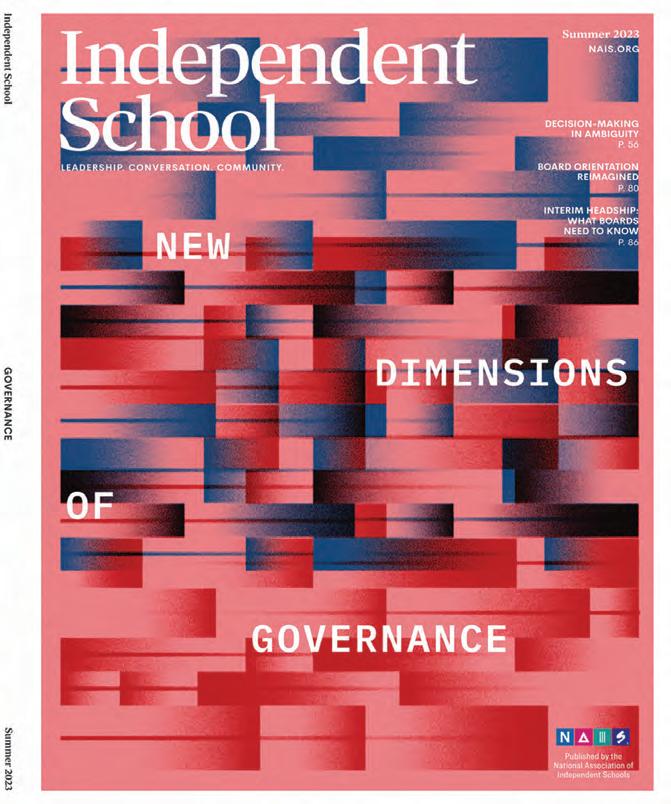
Newark Academy Trustee Pat Budziak and Chief Strategy Officer Lou Scerra co-wrote an article, “Boards of Trustees Need to Develop New Skills to Be Agile and Effective,” that was published in the Summer 2023 issue of Independent School Magazine.
The article details the ways in which boards of trustees at independent schools need a new set of tools, processes, and approaches to become nimbler, more data-driven, and more effective. Based on their work with Newark Academy’s high-functioning Board, Pat and Lou suggest a range of ways in which boards can accomplish this, including a newfound focus on skills, reimagined meeting structures, retreats designed to foster deeper connections and the intentional creation of linkages between the Board’s strategic oversight and day-to-day operations.
“The opportunity to take the experience of my many years of serving on the NA Board of Trustees (BOT) and think about the evolving nature of board service and the role of trustees while writing this article with Lou was both enjoyable and enlightening,” Pat says. “It’s very satisfying personally and as a trustee to document how the BOT continues to grow, evolve and respond to the changing needs of the NA community.”
The Independent School article is the latest collabora tion for Pat and Lou, who serve together on the Board’s Access and Affordability and Strategic Planning Committees, co-leading the construction of Newark Academy’s most recent strategic plan, “Putting People First.”
“Newark Academy’s Board of Trustees models a passion for learning in its willingness to evaluate its processes and approach,” Lou says. “I really enjoyed the chance to capture how the Board has evolved to meet the emerging challenges of independent school governance. And, of course, it’s always a pleasure to partner with Pat.”

LUMEN I SPRING 2024 8 NA NEWS
Lou Scerra
Pat Budziak
As appeared in the summer 2023 issue of Independent School
Boards of Trustees Need to Develop New Skills to Be Agile and Effective
Two independent school board members, a head of school, and a senior administrator meet in a virtual workspace to review saliva-testing proposals. A decade ago, that sentence would have read like the start of a bad joke at an NAIS conference or a never-to-be-published piece of science fiction. But, for countless independent school board members, leaders, and administrators, it was their lived experience starting in the spring of 2020.
Just as faculty members adapted to create and work in hybrid classrooms during the COVID-19 pandemic, boards of trustees pivoted from their regular forward-thinking strategic work and fiduciary responsibilities to meet the changing daily needs of their schools. And while the pandemic amplified the need for boards to shift, adapt, and respond quickly, the work of independent school boards and the environment in which they operate have been evolving for years. Strategic concerns have become broader and more nuanced over the past decade. Trustees have had to develop an even deeper understanding of topics such as diversity, equity, inclusion, and belonging (DEIB); access and affordability; and campus safety. “The principles of good governance haven’t changed, but the landscape is more complex,” says Donald M. Austin, head of school at Newark Academy (NJ). “Trustees must be conversant in a wider set of topics than they ever have before.”
At Newark Academy, we’ve been reflecting on trends in governance and rethinking our operations and processes with a focus on how our board can continue to adapt to an ever-changing world and how to assess our work now and into the future.”
Amid a mental health crisis across the country, how should boards help school leadership promote wellness among students and employees? Given a growing disparity between socioeconomic strata in society, how should boards ensure independent schools remain affordable and accessible to a wide range of families? As new technologies transform teaching and learning, how should boards redefine their value proposition as school leadership adapts?
As independent schools become more complicated organizations, boards of trustees need a new set of tools, processes, and approaches to become nimbler, more data-driven, and more effective. At Newark Academy, we’ve been reflecting on trends in governance and rethinking our operations and processes with a focus on how our board can continue to adapt to an ever-changing world and how to assess our work now and into the future.
Scan the QR code to read the full article
9 NEWARK ACADEMY

250 TH ANNIVERSARY
OF NEWARK ACADEMY
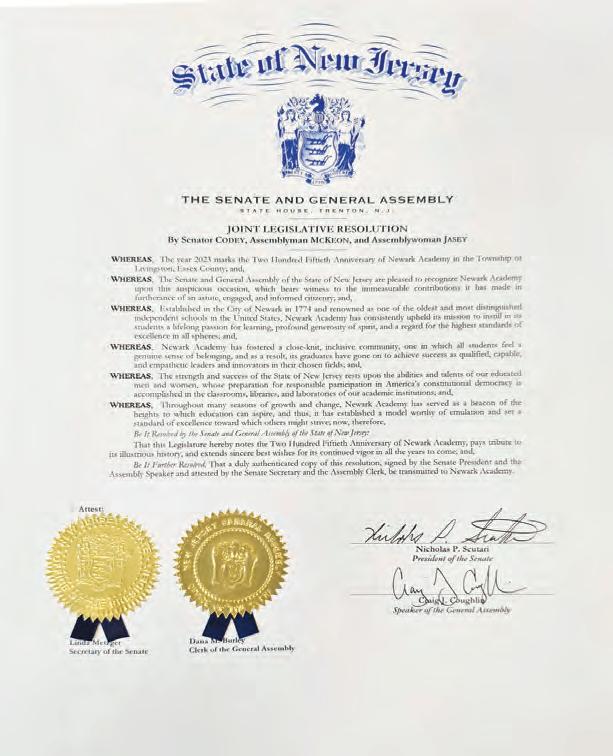
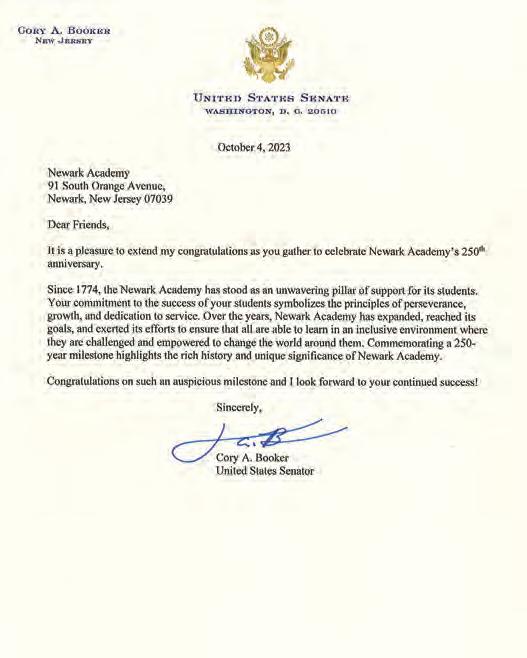
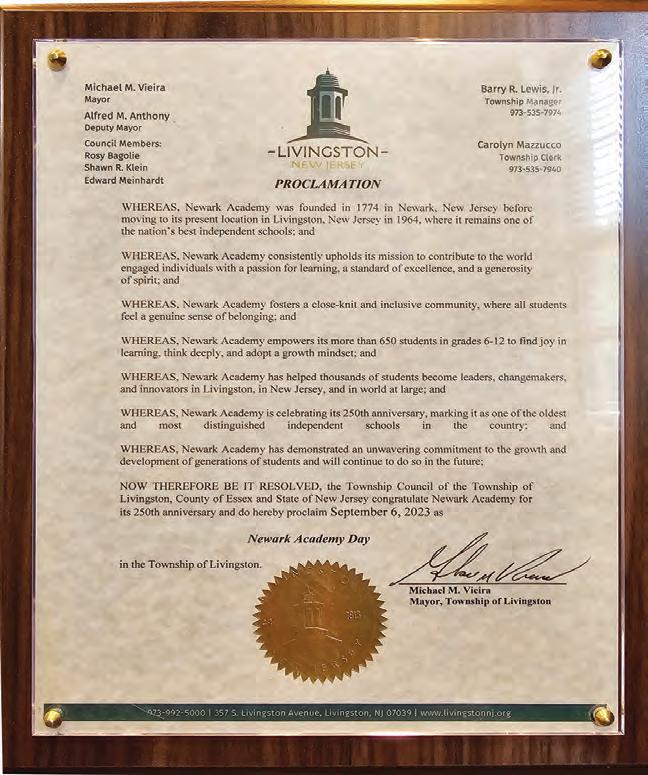
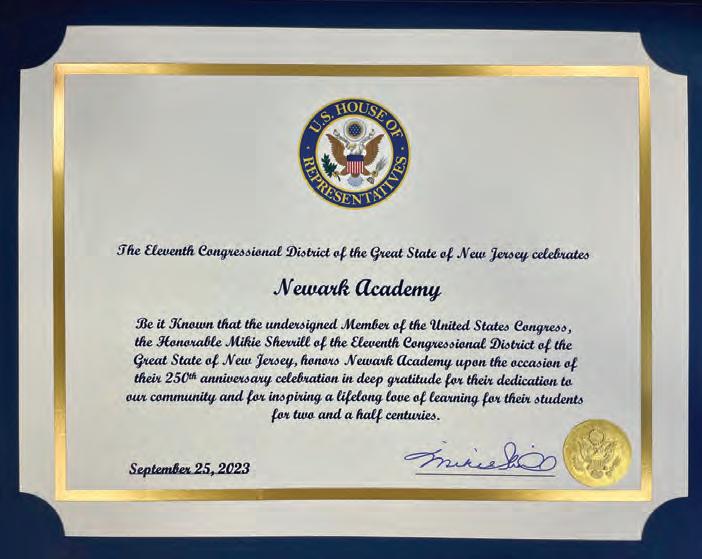
Founded in 1774, Newark Academy — now 250 years old — is one of the oldest private high schools in the country. Several elected officials, including United States Senator Cory Booker and Congresswoman Mikie Sherrill, congratulated NA for reaching this milestone achievement.


10 LUMEN I SPRING 2024
INSIDE THE NA ARCHIVES with Seniors Damian and Sebastian
By Jim Coe, Newark Academy Archivist
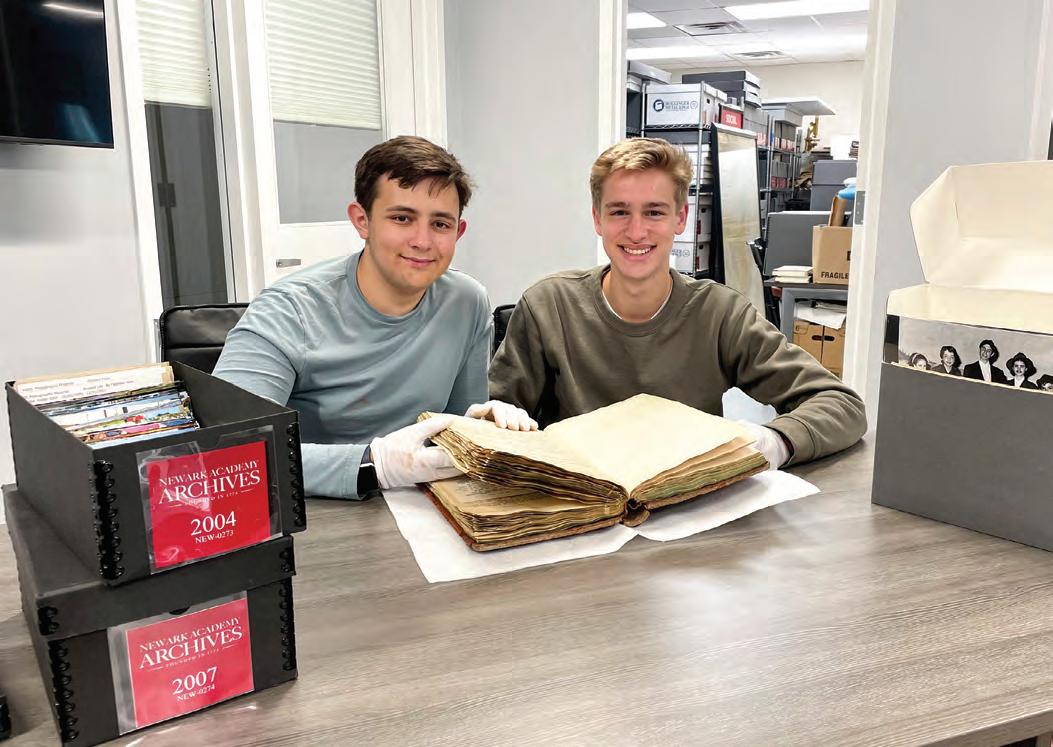
As Newark Academy prepared for its 250th anniversary, Damian Correa ’24 and Evan “Sebastian” Dias-Sotiriou ’24 found their interest piqued. The duo saw an opportunity to indulge in their passion for history by examining the archives of the school they have called home since sixth grade. Though they initially embarked upon their research without a specific final product in mind, they felt that whatever they found in the archives could serve as a foundation for their Creativity, Activity, Service (CAS) project, a core component of the International Baccalaureate (IB) diploma they are both pursuing.
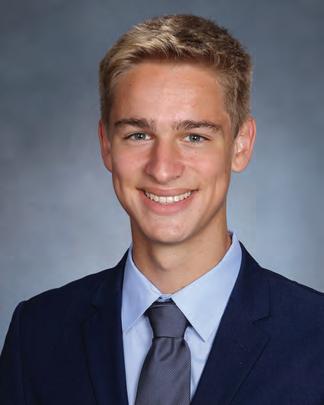
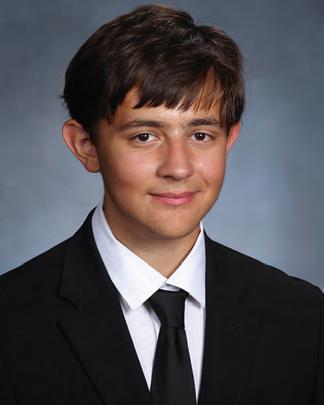
Damian and Sebastian batted around a number of possible topics and final products: a presentation to the school on the importance of former Head of School Samuel Farrand, a paper about NA during the Great Depression, or even a podcast about the Academy’s last 50 years. The final idea arose after the seniors interviewed NA luminaries like former Assistant Head for Academic Affairs, Dean of Faculty and Archivist Blackwood “Blackie” Parlin and
members of the still closeknit Class of 1969.
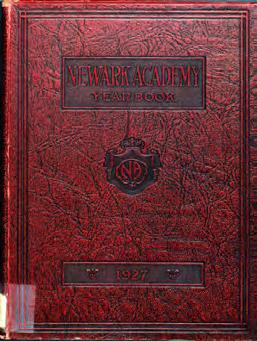
Damian and Sebastian left the interviews with a renewed interest in the more recent history of the school — a history both students felt was underrepresented in Suzanne A Widening Sphere of Usefulness: Newark Academy 1774-1993. With the school’s sestercentennial on the horizon, the friends found the proper motivation to
create “Newark Academy and Social Change: 1950-2024,” a written account of the last 50 years of the school’s history.
I sat down with these two studenthistorians to learn more about their time spent diving into the NA archives.
Jim Coe (JC): Do you have a favorite fun fact that you uncovered while looking through the archives?
Damian Correa (DC): There was a kid who was a teacher.
Sebastian Dias-Sotiriou (SDS): Damian is referring to Philip Whelpley, who was the son of the Headmaster Samuel Whelpley, and was a teacher at Newark Academy before his 15th birthday!
DC: That was amazing to uncover because at the time we were literally a year older than someone who would have been teaching at Newark Academy.
JC: Wow. Any other fun facts stick with you?

The other one I love and I know that Sebastian loves as well is the “golf ball test” that used to take place. If you could drop a golf ball down your trouser leg and it went all the way through, you would have to go and change your pants.



There’s another really good one, which is that when Newark Academy first moved to its current campus in Livingston, the land was actually a farm, and NA had spent all its endowment in the move. With that, the school didn’t actually have enough money to pay the seeders to put down grass. So, in an innovative deal, the seeding company agreed that if NA removed all of the debris off the
11 NEWARK ACADEMY NA NEWS I 250 TH ANNIVERSARY
Damian Correa ’24
Sebastian Dias-Sotiriou ’24
campus itself, they would put down all of the grass. NA community members spent two or three school days just removing rocks from the entire campus. Apparently, Mr. Parlin lost a shoe during the ordeal because he was using it to fill everything up with dirt. Then, former Head of School Dr. Allan Strand gifted Mr. Parlin with a shoe during his 25th year at NA.
JC: How funny! So what were the biggest challenges you faced working with archives?
SDS: I’d say reading old handwriting is a lot more challenging than you’d think.
So we were trying to figure out how to read cursive in the moment — and it wasn’t just cursive like nowadays’ cursive — it was old cursive.
DC: Oh yeah, the penmanship was very difficult to read. We went down to the New Jersey Historical Society and started reading through these large documents and then realized, we can’t read the first 200 pages.


SDS: And the funniest part for me was that the 1700s cursive was a lot easier to read than the 1800s. In the 1700s, there was clear penmanship and you could figure it out, but in the 1800s, it looks like someone just drew a line across. It’s very hard to read.
JC: I guess you’re wellversed in cursive now! Are there any lasting lessons that you’ll take away from your last year and a half spent on this work?
I would say, when you read about these people’s lives and you go through their entire life in two and a half hours, it puts some perspective on your own life and the impact that you make. People like
Mr. Parlin have left a lasting legacy that you can see. So that’s been a big takeaway for me.
SDS: For me, I had a different takeaway. Damian and I have been at NA since sixth grade and we have always thought of it as this really great place — and I’m not saying that historically it hasn’t been. I’m saying that Newark Academy over the last 20, 30 years is a different place than it was before. I guess it puts into perspective how everything could have changed. Newark Academy, if it did not pick up great leaders like Dr. Strand or even Samuel Farrand, might not exist today. My takeaway, I guess, is how lucky we are to have such a great school, because very minor historical changes could have meant that it would not exist today.
LUMEN I SPRING 2024 12
Seniors Speculate: What Will NA Be Like 250 YEARS FROM NOW?


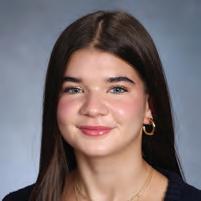
Avery Cohen ’24
“In the next 250 years, I think Newark Academy will have a diverse curriculum and embrace a diverse student body from around the world with varying perspectives. It will also have the latest technology to ensure students are wellequipped for an ever-changing world. And most importantly, Newark Academy will continue to be a fun, academic and unique environment for students to thrive and form everlasting connections with peers and faculty!”

Mehmet Acikel ’24
“In 250 years, NA will welcome a class of amazing, enhanced superhumans. Immersive virtual reality and artificial intelligence (AI) will help students excel to the utmost capacity. Eco-friendly spaces and sustainable practices will allow students to live symbiotically with their environment. The real question is, will there be immersion trips to Mars?!”
Jamie Shen ’24
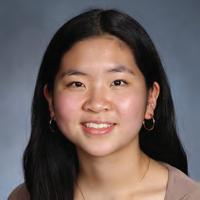
“In the next 250 years, I think that Newark Academy will harness advanced technology to build metamorphic programs and machines as well as continue to focus on global education in order to cultivate nuanced minds needed to lead the world. Despite this, I personally want to see NA maintain the receptiveness we have nurtured thus far, towards change for the better in the next 250 years. Adaptability has always been a strong suit, and I have no doubt that it will persist in the 250 years ahead of us!”
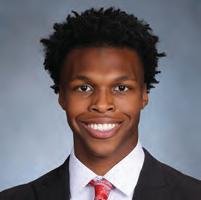
Lavarra Hines ’24
“I think in the next 250 years NA will have flying buses taking kids to school into an environment that has a strong and thriving community, working each day to help better one another in all aspects of life.
13 NEWARK ACADEMY
Acting Students Perform Down Neck in Newark’s NJPAC
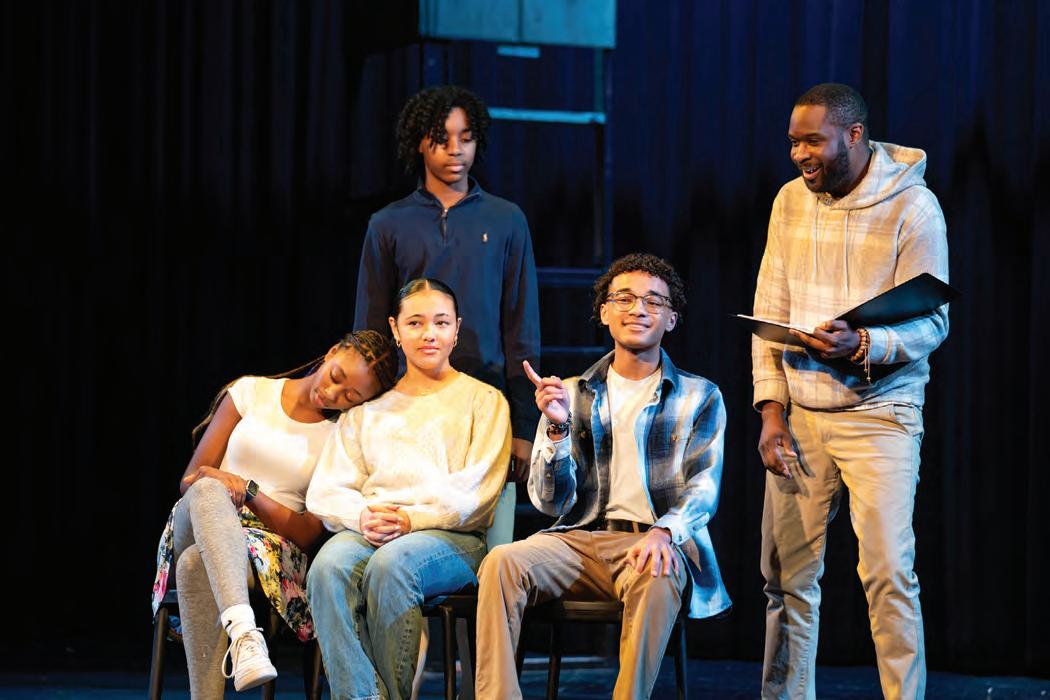
Newark Academy acting students collaborated with Newark-based Yendor Theatre Company on a production of Down Neck, a play about the Ironbound section of Newark. In addition to an on-campus performance, students performed the play at the Horizon Black Box Theater in the NJPAC Center for Arts Education on November 19, 2023.
Intermediate acting students spent several classes workshopping with NA theater alumnus Andrew Binger ’09, the artistic director of Yendor Theatre, in preparation for the performance.
“It’s been such a pleasure for me to work with these young people at NA on Down Neck,” says Andrew. “How beautiful
and full-circle for me to bridge my professional social justice theater-making experience with my alma mater, where I spent so many of my formative years in the theater program.”
The collaboration began as NA’s Director of Theater Arts Rachel Shapiro Cooper looked for ways to teach her students about NA’s origin city of Newark, in honor of the 250th anniversary year. “I wanted to see if we could bring the community together around an artistic experience,” Rachel says.
It just so happened that Yendor Theatre had commissioned writer Pia Wilson to create Down Neck, a play about three families of differing backgrounds navigating Newark’s Ironbound section in the aftermath of the 1967 riots. Rachel connected with Andrew and the partnership was born. Pia even joined in on a workshop with the students to discuss the playwriting process.
“It’s so special that the play Down Neck captures an important moment in the history of Newark, as NA reflects on its 250th anniversary,” Andrew says.
WATCH!
Scan the QR code to go behind-the-scenes of Down Neck
by James Worrell
NA NEWS I ARTS
14 LUMEN I SPRING 2024
Photo
IB Visual Arts Exhibit
The IB Visual Arts Exhibit features a culmination of two years of work by members of Newark Academy’s Class of 2024: Avery Cohen, Chloe Flores, Kaitlin Goguen-Compagnoni, Katherine Guo, Claire Nowak, Saira Rajparia, Vivian Zhang and Sophie Zhou.





to see
15 NEWARK ACADEMY
Scan the QR code
the full exhibit photographed by James Worrell
Artwork by (clockwise from above left): Claire Nowak, Avery Cohen, Katherine Guo, Kaitlin Goguen-Compagnoni and Vivian Zhang.
Middle School Maestro: William Sun ’29
Each year, middle school students around the world sit down for a live piano audition, hoping to advance in the Elite International Music Competition and earn the chance to play at Carnegie Hall.
Among those young classical musicians is Newark Academy Middle School virtuoso William Sun ’29, who has been a first-place winner every year since 2019.
“I really enjoy piano because I love seeing the happy faces of everybody who gets to enjoy my music,” William says.
This year, William earned first place accolades for his impressive performance of the first movement of Mozart’s “Piano Sonata in A minor ” He also took a first-place nod in the Sempre Musick International Piano Competition last spring.
HERE @ NA
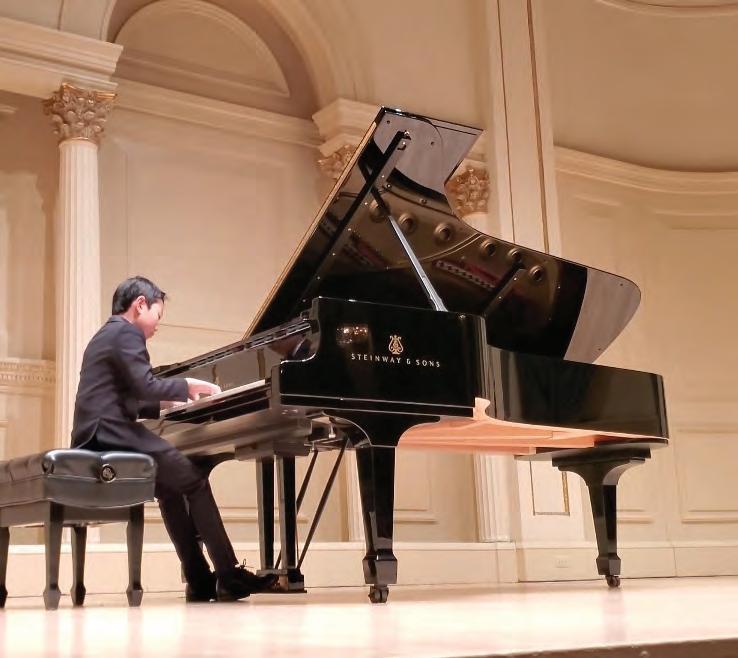
In addition to his background in classical music, William has begun dabbling in jazz and now aspires to play with NA’s Big Band and Chameleon in the future.
“It’s a special privilege to be able to perform at Newark Academy because it’s such a great community and everybody is really supportive here,” William says.
Chameleon is a Top 15 High School Jazz Band in the Nation
Newark Academy’s jazz band, Chameleon, was chosen as one of just 15 finalists throughout the United States to perform at the Essentially Ellington (EE) High School Jazz Band Competition & Festival at the Jazz at Lincoln Center. This is the seventh time in program history Chameleon has been
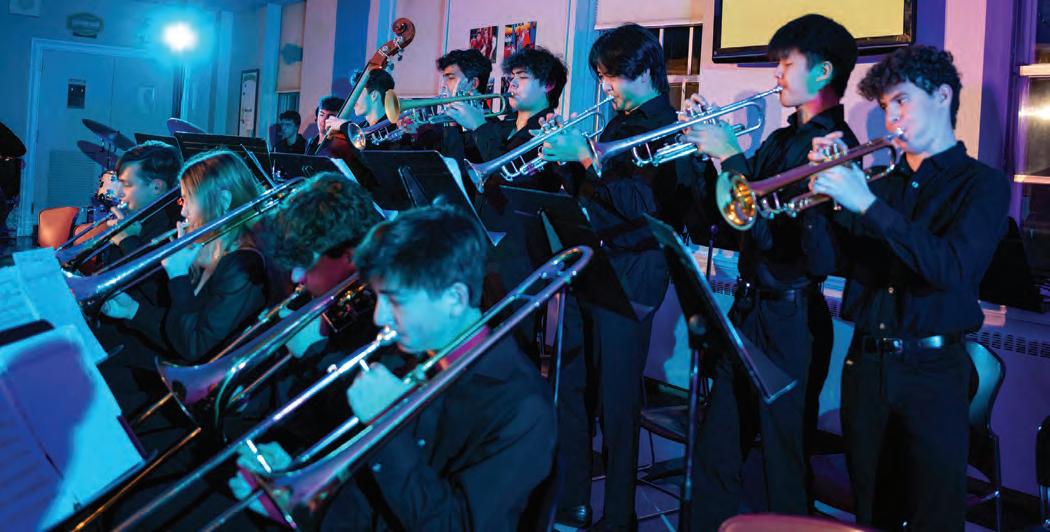
named an EE finalist, under the leadership of Director of Bands Julius Tolentino. Earlier this year, the jazz band took first at the Mid Atlantic Jazz Festival as well as its 13th-consecutive first place victory at the NJAJE State Championship. WATCH! Scan the QR code to see Chameleon featured on News 12
NA NEWS I ARTS LISTEN! Scan the QR code to hear William play
16 LUMEN I SPRING 2024
Division I
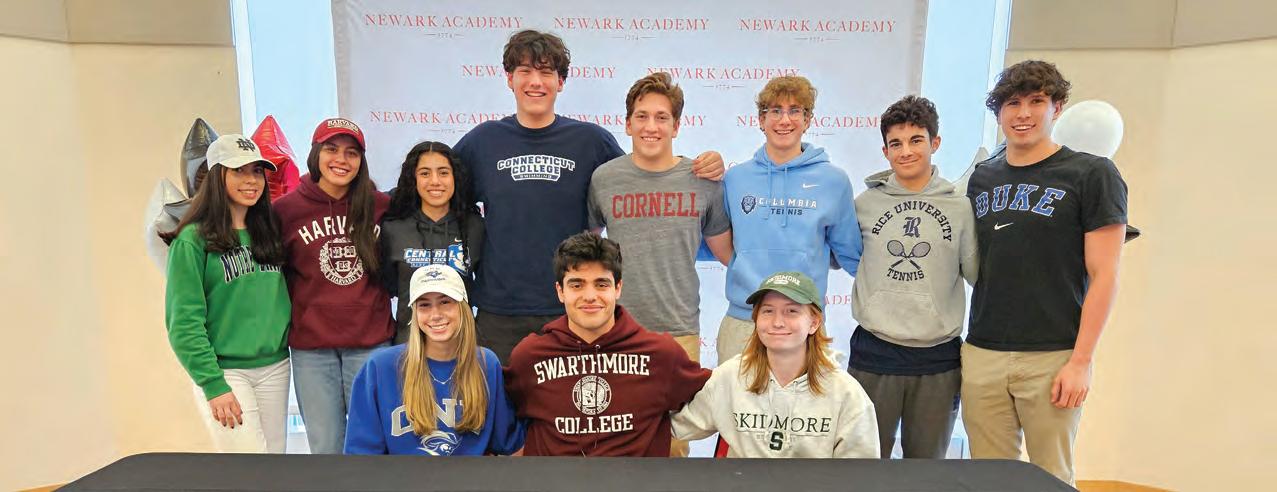
16 Newark Academy Seniors Commit to Collegiate Athletics BOUND
G. Owen Markowitz Duke University Swimming
Sixteen members of the Class of 2024 committed to playing their respective sports at the collegiate level next year. Minutemen Athletics honored these achievements during signing day ceremonies with friends, family, teachers and coaches in February and May.
“I am thrilled that we have so many student-athletes committing to participate in collegiate athletics,” says NA Director of Athletics Seth Lieberman.
“It is a testament to the hard work that the student-athletes, their coaches and families have put in. We’re proud to be a school where you can achieve both academic and athletic excellence.”
A. Victoria Pevzner University of Notre Dame Fencing
B. Jenna Shoman Harvard University Fencing
C. Dagny Slomack Central Connecticut State University Basketball
D. TJ Betlow
Cornell University Golf
E. Andrew Kotzen
Columbia University Tennis
F. Joshua Mandelbaum
Rice University Tennis
Lavarra Hines Jr.* College of the Holy Cross Track and Field
Division III
H. Jasper SchniedersSmith Connecticut College Swimming
I. Katerina Dakos
Christopher Newport University Basketball
J. Luka Opacic Rodrigues Swarthmore College Cross Country and Track and Field
K. Shayne Cleeve Skidmore College Softball
Olivia Croshaw* Dickinson College Field Hockey
Reina Hassell*
Amherst College Volleyball
Neil Pandey*
Johns Hopkins University Fencing
Ishaan Solanki*
Case Western Reserve University
Track and Field
* Not pictured
NA NEWS I ATHLETICS
A B C H D E
F G I J K
17 NEWARK ACADEMY
During a signing day ceremony held in February, Newark Academy celebrates student-athletes committing to play sports at the collegiate level.
1,000-POINT CLUB: Girls’ Basketball Stars Hit Milestone
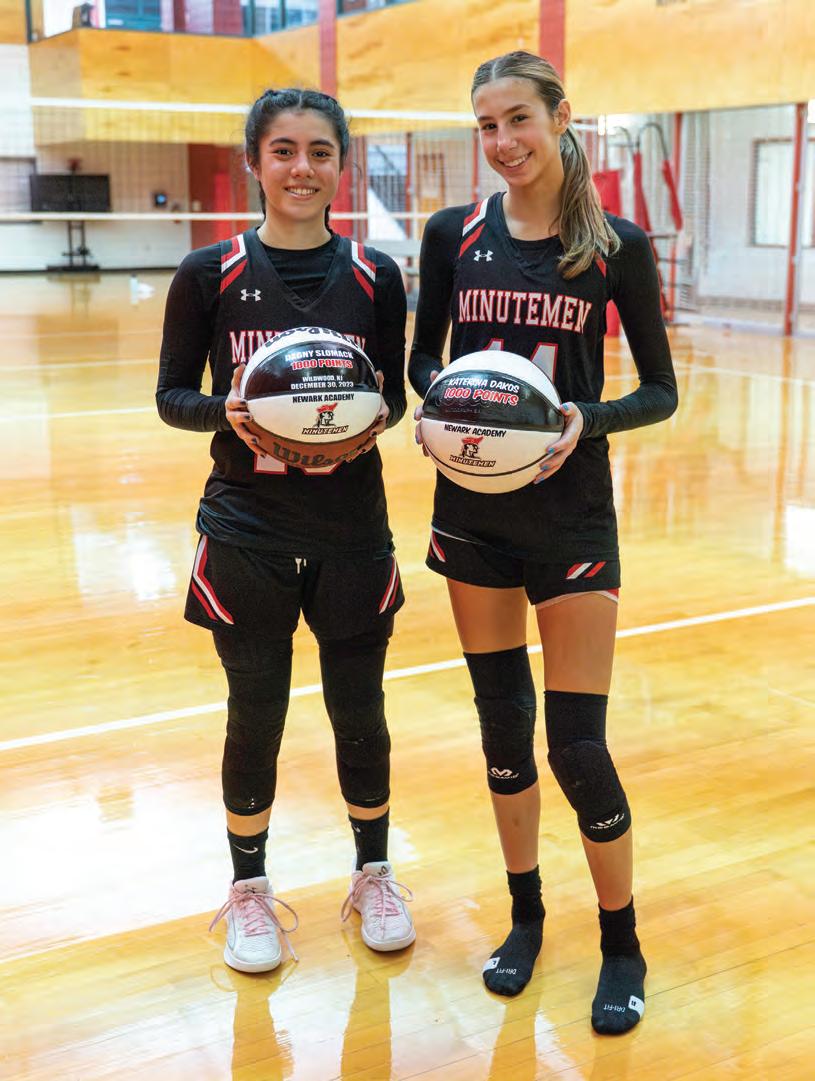
Newark Academy girls’ varsity basketball captains Dagny Slomack ’24 and Katerina “Kat” Dakos ’24 each netted their 1,000th career points during the 2023- 24 season, becoming the fourth and fifth players in program history to reach this milestone, respectively.
The NA team played only four games during Dagny and Kat’s freshman season due to the COVID-19 pandemic, making their 1,000-point feats even more impressive.
“Kat and Dagny have been playing together here at Newark Academy for six years (since they were both in seventh grade), and it shows,” says Head Coach Liz Bona. “They have really learned to complement each other on the court and play off each other’s strengths. They have made an irreplaceable mark on this program.”
Dagny and Kat join the 1,000-point club alongside current WNBA player Jocelyn Willoughby ’16 (1,707 career points), Sam Keller ’19 (1,029 career points) and Ivy Bethea ’19 (1,022 career points).
“This means a lot to me and I am really excited because it has been a personal goal of mine to surpass this milestone since my freshman year,” Dagny says. “I am really honored to be a part of NA girls’ basketball history.”
After graduating from NA in June, the two teammates will continue their basketball careers in college. Dagny has committed to NCAA Division I Central Connecticut State University and Kat will join the squad at Division III Christopher Newport University.
“I am very glad that this is not the end of my basketball career and I look forward to continuing at the collegiate level next year,” says Kat.
Dagny and Kat helped lead the Minutemen to the program’s first semifinal Essex County Tournament appearance this season, as well as back-to-back Prep B Championship titles during the 2022-23 and 2023-24 seasons. Dagny closed out her NA basketball career with 1,448 points and Kat finished with 1,195.

1,0 0 0
NA NEWS I ATHLETICS
18
Photo by Jason Slomack
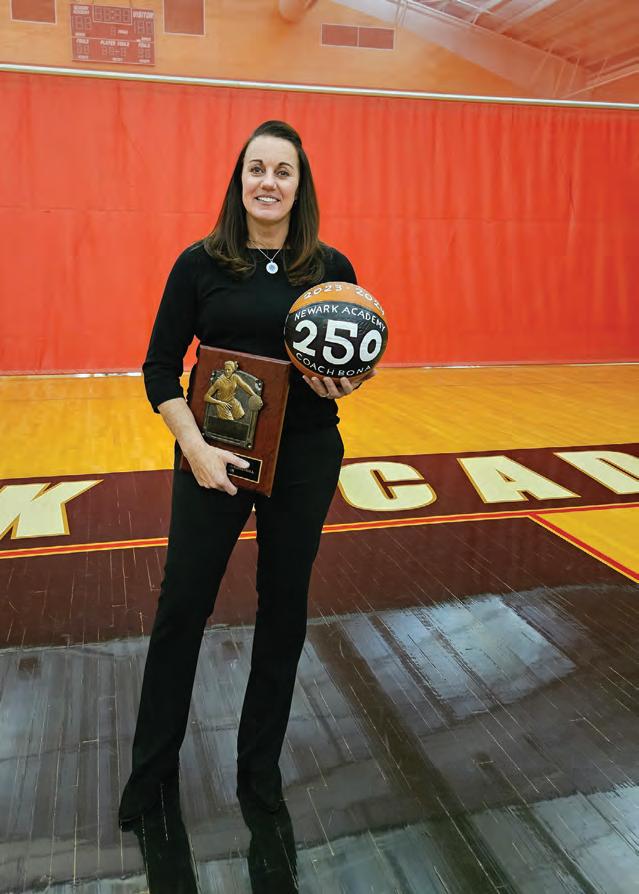
250 Wins in NA’s 250th Year!
Newark Academy girls’ varsity basketball Head Coach
Liz Bona earned her 250th career win with the Minutemen’s 48-26 season-opening victory over Columbia on December 14, 2023.
Liz took over the program in 2006 and has guided the Minutemen to four Prep B Tournament championship titles and multiple sectional final appearances. She also coached All-American Jocelyn Willoughby ’16, who under Liz’s tutelage was named the Gatorade New Jersey Player of the Year and now plays in the WNBA.

19 NEWARK ACADEMY Atlantic Sports Health Of昀cial Sports Medicine Provider of Newark Academy
atlantichealth.org/sports
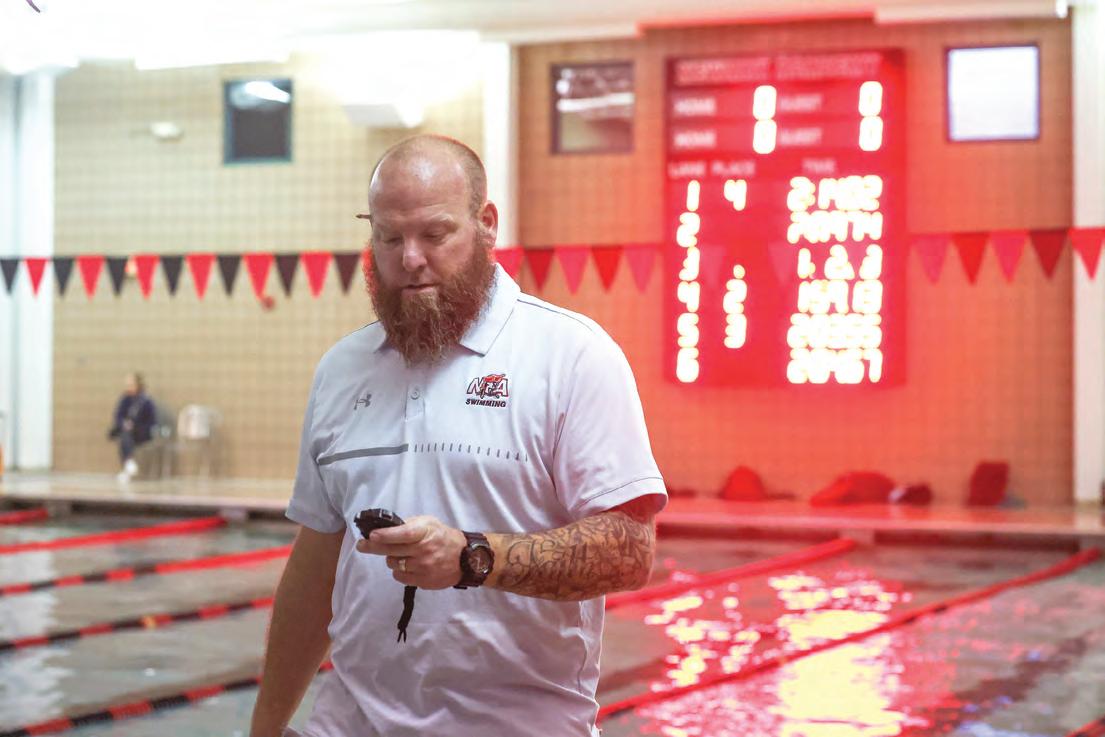
25 YEARS ON DECK
Billy Blomn, Newark Academy’s head varsity swimming coach, recently completed his 25th year at the helm of both the boys’ and girls’ programs. Over the course of his tenure, Billy has led the teams to a combined five prep championships, three state championships, one county championship and one conference championship. Billy was named NJ.com’s Boys’ Coach of the Year in 2021, and during the 2022-23 season he surpassed his 250th career win. Under Billy’s leadership, the swim program, which was previously a single co-ed team, has doubled in size.
Five winter varsity Minutemen Athletics teams took home their respective Prep B Championship titles!
Boys’ basketball (first since 2004)
Girls’ basketball (second-straight)
Girls’ swimming (second-straight)
Boys’ swimming (third-straight)
Boys’ winter track (third-straight)
Middle School Athletic Conference Champions
Middle School fencing
Wrestling individual titles: Cade Slomack ’28, Garrett Selig ’29 and Zuva Chakabva ’28
Follow the Minutemen
Instagram: @NA_Minutemen
X: @NA_Minutemen Facebook: @NAMinutemen
Visit www.naminutemenathletics.com to stay updated on all things Minutemen Athletics as the spring teams enter championship season.
20 LUMEN I SPRING 2024
@ NA
ATHLETICS
TITLES!
Winter Athletics: 5 PREP B
NA NEWS I ATHLETICS
Photo by Vincent Carchietta
Service Partnerships
Strengthen NA Ties to Newark
Newark Academy has a long-standing history of signature community service partnerships with organizations in its origin city of Newark, and the school’s 250th anniversary has brought an enhanced focus on the place NA called home for nearly two centuries. Through these partnerships with Newark organizations, Newark Academy has successfully implemented service-learning in which students partner with the broader community in mutually beneficial ways.
Tutoring Programs
A new tutoring partnership with the House of Miriam in Newark — cleverly dubbed Operation Education — was kickstarted last year by seniors Asher Herman ’24, Jayan Shah ’24 and Anuj Awasthi ’24 as part of their IB Diploma Creativity, Activity, Service (CAS) project. Through this partnership, Newark Academy Upper School students have been able to tutor middle school students at Newark’s Speedway Avenue School and 13th Avenue School.
“We want to make sure that these partnerships are equally beneficial for everyone involved,” says NA Director of Community Service Sarah Fischer. “Not only can we research teaching methodologies through this tutoring partnership, but we can find support and connection with the community in Newark. When students make that connection, they often continue to work with our signature partners long after they graduate from NA.”


I really loved being able to be hands-on in the Newark community and create something that wouldn’t just benefit the Apostles’ House, but the greater area as well.”
Apostles’ House Transitional Housing Center
New this year was NA’s “adoption” of two housing units in the transitional housing center at the Apostles’ House in Newark, which has been one of NA’s signature partners for nearly a decade. NA families furnished the apartments with artwork, furniture, rugs and more in a community-wide effort to source materials that would make the units welcoming for the residents. Over the last two years, NA students have also been enhancing the outdoor spaces at the Apostles’ House through the creation of murals and community gardens.
“I really loved being able to be hands-on in the Newark community and create something that wouldn’t just benefit the Apostles’ House, but the greater area as well,” says Sadie Trynin ’26, who designed the mural alongside Carolina Dias-Sotiriou ’25.
For the last nine years, NA has hosted families from the Apostles’ House for an on-campus holiday party that
(Continued)
21 NEWARK ACADEMY
NA NEWS I COMMUNITY SERVICE
– Sadie Trynin ’26
NA students serve meals to Apostles’ House families at the annual Holiday Party.
NA students create a mural at the Apostles’ House.
includes a family-style meal served by NA students, along with presents and musical performances by student-artists.
The Apostles’ House Holiday Party is a continuation of a now 20-year tradition that previously benefited children in Newark’s Suburban Cultural Education Enrichment Program (SCEEP).
I was beyond excited to be part of such a great cause. As a student, I approached this opportunity by understanding the commitment it requires, but also recognizing that I could be a leader at such an impactful organization.”
– Michael Wyche ’25
Service opportunities are just one way we can help support and publicize [Newark’s community leaders’] work, as well as bring their valuable knowledge and experience to our students.”
– Sarah Fischer, Director of Community Service
Covenant House Homeless Shelter
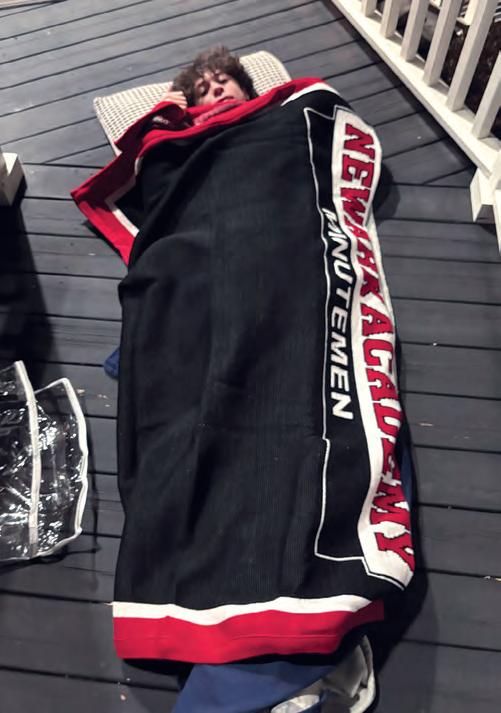
Another one of NA’s signature partnerships is with Covenant House in Newark, which serves homeless youth ages 18-25. NA students participate in a bi-annual “Sleep Out” to raise money for the Covenant House by sleeping outside regardless of the weather. Last year, NA students raised over $30,000 and have surpassed a cumulative total of $100,000 raised since first participating in the Sleep Out in 2014.
Michael Wyche ’25 and Emily Herbert ’26 now serve on the Covenant House Junior Board, which meets quarterly and engages student volunteers to expand the nonprofit’s mission.
“I was beyond excited to be part of such a great cause,” says Michael. “As a student, I approached this opportunity by understanding the commitment it requires, but also recognizing that I could be a leader at such an impactful organization.”
Yet as NA students seek new ways to serve communities in the school’s origin city of Newark, community service offerings continue to ensure that these partnerships are mutually beneficial.
“It’s important that our students don’t fall into a single story of Newark’s urban environment,” Sarah says. “Newark has resources and opportunities, as well as issues and challenges, just like every other city. When we talk about things like sustainability and environmental justice, Newark’s community leaders are at the forefront of facing these issues and developing solutions. Service opportunities are just one way we can help support and publicize their work, as well as bring their valuable knowledge and experience to our students.”
As NA looks ahead to the next 250 years, the city of Newark will remain a crucial partner in the next chapter of NA’s story — one built on compassion, service and community.
NA NEWS I COMMUNITY SERVICE 22 LUMEN I SPRING 2024
Cole Luber ’27 participating in the Sleep Out to benefit the Covenant House.
2023 – 2024 Innovation in Teaching and Learning Fellows
Newark Academy’s Innovation in Teaching and Learning Fellowship Program supports faculty fellows annually through $10,000 stipends for the research, development and implementation of projects that enhance the NA student experience. This year’s fellows were Charles Grossen, Tim McCall and Patty Pascal.
Charles Grossen – Mathematics
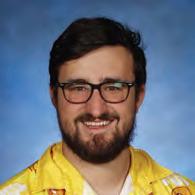
Charles has used the fellowship to enhance his Geometry classroom with interactive software that allows students to manipulate physical objects, rather than merely working with the geometrical concepts on paper.
Humanities
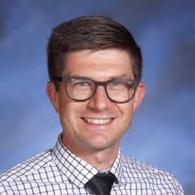
Tim has used the fellowship to gather and create resources for the IB History course, cultivating students’ intellectual curiosity and empathy as they gain a deeper understanding of 20th-century African nationalist and independence movements.
Profe Romay Wins Two Latino Book Awards

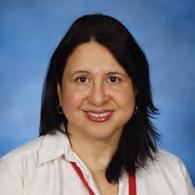
Patty Pascal – Languages
Patty has used the fellowship to implement projects allowing students to explore the history, ideologies and artistic voices of Spain and Latin American countries from the 17th century to the present. The multidisciplinary units she designed will enhance her students’ language skills along with their historical knowledge, critical and creative thinking skills, and cultural competency.
Sally Toffey, one of the first female leaders on Newark Academy’s Board of Trustees and alumni parent, made a gift to the Endowed Fund for Faculty Innovation. Each year, a Toffey Fellow will be chosen to work on innovative approaches that focus on helping students develop the critical and creative thinking skills necessary to understand and engage with multiple perspectives around complex issues. Sally sadly passed away in June 2023 but has left a lasting legacy for the support of our faculty.

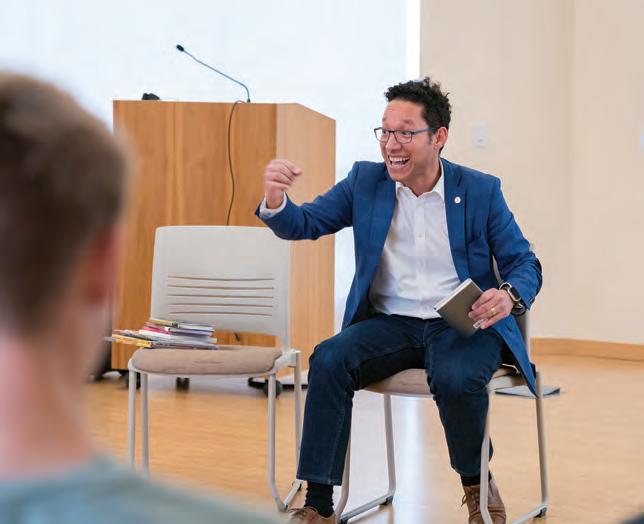
Newark Academy Spanish Profe Alexis Romay won two gold medals at the 2023 International Latino Book Awards for his recent book translations:
Yo tengo un sueño by Martin Luther KingBest Nonfiction Book Translation, English to Spanish Merci Suárez no sabe bailar by Meg MedinaBest Chapter/Young Adult Book Translation, English to Spanish
NA NEWS I FACULTY FOCUS 23 NEWARK ACADEMY
Photo by James Worrell
Tim McCall –
Fond Farewell: VON ROLLENHAGEN
As Newark Academy closes out its historic 250th anniversary year, we also extend a fond farewell to beloved English Teacher Frederick “Von” Rollenhagen, who is retiring after a 40-year career at NA. Von arrived at Newark Academy as part of the English faculty in 1984 and quickly immersed himself in Minutemen Athletics as a lacrosse, hockey and soccer coach. In 2000, Von became Dean of Faculty, a post he held for two decades in which he was instrumental in evolving the faculty at NA from being generalists to experts in their fields. He hired a generation of teachers who were student-centered and firmly focused on student growth and support, and oversaw a professional development program that reflected the excellence of our faculty and their unwavering passion for learning. In 2020, he returned to the classroom full-time.
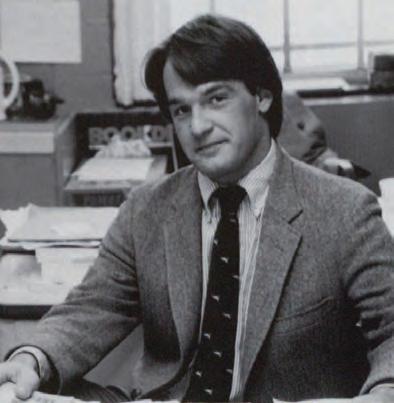


Above: Von Rollenhagen in 1985. Below: The class of 1994’s yearbook dedication to Von.
The Class of 1994 captured Von’s special qualities in its Polymnian yearbook dedication, writing that his “... quiet yet demanding attitude instills composure and calmness in the classroom and on the playing fields. His gift of benevolence and understanding is what makes him so liked … his gift to put things in perspective and impart a sense of balance in everything he does casts knowledge wherever he is present.”
REFLECTIONS FROM
Donald M. Austin Head of School
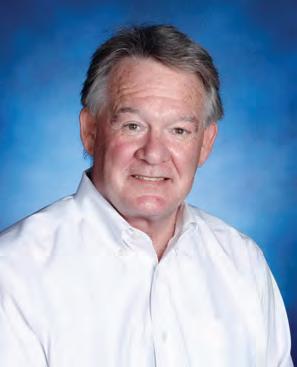
During his four-decade career at NA, Von met his wife, English Teacher Alexandra Mahoney, sent his two children Zoe ’14 and Sam ’16 through the school, and touched the lives of countless students who fondly remember his kindness, wit and generosity of spirit.
In his retirement, Von will be taking full advantage of outdoor opportunities in the fall and is planning a number of fishing and hiking trips from Maine to North Carolina.
Looking ahead, he plans to assist programs that serve those who are facing food and/or housing insecurity.

Von Rollenhagen joins the pantheon of Newark Academy leaders who have shaped the institution thanks to distinguished service and leadership. Over his 40 years, Von first stood out as an excellent teacher, coach, and colleague. Beginning in 2000, as Dean of Faculty, Von hired many of today’s outstanding teachers who share his passion for intellectual engagement and student-focused pedagogy. Von was instrumental in convincing the Board of Trustees to prioritize generous benefits and professional development for faculty because he understood the importance of addressing the needs of teachers at different points in their careers. A deft administrator, Von has always modeled personal qualities of integrity, kindness and compassion, and he has been a wonderful colleague. With gratitude and appreciation, I wish Von all the best for his well-deserved retirement.
24 LUMEN I SPRING 2024 NA NEWS I FACULTY FOCUS
REFLECTIONS FROM
Tom Ashburn Middle School Principal
From the moment I arrived at Newark Academy 25 years ago, Von Rollenhagen welcomed me in his role as my department chair, guiding me with wisdom and a good sense of humor. His commitment to treating every student with dignity and respect left an indelible mark on me, shaping my approach to education.
During his tenure as dean of faculty, Von’s leadership set a standard of excellence that inspired us all. He had an eye for talent, handpicking a team of exceptional educators who shared his dedication to intellectual rigor and joy in the classroom. But his ability to navigate complex interpersonal dynamics with finesse and empathy truly set him apart. Whether mediating conflicts or fostering collaboration, Von approached each situation with a humble understanding.
As Von embarks on this new chapter of his life, I feel both gratitude for his contributions and sadness at his departure. Von contributed a lot to making this school what it is today. Von should be proud of the legacy his work leaves behind. I wish him good fishing and excellent hiking on the trails as he “lights out” for the territory.
REFLECTIONS FROM
Betsy Barbato LaPadula English Faculty

“There are things you can replace, and others you cannot. The time has come to weigh those things,” wrote Jerry Garcia of the Grateful Dead. As Von moves on to another stage in his life, I weigh the 27 years I’ve known him, and conclude that, like the Grateful Dead, Von wasn’t the best at what he did at the Academy — he was the only one who did what he did. And what did he do? He showed me how to be unstintingly honest, giving and open-minded, even when I’d wake up to find out that doing so is never easy. By emulating Von, I have become more willing to discover, and to be more attentive to the songs in the heart of each person I meet.
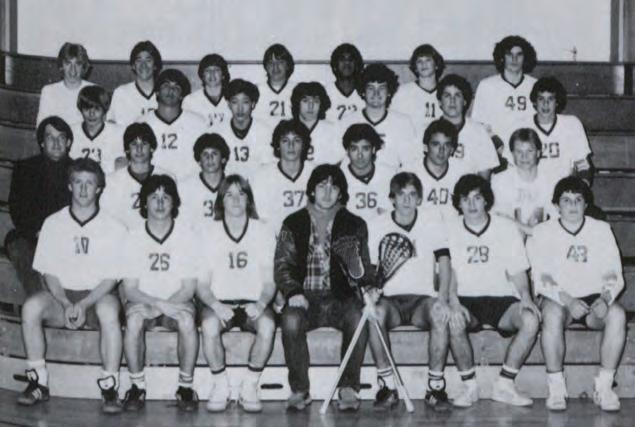

It’s very hard to believe I have known Von for my entire adult life. We met 40 years ago when I was 16 and playing lacrosse for him. Ever since that first season I have very fond memories of Coach Rollenhagen. From the fields to the classroom and then to the administrative corridor, we have always caught up about NA, trips to Vermont and of course our families. It will be a little different walking in the building and not seeing Von around. I wish him only happiness in his next adventure.
25 NEWARK ACADEMY
Von with the 1984 lacrosse team.
REFLECTIONS FROM Wayne Kent ’85 NA Trustee
NA Business Office Leaders Earn TWO NBOA AWARDS
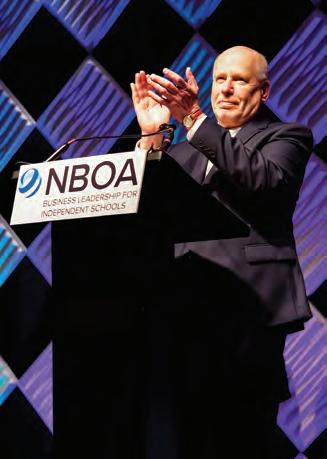
Two long-time Newark Academy Business Office staff members were recognized with prestigious awards from the National Business Officers Association (NBOA) on February 27, 2024. NA Director of Business and Finance Sam Goldfischer earned the 2024 Ken White Distinguished Business Officer Award, and Director of Human Resources Sarah Guelich was recognized with the Professional Achievement Award.
The Ken White Distinguished Business Officer Award, won by Sam, honors one chief business officer each year who has made outstanding contributions over several years to the broader field of independent school business operations. The recipient must have also served as a leader and role model throughout the national independent school business officer community.
The Professional Achievement Award, won by Sarah, recognizes the invaluable contributions made by an independent school business, finance and operations staff member.
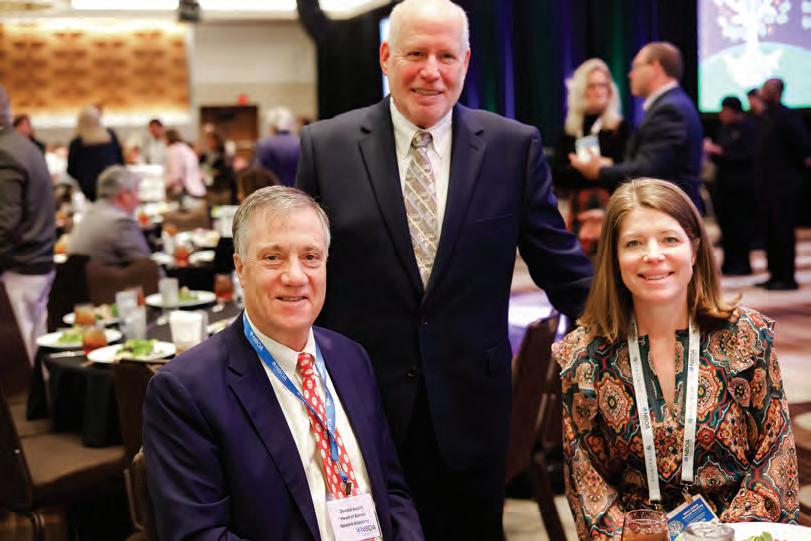
NA Head of School Donald M. Austin, Director of Business and Finance
Sam Goldfischer and Director of Human Resources Sarah Guelich
The success Newark Academy enjoys today is directly linked to Sam’s work ethic and unwavering commitment to sound practices and ethical management of our school’s finances. In addition to being a terrific partner to our Board and to me, Sam has been a generous mentor and colleague to other business managers in New Jersey and across the country.”
– Donald M. Austin, Head of School
In the very complex and highly emotionally charged world of HR, Sarah brings a sense of balance, maturity and level-headedness to her work. Our employees have a sense of confidence that Sarah has their best interests at heart while protecting the institution and its good name.”
– Sam Goldfischer, Director of Business and Finance
26 LUMEN I SPRING 2024 NA NEWS I FACULTY FOCUS
Photos by Arielle Jessica Photography
▲

Ar tificial Intelligence: The Technological Revolution at Newark Academy
By Jeff Vinikoor, Director of Studies
Within the classrooms of Newark Academy, artificial intelligence (AI) has begun to transform traditional teaching and learning paradigms. In just 18 months, a plethora of AI-driven tools — from text generators and problem solvers, to learning assistants, data analyzers, and video and image creators — have burst onto the scene. This surge of innovation has compelled us to rethink how we teach the critical thinking, creative thinking and communication skills that are essential for NA students to develop and grow.
Historically, every wave of technological innovation, from calculators to the internet, has raised concerns about potential detrimental effects to student learning.
Yet AI, with its uncanny ability to mimic human-like reasoning and creativity, presents an unprecedented challenge. The NA faculty stands at a crossroad. We recognize that AI tools can benefit students greatly when used appropriately, yet shortcircuit their learning when used inappropriately; our task is to advance the former and discourage the latter. We are navigating this delicate balance by both guiding students in the use of these technologies when appropriate — as detailed in the profiles that follow — and restricting student use of these tools when we want them to exercise their cognitive faculties without assistance.
We also recognize that AI tools are and will remain an essential part of our students’ futures, both in higher education and in the workplace. So our task today is not merely to keep pace with technological advancements; instead, we seek to prepare our students to be courageous and ethical leaders in a world where AI is ubiquitous. ›››
27 NEWARK ACADEMY
Can Generative AI Teach Us How Humans Think?
By Dr. Andrea Lankin, English Faculty
When we talk about artificial intelligence (AI) — the technology underlying chatbots like ChatGPT and image generators such as Adobe Firefly — the word “intelligence” suggests it’s possible for computer systems to think like humans. But are Generative AI (GenAI) programs — types of AI that creates new content-based prompts — really thinking and creating in ways that humans can recognize? Can we trust their output to provide reliable answers and meaningful art? Should we be afraid that GenAI will replace human jobs or render human creativity obsolete?
These questions are perfect for exploring in Newark Academy’s Theory of Knowledge (TOK) classes. Part of the International Baccalaureate (IB) Diploma Program, TOK challenges students to understand their roles as critical thinkers in the world. In these classes, students pose and answer questions about knowledge and learning through playful exercises and freewheeling conversations. They might reach into bags and use only the sense of touch to determine what objects are within, or take online personality tests to determine whether those tests can accurately categorize human behaviors. They examine various academic fields to assess how each handles data, tests assumptions and defends claims.
Since AI continues to rise in popularity and accessibility, I created a unit in the second semester of my senior-year TOK course to dive deeply into GenAI. Students are tasked with responding
to articles debating whether available GenAI programs are sentient, consciously able to think and feel. They also consider ethical critiques of GenAI. For instance, the datasets behind GenAI text generators rely on uncredited text from sources all over the Internet, which has led to lawsuits like The New York Times suing OpenAI for unlawful use of copyrighted work. In class, we debate whether and how it is appropriate to use datasets full of
Both [humans and AI programs] take in large amounts of data from the world and make new interpretations and responses to it, so they are actually more similar than we give them credit for.”
–
Katherine Guo, ’24
potentially stolen data. In one project, pairs of students ask chatbots openended philosophical questions about knowledge and consider the flaws and merits of the AI-generated answers, presenting their findings to the class.
So what did my students find?
They discovered that AI-written answers often sounded clear and professional, drawing from the language of the questions to provide basic responses. However, they generally could not replace human writing and human thought.
“Generative AI programs aren’t good at being specific and detailed,” says Alexa Jacob ’24. “Their answers are generally very vague and lack substance.”
The students found that, when prompted for more detail, the chatbots rephrased the same answers without adding depth or enhancing logical consistency. When asked to cite its sources, ChatGPT did not provide any, while Gemini, Google’s AI chatbot, invented titles and authors for nonexistent scholarly articles. Therefore, my students concluded that GenAI cannot successfully write high-quality essays, but might be a useful tool for generating ideas at the beginning of a project or for proofreading at the end.
Despite GenAI’s weaknesses and ethical challenges, my class found value in studying it to learn more about how human thought works. “Both [humans and AI programs] take in large amounts of data from the world and make new interpretations and responses to it,” says Katherine Guo ’24. “So they are actually more similar than we give them credit for.”

ARTIFICIAL INTELLIGENCE 28 LUMEN I SPRING 2024
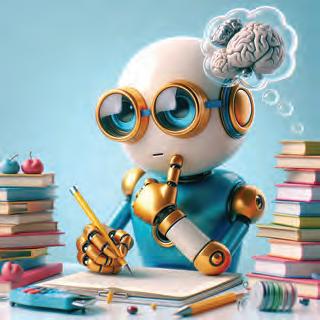
AI Robot thinking.
(Photo by Microsoft Designer Image Creator)
CLASS UNIT: Artificial Intelligence
CLASS: Theory of Knowledge II
TEACHER: Dr. Andrea Lankin
GRADE LEVEL: Senior


Brian Yun ’24 and Kevin Ha ’24 (pictured top to bottom)
Knowledge Question to AI Chatbot:

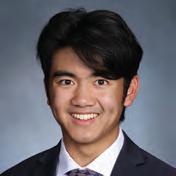
How does technology mitigate or exacerbate unequal access to knowledge?
FINDINGS
OpenAI’s ChatGPT responses were logically sound but lacked definitive answers, giving arguments for both sides. The answers were very standard and noncontroversial, and they did not include examples to strengthen the arguments. The AI was unable to identify legitimate sources for its information.
CONCLUSION
AI’s database is so large that it can’t pinpoint a single source of information. The generator is trained to mimic a human response to data, but it doesn’t actually copy and paste data from a source. Unlike a human, ChatGPT did not pick up on slight changes in the prompts or include emotion in its responses. In addition, the AI won’t provide definitive answers to controversial questions that humans would have an opinion on.
ASSIGNMENT:
Pose a knowledge question to a generative AI chatbot and analyze what the answer did well, what the gaps in it were, and whether the answer was persuasive and/or interesting. Ask follow-up questions to the chatbot and analyze the responses to see how they differ from or are similar to what a human might write. Ask the AI to identify sources for its claims. Present your findings.

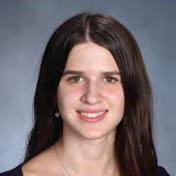
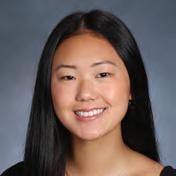
Alexa Jacob ’24, Claire Nowak ’24, Emily Horowitz ’24 (pictured top to bottom)
Knowledge Question to AI Chatbot:
Do we tend to exaggerate the objectivity of scientific facts and the subjectivity of moral values?
FINDINGS
Chat GPT offered almost identical answers in the same format for each follow-up question the team asked it and was not able to identify a direct source. While it answered the questions and provided helpful baseline information, it wasn’t able to provide indepth responses to the questions.
CONCLUSION
AI is formulaic and struggles to adapt answers into different formats for different types of follow-up questions. When a human is asked for clarification, they are able to adjust their answers accordingly, whereas the AI continues to restate exactly what it previously said.
29 NEWARK ACADEMY



Lights, Camera, Action!
Inside Newark Academy’s AI-Powered Film Class
Take a peek inside Dan Gold’s Upper School film class and you’ll be transported to a place where giant cookies are dominating the world, the last two humans on earth are fighting for survival, and the planets of the Milky Way are within reach.
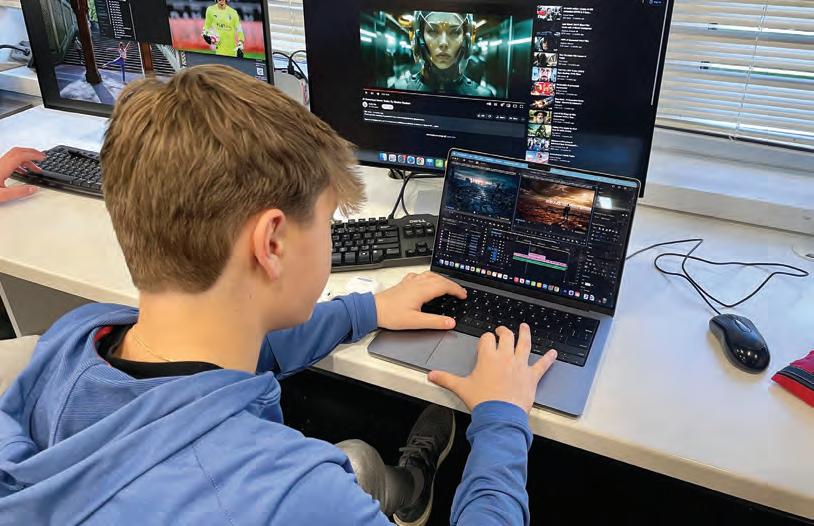
In Newark Academy’s new film and photography studio, students can now bypass the enormous financial and time constraints of filming a movie and jump right into the world of creating and editing scenes from their wildest imaginations — giant world-dominating cookies and all — thanks to the use of images generated by artificial intelligence (AI).
For this assignment, Dan tasked his students to create a 30- to 45-second trailer for their dream movie using three different AI software programs.
ARTIFICIAL INTELLIGENCE
30 LUMEN I SPRING 2024
STEP 1: Students had to imagine a particular scene, using ChatGPT to create a more detailed description of that scene.
STEP 2: They then entered the enhanced scene prompt from ChatGPT into Adobe Firefly to create high-quality illustrations of the scene in seconds.
STEP 3: After creating hundreds of such images, they used another AI tool, Runway, to animate each scene from the AI-generated images.
STEP 4: Finally, after crafting all of their animated scenes, they edited them together to create their dream movie trailer in Adobe Premiere Pro.
“The project expedites teaching students the principles of editing and the principles of creating a story shot by shot because the immediacy of the technology lets them create an image in five seconds, rather than five hours,” Dan says. “They can go right into the editing. The inevitable editing mistakes that they will make are very fixable by generating another image rather than having to go out and film a scene again.”
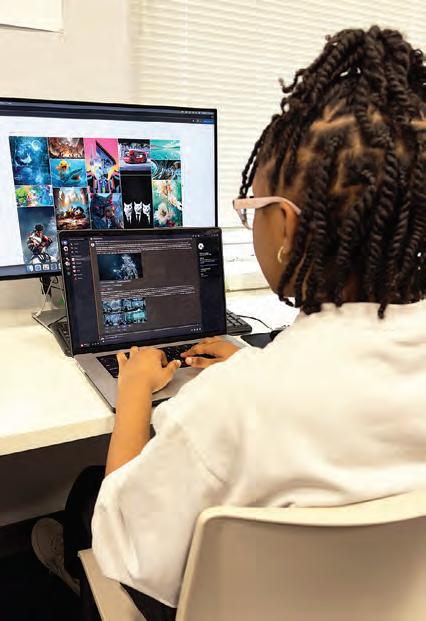
Drawing on their knowledge of the principles of filmmaking, students are able to instruct the Runway software on how to turn their still images into moving images, determining which camera angles they want, how each character should move, which parts of a scene should be animated and which parts should remain still.
“It’s definitely my favorite project that we’ve done this year,” says Jack Becker ’27. “We get to go in and be very unique because we’re not restrained to just our resources.”
India Hylton ’27 is particularly grateful for the opportunity to learn how to use AI constructively and responsibly. “When people usually hear ‘AI’ in school, they think about cheating. But I find it cool how we’re incorporating it within our daily school life but with a good connotation behind it,” she says. “It’s fun seeing your ideas come to life. You see really cool movie trailers and you’re like, ‘How did they do that?’ And now, you’re not even close to where those animators are in skill level, but you’re still able to do it because of AI.”
Having become pros at creating AIgenerated images, two students from Dan’s film course, Joe Murphy ’27 and Teo Levin ’27, led a demonstration of Adobe Firefly for students in Humanities teacher Micah Duhaime’s

“Propaganda: Past & Present” course. Micah’s students then used the software to create AI-generated posters for their final propaganda campaign project.
“The kids are imagining and getting immediate feedback,” says Dan. “Each student can really sink their teeth into it, and what we’re seeing is they’re getting really excited about doing their work and they’re really engaged. It’s very fun to watch.”
An AI-generated poster created by Jasper Schnieders-Smith ’24 in Micah Duhaime’s Propaganda elective in the Humanities Department.
▲

31 NEWARK ACADEMY
India Hylton ’27
An AI-generated image directed by Teo Levin ’27 for his movie trailer project.
▲
ARTIFICIAL INTELLIGENCE
NA ALUMS Charting the AI Frontier

with Symon Perriman ’03 Technical Program Manager, Meta

In 2006, Symon Perriman ’03 turned down an interview with a startup called “The Facebook.” Of course, Symon couldn’t have known at the time that that company would become the tech giant known today as Meta.
Still, after landing impressive stints at Microsoft and Google, Symon got his second chance with “The Facebook” 15 years later. He now works as a technical program manager at Meta and has found himself at the forefront of the technical revolution that is artificial intelligence (AI).
Q:
What do you do in your current role at Meta?
SP: I work with many teams across the company to solve their hardest AI infrastructure problems, currently
focusing on Generative AI (GenAI). I’ve been at Meta for two and a half years and had a similar role at Google for a year. Previously, I ran a sports marketing startup called FanWide that built AI computer vision solutions to help with COVID-19 compliance at sports stadiums.
Q:
In what ways have you worked with AI?
SP: Within Meta’s GenAI team, I help run one of the world’s most advanced AI platforms. I lead a few of the
hardware planning and optimization programs, helping Meta’s researchers train and serve larger AI models. This has included the LLaMA model (Meta’s version of ChatGPT) and Meta’s GenAI chatbots, stickers, images and photo-editing tools across Facebook, Instagram, Messenger and WhatsApp.
Q:
What do you think are the benefits of AI?
SP: AI has become the next technical revolution that is changing the world, but because of its high cost and technical complexity, it hasn’t been available to the masses until recently. Generative AI allows the public to access AI resources and “generate” personalized responses to any type of request. The inputs and outputs could include text, images, video, audio or other formats.

32 LUMEN I SPRING 2024
Symon Perriman ’03
Photo by Glynns Thomas
AI, and specifically GenAI, provides people with the tools to automate repetitive tasks (e.g., responding to customer support), to access new skills without training (e.g., creating graphics), or to level the playing field (e.g., non-native English speakers writing job applications). It lets anyone uplevel their skills and efficiency so that they can accomplish more at a faster rate.
Q:What about the downsides?
One major downside is that AI-generated content can be misleading or even deceitful. For example, AI-generated images or videos can be used to spread false information or create fake news. Additionally, AI can perpetuate biases and stereotypes present in the data it’s trained on, which can be harmful to marginalized groups. And let’s not forget about the potential for AI to replace human creativity and jobs! So, while AI can be a powerful tool, it’s crucial to approach it with a critical eye.
SP: Did you realize that the preceding paragraph was written by AI? “Meta.AI, write a paragraph about the downsides of using generative AI.”
Q:Do you think schools can use AI as a tool and asset, and do you think they should?
SP: The use of AI in academia is highly controversial, and probably always will be. I think it should be used as a tool to supplement learning or research, similar to the Internet. But it should not be used to replace foundational skills that students need to be successful in their lives, such as math or writing. These core abilities are still needed to validate the output of the AI or to function if the AI is not around. Employers do not want to hire someone who lacks these skills. If someone uses AI to do most of their work, at some point they may get replaced by that AI.
with Julia Mills ’14 Asset Developer, BandLab
As a passionate violinist, Julia Mills ’14 was drawn to Newark Academy in seventh grade because of its orchestra. Former Director of Instrumental Music Amy Emelianoff gave Julia the confidence to continue studying music and to pursue it as more than just an extracurricular activity. During her senior year, Julia took a computer programming class with Computer Science Teacher Andrew Alford and realized that she could take part in shaping the future of technology.
Eventually, Julia found a way to combine her love of music with her interest in technology development as an asset developer within the AI Music team at BandLab, a cloudbased music creation platform that enables creators to make music and share their creative process with other musicians and fans.
Q: What do you do in your current role at BandLab?
JM: I spend half my time composing and making music and half my time making the tools our team uses to do that. I apply my existing knowledge of music theory and genre classification to music making via algorithms.
Q: What should students be cautious about as they grow up with this developing technology?
SP: Always double-check the answers! AI is still an emerging technology, so while it strives for accuracy, sometimes the output is wrong, and it can “hallucinate” responses. This is why it is important to use AI as a supplemental tool, but to still have the core skills to validate that output.
Q: Anything else students should know?
SP: I’d encourage every student to learn basic coding, as it is becoming another foundational career skill used throughout every industry. This provides a stepping stone towards learning AI, which is transforming every business at rates we haven’t seen since web and mobile became mainstream. Just make sure you actually learn it and don’t rely on GenAI to write the code for you!
Q:
In what ways have you worked with AI?
JM: The kind of AI I specialize in is called algorithmic composition. In general, the systems I have built and use are like complex flowcharts for making musical decisions: “What note would sound the best here?” or “Should there be a bridge section in this song?” Instead of using a Digital Audio Workstation (DAW) or traditional sheet music, I use algorithms that my team and I have made to stitch together the hundreds of choices that any composer makes when creating a song.
Q: What do you think are the benefits of AI?
JM: AI has the power to unlock human creativity in new ways and to make self-expression more widely available. Maybe you don’t play the bass,
33 NEWARK ACADEMY

but you have a piano or a laptop keyboard and some chords you really like. We can use AI in music to fill in the gaps of people’s skill sets to allow non-professionals to realize their creative visions. In my opinion, AI systems that use a “humans-in-theloop” approach are the best compromise between leveraging all that AI has to offer and not completely letting go of the reins.
Q: What about the downsides?
JM: It is extremely important that we don’t hurt other parts of the creative sector through developing new technologies. There are many ways to unethically source data for AI or deploy it in a way that replaces artists. Thoughtful legislation and enforcement are needed to establish where the line is. BandLab has pledged its support for the Human Artistry Campaign, which seeks to do just that, and I feel very fortunate to work somewhere that centers ethics in our AI development.
Q:Do you think schools can use AI as a tool and asset, and do you think they should?
JM: Schools, especially K-12, should be incredibly cautious in allowing the use of AI on coursework. Heavy homework loads can easily lead students to want shortcuts, and as AI systems improve, it will get increasingly difficult to police their use. Rather than allowing its unsupervised use, I think generative AI could be used in classrooms for inspiration — using AI-generated images as the source material for a collage project, for example.
I also think that introducing students to AI tools in a supervised environment allows teachers to educate students on the importance of media literacy, how AI systems can contain biases, etc. Students will likely explore these new technologies outside of the classroom anyway, so getting ahead of the curve and educating them on ethics and implications is paramount.
Q: What should students be cautious about as they grow up with this developing technology?
JM: Younger people may not always have the fact-checking skills that using AI responsibly entails. I would be wary of accepting answers from AI systems without any follow-up research. Even the most sophisticated systems are ultimately built by humans and powered by human-made data, so there are errors, biases and gaps in information all over the place. I’d like students to feel empowered to look under the hood: learn where systems source their data, how mistaken results are addressed, etc. The more students understand about how the sausage is made, so to speak, the less they will uncritically accept bad results. Part and parcel to this is to not undercut their own education by relying on AI to take their classes for them. The only way to responsibly build these new technologies is for the next generation to maintain some level of independence from them.
Q: Anything else students should know?
Watch this space! Things change quickly. When I first started working in music AI in 2018, most people’s reaction was, “Wait, what does that mean?” With the rise of popular systems like ChatGPT and DALL-E, suddenly the concept of applying AI to anything and everything is mainstream. I don’t think there is a lot to be gained by being afraid of new technology, but it’s equally important not to get caught up in the hype and lose sight of what really matters: ethical data sourcing, keeping human creativity and knowledge in the system, and ensuring equal access.
34 LUMEN I SPRING 2024
Photo by Yasmeen Anderson
Julia Mills ’14

EXPLORING THE BOUNDARIES: Artificial Intelligence in Education
Given Symon and Julia’ s warnings regarding the use of AI in schools in the NA Alums Charting the AI Frontier Q&A, we invited Chat GPT to respond to this controversial topic.
By ChatGPT
In the hushed halls of Newark Academy, whispers of technological advancement float like ethereal echoes. Among these whispers, one theme resonates with particular vigor: the integration of artificial intelligence (AI) into the educational landscape. As our society hurtles toward a future shaped by silicon minds and digital intellects, it’s crucial to examine both the promises and pitfalls of AI in schools.
Proponents herald AI as a beacon of educational innovation, promising tailored learning experiences and personalized instruction. At the heart of this optimism lies the ability of AI to adapt to individual student needs, offering targeted support and challenging enrichment. Imagine a classroom where each student receives a curriculum meticulously crafted to suit their unique learning style and pace. With AI, this vision inches closer to reality, potentially unlocking the untapped potential of every student.
Furthermore, AI-driven educational platforms can provide invaluable insights to educators, offering real-time analytics on student performance and comprehension. Armed with this data, teachers can identify areas of struggle and intervene with precision, fostering a supportive environment where no student is left behind. In essence, AI empowers educators to become conductors of a symphony of learning, orchestrating harmonious progress for each student.
However, amidst the allure of technological utopia, shadows lurk, casting doubt on the unbridled adoption of AI in schools. Foremost among these concerns is the erosion of human connection in the educational landscape. Education is not merely the transfer of knowledge but the cultivation of curiosity, empathy, and critical thinking — qualities that are inherently human. As AI assumes a greater role in the classroom, there is a
NA Forms an AI Committee
Newark Academy has formed an AI Committee, headed by Director of Studies Jeff Vinikoor and Instructional Technologist Stephanie Hammond. The committee includes a representative from every academic department and meets monthly to discuss emerging AI tools and how they might be used to enhance curricula or streamline everyday workflows. Through this committee’s work, Jeff and Stephanie hope to normalize the integration of AI tools for positive uses and to minimize students’ and faculty members’ feelings of intimidation.
“We’re embracing AI because it can really make us more efficient and more productive,” Stephanie says. “It can enhance our pedagogy. The idea with AI is not to replace what we do; it’s to make what we do better.”
risk of diminishing the interpersonal bonds between students and teachers, relegating education to a transactional exchange devoid of warmth and understanding.
Moreover, the reliance on AI raises ethical dilemmas regarding data privacy and algorithmic bias. As students interact with AI-driven platforms, they leave behind a trail of digital footprints —data that can be exploited for profit or wielded to manipulate behaviors. Additionally, AI algorithms, though ostensibly neutral, can unwittingly perpetuate biases inherent in their training data, exacerbating existing inequalities in education. Thus, the unchecked proliferation of AI in schools may inadvertently widen the chasm of educational disparity rather than bridging it.
In navigating this technological frontier, Newark Academy stands at a crossroads, poised to shape the future of education for generations to come. As we tread cautiously into the realm of AI, let us do so with a mindful balance of innovation and humanism. Let us harness the transformative power of AI to amplify the voices of learners, while steadfastly safeguarding the values that define our educational ethos. For in this delicate dance between silicon and soul, lies the promise of a brighter, more equitable future for all.
35 NEWARK ACADEMY
Jack Becker ’27 uses AI-generated images to create a movie trailer in film class.
5 WAYS
Artificial Intelligence Can Transform Healthcare
By Abby Hsu ’25

I have long been passionate about leveraging technological and computational approaches to solve problems in the healthcare field. This past summer, I researched how artificial intelligence (AI) and machine learning can use physiological signals (the body’s biological responses to stimuli) to quantify exam stress progressions for students.
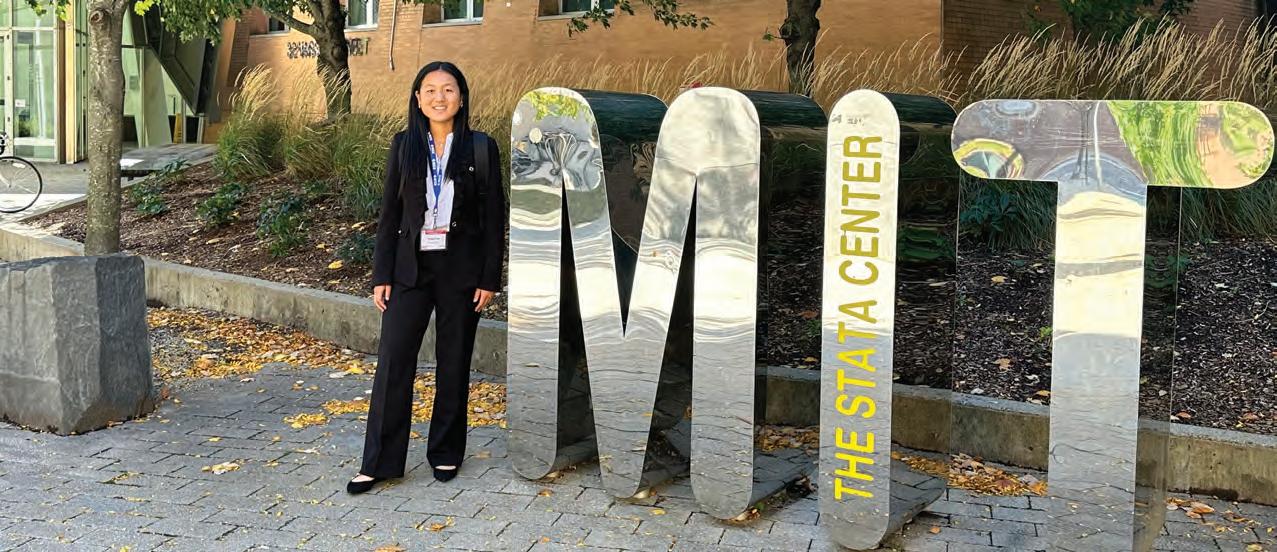
I was selected to present my research at the Massachusetts Institute of Technology (MIT) Undergraduate Research Technology Conference this past October, and in February my research paper “Quantifying Exam Stress Progressions Using
Electrodermal Activity and Machine Learning” was published in the IEEE Xplore Journal.
Based on my study, here are the five main ways I believe that AI can transform the healthcare sector:
Enhanced Diagnostic Accuracy
There was one statistic that inspired my mental health research: an average of 65 percent of mental health disorders are misdiagnosed, according to the National Institute of Health. After doing some digging, I found that mental health disorders are traditionally diagnosed based on surveys and therapist
36 LUMEN I SPRING 2024
ARTIFICIAL INTELLIGENCE
1
Abby Hsu ’25 presents her research at the Massachusetts Institute of Technology (MIT).
conversations, which can be extremely subjective. So I set out to use AI to analyze existing large data sets of physiological signals collected from students during exams. By detecting tiny patterns in the data, the AI tools I trained were able to accurately quantify fluctuations in stress. These measurements allowed the AI tools to differentiate between similar medical conditions in ways that surveys or therapist conversations typically could not, resulting in improved diagnostic accuracy.
2
Early Detection and Intervention
The rise of AI tools has led to a revolutionary surge in wearable technology. Using the results from my research, I am now working on developing MentalMetrics, a wristband that tracks real-time mental health data. (This business idea earned me a third-place finish in the 2023 BIG Idea Competition.)
The widespread accessibility of wearable technology will allow AI tools to process vast amounts of data instantaneously. Therefore, the AI
AT A GLANCE: Abby Hsu ’25
n Published in the IEEE Xplore Journal
n Presented research at the Massachusetts Institute of Technology (MIT)
n Placed third in the 2023 BIG Idea Out-of-State Competition
n Podcast host of TeenPod, to improve the mental health of teens
algorithms have the potential to identify risks of medical symptoms before patients even notice them, promoting early intervention and significantly increasing survival rates.
3
Predictive Analytics
I found that AI algorithms learn enough about patterns in medical data, they can predict medical risks. In the mental health field, an AI algorithm could use physiological signals such as heart rate to predict anxiety attacks or suicidal thoughts. Since these phenomena can occur suddenly and without warning, I’m excited to see how AI tools can help the patient and their loved ones be fully prepared to respond.
4
Personalized Treatment
While conducting my research, I realized the importance of personalized medical treatment. Since each of us has a different genetic makeup, lifestyle and environment, it is important to tailor treatments to our specific needs. In the future, I plan on training AI tools to analyze a vast array of data, from electronic health records to family health history. The AI algorithms will use the comprehensive datasets to establish individualized treatment options, increasing the effectiveness of care.
5
Increased Accessibility to Medical Care
I believe that AI tools can provide more accessible medical care. In recent years, there has been an influx in AI-driven chatbots

Podcast Host for Teens
Three years ago, Abby started her own podcast, TeenPod, as part of her mission to improve the mental health of teens. Abby interviews Division I athletes, judges, politicians, founders of nonprofits and others to help provide teens with a sense of direction and purpose. She currently boasts over 2,000 listens and has interviewed several NA alumni, including the Hon. Leo M. Gordon ’69, entrepreneur Dave Millman ’99, Jersey City Councilman James Solomon’02 and Princeton University golfer Nathan Drogin ’23.
WATCH!
Scan the QR code to listen to TeenPod
and virtual assistants to provide 24/7 support and guidance, especially as many suicide hotlines struggle to keep up with volume. While AI chatbots are certainly not a replacement for human assistance, the chatbots can provide temporary mental health relief and answer critical healthrelated questions.
37 NEWARK ACADEMY
ARTIFICIAL INTELLIGENCE
Computer Science Class Reinvents “Clue” to Learn Computer Coding
By Sherrie Negrea
In one room, players will rearrange historical milestones in the archives of Newark Academy. In another, they’ll search for characters from a Shakespeare play, and in a third, they’ll have to checkmate a chess king in just two moves.
The challenge to solve all nine puzzles in the video game “Clue Keepers” will soon begin, when a yearlong project to revamp the iconic board game “Clue” in Andrew Alford’s introductory computer science course at Newark Academy is completed.
Students in the class have learned nine different coding skills that have enabled them to create the interactive puzzles embedded in the video game. The puzzles are inspired by people and places at Newark Academy — such as Jim Coe, the school archivist, whose historical records have exploded out of order and must be reorganized. The game is also designed to tie into NA’s 250th anniversary this year by offering puzzles relating to the school.
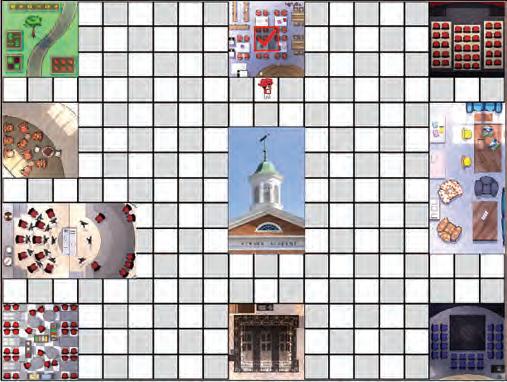

Andrew, who has taught computer science at NA since 2010, created the project not only to help the students learn software development, but also to give them a taste of what it’s like to work on a coding project as a team. Students are developing the puzzles for the game in four small groups.
“The idea for this project is to have a rather large program that is best approached by a team, where no one person is responsible for doing the whole thing,”

Andrew says.
“That is how it’s done in the real world. A system isn’t made by one programmer — it’s made by a team of programmers.”
Game graphic of Archivist Jim Coe.

Allie Chevance-Singh ’25 was surprised that learning coding skills in the course has been so hands-on. “It’s very different from my other classes because rather than taking traditional exams, we most often show our understanding by creating the game and applying the skills to create code,” she says.
Sophomore Joshua Chernin ’26 says working on “Clue Keepers” has allowed him to more fully understand the coding information he has absorbed in class. So far, he has worked with a team to build a chess scenario game and with the entire class to code a puzzle in which NA historical events must be listed in chronological order.
“I’ve always been into video games and I just always wanted to know how they work and how they were made,” Joshua says.
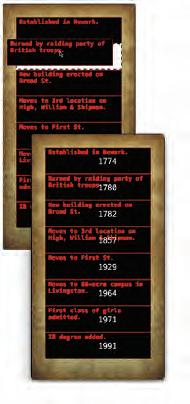
“I also love that we’re making a game about Newark Academy in its 250th anniversary year.”
Beyond just students in the class, others have contributed to the project’s success with their own skills. The artwork for the game, for example, was created by NA art student Katherine Guo ’24.
Once the video game is finished at the end of the spring semester, Andrew envisions the community being able to play it on an online platform.
“I’m hopeful that the students will end up with a project that they can be proud of sharing with the NA community during the 250th celebrations,” he says.
NA NEWS I STEM 38 LUMEN I SPRING 2024
Graphics by Katherine Guo ’24
Aaron Li ’24 NAMED TOP 300 REGENERON SCIENCE TALENT SEARCH SCHOLAR
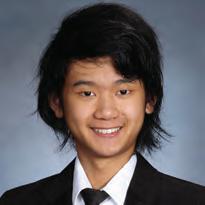
Aaron Li ’24
Newark Academy senior Aaron Li ’24 has been named one of the top 300 scholars in the 83rd Regeneron Science Talent Search (STS), the nation’s oldest and most prestigious science and mathematics competition for high school seniors.
With this recognition, Aaron becomes the second NA student to reach this level of the competition, earning the accolade for his project “The Dynamics of a Neutrally Buoyant Particle in Laminar Flow.”
“I am honored to have been named an STS scholar,” Aaron says. “It’s thrilling that STS recognizes the potential for my work to make a meaningful contribution to the field of computational fluid dynamics, and I eagerly anticipate delving deeper into the subject. I’m so grateful for the encouragement and support I’ve received from my teachers, mentors, friends and family throughout this project.”
 Drew Kesler

Aaron’s physics teacher, Drew Kesler, was also named a 2024 Teacher of Merit for his support and encouragement of Aaron’s work.
“Aaron’s success in the Regeneron competition shows that his math and science classes at NA, as exciting and fulfilling as they have been, were really just the launching points for his real work,” says Drew.
Regeneron STS recognizes and empowers the most promising young scientists in the nation who are exploring and developing solutions to the world’s most urgent challenges. The Regeneron Science Talent Search scholars and teachers were selected from 2,162 applicants from 555 high schools in 45 states, as well as Washington, D.C., Puerto Rico, and six American and international high schools overseas.
For Aaron’s and Drew’s accomplishments, Newark Academy will receive a combined total of $4,000 to be used toward STEM-related activities.
39 NEWARK ACADEMY
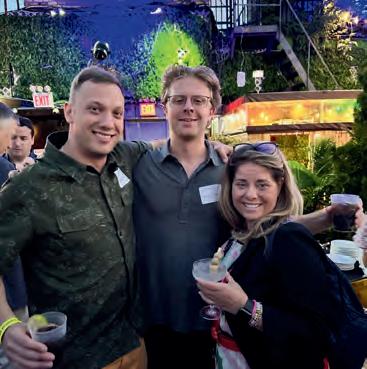
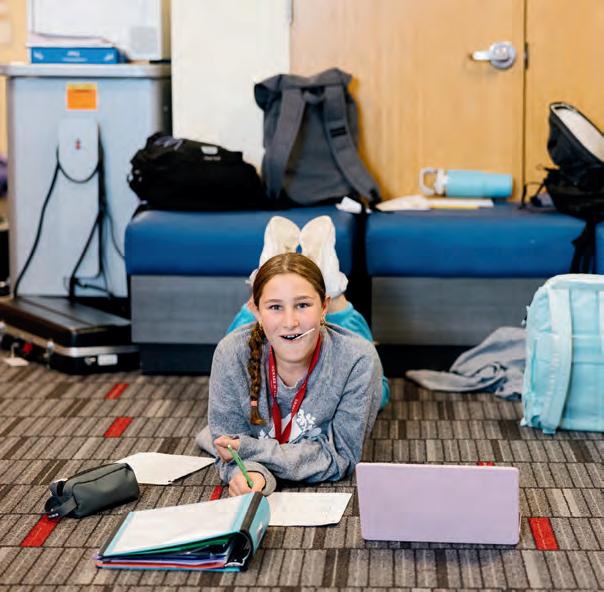
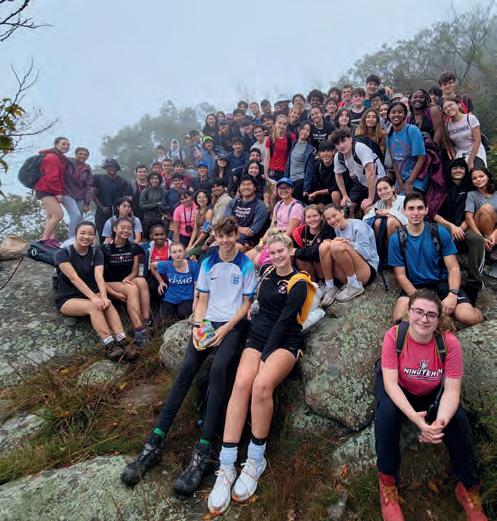

ADVANCEMENT Join us in shaping a vibrant future in which NA students, faculty and alumni will thrive together. newarka.edu/donate Make your gift today! 40 LUMEN I SPRING 2 02 4
HONORING OUR PAST, SUPPORTING OUR PRESENT, SHAPING OUR FUTURE
Newark Academy’s inaugural Founders Day campaign on November 15, 2023, honored our history as the NA community joined together to support another 250 years of continued innovation for future and current students. WATCH! Scan the QR code to watch Newark Academy’s 2024 Founders Day video
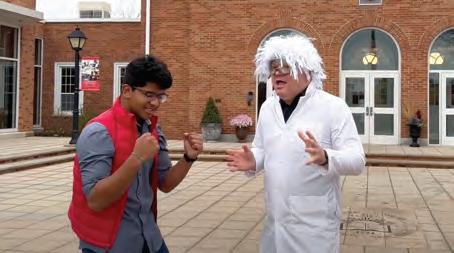
$318,383
TOTAL DOLLARS RAISED
308
TOTAL # OF DONORS
28 FIRST-TIME DONORS
41 NEWARK ACADEMY
$2 67, 046
TOTAL AMOUNT RAISED
388
TOTAL # OF DONORS
91
TOTAL VOLUNTEERS — 15 PARENTS, 66 STUDENTS AND 10 FACULTY MEMBERS
100% THE CLASS OF 2030 REACHED PARENT PARTICIPATION!
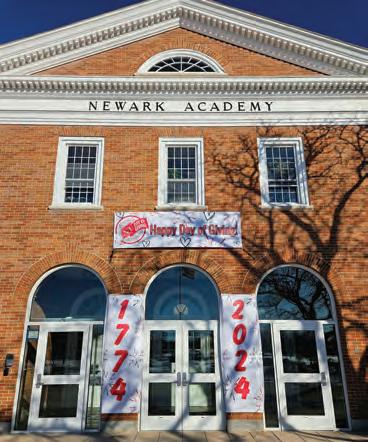
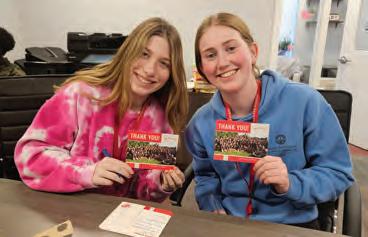
50 ALUMNI CLASSES WHO HAD AT LEAST ONE GIFT
42 FIRST TIME DONORS
54 PARENTS MADE A SECOND GIFT


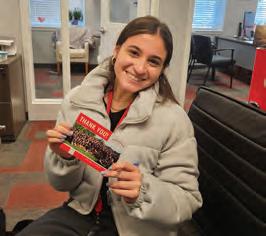
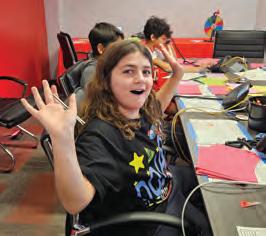
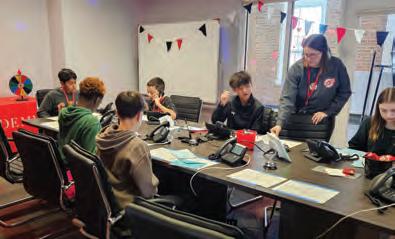
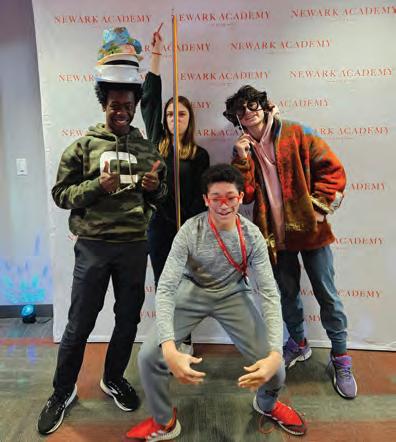
ADVANCEMENT 42 LUMEN I SPRING 2 02 4

Newark Academy alumni, parents, students, faculty and staff attended the second annual Women’s Summit in Kaltenbacher Hall on March 9, 2024.
During this event, Newark Academy women of many generations came together to discuss the evolution of women at NA during a faculty panel in honor of NA’s 250th anniversary year. The event also included a choice of two breakout sessions centered on preparing women for a healthy financial future or being an advocate for important causes. The event concluded with a workshop on personal branding by Beth Nydick ’91.
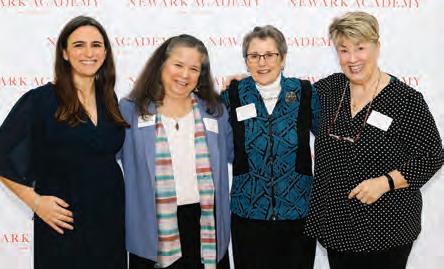
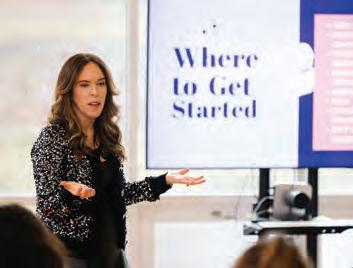 Photos by Da Ping Luo
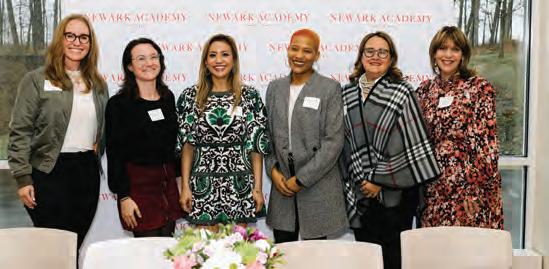
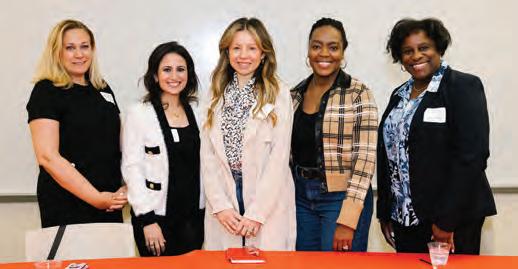
A. “The Evolution of Women at NA: Past, Present & Future” panelists: Maria Teresa McNeilly-Anta ’93, NA director of immersion experiences and language faculty; Pegeen Galvin, NA Upper School director of student life; Joan Parlin, former NA head of the Middle School, director of admissions and English faculty; and moderator Julie Madison Jacoby, former NA director of choral music.
B. “Be the Change You Want to See in the Word: How to Advocate and Support Causes that Matter to You” panelists: Mindy Opper, lead consultant at RAISE Nonprofit Advisors and current parent; Courtney Cooperman ’16, project manager at National Low Income Housing Coalition; Jacqueline Ko ’99, founder and chief executive officer of Changing Humanity Corp; Jaydeen DeCambre ’04, food security & economic justice program manager for Clinton Hill Community Action; Lorraine Dias-Sotiriou, president of the Newark Academy

WATCH!
Scan the QR code for video highlights from the Women’s Summit
Parents Association (NAPA), chair of the board of trustees of the Moms Helping Moms Foundation; and moderator Rebecca Moll Freed ’94, NA trustee, president of the NA Board of Governors, partner at K&L Gates and current parent.
C. Beth Nydick ’91, visibility strategist and founder of Beth Nydick Media, closes out the Women’s Summit with “Branding Yourself at any Age.”
D. “Bank on Yourself: Setting Yourself Up for a Healthy Financial Future” panelists: Suzanne Kecmer ’93, chief executive officer at SKB Capital; Lauren Hedvat ’01, capital markets executive and NA trustee; Iris M. Levitt-Heit ’97, managing director at JP Morgan Chase; Nola A. John-Drummond, managing director at EY and current parent; and moderator Karen Guy-Smith, co-founder and director of operations for J. Anderson & Associates, NA trustee and current parent.
E. Jackie Dorsky Pinchuk ’05 welcomes everyone to the second annual Women’s Summit.
43 NEWARK ACADEMY ALUMNI NEWS
A.
C.
D.
E.
B.
MUSICAL MEMORIES:
The
Jacobys Host
Talkback
with NA Theater Arts Alumni
Photos by James Worrell
As part of Newark Academy’s 250th anniversary year, Scott M. Jacoby, former NA director of theater arts, and his wife Julie Madison Jacoby, former NA director of choral music, returned to campus to host a talkback with several Newark Academy theater arts alumni and the current cast and crew of the Winter Musical, Something Rotten!, on March 9, 2024.
The alumni in attendance were:
Tiffany Bergin ’03, Andrew Binger ’09, Emmanuel Garcia ’18, Dylan Gawron ’19, Sarah Marcus Hansen ’06, Suzanne Paragano Kane ’93 , Alison Poole Lasher ’00, Joseph Longthorne ’08, Liz Maccie Chbosky ’93, Shilpa Mankikar ’94, David Mazzuca ’03, James Messina ’94, Evan Nisenson ’99, Evan Sills ’03 and Amaya Toland ’88.
The Jacobys and alumni shared personal stories from their experience being part of NA musicals and offered inspiration and advice to the current students.
“This program not only changed my life, I feel like it saved it, in many ways,” shared film and television writer Liz Maccie Chbosky ’93. “What was instilled in me [at NA] was that as an artist, you have a voice, whether you’re an actor or a painter … I found my voice in this program.”
Following the talkback, the theater arts alumni gathered for a dinner reception and then attended the performance of Something Rotten!

WATCH!
Scan the QR code for video highlights
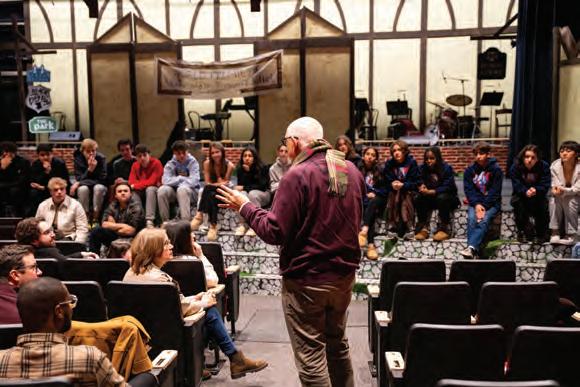
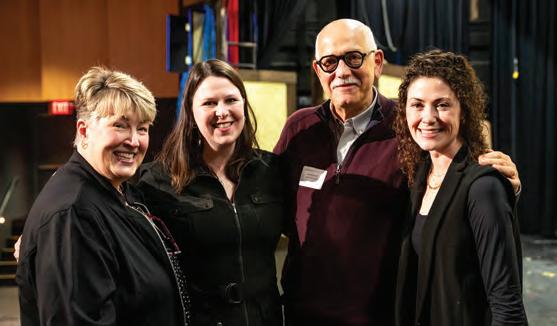
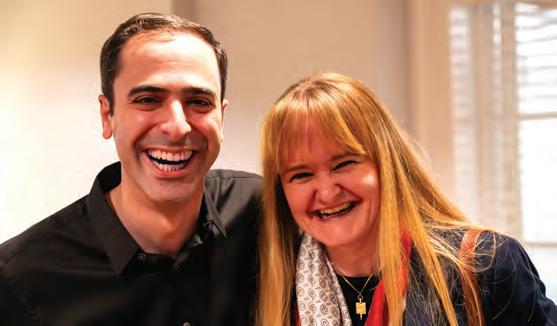
A. Julie Madison Jacoby, Sarah Marcus Hansen ’06, Scott M. Jacoby and Alison Poole Lasher ’00
B. David Mazzuca ’03 and Tiffany Bergin ’03
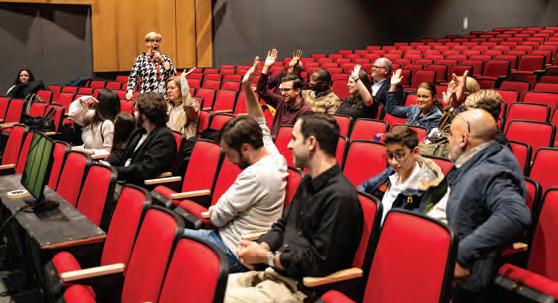
ALUMNI NEWS 44 LUMEN I SPRING 2 02 4
A.
B.
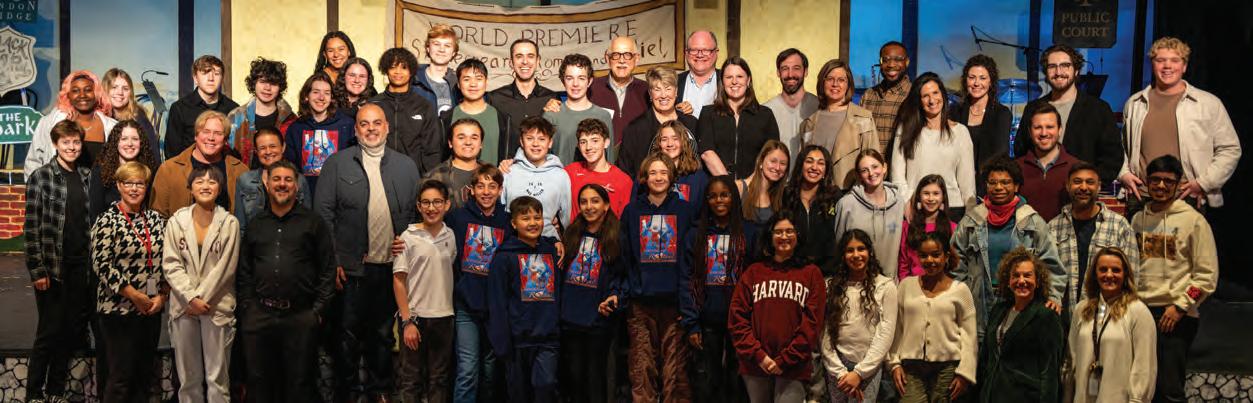












45 NEWARK ACADEMY
Robert Pensack '68
Adrien Wing '74
Stacey Kent '83Brad Johnson '75
Robyn Silverman ‘92 Ricky Kirshner ‘78Doug Polaner ‘82
‘51Roger
A podcast series featuring conversations with NA alumni. Hosted by Evan
An online community for alumni networking, collaborating and mentoring Visit www.naalumni.com or scan the QR code above Please contact Director of Alumni Relations and Giving Evan Nisenson '99 with any questions at (973) 992-7000 ext. 367 or enisenson@newarka.edu
Jacqueline Ko ‘99Lee Neuwirth
Flax '61
Nisenson '99
Newark Academy theater arts alumni with the NA cast of Something Rotten!
Liz Maccie Chbosky ’93
Campus View
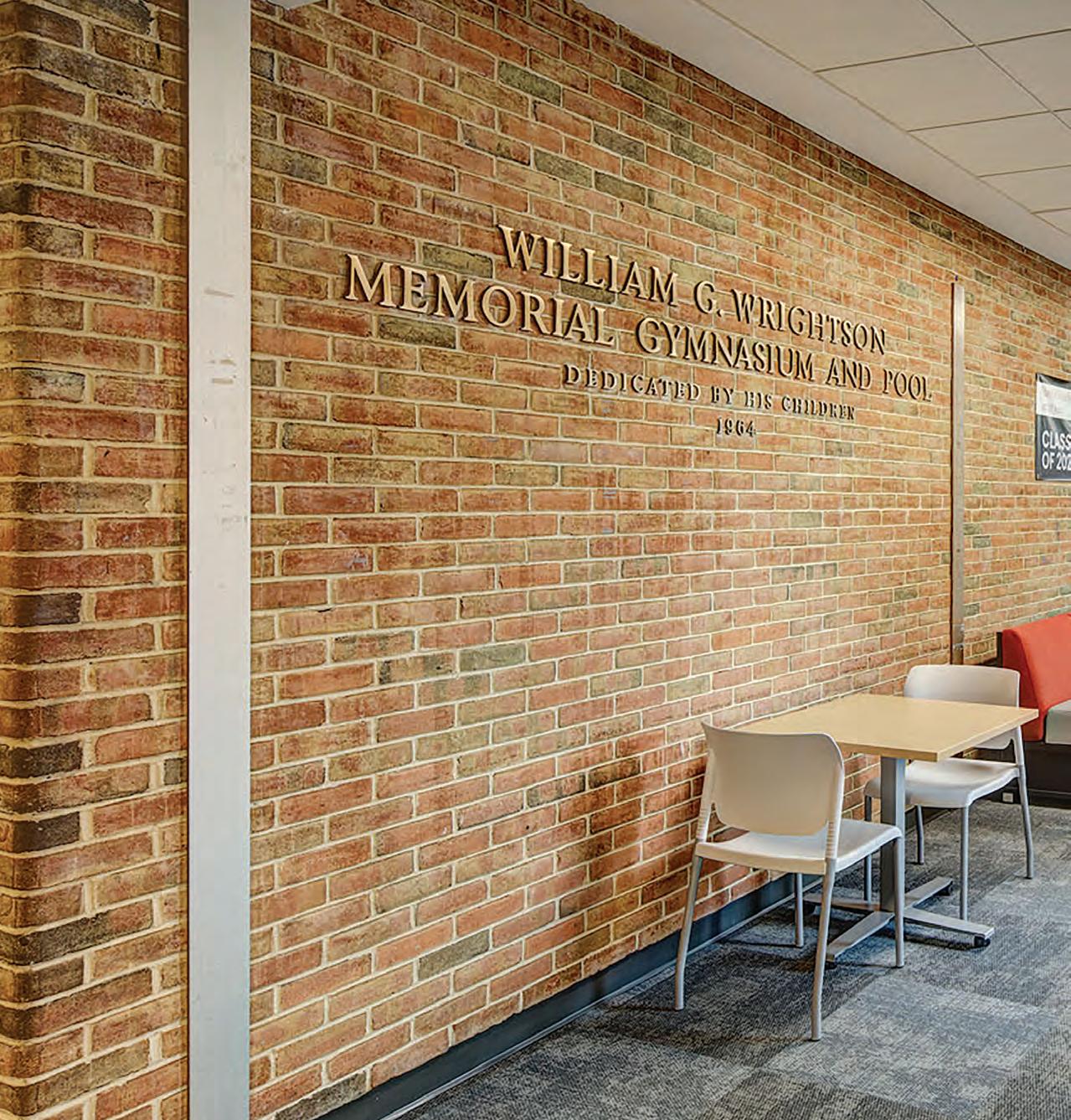
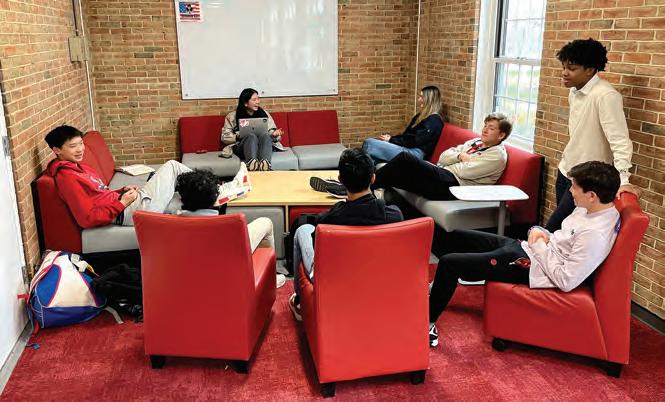
46 LUMEN I SPRING 2 02 4
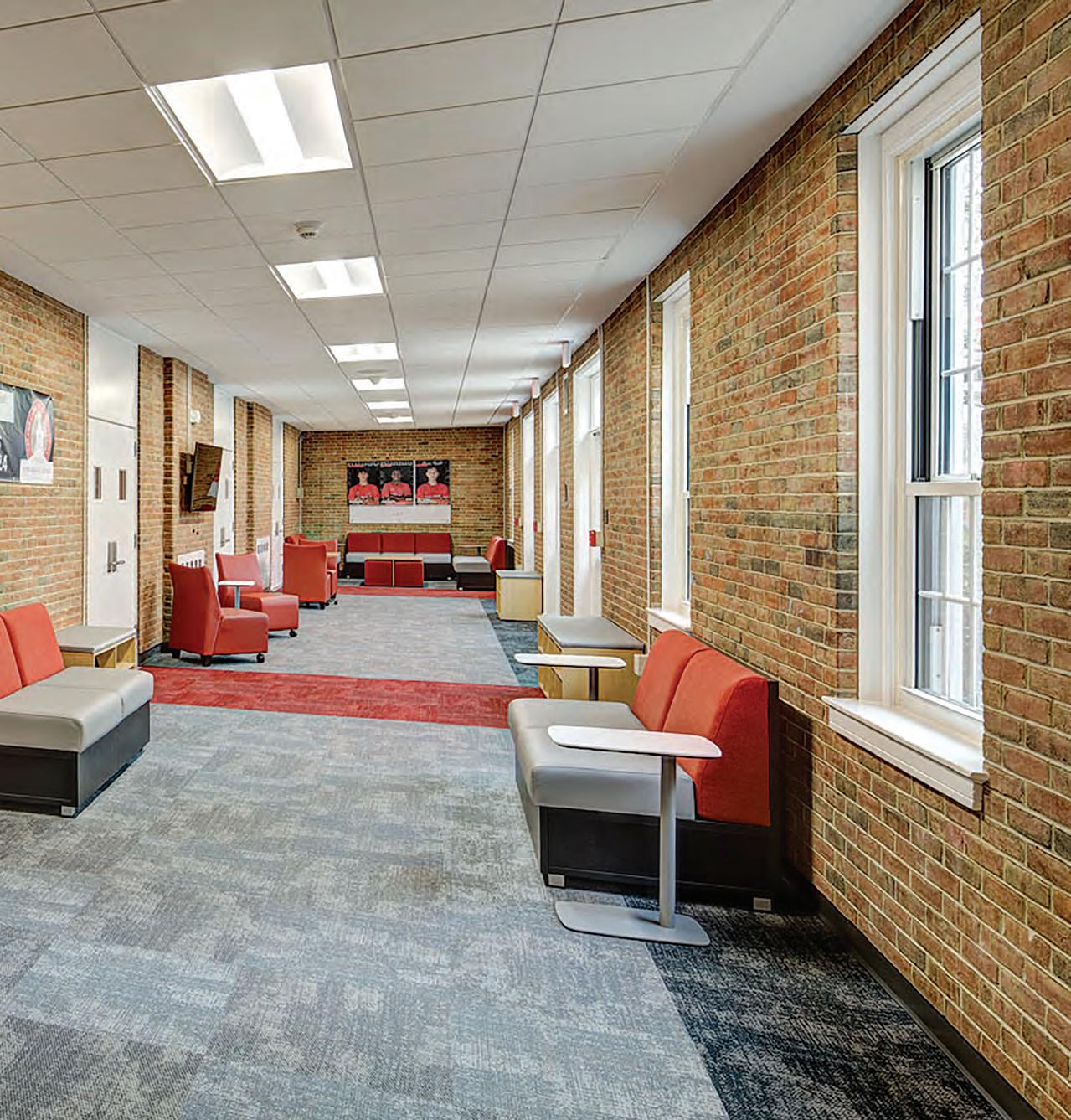
‘‘
For me, and really the whole senior class, there is nothing more important to us than spending time together. No place facilitates this process more than the Senior Corridor. The newly renovated corridor allows people of different friend groups to connect easily and effortlessly. Having a place to hang out and talk has given the seniors a common ground in physical form, encouraging us to forge connections and become united as a class and community.”
47 NEWARK ACADEMY
— Lily Sternlieb ’24
Photo by Natoli Construction
1965
Brian Maher was featured in NJ Monthly Magazine for his generous gift to help open the state-of-the-art Clinton Hill Early Childhood Education Center in Newark.
1976
Since her NA days, Francey Burke has devoted her life to many aspects of community service work by creating, organizing and hosting a wide variety of special events. Her signature event, the Burke Motor Group Car and Cycle Show, has been held every year to raise funds for active military and veterans.
1981
Artie Williams recently had dinner with Mary Gay Hensler at the home of a mutual friend. He also reports that classmate Chez D’Annunzio is a real estate investor in Vero Beach, FL.


1987
K. Lesli Ligorner was named the 2023 Asia-Pacific Labor and Employment Lawyer of the Year by Euromoney. Lesli leads Morgan Lewis’s labor and employment practice in China and handles crossborder employment matters and internal and regulatory investigations across the Asia-Pacific region.
1990
Raj Butani is a physician partner at Washington Gastroenterology and is on medical staff at Overlake Hospital Medical Center in Bellevue, WA, where he was recently elected to the position of chief of staff. His practice recently partnered with the GI Alliance, the largest
GI group in the country, with over 800 gastroenterologists nationwide.
1991
Beth Nydick presented “Branding Yourself at Any Age” during the second annual Newark Academy Women’s Summit.
1993
Suzanne Kecmer was a panelist during the “Bank on Yourself: Setting Yourself Up for a Healthy Financial Future” breakout session at the second annual Newark Academy Women’s Summit.
Maria Teresa McNeilly-Anta spoke as part of a faculty panel on “The Evolution of Women at NA: Past, Present
EATER: 100 ESSENTIAL RESTAURANT RECIPES FROM THE AUTHORITY ON WHERE TO EAT AND WHY IT MATTERS
Hillary Dixler Canavan ’04
Hillary Dixler Canavan is restaurant editor at Eater and the author of the publication’s debut book, Eater: 100 Essential Restaurant Recipes From the Authority on Where to Eat and Why It Matters. The book features recipes from popular restaurants around the country.


& Future” at the second annual Newark Academy Women’s Summit.
1994
Francis Lam will join season three of the PBS show The Great American Recipe as a judge.
Rebecca Moll Freed was named to the ROI-NJ Influencers: Women in Business 2024 list. She also moderated the breakout session “Be the Change You Want to See in the World: How to Advocate and Support Causes That Matter to You” at the second annual Newark Academy Women’s Summit.
1996
Scheherazade Tillet was published in The Guardian for her words and photographs in “‘Life Has Not Stopped for Grief’: The Photographer Holding Breonna Taylor’s Memory.”
1997
Iris Levitt-Heit was a panelist during the “Bank on Yourself: Setting Yourself Up for a Healthy Financial Future” breakout session at the second annual Newark Academy Women’s Summit.
CLASS NOTES
48 LUMEN I SPRING 2024
1999
Jacqueline Ko was a panelist during the breakout session “Be the Change You Want to See in the World: How to Advocate and Support Causes That Matter to You” at the second annual Newark Academy Women’s Summit.
Asha Talwar Coco moderated the 2024 NYC Networking Night alumni panel discussion at the Yale Club.
2000
Rishi Sharma participated as a panelist at NYC Networking Night.
2001
Lauren Hedvat was a panelist during the “Bank on Yourself:
Setting Yourself Up for a Healthy Financial Future” breakout session at the second annual Newark Academy Women’s Summit.
2003
Kevin Fritze is now leading the sustainability team at Premier Packaging. When he isn’t working, he coaches his kids’ soccer teams, runs his son’s Cub Scout den, and enjoys taking family and friends to Charlotte FC games with his wife, former NA classmate Dorian Muench-Fritze.
Akshay Oberoi is starring in Fighter, a new Indian Hindilanguage action film directed by Siddharth Anand. (See more on page 51).
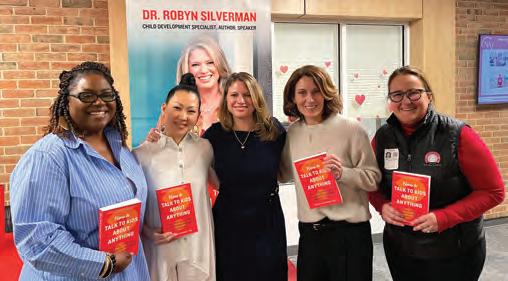
HOW TO TALK TO KIDS ABOUT ANYTHING: TIPS AND SCRIPTS TO MAKE TOUGH CONVERSATIONS EASIER
Dr. Robyn Silverman ’92
Dr. Robyn Silverman, a speaker, consultant and national bestselling author, published her latest book, How to Talk to Kids About Anything: Tips and Scripts to Make Tough Conversations Easier, in October 2023. She returned to Newark Academy to speak with students and families as the keynote speaker for Common Ground Speaks on February 21, 2024.
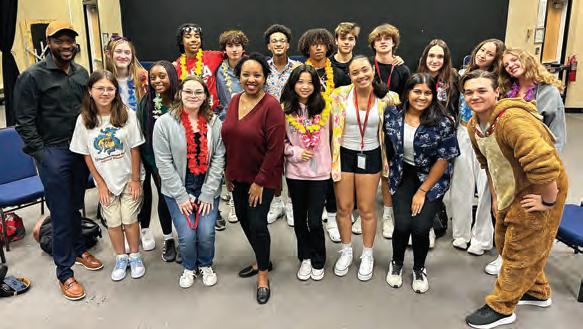
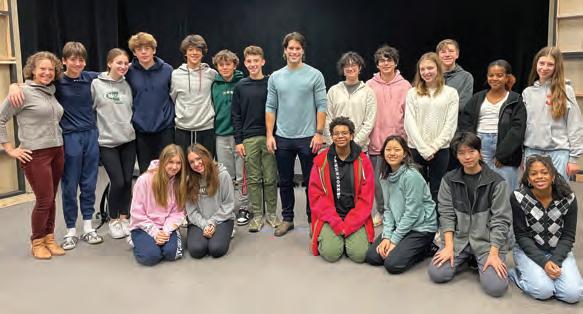

and
2. Asher Grodman ’06, (top row, eighth from left) who currently stars on the CBS sitcom
returned to NA to conduct workshops with both Upper and Middle School acting students on November 7, 2023.
3. Kennedy McNeilly-Anta ’20, (third from left) a senior at Duke Kunshan University (DKU) in China, founded the Kunshan Running Club League. In this role, he leads the DKU ParkRun, a biweekly event that creates “an opportunity for intercultural communication, friendly competition, and athletic development” within the local community of Kunshan. (Learn more on page 50).
49 NEWARK ACADEMY
3
1. Andrew Binger ’09, (far left) artistic director of Yendor Theatre Company in Newark, shared his experiences
advice with NA theater students alongside playwright Pia Wilson on October 18, 2023.
Ghosts,
2 1

W e Fondly R emember
Class of 1942
Bertram M. Kummel May 4, 2022
Class of 1946
Albert H. Fairchild – April 8, 2023
Class of 1950
Staats M. Abrams, Jr. –January 22, 2024
Paul H. Hirsch – February 24, 2023
Class of 1951
Harvey P. Yeager – August 20, 2023
Class of 1952
Richard J. Goff – March 9, 2024
Bruce M. Van Vliet –November 17, 2023
Class of 1962
Brian E. McCabe –February 18, 2024
Class of 1977
Robert F. Wuensch –February 24, 2022
Class of 1993
Jordan C. Garrick –November 18, 2023
Class of 1995
Toni Ann Carrino-Casale –December 18, 2023
Class of 1996
Senthil Sundaram –November 22, 2023
WE FONDLY REMEMBER
Bruce Goddin, Former Faculty and Founder of NA’s Soccer Program February 17, 2024

Bruce Goddin was a faculty member in the Newark Academy English Department from 1962 through 1978, seeing NA through its move from Newark’s First Street to today’s Livingston campus. According to his son, Scott Goddin ’74, Bruce’s proudest accomplishment was establishing the soccer program at NA in 1968, for which his legacy is cemented in the NA Hall of Fame. He later coached the 1975 boys’ soccer team to a state championship as well as a Prep championship against perennial cupholders Pingry and Lawrenceville — feats that landed the ’75 squad its own spot in the Hall of Fame. He was known by colleagues for his wit, sense of humor and dedication to his students and the Academy.
WE FONDLY REMEMBER
William “Arky” Crook, Former Faculty and Coach
December 2023
William “Arky” Crook, former NA faculty member and long-time tennis coach, passed away in December 2023. Arky taught a range of mathematics courses at Newark Academy, including higher level, for nearly 35 years. He led the boys’ and girls’ tennis program to countless titles, amassing more than 1,300 wins between both programs. He was inducted into the Athletic Hall of Fame in 2017. He will be missed.
2004
Jaydeen DeCambre was a panelist during the breakout session “Be the Change You Want to See in the World: How to Advocate and Support Causes That Matter to You” at the second annual Newark Academy Women’s Summit.
2015
Noah Wagner-Carlberg published his first paper in the Journal of the American Chemical Society. He credits his NA science teacher Dr. William “Bill” Hobson for inspiring his love of chemistry.
2016
Courtney Cooperman was a panelist during the breakout session “Be the Change You Want to See in the World: How to Advocate and Support Causes That Matter to You” at the second annual Newark Academy Women’s Summit.
2019
Former NA boys’ tennis captain Alex Kotzen is currently playing second singles for nationally-ranked Columbia University men’s tennis. He has been ranked nationally
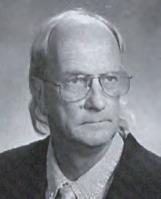
in Division I singles by the Intercollegiate Tennis Association.
2020
Kennedy McNeilly-Anta ’20, a senior at Duke Kunshan University (DKU) in China, founded the Kunshan Running Club League and leads the DKU ParkRun, a biweekly event that creates “an opportunity for intercultural communication, friendly competition, and athletic development” within the local community of Kunshan. Kennedy has used his fluency
CLASS NOTES
50 LUMEN I SPRING 2024
on page 52)
(Continued
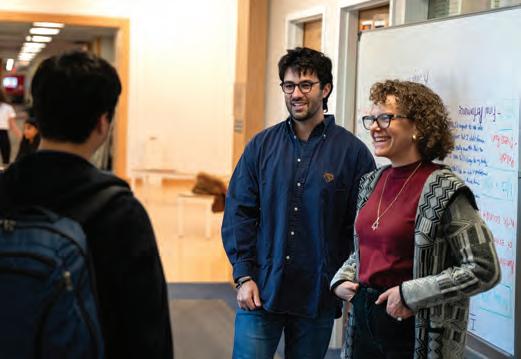
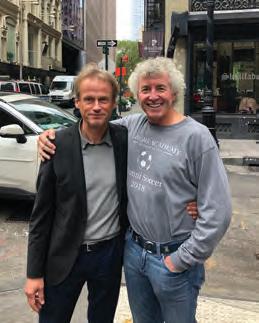
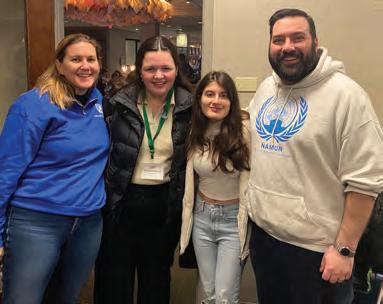
4. NA theater alumnus Elliott Zornitsky ’18 returned to NA as a guest teacher during the 24-Hour Playwriting Festival.
5. Rishab Oberoi ’00, Jyothi Vynatheya Oberoi ’03 and Akshay Oberoi ’03 at the premiere of Fighter, an Indian Hindi-language action film, in which Akshay is starring.
6. Bernhard “Bernd” Römer ’81 and Artie Williams ’81 met for lunch in New York City in September. Bernd was an exchange student at NA from Cologne, Germany, during the 1980 – 81 school year.
7. Laura Centurrino Messier ’97 and her husband, James, welcomed their daughter Joelle Rose on January 25, 2023.
8. Associate Director of College Counseling Kerri Speck (top left) visited Catherine Orr ’22 (bottom left), Colin Murphy ’20 (top right) and Arsha Misra ’20 (bottom right) at Montreal’s McGill University, which the three currently attend.
9. Director of Community Service Sarah Fisher (far left) and Humanities Teacher Jim Coe (far right) reunited with Penelope Jennings ’22, Nitya Gupta ’23 (see photo 9A), Lauren Freed ’22 (see photo 9B) and Ethan Garcia ’23 (see photo 9C, second row, fifth from the left) while chaperoning the Model UN trip to American University, which Penelope attends. Nitya and Lauren are enrolled at nearby Georgetown University, and Ethan goes to George Washington University.
51 NEWARK ACADEMY 6 7 8 9A 9C 9B 4 5
in Mandarin, which he developed during his NA Immersion Experiences, to collaborate with local organizations and attract businesses to sponsor athletic events such as DKU ParkRun. He also played a significant role in establishing and hosting the inaugural DKU Sports Invitational between the largest joint ventures in China (DKU, New York University Shanghai, University of Nottingham-Ningbo China, and Xi’an Jiaotong-Liverpool University) as well as Wuhan University. (See photo on page 49).
2022
Former NA fencer Konrad Czyzewski was a 2023 ACC Champion and a member of the 2023 National Championship team. He finished his freshman year on

the University of Notre Dame fencing team with an impressive 25 – 6 individual record.
Former NA high jump record-breaker Selah Dungey won the high jump at the UAA Aurora Grand Prix with a jump of 5’ 3” for the University of Chicago.
Former NA boys’ tennis star Nicolas Kotzen is currently playing third singles for nationally-ranked Columbia University men’s tennis. He has been ranked nationally in Division I singles by the Intercollegiate Tennis Association.
2023
Former NA girls’ tennis captain Mallika Reddy will play NCAA Division III tennis at Haverford College in the fall.
THE END OF RACE POLITICS: ARGUMENTS FOR A COLORBLIND AMERICA
Coleman Hughes ’14
Coleman Hughes is a prominent writer, commentator and musician known for his insightful perspectives on race, public policy and applied ethics. Coleman’s writing has been featured in the New York Times, the Wall Street Journal, National Review, Quillette, The City Journal and The Spectator. His new book, The End of Race Politics: Arguments for a Colorblind America, was published in February 2024.




Simran ’28 and Scarlet ’28, enrolling at Newark Academy.
11. Marjorie Jameson ’77 took a trip through the arctic circle. She was lucky enough to see the Northern Lights and take a reindeer sleigh ride.
12. Classmates Allegra Baldwin ’99, Kumi Dikengil Kay ’99 and Jacqueline Ko ’99 reunited following the Newark Academy Women’s Summit on March 9,2024.
13. Raj Butani ’90 (third from left) with his wife, Mona, and their two boys, Khrish (16) (left) and Rohan (17) (right).
10. Classmates Nirav Soni ’98 (far left) and Neil Rome ’98 (far right) joined together at the Accepted Families Reception on March 12, 2024, to celebrate their daughters and soon-to-be ninth grade classmates,
CLASS NOTES 10 11 12 13
52 LUMEN I SPRING 2024
Photo by
Evan Mann
PLANNED GIVING:
Classroom Lessons Inspire Lifetime Giving
Sitting in Blackie Parlin’s “Revolution in Japan, Russia and China” course at Newark Academy, K. Lesli Ligorner ’87 never imagined she would still be using what she learned there more than 35 years later.
A lawyer for 24 years, Lesli has spent more than 15 years living overseas. She currently lives in Japan, where she developed an AsiaPacific practice helping companies navigate their local employment law landscapes and conduct interview investigations.

“Mr. Parlin’s class provided me with an incredibly strong cultural foundation that helps when I work with Japanese companies and clients,” she says. “I draw on the history and events I learned from that class often in my daily life here.”
Lesli says that NA opened her eyes to many aspects of the world she had not experienced before. “I took courses with wonderful teachers who showed a genuine interest in my academic and personal growth and who developed my passion for reading, seeing the world, and continuing to learn,” she says. “That has been invaluable to me.”
In gratitude, Lesli has made a bequest in her will to support NA’s future. “I do not have children but value education,” she says, “so I wanted to make sure that I leave something to further education and specifically to help students who do not have the means to pay for tuition at NA. It was such a privilege for me to be able to attend, and I attended through the generosity of others, so I want to be able to give back in the same way.”
If you are interested in exploring a bequest or other planned gift, please call or email Director of Advancement Services and Planned Giving Barbara Sine at (973) 992-7000, ext. 362, or bsine@newarka.edu.
K. Lesli Ligorner ’87
P (973) 992 -700 0
E communications@newarka.edu www.newarka.edu


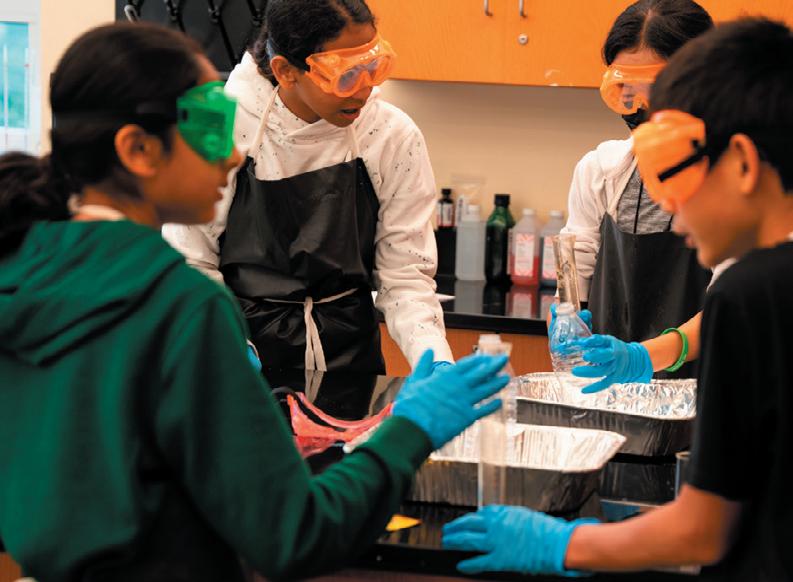
ACADEMIC & ENRICHMENT PROGRAM
Co-ed programs for children entering K-12
An unparalleled learning experience with more than 250 course offerings including Advanced Credit classes, SAT/ACT prep, STEM, arts, JTole Jazz Camp, Jump Start for kindergarten through second grade and more! Flexible programs allow for building your own schedule.

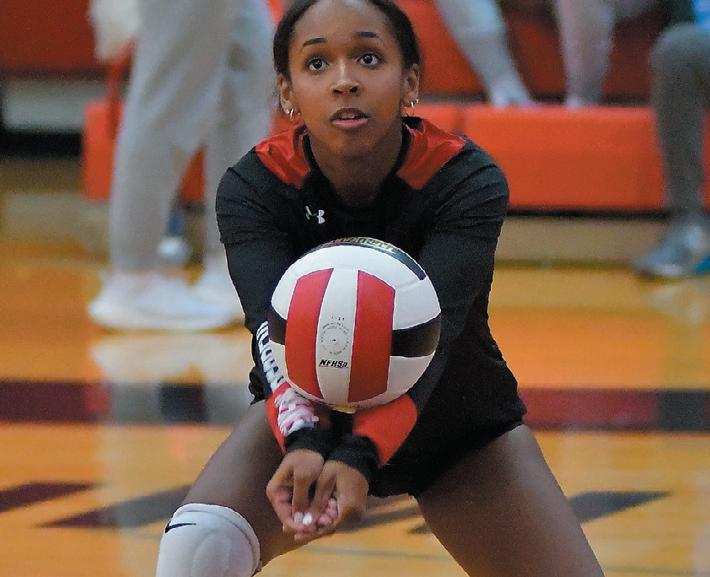
ATHLETIC CAMPS
Programs for children entering grades 3-9
Seasoned NA coaches guide athletes in a variety of sports including basketball, 昀eld hockey, football, soccer, softball, lacrosse and volleyball.
MOTT-LEENEY BASEBALL CAMP
Co-ed baseball program for ages 5-13
Campers hone their skills in pitching, catching, in昀eld and out昀eld play, hitting, baserunning and more.
newarka.edu/summer 973.992.7000 91 South Orange Ave. Livingston, NJ LEARN MORE Newark Academy 91
South Orange Avenue Livingston, NJ 07039
Parents of alumni: If this publication is addressed to your child and he or she no longer maintains a permanent residence at your home, please notify Newark Academy at alumni@newarka.edu. This publication has been printed on recycled papers certified by the Forest Stewardship Council. In doing so, Newark Academy is supporting environmentally responsible, socially beneficial and economically viable management of the world’s forests. NON-PROFIT ORG. US POSTAGE PAID PITTSBURGH, PA PERMIT #5450
