
The Academic e change
en vis ion
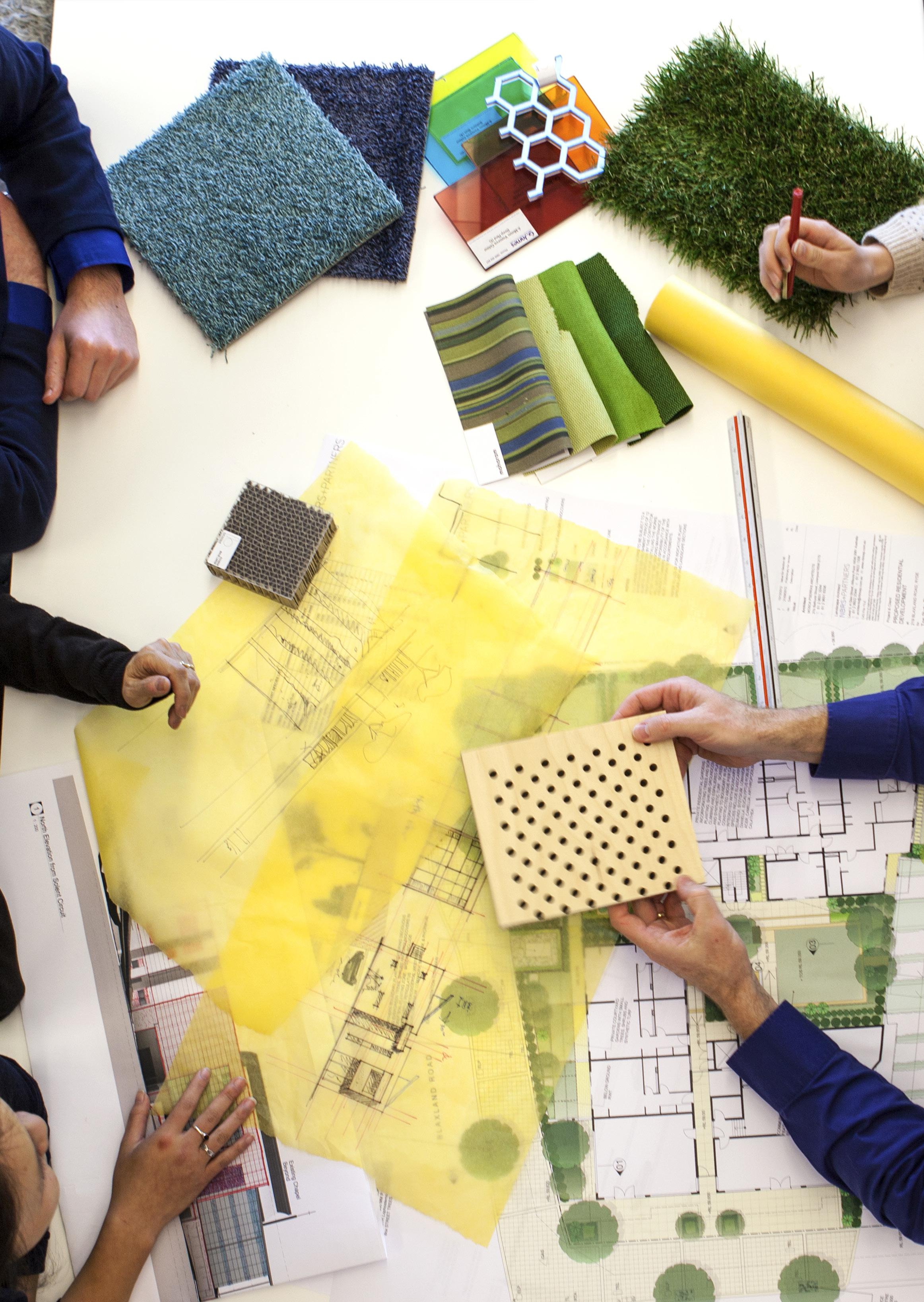
The ENVISION Student Partnership is a great way for students to get a foot in the door at an established multidisciplinary design firm, engaging and participating in an exciting design research project. Learning invaluable skills from our experienced designers, they help create solutions for an industry in need of change.
At NBRS we are interested in how innovative design can make a positive difference now, as well as into the future. The ENVISION Partnership is a highlight of our annual calendar, giving us the opportunity to connect with and be inspired by the ideas of talented young designers.
the design chal lenge
Envision 2015: Thinking Spaces
Brief
The challenge for this year’s ENVISION project was to explore the future of academic workspaces; finding productive solutions that can best support the academic community in advancing the global body of knowledge.
The higher education community consists of an array of stakeholders with complex, and sometimes conflicting requirements. Trends in commercial workplace design have long been moving towards more open plan, nonterritorial spaces, which encourages a more collaborative working environment. In comparison, the academic sphere embodies an environment of privacy and security, prioritising ‘the individual’ contrary to contemporary design models.
A unique framework
This project seeks to establish a unique approach to the design of academic workspaces. A comparative approach is often adopted at present, derived and adapted from the commercial workplace. The academic and commercial environments are significantly distinct from each other, as are the higher education and school environments.
An adaptation of an existing framework is insufficient in responding to the complex needs and desires of academia. A unique framework, constructed from the outset to specifically address Academic workspaces, will be more effective in introducing transformative spaces to higher education institutions.
Scope
The project will consider the academic workplace in relation to the broader university campus, however the spatial response will be primarily directed at the academic workplace.
The project focuses on the standard academic workplace, and does not take into consideration additional practical requirements such as labs or studios. The outcomes will cater for common tasks shared by academics across different faculties.
Arguably, the origin of contemp orary higher educa tional institutions is Plato’s Academy.


Under standing Higher Edu cation
Education
“Knowledge is the unique claim of higher education. It is at the core of every public and private good that we create.”
Simon Marginson, Professor of Higher Education, University of Melbourne
As a fundamental basis for this project, we have defined education as the building and transferring of knowledge. We believe that education in its truest form extends beyond the bounds of one-way instruction, engaging and encouraging self-education.
A contemporary understanding of education shifts the emphasis of traditional teaching roles from either giving OR receiving knowledge, and instead places an importance on the sharing of knowledge between both students and teachers. As a result, we believe that all participants become involved and can actively participate in discussions and debates collectively as academics.
The building of knowledge is a key focus among academic institutions, a process that can involve either individual study or collaborative efforts. Our research practices

are already strong in the area of building the global body of knowledge and therefore ask the question whether more discussionbased research environments would facilitate this.
Both the building and transferring of knowledge should be considered in conjunction with each other, allowing a fluidity between these two educational functions to achieve the best results.
We have summarized the essence of the educational process as ‘knowledge flow’, defining education as dynamic, relational and multi-directional. It is forever growing, evolving and advancing.
We believe that many contemporary educational institutions have physical spaces that could be better designed to support and improve this knowledge flow.
The evolution of the higher eduction institution
Arguably, the origin of the contemporary higher education institution is Plato’s Academy. In its initial stages, the school did not have any particular desire to teach. Instead Plato and his contemporaries posed problems to be studied and solved by each other. It was not an established ‘school’ as we recognise educational institutions to be today. There were no clear distinctions between teachers and students, and neither was there any formal curriculum. It instead offered an open forum for learning, utilising a fluid combination of teaching, individual study, discussion and debate.
This collaborative and supportive environment has transformed over many years, manifesting itself into many different
models, including the British Collegiate model which emphasises the comprehensive development of students intellect and character. This has been achieved through the use of the common space, allowing all members of the university to participate in the formation of strong communities in which to share ideas in an informal environment.
In order to remain competitive, the university system must stay agile, and respond to the democratisation of knowledge being disseminated freely to the public via the Internet. Universities must be able to offer more than simply instructional teaching, instead equipping future generations with the ability to think, respond and invent.
Today’s universities are seen as “too remote, too elitist, too unworldly, too expensive” (Patrick McCaughy, Director of University of Melbourne). The free flow of ideas and
open dialogue is absent from modern academic life and is far from Plato’s ideals of unhindered information exchange.
There is a desire to see universities, particularly public funded universities, “demonstrate their value (and their values) to the wider community...there has to be a way of presenting the very best of the university’s teaching and research in a palatable form to a lay audience.” (Patrick McCaughy, Director of University of Melbourne).
Over time academic scholarship has become increasingly isolated. In order to encourage the interpersonal development and collaboration of ideas, we must encourage an environment where academics can connect with those around them, drawing from the original practices of Plato’s Academy.
The university of tomorrow
In order to begin analysing the future of Australian Universities we must build upon the research that has already been established in the field of strategic vision and future projections from leading universities across the country.
Observing these trends allows a deeper understanding of core institutional values. This section highlights key insights from leading Australian Universities.
Quotes (emphasis added) from current strategic documents at February 2015 for:
Australian National University, ACT La Trobe University, VIC Macquarie University, NSW Monash University, VIC RMIT, VIC
University of Adelaide, SA
University of Melbourne, VIC
University of New South Wales, NSW University of Queensland, QLD
University of Sydney, NSW University of Technology Sydney, NSW University of Western Australia, WA
EN GA GED connected
to industry and communities
Quotes (emphasis added) from current strategic documents from Leading Australian Universities (pg 13)
develop strong and enduring relationships with business organisations
engage with industry in education, research, commercialisation and consultancy activities
ensuring that academic research engages with industry and knowledge is transferred, contributing to public policy formulation and debate
examine opportunities to develop facilities in partnership with the corporate world
engage with the communities of which we are a part
respond to major social, economic and environmental challenges
build enduring partnerships with industry, governments and other organisations that will enrich our ability to innovate, to infuse our students and staff with enterprising capabilities and provide opportunities to apply our research to make a significant impact for the betterment of our communities
open the life of our campuses to the surrounding community
beneficial research collaborations with global quality public and private partners
industry partnerships are key to [our] accomplishments in knowledge transfer and research commercialisation, ensuring that the wider community benefits from the outcomes of [our] research
industry engagement provides valuable ‘real world’ awareness to enhance [our] learning and research outcomes
our ambition is to positively influence society
drive expanding linkages and partnerships with donors, business, industry, the professions, schools, community organisations, government...
show how our research addresses problems of critical public concern
deeply engage with our communities on a local, national and global level
gain feedback from business, government and community, to focus and aligns our activity with the communities needs, providing the greatest opportunity for our research and education to find application and use
serve and engage the world through discovery, dissemination of knowledge and ideas, innovation and deep partnerships
strive for excellence and innovation in relation to the big issues of our time in order to make a difference
form game changing partnerships in teaching and research, including stronger ties with government, industry, NGO’s, philanthropists and other research institutions around the world
IN TER WOV EN connected research
and teaching
Quotes (emphasis added) from current strategic documents from Leading Australian Universities (pg 13)
education will be research-led encouraging students to question the norms, asking ‘why’ and ‘how’ to discover and learn through their own research research is central to everything [we] do
we hold education and research together. There should be a seamlessness in the learning of our students and researchers as they work to sharpen their skills in critical thinking and analysis to advance knowledge and understanding
outstanding learning experience through excellent teaching and exposure to research
the excitement, vitality and passion of the search for new knowledge is one in which all students participate
interweave our major research questions into undergraduate teaching the union of teaching and research, combined in a search for impartial truth
return research to undergraduate teaching, so that every student in every program comes to experience the scholarship of discovery as the highlight of their learning experience
learning and teaching experiences... will be integrated with, and informed by, research a learning foundation that is practice-oriented, globally focused and research inspired (MQU) learning, inquiry and discovery improves lives
COL LAB ORA TIVE
connected to each other
Quotes (emphasis added) from current strategic documents from Leading Australian Universities (pg 13)
while building on the traditional disciplines, we bring them together to solve complex problems in cross-disciplinary education and research
individual members of the University…are accountable to one another for their contribution
harness relevant intellectual resources from across the University and provide structures for cross-disciplinary research and education
cross-disciplinary collaborations of high social impact
connect and contribute through engagement
development of researcher-to-researcher collaborations and cross-disciplinary research collaborations
cultivate strategic relationships across the world to collaborate on teaching, research and knowledge exchange
shape the future by bringing together and developing leaders in their fields
partnerships, which bring together research teams across the university
to create sustained opportunities for collaborative learning, innovative research and enduring relationships
engage and collaborate with each other, our students, alumni, partners, professions and communities, locally and internationally
continue to endorse extensive and diverse collaboration for our individual academic staff
identify and develop a small number of cross-disciplinary Research Focus Areas... [to] address some of the most pressing questions affecting the future
collaboration and team work is encouraged
PLACES OF THE ACA DEMIC
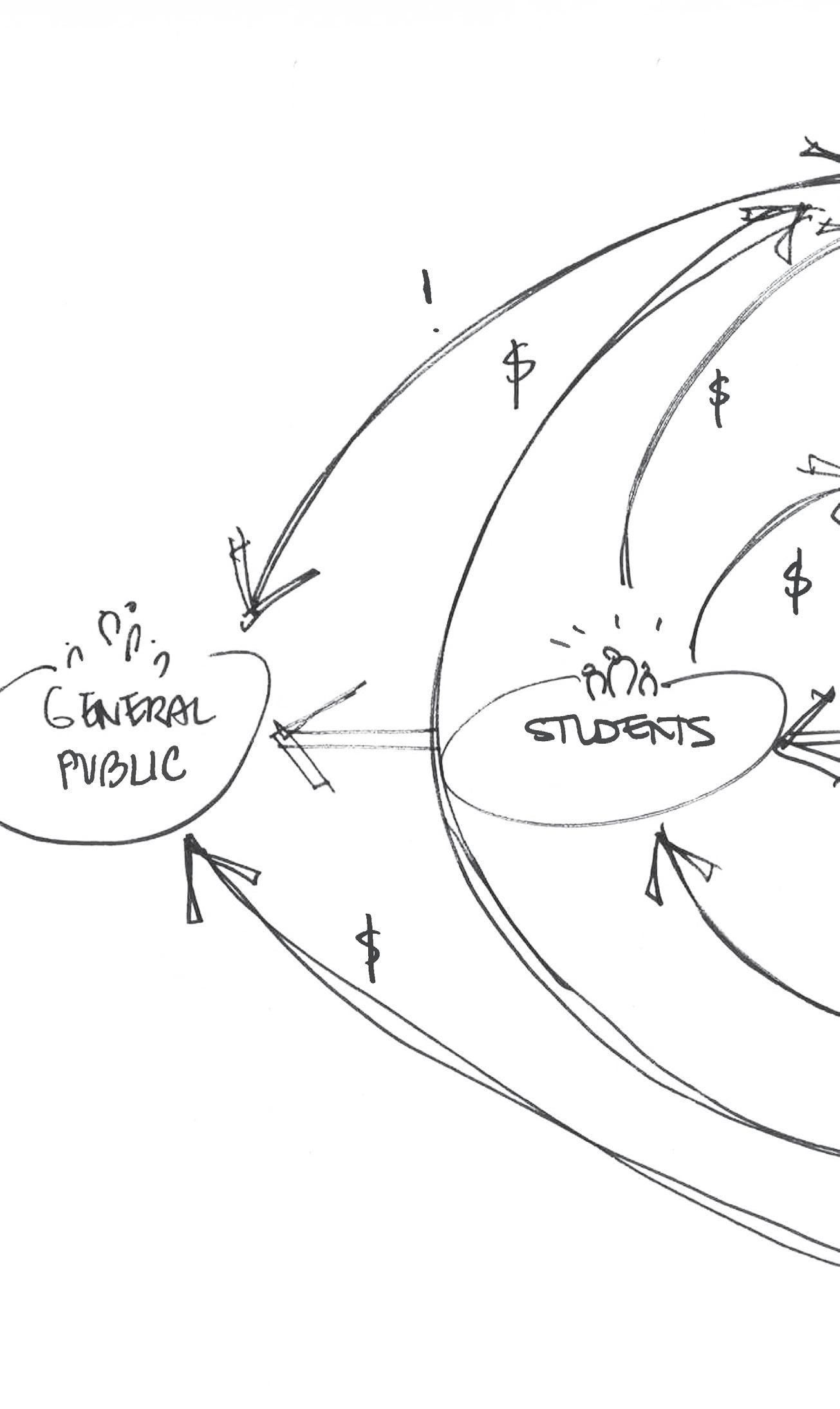
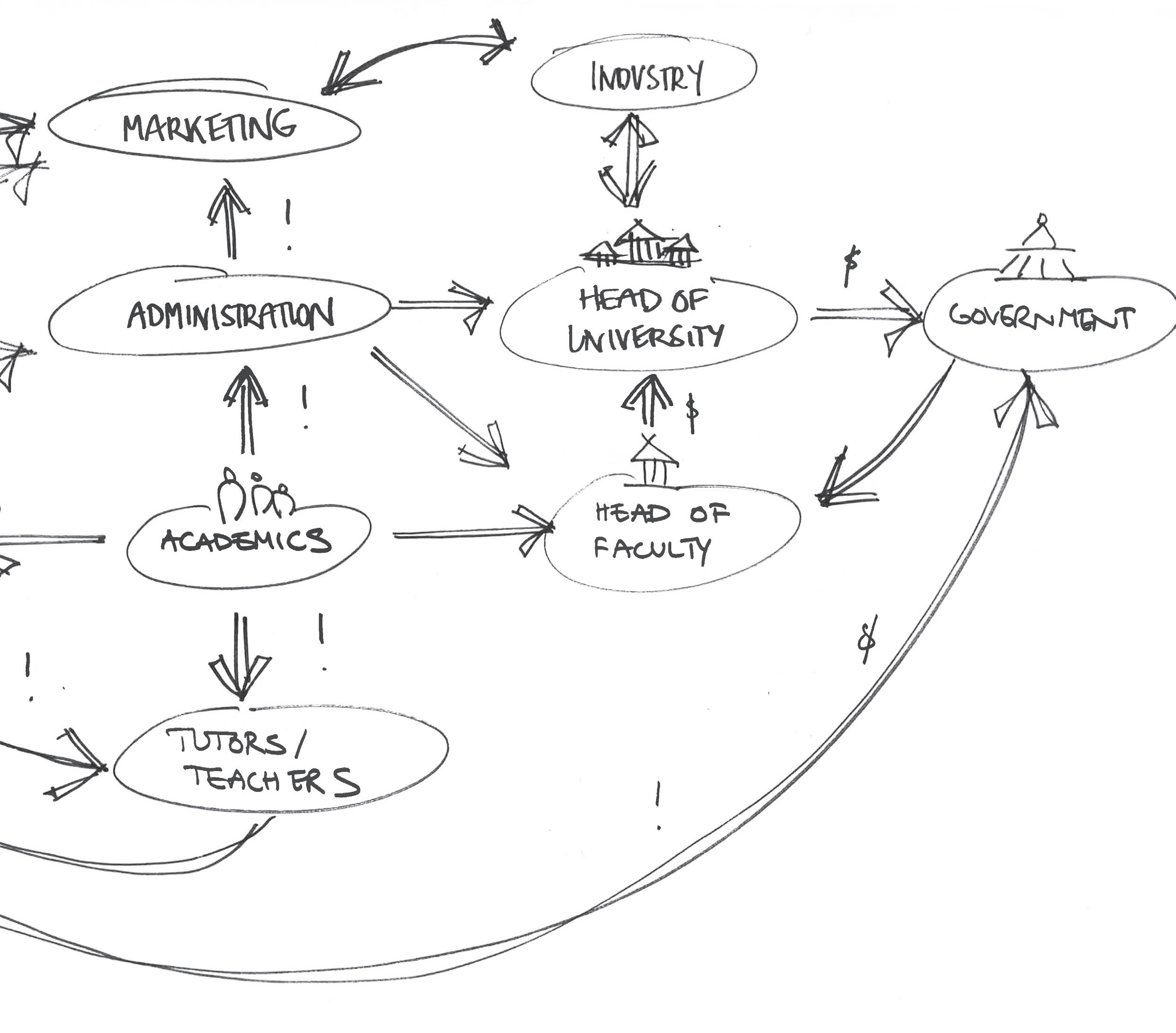
The academic is the primary component between a number of key stakeholders at any university. Their unique position allows them to engage with students, administration, the university executive, industry representatives, academics at other higher education institutions and the wider community. They are essentially the initiator of knowledge flow.
With such an important role, it is essential that an academic environment is provided with spaces that work to support them and their academic endeavours.
The teaching style of an academic can facilitate the multi-directional transfer of knowledge. Effective strategies include the integrating of research with teaching practices, as well as providing students with
insights into and opportunities to contribute to the building and transferring of knowledge.
Innovative research processes are key to the building of new knowledge. As ideas are acquired, synthesized and analysed, the body of knowledge as a whole continues to grow as new information is transferred and built upon by others.
In society, the academic has a key role in not only advancing new areas of knowledge but in the critical analysis of existing ideas, policies, trends and beliefs. Australian universities posses the key function of contributing to communities by addressing real world problems, as evidenced by the previously highlighted strategic vision excerpts.
Universities moving forward
The university of tomorrow: Collaborative, technology rich, connected with industry, interdisciplinary. Working together for bigger, better ideas. Increasingly virtual.
Contemporary society is continually transforming and evolving, becoming increasingly intertwined with technology. Traditional barriers between the local and the international are now crossed through the utilisation of technological developments. However, the approach to the academic work environment by contrast is still quite isolated and solitary. Despite other industries moving towards more open plan, versatile
ways of working, university spaces continue to pursue their conventional physical ways of working. In order to stay innovative the industry must be open to a transformative workspace, reassessing the importance of interpersonal concept development and its contribution to knowledge expansion.

Motivation
The choice to become an academic is generally motivated by a desire to contribute to the future of a particular field through teaching and research. The key characteristics of an academic are exploring the world of the unknown, to take intellectual risks and to enquire. These are the intrinsic motivators that allow academics to strive in their intellectual pursuits.
By contrast, many academic workspaces promote an extrinsically motivated culture, offering materialistic rewards for professional achievements such as larger office spaces. There is constant pressure to produce work that is both relevant and popular, with additional budget requirements and other administrative roles hindering the development of research.
In today’s commercial workplace, traditional hierarchical structures are being broken down, gradually shifting to a more open-
plan setting. The academic world however, is staunchly hierarchical. This structure dictates roles, pay grade and importantly for this project, the allocation of space to individuals. In many institutions both the amount of space and the facilities within it directly reflect an individuals professional standing.
Hierarchy
The following is an example of expectations and roles across the five academic levels in Australian universities:
LEVEL A
Level A staff are developing their academic careers. They should not be expected to co-ordinate units of study, nor be solely responsible for the delivery of any unit of study. Staff at this level would be expected to deliver lectures, present tutorials, take responsibility for modules within a unit of study, etc.
LEVEL B
Level B staff are expected to have diverse teaching portfolios, covering several units of study, or occasionally even multiple courses. They can be expected to take on some coordination and curriculum responsibilities.
LEVEL C
Staff at this level are expected to demonstrate leadership in learning and teaching activities and have central roles in course and curriculum development, and peer mentoring. It is likely that Level C staff will teach at both the undergraduate and postgraduate levels.
LEVEL D
Level D staff are expected to provide strategic, farsighted leadership in the planning and delivery of curriculum, as well as to give students dynamic and engaging learning experiences. In addition to regular teaching duties, staff at this level should

GETTING TO KNOW THE ACA DEMIC
be able to provide a ‘content specialist’ role within the faculty, teaching in specialist areas across courses and disciplines as appropriate.
LEVEL E
Level E staff are expected to be internationally respected leaders in their areas of teaching and research.
(University of Sydney, Academic Staff Workloads Policy)
Pressures
There are many varying pressures for the academic within the higher education institution that could impact their productivity and success when achieving their intellectual and professional goals.
Academics prescribe to a metric standard, requiring the publication of a high volume of research articles in addition to their teaching workload. Metrics are used to measure the output of academic material to determine
funding, progression and employability.
The aspirations of universities for their academic staff to operate under an increasingly collaborative model presents a challenge to the work practices of many academics.
For the institution, economic efficiency is also a chief operational concern. Any efficiency gains that can be made through property present an attractive deduction to overheads. However, these reduced property costs must be made in consideration of reduced efficiency or quality of academic output.
Intellectual Property & Focus
In a commercial work environment, a collaborative approach within an open plan environment supports productivity. While
acoustics can be challenging at times, this can be overcome by the adoption of an Activity Based Work model that offers a variety of work points to facilitate different work modes. Generally there is no concern around the protection of IP between colocated colleagues, as all potential intellectual property produced by employees belongs to the company.
In contrast, the academic environment is highly competitive and accreditation of individual ideas is fundamental to professional success. This results in a unique need for privacy, despite the benefits of collaborative spaces. Therefore a balance between the privacy needs of individual intellectuals and the physical assets of open plan spaces that facilitate knowledge flow would need to be considered.
Academic offices adapting to changing cirumstances.
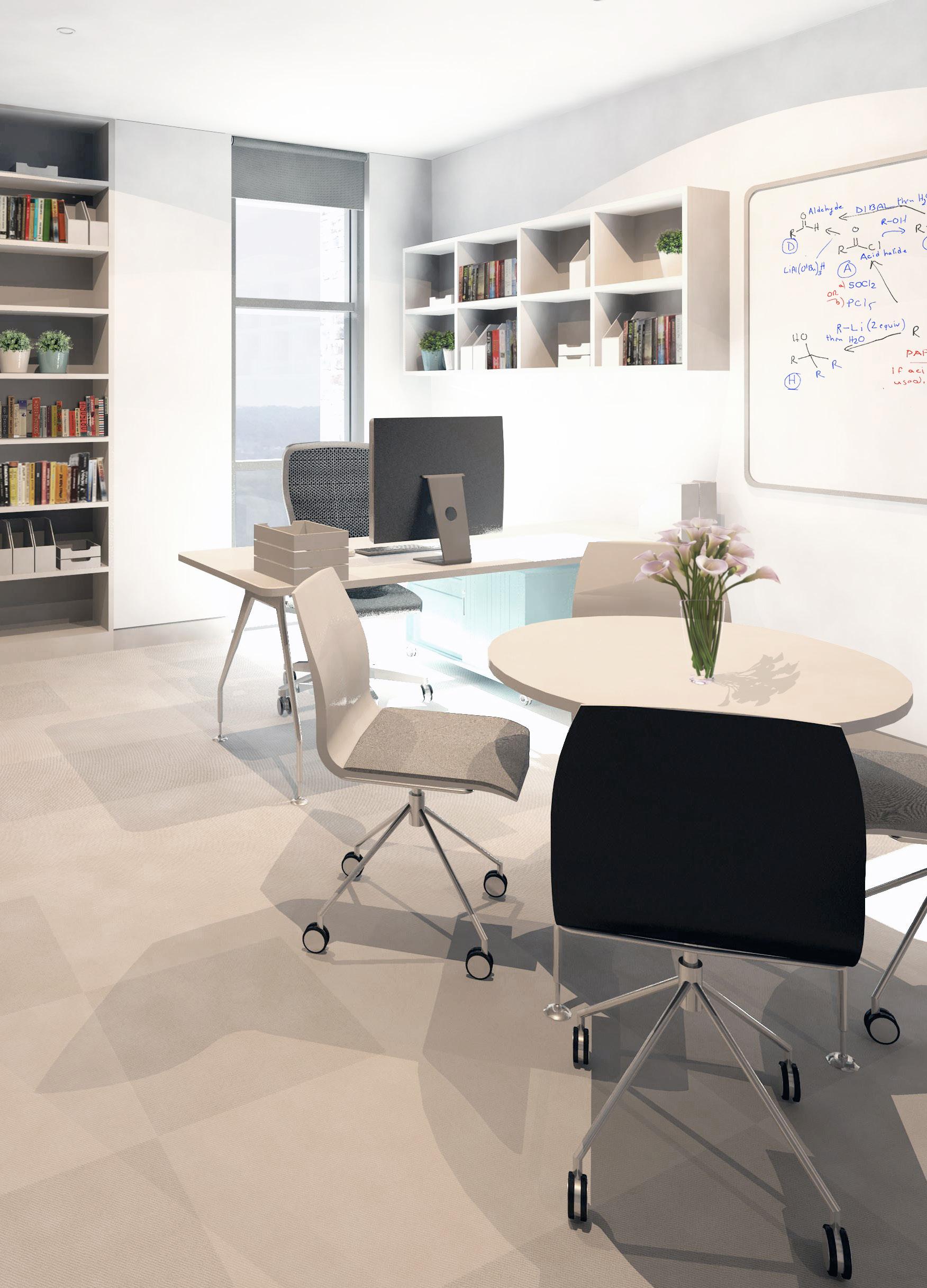
“Over the last decade institutions have been under increasing pressure to use their space more efficiently... Institutions’ utilisation of academic office space remains poor, and arguably has not adapted to changing circumstances. In addition to the low occupant densities found across the sector, the effective utilisation of academic office space (the degree to which it is occupied over time) also tends to be poor. Utilisation studies have repeatedly shown that academics and researchers typically occupy their workspaces for only 30-40% of the working day, because they are teaching, in meetings, away on business, on annual leave, working from home or engaged in some other activities away from their desk.”
How Spaces Relate to role
Hierarchy vs. Occupation vs. Activity
Traditionally, spaces in academic environments have been allocated largely based on hierarchy, rather than responding to activity modes. The more senior an academic is, the larger their office may be, with extra storage and increased privacy. At the top levels, spaces may provide private collaborative facilities.
The private office remains the preferred workspace for the majority of academics.
On analysis, it can be seen that a large number of tasks and proportion of workload requires quiet, individual space that fosters focus. These individual spaces however could not support the full spectrum of academic tasks.
Recently, these individual spaces have been occupied less, leading to institutions to turn their attention to other alternatives. Opting for an entirely open plan arrangement is impractical due to the nature of academic work. However, commercially inspired open plan solutions have been suggested and even implemented in some cases.
GROUP
TEACHING
Preparation of teaching resources
Delivery of face-to-face teaching activities
Delivery of online teaching activities
Marking and feedback to students
Student consultation face to face
Student consultation online
Higher degree research supervision
Convenor / coordinator tasks
Curriculum development & accreditation
Practical placement coordination
RESEARCH
Acquisition, aggregation and synthesis of knowledge
Planning, undertaking, analysing and publishing research
Writing articles and other works for publication
Developing collaborative research networks
Research supervision
Presenting scholarly papers / addresses to conferences
Preparing research grant proposals
SERVICE &
ADMIN
University service and administration
Community engagement
To the left is a generic analysis of academic tasks and group size involved. We suggest that this activity-based model could form part of a structure on which to design spaces that best support the academic workload.


The Need for Change
Supporting the knowledge flow
a more linear, equal management system that allows the discussion and transfer of ideas between the most junior and senior academics.
with larger office spaces and improved amenities, to reflect their professional status. This hierarchical approach is an embodiment of traditional management systems.
Currently, academics are rewarded with larger office spaces and improved amenities such as bookshelves, to reflect their professional status. This hierarchical approach is an embodiment of traditional management systems.
This office style is favoured as it allows for highly private, individual working spaces. Academics desire control and the ability to customise their working conditions.
This office style is favoured as it allows for highly private, individual working spaces. Academics desire control and the ability to customise their working conditions.
The physical and organisational barriers of this hierarchical office system impedes the transfer of ideas between junior and senior academics. Not only does this create distance between colleagues, but it also results in a lost opportunity for idea exchange and development. Organisational theory has moved towards
The physical and organisational barriers of this hierarchical office system impedes the transfer of ideas between junior and senior academics. Not only does this create distance between colleagues, but it also results in a lost opportunity for idea exchange and development.
Aligning with strategy
Organisational theory has moved towards a more linear, equal management system that allows the discussion and transfer of ideas between the most junior and senior academics.
Aligning with strategy
The desire for a quiet and private workspace conflicts with the idea of collaborative environments and their benefits of contributing to knowledge flow. Not only does collaboration allow academics to discuss and debate new and emerging ideas, but it also creates a dynamically engaging environment.
The desire for a quiet and private workspace conflicts with the idea of collaborative environments and their benefits of contributing to knowledge flow. Not only does collaboration allow academics to discuss and debate new and emerging ideas, but it also creates a dynamically engaging environment.
By 2050, the majority of the academic workforce will consist of Generation Z and Generation Alpha who will have a very different mindset to previous generations. Their way of accessing, consuming and information will be intertwined with technology. As a result, work spaces
By 2050, the majority of the academic workforce will consist of Generation Z and Generation Alpha who will have a very different mindset to previous generations. Their way of accessing, consuming and
will need to be responsive, and even preemptive, to this new cultural shift. As we enter an era of rapid technological change, academic working environments are required to be progressive and adaptable in reaction to these developments.
Evolving working modes
creating information will be intertwined with technology. As a result, work spaces will need to be responsive, and even preemptive, to this new cultural shift. As we enter an era of rapid technological change, academic working environments are required to be progressive and adaptable in reaction to these developments.
Evolving working modes
The instantaneous nature of technology has allowed us to connect with people on a global scale, with large amounts of data able to be quickly and easily transmitted. As a result, this has created an increased amount of mobility, with work able to be undertaken almost anywhere. We can already see the effects of technological change and its impacts on the professional environment, being “not linear but a mosaic of reinvented roles and options” (McCrindle, Wolfinger 2009).
With technology replacing base level data
The instantaneous nature of technology has allowed us to connect with people on a global scale, with large amounts of data able to be quickly and easily transmitted. As a result, this has created an increased amount of mobility, with work able to be undertaken almost anywhere. We can already see the effects of technological change and its impacts on the professional environment, being “not linear but a mosaic of reinvented roles and options” (McCrindle, Wolfinger 2009).
entry jobs and other manual tasks, we see the beginning of a knowledge-based economy, in which workers will depend on intellectual skills for employment. The workforce will need to be highly educated and highly skilled in data and communications. The traditional hierarchical management structure will need to move towards a more equal management system. The workplace itself would become more of an activity, rather than a physical place. Future workspaces will be configured to provide a variety of working and social situations, instead of following the notions of the conventional office which comprised of a series of repetitive individual workspaces.
In order to stay relevant to the evolving global body, universities must make compromises in their working environments. The future of the academic workspace requires a new framework that not only addresses the needs
of the academic, but produces a dynamic working environment and encourages the exchange of information. As we move towards a new era, conventional notions of teaching and learning will need to be reviewed.
Bridging the gap
The element of exchange creates ‘pause moments’ within transitory spaces. As seen in the figure X above, it is the connecting zones and circulation pathways that have the most potential to add quality and substance to an academic workplace. Both visual privacy and connectivity maintain a balance in hierarchy to allow for a variety of exchange methods to occur.
Figure X
Effec tive think ing spaces
Fostering discussion
In most academic higher research environments, working spaces can often be divided into individual offices. For academics, this is a space in which they can focus on their individual projects in a controlled and quiet environment. This is a popular and effective method of study, but it should not be the only aspect of an academic workspace. Collaboration, discussion and the transferring of ideas is extremely important to the academic profession and spaces that foster these collaborative interactions need to be considered in conjunction with private spaces.
Studies have found that academics in fact only occupy their individual offices for 30-40% of the working day. Due to other commitments such as teaching, meetings, business obligations, annual leave and off-site research it is clear that academics utilise a vast range
of differing environments. As academics spend the majority of their time away from their individual office, there is a need to create other adaptable and flexible workspaces to suit their various needs.
Academics are encouraged to establish partnerships with other institutions, corporations and members of the community. Developing an increased understanding of the use of space in an academic environment allows the improvement of productivity of the academic workplace.
Discussion is an enormous part of the academic experience, as it allows for individuals to create, expand and secure ideas. The collaborative process sees the growth and transferral of knowledge, increasing the range of understanding as well as contributing to new material.
Fostering this discussion can be achieved in a variety of ways that extend beyond the conventional structure of traditional meeting rooms. New, innovative designs can offer a diverse range of discussion points. These can be in the form of Pause Points and rendezvous areas in hallways and walkways, small incaves set into larger open spaces, or even more informal areas such as coffee table and arm chair spaces.


Introducing The Academic e change
The Academic Exchange is a highly adaptable design solution that can be applied in a multitude of configurations. The Exchange is comprised of a combination of Pause Points, selected as appropriate for the spatial configuration and intended use. The implementation of the Privacy Gradient in spatial planning will guide the selection and placement of components (Pause Points) that make up the Exchange. Pause Points are categorised into the three zones of the Privacy Gradient: Private, Permeable and Public.
Fost ering disc uss ion
Hubs
A Hub is a large Exchange section, consisting of a congregation of Pause Points with a public interface. It is ideally the most public section of any Exchange implementation, however spatial restrictions may prevent this in some scenarios.
Hubs are highly adaptive, able to be utilised for a range of group sizes, from small individual exchanges, to larger group discussions. Hub Pause Points support social interaction, visitor reception and collaborative working in a public environment. They offer a strong sense of arrival with a social tone acting as a host of activity for all resident academics, as well as an interface with students and industry.
Transitory spaces
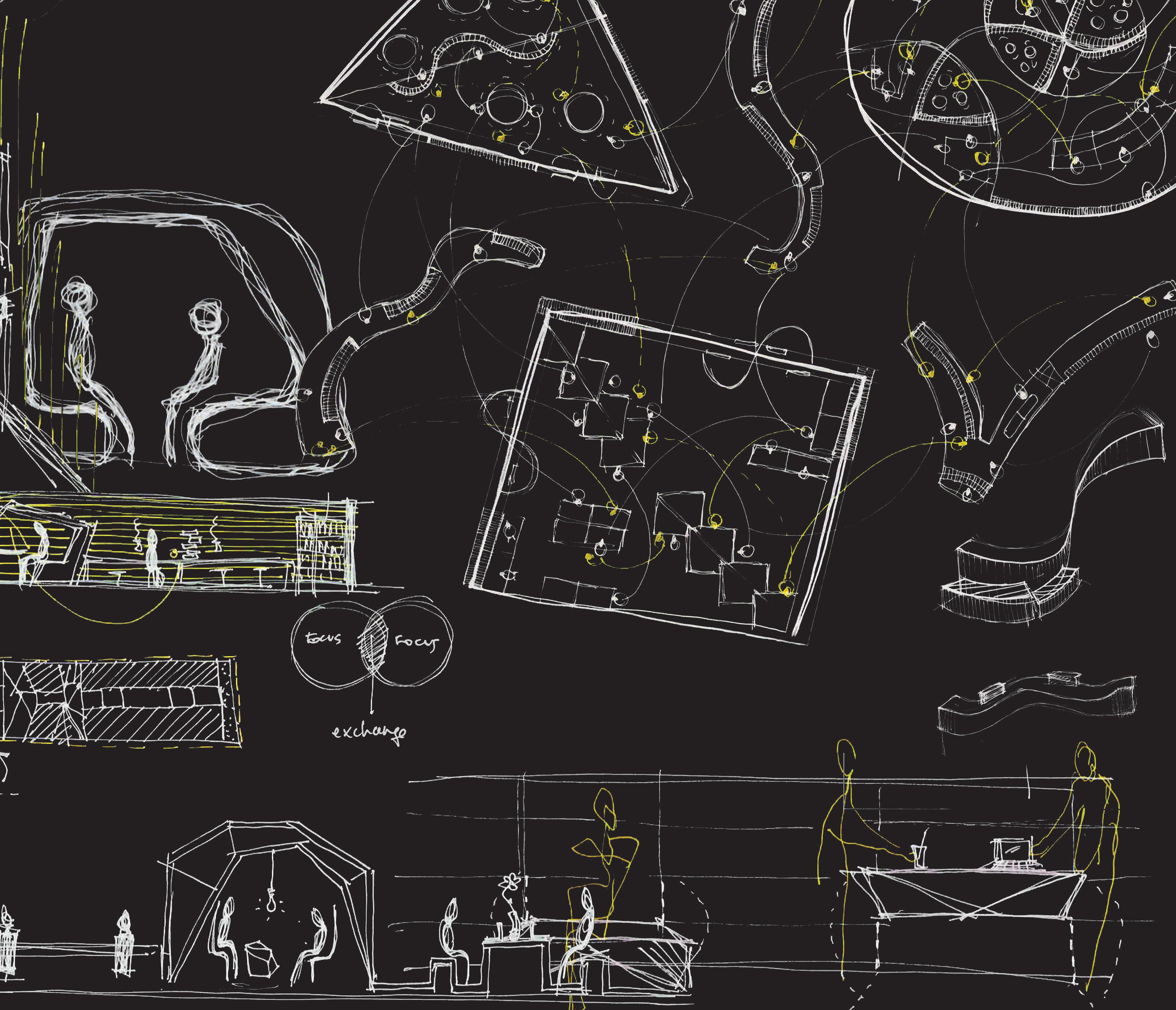
The Academic Exchange responds to the reality that a large vacant space isn’t always available to provide discussion opportunities for academics and their collaborative partners. Instead, the primary implementation of the Exchange is within transitory spaces. Existing corridors are often under utilised, viewed only as negative space surrounding offices. By punctuating transitory spaces with Pause Points, the Exchange permeates throughout the building, organically encouraging discussion between academics.
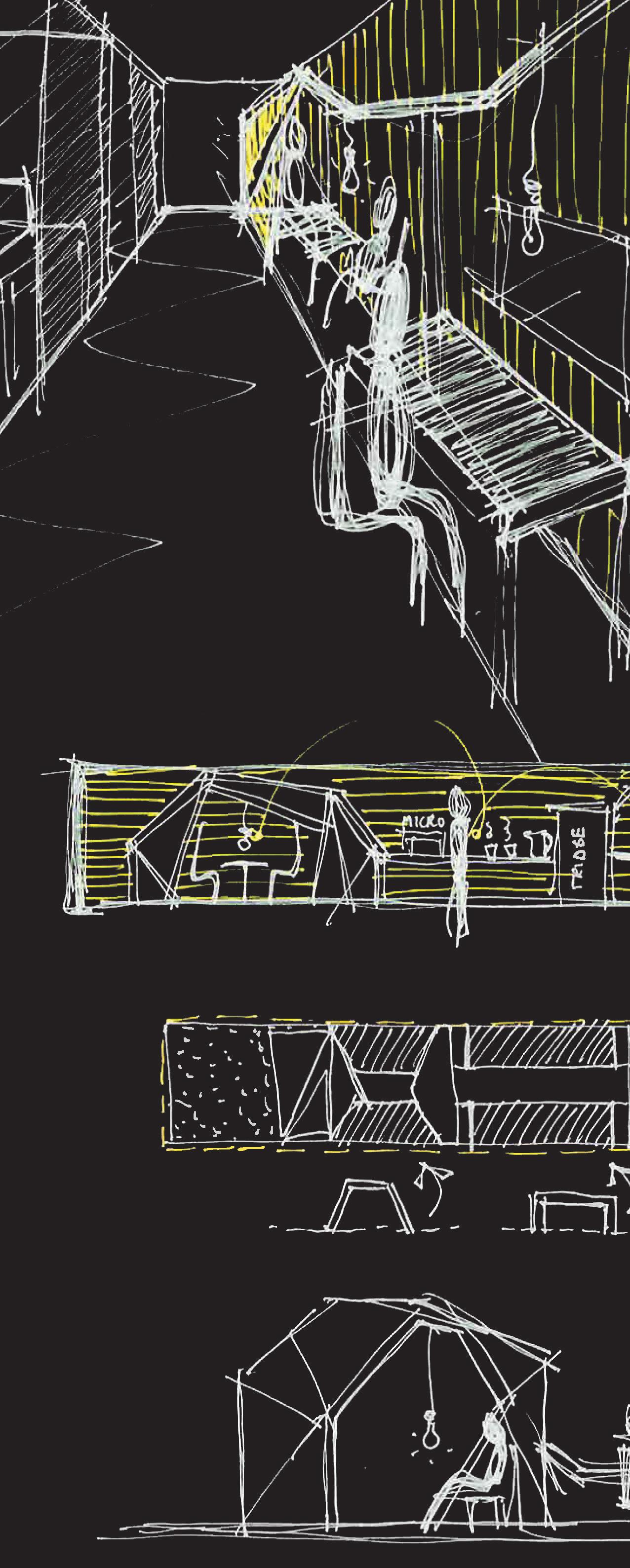
Through relatively small spatial sacrifices, this string formation of the Exchange has the capacity to have a dramatically positive impact.
Current:
• High speed corridors
Future:
• Interactive pause points
• A string formation of the Exchange ranging from Permeable to Private Zones
• Pause Points providing opportunities for organic, impromptu discussion
Spatial Reshuffle
Transitory spaces rely on the flexibility and adaptability of that space. There is the potential for an existing space to become more useful by simply reshuffling certain aspects of the space. Re-thinking and reordering spaces can be extremely refreshing and beneficial to the morale and work ethic of the staff. With some critical and architectural analysis, academics can make the most of their original workspaces.
Adaptable delivery
In these new spaces, it is important to note that the intention is to deliver a result that does not have a set or concrete purpose, but can be adapted and re-shaped to support the changing needs the occupants.
Academic institutions are continually morphing and changing to support their student body, as well as in response to governmental requirements and industry innovations. The physical spaces in which this development occurs should be able to be adapted in conjunction with these social and cultural shifts.
Quality vs. quantity
Innovative learning environments create an interplay between individual and group spaces. Making collaborative spaces does not, as some may assume, conflict with the idea of individual space but rather compliments and diversifies these environments to enhance their workability and capability.
Although the Academic Exchange offers quality and well researched environments in which to collaborate, it should not be at the expense of individual spaces which are an important aspect of academic work. The intention is to create a balance between new and old preferences in order to deliver the best result possible. It is not practical to create a variety of spaces which offer only average or mildly improved productivity to the former space. Instead, a combination of both individual and collaborative spaces will achieve a balanced and productive work environment.
The Academic Exchange seeks to foster and enhance dialogue between academics whilst not overriding the importance of individual space, making discussion and collaboration easier and more effective, without removing the opportunity for individual study.
Under util ised oppor tunity
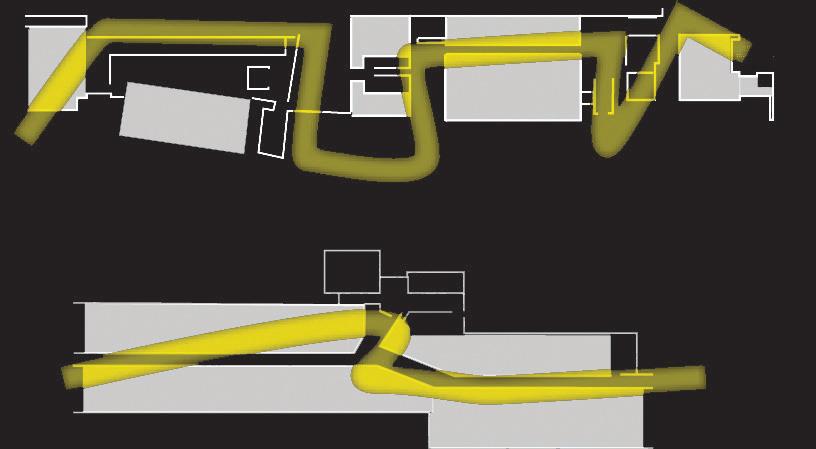
We have used the floor plate examples from two sample Australian universities to highlight the difference between the office and teaching spaces. The spatial diagrams of Figure A demonstrate how the negative spaces in between the black zones (the office/working zones) are often areas used for moving in and out of. However there is the opportunity for them to be transformed and orchestrated into something much more useful.
The circulation and movement within a building allows people to interact and exchange. By placing the focus on improving these specific areas, the overall quality of the entire space will be enhanced.
These zones provide a place of refuge so hallways become interactive spaces en lieu of traditional corridors. Zones of different sizes provide different levels of intimacy and
group interaction. A clear path for circulation is maintained in order to eliminate hidden corners and allow for a visual and spatial relationship to occur between the spaces.
The negative spaces (highlighted in yellow here) are what the thesis is based on.
This element of exchange creates ‘pause moments’ within these transitory spaces. As seen in figure A above, it is these connecting zones and circulation pathways that have the most potential to add quality and substance to a building, making it an interactive and engaging place to be.
Visual connectivity is of prime importance in an academic workplace. Both visual privacy and connectivity maintain a balance in hierarchy and allow for a variety of exchange methods.
Pause Points
• Discussion Modes: Social, Spontaneous, Orchestrated etc.
• Pause Length: Moment - All day
Figure A, displays the traditional corridor type. Universities use hallways to maximise space for offices and other amenities.
However, by asking new questions, transitory spaces can become more functional and multi-purposeful. For example;
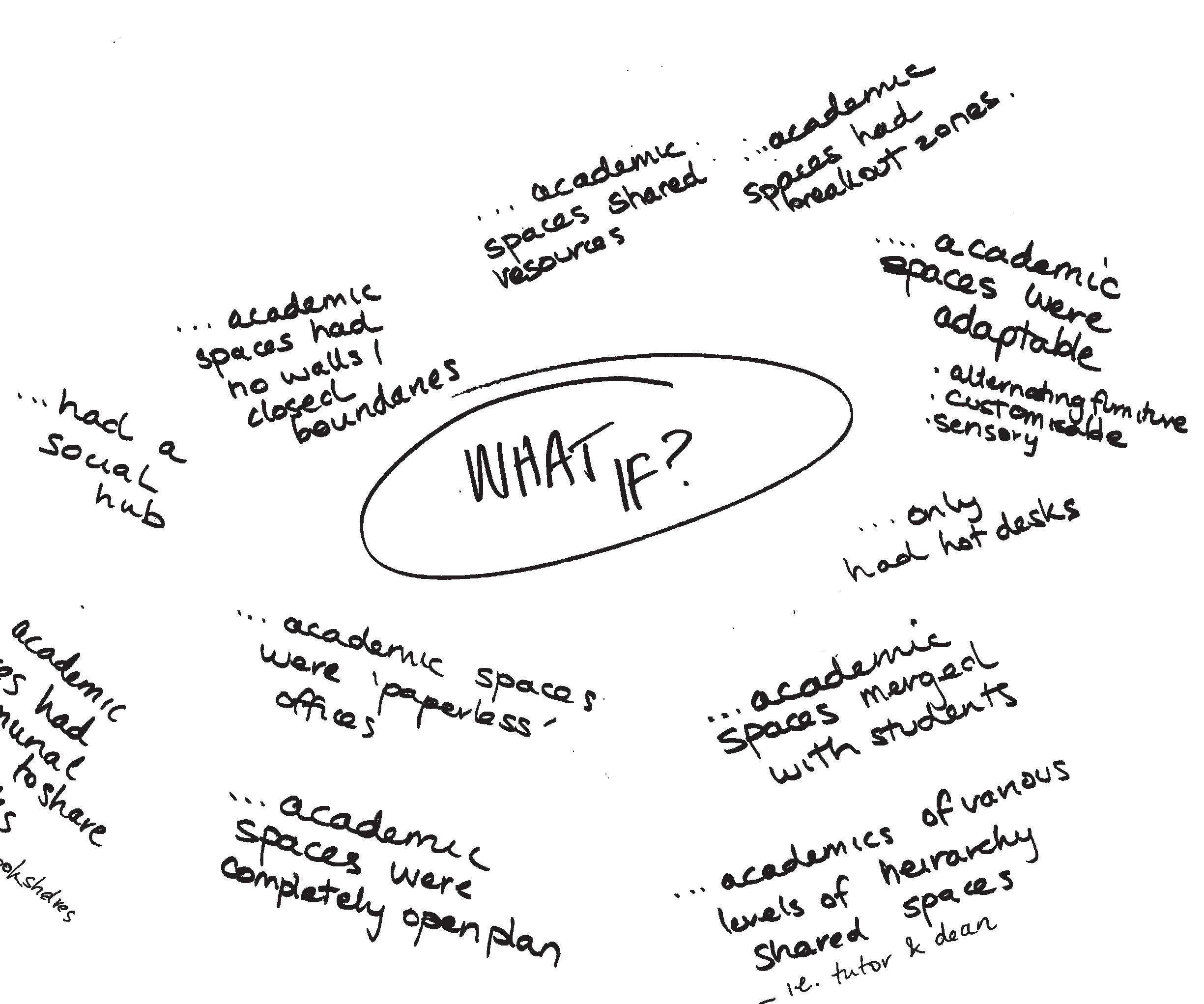
• What if these spaces were fragmented, divided, split up, or eliminated on one side?
• What positive effects could this have on the ‘transitory space’ within the academic faculty?
• How can it add value to the building overall
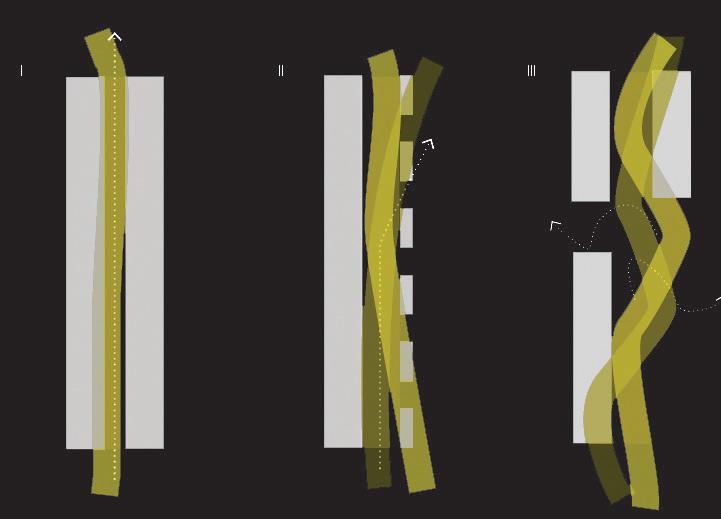
The three figures above demonstrate varying uses of corridors and the implementation of new and innovative strategies to encourage discussion and knowledge flow:
I. The generic corridor, mainly forward movement for exit
II. Corridor, open on one side, connection to outdoors
III. Fragmented corridor, open in segments through offices, as well as connection to outdoors
Adjacencies
Public Entry point
Access core
Social / Kitchen
Permeable Meeting rooms
Print room
Hotdesks/PHD candidate areas?
Private Focus Pods
Zone Categories
Public Size range – up to large group
Highest volume
Public Interface, arrival
Permeable Small Group
Medium volume
Group work, lounge room debate
Private Pairs
Low Volume
Bump discussion, shoulder-to-shoulder focus
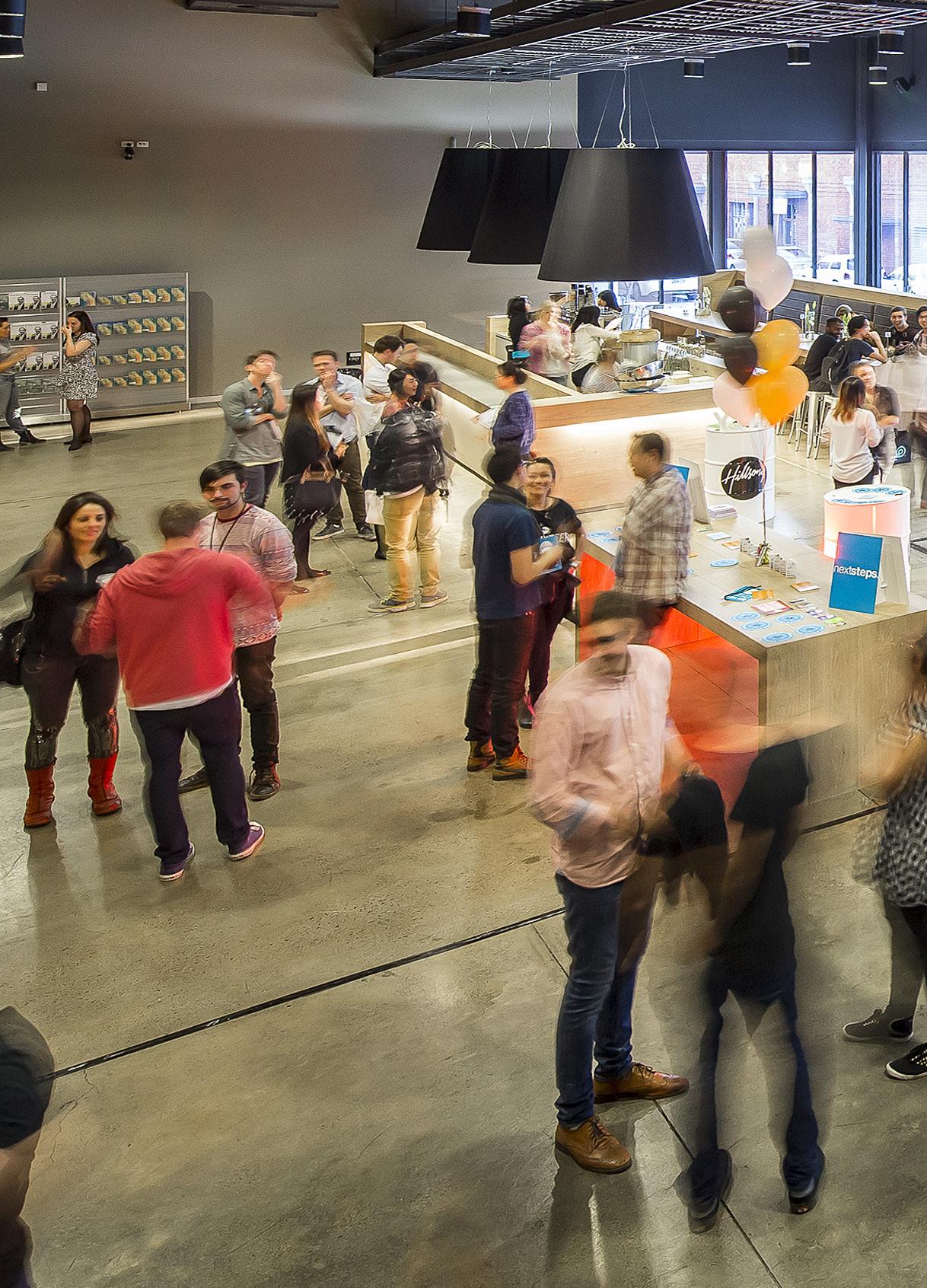
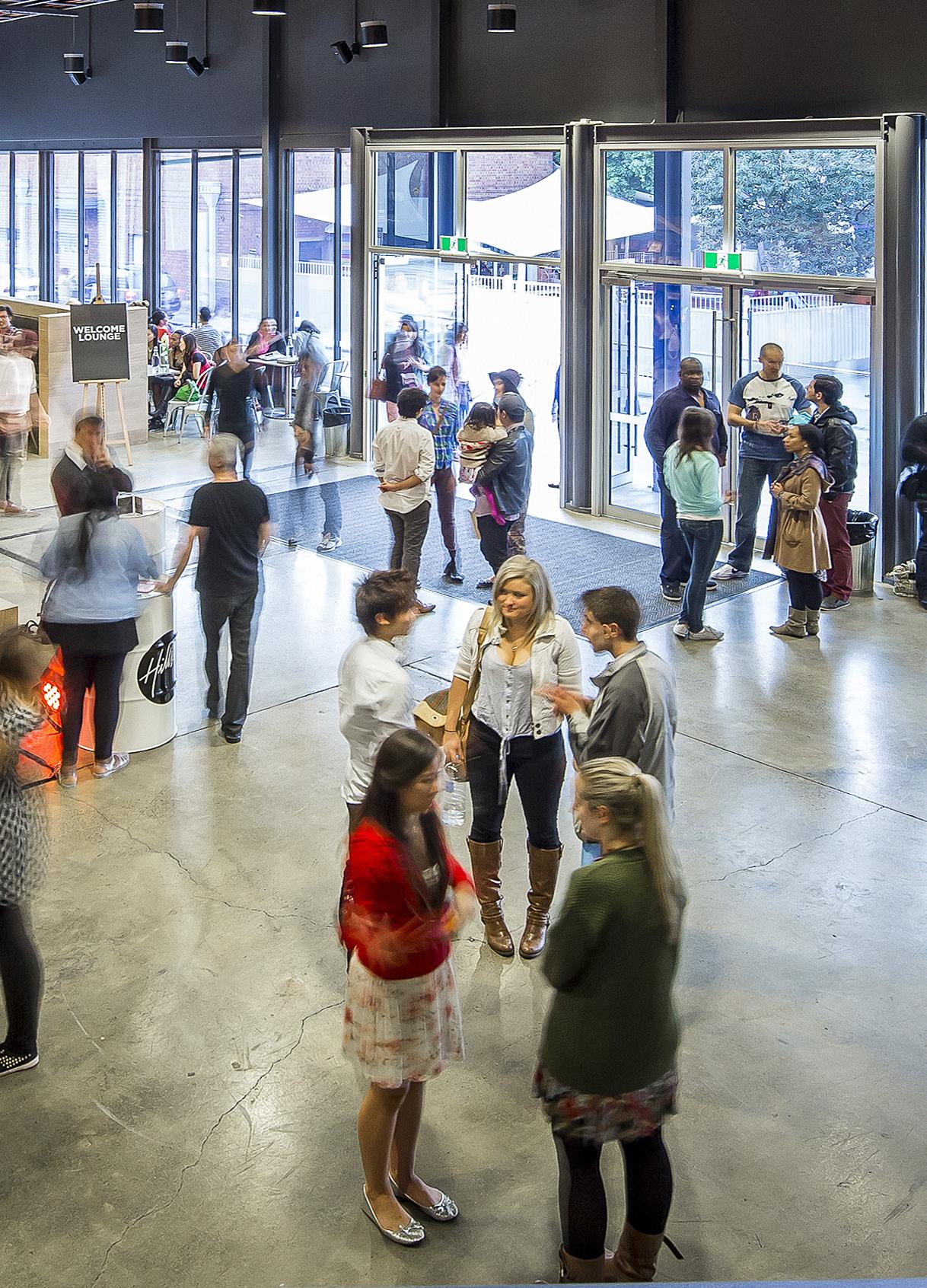
A communal seating space which allows for large groups of people to gather, eat and talk in the space.
Semi private zone seating with smart surfaces allow for impromptu meetings that can be accompanied by digital displays.
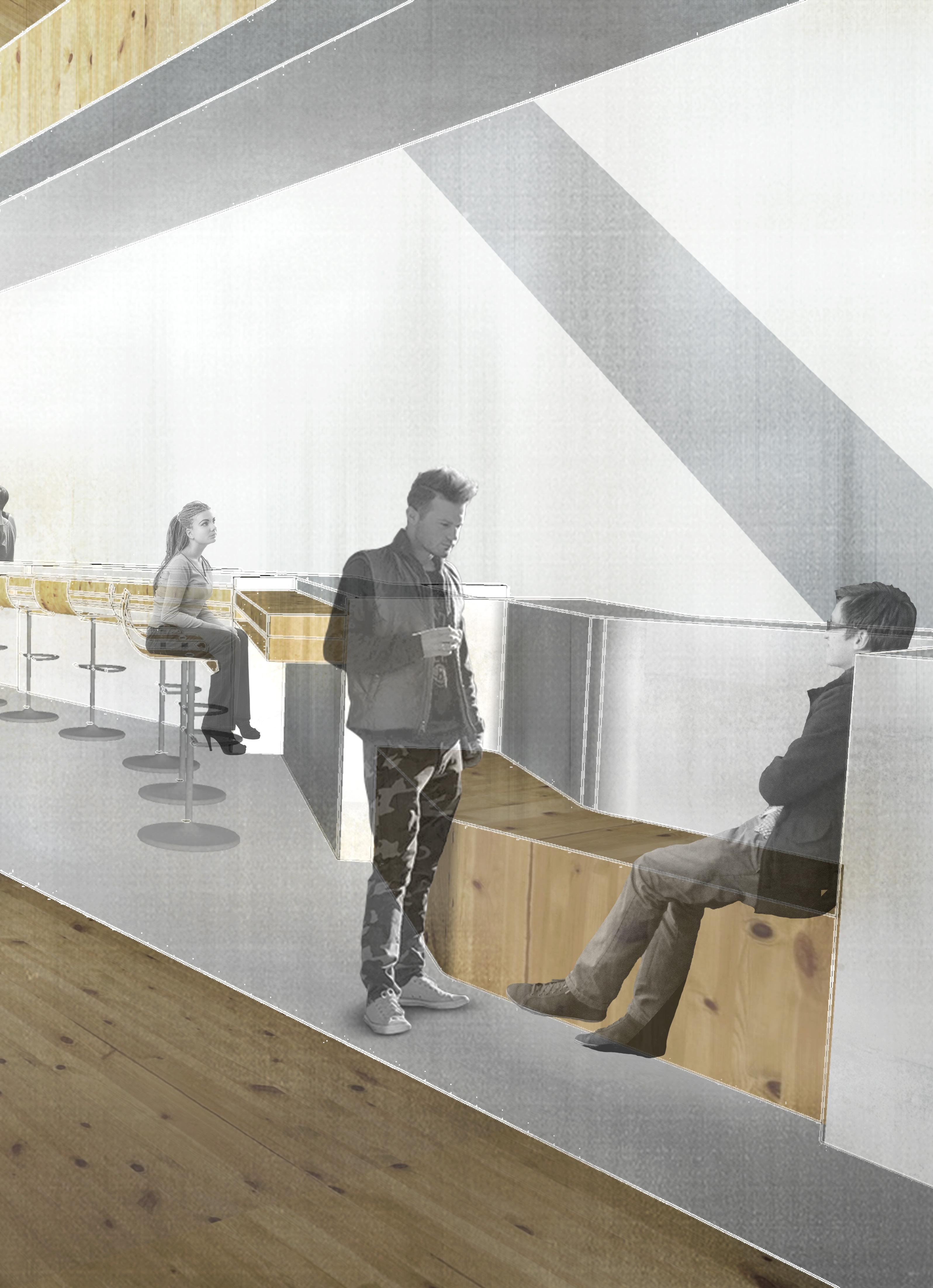
Embedded seating allows people to meet casually in the hallway, as well as to quickly sit and discuss ideas.
design case study
The Academic Exchange is a design concept which incorporates an adaptable space configuration, incorporating new developments in the organisation of academic space in order to produce an exciting and effective higher learning environment. These designs will utilise all space in a way that is conducive to collaboration and discussion, as well as individual research.
This case study will outline how the Academic Exchange can be applied to specific university institutions to transform their academic spaces. It can be adapted into a multitude of different configurations, offering an alternative to conventional and preconceived notions of research and teaching.
The two main components of the Academic Exchange include the need to foster collaboration and discussion between academics as well as the utilisation of space previously neglected. It takes otherwise empty or unused space, and adapts it into one which fosters communication and is conducive to focus and learning, as well as being aesthetically appealing. The Academic Exchange offers an architectural solution to an academic and institutional problem.
This adaptable design will be split into three areas as part of the Privacy Gradient, in which the space moves from the most public and collaborative areas, to the most private and individual. The three zones within the Privacy Gradient are: Public, Permeable and Private.
The following case study will outline how this adaptive theory can be put into action in these three stages to make a substantial difference to academic productivity.
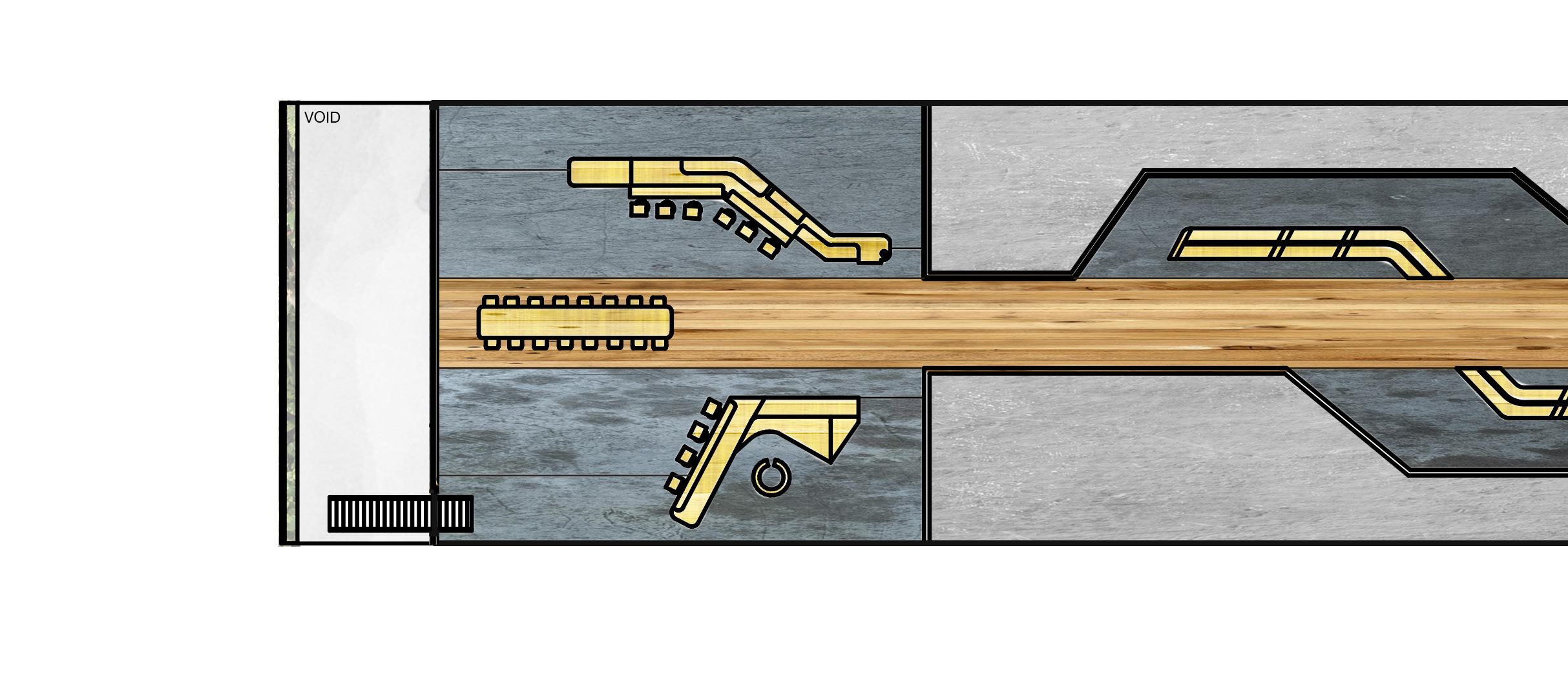
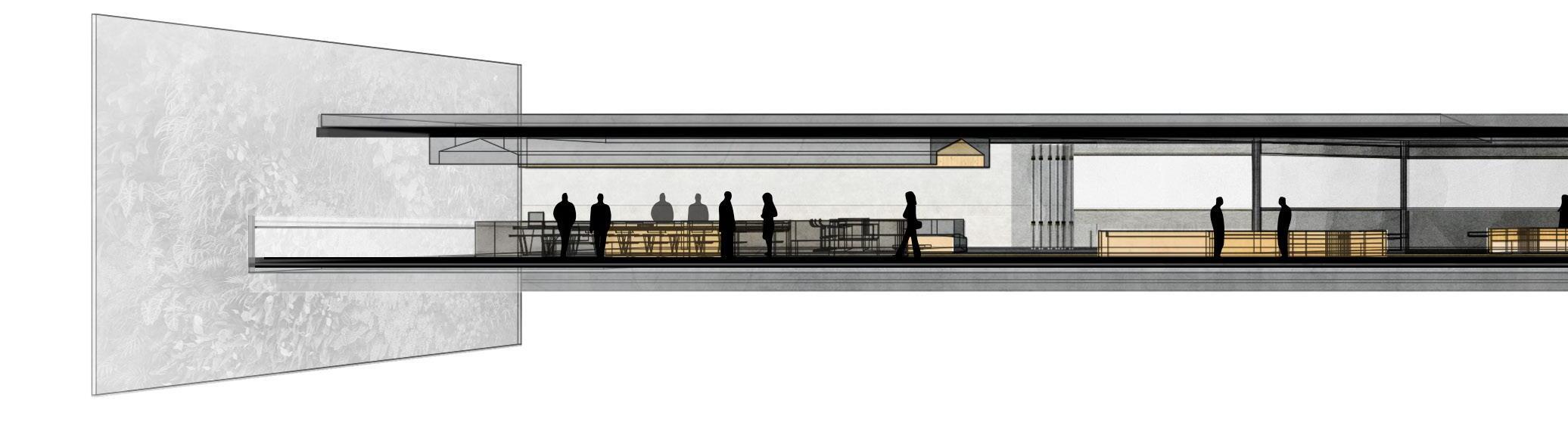
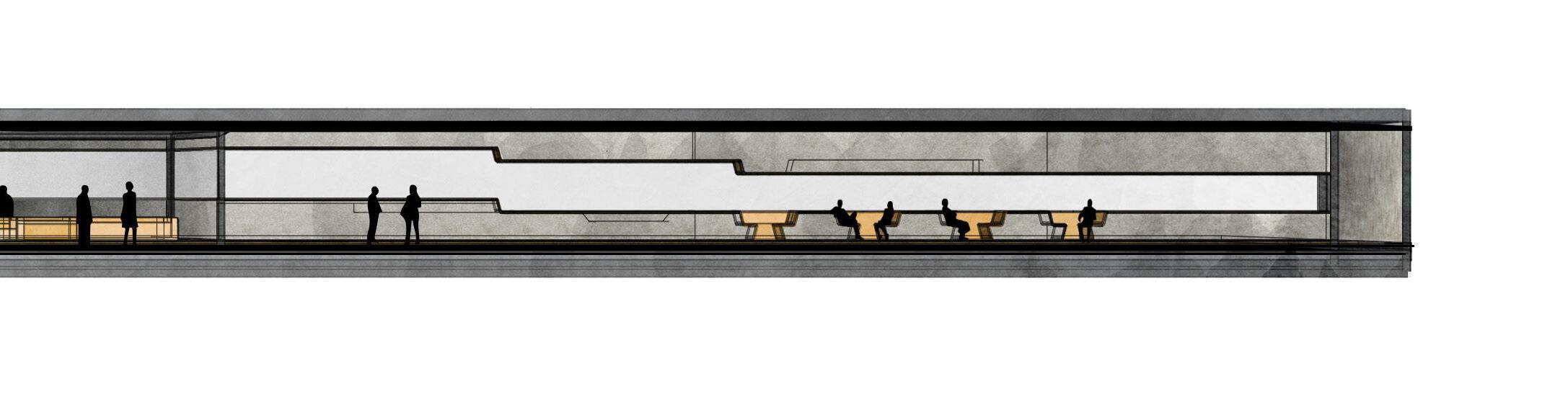
Floor Plan
Large
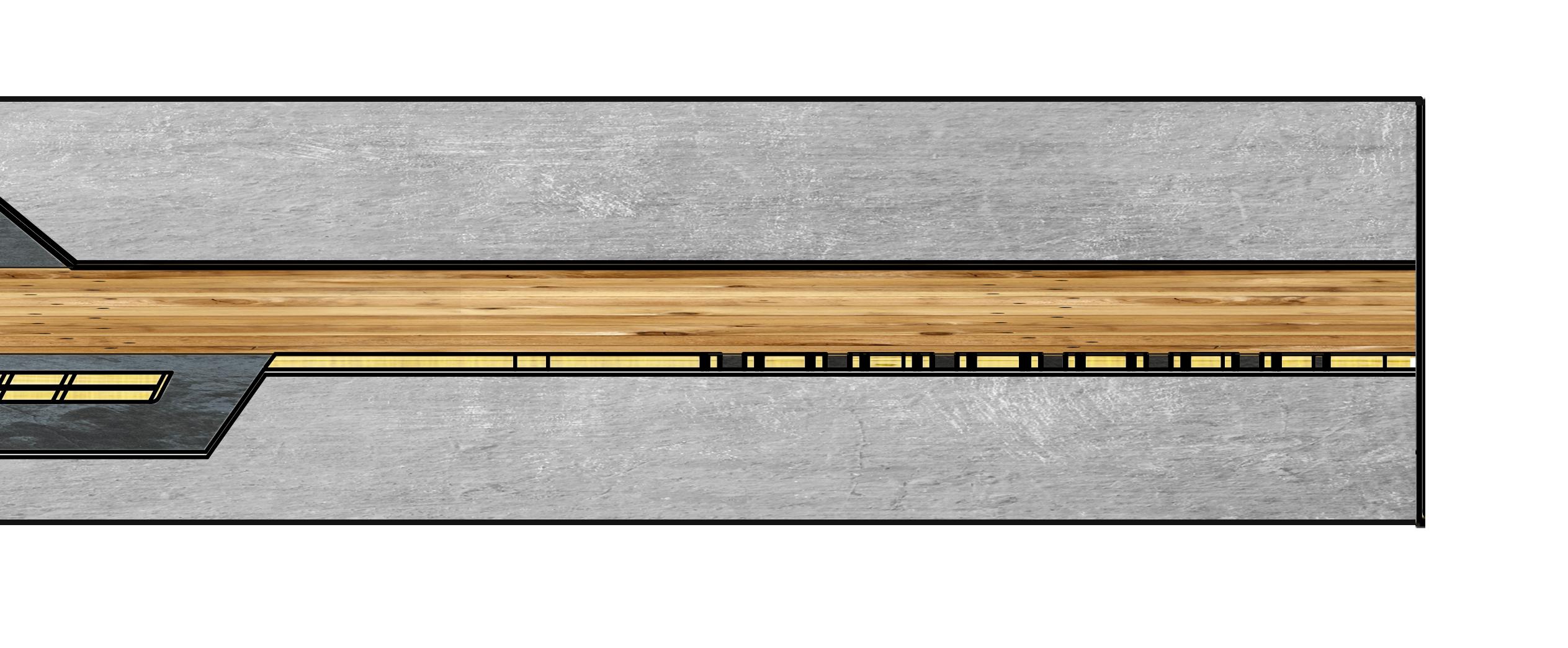
TOP VIEW ELEVATION
PRIVATE Pairs
Low volume
Bump discussion, shoulder-to-shoulder focus
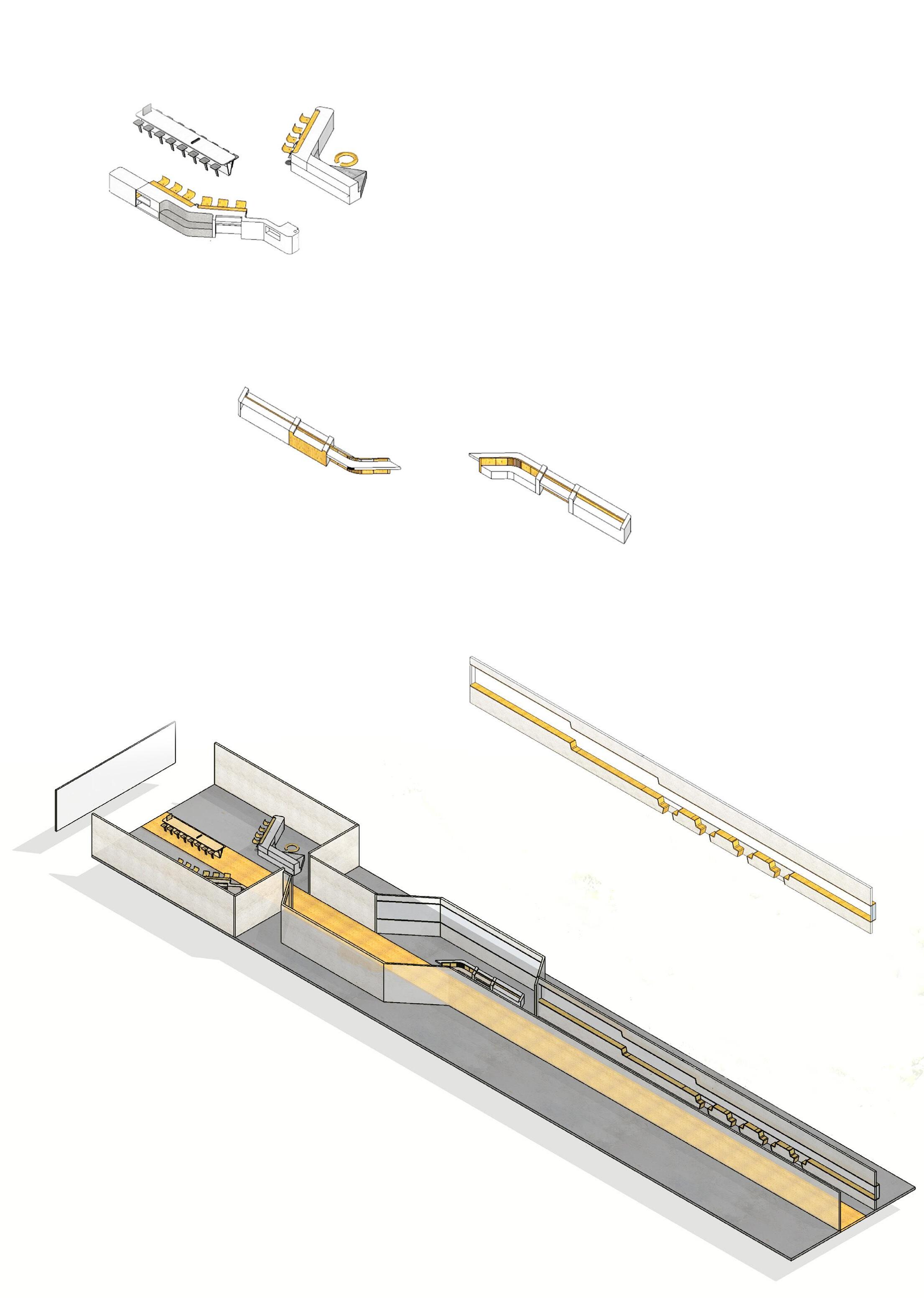
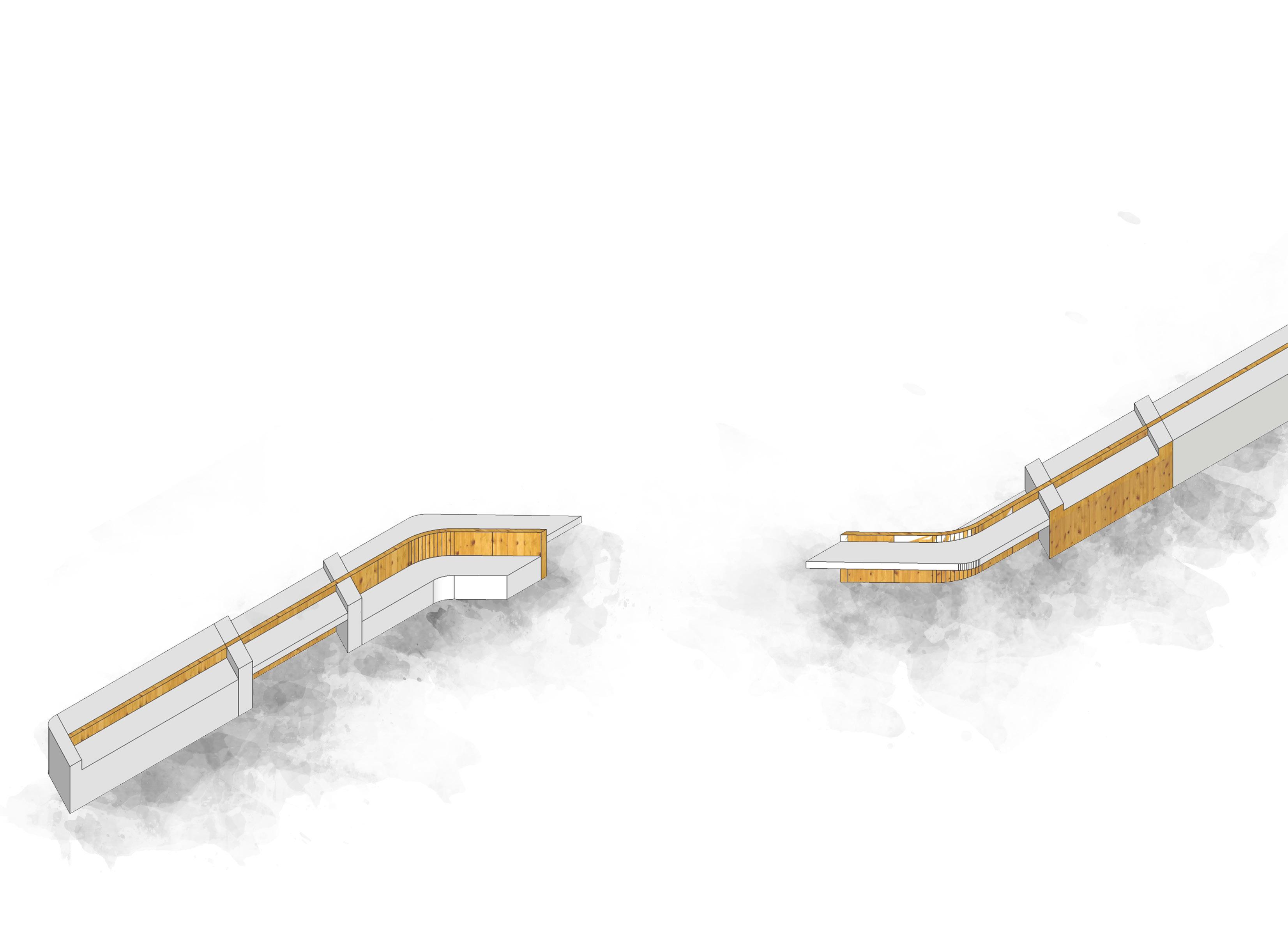
The modular element can be converted from a casual seating lounge to a standing bench or desk space with stools.
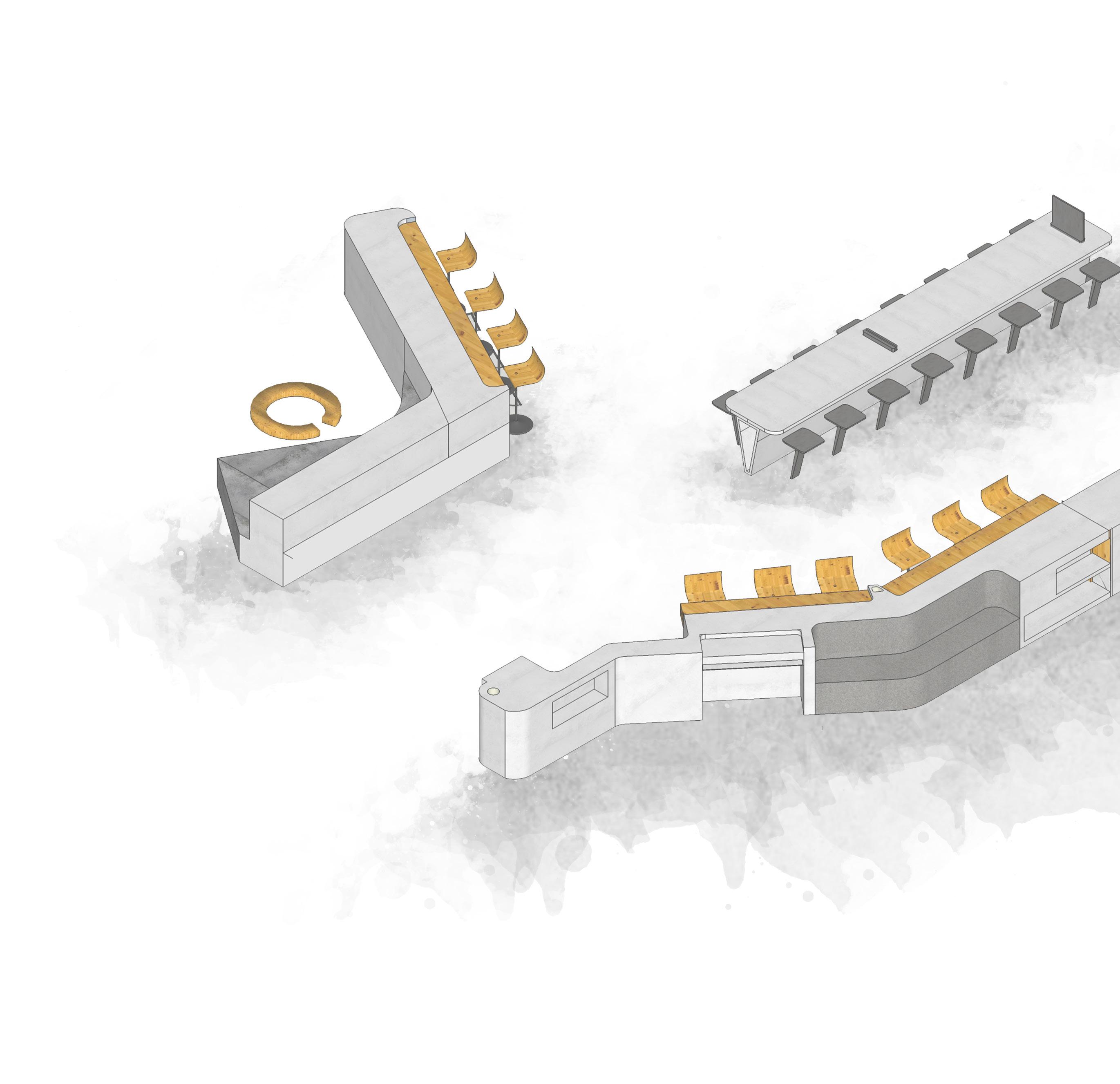
All these forms can be adapted to suit different hallway shapes and sizes. They can be extended to increase the amount of space used or reduced in size to allow different uses of the space and to accomodate different amounts of people.
The lunch table is an additional element as part of the ‘courtyard collaboration’ zone. Digital surface allows for images on technologies to be projected onto the tables surface.

Public Zone
creating and enhancing different discussion modes
Seating areas in the public zone can provide discussion space for groups of 6-8.
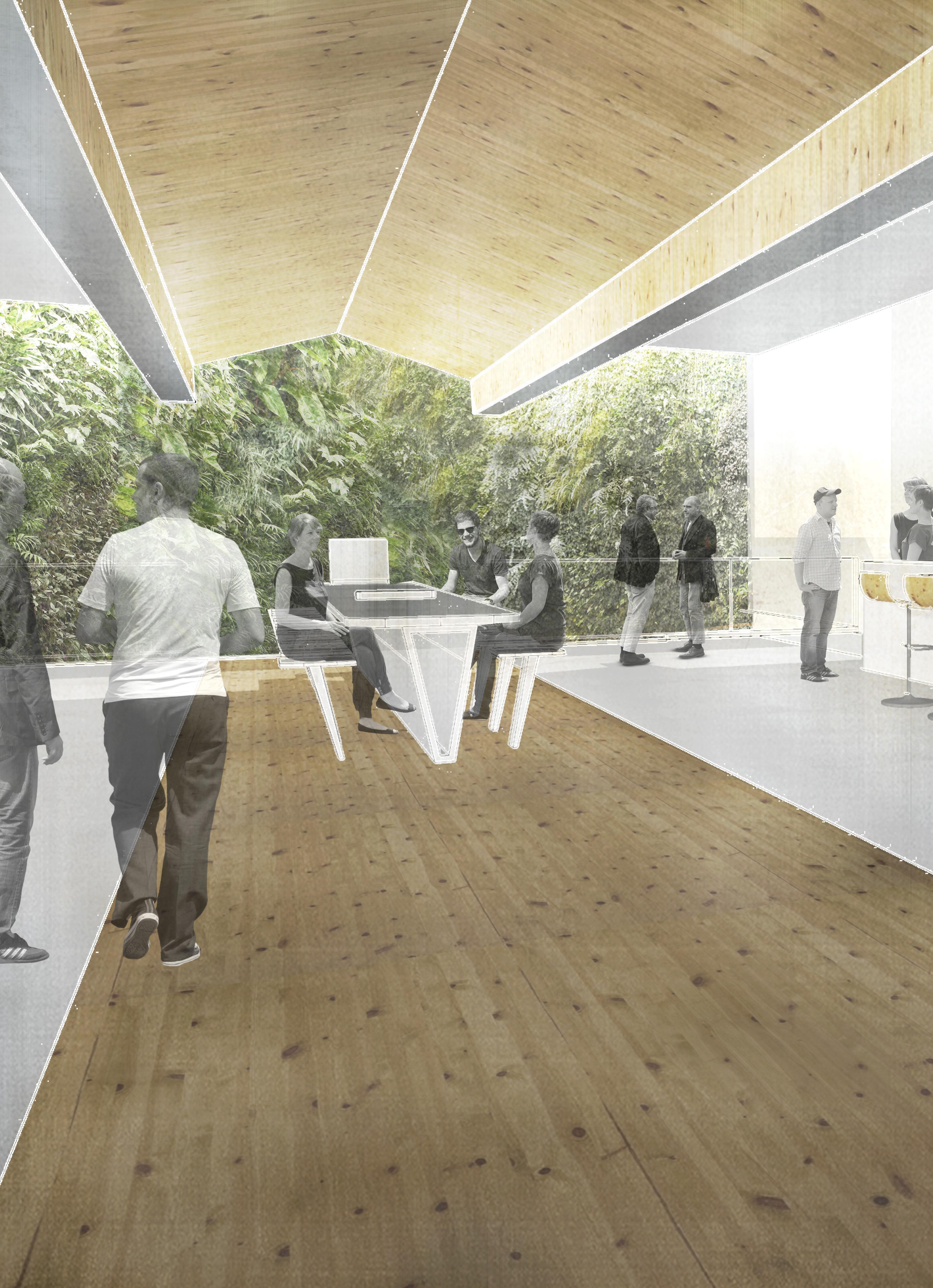
A communal space which allows for large groups of people to gather, eat, chat, discuss and laugh. Greenery and natural light attracts users to the space.
The modular element can be converted from a casual seating lounge, into a standing bench or a desk space with stools
A line of sight is maintained throughout the transitory space so that private discussion spaces and pause zones are hidden.
Permeable Zone
creating ‘Pause Points’ within transitory spaces
Seating zones that can provide discussion space for up to 4 people.
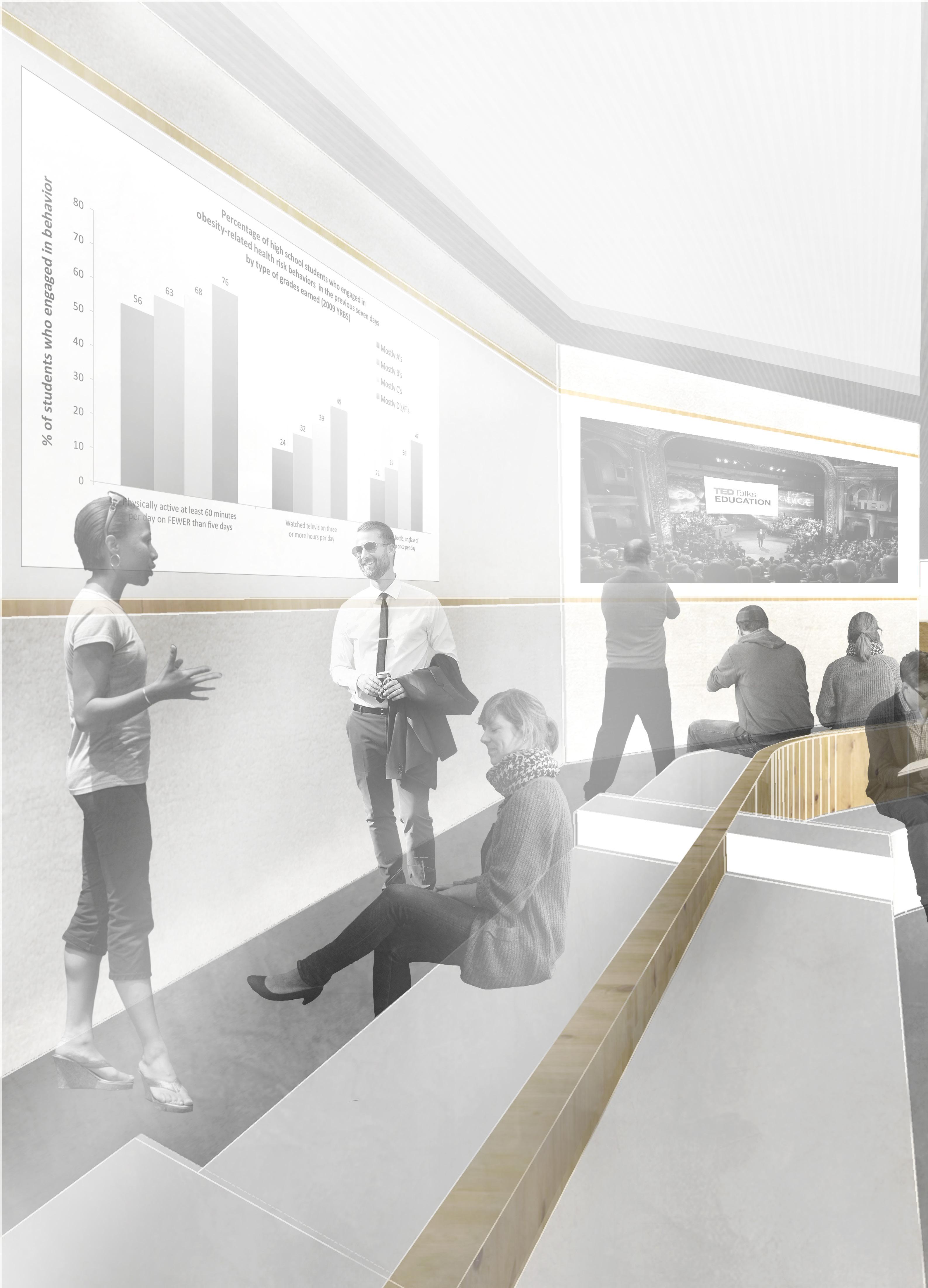
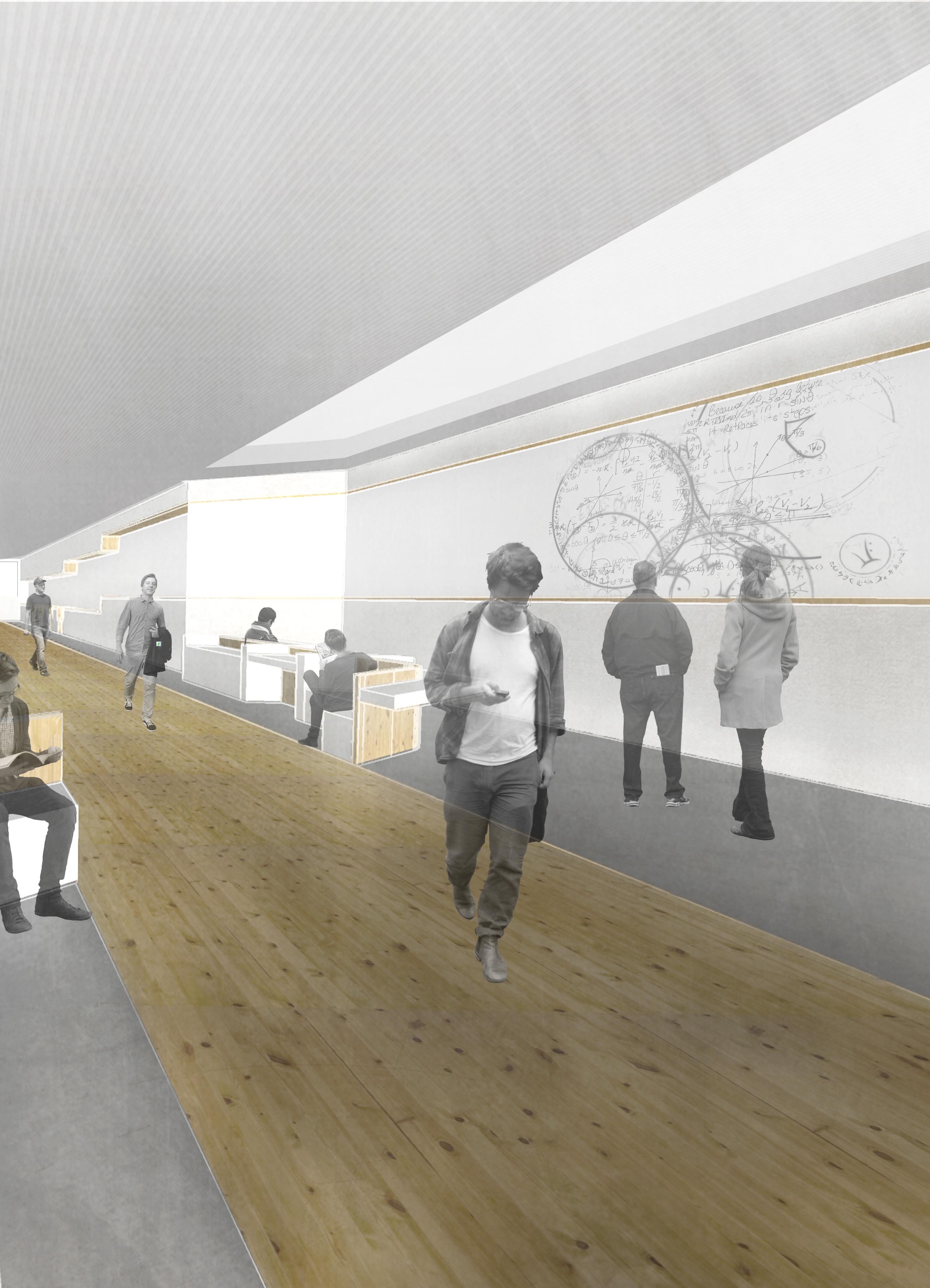
The permeable zone holds seating and smart surfaces which allow for impromptu meetings that can be accompanied by digital displays. Spontaneous moments of interaction can occur as users pass through the hallways.
Bookshelves and whiteboards along the hall are hidden from the line of sight.
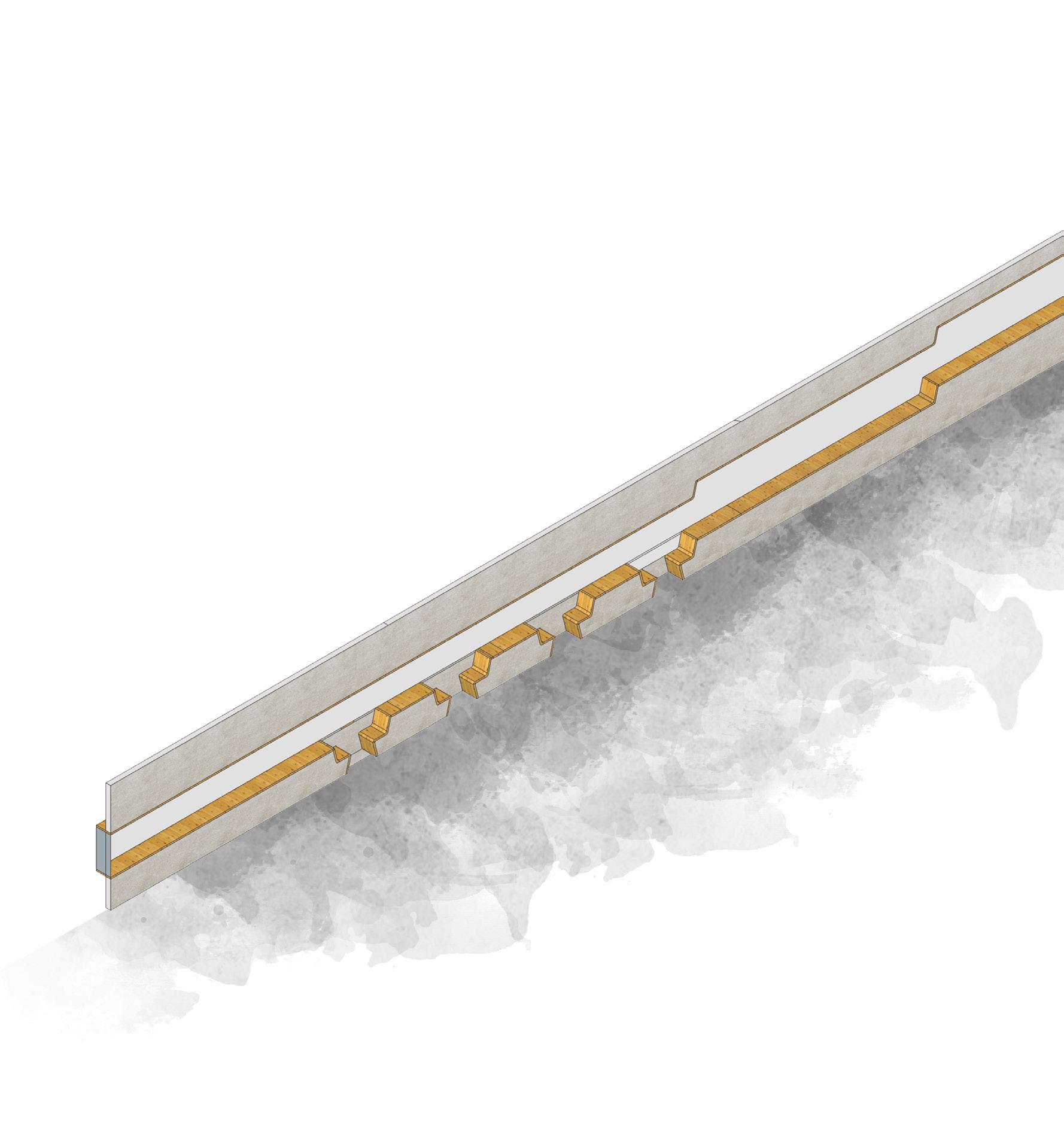
Standing moments of pause: desks extruded from the wall that can be used while standing.

A line of sight is maintained throughout the transitory space so that private discussion spaces and pause zones are hidden.
Seating zones for one or two people located within the wall.
Private zone
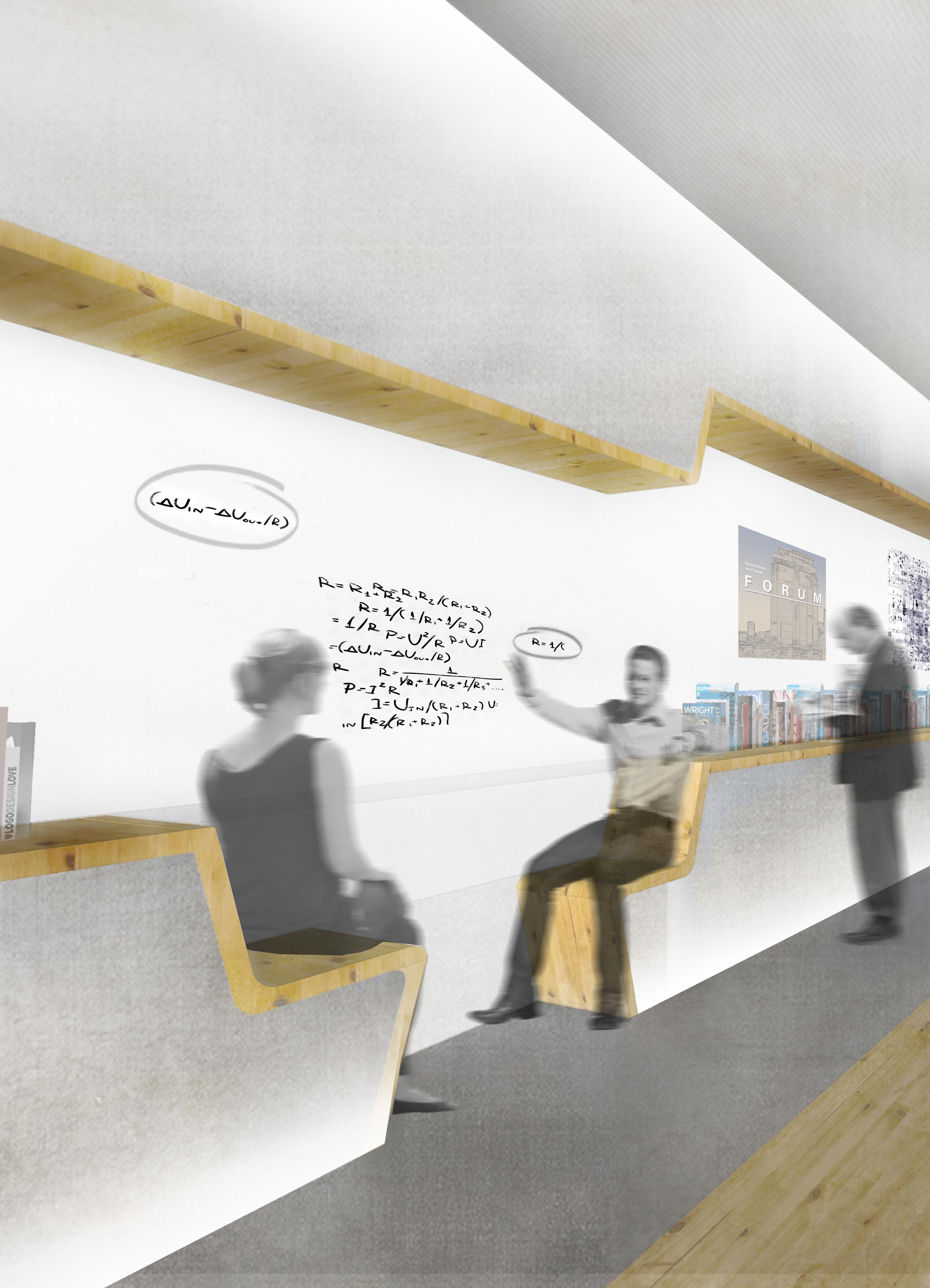
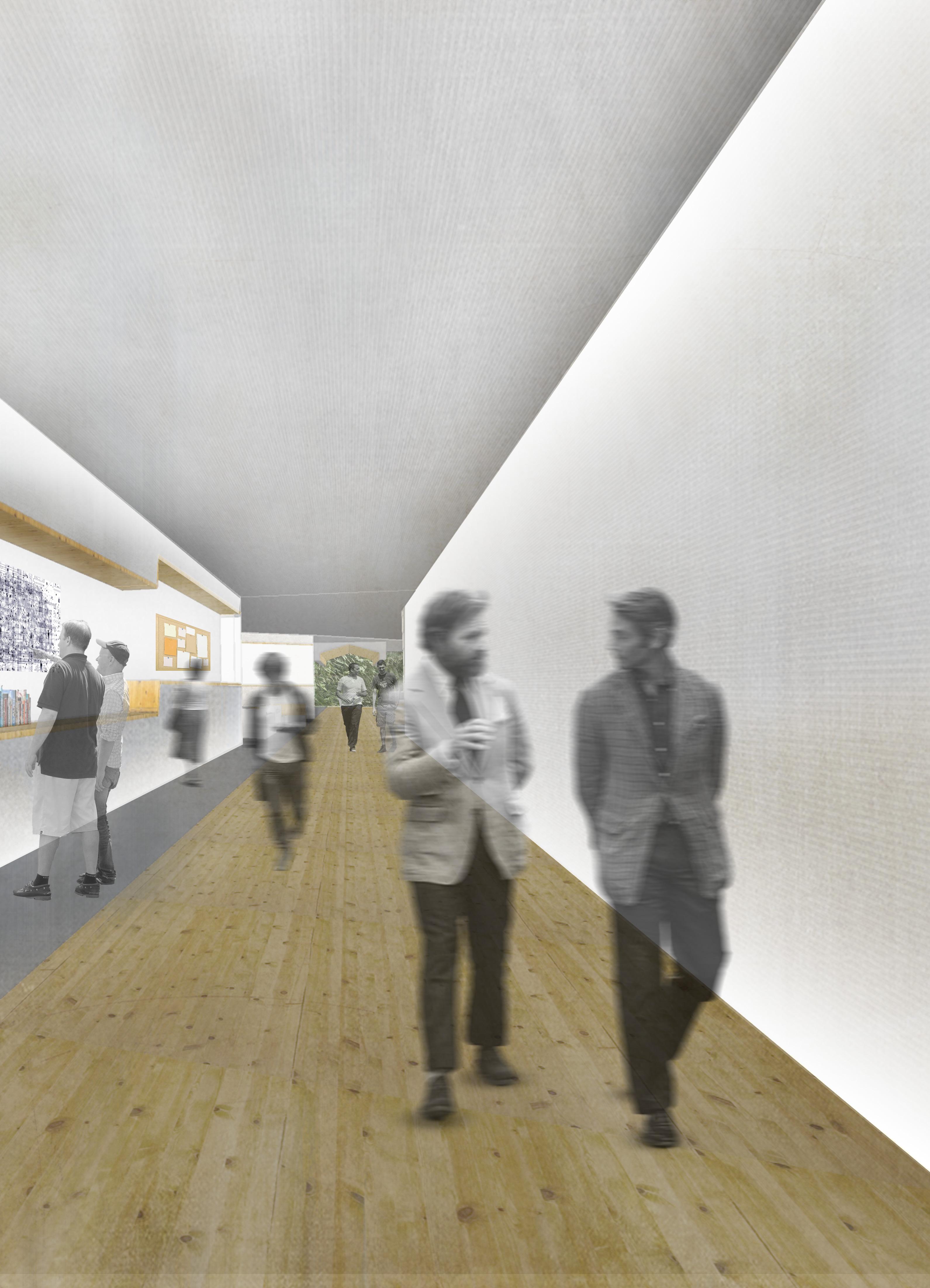
The private zone is embedded into the hallway, with a slightly inset zone to facilitate moments of ‘pause’. Embedded seating allows people to meet casually in the hallway and conveniently discuss ideas. Smart surfaces, bookshelves and pinboards activate the hallway, complimented by ambient lighting.
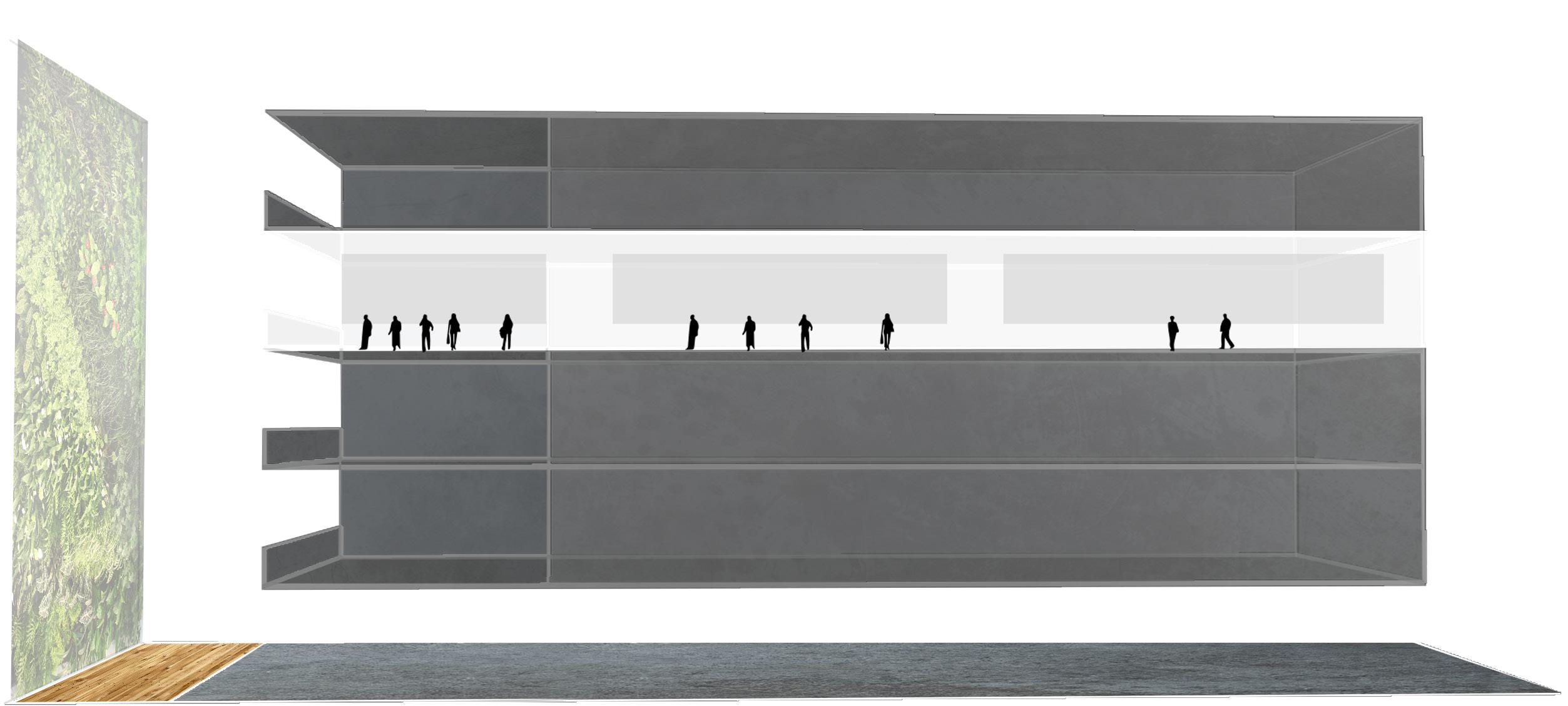
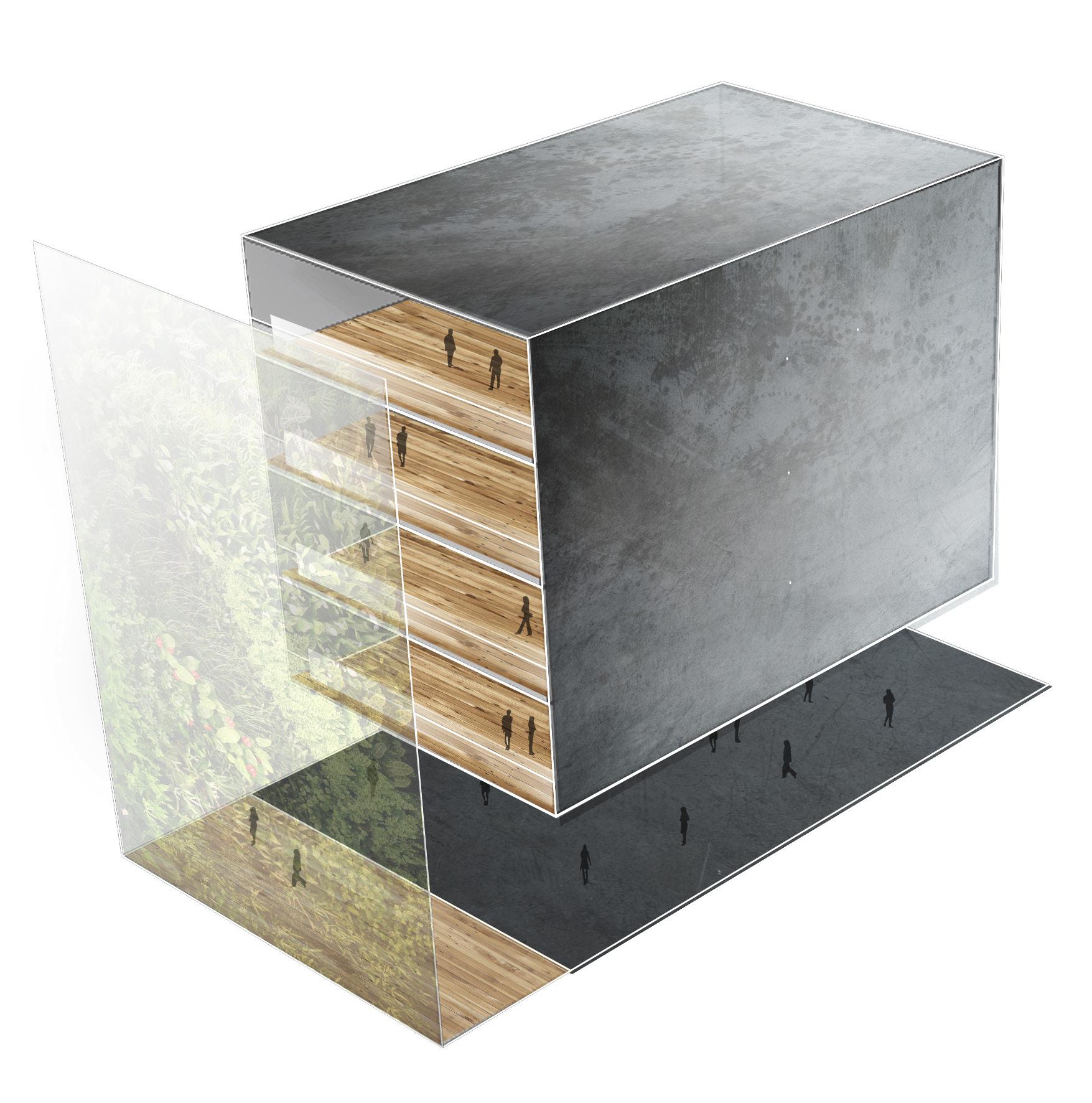
Our design case study allows for a vertical stacking of floor plates.
The most public space is flanked by a vertical void and green wall, allowing light and greenery to attract users to the space.
in reflec tion
Conclusion
Two key insights have emerged out of The Academic Exchange: Understanding the needs of the academic and finding the balance between collaboration and privacy.
Knowing the Academic
The academic workspace is entrenched in tradition and established power structures. However, this environment must continue to evolve and remain reflective of social and cultural shifts. As practitioners, we must ensure our work is tailored to the specific client and communicate with them in order to be responsive to their requirements.
The function of certain spaces in the academic world is very different to that of other corporate environments. For example, the traditional meeting is normally only used
to disseminate information or to come to a shared conclusion.
However, in an academic setting, meetings are used to develop research and test out new ideas. Decisive action is not the priority, and instead focuses more on the collaboration and expansion of ideas and information. The Academic Exchange facilitates these requirements through the use of many functional spaces which encourages spontaneous collaboration. The flexibility and informality also encourages incidental information exchange.
The Balance Between Private Work and Collaboration
Consideration of the relationship between privacy and collaboration is an important aspect of the Academic Exchange. Private study and individual achievements
are traditionally at the heart of the academic profession. Due to the value of an academics intellectual property, the opportunity to work individually in private offices are essential to their environment.
The introduction of a range of different private spaces is a new way to think about individual working environments, as well as considering the importance of collaborative spaces.
We propose that incidental space or Pause Points have the opportunity to make a huge impact on the development of ideas by facilitating spontaneous and incidental interaction between academics of varying experience. This environment is supported by the gradient from private to public spaces as seen in the Case Study in Part 3.
These places allow academics to sustain a
level of control and privacy over their work. It gives them the opportunity to research in new ways, accessing different spaces in relation to the contrasting nature of their work.
Ultimately the Academic Exchange combines innovative collaborative spaces allowing idea exchange and knowledge flow whilst still maintaining the private spaces of traditional academic research. This unique relationship between public and private workspaces is crucial to the academic profession, especially in response to the impacts of technology in the development and dissemination of information.
The Academic Exchange aims to reinvigorate the university environment to facilitate the creation and development of ideas by combining the use of traditional and
contemporary spaces in innovative and productive ways.