Enginemen: one rank below carpenters THE evolution from sail to steam was a pivotal period in the history of the Royal Navy – but it brought with it some problems. Not the least of them was how the Navy should deal with engineers (or enginemen, as they were originally known). These pioneers of iron and steam were an anomaly. They belonged to neither the military or civilian branches of the Service, and as such were not steeped in the harsh discipline and unbending tradition of the Navy. As the Navy needed to find experienced men quickly to support the rapidly-expanding steam Navy, they recruited civilians directly from the engine works and forges. But it was said that they constituted a law unto themselves in matters of discipline (and that when they were recruited they were generally found “hanging round under a street lamp”). Something had to be done to bring them into the fold – and that something was an Order in Council, which on July 19 1837 effectively brought the Engineering Branch into being. That Order specified that engineers should take their place in the natural order of things – in this instance, one rank below that of carpenters. And the tumultuous times of the early Victorian era also meant a pragmatic approach had to be taken – because of the demand for engineers, the next Order in Council, within 12 months, awarded engineers a 30 per cent pay rise. Next year the branch will celebrate its 180th anniversary, but a dress rehearsal was planned by some for this year’s anniversary, as Navy News went to press. Devonport will see a Standeasy tea and birthday cake at a number of work locations ashore and afloat, and the Devon engineers were hoping for a similar response across the Service
Civilian engineers join up
CIVILIAN firms have always coveted well-trained, disciplined Royal Navy engineers. But there is no reason why that should be a one-way street – which is why a new route has been opened up into the world of marine engineering in the Senior Service. The Royal Navy is testing a lateral entry scheme that recognises the common skills possessed by civilian and military engineers at senior rate level. DE POET (ME) Matt Goodman is one of the first civilian engineers to sign up for the Direct Entry Petty Officer Technician scheme – hence the ‘DE’ prefix to his rank. He is in a programme that will add a Naval dimension to the engineering skills and knowledge he developed in a previous career. “I was an electrician/engineer on the high-voltage side of maintenance and repairs of rigs in the international oil and gas industry,” said Matt, 36. “I worked in the Middle East – Saudi Arabia, Bahrain, the Emirates – then on to Australia and the jungle of Papua New Guinea, then I went to Algeria in North Africa. “It was quite a challenge sometimes; you can apply some of that to parts of the Navy. I understand some of what matelots go through.” Living away from home for prolonged periods and worldwide travel also chime in with life in a blue suit. But a downturn in the industry prompted Matt to think about the future – and that led him to an Armed Forces Career Office. “There was a CPO there who said: ‘I might have something for you...’ “I came back the next day and it just felt right. I was interested. “Within 24 hours I had made my choice.” That set in motion a chain of events that is being tweaked into a well-grooved process as it matures. Each candidate is invited to an assessment centre at HMS Sultan in Gosport, where they undergo a bespoke programme using the facilities at the Admiralty
Interview Board (AIB). “There is some practical leadership, a written engineering assessment, a board to explore the candidates’ personal traits and a technical interview where two WOs sit and talk and understand what the candidates know, and make a technical assessment,” said WO1 Darren ‘Judge’ Duery, a member of the team helping the DET initiative. “The WOs will assess whether they have compatible skills – and whether they will survive in a marine engineering department.” Candidates must have already done three years within the field of engineering, have an HNC or above, and have been in charge of a minimum of two technicians. The pilot scheme recruits to the marine engineering specialisation as it was felt that was where civilian and military skills were most closely aligned. If it proves successful, other specialisations and branches, such as weapon engineering, could set up similar schemes. Successful individuals will be made an offer, and if that is taken up they will spend time at HMS Raleigh, depending on previous military experience. Matt did the entire ten-week New Entry course. “I was a typical rig worker/ roughneck, and I had no military background,” said Matt. “At Raleigh I was in a room with a bunch of 18-year-olds and it was a challenge, but I got through. “Some of them are friends now and we keep in touch. “It also taught me skills on top of the leadership I had before, and it can open your mind up to different ideas. “You learn about the ethos of the Royal Navy and the six core values.” Those with a previous military career will spend days rather than weeks at Raleigh. “They don’t have to do the Raleigh militarisation – we just have to stop them saluting every three seconds if they learned drill in the Army...” said WO Duery. “They have the military skills and ethos. They might have done 20 years in the Army, and you do
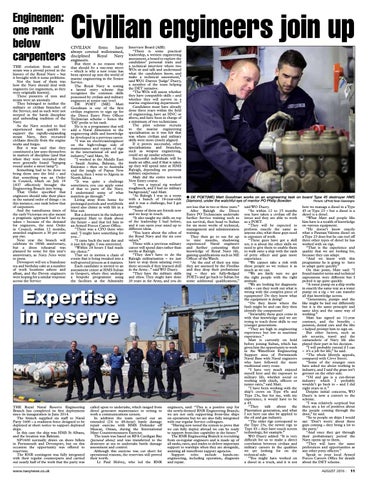
l DE POET(ME) Matt Goodman works on an engineering task on board Type 45 destroyer HMS Diamond, under the watchful eye of mentor PO Philip Bowden Picture: L(Phot) Sean Gascoigne not lose that in two or three years.” After Raleigh the Direct Entry PO Technicians undertake further Service training such as sea survival, then head to Sultan for six more weeks of technical, management and administration training. They then go to sea for up to nine months, shadowing experienced Naval engineers and further cementing their knowledge of Royal Navy life, gaining qualifications such as ME Officer of the Watch. “At the end of their sea time they are assessed by the Flotillas and they drop their probationer tag – they are fully-fledged POETs and go back to Sultan for some additional qualifications,”
Expertise in reserve
THE Royal Naval Reserve Engineering Branch has completed its first deployment since its inauguration in June 2014. The branch supplied six staff to Naval Party 1600 – a readiness force designed to be deployed at short notice to support deployed ships. In this case the ship was HMS St Albans, and the location was Bahrain. NP1600 normally draws on shore billets in Portsmouth and Devonport, but on this occasion the opportunity was offered to reservists. The RNR contingent was fully integrated with their regular counterparts and carried out nearly half of the work that the party was www.navynews.co.uk
called upon to undertake, which ranged from diesel generator maintenance to setting to work a communications system. In addition the team carried out an extended (24 to 48-hour) battle damage repair exercise with HMS Defender off Muscat, Oman, during the International Mine Countermeasures Exercise. The team was based on RFA Cardigan Bay (pictured above) and was transferred to the destroyer at sea to undertake battle damage assessment and control. Although this exercise was cut short for operational reasons, the reservists still proved their worth. Lt Paul Holvey, who led the RNR
engineers, said: “This is a positive step for the newly-formed RNR Engineering Branch; we are not only supporting front-line ships on operations but we are also fully integrated with our regular Service colleagues. “Having now tested the system to prove that we can fully deploy abroad we can be ready to support front-line capability in the future.” The RNR Engineering Branch is recruiting from ex-regular engineers and is made up of all ranks, rates, and trades to deliver important support to warships when they are alongside, assisting all waterfront support agencies. Support roles include hands-onengineering, including operation, diagnosis and repair.
said WO Duery. “So within 12 to 15 months you have taken a civilian off the street and they are able to work as a POET. “They will be expected to perform exactly the same as anyone else; what these guys need is exposure of work. “These guys have got a skill set; it is about the other skills we need to give them to enable them to walk onto a ship with the rank of petty officer and gain more experience. “We cannot take a risk with these people so we reduce it as much as we can. “We are fairly sure we get the right people with the right attitude. “We are looking for diagnostic skills – can they work out what is wrong with the complex piece of equipment? Do they know what the equipment is doing? “Do they know where the fault might be and can they then identify the component? “Invariably these guys come in with that knowledge and we are trying to teach these skills to our younger generations. “They are high in engineering experience but low in maritime experience.” Matt is currently on hold before joining Sultan, which has given him the opportunity to work in the Waterfront Engineering Support area of Portsmouth Naval Base with Naval engineers who have followed the more traditional entry route. “I have very much enjoyed myself here and the exposure to military life, whether social or working with chiefs, officers or junior rates,” said Matt. “I have been working with the ship’s crews on Type 45s and Type 23s, but for me, with my experience, it would have to be a 45. “They talk about the Playstation generation, and what I see here can also be applied to the oil and gas industry. “The older rigs correspond to the Type 23s, the newer rigs to Type 45 – they have touch screen technology, for example.” WO Duery added: “It is very difficult for us to make a direct correlation between civilian and military careers in the qualities we are looking for on the technical side. “You might have worked on a diesel in a truck, and it is not
how we manage a diesel in a Type 45 or Type 23 – but a diesel is a diesel is a diesel. “What Matt and people like him have is a wealth of knowledge on various equipment. “He doesn’t know exactly what a Paxman Valenta diesel on a Type 23 does but he can reel off three other types of diesel he has worked with on rigs. “That is the experience and quality that we are looking for, because they can adapt. “And we know with this programme he is going to have to adapt quite quickly.” On that point, Matt said: “I found matelot terms and technical expressions were different but I picked it up quite quickly. “A water pump on a ship works in exactly the same way as a water pump on a rig – we can transfer all that knowledge across. “Generators, pumps and the like might be laid out differently but it is the same principle and same idea and the same way of working.” Matt has signed an 11-year contract, and the benefits – pension, dental care and the like – helped prompt him to sign on. But other factors, such as job security, travel and the camaraderie of Navy life also played their part in his decision. “I will probably extend if I can – it’s a job for life,” he said. “The whole lifestyle appeals, compared with Civvy Street. “Some of the younger ones have asked me about working in industry, and I said the grass isn’t greener on the other side. “Oil and gas is a cut-throat industry which I probably wouldn’t go back to – and I did eight years in it.” Despite initial concerns, WO Duery is now a convert to the scheme. “I was relatively sceptical but there are a lot of positives about the people coming through the door,” he said. “So to people on ships I would say: ‘Don’t worry about these guys coming – they bring a lot to the party.’ “And once they get through their probationary period the Navy opens up to them. “They will have the same preferences and opportunities as any other petty officers.” Speak to your local Armed Forces Careers Office for details about the DET scheme. AUGUST 2016 :
11