JUNGLIES 50th ANNIVERSARY
Squadron celebrates jubilee
THE first Junglie unit to form up was 845 Naval Air Squadron, which celebrated 50 years as a Commando helicopter squadron on April 10 this year.
To celebrate the anniversar y the squadron hosted 50 guests, including past Commanding Officers and pilots at the unit’s home base, RN Air Station Yeovilton. After being welcomed Cdr James Newton, 845’s Commanding Officer, the guests received an insight into what the squadron has been up to in recent years, then ventured out to watch the famous Junglie assault demonstration. Cdr Newton later outlined the history of 845 as a Commando squadron, and the importance that he placed on its heritage, saying: “The ethos of the Junglie aviator was born in the skies over Borneo, and shaped during conflicts in Northern Ireland, Bosnia, Sierra Leone and Iraq. “This ethos remains alive and well in the hugely demanding environment of Afghanistan – the transition has been almost seamless.” Amongst the highlights for those gathered was Harry Benson recalling tales of being a young sub-lieutenant flying around lowlevel in the Falklands with his
comrades dodging bullets from Argentine guns, and bombs from their jet aircraft. Capt Alan Hensher, the first CO of 845 as a Commando helicopter squadron, recounted his experiences of taking the first helicopters into Borneo, flying in the jungle, having to adjust tactics and procedures on a daily basis, so steep was the learning curve. 845 first officially formed on February 1 1943 as a torpedo bomber reconnaissance squadron at Quonset Point in Rhode Island flying the Grumman Avenger, blazing a trail which sister squadron 846 followed some two months later. The squadron saw active service in the Far East before being disbanded in October 1945. Reformed in March 1954 at Gosport as an anti-submarine squadron, 845 was equipped with Westland Whirlwind helicopters and a remit to perfect the use of airborne sonar equipment. Disbanding briefly between October and November 1955, 845 took part in the Suez Crisis in March 1956, landing 515 Marines and 89 tons of equipment from HMS Theseus in history’s first vertical assault. Although Suez was a political failure, the military success of the landings was not ignored, and the
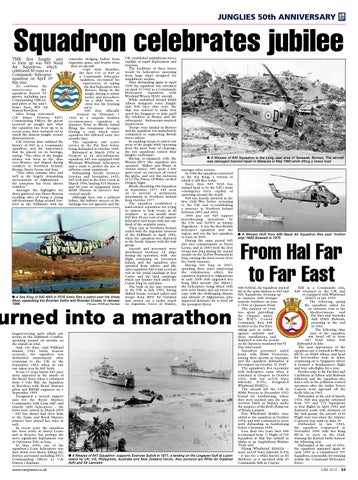
l A Sea King of 845 NAS in IFOS livery flies a patrol over the Vrbas River, separating the Bosnian Serbs and Bosnian Croats, in January Picture: PO(Phot) Phil Ball 1996
UK established amphibious forces capable of rapid deployment and response. The backbone of these forces would be helicopters operating from large ships designed for amphibious warfare. After disbanding again in April 1959 the squadron was reformed on April 10 1962 as a Commando Helicopter Squadron with Westland Wessex HAS1 aircraft. While embarked aboard HMS Albion alongside sister Junglie unit 846 later that year, the ship was ordered to make best speed for Singapore to help quell the rebellion in Brunei and the subsequent Indonesian-inspired insurrection. Troops were landed in Borneo and the squadron was immediately committed to supporting British forces ashore. In enabling troops to patrol vast areas of the jungle while operating from the most basic of clearings, the two squadrons earned their Junglies soubriquet. Having re-equipped with the Wessex HU5 (the squadron also operated Hillers and Wasps at various times), 845 spent a few quiet years on exercises all round the globe, and saw the inclusion of Lt The Prince Of Wales on Red Dragon flight. Briefly absorbing 846 Squadron in September 1977, 845 went on to provide a permanent detachment in Northern Ireland from October 1977. The squadron established a hard-earned reputation for trying its utmost to help troops in all weathers – in one month alone 845 flew 80 per cent of all support helicopter task hours with just one third of the available assets. Their stay in Northern Ireland ended with the Argentine invasion of the Falklands in April 1982, when the squadron was deployed to the South Atlantic with the task group. Aircraft and personnel were distributed between 14 ships during the operation, with one flight remaining on Ascension Island, and the squadron also operated from ashore, and like sister squadron 846 it had a crucial role in the initial landings at San Carlos and the land campaign which saw Stanley back under the Union Flag by mid-June. The bulk of the unit returned to the UK in July 1982, having shifted troops, rescued sailors and troops from RFA Sir Galahad and carried out a rocket attack on Argentine forces in Stanley,
l A Wessex of 845 Squadron in the Long Jawi area of Sarawak, Borneo. The aircraft was damaged beyond repair in Malaysia in May 1965 while lifting a heavy load amongst other actions. In 1986 the squadron converted to the Sea King, a version of which it still flies today. Since then 845 NAS has trained hard to be the UK’s main contingency force capable of operating around the world. 845 was heavily involved in the first Gulf War before returning to the UK and re-establishing a presence in Northern Ireland between 1992 and 2002. 1990 also saw 845 support peacekeeping operations by the UN and NATO in former Yugoslavia – it was the first British helicopter squadron into the region, and was the last squadron to leave in 2005. During the same period 845 also met commitments in Sierra Leone, and in 2003 took the first troops into Iraq during the crucial assault on the Al-Faw Peninsula in Iraq, earning the most recent of its five battle honours. Having left Iraq in 2007, spending three years supporting the stabilisation effort, the squadron deployed to Afghanistan in early 2008 with upgraded Sea King Mk4 aircraft (the Mk4+), the helicopters being fitted with new rotor blades and tail rotors to cope with the challenging climate and altitude of Afghanistan, plus improved defensive kit to fend off the insurgent threat.
urned into a marathon longest-serving units which saw action in the Falklands Conflict, spending around six months on the islands in total. And, job done (and Falkland Islands 1982 battle honour secured), the squadron was disbanded immediately after returning to the UK in the September 1982, when its role was taken over by 845 NAS. It was 13 years before 847 once more appeared in the annals of the Royal Navy, when it reformed from 3 Cdo Bde Air Squadron at Yeovilton with Royal Marines pilots and REME engineers on 1 September 1995. Designated a tactical support unit for the Royal Marines Commandos with Lynx AH7 and Gazelle AH1 helicopters – the latter were retired in March 2005 – 847 has always had close links to the Army, and Royal Marines aviators have played key roles as well. In recent years the squadron has been active in Sierra Leone and in Kosovo, but perhaps the most significant deployment was to Operation Telic in Iraq. In May 2006, one of the squadron’s Lynx helicopters was shot down over Basra, killing five Service personnel including 847’s Commanding Officer Lt Cdr Darren Chapman. www.navynews.co.uk
l A Wessex of 847 Squadron supports Exercise Subok in 1971, a landing on the Lingayen Gulf at Luzon Island by UK, US, Philippines, Australia and New Zealand forces. Also pictured are RFAs Sir Galahad (left) and Sir Lancelot
l A Wessex HU5 from 848 Naval Air Squadron flies past ‘mother ship’ HMS Bulwark in 1975
From Hal Far to Far East
848 NAVAL Air Squadron started life in the same fashion as 845 and 846 Squadrons, forming up in America with Avenger torpedo bombers on June 1 1943 at Quonset Point. The summer of 1944 was spent patrolling the Channel under the RAF’s Coastal Command, then 848 headed to the Far East, taking part in strikes against airfields and shore installations, and deployed to join the assault on the Japanese mainland but VJ Day intervened. Squadron personnel sailed home with HMS Victorious, leaving their aircraft in Australia, and the squadron disbanded at Devonport on October 31 1945. The squadron’s first encounter with helicopters came when it reformed at Gosport in October 1952, with ten ex-US Navy Sikorsky S-55s, designated Whirlwind HAR21s. The aircraft left the UK in HMS Perseus in December 1952 bound for Sembawang, where they were pitched into the antiterrorist battle in Malaya under the auspices of the RAF, flying out of Kuala Lumpur. Five Whirlwind HAR1s were added to the squadron in October 1954, and 848 continued to serve until disbanding in Sembawang before Christmas 1956. Less then two years later 848 re-emerged from C Flight of 728 Squadron at Hal Far airfield in Malta as an Amphibious Warfare Trials unit. Flying Whirlwind HAS22s – more ex-US Navy Sikorsky S-55a – it was for a while known as 45 Heliforce as it operated with 45 Commando RM in Cyprus.
Still in a Commando role, 848 returned to the UK and re-equipped with Whirlwind HAS7s in late 1959. The following spring the squadron sailed for an extensive tour to the Mediterranean and Far East and Australia with HMS Bulwark, returning at the end of 1962. The following May part of the squadron was hived off to form 847 NAS while 848 disbanded in July. The next appearance of the squadron saw it embark its Wessex HU5s on HMS Albion and head for hot-weather trials in Aden, continuing on to Singapore where it formed a headquarters flight and four sub-flights for a year. Further trips to the Far East and Caribbean in Albion and Bulwark followed, and the squadron also had a role in the pollution-control operation after the tanker Torrey Canyon went aground off the Scilly Isles in 1967. Disbanded at the end of March 1976, 848 was quickly reformed from 707 and 772 Squadrons as four flights in April 1982 and deployed south with elements of the task group; the aircraft of D Flight were lost when the Atlantic Conveyor was sunk on May 25. Disbanded in late 1982, the squadron reappeared in November 1990 with Sea King HC4s to serve in the Gulf, winning the Kuwait battle honour the following year. Disbanded at the end of 1991, the squadron appeared again in early 1995 as a renumbered 707 Squadron, responsible for training within the Command Helicopter Force. JUNE 2012 : S3