NAVY Nl-Z\‘\'-'S, AUGUST 2008
40
Reserves to the fore
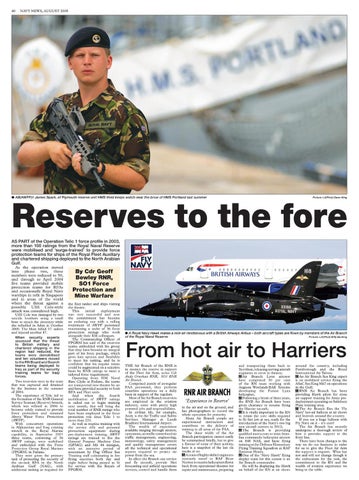
O AB(AWFP)1 James Spark, of Plymouthreserve unit HMS lfivid keeps watch near the brow of HMS Portland last summer
Picture: LAfPhot) Owen King
AS PART of the Operation Telic 1 force profile in 2003, more than 100 ratings from the Royal Naval Reserve were mobilised and ‘surge-trained’ to provide force protection teams for ships of the Royal Fleet Auxiliary and chartered shipping deployed to the North Arabian Gulf. As the operation moved into phase two, these
numbers were reduced to 50, and through to April 2004 Five teams provided mobile protection teams for RFAs and occasionally Royal Navy warships in refit in Singapore and in areas of the world where the threat against a possible USS Cole—style attack was considered high. USS Cole was damaged by two suicide bombers using a small boat to attack the destroyer while she refuelled in Aden in October 2000. The blast l-tilled ll‘ sailors and injured another 47. When security experts assessed that the threat to British military and chartered shipping in the region had reduced. the teams were demobilised and ten volunteers moved to the RN Board and Search
being deployed to Iraq as part of the security training teams for Iraqi
teams
forces.
Two reservists
that
by
was
were
in the
team
captured and detained
the lranians in the
summer
of200-'lv. The experience of Telic led to the formation of the RNR General Service Seaman (Reserve) branch, which was refined in 2006 to become solely trained to provide force protection and renamed Above Water Force Protection
(A\‘l’FP).
operations in Afghanistan and Iraq creating stretch in the Royal Marine capability, in September 2007 three teams, consisting of 36 A\‘€"F[’ ratings, were mobilised With
concurrent
and embedded with the Force
Protection
Group Royal Marines
(FPGRi\/l) in Faslane. They were given the primary task of protecting the security of
the on-task RFA in the North Arabian Gulf (NAG), with additional tasking as required for
By Cdr Geoff Bewley RNR,
’ my
=BRl1'iI§flAlli{\iVAi/S
S01 Force Protection and Mine Warfare
u... .
the fleet tanker and the theatre.
This
initial
ships visiting deployment
.
very successful and now the commitment has become an enduring one with a rolling
And
when
the
fourth
mobilisation of AWFP ratings is called out to begin training next month, that will bring the total number of RNR
have been
protection
ratings who
employed in the force
role since Telic l to more than 225. As well as routine training with the service title and personal
protection equipment during
pre-deployment training, AWFI’ ratings are trained to fire the General Purpose Machine Gun (GPMG) and Aalk 44 minigun, with an intensive period of
by Flag Officer Sea Training staff culminating in live firing exercises both day and night before being passed as fit assessment
for service with the FPGRM.
Royals of
_
4.
was
roulement of AWFP personnel maintaining a cadre of 36 force protection ratings who work alongside their RM colleagues. The Commanding Officer of FPGRNI has said of the reservist teams embedded with his group that they have become an integral part of his force package, which gives him options and flexibility to meet his tasking, and he is confident that his regular teams could be augmented on a selective basis by RNR ratings to meet a tailored force requirement. Operating from HM Naval Base Clyde at Faslane, the teams are transported into theatre by air and have provided security to both RFA and Fleet units.
4-
O A RoyalNavy Hawk makes a mid—air rendezvous with a British Ainivays Airbus of the Royal Naval Reserve
—
XXl68 X: ROYAL NAVY
both aircraft types are flown by membersof the Air Branch Picture: LA{Pha!) Billy Bunting
From hot air to Harriers
THE Air Branch of the RNR is in essence the reserve in support of the Fleet Air Arm, terrier Cdr Andy Orriisltatv RNR, S01 RNR Air Brtziiciz. Comprised purely of ex—regu1ar
transporting them back to Yeovilton,releasing serving aircraft engineers to serve in theatre; Air Branch Lynx aircrew have comprised 50 per cent of the RN team working with Augusta \‘(’estlandslBAl£ Systems and
FAA personnel, they perform countless operations on a daily basis in support of the regulars.
Most oftheAir Branch reservists are employed in the aviation
industry, some with pretty high powered jobs and responsibilities. In civilian life, for example,
Andy is the Air 'l‘ralTic and Safety Services Manager at Leeds Bradford International Airport.
The wealth of experience available ranging through aircrew, operations, air traffic control and air
traffic management,
engineering,
meteorology, safety management and quality management covers all the technical and operational aspects required to project air power from the sea. In effect the Branch can service and fly aircraft, provide Met
forecasting and airfield operations services, control and handle them
developing the Future Lynx helicopter;
‘Experience in Reserve’ in the air and on the ground, and has photographers to record the whole operation for posterity. Many Air Branch people are experienced instructors and contribute to the delivery of training in all areas of the FAA. The sheer width of the Air Branch participation cannot easily be summarised briefly. but to give a flavour of some of their activity, here is a snapshot of the last six weeks or so:
A teamofhighlyskilledengineers routinely travel to RAF Brize
Norton to receive helicopters flown back from operational theatres for
repair and maintenance, preparing
Following a break ofthree years,
the RNR Air Branch have been given clearance to resume flying the Harrier aircraft; It is vitally important to the RN to retain the core skills required to fly fast jets at sea, ready for the introduction of the Navy's two big new aircraft carriers in 20l2; The Branch is providing qualified instructors to train frontline commando helicopter aircrew on 848 NAS, and basic flying training at the Defence Elementary FlyingTraining Squadron at RAF Barkston Heath; One of the ‘Navy Hawk’ llying display team for this season is an Air Branch commander. He will be displaying the Hawk on behalf of the RN at air shows
around the country, including Farnborougli and the Royal international AirTattoo; An Air Branch Sea King expert is on mobilised service flying the ASaC Sea King Mk? on operations in the Gulf; RNR Air Branch has been providing Hawk pilots for close air support training for Army pre-
deplo_vmentoperating on Salisbury Plain training area;
The Air Branch flies the ‘Fly Navy‘ hot—air balloon at air shows and festivals around the country. If you see a huge balloon with Fly Navy on it it's ours! The Air Branch has recently undergone a thorough review of how it provides support to the front line. There have been changes to the way we do our business in order for us to give the Fleet Air Arm the support it requires. What has not and will not change though is the enthusiasm for the task, the commitment to the RN and the wealth of aviation experience we bring to the table. —