NAVY NEWS, NOVEMBER 1997
Options
BLACKBOARD'S GHOST TIRS AGAIN! Blackboard's ship the Queen Anne's Revenge may have been found near Beaufort, North Carolina, where it sank in 1718 after the Royal Navy finally caught up with the most infamous pirate of all. Now there is talk of a film starring Sean Connery - with Kevin Costner as an RN lieutenant. Author David Cordingly, an expert on piracy and a former keeper at the National Maritime Museum, tells the story of the last fight of Edward Teach.
w
hen the wreck of a pirate ship was located off the Beaufort Inlet on the coast of North Carolina, artefacts recovered from the seabed included a brass blunderbuss, several cannon balls, a sounding lead and a ship's bell inscribed with the date 1709. I
The nature of these and the position of the wreck have led experts to believe that they have found the Queen Anne's Revenge, the most famous pirate ship of her day. Her commander was Captain Edward Teach, better known as Blackboard, who terrorised the east coast of America until he was hunted down by an expedition mounted by the Royal Navy. The finding of the ship has coincided with an upsurge of interest in pirates in the United States. Hollywood is planning a major film on Blackboard with Sean Connery playing the pirate captain and Kevin Costner as the Naval lieutenant who tracked him down. A four-hour mini-series 'Pirate Tales' was recently broadcast by TBS and there are several other television documentaries in the pipeline. An exhibition entitled Under the Black Flag: life among the pirates is currently on display at The Mariners Museum, Newport News, Virginia where it is drawing record crowds. The exhibits include a skull coated with silver which is reputed to be that of Blackboard, some of the evocative paintings of pirates and buccaneers by Howard Pyle, and a formidable collection of weapons. Blackboard was a larger-than-life character who deliberately cultivated a terrifying image. Originally from Bristol, he was described by a sea captain who encountered him as "a tall, spare man with a very black beard which he wore very long". He went into battle with three pairs of pistols hanging in holsters across his chest and stuck lighted tapers under his hat which billowed smoke so that he appeared to his victims like a demon from hell. After he had blockaded the town of Charleston and plundered all the ships in the harbour, the Governor of Virginia issued a reward of £100 for his capture, dead or alive. Lt Robert Maynard of HMS Pearl was commissioned to lead a force of naval volunteers to find him. On 17 November 1718 Maynard set off with 60 men in two small vessels and spent several days searching the coast and offshore islands of Pamlico Sound. It took him four days to locate Blackbeard's ship, which was anchored among the shallows of Ocrocoke Inlet.
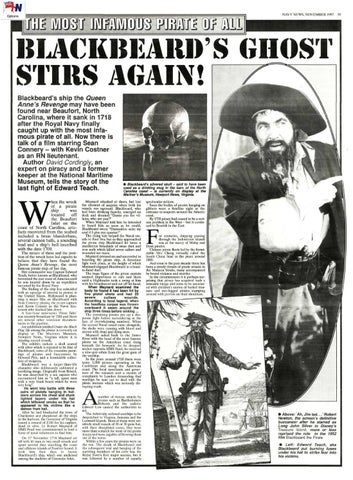
• Blackboard's silvered skull - said to have been used as a drinking mug in the bars of the North Carolina coast - is currently on display at the Mariner's Museum, Newport News, Virginia.
Maynard attacked at dawn, but lost the element of surprise when both his vessels ran aground. Blackbeard, who had been drinking heavily, emerged on deck and shouted: "Damn you for villains, who are you?" When Maynard told him he intended to board him as soon as he could, Blackbeard swore "Damnation seize my soul if I give you quarter!" The rising tide helped the Naval vessels to float free but as they approached the pirate ship Blackbeard let loose a murderous broadside of swan shot and iron nails which killed seven sailors and wounded ten more. Maynard pressed on and succeeded in boarding the pirate ship. A ferocious fight took place, at the height of which Maynard engaged Blackbeard in a handto-hand duel. The huge figure of the pirate captain seemed impervious to cuts and shots until a Highlander took a swing at him with his broadsword and cut off his head. When Maynard examined the body he found it had been hit by five pistol shots and had 20 severe cutlass wounds. According to local legend, when the headless corpse was thrown overboard it swam around the ship three times before sinking ... The remaining pirates put up a desperate fight before surrendering in the face of overwhelming numbers. When the second Naval vessel came alongside, the decks were running with blood and strewn with dead and dying men. Maynard sailed back to the James River with the head of the most famous pirate on the American coast slung beneath the bowsprit. As he dropped anchor opposite HMS Pearl, he received a nine-gun salute from the great guns of the warship. In the years around 1720 there were some 2,000 pirates operating in the Caribbean and along the American coast. The local merchants and governors of the colonies sent a stream of complaints to London demanding that warships be sent put to deal with the pirate menace which was seriously disrupting trade. / ^ number of vicious attacks by /"^^ pirates such as Bartholomew JL. JL-Kobcits and the sadistic Edward Low caused the authorities to act. The Admiralty ordered warships to be despatched to Virginia, Jamaica and the Leeward Islands. Most of these were relatively small vessels of 20 or 30 guns but, with their disciplined crews, they were more than a match for most of the pirate sloops and were capable of blowing them out of the water. Within a few years the pirates were on the run. The death of Blackbeard and the subsequent trial and hanging of the surviving members of his crew was the Royal Navy's first major success, but it was followed by a number of equally
spectacular actions. Soon the bodies of pirates hanging on gibbets were a familiar sight at the entrance to seaports around the Atlantic coast. By 1730 piracy had ceased to be a serious problem in the West - but it continued to flourish in the East. or centuries, shipping passing through the Indonesian islands was at the mercy of Malay and Dyak pirates. Chinese pirate fleets led by the formidable Mrs Cheng virtually ruled the South China Seas in the years around 1800. And even in the past decade there has been a steady stream of pirate attacks in the Malacca Straits, many accompanied by brutal violence and murder. In the circumstances it is perhaps surprising that piracy has acquired such a romantic image and come to be associated with children's stories of buried treasure and one-legged pirates stumping around with parrots on their shoulders.
.
.;
-••-•"I
; •>'
- —1
• Above: 'Ah, Jim lad...' Robert Newton, the screen's definitive buccaneer after he starred as Long John Silver in Disney's Treasure Island, more or less reprised the role in the 1952 film Blackbeard the Pirate .• Left: Edward Teach, aka Blackbeard put burning fuses under his hat to strike fear into his victims.
-..
39