priority groups
You can now learn about the vaccination sequence planned for your area and book your appointment online. Québec.ca/COVIDvaccine 1 877 644-4545 The vaccine. A safe way to protect ourselves.
CONTENTS 10 A National Justice Strategy Addressing systemic discrimination and disproportionate incarceration
EDITORIAL 4
Vaccine myths
NEWS Second dose on the way
5
Arrested development
6
IN BRIEF
9
FEATURES Culturally appropriate justice
10
‘Racist and discriminatory’
18
Mining the future
22
PUZZLES REZ NOTES
24
Positive predictions
18
Birth alerts still common in the north
Community
22
What happens to a closed mine
25
UTNS 26
Springtime snooze
Photo by Catherine Orr Provided by the DOJCS
Editorial
Vaccine myths by Will Nicholls
I
t’s been a lonely year for many. Many relationships have been tested, undergoing great stress in confined conditions with diminished finances. Often, they have broken down, leaving people even more alone, with the accompanying depression and other mental-health problems. While it’s hard to imagine when life might return to normal, hope is on the horizon. More and more vaccines are arriving and becoming available but there are still problems. Social media, and especially Facebook, spreads dangerous misconceptions about vaccines and their supposed dangers – even though they claim to be removing deliberate misinformation that is often planted by arms of Russian and Chinese intelligence in order to sow division and chaos in western countries. We read them every day. Myth: The Covid-19 vaccine is not safe because it was rapidly developed and tested. Truth: Here are many safety protocols before any vaccine can go to market. As for the timeline, just look at the yearly flu shots. They are new each year to deal with new strains. You can check out the data and process yourself by going the CDC’s vaccine tracker and get the facts for yourself. Myth: There are many side effects of the vaccine. Truth: The side effects are usually mild and short lived. If you are worried, then just contact your local CLSC. Social media is claiming a mortality rate of 1-2 % for Covid-19 so we shouldn’t get vaccinated. However, a 1% mortality rate is 10 times higher than seasonal flu. You cannot get Covid from a vaccine, but you can help to prevent its spread. The smallpox vaccine was responsible for its
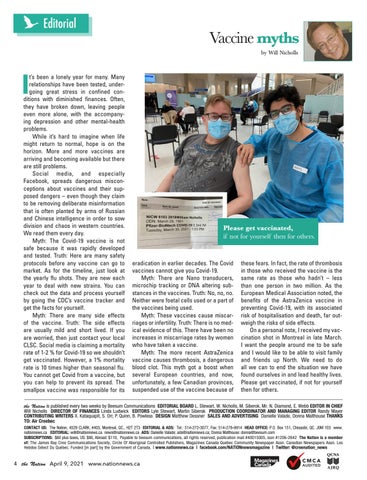
Please get vaccinated, if not for yourself then for others.
eradication in earlier decades. The Covid vaccines cannot give you Covid-19. Myth: There are Nano transducers, microchip tracking or DNA altering substances in the vaccines. Truth: No, no, no. Neither were foetal cells used or a part of the vaccines being used. Myth: These vaccines cause miscarriages or infertility. Truth: There is no medical evidence of this. There have been no increases in miscarriage rates by women who have taken a vaccine. Myth: The more recent AstraZenica vaccine causes thrombosis, a dangerous blood clot. This myth got a boost when several European countries, and now, unfortunately, a few Canadian provinces, suspended use of the vaccine because of
these fears. In fact, the rate of thrombosis in those who received the vaccine is the same rate as those who hadn’t – less than one person in two million. As the European Medical Association noted, the benefits of the AstraZenica vaccine in preventing Covid-19, with its associated risk of hospitalisation and death, far outweigh the risks of side effects. On a personal note, I received my vaccination shot in Montreal in late March. I want the people around me to be safe and I would like to be able to visit family and friends up North. We need to do all we can to end the situation we have found ourselves in and lead healthy lives. Please get vaccinated, if not for yourself then for others.
the Nation is published every two weeks by Beesum Communications EDITORIAL BOARD L. Stewart, W. Nicholls, M. Siberok, Mr. N. Diamond, E. Webb EDITOR IN CHIEF Will Nicholls DIRECTOR OF FINANCES Linda Ludwick EDITORS Lyle Stewart, Martin Siberok PRODUCTION COORDINATOR AND MANAGING EDITOR Randy Mayer CONTRIBUTING WRITERS X. Kataquapit, S. Orr, P. Quinn, B. Powless DESIGN Matthew Dessner SALES AND ADVERTISING Danielle Valade, Donna Malthouse THANKS TO: Air Creebec CONTACT US: The Nation, 4529 CLARK, #403, Montreal, QC., H2T 2T3 EDITORIAL & ADS: Tel.: 514-272-3077, Fax: 514-278-9914 HEAD OFFICE: P.O. Box 151, Chisasibi, QC. J0M 1E0 www. nationnews.ca EDITORIAL: will@nationnews.ca news@nationnews.ca ADS: Danielle Valade: ads@nationnews.ca; Donna Malthouse: donna@beesum.com SUBSCRIPTIONS: $60 plus taxes, US: $90, Abroad: $110, Payable to beesum communications, all rights reserved, publication mail #40015005, issn #1206-2642 The Nation is a member of: The James Bay Cree Communications Society, Circle Of Aboriginal Controlled Publishers, Magazines Canada Quebec Community Newspaper Assn. Canadian Newspapers Assn. Les Hebdos Sélect Du Québec. Funded [in part] by the Government of Canada. | www.nationnews.ca | facebook.com/NATIONnewsmagazine | Twitter: @creenation_news
4 the Nation April 9, 2021 www.nationnews.ca
CMCA AUDITED
C O V I D - 1 9 U P D AT E
by Ben Powless
Second dose on the way Minor delays announced to second-vaccine shipment to Eeyou Istchee
A
rapid rise in new cases in the Quebec City and Gatineau areas led the Quebec government to close schools and all non-essential commerce in these regions March 32, while also bringing back the 8 pm-to-5 am curfew. Variants of the coronavirus were driving up cases in Region 2 (Saguenay– Lac-St-Jean) and Region 8 (AbitibiTémiscamingue), but Region 10 (Nord-duQuébec) and Region 18 (Eeyou Istchee) have so far avoided the variants. Cree health officials said that the new variants posed a greater risk of transmission, and reports suggested that the new variants were resulting in more hospitalizations and more serious infections for younger people. Eleven new cases of Covid-19 were announced in Mashteuiatsh, bringing the total number of infected in the Innu community to 409, nearly 20% of the 2,100 residents. Another outbreak at the Eleonore mine seemed to have subsided, as all recent tests were returned negative and further safety measures were deployed. The Cree Health Board (CHB) said that Health Canada confirmed there would be a delay in receiving the second batch of Moderna vaccines, with the shipment now expected to arrive in the Cree territory as early as April 9. According to Quebec’s Ministry of Health and Social Services, this is still within the recommended 16-week period between the two doses. Those who receive their second dose will get a proof of vaccination, which other jurisdictions may require for access. Cree health officials stated their goal was to get as many people vaccinated with their second dose before Goose Break. Over 10,000 vaccinations have been completed in the Cree communities, representing over 77% of the eligible population. However, the CHB noted that 40% of Eeyou Istchee is under 18 and not currently eligible for the Moderna vaccine, although there are studies underway to determine if the vaccine is safe for children. In the United States, the Pfizer-
Health officials said that put Canada on track to receive 44 million doses by the end of June BioNTech was approved for those 16 and older due to different testing procedures. Cree health officials said that agreements have been made to provide vaccines for Cree students and beneficiaries in Outaouais, Estrie, Abitibi and Montreal, though they couldn’t guarantee they would receive the Moderna vaccine. Eligible individuals were asked to email 18TCR.ReentryVaccine@ssss.gouv.qc.ca for an appointment. Travel is permitted between Cree communities for the first time to allow for visiting family members in other communities. Travel protocols remain in place, gathering information for anyone entering a community to protect family and community members. The only other regions considered safe for travel are Region 10, Region 17 (Nunavik), and Region 18. Otherwise, all other travel within Quebec or outside the province requires the mandatory 14-day self-isolation measures. Regions 2 and 8 remain in the orange zone, with a curfew from 9:30 pm to 5 am and a prohibition on all indoor and outdoor gatherings, bars closed, and restaurants allowing only two adults per group. Southern regions including the Laurentians, Lanaudière and Montreal remain in the red zone, where all gatherings are prohibited, and bars and restaurants are closed. All Cree communities have moved to deconfinement Phase 4, allowing for outdoor gatherings of up to 150 people or indoor gatherings of up to 50 people. The Clara bus arrived in Chisasibi to offer breast screenings to eligible women from Chisasibi and Whapmagoostui. The CHB said Sophie Air was not flying to
Whapmagoostui this year, but eligible women from Whapmagoostui were able to get a flight to Chisasibi for a screening. As Quebec saw a 26% rise in new Covid cases in recent weeks, Health Minister Christian Dubé announced that Quebec had entered its third wave of dealing with the virus. The news came after it was revealed that an outbreak in a Quebec City gym led to 70 infections. Quebec also sent Sec 3, 4 and 5 students back to school full-time, though some school boards rejected the effort as unsafe and continued to alternate between in-class and online instruction. After the National Advisory Committee on Immunization announced new guidelines cautioning about the potential for the AstraZeneca-Oxford vaccine to lead to blood clots, Quebec joined other provinces in halting distribution of the vaccine to people under 55. Over 110,000 doses of the AstraZeneca-Oxford virus had already been distributed in Quebec to 6,000 people under 55, but no incidents of blood clots were reported. Meanwhile Canadian health officials said that Pfizer-BioNTech will ship five million doses of its vaccine to Canada by June instead of late summer, so that Canada will receive 9.6 million doses that month. Health officials said that put Canada on track to receive 44 million doses by the end of June, allowing for all Canadians who want a vaccine to receive one by the end of summer. Across Canada, over 5.4 million vaccine doses have been administered so far. This came as Canada approached a million cases of Covid, with 22,899 deaths so far.
www.nationnews.ca April 9, 2021
the Nation 5
How to address the infrastructure deficit in Indigenous communities
I
ndigenous communities and governments have made progress in addressing the housing and infrastructure deficit in Canada’s First Nations. The Canadian Council for Public-Private Partnerships estimates the cost of this gap in essential services – like clean water and power, sewage treatment and broadband access – could be as high as $30 billion. On March 17, the Cree Nation came one step closer to creating affordable housing, which has been identified as an urgent priority for at least a decade. Through its Rapid Housing Initiative (RHI), the federal government announced $17.4 million in funding for the immediate construction of 55 homes for Elders and people with disabilities in Eeyou Istchee. “This investment complements our efforts to meet the critical need for more than 2,000 housing units through our innovative Cree Nation Housing Strategy,” stated Grand Chief Abel Bosum. “And it marks an important step in Canada’s partnership with us in advancing this strategy, with its cornerstone of prioritizing private home ownership, while addressing the special housing needs of Cree Elders, youth and lower-income persons.” A total of 20 modular homes will be constructed in Chisasibi and Mistissini, while five homes will be built in each of Eastmain, Nemaska, Ouje-Bougoumou, Waskaganish, Waswanipi, Wemindji and Whapmagoostui. All should be ready for occupation by the end of 2021. “We are fabricating them now,” explained CNG Executive Director Bill Namagoose. “The communities will do the foundations when the ground thaws, then we’ll bring in the units from the fabrication plant and set them up.” As the pandemic highlighted the risk of overcrowded housing, the $1 billion RHI launched last October to create new permanent homes across the country for those who need it most. The project has already exceeded its initial target by developing 4,700 units, including 1,806 for Indigenous peoples. The RHI encourages the conversion and rehabilitation of non-residential buildings, like abandoned warehouses, into affordable homes. With existing infrastructure already in place, Namagoose said the Cree Nation had an advantage
6 the Nation April 9, 2021 www.nationnews.ca
News
Arrested development by Ben Powless
over other First Nations, helping secure quick approval from the RHI. “We built the infrastructure first, then the housing units come later,” Namagoose said. “A lot of First Nations are in a Catch22 – they don’t have the infrastructure, but they can’t apply for housing and reduce their backlog. If you don’t have infrastructure, you can’t build housing, schools or clinics.” Adequate infrastructure – especially transportation, energy and telecommunications – is a prerequisite for economic development. However, the need for more basic services in many northern Indigenous communities makes it difficult to consider these longer-term investments. These challenges are exacerbated by environmental factors, such as remote geography, short building seasons and harsh climates. A complex political environment is perhaps even more detrimental. To address the limited access to financing capital, the Canada Infrastructure Bank (CIB) launched the Indigenous Community Infrastructure Initiative (ICII) on March 19. With loans of at least $5 million available to cover up to 80% of project costs, the ICII is targeted to invest over $1 billion in clean energy, broadband, trade and transportation, and public transit revenue-producing projects. “We say a billion dollars is the floor and not a ceiling,” said Hillary Thatcher, the CIB’s ICII lead. “The goal is to get more community-based infrastructure built by providing this type of low-cost and patient capital, to close that gap and drive healthy green economies that suit the
First Nations, Métis or Inuit communities’ needs.” The CIB’s flexible repayment options enable Indigenous communities to advance their goals without waiting for government grants. Some communities are considering creative arrangements to build wastewater treatment plants, for example, by leveraging other revenue streams. “We are working with communities and federal partners to determine if there are other solutions that can get the infrastructure built faster,” Thatcher told the Nation. “Green energy is important to the bank’s mandate – over 100 Indigenous communities currently rely on diesel generation. They’re looking at clean alternatives. A reliable energy supply can be a game-changer for a remote community.” Thatcher explained that a community’s growth can be constrained by limitations in its power supply. Empowering sustainable energy projects not only develops local economic and health benefits, but also has a substantial impact on reducing Canada’s greenhouse gas emissions. The ICII has already attracted significant interest from First Nations like West Moberly in BC, which wants to build a solar farm, but they have had difficulty borrowing from banks without any private property ownership on reserve. These types of obstacles motivated the Cree Nation to develop its housing strategy last year with both private and social components. “The banks are still asking a lot of questions,” Namagoose shared. “They say the ecosystem for the real estate market is still not there – one obstacle was
needing a guarantee from the government or band council to get a bank loan to build a house. Now they’ve agreed they won’t need that guarantee.” Namagoose was told the RHI announcement was a partial government response to the Cree Nation’s major housing proposal and discussions will resume May 5. The $100 million private housing initiative provides prospective Cree homeowners with an affordability subsidy to compensate for higher construction costs in the North. “So far, communities and individuals have built 50 private homes,” said Namagoose. “The goal is to build a self-sustaining housing market where people will be able to own and lease land in perpetuity. Of course, that gives Crees future options to build equity in their homes, which they can tap for economic opportunities.” While the housing initiative is a means of working around legal obstacles that remain in Canada’s constitution, Namagoose says that prospects are much more positive than the 1990s when governments sought to prevent mining companies from even talking with the Crees. “Our people are understanding, we’re not going to take away anything from them,” Namagoose asserted. “We’re giving them something that was denied to them – great efforts were taken by governments across Canada to marginalize people like us. It’s vastly different today. They’ve started to understand we can propose our own solutions and sustain our livelihoods.”
www.nationnews.ca April 9, 2021
the Nation 7
ᓂᐱᑯᓵᔨᒫᓇᓐ ᒥᓯ ᐋ ᐊ ᐋᓐ ᐃᔮ ᑳᒥᓯ ᐃᓂ ᒡ ᒑ ᒌ ᒥᔪᐱᔮᒄ ᑭᔮ ᒑ ᒌ ᐱᑳᔅᒋ ᐆᔮᒄ ᒑ ᓄᒋᐱᔮᔑ ᐋᓂᐅᒡ ᐋ ᐄ ᐋᔑᓈᓂᐅᒡ᙮
Cabin specialists in Eeyou Istchee for over 40 years! Sizes of cabins available: 16x24
24x36
20x24
40x48
and many more sizes available
NEW Get your quote by email at rona@ronacaron.ca 9 Nottaway, Matagami J0Y 2A0 | T: 819-739-2578 | F: 819-739-3619 | rona.ca
8 the Nation April 9, 2021 www.nationnews.ca
Propane fridges, ranges/stoves, coolers, heaters, water heaters, tanks and fittings available.
GOOSE BREAK SPECIAL Tarps – Tents – Sheds Kitchen cabinets for cabins.
In Brief Beans catches best film nod Beans, the acclaimed film by Mohawk filmmaker Tracey Deer, picked up five nominations for the Canadian Screen Awards – including for best motion picture, achievement in cinematography, achievement in casting, achievement in sound mixing, and best first feature film award. The film looks at the 1990 Oka Crisis through the eyes of 12-year-old Beans as she learns that a golf course is to be expanded onto Mohawk burial grounds next to the community of Kanesatake. As the protest grows against the golf site, Quebec provincial police and eventually the Canadian Army are called in, and the incident escalates into what is known as the Oka Crisis. Beans is the first fiction film by Deer, who has made documentaries in the past. The film was released March 30 in Canada. The Canadian Screen Awards will be announced May 17-20.
Indigenous youth tell Biden to stop pipelines On April 1, Indigenous youth travelled to Washington, D.C., for a series of protests to urge US President Joe Biden to stop the Dakota Access Pipeline (DAPL) and the Line 3 pipeline. Over 400,000 people have signed a petition calling on the Army Corps of Engineers to withdraw its permit for the Line 3 pipeline, which runs from Alberta to Wisconsin.
Enbridge filed an application in 2014 to build a new route for the Line 3 pipeline which would allow it to increase oil volume, but the project has since ignited numerous protests from Indigenous communities along the proposed path. Similarly, the DAPL, which would run from North Dakota to Illinois, has also inspired protests, including an action camp on the Standing Rock Indian Reservation in 2016. Indigenous groups have said the pipelines will worsen the climate crisis and threaten supplies of clean water.
Recent killings and attempted murders spark outcry The Federation of Women’s Shelters in Quebec, or FMHF for its French acronym, is denouncing recent violence against women. In a statement, the FMHF expressed its “anger” at the death and attempted murder of two women in recent weeks. Montreal police reported that two bodies which were found dead in a taxicab were the result of domestic violence. It’s believed that a 52-year-old man killed his 40-year-old wife before taking his own life. The man was
This was the year’s seventh murder in Montreal, and the sixth case of femicide in Quebec. found in the driver’s seat and the woman was in the passenger’s seat. This was the year’s seventh murder in Montreal, and the sixth case of femicide in Quebec. Montreal police were also investigating another case in which a 29-year-old woman was sent to the hospital in critical condition. Her 32-year-old partner was arrested after a call to 911. Two other women, both related, were also killed in the Laurentian town of Sainte-Sophie March 2. On Twitter, Montreal Mayor Valérie Plante said, “It has to stop. This violence against women is unacceptable.” Earlier in March, Premier François Legault also called on men to stop committing violent acts against women. The FMHF reported that the 36 shelters they represent across Quebec supported 300 women who had experienced attempted murder in 2019 and 2020, and said that 30% of women had been harassed and 20% had received death threats.
The federation said that recent separation, harassment, a history of violence, and a loss of control were all factors to be recognized and taken seriously. They also said that Covid deconfinement could exacerbate many of these issues, resulting in a loss of control for violent spouses. The FMHF called for government action in providing health care, justice, police, social services as well as accessible accommodation when leaving one’s home. “Violence against women is manifold and requires a transversal and comprehensive approach, in line with the Action Plan on conjugal violence,” the organization said in a statement. The FMHF reported that its shelters provide housing for nearly 3,000 women and 1,500 children, while answering over 50,000 calls and 175,000 individual follow-ups. Across the Cree communities, there are two women’s shelters, one coastal and one inland.
www.nationnews.ca April 9, 2021
the Nation 9
Features
culturally appropriate justice
10 the Nation April 9, 2021 www.nationnews.ca
Photo of Grand Ch ief Dr. Wilton Li
How a national Indigenous justice strategy could implement Cree best practices by Patrick Quinn
ttlechild speaking
Photos by Catherine Orr, Provided by the DOJCS
T
stice Conference
nous Peoples’ Ju
at the 2018 Indige
he Canadian government has promised a national justice strategy to address the systemic discrimination and disproportionate incarceration of Indigenous and Black peoples. While it’s still unclear when this strategy will arrive, Justice Minister David Lametti has said the new approaches will advance Indigenous-led solutions with “true partnership”. Although Indigenous peoples represent about 5% of the Canadian population, 31.5% of federally incarcerated males and 42% of females are from Indigenous communities. They are subject to greater use of force, serve longer sentences, self-harm more frequently and have far higher recidivism rates. “I’m hoping the government goes bold and recognizes the efforts of various governments have not yielded any significant reduction in the overrepresentation,” said the Correctional Investigator of Canada, Ivan Zinger. “Ultimately, alternatives to incarcerations and shifting corrections to empower Indigenous communities will yield a much better criminal justice system.” Zinger’s office has made numerous recommendations over the years that he says have been dismissed by the government. But they have been picked up by the Truth and Reconciliation Commission and other Indigenous inquiries. These include shifting substantial resources to transfer care, custody and supervision to Indigenous communities. “The best thing that could happen is to reallocate significant funding from corrections to fund Indigenous communities so they can operate healing lodges and halfway houses,” Zinger told the Nation. “There is at least a great deal of consensus in what needs to be done. It’s not so much a strategy we need but action with deliverables and time frames.” While Lametti introduced amendments to remove mandatory minimum penalties and expand alternatives to prison sentences in February, Zinger is skeptical they will result in much difference. He similarly believes “Gladue components” – based on the 1999 Supreme Court ruling that decreed sentencing be tailored to Indigenous social history – have not delivered the desired changes. “Gladue is a bit of a band-aid,” asserted Zinger. “It was supposed to be temporary while the government brought justice in Canadian society. Gladue in perpetuity equates our own failure as a society. More of the same is not required here.” www.nationnews.ca April 9, 2021
the Nation 11
All of Zinger’s office’s investigations into the justice system reveal disproportionate impacts. His most recent report showed federal prisons were hit twice as hard by the pandemic’s second wave, with Indigenous inmates accounting for 60% of those testing positive. While the pandemic has had an inordinate impact on Indigenous peoples, its disruption to society has also been a catalyst for positive changes in the justice system. Travel restrictions have resulted in 47% fewer people held in remand custody while waiting for trials, with no related increase in crime. “During Covid, we stopped incarcerating everyone until their court date,” said Donald Nicholls, the Cree Nation’s director of Justice and Correctional Services. “We said we don’t need people travelling, so why don’t we review who should actually go
“We’ve developed this terminology in all the dialects, so people clearly understand what is happening, because the consequences are big” - Donald Nicholls (Pictured Right), the director of Justice and Correctional Services
into custody and who should remain in the community?” Transporting Indigenous individuals from their remote communities to preventative custody is particularly traumatic and costly, often involving several transfers between provincial institutions and disconnecting them from family. Nicholls believes the pandemic has enabled many changes that would not have happened otherwise, creating a more efficient and effective justice system. Trials are regularly held by video conference using a system built over a decade ago that allows them to connect with any courtroom in Quebec. “With video conferencing, there were less hardships on the family,” Nicholls told the Nation. “We didn’t bring in people who would cause anxiety in the community. We started putting up
12 the Nation April 9, 2021 www.nationnews.ca
www.nationnews.ca April 9, 2021
the Nation 13
We all want to know more about COVID-19 vaccination COVID-19 vaccination in Québec began in December 2020 as part of a massive effort to prevent serious complications and deaths related to COVID-19, and stop the virus from spreading. Through vaccination, we hope to protect our healthcare system and allow things to return to normal.
A VACCINATION OVERVIEW Why get vaccinated at all? There are many reasons to get vaccinated (all of them good), including protecting ourselves from health complications and the dangers stemming from infectious diseases, as well as making sure they don’t resurface.
How effective is vaccination? Vaccination is one of medicine’s greatest success stories and the cornerstone of an efficient healthcare system. That said, as with any medication, no vaccine is 100% effective. The efficacy of a vaccine depends on several factors, including:
The age of the person being vaccinated Their physical condition and/or state of health, such as a weakened immune system
THE IMPACT OF VACCINES AT A GLANCE The World Health Organization (WHO) estimates that vaccination helps prevent over 2 million deaths every year, worldwide. Since the introduction of vaccination programs in Canada in 1920, polio has been wiped out across the country and several other illnesses (such as diphtheria, tetanus and rubella) have virtually disappeared. Smallpox has been eradicated throughout the world. The main bacteria responsible for bacterial meningitis in children–Haemophilus influenzae type B–has become much rarer. Hepatitis B has for all intents and purposes disappeared in young people, due to their having been vaccinated in childhood.
COVID-19 VACCINES Are the vaccines safe? Definitely. COVID-19 vaccines have been tested for quality and efficacy on a large scale and passed all necessary analysis before being approved for public use. All required steps in the vaccine approval process were stringently followed, some simultaneously, which explains why the process went so fast. Health Canada always conducts an extensive investigation of vaccines before approving and releasing them, paying particular attention to evaluating their safety and efficacy.
Who should be vaccinated against COVID-19? We aim to vaccinate the entire population against COVID-19. However, stocks are limited for now, which is why people from groups with a higher risk of developing complications if they are infected will be vaccinated first.
Can we stop applying sanitary measures once the vaccine has been administered? No. Several months will have to go by before a sufficient percentage of the population is vaccinated and protected. The beginning of the vaccination campaign does not signal the end of the need for health measures. Two-metre physical distancing, wearing a mask or face covering, and frequent hand-washing are all important habits to maintain until the public health authorities say otherwise.
On what basis are priority groups determined?
Can I catch COVID-19 even after I get vaccinated?
The vaccine will first be given to people who are at higher risk of developing complications or dying from COVID-19, in particular vulnerable individuals and people with a significant loss of autonomy who live in a CHSLD, healthcare providers who work with them, people who live in private seniors’ homes, and people 70 years of age and older.
The vaccines used can’t cause COVID-19 because they don’t contain the SARS-CoV-2 virus that’s responsible for the disease. However, people who come into contact with the virus in the days leading up to their vaccination or in the 14 days following it could still develop COVID-19.
As vaccine availability increases in Canada, more groups will be added to the list.
Order of priority for COVID-19 vaccination 1
Vulnerable people and people with a significant loss of autonomy who live in residential and long-term care centres (CHSLDs) or in intermediate and family-type resources (RI-RTFs).
2
Workers in the health and social services network who have contact with users.
3
Autonomous or semi-autonomous people who live in private seniors’ homes (RPAs) or in certain closed residential facilities for older adults.
4
Isolated and remote communities.
5
Everyone at least 80 years of age.
6
People aged 70–79.
7
People aged 60–69.
8
Adults under the age of 60 with a chronic disease or health issue that increases the risk of complications from COVID-19.
9
Adults under the age of 60 with no chronic disease or healthcare issues that increase the risk of complications but who provide essential services and have contact with users.
10
Everyone else in the general population at least 16 years of age.
Is COVID-19 vaccination mandatory? No. Vaccination is not mandatory here in Québec. However, COVID-19 vaccination is highly recommended.
Is vaccination free of charge? The COVID-19 vaccine is free. It is only administered under the Québec Immunization Program and is not available from private sources.
Do I need to be vaccinated if I already had COVID-19? YES. Vaccination is indicated for everyone who was diagnosed with COVID-19 in order to ensure their long-term protection.
Québec.ca/COVIDvaccine 1 877 644-4545
Photo from the opening of the Robin’s Nest by Katherine Morrow
16 the Nation April 9, 2021 www.nationnews.ca
plexiglass in the courtroom, bought 20,000 masks, and implemented air purifiers in the front area.” The Cree Nation’s Justice Department was established in 2008 to respect both the federal and provincial judicial regimes while creating services and programs that honour the Cree culture. With an emphasis on traditional values, restorative treatment and addressing the root causes of crime, it’s a system demonstrated to create safer communities and more harmonious relationships. “We want the Cree values to be reflected so people know there will be an understanding of who they are,” said Nicholls. “If you send someone from the Cree Nation off to detention, they may or may not get a reduced sentence with Gladue and certainly there’s no programming offered in the Cree language other than what we bring in. That’s why Dr. Zinger would say the best programming is in the community.” The Justice Department supports Crees in detention facilities by sending Elders and specialists to do traditional counselling and cultural workshops. While there may be access to programs like Pathways in the federal system, an Elder-driven healing initiative based on the teachings of the Medicine Wheel, they send interpreters to ensure the lessons are understood. At a recent international conference, Nicholls highlighted the importance of translation services in the justice system. His team has been developing a glossary of legal terms that clearly explain in Cree the concepts that are being discussed in courtrooms, corrections and public health. “We’ve developed this terminology in all the dialects, so people clearly understand what is happening, because the consequences are big,” Nicholls explained. “In court sessions across the country, sometimes the translation doesn’t always reflect what’s being discussed, sometimes it’s paraphrased or there’s a limitation of words.” A national justice strategy would do well to emulate Cree best practices such as conflict resolution training for all employees, land-based programming and local tribunals. Through agreements with the court, over 100 cases annually are sent back to the communities to determine how the offender can repair the harm that may have been caused. “Every year we give the local tribunals money to develop community-based initiatives, suicide prevention weeks, healing lodges,” said Nicholls. “They consider wilderness therapy six times as effective as institutional therapy. We take them out and show this is a healthy relationship with yourself and with others.” Emerging initiatives include supervised living communities, anger and addictions management programming, employability and community connections. A new land-based camp will also be added to Mistissini’s regional youth healing centre this summer. “A few years ago, the director of healing services asked to do this program reconnecting youth with their families for six weeks,” shared Nicholls. “We made them build their own shelter as a family. Each day there were activities with no distractions out on the land. The results were incredible..”
www.nationnews.ca April 9, 2021
the Nation 17
Medical staff issue birth alerts by sharing an expectant parent’s personal information, without their consent, with social and health workers if there are concerns for the newborn’s safety based on the parent’s history.
W
hile the BC government calls it “illegal and unconstitutional”, the controversial practice of birth alerts is still common practice in Quebec. A recent APTN News investigation found that birth alerts occur every two days, on average, in the AbitibiTémiscamingue region. Medical staff issue birth alerts by sharing an expectant parent’s personal information, without their consent, with social and health workers if there are concerns for the newborn’s safety based on the parent’s history. They often result in apprehension and the child’s placement into foster care. Disproportionately used for Indigenous children, the National Inquiry into Missing and Murdered Indigenous Women and Girls (MMIWG) said in 2019
18 the Nation April 9, 2021 www.nationnews.ca
that the “racist and discriminatory” practice should be abolished. Since then, birth alerts have been discontinued in seven provinces and territories. However, documents obtained by APTN reveal there were 198 birth alerts registered in the Abitibi-Témiscamingue region between April 1, 2019 and March 31, 2020, most commonly for “serious risk of negligence.” These numbers include 80 reported at the Val-d’Or hospital, the nearest obstetric ward to most Cree communities. “I believe that there is racial profiling in these various hospitals in AbitibiTémiscamingue,” Anishnabe Nation of Lac-Simon councillor Lucien Wabanonik told APTN. “There are some who are very afraid, even today when we talk to each
‘Racist and ’ y r o t a n i m i r disc by Patrick Quinn
mon in the North
com Controversial birth alerts remain
other, of going to the hospital and giving birth in the hospital.” Wabanonik is a facilitator of Mino Obigiwasin, an organization serving four Anishnabeg communities in child and family services. He believes there are better ways to support new mothers whose children may be at risk and there is an urgent need for changes. “I think there are a lot of birth alerts, which is extremely unfortunate and deplorable,” said Wabanonik. “I know very well from experience and having seen certain things in the community here in Lac-Simon. There are young women who took their own lives.” Birth alerts may deter at-risk women from accessing prenatal care or seeking other treatment. Women may also be considered high-risk if they had a child appre-
hended years earlier, even if their life has since changed significantly. A source with first-hand knowledge of the situation confirms that birth alerts were issued for several new mothers in Eeyou Istchee but the Nation was unable to speak with them before press time. In June 2019, the first babies under the Cree Board of Health and Social Services’ midwifery program were born in Chisasibi. The midwifery program was launched in September 2018 to bring birthing back to the territory. These services will soon be offered in all communities, enabling women to give birth at Chisasibi Hospital, birthing homes or private spaces where they feel safe and comfortable. New birthing centres are being constructed in Chisasibi, Waskaganish and Mistissini, intended to provide “a comfort-
able, home-like environment for women and their families during labour and childbirth.” The Quebec health ministry has stated it will act upon recommendations regarding Indigenous communities in the final report of the Commission on the Rights of Children, which will be released April 30. “The decision to use an unborn baby alert is a clinical decision based on risk factors and not on the cultural identity of families,” wrote Quebec Health and Social Services Lionel Carmant. “The practice does not necessarily lead to a removal of the child at birth,” he continued, “but rather to a report that will be processed and assessed against the youth protection law, which, where appropriate, leads to the appropriate support for families.”
www.nationnews.ca April 9, 2021
the Nation 19
Have a safe and enjoyable Goose Break
ᒑ ᐃᔮᒀᒥᓰᔮᒄ ᑭᔮᐦ ᒑ ᒥᔻᔨᒧᔮᒄ ᒑ ᓅᒋᐱᔮᓯᐙ ᓂᐎᒡ The Cree Construction and Development Company wish all Eeyouch/Eenouch of Eeyou Istcheee to have a wonderful Goose Break!
Your Northern Airline of Choice
Air Creebec is operating by respecting and exceeding the rules with extensive cleaning and disinfecting of the aircraft, social distancing on board and at all service counters. We encourage everyone to respect the rules and to stay safe.
For the latest Air Creebec updates, please visit aircreebec.ca/covid19
Community
Mining the future Agreements give Indigenous communities a say on what happens when a mine closes by Ben Powless
A
s mining has continued to expand across the Cree territories, questions remain over the reclamation and remediation of ongoing and abandoned mining sites. The history of mining across the Cree territories resembles the history across the country at large, where regulations and cleanup were minimal until into the 1980s and 1990s. In Quebec, prior to the James Bay and Northern Quebec Agreement (JBNQA) of 1975, reclamation requirements were nearly non-existent, according to an article by academic Anne Dance. “For a long time, traditionally nothing was done about these sites. Mines opened and closed, and companies walked away,” said Arn Keeling, a professor in the Department of Geography at Memorial University of Newfoundland. It was only after the JBNQA that the Quebec government required mining companies to post securities to pay for remediation and to report on exploration, but that wasn’t enough, according to Dance. Waswanipi fought to clean up abandoned mines in the 1990s, pushing for monitoring of wet tailings and closing of open mining shafts, but budget limitations at the time prevented further work. Representatives of the Cree Nation Government did not respond to a request for comment.
.
Some of the dangers of abandoned and closed mines include leaching of heavy metals, wildlife habitat loss, polluted waters, disruption of migratory wildlife routes and food sources, as well as long-term social strains on communities. According to Keeling, only in the 1980s did mine closure legislation require environmental stabilization methods that included removing physical hazards for people and animals, controlling toxins from underground mines or tailings, and trying to prevent acid mine drainage from impacting natural waterways and harming wildlife.
22 the Nation April 9, 2021 www.nationnews.ca
“With underground mines you have to deal with physical stability, you don’t want them to collapse or people getting into old mines or material to leak out of them,” Keeling explained. One solution can involve filling these mines back with tailings and waste rocks, or burying them, and ensuring that they can be made stable. Otherwise, reclamation and remediation may deal with contaminated soils, mining roads and other built-up infrastructure. “It’s a question of how much, if any, of the original surface environment can be restored. Often, it’s not much because of the nature of the distur-
bance,” Keeling observed. Over the long-term, reclamation requires environmental monitoring that can last years after a mine is shut down, particularly since acidic rocks have the potential to contaminate water bodies for decades. However, as reclamation has advanced, it has come to include discussion of social and economic impacts to local communities. Indigenous communities have been at the forefront of these discussions through impact benefit agreements and related negotiations. Keeling says that recently there is more interest in how land-using communities like Indigenous groups will be impacted, from the effects of harvesting and travel to considerations like economic dependency. “There’s a long history of the problems that happen when these communities shut down,” Keeling said of mining settlements that spring up to support mining operations particularly in the North. Even when mines are close to existing communities, there’s still an economic impact on people who depended on the income provided by mines. Keeling urges Indigenous communities to plan for mine closures from “day one,” rather than when a mine begins to wind down. “When communities are at the table, different questions are asked about mining and the whole process,” Keeling insisted. This is when communities can identify their preferences for what the post-mine future will look like. As an example, Keeling points to requirements for road removal, where a community may prefer to retain the new routes. Keeling also observes that reclamation is a multi-million-dollar process that can take years. Indigenous communities may want to be involved by developing reclamation expertise and taking on those jobs. “If communities don’t think about closure, then maybe they aren’t asking all the questions they need to,” Keeling pointed out. “Dealing with long-term impacts may seem doable at first, but if you have to treat water for decades, who is going to pay for that?” Keeling points to the Raglan mine in Nunavik, which began its Closure Plan Subcommittee in 2018, even though the mine was not scheduled to close for 20 years. There, the subcommittee was formed in partnership with Glencore, the mine operators, as well as the nearby Inuit villages of Salluit and Kangiqsujuaq and the Makivik Corporation. The subcommittee consults with Inuit partners and integrates local traditional knowledge into a closure plan, while also securing mine-reclamation training for locals. The 2011 Opinagow Collaborative Agreement signed by the Cree Nation Government among other partners governing the Eleonore mine includes provisions to involve and consult Crees to prepare a mining rehabilitation and restoration plan and to involve Crees in rehabilitation and restoration activities.
ARE YOU A
SMALL BUSINESS
NEEDING TO
INCREASE YOUR
VISIBILITY? We have exactly what you need.... THE NATION MARKETPLACE A page dedicated to little ad space; enough punch to be seen without breaking the bank! A great deal to be seen by the whole Cree nation and beyond...
The deal is you take 10 ads in a row (Yes, 5 months of visibility) The size: 1.75” x 1.75”
The price is
$396
for the whole package of 10 ads!
That’s only
$39.60 per issue
You can also combine two spaces for your ad for more info. It’s $792 for a double space package of 10 ads. Only $79.20 per issue. For more information, please contact:
ads@nationnews.ca | 514.272.3077 www.nationnews.ca April 9, 2021
the Nation 23
Puzzles Crossword ACROSS 1 First class alternative 6 Best poker pair 10 Out for the night 14 Banishment 15 Diane of 2020's "Let Him Go" 16 ____ of thumb 17 Very small 19 ___-bodied 20 Biblical garden 21 Lackluster 22 Like some legends 23 Obtain (from) 25 Turn indicator 27 Ship's freight 29 Join the party 32 Backpack part 35 Wrestling "Giant" 37 Coffee, slangily 38 Soon, in old times 40 Bawdy 42 Squealer 43 Odometer button 45 Tribal pole 46 Pamplona pals 48 Carpenter's device 50 Producing an effect 52 Pueblo structures 56 Post-sneeze word 58 Kid's claim 60 Basketball dunk 61 Farm sound 62 Awe-inspiring 64 "___ bitten, twice shy" 65 Bailiff's request
H
ere’s another edition of the Nation’s puzzle page. Try your hand at Sudoku or Str8ts or our Crossword, or better yet, solve all three and send us a photo!* As always, the answers from last issue are here for you to check your work. Happy hunting.
PREVIOUS SOLUTION: M A R T
D E L I
E L A N
S M E L T
T E N O R
I D E A
S I N G L S E K I R T E S A P M O U N S S E E
S I D E A R M R E L I C
E A S S E I D T E T A S P T I E R R I A L I E D
P E E H L L Y O O M E P L W A I T T A N N P O S S E A P H Y S T E S E R S E N T R U B O R N S E P A R T E T I A R U P G Y M E
A G A T E
U L C E R
L E E R Y
I O T A
C L A N
S O R T
A R E A
T E N T
E D D Y
STR8TS Medium
3 9 6 9 8 5 6 7 7 6 8 5 1 2 2 3 1 4 3 5 2
4 9 9 6 9 5 3
7 1 4 9 2
You can find more help, tips and hints at www.str8ts.com
© 2021 Syndicated Puzzles
3
6
3
4
5
6
17
18
20
21
23
9
10
33
36
39
47
54
55
45
48
49
51
57
31
41
44
50
30 37
40
43
46
13
26 29
35
42
12
22 25
34
11
19
28
38
56
8
16
24 27
32
7
15
52
58
53
59
60
61
62
63
64
65
66
67
68
69
Copyright 2021 by The Puzzle Syndicate
66 Group of experts 67 Sprinter's event 68 On bended ___ 69 Preferred guests
10 Noah's landfall 11 Kind of printer 12 Fitzgerald of jazz 13 Former TV chef Paula DOWN 18 ____-friendly 1 Gave up 22 Not yet proven 2 Nitrous ____ 24 Misty (laughing gas) 26 Worn things 3 Scope user 28 Comedian's 4 Like some drug stock trials 30 Zilch 5 Barnyard 31 Hold as an brooder opinion 6 Type of sax 32 Some injections 7 Artillery wagon 33 Airport 8 Closing stanza conveyance 9 "Didn't I tell you?" 34 Restraint
No. 276
Previous solution - Tough
6
8
6 2
2
36 39 41 44 47 49 51 53 54 55 56 57 59 62 63
Spoil, with "on" Bitter end? Enormous Planetary path Engine seal Ming artifact Part of FDA, briefly Russian pancake Windchime spot, often Silvery fish Prosperous time Pickup shtick "Grimm" actress Turner Exasperate Health resort
SUDOKU
No. 276
3
1 14
8 7 1 2 5 8 6 7 3 4 4 5 2 6 1 3
2 3 1 4 9 5 6 7
1 2 5 4 3 2 4 3 6 8 5 9 6 7
4 3 1 2 7 8
Medium
1 3 5 6 8 7 2 4 9
6 4 3
1
8 3 8
2 2 6 3 9
7 7 7 5 8 1
How to beat Str8ts – Like Sudoku, no single number can repeat in any row or column. But... rows and columns are divided by black squares into compartments. These need to be filled in with numbers that complete a ‘straight’. A straight is a set of numbers with no gaps but can be in any order, eg [4,2,3,5]. Clues in black cells remove that number as an option in that row and column, and are not part of any straight. Glance at the solution to The solutions will be published here in the next issue. see how ‘straights’ are formed.
24 the Nation April 9, 2021 www.nationnews.ca
Previous solution - Easy
2
3
7 8
9
6
1 2
© 2021 Syndicated Puzzles
A R T S
by Margie E. Burke
9 6 7 2 4 3 1 5 8
4 2 8 9 1 5 3 6 7
7 5 6 8 2 4 9 1 3
2 8 1 3 6 9 5 7 4
3 4 9 5 7 1 8 2 6
8 7 3 4 5 2 6 9 1
6 1 2 7 9 8 4 3 5
5 9 4 1 3 6 7 8 2
To complete Sudoku, fill the board by entering numbers 1 to 9 such that each row, column and 3x3 box contains every number uniquely. For many strategies, hints and tips, visit www.sudokuwiki.org If you like Str8ts check out our books, iPhone/iPad Apps and much more on our store.
Rez Notes
Positive predictions
by Sonny Orr
A
s the pandemic tide rises on the third wave of Covid’s newest strain, it makes me think of something I wrote a year ago. I mentioned that the virus would evolve into different variants, and guess what? I was right. I wasn’t exactly the Simpsons scary accurate, which this popular long-running show seems to do with many different topics, including the election of the former orange-coloured president of the USA. No, I’m not comparing myself to anyone like Nostradamus or Edgar Cayce, but I think I was pretty close with the variant virus prediction. Having said that, I think I should start working on rosier and nicer predictions. For instance: the competition for everyone’s favourite hamburger could result in a merger between two famous giants of the world’s best sandwiches. The new company would be called McDAWs. The same future is in store for all the chicken dispensers that are laden with gorgeous, dripping fats when hot. Unfortunately, things like that don’t last long up North, where they freeze into an unrecognizable piece of poultry covered in sticky white stuff called grease. But I do see a surge in the almighty egg market since the addition of the deadly milk to cereals is slowly waning into nonexistence. Rock-hard-boiled eggs anyone? Another increase I see coming soon is the need for more electricity to power
all the new electric vehicles. I guess we should have partnered with the energy companies back when it was cheaper to buy into energy stock markets. This means that most vehicles, including the noisy braap machines called snowmobiles, will soon be quietly schlussing by with their electric motors. Sneaking up on your prey should be a lot easier since there’ll be less noise to scare them off. Imagine getting up close and personal to a caribou or a moose, because you’re just a real hunting ninja with a bow and arrow. Think of all the cases of lead poisoning dropping dramatically, causing some poison centres to shut down because of the lull in business from hunting accidents. Another trend I see on the horizon are the family hunting packs. Since no one from different households can hang out together, the family that hunts together, eats together. I do see a problem with trying to meet a future mate, since you would be with your siblings most of the time. The solution would be getting everyone to meet online first and figuring out who you’d be best suited to. Think of diminished need for protective shielding and STD remedies, not to mention the genetic tests to make sure your prospective mate is in fact your cousin. Just think – no more fun dates on some dark side road in the back seat of a SUV. It will
ᐅᕙᓂ ᐱᒋᐊᕐᐳᖅ ᓄᓇᕕᒃ Nunavik Starts Here
ᐃᓂᓕᐅᕐᓃᑦ RESERVATIONS 1 800 361-2965
be more of a family affair helping choose the next meathead for your daughter. Everyone would love that person since it would be a collective choice as to who they would have join their family unit. So, no more hating the in-laws, outlaws and hooligans just for the heck of it. As marriages would be conducted on Zoom, the costs of arranging such a grand affair would plummet. The next thing you know, almost anyone could afford to tie the knot and procreate. There will of course be a surge in the delivery business as serving hundreds of online guests would be carried out by someone you don’t even have to see. I guess the minister might have to be there in person, just to officiate and sign documents. The other factor would be having live community meetings as I remember trying to get enough people to show up in the best of times to meet quorum. But the biggest trend I see coming up is a lot of outdoor activities, as people who have been cooped up over a long dreary winter release themselves into the hinterland just to get away from all things confining, like walls and dusty houses. Other than that, I guess we just have to keep up our defences against this virus and continue to avoid each other for another year or so. My hopeful prediction for an end to this madness is this August, when we will see if I am actually worthy of Nostradamus.
ᖃᖓᑦᑕᔫᓂᒃ ᐊᑦᑕᑐᐊᖃᕐᓂᖅ CHARTERS 1 800 661-5850
www.nationnews.ca April 9, 2021
the Nation 25
www.underthenorthernsky.com
UTNS
Under the Northern Sky
Springtime snooze by Xavier Kataquapit
I
t’s getting warmer outside, and I’ve taken the time to get my deck chairs out to sit under the warmth of the sun. After a strange winter of seeing the inside my house all the time due to the pandemic restrictions, it feels good to be under a clear blue sky again in the backyard. Something as simple yet as precious as the warmth of the sun on my face as I lay back in my deck chair brought back memories of my youth in Attawapiskat. I thought about those times under a warm spring sun surrounded by melting snow. I recalled going out on the land with my father Marius and my brothers or my cousins to places like Nawashi River, the birthplace of my mother and her family. When we arrived there at the start of the goose hunting season in late March there was still a winter-like landscape. But within a week or two, the ever-brightening spring sun quickly turned the snow into melting ice and water. During the annual goose hunt we would space each other about a kilometre or two apart in blinds we built in the slushy snow next to ponds and marshland. We knew that Niska, the Cree word for goose, would be coming the grasslands soon to be freed from their winter blanket. We dug out our blinds with shovels and then lined the spot with brush and twigs. Next, we lay down fresh cut pine boughs that would keep us dry and cozy for hours. A layer of tall dry yellowed grass was then
laid on top to camouflage the dark green boughs. From the vantage point of a goose flying overhead, the blind blended into the melting snowy landscape. The design was practical because the raised walls blocked the wind, and the dry cushion of branches, pine boughs and grass made an excellent bed to rest on. With a thick layer of winter wear, parkas and snow pants, it was possible to lay back and enjoy a restful sleep in the warmth of the spring sun. We always did our best to get to our blinds early. These first few hours of daylight were very active for migrating geese. The geese also flew later in the day closer to dusk. The least desired time of the day for hunting were the midday hours. As the sun rose high overhead it would get warmer as the landscape of water, snow and ice lit up. During midday the geese would stop flying close to the ground. Still, now and then we would hear the distant honking of geese flying high above us as specs in the blue sky. Midday was our snooze time in the sun. To get comfortable I would arrange my blind to stretch out, lay down a thick parka over the grass and pine boughs then position myself facing the sun. I would usually have a good supply of bannock and a thermos of hot tea. It wouldn’t take long for me to fall asleep.
My dad had told me stories of my grandfather James goose hunting on the land long ago. He noted that back then hunters didn’t spend much time in their blinds because they had to keep going back to their camps for food and water. In those days, hunters had few supplies to comfort them so they wouldn’t stay in one blind for long. That story made me appreciate my warm, down-filled parka, waterproof boots and pants, and ample food and drink. Blinds today are a lot more luxurious, and many hunters even bring satellite phones or GPS units in case of emergencies as they hunt in remote wilderness areas. They have the latest in clothing, hunting gear, and sustenance for the day. At one point in the middle of my snooze on my deck chair in the backyard I woke to the call of a flock of geese flying by and expected to find myself back on the James Bay coast in a blind. I half expected the familiar flutter of heavy wings buffeting the air as a goose prepared to land. I thought of how my dad would have scolded me for falling asleep if he came by to check on me in the blind. That put a smile on my face. Back in my backyard reality, I was happy to feel the warmth of the sun and the comfort of my memories during a little snooze.
We have been present since 1939. All members of the large Deshaies' family are by your side today and will also be for the better days to come.
26 the Nation April 9, 2021 www.nationnews.ca
For more info... For more info... Jordan’s Principle Office
Jordan’s Principle Office Cree Board of Health and Social Services Cree Board of Health and Social Services of James Bay (CBHSSJB) of James Bay (CBHSSJB) 418-923-3355 x42186 418-923-3355 x42186 18tcr.jordans.principle@ssss.gouv.qc.ca 18tcr.jordans.principle@ssss.gouv.qc.ca creehealth.org/jp creehealth.org/jp
The The legacy legacy of of Jordan Jordan River River Anderson Anderson Individual Individual Applications Applications for for EeyouIstchee Istchee Eeyou
Jordan was born in Norway House Jordan was born in Norway House Cree Nation, Manitoba in 1999, with Cree Nation, Manitoba in 1999, with multiple and stayed stayedinin multiple disabilities disabilities and the hospital from birth. When he the hospital from birth. When he was 2 years old, doctors said he was 2 years old, doctors said he could to aa special special home homefor forhis his could move move to medical needs. However, the federal medical needs. However, the federal and governments could could and provincial provincial governments not on who who should should pay payfor forhis his not agree agree on home-based care. Jordan passed home-based care. Jordan passed away hospital at at the the age ageof of5.5. away in in the the hospital In House of of Commons Commons In 2007, the House passed Principle in inmemory memoryof of passed Jordan’s Principle Jordan’s Principle Principleisisaa Jordan. Jordan. Today, Jordan’s legal which means meansitithas hasno no legal obligation, which end support First FirstNations Nations end date—it will support children for generations children generations to to come. come.
IsIs your your child child eligible eligible for for Jordan’s Jordan’s Principle? Principle? Current Currenteligibility eligibilitycriteria criteriaunder under Jordan’s Principle are: Jordan’s Principle are:
24-hour 24-hour Jordan’s Jordan’s Principle Principle Helpline Helpline
1-855-572-4453 1-855-572-4453 Your child does not have to have a disability Your doesunder not have to have a disability to bechild covered Jordan’s Principle. to be covered under Jordan’s Principle.
•• • •
00to to18 18years yearsold old Must have a band number Must have a band number (or parents’ band number, (or parents’ band number, if not yet assigned) if not yet assigned)
Cree individuals (JBNQA Beneficiaries), at least 18 years of age, or Cree Local Governments and their development corporaaons
No arrears of any kind or nature with a Local Government Meet relevant credit criteria *Certain condiaons apply to the construcaon of eligible housing units.
Submit applicaaon with Local Housing Administrator
Review applicaaon and make recommendaaons
Confirm that file is complete and all condiaons are met
Process applicaaon for subsidy with Treasurer of Cree Naaon Government