VOLUME 070 SEP/OCT 2026
MEET US ONLINE
1
2
3
A NOTE FROM THE EDITOR
We have another jam-packed issue filled to the brim with new places to discover and dive deep into what makes Lombok so special, through music, hospitality and more. We profile two south Lombok staycation options for your next escape—Pilla Villas and Kuara resort. Additionally, we sat down with Phil Mowforth, Executive Chef for The Guest Society, whose portfolio includes the farm-to-table dining at Kuara. We also give you a flavour of the burgeoning Selong Belanak food scene. One of the most talked about eateries here is Pronto Pizza; learn all about it. Take a sneak peek at a new kind of beachfront living coming to Kuta Beach. Laga Living, a limited collection of nine private pool villas. We also hear about the ambitious plans for Mawi Valley, a new master planned residential project. The two sisters behind the design-led Somewhere Lombok Resort tell mylombok all about their vision for the resort. ON THE COVER Taken by dediclassic
Rizal Alfaro is a local singer going places. He tells us all about life and Lombok's growing music scene, and we also have all the details about two major events that recently took place. Guinness lovers take note: the Black Stuff is now at Kuta’s Prohibition-era speakeasy, The Last Word, following a VIP launch party. At ‘Merdeka by the Sea’ the TDA Entrepreneur Community of Mataram came down to Tanjung Aan to celebrate their Community Day 2026.
ENQUIRIES Telephone: +62 (0) 878 9640 3464 E-mail: info@mylombokmag.com Instagram: @mylombokmag Facebook: /mylombokmag Website: www.mylombokmag.com
THE BAD GUY NOTICE No part of this publication may be reproduced, stored in a retrieval system or transmitted in any form or by any means, electronic, mechanical, photocopying, recording or otherwise, without prior permission of PT Lima Elemen Grafika. The views and opinions expressed in this publication are not necessarily those of the authors and mylombok disclaims any responsibility for any errors, ommissions or complaints arising there from. The publisher will not be held responsible for copyright infringement on images supplied by advertisers and or by contributors.
4
5
EXPLORE Destination Selong Belanak Beyond the Beach
14
Local Profile Rizal Alfaro
18
Meet the Expat Claire and Valia Gontard
24
Through a Lense GT World Challenge Asia
48
ESTATE
56
Luxury Living Pilla Villas by Rascals, Kuta
60
Hotel Review Kuara Lombok Resort
70
Property Development Mawi Valley
76
Property Insight Indonesia Wants Investment— But What Kind of Investment? Part 1
EAT
42
6
Chef Interview Chef Phil Mowforth, Cocana Resort and Kuara Lombok
Eating Out Pronto Pizza, Selong Belanak
© Kuara Lombok
10
7
8
S E LO N G B E L A N A K B E YO N D T H E B E AC H RELA XED COASTAL ATMOSPHERE WITH A VIBRANT VILLAGE COMMUNITY
R I Z A L A LFA RO FINDING MY VOICE
C L A I R E A N D V A L I A G O N TA R D SOMEWHERE LOMBOK
9
DESTINATION
SELONG BELANAK BEYOND THE BEACH
Relaxed Coastal Atmosphere with a Vibrant Village Community
T
here is no doubt Selong Belanak is one of Lombok’s most eye-opening, photogenic beaches, having become a staple in many traveller’s Instagram feed. The arc of white sand and turquoise waters nestled between forested hills have been the catalyst for the area’s ascent to Lombok bucket list status. The parading water buffalo languidly strolling across the sands in front of one of Lombok’s most accessible surf spots has made it a go-to spot for day trippers and the ocean sunsets only enhance its golden reputation. Unsurprisingly, Selong Belanak has in recent years seen ritzy villa and boutique developments take shape, perched on the hills to take full advantage of the ocean scenery. While the assumption persists that Selong Belanak is an upmarket beach tourist hotspot, its secret weapon is the charming village community.
ikigai.lombok
It has that rare mix of a relaxed coastal vibe and natural beauty all around, as well as a genuine village community atmosphere. This is where you’ll discover the real spirt of Selong Belanak. There is a peaceful rhythm that has negotiated its rise in popularity perfectly. Amid the artisanal stores and coffee shops lie traditional Bakso and Ayam Taliwang stands, while family run warungs offering simple local eats still line the beachfront. While the hilltop villa resorts have their own upscale dining options, the simple warungs and seafood eateries are the beating heart of the local food scene. This is a culinary landscape that continues to evolve. While horizons are broadening for the international palate, new local roadside food options continue to open up, like Amir’s Satay. It serves up traditional street food satay, lontong, fried rice and noodles. Naughty Surfers is a chilled café in the village with barista coffee, classic Indo dishes from Mie Goreng to Rendang, and western comfort food like burgers. An ideal spot to while away the afternoon. An alternative option for your caffeine fix is Bambini Coffee. Another local option is Warung Corner, offering grilled fish and authentic Indonesian dishes in a spacious, unpretentious setting with indoor and outdoor seating. Amir's Satay
10
kren_selongbelanak
barengcoffeebar
11
DESTINATION
bambini.lombok
Selong Belanak is also transforming into a food for the soul hub. Wellness is taking off and should be on your list for a unique spa weekend escape. A perfect garden sanctuary to energise is Burudika Bath & Sauna House. Set in the grounds of a boutique bungalow resort of the same name, it offers a full range of treatments with hydrotherapy, ice baths, a traditional sauna and a full programme of spa rituals. Selong Belanak, long famed for its magical beach, is proving it’s way more multi-faceted than just its most famous natural asset. It will always be famous for its unforgettable coastal scenery but it’s becoming a much more immersive destination on many levels, deserving of much more than just a day at the beach.
Amir's Satay
12
13
LOCAL PROFILE
A CONVERSATION WITH RIZAL ALFARO
Finding My Voice
R
izal Alfaro is a name to look out for on Lombok’s music scene. Confident and self-assured, he’s clearly loving his life and his music. He spoke with mylombok recently about both. Tell us something about Rizal Alfaro before he was a singer I was born in Lombok and grew up in Labuapi. I’ve worked since I was seven years old. At first, I sold ice creams for pocket money, and helped my dad in his job, packing toys. When I was in Junior School, after classes I would sell newspapers and magazines at the crossroads and put up with the hot weather and the pollution. Then I started High School, and I worked in a restaurant and as a magician. When did you first discover your passion for music? I’ve enjoyed music since I was a kid. I didn’t have any particular musical influences growing up. I liked a bit of everything. My dad had a lot of friends, though, and they would always come to our house and hang out and sing, as we do in the Indonesian culture. That’s how I learned to play guitar. Later, I started to sing and go out busking. I’d say that’s when I found my voice and my real passion for music. I remember busking on Udayana Street in Mataram. I would sing 58 songs a night and I absolutely loved it! Was there a defining moment when you knew you wanted to be a professional singer? While I was busking, someone from an events company heard me and asked me to sing on stage at an event. I didn’t even get paid; they gave me a box of nasi (rice) and money for petrol. That was my first ever performance on stage. It didn’t go so well but I had no experience. When I did my second gig on stage, though, I sang at Kura-Kura Water Park in Mataram. It was with the same event organiser but this time they did pay me. I loved the experience. I loved crowd. I loved the money. That’s when I said to myself, ‘I think this is the job of my dreams’.
14
Obviously, you’ve worked to make the dream come true.... Yes. After that, I performed in Lombok and Bali and in Jakarta a few times. In 2016, my drummer and I went separate ways and I decided to start singing on my own— with just my guitar and my voice. When I play, it’s just me on stage. Now I have nine guitar pedals—I taught myself how to play them—with synthesisers recorded to a loop machine. Basically, I bring my home studio to the stage and do a live performance. I’m not really ‘performing’, in a way. I am there to build the vibe. Entertaining is the secondary thing. Do you write your own songs? I do. My songs are based on personal experiences, my stories, my parents’ stories or things from my imagination. One of the songs that means the most to me is about my family—and simply called ‘Family’. I am so inspired by my parents’ love. When I was kid, I watched them struggle but, no matter how hard life was for them, they always had so much love to give me. We didn’t have much money so they couldn’t give me much of that. The only thing they could give me was love, which is worth more than money or material possessions. We are a very close family—my father, mother, sister and me. I want the messages from my songs to be sent out to the audience. I want them to know what each song talks about and to feel the emotions the song is expressing. I want to be remembered for my songs. Do you think living in Lombok and the Gilis has shaped your identity as a musician? Yes, it has. Growing up in Lombok and the Gilis, I’ve met a lot of musicians from different backgrounds and I suppose I’ve combined those influences and found my own identity. I play all genres except jazz. My favourite genre is ‘blues’ —I love the blues. And my favourite song is ‘Jealous’ by Labrinth.
15
What has been the biggest challenge in building your music career? There’s nothing I could point to. I love it! I just do what I do and other people love it too. My energy catches everyone’s energy.
16
If you could perform anywhere, where would it be? Mars included? Here on Earth, it would be the UK and Europe. Most of my customers are European, so I would like to perform in their countries.
What advice would you give to young musicians from Lombok who dream of following a similar path? Keep being yourself. Believe in yourself and be amazing. And love yourself!
What do you enjoy doing when you’re not making music? Just chilling, sleeping and eating. And enjoying the views from the Gilis—ooking out to Lombok and Bali. Every morning I thank God I am awake.
Are there any dream collaborations you'd love to pursue? Yes, I want to sing on stage with John Mayer and Teddy Swims
What’s your favourite place in Lombok to relax and recharge? My parents’ house. It’s the best. And being around people I love is always a great place to be.
Where do you hope your music takes you in the next five years? I hope it takes me around the world. I want to play music and earn money overseas and then come back home to Lombok and open a business—maybe a school for music and magic.
You can see Rizal Alfaro sing at The Irish Bar and at Lay Day in Gili Trawangan, and at Gili Lumbung and Pelangi Cottages, on Gili Air. rizal.alfaro_
17
18
CLAIRE AND VALIA GONTARD
Somewhere Real, Somewhere Special, Somewhere Lombok
C
laire and Valia Gontard are sisters. Born in Hong Kong, they are now in southern Lombok, offering travellers a brand of high-end hospitality that is also warm, personal and in touch with the local community. Claire spoke with mylombok recently about how she and Valia have created a special ‘Somewhere’ in an idyllic setting. Tell us how the idea for Somewhere Lombok began. We’ve been coming to Lombok all our lives. It’s where our maternal grandfather was born and raised, and we still have family on the island. Beyond the family connection, though, it was the place itself that drew us in. We’ve always loved holidaying here. Lombok has so much beauty, and no crowds (for now) and is only about a 30-minute flight from Bali. When we started thinking about building something of our own, it made complete sense to start in Lombok, so that’s how the idea came about. We were introduced to the specific plot in Are Guling quite by coincidence, in 2015. Are Guling Bay is a top surf spot on the southern coast of Lombok and the site we found sits on a cliff right above it. It feels secluded, but it's only about 10 minutes from Kuta and 35 minutes from the airport, so guests can have privacy without feeling cut off. Where did the name ‘Somewhere’ come from? We worked with an incredible branding agency, Eight Partnership, who gave us a long list of options, and that was the one we fell in love with. Love it or hate it, you don’t forget it. Home isn’t a place on a map for us, it’s a feeling, and it's what we try to give every guest, wherever in the world our next ‘Somewhere’ is. What was the biggest challenge or difficulty in turning the idea into a business? Having patience. That can be difficult. Building in Lombok happens at a different pace than one would expect. There are often delays and extra costs you can’t plan for, and you have to be prepared for that. It’s also about working within
local village politics, so building genuine relationships with the community early on matters as much as the construction itself. Did you have previous experience in hospitality or was this a total change of direction? Somewhere Lombok was the first hotel we started, as founders, but not our first experience in hospitality. Valia had worked in the food and beverage industry for a while, and I had managed Kimamaya, a boutique hotel in Niseko, in northern Japan. Aside from that, hosting has always been in our family DNA. As we grew up, our parents constantly had guests to stay, and we both inherited a love of bringing people together. Tell us about the property and what it offers. Somewhere Lombok is a 20-villa boutique resort. Each villa is a ‘standalone’, just over 52 m2, with a private terrace and its own plunge pool. There's also a restaurant, a bar and lounge and an infinity salt water pool that has views over the bay. The resort is a member of Design Hotels and affiliated with Marriott Bonvoy. How do nature and outdoor spaces add to the experience? The site itself does most of the work. We’re on a cliff above Are Guling Bay, looking straight out over the surf. There are water buffalo wandering about the property behind us and tropical gardens throughout. Nothing about the setting is manufactured; we built around what was already there rather than importing or creating a ‘look’. Has anything surprised you about running the business, or about anything else? We were surprised at how difficult staffing is. We’d love to hire entirely from the island, but Lombok doesn't yet have the hospitality infrastructure to support training at a luxury level, so we constantly invest in training our own people rather than simply hiring ready-trained staff.
19
How do you involve local people? It’s central to how we operate. 100% of our staff is Indonesian, and 82% of our team is from Lombok itself. We also teach local women skills, such as crochet work that we help sell at the Hotel. We also connect guests with local craftspeople and fishermen who can invite them into their world, rather than keep everyone inside the resort. We host charity events and fundraisers for orphanages and schools. Building trust with the surrounding village community, understanding how they live and finding ways we can help have been as important as anything we’ve built physically. What is it like to work together as sisters? The best part is the trust. From day one, we were on the same page and even when we see things a little differently, we always land somewhere better than where either of us started. Valia has an incredible eye as an artist and photographer, and that instinct shows up everywhere in the property. The hardest part is probably the intensity of it. In the early years, especially, we were both going through huge personal changes, and there was very little separation between being ‘sisters’ and ‘co-founders’. How do you share workload and responsibilities? Do you have distinct roles? A couple of months before opening, we hired a general manager. Before that, Valia and I did everything ourselves: furniture design, the menus, even where the plugs and light switches went. The architects loved our passion but hated how particular we were about every detail. Now, I focus on operations, events, marketing and business development, and I'm still the more ‘hands-on’ from day to day. Valia isn’t involved in daily operations anymore; now the business is running smoothly, she’s able to step back from that side of it. What has been your most rewarding moment? Seeing our returning guests. We’ve been open for three years and we’ve already had guests coming back for their fourth stay. It's the biggest compliment there is, and it's exactly what we set out to achieve. That’s more rewarding than anything else—more than awards or great press coverage. Are there particular details, unique features or personal touches you’re most proud of? Yes, and I think it’s mostly the small things: a jar of fresh cookies delivered to every villa each evening; Bluetooth
20
speakers and beach bags in the rooms; and premium and sustainably sourced amenities. We also have Valia’s photography displayed in the rooms, which keeps the place feeling personal. And of course, the views from our restaurant and pool give guests a sense of tranquillity from the moment they arrive. Also, the weddings we’ve held here have been sensational. Offering a wedding destination is where we're heading next; it’s becoming a big part of our identity. What would you say makes Somewhere Lombok stand out? South Lombok has so much to offer, and we wanted to bring something a little different to the mix. Somewhere Lombok gives travellers a genuinely high-end, but unpretentious, boutique experience. That’s what we’ve set out to create. It’s also about getting the design right—down to the smallest detail, even if that meant driving the architects a little mad. Sustainability is a real differentiator, too. It’s not just a marketing line or something bolted on afterwards. It’s sustainability from the ground up. From the start, we worked with Eco Mantra on passive design, rainwater harvesting, recycled irrigation water and waste management, and we used materials such as porous paving and aerated bricks. Most guests, though, will tell you what stands out is the atmosphere, the experience of being at Somewhere Lombok. They’ll mention the view and the welcome they get—the sense they’re looked after from the moment they arrive. One of our priorities has been service, above everything else. Five-star service and genuinely kind staff who really want to help guests. Contrast is a word we keep coming back to. It’s secluded but accessible. It’s peaceful, but with world class waves on the doorstep if you want them. We want our guests to relax into a beach-chic, unfussy environment that’s genuinely focused on nature, wellbeing, sustainability and community, rather than a cocooned resort bubble that could be anywhere. I think all of that makes us stand out. What kind of guests do you tend to attract? We have guests from all around the world. We attract people who appreciate warm hospitality. Our biggest clients are wedding parties, couples, and full property book outs for retreats and families.
How do you see Lombok evolving as a tourist destination in the next few years? We’ve already watched Lombok change so much, and it’s exciting to see the island get the recognition it deserves, because of improved connectivity and more people discovering the south. We’d love to see growth that happens thoughtfully, in a way that protects what made us fall in love with the island in the first place: the pace of life, the community, the nature. It’s so important to respect the local community and surroundings, and make sustainability the core of the island's tourism rather than an afterthought for marketing purposes. Do you have specific plans for the future of Somewhere Lombok? We’ve just launched a new event space next door. It’s called ELSE, a 1,500 m2 ‘blank canvas’ with sensational views. It’s built to host anything from weddings or romantic proposals to kids' birthday parties. In a couple of years, we'll build additional guest facilities and villas with full ocean views. There’ll be a wellness space, an event space, a library and bar—accessible to all our guests. Beyond that, we’re starting to think seriously about international expansion: Somewhere around the world, you might say. What advice would you give to anyone thinking of starting a hospitality business in Lombok? Come with patience and expect things you didn’t budget for. Accept that things move at a different pace. And only invest in a project if you, or someone you deeply trust, can be on the ground to oversee construction and operations until things are running smoothly. Lombok has huge potential, but making everything run smoothly is the real work. What do you hope will be the one thing your guests will remember most after they leave Somewhere Lombok? That the place felt like somewhere real, not a resort built for tourists to bring their own world with them, but a place where they had a genuine sense of how people actually live on Lombok. And, selfishly, we hope they’d say the photos genuinely didn’t do it justice.
Are Guling, Lombok Tengah, Lombok 83572 somewherelombok www.somewherelombok.com
21
22
23
THROUGH A LENSE
GT World Challenge Asia at Mandalika International Circuit Indonesia Photographing the GT World Challenge Asia at Pertamina Mandalika International Circuit was a very different experience from shooting a conventional track event. The championship brings GT3 cars and teams from across Asia and beyond to compete at some of the region's major circuits, and at Mandalika the scale and intensity of the racing are immediately apparent. There is a particular sound that reaches you long before you see the cars, GT3 engines building through the sweeping corners, followed by the sharp smell of hot carbon brakes and burnt rubber as they load up for the next turn. Translating that intensity into a still photograph is one of the challenges of working trackside, but it is also what makes photographing racing so addictive. Mandalika adds another dimension to it. The circuit runs directly alongside the coastline, so between the tight action frames there are moments where the cars are moving through a landscape of ocean, volcanic hills and palms. Seeing international GT teams operating in that environment creates a contrast that is difficult to find at other circuits. For this set, I wanted to capture the weekend as I experienced it, the speed and proximity of the racing, the precision of the pit stops, the concentration on the grid and the release of the podium afterwards. The wider frames are just as important as the action shots because they show not only the race, but the place where it was happening.
24
Photography by Arief Budiatna (ariefbudiatnaphotography.pixieset.com)
25
26
27
28
29
30
31
32
CHEF PHIL MOWFORTH, COCANA RESORT AND KUAR A LOMBOK GETTING (AND EATING) BETTER TOGETHER
PRONTO PIZZ A , SE LONG BE L ANAK A TASTE OF AUTHENTIC ITALY WITH A TROPICAL TWIST
41
CHEF INTERVIEW
CHEF PHIL MOWFORTH, COCANA RESORT AND KUARA LOMBOK
Getting (and Eating) Better Together
P
hil Mowforth has lived in Bali for ten years. He is now Executive Chef for The Guest Society, a hospitality management company with a portfolio which includes the farm-to-table dining in Kuara Lombok’s beachfront restaurant, and two restaurants at Cocana Resort on Gili Trawangan, with a third restaurant onsite opening soon. Recently, he spoke with mylombok and shared his love of cooking and eating. Tell us something about your background and your career so far I was born and raised in Hull, up in the north of England. I started in hospitality young, at only 13 years old as a pot washer in an Italian restaurant. Niko, the head chef there, taught me how to fillet a fish, and I think that's the moment the whole thing clicked. The owners were good to me and put me through college, so I was studying full-time and working full-time at the same time. That was around twenty years ago now. After I graduated I moved around, working my way up through kitchens for 8 years in Manchester. Then I landed a job as a junior sous-chef out in the Caribbean, cooking for Richard Branson. It was a brilliant experience, working with no menus, just eight chefs cooking everything that guests fancied. After a brief return to England, I made my way to Bali, worked in few places with a few interesting people and somewhere along the way, I completely fell in love with Bali and Indonesia, the culture, the people, the food, all of it.
42
Kuara is very Indonesian-led, with its own farm and local producers, so I’ve been bringing Western technique together with Indonesian ingredients, and teaching the team the value of good food and proper training, getting them to taste and understand their own palate. There's a real focus on bringing the teams up to that standard, the regimented kind of kitchen you'd find in a Michelin restaurant.
So I opened my own restaurant, Downtown, in Kedungu. But then I came across what The Guest Society were doing, building exciting, original food brands with a real connection to the places they're set in, so I jumped at the opportunity. Now, I'm their Executive Chef.
At Cocana Resort, there are several dining options for guests. Pacifica is an all-day spot, with Mediterranean and Indonesian dishes. The Cocana Sunset Club, on the beachfront is very lively, with mezze, tapas, fresh grilled seafood—lots of sharing, regulars BBQ, and DJs coming soon. Most of our produce is now sourced locally from Lombok, we only really go to Bali for the more unique special ingredients.
Tell us about your role at Cocana Resort and Kuara Lombok These days it’s more about putting my experience and knowledge to work, being creative and running the show.
And we’re really excited about a new Japanese restaurant, Sensei Ikan. It’s an omakase-style 12-course menu with drinks pairing, very elegant and with limited seating. Guests are going to love it.
How does that work for you? Being in charge of multiple restaurants at the same time? Pretty well. I enjoy the variety and the challenges. I’ve trained the teams so they can run their own kitchens. A lot of them have been with me for ten years now, so there's real trust there. How would you describe your own style of cooking? And do you have a particular ‘philosophy’? It’s rooted in the classics, with a bit of fusion on top. I'll put a sambal with an Italian dish, or do a beef rendang with a salsa verde. I like to finish with a little acid by using herbs. In terms of philosophy, I like to stay open—trying and changing until I eventually get it. I did that when I left the fine dining scene and started to cook Mexican food— complete opposites! Trial and error. Always evolving. There is no right way. I just make sure the first guest and last guest always get the same standard. The way I teach my staff is similar. I explain to them how to cook something, then they have to taste it. If it doesn't taste good, they don’t serve it, even as a decoration. If it’s on a plate it should be edible. Which dishes do you most like to cook and eat? I really love Japanese cooking, that delicate balance you get with the flavours. And I love Indonesian street food, like gulai kambing (lamb curry), sate, or a BBQ fish. I love bakso (a mystery meatball) and nasi campur (mixed rice). On Sundays, I like making lasagna, or fresh pasta. I am not a great fan of eggs but generally there is nothing I won’t eat. I love all of it! Where do you find inspiration for your dishes? Mostly by travelling. I’m exploring the back streets, no matter which country I’m visiting. Here in Indonesia, I look for the warungs in the side streets and taste everything. I love to watch and learn from the ibus, that’s where real cooking happens. What are the rewards, and the challenges, in your job? Seeing guests enjoy the food and knowing you’ve given them that experience, that’s the biggest reward. The challenge is keeping everyone on the same page, all the time. People come to us to have a good time, and it's on us to deliver it.
What’s the best piece of cooking-related advice you’ve ever received? Taste it. Taste it again. Then taste it one more time. You can always add to a dish, but you can't take things out. Apart from cooking and creating dishes, what other things do you really enjoy? Whenever I have the chance, I jump on my motorbike to explore Bali and Lombok. When I have a little more time, I venture further into Java. I'm a bit obsessed with tracking down the best bakso stalls. When I'm not on the road, my favourite place is the beach with my dog. Who is your favourite celebrity chef? The late Anthony Bourdain. I love the way he explored everything. He believed the best way to understand a place was through its people, food and culture. He would travel to Indonesia and eat sate in a warung and meet the locals. I would have loved to cook for him, sit at the table, enjoy the meal and listen to his travel advice. What would you say are the most important qualities that make a successful chef? Understanding what the guest wants. Being able to get it wrong and still bounce back. Good leadership, and really listening to what your team needs. And knowing how to move everyone forward together. Do you have any tips for budding chefs? Find the best restaurant you can and work there as a commis chef. Learn and master the basics. Don’t try to become an executive chef straight away. Spend your first five to ten years working in a restaurant, getting experience. Be a sponge; taste everything. Always sharpen your knives before you start. Know what the rules are before you think about breaking them. You end up cooking like the chefs you spend the most time with, so find yourself a good mentor. What are your hopes and plans for the future? Lombok’s culinary scene is moving fast right now, with a lot of new restaurants and new cuisines, and plenty of variety. It’s exciting to see how it is going to shape up. I want to keep growing and doing new things with The Guest Society, keep opening new restaurants, and raise the level to keep getting better together.
43
Sate Campur (Spicy Peanut Sauce) Ingredients
Method
• 250 gr peanuts • 2½ cup water • 8 shallots roughly chopped • 4 garlic cloves roughly chopped • 2½ cm galangal roughly chopped • 2½ cm ginger roughly chopped • 3 lemon grass roughly chopped • 100 gr red chilli roughly chopped • 100 gr palm sugar (gula melaka) • 3 tbsp tamarind pulp • ½ tbsp salt
1. Roast peanuts in the oven until golden brown. 2. Blend roasted peanuts with water. For a smooth peanut sauce, blend until smooth. Set aside. 3. Cut shallots, garlic, galangal, chili, ginger and lemongrass into thin slices. Put them into the blender along with dried shrimps and water. Blend finely. 4. Heat 2 tablespoons of oil over a medium heat, add blended ingredients. Sauté over medium heat for 5 minutes. 5. Add blended peanuts into the pot. Stir and allow the mixture to cook for about 5 minutes over medium heat. Add water and increase heat to high until sauce boils. Once it begins boiling, reduce heat to medium and simmer for another 10 minutes. Keep stirring to avoid burning. Add small chunks of gula melaka into the peanut sauce. Stir until sugar dissolves. 6. Meanwhile, mix warm water with the tamarind pulp. Remove seeds and add tamarind mixture into the peanut sauce. Cook for another 10 minutes. Season with some salt. Serve warm.
44
Ayam Taliwang Ingredients
Method
• 10 large red chilies (seeded for less heat if preferred) • 3–5 bird's-eye chilies (adjust for desired spice level) • 8 small shallots, roughly chopped • 4–5 garlic cloves, roughly chopped • 1 medium tomato, roughly chopped • 2 cm fresh kencur (aromatic ginger) • 1 tsp toasted shrimp paste (trassi/terasi) • 1 tbsp palm sugar • 2 candlenuts • 3 lime leaves • 2 tbsp vegetable oil for sautéing • Salt to taste • 50 ml coconut milk or water
1. Blend the aromatics: Combine red chilis, bird's-eye chilies, shallots, garlic, tomato, kencur, and toasted shrimp paste in a food processor or blender. Blitz into a smooth paste. 2. Sauté the paste: Heat the vegetable oil in a pan or wok over medium heat. Add the blended chili paste and lime leaves. 3. Simmer and caramelize: Cook the paste, stirring constantly, for 5 to 7 minutes until fragrant and the raw tomato moisture evaporates. 4. Season: Stir in the palm sugar and salt to taste. Add a splash of coconut milk if you prefer a looser, simmer-friendly sauce.
45
Traditional Indonesian Dishes: Sayur Asem This is the first of a series of articles that focus on traditional Indonesian dishes, rather than on individual ingredients. The dish featured here is a well-known and popular one: it’s easy to prepare, great to eat and versatile enough to please everyone.
S
ayur Asem is a tasty and tangy vegetable soup. The name says it all: sayur means ‘vegetables’, and asem means ‘sour’. The characteristic flavour comes from its basic ingredient: tamarind broth. The soup often contains sweetcorn, chayote, green beans, melinjo seeds and leaves, peanuts and other available vegetables. ITS ORIGINS Sayur asem is a dish from West Java, Banten and Jakarta, where it has been a traditional food of the Sundanese and Betawi people. It probably came about as a fusion of local and other cuisines—Malay, Chinese and Arab—that influenced Indonesian food traditions centuries ago. It’s a favourite dish, enjoyed throughout the country—a simple, home-cooked meal, often made with whatever vegetables are available. It’s usually served as a main course, with side dishes of steamed rice, spicy sambal chili paste, crispy tofu or tempeh, salted or fried fish and, sometimes, a little beef or chicken.
THE INGREDIENTS The main ingredient in sayur asem is a broth made from tamarind paste. Tamarind (asam jawa) has been used for generations in Southeast Asian cooking, as a natural acidifier, before commercial vinegar or lime became common. The broth is simmered with other spices, such as galangal and daun salam (sometimes called Indonesian bay leaves). It’s the broth that gives the soup its sourness. Sometimes, a little unripe mango is added for an even more tangy flavour. Home cooks use a range of vegetables in the soup. Some of the most common are: • Jackfruit (nangka muda). The young fruit is cut into small cubes and simmered in the broth • Sweetcorn, which is left on the cob and cut into rounds
46
• Melinjo leaves and seeds (gnetum gnemon). This plant is native to Indonesia; the seeds can also be ground into flour to make emping (melinjo crackers), which are often served with the dish • Chayote, a pear-shaped squash, which absorbs other flavours very well • Bilimbi (belimbing sayur), which is a cucumber-shaped tropical fruit with a sour flavour • Long beans, sometimes known as yardlong beans, or snake beans. They can be green or purplish in colour. Often, the soup also contains peanuts, shallots and a spicy paste (bumbu), made from garlic, chili, candlenuts, galangal, shrimp paste, palm sugar and tomatoes. Different regions have their own variations: some include water spinach (sayur asem kangkong), taro root (sayur asem talas), salted fish (sayur asem ikan asin) or red beans (sayur asem kacang merah). Versions of the soup made in Sumatra are often reddish and a little oilier than the Betawi (Jakarta) types, which are mostly clear. HEALTH BENEFITS Because it is essentially a vegetable dish, sayur asem is quite low in carbohydrates and fat and is rich in plant proteins; the dietary fibre also helps digestion. The tamarind base provides vitamin C and B-group vitamins (thiamin, riboflavin, niacin), minerals (magnesium, potassium and iron), and polyphenols, which have antioxidant and antiinflammatory properties. Chayote has useful amounts of folate and phytochemicals that are good for the heart and the liver and help to control blood sugar. WHY IT’S SO POPULAR As well as being traditional and healthy, sayur asem is affordable, quick and easy to make and very much a ‘comfort food’. Its savoury and sour flavours, with a touch of
©cookmeindonesian.com
sweetness, make it an enjoyable and refreshing dish to eat. It also goes well with almost any accompaniment. People make it at home or buy it at warungs (roadside stalls). There’s even a song about it. ‘Sayur Asem’ by Lilis Suryani, sung in the gambang kromong style, shows how a simple, traditional vegetable soup is part of everyday life.
Easy too, its side dish, Just grilled tembang fish, Sour soup, melinjo leaves... A peaceful heart, and a lasting marriage. Why not make some for yourself? Go to a recipe and try it out. Be flexible with the ingredients and choose whatever side dish you prefer. It’s sure to taste delicious.
Here’s an excerpt, translated into English: Sour soup, mixed all together, Young corn and peanuts too, Cheap to make, light on the wallet, The dish for when the month runs low.
47
EATING OUT
PRONTO PIZZA, SELONG BELANAK
A Taste of Authentic Italy with a Tropical Twist
48
T
ucked away near Selong Belanak’s iconic beachfront is one of the area’s most talked-about eateries. PRONTO Pizza was initially established as a pizza delivery business and its new laid-back restaurant fits in perfectly with Selong Belanak’s cosy, casual vibe. Expect elegant natural stone, soft glow lighting and sofas amid lush tropical greenery. It has an easygoing energy that encourages slow, convivial dining and socialising. It’s a spacious culinary hotspot, yet feels almost like a hidden gem tucked away in a secret garden. It exudes an intimate ambience under a traditional alang-alang thatched roof. Open for lunch and dinner daily, PRONTO is the perfect spot to escape the heat and while away a lazy afternoon. It’s the ideal hangout for surfers and digital nomads. PRONTO’s forte is of course pizza but also serves up a wide array of pasta and western style comfort food. There is even a dedicated kids’ menu. All the classic pizza options are here from Margherita to Quattro Formaggi, as well as a few with a distinct local twist like Lombok Spicy Tuna and Rendang Chicken pizza. To kick off the meal there is Burrata and a range of Bruschetta styles.
49
The pasta is all made on site and again includes all the well-known favourites from lasagna, linguini and fettucine. The homemade gnocchi is a standout. There is also a range of burger options like the double smash, blue cheese burger, chicken and vegetarian. Sweet endings include classic desserts like chocolate mousse, brownies and creme brulee. In short, this is much more than merely a place to satisfy your pizza cravings; it’s a diverse foodie hub, especially with the varied kids menu choices. True to its origins, PRONTO delivers throughout the area, with orders taken via Whatsapp. They will even deliver it to your favourite spot on the beach.
Jl. Selong Belanak, Lombok, NTB +62 812 7777 3977 pronto_pizza_delivery
50
51
STIR IT UP Stories and recipes from a bar owner in paradise…
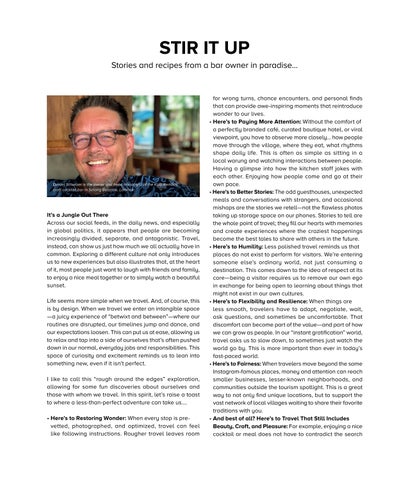
Daniel Schwizer is the owner and head mixologist at the Klub Kembali craft cocktail bar in Selong Belanak, Lombok.
It’s a Jungle Out There Across our social feeds, in the daily news, and especially in global politics, it appears that people are becoming increasingly divided, separate, and antagonistic. Travel, instead, can show us just how much we all actually have in common. Exploring a different culture not only introduces us to new experiences but also illustrates that, at the heart of it, most people just want to laugh with friends and family, to enjoy a nice meal together or to simply watch a beautiful sunset. Life seems more simple when we travel. And, of course, this is by design. When we travel we enter an intangible space —a juicy experience of “betwixt and between”—where our routines are disrupted, our timelines jump and dance, and our expectations loosen. This can put us at ease, allowing us to relax and tap into a side of ourselves that’s often pushed down in our normal, everyday jobs and responsibilities. This space of curiosity and excitement reminds us to lean into something new, even if it isn’t perfect. I like to call this “rough around the edges” exploration, allowing for some fun discoveries about ourselves and those with whom we travel. In this spirit, let’s raise a toast to where a less-than-perfect adventure can take us…. • Here’s to Restoring Wonder: When every stop is prevetted, photographed, and optimized, travel can feel like following instructions. Rougher travel leaves room
52
for wrong turns, chance encounters, and personal finds that can provide awe-inspiring moments that reintroduce wonder to our lives. • Here’s to Paying More Attention: Without the comfort of a perfectly branded café, curated boutique hotel, or viral viewpoint, you have to observe more closely… how people move through the village, where they eat, what rhythms shape daily life. This is often as simple as sitting in a local warung and watching interactions between people. Having a glimpse into how the kitchen staff jokes with each other. Enjoying how people come and go at their own pace. • Here’s to Better Stories: The odd guesthouses, unexpected meals and conversations with strangers, and occasional mishaps are the stories we retell—not the flawless photos taking up storage space on our phones. Stories to tell are the whole point of travel; they fill our hearts with memories and create experiences where the craziest happenings become the best tales to share with others in the future. • Here’s to Humility: Less polished travel reminds us that places do not exist to perform for visitors. We’re entering someone else’s ordinary world, not just consuming a destination. This comes down to the idea of respect at its core—being a visitor requires us to remove our own ego in exchange for being open to learning about things that might not exist in our own cultures. • Here’s to Flexibility and Resilience: When things are less smooth, travelers have to adapt, negotiate, wait, ask questions, and sometimes be uncomfortable. That discomfort can become part of the value—and part of how we can grow as people. In our “instant gratification” world, travel asks us to slow down, to sometimes just watch the world go by. This is more important than ever in today’s fast-paced world. • Here’s to Fairness: When travelers move beyond the same Instagram-famous places, money and attention can reach smaller businesses, lesser-known neighborhoods, and communities outside the tourism spotlight. This is a great way to not only find unique locations, but to support the vast network of local villages waiting to share their favorite traditions with you. • And best of all? Here’s to Travel That Still Includes Beauty, Craft, and Pleasure: For example, enjoying a nice cocktail or meal does not have to contradict the search
for something less polished. At its best, it’s another way of being fully present—to local ingredients, a restaurant’s creativity, a neighborhood after dark, the conversations happening around you. The point is not to reject comfort or style, but to choose places that feel rooted in their surroundings rather than staged only for visitors. Since opening our doors at Klub Kembali four years ago, these ideas have always informed our goal. To create a place that brings authentic flavors and blended ideas— all housed in a traditional, 120-year-old Joglo building, all enhanced by locally-made artwork, all served up by a team of experts who know exactly where the ingredients originate and exactly how the experience should feel. This flows through to our conversations with our guests as well. Namely, when we’re asked how to find the “real” Lombok, we always have a similar bit of advice: Allow yourself to be surprised, to expect the unexpected, and to
embrace unplanned detours. Leave the Instagram shots behind to seek out something more authentic. This type of adventure can give you something that polished travel can’t: a more active, surprising, and memorable relationship with a place… and with yourself. In honor of this “rough around the edges” feel, this month’s cocktail is focused on getting out into the wild and exploring both the sweet and the bitter, all in one delicious recipe—the traditional Jungle Bird. The Jungle Bird is a famous tropical tiki cocktail created in 1973 by beverage manager Jeffrey Ong at the Aviary Bar inside the Kuala Lumpur Hilton in Malaysia. Originally served as a welcome drink in a porcelain bird-shaped mug, it stands out for combining dark rum and tropical juices with bitter Campari. A great blend, and a perfect holiday sipper. Cheers!
Klub Kembali Jungle Bird 1. Fill shaker with: • 1 ½ oz Aged Manta Dark Rum • ¾ oz Campari • 1 ½ oz Pineapple Juice • ½ oz Lime Juice • ¼ oz Simple Syrup • 3 drops Saline Solution 2. Add ice and shake vigorously for 20 seconds 3. Double strain into lowball glass over ice 4. Garnish with dehydrated pineapple & cherry umbrella 5. Enjoy! Notes • At the Klub we age Indonesian Manta Dark Rum for added depth, but feel free to use any quality dark rum you prefer. • Saline Solution is the bartenders “secret sauce” to brighten up the flavors of most cocktails. We make ours by taking 100 ml water, adding 25 g salt and gently heating it until the salt is completely dissolved. Cool, bottle and use.
53
54
P I L L A V I L L A S B Y R A S C A L S , K U TA TRANQUIL TERRACOTTA VILLA HAVEN IN THE HEART OF KUTA
KUAR A LOMBOK RESORT HIDDEN BOUTIQUE OASIS EVOKING THE NATURAL BEAUTY AND TRADITIONS OF SOUTH LOMBOK
M AW I VA L LE Y SUSTAINABLE HILLSIDE LUXURY LIVING
55
LUXURY LIVING
PILLA VILLAS BY RASCALS, KUTA
Tranquil Terracotta Villa Haven in the Heart of Kuta
N
estled in a quiet corner of town, Pilla Villas’ stylish two-bedroom private pool villa is the perfect highdesign retreat for a Kuta weekend escape. Part of the Pilla Villas by Rascals collection, which also includes one-bedroom villas, it offers an off-site extension of the Rascals experience, just minutes away. The Pilla Villa aesthetic exudes a tropical minimalist design with stylish contemporary luxury. Perfect for family or small group stays, it serves as a best of both worlds option —offsite for more privacy, yet offering full use of all the Rascals resort amenities. The villa has an ideal functional, open layout allowing for lazy mornings over breakfast, afternoons lounging by your private pool and evenings dining al fresco or sipping sundowners. It features a fully equipped modern kitchen with an island, complete with Nespresso machine, refrigerator, cooktop and more. There is fast Wi-Fi connectivity, Starlink unlimited, throughout the property. The adjacent split-level living area boasts a cosy sunken lounge with plush sofas and an elegant dining table for entertaining in style. It leads out effortlessly onto the terrace and curved private pool which is flanked by plush daybeds and a shaded gazebo. There are also oversized floating beanbags. The villa’s two bedrooms are stylish sanctuaries with elegant king beds, ample built in storage space and lavish spa-inspired bathrooms featuring a full-size soaking tub, open-air rain shower, and even a tropical indoor garden. The bedrooms have the warm glow of pendant lights and poolside views, offering a dreamy backdrop in the evening.
56
57
This relaxed haven delivers refined architectural design using Eurasian style terracotta hues and meticulous stonework. It radiates warmth throughout, as well as a unique geometric style with arched full-size windows and doors. Guests can have breakfast in the villa or at Rascals, and adults can access the resort facilities at Rascals such as use of the spa for massage, body treatments, ice baths, the heated magnesium pool and yoga sessions. Villa guests also get use of the fully equipped gym facilities at nearby Xeno Fit. Villa guests can avail discounts at selected Kuta restaurants and beach clubs. Bicycles are available for guests to use, making it easy to explore the area. Pilla also offers a one-bedroom private pool villa option, perfect for couples.
rascalskuta reservations@rascalskutalombok.com www.rascalskutalombok.com
58
59
60
KUARA LOMBOK RESORT
Hidden Boutique Oasis Evoking the Natural Beauty and Traditions of South Lombok
N
estled beside Southeast Lombok’s mostly undiscovered Bumbang Bay, near Gerupuk, Kuara Lombok resort is a true secluded escape in nature. With stylish five-star comforts that exude a timeless appeal, this is that rare ‘best of both worlds’ staycation experience. Kuara Lombok is an exclusive boutique beachfront oasis set over a relatively large area, yet, with only 16 suites and villas, every guest can enjoy true seclusion, space, and privacy. There are many unique facets to Kuara Lombok—not least the one-of-a-kind meandering river pool which curves its way through the heart of the resort beneath towering palm trees. This lazy river experience is just one of several ways it seamlessly connects the resort to the surrounding tropical landscape. Throughout the grounds there are sheltered open-air spaces, and structures built with local materials. Additionally, there is a separate oceanfront infinity pool for those that cannot resist wide ocean vistas. It uses a multitude of natural materials—stone, wood, clay, and thatched roofs. The resort feels like an untouched tropical landscape stretching from beach to jungle, with stylish comforts and barefoot luxury amenities right on the doorstep. Beside the pool is a collection of traditionally inspired River Houses which boast expansive open plan living and dining, a spacious outdoor deck, and elegantly furnished ensuite bedrooms. Kuara also offers Garden Cottages and Garden Houses nestling within the tropical resort grounds. For beach lovers, the two-bedroom Beach House is just steps from the ocean. Expect upscale comforts with plush furnishings, and luxury amenities throughout. There are plenty of cosy nooks and large open spaces—indoor and outdoor—for simple relaxation, dining or entertaining. The four different types of accommodations all have premium linens, lounging space, a place to work, minibar and turndown service. The overall design has been meticulously thought out to reflect indigenous culture through colourful motifs and natural tones, while providing a style which has a timeless appeal. It utilises natural stone, timber frames and intricately woven textures. Each villa is built to sit within its surroundings rather than apart from them, following the ocean and the landscape rather than working against them.
61
The Kuara design philosophy was brought to life by celebrated designer Alexia Dubus. It takes the form of the local landscapes; the undulating forested hills and pristine beaches. It also pays homage to traditional Indonesian design history, with a nod to the traditional Sasak and Bugis culture. This is accentuated with locally sourced materials with indigenous design. In short, there is no compromise at Kuara. Its suites are expertly crafted, and you can expect attentive, authentic service alongside gourmet dining experiences. At the restaurant, Kuara celebrates the ocean’s bounty and local crops, including ingredients hand-picked from the resort’s own garden nurseries. Each villa is built to sit within its surroundings rather than apart from them, following the ocean and the landscape rather than working against them. Then there is an immersive cooking class with food prepared by hand. It is a full-on practical introduction to learn what goes into producing a gourmet-worthy meal. Kuara’s culinary focused experiences also include an enlightening trip to the local produce market. Each villa is built to sit within its surroundings rather than apart from them, following the ocean and the landscape rather than working against them. The menu is teeming with the unique flavours of Lombok and beyond, like appetizers of lumpia spring rolls, Gado-Gado, Rendang, classic Ayam Taliwang and ocean-fresh grilled lobster. There are timeless western favourites on the menu too, such as pasta, Chicken Parmo, burgers and the classic Club Sandwich. Desserts close the meal quietly, ginger cake, pandan crème brûlée, familiar flavours made with care.
62
Tucked away in a corner of the resort is Kuara’s wellness oasis of calm. Open to the air, the spa sits among dense greenery, the scent of fresh herbs and the sound of water finding its way through. From head to foot, the spa options utilise island grown herbals and oils for their restorative and energising treatments rooted in traditional techniques. Wellness carries into the garden through yoga, timed loosely around guests rather than a set slot. The resort lends itself naturally to weddings too, barefoot on the sand and beneath open sky, with the landscape doing most of the setting. It can cater to imitate gatherings or larger exclusive wedding receptions with the option of a full resort buyout for the big event. A stay at Kuara can take different shapes, a quiet break for two, or a base for surfers drawn south by the island’s waves. Beyond the resort, Kuara connects guests to the island itself: Sasak traditions, forest trails by bike, foraging along the coast, fishing, canoeing, snorkelling, all hands-on, all local-led. For those who prefer to stay closer to the resort, Kuara sits on a wide, near-empty beach, with nearby forested hills, and villages that carry on as they always have.
Jalan Pantai Jl. Bumbang, Mertak, Lombok, NTB +62 811 3831 0885 kuaralombok info@kuaralombok.com www.kuaralombok.com
63
64
65
LAGA LIVING
A New Kind of Beachfront Living in South Lombok
S
omething new is coming to the shores of Kuta Beach. Laga Living, a limited collection of nine private pool villas, will soon be released in one of South Lombok’s most distinctive beachfront locations. Created as part of the wider Laga destination, the residences will bring together tropical architecture, contemporary comfort and direct access to a lifestyle centred around sport, wellness, hospitality and the ocean. The collection comprises five spacious two-bedroom Aruna villas and four one-bedroom Muara villas positioned closest to the beachfront. More than simply places to stay, the villas have been designed for owners who want to become part of the changing rhythm of South Lombok—without losing the qualities that made the area special in the first place. A LIMITED BEACHFRONT COLLECTION Set within an approximately 12,000-square-metre site on Kuta Beach, Laga occupies a rare position between the ocean and river. The residences form a carefully considered part of the masterplan rather than a separate villa development. Owners and guests will be able to enjoy the privacy of their own homes while remaining connected to the energy, facilities and community of Laga Padel Club. With only nine villas being released, the development has deliberately been kept intimate. Each residence will have its own private pool and tropical outdoor spaces, with architecture designed to respond naturally to Lombok’s climate and landscape. Natural materials, shaded areas, greenery and a strong connection between indoor and outdoor living will give the villas a sense of place that feels unmistakably Lombok.
66
The objective is not to reproduce a conventional resort villa. It is to create homes that feel relaxed and grounded, while providing the quality, design and services expected from an international lifestyle destination. ARUNA: SPACE, PRIVACY AND TROPICAL LIVING The five Aruna residences are generous two-bedroom private pool villas designed for families, couples and owners seeking more space. Spanning more than 300 square metres, each Aruna villa has been planned as a complete tropical home. The architecture creates a natural flow between the living areas, bedrooms, private pool and outdoor spaces, allowing the villa to open itself to the climate while still providing privacy and comfort. The two-bedroom configuration makes Aruna equally suited to longer stays, family holidays and time shared with friends. Spacious interiors and carefully considered outdoor areas will allow owners to experience the freedom of villa living while remaining connected to the wider facilities of Laga. MUARA: LIFE AT THE WATER’S EDGE Positioned at the front of the residential collection, the four Muara villas offer a more intimate one-bedroom experience. These private pool residences have been designed for individuals and couples who want a beautifully considered base beside the ocean. Their location places them closest to the beachfront, capturing the atmosphere and energy of Kuta Bay. Muara combines the ease of a one-bedroom residence with the privacy and outdoor living of a larger villa. Each home will have its own pool and landscaped areas, creating a personal retreat within the wider destination.
67
The name Muara refers to the meeting point between a river and the sea—an appropriate reflection of the villas’ location and the landscape surrounding Laga. MORE THAN A PLACE TO STAY What distinguishes Laga Living is its connection to everything being created around it. At the centre of the destination will be Laga Padel Club, with five international-standard panoramic padel courts, including a championship centre court. The wider development will also introduce wellness and recovery facilities, a gym, swimming pool, restaurants, a sunset bar, social spaces and direct access to the beach. Owners could begin the morning with a walk along the ocean, play padel, recover in the sauna or ice bath, have lunch beside the pool and return to the privacy of their villa—all without leaving the destination. Some residents may come primarily for padel. Others will be drawn by Lombok’s surf, landscape and slower pace of life. Laga is being designed to bring those experiences together, creating an environment in which sport, wellbeing, food and community are naturally connected.
68
A PROJECT SHAPED BY COMPLEMENTARY EXPERIENCE Laga is led by co-founders Adam Murray, William McIntyre and Frankie Langan, whose backgrounds bring together business, hospitality, development and international padel experience. Adam is the founder of ATOMA Group and has been involved in hospitality and lifestyle businesses across Asia. He first invested in land in Lombok many years before the island began attracting the level of international attention it receives today. Will is based full-time in South Lombok and leads the project’s development on the ground, working closely with the local team, architects, consultants and contractors. His understanding of Lombok and experience delivering complex projects help connect Laga’s wider ambition with the practical realities of building on the island. Frankie, formerly Great Britain’s number-one padel player and a National Junior Coach, is responsible for helping shape Laga’s sporting experience. His involvement ensures that the courts, coaching, programming and future competitions are developed according to international standards.
Together, the founders share the belief that Laga should feel international in its quality but deeply connected to Lombok in its character.
THE NEXT CHAPTER OF LAGA The launch of Laga Living marks an important next step for the project.
DESIGNED TO BELONG That connection has influenced both the architecture and the way the project is being developed.
The first article introduced the wider vision for Laga: a destination bringing together international padel, wellness, hospitality and community on the shores of Kuta Beach. The residences now offer a limited number of owners the opportunity to become part of that vision.
Laga is being created alongside a predominantly Indonesian team, including people with longstanding relationships across Kuta and the wider Lombok community. Local knowledge has played an important role in the planning, construction and protection of the beachfront site. Before the buildings began taking shape, considerable work was undertaken to reinforce the riverbank, stabilise the land and protect the coastline from erosion. These early works reflect a broader commitment to creating something intended to last. The architecture follows the same principle. Open spaces, natural materials, tropical planting and shaded transitions between buildings are intended to make the development feel like part of its surroundings—not an isolated structure imposed upon them.
With only five Aruna villas and four Muara villas available, Laga Living will remain a private collection within a much broader lifestyle experience. It is an opportunity to own more than a villa. It is an invitation to become part of a beachfront community shaped around movement, connection and island life. The nine Laga Living residences will be released soon. To register for priority information about the villas, floor plans and upcoming release, visit us at: lagapadel www.lagapadel.com
69
PROPERTY DEVELOPMENT
MAWI VALLEY
Sustainable Hillside Luxury Living
A
unique lifestyle residential development is taking shape, nestled between Mawi’s iconic surf break and the undulating green hills of South Lombok. Mawi Valley is a master-planned, sustainable hillside project; a new concept of luxury living near the south coast. Set within a secluded valley just minutes from Mawi Beach and Selong Belanak, the development offers a combination of spectacular sunsets, panoramic ocean and lush valley views. However, this is not a cookie-cutter, tourism-focused, resort-style development community, but a real nature-orientated community being built from the ground up amid lush valleys, waves and pristine sandy shores. The generously sized hillside plots are deliberately spaced apart, giving homeowners privacy and room to create their own natural habitat, whether through tropical gardens, outdoor living spaces or children’s play areas. Family-focused living is at the heart of the Mawi Valley master plan. The residences come in three distinct architectural styles: Mawi Akyli, Mawi Mentari and Mawi Zen. They combine bold architectural forms and flowing lines with open-plan tropical living designed to connect naturally with the surrounding landscape. Different bedroom configurations (2 to 4 bedrooms) are available depending on the selected plot and villa type, allowing each home to respond to its individual position, terrain and outlook. For international buyers, Mawi Valley offers a secure HGB (Right to Build) structure via a PT PMA. Expect functional yet eye-catching open-plan layouts that embrace nature and a seamless indoor-outdoor lifestyle. Mawi Valley residences feature private pools, generous terraces and landscaped garden areas. Carefully designed furniture and kitchen packages based on the architectural visualisations are also available for homeowners who want a fully furnished, ready-to-live-in residence. The development has embedded sustainability into its wider vision. Solar energy, natural ventilation and well-insulated construction are combined with plans for rainwater collection and greywater recycling to reduce the environmental footprint of the community. Locally sourced, renewable and recycled materials, including bamboo and recycled timber, are incorporated where appropriate. Mawi Valley also embraces the existing character of the land. Green areas, planting and working farmland form part of the wider landscape, allowing families and particularly children to interact with nature and animals such as goats and cows.
70
71
A broad range of sports and leisure amenities is being integrated into the hillside community. These include a padel court, a multifunctional sports court and a skate bowl, helping to encourage an active lifestyle and community interaction through sports and events. With Mawi’s renowned surf break just minutes away, surfing naturally plays an important role in the lifestyle of the community. Walking and hiking trails through the surrounding landscape provide further opportunities to experience the valley and hills beyond the villas. Health and wellness are another central part of the Mawi Valley concept. Planned facilities include a yoga shala and gym alongside a sauna, ice bath and magnesium bath, creating spaces for exercise, recovery and relaxation within the community. The estate will also feature the Garden Café, set within the greenery at the bottom of the valley and complemented by a communal pool and children’s play area. Mawi Valley has now moved well beyond the initial planning stage. Major infrastructure works have been completed across significant parts of the development, while construction is progressing simultaneously on multiple villas. What began as a vision for a different kind of residential development in South Lombok is now visibly taking shape: a low-density community combining architecture, nature, family life, wellness and an active outdoor lifestyle in one of the island’s most distinctive coastal landscapes.
72
Selong Belanak, Lombok, NTB +62 822 3033 3523 mawivalley info@mawivalley.com www.mawivalley.com
73
74
75
PROPERTY INSIGHT
Indonesia wants investment — but what kind of investment? Part One of Two—The capital, the demand gap, and the lifecycle For tourism real estate and hospitality, attracting capital is only the beginning. The real test is whether an investment can enter correctly, operate successfully, create sustainable value and eventually exit with confidence. Part One asks what the 2026 figures actually say about the capital arriving in Indonesian tourism, and why an investment has to be underwritten as a lifecycle rather than as a transaction. By Ilyas Najim, Managing Director—MMI-Advisors
THE CAPITAL IS ARRIVING Indonesia does not have a capital-attraction problem. Whether it has a capital-productivity problem is the more interesting question, and one the tourism sector should take seriously before it congratulates itself on its growth rate.
half-year led by smelters, mines and data centres should look like. Indonesia is not simply trying to attract capital. It is trying to attract capital that creates domestic value, and tourism should be measured against that standard rather than exempted from it.
During the first half of 2026, realised investment reached IDR 1,010.6 trillion (approximately USD 57.0 billion), 7.2% higher than a year earlier. Foreign investment represented IDR 507.6 trillion (approximately USD 28.6 billion), marginally exceeding domestic investment at 50.2% of the total, with reported labour absorption of more than 1.4 million workers.[1] A note on what those figures are: BKPM's realisation data are compiled from company reporting through OSS, and the labour figure is selfreported absorption spanning construction and operating phases. Neither is Bank Indonesia's balance-of-payments foreign direct investment, which is compiled differently and is materially smaller. Commentary treats the two as interchangeable. They are not.
The origin of foreign capital deserves similar precision. Singapore remained the largest reported foreign investor at approximately IDR 156.0 trillion (USD 8.8 billion), followed by Hong Kong at IDR 134.7 trillion (USD 7.6 billion), China at IDR 69.1 trillion (USD 3.9 billion), Japan at IDR 33.7 trillion (USD 1.9 billion) and the United States at IDR 30.1 trillion (USD 1.7 billion).[4]
The composition is revealing. Investment was led by basic metals and related industries at approximately IDR 150.4 trillion (USD 8.5 billion), followed by other services— strongly influenced by data-centre development—at around IDR 114 trillion (USD 6.4 billion) and mining at approximately IDR 105 trillion (USD 5.9 billion). Downstream industries absorbed IDR 300.1 trillion (USD 16.9 billion), almost 30% of the national total.[1] That composition has an arithmetic consequence. Across the economy, IDR 1,010.6 trillion of realised investment sat alongside 1.4 million reported jobs: roughly IDR 722 million, or about USD 40,700, of capital per job—exactly what a
76
Singapore and Hong Kong together account for roughly USD 16.4 billion, some 57% of reported foreign realisation. Nobody in this industry believes that is Singaporean and Hong Kong money. These are the domiciles of the holding vehicles, not the origins of the capital, chosen for treaty position, shareholder-agreement law, arbitration seat and exit mechanics. That is not a criticism. It is the first evidence in these statistics that structuring decisions are made long before a project breaks ground. TOURISM'S SHARE, AND THE GAP THAT MATTERS Tourism is not Indonesia's largest investment sector and probably never will be. In the first half of 2026, tourism investment reached IDR 39.68 trillion (approximately USD 2.24 billion), roughly 3.9% of national realised investment— but growth of 16.64%, more than twice the rate of total investment. Foreign investment into tourism reached IDR 12.19 trillion (USD 688 million), up 37%, with domestic investment at IDR 27.48 trillion (USD 1.55 billion).[2]
That 3.9% is a floor, not a measure. The figure is BKPM's company reporting through OSS, aggregated by the Ministry against the classifications it treats as tourism— and what decides where an investment lands is not the asset but the code the company registered under. A resort held by a company licensed for accommodation counts as tourism. The identical resort held through real estate owned or leased counts as property. A villa let nightly may be either, or neither, if no foreign investment company was ever formed. Tourism is bigger than its own numbers, and the part that goes missing is exactly the small-format product part two of this article is about. Set that against demand. Indonesia welcomed 7.45 million international visitors in the first half of 2026, the strongest first half since 2020—but growth of 5.71%, and June alone recorded 1.39 million arrivals, 2.15% below June 2025. Domestic travellers generated 630.41 million trips. Accommodation and food-service activities expanded 11.83% during the first semester, against overall economic growth of 5.45%.[2][3][5] Read together, these numbers say something the sector rarely says out loud. Tourism capital is currently forming roughly three times faster than measured international demand is growing, and the strength of the accommodation economy is being carried substantially by 630 million domestic trips rather than by foreign arrivals, which have flattened at the margin—and the gap is wider than the published figures show, since capital that registered itself as real estate never entered the tourism line at all. This is not an argument against investing. It is an argument about what to invest in, and it should change three things in an underwriting model: the weight given to domestic demand in the segmentation, the caution applied to international-arrival growth assumptions, and the honesty of the competitive-supply analysis in any submarket where announced pipeline is running ahead of measured absorption. It also frames the real case for tourism, which is not scale but jobs. Compare Indonesia's two flagship zones. Morowali, the emblem of downstreaming, reports IDR 696.9 trillion of investment and 89,849 workers—roughly USD 438,000 of capital behind every job. The Mandalika reports IDR 6.02 trillion and 26,002 workers—about USD 13,000 per job. [6] The figures are imperfect, but no adjustment closes a gap of thirty to one. In a policy environment built around downstreaming, this is tourism's strongest argument: nothing else the country invests in turns capital into employment at anything like this rate. The sector should be making it with these numbers, loudly.
INVESTMENT SHOULD BE UNDERWRITTEN AS A LIFECYCLE An investment is not a transaction. It is a lifecycle: acquisition and structuring, development, operations, years of active management, and eventually a transfer, refinancing or exit. These stages appear sequential but must be analysed simultaneously. Before acquiring a property we should already understand how it will operate. Before finalising the operating strategy we should understand who might one day acquire it. And before thinking about that buyer, we need to ensure the architecture established at entry will survive due diligence many years later. Too many investments are structured around the first transaction alone: secure the land, reduce the acquisition cost, incorporate the company, begin construction. The shortest path to entry can appear the most efficient. A structure that saves a modest amount at acquisition but later restricts operations, creates governance problems, complicates repatriation, introduces tax exposure or reduces transferability may destroy considerably more value than it saved. Tax belongs in that architecture from the first day. In Indonesian hospitality it is frequently what separates two structures with otherwise identical operating economics: • PBJT. Under Law 1/2022 on Financial Relations between Central and Regional Government, the former hotel and restaurant taxes were consolidated into the tax on specific goods and services, levied at regency or municipal level within a statutory ceiling. The applicable rate is a local variable—one of the more concrete differences between developing in one regency and the next. • VAT. Accommodation and food-and-beverage delivered by the hotel fall outside VAT precisely because they are subject to PBJT. Management fees, licence fees and most third-party services do not. Structures that push revenue through a services company can inadvertently convert non-VATable revenue into VATable fees. • Rental income. Final income tax on land and building rental applies to passive letting. It does not describe a villa sold nightly through an online travel agent, which is an accommodation business—a distinction with consequences well beyond tax. • Repatriation. Corporate income tax at 22%, then withholding on dividends to non-residents unless reduced by treaty. This is the arithmetic behind the Singapore and Hong Kong figures above. None of this needs to be resolved perfectly at entry. All of it needs to be priced at entry. The objective of structuring is
77
balance: legal certainty, tax efficiency, investor protection, governance, operational capacity, bankability, flexibility and eventual liquidity. The most sophisticated structure is not necessarily the best one. The best structure is the one that remains resilient across the entire life of the investment. At development stage a new layer appears. Land rights must align with spatial planning; the activity must be compatible with the zoning; PBG, SLF, environmental requirements, access, utility capacity, engineering and financing must converge around an asset that can be built legally and economically. This means thinking beyond the building. Wastewater, solid waste, fire and life safety, security, accessibility, water supply, energy and the impact on neighbouring communities are not matters to address shortly before opening. They belong in the original design brief, because they affect CAPEX, licensing, operations, insurability and ultimately value. THE BUILDING CREATES CAPACITY. OPERATIONS CREATE THE RETURN. A shopping centre can operate for decades. So can a villa, an office building, a serviced residence. Longevity is not what distinguishes hospitality. The distinction lies in the intensity with which the operating business determines the yield generated by the real estate. A hospitality asset is monetised every day. Rooms are sold repeatedly, pricing changes continuously, distribution must be managed, staff shape the product, food and beverage strengthens or weakens profitability, and management discipline converts revenue into cash flow. A beautiful building without a functioning business inside it may have considerable replacement cost and very little investment performance. Operational strategy therefore belongs at the beginning. An owner may operate directly, and an effective owneroperator model creates exceptional alignment because strategic intent, capital allocation and operational decisionmaking sit close together. But ownership does not confer operational expertise. The alternative is a professional operator, through a management agreement, franchise, independent platform or lease—and selection is too often approached through brand recognition, proposed ADR and fee structure. Those matter but are not sufficient. Owner and operator must share an understanding of the investment thesis, and must be able to work together for over ten years. Personalities matter; corporate cultures matter; the capacity to disagree constructively matters. A highly regarded operator can be the wrong operator for a particular developer, just as an excellent development team can be the wrong partner for a particular brand.
78
Professional asset management connects these interests. The operator runs the business; ownership provides capital and direction; the asset manager continuously tests whether operating reality still matches the original thesis—challenging budgets, benchmarking assumptions, understanding costs rather than simply cutting them, anticipating CAPEX, protecting FF&E reserves, and evolving positioning before the property becomes obsolete. Without good operations there is no sustainable yield, and without credible, repeatable cash flow the investment becomes considerably harder to exit at the valuation originally envisaged. EXIT BEGINS AT ACQUISITION Development proves that an asset can be built. Operations prove that the investment works. Exit reveals how much value the two created together—and exit does not begin when the property is placed on the market. It begins at incorporation, because in Indonesia the choice between selling shares and selling assets is effectively made years before anyone contemplates a sale. Three points deserve to be modelled rather than assumed. The transfer-cost differential. An asset transfer attracts acquisition duty on the buyer and final income tax on the seller, together a meaningful percentage of consideration; a share transfer follows a lighter path. On a mid-sized resort that is a line item capable of moving the achievable net price. The licence chain. A share transfer preserves the company, and with it the NIB, the business licences and the operating history attached to them. An asset sale re-tests every permit against the rules applicable on the day of transfer—which, following a change in licensing architecture, is a very different proposition. It is the strongest practical argument for holding an operating hotel in a clean, single-purpose vehicle. Residual land tenor. More often a modelling question than a legal one, and worth stating clearly because it is frequently overstated. Under PP 18/2021 an HGB runs for thirty years, extendable by twenty and renewable by thirty, with extension and renewal capable of being applied for together. Where the statutory conditions are met—the land still used for its granted purpose, conditions of grant complied with, the holder still qualified, the land consistent with spatial planning and not designated for a public purpose—the process is administrative and, in practice, close to routine.[7] A compliant hotel on correctly zoned land is not an asset at risk of losing its title.
Beyond these, a purchaser will examine not only yesterday's EBITDA but the quality of tomorrow's earnings: operating history, licences, tax compliance, contractual obligations, land rights, employee liabilities, CAPEX, building compliance and the governance of the holding structure. Two hospitality properties can produce identical EBITDA and still be fundamentally different investments. One may be institutionally investable. The other may simply be profitable. The difference is liquidity. Part two, in the next edition. Part one has been about discipline that applies in any market. Part two turns to the rules that decide whether an Indonesian project can exist at all: the villa question, and the difference between controlling a property, developing it and lawfully operating a business from it; Bali’s closure of OSS licensing to new foreign vehicles this year, and the unresolved question of how far that closure actually reaches; the capitalisation thresholds that determine whether a project qualifies at all; why this market runs on equity rather than debt, and who that filters out; and what Bali’s decision means for Lombok.
SOURCES AND METHODOLOGY [1] National investment, FDI, sectors and downstreaming. BKPM reported IDR 1,010.6 trillion of realised investment in H1 2026, up 7.2% year-on-year, including IDR 507.6 trillion of PMA and reported labour absorption of more than 1.4 million; downstream investment reached IDR 300.1 trillion. The Presidency separately reported the largest H1 sectors, including basic metals at IDR 150.4 trillion, other services at roughly IDR 114 trillion and mining at IDR 105 trillion. BKPM realisation is compiled from OSS/LKPM company reporting and is not equivalent to Bank Indonesia's balance-ofpayments FDI. [2] Tourism investment and domestic demand. The Ministry of Tourism reported H1 2026 tourism investment of IDR 39.68 trillion, up 16.64%, comprising IDR 12.19 trillion of PMA (up 37%) and IDR 27.48 trillion of PMDN, alongside 630.41 million domestic trips. The tourism figure is the Ministry's own aggregation; BKPM's sectoral taxonomy contains no single equivalent "tourism" line, so the 3.9% share is a crosssource comparison. BKPM's sectoral taxonomy carries hotels and restaurants and property in separate lines, so the share understates tourism-directed capital formation to the extent that accommodation product is registered under real-estate classifications. [3] Indonesian economic growth. BPS reported 5.45% growth for the first semester of 2026, with accommodation and food-service activities expanding 11.83%.
[4] H1 2026 FDI origins. The Indonesian Presidency reported Singapore at USD 8.8bn, Hong Kong USD 7.6bn, China USD 3.9bn, Japan USD 1.9bn and the United States USD 1.7bn. BKPM reported that Hong Kong moved into first place during Q2 alone. Reported source countries reflect the domicile of the investing entity, not ultimate beneficial ownership. [5] International arrivals. BPS reported 7.45 million foreign visits for January–June 2026, up 5.71% year-on-year and the highest first half since 2020, with June 2026 at 1.39 million, down 2.15% year-on-year. [6] Morowali and Mandalika investment and employment. IMIP reported cumulative investment of approximately IDR 696.9 trillion and 89,849 workers as at end-January 2026, across 52 tenant companies; ITDC reported cumulative investment of approximately IDR 6.018 trillion, 27 active business operators and 26,002 jobs at end-2025. Both are estate-manager self-reporting on a comparable basis: cumulative investment across years against a point-in-time headcount spanning construction and operating phases, with no published breakdown. Mandalika's figure may exclude state infrastructure spending, including an AIIB facility of USD 248.4 million and state capital participation of around IDR 1.3 trillion; doubling it to allow for this still leaves a capital-per-job gap of roughly seventeen to one. IMIP's own USD conversion uses IDR 16,800 per USD. [7] Land tenor. PP 18/2021 provides for HGB of up to 30 years, extendable by up to 20 and renewable by up to 30, with extension and renewal capable of being applied for together. Article 40 conditions extension and renewal on the land remaining properly used and managed, the conditions of grant being met, the holder remaining qualified, conformity with spatial planning, and the land not being designated for a public purpose. HGB over Hak Pengelolaan additionally requires the consent of the HPL holder. Currency convention. USD equivalents of IDR-denominated figures are indicative and use approximately IDR 17,722 per USD as at 26 August 2026. For figures originally published in USD, the same rate is reversed to present IDR first. Minor differences from government releases can arise where official agencies use different reporting exchange rates. Note: This article is commentary, not legal, tax or investment advice. Regulatory positions described are current at the date of writing and are moving quickly. CP: Ilyas Najim, Managing Director +6285333453980 inquiries@mmi-advisors.com mmi-advisors
79
The Last Word VIP Guinness Launch: Guinness Arrives at The Last Word, Kuta Lombok The Last Word, Kuta Lombok’s Prohibition-era speakeasy, celebrated the launch of imported Guinness with an exclusive VIP evening attended by Guinness Asia dignitaries, Guinness Dublin’s GM and invited guests. The evening featured Guinness’ signature two-part pour, including the famous 119.5-second wait, alongside a specially created food menu. Guinness is now available nightly at The Last Word, alongside signature cocktails, classic drinks, international beers and share plates. Open daily from 4pm.
80
81
TDA Peduli Community Day 2026 —Merdeka by the Sea Celebrating Indonesia’s Independence Day, TDA Entrepreneur Community Mataram brought Merdeka spirit to Kuta and Tanjung Aan with a day of community action and celebration. The event included a beach clean-up, business-sharing session and distribution of 110 basic food packages to residents of Gerupuk, followed by traditional Independence Day games bringing entrepreneurs and local residents together. The initiative was a collaboration with Our Lombok, supported by Delalma Foundation and Asthari, with myLombok Magazine and Lombok Info as publication partners. TDA Mataram—Let’s Go Together.
82
The Joy of Giving On Kuta Mandalika beach, we joined Dika from Bali Quick Talk and the children of Serangan English School for a morning of giving. The children handed out nasi bungkus to beachgoers before everyone came together to eat and hear about Dika’s volunteering work with orphanages in Bali. OZ restaurant in Kuta also joined the initiative, providing free cookies for all the children.
83
84
85
This is Lombok! Lombok’s time is here and now, having finally stepped out of Bali’s shadow, showcasing to the world its unique mix of adventure, pristine natural scenery and captivating art and culture. A new airport, international yacht marina and improved roads have made travel to and within Lombok much easier, but it is its untamed natural beauty and traditional charm that captivates. It is an adventure-seeker’s paradise, home to world-class scuba diving, surfing and mountain climbing yet travellers looking for a cosmopolitan beach lifestyle and luxury creature comforts will not be short of options. Experience the best of Lombok with these recommended highlights and hidden gems: Senggigi and The West Coast Senggigi, just a short drive from the island capital Mataram is Lombok’s premier beach resort, extending along a series of sweeping bays. The main beach strip is fringed by a wide expanse of sand framed nightly by spectacular ocean sunsets. It is a fairly spread out beach town that rarely feels overcrowded yet there is a broad variety of places to stay, eat and socialise. There is a vibrant expat community here with lots of opportunity for sports and leisure, business networking and searching out those hard to find imported goods. Senggigi is the best place to arrange days out and guided trips to other parts of Lombok. The beach road then winds its way north to upmarket Mangsit, dotted with hip boutique hotels and villas among some of west Lombok’s most captivating scenery. In all, the Senggigi area stretches for almost 10 km along the west coast, and away from the main tourist centre, comprises numerous palm fringed beaches dotted with colourful fishing boats.
86
Gili Islands A trio of tiny tropical islands off the northwest coast, known simply as ‘the Gilis’ are the go-to place for laid-back island life and the simple pleasures of sun, sea and superb scuba diving. Each of these three islands has its own distinctive atmosphere; the smallest is Gili Meno, a peaceful tropical island haven with few distractions other than deserted white sand beaches and a couple of chilled out beach bars. Legendary ‘party island’ Gili Trawangan is largest and most cosmopolitan of the Gili Islands with no shortage of swanky boutique villas, diverse dining and plenty of action after dark. Gili Air, located closest to the Lombok mainland, sits somewhere in the middle of these two extremes and has the most authentic local atmosphere. The enduring appeal of the Gili Islands is the refreshing absence of any motorised transport making for a pleasant alternative to Bali’s congested beach resorts. Scuba diving is still the main draw and it is one of Asia’s top spots to learn the basics and get qualified. For landlubbers, there are few better places to get horizontal on a tropical beach and soak up the unique island vibe. Kuta and South Lombok Like its namesake in Bali, Kuta Lombok is synonymous with world-class waves but thankfully without the hassle of 24/7 traffic and infuriating beach hawkers. In fact, Lombok’s south coast surf breaks are more than a match for the best in Bali, and savvy surfers are heading here to enjoy miles of uncrowded, adrenaline-fuelled waves. Kuta, invitingly close to Lombok’s new international airport, is the main tourist hub yet remains a fairly tranquil tropical haven favoured by both surfers and adventurous families. It makes for a great base for exploring the rugged southern coastline dotted with numerous breathtaking beaches. Scenic highlights include up-andcoming Tanjung A’an, Gerupak and isolated Ekas Bay.
The Southwest Lombok’s ruggedly beautiful southwest peninsular is largely unexplored by visitors but is now getting serious recognition with the discovery of superb offshore scuba diving and miles of deserted beaches. The main gateway is Sekotong Bay, located just south of Lombok’s main ferry port Lembar and is the jumping off point for Lombok’s ‘Secret Gilis.’ These small offshore islands feature pristine coral reefs and idyllic tropical beaches for a real castaway experience. Heading south, the coastal road winds its way past tiny fishing communities and secluded bays all the way to the tip of the peninsular where the legendary surf breaks of Bangko Bangko (Desert Point) are found — rated among the best in the world. Mount Rinjani For an alternative to surf, scuba and sandy beaches, a trek up the immense Rinjani volcano is hard to beat. At over 3,700 meters, this is Indonesia’s second highest volcano and makes for challenging 3–4 day trek but the views are definitely worth all the effort. The mountain dominates much of north Lombok and the caldera alone covers a mind-boggling 50 square kilometres. Most climbers only go as far as the crater rim which offers vertigo-inducing views down into the volcanic lake but the extra effort to get to the summit will be rewarded with views as far as Java and eastwards across to the island of Sumbawa. If this all sounds too arduous for comfort, the mountain’s foothills offer a wealth of leisurely hiking opportunities. Head to Senaru village for easy-going walks through remote weaving villages and dense jungle to uncover a succession of scenic waterfalls.
87
THE DIRECTORY EAT Senggigi and the West Coast Asian Tiger +62 817 399 666 Kayangan +62 8214 4404 046 Verve Beach Club +62 878 6451 1311 La Chill +62 878 9273 4182 NooQ +62 821 4732 7446 Qerang +62 821 4732 7446 Quali +62 821 4732 7446 Salt +62 8234 0979 003 The Pearl—Jeeva Santai +62 3706 1971 23 Waroeng—Jeeva Klui +62 8779 8043 859
LA CABAÑA +62 859 2158 9690
The Well +62 822 6642 5518
La Fama +62 895 0523 6729
Three Sisters +62 823 3943 4472
Laut Biru +62 821 4430 3339
Tree House +62 821 4488 8710
Mama Pizza +62 812 4659 0212
Tropik +62 877 9804 3859
Mango Rooftop +62 853 3777 0451
Gili T
Nohi +62 812 3715 8418 Origin +62 821 4446 9996 Papi Sapi +62 823 4217 3719 Pronto Pizza +62 812 7777 3977 Pullman +62 370 7525100 Segara Lombok +62 823 4096 3101
Kuta and South Lombok
Soiree +62 851 8315 8089
Amber +62 853 3875 3290
TAKU +62 819 1595 0318
Ashtari +62 811 388 4838
Tanah +62 811 9631 0196
Boni Beach +62 823 3943 0612
Terra +62 859 3663 3130
Chez Marlin +62 822 5844 3170
The Breakery +62 811 381 2124
Damonte Gelato +62 878 3709 7570
The Club House +62 812 2662 9106
Disini +62 813 3842 4605
The Emporium Collection +62 813 3283 3047
Klub Kembali +62 817 977 7701
The Garden Collective +62 853 3841 0214
88
Fat Cats +62 8533 7156 982 Kayu Café +62 878 6239 1308 La Cala +62 8177 2852 855 L'Osteria Dell'Isola +62 8180 5771 375 Pearl Beach Lounge +62 819 9715 6999
Gili Meno BASK +62 812 3764 7471
PLAY Spas and Wellness Senggigi and the West Coast The Sira +62 370 7525555
Kuta and South Lombok Ashtari Yoga +62 812 3892 0735 Kensho Spa +62 813 3282 5878 Mana Yoga Retreat +62 853 3862 8659 Moon Lombok +62 823 4028 0029
Gili T Pearl Sunset Resort +62 8113 9009 050 Pesona Lounge +62 8133 8088 963 Regina Pizzeria +62 8776 5066 255 The Banyan Tree +62 8789 8524 709 The Roast House +62 8174 9160 04
Azure Spa +62 823 3910 4881 YOU SPA +62 821 4456 7093
Retail Kuta and South Coast Anggrek Lombokensis - florist +62 877 3884 5107 Billie’s +62 877 8422 9426
Gili Air Gili Coffee Roasters +62 859 6034 2360 Kopi Susu +62 821 4737 1516 Pachamama Cafe + Cantina +62 821 4649 5915
Nine-Nine +62 823 4027 1064
Health & Leisure / Recreation Senggigi and West Coast Scuba Froggy +62 878 1633 5000
Kuta and the South Lombok Papaya Beach Club +62 819 0784 7382
360 Surf Academy +62 853 3895 5800
Ashtari Cooking Class +62 811 388 4838 Awan Paper +62 822 6601 0423 Blue Marlin Dive +62 823 4098 6987 Nine-Nine +62 823 4027 1064 Ocean Addicts Lombok +62 813 5332 5630 Scuba Froggy +62 878 1633 5000
Gili T Dive Central +62 812 29569183 Gili Divers +62 821 4789 0017 Lutwala Dive +62 859 5521 6926
Estate Kuta and South Lombok 7Palms +62 817 1729 2980 Atrium Lombok +62 811 3900 7500
STAY Hotels Senggigi and West Coast Jeeva Klui +62 370 693 035 www.jeevaklui.com Kebun Villas & Resort +62 370 692 999 www.kebunresort.com Living Asia Resort & Spa +62 370 693 519 www.livingasiaresort.com Merumatta Beach Resort +62 852 3723 6446 Puri Mas Boutique Resort & Spa +62 370 693 831 www.purimas-lombok.com Qunci Villas +62 370 693 800 Sudamala Suites, Lombok +62 370 693 111 www.sudamalaresorts.com The Chandi Boutique Resort & Spa +62 370 692198 www.the-chandi.com
Novotel +62 370 615 3333 www.novotel.com
Lombok Property & Investment +62 819 0797 4075 www.lp-i.co
Origin Lombok +62 370 615 8550 www.originlombok.com
NAGAINDO +62 813 5332 9501 www.naga-indo.com
Selong Selo Residences +62 813 3779 1400 www.selongselo.com
Private Sanctuary +62 821 4741 9919 www.private-sanctuary.com
Sekotong
Reef Property Lombok +62 852 3801 4269
Cocotinos +62 819 0797 2401 www.cocotinos-sekotong.com
Gili T
Charity Aston Sunset Beach Resort +62 370 633 686 www.aston-international.com/eng/ hotel-detail/244/aston-sunset-beachresort---gili-trawangan Pearl of Trawangan +62 813 3715 6999 www.pearloftrawangan.com Pondok Santi Estate +62 819 0705 7504 www.pondoksanti.com
BASK +62 812 3764 7471 www.baskgilimeno.com
Nour Estates +62 853 3713 3898
The Sheraton Senggigi Beach Resort +62 370 693 333 www.sheraton.com/senggigi
Mahamaya, Gili Meno +62 370 637 616 www.mahamaya.com
Seascape +62 813 3820 4672
Kuta and South Lombok
Property
Gili Islands
Amber Lombok Beach Resort www.amber-lombok.com +62 853 3875 3290
Kuta Heights Development +62 821 4587 5594 +62 817 6673 983 www.kutaheightslombok.com
Palm View Properties +62 823 4164 7242
Kies Villas +62 878 6553 4450 www.kiesvillaslombok.com
Endri's Foundation www.endrifoundation.or.id Face This www.facethis.org Gili Eco Trust +62 813 3960 0553 www.giliecotrust.com Lombokcare +62 370 6194201
Gili Meno
The Oberoi Lombok +62 370 613 8444 www.oberoihotels.com/hotels-inlombok
NAGAINDO +62 813 5332 9501
Tate Developments +62 818 0376 0677 www.tatedevelopments.com
Lombok Eco Developments +62 817 713 708 www.lombokecodevelopments.com
89
ESSENTIAL INFORMATION
EMERGENCY NUMBERS Ambulance Phone: 0370 623 489 Emergency call: 119 Fire Brigade Phone: 0370 672 013 Emergency call: 113 Lombok Police Jl. Gajah Mada No7, Ampenan Phone: 0370 693 110 Emergency call: 110 Tourist Police Senggigi Jl. Raya Senggigi km 1 Phone: 0370 632 733 HOSPITALS Harapan Keluarga Jl. Ahmad Yani, Selagalas Phone: 0370 617 7000/617 7009 Risa Sentra Medika Jl. Pejanggik No.115, Cakranegara Phone: 0370 625 560 New Mataram Public Hospital Jl. Bung Karno No.1, Mataram Phone: 0370 645 045 Mataram Public Hospital Jl. Pejanggik No.6, Mataram Phone: 0370 623 498 Siti Fajar Moslem Hospital Jl. Panca Warga, Mataram Phone: 0370 623 498 Anthonius Catholic Hospital Jl. Koperasi, Ampenan Phone: 0370 621 397 Police Hospital Jl. Langko No.54, Ampenan Phone: 0370 633 701 Army Hospital Jl. HOS Cokroaminoto No.11, Mataram Phone: 0370 621 420 Central Lombok Public Hospital Jl. Jen Basuki Rachmat, Praya Phone: 0370 654 007 East Lombok Public Hospital Jl. Prof M. Yamin No.55, Selong Phone: 0376 216 80 HEALTH CLINICS Biomedika Clinic Jl. Bung Karno No.143, Mataram Phone: 0370 645 137 Medika Husada Clinic Jl. Raya Senggigi Phone: 0370 664 480 Klinik Prodia Jalan Pejanggik No.107, Mataram Phone: 0370 635 010
90
Hotel Villa Ombak Clinic Gili Trawangan Phone: 0370 642 336 Jolie Sourire Dental Care Mataram Mall Jl. Pejanggik, Mataram Phone: 0370 668 1797 PHARMACIES Guardian Pharmacy Mataram Mall Jl. Pejanggik, Mataram Phone: 0370 629 921 Kimia Farma Jl. Sriwijaya No.295, Mataram Phone: 0370 633 211 Jl. Pejanggik No.48, Mataram Phone: 0370 638 502 Jl. Catur Warga, Mataram Phone: 0370 634 774 Jl. M. Yamin No.155 Selong, East Lombok Phone: 0376 220 51 TAXI Bluebird Taxis Phone: 0370 627 000 IMMIGRATION OFFICE Department of Immigration Jl. Udayana, Mataram Phone: 0370 632 520 POST OFFICES Central Post Office Jl. Sriwijaya, Mataram Phone: 0370 632 645 Jl. Langko, Ampenan Phone: 0370 631 642 Jl. Raya Senggigi Phone: 0370 693 711 INTERNATIONAL SCHOOLS Mandalika Intercultural School Kuta, Lombok Phone: 0813 5357 8345 Nusa Alam Kompleks Grand Natura, Jl. Bung Hatta Phone: 0370 647 510 AIRLINE SALES OFFICES AirAsia Lombok International Airport Garuda Indonesia Jl. Panca Usaha No. 11, Mataram phone: 0370 649999 Lion Air Jl. Sriwijaya No.81, Mataram Phone: 0370 629 111
CAR RENTAL COMPANIES Gilitrans Phone: 0813 1313 7732 FREIGHT/COURIER COMPANIES Tiki Jl. Anyelir No. 1, Mataram Phone: 0370 633 014 DHL Jl. Hos Cokroaminoto No.53G, Mataram Phone: 0370 639 400 PUBLIC UTILITIES Electricity (PLN) Jl. Langko No. 25, Ampenan Phone: 0370 632 182 Jl. Raya Sengiggi Phone: 0370 693 535 Water (PDAM) Jl. Pendidikan No.29, Mataram Phone: 0370 632 510 Jl. Raya Sengiggi Phone: 0370 693 886 CHURCH SERVICES Bethany Mataram Church Jl. I Gusti Ketut Jelantik Gosa No.23, Mataram Phone: 0370 625 956 HKBP Mataram Church Jl. Gili Air No.4, Mataram Phone: 0370 632 924 Kristen Tuhan Church Jl. Ekas No.47, Mataram Phone: 0370 621 811 Masehi Advent H7 Church Jl. Kom L Yos Sudarso No.16, Mataram Phone: 0370 638 500 Pantekosta Church Jl. Pariwisata No.4, Mataram Phone: 0370 631 219 Katholik Church Jl. Majapahit No.10, Mataram Phone: 0370 634 397 CONSULATES IN BALI Australia (Also consular service for Canada and New Zealand nationals) Jalan Tantular No. 32, Renon, Denpasar Phone: 0361 241 118 Brazil Jl. Raya Legian No.186, Kuta Phone: 0361 757 775 Czech Republic Jalan Pengembak No.17, Sanur Phone: 0361 286 465
Denmark Jl. By Pass Ngurah Rai–Pemogan No. 852, Denpasar Phone: 0361 821 6979 France Jl.Mertasari Gg. II No.8, Sanur Phone: 0361 285 485 Germany Jl. Pantai Karang No.17, Sanur Phone: 0361 288 535 Italy Lotus Enterprise Building Jl. By Pass Ngurah Rai, Jimbaran Phone: 0361 701 005 India Jl. Raya Puputan No.42, Renon, Denpasar Phone: 0361 241 987 Japan Jl. Raya Puputan No.170, Renon, Denpasar Phone: 0361 227 628 Mexico Jl.Prof. Moh. Yamin No.1, Renon, Denpasar Phone: 0361 223 266 Netherlands Jl.Raya Kuta No.127, Kuta Phone: 0361 761 502 Norway Segara Village Hotel Jl. Segara Ayu, Sanur Phone: 0361 282 223 Russia Bali Kencana Resort II Block Cendrawasih No.18, Ungasan Phone: 0361 279 1560 Spain Kompleks Istana Kuta Galeria Blok Valet 2, No. 1 Jl.Patih Jelantik, Kuta Phone: 0361 769 286 Sweden & Finland Jl. Segara Ayu No.2, Sanur Phone: 0361 282 223 Switzerland Kompleks Istana Kuta Galeria Blok Valet 2 No.12 Jl. Patih Jelantik, Kuta Phone: 0361 751 735 United Kingdom Jl. Tirta Nadi No.20, Sanur Phone: 0361 270 601 United States of America Jl. Hayam Wuruk No.188, Denpasar Phone: 0361 233 605
91
92