BASECAMP: Self-Regulation Knowledge Resource SAQA ID 120300
Unit Standard Title Analyse Leadership and Related Theories in a Work Context
Page 1 of 125 © DukeCE - Knowledge Resource Management and Leadership Action Plan
NQF Level 5
Credits 8
Knowledge Resource
CONTENTS Outcomes of BASECAMP:............................................................................................................................................3 Self-Regulation......................................................................................................................................4 Ascend 1: Empathy.....................................................................................................................................................6 Ascend 2: Diversity, Equity, and Inclusion.................................................................................................................12 Ascend 3: Cross-Cultural...........................................................................................................................................24 Ascend 4: Social Intelligence....................................................................................................................................34 Analyse Leadership and Related Theories in a Work Context..............................................................45 Introduction..............................................................................................................................................................45 1.1
Explain the concept of leadership.................................................................................................................46
1.2
Differentiate between leadership and management.....................................................................................59
1.3
Analyze and compare leadership theories.....................................................................................................73
1.4
Apply the different roles and qualities of leadership in a work context........................................................89
Page 2 of 125 © DukeCE - Knowledge Resource Management and Leadership Action Plan
Dear Learner, Welcome to BASECAMP and congratulations on completing BOOTCAMP. We hope that the skills you acquired in the BOOTCAMP have been useful in your work and personal environments. The lessons in the BASECAMP focus on enhancing your skills of SELFREGULATION. It also includes an introduction to Leadership Insights. Therefore, BASECAMP has two outcomes of learning as outlined below:
Outcomes of BASECAMP: To achieve the goal, which is to summit Mount Everest, the learner must reach BASECAMP. At the end of BASECAMP, the learner will be able to embed the following habits relating to self-regulation: Empathy Diversity, equity, and inclusion Cross-Cultural Social Intelligence The unit standard aligned to this module is Analyse leadership and Related Theories in a Work Context. After completing the Unit Standard, the learner will be able to: Explain the concept of leadership Differentiate between leadership and management Analyse leadership theories Apply the different roles and qualities of leadership in a work context.
Page 3 of 125 © DukeCE - Knowledge Resource Management and Leadership Action Plan
SELF-REGULATION Self-regulation can be defined in various ways: It involves controlling one's behaviour, emotions, and thoughts to achieve a goal. It refers to the ability to manage disruptive emotions and impulses. It involves thinking before acting. It also reflects the ability to cheer yourself up after disappointments and to act in a way consistent with your deepest held values. The Importance of Self-Regulation Self-regulation involves taking a pause between a feeling and an action—taking the time to think things through, plan, and wait patiently. A lack of self-regulation will cause problems in life. An adult with poor self-regulation skills may lack self-confidence and self-esteem and have trouble handling stress and frustration. Often, this might be expressed in terms of anger or anxiety, and in more severe cases, this individual may be diagnosed with a mental disorder. Self-regulation is also important in that it allows you to act in accordance with your deeply held values or social conscience and to express yourself appropriately. If you value academic achievement, it will allow you to study instead of slack off before a test. If you value helping others, it will allow you to help a co-worker with a project, even if you are on a tight deadline yourself. self-regulation allows us to bounce back from failure while also staying calm under pressure Effective Strategies for Self-Regulation Everyone can benefit from learning concrete strategies for self-regulation: Mindfulness Is the awareness that arises from paying attention, on purpose, in the present moment and non-judgmentally. Enables us to put some space between ourselves and our reactions, leading to better focus and feelings of calmness and relaxation. Improves attention, which in turn helped to regulate negative emotions and executive functioning (higher-order thinking). Cognitive Cognitive reframing involves changing your thought patterns. Reappraisal Cognitive reappraisal involves reinterpreting a situation to change your emotional response to it. Using cognitive reappraisal in everyday life is related to experiencing more positive and fewer negative emotions. Cognitive reappraisal is associated with daily positive emotions, Page 4 of 125 © DukeCE - Knowledge Resource Management and Leadership Action Plan
including feelings of enthusiasm, happiness, satisfaction, and excitement. Qualities of Self-Regulators People who are skilled at self-regulation possess the following qualities:
Acting in accordance with their values Calming themselves when upset Cheering themselves when feeling down Maintaining open communication Persisting through difficult times Putting forth their best effort Remaining flexible and adapting to situations Seeing the good in others Staying clear about their intentions Taking control of situations when necessary Viewing challenges as opportunities
Practicing Self-Regulation
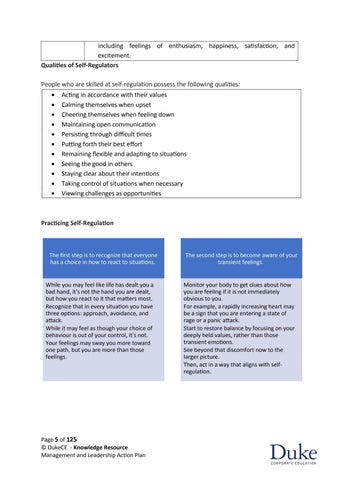
The first step is to recognize that everyone has a choice in how to react to situations.
While you may feel like life has dealt you a bad hand, it's not the hand you are dealt, but how you react to it that matters most. Recognize that in every situation you have three options: approach, avoidance, and attack. While it may feel as though your choice of behaviour is out of your control, it's not. Your feelings may sway you more toward one path, but you are more than those feelings.
Page 5 of 125 © DukeCE - Knowledge Resource Management and Leadership Action Plan
The second step is to become aware of your transient feelings.
Monitor your body to get clues about how you are feeling if it is not immediately obvious to you. For example, a rapidly increasing heart may be a sign that you are entering a state of rage or a panic attack. Start to restore balance by focusing on your deeply held values, rather than those transient emotions. See beyond that discomfort now to the larger picture. Then, act in a way that aligns with selfregulation.
Ascend 1: Empathy Empathy is the ability to emotionally understand what other people feel, see things from their point of view, and imagine yourself in their place. The concept of empathy is used to refer to a wide range of psychological capacities that are thought of as being central for constituting humans as social creatures allowing us to know what other people are thinking and feeling, to emotionally engage with them, to share their thoughts and feelings, and to care for their well–being. Essentially, it is putting yourself in someone else's position and feeling what they must be feeling. When you see another person suffering, you might be able to instantly envision yourself in the other person's place and feel sympathy for what they are going through. While people are generally well-attuned to their own feelings and emotions, getting into someone else's head can be a bit more difficult. The ability to feel empathy allows people to "walk a mile in another's shoes," so to speak. It permits people to understand the emotions that others are feeling.
Theories to explain Empathy Neuroscientific Explanations: Studies have shown that specific areas of the brain play a role in how empathy is experienced. Different regions of the brain play an important role in empathy. There are important neurobiological components to the experience of empathy. The activation of mirror neurons in the brain plays a part in the ability to mirror and mimic the emotional responses that people would feel if they were in similar situations. An area of the brain known as the inferior frontal gyrus plays a critical role in the experience of empathy. Emotional Explanations: Some of the earliest explorations into the topic of empathy centered on feeling what others feel allows people to have a variety of emotional experiences. The philosopher Adam Smith suggested that sympathy allows us to experience things that we might never otherwise be able to fully feel. This can involve feeling empathy for both real people and imaginary characters. Experiencing empathy for fictional characters, for example, allows people to have a range of emotional experiences that might otherwise be impossible. Prosocial Explanations: Empathy leads to helping behaviour, which benefits social relationships. Humans are naturally social creatures. Things that aid in our relationships with other people benefit us as well.
Benefits of empathy Empathy allows people to build social connections with others. By understanding what people are thinking and feeling, people can respond appropriately in social situations. Page 6 of 125 © DukeCE - Knowledge Resource Management and Leadership Action Plan
Research has shown that having social connections is important for both physical and psychological well-being. Empathizing with others helps you learn to regulate your own emotions. Emotional regulation is important in that it allows you to manage what you are feeling, even in times of great stress, without becoming overwhelmed. Empathy promotes helping behaviours. Not only are you more likely to engage in helpful behaviours when you feel empathy for other people, but other people are also more likely to help you when they experience empathy.
Not everyone experiences empathy in every situation. Some people may be more naturally empathetic in general, but people also tend to feel more empathetic towards some people and less so towards others. At the most basic level, there appear to be two main factors that contribute to the ability to experience empathy: genetics and socialization. Essentially, it boils down to the age-old relative contributions of nature and nurture. Parents pass down genes that contribute to overall personality, including the propensity toward sympathy, empathy, and compassion. On the other hand, people are also socialized by their parents, peers, communities, and society. How people treat others as well as how they feel about others is often a reflection of the beliefs and values that were instilled at a very young age.
Types of Empathy There are three types of empathy: affective empathy, somatic empathy, and cognitive empathy.
Page 7 of 125 © DukeCE - Knowledge Resource Management and Leadership Action Plan
Affective empathy involves the ability to understand another person's emotions and respond appropriately. Such emotional understanding may lead to someone feeling concerned for another person's well-being, or it may lead to feelings of personal distress.
Somatic empathy involves having a sort of physical reaction in response to what someone else is experiencing. People sometimes physically experience what another person is feeling. When you see someone else feeling embarrassed, for example, you might start to blush or have an upset stomach.
Cognitive empathy involves being able to understand another person's mental state and what they might be thinking in response to the situation. This is related to what psychologists refer to as theory of mind or thinking about what other people are thinking.
Barriers to Empathy A few reasons why people sometimes lack empathy include cognitive biases, dehumanization, and victim-blaming. Cognitive Biases: Sometimes the way people perceive the world around them is influenced by several cognitive biases. For example, people often attribute other people's failures to internal characteristics, while blaming their own shortcomings on external factors. These biases can make it difficult to see all the factors that contribute to a situation and make it less likely that people will be able to see a situation from the perspective of another. Dehumanization: Many also fall victim to the trap of thinking that people who are different from them also don't feel and behave the same as they do. This is particularly common in cases when other people are physically distant. For example, when they watch reports of a disaster or conflict in a foreign land, people might be less likely to feel empathy if they think that those who are suffering are fundamentally different from themselves. Victim Blaming: Sometimes when another person has suffered a terrible experience, people make the mistake of blaming the victim for their circumstances. This is the reason why victims of crimes are often asked what they might have done differently to prevent the crime. This tendency stems from the need to believe that the world is a fair and just place. People want to believe that people get what they deserve and deserve what they get—it fools them into thinking that such terrible things could never happen to them.
Signs of an Empathetic Person The following signs can be used to measure your level of empathy: Checklist Page 8 of 125 © DukeCE - Knowledge Resource Management and Leadership Action Plan
Rating (1-5)
You are good at really listening to what others have to say People often tell you about their problems You are good at picking up on how other people are feeling You often think about how other people feel Other people come to you for advice You often feel overwhelmed by tragic events You try to help others who are suffering You are good at telling when people aren't being honest You sometimes feel drained or overwhelmed in social situations You care deeply about other people You find it difficult to set boundaries in your relationships with other people
Page 9 of 125 © DukeCE - Knowledge Resource Management and Leadership Action Plan
Tips for Practicing Empathy Empathy is a skill that you can learn and strengthen. If you would like to build your empathy skills, there are a few things that you can do: Work on listening to people without interrupting Pay attention to body language and other types of nonverbal communication Try to understand people, even when you don't agree with them Ask people questions to learn more about them and their lives Imagine yourself in another person's shoes
Empathetic Leadership in the workplace Empathetic leadership means having the ability to understand the needs of others and being aware of their feelings and thoughts. Unfortunately, it has long been a soft skill that’s overlooked as a performance indicator. Today’s successful leaders must be more “personfocused” and able to work well with people from varying teams, departments, countries, cultures, and backgrounds. Empathy in the workplace is positively related to job performance. Managers who practice empathetic leadership toward direct reports are viewed as better performers in their jobs by leadership. The ability to be compassionate and connect with others is critical to our lives, both personally and professionally. Demonstrating empathy in the workplace — a key part of emotional intelligence and leadership effectiveness — also improves human interactions in general and can lead to more effective communication and positive outcomes, in both work and home settings. Some leaders are naturally more empathetic than others and will have an advantage over their peers who have difficulty expressing empathy. Most leaders fall in the middle and are sometimes or somewhat empathetic. Fortunately, it’s not a fixed trait. Empathetic leadership can be learned. If given enough time and support, leaders can develop and enhance their empathy skills through coaching, training, or developmental opportunities and initiatives.
Ways to Show Empathetic Leadership Displaying empathetic leadership can take many shapes and forms: 1. Watch for signs of Work burnout is a real problem today, and it comes at greater risk burnout in others. during times of intense stress and pressure. Many people are stressed, putting in more work hours than ever before and finding Page 10 of 125 © DukeCE - Knowledge Resource Management and Leadership Action Plan
it difficult to separate work and home life. Managers who are skilled at empathetic leadership can recognize signs of overwork in others before burnout becomes an issue that results in disengagement or turnover. This might mean taking a few extra minutes each week to check in with team members and gauge how they’re handling their current workload and helping them to recover from overwork. 2. Show sincere Part of leading with empathy involves working to understand the interest in the needs, unique needs and goals of each team member and how to best hopes, and dreams match work assignments to contribute to both performance and of other people. employee satisfaction. Team members who see that their manager recognizes them in this way are more engaged and willing to go the extra mile. 3. Demonstrate a Lines between work and personal life are becoming increasingly willingness to help an blurred. Empathetic leaders understand that their team members employee with are dynamic individuals who are shouldering personal problems personal problems. while having to maintain their professional responsibilities. They recognize that it’s part of their role to lead and support those team members when they need it most. Keeping open lines of communication and encouraging transparency is a good way to foster psychological safety and help team members feel comfortable sharing when it’s necessary. 4. Show compassion Real connections and friendships at work matter, and empathetic when other people leadership is a tool that managers can use to establish bonds with disclose a personal those they’re privileged to lead. We’ve all been through personal loss. loss, so even if we can’t relate to the specific loss our team member experiences, we can act empathetically and let them know they’re supported.
Empathy in the Workplace Empathy in the context of the workplace simply means that workers can establish true, empathetic connections with one another that enhance relationships and performance. It’s important to remember the difference between sympathy and empathy, as the 2 are often confused. Sympathy is typically defined by feelings of pity for another person, without really understanding what it’s like to be in their situation. Empathy, on the other hand, refers to the capacity or ability to imagine oneself in the situation of another, experiencing the emotions, ideas, or opinions of that person.
Page 11 of 125 © DukeCE - Knowledge Resource Management and Leadership Action Plan
Page 12 of 125 © DukeCE - Knowledge Resource Management and Leadership Action Plan
Managers can improve their empathy skills in several simple ways: 1. Talk about empathy in the workplace to signal its value.
2. Teach listening skills.
3. Encourage genuine perspective-taking.
4. Cultivate compassion.
5. Support global managers.
Let leaders know that empathy matters. Many managers consider task-oriented skills such as monitoring and planning to be more important in controlling the performance of their team members. But research shows that understanding, caring, and developing others is just as important, if not more important, particularly in today’s workforce. Giving time and attention to others fosters empathy, which in turn enhances your performance and improves your perceived effectiveness. To understand others and sense what they’re feeling, managers must be good listeners, skilled in active listening techniques, who let others know that they’re being heard and express understanding of concerns and problems. When a manager is a good listener, people feel respected, and critical trust on the team can grow. To show the highest levels of empathy in the workplace, managers should focus on listening to hear the meaning behind what others are saying by paying attention to not only the words being said, but also the feelings and values being shown, through nonverbal cues such as tone, pace of speech, facial expressions, and gestures. Managers should consistently put themselves in the other person’s place. For managers, this includes considering the personal lived experiences or perspectives of their employees. It also can be applied to solving problems, managing conflicts, or driving innovation. It’s very helpful to understand the role social identity plays for both yourself and others. Empathy is particularly an imperative for effective organizational diversity initiatives. Support managers who care about how others feel and consider the effects that business decisions have on employees, customers, and communities. Go beyond the standard-issue values statement and allow time for compassionate reflection and response. Remember, your employees care about social responsibility; your organization should too. The ability to be empathetic leaders who can collaborate across boundaries is especially important for those working in global or cross-cultural organizations. Leading a multicultural team requires cultural intelligence and the ability to understand people who have very different perspectives and experiences.
Page 13 of 125 © DukeCE - Knowledge Resource Management and Leadership Action Plan
When managers hone their empathetic leadership skills, they improve their effectiveness and increase their chances of success in the job. Empathetic leaders are assets to organizations, in part because they can effectively build and maintain relationships — a critical part of leading organizations anywhere in the world.
Ascend 2: Diversity, Equity, and Inclusion Diversity
Equity
Inclusion
Diversity is the presence of differences within a given setting.
Equity is the process of ensuring that processes and programmes are impartial, fair and provide equal possible outcomes for every individual.
Inclusion is the practice of ensuring that people feel a sense of belonging in the workplace.
Diversity Founded in acceptance and respect, diversity is built on the understanding that, owing to our differences, everyone is uniquely valuable. Encompassing the dimensions of race, ethnicity, gender, and sexual orientation, diversity also acknowledges socioeconomic status, age, physical abilities, religious beliefs, political beliefs, and other ideologies. When these differences are explored in a safe, positive, and nurturing way, diversity is achieved. Moving beyond simple tolerance, a diverse work culture embraces and celebrates the rich differences embodied by each individual. There’s a tendency to refer to people, or a person, as “diverse.” Even with the best intentions, referring to people this way feels a lot like a euphemism for “outside the majority,” or “different from the dominant group.” This framing of diversity is misleading at best because it assumes we’re all the same. At worst, it’s a damaging oversimplification that alienates people, rather than include them. It’s a problem we’ve seen echoed among many job seekers, talent acquisition specialists, and HR professionals. Diversity is the collective of differences and similarities that includes individual and organizational characteristics, values, beliefs, experiences, backgrounds, and behaviours. Activating that diversity is a process that involves recognizing and engaging differences within the employee and customer base. It equips managers and teams to explore the impact of diversity on perspectives, assumptions, and approaches, and identify ways to enhance the contribution of all.
Page 14 of 125 © DukeCE - Knowledge Resource Management and Leadership Action Plan
Blanket treatment of diversity doesn’t work because all perceptions of diversity are the same. In our own experience, we’ve found that some groups, such as millennials, perceive so-called “workplace diversity” as a combination of many different backgrounds. At the same time, older generations tend to view diversity more through the lens of equal and fair representation. It’s important to remember that diversity is less about what makes people different—their race, socioeconomic status, and so on—and more about understanding, accepting and valuing those differences. Equity Whereas diversity refers to all the many ways that people differ, equity is about creating fair access, opportunity, and advancement for all those different people. It’s about creating a fair playing field, to use a familiar metaphor.
Source: Equity vs Equality. Northwestern Health Unit Let’s take the topic of transportation. Not everyone within an organization will own a car, or even be able to afford public transportation daily. An organization can create a more equitable environment by accommodating the full spectrum of transportation needs, from policies around start times and working hours to stipends for both automobile and public transportation travel. Of course, issues of access, opportunity, and advancement extend far beyond how we get ourselves to work. Women, for example, are historically underrepresented, as are various minorities. Successful equity initiatives, then, must build fairness and equal treatment into the very fabric of an organization. This requires a design for creating, maintaining, and protecting equity organization-wide—a framework that supports equitable talent screening, hiring, workplace standards, and so on.
Page 15 of 125 © DukeCE - Knowledge Resource Management and Leadership Action Plan
According to Jim Link of Randstad North America, equity and equality are necessary to realize a diverse and inclusive environment. “We’ve heard a lot about diversity and inclusion, mostly in terms of talent attraction, retention, and promotion, but we rarely discuss what a truly diverse and inclusive organization looks like from a more holistic, lasting point of view — and that’s what equity is.” Inclusion There’s a common misconception that environments in which diversity and equity are priorities naturally beget inclusion. You’ve built equitable practices into your organizational processes, after all, leading to far more diverse, well-represented teams. People must feel included in a company like this, right? Not always, as it turns out. Inclusion is the extent to which various team members, employees, and other people feel a sense of belonging and value within a given organizational setting. The important distinction here is that even among the most diverse teams, there’s not always a feeling of inclusion. Women might be well represented at the senior management level, but still not feel included due to longstanding gender norms, salary discrepancies, and other factors.
Source: CRU-Inclusion-Graphic Community Resource Unit Ltd. Evaluating an organization’s inclusion starts with empathy. Why? Consider the fact that some 48% of employees believe that respect is the most important to creating an inclusive workplace (Quantum Workplace report). That means not only respecting people’s differences but considering the environment more broadly—from their point of view. Namely: Balance of experience for less represented groups. Barriers to entry both structural and societal that might be at play. Blindspots and assumptions that might be working against a more inclusive environment.
Page 16 of 125 © DukeCE - Knowledge Resource Management and Leadership Action Plan
Reasons why Diversity, Equity and Inclusion is a greater imperative for any business 1. Moral Imperative Giving equal access and opportunities to all people to work under fair and equitable conditions is simply the right thing to do. Inclusive companies declare fairness and opportunity for all as part of their corporate values and codes of conduct, demarcating exclusionary behaviour as fully unacceptable. Moral questions posed by new workplace technologies and practices only further underline the need to build organizational cultures that proactively engage the entirety of their workforce on these issues. 2. Legal Imperative Multinational organizations need to consider the rights and entitlements given to potential employees across different locations by law when they operate in these different legal environments. Beyond merely reacting to changes in national legislation, an increasing number of employers aim to act as active custodians of the interests of their employee base irrespective of location, supporting local legislation to evolve towards even greater fairness considering new workplace technologies and practices. 3. Economic Imperative To reap the full competitive advantages of diversity, equity and inclusion, some initial learning effort by managers, employees and the whole organization may be required – but a wide range of research conclusively documents that well managed diverse teams significantly outperform well-managed homogenous ones over time. To achieve this, companies will need to move beyond a focus on diversity towards a focus on providing a safe, open, and inclusive work environment that is underpinned by a sense of belonging for all employees. In return, diverse, and inclusive teams – if well managed – have a broader range of knowledge and skills; are better at identifying and solving problems that others may overlook; and gain a competitive edge in accessing new markets and higher market share.
Page 17 of 125 © DukeCE - Knowledge Resource Management and Leadership Action Plan
Expanding hiring to a broader talent pool provides new avenues for staffing hard-to-fill roles, while an inclusive workplace culture is a key driver of employee engagement, wellbeing, and retention. Consequently, companies leading their geography and industry for diversity, equity, inclusion and belonging perform better than their market average across a wide range of key performance metrics: Profitability: 25%-36% more likely to outperform on profitability Innovation: Up to 20% higher rate of innovation and 19% higher innovation revenues Decision-making: Up to 30% greater ability of spotting and reducing business risks Employee engagement: Statistically significant causal relationship with engagement and retention, for all employees Leading through uncertainty and disruption are fundamental to the success of today’s businesses. Appropriate strategies to build these capabilities can fuel greater productivity, innovation, and resilience across the organization. Increasingly, such strategies combine greater use of new technological tools with new, more human-centric approaches to workforce management that focus on employee experience, purpose and belonging and leverage diversity, equity, and inclusion as core organizational strengths. The “new normal” workplace emerging from the COVID-19 crisis is likely to significantly accelerate these trends.
Diversity, equity, and inclusion (DEI) in the workplace
Page 18 of 125 © DukeCE - Knowledge Resource Management and Leadership Action Plan
To make progress on DEI, leaders first need to acknowledge societal inequities and recognize that, unintentionally, their organization isn’t a level playing field. People enter the world of work and advance through their careers with the unevenness of advantage, opportunity, privilege, and power — so what is “fair opportunity” is not the same for everyone. When organizational leaders express their motivation, as well as acknowledge any barriers, for countering inequity; set clear goals toward greater equity; and then take action, they signal a commitment that becomes the foundation of the organization’s diversity and inclusion efforts. The business sector has the power to change and contribute to a more open, diverse, and inclusive society. Impacted by major social and political changes, more and more companies are taking steps to increase DEI initiatives. We can only fully understand what these initiatives mean and ultimately entail when we start implementing company-wide DEI endorsements from within our own organizations. The workforce of a diverse organization is fundamentally representative of the populations of the geographies in which they operate and of their customer base. Diversity describes the range of human differences and variations, whether they are inherent (by birth) or acquired (by experience). In today’s labour markets, these differences can be the basis for different forms of exclusion and result in different forms of discrimination. Equity in the workplace implies that everyone receives fair treatment and equal access to opportunities. While it’s often referred to when discussing pay, compensation is only one component of an equitable workplace. A focus on salaries and other similar metrics reveals a fundamental misunderstanding of equity’s true definition and potentially goes as far as to confuse equity and equality. Although similar, their meanings are, in fact, very different. Combatting other employee concerns, such as issues relating to managerial favouritism and equal recognition, are common leadership challenges. These can be thwarted by reaffirmation initiatives, fair promotion procedures, a commitment to transparency, and fair appeals processes. When all members of a diverse community have equal opportunities and support to succeed and grow, equity is achieved. Inclusion in the workplace is a result of collaborative, supportive, and respectful efforts to encourage and venerate the participation and contribution of all employees. When successfully applied, inclusion removes all barriers, discrimination, and intolerance to promote an environment in which everyone is made to feel included and supported. To foster inclusivity, companies must make a meaningful cultural change and take steps to remove unconscious bias when hiring new employees and nurturing existing ones. Page 19 of 125 © DukeCE - Knowledge Resource Management and Leadership Action Plan
According to some, inclusion is the only scalable way to build diversity within an organization. Without thoughtful and deliberate discussion and action to cultivate an inclusive environment, all the energy and resources spent on recruiting a diverse workforce are futile. Inclusion requires active, intentional, and ongoing efforts to promote the full participation and sense of belonging of every employee, customer, and strategic partner. It involves policies and practices, but also the ability to envision and enact new ways of leading. Across levels and functions, leaders need to learn what is now required, interpreting inclusive leadership for their various groups or for different roles. They also need tools, resources, and support as they improve their ability to identify and mitigate bias, respect differences, build empathetic relationships, foster allyship, manage conflict, and bring out the best in others. It’s common knowledge that DEI policies make businesses more innovative and creative when compared to non-diverse teams. People with different backgrounds, experiences, and skills bring more to the table than homogeneity does. This has the potential to positively impact an organization’s bottom line. As evidence mounts for the positive effect of having diverse workforces, there’s also a growing need for leaders to spearhead the DEI function and align that function with the overall business strategy. In essence, it needs to be supported from the top down. Here are five considerations organizations should make when creating their DEI development plan: Emphasize the business case for diversity and inclusion: Companies need diverse leaders who reflect the changing business landscape. When workplace teams reflect their target customers, they’re more than twice as likely to innovate effectively for their consumers. Be conscious of unconscious bias: Implicit bias occurs when our brains make quick judgments and assess people and situations without us consciously knowing or realizing it. These biases are pervasive, and employees often possess them unintentionally. It can impede even the most diverse and inclusive workplace cultures. Practice empathetic leadership: DEI can mistakenly be treated as a single initiative driven exclusively by human resources. But for real change to happen, leaders at every level (including the entire C-suite) need to commit to the value of belonging — practically, intellectually, and emotionally. Provide sponsorship programmes: Programmes that accelerate the progress of minority or misrepresented groups — not just in their first weeks or months on the job, but throughout their career — can improve opportunity and growth. For example, pairing women or inexperienced people of colour with more seasoned colleagues can pave the way for greater success. Page 20 of 125 © DukeCE - Knowledge Resource Management and Leadership Action Plan
Communicate expectations and hold leaders accountable for results: Leaders need to have clear expectations about DEI initiatives and be held accountable for making progress in their teams. Specifically, companies should track data on team sizes, recruiting, retention, and promotion rates. Systemic problems should also be addressed. Accelerate social progress with a technology-driven tool kit: Business leaders are now able to take on more responsibility in addressing social justice by employing an integrated approach to solutions-driven DEI fulfilment plans. For example, companies can utilize new technologies to create safe, open, and inclusive workspaces. Policies and practices that create inclusion make all employees feel welcome, valued, and respected. They are provided equitable and fair access to progression opportunities, good working conditions and fair wages. Employees of inclusive organizations experience a deep sense of belonging as well as being empowered and growing. Having a sense of belonging at work means that the work environment provides high psychological safety and employees can bring their full selves to work without fear of judgement. Employees feel comfortable expressing their opinions and ideas freely and are appreciated for their unique contributions and recognized for their accomplishments. Inclusive organizations take wider responsibility not just for the impact they have on their employees’ lives but also on the broader communities in which they operate, working towards social justice and equity for all. Leaders can take the following nine steps to develop a DEI initiative: Step 1: Compile Data Leaders must first know what their workforce looks like compared with the labour market, and if there are inequities based on demographics. By capturing data on employee demographics, leadership is better able to understand the diversity of its employees and equity of its internal practices and identify any areas of concern or trends. Historically, these data have included federal and state protected categories; however, recent trends indicate that other factors, such as personality type and thinking/learning style, may also be of value, though perhaps harder to find national comparative data for. If so, an organization may have to track its own data on these categories over time and determine what need for change may exist. Demographic data may include the following:
Age. Disability. Ethnicity/national origin. Family status. Gender.
Page 21 of 125 © DukeCE - Knowledge Resource Management and Leadership Action Plan
Gender identity or expression. Generation. Language. Life experiences. Organization function and level. Personality type. Physical characteristics. Race. Religion, belief, and spirituality. Sexual orientation. Thinking/learning styles. Veteran status.
Multiple resources are available to capture these data. However, most organizations will need to survey their workforce through voluntary self-identification to obtain additional data such as religion and sexual orientation. It may be challenging to gather diversity data from employees initially, especially when employees are unsure of how the data will be used or if there is a general distrust of leadership in an organization. If this is the case, an organization may want to use a third party or survey technology to capture information that will be reported in the aggregate without identifying information. In addition, it would be useful to gather information about the current company culture regarding DEI. Again, surveying employees can help shed light on their perception of the company in relation to encouraging and appreciating DEI in the workplace. Non-traditional differences such as personality traits or life experiences can also be measured. Leaders can conduct personality testing of the workforce or include open-ended questions on employee surveys to collect information regarding life experiences or other information employees may want to share about themselves.
Step 2: Identify Needs and/or Areas of Concern Once data are collected, underrepresented or problematic areas can be identified. To do so, leadership should begin with a high-level review of demographics such as age, sex and race representation and equity, and then continue to drill down by location, department, position, etc. Identification of problem areas can include questions such as:
Is management full of older white males? Do black females make less than their white counterparts? Does the accounting department tend to hire only females? Have promotions been limited for those with English as their second language?
Page 22 of 125 © DukeCE - Knowledge Resource Management and Leadership Action Plan
Additional information gained from employee surveys can help identify other areas of concern. Employee attitudes on culture may or may not match the survey results. If they do match, then the organization has a clearer path to what change is needed; if not, the organization may wish to conduct employee focus groups to better understand the disconnect. In addition, if results indicate little to no diversity in sexual orientation or religion, for example, it is possible that individuals don't have trust in the organization to divulge such personal information. As suggested in the previous step, leadership may need to outsource the data collection or use other means to collect data anonymously. Step 3: Address Policies or Practices Affecting DEI Leadership must determine if there are barriers impeding the employment, opportunity, or inclusion of individuals from different demographic groups. Organizations should consider if any policies or practices need to be eliminated or adjusted. Some examples to start with include: Employee referral programmes: Studies show that although employee referral programmes can be an excellent sourcing solution, they often result in "like me" referrals, where employees refer candidates of the same race, religion, national origin, or other class. This can lead to adverse impact and claims of illegal discrimination; it can also thwart DEI initiatives. Organizations may need to limit the use of employee referrals or consider other sourcing options to supplement the referral programme. Unconscious biases: Are there certain departments that are underrepresented in relation to the labour market? Is it possible that the recruitment manager is selecting individuals based on biases against certain groups? If a particular manager's department is significantly less diverse, equitable or inclusive than other departments, a review of the practices of that manager may be warranted. Company culture: Apparent preferences toward pro-life, traditional marriage and other aspects often associated with religious beliefs can repel candidates of differing beliefs or lifestyles. An annual Christmas party and recognizing only Christian holidays in a workplace can unintentionally send a message that only Christian employees are welcome. Organizations must consider holding a holiday party instead and provide floating holidays that employees may use for the multitude of religious observances. Political preferences: An organization with political signs and/or messages on its property may discourage individuals with different viewpoints from applying. A bumper sticker on an employee's car supporting a candidate who differs from a manager's choice can affect the manager's perception of the employee, as well as the manager's decisions regarding pay, performance, and promotion. A leader must consider how political preferences may be creating a disadvantage for applicants as well as current employees and remove those barriers by physically removing political messages in the workplace and/or training the workforce about respecting differing opinions. The organization must
Page 23 of 125 © DukeCE - Knowledge Resource Management and Leadership Action Plan
take appropriate disciplinary action when employees, including supervisors or managers, are intolerant of differences. Step 4: Identify Business Objectives Identifying how a diverse, equitable and inclusive workforce can aid in achieving business objectives aligned with the company's strategy is the next step in the process. The organization must set specific goals related to DEI based on the company's strategic objectives. As part of this goal, increasing diversity index scores is one of the organization’s performance indicators. Because its clients are becoming more diverse, the organization responds by embracing a more diverse and inclusive workforce to better serve the population. Another example might be around a business goal to create more innovative products an organization can introduce quickly to surpass the competition. To do so, the organization wishes to increase innovation in the research and development teams. One way to accomplish this goal could be to build cultural competence and inclusive decision-making within the team through training, which could more effectively harness existing team diversity and capitalize on diverse ideas. Step 5: Procure Buy-in and Support For the DEI initiative to succeed, senior-level buy-in and support are vital. Senior management must understand the business case for DEI initiatives, with direct links to the company's strategic goals. It is helpful to identify a senior-level champion who can be tasked with visible support of the initiative and ultimately responsible for keeping the programme "alive." Another task is to identify how management will be held accountable for supporting and engaging in the DEI initiatives. Examples of manager expectations include ongoing dialogue with staff regarding DEI, training for team members, and holding direct reports accountable for their individual actions related to fostering a diverse, equitable and inclusive workplace. An optional but recommended step is to create a diverse committee of employees from all levels with visible leadership presence and support. The committee is tasked with implementing the goals defined in the previous step and promoting DEI in the workplace. The organization should provide the committee with a clear mission, defined budget and expectations/performance indicators. Diversity committees meet regularly and are typically tasked with the following:
Promoting training and events to bring awareness to DEI in the workplace. Engaging co-workers in DEI conversation and training. Reviewing and developing policies and procedures that will promote workplace DEI.
Page 24 of 125 © DukeCE - Knowledge Resource Management and Leadership Action Plan
In the absence of a DEI committee, an organization can designate responsibility for the above tasks to management or consider hiring a DEI specialist to run the programme.
Step 6: Implement Initiatives Examples of DEI initiatives are changes in policies and practices, staff training, targeted recruiting, and employer-sponsored DEI awareness events for employees. The organization must develop an action plan to implement these initiatives by setting realistic goals and starting with the elements that have the greatest business value or that are readily achievable to build momentum for the initiative. Step 7: Communicate the Initiatives Leadership must identify different stakeholders and design messages for each stakeholder to inform, educate, engage, or empower as appropriate. People vary in how they understand messages, and it is important for each person to receive an ongoing stream of communications about the initiatives. The communication plan should incorporate executive presentations and all available media, including social media. Newsletters, intranet, and e-mail can also be successful communication tools. The organization should use metrics and success stories to connect the DE&I efforts to its own goals and strategic plan. Step 8: Measure and Disseminate Outcomes It is imperative to measure the results of the DEI initiatives that have been implemented. Outcomes such as the increased representation of identified groups and improved employee survey scores should be captured. Other measurements, such as improved employee retention, and public recognition, such as awards or social media accolades, can also indicate how an organization is performing in its DEI initiatives. Although some efforts may seem intangible, there are measures that can indicate the success levels of such action items. If DEI training is implemented to increase retention, participant retention can be tracked over time, and participants can be surveyed to determine if training was a factor, and how much so, in their continued employment. The results of the initiatives should be communicated at all levels to demonstrate the return on investment and value-add to the organization. Communication tools can include infographics for leadership meetings and public affairs, memos to staff, and company website videos for potential candidates. Step 9: Review and Adjust DEI initiatives are not static, and an ongoing review of the workforce and a response to changing needs are necessary. The organization must establish procedures for periodic review of DEI initiatives and goals. After a DEI initiative has been implemented for a period, Page 25 of 125 © DukeCE - Knowledge Resource Management and Leadership Action Plan
the organization should resurvey employees regarding their perceptions of the company's efforts. Periodically, an organization may need to start at step 1 again and collect data to refocus its DEI programme.
Ascend 3: Cross-Cultural Cross-cultural competence refers to your ability to understand people from different cultures and engage with them effectively. And not just people from the one culture that you’ve studied for years. Having cross-cultural competence means you can be effective in your interactions with people from almost any culture. Being able to communicate and work with people across cultures is becoming more important all the time. People are traveling, reaching out, and mixing with different others like never. They do it for fun, but they also do it for work. In all cases, success requires developing a relationship. And doing this means bridging a cultural divide. Why Is Cultural Competence Important? Demographic shifts and an increasingly diverse population: In other words, although we have always lived in an ethnically diverse society, we are all operating in an increasingly culturally diverse environment where we need to be able to interact, communicate, build relationships, and work effectively with people from diverse cultural and ethnic backgrounds. Moreover, those of us working with youth need to prepare them to operate in a society that will be even more diverse in terms of religion, ethnic background, and sexual orientation. Societies are increasingly becoming globalized: Today’s world is diverse and global. Technology has made interactions across cultures around the world a very common experience. Social networking sites, blogs, and chat rooms are letting people regularly interact across national borders. Many industries currently have a significant amount of international collaboration, and careers in many fields increasingly entail working with people from different countries, both directly and indirectly. Children and youth today need to be prepared to enter a workforce and adult society that spans across borders and involves interacting with people of diverse backgrounds in myriad settings. Recognizing our increasingly globalized society, many industries and professional organizations are emphasizing the importance of cultural competence and related skills (e.g., global awareness) as essential in today’s workplace. Successfully navigating our globalized society entails being able to understand and appreciate diversity in its many forms, and to effectively engage and communicate with people from different cultures. Persistence of issues around cross-cultural contact, discrimination, and related challenges: Despite the fact that societies are becoming more culturally diverse and globalized, issues Page 26 of 125 © DukeCE - Knowledge Resource Management and Leadership Action Plan
surrounding inequality, bias, and breakdowns in intercultural communications persist. There are also numerous bias incidents, persistent inequalities around racial and ethnic lines, and institutional policies that perpetuate inequalities at both the individual and institutional levels. One need not look beyond recent news reports to find that ethnic tensions persist. Discrimination and bias in various forms are hurtful all around: Discrimination and bias have serious consequences. A substantial body of work has also shown that victims of bias suffer in ways that may be less visible—in their academics, work performance, and other domains of life—even when those biases are subtle. Research on “microaggressions” (i.e., regular, or daily subtle and minor acts of bias that may be consciously or unconsciously expressed) illustrate this point and show that even subtle incidences can have cumulative and serious consequences for socio-emotional well-being. Negative effects are evident not just for the victims of biases. Recent research suggests that stereotyping, bias, and incidences of microaggressions not only affect the victim but also contribute to a hostile environment for everyone so that people in the broader setting (e.g., workplace) might feel invalidated or even intimidated and abused. In addition, holding biases and prejudice also negatively affects the very persons holding those stereotyped beliefs. Thus, biases and stereotypes have negative effects all around—for individuals and institutions, as well as for the targets of bias and for those holding such biases. What makes up cross-cultural competence? What is the specific knowledge, skills, and attitudes that make someone cross-culturally competent? These twelve principles give you some pointers about how to think about the experiences you have in new cultures. They are essential to cross-cultural competence: Stay focused on your goals: If you’re overseas for work, then building intercultural relationships is not just for fun. Building relationships will help you get your work done. Understand the culture within yourself: Keep aware of the fact that you see the world in a particular way because of your own background, personal history, and culture. Manage your attitudes towards the culture: You don’t always have to love the culture. But you do have to keep check on your reactions to values and customs that are different from your own. The first two principles can also help you manage your attitudes. Direct your learning of the culture: Don’t expect a book or training course to hand you the answers. Try to make sense of the culture for yourself, using the information you come across as clues. Develop reliable information sources: Find two or three locals to get answers from about the culture. Build the relationships so you feel comfortable asking about most anything. Check with more than one and compare their answers in your head.
Page 27 of 125 © DukeCE - Knowledge Resource Management and Leadership Action Plan
Learn about the new culture efficiently: You can’t learn everything about the culture before your trip. It’s unrealistic. Focus on learning a few things that fit your interests and use those to make connections and learn more while you are abroad. Cope with cultural surprises: No matter how much you prepare in advance, you will find yourself faced with people acting in ways that you find puzzling. When you do, try to find out why. Doing so will often lead to new insights. Formulate cultural explanations of behaviour: Routinely try to explain to yourself why people act as they do in this culture, differently from your own. Using things, you know about the culture to explain behaviour will help you build a deeper understanding of the culture overall. Take a cultural perspective: Try to see things from the point of view of the people from the other culture. By taking a cultural perspective, you may create a whole new understanding of what’s going on around you. Plan cross-cultural communication: Think ahead of time about what you have to say and how you want the other person to perceive you. Use what you know about the culture to figure out the best way to get that across. Control how you present yourself: Be deliberate about how you present and express yourself. Sometimes you’ll be most effective if you’re just yourself. Other times you must adapt how you present yourself to the culture you are in to be most effective. Reflect and seek feedback: Continue to reflect on and learn from your interactions and experiences after they occur. After an interaction, you can think about whether you got the messages across you intended. You can even ask a local how they think you did.
Tips for Building Skills in Cultural Competence Developing cultural competence is a process rather than an endpoint. Just like any skill, the process of development and improvement continues, and it is hard to point to a particular time when one can say “That’s it! I’ve reached it!” There are many ways by which we can increase our capacity to be effective in our interactions with others. Below are some suggestions to move forward in your development. Increasing cultural and global knowledge: Learning more about other cultures and being aware of current events is often key in learning about various cultural groups’ points of view. When working with people from different cultural backgrounds, it can be useful to learn about their culture’s practices, values, and beliefs. For example, learning about the languages spoken in their communities, child-rearing practices, or religious traditions can help us understand and interact with individuals and groups of various backgrounds. Conflicts that emerge between groups are often rooted in issues that may have deep historical origins. It is very helpful to understand these historical backgrounds that may help Page 28 of 125 © DukeCE - Knowledge Resource Management and Leadership Action Plan
explain current events. For example, why do certain words or phrases that seem neutral evoke negative reactions with specific populations (e.g., “Where are you from?” or “You really should be appreciative of what I give you”)? Some of these phrases reflect long histories and current experiences of oppression and thus evoke hurt and other negative feelings. Hurt feelings among youth may impact their ability to develop trusting and strong relationships with adults, which are necessary for youths’ growth and development. Similarly, some traditional events may evoke controversy as to their meaning and whether they should celebrate at all. Regardless of what side of the debate you might align with, the first and most important step is to understand the issue. Finally, beyond history, numerous events and policies continue to impact the individuals, families, and cultural groups with which you are interacting. Examples of these include wars and territorial conflicts. For those of us working with refugees or migrants in our communities, it is essential we understand events that underlie their movement from their home countries. Self-assessment Reflecting critically on our own biases and prejudices helps to develop the skills necessary to effectively interact and engage with individuals whose cultural background is different from our own. Realizing that everyone has biases is an important step for building cultural competence. Our biases may stem from our backgrounds, experiences, or personal demographics, and these biases exist whether we are aware of them. The problem is when we deny or fail to acknowledge our biases. Our interactions and perceptions of others may be influenced by our biases. These biases may cause us to inadvertently act in ways that are discriminatory towards others. However, if we are aware of our biases, we can work to diminish our own prejudices and the implications they may have in our interactions with others. In fact, holding on to the belief that one is “colour-blind” and unbiased is linked to unfavourable behaviours, such as miscommunication and lack of trust across racial groups, reluctance to help others from a different cultural group, and less ability to detect biased behaviours. Acknowledging that we all have biases and that we all hold stereotypes is the first step in cultural competence. Going beyond tolerance: Building skills and putting them in action Tolerating different cultural backgrounds is a step in the right direction. However, tolerance is not always optimal. In fact, tolerance usually means that you are simply putting up with something that is undesirable. Cultural competence goes beyond “putting up with” differences and instead involves being appreciative, affirming, and inclusive of all cultural backgrounds. For example, to increase our cultural competence, we can ask members of a Page 29 of 125 © DukeCE - Knowledge Resource Management and Leadership Action Plan
cultural group open-minded, open-ended questions, or ask for more information, such as, “I would like to learn more about . . .” Additionally, trying to detect verbal and nonverbal actions that certain cultures may not find appropriate (e.g., handshaking) can establish an inclusive environment. Overall, cultural competence has three important components: active listening, demonstrating empathy, and effective engagement. Each is detailed in the next section. Active Listening When was the last time you engaged in an active listening conversation with someone who has vastly different experiences and beliefs than you? Actively listening to an individual allows you to learn about that person’s culture and experiences. You should listen for total meaning by focusing on the content that is being given and concentrating on what is being said.
Active listening entails thinking about the feeling behind the content, or the emotion involved. The emotion gives evidence of the real intent of the conversation, which will help you identify if the person is upset, inquisitive, or acting on another emotion and allow you to respond appropriately. In addition to listening for total meaning, you should also avoid mental distractions when building cultural competency through active listening. This means listening with focus and not becoming involved in mental chitchat about how you are going to respond to a person or question. For example, if you believe that homosexuality is immoral and a choice and you are in a debate with a friend on the legalization of same-sex marriage, instead of engaging in mental chitchat about what scientific or biblical facts you can recite to prove your perspective, the key is focusing on what is being said and how it is being said. Page 30 of 125 © DukeCE - Knowledge Resource Management and Leadership Action Plan
Lastly, once you have listened for true meaning, the other person feels understood, and you both have limited mental distractions, you will want to make sure you ask more questions of the other person than offer solutions. Do not jump directly to giving people advice or offer solutions about what you perceive to be the problem or their problem. The response that is effective, especially if you are in a situation in which you are responsible for resolving a conflict between two people, requires seeking more information and multiple perspectives first. Empathy The second component of cultural competency is demonstrating empathy. It is the art of seeing and feeling the situation of another, walking in another person’s shoes, or seeing the world as that person sees it. Empathy involves understanding that person’s perceptions and the conclusions that person draws about his or her life experiences. It does not mean you have to agree with that person’s perceptions and conclusions, but at the very least, you are able to see the other person’s position. Take the previous example related to sexual orientation. A privilege of being heterosexual in our society is having multiple media, print images, and entertainment that portray heterosexual love and relationships and indicate it is not taboo to hug or give a peck to your girlfriend or husband while in public. These images are not as prevalent for same-sex couples. Therefore, empathy involves being able to understand the other person’s position. To be effective, you must engage in appropriate inquiry and dialogue. It also involves building relationships with an individual or cultural group. Engagement The third component of cultural competency is effective engagement. Engagement should be mutually beneficial and a reciprocal learning experience in which you learn from one another. Focus on the behaviours and the situation, not the person. Value-laden statements making the individual the target should be avoided. If the focus of the conversation or interaction is about a tradition or belief, keep the feedback within the context of that tradition or belief. Do not say, you are being silly because you believe that Muslims should be able to step out of class to pray six times a day. Focus on understanding the tradition or practice. Approach the topic by saying: I understand this is part of your religion, but I do not understand how it affects your belief in God and why you are required to pray six times a day. This opens a dialogue in which the person can explain to you the tenants of that culture and the requirement of prayers.
Page 31 of 125 © DukeCE - Knowledge Resource Management and Leadership Action Plan
Displaying the cultural competence behaviours of active listening, demonstrating empathy, and effective engagement is important when moving beyond tolerance. These three components will help us to create a welcoming environment and establish the appreciation of similarities and differences among cultures. What is Cultural Competence and How to Develop It? Develop cultural competency skills to enhance the ability to practice effective communication in intercultural situations.
photo source: Canva.com Working and living in a global society requires the ability to create interactions and relationships with people who are different from oneself. It is critical to know how to assess our cultural competency and evaluate our own cultural behaviours. Globalization and diversity lowered the barriers that once separated cultures both internationally and domestically (Garneau & Pepin, 2015). Cultural competency skills can help businesses run more productively, and efficiently. Practicing cultural competency skills can also elevate your customer service skills. Exceptional customer service gives you the ability to set your business apart from your competitors and keeps your customers returning to your business. What is culture? In 1951, Kluckhohn explained culture as sharing a pattern of thinking, feeling, reacting, and problem-solving. Culture is a dynamic relational process of shared meanings that originate in the interactions between individuals. In 2010, Gregory and colleagues emphasized that culture must be considered in historical, social, political, and economic contexts. Betancourt (2004) defined culture as a pattern of learned beliefs, values, and behaviour that are shared within a group; it includes language, styles of communication, practices, customs, and views on roles and relationships. Edgar Schein (2010) described a culture as "shared beliefs, values, and assumptions of a group of people who learn from one another and teach to others that their behaviours, Page 32 of 125 © DukeCE - Knowledge Resource Management and Leadership Action Plan
attitudes, and perspectives are the correct ways to think, act, and feel." Psychologists argue that unfamiliar culture negatively affects an individual's sensemaking mechanisms and determine their behavioural responses. As a result, individuals cannot accurately perceive, interpret, explain, and predict the behaviour of people with different cultural background(s) (Muzychenko, 2008). What is cultural intelligence? Cultural intelligence is the ability to interpret the stranger's behaviour the way the stranger's compatriots would (Muzychenko 2008). For example, if employees don't feel as if their manager understands or respects their culture, employees may find it hard to trust the leader or work as a team. What is cultural competence? Current research on cultural competence focuses on sensitivity to cross-cultural differences and the ability to adapt to other cultural environments, or reflective awareness of cultural influences on one's thoughts and behaviours (Chao, Okazaki, & Hong, 2011). Muzychenko (2008) defined cultural competence as the appropriateness and effectiveness of one's behaviour in an alien cultural environment. Wilson, Ward, and Fischer (2013) defined cultural competence as "the acquisition and maintenance of culture-specific skills" for very practical reasons: function effectively within a new cultural context. interact effectively with people from different cultural backgrounds. Williams (2001) defined cultural competence as "the ability of individuals and systems to work or respond effectively across cultures in a way that acknowledges and respects the culture of the person or organization being served". Why do we need to develop cultural competence? Developing cultural competence helps us understand, communicate with, and effectively interact with people across cultures. It gives us the ability to compare different cultures with our own and better understand the differences. Unconsciously, we bring our own cultural frame of interpretation to any situation. This is not to say that culture alone determines how one interprets a situation. One's own unique history and personality also play an important role (Hofstede, 2002). How do we develop an atti tude and components of cultural competence? Developing cross-cultural attitudes allows one to develop skills for better engaging with people from all kinds of cultures. Cross-cultural skills are demonstrated through the ability to communicate with respect; recognize others' values, accept knowledge, skills, and talents; and tolerate, engage, and celebrate the success of others. Deardorff Page 33 of 125 © DukeCE - Knowledge Resource Management and Leadership Action Plan
defined competence as "the ability to communicate effectively and appropriately in intercultural situations based on one's intercultural knowledge, skills, and attitudes" (Deardorff, 2006). We adopted Deardorff (2006) cross-cultural attitude strategies that help you to develop and enhance one's ability to practice effective communication in intercultural situations: Practice openness by demonstrating acceptance of difference. Be flexible by demonstrating acceptance of ambiguity. Demonstrate humility through suspension of judgment and the ability to learn. Be sensitive to others by appreciating cultural differences. Show a spirit of adventure by showing curiosity and seeing opportunities in different situations. Use a sense of humour through the ability to laugh at ourselves. Practice positive change or action by demonstrating a successful interaction with the identified culture. Borchum (2002) described cultural competence as "a non-linear dynamic process that is never-ending and ever expending. It is built on increases in knowledge and skill development related to its attributes". These attributes will guide you in developing cultural competence: Self-knowledge and awareness about one's own culture. Awareness of one's own cultural worldview. Experience and knowledge of different cultural practices. Attitude toward cultural differences. Social & Cross-Cultural Facilitating interaction and communication with others where social rules and relations are created, communicated, or changed in verbal and nonverbal ways. Respecting cultural differences and working effectively with people from a range of social and cultural backgrounds. Responds open-mindedly to different ideas and values. Leverage social and cultural differences to create new ideas and increase both innovation and quality of work. Knowledge Recognise when it is appropriate to listen and when to speak. Acknowledge differences, similarities, barriers, challenges, or values when working in a multicultural/diverse environment. Draw on known safety measures to encourage young people to make informed decisions about how they portray themselves and engage online, who they share their content with and how to utilise privacy settings.
Page 34 of 125 © DukeCE - Knowledge Resource Management and Leadership Action Plan
Determine where to refer young people to appropriate support services if necessary to deal with problems encountered in digital settings, e.g. cyberbullying, grooming, sexting and exposure to content they find upsetting or shocking. Understand mechanisms linked to stereotypical constructions of reality. Know of discrimination methods. Recognise and interpret words, body language & non-verbal communication in a culturally appropriate manner.
Skills Respect cultural differences and work effectively with people from a range of social and cultural backgrounds. Create experiences for learners to make positive, socially responsible contributions and behaviour online. Establish a learning culture that promotes curiosity and critical examination of online resources and fosters digital literacy and media fluency. Mentor others in safe, legal, and ethical practices with digital tools and the protection of intellectual rights and property. Use open and clear communication skills, with the ability to utilise other competencies to enhance a working relationship. Deal with ambiguity and change, tension, and conflict. Ability to raise awareness about each other within the group. Apply interrelated dimensions of culture and identity. Speak in a foreign language. Attitude Respond open-mindedly to different ideas and values. Ensure Sensitivity, Tolerance, Patience, Help and Support. Prepare for the unexpected and towards ambiguity in the group. Ready to confront others and be confronted in a respectful and constructive way. Willing to support and empower individuals and groups. Exercise caution does not use methods that implicitly reinforce stereotypes and discrimination mechanisms. Being aware that culture is a dynamic & multifaceted process. Facilitate awareness-raising regarding conflicts that exist in the society and how they relate to intercultural dialogue. Behaviour
Page 35 of 125 © DukeCE - Knowledge Resource Management and Leadership Action Plan
Conduct oneself in a respectable, professional, and caring manner. Inspire others to positively contribute to and responsibly participate in the digital world. Consider biases, assumptions, and behaviours regarding stereotypes. Uses appropriate tools and methods to support the group in deconstructing and reconstructing reality. Encourage young people to reflect on their own identity and related elements. Explore the complex connections, among others, between identity, politics, society, and history. Identify and deal with issues of power in and with the group. Encourage self-confidence & demonstrate flexibility in cultural & communicative behaviour. Encourage reflection and exchange of ideas regarding issues such as solidarity, social justice, promoting/protecting human rights, discrimination, dignity, and equality Prepared to speak a foreign language and overcomes resistances and inhibitions
Ascend 4: Social Intelligence Social intelligence can be defined as the human ability to decode the happenings of the world and respond to it likewise. This ability is exclusive to humans and distinguishes us from the rest of the beings in the animal kingdom. Social Intelligence is also the capability to act wisely while maintaining human relations. It is markedly different from just intelligence, unlike what people used to think earlier. Over the years, it has been observed that many exceptionally intelligent people struggle a lot while maintaining a social life. Social Intelligence is different from academic ability and signifies the talent of getting along with other people, as compared to solving equations and having well-defined learning mental facilities. As per the recent definition, Social Intelligence is an individual’s collection of knowledge and facts about the outside world. This can be influenced by factors like selfconfidence, and a desire to meet new people. Types of Intelligence According to experts, there are three types of intelligence: Abstract Intelligence – It is the ability to apply knowledge in complex problem-solving by seeing the problem as opposed to checking only the individual, constituent parts. This is about understanding the non-verbal ideas and expressing them verbally. They are assessed as a part of Intelligence Testing. Mechanical Intelligence – It is the skill to understand the functioning of mechanisms and processes. Engineers and scientists have a typically high level of mechanical intelligence that
Page 36 of 125 © DukeCE - Knowledge Resource Management and Leadership Action Plan
enables them to understand how a machine works or what would make a specific machine work. Social Intelligence – This kind of intelligence is found in successful managers and marketing people. They know how to find their own in a group of people and they are always ready with proper responses to every query. In other words, they know how to be the people’s person. Social Intelligence is also known as interpersonal intelligence because it is also the study of an individual’s ability to notice the distinctions between him and other people. As per this concept, a person’s own unique personality is a product of the person’s difference in knowledge on different areas as well as the level of social interactions he has with the people in his surroundings. Importance of Social Intelligence Industry experts have confirmed that thousands of employees have recently lost their jobs due to their lack of social incompetence. Earlier, talented people thought they only must be good at their jobs to guarantee their place in a company. However, the recent change in business approach has made all these employees rethink their style of working. They now realize that they can’t be employees in desk jobs and must start taking a larger interest and part in the improvement and growth of the organization. Technology has made people self-centered, in the sense that people might be interacting with people online happily, but the same people will be ignoring those sitting beside them. This boundary that people have drawn around them makes them look isolated and uninterested in any real-world communication, making the lack of human communication and relationships a pressing problem of our times. It is no surprise then that people having better social skills have more friends and are in more relationships and know how to nurture a relationship. This leads them to having successful careers and generally happier lives. We live in a society and meet people with different thoughts and personalities every day. While meeting these people with different social and psychological characteristics, we experience happiness, sorrow, misunderstandings, agreements, quarrels, and other different emotions. If we don’t know how to handle these feelings, we will tend to avoid those people who make us feel uncomfortable. That in turn, will make us appear unfriendly to those people, many of whom could be important people in our lives. EQ and IQ
Page 37 of 125 © DukeCE - Knowledge Resource Management and Leadership Action Plan
We are all familiar with that one employee whom we know as talented and hardworking who will never get promoted. We know that he is intelligent, but something tells us that he will never be a manager. Those qualities that we think are missing in him are called social skills. These are the skills or traits that have nothing to do with someone’s individual intelligence but everything to do with their success. Psychologists have started terming this as Emotional Quotient (EQ) and frequently compare its role in the improvement of human beings, with respect to Intelligence Quotient (IQ). According to them, while a person’s IQ tells us his levels of intelligence and informationprocessing speed, it’s a person’s EQ that puts him in control of his feelings and teaches him to handle complex situations. It has become a widespread practice to use EQ as an evaluation tool for job applicants because companies know that simply hiring people based on their talent and skills only will not get the employees who will understand the working culture of the company. Social Intelligence teaches people the skills of addressing individual differences positively, instead of avoiding them and running away from them. In large organizations, processes would cease to function properly if people started having issues while working with one another. Effective conflict resolution, successful negotiation and enhancing personal and professional relationships are all the foremost objectives of Social Intelligence. Social Intelligence makes us more adaptive to our social environment and be flexible as per the needs of the people in our surroundings. Being flexible means understanding the issues the other person is facing and seeing if it’s possible to make any change in your schedule so that you benefit while being in total command over the choice you are going to make. This is different from passively agreeing to others’ whims, where you don’t have any control over the actions you are partaking in. Being flexible increases your understanding power and helps you develop smooth and productive working relationships with co-workers. People with high social intelligence understand the emotions of other people and are also able to control their own emotional responses to these situations. They can know why people behave the way they do. They understand different points of view and know how to respond to conflicting situations with calmness and composure. These qualities make a person an ideal employee and this is why people who compete for jobs realize that social intelligence cannot be taken for granted. It brings balance and a sense of perspective in one’s life and thus, is very essential to the growth of individuals. Daniel Goleman has stated in his book “Social Intelligence” that the worst side of human nature is the toxic form it can take by just being around the wrong person at the wrong time. This extremely popular book was influential in bringing a sea of change in the way Page 38 of 125 © DukeCE - Knowledge Resource Management and Leadership Action Plan
companies viewed the roles of employees in the company. Employees were earlier treated and looked like service providers, however, now the employees are treated like an organization’s key assets. These changes have come due to the companies’ adopting the applications of Social Intelligence in their day-to-day lives in the workplace. According to SI experts, no two humans have an identical interpretation of the same word. The word ‘car’ might bring the mental image of a Barracuda for someone, while someone else could imagine an Aston Martin. Human beings respond to words through the inputs they get and their own sensibilities. In many situations, the messages are sent via postures, movements, gestures, facial expressions, and tone of voice. For example, if you were to walk into a conference room where a meeting is on the way, you can easily be able to figure out who the influential people are and who are the subordinates by simply observing their way of sitting, the way people respond to them, the way someone stands or maintains eye contact, etc. The way a person can influence others through his physical appearance, mood, body language, even the space he occupies in the room has a bearing upon the others and are clues to the way the person desires to be talked to, listened to, and respected. Many tend to believe that only good looks and good clothes are sufficient to send a suitable message across, however, the physicality of a person bears huge significance on the way he portrays emotions of friendliness, effectiveness, assurance, kindness, and empathy. They need to project an inviting personality that dispels the initial hiccups in the mind of a person while approaching them. When people sense hostility or are themselves unwilling to accept a decision, they start sending subtle, sometimes obvious, signals through their body language. These signals are found to be in direct conflict with the put-on neutrality they try to portray in their speech. People are quick to observe if a person has a salesman smile, i.e., insincere smile where he is trying to be too friendly, as opposed to the normal behaviour. Putting it differently, you could say that the person will give off the air of not being authentic. Authenticity is different from being merely honest and true. An authentic person is someone who also portrays genuine emotions for people and wants to really help others. Just having a good smile and a good personality is not sufficient if a person is not authentic. Therefore, a person who has good social skills might not be able to impress upon people if he is not socially intelligent. Socially intelligent people also know the difference between people who are genuinely hurt, and those who are looking for an excuse to make you feel bad for hurting them. These people have low self-esteem and love playing the victim card. They believe that by complimenting others, they degrade themselves, hence they enjoy making people fall for their guilt trap. For example, if you confront these people on their Page 39 of 125 © DukeCE - Knowledge Resource Management and Leadership Action Plan
poor performance, then these kinds of people will often come up with a left-handed comment like, “how could you say that after all that I have been through in my life recently?”, clearly trying to attach their issues in family life to their drop in productivity at the workplace. A socially intelligent person knows that empathizing with them is just feeding to their negative self-esteem, hence he will steer clear of getting too involved in giving suggestions to them. On the contrary, he will stick to the point and send polite reminders about the work that needs to be done. When the concept of Emotional Intelligence was first introduced to a wide audience in 1995, it quickly dawned upon the companies that the qualities that were traditionally associated with leadership, like intelligence, determination, and being well-informed were not sufficient to succeed in the fast-changing business scenario. People started realizing that only Intelligence Quotient is not sufficient to run a business successfully. To have a sustainable business, it’s always very important to keep interacting with your customers. In other words, businesses woke up to the concept of EQ. Experts identified a few core competencies that enhanced an individual’s EQ and his / her aptitude for a successful business. They are as follows: Self-awareness – This is the ability to recognize your feelings and understand your emotional reactions, and how they influence your behaviour and performance. It helps people get an idea of the perception they create in other people’s minds. A self-aware person is both confident of his own abilities and mindful of his current limitations. Handling emotions – People who know how to manage their feelings can keep calm under tremendous emotional pressure. This is essential to develop as a responsible employee who doesn’t shirk away from being held accountable for the team’s performance. This prevents them from taking hasty decisions which they might regret later. Self-motivation – The ability to motivate yourself in face of adversity is the hallmark of a perseverant individual. People who can put a positive spin on their negative emotions and end up as performers are prized in organizations. Empathy – Empathy is the quality of putting yourself in other people’s shoes and knowing where the shoe pinches. Understanding the problems of others by thinking of them as your own will not only help you in earning their respect but also taking a just decision. Resilience – In today’s world, resilience is a very important quality to have. Someone who can beat all the odds through his perseverance is a winner all the way. A resilient person can adapt to a changing environment and have a broad vision to understand the trends that are going to be followed.
Page 40 of 125 © DukeCE - Knowledge Resource Management and Leadership Action Plan
Socially intelligent people can know how to monitor their language in such a manner that it avoids any conflict in the minds of the listeners. They can identify words that might create misunderstanding and steer clear of these ambiguous words. They also realize that certain words tend to intimidate and threaten people. They avoid the usage of such words, especially while sharing feedback on the people’s performances. They do it through their skills of empathy and being open-minded towards people’s queries. For example, instead of using “you” statements, they focus more on using “I” statements. Sample the following conversations: Case 1 Team Manager to employee – "You are always coming late and giving excuses. Your output has been very low this month and your performance is nothing to write home about. You have not delivered anything last month and now you face termination from the company." Case 2 Team Manager to employee – "I am concerned about how I am going to put good numbers on the board this month, as I haven’t yet received the productivity that I was expecting. I am also thinking seriously about the punctuality issue of our team and how that is making us lose productivity. The performance of our team last year was also not satisfactory, and I am under pressure to trim off those from the team who are not pulling their weight.” Of both the cases, which one do you think will get the message across and prevent any negative personal backlash? Which case would get the employee to start thinking without feeling bad about his performance being pointed out to him? A person with Social Intelligence knows that using the ‘I’ statements will show the employee the issues that the manager is facing and what he is forced to deal with, and makes the person being spoken to sensitive to the issues. Using neutral language will send a positive signal of mutual respect to the listener and a willingness to acknowledge a different point of view. As you can see, the changes that you are to bring in your speech are not vast. It’s just the change of one word in the previous example that set off a completely different course of conversation and interpretation. For example, many language specialists say that using the word ‘but’ signifies a precondition to an action. The sentence, “I will help you, but you have to wait for just a few minutes.” signifies a precondition that help will only be provided in case you are patient. However, substituting the ‘but’ with ‘and’ will make the sentence sound different. Try it yourself: I will help you, and you must wait for just a few minutes.
Page 41 of 125 © DukeCE - Knowledge Resource Management and Leadership Action Plan
People who haven’t acquired clarity in speech tend to speak in a cluttered, rambling manner which clearly suggests that they haven’t yet learnt how to process and filter their thoughts. A carefully constructed conversational strategy requires the proper usage of words and the proper intonation. Influencing others needs information to be presented in such a manner that can be easily processed. It’s also important to present the right picture. Before giving a statement, it’s always advisable to ask yourself – Do you say what you mean and mean what you say?
Home»Blog
An article on Social Intelligence – Observing Nonverbal Behaviour and Understanding Emotions – by Dr. Sandeep Atre
It is a cliché to say that ‘we humans are social animals’, and yet you bet that there can never be a statement more important than this one for deriving maximum happiness, success and significance out of one’s life. Yes! It is one thing to say it ad nauseam and another to understand the essence of it and to stay mindful of it in one’s personal and professional arena. The ability to do so is at the heart of the skill called ‘Social Intelligence’. And there are clear ways to develop it… 1. Keep track of how you are feeling: Awareness is an integral part of social intelligence*. Only those people can be socially intelligent who are also emotionally aware. Yes! It all starts with ‘you’. A good way to start is by being aware of your own physiological cues of your emotional state like heartbeat, respiration, perspiration etc. It will help you gauge your internal dynamics and will help you offset reactions and manage impulse. 2. Approach interpersonal interactions with receptiveness: Whenever you have an opportunity for interpersonal interactions – a meeting, a discussion, a one-on-one, a conversation – try to get into it without preconceived notions. People are Page 42 of 125 © DukeCE - Knowledge Resource Management and Leadership Action Plan
not events, they are processes. And it is only our mind’s typecasting that stops us from looking at them anew. So be open to being surprised (and shocked). It will help you become better. 3. Try to put yourself in another person’s shoes: While dealing with someone, try to actively imagine other person’s intervening aspects like situations, constraints, preferences, complexes, priorities, or aspirations. And do it so that you can know where he or she is coming from and not to conclude how he or she is. Incidentally, when you remain truly engaged in a conversation, it helps the mirror neurons in your brain to strike attunement. This empathy makes the all-important difference. 4. Read invisible interconnections in a social apparatus: Some people call it politics and some others name it diplomacy, but the fact remains that every place, organization, institution, event, or occasion has an invisible hierarchy and power dynamics to it. Everyone is connected to everyone else in a unique way. It is important to understand these subtle interconnections at play. This helps in managing your responses wisely. 5. Learn to interpret people’s nonverbal behaviour: The real connections can only be made with people if you understand how they are feeling emotionally. Yes! Thoughts are a person’s intellectual pursuits, but emotions are a deep representation of a person’s real self. Emotions call shots in most situations. And the fact is that nonverbal behaviour – gestures, postures and expressions – is the most trustworthy representation of one’s emotions. Thus, to develop social intelligence, it is crucial to learn the scientific skill of interpreting nonverbal behaviour. Here are 9 ways that Dr. Goleman argues you can improve your social intelligence. 1: The Proto conversation There is so much going on behind our words. As we speak, our brains are taking in microexpressions, voice intonations, gestures, and pheromones. People who have high SI have a greater awareness of their proto conversations. Goleman identifies two aspects: Social Awareness: How you respond to others Primal Empathy: Sensing other people’s feelings Attunement: Listening with full receptivity Empathic Accuracy: Understanding others’ thoughts and intentions Social Cognition: Understanding the social world and the working of a web of relationships Social Facility: Knowing how to have smooth, effective interactions Synchrony: Interacting smoothly Self-presentation: Knowing how you come across Influence: Shaping the outcome of social interactions Concern: Caring about others’ needs Page 43 of 125 © DukeCE - Knowledge Resource Management and Leadership Action Plan
2: Your Social Triggers Let’s start with your social awareness. People and places trigger different emotions, and this affects our ability to connect. Think about a time you felt excited and energized by an interaction. Now think of a time when you felt drained and defeated after an interaction. Goleman presents a theory on how our brain processes social interactions: The Low Road is our instinctual, emotion-based way we process interactions. It’s how we read body language, facial expressions and then formulate gut feelings about people. The High Road is our logical, critical thinking part of an interaction. We use the high road to communicate, tell stories and make connections. Why are these important? The Low Road guides our gut feelings and instincts. For example, if people didn’t come to your birthday parties as a kid, you might feel a pang of anxiety when thinking about your own birthday as an adult–even if you had plenty of friends who would attend. Your High Road tells you that you are a grown-up and things have changed, but your Low Road still gives you social anxiety. I call these social triggers. You should be aware of your unconscious social triggers to help you make relationship decisions. Knowing your Low Road social triggers helps your High Road function. Here’s how you can identify yours: What kinds of social interactions do you dread? Who do you feel anxious hanging out with? When do you feel you can’t be yourself? 3: Your Secure Base Whether you are a cheerful extrovert or a quiet introvert, everyone needs space and a place to recharge. Goleman suggests a “secure base.” This is a place, ritual or activity that helps us process emotions and occurrences. A secure base is helpful for two main reasons. First, it gives us a place to recharge before interactions, so we don’t get burnt out. Second, it helps us process and learn from each social encounter. You can improve your Social Intelligence; you just need to prioritize it. After a business pitch, coffee meeting, party, or date do you set aside time to reflect and review what went right and wrong? Here are some questions I ask during my post-mortem: What went well? What went wrong? What would I have done differently? What did I learn from this interaction? 4: Broken Bonds Page 44 of 125 © DukeCE - Knowledge Resource Management and Leadership Action Plan
One of the biggest pitfalls in social intelligence is a lack of empathy. Goleman calls these Broken Bonds. Philosopher Martin Buber coined the idea of the “I-It” connection which happens when one person treats another like an object as opposed to a human being. Imagine you have just lost a family member. You get a phone call from a friend offering condolences. Immediately you sense the obligation of the caller. They are distracted, you can hear the typing of keys in the background. Their wishes are cold, memorized, and insincere. The call makes you feel worse, not better. This interaction makes you feel like an ‘it’ –a to-do list item, a ‘should,’ an obligation. Another word for this would be coldhearted. I had a friend who emailed me every 60 days to grab lunch. Her emails were so similar that I realized I was a calendar alert that she had set up! I was merely an item on her to-do list– she felt she ‘should’ do lunch to keep in touch and our lunches were perfunctory, predictable, and boring. I stopped saying yes. 5: Positively Infectious When someone smiles at us, it’s hard not to smile back. The same goes for other facial expressions. When our friend is sad and begins to tear up, our own eyes will often get moist. Why? These are our mirror neurons in action–part of our Low Road response to people. Therefore, Debbie Downers bring us down with them–the scowl and our brain unconsciously copies it making us feel depressed along with Debbie. Hang out with people whose moods you want to catch. If moods are catching, gravitate towards people who will infect you with the good ones! 6: Adopt to Adapt Our Low Road automatically mirrors the people around us. This is how empathy works. Our brain copies the people around us, so we feel as they feel. This in turn helps us understand them, where they are coming from and even be better at predicting their reactions. “Many paths of the low road run through mirror neurons. The neurons activate in a person based on something that is experienced by another person in the same way is experienced by the person himself. Whether pain (or pleasure) is anticipated or seen in another, the same neuron is activated.” Sometimes our High Road gets in the way. For example, if our partner is angry at something we try to stay calm. Then we try to calm them down. Usually, this makes it worse. The upset person feels you ‘don’t really understand’ or you ‘don’t get them.’ Why? Because you are fighting your instinct to mirror their upset. Sometimes you should let yourself adopt their emotions. Put yourself exactly where they are. This might give you a new glimpse into their perspective and help them see that you are on the same page as them. 7: Beware the Dark Triad Page 45 of 125 © DukeCE - Knowledge Resource Management and Leadership Action Plan
Goleman identifies the dark triad of people as the narcissistic personality, the Machiavellian personality and the psychopath or antisocial personality. The narcissistic personality is when someone has an inflated view of themselves, a huge ego, and a sense of entitlement. The Machiavellian personality is when someone is manipulative and consistently exploits the people around them. The psychopath personality is impulsive, remorseless and extremely selfish. 8: Mind-blind Can you usually guess what someone is about to say? Are you good at predicting people’s behaviour? Do you think you are intuitive? If you answered yes to these questions, you probably have high mindsight–and high social awareness. If you answered no to these questions you might fall on the “mind-blind” side of the spectrum. Mind-blind is the inability to sense what is happening in the mind of someone else. The key to mindsight is compassion. “In short, self-absorption in all its forms kills empathy, let alone compassion. When we focus on ourselves, our world contracts as our problems and preoccupations loom large. But when we focus on others, our world expands. Our own problems drift to the periphery of the mind and so seem smaller, and we increase our capacity for connection – or compassionate action.” Goleman argues that we are wired for altruism. We are inherently good. However, sometimes we forget how good it makes us feel to be good. 9: A People Prescription “The most striking finding on relationships and physical health is that socially integrated people, those who are married, have close family and friends, belong to social and religious groups, and participate widely in these networks, recover more quickly from disease and live longer. Roughly eighteen studies show a strong connection between social connectivity and mortality.” Goleman’s prescription for a long, healthy happy life is positive relationships. Our partner, our friends, our colleagues our kids, they support our soul as well as our immune system. Goleman shares studies that have found that kind words, physical touch, a song from childhood improve the vital signs of the sick and even fatally ill.
Page 46 of 125 © DukeCE - Knowledge Resource Management and Leadership Action Plan
Analyse Leadership and Related Theories in a Work Context Introduction As organizations become more complex and are expected to work at the highest standards to compete globally, the need to establish a positive work climate is increasingly critical to employee satisfaction and productivity levels. Satisfied employees in turn are the key to high performance in your business unit and team. Research has pointed to rising employee frustrations with their organizational climate and increasing disengagement over the past few years. If you are to be successful in managing a team it will be critical that you develop the skills required to build an optimal team climate – one in which your team members will perform and grow.
Positive work climate
Team motivation
Development of team capabilities
Extra effort is mobilised
Improved job performance
What is an optimal team climate? Every office and shop floor has a work climate. Work climate is the prevailing workplace atmosphere as experienced by employees. It is what it feels like to work in a group. Some climates are positive and productive, while others tend to demotivate employees. To understand the climate of your team, you can begin by asking yourself what it feels like to work with your colleagues, including your own manager and your team members. Your role in influencing climate It is important to know how you can influence work climate and distinguish between factors that are within your control and those that are not. On the one hand, you can change a climate that undermines employee commitment and performance by managing and leading your team better. On the other hand, factors such as organisational history, culture, and management strategy and structure may be beyond your influence unless you hold a powerful position in your organisation.
Page 47 of 125 © DukeCE - Knowledge Resource Management and Leadership Action Plan
As a manager who leads a work team, you influence the climate of your team more than any other factor. A manager may develop a team climate that differs from the prevailing organisational cultural norms. You may encourage participation and a sense of collective responsibility in your team even while the organisation is characterised by strict definition of roles, authoritarian decision-making, and an attitude of “that’s not my job.” In such cases, you will need to act as a buffer to your team; you can expect pressure from the rest of the organisation to conform to their “way” and you will need to handle the tension between culture and team climate. When your way produces results that please the Executives, you may feel less pressure. Effective leadership and management practices and competencies contribute to the creation of a positive team climate. Aligning and inspiring are especially useful in facilitating teamwork and can be achieved by building strong work relationships among team members. When you forge connections between each team member’s special skills and interests and their work, they willingly commit their time and efforts. At the same time, you need to show trust and confidence in what everyone can do and acknowledge their unique contributions.
1.1 Explain the concept of leadership ‘BE’, ‘KNOW’ and ‘Do’ Concept of Leadership Leadership is a dynamic process involving interactions among leaders, members and sometimes outside constituencies. Good leaders are made; not born. If you have the desire and willpower, you can become an effective leader. Leadership is a process by which a person influences others to accomplish an objective and directs the organization in a way that makes it more cohesive and coherent. Leaders carry out this process by applying their leadership attributes, such as – beliefs, values, ethics, character, knowledge, and skills. Good leaders develop through a never-ending process of self-study, education, training, and experience. To inspire your workers into higher levels of teamwork, there are certain things you must be, know, and do. These do not come naturally but are acquired through continual work and study. Good leaders are continually working and studying to improve their leadership skills; they are NOT resting on their laurels. The basis of good leadership is an honourable character and selfless service to your organization. In your employees’ eyes, your leadership is everything you do that affects the organization’s objectives and their well-being. Respected leaders concentrate on what they are [be] (such as – beliefs and character), what they know (such as – job, tasks, and human nature), and what they do (such as – implementing, motivating and providing direction).
Page 48 of 125 © DukeCE - Knowledge Resource Management and Leadership Action Plan
What makes a person want to follow a leader? People want to be guided by those they respect and who have a clear sense of direction. To gain respect, they must be ethical. A sense of direction is achieved by conveying a strong vision of the future. A good leader must be a professional who: Is loyal to the organization, perform selfless service and take personal responsibility. Possesses good character traits like honesty, competence, candour, commitment, integrity, courage, straightforwardness, imagination. A good leader must know: The four elements of leadership: follower, leader, communication, and situation. Yourself, the strengths and weaknesses of your character, knowledge, and skills. Human nature including human needs, emotions, and how people respond to stress. Your job, be proficient and be able to train others in their tasks. Your organization and where to go for help on its climate and culture and who the unofficial leaders are. A good leader Does: Provide direction in goal setting, problem-solving, decision making, planning. Implement by communicating, coordinating, supervising, evaluating. Motivate and develop morale and spirit in the organization, train, coach, counsel. Characteristics of leadership: 1. There must be Followers: Leadership cannot exist without followers. If a leader does not have followers, he cannot exercise his authority. Leadership exists both in formal and informal organisations. 2. Working Relationship between Leader and Followers: There must be a working relationship between the leader and his followers. It means that the leader should present himself in a place where the work is going on. Besides, the leader should be a dynamic person of the concerned group. If he is not so, he cannot get things done. 3. Personal Quality: The character and behaviour of a man influence the works of others. 4. Reciprocal Relationship: Leadership kindles a reciprocal relationship between the leader and his followers. A leader can influence his followers, and, in turn, the followers can influence the leader. The willingness of both the leader and the followers is responsible for the influence and no enforcement is adopted. 5. Community of Interests: There must be a community of interests between the leader and his followers. A leader has his own objectives. The followers have their own objectives. They are moving in different Page 49 of 125 © DukeCE - Knowledge Resource Management and Leadership Action Plan
directions in the absence of a community of interests. It is not advisable. It is the leader who should try to reconcile the different objectives and compromise the individual interests with organisation interests. 6. Guidance: A leader guides his followers to achieve the goals of the organisation. A leader should take steps to motivate his followers for this purpose. 7. Related to a Particular Situation: Leadership is applicable to a particular situation at a given point in time. It varies from time to time. 8. Shared Function: Leadership is a shared function. A leader is also working along with his followers to achieve the objectives of the organisation. Besides, the leader shares his experience, ideas, and views with his followers. 9. Power Relationship: A leader has powers to exercise over his followers. The leader derives these powers from the organisation hierarchy, superior knowledge, experience, and the like. 11 Major Objectives of Leadership To develop the feeling of cooperation and coordination. To determine and provide the needful directions about good or bad as well as right or wrong conducts and behaviour as may be applicable in society. To determine and formulate the equitable and justified behavioural norm in society. To develop new, innovative, and creative ideas, outlooks, and approaches among people. To determine and make the perspective visions and missions for the well-being of human life in society. To determine and develop the parameters based on ethical values towards optimum and balanced behaviour between individual and group in any society. To determine some learning aspects to follow the concept of truth, purity, politeness, and justifications among every people in society. To develop enthusiasms, loyalty and devotional behaviour and attitudes. To determine and provide needful directions for making team spirit among people. To provide due importance for common interest in a group or society. To provide some leading guidelines for developing a better work environment. Leadership as a Status Group, As a Focal Person, As a Function and As a Process (1) Leadership as a Status Group:
Page 50 of 125 © DukeCE - Knowledge Resource Management and Leadership Action Plan
It refers to a situation where a person moves to a leadership position by reason of heredity (as when he is a descendant of a business family), or when he is elected or selected to a leadership position. (2) Leadership as a Focal Person: According to this view, leadership vests the people who are regarded as leaders by virtue of positions held by them in an organization, such as persons elected or selected to positions of directors, executives, administrators, managers, or chiefs of departments in an organization. (3) Leadership as a Function: The leadership function comprises activities that facilitate the achievement of group goals. The person who performs this function is regarded as a leader. And while there are several people involved in working towards the accomplishment of group goals and there are many factors, including luck, that determine the result of their collective efforts, but the credit or discredit for success or failure of the group effort will be attributed to the leader of the group. (4) Leadership as a Process: According to this view, leadership is an interactive process in which leaders and followers exchange influence, i.e., the leader influences the followers by his ideas, direction and support, and the followers influence the leader by their ideas, suggestions, and contribution to the achievement of group goals. And because there is a positive balance of influence in favour of the leader, the followers accept his positional authority and carry out his orders in the formal organization and listen to his advice and suggestions as members of informal groups. Thus, a leader’s authority is limited to the extent of its acceptance as a leader by his followers, whether in a formal or an informal group. Importance of Leadership: 1. Leaders Provide Task Support: Leaders support the followers by assembling the organizational resources; and helping them accomplish their tasks in accordance with standards of performance. 2. Psychological Support: Leaders not only help the followers in accomplishing the organizational tasks; they also help them overcome various problems they confront while performing these tasks. They create willingness in people to work with zeal and enthusiasm. They make the followers realise that their work is important so that they work with confidence towards task accomplishment. 3. Development of Individuals:
Page 51 of 125 © DukeCE - Knowledge Resource Management and Leadership Action Plan
Leaders build willingness, enthusiasm, and confidence in followers for the accomplishment of their individual and organizational goals. This results in their overall growth and development. 4. Building the Team Spirit: No individual can work alone. Leaders develop team spirit amongst followers to work collectively and coordinate their activities with organizational activities and goals. A leader works as captain of the team. 5. Motivation: Leaders motivate the employees to take up jobs that they otherwise may not be willing to exercise.
6. Provides Feedback: When people work towards well-defined targets, they want constant feedback on their performance, which helps in achieving their goals effectively. Leaders provide them with this feedback. 7. Helps in Introducing Change: Effective leaders can convince members about the need and benefits of organizational change. The change process can, thus, be smoothly carried out. 8. Maintain Discipline: Leadership is a powerful influence that enforces discipline in the organization more than formal rules and regulations can. Employees will be committed and loyal to rules and regulations if their leaders have confidence in them. 9. Affirming Ethical Values: Leadership derives from trust. Ethics affirms trust of people (employees, customers, shareholders, suppliers, regulators, and community) in a leader. Thus, a leader needs to conform to ethical practices. 10. Empowering Others: A good leader leads by empowering others. It means delegation of power. Today’s leader is not expected to retain all power with himself, he gives autonomy and power to others. He must diffuse his power. He must command power and respect for empowering others. 11. Reviewing the Norms: From time to time, a leader needs to review his mission and vision statements along with clear norms and guidelines, considering views and experiences of his subordinates, by interactive ways like organizing workshops and discussions. 12. Setting the Ethical Example: The ultimate leadership responsibility is modelling the behaviour of others. Employees constantly watch and learn from leaders. They rightfully assume that it is okay to do
Page 52 of 125 © DukeCE - Knowledge Resource Management and Leadership Action Plan
whatever the leader does. Regardless of what is written or said in the organization, leader’s behaviour is the performance standard that employees generally follow. Need for Leadership: (1) Imperfect Organization Structure: It is not possible for any organization structure to design uniformly acceptable superiorsubordinate relationships. This explains the existence of informal groups within the framework of a formal organization. With effective leadership, imperfection of a formal organization structure may be corrected, and the formal and informal groups may be made to work in unison. (2) Rapid Technological, Economic and Social Changes: In the face of constant technological, economic, and social changes, the organization is required to effect suitable changes in its operations, superior-subordinate relationships, and management style. For example, in the event of a fall in demand, it may need to discontinue production of certain goods and services or take up production of alternative goods and services. In the event of increasing competition, it may think of new ways to retain its customers and add to their list by gaining a foothold in new markets. To lure more competent workers, it may offer an increased compensation package. It may increase spending on advertising and publicity on print and electronic media and introduce givealways like buy-one-get-one-free. It may tempt its major distributors with all-paid travels to popular holiday destinations. It may also acquire new businesses or shed loss-making businesses. Only effective leadership can enable the organization to meet the challenges posed by environmental factors. (3) Internal Imbalances Created by Organizational Growth: As an organization grows and complexity, it may develop certain imbalances. For example, an increase in organizational activities may lead to an increase in levels of management that will add to the complexity of the organization structure and create problems of command, coordination, and control of work at different work centres. Only effective leadership can steer the organization through such situations. (4) Nature of Human Memberships: Persons working in an organization come from different backgrounds and have different interests, values, beliefs, and intellectual and temperamental make-up. Again, each member is part of different social groups—family, neighbourhood group, community, and social organizations—that are external to the organization and beyond its control. Sometimes, such influence may result in conflict between individual goals and group interests. Effective leadership can create a suitable motivational framework that works to satisfy different needs and motives of individual employees and thus resolve interpersonal and group conflicts.
Page 53 of 125 © DukeCE - Knowledge Resource Management and Leadership Action Plan
Approaches to the Study of Leadership: There are many approaches to the study of leadership, and these could broadly be discussed under three headings, namely, (1) Traits or person-oriented approach. (2) Situational or situation-oriented approach; and (3) Group-oriented approach. (1) Traits or Person-oriented approach. Under the Traits or Person-oriented approach, the emphasis is on the characteristics or qualities of a leader. The Greek and Roman historians like Herodotus and Tacitus held that the course of events is at all times shaped by the charisma of individual leaders possessed of certain magical qualities. Conceptually, charisma is associated more with the style of exercise of power than authority. A charismatic leader owes his position to personal qualities and wields power without regard to conventional rules which considerably restrict the exercise of authority. For several years, researchers in the field of management focused on qualities that will make a person an effective and successful leader. The result was that Traits theory also called “Great Man” theory proceeds on the assumption that leadership qualities are inborn or God-given, and that the leader is quite different from average persons in terms of these qualities. As Linda Smircich and Gareth Morgan put it, persons emerge as leaders because “They can frame and change situations and, in so doing, enact a system of shared meaning that provides a basis of organized action.” In a way, this theory questions the usefulness of leadership training as it believes that the acquisition of leadership qualities is an impossible task. The traits approach concentrates on personal traits or characteristics of individuals who can be called leaders. Some of these qualities may be enumerated as follows: Height, weight, skin colour—though there are exceptions to this. A short person may be a more effective leader than a tall one, a lightweight can be a more effective leader than a heavy one, and a dark-skinned can surpass the fair-skinned in providing leadership. Energy, both nervous and physical; how long he can work energetically. Mental ability—Being well-read and well-informed. Personality—A captivating, magnetic personality. Initiative—Inventiveness and boldness to implement new plans. Imagination—Creativeness and original thinking. Emotional stability—Mental stability in adverse situations. Desire to accept responsibility—Courage to own responsibility. Flexibility—Ability to adjust and adapt to changing situations. Page 54 of 125 © DukeCE - Knowledge Resource Management and Leadership Action Plan
Honesty—Truthfulness and openness. Sincerity—Earnestness and authenticity. Determination—Resolve and will-power. Persistence—Doggedness and perseverance. Endurance—Staying power, stamina. Integrity—Reliability, uprightness. Judgement—Decisive, conclusive. Courage—Guts, bravery. Good looks—both physical and sartorial.
Trait theory has merits. The desirable qualities it expects of a leader testify to this. But it has several limitations, too. First, it regards leadership qualities as inherent, though it does not suggest which precisely these qualities are. As Eugene Jennings has commented, “Fifty years of study have failed to produce one personality trait or set of qualities that can be used to discriminate leaders and non-leaders.” Second, it places considerable emphasis on personal abilities of leaders but completely ignores the qualities of followers and the situations in which leadership is practiced. Last, it is belied by significant historical evidence. The qualities enumerated in this theory may be desirable in a leader, but they cannot be said to be essential for a leader. As Solomon says, “The world has seen a number of great leaders who could hardly lay claim to any kind of formal education. History is replete with non-trained, non-academic Fords, Edisons, and Carnegies, who could not even claim a grammar school education and yet managed to become leaders whose influence was felt around the globe. (2) Situational Approach to Leadership: The situation-oriented approach proceeds with a framework that is diametrically opposite to the Traits or Person-oriented approach. According to it, leadership is widely dependent on a variety of factors, such as the leader himself, his followers, and the existing situation which, on its part, will include the values and traditions of the organization, effectiveness of the group, nature of the problem at hand, etc. Situational approach recognizes that leadership is based on an interplay between: (a) Amount of direction (task behaviour) provided by the leader; (b) Amount of socio-emotional support (relationship behaviour) provided by the leader; and (c) Readiness level or maturity level of followers in respect of the performance of a task. Situational approach also considers environmental factors such as followers, job demands, nature of organization, and tempers of the times. But it regards followers as the most crucial Page 55 of 125 © DukeCE - Knowledge Resource Management and Leadership Action Plan
factor, because individually they may accept or reject a leader, but as a group, they together determine the extent of the leader’s personal power exercised with respect to them. Task behaviour of a leader would include goal setting, organizing, directing, and controlling. Relationship behaviour on his part would reflect proper support and encouragement to people—holding discussions with them in the spirit of give and take as regards work activities, listening to their opinions and grievances, facilitating interactions between workers, and providing proper feedback on their performance and achievements. Maturity levels of followers will be indicated by their ability (job maturity) and willingness (psychological maturity) to focus their behaviour with reference to a given task. Depending on the maturity levels of followers, the leader will need to modify his style. For example, regarding workers with low maturity levels, he will need to engage in a behaviour pattern that is “high on task and low on relationship”—he will, after defining their roles, strictly ‘tell’ followers about what, how, when, and where to perform the tasks assigned to them. This is because the followers themselves are neither able nor willing to take on this responsibility; they lack both job maturity as well as psychological maturity. For followers with low to moderate maturity levels, he will need to adopt a behaviour style that is “high on task and also high on relationship”; in other words, he will need to ‘sell’ the message about performance because the followers are willing but not able to perform the task; they possess psychological maturity but not job maturity. In the case of followers with moderate to high job maturity levels, he will need to adopt a behaviour style that is “low on task but high on relationship;” in other words, he needs to invite followers to ‘participate’ in the performance of the tasks, because they possess the ability to perform but are not willing to perform; they possess job maturity but lack psychological maturity. As regards followers with high maturity levels, the leader will need to adopt a behaviour style that is “low on relationship and also low on task relationship;” in other words through ‘delegating’, he will leave it to followers themselves to perform the tasks assigned to them. The followers in this case possess both job maturity and psychological maturity. The concept of situational leadership has gained wide acceptance throughout the world because it gives the practicing managers helpful ideas on what to do in which situations. However, it suffers from a major problem of determining the job and psychological maturity levels of individual followers, particularly psychological maturity levels. (3) Group-Oriented Approach to Leadership: Page 56 of 125 © DukeCE - Knowledge Resource Management and Leadership Action Plan
Under the group-oriented approach to leadership, which only marks an extension of the situational approach, leadership is viewed as the performance of those acts which help the group to achieve its stated objectives, such acts being called group roles or functions. It also seeks to define leadership as “a role which an individual occupies at a given point of time in a given group.” In this approach there are different leadership roles as follows: A. Group Task Roles: (1) Initiator-contributor – Originating an idea and contributing to its implementation (2) Information seeker— Searching for information relevant to an idea (3) Opinion seeker—Consulting experts on viability of idea and authenticity of information (4) Information giver— Provider of relevant information (5) Opinion giver—Sharer of own views and outlook with others (6) Elaborator—Expander of ideas or information (7) Coordinator—Arranger of links between activities (8) Orienter—Projector of ideas, information
B. Group Building and Maintenance Roles: (13) Encourager—Supporter of ideas, actions
C. Individual Roles:
(14) Harmonizer—Combiner of ideas, information
(21) Blocker—Speed regulator
(15) Compromiser— Agreement striker, balancer
(22) Recognition seeker— Credit desirer
(16) Gate keeper and expediter—Protector and speeder
(23) Self-confessor—Acceptor of responsibility
(17) Standard setter and ego ideal—Benchmark setter and Iconic (18) Group observer and commentator—Onlooker and describer (19) Follower—Disciple, adherent
(24) Playboy—Enjoyer, merrymaker
(20) Aggressor—Asserter, active advocate
(25) Dominator—Strong influencer (26) Help seeker—Assistance pleader (27) Special interest pleader— Advocate of unconventional ideas
(9) Evaluator-critic—Assessor of ideas, information (10) Energizer—Energy and morale booster (11) Procedural technician— Perfectionist in every matter (12) Recorder—Making notes of ideas, information
Accordingly, a leader plays more than one role and each of it is with a view to attaining different objectives. Moreover, different individuals may emerge as leaders at different points of time to provide direction to activities of their group members. Page 57 of 125 © DukeCE - Knowledge Resource Management and Leadership Action Plan
Leadership Effectiveness In business enterprise, managers at various levels assume the role of leadership in relation to their subordinates for getting the right things done in a proper manner to achieve a certain set of goals. The effectiveness of managers as leaders is critical to organisational survival and success. Hence there is a high premium on leadership effectiveness in business enterprise. There are at least three major views on the determinants of leadership effectiveness. One view is that effectiveness is a function of the personal qualities or traits of the individuals who assume the role of leadership. Although possession of these qualities does not guarantee effectiveness, all we can say is that they increase the probability of leadership effectiveness. The second view is that leadership effectiveness is not a matter of what leaders are but rather a matter of what they do and how they behave. This is known as the behavioural approach. The two most important dimensions of the behaviour of leaders are productivity orientation and employee satisfaction orientation. Leaders who score very high in both the above behavioural dimensions are said to be very effective. They give equal importance to the tasks and goals of the organisation and to their employees. Effective leaders do regard high productivity and employee satisfaction as consistent and complementary to each other. The third view is that leadership effectiveness is a function of interaction among at least three variables; the leader, the group of followers and the tasks situations. This is known as the situational or contingency approach to leadership. Here effectiveness is defined in terms of the task performance and satisfaction of the group of followers. It is determined by the qualities of the leader, his authority or power position (how much authority or power he possesses, the extent of his knowledge, skill and competence and the degree to which he can utilize them), the aspirations, attitudes and skills of the group members and the task situations, technology, organisational or task structure, relationship among tasks, division of labour, freedom available for doing the tasks, the degree of imposed control and the rewards associated with performance. Leadership effectiveness in this context depends upon the ability of the leader to adopt different behavioural styles to match different situations. There is no one best leadership style for all situations.
Page 58 of 125 © DukeCE - Knowledge Resource Management and Leadership Action Plan
On a careful examination of the above discussed three views on the determinants of leadership effectiveness, we may make the following observations: Effective leadership requires certain basic qualities among persons who assume the role of leaders. These are necessary but not sufficient. There is no ideal leadership style or behaviour generally applicable for all situations. Leadership effectiveness can be secured or enhanced by tailoring the style to the demands of each situation. The important situational factors which exert considerable influence on leadership effectiveness are – task complexities, the skill, and attitudes of the group of followers, their relations with the leader and the position power of the leader himself. Leadership in Different Cultures: Equalitarian Culture and Hierarchical Culture In the competitive scenario, the workforce in a modern organization is the amalgamation of several cultures. An organization may have employees of different nationalities speaking different languages and following completely different cultural norms. Therefore, various cross-cultural issues have emerged, which can influence the work environment of an organization. Employees of an organization find it difficult to work in foreign countries because of cultural differences. In such a scenario, a leader must be efficient in dealing with cross-cultural issues. The organizational cultures can be categorized as egalitarian/equalitarian or hierarchical according to the perception of a leader. 1. Egalitarian/Equalitarian Culture: Egalitarian/Equalitarian culture refers to the culture that gives equal status to all individuals regardless of their demographics, age, and sex. Leaders in such cultures exhibit the following characteristics: Prefer self-direction and seeks no or less guidance from anyone Need to take care of the flexible job requirements of their subordinates Need to be honest and careful while dealing with subordinates since they believe in reserving their rights to challenge authority whenever required Require having justified expectations, comprehendible rules, and general conscience Need to treat all subordinates with equal respect and mutual trust 2. Hierarchical Culture: Hierarchical culture refers to the culture in which social hierarchy is followed. For example, high-status people differentiate from low-status people. Some people are in power while others are bound to do as desired from them. In a hierarchical culture, a leader: Page 59 of 125 © DukeCE - Knowledge Resource Management and Leadership Action Plan
Gives clear cut directions to his/her subordinates Provides clear information about roles and responsibilities of subordinates Tends to keep his/her power in use to influence subordinates most of the times Enforces the guidelines, rules, procedures, and regulations onto subordinates
How to Develop Leadership Skills: Managers don’t become leaders overnight. Even “born” leaders don’t start out possessing all these skills. To be a strong leader, you need to: 1. Have Vision: Leaders have a clear sense of where they want to go and how they intend to get there. They see the big picture and then create a strategic plan for achieving their goals. Learn how to develop your vision – Befriend top business leaders in your community (not necessarily just those in real estate), read new and classic business books and great leaders’ biographies, and formulate a mission statement for your company. 2. Make Decisions: Leaders aren’t afraid to make difficult or unpopular decisions because they have confidence in themselves and in their abilities. They know that indecision wastes resources and opportunities. Learn to hone your decision-making skills – Practice making decisions in areas where failure isn’t critical to increase your confidence. If a decision turns out to be wrong, learn from it and move on. 3. Take Risks: Leaders have the courage to act in situations where results aren’t assured. They’re willing to risk failure. Learn how to take risks – Analyze the situation, listing pros and cons for each option, then assign each choice a risk factor rating from 1 to 5. Next, determine the likelihood that each outcome will occur. This will help you determine how much risk you want to take. 4. Motivate Others: Leaders can articulate their vision and ideas to others, convincing them of the value of their ideas. They can inspire people to work toward common goals and to achieve things they never thought they could do. Learn how to motivate people – Explore the different needs that motivate people and recognize that the same rewards don’t motivate everyone. Listen carefully to others to learn what motivates them. 5. Build Teams: Leaders create productive teams that draw the best from people. They effectively coach teams in collaboration, consensus building, and conflict resolution. Learn how to improve your teambuilding skills – Avoid preconceived answers to every question. Concentrate on appreciating different points of view during discussions rather than just trying to prove your point. This same willingness to include others is the key to successful team building. Page 60 of 125 © DukeCE - Knowledge Resource Management and Leadership Action Plan
6. Possess Self-Knowledge: Leaders know their own strengths and weaknesses and can view their behaviour objectively. They recognize their shortcomings, open themselves to feedback, and are willing to make changes when necessary. Learn how to expand your self-knowledge. Study yourself closely and practice self-assessment techniques to learn how you behave and the effect you have on others. Ask others for their opinions or criticisms and what you can do to become a better leader. Keep a journal of critical incidents; look back and learn what you did well and what you might have done better. 7. Display Integrity: Leaders must be trustworthy before others who follow them. Qualities that establish trust are competence, constancy, caring, candor, and congruity, which he defines as authenticity, reliability, and feeling comfortable with oneself. Learn how to assess your integrity. Actively seek feedback from other friends, co-workers, and even employees to determine if your values and sense of responsibility coincide with those of your peer group. 8. Pursue Lifelong Learning: Leaders have a desire to continually learn and grow and are open to new ideas. Learn how to expand your knowledge – Maintain a broad focus. Look beyond your colleagues and your own industry for ideas and inspiration and read books on new management theories and ideas. Wise managers look for support staff or partners who complement their weaknesses. 9. Communicate Effectively: Leaders can convey their ideas to diverse individuals and adjust their styles to meet the needs of the people they lead. Learn how to improve communication skills – Practice communications skills such as – active listening. Read between the lines during conversations, especially when dealing with subordinates who may be reluctant to say what they think. Restate important points in several ways or ask listeners to reiterate your point to you to ensure that your meaning is clear. 10. Help Others Succeed: Leaders empower others and go out of their way to help them achieve their full potential, thereby benefiting the organization. Give a boost to others – Mentor individuals you feel can assume leadership roles.
1.2 Differentiate between leadership and management The distinction between Leadership, Headship and Domination Leadership is different from headship or domination. Headship refers to placement in positions of official power or authority in the organizational structure. The head may be in position of official power or authority because of his election or selection to that position. This may be either because his electors or selectors want him to occupy that position or
Page 61 of 125 © DukeCE - Knowledge Resource Management and Leadership Action Plan
because his family owns the organization and he, by accident of birth, happens to be head of that family. For example, the exercise of authority by the head of a family or an educational organization does not automatically make him leader of the family members or subordinates in an educational organization. His authority is accepted only because he heads the family or educational organization. He will significantly influence the behaviour of members of these organizations only if they accept him as the leader. Leadership is essentially an influence process. When a manager directs his subordinates to work to achieve predetermined objectives, he is acting as the head all right, but not necessarily as a leader. Subordinates will carry out his orders but only because he has authority over them as manager, and not because they accept him as a leader. The influence exercised by a leader is quite significant and subordinates quite willingly accept his authority because it sees him as an effective instrument for the fulfilment of their individual and group goals and, urges and aspirations. To put it differently, a group only accepts leadership on its own terms. If the power of his position goes to the head of a leader, he will suppress the creativity of his group members. When he speaks, his members will not speak; they will not express their ideas and suggestions on how a different plan or method of work will deliver better results. A true leader is like a conductor of an orchestra waving his baton to direct players on different musical instruments but with his back towards tine audience. Difference between Leadership and Management In any organization leadership and management plays a crucial role in success. Many people think leadership and management are the same things but, they are not the same thing. Rather they are highly related to each other, and they have some common attributes and have some differences. In management, leadership is an essential part and plays a crucial role to build an environment in which each employee develops themselves and get success. Leadership is the quality to influence group behaviour to drive the group efforts towards the accomplishment of targets. On the other hand, Management is the science and art of getting people and other resources effectively and efficiently to accomplish desired goals and objectives. Leadership is one of the major elements of Management and Management is managing all the resources in a disciplined way. Leadership impacts the future of an organization by creating a vision and motivating the organization towards its goals. The leader either can make or break an organization and their vision can only be measured after a substantial period. On the other hand, the Page 62 of 125 © DukeCE - Knowledge Resource Management and Leadership Action Plan
management role is more to manage the day-to-day activities, supervise subordinate staff, get the task completed, and measure the performance. The difference between leadership skills and management skills and their importance in organizational success by the following table below: Leadership
Management
Leaders make a vision, which has long term effects on the organization. Leadership has the intention to climb to the next level. Leaders have followers to lead them.
Management has short terms goals, objectives.
Leadership is a proactive process. Leadership is based mainly on verbal or oral communication. Leadership evaluates individuals by their potentials, which cannot be measured. Leadership focused on a change to develop the organization. Leadership needs the trust and credibility of its followers. Leadership shows how to do work perfectly. Leadership tries to influence and motivate people to achieve goals. Leadership skills emphasize to motivate followers. Leaders have a dream to achieve after substantial time. Leaders influence their power to motivate their followers. Leadership works with commitment. Leadership emphasizes on innovating new things. Leaders try to find out the possible new outcome. Leadership is doing the right things. Leadership is about transformation, so it focused to bring and adapt change. Leadership is focused on achievement or Page 63 of 125 © DukeCE - Knowledge Resource Management and Leadership Action Plan
Management has the intention to execute the plan effectively and efficiently. Managers have subordinates to instruct which tasks to accomplish. Management is a reactive process. Management is based mainly on written communication. Management evaluates and rewards people by their present and past performance. Management focused on bringing stability to success. Management needs control of managers to its subordinates. Management tells what to do to work effectively and efficiently. Management involves managing people and resources to do the organizational work effectively and efficiently. Management skills emphasize upgrading skills. Management needs subordinates and resources to fulfil the leader’s dreams. Managers influence their power to regulate their resources. The management works by taking control of its resources. Management takes a standardized method to work. Management focuses on problem-solving in the present situation. Management is doing things right. Management is task-oriented, so it focused on things effectively and efficiently. Management is focused on the result.
change. Leadership is searching for the answer to how and when. Leadership tries to take a risk to bring change. Leadership has a long-term vision. Leaders treat all members equally and work as a team. Leadership involves followers in decision making. Here, the communication structure is a twoway process.
Management is searching for the answers to what and how. Management tries to avoid risk to get the work successfully completed. Management has short term goals. Management treats members by organizational hierarchy. Management does not involve subordinates in decision making. Here, the Communication process is a onesided discussion.
The leadership emphasizes empowering people to work towards a long term vision whereas management emphasizes short term goals. An operational framework is a key to management to deal with subordinates whereas leadership tries to develop the operational framework. Although Leadership and Management differ from each other both are equally important for an organization. Though there are differences between leadership and management many researchers thought to be a good leader one should have some skills of a manager and to be a good manager one should have some skills of a leader.
Similarities between Leadership and Management Both leadership and management work together to manage organizational resources effectively and efficiently. Leadership and management both have common goals. Leaders set the vision and the vision is separated by the manager into different goals. Leaders and managers both are working with people. Both managers and leaders are accountable for their results. Management and leadership both influence the work structure environment of the organization. Skills and qualities required to be a good manager The manager is an important profile for any organization or department. The main task of a manager is to manage people and resources rather than doing any work. There are debates about what skills and qualities a good manager needs. To manage an organization effectively a manager needs some skills and qualities which differ him from another employee of the organization.
Page 64 of 125 © DukeCE - Knowledge Resource Management and Leadership Action Plan
Interpersonal skills: Interpersonal skills are the behaviour and tactics we used to interact with others effectively. A manager needs to manage subordinates who work under him. So, he needs some interpersonal skills to have a good relationship with others. Communications skills: In everyday tasks, the manager needs to communicate with his/her subordinates. So, the manager should have sound knowledge of written and verbal communication. Motivating employees: A manager should have the quality to inspire the subordinates so that they can be directed towards the achievement of organizational goals. Organizing capabilities: A manager must be organized. He should be capable to organize among the subordinates and other resources to get a good result effectively and efficiently. Delegation: A manager needs to delegate the right tasks to the right people. Without delegation properly organization cannot get the tasks properly. Planning: A manager needs to have good planning and he/she must try to implement the plan. So, he/she forward the plan to his/her subordinates to achieve the target. Be practical and ethical: A manager must be practical and ethical in his approach. Some of the theoretical plans may not be implemented in practical life. In that case, he/she must talk with the upper level to change the direction. Reward and punishment subordinates: A manager should have knowledge of who works the right thing in the right way and who cannot do that. Based on the report, he should reward or punish his subordinates. Reliability: A manager must be reliable for his/her subordinates. He/she should be available when his/her subordinates need and support them. Time Management: A manager must be aware of the time. There should be a time frame to do tasks. And he should divide the work to his subordinates by setting a timeframe. Mentoring: Sometimes a manager needs to become a mentor for his subordinates. Like a teacher, he/she should teach his/her subordinates. Managing Conflict: If sometimes any conflict arises between/among people he/she should manage it through his experience and power. Commercial Awareness: A manager needs to have the surroundings commercial update news in which the organization operates. Commitment: A manager must be committed to his organization so that he/she can direct the subordinates to achieve the goals. Being positive: A manager is always a positive attitude in every action taken by the company. If something wrong happens, he/she tries to overcome the situation. Target oriented: A manager divides the set vision into separate goals or into small parts so that he/she can identify whether his/her target is achieved in short term or not. If in the short term if the target is achieved do not need to change the plan and vice versa. Skills and qualities of a good leader
Page 65 of 125 © DukeCE - Knowledge Resource Management and Leadership Action Plan
Vision: A leader should have a clear vision to transform it into the followers to achieve the targets. Communication: Communication skills are one of the main qualities of leaders. He/she communicate with his followers, take suggestions from them, and give instruction to them. Creativeness: Creativity is one of the major qualities of leaders that differentiate leaders from his/her followers. A leader needs a creative mindset to have an innovative plan. Flexibility and versatility: A leader must be flexible and versatile along with the plan. He/she must be ready to accept the change and go through the new plan/direction. Discipline and focused: A leader loves his work. He/she is very punctual and focused to achieve the target. He should work as a mentor for his followers. Feedback: A leader listens to followers/team, and stakeholders and take their opinions seriously. If the opinion gives positive feedback, he/she takes their opinion in a real case. Commitment: A leader is committed to his teams and organization. Without commitment and delegation, the vision cannot be achieved. Building morale: Morale denotes confidence, enthusiasm, and discipline. A leader himself builds morale for his team by giving them confidence and winning their trust.
Qualities that both managers and leaders should possess: Role of ethics: Ethics means moral behaviour to recommend right and wrong things. A manager/leader should play ethically in the organization. He/she must be a role model for his/her subordinates. Ethical standard depends on organizational rules and policies. So, a manager/leader should obey the rules and policies of the organization as well as of the country. Ethical management/leadership involves leading in a manner that respects the rights and dignity of others. A manager/Leader is responsible for influencing subordinates and followers to complete tasks and behave in certain manners. Role of social responsibility: Social responsibility is an obligation for society. A manager/leader should be obligated to society according to the organizational rules. A manager/leader is socially responsible for corporate governance, stakeholder engagement, or for the country. Strategies to overcome the communication barrier to effective communication: In any organization, there are different ways of communication which mainly can be divided into two categories, written communication, and verbal communication. But to communicate with each other we must face different barriers. Using simple language: Use simple and common words so that everyone can understand what one wants to say. Ambiguous and uncommon words should be avoided. For example, most of the country use British English as an official language. So, it needs to try to use it. Ensuring feedback: For any quarries, if anyone asks something please give feedback quickly so that he/she understands what is asking for. For example, if anyone mails to get the
Page 66 of 125 © DukeCE - Knowledge Resource Management and Leadership Action Plan
financial report then if it is ready then send it or if not ready, then reply to him/her that it needs some time to finish it. Reducing and eliminating the noise level: Noise is the main barrier to communication. Reduce and eliminate it with soundproof walls. For example, a separate room for top-level management with a soundproof wall can reduce the noise level. Avoiding overload information: Do not give all the information at a time. Rather separate it into different segments so that everyone can understand it easily. For example, never give sales reports, purchase reports, budget reports, salary reports, etc. at a time in one mail. Rather separate it into different mails. Controlling emotion: Emotions are one of the major obstacles in communication. For example, anger, anxiety, frustrations create a lack of attentiveness to communication. Having knowledge about cultural differences: When someone needs to communicate with a cross-cultural country be aware of their culture. For example, in every country, English may not be used as the base of communication. So, it is better to keep the English easy for them. Accountability and responsibility It is important for a manager’s own self-development and the development of their people to have a clear understanding of the difference between accountability and responsibility, how the terms should be applied in the workplace, and why they’re important. Consider a time when everyone at your company was working toward a big goal that required cross-functional collaboration. Perhaps you were rolling out a new product, undergoing a rebrand, or expanding into a new geographic area or market segment. Each team member has their own responsibilities and deadlines to meet the company goal. For instance, the marketing team may be working on a new website. That could mean one person is responsible for website copywriting, another for design, and yet another for technical implementation. The team may hit a snag when another department fails to furnish the required information for the new website. Now, the entire project is at risk of falling off track. Who’s ultimately accountable? Leaders. Leaders must take a proactive approach to ensure that cross-functional collaboration is effective, tasks are completed adequately, and deadlines are met. They must support their teams in whatever ways they need to meet their responsibilities. This could mean opening better lines of communication with other teams, hiring additional support staff, or reprioritizing tasks. The difference between accountability and responsibility is ever so slight, which is perhaps the reason these terms are often used interchangeably. Responsibility
Accountability
Responsibility is the ability to respond to
Accountability
Page 67 of 125 © DukeCE - Knowledge Resource Management and Leadership Action Plan
is
the
recognition
and
situations and events in our lives, as well as to perform or complete assigned tasks. Paradoxically, responsibility is often associated with blame, fault, or guilt which could be one of the reasons people are quite resistant to taking responsibility. It is a personal, mature, and conscious choice.
acknowledgement of our responsibilities, and being answerable for the outcomes of our actions, decisions, and mistakes. Accountability includes: Acceptance: consenting to receive or undertake something offered. Obligation: accepting the binding power of promise. Ownership: taking responsibility for an idea or problem. Answerability: explaining actions or decisions. Choice: deciding when faced with two or more possibilities. Commitment: being emotionally compelled to an agreement or responsibilities.
To help you gain such understanding, let’s start by defining accountability and responsibility. Responsibility is having the obligation to complete a task or oversee the output of others that you are directly in charge of. Accountability is the acceptance, good or bad, of your personal actions that contributed to attaining or failing to meet an intended goal. In a nutshell, the difference between these two concepts is: you are responsible for things and you’re accountable to people, but both are a conscious choice that comes from within. Those in a management role are required to be both responsible and accountable. They are held responsible for whatever their span of control is, whether it be a team, business unit, facility, or process. They are held accountable for whatever their goals are whether it be revenue, customer satisfaction, or productivity. Although these terms are often used as synonyms, several characteristics separate them. Responsibility refers to the obligation to perform the task or comply with the rule; accountability implies answerability for the outcome of the task or process. Responsibility is imposed whereas accountability is accepted. Responsibility can be partially delegated, but it is impossible to delegate accountability. Responsibility may or may not be measured as part of an employee's performance, unlike accountability which is—and should be—measured. Responsibility defines our duties to ourselves and others. Accountability demands us to be answerable upon fulfilment or non-fulfilment of our responsibility. Responsibility is binary and linear, whereas accountability is non-binary and nonlinear. Page 68 of 125 © DukeCE - Knowledge Resource Management and Leadership Action Plan
What are accountability and responsibility in the workplace? Responsibility vs. accountability comes down to effort vs. results. That is, a team member may be responsible for completing a task or project, and accountable for ensuring it’s done correctly. This can apply to leaders and individual contributors alike. Let’s look at a few examples of accountability in the workplace: A sales team leader commits to increasing quarterly revenue by 10 percent after growing their team. After realizing they don’t have enough deals in the pipeline to accomplish that goal, they set to work on a plan. They mentor under-performing team members, sync with the marketing department on upcoming campaigns, and jump in to knock out cold calls with the sales development team. This commitment to accountability inspires the rest of their team to go above and beyond to meet team goals. An engineer estimates that it will take 25 hours to complete coding on a new product function. As the project nears 15 hours, they realize they underestimated the project scope. Rather than rushing, and submitting a sub-par project, they let their manager know the project will require an extra day of work than originally anticipated. The manager can then reallocate resources and reprioritize tasks among the team to ensure goals are met. A healthcare provider bills a customer for services that should have been covered entirely by insurance. When the customer calls the healthcare provider to dispute the bill, the customer service representative tells them they need to contact their insurance company instead. However, the insurance company has no record of receiving a claim from the healthcare provider. Rather than passing the buck back to the healthcare provider, the insurance representative offers to call the healthcare provider to sort things out. Then the insurance representative calls the customer back to explain how the issue has been resolved. These accountability examples represent proactive accountability. This is far better than reactive accountability, in which team members and leaders hold themselves accountable for failures without taking adequate steps to prevent them. For instance, a leader may hold themselves accountable and accept blame when a deadline is missed, a customer is lost, or another mistake is discovered. This type of leadership accountability isn’t quite as useful. How to build a culture of accountability A culture of accountability encourages all leaders and individual contributors to assume control over their own outcomes. When accountability is a way of life for all employees, companies can benefit from: Page 69 of 125 © DukeCE - Knowledge Resource Management and Leadership Action Plan
Making better, faster decisions Tapping into the skills and opinions of all members Avoiding wasting time and energy on conflict Having more engaged employees Increasing productivity Providing better customer service Having less micromanaging and more autonomy in teams Developing trust Decreasing silo culture Achieving better results
Build a culture of accountability by applying the three Cs: Clarity. Provide clear, specific expectations and goals to your team members. For example, saying, "This project is due for our meeting on Thursday at 9:00 am” is clear and specific. Saying, “Finish this project sometime next week,” isn’t.
Commitment. Encourage team members to commit to specific outcomes. "I’ll try" isn’t a commitment; “I promise, or I commit” is. If a team member has valid objections or doubts about the desired outcome, negotiate the expectation, or discuss other ways to achieve the desired results.
Consequences. Outline consequences for not achieving the desired, agreedupon outcome. Or let your team members come up with their own possible consequences for not attaining their goals.
The Importance of Accountability in Management Organizations thrive when managers are accountable. When those in a management role are focused not only on what they’re responsible for but also accountable for how their own actions contributed to goal attainment, great things happen. Accountability reduces the time spent on unproductive and distracting activities that do not take individuals closer to their defined goal. Employees monitor their leaders to understand what is acceptable and how they themselves should operate. When their leader’s behaviours signal the importance of being accountable and how to do it daily, there is a great likelihood their employees will do the same, building an organization focused on accountability. Organizations understand the importance of accountability and for good reason. When a company fosters a culture of accountability, there are significant positive outcomes:
Page 70 of 125 © DukeCE - Knowledge Resource Management and Leadership Action Plan
It increases performance as there is a close eye on correcting less than optimal output while rewarding the results of achievement. It builds trust as each individual, team, and department knows they can rely on one another. It promotes employee engagement because it has been shown when individuals feel empowered to find solutions to achieve their goals, that sense of ownership is a key driver in employee engagement.
No one wants to follow a manager who isn’t responsible or dependable or one that places blame on others when things do not go according to plan. When managers lead by example, by being consistent, accountable, and focused on achieving the goal, they are modeling the behaviours that they want to instill in their employees. As much as accountability is critical to success, it can be overwhelming to put it into practice. Here are some tips to encourage accountability and responsibility: Accountability starts with you. Be an example of behaviours that you want to see in your company. You're accountable for your team´s failures and successes. If you don't walk the talk, why should your people be interested in doing so? Build trust. Without trust, you will see the culture of blame, and victims hiding information that employees think could be used against them. To create trust, listen to and understand people's concerns, ideas, and problems. Promote cultural alignment. Act and speak consistently about “how things are done around here.” It involves living the values, supportive supervision, clear expectations, and teamwork protocols, behaviours, and ethics. Measure objectively. Provide clear metrics by which all team members know they will be measured. Goals and objectives must be based on results and facts and not on opinions, politics, or power struggles. Provide timely feedback on performance. Provide a safe space to share information on how to improve performance as well as to discuss difficult issues without blaming anyone. The goal should always be to solve problems and to find solutions. Engage employees. Take steps to increase employees' motivation. Use brainstorming sessions, world café discussions, meet the CEO question-and-answer sessions, employee committees, and town hall meetings. Provide support. Set up review sessions to ask how people are doing. It gives you an opportunity to provide support when and if needed or give praise and encouragement when things are going well. Don’t hold people accountable. With continuous support, people need to make themselves accountable and accept the consequences of their actions. Don’t punish people for making mistakes but make it clear that mistakes have consequences. Page 71 of 125 © DukeCE - Knowledge Resource Management and Leadership Action Plan
Final thoughts on accountability vs. responsibility Going back to the basics of accountability and responsibility in our daily life and work is vital. It’s vital for being aware of ourselves, and our thoughts, emotions, and feelings. It’s vital for how and why we take actions and make decisions. It’s vital for changing ourselves and our environment. And it’s vital for our reputation and how we are seen by others. Leadership cannot be successful without accountability. Each team member and leader have a job to do to ensure company goals are achieved—but leaders must own the overall result. A leader’s ability to understand and assume accountability is critical for business success.
The complimentary role of a leader and a manager Every company needs people who can lead and people who can manage. They don’t have to be the same. They are likely not the same. Some of the best leaders cannot manage very well. Some of the best managers are not even good leaders. Yet both stimulate good-togreat performance. Both generate successful, profitable results. Both contribute to an employee engagement culture. So how are they alike? How are they different? Here are three key areas where your leaders should demonstrate specific styles and skills. In those same areas, your managers should demonstrate different skills that complement the leaders’ skills. In other words, you want them to be different, yet similar. Envision or Observe A leader envisions the big picture, the strategic vista, the long-term success. A leader views the organization and all that impacts it — now and in the future — with more than his mind. He actively sees with business insight, with personal intuition, with professional insight, and with emotional intelligence. That combination provides a leader with interactive know-how that gives employees reasons to engage their time, energy, skills, and creativity for the success of the organization. The leader’s know-how combines tools such as empathy, personal attention, individual interest alongside corporate commitment, and 20-20 sight that combines macro and micro vision. This power to envision is only as meaningful as the leader’s ability to convey what he sees. Wordy words and corporate communication often don’t cut it. The engaging leader conveys what’s envisioned in words and messages not merely understood but seen and felt and owned by every member of the organization. A manager observes the issues and actions occurring here and now. He pays day-to-day (if not hour-to-hour) attention to workers’ performance and results. He focuses on seeing that all employees know what is expected in every part of their assignments. After that, his focus turns to seeing how much excellence each employee brings from those expectations. The Page 72 of 125 © DukeCE - Knowledge Resource Management and Leadership Action Plan
manager observes with knowledge of each worker, awareness of specific tasks, the connection of each worker’s role to every other worker, and the efficiencies to be derived. How well these lenses are combined determines how eagerly employees engage themselves in their specific jobs. The key to a manager’s success is expressing what’s expected, updating that as situations change, and conversing openly about how much, how well the expectation is met. The engaging manager’s ability to communicate expectations — what, how, why, when, where — gives meaning to what he observes. Value or Evaluate The leader generates good business ambiance by expressing meaningful values to those throughout his organization. Business culture comes from clear and sincere positioning of the company’s values. The company that demonstrates its commitment to customer satisfaction, to community value and to employee well-being — from the executive offices to the service desk — puts its values out for all to see. And appreciate. Employees who clearly identify and accept their company’s values connect themselves to the business, to their teams, and to their assignments. The more often and the more vividly a leader speaks and shows, applauds, and acclaims what the company values, the more employee engagement he will generate. The manager generates a good management persona by evaluating her employees fairly, effectively and with concern. Evaluation can happen more often than the usual two times a year; it need not always be formal. The more often and the more conversational a manager’s effort to discuss performance, the better. Discussion may occur in a sit-down meeting or in a brief, off-the-cuff conversation. It may cover the whole-job performance or specific issues. The manager is the major reason an employee stays with the company or leaves. The manager’s commitment to successful performance evaluation encourages the good employee to stay. As the manager provides performance feedback openly and frequently, the employee engages in improving that performance. Inspire or Motivate A leader inspires his company’s personnel. He shares a vision so clearly that others see it for themselves. He expresses it so vividly that others desire to achieve it. A leader’s success at inspiring those in the organization is by making the result so appealing that others are willing and eager to commit to accomplishing the result. As true leaders seek continually to improve themselves, they impel others to similar self-improvement. Inspiration is a pull, a lure, an attraction to something desirable. A leader’s ability to communicate to the level of inspiration is his distinguishing feature. A manager motivates his employees. He gives employees reasons to accomplish results by a certain time with a certain level of quality. Typically, these motivators are either carrots or Page 73 of 125 © DukeCE - Knowledge Resource Management and Leadership Action Plan
whips, rewards, or penalties. However, there are more effective, work-positive motivators. The savvy manager takes advantage of praise and recognition of an employee’s hard work. An open-door policy backed up by a willingness to listen motivates employees to trust their manager. That trust strengthens team engagement. Motivation is a push tactic, encouraging employees to apply their full efforts to the job at hand. Leaders and managers: different and alike. In different yet complementary ways, both can contribute to the business culture that generates a more fully engaged employee base. There is a difference between leadership and management. The leader and the men who follow him represent one of the oldest, most natural, and most effective of all human relationships. The manager and those he manages are a later product with neither so romantic nor so inspiring a history. Leadership is of the spirit, compounded of personality and vision. Its practice is an art. Management is of the mind, more a matter of accurate calculations, statistics, methods, timetables, and routine. Its practice is a science. Managers are necessary, Leaders are essential.
Page 74 of 125 © DukeCE - Knowledge Resource Management and Leadership Action Plan
Here is a chart to illustrate the difference:
The tasks in the management zone require a certain degree of intelligence and discipline. Those in the leadership zone largely benefit from emotional and social intelligence. While some tasks are purely leadership (e.g. develop vision) and others purely management (e.g. plan), many require a blend of the two (e.g. develop staff). To succeed, you need strength in both areas: an excellent manager with no leadership qualities will ensure that the experiments are completed; however, there is no guarantee that the results shed light on the right question. An excellent leader with no management skills can develop and communicate wonderful visions; however, these will never materialise. The former is a technocrat, the latter a dreamer. The management zone is surrounded by the leadership zone (rather than vice versa) in this model since most people who move into leadership positions start out with a reasonable level of management ability and need to expand their skills and capabilities into the leadership zone.
Page 75 of 125 © DukeCE - Knowledge Resource Management and Leadership Action Plan
1.3 Analyze and compare leadership theories What exactly makes a great leader? Do certain personality traits make people better suited to leadership roles or do characteristics of the situation make it more likely that certain people will take charge. For decades, numerous studies have been focused on leadership, giving rise to several theories. These theories are various schools of thought put forth by philosophers, researchers, and cognitive experts to explain what goes into the making of a leader. These theories shed light on the traits and behaviours that can help individuals cultivate their leadership abilities. The History of Leadership Theories We can all recognize a good leader when we see one but defining what qualities and practices a good leader has can be difficult. Are great leaders defined by their accomplishments? Are leaders defined by the appraisal of their followers? Is nature or nurture the more important factor in determining leadership? Can leadership be learned, or is there a magical combination of traits, behaviour and situation that allows leaders to rise to the occasion? A leader may be considered a leader because of a formal relationship, provided by the possession of managerial rank in an organization. Or a leader can be informal, someone who steps up and provides that guidance from within a group of people, not necessarily the person who has been given decision making authority. Those are some basic concepts about leaders and leadership. How did we arrive at what we understand about leadership today? Historically speaking, it’s been quite a ride. Let’s take a trip way back and look at how far we’ve come. Examining the historical development of leadership theories provides some necessary perspective as well as context within which to appreciate the complexity of the subject. Each theory has its merits and drawbacks and seems to provide part of the answer to the leadership puzzle. There are a few different varieties of King Arthur’s story, one of the most prominent folklore stories from England. Most versions tell either of how Arthur became king when the Lady of the Lake gave him a sword called Excalibur, or of how he was the only one capable of pulling the sword from a stone. Either way, he was the chosen one, he possessed a certain something, and, by divine right, he became the king of Britain. There’d be very few leaders among us today if we relied on a pulling-sword-from-stone selection process. Or, more Page 76 of 125 © DukeCE - Knowledge Resource Management and Leadership Action Plan
likely, we’d watch the process unfold and then say, “Hey, nice trick, but why should I listen to you?” Surely, anyone who knew the legend of King Arthur understood that it helped illustrate the concept that those who led were born and not made. Early concepts of monarchy included the element that the king was a divine choice and was bound to no earthly rules. The right to rule was derived directly from the will of God. Those that were not kings were instead heroes, possessors of God-given skills that helped them achieve victory in battle. Some of these heroes were mythological, like Odysseus, a descendant of the gods and hero of the Trojan War, and others, like Alexander the Great and Hannibal Barca, earned their distinction in battles won against nearly insurmountable odds, immortalized in stories retold over generations. Plato, Plutarch, Lao-Tzu and even Machiavelli had an impact on how these rulers and heroes were defined in their instruction and shared opinions of what it meant to be a leader. Of course, they didn’t use the word “leader.” The word “leader” as we use it today didn’t come into the English language until the 19th century. Still, thanks to them, the “leader as hero” concept had been a clear definition for hundreds of years. In 1840, Scottish writer Thomas Carlyle stated that “the history of the world is but the biography of great men.” The Great Man Theory took hold—the idea that history can be explained by the impact of great men and the decisions they made. These great men were identified by their charisma, intelligence, and wisdom. Carlyle suggested that these great men shaped history through these personal attributes and, yes, divine inspiration, too. (And since he lived in Scotland in the 1840s, there was no mention of women.) In Carlyle’s book On Heroes, Hero-Worship and the Heroic in Society (Carlyle, 1840), the author dove into the lives of several men he deemed “heroes,” like Muhammed, Richard Wagner, Shakespeare, Martin Luther, and Napoleon. He believed that history “turned” on the decisions of these men and encouraged others to study these heroes as a way of discovering one’s own true nature. Studies were conducted on subjects who were already leaders, often members of aristocracy that had inherited their positions. Very few people with lower status had the opportunity to lead, and this contributed to the idea that these leadership qualities were something one was born with. Trait era: Great Man theory (1840s) and trait theories (1930s–1940s) This Great Man approach was fashionable in the 19th century, particularly with history professors who deferred to biographies of great men to teach their subject, rather than Page 77 of 125 © DukeCE - Knowledge Resource Management and Leadership Action Plan
social histories. After all, it seems as if, when we faced some of our most difficult moments in history, a man emerged to lead us successfully through it. The existence of Abraham Lincoln, Theodore Roosevelt, and others like them only seemed to prove the theory. From the turn of the century until the 1940s, most leadership studies focused on the personality traits of individuals that made them leaders and not followers. Thomas Carlyle set the stage for the great man theory, and other researchers followed suit, trying to determine what kind of traits made a great leader great. Francis Galton, an English scientist, and researcher wrote the book Hereditary Genius in 1869, which was the first social scientific attempt to study genius and greatness (Galton, 1869). To determine if the human ability was hereditary, he chose “eminent” men (men who exhibited extraordinary leadership qualities) and counted the relatives to see how many additional “eminent” men were in their background. Galton hypothesized that there would be a higher percentage of “eminent” men in their lineage than in the general population. His testing (for which he invented methods of historiometry) showed that numbers of eminent relatives dropped off when going from first degree to second-degree relatives, and from second to third. He took this as evidence of the inheritance of abilities. As you might guess, even Galton recognized the limitations of these studies. He went on to study twins and adopted children, testing the “nature vs. nurture” term that he’d coined, but never strayed too far from the idea that qualities were inherited instead of taught. In the early 1900s, American psychologist (and, like Galton, a eugenicist) Lewis Terman studied gifted children, and he conducted a variety of studies on the children and their parents to reinforce the idea of inheritance of abilities. And in the July 1928 issue of The Journal of Abnormal and Social Psychology, researcher W.H. Cowley wrote, “The approach to the study of leadership usually has been and perhaps always must be through the study of traits. Leadership obviously is not a simple trait but rather a complex of main traits fashioned together as a unity. An adequate appraisal of leadership would reduce this complex to its individual units, and any study of leadership to be of value should produce a list of traits which go together to make the leader”. In 1948, after years of experiments and studies, researcher Ralph Stogdill determined that leadership exists between persons in a social situation, and those persons who are leaders in one situation may not necessarily be leaders in other situations (Stogdill, 1948). This marked the end of researchers’ tenacious ideas that individual differences characterized leadership, or that they’d be able to predict leadership effectiveness. In the next sections, we’ll talk about the behavioural and contingency approaches these new theories sparked.
Page 78 of 125 © DukeCE - Knowledge Resource Management and Leadership Action Plan
But we must acknowledge here that this wasn’t the end of studying traits in leadership. The trait approach wasn’t done—it just took a break. In the 19th century, research on leadership was focused on the innate characteristics of a leader and on identifying the personality traits and other qualities of effective leaders. The core belief of the Great Man theory is that leaders are born, not made or trained. In other words, only a few, very rare, individuals possess the unique characteristics to be effective leaders and attain greatness by divine design. Examples were often drawn from popular historical figures such as Julius Caesar, Mahatma Gandhi, Abraham Lincoln, and Napoleon Bonaparte. It was believed that these individuals were natural-born leaders with innate characteristics of leadership, which enabled them to lead individuals while they shape the pages of history. The Great Man theory then evolved into the trait theories. Trait theories argue that leaders can be born or made. In other words, that the traits of successful leaders can be either inherited or acquired through training and practice. The aim was to identify the right combination of characteristics that make an effective leader and the focus was on studying the mental, social, and physical traits of leaders. However, a consistent set of traits was not produced and by 1950, it appeared that there was little advantage in continuing with this approach and hence it was abandoned. Today, psychometric tools are an example of trait theory principles in action and are often used in staff recruitment. These tools highlight key personality traits and are used for personal performance and team development. Twelve percent of all the research published on the topic of leadership between 1990 and 2004 contains the keywords “personality” and “leadership.” Interest persists, and new information has been uncovered. Researcher Steven J. Zaccaro pointed out that, even in Stogdill’s argument against traits, his studies contained conclusions suggesting that individual differences can still predict leader effectiveness. Remember that Cowley wrote that traits collectively lent themselves to leadership effectiveness. Taking a page from this book, Zaccaro and colleagues developed the trait-leadership model that attempted to address traits and their influence on a leader’s effectiveness. The premise of the TraitLeadership Model (Zaccaro, Kemp, Bader, 2004) is that: leadership emerges from the combined influence of multiple traits (integrated, rather than individual, traits) and leader traits differ in their proximal influence on leadership. Zaccaro’s model looks like this:
Page 79 of 125 © DukeCE - Knowledge Resource Management and Leadership Action Plan
This model comes with a list of leader traits, which Zaccaro reminds us of are always not exhaustive. But traits based on his 2004 model include extraversion, agreeableness, openness, neuroticism, creativity, and others. Two other models have emerged in recent trait leadership studies. The Leader Trait Emergency Effectiveness Model, created by researcher Timothy Judge and colleagues, combines behavioural genetics and evolutionary psychology theories of how traits are developed and puts them into a model that attempts to explain leader emergence and effectiveness. A second model, the Integrated Model of Leader Traits, Behaviours, and Effectiveness, created by D. S. Derue and colleagues, combines traits and behaviours in predicting leader effectiveness and tested the mediation effect of leader behaviours on the relationship between leader traits and effectiveness. Despite the increased focus of researchers on trait theory, it remains among the more criticized theories of leadership. Some argue it’s too simplistic. Others criticize that it studies leadership effectiveness as it’s perceived by followers, rather than actual leadership effectiveness. But we want to leave you with two thoughts on the trait approach before we move on: Traits can predict leadership. Years ago, the evidence suggested otherwise, but the presence of a proper framework for classifying and organizing traits now help us understand this better. Traits do a better job of predicting the emergence of leaders and the appearance of leadership than they do distinguishing between effective and ineffective leadership. The Great Man Theory is one of the earliest leadership theories and is based on the assumption that leadership is an inborn phenomenon and that leaders are "born" rather than "made." According to this theory, a person capable of leading has the personality traits of a leader — charm, confidence, intellect, communication skills, and social aptitude — from birth, which set them apart. This theory emphasizes leadership as a quality that you either Page 80 of 125 © DukeCE - Knowledge Resource Management and Leadership Action Plan
possess or you don't; it isn't something that you can learn. While the theory sounds pretty discouraging to those wanting to learn the ropes of leadership, you might take heart in the fact that most modern theorists dismiss it and even by some leaders themselves. It's still an interesting take on leadership and one that highlights the qualities of great leaders, which have remained unchanged over time. The Trait Theory of Leadership walks in the footsteps of the Great Man theory in assuming that leaders are born with traits that make them more suitable for the role of a leader than others who lack those natural-born traits. As such, the theory pinpoints certain qualities such as intelligence, accountability, sense of responsibility, and creativity, among others, that lets an individual excel at leadership. One major flaw in the trait approach to leadership is that it doesn't offer a conclusive list of leadership traits. However, the credibility of the theory lies in the fact that the significance of personality traits in leadership is well supported by research. Trait Theory of Leadership will help you to improve your leadership theories. Behavioural era: behavioural theory (1940s–1950s) Behavioural theory evolved from trait theories and asserts that leaders are largely made, rather than born and that behaviours can be learnt to ensure effective leadership. It puts emphasis on the actual behaviour of the leader and not on their traits or characteristics, but it largely ignores the situation and environment of the leader. In Behavioural Theory, the emphasis shifts from the traits or qualities of leaders to their behaviours and actions. In sharp contrast to the Great Man Theory and the trait approach to leadership, this theory considers effective leadership to be the result of many learned or acquired skills. It proposes that an individual can learn to become a good leader. This is one of the best leadership theories. Research in this area resulted in different patterns of behaviour being grouped together and labelled as styles. This became a prevalent approach within management training—perhaps the best-known being Blake and Mouton’s Managerial Grid. Today, this theory is exemplified in the numerous leadership-training programmes, which involve the development of leadership skills and behaviours, thus supporting the belief that leadership is largely learnt. Stogdill’s comments encouraged researchers to look in other directions back in the late 1940s. If it’s not the personality traits that predict effective leadership, perhaps it’s the behaviour of those leaders we should be studying.
Page 81 of 125 © DukeCE - Knowledge Resource Management and Leadership Action Plan
If the answer isn’t in the traits a leader exhibits, perhaps it lies in what a leader does. Behavioural theories of leadership suggest that specific behaviours differentiate leaders from non-leaders. The implications for this idea are big. Think about it. The trait approach can help you pick out a leader or predict that an individual might step up to leadership. The behavioural approach suggests that leaders can be trained. Let’s head back to the 1940s, around the time that Stogdill sent leadership studies off in a different direction and look at the emergence of a few different instances of behavioural leadership research. Back in the late 1940s, research began at The Ohio State University to identify independent dimensions of leader behaviour. The team began with a list of over a thousand different dimensions and eventually narrowed the list to two leadership behaviours as they were described by employees. Those behaviours were task-focused and people-focused. Those leaders that are concerned with the task are engaging in behaviours called initiation of structure. This doesn’t mean that they don’t care about people—it means that they approach leadership from the task point of view. They organize and define the task so that followers can achieve the goal. For instance, a CEO might want to acquire a new company for a conglomerate. In the initiation of structure framework, the CEO will bring in his or her senior staff and start to direct them as to how and when he or she believes the work should be done. Alternatively, consideration is a leadership behaviour aimed at creating mutual trust and respect with their followers. An example of consideration might be a leader who, in a time of change and turmoil in an organization, walks the floor of the assembly plant to see how workers are faring, or meets with the team to determine if they need extra support. Extensive research showed that leaders who rated high in both initiation of structure and consideration (a “high-high”) were more likely to achieve high employee performance and satisfaction more frequently than those that scored high in only one of the two categories, or low in both categories. However, “high-high” scoring did not always result in positive consequences. Those leaders that scored high in initiation of structure often experienced higher levels of grievances, absenteeism, and turnover. Others found that high consideration scores for a leader resulted in lower performance evaluation scores from that leader’s own manager. The Ohio State team suggested that “high-high” generally resulted in positive outcomes but there were enough exceptions to indicate that situational factors also needed to be considered. Studies at the University of Michigan were conducted around the same time the Ohio State research was going on, and they had similar research objectives. The University of Michigan team wanted to locate behavioural characteristics of leaders that appeared to be related to Page 82 of 125 © DukeCE - Knowledge Resource Management and Leadership Action Plan
measures of performance effectiveness. The University of Michigan team also came up with two dimensions of leadership behaviour. They labelled them employee-oriented and production-oriented. Employee-oriented leaders emphasized interpersonal relations. They took a personal interest in the needs of employees and embraced individual differences among members. The production-oriented leaders tended to emphasize the technical or task aspects of the job. Their main concern was accomplishing objectives and the group members were just a means to reach that goal. The University of Michigan team concluded that employeeoriented leaders were associated with higher group productivity and higher job satisfaction, and production-oriented leaders tended to score low in both those areas. In 1964, researchers Robert Blake and Jane Moutin introduced their managerial grid as a graphic portrayal of a two-dimensional view of leadership. Like the Ohio State and University of Michigan studies, Blake and Mouton concentrated on concern for production and concern for people. They scored each of those areas on a scale of 1 (low) to 9 (high) to create 81 different positions in which the leader’s style might fall. The result was five different types of behavioural styles.
In the accommodating management style, leaders yield and comply. They pay attention to the comfort of the employees in hopes that they’ll be productive. This style often results in happy employees but is not necessarily productive. In the indifferent management style, leaders evade and elude. They don’t give much consideration to people or production and try to fly under the radar a bit without getting into trouble. In the sound management style, leaders contribute and commit. They pay high attention to both people and production and encourage teamwork and commitment. It’s very Theory Y! In the dictatorial management style, leaders’ control and dominate. They pay attention to production but not to people and use rules and punishment to achieve goals. It’s very Theory X!
Page 83 of 125 © DukeCE - Knowledge Resource Management and Leadership Action Plan
In the status quo management style, leaders balance and compromise. They are middleof-the-road, and as a result, people needs, and production needs aren’t necessarily met. Managers performed best when they scored in the “sound” area. But the grid offered better framework for conceptualizing leadership style rather than presenting any new information in clarifying leadership behaviours because there’s very little substantive evidence to support the conclusion that a sound style is most effective in all situations.
We’re going to fast forward a few years to the 1990s, when Scandinavian researchers Ekvall and Arvonen began to reassess the idea that there were only two dimensions that captured the essence of leadership behaviour. In a changing world, they decided, leaders would exhibit development-oriented behaviour. By exhibiting development-oriented behaviour, these leaders would value experimentation, seek out new ideas and generate and implement change. In their review of the Ohio State studies, Ekvall and Arvonen found that the researchers had identified behaviours such as “pushes new ways of doing things” and “encourages employees to do new things,” but those items didn’t explain much about leadership in 1940s, when those behaviours didn’t have as great an impact. Their studies indicate that just concentrating on two different dimensions of behaviour may not be adequate to capture leadership in the twenty-first century. Situational era: contingent and situational theories (1960s) It was later recognised that the environment plays a significant role in the leader-follower dynamic, and this belief dominated the situational era. As the name suggests, the situational era is focused on leadership in particular situations, rather than on the traits or behaviours of leaders. This implies that leaders must be able to assess the context in which they operate and then decide what style will ‘fit’ the situation best. Because the best style is dependent on the situation, this approach is known as the contingency theory of leadership. We know that traits and behaviours both have an impact on a leader’s success, but what about the situation? This is the contingency approach. Circumstances might lead to peers and followers shunning a particular leader and then seeing him or her in a different way later on. Since the 1960s, the guiding light for research has been the assumption that what makes a leader great depends on the situation. The failure of researchers to arrive at any consistent results around leadership in the midtwentieth century led to the study of situational influence. As they started to realize that a certain style and set of skills were appropriate for one situation and failed in another, they sought to determine which conditions matched which styles and skills. This led to several theories on isolating key situational variables, and we’ll look at a few of those now.
Page 84 of 125 © DukeCE - Knowledge Resource Management and Leadership Action Plan
Fred Fiedler developed the first comprehensive contingency model for leadership and proposed that effective group performance depended on a solid match between the leader’s style and the degree to which the situation gives control to the leader. Fiedler started his study by determining whether a leader was more task-oriented or relationshiporiented in his or her behavioural traits. He determined to measure the leader’s propensity to one trait or another by developing the least preferred coworker questionnaire (LPC). The least preferred coworker asked leaders to react to sixteen sets of contrasting adjectives that would describe their least preferred coworker. LPCs respondents that described their least preferred coworker in relatively positive terms, it stood to reason that the leader employed a relationship-based approach. Those that described their least favourite coworker unfavourably were deemed to be more task-oriented. It’s worth noting that about sixteen percent of those taking the evaluation scored right in the middle and fall outside the predictions of this theory. So the rest of our discussion concentrates on that 84% of respondents that took one side or the other. At this point, Fiedler sought to define situations by which to compare these results. He did, in fact, identify three contingency dimensions that he was convinced defined the key situation factors that determine leadership effectiveness. Those situations were Leader-member relations: the degree to which members have confidence and trust in their leader (good or poor). Task structure: the degree to which job assignments are proceduralized (high or low). Position power: the degree of influence a leader has overpowered variables, such as hiring, firing, discipline, promotions and salary increases (strong or weak). Fiedler then started comparing task-oriented and relationship-oriented leaders and their performances, based on the twenty-four possible combinations of the situations above, and this was the result:
Fiedler Model
Page 85 of 125 © DukeCE - Knowledge Resource Management and Leadership Action Plan
Fiedler concluded that task-oriented leaders tended to perform better when situations were very favourable or very unfavourable to them. Relationship oriented leaders perform better when situations are moderately favourable. Fiedler then modified his conclusions to state that task-oriented leaders performed better in situations of high or low control, while relationship-oriented leaders performed better in situations of moderate control. While there are problems with the LPC evaluation and studies show that respondents’ scores are not stable, there is considerable evidence to support Fiedler’s conclusions. Still, it’s often difficult in practice to determine the quality of leader-member relations, the structure of task and how much position power the leader possesses. More recently, Fiedler and an associate, Joe Garcia, reconceptualized Fiedler’s original theory, this time focusing on the role of stress as a form of situational unfavourable and how a leader’s intelligence and experience influence his or her reaction to it. Essentially, Fiedler and Garcia propose that it’s difficult for leaders to think logically or analytically when they’re under stress, and how their intelligence and experience impacts their effectiveness in low- and high-stress situations. In other words, bright individuals perform worse in stressful situations, and experienced people perform worse in low-stress situations. This theory is garnering solid research support. Fred Fiedler developed one of the first contingency theories of leadership. His theory focuses on the importance of context in effective leadership and supports the belief that there is no one best set of leadership traits or behaviours. However, Fiedler asserts that because a leader’s style is fixed, they should be put into situations that best match their style. In other words, effectiveness as a leader is determined by how well their leadership style matches a particular context. The term “situational leadership” is mostly derived from and connected with Paul Hersey and Ken Blanchard’s Situational Leadership Theory. This approach to leadership suggests the need to match two key elements appropriately: the leader’s leadership style and the followers’ maturity or preparedness levels. The theory identifies four main leadership approaches: Telling: Directive and authoritative approach. The leader makes decisions and tells employees what to do. Selling: The leader is still the decision-maker, but he communicates and works to persuade the employees rather than simply directing them. Participating: The leader works with the team members to make decisions together. He supports and encourages them and is more democratic. Delegating: The leader assigns decision-making responsibility to team members but oversees their work. Page 86 of 125 © DukeCE - Knowledge Resource Management and Leadership Action Plan
In addition to these four approaches to leadership, there are also four levels of follower maturity: Level M1: Followers have low competence and low commitment. Level M2: Followers have low competence, but high commitment. Level M3: Followers have high competence, but low commitment and confidence. Level M4: Followers have high competence and high commitment and confidence.
In Hersey and Blanchard’s approach, the key to successful leadership is matching the proper leadership style to the corresponding maturity level of the employees. As a rule, each of the four leadership styles is appropriate for the corresponding employee maturity level: Telling style works best for leading employees at the M1 level (low competence, low commitment). Selling style works best for leading employees at the M2 level (low competence, high commitment). Participating style works best for leading employees at the M3 level (high competence, low commitment/confidence). Delegating style works best for leading employees at the M4 level (high competence, high commitment/confidence).
Maturity levels and leadership styles
Page 87 of 125 © DukeCE - Knowledge Resource Management and Leadership Action Plan
Identifying the employee maturity level becomes a very important part of the process, and the leader must have the willingness and ability to use any of the four leadership styles as needed. Contingency Theory proposes that no one way or style of leadership may be applicable to all situations. In other words, it recognizes that there might be variables influencing any situation, and a leader must choose the right course of action, considering those variables. In this regard, leadership researchers White and Hodgson state, "Effective leadership is about striking the right balance between needs, context, and behaviour." The best leaders have not only the right traits but also the ability to assess the needs of their followers, analyze the situation at hand, and act accordingly. New leadership era: transactional, transformational theories (1990s) and others (2000s) For the first time, it was recognised that focusing on one aspect or dimension of leadership cannot address all the complexity of the phenomenon. In a world that has become more complex and challenging, a need emerged for leadership theories that support circumstances of rapid change, disruptive technological innovation and increasing globalisation. This led to the new leadership era, moving away from the above-mentioned traditional theories of leadership, which define leadership as a unidirectional, top-down influencing process, drawing a distinct line between leaders and followers. Instead, the focus became on the complex interactions among the leader, the followers, the situation, and the system, with particular attention dedicated to the latent leadership capacities of followers. Transactional and transformational theories The above-mentioned context encouraged the popularity and adoption of two leadership theories: transformational and transactional theories and gave rise to approaches such as the Lean strategy and agile methodology to help deal with the fast pace of change and increasing complexity of the challenges faced. Transformational leadership is a theory in which leaders encourage, inspire, and motivate followers. This theory is used when an organisation needs to be revitalised, is undergoing significant change or requires a new direction. It is especially vital to today’s fast-paced technological industry where innovation and agility can make or break an organisation. Examples of transformational leaders include the likes of Jeff Bezos, Steve Jobs and Bill Gates. Transactional leadership, on the other hand, relies on authority to motivate employees. The leader exchanges reward for follower effort and punishes any follower who fails to meet their goals. In this context, the follower’s perception concerning fairness and equity of the exchange with the leader is vital. Transactional leadership works best in mature organisations that already have clearly defined structures and goals, to keep them on track, Page 88 of 125 © DukeCE - Knowledge Resource Management and Leadership Action Plan
and reinforce the status quo. Examples of transactional leaders include managers, who tend to focus on supervision, processes, and follower performance. The Transformational Leadership theory, also known as Relationship theories, focuses on the relationship between the leaders and followers. This theory talks about the kind of leader who is inspirational and charismatic, encouraging their followers to transform and become better at a task. Transformational leaders are typically motivated by their ability to show their followers the significance of the task and the higher good involved in performing it. These leaders are not only focused on the team's performance but also give individual team members the required push to reach his or her potential. These leadership theories will help you to sharpen your Skill. Transactional Theories, also referred to as Management theories or exchange leadership theories, revolve around the role of supervision, organization, and teamwork. These leadership theories consider rewards and punishments as the basis for leadership actions. This is one of the oft-used theories in business, and the proponents of this leadership style use rewards and punishments to motivate employees. Other Leadership Theories Leader-Member Exchange Theory The leader-member exchange theory considers leaders relationships with people and proposed that, because of time constraints, leaders establish relationships with a small group of their followers. These individuals make up an “in-group” and are more likely to receive attention from the leader. Other followers fall into the “out-group.” How the leader chooses the “in-group” is somewhat unclear, but it’s assumed that the leader chooses the individuals based on their similarities to his or her own characteristics, or because of their higher competence levels. Research testing the leader-member exchange theory has been generally supportive and provides evidence that leaders do differentiate among followers, that these disparities aren’t random, and that the individuals in the “in-group” will perform better, have lower turnover, etc. Path-Goal Theory In the Path-Goal theory, it’s the leader’s job to assist followers in attaining their goals and to provide the necessary direction and/or support to ensure their goals are compatible with the overall objectives of the group or organization. Developed by Robert House, he determined that there were four types of leaders that played into this theory: The supportive leader is friendly and shows concern for the followers. The participative leader checks with followers for suggestions before deciding. The directive leader lets followers know what work is to be done, gives guidance on how to accomplish tasks. Page 89 of 125 © DukeCE - Knowledge Resource Management and Leadership Action Plan
The achievement-oriented leader sets challenging goals, expect followers to perform at high levels. The factors are environmental (task structure, formal authority system, workgroup) and subordinate (locus of control, experience, perceived ability). The environmental factors are beyond followers’ control, and the subordinate factors are, obviously within their control. Environmental factors dictate which of the leadership behaviours above will be most effective, and the subordinate factors dictate how those leadership behaviours are interpreted. In other words, if a directive leader is paired with followers who already have a high ability and experience, the leader’s skills are likely to be perceived as redundant. The followers don’t need someone to tell them what to do. They’d be more successful with an achievement-oriented leader. Research supports this theory. It’s logical that a leader will be successful if he or she is “filling in the blanks” where environmental and subordinate factors are concerned and giving the team what they don’t already have. Leader-Participation Model Victor Vroom, the researcher who developed the expectancy framework by which we compared motivational approaches, also has things to say about leadership. He paired with Phillip Yetton to create a leader-participation model, and then with Arthur Jago to create a revised one. The revised model, the more widely accepted of the two, provides a set of rules to determine the form and amount of participative decision making in different situations. Beyond the complexity of the model, this model doesn’t take stress, intelligence, and experience into consideration as important variables. Modern leadership Theories The continued shift in leadership concepts led to the development of shared, collective, and collaborative leadership practices. According to these, success in an organisation is more dependent on coordinative leadership practices distributed throughout the organisation rather than the actions of a few individuals at the top. Servant leadership became popular once again, emphasising the importance of followers. Servant leaders seek to support their team members and are most concerned with serving people first. More recently, inclusive leadership also emerged, focusing on a person-centered approach. It is based on the dynamic processes that occur between leaders and followers and focuses on empowering followers to become leaders. Finally, contemporary leadership theory also includes complexity leadership, which emerged to deal with the complexity of our modern world. This theory takes a whole-system view, considering contextual interactions that occur across an entire social system. Summary of the main leadership theories
Page 90 of 125 © DukeCE - Knowledge Resource Management and Leadership Action Plan
Era
Period
Theory
Description
Trait
1840s 1930s– 1940s
Great Man Trait
Focus on naturally-born leaders Focus on identifying traits and characteristics of effective leaders
Behavioural
1940s– 1950s
Behavioural
Situational
1960s
Contingent Situational
New leadership
1990s 1990s 2000s 2000s 2000s
Transactional Transformational Shared Collaborative Collective Servant Inclusive Complexity
Focus on the actions and skills of leaders
and Focus on leaders adapting their style taking into account the environment Focus on leadership as a cost-benefit exchange Focus on an inspirational style pushing followers to higher and higher levels of achievement Focus on followers leading each other Focus on engaging followers. Person-centered style Focus on the whole system of an organisation
Leadership theory is a dynamic phenomenon and continues to change over time. It has been studied extensively over the years and several theories have emerged. Traditional leadership theories include the Great Man theory, which maintains that leaders are born to lead thus possessing certain inherent characteristics that destines them to lead. Trait theory evolved from the Great Man theory and specified that leaders can be born or made and that the combination of certain characteristics is needed to be an effective leader. Behavioural theory then followed, asserting that leaders are largely made with a focus on the actions of the leader as opposed to their personality traits. There was then recognition that certain environmental factors are important and contingency and situational theories were added to the mix. The modern era followed and involved a shift from focusing on the leaders and their attributes to considering the complex and continuous interactions and interrelationships among the leader, the followers, and the situation. The resulting theories include shared, collective, and collaborative leadership as well as inclusive leadership. Finally, complexity leadership also emerged, focusing on the whole system of an organisation. In today’s complex, dynamic and globalised world, organisations are consistently dealing with change and uncertainty and no one theory has been able to address all the concerns regarding leadership. Many consider the traditional hierarchical views of leadership as less Page 91 of 125 © DukeCE - Knowledge Resource Management and Leadership Action Plan
and less relevant given the complexity of our modern world. This led to a shift in focus from the characteristics and behaviours of leaders to a more systemic perspective, focusing on leadership as a collective social process resulting from the interactions of multiple factors. New leadership theories were consequently formulated to deal with the new reality of organisations and business, resulting in newer and more relevant definitions of leader, follower, and situation. Researchers have proposed many different definitions and theories of leadership. Stogdill defines it as ‘an influencing process aimed at goal achievement’, focusing on leadership as a process directed at influencing a specific group of people to meet a stated objective.2 Kouzes and Posner similarly believe that ‘leadership is the art of mobilising others to want to struggle for the shared aspirations’ 3 and Maxwell states that leadership is simply influence.4 Yet there is no one definition or particular leadership approach that is considered universal and efforts continue in trying to identify what makes an effective leader. Effective leadership is recognised as key to the success of any organisation. In fact, there has been a shift towards acknowledging the importance of human capital and organisational management. But what is the difference between leadership and management? Leaders are generally viewed as visionaries and strategists whereas managers monitor and control performance, maintaining order and stability in an organisation. Some researchers argue that leaders and managers have distinct roles and responsibilities while others assert that leadership and management are complementary, and it would be difficult to separate them in practice.
1.4 Apply the different roles and qualities of leadership in a work context In today’s competitive scenario, the concept of leadership has undergone a radical change. Modern leaders are expected to play multi-dimensional roles in organizations, which are explained in the following points: 1. Empowerment: Means putting employees in charge of what they do. Leaders are being advised that for being an effective leader they are supposed to share powers and responsibilities with employees. Empowerment requires leaders to ask for suggestions and lets employees make decisions. It is easiest to implement empowerment in smaller, less bureaucratic organizations. Empowerment presents the employees with an opportunity for taking initiative. 2. Leadership Succession Planning:
Page 92 of 125 © DukeCE - Knowledge Resource Management and Leadership Action Plan
Refers to identifying future leaders and ensuring their continuous development. Succession planning helps to find talent in an organization and encourage them to not only excel in whatever they do but also to motive others by setting examples. 3. Coaching: Implies that leaders are expected to provide instruction, guidance, advice, and encouragement to help employees improve their job performance. This is the contemporary role given to a leader; however, its usage is still not pervasive, persistent, and very apparent. Several authors have defined coaching as a method of directing, instructing and training an individual or a group, with the aim to achieve some goals or develop specific skills. 4. Importance of Technology: Indicates that modern organizations are highly technology-intensive. Decision-making has become more results-oriented, and time-bound with the advent of technology. It is expected that a modern leader should be fully aware of the impact of technology within and outside the organization. Leadership Development in Future Leadership development is an important and a recent issue. Basically, it involves developing those qualities and attitudes in managers which help them to investigate the future and to bring necessary improvement pertaining to different leadership styles. A recent emphasis has been put on leadership development through various learning and behavioural aspects. It is dependent on the personal development of executives and other leaders in the context of group dynamism. Some aspects of leadership development include: It is needful to learn and understand the qualities and capacity of leaders in present business scenario A knowledge of strengths and weaknesses and the areas where the complementary skills and strength can be brought to develop in a better way may be considered, The essential qualities of leaders may be created and developed by way of personal development A learning process may be developed to know about the multiple socio-culture environment and to know about the wide range of spectrum of lifestyles in the society The emotional competencies also generate and sustains trust, empathy, belonging and moral value in leadership development Within the leadership development process, there is a need to avoid and discourage the autocratic behaviour, monopolistic attitude, social evils, resistance to change, unethical norms in an organisation and different critical approaches in organizations. The leadership styles may develop the humanitarian ground which is duly based on employee-oriented aspects in the organisation
Page 93 of 125 © DukeCE - Knowledge Resource Management and Leadership Action Plan
The financial support must be provided for continuing education and training programmes To provide rewards and appreciation for those who create new concepts, improvements and are innovative To develop proactive in establishing a learning organisation that embraces new visions, approaches, and openness.
Page 94 of 125 © DukeCE - Knowledge Resource Management and Leadership Action Plan
Roles of a leader The job of a leader is to get the required results by employing three key areas of leadership: Define and ensure achievement of tasks required to execute strategy.
Task
Team
Individual
Build an effective and cohesive team that focuses on achievement of the tasks at hand. Develop individuals within the team to perform successfully for the current and future success of the business.
To achieve his/her goals as well as that of the organisation, a leader must fulfil certain roles. Below are some of these roles as defined in various literature sources:
Role
Description Focus on the future, not the past; anticipate trends and prepare for them; develop a vision for one’s team and communicate it to them.
Visionary
A good leader is clear on what the future holds and what should be done to be successful today as well as in the future. Outstanding leaders develop visions that are in line with the deeply held values of their followers and describe a better future.
Motivator
A leader must be a motivator - s/he must know what the needs of colleagues and team members are and must be able to fulfil those needs to cause them to do what needs to be done.
Synergiser
One of the roles of a leader is to create synergy within the team so that the team works well together. S/he also must create synergy between his/her team and other teams, sections and departments of a business, so that the entire business can be successful.
Facilitate a development al environment
It is in the interest of the team, the leader and the organisation to develop team members to do their work to the best of their abilities. Developing team members includes: Providing training opportunities for both strengths and weaknesses of team members Delegating tasks to team members Allowing team members to express themselves as individuals Encouraging team members to develop themselves by reinforcing good performance and correcting poor performance Encouraging team members to undertake all the tasks that must be achieved and to help each other when required.
Page 95 of 125 © DukeCE - Knowledge Resource Management and Leadership Action Plan
An innovator is not afraid to make changes or to do something in a new way. Leaders must be innovators: Innovator
They must find unusual and unique solutions to problems. They must develop new procedures or even new products or services. They must listen to and incorporate new ideas, or unusual solutions to problems from team members.
The roles and qualities within leadership contexts Effective leaders all have certain qualities that cause people to listen to them and follow them. Below are some of the qualities that people attribute to leaders: Visionary
Leaders focus on the future, not the past. They anticipate trends and prepare for them. They develop a vision for their team and communicate it to them.
Transparency
Leaders do not keep their vision and views a secret – they communicate to their people and are open to new ideas.
Objectivity
Expresses or deals with facts, or conditions, as perceived - without distortion by personal feelings, prejudice or interpretations.
Responsibility
A good leader possesses the courage to accept responsibility and can infuse the same into those around him/her.
Consistency
Consistent leaders keep to their principles and values at all times; they display a high degree of faith in themselves and in the attainment of the vision they articulate.
Integrity
Integrity implies trustworthiness and incorruptibility to a degree that one is incapable of being false to a trust, responsibility, or pledge.
Adaptability
Flexible and welcome change. They do not stick to an old position simply because it is more comfortable. See change as an opportunity rather than a threat.
Assertiveness
Assertiveness considers the rights and needs of everybody in making decisions. It can be thought of as a method of increasing choices for everyone.
Empathy
Tries to put themselves into the world, thoughts and feelings of the other person, as s/he experiences them and not as the leader wants to see them.
Humaneness
Marked by compassion, sympathy or consideration for humans and animals.
Page 96 of 125 © DukeCE - Knowledge Resource Management and Leadership Action Plan
5 essential leadership qualities that help leaders to achieve greater success 1. Integrity Integrity is a core quality that every leader must possess. You cannot run any business successfully if you lack integrity. Self-development author Brian Tracy says that whenever he holds a strategic business meeting, the first value every executive agrees on is integrity. Business leaders know- Integrity is the foundation of good leadership, and one must stand for their beliefs. No matter how hard a situation, a good leader inspires with his principles without compromising; they refrain from making false promises or take shortcuts, choosing thoughts and action over personal gain. Delivering the said promises as ethically and morally grounded is necessary to pay the dividend in the long run. 2. Innovative An innovative leader is not a creative genius with thoughtprovoking ideas but gives others the freedom to develop their ideas. You would always find people with great ideas who lack the will, determination, and fear of taking any actions. But innovative leaders are not one of them. Innovative people are always open to new ideas and discussions. They listen to everyone actively and motivate others to think out of the box. This quality gives them an edge over others since they are always hunting for creativity and innovations. As the innovative leader, Steve Jobs himself said, 'Innovations distinguish between a leader and a follower.' 3. Honesty Leadership can be defined in one word 'Honesty'. You must be honest with the players and honest with yourself. ~Earl Weaver
One of the essential leadership qualities is the possession of honesty. Honesty is expected from leaders to garner trust and respect from people for reliability. Moreover, we look up to people who are loyal to their words and are accountable. Thus, honesty is the most valued trait for any business leader or any leader in general.
Page 97 of 125 © DukeCE - Knowledge Resource Management and Leadership Action Plan
4. Active Listening The roots of effective leadership lie in simple things, one of which is listening. Listening to someone demonstrates respect; it shows that you value their ideas and are willing to hear them. ~John Baldoni
Active listening is an excellent quality to have when it comes to leadership. Good leaders listen to people with great attention and sincerity. It helps them understand people and their perspectives. Active listening builds trust and relationships in the long run. Good leaders communicate with care, focus on the person and the message; they don't interrupt and acknowledge what is being said. And that is what the world needs; leaders who listen to its people. Acquiring this skill is not easy; it needs self-awareness and humility to respect others’ thoughts. 5. Self-Confidence Self-confidence is found abundantly amidst true leaders; hence they know about their competencies and leadership qualities. They are sure about their competencies and leadership skills. They have a sense of self-assurance and self-esteem and, most importantly, believe that they can make a difference. As Rosalynn Carter rightly said, ‘You have to have confidence in your ability and be tough enough to follow through.’ Self-confidence is critical for leadership because it gives them wings to take risks, accomplish goals, and fly high. Organizational leaders take charge themselves and march with positivity and confidence. It allows them to make immediate decisions, solve organizational problems and conflicts. Good leaders take full responsibility and quick actions without passing on issues, ignoring, or procrastinating. 6. Visionary A leader should be Visionary and have more foresight than an employee. ~Jack Ma
A visionary leader is far-sighted and driven and inspired by what a company can become. Visionary leaders work hard for the greater good and keep themselves updated with time and change. Ensuring a vision for the future with perseverance and keeping everybody invested in the process is what a visionary leader does. A visionary leader does not hold back to take risks and unconventional decisions.
Page 98 of 125 © DukeCE - Knowledge Resource Management and Leadership Action Plan
7. Strong Communicator Excellent communication is the key to good leadership. An effective leader knows how to put across his message. They are good orators and communicate to get his/her work done. They are not harsh; they choose words and expressions which suit the situation and allow others to express their thoughts and ideas. They understand how important it is to have good communication skills. They are very conscious and learn from others’ behaviours, which gives them a deep understanding of human complexities. 8. Delegation The ability to delegate effectively is a good leadership quality. A good leader who knows how to delegate wisely and make the best out of it. Delegation is crucial for maximizing productivity and team performance. Also, a leader is the busiest person in any organization. Therefore, knowing when and how to delegate gives them more time for their most important work. Also, an essential factor to note here is that the ability to delegate does not limit to delegating tasks to others. It also means having the awareness and understanding of who has the necessary skills and expertise to complete the task. Mindful delegation is vital to save time and future inconveniences. 9. Decision-making Skill Good leaders are decisive and know how to help the organization, employees, stakeholders, and customers. You would never envision a leader who is unclear and uncertain. Good leaders are aware of the fact of how their decisions can make or break businesses. They evaluate a given circumstance many a time before coming to any conclusion. They collect the necessary information required before making any announcements. Also, they do not believe rumors but examine a situation or a problem themselves before deciding.
Page 99 of 125 © DukeCE - Knowledge Resource Management and Leadership Action Plan
10. Problem-Solving Skills Leadership roles are not only limited to management or delegating. Today for any business leaders, the spectrum of leadership responsibilities have evolved. For the proper functioning of an organization, leaders must have problemsolving skills and an eye for analyzing the situation to make better decisions. When it comes to effective leadership, problem-solving skills are crucial. Good leaders have this innate ability to respond to problems. They are equipped with the ability to identify and define problems. Make the analysis, use data, and communicate to solve the issues. Cultivating strong problem-solving skills is vital for any leader to eliminate barriers. 11. Fair Attitude We all have personal biases. One who can think and act beyond this loop is what makes them different from the crowd. These biases are one of the factors why most leaders fail to achieve greater heights. Good leaders are fair to the employees and the organization's processes. They acknowledge the good and always make room for everyone to thrive together. They understand that nothing significant has ever been achieved with an attitude that is unfair and biased. Even if it does, the sustainability of the outcome is always questionable. Good leaders keep biases and unfairness out of the window and create a culture that does not promote or acknowledge this attitude. 12. Inquisitiveness Have you ever watched great leaders sharing stories and their experiences in Ted-talks? I presume you have. If you haven't, I recommend you do it. You would realize how knowledgeable and curious these leaders are. And how they are always open to learning new things. Their thoughts, ideas, and perceptions are unique and thought-provoking. The reason behind this is their inquisitiveness and curiosity about life. They pursue various interests and keep themselves invested in it. They are open to broadening their spectrum through art, technology, and science. And, in fact, all the world's know-how. This quality helps them build a rational and positive attitude towards any problems.
Page 100 of 125 © DukeCE - Knowledge Resource Management and Leadership Action Plan
13. Self-motivated The great leaders of business, industry, and finance, and the great artists, poets, musicians, and writers all became great because they developed the power of self-motivation. ~Napoleon Hill
One of the essential leadership traits of good leaders is their ability to motivate others. Good leaders always motivate their employees and boost their morale when needed. They sail their boat smoothly, even in hazardous situations. They keep themselves self-motivated and set an example to follow.
14. Humility Humble leaders make the best leaders. This statement is not something I am claiming to be true. In his seminal book 'Good to Great,' Jim Collins shows extensive research data on how humble and willful leaders help their companies grow and sustain their market position. Humility is not the first trait that comes to mind when we think about leadership. But it is one of the essential qualities of a good leader. It is because humility often gets overshadowed by the flamboyance of the celebrated leadership qualities. Humble and willful leaders understand the fact that leadership is all about working for the greater good. They lead to transform, not dominate. They are aware of their strengths and weaknesses and always yearn to learn and contribute more. 15. Care for Others The best leaders have a high consideration factor. They care about their people. ~Brian Tracy
Good leaders understand the value of the balance between work and life. They know that people’s health and wellness associated with the organization play an important role in attaining success. They inspire their team members and make sure the staff, clients, beneficiaries, and customers feel trusted. They understand the importance of appreciating and recognizing employees and creating mutual respect and understanding within the organization. They work towards giving them an environment where everyone can flourish.
Page 101 of 125 © DukeCE - Knowledge Resource Management and Leadership Action Plan
16. Self-Discipline Great leaders always have self-discipline -without exception. ~John C. Maxwell
Good leadership is in developing discipline in others. Good leaders are self-disciplined and have good time management skills. They encourage a culture where people are disciplined. This is a quality in which people can adapt themselves with persistence. When you are self-disciplined and set an example, you motivate others to follow. In an organization where everything is fast-paced, and employees get occupied with so much workload, being more disciplined can help achieve more and keep the work environment at ease. 17. Emotional Intelligence Emotional Intelligence is the capability to identify, manage, evaluate, and understand our own emotions and the people around us. According to the psychologist, Daniel Goleman, EI has five components- Self-awareness, Self-regulation, Empathy, Motivation and Social skills. Good leaders are selfaware, act in control, take calculated decisions without getting carried away. They understand other's perspectives without being cynical. They are self-motivated and have strong social skills, which help them build connections and healthy relationships. These explain that good leaders have a high degree of Emotional Intelligence. EI is one of the essential leadership attributes. 18. Passion Passion is a common leadership trait found in most effective leaders across the world. They are highly passionate about their goals and objectives. They know what they want and work tirelessly to achieve those. Their passion is infectious and very inspiring. They are highly committed to their goals and help others in achieving theirs. Passionate leaders elevate productivity and ensure that the employees commit to their vision. Passion helps leaders to instill motivation in their employees and helps to achieve the desired vision.
Page 102 of 125 © DukeCE - Knowledge Resource Management and Leadership Action Plan
19. Resilience Leaders must be tough enough to fight, tender enough to cry, human enough to make mistakes, humble enough to admit them, strong enough to absorb the pain, and resilient enough to bounce back and keep on moving. ~Jesse Jackson
One must understand their self before taking responsibility for others. Resilient leaders are perceptive and know how to handle themselves in any good or bad situation. Resilient leaders can retain their energy level under strain and respond to disruptive changes. They also overcome severe challenges without destructive behaviour or hurting others. Resilient leaders are high performing leaders who recover from any adversity positively. 20. Accountability Accountability is the glue that ties commitment to the result. ~Bob Practor
Being an accountable leader is not an easy task. It means you can own up to commitments and promises you made. It means being answerable to the actions and decisions made by you and by those you lead. Accountable leaders establish clear goals and targets. They focus on the future and own up to their mistakes. They ask for help when needed and provide honest and constructive feedback. 21. Supportive Leadership without support is like trying to make bricks without enough straw. True leaders reinforce their ideas and plans with strategic partnerships, alliances, and supportive audiences. ~Reed Markham
Supportive leaders give the guidance that you need. Supportive leaders mentor you, guides you till you need little to no supervision in the future. They do not believe in delegating tasks and expecting results right away. They are with you in the process and support you with their knowledge and experiences. Supportive leadership involves building trust among the team members and encouraging dialogue to keep the team spirit high. The fundamentals of supportive leadership are, therefore, promoting teamwork, building relationships, and commitment.
Page 103 of 125 © DukeCE - Knowledge Resource Management and Leadership Action Plan
22. Tech-savvy Our future success is directly proportional to our ability to understand, adapt, and integrate new technology into our work. ~Sukant Ratnakar
For digital transformation, the world needs Tech-Savvy leaders. Today's leader needs to understand the technology sufficiently to sustain their business. The organization's technology decisions must be guided with a strategy and transforming its analogue experience into a digital one. Most of the companies worldwide are digital today, and it will only grow exponentially with time. Therefore, it becomes evident that business leaders enhance technological skills for sustainability and making better decisions. 23. Empathy Leadership is about empathy. It is about having the ability to relate to and connect with people for the purpose of inspiring and empowering their lives. ~Oprah Winfrey
Empathy is a core leadership trait that helps you nurture your team. Empathy is in understanding others' needs and what goes into their mind. We live in a world with a constant communication loop, and people interact with each other at much ease. But at the same time, people are less empathetic towards each other. Many communicate to express but not to understand other perspectives. Empathetic leaders are perceptive, and they are aware of other's feelings and thinking. Being empathetic does not always mean to agree on other's views, but to appreciate and have a willingness to understand. 24. Learning Agility Agile leaders make the best response to organizational change and uncertainty. Today we need leaders who are quicker in decision-making and who can take immediate action in crisis times. We live in a fast-paced world, and work trends are evolving in no time. Therefore, there is little time for all to take calculated decisions. Also, the strategies and policies that worked well in the past can be obsolete today. One of the visible examples is the Covid-19 crisis. The crisis had changed the landscape of work culture, and leaders had to find new strategies to fight the storm overnight. The future of work will always be
Page 104 of 125 © DukeCE - Knowledge Resource Management and Leadership Action Plan
uncertain and ambiguous. Future events will bring new challenges. Organizations now will only thrive in the future under the supervision of leaders who can make sense of uncertainty. 25. Empowerment As we look ahead into the next century, leaders will be those who empower others. ~Bill Gates
Great leaders can empower their team members to achieve maximum productivity and organizational success. Empowerment gives the team members equal decisionmaking opportunities and uses their power of judgment and expertise to develop solutions. This builds the sense of individual worth and employees' commitment towards their organization. Every individual brings their skills and talents to the table that often finds a route to flow. Usually, you would have skillful team members, but lack of guidance and motivation fails to bring them the best. It is, therefore, on leaders how they foster these skills by empowering them. Good leaders know how to unleash positive traits in others. They understand that the only way to do that is by empowering them. Therefore, leaders take it as a daily practice to continuously empower people and strengthen the team. Every leader has an urge to lead, inspire, and contribute to the greater good. Therefore, you need the right leadership qualities to guide you. No one can own all these leadership qualities. It is a consistent effort and self-belief that paves the path. Leaders should, therefore, be mindful and exercise these leadership skills for sustainable growth. The leadership style of selected leaders 1. Mahatma Gandhi – The Anti-War Activist with A Global Legacy Mahatma Gandhi left his mark on the world in more ways than one. The leader of India’s independence movement achieved remarkable feats through a form of non-violent civil disobedience that would inspire millions around the world, including many of the people on this list. World leaders, scientists, philosophers and even entrepreneurs have drawn inspiration from Gandhi, whose spiritual significance was just as profound as his role in liberating India.
Page 105 of 125 © DukeCE - Knowledge Resource Management and Leadership Action Plan
Gandhi was born in India in 1869, a country that was then part of the British Empire. His youth was perhaps uncharacteristic of the Gandhi the history books remember. After an arranged marriage at the age of 13, Gandhi rebelled against his deeply religious upbringing by smoking, eating meat and even stealing. By age 18, he set sail to London to study law. A fledgling law career in India would eventually send the 24-year-old Gandhi to South Africa. It was here that he witnessed the deep-seated discrimination and racial segregation of South African society. Perhaps the biggest turning point in young Gandhi’s life occurred on June 7, 1893, where he was thrown off a train station by a white man after he refused to move to the back of the car. That would prove to be Gandhi’s first, but certainly not last, act of civil disobedience. By 1906, Gandhi had organized his first mass civil disobedience campaign in South Africa. He would spend the next 9 years fighting for Indian rights in the country before returning home to fight for Indian liberation. Over the years Gandhi would become a leading figure in the liberation movement. After years of struggle and multiple arrests, Gandhi’s “Quit India” movement in 1942 paved the way for Britain’s eventual withdrawal from the country. Although a pacifist, Gandhi was murdered by a Hindu extremist who resented the leader’s tolerance of Muslims following the declaration of Indian independence. A man who had spent his life preaching nonviolence was killed by a semiautomatic pistol at point-blank range. Gandhi is today remembered for his commitment to pacifism, peaceful protest, and simple living. He single-handedly inspired millions of people to action, preaching a message of love, tolerance and avoiding greed. For those reasons, he inspired civil rights movements from Apartheid South Africa to the United States and is today remembered as one of the greatest leaders of the 20th century. 2. Winston Churchill – Resolute Leadership During One of The Most Painful Episodes In Human History Winston Churchill is long remembered as one of the greatest leaders in modern history and the savior of democracy. He was tasked with the daunting task of leading Britain and the Allied powers to victory against the Nazis during the Second World War. His wisdom, upright character and persistence led Britain from the brink of defeat to victory in the most brutal war of the 20th century. Winston Churchill was born to an aristocratic family in 1874 and served in the British military. He would go on to become a prolific writer before entering politics. Churchill Page 106 of 125 © DukeCE - Knowledge Resource Management and Leadership Action Plan
became British Prime Minister in 1940 during the height of the Second World War. His long political career is also remembered for its persistence. It took Churchill a staggering 40 years to finally become Prime Minister. But when he finally took the helm, he became arguably the greatest leader of the 20th century. He was not only instrumental in working with the United States and Russia to defeat the Axis powers, but he also helped establish the postwar peace that would lead the western world through one of its greatest periods of prosperity. Churchill’s leadership style would prove so powerful that he would be elected Prime Minister again in 1951. Among Churchill’s greatest strengths was his power of oratory, which helped him connect with an entire nation. His life was filled with memorable quotes that leaders to this day use for inspiration. Phrases like, “We will never surrender,” “The Iron Curtain” and “This was their finest hour” have withstood the test of time. Among his many honours include a Nobel Prize for Literature and being the first person to become an honorary US citizen. Churchill’s inspirational leadership style is especially notable when you consider his bitter struggle with depression – the so-called “black dog” of his existence. In fact, historians attribute many of Churchill’s successes to his ability to use his manic depression and bipolar personality to his advantage. These are just some of the reasons that make Winston Churchill truly special. The following Churchill quote still serves as a powerful motivational nudge to stick with your convictions even when the going gets tough: “Never give in. Never give in. Never, never, never, never – in nothing, great or small, large or petty – never give in, except to convictions of honour and good sense. Never yield to force. Never yield to the apparently overwhelming might of the enemy.” Now you know why they called Winston Churchill “The Bulldog.” 3. Martin Luther King Jr. – Celebrated Civil Rights Activist That Forever Changed America “I have a dream that my four children will one day live in a nation where they will not be judged by the colour of their skin but by the content of their character.” – Martin Luther King Jr. Very few Americans are as celebrated as Martin Luther King Jr., the Baptist Minister and social activist who led the Civil Rights Movement in the United States until his tragic death in 1968. As an African American born in the rural south in 1929, MLK faced an uphill battle all his life. Growing up in Atlanta, Georgia, the young Martin was considered a precocious student who paid little attention to his studies and found great discomfort in religion. That all began to change in his junior year when he took a Bible class and renewed his faith. By 1948, he had Page 107 of 125 © DukeCE - Knowledge Resource Management and Leadership Action Plan
earned a degree from Morehouse College before moving on to the Crozer Theological Seminary in Pennsylvania. It was at Morehouse College that MLK opened his eyes to racial inequality. Following years of successful civil rights activism, MLK and 61 other activists founded the Southern Christian Leadership Conference in 1957. Two years later, MLK visited Mahatma Gandhi’s birthplace in India, which emboldened him to continue down the path of peaceful activism. On August 28, 1963, MLK would leave his mark on American history by delivering the famous “I Have a Dream” speech during the March on Washington for Jobs and Freedom. King had such a profound impact on American race relations that his efforts resulted in the passage of the Civil Rights Act of 1964, which authorized the federal government to desegregate public accommodations. The same year, MLK received the Nobel Peace Prize. MLK would continue his activism until his assassination on April 4, 1968. His killer, James Earl Ray, was eventually apprehended after a two-month manhunt. King’s assassination was a tragic end to a remarkable life that had a seismic impact on an entire nation. He proved, just like Gandhi, that non-violent protests can influence tremendous change. MLK gave his life to the civil rights movement. Nearly 50 years after his death, his legacy is stronger than ever. The third Monday of every January is Martin Luther King Jr. Day, an observed federal holiday in the United States. 4. Nelson Mandela – A Man Whose Cause for Freedom Proved Triumphant Very few individuals personify dedication and patience like Nelson Mandela, South Africa’s first democratically elected President. Getting there was a story so epic that it was made into a Hollywood biopic in 2013. Much like Martin Luther King, Jr., Mandela was one of the great transformative civil rights leaders of the 20th century. He not only directed peaceful demonstrations against the deeply racist South African government, he went on to claim the Nobel Prize in 1993 for helping to end apartheid. Mandela was neither a politician nor an opportunist, but a man deeply committed to improving the lives of his people and applying the same message of freedom and equality to all nations. “I hate race discrimination most intensely and in all its manifestations. I have fought it all during my life; I fight it now and will do so until the end of my days.” Born in 1918, Mandela became involved in the civil rights movement as a young man and spent 20 years leading a peaceful defiance against the apartheid government. His Page 108 of 125 © DukeCE - Knowledge Resource Management and Leadership Action Plan
commitment to ending apartheid landed him and 150 others in prison in 1956 on charges of treason. Although they were acquitted, Mandela began to recognize that an armed struggle was necessary to achieve real change. His involvement with the MK movement, an armed wing of the African National Congress (ANC), landed him back in prison in 1961 after organizing a 3-day national workers’ strike. Mandela was eventually sentenced to life in prison in 1963 for political offences. He would spend the next 27 years in jail, where he endured cruel punishment and contracted tuberculosis. During that time, Mandela was offered early release if he renounced armed struggle – a condition he flat-out refused to consider. It wasn’t until February 11, 1990, that the now 72-year-old prisoner was released under South Africa’s new President, de Klerk, who helped broker the deal to end apartheid. One year later, Mandela was elected leader of the African National Congress after it was also unbanned by de Klerk. Mandela would become South Africa’s first black president in 1994 after the country’s first democratic elections. The title of Mandela’s autobiography, Long Walk to Freedom, aptly describes his lifelong journey to ending apartheid. It’s hard to think of many leaders in history who gave more to his cause than Nelson Mandela. For that reason, he is one of the most celebrated people in modern history. Mandela died on December 5, 2013, at the age of 95. 5. Albert Einstein – Rewriting The Laws Of Nature For The Betterment Of Humanity Albert Einstein is perhaps the most famous scientist of the 20th century. The prized physicist had a profound impact on our understanding of the universe, including basic concepts such as time, light and gravity. To this day, his work is being used to guide physicists to new frontiers, helping us to understand our significance on the grandest scale. Born in Germany in 1879, Einstein was slightly different from all the boys. His head was a little bigger and he hardly spoke a word, which led at least one housekeeper to label him “retarded.” Little did she know, this “retarded” boy would eventually go on to reshape the world through his ideas. By age 26, Einstein had obtained his PhD. The same year he published 4 important papers on topics ranging from the nature of light to mass-energy equivalence. While largely ignored at first, these papers would eventually make a tremendous contribution to the scientific community, including the famous E= MC2 equation for massenergy equivalence. These papers also contained the seeds of Einstein’s Theory of Relativity, one of the most revolutionary ideas in history. Although it’s impossible to pinpoint exactly the nature of Einstein’s brilliance, he had all the characteristics of a genius.
Page 109 of 125 © DukeCE - Knowledge Resource Management and Leadership Action Plan
He had a vivid imagination, questioned everything, and found new ways of thinking about old problems. He also had an unrelenting work ethic that pushed him to action even on the day of his death, where he was reportedly working on a speech for a television programme. The final picture of Einstein’s office taken hours before his passing showed a man who was deeply consumed in his work right up until the very end. In addition to his timeless quotes and deep sense of humour, Einstein is remembered for overcoming adversity. From physical setbacks as a young boy to spending two frustrating years looking for work as a teaching assistant after graduating, Einstein’s life was filled with challenges. His ability to keep a positive attitude and provoke creative thought experiments were at the centre of his genius. More than 60 years after his death, the world remembers not a man who spent years working at a patent office, but a man who changed the world. 6. Abraham Lincoln – The Embodiment Of Liberty And Great Emancipator Of Slaves Abraham Lincoln was more than just an American hero; he represented the dawn of a new era in human civilization based on freedom, self-government, and equality. Lincoln was born in a log cabin in Kentucky in 1809. He knew his mother all of 9 years before she died of milk sickness at the age of 34. Her death devastated young Abraham and further alienated him from his father. One year after his mother’s death, Abraham’s father married a woman who had a significant impact on Abraham’s life by encouraging him to read. As one might expect, there was little time or need for a formal education in the Indiana wilderness. Abraham’s formal education began much later in his life and amounted to a mere 18 months. That said, Abraham was incredibly talented. Largely self-taught, he eventually became a lawyer before getting elected to the Illinois House of Representatives in 1846. It was here that his brilliance influenced what would become the freest and most prosperous nation on earth. Lincoln rapidly modernized the economy without sacrificing his values. By 1860, he secured the Republican Party presidential nomination and was elected president. Lincoln’s victory prompted southern slave states to form the Confederate States of America. Abraham became leader of the Union during the American Civil War, where he used his power of oratory to deliver the Gettysburg Address and other powerful speeches to win over support of the American people. To this day, Lincoln is synonymous with the principles of liberty, democracy, equal rights and unification. His willingness to stand alone on issues he believed in made him one of the Page 110 of 125 © DukeCE - Knowledge Resource Management and Leadership Action Plan
most beloved and memorable leaders in modern history. His refusal to compromise on the issue of slavery and instrumental role in leading the north to victory during the Civil War made him the target of Confederate plotters and sympathizers. Lincoln was assassinated by John Wilkes Booth, a Confederate supporter, on April 14, 1865 – less than one month before the end of the Civil War. 7. St. Teresa of Calcutta (Mother Teresa) – Nobel Lauriat Determined To Ease Suffering In The World Mother Teresa’s unforgettable devotion to helping the world’s poorest, most impoverished, and vulnerable people left a lasting dent in the world. Her remarkable leadership was even powerful enough to cut across conflicts and enemy lines — a strength clearly exemplified during the 1982 Siege of Beirut. Mother Teresa managed to broker a temporary cease-fire between the Israeli army and Palestinian guerrillas to rescue 37 children trapped in a frontline hospital. Teresa then travelled through the war zone alongside Red Cross workers to evacuate the young patients. What inspired Mother Teresa’s tireless drive to help others? Born in 1910 as Anjezë Gonxhe Bojaxhiu, she grew up in present-day Macedonia. Perhaps influenced by her father’s death when she was only 8 years old, Mother Teresa already decided to commit herself to a religious life by the time she was 12. Her real journey began in 1929 when she arrived in India where she became a nun and taught at a convent in Eastern Calcutta for several decades. The 1943 Bengal famine which killed a staggering 2.1 million people was a life-changing moment for Teresa and left an unshakable impression on her. After 20 years of teaching at the convent, she felt a “calling within a calling” and left her position as headmistress to aid the poor. Teresa then moved into the slums where she faced hunger, poverty, and homelessness. Despite the lack of equipment and supplies, she found a way to open a school for poor children teaching them to read and write using sticks in the dirt. Her efforts didn’t go unnoticed. A new community soon formed around Mother Teresa opening hospices, clinics, and orphanages throughout India. Within a few years, the mission went global. By the 1970s, the congregation was helping orphans and those afflicted by addiction, poverty, disability, old age and disaster around the world. In 1979, Teresa received the Nobel Peace Prize for her work to overcome poverty and suffering. Mother Teresa’s passed away in 1997 but the congregation continues to live on to this day spreading Mother Page 111 of 125 © DukeCE - Knowledge Resource Management and Leadership Action Plan
Teresa’s vision and serving those in need. In 2016, the Catholic Church recognized Mother Teresa as a saint and canonized her as St. Teresa of Calcutta for her heroic virtue.
8. Stephen Hawking – The Physicist Who Proved That Determination and Positive Thinking Can Triumph Over Even The Most Severe Limitations Stephen Hawking probably had every reason to give up on life. Diagnosed with amyotrophic lateral sclerosis (ALS) at the age of 21, he would spend most of his life severely disabled to the point where he controls his communication device through the movement of his cheek muscles. Despite his debilitating condition, Hawking became arguably the most well-known theoretical physicist since Albert Einstein. Hawking is known for his groundbreaking work on cosmology, quantum physics and black holes. Hawking came from humble beginnings. The eldest of 4 children, Stephen was born in England during the Second World War. By his own admission, Hawking didn’t spend a lot of time studying. That didn’t stop him from graduating with full honours before pursuing a PhD in cosmology at Cambridge University. Much has been written about Hawking and his thought-provoking theories on the universe. He has received worldwide acclaim not only for his work but for his determination in overcoming a severe disability. When he was originally diagnosed with ALS, he was given only two years to live. That was over 50 years ago. On overcoming his disability, Hawking provides this brilliant quote: “If you are disabled, it is probably not your fault, but it is no good blaming the world or expecting it to take pity on you. One must have a positive attitude and must make the best of the situation that one finds oneself in; if one is physically disabled, one cannot afford to be psychologically disabled as well... My disabilities have not been a significant handicap in my field, which is theoretical physics. Indeed, they have helped me in a way by shielding me from lecturing and administrative work that I would otherwise have been involved in”. Hawking’s attitude comes from his sheer refusal to make excuses for his disabilities. His exwife Jane Hawking attributed his outlook on the world to a combination of determination and stubbornness. As Hawking clearly demonstrates, both traits have their pedigree. As does his humour and humble nature, which has been evident throughout his career.
Page 112 of 125 © DukeCE - Knowledge Resource Management and Leadership Action Plan
9. Bill Gates – Entrepreneur and Philanthropist Who Inspired An Entire Generation Of Innovators Very few people are as synonymous with their industry as what Bill Gates is with information technology (IT). It wasn’t until the age of 13 that Bill saw his first computer at school. He actually paid to use it, and when his money ran out, he hacked into the computer to use it for free. At this point, you could say young Bill was destined for an innovative career in IT. Bill Gates grew up in an upper-middle-class family in Seattle, Washington and had a very close relationship with his mother. From an early age, he showed flashes of brilliance, including a knack for business and entrepreneurship. By the age of 15, he had already started a business with his friend Paul Allen. Little did they know that just 5 years later they would be on the path to changing the way the world does business and even communicates. In 1975, Gates and Allen co-founded Microsoft. And the two poured everything they had into it. Gates’ incredible vision, aggressive business strategy and unrivalled work ethic made Microsoft the world’s biggest technology company. In the process, he became incredibly wealthy. By the time Gates and Allen decided to incorporate Microsoft in 1981, the company already had 128 employees and generated $16 million in revenue. Just two years later, the company went global. However, it wasn’t until 1985 that Gates would truly leave his mark on the world. That was the year Microsoft launched Windows, its flagship software. For more than two decades, Gates has routinely ranked among the richest people in the world, and in 2016, Forbes trumped this by ranking him as the richest man in the world. But those riches didn’t come without sacrifice. Gates worked tirelessly to build Microsoft and ensure its leadership pace in an increasingly competitive market. It wasn’t until 2014 that Gates stepped down as Chairman only to remain active as a technology advisor. Today, Microsoft generates nearly $100 billion annually in revenue and employs 120,000 people worldwide. Incredibly, the founding of Microsoft isn’t Gates’ only legacy. As a committed philanthropist, Bill and his wife Melinda Gates have established a $44 billion endowment designed to improve healthcare and reduce extreme poverty around the world. It is by far the largest private foundation of its kind in the world. By 2013, Bill Gates had personally donated $28 billion to the foundation, a testament to his generosity and character.
Page 113 of 125 © DukeCE - Knowledge Resource Management and Leadership Action Plan
10. Oprah Winfrey – Overcoming the Odds To Empower An Entire Generation Of Women To Succeed Oprah Winfrey is much more than a television talk show host. She is one of the world’s most powerful business leaders who exerts a great deal of influence on popular culture and mainstream society. Valued at over $3 billion, Oprah has come a long way from the rural in Mississippi, where she was born. To say that Oprah, a black woman from the south, overcame the odds would be a huge understatement. Very few people with her background and double-minority status would ever dream of making it in show business during the 1970s and 1980s. Oprah’s battles didn’t begin with her race or gender. Her youth was filled with horrible sexual abuse at the hands of relatives and family friends. After a turbulent adolescence in the small farming community of Kosciusko, she moved to Nashville to live with her father. She would eventually enter Tennessee State University in 1971 before moving to Baltimore, Maryland 5 years later to begin her career in television. By 1986, Oprah had her own nationally syndicated television programme, Oprah Winfrey Show. This was the platform that catapulted her to critical acclaim and global recognition. During the 1990s, when talk shows like Jerry Springer were dominating the ratings with trashy topics, Oprah promised to keep her show respectful and free of exploitive topics. Although ratings fell initially, Oprah stuck to her guns. Oprah’s integrity would lead her to more fame and prosperity over the years, as she became a mainstay in an industry filled with cheap tricks. In addition to her television show and media celebrity, Oprah has made incredible contributions to the publishing world through Oprah’s Book Club. This segment of her show not only promoted literacy, it helped unknown authors become recognized for their work. Her generosity didn’t stop there. Through various charities, she has raised hundreds of millions of dollars to help children and underprivileged youth all over the world. According to Forbes, Oprah was the richest African American of the 20th century. Life Magazine also recognized her as the most influential woman of her generation, a testament to this media icon who has not only done it all but inspired an entire generation of young women to pursue their dreams – regardless of their race or ethnicity. The term role-model
Page 114 of 125 © DukeCE - Knowledge Resource Management and Leadership Action Plan
Role models serve as examples for others and inspire those around them to action through their own actions and individual personalities. Other people can be inspired by role models and want to emulate them. Leaders serve as role models by being examples of integrity, persistence, optimism, and hope. Role models lead by example and exhibit characteristics and traits that others hope to emulate because they respect and admire them. Although many in leadership roles are role models, it is not necessary to have a formal leadership position to serve as a role model to others within your industry or company. Simply conducting yourself admirably and having a solid and respectable work ethic can prove you to be a strong role model for colleagues. Managers are on stage every day. Employees, customers, vendors, and many others are watching your every move and learning from your behaviour. To be an effective role model, you must exemplify these characteristics every day: Hard work: Effective role models work hard and pitch in when their staff needs help, always demonstrating a commitment to company goals. No task is below you as a manager. If the floor needs to be mopped and there is no one available to do it, do it yourself, and do it well. Not only does that ensure critical tasks are completed, but it also shows employees that the “it’s-not-my-job” mentality isn’t allowed. Trust: Trust isn’t given, it’s earned. Show your team that you can be trusted by always being fair, honest, and consistent. Don’t engage in gossip, and don’t tolerate it within your staff. Employees need to know you have their backs, and you should take every opportunity you can to prove it. Accountability: Role models take responsibility for their actions and inspire others to do the same. If you make a mistake, admit it and let the team know how you plan to correct the situation. Never blame others or make excuses. Respect: Always show respect for all individuals, customers, employees, and vendors. Respect is paramount in every situation and is especially important during situations when you must correct behaviour. Never criticize an employee in public, and keep your feedback focused on the task at hand. Positivity: Business is nothing if not unpredictable. As a manager, you need to be prepared to deal with high-stress situations. Your team will be watching closely as you handle challenges. If you overreact or get easily overwhelmed, your staff will be inclined to do the same. Model the positive behaviour you expect from your staff. Persistence: Steady persistence in the face of obstacles or difficulties means your team can count on you in tough times. Don’t abandon tasks when times are tough, approach them with a sense of urgency and resolve. Integrity: You must follow every rule you expect your staff to follow. Some managers think their position allows them to bend the rules here and there. Not so. Being on time, staying productive, and following all company policies is critical to being an effective role model.
Page 115 of 125 © DukeCE - Knowledge Resource Management and Leadership Action Plan
Page 116 of 125 © DukeCE - Knowledge Resource Management and Leadership Action Plan
Formulate a leadership development strategy Leadership development is the process of improving leadership skills and competencies through various activities. In leadership development, staff at all levels are taught the invaluable leadership skills that allow them to properly lead, inspire and guide their teams to success. This type of development is important to properly cultivate a culture of leadership throughout an organization. Leadership development training can take on many forms, both on-site, such as internal training and mentorship programmes, and off-site, such as training seminars, conferences, online training, or graduate programmes. To effectively action leadership development, an organization should create a leadership development plan. This plan will lay out the steps that the organization will take, what is expected of staff who undergo this development, and how the development will help both the organization and the staff. Leadership development benefits an organization in a multitude of ways. 1. It drives better business results Including higher financial performance and more consistent achievement within departments guided by proficient leaders. 2. Skilled leaders are more agile An organization with empowered leaders can navigate today’s complex business environment and solve problems quickly and effectively. 3. Good leadership drives innovation A workforce with effective leaders will be inspired to believe in, and work for, a greater vision. 4. Skilled leaders attract and keep employees Good leadership can inspire higher engagement from their staff and reduce turnover. A great leader will attract talented new employees and will be able to keep the ones that they have, which leads to better work satisfaction. 5. Improves employee engagement Most workers are disengaged at work. Effective leadership that knows how to increase engagement within teams using purpose and recognition has been shown to increase profitability within an organization. 6. Improves communication inside and outside the organization Good communication can make or break a company. If the leaders within a company make effective communication a priority, it leads to increases in productivity, better speed of execution of tasks, and a more positive organizational culture. 7. Improves Customer retention Customers will be more loyal when leaders are effective in engaging employees. Leading by example improves the customer experience.
Page 117 of 125 © DukeCE - Knowledge Resource Management and Leadership Action Plan
8. Increases employee loyalty In-house leadership development inspires loyalty from employees, as it shows that there are growth opportunities available for them. It is also cheaper, and requires less time, than finding, hiring, and training leaders from outside. 9. Proper leadership development strategy fuels business strategy A properly developed leadership development strategy is an invaluable tool for driving and achieving the organization’s business strategy. In taking the time to understand what your organization needs from its leaders; you will better understand the business strategy that will work best for you. These two strategies go together, developing one will help in achieving the other. No matter the industry, every organization can benefit from developing leadership skills from within their organization and prioritizing leadership in their company culture. Leadership development goals For a leadership development programme to be effective, there must be clear goals that are set at the beginning of the process. Some, or all, of the following goals, can be used as a starting point. 1. Demonstrate personal responsibility A true leader owns their actions and the consequences of them, whether good or bad. They can look at the outcomes of their decisions and appreciate the lessons that both success and failure teach. Employees notice if a manager never takes responsibility for their actions, or worse, pushes the responsibility for their failures onto their subordinates. 2. Practice self-discipline When making decisions, it can be tempting to make ones that benefit the individual, rather than the team or organization. A good leader considers all options then chooses the one that is best for the company, rather than themselves. This practice involves shedding bias and developing integrity. 3. Develop active listening skills Sometimes leading means listening, rather than speaking. Every member of a team has some valuable input and experience that they can share, and a good leader takes the time to create a space for discussion and actively listen to each person. 4. Expand and diversify knowledge Leaders need to be well-rounded, with a wide array of skills in different areas of competence. In taking the time to study fields that may be outside of their direct role, a leader will be better able to handle issues as they arise in a creative and agile fashion. 5. Focus on time management
Page 118 of 125 © DukeCE - Knowledge Resource Management and Leadership Action Plan
A leader is not going to be much use to anyone if they are consistently running behind on projects and don’t have enough time to lead. In focusing on proper time management, a leader can make sure that they set a good example and are available for their team. 6. Creating a culture of mentorship A key role of a leader is to foster leadership in others. Being able to identify and develop those skills in team members is an important aspect of a leader’s job and is essential in the development of a leadership culture within an organization. This involves coaching, giving actionable and constructive feedback, and paying attention to how team members are approaching challenging projects. 7. Improve communication practices A leader is only as effective as their communication. Great ideas and active mentorship won’t go far if a leader’s communication style lets them down. Developing communication skills takes time and effort and includes building rapport with team members, understanding how, and when, to use persuasion, and improving conflict management skills. 8. Practice big-picture thinking Leaders shouldn’t think small. Problem-solving and effective team management is dependent on a leader who can make decisions that will benefit the team not just immediately, but down the road as well. Using these goals as a starting point will help an organization dial in on what is important, what changes need to be prioritized, and what kind of training will be most effective in developing the leadership that they would like to see within their organization. Leadership development plan So, how to improve leadership skills within your organization? You should start with a leadership development plan. It is the roadmap of how your organization is going to nurture leadership skills in employees of all levels. It should cover goals that align with both strategic business needs and interpersonal, or more human, needs. It should address the needs of leaders of all levels within the organization, both current leaders and those you wish to train for future leadership positions. An example of a good leadership development plan is one that has followed the following steps: 1. Define what type of leaders do you need First, you need to understand what type of leaders you need, what set of skills are most essential for your business and will be valuable in the future. To do so, it's better to take a step back and review your key business objectives, if you don't have a clear list, then it is time to make it. Create a list of skills that you are expecting to see in a good leader that fits your company. It should be aligned with your business. Page 119 of 125 © DukeCE - Knowledge Resource Management and Leadership Action Plan
If you have a different department that requires improvements in leadership, create a separate profile for them. Assess where your leadership is. Create a leadership assessment for your employees. Using a variety of methods, including anonymous, email, and face-to-face feedback, your organization can develop a clear idea of where the leadership currently is. Also, it might be good to have a list of employees who demonstrate an interest in management roles and are talented enough to take leadership roles. 2. Align an employees career vision with your business needs Talk to the employees who will participate in this leadership development and try to align their career vision and path with your ideas and business path. Having the same direction in development will affect results dramatically. Of course, a culture of leadership is easier to develop with engaged employees who view the organization in a positive light. So, sometimes it will be better not to focus on people who are going to leave the company. One-on-one meetings will be the most beneficial tool for discovering what your employee’s career vision is. Make the time to meet with employees on a regular basis to ensure that the two paths are in accordance. Be willing to listen to your employee’s ideas about what is needed both in leadership development and business strategy. You might get unexpected insight into your organization and ideas for the future. 3. Create a list of leadership development goals and skills As discussed above, leadership development goals are an important part of this strategy. Without clear goals, it will be hard to understand what to do and how effective your plan is. The required qualities and skills of your organization’s leadership will determine the relevant leadership development goals. These goals must be achievable, measurable, and should correlate with the key business objectives. Look at leadership skills, it might help you. Create a list of goals and skills required for each individual or role. Rank their importance so people will focus on the most valuable or important goals for them. Define a clear timeline for each goal, it will motivate people to act. Be clear about what success for each goal looks like. The clearer this list is, the more successful employees will be in reaching their goals. Look within your organization for examples of success. It is better to show, rather than tell. 4. Identify which methods of development to use and create a development plan There are many different methods that can be used for leadership development: o mentorship programmes, Page 120 of 125 © DukeCE - Knowledge Resource Management and Leadership Action Plan
o formal training, o volunteering, o task forces, o working groups and committees, o changing the way the responsibility is taken, o and others. Some companies will develop these methods in house, while others bring in a thirdparty company that specializes in this type of development, it's up to you what to choose. We recommend creating a separate leadership development plan for each role or individual. It will make it more personal and role oriented, and as a result, it will be much more engaging and relevant. Focus on those methods that fit you, some of them are expensive, while others require experience. Think about the realization stage. 5. Measure and analyze the programme results As mentioned, the development plan must be measurable, otherwise, it will be impossible to quantify its success. By using measurable goals, concrete criteria, feedback from employees, and data, your organization will be able to measure the success of the programme and adjust where necessary. Set timeframes and review results frequently. Communicate with employees, their feedback will be important. Come back to the plan and adjust it if necessary. Using these steps, your organization can create a leadership development plan template to follow. In doing so, a culture of leadership and positive development will be established, and beneficial results will follow. In every organization and in every industry, leaders play a critical role: managing teams, working together to make important (and sometimes difficult) decisions, and guiding an organization to move in the right direction. While you might think of a leader as an experienced executive with a corner office, the reality is that successful organizations rely on employees who demonstrate strong leadership skills regardless of their job title or length of tenure. If you are looking to enhance your leadership capacity, one important strategy for guiding your growth is to create a personal leadership development plan. This type of plan can help you grow in your current role and prepare you to take on additional leadership responsibilities in a new role.
Benefits of a Personal Leadership Development Plan Page 121 of 125 © DukeCE - Knowledge Resource Management and Leadership Action Plan
As the name implies, a leadership development plan outlines the steps that you intend to take to be a better leader. A plan should include skills you need to improve, responsibilities you want to take on, and tasks that you hope to complete. Many leadership development plans serve as agreements between an employer and an employee. In these cases, the plan has benefits that extend beyond the individual. When leadership development is aligned with business strategy, organizations can link their investments in supporting potential leaders—such as internal training programmes or tuition reimbursements—to broader goals and strategic plans. Such alignment increases the likelihood that your manager and other stakeholders within the organization will give your personal leadership plan the stamp of approval. Of course, individuals can also create their own personal leadership development plans. This type of plan can be helpful if you hope to get a new job at a different company, apply your current skills to a new industry, or pursue educational opportunities, such as a degree completion programme. Before the Plan: Conducting a Self-Assessment Prior to creating your personal leadership development plan, the American Management Association recommends that you make a list of what you feel are the 10 to 15 characteristics of an effective leader. Some of these traits should be specific to your current or desired industry or role, while others should apply to leadership in general. Creating this list of leadership qualities will help you assess your own skills. Some of the characteristics on the list may require both professional and personal growth and are therefore worth including in your development plan. Other traits may be core strengths that are worth noting in your plan but will be a low priority for further development. Successful leaders tend to have many qualities in common, so it should be easy to identify which traits are a strength for you and which traits will require some improvement. GovLeaders.org, a resource for managers and leaders in the public sector, suggests that you think about a “life mission statement.” Like a corporate mission statement, this is meant to link your leadership development efforts with your long-term personal and professional goals. This is an important step, as it ensures that the steps you take to improve your leadership skills do not conflict with the type of work that you want to do. Elements of a Personal Leadership Development Plan After you have given some thought to your long-term leadership goals and the leadership qualities you’d like to improve, it’s time to create your personal leadership development plan. Since the document is personal, it should take on the style and format that works best for the way that you take in information. Some people may use a spreadsheet; others may
Page 122 of 125 © DukeCE - Knowledge Resource Management and Leadership Action Plan
prefer a chart. No matter the format, there are several key things that every personal leadership development plan should include: 1. Core Skills to Master Leaders have several job responsibilities that are specific to a role as a supervisor. These can include running meetings, providing feedback, sharing information in front of groups, and making personnel decisions. Identify the skills that align with your leadership development goals but are not part of your existing job responsibilities. If someone you currently work with has these skills, ask if you can shadow them or practice with them. If not, look for external resources that will help you build these skills. 2. Experience Gaps to Close. In addition to tactical skills, there are several strategic responsibilities that a leader can expect to take on. These can include starting a new project, turning around a project that is not going well, managing larger and more mission-critical projects, and managing in a crisis. As with building skills, it’s important to identify these key tasks that align with your goals and develop a plan to gain the necessary experience. 3. New Relationships to Build As a leader, you interact with a variety of stakeholders on a regular basis. Many are within your organization and include department heads, front-line employees, and managers with different skill sets but similar tenure. Others are outside your organization and range from customers and suppliers to board members and other members of the business community. As you build a leadership development plan, identify the stakeholders with whom you’d like to have a stronger, mutually beneficial relationship and reach out to start the conversation. 4. Specific Tasks to Delegate Effective leaders strike a balance between day-to-day tasks and long-term responsibilities. They focus on the work that is most closely aligned with their expertise and trust others within the organization everything else, ensuring that projects are not delayed and that employees remain engaged. List the activities that are critical to professional development within your role, along with the activities that others can complete themselves. 5. Key Action Items to Complete As noted, the specifics of a leadership development plan should include strengths as well as potential areas of improvement. For each area where you see potential to improve, include an action item, the timeframe in which you want to complete the task, and the cost (in time and/or money). Action items could include meeting with a mentor or manager, reading a book on leadership, completing a leadership assessment, or identifying training or educational opportunities. 6. Critical Indicators of Success Leaders are assessed not only on their own success but also on the success of their teams. Your personal leadership development plan should list the critical indicators of success for leaders and their teams, which include but are not limited to the following: Improving the quality of work Page 123 of 125 © DukeCE - Knowledge Resource Management and Leadership Action Plan
Improving teamwork and morale Increasing delegation of responsibility Strategic planning and preparation Continuous learning for you and your team Recognizing the team’s contributions
Beyond the Plan: Building Leadership Development into your Role A personal leadership plan should be a living document. You should revisit it on a regular basis to ensure that you are addressing the areas of improvement that you identified for yourself and meeting the timelines you set for taking on new responsibilities, building new skills, and so on. Accomplishing the goals that you lay out in your plan should not require wholesale changes to how you work or learn. After all, the plan is meant to help you continue to grow, not start over completely. However, there are a few activities that you can add to your regular routine to support your development as a leader. Seek feedback: Talk to your team and your peers about how well you are growing as a leader and where you can continue to make improvements. It’s also important to seek feedback from groups you don’t typically interact with, whether they be other divisions within your organization or third-party partners. These groups will provide different insight than those who work with you regularly. Take time to reflect: Leaders have a great deal of responsibility to juggle. Take 15 minutes every morning to assess the most important tasks for the day and 15 minutes in the evening to reflect on what went well and what could have been improved. Consider writing your thoughts in a journal, focusing on lessons or insights you have gained from your experience. Find a mentor: Whether as a source of advice or as a connection to networking opportunities, mentors are critical to personal leadership development. It’s important to find a mentor who will be available for regular meetings and who will provide honest feedback—someone who always tells you what you want to hear may inadvertently hinder your growth. Your mentor could be a manager at your current job, a manager from a previous job, a professor, or a respected figure from your personal life.
Page 124 of 125 © DukeCE - Knowledge Resource Management and Leadership Action Plan
Page 125 of 125 © DukeCE - Knowledge Resource Management and Leadership Action Plan