




030 RIDER OF THE MONTH
MXGP MAG
Chief Editor: Marionna Leiva Photos: MXGP
INFRONT MOTO RACING MEDIA
070 HALL OF FAME

World Trade Center II Rte de Pré-Bois 29 1215 Geneva 15 Airport Switzerland
MXGP Mag #133 2024
The articles published in this magazine do not necessarily reflect the official position of Infront Moto Racing.
Then content of this publication is based on the best knowledge and information available at the time the articles were written.
The copying of articles and photos even partially is forbidden unless permission has ben requested from Infront Moto Racing in advance and reference is made to the source (©MXGP).


AS WE ENTER THE WINTER BREAK OF MXGP, OUR TEAM IS ALREADY FULLY DEDICATED TO PREPARING FOR THE 2025 SEASON.
October is usually a very important month for the motorsport industry, as the EICMA in Milano and SPORTEL in Monte Carlo take place. One is the biggest two-wheel fair in the world, and the other is the international gathering for sports stakeholders to connect with the media and TV broadcasting industry. Infront Moto Racing has been a historical partner of both events, participating in each of them since the early 1990s.
This year, we continued our collaboration with the Supercross of Paris by broadcasting the two-day event LIVE on the MXGP-TV.com platform. The official MXGP platform will expand further next year with the addition of the Time Practice session on Saturday to the LIVE program, for the biggest pleasure of our fans. You can
already secure your early bird pass for the full 2025 season now on MXGP-TV.com!
MXGP24 The Official Game release’s date as also been announced for the 28th of November 2024. In collaboration with NACON, Infront Moto Racing is very proud to bring back this popular and worldwide recognize license to the Motocross fans. It will feature all the official tracks, MXGP and MX2 riders of the 2024 MXGP World Championship.
Finally, you can already book your ticket for the opening Grand Prix of the season, in Cordoba – Argentina that will take place on the 1st and 2nd of March 2025 and several other Grand Prix such as France, Germany and Australia.
David Luongo CEO of Infront Moto Racing





THIS YEAR THE PRESTIGIOUS EICMA SHOW (SALONE INTERNAZIONALE DEL CICLO E MOTOCICLO) CELEBRATED ITS 110TH ANNIVERSARY, AND WE COULDN’T MISS THE CHANCE TO PAY IT A VISIT.
The exposition unites the bulk of the motorcycle industry from all over the world for an unforgettable 6 days of bikes, fun and live moments; traditionally all the manufacturers use this exhibition to present their newest models, exclusive concepts and much, much more.
This year we had the chance to catch up with some of our MXGP and MX2 riders, and we took this opportunity to have a chat with them and check their assessment of the 2024 season, as well as look into their thoughts on the upcoming 2025 season.
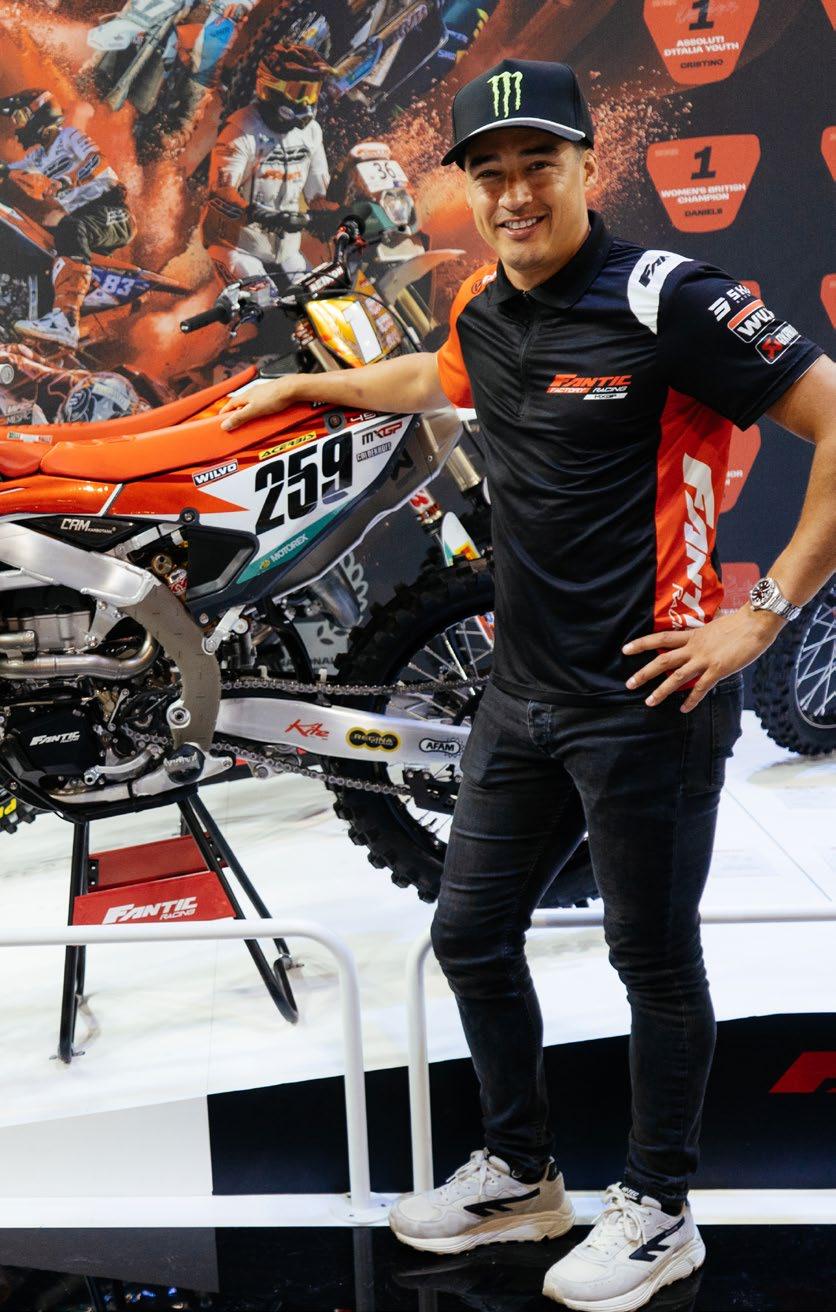
At the Fantic Motor booth we had a quick talk with Andrea Bonacorsi, freshly announced as a new rider with the Fantic Factory MXGP Team for the 2025 campaign, guided by Louis Vosters and Vitaliy Tonkov. The team that switched from Yamaha to Fantic in 2024 is one of the most experienced in the MXGP Paddock and has seen such esteemed pilots as Maxime Renaux, Jeremy Seewer, Gautier Paulin, Arnaud Tonus and many more passing under their awning. In 2024, Glenn Coldenhoff and Brian Bogers had a solid season, with Glenn winning the RAM Qualifying race in Arnhem on his home soil and finishing the season 6th overall in the MXGP Championship. Meanwhile Brian, due to the late start of his season (he only signed with Fantic before Sardegna, missing the first two rounds of the year) and the shoulder injury sustained in Indonesia that forced him to miss two additional GPs, earned a solid 11th position in the Championship standings.
The team for 2025 decided to take a big step and add another bike for Andrea Bonacorsi to complete a really strong line-up. For Andrea, jumping on the Fantic XX450F is a throwback, as the young Italian won the EMX125 Presented by FMF Racing class with Fantic back in 2020,
when he won 4 of the 9 rounds and was crowned EMX125 European Champion at the final round at Lommel. Since then, Andrea became part of the Yamaha family and competed in the EMX250 class, winning his second European title in 2023! He stepped up to the MX2 class at the start of 2024 and scored a top three finish in race two at Trentino, before making the big jump of moving into the MXGP class to replace the injured Maxime Renaux from round five onwards! Bonacorsi had a solid season considering his late start and finished the 2024 campaign with 10th position in the MXGP World Championship Standings.
“Being back with Fantic is like being back home, we were both new to the class but together we won the European Championship in 2020 and since that moment we grew up separately; now that we have the chance to be back together, it will be amazing and I can’t wait to start this new adventure.”
After Fantic, we had the chance to move to the Acerbis booth where many of the MXGP and MX2 riders came to see the new collection and take part in the signing session organised there, with fans attending from all over the world.
Monster Energy Yamaha Factory MXGP rider Maxime Renaux talked about his season and his goals for the future: “After winning the MXoN with Team France in 2023 I was really pumped for 2024, but it didn’t go as I expected. I got another injury to my foot in Madrid during MXGP Race 1 and from that moment my season was over. Together with the team we decided to undergo a surgery to fix the problem permanently, but this required a long break, and I managed to come back only for the Swiss GP at the end of the season.”


Renaux returned at Frauenfeld, showing impressive speed and fitness, clinching the FOX Holeshot in MXGP Race 2 and finishing the GP in 6th overall. The Frenchman was then 5th in Turkiye, 12th in China and 9th in Castilla La Mancha, before joining Team France at the 2024 Monster Energy FIM Motocross of Nations. Together with Romain Febvre and Tom Vialle, the team managed just a 5th place classification as defending Champions.
Maxime added, “For 2025 we all know what the goal is. I’m a factory rider for one of the best manufacturers in the world, so we keep the focus and get ready for a proper winter training.”
Still inside the Acerbis booth at the signing session we had the chance to meet Brent van Doninck, riding for the JM Honda Racing team that recently renewed his deal with Team
BEING BACK WITH FANTIC IS LIKE BEING BACK HOME, WE WERE BOTH NEW TO THE CLASS BUT TOGETHER WE WON THE EUROPEAN CHAMPIONSHIP IN 2020

Manager Jacky Martens for 2025. “You all know how hard it was for me in 2024, I got a really bad injury in Patagonia-Argentina. I had a broken femur, and it was a big nightmare, but thankfully this is just the past and now I’m OK and ready for 2025; signing with JM Honda Racing again is something that makes me really happy, it gives consistency to the work we’ve done through the years with Jacky and all the crew.”
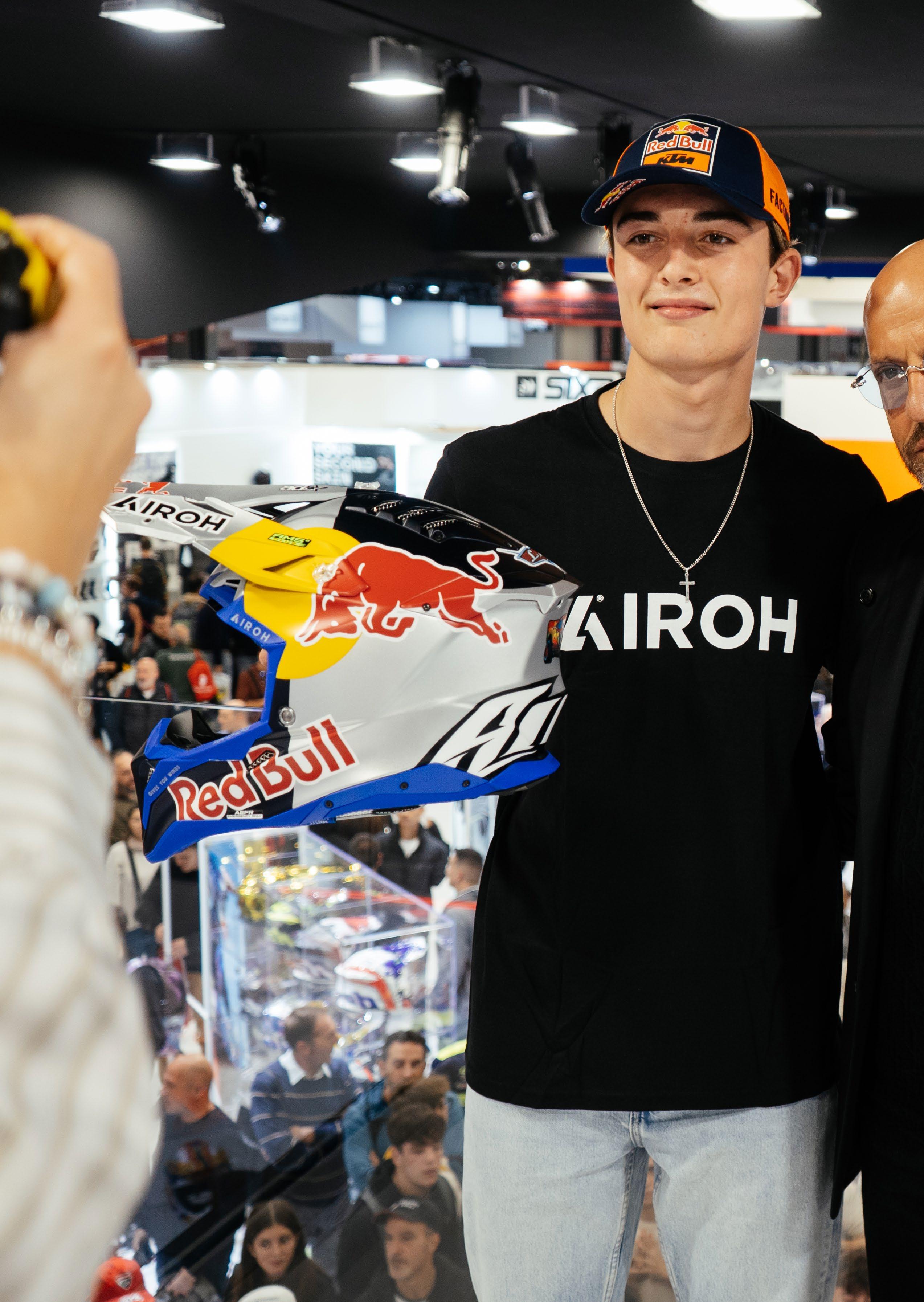
We moved then to the magnificent Airoh stand, where all the riders sponsored by the Italian helmet brand passed by for signing sessions and meetings with fans. At Airoh we got the chance to speak with Lucas and Sacha Coenen, who in 2025 will ride for the Red Bull KTM Factory Racing squad under the eyes of Team
Manager Davide De Carli; Lucas in MXGP and Sacha in MX2.
MXGP Mag: Lucas, tell us more about this change of class, did you have time to test the bike?
Lucas : Yes, I tested the bike a few days ago and it’s fantastic, it’s so fast and powerful! This is all I want, to have fun on it.
MXGP Mag : What pushed you to make the switch at such a young age (Lucas just turned 18 on the 9th of November)?
Lucas: Even if I am young, I’ve ridden a lot on the 250cc, I’ve made huge progression on the

bike. Last year we won 9 GPs, so I think that even due to my physical structure, it’s the right moment to do it. I’m really excited for this new part of my career, and I can’t wait to be back racing.
We moved then to Sacha.
MXGP Mag: Sacha, same bike but new team, and this time it’s together with your brother as it was back in the days with BT Racing and then Bud Racing; how does it feel for you?
Sacha: It feels amazing, we’ve just moved to Rome and it’s a completely new experience in life. I’m so happy to be with my brother, even before we used to train always together, but now that we are in the same team, it’s even easier and will be a big push for both of us.
MXGP Mag: Last season you proved to everybody that you are getting more and more confident, with 16 FOX Holeshot and 2 Grand Prix wins, it seems like consistency is getting there also. So, what are your expectations for 2025?
Sacha: You know, even if the team is new, the environment is amazing and I’m sure this is what I need to make the final step; now I’m ready for the winter training and then I can’t
wait to get back racing again in Argentina next March.
Inside the Airoh Hospitality unit, drinking an Italian coffee, we then had the chance to speak with Andrea Adamo about his 2024 season, and the expectation for 2025.
“2024 didn’t go as planned, but by the end of the season, I finally found more confidence with the bike, and I think everybody saw the results and the change in my riding. The goal is to have proper winter preparation to be ready for the season kick off in Argentina, so now we stay focused and continue to work in the proper way we need to,” said Adamo.
Last but not least, we had the chance to pass by the Honda and Yamaha booths, where all the bikes from the MXGP World Championship were exposed and getting plenty of attention from the public, who for once had the chance to admire them up close and check all the small details that during a race weekend, with the tight timetable, is always tough to see.
There is not too much more to say, now it’s time to take a break, be ready for the winter preparation, and faster than you know it, the 2025 season will be here! We can’t wait for it to start at Cordoba for the 2025 MXGP of Argentina!


Motocross in France has had something of a lean 2024 at the very top level but hope springs eternal for the next generation coming through, as the latest in a line of teenage talent, the 2024 EMX250 European Champion Mathis Valin, will hit MX2 with full factory equipment beneath him in 2025.
While Team France may have started the Monster Energy FIM Motocross of Nations with the numbers 1, 2, and 3 of the defending Champions, they did so without recording a single GP win for the first time since 2018. While promising talents such as Marc-Antoine Rossi and Quentin Marc Prugnières had injury-affected rookie seasons in MX2, their leading MXGP riders Romain Febvre and Maxime Renaux, as well as experienced MX2 star Thibault Benistant, also suffered various misfortunes to deny them an overall victory. The main salvation for French pride was former World Champion Tom Vialle’s successes in the USA.
However, “La Marseillaise” was heard plenty of times at GP weekends this season, with four overall victories in the EMX250 category for 18-year-old Mathis Valin, including a stunning run of five individual race wins to close out the season and give none of his competition a chance to beat him to the title.
This achievement crowned a superb year for the boy from the Vendée region, after moving from Valentin Teillet’s 737 Performance GASGAS squad to the Bud Racing Kawasaki team for 2024. The year started with a spectacular win in the Junior class of the Le Touquet beach race and ended with the addition of the French MX2 Elite title and the EMX250 European Championship to his expanding trophy cabinet.
It took time for the young man from the west coast of France to make an impact in Motocross. Among countless young racers, Mathis campaigned the EMX65 trail back in 2017, and didn’t instantly shine, despite claiming the French 65cc

Championship title and being narrowly beaten to a win in the EMX65 Portuguese qualifying round by Spaniard Antonio Gallego-Ramos. The final at Loket was won by Dane Mads Fredsoe, with Ivano van Erp in third, 2024 EMX125 Champion Noel Zanocz in seventh ahead of Ferruccio Zanchi, Sacha Coenen tenth and 2025 MXGP rookie Lucas Coenen in 13th! The 11-year-old Valin was 21st overall.
He never attempted the EMX85 series at all, taking time to flourish on the bigger bike, but promising domestic form led to him finding a place in the new 737 Performance team, founded by former European Champion Valentin Teillet. After finishing a close second in the 2020 French Championship, to none other than Sacha Coenen, Mathis finally nailed his second youth national title in 2021.
It was on a 125cc machine that Mathis Valin really started to come to prominence. Turning 16 halfway through 2022, and visibly growing under the tutelage of Teillet, he took to the EMX125 series with aplomb, working forward through the pack and peaking on home turf with a fine fifth overall at Ernée on his way to finishing 12th in the series, despite missing three of the nine rounds.
In his first experience in the Junior World Championships, held in sandy going at Vantaa in Finland, he took a fine sixth in race one but


crashed down to 23rd in race two. However, the year ended brilliantly with a Championship victory in the French Supercross series, and then he was part of a winning Team France at the Motocross of European Nations at Talavera de la Reina in Spain. He headed into 2023 with continuity, for the fourth straight year working with Teillet’s GASGASmounted brigade.
Valin’s EMX125 campaign started in great style at Frauenfeld in Switzerland, with a 2-1 scorecard securing the overall victory and immediate ownership of the red plate, although it would only last a week after a disastrous race one at Trentino put Latvian flyer Janis Reisulis into the points lead after a dominating 1-1 performance.
VALIN IS ONE OF FIVE EMX125 OR 250 CHAMPIONS LINING UP IN MX2 FOR THE NEW SEASON, AND FOR SURE HE WILL WANT TO STAND OUT FROM THE CROWD.
The Frenchman fought back, however, with a race win in Portugal before a dream win in front of his home crowd at Villars-sous-Ecot! He was back in the hunt, but Reisulis was super-consistent, only twice dropping out of the top two positions in any of the 18 races.
Overall victory for Valin in Latvia made him no ground on home hero Reisulis, just a lot of unhappy Latvian fans! A win in race one at Germany was Valin’s last of the campaign, and ultimately Reisulis took the title by exactly 60 points. With 67 points over third-placed Max

Werner, however, Valin had clearly made a jump in his racing, ten places better than the previous year!
The cherry on the cake was enjoyed at Bucharest in Romania, as Valin took the first race ahead of Simone Mancini, with Janis Reisulis crashing early on, having to recover to salvage seventh place! The wild-haired Frenchman rode to a sensible second behind the Latvian in race two, safe in the knowledge that the FIM Gold Medal was his – he was Junior World Champion!
Adding to that honour, the French 125cc Junior title also went his way, but a phone call of destiny was on the horizon. Bud Racing Kawasaki, based much further down the West Coast than his native Vendée, were looking to add to their impressive roster, and with the team’s heritage of helping many former World Champions on their path, it was a clear decision that was no doubt fully understood by Teillet, himself a former member of that roster.
With victory at Le Touquet showing that his winter with the new team had helped him transition well to the fourstroke KX250, the mission was on for the EMX series. With KTM- and GASGAS-backed riders Cas Valk and Valerio Lata, both former EMX125 Champions, as his main competitors, it would be a true battle throughout the season. Lata bolted out of the starting blocks early with victory in both of the opening two rounds, but Valin was the only one to beat the Italian to a race win in those events, and after Valk cleaned up in the deep mud of Portugal, the Frenchman was right in the middle of his rivals as they headed to his home round, this time at one of his more local circuits – St Jean d’Angely!
With treacherous conditions affecting the racing all weekend at the Monster Energy MXGP of France, Valin pulled out a masterclass to take the maximum 50-point haul, while Lata and Valk only scored 42 between them!

Suddenly the Kawasaki kid enjoyed a Championship lead of over 20 points, and the red plate looked secure on the green machine.
As the rain clouds followed the MXGP series across Europe to Germany, Valin survived a difficult first race to claim fifth, then a second race win brought him an unexpected second straight overall victory as Lata floundered again. The Italian was down to third behind Valk, who had stayed steady if not spectacular, and Valin looked to be in complete control.
As Lata and Valk dealt with a highly motivated Karlis Reisulis and his Yamaha stablemate Ivano van Erp, Valin finished Latvia with two fifth places to at least keep his title lead, even if it was narrow. The even deeper sand of Lommel was next, and although Valin shared race wins with the favourite Valk, a fourth in the other race by each rider gave Lata the overall verdict with a 2-2 card! Just 18 points covered the three of them with four rounds to go.
That number was reduced to 15 at a Swedish GP which was a Lata benefit, although the Italian was unlucky to lose points, as he hit a crashed lapped rider in his path in race one! Two thirds for Valin meant that it was still a nervous wait for the next round, and Valerio was given hope as a win on Switzerland’s dry Saturday race put him just four points shy of the Bud Racing star!
From there, however, Valin flipped the switch, winning on Sunday’s much muddier Frauenfeld circuit, then going unbeaten through the last four races in Turkiye and Spain to clinch the title in style with the last race still to go!
It was an epic confrontation, and this brilliant threeway rivalry will continue in 2025 as both Valin and Lata pick up Japanese factory weaponry, with Valk on obviously strong Austrian equipment to truly add spice to the MX2 division! Valin is one of five EMX125 or 250 Champions lining up in MX2 for the new season, and for sure he will want to stand out from the crowd.
The fact that he could be on one of the only green machines in the class will certainly help in that way. The new factory effort, running from the same hitech KRT Transporter as former World Champions Romain Febvre and Pauls Jonass, under the watchful management of Antti Pyrhonen, will give him a wealth of experience to draw from even if it’s the first full MX2 effort from the factory in over seven years. The last MX2 victory for Kawasaki was for Dylan Ferrandis back in 2016. Valin, however, couldn’t be happier:
“It’s a dream came true! If anyone had told me earlier this year that I would be joining the Kawasaki Racing Team at the end of the season, I wouldn’t have believed them. I’m happy and proud to join the team; I think that my results helped me to earn this position and now the goal will be to carry on working hard to continue getting good results. It’s a big change for me but already this season I have left my parental home so moving to Belgium, in a team where there are already some French guys, will be OK. When I was offered this opportunity to join KRT, there was no hesitation.”
Now working in the Motocross mecca that is Lommel in Belgium, there is no doubt that this talented French teenager will be one to watch for, as he starts his quest to maybe become the first EMX250 Champion to also win the MX2 World Championship. Time will tell!


THE MXGP ACADEMY CONTINUES TO PLAY A PIVOTAL ROLE IN NURTURING YOUNG MOTOCROSS TALENT AROUND THE GLOBE, DELIVERING TOP-TIER TRAINING, MENTORSHIP, AND GUIDANCE TO RIDERS, PARENTS, AND TRAINERS.
Since its inception in 2015, this program has grown significantly under the support of the FIM, Infront Moto Racing, and local FMNs (Federation Motorsport National), evolving into a global initiative with the goal of fostering young motocross racers and expanding access to structured training worldwide.
The 2024 season has seen the MXGP Academy reach new heights with training sessions across various countries, including Cyprus, Spain, Kenya, Thailand, and soon Colombia. The program, led by experienced coaches such as Martin van Genderen, Jan Postema and John van de Berk, provides young riders with a comprehensive foundation in both technical skills and holistic development.
One of the standout sessions this year took place in August at Nairobi’s Amhuri racetrack in Kenya, where 16 local riders participated in three days of intensive training under the guidance of 13 MX trainers. The program included two 45-minute track sessions, an educational module for riders to earn their MX-A certificates, and a unique workshop for parents on how to effectively support and communicate with young motocross riders.
Since 2015, the MXGP Academy has been dedicated to attracting young riders (MXathletes) from all corners of the globe to choose motocross as their sport, as well as assisting talented and passionate athletes in pursuing their dreams of becoming worldclass motocross riders. With support from Infront Moto Racing, the FIM, and national FMNs, the Academy offers a range of programs designed to aid young motocross athletes, local MX-Trainers at every stage of their career, from novice riders to those with professional aspirations.
To address these goals, the MXGP Academy provides a structured mix of educational programs, MX training, and training camps. Through these activities, the Academy aims to help riders build a solid foundation for their motocross careers, emphasizing not only skill development but also the educational components critical for long-term success, as an athlete who ride on a MX-bike.
Martin van Genderen: It has become apparent that a setup like the MXGP Academy trainers in cooperation with FIM and local FMN’s, offers a program that meets the needs in our sport. Local MX trainers who want to learn through the “Train the Trainer” program, to pass on this knowledge to local parents and young riders. We also see that local FMNs are


responding to this need more and more, and that completes the circle that we as Infront Moto Racing, and FIM had in mind from the beginning in 2015.
A program for local riders (MX athletes), parents, MX trainers and FMNs. “Personally, I find it an honour to be able to work in this project and to be able to share the knowledge that we have built up over the years, in all corners of the world. We increasingly see a need for a program like this and we already have more than 100 locations all over the world, with the so-called MTC program” (MotoCross Training Club program).
This program includes basic MotoCross training and educational programs for MX athletes and parents, trained by local MX trainers that we were allowed to train with our MTC program. To clarify, the MTC program is mainly a program to guide the athletic side of the sport well, in addition to the MX technical training. A complete program, as a start of a possible talent development program in MotoCross, worldwide”.
To meet the diverse needs of young riders, the MXGP Academy’s weekend training format includes not only masterclass sessions for riders, but also educational workshops, seminars, and panel discussions for parents, trainers, and federation representatives involved in motocross. These sessions focus on creating a supportive environment for young athletes, recognizing that the success of a rider is also closely linked to the support of their family and coaching team.
Regular updates and news are shared across various media channels, keeping the motocross community engaged and informed about the Academy’s progress and initiatives. Through this approach, the MXGP Academy aims to foster a global community that supports the next generation of riders on their journey toward potential world championship success.
Jan Postema: “It has been and still is a privilege to work with the MXGP Academy program over the past ten years. In my view, one of our greatest achievements has been the transformation of motocross riders into true athletes. We’ve equipped them with the tools to train and perform like professional athletes, both on and off the bike.


It’s particularly rewarding to see our program benefit both girls’ and boys’ riders. We focus on providing comprehensive training, including do the training off and on the bike, nutrition guidance, bike preparation, hygiene, and safety. Additionally, we actively involve parents, empowering them to support and guide their children through the process.
I have thoroughly enjoyed working with such dedicated and motivated young riders and their families. We remain committed to the program and look forward to seeing many of them achieve success on the podium in the future.”
This year’s Academy calendar included stops at multiple MXGP Championship events in
countries such as Portugal, Spain, Latvia, Germany, the Czech Republic, Türkiye, and Cózar in Spain. These locations provide young riders with invaluable exposure to the competitive and dynamic atmosphere of MXGP, helping them understand the demands and excitement of the professional motocross world.
The MXGP Academy’s impact is unmistakable – as it continues to support, train, and inspire young riders, parents, and the local MX-trainers, it strengthens the foundation of motocross and contributes to the sport’s future. With its robust programs and worldwide outreach, the MXGP Academy is cultivating the champions of tomorrow and establishing a legacy for motocross that will last for generations.


AT THE LAST EDITION OF EICMA WE HAD A CHANCE TO HAVE THE TEAM HRC OWNER GIACOMO GARIBOLDI FOR A SPECIAL EDITION OF THE MXGP PODCAST TALKING ABOUT THE HRC SEASON, GOALS FOR THE FUTURE, THE BRAND NEW MX2 PROGRAM AND MORE …


THE EUROPEAN MOTOCROSS CHAMPIONSHIP (EMX) HAS LONG BEEN A PROVING GROUND FOR YOUNG TALENTS EAGER TO MAKE THEIR MARK ON THE GLOBAL STAGE. THESE FORMATIVE YEARS NOT ONLY SERVE AS ESSENTIAL LEARNING ALSO BUILD THE RESILIENCE AND CHARACTER NEEDED TO SUCCEED AT THE HIGHEST LEVELS OF MOTOCROSS.
2024 FIM World Junior Champion 125cc
From the really young rider of EMX65 and EMX85 classes to the those on the brink of becoming part of the Motocross World Championship in the EMX125 and EMX250; without forgetting the one rounds of EMX2t and EMXOpen that allow riders to shine on the global stage, each championship serves as a critical stepping stone. These platforms provide emerging talents with the tools and experiences necessary to become the champions of tomorrow.
Through dedication and hard work this year’s European champions exemplify the essence of motocross, demonstrating that every journey starts with a dream and is fuelled by a real determination. As we spotlight these incredible riders, their stories remind us that the future of motocross is bright, driven by the passion and talent emerging from this prestigious series.
2024 EMX125 PRESENTED BY FMF RACING EUROPEAN CHAMPION: NOEL ZANOCZ
Rider Profile:
Name: Noel Zanocz
Date of Birth: 6/1/2007
Nationality: Hungarian
Place of Birth (City): Oroshàza
Racing Number: 716
Best Results:
2024 EMX125 Champion
2023 Winner – 125cc Italian Rookies Cup
2021 FIM World Junior Championship 85cc – 3rd
In one of the closest Championship battles of the season, the EMX125 Presented by FMF Racing series delivered a fascinating mixture of characters in the fight for the top two-stroke title in World Motocross. Teenage tearaways from Italy and The Netherlands we are used to, but this year a force emerged from a previously thin resource of Motocross talent – Hungary.
While the eastern European nation has hosted a handful of Motocross GPs in the past – the legend Stefan Everts took his first Grand Prix win there in 1991 – there has been precious little success for Hungarian riders. With no Motocross GP winners at all, it was only recently that “Himnusz”, the Hungarian national anthem, was heard at a toplevel event, as young Áron Katona took a double win in the 2021 65cc World Junior Championships at Megalopolis in Greece to claim the first title of any description for his nation.
The officials had to unveil the horizontal red, white, and green flag again that same day, as Noel Zanocz took a fine third overall in the 85cc class with a 2-5 scorecard. Hailing from the south-east of the country near the Romanian border, it was far from Noel’s first turn of speed in the youth ranks, as he had first competed in the EMX65 class as far back as 2016. An 11th place finish at the finale at Loket that year was the first of many visits to that event, as he progressed to 7th in EMX65 in
2017, after taking six race wins in the South-East regional qualifiers.
The World Juniors podium in Greece came at the end of four years in the 85cc class, including the Covid-affected season of 2020, but despite several wins in the qualifiers, sixth place in the 2021 finale was the best that Noel could manage in the EMX85 class. A move to Italy, and regular racing in various national Championships, started to lift him through the ranks of the 125cc class. At the age of 16, he was second in race two of 2023’s opening EMX125 round at Frauenfeld in Switzerland, ending the year eighth in the Championship and eighth at the World Juniors. Most importantly, he won the 125cc Rookies Cup in Italy, a series that runs alongside the MX Prestige Italian Championship.
This caught the eye of talent scouts for Fantic Factory Racing, who were impressed by his riding style and determination, picking him up to race alongside old foe Simone Mancini in the EMX125 class for 2024. Despite his mainly hard pack upbringing and Italian base, he grabbed the series lead with a stunning 2-1 performance at the opening round in the deep sand of Sardegna, his first overall win at this level.
The red plate stayed on his 125cc for the first nine of the eleven rounds, taking second overall in the deep mud of Portugal, and again at St Jean d’Angely in France with a fine second race win. Overall victory at the MXGP of Latvia gave him a strong series lead over Dutch chaser Gyan Doensen, who then won the single race at a

muddy Maggiora to make the gap 14 points going into the eight-week break in the schedule.
In the meantime, Noel again showed his sand prowess with a win at Heerde in the Netherlands to take the World Junior 125cc title, scoring a first and a second to finally get his hands on an FIM gold medal.
He was clearly after more than that, however, and took a fine race win in the second outing at the Swedish round of EMX125 to clinch second overall and increase his points lead. The Dutch round predictably went the way of Doensen, who reduced the gap to Zanocz to just five points as the Hungarian went 2-6 on the day. Never happy on the podium with anything other than a win, the stress was starting to show with two rounds to go!
Noel’s only no-score of the year happened at Frauenfeld, as a mechanical failure in the heat of Saturday’s first race cost him the red plate, although Doensen didn’t capitalize with just 6-5 finishes, giving Zanocz a six-point gap to chase down at the final round!
The Hungarian has a superstition that he must only wear a white crash helmet in races, and it was the perfect choice in the heat of Cozar in southern Spain for the final round of the season. The rocky, hard pack circuit was just to his liking, however, and he reclaimed the series lead with a fine win in race one, before succumbing only to a late charge from Italian Francesco Bellei in the second race, confident that his Championship rivals were well behind him!
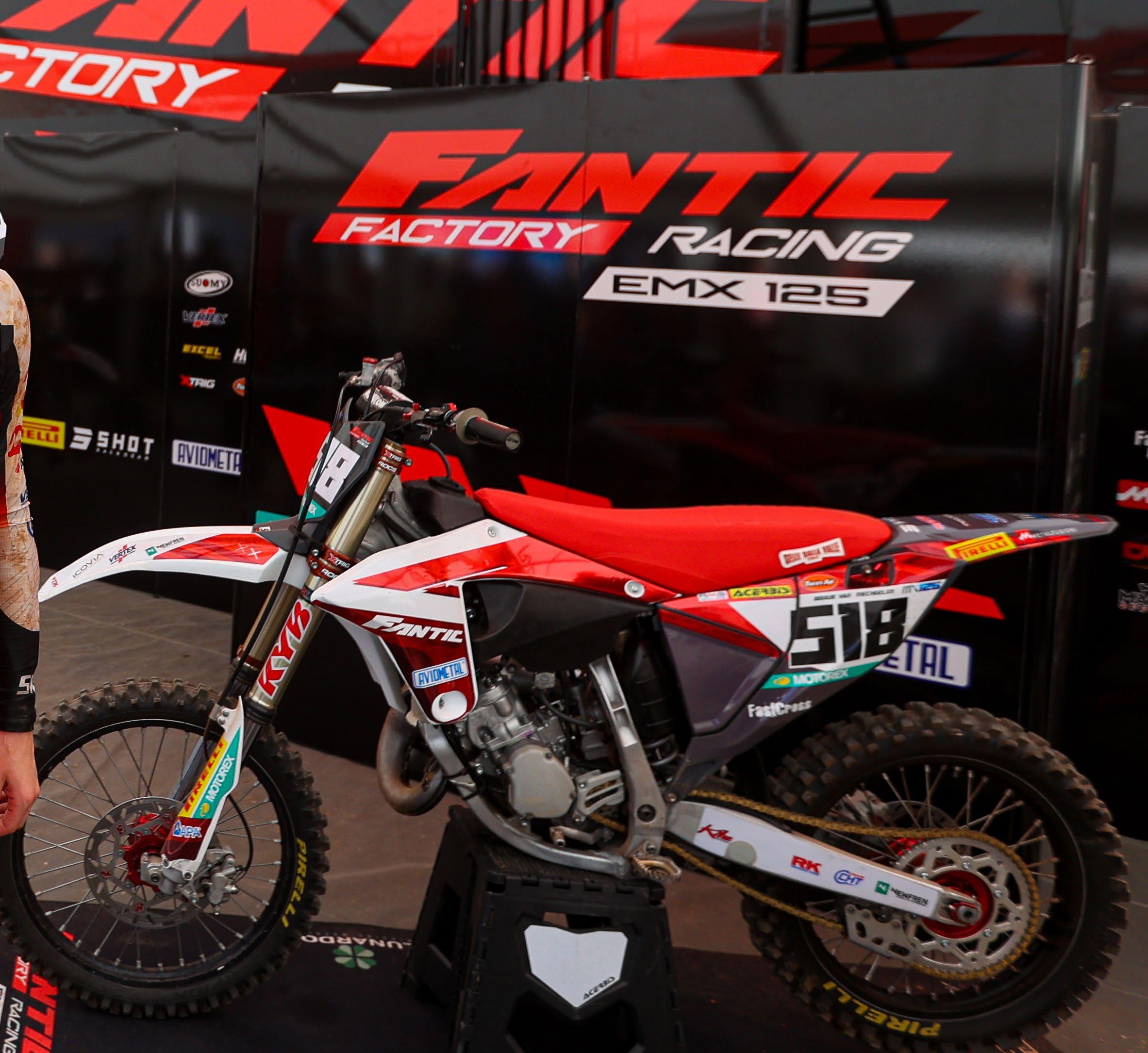

The title was his by just a seven-point margin, and Fantic celebrated their third EMX125 title in five seasons! Noel said afterwards: “It wasn’t easy at all, I struggled in Time Practice, but my start was still good in the first race, I took the lead on the first lap and led all the way, it was a really good one! In race two I was around sixth at the beginning, made my way up to second, lost a position, but regained it. It was a tough race but, in the end, I won the Championship, and I couldn’t be happier! This season, I proved that you can achieve anything, even if you come from a small country – you just need to believe in yourself!”
With his Champion’s mindset and that self-belief, you can certainly visualize a future where Zanocz does for Hungary what Tim Gajser and Jorge Prado did for Slovenia and Spain. Noel turns 18 in
January and for sure his eyes will be set on more titles to come!
Riders profile
Name: Sleny Goyer
Age: 14
Nationality: French
Place of birth:
Racing Number: 350
Team: 737 Performance GASGAS Oxmoto Team
Best Results: EMX 85cc Champion 2024,

85cc French Champion 2023, 85cc Le Touquet Winner 2023 & ‘24,
2nd World Junior Champs 65cc 2021
The freight train of Motocross talent from France continues to roll forward, despite a rare year of no French overall victories at GP level in 2024. Former Grand Prix rider Valentin Teillet, whose own career was derailed by injury, has been helping to develop the next generation of potential World Champions, and from his GASGAS supported 737 Performance Oxmoto team comes Sleny Goyer, working his way through the ranks and becoming the 2024 EMX85 Champion at the Loket finale in July.
Hailing from the northern region of Normandy, Sleny has worked his way through the ranks of Youth Motocross in France for the past few years. In 2021 he qualified for the EMX65 final with a fine 2-2 at the French round of the SouthWest Qualifying Championship, and finished fifth in race two of the finale, held in the deep sand of Sardegna, after a first race no-score. The Normandy sand tracks proved to be useful in building his soft-circuit techniques! However, he truly caught the eye with a brilliant second overall in the 65cc World Junior Championships, held in the heat of Megalopolis in Greece, with 3-2 finishes behind Hungarian flyer Aron Katona.
In 2023, up onto an 85cc machine, Sleny started the year with victory in the 85cc class of the mighty Le Touquet Beach Race – a serious test of


the small bikes with the super-soft sand! Sleny’s younger brother Eydan also raced his way to the EMX65 finale, finishing 17th overall at Loket.
He once more impressed on home soil with third overall, including a race win, in the French EMX85 qualifier, before finishing sixth in the Italian-hosted semi-final, then 16th overall in the EMX85 finale at Loket. The World Juniors in Romania did not go quite as well, with 16th overall, but he bounced back to claim the French Minivert national title, showing immense progress through the season.
On to 2024, and he again rocketed to a stunning Le Touquet win, before building in strength through the EMX Qualifying campaign. Third in Slovenia, then a superb overall win in Croatia, put him second to fellow French kid Leo Diss-Fenard in the regional standings, despite missing the final qualifying event in Portugal.
A week before the EMX85 finale, his sand prowess was tested at the World Junior Championships at Heerde in the Netherlands, but he came through to just miss the podium in fourth, after a strong second in race one.
The EMX85 finale saw Sleny take a clear race win on Saturday, but Sunday’s race to decide the Championship saw the French kid suffer a poor start, still only in 16th at the end of the first full lap. He fought through the pack with great tenacity, passing two riders in the late stages to claim fifth position, and the overall EMX85 European Championship!
For sure, this teenage warrior is a name to watch for in the future if he can continue battling in a similar style to his Championship-winning charge.
EMX65 EUROPÉEN CHAMPION: ROKO IVANDIC
Rider Profile:
Name: Roko Ivandic
Age: 11
Nationality: Croatian
Team: Dirt Bike MX Racing Team KTM
Racing Number: 643 / 243
Best Results:
2024 EMX65 Champion
2024 Italian Minicross Champion
For anyone who had attended the Southern Zone EMX Qualifying Semi-Final at Zarnesti in Romania in early June 2024, the results of the EMX65 finale


at Loket were no surprise at all. The diminutive, but growing, Croatian flyer Roko “The Rocket” Ivandic had swept both races in the final stage of qualification for the EMX65 finale and truly marked himself as a top contender.
With the fastest lap in Time Practice by a slim margin over the Northern Zone semi-final winner, Brit Cohen Jagielski, the stage was set for a great battle between the pair, but The Rocket lived up to his nickname by nailing the holeshot and advancing away from the pack. Jagielski suddenly had electrical issues and was out of the race, unable to challenge. The control and maturity he showed while at the front and under pressure in race 1 was impressive. The second race was again all Ivandic as the long-haired lad in fluorescent yellow ruled the roost on his favourite hard-pack terrain, and never looked back to clinch his first major title, the EMX65 European Championship and the Gold medal.
Croatia has virtually no history of Motocross success. A search into the past of the European Championship reveals that a rider called Nined Šipek won the Open title in 1999, long before the days of EMX branding, but that is the only nondomestic title that any Croatian can lay a claim to.
Roko’s promise on the EMX stage showed in his second season of 2023, when he was fifth in the South-West Qualifiers table after all four rounds, taking a 2-1 victory on home soil at Mladina, just 30 minutes from the family home in Karlovac, but he could only manage 30th overall at Loket that time around.
Unperturbed, and almost outgrowing the 65cc machine as he turned 11 years old, Roko took the win in the 2024 qualifying round in Slovenia, was only just denied another win in his home country by French kid Timotei Cez, and then romped to victory in the semi-final.
Normally riding number 643, the race number regulations for the separate qualifying zones meant that he had to pick something different, so he contacted his hero Tim Gajser and asked if he could run his number 243 instead! The five-time World Champion, himself coming from a country with precious little past success in the sport, was only too happy to agree to the request, and was good enough to take a photo with young Ivandic after the boy did the number proud in Loket. It was a weekend when Tim himself actually took his first GP win at the Czech circuit. Maybe inspired himself by young Roko!
With a cool first name and long-haired style, Roko Ivandic is keen to put Croatia on the Motocross map and is certainly a talent to watch for.
Riders profile
Name: Marcel Stauffer
Date of Birth: 18.04.2001
Nationality: Austrian
Place of birth: Salzburg
Racing Number: 401
Team: Osicka MX Team
Best Results:
22nd 2023 MX2 World Championship, 2019 & 2023 Austrian MX2 Champion,
The MXGP Paddock is very used to hearing the Austrian national anthem, playing as it does after every win for the KTM, GASGAS, and Husqvarna brands in the MXGP class. However, 23-year-old Austrian Marcel Stauffer made the bars of “Land of the Mountains, Land by the River” play out over the Czech Republic landscape following a comprehensive double victory at Loket to become the EMX2t Champion for 2024.
The win did look fairly straightforward on the day, but for Marcel it was far from that, as it brought a fairytale conclusion to a journey back from injury that at one point contained a discussion about never racing Motocross again.
In early November 2023, after winning the Austrian MX2 Championship in a year when he earned 8th overall in MX2 at the MXGP of Germany, “Cello” broke several vertebrae in a practice crash in Italy. After being fitted with a halo vest, which he had to wear for twelve weeks, doctors were telling him that he would never ride again. He was advised in November to fuse his spine, meaning he would have been unable to even turn his head, but he refused and worked with his physio, even though he felt like “my dream was slipping away from me”.
Ultimately he was able to get back on a bike in May, and raced in the domestic Championships of Austria, Germany, and the Czech Republic to build his pace back to where he had been, winning again in the MX2 class in July.
Still only 23 years old, and with the need to move up from MX2 next season, he decided to try EMX2t for Team Osicka KTM, as a return to


the world stage. In the races at Loket he worked steadily forward in both races, passing Hungarian Bence Pergel each time, to climb the podium in a massively emotional moment.
After his own journey “to hell and back”, the emotions ran high, even more so when he took the number plate of his great friend, the late Rene Hofer, onto the podium at the circuit where his fellow Austrian had won his 85cc EMX title in 2016.
After the race, Marcel stated: “Wow, what a journey it has been. I had days when I would have liked to give up, when I thought I would never step back on a bike again and when I was just afraid to fail. I got crowned a European champion and the reason I fought my way to this point is because I knew that if I gave up, I would regret it for the rest of my life.
This title means so much more to me, I went through hell and back and this is the reward for all the hours of suffering!”
For the next step in his career, Marcel has taken to a 450 in order to prepare for next year, and has already won races at domestic level. Although his MXGP debut in Switzerland did not go to plan, being involved in a big crash with another rider which put him out of the event early, he showed good pace in Practice and Qualifying and is for sure a rider to watch for in the future.
Rider Profile
Name: Jakub Terešák
Nationality: Czech
Racing Number: 224
Best Results
- 2024 EMXOpen European Champion
- 2013 3rd in the 2013 Monster Energy FIM Junior Championship, 85cc
Jakub Terešák: The 2024 EMXOpen Champion
The unique round of the 2024 European Championship EMXOpen took place during the MXGP of Flanders at Lommel, known as one of the most challenging tracks in the world. The racing was intense, and with the demanding Belgian sand under the riders’ tires, mistakes were costly. Yet, amidst these tough conditions, Jakub Terešák emerged as the most consistent and solid rider of
the weekend, ultimately taking home the EMXOpen Championship.
In the first race, Freek Van Der Vlist took the holeshot, with Belgium’s Brent Aerden and Matteo Puffet in close pursuit. However, it was Terešák who made a bold move early on, climbing into 4th place. Despite tough competition, Terešák held his ground, riding consistently around 4th place throughout the race. As the laps ticked by, heartbreak struck Giuseppe Tropepe, who was leading until his bike stalled just four corners from the finish, handing the victory to Micha-Boy De Waal. Van Der Vlist finished 2nd, while Terešák’s steady performance kept him well-positioned for a potential podium finish.
The second race on Sunday was equally dramatic. Under a clear sky, Jere Haavisto took an early lead, with Terešák close behind. Despite pressure from the field, including a hard-charging Vettik and the unfortunate De Waal, whose bike gave out mid-race, Terešák remained focused. As the race neared its end, Haavisto’s bike stalled on the last lap, allowing Terešák to seize the lead. Although Haavisto quickly regained his position to win the race, Terešák’s 4-2 finishes across the weekend secured him the overall victory and the EMXOpen Championship.
Terešák was even surprised after his EMX Open win: “Really, I’m Champion!? I didn’t expect as I did 4-2 but that’s a great feeling!”
Terešák’s victory at Lommel is the culmination of years of dedication, dating back to his days as a standout junior rider, where he finished 3rd in the 2013 Monster Energy FIM Junior Championship in the 85cc category, behind notable riders like Conrad Mewse and Hunter Lawrence and in font others like Chase Sexton and Jorge Prado! It shows that the talent was there, but this year, his perseverance and skill were rewarded as he stood atop the podium as the 2024 EMXOpen Champion.
Reflecting on his achievement, Jakub Terešák said, “I’m feeling super good. I didn’t expect to win to be honest, so I’m very happy about it. I had two great starts. In the first race, I suffered with arm pump but came back to it in the second race, and I felt like I had a really good rhythm. I’m so happy!”
Terešák’s success in the EMXOpen at Lommel is a testament to his skill and persistence, and it marks a significant milestone in his career.
Congratulations to Jakub Terešák, the 2024 EMXOpen Champion, for his incredible performance in the sands of Lommel!


IT’S PRETTY SURREAL TO THINK IT’S ALREADY BEEN TWENTY-YEARS SINCE THE BIRTH OF THE MX2 CLASS IN THE FIM MOTOCROSS WORLD CHAMPIONSHIP, AND WITH IT, THE EVENTUAL DEMISE OF THE 125CC 2-STROKE ERA AND THE 125CC CLASS AT WORLD CHAMPIONSHIP LEVEL.
Whilst Yamaha had led the way with the new, innovative 4-strokes with the introduction of the production YZ400-F in 1998 and YZ250-F in 2001, the pressure from the other brands to jump on board and offer up some resistance was increased, in time for the 2004 MX2 era, and for Kawasaki and Suzuki, that meant joining forces in order to come up with a plan. So, in this issue of MXGP Magazine, we take a look at Suzuki’s contribution to the dual-effort and how the RM-Z 250 came to be.
Designing and developing new products is never easy, nor is it cheap, and as a response to what Yamaha was already doing with its YZ250-F, Suzuki and Kawasaki announced in August 2001 that they were forming a ‘Strategic Alliance’ with the intention of producing a joint 250-F effort, in readiness for the new era of the ‘baby boomer’ 4-stroke machines. Of course, it goes without saying that the obvious benefit from this exercise was based around money, and how much they could save, and so from that side, the intriguing question was which side of Japan would be designing what, and how different or similar would the bikes look when they rolled off the production line? And which production line would that even be; Kawasaki or Suzuki? As it turned out, both machines would eventually roll off the Kawasaki production line in Akashi, Japan.
When push came to shove, we later learned that the engine side of things would be designed by Suzuki, with Kawasaki responsible for the chassis, and actually, when all was said and done, the only difference between the two was the colour and the design of the plastics, and by the end of 2003, both bikes broke cover for ‘Media Tests’ ahead of what would be an important 2004 debut season.
With no previous 4-stroke experience to draw upon, Kawasaki’s reference point regarding the frame was the KX125, which from a chassis
perspective, had been using a twin-spar steel perimeter frame since 1990, and since that side of things wasn’t ‘broke’ so to speak, there was no obvious reason to try and fix it. One thing that Kawasaki did introduce though, was a new D-section where the perimeter frame tubes were designed to ‘allow the bodywork to hug the frame more closely, thus offering a slimmer design and better riding position.’
In fact, everything to do with the chassis came out of KHI (Kawasaki Heavy Industries), and so from that standpoint, that also included the 48mm KYB cartridge fork and KYB rear shock. Why was this so relevant? Well, for as long as most people could remember, Yamaha and Kawasaki bikes came with KYB, whereas Suzuki and Honda always utilised Showa, and so this was seen as a massive shift for Suzuki – especially since the 2004 RM range of 125cc and 250cc 2-strokes still came with Showa suspension!
The forks were new and ran check valves on the bladders to help improve damping, offering an overall smoother action through the stroke. The rear shock was also new and so too was the new-link Uni-Trak system which was designed to transmit suspension input via the swingarm, which therefore allowed the frame to be lighter. With a much simpler rear shock motion, the suspension action was therefore smoother, which according to the technicians at the time, helped to increase traction at the rear wheel by 35%.
As far as the motor, Suzuki’s reference point was already out there. Okay, it might have been dressed in blue plastics, but as a starting point to where you can see what the competition had already been doing, then why not see what can be done differently, right?
Right! At that time, Yamaha’s engine ran five valves, so Suzuki’s response was not only to

go with four, but they would also be made from titanium, with the cylinder head being DOHC.
The technical boffins also came up with the idea of introducing a hybrid version of Yamaha’s semi-dry sump system, which was designed to save weight and help lower the centre of gravity, coming up with ‘SASS’ (Suzuki Advanced Sump System), a semidry sump system which separated the crank and transmission compartments, with two oil pumps responsible for scavenging and pumping. Whilst it ticked that particular box, it didn’t come without its problems, but as a starting point, the bike felt lighter and more compact than the Yamaha when it broke cover. The go-to carburettor was the 37mm Keihin FCR carb’ and when set up correctly, would produce this instant, snappy response right off the bat, which is what everybody wanted to feel when they jumped on these new generation 4-strokes. The bike also came with a 5-speed gearbox and trick digital CDI unit, with 3D mapping. The myth surrounding the new 4-strokes was that the engine braking was quite abrupt, but with the combination of the carb’ and trick CDI unit, that harsh feeling was soothed, helping it feel like a 2-stroke as the rider closed the throttle.
With regards to weight and how the bike ‘felt’, the need to feel lighter was crucial, and so the use of titanium valves and as much aluminium as possible were incorporated into the design. No stone was left unturned, as they say, but even with all of that, along with new, lightweight front brake callipers with Kevlarlined brake cable, the bike still came in at more than 5kg heavier than a production 2-stroke.
The power delivery was smooth yet responsive, but pretty soon you learned to adapt to this new form of power. Gone was the need to hang on to the power curve for as long as possible, as was the case with a 125cc 2-stroke. Instead, the best way to get the optimum performance out of this bike was by quick-shifting, and with first and second gears being pretty close together, it wasn’t until you hit third and fourth where you really saw the benefits of this new motorcycle. Perhaps the biggest gain was the realisation that actually, we have discovered a way to maintain corner speed, and in a more consistent manner, too.
As for the success of the all-new Suzuki RM-Z 250 though, sadly there wasn’t much to write home about for a few years to come, and when you think about how dominant Suzuki was when the RM125 burst onto the scene in 1975 in the hands of the late, great Belgian Gaston Rahier, it was the start of a Suzuki success


story which continued in devastating fashion, with an undefeated run of ten world titles in a row from 1975-1984 (inclusively).
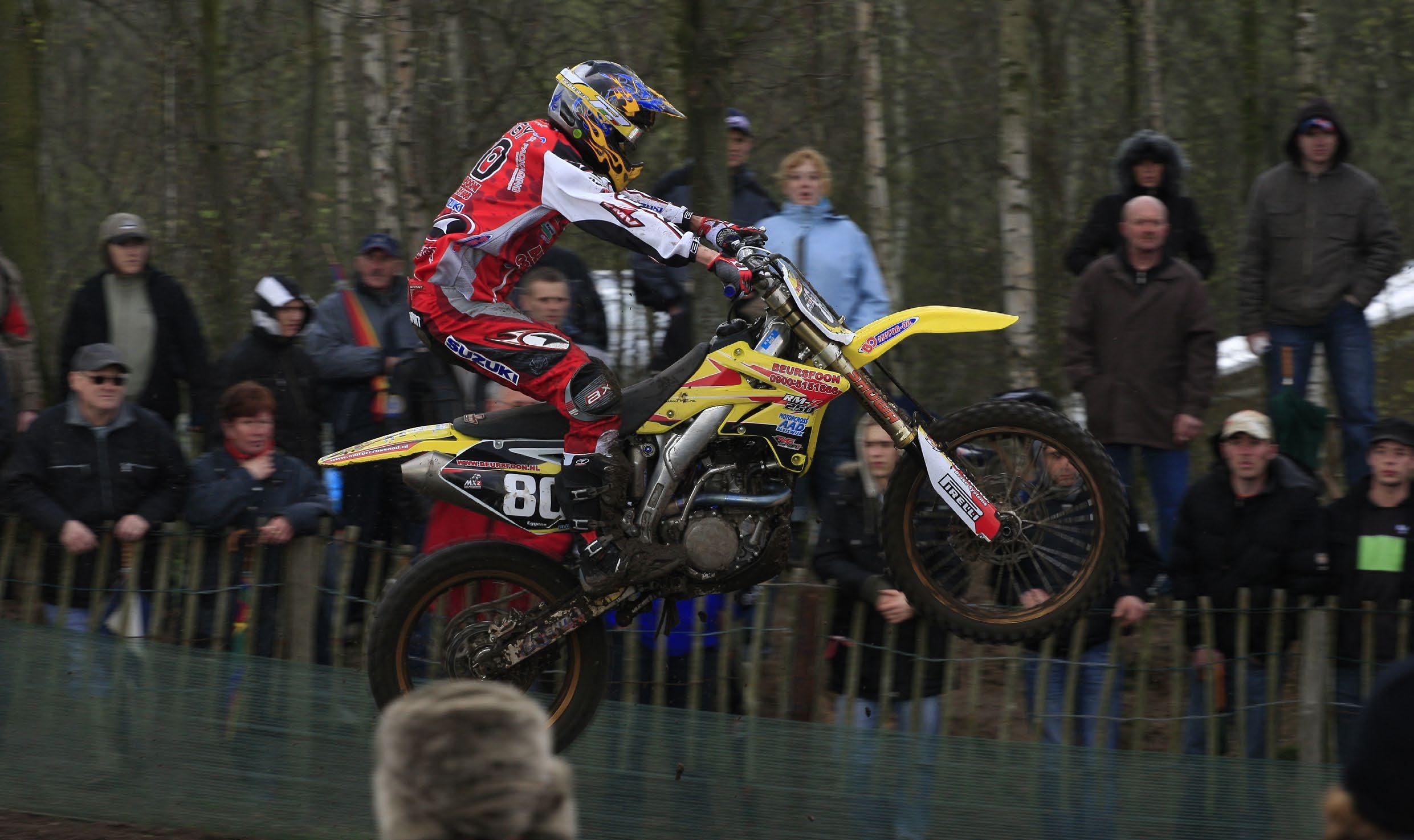
As for the RM-Z 250, the success story eventually began to gather momentum in 2008 when Dutchman Erik Eggens powered to 3rd overall (4-3) at the opening round of the MX2 World Championship in Valkenswaard, whilst Frenchman Xavier Boog finished 7th overall in the final championship standings.
Its first GP victory though came in 2009, in the hands of a 15-year-old German by the name of Ken Roczen, who wrote another chapter in Suzuki’s history books, when he won the German GP at Teutschenthal on June 21st 2009. That same year, Roczen and Boog (Teka/Suzuki World MX2) secured six podiums between them, with Kenny also adding two race wins to the RM-Z 250 portfolio in Sweden and Czech Republic.
In 2010, Roczen improved on his 5th overall in the MX2 World Championship to 2nd overall, adding another ten race wins, three GP wins and ten podiums to Suzuki’s tally. The icing on the cake came at the final round at Fermo, Italy, where Roczen rounded out the season with a double race victory as his teammate Arnaud Tonus secured his first career podium (3rd), to give Suzuki its first two-rider podium in MX2.
Suzuki’s most successful campaign came in 2017 when Jeremy Seewer emulated Roczen
to finish 2nd overall in the final MX2 standings, with seven race wins, five GP victories and thirteen podiums, ending the year with 732 points from the nineteen rounds on offer (K-Roc scored 574 points from fifteen rounds).
Suzuki’s last race win in MX2 was at the final round of 2017 in France at Villars sous Ecot on September 17th, with Hunter Lawrence at the ‘bars. Suzuki’s factory effort closed its doors at the end of the season and from 2018 to 2024, just ONE Suzuki rider has scored points on a Suzuki in the MX2 World Championship standings during that time: His name, Florent LAMBILLON, from Belgium, who went 20-18 in France at Ernee on June 5th 2022 followed by 18-17, also in France at the MXGP of Charente Maritime in the same year (Saint Jean d’Angely) on his way to 52nd in the final MX2 standings.
RM-Z 250 History
2004 – 2024
Race Results
22 x 1st / 37 x 2nd / 30 x 3rd (90 top three race finishes)
Grand Prix Overall Results
9 x 1st / 24 x 2nd / 17 x 3rd (50 podiums)






further three times, Steffi Laier is one dominating her rivals from 2009 to 2011.
the German star retired from GP racing six
two rounds in 2006 and three in 2007, the series grew and attracted more riders from all over the world. Runner-up in 2006, when her priority was to get her university degree, she was unlucky the following year as she missed the third and final round at Lierop due to a thumb injury.
Missing the first round of the 2008 WMX Championship due to a shoulder injury – a rider landed on her shoulder at a German race just a week before – Steffi could never reduce the gap to her rivals even though she won more races than anybody else on her way to the silver medal. In 2009 she won eight motos and four of the seven rounds to finally reclaim the world title after three tough seasons. The competition was higher than ever at the time, but Steffi had so much experience that she remained ‘the woman to beat’ during this period.
Racing for so many years on a KTM, she joined the factory team in 2010 and added more wins and titles to her list of records. In 2010 she won the first four rounds of the series to clinch another World title over Livia Lancelot, her main opponent besides Kiara Fontanesi. The Women’s World Championship was run alongside the MX3 World Championship in 2011, and all-season long Steffi and Kiara battled hard and shared the wins; Kiara won more heats than Steffi – six to five –but Steffi was more consistent to grab her third consecutive world title.

in 2000, at a German race, Steffi decided the following year to fly to the USA where a series was dedicated to female racers. In four successive years, from 2001 to 2004, Steffi won
organised a World Cup in 2005 she had more experience than all the other girls and she dominated the inaugural event in Sweden. With
Switching to Kawasaki in 2012, Steffi only entered the first GP that season – on the podium with Kiara and Livia in the Netherlands – before being back full time in 2013. She didn’t win any moto or Grand Prix that year, but stood on four of the six podiums to finish third in the Championship. Fourth in 2014, her penultimate full season as she raced only two GPs each in 2015 and ‘16 plus three in 2017, she completed her last GP campaign in 2018 with fifth position, ending her GP career with a podium – her 37th – at the penultimate round in Assen.

WINNER OF THE WMA – LADIES WORLD CUP – CHAMPIONSHIP IN USA
2002: WINNER OF THE WMA – LADIES WORLD CUP – CHAMPIONSHIP IN USA
2003: WINNER OF THE WMA – LADIES WORLD CUP – CHAMPIONSHIP IN USA
2004: WINNER OF THE AMA WOMEN’S CHAMPIONSHIP
2005: WINNER OF THE FIM WOMEN’S WORLD CUP (KTM). WON THE ONLY GP.
2006: 2ND IN THE FIM WOMEN’S WORLD CUP (KTM)
2007: 12TH IN THE FIM WOMEN’S WORLD CUP (KTM)
2008: 2ND IN THE WMX WORLD CHAMPIONSHIP (KTM). WON 3 GPS.
2009: W MX WORLD CHAMPION (KTM). WON 4 GPS.
2010: WMX WORLD CHAMPION (KTM). WON 4 GPS.
2011: WMX WORLD CHAMPION (KTM). WON 5 GPS.
2012: 20TH IN THE WMX WORLD CHAMPIONSHIP (KAWASAKI)
2013: 3RD IN THE WMX WORLD CHAMPIONSHIP (KAWASAKI) 2ND AT THE EUROPEAN MOTOCROSS OF NATIONS WITH TEAM GERMANY
2014: 4TH IN THE WMX WORLD CHAMPIONSHIP (SUZUKI) 3RD AT THE EUROPEAN MOTOCROSS OF NATIONS WITH TEAM GERMANY
2015: 11TH IN THE WMX WORLD CHAMPIONSHIP (KTM)
2016: 16TH IN THE WMX WORLD CHAMPIONSHIP (KTM)
2017: 16TH IN THE WMX WORLD CHAMPIONSHIP (KTM)
2018: 5TH IN THE WMX WORLD CHAMPIONSHIP (KTM)
2023: WOMEN’S WORLD VET CHAMPION, USA


8 9




1 Kevin Brumann joins MXHandel Husqvarna Racing in 2025, aiming to secure MXGP points.
2 Yamaha Racing targets 2025 titles with Renaux, Vlaanderen, Geerts in MXGP, Benistant, Elzinga and Reisulis in MX2.
3 Andrea Bonacorsi returns to Fantic Factory Racing, racing the XXF 450 in MXGP!
4 Here to stay! Honda and Gariboldi extend partnership, celebrating 5 world titles in 10 years with Tim Gajser.
5 Levi Townley, reigning 85cc World Champion, joins Yamaha MJC for 2025 EMX125 season.
6 Guillem Farres joins Monster Energy Triumph for his first MX2 season in 2025.
7 Two world champ’s in KRT! Pauls Jonnas joins Romain Febvre in the prestigious Kawasaki structure after his first MXGP win at Agueda in 2024!
8 2025 FIM Motocross World Championship Calendar is unveiled! Cordoba and Darwin are the new venues as Australia makes his comeback after 24 years!
9 It’s official! Lucas Coenen jumps in MXGP with the KTM 450 SX-F within De Carli Racing team. Sacha also joins the Italian structure in MX2.


