Q2/Q3 2022
GREAT ARTISTS HAVE NO EXPIRY DATE. YOU WERE BARELY OUT OF YOUR TEENS WHEN YOU HAD YOUR FIRST HIT. YEARS LATER YOU’RE STILL TOURING. YOU’RE STILL MAKING NEW RECORDS. YOU’RE AN ARTIST. SADLY THAT’S NOT ENOUGH FOR SOME. YOU’RE A HERITAGE ARTIST, THEY SAY, OR EVEN WORSE A LEGACY ARTIST. AT BMG WE TAKE A DIFFERENT VIEW. TO US AN ARTIST IS AN ARTIST. PERIOD. NOT A FRONTLINE ARTIST. OR A CATALOGUE ARTIST. AND NEVER, BUT NEVER, A HERITAGE OR LEGACY ARTIST. AT BMG WE BELIEVE ALL ARTISTS DESERVE THEIR DUE. TIME TO JOIN THE NEW MUSIC BUSINESS.
1
In association with
SAVE THE DATE: TUESDAY, NOVEMBER 8 AT THE DE VERE GRAND CONNAUGHT ROOMS, LONDON WC2
TheAandRawards.com
In this issue... 14
Denis Ladegaillerie
22
Lucas Keller
28
Cookie Pryce
34
Barbara Charone
36
Patrick Moxey
40
Martin Hall
Hall Or Nothing
48
Samuel Adebayo
Island Records
56
Stephen ‘Tav’ Taverner
62
Michael Adex
72
Terry Appiasei
8
Believe
Milk & Honey
The Orchard
MBC
Helix/Payday
East City Management
NQ
Golden Boy Entertainment
DERMOT KENNEDY
OVER 3 BILLION STREAMS as a debut artist CERTIFIED PLATINUM in 11 countries OVER 700,000 TICKETS SOLD to date The best is yet to come....
Contributors ADRIAN SYKES
EAMONN FORDE
Adrian Sykes is a widely-respected UK music industry veteran, having made key contributions to the history of Island and MCA over the past four decades. He is also a successful entrepreneur and manager, having founded Decisive Management – which looked after Emeli Sandé before, and throughout, her multiplatinum debut album campaign.
Eamonn Forde has been writing about all areas of the music business since 2001. He regularly writes for IQ, The Guardian, The Big Issue, Q, Music Business Worldwide and The Quietus among other titles. He completed his PhD at University of Westminster in 2001. His latest book, Leaving the Building: The Lucrative Afterlife of Musical Estates, is out now.
MARK DOUGLAS
MARK SUTHERLAND
MURRAY STASSEN
Mark Sutherland has been covering the music business for over 25 years. He is a Variety columnist and writes for publications including Rolling Stone and Kerrang!. He was previously Editor of UK trade title Music Week. In this issue of MBUK, Mark pens interviews with Patrick Moxey, Stephen ‘Tav’ Taverner, and with Martin Hall.
Murray Stassen is the Editor of Music Business Worldwide and the Deputy Editor of Music Business UK. Stassen, a former Deputy Editor of British trade paper Music Week, has written for the likes of VICE, Line Of Best Fit, and Long Live Vinyl, and was shortlisted for the #Merky Books New Writers’ Prize. In this issue, he interviews Terry Appiasei.
Mark Douglas is Chief Information Officer at PPL. In his current role, Mark is responsible for all of the technology systems and data that underpin PPL’s operations. To achieve this, Mark leads PPL’s Information Technology, and our Data & Insight functions. In this issue, he offers us some no-nonsense views on blockchain and music rights.
10
JANE DYBALL
Jane Dyball is an award-winning music executive with more than 20 years’ experience. She provides strategic advice for businesses and individuals in the music and music tech industries via her own company Laffittes Ltd. She spent more than 20 years at Warner Music Group, before going on to lead the Music Publishers’ Association and IMPEL.
WELCOME
EDITOR’S LETTER My personal cultural highlight this past quarter had nothing to do with bangers or beats or bars. It didn’t happen at Glastonbury, and it wasn’t proffered in honour of a Windsor. It was an HBO documentary about the late stand-up comic George Carlin. You don’t have to be a Carlin diehard to know why this is timely: if you dabble in the TikTok / Twitter netherworld, you may well have seen one of the great man’s clips catch a spark recently, simply because so much of the cultural detritus he railed against seems determined to float back around and pollute 2022. (Carlin’s wonderful bit on the American Religious Right’s obsession with the ‘pro-life’ cause rings truer than ever: “Pro-life conservatives are obsessed with the foetus from conception to nine months. After that, they don’t want to know about you, they don’t want to hear from you… they don’t give a shit about you until you reach military age.”) Watching Judd Apatow’s doc, what particularly struck me was how, if it had been left to the first half of Carlin’s five-decade career in entertainment, his legacy would be Rizla-thin and likely long forgotten. Carlin started out as a goofball TV comic in the 1960s, before dabbling with more beatnik / counter-cultural material in the early 1970s. Then came the coke’n’confidence years (and the heart attacks). But it wasn’t until the early nineties that Carlin, then firmly into his fifties, fully honed his gnarled, fervid, angry-cooluncle persona. This was to be the muse for his best (and most incisive) material, which cemented him as perhaps (in a final duel with Richard Pryor) the all-time G.O.A.T. George Carlin was greying by the time he knew who he really was. And it was only when he knew who he really was – when he could play with that person, soften that person, ignite and exaggerate that person – that he was able to produce art which echoes down the ages.
© Music Business Worldwide Ltd 27 Old Gloucester Street, London, WC1N 3AX ISSN 2632-5357
1
Tim Ingham
“In the streaming and social media age, nothing truly great, including Running Up That Hill and George Carlin’s best skits, ever really decays.”
Guess what inspired this revolutionary ‘third act’ from Carlin in middle age? Ridicule, of course. As the 1980s dawned, Cheech Marin – riding high in now-painfullyoutmoded stoner comic duo Cheech & Chong – suggested that Carlin and his wordplayheavy sets had become “obsolete”. Heaping on further mockery, Rick Moranis (of Ghostbusters fame) lampooned Carlin multiple times on Saturday Night Live. Apatow’s documentary shows precisely what Carlin wrote in his diary, to himself, in all caps, in response to this onslaught of jeers: “FUCK THEM ALL.” And then he did. Is there a music industry connection to all of this? I guess so. I guess Kate Bush topping the charts, aged 63, is making us all consider what ‘new’ means in modern music and, particularly, whether Kids These Days actually care at all when something was originally recorded. I guess Paul McCartney, aged 80, by uniting us all for three hours, just asked profound questions of who we are as a nation, who we want to be, and how music can trigger us to contemplate both. And I guess it’s got me thinking about a pop music industry that, for 70-plus years, has been so obsessed with the allure of youth – the magic of the freshly un-cocooned-butterfly – and so dismissive of artists with a single hint of crows’ feet or widow’s peak. In the streaming and social media age, nothing truly great, including Running Up That Hill and George Carlin’s best skits, ever really dies or decays. We’re only now starting to properly understand this fact, and how the music biz may require a slight mindset-shift as a result. Other lessons music industry folk could learn from George Carlin’s wisdom? They’re endless. But I’ll finish on this one, because it helps keep me sane on the regular: “Some people have no idea what they’re doing – and a lot of them are really good at it.”
Contact: Enquiries@musicbizworldwide.com Advertise: Rebecca@musicbizworldwide.com Subscribe: MusicBizStore.com
XX
LEAD FEATURE
FROM PARIS, WITH LOVE (AND SOME ASTUTE MARKET CRITICISMS) It’s been a year since Believe IPO’d on the Paris stock exchange, raising hundreds of millions of dollars to expand its global work with local labels and artists. The company’s CEO, Denis Ladegaillerie, maps out the future for his company and the industry – and explains why Believe is taking the UK market much more seriously these days…
T
he music business has been forever changed these past few years by the stock exchange. Following the likes of Spotify and Hipgnosis’ flotations, in June 2020 Warner Music Group returned to the public markets via an IPO on the NASDAQ. And, famously last year, Universal Music Group floated in Amsterdam at a whopping USD $54 billion day-one valuation. In some ways, though, the flotation on the Paris stock exchange of Believe has been the most interesting music IPO of all. That’s because the majority of Believe’s business comes from servicing independent artist and label clients around the globe (including the servicing of DIY artists via TuneCore). As such, investors in Believe aren’t directly betting on the future growth of catalogue copyrights (a la Hipgnosis or, to a degree, WMG/ UMG); they’re betting that the future of the ‘frontline’ music business will encompass a much more valuable independent sector than it does today. And that Believe will be at the centre of it, globally. Believe’s thesis focuses on funding and servicing active artists (at all stages of their careers) in their local markets. It doesn’t – unlike the major record companies – pin its hopes on a certain percentage of these artists ‘going global’, although it’s happy when they do. Believe’s founder, Denis Ladegaillerie, forecasts that the next 10 years of the music business will become more ‘local’ than it’s been in a long time – and that’s partly why he’s predicting that Asia (inclusive of China and India) will become the global recorded music industry’s No.1 region by 2028. Believe saw its annual global revenues grow by over 30% in 2021, and has seen serious artist success in the past 12 months with the likes of Scriptonite (No.1 in Russia), Naps (No.1 in France), and Pamungkas (No.1 in Indonesia). Plus, largely thanks to TuneCore, Believe says it serviced over a million artists in 2021, versus 850,000 of them in 2020. 15
Here, we grill Ladegaillerie on Believe’s global gameplan as a public company, his fresh enthusiasm for the UK market – and what he thinks the music business’s biggest problems are as we stand today… Goldman Sachs just released a report that predicts a single digit rise (+7.7%) in global recorded music industry revenues this year. How does that compare with Believe’s view of the market? It seems very conservative. Obviously there’s a lot of uncertainty about what’s going to happen in the second half of this year in terms of macro-economic factors, but looking at the numbers, we’re not seeing a significant slowdown in paid subscription growth in the UK or elsewhere. We do anticipate a slowdown in the second half of the year globally. But our view is we’re still anticipating double-digit [global industry] growth annually.
You recently predicted that Asia would be the world’s No.1 recorded music territory in a few years’ time. How does that fit with the long-term strategy for Believe? The long-term strategy for us – and this applies to the UK as well [see boxout] – is developing local artists. We believe that over the course of the coming two decades, local artists will progressively gain a bigger share of their own markets, around the world. In Asia right now, in most of the market, that’s already the case: In Japan, 80% or 90% of the music consumption is of local artists; in China, it’s 85%; in India, it’s above 70%. So, for our strategy, these are great markets. If you then take India, China, Japan, and add Indonesia and the Philippines, you are going to have the largest music market in the world by 2028. These are regions where local artists are going to be dominating, but where [volume of the population] is also going to drive global results. Go and look today on any of the Top 100 most-viewed videos on YouTube, and you’ll see that close to 90% of them are Indian, Indonesian, or Filipino artists, three or four of them are from LatAm, and then the rest are from the US. The [Asian markets mentioned] have not yet reached the same level of monetization [as the UK and US] through paid subscription, but it’s going to come. I don’t think this is something that most investors [in music] have even realised yet. People are still thinking music is an AngloAmerican world, globally, and it’s going to remain that way. I don’t think that’s the right assumption.
“People aren’t going to like me saying this, but you do it on a 90/10 or even 95/5 basis in favour of the artist.”
There’s a lot of talk about macroeconomic impact on streaming’s global growth this year. What’s your view? What we hear from a number of conversations – and from my own intuition – is that paid music streaming subscription is more resilient to an economic downturn than video streaming subscription. In video, people tend to subscribe to several services; in music, they only need one. We feel pretty good about the [record industry’s prospects in 2022, despite inflation]. Where we see more question marks is around ad-supported revenues, through YouTube, TikTok and Instagram. We know historically in economic downturns advertising spend is one of the things that gets cut. So depending on what happens in H2, we [anticipate] slower growth there. And we’re [mindful] that this is still very early-stage [in the macroeconomic story of 2022]; when people like [JPMorgan Chase CEO] Jamie Dimon are talking about an upcoming ‘economic hurricane’, it’s wise to listen.
Goldman Sachs has you as ‘neutral’ stock, but Universal Music Group as a ‘buy’. What’s your take on that? I think Goldman’s analysis has very specific guidelines around ‘buy’ built in. When Lisa [Yang at Goldman Sachs] initiated a report [on Believe], I think her target price was around €19 [per share], and the Believe stock was trading at just 20% lower than this. I really respect the work of Lisa and her team on their market projections. From a more general view, it seems the current market values profitable companies, rather than longer-term growth, and Believe is still in a phase where we’re still investing heavily. But what we’ve been telling investors is, we are very efficient at gaining market share, we are going to keep growing and investing in teams, investing in technology, to continue differentiating ourselves. That means not aiming for positive free cash flow in the very short term. 16
In terms of catalogue acquisition, as I understand it, Believe is interested in participating with certain criteria, but you’re not going to use capital from your own balance sheet to achieve that... Correct. When we have conversations with artists who are considering selling, they tell us two things. One, obviously they’d like a big cheque – whether that’s for tax reasons, or they’re getting older, or just want to maximize the value of their assets. And two: they want someone who cares about their catalogue and actually understands how to monetize it. If you look at most of the catalogues right now, 90% of the monetization is coming from Spotify, YouTube, and other digital sources, and the rest is coming from branding or sync. Our view is, we have the ability to actually monetize these catalogs to a great extent, because digital is what we do best. And many artists have been approaching us [with a view to a catalogue sale]. And that’s great… except for the price of the assets! Since the Believe IPO we have raised €300 million of investment capability. But, relative to the majors, Believe is still a small company, and our view is that paying really high multiples for catalogues – 15 times or 20 times – [isn’t] for us. There are other
LEAD FEATURE
Lauren Spencer-Smith broke through via TuneCore this year, before signing a bigmoney deal with Island Records in ths US
ways of allocating capital that are much more efficient. So we’ve had a number of conversations with private equity, with us telling them, ‘Hey guys, you are looking for investment returns with a cost of capital that allows you to pay 12 times, 15 times, even 20 times for assets – but we can do a great job exploiting these assets and helping you source these deals. Let’s partner.’ I’m not copyrighting any ideas here: I think Willard [Ahdritz] at Kobalt wrote the blueprint for this, and then Merck [Mercuriadis] and Hipgnosis took it to another level. I tip my hat to both of them.
I have to ask you about Kate Bush. Warner Music doesn’t own her catalogue – she does. Are you excited by this kind of development in the marketplace? What it demonstrates is that a lot of the big catalogues aren’t actually owned by the major record labels. Some of the transactions we’ve seen in the past year have demonstrated that, like Bob Dylan; Sony wasn’t the owner of that catalogue, it was Bob Dylan’s and Bob Dylan sold it [publishing sold to Universal and recording rights sold to Sony]. Perhaps the biggest one of all is Queen, who own their catalogue 17
Naps
Pamungkas
[outside North America]. Queen then contract, every three to five years, a partner for the exploitation of various rights. And I think that’s as it should be. These artists need a partner to maximise these revenues through sync, or across all digital services. And obviously, when you’re working with an [artist-owned] catalogue like Kate Bush’s, generating millions or tens of millions of dollars [annually], you don’t do that on a 50/50 revenue share basis.
And am I right in thinking that Believe worked with Queen at one point? We worked with Queen on their music video rights – we exploited all the YouTube channels a couple of years back. And then, ahead of the [Universal] IPO, Lucian [Grainge] decided to write a big cheque that we felt we couldn’t match! So Queen took the rights to Universal. But I hope there will be opportunities for more conversations in the future.
What revenue share basis do you work under on a deal like that – as a distribution partner to an artist-owned evergreen recording catalogue making millions of dollars per year? People aren’t going to like me saying this, but you do it on a 90/10 or even a 95/5 basis [in favour of the artist]. That’s the reality. If you have a catalogue that generates millions or tens of millions of dollars, you can operate that catalogue very profitably on lower levels of margin – bringing high value to the artist while also being a very profitable business. Major record companies are well positioned to keep some of these deals. But they’re not going to be able to keep them at high margins, because the nature of the service doesn’t warrant taking 50/50 or even 70/30 on these catalogue distribution deals. Artists are going to start realising that.
Let’s talk about TuneCore: You recently announced a change in pricing that enables DIY artists to upload as many tracks as they like for $14.99 a year. Can that help you scale to catch DistroKid’s market position? Yes, I think so. Our target is to aim for market leadership. Believe has always thought that the music market starts with developing artists, all the way up to the top artists. We’ve seen that on TuneCore with Lauren Spencer Smith and others. For us, working with DIY artists is very important, and it’s a segment we believe is very valuable and will keep growing. [The DIY sector] is capturing 15% to 20% of the value of [all] streams today in many markets around the world; it’s the fastest-growing segment in the music industry. That’s why we have been investing in TuneCore and we will keep investing in TuneCore.
18
LEAD FEATURE
What do you make of the argument that DIY artist-uploaded songs should get a lower royalty rate on services like Spotify than major label-signed superstars, because the superstars are the ones attracting subscribers to the platforms? I heard the expression that Rob Stringer used [to describe lesser-quality DIY-uploaded music] the other week, ‘flotsam and jetsam’. I had to look up the meaning [laughs]! It was interesting to see that comment, and then at the same time see Universal announcing that it was reducing Spinnup. [DIY artists can no longer upload their tracks to DSPs via Spinnup; they have to be accepted / invited by the service first.] In my view, there is a lesson here: Lauren Spencer Smith signed to TuneCore, went to No.4 in the UK charts and was No.1 in four countries; LANDY in France was a TuneCore artist a year-and-a-half ago and was No.1 Billboard charted six months ago. There are many more examples. My view is these emerging artists should get exactly the same [royalty] rate as any other artist on streaming platforms. If you’re a big artist, the argument is: ‘I am contributing subscribers and users to the services.’ Absolutely right. But as an artist you are already extracting value out of that relationship, because often [when the] DSPs are using your image and popularity, they are buying billboards, buying digital marketing campaigns, significantly contributing to your own marketing as an artist. That lowers your own marketing costs and, at the end of the day, increases your royalties. So if you’re an artist at the top of the industry, you are already getting more value out of the services than if you’re an emerging artist with fewer followers and streams. When I talk to a lot of the DSPs, I ask them, ‘Do we have more fake streams through TuneCore on your platform than the major record labels?’ I get a no. ‘Do we have copyright infringement at higher rates than the major labels?’ Also a no. So are there operational costs [to the services] that justify a different royalty treatment for [DIY] artists? No. I know major record labels are pushing for lower rates for [DIY] artists, and I just don’t think it’s right; I think it’s wrong. The reason major record labels are pushing for this is that they’ve been consistently losing market share for the past five years [due to the volume of releases coming out via DIY platforms]. They’re trying to find ways of regaining that lost market share through higher value, but I don’t think it’s the right way to do it.
What I’ve been recommending to Daniel [Ek] and Spotify is for them to automate all of their media-buying tools, wherever it’s Marquee, whether it’s Ad Studio, whether it’s Spotify Discovery, and create APIs for them, so that we can use them at large scale. I would love nothing more than to be able to invest much more money into Spotify than we do today. All of our experience shows us that the return on that investment for developing artists when using these tools is great. When you look at the P&L of any of the major record labels, the ‘marketing and promo’ line is still one of the most significant areas of investment. And when your audiences become digital, the best way to spend money is where the audience is already listening to music. So, yes, we’ve been a big supporter of Spotify Discovery, because Spotify Discovery is pushing discovery of our artists to users that would not otherwise have listened to them as it supports revenue growth. Is Spotify doing enough to keep a clear line between Discovery Mode and what was once called payola? It’s a really good question. And I think the way they’re framing it right now is correct: this is not guaranteeing airplay. In our experience, Spotify Discovery puts the user at the center of the experience: [Speaking as Spotify] ‘I’m not able to guarantee anything [to the Discovery Mode artist] because I first want the user to be satisfied. If the user starts skipping a track [the platform recognizes] I shouldn’t be marketing that track.’ And then it’s about being very clear to the user that [the Discovery track] is a sponsored track. But I think the way it is being done now aligns with how you would do traditional marketing, rather than payola.
“Major labels are pushing for lower rates for these artists, and I think that’s wrong.”
You’ve been a supporter of Spotify’s Discovery Mode, which lowers royalty rates in exchange for organic-type promotion of artists who apply for it. What’s your latest view on it, and of the criticism it gets from the independent community in particular?
A few people have recently raised concerns to me about the ‘blind cheques’ being paid to rightsholders from the likes of Meta/Facebook and TikTok every few years. My understanding of this is that neither platform currently pays out royalties tied to detailed reports of consumption on their platforms; they pay a lump sum that music companies accept. The worry is, that lump sum, eventually, won’t recognise how much business music has created for these platforms. What’s your view? I’m smiling at this question a little, because we started our renegotiation with one of these platforms – a large short-form video platform – about three or four months ago, and we asked what you describe: ‘You are great, but you’ve been paying us a flat fee for our music, which is fine in the beta phase. But now we want a rev share agreement [and associated reporting tools] like YouTube does for Content ID.’ We started that negotiation. And then [this video platform] began another negotiation, with another company, a larger music company than Believe. 19
And I’m told that company said to them: ‘We don’t want a rev share. We want a cheque – today.’ Then [the video platform] came back to Believe and said, ‘We’re going to pay you a cheque too.’ So the short answer to your question is, yes, I would like that, but unfortunately we are following rather than leading on that discussion. What happens when I compare what some of these platforms are paying us versus what we should be getting? When we compare the volume of music usage to the size of cheques? Even considering the size of the cheques we get, I don’t think they are at the right level. And we’re going to fight tooth and nail to get them to the right level.
On Meta/Facebook specifically – as far back as 2017 they were suggesting that they were going to build royalty reporting tools like YouTube’s Content ID. We’re now five years on; is there some impatience creeping in at this point? Yes, and that is something we have expressed to them. But I would also say with Facebook and Instagram that we’ve seen a better quality of data [than from other social media services]. We’re pretty happy with that. And the level of monetisation [versus consumption] on Facebook/Instagram is aligned to what it should be when you look at usage. Plus we’re able to see reports on the usage of the tracks to [account to] artists, as we should. n
‘The UK market is much more attractive to Believe than it was two years ago.’ You might remember the last time that Music Business UK spoke to Denis Ladegaillerie. He certainly does. In 2020, Ladegaillerie told us why Believe was investing in the UK market – where it employed 40 staff – but perhaps wasn’t investing to the level some might assume. In his view: (a) There weren’t enough UK indie labels to buy; (b) The major record companies were too dominant; and (c) Believe’s strategy of ‘local-first’ would be hampered by the fact that American artists claimed so much market share of the UK charts. Yet speaking to MBUK this time around, Ladegaillerie indicates that something crucial has changed. The UK has transformed over the past 24 months, he suggests, thanks to streaming surging, and other formats lessening their impact on the market. “The UK market is really changing much more rapidly than we’ve seen in the past few years,” he says. “At the end of March, we think you had close to 32 million people in the UK with [access to] a paid music subscription. That’s a significant percentage of the population. What that means is that, for a company like Believe, artist development gets better; it becomes much more digital.”
In Ladegaillerie’s view, a more digital market plays to Believe’s strengths, and opens up more opportunities for independent artists to break through to a serious degree. Case in point: Lauren SpencerSmith, the Canadian singer/ songwriter whose TikTok-powered hit, Fingers Crossed, (distributed via TuneCore/Believe) reached No.4 on the UK chart earlier this year. (Spencer-Smith has since signed to Island Records in the US.) Believe, whose UK staff now numbers above 60 people, recently
and Knucks with Alpha Place which reached No.3 in May. However, Ladegaillerie argues that there are still a number of “headwinds” holding back the potential of the UK as a recorded music market. “I was looking at the BPI numbers for 2021, and around 40% of music consumed in the UK last year was from US artists. That is still a big issue for UK artists,” he says. “I think regulators should be looking at: ‘How do I protect my local music content so that more of the music being streamed in the UK is from UK artists?” Ladegaillerie’s mention of “regulators” is no coincidence: it’s a clear nod to the Competition and Markets Authority (CMA), which is currently undertaking a market study into the economics of the UK industry. Believe is an active participant in that process. Argues Ladegaillerie: “I am really a strong believer that while you have major record labels dominating the UK market to such a level – a combined 90% market share – you are actually weakening your local market. We’re competing on deals in the UK where the money just doesn’t make any sense. These issues need to be addressed.”
“We’re competing on deals in the UK where the money just doesn’t make any sense.”
20
hired respected industry veteran Alex Kennedy as its UK Managing Director. Believe also celebrated its first ever No.1 album in the UK in February (via Nuclear Blast) with Don Broco’s Amazing Things. Other recent successful album projects from Believe in the UK include James Morrison’s Greatest Hits, released in February, which hit No.6 on the Official UK chart,
XXXXXXXX
THE MOST EFFECTIVE MUSIC INDUSTRY JOBS BOARD IN THE WORLD
WWW.MUSICBUSINESSJOBS.COM
WHY I’M DOUBLING OUR INVESTMENT IN THE UK MUSIC INDUSTRY, JUST WHEN PEOPLE SAY IT’S LOSING GLOBAL POWER Screw the statistics and damn the doubters, Lucas Keller’s belief in the hit-making ability of British songwriters, producers and artists is unwavering...
Y
ou’ve all heard the arguments. The UK remains the world’s third biggest music market, but its homegrown artists are finding it increasingly difficult to make it huge on the global stage. That’s all because of streaming, and a superstar artist community getting ever-more international. Despite the likes of Harry Styles, Ed Sheeran and Adele topping worldwide charts of late, the numbers don’t lie: According to Billboard/Luminate stats analysed by the BPI, UK artists claimed just 7.6% of all streams in the US last year (by the top 3,000 artists in the market). Back in 2016, that number stood at 8.4%. And don’t forget – last year was an ‘Adele’ year, with the trend-curbing megastar’s long-awaited album release, 30. There are, though, some positive signs for British stars: UK artists claimed 12.1% of all global streams last year (of the top 1,000 artists worldwide), according to Billboard/ Luminate. That put the UK in a solid No.2 spot behind the US (with 59% of all streams) and comfortably ahead of Canada (5.4%). What’s more, PRS For Music – which represents British songwriters globally – saw a 22.4% rise in collected revenues last year (on a constant currency basis), suggesting that British creativity remains a lucrative force in a changing world. Lucas Keller is founder of Milk & Honey, one of the USA’s biggest songwriter and producer management companies, which has also expanded into artist management, sports, Web3 and more in recent years. Additionally, Keller’s company (co-partnered by L.Abased executive Nic Warner) brags that it’s struck music publishing catalogue sale deals cumulatively worth over $150 million in the past two calendar years. Headquartered in
L.A, the firm also runs offices in Nashville, New York, Dallas, London, and Sydney. Milk & Honey set up its UK office in 2020, run by Brit exec Ant Hippsley. It’s enjoyed a spate of successes with UK talent since, including involvement on No.1 albums and/ or Top 5 singles from the likes of Ed Sheeran (via David Hodges), Dua Lipa and George Ezra (via Stuart Price), Sam Fender (via Rich Costey), Celeste (via Jamie Hartman), Meduza/Dermot Kennedy (via Gez O’Connell), Billen Ted/The Wellerman, and James Arthur (via Andrew Jackson).
for that big L.A company.’ That didn’t work for me. It needed to be the case that our British business, with its UK bank account, was successful independent of our L.A business. The road to achieving that has really opened my eyes to the uniqueness of British talent, and the amazing impact it continues to have around the world. Some people these days are down on the UK, especially UK A&R, because of the declining streaming market share of British artists globally. And I get it: If I was a major record company Chairman, I would also be pondering what percentage of my global A&R budget the UK should be getting versus, for example, LatAm, South Korea, or Sub-Saharan Africa. UK executives might be sick of hearing the (rapidly-becoming) old adage that, these days, global hit songs and viral moments can come from anywhere. But from Milk & Honey’s perspective, that’s just as true of the UK as it is anywhere else in the world. It’s not a threat to British talent – it’s an opportunity! Investing to create a transatlantic system to nurture and break that talent is now a crucially important strategy for my company. But history suggests it’s a sensible bet. Look at what’s weighing in the UK’s favor: An amazing pedigree and track record of British songwriter, producer and artist talent, decade after decade. From Milk & Honey’s perspective, where the runway for modern British talent falls down is when artists, songwriters and producers don’t get a fair opportunity to shine in the US – the world’s biggest music market by some distance.
“Global hits can come from anywhere. That’s not a threat to British artists – it’s an opportunity!”
22
Globally, Milk & Honey’s clients have written and/or produced hits for superstars including Demi Lovato, Selena Gomez, Doja Cat, Ed Sheeran, Justin Bieber, the Jonas Brothers, Calvin Harris and The Chainsmokers, amongst many others. Here, Lucas Keller explains why he’s doubling investment in his UK business in 2022, and why he has an unshakeable belief in the continued global power of British creatives. Take it away, Lucas... The last thing we wanted when we set up Milk & Honey in London two years ago was to have Ant Hippsley be told, ‘Oh, you’re that guy that runs that little office
Photo: Blake Young
FEATURE
Lucas Keller
In almost every case of us signing British songwriters, they want to know if we can provide them with resources and opportunities in Los Angeles or Nashville, because they recognize that, like it or... well, don’t like it, the US market has become the center of the global music streaming business in 2022. We make sure we provide that two-way street. And guess what? Once that channel is opened up, British talent absolutely kills it. Opening our London office also afforded an amazing opportunity for our US talent: direct access into the British music market. Simply, our UK office has become air traffic control for American
clients who want hits with British artists. When you zoom out and look at it properly, an inordinate number of the world’s best writers, and its most successful copyrights, are British. Those songs don’t have to be as big as Dua Lipa’s Levitating (the most streamed song in the US last year). I’m talking about records that are evergreens, huge crossovers, that didn’t necessarily make a giant splash in the States when they were first released. New songs go up, then they come back down – but in the streaming age it’s where they flatten out for the long-tail that really matters. The evidence shows that a bizarrely large proportion of the greatest,
most timeless copyrights in the world, still being streamed millions of times a week, come from the UK. (Kate Bush, anyone?) Look at James Arthur’s Say You Won’t Let Go (2016), which was co-written by Milk & Honey friends and clients, Neil Ormandy and Steven Solomon. That song peaked outside the Top 10 of the US charts, but it still makes a ton of money, and is a genuine crossover, because it was built to last. Allow me one more plug: Jamie Hartman. Here’s a British guy who upped sticks to Nashville to hone his craft and further become one of the most successful songwriters in the world, before moving 23
back to Los Angeles and London. He’s been behind an insane volume of international hits these past few years, for everyone from Celeste (A Little Love, Stop This Flame) to Lewis Capaldi (Hold Me While You Wait), Calvin Harris & Rag N Bone Man (Giant) and countless others. He deservedly won Songwriter Of The Year at the Ivor Novellos in 2021. These artists all want to work with Jamie because they know he’s going to bring an immense amount of talent and knowhow to their work – but he’ll also bring a different perspective, and a different cultural background, from the American writers they might have picked otherwise. I don’t want to make trite suggestions that writing enduring hit songs is ‘in the blood’ of British writers. I don’t believe that. But I do agree that mainstream British culture is tuned in to (and reverential of ) music – from a genuinely diverse set of musicians – to an uncommon degree. And that appreciation of music in all its forms is being pumped into Brits’ eyes and ears from an early age. It shows. So, Milk & Honey’s British office is doing great, it’s nicely profitable, and we’re working with some ludicrously talented people. We’re making sure those people then get in front of the right people in L.A and Nashville. Plus, we’re making sure that US writers – David Hodges being a perfect example – can travel and work in the other direction, and get proper service from us in London, because the UK industry is an important place for clients to craft global hits. For the same reason that so many of our writers have chosen to spend time in Nashville (working with Milk & Honey South) to tap into the local culture and songwriting community, many of our clients want to experience a similar energy by spending time in London. This article came about because Tim at Music Business Worldwide keeps telling me British execs are concerned about the numbers; that the market share of global streams from British artists has been dwindling of late versus the ‘glory years’ of British music.
Milk & Honey’s Stuart Price has worked on recent global smashes for Dua Lipa, including Levitating
I’m here to tell you, that’s just not the pattern I see in our world. British songwriters and producers in particular keep laying down hit after hit, in multiple markets, and we’re hugely appreciative to work with them. We’re doubling investment in the UK because we want to work with even more of them.
UK-signed writers, and vice-versa. As a company with 30 employees globally, we believe we are the largest staff-per-writer producer management company, but we are also nimble enough to deliver on what we promise. Additionally, the revenue on a hit that comes from anywhere for Milk & Honey matters. And it matters for the whole company, not just one local office. As for UK artists going global? Be patient. It seems obvious to me that there will be more artists with the level of worldwide success of Adele, Sam Smith and Ed Sheeran coming soon enough. The UK has brilliantly exported great artists like this decade after decade. (I’m not distracted by the glut of dance hits and electronic music focus coming from the UK right now – because we love those artists and records too! I told you: ‘Hits come from anywhere’ in 2022!) It seems inevitable to me that British artists will be a huge part of the streaming superstar story in the years ahead. We want to be a lynchpin in telling British songwriters’ stories and putting them on the global stage. The UK industry might have lost a bit of confidence in the past few years. But I’ll guarantee you this: its brightest talent has never lost the ability to create a global smash. n
“More UK artists with the level of success of Adele and Ed Sheeran will come soon enough.”
24
As a management company, when you service brilliant British talent properly, when you make the calls – and call in the favors – in L.A and other US markets to get UK writers and producers their shot, more often than not you find success. One of the big issues for songwriters today is the quantity of employees at the major music publishers, and their expectations of their point person there. It’s not just a bandwidth issue; based on how the money flows, a pubco’s L.A office is often not incentivised to help out
THE DORRIES OF PERCEPTION: A DRY RUN FOR THE DEATH OF CULTURE Eamonn Forde doesn’t know whether to laugh or leave the country when contemplating the asininity and vandalism of ‘Culture’ Secretary Nadine Dorries... Nadine Dorries is not a genius. Watch any of her TV interviews and you will witness vehement, sanctimonious and deluded words gush out of her like effluence escaping a burst septic tank. Nadine Dorries is, however, Secretary of State for Digital, Culture, Media & Sport (DCMS) in the UK and, as such, has significant sway over the music business. Some will argue that the heads of the (many, so many, far too many) UK music industry organisations and bodies are overpaid for what they do. I say that, since 15 September 2021, the day Dorries took over at DCMS, whatever they are being paid to try and reason with her capricious and illogical opinions, it is not enough. At every turn, she gives increasing credence to the notion that she has been promoted far beyond her abilities. Worse than this, however, is the mounting suspicion that she disdains much of the culture that makes up her bitter bailiwick. In November, in her first appearance before a select committee in her new role, she argued that Channel 4 was “in receipt of tax payers’ money” and that it was “our responsibility to evaluate whether taxpayers are receiving value for money and whether that model is sustainable in the future”. Damien Green, DCMS committee member, patiently pointed out that Channel 4 “is not in receipt of licence fee money” and explained that “it makes its money from commercial operations”. Dorries, now repeatedly smacking herself in the face with the garden rake she couldn’t stop stepping on but all the while convinced she had just pole-vaulted over the moon, replied: “And… So although it’s… yeah… and?” Sarah Healey, Permanent Secretary of DCMS, had to leap in and try and make some sort of sense out of Dorries’ mind confetti. This was not an isolated incident. Anyone seeing her try and defend the government over the mounting Partygate scandal this year could 26
“At every turn, she gives increasing credence to the notion that she has been promoted far beyond her abilities.”
see that evidence and facts were no barrier to her holding contrary and ornery opinions. [Just as a side note, and in no way connected to anything else written here, you should go to YouTube and search for the sketch from Jam, the ambient-surreal TV show created by Chris Morris on Channel 4 in 2000, called ‘Thick People’. In it, Julia Davis plays a character who has unwittingly monetised their stupidity and is sent to deal with a car that has been impounded. She is inadvertently excellent at the job simply by wearing everyone else down with her inability to understand anything. “Thick people are very good at winning arguments,” says the boss of the agency that employs her and others like her, “because they’re too thick to realise they’ve lost.”] So, where were we? Speak to any lobbyist for any industry, but especially lobbyists for the music business, and they will tell you their job is effectively Groundhog Day as the department they are dealing with can suddenly shift overnight as part of a cabinet
COMMENT
reshuffle. Or, in a general election, there could be a change in government. Nothing is assured. That means that all the careful briefings they have gone through with department ministers and their spads – where they have to try to simplify the esoteric nature of their business so as to be comprehensible to outsiders – can all evaporate overnight. They find themselves back at square one, explaining it all to new faces in the hope that, eventually, they might find a way in and help shift government policy on the issues that matter most to them. One gets the impression that it’s currently Groundhog Day for them half way through their first sentence in the offices of DCMS. It’s like dealing with Guy Pearce’s character in Memento, except this time he’s got tatouazophobia. More than this, however, is the impression that Dorries and the government she is part of hold their noses when encountering almost all popular culture. They might begrudgingly accept the economic value of the culture industries but they don’t see the artistic value in the culture industries. They cannot comprehend how the latter relates to the former. A culture minister who distrusts and misunderstands culture is like a health minister who recommends that everyone eat a diet of glass. It’s like an education minister who wants to privatise punctuation. It’s like a foreign secretary trying to barge through Heathrow without a passport. It’s like a prime minister without guiding principles or honour. Oh… But, I hear you cry, she has written a bewildering number of novels so she must love the arts and clearly understands the importance of culture for the economic and social well being of a nation. Except when you read any of them – with the Daily Dorries account on Twitter doing a bracing job of filleting her oeuvre – you might change your stance. ‘Jesus, Mary and Joseph! Why are Nadine Dorries’ novels so full of Irish cliches?’ asked The Guardian in 2021. That’s barely the tip of this dumberg. Dissect any of her writing and it becomes worryingly clear that what she has achieved here is nothing less than a declaration of war on the alphabet. As someone who has sworn unswerving loyalty to the PM, Dorries is pretty much assured a cabinet role for the troubling tenure of the current
Nadine Dorries
“This is what the lobbyists of the British music industry are up against. Pray for their doomed souls.”
government. It seems unlikely that she will be moved from DCMS as she is waging a brutal assault on public service broadcasters in the UK (both Channel 4 and the BBC), looking to either defuse them or decommission them. These are broadcasters that have upset the government. Gelding them or bringing them to heel is the end game. This is what the lobbyists of the British music industry are up against. Pray for their doomed souls. Despite opposition, despite refusing to apologise when proven to be wrong, the cultural desecration will not just continue, it will accelerate. You can do anything you want when you never need to accept you are wrong. She is the hatchet swinger that the government knows can chop down anything it wants with impunity. Her baleful value to The Johnson Project is greater than we can ever comprehend. Maybe Nadine Dorries is a genius after all. 27
INTERVIEW
‘WHEN WE DO GET IN THE DOOR, DO WE HAVE TO COMPLY WITH THE WAY THINGS HAVE ALWAYS BEEN?’ MBUK’s latest link-up with the Did Ya Know? podcast sees industry legend Adrian Sykes talk to hip-hop royalty and groundbreaking executive Cookie Pryce about her experiences as an artist and as a Black woman in the business on both sides of the Atlantic…
C
ookie Pryce is a pioneer of Black British music who went on to become a trailblazing Black female exec within the UK industry. As a teenager, she and childhood friend Susan Banfield (Susie Q) formed Cookie Crew, a rap duo from South London who pre-dated artists such as Wee Papa Girl Rapas and Monie Love. The had a top 10 hit almost by accident, with Rock Da House (credited to Beatmasters featuring Cookie Crew), but then forged a career based around their real passion, old-school hip-hop (or, as it was known then, hip-hop), recording two albums and touring with artists such as Public Enemy and De La Soul. When the group ran out of steam (and enthusiasm), Pryce re-invented herself as an executive, working on both sides of the Atlantic, in press, promotions, marketing, live – and now as Senior Label Manager at The Orchard. Growing up in South London (something Cookie Crew were always proud of and often rapped about, even if some of the references baffled their US audience), she says “music was second nature to us; that’s what we did, we flicked through the import sections of the record shops in Clapham Junction and then we went home and listened to music”. One day, in Susan’s kitchen, “we were listening to The Message and we decided we were going to write a rap”. Soon after, BBC Radio London turned up to broadcast from Battersea Town Hall, where they were hanging out with some friends and a beatbox. The presenter asked them what they did, “and so we said we were rappers. We’d never touched a mic in our life, we’d never performed. But what had we got to lose?”
The resulting publicity led to them taking to the stage for the first time (becoming rappers just weeks after they’d told a sizeable chunk of London they were rappers), at local shows and community events. Until one day they heard about a rap competition at the legendary Wag Club: “We were nervous as hell, but we went down there and we put our names on the list. I can visualise it now: the place was crowded, we were standing kind of away from the stage, not even talking to each other because we were so nervous. “And oh, we kiiiilled it. The crowd was going nuts, we could barely hear ourselves. When it was announced that we won: Oh. My. Days. Our feet didn’t touch the floor. The prize on the night was £200 and a
We felt we felt elated, and we felt supported by the people that were with us. We felt on a high and we felt very proud of South London, because things were kind of booming there at the time. But no, we didn’t think this is the next step in our career. I guess it was a form of acceptance. We felt like people would take us seriously. There weren’t many girls around the scene, and we wanted to be taken seriously, because we loved our craft. We were there for the music, we were there for the culture. I can remember a point where UK rap became very fashionable, it became an acceptable part of the mainstream music business. What was the moment when you became part of that world? It actually kicked off when we got a call from the guys who were the Beatmasters, but before they became the Beatmasters. They were creating TV ads at the time, and they needed somebody to do voiceovers. They knew Tim Westwood and Tim recommended us. We went down to see them and we did a few TV spots with them. Through that, we realised that we enjoyed working together in their studio, which was in Wardour Street; we just bonded. At the time, when we did shows, we were still rapping over cassette tapes, and we told them it would be good to have some original music, like backing tracks. Then they created this backing track, and they wanted us to write a rap to it, and what we wrote became Rock da House (1987, No. 5), which turned into this beast – and became known as the first ever hip-house track. It was their project, it wasn’t really anything to us. It’s just a track, whatever.
“We wanted to be taken seriously, because we loved our craft. We were there for the music.” recording contract. But we weren’t interested, we didn’t pursue that. We just wanted to be in this scene that was building and be part of this culture. We just wanted to rap.” Which is what they did, for the next few whirlwind years, before splitting (whilst remaining friends), at which point Pryce entered the exec life, faced a whole new set of challenges, and overcame them with the same determination, confidence and skills she brought to the UK rap scene and then the world. When you walked offstage at The Wag, did you at any point think, this is going to change my life?
29
Then it got into the hands of Mark Moore, who had a relationship with Rhythm King, and they were interested. We went for a meeting, but we still didn’t understand the business, so we just said, sure, put it out, do what you’re doing. When it was a hit, second time round, with the remix, it really escalated. It started making noise in the US, but it was happening in the background for us, because we weren’t mixed up in the music business. We didn’t have management, we didn’t understand the legal situation. Plus, we didn’t really want anything to do with this track, because it wasn’t us. We didn’t want to ruin our reputation as hardcore rappers, right? So we kind of disowned it. I’m not mad at it, I’m grateful for it, because if it wasn’t for Rock da House, we wouldn’t have had all those majors knocking at our door. I think we may have even come to see you back in the day…
our management team. They kind of took control, because me and Susan didn’t have a clue. We’d be in these meetings with lawyers and label heads, and we’d be sitting on the sofa while Jean and Mary were up front. And let me tell you, those two women were tough. They didn’t take no shit from no one. People tried to take the piss, manipulate them, but you can’t fuck with Jean and Mary, let me tell you. They were the ones who set us up as a limited company, they put us on a payroll, they made sure we put a deposit down on property. They taught us everything. You know when you hear tragic stories about managers ripping people off, the artist signs a recording contract, then the manager gets a big car and the artist is broke? None of that with us.
on their investment, but we just didn’t want people to control us. The deal was with London, and through Polygram worldwide. So even travelling to the US and slotting into that culture, whilst retaining our British identity was… fun and challenging at some points, because we refused to be controlled or told what to wear. We just wanted to be us, a couple of girls from South London who do what we want to do. But yes, at the same time, we will deliver what needs to be delivered. So, you have all this amazing success as an artist, what was the point where you thought, I’m gonna become an executive? To be honest, it wasn’t a case of, this is what I want to do. Because even though we were signed to a label, and we knew there was a promo team, a press team, a PR team etc., I still didn’t really understand what those roles were. And also there was nobody that looked like us in those roles. But at the same time, it got to a point where the music they wanted us to make wasn’t what we were feeling. It became a bit difficult, a bit of a chore. They wanted pop hits that we couldn’t deliver. Mentally, we were ready to kind of wind down. We were still gigging, we didn’t shut down completely, we just didn’t want to be tied to that corporate thing, we needed a break from it. I think it was the best thing for us, because if we had carried on, it could have turned horrible I wanted to stay creative – but work at a label? I didn’t really know what that was. How do you apply for that? I just got on a hustle, really. And I semi reinvented myself. I registered with a bunch of agencies, got my foot in the door with a couple of reception jobs here and there, and I just kept getting callbacks from different departments, because I was good at whatever I was doing. I ended up in the press department at MCA, and I liked it, it was a nice environment. Then there was a round of redundancies, which was a blessing because there was
“There were lots of microaggressions in the way urban music was treated back then.”
You may well have done, but I’ve got a funny feeling that somebody offered a lot more money than I was able to put on the table… I think so, Adrian [laughs]. At the same time we met an amazing woman called Jean Davenport, who eventually became our manager. She was booking UK shows for US rappers, flying back and forth to the States. She had heard about us and we met her when Run DMC were playing Busby’s. She said she wanted to book us for a show called Rap Attack. If that meeting hadn’t happened, I wouldn’t be sitting here talking to you today to be honest. There were so many people coming after us to manage us. We were having meetings with strange characters, and we always knew there was something a bit dodgy about them. In the end, we persuaded her, and she looked after us very well. She was the one that walked us through everything, when the labels were ringing, and all the publishing companies were ringing. Her and another wonderful woman, her sisterin-law called Mary McLennan, they became 30
What was your experience of being signed to a label as hip-hop/rap artists, trying to do something that was absolutely true to the core of who you were? We were very lucky, actually. We were also quite headstrong, stubborn in some cases. We told them what we wanted, but things were amicable. Pete Tong was our A&R, we had a good relationship with our label, and we just made sure we delivered. Out of all the labels that we sat with, London Records/FFRR felt like the right home for us, because they listened. We told them exactly what we wanted to do, we said we do not want to make more music like Rock da House, even though I’m sure they would have loved that. We didn’t really understand that signing into a record label is a business deal, right? It’s a loan, and everybody wants a return
INTERVIEW
this New York artist, A+, coming over to do promo. We were putting together an itinerary, and in one of the emails I recognised this name, Vivian Scott Chew, the founder of TimeZone International [who had previously worked with Cookie Crew as part of the US promo team within Polygram]. She knew everybody, right? She also knows the culture of this country. She came over with A+ and that’s when we connected again. That very same week, I was made redundant from Universal [who had bought MCA], she asked me if I wanted to go to the States and work with her. And the interesting thing about going to work in the US is how people received me back in the UK. Tell me what was different in the way people treated you… The UK is a very interesting space, particularly the industry that we work in. We see that things are now changing, we’re seeing people of colour in different spaces. Back then, that wasn’t the case; there was a handful of us, right? But there was, God, it’s such a triggering thing sometimes... You know that you’re right, and that you should be in different spaces, but you were never pulled through the ranks, no matter how hard you try, or what you do, or who you are, what your background is, what your credentials are, what your merits are; that didn’t mean anything to anyone. So going to the US and seeing that flip around, being a person of colour with a British accent, that was a bonus in itself. And they respected the work that you put in. If Vivian didn’t take me to New York, I probably wouldn’t be sitting here talking to you. Because I think she was the one that reminded me of who I was and how good I am and that there were possibilities. So, when I came back to the UK, I came back with a different energy. What do you remember about your experiences in the UK industry at that time?
Cookie Crew (Cookie, left, with Susie Q)
There were lots of what I now know as microaggressions in the way urban music was treated back then, even just how things were dealt with in meetings. There’s one incident which still triggers, it really shouldn’t, but it does. We had a massive planning meeting for a massive artist, Missy Elliott. I set it up, all departments would be attending and it was during lunchtime, which meant we sorted out some food, sandwiches etc. A few people dropped out nearer the time, but it was a very good meeting. And usually at the end of any kind of planning meeting, you get some kind of positive reaction from your leaders. After this meeting, I was pulled back and someone said, ‘Er, Cookie, you’ve ordered too many sandwiches.’ Now, I hadn’t, people had dropped out, but either way, what a reaction. What a thing to say. But those are the kinds of things I was dealing with. Going to the US, it was a different space for me. I changed, I was invited to
meetings, I was included in conversations and I was communicating with people in the UK that probably never had the time of day for me when I was there. So that was interesting. Also, going to the US and seeing people that look like us… they have their own problems in the States, we know that, but you do stand a better chance of being accepted into that environment and being a part of something where you’re going to grow together. In the UK, I wasn’t getting that. Seeing all that, what made you decide to come back? There was an element of something here that I was missing. I wanted to come back and make it work. But even coming back, applying for jobs that had my name written all over them, and being told you’re not experienced enough, it blew my mind. But I was determined to do it in this space, because this is where I’m from. I could have easily stayed, but I was missing London, I really was. 31
And when you did come back, how was it trying to break into a space where, as you say, there weren’t many people who looked like you? I think I was just determined, particularly when you’re working music that you’re passionate about, and you know more about it than those who are sort of trying to tell you about yourself. It’s like, this ain’t right. It just took time. And let’s not get it twisted, we still have hurdles to jump over. But I wanted to win, I didn’t want to give up. Some people I know have given up in the past, because there’s always moments where you ask, why am I dealing with this? But hang on a minute, this is what I do. That’s why I’ve managed to keep myself relevant, I think. What were some of the challenges that you faced, as a Black woman in the music business in the UK? What was it like for you? Just not being included. Not being included in meetings about music and artists that you were going to be working across. Not being invited to that event, or sitting around that dinner table, with those artists I’m working. And the truth is that when those artists come to town, they’re looking for the people of colour – and when they find you, they find you. I found that challenging. They didn’t want our faces round that table for fear of… I don’t know what. Us getting on, us forming a working relationship. I think we now know what it was, but at the time, there wasn’t enough of us to fight the cause. Although we did fight, and we had our moments, it wasn’t like now where you can actually have conversations and speak honestly. Back in the day, you say anything and it’s like, Oh, what happened to such and such? Silence. How do you think the business has changed with regard to those moments of opportunity and that conversation? It has changed drastically, but there’s still a lot of work to be done. Businesses need 32
From the photo shoot for debut album, Born This Way (1989)
to do better. With this generation now, they’re the ones that are in control, with the power of social media, and the power of people talking directly to each other. Back in our day, you can’t talk to that person over there, because you’ve got to go through this person and that person. Everyone was holding those gates closed. But now they can’t control that. Things have gotten better because younger people, they have fire in their belly. And they’re not scared, they’re not afraid to speak. And what happened a couple of years ago, in 2020, I think that spoke volumes. And I sometimes wonder, if 2020 didn’t happen, if the pandemic didn’t kick off, if George Floyd didn’t happen, if Blackout Tuesday didn’t happen, what would this space look like now? 2020 was the first time I was able to really speak my mind without repercussions. That’s a big difference. I think things would have changed, but it would have been at a slower pace. I was
seeing change visibly, seeing young people of colour, because somebody in that company was bringing people through. You can’t ignore what young people of colour are doing for this industry, the music they bring in and what they contribute financially; people are making money, right? And that’s sexy stuff for this industry. So people have been allowed in and given roles, but those roles need to be elevated. People are coming in at entry level, but what about the elevation? That’s what’s missing, people are working hard and not getting the same opportunities. Since 2020, I’m very mindful of fasttracking, you know, promotions, different job titles. Okay, so we are good? We are good for those titles? So why wasn’t that happening five, 10, 15 years ago? Because it could be performative action. I don’t want to think it is that, but there was a lot of fast tracking post-2020. I love that, I love what I’m seeing, but where’s that come from? Why are you doing it now, and so quickly?
INTERVIEW
The most cynical answer is that a lot of it was window dressing, being seen to be doing the right thing. And it’s a conversation that’s come up a couple of times in this series. Do you see it as that? Or do you see it as the industry actually wanting to make meaningful change? I think they do want to make meaningful change. It’s just unfortunate, all the things that happened to kickstart and to go at the pace it did. So I suppose some of it will look like window dressing, but I want to see all that is happening flourish into something that is real and sustainable. I want to see people grow in their roles, grow at a company. I want to see more people of colour in leadership and making decisions. And that’s happening, in the past 24 months or so, but it has to continue. There’s still a lot of work to be done, and it has to be done right. We also have to represent, right, when we bring ourselves through or bring people through and give people opportunities: do good, do things with purpose, don’t let us down, don’t let me down.
positions and allowing them to be who they are. Because the problem with not enough of those people existing is, when we do get in the door, do we have to comply with the way things have always been? Are we allowed to create our own way, basically? Are we allowed to have our own voice, or do we need to play lip service until we catch up? But yes, there needs to be more women and more women of colour. And they’re out there, we all know they’re out there, and the young ones that are coming through, they’re gonna kill it – and I can’t wait to see that happen.
First and foremost is most definitely Taponeswa [Mavunga, Director of Africa, Sony Music UK] and Mel [Rudder, Founder, Three Thirty Music]. Walking into a label [Atlantic] and meeting those two was incredible. I don’t think I’d ever worked at a label where I had Black female colleagues, and we got very tight. We still are very tight. You know, Mel didn’t realise that she was incredible. I had to tell her. She knew she was putting in the work, but she wasn’t being told how amazing she was. We created such a bond, we called ourselves the urban angels, and we delivered. We worked some amazing projects where it was just us as a team pulling it out of the bag. We made it happen. So I take my hat off to those two, they’re still my mentors to this day,
“Are we allowed to have our own voice, or do we have to pay lip service until we catch up?”
How do you think the music business has changed in its relationship to women and women of colour? I’m not going to deny it has changed, but, again, it could be better. I think there’s more men of colour in leadership positions right in this country. I would like to see more women, and more elders. Because we see elders in terms of white executives. I want to see black people working in those jobs and then taking retirement, not all of a sudden disappearing after whatever period of time in the industry. It’s about having that longevity, putting those people in senior
You’re one of the first black women execs in this business. And one of the fantastic things, and I hope you know this, is that there are so many Black women in this business who hold you up as someone that opened the door and paved the way. Do you see yourself that way? Yes, I do, actually; I’m going to own that. Because I’ve also had longevity, against all the odds. I’m still here. Over the years, I’ve worked at different businesses, I’ve worked with different circles of people, I’ve worked with people from different generations, and I can still maintain, in any circle. Which women, either from previously or now, do you see as role models and inspirations?
Give us an overview of your role as Senior Label Manager at The Orchard I manage the day-to-day of people’s businesses: setting up releases, getting tracks onto the DSPs, working with the retail marketing team, and just being the linchpin, getting their music to market, and overseeing all the internal mechanics that make a release. It’s educating, it’s teaching them about best practices, how to set up a release. Because a lot of people are creative, but they don’t know the processes of how to get their stuff to market. We’re there to support that. And it’s across the board, it’s not just one genre, I’ll work across different styles of music, different businesses, and not only in the UK. It’s running a label, basically, but multiple labels not one label at a time I’ve been at this company for eight years, I’ve never stayed anywhere this long, because I like the people I work with – and that’s a big deal. n
This interview is taken from a new podcast series, Did Ya Know?, which tells the often unheard stories of key figures in the British music industry, focusing initially on pioneering executives of colour. The team behind the pod includes Stellar Songs co-founder Danny D and Decisive Management co-founder Adrian Sykes. MBUK and our sister brand, Music Business Worldwide, are proud to be partners and supporters of Did Ya Know?. You can listen to it wherever you find your favourite podcasts.
33
‘THERE’S NOTHING BETTER THAN BEING IN THE COMPANY OF MUSICIANS WHO ARE STILL IN THRALL TO WHAT THEY DO’ PR legend Barbara Charone founded MBCPR with Moira Bellas in November 2000. That followed nearly 20 years at Warner Music, and a career as a music journalist for the likes of NME and Rolling Stone. The following excerpt is taken from Charone’s new memoir, Access All Areas: A Backstage Pass Through 50 Years of Music and Culture, which is out now via White Rabbit...
B
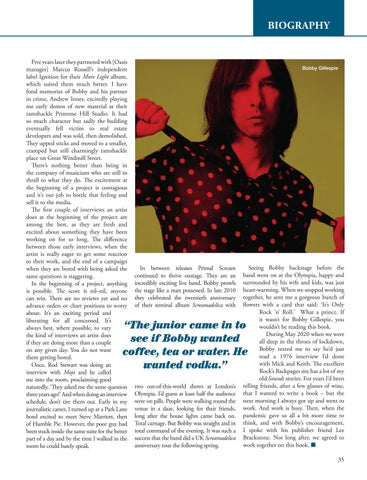
obby Gillespie, Primal Scream main man, came for a meeting one dark January day in 2006. He looked every inch the rock star, wearing a long leather coat and a haggard look that said, ‘I haven’t been to bed.’ The junior came in to ask if he wanted coffee, tea or water. He wanted vodka. Off the junior went to buy a bottle around the corner. An MBC first. He’d been up all night and, as he now admits, ‘was a bit worse for wear’. Nevertheless, we soon started to work together, and did so for the next 10 years. By 2008 he was sober and has stayed that way ever since. Bobby and I share a love of the Rolling Stones and all things Keith so it was just a pleasure to work with him. I’d met him a few times with Robert Plant, and of course back in the day with the Jesus and Mary Chain. Primal Scream had just recorded one of those statement albums that confidently declares its intentions from the first note. They were back on form. The album was called Riot City Blues and possessed a real swagger. Produced by Youth, who I had worked with at Warners when he was in a band humbly called Brilliant, the first single, Country Girl, tipped a raucous hat to the Rolling Stones and went top 5, as did the album. Two firsts for the band. Happy days. Sadly, it didn’t last. Riot City Blues was their last album on Sony Records. Their next disc, Beautiful Future, was on B-Unique, a small indie distributed at the time by Atlantic Records. It wasn’t a good mix, not the right home for the band. 34
BIOGRAPHY
Five years later they partnered with [Oasis manager] Marcus Russell’s independent label Ignition for their More Light album, which suited them much better. I have fond memories of Bobby and his partner in crime, Andrew Innes, excitedly playing me early demos of new material at their ramshackle Primrose Hill Studio. It had so much character but sadly the building eventually fell victim to real estate developers and was sold, then demolished. They upped sticks and moved to a smaller, cramped but still charmingly ramshackle place on Great Windmill Street. There’s nothing better than being in the company of musicians who are still in thrall to what they do. The excitement at the beginning of a project is contagious and it’s our job to bottle that feeling and sell it to the media. The first couple of interviews an artist does at the beginning of the project are among the best, as they are fresh and excited about something they have been working on for so long. The difference between those early interviews, when the artist is really eager to get some reaction to their work, and the end of a campaign when they are bored with being asked the same questions is staggering. In the beginning of a project, anything is possible. The score is nil–nil, anyone can win. There are no reviews yet and no advance orders or chart positions to worry about. It’s an exciting period and liberating for all concerned. It’s always best, where possible, to vary the kind of interviews an artist does if they are doing more than a couple on any given day. You do not want them getting bored. Once, Rod Stewart was doing an interview with Mojo and he called me into the room, proclaiming good naturedly, ‘They asked me the same question three years ago!’ And when doing an interview schedule, don’t tire them out. Early in my journalistic career, I turned up at a Park Lane hotel excited to meet Steve Marriott, then of Humble Pie. However, the poor guy had been stuck inside the same suite for the better part of a day and by the time I walked in the room he could barely speak.
Bobby Gillespie
In between releases Primal Scream continued to thrive onstage. They are an incredibly exciting live band. Bobby prowls the stage like a man possessed. In late 2010 they celebrated the twentieth anniversary of their seminal album Screamadelica with
Seeing Bobby backstage before the band went on at the Olympia, happy and surrounded by his wife and kids, was just heart-warming. When we stopped working together, he sent me a gorgeous bunch of flowers with a card that said: ‘It’s Only Rock ’n’ Roll.’ What a prince. If it wasn’t for Bobby Gillespie, you wouldn’t be reading this book. During May 2020 when we were all deep in the throes of lockdown, Bobby texted me to say he’d just read a 1976 interview I’d done with Mick and Keith. The excellent Rock’s Backpages site has a lot of my old Sounds stories. For years I’d been telling friends, after a few glasses of wine, that I wanted to write a book – but the next morning I always got up and went to work. And work is busy. Then, when the pandemic gave us all a bit more time to think, and with Bobby’s encouragement, I spoke with his publisher friend Lee Brackstone. Not long after, we agreed to work together on this book. n
“The junior came in to see if Bobby wanted coffee, tea or water. He wanted vodka.” two out-of-this-world shows at London’s Olympia. I’d guess at least half the audience were on pills. People were walking round the venue in a daze, looking for their friends, long after the house lights came back on. Total carnage. But Bobby was straight and in total command of the evening. It was such a success that the band did a UK Screamadelica anniversary tour the following spring.
35
‘WITH HELIX, I CAN WORK WITH ANY ARTIST TO ACHIEVE ANYTHING THEY WANT’ Following a clean break from his partnership with Sony Music, pioneering hip-hop and dance music exec Patrick Moxey is excited and optimistic about going back to his indie roots...
W
hen Pharrell Williams picked Patrick Moxey up at Virginia Beach airport, the exec thought he knew what to expect. “I knew Pharrell as a hip-hop producer,” says Moxey, who at the time was SVP of A&R at Virgin Records, where he’d signed Williams’ NERD collective. “So I got in his car expecting to hear the latest hip-hop records. But the first record on is America’s A Horse With No Name, and the next is Earth Wind & Fire’s September. As we drive to the studio, I realise that he’s studying and subconsciously channelling all the ideas that are floating around. “That’s why I saw him write three No.1 records in five minutes each,” Moxey smiles. “He was easily the most talented person I’ve ever worked with.” Throughout his remarkable career, Patrick Moxey has often found himself adjacent to such talents as they conjure up their most memorable musical moments. He started out in Chicago in the ‘80s as a DJ and music journalist, before moving to New York in 1987 and throwing legendarily wild warehouse parties. That put him in contact with New York’s music industry elite and soon he was working for Russell Simmons and Lyor Cohen at Rush Artist management (“Rick Rubin was living upstairs and he’d painted all his walls black,” remembers Moxey. “He had this whole Satanic heavy metal thing going on at the time…”). He moved onto Polygram and Virgin before launching his own indie labels; Payday Records for hiphop in 1992 and Ultra Records for dance music three years later. Payday gave early breaks to the likes of Jay-Z, Mos Def, DJ Premier and Jeru The Damaja, while Ultra became a dance
music behemoth across records, events and publishing, at various times featuring the likes of Steve Aoki, Kygo, Deadmau5, Calvin Harris and David Guetta. In 2013, Ultra formed a ‘global strategic relationship’ with Sony Music, and the major bought out Moxey’s remaining stake in the label at the start of this year. So the Moxey that MBUK meets today has returned to his roots, both physical – based in the UK since 2021, he’s at Helix/Ultra’s office in Tileyard, just down the road from Kentish Town, where Moxey was born and where his mother still lives – and spiritual, as the head of a wholly independent music business. He still controls Ultra Music Publishing
Warner artists. Ultra Music Publishing also has an alliance with Warner Chappell. Helix has already signed the likes of Snakehips, AR/CO and Marshall Jefferson, while it has a breakout Latin EDM hit with Willy William’s Trompeta. “We’re hitting the ground running because that’s what we like to do,” grins Moxey. “I thought about going to a beach after the sale, but what would I do there? It’s too much fun making things happen…” And, indeed, Moxey fizzes with enthusiasm and ideas for his new business, constantly reeling off impressive Dutch streaming stats and significant Canadian radio adds (“People make fun of me for it, but I love a good stat!”). It’s the sort of thing founders and CEOs usually refer you to other people for, but that’s not due to any lack of staff or resources. His music group has three offices (LA, New York, London), each with dedicated sync teams, 38 staff across the world and studios everywhere from Stockholm to Atlanta to Liverpool. (To a degree, however, it’s also a family affair: Moxey’s wife, Bernadette Cruz, is Director at Ultra Publishing and works across HR and operations for both Helix and Ultra Publishing.) This growing indie empire is built to compete with the biggest music companies on earth, yet instilled with the nimbleness of the small, independent businesses that drive dance and hip-hop’s relentless innovation. That’s why Moxey is in the office bright and early on the day after his 56th birthday (“I gave partying a rest for about 20 years,” he shrugs), ready to make the case to MBUK that his next music industry act will be every bit as successful as his previous ones, as he looks to unearth the next Pharrell.
“I thought about going to a beach after the sale, but what would I do there?”
36
and Payday, and has just launched Helix Records, which aims to be “a multiterritory independent home for the world’s best new electronic dance music”. And he still believes in what he calls dance music’s ultimate “moment of truth”: when a record is played at a club or a festival and either erupts or clears the dancefloor. The signs are already good that Helix will feature a lot more of the former than the latter. He’s signed a deal with Warner Music that will see Payday and Helix go through ADA for global distribution. It allows Helix, Payday and non-US Warner Music territories to reciprocally license music to each other, and for creative collaborations between Helix and other
XX
Photo: Margaryta Bushkin
“I’m still a young man,” says Moxey. “I’m energised and motivated right now, more so than ever. Three weeks in and we’re already flying…” How are you finding life outside of Sony? I’m super-excited to be back to my roots and be 100% independent. We’ve had a great response from managers and artists that want to get pushed. If the majors are putting out 3,000 records a week and to some extent turning into aggregators, we’re able to focus people on four or five records a week. We’re [distributing] direct to Spotify and Apple, and Apple and Spotify are very responsive to good new music. The Sony-Ultra partnership looked successful. So why leave? It was about wanting to have flexibility over how we can best represent the artist with the digital outlets and how we can best get their message across at radio. If you’re in the top group of artists at a major, it’s exciting. But even as good as the reps at the majors are, they can push, what, 10 records in a week? Maybe 20. Are you saying your artists were not in that priority group? The wholly owned labels are always going to be at the top of the queue, so it was always a struggle. Was that frustrating? Yes, but it’s all good, no regrets. It’s onwards and upwards.
Why go straight into another collaboration with a major with the Warner deal? Well, this time I’m 100% independent, so it’s more like we’re working with Warner where it makes sense for Helix’s artists. It’s a bit different; Sony was an investor in Ultra Records. Of all the three majors, Warner to me are the right people to be aligned with. I love the leadership currently at Warner.” You originally set up Ultra as an indie. How different is it doing the same thing with Helix nearly 30 years later? It’s easier to start an independent label right now, because things are very consolidated in the record business. There’s a real need and desire for an independent that can work records across multiple territories at the same time. When I started in the business there were five majors and now we’re down to
and Apple. But, after that, a strange thing has to happen: somebody has to like it. Music comes first and commerce follows the music. What characterises a Helix signing? Sound and charisma. Hopefully there are some artists out there who aren’t just data crunchers and have the charisma and the certain touch to connect things. A guy like Bru-C, who we publish, is absolutely taking over, precisely because he’s out there playing the festivals and the clubs, bringing the music to the people. That’s worth a zillion things on TikTok. When I talk to friends who are doing A&R at the majors, they say that, when they pick up a TikTok artist, a lot of the time they don’t get a trained athlete, they just get someone who got lucky from their bedroom. They’re not getting someone who’s got stagecraft, charisma and the discipline to do session after session to get the right records. They’re just getting somebody random.
“There should be more options, especially indie ones, that stand outside the big three.”
Is there anything you miss about Sony? I haven’t found it yet. Were Sony Music sad to see you go? Well, let’s just say that I did very well for them. They never had to put a dollar into the business and I generated great profits. But now it’s time to do this in a new way. Is it strange to see Ultra being run by someone else? It’s logical. It’s similar to when Chris Blackwell was at Island or Clive Calder was running Jive and Zomba. Oftentimes, the majors close those labels down within a couple of years [of the 38
founder leaving], that’s just what they do. But look, I can’t predict the future. I can only think about Helix.
three, and the economics have changed completely. It came down to three when the business was contracting and losing 10% a year. Now the business is probably doing the reverse, increasing by 10% a year, so it’s obvious to me there should be more options, especially independent ones, that stand outside of the big three. Realistically, can you compete with the majors though? Absolutely, but I will say it’s all in the music. When you have a great record, you get behind that thing and it just goes. I always say our job is to get something heard – on TikTok, or on a specialist show on the radio, or on a playlist at Spotify
Can you do things with Helix you couldn’t do with Ultra? Absolutely. With Helix, there are no restrictions. I can work with any artist to achieve anything they want. My job is to be a problem solver for artists, to get their music to DSPs and radio and to be flexible about how we can sell the experiences around the artists and their music.
You’ve said Helix will be involved with NFTs. What will that look like? We have to do it on a practical basis. There’s so much hype around the space, but we have to look at it like, ‘Music is valuable, how do we create an experience connecting the artist to fans in a fun and exciting way?’. You’ve got all sorts of ways to do this right now, from something where it’s a simple record release with different artwork, or it’s more of a collector’s piece, or it’s a gated community experience, similar to what Steve Aoki or Deadmau5 are bringing to the market. We’ll be working with our artists to
FEATURE
build them up in all these sectors, wherever it makes sense. One thing [to make it more accessible] would be price point. There’s a great value in inexpensive things you could buy for your avatar or NFT experience that don’t have to be such monolithic, expensive pieces.
Trompeta by French artist Willy William (pictured), which went Top 5 in the Netherlands, is already a Latin-EDM hit for Helix
How important is the UK to Helix? UK dance music is amazing. I’ve always been involved with it, going back to Sasha & Digweed. I was bringing people like Little Louie Vega, Roger Sanchez and Moby to London for the first time, when I was managing those guys. Seeing those first raves, the Sunrise 5000 – I was carrying Louie’s record crates through the muddy fields towards the aircraft hangar! So I have a lot of respect for UK dance music. Can dance music get back to the commercial peaks of the ‘90s and ‘00s? Yes. The great thing about dance music is, it’s international music. A dance record can sound just as good in Indonesia as it can in Doncaster. It travels. Whereas hip-hop, which I also love, tends to be very countryby-country. You have French hip-hop, German Hip-hop, UK hip-hop, US hiphop… You might see more hip-hop records in any one particular market, but you won’t see those hip-hop records in other markets, while you will see the dance records. The UK sound right now will do well in the US, Canada, Australia and Holland. You’ve said you want Helix to be bigger than Ultra in five years’ time: how will you achieve that? Artist-by-artist, record-by-record, playlistby-playlist, radio-add-by-radio-add. It’s about building up momentum and layers, learning how to be flexible with the times and pushing artists as hard as possible. It’s not just that I have this vision that it’s going to be bigger in five years; I’ve got groundswell. It’s already happening. Do I want to be tied with a major or be an independent, when the independent market share is growing by 1% a year? So can Helix be as big as a major?
I can only say that somebody should, whether it’s me or somebody else. It’s time. There were five [majors] when I started and now we’re down to three. Let’s get that number back up. What happens if a major comes along with a chequebook and makes you an offer you can’t refuse? It’s funny – I’ve already had one approach, which I declined. Because this time, I want to enjoy this. I want to be a great choice for artists outside of the three. If you could change one thing about today’s industry what would it be and why? I just want everyone to realise that the power is in their hands to get the job done. Because the job that needs to be done sits somewhere in between the artists, the managers, the labels and the publishers. Music has to get made, it has to get presented and packaged and pushed. It
has to be cool, artistic collaborations need to be co-ordinated and it really can be done by anyone. What’s more exciting now about this digital era is, there aren’t gatekeepers as there were in the past. It used to cost you $2,000 just to put one song down on twoinch tape. Those days are over, anyone can record anything, anywhere. But that same spirit of independence, where you could make it, promote it, market it and do it [yourself ]… that’s what I’m hoping more and more people will continue to realise. What advice would you give to someone who wants to be the next Patrick Moxey? I would tell them that they’re going to represent their music better than anyone else and they should carry that message as far as they can and work with like-minded independent people. This is a real chance for independence to shine. n 39
‘I’M PLEASED TO BE DOING IT MYSELF AND NOT HAVING A BOSS’ After a stint under the auspices of YM&U, legendary British artist manager Martin Hall has ‘gone indie’ again – and he’s done so with one of the hottest bands in the world, Wet Leg, on his roster…
O
ver a 32-year career managing legendary Welsh rockers the Manic Street Preachers, Martin Hall has helped his charges to the highest highs: meeting with Fidel Castro at a pioneering gig in Cuba; winning multiple BRIT Awards; and ushering in the new millennium in a stadium full of their ecstatic countrymen and women. But he has also had to navigate the lowest possible lows: the still-unsolved disappearance of troubled Manics guitarist Richey Edwards, which came soon after the death of Martin’s own brother, management partner and mentor, Philip Hall. All that would have been more than enough for most people. But Martin Hall has also done so much more; helping to plot the careers of everyone from James Arthur to Pixie Lott, Groove Armada to The Script and Shampoo to Wet Leg. The only thing he hasn’t done is talk about it. Until now. Today’s tetea-tete with MBUK, in a Soho private members club, is – remarkably – the first time he has ever spoken in depth about his career. And there is a lot to talk about. Even by his standards, the last nine months have been exceptionally successful, bringing him three UK No.1 albums by three different artists: the Manics’ Ultra Vivid Lament, The Script’s Tales From The Script: Greatest Hits and Wet Leg’s self-titled debut album. But his back story is just as remarkable. Hall started off in the ‘80s selling advertising in music magazines before his entrepreneurial spirit saw him decamp to New York to set up his own publication, covering the stars of the then-ubiquitous second British Invasion (“Having lived in New Malden, New York was fucking amazing,” he grins). The fact that the magazine, London Calling, never actually published an issue didn’t prevent him from talking his way into interviews with the likes of the Thompson Twins, or onto the red carpet at the very first MTV VMAs, all the while getting “a taste for how easy it was to blag your way into things”. After a stint selling ads for Star Hits, the US version of legendary British pop mag Smash Hits, he returned home in the late ‘80s and began work at his big brother’s independent press company, Hall Or Nothing. The pair had been mulling over a move into music management when a letter arrived.
That missive, from four Welsh punks declaring themselves ‘the future of rock’n’roll’, was what they – and pretty much every rock fan in Britain – had been waiting for. At their first meeting in South Wales, bassist Nicky Wire had cut his head and was bleeding all over the blouse he’d co-opted from his mother’s wardrobe and stencilled with seditionary slogans, while singer James Dean Bradfield was too shy to even talk to the visiting music biz hotshots. “I wasn’t sure about it,” Hall admits today. “But Philip was like, ‘I’m going to get so much press on this band. It’s going to be great – and the music will catch up’.” It did too. Signed by Rob Stringer to Columbia UK, the Manics cut a swathe through the moribund early ‘90s UK scene with dazzling songs such as Motown Junk, You Love Us and Motorcycle Emptiness. Edwards and Wire entranced the music press with a series of provocative interviews (Richey famously carved the phrase ‘4 Real’ into his arm with a razor blade during an interview with NME’s Steve Lamacq). This being the first band the Hall brothers had ever managed, they thought all this was normal. But Philip’s tragic death from cancer in 1993 was followed swiftly by Richey’s disappearance in 1995. There’s been no trace of him ever since, and he was declared officially dead in 2008. The Manics carried on as a trio – drummer Sean Moore completes the line-up – and finally became as big as they always said they would be, as Everything Must Go went triple Platinum. Martin had stepped up to run HON management (Philip’s wife Terri Hall took over the PR business of the same name) and, after a few years, he started to take on other clients. He’s sold the business twice – to Sanctuary in 2003 (later becoming Sanctuary MD) and YM&U, then the James Grant Group, in 2012 (with Hall later becoming executive chairman). But corporate conformity wasn’t his style, and both times he returned to the independent life (“I enjoyed all that, but I’m pleased to be in charge of my own destiny again,” he says). And now, 32 years on from that letter, his career has come full circle. He still talks to Nicky Wire every day (in fact, Wire calls just as Hall sits down with MBUK), whether it’s about work or
“You think every band you work with could be successful, but you don’t know to what level.”
40
“xxxx”
XX
just the rugby. But Hall is once more managing the hottest new alternative band in the country, overseeing Wet Leg’s phenomenal rise from their debut gig in July 2021 to a UK No.1 album 10 months later. And, finally, Hall seems to be getting the respect he deserves as one of the British music business’ most under-the-radar success stories. His phone hasn’t stopped buzzing with congratulations about Wet Leg’s many triumphs and, despite all his years in the game, he remains every bit as passionate about music and the business as he was back in the ‘90s. Nor is he about to go anywhere. While he’s toying with launching a publishing company or a label (“I’d like to get into some kind of rights ownership – that’s quite logical as a manager”), it’s clearly management that still makes him tick, as he enthuses about dashing between his charges’ various gigs on different sides of the planet. “It’s the best part of the job,” he smiles. “Seeing the bands play live and being in the dressing room, that’s what I enjoy the most.” There are plenty of good times ahead, then, as his artists look forward to another huge live summer. But before then, it’s time for Martin Hall to, finally, have his say… You must have had your hands full with the Manics in the early days… Yeah, it was tricky. You know all the incidents, I don’t need to repeat them. Nicky couldn’t stop himself really. Even now, when he goes up to the mic, I always have an involuntary shudder at what he’s going to say. But they weren’t arseholes or difficult, they were lovely to work with, they just presented this front.
to whatever they wanted to do. We didn’t have a sit-down meeting about it, they’re not like that. They gave it a pause and then they started writing. Nicky sent James a lyric and it was A Design For Life – he said, ‘I think I’ve written something special…’ How was it sorting out the notorious Cuba visit in 2001? That was an interesting trip! It was Rob Stringer backing the band’s vision to do something as crazy as that, because it was really expensive. And it was unknown territory. When we met Castro, it wasn’t planned, we were backstage before the show and one of the officials said, ‘Do you want to meet someone?’ And there he was, standing there in his full military uniform. James said, ‘It’s going to be quite loud tonight, so maybe bring some headphones’ and Castro, through his translator said, ‘It can’t be louder than war’. Then, the day after the gig, it was like, ‘You must go see Castro do a speech.’ It was three hours away on the coach, but it wasn’t optional. I had to say to the band, ‘Come on, you’ve got to come’ – I basically bribed them to get on the coach because they wouldn’t take no for an answer. After all that, managing other artists must have been easy? Nicky Wire once said to me, ‘Why are you managing other bands? Paul McGuinness only manages U2’. And I said, ‘If you were U2, you’d be the only band I would manage!’ Different bands have different challenges, but you don’t have to deal with the same drama or tragedy that we did with the Manics. It’s unusual to come through that and then make it successful.
“Seeing the bands play live and being in the dressing room, that’s what I enjoy most.”
Did you have any idea how big they were going to become? You think every band you work with could be successful, but you don’t know to what level. Sometimes, as a manager, you’ve just got to believe in the people – if you believe that, collectively, they’ve got something special about them, that’s got to be the starting point. The Manics was a difficult journey, so winning the BRITs and everything was always bittersweet. That’s why Rob Stringer, me and them are still so tight. They speak to Rob a lot because going through that together brought us closer – most bands don’t have to do all that with their manager. Nor do many managers have to deal with something like Richey’s disappearance… I know. Filling in the missing person’s report at Harrow Police Station… that was difficult. The band had known each other since primary school, so it was really hard for them. I don’t think we ever thought it was obvious he wasn’t coming back – I still have dreams that he turns up now. In terms of continuing, I just left it 42
What’s changed between those days and Wet Leg’s breakthrough? It’s more competitive now, because there are so many bands. There seemed to be fewer then. At the time, I felt if I found a Britpop guitar band, it wouldn’t be that hard to get them a record and publishing deal. Everyone was signing British guitar bands, it was easy. There’s so much music now, to get heard and cut through is hard. Does wet leg’s breakthrough prove that alternative rock is alive and kicking? Every year, everyone says indie music is coming back. Maybe as a guitar band that can have a big No.1 album, Wet Leg might open a few doors. I hope so, but I do think the difference is, Wet Leg are better. Their songs can cut through, they’re pop songs really. They’re already doing well in America. Could they be the next big British band globally? Oh, they could be huge. I trust them as songwriters, they’re smart and they’re not fazed by this stuff. Some bands struggle with the weight of expectation on the second record but I don’t think that
INTERVIEW
Wet Leg
will happen to them. If Wet Leg become as big as they might be, I’ll need more help… Is that why you did the YM&U deal, to get more back-up? In theory, yeah. I sold to Sanctuary and to YM&U because, on paper, the back-up, the brand team and the international office feels attractive, and the cheque looks good. But neither time worked out how I envisioned it. I found I lost my entrepreneurial spirit in a corporate environment. I’m not sure if Wet Leg would have joined me if I’d been in a corporate environment right now. They liked the fact it was a smaller business and I’m really handson – that’s good for them. Ultimately, I’m pleased to be doing it myself and not having a boss. If you ask too many people, you’ll never make a decision. You’ve got to trust your instincts, whether things are good or not. We’ve got other [new acts] that I’m finding harder to get moving, but I have to trust that I really like it, so hopefully it’ll work.
You’ve managed a wide variety of acts, genre-wise. What do you look for in an artist? You don’t want to be more ambitious than the band you manage. If you’re going to work that hard, put that much of your personal time into it, you’re going to want to know they actually want to be successful. Are you friends with your artists? I’m friends with the Manics. I think I’m friends with The Script. They came to my wedding and my birthday party, but I’m still their manager. I work for them and it’s hard to blur the lines. When I was at YM&U they said, ‘We’re not friends and family, it’s a professional relationship’. But, when you work closely with people and you’re on the road a lot, you do become friends with them. Do you have a view on the catalogue rights sale boom that has taken place in the past few years? 43
Manic Street Preachers
Celebrating Wet Leg’s No. 1 debut album earlier this year
There have been some conversations going on with the Manics. If the deal’s right, you’re of an age, you’re maybe not selling all of it and they give you the money you need, then I’m open to those conversations. But it’s the artist’s call. They’re saying Pink Floyd is going for £500 million – fuck me, that’s a big cheque for anyone! I don’t know how they do their numbers on that – it doesn’t stream that well! It’s like, with the Manics, we never seem to get any adverts. For years, we’ve been saying you can work our catalogue, why not? Historically, the NME and Melody Maker would be a bit judgemental about that, but they’re not there to be judgemental, unfortunately. We’re open to using the rights, there’s nothing wrong with that.
an eye on recoupment, because you know you’re going to tour and make money. You don’t say, ‘Let’s spend 10 grand on the video, not 20, because we’re looking to recoup’ – you just make the best video you can. Then, if you’re properly successful, you’ll renegotiate the deal. You shouldn’t skimp on expenditure early doors, you’ve got to go for it. Have the Manics recouped? [Laughs] Yes! With this run of No.1s, are you finally getting your dues as a manager? Well, I’m not a self-publicist. I don’t go looking for awards and things, I’m more of a behind-thescenes type. Some managers have Instagram accounts etc, but that’s not how I operate. I always thought I might get offered a job at a record company, but I never got a call and I’m too old now! Plus I love what I’m doing and I’m not sure I could do anything else. I live and breathe it and never stop working. I’m never not on the phone at the weekend because, if there’s a call, you have to take it. I’ve got no plans to retire. I’m not saying I want to work forever, but maybe I’m just hitting my stride now. n
“Some managers have Instagram accounts etc., but that’s not how I operate.”
If you could change one thing about today’s music industry, what would it be and why? I’d like deals to become more artist-friendly, so we’re not signing in perpetuity and giving rights away forever. It’s got to move on. Labels do now offer 50/50 revenue, or reversions of masters, but some of those old deals are tough. The pendulum swinging back in the artists’/managers’ favour is a good thing. Although, as a manager, when you sign a record deal, you don’t keep too close 44
DID YA KNOW..., Changing the narrative There is a story behind all of us. There is a reason why we are who we are…
Did Ya Know… The Pioneers, The Podcast. The stories of the executives of colour that have led the way. Available from wherever you get your podcasts.
THE RISE OF THE HR DEPARTMENT We got through the pandemic – but what now for our professional lives? Jane Dyball suggests Human Resources teams will be important to music companies like never before… There used to be a time, maybe not that long ago, when you would see the HR person on your first day at work and then you would hope to never see them again - because if they turn up in your office unannounced it’s only gonna be bad news. However if there is one good thing to have come out of the pandemic it’s the rise of the music biz HR teams. Having to send people home on a pretty much indefinite basis in March 2020, at almost no notice, was a huge operation for businesses large and small across the music industry. Apart from all of the health and safety issues there was a big problem in terms of how to motivate and manage a remote workforce. Back in the day I had to threaten to resign and /or operate extreme levels of subterfuge to be able to work from home, and now companies were having to insist on it. I would book days off knowing that I would be working all day and then tell my bosses that I’d had to spend all day closing a big deal and therefore needed to claim another day off in lieu. Later on when it became permissible under my contract to work from home, I scheduled all my conference calls for my wfh day in case anybody questioned me on my output. I would work equally long days, if not longer, but just found it productive to be at home. It also gave me the opportunity to be available for an hour at four o’clock when my kids came home from school, just in case they wanted to talk to me. They rarely did. Except of course to turn up in my home office at seven o’clock asking what was for tea. Coinciding with lockdown, the #metoo and #BlackLivesMatter movements had a real impact on music industry businesses who saw that the lack of women and people of colour in senior positions was going to be a real embarrassment, not to mention a legal risk, if not addressed. What followed was a flurry of appointments - my LinkedIn stream positively 46
“Back in the day, I had to threaten to resign and/or operate extreme levels of subterfuge to work from home.”
sang with appointments of diverse executives and Diversity specialists. I have to say, in my capacity as Co-Chair of accessibility charity Attitude is Everything, there is still a long way to go for disabled people who so far haven’t really been welcomed into the music industry executive suites. It’s one of the reasons I got involved in that charity. Despite working in, and with, pretty big companies, I have never worked alongside a visibly disabled person. I can only think of one person I have been in a meeting with (prior to joining AIE) with a visible disability and I bet you can all name that same one person. Having talked to HR teams in the industry and having advised small businesses through my consultancy business it’s clear that this is something that a great many of them are really taking seriously, and AIE has a number of tools and resources that can help with this.
XXXXXXXX COMMENT
HR departments: They’ve got the whole company in their hands
Post pandemic, of course, companies are facing challenges in luring people back into the office but ultimately it’s clear that the working life balance will be much improved by new practices that are becoming widespread. For example many companies now offer their staff the ability to ‘buy’ more holiday outside of their contractual entitlement. One thing that the pandemic has taught us is that life is short. At a time of almost 100% employment the industry will be required to treat its employees as assets as opposed to problems to be managed. These days, as part of my ‘give back’ manifesto (I know, get me!), I speak a lot to kids at school about careers. I tell them what a fantastic career I’ve had in the music industry, about the amazing people I’ve met and friends I’ve made all over the world. I tell them about going to the BRIT Awards by boat with endless supplies of free cocktails, hanging out with superstar musicians and playing tennis with Richard Branson – and yet when I ask them if any of them are thinking about going into the music industry not one of them puts up their hand.
“The industry will be required to treat its employees as assets as opposed to problems to be managed.”
Now, that’s not something that particularly translates – we know that there are always too many people applying for music industry jobs, but we mustn’t take that for granted. The difference is that kids can afford to be choosy. So, if you’re an exec who doesn’t feel like they’re getting a good deal from your bosses, now is the time to persist. You’re probably going to have to go into the office a few days a week though. Anyway, let’s hear it for those HR teams, especially those who are trying to introduce flexible working patterns, who understand their pastoral role in looking after staff, who recruit in an accessible way and who are using this once-in-a-lifetime opportunity to make lasting change. If you work in HR and are not getting through to your bosses, now is the time to insist. And if by any chance you’re a boss who hasn’t started to think about these things, or if you’re starting to suspect you may be part of the problem, you’re probably going to have to have a bit of a rethink if you want to be a competitive employer in today’s market. And that’s no bad thing. 47
You’re about to hear a lot more from…
Samuel Adebayo
Introducing a new series featuring execs who are on the rise, having a moment, hot property, destined to be your boss – or possibly all four. We kick off by hearing the story, philosophy and goals of Island Records UK’s Senior A&R…
48
INTERVIEW
P
eru, by Nigerian artist Fireboy DML, and featuring Suffolk’s very own Ed Sheeran has, at the time of writing, been in the charts all year. It has significantly raised the profile and standing of the main A&R behind the track, Island Records’ Samuel Adebayo. Its success, however, is more than a calling card, it is a reflection of his roots, his ambition and of lost friendships. Here, he tells MBUK about breaking into the industry, finding his way to A&R, how he develops artists, his mentors, his peers and where he wants to be in five years. How did you break into the business? I was doing a Master’s in Audio Engineering, but luckily part of the course was on music management. And when I did that, I had kind of an epiphany. I realised I wanted to be on the business side of things. I started calling every single record label. I was young, I didn’t know there’s a process; I was just calling labels and saying, ‘Can I have a job?’ I called Universal so much that eventually this guy who worked on reception felt sorry for me and told me to send my CV direct to Justin Cross, who was Head of Digital at the time. My first job ended up being in digital marketing at Island. I remember my first day, walking in, I didn’t know what to expect, and I think at first it was kind of overwhelming. Obviously, I was really enthusiastic, and I knew I wanted to be there, I just didn’t know what I was doing. These were the days when we needed to create MySpace and Facebook pages for artists, and one of my first jobs was to create a Facebook page for Amy Winehouse, and then the Sugababes, Keane, The Feeling… Every day I was leaving the building thinking, wow, I’m doing it, but at the same time pretending to keep my cool [laughs]. How did you make the move into A&R? The job in digital was an internship. After that I ended up getting a job in the post room at Universal. People would recognise me and you could tell they were thinking, hang on, why are you dropping off post? But I figured at least I was still in the building.
L-R: Gabriella Kingsley, Samuel Adebayo, Ed Sheeran, Fireboy, Bolaji Kareem
I was applying for jobs all the time and I ended up at Parlophone, working in digital again. Within a year of that, a friend of mine told me about this guy who had started a management company, but he didn’t really have much of an idea, his background was in property, I think. He had this kid called Angel, who was really good, but needed some help, and so he asked me to manage him. I helped develop him, and then funnily enough ended up signing him to one of my good friends and someone who is now family, Benny Scarrs. He was at Island when I was there and had gone on to become an A&R under Darcus [Beese]. We ended up having our first top 10 hit, with Wonderful, which was a big smash that summer [2012]. That was my first taste of A&R, because even then, as a manager, you had to pretty much build everything with the label. Working closely with Ben at that time gave me an insight into both sides. How did you end up back on the label side of things? I got approached by 3beat. A friend of mine, Shaurav D’Silva [2-Tone] knew
there was an opportunity there and he said I think you should meet Jon Barlow, who is a great, great guy. I started working for Jon, just seeing where it might go, and then I brought in this kid called Geko, and put together a summer hit with 6:30, ft. NSG and produced by JAE5, in 2018. And then Alex Boateng, who’s now running 0207 Def Jam with his brother [Alec], hit me up. He said we think you’re great, we’ve got this opportunity and we’d love to get you over to Island – so I ended up back where I started, but in A&R. Who was your first signing there and how did that come about? That was ArrDee. My younger brother was listening to him and I was intrigued. I thought he was crazy talented and cheeky at the same time. So I got in contact with his manager, Versatile [Carl Samuel, also Senior A&R Manager, Columbia], and we went to meet ArrDee in a studio in some arches in Woolwich. He was really bright, full of energy, knew exactly what he wanted, knew his brand – and the music was just phenomenal. I thought straight away, we need this, this is what the UK needs right now. 49
Myself and my co-A&R Alex Sparks called our heads of A&R, Daniel Lloyd Jones and Annie Christensen and said, ‘We’ve got to do this; this is the real deal.’ Obviously it became a competitive deal, and rightly so, but the artist and the manager believed in us and knew the passion we had. Who were some of your mentors during your early years? When I first started – and right up to now, actually – it was Darcus. I remember, during my first stint at Island, there was this time when I was just sitting there, kinda doing nothing to be honest, because, to me, there didn’t seem to be anything to do at that time. He called me to his office and said, ‘Listen, this is the music business. You only get one chance and you need to take this seriously’. He’s probably forgotten, but he kind of laid into me! [laughs] He told me, ‘If you don’t have any work, find some, find something to do. Just immerse yourself in this, because not everybody gets this opportunity.’ He was right, and he’s been there every step of the way ever since. He’s someone I’m always able to call and talk to. Then obviously there’s the twins [Alec and Alex Boateng]. Their story is just incredible, and the hits they’ve had have been phenomenal. They’re extremely motivational, they’re inspirational and they’re really wise. To get their perspective is always so useful. Ben Scarrs has the best ears for music. If I play him something, his feedback is so valuable, because he just knows, he hears it. And of course what he’s done with Dave is unbelievable; he’s one of the best A&Rs in the game. And then there’s Colin Lester, who works at Virgin now. Again, brilliant ears, and also he has this tenacity to get great artist after great artist through the door. And of course [Island Records President] Louis Bloom! He’s such a great leader. It’s almost like Wenger when he managed The Invincibles [laughs]. It feels like that’s what Louis is doing now, building a really strong team where everybody believes in 50
With ArrDee
themselves and everybody feels like they can win, good vibes. His knowledge of music and attention to detail is fantastic. Even with ArrDee, he’ll be listening to mix number 20 saying, ‘Don’t you think we should change this bit?’. With all the success he’s had, he’s still so on it and you’ve got to respect that. And then on another level, the way he brings the company together, his thought processes, you can’t help but learn. I also find it interesting to study how he works in other genres, how he works with producers I maybe wouldn’t have thought of. What have been the biggest changes in A&R during your time? It has to be the importance of social media. Back in the day, you had to turn up to a show to find out what was going on. And there is that element still, just to make sure it feels real, not fabricated, or people trying to blag a deal. But just the metrics you get, the way you can see how an artist is interacting with their fans, across all channels, it has been such a help. It’s a way of giving fans the character of an artist, it’s a great place to hear music early, or see some video of a gig where it’s really going off. It’s given A&R an extra dimension, and it gives fans more layers when it comes to really getting to know an artist.
When you’re looking to sign an artist, how important is attitude and personality, alongside the music? It’s absolutely key. The artists who have longevity are the ones whose fans can see there’s more to them, and who have a deeper relationship with their fans than just the music. I think these days it’s important not to get to the point where the song is bigger than the artist, because the ones that last longest are the ones that build brands for themselves. Dave is an example of that, I think. And so is ArrDee to be fair; he’s an artist that people have an opinion on, and there’s always a level of interest in what he does. Those are the sort of artists that excite me. And at the very top level you get artists like Rihanna, who might not put out music for years, but people still want to buy all her products because they’re invested in the artist and they believe in the artist’s overall brand. Who are your peers in A&R that you think are doing great work at the moment? Obviously, I want to big-up my co-A&R at Island, Alex Sparks. He has a great ear, a great understanding on how the business works and what artists need. There’s Emmanuel Olowojoba, who works at EMI, a real up-and-coming talent who’s
INTERVIEW
doing his thing right now. There’s a guy called Glenn Sonko at 0207 Def Jam. He’s Tion Wayne’s co-manager and he signed Potter Payper. He’s doing great things. Dan Owusu, Lunick Bourgess and Shane Derozario, who run Dream Life at Sony, I really like what they’re doing. Komali Scott-Jones at Parlophone also definitely deserves a mention. And Ish Olukunbola, at 0207 Def Jam, who I actually grew up with; he has a great knowledge of the business and a great ear for music. What’s the most important thing an A&R person can do for an artist after they’ve signed them? For me, first and foremost, it’s about building that one-to-one relationship with the artist. We need to make them feel human, like really important people in their own right, as opposed to being another product on a release schedule. We need to be sure that they know we care about their overall well-being, their mental health and their vision. And from there it’s easier to delve into the music they want to make, what they want for their career, the artist they want to become, what their brand is going to look like, the best producers to work with, who the target audience is, etc. But before all that, and in order to really do that well, we have to get to know the artist as much as we can. And you won’t get it perfect straight away, you’ll have moments of figuring it out between you, and that’s why I’m saying it’s important to spend time together away from the label, away from the studio, just keep checking in and building that relationship.
Tell us about how Peru came about – and how Ed Sheeran became involved? Peru is probably the proudest moment of my career to date. My younger brother, Peter, was telling me about this song that was popping off everywhere he went. And then suddenly everyone was talking about it. I managed to get hold of it and I sent it over to Jamal Edwards, rest in peace. He was a really, really close friend of mine for so many years and I was like, I’ve got this song, I’m going to sign it, and actually I think Ed would be great on that song. The next day he asked me to send him the instrumental. I was like, hold on… but in typical Jamal fashion he just said, ‘Trust me, trust me’. So I sent it. And I remember I was going to see some orchestra thing in Birmingham with my dad and my son when I get a text from Jamal to say ‘It’s done’. I was like, ‘What’s done?!’ He said, ‘I’ve got a version with Ed, he’s texted Fireboy, it’s all good’.
“Jamal was such a pioneer, and so important to me. He’s left such a legacy.”
Who is your latest signing? I’ve just signed an artist called Benzz – and we’re having a moment with him. He’s got a song called Je M’appelle that’s absolutely flying at the moment, here and internationally. He’s a rapper of Moroccan descent from West London and he’s an exciting prospect.
My dad was looking at me, because I was freaking out! I am usually so calm, but at this point I’ve got one of the biggest artists in the world on a record I’m about to sign. I remember calling Louis the next morning – we’re literally closing for Christmas at this point – and I basically said, I’m really sorry, but we need to deliver this record now. I went to New York to shoot a video and we got it out on Christmas Eve. The whole label really pulled together. And as of now it’s been in the Top 10 for more than 25 weeks, coming up for six months. It just felt like a moment that needed to happen, and I’m so happy it did, because Jamal was such a pioneer, and so important to me. He’s left such a legacy.
I talked about Angel, my first artist, and it was Jamal that gave us our platform. That’s when all labels started talking to us. He was so, so pivotal in so many people’s careers. What’s the most important piece of advice you would give to someone just starting out? I would say just know it’s something that you really want to get into, because you have to be 100% passionate. And if you are, that will show. Secondly, what I tell most people is to try and find a few things even before you come in, because those things will be your CV. If you can demonstrate a talent for finding artists, that shows the label that you don’t have to wait on anyone, you’re proactive. It also gives you something real to talk about, like explaining how you actually did something rather than how you promise you will do things. Labels are looking for people who can do it off their own back. And make sure you’re knowledgeable – about the industry and the company. When I had my interviews with Island and Parlophone in the early days, I treated them like exams. I made sure I knew everything I could about them, because I just wanted it so bad. What do you want to achieve and where do you want to be in the next five years? For me, it’s about the impact I have on my artists and the impact I have on my community. I was born and raised in Hackney, and that’s a big thing for me and a big part of why I do what I do. There are so many people where I’m from that haven’t had the opportunity, and so I want to hopefully be someone they can look to for guidance and make sure there are more opportunities. I also want artists with international status, that’s definitely a dream of mine, to have artists that cross borders and that make a change in the world. Most importantly, I want to see more artists from Africa get the recognition they deserve internationally. It’s been a long time coming, and if I can be instrumental in helping with that I would be made up. n 51
5
Numbers
you need to know The second quarter of 2022 was one obviously overshadowed by global economic news, not least spiralling inflation in the UK and in many other markets around the world. In the music industry, however, the financial numbers – for now – continue to beam out positive vibes for the business’s health…
52
ANALYSIS
$53.2 billion:
The big hope for 2030
The global record industry is already doing great, right? Right. But according to Goldman Sachs, there’s a whole lot more good news to come – despite, says the financial giant, the current macro-economic threats to the business’s growth. The latest edition of Goldman’s Music In The Air report dropped in June, and significantly upped its long-term forecasts for the growth of the recorded music business and the music publishing business. On the recorded music side of things, Goldman is now projecting that the annual business will be generating USD $53.2 billion in annual trade revenue by 2030 – more than
double the turnover of the worldwide industry in 2021. For publishing, Goldman suggests that the global business will generate $11.6 billion by 2030. That’s not quite double what we saw in 2021, but it’s close: last year’s global music publishing biz saw $6.9 billion of trade revenue, says Goldman. Adds the report: “While the traditional on-demand subscription model continues to dominate much of the growth in the music industry, we believe advancements in technology and the further digitisation of industries will further increase the pervasiveness of music and create new monetisation opportunities.”
Global music industry annual forecast ($bn) n Recorded Music (trade $) n Music Publishing (trade $)
55.6
53.2
n Paid streaming (gross/retail $) n Ad-funded streaming (gross/retail $)
33.7 27.9
25.9
26.5
23.2
9.8
6.9
2021
11.3
7.4
2022
11.6
2023
Source: Goldman Sachs ‘Music In The Air’, June 2022 update
53
1 billion:
Spotify’s fearless objective
Spotify ended 2021 with 406 million monthly active users (MAUs) globally. In June, Spotify founder and Chief Executive, Daniel Ek, unveiled a new target for Spotify at the company’s Investor Day in New York: Spotify, he said, wants to reach 1 billion active users globally by 2030. Interestingly, Spotify grew its worldwide MAU count by 61 million people last year. If it can maintain that pace of growth over the next decade (+61 million per year), it would hit 1 billion global MAUs in the second half of 2030. One small hurdle in SPOT’s mission: New stats show that Spotify’s MAU growth in Latin American slowed considerably in 2021 (up +11m last year versus +16m in 2020).
€102 million:
Todd Moscowitz
54
Daniel Ek
The price (of 50%) of a modern indie label
Have you ever heard someone say that the glory days of the independent label are over? Try telling that to Todd Moscowitz. The US-based A&R veteran has seen large-scale success before in his career – whether that’s at Def Jam, Warner Music Group, or as one of the founders of 300 Entertainment. But from an entrepreneurial standpoint, his latest project, Alamo Records, is next level. Moscowitz founded New York-based Alamo in 2016 (then called Cold Heat Records). At that point, the label was a JV with Universal Music Group / Interscope, and it’s since gone on to break artists including Blackbear, Lil Durk and Rod Wave. In May this year, a Sony Music filing confirmed that the major record company paid €102 million to buy UMG’s interest in Moscowitz’s label – valuing Alamo at around USD $250 million. Sony didn’t just buy UMG’s stake, either; it also acquired an additional chunk of the company from Moscowitz (to gain a majority stake overall). Moscowitz, who continues to run Alamo, would have done very nicely from that deal.
ANALYSIS
78.4%:
It ain’t easy, being popular
How many of Spotify’s 8 million artists have fewer than X monthly listeners? n Total artists (in millions) n % of 8m artists on Spotify 83.3
78.4
6.66
6.27 Under 50 monthly listeners
93
Under 100 monthly listeners
7.44 Under 1,000 monthly listeners
Source: Spotify Loud & Clear / MBW calculations
18:
Music Business Worldwide is well-known for uncovering some mind-boggling stats about the modern music business. But perhaps none to date have been quite as mind-boggling as this one. According to MBW analysis of Spotify’s Loud & Clear numbers, nearly 80% (78.4%) of artists on Spotify today have fewer than 50 monthly listeners. That’s just under 6.3 million artists on the platform – as of the end of 2021 – with an audience smaller than half-a-century of people. Just 7.0% of all the artists on Spotify, MBW’s research found, have more than 1,000 monthly listeners. Obviously enough, that leaves 93% (!) of artists on the platform with a lesser figure hearing their music monthly. As MBW’s analysis pointed out: “This is a rather enlightening set of statistics, for a couple of reasons. For one thing, it brings yet more perspective to the debate around the streaming economy – especially the teeny percentage (0.2%) of the 8 million artists on Spotify who are generating $50k-plus a year from the platform. In addition, it makes you wonder how much money loss-making Spotify must be burning each year simply to host oodles of music/artists that a handful of people – at best – are actually listening to.”
How many months it might take for Steve Cooper to be succeeded at WMG
Steve Cooper is officially to vacate his seat as CEO of Warner Music Group. But despite the veteran exec announcing to WMG’s board in June that he’s to step down, it’s a process that could last 18 months. Cooper is taking an active role in helping Warner find his successor – who could come from inside or outside of WMG – and the company says this search may not be complete until the end of 2023. (It might be finished earlier.) Said Cooper in a note to colleagues announcing his exit: “When I arrived here in the summer of 2011, a lot of people figured I’d only be here a year or two. But eleven years later, I’m now six decades into my career, and of everything I’ve done, this is the job I’ve enjoyed the most. I’m proud to say that I’m the longest running CEO in WMG’s history. This is a wonderful company, and I’m excited to help select my successor.”
Steve Cooper
55
‘I THOUGHT: I’VE HAD ENOUGH OF THIS, I’M GOING TO LEAVE THE INDUSTRY’ He didn’t, and thank goodness – otherwise he wouldn’t have gone on to manage Wolf Alice, alt-J, or a host of other great acts. MBUK meets Stephen Taverner…
“I
’ve killed bambi…” Stephen ‘Tav’ Taverner had learned to expect the unexpected in his artist management career, but this was a new one. A cryptic note referring to the murder of a beloved disney character had been shoved under his hotel room door by his star artist, Tim Wheeler of Ash, just before the singer-guitarist went AWOL, leaving a blood-stained hotel room behind him. The year was 1999, and Wheeler had been determined to leave his fresh-faced indie pin-up image behind him. That mission – this being the ‘90s – involved filming a sex, blood and drug-fuelled video with a dominatrix for Ash’s single, Numbskull, in a Manhattan hotel. Tav’s role was to keep the record label’s video commissioner occupied in the bar downstairs until the promo was in the can, a process that – again, this being the ‘90s – involved them both getting smashed. “Eventually, we went up to see what was going on,” he reminisces. “The room was empty apart from feathers a foot deep across the whole floor where they’d slashed the pillows. I looked in the bathroom and there was blood on the tiles, but I couldn’t find Tim anywhere. At which point the poor video commissioner started having a nervous breakdown. I said, ‘don’t worry, we’ll get this sorted’ – and the only way we could sort it was going out and drinking more… By the time I found the note, I was very drunk and panicking. I literally thought he’d killed someone…” Taverner eventually tracked his client down a few days later. Wheeler and the 56
dominatrix had been having a lovely time, oblivious to the chaos and confusion left in their wake. “That’s probably the weirdest it’s ever got for me,” he laughs, 23 years later. The fact that he adds ‘probably’ is telling. Because Tav has seen pretty much everything in his career as one of the UK’s most successful managers, the man behind everyone from Ash and the Ting Tings to alt-J and Wolf Alice. He’s at pains to point out not every band he’s managed has made it, but it’s not a bad track record for someone who never even planned on becoming a manager. Taverner originally aspired to be a producer, before lucking into a gig at the Rough Trade distribution warehouse, where – this being the ‘80s – his job interview consisted of tracking down his supremely stoned manager in a nearby squat. Eventually, Rough Trade spotted his potential and asked him to set up a plugging department. There, he successfully worked the likes of the KLF, The Lemonheads and Soundgarden, until Rough Trade went bust. He carried on plugging at real time, before Steve ‘Abbo’ Abbott and Linda Obadiah’s Big Cat Records and Bedlam Management asked him to use his US connections – Tav had spent time in New York in his teens – to sign some American artists. He duly brought in the likes of Mercury Rev for management and Pavement for records (in the UK), enough to convince himself that, “I knew what I was fucking doing now”. He decided to set up his own label, working out of Anton Brookes’ Bad Moon
XX
publicity office, while carrying on plugging for the likes of Hole. One day, Bad Moon’s Paddy Davis played him a demo by some Northern Irish schoolboy pop-punks he’d been sent by a fanzine. “Ash were scrappy kids in a shed, but the melodies and the sentiment just blew me away,” Tav says. He put out their debut single, Jack Names The Planets, on his own La La Land imprint, but then decided managing the band was a better option. A deal with Korda Marshall’s Infectious Records followed, along with hit singles, No.1 albums and – this still being the ‘90s – an awful lot of on-the-road carnage. Taverner managed Ash for 17 years, before they took a seven-year break from each other (“we’d just come to the end of the road and needed time apart”). But he is now back at the band’s management helm (in conjunction with Remote Control’s Pat Carr, with whom he also runs the Vertex label). Along the way, Tav also steered the Ting Tings to stunning global success with 2008 debut album, We Started Nothing. But, despite taking them from a failed career under the name Dear Eskiimo to a No.1 UK single and album and a Hot 100 smash with That’s Not My Name, the band dropped him immediately after their debut campaign, in favour of Jay-Z’s Roc Nation. Disillusioned, he briefly contemplated packing it all in, before regrouping and finding even more success with alt-j, Wolf Alice and even pianist RIOPY (who hit No.1 in the US classical charts with 2019 album, Tree of Light), while his East City Management colleague Louise Latimer looks after the likes of The Big Moon and current alt-pop sensation Self Esteem (“Louise is a very good manager with great ears, she could be huge globally,” he says, proudly). Steering so many big names for so long would stress most people out. But – as well as a history of innovative ideas such as Ash’s A-Z Series subscription scheme and even designing Alt-J holograms that could be used if one of them went down
with COVID on tour – Tav’s reputation has always been as an oasis of calm amidst the chaos of rock’n’roll life on the road. He’s often cited by Ed Sheeran’s manager Stuart Camp as one of his managerial role models. “There have been, in the past, complete shysters [managing artists],” he says. “It’s awful when you hear those stories. But I pride myself on my honesty and integrity, those things are very important to me. And artists need to be surrounded by people like that…” Time, then, for MBUK to sit down in another hotel bar and catch up with the life and times of one of the UK’s greatest managers. Although this time – this being the 2020s – he’s drinking nothing stronger than coffee and no cartoon deer are in danger…
on cheap booze every night and they were like, ‘We want to do that as well. And this booze is free, so we can!’ They were young, and I was inexperienced. In the end, I gave up trying to stop them drinking and pretty much joined them. Why did you get back together after seven years apart? They say never go back, don’t they? But they’re like family, so it’s not your normal management relationship. They’re such lovely guys and it’s probably better the second time around. We can do a meeting and just be in stitches, because we know each other so well, cracking the old jokes. They’ve reached a point in their career where they make good money playing live and from their publishing, and anything else we can add onto that is a bonus. And they’re a lot calmer. I couldn’t handle that again…
“By the time I found the note I was very drunk and panicking. I literally thought he’d killed someone.”
58
Ash were actual children when you started managing them. Did that make things complicated? For sure. When they got offered the Elastica tour, I had to go and meet their headmaster because they were supposed to be revising for their exams. I promised I would make sure they did their homework on tour. And, of course, we got out on the road and they absolutely refused to do any work at all! I did try, but they were just like, ‘No fucking way, we’re on tour!’ Having your first client become so successful must have been quite a steep learning curve for you? Oh Christ, it was massive! I was not prepared for what I was going to go through. Ash were hedonistic, because they were kids. They were talking to their mates who were at university, going out and getting hammered
And then, with the Ting Tings, you also cracked the US… I’d had 10 years of misery trying to break America with Ash. We tried and tried and couldn’t make it work, but over those 10 years I learned how it works out there. I realised there are a myriad of radio stations, a lot of politics, a lot of things you have to do to get up the different levels. So, when I came back with the Ting Tings and Rob Stringer, who was running their US label, the door was open and I could see the path. I always thought America was like a second home to me. So it felt like validation when Ting Tings broke, especially after not getting Ash away over there. It was really exciting – but sadly they let me go after that. That must have been tough? At the time, I was completely shocked. I couldn’t understand what I’d done wrong. But I couldn’t compete with Jay-Z and his team at Roc Nation. We are friends now, but at the time I was like, ‘What the fuck?’ Did you at least enjoy some schadenfreude when their career tanked soon after they dropped you?
INTERVIEW
Wolf Alice
The weird thing was, I was angry with them for that as well! They had everything on a plate; we’d worked so hard to get their album to where it was, all they had to do was deliver a great record, work it in the right way and they were set for life. We’ve talked about it subsequently and they agree they’d lost their way. I still help them out from afar. They rang me when [That’s Not My Name] went viral on TikTok recently. I explained, ‘Don’t get too excited, because it can be very fleeting. Sure, it’s massive and Madonna and The Rock have just done a version, but it can disappear pretty quickly as well…’
How did you regroup after that split? What I thought at the time was, ‘I’ve had enough of this, I’m going to leave the industry.’ I’m not a rip-off merchant, so to get dumped like that out of nowhere was just so weird and upsetting. But I thought, ‘No, I’ve just got to keep going and hopefully find something else that will be just as big.’ And along came alt-J and Wolf Alice… Yeah. With alt-J, I went back to what I did at Rough Trade really – which was word of mouth, letting the music do the heavy lifting. We spent a year developing them, utilising SoundCloud free downloads.
With Wolf Alice, initially [then Atlantic UK boss] Max Lousada wanted to sign them and asked, ‘Would you be their manager?’ I was too busy, but they came back to me after they’d done a deal with Jamie Oborne at Dirty Hit. Ellie [Rowsell, Wolf Alice singer] sent me all of their demos and I was blown away so I thought, ‘Why not?’ Not thinking for one minute that now they had to go and fire Jamie [as manager] and I’d be working with him as the label! [For that reason] the first album was tough. We were at loggerheads, but we managed to get through it over the course of three albums. I’ve got a lot of respect 59
The Ting Tings
Can alternative rock ever get back to the centre of pop culture? [Laughs] Do you know how many times I’ve been through this ‘guitar music is dead’ thing? Four times now, I think! When I was at Rough Trade, Kylie and Jason were massive and Stock Aitken Waterman were saying, ‘Alternative music is not happening.’ But it always comes back. At the end of the day, people need something with substance and emotion to latch onto and, after a while, three minutes of ‘Ya-ya-ya’ gets a bit wearing for anybody. If you could change one thing about today’s music industry, right here and now, what would it be and why? That’s quite easy: I’d like to see total transparency in accounting and the way artists receive streaming royalties. It should be transparent from the DSP through to the artist. As more artists come out of their deals, they’re going to be looking at that.
for Jamie – he stepped up and saw their potential. Same with The 1975; he’s stuck with them through thick and thin and you’ve got to admire someone like that. Rumour has it that Wolf Alice have now signed a label deal elsewhere – at a major record company… Yes, we renewed their deal with RCA in America and we’ll now be coming out through Columbia exUS. Ironically, with Gus from alt-J’s brother [Columbia UK boss Ferdy Unger-Hamilton], which is quite funny. Obviously, Jamie was pissed off at first. But he does understand – they were signed to him since their early 20s and they want to see what it’s like elsewhere. It’s nothing personal. The band wanted to experience something different and Rob Stringer is a huge fan. And I’d had that experience with Rob with The Ting Tings – he’s a man of his word so when he tells me, ‘I’m going to do this, this and this,’ I believe him.
East City has broken several alternative artists during an era when that’s been harder than ever. What’s the secret? Ultimately, it’s down to the music, but the three things I obsess over are positioning, timing and perception. I see so many artists get just one of those three things wrong, and it seems to affect everything else.
Finally, you’ve been at this for a long time now. How do you maintain your enthusiasm? I love the music side and I love discovering new things. I listen to music from the minute I wake up to the moment I go to bed. The business side can be frustrating, I don’t particularly love that, but I’ve been very lucky to have the successes I’ve had over the years. One of the things I always say to younger managers is – I know it’s easy to say this, but – don’t give up. It’s very tough when you first start. Ten years of me in America trying to break Ash… I could have given up many times, but I stuck at it. It didn’t work with that artist but with the next artist, it did. It’s a funny old business, there’s no rhyme or reason to it sometimes. I’ve got a couple of friends who literally cannot listen to music anymore. But I just couldn’t live like that. I’m always searching for the new thing, I can’t help myself. n
“I’m not a rip-off merchant, so to get dumped out of the blue like that was so weird and upsetting.”
60
You need time to grow and develop as an artist, especially these days when you’re expected to have a hit on your first album, or serious numbers on TikTok. That kills artistry and gives everything a limited lifespan – and real artists need time.
The Islander: The Islander: The Islander: The Islander: My LifeThe in Music and Beyond Islander: My Life in Music and Beyond My Life in Music and Beyond My Life in Music and Beyond My Life in Music and Beyond The phenomenal The phenomenal The phenomenal The phenomenal life & story of The phenomenal life & story of life & story of life & story of Chris Blackwell, life & story of Chris Blackwell, Chris Blackwell, Chris Blackwell, founder of Chris Blackwell, founder of founder of founder of Island Records founder of Island Records Island Records Island Records Island Records
Available 9 June 2022 Available 9 June 2022 Available 9 June Available 9 June 2022 2022
KEY SONGS IN THE LIFE OF…
Michael Adex
The manager of Aitch and founder of Northern Quarter talks about the five tracks that have influenced his life and impacted his career… 62
I
n 1978, Tony Wilson and Alan Erasmus started Factory Records, a Manchesterbased music (and more) company that combined unapologetic civic pride with unbridled global ambition, championing artists from its home city, changing culture around the world. Now, Michael Adex, via his music (and more) company, Northern Quarter (NQ), is starting to do something completely different but strikingly similar.
PLAYLIST
1.
2.
Adex himself is aware of the legacy and happy with the comparisons. “It’s not necessarily something that we model ourselves on,” he says, “but when I first started, I had to make a decision whether to move to London or stay in Manchester… I [wanted] to do my research, so I understood historically – and in more modern terms – the influence Manchester music has had on the UK and further afield: Joy Division, Oasis, Factory, Tony Wilson, In The City etc. I pride myself on creating the next [chapter] in that legacy, and a new wave of things happening here that go around the world. “Alan Erasmus actually came to the office recently. Unfortunately, I wasn’t in, but he left a Factory pin for me, which was really cool. He texts me randomly now and again, always says nice things. Sometimes he texts me little riddles that I don’t understand, but I pretend I do! [laughs]” Adex didn’t get his break presenting local news on TV; he was much more of a 24 Hour Party Person. “Like any other 18 year old, I was in the clubs, making new friends, lots of them in
music. And at the same time I was always finding new artists online, before they became big. “I’d stay in contact with them and when they were doing shows in Manchester, I’d show them around the city, take care of them. And when I went to London, they’d do the same for me. I
“When I was gallivanting around the city,” Adex recalls, “there were a lot of grime sets and open mic nights and Aitch was one of the kids there, probably the youngest of everyone performing around that time. We built up a great relationship, and so when I decided to do my own thing, I signed him up at 16 and we went from there. “As well as his undoubted talent, he’s just unapologetically himself, and people like that. When you get fame and a bit of money, it’s easy to change, but he’s still just a big kid. He’s also been at open mic nights, in pressurised situations, since he was a kid. That’s what I was doing with him when I picked him up, taking him to London to rooms full of people twice his age. I think that all prepared him for where he’s at now and allows him to just take it in his stride and smash it.” Five years since its foundation, Aitch is NQ’s biggest client, and music its main business. But that’s changing. “We’re a 360 entertainment company. We specialise in music, but the longterm vision has always been to operate in different verticals within entertainment.
“Alan Erasmus texts me little riddles that I don’t understand, but I pretend I do!” was networking without knowing what networking was. I just seemed to have a natural flair for discovering new music before it got big, plus I was building this good group of contacts, so I embarked on my journey.” One of the landmarks on that journey was discovering Aitch. The Manchester rapper has had two UK Top 10 EPs, three Top 3 singles, and his debut album, Close to Home, is due later this summer.
63
“At the moment we’re a management company, a publishing company and a record label. We also acquired a music media company called P11O, which is based in Birmingham. “We’re working with artists we want to be associated with and that we think we can help. The main thing I say to everyone in my team is that we’re not the talent, we’re not the ones on the stage or on the track, writing the songs. All we can do is add value. “So let’s do that, let’s create opportunities, you know, get involved and be creative on the business side, see things the artist can’t see. That’s all we’re there for, to make their life easier and help them execute on their vision. “The big ambition is to be properly multi-faceted. We want to be at the level we’re at in music across all disciplines. I’m a big sports fan, a big football fan and I want to eventually get into sport, managing sports stars and athletes. “We also have a purpose to give back to the community in Manchester, give people opportunities within the city. But we don’t want to be limited. We want people to be able to fly out from the city and then fly the flag for the city internationally. “That’s not about abandoning your roots, it’s about finding your level. Our aim isn’t to be the biggest in Manchester, it’s to be the biggest in the world.” 43 years after the release of A Factory Sample, asked to pick the five tracks that have influenced his life, career and philosophy to date, there is, quite understandably, no Joy Division, New Order or Happy Mondays in Adex’s mix. What there is, however, is a collection representing the power of music and the might of Manchester. Wilson would almost certainly have approved. Erasmus will probably text. 1. 2Pac, Changes (1998) Most of these tracks I’ve chosen because of what they mean to me, but this first choice is more generic. What I mean by that is, forget me as a person, and my 64
3.
4.
5.
life, I think this was a track and an artist when, for the first time, I saw the power of music on people generally. Because this song is a generational song. This will stand the test of time, the same as 2Pac as an artist has and will stand the test of time. It’s a song that will never die. It’s a song that, when it gets played today, people still sing it word-for-word. It showed me how impactful music can be, on society, on the world, and for all time. And it also showed me how unifying music can be, and that’s definitely something we aspire to. 2. Krept & Konan, Behind Barz (2011) Krept & Konan were probably the first UK rappers that I really loved. I heard them and I was like, yo, these guys are really good. And Behind Barz itself was probably the first rap song I knew every word to. It’s still one of the very few I know all the words to, because I’m terrible at remembering lyrics! Krept & Konan probably still don’t get the credit for what they’ve done. They were pioneers, they still are. As well as the music they launched these amazing business ventures, which even today influences me and makes me want to keep going to do more things. 3. Wizkid, Ojuelegba (2014) I wanted to mix this list up a bit, because I’ve got very eclectic taste. There were Passenger records I was thinking of, Ed Sheeran records, even Imagine Dragons records. But in the end I had to go for this. I come from Nigerian heritage, and I feel like what Afrobeats and African music is doing now around the world is incredible. It’s funny because these guys were putting out videos when I was 15, so to see it now, still relevant but at an even bigger level is absolutely crazy. I picked this song specifically because it talks about where he’s from, and my heritage is from there as well, so I just
PLAYLIST
wanted to shine some light on where I’m from, and the fact that I’m proud of where I’m from, and that it’s part of me.
Aitch
4. Aitch, Straight Rhymez (2018) This one was kind of easy, especially when I think specifically about songs that have impacted me or influenced my life in some way. It’s also really appropriate, because it just turned Silver last week – and this is just a freestyle, remember. It was such a breakthrough song. Although, this might sound mad, but all these things that are happening now, I always knew were going to happen. I knew there was going to be a moment, but music is such a beautiful thing, so I just didn’t know what the song was going to be that would spark that moment. Especially now, with so many different ways of making it happen, different ways of shining a light on things, different platforms, that moment can happen anywhere – and I was just waiting for it. That meant I was ready. I’d done my research, I had a plan, I just needed that break. I wasn’t going to miss it. And then Straight Rhymez happened, and I remember it got to 10,000 views, which isn’t a lot in the grand scheme of things. But that was on the first day, 10,000 views; I could just feel it happening. I started getting emails from labels and I swear to God, I remember I was in a studio in Stockport for a session, and I just took my shoes off and I was running up and down, shouting, ‘It’s happening! It’s happening!’ Without this song, this freestyle, a lot of things would have been very different.
I went with this track because I can relate. I’m very good at putting myself in other people’s shoes and living vicariously through them as well.
from their mistakes sometimes, so that I don’t make them myself. When Stormzy released this track, it was on his second album and I was aware of all the pressure he was under; I was putting myself in his shoes, thinking about that. You’re the top guy coming out of your scene, and you have to maintain that number one spot, you have to deliver. That’s pressure. I’m someone that has lots of staff, lots of artists, and everyone looks to me a lot of times. There are always issues, and a lot of times my days are filled with putting out fires. So I can sympathise with that pressure, that weight on your shoulders, and that was why this song was really impactful for me. n
“I’d done my research, I had a plan, I just needed that break. I wasn’t going to miss it.”
5. Stormzy, Crown (2019) Stormzy’s a legend, he stands for so much and he’s got all my respect. He’s also an artist where his stuff is so good that it’s hard to pick individual songs.
I think that’s maybe why at such a young age I’ve managed to do things to the same level as people who’ve been doing it for longer than me. I like to study people and learn from them, learn
65
‘I MET THEM AFTER THE SHOW IN A VERY CRAMPED DRESSING ROOM, ALL OF US ON TOP OF EACH OTHER, BECOMING A PART OF MUSIC HISTORY, OR PERHAPS JUST SHIPS PASSING IN THE NIGHT’ In two exclusive extracts from his new autobiography, The Islander, Island Records founder Chris Blackwell explains how he signed U2 – and nearly, but didn’t, sign Spandau Ballet…
I
was at Compass Point in the spring of 1980 when Rob Partridge, the Head of Island Press, first told me about U2. A former Melody Maker journalist, he had good instincts for what was happening, any new scene, and he called me up and said, ‘I think there is a band you will really like. They are Irish and they’ve got something.’ He wasn’t the excitable type, so I took him seriously. When he saw them, Nick Stewart, our new A&R man, thought they were perfect for Island – a noisy rock band, like the old days, but young, enthusiastic and with a little modern punk attitude. Island had missed out on punk pretty much, except for the Slits, who had a very different vibe and a very particular sense of rhythm and seemed to fit into Island in a way punk bands really didn’t. I never really took to punk as music, even though I liked the attitude (to me, it just lacked bass), but there was a sense within the label that we had missed out on something culturally important, perhaps for the first time since we started. It was a time when Island was out of fashion, when we mostly had rock groups, even if we also had Kevin Ayers, Nico and John Cale, whom Partridge had helped bring into Island when he was working in A&R. We also had the wide interests of Brian Eno after Roxy Music, whose early solo singing albums contained, among much else, some punk-like energy and post-punk disquiet. But the punk groups weren’t going to
come to the Island of Cat Stevens, Jethro Tull, Free and Nick Drake, which seemed like the old days, and even Roxy Music and Sparks were the wrong influence. The new punk groups would start their own labels or go to labels with their own punkiness, like Stiff. (We did actually distribute Stiff, so we kept our hand in, not losing touch completely.) Then there were bands like the Sex Pistols, who played games with record labels, taking the money and taking the piss. Paradoxically, even though we were seen as a big, established label at the time, we
but it did mean that, when the bigger punk groups like the Clash were the subject of bidding wars, we actually couldn’t afford them even if we wanted them. When it came to punk as rebel music, I had Bob Marley bringing the rebel into the label and that was rebel with rhythm, much more where I was. I never saw U2 as punk, but they were definitely part of that next wave of groups after punk, who took the energy and attitude and, in U2’s case, added something uplifting and positive – in its own way, something undeniably spiritual. They weren’t exactly post-punk either, as there was something about them, perhaps the fact that they were Irish, that held them back from seeming something boldly new. We didn’t respond quickly to the post-punk groups, and Virgin Records, who’d begun being distributed by Island, had become the more obvious destination for postpunk bands like Public Image, XTC and Magazine – they even challenged us with their own reggae division, Front Line. U2’s name instantly hooked me even if the music didn’t. I go by names, they mean a lot, and I was quite capable of not signing an act because their name wasn’t right. If I thought there was nothing you could do with a name, I never had any interest. U2 you could definitely do something with – it would look great printed big on a poster, unmissable, and it was something you said every day: You too? You too! There was a little wobble about their name among the Island staff backing us to sign U2. They
“Bono seemed particularly driven, like he knew what his destiny was.”
66
were actually having our own financial troubles. The gambler in me did like to spend money and invest incoming money in new projects, and the managing directors I put in place tended to be those who had worked for me from the very beginning. After seeing him rise through the ranks, I wasn’t really going to listen to my managing director Tim Clarke, much as I respected him, if he told me to stop spending money. For a couple of years around 1976 and ’77, we were forced to license our records through EMI to raise urgent money, losing our independence for a while. We got it back a couple of years later, when the Marley money started to come through,
FEATURE
67
were being called the U2’s, but I thought it was a strong name as soon as I heard it. Rob Partridge and Nick Stewart were trying to find a way for me to go and see them while I was in England, which, because of Compass Point and business in New York, was happening less and less. A gig was arranged on 8 June in South London, at the Half Moon in Herne Hill; I could go there after Bob Marley’s openair show in front of 15,000 people at the Crystal Palace a few miles away. No one in the audience knew Marley was ill. He had less than a year to live and some people who saw him perform said he seemed a little tired, a little slow and careful. Bob sang his new acoustic track Redemption Song, the first time many people had heard it, just as the sun went down. For many there, it was heartbreaking, but they couldn’t really explain why. After the show, everyone backstage headed into central London on coaches, but I went off to see U2 with my girlfriend of the time, Nathalie Delon, and one or two others. I did not know it, but I was heading into another adventure and, in the same way Island had Cat Stevens, who brought the spirit of 1960s into the early 1970s, and then Bob Marley later in the 1970s, here was Island’s biggest act of the 1980s. All three of them made religious music, from different places, but music with a message, songs about faith and truth and human dignity, which must say something about why I was so drawn to them. Arriving at the pub, an old haunt of Dylan Thomas, I would never have believed I was about to come across Island’s next big signing, but then, at the beginning of these things, it’s often beyond your wildest imagination how it will turn out. You don’t expect anything. You just follow your instinct and make a decision at that moment and then let it play out. They’d played there a few times already that year. There seemed to be more people in my entourage than in the paying audience, but U2 played as though there were a thousand in front of them. They were bursting out of themselves. 68
With Bono, around the launch of U2’s Achtung Baby in 1991
I was immediately blown away by their passion. I didn’t really feel the music – it wasn’t my kind of thing, too trebly, a bit rinky-dinky. They sounded as young as they were and seemed overwhelmed by their influences, and their solemn-looking rhythm section barely made a dent in my memory. The jazzer and the Jamaican me needed some bass, the R&B lover wanted some swagger, and at that time I was enthralled by the cross-pollinated rhythms of the New York bands signing to ZE and the rhythms of Compass Point. U2 wasn’t about unusual rhythms and, if I had just heard them on a demo tape, I would have passed. Their early demo tapes would give you about 10 per cent of the necessary information. All was not lost, because I really believed in their self-confidence. It was like seeing a movie where you are not getting it all the way through, it doesn’t seem to be grabbing you, and then at the end you realise you loved it. You want to see it again.
There was much more to it than there initially seemed. And how that came across to me was through U2’s energy, something that was really focused. In their energy was their own belief in themselves, which was irresistible. Their 18-year-old singer, Bono, seemed particularly driven, like he knew what his destiny was and he was charging towards it from a small stage in an unpromising pub in South London. He had some kind of rhythm, even if it was just how he engaged with an imaginary audience. Very early on in these cramped little venues in front of the smallest crowds, he was already clambering over the equipment and up the lighting rig as though he were trying to reach out to the back of a vast venue and even farther. This was either completely delusional wishful thinking, sheer audacious magnetism, or a bit of both. He was already rehearsing for the big time. It stopped just about short of being too
FEATURE
Photo: Nathalie Delon
With The Wailers
much. He didn’t care if it looked a bit daft. In his head, it was magnificent and he was out to persuade everyone else it really was. They were going through where they were, without any kind of shame, to get to where they were going. I met them after the show, in similar circumstances to when I met the Spencer Davis Group, in a very cramped dressing room, all of us on top of each other, becoming a part of music history, or perhaps just ships passing in the night. Bono was perhaps so animated because he was still in the process of proving to drummer Larry Mullen Jr, who had formed the group and was clearly the leader, and to bassist Adam Clayton and to the guitarist they were already calling the Edge, quiet but clearly smarter than the usual young rock musician, that he was going to work as the lead singer. It was small talk, really, nothing much more than a bit of chitchat, but I realised pretty quickly that they were an intelligent
collection of individuals. I believed in them as people even if the music had passed by me. I agreed on the spot that they should come to Island. Their manager, Paul McGuinness, made a big impression on me as well. Bands at this stage of their life, playing small, dirty venues, are usually looked after by an eager pal who can’t play an instrument and acts as the driver and equipment humper. But U2 had someone in place who, even in this tiny venue, absolutely looked the part, reminding me very much of David Enthoven and John Gaydon of E.G. He was clearly in charge of everything but their music. Bono talks about how when I came to the gig I was dressed in shorts and flipflops, as though it were a cold winter’s day or something. It was June, but Bono likes to make a story better! He’s got a way with words. Apart from whatever else he is, he is a mythmaker. The flip-flops made a big impression
on him, that the boss of the record label turned up that way. But what made an impression on me was how their manager was dressed almost exactly the opposite to me, the way I would never dress. Even though it was a scruffy venue, a basic bar with a barely-there stage, he was in a suit and tie, very proper, very professional, and that really added to the sense that they all meant business. Just a few words was all it took for McGuinness to make it clear to me that he was very smart and he also believed in U2 and knew how to sell them. He was committing himself to this project. He was confident. Don’t worry about the size of the venue or the small crowd, this is going to happen. He told me, ‘We are not in the record business, we are in the U2 business,’ and I knew exactly what he meant. He was announcing, We have stature, we have a future. The professionalism was significant. They had things worked out. 69
Photo: Adrian Boot
At Compass Point (Bahamas) Studio with engineer Steven Stanley (far right)
We signed them, not for a particularly dramatic amount of money. We might have offered Spandau Ballet more, but there were no other labels interested in U2 and we didn’t have to enter a bidding war. Even Stiff, run by fellow Irishman Dave Robinson, wasn’t keen on releasing U2 records when McGuinness asked him to help, to give them a profile. He liked the idea of them, but he thought their songs were underwhelming. Later, when he was managing director of Island, feeling I was too soft and oldfashioned when it came to promotion, it was Dave’s aggressive marketing and TV advertising of U2 that pushed them from being minor cult to the edge of the big time. Paul McGuinness didn’t blink when it came to negotiation, even though we might have been their only option. The reality was Island was the best label for U2 because it was in an area between major and independent and I still had the final say about what we signed, based on years of experience. 70
Some record companies might get nervous if they think no one else is interested, but it suited Island just fine. We had done well signing the rejects and the unwanted because we often responded to an act not as a record company but as a potential collaborator. Now that I was a U2 believer and we were signing them, I told everyone at Island that I wanted to give them their head; I wanted us to follow them instead of telling them what to do. I said, ‘These guys are in charge. This is their thing.’ In effect, I gave them the company to use as they wanted to make their vision come true. I gave them a platform. I gave them Island Records. I did not have any influence on them at all. I had nothing to do with their recordings, their graphics, their touring. They did everything themselves. And we left them to it. I just got out of their way, allowed them to be independent spirits. Sometimes that’s what it takes. They had a producer in mind: Steve Lillywhite, who’d worked with Siouxsie
and the Banshees, XTC and Ultravox, engineered a great single for Island by Eddie and the Hot Rods called Do Anything You Wanna Do, and had just produced Peter Gabriel. He seemed like a good choice, a little older than them but not by too much, and had also fallen for their self-belief and live performance as much as their demo tapes. We left them to it, as I promised, and let them work it out for themselves, none of them yet 20 – but then neither were the members of Free when they made their first album. Bono would say he took it as a compliment that I just let them be themselves. It was a good time for me to come across U2 because I was becoming more hands-off in general, certainly outside of Compass Point, and it was perfect to find a band that connected so well with Island but didn’t really need much involvement from me. I just needed to be there, a living symbol of the kind of person they wanted at the head of their label. n
FEATURE
‘I admit it now: I was attracted to the shiny object. It happens. Sometimes the lights and noise mean something – and sometimes they’re all there is’ Within a few years of starting pinklabel, rock-oriented Island, I was mainly concentrating on artists I felt personally close to. If I didn’t like something, I would have to be persuaded, as I didn’t want the label to stray too far from my own standards. The majors had to imitate Island by setting up ‘artist-friendly’ subsidiaries and many of them copied our ideas, as though our role was to test the market. EMI had Harvest, Phonogram had Vertigo, Pye had Dawn and Decca had Deram. That was their way of trying to compete with Island’s potential to monopolise the best new progressive talent. But the more interesting, wild acts still fancied singing on Island. The big labels’ fauxindependent subsidiaries could never quite work out how to recreate the kind of organised chaos that true independence embraced. After a little gentle persuasion, Muff [Winwood] ended up producing the furiously irresistible This Town Ain’t Big Enough for Both of Us for Sparks, adding, Jimmy Miller-like, the gunshots at the beginning. It was very Island to decide that it was going to be the band’s first single with us when even Muff wasn’t sure it was a very commercial decision. He played it to Elton [John], who knew his stuff, and, although the mischievous Sparks brothers liked to put out the story that Elton bet Muff it wouldn’t be a hit, Elton’s pop instincts were getting stronger by the year and he recognised it as a winner. He bet Muff it would make the top three – and it did. Island didn’t have many pure pop groups, but when we did, we had in Sparks the most wonderfully warped one.
Sometimes it would be the other way around and I would be interested in signing an act when no one else at Island was, from the press and marketing departments to the A&R team. When the pressure internally was on me to give the green light to U2 in 1980, I was taking an interest in a group who were causing a scene in the West End of London as part of an up-and-coming tribe being dubbed the New Romantics. The group I had come across was called Spandau Ballet and its members were the dandy opposites
The guy was acting very much like the big deal, which was fair enough as they were one of those hot bands of the moment, feted in the press and being chased by all the main labels. (U2 wasn’t.) Spandau Ballet had cocktaildrinking fans queuing up around the block to see them. I admit it now: I was attracted to the shiny object, the lights and noise. It happens. Sometimes the lights and noise mean something – and sometimes they’re all there is. Spandau Ballet fancied their chances and weren’t keen on our offer, nor on the fact that they wouldn’t be dealing with me day-to-day. Thinking I should spend all my time attending to their needs, they went elsewhere. What was interesting was that, within Island, those who supported the signing of U2 were amping up their advocacy during my brief Spandau Ballet dalliance. Which I really noticed. People were prepared to fight for U2, with the first person they needed to fight being me. I thought I’d better look closer. On the surface, even on the balance sheet, Spandau Ballet might have seemed the correct choice and would have given Island a nice run of hit records for a couple of years. But under the surface – which, after all, was where Island was used to looking, finding the underdogs, misfits and rejects, seeing things no one else could – U2 was the correct, music-changing choice. In the end, it was meant to be. When you think of Island Records, you think of U2. And, when you think of U2, you think of Island Records.
“On the surface, even on the balance sheet, Spandau Ballet might have seemed the correct choice.” of U2, who were the kind of plain, dressed-down, serious-faced four-piece rock band that didn’t immediately inspire me. Spandau Ballet seemed influenced by soul and their club nights reminded me of all-nighters in the ‘60s. I was seduced by the scene surrounding Spandau Ballet, but Island staffers thought they were just a flavour-of-the-month pop group, with none of the perversity, wit and intelligence an Island group traditionally had. They could see something in U2 that I wasn’t yet seeing and I think they thought I was nuts when I invited Spandau Ballet’s very cocky manager for a meeting about a contract.
The Islander: My Life in Music and Beyond is out now
71
‘THERE’S NO BETTER FEELING THAN SEEING YOUR FRIENDS DO WELL’ Golden Boy Entertainment founder Terry Appiasei is the manager behind UK rap star Tion Wayne, who scored his (and drill’s) first UK No.1 in 2021 with Body, and has kept succeeding ever since. Here, Appiasei discusses the pair’s path to chart-topping glory, while offering his predictions for the future of the UK rap sector…
‘D
on’t mix friends and business’. That old axiom has probably featured, at some point or another, in most creative industry professionals’ catalogue of peer-supplied careers advice. Such advice may have prevented a few major fallouts between old mates, but has also, possibly, prevented hundreds of potentially successful industry partnerships before they had the chance to get off the ground. Then you get Terry Appiasei and Tion Wayne, who have torn up that adage and rewritten it into a thriving music business, based on hard work, trust, and, you guessed it: friendship. Appiasei is founder of Londonbased Golden Boy Entertainment, manager of UK rap star Tion Wayne and rising UK rapper and singer Darkoo. He’s also an A&R consultant at Atlantic Records and Asylum Records UK. At the time of writing, Atlanticsigned Tion Wayne’s single IFTK (with La Roux) is in the UK Top 10. His UK chart history over the past three years includes six UK Top 10s, 14 UK Top 40s and a Top 10 album (No.5) with 2021’s Green With Envy. Steering his success every step of the way has been Appiasei, whose own music career started at university, where he was planning events and building up a network of promoters and DJs. Growing up with Tion Wayne in North London, he was front of the queue to hear the rapper’s early work, and after uni, Appiasei decided to take on management duties for his old friend full time. “He was always sending me demos, trying to get my
thoughts,” recalls Appiasei. “I automatically knew that my friend was very talented. I talked to Tion, I was like, ‘I might not know what I’m doing, but I believe in you’. “Tion also believed in me. Being a close friend, he knew that I wasn’t just saying he was good at music for the sake of it. We started by putting out a couple of music videos. And then it really took off.” One of the big first projects they worked on together as artist and manager came in 2014 when Tion Wayne independently released his Wayne’s World One mixtape, the first in his Wayne’s World trilogy. The
prouced Options by NSG. Tion Wayne hit the Top 10 again in 2019 with his hit Keisha & Becky (Virgin EMI). Appiasei explains that once Tion’s deal with Virgin ended, they signed a onesingle deal with Atlantic for I Dunno [feat. Dutchavelli and Stormzy], which landed in the UK Singles Chart Top 10 at No.7. After I Dunno’s Top 10 Singles Chart breakthrough that summer, Atlantic Records UK signed Tion Wayne to a longterm deal. “They believed in Tion,” says Appiasei about Wayne’s relationship with Atlantic Records UK. “After [I Dunno’s] success it was like, ‘Okay, cool. Let’s look at doing a bit more’. It was a natural progression”. With his Atlantic deal freshly inked, the beginning of last year saw Tion Wayne reach new commercial heights, scoring his first No.1 single via Body (Atlantic/GDS Records) with Russ Millions. Body was the first ever drill track to hit No.1 on the UK Singles Chart. One of the previous highest-charting drill songs was Only You Freestyle by Headie One ft. Drake in 2020 at No.5. Appiasei notes that it was “completely unconventional” for Body to become “one of the biggest songs to come out of the UK last year”, and that its success is indicative of the healthy creative and commercial positioning of rap in the UK at present. Here, Golden Boy Entertainment’s Terry Appiasei details the dynamics of working professionally with his old friend Tion Wayne (real name Dennis Junior Odunwo), his approach to management, and his thoughts on coming up in the British music industry…
“Work ethic and belief. Those are the most important things.”
72
third, T Wayne’s World 3, was released by Virgin EMI in 2019 and made it into the UK Top 100 at No.62 Looking back at their early days, Appiasei notes that it “wasn’t really a professional setup back then”, adding: “I was [mainly] emailing DJs. It was really basic, but that laid the foundation.” Appiasei tells Music Business UK that the turning point was Tion Wayne’s 2015 single Can’t Go Broke featuring Afro B (Golden Boy Entertainment). The Wayne‘s World 2 mixtape (Golden Boy Entertainment) followed in 2016, with Tion’s first Top 10 UK Singles Chart appearance arriving in early 2019 as a featured artist on the JAE5-
Terry Appiasei and Tion Wayne hold their official UK Singles Chart No.1 Awards for Body with Russ Millions
XX
You and Tion Wayne grew up together. How do you strike a balance between your friendship and professional relationship? Once you both have a common goal, it makes it easier. There’s no better feeling than seeing your friends do well after seeing where you both came from. It allows everyone to know their role and always push for the same common factor. Look, this is the music industry, we’re always going to have disagreements about releases, or music and structure, but ultimately, he knows that I’m not going to say anything to try to hinder his career, and vice versa. What should an aspiring artist manager look for in an artist? Managing artists is very time consuming and it’s a lot of hard work. Fundamentally, the belief you have in an artist, people need to look at you and think you’re almost insane or stupid. It wasn’t always all rosy with Tion. We’ve had some public issues in his career, but I always knew that, at a point, we will be on top. I heard it and I’ve seen it. Not everyone believed in [Tion]. But if you do have that belief, you always know that the work is not in vain. Work ethic and belief. Those are the most important things.
[A&R Director, Atlantic Records UK], Ed Howard [Co-President of Atlantic Records UK] and Kevin Christian-Blair (A&R Director, Asylum Records UK). And then, Lunic [Bourgess] at Dream Life, Patrick [Yabish] and Moe [Bah] at 2k Management, Tobe [Onwuka], Stormzy’s manager, as well as Nino Dornor [at GDS Records], Glenn Sonko [0207 Def Jam] and Davina Merchant [Downtown Publishing]. We all came through [in the industry] at around the same time. It’s always easy to bounce off each other. We’re all learning. Even someone who’s been in the game 25 years still has to learn, because the music industry has adapted and changed. We’re making mistakes together. It’s about sharing information as well. That’s important, because artists
out to an artist, another five A&Rs have also done it. A&Rs are also getting younger now. They’re listening to different kinds of music, and they’re on TikTok, which we didn’t have when we were coming through. There are more opportunities now, but in terms of cutting through and making a name for yourself, it’s still possible, but it’s definitely becoming more concentrated, which means you’ve got to work that bit harder. Could you describe your approach to management? Every relationship and every artist is different. Some artists might wake up and say they’re going to the studio. You don’t need to push them. They’re going to send you new music weekly. You’ve got some other artists who might need a bit more time to put music together. But ultimately one thing I’ve realised is that the art comes from the artist. That’s something that leads everything that I do. I don’t want to be in a position where I’m saying, “Change this; change that”. Of course, we want the best final product, but in terms of the art and the art-making process, I leave that to the artist. Let the artist say what they want to say in their music and portray how they feel, man. The art needs to lead, and everything else follows.
“The belief you have in an artist; people need to look at you and think you’re almost insane.”
How do you manage the expectations of an artist when they’re in the public eye like Tion? You’ve just got to keep grounded. Tion hasn’t really changed. He’s still the same person. It’s made it quite easy to manage, because the fame hasn’t got to him. He’s still as hungry as ever, probably even hungrier now than he was before. I’ve been lucky in working with him and all the artists I work with, really. What music executives, artists or managers have you looked to for advice, mentoring or inspiration over the years? Austin [Daboh, Executive Vice President of Atlantic Records UK], Rich Castillo 74
aren’t going to be here forever. Even if you have a 10 year career as an artist, you’ve done amazingly well. Is it getting harder or easier to come up as an executive now in the UK music industry? I can speak for the black music space. Five or six years ago, there weren’t that many black music execs at the major labels. Whilst they had their own challenges [at the time], coming through [then], might have been a bit easier, because, if you were able to do well and make a name for yourself, and were able to identify talent, that would help you in your career, because there were less A&Rs competing for the same sort of acts. Now, due to the success of the black music scene over the past few years, there’s loads of execs who are [working] within the space. So by the time you’ve reached
Tion Wayne signed a long-term deal with Atlantic Records in 2020, what are the benefits of working within the major label system versus staying independent in 2022? It depends on where you are in your career, those you’ve got around you and what you want to achieve. We’ve got instances of independent artists such as Dave or Central Cee who are doing exceptionally well. But they’ve got very good teams around them. And you’ve also got artists who are signed to majors like Tion, J Hus, and Stormzy, for example, who are also doing exceptionally well [in] their major [label deals]. I don’t think it’s a one-size-fits-all approach. Everyone just needs to find what
INTERVIEW
works for them. If you’re independent, for example, you can drop seven singles in a week if you really wanted to. No one’s going to say no to you. But at a major, that’s not happening. You’ve got less control over things like the number of releases you can do. But you know that you’ve got a very powerful machine which can dial up records quite substantially. If you look at Body, which was Tion and Russ Millions’ UK No.1 last year, Atlantic did a great job of dialling it up into the right places, quickly making calls and getting it to No.1 in Australia, New Zealand and Ireland. Gold in the United States. All these things came into play because we were in an ecosystem that allowed these things to happen. But again, that doesn’t mean you can’t also achieve success independently. Central Cee has a No.1 album. Dave has a No.1 single and a No.1 album. Where are Tion Wayne’s biggest markets outside of the UK? Australia is a big one. Europe is very big. Germany, France, Italy, the Netherlands, Scandinavia. It’s quite well rounded. There’s still a lot of growth to achieve. Being in the UK black music scene, we might be behind artists in markets such as France, who have mega superstars within the black music space. Across Europe, you’re seeing a lot of first generation West African immigrants who are popping up in markets that might not have been as predominant as the number of first generation immigrants in the UK for example, or France. Now, in places like Italy, Spain, Portugal and Czech Republic for example, these communities are popping up. That’s helping to spread the music across these places and because of that, we’re getting shows in these regions as well, which is just great. It helps push the scene and culture forward. How have your strategies had to evolve compared to when you first started working with Tion? When we first started there was a lot of
Terry Appiasei
freedom. We’d wake up and say, ‘Oh, let’s go shoot a video for this song and then have it up next week’. We’d drop one song today and then the next week we’d drop another. We had freedom to do whatever we wanted. At the time we were really on the ground. That really helped us to cater to those who liked our music. And given the age that we were at the time, we were in the direct mix of
the scene and the culture. We were doing University shows for example, but we were at University ourselves. We were seeing live reactions. Tion has had more mainstream success now, so as a result of that, it’s not the same as dropping music as often as we were before. Now there’s a bit more structure and control. We’ve got to strategise what we’re aiming 75
Is breaking America a goal for you and Tion? It would obviously be great to break America. Any market we can break is a blessing. Ten to 15 years ago in the black music space in the UK, we relied quite heavily on America. We were a bit obsessive about it. Now you can have a [career] in the UK and Europe and do amazingly well. If America comes, it comes. It’s the biggest market in the world for music, so it’s definitely something we’d like to do, but it’s not going to be something we obsess over. When it’s time to go over there and kill it, we’ll be ready.
Darkoo
What are your predictions for UK rap commercially and creatively over the next two to five years? It’s going to keep on taking over. The biggest artists in the UK are all working with rappers. Rappers are doing their own thing. We’ve got our own ecosystem. There’s still a lot of work and growth to be done, but if you look at the growth over the last five years, it’s been significant. Going forward, it’s only going to get bigger. The data shows it, the charts show it, the fans show it, the festivals show it. It’s all pointing in one direction. for, whether it’s big chart hits, or trying to do something that’s a bit more culturally relevant, just to keep his core fanbase happy. We’ve grown up with our core fanbase, who are now at the age of buying festival tickets and for headline shows. Artists like J Hus, Tion Wayne and Kojo Funds really [built fanbases] at shows. Whereas now, a kid might drop a song in February, and could be doing festivals in the summer. But they automatically missed out the little steps that are essential to keeping your core fanbase happy and actually being in the mix with them. Now, it’s almost like we’re expecting instant stardom, and we’re missing out on crucial steps that are going to give artists a long career. What are your views on artists achieving 76
instant stardom through TikTok, for example? We can’t discredit or disregard the success of an artist no matter how they came up. Either way, their music is still being consumed by consumers. So if you do have an instant hit on TikTok, it’s not a negative. If you’re an artist and you have a hit in any way, shape, or form, that’s a blessing. What artists need to realise is that it requires a lot of work after [the first hit] to ensure that the next one is a [also] hit. There’s a difference between a consumer of your music and someone who’s a fan of your music; someone who wakes up and types your name in Spotify, and listens to your songs from A to Z. A consumer just goes on an editorial page and hears your song by chance. That conversion is important. You can’t disregard it.
What advice would you give to a young manager starting out in the industry today? Believe in your artists. Keep learning, keep networking, and keep working. Those are the four main points. If you could change anything about the music industry what would it be and why? I would give more UK Black women musicians opportunities. There’s a lot of talent. But there appears to be a ceiling as to how far they can get. For whatever reason that might be, whether that’s institutional, or whether they’ve just been overlooked, they definitely deserve more of a level playing field to showcase their art and have the same amount of success as their male counterparts. n
XXXXXXXX COMMENT
‘OUR PROBLEM HAS NEVER BEEN NOT HAVING A TAMPER-PROOF PLACE TO STORE DATA, IT HAS BEEN DATA MANAGEMENT’ The rise of NFTs means the buzz about blockchain is, once again, loud and insistent. But, argues PPL CIO and MBUK columnist Mark Douglas, it is a technology that doesn’t address, let alone solve, the industry’s main data issue… In my first column, back at the end of 2021, I questioned whether enough effort was being spent on good old fashioned data management. In this article, I want to revisit that topic, but through the lens of blockchains. As a solution to all ills in the music industry, blockchain first raised its head back in 2016. There wasn’t a week that went by without another seminar, blog post or industry journal heralding this new transformative technology and how it was going to reinvent the music ecosystem. By 2019 this fervour was starting to ebb, and all went quiet for a few years. Many of the start-ups that were going to lead this transformation shut up shop and moved on to something new. The rest of us got on with our day jobs. Then, in 2021, NFTs broke through into the mainstream. With technically founded on blockchains, this rise in NFT popularity has reawoken the blockchain fan base. The noise levels around how blockchains are going to transform our industry are rapidly rising to their 2017 levels. Even the Worldwide International Property Organisation (WIPO) have joined in, releasing a white paper titled ‘Blockchain Technologies and IP Ecosystems’, which sets out the many and varied ways in which blockchains will solve a broad range of problems in the Intellectual Property domain. Depressingly, the 189 pages read like an advertorial for blockchains. Perhaps that should come as no surprise. WIPO set out in their introduction that the contents of the paper have been created through desk-based research, a survey of companies playing a role in the blockchain industry, and interviews with ‘relevant’ actors in the IP and blockchain industries. As with many commentators on blockchains, the whole premise of the white paper seems to me to be back to front. The questions it
“The premise of the white paper seems to be back to front: I have a blockchain, what can I do with it?”
seeks to answer are framed in terms of: I have a blockchain, what can I do with it? The proverbial hammer looking for a nail to hit. In all my years of designing and delivering technology systems, I have found the best approach to be to first get to the bottom of what the problems are, and then design the solution to best address those problems. Picking a solution first and then seeing how it can be manipulated to try and address the problem usually leads to failed projects. It is at this juncture that it is worth understanding the mechanics of a blockchain. By examining how they function, we can better understand what benefits they may provide, and then determine their relevance to solving the data challenges we have in the music industry. Imagine I want to create a public database of all sound recordings, the party that owned the 77
original copyright in each of those recordings, along with the recordings’ release date. Let’s take Welcome To Hell by Black Midi as a recently released example. The original copyright in that recording is owned by Black Midi, and it was released on 9 May 2022. Following database best practices this data should be expressed using appropriate identifiers. For the recording, that would be its ISRC (International Standard Recording Code), and for the copyright owner, let’s use their ISNI (International Standard Name Identifier). For my Welcome To Hell example, that gives us an ISRC of GBCVZ2200020, an ISNI for Black Midi of 0000 0004 7629 4420, and a release date of 09052022. I now have the data that I want to store on my public database. If I choose to use a blockchain for this, I now must create what is called a hash. It is the hash that makes the data tamper proof. A hash is no more than a mathematical function that takes any string of characters as its input and then generates a fixed length character string as an output. Hashing is used in many situations. The last digit of your credit or debit card number is a hash, calculated by putting the first 15 digits through a hashing function. In many blockchains, the hashing function used is SHA256. This function can take any number of characters as its input and will always generate a 64-character value as its output. The combination of the data I am trying to store, along with this hash, forms the ‘block’ bit of a blockchain. The hash is critical to blockchains as it makes the contents of the data tamper-proof. If you change just one character in the data, a very different hash value gets generated. These ‘blocks’ are then made into ‘chains’ by linking this new block to the previously written block. This is achieved by including the hash value from the previous block into the new data that is being hashed. In this way, any attempt to alter the content of a block or to alter the sequence of blocks is immediately discoverable by recomputing and verifying the hash. This is the cryptographic bit of blockchains that renders them tamper-proof. So, I hear you ask, if it’s this simple, what is all this stuff about ‘mining’ and huge energy consumption that I read about? The answer to that is that blockchains do not exist on a single computer. They exist on thousands of 78
Black Midi
“The cryptographic bit of blockchain doesn’t tell you anything about the veracity of the data; it just tells you it hasn’t been messed with.”
computers. For some blockchains, such as Bitcoin or Ethereum, I literally mean tens, if not hundreds of thousands of them. When someone wants to add data to a blockchain, these thousands of computers vie with each other to be the one that confirms the new block, in return for a financial reward. The somewhat random allocation of who gets to mine a new block is an important part of a blockchain’s security as it largely removes the likelihood of any one participant manipulating what is held on the blockchain. To date, this random allocation has been achieved by getting every computer to repeatedly add some extra characters to the data that is being added to a new block and generating hash values, until such time as the resulting hash meets some predetermined rule (e.g. it starts with 16 zeroes). In my previous example, imagine adding an 8-digit number at the end of my ISRC;ISNI;Date string, starting with 00000000, and then hashing it. If the resulting hash does not meet the criteria, add 1 to the number and try again. This process is repeated in what is essentially a computing brute strength process, until a hash is generated that meets the criteria. The first computer to achieve this is rewarded with the relevant mining fee, the block is added to the chain, and then replicated around all the other computers in the network. Tragically, the energy consumption of all but one of these computers is wasted as they lost the competition to mine that block. To make things
XXXXXXXX COMMENT
even worse, they are able to process no more than 4-5 transactions per second. This brute force, energy consuming approach is known as Proof of Work. Recognising the unsustainability of this model, newer blockchains are built around a different model, Proof of Stake. In this model, the integrity of the computers adding data to the chain is assured not by a random, competitive allocation process, but through putting money at risk - a ‘stake’. This is the model that the Ethereum blockchain is due to move to this year, and why blockchain fans are quick to dismiss the environmental arguments against blockchains. But I’m not here to argue against blockchains on the grounds of their environmental credentials. Whilst an important one, it’s not my primary objection to them. Having read my description of how they work, you might rightly be asking yourself how is any of this distributed, tamper-proof data storage technology in the least bit relevant to solving the data challenges in the music industry. A big part of the answer to this lies in the fact that blockchain is just a specific name for the more general concept of Distributed Ledger Technology. The accountants amongst you will know that Ledgers are ordinarily used to record accounting information and comprise both debits and credits, two sides of the same coin that all net out in a balance sheet. And indeed, in a business situation where you can get both sides of a transaction to agree to its nature and value (borrower and lender, punter and bookmaker, buyer and seller), then the data they agree on can indeed be written to a blockchain, and the tamper-proof nature of this indeed makes it a trustworthy record of what happened. Importantly for many in the blockchain movement, it is this very removal of the need for a middleman that underpins their passion. But this key attribute of blockchains doesn’t address the challenges we face in music data. Our problem is that the necessary data is not being captured in the first place. Our problem has never been not having a tamper-proof place to store that data, it has been one of data management. For several decades, we have been able to store data in relatively inexpensive technology that prevents amendment without an audit trail and that makes the data available 24/7, anywhere in the world.
“A publicly accessible platform on which anyone can make assertions about their ownership of music or contribution to a composition starts to sound like anarchy.”
Some will argue that a publicly open, distributed database is the very thing we need to allow the data to be captured at the right point in time. This totally misses the point on a couple of levels. Firstly, it is a fundamental shift in behaviours we need. We need artists, and those around them, to understand the importance of data management and to then follow good processes to make sure that it is captured and passed on. It is tools like Session, SoundCredit, VEVASound and Creative Passport that enable this. It is integration with studio tools that enable this. It is data standards such as the DDEX RIN that allow this. It is services such as RDx that enable this. Blockchains are, at best, a distraction. Secondly, the absence of a counterparty to verify the data that is being added to a blockchain is a problem. So much so that the primary strength of a blockchain become its massive Achilles’ heel. You may have noticed that the cryptographic bit of blockchain doesn’t tell you anything about the veracity of the data; it just tells you it hasn’t been messed with since it was added. With that in mind, a publicly accessible platform on which anyone can make undeletable, tamperproof assertions about their ownership of music or their contribution to a composition or recording starts to sound like the foundations of anarchy. The typical response to this is that it wouldn’t be a public blockchain, it would be a ‘permissioned’ blockchain. That’s fancy talk for there being a middleman that controls the blockchain, and who determines who can and cannot add things – a bit like the Collective Management Organisations we have today! The CMOs that request evidence to be provided before they amend data that will cause money to flow. The CMOs that are fundamentally data management organisations, cleansing and augmenting the data from the past seven decades of popular music, and verifying and resolving the new data that is delivered to them. You see, when someone advocates for permissioned blockchains, they aren’t really advocating for a public, non-centralised solution for the greater good. They’re advocating that you shift to a very inefficient technology platform that they control, and that will generate a return for their backers. So when I read articles claiming that Elon Musk is heading our way with a blockchain to solve all of our data problems I grab a very large pinch of salt and start asking myself hard questions about the motives behind such an assertion. 79
‘WE HEAR SO MANY TALES FROM ARTISTS WHO SIMPLY DO NOT FEEL RESPECTED OR TAKEN SERIOUSLY ELSEWHERE’ From a standing start in 2008, BMG has built the largest premium recordings catalogue outside the majors (over 250,000 tracks). Global Catalogue Chief Peter Stack talks us through the making of this impressive slice of rock and pop history – and explains why the phrases ‘legacy’ and ‘heritage’ artist are banned…
C
atalogue is, by definition, a record company’s past. Now though, it is also a bigger-than-ever part of their present and their future. A recent report from MRC Data, for instance, said that it accounted for 73.1% of all music consumption in the US in 2021. It is also a commodity, “as investible as gold or oil”, as Hipgnosis founder Merck Mercuriadis memorably put it in 2019. 80
And for Peter Stack, it’s been his life. Or, at least, it’s been a massive part of an impressive career. He founded catalogue marketing specialist Union Square in 1999, built it for 15 years and then sold to BMG in 2014. He has been central to the recordings strategy at the ‘new kind of music company’ ever since. Why is catalogue important to BMG, both in regard to revenue and also
helping define who you are? And is catalogue now more important than ever? When BMG was launched in 2008, [BMG CEO] Hartwig Masuch set a very clear strategy for developing a recordings business. Rather than simply copying the traditional hits-driven model, BMG would define its own course, mirroring the reality
FEATURE
of the business, where catalogue is the dominant market segment. That approach underlies everything BMG does, combined with a strong service ethic. I had taken the same approach whilst building Union Square, treating the artists, their music and their audience with complete respect. Wherever we can, we like to collaborate closely with artists in all areas of representing their catalogue. After all, they created the music, they have the vision. We never use the terms ‘heritage artist’ or ‘legacy artist’ at BMG. Artists don’t stop being artists just because their breakthrough was years ago. Artistry deserves respect. In terms of catalogue’s importance within our mix, that hasn’t really changed; it has always been important. What has changed is that more of our competitors and, more recently, financial investors now recognise its importance.
Go back 10 years or so and we effectively had only one route to market – the compact disc. Now it’s multiple. In 2008, did BMG have headline goals either in terms of the size of catalogue it wanted to build within a certain time frame, or in terms of the type of catalogue and artists it represented? BMG started from day one with a catalogue of recordings retained from Sony-BMG (many of them, like Rick Astley, still mainstays of the BMG catalogue business) and then rapidly built out through acquisition, with over 100 significant transactions in less than a decade. In terms of the type of artist whose catalogues we seek out, we now have a very diverse catalogue, strong in rock, dance, reggae, jazz, world music, and strength in most vintages. We are not driven by genre,
from the majors (Sanctuary, Mute), others were the acquisition of independent labels (World Circuit, Skint) and most recently there have been individual artist deals, like Mötley Crüe. Certainly we are proactive, an obvious starting point being artists with whom we already have a relationship, but over the past year or so, as it became known that BMG was again in acquisition mode, there has been a lot of incoming opportunities. How would you say BMG’s attitude towards catalogue – and the artists behind that catalogue – is different compared with other record companies? It’s the relationship with and respect for the artist and their work. We hear so many tales from artists who simply do not feel respected or taken seriously elsewhere. That’s not because the people at those labels are bad or badly intentioned. It’s because if the focus of a company is almost solely on breaking hits, there isn’t much room for attention for anything else. We certainly don’t claim to be perfect, but our focus is clearly different and tends to be more aligned with that of artists. I think the genuine thrill we have seen on the faces of Keith Richards or members of The Kinks when they have seen what we have done to re-present their music speaks for itself.
“If the numbers work, there is no size of deal that is beyond our reach.”
How has the dominance of streaming affected catalogue - from market share to how it’s discovered and how it is prioritized/promoted by BMG? Streaming has revolutionised catalogue as much, if not more, than it has changed the hits business. In a physical-only world, it was a constant struggle to keep catalogue visible and available. That problem doesn’t apply with streaming. It has particularly benefited artists who may perhaps only have had one or two hits. Before streaming they were effectively unavailable except as part of compilations, but now they are available globally 24/7. A great example is The Foundations’ Build Me Up Buttercup. It’s now up to around 300m streams on Spotify alone. Streaming has long been hard-wired into all of our marketing activity. Our campaigns can be streaming-only or a combined streaming/physical approach. The big mistake that many made, of course, was to think streaming would be completely substitutional of physical. Physical sales of catalogue have been roaring ahead, because it delivers completely different benefits.
just the desire to work with great artists and great music. From my perspective, it has been great to play a part in such a successful strategy. At Union Square we had built an impressive catalogue and established excellent relationships with artists such as Madness, Nazareth, Gilbert O’Sullivan and Richard Clayderman. Taking that approach forward within BMG, with increased funding and scale, has enabled us to build the amazing treasure trove of outstanding and important music that now makes up the BMG catalogue. How proactive can you be, in terms of targeting certain artists and trying to make deals happen, or is it more opportunistic, with essentially a watchlist, waiting to see what becomes available? Catalogues have come to us through so many routes. Some were divestments
Are you still actively looking for acquisitions? The bigger picture is a matter for our board and our shareholder, Bertelsmann, but looking at the activity so far this year – most of it never publicly announced – it is clear that we are still very much in the acquisitions market. If the numbers work, there is no size of deal that is beyond our reach. We want to expand and diversify our repertoire, but the calculations when you’re building a long-term sustainable business like BMG are likely going to be different from those taken by businesses looking for shortterm gain. 81
How to build a catalogue, BMG-style 2008
2011
“When Bertelsmann decided to sell out of Sony-BMG to create a new music company, the main focus was initially on publishing, but rather than starting with zero revenue, we retained a small catalogue of master recordings which were licensed back to Sony for marketing. As time has gone by and we’ve built our global team we have taken the marketing of more and more of these recordings in-house.”
Rick Astley Japan Clannad Nena Dr. Alban Scorpions Thompson Twins Shakin’ Stevens Alison Moyet Kylie Minogue Sweet The Stranglers Super Furry Animals
2016
John Paul Young Rose Tattoo Snap!
“In the end it was Warners who got the Parlophone catalogue after a hotly-contested auction, but BMG benefited too when Warner were forced to divest a number of key recordings with a brace of rock and alternative artists. 2017 also brought the founder of one of the US’s greatest bands, Creedence Clearwater Revival, and the Eurovision winner Walking On Sunshine.”
2014
“It’s important to have breadth in catalogue and 2015 had everything from house and disco and jazz to one of the UK’s most creative singersongwriters.” Loleatta Holloway Salsoul Orchestra Peech Boys Nina Simone Charles Mingus
2017
82
Tom Jones Engelbert Humperdinck Feeder Moloko Morcheeba
2015
“We’d had Rick Astley catalogue from the very beginning and Kylie Minogue’s Deconstruction recordings, but in 2016 we were able to acquire the PWL catalogue. Meanwhile the Alberts catalogue represented some of the crown jewels of Australian music and Snap! gave us The Power!” Kylie Minogue Jason Donovan Sonia Mike + The Mechanics The Easybeats
“Chrysalis was not just a great publishing acquisition, because along with it came Chrysalis Copyrights which included ‘60s and ‘70s recordings by Tom Jones and Engelbert Humperdinck as well as the Echo label which had enjoyed considerable success with Feeder and Moloko.”
Duke Ellington Ace The Fall The Gap Band Katie Melua
“Our strength in contemporary alternative rock was founded on two 2014 acquisitions – the Infectious and Vagrant labels. They brought with them catalogue, but also ongoing relationships with artists like alt-J and RY X. But 2014 also brought UK dance music in Skint and Union Square’s combination of owned and licensed catalogue.”
2018 Supergrass Sigue Sigue Sputnik Thomas Dolby Ash Megadeth Saxon The Subways Darts White Town John Fogerty Katrina and the Waves
“In recent years the focus has been on individual artist catalogues – some of them licences like Keith Richards – but 2018 also marked the arrival of arguably the greatest world music catalogue of all, World Circuit.” Keith Richards The Dave Clark Five Slade Buena Vista Social Club Ali Farka Touré Orchestra Baobab Oumou Sangaré Tony Allen
FEATURE Peter Stack reflects on the most significant deals and overall strategy behind the creation of the biggest catalogue outside the majors…
2012 Reel 2 Real Ultra Naté Wamdue Project Josh Wink Stan Getz Mingus Big Band Nick Cave Goldfrapp Moby Erasure
“In 2012 BMG’s acquisition of recording catalogues really got going with the Mute catalogue, Strictly Rhythm and Dreyfus Jazz. It was a big year for us. When we acquired the legendary Strictly Rhythm label it brought a string of classic house and garage hits such as Reel 2 Real’s I Like To Move It, Ultra Naté’s Free and Wamdue Project’s King Of My Castle.”
2013 Alt-J Temper Trap RY X DMA’s LP Alkaline Trio Eels Thrice Fatboy Slim Lo Fidelity Allstars Madness Nazareth Gilbert O’Sullivan
Michael Crawford The Damned The Farm Richard Clayderman The Undertones
2019 Garbage Sparks Emerson, Lake & Palmer Jim Croce Ian Dury & the Blockheads
2020 The Kinks
“The Sanctuary Records catalogue was our biggest acquisition to date and laid the foundations of our ongoing strength in rock. But it was a lot more than that as Sanctuary itself had rolled up a large number of labels from Immediate to Transatlantic to Trojan to Pye and more, it gave us real breadth.”
Black Sabbath Motörhead The Kinks Iron Maiden (US) Jonathan Richman & The Modern Lovers Desmond Dekker Lee Perry The Maytals Dave & Ansel Collins, Bob and Marcia Ken Boothe Small Faces Peter Green
2021 Mötley Crüe Duran Duran Bryan Ferry Asia Hall & Oates
Sham 69 The Searchers Grandmaster Flash Sugarhill Gang Shalamar Bert Jansch Gerry Rafferty Ralph McTell The Dubliners Donovan The Real Thing Petula Clark Uriah Heep Osibisa
2022 John Lee Hooker “Right now BMG is in the midst of its most extensive acquisition programme in years. Many of those are revenue stream deals rather than outright acquisitions of masters. An increasing number of sellers prefer no publicity, but our release schedules over the coming years will reveal all. The work of building a world-beating catalogue is never done.”
83
Photo: Chris Lopez
United Development founder and director Pamela McCormick puts forward her five-point plan for change...
FEATURE
A
s founder and director of UD (United Development), Pamela McCormick has spent the last 20 years advocating for and providing greater recognition and development opportunities for Black and culturally diverse music. This year, the charity’s work is stepping up with the launch of the Talent House in Stratford. In partnership with East London Dance, the £4.1m building boasts five music recording studios, a rehearsal space, media lab and much more. The ambition for the new space, according to McCormick, is to create a vibrant music hub in East London. “It’s a continuation of an ambition we’ve always had from when we first set up the company in the late ‘90s,” she says. “Back then, Stratford was a very different place, so it feels like it’s taken that amount of time, plus the Olympics, to make the vision a reality due to London moving further east. It’s a physical manifestation of our ambition to create this national organisation that focuses on Black music development, which helps the industry, over time, become increasingly more interested in what’s going on in order to spot new talent.” UD works with around 2,500 young people each year and aims to double that over the next three years through its six-month talent and career development programme, level 4 college courses and annual conference, Industry Takeover. McCormick came up with her manifesto on a walk with her dog and she says that the five points correlate with the values UD has always had and the needs that exist today, at a time when there is better mainstream recognition for Black music but gaps still remain. “There’s a lot of work to be done that goes right down into the roots of the talent pipeline,” she says. Back in the ‘90s, McCormick had been working with jazz and classical artists while producing tours and shows for the likes of Branford Marsalis, John McLaughlin, Courtney Pine, Gil Scott-Heron, Nina Simone and Ornette Coleman. After witnessing the amount of support and
infrastructure available for those acts, she saw a disparity in what was available for a collective of hip-hop artists she was also working with, and felt she could add value in helping to fix that, which is when the idea for UD arrived. Her passion for improving diversity and inequality, however, goes back a lot further. McCormick grew up in Belfast in the ‘60s and ‘70s when the Troubles created violence and division between loyalists and nationalists. “It was a really tough place to be at the time, seeing the distrust and blame for ‘the other’ being acted out in front of my eyes and not seeing any sense for the religious bigotry,” McCormick remembers. “I ended up being quite well-educated, and you realise that these issues only really play out in the working class estates where people’s lives are a bit rubbish. You
the need to do something that aligned with my personal values.” Here, McCormick lays out her five points that tackle talent development, greater diversity in arts funding, inequality in employment and the education system and how the wider business can support UD’s mission.
1. Invest in early talent for sustained development
I’d like to deal with the old adage, which I’ve had many men say to me over the years, that ‘talent will find a way’. In our honest opinion, it shouldn’t be about the hustle or the luck of the draw; talent is everywhere, opportunities are not, and it needs sustained, long-term support and development. I don’t want to claim that we have every answer, but our programme has been developed with that in mind, where we have a process of development from school that starts at the age of 14, although clearly there’s work that needs to be done earlier than that. The timeline for talent development depends on where you start. If you’re already making some moves, have a bit of a network and have written a few songs with high potential, that would be at the top of our pipeline and from there, it takes around two to three years. Darcus Beese once said to me that he thought of artist development as the first album and that applies to someone who is a bit further along. The work we do shows how you take people on the journey a lot earlier than that, starting with an intervention in schools through to holiday activity in the same way that, if you’re a talented violinist, for example, you would be referred to a local orchestra. Then it’s about offering the opportunity from a young age to perform, regularly work with others and make decisions about vocational study. So you’d have access to equipment, teaching and a network. When you’re ready to go out on your own, it’s about offering support with developing the product and taking it to market. That’s probably an eight year journey.
“It shouldn’t be about the hustle or the luck of the draw; talent is everywhere, opportunities are not.” hear about the famous Shankill and Falls Road, where bricks were being lobbed over the sides of the walls and in my A Level English class, which was mixed, the religious problems didn’t exist. So there’s a lot to be said about the value of education, for people leaving these pockets of violence and getting a sense of perspective.” When McCormick left Belfast, she ended up working with mostly Black artists, which helped cultivate a deep love and respect for the music. Later, in London, she saw the same attitude she’d experienced in Ireland play out in racism, unfair resource and poverty. “It was quite a familiar feeling of empathy and the desire to try and make a difference,” she says. “Having worked with classical artists in particular, you see a different world — there’s so much money and they really get looked after. I just felt
85
What would I like to see from music companies that would support this trajectory? A stronger conviction from everyone across the board of the need to get involved and invest. I think it’s changing a bit now but there was definitely a time where some stopped doing artist development and were cherry picking people when they had already done quite a lot for themselves, which is quite a riskaverse approach. I would argue that they should be involved in that whole pipeline, all the way through. I’d like to see greater synergy between the end product and what it takes to get someone ready. There are examples of people who do have a lot of innate talent and have built their own network but relying on that route alone means it will always come down to the lucky few.
really enjoy that music, but I don’t enjoy the imbalance of investment. Often, the case has been made to me that these organisations are in buildings that have to be supported and we can’t take the money away. It’s heritage that needs to be looked after and protected, otherwise, it’s not a viable commercial model. But the counter argument could be, if you’re wealthy enough to be able to pay a few hundred quid to go and see an opera,
record labels and shareholders, there’s still work to be done. I’m not talking about tokenism, I’m talking about developing executive talent over a period of time. The Boateng twins are one great example of what this looks like — they are very talented and have earned their positions so bring a wealth of knowledge, experience and a network around the music that is released within their sphere to their roles at Def Jam 0207. That deep authenticity and understanding of the music will be at every level of the organisation. I’d expand this to class, too. In order to reach those leadership roles, you have to have the confidence to believe you can go all the way and private schools are better at instilling this than state schools. The other issue that might hold people back is not having access to a network that’s going to enable career progression. Considering the fact that someone from a certain background might have a different confidence level to someone from another during the hiring process is important. I feel that people tend to look for superstars who are exceptional but I don’t believe you need to have a successful blog, for example, to do well in music. You can just be a grafter who wants to make themselves indispensable. There are so many jobs in the music industry where you could be a bit shy and lack a little self-confidence but be a hard worker and still get on well. Interviews aren’t always the best way to test someone’s skills.
“I’d like to see greater synergy between the end product and what it takes to get someone ready.”
2. Fairer distribution of resource for cultural production
Research tells us that just 2.4% of regular arts funding goes to the Black, Asian and minority ethnic demographic in the UK, who represent 14% of the population. At the same time, we know that the vast majority of resource goes to ‘high art’ or western classical music, like orchestras and opera. My highlight of the BRITs was Dave’s phenomenal performance which, to me, was a piece of high art, but this kind of music hasn’t been recognised as such in the arts world. I’d like to make the case for a fairer distribution of resource for cultural production and the democratisation of culture that recognises the value of music from different sources. There is still a hierarchy of resource and there shouldn’t be. At the top of organisations like the Arts Council, although they are much more aware of diversity and inclusion than they have been before, there is still the sense across the sector that Black music isn’t quite ‘as good’ as Covent Garden. In my previous life, I worked with classical musicians and have seen quite a lot of opera and because of that work, I 86
you could probably afford £500 tickets. So what is the case for investment, really? I prefer not to get into the divisive approach, it’s just about recognising that there is an unfair distribution. Ultimately, this money comes from Government and taxation so surely it should be distributed fairly across the population.
3. Employment that reflects the UK population
In the music business, UK Music research shows that Black, Asian and other ethnic minorities fill just one in five senior posts and there’s a decline in female representation as career levels increase in seniority. We know that employment doesn’t reflect the UK population as a whole, so I would absolutely endorse the need to reflect upon employment practice to ensure we’re working towards a fairer representation. We believe that our organisation reflects the London of today and that’s an important thing for me. We have 70-80% staff who don’t come from a white background, at all levels of the organisation, and our board is Black-led. The industry is definitely making massive progress around its employment practices, but if you were to look at the boards of
4. Make music lessons more accessible
This is a slightly nuanced point, because we’re not sure whether studying music at school is necessarily a direct route into working in music. That said, you will not be able to do music GCSE, and therefore progress to a music course at university, unless you are a naturally talented singer or someone has paid for you to have music lessons. My son would not be able to do music GCSE if I hadn’t paid, for several years, for him to study guitar. You have to play
FEATURE
There was promising news in June this year, when the UK government announced new capital funding worth £25 million for schools to purchase musical instruments and equipment
a Grade 5 piece as part of the practical GCSE exam and I don’t see how any child will be able to do that without tuition. So the question is, have we created a massive barrier to entry in no longer having free music lessons? I’d like to see a rethink around how to make instrumental lessons more accessible and fairer for inner-city schools, where there’s a greater portion of the population whose parents may not be able to afford them. At the same time, the music education that does exist in schools is still very biased towards Western classical music. The music education hubs that have been created to try and create a localised support system for schools through to progression and links to next steps are still, on the whole, very heavily weighted towards instruments or singing. We shouldn’t just be teaching Western classical music because it will be a turnoff for a lot of young people. We need to be considering what form of music is going to engage the most in order for
there not to be a drop off. There does tend to be repertoire choices for rock and pop, but other genres from a wider breadth of interest should be reflected, too.
5. More action, fewer words
‘Be the change that you want to see’ has been a personal mantra for me and is what has sustained me doing this work for quite a long time in the same organisation. The work has not yet been done — there is the need for more in terms of employment practices, the delivery we do and the case for more investment, infrastructure and resource — and the slightly more maverick campaigner in me will advocate for as much change as is possible for any person to achieve in the context of their life and role. In the wider business, I’d like to see us trying to get our heads above the parapet so we’re not sitting around and talking about it but backing good ideas, young people and artists to make the music they want to
make without controlling or gatekeeping and giving them the freedom to crack on and have their journey. I’d also like to see strategic campaigning and lobbying. There are a number of good organisations, including UD and the Black Music Coalition, where people need to speak up, join forces, lobby, build the evidence and be bold to try and get to the real decision makers who are in a position to allocate resource. In the end, it all comes down to the choice of where you put resource. UD was formed at a time when there was a Labour government and there was a very bold programme via new lottery funding to support Black artist-led organisations, which is what got us going. So part of this is how we find those innovative pockets of money to support change, entrepreneurship and back innovative talent equally while being as impactful and as effective as possible within the existing Treasury portfolio. n 87
TRANSPARENCY HAS COME OF AGE No one has a better view of artist finances than their business manager. And BigStar founder Nick Lawrence reckons new tech is taking transparency to the next level… There’s lots of money in rock ‘n’ roll. But there’s also lots of money from rock ‘n’ roll that never makes it into the artist’s pocket. Music history is awash with stories of finances gone wrong. Sometimes due to big-spender excess, but more often because of the dubious actions of talent and business management. Let’s face it, it’s been too easy to rip off artists for too long. After all, as fans we don’t love artists for their financial nous. We love them for their creativity: for stirring our soul and soundtracking our lives. As such, their special talents are rarely complemented by the attributes required to manage a business (their business). Which is fine if you’ve got good, trustworthy and competent people around you. But if you don’t... This sort of chicanery can (and should) be consigned to the past. Cloud-based technology means the smoke, mirrors and blind trust of days gone by has been replaced by transparent, real-time data – the sort of technology that my business, BigStar, has hung its hat on from day one. It’s what I call ‘Business Management 2.0’, whereby artists and their representatives are empowered by the ability to see and access data in real time. Instead of waiting for the traditional and anachronistic ‘gatekeeper’ figure (and the dusty books and incomprehensible spreadsheets that come with them), suddenly those artists can be part of the financial plan; active in key decisions. The knock-on effect – and the characteristic that I think most reflects how modern business management should work – is that the client/ business manager dynamic becomes less like a detached service, and more like an ongoing collaboration, with decisions made in tandem, as and when those decisions need to be made. It means anxieties about the quality of data, the accuracy of financial results, the ability to project and plan, are all addressed in one fell swoop. Even better, the nature of tech-driven evolution drives constant progress and development: more tools, better platforms. For us at BigStar, that means Xero, AmpSuite and Voly, a combination of which allows us to offer our clients critical data whenever and wherever they need to see it: 88
XERO Xero allows us to give our clients that 24/7 access - drastically cutting down those cold sweats in the early hours. But aside from the security and peace of mind advantage, it’s all incredibly useful for informed business decision making. Because all (appropriately authorised) stakeholders can see the full financial picture, it means everyone is fully and equally informed. It might sound like an obvious thing, but it’s exactly that sort of ‘obvious’ thing that artists have so often been denied in the past.
“The client/ business manager dynamic becomes less like a detached service and more like and ongoing collaboration.”
AMPSUITE We use AmpSuite for royalty accounting. It gives clear access to the data and provides the security of cloud-based storage. It’s a bit of a favourite of ours, primarily for the way it increases the accuracy of data through clever APIs and aggregators. VOLY MUSIC In terms of routine number crunching, the elephant in the room is tour accounting. Those knackered old spreadsheets won’t cut it – and yet are still depressingly common. We’ve been on the lookout for a tool that fits our approach for a while, and in Voly we reckon we could be on to something. We’re still in a trial phase, but essentially, it’s an app that enables monitoring and access to real-time live activity, which is a total game changer in terms of real-time accuracy and reliability of data. These tools are central to the BigStar approach, and very much part of our philosophy around embracing new tech and foregrounding transparency. But, of course, it only really works if artists (and the core, trusted people around them) are empowered to take advantage of the oversight and agency they can now have over their finances – slamming the door shut on an era when an artist might never quite be sure what they were owed. With all of our clients at BigStar, we make sure it works that way. But our hope – for the health of the industry and, most importantly, the prosperity of the talent we love – is that techbased transparency becomes the norm, rather than the exception.
VISIT
MUSICBIZSTORE.COM
‘BEING STRAIGHTFORWARD AND HONEST, NOT SKIRTING AROUND THE ISSUE, ALWAYS YIELDS THE BEST RESULTS’ Artist manager Adam Alpert on the rise of The Chainsmokers, the potential of Dove Cameron, hard work, good times and the future of the industry...
S
traight out of college, in 2002, Adam Alpert landed a job in the hospitality industry with a company that specialised in restaurants and nightclubs. He gravitated towards nightclubs – “Of course I did, I was 22!”. This beats-before-eats decision meant he was in the right place(s) at the right time to notice and, more importantly, act on, the convergence of a number of trends which would eventually form his path to management. “One was the rise of social media and the ability for people to cultivate a fan base themselves. Another was dance music spilling over from Europe in a more mainstream way. And another was when a very well-known LA celebrity DJ, called DJ AM, started dating Nicole Richie, and they were on the cover of US Weekly. “When I saw that cover, a lightbulb went off in my head: the DJ was the new rockstar. And it was then that I realized I knew so many incredible DJs who were underutilising their talents, who were not taking advantage of social media, not cultivating a real fan base and servicing them. “So I decided to start a management company on the side, 4AM. I signed 10 of the best local New York DJs and within a couple of months, that company exploded. They were working all over the world, for much higher fees, growing their social media presence; it was blowing up. They all got so big, so quick that I left my job and that’s how I got into management” During that time, Alpert met a DJ called Alex Pall who was in a duo called Chainsmokers. Only it wasn’t a duo anymore, original partner Rhett Bixler having just quit. Pall asked Alpert to help him find a replacement and become the new manager 90
of the new Chainsmokers. “As luck would have it, somebody who worked for me at the time had a friend who knew Drew [Taggart]. I honestly just cold-called him and he took the eight-hour bus trip from Maine to New York to meet me and Alex. That’s how The Chainsmokers as we know them started.” What Alpert calls their first “mini moment” came with #Selfie, in 2014 [No. 16 in the US, No. 11 in the UK]. He recalls: “It was really just a joke, and it went viral – before going viral was a term people used. That’s when Doug Morris took notice, we
struck up a relationship and he invited me to do a joint venture with Sony, which was Disruptor.” In 2016 Chainsmokers topped the US chart with Closer (feat. Halsey) and a year later their debut album, Memories… Do Not Open topped the album charts. A year later Something Just Like This (with Coldplay) was top 10 in over 25 territories. By 2019 they had dethroned Calvin Harris as the world’s highest paid DJs (with revenues of $46m) Just before the pandemic hit, however, they decided to take an extended break
INTERVIEW (more on that later). Their return, earlier this year, was announced via a (non-music) video called, Sorry, The Chainsmokers Are Back - the title and content both referencing regular press pot-shots at their perceived tech bro/frat boy image as well as the general anonymity/interchangeability of EDM stars. Their fourth album, So Far So Good, was released in May, complete with an innovative NFT-based royalty giveaway. Meanwhile, Alpert is also managing Dove Cameron, the former Disney child star who is now looking to build on breakthrough hit, Boyfriend [Top 40 US, Top 10 UK], released earlier this year. Here he discusses his history with the Chainsmokers, his hopes for Dove, his management philosophy plus his thoughts on TikTok, catalogue sales and much more… Why do you think, out of all the DJs you were managing at the time, The Chainsmokers were the ones who broke so big? The first and most important thing that happened was they locked themselves in a room and started producing dance music. So that was my first foray into managing DJs that actually made music themselves. And as soon as I heard that demo, of their own music, I was all in, because it was the first tangible thing that I ever had to work with, the first thing that was ours. I became completely obsessed and infatuated with building The Chainsmokers. The three of us literally sat in my bedroom all day and all night talking about how to make it, how to win fans, how to build social media, how to get gigs, how to use their personality to draw people in, how to create content – and that’s what we did; out of my bedroom. They started remixing indie bands. At that time, 2012/13, that didn’t exist. DJs were mixing dance records and pop records. But they [Alex and Drew] loved dance music and they loved indie music; why not marry the two? So they would get cool indie bands to give them stems to their songs and they would make electronic music versions of them. That got them this kind of cult/
The Chainsmokers
online/blog/Hype Machine following. And that’s how they cultivated their fan base. Apart from what you call the ‘luck’ of #Selfie, what was the key to breaking them, getting the deal with Sony and then parlaying that into a career? The first thing I want to say is that I truly believe the reason why The Chainsmokers became so successful was not merely because they wrote hit songs, but because they work 24 hours a day, seven days a week. They’ve been doing that for 10 years, and they have stayed humble the entire time. They also complement each other so well. It’s the luckiest thing that ever happened to me, that these two people fit each other like yin and yang. It sort of spoiled me as a manager in terms of what I came to expect from all the other artists that I work with. But there were a lot of challenges. I think first and foremost, the industry, certainly then, was much less accepting of new
success. People wanted to keep us down. There was a lot of competition who did not want to see us succeed. We had to fight tooth and nail for everything: for every festival, for every feature, for every opportunity to promote our music. We felt like underdogs that entire time. And we still feel like underdogs. Which I think is also part of the reason for their success. You know, they’ve won Grammys, they’ve had various records for the most streams this, the most weeks that, but when any of those records or accolades came along, we all still felt like underdogs, like we had something to prove. We were always asking ourselves, what’s next? We never really took time to celebrate anything. We just were having so much fun doing it, and it was always like, Okay, what else can we do? What’s next? And I think by having that attitude we did a lot of things differently, and that’s where the 91
Photo: Kristen Jan Wong
Dove Cameron
92
INTERVIEW
name Disruptor came from: there’s a lot of things that we did along the way that were taboo, that hadn’t been done before. What was it like to be in the middle of that success, through 2016/17 in particular, and what are the challenges of sustaining that sort of level of success in that EDM/DJ world? Yeah, you know, those years were certainly crazy years. It was very hard to stop and really understand the gravity of what was happening, because we were moving at 100 miles an hour. They played 200 shows a year, they still play 200 shows a year. They were just making whatever music they wanted to make. There were no rules. And they would just make hit after hit after hit after hit, without really thinking about it or trying. It wasn’t like they were setting out to make hits, they were just being The Chainsmokers. Also, in those years, they were really honing their craft as songwriters. In 2012/13, they were not songwriters, it took them those years leading up to that to become the songwriters that they are.
that we’re not aware of them, or that we don’t celebrate the victories, it’s just not what we’re about and it’s not what we think about while we’re doing the actual work. The things that are the most fulfilling for me, and for my team, are standing side stage and seeing 10,000 people singing the song, celebrating with their best friends, their loved ones, seeing the music touch them, even if just for one night. That’s how we measure success. What are the plans and hopes for the new album, So Far So Good? This is an exciting album for a lot of reasons. First and foremost, because they took a twoyear hiatus after eight years of releasing a song pretty every month their entire career. It was
Well I think I can safely say that we invented the always-on strategy! We were putting out a song every four weeks in 2014. And the labels at the time didn’t understand, they looked at me like, What are you doing? But it was a no brainer for us. Then, at the end of 2019, they’d just done 42 arenas and they had put out 10 songs in 12 months. We’d done this alwayson, omnipresent thing for eight years. We needed to give the people a break from us; it was too much. As a result, having the time to make this album and be proud of it, for it to be completely finished and to prepare content for it, it’s a luxury that we’ve never had. Not just in my Disruptor team, everybody at Columbia Records and Sony just put so much love and effort into the planning behind this. I wouldn’t have had it any other way. And you know, at this point in their career, they’ve earned the right to make whatever they want, whenever they want, however they want to do it, and know that their fans are going to be there and they’re going to appreciate it.
“We had to fight tooth and nail for everything. We felt like underdogs that entire time.”
Do you think they get credit and recognition as songwriters, or is there a layer of cynicism and snobbery? I’d like to think they get credit. I think it’s sort of like, you either know or you don’t know. I mean, Drew was ASCAP Writer of the Year in 2017. That same year he was also nominated for a Grammy for Song of the Year as co-writer on Logic’s song, 1-800. So I think the masses may not know who writes what songs for electronic music artists, because they’re traditionally just producers, but I think the industry knows that they’re hitmakers. What are the key metrics of success for you right now, in terms of sales, streams, social numbers, ticket sales, etc? If my mom finds out about it, I consider it successful [laughs]. The truth is, we don’t really let ourselves focus on numbers and charts. And I know that’s like a funny thing to say, and a lot of people say that. It’s not
like running a marathon that never ends. We gave ourselves a second to breathe and gave them time to make whatever they wanted to make, without rushing. They did exactly what they wanted to do, nobody pressured them, and the result is a body of work they’re really proud of. There are no features on the album, it’s just Drew singing, which I think is a very important step at this stage in their career. Showing the world and showing their fans that they can do it on their own was an important message. They do have lots of collaboration and features that will come later, but I think they felt like they needed to do this on their own right now. These songs took two years to write, and they sound like they took two years to write. The level of detail in the production and the lyricism is beyond anything they’ve done. You mentioned the two-year hiatus, how brave a move is that in the modern music environment and the pervasiveness of the always-on strategy?
Let’s talk about another client who’s blowing up right now, which is Dove Cameron. How did you come to work with her? Absolutely, that’s another incredible story, the type you always dream to be part of. About five years ago I was introduced to her by Matt Galle, who’s her agent at CAA. She was looking to launch her music career, post her Disney acting career. We met and we hit it off. I had seen the platform that she had built for herself on Disney, with a much younger audience. She had aspirations of becoming a songwriter, and after spending time with her… She is just a brilliant person; I don’t know how else to say it. She is just so thoughtful and smart. I felt like she and I could be successful. And it was, you know, and I can say this now, it was your very common tale of artist development: trying things, learning things, making mistakes, taking 93
risks writing lots and lots and lots of songs, putting stuff out, seeing what worked, what didn’t work, figuring out how to introduce her acting fans to her music career and take that seriously. It took a long, long time. Five years later, here we are with this giant global smash, Boyfriend, that she wrote. It couldn’t be a more fulfilling story for any manager, to work with a new artist and stick with them, go through it together year after year after year, and then finally get that moment. It’s what every artist dreams of, and it’s why I do what I do. We work with lots of developing artists and it’s the most fun for me and my team: to find a new artist that we just all passionately believe in. We put that work in, they put the work in. And then whether it’s in six months or six years, they break and you realize why you did the hard work when you weren’t having success. It’s for moments like these. When can we expect the debut album? What I know is that Dove is in the driver’s seat when it comes to the music and the releases. And I know what you’re gonna get is unapologetically honest songwriting from her.
Some writers may think that their best songwriting years are ahead of them and they can always write more songs that will do well. Some writers may think they can use the money more wisely and invest it in a way that can make a greater return than the publishing royalties. We did sell a portion of their catalog to Hipgnosis in 2019, and I will say Hipgnosis and the team there have been an incredibly accommodating and collaborative steward of those copyrights. What’s the biggest change you’ve noticed in how you break an artist – in terms of the tools, the platforms and the important gatekeepers, if there are any? The tools that we use for breaking artists are always changing and evolving. What worked 10, eight six, four years ago wouldn’t work now. I know what you’re getting me to say, and yes, TikTok is the most important platform for cultivating a fanbase and thus breaking artists at this moment in time. I can’t say that it will be tomorrow, but it is today. It’s a very powerful tool, and I love it because I can visibly monitor a fanbase being built and fostered on the platform in a way that no other platform has been able to do before. So, it’s very powerful, it’s very exciting, we love using it, we work it differently for every artist, and it’s part of our day right now. Maybe that will soon be the case for NFTs, Web3 and the metaverse. It’s always evolving.
“I recommend you have three or four solutions to the problem before telling the artist what the problem is.”
What do you think are the important skill sets and character traits that a manager needs? I would definitely say patience, honesty and perseverance. You know, one of the things that this job comes with is giving lots of bad news and dealing with lots of things that don’t go right. And I always find that being straightforward and honest, not skirting around the issue, always yields the best results – and an understanding artist. I recommend you always have three or four solutions to every problem before telling the artist what the problem is. I also recommend you always get three or four solutions to every problem before telling the artist what the problem is. You’re not just going to them with the problem, you’re going to them with the problem and several solutions; that always seems to work well. 94
What have been the biggest changes in the industry in your time as a manager? It’s funny, because I’m both a manager and a label boss, and when Doug Morris offered me this joint venture, I didn’t know the first thing about running a label. The first thing I said was, Of course I would love to start a label at Sony, but if I do, I’m gonna run it like a manager. He asked me what I meant. I said, It just means that if we sign an artist, I’m going to worry about all aspects of their career, not just recorded music revenue. And that’s been the mantra for our label ever since. All the artists that are signed to our label, their managers treat us not so much like a label and more like co-managers, because we want to be there every step of the way; whatever they need, we want to help,
because we all wish for the greater good of the artists. And the reason I’m telling this story is because now the whole industry has shifted that way; everybody is sort of working on everything. And many of us have taken on a lot more responsibly. That is not to say that the labels are doing less, it’s more to say that everyone needs to help with everything. What is your view on the trend of songwriters to sell their catalogues, and is that an opportunity that has come your way in association with Drew and Alex? Like anything else, it’s a personal choice that each individual songwriter makes based on their own unique situation. It’s a trend in the past few years because, as you know, the multiples buyers are willing to pay have been higher than ever before. Some writers may personally need a cash infusion and want to capitalise on the opportunity in front of them.
What’s the one change you would make to the industry? If I could change one thing it would be that songwriters would be treated more fairly. Do you see that happening? I do, but I think it’s gonna take a long, long time, just because of the resistance around old laws, but I think it will get better What’s the most important piece of advice you would give to a young manager just starting out? The one piece of advice I would give is: work 24-hour days, but only because you love it. n
Helpline: 0800 030 6789
You Are Not Alone
We’re a registered charity run by music industry persons for music industry people who are suffering from mental health issues, addiction or emotional and behavioural health disorders.
WE PROVIDE: Helpline Festival Safe Tents Crisis Support Workshops/Training
www.musicsupport.org