MAGAZI N E M USEUM.COM 2 26
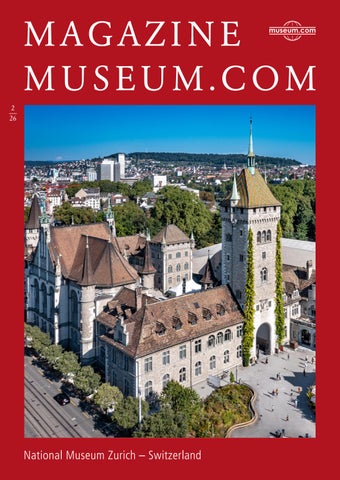
National Museum Zurich – Switzerland
Table of contents – Museums
Sigmaringen Castle Sigmaringen, Germany
2
National Museum Zurich Zurich, Switzerland
Hohenzollern Castle Hohenzollern, Germany
Table of contents
Image Access | ART SCANNER Wuppertal, Germany
MAGAZINE MUSEUM.COM
museum.com Sinserstrasse 67 6330 Cham SWITZERLAND magazine@museum.com Tel. +41 41 5102688
About the global museum project
MAGAZINE MUSEUM.COM
museum.com presents a global museum database in which museums can enter their content directly via a personal login. Membership is free of charge. In addition, museum.com offers the independent creation and operation of audio guides, which are created with the help of artificial intelligence. The portal is accompanied by the MAGAZINE MUSEUM.COM, which covers current topics from the museum world.
Media Data 2026 – For publication inquiries or media data, please contact us by e-mail - we will be happy to send you all the information you need. Publication in the current issue No. 3 is possible at any time, as there is no fixed editorial deadline.
Download Media Data, click here
3
Sigmaringen Castle
4
High above Sigmaringen, Hohenzollernschloss Sigmaringen (Sigmaringen Castle) appears as a dynasty embodied in stone. Yet behind its towers and gables, a far more complex legacy unfolds: state rooms and private apartments, European marriage politics and the technology of courtly life, precious tapestries and hidden service routes together tell a story of power, everyday life and historical change. Perched on its rock, the castle seems to offer a counterpoint, accumulated over centuries, to straightforward chronology. Towers, steep roofs and richly articulated façades combine to form an imposing silhouette, yet they by no means date from a single building campaign. Medieval fabric, extensions that transformed the castle into a princely residence, and historicist interventions around 1900 are closely superimposed. The exterior thus already announces the central theme of the building: at Sigmaringen, history was not simply preserved, but repeatedly reinterpreted and given architectural expression. First mentioned in 1061, the Hohenzollerns divided into Franconian and Swabian branches in the early 13th century. The Brandenburg Hohenzollerns descended from the Franconian branch; in the 16th century, the Swabian branch held some of the highest offices in the Holy Roman Empire. In 1535, King Ferdinand I invested Charles I of Hohenzollern with the counties of Sigmaringen and Veringen. By then, the medieval fortress had already been transformed into a prestigious residence, which the Hohenzollerns gradually extended. A decisive moment came with the fire of 1893, which almost completely destroyed the east wing. During reconstruction, the architects involved, foremost among them Emanuel von Seidl, drew on Gothic and Renaissance forms. This was a programmatic choice: they evoked the periods in which the Swabian Hohenzollerns had reached the height of their power. Rather than appearing modern at any cost, the new building was intended to connect the present with a glorious dynastic past.
Sigmaringen Castle, on its rocky outcrop above the Danube Photo: © Sigmaringen Castle
5
A thunderous welcome Visitors entering the Kanonenhalle (Cannon Hall) encounter a particularly concentrated expression of this dynastic self-image. Two field guns, presented to the House of Hohenzollern by Emperor Napoleon III in 1860, probably gave the room its name. Suits of 16th-century armour, weapons above the door and the flag of the association of former Hohenzollern fusiliers complete the military ensemble. The welcome strikes an unmistakable historical note: martial strength, political standing and the memory of former power shape the first impression. Yet the message extends beyond the military. The elaborate entrance to the chapel and paintings of Hohenzollern prince-bishops point to the family’s Catholic tradition.
Secular authority and confessional identity are thus brought into close proximity. This conjunction, in particular, makes the Cannon Hall more than a decorative entrance. In this very first room, it establishes the central coordinates of the family’s history. The hall was rebuilt after the fire, and its furnishings survive. One older object retains a distinct historical presence: the sandstone fireplace, made in the 17th century and acquired in 1862, which survived the fire of 1893 almost unscathed. Its mantel depicts an Old Testament scene. A historicist reconstruction, an early modern fireplace and 19th-century memorabilia thus meet within a single room. From a museum perspective, it is precisely this coexistence of different historical layers that matters.
An ascent governed by rank From the Cannon Hall, the grand staircase leads up to the principal floor. Its shallow steps allow a measured ascent – a movement that formed part of court ceremonial. Particularly in the Baroque period, the staircase was not a neutral circulation space but a stage on which social distinctions were enacted. The higher a guest’s rank, the further the host descended to greet them; on departure, the same hierarchy determined how far he accompanied them towards the door. The decoration, too, had to fulfil this function. It offered arriving guests a carefully composed first glimpse into the world of the household. Today, a marble bust of Prince Leopold stands here, while a wall niche contains a bust of Prince Karl Anton. The latter left a lasting mark on the castle as a patron and collector, acquiring many important works for its collections. A painting of St Fidelis from the school of Tiepolo continues the confessional theme of the entrance hall. Born Markus Roy in Sigmaringen, Fidelis worked in the cause of the Counter-Reformation and was killed by Calvinists in Graubünden in 1622. As the patron saint of his birthplace, he links local identity with the history of religious conflict. Paintings of the Hohenzollern prince-bishops of Warmia reinforce the ideal of a close bond between throne and Church. A blue maiolica vase, small equestrian figures of Frederick the Great and Prince Leopold, and a large tapestry further lend the staircase its courtly character. Measuring more than eight square metres, the tapestry was woven in 1694 after a design by the Flemish painter David Teniers the Younger. The staircase thus unites ceremonial and collecting: not only the grand rooms, but the route leading to them was conceived as a prestigious setting for art.
Left page: - Cannon Hall with field guns - Staircase to the principal floor - Princely bathroom with bath and fittings - Princesses’ dressing roomn Right page: Princesses’ Corner Salon Photos: © Sigmaringen Castle
6
The luxury of modernity Behind the historic splendour, another story begins – one of technology, hygiene and organisation. In the corridor leading to the private rooms is an indicator panel for the bell system installed around 1905. It allowed members of the family to summon servants and indicate in which room they were needed. This unassuming box is a key object in understanding the infrastructure of courtly life: it speaks of comfort, but also of the division of labour and the hierarchy of a large household. The princely bathroom documents the transition from portable washing equipment to a permanently fitted room. Even shortly before the turn of the 20th century, baths, washstands, bidets and bathwater heaters were moved between rooms as required. Only connections to piped water and sewerage made possible the fixed installations more familiar to us today. The Sigmaringen Hohenzollerns were early adopters of electricity and „water closets“, probably among the first permanently installed toilets of their time. Particularly striking is the deliberate departure from the decorative exuberance of the state rooms. The bathroom follows clean, functional lines and was intended
to convey an almost clinical, technological coolness. Progress could, and indeed should, be visible. A heated towel rail completes the fittings. Here, the private sphere emerges not as a retreat from modernity but as one of its testing grounds.
hips of 97. Today, it wears a modern dress made to a historical pattern. As a museum object, it conveys not only fashion but also the disciplining of the body for social appearances. Rococo and world politics
The story of bodily routines continues in the dressing room. In the 19th century, the prince and princess occupied separate apartments, as was customary in aristocratic families. The suite named after Princess Josephine includes bedrooms with simple furnishings and an airy feel. The bed is made of iron and brass rather than wood – materials that reflected a growing awareness of hygiene and were easier to clean. The dressing room was equipped with a fixed washstand incorporating a pull-out bidet, pewter basin and shower. Yet the room served more than personal hygiene. Here, the princess was prepared for her public role. Less formal or full evening dress, hairstyle and corset all followed the conventions of courtly display; lacing the corset alone could take up to an hour. A historic dressmaker’s mannequin from the Belle Époque, probably once owned by Princess Antonia, makes the contemporary ideal of beauty almost literally measurable: a bust of 90 centimetres, a waist of 60 and
The Ecksalon der Fürstinnen (Princesses’ Corner Salon) translates this conception of women’s roles into a distinctive interior aesthetic. It was intended to be elegant, delicate and comfortable. Around 1900, Rococo offered an appropriate stylistic model. A silver-plated suite of furniture defines the interior; the candlesticks, chandelier and vase came from the Meissen Porcelain Manufactory, whose products were coveted status symbols among aristocratic families. At Sigmaringen, however, the French connection is far more than a matter of style. Amalie Zephyrine of the House of Salm-Kyrburg found life at the Upper Swabian court restrictive. Shortly after the birth of the heir, Karl, she left Sigmaringen in 1785 and joined her brother in Paris. There, she became friends with Joséphine de Beauharnais, Napoleon’s future wife. Hohenzollern’s survival as a sovereign state owed much to Amalie Zephyrine’s connections. She returned in 1808 but lived separately from her husband.
7
In the 20th century, the relationship with France took a darker turn. From September 1944 to April 1945, the castle was placed at the disposal of the Vichy government, which collaborated with Hitler. SS units sealed off the castle hill and the town. The princely family had to leave Sigmaringen immediately and move to Schloss Wilflingen (Wilflingen Castle); Marshal Pétain and his government occupied the princely apartments and the floor above. The bright ladies’ salon thus carries a historical tension diametrically opposed to its elegant appearance. The very room that embodies courtly privacy and French-influenced taste became, in the final year of the war, the setting for an imposed political occupation. The interior is not merely a backdrop but a material witness to conflicting histories.
8
Europe’s family album In the Blauer Salon (Blue Salon), dynastic politics can be read through a sequence of portraits. The room served as a writing room and, on festive occasions, as a reception and drawing room. A large painting of Princess Josephine of Baden is flanked by smaller portraits of her four elder children. The family grouping seems intimate, yet the lives of those depicted extend far beyond Sigmaringen. Karl became King of Romania, Stephanie Queen of Portugal, while Leopold, the eldest son, became Hereditary Prince of Hohenzollern. Anton was wounded at the Battle of Königgrätz in 1866 and died a few weeks later. A portrait of Prince Karl Anton completes the group. His children’s marriages into prominent European dynasties created family ties that endure to this day. Josephine’s mother, Stéphanie de Beauharnais, also belongs to this network. Orphaned as a child, she was adopted by Napoleon and married the Hereditary Prince of Baden in 1806.
The Blue Salon is therefore less a family album in the private sense than a painted political topography. Kinship emerges as a means of forging European connections. In the Grüner Salon (Green Salon), mahogany Empire furniture with brass mounts sustains the air of formal splendour. Latin phrases in the stucco reliefs praise the value of home and offer moral counsel. The inscriptions above the doors even refer to the different spheres of the apartments: on the side leading to Josephine’s living quarters, they celebrate the pleasures of home, while the verses towards the Schwarzer Salon (Black Salon) adopt a masculine register. The portraits continue the family’s European history. Stephanie married King Pedro V of Portugal but died just a year after their wedding; her husband followed her two years later. Leopold married Pedro’s sister Antonia. In 1869, he was offered the Spanish crown. He declined, but further French demands and Bismarck’s abridged account in the Ems Dispatch culminated in the Franco-Prussian War of 1870–71.
Prince Karl of Hohenzollern was elected Prince of Romania in 1866 and proclaimed king as Carol I in 1881. All subsequent Romanian kings belonged to the House of Hohenzollern. Other portraits commemorate Marie, the great-great-grandmother of the present King Philippe of Belgium; Anton, who died young; and Friedrich, who pursued a long career in the Prussian military. The walls of the Green Salon reveal how closely individual lives, marriage politics and the history of European conflict were intertwined.
Left page, top: Blue Salon with portrait grouping Bottom: Detail of the Blue Salon Right page, left: Princess Stephanie, Green Salon Rechts: Green Salonn Photos: © Sigmaringen Castle
9
Dining on a grand scale The Französischer Salon (French Salon) lies in the older part of the castle and was designed in 1872 by the Parisian architect Marc Lambert. In the spirit of historicism, he drew on the Louis XVI style of the late 18th century. Courtly dining thus received a deliberately French setting, one that does not conceal the room’s date of creation but makes historical quotation itself a design principle. The porcelain presented in the display cabinets was not intended for use. These precious pieces, predominantly from the Königliche Porzellan-Manufaktur Berlin (Royal Porcelain Manufactory Berlin), were made for display. The table, by contrast, could be extended to accommodate thirty chairs, many bearing the Hohenzollern coat of arms and family motto. Service connections lie beneath two removable sections of parquet flooring. The kitchen is directly below the dining room. A lift carried dishes to adjoining rooms, where they received their finishing touches before being served. The table’s glittering surface and the technical logistics behind it are thus inseparable. The connections hidden in the floor are a particularly telling reminder that ceremonial display was always an organisational achievement too.
French Salon with table set for a banquet Photos: © Sigmaringen Castle
10
11
An ancestral gallery In the passage to the Ahnensaal (Ancestral Hall), the international network of relationships is condensed into miniature form. Portrait miniatures depict members and relatives of the family as well as rulers of other states, among them Frederick the Great, Napoleon I, Prince Karl and Princess Amalie Zephyrine. Beyond them, the scale changes dramatically. Built in 1736 and converted into the Ancestral Hall in 1878, the room presents 26 larger-than-life oil paintings of Hohenzollern
12
counts and princes. The portraits form a monumental genealogy, placing each individual within a long dynastic succession. Prince Karl Anton stands out among those depicted. In the wake of the revolutionary unrest of 1848–49, he became the first German prince to relinquish his rule, ceding the principality to Prussia on 7 December 1849. The Hohenzollern principalities became a Prussian administrative district. Karl Anton moved to Berlin, entered Prussian service and later served as Minister President – one of Bismarck’s predecessors. Beside him appear Prince Leopold, who
had been offered the Spanish crown, and Prince Wilhelm in a grey general’s uniform. Above the doors are depictions of places associated with the Hohenzollerns, including Sigmaringen, Hechingen, Haigerloch, s’Heerenberg, Hohenzollern Castle and Nuremberg Castle. The richly ornamented ceiling elevates this genealogical statement into allegory. The stucco artist Emil Roddo created garlands, scrollwork and rosettes; the paintings are by Friedrich Madaus and Ludwig Lesker. Uranus and Mars, Abundantia and Concordia preside over the central image. Oval
panels depict Wisdom, Justice, Fortitude and Constancy. The room presents the dynasty not through descent alone, but through a programmatic vocabulary of virtue and order. The Old German Hall The Altdeutscher Saal (Old German Hall), by contrast, feels more intimate. Its name is misleading, for the room is devoted not to a distant past but to the family in the 20th and 21st centuries. Italian marquetry furniture once owned by Princess Maria Theresia stands alongside 19th-century
office furniture, photographs and personal mementoes. A harpsichord from Schloss Umkirch (Umkirch Castle), which belonged to Princess Margarete, represents the family’s musical talents. A model aeroplane, writing implements and a Sèvres porcelain tea service came from Prince Friedrich Wilhelm’s possessions. A figurine depicts Princess Margarete as a fashion-conscious young woman, her clothing based on a photograph of 1924. Particularly evocative is the set of children’s seating from the family residence at Josefslust.
On their birthdays, the children were carried through the house in one of the small armchairs and then sat in it to receive the family’s congratulations. The furniture thus preserves not only design and material but a specific ritual. Here, private memory holds its own alongside official portraits.
Top, both photos: Ancestral Hall Bottom: Old German Hall with family photographs Photos: © Sigmaringen Castle
13
14
Portugal in silk The Portugiesische Galerie (Portuguese Gallery) now extends across the site of a castle terrace that existed before the fire of 1893. Emanuel von Seidl completed it in 1902. It was named in honour of Princess Antonia, Infanta of Portugal, sister of King Pedro V and wife of Prince Leopold. The gallery still provides a setting for gala dinners and concerts. At the far end, a Neptune fountain with mosaics of blue pebbles, shells and quartz draws the eye. Prince Leopold ordered two mermaid fountains after seeing them at the Paris World’s Fair; statues along the window side evoke ancient Rome. The hall’s splendour thus unfolds through a carefully composed combination of aquatic iconography, classical references and dynastic commemoration. Its greatest treasures, however, are the large tapestries. Measuring up to 3.25 metres in height, they were woven around 1500 after designs by Pieter van Aelst. They depict scenes from the story of David and Bathsheba in an altered sequence: Bathsheba bathing, David’s repentance, Bathsheba and Nathan, Solomon’s entry into Gihon, David and Uriah, and the receipt of news of a victory. Their scale and stylistic refinement make them particularly valuable works. Cleaning them in Brussels and Munich took six years. The gallery’s significance as a museum space lies in the interplay between textiles and architecture. The tapestries are not simply individual works hung on walls; their monumental sequences of figures determine the proportions, rhythm and colour of the entire room. The hall becomes a pictorial environment through which visitors can walk.
hunting grounds at Hettingen, in 1831. Fallow deer came from Josefslust and a heron from the Danube valley. Alongside them are brown bears from the Carpathians, chamois horns and a golden eagle from Tyrol, an elk’s head from Sweden, and stag antlers from Romania, Pomerania and the March of Brandenburg. The castle library complements these objects with specialist hunting literature and diaries. Even language forms part of the legacy: from a vocabulary that originally comprised around 13,000 expressions, some
3,000 terms survive, defining approximately 40,000 concepts. „Lichter“, „Äser“ and „Lauscher“ denote the eyes, mouth and ears of game animals. Trophies, texts and terminology together constitute a cultural system. The courtly splendour of the state rooms depended on the labour of the castle kitchen. Storerooms and cold stores, rooms for crockery, silver and linen, and the kitchen itself formed an elaborate provisioning
infrastructure. The kitchen occupies the former Knights’ Hall. As early as 1834, a lift connected it to the dining room above. At its centre stands a wood-fired cooking range of 1875, which could be worked from all sides. Smoke was initially drawn vertically down into the floor, then channelled underground behind a warming cupboard to the chimney. The cupboard kept plates and dishes warm. Waffle irons, coffee makers, ladles, baking moulds and pots from the last two decades of the 19th century illustrate the variety of tasks performed here. For a long time, cooking at court remained a male preserve because the heavy pots and pans required considerable physical strength. Only lighter aluminium cookware changed this situation. Culinary reputation, too, formed part of court culture: in the 19th century, Sigmaringen’s kitchen was known for its cheese cakes, onion tarts and gingerbread. At the wedding of Ferdinand of Hohenzollern, heir to King Carol I of Romania, and Marie of Edinburgh, an exquisite menu was served to a company that included several crowned heads.
Left page: Neptune fountain Right page, top: Portuguese Gallery with tapestries Left: Trophy wall in St Hubert’s Hall R.: Castle kitchen with cooking range dating from 1875 Photos: © Sigmaringen Castle
The splendour of the hunt and the heat of the kitchen The Hubertushalle (St Hubert’s Hall) introduces another sphere of aristocratic life. Hunting was not merely an occupation befitting noble status; it also influenced painting, music and architecture. At Sigmaringen, it assumed particular importance under Friedrich, Prince of Hohenzollern. His court hunts brought together kings, counts and dukes. Hundreds of trophies reveal the geographical reach of this hunting culture. On display is the last wolf killed in the Hohenzollern
15
Nights in the casemate A cellar full of clutter and old beds might initially seem an unlikely setting for courtly sociability. Yet in 1860–61, Karl von Mayenfisch, chamberlain and director of the princely collections, had this area remodelled without Prince Karl Anton’s knowledge. A rib vault and a balcony were added; the storeroom became a drinking room with a billiard table. Its fittings are a prime example of historicist appropriation. For the fireplace, von Mayenfisch used the upper structure of a fountain made in 1569 for Wasserschloss Glatt (Glatt Moated Castle) in Sulz am Neckar. Choir stalls from the former Cistercian convent at Wald served as benches. Relocated historic elements were assembled into a new, highly atmospheric space. Initially known simply as the „Billiard Room“, the retreat was later named the Donau-Kasematte (Danube Casemate). Male guests in particular appreciated it as a
16
place to smoke and drink after the hunt. At the golden wedding celebrations of Prince Karl Anton and Princess Josephine in 1884, specially brewed beer was served here. The guests included the Prussian Crown Prince, the kings of Saxony and Romania, the Grand Duke of Baden, and princes and counts from numerous European houses. Here, the courtly elite met not amid the gilded splendour of the state room but beneath a newly created medieval-style vault. A finale in iron In the inner courtyard, the castle’s long building history is openly visible. Rusticated blocks with dressed margins mark the remains of the 12th-century fortress; behind them lie the foundations of the former keep. The former Knights’ Hall, once part of the principal residential range, is now used as the kitchen. The transformation from fortress to palace began around 1500, while the present appearance owes much to Emanuel von Seidl’s historicist remodelling
around 1900. On the Viereckturm (Square Tower), von Seidl replaced the earlier upper structure with a Gothic Revival octagon
of Werdenberg. A figure of St Michael stands between the tall windows, with the Hohenzollern coat of arms below. This full achievement of arms brings together former offices, lordships and possessions. At its centre is the Zollern shield, quartered silver and black. Surrounding it are the emblems of the hereditary office of chamberlain, the counties of Sigmaringen, Berg and Veringen, the lordships of Haigerloch and Wehrstein, and the Burgraviate of Nuremberg. The motto introduced in the 19th century, „Nihil sine Deo“ (Nothing without God), puts the dynasty’s sense of its place in the world into words.
Left: Casemate with fireplace and choir stalls
capped by a pointed spire. The Böhmischer Turm (Bohemian Tower) takes its name from a portal brought from an unidentified castle
in Bohemia. On the Schwedischer Turm (Swedish Tower), a lintel dated 1498 recalls an extension undertaken by the Counts
Right: Inner courtyard Bottom: Exterior view with the Danube Photos: © Sigmaringen Castle
17
The Armoury The visit concludes in the Waffenhalle (Armoury), home to one of Europe’s most extensive private collections of arms and armour. An inventory of 1743 lists 43 weapons; by 1801, there were already 293. Prince Karl Anton expanded the collection to almost 3,000 objects. When the display
18
room established in 1846 became too small, he had a timber storage shed converted into the Armoury. Gothic Revival rib vaulting and wood panelling were intended to evoke a medieval armoury. Since the 2017 redisplay, 17 thematic sections have traced the history of weaponry from the 14th to the 20th century. Knights’
armour and ceremonial suits of armour, swords and crossbows, pikes and sabres, cannon and rifles appear alongside flags, musical instruments and riding boots. Small cannon models served as patterns for manufacturing full-sized artillery. A decorated morion, an open-faced helmet without a visor, formed part of the equipment of the Hohenzollern Guard.
Among the oldest objects is a hooked gun dating from around 1450. It required two men to operate and was used to defend Sigmaringen Castle. The two-handed sword, weighing up to five kilograms, likewise demanded considerable physical strength. Finally, a suit of armour for a boy aged ten to twelve shows how early the rehearsal of aristocratic roles and military display could begin.
In the Armoury, the story comes full circle, returning to the castle’s exterior silhouette. What appears from a distance as a powerful, almost unified image resolves inside into numerous historical layers. Remains of medieval walls stand alongside historicist interiors, court portraits alongside technical installations, precious porcelain alongside kitchen utensils. This is precisely what gives
Sigmaringen its interpretative power as a museum: architecture and collection do not simply illustrate history; they reveal how a dynasty ordered, furnished, inhabited and repeatedly restaged its past.
Armoury with suits of armour and ceremonial armour Photos: © Sigmaringen Castle
19
Sigmaringen Castle has served as a residence for the princely family since the 16th century. For Karl Friedrich, Prince of Hohenzollern, and Katharina, Princess of Hohenzollern, it is therefore far more than an important heritage site: its rooms, works of art and collections intertwine family history with personal memories. At the same time, the castle embodies the House of Hohenzollern’s bond, nurtured over generations, with Sigmaringen, the surrounding region and the people who live here. A visit reveals this history in all its diversity. The sequence of rooms leads through magnificent salons and halls, the Portuguese Gallery with its precious tapestries, and the princely private apartments. The historic castle kitchen, bathroom, bell system and kitchen lift also tell of everyday life and the technical organisation behind the grand façade. In the Armoury, one of Europe’s most extensive private collections of arms and armour traces developments from the 14th to the 20th century. At Sigmaringen, fortress and palace, courtly splendour and personal memory, European history and locally rooted
20
His Highness Karl Friedrich, Prince of Hohenzollern Her Highness Katharina, Princess of Hohenzollern © Sigmaringen Castle
tradition thus come together. The prince and princess welcome everyone wishing to get to know this multifaceted place and explore its historical traces with an attentive eye.
Hohenzollernschloss Sigmaringen Karl-Anton-Platz 8, 72488 Sigmaringen Tel. +49 (0)7571/729-230 besichtigung@hohenzollern.com www.hohenzollern-schloss.de
Discover exhibits. Hear their stories. Audio guides for your exhibits – created and delivered through museum.com
affordably. Every audio guide package includes five guides for you to populate with your own content. Your benefits at a glance
Create your own audio guides A good audio guide accompanies visitors throughout their visit – informative, engaging and there exactly when they need it. Create and manage your own audio guides through the content management interface on museum.com. Integrated AI tools can help you create and edit audio scripts and produce translations whenever you need support – from the first draft to the finished language version. Upload your own audio recordings or turn your texts into narration with ultra-realistic AI voices. You can combine several speakers within a single audio stop. Emotional delivery cues also let you specify how individual passages should be spoken. You can also create dedicated audio guides for temporary exhibitions flexibly and
l AI-assisted audio scriptwriting l AI translations for international visitors l Ultra-realistic AI voices for narration l Combine several speakers per
audio stop l Emotional delivery cues
for engaging narration l Upload your own audio files l Up to 40 language versions l Virtually unlimited audio stops l Five customisable audio guides per
package – ideal for temporary exhibitions l Manage audio guides and content inde-
pendently through the content management interface
www.museum.com the global museum project Sinserstrasse 67 6330 Cham, Switzerland Uwe Strauch project@museum.com Tel. +41 41 5102688
21
National Museum Zurich – Switzerland
22
Looking from Zurich’s main railway station towards Platzspitz Park, you might mistake the National Museum Zurich, with its towers and courtyards, for an old castle. In fact, the architect Gustav Gull designed it specifically as a museum, drawing on styles from different periods of Swiss architectural history. The building itself thus offers a glimpse of what awaits visitors inside. The first Swiss National Exhibition, held in Zurich in 1883, helped inspire the museum’s founding. The historical objects on display sparked a desire to bring artefacts from Switzerland’s cultural past together in a permanent collection open to the public. In 1890, the Federal Assembly voted to establish a national museum, and the following year Zurich was chosen as its home. The museum opened its doors on 25 June 1898. Today, the National Museum Zurich is part of the Swiss National Museum, a federal institution governed by public law. It also includes the Château de Prangins, the Forum of Swiss History Schwyz and the Collection Centre in Affoltern am Albis, where objects are stored, studied and restored. In this article, we explore three permanent exhibitions at the National Museum Zurich: ‘History of Switzerland’, ‘Archaeology in Switzerland’ and ‘The Collection’.
23
then explore the threat of war, economic change and social movements in the 20th century. The exhibition concludes by considering the decisions facing Switzerland in the 21st century. 15th Century – Alliances and Military Campaigns
Permanent Exhibition "History of Switzerland" How does a web of alliances become a federal state? What holds a society together when its political, religious and economic interests repeatedly pull in different directions? The permanent exhibition «History of Switzerland» at the National Museum Zurich explores these questions from the 15th century to the present. Its chronological route connects the emergence of the Swiss Confederacy with the social changes and challenges of the centuries that followed. Historical developments shape the exhibition’s structure: early alliances and joint military campaigns give way to the Reformation, the mercenary trade and the Enlightenment. The 19th century brings the foundation of the federal state and the rise of industry. Two thematic galleries
24
The exhibition opens with a web of agreements between rural cantons, towns and aristocratic rulers. These alliances secure transport routes and guarantee military support. Yet they require continual renewal. Joint conquests forge further ties: the members of the Confederacy acquire territories that they subsequently administer together. A flag preserved as a trophy of the Swabian War illustrates the military dimension of these developments. An installation of pikes and halberds stands at the centre of the gallery. Together with a multimedia station exploring the Confederacy’s founding narrative, it connects the account of military campaigns with questions about Switzerland’s sense of itself. The founding narrative extends beyond the early Confederacy. Retold throughout the centuries that follow, it plays a crucial role
in shaping a Swiss identity. The opening section therefore examines not only alliances and military ventures, but also the enduring influence of shared narratives. 16th Century – Reformation and the Federal Diet The next gallery explains how the early Confederacy functions while its structures are still taking shape. Delegates from the 13 cantons meet regularly at the Federal Diet. They negotiate with one another and coordinate their foreign policy. Thirteen historic stained-glass panels bearing cantonal coats of arms, painted by Josias Murer, represent the sovereign cantons of the Old Swiss Confederacy. Foreign policy increasingly turns towards France. A facsimile of the Treaty of Fribourg of 1516 bears witness to this shift. The Confederates conclude this treaty with the French king after their defeat at Marignano in 1515. At home, the Reformation and the confessional divide severely test cohesion. Religious disputes also touch on economic interests. Reformers such as Ulrich Zwingli oppose the business of supplying mercenaries for
foreign service. In Catholic Switzerland, by contrast, mercenary commanders continue to expand their recruitment operations. A shared foreign policy thus coexists with divergent positions on mercenary service. 17th Century – The Bourgeoisie and the Mercenary Trade The Confederacy remains largely untouched by the Thirty Years’ War. Swiss mercenaries, however, are still in demand and repeatedly fight on opposing sides far from home. Military entrepreneurs supply fully equipped regiments, running flourishing businesses in the process. These interests also shape relations with France. To safeguard its mercenary contracts, the Confederacy renews its alliance with King Louis XIV in 1663. The «Allianzteppich» (Alliance Tapestry) records the scene. Measuring almost 25 square metres, it commands a correspondingly prominent place in the exhibition.
seek ways to increase agricultural yields. The world of work also changes. Innovative entrepreneurs commission spinning and weaving from home-based workers. This marks the beginnings of industrialisation, with production still taking place in domestic settings. An old handloom exemplifies this way of working, adding an economic dimension to the century’s intellectual and social history. 19th Century – The Federal State and Industrialisation In the 1830s, liberals gain power in several cantons. They grant rural inhabitants equal rights with urban citizens. These political developments lead, in 1848, from a confederation of states to a federal state. The new political order transforms the country’s economic and organisational foundations. Internal customs duties are abolished and a single currency is introduced. The federal government gains greater authority
over the army and the postal service, whose organisation is standardised nationwide. The Federal Palace is built in Bern. A scale model in the exhibition recalls its construction. A generator manufactured by Brown, Boveri & Cie. embodies the rise of industry. Alongside railway construction, exports from the textile and engineering industries grow. The exhibition thus connects political reorganisation with the century’s economic changes. Prosperity does not, however, eliminate poverty. It remains widespread, prompting many Swiss people to emigrate to North and South America. In this section of the exhibition, industrial success and economic hardship are equally integral to the country’s history.
Left side: Exhibition view. Right: Flag captured during the Swabian War, c. 1490. Painted silk taffeta. Photos: © Swiss National Museum
Mercenary service also strains relations between Protestant and Catholic cantons. Both confessions defend their faith while seeking to assert their distinct identities and influence. Meanwhile, a self-assured bourgeoisie emerges in the towns. In Protestant cantons, it expresses its social standing through discreet displays of luxury. The exhibition presents Hans Konrad Werdmüller’s exquisite suit of armour as an example. 18th Century – Enlightenment and Sensibility In the 18th century, scholars spread Enlightenment ideas across Europe. One gallery turns to Geneva, where philosophers such as Voltaire and Rousseau debate universal values and advocate reason in politics. In salons, men and women engage in spirited discussions of social and political reform. Personal relationships change alongside political and philosophical ideas. Marriage for love and parental affection gain in importance. This greater emphasis on feeling across different areas of life first takes hold among the bourgeoisie. Nature, too, becomes the subject of new investigations and ideas. Researchers survey the Swiss mountains and idealise the Alpine landscape. At the same time, they
25
Left side: Depiction of the seal of the Federal Pact, print, after 1816, Zurich. Aquatint on paper Right: Federal Constitution of 1848, Laurenz Lüthi, Solothurn. Gouache on paper with calligraphy
26
Next double page: Les Suisses illustres (Illustrious Swiss Figures), painting, c. 1829, Jean-Elie Dautun, Lausanne. Oil on canvas Photos: © Swiss National Museum
27
28
29
20th Century – World Wars and Economic Boom The account of the 20th century spans two thematic galleries. The first examines the persistent threat of war. Military preparations during the two world wars and the arms build-up during the Cold War define this part of the exhibition. During the Second World War, plans for the army to retreat into the National Redoubt involve extensive fortification of the Alps. Switzerland thereby signals that occupying the country would come at a high price. A telescope gives visitors a spatial understanding of this chapter of military history, offering a three-dimensional view inside the fortifications on the Gotthard Pass. The second gallery explores the economic boom and the emergence of new social aspirations. Social issues and the introduction of old-age and survivors’ insurance (AHV) are the subjects of intense debate. From the 1950s onwards, economic growth creates jobs on construction sites and in the service sector. Major retailers such as Coop and Migros cater to a growing appetite for consumption. These developments require additional workers, whom the country recruits mainly from Italy. Economic growth, consumption and labour migration thus emerge as interconnected developments. From the 1960s onwards, social movements demand greater rights and freedoms. A banner depicting Helvetia with a raised
30
spear adds an image of the women’s movement to this thematic section. Helvetia mit Speer im Anschlag (Helvetia with Spear at the Ready), FBB banner, c. 1976, Helen Pinkus-Rymann and Margareta Peters, Zurich. Painted textile. Swiss Social Archives
Left side, left: Alternating-current generator, 1895, Brown, Boveri & Cie., Baden. Cast steel Middle: Flag of the Swiss Embassy in Berlin, before 1940. Viscose Buttom: 5.3 cm quick-firing gun with mobile armoured carriage, 1892, Grusonwerk, Magdeburg. Steel. Right side, top: Exhibition view Middle: Helvetia mit Speer im Anschlag (Helvetia with Spear at the Ready), FBB banner, c. 1976, Helen Pinkus-Rymann and Margareta Peters, Zurich. Painted textile Buttom: Model of the Parliament Building, scale 1:100, made by Zaborowsky Modellbau, Zurich. Acrylic glass and PVC, CNC-milled and spray-painted Photos: © Swiss National Museum
A selection of objects represents a range of social causes. A dress belonging to Elisabeth Kopp, the first woman to serve on the Federal Council, points to the achievements of women’s suffrage. Musician Toni Vescoli’s denim jacket represents the youth movement. A three-wheeled solar-powered vehicle from 1985 reflects the growing popularity of the environmental movement. These objects make social change tangible through individual lives and everyday things.
The focus is on the consequences of collective decisions. They open up opportunities, but also come at a cost. A change may improve circumstances for some while requiring others to make sacrifices. Greater freedom in one area may entail restrictions elsewhere. The exhibition leaves visitors to weigh these tensions for themselves. Having traced Switzerland’s emergence and development chronologically, it now invites them to consider their own position: how should we approach a dilemma in which different interests and needs cannot readily be reconciled? The history presented here ends not with a definitive answer, but with a decision to be made.
21st Century – The History of the Present The exhibition concludes by considering a globalised Switzerland whose direct democracy faces the challenges of rapid change. Five central themes are up for debate: robotics, climate change and migration, alongside questions of sovereignty and life expectancy.
31
32
Der Neubau von Christ & Gantenbein ergänzt den historistischen Altbau des Landesmuseums Zürich und ermöglicht einen durchgehenden Museumsrundgang. Hier widmet sich die Dauerausstellung «Archäologie Schweiz» auf 500 Quadratmetern den frühen Lebenswelten auf dem Gebiet der heutigen Schweiz.
Photo: © Swiss National Museum
33
Archaeology Switzerland: People, Landscape and Environment The permanent exhibition «Archaeology Switzerland» at the National Museum Zurich explores human history in what is now Switzerland, from 100,000 BC to the spread of Christianity around AD 800. Three sections connect archaeological sites, cultural developments and the interactions between people and their environment. Around 1,400 objects form the exhibition’s core, drawn predominantly from the collections of the Swiss National Museum and complemented by loans from across Switzerland. Recent discoveries feature alongside well-known finds from Swiss archaeology. Designed by Atelier Brückner, the exhibition occupies 500 square metres in the extension by Christ & Gantenbein. Its thematic arc leads from the archaeological landscape in «Terra», through a chronological exploration of human life in «Homo», to questions of environmental history in «Natura».
34
Terra Mountains, valleys, passes, glaciers, lakes and rivers shape Switzerland’s landscape – and the conditions for human settlement. Fertile valley floors close to lakes and rivers were settled early, as were Alpine locations along favourable transport routes. Material traces of past eras survive in the soil, on lake beds and in glacial ice. «Terra» connects these remains with the places where they were found. A topographical model reveals the diversity of the archaeological landscape. Finds range from a small willow basket from a pile-dwelling settlement on Lake Zurich, dated to 1100–800 BC, to a stone tool made of rock crystal from around 6500 BC. The latter was discovered in the canton of Uri at 1,494 metres above sea level. These examples reveal the variety of landscapes in which traces of human life have survived.
Photo: ATELIER BRÜCKNER, © Daniel Stauch
35
36
Homo At the heart of the exhibition is the changing nature of human life from the Palaeolithic to the early Middle Ages. Six chronologically arranged displays, each devoted to a particular period, show how the forms, materials and uses of objects evolve. Flint knives and stone axes, basketry, ceramic vessels and bronze pendants illuminate life in earlier millennia. These surviving objects were lost, buried or placed with the dead as grave goods. The exhibits include one of Europe’s oldest cartwheels, dating from around 3200 BC. A movable scanner provides detailed information about individual objects and digitally reconstructs the wheel’s complete form. A Roman gravestone from AD 180 bears the first recorded mention of the name Zurich. Seven outstanding objects from the collection add depth to the chronological journey. Among them is a decorated perforated baton made of reindeer antler, dating from 13,000 BC and bearing Switzerland’s oldest figurative representations. A gold bowl from around 1100 BC is decorated with punched motifs of celestial bodies and animals. The Erstfeld Treasure, dated to around 390 BC, comprises gold neck rings and arm rings. Filmed scenes place the objects in the context of their former owners and their discovery, adding human stories to the encounter with the artefacts. An audio piece by the Swiss philosopher Stefan Zweifel establishes a connection with the present: «Ich in der Silikonzeit» (I in the Silicone Age) invites visitors to reflect on their own relationship with time and the past.
Photo: © Swiss National Museum
37
38
Natura When did people begin growing cereals and milking cows? Where do our apples come from? How did the wolf become a domestic animal? «Natura» examines how people transform their environment while also being shaped by it. With the transition to settled life and the domestication of plants and animals, nature gradually becomes the familiar cultural landscape. Seven interactive thematic stations explore plant, animal and mineral finds. They offer insights into archaeological research ques-
tions and show how modern methods of analysis help trace the relationships between people and their environment. The horn of a wild aurochs, for example, is paired with a depiction of oxen ploughing the first fields. «Natura» thus complements the history of tools, vessels and jewellery with an exploration of the natural foundations of human life. The exhibition presents cultural change not in isolation, but in relation to landscape, diet and the use of plants and animals.
Photos: ATELIER BRÜCKNER, © Daniel Stauch
39
The Collection In the historic west wing of the National Museum Zurich, the architecture and the objects on display come together in an evocative journey through time. Spanning two floors and some 2,000 square metres, the permanent exhibition «The Collection» brings together more than 7,000 objects from the holdings of the Swiss National Museum. It invites visitors to experience a millennium of fine craftsmanship and to discover the historic rooms themselves. To enter the west wing of the National Museum Zurich is to step straight into another age. The architect Gustav Gull designed the castle-like museum in 1898 in the Historicist style. Its oldest wing has been painstakingly restored to its original appearance. «The rooms themselves are the exhibit», says chief curator Luca Tori, summing up the thinking behind the exhibition. The architecture of this listed building provides an ideal setting for more than 7,000 objects, from treasures of the decorative arts to everyday items, spanning some 1,000 years of Swiss history. A wealth of stories across two floors The route through the exhibition invites visitors to discover the country’s cultural diversity. The displays encompass every region of Switzerland and trace a path from the High Middle Ages to the present day, from an eleventh-century processional Palm Sunday donkey to contemporary fashion, including an elegant Valentino suit from 2014. Sumptuous examples of the goldsmith’s art sit alongside precious textiles, delicate stained glass, timepieces and furniture, each casting new light on the others. Many displays occupy the centre of the rooms, leaving the historic walls in full view. Interpretation in four languages and digital tablets offer opportunities to explore in greater depth. Photo: ATELIER BRÜCKNER, © Daniel Stauch
40
Palm Sunday donkey
The historic rooms:
The Palm Sunday donkey (eleventh century): This striking sculpture is among the oldest surviving examples of medieval woodcarving in Switzerland. Once drawn through the streets in Palm Sunday processions, it still conveys the depth of popular devotion and the expressive power of High Medieval art.
At the heart of the exhibition, these interiors reveal how the Swiss furnished their homes from the fifteenth to the seventeenth century. They include the elaborately panelled parlours of affluent townspeople, so-called period rooms and original tower rooms.
41
The Alice and Louis Koch Collection More than a century ago, the Frankfurt jeweller Louis Koch (1862–1930) and his wife Alice (1866–1937) began collecting rings dating from antiquity to around 1900, including pieces from the Middle Ages, the Renaissance and the Baroque period. Their descendants shared their passion and extended the collection to include jewellery of the twentieth and twenty-first centuries. Today it brings together exceptional work by jewellery artists from Europe, the Americas and Asia and ranks among the world’s most comprehensive collections of rings. At the National Museum, visitors can discover the entire collection for the first time in a display case designed for the purpose and itself shaped like a ring.
42
Photo: ATELIER BRÜCKNER, © Daniel Stauch
43
The Hallwil Collection A major gift to the National Museum Zurich, the Hallwil Collection offers a rare insight into the homes and daily lives of the Swiss nobility. Assembled over generations by the von Hallwyl family, it brings together precious works of art, furniture, paintings and a wide variety of everyday objects
44
from different periods. The display is like a museum within a museum: it brings the history of collecting and domestic life to life while giving visitors a sense of how the public first encountered the collection some 100 years ago.
The St Gallen Globe, 16th century Standing more than two metres tall, this monumental model of the earth and the heavens is one of the largest surviving Renaissance globes. It embodies the thirst for knowledge, the cartographic skill and the world view of an age of exploration.
Photos top, right: © Swiss National Museum Buttom: ATELIER BRÜCKNER, © Daniel Stauch
Oetenbach Room Dating from 1521, the historic Oetenbach Room offers a remarkable glimpse of both domestic and monastic life in Zurich. Its finely worked wall panelling comes from the city’s former Dominican convent of Oetenbach. In the late nineteenth century, the room was assembled from elements of the original convent interiors, with additions in a matching historical style made for the National Museum. In the present display, selected panels stand in the centre of the room. This arrangement reveals not only the craftsmanship of the historic woodwork but also the eventful history of this exceptional interior and its journey to the museum.
45
46
Historic Dress in the Upper Chapel The Upper Chapel’s exceptional costume display invites visitors to explore the history of fashion. The earliest pieces date back more than 300 years, while the most recent are creations of our own time. Garments from the seventeenth to the nineteenth centuries trace international developments in dress. The display also features international couture made from fine Swiss fabrics, alongside work by Swiss fashion designers from the 1970s onwards. Seen side by side, pieces from different periods reveal how silhouettes, materials and ideas of style have changed over the centuries – and how closely fashion has always reflected its time. Photo: ATELIER BRÜCKNER, © Daniel Stauch
47
The Einsiedeln Service from the Kilchberg-Schooren Porcelain Manufactory Made between 1775 and 1776, the Einsiedeln Service ranks among the finest examples of eighteenth-century Swiss porcelain. The Canton of Zurich commissioned the Kilchberg-Schooren Porcelain Manufactory to produce the dinner service, which originally comprised some 300 pieces, as a prestigious gift for Einsiedeln Abbey. One
48
distinction gives the service a unique place in Swiss cultural history: it is thought to be the only Swiss state dinner service of its time. The finely painted pieces reveal not only the skill of the manufactory’s craftspeople but also the dining customs of the court, the ways in which political authorities projected their status and the significance of lavish gifts in the eighteenth century.
The Historic Pharmacy The National Museum’s faithfully recreated pharmacy offers a glimpse into the history of pharmaceutical practice. The dispensary, the main room of a pharmacy, evokes the atmosphere of a monastic apothecary of centuries past. Shelves crowded with old apothecary jars, labelled drawers, scales and pharmacists’ tools suggest how remedies were once stored, weighed and prepared. The installation dates from 1898. Many of its fittings came from the former pharmacy of Muri Abbey in the canton of Aargau.
Photos: © Swiss National
Prunkschlitten (Ceremonial Sleigh) by Hans Wilhelm Tüfel This magnificent ceremonial sleigh, dating from around 1680, bears witness to Baroque craftsmanship and the taste for elaborate displays of status on festive occasions. It is the work of Hans Wilhelm Tüfel (1631– 1695), a sculptor from Sursee. Intricately carved and painted in the form of a dragon, the sleigh looks as though it belongs in a
fairy tale. The dragon’s imposing head, its sinuous body and the gilt ornament are particularly striking in combination. The sleigh shows how, even in winter, the wealthy of the seventeenth century displayed their social standing through the splendour and artistry of the vehicles in which they travelled.
49
The Baroque Hall from the Haus zum «Langen Stadelhof» The original Baroque hall from the Haus zum «Langen Stadelhof» offers a vivid glimpse of domestic life in seventeenth-century Zurich and of how the city’s elite displayed their status. Built in 1667, this reception hall belonged to Colonel Heinrich Lochmann of Zurich, who used it for social gatherings. Of particular interest is the portrait gallery, which depicts members of the French royal family, their political rivals and leading figures of the Thirty Years’ War. The richly decorated walls and vividly coloured tiled floor evoke the splendour of a formal reception in Lochmann’s day. The present floor is a reconstruction of its historical counterpart dating from 1898. Photo: ATELIER BRÜCKNER, © Daniel Stauch
50
51
The State Room from the Palazzo Pestalozzi Dating from 1585, the state room from the Palazzo Pestalozzi invites visitors to experience a historic interior from an unusual perspective. Its intricately worked coffered ceiling and sumptuous fittings are striking in their own right. A mirrored floor offers a particular delight: visitors can study the ceiling and its elaborate details without having to tilt their heads back. The display brings the domestic culture of the period into focus through a curatorial choice as imaginative as it is effective. Swiss National Museum National Museum, Zurich Museumstrasse 2 8001 Zürich, Switzerland Tel. +41 44 218 65 11 Photo: ATELIER BRÜCKNER, © Daniel Stauch
52
53
Hohenzollern Castle Autor: Roland Beck Some 1,000 years ago, the Counts of Zollern showed remarkable foresight when they built their first castle on the distinctive „mons solarius“, halfway between Lacus Potamicus, now better known as Lake Constance, and Stutengarten, present-day Stuttgart. This was the name the ancient Romans had given the conical hill, which they probably used as a place of worship. Mountain of the sun. From „solarius“ came
54
„zolorin“, which later evolved into „zolre“ and ultimately „Zollern“. The first recorded use of the name in reference to individuals dates to 1061, when the monk Berthold of Reichenau mentioned the brothers „Wezil et Burchardus de Zolorin“ in his world chronicle. From the 14th century onwards, the counts added the prefix "Hohen" to their name, becoming the „Hohenzollern“. This emphasised their elevated position, both
geographically and socially. In time, the family would produce not only Swabian counts and princes, but also the Margraves and Electors of Brandenburg, the kings of Prussia and even the German emperors. Left page, top: Exterior view of Hohenzollern Castle Bottom: The castle hill without tree cover. © BHZ Arch. Right page: Frederick the Great Photos: © Hohenzollern Castle, Roland Beckk
Roots reaching back 1,000 years The earliest documentary reference to the castle building dates from 1267 and appears in the cartulary, or collection of charters, of Kloster Stetten (Stetten Abbey) near Hechingen. The abbey describes its location as „sub castro zolre“, meaning „below Zoller Castle“. Evidence in the foundations, however, suggests that the fortress must have been built as early as the 11th century. It was, in any event, a medieval stronghold straight out of a fairy tale. The steep slopes made life difficult for attackers, while the elevated position afforded defenders magnificent panoramic views – particularly as the sun mountain was still treeless at the time. Illustrious names on the rise In the early 13th century, the Zollern brothers Frederick IV and Conrad divided their inheritance after their father had acquired the County of Nuremberg through marriage. Frederick remained at the ancestral castle in Swabia, while Conrad founded the Franconian branch of the Hohenzollern family in Nuremberg. This branch rose steadily through the ranks. In 1415, its members became Margraves of Brandenburg, and two years later Electors. In 1701, Elector Frederick III of Brandenburg crowned himself the first King in Prussia. From this point onwards, the branch is known as the Franconian-Brandenburg-Prussian line of the Hohenzollern family: the royal line, which established its residences in Berlin and Potsdam. It produced eminent figures who would play a decisive part in shaping European history. Among them was King Frederick II of Prussia, better known as Frederick the Great. Under his rule, the Kingdom of Prussia reached its greatest territorial extent. Old Fritz, as he was popularly known, also won fame and esteem through a rather „nourishing campaign“: he vigorously promoted potato cultivation in his country. Although this crop from overseas, still relatively unfamiliar at the time, seldom appeared on his own table, he recognised its culinary value and thus protected his people against famine. He was also a freethinker, philosopher, musician, dog lover and snuff-taker.
55
One of the snuffboxes he always carried in his waistcoat pocket while on campaign even saved his life by deflecting a musket ball. That very snuffbox is now displayed in the treasury at Hohenzollern Castle. Among the women of the dynasty, Queen Louise stands out. The wife of King Frederick William III of Prussia was regarded as an icon of her age.
56
Young, graceful and intelligent, she defied many conventions of court etiquette, cultivated a close rapport with the people and became a trendsetter for Empire-style fashion. She also became famous for her courageous journey to Tilsit. There, following Napoleon’s victory over Prussia, she sought to persuade the French emperor to grant her people more lenient peace terms. Numerous portraits and per-
sonal mementoes at Hohenzollern Castle still commemorate this queen of hearts.
Left page: Louise, Queen of Prussia (1776-1810) Right page, top: Snuffbox in the treasury Bottom: Siege of the castle Photos: © Hohenzollern Castle, Roland Beck
The fall of the first castle But let us return to the castle. In 1423, dark clouds gathered over the Zollerberg. The castle’s lord at the time, Count Frederick XII of Zollern, known as the Oettinger, incurred the wrath of the Swabian League of Cities through his „troublesome ways“. Before long, the League marched against the Zoller stronghold under the leadership of Countess Henriette of Württemberg, Countess of Montbéliard. After a ten-month siege, the enemy army captured the fortress and reduced it to rubble and ashes. According to legend, Henriette took the Oettinger prisoner and gave him a choice: spend the rest of his life in a dungeon – or marry her. The „troublemaker“ is said to have chosen the former.
57
The second fortress on the mountain A generation later, Count Jost Niklas of Zollern, a nephew of the Oettinger, commissioned a new fortress on the same site. The second Hohenzollern Castle was designed on a grander scale than its predecessor and further fortified with a ring of bastions in anticipation of the Thirty Years’ War. Yet this building, too, enjoyed no lasting good fortune. After the war, neglect, combined with exposure to wind and weather, reduced it to a ruin. By then, the Swabian Hohenzollerns had divided once again, establishing residences in Sigmaringen, Haigerloch and Hechingen. Of these branches, only the princely house of Sigmaringen survives today.
Photo: © Hohenzollern Castle, Roland Beck
58
A royal dream: the third castle Today’s Hohenzollern Castle owes its existence to King Frederick William IV of Prussia. He wished to see his dynasty’s ancestral seat rebuilt. Under the direction of the celebrated Berlin architect Friedrich August Stüler, his dream became reality. Construction of the new Gothic Revival castle began in 1850 on the foundations of its predecessors. The two branches of the family shared the cost, with the Prussian line contributing two-thirds and the Swabian line one-third. The third castle was to be larger and more beautiful than ever before. A devout Protestant, the king commissioned the Protestant Christuskapelle (Christ Chapel), with magnificent stained-glass windows, opposite the Catholic Michaelskapelle (St Michael’s Chapel), which had survived from the second castle. The third Hohenzollern Castle was ceremonially inaugurated in 1867 – on 3 October, as it happens, a coincidence of history.
Top: King Frederick William IV of Prussia, the "Romantic on the throne", commissioned the third and present castle on the Zollerberg in 1850. His architect: Friedrich August Stüler. Bottom: During sieges, the casemates provided shelter and accommodation for the castle’s garrison and storage for weapons and ammunition.
Walls and foundations from the two earlier castles were incorporated into the new structure. Here, visitors also encounter the legend of the White Lady, the ghost said to haunt the Hohenzollern family. According to tradition, her appearance foretold the death of a family member. During one siege, the legend is said to have been used to gain entry to the castle undetected.
59
Princess Sophie and Prince Georg Friedrich of Prussia
A Hohenzollern museum with a social mission
Right: The Adlertor (Eagle Gate) forms the entrance to the present castle complex. Its name refers to the Prussian royal eagle in the coat of arms above the gateway. Beneath it is the Hohenzollern motto „From the Rock to the Sea“. The gable features an equestrian figure of Frederick I, the first Hohenzollern Elector of Brandenburg, who assumed the title in 1415. An inscription commemorates the castle’s history and reconstruction. After the destruction of the first castle and the decline of the second into ruin, King Frederick William IV of Prussia commissioned the present, third castle, built between 1850 and 1867. Photos: © Hohenzollern Castle, Roland Beck
60
In the early 1950s, the then head of the family, Prince Louis Ferdinand of Prussia, furnished the castle with precious works of art and developed it into a Hohenzollern museum. Among other changes, the former castle kitchen became a splendid treasury. Together with his wife, Princess Kira of the House of Romanov, he also established the Kira-Stiftung (Kira Foundation), named in her honour, to offer free holidays at Hohenzollern Castle to children and young people from disadvantaged backgrounds. Today, their grandson, Prince Georg Friedrich of Prussia, is head of the family. His cousin, Prince Karl Friedrich of Hohenzollern-Sigmaringen, remained co-owner of Hohenzollern Castle until the end of 2025. At the turn of 2025/26, however, he transferred his share to Prince Georg Friedrich, who has therefore been the castle’s sole owner since 1 January 2026. Meanwhile, his wife, Princess Sophie, continues the tradition of the Kira Foundation with great dedication.
61
Counts’ Hall. Photo: © Hohenzollern Castle, Roland Beck
62
63
An audio guide through royal chambers As a medium-sized private enterprise with around 80 permanent employees and as many seasonal staff, Hohenzollern Castle generates the income needed for its own running costs. Its activities encompass the museum, catering, events and the castle shop. Every day, it opens its gates to visitors from around the world: some 300,000 each year, half of them from abroad. They enjoy sweeping views across the Zollernalb region and stroll at their own pace through the magnificent historic museum interiors, immersed in a regal atmosphere. These include the grand Grafensaal (Counts’ Hall), the Blauer Salon (Blue Salon), the Fürstenwohnung (Princes’ Apartments) and, of course, the treasury. Guided by the intuitive Museum.de smartphone audio guide, visitors enter a world of royal highnesses and majesties, listening to or reading its history and stories – currently in nine languages. Even the extensive family tree on the walls of the entrance hall, with its many dates, Fredericks and Williams, becomes an engaging and accessible experience. Friendly staff are also on hand in the rooms to offer further explanations and conversation. Throughout the extensive grounds and ancillary buildings – the courtyard, garden, bastion, approach ramp, cellars and chapels – visitors can likewise access information through the audio guide. It works simply by scanning QR codes with a personal smartphone, with no need to install an app. Afterwards, visitors can reflect on their castle tour over refreshments in the castle restaurant or beer garden. Alongside hearty classics, the menu offers vegetarian dishes and freshly poured Preußens Pilsener, the Hohenzollerns’ own beer. To enjoy the many facets of Hohenzollern Castle at a leisurely pace, visitors should allow at least two to three hours. Creating the audio guide in-house The castle’s own museum team creates the audio guide using the content management interface on museum.de. An editor with emotional delivery cues is available for producing narration with ultra-realistic synthetic voices. Integrated AI tools can also be used for audio scripts and translations.
Suits of armour in the Silver Cellar Photo: © Hohenzollern Castle, Roland Beck
64
www.museum.com/m/6247
65
66
In the treasury. Top: Wilhelm II’s uniform and the Prussian royal crown Bottom: Wilhelm II’s christening cup Photos: © Hohenzollern Castle, Roland Beck
67
Blue Salon. Photo: © Hohenzollern Castle, Roland Beck
68
69
Photos: © Hohenzollern Castle, Roland Beck
Not a day passes at the castle without tradespeople at work. Sheet-metal workers, electricians, painters, joiners, roofers and fitters come and go in constant succession. In 2018, a once-in-a-century project began: the conservation of the entire outer wall. Wind, weather, earthquakes and salt ingress have severely damaged the Angulatensandstein (Angulata sandstone). The conservation programme, costing tens of millions of euros, will continue for many years to come. In this particular case, financial support is available from Germany’s federal government, the state government and the Deutsche Stiftung Denkmalschutz (German Foundation for Monument Protection). Conservation work is also regularly required inside the castle. A hole in a painting, missing gold leaf on a frame, crumbling stucco ornament around a doorway, broken carvings, worn upholstery, bent metal on a chandelier or rust on a knight’s helmet – each calls for a specialist. The castle works with a network of conservators whose expertise also complements one another across disciplines. The
70
stained-glass windows of the Protestant Christ Chapel and their reveals are currently undergoing conservation. Fittingly, the work is being undertaken by the same workshop that made the windows more than 160 years ago and remains a fa-
mily business, now in its fifth generation. It is a necessary but also very costly undertaking. Fortunately, the support association „Freundeskreis der Burg Hohenzollern e.V.“ (Friends of Hohenzollern Castle) is helping to fund work on this venerable building.
71
72
Family Tree Hall Photo: © Hohenzollern Castle, Roland Beck
73
74
A royally enchanting winter Hohenzollern Castle offers a rich variety of events throughout the year. Spring opens with the floral displays of Frühlingserwachen (Spring Awakening), followed by the Conservators’ Weekend in May, open-air theatre and cinema in summer, and family weekends in autumn. The most spectacular event, however, is Königlicher Winterzauber (Royal Winter Magic). From the beginning of Advent until early January, it transforms the castle into a Christmas fairyland from 3 pm to 9 pm (almost) every day. Large-scale outdoor illuminations set to music and elaborate decorations in the museum rooms enchant visitors. As the scent of mulled wine and waffles fills the air, the court jester sends shimmering bubbles floating into the night sky above the courtyard. St Nicholas and his little helpers also pay a visit. Visitors can enjoy culinary treats in the castle restaurant and garden, while the seasonal Café Kira on the third floor offers coffee and cake in a cosy, sitting-room atmosphere, with donations welcome.
Top: Open-air cinema Photo: © Hohenzollern Castle, Roland Beck Royal Winter Magic Aerial photograph: © Achim Mende
75
76
Royal Winter Magic Top: Imperial banqueting table Right: Illuminated castle courtyard Photos: © Hohenzollern Castle, Roland Beck
Each year, Royal Winter Magic is opened by Prince Georg Friedrich in person. After a speech, he strikes up the Hohenzollernlied (Hohenzollern Song), and the whole courtyard joins in: Not far from Württemberg and Baden, from Bavaria and fair Switzerland, a mountain rises, high and stately, known by the name of Hohenzollern. It gazes down, so proud and bold, on all who make their way below by Hohenzollern’s steep and rocky slopes, where harmony rests undaunted. A tale is told about this mountain that stirs deep sorrow through the land, and many a father knows the lament that tells the story of his son: They took him to a distant land, his sweetheart thinks him banished from Hohenzollern’s steep and rocky slopes, where harmony rests undaunted. Yet when the long-awaited hour arrives that calls us home once more, our voices rise in joyful song to greet fair Hohenzollern. And loudly we cry: O homeland, how firmly is my heart bound to you, to Hohenzollern’s steep and rocky slopes, where harmony rests undaunted. Hohenzollern Castle Information 72379 Burg Hohenzollern Telephone: +49(0)7471-2428 info@burg-hohenzollern.com www.burg-hohenzollern.com
77