Schönbrunn Palace – Vienna, Austria
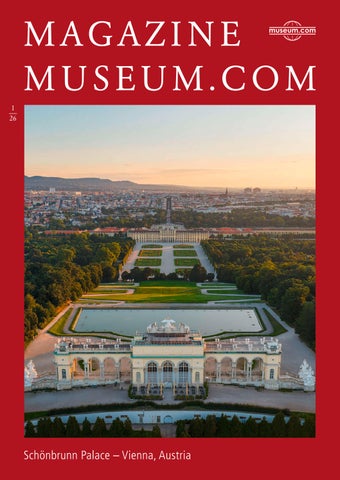
Schönbrunn Palace – Vienna, Austria
Image Access | ART SCANNER
Wuppertal, Germany
MAGAZINE MUSEUM.COM
museum.com
Sinserstrasse 67 6330 Cham SWITZERLAND
magazine@museum.com Tel. +41 41 5102688
About the global museum project
museum.com presents a global museum database in which museums can enter their content directly via a personal login. Membership is free of charge.
In addition, museum.com offers the independent creation and operation of audio guides, which are created with the help of artificial intelligence.
The portal is accompanied by the MAGAZINE MUSEUM.COM, which covers current topics from the museum world.
MAGAZINE MUSEUM.COM
Media Data 2026 – For publication inquiries or media data, please contact us by e-mail - we will be happy to send you all the information you need.
Publication in the current issue No. 3 is possible at any time, as there is no fixed editorial deadline.
Download Media Data, click here
Vienna, Austria. A walk through architecture, garden design, and lived history Schönbrunn as an ordered landscape
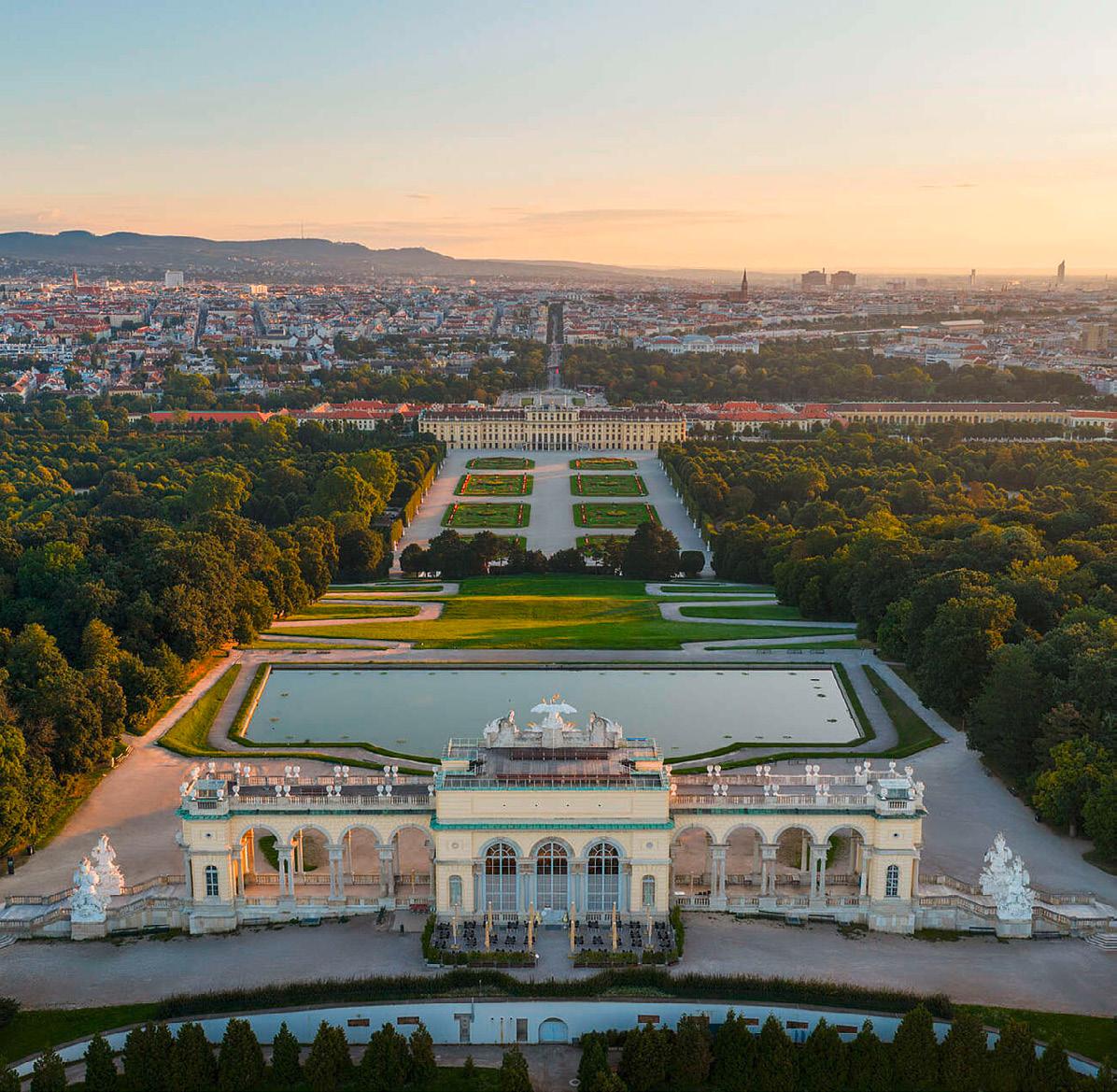
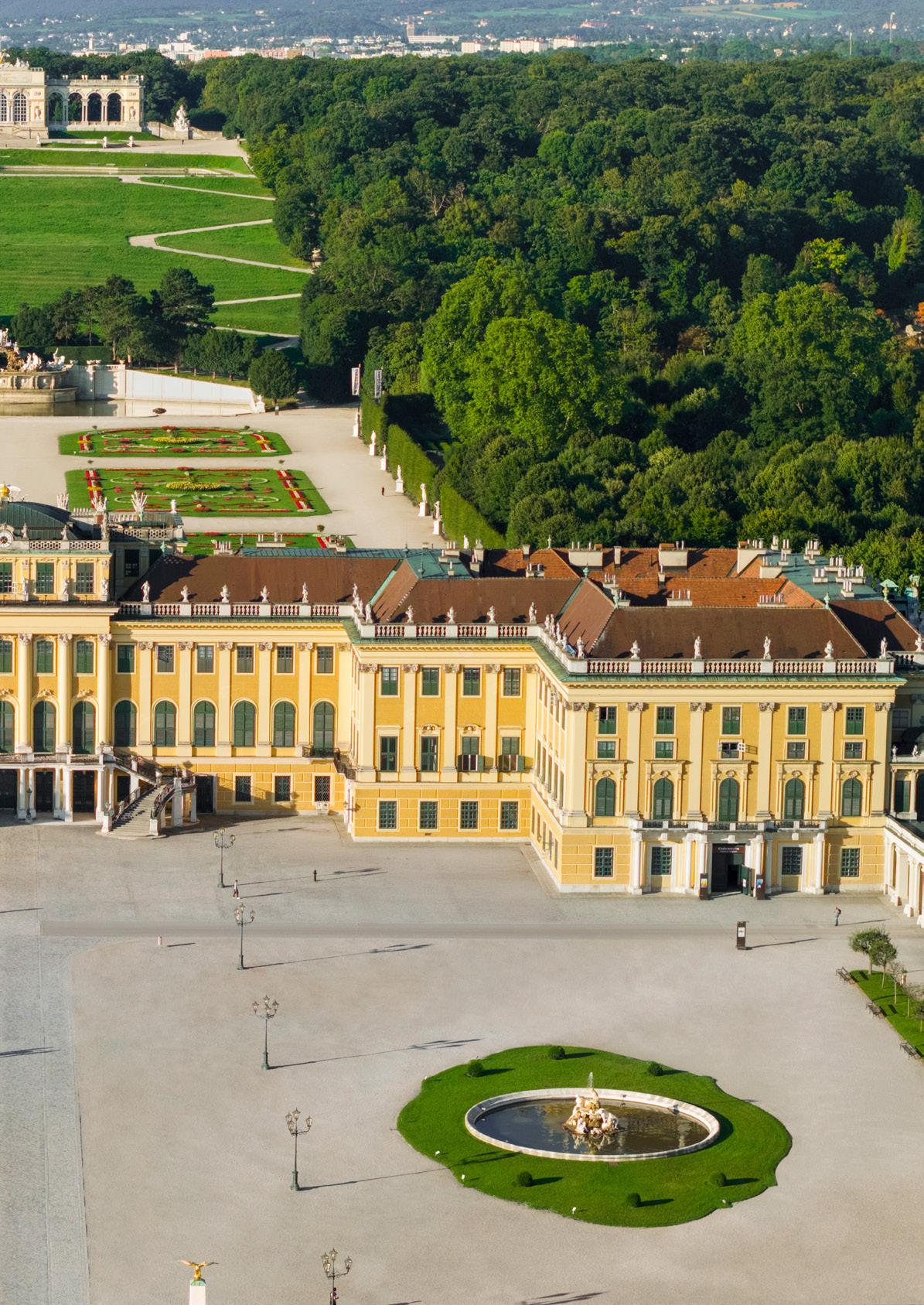
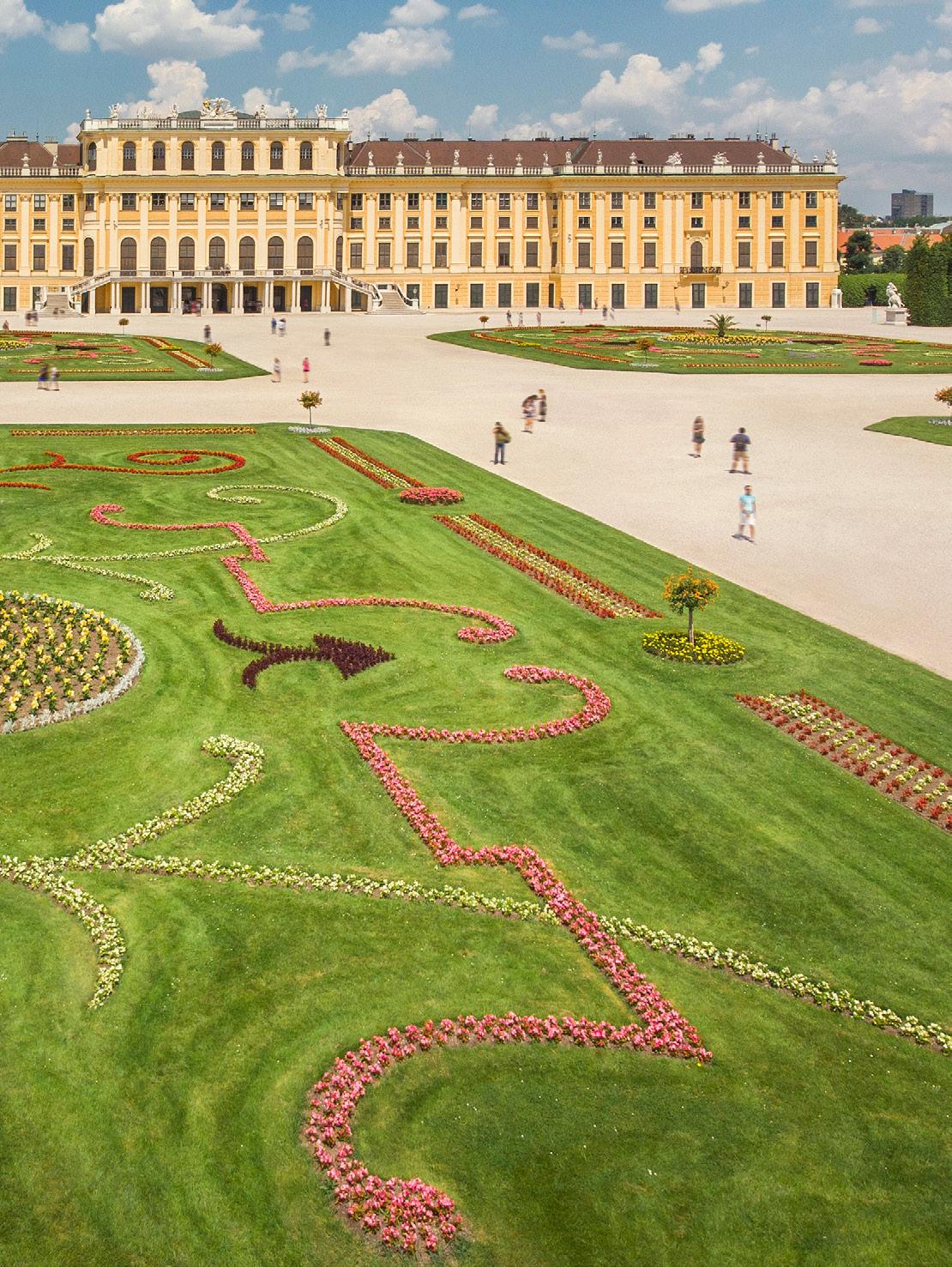
From the air, Schönbrunn looks like a landscape that was once thought through in its entirety and then built with remarkable consistency. The long body of the palace lies at the center of the composition like a calm anchor; in front of it the Parade Court, behind it the great parterre, the avenues, bosquets, and fountains, and high on the ridge the Gloriette. It is only from this perspective that one fully grasps
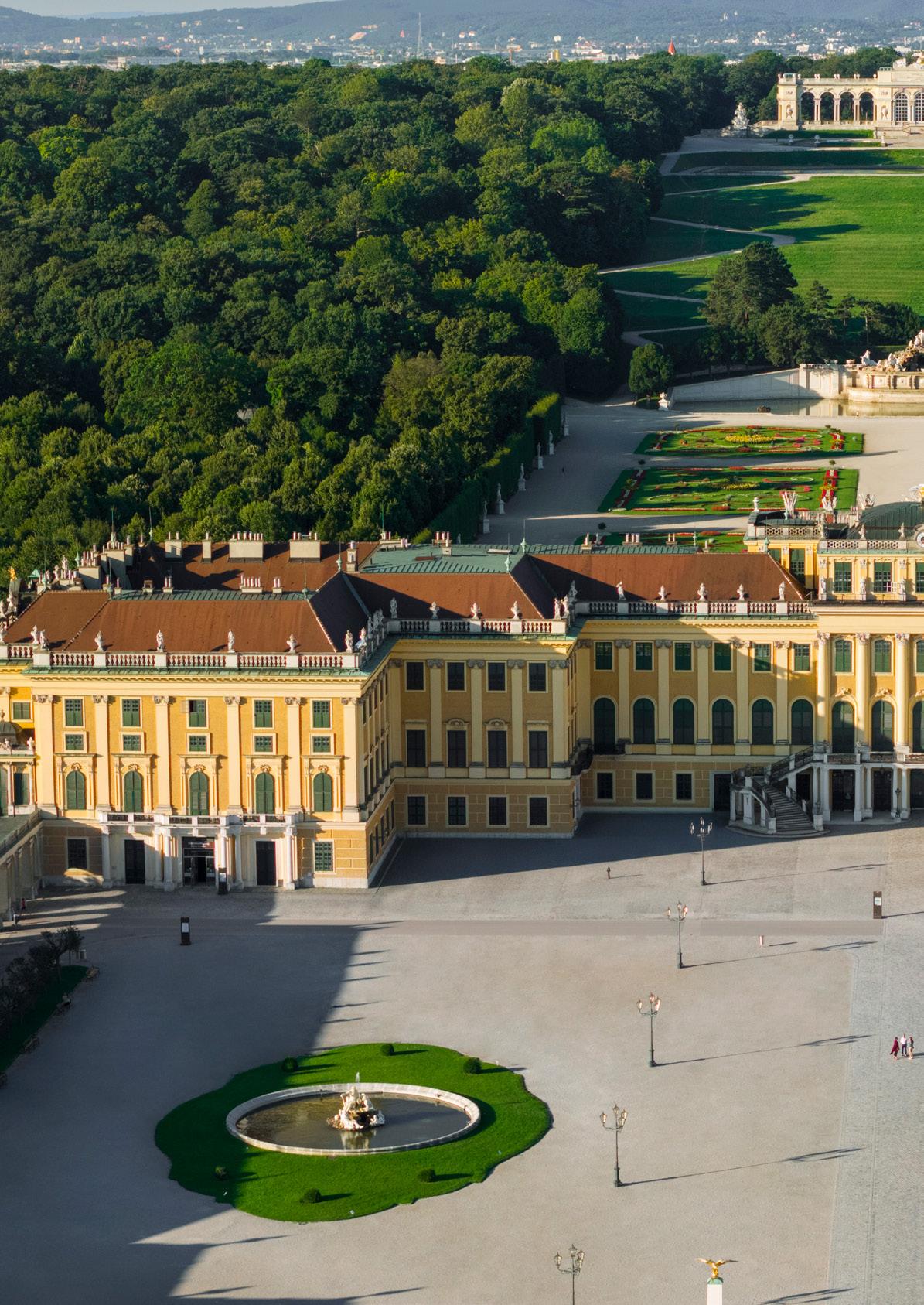
what makes the place so distinctive: palace and park are not neighbors, but two parts of the same idea.
UNESCO therefore describes Schönbrunn as an exceptionally well-preserved Baroque residential ensemble and as a Gesamtkunstwerk, a total work of art combining architecture, garden design, and the decorative arts. The ensemble has been on the World Heritage List since 1996.
The court as a beginning
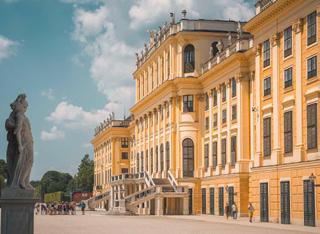
At ground level, Schönbrunn begins in a surprisingly restrained way. In the Parade Court, the first impression is not overwhelming splendor so much as proportion and order.
The broad palace façade keeps its distance without seeming forbidding; the side
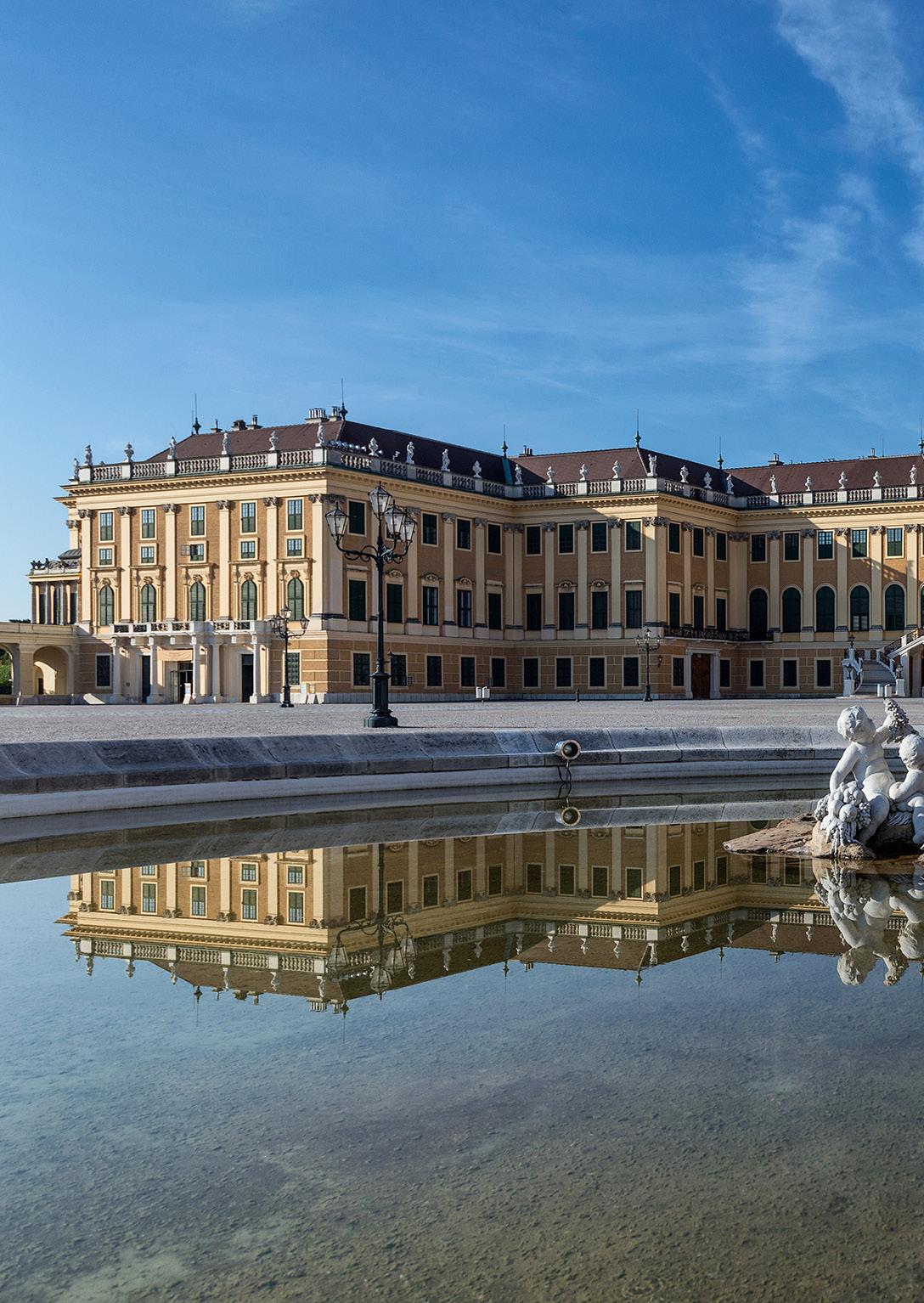
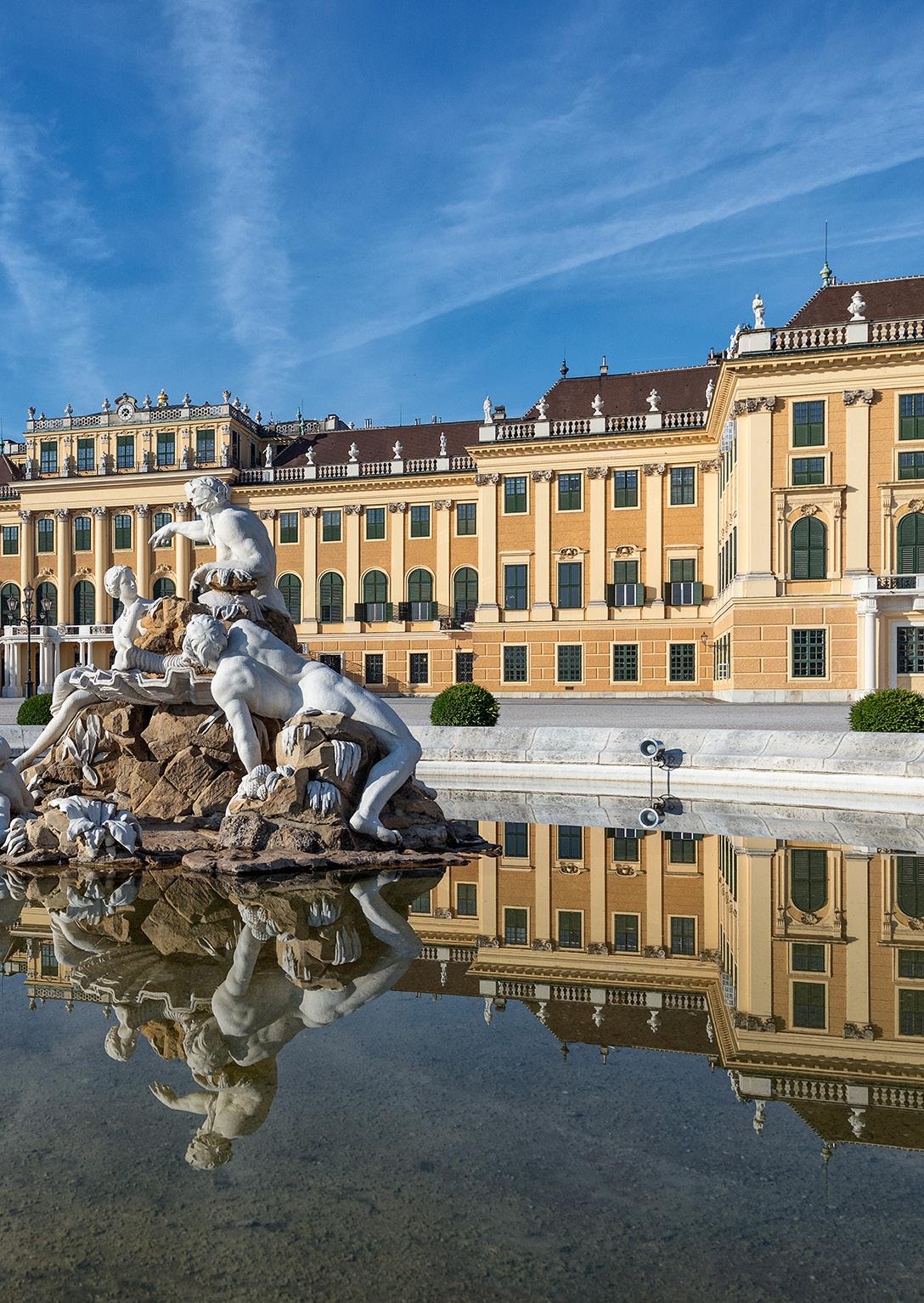
wings frame the space, and the fountains give it gravity. Even here, one of the site’s governing principles becomes clear: it works not through effects, but through the guidance of the eye. Visitors are not moved at random, but led step by step into a choreography that begins in the forecourt. The sculptural groups in the fountains today were installed in 1776; through their allego-
ries, they point to the rivers and territories of the Habsburg Empire.
From hunting grounds to residence
It is hard to imagine now that a medieval estate known as the Katterburg once stood here. Yet that is where the story begins. In 1569 the property came into Habsburg possession through Maximilian II; the name Schönbrunn is linked to a spring that, according to tradition, Emperor Matthias discovered. After the destruction of 1683, Leopold I decided to have a representative new building erected here for his son Joseph. Johann Bernhard Fischer von Erlach developed the Baroque concept from which the later palace emerged. Its present form, however, is owed above all to Maria Theresa, who from 1743 onward, together with Nicolaus Pacassi, expanded the complex into the imperial summer residence that still defines the site today.
From the garden back into the palace
Anyone entering the main building quickly senses that Schönbrunn is no mere decorative shell. The palace tells a story not only of representation, but also of habits, routes, and hierarchies. Its sequence of rooms is precisely designed for this: from preparation to reception, from reception to government, from government to living. That is exactly why Schönbrunn does not feel like an abstract monument, but like a place that was used intensely and for a long time — until 1918 as a Habsburg residence, and thereafter as property of the Republic of Austria. UNESCO explicitly emphasizes that the preferences and ambitions of several generations of rulers can be read here across the centuries.
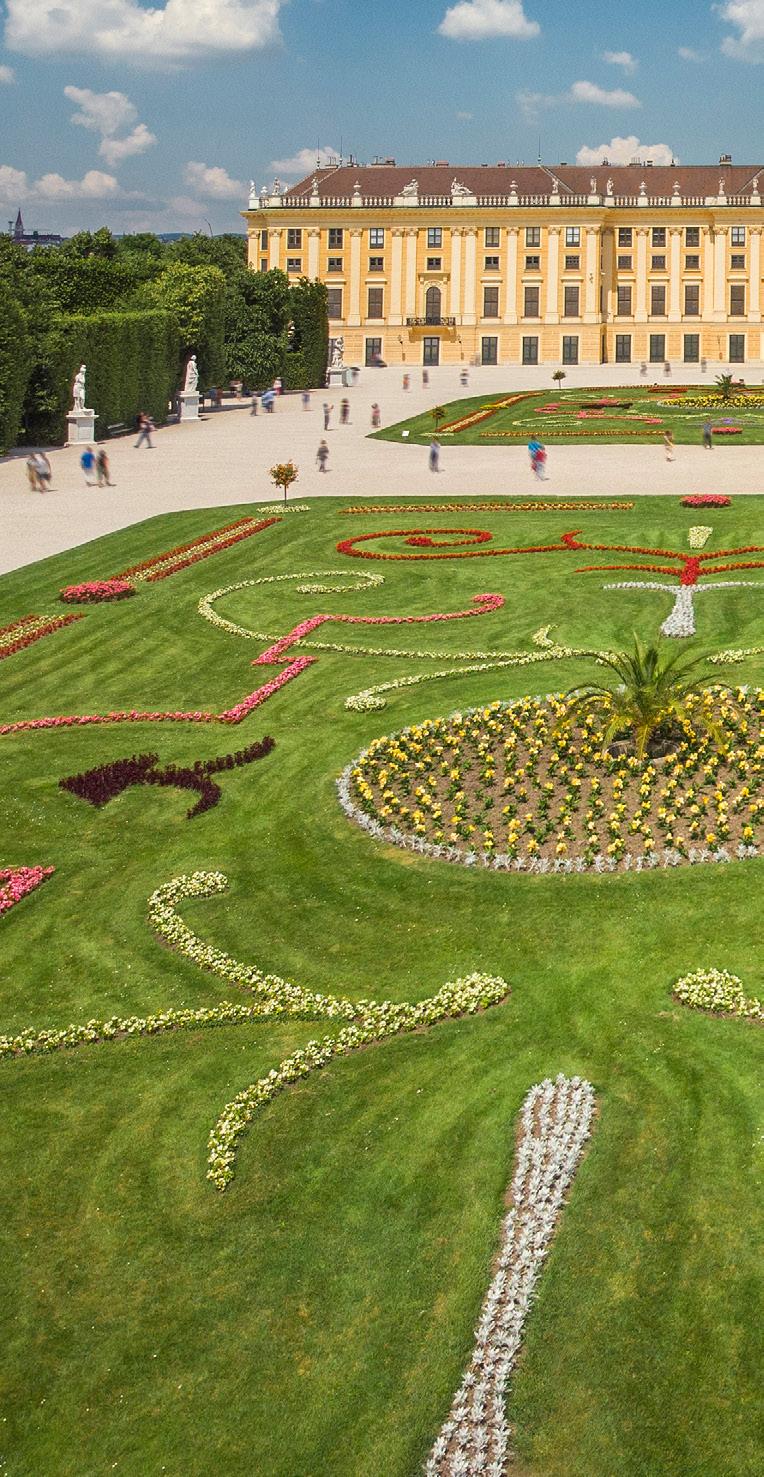
Schönbrunn Palace, Great Parterre © Schloss Schönbrunn Kultur- und Betriebsges.m.b.H, Severin Wurnig
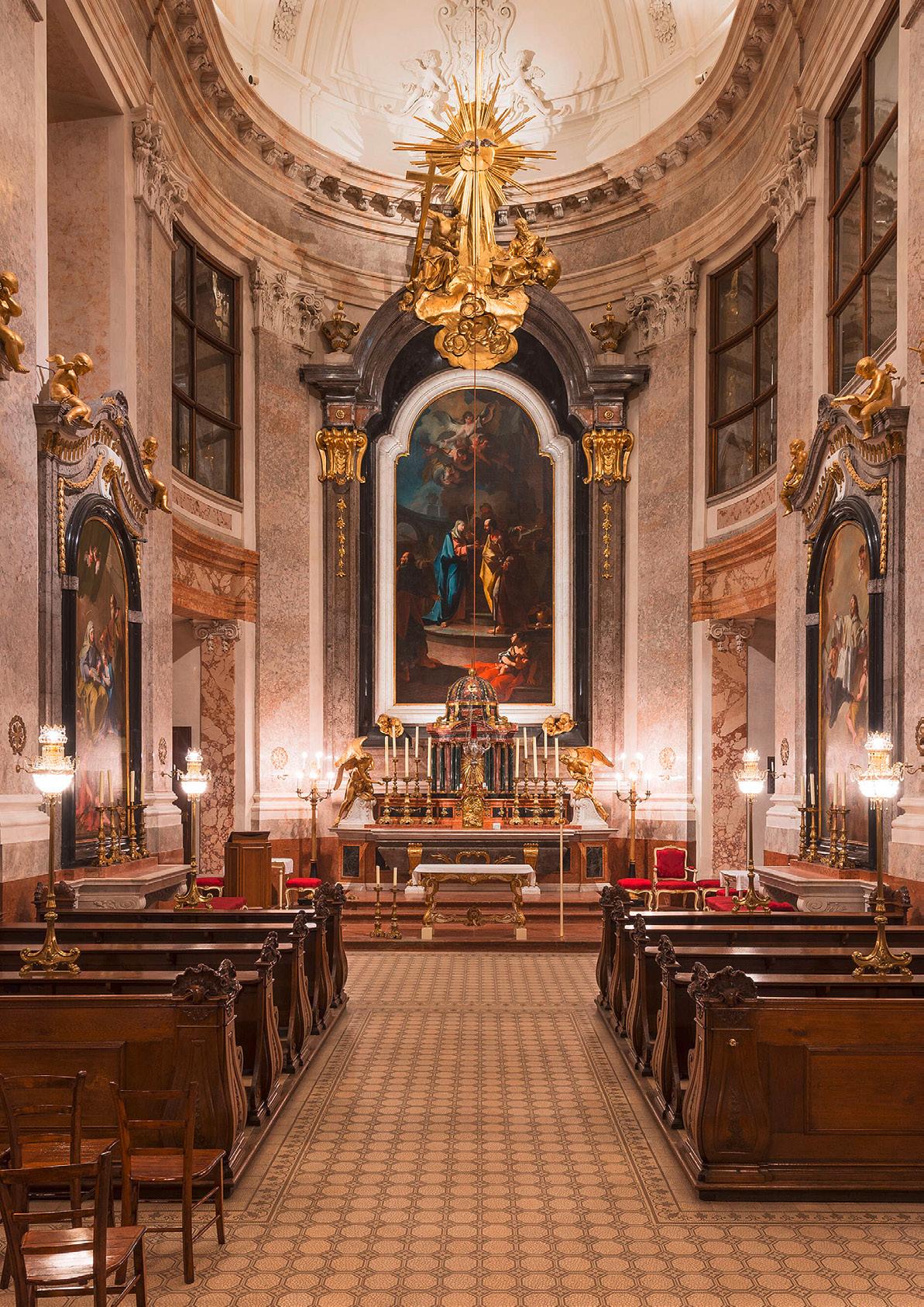
Before the great state rooms begin, it is worth pausing in the Palace Chapel. It still preserves the position, spatial structure, and architectural articulation of the early building around 1700. Under Maria Theresa, beginning in 1743, it received a new and splendid interior from leading artists of the period; the high altarpiece depicting the Marriage of Mary and Joseph is by Paul Troger. In a palace so often associated with state occasions, family history, and court etiquette, the chapel is a reminder that religion at the Habsburg court was not marginal, but part of the daily ceremonial order.
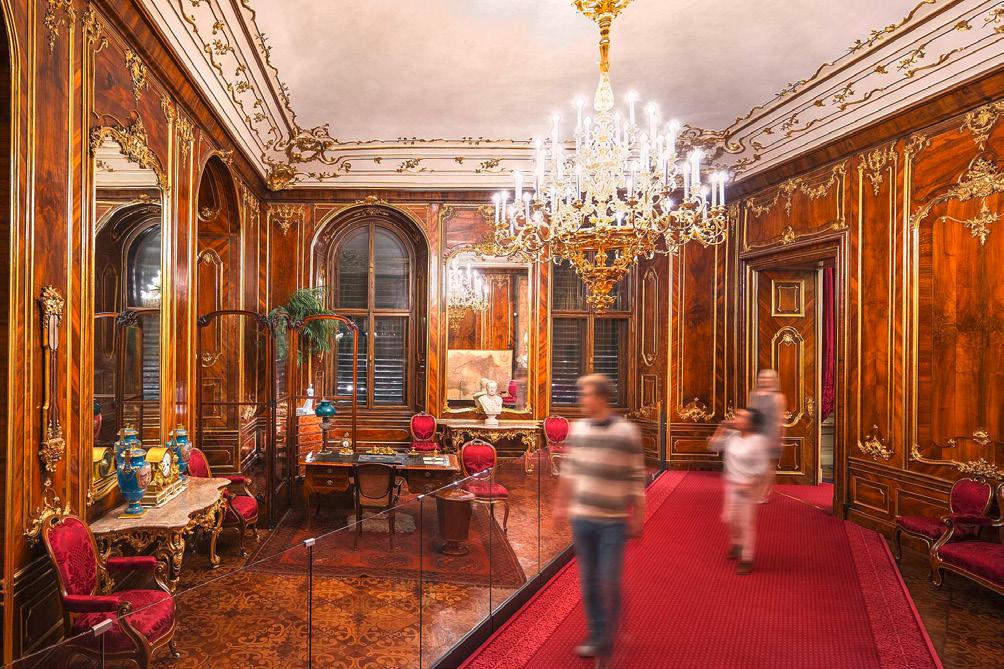
From there, it is only a short distance to the rooms where power assumed its less glittering, but perhaps more revealing, daily form. The Walnut Room, also known as the Audience Chamber, was furnished around 1765 for Joseph II and later served Franz Joseph as the setting for private audien-
ces. Here, there were no celebrations, but conversations, reports, and decisions. It is precisely the room’s comparatively restrained atmosphere that gives it force. In places like this, Schönbrunn shows that monarchy did not consist only of coronation paintings and state banquets, but of an almost unceasing sequence of conversations, petitions, and briefings.
Left: The Palace Chapel still preserves the spatial layout of the early palace building around 1700. Under Maria Theresa it was newly furnished from 1743 onward; the high altarpiece depicting the Marriage of Mary and Joseph is by Paul Troger.
© Schloss Schönbrunn Kultur- und Betriebsges.m.b.H, Alexander Eugen Koller
Right: The Walnut Room, also known as the Audience Chamber, was furnished around 1765 for Joseph II. Later, Franz Joseph received here those granted a private audience with the emperor — a room of court government on an intimate scale.
© Schloss Schönbrunn Kultur- und Betriebsges.m.b.H, Severin Wurnig
Elisabeth and the ceremonial order
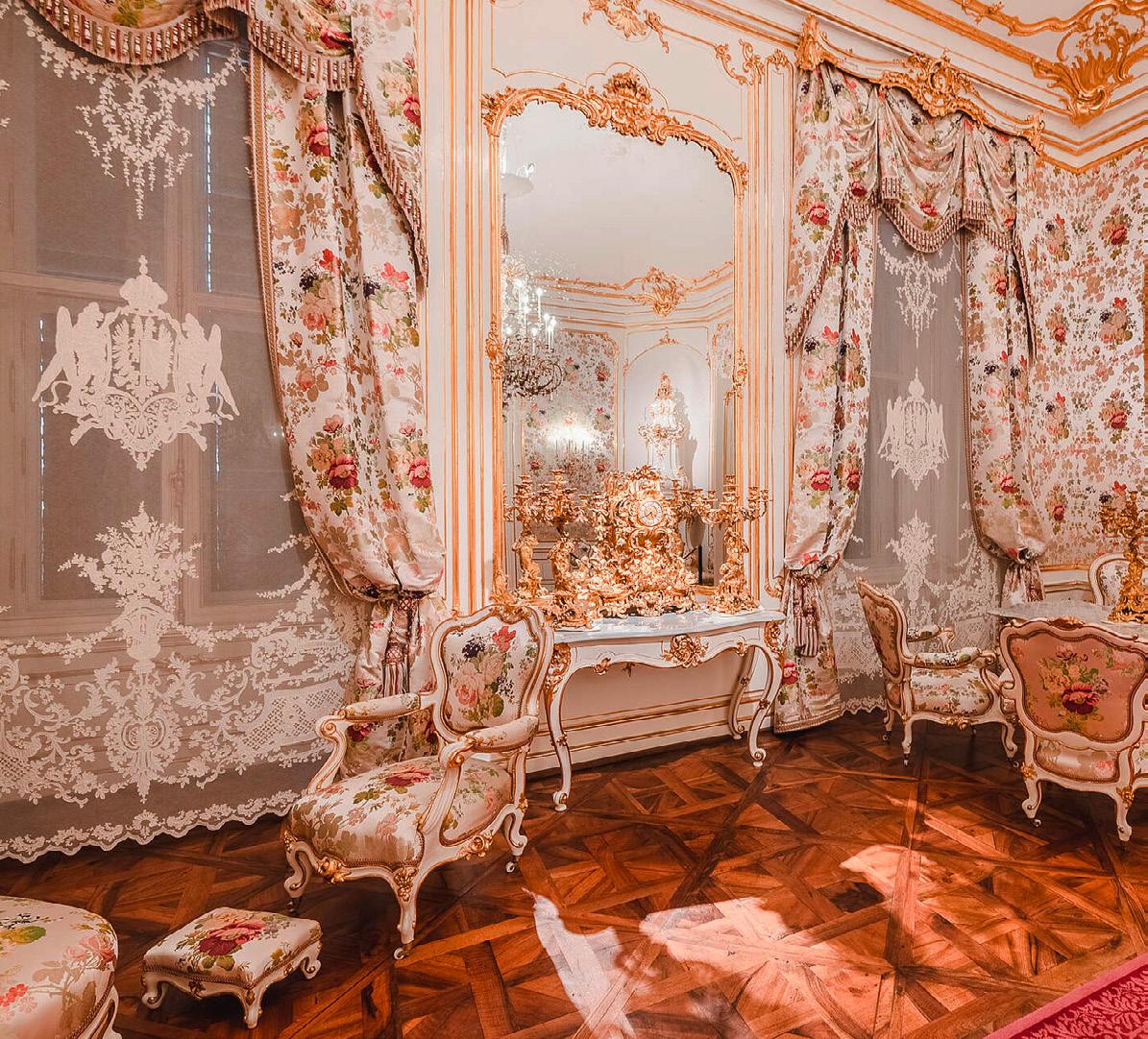
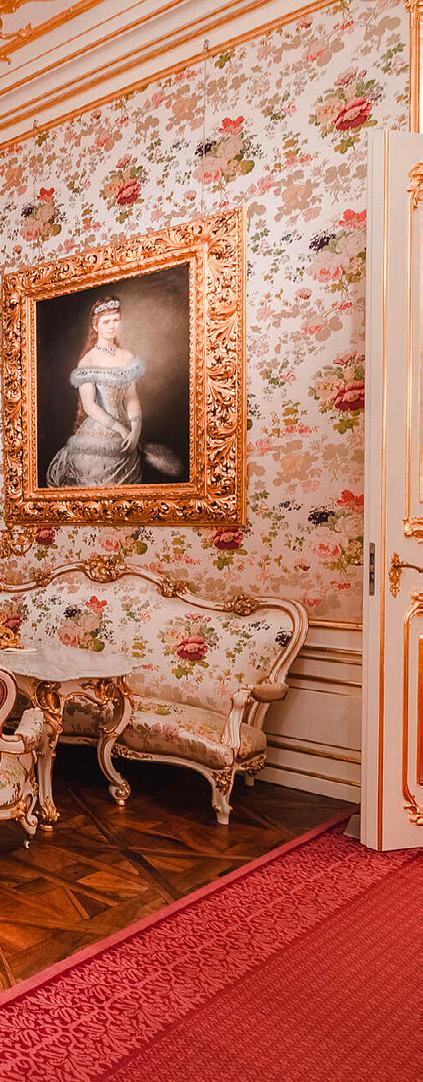
Close by, the mood shifts. The Salon of the Empress was Elisabeth’s highest-ranking reception room in her Schönbrunn apartments. Following restoration, it once again displays the original furniture ensemble and reconstructed nineteenth-century silks. The room is magnificent without being
warm; one senses the formal strictness of a court whose rules Elisabeth endured more than embraced.
That is precisely what makes the salon so interesting: it tells not simply of Sisi mythology, but of an empress caught between personal distance and official role.
The Salon of the Empress was Elisabeth’s highest-ranking reception room in her Schönbrunn apartments. Its restored furnishings and reconstructed textiles show how strongly the nineteenth-century court looked back to the formal language of the Rococo.
© Schloss Schönbrunn Kultur- und Betriebsges.m.b.H
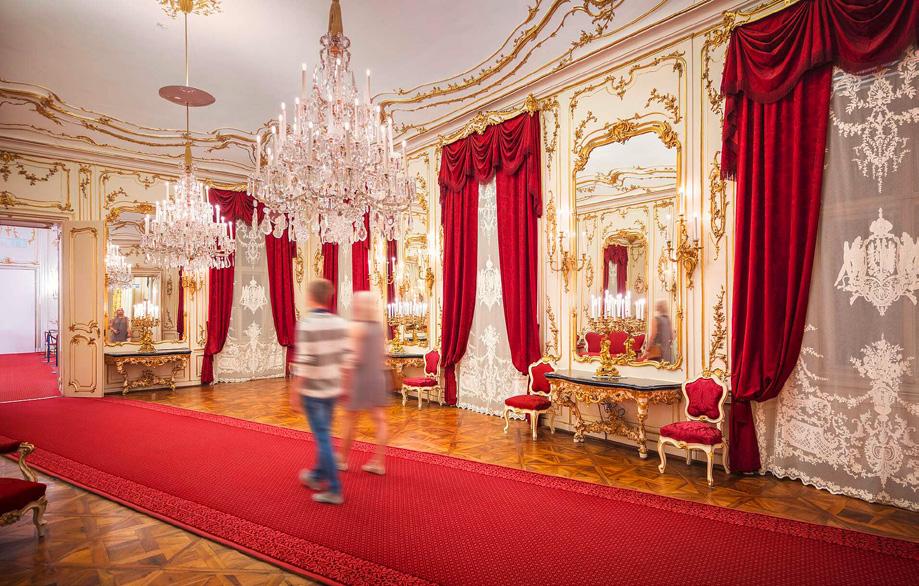
In the Hall of Mirrors, Schönbrunn becomes lighter, more mobile, almost relaxed. The white polished surfaces, gilt decoration, and large mirrors multiply the light and lend the room an ease one does not necessarily expect in an imperial residence. Tradition has it that the six-year-old Mozart performed here before Maria Theresa in 1762; what is certain is that the hall was also used for public audiences under Franz Joseph. That suits its effect. It is representative without being intimidating, festive without being heavy. A room in which courtly proximity is easier to imagine than courtly distance.
The Hall of Mirrors is one of the most famous rooms at Schönbrunn. Tradition holds that the young Mozart performed here before Maria Theresa in 1762; later, under Franz Joseph, the room was also used for public audiences. © Schloss Schönbrunn Kultur- und Betriebsges.m.b.H, Severin Wurnig
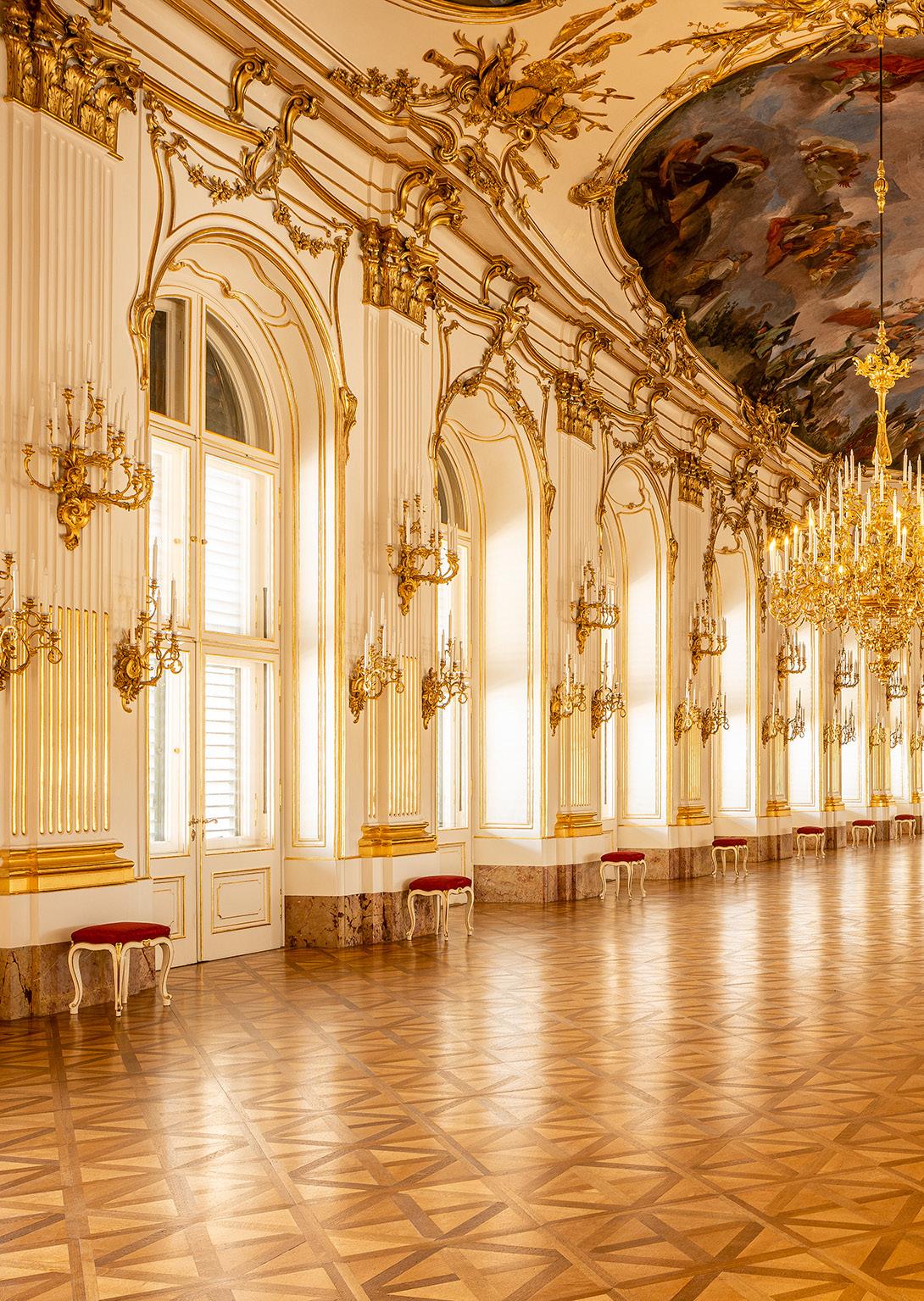
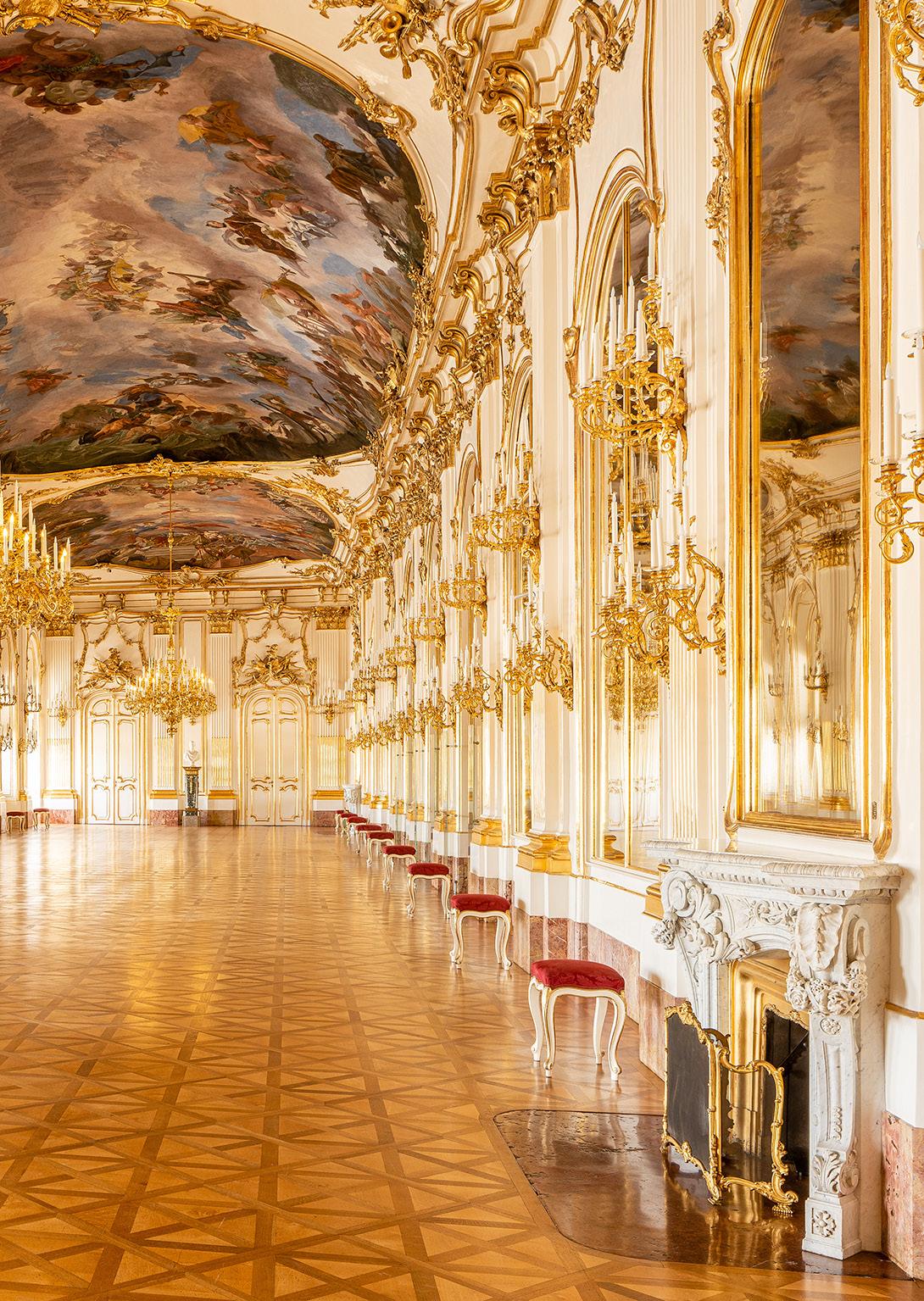
The farther one moves into the center of the palace, the more clearly the political function of its splendor comes into focus. The Great Gallery forms the architectural and ceremonial climax of the piano nobile. At 43 meters in length, with its gilt stucco and ceiling frescoes by Gregorio Guglielmi, it was the ideal setting for court festivities and receptions; even after the end of the monarchy, it remained a space of state representation and is still used by the Republic of Austria for official occasions.
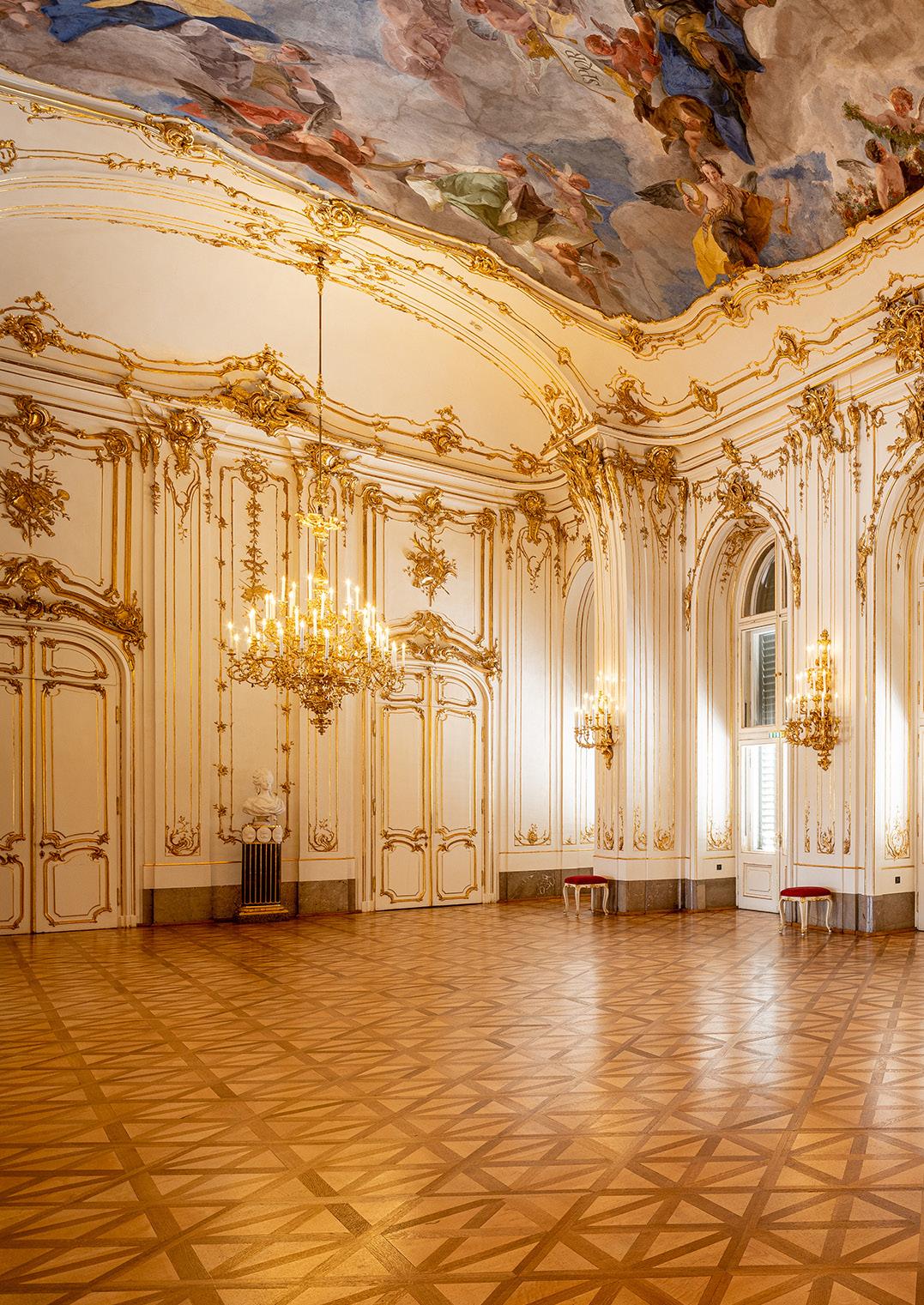
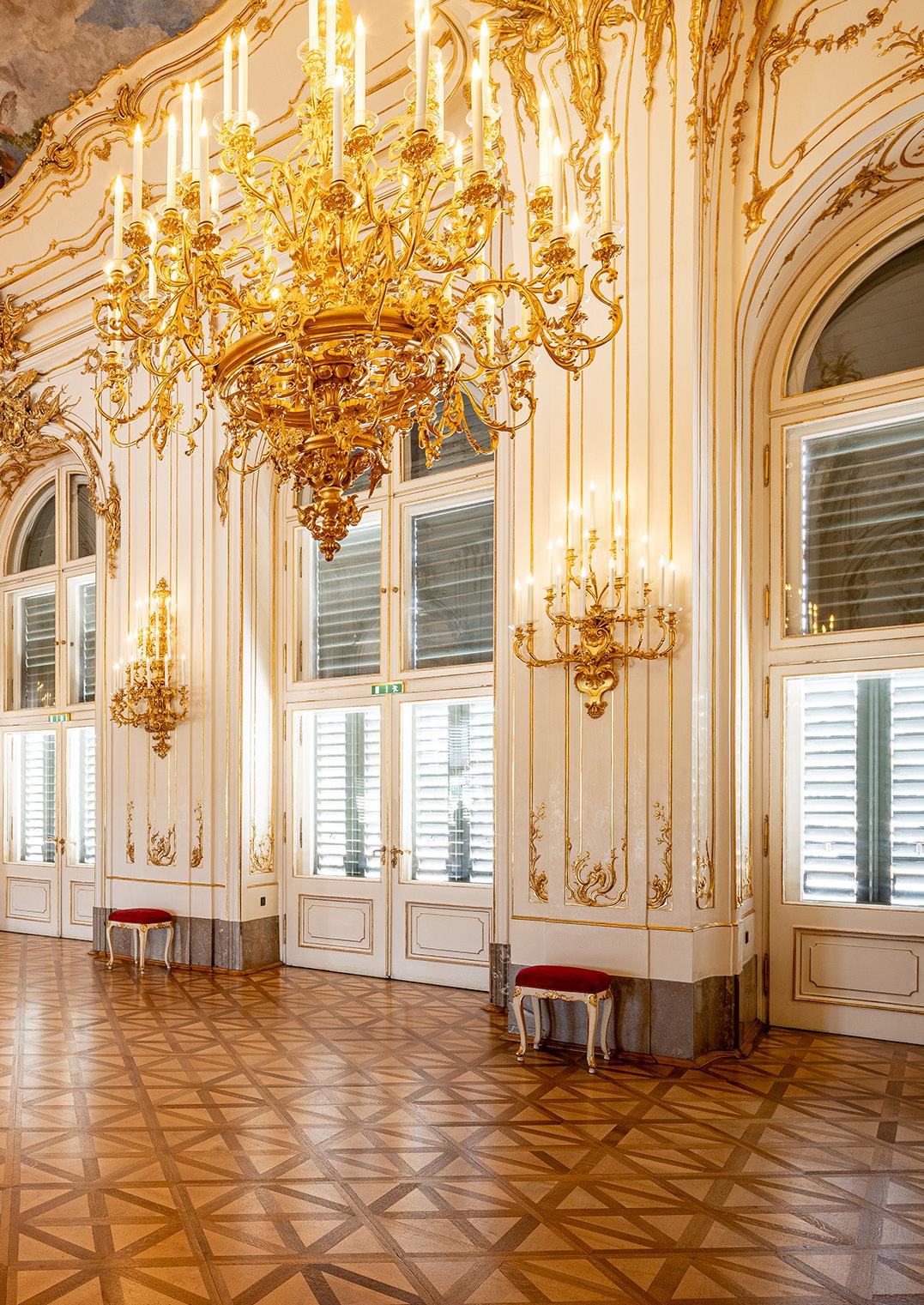
The small gallery
Beside it lies the Small Gallery, much more intimate in scale, but equally consistent in the Rococo language of Maria Theresa. Schönbrunn is especially convincing in this juxtaposition: the grand gestures and the smaller ones support one another.
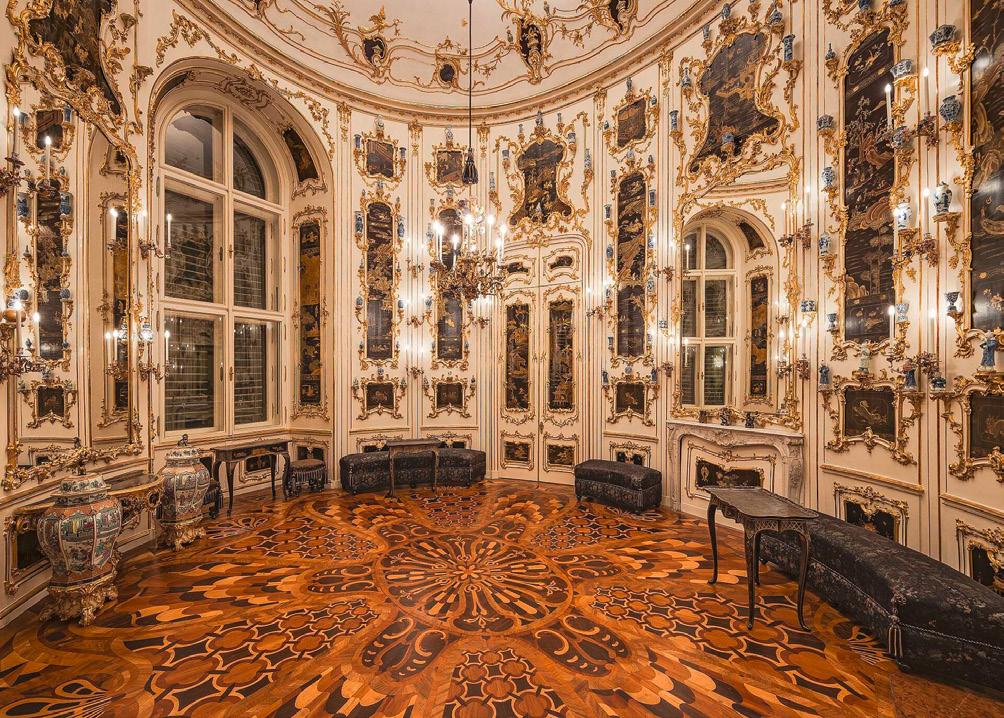
On either side of the Small Gallery are the rooms in which Schönbrunn articulates its curiosity about the wider world with particular refinement. The Chinese Round Cabinet is decorated with East Asian lacquer panels, porcelain, and gilded consoles — not as a loose collection, but as a highly controlled courtly staging.
At the same time, it was more than a display room. Maria Theresa used the Round Cabinet for secret state conferences with her chancellor Kaunitz. The connection between artistic taste and politics could hardly be clearer. From today’s perspective, such rooms can of course also be read as evidence of Europe’s appropriation of distant cultures; that, too, is part of what makes them so revealing.
Even quieter, more personal, and more surprising is the Vieux-Laque Room. Art-historically, it is one of the most significant interiors in the palace, and it owes its present appearance to a moment of rupture: after
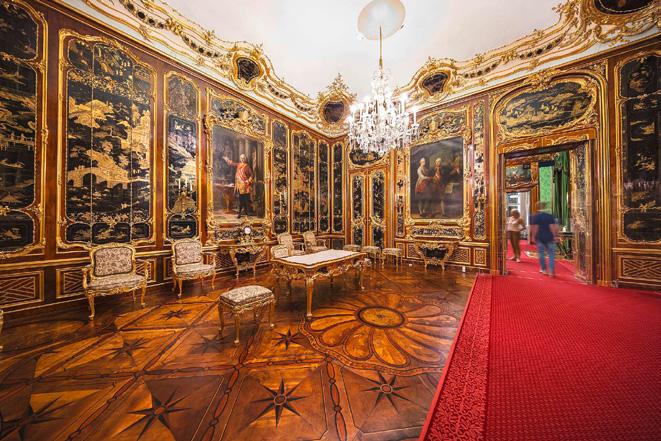
the sudden death of her husband Franz Stephan in 1765, Maria Theresa had the room transformed into a memorial chamber. The black Chinese lacquer panels, the family portraits, and the subdued effect of the room create an atmosphere clearly distinct
from the brilliant ceremonial halls. Here the dynasty is not celebrated, but affirmed — under the sign of loss. It is one of the rare rooms in Schönbrunn where personal grief and political self-representation become almost inseparable.
Portraits of a political line
From there, the Red Salon leads back into the broad historical narrative. Its portraits present several generations of Habsburg rulers and make visible how closely Schönbrunn was tied to Europe’s political upheavals. Especially revealing is the reference to Emperor Franz: under pressure from
Napoleon, he assumed the title “Emperor of Austria” in 1804 and, as the last ruler, dissolved the Holy Roman Empire in 1806. What often remains abstract in history books stands here in a room and looks back at the visitor.
In moments like this, Schönbrunn is less a backdrop than a point of condensation for European history.
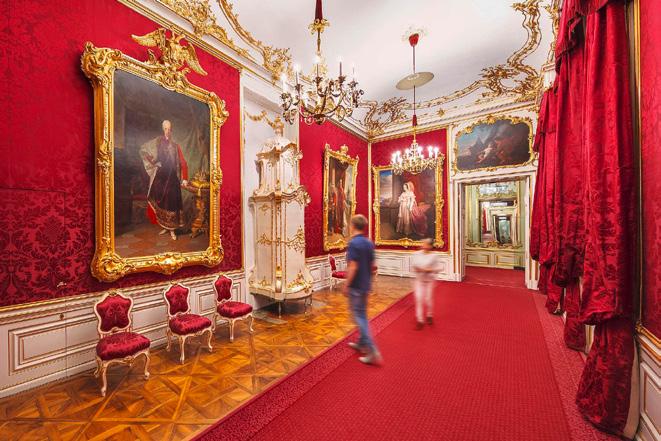
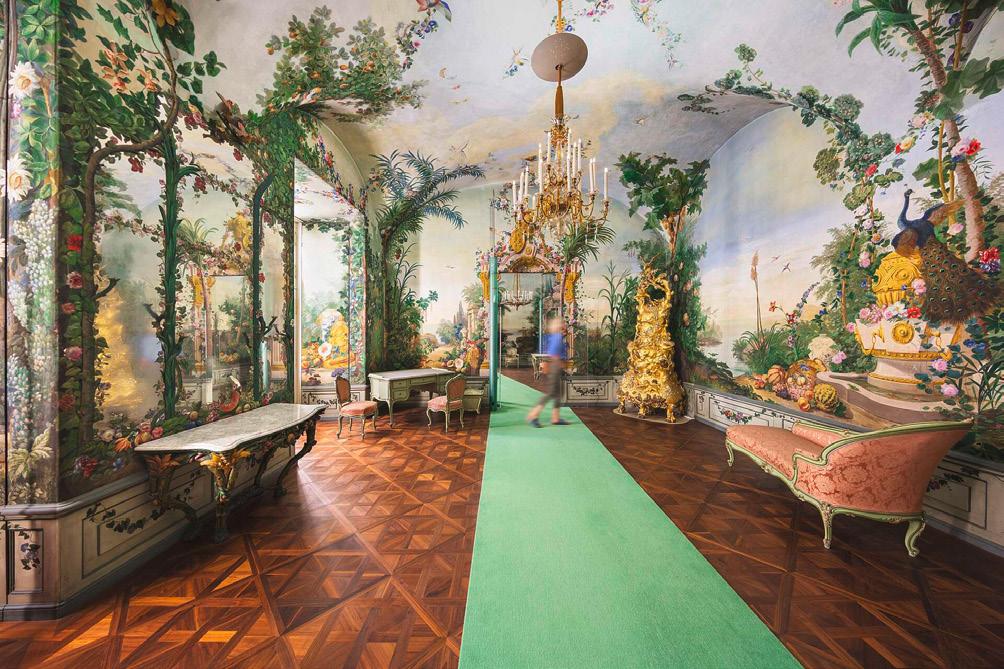
After all the rooms of representation, the Bergl Room feels almost like a release. It belongs to the Bergl Rooms on the ground floor, which Maria Theresa had arranged for herself in later years. Johann Wenzel Bergl covered walls and ceilings with illusionistic landscape paintings, exotic vegetation, vases, vistas, and ornamental arrangements. Together with the East Asian cabinets, these rooms rank among the palace’s most precious ensembles. And yet their strength lies not in their preciousness, but in their atmosphere: after so much courtly order, they open the interior of the palace into a painted, lighter, almost summery world.
Left:
- East Asian Cabinet, Alexander Eugen Koller
- Vieux Laque Room, Severin Wurnig
Right:
- Red Salon, Severin Wurnig
- Bergl Room, Severin Wurnig
© Schloss Schönbrunn Kultur- und Betriebsges.m.b.H
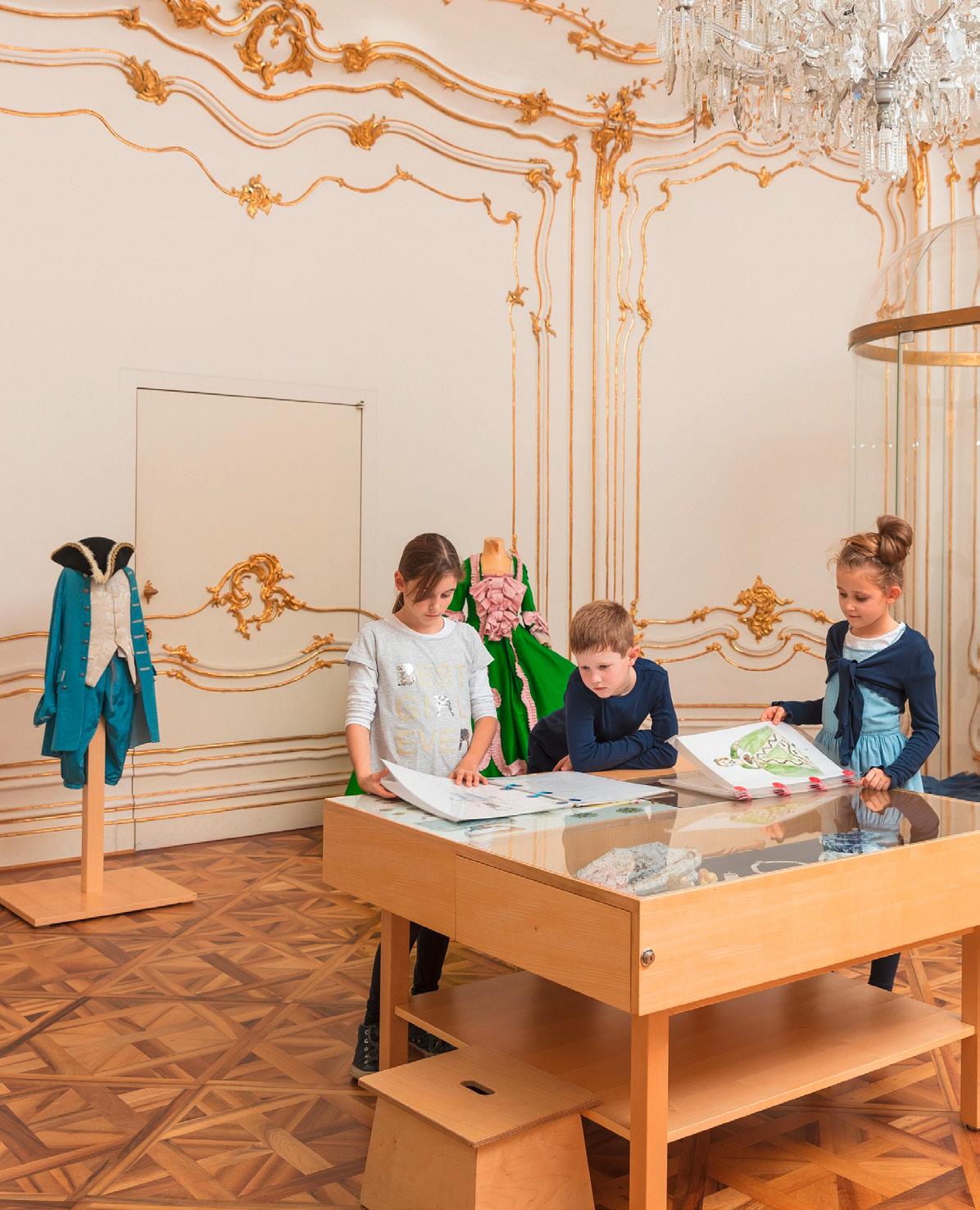
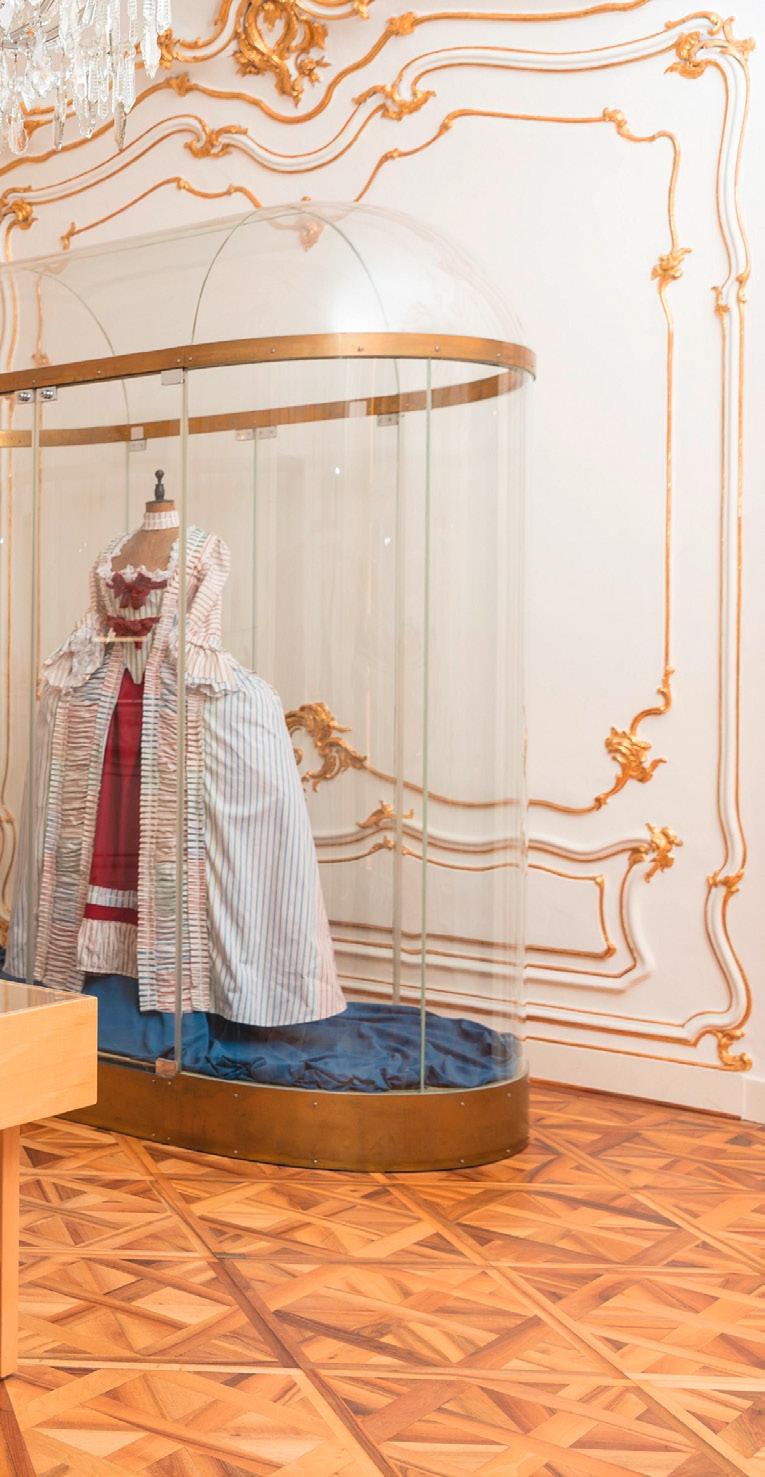
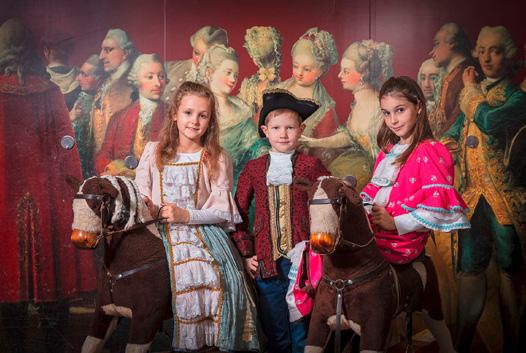
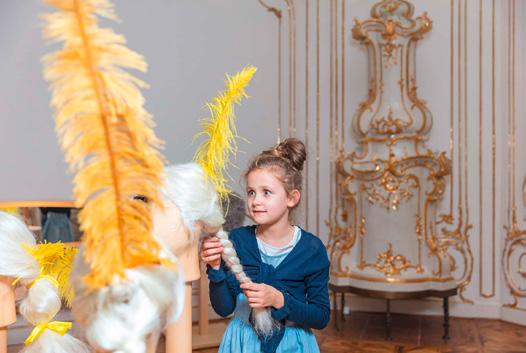
The fact that the palace now also houses a Children’s Museum is more than a family-friendly addition. It shifts the perspective on a court that is otherwise almost always viewed from above. Instead of speaking only of emperors and chancellors, it focuses on the daily lives of the imperial children: clothing, education, manners, play. At a place like Schönbrunn, that matters. For only when the site is understood not just as a stage of power, but as an inhabited living environment, does it truly come alive.
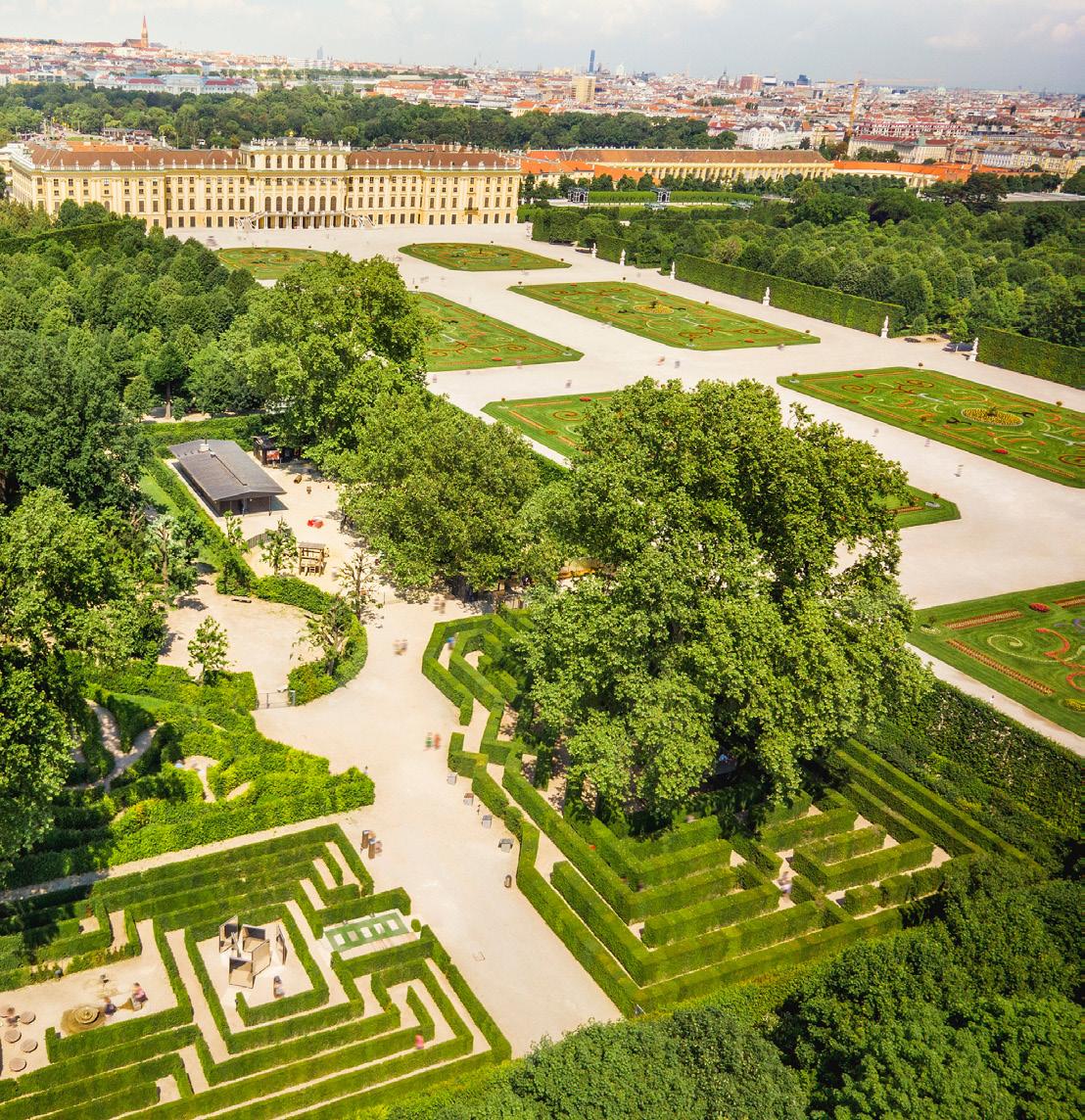
The moment one steps back outside from the southern rooms of the palace, it becomes clear that the park is no mere backdrop. It is the continuation of the interiors by other means. The Baroque garden design of Schönbrunn was explicitly conceived as an external extension of the palace’s representative rooms. The great parterre takes up the central axis and draws it into the landscape; avenues and sightlines organize the space so that the eye is constantly guided. Here the logic of the ensemble reveals itself with unusual clarity: architecture continues in the garden, and the garden confirms the architecture. That is why UNESCO stresses that palace and park at Schönbrunn cannot truly be separated.
Left: The Schönbrunn Orangery
© Schloss Schönbrunn Kultur- und Betriebsges.m.b.H, Alexander Eugen Koller
Right: The Maze
© Schloss Schönbrunn Kultur- und Betriebsges.m.b.H, Severin Wurnig
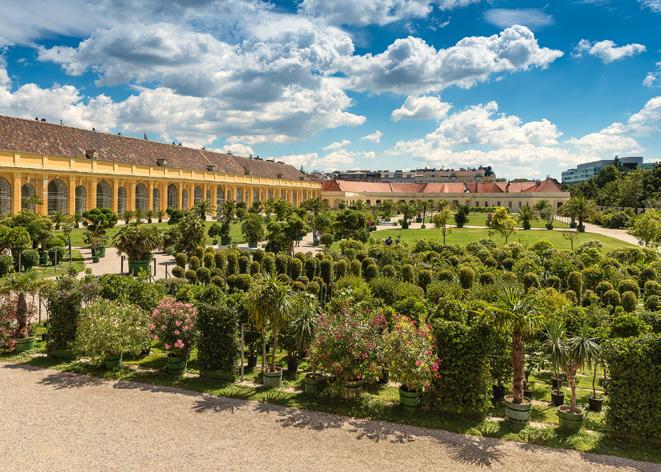
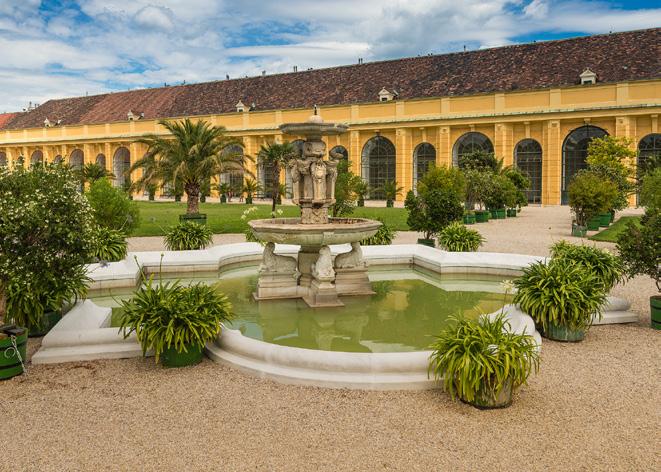
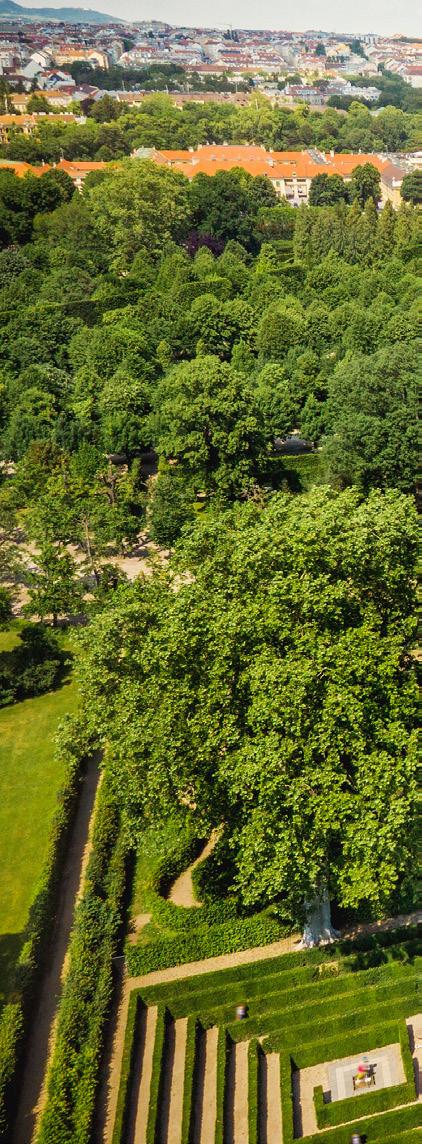
Anyone leaving the main axis and heading east encounters another, often underestimated, aspect of Schönbrunn. The Orangery Garden and the great Orangery show how closely courtly representation and botanical passion were linked.
At 189 meters long and 10 meters wide,
the Schönbrunn Orangery is among the largest Baroque orangery buildings in the world; it was heated through a hypocaust system in the floor so that citrus trees and other frost-sensitive plants could overwinter there.
Buildings of this kind were not accessories in the eighteenth century, but expressions of knowledge, technology, and global cu-
riosity. In the court garden, nature was not merely disciplined, but collected, cultivated, and displayed.
Baroque order, playfully refracted
The Maze works quite differently. It was laid out around 1720, abandoned in the nineteenth century, and reconstructed in
1999 on the basis of historical plans. Unlike a classical labyrinth, it was originally intended less for dramatic disorientation than for a searching, leisurely stroll. That is exactly what makes it so fitting for Schönbrunn. Even where play takes over, the shaping will of the Baroque remains palpable. The layout allows detours, but leaves nothing to chance.
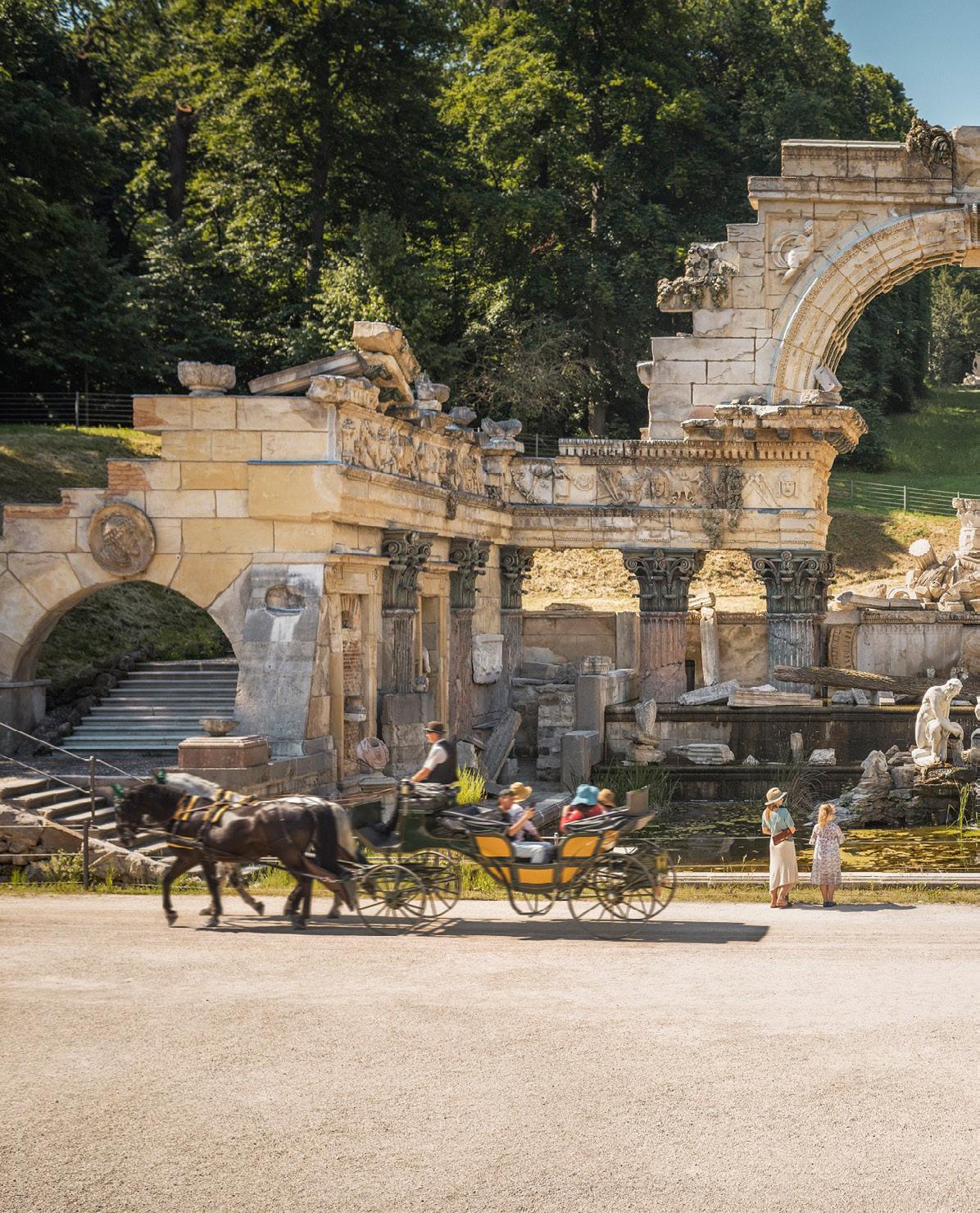
Farther to the side, at the foot of the wooded slopes, the park surprises with an architecture deliberately built around the idea of decay. The Roman Ruin, originally called the “Ruin of Carthage,” was erected in
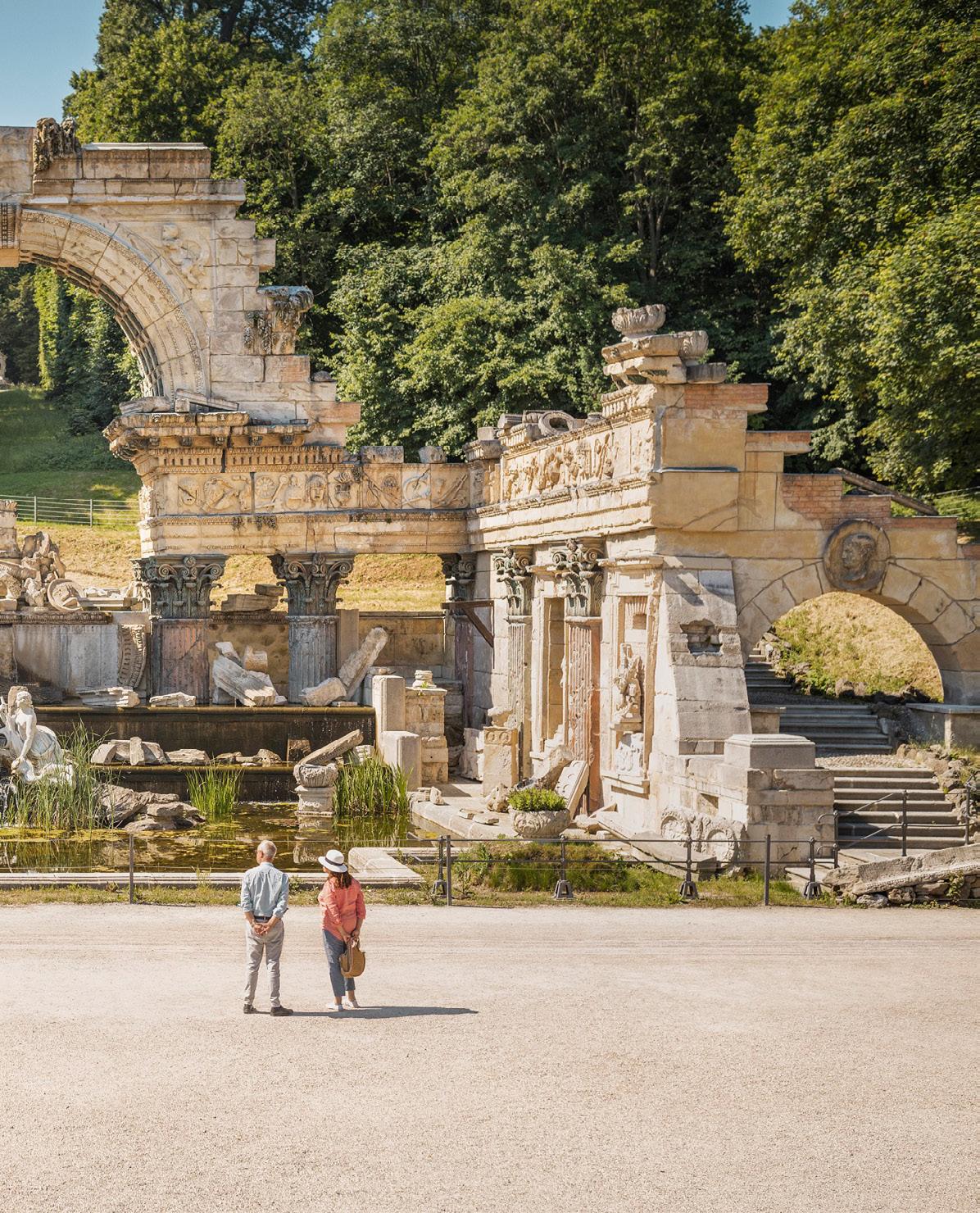
1778 by Johann Ferdinand Hetzendorf von Hohenberg as an artificial ruin. It is therefore not a relic, but a refined invention, inspired among other things by ancient models circulated through the engravings of Giovanni Battista Piranesi. Garden architectures of this kind make clear that Schönbrunn was
never only a place of geometry. The park could also become pictorial, melancholic, and theatrical.
The Roman Ruin © Schloss Schönbrunn Kultur- und Betriebsges.m.b.H, Severin Wurnig
The nineteenth century in the park
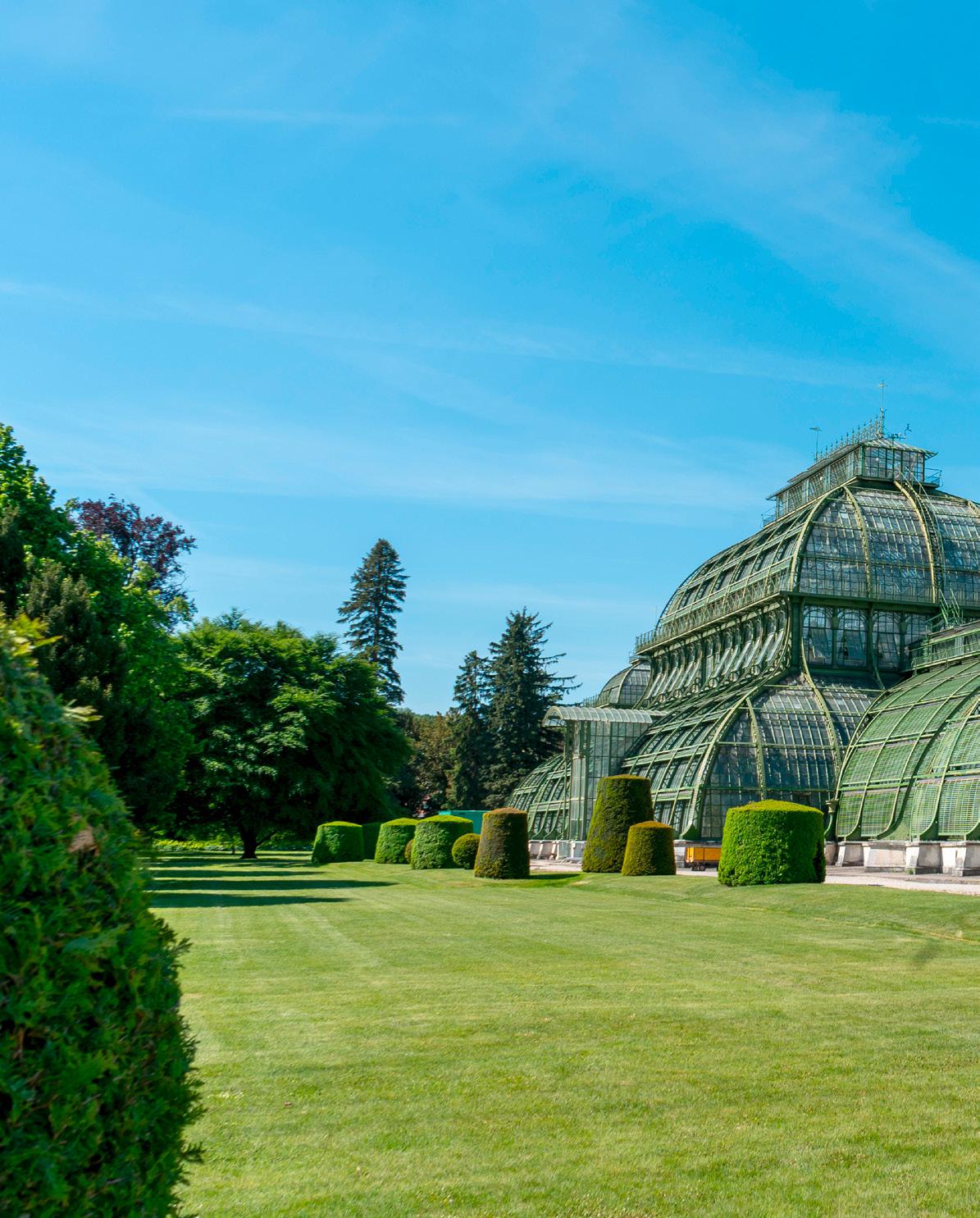
Anyone who today walks from the Baroque core toward the Palm House experiences a striking leap into the late nineteenth century. The building was erected in 1881/82 to designs by Franz Xaver Segenschmid on the site of the former Dutch Botanical Garden,
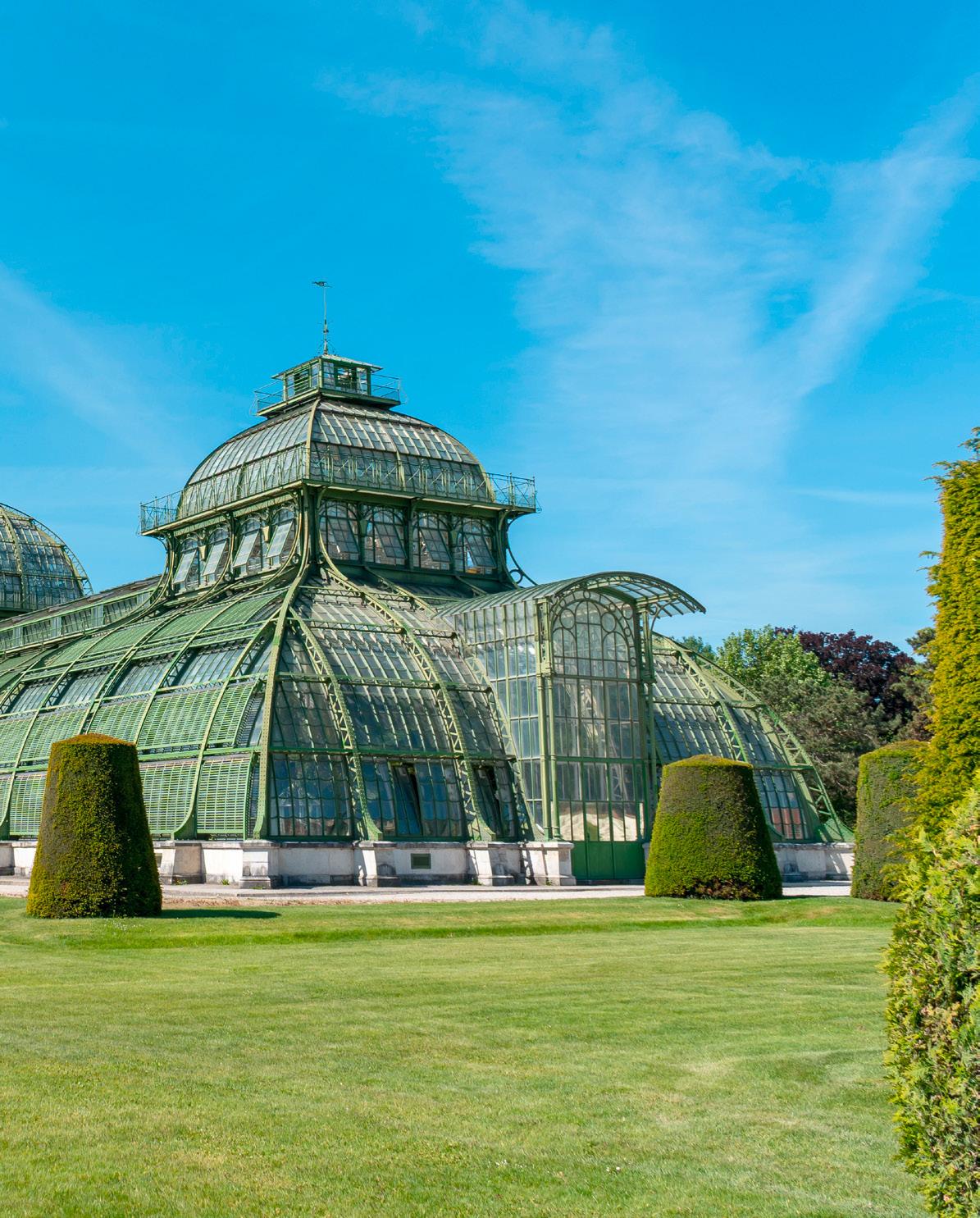
which Franz Stephan had established in 1753. The Palm House is 113 meters long, has a central pavilion 28 meters high, and is divided into different climatic zones regulated by a steam-water heating system. It was the last structure of its kind to be built on the European continent and remains one of the most impressive iron-and-glass
constructions in the ensemble. It is here, in particular, that one sees how Schönbrunn continued to evolve in the nineteenth century without losing its historical coherence.
The eye is drawn uphill
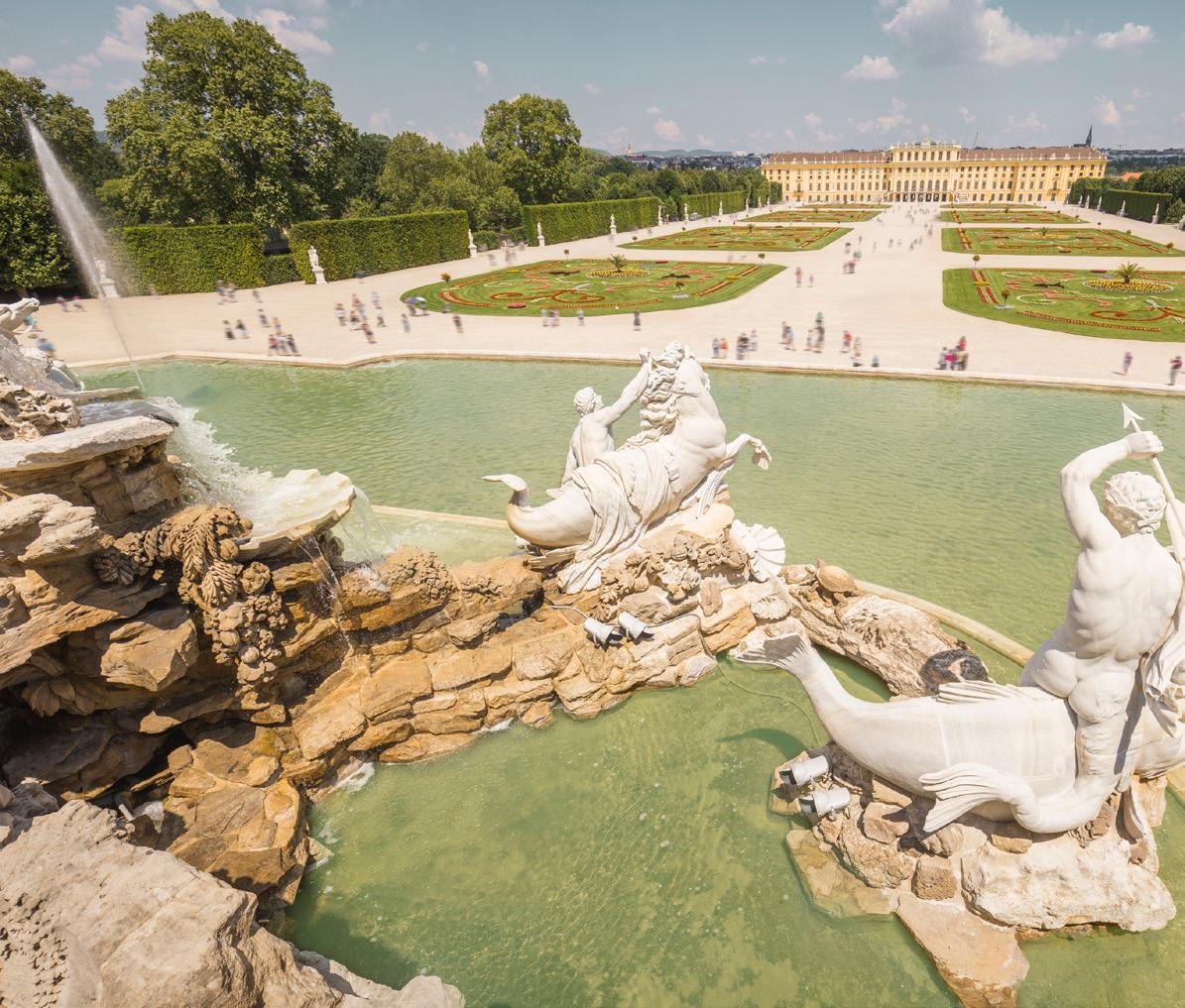
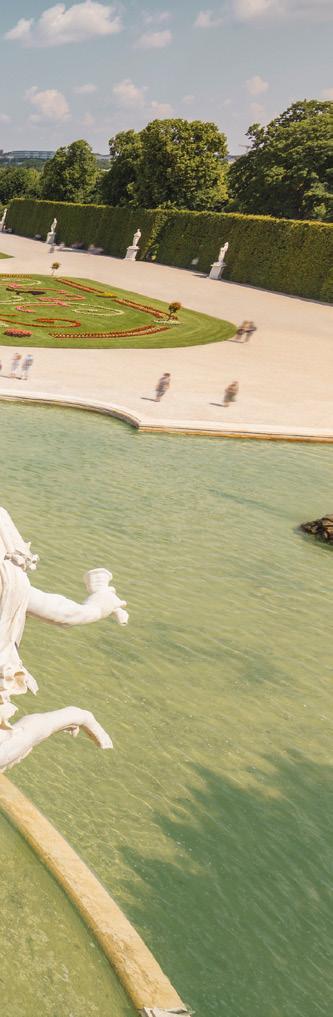
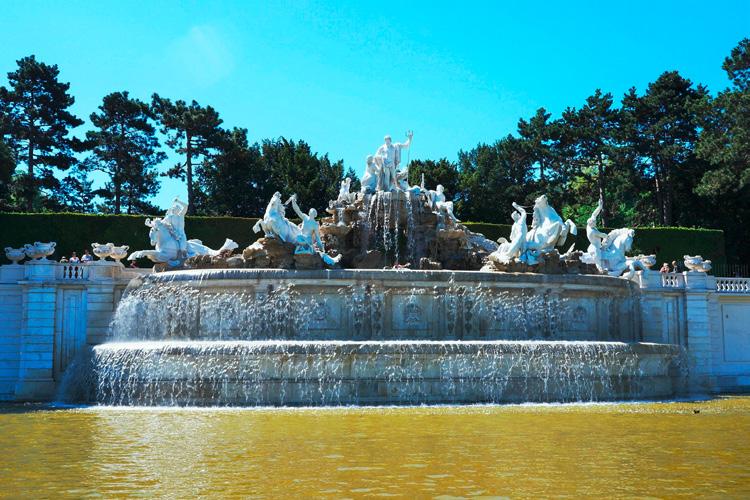
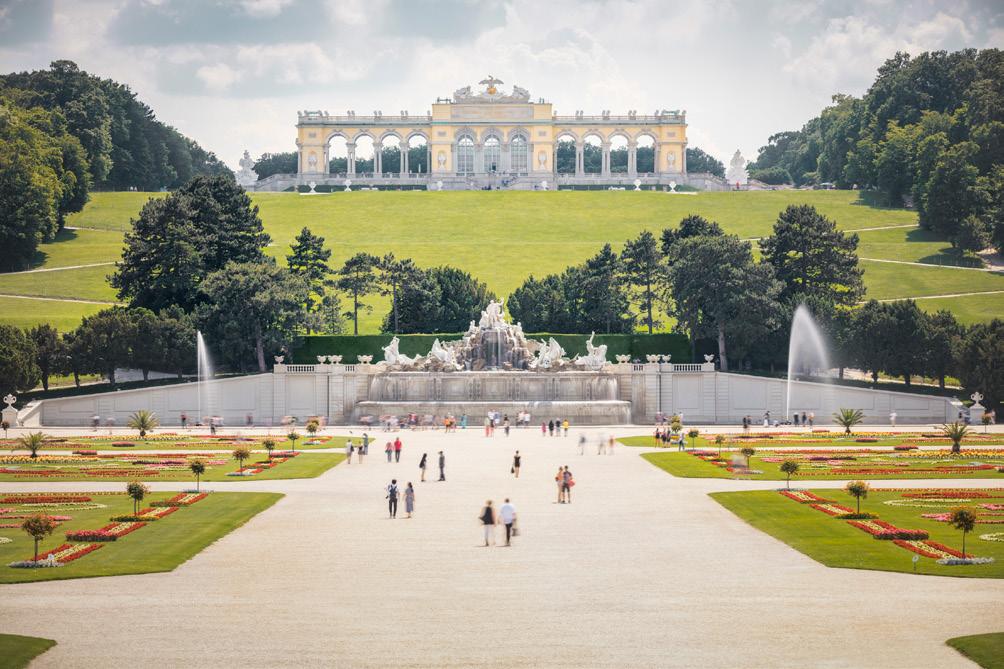
Yet even after this excursion, the great axis of the park remains the true backbone of the site. In front of the palace, it begins in the parterres, then gathers at the Neptune Fountain and draws the eye up the hill. The fountain was designed as the crowning conclusion of the great parterre and formed part of the redesign of the gardens in the 1770s under Maria Theresa. It marks the point at which surface becomes movement. One does not simply stand before a fountain, but at the opening of a progression.
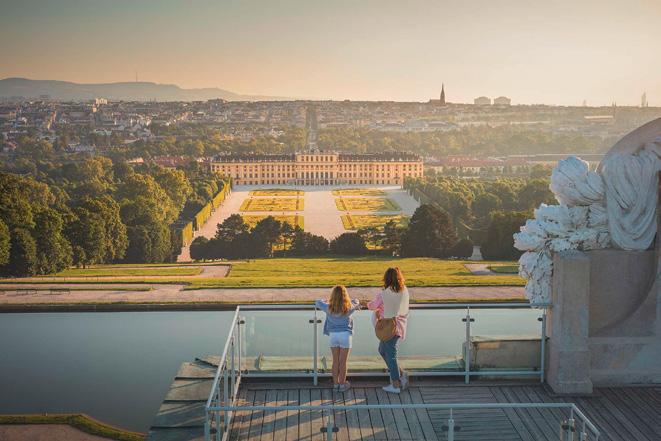
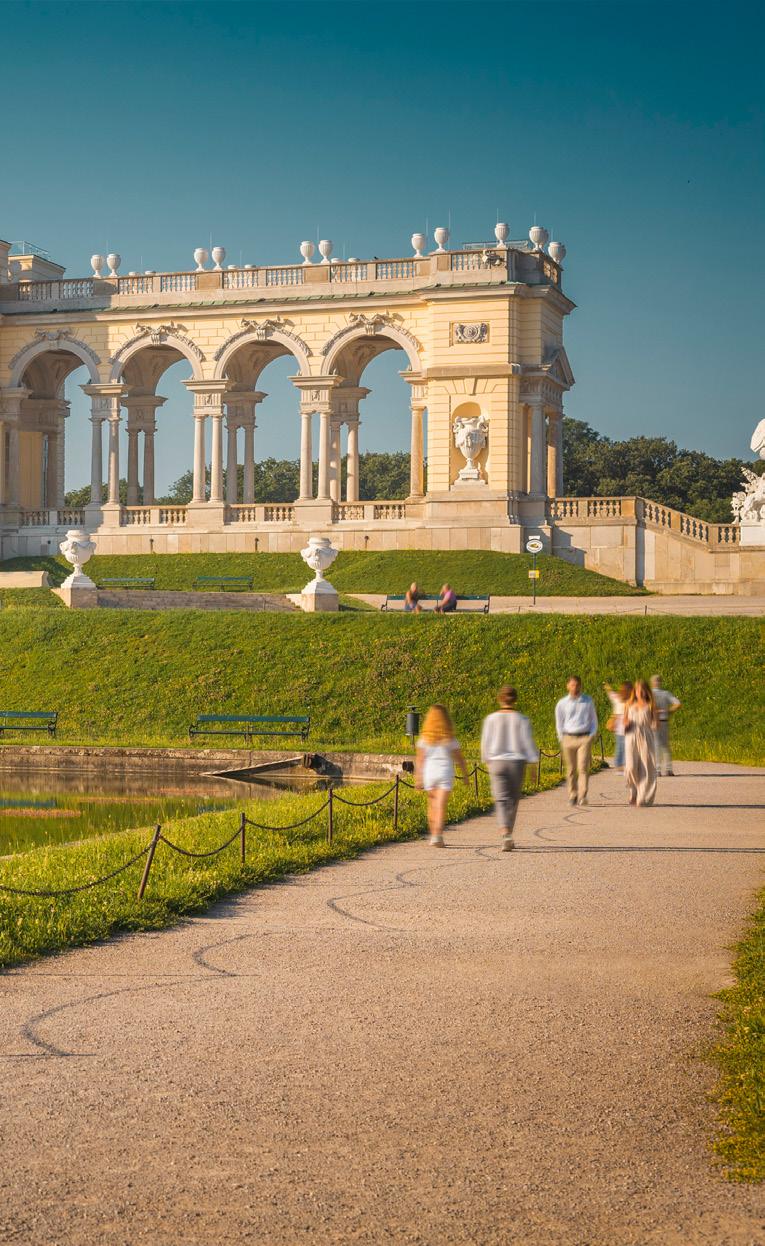
Even from here it becomes clear that the Gloriette is not just any destination in the park, but the architectural final thought of the whole composition.
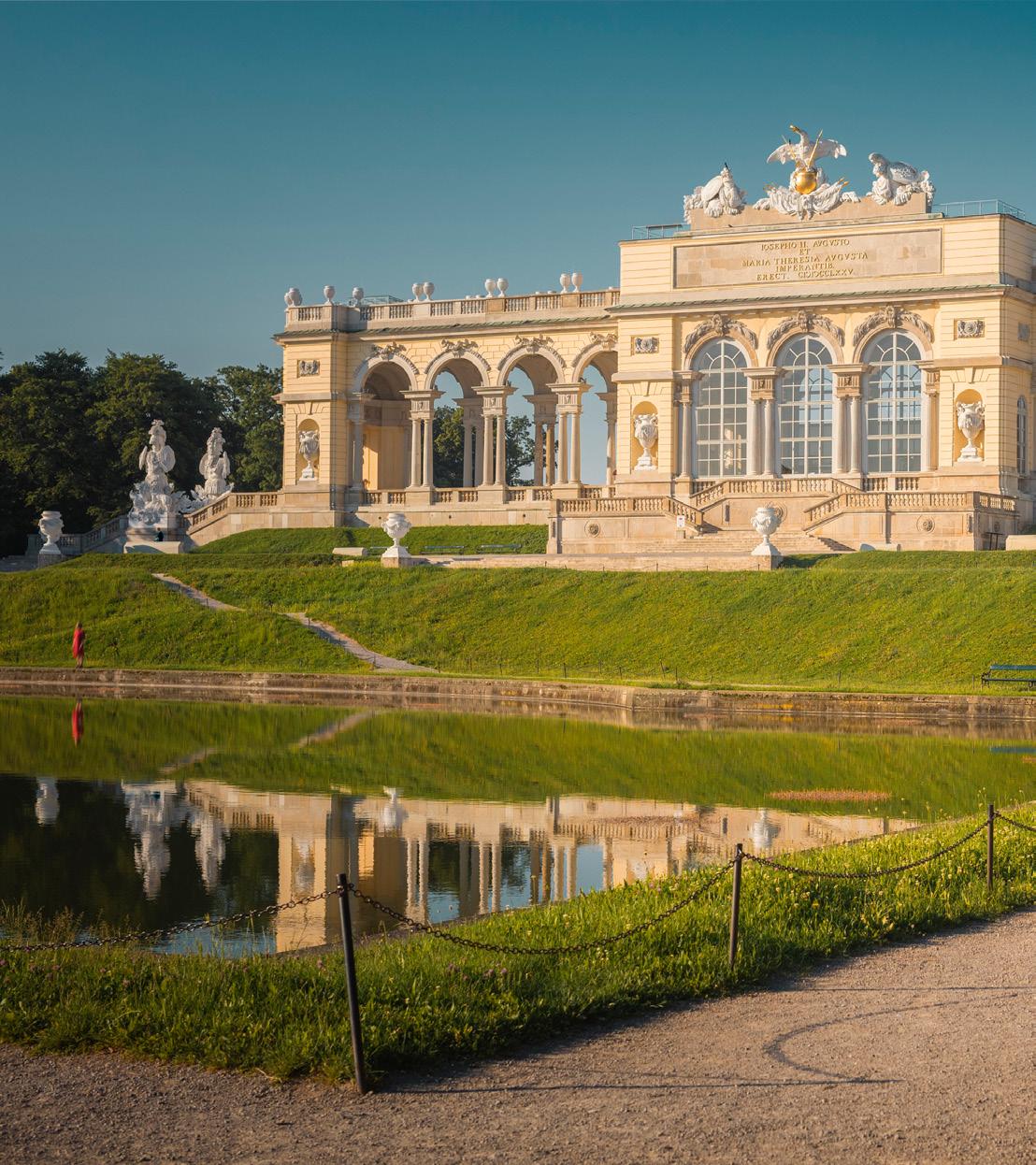
The Gloriette was built in 1775 on the ridge to designs by Hetzendorf von Hohenberg. Fischer von Erlach had already envisioned a belvedere at this point; the idea was rea-
lized only in the later phase of the garden’s design. From below, the colonnade appears almost like a frame set against the horizon; from above, it becomes a viewpoint over the entire ensemble. It is precisely there that one understands how exactly Schönbrunn was composed: the palace lies far below in the garden’s grid, the park opens out in breadth, and Vienna appears beyond it not as a rival, but as a distant horizon. It is a view that does not merely assert order, but makes it visible.
In the end, what remains above all is the sense that Schönbrunn resists any simple summary. It is a residence and a park, a stage of state and a family place, a work of art and a place of use all at once. Perhaps that is precisely why the ensemble feels so modern. It shows how architecture can order a landscape, how gardens can store ideas, how political power can be translated into space — and how a place can preserve all of that across centuries without becoming lifeless. Anyone leaving Schönbrunn takes away not only images, but a particular way of seeing: of axes, of transitions, of rooms that reveal more the longer one remains in them.
Schloss Schönbrunn
Schönbrunner Schloßstraße 47 1130 Wien
Tel. +43 1 811 13-0 info@schoenbrunn.at www.schoenbrunn.at