MAGAZI N E M USEUM.COM 2 25
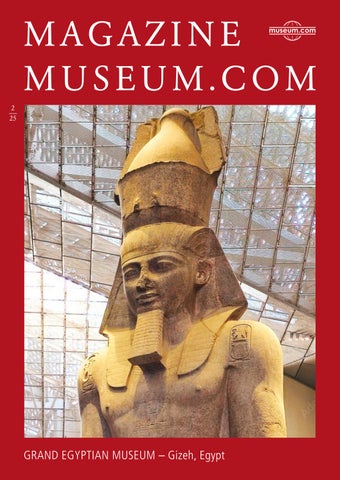
GRAND EGYPTIAN MUSEUM – Gizeh, Egypt
Table of contents – Museums
The Grand Egyptian Museum Gizeh, Egypt
2
Table of contents
Image Access | ART SCANNER Wuppertal, Germany
MAGAZINE MUSEUM.COM
museum.com Sinserstrasse 67 6330 Cham SWITZERLAND magazine@museum.com Tel. +41 41 5102688
About the global museum project
MAGAZINE MUSEUM.COM
museum.com presents a global museum database in which museums can enter their content directly via a personal login. Membership is free of charge. In addition, museum.com offers the independent creation and operation of audio guides, which are created with the help of artificial intelligence. The portal is accompanied by the MAGAZINE MUSEUM.COM, which covers current topics from the museum world.
Media Data 2025/2026 – For publication inquiries or media data, please contact us by e-mail - we will be happy to send you all the information you need. Publication in the current issue No. 2 is possible at any time, as there is no fixed editorial deadline.
Download Media Data, click here
3
The Grand Egyptian Museum Gizeh, Egypt
4
The building by Heneghan Peng Architects covers an area of 50,000 square meters near the Pyramids of Giza and houses more than 100,000 objects on a total area of 81,000 square meters. Photo: © Grand Egyptian Museum
5
6
Origins, Motivation, and Significance Perched on the desert edge of Cairo, just a few kilometers from the timeless pyramids of Giza, the Grand Egyptian Museum (GEM) stands as a bold testament to human history – a bridge between antiquity and the present, and a grand promise to safeguard Egypt’s rich heritage for generations. The idea to build GEM goes back decades: Egypt’s existing museums, notably the old Egyptian Museum in Tahrir, had by the late 20th century become overcrowded and insufficient to house the growing collection of antiquities – many stored in warehouses, fragmented across sites, or displayed under sub-optimal conditions. The motivation was manifold: to preserve, to honour, and to offer a dignified, modern home for one of the world’s richest archaeological legacies. Beyond conservation, GEM was conceived as a cultural and touristic beacon. Located close to the Giza Plateau, it connects the ancient wonders of the pyramids with a
curated narrative of Egypt’s civilization – encouraging longer stays, deeper engagement, and a broader understanding of Egypt’s past. In doing so, GEM is not only a museum: it is a symbol of national heritage and global cultural dialogue, offering visitors from around the world a chance to traverse millennia of human achievement under one roof. From Old Spaces to a New Museum – Why GEM Was Necessary For decades, Egypt’s antiquities – statues, sarcophagi, jewelry, everyday objects, temple fragments – were scattered across multiple institutions, storerooms, and older museums. The central museum in Cairo, though historically significant, lacked the capacity, climate control, and curatorial space needed for a comprehensive and respectful display. Overcrowding, inadequate lighting, exposure to environmental stress, and the fragility of ancient artifacts made it clear: many objects were at risk,
many stories remained untold, and many treasures remained unseen. In addition, archaeological work across Egypt continued to produce new finds – in Saqqara, Luxor, the Nile Delta, and elsewhere – increasing the pressure on existing facilities. A purpose-built museum with modern conservation laboratories, climate-controlled galleries, storage and research facilities, and expansive exhibition space became less a luxury, more a necessity. Thus, GEM was conceived as the long-awaited response: a unified institution where Egypt’s material heritage could be preserved, studied, and displayed in a way that does justice to its historical weight – and where ancient civilization could be experienced with clarity, dignity, and narrative coherence.
Left: GEM Glass Pyramid. Right: GEM Hanging Obelisk Photos: © Grand Egyptian Museum
7
8
The Inauguration: A Ceremony Marking a New Era After decades of planning, design competitions, delays, and partial openings, the Grand Egyptian Museum officially opened its doors to the public on 4 November 2025. The opening marked the culmination of a long journey from concept to reality – and the beginning of a new chapter for cultural heritage. This inauguration was more than just a local event: it was celebrated globally. Heads of state, cultural dignitaries, scholars, and international guests gathered – signaling the museum’s global importance as a centre for ancient history, heritage, and world civilisation. For many visitors, the opening represents a long-awaited opportunity: to see Egypt’s past assembled in a single place, to walk through time from prehistory to the Roman era, and to experience a museum built to match the ambition of ancient Egypt itself. Prior to the opening, beginning as early as 2023, the museum had already opened parts of its complex in phases: first the Grand Hall with the monumental statue of Ramesses II; then, in October 2024, a “trial operation” of the 12 main galleries. This soft-opening allowed the museum to test visitor flows, logistics, and exhibit readiness before the full inauguration. Photos: Opening. © Grand Egyptian Museum
9
10
Architecture: a Dialogue between Desert, Light, and Memory From the outside, GEM appears less as a conventional museum and more as a monumental emblem – a structure that resonates with its surroundings. The architectural design was selected from an international competition held in 2002, which attracted over 1,500 entries from 82 countries. The winning proposal came from the firm Heneghan Peng Architects, supported by leading engineering and landscape firms. The building’s form evokes the geometry of the nearby pyramids: its triangular, chamfered volumes draw a subtle parallel to Egypt’s ancient monuments. Through this echo of shape, GEM integrates itself into the landscape – a "fourth pyramid" in dialogue with the three ancient ones. Visitors approaching the museum sense that the new structure belongs as much to the present as to the continuum of Egypt’s past. But GEM is not merely symbolic: its architecture serves function, preservation, and experience. Inside, the airy Grand Hall – with its translucent façade and light-diffusing design – welcomes visitors with a sense of scale and ceremony. Sunlight is filtered and softened; as dusk falls, the building glows warmly, a silent testament to centuries-old civilization bathed in modern light.
Photo: © Grand Egyptian Museum
11
12
Photo: © Grand Egyptian Museum, Rehab Eldalil
13
Grand Egyptian Museum – Grand Stairs. © Josef Sindelka
14
From the Grand Hall, visitors ascend the Grand Staircase – a monumental gallery in its own right – lined with statues, columns, sarcophagi, temple reliefs, and monumental fragments. The staircase becomes a narrative device: as one rises, one rises through time, power, belief. The vertical journey through stone, light, and shadow evokes the ascent from mortal life toward eternity, echoing the ancient Egyptians’ own spiritual geometry. Large windows at key vantage points frame the nearby Pyramids of Giza – a breathtaking architectural gesture that ties the new museum directly to the ancient landscape outside. Walking through GEM, visitors do not forget where they are: the cradle of one of humanity’s greatest civilizations. Behind the scenes, GEM is more than display space: beneath its gleaming halls lie state-of-the-art conservation laboratories and storage facilities, designed to preserve fragile antiquities with modern climate control, preventive conservation, and scientific rigor. This infrastructure ensures that these treasures, some thousands of years old, survive – not only for this generation, but many to come.
15
Exhibition Concept: A Multi-Dimensional Narrative of Civilization What makes GEM truly remarkable is not only the amount of artifacts, but the way they are presented: not simply a chronological parade, but a carefully curated conversation between time, theme, and human experience. The permanent exhibition is organized around three interrelated themes – Society, Kingship, and Beliefs – and unfolds across 12 Main Galleries that cover the sweep of Egyptian history from prehistoric times up to the Roman period. This conceptual framework allows visitors to choose their own path: follow a strict chronological journey – from earliest settlements to late antiquity – or explore thematic threads such as religious beliefs, daily life, royal power, or social structures. Alternatively, visitors can combine both approaches, creating a personalized and layered experience. Within this structure, each gallery is not simply a room of artifacts, but an immersive environment: lighting, display cases, labels, spatial arrangement, and narrative transitions all work together. The curatorial philosophy balances scholarly depth with accessibility, offering both general audiences and specialists a meaningful experience. Beyond the main galleries, GEM is also conceived as a living institution: a centre for conservation and research, education, temporary exhibitions, immersive experiences, and outreach – a place where ancient heritage connects with modern lives.
Main Galleries. Photo: © Grand Egyptian Museum
16
17
Main Galleries. Photos: © Grand Egyptian Museum
18
19
A Journey Through the 12 Main Galleries – A Narrative in Prose Walking into GEM is like stepping into a carefully composed novel, where each chapter unfolds across stone, wood, metal, and bone; where each artifact is a character; where every corridor leads deeper into the soul of ancient Egypt. At the beginning, in the galleries dedicated to Prehistoric, Predynastic, and Early Dynastic periods, one encounters the roots: simple tools, pottery shards, everyday objects, early burial goods. These modest artifacts speak of humans learning to shape the land, to settle, to forge community along the Nile. In dim, respectful light, these fragmentary remains whisper of beginnings. Moving forward, the Old Kingdom emerges – the age of pyramid-builders, of the first great state. Here one finds funerary objects, early statuary, aspirational art, tools, and domestic items – windows into lives lived millennia ago. As one ascends in time, the Middle Kingdom and Second Intermediate Period unfold: a more complex society, shifting politics, regional variations, evolving craftsmanship. Objects of daily life – pottery, tools, weapons – share space with figurines, statues, administrative artifacts, and early religious paraphernalia. Then comes the New Kingdom – perhaps the zenith of ancient Egypt. Here the grandeur of empire: royal statues, religious objects, temple fragments, tomb-chapel reconstructions, ceremonial items. Though the two halls dedicated to Tutankhamun’s treasures may have their own space, the New Kingdom galleries contextualize his world: the wealth, the faith, the art, the living and the dying of a civilization at its height. Beyond, the galleries cover the Third Intermediate Period, the Late Period, the Ptolemaic age, and the Graeco-Roman era: centuries of change, fusion, adaptation. Here, artifacts show a society transforming – foreign influences, syncretic beliefs, evolving daily life – yet still rooted in traditions millennia old. Throughout the journey, the three themes – Society, Kingship, Beliefs – interweave. One sees not only pharaohs and elites, but craftsmen, priests, common people; not only temples and tombs, but homes; not
20
only royal power, but family, community, faith and ritual. The narrative thus becomes multidimensional – more human, more layered, more alive.
Highlights and Treasures: From Colossal Statues to Human Stories Among the countless objects GEM presents, some stand out – not only for their material splendor, but for the stories they carry. At the museum’s entrance hall – the Grand Hall – the visitor is greeted by the towering statue of Ramesses II: a colossus hundreds of years old, relocated to its new home. Through the galleries, one encounters artifacts of all kinds: from simple prehistoric tools to elaborate funerary objects; from everyday ceramics and household items to statues, relics of temples, ritual objects, and royal paraphernalia. Once fully open, visitors will be able to see the entire Tutankhamun collection reunited: the golden mask, nested coffins, jewelry, chariots, thrones, daily life objects, ritual items – thousands of pieces that had been dispersed for decades.
Beyond the Galleries – A Living Institution GEM is not just a museum of objects; it is a living cultural complex. Beneath its grand halls lie conservation laboratories and restoration workshops – state-of-theart facilities designed to preserve, study, document, and restore ancient artifacts with scientific precision. In addition to research and preservation, GEM offers educational programs, outreach, and visitor services. There are spaces for children and families; gardens and outdoor areas; cafés, shops, and amenities; and plans for immersive and multimedia exhibitions that make ancient Egypt accessible not only to archaeologists, but to curious minds of all ages.
Statue of Queen Hatshepsut Photo: © Grand Egyptian Museum
21
Left: His Lifestyle, Chariots / His Funeral Right: His Appearance / His Lifestyle Showcases Photos: © Josef Sindelka
22
23
24
Left: His Lifestyle, Sailing Boats / His Afterlife Right: His Funeral, Shrines / His Funeral, Sarcophagi Photos: © Josef Sindelka
25
26
Everyone wants to see it: the golden mask, surrounded by amazed visitors. Photos: © Hassan Mahmoud
27
Looking Ahead: Future Plans and Vision With its official opening, GEM begins not a conclusion, but a new beginning. The museum aims to display a fraction of its total holdings initially: among more than 100,000 preserved objects, some 50,000 will be available to the public in the galleries at launch.
28
and pyramids, enhancing access, and integrating heritage, tourism, and education in a sustainable framework for the future. Conclusion
Over time, GEM plans temporary and thematic exhibitions, rotating displays, and special events – bringing to light lesser-known aspects of Egyptian history: regional cultures, daily life, crafts, religious practices, and newly unearthed artifacts.
In the Grand Egyptian Museum, Egypt has built more than a museum: it has created a monumental vessel of memory, a carefully designed bridge between millennia, a space where past and present meet in conversation. Through architecture, curatorial vision, conservation, and visitor experience, GEM honors the profundity of ancient Egyptian civilization.
Furthermore, GEM is part of a broader vision for revitalizing the Giza area: improving visitor infrastructure, connecting museum
Walking through its halls, ascending its grand staircase, pausing before a statue of an ancient king or a humble pottery
shard – one senses the weight of history, the continuity of human endeavour, the fragility and resilience of culture. GEM invites us not just to observe, but to reflect: on what has been, what remains, and what we choose to preserve. General planning & media production: ATELIER BRÜCKNER
The Grand Egyptian Museum Cairo - Alexandria Desert Rd, Kafr Nassar, Al Haram, Giza Governorate 3513204 Egypt https://gem.eg
Opening ceremony. Photo: © Federal Government/ Marvin Ibo Güngör
29