Bush tucker plants . . .
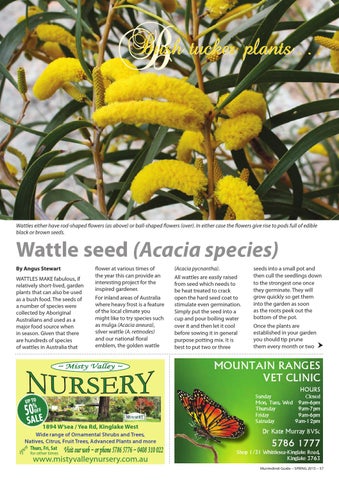
Wattles either have rod-shaped flowers (as above) or ball-shaped flowers (over). In either case the flowers give rise to pods full of edible black or brown seeds.
Wattle seed (Acacia species) By Angus Stewart WATTLES MAKE fabulous, if relatively short-lived, garden plants that can also be used as a bush food. The seeds of a number of species were collected by Aboriginal Australians and used as a major food source when in season. Given that there are hundreds of species of wattles in Australia that
flower at various times of the year this can provide an interesting project for the inspired gardener. For inland areas of Australia where heavy frost is a feature of the local climate you might like to try species such as mulga (Acacia aneura), silver wattle (A. retinodes) and our national floral emblem, the golden wattle
(Acacia pycnantha). All wattles are easily raised from seed which needs to be heat treated to crack open the hard seed coat to stimulate even germination. Simply put the seed into a cup and pour boiling water over it and then let it cool before sowing it in general purpose potting mix. It is best to put two or three
seeds into a small pot and then cull the seedlings down to the strongest one once they germinate. They will grow quickly so get them into the garden as soon as the roots peek out the bottom of the pot. Once the plants are established in your garden you should tip prune them every month or two
MOUNTAIN RANGES VET CLINIC
1894 W’sea / Yea Rd, Kinglake West Wide range of Ornamental Shrubs and Trees, Natives, Citrus, Fruit Trees, Advanced Plants and more for other times
www.mistyvalleynursery.com.au
HOURS Sunday Closed Mon, Tues, Wed 9am-6pm Thursday 9am-7pm Friday 9am-6pm Satruday 9am-12pm
Dr Kate Murray BVSc
5786 1777 Shop 1/31 Whittlesea-Kinglake Road, Kinglake 3763 Murrindindi Guide – SPRING 2015 – 57