PRINCIPAL SPEAKS
Student voice the key to engaging students


Essential Reading for Principals • Department Heads • Teachers • Professionals The essential industry guide Issue 27 | Term 1, 2023 Registered by Australia Post Print Post No. 100022567 AUD $12 incl GST | school-news.com.au SPECIAL REPORT
and expression in the
Language
digital age


























































































































































































1800 742 748 | info@iav.com.au | iAV.com.au 5 YEARS WARRANTY 5 SRAEY YTNARRAW 5 5 super specialBLENDEDlearning No Limit... While Stocks Last! BENQ SPECIAL PACKAGE INCLUDES BenQ 4K Interactive Panel, Wall Mount Bracket, Logitech C925e Full HD Webcam, 5 Years Warranty. bonus 1080P FULL HD Webcam for Streaming, Conference Calls and Recording for Windows and Mac DELIVERY INCLUDED | AUSTRALIA WIDE interactive panel Massive savings $ 2 , 7 5 0 ex gst included Logitech C925e Prices starting from
School News is distributed to primary, secondary and intermediate schools throughout Australia by Multimedia Pty Limited.


The views and images expressed in School News do not necessarily reflect the views of the publisher. The information contained in School News is intended to act as a guide only, the publisher, authors and editors expressly disclaim all liability for the results of action taken or not taken on the basis of information contained herein. We recommend professional advice is sought before making important business decisions.
Advertising Conditions
The publisher reserves the right to refuse to publish or to republish without any explanation for such action. The publisher, it’s employees and agents will endeavour to place and reproduce advertisements as requested but takes no responsibility for omission, delay, error in transmission, production deficiency, alteration of misplacement. The advertiser must notify the publisher of any errors as soon as they appear, otherwise the publisher accepts no responsibility for republishing such advertisements. If advertising copy does not arrive by the copy deadline the publisher reserves the right to repeat existing material.
Disclaimer
Any mention of a product, service or supplier in editorial is not indicative of any endorsement by the author, editor or publisher. Although the publisher, editor and authors do all they can to ensure accuracy in all editorial content, readers are advised to fact check for themselves, any opinion or statement made by a reporter, editor, columnist, contributor, interviewee, supplier or any other entity involved before making judgements or decisions based on the materials contained herein.
School News, its publisher, editor and staff, is not responsible for and does not accept liability for any damages, defamation or other consequences (including but not limited to revenue and/ or profit loss) claimed to have occurred as the result of anything contained within this publication, to the extent permitted by law. Advertisers and Advertising Agents warrant to the publisher that any advertising material placed is in no way an infringement of any copyright or other right and does not breach confidence, is not defamatory, libellous or unlawful, does not slander title, does not contain anything obscene or indecent and does not infringe the Consumer Guarantees Act or other laws, regulations or statutes. Moreover, advertisers or advertising agents agree to indemnify the publisher and its’ agents against any claims, demands, proceedings, damages, costs including legal costs or other costs or expenses properly incurred, penalties, judgements, occasioned to the publisher in consequence of any breach of the above warranties.
The Multimedia Pty Ltd team acknowledges Aboriginal and Torres Strait Islander peoples as the First Australians and Traditional Custodians of the lands upon which we gather, work, and publish. We want to pay our respects to Elders past, present, and future, who continue cultural, educational, and spiritual connections to Country. © 2023 Multimedia Pty Ltd. It is an infringement of copyright to reproduce in any way all or part of this publication without the written consent of the publisher.
Pty Limited
PO Box 1080, Noosaville BC, Queensland, Australia 4566 Phone: (07) 5440 5322 Fax: (07) 5604 1680 mail@school-news.com.au school-news.com.au

EDITOR Gemma Easton editor@school-news.com.au
INDUSTRY REPORTERS
Shannon Meyerkort and Sarah Davison
PRODUCTION Richard McGill ADVERTISING Pip Casey advertising@school-news.com.au
CONTRIBUTORS
Integrate AV, Jason Cross and Daniela Falecki
KEY
Commercially funded supplier profile or supplier case study
Supplier information or content
Suppliers share their views in one-off, topical pieces General editorial. Case studies and features may cite or quote suppliers, please be aware that we have a strict ‘no commercial content’ guideline for all magazine editorial, so this is not part of any commercially funded advertorial but may be included as relevant opinion. Happy reading!

04 Term 1, 2023 | school-news.com.au FRONT DESK
10 14 41
58 FRONT DESK Editor’s Note: Welcome to a new school year! 05 EDUCATION Special Report: Language and expression in the digital age 06 Surviving and thriving with ChatGPT and AI .................................... 08 Principal Speaks – Student voice: the key to engaging students 10 Assisting teachers to make a difference.................................................. 12 Profile – King’s Baptist Grammar School, SA: Pedal Prix the ultimate STEM subject 14 ADMINISTRATION Acoustic solutions for all areas 18 Digital sign in: the benefits for schools ................................................... 22 Running a successful fundraiser 24 Case Study: Furniture choices bring new life to spaces ............ 26 Furniture trends to inspire learning 30 TECHNOLOGY BenQ receives Eyesafe certification .......................................................... 33 Three stages of the smart classroom 34 TEACHER'S DESK Wellbeing for the whole school community 38 TEACHING RESOURCES Exploring the benefits of live performance 41 Rethinking STEAM learning and teaching 46 HEALTH & SAFETY Automatic external defibrillators: Is your school equipped? .................................................................................... 51 WHAT’S HOT ................................................................. 56 EXTERNAL LEARNING The benefits of school camps and excursions ..................................58 PROPERTY Nature Play: more time in trees, less time on screens 64 Learning spaces beyond the classroom ................................................ 67 inside Front Cover: © Kaspars Grinvalds – stock.adobe.com
term one
Welcome to a new school year!
Welcome to the Term One issue of School News!
As the now former editor of School News, I want to extend a sincere thank you for reading, collaborating, and sharing your stories with me over the past few years. I have been endlessly inspired by the vital work schools have been doing around the country, particularly during the height of the pandemic. It was a great privilege to interview so many principals and teachers during lockdowns and teacher strikes, following floods and bushfires, and in the lead up to curriculum changes.
No industry works harder than this one, and I am thrilled to have been part of a magazine dedicated to showcasing that hard work and innovative spirit. I look forward to reading this issue alongside you all, having now left School News in highly capable hands. A very warm and o icial welcome to Gemma, Naomii, Sarah and Shannon, our fabulous new School News editorial
Gemma Easton, Editor, SchoolNews editor@school-news.com.au
team. I hope the new school year brings plenty of joy and exciting stories to share. Kindly, Rosie Clarke
Hello! My name is Gemma and I am the new editor of School News Thank you to Rosie for her kind words, and the work she has put into so many editions of School News, ensuring it is a valued publication throughout the industry.

I have spent the past few years working in schools, in a non-teaching role. This has

given me an insight into how schools operate and the issues a ecting both teaching and non-teaching sta . Above all, though, I know how incredibly hard everyone works in a school. My background is in writing and editing, and I am thrilled to be back doing what I love!
I feel fortunate to have the opportunity through School News to showcase and celebrate the wonderful things happening in schools and across Australia. There is no such thing as a quiet time in schools, but the back-toschool period can be particularly busy. Ensuring everyone is okay as the year commences is important, so in this issue of School News, we explore wellbeing, and discuss ways to keep sta , students and the wider community mentally healthy. The way students express themselves is changing. In our Special Report, we look at the technical loophole which saw students in South Australia have
access to language assistant Grammarly during end of year exams. We explore the challenges of teaching language and expression in the digital age.
In our Principal Speaks section, we meet Jason Cross from Miami High. Mr Cross discusses how student voice and student engagement have been game changers at his school. Go gently as we embark on a new school year.
Gemma
Got plans for your school in 2023? Write in and let us know so we can feature you!


The School News team acknowledges Aboriginal and Torres Strait Islander peoples as the First Australians and Traditional Custodians of the lands upon which we gather, work, and publish. We want to pay our respects to Elders past, present, and future, who continue cultural, educational, and spiritual connections to Country.


Term 1, 2023 | school-news.com.au 05 FRONT DESK EDITOR’S NOTE
Language and expression in the digital age
By Sarah Davison, Industry Reporter
The South Australian Certificate of Education (SACE) board is investigating how a technical oversight saw some Year 12 students access cloud-based writing assistant, Grammarly, during their English exams.
In November 2022, The SACE Board confirmed that students writing their English Literary Studies exam were able to access Grammarly, a program that corrects grammar and punctuation, and makes suggestions to improve writing style.
South Australian students started using laptops for exams in 2018, in an Australian first. To make sure students could not access external material during exams, SACE developed a computer management system. The previous version of the system blocked access to apps such as Grammarly; the version that was introduced for the 2022 exams did not block access.


For students, if Grammarly had been installed on their laptop prior to the exam, the app continued to appear and make suggestions to improve their writing. Students who did not have it installed were not afforded this advantage.
In a statement, the SACE board rejected claims that the integrity of exams had been compromised.
“We acknowledge that there has been some concern and confusion in recent discussions regarding the use of editing tools in the electronic examination environment,” the statement said.
“The focus of the English Literary Studies examination is the assessment of a student’s ability to read, interpret and
analyse texts and to construct a reasoned argument based on a personal point of view.
“Students must demonstrate their understanding of values, ideas and perspectives, analyse texts and contexts, think critically and select and integrate textual evidence to support and justify their ideas.”
While the board confirmed the incident and said it was investigating, it has spurned a larger debate about the perceived importance of spelling and grammar in English education.
The use of AI in assisting with exams and assignments
was brought into focus again recently, with many Australian states banning the use of Chat GPT in schools.
ChatGPT, or Chat Generative Pre-Trained Transformer, can produce a variety of written responses from songs and poems to computer code and exam responses. Some educational institutions have updated plagiarism policies or rewritten exam questions to minimise the technology’s reach.
Naomi Parry is a lecturer in English in the School of Humanities in the College of Arts Law and Education at the University of Tasmania and said the recent incident
raised an interesting question about the role of digital tools within education.
“We live in a digital world, we have autocorrect and predictive text, and all of those things are part of our lives,” she said.
“I use Grammarly, and I know a lot of other writers and editors who use the program within their professional work. Obviously with this situation there was a bit of a glitch, and something that could only happen within a digital environment.
“But I suppose the question is, if we are working in a digital environment, then should we be without those tools?”
However, Dr Parry said she believed that spelling and grammar still needed to be a focus in English, and this should be reflected in assessment.
“I think it is essential that students are taught grammar and I think it absolutely should be part of assessment, that we should be assessing students on the basis of their spelling and grammar,” she said.
“People need to have their own understanding of why a sentence is incorrect, and why it’s triggering Grammarly. English is really the only subject where that’s going to be picked up.” ©
06 Term 1, 2023 | school-news.com.au EDUCATION SPECIAL REPORT
stock.adobe.com © stock.adobe.com
Senior teacher and South Australian English Teachers Association (SAETA) past president, Alison Robertson said SAETA was also somewhat concerned by the student access to Grammarly during the exam.


“Although SACE has claimed ‘The ELS examination tests critical reading, not spelling or grammar’ the markers are instructed to grade students on Ap3: ‘Use of accurate, clear, and
fluent expression appropriate for purpose and audience’.
“Accurate expression entails correct spelling and grammar. It is true that there are many other performance standards also being assessed and that Ap3 is just one, but it is naïve to suggest that spelling and grammar are unimportant in an English exam.”
Additionally, Ms Robertson said SAETA also held concerns

The only alternative to the dangerous protruding metal hook is here!
pool centres and change rooms, just to name a few.
about ensuring educational equity between students.
“This is a significant equity issue as not all students can afford the app Grammarly Premium which is downloaded onto their laptop,” she said. The issue of equity and access was echoed by Dr Parry. “The biggest issue I see is about equity. Students who can afford this technology are going to go for it, but the ones who can’t afford it will have to go without,” she said.
“I think that if some students are going to have access to Grammarly, then all students should have full access to Grammarly.”
Working with university students, Dr Parry said that each year, she sees students start university with a decreased understanding of grammar and spelling, however, she does not think programs like Grammarly are entirely to blame.
“What I really notice is students writing incomplete sentences as well as sentences that do not have a subject. I have students that start sentences


without capital letters, and I have to point out that they’re incomplete sentences.”
She believes that students’ use of grammar can also be attributed to the digital age. “We’re trying to teach students that there’s a difference between the way you speak and the way you text and the way that you write, and that is often quite novel for them.”
Dr Parry added that the difference in English skills between “academic” writing and everyday expression was also significant. “You have a written assignment, and there’ll be some kind of effort to write with fluency in that assignment,” she said. “But then you see what they’re writing in the chat rooms, and it’s really amazing how weak their basic expression is. And that’s their day-to-day communication.
“I think it’s an interesting insight into how we are communicating these days. I really do think that with the increased presence of social media, language use is shifting quite profoundly. I don’t know whether it’s bad or good, but it is happening.”
The safest hook in the World
Proudly designed, engineered and manufactured in Australia with the intent to provide the user with total peace of mind.
Unlike the dangerous, old style, protruding metal bag hooks, Snughooks have a smooth, recessed hook design, completely without any sharp edges, eliminating the potential dangers and injuries commonly occurring from the traditional styles.

Ideal for hanging bags, towels, coats, hats, and other items across a range of applications, including schools, swimming


To ensure they are up to the task, Snughooks have undergone load tests to assess their ability of withstanding certain forces placed upon them, and have determined they can safely hold loads of up to 120kg
Simple to install, the Snughook comes with all the necessary fi xings and step by step instructions to easily make the transition from sharp steel hooks.
MAKE THE CHANGE TODAY to the “Safest Hook in the World!”
For more information, contact us on 08 9378 0500 or email us on sales@snughook.com
Term 1, 2023 | school-news.com.au 07 EDUCATION
It’s time to replace the old, dangerous, protruding metal hooks! KEEP YOUR STUDENTS SAFE ORDER TODAY snughooks.com (08) 9378 0500 sales@snughooks.com
Snughooks are a unique and innovative wall hanging solution, making it the “safest hook in the world.”
© stock.adobe.com
Surviving and thriving with ChatGPT and AI



 By Sarah Davison, Industry Reporter
Research continues to tell us that the students of today will be stepping into a wildly different world than their parents.
The recent emergence of ChatGPT is indicative of our ever-changing world. ChatGPT, and similar technology, is part of a new wave of AI that can generate highly cohesive, human-like responses to questions and prompts.


International expert in Artificial Intelligence (AI) and education

Professor George Siemens said that AI technology would undoubtedly change the lives of students and teachers. “We are on the cusp of a massive explosion of innovation and creativity in the education sector and AI is at the very centre of it,” he said.


For today’s students, AI technology will become increasingly commonplace in all facets of their lives. And for educators, these changes are impacting the way that students learn and prepare for careers after the classroom.
A 2020 report by the University of Melbourne found that for students to thrive in the future workforce, they need to become “expert learners”. With this, they need to be adaptable to an ever-changing environment and also develop broader social skills. Developing personal skills such as collaboration, communication and persistence
are paramount in helping students thrive into the future.
“They need to acquire a body of knowledge, skills, attitudes, and values that enable them to adapt and contribute in an ever-changing environment,” the report said.
“What is clear is that these skills cannot be learned if learning is experienced only through carefully directed, broadcast-style instruction, targeting mastery of set texts and assessed using wellrehearsed written examinations that rely on individual, intellectually focused effort.”
For Nüdel Kart creator and founder Marcus Veerman, the recent media storm about ChatGPT has simply cemented what he already believed: that these new technologies will affect every level of society; and students, and therefore their educators, need to be highly adaptable and creative to thrive in this new paradigm. “Every time I think about all of these new technologies and this kind of rapid change, it all boils down to children needing to learn their most human
skills of creativity, problem-solving, innovation, entrepreneurship, and all of the social skills that go along with it. Because everything’s going to change so rapidly, children need to be highly adaptable.”
While there are inherent fears surrounding AI technology, Mr Veerman said he believed AI was here to stay, and would offer many benefits to educators in the long run. “Humans like to be productive, I don’t think we’re going to have AI doing everything for us and just have people sipping pina coladas by the pool,” he said.
“I think what it will do is it will create opportunities for people to do much more interesting work. For educators, this means taking that next step up to be able to support learning by handing some ownership over to children, and to have a greater emphasis on children being active, creative problem solvers who have the skills to become innovative confident citizens in the world.”
Mr Veerman said he hopes to see problem-solving and


creativity become its own subject in the future, for these areas to be seen as a skill to be practiced and developed.
This was a sentiment Professor Siemens echoed, saying that the education sector must be open to change. “Teachers must start connecting with their peers around the impact of AI on their teaching and state and national education departments should be actively evaluating how AI will affect policy, technology needs, and teacher supports,” he said.
“AI presents a tremendous new technology that opens a whole new opportunity for knowledge generation and idea creation to improve teaching practices. This convergence of humans and AI working together is the future. Getting started now will ensure teachers and students build the familiarity they need to excel in this new space.”
Mr Veerman said the emergence of navigation apps is an example of how a seemingly simple idea has changed the way we live our lives. “With maps, we initially thought, this is amazing, I don’t have to look at this paper map anymore “But what actually happened was much further reaching, it’s not just a better map, it’s changed the way we see and explore our world. AI is going to be a hundred fold more than this.”
This generation of learners will be at the forefront of the next big revolution in how we live our lives. Teaching them the skills to safely and effectively leverage these new technologies is the next big challenge for our educators.
08 Term Term 1, 2023 | school-news.com.au EDUCATION
© stock.adobe.com
Teachers must start connecting with their peers around the impact of AI on their teaching


US Open, Tokyo Olympics, FIFA Headquarters, Newcastle High School… From the most prestigious sporting events to your popular local school, APT manufactures and installs more artificial turfs, courts, playgrounds and tracks than any other business. Made in Australia from renewable resources, our artificial surfaces are backed by warranties of up to 15 years. Find out more at aptasiapacific.com.au. 1800 652 548 I info@aptasiapacific.com.au I aptasiapacific.com.au
Student voice: the key to engaging students
Last year, Miami State High School in Queensland was named an A Team Tuition Secondary School of the Year – Government, at the Australian Education Awards. Acting Principal Jason Cross believes student voice and student agency gave his school the competitive edge. In this edition of School News, Mr Cross discusses the impacts of providing opportunities for students to be heard and listened to.

I’ve been connected with Miami State High School for twenty years. Recently, I stepped into the role of Acting Principal while Sue Dalton is on secondment as Assistant Regional Director.
As an educator, my passion is around building capacity in all our staff, and promoting student agency and student voice.
Fostering and developing student leadership has been a key focus at Miami State. From my perspective, that means ensuring we have a breadth of student leadership across the school.
About four years ago, I introduced an Aspiring Student
Leaders Program, running from Year 7 through to Year 11. The program helps develop students with leadership potential into future executive school leaders. Importantly, teachers nominate students they believe may hold leadership potential.

For me, this is an important part of the program, as teachers will often identify students that I might not know as well, and hadn’t considered.
At the end of the teacher nomination process, I end up with a list of students. Then, we also need to promote it to every single student so that every student has the opportunity. The program is also promoted to our parent community, so parents can have that conversation with their child about joining the program.
Once we have our final list of students, we get them involved in a weekly program that runs across Term 1 and
Term 2. COVID-permitting, it spans seven lessons and it’s not just me standing up there and talking. We engage with a number of external organisations, and other community groups and they will come and speak with the students. Engaging with these guest speakers and external organisations makes the program really powerful, and provides students with a diverse range of perspectives and leadership styles. Sessions are hands-on and go beyond just popping a PowerPoint on. We challenge the students with their thinking of what leadership is, and what it can be. In conjunction with this leadership program, recently, Miami State rebranded its student leadership plan, connecting student leaders with the school values of ‘Respect, Connect and Inspire’.
10 Term 1, 2023 | school-news.com.au EDUCATION PRINCIPAL SPEAKS
Jason Cross Acting Principal, Miami State High School,QLD
All images courtesy of Miami State High School
Among our executive student leaders, our three school vice captains are now aligned to one of those values. The school has a school vice captain of Respect, of Connect and of Inspire. This has helped to create a clear alignment to these values for all students.


Creating this clear connection between the student body and our school values has been beneficial. Student leaders now see how they are going to demonstrate their school value to the student cohort, and also extend that value to learning.

Lifting of Covid restrictions has meant Miami State could introduce another initiative, a Student Agency Forum. All students were invited to attend a 70 minute session with their executive student leaders. The forum allowed students to voice their feelings and perspective, and share what they felt was working and what was not working within our school. The session was led by the student executive team and student leaders. Close to 50 students attended the session.
It was great to hear from those students, and now the student executive team for next year have some homework to do! They will need to follow up the concerns raised in that forum, and create some positive impact.
The forum was a worthwhile exercise, not only for the student cohort, but for teachers as well. While the students didn’t raise any issues that I was unaware of, what was really eye-opening was their approach and creative thinking. Students came up with some creative solutions to some problems that they identified. Coming from a student lens, these solutions were different to what a staff member might have suggested.
As an example, every Friday at Miami State we have a period that is kept free for assemblies. What we heard from our forum was that the assembly agenda was not always clear. We do communicate that information across various platforms, but the students suggested that we put it on the School Instagram page because they are all active on Instagram. That was a simple change for us to make, and it showed the students the power in their own problem solving abilities.
Looking to the future, a new initiative that I am excited about is the Growing Good Humans Mentor Program. This will be introduced from next year, and will allow Year 9 and 10 students to step up and become student mentors to our Year 7 students. These mentors will work with the Year 7 students to help them transition into high school, and will play a significant role in our school.

The focus of this program will be ensuring that our students are connecting with the schools’ values. When our students graduate and exit the gates of Miami State, we want to ensure that they are leaving as wellrounded young people. I believe that mentorship programs will play a significant role in this.
The Growing Good Humans Mentorship Program also provides additional opportunities for students to take on a role of responsibility. We have students who may not want to be part of the student leadership team but want to be involved in having a positive impact on the school. Not everyone wants to be school captain, so this program will provide an additional layer of leadership potential for those students. For other schools interested in promoting student agency, my first piece of advice would
be that you need to develop trust. This means developing trust among your staff in terms of the direction of the school, and developing trust with the students that their voices will not only be listened to, but actioned. There’s been a lot of work at Miami State to develop that safe and supportive environment where students feel they can have an opinion and have a positive impact on the school. We started small, and with tangible, visible examples of students agency at work, and we have grown from there.
Term 1, 2023 | school-news.com.au 11 EDUCATION
Assisting teachers to make a difference
By Shannon Meyerkort, Industry Reporter
Dyslexia is a neurobiological disorder that presents as a persistent difficulty with reading and spelling. It is estimated that dyslexia affects around 10 per cent of people, suggesting that there are up to 400,000 children currently in Australian schools with the learning disorder. On average, in each classroom, there will be two or three children with dyslexia.
But like many things, dyslexia is a spectrum. While one child might struggle only with poor spelling, another may face significant challenges with their reading, writing, spelling and word recall.

One student might be getting plenty of help and support at home while another might be receiving no assistance at all. Yet the teacher must support all students effectively, often without having received specialised training as part of their degree.
Fortunately, awareness and understanding of dyslexia and other specific learning disorders has dramatically improved in recent years. Positive and vocal role models including Richard Branson and Georgia Ryan speak loudly and proudly on social media, and there are new books for children highlighting some of
the fascinating and successful people living with dyslexia.
Each state has specialised dyslexia associations covering research, diagnosis and assistance, and a quick search online brings up a wealth of resources on how to help students with dyslexia. But in an area bursting with support and resources, the information leaves a large gap – the teachers.
How can we help teachers in the classroom to make a positive difference for students with dyslexia?
Improve teacher training
According to the Australian Dyslexia Association, half of the Bachelor of Education teacher training courses in Australia devote less than five per cent of their four-year curriculum to teaching reading. Moreover, specific programs training teachers how to work
with children with learning disorders are, in most courses, elective only, and do not form part of the core subjects.

This means most graduates are being sent to schools with only basic knowledge of how to teach any child to read, and sub-optimal knowledge of how neurodiverse children learn to read.
One way of assisting teachers, then, is to ensure they can engage in professional learning, both on an individual and schoolwide basis. This can be as simple as an in-service course on what dyslexia is, decoding some of the myths around it, how to recognise it in the classroom and what resources are widely available, to multi-day training programs to teach evidence-based synthetic phonics instruction.
It is vital though, that this is not only left to early years teachers. If all teachers from K to 12 are made aware of the key learning difficulties and how
to spot them in the classroom, then fewer students will end up falling through the gaps.
More than simply imparting curriculum-based information, teachers, especially those in upper primary and high school, become vital instruments in helping students with dyslexia learn to communicate their academic needs. This is a skill that will take on lifelong importance for the student, so it is essential that teachers are adequately skilled themselves in providing those lessons to the student.
Connecting teachers with families (and other teachers)
Families of children diagnosed with dyslexia are often educated – usually self-taught – on the finer details of learning disabilities, but more importantly, they are highly knowledgeable about the specifics of their own child. Providing an opportunity at the beginning of each school year, for past and present teachers to meet with families (and students) to discuss the needs of the child, is an effective way to support that teacher going forward. Conversations between the family and school should not be one-off events, but ongoing two-way conversations.
Connecting teachers within the same school who are teaching students with dyslexia can also provide an informal, in-house support group.
12 Term 1, 2023 | school-news.com.au EDUCATION
© stock.adobe.com ©
stock.adobe.com
Keeping teachers up to date with research
While it isn’t possible for teachers to read all the academic journals front to back and attend conferences each year, it is possible to provide them with summaries of the latest research in the science of reading and specific learning disorders. Whether that’s through a subscription service to a statebased SPELD newsletter or a staff member with a personal interest, ensuring staff are kept up to date with the latest research will help them feel supported and equipped to assist students.
Informing teachers about resources and tools for students
From scanning pens to e-readers, there is an increasing number of tools available to students in the classroom to support them in their learning. Keeping teachers informed about the technology and tools available will ensure they are informed when students seek permission to use the items in the classroom, and helps students by guaranteeing
their teachers are adequately equipped to assist when required.
Providing support and ensuring teacher wellbeing
It is essential that teachers feel adequately supported both in and out of the classroom and that their well-being is considered of utmost importance by the school administration. Teaching students with learning disorders, while rewarding, can also be mentally exhausting. Stressed teachers invariably have a negative effect on student performance.
Ensuring teachers are sufficiently informed, prepared and resourced long before students with specific learning disorders come into their classes goes a long way to avoiding problems later down the track.
David Campbell from Scanning Pens recommends if someone has been diagnosed with dyslexia, they start using Assistive Technology products as soon as practicable. “Today there are many tools and resources for individuals to overcome reading and writing challenges.

“Text-to-Speech (TTS) Products converts text to speech. TTS software has greatly improved in terms of accuracy and naturalness of speech, making it easier for dyslexic students to comprehend written text.
“Speech Recognition software has become more sophisticated, allowing dyslexic students to dictate their writing, reducing the need for manual typing.
“Electronic textbooks, along with TTS software, make it easier for dyslexic students to access and comprehend written material, with features like adjustable font sizes and highlighting capabilities.
“Many school and university learning management systems now include built-in assistive technology, such as TTS, making it easier for dyslexic students to access and complete coursework. There are now also numerous mobile apps available for dyslexic students, providing tools for reading, writing, and organisation, such as text-to-speech, notetaking, and flashcard apps.
“Overall, these advancements in assistive technology have greatly improved the ability of
dyslexic students to access and comprehend written information, helping to level the playing field in education and other areas of life.
“Schools can sometimes get things wrong when dealing with dyslexia. Schools may not have a clear understanding of dyslexia, leading to a lack of appropriate support and accommodations. Schools may not have proper procedures in place to diagnose dyslexia, or they may not refer students for an assessment even when there are clear signs of difficulty. Adequate accommodations may not be made for students with dyslexia, for example, suitable assistive technology, or they may not provide them consistently.
“There may be an overreliance on traditional teaching methods, that are not effective for students with dyslexia, such as rote memorization or lecture-based instruction. Stigmatising attitudes may also be perpetuated by schools with dyslexia, making it difficult for these students to feel valued and included in the learning community.”
Term 1, 2023 | school-news.com.au 13 EDUCATION
Pedal Prix the ultimate STEM subject
By Shannon Meyerkort, Industry Reporter
Name a subject where students ranging from Year 7 to 12 can work collectively to learn about everything from Newton’s Law of Motion to elite athlete diet management, while honing practical skills from welding to writing press releases. If you can’t think of one, then you’ve probably never heard of the Pedal Prix.
King’s Baptist Grammar School is a co-educational ELC to Year 12 Christian school in the northeastern suburbs of Adelaide. For two years they have been participating in the UniSA Australian HPV (Human Powered Vehicle) Super Series, otherwise known as the Pedal Prix.


Wayne Grady, Senior School
House Leader at King’s and Team Manager for Pedal Prix explains what the program is: “The Pedal Prix program is the combination of fitness, driving skills, construction, pit management, rider management, vehicle tracking and timing with software and GPS, in an effort to propel a human powered vehicle around a track as many times as possible in a set amount of time.”
That ‘set amount of time’ ranges from 6 hours up to 24 hours; races of stamina and teamwork with six main races of 6 to 8 hours during the year, culminating in the Murray Bridge 24-hour race, with drivers constantly rotated throughout the event. From King’s very first race in the AHPV Super Series the team was highly competitive finishing in the top third of the field.

The school has two HPVs – a Middle School vehicle with

about 14 students and the Senior School vehicle with 10. While ‘Human Powered Vehicle, (HPV), Engineering and Racing’ is a SACE course delivered as a Year 10 elective, around 25 students from across Years 7 to 12 are involved in the program as drivers, pit crew and management when racing on weekends.
The resulting sense of community that develops over the race year is one of the many positive aspects of the program. The other is the broad range of learning areas that are encompassed by the Pedal Prix .
The ultimate STEM program
“Simplistically, the practical outcome is HPV racing in the Australian International

HPV Super Series,” says Steve Marshall, Technology Leader at King’s and Pedal Prix Team Manager.

“However, the penultimate outcome is the STEM engagement of students when applying skills and knowledge from every learning area to achieve a shared goal. It really is the ultimate STEM course – I think it would be difficult to find a STEM program as comprehensive as the Pedal Prix.”
Students apply mathematics and physics laws in practical application while designing and manufacturing components for HPV racing vehicles. They learn welding and engineering skills. They learn how to disassemble and rebuild the vehicles, repairing and tuning them for race performance.
14 Term 1, 2023 | school-news.com.au EDUCATION PROFILE
King’s
Grammar School,
:
Baptist
SA
All images courtesy of King’s Baptist Grammar School
SAFEHOOKS FOR YOUR SCHOOL


Our Classmate® range of school bag & hat hooks, offer a durable, safer alternative to sharp metal bag & hat hooks

QUANTITY DISCOUNTS

SAVE WITH YOUR NEXT ORDER
Scan for more information on our product range, register to access


The Classmate® range of bag & hat hooks, now four great designs and a wide range of colours to choose from. Suitable for installation indoors or out. Low maintenance, affordable, strong, safe, easy to clean & install.

or call 07 3511 1668

SHOP ONLINE @safehook.com.au
AUSTRALIAN MADE + DESIGNED BAG + HAT HOOKS
TM © July 2022 Linc Furniture Pty Ltd
EuroV2 Hook
Ihook Mk2
www.safehook.com.au
NSW Government Schools Vendor Number: 0100085183
Students also run a data and logistics team to set up GPS tracking race telemetry and monitor the vehicle on the track, analysing performance of both rider and vehicle, adjusting race strategy for optimum outcome.
Beyond STEM, the Pedal Prix has many cross-curriculum links including: Budgeting and event logistics; fitness testing and training; vehicle maintenance, modification and repairs; elite athlete diet management and event catering; writing press releases and marketing; advanced mathematics with steering geometry and gear ratios; climate control, wind resistance and environmental issues; fabricating and 3D printing tools and; designing vehicle graphics, signage and logos.
Steve Marshall adds: “HPV Racing and Engineering engages students and community members to capture their attention in a manner which brings them back year after year. The goal of making the team better each race results in students undertaking their own research and learning far beyond the classroom.”
“The HPV Racing and Engineering program at King’s Baptist Grammar School really is an outstanding example of best practice in co-curricular educational programs because it links so strongly to every other subject. The value in this project-based program is that students see relevance in their learning and bring knowledge and skills from a diverse range of subjects to work together in cooperation to achieve a team goal. The program has developed enough now that students are wanting to enrol at King’s Baptist
Grammar School so that they can be involved in HPV Racing and Engineering.” Steve Marshall, Pedal Prix Team Manager.
Beyond the curriculum
King’s Baptist Grammar School promotes the FISHER principles - fairness, integrity, service, humility, excellence, respect and responsibility - all qualities demonstrated by the students involved in the Pedal Prix program.
“The King’s Racing program has been highly effective in developing personal skills,” says Steve Marshall.
“Drivers have demonstrated

integrity and responsibility by sticking to an afterhours training program in preparation for races. They also demonstrate fairness by learning race rules and track etiquette and conducting themselves in a manner which gained the respect of other teams. Each team member also assisted in setting up and packing up at races as well as assisting with driver changeovers. Some students were involved simply in a service capacity, supporting other students as pit crew or in data management. Possibly the fantastic teamwork developed was the biggest win for the students.”
The students involved in Pedal
Prix come from a wide variety of backgrounds, with different athletic and academic abilities. Jason Urquhart, Technologies and Pastoral Teacher and acting Pedal Prix Team Manager, says this is another strength of the program.
“The students come from a broad cross section as it draws on a variety of interests. We definitely have those who would be considered competitive from a sporting perspective but that wouldn’t necessarily be the norm. The mechanical and tech aspect draws some, a desire to lead team and formulate strategy others. For me, one of the strengths of the Program is the diversity of students who come together and the community that it creates.” That community stretches beyond staff and students, with families and parents often involved in race events from catering and sponsorship to track marshalling and helping with vehicle maintenance.
King’s Baptist Grammar School is now in its second year of participating in the Pedal Prix, having identified a need for a program to cater for students with an interest in cars and mechanical engineering.


The Year 10 HPV Racing and Engineering course has met that gap, providing a strong school connection for students with a unique set of skills and interests. Extending involvement across the entire senior school has meant students from other year groups bring expertise from other subject areas and life experience. The result has been highly motivated and engaged students who can see real world relevance in their learning.

16 Term 1, 2023 | school-news.com.au EDUCATION
It really is the ultimate STEM course.
All images courtesy of King’s Baptist Grammar School
Simplifying the day at school with SALTO
SALTO is simplifying the school day with access control solutions trusted by hundreds of schools around ANZ. Managing a school campus, with multiple teaching areas and large numbers of people moving between them, can be complex, costly and time-consuming. Schools need to ensure that pupils and staff can access the premises easily, but at the same time keep out unwanted visitors. Teachers need to get from classroom to classroom, often whilst carrying laptops and other teaching materials. You may also have facilities such as sports or drama areas that are used by external groups.

With this level of complexity, traditional locks and keys simply don’t cut it in today’s schools. That’s why over 800 educational establishments in Australia and New Zealand

have turned to SALTO, a leading global provider of Electronic Access Control (EAC) solutions.


SALTO provides schools with electronic locks, which are opened with a ‘credential’ such as a keycard or wristband fob. The credential (which can double up as, for example, an ID badge or photocopier card) is programmed to only give each user access to the areas, and at the times, for

which they are authorised. Doors and gates can be programmed to automatically lock and unlock at pre-defined times. The card or wristband fob simplifies life for teachers. They don’t have to carry multiple cards and keys, and they don’t have to put down the teaching materials they are carrying in order to unlock a door – they simply touch their credential to the lock.
For school managers, SALTO simplifies things too – no more sending someone round the campus locking and unlocking doors; it’s much easier to give, for example, sports clubs access to facilities, and SALTO’s reporting gives them an audit trail of who has accessed (or tried to access) each area.

Yarrabilba, a high school on a large campus in southeast Queensland, is one of those benefitting from the SALTO EAC. Deputy principal Janelle Whatmore explains: “Our staff love the SALTO system and particularly using the fobs, which really simplifies their working day. Teachers simply have to touch their wristband against the door lock which makes access easy, even if they are carrying multiple objects.”
View the 2-minute Yarrabilba case study film now by scanning the QR Code below.
Term 1, 2023 | school-news.com.au 17 EDUCATION Simplify the day at school. Join the SALTO family, trusted by 800+ schools across Australia and New Zealand. info.oceania@saltosystems.com +61 3 8683 9782 View the Yarrabilba SSC Case Study Video
Acoustic solutions for all areas
By Sarah Davison, Industry Reporter
Teaching spaces have a single overriding acoustic requirement: communication between teachers and students, including recorded and virtually delivered content, must be clearly understood above background noise
Poor classroom acoustics can affect a student’s ability to work effectively. Too much noise in the classroom can impact their ability to hear and comprehend what’s being said, directly impacting their learning.
Younger children have a less mature auditory system and a less-well developed knowledge of language, and require a better quality acoustical environment than adults to understand speech. Additionally, students who speak a different language at home, and students with hearing loss are particularly disadvantaged by poor classroom acoustics.
Within the Australian context, classroom acoustics are particularly important when considering Aboriginal and
Torres Strait Islander students who are from diverse linguistic and cultural backgrounds and have a higher prevalence of hearing loss due to otitis media. And of course, poor acoustics mean raised voices for teachers, potentially leading to vocal cord strain and exhaustion.
Good classroom acoustics are vital for children in any stage of language development and help teachers create a functional space for learning. Given the impact on learning, state and territory has created performance requirements to ensure that classroom acoustics are suitable for learning.
School News spoke to experts in the field to learn more about acoustics in schools.
Michael Turtledove from Soundblock Solutions said consideration should be given to good acoustics in all learning,

meeting and recreational spaces. “Acoustic materials need to be incorporated into the design of each space, with acoustic absorption to reduce reverberation, and barrier material to reduce noise transmission or bleed. Acoustic materials with higher NRC (noise reduction coefficients), should be used on ceilings and walls to reduce reverberation. Carpet for flooring, where possible, will also assist in reducing reverberation. The more acoustic material, of requisite quality, incorporated into the design, the better the reduction will be, with better outcomes for learning, engagement, stress and wellbeing.
“Around recreational spaces, whether indoors, undercover or outdoors, acoustic materials should be incorporated too, to reduce both reverberation for the comfort of users, and transmission for the comfort of


other learning areas as well as neighbours. Acoustic materials in these applications can be installed onto walls, sofits and even under outdoor shaded roof covers. Acoustic treatment should also be incorporated around mechanical plant and equipment, including air-conditioning units.”
Mr Turtledove said learning environments such as indoor pools or technical workshops can be challenging to treat acoustically because, “traditional acoustic materials are fibrous, polyester, mass based, open cell foams, which degrade acoustically over time, when exposed to liquids, moisture, chemicals, dirt, and dust. The fibres may draw in moisture over time, acoustically degrading the foam so they no longer absorb noise. Fibres may also be emitted over time, potentially becoming a health hazard.
“The solution lies in using closed cell foams in these challenging environments. Closed cell foams are fibre free, exceptionally lightweight and won’t degrade acoustically when exposed to moisture, UV, dirt and dust. As they are fibre free, they won’t end up in your student’s project.”


18 Term 1, 2023 | school-news.com.au ADMINISTRATION
Poor classroom acoustics can affect a student’s ability to work effectively.
Image courtesy of Autex
Transforming interiors with innovative acoustic solutions.

The Autex Acoustics® × Willie Weston collection enables you to incorporate First Nations design into your space and meet your acoustic requirements. Each design celebrates the culture and traditions of the artists and the communities they come from and contributes to fair and equitable income for First Nations artists.
Australia
We are carbon neutral in everything we do, across all products, all operations, and manufacturing.
 Sugarbag Dreaming - Ghost Gum - Rosie Ngwarraye Ross
VIC, TAS, SA T 03 9450 6700 NSW, ACT T 02 9729 6100 QLD, NT T 07 3712 4466
View the full collection:
www.autexacoustics.com.au
WA T 08 9355 1911
Rob Jones from Autex Acoustics said there are four key factors that must be considered when assessing your classroom acoustics: External noise from environmental factors, for example, transportation and weather noise; noise from the activities in other parts of the school; building services noise and; noise generated from activities in the same or adjoining spaces.
From here, Mr Jones said the next step is to determine what can be changed, and what is outside the school’s control.


“While you may not be able to stop roadworks from happening outside your school or avoid a storm from causing a kerfuffle, acoustic-friendly floor plans can go a long way to helping create an optimum space for learning.

“Floor planning that minimises the impact of differing activities


is a key part of achieving the best acoustic outcome and can limit the type and quantity of acoustic treatments required. For example, a highly collaborative breakout space adjoining a dedicated teaching area will necessitate a high level of acoustic engineering, whereas separating such spaces with distance and reducing direct line of sight will lower the noise intrusion and decrease the engineering needed.”


However, communal areas that are used for multiple functions can prove more difficult to treat acoustically. Mr Jones said that long and wide spaces, such as school halls can be adversely impacted by noise bounding between surfaces, and hard reflective floors can also lead to poor acoustics. In these scenarios, carpet can be used to minimise footfall noise and impact-resistant panels can be fitted on opposing walls.


20 Term 1, 2023 | school-news.com.au ADMINISTRATION STRATOCELL WHISPER Superior sound absorption | Ideal for classrooms, halls, gyms & pools E: michael@soundblock.com.au M: +61 409 938 606 www.soundblock.com.au
Images courtesy of Soundblock Solutions
Who is Solaris Paper?
Solaris Paper is a leading Australian managed and operated manufacturer of washroom tissue paper products.


Along with our sister companies - The Sorbent Paper Company in Australia and Cottonsoft in New Zealand – we are one of the leading washroom suppliers in ANZ and part of one of the largest vertically integrated pulp and paper companies in the world.

We have as our strategic supply partner, Asia Pulp and Paper (APP) with substantial sustainable plantations and converting facilities around the world.
In Australia, Solaris Paper’s business brands include:
Sorbent Professional recently launched in Australia, with a range designed specifically for businesses, providing a

touch of home when you are away from home. The range is designed to be soft, strong, and absorbent with the iconic Australian brand “Sorbent” that is ubiquitous with Australian bathrooms, providing extra luxury for those discerning users.
Livi is the market leading wholesale/business brand that is globally recognised and distributed in 37 countries across 5 continents.

Livi’s excellence and scope of products, with two quality tiers of Everyday and Essentials, has made it an ideal choice for customers who value flexibility and cost-effectiveness without compromising on quality.
Handee Ultra is Australia’s leading kitchen towel brand, with the orange synonymous with strong, wet, or dry and available for bulk purchase through Solaris Paper’s distributor partners.


Responsible Sourcing at our heart


As a sustainable and responsible business, we create products and operate with care for our employees, society, and the environment. Our strategic supply partner, APP has a strong commitment to sustainable supply from its vast plantations where Zero deforestation and Zero illegal logging is practiced. We can proudly say we plant one million trees a day, every day due to the eucalyptus and acacia trees that grows rapidly in a tropical environment, reaching full maturity at 5 years compared to old growth forests at 25 years. That is true sustainability in action! Our strong ethical and responsible supply practices throughout our supply chain are independently certified as sustainable by PEFC and we are proudly a SEDEX member for ethical sourcing.

Term 1, 2023 | school-news.com.au 21 ADMINISTRATION
For more information visit solarispaper.com.au.
Digital sign in: the benefits for schools
By Gemma Easton, Editor
Schools are responsible for the safeguarding of their students, staff and visitors. Knowing who is on site and where at any given time is, therefore, essential.
Digital visitor sign in platforms offer a reliable alternative to paper based records, helping schools to streamline and automate the check-in process, with technology to monitor, track and record visitor information.

Covid-19 regulations and requirements saw a rise in digital sign-in platforms. Many state governments required schools to digitally sign-in all guests, ensuring they could be contacted easily in case of a localised Covid outbreak.
Even in the absence of a
pandemic, it is important for schools to know who is on their site, at all times. In the event of an emergency evacuation, such as for a fire, the school needs to account for the whereabouts of all persons. This includes staff and students, as well as contractors, parents and other members of the public who may be visiting the school. A digital visitor management system can simplify this process. More long term, digital storage of records makes them easier to search, so you can see who was on your site at any given day and time. Auditing this information is made easy.
Ensuring visitors to the school are easily identifiable is also important for keeping the school community safe. Commonly, schools require visitors such as contractors to wear a name tag or other identifier, so staff and students are confident the visitor is allowed
on school grounds. Some visitor management systems can print name tags when a person signs in, reducing the workload for school staff. In most cases, information can be stored digitally, meaning repeat visitors can retrieve their details, rather than entering them again every time.
As an extension to the schoolbased system, some platforms allow visitors to install an app on their phone so they can sign in and out remotely. Contractors visiting a particular location in the school may find this useful, as they will not need to report to a central location like reception to sign in before beginning work. If a staff member is leaving the school grounds for an unplanned absence, for example if they are unwell, signing out remotely again negates the need for them to visit a central location to sign out.
Thinking of installing a digital
visitor management system in you school? School News reached out to Laura Hunt, Operations Manager at Passtab to learn more.
Ms Hunt said a digital visitor management system provides a robust and reliable emergency management solution, and assists in managing a number of time-consuming administration tasks such as registering and tracking items.
“Digital visitor management systems allow schools to maintain accurate information of who has entered the building and document the required licences and qualifications for that person, to easily audit records and ensure accountability. Visitation records can be rapidly filtered and searched to quickly access the information required at any given moment. This is also paramount to support a reliable emergency management process.
22 Term 1, 2023 | school-news.com.au ADMINISTRATION
Image courtesy of Passtab
“The ability to be highly customisable is important in creating a highly functional system. Being able to set rules of entry parameters, tailored alerts, control what information is captured, how it’s reported and what checks are being made is vital in ensuring every visitor is screened, registered correctly and the data is accessible and easily auditable.”


Ms Hunt said schools should consider a range of factors before implementing a digital visitor management system.


“Privacy and security must be at the top of the list. Data hosted in Australia should be nonnegotiable, as is encryption at every point of the data’s life cycle.”
Additionally, Ms Hunt said systems should integrate well with existing systems and technologies, have an intuitive and user-friendly interface and have easy to access reporting capabilities. The system should also be scalable to accommodate changes in the school to grow, develop and improve over time.

“The system should have a module that specialises in the management of workers

compliance. When a worker signs in, both their individual and company documents are checked for compliance, where required. The system should also monitor Working with Children’s card validity and teacher registrations for teaching staff.”

Digital visitor management systems can also streamline processes in other areas of the school. “An iPad or computer located in the First Aid room will record information required for accurate documentation, including date and time of visit, student’s details, and details of the incident and treatment. The system can also be used to monitor expiry dates of all medicines and items like EpiPens in the first aid centre.
“Item tracking capabilities allow monitoring of items such as keys, first aid kits, laptops, and equipment. The IT desk at your school can also be streamlined to reduce the workload in collecting relevant details from students and staff. The system can be used to register students’ phones that are being handed in and stored by the school.”

Term 1, 2023 | school-news.com.au 23 ADMINISTRATION Have confidence all visitors meet your entry requirements Ph: 03 9800 1489 Email: team@invision.net.au For further information: passtab.com Your school’s inductions Terms of entry Working with Children Check Relief staff teaching licence Contractor documents
the
Contact us to find out how Passtab can manage all your visitor and contractor requirements.
Before a person can sign into your school, there are a wide range of checks that need to be conducted, depending on who they are and the reason for their visit. Passtab automates this process with ease, handling who needs to complete which requirement and ensuring it happens either before their visit, or at
time of sign-in.
Image courtesy of Passtab
Running a successful fundraiser


 By Gemma Easton, Editor
Sport and cultural trips, specialist learning equipment and extension experiences are just some examples of the benefits fundraising can provide. Finding fundraising ideas, though, that are simple to organise and profitable can be a challenge, particularly in a school context. Families and businesses are increasingly asked to donate money, for state or nation-wide appeals, specific causes, local sport or community clubs as well as schools. In this issue of School News, we discuss how to organise school fundraising, and explore the latest trends from tasty treats to practical products, to make sure your next school fundraiser stands out. The success of any fundraising venture is linked to its efficient organisation. Often, school parent communities, like the

Parents and Friends Association will take the lead in this. Schools should work collaboratively with parent communities to facilitate fundraisers. Clear parameters should be established, including what the fundraiser is for, how and when details will be communicated with the school community and, if appropriate, wider community, and the monetary goal. All fundraising must comply with relevant state laws, so schools are encouraged to consult with relevant authorities to ensure this.
Parent associations, while comprised of volunteers, often


Tea Towel Fundraiser


contain many parents with expertise in a certain field. These expertise can be drawn on to enhance fundraising efforts. A person proficient at utilising social media platforms, for example may be tasked with coordinating social media content to promote the fundraiser; an individual with links to a local business may be asked to approach the business for support.


School staff, as well, can support fundraising efforts. Helping to explain the benefits the fundraiser will have for the school community or specific


links to learning opportunities may assist in validating the fundraiser, deeming it worthwhile to students, parents and their families.
Engaging the school community is also integral to the success of any fundraising endeavour. Students who can see direct benefits for themselves may be more inclined to volunteer their time or services to assist with fundraising. Similarly, parents who can identify a need and recognise the benefit of a school fundraiser may be more likely to lend their support to the fundraiser. When considering the best items for a school fundraiser, the opportunities for schools are vast.
Consumables such as chocolates, bakery treats and pies have long been a staple of the school fundraiser. With broad appeal, these items can be easily sold by students to family and friends. Collaborations with local businesses such as bakeries can provide benefits for the wider community.
Keepsakes can make excellent gifts for occasions such as mother’s day, father’s day and


24 Term 1, 2023 | school-news.com.au ADMINISTRATION
Fundraising is an important activity for all schools, helping to provide resources and fund opportunities for students outside the scope of the annual school budget.
Create unique mementos to treasure for years to come. Easy to run, everything supplied and everybody LOVES them.
© stock.adobe.com
Image courtesy of Expressions
Remember to have fun with your fundraising!
Christmas. Photo frames and photo keyrings, coffee mugs and pens all provide mementos the whole family can cherish. Fundraising around Easter could involve the sale of hot cross buns or chocolate; hand painted ornaments or specialist wrapping paper would serve well at Christmas time.
Recent shifts in community consciousness towards caring for the planet make reusable items a great choice for fundraising. A variety of products are available to schools, including reusable coffee mugs, shopping bags and food containers. Other household items like hand sanitiser, sunscreen and band aids are also popular fundraising items. These products can include school-specific branding, thus serving the dual purpose of fundraising and marketing. Most importantly, remember to have fun with your fundraising! Often the simplest ideas, that are easy to organise and prove the most successful. Planning, organisation and a great product will help your fundraiser to be a hit with students, their families and the broader community.
School News asked several different organisations how they can assist schools with fundraising.

Expressions, known to many as ‘the tea towel company’, is an Australian-owned and operated fundraising supplier
who have been a part of the fundraising landscape for more than 20 years.
Specialising in tea towels designed using children’s drawings, the company creates cherished family keepsakes of childhood friends and teachers.

Expressions custom designed and printed tea towels, aprons and bags offer a bespoke, premium quality choice for fundraising. These organic, long lasting and practical products offer a healthy and enduring alternative for fundraising that won’t be thrown away. Expressions fundraising projects are easy to run, with everything
necessary for successful implementation provided. Expressions have won multiple awards in the Australian Fundraising Directory Awards over many years for Best Customer Service, Best Eco-Friendly Fundraising and Runner Up Fundraising Company of the Year.
Zoom Kites provides an easy, fun and food free fundraising solution to schools and clubs. Australian owned and operated, Zoom Kites offers a range of six fun kites designed for children aged 3 to 12 years, including a unicorn, dragon, dinosaur, UFO, flamingo and mermaid. Designed to fly with ease, company owner Shayla Strapps drew on her experience in kite design and wholesaling to develop the product.

Zoom Kites online platform reduces time and energy required by the fundraising committee as it provides a
completely online payment and order process. No money needs to be handled by the school, and orders are sent direct to the school after the order period. As well as raising funds, Zoom Kites encourages children to get outside and be active. Some schools have incorporated these learnings into school teaching time, while others have created after school kite festivals. Fundraising via Zoom Kites is available for all schools and clubs.

Term 1, 2023 | school-news.com.au 25 ADMINISTRATION
©
Image courtesy of Zoom Kites
stock.adobe.com
Furniture choices bring new life to spaces
By Sarah Davison, Industry Reporter
Located in St Marys, South Australia, St Bernadette’s School is a co-educational Catholic Parish Primary School.
Educating students from Reception to Grade 6, the school has experienced strong enrolment growth in recent years.
With an increased need for functional learning spaces, as well as a communal area where students and staff can come together for school celebrations, St Bernadette’s engaged Resource Furniture to help design their new space. Assistant Principal Learning and Inclusion Michelle Starr said the upgrade was needed.
“We were a small school with 88 students in 2018, but have grown rapidly to 170 by the beginning of 2023,” she said.
“We wanted some modern learning spaces, so we applied for some state and federal grants and undertook a full refurbishment of our main teaching and learning area. We created eight classrooms
in addition to a new space that we have called our Learning Commons.”
Flexible learning spaces was key to the brief. Including furniture that was durable and easily manoeuvrable was essential in achieving this. “We chose the furniture based on the learning spaces we wanted for the students,” Mrs Starr said.


“We wanted the space to be really flexible. And we wanted different options for kids to be quite collaborative so they could break out and work in groups or independently.
“We also redesigned our library and used furniture to create little zones within that as well. And finally, we installed some u-shaped seating that we use for assemblies, staff meetings and graduations.”
Mrs Starr, who was tasked with fitting out the new space, said embracing the professional guidance from Resource was integral to the project’s success. “I was quite nervous about it, and we spoke to a number of furniture suppliers. We chose Resource because their furniture was really high quality and durable,” she said.
26 Term 1, 2023 | school-news.com.au ADMINISTRATION CASE STUDY
Images courtesy of Resource Furniture
“Grace and Emma from Resource visited the school at the beginning of the project and explained what was possible. They were both excellent at helping me make those design decisions, especially at the beginning of the project when I was feeling a bit more apprehensive.”
Resource Business Development
Executive Grace Misso said the refurbishment was already well underway when Resource joined the project, and they worked with St Bernadette’s to deliver furniture options to create a space that would meet the school’s needs. “The project began with a meeting with the school leaders to
discuss the requirements of each room,” Ms Misso said.
“The building was still underway when we started looking at the project. This required floor plans to be reviewed and our design team planned layouts for each room to suit student and teacher needs and desired functionality.”
Attention to detail was an important aspect of the design, with furniture lowered to give students of all ages clear visibility across the space. Another highlight was colour-matched furniture to coordinate the laminate with the book bag cubbies in the library zone.


Mrs Starr said students, teachers and parents had all
been thrilled to see the new space. After the success of the project they will be working with Resource again for the second stage of their refurbishment.
“We were just thrilled with the final product,” Mrs Starr said. “At the end of 2022, we had our graduation ceremony for our Grade 6s, and it was just wonderful to see the space being used for that. It’s a real hub of activity, and a true gathering space for the school community.”
Ms Misso enjoyed seeing the space being utilised by students and teachers. “Revisiting the site after the delivery and installation is complete is always my favourite part of the project,” she said.
“It’s great to see students using the products in real time. Seeing our designs and ideas come to life and become a functional space for very well deserving children is really rewarding.”
Popular items with the students include Sprout Laptop Tables, Pie Ottomans and curved seating, which all add to the calming aesthetic of the Learning Commons.
“It’s excellent to see the items being used and enjoyed,” Ms Misso said. “I think when the students start benefiting from their learning space, so do the teachers and wider school community.”

Term 1, 2023 | school-news.com.au 27 ADMINISTRATION
Shaping a holistic environment to encourage a love for learning
Broughton Anglican College in Sydney, Australia, is an archetype of modern learning spaces designed right. With dynamic, multicampus facilities comprising Junior and Senior schools in a 27 hectares semi-rural setting, the school prides itself on quality, Christian education, excellent opportunities to connect and collaborate with each other, and high-ranking academic standards.
Student wellbeing and connectivity are at the heart of Broughton’s curriculum and educational experiences. The state-of-the-art Junior School is built on the core principle that education is no longer a ‘one

size fits all’ model and children are unique, each with their own talents. This motto is well reflected in their spatial goalsto design flexible spaces, ignite curiosity among learners and support innovative pedagogy.
Furnware had the opportunity of collaborating with this worldclass school in 2020 to bring their vision for connected learning
environments to life at their newly built Junior School with innovative furniture solutions in welcoming colour schemes. With 16 classrooms designed to foster different learning styles, three large open learning spaces to ignite curiosity with STEM activities, and a professional development area for staff to collaborate across

teams, the project required extreme attention to detail from Furnware to reinforce the school’s spatial goals.
With a dedicated Furnware Account Manager to assist every step of the way, the school gave the green light to install modular table systems with writable surfaces, Bodyfurn® seating solutions, soft furnishing, book displays, and teacher hubs, creating a series of fresh and modern spaces where students and teachers love to be in.
“The main point of difference is the attention to detail when beginning the design journey. Furnware was creative in its ways of using furniture to meet our needs. There were no restrictions on the ideas we had.”
– Kate Bradley, Acting Head of Junior School, Broughton Anglican College
28 Term 1, 2023 | school-news.com.au ADMINISTRATION
inspiring learning spaces...

support better learning outcomes.

learn more

We work in close partnership with you to deeply understand your school’s unique environment, and design solutions to meet your performance goals.






1800 133 155 | furnware.com
Furniture trends to inspire learning
 By Gemma Easton, Editor
In decades past, classroom design was often an afterthought and followed a standardised layout. Plain boxed shaped classrooms, with identical chairs and tables throughout were commonplace in many schools.

Recently, though, there has been a shift away from this one-sizefits all approach to classroom design, with recognition that an engaging classroom can help enhance the education experience for students. Tailoring furniture to suit a space can provide increased flexibility in learning spaces, encourage alternate methods of learning and teaching, and strengthen student engagement with their classroom subjects.
Researchers at the University of Salford Manchester found that classroom design can boost student learning. According
to the results of the study, the physical characteristics of a classroom can affect how successful a class is. The study identified that design parameters including light, temperature, air quality, flexibility, colour and ownership of a classroom space all affected student outcomes. These factors, then, should be incorporated into plans for new classrooms, and redesign of existing spaces.
When considering the design of a 21st century classroom, flexibility is key. This can be achieved through furniture that allows educators and students to experiment with classroom layout and design. Furniture like desks and cupboards that are on wheels, for example, allow the classroom set up to be adapted for different learning activities. Individual, small group work and wider collaboration can all be facilitated when a space can be easily reconfigured. This flexibility means spaces can also be used as venues for other activities, not just as classrooms. School
or community groups may utilise the space for meetings, students can showcase their work to their peers and wider community, or students or staff can come together in the space for workshops and team building experiences. With student numbers in many schools increasing without a comparable growth in physical space, furniture which provides storage solutions can be particularly useful. Tables or seats with storage compartments, and slimline cabinetry can help accommodate learning tools in a functional way, without occupying valuable floor space. For many schools, sustainability will be important in any classroom redesign. Furniture products can now be sourced that are made from recyclable materials. Schools may also wish to consider incorporating the use of renewable energy like solar power into their design. Utilising natural light sources can help produce electricity
costs, while helping students stay connected to the outdoors. Introducing elements which mirror the school’s natural landscape, culture or traditions can help build a sense of community for students’ and their families. Furniture shapes which are in line with the shapes outside the windows, drawing on natural elements including trees, boulders and mountain ranges, can bring the outside in. Sourcing furniture from local suppliers, or made using local materials can help give the classroom and the school a sense of place, comparable to the broader setting.
Research published in Tikrit Journal of Engineering Sciences revealed that colour can influence learning. The use of colour, the study found, can create associations in a student’s brain, preparing them to learn. Designing classrooms with cool colour palettes including white, green and blue, works well to stimulate learning and promote knowledge retention.

30 Term 1, 2023 | school-news.com.au ADMINISTRATION
Image courtesy of Furnware
Colour can also be used to imbue a space with an element of fun. For junior classrooms particularly, the use of bright colours can help promote school as a place of excitement and discovery. In large spaces, colour can be used to zone areas, with different colours indicating the activities to take place in that space.

The focus on STEAM (Science, Technology, Engineering, Arts and Maths) learning has also influenced the furniture needs of classrooms. When considering classroom furniture, students may need space to stand, sit around a table in small groups, or get on the floor to create. Facilitating technology in these spaces is also important. Access to charging stations and internet points should be considered.

To help you select the perfect furniture for your classroom, School News spoke with industry experts about the latest trends and what to consider when curating your classroom.
Sebel representative Stephanie Cox said flexible seating options have become popular. “Consistently, furniture and
seating must be able to move easily between different groups and group sizes so the room may be used for multiple activities. This can involve stools in different heights and shapes, with and without backrests, as well as soft ottomans, side chairs, and armchairs with different upholstery options.”
Additionally, Ms Cox said a growing trend was high schools providing senior students a dedicated area that reflects
the world they will be stepping into. “Classrooms do not need to be full with furniture, pick some great foundational pieces and keep the classroom simple. Pieces that can be reconfigured quickly, are flexible and have many uses are a great place to start.
“Like other aspects of modern learning environments, flexibility and mobility are paramount and specialised storage, such as that used for tech spaces
Over 70 years of iconic, durable furniture


and devices, are often shared between spaces or relocated based on need,” Ms Cox said. “Since schools have transitioned towards more open plan learning, storage units are increasingly being used as room dividers to create specific zones like quiet reading corners or collaborative nooks. Having products on castors makes them easy to be moved allowing free space for group activities and things like robotics.”

Term 1, 2023 | school-news.com.au 31 ADMINISTRATION
MORE
LEARN
Image courtesy of Sebel
When designing a STEAM space, Ms Cox said storage is overlooked. “STEAM is more than just coding and classroom learning; there’s a lot of hands-on work, and projects that may span multiple days or weeks. Just as with art projects, there must be space to safely store this work in between sessions, clearing the room for the next group.”
Patrick Hyde, Account Manager at Furnware, said sourcing flexible and agile furniture had been a focus for schools in recent years.

“Classrooms are dynamic, and the ability to switch up the furniture easily and quickly is necessary for many teachers.”
“We recommend purchasing good quality furniture with a robust warranty. Cheap isn’t always the best, as you might replace it within a few years. Also, make sure to read the fine print on that warranty.”
Mr Hyde also warns against overfilling your classroom with products. “You can always purchase more items later, but it’s wasteful if you buy too much and the excess items have to go into storage.
“Through consultation with your furniture provider, conduct

an audit of your existing furniture. Quite often, there are pieces of great quality that are still fit for the purpose that doesn’t need to be replaced.
“Lastly, consider your colour palette when choosing furniture, particularly for the junior classes. There will already be a lot of colour in these rooms with students’ artwork and teaching aids. Adding too many additional colours could be overwhelming.
“STEAM classrooms may require unique designs, but not all the furniture needs to be unique. My go-to choices for STEAM furniture are found in the classroom also. Choose tables with whiteboard tops to encourage sharing and problemsolving. Castors on tables
enable them to be pushed out of the way when robotics on the floor needs to take place. Standing height tables paired with stools are also a winner in STEAM spaces. And don’t forget storage! All those materials need a place to be organised and stored, with easy access.”
Grace Misso, Business Development Executive at Resource Furniture said the introduction of Year 7 into secondary school last year prompted changes in furniture. “There was a new age group to consider for our SA clients, and sourcing furniture for a smooth transition for the students was important.
“Fabrics and colours have also contributed to the trends we
are seeing in 2023. There is still a large palette for neutrals, but we are seeing bold colour such as deep blue and muted reds being used. Patterns have been very popular in the education sector. Furniture that can be used indoors and outdoors is going to be a big 2023 trend as we start to see more classes move lessons outside to increase well-being and productivity.
“The best way to make your refurbishment future-proof is to speak with an expert. This ensures the planning is done prior to ordering furniture. A great way to save money or more so, not waste it, is to stage a project out. This prevents over-ordering items that are not necessary. Ordering the basics can be a great place to start, then adding items once you can understand what’s missing from the space such as soft seating.
“Creating a space with an open floor plan is important to allow for mobile and modular furniture. Simple configurations will create a less cluttered space and easy mobility with furniture. Giving students the option of standard and bar height tables with stools gives the students choice of seating and builds a more creative space.”
32 Term 1, 2023 | school-news.com.au ADMINISTRATION
Image courtesy of Resource Furniture
Furniture choices have a strong influence on creating a positive, productive learning environment.
BenQ receives Eyesafe certification
By Gemma Easton, Editor
BenQ is the first and only edtech provider to gain Eyesafe® Certification for large-format interactive displays, ensuring added protection against highenergy blue light while maintaining optimal colour performance.

Adapting to new technology and an ever-changing set of circumstances, teachers and students are turning to educational technology more than ever to empower flexible, responsive, and adaptable classroom engagement.
School News spoke to Martin Moelle, Managing Director of BenQ Australia to find out more.
What does being Eyesafe certified mean, and what did achieving this certification entail?
TÜV Rheinland and Eyesafe have created a new blue light filtration standard for digital devices to manage blue light emissions as well as maintain colour accuracy.
To gain such certification, the BenQ Board, along with the education series LCD monitor, were subject to in depth testing of blue light measurement and colour performance.
Being the first interactive board brand to be Eyesafe certified is a big step forward, especially in the education space. At BenQ, we’ve always prided ourselves on the

dedication to the ClassroomCare set of technologies, so participating in the Eyesafe program was a no brainer.
Why is this certification important for products used in a classroom setting?

With students spending more and more time on screens, even at the preschool level, it’s important to provide classrooms with products that have been proven to help keep students and teachers safe on a daily basis. Devices often use softwarebased filters to reduce blue light emission but the problem of colour and content accuracy arises. We want the teaching experience to be as natural and true to the content as it can be, but if it’s got that typical ‘yellow hue’ this just can’t be achieved. That’s why hardwarebased certification is the way forward. Not to mention the growing concerns from parents about classroom technology implementation. We want to help put their minds at ease. What are some of the risks or dangers associated with prolonged blue light exposure, particularly for children?
Young developing eyes are particularly susceptible to eye damage and it’s not just presenting later in life, either.
We’re talking about things like myopia, an eye condition that can cause near-sightedness when being exposed to excessive harmful blue light emissions.
Research is also uncovering the acceleration of other conditions like dry eye disease and digital eye strain, with more and more young people presenting symptoms earlier in their lives. However, blue light isn’t just negatively affecting our eyes. As children spend more time looking at screens, both at home and now at school, attention in class and sleep at night is suffering significantly. How is the BenQ Eyesafe Monitor different from other products? How does it work to decrease blue light exposure?
BenQ displays treat the reduction of blue light a little differently to other brands. It’s a hardware-based approach that is designed to filter out the maximum amount of harmful blue light. The new technology deployed in the latest interactive panels, maintains the accurate colours you would expect from your classroom display, however having removed significant
levels of exposure to the harmful elements of the spectrum.
Do you have any other tips for decreasing blue light exposure in the classroom, while meeting students’ learning needs?
There is a clear need for balance in the classroom when it comes to the use of technology. New ways of teaching and learning through devices are continuing to be added into the curriculum, but that doesn’t mean they need to be used 100 per cent of the time. It’s important to take regular breaks from using laptops and screens, and also making sure that if students and teachers are using displays up close, like interactive whiteboards or iPads, then having proven blue light filtering goes a long way towards keeping the classroom as safe as possible. There is a place in the curriculum for maximising the benefits of technology to improve the learning outcome. Balancing that with a healthy outdoor lifestyle is critical.

Term 1, 2023 | school-news.com.au 33 TECHNOLOGY
Images courtesy of BenQ
Three stages of the smart classroom
By Integrate AV
Future classrooms, digitally-aided education, innovative teaching. Many names exist for the ongoing changes and stages of educational evolution continuing to take place in schools all over Australia. Adapting to new technology and an ever-changing set of circumstances, teachers and students are turning to educational technology more than ever to empower flexible, responsive, and adaptable classroom engagement.
“The smart classroom” represents an international trend in learning, a market on track to be worth more than US $300 billion by 2029. Possibly the most effective single-purchase piece of technology schools can add to stay ahead of the curve in 2023 is an interactive display.
Self-contained but widely device agnostic, the interactive display, or interactive board, offers a consolidated central platform to build great smart classrooms. Interactive displays deliver not only an instant upgrade thanks to their all-in-one feature set, they’re also very easy to use and immediately familiar to teachers and students.
With students today especially, the learning curve is no longer as steep and scary as it once was, pre “smart” devices and the Tik Tok generation. After all, lengthy training and adaptation very quickly offset the benefits of even the best technology. A good interactive display is ready to go, out of the box and will be, for most teachers, ready to use with only minimal training.
Based on BenQ’s experience and user feedback from K-12 schools all across Australia, we generally observe three
stages that help make sure the integration of new educational technology like interactive displays ultimately achieve the most positive learning outcomes.

Stage One: DigitallyAssisted Teaching
This is the primary and entry phase, when educational technology is perhaps still relatively novel to teachers and IT staff. Tech is often used in a “chalk and talk” fashion, with teachers communicating class materials to students in a traditional way, with little feedback from students.
Materials are prepared before class, with something like Powerpoint, and technology is utilised as a platform of delivery and presentation. While students may enjoy the audio-visual and multimedia nature of content delivery, this stage is overall mostly passive. An overseas study has shown that students were 1.5 times more likely to fail in a class where lessons were given in a passive manner, as compared to a class with active learning approaches.
Interactive boards offer an excellent progressive teaching tool through this stage. Thanks to their flexibility and ease of use, interactive boards can be used simply or intricately based on educator choice and preference. The ability to directly mirror content from a teacher’s laptop, tablet, or phone onto the display enables the effective sharing of virtually all types of content, from videos to Google Slides presentations.
While many schools are still navigating through this stage, there is a wealth of educational benefits waiting just around the corner.
Stage Two: Interactive Teaching
Taking things to the next level, educational technology becomes invaluably important to extend communication and collaboration among teachers and students. This stage initiates when users become more familiar with technology over time, or are proficient and comfortable with technology from the get-go. Reports have shown that two-thirds of
primary school aged children have their own mobile screenbased device at home.
Since interactive displays are so familiar to many, in most cases classroom users will enter this stage very quickly and start kicking learning goals right away. With interactive teaching, educators can deliver class materials and activities to all participating students at the same time and with the same level of consistency.
The instant delivery offered by interactive displays makes class sessions dynamic and productive, with minimal delays where students would usually take the opportunity to relax their concentration on the task and cause the ever time consuming disruption.
As this stage is reciprocal by nature, it welcomes a lot of interaction and back and forth between teachers and students.
Team activities, gamification, Q&A sessions, open discussions and other similar modes of teaching are prevalent in this stage.
34 Term 1, 2023 | school-news.com.au TECHNOLOGY
Image courtesy of Integrate AV
Students have ample opportunity to receive and provide feedback, plus a plethora of ways to practise presentation skills. Group learning and brainstorming bolster the interactive nature of learning here, all aided by interactive displays. Thanks to an abundance of Android apps right on the interactive display or mirrored from an external device, classes take on entirely new dimensions compared to basic digitallyaided teaching. Features like multi-touch and split screen encourage learners to approach the board and interact with class materials directly, particularly when working with gamified platforms like Kahoot!, Literacy Planet, Seesaw and many others. Gamified learning has been shown to boost enjoyment and provides instant feedback to the student.
Stage Three: Innovative Teaching in Smart Classrooms
When educational technology like interactive displays truly becomes part of the landscape for teachers and students, the class takes on a whole new way of learning thanks to the “smart” attributes not possible without the implementation of the latest technology.
The scope of learning ability has been ever widening over the last decade, fuelled by schools’ digital transformation journey. This means more than just blended or distance learning where students are located beyond the classroom, which helped immensely in the recent pandemic and natural disasters. Imagine the ability to hold extra-curricular activities such as virtual excursions
and presentations by guest speakers, all via the cloud and right on the interactive display. Because this stage offers so many opportunities to enrich the curriculum for students, proficiency levels among educators and learners are very high, and so the technology becomes second nature. Teachers take it upon themselves to explore new topics and try new things with the tools available to them, again with a big emphasis on multimedia content and the cloud.
When teachers and students feel so comfortable with tech that spontaneous adaptation and experimentation occur, you know learning outcomes are in a good place. This stage is the most conducive to open communication, discussions, and knowledge sharing, so this is a common aspiration for most schools, just ask any tech-savvy principal or head teacher.
The most impactful changes that the smart classroom has brought to the Aussie school is the emergence and diversity of new and innovative teaching styles. No longer constrained by one-way communication, genuine multi-group, multi-
directional engagement is possible. Collaborative learning is at its peak, and we tend to observe the flipped classroom in action. That is, students explore topics and complete tasks before the class, then discuss what they learned with educators to reach conclusions and share knowledge.
The smart classroom embraces analysis-based learning, where students are encouraged to ask questions and find their own path through tasks while figuring out how to solve problems. Interactive panels form a solid foundation during this stage, thanks to native cloud access, video conferencing, and apps that enable integrated and STEM-based education.
Prepare to Excel
Wherever your school is in these three stages, you probably have or at least have thought about acquiring an interactive board for your classroom or school. Interactive boards have shown and proven the massive potential to revolutionise classroom learning environments with the help of advanced collaboration tools, picking up the digital transformation where the humble iPad left off.

However, it’s still important to make sure your school is well prepared for these changes. While the nature of technology, including interactive boards, is to be “plug and play” “out of the box” solutions, there are still considerations and safeguards that need to be put in place.

Curriculum that allows for the development of learning structure, strong IT infrastructure and ongoing training and development are the keys to successful implementation. As we venture into 2023, one thing we do know for sure is that interactive displays are now a pivotal and essential part of the modern classroom, and the technology is getting better and better.
Footnote:
With BenQ ClassroomCare® Boards, students and teachers can stay productive and engaged with exclusive and free EZWrite Cloud Whiteboard and InstaShare native screen sharing apps. These enable collaboration and sharing with ease, whether in the classroom or remotely. Advanced healthcare features including World’s First Eyesafe® Certification and Advanced Air Quality Sensors help to ensure safer classrooms.
Ready to implement BenQ Education Solutions successfully into your Smart Classroom? Contact the knowledgeable team at Integrate AV on 1800 742 748. Dedicated to providing end to end education solutions to schools all over Australia through consultation, design, delivery, installation, with ongoing service and support. Integrate AV has been working closely with BenQ for over 10 years on installation of IFPs, Projectors and other display technologies. Integrate AV is an approved supplier on contract for NSW Department of Education Multimedia Solutions State Contract, QLD Department of Education Standing Offer Arrangement QEDSOA-71789 and the Tasmanian Information and Communication Hardware C150 contract.
Term 1, 2023 | school-news.com.au 35 TECHNOLOGY
Images courtesy of Integrate AV
interactive panel Features


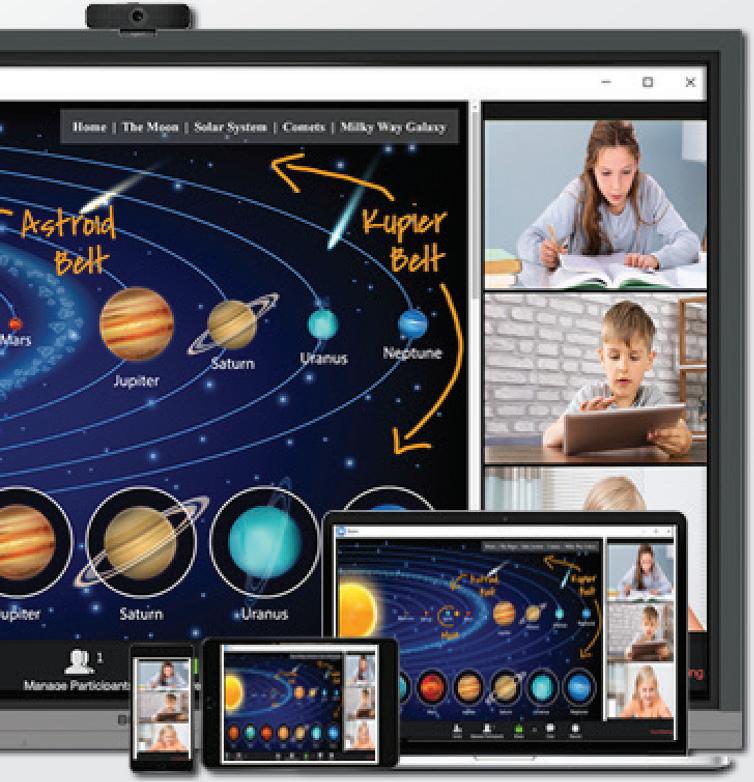




4K Ultra HD resolution


InstaShare screen sharing technology
EZWrite Software Technology


Two-way Mirroring Smart Eye-Care


Flicker-Free Technology


whiteboarding function screen video recording floating annotation tool


Two-way Mirroring and Touch Back

5 YEARS WARRANTY 5 SRAEY YTNARRAW 5 5 floating toolbar Share content and provide instant feedback from laptops, smartphones and tablets to the Interactive Flat Panel.
BenQ
EZWrite SOFTWARE VIVI (Subscription Fees Applies) CLICK VIEW (Subscription Fees Applies)
Logitech C925e included Durable and commercial-grade ULTRA HD 4K
INTERACTIVE Panels future proof your classroom
integrate
BENQ INTERACTIVE PANEL SOLUTIONS FOR





EVERY


BUDGET
AND LEARNING ENVIRONMENT

Integrate AV offers comprehensive training and professional development, which we can tailor specifically for your school.


We have extensive courses already developed focussing on a wide range of education technology topics.


For enquiries or more information, please email info@iav.com.au

av offers
for the whole school community
By Gemma Easton, Editor
Wellbeing has been discussed extensively within a school context in recent years. Covid-19 related challenges and disruptions, financial and cost of living pressures as well as floods and drought have placed increased pressure on everyone.


For schools, helping teachers, students and their families adapt to and manage changing circumstances while remaining physically, mentally and emotionally healthy has brought wellbeing into focus. Looking beyond the buzzword, here we discuss what wellbeing means, why it is important, how we can measure wellbeing, and what resources are available to foster positive wellbeing for students, teachers and the wider school community.
Establishing a concrete definition of wellbeing is complex, with the meaning of wellbeing shifting over time. A report published by the Australian Institute of Teaching and School Leadership Limited (AITSL) indicates that wellbeing is “no longer seen merely as the absence of negative conditions”. Wellbeing is now viewed as more intricate, with an understanding that people will respond in different ways at different times to wellbeing initiatives. An holistic approach should be taken to wellbeing, with reference to an individual’s circumstances.
Wellbeing, then, can not be seen as a universal concept, and will be applied and measured differently depending on the situation and context.
The Australian Government Student Wellbeing Framework is

designed to support Australian schools in providing strong foundations for students to assist them in achieving their goals. The Framework is “based on evidence that demonstrates the strong association between safety, wellbeing and learning.”

The Framework notes that connection to others, and experiencing safe and trusting relationships enhances young people’s wellbeing and optimises their learning outcomes. “Students who feel connected, safe and secure are more likely to be active participants in their learning and achieve better physical, emotional, social and educational outcomes.”


Similarly, educators who feel valued and supported are “more likely to engage positively with students and build stronger connections within the school community.”


Improved wellbeing for students and teachers, then, can deliver overall social, health and economic benefits to the wider community. The Framework works to support all students and their families, and “actively seeks to help realise the aspirations, education and wellbeing of Aboriginal and Torres Strait Islander students.”
Five elements are included in the Framework: leadership, inclusion,

student voice, partnerships and support. Good nutrition, exercise, relaxation and sleep are seen as integral to overall wellbeing for both staff and students.
As peer connectedness is important for students wellbeing, it is also important for teachers, making collaboration and collective efficacy important.
AITSL says an extension of this philosophy is the importance of school leadership teams creating and fostering a culture to nurturing wellbeing among all.
AITSL’s report into wellbeing noted that “learner wellbeing is supported and strengthened by educator wellbeing.” Creating a positive workplace, then, is intrinsically linked to student wellbeing. The report found that teacher wellbeing impacts the quality of their teaching, as well as their personal stress levels and enjoyment of their job, and the profession. Only when educators are in control of their personal mental health and wellbeing can they support students in their wellbeing journey.
Practising mindfulness is thought to have a positive effect on wellbeing, and work to promote the conditions necessary for overall physical and mental health. The Smiling Minds program, presented by Beyond Blue, takes
a “mindfulness-based social and emotional (SEL) approach, integrating mindfulness theory and research into the wellknown SEL frameworks used by schools across Australia.” Combining topics including the senses, movement, recognising emotions, goal-setting and positive communication, the program works to develop students social and emotional skills to support good mental health and wellbeing. Smiling Minds links to the Health and PE curriculum, and the Humanities and Social Sciences curriculum.
AITSL warns, though, that mindfulness should not come at the expense of social connectedness. Teachers and students should engage in partner or group mindfulness activities such as yoga or meditation to avoid isolation. While relaxation and personal reflection is important, building shared experiences and encouraging collaboration remain integral to everyone’s wellbeing.

As with defining wellbeing, measuring wellbeing among staff and students can also be difficult. Student and teacher retention, as well as good performance, whether in teaching or learning outcomes, can be indicators of positive wellbeing. The Student Wellbeing Hub, presented by the Australian Government, provides a School Wellbeing Check. With reference to the Student Wellbeing Framework, the survey encourages participants to consider their school’s performance.
Wellbeing, though, is a collective responsibility. Check in with your colleagues and yourself, and seek support whenever you need it. Only when you are feeling mentally, emotionally and physically well, can you support others to feel the same.
38 Term 1, 2023 | school-news.com.au TEACHER’S DESK
©
stock.adobe.com
Neuroscience + storytelling engage and inspire a positive school culture
What would you say if we told you that a dog, an elephant, a sooty bird, an owl and an octopus could inspire your students to take care of their wellbeing?

Because that is exactly what is happening in schools across the country right now. Each animal from the Grow Your Mind program represents a key part of the brain. And before you start teaching the key skills for enduring positive mental health or if you are 5 years down the track, we highly recommend you include neuroscience.
Why neuroscience? It gives purpose to positive mental health strategies.
We know that it is having an impact as a 2021 external evaluation of the program
by the University of Wollongong revealed that students who were exposed to the program showed:

• positive gains in physical and psychological wellbeing
• a reduction in negative eff ect
• an increase in the quality of the child’s interactions with others
• an increase in the child’s sense of belonging and engagement
Search: Meet the Grow Your Mind animals to find out what each animal is responsible for.
And what about storytelling?
Oral storytelling is as universal as it is ancient.
This is a playdough image of holocaust survivor, Eddie Jaku. We have over 40 plortrait (playdough portraits) of incredible humans who have overcome the odds by using certain character strengths to go on and lead a life of meaning.

Each image has a corresponding video lesson, comprehension task and link to rich literature.
Stories remind us all that life is not about avoiding setbacks, sadness & stuff ups. Part of the price we get to pay for being alive is to experience all of this & more. At Grow Your Mind we have created unique resources to inspire a love of learning and to teach young and old (er) that we have strengths within us that will help us to not only handle life’s curve balls and disappointments but to also develop a mindset that encourages us to help others and create a positive ripple effect. We do it via play, neuroscience, stories and songs.
Grow Your Mind has reached over 21,000 educators across Australia. If you are interested in building a rockstar culture of wellbeing within your school email hello@growyourmind.life, check out www.growyourmind.life for more information, free products including our award winning podcast.


Term 1, 2023 | school-news.com.au 39 TEACHER’S DESK
Who is responsible for teacher wellbeing?
Teacher wellbeing is a hot topic, as it should be. Teaching has been tough, teachers are tired, and yet teachers are essential as they make learning happen.
But, who is responsible for the wellbeing of teachers?
Employee wellbeing is increasingly being prioritised in organisations especially with the launch of new psychological health and safety standards requiring workplaces to prevent and minimise psychological harm caused by working conditions.





This is typically led by Human Resource (HR) professionals. Schools, however, do not necessarily have a dedicated team of trained HR professionals. Instead, the wellbeing of employees in schools is typically left to one person
Who is responsible for the wellbeing of teachers?
to lead wellbeing initiatives, that generally place the responsibility on individuals to make better self-care decisions. While individuals do have a role to play in their own wellbeing, it is more complicated than this. For teachers to be well at work, it requires a partnership between both individuals and the organisation. The reality is, no matter how much exercise you do, or how often you meditate, if the workload and working conditions are unreasonable, it will impact a person’s wellbeing.
The OECD (2020) defines teachers’ occupational well-being as; “Teachers’ responses to the cognitive, emotional, health and social conditions pertaining to their work and their profession”.


It’s not what happens at work, but how we respond to what is happening. They go on to highlight three factors that impact the wellbeing of teachers;
1. Professional factors – expectations and workload (policies - US)
2. Situational factors –colleagues, supervisors (relationships - WE)


3. Personal factors – selfcare, home commitments (individuals - ME)


This takes an ecological approach to create a ME, WE, US model for addressing teacher wellbeing. Self-care (ME) impacts how I show up in relationships (WE) and this in turn impacts the system (US). Vice versa, the system can impact relationships which in
turn impacts me. By exploring this model, schools are able to better think about, discuss, and plan for wellbeing in schools.
Instead of blaming individuals or blaming the organisation, what if we considered the factors that impact our wellbeing across all three layers and then planned ways to promote wellbeing across all three layers. This becomes a more strategic approach to workplace wellbeing.
We can begin with three questions;


US – How and when will we review workplace systems to ensure they are helpful and meaningful?


WE – How can we encourage positive and supportive relationships with students, parents and colleagues?
ME – How can we encourage people to practise self-care?
By reflecting on wellbeing across these three layers we can categorise stressors into three distinct areas instead of placing them all in one group. By doing so, we are able to identify what we can control and make pro-active decisions that promote wellbeing.
With this understanding everyone in the organisation is better placed to have meaningful conversations about who is responsible for wellbeing.
Find out how Daniela can help you build a staff wellbeing strategy for your school at teacher-wellbeing.com.au


40 Term 1, 2023 | school-news.com.au TEACHER’S DESK www.teacher-wellbeing.com.au Conversation starters PD Activities to boost morale Reflective moments Solution-focussed planning TEACHER WELLBEING RESOURCES EMPOWER POSITIVE WELLBEING MEANINGFUL PRACTICAL SIMPLE CONNECTIONS REMINDERS TEACHERS Workshops, Online Courses & Consulting
Daniela Falecki Director, Lecturer, Teacher, Teacher Wellbeing
Exploring the benefits of live performances


 By Gemma Easton, Editor

Theatre, including school productions and theatre incursions, is a valuable educational tool. Helping students to develop new skills, and explore aspects of the curriculum in different ways, the advantage of theatre are wide ranging.

Perhaps the most obvious benefit of staging a school theatre production is the extension of students in the performing arts, allowing them to share their talents in drama, music, dance and voice. Performing helps students to build confidence in these areas, which will in turn build their confidence more broadly.


Students who are not involved in the performing arts through their classroom subjects may be encouraged to try something new, and step outside their

comfort zone to appear on stage in a production. This can help students discover new interests, and explore hobbies and pastimes beyond their usual activities.


Of course, a school production, goes beyond the people on stage. Students who are not performers can be involved in different aspects of the




production, including set and costume design, sound and lighting, and promotion of the production. There is also the opportunity for students to sell tickets, or assist on the night with ushering. Opportunities, then, are available for all students to become involved.
This large-scale involvement in a shared project can help students
build a sense of pride in their school, helping them to feel more connected to their school, their teachers, and their classmates. This will in turn help students to feel happier at school, positively impacting all areas of their learning, as well as their social and emotional development. This sense of connection can extend to the wider community, as parents and families help out with the production, or come and watch a performance.
A musical brings together the discrete learning areas within the creative and performing arts, blending elements from each discipline. This can allow for teacher collaboration and coteaching across subject areas. From collaboration, teachers may learn new ideas or consider different ways of approaching a subject. Co-teaching can help lighten the load for individual teachers, as the responsibility of preparing and delivering a lesson can be shared.
Term 1, 2023 | school-news.com.au 41 TEACHING RESOURCES Safe and Robust Quick Assembly Highest Quality 1300 712 066 i n f o @ t r a n s t a g e . c o m . a u transtage.com.au C o n t a c t U s T o d a y Australia's Leading Australia's Leading Portable Stages Supplier Portable Stages Supplier T r u s t e d b y m o r e t h a n 1 0 0 0 s c h o o l s a l l o v e r A u s t r a l i a
Images courtesy of Alpha Shows
The educational benefits of theatre productions extend beyond honing a student’s performance skills. The performing arts can help develop a range of skills which will benefit multiple subject areas, including improved communication skills, giving and receiving feedback, working in a team and collaborating, and effective time management. The unpredictable nature of live performance helps students develop the ability to think quickly and improvise when things do not go to plan, and to stay calm in difficult situations.

Through theatre productions, students may be exposed to different cultures or philosophies, challenging them to consider things from a different point of view. This
helps build their capacity to approach tasks with an open mind, considering the impacts of their actions on a global, rather than individual level.
Engaging an external company to present a theatre production to students is another way to incorporate theatre in learning. Productions can complement history or social science studies, bringing subject matter to life in different and interesting ways. Students may better connect with content when presented in this way, leading to improved learning outcomes.
Whether you are staging a school production or hosting a guest performance, there are important things to consider. Firstly, the intended audience will impact the choice of performance.
All productions should be age appropriate and engaging for students, and the links to curriculum clearly established. For in-house productions, schools must ensure they have obtained the necessary licenses and permissions to stage the performance.

The size of the space to perform, as well as the capacity to hold an audience should also be considered. If audiences are to be seated for a long time, ensure seating is comfortable, and the space is adequately cooled or heated. Access to technology, including sound, lighting and special effects can impact your choice of performance. Some schools choose to install professional sound and lighting boards,
allowing students to learn how to operate these. If performances are to be held at night, ensure there is adequate lighting of the performance area, and for audience members to take their seats.
Ensure external companies provide a clear brief, outlining their requirements and expectations before they arrive to perform. In some instances, a site visit ahead of the performance may be useful to ensure the space is appropriate.
With so much to consider when planning a theatre incursion or school production, School News asked some industry experts for their advice.
Ben Jackson from Alpha Shows said there are several benefits to inviting an external provider to host a musical incursion in your school.
“A musical incursion gives students the opportunity to experience a professional-quality production and to see how musical theatre is performed at a high level. They can then take what they have learned and apply this in their own production. The skills and social and emotional learning experienced through theatre goes beyond just the arts, and has positive impacts for all learning areas.
“Participating in a musical incursion can help students develop their own theatre skills, such as singing, dancing, and acting. They may also learn about stagecraft, lighting, and sound design.”
Mr Jackson said theatre is a safe space for students. “You can either bring in performing arts and have theatre presentations that allow a safe space to process grief, fear and anger, or let it happen uncontrollably out in the playground, classroom or world! Emotions need to be fully felt and expressed, but our culture and society often has limits to how much children (and adults!) are ‘permitted’ to do this important psychological work. By taking these types of archetypes to the extreme in theatre, children can more easily be triggered to express their emotions in a safe place, thus negating the need to express that outside in an uncontrolled and perhaps unhealthy or destructive way.
42 Term 1, 2023 | school-news.com.au TEACHING RESOURCES
Images courtesy of Origin Theatrical


MOTIV™ Digital Microphones & Recording Solutions YOUR SOUND , YOUR WAY. Introducing a suite of on-the-go recording solutions, the iconic MOTIV™ Digital Microphones easily connect to any Mac, PC, iOS or Android device for convenient and reliable digital recording wherever you are. From music and podcasts, interviews and broadcasting to field recordings and mobile video, capturing audio has never been this simple and stylish. Check out all five models today and discover what portability and quality truly feels like! distributed by jands.com.au MV7: For perfect recordings in imperfect rooms. Boasting both XLR and USB connectivity options to offer complete flexibility. MV5C: Join virtual meetings and classes with the confidence that you sound just as good at home as you do in person. Compatible with MS Teams and Zoom. MV51: Unparalleled audio in all-metal construction. Deny distortion and enjoy sound excellence in every environment from demo sessions to field recordings. MVi: Compact Audio Interface that creates a portable recording studio, wherever and whenever you need it. MVL: For the on-the-go recorder. Simply plug into a mobile device to capture quality audio for interviews, lectures, public speaking and videography.
“Musical incursions can be tied to other subjects, such as history, literature, and music, providing a unique and engaging way to learn about these subjects. Even when the subjects or curriculum content isn’t addressed directly, those curriculum areas can still see benefit as a student grows in their emotional resilience and confidence.”
When staging your own production, Licensing Manager at Origin Theatrical Nick Young said you must first apply for rights. “The authors or creators of that musical and/ or those who own the rights, must give you permission to perform their creative work. You will need to pay a small fee (a royalty) which is passed on to the rights owner, author or creator. This is how the creators of the show make a living.
“To apply for rights, first you need to find out who owns the rights and provides the licence and materials you will need to perform the musical. Once your application has been submitted, you need to wait for approval. This can take anywhere from 24 hours to a
few days and depending on who needs to give permission, all the way to six weeks.
“Sometimes the rights are restricted or not available for the musical which you might want to perform. This can happen if it is a brand-new musical and rights for schools to perform have not yet been released or if there is a professional production running currently or coming soon.”
Mr Young warns that staging a performance without an approved licence is breaking copyright law

and you could be fined.
“As a rule, you cannot make any changes to the show or script without having written approval from the owners of the show. On occasion permission might be granted to localise place names or change nonlead character names.
“You can create your own show, but only if you are going to use a script that is 100 per cent your idea and any songs and music are your own creation as well. You are not able to mix different songs from different

musicals to come up with a new show or compilation show.”

Transtage said there has been a trend towards portable staging in recent years, providing schools a cost-effective way to customise their staging solutions.

Company representative Kevin explains, “Most schools have a permanent stage in their school hall. However, portable staging has become more and more popular in the past decade, as they are a great addition to the permanent stage.”
Using portable staging gives schools flexibility. “Portable stage can be easily added on to an existing stage as an extension, to enlarge the size of the stage for bigger events. Portable stage can also be taken outdoors when a school wants to host an outdoor event.
“Most portable stages are modular design, which means the school can change the size of the stage easily. A small stage can be set up for a small event, and a bigger stage for larger gatherings. Portable, modular staging can be tailored to suit the schools needs and types of events it will host.”
Joe Hopkins from Jands said choosing the right equipment will enhance your school production. “Proper microphone selection and placement in theatre applications can dramatically improve and reinforce the impact of the action and emotion on the stage. From large Broadway shows to small community stages, any theatre experience relies heavily on having good sound to emotionally connect with the audience.
44 Term 1, 2023 | school-news.com.au TEACHING RESOURCES
Image courtesy of Origin Theatrical
Image courtesy of Jands
Image courtesy of Jands
Image courtesy of Transtage
“Loudspeakers are available for a variety of applications, including schools and theatres. There are several options to choose from, including portable and compact models. Make sure you choose the model most suitable for the space where it will be most used. Some models are better suited to large spaces like auditoriums and gymnasiums, while more compact models may be sufficient in a smaller venue, like a classroom.




“Hiring or purchasing truss is







a good option for schools. It is a versatile resource, and can be used for hanging lighting, curtains or speakers for any temporary installations. For lighting, there are a range of options which meet or exceed theatrical and performance lighting demands and specifications. Lighting consoles, dimming systems, networked lighting controls, and software for lighting design and visualisation are also available. All of these tools will help make your school production more professional.”


Term 1, 2023 | school-news.com.au 45 TEACHING RESOURCES ORiGiN™ Theatrical ALPHA THE BEST SHOWS FOR SCHOOLS SHOWS Alpha Shows is Australia’s premiere interactive theatre experience for your students to express, transform and learn about emotional resilience, social values & mental wellbeing using state of the art storytelling, music, lights, sound, values education & peak states Real, quality theatre...that comes to you! Call or email today to book your Alpha Shows event with SIX live performers at your school! 1300 850 658 | ALPHASHOWS.COM.AU
Images courtesy of Jands
Rethinking STEAM learning and teaching
By Gemma Easton, Editor
The integration of Science, Technology, Engineering, the Arts and Maths (STEAM) has given students the opportunity to connect ideas, knowledge, and techniques, combining them in new and interesting ways. STEAM education encourages engaging and integrated teaching, helping students to think in a future-orientated-, ‘what-if’ mindset, through innovation and problem-solving.
In an increasingly global world, with technology and innovation at the forefront, 21st century skills are highly valued by employers.
As well as a grasp of literacy, maths and science, school leavers need the critical thinking skills to approach tasks differently, across all areas of the workplace. Social, economic and technological change is reshaping the kind of jobs available in the future; this in turn is impacting the skills required by business and industry.


Building on the early 2000s concept of STEM, STEAM includes arts education, encompassing visual and performing arts, manual arts, music, dance and more. The inclusion of arts recognises that technology alone is not enough. STEAM aims to spark students’ imagination and creativity through the arts in ways that naturally align with STEM learning. Through engagement with the arts, students can develop creativity, communication and performance skills which will benefit their education as well as future employment opportunities.
With the shift to STEAM
education, there has been a corresponding shift in how the implementation of this education is viewed. Now, emphasis is placed on how the distinct disciplines work together, rather than separately. Interdisciplinary, multi-disciplinary and cross-disciplinary courses and subjects which integrate more than one learning area are championed. Including arts in STEM learning can work to make these subjects more accessible to students who are not typically interested in these learning areas.
Contextualising STEM subjects

within an arts framework encourages students to think creatively and explore different problem-solving techniques.
As a field, the arts is broad and diverse, covering areas including photography, architecture, history and performance. This allows educators the opportunity to blend STEAM thinking into many subject areas in a variety of ways. The wide spectrum of arts education opportunities can help teachers integrate elements of the arts into their lessons. Similarly, the variety of disciplines
within the arts allows teachers to incorporate STEM principles into their arts classrooms. Students who struggle with principles of maths and science, or find technology daunting may be encouraged to engage with these subjects through their arts practice. Shifting the focus from science or maths, for example, in isolation and adopting an integrated approach can make concepts more accessible. Recontextualising STEM learning within an arts framework can encourage students to engage with these concepts.
STEAM has been imbedded in the Australian Curriculum, with educators increasingly encouraged to tailor learning activities which touch on more than one STEAM discipline. This can improve learning outcomes for students, with a shift away from traditional rote learning. Integration of STEAM subjects can encourage students to build on their strengths to engage with other areas of the curriculum they feel less confident with.


46 Term 1, 2023 | school-news.com.au TEACHING RESOURCES
P48
Image courtesy of Trotec
Learning leaps with loose parts
hyper focused on using materials that were as biodegradable and sustainable as possible “
Nüdel Kart makes a great teachers sidekick, always there to create a hands-on environment to practise numeracy or literacy but there are a few other areas where Nüdel really excels; like STEM and wellbeing.

Contrary to what many educators believe, STEM skills are not building robots and writing code, STEM skills are mainly the foundational skills required to do the jobs most in demand in the future. Surprisingly, most STEM skills are a long way from coding a computer and much more human than many would expect. They are skills like problem solving, creativity, critical analysis, teamwork, independent thinking, initiative and communication.
Five years ago, Nüdel Kart embarked on a mission to create the world’s most open-ended learning resources for Schools.
Founder & CEO, Marcus Veerman says “Nüdel resources sit at the Dr Seuss end of the construction toy spectrum”.... He says “when children are in a self directed, creative and open-ended environment, quite simply, they learn more deeply”. “They become responsible for their learning and far more motivated to explore and experiment; and whether they succeed or fail, they own the results.”
The Australian charity makes high quality mobile carts that look like something between a shopping trolley and a meticulously designed nordic piece of furniture. They are designed to promote creativity, STEM, social skills, and wellbeing in a package that is easy and low stress for teachers to use. Bond University Research in 2022 showed that 100% of the creative and critical thinking; and, Personal and Social general capabilities in the Australian curriculum were demonstrated and practised during Nüdel Kart sessions“ and that is completely student- led… No teacher direction or explicit


instruction” states Veerman.
“Imagine what children would be absorbing with a great teacher supporting their development”. In addition the study showed that over 90% of the children showed these general capabilities being used. “What this means is that not only are the children doing all those critical life skill capabilities but they are doing them almost all the time in a Nüdel space which is really exciting data to see from an independent study”.
Nüdel Karts are based on the theory of loose parts developed by Simon Nicholson In 1972. Nicholson’s theory stated that loose parts are materials which can be moved around, designed and redesigned, tinkered with and

combined and connected in many different ways which creates infinitely more opportunities for creative engagement than static materials and environments. Nüdel has taken this theory and; using modern manufacturing techniques and hundreds of iterations, created a series of unique, and unusual materials that connect together in billions of different combinations. “We have really tried to focus on providing an array of different materials with as many different tactile elements as possible. It's not just made out of wood, but it's got silicon, fabrics, netting, wheels and so on which really means that the possibilities for children are close to endless” states Veerman “ we were also
Nüdel Kart excels in creating time and space to deeply explore these skills in a self directed and creative way. Simply placing a Nüdel Kart in the middle of a room and allowing children to begin, any educator would quickly be able to see children deeply engaging in all of these STEM skills within seconds. Most importantly, the students will experience this environment not as a chore but as deeply engaging and a lot of fun which brings us to our second major benefit. Nüdel Kart significantly reduces stress on teachers and increases a child's well-being. Engaging in hands-on activities can help children develop not only a sense of pride and accomplishment, but engaging in a physical activity for children significantly improves their overall mental and emotional wellbeing, which for many children in the last few years has been at an all time low. Nüdel Kart products offer a fun and engaging way for children to naturally engage deeply in the curriculum in some areas which have traditionally been hard for teachers to teach and at the same time its proven to help develop their STEM skills, social skills, and sense of wellbeing. Nüdel can help children develop into well-rounded individuals who are prepared to face the challenges of a fast moving and uncertain future with confidence.
For more information please visit nudelkart.com or email nudel@playgroundideas.org or call Marcus 0432 738 719

Term 1, 2023 | school-news.com.au 47 TEACHING RESOURCES
World Economic Forum research found that “65 per cent of children entering primary school today will ultimately end up working in completely new jobs that don’t currently exist.” The Australian Government National Career Education Strategy notes that “Children starting preschool today will engage with a different world. They will be asked to do jobs yet to be created, use technologies yet to be invented, and face social, economic and environmental challenges yet to be anticipated.” STEAM education aims to develop in students’ skills needed for the future, by helping them adapt to the evolving and fast-paced environment.
According to the World Economic Forum report, “workers will need to have the appropriate skills enabling them to thrive in the workplace of the future and the ability to continue to retrain throughout their lives”. Lateral thinking and transferable skills will be highly desired in the future workforce.
Through exposure to the arts, students’ cultural and social awareness is increased. This in turn can help foster an
appreciation and understanding of other world views. Remaining open to alternative viewpoints and different lived experiences may encourage new approaches to problems. Shifts in social consciousness and a recognition that problems should often be viewed in a global, rather than local context make this educational exposure valuable. Today’s young people will require the ability to look beyond their own backyard, and incorporate broader contexts in their approach to tasks.
STEAM education is important
for students of all ages. For ideas on how to incorporate STEAM learning into classrooms, School News spoke to some industry experts.
Street Science founder Steve Liddell said using STEAM resources is important in inspiring students. “Connecting with students and getting them to genuinely understand curriculum material is one of the biggest challenges that teachers can face. Developing lessons that incorporate hands-on learning activities is one way to inspire your students to learn.”

Hands-on learning, Mr Liddell explains, “means bringing resources and equipment into the classroom that students can engage with on a kinaesthetic level. When the sense of touch is engaged, the brain’s neurological pathways are linked, resulting in better understanding, retention, and memory.
“Hands-on learning also helps students focus, which can be particularly helpful for those students with short attention spans.”
To make learning fun, Mr Liddell recommends incorporating hands-on learning into lessons. “There is no doubt that science can be a dry subject and reading about an experiment and its results is very different to actually doing the experiment and seeing the results firsthand.
“Developing lesson plans that include hands-on activities is a great way to ensure your students are engaged and having fun whilst learning. Consider how you can contextualise these concepts for the students. When a student can relate a concept to their own lives, they are more likely to be motivated to learn about it, and more likely to retain the knowledge. P50

48 Term 1, 2023 | school-news.com.au TEACHING RESOURCES
P46
Images courtesy of Street Science
Ruby®: Connecting Education, Community and Industry


The latest laser software innovation, Ruby®, from Trotec Laser is connecting learning outcomes directly with the community and industry in real-time.


Thanks to the simplicity to get started, implementing laser equipment has accelerated exponentially. Not only can they be integrated with the majority of the Australian Curriculum, but they’re also providing applicable transferrable skills requested by Industry.
Welcome to 2023 and the connections Trotec has made to Industry 4.0. Software has become the new hardware and whilst it was the hardware that got Neil Armstrong and his crew to the moon, it was the software that brought them home. We believe in the importance of creative thinking about possible, probable, and preferred futures
and ultimately leading to building learning environments based on engagement.
Ruby® is not only the industry standard for commercial industries, the Ruby® platform encourages a safe space for collaboration as well as working independently utilising either solely the Ruby® platform or in conjunction with supporting design-based software platforms,

even in circumstances this may be as primitive as pen and paper. Ruby® also provides an environment where students are encouraged to imagine, generate, iterate and critically evaluate – thus bringing an idea to a product through the use of Ruby® and the laser machine. Over the past three years there has been a seismic shift in Australia’s attitude to manufacturing.
Previously it was about offshoring to capitalise on productivity and profitability and now the ability to control your production capability and meet customer demands is weighing heavily in the decisionmaking process. In an effort to reclaim its reputation as a country that leads manufacturing with smart skills, the federal government introduced a $15 billion landmark bill that would support, diversify, and transform Australia's industry and economy.
The ability to critically and creatively think as well as solve problems is necessary for the future industries of Australia and beyond. Ruby® is the key link between student learning outcomes and the industry.
To learn how you can introduce Trotec and Ruby® into your teaching curriculum, email info@troteclaser.com.au or call 1300 876 832.
Providing a connected STEM environment
Ruby® - the latest innovation from Trotec - provides educators and students with a platform that promotes integration between all stakeholders with a collaborative approach with endless advantages bringing the learning experience to new levels.

Term 1, 2023 | school-news.com.au 49 TEACHING RESOURCES Laser software re-defined. www.trotecaustralia.net/rubyineducation 1300 876 832
UCCR-PFV3-XFSD
“Create a lesson plan and look for resources that are multisensory – visual, auditory, reading and writing, and importantly hands-on.”
Angela Perkiss from Trotec Laser said focussing on real, in the moment issues can create high levels of student engagement with STEAM subjects.
“Encourage students to look for issues in their daily lives, such as developing a product that could simplify tasks for elderly relatives. If a student connects with the outcome, the inspiration will follow and hopefully have enough momentum to have the student stick with the idea. Personally, I am lucky to see the lightbulb moment that students realise their product or idea, that has been built with creative and critical thinking, actually has a measurable benefit in an industry.”
To encourage teamwork, Ms Perkiss suggests looking to the industry as an example. “In the commercial sense, product designers, procurement, marketing, fabrication all work
together on a common goal.
To put it simply, as a group of Year 3 students said, An Idea + an Idea = A Mega Idea.”
“Like anything in the modern digital world that is progressing quickly, software has become the new hardware. The skills required to make machinery efficient are becoming much more valuable. Naturally things like ChatGPT and Augmented Reality are great tools that can assist the learning journey going hand in hand with physically creating things to still have that handson and tangible experience.

“Simply look at all the boutique manufacturing happening in Australia currently and the incredible skills required to keep these types of advanced manufacturing scenarios in place for years to come, from Spacecraft and Satellites to CyberSecurity and Smart Automotive Products.
The ability to critically and creatively think as well as solve problems is necessary for the future industries of Australia and beyond.”
Impact your students with Street Science
Street Science was founded by Steven Liddell, a qualified science educator who has a passion for bringing


Whilst working full time as a high school teacher, he loved engaging his students and showing them how awesome science can be. Seeing the impact his teaching style had, he had a vision: to take his engaging style of science education out of just one school and into as many schools as possible.
Street Science programs are facilitated by fully trained and experienced science communicators. With either a science or education background, the Street Science team mix humour, exciting demonstrations and quality scientific explanations into an
interactive science experience and science incursions to be enjoyed by all ages.

Street Science now also offers digital and e-learning options, with our live streamed broadcasts from our purposebuilt studio, along with our award winning Classroom Science Kits that deliver hands-on workshops to schools around the country.
Aligned to the Australian National curriculum for students from prep/foundation through to year 10, the Street Science Classroom Kits offer teachers an opportunity to create a hands-on science experience in their classroom whilst being fully supported by the Street Science team through our unique digital learning portal.
For more information please contact us on 1300 150 481 or visit www.streetscience.com.au

Term 1, 2023 | school-news.com.au TEACHING RESOURCES www.streetscience.com.au/classroom-science-kits - A student-centred hands-on science experience - Engage up to 35 students per kit - Multiple curriculum-aligned kits available - Digital Learning Portal - we do the teaching - All inclusive - nothing more to buy Scan this QR code to ORDER YOURS TODAY
BY TEACHERS, FOR
CREATED
TEACHERS
science to life.
P48
Image courtesy of Street Science
Is your school equipped?





 By Gemma Easton, Editor

Cardiac arrest is a leading cause of death in Australia. Heart Foundation research indicates that approximately 250,000 people in Australia each year will suffer a cardiac arrest out of hospital. Of these, it is estimated that as few as 5 per cent will survive to leave hospital and go home. Sudden cardiac arrest can happen to anyone of any age, including children. The only treatment for a sudden cardiac arrest is CPR and defibrillation, which can be administered by an AED. Schools and their staff are responsible
for protecting the health and safety of those within the school grounds. Understanding the appropriate action to take in the event of a cardiac arrest is essential to ensure this. Sudden cardiac arrest can occur at any


time and everybody is at risk. The chance of a staff member, parent, community member or even student surviving a cardiac emergency may rest entirely on whether your school has an AED. Schools are often the centre
of communities, with families and members of the public regularly gathering for events and celebrations. Access to AED could mean the difference between life and death should a sudden cardiac arrest occur on or near school grounds.
AEDs can “jump-start” a heart that has stopped, by delivering an electric shock to it. After pads are positioned on the patient, the device will perform and automatic analysis of the patient’s heart rhythm. When necessary, it will administer an electric shock to the heart to restart muscle contractions and get the heart back to its normal rhythms.
AEDs are designed to be used by anyone, with visual and voice prompts guiding a user through an emergency.
Term 1, 2023 | school-news.com.au 51 HEALTH & SAFETY
Automatic external defibrillators:
Image courtesy of Defibrillators Australia
All AEDs have the same essential function, so when considering an AED to purchase, think about your school’s requirements.
Some devices may be smaller for ease of transport, and some may have a more user-friendly design. The safe operation of AEDs is typically covered by standard first aid courses, which are necessary to meet a school’s minimum health and safety requirements. Both CPR and AED use are taught in first aid courses, and both could be lifesaving in an emergency. In the “Chain of Survival”, which describes the events that need to happen in rapid succession to increase chances of survival after a cardiac arrest, the first step is early recognition and rapidly alerting emergency services through dialling 000, followed by access to CPR, and an AED. On purchase, AEDs will have an instruction manual which should be read carefully to ensure proper set up. All staff will need to be shown where it is located, so that it can be easily accessed in an emergency. AEDs should be positioned in an accessible place within the school; they should be in a publicly accessible space, and within reach of wheelchair users, in an unobstructed area. They should also be clearly marked and in a well-lit area.
So how do you choose the best AED for your school? School
News gained some insider opinion on what to look for. James Taylor from Aero Healthcare shared his thoughts. Mr Taylor said there are several factors
for schools to consider before purchasing an AED, beginning with ease of operation.
“There are two main types of AEDs suitable for schools, Automatic and Semi-Automatic. Automatic defibs analyse the heart rhythm and deliver a shock if needed, without the need for the user to press a button. Semiautomatic AEDs will analyse the heart rhythm and prompt the user to deliver a shock only when and if it is necessary. Both types of AEDs are designed to be easy to use and confidence inspiring.
“CPR feedback is an important feature of certain AEDs. The AED will analyse the effectiveness of the responders CPR, providing visual and audible feedback of their performance, advising them to push harder, faster or slower depending on how the blood flow of the patient is responding to the CPR. CPR is a key link in the chain of survival and providing feedback empowers the lay rescuer to conduct effective CPR.
“AEDs should be purchased from a reputable supplier who has a focus on customer service. As these are lifesaving devices, follow up service and ensuring the customer properly
understands their AED is important for the confidence of all users. Reputable AED suppliers also assist the owners with maintenance and servicing of the AED, so that it is always available in case of an emergency.”
Mr Taylor said while AEDs are typically considered a low maintenance item, it is critical that they are always in operable condition. “Regular inspections of the AED should be conducted to ensure the status indicator light on the front of the device continues to flash green, every five to ten seconds. If anything, out of the ordinary has occurred, you should contact your AED supplier immediately.
“The frequency of maintenance can depend on the manufacturer, and it is recommended that AEDs are replaced at the end of their warranty period.”
Lesley Cochrane from Defibrillators Australia said “having a defibrillator readily available at your school can make a significant difference in saving a person’s life. Defibrillators are easy to use, and with proper training, can be used by anyone, even non-medical personnel, to provide potentially life-saving
treatment until emergency medical services arrive.”
When choosing a defibrillator for your school, Cochrane highlighted several considerations.

“Consider the size and weight of the defibrillator, as well as its battery life, to determine if it can be easily transported to where it is needed. Look for a Defibrillator that is user-friendly, with clear instructions and visual aids to guide the user through the resuscitation process.
“Schools are busy and active environments, so it’s important to choose a Defibrillator that is durable and can withstand regular use and handling. Also consider the cost and frequency of maintenance and replacement of batteries and pads, as well as the availability of replacement parts.
“The frequency of defibrillator maintenance and replacement can vary depending on the manufacturer and model. The leading brands of defibrillators require routine visual checks at least once a month to ensure proper functioning of the green light indicator. Some of the components that will need to be replaced are batteries and pads, especially after use or every four years on expiry. It’s also important to have a defibrillator that is self-checking and not in need of off-site inspections or calibration.”
Cochrane said, “regular maintenance can help to ensure that your defibrillators are always ready to use in an emergency.”
52 Term 1, 2023 | school-news.com.au HEALTH & SAFETY
Image courtesy of Defibrillators Australia
Sudden cardiac arrest can occur at any time and everybody is at risk








EACH WEEK 12 YOUNG PEOPLE DIE

Due to Sudden Cardiac Arrest in Australia1

Sudden Cardiac Arrest can strike anyone... anytime... anywhere.

Be Ready, Willing and Able

Sudden Cardiac Arrest (SCA) knows no boundaries.


In Australia approximately 30,000 people sustain SCA outside hospital and are treated by treated by emergency medical services (EMS) each year1
• An average of only 9% of its victims in the Australia survive1
• It can happen anytime, anywhere and to anyone, even young athletes
• Early defibrillation is the single most e ective treatment for SCA
• Defibrillation within three minutes of collapse can increase the chance of survival to over 70%2
Why
•
Heart Safe School Communities
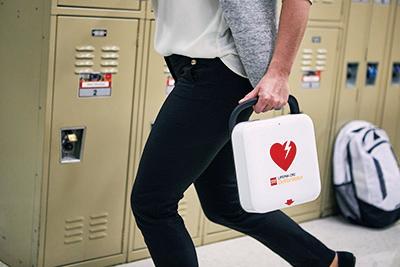
e ectively help someone save a life.
•
•
•
•
•
•
•
Ready? Able? Willing? IS YOUR SCHOOL...
1. http://www.takeheartaustralia.com.au/ 2. Nolan J, Soar J, Zideman D, et al. European Resuscitation Council Guidelines for Resuscitation 2010 Section 1. Executive summary. Resuscitation. 2010;81:1219-76. Available at: https://www.erc.edu/index.php/docLibrary/ru/viewDoc/1195/3/
choose Defibrillators Australia to partner with?
10 years experience in the health industry, specialising in Defibrillators
• No. 1 Customer Service Team called our HeartSafe Angels.
8 Year Warranty
“Heart
8 Year Customer Service
Shield” Program
Forward Hearts Program
Defibrillators
Highest quality and reliable
in the world
Excellent resource library
Phone support when you need it
Best pricing guarantee
live and play
Call our HeartSafe Angels Customer Service Team. We have a special offer just for schools, best price guaranteed. 1300 33 11 93 or email admin@defibaust.com.au 1. CALL 000
Creating safer places for you to work,
Defibrillators Australia aims to create more Heart Safe environments across Australia by placing defibrillators in educational establishments, workplaces, sports and leisure clubs, public and community environments - allowing you to simply, safely and
2. PUSH
3. SHOCK
USING COLOUR TO PROMOTE RECYCLING!

Astra Street Furniture is helping schools right across Australia to better promote and educate students to correctly dispose of their waste, particularly recycling waste. Through Astra’s Athens Bin Enclosure suite, the doors of these wheelie bin enclosures can be printed with waste and recycling messaging, waste and recycling symbols and even the school logos! With bright and distinguishable colours for each different waste stream, this is a great way to keep your school clean and your waste separation accurate!
C Astra Street Furniture P 1300 889 821
E sales@astrastreetfurniture.com.au W astrastreetfurniture.com.au


SM58 PERFORMANCE MICROPHONE

The SM58 is known as the world’s most popular performance microphone. It is an instantly recognizable icon in theatre and can be seen in the hands of anyone from Pop Idols and Presidents, to Podcasters, Poets and MCs. Simply connect the SM58 to either an MVi, an X2U, or your audio interface of choice, and you’ve got a very affordable and durable kit for your live performances –Perfect for public speaking, theatre performances and choirs.
C JANDS








P 02 9582 0909
W jands.com.au











SORBENT PROFESSIONAL TAD HAND TOWEL PROUDLY WEARS THE OFFICIAL AUSTRALIAN MADE LOGO


Solaris Paper is excited to share that our Sorbent Professional TAD hand towel has gone through the stringent testing, to be able to wear the official Australian Made Campaign Logo. The AMCL requires “a significant transformation in Australia”. Both the TAD paper making, and the folding into interleaved towel is performed in Australia. Not only does this secure Australian jobs, but it also makes these products more readily available during the challenges of any shipping crisis and more flexible when demand spikes.
TAD hand towels are softer and more absorbent, meaning kinder to frequently washed hands and with less towels needed, also kinder to the environment. Therefore, Sorbent Professional TAD hand towels are a win-win-win. A better user experience, better for the environment and better for the Australian workplace too.
C Solaris Paper W solarispaper.com.au


56 Term 1, 2023 | school-news.com.au WHAT’S HOT
XS4 ONE

Smart, secure and easy to install, the SALTO XS4 One provides a totally wire-free and networked electronic locking solution with a great range of features. This all-in-one smart lock is designed to blend into any type of door, access point and/or door retrofit. IP-rated model available. Durable and ready for the schoolyard.

C Salto Systems P 03 8683 9782 E info.oceania@saltosystems.com W saltosystems.com
A CERTIFICATION FOR SORE EYES
As the first and only edtech display to gain Eyesafe® Certification, new BenQ Board Pro ensures added protection against high-energy blue light commonly emitted by LCD displays . TÜV Rheinland, globally renowned third-party certification organisation and Eyesafe® affiliate, formally awarded BenQ with the certification, verifying that the RP Series has undergone thorough testing and satisfied blue light emission and colour performance requirements. To find out more about Eyesafe® Certified BenQ Boards, visit BenQ.com.au

C BenQ W benq.com.au
SMART LUMIO BY INTEGRATE AV


Lumio is a digital learning tool that lets students actively explore, create, question, reflect, collaborate, and play as they engage with lesson material on any internet enabled device, in the classroom or from home. At the same time, Lumio gives teachers a clear understanding of every student’s progress, with ongoing feedback that lets them assess and support the needs of individual students.


C Integrate AV P 1800 742 748 W iav.com.au
APC AISLESAVER®


APC’s Aislesavers® provide the ultimate refinement in high density storage, by reducing the floor space required. Available in both manually operated (Ezi-Slide), and mechanically assisted (Ezi-Drive) versions, representing the perfect solution in light-weight mobile shelving for all your storage and filing. The APC Aislesavers® are available in a large range of standard sizes and can also be tailor-made to suit your specific needs. Designed and manufactured in Australia from Australian steel, the APC Aislesavers® incorporate low profile tracks, with discreet anti-tilt mechanisms, reducing the chance of operator strain. This allows users to move up to 1000kg effortlessly.

C APC Commercial
P 1300 138 303

E sales@apcgroup.com.au
W apcoffice.com.au


Term 1, 2023 | school-news.com.au 57 WHAT’S HOT
The benefits of school camps and excursions
By Gemma Easton, Editor
There are few educational experiences more exciting to students than a stint out of the school grounds. Whether it’s the novelty of being outside a classroom, having new experiences, or deepening peer bonds, there is an undefinable quality about school trips that creates immense value in the educational space.

While some students may see school excursions as a “break” from learning, clever planning can ensure EOTC contributes to the learning goals of wider curricula. EOTC can be particularly effective when educators engage with specialist staff at off-site venues, collaboratively planning around learning outcomes.
EOTC experiences encompass a wide range of venues and learning areas, including museums, art-galleries, and learning centres, covering areas of social sciences, arts
and science. These sites offer enriching experiences such as access to specialised equipment and interactive exhibits not replicable in a classroom setting. Even reluctant learners can be engaged through EOTC. Positive connection is made through direct participation, encouraging students to form links within and between subjects, deepening understanding and empowering students to enjoy learning.
To meaningfully embed EOTC experiences into the curriculum, links must be made between
the experience and prior learning. For specific classroom contexts, the timing of an excursion can be tailored to the aims of a module to build upon prior and future learning.
School camps or overnight stays can provide valuable EOTC experiences. Here, students can be pushed outside their comfort zone and challenged to try things they may not otherwise encounter. These experiences can help develop students’ soft skills, such as teamwork, risk management, confidence, and social and emotional maturity.

58 Term 1, 2023 | school-news.com.au EXTERNAL LEARNING
Image courtesy of Urban Camp Melbourne
Image courtesy of Hartley’s Crocodile Adventures














40 mins north of Cairns, 15 mins north of Palm Cove & 25 mins south of Port Douglas OPEN DAILY: 8.30am - 5:00pm • Captain Cook Highway • Ph: 4055 3576 For more info contact: sales@crocodileadventures.com • crocodileadventures.com School Excursion and Education Groups are our specialty! • BOAT CRUISE • CROCODILE FARM TOUR • CROCODILE ATTACK SHOW • SNAKE SHOW • CASSOWARY FEEDING • WALLABY FEEDING • Have a group photo with a koala or snake • The Gallery of Living Art displays colourful snakes and lizards along with a Komodo Dragon and a giant Reticulated Python • Explore Gondwana Gateway and learn about Australia’s fauna evolution • Exciting and educational presentations throughout the day supported by informative displays • Student group menus available
Developing interpersonal and communication skills, critical thinking and selfresponsibility will have impacts for students’ general learning, positively influencing all areas of the curriculum.
Connecting students to themselves, each other, their communities and nature can provide culturally specific outcomes and deeper understanding of First Nations’ culture. To strengthen cultural understanding outcomes of an EOTC experience, educators may reach out to local elders.
To find out more about the EOTC experiences on offer in Australia, School News asked some EOTC providers to explain what they offer for school groups.

Hartley’s Crocodile Adventures is an Advance Eco Tourism Accredited nature reserve and wildlife attraction, nestled in the spectacular Wangetti Valley just north of Palm Cove, Queensland. The Wangetti area is the traditional home of the Yirrganydji people and is also part of the UNESCO Wet Tropics World Heritage Area.
A typical ‘Hartley’s Adventure’
for students will include a crocodile safari cruise on Hatley’s Lagoon, a visit to the Gondwana Gateway, the Cassowary Walk and Gallery of Living Art, one of North Queensland’s most diverse collections of Australian and exotic reptiles. Visits will often also include the educational Crocodile Show and Snake Show. Interactive photo opportunities are very popular with students.

Hartley’s can also offer Breakfast with the Koalas, or a student lunch which includes a range of delicious grilled fare and healthy salads.
Crocodile Farming is recognised as one of the most successful examples of sustainable use by the International Union for the Conservation of Nature (IUCN). Hartley’s was designed and built as a sustainable attraction which has its own wastewater processing facilities, a very large bank of solar panels producing sustainable power and collects and stores substantial quantities of local rainwater used for its wildlife and farming operations.
Urban Camp Melbourne is an award-winning school camp facility located in Royal Park, 3km from the centre of Melbourne.

60 Term 1, 2023 | school-news.com.au EXTERNAL LEARNING
Image courtesy of Museum of Brisbane
Images courtesy of Hartley’s Crocodile Adventures
Urban Camp offers a lowcost school camp experience from which students explore Melbourne’s dynamic cultural, educational and recreational attractions. During an average year, more than 10,000 young people are welcomed to Urban Camp; the majority travel from regional Victoria for a city-based adventure. Urban Camp’s programming team works closely with venues and schools to curate individualised educational programs for each group, incorporating essential learning areas directly linked to the curriculum. On average, each school group visits eight
of Melbourne’s most impressive attractions across the city over three days. Public transport is easily accessed from the site, with trams stops and a train station within walking distance, and group travel pass organised for seamless commuting.

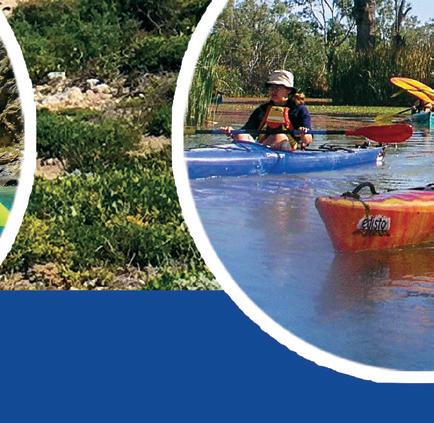






School camps are a formative experience in a young person’s life, providing opportunities for independence and growth away from the classroom and home. Urban Camp enables young regional people to thrive through Melbourne city experiences while providing safe and comfortable facilities, accommodation, and nutritious meals.


Term 1, 2023 | school-news.com.au 61 EXTERNAL LEARNING
Image courtesy of Urban Camp Melbourne
Even reluctant learners can be engaged through EOTC.
next generation of curious and creative thinking through highly immersive programs that enable students to experience dynamic and embodied learning in a memorable environment.
The MoB Learn programs are designed and facilitated by trained Learn Specialists, with each offering providing curriculum-aligned experiences across the humanities and Social Sciences, First Nations Histories and Cultures, Civics and Citizenship, Visual Art and Fashion. Programs included unique access to objects,
artists, historians, curators, conservators and professional development experts.
From Artist-Led workshops to hands on White Gloves Experiences, where students can handle real life museum objects, MoB’s Learn experiences are designed to not only be informative, but thoroughly engaging as well.


To ensure that everyone has the opportunity to access the programs, MoB also offers subsidies through the Learn Assist scheme.
MoB Learn Assist provides increased access for children, young people and their teachers to participate in the cultural life of our city through Museum of Brisbane’s education program. Schools and education groups that meet eligibility requirements will receive financial assistance for booking and travel costs. For more than 30 years, Wilderness Escape Outdoor Adventures has been providing quality outdoor education experiences for students from Primary to SACE level. Working in partnership with schools, the company offers unique opportunities for students to engage with the world around them whilst discovering more about themselves, developing meaningful life skills and fostering relationships with classmates and teachers.

Wilderness Escape is the largest provider of outdoor education programs in South Australia and are recognised nationally as a leader in the field of school based experiential education.


62 Term 1, 2023 | school-news.com.au EXTERNAL LEARNING
Located in the heart of the city at Brisbane City Hall, Museum of Brisbane (MoB) is the keeper of Brisbane’s stories and history. MoB Learn fosters the
Images courtesy of Museum of Brisbane
Image courtesy of Wilderness Escape
With an outcome-based approach and a sound understanding of the theory of experiential learning, the company designs programs to ensure students get the best results from their experience.





To maximise the effectiveness of outdoor education experiences, Wilderness Escape focuses on developing a range of skills and knowledge through safe and active participation; building communication and collaboration skills by achieving common goals; promoting personal health, wellbeing and mindfulness


through immersion in natural environments; enhancing decision making skills and personal responsibility through task-orientated, independently led journeys; fostering a positive growth mindset and personal development through the undertaking and achievement of self-propelled journeys and; increasing appreciation of natural environments through building human-nature relationships, the development of cultural appreciation and a sense of self.

Term 1, 2023 | school-news.com.au 63 EXTERNAL LEARNING (03) 9585 7860 From $360 From $440 From $540 Sustainability Education Centre Cheltenham State Forest Toolangi Marine Sanctuary Beaumaris Your School Greater Melbourne S U S T A I NA B I L I T Y • S C I ENC E • G EOG R A P H Y • STEM Excursions & Incursions “ G o u ld Le a g u e : mak i n g te a ch e rs ’ l i v es ea s i e r s i n ce 1 909 ” Urban Camp provides accommodation, dining and recreation all under the one roof We offer free programming to ensure a seamless camp so you can focus on fun and learning with
Enabling students to thrive through urban experiences. Explore www.urbancamp.org.au 3 klm from CBD Sleep Eat
your school group
Image courtesy of the Gould League
Image courtesy of Wilderness Escape
Nature Play: more time in trees, less time on screens
By Shannon Meyerkort, Industry Reporter
Nature Play is a concept to encourage children to spend more time playing outdoors using their imaginations in a natural setting. It inspires openended possibilities for boosting fitness, motor skills, and learning, as well as social and emotional development in children. This, in turn, can lead to improvements in cognitive and learning outcomes.
In 2005, American journalist Richard Louv coined the term ‘nature-deficit disorder’ to describe the effect on children as they move indoors and lose their connection to the natural world. By spending less time in trees and more time on screens, children were experiencing myriad problems, from obesity and depression to attention

disorders. With worldwide support for his claims, he is often credited with helping to inspire the nature play movement and bringing children back outside.
At its most basic, nature play is simply unstructured and child-led time spent outdoors in nature. Screens, plastic blocks and toys are replaced with mud, branches and water. Inactivity, repetition and solitude are replaced with spontaneity, discovery and risk-taking.
Elements of risk are important in natural play areas, whether that comes from the effects of gravity, rough edges, vegetation or loose materials. Risk is where children can challenge themselves both physically and emotionally, by pushing boundaries, challenging themselves and overcoming fear.
Anything from the natural world can be used when creating a nature play space. Elements can be fixed, such as large boulders, water play taps and streams, vegetation and heavy logs, or loose, such as leafy
Nature play is simply unstructured and childled time spent outdoors.

branches, rocks and dirt. By limiting the direction given to children and simply exposing them to natural materials, they will learn to explore, decide, collaborate, design and manipulate the materials in their own creative ways.
Some non-natural elements may be beneficial and facilitate further exploration and utilisation of the natural elements – these include buckets, spades and
other digging tools, rope or chain and old kitchen pots and utensils. Heavy-duty plastic or metal sifters and strainers, funnels and tubing can also make wonderful additions to mud kitchens and water play.
Help is available for schools wishing to create a nature playground, from assisting with design work all the way to construction, planning and maintenance.
64 Term 1, 2023 | school-news.com.au PROPERTY
Image courtesy of Timber Creations
Playgrounds Built for Schools
Custom designed for unique spaces

individual school environment.

Using a ‘design and build’ holistic approach, Timber Creations make playgrounds to suit the space available, utilising the landscape and existing natural features.

The timber play elements will entice children to explore and investigate through natural colours, shapes and textures.
Timber Creations’ mission is to design amazing playspaces that will not detract from the natural features of the environment, but enhance them, bringing together a sense of wonder and play.

The team’s unique expertise with native Australian timbers means that the beauty and individuality of the Australian trees can be harnessed in


each playground piece.
Due to Australia’s tough climate, local trees grow in fascinating ways, and there is no timber like ours in the world! Timber Creations collect the most interesting pieces and create playspaces with a unique sense of joy.
All the play pieces that are made by Timber Creations Nature Play are custom

handmade on the Central Coast NSW. Have all the hassle taken out, and all the excitement put back into play, and contact Timber Creations for an iconic playground built to your budget, your environment, and your special interests!


Some companies can assist with designing and building traditional playground equipment such as swings, seesaws, cubbies and forts, but with reclaimed, sustainable and predominantly natural elements. Others can help design a more freestyle and unstructured nature play area, by helping you understand and utilise the natural elements already in your local area.
When designing a nature play area, it’s important to start with your goal – what are you aiming for? Who will use your playground, and what do they want to get out of it? All your subsequent decisions will come back to this, from the elements you include, to the level of acceptable risk and the plants you incorporate.
If you choose to create your own outdoor play space using only natural and recycled materials, this opens up many opportunities to create a
sustainable play environment that simultaneously helps the community find new uses for unwanted items, rather than sending them to landfill.
Some ideas to consider are painting old car and truck tires and using them for building, stacking, rolling and water play; plastic or wooden crates and pallets can be used for building, stacking, forts, transporting materials, making bridges and ‘furniture’; limestone blocks from walls and garden beds can be used for structures, stages, foundations and seating.
Nature play elements can be linked to aspects of the primary curriculum from Pre-Primary all the way through to Year 6, including science, geography, history, maths and English, and general capabilities such as critical and creative thinking, intercultural understanding, and personal and social capabilities.
Why should you include nature play in your students’ day? School News gained some industry insight to find out more.
Madelyn from Timber Creations said nature play provides an important contrast to the increasingly controlled environments of the modern world “Nature play is important because it provides a deep insight into the beauty and chaos of life, as well as the cyclical nature of growth and decay. The key to nature play is that the play space changes each day, so the play changes every day - there is more to discover and explore than a piece of plastic that has been designed to be unaffected by the environment.”
“Recently, there has been a trend toward play environments that encourage children to take risks. Risky play helps children learn to balance trying something that may result in them falling from a safe height, or failing

in some way before they learn how to do what they are trying to do. Nature play is the best for this, as nature provides natural variation such as uneven textures and different sized gaps that challenge children in multiple ways and encourage them to extend themselves.
“Children have a natural inclination to explore the world around them, and nature play is at its best when children are left to their own devices to make up their own games and activities in free play. Sometimes they need a little push to get more comfortable if they haven’t had much opportunity with natural play. Some great options are workbenches and mud kitchens, obstacle courses with natural materials, sandpits and digging patches with loose parts play. Children who are more comfortable can be extended with more non-prescriptive play such as logs, boulders and natural landscapes.”
66 Term 1, 2023 | school-news.com.au PROPERTY
Image courtesy of Timber Creations
Learning spaces beyond the classroom
By Sarah Davison, Industry Reporter
The Covid safety plan for many schools included moving lessons outside and utilising outdoor learning spaces.
In fact, the federal government’s $270 million Schools Upgrade Fund included $32 million for outdoor learning spaces. The benefits of outdoor learning, though, have long been documented. Now, these benefits are being enjoyed by more students than ever before.
A 2005 study of urban Melbourne primary schools found that hands-on contact with nature in primary school, regardless of the type, is an important means of connecting children with nature and can play a significant role in cultivating positive mental health and wellbeing.
Findings from 2018’s Outdoor Learning and Play at Schools
Around the World report explained “the benefits of outdoor learning and play last beyond early education.
“Preschool children who enjoy large amounts of outdoor time have been shown to consistently score better on standardised tests for executive function, attention and short-term memory than children attending preschools that have fewer outdoor hours in the school day. Those children who enjoy more outdoor time during preschool continue to score better on standardised testing once they have moved into primary education.”
Outdoor education can also connect students with First Nations peoples’ and their relationship with the land. Australian Indigenous communities have used the oral language tradition of the
Yarning Circle for thousands of years. They are used to discuss issues in a way that is inclusive, safe, and collaborative.
According to Be Deadly Online, “Yarning Circles are designed to allow all students to have their say in a safe space without judgement. Each student is encouraged to speak, one at a time, without interruption. This is a process that helps to develop deep listening skills, sharing knowledge and establishing rules around respectful behaviour.” In a school environment, implementing Yarning Circles can help increase understanding of Aboriginal and Torres Strait Islander knowledge. And it’s not just school students who are exploring the benefits of the Yarning Circle, with the University of Canberra recently announcing that it would be implementing Yarning Circle demonstrations across disciplines.
University of Canberra Clinical Assistant Professor in Law Doris Bozin said, “A yarning circle requires listening to others share their stories, without
interruption, in a safe space with no judgement, to work together to resolve a dispute.
“Yarning circles also demonstrate a different way of resolving disputes through exploring tensions between competing rights and responsibilities, learning what just and equitable outcomes might look like, finding fairness and resolution within the process, and understanding the importance of certainty in a resolution.”
While moving lessons outdoors is an increasingly popular trend, many schools do not have purpose built outdoor learning areas. Several options are available for tables and chairs, shade solutions and comfortable ground coverings. Natural elements like tree stumps and logs can be incorporated into the space, reinforcing the connection to nature.
Utilising outdoor learning areas during class time can be as simple as taking children outside to read a story. If your space is appropriate, whole lessons can be conducted outside in any subject or discipline. Taking
advantage of natural light and favourable weather has great health benefits for students and teachers, and can also help schools save money on electricity. To find out more about the benefits of outdoor learning spaces, School News asked Lindsay Stead from Astra Street Furniture for his insights.


Mr Stead said that the benefits of outdoor learning areas are clear. “Being out in fresh air has been shown to stimulate the senses, improve mood, reduce stress, improve eyesight and increase physical activity, which in turn promotes good health and wellbeing,” Mr Stead said. “Students’ behaviour improves and they are more eager to learn. It is also a confidence booster for students who feel less comfortable in the classroom.” Mr Stead said Yarning Circles were becoming a popular request for schools updating their outdoor learning space.
“Incorporating a yarning circle into an outdoor learning environment helps students to connect with Country and enhance the outdoor learning experience,” he said.
When planning an outdoor learning space, it is crucial that schools thoroughly research all the furniture items they require to cater to all students. “There is a variety of outdoor classroom furniture available that is suitable for primary and secondary students to support a wide range of outdoor learning activities.
“Many schools include spacious picnic settings, one-on-one seats, curved benches, wheelchair accessible furniture pieces, fixed shelters or folding umbrellas for shade, trees, planter boxes, recycling bins and of course, Yarning Circles.”
Term 1, 2023 | school-news.com.au 67 PROPERTY
Yarning circles allow students to have their say in a safe place. Images courtesy of the Area Safe Group


