ISSUE 4
M
A
G
A
Z
I
N
THE HUMAN SIDE OF PERFORMANCE Why neuroscience and well-being belong in the leadership conversation.
THE ART OF STARTING OVER
E WOMEN REDEFINING SUCCESS Perspective on ambition, identity and the courage to choose a different path.
From family law to coaching women through life's defining transitions.
TRACY LITT THE BUSINESS OF BECOMING The visionary behind The School of Becoming® is taking personal transformation into a new era of leadership.
INSIDE 16 REMARKABLE WOMEN SHAPING WHAT’S NEXT
Editor’s Letter Dear Readers, Growth often begins with a willingness to ask what comes next. In this issue of Rainmakers Magazine, we explore how that question shapes leadership, ambition, and the meaning of success. Our cover story features Tracy Litt and “The Business of Becoming,” opening a conversation about personal transformation and the way we lead. Throughout this edition, we meet women finding their voices, addressing gaps in care, building businesses, and embracing new directions. Their stories invite us to reflect on our own choices. Does our work reflect what we value? Are we making room for well-being alongside ambition? What might we begin if we gave ourselves permission to change? My hope is that these pages offer inspiration and encouragement to take your next step with intention. Thank you for joining us for Issue 4. Warmly, Dennis M. Postema
1
Table of Contents The Woman Who Is Redefining What It Means to Become
03
Building a Business Around the Power of Presence
27
The Courage to Become
07
The Business of Reinvention
29
Turning Breakthrough Work Into a Business Built to Be Seen
11
The Executive Who Learned to Make Change Personal
33
The Veterinarian Who Built Her Way Back to Herself
13
35
Turning a Healthcare Gap Into a New Model of Care
Rethinking What Executive Presence Really Means
17
Rewriting the Rules of Corporate Performance
37
Building a Business Around The Perimenopause Gap
19
The Work Beneath Personal Transformation
41
21
Building Support for Families Living With Addiction
43
25
Helping Writers Find Their Voice and Their Readers
45
Building a Personal Brand at The Intersection of Voice, Wine and Transformation Building a Business for What Comes Next
2
TRACY LITT
The Woman Who Is Redefining What It Means to Become
From a moment of reckoning on a garage floor to the creation of The School of Becoming®, Tracy Litt has built a movement around one extraordinary proposition: the person you have been does not determine the person you can become. The garage was quiet after the crying stopped. On the floor, a young mother lay curled in exhaustion, her eight-month-old daughter inside the house, her own future suddenly unrecognizable. She had no job, no income, and no clear idea how she would raise her child alone. Then, in the stillness, Tracy Litt heard a voice that would change everything. She could continue living the same story, or she could stand up and create a different life. She remembers raising her hand, almost instinctively, as though someone were reaching down to help her. In her telling, that someone was the woman she had not yet become. Today, Tracy Litt is the founder of The School of Becoming®, an education and certification company devoted to helping people transform the internal patterns shaping their lives. Her work attracts entrepreneurs, executives, coaches, educators, healthcare professionals, and women seeking something they cannot quite articulate. Yet the most compelling thing about Tracy is not simply the business she has built. It is the relationship between her personal evolution and the institution she is determined to leave behind.
3
ences had left behind. Her mother’s explorations did not cure her illness. But they introduced Tracy to questions about identity, personal responsibility, and the relationship between one’s inner life and outward circumstances. The connection has become generational. Tracy’s daughter, Taylor, is now pursuing her own path through The School of Becoming®.
The Woman Who Planted the Seeds
“My grandmother had it, my mother had it, I have it, Taylor has it,” Litt tells, describing what she experiences as an inherited gift and calling.
When Having Everything Wasn’t Enough Long before Tracy understood the language of personal transformation, her mother was exploring it. Diagnosed with cancer when Tracy was 21, her mother lived another three and a half years before dying at 51. During her illness, she immersed herself in spiritual exploration, began counseling women, wrote a column called Food for Thought, and delivered empowerment talks in borrowed spaces. She remembers returning home to find unusual gatherings and practitioners discussing ideas that seemed entirely foreign to her. At 21, she wanted little to do with them. Only years later did she recognize the influence those experi-
Without a traditional college degree, she climbed the corporate ladder, eventually becoming a vice president of human resources. She spent 12 years in the profession, working within the elder-care industry.
built. Eventually, sitting outside one evening as waves crashed nearby, she experienced another moment of clarity. “You are not getting out alive,” she recalls hearing from her highest self. So, she enrolled in coaching school. Four months later, she was laid off from her corporate position. Rather than listen to her mind and get another job, she committed to building something of her own. In 2017, The Litt Factor was born.
From Personal Transformation to a School of Leaders
Tracy developed Neuro-Identity Evolution®, her proprietary framework integrating identity, thought patterns, beliefs, language, fear, and nervous-system reimprinting.
She earned a multiple-six-figure salary, purchased a townhouse, and created a secure life for Taylor. “Why do I feel so empty inside?” she remembers asking. She began researching helping professions, from psychotherapy to hypnotherapy, before discovering the world of coaching and personal development. For two years, Tracy vacillated between the excitement of pursuing coaching and the fear of abandoning everything she had 4
Originally delivered through a program called Mind Magic, the
The Radical Business of Making Yourself Unnecessary Perhaps Litt’s most provocative position concerns the relationship between teacher and student. She believes the personal-development industry has too often encouraged dependence on charismatic leaders. Her alternative is sovereignty.
Originally delivered through a program called Mind Magic, the methodology attracted leaders who had already invested extensively in personal development. They began asking whether they could bring elements of her teaching into their own organizations. Could they teach these tools to sales teams? Could they become trained in the methodology themselves?
evance. “Who you’ve been is zero indication of who you’re capable of becoming.”
“You’re not changing the world by yourself,” she remembers realizing. If she wanted her work to reach more people, she needed to develop other practitioners.
The result is BECOMING Certified, a practitioner-training program built around a seven-module framework intended to integrate approaches that participants may previously have encountered separately.
Her first certification cohort launched in 2021, followed by another in 2022. In 2023, she introduced The School of Becoming®, transforming a founder-centered coaching business into an institution designed for broader reach and long-term rel-
Rather than treating mindset, somatic practices, and identity work as disconnected disciplines, she brings them into a single methodology. Her argument is that an inspiring thought is not the same as a durable change in how someone lives and responds.
It also reflected a strategic business decision. Tracy wanted an organization that could eventually operate beyond her personal brand, with intellectual property and a community capable of surviving its founder’s daily involvement.
5
“Our certification ensures the practitioner embodies their own sovereignty because it’s their core job to guide their clients back to their own sovereignty.” Litt does not want practitioners who collect followers dependent on their guidance. She wants professionals capable of helping others develop confidence in their own discernment and self-trust. One of the skills she teaches is detached involvement: remaining compassionate, attentive, and available without assuming responsibility for another person’s outcomes. During a certification immersion attended by Rainmakers Host Dennis Postema, Tracy illustrated the concept by imagining a sheet of plexiglass separating practitioner and client. The practitioner remains present without becoming emotionally entangled in the client’s experi-
ence. “Detachment is loving and is essential to be an effective facilitator,” she explains.
sonality assessments can help employees understand their differences without necessarily equipping them to change how they respond under pressure.
that identity can change. Her corporate success taught her that achievement and fulfillment are not interchangeable.
with feeling unsafe and identify opportunities to respond differently. That tool remains in development, but the direction is clear: bring her identity-centered work into conversations about culture, leadership, and organizational performance.
reach.
Taking The School of Becoming® Becoming Into She is developing an assess- And has become the vehicle through intended to help leaders which she hopes to share those the Boardroom ment recognize patterns associated lessons far beyond her own Tracy’s next chapter returns her to the corporate world she left behind. Through The Evolved Leader, The School of Becoming® is expanding into leadership development for corporations and smaller businesses.
The Life She recalls watching organizaWaiting on the tions spend heavily on professional-development initiatives Other Side that failed to produce the behavioral changes they intended. “At the core, all professional development is personal growth,” she says. Tracy believes conventional per-
Life, Tracy believes, is not meant to be spent waiting until fear disappears. Because it never does. Her mother’s death taught her that time is finite. Her experience on the garage floor taught her
6
There is a striking paradox in Tracy Litt’s ambition: she is building an increasingly recognizable personal brand around the conviction that people should not need someone else to be their guru or their sage. The young woman who once reached upward from a garage floor is now reaching outward, building an institution designed to help others recognize the possibility she once struggled to see in herself.
BROOKE ROBINSON
The Courage to Become For Brooke Robinson, fear rarely announced itself with drama. It looked more like an unfinished email and a sudden urge to do the laundry. From Australia, Robinson had built a creative business around surface pattern design, patterns destined for wallpaper, tablecloths and fabric. She taught others the craft, organized summits and learned what entrepreneurship demanded. Yet behind the color and creativity was a less visible reality: the physical strain of repeatedly asking herself to be seen. “I was scared about stepping forward and pitching things and doing the things I need to do in a business,” she says. Her shoulders tightened. She held her breath. Important tasks triggered distraction. She was discovering how much of entrepreneurship happens beneath the business plan.
7
actually speak to that fear, or I can do some breathing, or I can go have a different perspective,” she explains. That distinction changed her relationship with action.
A New Business Takes Shape
When Fear Becomes Information Robinson’s trajectory shifted when she encountered Tracy Litt’s work and began learning about nervous-system regulation. She had already begun hosting summits, but the experience remained frightening enough that she wanted growth to feel less punishing. The revelation was not that fear could be eliminated. It was that fear could be understood. Through breathing practices, Robinson noticed what her body had been communicating. She jokes that she had been “wearing my shoulders as earrings.” She noticed how frequently she held her breath and how tension appeared around possible rejection. A company pitch became the test. As she prepared to send an email, she could feel herself tightening and looking for an escape, anything to postpone the risk. Instead of interpreting that resistance as evidence she should stop, she learned to identify it as a nervous-system response. “In that moment, I can
Over time, Robinson’s private transformation began reshaping her professional ambitions. She kept returning to one thought: other people needed to understand this too. She still wanted to serve creative business owners. Only the problem she wanted to solve had changed. Her new program, Safe to Become, is being developed for entrepreneurs who reach the edge of an important decision and find fear standing between intention and execution. Robinson plans to begin with a priority waitlist and small groups, alongside one-onone support. It is a notable pivot, but not an abandonment of her creative identity. Surface pattern design will remain part of her life, even if increasingly as a hobby. Robinson says regulation has strengthened her creativity. That continuity gives the transition an unusual kind of coherence. The connection makes sense. Creative work requires openness; entrepreneurship demands exposure. For someone doing both, the ability to recognize internal resistance without automatically surrendering to it can become a business skill in its own right.
Building a Brand From Lived Experience 8
Robinson’s strongest differentiator may ultimately be the simplicity of her story: she is becoming the person she once needed. She knows what it is to have the strategy and still struggle to act. She knows the peculiar choreography of avoidance: the tense shoulders, the held breath, the conveniently urgent household task. And she knows the shift that occurs when those reactions become observable rather than controlling. Her existing design platform is now beginning its own transition, while her emerging identity in nervous-system work is taking shape through Safe to Become and her social presence as Brooke Neuro Identity. There is vulnerability in making such a transition publicly. Her audience knows her for one thing; she is asking them to follow her toward another. Yet that uncertainty is also unusually aligned with the work she now wants to represent. Safe to Become is, after all, a name about movement before certainty. Robinson is not presenting entrepreneurship as fearless performance. Her proposition is quieter and perhaps more credible: notice what happens when fear arrives, understand what the body is trying to protect, and create enough internal room to choose deliberately. For a woman whose next chapter emerged from learning not to flee the difficult email, the brand and the person are becoming difficult to separate. That may be exactly the point.
9
10
CHERYL KEATES
Turning Breakthrough Work Into a Business Built to Be Seen Cheryl Keates knows what it means to be highly effective and largely invisible. Her clients, she says, have included billionaires and creatives. She has helped people build eight-figure businesses and guided others through personal shifts that changed the trajectory of their lives. Yet Cheryl describes herself with a phrase familiar to many experts whose reputations have traveled farther through referrals than through media: a “high-value, best-kept secret.” Now, at 63, she is changing that. Cheryl is entering a new chapter in which the work itself is no longer the question. The opportunity is building the visibility, programs and business infrastructure capable of carrying it to a larger audience. 11
specific obstacle. She points to a recent client who had once been highly visible, with dozens of New York Times bestsellers attached to her work, but had retreated professionally. Within five weeks of working with Cheryl, she says, the client was back onstage. It is this ability to accelerate change that Cheryl increasingly wants at the center of her brand.
When Expertise Outgrows Referrals The Guide for the Guides Cheryl is a Master Certified Coach and an expert in human behavior. Her work is rooted in getting beneath the visible problem to what she sees as its underlying cause, then helping clients create change from there. “I’m in this phase of being the guide for guides,” she says. That evolution is already shaping her business. Cheryl has launched a group for coaches focused not only on transformation, but on strengthening the profession itself: helping trained coaches increase their impact, build wealth, raise their rates and operate with greater integrity. A second group is planned for female leaders and business owners, while her private practice continues to include select clients, including men and professionals in creative industries. Then there is her six-week breakthrough program. Cheryl describes it as concentrated work for someone facing a
For years, referrals brought clients to Cheryl from around the world. More recently, that flow changed, prompting her to examine how people discover her and how her business presents itself online. The realization was uncomfortable but useful: exceptional client results do not automatically create public visibility. “People just don’t know about me,” she says. Social media has not felt natural. Scripted performance feels even less so. Cheryl is at her best in conversation, where she can respond intuitively rather than perform for a camera. That distinction informs how she thinks about growth. She does not want visibility for visibility’s sake. She wants a platform that preserves the authenticity that makes her work effective. “I want to have the most authentic ways of connecting with people,” she says. “I don’t want to be performing.” For Cheryl, the business question has therefore become one of translation: how do you turn deeply personal, high-touch expertise into a visible brand without flattening what makes it valuable? 12
A Bigger Canvas Her ambitions extend well beyond coaching sessions.Cheryl has an idea for a television show built around transformation. She owns the domain and has been thinking about how the format could connect to her breakthrough work. She also has a personal screenplay she has envisioned for years and now believes finally has its ending. These projects are not random departures. They reveal where Cheryl sees the next version of her business heading: toward media, intellectual property and a broader public identity.Her priority is completing and establishing her signature programs so those foundations can support the creative projects that follow. The shift also reflects something Cheryl says about her own life. When people remark on how young she looks, she attributes it not to cosmetic intervention but to “the inner work.” For her, internal transformation eventually becomes visible externally. Her business is approaching the same test. Cheryl has spent years doing the work behind closed doors, producing results one client at a time. Now she is building the structures that can make that expertise more visible without making it less personal. The best-kept-secret phase may have served its purpose. The next chapter is about ensuring that the depth of the work and the reach of the brand finally begin to match.
DR. EVE HARRISON
The Veterinarian Who Built Her Way Back to Herself There is a flute on a music stand behind Dr. Eve Harrison when she talks about veterinary medicine. It is an appropriate detail. Dr. Eve’s professional life has never fit neatly into one category: veterinarian, entrepreneur, coach, yoga teacher, musician. “I’m a veterinarian by day, musician by night,” she says. Today, Harrison runs Marigold Veterinary, a boutique concierge integrative house-call practice in Los Angeles, and The House Call Vet Academy, where she teaches veterinarians to build independent mobile practices. She has helped roughly 500 veterinarians to create their own businesses. But the enterprise began not with ambition to become a business coach. It began with Harrison nearly leaving veterinary medicine altogether.
13
proud of that moment,” she says now. The dismissal dismantled the identity she had spent years constructing. In order to heal from traumatic experiences in the veterinary profession and especially during that surgical residency, Harrison turned toward yoga, meditation and somatic work, eventually becoming a yoga teacher. Slowly, she began asking a different question, not what veterinary medicine expected her to become, but what kind of veterinarian she wanted to be. Her intimate integrative practice, Marigold Veterinary, emerged from that answer.
Refusing to Become a Cog
Reclaiming Veterinary Medicine – For Healing
Years earlier, Harrison was two years into a surgical residency, pursuing the prestigious path toward becoming a board-certified veterinary surgeon.
Harrison began small, initially practicing veterinary acupuncture before developing an integrative, concierge-style housecall model.
Behind the credentials was exhaustion. She describes a corporate environment of sleeplessness, relentless emergency work and a culture that seemed to demand the disappearance of the person behind what she calls the “white coat straightjacket.”
Instead of cycling through hundreds or thousands of patients, she created intimate relationships with families and their animals.
“You are nobody. You are a cog in this corporate machine,” she recalls of how it felt. Then came the rupture. Harrison refused to euthanize an animal her superiors wanted euthanized. An argument followed. That week, she was fired. “I’m actually
Today, her practice deliberately holds no more than ten to twenty clients at a time, and provides Harrison with what she describes as peace, fulfillment, and a strong income. The smallness of her practice is intentional. When COVID-19 disrupted traditional veterinary clinics, Harrison’s unusual model suddenly attracted attention. 14
Veterinarians exhausted by curbside care, staffing shortages and professional burnout began asking the same question: How do you do what you do? Harrison realized she had spent more than a decade solving a problem others were beginning to articulate. The House Call Vet Academy educational and coaching platform for veterinarians followed. What began as consulting expanded into courses, community and coaching, reaching veterinarians across the United States, Canada, the United Kingdom, Australia, New Zealand, the Caribbean and South America to become a fully international offering. Her work eventually moved beyond business mechanics. Harrison could hand someone the blueprint for entrepreneurship, but she discovered that knowledge did not guarantee action. “I encountered students who I could consult on the business plan and every nitty gritty step to take, but some veterinarians still just wouldn’t do the thing,” she says.
Coaching the Person Behind the Practice That realization brought Harrison deeper into mindset, identity and nervous-system work through spiritual facilitation training, coach certifica-
tion, trauma-informed training, as well as neurodivergence and ADHD coach training and deeper. Additionally, after encountering the Neuro-Identity Evolution methodology, she saw a framework capable of addressing the limiting beliefs and emotional patterns that simple consulting could not reach. This training & deepening of her skillset as a coach complemented something Harrison already understood: entrepreneurship can become a form of self-reclamation. She now brings all of these philosophies and frameworks into her Concierge Vet Mastermind, into her coaching, and into her communities to help veterinarians build highly personalized practices with fewer clients, deeper relationships and greater autonomy.
The proposition is striking in an industry Harrison describes as increasingly corporatized. Rather than teaching veterinarians merely how to escape the “golden hand cuffs” of employment, she is asking them to reconsider what their profession could look like when designed around their values and another chapter is emerging. Harrison is a classically trained flautist who performs in several local symphonies, for Renaisance Fairs, weddings, festivals, and with her Celtic band called Mayde in Ireland. Music, she says, is “absolute medicine”, a connection to self, body and the divine. She is now considering bringing her coaching work to musicians struggling with perfectionism, judgment and the persistent conviction that they are not enough. 15
On paper, veterinary medicine and music make unusual companions. In Harrison’s life, they tell the same story. Both once placed her inside systems where achievement threatened to eclipse identity. Both eventually became routes back to herself. That may be Harrison’s most compelling work: not simply showing veterinarians how to build practices, but demonstrating what can happen when a professional stops asking how to fit the system and begins building one that fits the person, its animals, and its music.
16
KAREN ROSE FERNANDEZ
Turning a Healthcare Gap Into a New Model of Care On a quiet island in the Philippines, Karen Rose Fernandez lay face down on a massage table, looking through a glass panel at the ocean moving beneath her. She was thousands of miles from her career in software engineering, exhausted by the pace of high achievement, when the island’s serenity inspired a vision: women’s healthcare rebuilt from the ground up to feel personal, intentional, peaceful, and more complete. Years later, that vision has become Inspira Care, Fernandez’s holistic fertility company, and the convergence of two identities that once seemed unrelated: the engineer trained to find root causes and the woman who spent years searching for answers about her own body.
17
From Software Systems to Human Ones For 15 years, Fernandez built a formidable career in technology, eventually becoming senior director of engineering at a healthtech startup. She loved the work and imagined herself becoming a CTO. Alongside that success, however, she was dealing with endometriosis, PCOS, infertility, severe menstrual pain and persistent acne. Conventional approaches, she says, never gave her the explanation she was seeking. So Fernandez did what engineers do: she investigated. She immersed herself in nutrition and later targeted supplementation, gradually improving symptoms she had lived with for years. The experience altered her view of healthcare. If she could not find the model she wanted, perhaps she could build it. In 2024, she left software engineering and founded a healthcare company. “The core thing that I’ve always loved is solving problems and getting to the real root cause,” she says. “We’re just dealing with a human body that is actually a lot more complicated than a computer.”
blood chemistry, nutrition coaching, whole-food supplementation and, increasingly, nervous-system regulation. Her philosophy is deliberately broader than pregnancy alone. She wants clients to understand their health rather than experience fertility as an isolated reproductive problem. Nutrition remains foundational. Fernandez says she will not offer supplementation without nutrition coaching because the larger objective is sustainable behavior, not a temporary protocol. But another piece was missing from her own life and her clients’: stress management. A lifelong high achiever, Fernandez had tried meditation, yoga, therapy, books and programs without creating lasting change. Then, shortly after experiencing a miscarriage, she attended an event where she publicly shared what had happened. “I felt like a failure,” she recalls. “Who am I to give people advice on fertility when I just had my own miscarriage?” There she met Tracy Litt, whose work in nervous-system regulation became pivotal to Fernandez personally and professionally.
ing a company and raising a family. At the time of her Rainmakers interview, she was 38 weeks pregnant and preparing for a home birth. It was also her final working day before maternity leave. The contrast is central to her brand. Fernandez is not presenting herself as someone who escaped demanding circumstances. She is running a young company, parenting, preparing for another child and planning to scale. Yet she says she feels less stressed than when she was single and working for a San Francisco startup. Next year, she plans to expand a program combining nutrition, targeted supplementation and nervous-system regulation, while growing Inspira Care carefully enough to preserve a three-day workweek. Her longer-term vision is more ambitious: a women’s healthcare clinic and birth center carrying the atmosphere she imagined beside that Philippine ocean: calm, restorative and attentive to women. There is something fitting about an engineer building a fertility company. Fernandez has spent her career examining systems, locating inefficiencies and refusing to accept that an unexplained outcome is simply the end of the investigation.
Building Inspira Care Fertility From the Beyond a Inside Out Single Number Fernandez subsequently entered Only now, the system is huInspira Care works primarily with women and couples navigating infertility, secondary infertility and recurrent miscarriage. Fernandez’s approach begins with fertility awareness and cycle tracking, then may incorporate nutritional
Litt’s Becoming program and is pursuing certification to bring that work into her own fertility practice. She describes the change in unusually practical terms: more calm, greater confidence and less reactivity, even while build18
man. And Inspira Care is her attempt to ask a more consequential question: what becomes possible when women are given the time, information and support to understand the whole picture?
KAYLA JOHNSON
Building a Business Around the Perimenopause Gap In March 2020, Kayla Johnson stood inside a business that had suddenly become impossible to run. One year earlier, the longtime fitness entrepreneur had opened a spin studio in Santa Barbara. Then COVID closed the doors. At 44, Johnson was fighting to protect her company while managing a blended family of six children. She was also gaining weight, waking with anxiety, sleeping poorly and experiencing panic attacks. She blamed the obvious culprit: a world turned upside down. What she did not understand was that she was also in perimenopause. “I thought it was for, like, 80-year-olds,” she says. The realization would eventually dismantle one business and create another. 19
Turning a Personal Problem Into a Market Opportunity Johnson had spent more than three decades in fitness. A lifelong dancer who fell in love with group exercise in the 1990s, she had owned three fitness businesses and taught spin for more than 20 years. Yet the methods that had defined her career were no longer working for her body. She was roughly 25 pounds heavier, uncomfortable in her clothes and sometimes getting dressed in the dark to avoid seeing herself. Thirteen spin classes a week, she discovered, were not necessarily the answer for a woman navigating hormonal change. So Johnson returned to study. As she researched perimenopause, nutrition, hormonal optimization, insulin resistance and eventually peptides, she saw something larger than her own experience: women were entering midlife surrounded by information yet starved of clarity. The entrepreneur in her recognized the gap. She sold the spin studio and moved her work online, becoming a perimenopause weight-loss coach. Nearly five years later, she says she has helped 1,000 women.
A Business Built for Women Who Usually Have It Together Johnson’s client is not someone unfamiliar with discipline. She
often works with CEOs, entrepreneurs, mothers and high-performing women accustomed to managing demanding lives. Then their bodies change. By the time they reach Johnson, many have been pulled into what she calls an “echo chamber” of advice: supplements, workouts, diets and social-media prescriptions, each promising to be the missing answer. Her business rejects the one-size-fits-all premise. “Every woman’s a puzzle,” she says. Her virtual coaching examines movement, nutrition, supplementation, hormones, lifestyle and goals. Her core offer begins as a 90-day program, with continued support extending through the year. Johnson describes herself as a client’s “perimenopausal bestie”, although her coaching style is tough-love. “I will love your guts, but I won’t let you get away with stuff.” That combination is becoming central to her brand: warmth without coddling, expertise without pretending there is one universal protocol.
From Weight Loss to a Larger Platform Johnson’s work is now expanding beyond physical strategy. Through her training in neuro identity evolution, she is incorporating deeper conversations about self-perception, behavior and learning to move through change without turning against oneself. 20
“You can’t hate yourself through this,” she says. It is a significant evolution for a business initially built around weight loss. Johnson increasingly speaks about women prioritizing themselves, investing in support and refusing to apologize for wanting to feel good in their bodies. The shift also reveals a larger entrepreneurial opportunity. Johnson knows she has expertise, presence and a story that resonates; what she is building now is the infrastructure and visibility to match it. She has already seen the commercial power of exposure through guest podcast appearances, which brought clients into her business. She is exploring media, scalable programs and recurring offerings while working to spend less time buried inside operations. “I know that I can captivate,” she says. “I just don’t know that I know how to capitalize on who I am.” That may be the most revealing line in Johnson’s story. Her next stage is not about inventing another identity. It is about turning three decades of experience, a midlife reckoning and a growing body of client work into a brand large enough to hold them. Perimenopause forced Johnson to reconsider the rules that had governed her own body. Building the next version of her company may require the same thing: recognizing when an old model has stopped working and having the nerve to design a better one.
NOELLE LAGUSCH
Building a Personal Brand at the Intersection of Voice, Wine and Transformation Noelle Lagusch has spent much of her career learning how to use her voice. First, quite literally. Nearly two decades ago, while working in corporate America and pregnant with her first child, a singer friend suggested she try voice acting. Lagusch took the advice, discovered she loved the work and began recording small commercial projects. Motherhood temporarily changed the trajectory, but not the ambition. In 2018, she returned seriously, rebuilt her demo, created a home studio and stepped into the increasingly independent world of voiceover. Today, however, Lagusch is building something broader than a voice-acting career. She is a wine consultant, entrepreneur, mother, caregiver and emerging coach—an unusual collection of experiences that is beginning to converge into a personal brand centered on transition, creativity and human potential.
21
From Corporate Structure to Entrepreneurial Freedom
fication in nervous-system and personal-development work, and her first instinct is not to build an entirely separate audience. It is to bring the work into communities she already understands.
Lagusch’s path into entrepreneurship was anything but linear. Voice acting gave her the first taste of independence, but the economics were demanding: constant auditions, training and investment without guaranteed work.
The wine industry is one possibility. Thousands of independent consultants across the country face the pressures familiar to entrepreneurs: motivation, confidence, consistency, identity and growth. Lagusch sees an opportunity to introduce deeper personal-development work into an industry where she already has credibility and relationships.
Then, in 2020, a nutrition coach introduced her to a wine company. Lagusch initially resisted the business opportunity. She simply liked the product. Eventually, she agreed to become a consultant. The decision unexpectedly expanded her world. She joined her local Chamber of Commerce, entered networking groups and found a professional community she had not realized she was missing. Six years later, the wine business has become more than another income stream. It has given her a network and potentially, a market for what comes next. “The autonomy is priceless,” Lagusch says of entrepreneurship. With two teenagers, an aging mother nearby and the responsibilities of what is often called the sandwich generation, flexibility is not an abstract lifestyle benefit. It is infrastructure.
Finding the Next Business Through an Existing One
Lagusch is now pursuing certi-
Voice acting offers another natural direction. She belongs to an online community of performers and understands firsthand the vulnerability of creative work: the auditions, rejection, discipline and need to remain expressive under pressure. For Lagusch, these are not competing niches so much as evidence of a larger idea: the strongest new business may already be hiding inside the relationships and expertise an entrepreneur has accumulated.
Building the Infrastructure for Visibility What Lagusch does not yet have is the machinery behind a scalable personal brand. She has a landing page, established branding and experience as a podcast guest. She maintains a presence on Facebook and Instagram, with some activity on LinkedIn. But she does not yet have a comprehensive CRM, consistent content system or defined ecosystem for 22
turning visibility into clients. That gap matters because Lagusch’s ambitions are becoming clearer. She is considering coaching programs at multiple levels while exploring the possibility of a podcast—an especially natural medium for someone who has spent years professionally developing her voice. A show focused on entrepreneurs in the wine industry could connect her existing network, interviewing skills and emerging coaching work under one recognizable platform. It could also give Lagusch something increasingly valuable as she enters this next phase: a platform she owns. There is a certain elegance in Lagusch’s next chapter. Voice acting taught her to communicate. Wine consulting taught her to sell, network and operate independently. Family responsibilities taught her the value of flexibility. Mentors taught her that asking for guidance can accelerate change. Now those experiences are beginning to look less like separate careers and more like the components of one business. The question is no longer which identity Lagusch should choose. It is how deliberately she can build a brand spacious enough to hold all of them and clear enough that the right audience understands why they belong together in the years ahead.
23
24
REBECCA COOPER
Building a Business for What Comes Next For years, Rebecca Cooper helped other people navigate change from inside counseling rooms and school hallways. Then change arrived at her own door. A divorce disrupted one chapter. Retirement from a long career as a school counselor closed another. Somewhere between the two, Rebecca Cooper found herself confronting a question familiar to the women she now hopes to serve: when the roles that have defined you begin falling away, who are you next? Her answer is becoming Echo and Alchemy, a coaching business built around transition, nervous-system work and the possibility that reinvention does not require abandoning who you have been. Sometimes, it means finally hearing yourself clearly.
25
From Counselor to Coach Cooper spent years in counseling, maintaining a part-time private practice while working in the school system. Most of her career centered on adolescents before she eventually moved into elementary education. Counseling gave her a foundation in cognitive approaches to change. Her personal experience, however, convinced her another dimension mattered. During her divorce, Cooper entered a personal-development program focused partly on nervous-system regulation. She describes the experience as profound enough to alter not simply how she navigated the upheaval, but how she imagined her professional future. “I don’t think I could have survived the retirement or the divorce without knowing what I know now about the nervous system,” she says. She completed certification in 2025 and is currently undergoing recertification, preparing to integrate that work into a business that draws on her counseling background without simply recreating her former career. “I felt so led to take this out to others,” Cooper says.
Echo and Alchemy
The name of Cooper’s new company is deliberate. Alchemy traditionally evokes the transformation of lead into gold.
Cooper sees a human parallel. Not because people begin as something lesser, but because circumstances can be transformed into something more intentional. “We all can take what we are, where we are, and make that better,” she explains. Echo, meanwhile, feels particularly fitting for a woman whose story repeatedly returns to voice. Cooper is also a musician and songwriter. Her band, Fox Hill Road, has released an album titled Tell the Tale, blending singer-songwriter influences with rock and Americana. For Cooper, songwriting and coaching intersect around the same challenge: becoming willing to say what feels frightening to say. After her divorce, she describes having to rediscover her own voice. Music gave that process an artistic language; nervous-system work gave it another framework. Fear, she believes, does not necessarily disappear when someone becomes more confident. The practice is learning to move alongside it. “Fear, I hear you,” she says of the internal conversation. “Thank you for trying to protect me, but I’m going to do this anyway.”
A Business for Women in Transition That philosophy now informs the market Cooper wants Echo and Alchemy to serve. She is particularly interested in women between roughly 40 and 70 nav26
igating major transitions: divorce, remarriage, retirement, an empty nest, children leaving for college, or the quieter realization that years spent caring for everyone else have left an uncomfortable question behind. Who am I now? Cooper also sees a place for creative women struggling to be visible, share their work or trust their own voices. Her differentiator is the combination of professional counseling experience and her newer coaching approach. Cooper remains respectful of traditional counseling and the cognitive behavioral methods in which she was trained. But she believes lasting transformation can require attention to the body and nervous system alongside thought patterns. Echo and Alchemy is beginning with private clients, with Cooper open to developing group and community offerings as the business grows. Her website serves as the front door for consultations. The commercial opportunity is intertwined with something more personal. Cooper is not building a business around a transition she has merely studied. She is building one from inside a transition she has lived. Retirement could have been an ending. Divorce could have been only a rupture. Instead, both became raw material. Perhaps that is the clearest expression of Echo and Alchemy itself: not erasing what came before, but transforming it into the foundation for whatever comes next.
SHARON COSTIANES
Building a Business Around the Power of Presence Before Sharon Costianes built a business around the voice, she had to rethink the body behind it. Fresh out of college with a degree in vocal performance, Costianes expected music to define her future. She had trained as a singer and imagined opera stages and international touring. Instead, chronic back pain intervened. One episode became so severe she could not walk for a week. Her voice teacher, also a Feldenkrais practitioner, asked Costianes to come for a hands-on session. Thirty minutes later, Costianes walked out of the office. She was not cured; the pain took years to resolve, but her professional direction changed almost immediately. “I’m not going to grad school for vocal performance,” she remembers deciding. “I’m gonna go study this stuff.” Two decades later, that decision has become Resonant Knowing, a business positioned at an unusual intersection: voice, movement, nervous-system awareness and human performance.
27
The Body Is Part of the Message Costianes completed the intensive four-year Feldenkrais practitioner training and began working with clients ranging from people with chronic pain to individuals with Parkinson’s and babies with cerebral palsy. Alongside that practice, she continued teaching voice. Eventually, the two disciplines stopped looking separate. Today, Costianes describes herself as a somatic vocal performance coach. Her work helps clients become more comfortable in their bodies, more visible and more capable of using their voices with authority. For a singer, that may mean stepping onto a stage without being overtaken by fear. For a keynote speaker, executive or entrepreneur, the context changes, but Costianes argues that the underlying challenge is remarkably similar. “Your body’s delivering a speech too,” she says. That idea gives Resonant Knowing its commercial distinction. Costianes is not approaching communication solely through better words, presentation technique or vocal mechanics. She is examining what the body communicates before the audience has consciously interpreted the message. When words and physical presence align, she believes, communication becomes considerably more powerful.
A Market Tired of Performing Costianes works primarily with women and queer clients who, as
she puts it, are “tired of performing themselves.” They may be caregivers accustomed to placing everyone else first. They may be creatives struggling to become visible, or leaders who know how to perform competence while feeling disconnected from themselves. Her methodology begins with awareness: noticing physical habits, tension and patterns that may have become automatic. Through movement and somatic work, she helps clients explore different ways of organizing themselves physically and responding to familiar situations. The objective reaches beyond posture or vocal technique. Costianes wants clients to develop self-agency: the ability to recognize what feels aligned, trust their own internal information and express themselves accordingly. Recently, she identified another opportunity inside that work. With clients, Costianes repeatedly reached moments where physical awareness alone was not enough. She could help someone become comfortable on stage or use their voice differently, but deeper questions around identity and mindset remained. Additional certification as a Neuro-Identity Evolution Practitioner® is now expanding the business into that territory.
The Next Evolution of Resonant Knowing That expansion is becoming a product. Costianes already offers multiple ways to work with her, 28
from smaller, more accessible containers to intensive oneon-one experiences. Next year, she plans to introduce a flagship program called The Elusive Power Source, combining her somatic methodology with her Neuro-Identity Evolution training. The aim is full expression: helping clients become capable of being seen and heard in the arenas their ambitions require. It is also a logical evolution for a brand built over decades rather than invented for a market trend. Costianes began as a singer searching for a way out of pain. She became a practitioner studying how bodies learn, then a teacher examining how voice and physical organization interact. Now she is assembling those disciplines into a more comprehensive business around presence. The result is difficult to reduce to conventional voice coaching, and that may be precisely the point. In a marketplace crowded with advice about what leaders should say, Resonant Knowing is building its proposition around a different question: Before the script and polished delivery comes presence. Resonant Knowing is betting that learning to inhabit it may be a powerful communication skill.
SHARRI FREEDMAN
The Business of Reinvention Sharri Freedman has spent much of her professional life around endings. As a family law attorney, she understood what happens when a marriage becomes a legal matter. Later, as a certified divorce coach, she learned that the paperwork is only one part of the rupture. Today, her business centers on what happens next and gives women a structure for answering that question. Sharri works with women at crossroads: questioning a marriage, navigating divorce, rebuilding afterward, leaving a career, confronting an empty nest or grieving a partner. Many are highly successful professionally, accustomed to solving difficult problems and uncomfortable with one particular word: failure. Sharri’s work begins by challenging the premise. “Your marriage failed. You are not a failure,” she tells clients. It is a deceptively simple distinction, and the foundation of a coaching business designed not merely to get women through transition, but to help them decide who they will become on the other side of it.
29
30
Beyond Divorce Coaching After years as a divorce attorney, Sharri paused her career to focus on her family. In 2018, she reached her own professional crossroads: return to law or build something different. Divorce coaching was emerging, and Sharri pursued an intensive certification. Her legal experience proved valuable, particularly in helping clients understand the architecture of a divorce without providing specific legal advice. But after several years, she wanted to go deeper. Sharri began incorporating nervous-system and somatic work into her coaching, eventually developing Liberated, her adaptation of a methodology she has studied and practiced repeatedly. She has run 11 group cohorts, and also integrates the work into her primary offer: high-touch, bespoke one-to-one coaching. “Change happens at the speed of safety,” she says.
cate.”
her forever.
Sometimes the work leads a client toward ending a marriage. Sometimes greater self-awareness changes the relationship enough for the marriage to continue.
Her objective is to give women practices they can carry into future relationships, careers and transitions.
Her role is not to determine the outcome, but to help clients recognize that they have agency. “There’s always choice and there’s always option,” she says. “The options just might not be very good.” That perspective is especially relevant to the women she serves. Professional success can make personal upheaval feel like an identity-level contradiction. A woman capable of leading companies, teams or complex careers may privately interpret divorce as evidence that she failed at something she should have been able to fix. Sharri reframes endings as data. One of the practices inside Liberated is “is-ness”: stripping an event of the story immediately attached to it. Rain falls. Birds fly. Flowers grow.
For Sharri, that principle explains why someone can reach the end of a divorce and still feel trapped inside the same emotional patterns.
And my marriage ended. It simply is. From that neutral position, clients can examine what happened without automatically making it mean something about themselves.
A Premium Model Built Around Choice
Building Independence, Not Dependency
Sharri is not, she says, an advocate for divorce. She thinks of herself as a “happiness advo-
There is another unusual feature in Sharri’s business philosophy: she does not want clients to need 31
The value, she believes, extends beyond the individual client. Women take regulation tools home to their children, such as breathwork, movement, dancing through difficult emotions, and then model different ways of handling emotions. Sharri spent one career understanding how relationships end. Her second focuses on what an ending can make possible. In her world, Sharri helps clients make endings a launchpad for reinvention. She recognizes that when the life you built no longer feels good, it can be confusing and disorienting because you’re outgrowing something you always thought was the endgame. This is the threshold of reinvention. Sharri’s mentorship is gentle, practical, science-based, and deeply compassionate. Women work with her because they feel safe, understood, and expertly guided into the next chapter of their lives.
MADE FOR YOUR MOMENT.
32
SHEILA EGGERT
The Executive Who Learned to Make Change Personal For 38 years, Sheila Eggert worked inside large corporate organizations, watching what happened when organizations asked people to become something new. At JPMorgan, she helped introduce diversity initiatives in the 1990s. She worked through mergers, culture integrations and organizational transformations. At Bayer, she helped leaders and employees navigate the upheaval of 2020. Eggert saw the same divide: some people moved toward change; others held tightly to what they knew. Today, that observation is the foundation of her business. After leaving corporate at the end of 2023, Eggert built a coaching and advisory practice around a proposition that challenges conventional change management: transformation is not simply an organizational problem. It is personal. 33
When Strategy Meets Identity Traditional change management, Eggert argues, has often concentrated on communication: explain what is changing, why it matters and what employees need to do next. Her experience convinced her that information alone cannot address what happens underneath. A merger, restructuring or technological disruption can challenge a person’s professional identity. The arrival of AI makes the issue especially visible. An employee who has spent decades becoming the expert may suddenly watch technology perform parts of that expertise in seconds. The question becomes larger than learning another system. Who am I if the thing that made me valuable is changing? Eggert’s work brings neuroscience, somatic practices and identity into that conversation. She begins with executives, then works with teams through coaching and workshops designed to help individuals understand their responses to change. She calls the alternative to clinging to the familiar “possibility thinking”: approaching uncertainty with curiosity about what might emerge. And adaptability is only part of the proposition. Eggert believes that when employees are less consumed by threat and uncertainty, they have greater capacity to think creatively, collaborate, solve problems and contribute new ideas.
Wellbeing as Business Infrastructure
In 2021, Eggert was diagnosed with breast cancer. Two months after completing treatment in 2022, the lifelong New Yorker moved across the country to California, despite not initially knowing whether her employer would allow her to remain remote. Today, she lives across from the beach in Santa Monica. The move crystallized another principle that now sits at the center of her brand: “Your wellbeing is not the cost of your business success. It’s actually the foundation.” It is a notable position from someone whose career unfolded inside high-pressure Fortune 500 environments. Eggert sees wellbeing not as an employee perk, but as performance infrastructure. Prolonged uncertainty and chronic stress, she argues, can narrow thinking and leave leaders reactive precisely when their businesses require creativity, focus and sound decisions. She compares it to elite athletics. Recovery is not what happens if there is time left after training; it is part of the performance plan. In business, she believes, wellbeing deserves similar consideration because focus, resilience, productivity and creativity depend on the person doing the work. Her own life became the case study. Within six months of leaving corporate, she had written a book and delivered a TEDx talk. The Power of Living Unscripted: Reclaim Creative Control of Your Life explores moving beyond inherited expectations and learning to trust oneself. Her TEDx talk examines self-trust and transformation. 34
Turning Decades of Corporate Experience Into a New Model Eggert now works through one-on-one coaching, group workshops and advisory engagements with organizational leaders. Her market increasingly includes founders and entrepreneurs alongside corporate executives. Her proposition arrives at a useful moment. Businesses are no longer managing one transformation before returning to stability. AI, regulation, competition and evolving ways of working are creating overlapping cycles of change. For Eggert, the opportunity is therefore bigger than teaching employees how to survive disruption. It is helping organizations develop people who can navigate change while remaining innovative, productive and collaborative. After nearly four decades inside corporate transformation, she is now building outside the organizations she once served from within. From New York boardrooms to a business run near the Pacific, the setting has changed, but the question that fascinated Eggert at 23 remains intact: why do some people transform while others resist? Her company is built on the belief that the answer may shape not only whether change succeeds, but how effectively people perform before, during and after it.
TRACY TUTTY
Rethinking What Executive Presence Really Means The numbers were delivered. The board had what it needed. A struggling finance team had survived a troubled technology implementation and made it through year-end. From the outside, Tracy Tutty had done exactly what she was hired to do. Inside, something was deteriorating. “I was exhausted,” she remembers. Sunday evenings brought dread. Her communication with her team was becoming sharper. Even with 15 years of coaching experience and her training as a medical herbalist, Tracy realized she was using every tool she had to keep functioning rather than addressing why leadership had become so difficult. “I was starting to hate who I was becoming.” That realization eventually reshaped her career and became the foundation of a business helping women leaders understand what happens beneath performance. 35
The Leader Behind the Results Based in New Zealand, Tracy brings an unusual résumé to executive coaching. She is a chartered accountant, medical herbalist, longtime coach and neuro-identity evolution practitioner. Her corporate specialty has been entering finance teams that are not working and restoring performance. But today, she approaches those environments differently. Tracy’s work focuses on women who lead teams and appear highly capable while expending enormous internal energy maintaining that capability. They overprepare. They scan meetings to gauge everyone else’s reaction. They solve problems because they can. Then they replay conversations afterward, wondering what they should have said differently. For Tracy, these are not simply productivity problems. They can be identity patterns. Her own was being “the reliable one.” Being the person who could solve problems brought recognition throughout her life and career. Corporate environments rewarded it further: another difficult project, another crisis, another problem only she could apparently fix. Then came a sentence that changed her thinking: “You don’t have to do more in order to be more.” Tracy began examining what leadership might look like without deriving worth from constantly rescuing everyone around her.
Building a Wider Leadership Presence Before Platform
“Just because I could doesn’t mean I should,” she says.
Performance
That distinction now informs Tracy’s commercial positioning. Her clients are not necessarily women who need another leadership strategy. Many already know how to prepare presentations, manage teams and perform their roles. Tracy works further underneath. Consider the executive walking into a boardroom with a racing heart, acutely monitoring every expression around the table. Conventional advice might focus on preparation or confidence. Tracy instead asks what is happening internally. The objective, she explains, is regulation, not necessarily calm. A leader can be energized and still regulated. From that state comes what Tracy calls presence: an internal centeredness she distinguishes from charisma. That presence changes how a leader communicates, listens and responds. Tracy says she has seen the effect inside finance teams she continues to lead: people become more confident, take greater ownership and begin contributing with more initiative. Those environments also generate business organically. Other leaders observe the difference and ask how she is creating it. Much of her corporate coaching has consequently grown through word of mouth.
36
Tracy’s business now extends beyond one-to-one coaching. Her podcast, Project Joyful, has accumulated more than 250 episodes exploring leadership, joyful living and herbal medicine. It gives her brand an established content platform alongside her corporate work and executive coaching. She is also developing live educational experiences. Her upcoming event, When Preparation Isn’t the Problem, addresses women leaders who script meetings meticulously yet still struggle to feel present when it matters. The title captures Tracy’s larger business thesis. High-performing women are frequently offered more tactics: prepare harder, communicate better, become more productive. Tracy is building her practice around the possibility that another strategy is not always the answer. Sometimes the more valuable question is why an accomplished leader believes she must keep doing more at all. Tracy knows that pattern intimately. She built a successful career through competence, responsibility and the ability to fix difficult things. Her next chapter is not about discarding those strengths. It is about helping women lead without being consumed by them. And in a corporate culture accustomed to measuring leadership by output, that may be the performance metric worth reconsidering.
TATIANA DEIANA
Rewriting the Rules of Corporate Performance Tatiana knows what happens inside a company when the reassuring language ends. For 20 years, she worked in human resources, including a decade leading HR for technology companies. She lived through three mergers and acquisitions, managed employees through uncertainty and, twice, experienced redundancy herself. In one acquisition, she was simultaneously responsible for guiding others through the process while knowing her own role would eventually disappear. Protect the business, support the people, manage your own fear: that contradiction changed how she understood corporate wellbeing. Now, as she prepares to leave corporate employment behind, Tatiana is building a coaching business for the people she once supported from inside the system: professionals, particularly women in demanding leadership roles, who want ambitious careers without allowing work to consume the rest of their lives. 37
The View From Inside HR
Building the Infrastructure Around the Tatiana’s business is still taking shape, but its market proposition Private coaching will sit at the Expertise comes from unusually direct experience.
During acquisitions, she watched companies concentrate on compliance, processes, policies and commercial objectives while employees absorbed the uncertainty. Even those who kept their jobs could be left without clarity about how they belonged inside the new organization. Human resources, she concluded, could become remarkably detached from the humans in its name. Her own burnout sharpened that realization. Around six years ago, she began practicing meditation, eventually becoming a certified meditation teacher and breathwork coach. After her second layoff, the possibility of using those disciplines professionally became more concrete.
Tatiana’s emerging company is being designed around several connected offers rather than a single coaching service.
center. She plans to package sessions as a structured transformation rather than sell disconnected appointments, initially focusing on professionals experiencing stress, overwhelm or burnout. Her clearest audience is women balancing high-demand careers with motherhood, relationships and life outside work.
Tatiana has begun using Instagram and plans to make LinkedIn a significant channel because her prospective clients already live professionally there.
Meditation and breathwork provide another layer.
A website remains under development.
Tatiana has already sold meditation courses through referrals and sees them as both standalone products and accessible entry points into deeper coaching.
Her current audience has largely come through relationships and word of mouth rather than digital acquisition.
Corporate workshops create a third revenue path.
She did not want to abandon corporate life entirely. She wanted to return to it from a different position.
Her first workshop, scheduled for a London coworking space, gives her 40 minutes to introduce breathing practices, explain her approach to stress and allow participants to experience bodybased work.
Instead of being the executive responsible for carrying out organizational decisions, she could become the outside coach helping people navigate what those decisions do to them.
It is a small beginning, but strategically important: Tatiana ultimately wants to speak on stages and bring her methodology into organizations through workshops and group programs.
From Stress Management to a Business Model
The challenge now is converting professional credibility into a visible brand.
Her experience with mergers and acquisitions could also become a distinctive corporate specialization, particularly around supporting employees through uncertainty and integration. 38
That makes this stage of the business less about discovering what she knows and more about packaging, positioning and consistently communicating it. Her coaching methodology is expanding too. Meditation and breathwork gave Tatiana practical tools for awareness and nervous-system regulation, while her current coaching certification is deepening her work around identity, embodied awareness and behavioural patterns. She is learning to help clients recognise the beliefs, habits and ways of being that may have helped them succeed but are no longer serving them, and develop new ways of thinking, responding and showing up that better support the life and career they want.
The resulting proposition is broader than stress management or relaxation. Tatiana wants to help ambitious women in corporate environments notice when they are operating automatically, understand the patterns beneath that pressure, reconnect with what matters to them, and make practical changes to how they work, lead and live.
Her aim is not simply to help women cope better with demanding careers, but to help them create success on different terms, with greater clarity, energy and self-trust, without making burnout the price of ambition. After two decades in HR, she understands the corporate machinery intimately. She knows why companies restructure, what leaders must deliver and how ea39
sily employees can become secondary to the transaction. Her next chapter places those employees back at the center. It is a lesson learned from both sides. For a business still at the beginning, that is already a clear position: success at work should not require disappearing inside it.
40
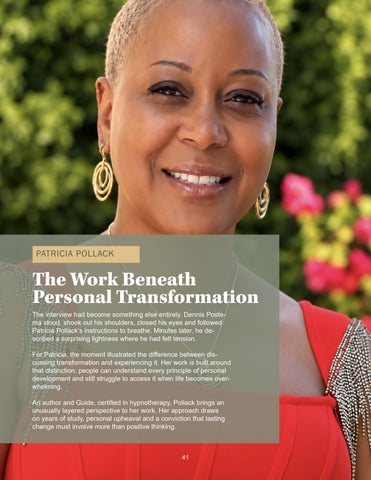
PATRICIA POLLACK
The Work Beneath Personal Transformation The interview had become something else entirely. Dennis Postema stood, shook out his shoulders, closed his eyes and followed Patricia Pollack’s instructions to breathe. Minutes later, he described a surprising lightness where he had felt tension. For Patricia, the moment illustrated the difference between discussing transformation and experiencing it. Her work is built around that distinction: people can understand every principle of personal development and still struggle to access it when life becomes overwhelming. An author and Guide, certified in hypnotherapy, Pollack brings an unusually layered perspective to her work. Her approach draws on years of study, personal upheaval and a conviction that lasting change must involve more than positive thinking.
41
From Achievement To Inquiry Before entering the personal-development world, Patricia worked as a project leader for the National Basketball Association. She had followed the conventional script: education, career, marriage and family. Then, as she puts it, her life “blew up.” The experience unsettled her belief that doing everything correctly guaranteed a stable life. In 2016, she began studying gratitude, later exploring Mary Morrissey’s DreamBuilder work and attending multiple retreats with Dr. Joe Dispenza. Yet acquiring knowledge did not always mean living it. Patricia could recite reasons to feel grateful without experiencing the deeper sense of gratitude she sought. She became increasingly interested in the gap between intellectual understanding and what she calls embodiment. Her subsequent work with Tracy Litt introduced neuro-identity and somatic practices that, in Patricia’s view, helped connect previously separate pieces of her training. Rather than discard earlier methods, she integrated them into an approach centered on individual needs. The resulting practice reflects a hard-earned skepticism toward programs that promise progress through discipline alone, without asking what a person is carrying internally.
A Distinct Client, an Overlooked Burden
Patricia works with individuals and groups, including executives and organizational teams. But one population occupies a particularly important place in her practice: parents caring for children with disabilities, including adult children whose needs continue across decades. She describes families coordinating medical appointments, therapies, medications and long-term financial arrangements while receiving little space to process their own emotional experience. Even respite can demand exhausting preparation. Someone must be trained, trusted and briefed on a child’s routines. A few hours away may not relieve the vigilance a parent has carried for years. Patricia sees a gap between the practical services these families may already have and the emotional support they need to navigate them. Financial advisers, attorneys and guardianship arrangements can address essential logistics, but they do not necessarily address the fear, grief or tension accompanying difficult decisions.
tify where he felt tension. As he responded, she adapted the exercise, later introducing alternate-nostril breathing and a guided visualization of his future family life. There was no fixed script. Patricia explained that she watches for cues and changes techniques when one does not fit. Her premise is that an affirmation or ambitious goal may be difficult to engage with when someone feels emotionally overwhelmed. “You can’t put affirmations on a congested system,” she says. Her approach, The Pause Is the Answer™, follows four movements: PAUSE, REGULATE, DO, REPEAT. Patricia is not selling a single ritual or insisting clients follow a guru. She wants them to develop enough awareness to choose practices for themselves. “I’m not your guru,” she says. “I will teach you how to be your own guru.”
A Practice Built Around Wholeness
Her work does not replace medical care or professional mental-health treatment. Instead, she offers individualized coaching aimed at helping clients notice their internal responses and develop tools for managing them.
Patricia published Manifest The Life You Want – The Donald Trump Way. He Did It, You Can Too! in 2019. Today, through The Pause Is the Answer™, her work emphasizes what she describes as wholeness: the ability to connect aspiration with an internal sense of steadiness.
Patricia’s interview offered a glimpse of her method. She invited Dennis Postema to move, breathe, scan his body and iden-
For caregivers, executives and others carrying sustained pressure, that distinction matters. Patricia Pollack’s question is not simply what someone hopes to achieve. It is whether they can inhabit the life they are working so hard to build.
Demonstration, Not Another Formula
42
KATHIE ROLLINGER
Building Support for Families Living With Addiction An unanswered phone call can change the atmosphere of a house. For families living with addiction, evenings carry dread, hope and the exhausting uncertainty of what comes next. Often, the people holding everything together have nowhere to put their own fear. Kathie Rollinger understands that experience intimately. She has lost one son to addiction, while another continues to struggle with it. For nearly a decade, she has also supported people affected by addiction and overdose through online communities. Now, Kathie is translating that experience into a coaching practice with a particular focus: the emotional needs of individuals and families whose lives have been shaped by addiction. Her business is built around a distinction that matters. Supporting someone through addiction should not require abandoning yourself.
43
From Community Leadership to Coaching
Kathie’s experience began long before she considered building a coaching business. She served as vice president of a Facebook-based addiction-support organization, helping coordinate fundraising, annual events and practical assistance. Sometimes that meant helping someone cover their first week in a recovery home or obtain essential clothing. Just as importantly, it meant participating in a community where people could speak about circumstances they might conceal elsewhere. Although she stepped away from that leadership role, she remained connected to the organization and continued contributing to its activities. Initially, Kathie considered focusing her coaching on empty nesters. But she began reconsidering the value of the relationships and knowledge she had already developed. Her years in addiction-support communities had given her an understanding of both the practical pressures and private emotional costs families face. That experience became the foundation of her emerging business.
A Distinct Place in the Support Landscape
Kathie is not positioning herself as an addiction-treatment provider. Her approach brings personal-development coaching to peo-
ple who need support alongside the treatment, recovery resources or peer communities already available to them. Importantly, her focus includes parents, partners and extended family members, not only the person experiencing addiction. She offers confidential one-on-one coaching as well as group support, with additional group availability planned for November. The two formats answer different needs. Private sessions offer discretion; groups allow people to recognize their experiences in someone else’s story. “What one person is feeling, so is another,” she says. Kathie believes shame and guilt can keep families isolated, even when they are surrounded by people who care. Her coaching aims to help clients examine personal patterns, rebuild confidence and make room for their own wellbeing. That approach draws on approximately twenty years of personal-development experience, including earlier work as a Beachbody coach. In 2024, she participated in Tracy Litt’s Mind Magic program and pursued further training inspired by its emphasis on self-awareness and looking inward for answers. For Kathie, those practices offer a way to move beyond simply enduring another difficult day.
when a family fears judgment or cannot afford extensive private services. Group coaching is one avenue she is exploring to broaden access. She has also discussed possible partnerships with established support organizations and community resources, although those ideas remain preliminary. The ambition is measured rather than grandiose: create opportunities for people to feel heard, learn practical self-development tools and decide what support suits them. Her own responsibilities remain substantial. Alongside developing the business, Kathie is raising her young granddaughter. The balance between caring for others and making space for oneself is not theoretical in her life.
The Strength to Ask
Kathie makes no promise that coaching can remove the uncertainty of addiction. What she offers is informed companionship, discretion and an understanding of how deeply one person’s struggle can affect an entire family.
“Don’t keep everything in,” Making she urges. “Reach out for help, Connection More whether it’s me or somebody else.” In a field often centered Accessible on the individual in crisis,
Kathie’s existing community relationships distinguish her from someone entering the field without a history of involvement. She understands how difficult it can be to ask for help, particularly 44
Kathie is making room for the people standing beside them. Her work begins with a simple recognition: those who give support need somewhere to receive it, too.
ALICE CRIDER
Helping Writers Find Their Voice and Their Readers The manuscript may be finished. The story may be extraordinary. Yet somewhere between writing the final page and finding an audience, a promising author can become stranded. Alice Crider has spent nearly three decades watching that happen from inside Christian publishing. As an editor, she has helped shape other people’s books, often working behind the scenes while their names appeared on the covers. As an author coach, she now addresses a problem that editing alone cannot solve: what happens when a writer’s ambition collides with fear, uncertainty or the commercial realities of publishing? Her answer combines editorial experience, coaching and a conviction that a book’s purpose begins with its reader.
45
Beyond the Manuscript Alice has coached since 2008 and earned a coaching certification in 2016. More recently, she began adding neuro-identity work to an approach she describes through the connection between spirit, mind and body. The distinction matters to her clients. A writer may know how to construct a chapter but remain overwhelmed by the prospect of submitting a proposal, appearing publicly or marketing a book. Alice’s coaching examines the thoughts and patterns that keep that writer from moving forward. She calls one of her workshops The Missing Link: the distance between the writer someone is today and the author they feel called to become. Her audience includes aspiring and published authors, particularly women who repeatedly put other people’s needs before their own work. Crider recognizes that pattern personally. Years of self-development, she says, helped her understand how easily an important ambition can be postponed indefinitely.
The Reader Comes First
Publishing expertise gives Alice’s coaching a practical edge. She understands that writing a compelling manuscript does not automatically create a viable publishing opportunity. Traditional publishers often want evidence that an author can reach readers. For writers who feel called to tell a story but have little public visibility, that require-
ment can be disheartening. Alice’s advice is specific: identify the reader before trying to build a platform. “Find out what is it that they really want,” she says, rather than assuming what they need. She encourages authors to meet the people they hope to serve, learn where those readers gather and build relationships that extend beyond a social-media following. Speaking engagements, podcast conversations and personal recommendations may create more meaningful connections than forcing an online persona that feels unnatural. That is also why she resists treating social media metrics as the only measure of an author’s reach, credibility or long-term potential. Her approach is especially relevant to memoir, one of her editorial specialties. Personal stories, she believes, become powerful when they reach someone who recognizes something of their own life in the pages.
Stepping Onto the Cover Crider is now experiencing the publishing equation from the author’s side. Her forthcoming book, Running on Empty Isn’t Your Calling, is a spirit-mind-body reset for mothers raising children at home. It draws on the same concern that runs through her coaching: women becoming so responsible for everyone else that they lose sight of themselves. The book also illustrates a strategy she 46
recommends to authors without established platforms: collaboration. When a publisher liked Crider’s proposal but questioned her audience reach, she approached Tricia Goyer, an experienced author with an established readership. The two agreed to co-author the book, bringing complementary strengths to the project. Crider calls the arrangement “borrowed influence.” For an editor accustomed to appearing in acknowledgments, it also means seeing her own name on a book cover. Meanwhile, her podcast, Your Right Life Coach, launched in June 2026 and had already reached approximately 25 episodes at the time of her interview. Through conversations with authors, it expands her visibility while reinforcing her coaching practice. Her Ask an Editor Facebook group offers another point of connection for writers navigating publishing questions. Crider is building a brand around something more durable than promises of bestseller status. She wants writers to understand whom they serve, overcome what holds them back and value the work even when its audience is modest. A book may reach millions. It may reach fifteen people. For Crider, the essential question is whether it reaches the right ones.
47
48
YOUR STORY DESERVES TO BE HEARD. SHARE YOUR JOURNEY, YOUR EXPERTISE, AND THE IMPACT YOU’RE MAKING. EXPLORE INTERVIEW AND COLLABORATION OPPORTUNITIES WITH RAINMAKERS TV.
LET’S START A CONVERSATION