Bringing YOU the BEST of biking for FREE


























































































HIT THE TRACK


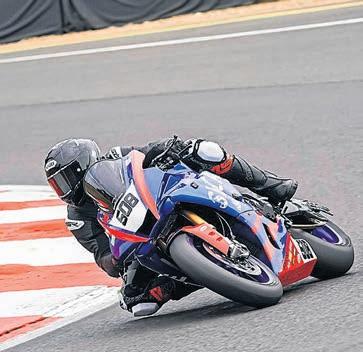
The need-to-know about club racing



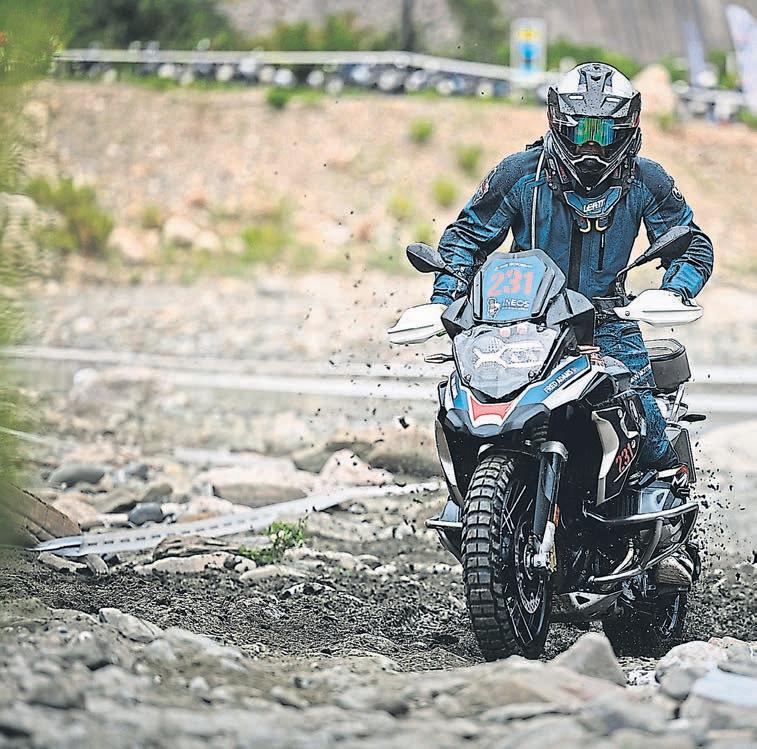
Over 12 days and 1300km, BMW’s GS proves itself yet again
RIDE BETTER


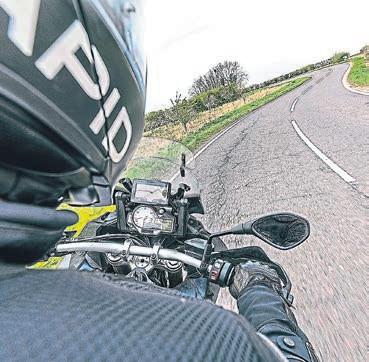
The art of reading the road



THE INSIDE LINE ON THE LATEST BIKES





















WE RIDE THE HONDA TRANSALP XL750 AND TRIUMPH STREET TRIPLE 765













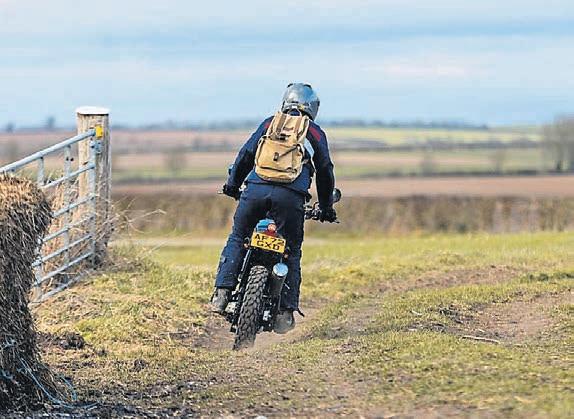
I’ve been out doing a bit of green laning this month.
Nothing nuts, but I’ve had a few retro scramblers in from AJS and Herald (and Kymco's DTX 360 320 adventure scooter, too), so I've taken the chance to explore some local BOATs and get a bit muddy.
I absolutely love trail riding. It’s not something I get to do very often any more – with so many road bikes to test and not enough hours in the day – but it’s how I learnt to ride, starting with a Puch
the Editor

50 scrambler when I was a nipper, through to my L-plate clad Yamaha XT125 when I was starting out on the road. It always takes me a bit of time to find my groove again, but after a full day bombing about in the sticks I’m in the zone with the bike squirrelling around beneath me and my eyes focused on the horizon.
What about you? Would you like to see more dirt-based shenanigans on these pages? Next month we’ll be bringing you


rmowbray@mortons.co.uk
a test of the two AJS scramblers, and a bit of a guide about riding ‘off-road’, with some tips on body position, keys skills and some suggestions on how to find legal trails (which can be super-easy or extremely difficult depending on where exactly you live).
But for now, there’s an eclectic mix of biking goodness to devour in this month’s issue. I hope you enjoy it.
Editor MB recommends bikesafe.co.uk MoreBikes, Media Centre, Morton Way, Horncastle, Lincolnshire LN9 6JR Tel: 01507 529529 Editor Ross Mowbray Editorial design Fran Lovely Publishing Director Dan Savage Email editorial@morebikes.co.uk Production Editor Mike Cowton Group Advertising Manager Sue Keily Advertising Simon Meyer 01507 529310 Advertising deadline for June issue April 6, 2023 Sales and Distribution Manager Carl Smith Marketing Manager Charlotte Park Commercial Director Nigel Hole Customer services number 01507 529529 Telephone lines are open Monday-Friday 8.30am-5pm Call 01507 529529 or visit classicmagazines.co.uk/MB10 or email subscriptions@mortons.co.uk MoreBikes is published monthly by Mortons Media Group Ltd and printed by Mortons Print. Subscribe to MB and just pay the postage! INSIDE THIS MONTH WIN BIG WITH MOREBIKES Two chances to bag quality biking kit, including an AGV helmet signed by Giacomo Agostini RUROC AND ROLL The need-to-know about one of the coolest helmet firms around Dreaming of retro races bikes but don’t know whether to build or buy? Bruce Wilson from Fast Bikes has got your back. WANT TO LEARN TO RIDE? Here’s exactly what it takes to do your CBT 38 36 47 27 8 14 & MAY 2023 TWO ICONS, ONE CHOICE OLD BIKE ENTHUSIAST? How to own an icon without breaking the bank MoreBikesEvenMoreBikesOfficialMoreBikes NEWS 3
A nod from
LIMITED EDITION
What you need to know about KTM’s 1290 Super Duke RR.

Following the success of the tricked-out 1290 Super Duke RR in 2021, the Austrian firm has created a new version for 2023.
Coming with a gloss black and matt carbon base, contrasting white graphics and orange accents, there’s no doubt the new machine casts a darker shadow than its 2021 counterpart. But there’s plenty more to get excited about than its paint job.
Offering 1,301cc, 180hp, 180kg and 140Nm, with a 1:1 power-to-weight ratio (thanks to being 11kg lighter than the standard 1290 Super Duke R), the new RR is likely to be an absolute monster no matter whether you’re mixing it up on track or blasting up an alpine pass.
There’s a fully adjustable WP APEX PRO 7548 closed cartridge fork which has been tailored specifically for the RR upfront, while a custom-made WP APEX PRO 7746 shock looks after things at the rear. And there’s also a WP APEX PRO 7117 steering damper which offers 30 clicks to dial it into your specification.
There’s a shedload of carbon fibre, including the subframe also receiving a lightweight carbon treatment. The LED tail lights are incorporated into the LED turn signals, and it’s also got KTM’s adaptive brake light as standard. Elsewhere, there’s a track-orientated electronics pack included, which adds advanced Track and Performance modes to the standard machine’s already extensive suite of technology. And if that’s not enough, there’s a whole host of goodies that you can add on – including an Akrapovič EVO line full exhaust system.

It’s only available in Europe and the United Kingdom, but if you want to get your hands on one you had better get a move on because the order book opened on March 13.
If you want to find out more, have a word with your local KTM dealer.
BAG A BAGGER?
Indian Motorcycle’s ultra-limited edition Challenger RR

The American firm has revealed that it’s building a super-exclusive version of its Indian Challenger RR, to celebrate winning the 2022 King of the Baggers championship.


That’s right. A limited run of 29 race-replica Challenger RRs have been built by the same S&S hands that wrenched Tyler O’Hara’s #29 championship-winning bike.
It’s a seriously cool bit of kit, which mirrors O’Hara’s machine with a fixed fairing and Aero windshield; Maxx fully adjustable ECM; AIM DL2 data logger dash; and adjustable S&S fairing mount being just the tip of the iceberg.
Winning bike
It also gets 17-inch race rims combined with Dunlop race tyres; a Hayes rear caliper; Brembo M4 front calipers and Ohlins FGR250 front forks; a TTX Ohlins rear shock; an S&S chain drive conversion; an S&S automatic chain tensioner; and an S&S billet clutch cover. There’s also a raised seat, S&S rear sets, adjustable handlebars and a quickshifter kit – exactly the same as the championship-winning bike.
And, of course, there’s that beefy Powerplus engine that’s been made
even more capable with custom S&S camshafts; a 112 CID big bore cylinder/piston kit; CNC ported cylinder heads; an S&S air intake with a 78MM throttle body; billet adjustable rocker arms; and a throaty S&S 2-1 race exhaust thrown in for good measure.
Sadly the bike’s not road legal – but if you’ve got the money to throw around to buy one of these babies, then you’ll probably have no trouble getting a bit of track time for a blast. Speaking of which, there’s actually been no official word on pricing or availability, with Indian recommending you get in touch with your local dealer to express interest.
4 NEWS
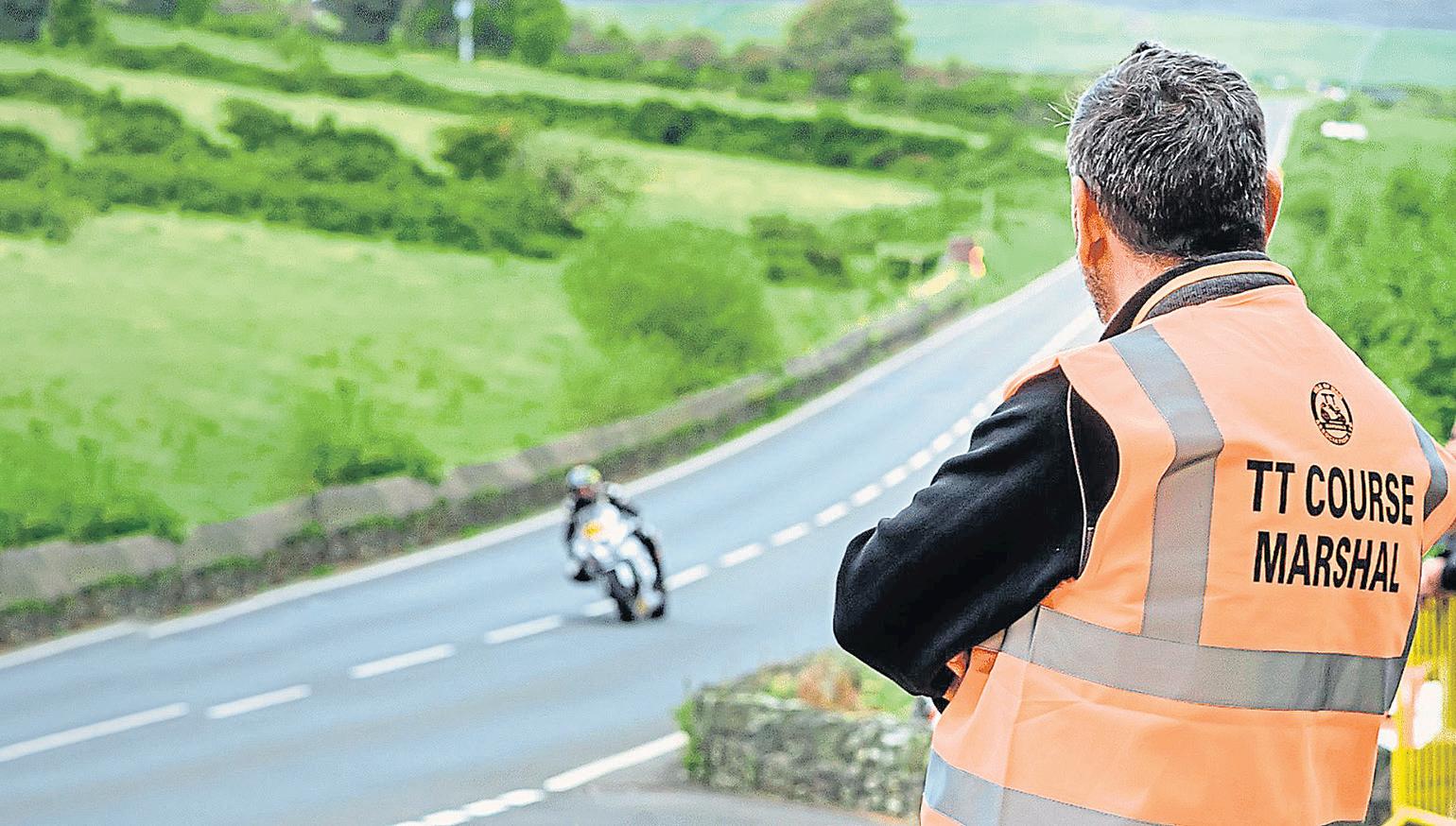
GET INVOLVED AT THE TT: SIGN ON AS A MARSHAL









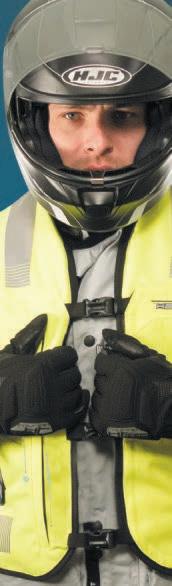
It’s not difficult to get involved in one of the biggest, best and most iconic racing events on the planet.

Ever thought about marshalling at the TT? Well, now’s your chance – because the TTMA has just announced it’s on the hunt for new people to get involved and help make the racing happen on the little island in the middle of the Irish Sea.

Speaking about the announcement, Jane Corlett, director of the TT Marshals Association, said: “Whether it’s your first time visiting the TT, or you’ve been following the racing for decades, you’ll be made to feel very welcome. And, if you’ve never marshalled anywhere before? You can rest assured you’ll be looked after by the Chief Sector Marshal and teamed up with an experienced marshal to learn the ropes. There are opportunities around the course to suit all interests, backgrounds and levels of experience. You also don’t need to do every qualifying and race session, but every one you can do really does help. You’ll gain a new set of skills for free as well as join a community that often turn into lifelong friends.”

Still interested? The first step is to sign on



















for sessions via the TTMA website. Once registered, there are two online training modules to complete for first-timers. The modules are quick and easy to complete and can now be accessed on a mobile device. Of course, those that have already marshalled at the 2022 Isle of Man TT Races or the 2022 Manx Grand Prix do not need to complete the training again and can simply sign on for the days they are available.









In addition to the two online training modules, the TTMA also offers an Incident Management Course (IMC) for marshals that have undergone a minimum of three sessions on the TT course. The day-long course is purpose-built to provide TT marshals with the chance to gain more in-depth knowledge on the use of equipment as well as the handling procedures for breakdowns and incidents.



If you want to know more, or get started on your journey to becoming a marshal at the 2023 TT, then visit www.iomttmarshals. com

NEWS 5
Honda boffins make airbag advances
Honda's long since been at the forefront of innovative technology in the world of motorcycling – particularly when it comes to safety. It led the way in 2006, integrating an airbag into its Gold Wing motorcycle. And now it looks as though it’s taking things a further step, with patents filed for a new generation of cutting-edge airbags for motorcycles.
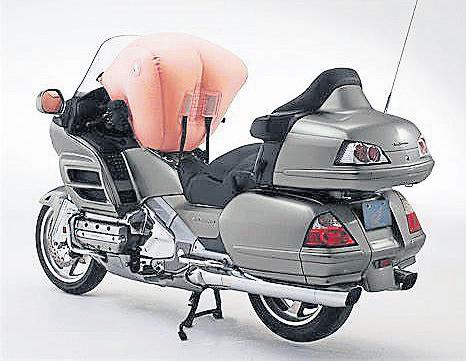
The current system can protect riders against frontal impact but not side impacts, which Honda’s latest prototype aims to tackle. It would deploy around the rider – which would mean that there would be no need for other protective airbag devices (in theory...).
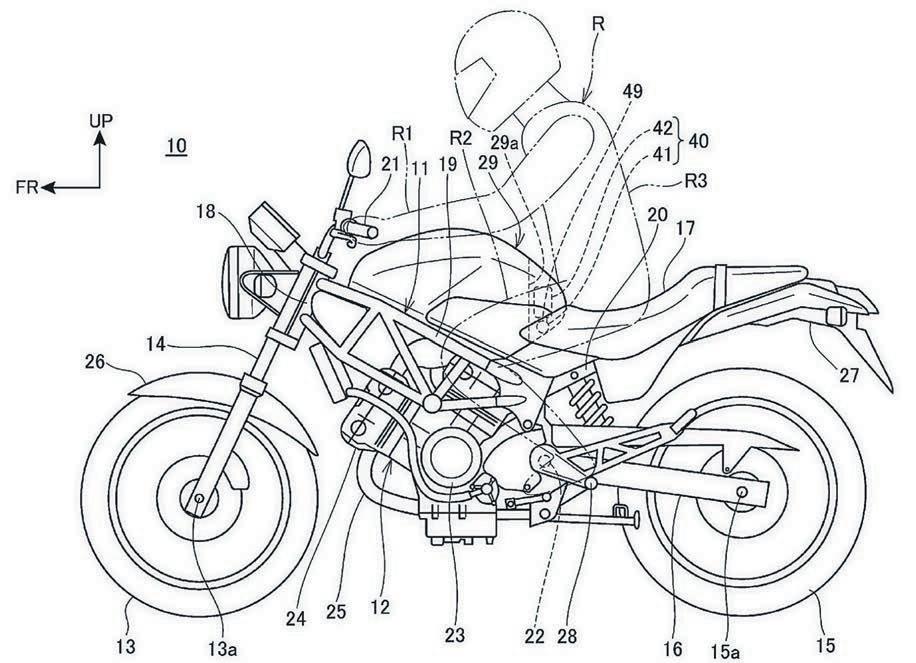
There’re a couple of designs doing the rounds, one which places the airbag in the front console, and another featuring an airbag which deploys from the back of the bike seat. Both ideas see the airbag winding around the rider, offering a higher level of protection than ever before. Nothing’s certain yet, but the plans make for interesting viewing.
The first electric BMW motorcycle is coming
The German firm has filed patents for its first electric motorcycle
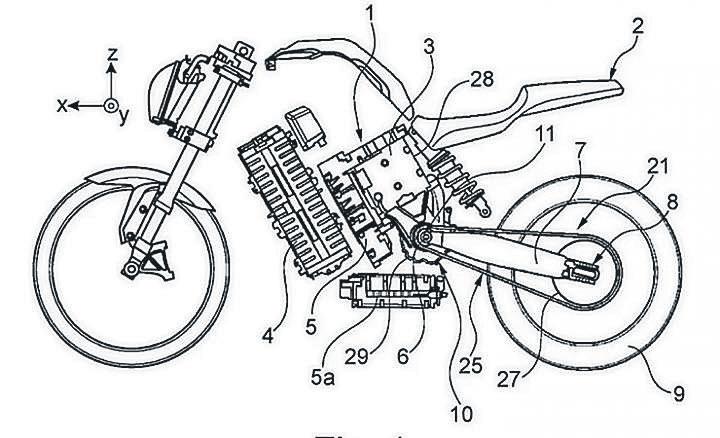
Despite almost a decade of experience in electric twowheelers, there’s never actually been a production electric motorcycle designed by BMW. However, a recently filed patent reveals that things could be about to change very soon.
Of course, it makes sense to make use of existing parts, and with a solid base of a G310R chassis and the electric technology from its CE 04 scooter, BMW could be on to a winner.
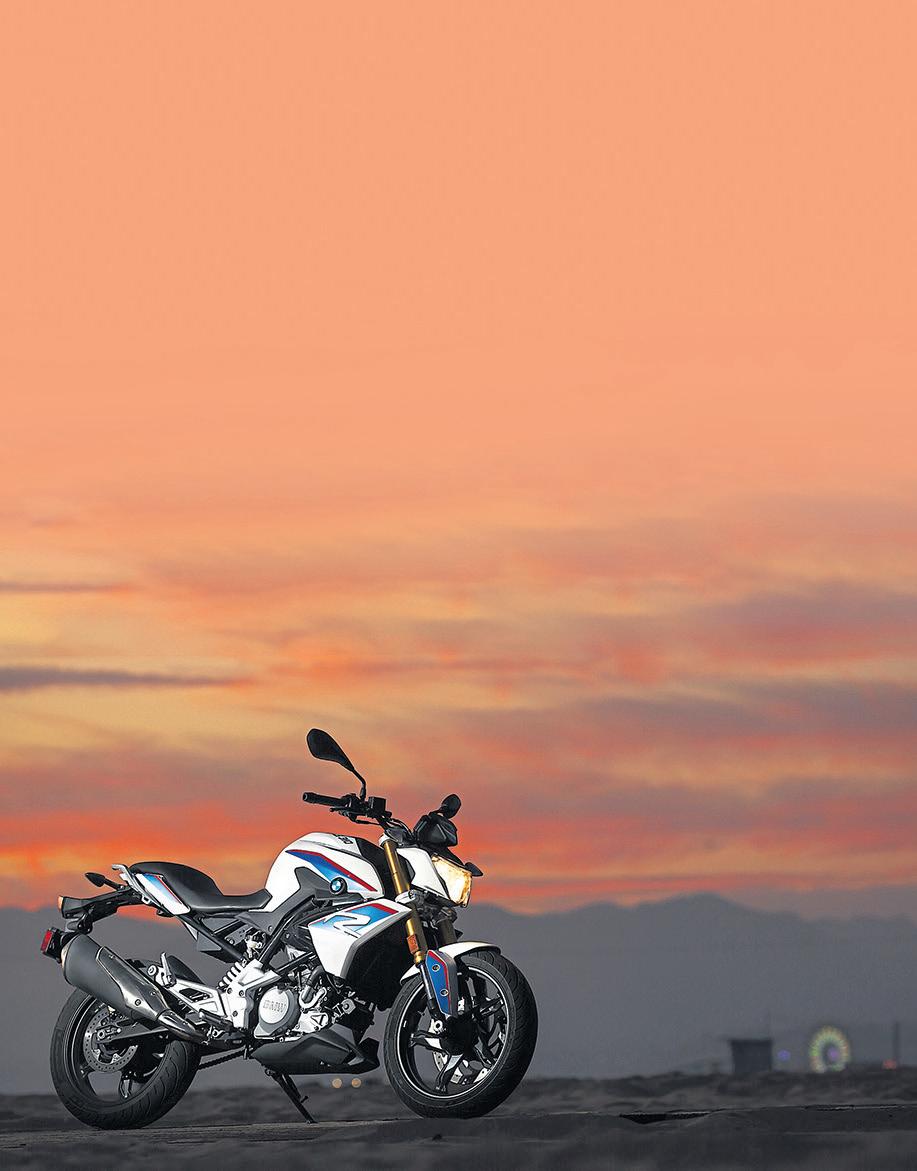
how the battery pack and motor from the CE 04 fit into the G310R frame, particularly when you consider its more compact dimensions. However, it looks as though BMW has made some clever tweaks to accommodate the components, with the motor 6 NEWS
IMPROVE YOUR SKILLS
Take part in a motorcycle safety workshop run by the Police
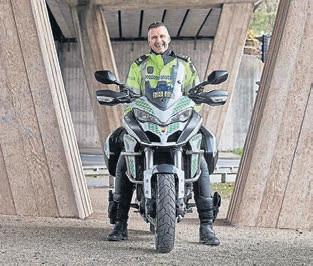
Staffordshire Police volunteers are providing complimentary motorcycle safety sessions.
Sergeant Rob Gilligan from the Central Motorway Policing Group (CMPG) is leading workshops this year for Biker Down, a project created in memory of PC Luke Van De Sande, who lost his life in an off-duty motorcycle crash back in 2019.
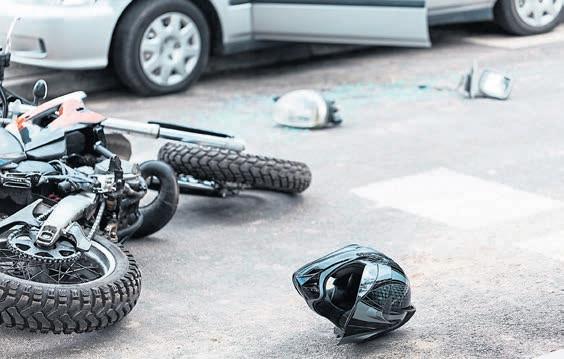
This year’s Two Wheels Workshops will be initiated as a part of CMPG’s operation in compliance with the National Roads Partnership campaigns schedule.
being rotated 90º and the battery pack being placed vertically at an angle under the front section of the bike. At this stage details are a bit hazy, so we’ll have to sit tight to get the full lowdown on the bike. Either way, it’s great to see BMW making a start.
He’s joined by several currently serving and former emergency services personnel. The team of presenters boasts significant specialist experience and expertise in the fields of operational motorcycling, advanced first aid and collision investigation.
Workshops are open to motorcyclists of all ages and experience levels, and there is no cost to attend. This course encompasses three sections: scene safety, casualty care and rider skills. Every participant receives a first aid kit constructed to be attached to a motorbike, together with a Biker Down pin badge.
Saturday, April 22 will mark the launch of the workshop at the Staffordshire Honda dealership in Newcastle-underLyme. Representatives from advanced rider training groups will be present to offer advice and provide information for participants.
A select few tickets are up for grabs for the event taking place at Staffordshire Police Headquarters on Saturday, May 27, and the subsequent dates to follow on Saturday, June 10.
If you wish to sign up or gain further information, simply email BikerDown@staffssaferroads. co.uk or for more information on Biker Down, visit docbike.org/ bikerdown/
Okay, so while it’s slightly disappointing that the Bavarian firm doesn’t appear to have its sights set on the highperformance models from the likes of Zero, Energica and Harley-Davidson, it’s a positive step forward from one of the biggest names in the game. It will be interesting to see
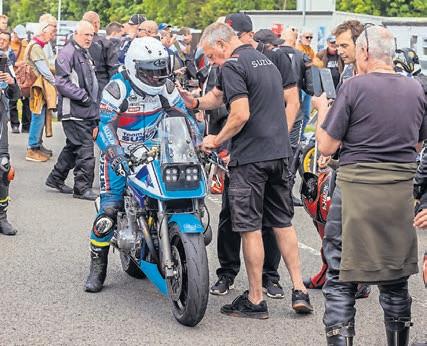
SUZUKI LIVE RETURNS FOR 2023






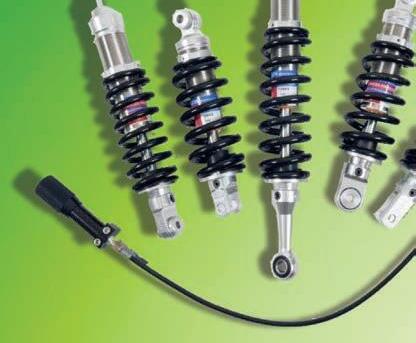













That’s right. Suzuki’s top drawer track event is back at Cadwell Park on July 15-16.
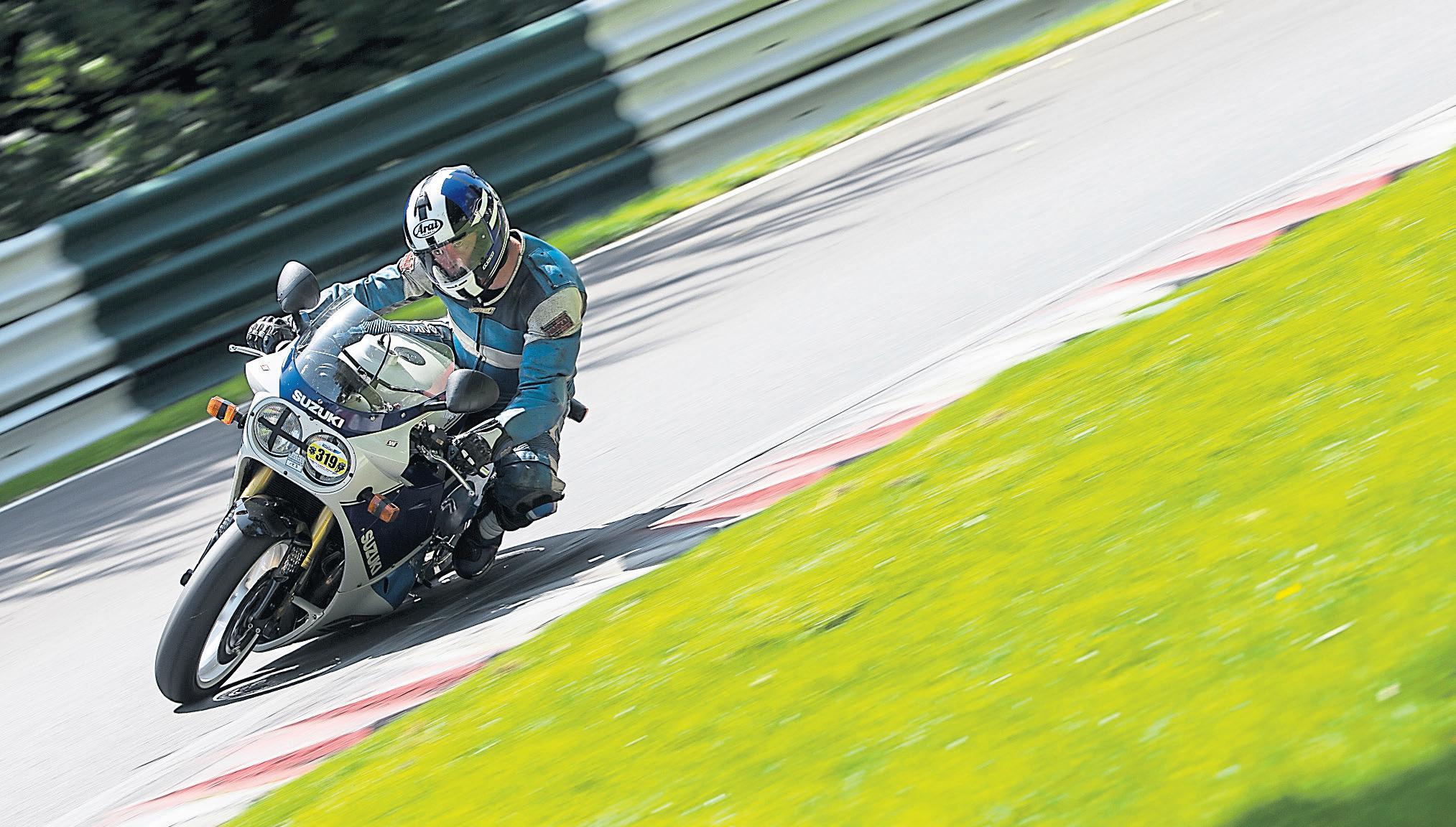

With track sessions for classic and modern Suzukis (for novice, intermediate and experienced riders), as well as classic race bike parades (with both pre-2000 and post-2000 models welcome), if you’re into the Japanese marque, you’re going to be in your element.

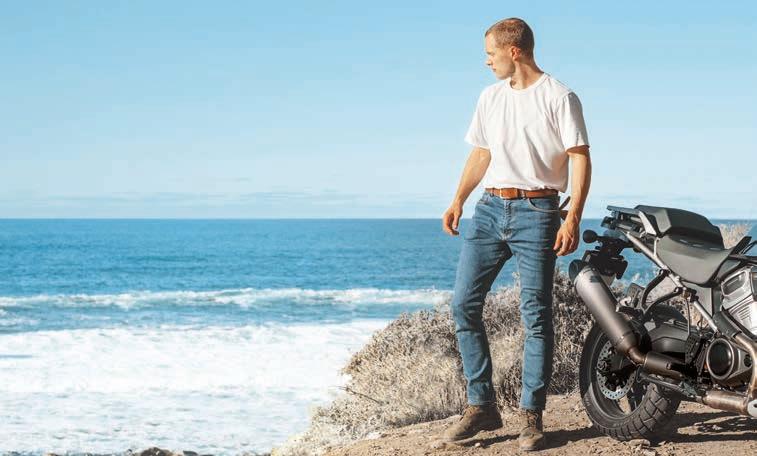
V-Strom owners will also have the opportunity to explore off-road terrain with a new adventure bike zone. Over the weekend, they can receive free expert tuition, participate in a skills area, and go on a test ride loop traversing through woods and beyond. Additionally, it is an ideal chance to try out the V-Strom 1050DE and all-new V-Strom 800DE.
Visitors to Cadwell Park will be able to test the Suzuki on-road range, such as the GSX-8S, GSX-S1000GT, GSX-S1000 and the acclaimed Hayabusa.


There will be some famous faces on hand, too, in the form of three-time British Superbike winner John Reynolds, National Superstock 1000 champion Taylor Mackenzie, and the 500 Grand Prix racer and British champion Steve Parrish. Track day sessions for the full weekend are available for £229, with race bike parade spots costing £199. Both include camping and evening entertainment on the Saturday night, featuring trophy presentations and lively stories from the star guests, and a live band.

Sounds like a good weekend to us. If you’re keen, find out all the information and book your tickets at www.classicbiketrackdays.com







NEWS 7
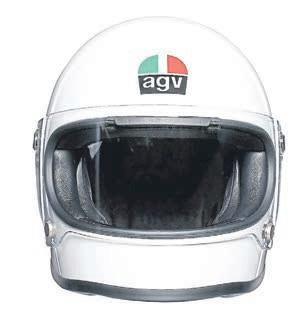
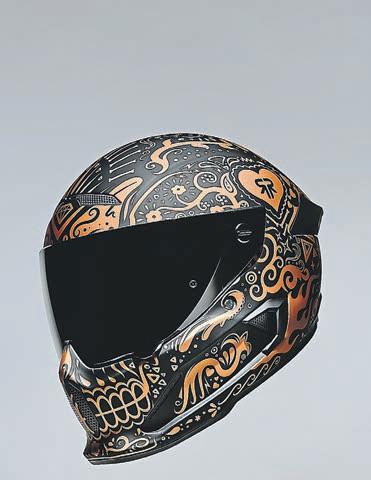
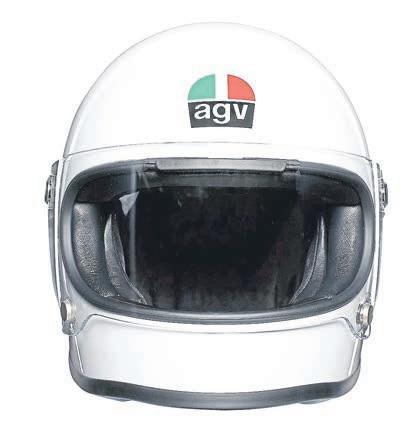
WIN A RETRO-STYLED AGV HELMET SIGNED BY GIACOMO AGOSTINI
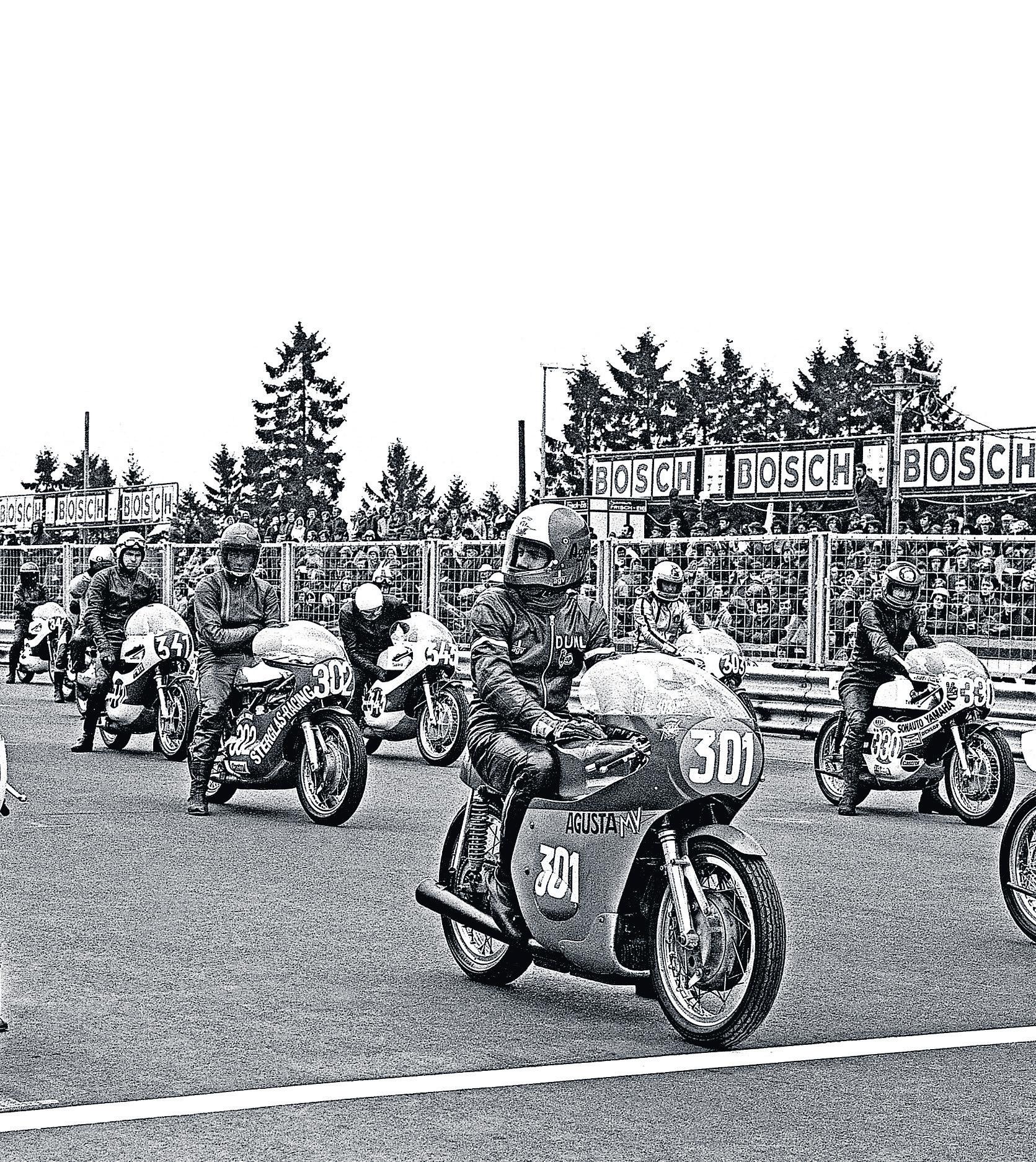
That’s right. The iconic Italian racer is going to be the star guest at the upcoming International Classic MotorCycle Show, and we’ve teamed up with them and AGV to give away a seriously special prize.
HOW TO ENTER
THE PRIZE
Bagyourself a seriouslycool AGV X3000signedbynone other thanAgohimself. The lid’s worth over £300 – but withthesignature of one of the most successful racers ever,it’sprettymuchpriceless.
ONLINE
Head over to www.morebikes.co.uk and look out for the WIN tab along the top. Tap on there and you’ll be well on your way.
AT THE SHOW
Free on April 22-23? Get yourself along to the mega classic bike show and come and find the MoreBikes stand in the centre of the main hall.
THE SHOW
If old bikes are your bag then there’s no better place to be this April than the International Classic MotorCycle Show at Staffordshire County Showground. It’s one of the biggest events of its kind in the world, attracting over 30,000 people through the gates over the course of a weekend. With tons of bikes on display, trade stands, jumble plots, an auction, live action, music and Agostini on stage telling stories about his rich racing life, you’d be mad to be anywhere else. And we’ll be there, too, dishing out newspapers and magazines slap, bang in the centre of the main hall. If you’re there, be sure to come and say hello. Want to know more or grab a ticket, visit: www.staffordbikeshows.com
Competition closes 30.04.23. There are no cash alternatives available. The winner will be the first name drawn at random. Winners will be contacted via an official Mortons email. We never ask for bank details. Terms and conditions apply. To view the privacy policy of MMG Ltd (publisher of MoreBikes) please visit www.mortons.co.uk/privacy 8 COMPETITION














✪ PRODUCTS ✪ PRODUCTS ✪ PRODUCTS ✪
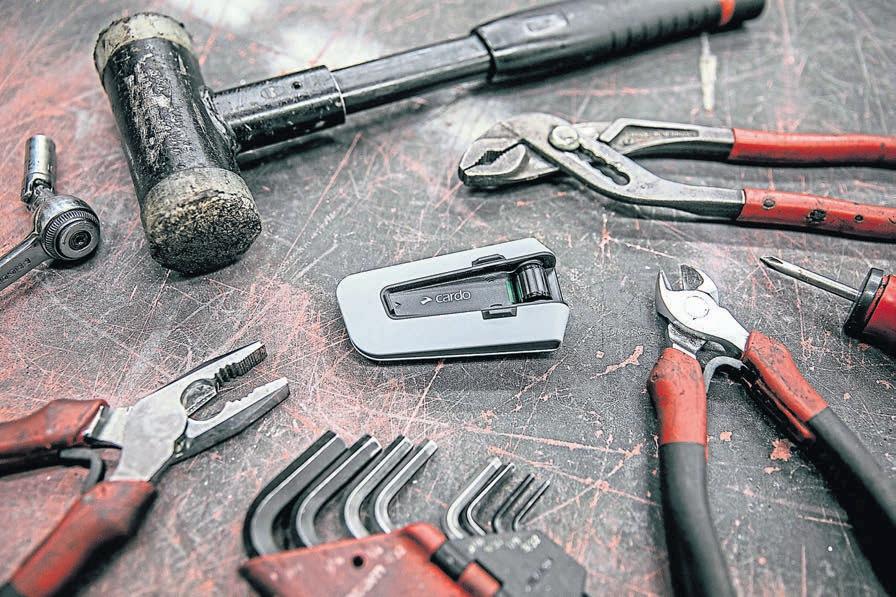
Cardo Packtalk Custom
£254 | www.cardosystems.com
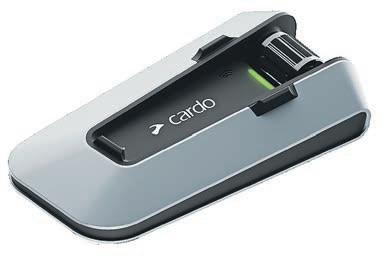
While motorcycle communication systems aren’t anything new, recent innovations have made them far more practical. Mesh systems, such as that used by the Cardo Packtalk, is a good example of improved efficiency, and the next generation of Cardo communicators includes an ability to customise the unit’s abilities with a subscription programme.
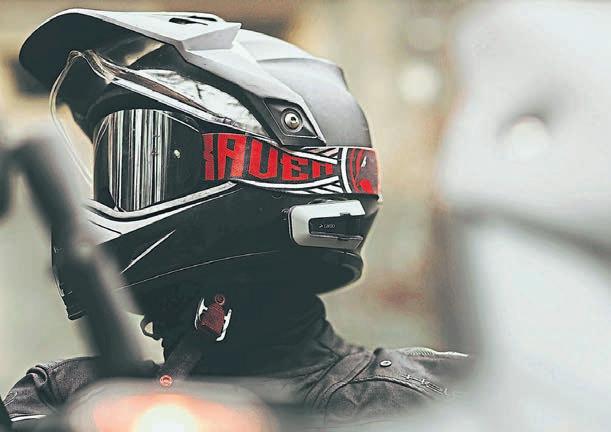
With three levels – Silver, Gold and Platinum – the Packtalk Custom, as based on the Packtalk Edge unit, has the basics of a fully waterproof design that uses Cardo’s second generation Dynamic Mesh Communication that allows connection to up to 15 riders with up to a one-mile rider-torider range, with Bluetooth and over-the-air updates (i.e. no need to plug it into your laptop for software upgrades).
Additionally, the pay-per-feature packages available include music sharing; audio profiles; universal Bluetooth intercom (so you can connect with other Bluetooth users); voice commands; and more. The unit comes with 40mm high-definition speakers and can deliver an impressive 13-hour talk time; 20 minutes of charging will provide for 20 minutes of talk time. There’s a two-year warranty, too.
Briefly, the Silver package (starting at €2.99 per month or €19.99 per year) offers music sharing, audio profiles and speed dial; Gold (starting at €4.99
monthly / €29.99 yearly) has those plus universal Bluetooth Intercom and a second channel connection; while the top-notch Platinum (starting at €6.99 monthly / €39.99 yearly) has all that plus voice commands and an eco mode. The Cardo Connect app can be used to upgrade (or scale down) the package at any time, so you can change your unit’s capabilities to suit your current use.
RST S-1 Mesh Gloves
£84.99 / www.rst-moto.co.uk
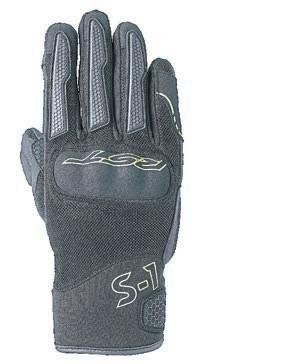
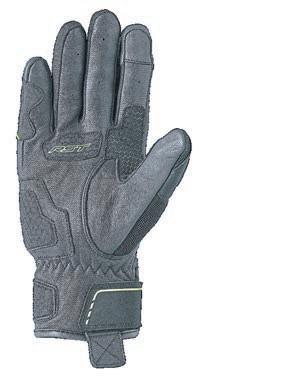
Okay, it’s maybe a wee bit early for full summer mesh gloves as we write this. But before you know it, it’ll be all 40 degrees again – so best get ready. These RST S1 Mesh gloves are designed for maximum cooling airflow, while adding all the protection you’ll need. There’s Alcantara and TPU hard knuckle protection, plus a double layer leather palm and Velcro double wrist fastening. Available in a range of colours, including this neat black/green, and also includes a touchscreen insert on the forefinger.
Arai RX-7V EVO Maverick Star £799.99 / www.whyarai.co.uk
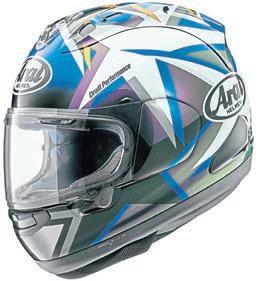
A sweet new Drudi design scheme for the top-end Arai race lid, the Maverick Star is a little more subtle than some paint jobs out there. It’s based on the latest ECE 22.06 homologated RX-7V Evo shell, with the usual high-end Arai protection levels, plus extensive air venting. The top diffuser has intake and exhaust vents, and there’s also closable eyebrow and chin venting.
The inner is fully removable and washable, and your dealer can supply different thickness inner pads for the perfect fit. Double-D ring, emergency release cheek pads, inner speaker pockets around the ears and quick-release visor all round out the spec list nicely. Not cheap – Arai never has been – but a fair price these days for a premium handmade-in-Japan lid, we reckon.
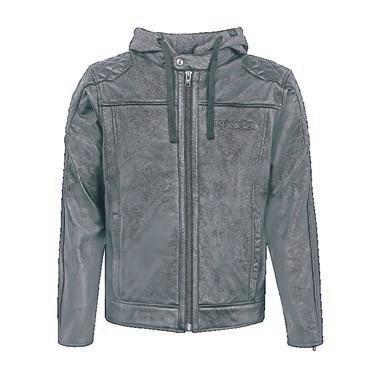
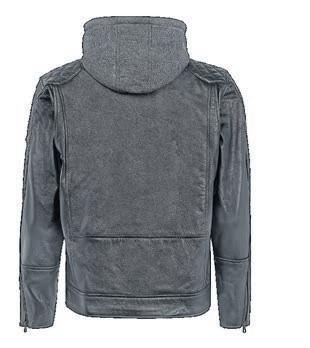
Spada Lambert Jacket
£269.99 / www.spadaclothing.com
We like the look of this Spada jacket a lot. It’s got a neat retro-roadster style, with or without the removable fleece hood. The black leather outer is nononsense old skool cool, and the metallic finish studs and zippers, plus diamondquilted shoulders, finish it off nicely. The final spec hasn’t been released as yet, but expect the usual CE armour in elbows and shoulders, plus pocket for back protector, and thermal liner. Decent price in these inflationary times, too.
Vanucci VXP-1 Armoured Jacket
£176.24 / www.louis-moto.co.uk
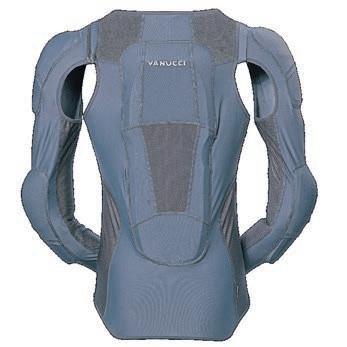
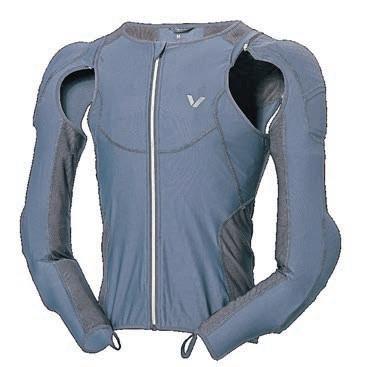
Remember last summer? How you wanted to go riding in your pants because it was so hot? Well, it’ll be boiling again soon, and here’s a solid option to keep you (a bit) safer on the bike while staying cool. It’s a multi-use mesh jacket with CE level two armour in shoulders and elbows, plus a full back protector and optional chest protector pockets. Wear it under your jacket in cooler weather or on its own round town when it gets really hot.
Dog tags
£6.99 / www.lfmemories.com
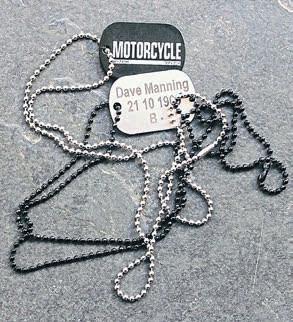
An identity necklace – colloquially referred to as a ‘dog tag’ – is a compulsory part of road racing when you’re competing within ACU-sanctioned events, which basically means all kinds of roadracing in England and Wales. For the ACU, the ‘dog tag’ needs to show just the rider’s name and date of birth, but many choose to add blood type as well. The producer, Living Forever Memories, is also the main supplier to No Limits Racing, the British Army Motorsport, plus individual race teams.
10 PRODUCTS
Q&A
Our specialist motoring solicitor Andrew Prendergast guides readers through their legal trials and troubles
QI am not exactly James Bond but what I can say is I work for the Government. I cannot say much else, other than what I do is classified and I had to sign the Official Secrets Act 1989. About two-and-a-half years ago I got knocked off my motorbike and bust my femur and foot badly. To stress, this had nothing to do with work. I was riding for leisure and pleasure one weekend when a man in a van pulled out of a side road and T-boned me. I needed three operations, 18 months in an external fixator and then a bucketload of physiotherapy. Whilst it was rubbish, that part of the case was straightforward as the van driver had admitted liability and helped with treatment. The problematic part is my job. Pre-accident, I could work away and get overtime, etc. However, when I eventually got back to work after two-and-ahalf years, I could not do my old job (which I loved) due to my leg and I am now stuck being a desk jockey (which I hate). The problem I have is my solicitor has told me I need to give them and the van driver’s insurer all my employment and occupational health records to prove I can’t do my old job and have lost money. However, to be blunt, I can’t as it is classified. Answers on a postcard as my solicitor seems a bit clueless.
AThis can be super-tricky to deal with.
On the one hand, you need to prove on
the balance of probabilities you have or will suffer a loss because the van driver T-boned you. To prove your case, you need to rely upon evidence. However, the Official Secrets Act 1989 states amongst other things that ‘A person who is or has been… a member of the security and intelligence services… is guilty of an offence if without lawful authority he discloses any information, document or other article relating to security or intelligence which is or has been in his possession by virtue of his position as a member of any of those services or in the course of his work while the notification is or was in force’. Therefore, it potentially makes it difficult for you to disclose evidence from work. However, it is not impossible. You should instruct your solicitor to contact your employer, advising exactly what you need and why. Your employer will have a specialist legal department and they should be asked to redact any information that could affect national security or identifies a third party, etc. If they do that, you should end up with the documents you need to disclose and not be in breach of the Official Secrets Act 1989. Thereafter, I strongly advise your solicitor to get suitable safeguards from the Defendants before any disclosure is provided to them. In short, you do not want these documents
sent off to an insurer and then it accessed by the whole insurance company and their dog. The disclosure needs to be secured and treated with the upmost care. Lastly, it does not appear you have issued Court proceedings yet. If you do, your solicitors need to consider whether you need 1) Anonymity Orders 2) Private hearings 3) Reporting restrictions. This is to stop your name ending up in the public domain and you/your employer being exposed to risks, etc.
QI run my own company (a limited company) and feel very annoyed with the situation I am now facing. A week ago I sold a little 2022 Mutt 125cc motorbike with 237 miles on the clock. I took it in as a part exchange (the son did not like it so the dad chopped it in for himself and bought a Ducati). So. all in all, it was virtually a brand-new bike. The buyer of the Mutt 125cc probably weighs 14 stone or so and when he rode off on the bike it did concern me due to how big he was and how small the bike was. He told me he was going to use it to commute to college. Yesterday I received an email from the buyer. Apparently, some of the spokes have broken and therefore he is claiming it is ‘not fit for purpose or satisfactory quality’ and wants his money back. Before I go and give a full refund, I am 100% convinced this has happened due to
The MB legal column is compiled by managing partner Andrew ‘Chef’ Prendergast and his bike-riding barristers and solicitors at White Dalton Motorcycle Solicitors.
The firm deals with personal injury claims and its sister company, Motor Defence Solicitors, deals with all the motoring offences. White Dalton lawyers have a vast knowledge of bike law, and they have full bike licences, too. They don’t act for insurance companies or the prosecution.
White Dalton is Britain’s premier specialist motorcycle law practice, and if its professionals don’t know the answer

his weight or because he has gone up a curb or down a pothole (the roads are in a right state). So my question is, do I have a leg to stand on or is it just a bitter pill I have to swallow under current consumer rights? I feel he has blatantly abused the bike and doesn't want it repaired just to get rid and exercise his rights.
AIf you have sold the bike as a ‘dealer’ then the buyer does have legal protection. Broadly speaking, under the Consumer Rights Act, the buyer has a legal right to reject goods that are of ‘unsatisfactory quality’; or ‘unfit for purpose’; or ‘not as described’, and get a full refund as long as they do this within 30 days from the date they took ownership of the goods (the bike in this case). As you sold the bike a week ago then he is within that time so you may well be stuck with it. However, before giving any refund I would want to see the bike to double-check, i.e. if the rim is bent from bashing up a curb or down a pothole, then you may be able to refuse to give a refund. However, if it is just faulty then you may not be able to refuse. As an aside, if it is faulty rather than having been abused, you could offer to fix the broken spokes to see if that will solve the issue. Lastly, I suspect being 14 stone is well within the weight limit allowed and I doubt this caused the spokes to break, so probably best not to speculate.

to your question, there probably isn’t one. Don’t rely on the advice from your insurance-appointed solicitor, get proper independent advice.
For road traffic offences, call the Motor Defence solicitors on 0800 280 0912. For non-offence cases, call White Dalton motorcycle solicitors on 0800 783 6191.

If you need advice on a biking-related legal question or query, email mail@whitedalton. co.uk. The best Q&A will be published in MB, in confidence, of course.
S O L I C T O R S www.whitedalton.co.uk
WHITE DALTON 11
BIKING BUCKET LIST?





There are so many incredible things to do on bikes, beyond going for a bit of a blast on your local roads. If you’ve always dreamed of attending a trackday or giving trials a go, there’re loads of cool companies that can make it happen. Here’s a brief guide to some of our favourites.



MICK EXTANCE EXPERIENCE






































































Last year we trekked into deepest, darkest Wales and paid a visit to the Mick Extance Experience for some enduro-based shenanigans. If you’ve ever thought about giving off-road a go, but you want some guidance and advice from one of the most qualified off-road instructors in the game, you should definitely book yourself a day. We guarantee you won’t be disappointed. We’ll be back at the first opportunity. Oh – and if you’re into your adventure bikes rather than your enduro bikes, Mick’s just joined forces with Harley-Davidson to take on a fleet of its Pan Americas and open a dedicated Adventure Centre. We’re already trying to work out when we can get down there again and have a go for ourselves.
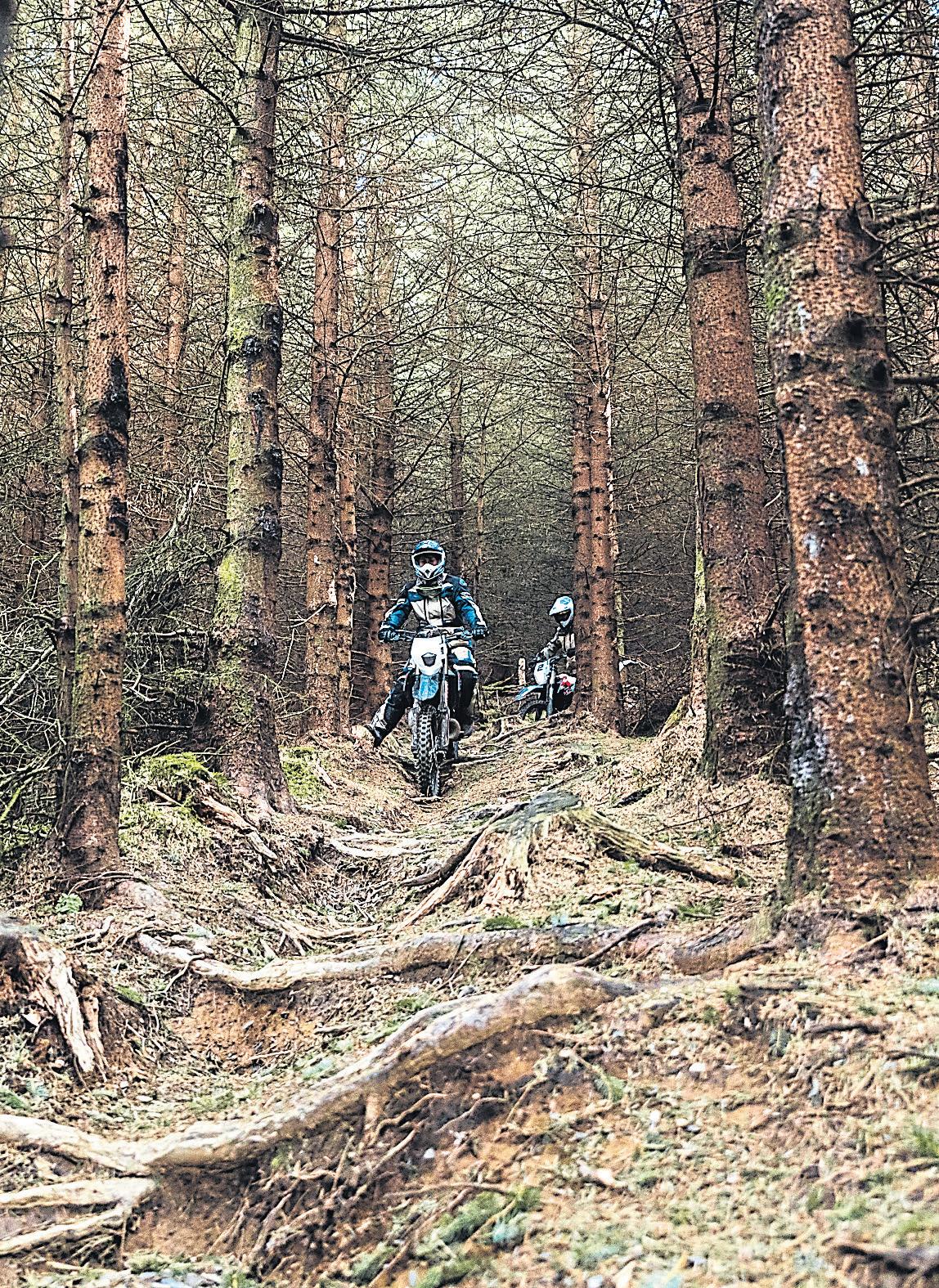

Ultimate off-road day – £250 / www.mickextanceexperience.com
12 EVENTS
Champions Flat Track School
From £130 / www.flattrackschool.co.uk
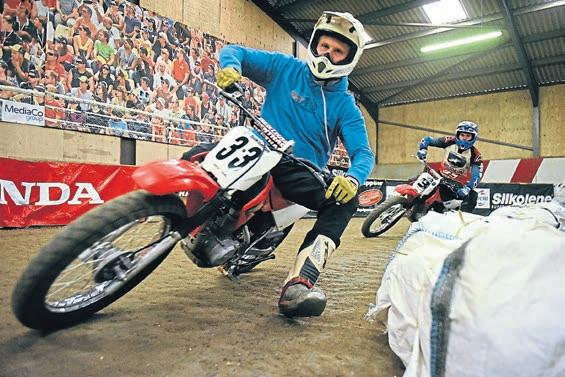
Want to brush the cobwebs away, pick up some new skills and learn the basics of dirt/flat/short track? This is the one for you. The Champions Flat Track school in Lincolnshire is run by top rider and top bloke Pete Boast – who’ll treat you to a top of day of belting around on little Honda CRF110’s. Just turn up with your usual riding gear and boots – they provide the steel shoe and bike. It’s that easy.
California Superbike School
Level 1 starts from £465 / www.superbikeschool.co.uk
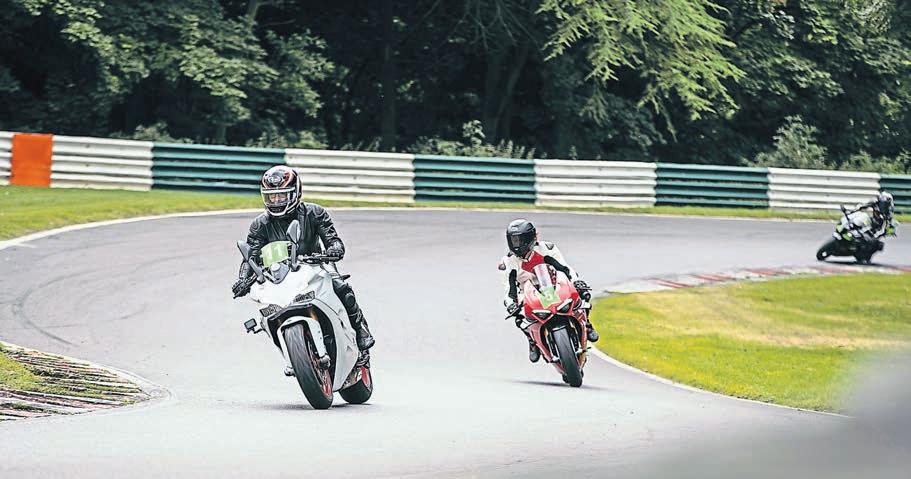
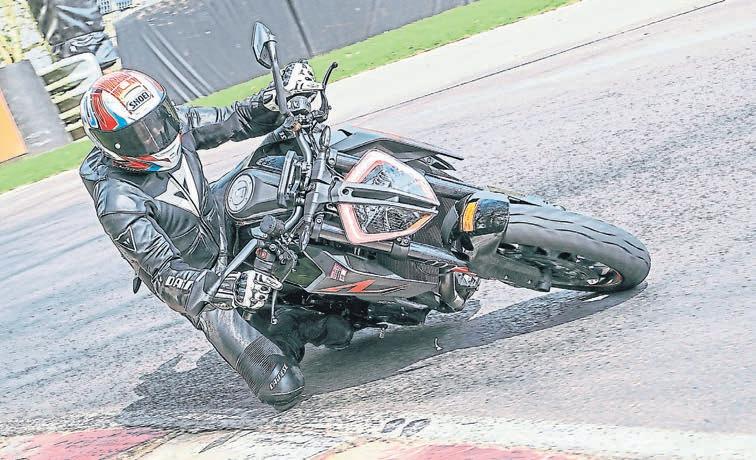
It doesn’t matter what bike you ride, whether you ride on the road or track, or how fast or slow you ride – if you ride a motorcycle, you can improve. The California Superbike School has more than 30 years of experience helping people ride faster and safer, so they can help you improve quickly. We’ve done a few days with these guys, and would wholeheartedly recommend them to anyone who’ll listen.
Gary Adshed, chief riding coach says: “The school provides riders with a measure of confidence about their cornering skills for both road and track. After all, a turn is a turn, no matter where it is. The techniques we teach apply just as easily on road as they do on track. Although we teach on track, the drills equip riders for riding on any road, any time and any condition.”
No Limits Trackdays
From £55 / www.nolimitstrackdays.com
No Limits Trackdays was set up way back in 1993. In that time, it’s carved out a reputation as the UK’s top trackday provider, with sessions at an extensive range of circuits at home and across Europe. So if you want to spend a bit of time on track in 2023, these guys should probably be your first port of call. And with a range of sessions to suit every skill level, there’s
Inch Perfect Trials
From £100 / www.inchperfecttrials.co.uk
With a huge array of courses to choose from, including children’s and women’s days, full and half-days, a wheelie school, a bike maintenance course and a tailored training for more advanced riders, if it’s trials related these guys have it covered.
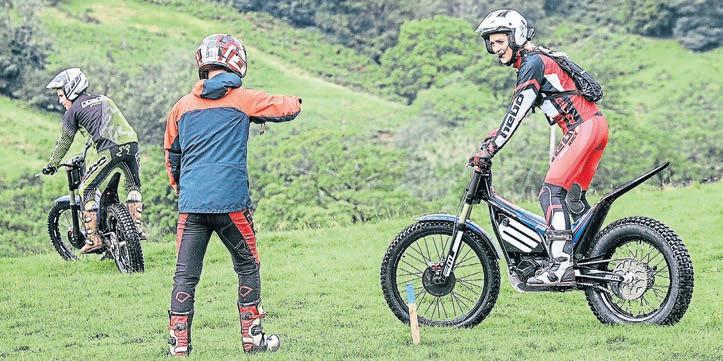
If you fancy a piece of this pie, we can wholeheartedly recommend the experience day. The whole thing is well run, the experience will improve your riding skills, and it’s an absolute giggle.
Just don’t expect to go home without being caked in mud – but that’s part of the fun, right!
If you class yourself as a petrol head or a speed freak, you probably wouldn’t rush to sign up for a day on an electric trials bike. But you’d be massively missing out – the Inch Perfect Trials Experience Day on an Electric Motion Epure machine is one of the best things you can do on a bike. Not a drop of petrol, and very little speed needed.
Motorrad Tours
nothing to worry about if you’ve never been out on track before.
If you want to stick to the UK, you’ve got a massive selection of tracks to choose from, including Anglesey; Bedford Autodrome; Brands Hatch; Cadwell Park; Croft; Donington Park; Lydden Hill; Mallory Park; Oulton Park; Rockingham National; and Snetterton.
From £3495 for The Grand Tour: Italy / www.motorrad-tours.com
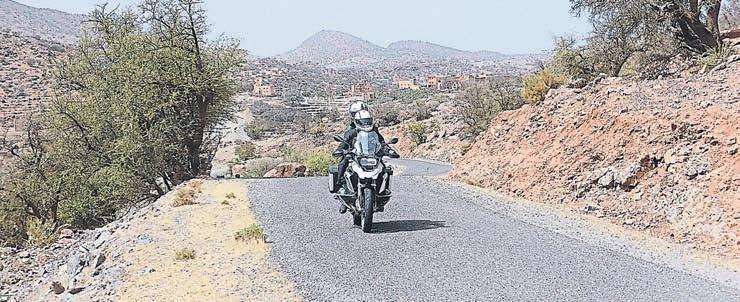
If you’re after an adventure, but you haven’t got time to plan it our yourself, then the guys at Motorrad Tours have got you covered. They are the UK’s only Official Travel Partner of BMW Motorrad, and they run a massive range of bike tours throughout Europe, Africa, the Americas and Asia. You don’t have to ride a BMW though, if you’d prefer to take your own. We like the look of The Grand Tour: Italy.
You’ll start in Milan and work your way right down to the bottom of the boot, taking in some of the best roads, coolest cities and inspiring views the country has to offer over the two-and-a-bit week tour. Hotels and breakfasts are sorted; there are tours are ferries booked for you; and a few meals and drinks included, too. It’s expensive, but then it’s a seriously special trip.
EVENTS 13
We love a bit of trivia here at MoreBikes. No matter whether we’re at a pub quiz with a beer in one hand and a pencil in the other, or being questioned by our mates when we’re stood around at a bike night, there’s something about knowing the answer to an unexpected question that gives us a nice fuzzy feeling inside. And if we don’t know, then there’s a good chance we might learn something. That’s why we’ve decided to introduce a regular quiz section sponsored by our good pals at Fowlers (who’ll be supplying the prizes).
We’ll be asking you questions about all manner of two-wheeled stuff, pushing your
It’s time to get out your pens and pencils and put your grey matter to the test
memories to the limit and asking you to dig deep to try and remember all manner of strange stuff from right across the biking spectrum. It’s a chance for you to show off your infinite wisdom and be in with a shot of bagging some cool prizes. All you’ve got to do is jot the answers down on the entry form below, and send it in using the details provided. We’ll then pick the winner from an upturned helmet crammed with correct answers – and that person will be sent a brand-new bit of kit that’ll help them stay safe out on the road. It’s that simple. Get cracking for the chance to win. Good luck!
Which motorcycle was the chosen ride of seven of the top 10 racers in the 1977 GP Championship?
How about this for a cool bit of riding kit? This lumberjackstyle shirt from Weise might look like it’d be more at home in a Shoreditch boozer than at a bike meet, but actually, it’s a properly equipped bit of kit that’ll help to look after you on the road. A-rated for protection, it’s equipped with an abrasion-resistant aramid lining and gets CE-approved armour at the elbow, shoulder and back. Want to know more?
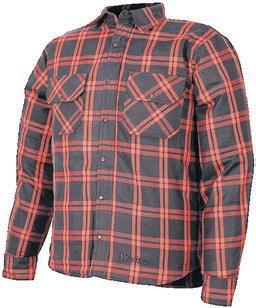
£139.Worth99
Visit: www.weiseclothing.com
When was Kawasaki’s Z650 first launched?
How long does a CBT certificate last?
How many Street Triples has Triumph sold since 2007?
7
2 5
Which bike does Honda’s new Transalp share its motor with?
8 3 9
Which Ducati claimed 63 race wins in its five years racing in World Superbikes?
6 1 10 4
Ruroc first made its name producing helmets for which extreme sport?
LAST MONTH:
Here’s

What’s another name for the ‘Limit Point’?
How many trick Indian Challenger RRs are being built to celebrate its King of the Baggers Championship win?
Did you get ’em right? Silverstone, Siddhartha Lal, 2002, Ducati Multistrada V4, Phil Read, Yamaha, 1943, Earning the ‘Gold Star’ at Brooklands, 350,000, Hawk Racing
14 COMPETITION
you need to know Fill in your details on the form or enter online and return to: MoreBikes, Weise Redwood shirt, 2023 Competition, Mortons Media Group Ltd, Morton Way, Horncastle, Lincs LN9 6JR. Competition closes: May 12, 2023 ANSWERS: 1.......................................................................... 2. .................................................................................. 3. ............................................................................. 4. ........................................................................ 5. .................................................................................. 6. ............................................................................. 7. ........................................................................ 8. .................................................................................. 9. ............................................................................. 10. ...................................................................... Mr / Mrs / Miss / Ms (please circle) First name:...................................................................................... Surname:............................................................................................................................... Address:....................................................................................................................................................................................................................................... Town/City:........................................................................ County:.......................................................... Postcode:.................................................................... Email:............................................................................................................. Telephone:............................................................................................................ There are no cash alternatives available. The winner(s) of the Weise Redwood shirt will be the first name(s) drawn at random from the upturned MB helmet. YOU can also ENTER online! Just check out the MoreBikes social media channels for more information. Terms and conditions apply. To view the privacy policy of MMG Ltd (publisher of MB) please visit www.mortons.co.uk/privacy What’s the name of the organisation that manages the marshals at the Isle of Man TT? THE WIN! MOREBQUIZIKES
the legal bit that
✂
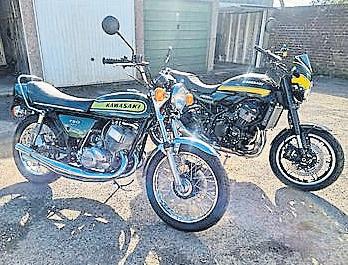
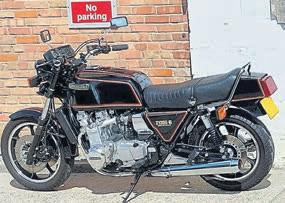
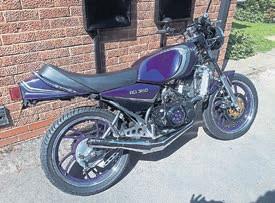
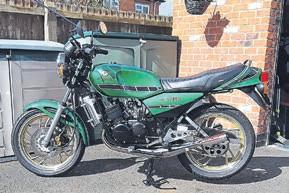
We love to see what you lot are riding – and we know the rest of you like it, too. It’s just like pottering around a bike night and checking out what’s been brought out for a ride. Now we’ve decided to bring the bike night to you, asking readers to send us photos of their pride and joy for the world to see. Here’re some of our top picks from the last month.
BIKER-FRIENDLY DINERS

THE ORIGINAL EPPING TEA HUT
You must be doing something right, when a hut in the middle of a forest is still serving customers after close to 100 years. That’s what the Original Epping Tea Hut has been doing since the early 1930s.
In that decade Speedway was launched in Epping, Ernie Miller saw an opportunity and opened up a tea hut to cater to the often thousands of fans. Speedway came and went, but the Tea Hut remained, now into its fifth generation of ownership by the same family. That’s pretty incredible, don’t you think?
Over the years, the original wooden hut needed replacing. The solution? An old shipping container (long before this became trendy) was converted for purpose, still in the same green paint as the original.
The Tea Hut is cash only
The parking space is gravel (but there is a small concrete area). The seating is outdoor only. That said, the tables do have brolleys and you can always shelter under the trees should the heavens open.
There was a threat to the Hut’s existence a few years ago, as landlords and forest owners City of London put a tender on the space. Thankfully, a longstanding customer ran a campaign to ‘save the tea hut’ and has since managed to become a Verderer of the forest and now sits on the management committee.
The only difference: the hut’s been moved just slightly. A third upgrade came in 2016 – still using a shipping container, but this time purpose-built for the Hut’s unique requirements – and it continues to operate to this day.

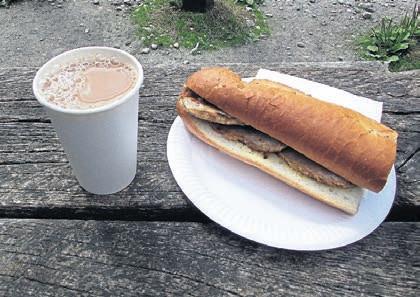
Theirs is a simple formula: A lovely, friendly place to stop off and get good-quality (and plentiful) food at very affordable prices. The (delicious) cup of loose-leaf tea and huge (threesausage) baguette in the photo (sorry, it should have photographed before starting eating, but it was too damn tasty!) cost £6.50, a total bargain. Rolls start from just £2.50; sandwiches and baguettes from £4; muffins from £2; wraps from £4; with drinks from as little as £1.
The Hut has always been popular with bikers since its Speedway days,
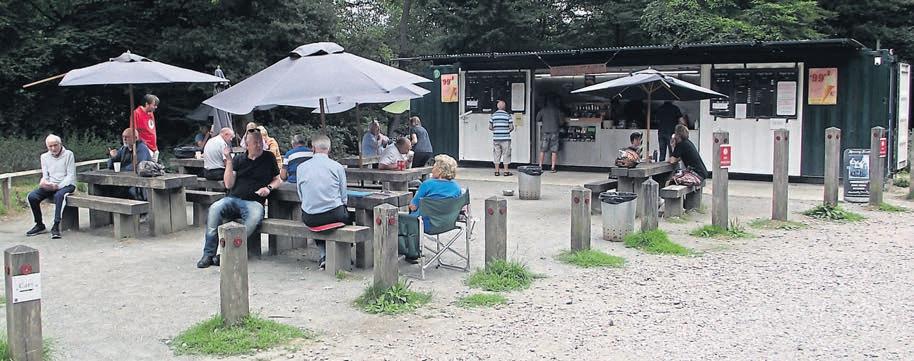
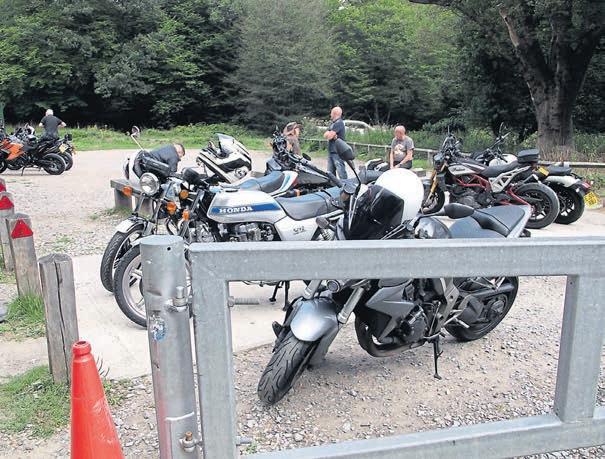
in part thanks to the great roads around the area (it’s easily accessible with nearby links to both the M11 and M25, A10, A12 and A406, despite sitting in the middle of an ancient forest). Upon arrival, there is plentiful parking and a large outdoor seating area. And there are always bikes and bikers. We visited on a Tuesday afternoon and the mix of bikes was fascinating, from an Indian FTR to a KTM 1290 Super Duke to a pair of Honda 250 Superdreams in stunning condition!
For fans of horror, James Herbert’s classic ‘The Rats’ was based just up the road at the High Beech Conservation area. And if you’re into classic trains (and who isn’t) the Epping to Ongar Railway is just a few miles away.
In partnership with Forcefield Body Armour
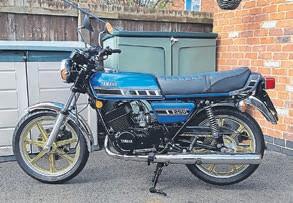
Bruce Green’s pair of immaculate Yamahas. What we’d give to have this handsome duo in our garage.
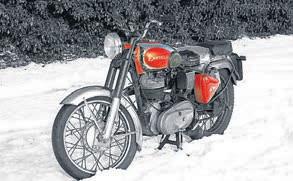
Derek Sowton’s Royal Enfield is ready for anything.
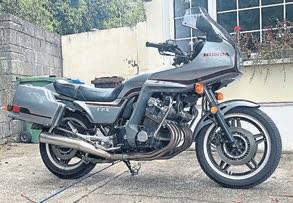
Ian Clandillion’s delivered a bit of 80s retro cool with his lovely Honda CBX.
Right: Another RD! This one belongs to Reece Bennett – and he’s had it for an amazing 29 years. That’s what we call love.
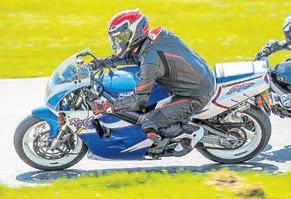
Chris Webb’s track-ready Suzuki RGV R. “Owned for 25 years, 41.5 thousand miles on the clock, and it still absolutely flies.”
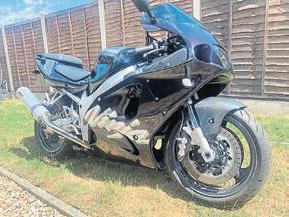
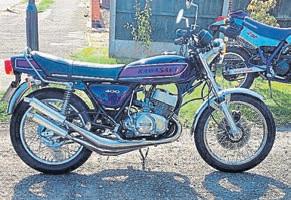
Martyn Wood’s Kawasaki S-3 400 is a real stunner. We love that purple paint job.
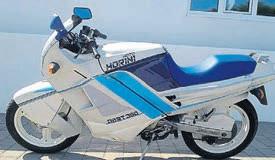
Simon White’s 1990 Moto Morini Dart 350. You don’t see many of these about – but we kind of love it.
Craig Hoal’s mint Kawasaki Z1300-6. It’s hard to believe it’s 35 years old.
Oooft. We like the look of Gareth Williams’ two Kawasakis. Lucky chap.
Mike Weaver’s 99 Kawasaki ZX-7R P4. “I bought it in 2004 and it’s been with me ever since. I’ve had some amazing adventures on the lardy old girl so she has massive sentimental value to me, even if she’s not worth very much!”
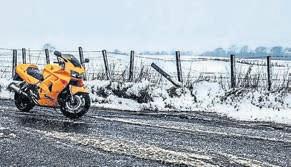
Stephen Mastin’s Honda VFR doesn’t mind a hint of snow!
The Original Tea Hut Cross Roads, High Beech, Epping IG10 4HR www.originalteahut.com 9am-5pm MondaySunday. YOUR RIDE/BIKER GUIDE 15
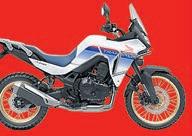
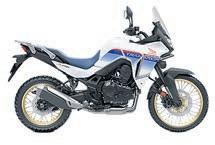
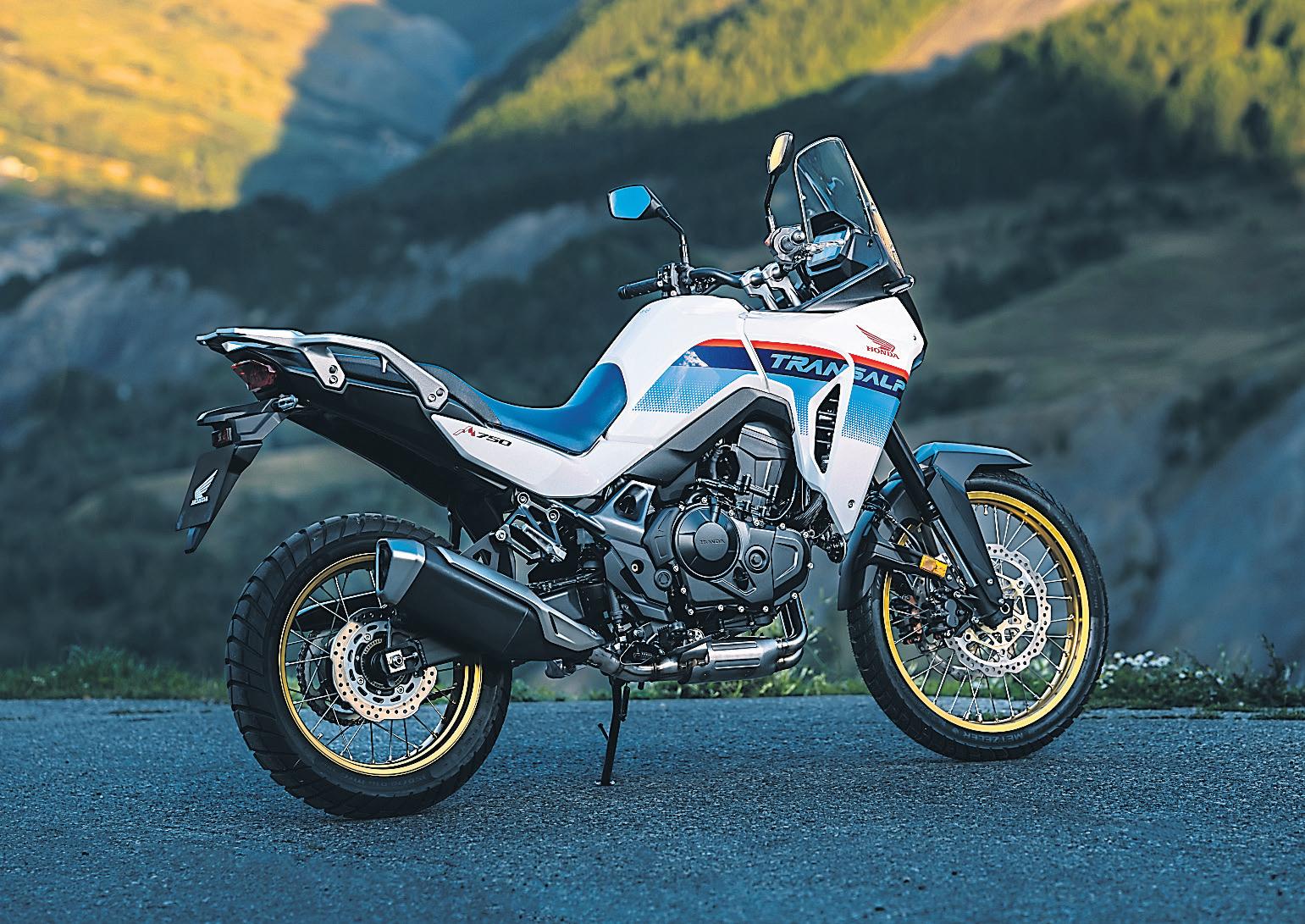
Honda Transalp XL750 JUST RIGHT?
Does Honda’s new middleweight adventure bike offer the perfect mix of road manners and off-road ability?
I’ve been out to Portugal to put the new middleweight adventure bike from Honda through its paces. Here’s how I got on.
The 755cc liquid-cooled 4-stroke parallel twin ripped straight from the new Hornet is the highlight. With 90bhp and 55lb-ft of torque, there’s plenty of low-down punch, but it’s at its best when you get it singing higher up the revs. It’s strong, versatile and thoroughly usable, no matter whether you’re pottering through down or blasting up mountain passes. A couple of people said the engine made even more sense in the Transalp than the Hornet, and although I’ve not ridden it yet, it definitely works well in an adventure bike package.
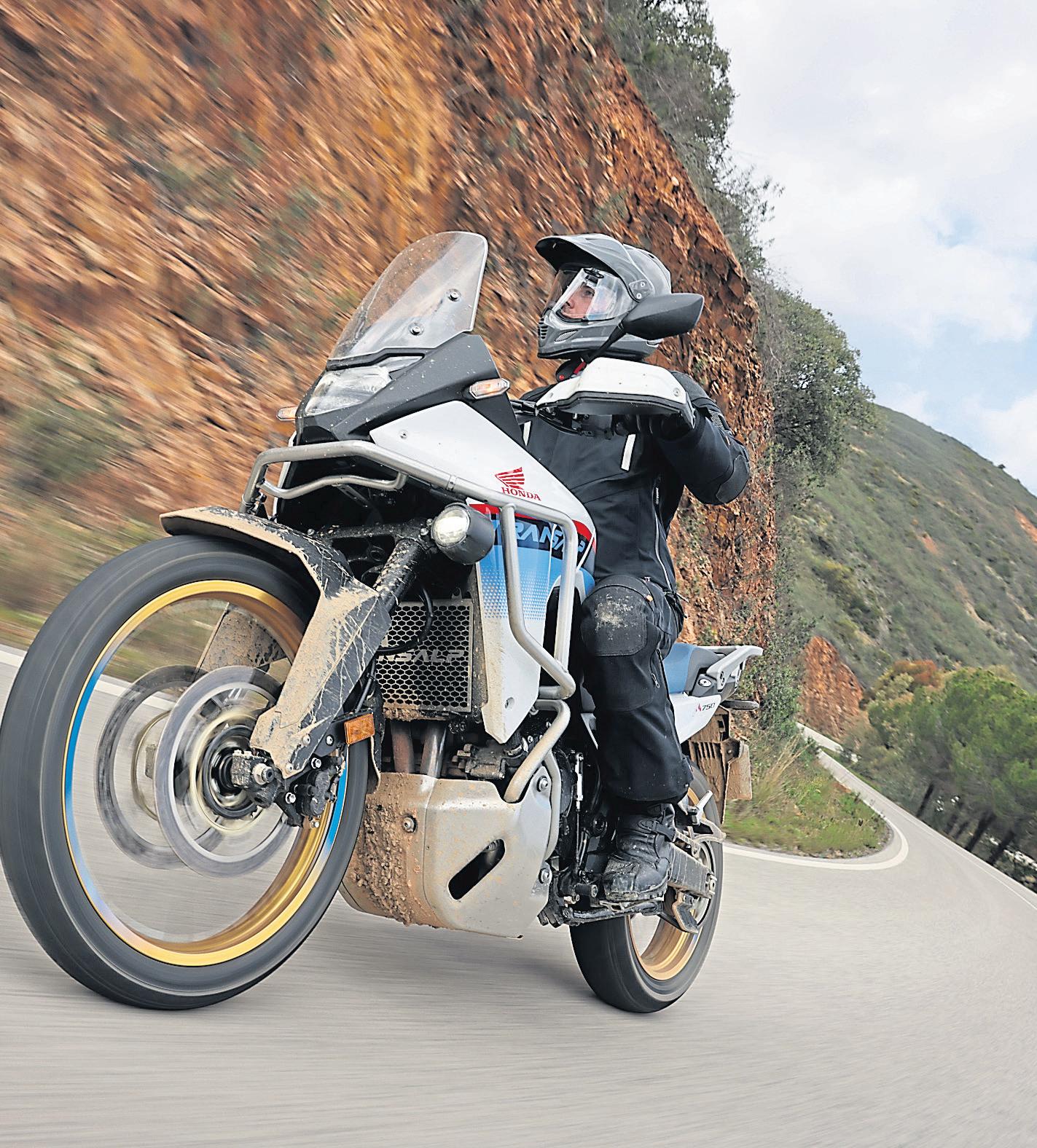
The handling’s very good. You’d be forgiven for expecting a bit of vagueness from the 21-inch front wheel, but in practice it feels planted and stable with plenty of grip from the Metzeler Karoo Street tyres on the Tarmac (even on damp roads).
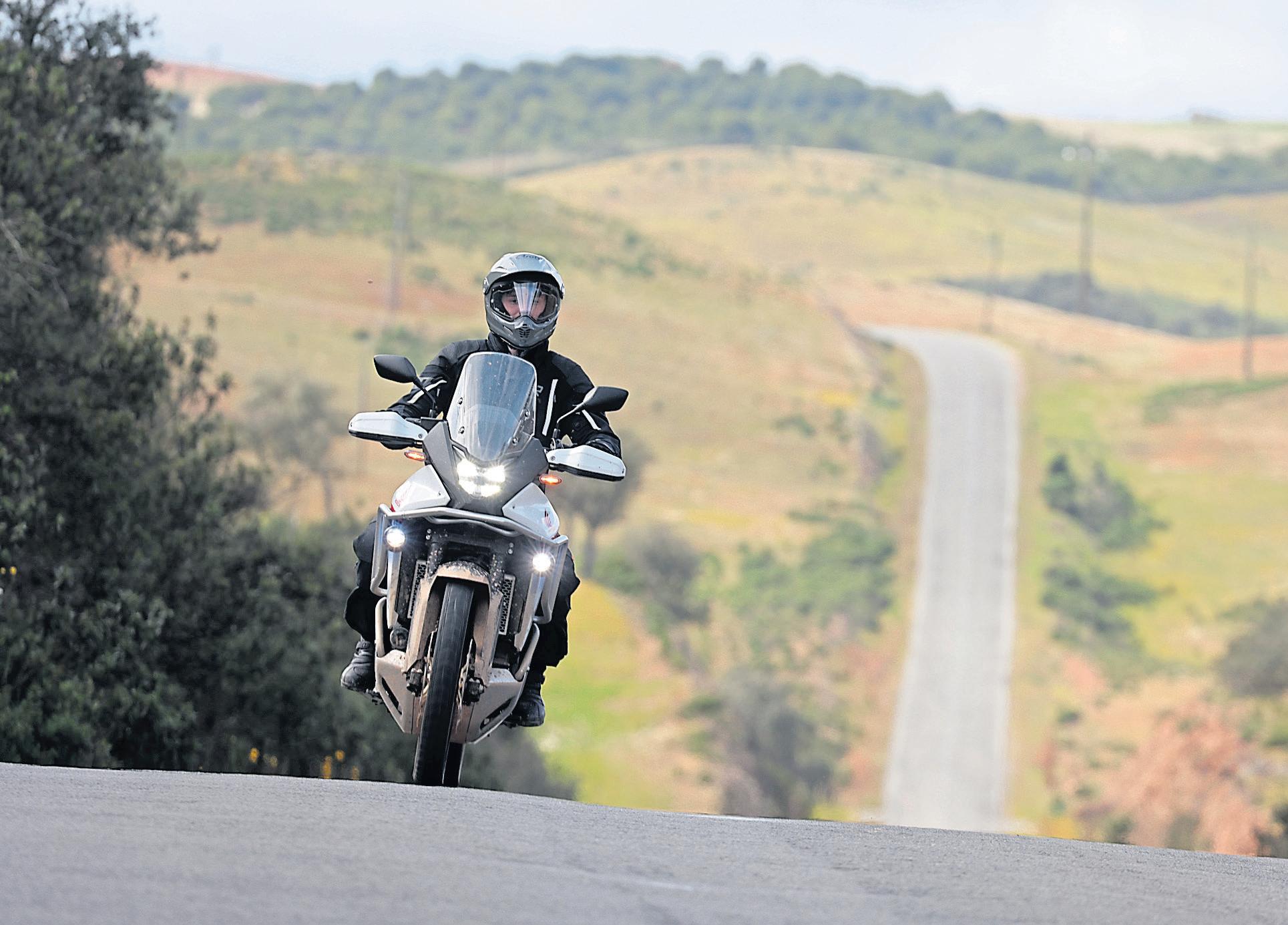
When things dried up, the Transalp
came alive, and I reckon I’d struggle to go much faster on a bigger and more powerful adventure-focused machine.
We also did a bit of trail work. Wide and a bit grimy, it was the perfect introduction to the bike off-road. It’s not going to win any Dakars, but it feels poised and planted with plenty of adjustability in the electronic settings to suit all skill sets.
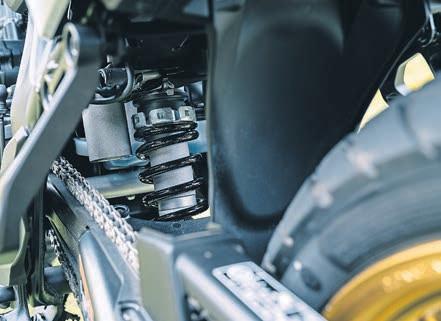
The Showa 43mm USD forks up front have 15-stage preload adjustment and 200mm of travel, and the Pro-link monoshock at the rear has 190mm of travel. Developed in conjunction with the frame, it’s a capable set up. There’s a bit of wallowing and diving under hard braking and strong acceleration, but that’s probably to be expected, and it never feels like it’s out of control even when being pressed hard.
For stopping there’s Nissin dual 310mm wave discs with axial mounted two piston calipers up front and single 256mm wavy discs with single piston calipers. They’re good,

offering plenty of bite and plenty of feel to stop in a hurry. There’s a solid suite of electronic rider aids, too, with adjustability for the rider modes, traction control, engine braking and ABS. Interestingly, full power is available in all modes, but it’s delivered in a slightly different way. There’s a Gravel mode which is a simple way to tune the bike for the dirt. But it’s more for safety than performance. The good news is that there’s also a User mode which allows you to set things up in a slightly more aggressive way.
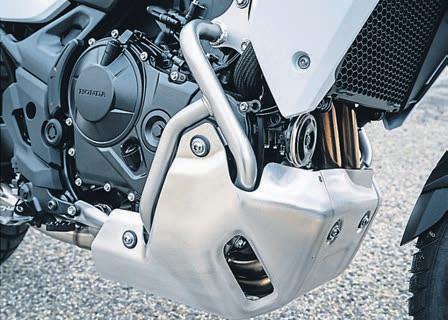
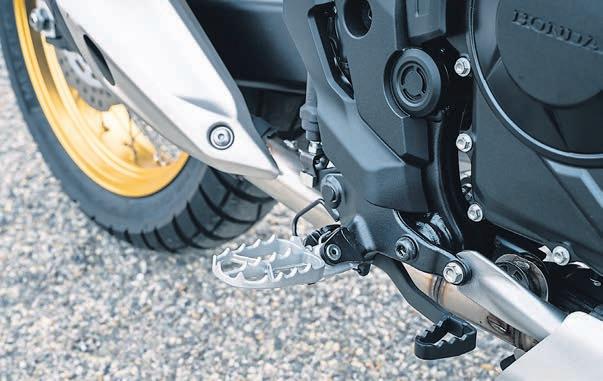
The bike we were riding had the aftermarket quickshifter on. Ripped from the Fireblade, it’s a lovely thing to use, making it easy to rattle through the six-speed box. Also we had a few extra goodies, including a bash plate, engine protection, and rally-style pegs (in addition the aforementioned quickshifter). There’s a shed load of accessories available, including five kits to make the Transalp ready for touring, commuting or outright offroad adventures.
Want to get the full lowdown on the new Honda Transalp XL750?
Grab yourself a copy of MSL and read an in-depth review on the new middleweight from big H, and hopefully you’ll be one step closer to working out if it’s the bike for you…
16 FIRST RIDE: HONDA TRANSALP XL750
WORDS: Ross Mowbray PHOTOS: Honda Europe
FIRST RIDE: HONDA TRANSALP XL750 17
GET COMFY
Honda knows what it’s doing when it comes to rider comfort, and the Transalp is just right, fitting all types of riders of all shapes and sizes with ease. It’s not a big bike, but there’s a surprising amount of room for a pillion, too, with some obvious thought going into how it’d handle for two-up travel.
ROAD MANNERS
It’s a road bike through and through. Despite the big front wheel and knobbly-ish rubber, the Honda tips, turns and grips far better than you’d ever expect it to. For an adventurefocused bike, the handling is excellent.
It’s low and light with an 850mm seat height and a 208kg weight, which helps make it manageable to shift around. I’m 6ft 1in tall and I can get my feet flat on the floor with room to spare. And the 16.9-litre fuel tank is good for a claimed 300km (186 miles), though I suspect you’d struggle to achieve that on all but the most sedate rides. That said, I reckon you’d be able to get fairly close to 150 miles before having to top up.
Interestingly, the new steel diamond frame has been developed in
THE MOTOR
The 755cc engine ripped straight from the new Hornet is oh so good. It was in its element being worked hard in the hills above Faro, but it’s just as happy pootling through town or plugging miles on the motorway. It is versatile, capable and very smooth. What more could you ask for?
TALKING TECH
It’s not dripping with electronics, but there’s plenty to be going on with including all the usual rider modes, traction control settings and ABS choices to dial in. If you’ve ridden a recent Honda, it’s all very familiar, though the various menus are much, much easier to navigate than those of the notoriously complex Africa Twin.
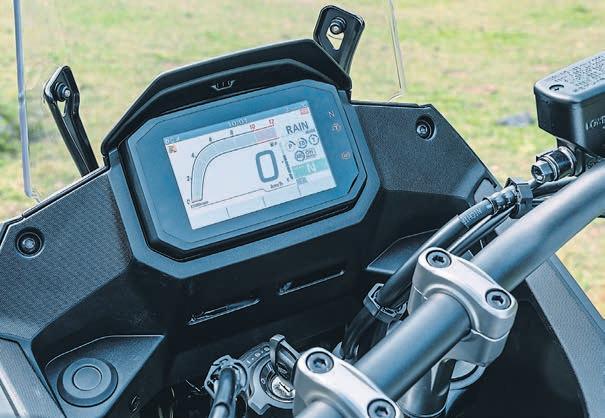
OFF-ROAD POTENTIAL
This is the new Transalp’s downfall. It'll do it, and when kitted out with all the additional adventure goodies it definitely looks the part, but in truth if hitting the dirt is your thing, you’d probably be wiser to look elsewhere.
conjunction with the Hornet. But it’s not the same. The rear subframe is stronger, with a focus on pillion comfort and carrying capacity. Although we did not have a chance to get on the back during the ride, a quick sit suggested that there was enough padding and room for long rides.
There’s a lot of competition out there – including Yamaha’s extremely popular Ténéré; the KTM 790 and 890 Adventure; the Aprilia Tuareg 660; and the newly-released Suzuki V-Strom 800 DE. But the
Transalp holds its own. I reckon it’s probably the best road bike of the bunch.
Okay, so it’s limited off-road and the Ténéré is a much better option if you want to hit the trails in a serious way, but I suspect that plenty of potential adventurers would be more than happy with the new Honda’s ability.
And let’s not forget that it’s the cheapest of the lot, priced at a very impressive £9499. Criticisms? It’s a bit of a shame the bash plate doesn’t come as standard, and it’s a bit frustrating that the standard USB socket is tucked away under the seat. But small gripes aside, it really is very good.
18 FIRST RIDE: HONDA
TRANSALP XL750






































Never one to rest on its laurels, Triumph has once again put in the graft to keep the Street Triple at the top.
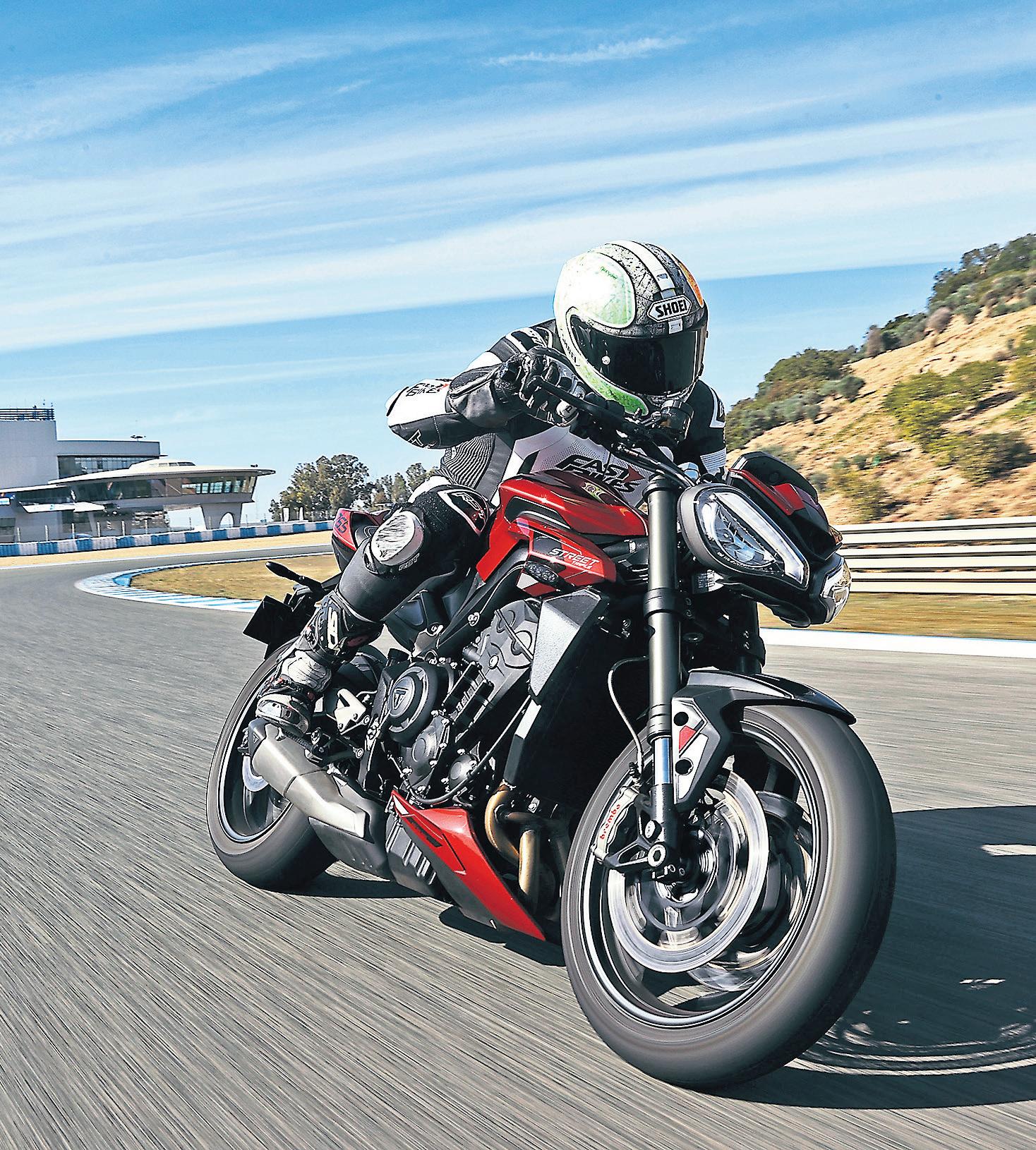
WORDS: John McAvoy PHOTOS: Triumph
If this teaser tickles your fancy and you want to know even more about the Triumph Street Triple 765RS and 765R, scan the code and snag yourself a copy of Fast Bikes. Those lads really know their onions when it comes to bikes built for speed.

20 FIRST RIDE: TRIUMPH STREET TRIPLE 765RS
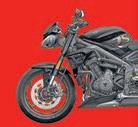
You’ve really got to doff your cap to Triumph. Not only did it conceive the Street Triple 675 in the first place back in 2007, in the process setting the gold standard for performance, desirability, build quality and price in the middleweight naked class, it’s continued to set the standard ever since.
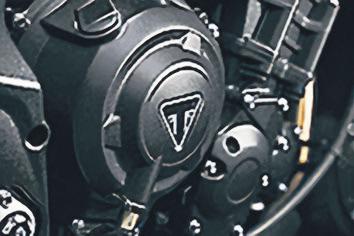
So, what do you do when your bike is top dog, with no sign of any challenge coming from your competitors? It turns out that if you’re Triumph, you don’t play it safe, save your energy, maintain the status quo and keep adding to the 130,000 units already sold. You don’t even give it a quick onceover with an extra couple of bhp and trim a kilo of weight from it. No, if you’re Triumph, what you do is start with a phone call to the people who have been designing and building your Moto2 engines for the past four years...
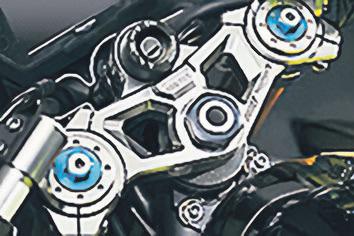
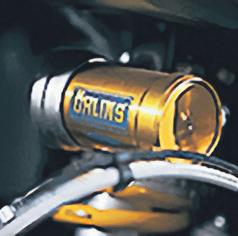
By virtue of being the RS spec Street Triple, it gets some nice touches and a sprinkling of bling, too. The brakes are now Brembo Stylema monobloc calipers with MCS adjustable span and ratio levers. There’s also a fully adjustable Öhlins STX40 shock in the back; Pirelli Supercorsa SP V3 tyres; some fancy LED daylight running lights; belly pan and pillion seat cover all as standard on the RS; which, along with the 10bhp change, all account for the £1700 price difference between it and the R spec model.
So, you’ve upgraded your middleweight naked bike and state that it’s been ‘designed to set the new performance naked benchmark’ and use other phrases in your marketing such as ‘race-powered naked sports perfection’, and you talk about ‘taking the handling performance to the next level’... you really need to back that stuff up. It’s a sign of confidence, then, that of all the places Triumph chose to present the Street Triple to the world’s media was at one of – if not the greatest – race circuits of all time: Jerez. Turn one in 2011 and Rossi torpedoes Stoner; turn three nearly finishes Doohan’s and Marquez’s careers; turn six in 2018 and Pedrosa
FIRST RIDE: TRIUMPH STREET TRIPLE 765RS
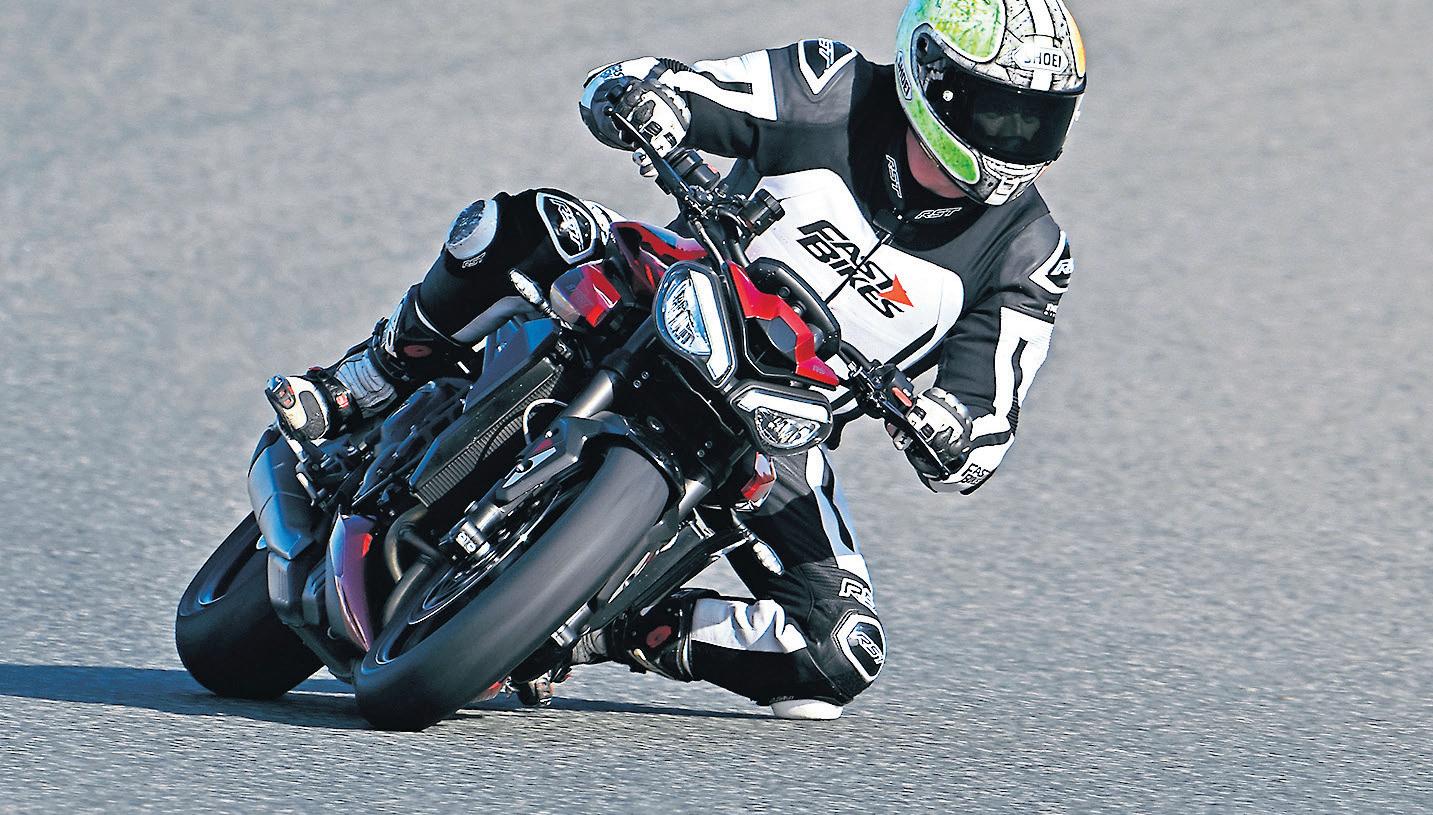
wipes out Lorenzo and Dovisioso; turn 13 in 2005 and Rossi shows Gibernau the gravel trap; and in 1996 a track invasion before the race ends costs local hero Alex Criville victory. Some of the most iconic moments in motorcycle racing have happened at Jerez – and one of the reasons for that is that it’s fast, very fast, which, on the surface, makes it a brave place to launch a bike with ‘only’ 128bhp. However, the majority of the lap is spent turning the bike either through a series of corners, joining up corners, or setting up for corners. You might have all the power in the world, but if your bike doesn’t handle, lapping Jerez is not easy.
Straightaway, it’s clear the 2023 Street Triple RS is like no other Street Triple that’s gone before. It really likes revs, and it really likes the brakes being let off early and carrying speed into the corners, both slow and fast. The worry from a rider’s point of view, when you start getting greedy on corner entry, is whether the front will tuck, or will the bike run wide or turn through the corner?
This is the overriding sensation and ongoing calculation that goes on in my head as I try to simultaneously learn the circuit and bike. Both come to me quite quickly, as both are
relatively easy to learn, even though I know unlocking the secrets of the track would be much more difficult than the secrets of the bike; I learn the circuit well enough to know what the bike wants.
Riding the Street Triple is a lot like riding a supersport bike, insomuch that maintaining momentum is the goal. Braking deep into the corner and turning the bike in the shortest space possible, as you would on a litre bike before firing it out, is not the way to ride the Street Triple or how it wants to be ridden. Brake very late and very hard right at the very edge of the curb, or on the curb if it’s smooth enough, then let the brakes off at the same time as you roll the bike off the centre of its tyre, and eyes on the apex you want to hit at all times. Commit, stay relaxed, don’t grip the bars too tight, get your body off the bike, and get your head down by your forearm as the load on the front tyre builds and builds to the point where it starts to feel a bit uncomfortable, and you feel like it can’t take any more. Next, just touch the throttle to move some of the weight to the rear and give it some relief as you sweep past the apex. Then hit the throttle and spot the exit curb. Do not shut the
throttle, finish the corner by leaning on the electronics and either keeping the bike turning by staying low, or letting it drift to the edge, and be ready to click another gear, but under no circumstances back the throttle off and lose that precious built-up momentum. This is how you ride a 2023 Street Triple RS, which is nothing like the Street Triples I’ve ridden before.
I’d have happily kept going round the circuit on the Street Triple until the sun went down, and then I’d have happily kept going round some more – a testament to how even on such a wide, open and fast circuit, a humble 128bhp naked bike can be exciting and ask as much from you as a rider in terms of commitment that a litre bike does. It’s just a different type of commitment.
The next day we took the RS out on the road to ride alongside the more road-biased R spec model, and this is where the RS played its ace card. After all the heroics on track the day before, the RS revealed the other side of its personality by being an absolute doddle to ride at normal speeds. Lightweight, manoeuvrable, flexible engine and smooth fuel injection make it an ideal first bike for anyone who’s just passed their test. It’s as happy being thrown into a fourth gear corner at more than 100mph and holding a line as it is pootling through a town centre or rolling through the countryside just rolling the throttle on and off
21
ONE
FOR THE ROAD
If road riding is your greater focus, the R might be your better bet.
It’s a great shame that by virtue of being the ‘lesser’ spec’d of the two Street Triples, the R could be viewed as the poor relation to the RS and therefore overlooked. But it’s not really fair to compare it to the RS for several reasons, not least because the RS is playing a different game and just has a very different set of dynamics to the R. Plus, let’s be honest, we’re all magpies at heart, and the lure of the shiny bling alone on the RS more or less seals the deal anyway if you’re comparing the two Street Triples. A fairer comparison for the R would be against last year’s Street Triple and other bikes that exist in the sub-£10k price point, such as the Yamaha MT-09 or Aprilia Tuono 660. In that company, the Street Triple R looks a lot less like the ‘lesser’ option.
On the road, the R basically has the same amount of mid-range power as the RS, the same gearbox ratios and the same final drive, so unsurprisingly it feels pretty much identical to the RS on the road when it comes to driving off the corners and short shifting through the gears.
Then there’s the wheelies. The route we took was about 200km in total, with a very large part of it spent in the hills surrounding Jerez that are populated almost exclusively with second and third gear corners and crests; this was the Street Triple’s happy place. T-junction, wheelie, second gear corner, wheelie, third gear crest, wheelie. I can honestly say, hand on heart, that during the ride, I have no idea how many wheelies were executed, but it must be in the hundreds, which is a roundabout way of saying that the Street Triple R isn’t lacking in the fun department. But it’s not a one-trick pony…
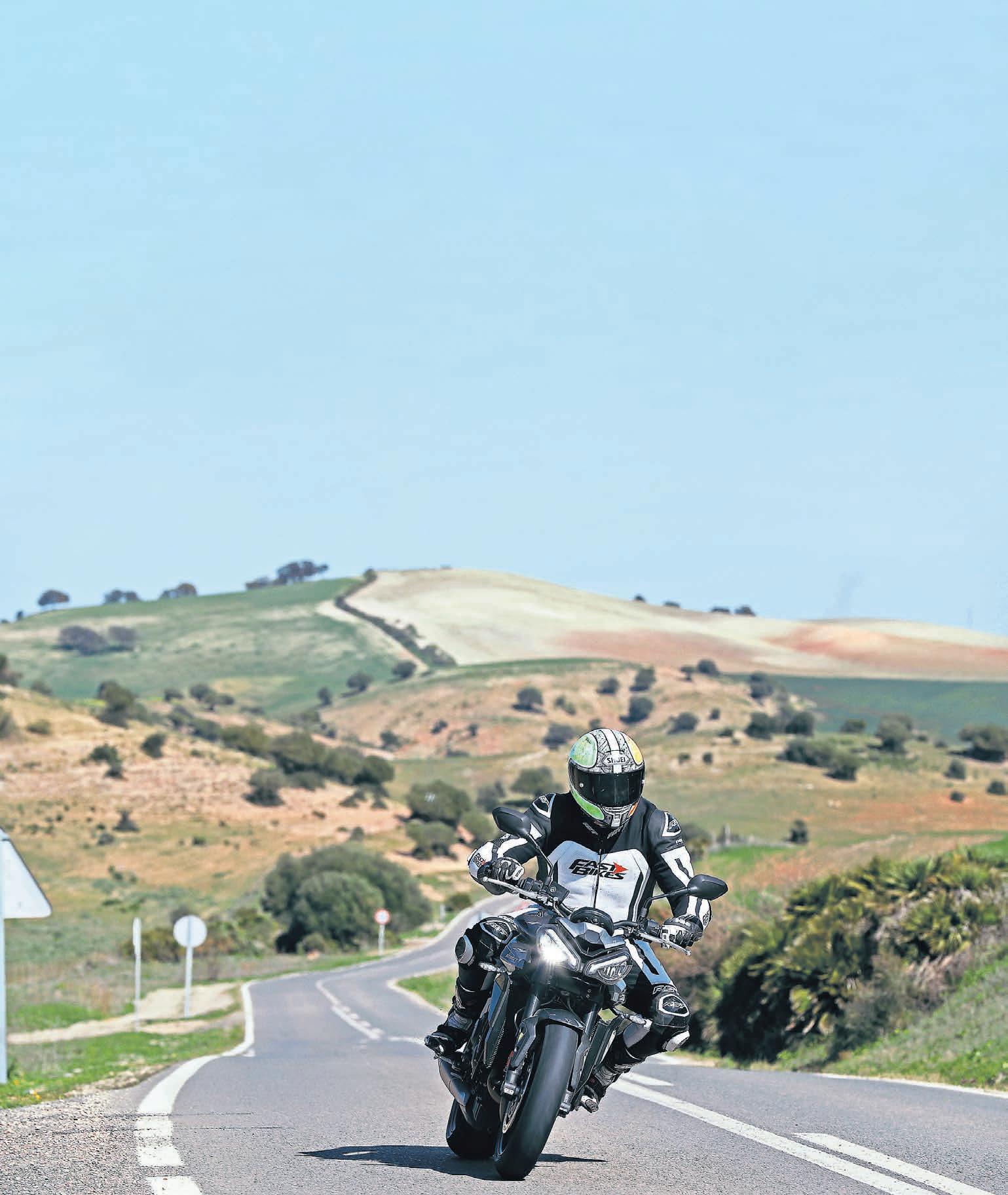
On the occasions when both wheels were on the floor at the same time, the Street Triple was a joy to ride, and it was able to dispatch corners and bumps with the high levels of refinement that have become the hallmark of the Street Triple over so many years. It’s easy to access the levels of performance it has, and it manages to strike the balance between feeling light and playful while also feeling planted and stable.
I think the different fuel and ignition maps that give the R its lower peak output are also responsible for a slightly nicer first touch of the throttle and even smoother fuelling – if that’s even possible – than the RS.
I was equally impressed with the Showa suspension. The forks are the same as the RS’s, and the rear shock, while not gold and yellow in colour, is a high-quality unit with all the adjustment, support and control you could ever need for the road. If anything, given the R’s main purpose in life being to compete for sales in the sub-£10k sector, I’m surprised Triumph didn’t fit it with something a bit more basic or with less adjustability, but then I suppose that would see the Street Triple encroaching on its very own Trident or Tiger Sport 660 territory.
The Continental tyres are much better for the road than the RS’s Pirellis; they warm up faster and operate at a lower temperature anyway. They also have a nice feel to them, insomuch as the profile – in particular of the front tyre – brings
a certain amount of lightness to the steering that really suits the overall move towards agility for the 2023 Street Triple, even if it isn’t as extreme on the R as it is on the RS.
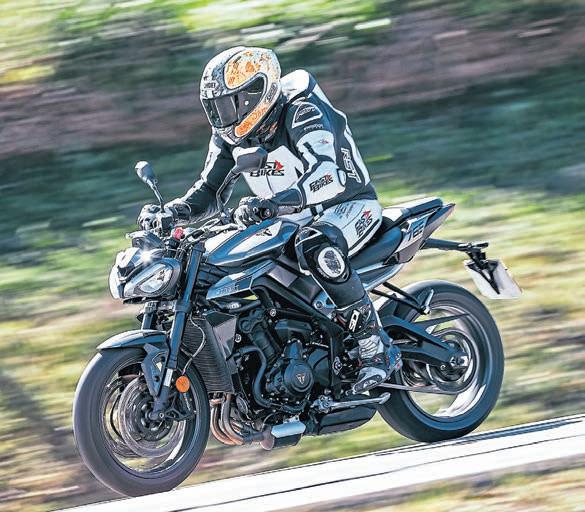
Overall, I found the R to be just that little bit smoother on the road than the RS, which feels daft just saying it, but I think its different fuel and ignition maps give it a small edge on the road in the shape of smoothness. This isn’t to say that the RS isn’t a smooth, easy bike to ride on the road, because it is. We’re talking about very subtle differences here that can make any comparison pretty much pointless. However, if you change the perspective and look at it another
way, the RS can do everything on the road that the R does with a very subtle difference in how the throttle feels, but even though we never rode the R on track, it’s safe to say that the R just wouldn’t be able to live with the RS in an environment where you live in the last third of the revs, and hard cornering is the order of the day. Its outright power deficit and slightly lazier geometry would see it get thrashed, so it’s just as well that the R isn’t competing with the RS. The R has got a different set of potential customers to impress and a different purpose in life. Between them, they can take on a much broader range of competitors. They’re brothers, not rivals.
22 FIRST RIDE: TRIUMPH STREET TRIPLE 765R






SAVE SOME CASH
After a new lid? HelmetCity.co.uk has given Danny a 15% off discount code to share with you lovely lot (for full-priced gear over £50). If you want to take advantage, tap in the code DMR15 at the checkout.
LET’S GO RACING
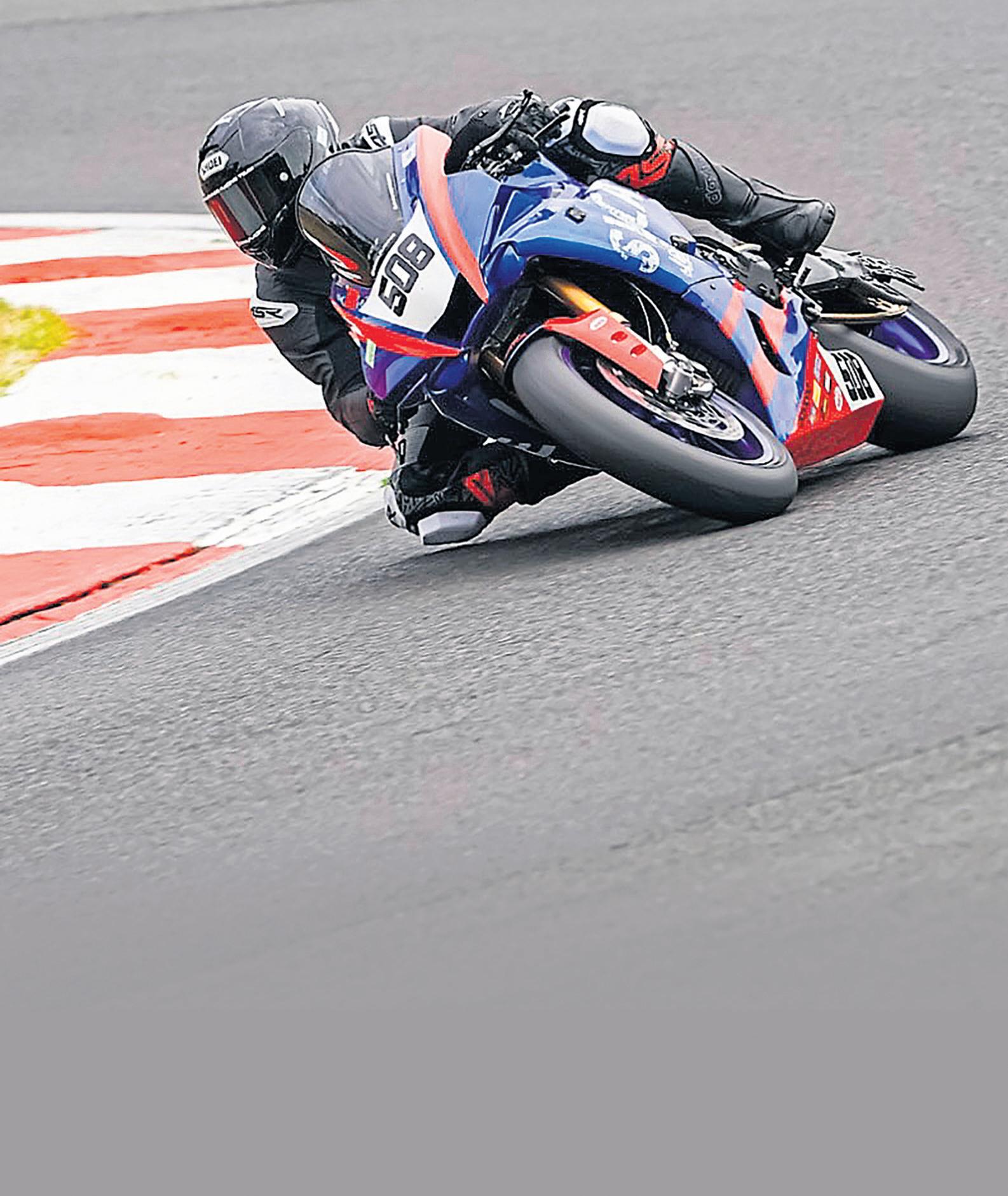
Ever thought about mixing it up on track? Don’t know where to start? Don’t worry, our man in the paddock is on hand to fill you in on exactly what you need to know if you fancy becoming part of the vibrant club racing scene in the UK.
My own journey into racing hasn’t been straightforward. It’d been a lifelong ambition to compete on track, starting when I was a child riding at speed everywhere on my push bike (complete with spokeydokies), imagining it was one of the GP bikes of the time, but it took me more than a few years to get there, and I didn’t actually realise my dream until I was in my late 30s in 2021.
After having a long break from motorcycles for the usual suspects (children...), I began road riding again back in 2016, with track days following on quickly in 2018. But after a couple of seasons I wanted more. The increasing popularity of the track day scene, with sell-out numbers and broad, mixed ability groups, saw many of the days
riddled with flags and stoppages resulting in serious riding time reductions. That’s what led me to explore the world of club racing.
GET A LICENCE
The first step is to complete the required ACU test. It’s a necessary step for all those seeking to take part in either an ACU test day or any ACU racing event. It’s made up of both practical and theory elements, as with all modern driving-based licences, but the key difference with the ACU test is that the overall goal (by all involved) is to see you pass.
The racing community is one constantly wanting more members. As with any true followers of a chosen field, we want others to experience and enjoy our hobby,
too. The added benefit of a thriving intake of newcomers to the sport ensures the future of the sport and most importantly the sustainability of the many fantastic tracks we are lucky to still have here in the UK. ACU test days are run by several different clubs throughout the year, all of which are very inclusive, catering for complete track-riding newcomers to the most experienced of riders. My key advice would be that the day is not a test of a budding racer’s speed but a test of a rider’s safety to both themselves and others on track. The ability to follow the rules and navigate potential dangers are essential, while the speed part is only something that will develop once your racing journey is properly underway.
JOIN A CLUB
Once you have obtained your ACU licence the next step is to join a relevant club, which in turn allows you to apply for your 12-month ACU annual membership. Once completed you are now ready to enter your chosen race class.
As with most things in life it’s the fear of the unknown that can be most debilitating, so my advice is to take the time to immerse yourself in the racing paddock before even attempting your first race weekend. It’s not essential, but I’d recommend visiting a race weekend as a spectator. That’s exactly what I did, and the process of simply seeing how it worked without the pressure of actually competing took away much of that fear. Understanding how the
paddock is run, time schedules, holding areas and chatting to people actually racing in the class you are looking to compete in is highly recommended.
All clubs have a thriving online presence. Join these groups and reach out to any riders that are racing in the class you’re looking to compete in. The majority of racers, although competing with you on track, will go out of their way to try and help another competitor any way they can. There are plenty of racers out there in the club scene, and any tips and tricks of the trade will likely have been hard won through their own (and others’) experiences. Soak it all in and hopefully you won’t make any of the same mistakes...
Many lasting friendships have
24 KNOWLEDGE
WORDS: Danny McFadden PHOTOS: Danny McFadden
been made through this process, and more often than not, you’ll end up finding a group of people whom you can lean on during your first season of racing. From simply having some friendly faces to set up next to in the paddock for a weekend of racing, to navigating things like bike set up and race craft. A key thing to remember is everyone was once a novice and can therefore relate to your position and more often than not will be ready to offer help and advice.
CONSIDER THE COSTS
The costs for racing can be pretty considerable. However, budgets can and do vary wildly depending on chosen race class, race lengths and pace. A rough guide for a weekend’s racing (typically a Friday test day, Saturday and Sunday race days) would be fairly comparable to the cost of booking three consecutive track days (though you only having to deal with the unloading and loading of a single track day and the associated fuel cost to and from the track once). A large majority of racers sleep in the back of the van or a tent, many of whom enjoy the simplicity of this arrangement. A caravan or camper van offers increased comfort, especially for those bringing the family along for the event. However, it is not essential as toilet/showering facilities are provided at the circuits along with food/drink options. There’s a bit more detail on specific costs on the right of the page.
KNOW THE FORMAT
A typical race weekend will open with a Friday test day. Ran using the same timed group sessions as a standard track day, the day tends to be spent honing yourself and your machine ready for the racing ahead. This will be your first taste of the difference between a racing paddock and a track day paddock. You will be on track with well-maintained and prepared machines with riders who, despite seeking to go as fast as possible, will adhere to a level of care to both themselves and others.
The stoppages on a test day are generally considerably less than on a track day as the majority of issues can be dealt with under yellow flags. This for me took some adjustment after years of seeing the yellow flag as a precursor to the red
The man in the paddock
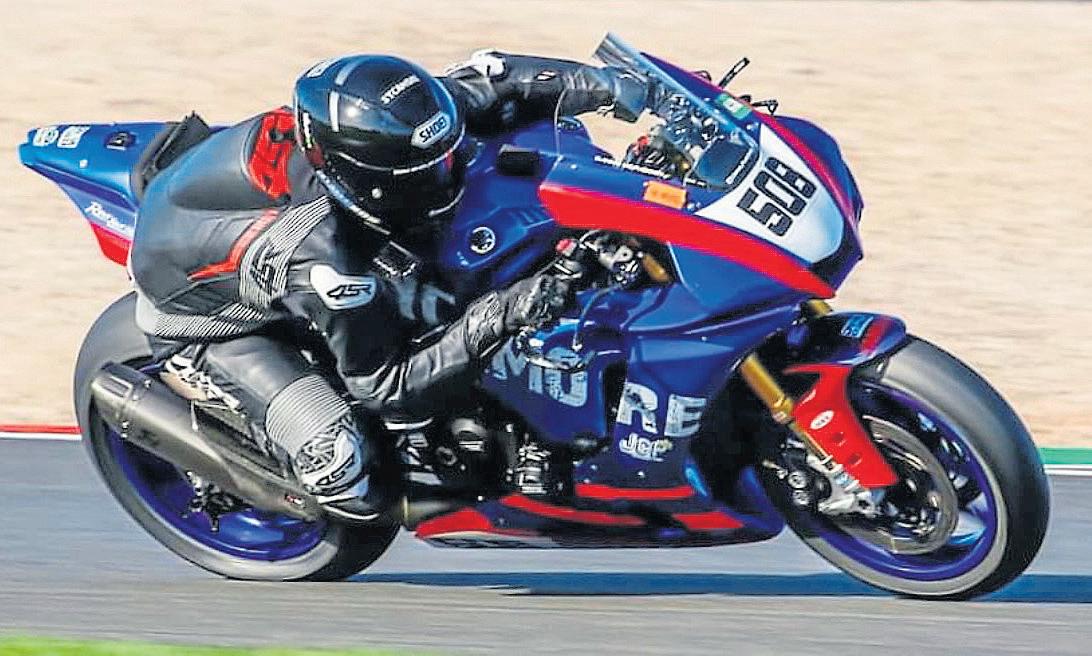
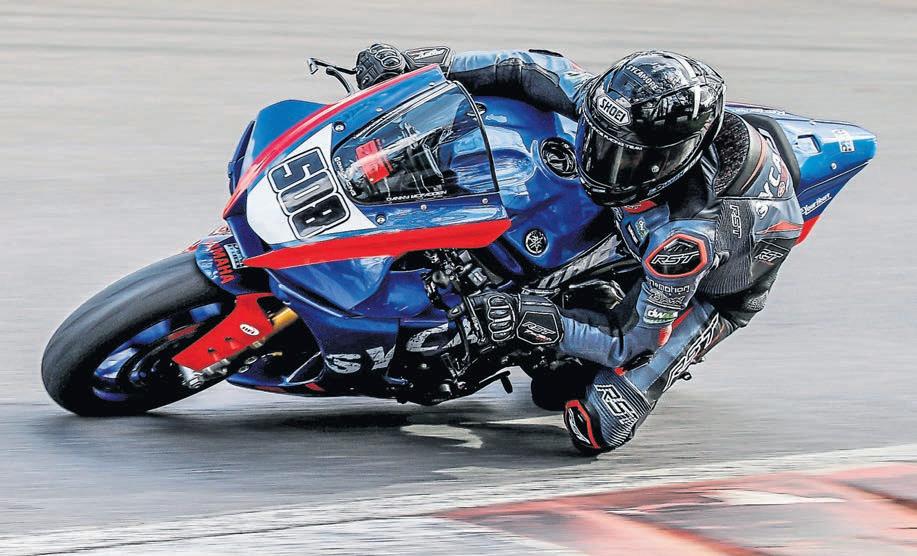
Danny McFadden started racing in 2021, entering the Rookie 1000 grid with British Motorcycle Racing Club (BRMC-Bemsee) where he ended the championship 6th overall after a season of ups and downs, which started with an unfortunate accident on his first track day of the year (one week before his ACU test). It saw him caught up in another rider’s mechanical failure (oil leak) which caused five riders to fall, and ended with Danny taking a trip to Norwich hospital and leaving with a fractured elbow, a totalled bike and riding gear. Not the best way to start the season. It didn’t put him off, though. The accident was the perfect confirmation that he needed to go racing, rather than stick to trackdays.
flag almost certain to follow. On the subject of track days I would like to state that I believe they are a fantastic opportunity for all to enjoy their motorcycle and although they shouldn’t be approached in a competitive way, they inevitably are. This is often where frustrations can build between those who are wanting a safe place with lots space and others trying to push the envelope. It’s at this point I believe a leap into the world of club racing should be made.
PREPARE YOUR BIKE
Scrutineering of both your motorcycle and riding kit opens at the end of the test day and carries on into the early evening, allowing riders to avoid the added rush of another thing to carry out on the Saturday morning. However, it is still available
What does it cost?
on Saturday morning, and is often much faster than on the Friday. I will touch on the basic requirements of scrutineering in my future articles.
BE READY TO RACE
Your Saturday will be made up of a qualifying session and one to two races depending on your class. It might not seem like much, but in reality it’ll see you suitably drained by the end of the day and more than likely completely hooked. The evening will be spent prepping your bike and running through all the ways you can improve your performance ahead of race day. With the conclusion of your first race weekend you will realise that there is a place for all ability levels within the paddock. Outside of the headline top runners of a chosen
While there’s plenty of room for either saving or spending, depending on your budget, it’s worth having a vague idea of what some of the essentials cost.
ACU Test Day
■ £189, Adults / £239, Under 18s
■ ACU Annual Membership
£70
■ Racing Club Membership £35 (club dependant)

Race Meet
■ £285 – Snetterton in March / £499 Brands
GP in summer (The cost will vary based on the time of year and track)
Test Day/Track Day
■ £150
Bike
■ The sky’s the limit here but for the No Limits series you’ll be looking at between £4k-£20k+
Kit
■ You can beg, steal and borrow appropriate kit or you can spend a fortune. Either way, always go for the best you can get your hands on. We’ll be doing a full feature on this.
Danny still managed to complete his ACU test later that week (on a bike borrowed from his brother). However, various issues with a replacement bike tested his resolve throughout his rookie season and taught him a lot about the pitfalls of second-hand bike purchases (which we’ll be getting into in a future article) and how to keep moving forward. 2022 saw Danny enter the Pirelli
Instagram @dannymcfaddenracing Facebook @dannymcfaddenracing Twitter @DanielPMcFadden

class there are dozens of racers all competing with someone, each looking to improve and hone their speed with a new-found focus that only competitive sport can give.
The process of simply putting yourself out there can have very positive mental benefits. Having a goal can provide focus and drive you didn’t know you had. It can help
Super series – Premier class and the ACU Clubman 1000 Endurance class with No Limits Racing, finishing 10th and 3rd respectively over a thoroughly enjoyable season. And now he’s ready for 2023, with the support of Sycamore Yamaha in Uppingham, EBC Brakes, HEL Performance and HelmetCity. co.uk
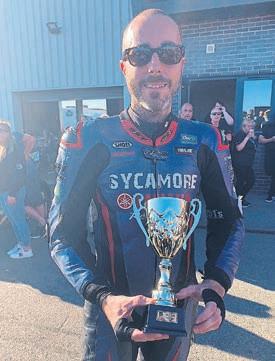
Expect lots more from Danny over the coming issues, and if you’re ever at a Bemsee round be sure to go and say hello. He might even persuade you it’s time to dust of the leathers yourself...
you take that step to get fitter, eat healthier and do everything you can do to gain that competitive edge. It’s also helped me bring the family into my hobby, spending weekends together away from the modern distractions of home, travelling the country together, staying in what are essentially country parks with a race track in the middle. Bliss.
Tyres
■ This will vary greatly depending on which bike class you are racing, your pace and your overall racing objectives. Currently a set of Pirelli SC1s cost £400+ – this will be your biggest expense while racing.
Fuel
■ £60-150 (depending on your class – and don’t forget your generator fuel, too)
Having a goal can provide focus and drive you didn’t know you had
KNOWLEDGE 25



































BUILD IT
Do you build a bike for less and make it your own or buy the exact machine you want… even if it costs a fortune?
POWERED BY
OR BUY IT
Ducati 999
Some teenage boys dream of girls, booze, and getting behind the wheel of a car… I did. But I also lusted after something most of my mates didn’t – in the form of some saucy Italian twins.
To be more precise, I wanted an Aprilia RSV Mille or a Ducati 999. They were the pin-ups of my adolescence, with all the right curves in all the right places, emitting the kind of seductive sounds that made me go weak at the knees. Unfortunately, at 16 years old, an RS50 was as close I could get to these dream machines, but my passion for the aforementioned particulars never faded.
Life’s a funny old game, don’t you think? As I write this – older, fatter, and with a meaty mortgage floating above my head – I
vs
Aprilia RSV Mille
WORDS: Bruce Wilson PHOTOS: Gary Chapman
am having to pinch myself at the situation I’m now in. For those of you who read Fast Bikes regularly, you’ll have probably clocked that three years ago I bought a ‘box of bits’ Mille for £500 from my mate. With the help of my good friends Clive, Rob and Griff at AP Workshops (plus many more good folk), we did something special with that Aprilia... not just resurrecting it from its destitute state, but adding a sprinkling of spice. The aim was to keep the bike’s silhouette the same but to subtly spec it up with contemporary goodness… and the way we went about it meant I never broke the bank – at least not by enough to make my wife notice. At a rough guess, I’d say about £4000 went into that pot, which is what you’d pay for a top-drawer original RSV these days, albeit without all the fancy
stuff on the bike we built, dubbed a Mille ‘CW’, in memory of Clive.
Four grand is a substantial sum to me, but it wouldn’t even get me a tickle if I were to have lunged after the Aprilia’s counterpart – Ducati’s 999. It might not have been everyone’s cup of tea back in the day, but it’s a model that brought huge success to the brand on the track and is one of the most winning models the Bologna boys and girls ever produced. To me, it brings back fond memories of Hodgson, Toseland, Xaus, and so many others scrapping hard on the World Superbike scene, plus the likes of Lavilla and Haslam at home in BSB. That thing won races and championships galore but somehow flopped in the showroom. Call me weird, but I’ve always considered
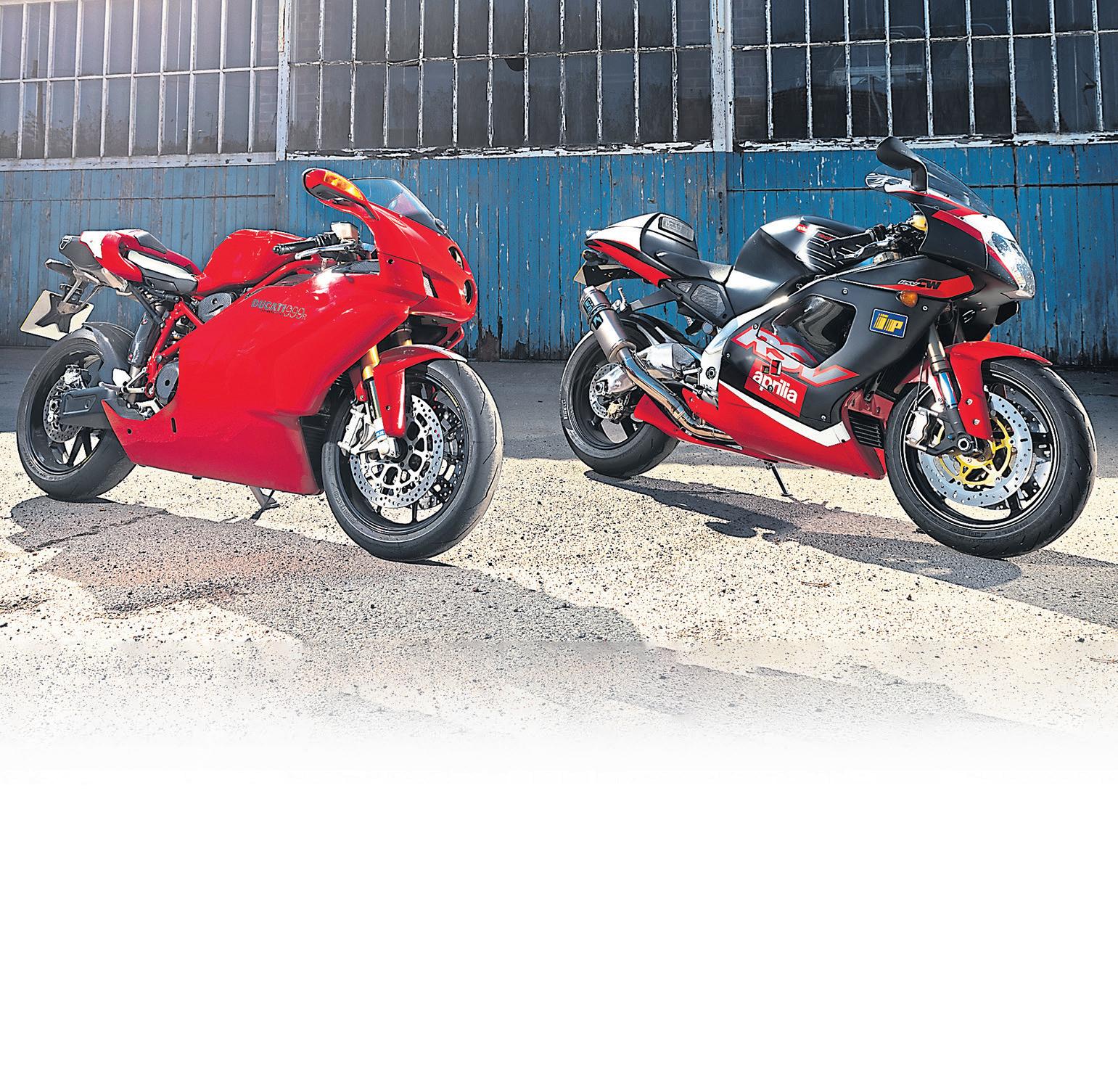
it one of the best-looking motorcycles ever made, and I think more and more people are warming to that idea as prices are sky-rocketing even for the base model machines. And if you’re inclined to purchase one of the fruitiest examples out there, the 999R, you’ll need to have about £15-20k kicking around under your mattress...
For me, the question is whether the huge investment in the Ducati is worth it or if going about building your own trick bike, such as my Aprilia, for a fraction of the cost is the better thing to do? Do you build it or do you buy it? It’s a massive question, up there alongside the best way to save the planet or how best to get red wine out of a white carpet? I don’t have the answer to the latter ones, but here’s what I reckon on the bikes…
RETRO RIDES 27
BUY IT: Ducati 999R
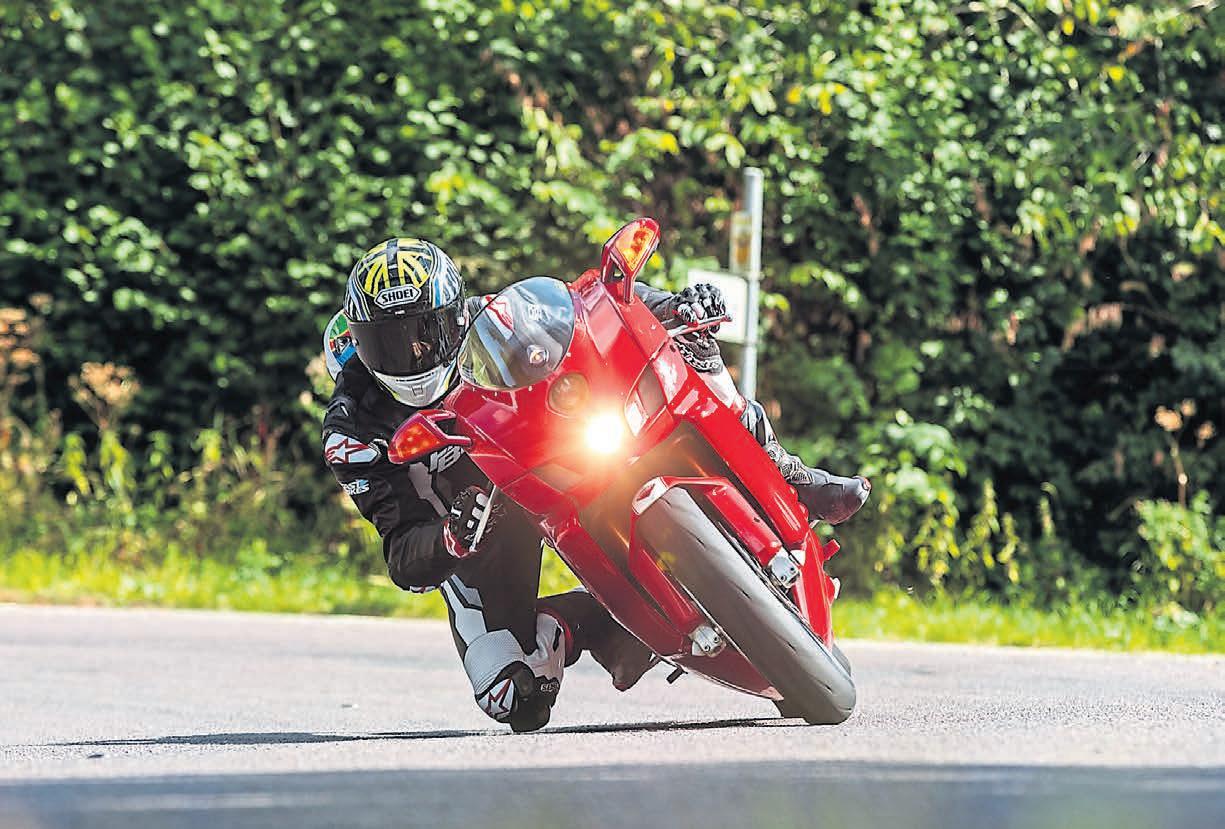
I sat down to take a moment, listening as I did to the click-click-click of the 999R’s cooling hot metal. Having tested bikes day in, day out for almost 20 years, you can become numb to some experiences. Some bikes just don’t stand out, warm your cockles, or make you plot what you’d have to sell on eBay to fund a new addition to your addiction… but this Ducati was different. I wanted it. I needed it. I was instantly feeling withdrawn from it, trying to figure out how a 15-year-old motorcycle could deliver the mesmerising joyride I’d just absorbed. What was meant to have been an hour-long inaugural blast had lasted for four, consuming a tank of fuel in the process and making me feel even happier than the bloke who invented beer (…and he must have been a happy chap). I was all warm inside, largely owing the immeasurable amount of heat from the underseat exhaust that’d been roasting my inner thighs like a pig on a spit roast, but also thanks to the tangible pleasure the 999R emitted. However good I’d expected it to be, the reality was several times greater.
Staring at the bike with my heart rate slowly recovering, I couldn’t help but feast on the beauty before me. What Ducati did, not long into the Noughties, was to rewrite the rule book on what a sportsbike should look like… in much the same way the 916 did a decade or so earlier. Unfortunately for the 999, it turned out that people weren’t ready for such a drastically different design, and that fact bit the bike on the botty as far as showroom sales were concerned. The machine’s flat profi and futuristic angles, with slit-trench-like wings, was too much for some – but not me. Call me perverse (you won’t be the first), but I’m a massive fan of its huge and unadulterated side fairings, and the stacked headlights are right up my street. As for the rear end, who doesn’t love an underseat can or a fancily fluted double-sided swinger? Different it might be, but it’s far from ugly.
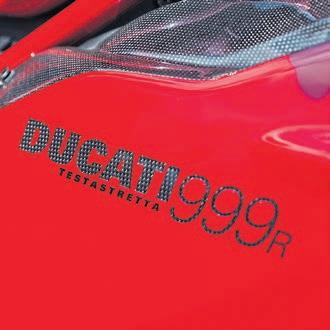
In the case of the R, it scores more bonus points thanks to the subtleness of its sexiness. Underneath the characteristic Ducati red paint is pure carbon fibre bodywork, but you wouldn’t know that from a distance – the only giveaway are the unpainted
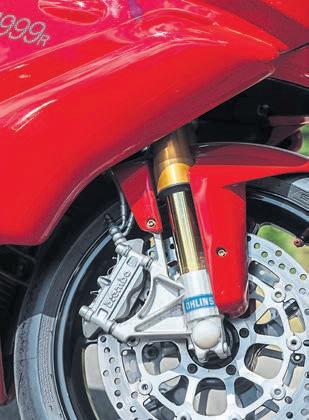
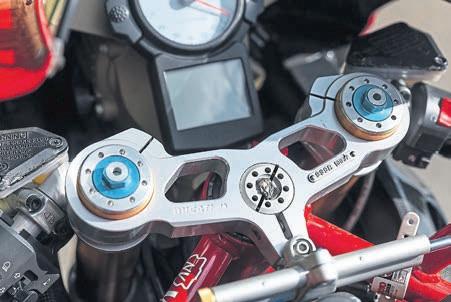
areas that double up as the bike’s graphics, showing the carbon weave in all its glory. Maybe they should have made more of a fuss about it, but perhaps they didn’t need to? The presence of the Corse logo on the front mudguard is statement enough, and if you scan your eyes a little more you’ll soon pick up the hallmarks of a machine that won three world titles. It’s dripping in the good stuff, with radial monobloc Brembos and an accompanying Brembo radial master cylinder to ensure there’s no hold-up in the stopping process. The suspension is no less of a headline act, sporting trick Öhlins front and rear, and then you’ve got the Termi system on this thing that’s assured to win your neighbours over when you start the bike at the crack of dawn. You’ll probably not see the adjustable headstock, but it’s there, as are the two-position footplate hanger mounts that allow you to raise or lower the pegs according to your lankiness. The carbon hugger is simply nice, and the same goes for the magnesium front sub-frame that harbours the basic half analogue/half digital Magneti Marelli stacked clocks. And then you’ve got the STM dry clutch that’s hidden away behind even more carbon fibre… or at least until you start the motor and its jangling demeanour makes it impossible to ignore. You get the point, this motorcycle is not lacking in bling, and I’ve not even started on the engine’s internals that includes titanium valves and conrods. Of course, all of this glitz came at a price, with the model hitting the scene at an eye-watering £20,000 when new – a good average for what you’d need to fork out to own one now. Get lucky and you might be closer to £15,000, but for a version like this one, that’s absolutely mint and has only 2500 miles on the clock, you’ll probably be looking closer to £25,000. Bottom line – it ain’t cheap!
For the same amount of wedge you could become the proud owner of a brand-new Fireblade RR-R SP, S1000RR M-Sport or Aprilia RSV4 Factory. Bikes that are so much more powerful and technologically advanced, and don’t require a new timing belt every two years – whether you ride it or not.
It was easy for me to overlook the pricing and ownership costs of this bike because it is not mine
– it belongs to my good mate Alan. He kindly wheeled it my way and told me to go and enjoy it, which is exactly what I’ve been doing all summer long.
To sit on, the Ducati feels long and low, with the rider nestled nicely behind the stunningly-sculpted tank. It feels ridiculously narrow between the knees, and the reach to the bars isn’t awkward in the slightest, though you might want to think again if you’re more than 6ft tall, as the pegs do encourage a bit of contortion of your legs – God only knows how Xaus hacked it. All is forgiven the minute you get moving. The L-twin pulls potently from the bottom, propelling you forward with the kind of urgency that’d leave some modern sportsbike in tears. It might not make 200bhp up top but it can hold its own setting off from the traffic lights. The spread of power is quite linear and the fuelling is more than fine, never feeling flat or fluttery. Simply twist the throttle and it goes like you’d hope it would, and best of all is the fact it doesn’t hunt like newer twins or V4s do when you’re cruising through town at 30mph. And the higher up the revs you go, the less enthusiastic the motor feels, with peak power being achieved just below 10,000rpm.
From a pure rider’s point of view, the set up is intoxicating and massively rewarding. The bike burbles and barks, shakes and stutters, letting you know that it’s very much alive. But its crowning jewel is the way it handles. I don’t know the history of this bike, so have no idea whether someone’s fettled with the Öhlins suspension, but I was blown away by the plushness that seemed to hug all but the roughest of the surfaces. It also proved to be a very responsive and agile bike, never really needing any muscle to place it where you want.
In reality, the handling is just one of the many elements that makes this bike so special. It looks the part, goes like the clappers, and sounds sensational. It’s the whole package and it’s undoubtedly only going to become more sought-after as time passes and people come to realise what a wonder weapon it really is. Luckily for me, I clocked that fact aged 16. Now all I need is a lottery win.
28 RETRO RIDES
RETRO RIDES
What makes the 999R so special?
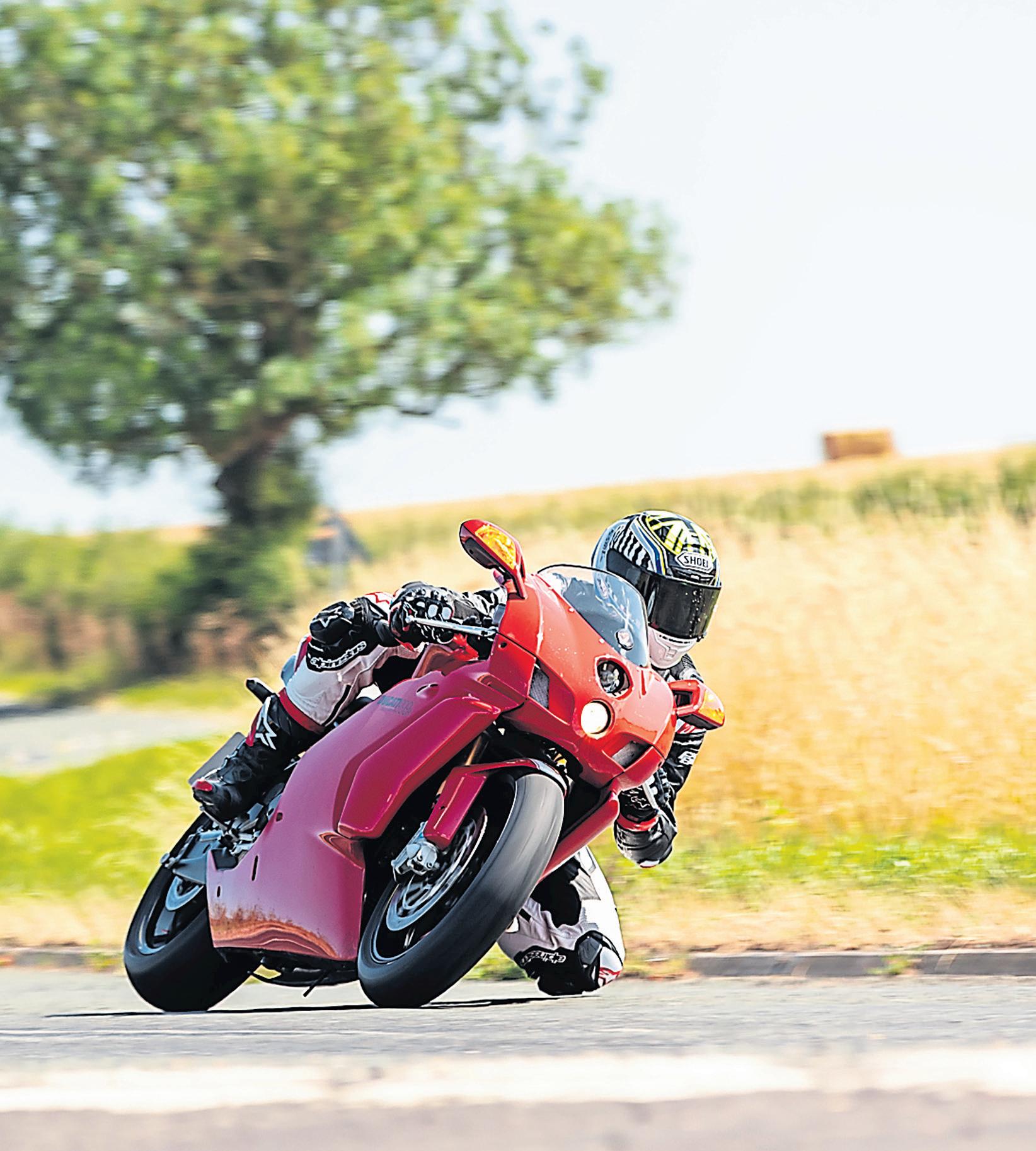
Many view the Ducati 999 as a failure due to its poor showroom sales, but it was actually one of Ducati’s most successful World Superbike racers ever – demonstrating that sex sells, not results! In fact, it won almost twice as many races as the closest 916-derived sibling and during its five years in WSB the 999 took 63 race wins, while the 998 only managed 34 wins in four years on track. Not only that, the 999 took three WSB titles with Troy Bayliss, James Toseland and Neil Hodgson all claiming championships. And, even better, during the 2003 championship, Ducati won every single race that year (24 races) with factory riders Neil Hodgson
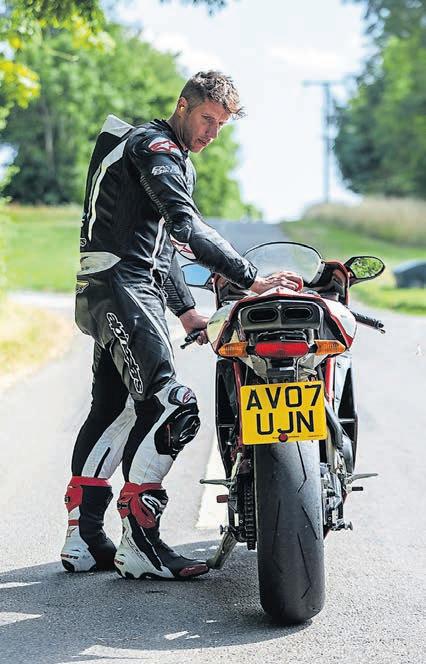
(13 wins) and Ruben Xaus (seven), decimating the field on their 999s and the only non-999 wins coming from 998 riders Shakey (two wildcard wins), Pierfrancesco Chili (one win) and James Toseland (one). So dominant was the 999 in 2003 that it forced WSB’s organisers to rethink the new rules as the litre inline four bikes, which were allowed to race in 2003, couldn’t match it! For the 2004 season the litre bikes were no longer saddled with restrictors, not that it really mattered as the 999 took all bar four race wins and James Toseland narrowly defeated his factory Ducati teammate Regis Laconi to the title with Haga finishing third – on a 999, naturally…
TECH SPEC
Ducati 999R
(2003-2006)
Engine Type: 999cc, liquid-cooled, 8v, desmo V-twin
Bore x stroke: 104 x 58.5mm
Compression: 12.3:1
Fuelling: Electronic fuel injection
Claimed Power: 139bhp @ 10,000rpm (2005: 150bhp @ 9750rpm)
Claimed Torque: 112Nm @ 8000rpm (2005: 116.7Nm @ 8000rpm)
Chassis
Frame: Steel trellis
F Suspension: 43mm Öhlins forks, fully adjustable
R suspension: Öhlins monoshock, fully adjustable
Front brakes: Four-piston Brembo radial calipers, 320mm discs
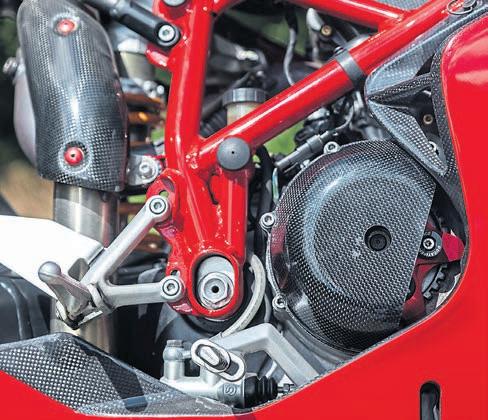
Rear brake: Two-piston Brembo caliper, 240mm disc
Dimensions
Wheelbase: 1420mm
Seat Height: 780mm
Dry Weight: 181kg (claimed)
Fuel Capacity: 15.5 litres
29
BUILD IT: Aprilia RSV Mille CW
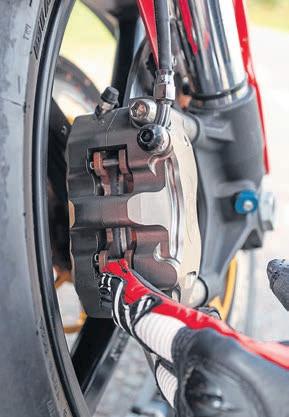
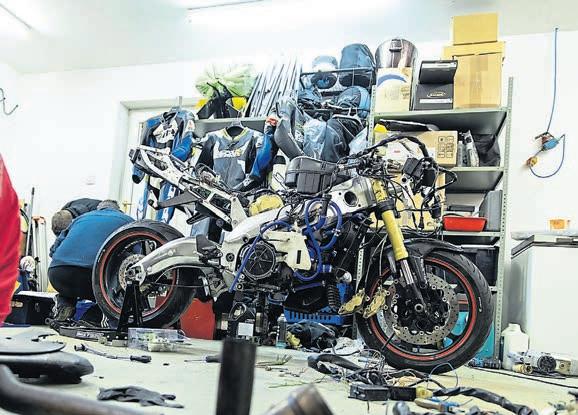
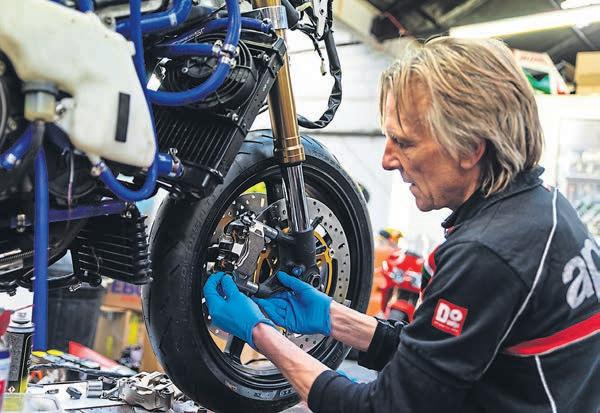
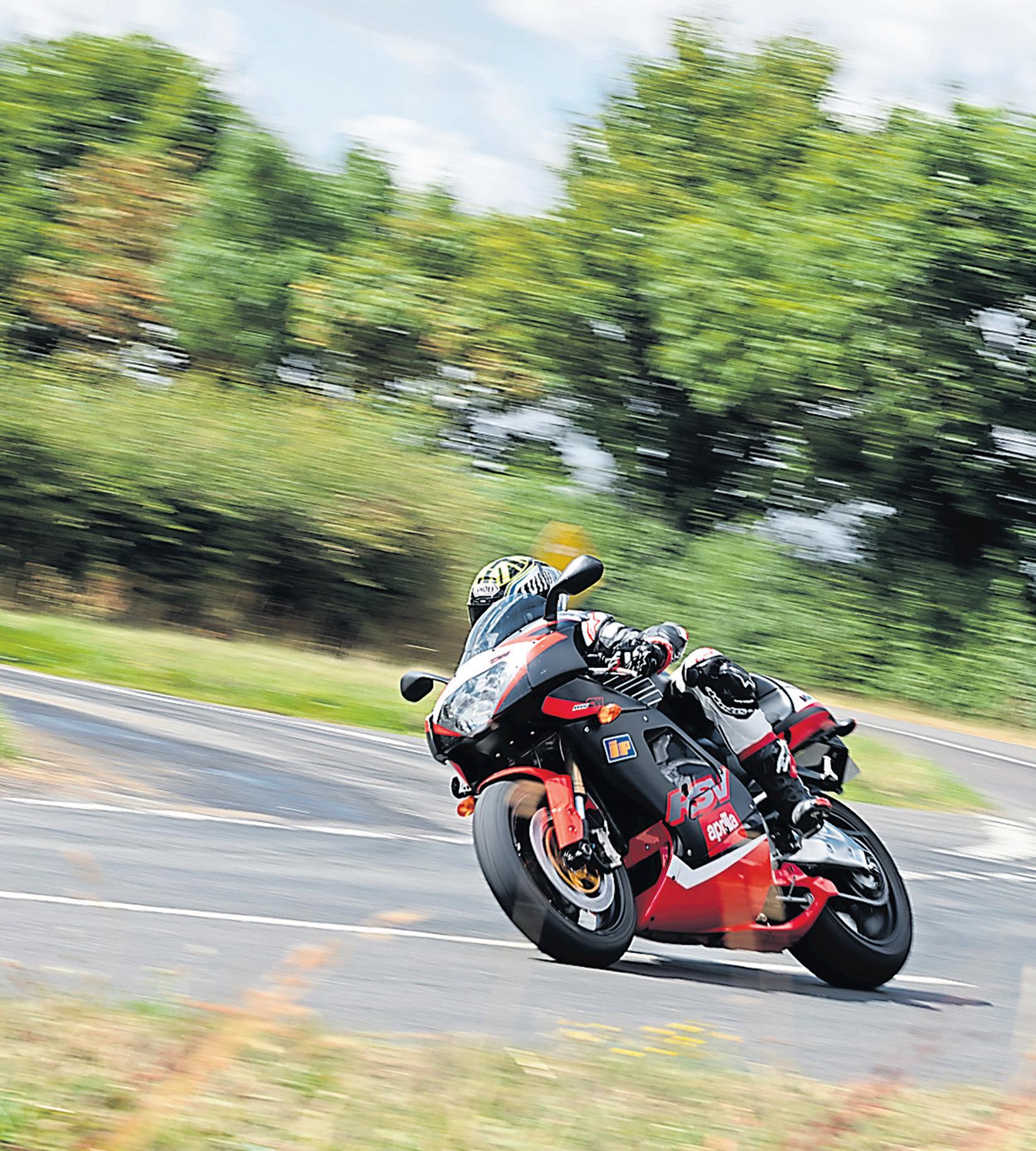
Buying an RSV Mille
Prices from £2000 to £5000
A well looked-after RSV is a very reliable bike. However, they have a few irritations that, if not dealt with, can make them a bit of a nightmare. All pre-2005 RSVs use a 50AMP starter solenoid, which is known to fail, so fitting the later 150AMP and also upgrading the 90CCA battery to a 230CCA unit is recommended to help preserve the sprag clutch. The sprag clutch is the V990 motor’s major weakness; any slipping or squeaking when the starter is hit hints at a worn unit, which will cost about £350 to replace. Other than this, the motor is very reliable, although out-ofbalance throttle bodies can make the bike very snatchy to ride at low revs. On the chassis front, watch out for damage to the swingarm and frame (always HPI check an RSV as Cat-D write-offs are common) and also watch out for a Mille made to look like an R through secondhand parts. If the bike is a pain to get into neutral, swap the clutch jet from a 0.60 to a 0.40 (which was the standard fitment on post-2006 models) or fit an aftermarket slave cylinder. When it comes to a non-working rear brake, use rearsets to locate the brake master cylinder vertically rather than horizontally. A lot of owners boost the RSV’s performance through an airbox conversion, lower its gearing (the speedo isn’t affected) or fit a scavenger exhaust system – all of which are excellent and very cheap modifications. Just watch out for ex-track bikes; without a proper slipper clutch (the OE Aprilia unit is a pretty poor pneumatic back-torque limiter), aggressive downshifts can bend valves.

30 RETRO RIDES
In theory, my Mille project was doomed to fail like the many other special builds I’ve attempted in my time, but with a carrot so juicy and a price tag of just £550 dangling before my lustful eyes, it was worth a roll of the dice. Three years later and knowing what I know now, I don’t regret that initial decision one bit... but I should add that brute ignorance and other folk’s kindness have powered the project along. If it weren’t for the support of so many good mates, especially Clive White, the Mille would still be resembling the aftermath of a jigsaw puzzle my one-year-old had attempted – not a pretty sight. They didn’t just help me bolt bits together but also steered the project, coming up with creative ways to better the bike without robbing it of the soul that so many people, including myself, know and love.
There’s no denying that the machine the Noale factory released around the turn of the second millennium was a winner from the get-go, and I’d have been more than happy to own a bogstock RSV. Given the chance to do something a bit different, I decided to head off into uncharted territory with little more than hope and goodwill on my side. The goal with the build was twofold: to get it up and running again, and to spice it up with better, contemporary components, such as the USB KYB forks it has fitted, plus
tandem with radially-mounted HEL calipers. The bracing of the swingarm was far from necessary, but just like the latter year’s body kit that beautifies this first-gen gem, I’m pleased it’s on the bike.
If you’ve followed this build you’ll know that no stones were left unturned. Engine work and mechanical fine-tuning were just some of the graft undertaken by Griff and the guys at AP Workshops, while my mates Rob and Craig spent an unholy amount of hours machining parts to make the trick bits of the build fix to the original mountings. And then there’s the paint job, which was originally planned to be so very different, but with Clive’s passing it seemed wrong to pursue a dream we’d crafted together. Standard it would be, and I have Paul at The Project-X Channel to thank for the finish it now sports.
Griff and his gang were instrumental in the build the whole way through, and they also saw it over the finish line at a time when I was just about ready to give up and leave it in the corner of my garage to collect dust. I’m so very glad that’s not how this story ended. MoT’d, taxed, and sporting a full tank of fuel, my very first ride was beyond memorable. Just starting the motor, listening to the deep burble of the big twin through the Pipe Werx stubby end can, gave me goosebumps.
The engine, on the other hand, might have had something to say. The closeness of the cylinders means it doesn’t take long for the temp to get toasty, so a deserving blast was in order. Milles are monsters of torque –or at least, that’s how the motor makes it feel. In truth, they produce about 100Nm, but the way they pump that poke out, right from the bottom of the rev range, exaggerates the sensation.
The first ever Mille I rode was back in 2018 and it blew me away. This – my very own RSV – felt even sweeter, arguably down to the carefully balanced and fuelled cylinders, made all the punchier by the fitment of AP Workshop’s special airbox kit, plus Red Rats’ modded headers and the correctly defined EPROM.
The actual engine itself is standard, and it’s the small-valve version at that, but there’s so much to love. The smoothness of the pick-up is something else... and the way the bike shakes and shudders, without a hint of annoyance to the rider, adds so much character to the experience.
This thing’s got table manners by the boat-load, made all the sweeter by the cable-operated throttle that governs this first-generation fuel-injected masterpiece; the pick-up is instant and precise. The Aprilia was way ahead of its time, which is perhaps one of the other reasons why I like this bike so much, and why more and more people are investing in Milles of their own despite the ever-hiking prices.
Yep, engine-wise, there was nothing not to like – but how would our hacking around of the geometry have affected the bike? For clarity, we kitted the machine with bigger bore Kayaba USB forks from a 2010 GSX-R 600. Rob got his hands on some adjustable offset yokes and they were adapted to link the legs to the frame. The other tweak made was to the rear linkage that gained the later first generation’s triangle mount, plus the accompanying newer rear shock found on 2001-2003 versions. Don’t ask me what difference it made, but Griff said it was the right thing to do, so that’s what we did. The
changes made, front and rear, have meant that the wheelbase is actually a bit shorter than standard but not enough to write home about, being 15mm lesser.
The damping, on the other hand, is night-and-day different, with the forks being more than a decade newer than what originally came on the Aprilia. We set the ride height the same as what it would have been on the stock machine, both front and rear, but there’s no denying that for some strange reason my Mille feels a little more lethargic in the handling department than the Mille R I rode way back. Nothing’s bent, so it’s probably just a case of needing a bit more ride height on the rear shock, or dropping the forks through, to help the bike turn.
The good news is that the stability of the Aprilia felt faultless from the get-go. Being so tall, the Mille requires a bit of a workout to get the thing hustling, but that’s a trait I quite like. This right here is a dream being played out; I now own the bike I’ve always wanted – and this particular model couldn’t be any more special or sentimental if it tried. It’s a keeper, literally, and a very special one at that.
TECH SPEC
Aprilia RSV Mille CW
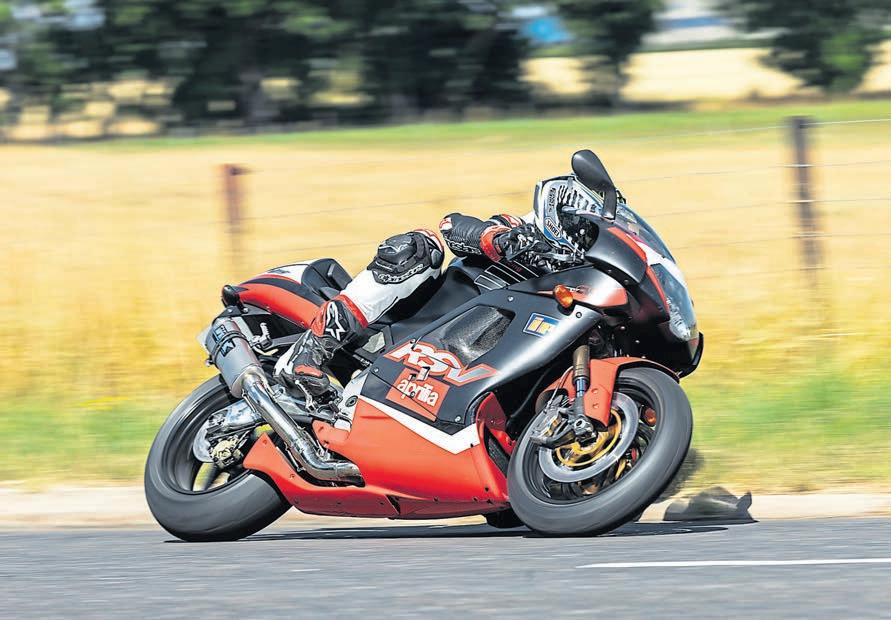
Engine Type: 998cc, liquid-cooled, 8v,V-twin
Bore x stroke: 97mm x 67.5mm
Compression: 11.4:1
Fuelling: Electronic Fuel Injection
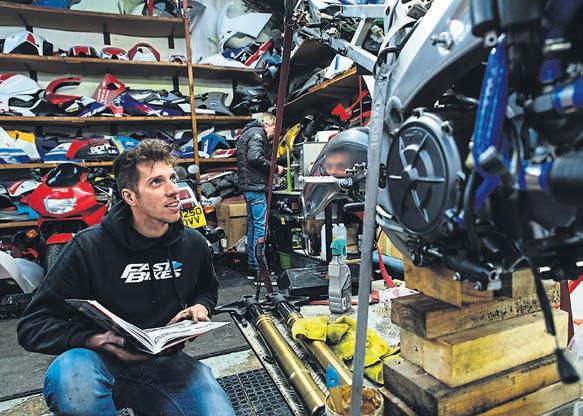
Tested Power: 120bhp @ 10,000rpm
Tested Torque: 99Nm @ 8600rpm
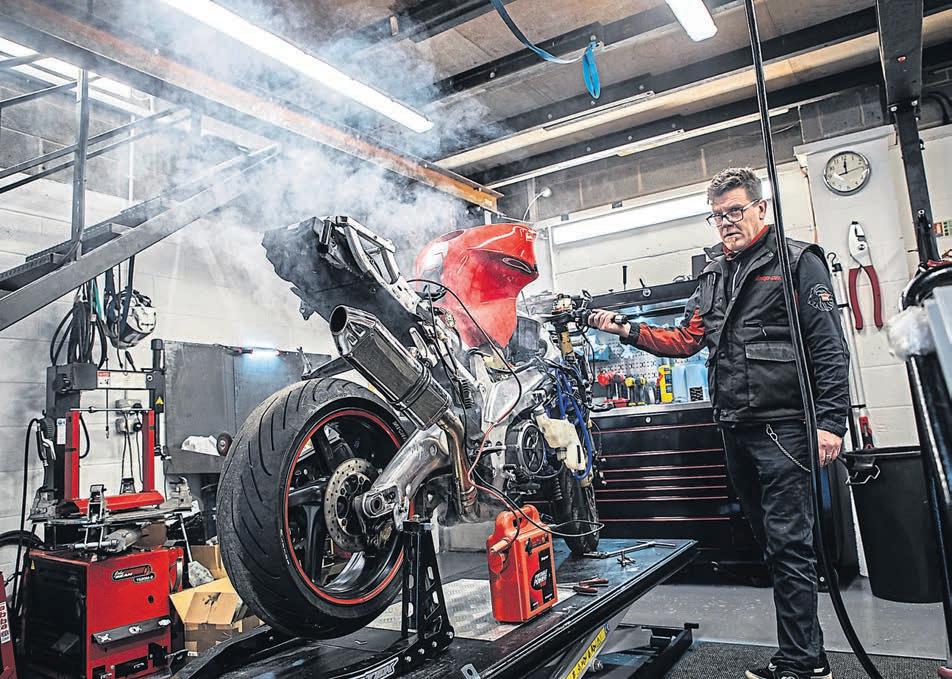
Speed 0-60: 3.68 sec
0-100: n/a
0-150: 18.51 sec
Stg ¼ mile: 11.52sec @ 130.67mph
Standing mile: n/a
Top speed: 168.3mph
Chassis
Frame: Aluminium twin spar F Suspension: 43mm USD KYB forks, fully adjustable
R suspension: Sachs monoshock, fully adjustable
Front brakes: HEL four-piston radial calipers, 330mm
EBC discs
Rear brake: Two-piston caliper, 220mm disc
Dimensions
Wheelbase: 1400mm
Seat Height: 825mm
Dry Weight: 189kg
Fuel Capacity: 20 litres
31
RETRO RIDES
This test wasn’t just about money. Sure, the way in which I went about building the Aprilia probably saved a pretty penny, but the bigger picture was having the chance to own something special, something that reflected me and my decisions about what I wanted in a bike. It was a process that evolved with time and ended up quite different to my inaugural vision, which makes the bike even more special. What it lacked in monetary terms, it cost me in time, graft, and plenty of head scratching... which is all part of the process and I couldn’t be happier with the end result. It’s not perfect, but the great thing with a project is that it’s indefinite. I’ve already taken three years to get the bike this far, so there’s no harm in taking my time to finely tune it over the next handful of years or so. After all, it’s not going anywhere.
I wish I could say the same about the 999R, but that machine is borrowed and my time with it is limited. Unlike the Mille, the 999R was already born special, and it would genuinely be tricky to better it without inflicting a raft of contemporary electronics on the beauty – and I would consider that sacrilege. What came out of the Bologna factory was pretty much perfect and it still feels an absolute weapon all these years later. From the way it looks to the way it handles, it’s a hard bike to knock. My only criticism is the price tag… but that’s more a reflection of me and my cash flow than anything. Truth is, if money wasn’t a factor and I didn’t have the emotional attachment that I do to the Mille, I think I’d be drawn to the Ducati over the Aprilia. It hurts me to say that, akin to telling my wife that she’s less goodlooking than the lady next door, but it’s the truth (I hope she’s not reading this). The Ducati is the finished product, highly honed and exceptional to experience, whereas the RSV still has a good few teething problems to get on top of, and even then, set up to the best of my ability, it simply wouldn’t be able to match the red rocket in any single characteristic. For all the tea in China, I’m unlikely to ever afford the 999R without putting the kids on a strict porridge and rice diet for a few years to help in the saving-up process, and I don’t think I’ll get away with that. But I don’t feel too sad, because what I’ve got in the Aprilia is special in its own kind of way and I’ll cherish firing that thing down my local backroads on each and every occasion. Perhaps making something makes that item more valuable than the cash required to buy something saucier from a showroom… if that makes sense?
I should probably add that it’s unlikely I will ever attempt a project bike again after this... not least of all because I’ve asked so many favours from folk with the Mille that next time I need help, the answer’s likely to be ‘no’, but also because it consumes you in a way that you’ll only grasp once you get stuck into one. To conclude, I know now my next bike is going to be bought, not built, and unfortunately that means the likes of the 999R is going to be firmly off my radar, so I had better make the most of it while I’ve still got it.
GOT THE NEED FOR SPEED?
If you like your bikes quick, your news meaty and tech features full of pub ammo, you need a bit of Fast Bikes in your life. With the UK’s biggest group tests, top-notch bike reviews, track guides, workshop wisdom and exclusive interviews with racers, engineers and two-wheel legends, it’s the only place to go if you’re a self-confessed sportsbike junky like us.
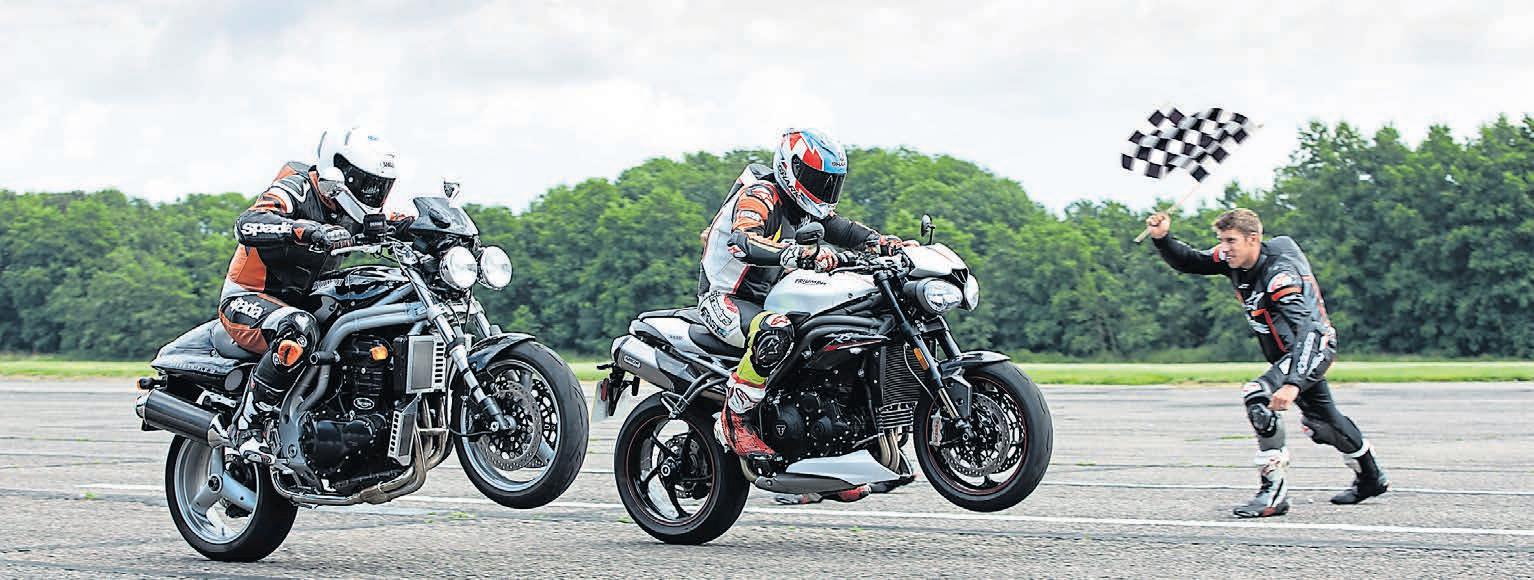
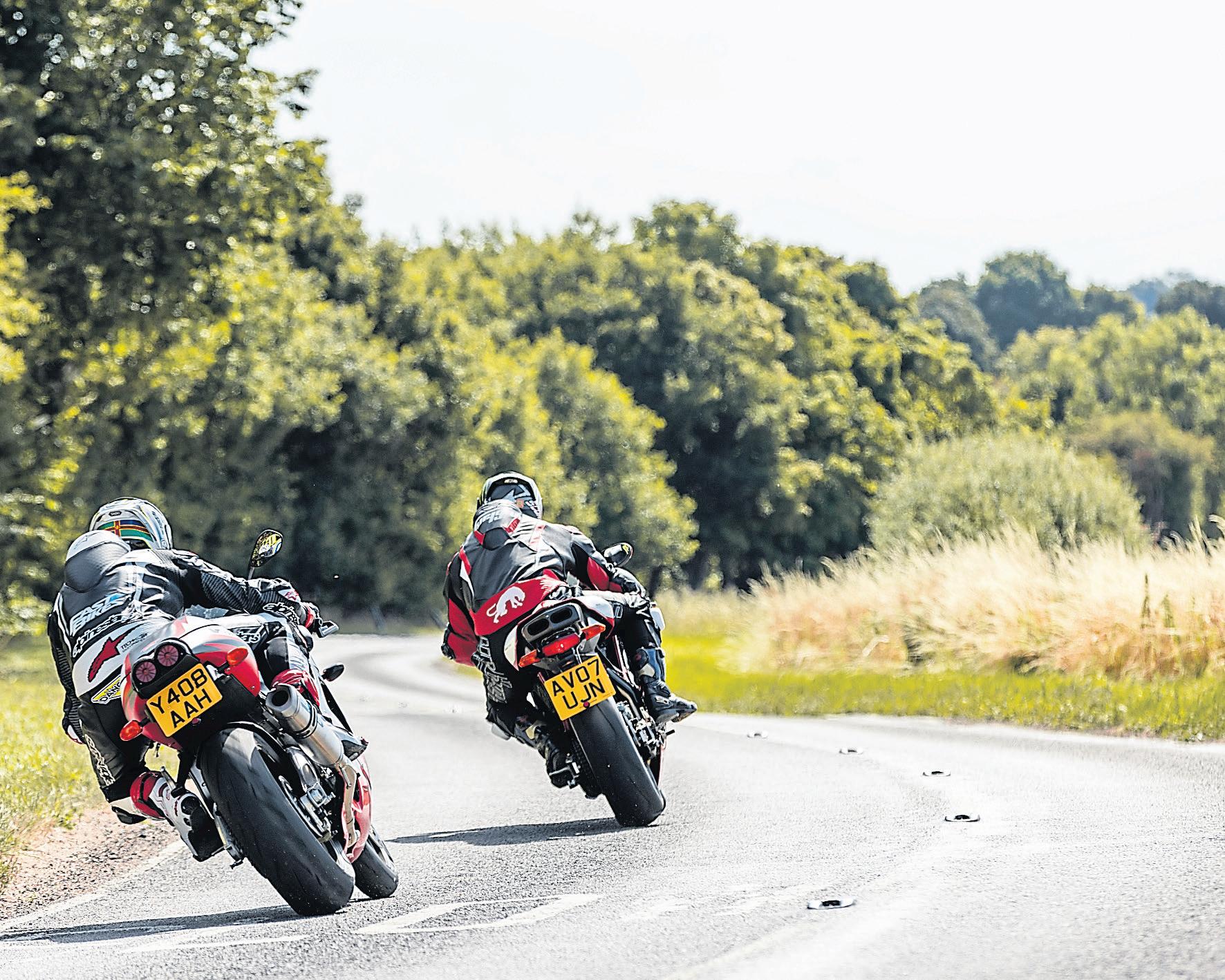
To make it super-easy to bag a copy, just scan the QR code here and you’ll be transported to the Fast Bikes shop where you’ll be able to get your hands on back issues or pre-order next month’s copy before it goes in the shops. It’ll cost you less than the price of a posh pint and you’ll be treated to reams of top-quality motorcycle content that you can’t get anywhere else. For those without a smartphone, all you’ve got to do is tap www.classicmagazines. co.uk/fb into your browser and you’ll be well on your way.

32 RETRO RIDES






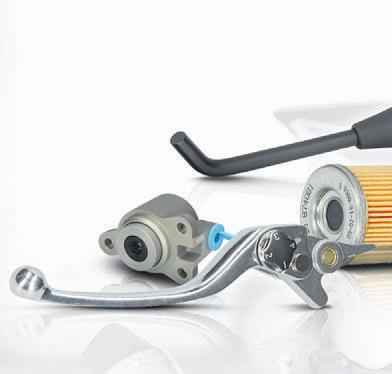




















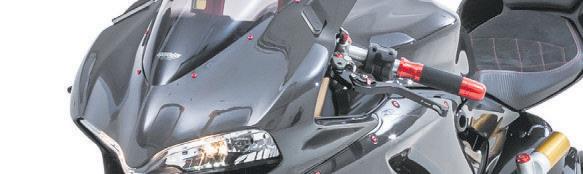
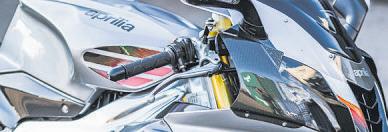










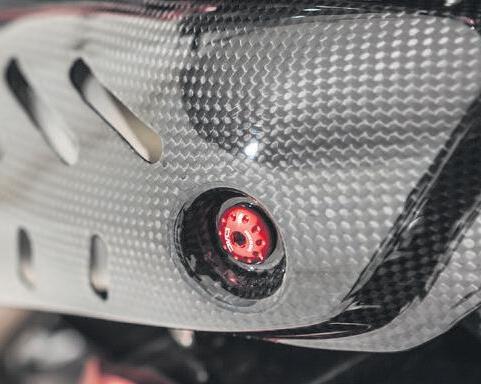





















CORNERING
How to negotiate bends smoothly, confidently and efficiently
WORDS: Mikko Nieminen PHOTOS: Gary Chapman
MB: How can we tell how severe a corner is?
Ryan: As always, reading the road is a defining skill. The rider’s ability to gather the right information, early, and in the right detail, will determine the speed it is safe for them to ride through a bend.
The rider should see the bend as soon as it is visible to the naked eye. This might be half-a-mile or more away. But registering that there is a bend early is the first step. Now it is on the rider’s ‘radar’, and as they get closer, they will start to pick up warning signs – chevrons, road markings, the presence of other hazards, and cross views. They will see which way the bend appears to be going, its severity, and if it is a single or double bend.
On initial turn-in, they will still be searching for road surface information, opposing traffic, and for tell-tale signs that the exit is opening up. Finally, they will identify where they want the bike to exit the bend based upon what is coming next.
MB: And where should we be positioned?
Ryan: At the most basic level, positioning for bends is about extending the view of the rider. This involves moving to the left on the approach to a right-hand bend, or moving to the right on the approach to a lefthand bend.
But, in the real world, there are many more variables to consider such as road surface, camber and condition, which may dictate a different line; other traffic behind and ahead, especially oncoming traffic on left-handers; the view across or through the bend, which could lend itself to an improved line; the speed of the rider, which may not necessitate an extended view; other hazards, such as actual or potential for pedestrians on country roads; and even at a modest 50mph, if an oncoming vehicle is also travelling at 50mph, the closing speed will be 100mph, leaving little – if any – time for either rider or driver to make corrections if they are on a collision course.
MB: So, how do we choose our speed?
Ryan: The technique used to enter a bend at the fastest speed possible differs from that required to cruise through the bend at a leisurely pace. We also need to consider that it is rarely the severity of the bend or the capability of the bike that limits the speed on the road, it is almost always the need to be able to stop on our own side of the road, in the distance we can see is clear.
There is no one speed for any one bend that is the correct speed to achieve this. Stopping distance will depend on reaction time, which will depend on the rider’s ability to read the road. Braking distance will depend on the machine control skills of the individual rider, the road surface condition, the machine characteristics, and lots of other factors.
As individual riders, we must develop an ability to read the road ahead and accurately assess safe entry speed relative to all of these variables. As we develop our observation, interpretation, planning and machine control skills, we will be capable of improving safe entry speed.
How do we assess entry speed? There are many ways we can assess the severity of a bend and the appropriate entry speed. Cross views can often allow us to see the direction of the road, sometimes several bends ahead. The speed and position of other vehicles entering or exiting the bend can also give valuable insight into the nature of the bend, as does the presence of warning signs and chevrons, etc. As a general rule, the more paintwork and furniture, the more severe the bend. Another tool which many riders find helpful in assessing the speed of entry is known as the Limit Point.
MB: What is the Limit Point?
Ryan: Also referred to as the ‘vanishing point’, the Limit Point is the furthest point a rider can see into a bend where the nearside kerb appears to meet the far kerb
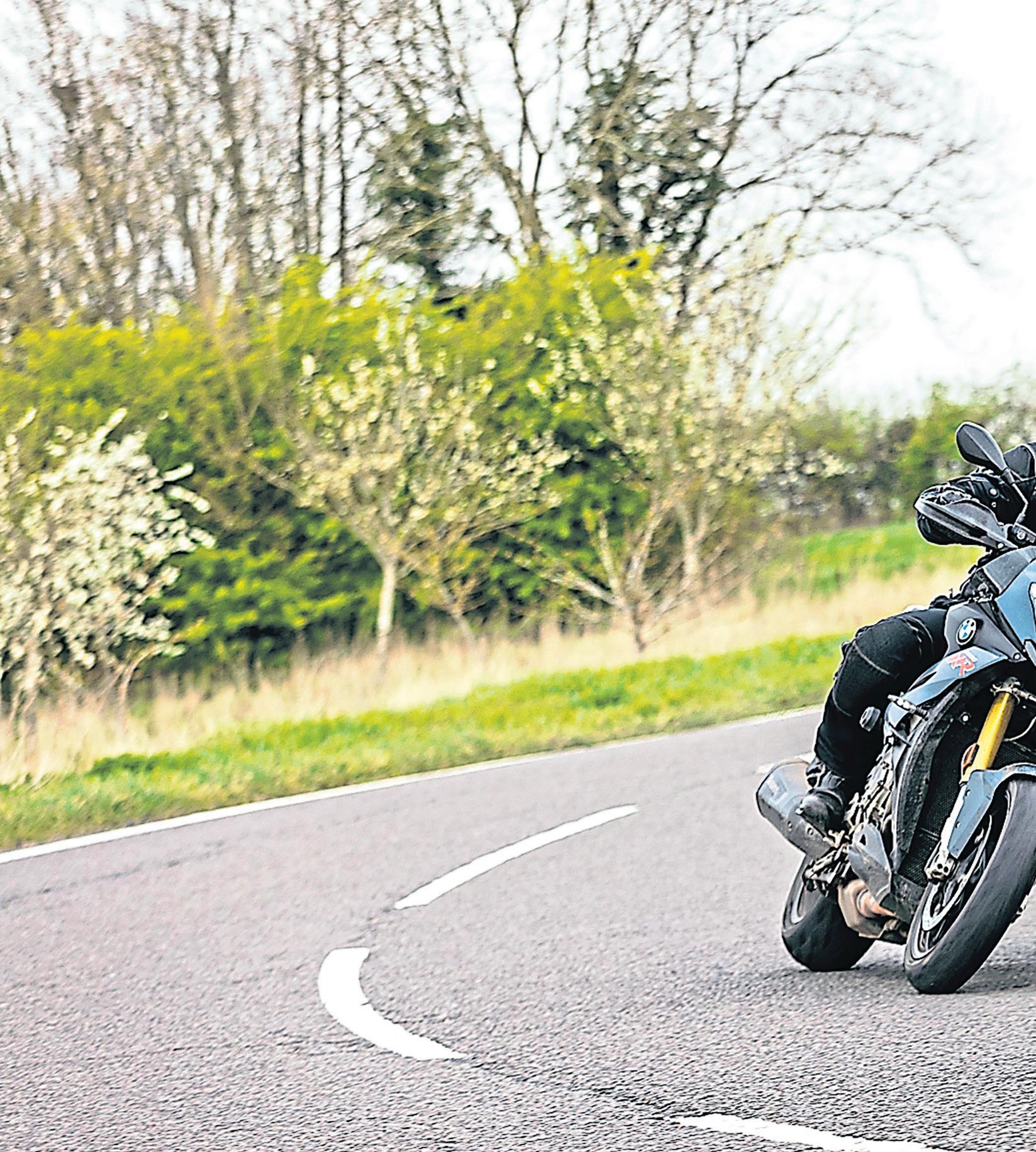
from the rider’s viewpoint. It gives important information about the severity of a bend. If we are approaching a bend and the Limit Point remains static as we are closing towards it, the bend is likely to be tight. The longer it stays static, or worse, appears to be moving towards you, the tighter the bend is likely to be. If the Limit Point is moving away from us as we approach from a distance, it is likely to be a fairly loose bend.
The technique to negotiate the bend using the Limit Point is this:
■ On the approach, for as long as the Limit Point remains static and we are moving towards it, we slow down.
■ Once the Limit Point begins to move away from us at the same speed we are approaching it, we are at the correct speed.
■ Once we are in the bend, and the Limit Point starts to move away from us faster than we are approaching it, the bend is opening, and we can begin to consider rolling on the throttle.
■ A word of warning about the Limit Point, however. Do not get fixated on it – it is only one tool and doing so will stop you searching for other information which you may need.
MB: And what about gear selection?
Ryan: Gear selection should clearly relate to engine speed. Too high a gear will result in a wallowy ride through the bend with limited ability to control speed. Too low a gear will prevent positive exit drive. The right gear will offer good control and great exit drive. And the circumstances will not only dictate our gear selection, but also throttle control as well.
MB: So, finally, what are we doing with the throttle whilst cornering?
Ryan: Cornering throttle control is an essential skill in expert cornering. There are three distinct phases in cornering that require differing throttle application: entry, mid corner and exit.
The ideal throttle position at corner entry depends on how challenging the corner is. In an easy, rolling bend, where the approach and exit speed are similar, it is often best to keep the throttle rolled on at the entry stage. This balances the demand for traction between both tyres; removes weight transfer out of the cornering equation; settles the suspension at its most efficient point of travel; and keeps ground clearance to its maximum. However, in a more challenging corner, where the bike is working harder (such as a tighter or off-camber bend), it can be better to enter the corner throttle off. This increases weight on the front tyre (and therefore increases traction at turn-in) and improves the steering geometry of the bike, making it easier to steer accurately, quickly and more tightly into the corner.
Whichever throttle approach is taken at corner entry, the mid-corner section is almost always best handled on ‘positive throttle’. This requires the rider to open the throttle sufficiently to maintain speed (cornering forces remove speed, so the roll-on has to be sufficient to counter this).
Positive throttle offers more stability as it transfers the weight, and therefore the traction demand through both tyres improves the suspension capability and increases the ground clearance of the bike through the bend. The goal of the rider is to get back to this state as soon as the bike is settled after turn-in (note though, getting back too early or too aggressively pushes the bike wide and risks loss of traction).
As soon as the rider can see the corner exit opening up, they can begin a steady throttle roll-on, and at the point they can see far enough down the road, they can optimise performance by timing roll-on with standing the bike up. As the bike reduces lean angle, more traction is available for throttle and this allows more progressive exit speeds.
However, especially on slippery roads, it is important that the rider doesn’t ‘get greedy’ with the throttle. Getting back on the gas too early, with too much lean angle, will seriously threaten traction. The key is in the timing.
34 KNOWLEDGE
Rapid Training
Founded in 1997 by a group of ex-racers and current police riders, Rapid set out to deliver a fresh approach to rider development with its own, relaxed, no-nonsense approach to coaching. No formality, no student bibs, just passionate riders being coached by the most highly qualified professionals in the business – and having fun. The company claims to offer the most comprehensive and advanced rider coaching available in the UK. www.rapidtraining.co.uk

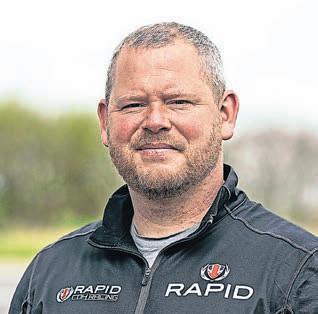
The Expert: Ryan Decarteret
Ryan is a passionate motorcyclist, Rapid National Operations Manager and Coach with a background in surveillance and covert police riding, with around one million miles of riding experience (and he says he’s still learning).
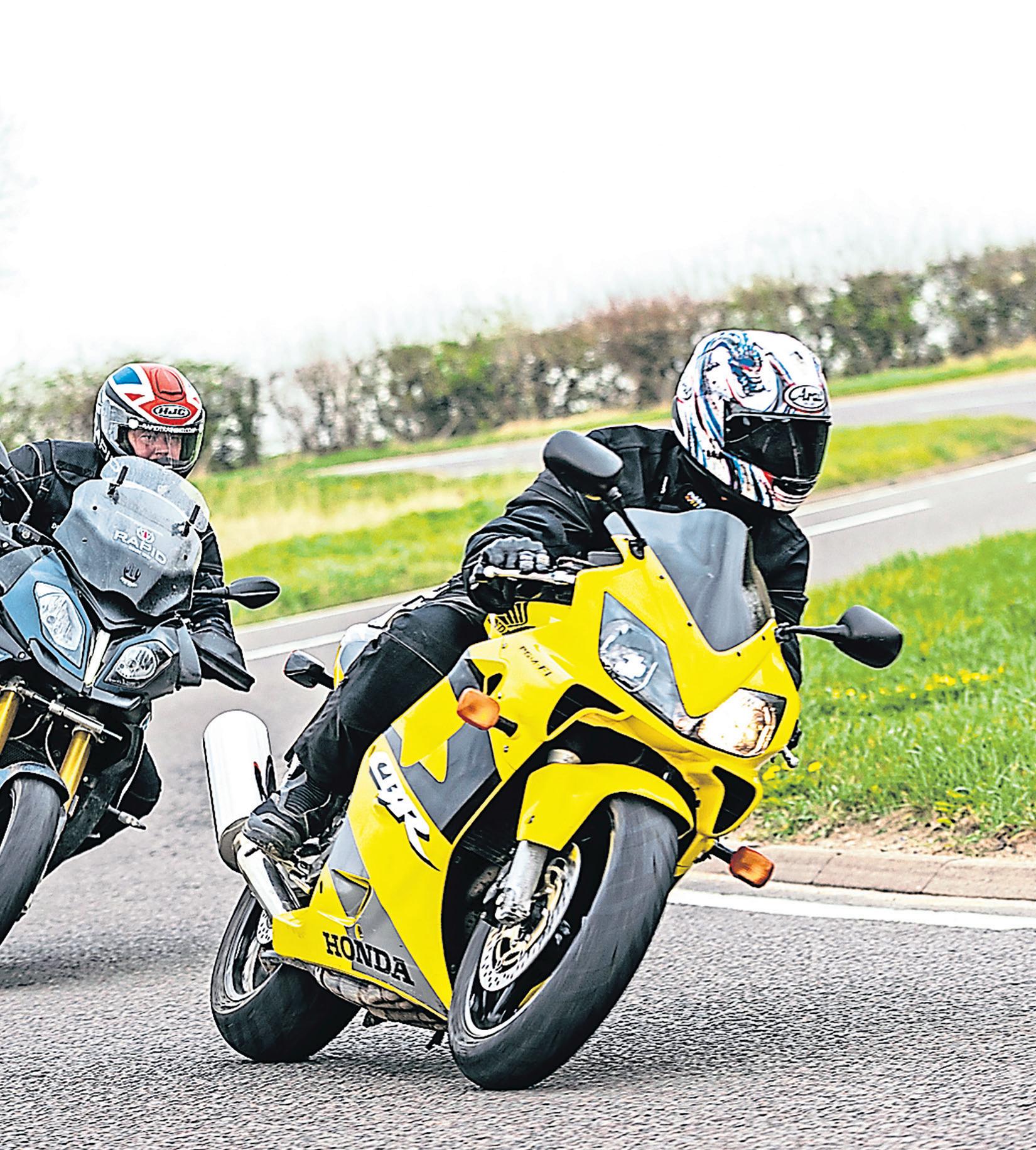
KNOWLEDGE 35
THE INSIDE LINE RUROC
How the snowboarding-focussed brand is taking the biking world by storm with its funky full face helmets
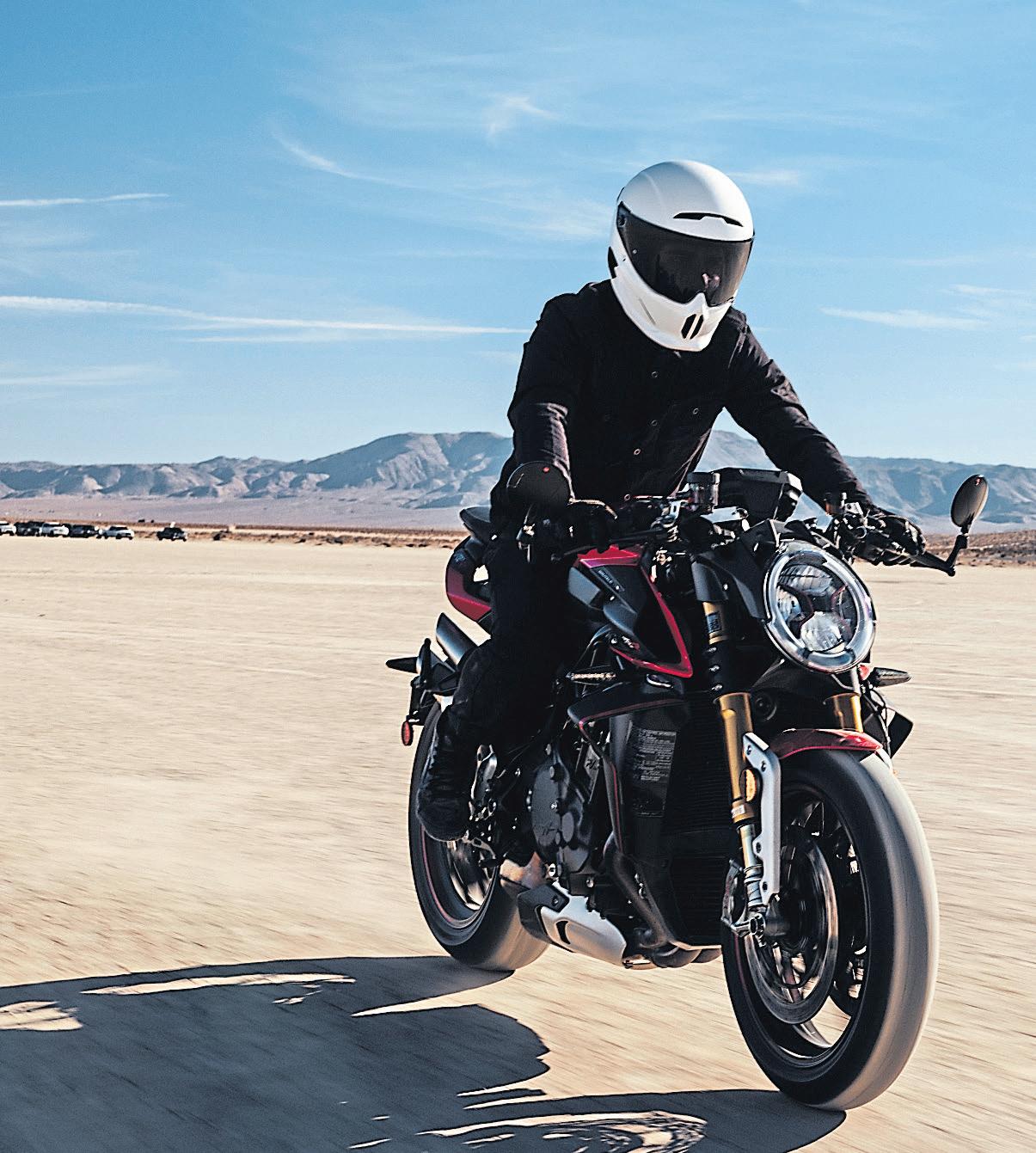
The story of Ruroc is a genuine ‘Phoenix from the Ashes’ tale. Original founder Rob Gavin was caught in a whiteout when snowboarding, and it became obvious the traditional gear of goggles, bandana and helmet left the skier’s face far too exposed to the elements.
Back in the UK, he designed a fully-integrated system, whereby mask, goggles and helmet joined seamlessly to provide full protection. Launching in 2007, rave reviews did not translate into sales and Ruroc quickly went into administration. Relaunching in 2008, the product still failed to find its sales feet and Ruroc went back into administration in 2010.
Enter new investors, tactics and knowhow
Taking Ruroc out of ‘traditional’ advertising and setting up channels to tap into social media, Ruroc found its market, recording a 300% upturn in sales.
A fully integrated system linking helmet, goggles and mask? Sound familiar? A lot of people thought so. “On the transition from snowsports into the moto world, a huge amount of this was due to consumer demand. We received tons of queries, not only from existing RG1 customers but also those totally new to the brand, who loved the look of the lid so much that they were asking if they could also be used on the road. Obviously the RG1 wasn't suitable for motorcycle use, but that led us to start work on the ATLAS project in 2017.”
Ruroc uses high-end materials, such as carbon fibre (I understand a weave developed especially by Ruroc for their products) and RHEON superpolymer, allowing the ATLAS 4.0 helmet to be one of the first to pass the more stringent ECE 22.06 certification (exceeding requirements by 20%). The company’s previous helmet, the ATLAS 3.0, gained a 4-star SHARP rating, and at the time of writing the 4.0 was yet to be tested.
Lockdown presented Ruroc with an opportunity. Over 85% of sales come from direct purchases. But let down by a supplier, the company had to take action. “We worked relentlessly to develop and roll out vastly improved replacements in record time, even redeploying teams to increase assembly line output in order to fulfil orders as quickly as possible. We then decided to move away from the large factories and invest in our own purpose-built facility.”
All Ruroc helmets are now manufactured by its own expert team, allowing full control over every step of production, increasing monthly capacity by over four times and enabling Ruroc to develop products at a greatly increased speed.
A key part of Ruroc’s development is its relationship with its customer base. From day one, the company looked to communicate directly with its clients, ensuring feedback was an essential part of the design process.
36 SPECIALIST SPOTLIGHT
TRIED AND TESTED
RUROC ATLAS 4.0
The ATLAS 4.0 is one of the few helmets so far to pass ECE 22.06 certification. Slipping on easily, the 4.0 squeezes the cheeks but is comfortable. There was a scrunch as I pulled it down. Ruroc advised this is the RHEON strips pushing against the EPS and will settle. It secures using a Fidlock: two powerful magnets clasping together, unbuckling by tugging on a tab. It’s… different, working well once the magnets clamp (pulling hard it wouldn’t budge) and okay fastening with naked hands on a warm day. I can see it being fiddly in gloves in winter. My glasses slotted easily past the unusual nose guard and sat comfortably. There was an odd rattle coming from the back, which was disconcerting… until I popped the panel where the Shockwave audio system slots. The connectors were rattling; once I pushed them well down, it stopped (if it happens to yours, this is the culprit).
Everywhere I rode, people stared! The streetfighter look makes it stand out and graphics are stunning. For those that like their helmet more sedate, plain colourways (£375 rather than £425 for the El Cobre) are available. For a carbon lid, the ATLAS 4.0 is weighty (a reported 1600g); a concern for longer distances where weight takes a toll. I rode two-hour stints with no issues, but if you ride mega-distances it’s worth bearing in mind. On the plus side it returns total stability even on a naked bike at motorway speeds.
Where the ATLAS 4.0 shines is field of vision.
A vast 100 degrees vertical and 215 degrees horizontal aperture, it’s like you’re not wearing a lid. Visor operation is easy (big tab on the left). No integral sun-visor, but it comes with a spare dark visor as standard. Changing the visor is simple. Turn a latch key on each side, pop off and remove. To fit, push in place, turn the keys. Do this indoors, preferably on a raised-edge tray. It’s easy to drop the tiny keys (don’t ask). The ATLAS visor is Pinlock-ready, bought separately (most makers at this price supply free of charge).
Ruroc sets great store in customer input. Feedback on the ATLAS 3.0 was for improved venting and soundproofing. Ventilation comes via chin and forehead vents, with an always open rear exit (what look like extra vents beneath the visor are closed, for stylistic purposes only).
The chin vent slider is on the inside of the helmet, making it impossible to operate when on. In the open position. I got good airflow, notably at my face, which is good news for a glasses wearer, but no air seemed to hit the visor (more a cold weather issue – I tested during the July heatwave). The top vents don’t seem to do a great deal.
As regards soundproofing, up to around 50mph it’s no noisier or quieter than other helmets at this price point. Picking up the pace, you need earplugs (you should be wearing at higher speeds anyway).
The ATLAS 4.0 is something of a Curate’s Egg. It’s Carbon yet heavy; fastening mechanism is an answer to a question no one asked; and the venting is a mixed bag. But I like it. The phenomenal field of vision and utter stability are winning points.
HOW MUCH?
The ATLAS 3.0 ranges from £295 plain to £350 for graphics. The new ATLAS 4.0 goes from £375 plain to £475 for the ‘Liquid Carbon’ design.
WHERE?
Ruroc’s headquarters are based in Barnwood, in leafy Gloucestershire. The facilitiesmanufacturing are based in the UK.
Shockwave Bluetooth audio system
£150 / Bob Pickett
The Shockwave bluetooth audio system slots into the rear of the helmet; microphone and speakers plug into the helmet via preinstalled sockets.
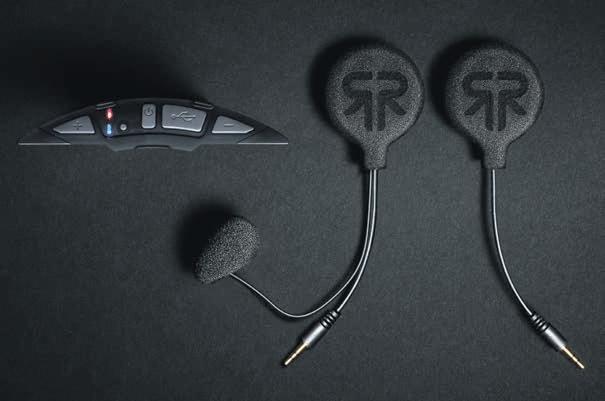
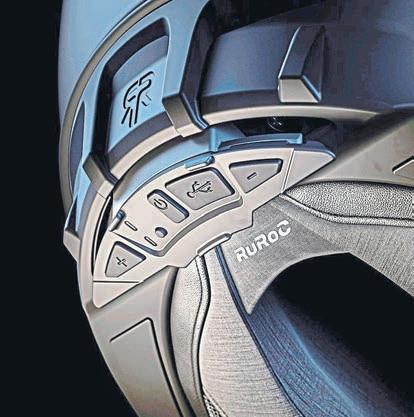
The main unit fitted easily enough (plug in antenna and AUX jacks from the Shockwave cavity; a push and wiggle secures the unit to magnets). Fitting speakers and microphone was a two-person job. After unpopping the cheek pads, my large hands struggled to get the jacks to the sockets. My wife Laura has much smaller hands and was able to manoeuvre inside the helmet, but couldn’t see (I held a torch through the aperture) or get force on to the jacks. Once in place I could give the finishing nudge. Plugged in, speakers and mic attach to Velcro panels (If you’re not going to use a Shockwave, Ruroc supplies pads to insert where the speakers would go, aiding soundproofing).
Once installed, pair the Shockwave with your phone (hold down the power-on button for three seconds; you will hear the unit say ‘Pairing’, then pair your phone to the unit as you would any other bluetooth device). You can charge the Shockwave in the helmet (or remove if preferred) via a USB-C cable. Once charged, it is good for about eight hours.
I first used the unit to take a phone call. Clean sound, and at the other end my voice was clear. Next check: Music –- what other track than ‘1952 Vincent Black Lightning’? Each note of Richard Thompson’s complex guitar work was distinct.
As a satnav, I was impressed with the sound clarity; sharp and crisp, with no apparent delay (very important when following directions). However, this did lead me to an issue. The controls are located on the Shockwave, which plugs into the back of the ATLAS 4.0. I was listening to the instructions when the maximum speed changed; accelerating, the voice became harder to hear but you can’t quickly up the sound. The ‘Volume Up/Accept Call’ button is on the left. But it’s not intuitive; at standstill I could locate but on the move was another story. And, of course, you can’t always remove your left hand from the bars. The other controls (‘Reject/Make call’, ‘Volume down’ – all buttons have additional functions when listening to music) are further across, making them even harder to reach. I don’t know if most people attach their mobile to the bars, but as someone who keeps theirs firmly sealed in a pocket, a quick way of changing volume would be useful.
WHAT’S RHEON?
■ RHEON is a non-Newtonian super-polymer. By being able to change molecular structure when required (soft when not needed, becoming hard under impact forces to provide additional protection), they are ideal for use in protective clothing for bikers.
■ The RHEON strips work with the ATLAS 4.0’s EPS and shell to absorb (rather than redirect) energy that could otherwise be transmitted. By setting out the strips around the head, it means that in an impact RHEON goes hard,
forming channels that ensure the rider’s head isn’t jarring – a vital component of ECE 22.06.
■ RHEON also works to dampen vibration, making the helmet quieter and by being placed outside the comfort liner works like semiactive suspension, reducing vibrations to the rider’s head which makes it less tiring on long rides.
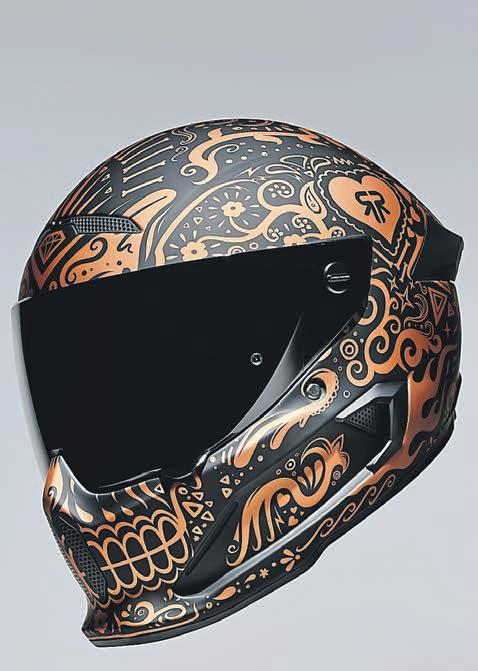
SPECIALIST SPOTLIGHT 37 GET IN TOUCH www.ruroc.com
➜
From £375 to £475 / Bob Pickett / El Cobre £425
LEARN TO RIDE
Getting your hands on a big bike licence can be a tricky old process. Thankfully, the first piece of the puzzle is pretty easy. It’s the CBT. Here’s what you need to know
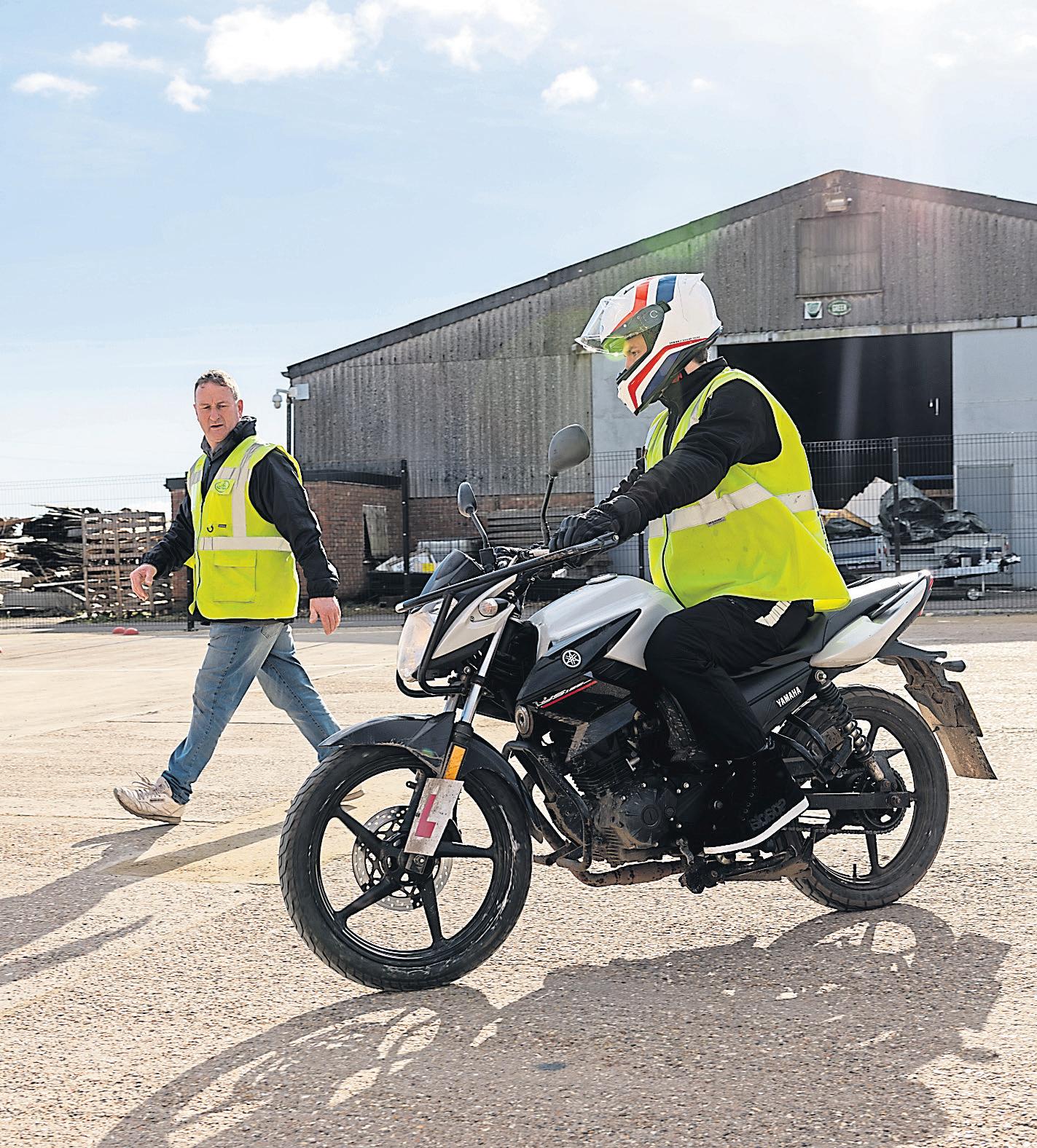
about taking your first steps into the world of motorcycling
After years dreaming about riding, I decided enough was enough and it was about time to kickstart my journey to becoming a fully-fledged member of the biking community.
And how did I do that? The same way everyone else does, by undertaking the one-day Compulsory Basic Training (more widely known as the ‘CBT’), which takes a complete novice and equips them with all the skills, knowledge
and techniques to get out on two wheels as a road-legal learner motorcyclist (all in the space of about 6-8 hours).
KNOW THE RULES
Prior to your course it’s not the worst idea in the world to familiarise yourself with the Highway Code if you haven’t already. The evening before my training I spent half-an-hour on the Ridefree website, which covers a lot of important stuff that’ll help keep you safe out on the road – including some personal safety information on useful topics like rider behaviour on the road.
38 KNOWLEDGE
if you’re thinking
WORDS: Chris Bailey PHOTOS: Gary Chapman
ON THE DAY
Once the big day arrives, there are five sections to the Compulsory Basic Training your instructor will go through with you over the course of the day. We started with the age-old eye test of reading a number plate from 20 metres away before moving on to learning about a range of important details regarding what is and isn’t acceptable regarding helmet care and best practice for looking after all your protective gear, as well as why each individual item is so crucial to your safety.
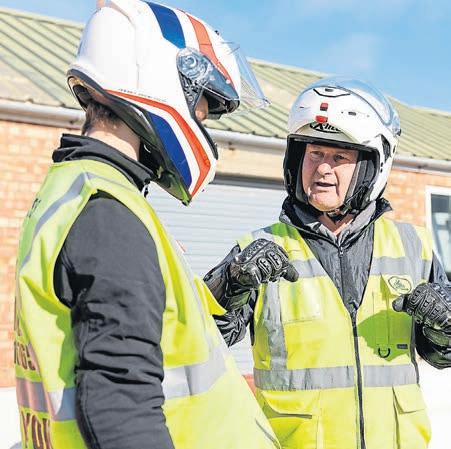
Once the more ‘classroom’-focused section is out of the way you’ll move on to ‘Element B’ of the course, which is the practical on-site training. You’ll also get acquainted with your ride for the day, as well as be given a run through of how a motorcycle or moped works, what maintenance checks you should be doing both daily and weekly, as well as getting a general feel for the weight and balance of the bike and what the different bits and pieces do.
I was loaned a Yamaha YS125, whilst the only other fellow student (two is a common number on CBTs, but you’ll never be in a class with more than three other learners) had an Aprilia scooter of her own which she had brought with her. So we got to see side-by-side how a manual transmission motorcycle works, compared to a ‘twist ‘n go’ scooter.
Once we had been given some time to familiarise ourselves with where everything was on our rides it was time to wheel ourselves out on to the courtyard for ‘Element C’ – on-site riding. This is where you’ll do your first bit of actual riding, as well as where you’ll learn how to perform a range of manoeuvres such as riding through junctions, U-turns, slow control of the motorcycle and gear changing (for manual transmission).
I learned quickly here that the faster you went for most of these exercises, the more stable you felt in the saddle. I struggled most with anything involving slow control of the bike… as it turns out my wife is correct: multi-tasking really isn’t my strong suit. Having to continuously work the clutch lever with my left hand, keep a steady amount of pull on the throttle with my right hand, and keep
a mindful eye on how much pressure my foot was putting on the control for the rear brake seemed beyond me. Honestly, this is where picking the right centre becomes invaluable. I was getting a bit frustrated with myself for not getting it right, and I kept expecting Adrian, my instructor, to get just as frustrated, but if he was, he did a cracking job of hiding it! After walking me through what I needed to be doing with each control of the bike, and telling me to just relax and not overthink what my hands and feet were each doing, it all came together a lot more smoothly.
The most important outcome from this section of the course is for you to feel like you’re in control of the bike, and whilst at first you may feel completely the other way round, once you stop looking at what your hands are doing with the bike whilst riding and start focussing on where you want to move, you’ll quickly feel the improvement and stability.
the road aspect of the course. Here you’ll go through what positioning on the road you should be riding in depending on what else is going on around you.
Since you are more vulnerable on a bike than in a car, your instructor should spend a decent portion of this element giving you the ways you can keep yourself safest on the road – whether that’s from the distances you leave between yourself and other road users, what hazards you might face (and how to handle them), as well as ways of anticipating what other road users might do.
GET A LICENCE
First things first, if you’re looking to undertake a CBT you’ll need a licence. If you already have a full driving licence or provisional licence then you don’t have to do anything else with it prior to your CBT. However, if you don’t yet own any kind of licence you can apply for your provisional licence from the DVLA on the gov.uk website (it costs £34 to do so, if you haven’t already). Once you have your licence in hand you can move on to the next step.
CHOOSE A CENTRE
Around this time was where we stopped for a little lunch break, although for you that will entirely depend on how many of you there are, and how many times one of you has almost knocked something (I can hold my hand up and say I selflessly took that responsibility on for myself, so my fellow trainee didn’t have to).
Once this is done you move on to the second-to-last part of the Compulsory Basic Training ‘Element D’, which is preparation for the on
At this point your trainer will also let you know what to expect from the final part of the course, which will be a minimum of two hours’ riding on the roads through a range of realworld scenarios such as roundabouts, traffic lights and pedestrian crossings. You’ll be fitted with a headpiece which fits snugly inside your helmet, where you’ll be able to hear your instructor so they can give advice on the road and let you know if there’s anything you can work on, as well as they will be able to give you directions, since you and your fellow trainee will take it in turns leading the pack, whilst your instructor will be following from behind, herding their little flock. Finally, you’ll have made it to the last element of the course, ‘Element E’ –practical on-road riding. Two things to mention here: the first is that if you was in a group of more than two trainees you would split into two groups so that each instructor has a maximum of two learners on the road with The other, more important thing is that your instructor has been watching you and coaching you throughout the day, offering advice and potentially getting you to repeat the same manoeuvre a dozen times until they were happy you were doing it in a safe and controlled manner. What this means is that they wouldn’t take you on the road at this stage unless they were absolutely confident that you’d picked up all the skills required to be able to ride safely in live traffic. Basically, try not to get too nervous – and remember that you wouldn’t be doing the road-riding if they weren’t confident in your ability.
A quick blast into your search engine of choice will show you a wide range of options for places that will happily guide you through your Compulsory Basic Training. I’ve heard plenty of horror stories from friends and acquaintances who have gone with the first centre they spoke to, or the one who could book them in fastest, only for a clash in personalities and preferred learning styles to have made it an awful day (in some cases enough to scare people away from taking their CBT for a while). Start by asking anyone you know in your local area where they did their training, and what sort of experience they had, and make sure to speak to a few centres on the phone, and choose the place you feel will be right for you – if you click with your instructor it will make the whole experience a lot more productive. I was lucky in that the training centre I went with, Access Rider Training in Stickney, was only 20 minutes from where I live. However, I would have travelled a further than that for the positive experience I had on the day.
STAY SAFE
Licence in one hand, booking confirmation in the other, your next item on the agenda should be your protective gear. A lot of centres will be able to loan you some kit on the day (although you may still find some providers ask that you bring your own to help protect you and others from a certain virus), but either way if you’re planning on riding then you’ll need to start looking at sourcing your own quality gear to help protect you, should you face any unfortunate accidents on the road.
By law, the only thing you need is a helmet. However, any training centre worth their salt will want you to turn up with proper gloves, boots, jacket and jeans. There are a shedload of great options available, but if you don’t quite know what to aim for then sit tight, as next month we’re going to bring you a complete in-depth guide to beginners kit, and what to look for.
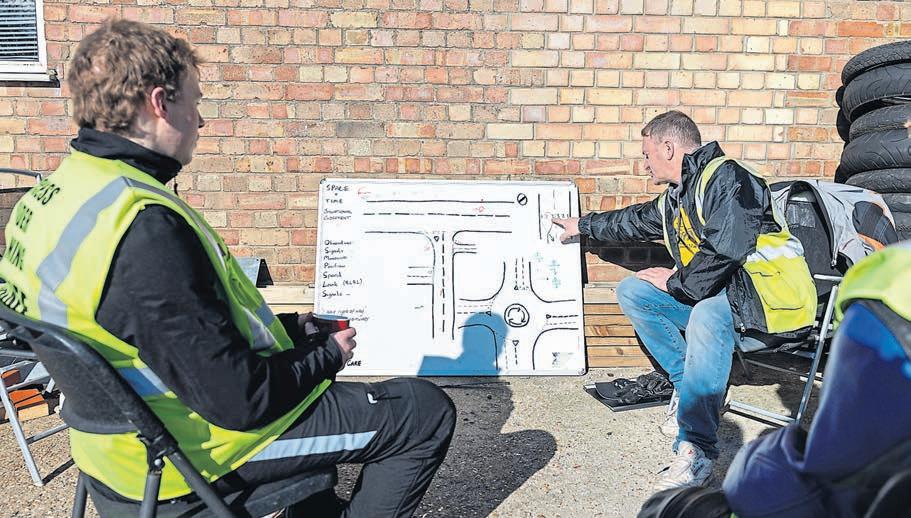
KNOWLEDGE 39
Depending on where your training centre is based, your route will be very different (although no matter where you are you’ll still end up having to do a few roundabouts, gradients and hills, traffic lights and junctions). For us, we had a great mixture of wide-open countryside, as well as the more urban streets of Boston to ride through, all the while with our instructor’s voice coming through the headsets reminding us to check our mirrors often; to keep an eye out for upcoming signs and changes in the traffic; as well as giving us advice depending on how we were riding. I stalled a few times (and a few more times) as I was going to pull out of junctions, but whenever I did I heard the calm voice from my instructor
come through the earpiece, telling me to relax, check my surroundings and go again. That kind of response from Adrian made all the difference in building my confidence, and as my confidence grew I found it was happening less and less.
You’ll also be taken down a quiet road to show off your newly developed techniques for emergency stops and U-turns on a real road.
Before I knew it, it was time to start riding back to the centre and by then our instructor had gone silent (apart from to give us directions) to just let us ride and demonstrate our independence. Despite having ridden almost non-stop, minus a five-minute break, for the last twoand-a-bit hours, I was still genuinely
disappointed when we arrived back at the centre. I could happily have kept riding for hours.
Our instructor happily announced at that point that he was going to write out both of our certificates as we had successfully completed our CBTs. He also gave us tips for some further improvement to our riding habits based on what he saw during our ride together, which felt like a nice touch to give me something to work on. We were also informed of the limitations of what we could ride with our CBT. The maximum engine size will vary depending on your age, but the most you’ll be able to ride will be a 125cc, with no passengers allowed – and your ‘L’ plates must be clearly displayed and untampered with at
ACCESS RIDER TRAINING

the front and back of your bike. A great suggestion we were given was to take a photo of our certificate and store it on our phones in case we were pulled over at any point, so that you didn’t have to carry the original A4 document around with you and risk damaging or losing it.
You’ll also be reminded that your CBT certificate is valid for two years, so if you’ve not passed your full bike test by then you’ll have to redo a CBT to carry on riding.
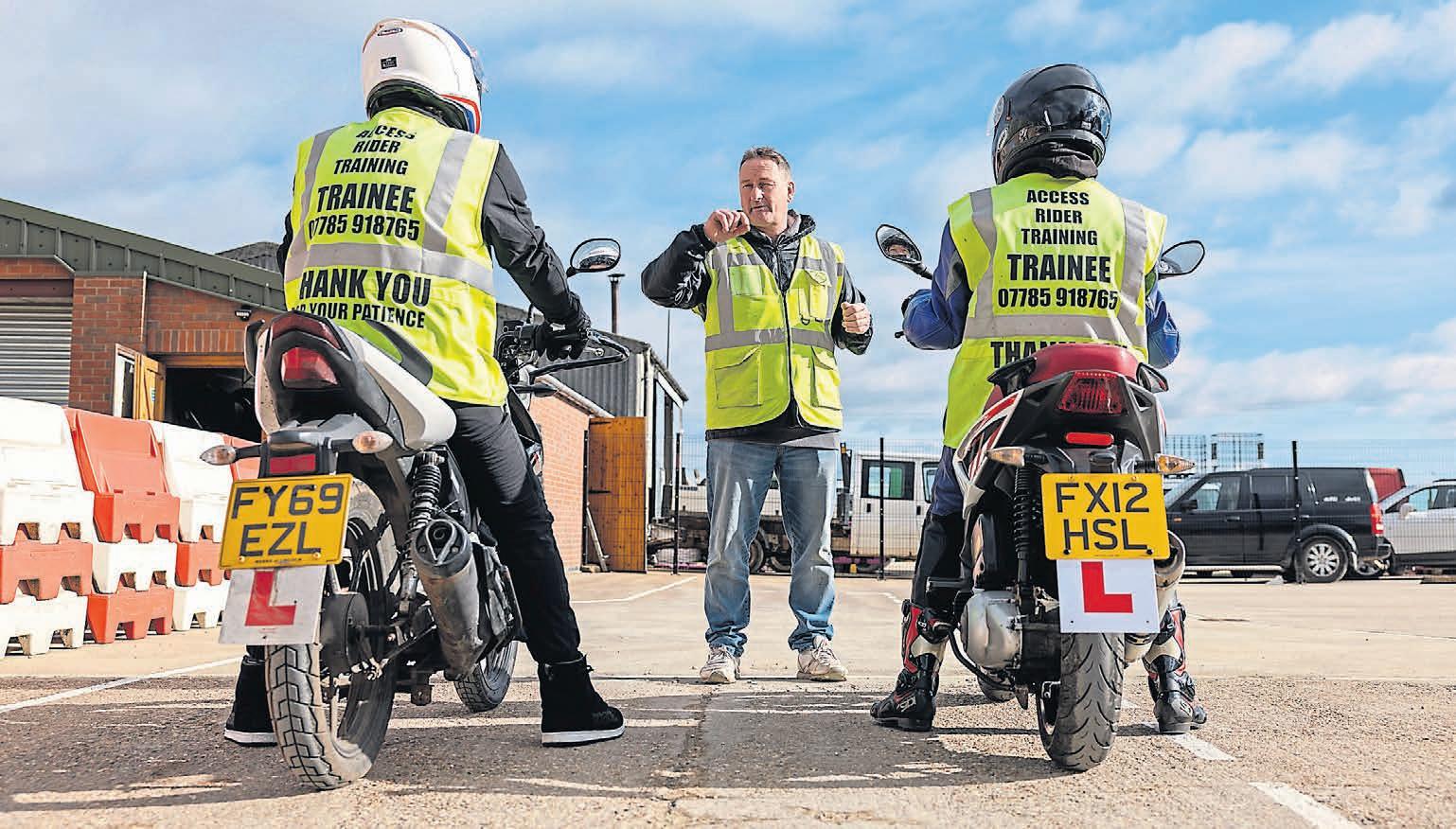
But if you’re feeling anything like I was by this point, you’ll be itching to get as much experience as possible under your belt so you can get your full licence and move up to some bigger and more powerful machines. But for now, I’ve got a 125 to ride.
Stickney, Lincolnshire
The lads and lasses at Access are a cracking bunch. They’ve been in the game for years and have big plans for their latest set up which sits neatly between Boston, Skegness and Horncastle in the heart of Lincolnshire. People travel from all over to undergo their CBT, Mod 1, Mod 2 and advanced rider training with them. And it’s easy to see why. They’re a lovely bunch with plenty of enthusiasm, knowledge and jokes to match. We’d thoroughly recommend them.
40 KNOWLEDGE
PART ONE GS Trophy: ALBANIA
BMW’s annual extravaganza is a serious test of man and machine. Fast Bikes editor Bruce Wilson has been out to Albania to test his adventure skills to their limit. Here’s how he got on
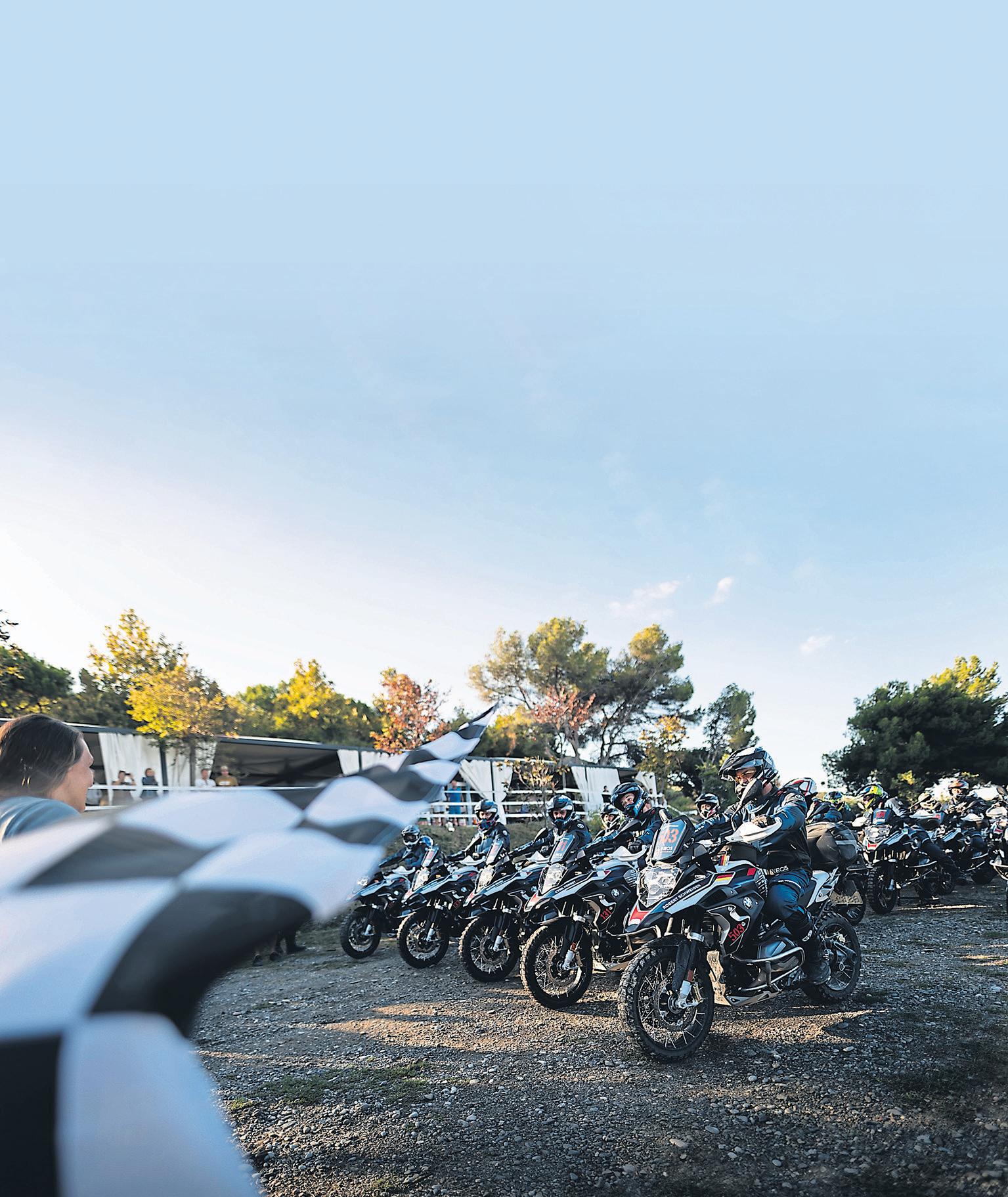
WORDS: Bruce Wilson PHOTOS: BMW
I wasn’t meant to be on this trip. Up until just a few weeks before, I knew very little about it, but then the call came, and the torment set in. Could I just up and vanish from work, from home, my kids and wife for 12 days straight? Well, it turns out I could... Just a few weeks later my plane touched down at Tirana Airport, the capital of Albania, the host nation of the event’s 1300km endeavour. The next question was if I’d be able to go the distance and not look a proverbial nob in the process. It
was a tall order, made more unlikely by the fact I’d not so much as sat on a GS for more than a year, with my last outing being at the UK’s GS Trophy qualifier event. Despite the odds and having not ridden a GS for seven years prior to that, it’d gone alright; I somehow scored sixth out of the initial 250 entrants, from whom the top 10 (…minus myself, because I was a journo) scrapped it out for the three lucky places on Team GB, bagging their ticket to this once-in-a-lifetime adventure.
This is just one small part of a mammoth feature from our pals at Fast Bikes, so if you want more fascinating insights into the exclusive, challenging and seriously rewarding world of the GS Trophy, scan the code and snag yourself a copy of the magazine that’s all about riding bikes hard and fast.

GS TROPHY 41
The

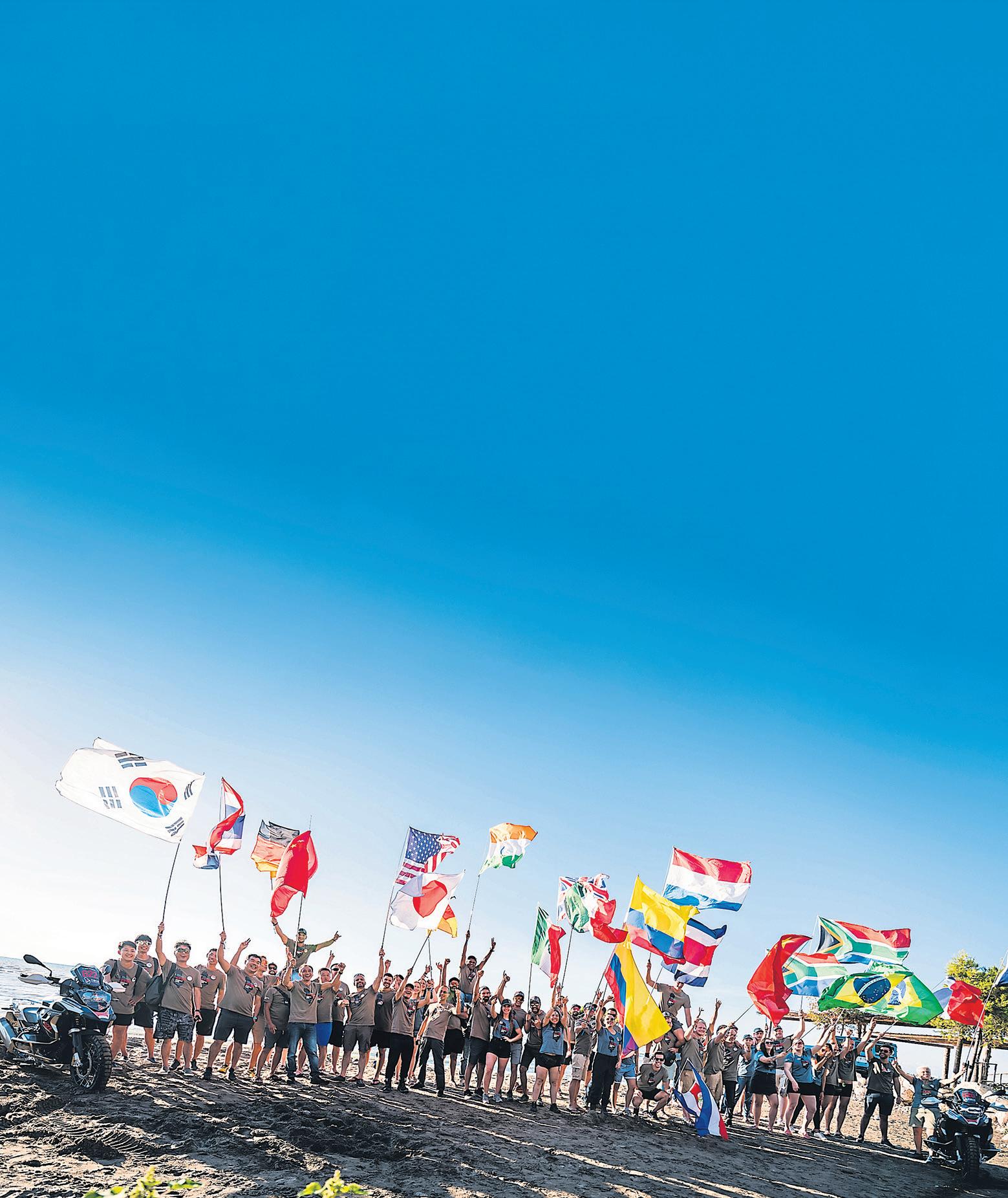
There were 15 male teams in all, comprising three riders apiece, and six female pairings that would take on the exact same route and challenges. Add logistics staff, marketeers, medics, marshals and many more folk into the mix and you’ll begin to appreciate the magnitude of the undertaking. It was mind-blowing. We even had our own helicopter for medical cover, plus ambulances, and no less than 19 support vehicles in the shape of Ineos Grenadiers. And then there were all the bikes. Locked away behind a reed-walled compound were more than 100 GSs, each identically kitted to what would be known as Trophy-spec machines. Among other things, it meant they featured added crash protection, saucy-sounding Akrapovic end cans and some muchneeded Metzeler Karoo 4 rubber. They also had our individual names, numbers, and blood groups plastered on the front cowls. They looked the nuts, and after a hearty search I eventually stumbled across my very own workhorse – number 190. Firing my GS into life for the first time was a memorable occasion, signifying the start of something special. The BMW felt as familiar as sand is to the Arctic, but I knew with time and many miles under
my belt I’d soon be at home on the heavyweight. Until then, all I had to do was not crash… or lose my head, unlike the decapitated snake we passed as we exited the compound. Tackling roads that gradually deteriorated in condition, we soon got to a point where there was no Tarmac left to talk about. The route got trickier and hillier, but the flow of homes lining the road were still as plentiful. The GS was now in its element, designed for conditions such as this, which I don’t imagine could be said of the Ladas and suchlike that were tasked with the route’s challenge on a daily basis. After half-an-hour we reached a training point, high up above the coast. We practiced emergency stops, tackled some sandy sections, and basically tried to convince our accompanying marshals that we were fit for the fight. It was hot, about 35°C, which meant as basic as the riding was, it took its toll on a few people who felt unwell and made the call there and then to drop out of the riding for the event. The most important thing I learned was that I’d very much need the camelback water supply I’d left kicking around my hotel room... I was sweating buckets and feeling as parched as paper.
Everyone had the same spec R1250GSs
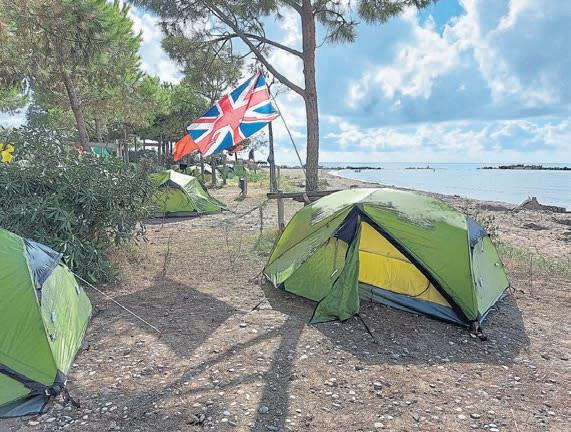
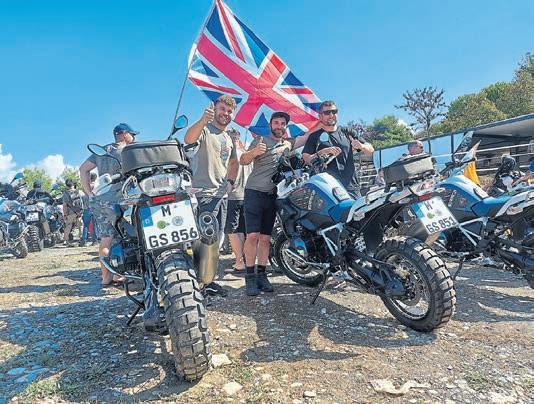
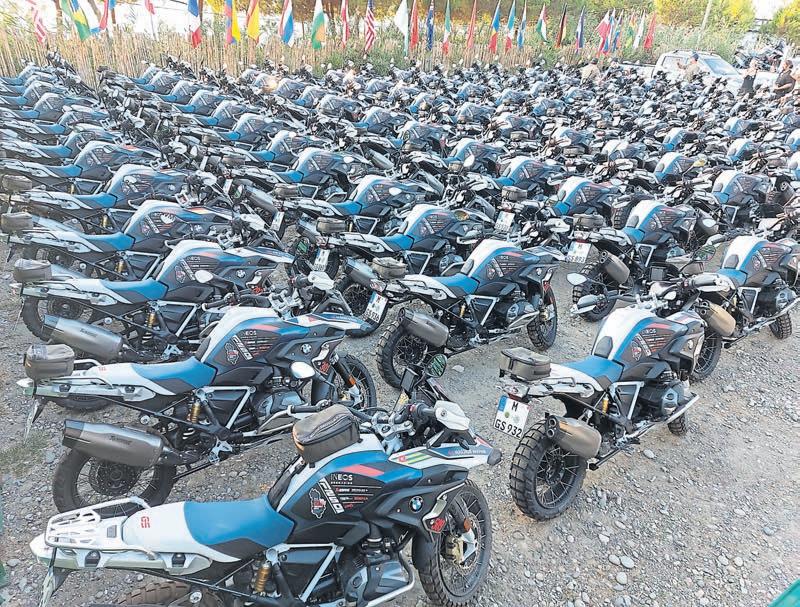 Team GB: Fred, Craig and Kyle
scariest thing on the Trophy was base camp’s wonky bridge
Team GB: Fred, Craig and Kyle
scariest thing on the Trophy was base camp’s wonky bridge
Home, sweet home
42 GS TROPHY
“While everyone else pulled off in style under a waved flag and cheers from the hosting staff, things didn’t quite go so smoothly for us.”
DAY ONE
Setting off two nations at a time, guided by a marshal, the UK was the last of the lot to leave camp the next morning. While everyone else pulled off in style under a waved flag and cheers from the hosting staff, things didn’t quite go so smoothly for us. Our marshal, Jenny, had an issue with her battery, which we only realised moments before our departure. Under gruelling heat, fully kitted, the first task of the day was to get her bike bump-started, something you wouldn’t wish on anyone… unless they’d kicked your cat. Twenty minutes later, we were already half-baked by the time our Armada set sail, paired up with the Brazilian ladies’ team. It wasn’t the ideal way to get the ball rolling, but we’d soon learn there was no gain to a punctual departure. By the time our heart rates recovered, and our focus returned to the day’s endeavours, it was time to pull over. We’d only been at it 10 minutes, tackling a few light trails, but already we’d reached the first of the Trophy’s challenges.
We joined a swarm of other GSs, abandoning them under the sun while we scarpered off to a rock face in the hope of finding shade from
the sun. We couldn’t see what was on the cards, but in the distance we could hear the bikes of our rivals, who were being put through their paces. With nothing to do but wait, we ate Jelly Babies, drank lots of water, and tried to guess what was heading our way. When I say our way, I mean that of Fred, Kyle and Craig. To all intents and purposes, I was just a mobile cheerleader, following these guys in their tracks but exempt from taking part in the challenges themselves. I didn’t mind one bit, instead throwing my weight into helping the guys in any way I could.
Our turn came to head to the starting point. The initial task was a timed trial in a quarry-like enclave, with plenty of hidden rocks and troughs to make you land on your arse. The challenge was to nail it around a taped course without any dabs, stalls or falls. Fred went first and made it look easy, as did Craig and Kyle. The question was, how easy had the other teams made it look? We’d find out later, but for now the journey ploughed on.
We had 200km to tick off that day, with the next 60km of it being on Tarmac, meandering our way inland
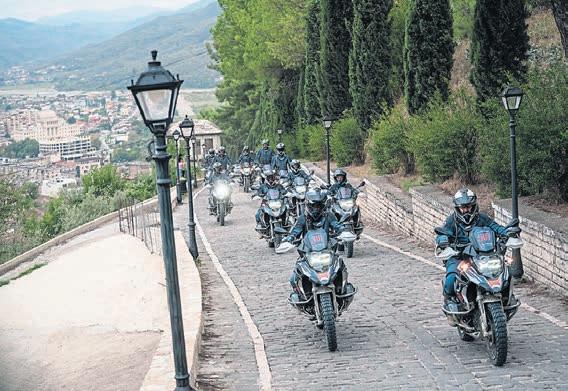
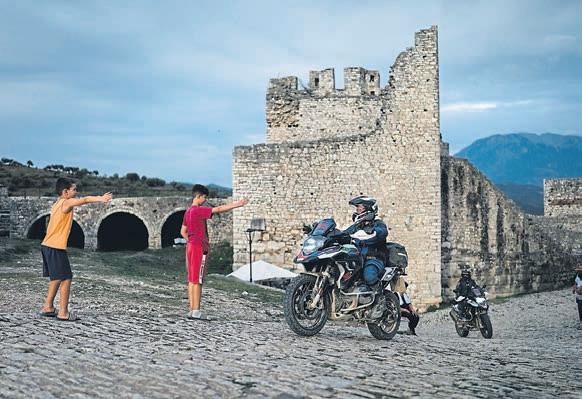
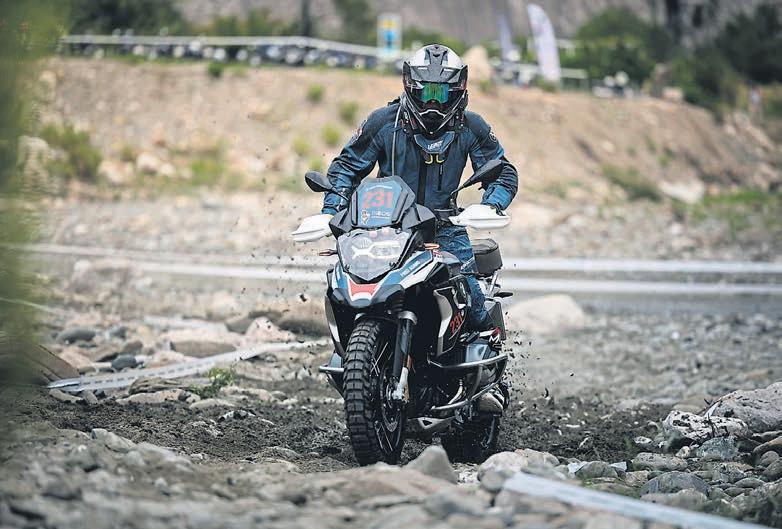
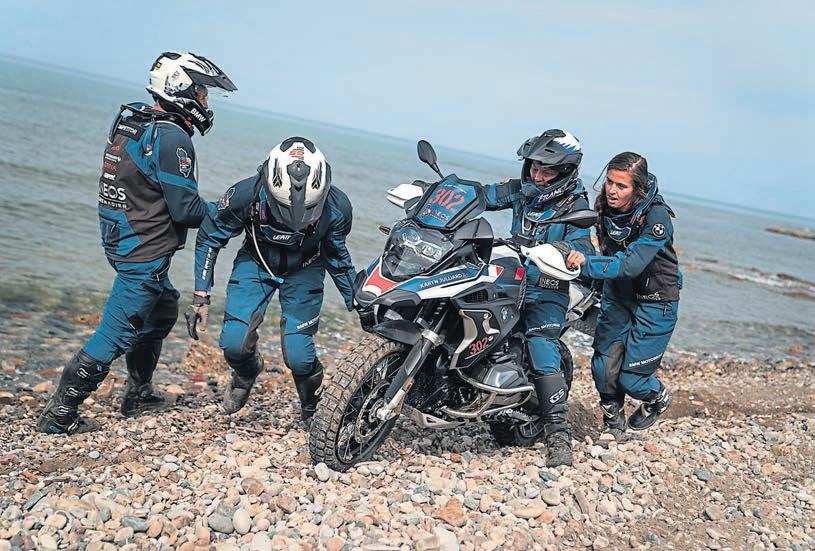
across Albania’s rolling lowlands. The landscape was green with a horticultural theme, interspersed by more pillboxes than you can shake a stick at. Knowing so little about the country or its communist past, I wasn’t quite sure who they were so was averse to visiting them, but they seemed well geared up for the job. Rumour has it there are more pillboxes than people over there, which I soon came round to believing. From a riding point of view, there wasn’t really much to talk about as the big GS just romped its way along the rural roads without breaking a sweat, rumbling along on the knobbly Karoos. When you’re geared up for an off-road adventure, the last thing you want to do is clock big miles on Tarmac. The good news was that after our coffee break, we only had a short stint left on the black stuff; Jenny pitched off up a trail and her flock willingly followed. The going was light work, on a shalelike surface with a few potholes thrown in for good measure. We were climbing higher all the time, tackling the odd switchback in due course, but it was nothing to write home about.
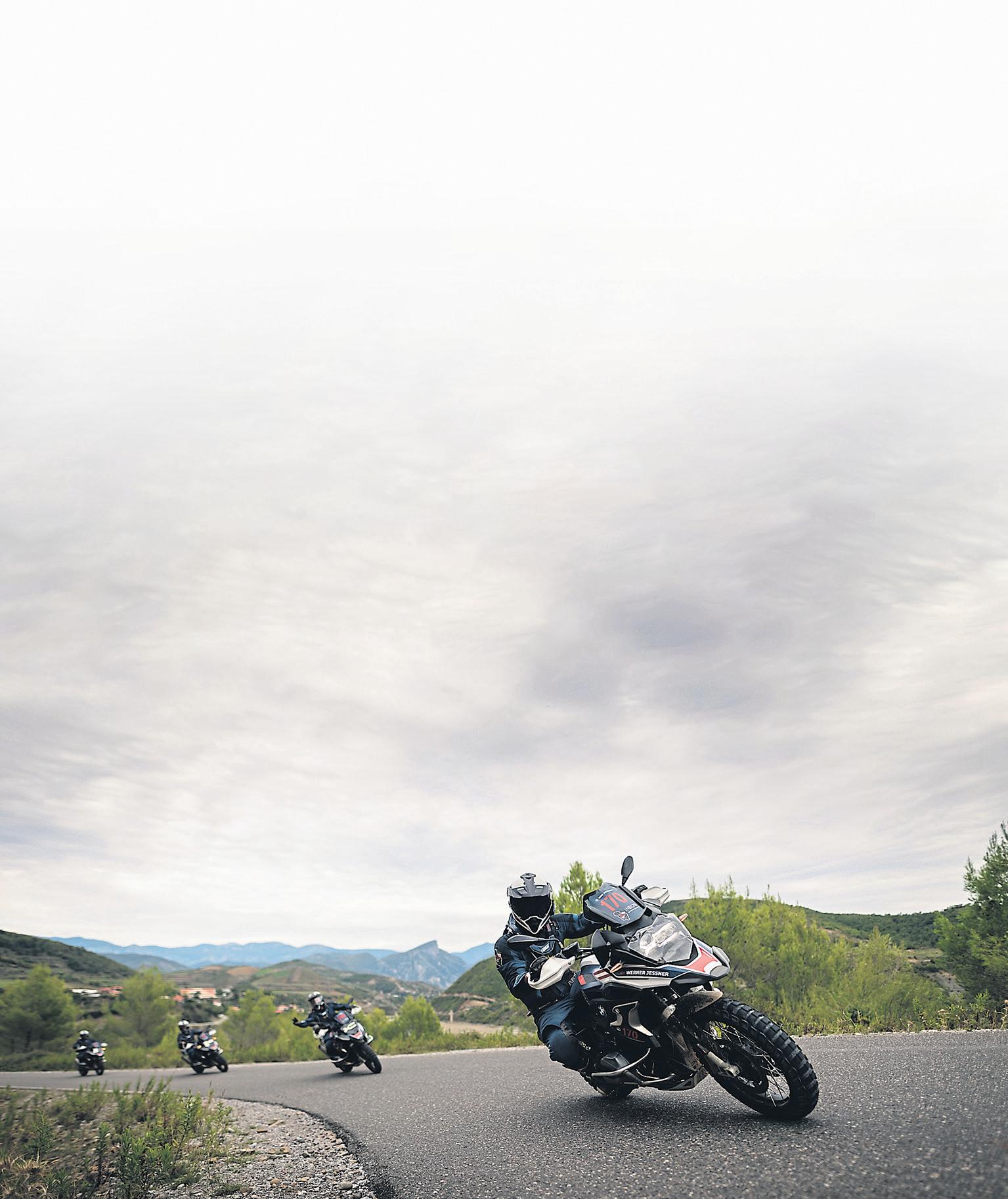
GS TROPHY 43
This kind of theme played out for 20 minutes, to the point that even I was comfortable with the pace, gradient and challenge of the trail… but then things changed pretty drastically. Up ahead, the route got proper steep, the rocks much bigger, and there were a few GSs on their sides, penned in between a rock face and a sheer drop. I don’t like traffic jams at the best of times, so I pinned the throttle and followed Fred, Craig and Kyle in their rocky wake, passing a handful of riders and bikes in the process. It was not an easy climb, but I knew I had no hope if I got stuck there. After a few minutes, the severity eased.
We each parked up, hopped off and headed downhill to help the stragglers. One of our ladies was in a bad place, anxious about the height and the challenge of the climb; I walked her up the hill while Craig blasted her bike. All the while, Fred and Kyle were busy helping others until there was no one left to assist. Jenny gathered the group and did a cracking job of rallying us for the rest of the ride. We were in good hands.
The terrain was mesmerising, and
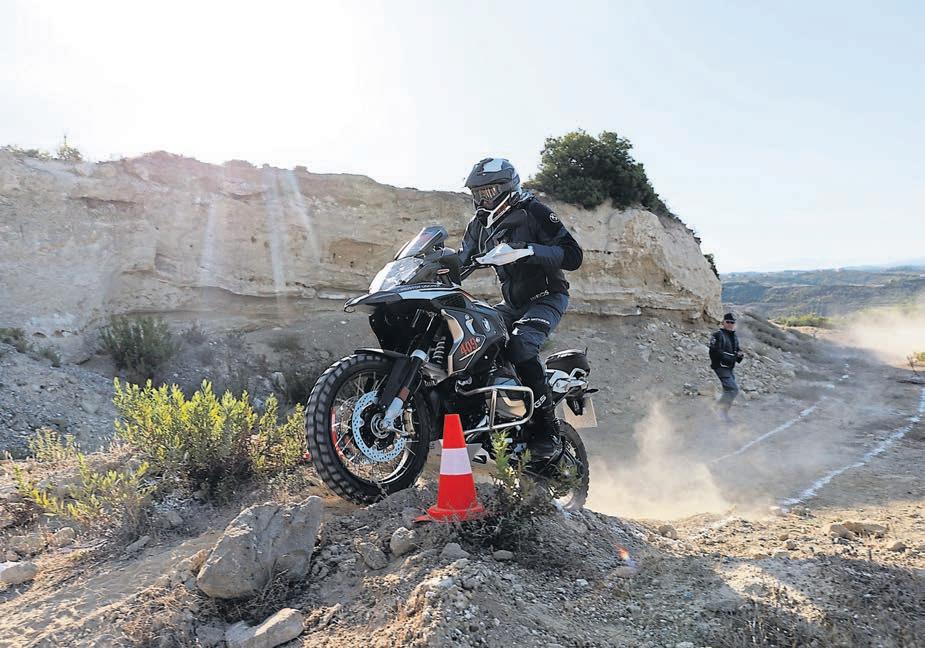
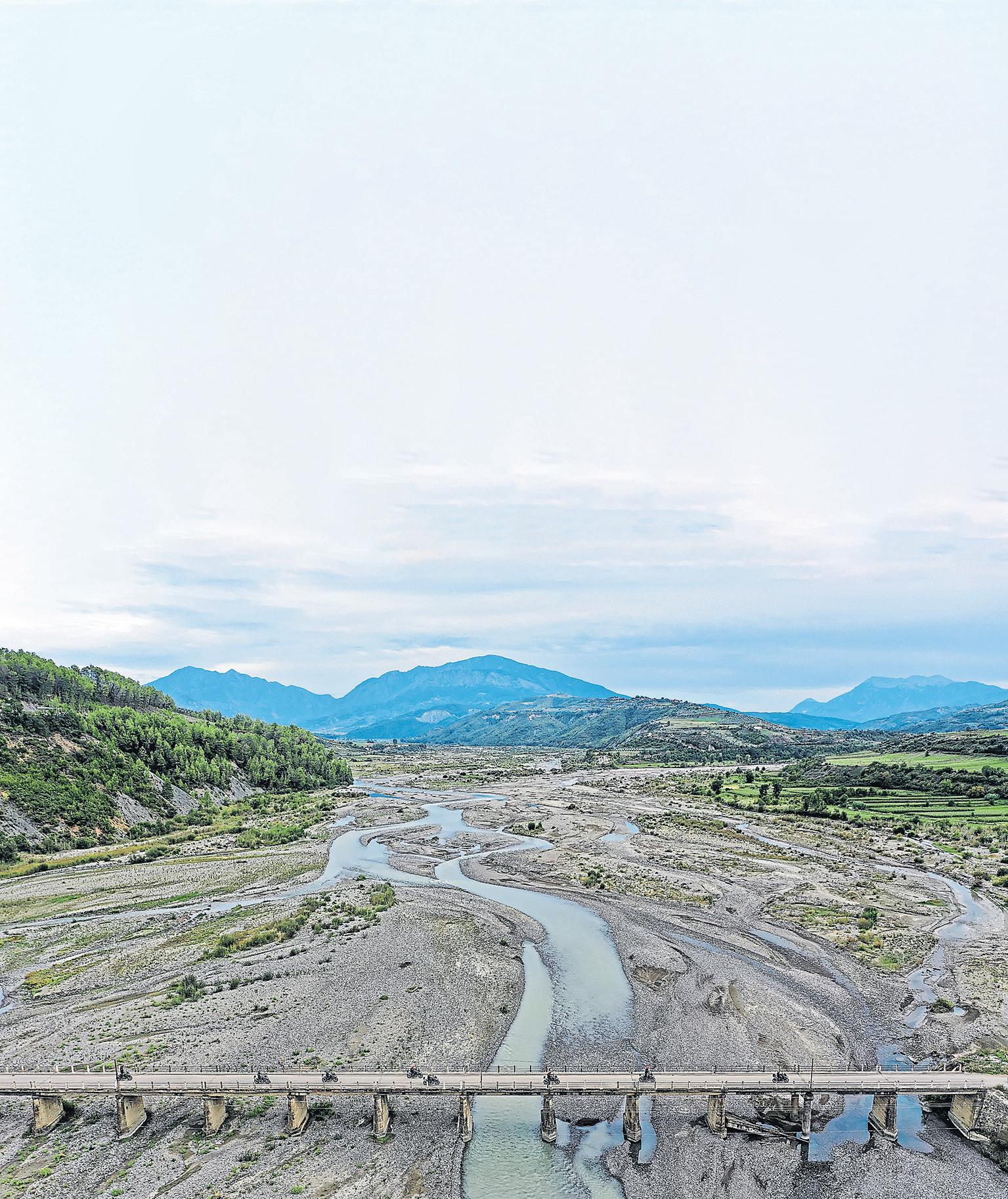
our altitude seemed to keep rising ever higher. Just when you thought no one else could possibly be this far remote, you’d clock a Transit van heading the other way or a family of four bouncing their way on a scooter along the arduous trail to who knows where.
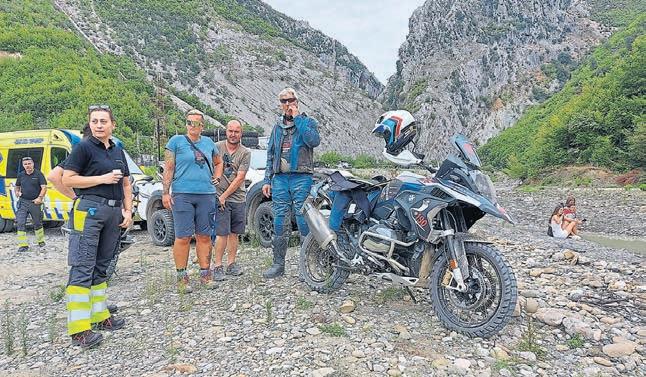
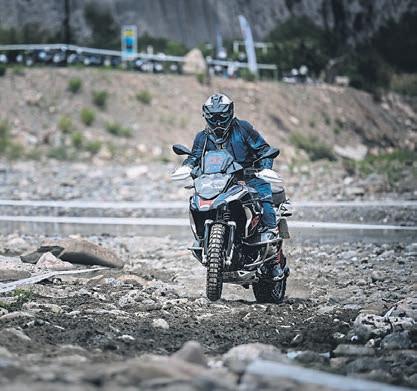
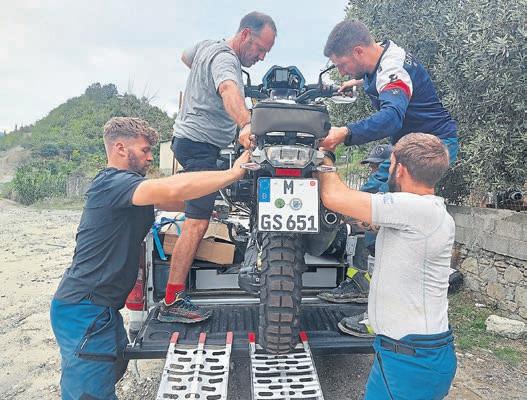
The locals seemed happy, pleased to see us rather than pissed off by the noise and disruption caused by more than 100 passing GSs. It was akin to a small army being on the move, especially with all the Grenadiers in tow… a spectacle you’d just never expect to see or hear, especially up in the Apennine-like surroundings we were powering through.
Being the slowest of our team, I assumed my place at the back of the pack, which meant I was inhaling more dust than oxygen. It also meant I often lost track of the boys in front, who were in a different league to me. I had no satnav, and more often than not no phone signal, so the prospect of getting lost up in the mountains was palpably real. Quite simply, I had to keep up, learning as quickly as I could what was required to get the GS bounding along at a respectable pace.
44 GS TROPHY
Most concerningly, I didn’t want to miss out on lunch. We were burning way more calories than I’d expected, and my two-litre camelback would prove to last just half a day. Six hours in, I was very much ready for a rest. Unfortunately for Team GB, there’d be no such luxury… not before taking on the second of the day’s tasks. We’d arrived at a rocky, dry riverbed for what was known as the Holta Enduro Lap. The competitors had to blast around a taped course by any means necessary, getting back to the start in order to send the next of the team’s riders on their way. The fastest team to finish was the winner – simples. We were about the last group to make it there, meaning the course was well cut in, with boulders here, there and everywhere. It looked gnarly, especially having caught a glimpse of the teams in front of us trying their hands. The cardinal sin was to fall off, as it would cost so much time to get the bike up and started, but I don’t think such a concern even crossed the lads’ minds. They just got on, blitzed the course and lined up for lunch. We ate big and debated big on how well the day had gone. There were only two challenges that first day, and we’d been buoyed by the impressed faces of those marshalling the courses. Maybe they were just being polite, but deep down we were excited for our prospects. We filled up our camelbacks, loaded up on snack bars and headed off on more trails.
The destination for that night was Berat Castle, which was little more than a name at that point. Jenny said we had about three hours’ riding left to tackle, but fate had other things in mind. Having descended from the mountains and rejoined civilisation, we were once more ogling the views, watching men take donkeys for walks and such like. There was never a dull moment, including the point Fred pulled over and said there was something wrong with his bike. For context, he owns a motorcycle workshop and spent many years refreshing Merlin and Griffin engines for Spitfires and Lancs. The point is, he knows mechanical engineering pretty damn well, as this scenario proved, too. He’d heard a rumble from the shaft drive cardinal and didn’t want to punish the bike any further without inspection.
This was bad news. If you broke a brake lever, your team lost a few points. If you bust a rim, your team lost even more points… and if you wrote off an engine, or bike for that matter, you were some 60 points down. Considering a win in a challenge was only worth 25 points, you can imagine how much we were bricking it. A recovery truck arrived, a new bike was unleashed, and our journey continued – a few hours behind schedule.
It was dark by the time we got to Berat, a vibrant and large town wrapped around a fortress that traces
its history to Roman times. That was where we stayed the night, in the grounds of the castle, 214 metres above the town. The ride up to the fort on a stoned road was surreal, especially when we were high enough to appreciate the enormity of the floodlit castle. It was something else, but we had little time to savour its architecture. Everyone else’s tents were up, most people had already showered, and the beer supply was being hit hard – we wanted in on the action. More to the point, we wanted to know how our day had gone. Showered and with beers to hand, we headed to a massive marquee where food was served and more beer was plied on us, and we awaited our results. It’d been a long day, but a very good one... not just for the views, trails and laughs we’d had along the way, but mostly because it turned out that Team GB had done the double, taking the top spot in both of the day’s challenges. It didn’t seem real. We were already perceived as the ‘quiet team’, but there was nothing quiet about us as we erupted on the news, stamping our intent on our bewildered rivals. Psychologically, it crushed them. Now all we had to do was keep it up for six more days.
DAY 1 RESULTS
1. United Kingdom: 50 points
2. Thailand: 33
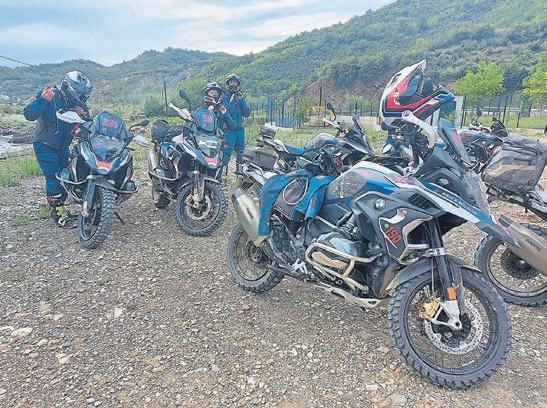
3. South Africa: 26
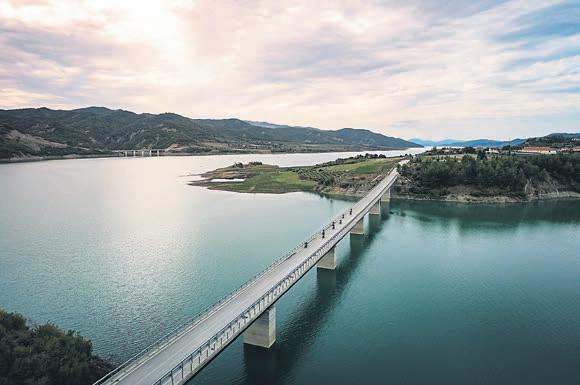
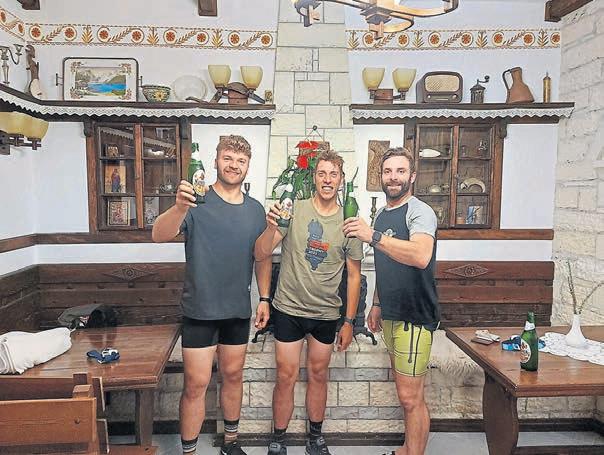
4. China 2022: 21
5. Latin America: 20
5. Japan: 20
7. USA: 19
8. Germany: 19
9. France: 15
10. Netherlands: 13
11. Mexico: 12
12. India: 10
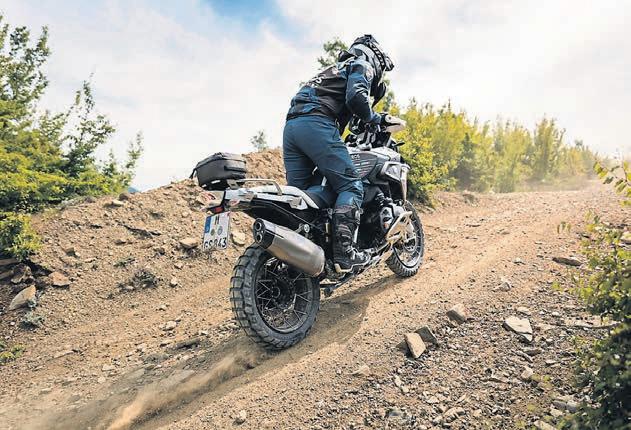
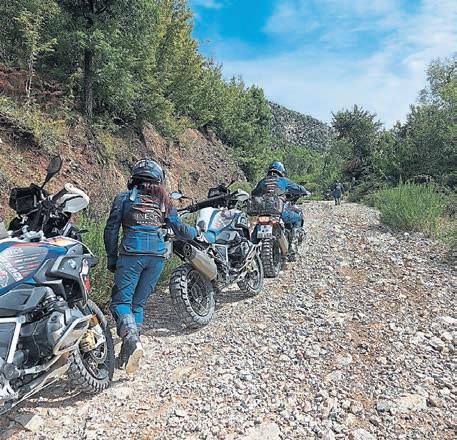
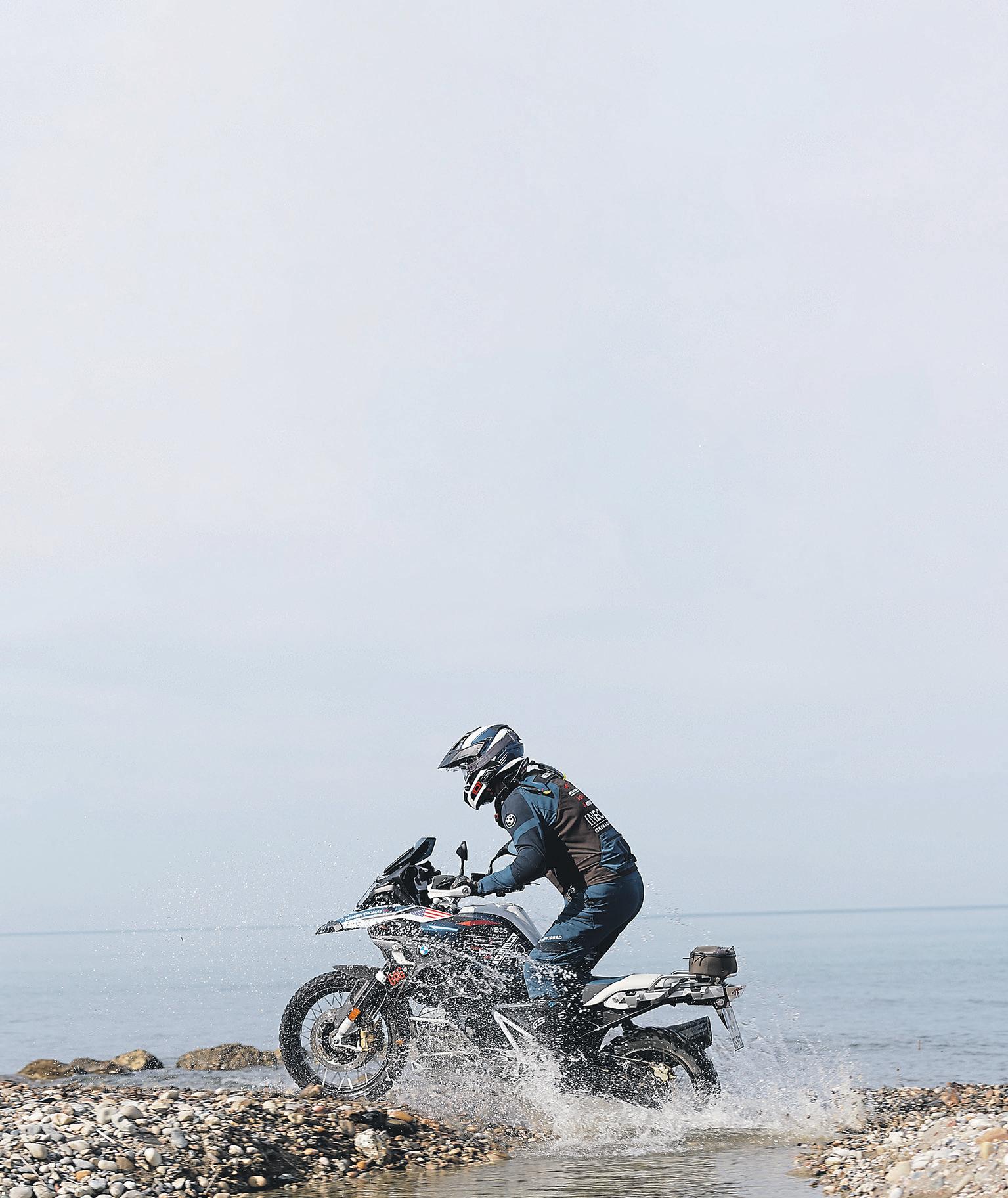
12. China: 2020 10
14. Brazil: 6
15. South Korea: 4
GS TROPHY 45














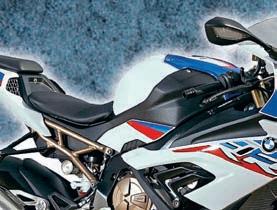







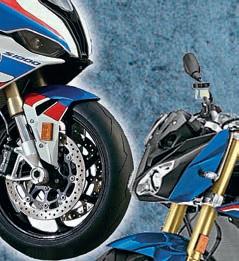





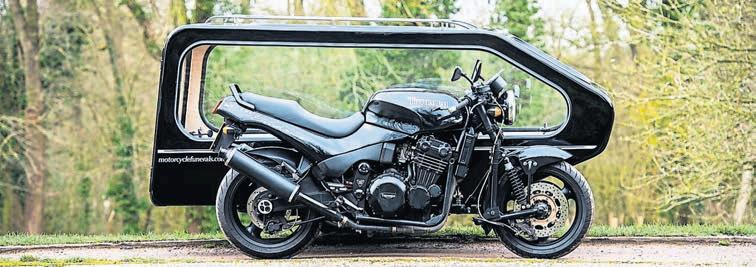



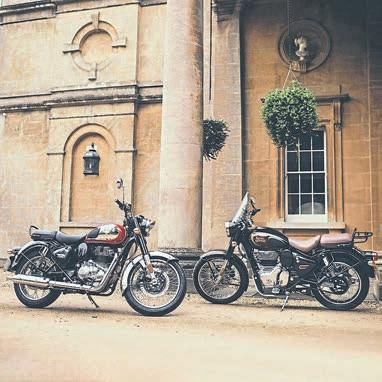















Cost-effective Classics

KAWASAKI Z650
WORDS: Steve Cooper PHOTOS: Mortons Archive
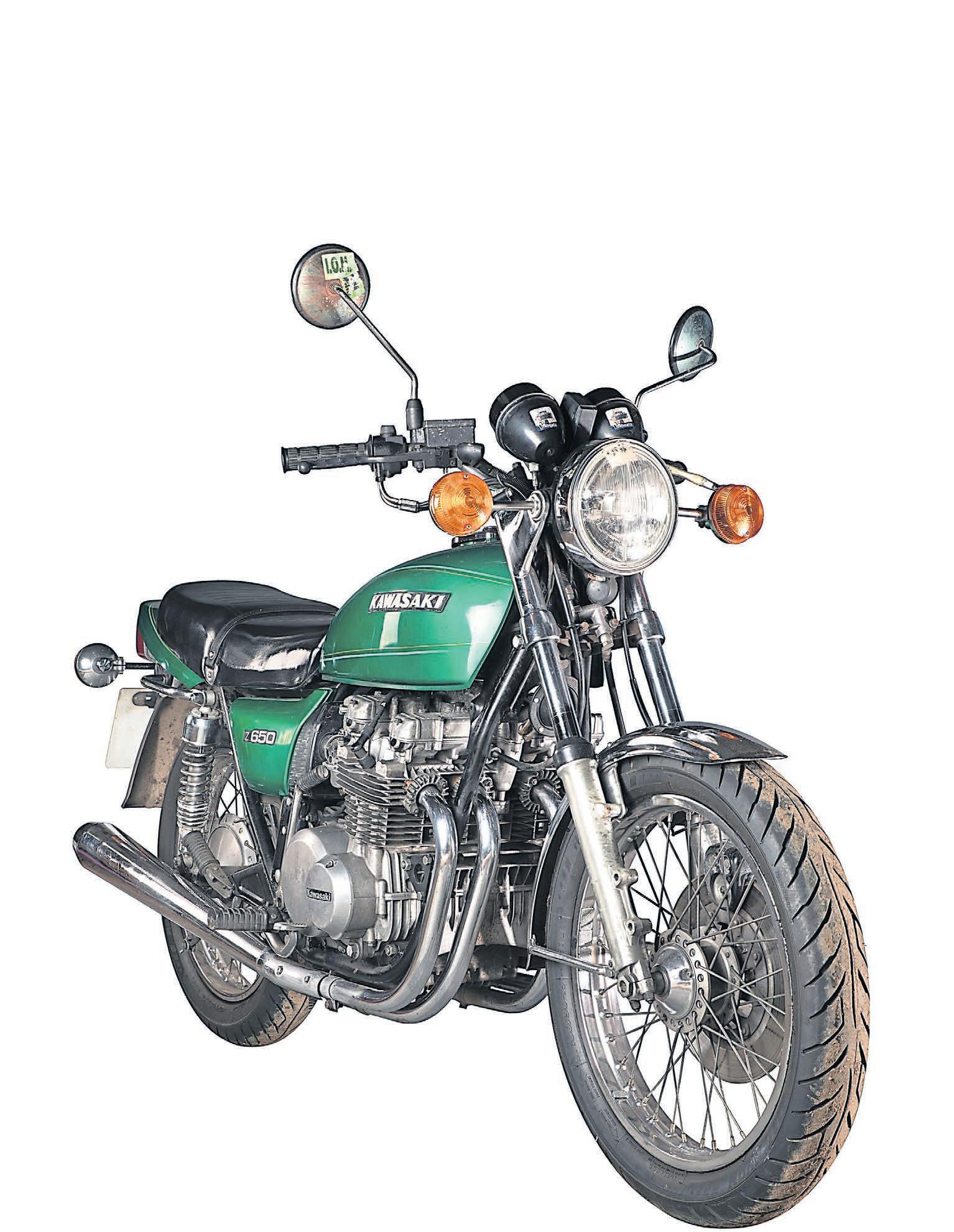
COST-EFFECTIVE CLASSICS 47
Possibly the best VFM classic Japanese four you can buy!
COST-EFFECTIVE CLASSICS
Classic, old school, air-cooled multis don’t come more attainable than the Z650. Essentially a second generation Japanese four, it has similar performance to Honda’s seminal CB750/4 but with reduced mass… and cost!
Background
Kawasaki’s move into air-cooled fours occurred late 1972 with the iconic Z1 900 Super Four and the bike won hearts and minds… and huge sales. However, it was far from perfect for several reasons: mass, bulk, handling, build costs and more. What was needed was an accessible four that had mass-market appeal and was more cost-effective to build.
The bike
The Z1 900 had been based around a pressed-up crank running roller bearings – a remarkably strong and resilient structure but expensive to build with so many webs, pins, bearings, etc. The Z650’s motor is based around standard automotive practices utilising plain, white metal, big ends and connecting rods bolted together over the bearings. This facet of the bike alone massively reduced the cost of its manufacture, allowing Kawasaki to sell it at a more costeffective price. And the fact that the firm chose to make its new baby a 650 meant it had no direct market competition.
At the time of launch many questioned why the four-cylinder machine didn’t have four silencers as per the bigger Zeds, but Kawasaki
was keen to move the game on. Launched in 1976, the Z650 heralded a move to reduced mass and bulk via 4 into 2 exhaust systems that would feature on the larger machines just a year later. Lessons learnt with the 900s, observations made by various journalists and issues encountered during production racing were all fed back into the 650’s design matrix.
A fundamentally stiffer frame with extra bracing and gusseting formed the basis of the Z650’s better road manners allied to revisions in rake and trail. And the use of just two silencers meant ground clearance was enhanced. Few who rode a Z650 at the time had any real issues with its handling.
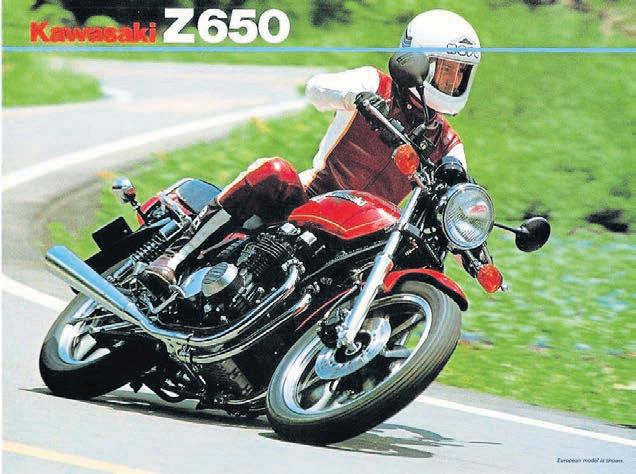
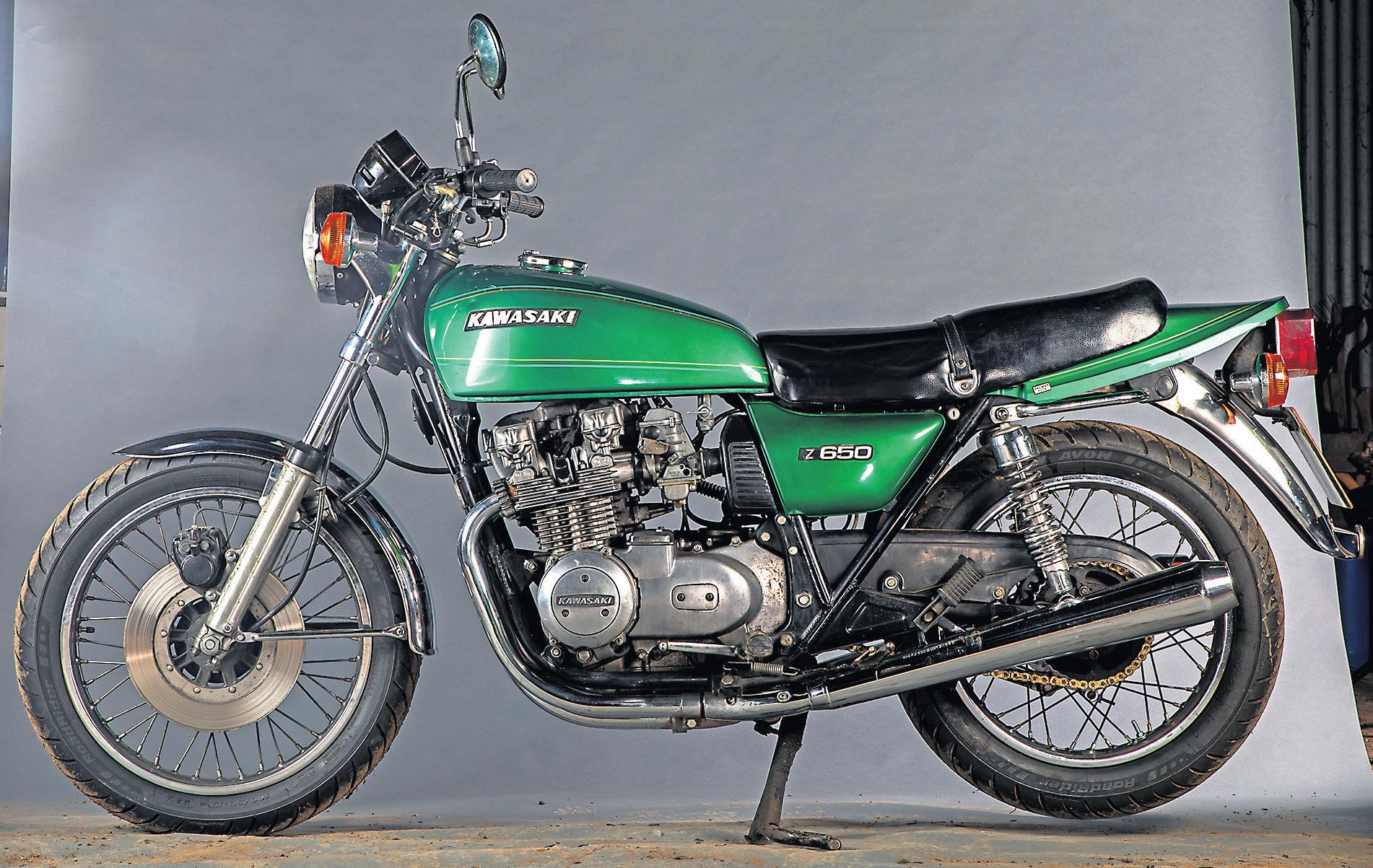
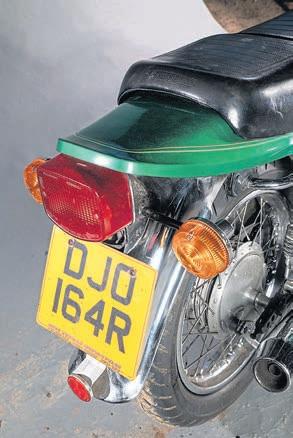
What the Z650’s designers achieved is often overlooked or disregarded by fans of the 900s but it’s worth noting especially in the current strained financial times. The 650 is just 5mph slower than the 900; weighs some 20 kilos less; is just 0.1 seconds slower over the standing quartermile; and still managed to look like a classic 1970s Zed – and that’s some achievement!
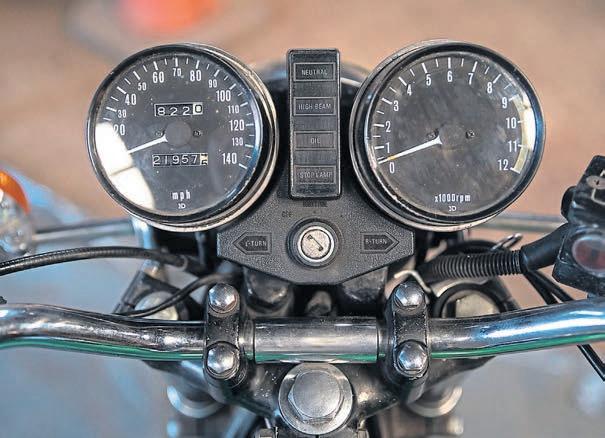
The bike had an eight-year model run (76-83) and was the subject of ongoing upgrades throughout its life. However, all of these changes were iterative and Kawasaki never had any serious issues with any of the models. Interestingly, Kawasaki was amongst the first Japanese manufacturers to launch a so-called ‘factory custom’ version of an existing model. The Z650C was perceived as quite radical for its time with seven-spoked alloy
wheels, a chunky rear tyre, pulledback bars and metallic powder blue paint job. In reality the styling was rather mild but it opened a new market for the bike,especially in the USA.
Lineage and Legacy
The Z650 has a huge legacy and laid down the blueprint for a vast range of air-cooled Kawasakis. It was only with the introduction of the liquidcooled DOHC, 16-valve GPz900R that things really changed. From the baby Z400J right through the various 750s and on to the hugely impressive GPz1100, the Z650’s DNA was there. Even the hugely outrageous Z750 Turbo has its roots back in the Z650.
48
“A Kawasaki Z650 offers you pretty much everything a Z1/Z900/Z1000 does but for substantially reduced expenditure.”
9
1 2 3 4 5 6 7 8
Faults and Foibles
1. VALVE ADJUSTMENT
These motors use inverted ‘shim & bucket’ valve adjustment so a noisy top end may be due to poor maintenance.
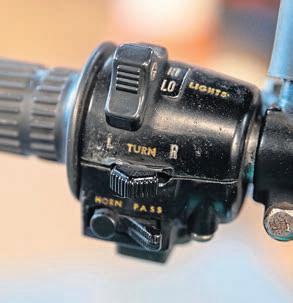
2. BRAKES
The original B model had a marginal single disc up front and drum rear. C variants run three discs. All benefit from a proper service and modern pads.
3. EXHAUSTS
Originals are prone to rotting from the inside out. Check on the inner faces and underneath.
4. OIL
It’s a plain bearing bottom end, not rollers like the Z1 so goodquality bike specific oil, and regular filter and oil changes are key to longevity.
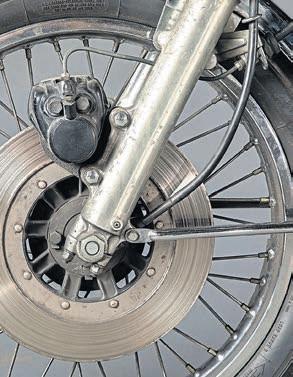
5. CARBURETTOR & AIR FILTER
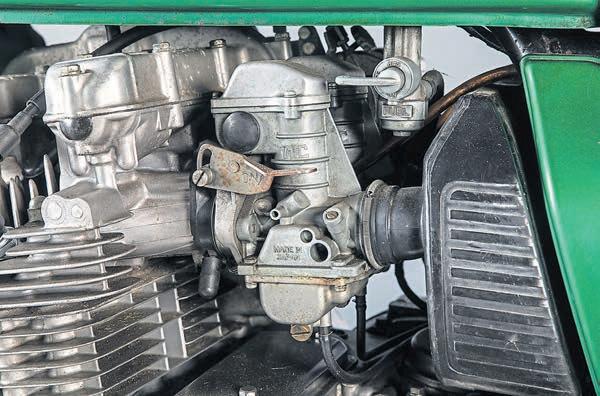
OEM air boxes are always better than pod filters. Haggle accordingly if the air box is missing.
6. SIDE PANELS
A missing panel isn’t the end of the world as replicas are available.
7. GUARDS
Decent front guards are rare.
Typical Prices
As you might expect with the advent of the new Z650RS, a few dealers are jumping on the bandwagon trying to punt out the original 70s Z650s as something mega-important. There’s enough of the 70s Z/KZ650s to go around and anything over our £5000 budget is, arguably, overpriced. We’ve spotted a handful of the 650C custom models being offered at £8k or more, but that’s pure madness. Five grand tops for something that’s in original condition with OEM exhausts and a standard paint scheme is about where it’s at. Projects start as low as £1500 for something running but rough, and go up to around £2500. We’d be investing £3500-3750 in a USA KZ650 import with patina knowing it’d only likely go up in value.
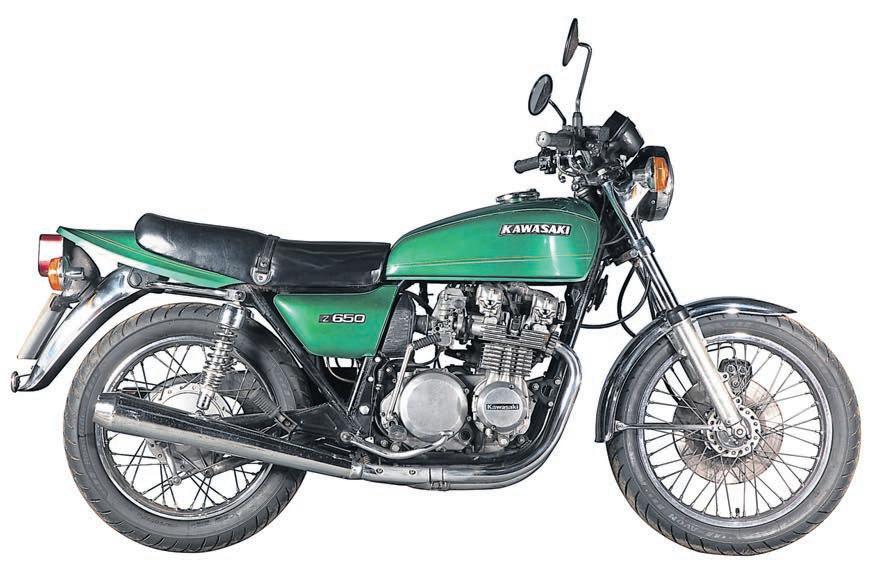
Why you might want one now
A Kawasaki Z650 offers you pretty much everything a Z1/Z900/ Z1000 does but for substantially reduced expenditure. It has all the style and panache of the bigger machines without the mass and bulk, handles significantly better and is substantially more accessible. And with its ‘shim and bucket’ valve clearance adjustment facility, maintenance schedules are reduced. The engine/exhaust are remarkably
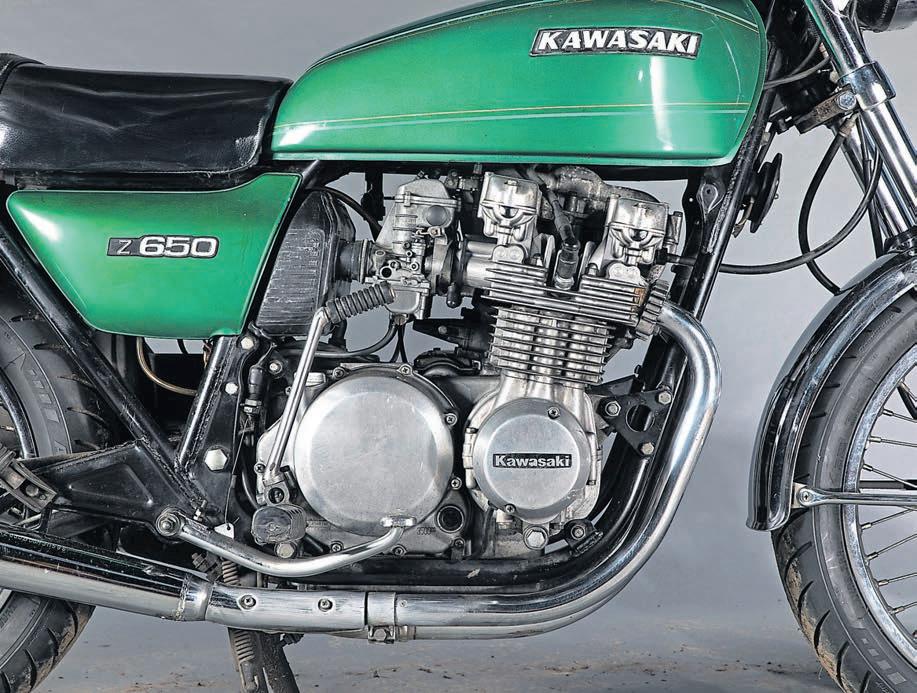
Look out for longer OEM rear guards that have been cut down to ‘look better’. Either guard will now be expensive and rare.
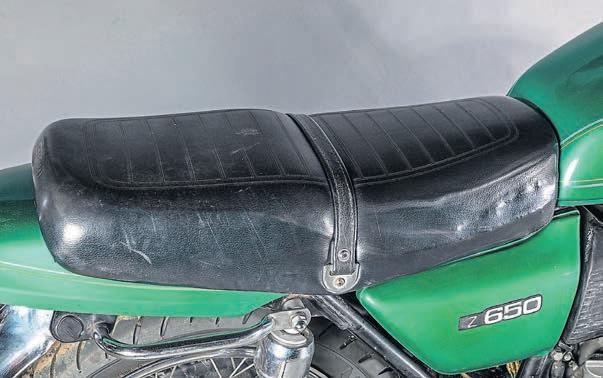
8. PRIMARY CHAIN
Some seem to last forever, others die around 50k. If you’re rebuilding the motor, change the chain regardless.
9. STARTER MOTOR ISSUES
Starter clutches are a known issue and variously caused by low batteries, synthetic oil/additives, weak springs and/or worn parts. Repair components are available but a unit from the later ZR7 fits straight in and works reliably.
quiet for the period and the bike is just so easy to ride. Amazingly, it’s still modern-world relevant and, quite frankly, we’d be more that happy to take one touring around Europe. All the style of a Z900 for a fraction of the cost, less bulk, better handling… what’s not to like? The Z650 offers old-school, air-cooled panache in a readily accessible package allied to the legendary reliability of the four-cylinder Zed range. If you were in the market for a late 70s cum early 80s middleweight you’d genuinely struggle to find something better.
COST-EFFECTIVE CLASSICS 49
SHEENE AND SUZUKI
1977 saw Yamaha back in full factory action with Venezuelan Johnny Cecotto and American Steve Baker both riding the latest and essentially allnew version of the TZ500.

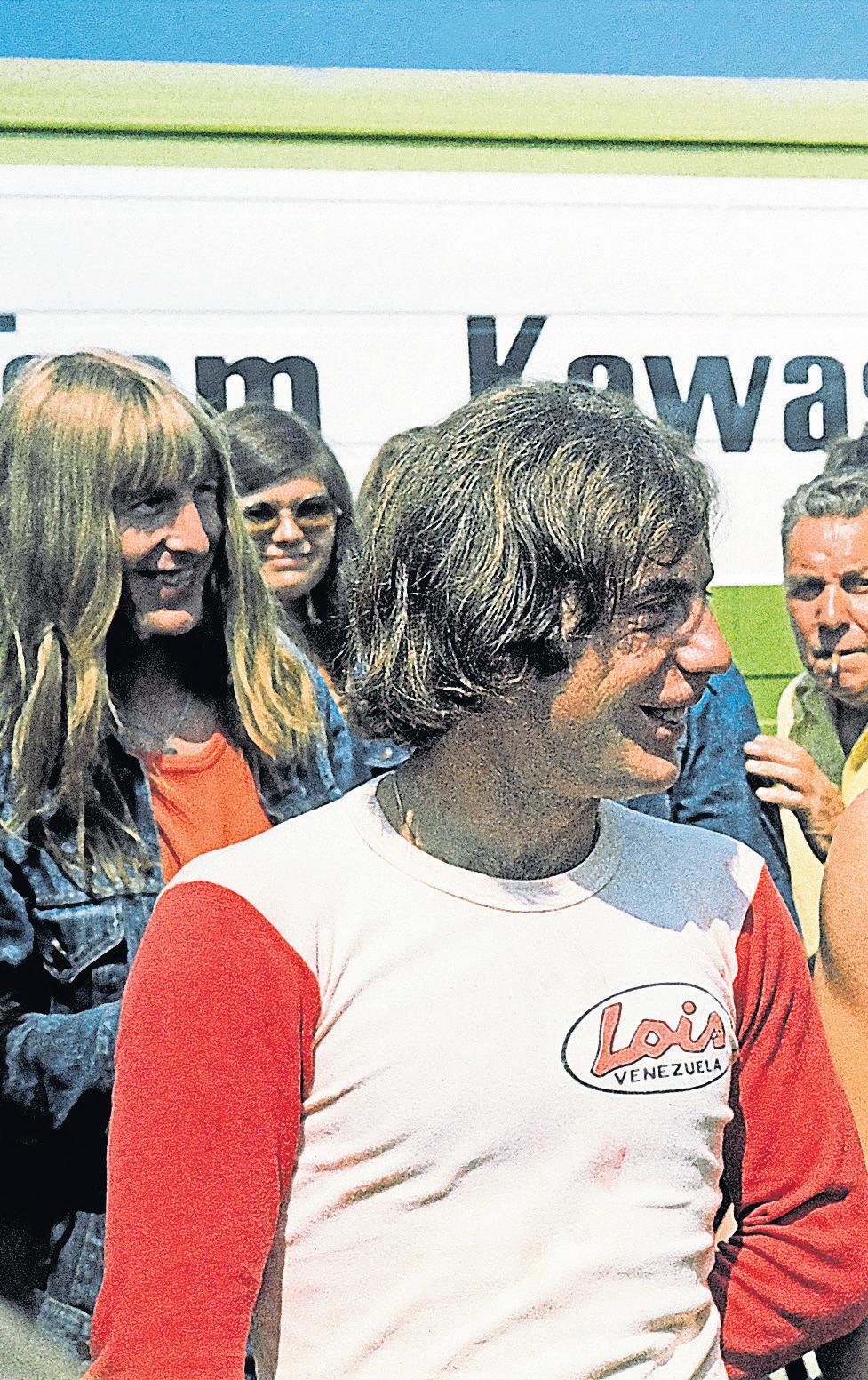
The OW35 marked a significant direction change for the half-litre four with the model defining reed valves dropped from the design. Despite their known benefits, Yamaha had concluded their presence within the inlet tracts was, ultimately, impacting upon gas flow. Seeking to address this radical deviation from the original concept, bell mouths were fitted to the Mikuni carburettors which also featured Power Jets – something would later appear on road-going strokers from the company.
Another piece of artifice was the use of tuned inlet tracts to support the revised port timing; Yamaha was seeking all-out power. Another marked change was the revision of the OW35’s bore and stroke. Yamaha had favoured to ‘square’ 54 x 54mm set up for many years but now switched to 56 x 50.6mm as previously used a decade previously on some of the air-cooled 250cc racers. This arrangement favoured top-end power and also, fortuitously, meant smaller flywheels which in turn aided crankshaft reliability.

Another massive change from convention was having the engine running backwards which allowed the motor to maximise incoming fuel/air charge without compromising piston skirt integrity. Needless to say, the backwards running engine came with a weight penalty in that an additional jack shaft was needed to reverse drive momentum before it entered the gearbox but this wasn’t considered to be a major issue. Finally, a vertical drive taken off the jack shaft powered both the cooling water impellor and the new lubrication pump that served the gearbox. With revised the expansion chamber layout and now mandatory end cans on the exhausts, the piston-ported TZ500 Mk2 was ready to take on all comers. The OW35 was a fairly radical step on from the old TZ500s!
Early tests showed the new engine was capable of delivering 110bhp but only between tightly defined rev limits of 10,000 and 11,000rpm. With Agostini back with Yamaha for his final year of GP racing together with Cecotto and Baker, most people thought the firm was in with a good chance of regaining the title but it wasn’t to be. The combination of Barry Sheene on the Suzuki RG500 proved to be unbeatable with 108 points at the end of the season. Steve Baker came a creditable second on 80 but it wasn’t sufficient for Yamaha’s bosses who then sacked him, despite him taking the F750 for them! Cecotto could only manage fourth with 50 points and Agostini bowed out in sixth place with just 37 points and was refused factory machines for the following year! In the top 10 riders of the 1977 season all but three were on Suzuki RG500s – the top people back at base in Iwata, Japan, were not in the best of humours! Something fundamental had gone wrong despite all the time, money and effort invested in the 1977 OW35. If Yamaha’s top three riders couldn’t beat those damn Suzukis from Hamamatsu on the best TZ so far, perhaps the faults lay closer to home? Some soul-searching and critical analysis were to be undertaken and a fair few home truths handed out.
50 THE INSIDE LINE TO CLASSIC JAPANESE IRON WITH STEVE COOPER FROM THE VJMC WANT YOUR FIX OF JAPANESE CLASSICS? THEN YOU NEED... Visit www.classicmagazines.co.uk/cmm296 Call: 01507 529529 and quote: CMM296 6 issues for £24* Expiry: 31/12/23 *UK only offer *Followed by £24 every six months The VJMC – run by motorcyclists for motorcyclists. For membership enquiries only Tel: 01454 501310 Email: membership_vjmc@yahoo.co.uk Address: PO Box 1949, Yate, Bristol BS37 0BX Office hours: Mon-Thurs,10am-4pm (please leave a message)
Words: Steve Cooper
Photo: Mortons Media Archive
struggles to hold its own against some seriously tough competition towards the end of the 70s
Yamaha
hard feelings.
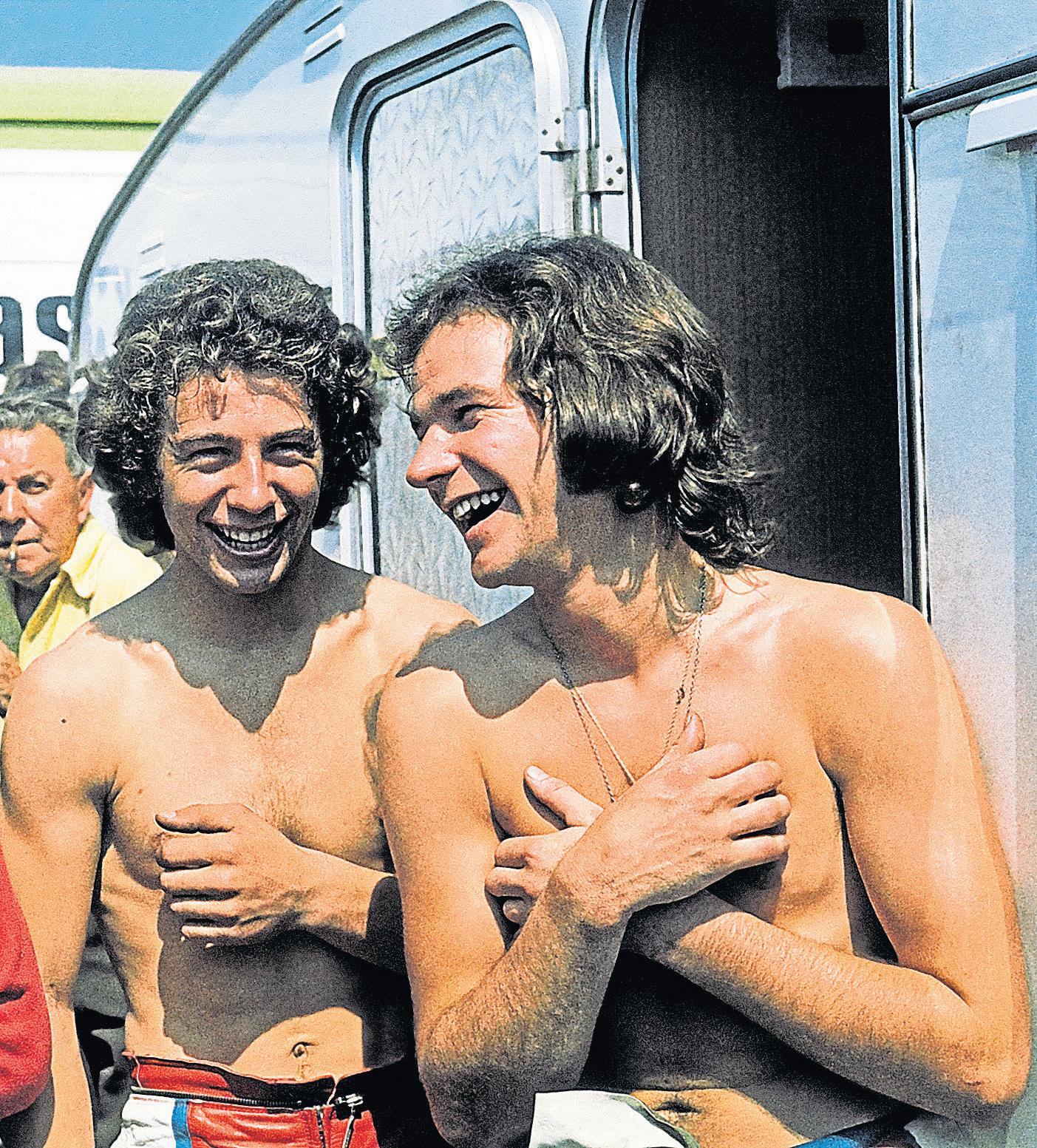
THE INSIDE LINE TO CLASSIC JAPANESE IRON WITH STEVE COOPER FROM THE VJMC 51
No
Sheene, Johnny Cecotto, and Cecotto’s younger brother Jose (left).




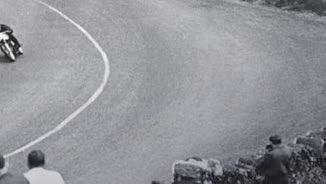










































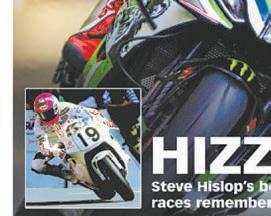


























































































































































CHROMING ACCESSORIES TYRES
BRAKELINES CLASSIFIEDS www.morebikes.co.uk
WEBWATCH
For Sale
BSA B31 1948, rigid frame is in original condition with no lugs missing, Triumph T140 piston and belt driven clutch conversion, new tyres, Goldie forks, £5000 ovno Tel. 07513 168824. Notts.
KAWASAKI ZX6R 2000, X reg, one lady owner for the last 14 years, good tyres, chain and sprockets, very clean and well loved bike, 50,800 miles, full front calipers clean and new seals at 49,000, Hugger and R&G crash protectors, £1450 ovno Tel. 07795 680499.
MOTO GUZZI Zigolo, 1957, 98cc, 2 stroke, dry stored, V5, on Sorn, £850 Tel. Mike 07790 603367. Worcs.
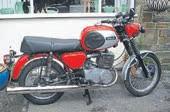
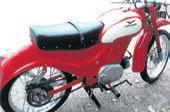
ROYAL ENFIELD Cafe Racer, 1969, immaculate, red/black, lightweight 250cc, single cylinder, new wheels, tyres, battery, exhaust, silencer, fitted clipons, rearsets, excellent chrome, running well, ready to ride or show, free delivery, £3950Tel.01723372219.North
Yorkshire.
SUZUKI RF900R 1996, good condition,goodtyres,box,recent new chain, needs water pump, current MoT, offers Tel. 07768 315098. Wiltshire.
BMW R1200GS 2009, 32,535 miles, new MoT till Sept 9 2023, Namibia Orange, excellent runner, good clean well looked after bike owned for last four years, ABS, 3 Suspension modes (ESA), adjustable seat height, £5450 Email. malcolmgardener@sky.com
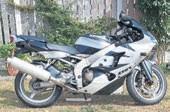
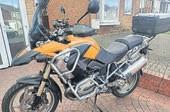
HONDA SHADOW 1998, MoT, 600cc, very good condition, 10,250 miles, custom black, orange, £2800 possible p/x Tel. 07395 910839. Norfolk.
KAWASAKI KLX300 2002, road reg, road tyres, FMF exhaust, very good condition, modified seat renthals, lovely bike to ride, very reliable, £3000 ono Tel. 01225 743415.
KAWASAKI ZX-9R C2 1999 owned since 2014, 23,600 miles, 100% OE spec inc all the fasteners etc, fantastic condition except mild topple-over gravel rash on fairing panels (hard to see), recent Roadtec 01s, C&S (DID), HEL hoses, new EBC-HH pads, fluid, spare wheels with Bridgestone R10s, both sets of wheels Cerakoted gold, Oxford stretch indoor cover, Scottoiler, footrest lowering kit if you want it too, lovely bike, £3200 Tel. 07811 312819.
MZTS250/1 Super5,1980,nice standard bike, in good useable condition, historic vehicle, V5 so tax&MoTfree,recentnewtyres, brakes & silencer, classic two strokefun,£1750onoTel.07771 834069. West Yorks.
TRIUMPH BONNEVILLE 1977, Limited Edition, T140 with factory certificate, as new, Silver Jubilee model, previous MoTs and tax discs, only 7517 miles from new, twin discs, electronic ignition, offered from a private collection, photos available, free delivery arranged, £7950 Tel. 01723 372219. North Yorkshire.
YAMAHA XT225 1992, needs somework,£900onoTel.07484 103498. Somerset.
YAMAHA FJR1300 2003, red, 9550 miles, excellent condition, MoT June 2023, full touring pack, tank graphics, collectors bike,£4500.Tel.07717768687.
Parts For Sale
TRIUMPH THUNDERBIRD 900 new old stock, chrome sprocket cover original box, mint fits Adventurer Legend Sport, £400 + £7 postage. Also black plastic OE clocks covers, £70 + £5 postage. Rear brake, £35 + £5 postage Tel. 07434 513161. Lancashire.
YAMAHA MT09 TRACER 2015 power bronze touring screen, taller and wider than the standard unit, will fit models up to 2017, very good condition, collection in Tadcaster, North Yorkshire, can post if required, £35 Tel. 07496 566163. North Yorkshire.
Wanted
ANY CLASSIC BIKE wanted anything considered in any condition by enthusiast top price paid Tel. 01514 470147.
BELSTAFF LEATHER JACKET
black vintage with removeable fur lining, large, £400, todays new price £1350. TT leathers International wax cotton trials trousers, med/large as new, £40 Tel. 01484 663007. West Yorkshire.
LAMBRETTA 150 MK2 Instruction Booklet, as new £10. Lambretta Scooter Maintenance/ Repair book, all models from 1952 as new, £10. The Official Lambretta Workshop Manual, printed by Lambretta Concessionaires Tel. 01484 663007. West Yorkshire.
MOLTON STANDARD BICYCLE
1960s, maroon, 16” wheels 3-speed Sturmey Archer gears all complete, dry stored, £70 Tel. 01299 266565. Worcs.
KAWASAKI GPZ500 07, 2000, 3800 miles, owned since 2018, amazing condition, four previous owners, lots of history, original except for brake hoses, MoT, tank cover rack, £1900 ono Tel. 01797 320434.
MOTOMORINI250 V-twin,1983, immaculate red/black paintwork, alloy wheels with Avons front disc rear drum brakes, stainless silencers, indicators, previous MoTs, V5C, photos available, readytoride,freedelivery,£4450 Tel.01723 372219.
NORTON DOMINATOR 99 Slimline, 1961, very well presented in silver/black, large historyfolderincludingrestoration receipts, MoT paperwork, Workshop Manual and V5C, restored during 2016 and placed in a private collection, now recommissioned, ready to ride, freedeliveryarranged,£7950Tel. 01723372219.Yorkshire.
NORTON INTERSTATE 1972
Special, fitted CB500 black toolkit twin, £5250. Honda 750/4, 1979 L/M 9k, new pipes x 4 tyres, battery, black, £5500. New: books V. Rossi & Moto GP, £8/£12. New: L/rg suit 5’10” XL B/W/R,£150Tel.07759607498. East Berkshire.
ROYAL ENFIELD 250cc Clipper, 1959, silver/black, paintwork chrome guards, very tidy throughout, lightweight, single cylinder, new battery, excellent wheels and tyres, photos available, V5C, historic free road tax, free delivery arranged Tel. 01723 372219. North Yorkshire.
TRIUMPH TRW 1957, 500cc sidevalve in superb restored condition, lovely lightweight post war military bike, V5C, £6995 Tel. 01895 624554. Herts.
AFTERMARKET SEAT to suit Honda CX500, excellent condition, no damage whatsoever, like new, £40 ono Tel. 07717 742550.
HONDA 350SG 1986, wanted spares parts 450SC 1986, any useable parts consider complete bike, spares, repair, WHY? possible to collect south Tel. 07790 343607. Devonshire.
SUZUKI GT500A 1976, 27,000 miles, UK bike, good runner, goodcondition,restoredin1990, gearbox rebuilt, one re-bore 0.5mm, silencers re-chromed, frame stove-enamelled, seat, horn, brake lever, wheels not original, Haynes manual included, £4750 Tel. 07977 556640. Email. helenhunt3@ btinternet.com
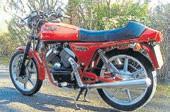
YAMAHA V80 89cc, 1983, restored, new wheels, exhaust, seat, fairing stunning condition, classic investment or ride, £22 road tax, 100+ mpg, MoT free Yamaha answer to rusty C90, £1950 Tel. 07434 072785. Lancs.
TRIUMPH T120R Bonneville, 1970, 650cc, matching frame and engine numbers, excellent condition, runs well, no smoke or rattles, photos by phone, becoming quite rare, £7295. Tel. 07887 674467. Hants.
BSA A10 big journal crank, £120. Sump plate, £10. Gearbox, £180. Small Journal crank rods, £110. Small journal con rods, £30. Front wheel, £120. Dunlop rim, £15. Rocket crank cases, £125 Tel. 07968 390904.
SUZUKI SV650 radiator cover, new boxed, £20. Rear SV650 suspension spring as new, £50. SV650 fork internals as new, £20 Tel. 07974 024893. North Yorks.
TRIUMPH SPRINT and Tiger 900 parts: 1995, cylinder heads with camshafts and rubber rocket gasket, head covers, pistons, conrods starter clutch, valves, shims, camchain guide, valve springs etc, £200. Tel. 07448 927393.
ROYAL ENFIELD pre 1960 trials bike,notBulletwithoffroadtyres Tel. 01248 352681.
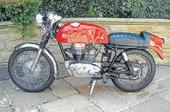
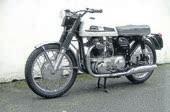
SUZUKI GR650 1983, Suzuki GR650tempterstartermotorand clutch lever wanted Tel. 07434 762911. Manchester.
YAMAHAR6 1955-2000approx, £1500 - £2000, reasonable mileage and extras with MoT, could collect reasonable distance, please text only 07790 512582. Shropshire.
Miscellaneous
ABBA BIKE STAND one person operation, with instructions and fixing kit for Kawasaki ZX6R Ninja, (fixing kits for other bikes available from ABBA), little used, £65. Tel. 01516 069983. Wirral.
MOTORCYCLE HELMET Nexx Wed? three in one, Street/ Enduro/Offroad, Pinlock fitted, equipped to accommodate X.com, black, size large, unwanted prize, never worn, £165 ono Tel. 07871 518336. Durham.
PAIR OF EVERSURE car ramps, one owner from new, dry stored, no damage, 32” long 8” wide, 10” high, £30 Tel. 01299 266565. Worcs.
RACING LEATHERS by MW London, medium, £45. RM wax cotton trials jacket style, medium, new, £80. Yamaha Workshop Manuals 250-400 DT Trail 1968-79, 1971 onwards, rare as new, £15 each Tel. 01484 663007. West Yorkshire. SEALEY MOTORCYCLE heavy duty front wheel chock FPS7.V2, £25. Motorcycle ramp l/weight folding aluminium max weight, 200kg, £25 both excellent condition Tel. 07849 685043. Lincolnshire
Selling your bike is FREE for private readers Choose one of the following methods: 1 ONLINE www.morebikes.co.uk 2 EMAIL freeads@morebikes.co.uk 3 POST MB Reader Adverts, Media Centre, Morton Way, Horncastle, Lincs LN9 6JR Classified