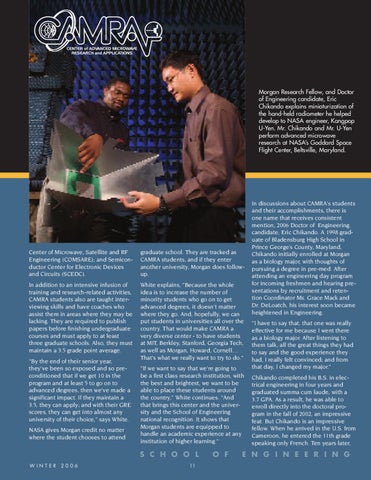
Morgan Research Fellow, and Doctor of Engineering candidate, Eric Chikando explains miniaturization of the hand-held radiometer he helped develop to NASA engineer, Kangpop U-Yen. Mr. Chikando and Mr. U-Yen perform advanced microwave research at NASA’s Goddard Space Flight Center, Beltsville, Maryland.
Center of Microwave, Satellite and RF Engineering (COMSARE); and Semiconductor Center for Electronic Devices and Circuits (SCEDC).
graduate school. They are tracked as CAMRA students, and if they enter another university, Morgan does followup.
In addition to an intensive infusion of training and research-related activities, CAMRA students also are taught interviewing skills and have coaches who assist them in areas where they may be lacking. They are required to publish papers before finishing undergraduate courses and must apply to at least three graduate schools. Also, they must maintain a 3.5 grade point average.
White explains, "Because the whole idea is to increase the number of minority students who go on to get advanced degrees, it doesn't matter where they go. And, hopefully, we can put students in universities all over the country. That would make CAMRA a very diverse center - to have students at MIT, Berkley, Stanford, Georgia Tech, as well as Morgan, Howard, Cornell… That's what we really want to try to do."
"By the end of their senior year, they've been so exposed and so preconditioned that if we get 10 in the program and at least 5 to go on to advanced degrees, then we've made a significant impact. If they maintain a 3.5, they can apply; and with their GRE scores, they can get into almost any university of their choice," says White. NASA gives Morgan credit no matter where the student chooses to attend
"If we want to say that we're going to be a first class research institution, with the best and brightest, we want to be able to place these students around the country,” White continues. “And that brings this center and the university and the School of Engineering national recognition. It shows that Morgan students are equipped to handle an academic experience at any institution of higher learning."
S C H O O L WINTER
2006
11
O F
In discussions about CAMRA's students and their accomplishments, there is one name that receives consistent mention, 2006 Doctor of Engineering. candidate, Eric Chikando. A 1998 graduate of Bladensburg High School in Prince George’s County, Maryland, Chikando initially enrolled at Morgan as a biology major, with thoughts of pursuing a degree in pre-med. After attending an engineering day program for incoming freshmen and hearing presentations by recruitment and retention Coordinator Ms. Grace Mack and Dr. DeLoatch, his interest soon became heightened in Engineering. "I have to say that, that one was really effective for me because I went there as a biology major. After listening to them talk, all the great things they had to say and the good experience they had, I really felt convinced; and from that day, I changed my major." Chikando completed his B.S. in electrical engineering in four years and graduated summa cum laude, with a 3.7 GPA. As a result, he was able to enroll directly into the doctoral program in the fall of 2002, an impressive feat. But Chikando is an impressive fellow. When he arrived in the U.S. from Cameroon, he entered the 11th grade speaking only French. Ten years later,
E N G I N E E R I N G