Student Retention: continued
“Ultimately, when you compare Morgan to other public, urban HBCUs (Historically Black Colleges and Universities), our graduation and retention rates are excellent.” —Dr. Tiffany B. McMillan
The schools’ retention programs are coordinated through Dr. McMillan to ensure that campus-wide goals are met. But, beyond that, each school develops unique retention strategies.
“Morgan is a unique institution. We nurture our honors students and those that are meeting their academic expectations and goals at the university, and at the same time, we also provide access and opportunity to students who have yet to reach their full academic potential. We take students with the potential to be good and try to make them great.”
Michael James, Retention Coordinator for the School of Education and Urban Studies, says, “We created a study and networking area for our students called the PIT (Positive Information Territory). The students did not have a designated area in which to study, before and after classes, so we chose an underutilized location to bring in furniture, related magazines, periodicals and books, and supplied some resource tables. Also, since one of our big retention issues is funding, we started a letter-writing program targeting churches and hip-hop moguls, asking them to help us. We have a resume-writing program as well.” “Basically, we do everything we can to help students discover their career passion and to follow it successfully. The retention staff here at Morgan is here to 'meet and solve,' not just to 'meet and have dialogue,' and Dr. McMillan is the visionary that directs the entire program.” We do everything we can to ensure student success and achievement.”
Another trait that sets Morgan apart from other institutions is the university’s mission to serve a multi-ethnic and multi-racial student body and to help ensure that the benefits of higher education are enjoyed by a broad segment of the population. Because Morgan’s mission encompasses providing access to a large segment of diverse academic and social backgrounds, the numbers relative to retention are even more impressive.
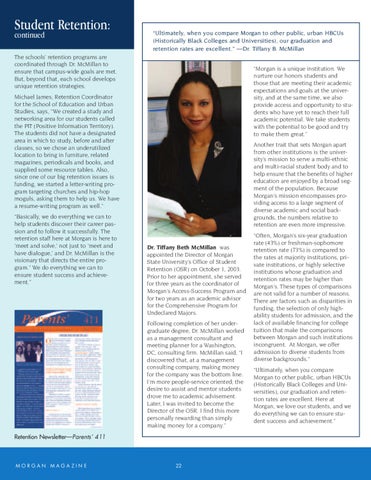
Dr. Tiffany Beth McMillan was appointed the Director of Morgan State University’s Office of Student Retention (OSR) on October 1, 2003. Prior to her appointment, she served for three years as the coordinator of Morgan’s Access-Success Program and for two years as an academic advisor for the Comprehensive Program for Undeclared Majors. Following completion of her undergraduate degree, Dr. McMillan worked as a management consultant and meeting planner for a Washington, DC, consulting firm. McMillan said, “I discovered that, at a management consulting company, making money for the company was the bottom line. I’m more people-service oriented; the desire to assist and mentor students drove me to academic advisement. Later, I was invited to become the Director of the OSR. I find this more personally rewarding than simply making money for a company.”
Retention Newsletter—Parents’ 411
MORGAN MAGAZINE
22
“Often, Morgan’s six-year graduation rate (43%) or freshman-sophomore retention rate (73%) is compared to the rates at majority institutions, private institutions, or highly selective institutions whose graduation and retention rates may be higher than Morgan’s. These types of comparisons are not valid for a number of reasons. There are factors such as disparities in funding, the selection of only highability students for admission, and the lack of available financing for college tuition that make the comparisons between Morgan and such institutions incongruent. At Morgan, we offer admission to diverse students from diverse backgrounds.” “Ultimately, when you compare Morgan to other public, urban HBCUs (Historically Black Colleges and Universities), our graduation and retention rates are excellent. Here at Morgan, we love our students, and we do everything we can to ensure student success and achievement.”