
5 minute read
Addressing skills shortages in the clean energy industry

ADDRESSING SKILLS SHORTAGES IN THE
CLEAN ENERGY INDUSTRY
Advertisement
By Mikayla Bridge, Editor, Utility Magazine
The Clean Energy Council (CEC) has released a new report, Skilling the Energy Transition, which makes six recommendations to fix the skills and labour challenges that could endanger the success of Australia’s clean energy transition. Utility spoke to Dr Anita Talberg, CEC’s Policy Director for Workforce Development, to explore her recommended solutions to the current skills shortage.
The CEC report, published ahead of the Job and Skills Summit in early September 2022, explored the different ways that businesses and governments can improve worker access to clean energy jobs. The report’s six recommendations lay out the major barriers that limit the pool of talent entering the industry.
CEC’s six recommendations include: 1. Calibrating higher education to meet the needs of clean energy interests 2. Anticipating the future needs for the clean energy workforce 3. Raising the profile of the clean energy sector as an opportunity for all Australians 4. Establishing an authority to manage the clean energy transition 5. Enhancing the Vocational Education and Training
Sector’s capacity to understand and meet the demands of industry 6. Establishing Australia’s reputation abroad as a global centre for clean energy expertise
Dr Talberg leads the Clean Energy Council’s Skills and Training Directorate, a group designed to bring CEC members together and address challenges around skills and training, as well as other issues that resonate across the whole sector.
“Essentially, what I'm trying to do is make sure that we have the workforce to support the continued and accelerated growth of renewable energy in Australia. That can present lots of different facets, but at the core of it, we really need the headcount. We need the right number of people with the right skills in the right place at the right time. It's not rocket science,” Dr Talberg said.
This approach formed the basis of the Skilling the Energy Transition report. Targeted at businesses and government bodies, the report aims to answer the question of how we ensure that the industry has the talent needed to carry out its development plans over the next five to ten years.
MAJOR CHALLENGES AND PRESSURES WITHIN THE INDUSTRY
Dr Talberg consulted with CEC members to understand the greatest challenges facing the current workforce and the impact these pressures can have on the future of the clean energy industry.
From these discussions, it became clear that many of the industry’s in-demand skills can come from not just one discipline, but a range.
“As it becomes more difficult to source a role, you start to become a bit more creative about how you do that. So, you might start thinking about tangential skills or other people that could be cross-skilled, or different ways of bringing people in through what types of pathways exist. Bringing all of that information together is really helpful in starting to understand what the skills shortage is, in which areas,” Dr Talberg said.
Though some in-demand roles require specific training, such as power systems engineers, the majority of roles require skills that exist in various other industries. This includes electricians, general technicians, mechanical and electrical tradespeople and other trades roles that support the industry.
“A lot of people don't realise that we already have three times the number of people working in clean energy, rather than coal-sourced electricity. For domestic thermal coal – the
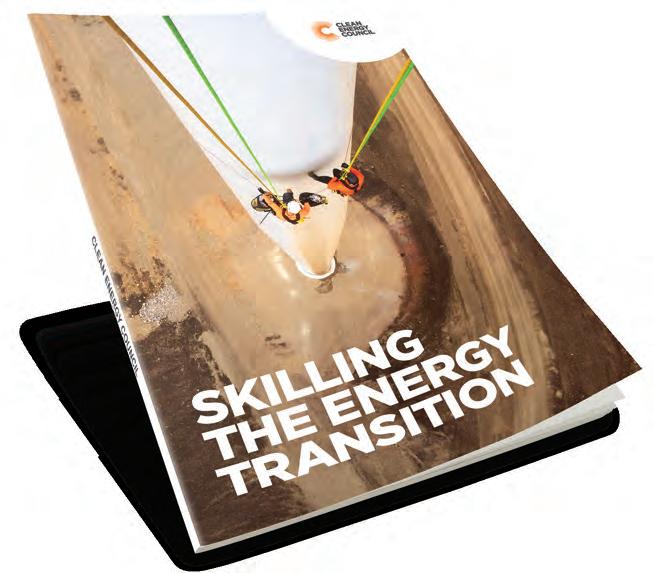
CEC SKILLS REPORT 2022 COVER
coal used for electricity – there are around 10,000 people employed in Australia, and we've now got more than 30,000 people in renewable energy,” Dr Talberg said.
“This story about how we shouldn't be transitioning to clean energy because of the jobs we’ll lose is a little shortsighted, because we're already past that. Not to say that it's not important, it's absolutely important to help those people transition, but we also need to be providing jobs for other people.”
This idea of highlighting the transferable nature of industry skills was the primary reason for the Skilling the Energy Transition report. The secondary reason was to “demystify” the existing roles within the clean energy industry.
“It's really clear to me, in my role, that people don't understand what a job is in clean energy; they don't know what that means and they don't know how to get it. So yes, we have a lot of engineers, but we don't only have engineers. We also have legal professionals, community engagement professionals, energy traders, and more. We have a whole gamut of people,” Dr Talberg said.
“The human capital is a huge part of the success of the energy transition. It's not all about technology and regulation.
“We're not trying to make recommendations that fine-tune how the clean energy sector can access talent. What we're saying is that there are these pathways. You need to fix the systems, and then we can, as an industry, do the rest.”
PLACING WORKERS AT THE CENTRE OF THE SOLUTION
In order to fix these systems, Dr Talberg makes a number of recommendations. These include: • Improving local education and training • Changing higher education business models • Fixing skilled migration
“If you can fix these, we can do the rest. We're not asking for favouritism. We're an industry, just like any other,” Dr Talberg said.
Encouraging workers to transfer to the clean energy industry through environmental, social and governance incentives is another major focus for the CEC.
“A lot of research shows that things like offering genuine career progression opportunities and pathways through the industry, having a diverse and inclusive workforce, having really good ESG principles in general, attracts people,” Dr Talberg said.
For businesses looking to attract a larger workforce, Dr Talberg suggests improving job visibility.
“These organisations should be going out to schools and local councils, and having that public face and creating an employer brand so that we can be telling a more cogent and more coherent story about career opportunities within the industry.
“We know that people who make career decisions are actually quite young. So, if it's something that they can see, then it makes it a lot easier to convert them. It's a long game. You're not going to reap the benefits straight away, but in ten years' time, they will have chosen that pathway.
“So that's the piece that's missing; for businesses to actually go and do that footwork, and be seen in public.”
When asked if there was anything that she’d like to say to potential employees, Dr Talberg said when we talk about a job in clean energy, we're actually talking about a career.
“This is the future. This is where those future opportunities exist. This is how you are part of the future; by being involved in the energy transition. It's not a decision you're ever going to regret,” Dr Talberg said.
To read the Skilling the Energy Transition report, visit the CEC website at www.cleanenergycouncil.org.au.
