
The Australian hydrogen INDUSTRY’S PATH TO COMMERCIALISATION NO TRANSITION WITHOUT TRANSMISSION: Brett Redman on unlocking renewables THREE STEPS to a smarter energy system ISSUE 20 · November 2022 · www.energymagazine.com.au


reach energy industry decision makers? Scan this code to learn how we can help you ensure your marketing is always on. www.energymagazine.com.au In B2B, the sales cycle is long. You’ll always have people at different stages of the buying cycle, so your marketing needs to be always on. We also have a team of editors, designers and marketing experts who specialise in the energy sector and can help make the most of your campaign. ● Brand building ● Educating the market ● Generating leads ● Creating engaging content ● Managing your social media and SEO ● Setting up marketing funnels Decision makers in the energy industry gain information from a wide range of sources. The team at Energy are able to provide a complete range of marketing solutions:
Want to
EDITOR’S WELCOME
s we come to the close of another year, it’s natural to reflect on how the past 12 months have played out for the energy sector. I think it’s fair to say, it’s been a bit of a bumpy ride!
For me, one of the biggest stories of the year has been the rise of energy activism, which probably had its greatest impact on the industry through the rise of “teal independents” at the Federal Election; and Mike Cannon-Brooks’ influence in the canned AGL demerger.

What are the lessons we can learn from these major events?
I think the first one is, ignore the will of the people to decarbonise and mitigate the impacts of climate change at your peril. AGL is the cautionary tale that the other major gentailers, and the industry at large, won’t forget in a hurry. And as Australia continues to face the impact of climate disasters – most recently, more major floods in Victoria and New South Wales – sustainability and impact on climate will continue to be front of mind for energy customers.
Secondly, the transition towards renewable energy has already picked up pace, and now, this will only continue to escalate in the years to come. In 2022, we saw a number of coal plant closures brought forward, including AGL’s announcement that it would exit coal completely by 2035 (brought forward from 2045); and Origin Energy’s announcement that it would close the Eraring coal-fired power station seven years earlier than scheduled, now in 2025.
Last year, EnergyAustralia also announced that it would exit coal by 2040. With AGL’s 2035 promise, it wouldn’t be
surprising if they too brought their plans even further forward in the year ahead.
All of this points to the industry currently being closely aligned with AEMO’s “Step Change” transition scenario, as outlined in the Integrated System Plan (ISP). In the ISP, four scenarios are outlined: Slow Change, Progressive Change, Step Change and Hydrogen Superpower. Step Change has long been considered the more likely transition scenario – and events of 2022 are thus far indicating that this assumption has been correct.
So where does that leave the industry for 2023? At the reading of the Federal Budget in October, it was forecast that power prices will rise 20 per cent in the second half of 2022 and a further 30 per cent in 2023-24. This leaves the industry to grapple with the dual challenges of transitioning to clean energy, while trying to manage skyrocketing costs.
Certainly no easy feat – but it’s a challenge that I know the industry is ready to tackle head on.
Harvey Editor
1 www.energymagazine.com.au November 2022 ISSUE 20 ISSUE 20—NOVEMBER 2022 WELCOME Monkey Media Enterprises ABN: 36 426 734 954 C/- The Commons, 36–38 Gipps St, Collingwood VIC 3066 P: (03) 9988 4950 monkeymedia.com.au info@monkeymedia.com.au energymagazine.com.au info@energymagazine.com.au ISSN: 2209-0541 Published by Editor Laura Harvey Assistant Editor Holly Tancredi Journalists Stephanie Nestor John Thompson Rebecca Todesco Design Manager Alejandro Molano Senior Designer Luke Martin Designers Ozlem Munur Danielle Harris National Media and Events Executives Rima Munafo Brett Thompson Christine Circosta Marketing Manager Radhika Sud Marketing Associate Andie James Digital Marketing Assistants James Holgate Jackson Barnes Natalie Ta Publisher Chris Bland Managing Editor Jessica Dickers This document has been produced to international environmental management standard ISO14001 by a certified green printing company. Scan to subscribe to Energy Magazine’s weekly newsletter – delivered to your inbox every Tuesday afternoon.
A
We’re keen to hear your thoughts and feedback on this issue of Energy. Get in touch at info@energymagazine.com.au or feel free to give us a call on (03) 9988 4950.
Laura


CONTENTS 2 GEOSPATIAL INFORMATION 18 Delivering geospatial intelligence for Horizon Power RENEWABLES 20 The Australian hydrogen industry's path to commercialisation 22 Delivering successful energy projects in the renewable revolution 24 Managing solar waste: Getting ahead of the challenge 26 The next generation of solar technologies GRID INTEGRATION AND STABILISATION 12 There's no transition without transmission 14 Australia's energy future is renewable and it's here. Are you ready? 16 Supersized storage: the Aussie batteries getting bigger and better 18 12 NEWS 4 AEMC recommends 100 per cent uptake of smart meters by 2030 6 $62B clean energy plan to make QLD renewable energy capital 8 NSW transmission hosts receive $200k bonus 9 APA purchases Basslink for $733M, ending legal woes 9 Neoen, BHP sign 70MW renewable energy baseload contract 10 Marinus, Kerang Links fast-tracked from $20B fund EACH ISSUE 1 EDITOR'S WELCOME 44 A WORD FROM THE ENA 64 FEATURES SCHEDULE 64 ADVERTISERS’ INDEX CONTENTS November 2022 ISSUE 20 www.energymagazine.com.au 20


CONTENTS 3
50 Sustainable aviation fuel: Ready for take-off in Australia 34 ELECTRIC VEHICLES 46 Australia's national electric vehicle uptake strategy: the plan to propel new technology forward 48 Study drives vehicle-to-grid in Aus-first trial RENEWABLES 28 What the QNI upgrade can teach us about successful partnerships 30 Critical energy minerals: The building blocks for renewable transformation 32 The race to decarbonise RENEWABLES 34 Three pathways to a smarter energy system 36 Three ways electric vehicle charging can bring benefits to businesses 38 Emissions deductions are just the beginning: Australia's opportunity to build the energy system of the future RENEWABLES 40 The latest in residential energy storage 42 The green alternative to wind turbine brakes pads 28 www.energymagazine.com.au November 2022 ISSUE 20 52 56 EMBEDDED NETWORKS 52 Victoria's embedded network ban: offering choice and clarity for consumers 40 GAS 54 Condabri Gas Plant undertakes vital maintenance work 46 SUBSTATIONS 56 What is a substation? Behind the technology driving transmission and distribution networks NATIONAL ELECTRICITY MARKET 60 Why the NEM is stuggling to meet it's objectives
BIOFUELS
AEMC RECOMMENDS 100 PER CENT UPTAKE OF SMART METERS BY 2030
The Australian Energy Market Commission (AEMC) has recommended a 100 per cent uptake of smart meters by 2030 in a draft report, detailing the acceleration of smart meter deployment.
The draft report for the Review of the Regulatory Framework for Metering Services outlines 20 key recommendations for accelerating the rollout of smart meters and shows a 100 per cent uptake would deliver net benefits to the tune of $507 million dollars for all National Energy Market (NEM) regions, including New South Wales, Australian Capital Territory, Queensland and South Australia.
The AEMC is working with stakeholders to accelerate a smart meter rollout in the NEM, to support the energy transition and build a smarter grid for the future.
The draft recommendations and options in the Review of the Regulatory Framework for Metering Services report reflect the many stakeholder ideas and suggestions put forward to the Commission in submissions and at the Review’s forums and reference groups.
Key recommendations include potential changes to the energy rules to support a more coordinated program of meter replacements in addition to ensuring appropriate safeguards for privacy.
AEMC Chair, Anna Collyer, said smart meters offer customers more ways to engage with the energy market now and in the future, as we continue up the tech curve.
“Smart meters turn power into knowledge and knowledge is power. Consumers can make informed choices which in turn open the way to greater retail options that suit their family or business usage patterns,” Ms Collyer said.
“The electricity market needs a critical mass of smart meters across households and businesses before we can introduce other significant advances necessary to reach net zero.”
Other potential benefits consumers can unlock with smart meters include:
» Remote meter readings means no more manual meter readings or estimated bills, providing accurate real-time information about electricity usage

» Customers can see their usage more frequently and accurately, meaning they have more control over their daily energy use and can potentially change their usage patterns by identifying cheaper times to use energy and as a result, cut the costs of their bill
» Access to different flexible pricing options, meaning customers can choose different rates for electricity that suit them – those without solar or batteries can especially benefit from new tariffs that reward usage during times of excess solar generation, helping to cut costs of their bill and reduce solar wastage
» Faster detection of faults and outages to alert distribution businesses quickly identify if the power is out, speeding up power reconnection for consumers.
Ms Collyer said that as well as providing benefits to consumers, smart meters are vitally important for the evolution of the electricity network.
“You can’t run a smart system on the old, ‘dumb’ technology like traditional accumulation meters,” Ms Collyer said.
“Smart meters are foundational to a more connected, modern and efficient energy system that allows all consumers to get data about their household energy use.

“They also allow providers, in a secure way, to get the information they need to provide better service to consumers.
“Smart meters really are the gateway to a more dynamic and flexible market where energy is traded both ways.
“The sharing of power quality data with distributors would also help manage supply and reduce future spending on expensive poles and wires.”
Energy Networks Australia has welcomed the recommendations, which it said will allow electricity retailers, energy networks and customers to securely access energy use data quickly and accurately to provide better energy services.
Energy Networks Australia CEO, Andrew Dillon, said the current smart meter rules had not delivered for customers and a new approach was needed.
“Smart meters are a key enabler of a smart grid. We can’t run a 21st century grid with 19th century meter technology,” Mr Dillon said.
“Customers with smart meters can take advantage of flexible pricing to tailor their use to when power is cheaper and save on their power bills.
“They also help networks identify, locate and fix faults and outages faster and make connection processes far simpler, which delivers better customer service.”
Mr Dillon said the entire economy was adopting better technologies to aid in the transition to net zero, and energy networks were an essential platform to deliver a decarbonised future.
The draft report, Review of the Regulatory Framework for Metering Services, is available on the AEMC website.
Stakeholder and industry feedback will be accepted until 2 February 2023 and the final report is expected to be released in mid-2023.
4 NEWS November 2022 ISSUE 20 www.energymagazine.com.au
australia@antaisolar.com www antaisolar com au
$62B CLEAN ENERGY PLAN TO MAKE QLD RENEWABLE ENERGY CAPITAL
Abold new $62 billion clean energy future has been announced for Queensland – including the largest pumped hydro scheme in the world, which will supply clean, reliable and affordable renewable energy for half of Queensland’s entire energy needs.
Queensland Premier, Annastacia Palaszczuk, said the plan will make Queensland the renewable energy capital of the world.
The Queensland Energy and Jobs Plan includes:
» 70 per cent of Queensland’s energy supply from renewables by 2032, 80 per cent by 2035

» Two new pumped hydros at Pioneer/Burdekin and Borumba Dam by 2035

» A new Queensland SuperGrid connecting solar, wind, battery and hydrogen generators across the state
» Unlocking 22GW of new renewable capacity – giving Queensland eight times the current level
» Publicly owned coal fired-power stations to convert to clean energy hubs to transition to, for example, hydrogen power, with jobs guarantees for workers
» Queensland’s publicly-owned coal-fired power stations to stop reliance on burning coal by 2035
» 100,000 new jobs by 2040, most in regional Queensland
» 11.5GW of rooftop solar and 6GW of embedded batteries
» 95 per cent of investment in regional Queensland
» Building Queensland’s first hydrogen ready gas turbine
» Projects subject to environmental approvals
Ms Palaszczuk said the visionary plan will set Queensland up for the next century, with the focus on cheaper, cleaner and secure energy for Queenslanders.
November 2022 ISSUE 20 www.energymagazine.com.au
6
Coopers Gap Wind Farm.
Coopers Gap Wind Farm.
NEWS
Ms Palaszczuk also discussed a new publicly owned entity – Queensland Hydro –to progress the project.
“The Pioneer-Burdekin mega project, west of Mackay could be the largest pumped hydro project in the world, with potential generation capacity 2.5 times that of Snowy 2.0,” Ms Palaszczuk said.
“It has the potential to deliver up to 5GW for 24 hours or 120GWh, given the favourable topography of the area.
“That’s 617 times larger than South Australia’s Hornsdale battery and 20 times larger than Wivenhoe.
“The high-quality wind and solar resources across North Queensland means it could also unlock large volumes of renewable energy capacity for local industry.

“This makes the region even more attractive for global investment in emerging industries like green hydrogen, green metals and manufacturing.”
Queensland Treasurer, Cameron Dick, said publicly owned entity – Queensland Hydro – would ensure Queenslanders continue to reap rewards from their publicly owned energy assets.
“Since 2018, the Palaszczuk Government has delivered up to $575 of dividends to Queensland electricity customers via asset ownership dividends and cost of living rebates,” Mr Dick said.
“All that money – $1.19 billion – has gone back into the pockets of Queenslanders instead of corporate shareholders.
“That’s only possible because Queenslanders own their electricity assets and weren’t sold off like the former LNP government wanted to do.”
Queensland Hydro will conduct further studies and deliver a detailed assessment for the Pioneer-Burdekin project to Government in 2024, including consultation with traditional owners and the community, hydrological modelling and assessment of environmental and social impacts, as well as commercial and financial modelling.

Queensland Hydro will also continue to investigate other largescale, long-duration pumped hydro sites in the event the project is unable to proceed.
Climate Council CEO, Amanda McKenzie, said the Queensland Government’s plan shows significant progress for the state.
“Queensland has substantially raised its renewable energy target to 70 per cent by 2032, with a $62 billion investment in regional communities, good jobs and clean power for all Queenslanders,” Ms McKenzie said.
“This now puts Queensland ahead of the big states for their 2030 renewable energy targets.
“Queensland is now aiming for 60 per cent by 2030 – compared to Victoria which has pledged 50 per cent by 2030 and no specific target for New South Wales.
“The great work Queensland has started must be accelerated with a rapid replacement of coal and gas-fired power by clean, cheap renewables over this decade. There will also be no need for any new fossil fuel projects.”
Australian Energy Council General Manager for Corporate Affairs, Ben Barnes, said the encouragement of private
investment, alongside state commitments, would be critical to its overall success.
“We support the ultimate aims of cleaner, cheaper power and stand ready to work positively with the Queensland Government towards the plan’s success. We note very major investments will be made by publicly-owned businesses which will unavoidably have some impact on investor confidence.”
Queensland Resources Council (QRC) Chief Executive, Ian Macfarlane, issued cautionary support for the plan, warning also that work was needed in attracting large-scale private investment.
“The energy plan’s ambitious centrepiece, a transition to 70 per cent renewable energy by 2032, will require detailed planning and
extensive industry and community consultation over many years,” Mr Macfarlane said.
“This underlines the opportunities to diversify Queensland’s energy mix, but also the immense size of the challenge.
“Queensland will need large-scale investment to meet this target, but at the moment Queensland is cementing a reputation as a higher risk jurisdiction where the rules of engagement can change suddenly without warning.”
QRC said recent increases to coal royalties, to which it is opposed, had eroded industry confidence in its leadership.
“The biggest signal the Palaszczuk Government has sent to resources and energy investors in 2022 is to hike coal royalty taxes to the highest in the world, without consultation.
“A recent report from Commodity Insights warned of the significant risk of a contagion effect to investment in other commodities, including gas and hydrogen. International investors are sounding a note of caution that Queensland is no longer the trusted place for project partnerships that it once was.”
www.energymagazine.com.au November 2022 ISSUE 20
7 NEWS
Wivenhoe Dam.
NSW TRANSMISSION HOSTS RECEIVE $200K BONUS
New South Wales farmers hosting transmission infrastructure will receive an additional $200,000 per kilometre paid over 20 years, following alleged disparity in remuneration payments.
Landholders hosting transmission infrastructure have historically been paid less than those hosting electricity generating technologies such as solar and wind.
Now, the New South Wales Government has announced it will pay an additional $200,000 to said landholders from its newlyintroduced Strategic Benefits and Payments scheme, in addition to existing statutory compensation payments made under the Just Terms Act.
The decision has received broad support from advocacy groups and transmission businesses, including the Renewable Energy Alliance (RE-Alliance), Farmers for Climate Action, Energy Networks Australia and Transgrid.
Transgrid CEO, Brett Redman, welcomed the new rules which he said would support the national transition to renewable energy and further enable the supply of renewable energy to consumers.
“Transgrid has been working closely with the New South Wales Government on the details of the proposal and we are pleased to see the Strategic Benefit Payments provided for landowners who host transmission assets,” Mr Redman said.

“The payment will apply to private landowners hosting our major transmission projects EnergyConnect and HumeLink, as well as those landowners affected by any future projects such as VNI West, which are part of Transgrid’s energy superhighway,the Australian Energy Market Operator’s Integrated System Plan and Renewable Energy Zones.
“Transgrid’s overriding considerations have been to ensure that the payment is equitable for new transmission project landowners, addresses the social licence issues raised by them and balances these factors with the need to represent value for energy consumers.”
Energy Networks Australia CEO, Andrew Dillon, said the payments would help get transmission infrastructure built on time to enable the transition to net zero energy.
“The New South Wales Government is taking major strides in solving the challenges of building transmission infrastructure including how networks engage with communities and landowners and implementing social licence best practice. This may form a blueprint for other jurisdictions,” Mr Dillon said.
“Australia is working towards a net zero energy grid but is impeded by a lack of transmission infrastructure.
“Our existing network regulations focus on keeping payments to landowners as low as possible. The current regulatory approach is
a handbrake on getting projects built and challenging and divisive for affected communities.
“Strategic benefit payments are a major step to addressing this problem.”
Farmers for Climate Action CEO, Dr Fiona Davis, said the new policy had the potential to help win social licence for the transmission required for renewable energy developments, speed up bringing projects online and provide stable alternative income for farmers.
“Farmers for Climate Action has called for exactly this kind of arrangement and we’re so thrilled to see it become reality in New South Wales,” Dr Davis said.
“Community support is essential to deliver the thousands of regional jobs these renewable energy projects bring, and a policy like this brings benefits to the local community. Farmers who have alternative income during drought keep employing locals and spending money in local pubs, cafés and retail stores.
“We know this won’t solve every community concern and that some farmers oppose transmission on their land under any circumstances, and we continue to suggest renewables companies in Renewable Energy Zones contribute to a local community fund.”
RE-Alliance National Director, Andrew Bray, said it was important that state governments treated landholders hosting transmission lines as equal stakeholders in energy projects.
“NSW has a number of renewable energy transmission projects in the pipeline that will carry high volumes of clean power across NSW and to neighbouring states,” Mr Bray said.
“By hosting transmission lines, landholders are creating value for energy consumers, and it’s important they are treated as core stakeholders and benefit materially for the role they play in our future energy system.
“Farmers hosting transmission lines on their property will now receive payments more comparable to those hosting a solar farm or wind farm.”
Mr Bray said RE-Alliance would call on other state and territory governments to adopt similar measures ahead of the national energy transition.
“Energy Ministers are set to meet at the end of the week. Following today’s announcement, harmonising payments across state jurisdictions is likely to be on the agenda,” Mr Bray said.
“Some transmission lines cross state borders, and it’s simply untenable to have landholders receiving different amounts on either side.”
November 2022 ISSUE 20 www.energymagazine.com.au
8 NEWS
APA PURCHASES BASSLINK FOR
ENDING LEGAL WOES
Ayears-long dispute between the Tasmanian Government and operators of the underwater Basslink interconnector, Basslink Pty Ltd (BPL), has been resolved with the company successfully purchased by APA Group for $773 million.
In 2015 both the Tasmanian Government and Hydro Tasmania sued BPL for damages following a lengthy outage of its Basslink interconnector due to thermal overstressing caused by the company’s operational practices.
After five years of legal arbitration, High Court Chief Justice, Robert French, found in favour of the Government, awarding $70 million in damages and ordering BPL to take measures against further outages. In 2021 Hydro Tasmania terminated its Basslink Services Agreement with BPL, forcing the company into receivership.
Now, natural-gas producer APA Group has committed to purchasing BPL in a $773 million deal that will resolve much of BPL’s ongoing legal disputes, which includes payment to Hydro Tasmania of an agreed financial settlement in relation to
disputed amounts owed to Hydro Tasmania in connection with the Basslink Services Agreement (which was terminated earlier this year).
APA will also progress technical improvements to Basslink, including implementation of the mitigating actions required by the 2020 Arbitration process.
Hydro Tasmania looks forward to working with APA as they move Basslink to a sustainable footing where it will continue to play an important role in energy security as well as providing trading opportunities for the business.
Operations at BHP’s Olympic Dam in South Australia will be powered by the Goyder South wind farm and Blyth Battery project from 2025 under a new Neoen and BHP 70MW renewable energy baseload contract.
Olympic Dam has one of the world’s most significant deposits of copper, gold and uranium. This baseload contract is the first of its kind for Neoen and is expected to meet half of the project’s electricity needs from July 2025.
Under the contract, Neoen will deliver a green energy solution 24/7 to the mine, along with the associated large-scale certificates (LGC). To provide energy 24/7, Neoen will integrate output from its Goyder South Stage 1 wind farm and storage from its Blyth Battery, supported by its energy management expertise.
Neoen Australia’s Managing Director, Louis de Sambucy, said Neoen are delighted to provide BHP with this highly innovative solution. “We are convinced that our ability to combine our assets and
our energy management capabilities to create bespoke commercial offers will be a key element of success for our future developments,” Mr de Sambucy said.
Neoen will dedicate half of the output of Goyder South Stage 1 wind farm to this contract. Neoen will firm the intermittent wind energy, combining the storage capacity of Blyth Battery and its energy management expertise.
Goyder South Stage 1 is a 412MW wind farm currently under construction.
It is the first phase of Neoen’s flagship project known as the Goyder Renewables Zone, a hybrid wind, solar and storage project, located near Burra in South Australia’s Mid North region.
The exceptional wind resources of the area are making this project world-class in terms of both size and competitiveness.
Goyder South Stage 1, consisting of Goyder South 1a and 1b, is the first stage of Neoen’s flagship project known as Goyder Renewables Zone – a hybrid wind, solar and storage project located in mid-north South Australia. The Goyder Renewables Zone leverages the exceptional wind and
solar renewable resources of the area and will deliver a significant economic boost to the region.
Goyder South has development approval for a total of 1,200MW of wind generation, 600MW of solar generation and 900MW of battery storage capacity – making it South Australia’s largest renewable project.
The two parts of Stage 1 include:
» 209MW underpinned by two long term power purchase agreements with the Australian Capital Territory (ACT) Government and Flow Power
» 203MW underpinned by this new 70MW baseload contract with BHP
Neoen’s Chairman and Chief Executive Officer, Xavier Barbaro, said thanks to Neoen’s storage assets and deep expertise, it is now able to offer 24/7 energy to its customers.
“This first baseload PPA is a significant step forward for Neoen and will serve as a template for future contracts, opening up great market opportunities in Australia and in the rest of the world,” Mr Barbaro said.
www.energymagazine.com.au November 2022 ISSUE 20
NEOEN, BHP SIGN 70MW RENEWABLE ENERGY BASELOAD CONTRACT 9 NEWS
$733M,
MARINUS, KERANG LINKS FAST-TRACKED FROM $20B FUND
The Federal Government has committed to conditional funding for major renewable and transmission projects –including the Marinus and Kerang links – from its $20 billion Rewiring the Nation plan.
The new commitments include a $75 million investment to fast-track the Marinus Link project, a $1.5 billion loan for Victorian Renewable Energy Zones (REZ), and a $750 million concessional loan for the Victoria-New South Wales Interconnector (VNI West) KerangLink.
Prime Minister, Anthony Albanese, said the conditional funding would strengthen investment and growth in Australia’s future energy grid.
“Rewiring the Nation has always been about jobs in new energy industries, delivering cleaner, cheaper and more secure energy, and bringing down emissions – today it begins doing just that,” Prime Minister Albanese said.
“An electricity grid built for the 21st century is absolutely critical, but until the election in May there was no plan to deliver, let alone to do so at lowest cost for consumers.”
The significant investment in transmission infrastructure has been celebrated by Energy Networks Australia CEO, Andrew Dillon, who said the project would deliver more secure and reliable access to renewable energy sources.
“Australia is working towards a net zero energy grid but is hampered by a lack of transmission infrastructure. These new links are key steps towards a 21st Century renewable energy grid,’’ Mr Dillon said.
“Network investment is critical to enable the most affordable transition to a net zero energy system.
Kerang Link and Victorian REZs
The Federal Government has agreed to fast-track Victorian REZs and offshore wind development with $1.5 billion of
concessional funding for REZs and offshore wind projects.
In addition, a concessional loan of $750 million will be allocated toward the VNI West KerangLink.
Promising 4,000MW of new power generation VNI-West KerangLink will support more than 2,000 direct jobs during construction and generate $1.8 billion in net market benefits.
Victorian Premier, Daniel Andrews, said the investment acknowledged Victoria’s nation-leading emissions reduction efforts.
“Victoria has cut emissions by more than any other state, tripled the amount of renewable energy and created thousands of jobs. We’re not just talking about climate action – we’re getting on with it.”
“All of this means more jobs, cleaner energy and cheaper power bills for Victorians.”
Marinus Link
The Federal Government has committed $75 million from its Rewiring the Nation plan, and signed a partnership with the Tasmanian Government to jointly fund the ambitious Marinus Link project.
Construction will see more than 255km of undersea transmission cable delivering renewable energy generation and storage for the mainland through Tasmania’s Battery of the Nation projects.
The project comprises two under-sea transmission cables connecting Tasmania and Victoria, promising 1,400 jobs in Tasmania during peak construction, 1,400 jobs in Victoria, and up to $4.5 billion in positive net market benefits, including to electricity users.
The partnership will supercharge investment in Battery of the Nation, which is expected to deliver up to 670 direct jobs across Tasmania in a letter of intent that includes:
» Access to a concessional loan from Rewiring the Nation, through the Clean Energy Finance Corporation
for approximately 80 per cent of the project costs of Marinus Link, with the additional 20 per cent to be an equity investment shared equally between the Commonwealth, Victoria and Tasmania to the critical project off the ground
» Up to $1 billion of low-cost debt from Rewiring the Nation for Tasmania’s Battery of the Nation projects, including Tarraleah Power Station redevelopment and Lake Cethana Pumped Hydro
» Low-cost debt to link Cressy, Burnie, Sheffield, Staverton and Hampshire in Tasmania, known as the North West Transmission Developments (NWTD), which will increase the capacity of the network in Tasmania
The joint-commitment has been welcomed by Marinus Link’s major stakeholders, including Hydro Tasmania and the Marinus Link organisation.
Marinus Link CEO, Bess Clark, said at 1500MW, Marinus Link has about three times the capacity of the existing Basslink interconnector, and equivalent capacity to the former Hazelwood power station in Victoria, able to supply over 1.5 million Australian homes with electricity.
“The project has been identified by the market operator as urgently required and this announcement provides the commercial framework to see the project progress through to operation,” Ms Clark said.
“Marinus Link will ensure long-term energy security and provide Tasmanians with a stronger, more resilient grid. Marinus Link will allow Tasmania’s capacity-rich hydro generation to be better utilised, alongside new wind and solar energy.”
Hydro Tasmania CEO, Ian Brooksbank, said his organisation welcomed the new commitment, which will harness Tasmania’s abundant natural resources.
“Hydro Tasmania welcomes the
November 2022 ISSUE 20 www.energymagazine.com.au
10 NEWS
announcement of a new partnership between the Tasmanian and Federal Government to back progressing Tasmania’s renewable energy ambitions through Marinus Link and Battery of the Nation,” a Hydro Tasmania spokesperson said.
Marinus Link involves approximately 255km of undersea High Voltage Direct Current (HVDC) cable and approximately 90km of underground HVDC cable.
It will also include converter stations in Tasmania and Victoria, and approximately 240km of supporting High Voltage Alternating Current (HVAC) transmission in North West Tasmania, known as the North West Transmission Developments.
“A game-changer”
The Clean Energy Council (CEC) said the announcement that the Federal Government has reached agreements with the Victorian and Tasmanian Governments to proceed with a range of critical transmission projects will unlock massive investment in renewable energy and is a game-changer for Australia’s clean energy transition.
CEC CEO, Kane Thornton, said a smart, modern and strong transmission system is a “crucial piece of the jigsaw puzzle to deliver a lower cost, more reliable and clean energy power system and transition Australia to become a clean energy superpower”.
“Australia is rapidly transitioning to a more flexible, low-cost, clean energy system and transmission projects – such as Marinus and KerangLink – and energy storage play a crucial role in Australia’s energy future,” Mr Thornton said.
“Marinus Link will allow Tasmania to export its considerable pumped hydro and wind energy resources to the National Electricity Market and open up further investment opportunities in renewables.

Support for renewable energy zones and offshore wind projects is also a smart investment in the energy infrastructure necessary for the 21st century.”
Mr Thornton said CEC knows that clean, low-cost renewable energy and storage is the answer to Australia’s energy supply concerns.
“Speeding up investment is critical to lowering energy prices, ensuring a reliable grid and unlocking an enormous amount of renewable energy investment,” Mr Thornton said.
“This is the sort of political leadership and tangible action investors have been calling for to ensure we have a smart, modern and 21st-century electricity grid.
“[The] announcement shows how quickly we can make progress on the energy transition when governments across the country are working together.”
The CEC will continue to advocate for reform to the energy market and regulatory tests for new network investment, as well as a renewable energy storage target. Combining wind and solar with storage like batteries, hydro and pumped hydro, and the transmission needed to move clean energy around the country, will ensure every Australian has access to clean, affordable and reliable energy.
Confidence and certainty for Hydro Tasmania
Hydro Tasmania CEO, Ian Brooksbank, welcomed the strong government support for the partnership between the Tasmanian and Federal Government.
Mr Brooksbank said that the announcement of low-cost financing through the Rewiring the Nation plan provided confidence and certainty to Hydro Tasmania for its Battery of the Nation vision to maximise Tasmania’s existing hydropower capacity and add pumped hydro.
“Marinus Link will open up even greater two-way market access, stimulating renewable energy investment in Tasmania including our hydropower projects,” Mr Brooksbank said.
“Battery of the Nation will bring an additional 1500 MW of on-demand capacity into the national market – that means it’s available at the ‘flick of the switch’.
“The first 750MW Marinus Link cable will unlock flexibility in our existing hydropower system to provide the on-demand backup needed. It also opens up potential for capacity upgrades in our assets including the Tarraleah scheme and the West Coast stations.
“The second 750MW cable creates the opportunity to develop pumped hydro – a 750MW, 20-hour, cost-competitive, long-duration storage opportunity at Lake Cethana.”
With more interconnection, new wind projects and increased hydropower capacity, Tasmania will produce more than enough renewable energy to power Tasmanian homes, businesses, and industries plus it can export the extra power to support a clean energy future for Australia.
“Benefits will flow back to Tasmania through access to affordable power, economic investment, creation of much needed jobs, attraction of new business, and increased profitability for Hydro Tasmania which brings revenue to the State Government to support vital infrastructure and services,” Mr Brooksbank said.
“Tasmanians can be proud that we are doing our bit to address climate change, while also reaping the benefits of lower power prices, greater economic returns to the state, and the jobs and investment that will help grow our economy for the future.”
www.energymagazine.com.au November 2022 ISSUE 20
11 NEWS
Transgrid recently published its Transmission Annual Planning Report 2022 which supports calls for major transmission projects to be delivered faster and cheaper for consumers.
This key report aligns with the Australian Energy Market Operator’s 2022 Integrated System Plan which states investment in new transmission needs to begin “as urgently as possible”.
A June 2022 report by Endgame Economics found prompt investment in transmission upgrades reduce the average wholesale price of electricity, however prices become higher and more volatile with extended delays to transmission upgrades.
It also found that the increase in average wholesale cost added to consumer bills with a delay greatly outweighs the small reduction in transmission cost due to deferred transmission capital expenditure.
For example in NSW, the predicted residential consumer bill increase due to
transmission delays are $283 (1.4 per cent) for a one-year delay to the ISP base case, $575 (2.8 per cent) for a two-year delay, and up to $1,428 for a four-year delay (6.9 per cent) (calculated over the FY26-2040 period, in real 2022 dollars).
It means consumers will likely have larger electricity bills with greater transmission delay.
Equally important is the reality that the National Electricity Market (NEM) is facing serious risk of energy shortages as we transition from coal to renewables at a rapid rate – even faster than expected.
This is the critical decade for energy. The expansion of our grid is essential to underwrite energy security and mitigate the risk of significant black outs. We are building the infrastructure to enable the integration of existing and future wind, solar and hydro power. Our transmission projects EnergyConnect, HumeLink and VNI West will get this energy to market, filling the gap left as coal-fired generators become unreliable and retire.
The recent energy market crisis demonstrated the current system’s lack of resilience and the high consumer cost of disruption. These risks will continue until we have a strong, flexible electricity network capable of safely delivering high volumes of renewable energy.
Transgrid is responding to this reality.
It is imperative Transgrid builds new transmission now, to avoid paying much more for this critical infrastructure later.
We recently delivered the $236 million upgrade of the Queensland-NSW Interconnector enabling more energy to flow between the states. Transgrid has also delivered its $45 million Victoria-NSW Interconnector (VNI) upgrade, allowing more renewable energy to flow between Victoria, NSW and the ACT.
Construction is well underway on Australia’s largest electricity grid project, the $1.8 billion EnergyConnect interconnector, which will enable the sharing of energy between NSW, South Australia and Victoria for the first time.

November 2022 ISSUE 20 www.energymagazine.com.au
12
This critical project will allow integration of renewables in the state’s south-west and provide the best chance of meeting the nation’s clean energy targets while helping to drive down the cost of wholesale electricity. These tangible benefits represent valuable outcomes for everyone in the NEM.
Transgrid is also planning the VNI West project which will enable more energy sharing between NSW and Victoria. This will converge in Wagga Wagga with EnergyConnect and another actionable ISP project HumeLink.


HumeLink is a key component in a robust, future grid. It will enable a successful and rapid integration of new, clean energy from renewable energy zones and unlock the full capacity of Snowy 2.0. This energy, from wind, hydro and solar farms, will be shared across NSW, the ACT and the NEM.
The Australian Energy Regulator recently provided a vote of confidence in Transgrid’s HumeLink project by approving a $322 million funding agreement for Stage 1 early works. The delivery of HumeLink, alongside
EnergyConnect and VNI West will reshape the NEM – providing a strong and stable platform for Australia’s economic growth.
These priority transmission projects will form the country’s energy superhighway. They must be progressed as urgently as possible. We will achieve this by bundling the projects together to ensure we are able to attract and retain the people and materials to deliver them.
Transgrid is investigating the integration of these projects into a single simultaneous program to deliver them earlier and cheaper, which will help put further downward pressure on customer bills.
Any delays to these projects will likely have a significant ripple effect on all dependent on our network.
For example, any delays to HumeLink would threaten the timely connection of new renewable generation and new interstate connections to the grid.
We must get ready faster for the retirement of the ageing coal generation fleet. Building now to facilitate the connection of new renewable generation
and storage is the only acceptable path forward for Australia’s energy consumers, who will reap the rewards of a rapid acceleration for generations to come.
www.energymagazine.com.au November 2022 ISSUE 20
13 GRID INTEGRATION AND STABILISATION
Brett Redman maintains that upgrading Australia’s transmission network will be critical to the renewable energy transition.
Transgrid CEO Brett Redman.
Year on year, the percentage of renewable energy entering the Australian electricity market is growing, and these figures are only set to increase as states and territories embrace increasingly optimistic net-zero goals. With these enhanced net zero goals will come a flurry of project activity to deliver on targets, and it is increasingly important that developers work with partners equipped to deal with the challenge of rapid renewable energy project deployment.
In the Australian Energy Market Operator’s (AEMO) most recent Quarterly Energy Dynamics report, it advised that coal-fired generation decreased by an average 117MW (12 per cent) compared to Q2 2021; and gas, solar and wind generation increased at all times of day, with distributed PV continuing to grow, increasing by 46MW (28 per cent) on average compared to Q2 2021.
By 2050, it is estimated renewable energy will supply the majority of the National Energy Market’s (NEM) electricity needs, with significant reductions continuing for coal and fossil fuel plants. Several coal plants are planned to shut down early, including the recently announced Loy Yang A Power Station – with the new closure date almost ten years earlier than previously announced.
The Federal Government’s Australian Energy Statistics (AES) report into 2020-2021 energy generation and use showed that in 2021, renewables represented a record high of 29 per cent of the total energy generation in the country, while fossil fuel generation continued to decline.
Diversifying energy streams creates a more interconnected grid, which means the grid needs to flex with the changing contributions of different energy sources – as well as the changing demands of Australian consumers.
The Australian Clean Energy Regulator (CER) also knows the importance of getting more renewable energy into the grid.
“As the rapid pace of renewable investment continues, planning for the integration of a much higher penetration of renewables into the national electricity grid is the next key phase in Australia’s transition to a clean energy future,” the CER said.

It’s important then, with multiple new renewable energy projects underway and being connected to the National Electricity Market, that developers look to trusted experience and stability in their
renewable partners, to ensure that projects are constructed with the best equipment on the market.
Since 1916, MM Electrical Merchandising has been supporting the energy industry as Australia’s largest distributor of electrical, communications, solar and electrical component products. Greentech sits within the MM Electrical Merchandising Group and is Australia’s largest wholesaler network of solar and renewable energy specialists.
Since its inception, Greentech has been focused on supporting the stabilisation of the energy transition in Australia, and with over 3,000 staff across Australia, Greentech has the maturity and experience to support their customers as they begin or expand their transition to renewables.
Greentech supplies the world’s leading brands across products including photovoltaic panels, mounting systems, inverters, batteries and electric vehicle chargers. With national coverage, credit facilities, and the best brands, Greentech offers a complete solution. Greentech has the necessary equipment and instalment options, with a huge Australian inventory across its warehouses to support the growing renewable demand.
Adaptive, and understanding of the changing needs of the energy industry, Greentech haven’t lost their personal touch, and are proud to bring the same traditional service values they began the company with.
Greentech’s experience has consistently supported Australia’s businesses and contractors in the renewable energy sector. A leading supplier, Greentech’s online system allows for 24/7 web access and click and collect, so you can shop the needs of your business, in your preferred way.
We know Australia’s renewable energy future is here. Greentech is ready. Are you?
ENERGY FUTURE IS RENEWABLE AND IT’S HERE. ARE YOU
14 GRID INTEGRATION AND STABILISATION SPONSORED EDITORIAL For more information on the products and services Greentech can provide for your business, head to https://greentech.mmem.com.au
AUSTRALIA’S
READY?













SUPERSIZED STORAGE: THE AUSSIE BATTERIES GETTING BIGGER AND BETTER
By Holly Tancredi, Assistant Editor, Energy Magazine
Announcements regarding new large, grid-scale batteries are becoming a constant in Australia. So what big batteries have been produced, what’s been completed thus far in 2022 and what is being developed for Australia’s future and the AEMO’s ISP goal of 15GW of total storage capacity?
The consistent increase in renewable energy in Australia’s energy market is creating a regular need for demand management and battery storage solutions.
Across the country, a number of big, utility-scale batteries are already in operation, helping to ensure the reliability of our energy network. A number of new storage developments have been announced this year, which will continue to backup the network as renewable energy penetration increases.
Supersized energy
To ensure New South Wales continues to have reliable energy supply following the anticipated closure of the Eraring Power Station, the New South Wales Government is delivering the Waratah Super Battery project. The project includes the largest standby network battery in the southern hemisphere, providing a service of up to 700 megawatts of capacity dedicated to supporting the transmission grid.
The Waratah Super Battery will operate as part of a System Integrity Protection Scheme (SIPS) designed to monitor transmission lines and enable the battery to act as a 'shock absorber' in the event of any sudden power surges, including from bush fires or lightning strikes.
By supplying additional on demand capacity, the Waratah Super Battery provides a virtual transmission solution that will increase the transmission capacity of the existing network, allowing electricity consumers in the Sydney, Newcastle, Wollongong demand centres to access more energy from existing generators.

The Waratah Super Battery project is being delivered as a Priority Transmission Infrastructure Project, or PTIP, under the Electricity Infrastructure Investment Act 2020 (the Act), and is the first PTIP to be delivered under the Act.
The super battery is set to provide additional energy generation for Sydney, Newcastle and Wollongong while renewable energy zones (REZs) and further transmission projects are completed. It will further serve as the backup energy supply during outages which will be necessary as the Eraring Power Station closes in 2025.
In October 2022, the New South Wales Government issued a formal direction to Transgrid, as Network Operator, to carry out the Waratah Super Battery, including designing a $30 million control system to trigger the battery into operation when additional energy is required.
Transgrid CEO, Brett Redman, said Transgrid was fully committed to ensuring a more reliable, affordable and sustainable energy supply for Australians as they work
16 GRID INTEGRATION AND STABILISATION
with the government to accelerate the transition to a clean energy future.
“The co-location of the super battery and our substation will bring new life and jobs to the retired Munmorah coal-fired power station site as well as ensuring additional energy is located near high growth areas including the burgeoning Lake Macquarie and Central Coast regions,” Mr Redman said.
“The Waratah Super Battery is part of the NSW Government’s Electricity Infrastructure Roadmap which is bringing together transmission, generation, storage and firming infrastructure to ensure we can pivot away from old world coal towards new, clean energy sources.”
Would you like a SuperGrid with your Big Battery?
Queensland’s Energy and Jobs Plan, announced in September 2022, outlined significant changes to how the state is planning to “remove regular reliance on coal-fired generation by 2035” with a 70 per cent renewable target by 2032 and 80 per cent target by 2035. The plan outlined the steps to convert the state’s electricity grid into a “SuperGrid”.
More detailed Battery Industry and Energy Storage strategies will be released in 2023 and 2024 respectively. The State also announced major funding – $500 million – for public and locally owned energy businesses to invest in battery storage, while the funding for subsequent REZ developments and upgrades will be around $4.5 billion.
Queensland also continued its aptlynamed “battery blitz” in 2022, with the addition of many large grid-scale batteries and finished projects reaching capacity.
The Wandoan South Battery Energy Storage System (BESS) recently reached its full capacity and is currently supplying 100MW of grid capacity and storing up to 150MWh of renewable energy to its Queensland consumers.
The project, which was acquired by AGL in August 2022, offers 100MW of grid capacity energy – equivalent to powering 57,000 homes.
“Storage projects like the Wandoan South BESS will enable AGL to leverage excess solar generation in Queensland and provide capacity when AGL’s Cooper’s Gap Wind Farm in Queensland is not generating or when the energy market needs it,” said Markus Brokhof, AGL’s Chief Operating Officer.
The battery, originally owned by Vena Energy Australia, is now under the ownership of AGL for a 15 year contract, following an 18 month testing and commissioning process.
The State Government has also completed an $8 million battery in Tanby, with Deputy Premier and Minister for State Development, Infrastructure, Local Government and Planning, Stephen Miles, calling the battery an important and innovative addition to energy supply for Central Queensland.
“We know there’s been a huge uptake in rooftop solar energy in Yeppoon and Rockhampton and this investment will drive even more,” Mr Miles said.
“It means renewable energy made during Central Queensland’s many sunny days can be stored to use during peak demand periods in the evening.”
Western storage at scale

In Western Australia, Synergy’s Big Battery is the major storage development set to help power the state.
Battery storage is fast becoming a critical part of Western Australia’s energy landscape and Synergy’s Big Battery, once constructed, will be the biggest in the state. As a key element of the Western Australian Government’s Energy Transformation Strategy, it will help support the state’s electricity system and enable the uptake of more renewables in the community.
Planned to be the size of 14 tennis courts with the generating capacity of 100MW/200MWh, the Synergy Big Battery will be capable of powering 160,000 homes for two hours.
The Big Battery project was announced by WA Premier Mark McGowan and Minister for Energy Bill Johnston in October 2020. Currently under construction at Synergy’s Kwinana Power Station, it is set to be operational at the end of 2022.
The Big Battery will have an easy, millisecond transition from charging and discharging to ensure reliable, stable power is provided whenever needed.
Victorian Big Battery number…?
In December 2021, Neoen celebrated the operational opening of the biggest system battery in the Southern Hemisphere, its 300MW Victorian Big Battery located in Geelong, Victoria. Its production is supporting the Victorian Renewable Energy Target (RET) of 50 per cent by 2040 and was delivered alongside collaborators Tesla and AusNet Services.
Neoen’s plan for a second big battery for Victoria is currently in its early planning stages. If approved and completed as outlined, the project would have a huge 600MW capacity and be connected to the Moorabool Terminal Station and would be operated independently as a separate entity.
Neoen Chief Executive Officer, Xavier Barbaro, said the Victorian Big Battery was a major milestone.
“We are convinced that large-scale battery storage is a vital element of the energy transition, and we are proud of our leadership in this sector. We will continue to build on our experience to deliver world leading solutions that help to shape and transform the grid of the future, for the benefit of industry and consumers across Australia and around the globe,” Mr Barbaro said.
The Victorian Hazelwood Battery Project, announced in December 2021, is set to be online in November 2022, providing 150MW/150MWh. In July 2022, the installation of accessories, cooling systems and a header tank was undertaken; and its main transformer, which converts 33,000 volts into 220,000 volts and weighs over 100 tonnes, was also delivered and installed.
The Koorangie Energy Storage System (KESS) contract was awarded to Edify Energy in September 2022 and is currently in its development phase in Gannawarra Shire Victoria. Its unique lithium-ion battery is designed to provide 125MW of services, and connect to the 220kV Murray River REZ. The KESS was designed to boost the REZ’s renewable hosting capacity and further stabilise the network when it commences operations in 2025.
Renewable energy company, Maoneng, also has 1,800MWh of BESS projects in development across the country. Most recently, its 240MW/480MWh Mornington Peninsula Battery achieved development approval in the middle of 2022. With four other utility-scale batteries in New South Wales and Adelaide set for a 2023 operational timeline, the batteries will provide pivotal energy storage for the clean energy transition.
Powering people and their future Big batteries, with their major construction work and maintenance, create thousands of jobs for the Australian workforce, the majority from the construction industry. All the big batteries discussed supported around or over 100 construction jobs and created numerous permanent positions across their projects.
Large-scale battery storage is an invaluable part of Australia’s transition to net zero and a clean energy future. The increase of renewable energy will be supported by batteries' ability to meet consumer demand at times when renewable energy isn’t being generated, providing the crucial missing link to ensuring ongoing energy supply.
17 GRID INTEGRATION AND STABILISATION
DELIVERING GEOSPATIAL INTELLIGENCE FOR HORIZON POWER
Horizon Power has selected geospatial specialist Altavec to deliver the Geospatial Intelligence Program. With a network spread across thousands of kilometres, the program will optimise asset performance, and keep the network safe and reliable.
Leveraging remote sensing, imagery, and advanced analytic technologies, the program aims to deliver a geospatial intelligence solution that transforms Horizon Power’s ability to quickly understand the state of the network.

When imagery and operational data is available in one system and integrated with analytics, it will become much easier for stakeholders to understand the state of the network – HV and LV distributions assets, clearances, and vegetation. This solution will enhance Horizon Power's ability to resolve core data issues with network alignment and implement predictive maintenance strategies aimed at reducing network failures and damages. The centralisation of knowledge, more accurate data, and enhanced management visibility will significantly reduce risks and improve network reliability while lowering costs.
The innovative use of imagery and other remote sensing technologies will lead Horizon Power away from the run-to-failure model and towards a predictive data-driven model.
Altavec delivers a world-class, cloud based geospatial intelligence platform. The Altavec AIMS 3D platform is designed to process LiDAR (for network realignment, vegetation analysis and network clearance analysis) and images (for asset condition monitoring) in a highly automated fashion. The result being the full network rendered in 2D and 3D, matched to Horizon Power’s assets, and tagged with defects or vegetation encroachments. With the addition of artificial intelligence (AI) and machine learning (ML) techniques, Altavec scans thousands of images collected across the network in minutes, and guides Horizon Power to areas of concern. Streamlined analytics enable the delivery of actionable insights to decision makers who can get the right team to the right
place at the right time. Altavec is investing heavily to continually improve the accuracy and breadth of the automation. Business benefits delivered to Horizon Power include:
» Virtual inspections will provide the ability to plan beyond the near run to failure model and gain visibility into the health of assets and equipment that cannot be seen from the ground

» Accurate identification and quantification of non-compliant asset conditions, prioritisation of asset maintenance/repairs and targeted preventive maintenance that increases the life of assets and reliability across the network
» Situational awareness of the network will improve preparedness during emergency events and natural disasters
» Access to geospatial information will assist in planning and prioritising before crews begin field work, reduce site assessment visits and field travel time. The information will also improve permitting workflows, resulting in better data and time savings for both office and field crews
» Reactive maintenance costs will be reduced, with improved system reliability and fault response efficiency
Altavec (previously known as Geomatic.ai) is a Tech Mahindra company, specialising in geospatial and network intelligence services to deliver digital asset insights. Designed to empower infrastructure businesses to make truly informed decisions about their assets, the team at Altavec convert LiDAR and imagery into digital network models for compliance, analysis, planning and design purposes.
Having completed over 300,000km of network survey and analysis work across Australia, Altavec has been trusted partners to Australian utilities for more than 20 years. Ongoing advancements in automated analytics along with developing machine learning and
intelligence algorithms ensure Altavec delivers the future
now.
November 2022 ISSUE 20 www.energymagazine.com.au
18 GEOSPATIAL INFORMATION SPONSORED EDITORIAL To learn more about Altavec’s solutions, head to http://altavec.com
artificial
of network intelligence,
In Western Australia, Horizon Power is leading the energy transition with a clear strategy to deliver cleaner and sustainable renewable energy solutions for regional and remote areas of the state. Its transformational Geospatial Intelligence Program will create a common operational view of the network and assets that stakeholders can easily explore, analyse, and visualise to make informed decisions.

THE AUSTRALIAN HYDROGEN INDUSTRY’S PATH

TO COMMERCIALISATION
ByDrFionaSimon,CEO,AustralianHydrogenCouncil
Withthemanyannouncementsbeingmadeabouthydrogeninthemedia,itmaybeasurprisetohearthatthe cleanhydrogenindustryinAustraliaisfarfromcommercial.
20 RENEWABLES
Global announcements from around the world demonstrate that this situation is not unique. In its 2022 Hydrogen Insights publication, the global Hydrogen Council reports that only around ten per cent of the proposed $240 billion worth of large-scale project announcements have reached final investment decision, and the International Renewable Energy Agency has commented on the high uncertainty about which specific announcements will materialise.
Considerable investment is needed to close the economic gap between where we are now and hydrogen as a commercial proposition. For Australia to meet its hydrogen ambitions, this investment will likely be tens of billions of dollars.
Of course, the economic dividend for being among the first countries to do so successfully will be worth many times more.
The issue is that today’s markets still regard carbon emissions as externalities, and clean and green alternatives to fossil fuels as needing to cost a ‘green premium’.
We can see circumstances changing, but we are not yet in a place where the benefits of the energy transition are valued sufficiently to bring in low to zero emissions alternatives like hydrogen – at least not at scale.
Government policy is the only way to level the playing field and accelerate market developments in the public benefit. We need to see government policy manifested in mechanisms like carbon pricing, taxation costs and benefits, targets and rebates.
The overarching policy mechanism for valuing carbon in Australia is the Safeguard Mechanism. It requires Australia's largest greenhouse gas emitters to keep their net emissions below a baseline.
The Australian Government intends to gradually reduce baselines to help Australia reach net zero emissions by 2050. It proposes introducing credits for facilities that emit less than their baseline and providing tailored treatment to emissionsintensive, trade-exposed facilities so local businesses are not disadvantaged compared to international competitors. The Government is currently consulting on the details of this proposal.
The proposed changes to the Safeguard Mechanism will mean that industry effectively assigns a value to being able to maintain productivity while reducing emissions.
Done properly, this is exactly what’s needed. But it is unlikely that this will be enough. In the absence of an economy-wide carbon price, we need a suite of policy mechanisms.
The United States has taken steps to draw investment in hydrogen through measures included in its Inflation Reduction Act. These measures include the provision of tax credits for the production of clean hydrogen, with the size of the credit based on the carbon intensity of the hydrogen product. Projects can attract a multiplier if they meet eligibility criteria relating to job and apprenticeship creation and the use of locally produced steel in project construction.
This policy has the potential to bring forward investment in hydrogen production and the ability to produce green hydrogen at cost parity with carbon intensive grey hydrogen.
Funding and concessional loans are also vital, and this is recognised in Australia.
We have our Australian Renewable Energy Agency (ARENA), which provides direct funding to select projects, and the Australian Government’s ‘green bank’, the Clean Energy Finance Corporation (CEFC). Both play an important role in hydrogen, particularly ARENA’s support of pilot and demonstration projects. The CEFC has a $300 million Advancing Hydrogen Fund, and will be vital to the industry, however the CEFC can only finance commercial projects in order to provide a return to taxpayers.
ENGIE and Yara Pilbara Fertiliser reached final investment decision for the Yuri Renewable Hydrogen to Ammonia Project in Western Australia, which is supported with $47.5 million investment from ARENA.
A 10MW electrolyser, powered by 18MW of solar PV and supported by an 8MW battery energy storage system, is expected to generate renewable hydrogen to produce renewable ammonia at a neighbouring liquid ammonia plant.
The green hydrogen produced will ultimately displace existing grey hydrogen and kickstart the Australian market for clean hydrogen as a feedstock. Once commissioned, it will be among the largest renewable powered electrolysers in the world. ARENA is supporting three 10MW electrolyser projects scheduled to come on-line in 2023 and this is a promising start. But the scale of the electrolysers required to reach scale will be closer to 1GW – and we will need several of these.

The Yuri Project is a great start – it is exactly the kind of ‘no regrets’ project for hydrogen that we need to see get up, where we know hydrogen has a role and where decarbonisation benefits are immediately obvious.
These types of projects are critical to ensuring that Australia receives the greatest return on its public investment in hydrogen and driving the additional private investment required to bring the industry to scale. Imagine what could happen when this kind of industrial change is further driven by policy like the Safeguard Mechanism.
21 RENEWABLES
DELIVERING SUCCESSFUL ENERGY PROJECTS IN THE RENEWABLE REVOLUTION
By Fiona McIntyre, Partner, PwC Australia’s Energy Transition team


To achieve net zero by 2050, Australia’s energy landscape needs a massive, rapid step-change. The task is enormous – but so are the opportunities. Here, we take a look at the mammoth program of work required to build the renewable energy infrastructure Australia needs, and the key considerations developers undertaking these projects need to consider.
With coal power stations expected to retire two to three times faster than scheduled, the Australian Energy Market Operator (AEMO)’s 2022 Integrated System Plan estimates that by 2050 Australia will need nine times the current level of renewable generation, five times the distributed solar PV generation and three times the firming capacity and storage solutions. This is just to replace retiring coal generation and doesn’t even begin to factor in a new domestic and export green hydrogen industry.
The scale of this generation and firming deployment will require more than 10,000km of new transmission lines to get the electricity to consumers – an enormous investment in new transmission infrastructure.
The most efficient and cost-effective way to manage these challenges is expected to be through the development of Renewable Energy Zones (REZs), where new renewable energy and storage developments can be concentrated. REZs can provide efficiencies in the amount of transmission lines needed to connect to the grid and population centres, reducing the cost to consumers, and can minimise risks for investors by potentially sharing some infrastructure and costs across multiple parties.
The National Electricity Market (NEM) is already intricate, and overlaying statebased REZs adds further complexity. Investors and project developers will need to understand how the state-based REZ schemes interface with the NEM and AEMO rules. Of course, in such a dynamic and evolving sector, there are also many layers of uncertainty – including future
regulatory and policy changes, such as the Energy Security Board’s transmission access reforms, which have the potential to impact operations and returns for investors and consumers.
These are exciting times for infrastructure investors and renewable energy developers, but it will be critical to come to grips with complexity in some key areas in order to maximise the likelihood of success and avoid preventable pitfalls. The following four areas are essential considerations right now.
1. Getting connected
Improving the grid connection process and making it quicker and easier to connect is key to accelerating the energy transition.
The time it takes to develop a project and reach financial close has progressively increased and often takes more than
22 RENEWABLES
three years – yet it only takes a few weeks to connect solar PV to a rooftop. As a consequence, the amount of distributed renewable energy added to system capacity has exceeded 3 GW for each of the past two years.


The proposed concept and design of REZs, with their significant upgrades in transmission infrastructure, is likely to shorten the process of grid connection and reduce the likelihood of curtailment. Batching power system and connection studies, as proposed for the Central West Orana REZ, will speed up connection compared with undertaking these sequentially.
Investments in transmission in the REZs will be essential for fast-tracking new renewable generation so it is ready to meet the accelerating timeframe of coal retirement.
2. Supply issues across the energy value chain
The pipeline of infrastructure projects in Australia is already significant. Adding REZs to this picture raises a burning question: will there be enough appropriately qualified personnel available to build the REZs to the expected quality and schedule? One aspect of the solution is likely to be upskilling and retraining workers displaced from industries such as coal mining. While this will be positive for affected communities, it is unlikely to be sufficient in itself to achieve the build out, so early preparation and resource planning will be essential.
Beyond personnel, will there be enough of the necessary technologies, materials and equipment for forthcoming renewables, storage and transmission investments? It is likely that pressures will emerge right across the value chain. Giga projects such as Sun Cable’s Australia-Asia Power Link will require a huge amount of transmission lines and HVDC cables, with the quantum
required potentially too great for a single supplier or even a single region. New renewables projects will need to consider alternatives early.
Another significant challenge is availability and cost of key critical energy minerals required in renewable energy technologies. The cost of minerals such as silicon, lithium and cobalt has skyrocketed and is likely to escalate further under the pressure of the energy transition and global geopolitical dynamics.
For projects that have already locked in their power purchase agreements (PPAs) and expected internal rates of return, rising equipment costs and changing cost assumptions will have implications. Some solar projects have already encountered much higher than expected costs for solar panels. Who will bear the impact of these escalating costs? Will the project still be viable? This dynamic needs to be factored into a project’s expected returns and considered by potential offtakers.
3. Environmental, social, and governance issues
Environmental and social licence can make or break a project, so it’s vital that environmental, social and governance issues remain at the front of the agenda. Mere compliance with the basic requirements of legislation is unlikely to win over a community or build a positive reputation.
Social licence will be a key issue when developing REZs. Many of these areas currently have limited transmission infrastructure, so routes, land access and easements for new infrastructure will need to be negotiated carefully with landholders and local communities, and with a particular focus on First Nations peoples. Early engagement will be very important so that everyone can understand the scope and intended outcome of the project, potential
visual or environmental impacts, alternative routes or construction methods, and possible community benefits.
Although some examples of best practice in community engagement are beginning to emerge in Australia, there is still much to be done to build greater trust with communities across the country to support the energy transition.
Consideration should also be given to ethical and human rights issues throughout the value chain, such as the risk that materials or components may have been extracted or manufactured under conditions of modern slavery, or other socially and environmentally harmful practices.
4. Obtaining an offtake
Ultimately, most projects will not secure financing or progress to construction without an offtake arrangement to underpin the revenue stream. The demand for offtake is changing. The days of the ‘Big 3’ retailers being the predominant offtakers has passed, and the corporate PPA market continues to grow as companies seek to reduce emissions and control their exposure to volatile power prices.
In NSW, it will be interesting to see the interplay of offtakes and the long-term energy service agreements, which will offer an option to access price guarantees for eligible generation, long-duration storage and firming projects.
A new energy paradigm is unfolding around us in real time. In this rapidly evolving energy market, there will continue to be complexities, unknowns and risks for investors and developers. However, none of the challenges we’ve discussed in this article are insurmountable, and they shouldn’t overshadow the excitement of the sector’s opportunities. Early awareness of these considerations will go a long way towards more positive project outcomes.
23 RENEWABLES
MANAGING SOLAR WASTE: GETTING AHEAD OF THE CHALLENGE
 By Peter Majewski, Professor Advanced Materials, UniSA Future Industries Institute
Currently, about 80 million solar PV panels are installed in Australia, 90 per cent of which are silicon solar panels. By 2030, solar panels are expected to create a cumulative waste volume of more than 500,000 tonnes and more than 1.1 million tonnes in 2040. To avoid an unwanted waste legacy, a robust legislation could regulate the end-of-life management of solar PV panels.
Possible regulatory environment
Landfill bans for solar panels, like in Victoria, can be a powerful tool to achieve desired outcomes. However, such regulatory measures should be accompanied with legislations that supports recycling of old panels. Tracking of panel’s serial numbers to provide information about the whole life cycle of a panel can also be a useful tool.
The ownership of the panels also needs regulatory clarification. Once the panels are installed on a rooftop of private dwellings, their operator is obviously the owner of the dwelling. However, once the panels are dismantled and on their way to a recycler, ownership and responsibilities for the proper handling of the panels needs to be clarified. In case of commercially used solar PV panels of solar farms, it can be expected that business agreements between panel manufacturers and solar farm operators clarify the ownership and end-of-life arrangement for the panels before the solar farm gets planning approval.
Potential product stewardship scheme
A products stewardship scheme for solar panels can legislate that panels must be recycled through certified recyclers. Existing
products stewardship schemes can be used as models for such schemes, like the National Television and Computer Recycling Scheme, the Battery Stewardship Scheme in Australia, or the Tyre Stewardship Australia.
A scheme can distinguish between panels from private users and commercial users. In case of commercially used panels the business-to-business (B2B) model of the European Union’s Waste from Electrical and Electronic Equipment (WEEE) Directive could be applied. Here, a producer must declare that the producer has the adequate resources available to finance environmentally sound end-of-life management processes for the product. The coverage of the related costs, take back options, or other related end-of-life management actions can be negotiated between the producer and business end user. This B2B model would ensure that legislators have a clear understanding of the end-of-life management of panels and the ability to monitor declared actions at the end of the panel’s life.
Legislation can also encourage manufacturers to engage in enterprise agreements with local solar panel recyclers to manage the collection and recycling of panels if the manufacturer does not offer a take back scheme. This may be especially of interest
November 2022 ISSUE 20 www.energymagazine.com.au
24 RENEWABLES
for overseas manufacturers who are expected to ensure that panels undergo end-of-life management processes which are in line with the legislation of the jurisdiction where the panels reside.
A common issue with new end-of-life legislation is how to deal with existing products which are subject of the new end-of-life legislation. One solution can be to exclude all previously sold products from the new endof-life legislation. This, however, would cut off recyclers from a valuable stream of material to be recycled waste until newly sold products reach their end-of-life. This would delay the development of proper recycling processes and, therefore, would be a barrier for establishing a circular economy for solar panels. Therefore, it is recommended to include existing panels in an end-of-life legislation and design the scheme in a way that it can also deal with existing panels considering both avenues, recycling and re-use.
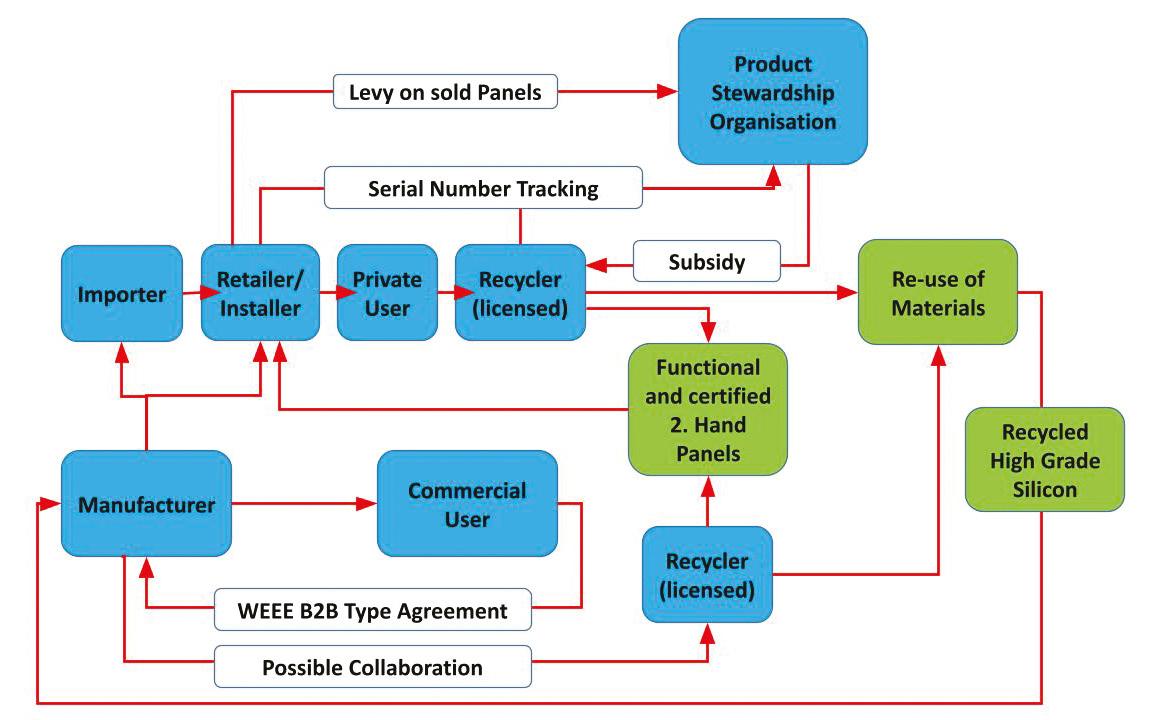
Re-use of functional panels
Many panels, which are replaced, are still fully functional. Solar panel re-use offers a variety of social and environmental benefits and is an approach that could easily fit into existing collection and recycling networks and processes. A bare minimum would be a certification like the electric compliance certificate or equivalent provided by a certified electrician or equivalent to ensure safe operation of the second hand panels.

Consumers of second hand solar PV panels need to be certain that the second hand panels are still working at a certain defined capacity. Therefore, a certificate would be necessary that provides information about the capacity and age of the second hand panel. Again, this certificate would need to be provided by a certified individual or organisation to ensure legal compliance before the panel enters the second hand economy.
Levy to support a scheme
Long term experience in waste management, domestic and international, indicates that convenience for consumers through collection of unwanted products without paying a levy at disposal of the product appears to be important to increase collection rate and decrease illegal disposal.
It can, therefore, be recommended that an upfront levy for supporting a product stewardship scheme for solar panels and their recycling is requested, like for car tyres, to avoid a disposal fee for consumers. Especially in the case of upgrading existing solar systems through new panels, a disposal fee for the old panels could be detrimental for the solar industry as consumers may delay or cancel the upgrade if the levy is too high.
Experience also shows that high collection rates are achieved where a fully funded not for profit product stewardship organisation is overseeing the product stewardship scheme. This would require that the levy is set at a level which not only allows to support collection and recycling of the panels, but also provides funds to support the operations of an effective product stewardship organisation.
At the current stage, the level of the levy is difficult to define. Whatever levy is applied, previous studies clearly show that it is essential to continuously monitor and, if necessary, adjust the levy to ensure high collection and recycling rates with time.
Ensuring compliance
One issue with end-of-life legislation is the control of compliance avoidance or free riders. Free riders are organisations that may benefit from an end-of-life legislation without contributing to the cost of the scheme. One obvious measure would be a legislation that says that only panels from participating manufacturers can be sold in Australia. Because such restriction may be in conflict with national competition and consumer rules or international general trade agreements, legal accreditations of such measures from related government bodies and regulators may be necessary.
Market forces can also be exploited to control free riders by involving retailers. As all products are designed with a consumer choice in mind, the product must attract consumers. Products that can only be legally disposed of at the cost of the consumer, as their manufacturers do not participate in a product stewardship scheme, may not attract much consumer attention. Thus, consumer engagement in end-oflife legislation schemes is essential to close the loop. Legislation needs to require that retailers of panels must provide consumers with information about manufacturer’s participation in end-of-life schemes and potential costs for the consumer in case the consumer chooses panels from not participating manufacturers.
The need for renewable energy systems to replace coal and gas for electric power generation has been clearly stated. The unavoidable significant waste stream from renewable energy systems, therefore, needs appropriate waste management legislation. Existing schemes show that an innovative and robust product stewardship scheme for solar panels can be designed to satisfy consumer demand, support solar industry, create jobs in the recycling industry, and address environmental concerns in the society regarding waste from solar panels.
www.energymagazine.com.au November 2022 ISSUE 20
25 RENEWABLES
Potential model for a product stewardship scheme.
THE NEXT GENERATION OF SOLAR TECHNOLOGIES
By the Australian Centre for Advanced Photovoltaics (ACAP)
In a recent announcement by Federal Energy Minister, Chris Bowen, ARENA will fund an extension of the Australian Centre for Advanced Photovoltaics (ACAP). Final negotiations are in process on the research program and partnerships, with work expected to start in 2023. Here, ACAP outlines breakthroughs in solar technologies, what the next generation of photovoltaic technologies looks like, and the role this plays in grid overhaul.
program of work, will be trained engineers and innovators to work with industry to deliver on the energy transition.
ACAP is the Australian Centre for Advanced Photovoltaics (PV), a national centre for solar PV research led by UNSW, in partnership with ANU, CSIRO, the University of Melbourne, University of Queensland and Monash University. ACAP started with this group in 2013, in partnerships with industry and international research institutions to work together on the next generation of photovoltaic technologies to be deployed in Australia and globally.
The Australian Renewable Energy Agency (ARENA) provides significant funding for the work of ACAP, and in 2022, renewed its support for another eight years. With the extension comes new partnerships with the University of Sydney and the addition of CSIRO-Energy to complement the activities of CSIRO-Manufacturing.
Cell technologies have historically been the great research strength of ACAP, and we’re excited to be continuing our world-leading work in the field. The cells currently in panels that you see now have efficiencies of somewhere between 21 and 25 per cent. The aim is to drive those cell efficiencies up and keep the price pressure on the technologies to make solar even more affordable than it already is.
The program of work for the ACAP extension is framed around ARENA’s 30-30-30 targets, for 30 per cent module efficiencies, 30c/Wp systems costs by 2030. Together, these targets contribute to the economic stretch target of a low cost of energy of $15/MWhr for energy from solar. This will enable green manufacturing and support a hydrogen export market.
ACAP will be focusing on achieving these 30 per cent efficiencies with new and emerging solar cell technologies. ACAP will also be addressing issues of manufacturability, including local content and sustainability, and design for recycling and recycling technologies. An important output, historically and in the new

To achieve these higher cell efficiencies, we have ongoing research into new kinds of materials for solar cells, as well as the design of cells and panels themselves. These two elements, new materials and cell and panel design, are at the forefront of where new performance breakthroughs in solar cell technologies are happening.
Tandem cells, which capture more of the light spectrum, and new materials like perovskites and adamantine that absorb light in parts of the spectrum that complement silicon, are big areas of interest to us. We’re confident that continued work on these technologies will bring us to 30 per cent efficient cells by 2030, if we really back ourselves.
November 2022 ISSUE 20 www.energymagazine.com.au
26 RENEWABLES
The Solar Industrial Research Facility at UNSW, Sydney. Images courtesy of ARENA.
Manufacturing in Australia
In regards to manufacturing, what we have seen historically is that the technologies are developed in Australia, and the manufacturing is done elsewhere. The PERC cell, which was invented at UNSW and is now in 90 per cent of all solar panels on earth, has been taken to scale in manufacturing successfully internationally, most successfully in China.

However, as the world moves to focus on a reality where up to 50 per cent of the world's energy is going to come from solar photovoltaics, we will need to coordinate investment to diversify supply, while keeping the price pressures down. We are looking at where Australia can contribute in the international solar supply chain, and we are working with industry partners who are ready to engage in securing solar for their long-term strategies, helping them make technology-informed investment decisions.
These are very big opportunities for Australian technology development in support of local manufacturing. Early indicators are that Australia has a role to play in the early-stage silicon refining part of the solar panel manufacturing chain, particularly as we increase the renewable energy content of the manufacturing, to make green-silicon. We continue to lead in cell-innovation, including with our partners, Australian company SunDrive, who are setting world records for manufacturing compatible processes.
In the last stage of manufacturing, the module assembly phase, we are working with partners Tindo and the Australian Photovoltaic Institute (and others, yet to be confirmed) on opportunities to develop local manufacturing of input materials in support of module assembly. Australia could produce the glass, the aluminium and the polymer encapsulants of solar panels. There is a significant opportunity for Australia to contribute to local and international supply chains for solar panel manufacturing. We’re working with our partners to support technical and financial modelling of these opportunities.
Deployment and innovation opportunities
Beyond the cell technology and cell and panel manufacturing opportunities, we also look to innovation in performance with our partners at RayGen, in new applications with BlueScope Steel, in deployment with our partners 5B. We also look at the significant opportunity in Sun Cable’s plan to deliver the world’s largest solar farm, generating energy in Australia, to then export into Southeast Asia.
We also take the same deep knowledge around cell technology and convert it across the supply chain in quality control, performance assessment and monitoring to yield innovation, technology development and commercialisation opportunities. Our partners BTimaging, PV Lighthouse, OpenInstruments and SolarVision add value locally and internationally in manufacturing and in large scale field deployments. We ensure performance, to lower technology and project risk and to ensure return on investment.
Thinking sustainability for the future
Importantly, we focus on sustainability and in the recycling of panels once they reach the end of the 25-30 year lifecycle. We’re very conscious of looking forward and planning for a robust increase in the amount of solar panels needed in order to shift energy generation to meet international zero emissions targets.
With long lifetimes for solar panels, we don’t yet have a pressing issue with recycling, but we’re working on solutions for when the volumes are large enough to build a recovery-industry around recycling. We don't want to repeat the off-shoring of recycling that has been seen in other sectors. We need to build an industry locally. Solutions being considered include solving the challenges of recovery logistics, and technologies for recycling.
On material sustainability, we have a worldwide 200GW a year
market for solar now, and we are going to need to get that to more than double, and double again, to reach a terawatt for solar to deliver 50 per cent of current global energy needs.
Sustainability is important. At 200GW, solar panel manufacture uses around ten per cent of the world’s silver in its cells. So, if we're going to go fivefold, we have to do something different in the way we make the technology. With a long history in cell development, we are working with partners, including SunDrive, to look at how best to replace silver with more abundant materials, while maintaining performance and long lifetimes, and downward pressure on price.
The team at ACAP sees solar PV as disruptive – and really only just beginning. We expect tenfold growth in deployment over ten years. That will demand the innovation, expertise and the resources that ACAP can deliver. Delivering on the 30-30-30 targets will support the economic stretch target of a low cost of energy of $15/ MWhr for energy from solar that will in turn create opportunities for Australia in manufacturing, in the hydrogen economy and in minerals processing.
This is a truly exciting time for the solar innovation sector in Australia, and we thank our supporters and partners in making it a reality that will carry us all into a clean and sustainable energy future.
For more information on projects and partnerships, please contact Professor Renate Egan at r.egan@unsw.edu.au.
www.energymagazine.com.au November 2022 ISSUE 20
27 RENEWABLES
The Solar Industrial Research Facility at UNSW, Sydney. Images courtesy of ARENA.
Critical infrastructure projects require the planning and experience of a trusted and skilled workforce, and collaborating with experienced partners ensures all facets of a project are delivered successfully. Transgrid’s recently completed Queensland-NSW Interconnector (QNI) upgrade was a complex undertaking, with Zinfra engaged as a trusted partner to deliver two main components of the project.

November 2022 ISSUE 20 www.energymagazine.com.au 28 RENEWABLES SPONSORED EDITORIAL
THE QNI UPGRADE CAN TEACH US ABOUT SUCCESSFUL PARTNERSHIPS
WHAT
The QNI transmission upgrade supports around 460MW of energy heading north to Queensland, and 190MW coming south into New South Wales. This critical development of national infrastructure is estimated to deliver $170 million in net benefits to Australia’s electricity consumers, while simultaneously supporting the country’s energy transition.
The project's timely and budgetary success comes from ensuring the appropriate, trusted and experienced teams delivered the work – for all 82,000 hours of manpower.
Setting up for shared success
Zinfra was initially engaged to assist Transgrid with the QNI upgrade in 2019. From the tender stage, Transgrid allocated Zinfra a series of upgrades to the line and substations along the project.
Zinfra Operations Manager Paul Robinson said the Transgrid and Zinfra alliance highlighted the power of collaborative partnerships on the critical work which will significantly boost transmission and support development of new renewable energy zones over the coming years.
Zinfra also brought their design partner, Beca on board, where they worked handin-hand during the design process.
“We had a very close design process, ongoing meetings with all three parties involved going through the 20 per cent concept design, the 45, the 85 and the IFC design processes, making sure everyone was consulted along the way,” Mr Robinson said.
True partnerships benefit all parties, and utilise all partners' experience.
Experienced capability
There were three substations that required significant work, and Zinfra was allocated the Armidale location, as well as significant infrastructure upgrades to the line components of the project. These upgrades tested Zinfra’s planning and scheduling ability to ensure all components were delivered on time.
“The Armidale substation involved the construction, testing and commissioning of four new 330kV capacitor banks and replacement of the existing 330kV shunt reactor,” Mr Robinson said.
“In the lines component, we upgraded the lines, which made it possible to run power through it at 120 degrees Celsius, as opposed to the existing 85 degrees Celsius. We did that by increasing the conductor height, and that was done using several methods.
“It was either pole replacement, insulator replacements, or insulator string rearrangements and landscaping and additional tower strengthening works associated with those augmentations.”

Innovative pole replacement was a key part of the methodology, which would allow Zinfra to keep its work on budget and on time for the QNI upgrade.
This is where Zinfra’s design partnership with Beca came to the fore.
Zinfra worked with Beca to design the transmission pole that met the structural and constructability needs of the project.
Specifically, the poles needed to facilitate a construction methodology to minimise the length of outages during the works.
“The project had a fairly tight timeframe, so we, in collaboration with Beca and Transgrid, chose to apply a higher strength reduction factor in our design which then eliminated the need for pole testing, which would add three months to the program,” Mr Robinson said.
“The second aspect was introducing a bolted flange connection type design, so that it allowed the construction of the pole arrangement in such a way that we could partially erect the poles without outages,” Mr Robinson said.
The joint decision on the pole design allowed the completion of the rest of the work with only one day's outage, meaning Zinfra could return to the line to service it each night, as opposed to a standard design that would have required a multiday outage.
The final, innovative step implemented by Zinfra was to remove and dismantle the structures the project was replacing. Again, Zinfra understood the importance of the project’s schedule, and planned a controlled demolition (or felling) of the towers, which expedited the process.
The success of the project’s pole implementation with Beca led to the submission of its work for a collaborative design award at the Consult Australia Awards, where it made the 2022 award finals.
In total, Zinfra replaced 58 structures, strengthened 35 structures and augmented about 250 insulator arrangements.
A people-powered project
According to Mr Robinson, it’s the people behind the project, and their commitment to safety, that were critical to its success.
“Across 82,000 man hours, we had over 200 per cent of our lead HSE audit actions undertaken versus planned and about 135 per cent of our leading behavioural actions are undertaken versus planned,” Mr Robinson said.
As Zinfra worked on its components throughout the early lockdown and border restrictions of the COVID-19 pandemic, the (sometimes daily) changes to lockdown rules created another challenge to keep workers safe. But Mr Robinson explained that looking after the blue collar workforce was a paramount focus for Zinfra.
“Ultimately, they're the guys who get the job done,” Mr Robinson said.
“We had interstate workers that couldn't get home because of border closures. Some of them did months and months on end of work on this project without getting home. So we were quite focused on their wellbeing, looking after them, making sure and doing what was necessary to the extent that we could to keep them as satisfied and as sane as possible during that difficult period.”
Zinfra, whose project delivery team is competent, capable and led by trusted managers, collaborated with their selected industry partners to foster the ultimate productive environment. This curated environment with its partners was pivotal to the success, on-time delivery and completion of Zinfra’s components on the QNI project.
Transgrid CEO Brett Redman thanked Zinfra for helping it build the transmission super-highway which will transform the energy supply for millions of Australians.
“There will be no transition without transmission”, Mr Redman said.
www.energymagazine.com.au November 2022 ISSUE 20
29 SPONSORED EDITORIAL RENEWABLES
As Australia, and the world, races to decarbonise our energy sources, the critical factor we need to be considering is the rare earth materials required for the manufacture of equipment like wind turbines and solar panels – and crucially, where these resources are located. Here, Professor Tina Soliman Hunter looks at the global reserves of critical minerals such as lithium, nickel, cobalt and more, and considers the impact this will have on Australia’s ability to decarbonise.
CRITICAL ENERGY MINERALS: THE BUILDING BLOCKS FOR RENEWABLE TRANSFORMATION
By Professor Tina Soliman Hunter, Director, Centre for Energy and Natural Resources Innovation and Transformation, Macquarie University
Critical energy minerals, as the name implies, are those minerals, generally found in small quantities, necessary for renewable energy generation such as wind and solar energy. As demonstrated in figure 1, the minerals required vary according to the technology and use, with lithium, nickel, cobalt, manganese, copper, and graphite crucial for battery performance and longevity, and energy density for the generation and transmission of electricity. In addition, large volumes of copper and aluminium are required, with copper being the essential mineral for all electricity-related technologies. Rare earth elements (REEs) from the lanthanide series of metals, especially Neodymium and Samarium Cobalt, are essential for the permanent magnets integral to wind turbines and electric vehicle (EV) motors.
The energy transition has been likened to a new industrial revolution, one which instead of relying on coal necessitates access to critical minerals and REEs. However, unlike the bulk commodity coal, which is abundant, cheap to produce, and easily available, critical minerals are often found with other minerals thereby requiring intensive processing, which uses large volumes of water.
Global economic and technological changes have driven a long-term increase in the demand for critical minerals. According to the International Energy Agency’s (IEA) 2021 report The Role of Critical Minerals in Clean Energy Transitions, due to the increased share of renewables in new energy investments since 2010, the average amount of minerals required for a new power generation unit has increased by 50 per cent (IEA, 2021). Global dependence on rarest minerals is expected to grow fivefold by the end of 2020s, and a sufficient supply of rare
earth minerals and lithium is essential in the global transition to a green economy (IEA, 2021).

At present, most countries rely on critical minerals from China where, according to the European Union, over 90 per cent of REEs and 60 per cent of lithium are processed. The domination of one country in the market, and hence the reliance on China for the supply of critical minerals and REEs, has the potential to create market and geopolitical issues reminiscent of 20th century dependency on the Middle East for oil and gas. In addition, there are geopolitical issues at play, demonstrated by souring trade relations between Australia and China since 2020, affecting exports and supply chains.
According to a 2022 study by the Brookings Institution, China dominates the critical mineral market: it refines 68 per cent of global nickel, 40 per cent of copper, 59 per cent of lithium and 73 per cent of cobalt (Brookings Institution, 2022, p6). China also
November 2022 ISSUE 20 www.energymagazine.com.au 30 RENEWABLES
Figure 1. Critical minerals required for clean energy technologies. Source: IEA, 2021, p45.

accounts for most of the global production of mineral-rich components for battery cells, including 70 per cent of cathodes, 85 per cent of anodes, 66 per cent of separators, and 62 per cent of electrolytes (Brookings Institution, 2022, p6).
Interestingly, as demonstrated in figure 2 below, even though China dominates REEs, it does not dominate all minerals – Australia and Chile together produce more than three quarters of the world’s lithium, and the Democratic Republic of the Congo dominates cobalt, producing more than 80 per cent globally (IEA, 2021, 21). Increasingly, developed countries are looking to other jurisdictions for the supply of critical energy minerals, including Chile, Mexico, New Zealand, and Australia.
The EU has indicated its need for autonomy in these critical energy minerals, as well as a desire for sustainable growth and development of these minerals. Indeed, according to European Commission President Ursula von der Leyen:
“Lithium and rare earths will soon be more important than oil and gas. Our demand for rare earths alone will increase fivefold by 2030. We must avoid becoming dependent again, as we did with oil and gas. We will identify strategic projects all along the supply chain, from extraction to refining, from processing to recycling. And we will build up strategic reserves where supply is at risk.”
President von der Leyen clearly articulated a stark fact applicable to many nations as they embrace the energy transition: without secure and sustainable access to the necessary raw materials, any ambition to become climate neutral
is at risk. To address such risk, the EU has proposed the European Critical Raw Material Act 2022, designed to assist in increasing supplies of critical minerals such as lithium and REE through the development of raw material agencies, the development of more resilient supply chains, and the establishment of a strong and sustainable level playing field for all members states, with recycling and waste management as the centrepiece.
For Australia, critical mineral and REE policy development industry reform focuses on the upstream sector, seeking to support and develop the critical minerals sector through foreign investment, infrastructure and innovation. According to the IEA, Australia is the world’s largest producer of lithium and zirconium concentrate, and the fourth largest producer of REEs (IEA, 2021, p165). Hence, Australia is well placed
as a reliable supplier of critical minerals necessary for clean energy technologies. The 2019 Critical Minerals Strategy set out the Australian Government’s ambition to increase production of these minerals, while simultaneously fostering downstream processing and refining, and lowering production costs through innovation and infrastructure development.
Through its Critical Minerals Office, established in 2020, the Australian Government has been developing supply chains, assisting in financing critical mineral projects through the 2021 Resources Technology and Critical Minerals Processing Project (part of the Modern Manufacturing Initiative), and facilitating research in the area. Building on previous initiatives, the 2022 Critical Minerals Strategy supports production and processing innovation and technology, with aspirations for Australia to be a global critical mineral supplier integral to international supply chains and technologies. Such aspirations to shift market dominance away from China will be challenging given the greater cost in producing Australian REE and critical minerals, and challenges with the current Australian investment regime.
Given Australia’s endowments of critical minerals and REE, this is possible. It will, however, take a combination of investment reform, ongoing government facilitation and support, technological development, technical innovation, and ongoing consideration of environmental, social and governance challenges.
Figure 2. Major producers of selected critical minerals. Source: IEA, 2021, p45.

IEA (2021) The role of critical minerals in clean energy transitions. https://iea.blob.core.windows.net/assets/ffd2a83b-8c30-4e9d-980a-52b6d9a86fdc/TheRoleofCriticalMineralsinCleanEnergyTransitions.pdf
Brookings Institution (2022) China’s role in supplying critical minerals for the global energy transition: What could the future hold? https://www.brookings.edu/research/chinas-role-in-supplying-critical-mineralsfor-the-global-energy-transition-what-could-the-future-hold/
www.energymagazine.com.au November 2022 ISSUE 20 31 RENEWABLES
IEA. All rights reserved
THE RACE TO DECARBONISE
Europe, the US and China have all imposed bans on internal combustion engine manufacture, some as early as 2030, which will disrupt the automotive industry.
As a result, the electrification of road vehicles and heavy machinery has been gathering pace to accommodate future regulations.
According to HYDAC National Development Manager – E-Mobility & Hydrogen Control Systems, Dirshan Daby, electrification is one part of the equation, but energy sourcing and storage are also set to play a big role.
“Projects that harness wind and solar power are expected to grow, and hydrogen and industrial battery systems are being proposed as the long-term storage solutions for green energy,” Mr Daby said.

“The real challenges will be upscaling pilot projects to industrial production, ensuring the amount of energy input versus the amount of energy output is viable, and that the process is safe. This especially centres around whether efficient hydrogen and safe hydrogen production can be assured through a commercially feasible process.”
Safety and efficiency key
When it comes to hydrogen safety, HYDAC has control systems in place such as ATEX and IECEx-rated sensors, which are ideal for explosive environments. HYDAC also has its own senior electricians
in-house who can wire control panels to ATEX requirements.
This means that systems can communicate with each other when the production factor is multiplied to ensure the process is streamlined while also remaining efficient and safe.
“When an upscaling takes place and intense, energy-driven processes are used, a decline in efficiency occurs due to heat and noise losses. It’s here that HYDAC can offer its cooling systems and understanding of an application, thanks to our in-house team dedicated to e-mobility,” Mr Daby said.
Meeting hydrogen production requirements
The current preferred method for hydrogen production is the use of polymer electrolyte membrane (PEM) or alkaline electrolysers that split water molecules into hydrogen and oxygen using powered electrodes and separation membranes.
Mr Daby said it is imperative to have clean and dry fuel when producing hydrogen for fuel cells.
Hydrogen from electrolysers requires coalescing filters in this process, which are also available from HYDAC. They are required for hydrogen drying because humidity is produced in the production of hydrogen, which must be pumped out of the system.
According to Mr Daby, when charging hydrogen tanks at high pressure, solid contaminants, if present, can be
catastrophic to fuel cells and tanks, which essentially require laboratory clean hydrogen, if not cleaner hydrogen. To assist in this challenge, HYDAC has a range of solid contaminant gas filters.
“We developed products to ensure dry and clean hydrogen is supplied to refuelling stations and we also have testing and sampling equipment to ensure highest purity hydrogen,” Mr Daby said.
HYDAC also offers a range of filtration products that meet requirements at any point on a production line.
“Gas cooling is required throughout the whole process. On the hydrogen side, this means keeping the hydrogen cool so that the level of hazard can decrease. Then it’s also necessary to cool the compressors and electrolysers used in the process,” Mr Daby said.
Overall, HYDAC is well prepared to meet standardised and customised cooling requirements through its range of fluid heat exchangers to air blast coolers and chillers that can achieve below ambient temperatures.
Understanding of relevant regulations critical
Importantly, HYDAC has a detailed understanding of regulations when designing systems for Australia.
Understanding regulatory requirements, along with a solid knowledge of equipment and a priority on safety, are all critical when looking at partners to assist in the clean energy revolution.
November 2022 ISSUE 20 www.energymagazine.com.au
Electricity price hikes and heavy carbon emitter taxes have resulted in strong action being taken in Europe, the USA, China, and Australia, among other countries, to decarbonise industries. As the race to decarbonise gathers pace, it’s critical that businesses work with partners that keenly understand the challenges that come with decarbonisation, and can assist in the management of the journey towards clean energy.
32 RENEWABLES SPONSORED EDITORIAL
can
For more information about how HYDAC
help your business transform and lead the race to decarbonisation, head to www.hydac.com.au

THREE PATHWAYS
Dr John McKibbin leads CSIRO’s research in energy systems digitalisation. He is driving research programs working to enhance energy forecasting, system planning and network visibility.
“The current energy transition will be the defining challenge of our time. If you can imagine our energy market as a machine, then consider that we’re creating the largest and most complex machine ever invented. In real time.” Dr McKibbin said.
“There are three challenges that energy digitalisation can help us solve. And if we solve these challenges, we will be on our way to decarbonising our energy system.”
1. Sharing the load
As we enable the rapid electrification of our transportation, buildings and industry, more pressure will be placed on the grid to meet the growing demand for electricity.
The capacity of our grid is finite, so maintaining the balance between supply and demand is crucial.
Strategically shifting load to low demand periods can restore balance to the grid during peak events, avoid wasteful overgeneration of renewables and increase grid resilience, reliability and affordability.
In doing so we can turn large flexible loads such as heating, air conditioning, hot water heaters, and electric vehicles into distributed energy resources for the grid, effectively creating a giant battery.
The practice of operating appliances during off-peak periods when energy rates are lower is not new. But the introduction of smart technology has provided the capacity to automate and optimise load timing to maximise efficiency and consumer savings.
Empowering smart buildings
Commercial buildings are responsible for around 25 per cent of electricity use in Australia and ten per cent of emissions. To improve energy efficiency, property managers need comprehensive and accurate building data and reliable processes to connect diverse data sets.

The Data Clearing House (DCH) is a digital solution developed by CSIRO in collaboration with industry innovation and university research teams. The platform streams disparate sources of building
data to a single location and includes information from external authorities such as the weather bureau and electricity market. By consolidating these insights, the DCH unlocks quality data trends and intelligence, empowering building managers to realise energy savings and flexible load opportunities.
2. Making the invisible visible
Australian households and businesses are changing the way our energy is produced. They are taking a more active role in energy generation through the uptake of distributed energy resources (DERs) such as solar and battery storage.
The rapid integration of DERs into the grid has introduced technical and operational challenges. DERs can be invisible to energy network operators, who may only see the change in net demand that they cause.
The lack of visibility compromises the network’s capacity to understand DER behaviour and effectively manage the power system. This can lead to blackouts and equipment damage if the physical limits of the distribution network are breached.
DERs can be connected and operated at scale through microgrids and virtual power plants (VPPs), offering enormous potential to contribute to a reliable and secure energy system.
Realising our distributed energy potential
CSIRO, through the RACE for 2030 collaborative research centre, developed a strategy with network businesses, universities and tech companies to increase our visibility of the low-voltage network and help enhance the capacity of the network to host DERs.
A range of opportunities were identified to enhance network visibility, including better leveraging smart meter and smart inverter data and installing new emerging network monitoring technologies.
The collaborative research program is now working to enhance the network visibility and hosting capacity of the low voltage distribution network, including:
» Developing data standards, interchange protocols and data integration platforms
» Developing improved analytical workflows for network planning and operations including hosting capacity assessments and dynamic operating envelopes
» Identifying the value of DER services for networks and customers
November 2022 ISSUE 20 www.energymagazine.com.au 34 RENEWABLES SPONSORED EDITORIAL
As Australia’s energy transition accelerates, a new generation of digital solutions are needed to coordinate an increasingly decarbonised, decentralised and democratised electricity network.
TO A SMARTER ENERGY SYSTEM
3. Powering on with inverter-based systems
Australia’s expansion of renewable energy is skyrocketing – up to ten times the average worldwide per capita rate.
Large synchronous fossil-fuel based generators support grid strength and stability, so our transition to non-synchronous, or inverter-based systems from renewable energy presents challenges and requires new solutions.
“We need to make our inverter-based systems smarter. Currently, they are largely grid following, which means they rely on the rest of the network to manage energy disturbances and fluctuations. As we increase the share of inverter-based resources, they will increasingly need to be grid forming in order to contribute to system strength and stability,” Dr McKibbin said.
Emerging research is investigating how large-scale batteries with grid forming inverters can provide system strength and stability capabilities, as higher levels of variable renewable energy are integrated into the grid.
Contributing to a global energy vision
The Global Power System Transformation (G-PST) Consortium engages power system operators, research institutions and governments from all regions of the world to accelerate the global transition to clean energy at unparalleled scope and scale.
CSIRO and the Australian Energy Market Operator (AEMO) are Australian Consortium representatives, supported by Australian and international engineering, academic and research partners.

CSIRO’s G-PST Research Roadmap incorporates research plans for the nine most pressing research topics to integrate renewable energy into our electricity networks and decarbonise our energy sector, including:
» New capabilities, services, design methodologies and standards for inverter-based resources
» New technologies and approaches for power system operator control rooms to provide more real-time visibility, analysis and control
» Quantifying the technical service requirements of future power systems to maintain the supply-demand balance and affordability of renewables
» New procedures for black starting and restoring a power system with high or 100 per cent Inverter-based resource (IBR) penetration
CSIRO is currently working with academic and industry experts across Australia to deliver the roadmap, in collaboration with the global consortium.
Rewiring our future
Solving these three challenges is imperative to ensuring that our future energy supply is sustainable, affordable and secure.
As Australia’s independent science agency, CSIRO is uniquely positioned to connect, guide and accelerate our energy transition.
“But it will require an extraordinary uplift in digital capability,” said Dr McKibbin.
“And this cannot be achieved if innovation occurs in silos. What we need is for industry practitioners, regulators, government, researchers and communities to collaborate at unprecedented levels.”

CSIRO’s Data Clearing House unlocks quality data trends and intelligence.
Learn more about CSIRO’s energy research at www.csiro.au/energy
www.energymagazine.com.au November 2022 ISSUE 20
35 SPONSORED EDITORIAL RENEWABLES PATHWAYS
THREE WAYS ELECTRIC VEHICLE CHARGING
CAN BRING BENEFITS TO BUSINESSES
The electric mobility global market continues its growth, both in terms of registrations of hybrid and fully-electric vehicles. For Australian businesses, adding charging stations to their sites offer a range of benefits that extend beyond the environment.
Although Australia is lagging behind the rest of the developed world in its uptake of electric vehicles (EVs), the Electric Vehicle Council of Australia's last report has shown how the adoption of EVs in Australia is starting to grow. The perception of the practicality and benefits of electric vehicles versus internal combustion engine vehicles is rapidly changing in a positive direction. One area needed to support this continued growth is ensuring a reliable electric vehicle charging network, whether at the home, office or out and about, to counter any range anxiety.
Most public, commercial or industrial locations will only require a 22kW AC charger to meet their charging needs, particularly if vehicles will remain at the location for at least 30 minutes. They come in various configurations that can suit businesses of any size and budget.
There are three ways businesses can benefit from installing one or more electric vehicle chargers at their premises, by choosing how they enable charging for their customers.
Encourage people to your business by offering free charging
By installing a simple plug-and-charge charger, businesses can offer free charging to entice people to their business. Just drive up and plug in – it's that simple. The cost of the electricity used will depend on their retail tariff and businesses that run primarily through the day and have solar installed can offset this to provide the charge at essentially no cost. Chargers can control and manage the loads to ensure it doesn’t overload the capacity of their electricity supply. An example is an independent brewery in Victoria with five wall-mounted chargers installed. Two are FIMER FLEXA AC Wallboxes for customers to use for free.
Offer customers, guests or staff free charging as a value-add
Businesses that want more control over who has access to charge with their chargers can provide electronic swipe (RFID) cards at their discretion. All the user needs to do is swipe the RFID card on the charger, which will enable the charger. This is an ideal solution for hotels or motels offering their guests free charging and the ability to fully charge their vehicle overnight while it is parked.
Provide charging at a small fee and have an additional revenue stream
Businesses that install smart chargers that are OCPP-enabled can subscribe and connect to a charging management provider and offer customers to charge for a fee, enabling the business to create a new revenue stream. Every charging management provider will have a different subscription model. However, they will all manage the charger remotely and allow the business to set rates for customers to pay. For example, FIMER's charging solutions can be integrated with Noodoe, Everty or JetCharge, with more being added over time.
businesses an easy and affordable solution to install and offer electric vehicle charging.
The FLEXA AC Wallbox is Italian-made and has a 100 per cent recycled plastic casing that is IP55 rated, so it can be mounted inside or outside.
Businesses can install only one or up to 32 chargers and have them configured to work together smartly with its built-in load management system.
Alternatively, FIMER's FLEXA AC Station is a perfect solution for businesses with larger car parks, as it is a ground-mounted solution that can charge two vehicles simultaneously.
FIMER's AC charging solutions, the Wallbox and Station, offer a 22kW threephase solution that can fully charge most current electric vehicles in approximately 2-3 hours. They can also be customised and branded to match any business's branding requirements.

There is confusion in the market that businesses need to offer DC fast chargers to their customers.
Compared with AC chargers, DC fast charging solutions are generally more expensive to install and have higher ongoing operating and maintenance costs.
DC fast chargers are usually installed in areas where vehicles will remain for less time, need to travel longer distances and/ or require fast turnover of vehicles to keep the availability of the charger as high as possible, for example along major roads or in regional or remote areas. These chargers pump energy directly into the vehicle's battery without first converting the energy from AC to DC. The charging times are much quicker, with fewer losses experienced.
FIMER's ELECTRA DC Station charger is a modular charger available in power ratings from 60kW up to 150kW, offering both AC and DC charging for up to three vehicles simultaneously.
FIMER's FLEXA AC Wallbox is a wall or stand-mounted solution that offers
FIMER is the fourth largest solar manufacturer globally and still manufactures its string inverters and electric vehicles in their two manufacturing facilities in Italy. Since 2017, they have been manufacturing electric vehicle chargers and to date, have over 55,000 units installed worldwide.
November 2022 ISSUE 20 www.energymagazine.com.au 36 RENEWABLES SPONSORED EDITORIAL
So what charging options are available?
To learn more about FIMER's charging solutions: fimer.com/charging-electric-vehicles
Wallbox.
FIMER's
FLEXA AC


SAFELY STORE YOUR SOLAR POWER Contact your local R&J Batteries branch for more information on BAE Batteries / www.rjbatt.com.au / 1300 769 282 / 23 branches across Australia 9 100% Berlin German made quality 9 Proven sustained long-lasting cycling in the harshest environments 9 Suitable for on and off grid, telecommunications, sub-stations, small homes to large stations, resorts and more 9 Safe, low maintenance design 9 Distributed through Australia, New Zealand & Oceania
EMISSIONS REDUCTIONS ARE JUST THE BEGINNING : AUSTRALIA’S OPPORTUNITY TO BUILD THE ENERGY SYSTEM OF THE FUTURE
By Julie Romanet-Perroux, Energy Transition Lead, Accenture Australia and New Zealand

Australia’s energy system is undergoing an enormous overhaul in the race to net zero. While there is currently an intense focus on reducing emissions to achieve 2030 climate goals, the objectives of energy transition in Australia should be to achieve much more than just the transition of a single sector of the economy.
The Australian Institute of Company Directors (AICD) noted at its inaugural Climate Governance Forum in early August 2022, the transition to a low-carbon economy presents a $420 billion investment opportunity. Boardroom conversations have shifted from trying to understand why organisations need to respond, to understanding what actions need to be taken. At the same time, boards and senior leadership are facing strong, sometimes conflicting expectations on climate from a wide range of stakeholders.
Value at scale
We have built a strong energy transition team at Accenture, well positioned to advise the government and our corporate clients on how to navigate the challenges of the energy transition and understand the impact of the decisions they are facing. In recent work led by my colleague Dominic Mendonca, we have leveraged
the World Economic Forum’s System Value Analysis framework to identify the value of the energy transition in twelve dimensions, including emissions, access to electricity, job creation, health, water footprint, resilience and security. Our analysis of these dimensions reveals that the value to be gained from energy transition in Australia is immense if we manage the process well and create a common journey for government, industry and consumers.
What will it take to achieve these benefits?
While significant effort has already been made to transform Australia’s supply-side energy system, equal focus needs to be put on demand-side interventions. Building a strong, resilient and efficient energy system will require a major shift not only across industries, but also in how everyday Australians view energy and the role we play within the system.
The System Value Analysis framework explores four specific energy usage interventions:
November 2022 ISSUE 20 www.energymagazine.com.au
38 RENEWABLES
Shifting from petroleum-based vehicles to electric vehicles
While most consumers realise that electric vehicles (EV) are inevitable in the decarbonised future, there is still work to be done in setting up a national charging network to facilitate this change, as well as match supply to what is already great demand for EVs in the nation. Not only that, Australia’s supply chains depend on road transport. How will our road-freight industry adapt to a decarbonised future? How will our long-haul trucks be converted? These questions have not been answered yet. We are working with our clients who have supply chains that will be affected by these decisions in the future to map out contingency plans and test solutions to these questions.
Despite the challenges, however, the benefits associated with clean transport for Australia are huge. Not only will the shift help us achieve decarbonisation, many Australians will see health benefits as the tailpipe emissions from diesel and petrol cars are eliminated. In addition, our reliance on imported refined oil has been identified as a significant national security weakness, so by reducing this dependency, we increase the sovereignty and resilience of our nation.
Shifting from gas to electric appliances in residential and commercial businesses
Health
The reduction of particulate emissions and noise pollution will save Australia approximately $4 billion per year from 2035 in hidden healthcare costs.
Employment
Clean jobs will be created, with an estimated 400,000 opportunities during the electrification journey and ongoing.
Energy storage
The creation of 85 gigawatt hours of battery storage capacity and 21 terawatt hours of hydrogen storage capacity in 2035, will protect Australia during natural disasters and unplanned outages.
Water
There will be an estimated reduction in water usage by 40 gigalitres per year in 2035.
Electricity prices
Improving the utilisation of the electricity system will reduce electricity prices by more than 30 per cent. This is in addition to the energy cost savings through improved energy efficiency.
Oil imports
By 2013, Australia will avoid importing 150,000 barrels of refined fuels per year – the import of which is a key weakness in Australia’s national security.
Once we are generating “clean” electricity from renewable sources, we need to make sure that it is being used preferentially over other sources of energy. This means encouraging a consumer and commercial shift from gas to electric appliances, which involves a significant behavioural, attitudinal and structural change. It will take collaboration from government, wholesalers, retailers, trade and consumers to move from gas appliances to electric appliances in homes and commercial premises across the nation.
Expected benefits from the transition towards clean energy by 2035.
and Gladstone in Queensland have also been identified as having potential to form circular-economy based industrial clusters.
Expanding distributed solar energy generation and storage in homes and communities
As Australian households make the switch from gas to electric appliances, once again we will not only make progress towards our decarbonisation goals, we will also see visible health improvements, notably from reductions in childhood asthma and other respiratory illnesses. From our analysis, we anticipate that these societal health improvements will see a national health saving of $4 billion per year. This is a huge hidden benefit to Australia moving into the clean energy future.
Shifting industrial processes to be circular economy based and electricity based
In order to achieve net-zero emissions by 2050, there is a need for a radical acceleration of the decarbonisation of heavy industries in Australia. One of the ways we can do this is by creating “Industrial Clusters” within Australia which are concentrated regions where industrial companies are located close together and collaborate to share resources, and even by-products, to reduce environmental impact and increase their own cost efficiencies. One such cluster that has been very effective is the Kwinana cluster in Western Australia. Areas in the Hunter Valley in NSW
Finally, but importantly, it will also take cooperation and understanding from consumers that they have a role to play in the capture and storage of energy in the future. By installing solar panels and battery storage in the home, Australians have the opportunity to change their role from energy consumers to energy producers, for the greater good. By making the switch to more efficient sources of electricity, we will see a reduction of around four per cent in the total energy we use nationally.
What next?
With the right planning and collaboration between government, industry and consumers, we have the chance to build a better energy system for all Australians. A system that takes advantage of our abundant renewable energy sources and that can cut the cost of our bills, create jobs and even help our health. Not only that, we have the opportunity to build a system that empowers customers to be both producers and consumers of energy. However, this involves a fundamental change in the way all Australians view energy, and that will require time, education and an ongoing dialogue.
www.energymagazine.com.au November 2022 ISSUE 20
39 RENEWABLES
THE LATEST IN RESIDENTIAL ENERGY STORAGE
ACE’s all-in-one storage system was born for the residential energy storage market. The system contains a 5.5kW inverter and LiFePO4 battery packs. The lithium-ion storage is scalable from 5kWh to 20kWh. It reduces carbon emissions effectively by improving the self-consumption capacity of the PV storage system, thus reducing the consumer’s electricity consumption effectively as well.

It differs from other solutions in the market in many aspects. It uses sustainable clean energy, providing a complete home energy supply with a real and own grid. The house can continuously rely on sunlight for energy storage via the PV system with DC-side rechargeable. It supports both single and three-phase emergency power supply, or chooses constant island mode for supplying energy independently. Moreover, it can switch between island mode and grid mode automatically. There is no need for additional control boxes and switches, and no additional energy supply. It has complete energy management.
This system has been provided to a large number of customers worldwide, and it has been proven to be workable and effective.
The solution meets the daily needs of European and American families well. The lithium battery has a cycle life of up to 8,000 times, thus providing a more durable and safer energy storage solution with costs reduced.
ACE reduces the carbon emissions of the product throughout its whole life cycle, and conducts in-depth research and analysis in product development and the product manufacturing process to reduce the environmental impact during the product production.

By 2050, with the carbon-neutral goal aligned with ACE’s end-to-end supply chain, all ACE products will be carbon-neutral. ACE works with suppliers to achieve net zero emissions from our supply chain by 2060. When the product life ends, local distributors will provide users with a complete disposal solution.
For more information on ACE’s energy storage solutions, head to www.acebattery.com
November 2022 ISSUE 20 www.energymagazine.com.au
40
ACE's all-in-one energy storage system provides a secure, efficient residential solution with a built-in inverter and LiFePO4 battery packs.
RENEWABLES SPONSORED EDITORIAL
Brake pad wear dust is a reality of operating a wind farm, and the environmental implications from brake pad wear dust particles can be serious. It’s important for wind farm operators to consider a brake pad product that performs its technical function to an elite level, as well as being an environmentally friendly product for the people working on site and in close proximity to wind farms.
One of the environmental considerations that comes with operating a wind farm is the fact that brake pads in wind turbines will generally result, at some point of time, in brake pad wear dust.
The amount of brake pad wear dust, and the size of wear dust particles generated by a wind turbine will vary greatly, and is directly related to how brake pads are used (for example, how often they are activated, the disc material, the pressure and load on the brake pads, and many other factors).
But the reality is that brake pad wear dust is a factor in wind turbine operation, and it can have an environmental cost.
Investigating the options
Recognising the challenge of managing brake pad wear dust, brake pad manufacturer Altra-Motion Svendborg Brakes decided to explore the wear dust generated by their product, and two competitor products, undertaking a range of tests in a controlled environment at the Svendborg Brakes Test Centre.
The results showed that approximately 95 per cent of the particles generated in the wear dust tests were within 10μm (small enough to enter the lungs, or inhalable), and about 80 per cent of the particles within 5μm (small enough to reach the alveoli, or respirable).
Testing on the particles generated also showed that 25 per cent of the dust generated was from the disc, with the remaining 75 per cent of dust was from the brake pads.
Looking at the amount of dust generated in the tests, Svendborg Brakes generated 16g of dust, with Competitor 1 generating 79g and Competitor 2 generating 132g.
Rising to the challenge
Altra-Motion Svendborg Brakes realises that managing the impacts of brake pad wear dust is a serious consideration for wind farm operators.
As well as recommending that crews working in close proximity to turbines and brake pads use gloves, eye protection and an FP2 mask where exposure to wear dust is possible, Svendborg Brakes products have been specifically designed to be as environmentally friendly as possible.
As seen in the results above, Svendborg Brakes generate less brake pad wear
dust than competitors; but in addition, Svendborg Brakes friction materials have been developed according to REACH legislation. REACH is a regulation of the European Union, adopted to reduce the levels of dangerous chemicals in industrial products.
In short, by adhering to this legislation, Svendborg Brakes friction materials are asbestos free and contain:
» Less than 0.1 per cent of Mercury, Chromium +6 and Lead
» Less than 0.01 per cent of Cadmium
As well as this, all electrical items comply with the Restriction of Hazardous Substances (RoHS) Directive; and Svendborg Brakes also strives to comply with all automotive rules and directives, related to both original equipment (OE) and aftermarket (AM) applications.
When it comes to managing the environmental considerations that come with operating a wind farm, there are many factors to be considered.

Ensuring wind turbine brake pads meet industry and community safety and environmental expectations is just one of these; but with Svendborg Brakes, wind turbine operators can feel comfortable that they’re working with a manufacturer that values environmental protection.
For more information about Altra-Motion Svendborg Brakes and their environmentally friendly brake pads, head to www.altramotionaustralia.com
November 2022 ISSUE 20 www.energymagazine.com.au
42 RENEWABLES SPONSORED EDITORIAL


As leading multinational designers and manufacturers of innovative power transmission products, the brands of Altra Motion offer many critical drivetrain solutions for a wide range of renewable energy applications. 1300 ALTRAMOTION www.altramotionaustralia.com Svendborg Brakes | Twiflex Ameridrives | Warner Electric Matrix | Stromag GENUINE OEM SPARE PARTS AND SERVICE Service Support by Trained Technicians Specialist Tooling for Maintenance Genuine OEM Spare Parts Local Spares Stocking Program
NETWORK AWARD WINNERS UP IN LIGHTS
By Jemma Townson, Media and Communications Manager, Energy Networks Australia
After a two-year hiatus, Energy Networks Australia’s Annual Dinner and Awards night was a wonderful opportunity to mingle, network and recognise the work of ENA members.

A WORD FROM ENERGY NETWORKS AUSTRALIA 44
A WORD FROM THE ENA
The winners of the Consumer Engagement Awards, AusNet Services, AGN and MGN.
The sector’s night of nights, the event hosted the glitterati of the industry. The mood in the room was electric while the lights shone on the winners of the consumer engagement and innovation awards. The industry contribution award winner, although shocked, also enjoyed his moment in the spotlight.
2022 Industry Contribution Award winner
Energy industry veteran Laurie Curro from Western Australia’s Horizon Power won Energy Networks Australia’s 2022 Industry Contribution Award. Laurie was recognised for his contribution and commitment to the energy industry, in particular power transmission and distribution in Western Australia over the past 30 years.
Laurie was a member of ENA’s Asset Management Committee for many years and has made a significant contribution to smart grids development, standards, distributed generation, network management, safety and asset management.
His retirement this year represents a major loss to the sector. It is a most appropriate recognition of his many years’ service for him to be the 2022 Industry Contribution Award winner.
2022 Consumer Engagement Award winners

AusNet Services, Australian Gas Networks (AGN) and Multinet Gas Networks (MGN) won the 2022 Energy Networks Industry Consumer Engagement Award. The Victorian gas networks’ joint submission ‘Three businesses, one plan to deliver better outcomes for Victorian customers’ took out the top gong. AGN and MGN are part of the Australian Gas Infrastructure Group (AGIG).
Run jointly by ENA and Energy Consumers Australia, the award recognises an Australian energy network that demonstrates best practice consumer engagement.

AusNet Services, Australian Gas Networks and Multinet Gas Networks came together to design and deliver a single, integrated, consumer and stakeholder engagement program for their regulatory reset engagement plans for the Australian Energy Regulator.

By involving all three gas distribution businesses, a clear and consistent engagement plan was able to be produced, providing a single forum to discuss issues of importance to the sector.
2022 Industry Innovation Award Winner
New South Wales electricity distributor Endeavour Energy won the Energy Network Industry Innovation Award 2022 for its application ‘Using a Network Digital Twin for Digital Emergency Response and Resilience.’ The award recognises leadership in the design, development and application of a ground-breaking Australian energy network initiative.
The Digital Twin is a 3D digital model of Endeavour Energy’s footprint including topography and network assets, along with flood modelling capabilities. This allows for near real time information in the event of a major incident such as flood or fire and for longer term planning of the grid such as infrastructure builds and vegetation management.
Energy networks are the critical platforms enabling the Australian economy’s transition to net zero emissions. The innovations and consumer engagement work that our members are undertaking is an essential part of the energy sector’s transformation. We look forward to seeing the advances being made in next year’s awards program.
www.energymagazine.com.au November 2022 ISSUE 20 45
ENA CEO Andrew Dillon, Laurie Curro and ENA Chair Frank Tudor.
Winners of the Industry Innovation Award, Endeavour Energy.
A WORD FROM THE ENA
The industry gathered at Zinc in Melbourne for the awards.
AUSTRALIA’S NATIONAL ELECTRIC THE PLAN TO PROPEL NEW
By Rebecca Todesco, Journalist, Energy Magazine
The Federal Government has provided an official update on a national electric vehicle (EV) strategy, publishing a consultation paper that explores what a national EV strategy will look like for Australia, EV policies already in practice around the country as well as the importance of having a cohesive, nation-wide policy.
The National Electric Vehicle Strategy (NEVS) consultation paper offers insight into the government’s proposed goals and actions for a national strategy and invites Australians to have their say, with the government also seeking views on implementing vehicle efficiency standards in Australia.
The main goals of a national strategy, as outlined in the consultation paper, include:
» Making EVs more affordable for Australians
» Expanding nationwide EV uptake and choice options
» Reducing emissions
» Saving Australians money on fuel
» Increasing manufacturing at a local level
In 2021, EVs made up less than two per cent of new light vehicle sales in Australia, compared to EVs’ market share of five per cent in the United States and Canada, and nine per cent globally. Closer to home in New Zealand, EVs increased from 2.5 per cent of new registrations to more than eleven per cent.
Transport makes up nearly a quarter of total global emissions, with road transport contributing 70 per cent of that. In Australia,
transport is the second largest contributor to national emissions, a share of 19 per cent.
Speaking at the recent National Vehicle Summit in Canberra, Federal Minister for Climate Change and Energy, Chris Bowen, highlighted that one of the main reasons for the Federal Government to implement a national EV strategy is to give Australians options.
“I want Australians to have the choice and have more choices,” Mr Bowen said.
“I know many Australians would love to drive an electric vehicle. But they look at the cost and they look at the availability in Australia and say it just doesn't stack up.”
Australia’s standing in EV uptake around the globe
The world is rapidly moving to electrify road transport, with the global utilisation of EVs helping facilitate the global goal of keeping warming to below two degrees.

Electrifying Australia’s roads is more critical than ever to reaching the country’s emissions reduction goal of net zero emissions by 2050.
Australia, alongside Russia, is one of the only major economies without vehicle fuel efficiency standards in practice or under development. These policies help other countries to reduce emissions and secure a supply of affordable EVs for its residents.
This absence of policy means Australians are being sold some of the highest emitting cars in the world, with new passenger vehicles in the country having on average around 20 per cent higher emissions than the United States and a staggering 40 per cent higher emissions than Europe.
“I'm sorry to say Australia is a dumping ground for cars which would not be able to be sent to other countries,” Mr Bowen said.
“Australia and Russia are really the only developed countries without fuel efficiency standards.
“It's time to have a sensible, mature conversation about changing that.”
Policy settings to date have failed to secure the supply of affordable EVs for Australians, resulting in Australia lagging behind the rest of the world when it comes to reducing transport emissions.
Policies at a State and Territory level
The lack of a collective agreement by government and industry in Australia has not prevented the states and territories from deploying their own strategies and policies to spur EV uptake, with some performing better than others.
One of the primary barriers to EV uptake – the upfront cost of purchasing – is being tackled by most states and territories in a variety of ways. The Australian Capital Territory and the Northern Territory are taking advantage of the two policy levers available to every state and territory government – the waiving of registration fees and stamp duty exemption – with the Australian Capital Territory offering the greatest discount on upfront EV costs in the country.
November 2022 ISSUE 20 www.energymagazine.com.au
TECHNOLOGY 46 ELECTRIC VEHICLES
VEHICLE UPTAKE STRATEGY: TECHNOLOGY FORWARD
Other EV uptake incentives include the New South Wales Government’s introduction of a $3,000 subsidy for 25,000 EVs, the Tasmanian Government’s stamp duty exemption, and the Victorian Government's initial subsidy to assist in reducing the upfront cost of purchasing an EV.
The Queensland Government has released a new Zero Emission Vehicle Strategy, which includes support for reducing the upfront cost of EVs, with Western Australia the only location without policies currently in place to reduce the upfront costs of EVs.
South Australia, New South Wales and Victoria have signed the COP20 Declaration, committing to 100 per cent zero emission passenger sales by 2040, with Victoria setting an interim target of 50 per cent EV sales by 2030.
The states and territories are united in acknowledging the need for more charging infrastructure, with the New South Wales Government leading the country with its strong investment in a state-wide charging network.
Governments in the Northern Territory, South Australia and Western Australia in particular are focused on reducing range anxiety when considering charging infrastructure, and Western Australia has also undertaken efforts to improve consumer awareness of EV technology.
Why the need for a national EV strategy?
Although the states and territories have implemented their own policies and incentives to increase EV takeup, coordination and alignment at a national level up until now has been lacking.
For something as important as accelerating EV uptake, national leadership is essential. Effectively integrated infrastructure and systems are critical, the planning for which needs to occur at a national level to ensure the benefits and opportunities from the transition are fully realised.
The $500 million Driving the Nation Fund has committed to establishing a national EV charging network and a hydrogen refuelling network on major highways, with charging stations available at an average interval of 150km on major roads.
The roll out of reliable EV charging and refuelling infrastructure needs to be aligned and accessible across the whole country for energy and parking needs. It will need to consider metropolitan, rural and remote motorists. Additionally, Australian governments will need to coordinate public investment to make sure it does not duplicate or crowd out private or state and territory government efforts.
What a national electric vehicle strategy will look like
The NEVS will see various government initiatives put to work. Australians can expect to see the establishment of a national EV charging network and a hydrogen refuelling network on major highways funded by the Driving the Nation Fund.
The Powering Australia plan will include making electric cars cheaper with the Electric Car Discount by exempting eligible electric cars from fringe benefits tax and import tariffs, working towards the Federal Government’s commitment to an EV target of 75 per cent of new leases and purchases in the Commonwealth fleet by 2025. Additionally, the government is developing a National Battery Strategy and a National Reconstruction Fund, aiming to add value in the resources sector as well as drive investment across a range of activities, including clean energy component manufacturing.
The NEVS will:
» Build on the strong platform that governments and industry have already started
» Deliver a nationally consistent, comprehensive and overarching framework
» Enhance existing actions to ensure greater alignment to the Strategy
» Raise the pace and scale of change
» Address national gaps so all Australians can access the benefits of EVs
» Be dynamic and adapt over time to reflect the rapidly evolving nature of the sector
» Ensure Australia is on track to meet emissions and transport electrification goals and proposed objectives
What this means for Australia
The transition to EVs presents enormous opportunities for Australia, which has the mineral resources, capital and skills potential to assist with this work.
Australia can value add and participate in:
» Manufacturing batteries and other aspects of vehicle manufacturing
» Manufacturing mechanical and electronic componentry and control systems
» Developing intelligent electricity grid integration systems and markets
» Leveraging other economic opportunities including:
» Increased growth and investment
» Upskilling the workforce
» Creating more jobs
» Increasing export revenue
» Increasing fuel security
Australia can expect to gain social, health and environmental benefits, including industry growth, less air quality related health costs, less noise and reduced emissions.
Accelerating EV uptake offers lower operating costs and reduced exposure to fuel prices for households, as well as better safety features and increased choice of vehicles. Future innovations should enable more EV models to provide battery storage for the home and the electricity grid.
The transition to EVs can also benefit the environment and overall health of Australians, with an anticipated reduction in air pollution a favourable side effect.
Air pollution due to vehicle emissions has been linked to health conditions including respiratory disease, cancer and dementia, with speculation that vehicle air pollution may cause more deaths than the national road toll.
The Federal Government has called upon the industry to share their ideas and views on the consultation paper.
“We want good ideas, we want feedback,” Mr Bowen said. “I want to work with people across the sector, whether they be from the manufacturers or the Electric Vehicle Council, and I'm looking forward to strong engagement, to strong feedback about this.”
www.energymagazine.com.au November 2022 ISSUE 20
47 ELECTRIC VEHICLES
The $6.26 million Realising Electric Vehicle-to-grid Services (REVS) project began in 2020, and sought to demonstrate the feasibility of EVs, particularly those used in corporate and government fleets, collectively discharging their batteries when the national grid needs extra power.


The forward-thinking project seeks to combat the comparative unreliability of renewable energy, which tends to overproduce during periods of low-demand (oftentimes during the day when
solar and wind energy is at its most productive) and underproduce during high-demand periods in the evenings.
Solving this are new battery storage facilities – such as Neoen’s ‘big battery’ in Geelong – which store energy for later use and offer so-called grid-firming capacity to ensure the reliable supply of energy no matter the time of day or weather conditions.
Though smaller in scale, EV batteries offer similar capabilities and could offer additional capacity during contingency events such as the sudden loss of generating power; often referred to as contingency frequency control.
November 2022 ISSUE 20 www.energymagazine.com.au
48 ELECTRIC VEHICLES
Australia’s largest-ever V2G trial
Comprising 50 Australian Capital Territory Government-owned EVs and an additional ActewAGL vehicle, the project is the largest demonstration of vehicle-to-grid (V2G) services ever conducted in Australia.
The findings will inform roadmaps and recommendations for the future implementation of V2G services, soon to be released by the ANU REVS research team led by the university’s Battery Storage and Grid Integration Program Research Leader, Dr Björn Sturmberg.
“EV batteries are large – roughly five times larger than household batteries, and when fully charged they typically store about as much energy as an average household uses over two to four days,” Dr Sturmberg said.
“The national fleet of EV batteries could play a vital role in avoiding blackouts by jumping in to support the grid during disturbances, such as a fossil fuel generator trip.”
Though implementing the technology was not without its challenges, customer uptake and adoption of V2G services presented researchers with a far greater challenge.
“V2G technology has been in development for decades and is now available in a select number of mass market vehicles and chargers,” Dr Sturmberg said.
“The maturity of the technology has been demonstrated in overseas trials but questions remain about customer uptake. We’re seeking to discover what makes V2G attractive to customers, manufacturers and service providers.”
Finding practical incentives
During the trial, the fleet was paid the difference between a V2G-capable car/charger and a non capable car/charger, so that participation didn’t come at a cost.
ANU’s Battery Storage and Grid Integration Program Senior Analyst, Laura Jones, said understanding the needs of EV fleet operators and how best to accommodate them, was a key focus for the trial.
“Whenever you look at these things, they're not really technical or economic problems. The social bits are often the hardest bits because it's around what do people see in vehicle-to-grid and can they see it in their lives, what are their concerns,” Ms Jones said.
Ms Jones said that an increasing number of grid-scale battery projects in Australia had diluted the incentives for V2G technology, offering better and perhaps more convenient grid-firming and contingency frequency controls in an as yet small industry.
“Contingency frequency control was chosen because there are very few events a year and when there is an event it's only a very small percentage of the car's battery. At the time when the trial was scoped, it was worth a lot of money. It's probably worth a bit less now because it's not a very big market,” Ms Jones said.
“The Hornsdale batteries and others that are coming online, they all eat at that market, which means it's easy to swamp it with these new batteries coming in and make the price quite low.
“Money tends to be what people talk about. What's interesting is that to some extent maybe that's because that's how the energy system has usually asked people to do things. They usually say you could make money. One of the challenges with that is often it ends up small. It's like, you can hand over control of your battery to the energy system for 37 cents a day and people are like, ‘Wow, sign me up’.”
A closer to home alternative
Understanding the technical and social challenges V2G presented, Ms Jones questioned whether wide-spread adoption of such a technology would be viable or attractive in commercial applications.
Instead, she suggested vehicle-to-home technology to be a more attractive alternative for both energy operators and EV fleet owners.
“Vehicle to grid is this idea that the battery is discharging for broader grid purposes and vehicle to home is storing your excess solar, managing your pricing, that sort of thing,” Ms Jones said.
“It feels like vehicle-to-home is going to become more of a thing because it's an easier thought for people to say you can use your car to make your energy bills lower or to reduce your emissions or whatever it is that floats your boat.”
Vehicle to home is an alternative solution, offering perhaps greater incentives, especially to single-vehicle operators.
The concept uses an EV battery to support home energy use, and store the excess energy generated by rooftop solar panels –offering reduced costs and greater independence from the needs of energy operators.
“I think there are a bunch of reasons why people might want to do things and money is one of them. What's interesting is, if you take the way the energy system seems to be pushing in things like pricing and what vehicle to home might mean for customers, the grid bit is actually not necessarily a focus,” Ms Jones said.
“If you're talking about the sorts of services we are providing in REVS, they're kind of esoteric, maybe once a month, it's less than a percent of your car battery that's used.”
A bumpy road ahead
Now in its final stages, researchers for the REVS project have begun drafting reports and frameworks to inform a broader understanding of V2G services in Australia.
“There's a heap of reports that we published and another heap to come as well, so it'll be really good to see once you've stapled everything together, whether it works. Beyond the trial, I can't speak for the partners of the project here,” Ms Jones said.
“I don't know if they're intending on rolling this out into an offering at the moment. We just have to ask them given how complicated it's been. It may not be the case, but we'll just have to wait and see.”
Technical challenges posed by as-yet unrefined and inconsistent V2G technology further complicates the services utility and can easily discourage would-be adopters of the technology, according to Ms Jones.
“One of the disadvantages of that particular service is it's probably more technically challenging to deliver than a lot of other ones because you're going to be able to respond really quickly like the fastest service is between zero and six seconds so you've got to respond within a second also,” Ms Jones said.
These challenges, coupled with the need for operators to in some ways hand over control of their assets, demanded better assurances from grid-service providers and a leap of faith for would-be adopters.
“The bit that'll be interesting will be around trust, I think. It’s handing over control to a thing, so the people coming to this journey must be confident that this thing is going to work the way that they'd like it to, and that's going to be an interesting journey,” Ms Jones said.
www.energymagazine.com.au November 2022 ISSUE 20
49 ELECTRIC VEHICLES
SUSTAINABLE AVIATION FUEL: READY FOR TAKE-OFF IN AUSTRALIA

 By Shahana McKenzie, CEO, Bioenergy Australia
It is well recognised that aviation is one of the most challenging industries to decarbonise. With Australia’s geography requiring longer flights and larger planes for critical connectivity, sustainable aviation fuel must be prioritised in our efforts to reach net zero by 2050. Here, Bioenergy Australia CEO Shahana McKenzie outlines the benefits Australia – and the world – could see by adopting more ambitious targets in the aviation industry.
While renewable hydrogen and electrification could contribute to the decarbonisation of aviation, these solutions are in early development. In contrast, sustainable aviation fuel (SAF) is available today to play a critical role in achieving the aviation sector’s 2050 emission reduction targets. The International Air Transport Association (IATA) estimates that 65 per cent of required emission reductions to achieve its target of net zero aviation by 2050 need to be delivered through the use of SAF SAF is non-conventionally derived aviation fuel that can be made from sustainable biogenic sources, such as used cooking oils, council waste, plant oils, agricultural residues and non-biological sources. Biogenic SAF has the potential to reduce emissions
on a lifecycle basis, typically by up to 80 per cent compared to conventional jet fuel. In addition to the reduction of total life cycle CO2 emissions, SAF reduces direct emissions: particulate matter by up to 90 per cent and sulphur by 100 per cent, compared to conventional jet fuel. Reducing these emissions improves local air quality, particularly in areas with a high density of flight movements, such as airports.
The decarbonisation of aviation is a global challenge. As such, production and supply is also global. The key challenge delaying the wider adoption of SAF is the cost, sitting around three to five times the price of conventional jet fuel. Regulators around the world are rising to the challenge of driving expanding SAF adoption through mandates and incentives. In Europe, Sweden, Norway and France have already established SAF mandates
50 BIOFUELS
requiring a certain share of all jet fuel used to be SAF. The European Union and the United Kingdom are expected to make such policies Europe-wide by 2025. In the US, the government has set the target to increase SAF use to 3 billion gallons by 2030 with support of financial incentives.
Collaboration between industry and government to develop a supportive investment and policy environment would enable an Australian SAF industry to:
» Supply up to 18 per cent of Australia’s domestic aviation fuel market by 2030 1
» Create more than 7,400 jobs by 2030, and up to 15,600 jobs by 2050 – most in regional areas2
» Secure Australia’s domestic fuel security – removing reliance on imported liquid aviation fuel3
» Unlock a large export market – Australia represents a small percentage of the global aviation fuel market, so there would be significant opportunities to scale up domestic production to export SAF to other countries
» Contribute an additional $2.8 billion in GDP per year by 2030, and up to $7.6 billion per year in 2050 4 SAF is already in use globally, with the number of commercial flights using SAF already exceeding 450,000. In addition, SAF operates within existing infrastructure, refuelling systems and aircraft without modification, as such SAF is ready for immediate decarbonisation of aviation in Australia.
In December 2021, Qantas became the first Australian airline to purchase SAF on an ongoing basis, which is being delivered at London Heathrow Airport. Since then, Qantas has acquired 3.2 million litres of SAF at London Heathrow for FY22, representing approximately 7,200 tonnes of abated CO2 equivalent. The SAF will represent (by volume) up to 15 per cent of their annual fuel needs out of Heathrow Airport, reducing carbon emissions by up to ten per cent on this route, based on 2019 volumes from London Heathrow. In addition, Qantas Group announced an interim target in
March 2022, which included ten per cent use of SAF in Qantas’ fuel mix by 2030 and approximately 60 per cent by 2050.
Bioenergy Australia formed the Sustainable Aviation Fuel Alliance of Australia and New Zealand (SAFAANZ) to focus on the decarbonisation of the hard-to-abate aviation industry using sustainable aviation fuel. The SAFAANZ includes over 60 organisations ranging from airlines, airports, aviation industry suppliers, aviation fuel producers and distributors, research organisations, and non-profit/industry associations. The ambition of the alliance is to create a collaborative environment to advance sustainable aviation fuel production, policy, education and marketing in Australia and New Zealand. This collaboration is critical to achieving the modelling presented in Australia’s Bioenergy Roadmap (2021), which shows that industry and government efforts could result in SAF representing approximately 18 per cent of the aviation fuel market by the 2030s.5
The SAFAANZ welcomes the announcement by the Commonwealth Government recently for the formation of a Jet Council. This follows the lead of the UK, Canada and New Zealand and their Jet Zero Councils or equivalent. A Jet Council to connect state and federal governments with aviation industry stakeholders to guide the development of sustainable aviation policies is essential in progressing the industry.
The Jet Council will work with various levels of government to guide and support pathways for SAF R&D in Australia, as well as provide feedback on the design and implementation of policies to overcome existing barriers to SAF development.
1https://arena.gov.au/assets/2021/11/australia-bioenergy-roadmap-report.pdf
2 Frontier Economics analysis on SAF – Produced for A4ANZ.
3 https://arena.gov.au/assets/2021/11/australia-bioenergy-roadmap-report.pdf
4 Frontier Economics, op. cit (2).
5 https://arena.gov.au/assets/2021/11/australia-bioenergy-roadmap- report.pdf
In 2021, Qantas became the first Australian airline to purchase sustainable aviation fuel on an ongoing basis.


51 BIOFUELS
VICTORIA’S EMBEDDED NETWORK BAN:
By Stephanie Nestor, Journalist, Energy Magazine
In July 2022, the Victorian Government banned embedded networks in new residential apartment buildings and set out policy to reform existing networks. As an election commitment from 2018, the Victorian Government initiated a review led by an expert panel to investigate the situation for residents in apartment buildings.

The Government accepted all the panel’s recommendations to ban embedded networks to ensure all consumers regardless of what type of building they’re living in, can choose their retailer based on price and whether their electricity is generated by renewables.
As the first ban of its kind in Australia, this change signals that reforms are needed to ensure consumers’ rights are protected and embedded networks keep up with the turn to renewables. But according to the Victorian Government, there is still more work to
be done to make Australia’s private electricity networks fairer and more transparent.
What are embedded networks?
Embedded networks are privately-owned and managed networks that buy electricity in bulk to sell on to customers within a building or premises. There is one connection point for the larger electricity network that transfers electricity to separate connection points to each tenant or premises.
Embedded networks are typically installed in apartment blocks, retirement villages, social housing, caravan parks, shopping centres and other commercial buildings.
According to the Australian Energy Market Commission (AEMC), around half a million people across Australia purchase electricity through embedded networks.
Victoria has banned embedded networks following an extensive review to provide better protection for residents by offering them the ability to find cheaper electricity. So what will that mean for consumers and the future of the industry?
OFFERING CHOICE
52 EMBEDDED NETWORKS
AND CLARITY FOR CONSUMERS
Prior to the ban, embedded network owners did not have to get a licence to charge for electricity and as a result were unregulated. However, over the years, embedded networks have been required to register with the Essential Services Commission (ESC) and comply with the Australian Energy Regulator (AER) to protect customers’ rights.
In 2019, the Victorian Government put in place the Victorian Default Offer (VDO) to set maximum prices for households and businesses that pay for electricity from an embedded network.
The challenges
Despite the provisions put in place to protect consumers’ rights, customers on embedded networks were reporting feeling trapped, as owners increased prices and prevented them from being able to get cheaper electricity.
The expert panel in charge of investigating and reviewing embedded networks in Victoria heard from hundreds of customers who were forced to pay higher prices for electricity and didn’t have the same ability to shop around for electricity retailers like other Victorians, because their apartment buildings had embedded networks.
Victorian Minister for Energy, Lily D’Ambrosio, said the ban will allow customers in residential apartment buildings to access more competitive deals and save on their energy bills.
“We’re banning embedded networks because all Victorians deserve to get the same competitive energy deals and have the same protections, driving down the cost of living when people need it most,” Ms D’Ambrosio said.
“We’ve already delivered energy market reforms, banned doorto-door sales and cold calling, and increased penalties for retailers who engage in dodgy behaviour. This is delivering a better deal for all Victorians.”
Prior to the ban, many sellers to embedded networks were eligible for an exemption from registering as a network service provider with the Australian Energy Market Operator (AEMO) or AER, which meant they fell outside of consumer law.
Several years ago, when embedded networks were established for apartment buildings, many people assumed customers would save money on electricity and developers would invest in more green energy when designing buildings.

Unfortunately, this was only in theory, as prices increased significantly and buildings didn’t incorporate renewables.
Providing choice and clarity
After an extensive 18-month review, the Victorian Government supported all of the proposed recommendations set out by the expert panel, with modifications made to some.
The reforms will be made in two phases, with the first phase to begin in January 2023 and the second to follow after further consultation.
As part of the ban on embedded networks, no new networks will be installed in residential apartment buildings from January 2023.
Banning embedded networks for new residential apartments and reforming established ones will give residents more options when it comes to electricity. Customers in embedded networks will be able to purchase electricity from an authorised retailer or an exempt seller to find a better deal.
Not only will customers receive better protections regarding disruptions to services and billing, but privately-owned service providers will need to consider adding renewable energy sources to their networks.
The Victorian Government proposed alongside the ban that 100 per cent of the electricity supplied from embedded networks should be from mixed on-site and off-site renewable sources, with a minimum of five per cent on-site renewable energy generation.
The panel originally recommended that at least 50 per cent of electricity supplied to consumers in embedded networks be from on-site renewable sources. However, in consultation with local government and consumer sectors, the Victorian Government deemed the 50 per cent on-site renewables target to be unfeasible for residential apartments due to space limitations.
What happens now?
While these reforms can offer benefits for residents in apartment buildings, reforming embedded networks for small businesses and other non-residential buildings will take more time.
The second phase of reforms will focus on developing a licensing regime for embedded networks. This will replace the current regulatory framework for networks based on exemptions and take into account other customers and building types.
But determining the details of licensing embedded networks in both residential and commercial buildings will require additional consultation and reforms.
Other states are also taking steps to reform embedded networks. In New South Wales, a parliamentary inquiry investigating embedded networks is underway, in Tasmania there are calls to update the regulatory frameworks, and in Queensland reforms in 2018 allowed customers within an embedded network to purchase electricity from a retailer of their choice.
With the ban taking effect on 1 January 2023, embedded network operators will need to reconfigure or develop their networks to meet the new requirements.
While this mostly affects new developments, it remains to be seen how operators will renegotiate contracts with non-green electricity suppliers. Considering planning and installing these networks happens early on in development and operators enter long-term bulk purchasing agreements, there will be many concerns to resolve before January.
Further transparency for both residents and businesses in embedded networks will provide better consumer protections and encourage renewable energy generation, creating a fairer and greener energy market.
www.energymagazine.com.au November 2022 ISSUE 20
53 EMBEDDED NETWORKS
CONDABRI GAS PLANT UNDERTAKES VITAL MAINTENANCE WORK
Coal seam gas facilities across the Surat and Bowen basins in Queensland are undergoing a variety of complex scheduled maintenance work to ensure their reliable and safe operation into the future.

The facilities form part of Australia Pacific LNG’s (APLNG) gas production and pipeline systems, which play a major role in the supply of natural gas to both the domestic and international markets.
As the upstream operator of APLNG, Origin periodically undertakes planned turnarounds to enable maintenance, inspections, and repairs.
The latest turnaround is being undertaken at the Condabri Central Gas Plant, near Miles. The scope of work includes replacing compressor bundles on both low-pressure and high-pressure compressors, replacing the boiler vessel, vessel and piping internal inspections, control valve overhaul and pressure safety valve inspection and overhauls.
Work at the Condabri Central Gas Plant commenced in July, with maintenance work planned to continue until April 2023 across four gas facilities across the region.
Origin's Major Maintenance and Turnarounds Manager, Matt Blunden, said, “Turnarounds are vital because they enable Origin to catch any potential issues before they become a critical risk to people or the environment.
“Planned turnarounds take months of planning and are costly, but unplanned shutdowns or outages can be even more expensive.
“Turnarounds provide an opportunity to identify and resolve any maintenance issues that could not have been fixed unless the facility was completely
shut down. It also allows for thorough inspections of the equipment that would not be possible if it was in operation.
“Data from our inspections and checks enable our Integrity Engineers to analyse the condition of the plants to improve our maintenance strategies.”
Mr Blunden said, “Origin has a continuous program of scheduled turnarounds across its operated assets, which include seven gas production facilities and two pipeline compression facilities.
“Turnarounds are typically delivered on a four-year cycle; however, we are currently assessing our inspection and operating data to determine if this can be safely extended to provide increased periods of safe and reliable operation.
“All completed inspections and maintenance enable compliant, reliable and safe operation of the asset through to the next cycle.
“The scope of work is limited to the work that cannot be undertaken safely while the plant is in operation, unless a compelling justification is proven in terms of aspects such as risk, cost and operability of the plant and its equipment.
“Quality is planned into all activities and controlled execution ensures all work maintains the mechanical integrity required to safely shutdown and start up the plant and then safely and reliably operate it at its rated capacity.”
Origin’s Turnarounds Team plan and deliver the scope in a way that minimises production losses in the short term and
November 2022 ISSUE 20 www.energymagazine.com.au
54 GAS
maximises production opportunities in the coming years. The availability of other gas infrastructure within the network helps mitigate the risk of supply disruptions.

“Wet weather events like those experienced during La Niña weather patterns can present additional challenges in delivering the work,” said Mr Blunden.
“When heavy rain occurs, the wetter than normal conditions can impact heavy equipment movements in the rural areas where our gas infrastructure is located.
“The softer ground conditions create ground compaction issues with cranage, and trucking materials and floodwaters can inundate low-lying road crossings.
“To meet this challenge, we monitor weather conditions and forecasts closely as part of our lead up to turnaround events. We make a specific decision regarding whether to proceed if conditions are safe, or defer the event if conditions are unsafe.”
Logistics planning and personnel resourcing with COVID hygiene requirements has also provided unique challenges to manage large skilled teams to perform work across the sites.
“As local COVID waves peaked, we focused heavily on masks, separation distancing, hygiene measures, and rapid antigen testing to minimise the impact of COVID on the Execution Team and allow this important work to continue,” Mr Blunden said.
“Our management approach is to ensure that everyone at work is mindful of health and safety risks.
“Before any turnaround event is approved to proceed to execution, we ensure all Health, Safety and Environment risks to people, community and environment are identified and fully assessed with approved controls.
“This is conducted before each event to capture learnings from the previous events to ensure we are always learning and challenging ourselves on our controls and risk management.
“Thanks to the delivery of this vital turnaround work, we are keeping Queensland’s vital gas infrastructure compliant, reliable and in safe operation.“

www.energymagazine.com.au November 2022 ISSUE 20
55 GAS

SUBSTATIONS 56


57 SUBSTATIONS
SUBSTATIONS
Also of note is global clean-energy supplier Neoen’s standalone Battery Energy Storage System (BESS) to be developed in Collie, Western Australia.
Connecting the proposed battery to Western Australia’s South West Interconnected System (SWIS) – the state’s main electricity grid – will be a 330/33kV substation with step-up power transformers, and 330kV overhead cables to connect to the existing Western Power transmission infrastructure.
And a recent project by CitiPower also saw the delivery of a 74-tonne high-voltage electricity transformer to its Port of Melbourne substation, ensuring reliable services and greater capacity for port services.
The decision to upgrade was made after the retiring of CitiPower’s West Melbourne Terminal Station’s 22kV equipment, necessitating the decommissioning of power lines and rerouting of supply to other inner-city Zone Substations.
The project required a large crane to help place the 4.8m high transformer into position at CitiPower’s Dock Area Zone Substation.
Powering the future
As the world wisens to the consequences of climate change, Australia is now poised to transition to net zero energy technologies.
Substations will remain critical in both facilitating and maintaining this transition, which will demand both flexibility and resilience in the transmission network.
The transmission network will have a critical role to play, connecting identified Renewable Energy Zones in rural parts of the country with the capital cities where vast amounts of electricity is used.
Around the country, existing transmission lines are being upgraded, with substations also being upgraded to suit increasing needs.
One example is Transgrid’s ongoing Victoria to New South Wales Interconnector (VNI) project, which will allow substations at Yass and Stockdill in Victoria to facilitate the transfer of an additional 50MW, enough to power 30,000 homes.
November 2022 ISSUE 20 www.energymagazine.com.au 58
Using new SmartValve technology Transgrid is able to upgrade substations using existing transmission infrastructure, with the SmartValve units redirecting power off overloaded transmission lines and onto lines with spare capacity.
Transgrid’s Executive General Manager of Delivery, Craig Stallan, said the project was a sustainable alternative to building new facilities, and would better support new renewable energy sources.
“This is clever technology which benefits both customers and the environment and will allow renewable energy from Victoria to flow into NSW and the ACT when demand is greatest,” Mr Stallan said. “Using SmartValves means no new lines are needed, so extra energy is unlocked with minimal environmental and community impact associated with building new lines or upgrading existing ones.”
No transition without transmission
Australia has begun its transition from carbon-intensive coal-fired power plants and fossil fuels, which has been accelerated by AGL’s recent commitment to exit the coal industry by 2035 ten years ahead of schedule.
But the transition to renewable energy presents new challenges for energy providers, for unlike fossil-fuel generated electricity (the output of which can easily be adjusted for periods of low or high usage) renewable energy is dependent on natural phenomena such as sun, wind or water.
The comparative unpredictability of these renewable sources demands greater flexibility in the grid. Though much has been made of new battery storage technologies, which allow energy to be stored during periods of low-demand to be used in those of high-demand, legacy hardware such as substations will remain critical in providing the tools and resources needed to mitigate against grid-instability.
For though individual states and territories may be affected by low-generation from unideal weather conditions (e.g. low wind speeds or light levels) it is unlikely that these same conditions will affect generators in other locations.
Accordingly, a resilient transmission network will continue to make use of substations, which would allow energy from highoutput sources in periods of low-demand to be redistributed for areas with low-output and high-demand; guaranteeing reliability for both producers and consumers of electricity.
As such investment in both new and legacy transmission technologies, including substations, will be essential to the future energy grid.
Components of a Substation
Substations have an ongoing role to play in supporting Australia’s net zero transition and battery-storage projects.

» Light poles provide lighting for crews that might need to attend the site in the event of a fault.
» Surge arrestors protect equipment within the substation from any voltage spikes on the transmission lines.
» Line disconnectors allow transmission lines and equipment within the substation to be safely isolated for maintenance work.
» Gantries guide transmission lines into the substation.
» Voltage and current transformers measure voltage and current entering and moving through the substation.
» Circuit breakers are automatic switches that interrupt electrical flow to de-energise equipment and clear faults.
» Lightning masts attract lightning away from sensitive substation equipment.
» Busbars are conductors which connect equipment within the substation.
» Weather stations provide real time information about localised conditions which could affect the safe and reliable operation of the transmission network.
» Power transformers increase or reduce voltage, depending on whether the substation is an entry point to the transmission network or an exit to the distribution network.
» Communications towers allow substations to be remotely monitored and operated.
1https://www.aer.gov.au/system/files/Chapter%205%20%20Electricity%20transmission%202009.pdf
2https://www.energyrating.gov.au/sites/default/files/documents/tech-transform2000_0.pdf
3https://www.aer.gov.au/system/files/State%20of%20the%20energy%20market%202021%20-%20Chapter%203%20-%20Electricity%20Networks.pdf
www.energymagazine.com.au November 2022 ISSUE 20 59 SUBSTATIONS
Information courtesy of Electranet.
WHY THE NEM IS STRUGGLING
By Tyson Vaughan, Technical Director – Energy Policy, Mott MacDonald, and Dr Stephen Hinchliffe, Energy Advisory Leader – Asia-Pacific, Mott MacDonald
Global energy markets and grids are in transition, and Australia’s National Electricity Market is no different. Here, we take a look at recent rule changes within the market, and the influence these have had as we increase the concentration of renewable energy in the grid.

Up until the late 2010s, Australia's National Electricity Market (NEM) had ample generating capacity. This was primarily because from the 1960s to the 1980s, state governments built most of the coal power stations that we rely on for base load today.
However, a view was formed that state governments built too many power stations, triggering the breakup of the state utilities and the development of the NEM. However, this excess supply helped make sure that the new market was competitive, and this helped deliver some of the lowest electricity prices in the world during the 1990s and 2000s.
More recently, a series of coal plant retirements during the 2010s, combined with a lack of support for new generation capacity, significantly reduced the size of the generation fleet compared to demand. The market suspension event in June 2022 revealed how tight supply is in the NEM. Gas generators did not bid into the
market to generate (because the cost of burning gas to make electricity was higher than the maximum market price). Some coal-fired generators could not physically generate because they were shut down for maintenance, or had wet coal supplies due to flooding caused by a La Niña event arguably made more powerful because of global warming. Output from solar PV and wind turbines was low because it was the middle of winter and wind conditions were light. And, ironically, because winter was unusually cold (again, thanks to climate change) demand was high for heating. This series of events, coupled with high periods of electricity prices hitting the ceiling price, caused AEMO to suspend the market and dispatch generators, irrespective of their preferred, commercially driven, dispatch position.
Coal and gas are set to remain expensive in the medium-term. Russian gas embargoes are likely to continue, keeping gas prices high in the medium-term. La Niña is forecast to peak in November 2022, but rain and flooding will threaten
coal stocks for months to come. As such, this market volatility, and the potential for AEMO to intervene again, remains.
The cost of running coal plant, exacerbated by their advanced age, market requirement to flex more than their design parameters intended, and carbon risks means that more than 85 per cent of the NEM's coal plants are expected to retire by 2034. This, combined with expected demand increases from electrification (transition from gas and liquid fuels to electricity, and technologies like hydrogen electrolysers), provides a clear signal that the market will face supply shortages over the next decade.
Variable Renewable Energy (VRE) has been demonstrated to be the cheapest form of new generation at least since 20171, and is cheaper to operate than fossil fuel generation. If we are to guarantee a cost-effective and reliable electricity supply for consumers and industry; and reduce carbon emissions, we need to significantly increase Australia's generation capacity, and that generation should come from
60 NATIONAL ELECTRICITY MARKET November 2022 ISSUE 20 www.energymagazine.com.au
TO MEET ITS OBJECTIVES
renewables and storage. However, this does not necessarily mean that costs will fall, as the capital and operating cost of required new transmission lines to connect distributed VRE, coupled with the cost for both short duration (intra-day firming) and long duration storage (inter-day firming to cover periods of wind and solar droughts) are high.
The relatively moderate pace of roll out of new VRE is not due to lack of interest. At the time of writing, there are 165GW of projects proposing to connect to the NEM – more than three times current installed VRE capacity. However, market and regulatory barriers, particularly around connection, prevent these generators from coming online quick enough to replace declining fossil fuel generation. This potentially leads to increased supply constraints and hence on-going high electricity prices.
Considering this, and considering market failures, it is arguable there is a need for governments to help coordinate and support investment in generation, storage, and transmission networks like they did during the 1960s to the 1980s.
New renewables policy
Given this, it might surprise some to know that most of the recent rule changes completed by the Australian Energy Market Commission (AEMC), the NEM rule-maker, do not provide this needed support to VRE developers and operators.
That said, there are some rule changes that do help clean energy technologies. The Integrating energy storage systems into the NEM rule change, for example, clarified obligations for storage technologies and enabled large-scale storage to co-locate with generation in hybrid projects. It also maintained the existing framework for network charges, allowing storage participants to obtain a negotiated shared transmission service with their relevant transmission network service provider. Broadly, under a negotiated agreement, storage participants would not have to pay for transmission use of system charges if they do not charge at times that would trigger the need for new network investment.
However, some rule changes, like the Semi-scheduled generator dispatch obligations, make regulatory requirements more stringent for renewable generators.

Nevertheless, rule changes like this are generally reasonable because they seek to make the obligations equitable across all participants.
And this is what many of the AEMC's rule changes have focused on: making the rules technology-neutral to be “fair” to all market participants. They have also focused on creating new markets for system services. This is in line with the National Electricity Objectives (NEO) of a safe, efficient, and reliable power system, the guiding principle for the AEMC.
The normative aspect of the NEO is that it recommends broadly that the market, rather than governments, is best placed to coordinate investment and decide what is the least-cost mix of generation and transmission. However, this fails to consider that maybe markets are not best placed to solve extremely complex problems involving long-term investment decision making that feature split incentives and have significant impacts on public welfare.
If the energy transition was simply about the market seeing a signal to invest, then we should have been flooded with new power plant connections without government assistance. However, despite
61 NATIONAL ELECTRICITY MARKET
www.energymagazine.com.au November 2022 ISSUE 20
Title and completed date Description Impacts
Primary frequency response incentive arrangements
8 September 2022
Semi-scheduled generator dispatch obligations
11 March 2021
Integrating energy storage systems into the NEM
2 December 2021
Implementing a general power system risk review
3 June 2021
Fast frequency response market ancillary service
15 July 2021
Efficient management of system strength on the power system
2 July 2020
Compensation
for market participants affected by intervention events
2 December 2021
Confirms that the mandatory primary frequency response (PFR) arrangements will continue beyond 4 June 2023.
Introduces double-sided frequency performance payments.
Requires semi-scheduled generators to meet a dispatch level in all dispatch intervals, subject to the availability of their natural resource.
Amends the rules to recognise and accommodate:
Storage technologies (batteries)
Hybrid systems (combinations of batteries, loads and/or generation)
Requires AEMO to conduct an annual General Power System Risk Review (GPSRR), replacing the existing Power System Frequency Risk Review (PSFRR).
Introduces two new market ancillary service categories into the NER: Very fast raise
• Very fast lower
Introduces a new obligation on transmission networks to provide the right amount of system strength to support the connection of inverterbased resources.
Allows participants to be compensated if they are affected by AEMO intervention events that trigger intervention pricing.
Table 1. Completed NEM rule changes.
high prices, historically low interest rates, access to low-cost finance, a glut of market information and clear signals about tight supply, the market simply isn't delivering the amount of generation and transmission necessary to replace existing supply (at least, outside of government support).
It may be that the market is simply
Confirms that the mandatory PFR arrangements will continue beyond 4 June 2023
Mandatory PFR arrangements require all scheduled and semi-scheduled generators to respond automatically to changes in power system frequency.
The rule introduces a new double-sided frequency performance payment that value helpful frequency response from any eligible unit of generation or load
• These payments make the obligation more equitable for participants and make frequency management more economically efficient
• Addresses a loophole where semi-scheduled generators (i.e. renewables) could reduce their output (from what they promised) during a trading interval if the price is too low or negative
• May slightly disadvantage renewable generators, but makes dispatch fairer across all generation, and makes market operations more stable
Clarifies the requirements for storage in the rules and may facilitate hybrids
• Existing generator connection agreements remain unchanged
TNSPs can negotiate price and service levels that are consistent with those that have been negotiated for other transmission customers receiving the same service
New distribution-connected storage participants will receive a direct control service tariff or a storage tariff trial option, where offered
Further rule changes are needed to make sure that batteries and hybrids are not disadvantaged
• May help better manage power system risks because AEMO will now examine all aspects of power system security (not just frequency like under the PSFRR)
It is not yet clear whether AEMO’s analysis will be broad enough to adequately identify and manage emerging risks
FFR services help arrest frequency changes more rapidly than the existing services. This helps operate the grid
New FFR markets provide new revenue streams for new technologies like renewables and batteries, encouraging them onto the market
Facilitates the energy transition by creating new markets, but these markets may become quickly saturated and be volatile without government coordination
• Under the old rules, new connecting generators needed to assess how their plant impacts system strength and self-remediate any adverse impacts (e.g. by building synchronous condensers)
• This requirement was too onerous and discouraged new generation By placing the obligation on transmission network companies to coordinate system strength remediation, the rule decreases administrative burden and facilitates new generators and batteries to connect to the grid
• Addresses the risk under the current Rules that participants could be under-compensated if they are dispatched differently because of an intervention event that triggers intervention pricing
• Incorporates FCAS into the automatic compensation framework of the NER Amends the formula for calculating energy compensation for market customers with scheduled loads.
• This makes market operation more equitable across participants
becoming too complicated for investors to handle without government guidance. The premise behind the NEM is that the private sector is almost always better placed to make allocative and rational economic decisions than government. Unfortunately, examples like the solar farms stranded in the “rhombus of regret”

in Northwest Victoria, or how changing (increasingly volatile and declining)
marginal loss factors caught so many VRE operators and owners off-guard, show that investors are not as omniscient as they are in economic textbooks. Both investors and analysts have told us that it is simply becoming too hard to reasonably forecast
62
ELECTRICITY
NATIONAL
MARKET
Title and current stage Description Impacts
Considers the ability of the current market frameworks to address variability and uncertainty in power system conditions.
Outlines high-level designs for four options to procure reserve services.
One approach is to pursue incremental improvements to reduce variability and uncertainty, such as improving the accuracy of forecasts, the information available to market participants, and system design and operation.
Another approach is to address the risk of insufficient reserves by explicitly valuing the provision of reserve services. This would separate the provision of this service from energy and FCAS markets.
AEMC papers suggests two possible approaches to efficiently schedule resources to ensure the power system remains secure:
a. Market ancillary services (MAS) b. Non-market ancillary services (NMAS)
The rule change could provide new revenue streams for system security services, which could help stabilise the grid as thermal generators retire. However, it is not clear how effective these markets might be at supporting new generation to connect: these markets could be volatile and could also become quickly saturated
both sides of the ledger for new projects, particularly in new markets.
The number and frequency of rule changes are increasing to try to enable the market and the power system to facilitate new supply. But while these rule changes are helpful, they do not make the market less complex.
State support for new development is helping to overcome this problem. Many state ministers have determined that the states should lead development of their own capacity mechanisms rather than the Energy Security Board. The NSW Government is set to underwrite billions of dollars of transmission and generation projects. The Victorian Government has announced that, if re-elected, it would renationalise part of the state's electricity system, spend $1 billion on building new generation and explore whether it can sell electricity directly to consumers. This echoes statements from the Queensland Government that public ownership of generating assets is the best way to deliver a smooth transition.
Governments have recognised, as they did during the 1960s, that they need to guide and coordinate investment in projects that provide a public service particularly when they are major capital investments for which the private sector struggles to obtain investment approval.
By way of example, we set out in the two tables several recent and proposed rule changes and their general impact on VRE development.
This shift in market dynamics and potential increase in government involvement brings up a broader philosophical question about the nature of competition in the market. Some perceive that VRE is not legitimately competitive because most projects, up until recently, have relied on some sort of government support to connect. However, it must be remembered that most coal and gas plants in the NEM were entirely paid for with government support.
Under this orthodoxy, state and federal government interventions are seen as impure distorting influences that ruin an otherwise perfect market.
These are, as we see it, the big questions that governments, market operators, market rule changes, market proponents and consumers need to contemplate:
The power system comprises distributed generation (dispatchable, semi-dispatchable or self-dispatchable); short, medium, and long duration storage, aging and retiring centralised fossil fuel generation, increasing distributed energy resources (DER). Is it becoming too complex to allow markets alone to operate?

Is there a need for increased government intervention (as has always been the case – think Large-scale Renewable Energy Target and the Small-scale Renewable Energy Target)?
Do state governments need to continue to introduce central planning?
Is there a need to start from scratch and build a new energy market that doesn’t just contemplate centralised large-scale generation, transmission, and distribution single way power flow, but is designed for our future, complex system of distributed generation, DER, storage, and reverse power flow requirements?
63 NATIONAL ELECTRICITY MARKET
Introduction of ramping services & operating reserve market Draft Determination
Operational security mechanism Directions Paper
Sets out options for the scheduling and provision of essential system security services.
1 CSIRO GenCost Database
Table 2. Ongoing NEM rule changes.
November 2022 ISSUE 20 www.energymagazine.com.au 64 MAJOR FEATURES Grid integration and stabilisation Biofuels Embedded networks SPECIAL FOCUS Electric vehicles IoT & cloud communication Demand management EQUIPMENT & MACHINERY Switchgear EVENT DISTRIBUTION TBC November 2023 Deadline: 29 September 2023 ACE Battery Co 41 Altavec ................................................................................................................................................................................ 19 Altra Motion 43 Antai Solar ........................................................................................................................................................................... 5 Compliance Quarter 33 Enlit Australia ....................................................................................................................................................................IBC Greentech 15 Monkey Media .................................................................................................................................................................. IFC R&J Batteries ....................................................................................................................................................................... 37 Sick OBC MAJOR FEATURES Wind Next gen renewables Gas pipelines Energy efficiency SPECIAL FOCUS Microgrids Disaster management Distributed generation EQUIPMENT & MACHINERY Drones EVENT DISTRIBUTION All-Energy September 2023 Deadline: 7 July 2023 MAJOR FEATURES Storage and solar Energy networks Safety and risk management Waste to energy SPECIAL FOCUS Industrial energy Automation Asset management EQUIPMENT & MACHINERY Transformers and substations Vegetation management EVENT DISTRIBUTION Australian Energy Week June 2023 Deadline: 14 April 2023 MAJOR FEATURES Solar Domestic gas outlook Hydrogen and future fuels SPECIAL FOCUS Smart networks Consumer and industrial retail Security EQUIPMENT & MACHINERY Spatial & GIS EVENT DISTRIBUTION Enlit Australia Smart Energy Expo March 2023 Deadline: 16 December 2022 FEATURES SCHEDULE & ADVERTISERS' INDEX I nterested in working with Energy Magazine? Scan to download our media kit.
22-23 March 2023
Melbourne Convention & Exhibition Centre, Melbourne, Australia

FORMERLY:
Your Guide to Australia’s Energy Transition
enlit-australia.com
A BRIGHT FUTURE WITH GREEN INTELLIGENCE.
People and industries around the world are committed to climate protection and the energy transition. Sustainability has been a priority for SICK from day one. With sophisticated sensor technology, we optimize the measurement of your emissions and process gas, and are active in the areas of carbon capture, LNG and hydrogen. We consistently utilize digitalization to increase transparency and make processes more stable. Making industries clean with intelligent sensor solutions from SICK: That’s green intelligence. www.sick.com/hydrogen

