EUROVISION SONG CONTEST 2021
bridges that connect land and water in the Netherlands. “I devised a ‘waves’ style design on the stage in an abstract way which is inspired by Dutch design – highly functional, understated, and featuring linear lighting. It’s all about organisation, like the people of the Netherlands,” he explained. The design process involved converting Wieder’s initial sketches of the stage into photorealistic renders. Once the design was signed off, the renders were handed over to the art directors to convert into a scaled CAD-3D model and then later to floor and section plans as well as detailed drawings for all set parts and video screens. “We usually bring the audience close to the action. This year, we can’t do that, so we replaced the stage side audience with delegation tables to fill the gaps,” Wieder explained. “I like the simplicity of this design, which is only achievable through teamwork of producers, directors, and creatives – it’s a collective vision.” Art Director, Cuno von Hahn and Art Director / Project Manager, Per Arne Janssen managed the project, overseeing regular meetings with all the suppliers and production crew and developing design ideas for opening and interval acts. Unbranded Account and Project Manager, Antoine De Haas and Project Manager, Miranda Koopman were brought in to oversee decor. A team of 35 were closely involved in the construction and more than 20 trailers with equipment for decor. Unbranded CCO, Olivier Monod de Froideville, commented: “Unbranded was proud to be able to make an important contribution to this international mega-event and to bring Florian Wieder’s designs to life.” Henk-Jan van Beek of Light-H-art described how he picked his ESC crew: “I included a broad team of the best operators available – three with theatre backgrounds, two with EDM experience, and many from TV and broadcast. I was only able to achieve my vision with the right crew – specifically Associate LDs, Bas de Vries and Joost Wijgers for stage design, and Martin Beekhuizen, who managed the interests of 39 delegations.” This year, the visual team were able to harness the openness of the set and motion elements to shape the aesthetic and narrative of each song
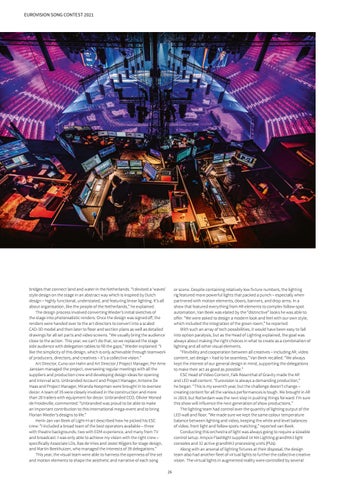
or scene. Despite containing relatively low fixture numbers, the lighting rig featured more powerful lights that packed a punch – especially when partnered with motion elements, doors, banners, and drop arms. In a show that featured everything from AR elements to complex follow-spot automation, Van Beek was elated by the “distinctive” looks he was able to offer. “We were asked to design a modern look and feel with our own style, which included the integration of the green room,” he reported. With such an array of tech possibilities, it would have been easy to fall into option paralysis, but as the Head of Lighting explained, the goal was always about making the right choices in what to create as a combination of lighting and all other visual elements. “Flexibility and cooperation between all creatives – including AR, video content, set design – had to be seamless,” Van Beek recalled. “We always kept the interest of our general design in mind, supporting the delegations to make their act as good as possible.” ESC Head of Video Content, Falk Rosenthal of Gravity made the AR and LED wall content. “Eurovision is always a demanding production,” he began. “This is my seventh year, but the challenge doesn’t change – creating content for all the various performances is tough. We brought in AR in 2019, but Rotterdam was the next step in pushing things forward. I’m sure this show will influence the next generation of show productions.” The lighting team had control over the quantity of lighting output of the LED wall and floor. “We made sure we kept the same colour temperature balance between lighting and video, keeping the white and level balances of video, front light and follow spots matching,” reported van Beek. Conducting this orchestra of light was always going to require a sizeable control setup. Ampco Flashlight supplied 14 MA Lighting grandMA3 light consoles and 32 active grandMA3 processing units (PUs). Along with an arsenal of lighting fixtures at their disposal, the design team also had another fleet of virtual lights to further the collective creative vision. The virtual lights in augmented reality were controlled by several 26