THE STREETS Touring specialists stage a seminal concept album with a life-size bus shelter in tow
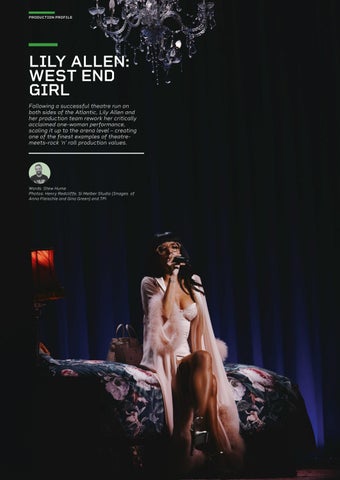
LILY ALLEN One of the finest examples of theatre-meets-rock ’n’ roll production values in 2026
DERMOT KENNEDY The singer-songwriter’s production crew present a full-circle performance
TAKE THAT One of the most memorable tours returns...
SEPTEMBER/OCTOBER 2026 • #295
WWW.TPiMAGAZINE.COM
INTRODUCING
MANY ONE(S) MAKE LIGHT WORK
©2026 HARMAN. All rights reserved.
TPI_Martin_MAC_One_Beam_EMEA_SP_Advert_v1.indd 1
Learn more at martin.com
13/02/2026 10:29
U N I V I E W L E D .COM
THE ROAD NEVER STOPS, NEITHER SHOULD YOUR DISPLAY
UNIVIEWLED AT LDI 2026 Las Vegas Convention Center West Hall December 6-8, 2026
First
BOOTH
1714
Look
UR PRO
TST
RDV
I
GHC
LED POSTER
Rental LED
Transparent Touring LED
Rental Dual-sided LED
Interactive LED Floor
Fine-pitch LED
Folding LED Poster
NEW PRODUCT PREVIEW
READY FOR THE ROAD BORN FOR THE SHOW Lightweight and durable outdoor touring solution
2026
OUR STANDARD: ABNORMALLY STRONG.
EXTRA HEAVY DUTY XHD CORNER C30
HO
FK ON
HOFFORK 350 BOXCORNER INDIVIDUALLY CONFIGURABLE
HOF
HOF
29
0-4
FOR
K 35
MEET US AT LEATCON BOOTH A1-K11
www.h-of.de
@hofalutec
BOLT
0-5
ORDER NOW
NEW
200-
2
The world’s most powerful broadcast audio mixer designed for a SMPTE-2110 future! Fairlight Live audio panels are the mixing control center of your live production! Designed to integrate with Fairlight Live software, the world’s most powerful audio mixer, you can manage unlimited channels and complex mixes with subtle adjustments using precision faders and knobs. Real-time visual feedback is provided by LCD displays. USB-C and SMPTE 2110 network integration ensures seamless compatibility with ATEM switchers.
Upper Deck Function Buttons The function buttons allow fast access to channel processing and routing tools including EQ, dynamics, plugins, panning, and bus assignments. When you select a function, the menu buttons, encoders, and touchscreen automatically adapt to show relevant controls and parameters. Function buttons work with soft menu buttons to navigate parameter pages, keeping advanced mixer functions organized and accessible.
Customizable Channel Strips
Tools for Live Production
Fairlight Live audio panels feature customizable channel strips which include a motorized fader, solo, mute, and select buttons, plus a rotary encoder for fast access to channel functions. The bright LCD touch screen display keeps channel status and identification clear. Assign any strip to any track or bus, plus a single strip can control multiple tracks or buses simultaneously.
The most important live production functions are grouped so you can move quickly between rehearsal, playback, cue execution, and show automation. Player recorder lets you record and play back virtual sound checks. Cue player gives instant access to audio and MIDI cues for jingles, stingers, and effects. Snapshot controls enable fast preview, recall, update, and creation of snapshots for seamless show transitions.
LCD Touchscreen Display Each group of 10 channel strips has a dedicated LCD touchscreen, giving you a comprehensive graphical display of your audio mix including channel VU meters and mixer status. Adjust plugins, assign channels to busses, manage monitoring, configure layers, and set spill zones via the touchscreen. You can control complex live mixing in one place without navigating to separate menus during live production.
www.blackmagicdesign.com/uk SRP is Exclusive of VAT.
Fairlight Live ������������������������������������������Free Download Fairlight Live Audio Panels ������������From £1,679
Learn More!
tarm
REVOLT 17 colors, CMY, gradual CTO 500 W laser light source Angle 0.38° - 12.5° IP66 rated
• Turbo hybrid moving head • Delivers an exceptionally sharp, highly visible beam over long distances • 1’200‘000 lx @ 20 m • 540°, infinite pan / 270° tilt (8-16 bit)
www.tarm.com tarm AG • Kreuzlingerstrasse 5 • CH-8574 Lengwil • Phone: +41 44 500 21 40 • Email: info@tarm.com
EDITOR’S LETTER
Issue #295 September / October 2026
RUNNING AWAY WITH THE CIRCUS
Managing Editor Stew Hume Tel: +44 (0)161 476 8360 Mobile: +44 (0)7702 054344 Email: s.hume@mondiale.co.uk Editor Jacob Waite Tel: +44 (0)161 476 8360 Mobile: +44 (0)7592 679612 Email: j.waite@mondiale.co.uk Assistant Editor Alicia Pollitt Tel: +44 (0)161 476 8360 Mobile: +44 (0)7508 441986 Email: a.pollitt@mondiale.co.uk Commercial Director Fran Begaj Tel: +44 (0)161 476 8360 Mobile: +44 (0)7852 336728 Email: f.begaj@mondiale.co.uk Senior Account Manager Matilda Matthews Tel: +44 (0)161 476 8360 Mobile: +44 (0)7413 555978 Email: m.matthews@mondiale.co.uk Account Manager Tom Dyson Tel: +44 (0)161 476 8360 Mobile: +44 (0) 7306505230 Email: t.dyson@mondiale.co.uk Account Manager Molly Cummins Tel: +44 (0)161 476 8360 Mobile: +44 (0) 7710427823 Email: m.cummins@mondiale.co.uk Digital Content Manager James Robertson Tel: +44 (0)161 476 8360 Mobile: +44 (0)7725 475819 e-mail: j.robertson@mondiale.co.uk Marketing and Events Manager Alice Clarke Tel: +44 (0)161 476 8360 Mobile: +44 (0)7752 392465 Email: a.clarke@mondiale.co.uk Marketing and Events Assistant Charlie Moore Tel: +44 (0)161 476 8360 Email: c.moore@mondiale.co.uk Editorial Director Peter Iantorno Tel: +44 (0)161 476 8360 Mobile: +44 (0)7763 233637 Email: p.iantorno@mondiale.co.uk Chief Executive Justin Gawne Tel: +44 (0)161 476 8360 Mobile: +44 (0)7768 850767 Email: j.gawne@mondiale.co.uk Accounts Jodie Matthews / Sarah Healey: ar@mondiale.co.uk Mondiale Group Chairman Damian Walsh
As weather-beaten flightcases and equipment carts glide from Europe’s mainly sun-ravaged, dusty festival fields [p22] onto planes, trains and automobiles, it seems an opportune time to ruminate on the ingenuity of live touring professionals and their ability to create tangible artistic experiences for audiences, often with minimal equipment and in far-from-ideal environments. This ability to ‘do more with less’ is often embraced by the theatre world – a point that is demonstrated in abundance, and contrast, in TPi #295. ‘Running away with the circus’ used to be a dismissive remark made to and by industry insiders about life on the road. However, our cover story, Take That’s The Circus Live 2026, applies a modern approach to this adage – combining the best of theatre, Cirque du Soleil and pop extravaganza with a show that holds nothing back [p64]. Dermot Kennedy’s latest tour, meanwhile, is introspective and stripped-back, while putting the artist at the fore [p38]. Lily Allen’s West End Girl is perhaps one of the finest examples of
theatre-meets-rock ’n’ roll production values in 2026 [p50], as is The Streets’ A Grand Don’t Come For Free Tour, which transforms venues and festival sites into inner-city Birmingham of the Noughties, complete with a life-size bus shelter [p14]. Away from the stage, Jim Digby underlines the need for leadership training [p112]; Sarah Rushton-Read and The Music Industry Therapy Collective (MITC) asks: what should responsible touring look like? [p114]; NOWIE (The Network of Women in Events) previews The Big Survey, with revealing statistics about what needs to change for women in live events [p116]; and The BACK LOUNGE’s Suzi Green muses on retirement in the events and touring industry [p118]. Finally, Production Services Association (PSA)’s partnership with onboard:earth aims to help the UK live events supply chain reduce travel-related carbon emissions [p119]. See you on the road, Jacob Editor
Graphic Design & Production David Bell: d.bell@mondiale.co.uk Jez Reid: j.reid@mondiale.co.uk Cover Photo Take That by Emma Tranter Printed By Buxton Press • www.buxpress.co.uk Annual subscriptions (including P&P): £42 (UK), £60 (Europe), £78/$125 (RoW). Subscription enquiries to: Subscriptions, Mondiale Media Limited, Strawberry Studios, Watson Square, Stockport, SK1 3AZ, UK. Tel: +44 (0)161 476 5580 Email: subscriptions@mondiale.co.uk www.tpimagazine.com www.tpiawards.com www.gtlsessions.com Total Production International (TPi) is a controlled circulation magazine, published six times a year by Mondiale Technology Media Limited under licence. ISSN 1461-3786 Copyright © 2026 Mondiale Technology Media Limited. All contents of this publication are subject to worldwide copyright protection and reproduction in whole or part, in any form whatsoever, is expressly forbidden without the prior written consent of the Publishers. Every effort is taken to ensure accuracy in the preparation of this publication but neither Mondiale Technology Media Limited, nor the Editors, can be held responsible for its contents or any consequential loss or damage resulting from information published. The views expressed are not those of the Editors. The Publishers accept no responsibility for the return of unsolicited manuscripts, photographs, illustrations, advertising materials or artwork. Total Production International USPS: (ISSN 1461 3786) is published six times a year by Mondiale Technology Media Limited. The 2025 US annual subscription price is 125USD. Airfreight and mailing in the USA by Agent named Air Business, C/O WorldNet Shipping USA Inc., 155-11 146th Avenue, Jamaica, New York, NY11434. Periodicals postage paid at Jamaica NY 11431. US Postmaster: Send address changes to Total Production International, Air Business Ltd, C/O WorldNet Shipping USA Inc., 155-11 146th Avenue, Jamaica, New York, NY11434. Subscription records are maintained at Mondiale Technology Media Ltd. Waterloo Place, Watson Square, Stockport, SK1 3AZ, UK.
007
ITINERARY
ON THE COVER
Access our complete range of globally available professional AV equipment and request your rental quote online. Stay up to date with the latest innovations and product releases from our partner brands.
64 TAKE THAT One of the most memorable tours returns to stadiums in the UK and Ireland, providing a whole new generation of gig-goers with a spectacular experience…
EVENT FOCUS 12 Jack Childs highlights the
INTERVIEW 84 Rentman prepares for the future
14 The Streets’ crew turn venues into
88 Meet those at the forefront of the
20 Clay Hutson talks all things rigging
94 The Tronios Group looks back on
benefits of Shure ADPSM.
Noughties inner-city Birmingham. after TWICE’s THIS IS FOR TOUR .
FESTIVAL FOCUS 22 On the road with dBTechnologies, The Piece Hall, Adriatic Sound Festival, and many more.
PRODUCTION PROFILE 38 DERMOT KENNEDY
A full-circle production for the Dublin native and his crew.
50 LILY ALLEN
AED United Kingdom +44 1628 953 360 info.uk@aedgroup.com
The artist’s loyal touring team presents an impressive theatre- meets-rock ’n’ roll spectacular.
amid new workforce pressures.
pre-vis conversation.
over four decades of business.
96 Make Noise Pro Audio branches out into the rental market.
IN PROFILE 98 Pieter Smit Group acquires MM Band Services.
100 Retracing a decade of Follow-Me. PRODUCTION FUTURES 104 Production Futures celebrates
its 10-year anniversary with its Annual Partners Summit.
14
20
22
38 GEAR HEADS 106 Highlite reveals CHIMP G3. 108 L-Acoustics’ Source Intelligence. 110 Avolites unveils Prism.
50
FEEDBACK 112 Jim Digby on the need for
leadership training within the live touring industry.
114 MITC asks, what should
responsible touring look like?
116 NOWIE previews The Big Survey. 118 Suzi Green muses about retirement in the industry.
119 PSA partners on:board earth. BACK CHAT 122 22live’s Alex Penn and Spencer Beard tell TPi all about the company’s new headquarters.
108
Kendrick Lamar & SZA’s Grand National Tour | Photographed by Greg Noire
ENQUIRIES@STRICTLYFXUK.COM | UNIT 6, CREST RD, HIGH WYCOMBE, HP11 1WT | +44 (0)2045 010101 INFO@STRICTLYFX.COM | 120 AIRPARK CENTER DRIVE E, NASHVILLE, TN 37217 | +1 629 702 3639
We are passionate about what we do. Our expertise and extensive knowledge of the world’s leading pyrotechnic, laser, and flame manufacturers allows us to curate astonishing live events for each client. We are proud to be part of the
strictlyfx.com
EVENT FOCUS
MIXING TOM MISCH Sound engineer Jack Childs discusses his work with the singer-songwriter and some of his tools of choice for capturing the magic, including the newly updated Shure Axient Digital PSM.
Words: Stew Hume Photo: Shure
With a production background mixed with jazz sensibilities, Tom Misch’s eclectic sound has found cultural acclaim in recent years. Having worked with the singer-songwriter since 2017 prior to the release of his album Geography, Monitor Engineer, Jack Childs has had a frontrow seat to the artist’s rise in popularity. Given the artist’s propensity to draw inspiration from multiple genres, he has often toured with quite a large band to “recreate his rich soundscapes”. He continued: “Usually we tour with an eight- or nine-piece band with three guitarists, so part of the challenge is delivering monitoring with clarity and focus for each player as there’s always a lot going on musically.” Childs’ “go-to choice” of desk for most artists is DiGiCo, and Misch is no exception. “Most recently I’ve been carrying a Q326 because of their high channel and bus count, deep programming ability and wide connectivity options whilst keeping a fairly small footprint.” Regarding wireless options for the artist’s latest tour, Childs turned to Shure for a solution. “I’ve always looked to Shure to cover my RF devices. I like their ecosystem, and Workbench is probably one of my most valued tools. So having coordination to deploy infrastructure that just works every time is important to me.” During its initial release, the engineer took out several Axient Digital PSM (ADPSM) units on the road. “There were some obvious teething issues,” admitted Childs. “But when Chris Parker at Patchwork [the tour’s audio supplier] told me I
012
had the opportunity to beta test the new Single Carrier (SC) Narrowband mode, I really wanted to see how it had improved.” Parker added: “At Patchwork we’ve invested heavily into Shure Axient systems and have had several deployments of varying scale of ADPSM. It’s been great working with Shure on the application of Single Carrier Narrowband, and it’s quickly become our go-to transmission mode for our system topologies as it ticks all the boxes in performance and reliability.” Parker expressed his thoughts on the camp: “We were pleased as always to be working with Jack Childs, as well as FOH Engineer, Lee McMahon. Both are brilliant personalities and great communicators.” According to Shure, SC Narrowband is designed to behave more like traditional narrowband IEM systems while retaining the benefits of a modern digital platform. It states that it offers the same low latency and efficient spectrum use as existing digital narrowband modes, with improved stability in difficult conditions. The company believes this will be particularly beneficial when artists are near reflective metal surfaces, such as cymbals, or in environments with less time to set up. “The updates feel like a massive step forward,” commented Childs. “In SCNB mode, ADPSM now has the same reliability as PSM 1000s. I had total confidence in what I was deploying and what the players were receiving, which is important when there’s nothing but air between you and them.”
He was also complimentary of the time it took to get the system up and running each day. “I have a lot of jobs to do on top of coordinating RF, so having ShowLink to wirelessly deploy my frequencies to all ADPSM devices at once is a game changer. Being able to monitor battery and volume levels from my world is also handy.” Childs revealed that Tom Misch and the band noticed a difference in quality. “The noise floor is so low that most people were unsure if their receivers were switched on. But what I noticed most is the huge dynamic range. Less companding and compression makes everything feel more organic and natural.” After being involved in beta testing, TPi asked Childs what he would like to see in the future for in-ear monitor and wireless solutions. “I’d like to see the ability to have tone profiling built into IEM receivers to counteract performers using different brands of in-ear monitors,” he stated. “It’s one of the common problems you come across as a monitor engineer and having the ability to create a tonally flat response for everyone regardless of which in-ear monitors they are using will help monitor engineers deliver a much more accurate mix for everyone.” With Misch’s latest run of shows coming to an end, Childs is now looking ahead to the rest of the year, mixing for Katie Melua and Clementine Douglas before heading out on an album campaign with FKJ in the autumn. www.tommisch.com www.patchworklondon.co.uk
Scan for more information
C
M
Y
CM
MY
CY
CMY
K
Compact 42,000 lm design;
EVENT FOCUS
THE STREETS: A GRAND DON’T COME FOR FREE Touring specialists stage a seminal concept album, transforming venues and festival sites into inner-city Birmingham of the Noughties, complete with a life-size bus shelter.
Words: Jacob Waite Photos: Luke Dyson
014
Over two decades ago, The Streets released A Grand Don’t Come for Free. Music theatre meets garage, the seminal concept album follows Mike Skinner’s relationship with Simone, sidetracked by the devastating loss of £1,000 from right under his nose. The album has soundtracked countless long drives and encapsulated early-2000s British culture like few records, so it was a pleasure to track down the vendors and touring crew tasked with building a production befitting the brief. Production and Tour Director Will Driscoll of 24/7 Productions enlisted trusted suppliers Boxcat Studio (content creation), CSE Crosscom (radios), FOMO London (band rehearsals), Gravit8 Travel (travel agent), KB Event (trucks), Mission Control (RF coordination), Opto Live (playback), Ox Event House (set fabrication and scenic), Phoenix Bussing (buses), Production Freight (freight), Production Park – The Mill (production rehearsals), Solotech (audio), and Zeal (lighting). “We went through a number of revisions before settling on the final design, somewhere between the dream and the reality,” Driscoll said, speaking to TPi at London’s Alexandra Palace. “I’m really pleased with the team we have on this project. Everybody is multi-rolling and it’s admirable.” It was an unconventional show for The Streets: a theatre-style production in which the first half was a theatrical performance before moving into a rock ’n’ roll gig, complete with Skinner’s signature crowd interaction. The main challenge was scaling the show for
academy-sized venues. “I think we’ve nailed it and the whole team has stepped up to do so,” Production and Stage Manager, Richard ‘Cookie’ Cook, reported. “The economy of space was the biggest challenge. We couldn’t compromise on the set because of the size of the bus stop, so getting it into Glasgow’s Barrowland Ballroom with a 1ft gap between the artist and the bus stop was the compromise. Even getting the team to carry everything up the flights of stairs with a smile was commonplace at the Barras.” Reflecting on the success of the tour, Cookie praised the influence of the crew and vendors: “The gear was fantastic, they all had been wonderful to collaborate with, and the support had been great. Dublin’s Olympia Theatre show stands out as highlights.” A ‘LESS IS MORE’ APPROACH The show’s video content followed a continuous journey from day into night. For outdoor performances such as Ally Pally, it mirrored the changing ambient light, gradually darkening as the festival site moved into evening. At the centre of the stage was a bus stop, a nod to the album artwork, complete with an authentic Birmingham bus map, grounding the show in the city’s visual language and the band’s roots. The graffiti scrawled across the bus stop changed each night, featuring a different slogan at every performance. Famed for crowd interaction, Skinner did not acknowledge the audience during the first part of the set. Instead, choreography became
a visual representation of the lyrics, reinforcing the storytelling, most notably during Fit But You Know It, which recreated the familiar scene of people queuing outside a kebab shop. Production and Lighting Designer, Liam Tully, programmed the show at his home in Newcastle, using an MA Lighting grandMA3 light console with Recipes. The design was drawn in Vectorworks and previsualised using Syncronorm Depence software, before the show narrative was developed during five days at Production Park’s The Mill rehearsal facility. “The idea of the show was the album in full,” Tully explained. “The bus stop is only lit from one side at the start of the show; the rig progresses throughout the set, going from day to night, starting at stage right and finishing on stage left.” The rewind sound on Empty Cans at the end of the show, and the floor lighting package, burst into life upon Skinner’s discovery of the £1,000. The only departures from the day-to-night structure came during anthemic Blinded by the Lights and Fit But You Know It, and greatest hits section. Steve Hough of Zeal, who supplied the lighting, had previously toured as the band’s Lighting Designer and had worked with The Streets since their stage return in 2018. “It’s a theatrical show, providing something special for fans,” he said.“I love working with Zeal,” Tully added. “They have a great apprenticeship scheme, their equipment is perfect, and they are designers in their own right.” The rig included flown Martin Professional Aura XIPs, Viper XIP units on the floor, while
015
EVENT FOCUS
ACME PIXEL LINE IP 500s were housed inside the bus stop and lampposts. SGM Q-8 fixtures provided backlight, complemented by three Robe Robin FORTE followspots on a RoboSpot system. Further ACME Lighting PIXEL LINE IP and LINE 500 strips lined the stage risers. “It’s nice to not have loads of lights flashing,” Tully noted. “It’s a two-truck tour, so less is more. Some of the best looks are generated by just one light.” Hough expanded on the ‘less is more’ approach: “It is arguably one of the hardest things to do as a designer. You have to have a level of confidence and assurance in your design and the performers, and I think this show leaned into that, using negative space tactfully,” he said. “On the other hand, there were still elements of energetic lighting design towards the end of the show, which was the genius of Liam’s design, providing both the theatrical moments and the party at the end. It felt collaborative and not transactional, pulling together and pitching in to present a great gig.” In Australia and New Zealand, a floor package and video wall replaced the bus stop, with Boxcat Studio recreating the environment in Unreal Engine across the production. Resolume media servers and in-house LED allowed the production to tie the video content seamlessly into the lighting. “It’s an ever-evolving show,” Tully noted, reflecting on the experience of designing one of his favourite albums. “My favourite moment is Empty Cans. It’s the crescendo of the show, straddling both the theatrical and anthemic
016
elements. There are so many highlights across the nine greatest hits.” In preparation for the production, the design and carpentry team measured real-life bus shelters, timetables and seats to create the show’s central prop. However, everything built by Ox Event House had to be modular and tourable, navigate tight spaces, fit festival stages and roll on and off trucks partially assembled. “We came up with off-the-shelf material designed to allow it to transport and attach the decking with stock wheels and deck,” Ox Event House’s Ben Levitt explained. “We also repurposed lampposts we had as hire stock and implemented lighting fixtures to fit the brief. We are fans of The Streets, so it was a cool and well-received project.” Ox Event House scaled the bus stop to fit stock risers. It broke down into 2D panels across 10 sections, which were aircraft-pinned together and bolted to deck bases for safety. The bus shelter could be built in around 30 minutes and occupied 8ft of truck space across three travel carts. Polycarbonate window glass was lowered to accommodate the new winch system at Glasgow’s Barrowland Ballroom, allowing the structure to be moved up the centre of the venue’s stairs. “Modifications allowed it to break down small to fit tough venues like Dublin’s Olympia,” Ben Levitt continued. “We also made it so it could fit in three four by eights, so you could roll the middle and the two middle-left and right sections off a truck on a festival site and fit that
together with ‘space couplers’ for our in-house system. It fitted together seamlessly.” Fiona Levitt added: “We were able to recreate the shades of the iconic album artwork bus stop, and relished the opportunity, matching colours and reference imagery to make it as realistic as possible. It’s heartwarming to see The Streets’ relationship with the bus stop and Carpenter, Jack, who Mike Skinner refers to as ‘Bus Stop Jack’.” ‘EVERY DETAIL MATTERS’ “You don’t just recreate an album like this – you become its custodian for a while,” Musical Director and Playback Technician, Oliver Twiby, commented. “Every decision was made with one question in mind: would the audience believe this was the record they knew and loved? That philosophy ran through every department. Every detail matters, and there’s no shortcut. It’s about understanding the feel, attitude and emotion behind the music, not just recreating the notes.” Having spent nine years with The Streets, Twiby described the campaign as one of the biggest technical and musical challenges the team had undertaken. The album was never designed for full live recreation; many of the songs had never been performed live, and significant amounts of the original source material no longer existed. The team, therefore, rebuilt large sections of the record while remaining faithful to the original. The process began with a forensic analysis of the album, identifying which
100% App
Wireless DMX
Battery
IP65
QUICK & COMPACT
QuikBeam features a 13°–60° Fresnel zoom and delivers full 200 W tungsten-equivalent output with three flexible power options: QuikBrick for wireless freedom, PoE for power and data over a single cable, or PowerFlow for continuous AC mains power with daisy-chain capability.
QUIK PUNCH POWERED BY
ASTERA TITAN LED ENGINE
QuikBeam with QuikBrick and PowerFlow One fixture covers multiple workflows.
NetBox and PowerInjector The devices to use PoE with QuikBeam.
8-Unit QuikCase Kit Everything you need to light an event, packed into one QuikCase.
www.astera-led.com/quikbeam RGB+MINT+AMBER FULL SPECTRUM
1750K - 20000K WIDE CCT RANGE
TLCI/CRI Ra ≥ 96
EXCELLENT COLOR RENDERING
EVENT FOCUS
assets remained, what could be restored and what had to be recreated. The team met to discuss arrangements, instrumentation and the approach to each song before moving into months of studio programming, recording and rebuilding alongside Cassell ‘The Beat Maker’ (drums), Wayne Bennett (bass), Gabriel PiersMantell (keys), Max O’Donnell (guitar), Kevin Mark Trail (vocals) and Roo Savill (vocals). The playback system was supplied by Opto Live. “This one of the best touring rigs that I have ever worked with,” Twiby commented. “Andy Hamwee and the Opto Live team have built an incredibly reliable system that’s perfectly suited to modern touring.” The rig featured dual Apple MacBook Pro M5 playback computers and RME MADIface XT interfaces, with a DirectOut PRODIGY handling the first 32 channels of audio and Ferrofish A32 providing the remaining outputs, for 40 analogue outputs. “The audio department wanted to keep the playback system entirely analogue, and delivering 40 discrete outputs reliably is no small task,” Twiby continued. “The combination of the PRODIGY and Ferrofish makes that incredibly straightforward while maintaining excellent audio quality.” MIDI over MADI was achieved from the PRODIGY, meaning whichever playback machine was active automatically became the active MIDI source. From there, everything was distributed via an iConnectivity mioXL and Opto Live’s proprietary Kenton Line Driver stage boxes, providing an “extremely robust” touring network. Ableton Live 12 alongside AbleSet was used for show control, with everything controlled from an AKAI LPD8, giving Twiby “quick, tactile
018
access” throughout rehearsals and live shows. “It’s flexible, completely redundant and, most importantly, dependable, which is exactly what you need when you’re carrying so much of the production,” he said of the solution. The audio department was equally important. “FOH Engineer, Rob Sadler completely understood the sonic direction from the outset,” Twiby said. “He trusted the arrangements, stayed true to the dynamics and character of the record, and let the songs tell the story.” CSE Crosscom supplied 15 Motorola DP4600e radios, configured and delivered in a Peli transport case for transportation and deployment. CSE Crosscom’s Dan Howroyd commented: “With clear audio, durable construction and proven reliability, the DP4600e radios were ideally suited to the challenges of touring, helping the team maintain effective communications throughout.” The crew included Tour Managers, Keith O’Neill and Phillippa ‘PJ’ Jeffrey; Stage Manager, Pete Hamilton (June); Monitor Engineer, Sam Downes; Stage Technicians, Martin Worsnip and Dean Bellamy; Backline Technicians, Jonathan ‘Baz’ Barrett, Art Smith, Roger Davis and Tom Pryce; Lighting Operators, Otis Benjamin and Alex Knowles; Lighting Technicians, Alex Knowles and Lewis Williams; Set Carpenter, Jack Stevens; and Production Assistant/Wardrobe, Millie Gorringe. “It’s not just the technology or the production values; it’s about a group of people who genuinely enjoy working together,” Twiby stated. “Seeing almost 30,000 people across two nights at Alexandra Palace singing every word of an album that still means so much to them
was one of those moments I will never forget. It reminded all of us why we do this. I am incredibly proud to have played a small part in bringing this record back to life, and I am even prouder to have done it alongside such an exceptional group of people.” The production adopted an unusual approach to audience egress as devised by Production and Tour Director, Will Driscoll. “We pause at the end of the show, the band leave, and we try to operate like a theatre load-out,” Driscoll explained. “Lights go back to a preshow state, and music is played during egress. It means the lasting memory people have is of the show, instead of roadies in high-vis, floodlights and PA announcements impeding the atmosphere.” The approach also made egress faster. Driscoll cited the ‘Robert Miles effect’ in closing, referencing the music played at the end of club nights in Ibiza to bring heart rates down and encourage people to leave safely. www.thestreets.co.uk www.24-7productions.co.uk www.boxcat.studio www.csecrosscom.co.uk www.fomo.london www.kbevent.com www.liam-tully.com www.missioncontrolltd.com www.optolive.com www.oxevents.co.uk www.phoenix-bussing.co.uk www.productionfreight.com www.productionpark.com/studios www.solotech.com www.wearezeal.co
FESTIVALS MOVE FAST
...YOUR CONSOLE SHOULD TOO!
www.digico.biz DiGiCo, No.5 The Distillery, Silverglade Business Park, Leatherhead Road, Chessington, Surrey KT9 2QL. Tel: +44 (0) 1372 845 600
DiGiCo_Q225DS_Festival_TPi_May_Jun26.indd 1
05/05/2026 10:08:07
EVENT FOCUS
TWICE: ‘THIS IS FOR’ RIGGING Ronin Rigging’s Clay Hutson documents his time during TWICE’s THIS IS FOR WORLD TOUR, how rigging practices are evolving and why education is essential for growth.
Words: Alicia Pollitt Photos: Clay Hutson and Broadweigh
Over a decade since their debut, TWICE’s THIS IS FOR WORLD TOUR saw the ninemember powerhouse K-pop group tour a 360° stage show for the first time. With the stage setup featuring extended runways, B-stages, and multiple performer lifts, the rigging department was put through its paces. Head Rigger and Owner of Ronin Rigging, Clay Hutson, was onboard to take the show worldwide with over 200 rigging points, a mother grid of over 98,000lbs, and an overall show weight of 205,000lbs. “I have done a few K-pop tours and shows now and the standard is always very high, so I am grateful to be involved in these innovative shows – TWICE being no exception to that,” Hutson began. “Even though we were travelling through different-sized venues, which required different rigging configurations, we made sure the look and feel of the show didn’t suffer for it.” Leading a team of five touring riggers, Hutson also had the help of 36 local crew members on a day-to-day basis to assist with the rig, supplied by Five Points Rigging, which featured 570ft of Tyler Truss Systems GT truss, 233ft of Fuse Square PreRig, 360ft of TAIT
020
Mother Grid, 160 LIFTKET Direct Drive 1T, 44 Direct Drive 2T, 16 Direct Drive 1.2T, 56 TAIT Nav Hoists and 60 Broadweigh load cells. Hutson owns the Broadweigh load cells, and told TPi he brings them along with him on every tour he does, as a matter of preference for the kit. “I know exactly what is happening with the kit and it is the most reliable product that I have ever worked with,” he explained. “The interface on the computer is fantastic – you can have your entire overlay into it and then each load cell placed where the hoist is, so if something goes wrong, I know what part of the rig is affected instantly. A properly set up Broadweigh system for me is flawless.” Having been a rigger for the past 35 years, Hutson also reflected on how his role and rigging across the industry have changed since the early days when alpine harnesses were still used. “Our awareness as an industry about safety has come a long way. The UK and Europe are light years ahead of the rest of the world when it comes to rules and regulations, but I believe that steps are being taken in the right direction,” Hutson stated. “The industry is pushing the envelope with engineering
Head Rigger and Owner of Ronin Rigging, Clay Hutson.
WIRELESS, ROBUST, AND ENGINEERED FOR THE LIVE EVENTS INDUSTRY. Proud to support TWICE on tour
From small set pieces to stadium roof points, Broadweigh wireless load cells meet every rigging challenge. Available in three shackle types—3250kg, 4750kg and 9000kg—they deliver real-time load data with the accuracy and reliability trusted worldwide. Know more. Do more.
technology; the products we’re rigging are getting lighter, so productions are adding more to be bigger and better than their last iterations, which has meant that we’re seeing a higher calibre of show.” As a company owner and experienced in his craft, “evangelist for education” Hutson places a major emphasis on training the next generation of riggers. “The pandemic left us with a huge gap in training and competency, through no fault of the crew members themselves, but instead because the industry was shut down for so long,” Hutson said. “What is important to me is to bring the skills to newcomers, so they have the confidence and knowledge to think on their feet and rely on their memory of a situation.” Hutson noted that these skills cannot be learned by theory alone. “This is not something you can teach by book, which is why it is important to understand it before you can teach it and why people in positions such as mine should help out the new generation of riggers,” he explained. “It is such a practical role, and learning on the job is a part of it, but
something I tell the people in my seminars is that I have made certain mistakes in my career, so you don’t have to.” Looking to the future of education, Hutson hopes to develop a resource for riggers which offers new training courses, how-to videos, podcasts, reading materials and events that will help the next generation through experience Hutson has. Hutson’s experience assisted him on the THIS IS FOR WORLD TOUR, which began in North America in winter and subsequently traversed varying venue sizes. “The goal was to get the whole show in every single time, no matter the venue, or whether the trim heights were different. There was a large lighting rig that encompassed the entire arena, elaborate automation and an extensive video package, and we worked hard to make sure the show looked the same every night,” Hutson explained. “Sometimes we would have to truncate the original show to make it fit, but we would always have the core of what the show was meant to be.” www.twice.jype.com www.broadweigh.com
BW-S475
See the full ecosystem at broadweigh.com
021
FESTIVAL FOCUS
ON THE ROAD WITH DBTECHNOLOGIES From medieval squares to coastlines, dBTechnologies’ solutions sound out music festivals across Italy this summer.
Words: Jacob Waite Photos: Francesco Prandoni and TPi
For the third year running, dBTechnologies returned to Lucca Music Festival with largescale VIO Series line array systems deployed by the festival’s trusted sound partner, TEMA Show Service, across the city’s challenging historic venues, including Piazza Napoleone and the Mura Storiche – providing visiting performing artists, engineers and technical production teams the consistency and confidence to perform. Among those on site was the effervescent Andrea Brasolin, Product Specialist at dBTechnologies and part of the company’s Application Department, who was on hand to support the system deployment. “It’s an interesting and difficult venue,” he explained. “Every year, we make slight modifications to guarantee a better experience. This is a square in a medieval city, with many different acoustic reflections from the surrounding buildings. The stage is not in a symmetrical position within the square, and the back of the venue is also not symmetrical. We also have some trees and a giant statue of Maria Luisa of Bourbon (Duchess of Lucca and former Queen of Etruria) to contend with.” Brasolin and the dBTechnologies team were responsible for designing, deploying and tuning the PA system. Far from being a plug-andplay application, the site presented a series of acoustic and environmental challenges. “It requires a lot of problem-solving and troubleshooting,” the product specialist continued. “The area is 55m by 140m, so we decided to use the same number of boxes for the main system and the outfills to guarantee
022
the same tonality from the clusters, although they are set up differently.” The outfills also must reach the furthest points of the venue, requiring a tailored approach to high-frequency management. “There is a lot of hot air at ground level and cold air above, so the sound moves around, making it difficult to reach the final row of people. That’s why we have a processing approach specifically designed for this scenario. We need to reach the sky box over the glass, which is the goal, and we have managed to do that.” The festival’s programme encompasses everything from pop, rock and classical performances to conferences on non-show days. As a result, consistency was critical, with the system designed to maintain approximately a 3dB SPL difference between the first and last rows of people. Four clusters were deployed as the main system and outfills, with a central cluster covering the first rows above the stage. Additional point-source loudspeakers provided further SPL coverage across the audience and towards the sides of the venue. The system comprised 48 VIO L212 loudspeakers for the main and outfill hangs, with 15 VIO L1610 units forming the central cluster and front-fill line on stage. Four X310 loudspeakers were deployed as point-source outfills, while 40 VIO S218F subwoofers were flown in a gradient stack, with further low-frequency reinforcement beneath the stage in an arc array, supplemented by two end-fire blocks at the sides. “The double 12-inch boxes guarantee a bigger transient response, which is why we
have 38 double 12-inch, three-way boxes,” Brasolin explained. “The subwoofer is a double 18-inch, flyable version. Everything else is the right speaker for this setup – double 10-inch, three-way boxes for the front fill, point-source three-way boxes for the outer fill, and smaller double five- or six-inch speakers backstage. Everything is the appropriate dimension for the result we need.” The system also had to accommodate the incoming production design for David Byrne’s Who Is the Sky? Tour, with chairs removed from the front and sides of the audience area to make room for the production, including three LED video walls. The visiting audio team also added delay elements to the centre cluster. FOH Engineer for David Byrne and owner of SpiritHouse Studio in Massachusetts, Danny Bernini, was positive about the system: “I like it. I’ve used it in a couple of different places and have been very happy with the sound,” he said. “System Engineer Val Sulejmani and I feel like it’s a very musical PA. It sounds very good, and it’s fun to mix on… I met Andrea [Brasolin] four years ago, and he’s a real sweetheart. dBTechnologies have been hugely supportive.” Brasolin highlighted the approach taken by Byrne’s touring audio team, particularly its willingness to combine measurement and software tools with critical listening. “What I love about this production is that they have a very scientific approach,” he said. “They close the software and use their ears before adding delays and so on. The reverb of the outfill blends with this addition, and I heard the difference. From the microphone it was wrong,
BUILT ON TRUST. BUILT TO LAST.
FESTIVAL FOCUS
but to the ears it was ideal. Sometimes the ears are the best.” WORKING WITH ENGINEERS According to Brasolin, collaboration with visiting engineers is a key part of dBTechnologies’ approach to system deployment and product development. “We love to log feedback, which is important for product and software development, and interact with engineers who use multiple PA systems in different situations to see how we can make their lives easier,” he said. The festival provided an opportunity to demonstrate the latest iteration of dBTechnologies’ Aurora Net software, which incorporates several new features, including subwoofer tilt. “We’ve used subwoofer tilt to guarantee a much better result in reaching the corners of the venue,” Brasolin explained. “The new arc-array capabilities also help us deliver smooth results for the sides of the venue. The software’s ability to change the settings of the speakers at the touch of a button saves a lot of time for engineers. The overall flexibility of the system, its frequency and transient response, and the ability to modify anything in a second are super important.” With multiple artists passing through the stage, system flexibility was essential. “The PA must be adaptable to the artist and their team’s
024
specifications,” said Brasolin. “Sometimes we have to compensate for the high frequencies during challenging weather conditions outdoors, such as wind.” Environmental restrictions played a role at Lucca. The festival enforced daytime curfews and sound-level restrictions, with levels reaching a maximum of approximately 98dB SPL. Brasolin also pointed to one particularly unusual performance during the festival, when 12,000 people experienced a two-hour silent performance by Ludovico Einaudi. “12,000 people completely silent for two hours was amazing,” he recalled, buoyantly. The Lucca deployment was not the only major Italian festival application for dBTechnologies. Around 20km down the road, the company’s PA systems were also deployed at La Prima Estate, with a headline bill featuring artists including Jack White, Richard Ashcroft, Nick Cave and the Bad Seeds, Gorillaz and Twenty One Pilots. “The feedback has been overwhelmingly positive,” Brasolin concluded. “We love to support our customers. It is the most important thing, in addition to the reliability of the services we provide and the knowledge we can share. Experiences like this are like gold to me. I will return to the dBTechnologies office with feedback gathered, and I’ll be able to expand our network of sound engineers.”
HISTORY AND HERITAGE dBTechnologies’ identity is closely connected to its home city of Bologna and the wider Emilia-Romagna region. Founded in 1973, the company began life as AEB Industriale, initially repairing microphones before developing into the loudspeaker manufacturer known today as dBTechnologies. That regional connection remains apparent when visiting the company’s headquarters. Bologna is a city steeped in arts and culture and is home to the world’s oldest continuously operating university, while Emilia-Romagna has developed an international reputation for engineering and manufacturing, with automotive names such as Ferrari and Ducati among its most recognisable exports. Geography has played a role in the region’s development as an industrial and logistical hub. The mountains and Adriatic coast are within easy reach, while the Port of Ravenna provides access to international shipping routes. High-speed rail connections also link Bologna with Rome in around two hours, making the city well positioned for the movement of equipment and materials. dBTechnologies’ Founder, Arturo Vicari, was born and raised in Bologna, and the company’s workforce remains strongly connected to the city and its culture. More than five decades after its establishment, the company has grown
considerably. dBTechnologies now occupies multiple facilities incorporating warehouses, an anechoic chamber, administrative offices, R&D laboratories, product testing areas and demonstration spaces. Components and prototypes, including woodworking and other manufacturing processes, are developed inhouse. The company has occupied its current headquarters for more than three decades, although plans are in place for purpose-built facilities in Bologna in the coming years. Its international footprint has also expanded, with branches and offices in Cologne, Paris, Madrid, Prague, the US and the UK, while distribution reaches markets across much of the globe. Closer to home, the Unipol Arena, one of Italy’s largest indoor venues, is located nearby and is equipped with VIO sound systems. The arena has hosted performances from artists including The Cure and Peggy Gou, among others, including Kanye West’s 360° in-theround setup. Globally, VIO has been deployed across an increasingly diverse range of applications, from Lollapalooza stages in Argentina and Chile; Antonio Solís’ performances in Honduras, television specials in Germany and Austria, to Wasteland and FivePoint Amphitheatre in the US, K-pop shows in Vietnam, Jungle Music Festival in China and, most recently, SXSW in Austin and London.
INVESTING IN THE FUTURE dBTechnologies’ growth has been accompanied by a strong emphasis on research and development. “We’re committed to connecting feedback with R&D, and building the brand and awareness based on demand of the marketplace,” dBTechnologies’ Stefano Bini said. Today, approximately 60% of the company’s revenue comes from touring, with the remaining 40% split between installation, a growing market, and the retail and MI sectors. The company continues to expand its portfolio, with several new products including the 1608, which debuted at The NAMM Show and featured at ISE Show in 2026. dBTechnologies has continued to invest in its relationship with the wider professional audio community. “We listen to our community,” Bini said. “We hold periodic meetings at the headquarters to gain feedback from the audio community as well as running an Academy.” Founded in 2022, the dBTechnologies Academy provides training and certification for VIO operators, while also covering wider audio principles and practices. Courses are hosted internationally taking place over two days. “Our goal is to share knowledge, develop as a brand and grow as a sector,” Bini concluded. www.dbtechnologies.com www.summer-festival.com www.laprimaestate.it
dBTechnologies systems support La Prima Estate; dBTechnologies’ Gloria Arianna Giglioli, Andrea Brasolin, Ilona Isabel Utriainen and Chiara Vicari; FOH Engineer, Danny Bernini; dBTechnologies’ Stefano Bini and Enrico Gamberoni.
025
FESTIVAL FOCUS
SUMMER AT THE PIECE HALL Production Manager, Martin Hudson takes TPi behind the scenes of The Piece Hall’s new sound system
Words: Alicia Pollitt Photo: TPi
With 42 open-air shows programmed taking place between June to August, the stunning surroundings of The Piece Hall in Halifax have become a familiar backdrop for gig-goers over the summer period with the likes of CMAT, David Byrne and Turnstile’s respective touring production teams descending on the Grade One-listed site in recent weeks, firmly putting Yorkshire on the live music map. “Our capacity is just 6,000, and we’ve had performing artists that regularly fill football stadium sized venues perform at The Piece Hall, which is a testament to the atmosphere that we have created,” Production Manager, Martin Hudson proudly said, speaking to TPi on a balmy day in July ahead of CMAT’s headline performance, supported by Katy J Pearson. “I was given the freedom to put my own stamp on the operational side of things from a technical-production standpoint.” In doing so, The Piece Hall production team have made the stage a metre higher, moved the FOH tent to a more sonically pleasing location and removed an imposing followspot tower. “This year, we enlisted the support of a new audio company,” Hudson reported, reflecting on the changes made during his three-year tenure in the role. Hudson brought Isophase Audio onboard after Hudson asked Pete Sharman to create an entirely new sound design for the venue – the result featured a d&b audiotechnik KSL Series system with XSL Series as fills. “The older system used to hang quite high to cover the balcony, which subsequently made the sound bounce from the balcony, so we wanted to stop that,” Hudson reported.
026
“We lowered the PA and added in delay towers for the balcony so that the coverage was better for the entire audience, instead of trying to cover every area with the main PA.” Sharman created dedicated towers for certain sections of the delays, which could target the balcony directly, he explained: “The adapters for the towers are all built in house, they are able to be rotated so we can maximise the sound coverage of the delays and the pigeons love them,” he said, laughing. “It’s brilliant to be involved, especially as a supplier from just down the road in Pontefract,” Sharman added. “It’s a nice place to do a series of gigs and it always results in a great atmosphere. This d&b system has been great – we’ve tried a lot of different systems, and this is the best.” The Isophase team and Sharman decided that it would be better treating The Piece Hall events as individual concerts, as opposed to a festival. “We tried to treat the boundaries as if it was a reverberant space, rather than a big open greenfield area, where there are no boundaries,” he said. “We’ve kept that in mind and really addressed these shows in a more delicate manner, in an attempt to make it better for everyone, wherever you are in the crowd.” Compatibility with everyday Halifax life is of equal consideration with the site, bar areas are open to visitors who want to visit the vendors in the building ahead of the show. Creating this culture, the PM says, is helping “spark interest” in how modern-day events are put together and the amount of work required to do so. “We have different people, from different walks of life, watching the shows
come together before the audience gets here and they just want to ask questions and of course we’re more than happy to oblige,” Hudson smiled, going on to tell TPi that the introduction to new people in the industry doesn’t stop there – with the team welcoming in a local school for a tour, as well as local college students for work experience. “It’s nice that the education sector is finally taking the live touring industry seriously, and it is definitely the right time to start welcoming younger people.” Hudson shouted out the wider technical teams involved, including Lights Control Rigging (LCR), who provided a lighting package for the stage and the tower. “The service from LCR has been great, and the inclusion of the tower has made the entire venue look great,” Hudson said. “We also have Acorn, who are also a Yorkshire company, so it is special to have them involved as well as our power supplier FTS Event Power.” With The Piece Hall a staple in the Halifax summer calendar, as well as a Northern destination for music, Hudson looks forward to the remaining dates at The Piece Hall this summer and is proud of the shows that have already taken place. “We consistently get praise from touring productions about how efficient our crew are, which is a real testament to the team,” Hudson concluded. “I have put a lot of effort into my role here at The Piece Hall and I am so happy to see it paying off. I can see myself taking part in this summer series for some time.” www.goldleaderproductions.co.uk www.isophaseaudio.co.uk
I‘M AN ARTIST
SASCHA TIETZE PYRO DESIGNER www.fogsfx.de
"
Timing and clear commands are absolutely critical in show productions. The Artist intercom and the Max headsets guarantee clear sound and comfortable communication, even at loud events.“
ARTIST INTERCOM
Professional and reliable live communications. Seamless integration of Riedel‘s SmartPanel and Bolero wireless intercom. Easily scaling from 16 to 1024 ports with flexible licensing.
Become an ARTIST www.riedel.net #iamanartist
FESTIVAL FOCUS
CREATING ADRIATIC SOUND FESTIVAL After retiring from professional football to launch an electronic music festival, Luca Lewis, is channeling his unlikely career pivot into one of the most exciting live productions in Italy...
Words: Alicia Pollitt Photo: Adriatic Sound Festival
Adriatic Sound Festival (ASF) returned to Fano Airport on the Adriatic Coast of Italy for the second time with a production featuring performances by Fisher, Anotr, Honey Dijon, and more. Far from conventional, ASF Founder, Luca Lewis, may just be the first person to pivot from a career as a professional footballer to festival organiser. Speaking exclusively to TPi, he shares how he enlisted the support of STUFISH Entertainment Architects to translate the Roman history of Fano into the creative vision for an electronic dance music festival. “I grew up in Pesaro, and I was driving one of my friends home to Fano when we passed the airport and we just discussed how it would be the perfect place for an event. We were shocked that it didn’t already exist,” Lewis recalled. “I was a professional footballer and on a completely different path, but I just couldn’t stop thinking about it since that day. When I decided to stop playing football, I pitched the idea to the Mayor, who was interested.” Lewis, who hadn’t so much as “planned a birthday party” before taking on the festival, was introduced to Marco Marchesi, who suggested contacting STUFISH. “They loved the creative direction behind the event, and a week later we met in Fano to see the site,” Lewis recalled. “We then did extensive research on the Roman architecture left in Fano, which was special considering it is the second city after Rome with the most ruins from that timeframe. After that, it was about merging the worlds of electronic dance music with the rich history of Fano.” For STUFISH’s Zarya Vrabcheva and Ric Lipson, the intention behind the festival was to create a space that was unique to Fano, providing a different dancefloor and audio-visual experience through production.
028
Vrabcheva explained: “The main stage, which we called ‘The Temple’, became an immersive 360° arena, where the artists played from the centre out to the crowd, embraced by a monumental sculpture that was inspired by Roman architecture,” Vrabcheva explained. “We took the idea of the arch as a fundamental and iconic architectural element, preserved through the ages and had one side of the Temple resemble that, whereas the other became an inverted arch and represented something other earthy and contemporary. In that way, we created a parallel between past, present and future, where music and uniting people through it would always be there.” A second stage was created in front of three aircraft hangars, a nod to the site of the festival, Fano Airport. “This wide stage used the large canvas of the hangars as the backdrop with some additional screen elements added to complement the architecture,” Lipson added. “The two stages provided multiple levels and ways for the audience to see the artists and experience the music, from more intimate and elevated areas, to large, rave-like open crowds.” Lipson and Vrabcheva collaborated with Denso on the lighting design, with Order Studio for video, SuperFX for special effects as well as BBR Projects and Innscena for structures, allowing ASF to reuse them for future editions. “Putting Fano on the map” was key to the festival’s programming. “It isn’t about creating a random theme, in a random place,” Lewis said. “Faro is steeped in history, and it is very meaningful to me, especially because I am from the area. I want to teach the world that Fano is absolutely a place to visit, and what better time to come than when the festival is on.” Coming from the footballing world into live events isn’t a traditional path, but one that
Lewis is grateful he took. “I wasn’t enjoying football the way I used to, so being able to build something from the ground up has been an enjoyable challenge to undertake,” Lewis commented. “We are already seeing it grow massively in year two and are grateful. It was important to us to listen to the experts, and we’re thankful to our suppliers for believing in us from the beginning.” Lipson echoed: “It is rare for us to have the opportunity to be part of designing a new festival, so much of the creative of what the iconography of the festival will be known for comes out of the design that we create for the stage architecture and site.” He added: “When making these designs, the hope is that the festival is a massive success and that it can return year after year and build on the audience, artists, duration and scale. Being able to be part of this and develop a relationship with the ambitious founders of the festival is very special, and we have been very proud and excited to be able to be at the start of this now world-famous event, which is now globally recognised as one of the most exciting places to go for this genre of electronic music.” Adriatic Sound Festival is scheduled to return in 2027, with Lewis looking forward to what the third edition of the event has to offer. “We want to get the wider city involved. Something we began this year was giving an opportunity to local acts from Fano and neighbouring towns to play at the festival, which is giving back to that local community, and in 2027, we want to extend that further,” Lewis revealed in closing. “We also want to add additional elements to the festival, so watch this space…” www.adriaticsoundfestival.com www.stufish.com
FESTIVAL FOCUS
HOW FESTIVALS CAN LEAN INTO CREATIVE Stencil Audio is on a mission to transform sound systems and incorporate them into the overall creative of festivals…
Words: Alicia Pollitt Photos: Stencil Audio
Following a 22 year career in sound, working with artists like Maribou State, Biig Piig and The Vaccines, David Goodwin is striving to bring sound systems into the heart of the creative conversation with the launch of Stencil Audio. “I was starting to become aware that creatives put so much effort into the overall vision of a show and then the sound system is traditionally just a set of black boxes surrounding it,” Goodwin said, speaking to TPi. He shared that the inspiration for the creation of Stencil Audio was working as an engineer on a premiere and a director approached the sound desk and asked him to move the PA system out of shot. “I explained that we couldn’t because the sound system was crucial, and the audience needed to hear the press conference we were mixing, but I asked if having covers on the speakers would aid the overall vision; they were interested, and the rest, as they say, is history,” Goodwin said, mentioning that following one social media post to gauge interest in the concept he was inundated with requests.
030
What then followed was the creation of Stencil Audio, which now designs and manufactures custom-printed acoustically transparent loudspeaker covers that manufactured with fire rated material for sound systems for the creative vision and further sponsorship opportunities. Goodwin believes this concept is perfect for festivals. “I think the gap in the market is that there is an untapped potential for set design, but I also think that at a time when festivals in the UK are struggling directly it gives another chance for brands to get recognition at these events and therefore support the festival,” Goodwin added. “I also think that it brings everything together, so that every single aspect of a show can be cohesive with what the overall vision of a show, stage or festival is.” Stencil Audio, Goodwin explains, provides productions with an extra asset to use creatively, without compromising on sound, and for him this is a passion project. “For the past 20 years, I have spent more time on festival grounds than on tour, so festivals are where I want Stencil’s heart to be,” Goodwin
said, impassioned. “When I look at festivals, or reminisce on them, you spend all day with your friends watching artists you love and its euphoric and for Stencil Audio to be a part of that is vital to our culture. Touching hearts through sound is one of the most important things to me.” Not ready to shut his flightcase just yet, the engineer aims to keep up with ever-changing trends, attitudes, and how sound systems are rigged by continually operating in the field. “It’s important to continue to work as a sound engineer, my heart is still in the industry, and it is so ingrained into my life,” Goodwin added. Key to growth, Goodwin says, will be R&D and experimenting with solutions driven by market demand. “I don’t think that we will ever get to the point where we think our work is done. We want innovation to be a clear part of who and what we are,” Goodwin concluded. “We’re a living, breathing hub of creativity all the way through to the technical implementation, but our soul, will always be in the heart of creativity.” www.stencilaudio.com
Now We’re Talking Spectera SKM. Now Shipping. The Spectera SKM handheld has arrived — and that means the core Spectera ecosystem is now complete. Ready to simplify virtually any live performance or broadcast application, Spectera delivers stunning, low-latency audio while also enabling continuous monitoring, remote control, and revolutionary reliability via Sennheiser’s WMAS technology. Learn more: sennheiser.com/spectera
Sennheiser_Spectera_SKM_150x210_tpi_UK.indd 1
17.08.26 17:04
FESTIVAL FOCUS
WE ARE WIRRAL dBS Solutions delivers technical support for the second edition of Jazz Events’ family festival…
Words: Jacob Waite Photos: We Are Wirral and TPi
Liverpool-based dBS Solutions, who recently celebrated 20 years of business, provided sound and lighting for the second edition of We Are Wirral, staged at historic Birkenhead Park and organised by Jazz Events. The festival featured a family-focussed line-up including local headliners, The Coral, as well as Dick & Dom, The Lottery Winners, Greg Wilson, Hard-Fi, Tinie Tempah, Sigala and Chesney Hawkes, among others. The company has worked with Jazz Events on Camper Calling Festival for the past five years and supported the inaugural We Are Wirral. For dBS Solutions co-Director Chris Bogg, the second edition represented an opportunity to build on the first event – responding to feedback from the site and local community. “Last year was modelled on the size of the stage we provide at Camper Calling, providing full production and getting it off the ground. We scaled it up slightly this year, learning from the site layout and community feedback after the first year,” Chris explained, speaking to TPi on site. “Jazz Events are great at engaging the locals and getting a local community-based family festival together.” Planning for the technical delivery began at the start of the year, with six weeks spent advancing the artists and their requirements.
032
“The bill has changed slightly, as have the technical demands from last year,” Chris noted. The main PA comprised a Martin Audio WPL system, with 12 enclosures per side providing coverage across approximately 90m before controlled attenuation towards the concessions and children’s play area. Additional TORUS outfills covered the side areas and AVP, while a broadside cardioid array of SXH subwoofers helped meet stringent offsite noise requirements through rear rejection. An Outline Newton handled system processing, with multiple inputs available for different consoles, including AES and analogue connectivity. dBS also prepared guest infrastructure to streamline changeovers and accommodate visiting engineers. “We have got guest multis in the tracks already to make the transition easier for visiting engineers. We didn’t want guests to have to run multis in the morning, so we have some HMA and some CAT five lines for guests,” Chris reported. “Visiting engineers have been really happy with the sound.” System Engineer Danny Claire managed processing using Martin Audio DISPLAY software, which was also central to the design process. The team imported geodata from SketchUp to model the site and assess coverage and any potential off-site impact.
“This is a challenging site, with some houses almost within the park boundary, so we are just about making the 65dBA off-site. It is a constant back and forth with the noise consultant,” Chris explained. The availability of data from the first edition provided an additional advantage when planning the system for this year’s event. “One of the things I like about the DISPLAY software is its accuracy. It’s a technician’s tool. Over the years, we’ve built faith in the numbers it generates,” Chris said. dBS Solutions’ relationship with Martin Audio dates to 2010, when the company began looking to replace its ageing W8LM inventory. The rental company subsequently invested in the Wavefront Precision range, starting with WPM in 2019 before adding larger sound systems, including WPL. “What I like about Martin Audio is that, with my stock of amps and line array boxes, on an event like this where off-site is important but not a real challenge, I can use the box in twobox resolution, which is our standard setup,” Chris stated. “Then when we need some real magic to help reduce off site noise or reflections in a tricky room, we can add more amps to get the system into one box resolution. The scalability of this makes it an ideal rental choice.”
EVENT FOCUS
The lighting system comprised Ayrton Rivale spot/washes and CHAUVET Professional Rogue Outcast 2X Wash and Rogue Outcast 1L Beam and Color STRIKE M fixtures, controlled through an in-house system incorporating a ChamSys MagicQ MQ500M Stadium Console and an MA Lighting grandMA2 light. Guest lighting engineers were accommodated throughout the festival, with the network configured to allow visiting operators to take control and programme between acts. “The lighting network is set up to allow them to grab control back and give it back to guest LDs to programme between acts,” said Chris. “The response has been great so far. Adam Nicholls, our lighting designer, has designed a fantastic and flexible rig.” Show control was provided using Pioneer DJ equipment, enabling FOH personnel to view track waveforms and anticipate musical cues. The system was introduced during the previous year and has since been deployed on other dance-focussed festivals. “We’ve implemented it for the DJs and for our lighting designer to see where things are going to drop and the dynamics of the music, etcetera, in advance. It’s a new thing we piloted last year and have used on dance-led festivals.”
034
Around 20 dBS Solutions personnel were involved in preparing and delivering the festival package. Chris believes the company’s approach is based as much on preparation and personnel as it is on equipment. “Our mantra of ‘setting hire standards’ comes from the people and the planning.” For Jazz Events, having one supplier responsible for both audio and lighting also simplifies the production process. “Working with one account handler for lighting and sound works really well,” Chris added. Jazz Events Managing Director David Arthur says the event remains a long-term investment. Alongside We Are Wirral, the company is behind Camper Calling and Camper Jam. “It’s a beautiful park with a lot of potential and a passionate audience. We are still a long way from breaking even on this event, so it’s a long-term investment for us,” Arthur said, detailing the realities of launching a grassroots festival while maintaining production standards central to development. “We are not in it for the short haul. There is a decent level of production, and that comes down to the involvement of dBS Solutions, who have done a fantastic job.” We Are Wirral also provided an example of the opportunities
that can emerge from local festival production. Through We Are Wirral’s partnership with Future Yard, dBS Solutions offered workplacement opportunities during the first year. One participant, Patrick Bratin, stayed for the full three-day event, working across lighting and cameras. His involvement subsequently led to a paid opportunity as a camera operator at this year’s festival. For Chris, such opportunities are an important part of the independent festival sector’s wider contribution: “Since emerging from the pandemic, we have seen growth in independent festivals. It’s great to see new grassroots festivals popping up, particularly local ones. There isn’t a lot of this kind of thing for youths to get involved in, around youth music, other than Future Yard in Birkenhead, so it’s nice to see a new, growing festival.” dBS Solutions and Jazz Events closed out the festival season with Camper Calling Festival, with dBS Solutions also providing production. Chris concluded: “It’s great to work with promoters who share the same ethos to deliver experiences for the local communities.” www.wearewirral.co.uk www.jazzevents.co.uk www.dbs-solutions.co.uk
AUDIO & LIGHTING RENTAL SPECIALISTS BASED IN THE NORTH WEST. - LIVE MUSIC CONCERTS - TOURING THEATRE - CORPORATE - SPECIAL PROJECTS - INSTALLATIONS
20 years. Thousands of moments. One relentless focus: making technical productions happen. From first idea to final cue, we bring creativity, precision and calm expertise to every production. We understand what’s at stake and know how to make it happen. Got a production to deliver? Let’s talk.
DON’T JUST TOUR,
TOUR YOUR WAY A fresh, flexible approach to touring, festivals and park-ups. From fresh plans to the final destinations, we work alongside artists, crews and production teams to create transport solutions that fit the tour.
MORE THAN TRANSPORT. A TOURING PARTNER.
SAFE & RELIABLE
PLANNING YOUR NEXT TOUR?
Let's build your journey around you. PHONE NO: +44 (0) 20 3633 1951 Email: sales@jumbocruiser.com
SCAN TO PLAN YOUR NEXT TOUR
BUILT FOR TOURING
HERE TO FIND SOLUTIONS
20+ YEARS EXPERIENCE
Extremely Compact Long-throw Powerhouse
Your Y ou ur e everyday veryday g go-to o-tto IIP65 P65 L LED ED WashBeam, easy to handle and well equipped
Discover More
PRODUCTION PROFILE
DERMOT KENNEDY: THE WEIGHT OF THE WOODS From busking on the streets of Dublin to headlining the city’s Aviva Stadium, TPi catches up with the singer-songwriter’s production team ahead of the artist’s homecoming performance…
Words: Alicia Pollitt Photos: Luke Dyson, STUFISH Entertainment Architects, Joel Stagg, James Conway, Aoife Moloney, Ian McDonell and TPi
Despite playing the two biggest headline shows of his career in his hometown, Dermot Kennedy was keen to keep in theme with his recent project The Weight Of The Woods, which saw the singer-songwriter return to his roots and transform Dublin’s Aviva Stadium into a woodland. Stripping the show back to basics was “important to Dermot”, said Production Manager, Ben Pomphrett, who recruited suppliers which included: Solotech (audio), Christie Lites (lighting), Quantum Creative (media servers), Ox Event House (set pieces), Popcorn (catering), CSE Crosscom (radios), Musicmann (staging), Beat The Street (buses), and EST (trucking). For the Aviva Stadium shows, local supplier, Just Lite deployed a 360° solution, except for a camera package that was provided by Creative Technology. “We’ve got a few long-term suppliers that we have worked with for a while,” Pomphrett explained. “They look at the show from a ground-up perspective, which is great. Having this relationship with our suppliers has meant I have been able to focus on interdepartmental relationships and there has been lots of integration and collaboration among everyone.” This strength was proven when an issue at customs meant that some of The Weight Of The Woods tour kit was held up. “A massive part of it is knowing that we’ve got people who don’t get flustered in situations like that and instead take initiative and make good use of their time. When the kit did arrive, the entire
crew immediately jumped on it,” Pomphrett explained, going on to praise Production Coordinator, Grace Cooper-Burrows and Stage Manager, Ryan Jenkinson. “Their support and ability to pivot quickly has been crucial.” Pomphrett continued: “Some people would say Ryan is my right-hand man, and I think that’s a bit of a disservice to what a good stage manager can be. He is my equal and I trust him to run the stage as he sees fit, and that takes a significant load off.” TURNSTILE With certain logistical restrictions in Ireland for the time frame, Pomphrett brought in Just Lite Group. “Ben contacted us about supplying for these two Aviva Stadium shows over a year ago and it is a great achievement for not just us as a local supplier from Ireland, but also for Dermot himself. It has been great seeing him as a local act just grow, and grow,” Just Lite Group’s John McGuinness said. “To be a local provider and deploy such a large show is an achievement within the Irish industry and for us to do it all in-house has been fantastic.” With Just Lite on board, the production only had to bring three trucks of equipment to Dublin. “We were really able to lean on John from Just Lite, and while it can be difficult to relinquish responsibility, the team at Just Lite has made sure this has been smooth sailing,” Pomphrett added. When discussing challenges on the tour, Stage Manager, Ryan Jenkinson, highlighted
the move from the A to B stage. “It is important to get timings and know it’s all going to work. We have all hands-on deck when it comes to transporting instruments and making sure Dermot and his band are over there in time. It’s a real challenge, but when you see the route that Dermot and the band take through the crowd, and then the performance on the B-stage, it is all worth it,” he added. “What attracted me to come back to this is definitely the camp, and working for an artist like Dermot who has grafted and is now headlining his home stadium. Doing these shows, with an artist who started by busking on the streets of Dublin, has just been so special.” Production Coordinator, Grace CooperBurrows prides herself on crew welfare, touring with a production case stocked with “everything” you could ever need. “When you go on a tour, you spend so much time together. You build connections very quickly, but that also means that everyone is tired at around the same time,” CooperBurrows explained. “As a team, I feel we have really fostered an environment where people feel comfortable enough that people can come to us if they are feeling homesick or down.” Cooper-Burrows invited Women In Live Music (WILM) to visit the camp, where WILM members were able to witness each department and learn more about the industry. “We had five people each time, and we all spoke to them about our experience, and it was rewarding to be able to do that. I began in the
039
PRODUCTION PROFILE
fashion industry and never thought I would be in the music industry the way that I am now,” she said. “I was able to pass along the advice to those wanting to break into the industry that I had also received, which was ‘be nice, and say yes to everything’ which was really special.” On the rigging side, Damian ‘Deezer’ Cullinan oversaw 80 rigging points for the UK and EU run. As the production moved to a stadium scale, the work and weight load increased. “We have four delay towers here, and even more ring delays with a lot of extra truss and additional audio around the stage, so it’s certainly heavier,” Deezer said. “This show follows a more theatrical path than the usual, touring show, so it has been an interesting project to work on.” Joining the backstage crew was Tour Manager, Jez Couldwell and Backstage Coordinator, Crystal Feng. “It has been a fantastic journey; I’ve been a tour manager for 20 years now and what makes this camp special is how great the team is – Dermot is the best boss,” Couldwell said. “Ben and I are encouraging the crew to break in the afternoon, get some sunshine and just take a moment for themselves, which we think is really important.” Couldwell utilised Eventric’s MasterTour, and is proud to name himself as an “early adopter” of the software. “MasterTour is now basically my entire organisational system, and the entire team is very supportive and just a really great
040
bunch. It is absolutely an essential tool for me.” Feng looked after dressing room assignments, ensuring each space was big enough for the allotted person in the room as well as making sure that riders are in place for everyone to be as comfortable as possible on the road. “This was one of my first ever tours in the industry. To be now doing shows of this level is daunting but it has been amazing from start to finish,” Feng said, excited to be taking on the mantle of Tour Manager when the show goes further afield. SYCAMORE “This is a big show for Dermot; he was quite vocal about how this year marks a decade since his first show, and 20 years since he started busking, and with Dublin being a hometown show for him, being here at the Aviva is special,” Pomphrett said. “Some of our crew have been fortunate enough to come with him through that journey, too, so everyone is delighted; there have been a lot of happy tears.” Following on from previous campaigns, which Pomphrett described as “very pop driven”, Production Designer, Owen PritchardSmith and STUFISH Entertainment Architects, who collaborated creatively on the show, wanted to create a more “organic” feel. “Dermot has woodland just behind his house, where he walks his dog, so the team wanted to bring that world into here,”
Pomphrett noted. ”The creative direction was built upon conversations with Dermot and his team, as well as our own research into the music, lyrics, stories and visuals that were already part of his catalogue. We wanted every song to feel different and reflect its meaning and mood, while also preserving an overarching strong presence of the world the show exists in,” STUFISH’s Zarya Vrabcheva commented, explaining the woodland theme of the album was leant into as the “perfect” setting. “We were inspired by the multimedia visuals, largely shot by Joel Stagg, that had become part of the new album’s promo and graphic style, which had a more analogue film aesthetic. Working together with Video Designer, James Lockey; Production Designer, Owen Pritchard-Smith and Video Director, Glen Leyser, we made sure all the elements of the show followed this language and felt coherent in expressing the narrative.” After establishing the creative direction, the team developed different iterations, which considered various practical elements such as sightlines and band risers.“We ended up with a multilayered landscape of a forest floor and 10 trees positioned to create more depth on stage and make them feel more natural,” Ric Lipson, Partner and Stage Architect at STUFISH, said. “In between, we used the space as canvas for video content on transparent screens, which became part of the visual language and
PRODUCTION PROFILE
expanded the scenography. Similarly to the video content, the physical set was handpainted to feel more tactile and artistic.” Scalability was crucial with the show visiting 50 varying venue sizes. “Together with Ben Pomphrett and Ox Event House, we found clever ways to create large objects that could come apart and travel as almost flat packs. All the trees and rocks were made from fabric with minimum support and structure that made the set compact to help with logistics and load-ins,” Vrabcheva explained. “The moment Dermot’s team approached us for this collaboration, we were thrilled to meet with him, dive deeper into his music, stories and aesthetic. We knew this show would allow us to go in a more theatrical direction and were very pleased to learn that Dermot was keen to create a world around him and the band on stage that feels like an organic artwork, which reflects the music.” Lipson added: “The tour went from small theatres to arenas and then large stadiums, and the biggest challenge was to create a set that could fit in the tightest spaces and still feel full in the largest. The modularity and flexibility of all the elements made that possible. The majority of the band risers and stage decking were sourced locally, which also reduced the amount of custom-built scenery.” This show stood as the singer’s biggest foray into scenic elements – somewhat
042
of a speciality for the company. “STUFISH approached us and asked us if it was possible and presented their ideas, and for us it was making the scenic elements tour-able,” commented Ox Event House’s Fiona Levitt. Kieren Ward, Project Manager at Ox Event House, added: “The entire set had to be collapsible to fit into air freight containers, or onto trucks. The set is basically flat packs to make it as tourable as possible.” Ben Levitt praised the team working on the show, which included Ward and Esther Roy, who he said worked “extensively” to make the show fit the creative brief while also being practical. Ox Event House gathered 25 people to work on the set, including scenic painters. “We decided to send Polly Phillips, one of our scenic artists on the tour, to do a hybrid role, which included working as a set carp. Each element had to be dressed for every gig, so we needed someone with an artistic eye to be able to do that, and Polly was the person for the job,” Fiona Levitt added. “It shows that you can create a stage set that can travel in a much smaller volume than how it appears; it gives options to touring productions.” A highlight of the project for Levitt was working so closely with STUFISH: “It’s a nice stand-out moment when designers physically come to see us working and we can collaborate in person. It puts Hull on the map.”
Production Manager, Ben Pomphrett with Production Coordinator, Grace Cooper-Burrows; Stage Manager, Ryan Jenkinson; FOH Engineer, Will Donbavand; Monitor Engineer, Michael Fitzsimons and Monitor Technician, Dominic Green; Lighting Programmer, Josh Musgrave with Production Designer, Owen Pritchard-Smith and Screens Director, Glen Leyser.
Solutions for every stage
Your production partner 0333 0416980 hire@solotech.com solotech.com
Solotech ad 03 for TPI [Trim 333mm x 236mm]_v03PRINT.indd 1
17/08/2026 11:57
PRODUCTION PROFILE
POWER OVER ME Production Designer, Owen Pritchard-Smith’s role involved taking the concept and producing it with the technology in mind. “Dermot wanted this show to be more theatrical, atmospheric and stripped back; he really enjoys the smaller venues and having the audience there with him, but how do you create that on this scale,” he laughed, gesturing to the stadium around him. “The B-Stage is much further out than you would anticipate for a show in a venue like this, and that is because it puts him right in the middle of everyone, so they can feel that intimacy from him.” One of Pritchard-Smith’s favourite aspects of the production design was “light, colour and intensity” – the production designer worked with the creative team to enrich the set design and music. “I kept the show primarily in natural and organic colour schemes,” he said. “From burnt amber sunsets, to cold and stark blues and whites, I was able to immerse Dermot into these scenes and place him in the worlds reflected in his lyrics.” He added: “It is a very subtle design, with heavily theatrical side, foot and top lighting. It isn’t really in the audience’s face. We have the back wall of Martin Professional MAC Ones for the punch, but we use them sparingly.” Additional lighting fixtures included Martin Professional MAC Ultra Performance, GLP JDC1, Robe Robin iFORTE followspots, ETC Connect Source Four LED Series 3 Lustr
044
fresnels and Chroma-Q Color Force II 12, whereas the lighting package for the Aviva Stadium show featured an almost all CHAUVET Professional rig including Maverick Storm 4 Profile, Color STRIKE M, and Maverick Storm 2 BeamWash units. “I took the decision to swap out the static lustr fresnels for an overhead rig of movers for the stadium show as we needed certain looks to be bigger. Just Lite provided CHAUVET Maverick Storm 2 Beam Wash to undertake this role for me,” Pritchard-Smith added. “There are a couple of moments in the show where I fly them out to fill the stadium. I keep this to a minimum to retain impact.” With Dermot taking the decision to not use any track or click, the lighting and production designer, alongside Programmer Josh Musgrave, enjoyed the opportunity to create a show not utilising timecode. The show is operated fully live, using an MA Lighting grandMA3 full size console. “It was important to Dermot to bring the show back to fully live; there is something about a band playing live on stage and everything happening around them is organic. It doesn’t change much, but it allows the band to change BPMs, adlib on certain moments; it gives the audience a better show and makes it unique because you’re also performing a show every night,” Pritchard-Smith added. Pritchard-Smith sat beside Screen Director Glen Leyser. “Dermot made it clear from the
start that he wanted more live cameras for this tour, with less reliance on motion graphics, using content more sparingly, and primarily for scene-setting. Of the content that is used, it’s mostly filmic B-roll shot by Joel Stagg, of the journey that Dermot has taken while producing this album,” Leyser said. “On the arena tour, we have around five cameras, whereas in Dublin we have 16 and the vast majority of the show is either cameras, or camera feeds blended in with the visual content.” Leyser utilised an MA Lighting grandMA3 light and Disguise GX 3 media server for visuals. “There’s an awful lot of live camera balancing, either with Notch effects or compositing with content, and so I needed the ability to adjust effect parameters, and blend amounts live. An MA desk gives me so much more flexibility than something like a midi controller,” Leyser said, going on to mention he also doesn’t run on timecode. “The thing we have tried to keep at the core of everything we have done has been to show off the band, and elevate what is happening onstage, instead of competing with their performance. We want it to all be cohesive.” Lighting supplier, Christie Lites, was happy to be involved: “It is always a pleasure working with Owen and Ben on the Dermot Kennedy tours,” said Christie Lites’ Andy Strachan. “I have worked closely with Owen for more than eight years, from the early days supporting smaller tours through to the large-scale arena
[R]EVOLUTION The New Original
JDC Burst 1 +120% Red | +60% Green | +30% Blue 180° Tilt | IP65 rated | 14 kg / 30.8 lbs
2IN ONE FIXTURE ICONIC GLP PRODUCTS
THE CREOS’ AND JDC BURST 1’S
IDENTICAL TWYN /GLP.German.Light.Products /GermanLightProducts glp.de
PRODUCTION PROFILE
tours across Europe, the US, and Canada. Watching that journey and continuing to collaborate has been incredibly rewarding. This most recent tour was a true showcase of Owen’s design talent. The production had a highly theatrical feel, combined with a genuine rock ‘n’ roll aesthetic, creating a spectacular visual experience from start to finish.” The video package for the arena shows featured ROE Visual V8T and CB5 LED panels for IMAG, while the Dublin show’s IMAGs were Absen JP5 Pro. Reflecting on the show, Leyser shared some of his favourite moments: “The first time I listened to the album, I remember thinking about how incredible it was going to be live. Funeral is such a great song, and I think what we’ve done visually, really helps accentuate the musical climax of the show. What I enjoy the most is seeing a room full of people enjoying themselves, and that’s at its peak during that track,” Leyser said. “In the same vein, the B-stage section is incredible just to see how quiet some of the crowds can get; it becomes incredibly intimate and demonstrates how powerful it can be when you strip everything back and let the music be the focus.” Camera Director, Wannes Vandendriessche worked with Leyser and Pritchard-Smith, stepping into the role for the UK and Dublin
046
shows, where IMAGs were used. “With it being the height of summer on this side of the world, it is light until very late in the evening, so it’s important to work around that with the lighting world to make as much of the overall vision as possible,” Vandendriessche said. “We focus on closer shots of Dermot to continue with the overall vision of intimacy. The lighter evenings in a stadium such as this aren’t all bad when you get the sunsets we have had here in Dublin, as it brings an extra depth to those moments.” Vandendriessche cut the show on a Ross Video Carbonite switcher, and focussed on the show from a creative angle rather than a technical one, he explained: “For me, it is about getting the cuts right, and framing the show how Dermot and the team envisioned,” he added, going on to mention how the Dublin show varied from the arena, including having some special moments, from a guest performance from The Cranberries, to support acts Amble and Aaron Rowe joining Dermot on the B-stage. “Those moments were particularly special here in Dublin; you can really feel the energy of the crowd behind it – there was a certain chill in the air for those,” Vandendriessche added, mentioning that his favourite moments are when he can “hone in” on the energy coming from Dermot and the band on stage. Meanwhile, Creative Technology was brought on for the
Creative Technology’s Jonny Clark; Backstage Coordinator, Crystal Feng; Camera Director, Wannes Vandendriessche; Head Rigger, Damian ‘Deezer’ Cullinan; Tour Manager, Jez Couldwell; The Just Lite team made up of Paul Smith and John McGuinness.
TPi-fullpage-XDM_print.pdf
1
05.05.26
14:44
THE ONE BOX THAT
C
M
Y
CM
MY
CY
CMY
K
16 XLR and AES3 OUT DANTE I/O MADI
Box clever. Be smarter.
Works with any Dante or MADI system 16 analogue or 8 stereo digital outputs Built-in redundancy with dual power and backup network Converts both ways: Dante <> MADI, with passthrough Simple remote control via the KLANG:app Compact 1U rack design for touring or tight spaces
KLANG.com/XDM
PRODUCTION PROFILE
Dublin Aviva show, a collaboration between production and supplier that Jonny Clark, Head of Music and Touring at Creative Technology, hopes will continue further down the line. “We were asked to provide a 16-camera package with five long lenses on Canon 122 lenses, we also have other cameras kicking about that are variations from 14 lenses and 22 lenses,” Clark explained. “We’re providing communications for all departments as well as supplying some smaller PTZs for the B-stage and main stage, as well as Panasonic LUMIX BGH1 for the main stage.” Reflecting on the show, Clark said: “This is just the start of the relationship between Creative Technology and Dermot, and long may it continue. I was stood at FOH at the first Dublin show, and that was certainly a spine-tingling moment for me.” HONEST FOH Engineer, Will Donbavand – one of the longest mainstays within the camp – started with the singer nearly a decade to the date of the Aviva Stadium shows. “Our first show together was at The Sugar Club in Dublin, and I’ve been on this journey with him ever since, developing my own skills along the way,”
048
Donbavand laughed. The engineer mixed on a DiGiCo Quantum 5 console in Dublin, elsewhere he chose a Quantum 338, making the change for Dublin for the additional 22-piece choir. “To have enough Mustard processing was reason enough to move to the Quantum 5 – I am using the Fourier Audio transform.engine which I am using for wet effects, Universal Audio x16D for static inserts and C-Vox for more noise reduction on the mics,” Donbavand said, further sharing his choice of outboard gear. “We have the Rupert Neve Designs 5045 Primary Source Enhancer for guest performances to give more gain, which has been helpful with the B-stage being so far in front of the PA.” An L-Acoustics sound system with K1 and K2 loudspeakers were chosen for the tour, provided by Solotech across arenas, and then by Just Lite in Ireland. “Chris Drew is my systems engineer, and has worked with the suppliers on the initial design to get it to where we want it,” Donbavand added, explaining how the show featured “next to no track”, which he consciously made the decision to move away from on this tour. “Everything is coming from the people on the stage, which I think works very well for Dermot’s music. When I go to a gig, I want it to feel live,
and different in a way to the recorded album,” he added. “It makes it into a great live show.” Looking after Dermot, the band and his guests at the Dublin show, was Monitor Engineer, Michael Fitzsimons. The singer opted for a set of 64 Audio in-ear monitors. “Dermot has a really musical mix; there is a lot of different elements on this with strings, and then there’s the rock songs with guitar and heavy drums, so we use scenes to keep up with the full musical mix,” Fitzsimons said, adding that for the addition of the guest choir he created a sub buss so they get one stereo channel that is made up of all the instruments. Like Donbavand, Fitzsimons mixed on a DiGiCo Quantum 5 console – his brand of choice. “I’m enjoying working with Solotech on this tour,” he added. Fitzsimons found the B-stage in a stadium to be a challenge: “Especially in the song Stockholm, because the band have returned to the main stage, but Dermot is still situated at the B-stage it can be interesting,” he added. “We want to keep his ears as clean as possible. For this show specifically, we have had to run fibre to it because it’s much further away. We also have an extra DiGiCo rack at FOH picking up the inputs that we have done on a fibre loop.”
The Weight Of The Woods requires an impressive 80 channels of RF, with Monitor Technician, Dominic Green working with Fitzsimons to ensure it went off without a hitch. “He is integral to the running of the show; there are nearly 150 physical inputs – he is absolutely fantastic,” Fitzsimons smiled. CSE Crosscom provided 34 Motorola Solutions R7 full keypad radios, programmed with multizone configuration to ensure communications for the crew across Europe. The CSE Crosscom system was housed in a custom flightcase, which allowed for easy deployment across every venue. CSE Crosscom’s Dan Howroyd commented: “Supporting touring productions requires communications equipment that is reliable, robust, and easy to deploy. We’re proud to continue working alongside Dermot Kennedy’s production team, providing a solution that helps keep crews connected throughout every stage of the tour. We look forward to supporting many more successful productions in the future.” Solotech’s Luther Edmonds commented on his and the company’s wider involvement with the touring team: “We have worked with the Dermot Kennedy camp for many years now
and it’s been a positive experience again for our team and myself,” he commented. “We were very happy to have Dom Green looking after the control side, who, although contracted directly by production, has worked with Solotech for a long time. Having a close working relationship makes all the difference when planning what is a complex package and means communication between the engineers, techs and supplier is excellent including when changes need to be made,” he added. “System and FOH minder duties have been covered by Chris Drew who, as one of our full-time team, is a huge asset. Chris was joined by Matt Benton and Gerry Carrick to complete the PA crew, both experienced and excellent technicians meaning we had a very strong team on the road.” Edmonds continued: “Crew, in my mind, is one of, if not the most important things to deliver well. If you haven’t got the right people and dynamic it can really make or break a tour. We are pleased to have such a strong team with great relationships on this one.” Tasked with providing artist and crew buses throughout the tour, Beat The Street’s Dan Chitty commented: “It was an absolute pleasure to work with Jez and the Dermot Kennedy team again on this tour. Having worked together since
2023, it was brilliant to be involved once again in what was a very well-run and enjoyable tour. The drivers spoke very highly of the tour and the overall environment, which is a real credit to the entire DK group. I look forward to continuing to build on the already strong working relationship between Beat The Street and the Dermot Kennedy team.” Having cut his teeth performing just streets away from the Aviva Stadium, Dermot Kennedy would be forgiven for wrapping up The Weight Of The Woods Tour in Dublin, however, rest is unfamiliar to this team, who have a wider world tour – which will see them visit Australia, Japan, the US, and even further afield – to conclude. www.dermotkennedy.com www.solotech.com www.christielites.com www.quantumcreative.co.uk www.oxevents.co.uk www.popcorncatering.com www.csecrosscom.co.uk www.beatthestreet.net www.yourock-weroll.com www.ct-group.com www.justlite.com www.stufish.com www.doubleduckdesign.com
CONTACT US FOR A QUOTE SF@Roadshowservices.com
Great Drivers • Nice Trucks • Best Customer Service NEW YORK • LITITZ • NASHVILLE • LOS ANGELES • SAN FRANCISCO
049
PRODUCTION PROFILE
LILY ALLEN: WEST END GIRL Following a successful theatre run on both sides of the Atlantic, Lily Allen and her production team rework her critically acclaimed one-woman performance, scaling it up to the arena level – creating one of the finest examples of theatremeets-rock ’n’ roll production values.
Words: Stew Hume Photos: Henry Redcliffe, Si Melber Studio (Images of Anna Fleischle and Gino Green) and TPi
Turning the clock back to the late 2010s, there was a growing trend of productions drawing inspiration from the world of theatre, creating staging with striking scenic elements that stood apart from their contemporaries and, in some cases, even poaching designers from both the West End and Broadway. Following the COVID-19 pandemic, it felt like this trend lay somewhat dormant. However, in 2026, in arenas up and down the UK, a creative team successfully put together the amalgamation of a one-woman theatre performance and traditional touring production. A performance that ranged from looks that wouldn’t be out of place at a rave or in theatres, complete with a falling chandelier right out of the playbook of Phantom of the Opera. West End Girl is far from your standard touring production. The live show sees the singer act out each song in the brutally honest retelling of her marriage breaking down. Before the album’s release, Allen had collaborated with Creative Director Anna Fleischle, discussing how the album could be manifested as a live performance. Fleischle has worked with the singer on several theatre projects. However, with it being eight years since Allen had toured as a singer, a whole new team had to be created to help take the show on the road. Giles Woodhead assumed the mantle of Production Manager for both the UK and American theatre run. As the production needed to expand for arenas, he took on the title of Tour Manager and brought in Ian Martin as his Production Manager. “Throughout the theatre run, Anna was working on the arena show creative design. As soon as we finished the US leg in San
Francisco at the end of April, it was time to start construction on a whole new set for the arena tour,” stated Woodhead. “Although the show follows the same themes in the arenas, it’s a different set. Everything is much bigger, so we went back to square one and engineered a set that could tour for the rest of the year”. After the pieces were put together in The Backstage Centre, the production hit the road, starting in the Utilita Arena in Newcastle with TPi catching up with the tour on their third night at the AO Arena in Manchester. Several suppliers from the theatre run were brought back for arenas, including Southby Productions (audio), Colour Sound Experiment (lighting and video), Electric Foundry (scenic lighting), Ox Event House (set), and CSE Crosscom (radios). Transam Trucking (trucking), Phoenix and Megasleepers (buses), Electric Light Studios (cameras) and Popcorn (catering) made up the supplier roster. “When the arena dates were passed to me, the first thing I did was call every bus company in Europe,” stated Woodhead, as he knew getting confirmation was going to be hard with the tour kicking off during festival season. Thanks to a few cancellations, Woodhead was able to source enough buses with the combo solution of Phoenix and Megasleepers. He added that building a show in the summer posed challenges. “Look at Manchester tonight – you’ve got us, Take That down the road and Parklife,” Woodhead chuckled. The TM was excited to bring this unique show to a larger audience. “It’s been great to see the show move into arenas,” he stated. “There are moments in the performances that are really ‘dancey’. On the theatre run,
the audience sat down, which was a great experience, but it’s great to see these songs with people able to move, and it’s a great vibe.” DESIGN ORIGINS “When Lily first talked to me about the album, we were still working on a theatre show together,” began Creative Director, Anna Fleischle, as she spoke about the origins of West End Girl. At the time, the album had not even been released, but Fleischle and Allen began exploring how the record might be recreated in the live space. With a storied career in theatre – working on everything from ballet to opera – this would be Fleischle’s first foray into touring. Despite the different medium, she still approached the project in the same way she would a theatre show. “For me, the first read of a play – or in this case listening to the album - is very important, as that is where you get your first instinctive reactions and my first visual ideas come up. With the subject matter and the story, I wanted to create a visual world where you are responding to her emotions and visualising her internal struggles. At the time I wasn’t thinking of a concert but I just knew I wanted to create an image and atmosphere that portray her emotions.” With that as the starting point, the Creative Director wanted to ensure there was a strong narrative arc within the performance. “There are a lot of issues within the record, but there are also points that talk about working through them, and light at the end of the tunnel.” Fleischle also highlighted the power and importance of humour within the production. “Take the song Dallas Major,” mused the
051
PRODUCTION PROFILE
Creative Director, discussing the song where Allen delves into the world of online dating. “I often compare it to a clown who, although often melancholic, is there to make you laugh.” With clear design goals, Fleischle did have apprehensions of a show existing as a touring production. “The way things are done in touring is quite different. In the theatre world, we are very detailed with teams working together to make things foolproof. Music by its nature can be a bit more slapdash, which I found quite nerve-racking – especially in moments where Lily’s choreography has to hit the right mark.” Fleischle was quick to compliment the wider team who “threw themselves into the project 100%”. As the production moved from theatres to arenas, Fleischle drafted a brand-new design for the show. “I had this initial thought that as we were moving into arenas, we had to do something different and I needed to follow ‘certain rules’,” she explained. Upon reflection, the team opted to retain the same look and feel as the initial theatre run on a grander scale. “I was keen to retain intimacy. The screens played a big part. They had to be part of the show, which is why I pushed for physical frames around the LED, making these elements part of the wider set.” After dipping her toe into touring, TPi was eager to find out whether Fleischle would consider more projects in this world. “100%,” she beamed. “I’m hooked. I’m always interested in projects that have a strong, visual impact and music lends itself to that. Designing is really ‘visual direction’ in my mind, and in projects it can sometimes be tricky to convey my full vision as you have other people come in with
052
their own interpretation. West End Girl has been the piece of work where my vision has been completed the most.” STAGING AND SHOW DESIGN Although the arena design followed the same narrative as the previous theatre run, the stage had to be redesigned for the larger rooms. “This was a challenging and innovative production,” began Production Manager, Ian Martin. “It was ambitious given the timeline, but then doing something new often is. It’s a great mix of scenic, stagecraft, technology and even a few ropes and pulleys.” Martin noted a “major element to the show’s delivery,” citing everything from lampshades to soft goods that were specifically selected, and giving a shoutout to Sue Harrison from SCENIQ. “The structure had its own challenges,” he continued. “It needed to have a 12m span without deflection, be self-standing while having a visual profile of no more than 30cm. It also had to support 40sq m of LED, cameras, and various other scenic elements.” After a great deal of searching, Lucy Edelstein, MD of Triple E, introduced the team to ModTruss. “It met our needs with virtually no deflection,” enthused Martin, complimenting its flat-sided profile and internal connectivity, along with its wide range of part sizes. “It’s roadie LEGO,” he chuckled. Martin praised the support of Triple E. “They provided a heavy-duty low-profile extrusion and trolley system that was used as floor rails on our set, while evenly distributing the load over house stages. Amazingly, a single person was able to manually move our structure of nearly 3,000kg from downstage to upstage
seamlessly over the course of the show.” Along with the motion of the structure, the production also deployed around 30 Wahlberg winches for unique props or lighting elements attached, while some larger movements, from the lighting truss to a swing prop, used a Kinesys system. Brought in to oversee this scale-up was Ox Event House, working alongside Electric Foundry, which created the bespoke scene lighting. “It ended up being a two-week turnaround,” commented Ben Levitt of Ox Event House, who noted there there was a bit of downtime between the theatre tour ending and getting the green light to start building the arena show. “There were some stressful moments but plenty of times when everything was slick, which is testament to the team.” Levitt praised Woodhead, who got stuck in to aid in the creation of some of the staging elements as “not something that every tour manager would do.” Levitt referenced the automated, threetiered cake set pieces as one of the trickiest parts of the build. “We ended up utilising a lowprofile electro-hydraulic lift that was stacked on top of one another throughout the layers of the cake, with several specially obtained parts to not only make it safe but also be able to integrate into the stage floor, seamlessly, when not in use,” he commented, adding that once the ‘cake’ was in motion, operators popped their heads out of the trapdoor behind the set pieces to ensure safety. “I’ve told all my staff and wider crew to get used to more theatrical shows like this as they are the future,” enthused Levitt. “Thankfully for us, Ox Event House finds itself well positioned to facilitate tours given our set background and
automotive experience.” With the theatrically coded show design, it’s perhaps no surprise that the production brought in a team of crew hands to ensure each scene of the show flowed seamlessly from one to the next. “We don’t have backline techs on this tour – we have stage managers!” Woodhead said, highlighting the need for three people in this department. TPi sat down with the lead Stage Manager, Maciej ‘Magic’ Chrzanowski to find out more. “We are marrying the worlds of theatre and rock ‘n’ roll,” began Magic. “Stage management looks very different in those two worlds. In theatre, you would have a show caller, but we are all-hands on deck during the show, so what we have done is built in cues to the track and used pre-recorded ‘calls’ which are then triggered on tracks, so it’s identical each day.” With all the show cues being very much tied to the track, the production opted to move away from a traditional communications system to all being on IEMs with an inbuilt talkback system by employing Sennheiser’s new Spectera IEM systems. With Magic’s background in rock ’n’ roll, he was keen for the rest of his team to have more of a theatrical background, with Deputy Stage Manager, Tom Vowles, and Assistant Stage Manager, Cameron Redshaw, taking on the feat.
CONVENTIONAL AND BESPOKE LIGHTING Lighting Designer, Matt Daw was brought in before the album dropped. With a strong background in theatre, Daw admits he splits his time equally between working on music tours and theatre, making him the ideal choice for this hybrid production. “In the early days, Anna Fleischle and I had some great conversations, and her ideas were so refreshing with her theatrical background. Although I was brought in due to my experience in both touring and theatre, I was keen not to be too heavy-handed in creative conversations and not bring a ‘this is how it happens in touring,’ mentality,” he stated, praising the support of Fleischle and Video Designer, Gino Green. “It was a small team with ambition.”. Daw opted to keep most of the same fixtures he had used on the previous run, just in greater quantity, thanks to supplier Colour Sound Experiment. The main workhorse fixtures included Ayrton Rivale Profile, Martin MAC Auras and VDO Sceptrons and GLP X4 Bars. “I use the Rivales a lot, and they are great spots. The X4 Bars also lent themselves to several ‘light curtain’ looks taken from Anna’s original storyboard.” For followspots, Daw opted for Robe’s RoboSpot followspot solution. “I still favour
having a manual operator of spots over a tracking system,” he admitted. “Especially in our case when we have one person on stage, there is something more reliable having someone on the end of a control system.” The generic moving fixtures were only part of the story, with the tour utilising several bespoke fixtures courtesy of Electric Foundry. “They are brilliant, especially when it comes to interpreting a creative brief and coming up with good suggestions,” Daw enthused. The company created LED strips that framed the entire set, controlled by the lighting desk at FOH. “We also have COB (chip on board) Blinders, which were each created to provide bright point sources that would blind the audience on the downstage, giving the stage management team a chance to make a move on the set without being noticed,” stated Daw. “It became such a dominant look in the show – especially for the song Pussy Palace.” The set featured Astera NYX and LunaBulbs. The former were used for the automated lampshades that came in and out of view during the show, with the LunaBulbs being used for the chandelier. A lot of these elements were brought in and out of sight by Wahlberg winches controlled by the tour’s lighting operator. “What’s great about the Wahlbergs is
053
PRODUCTION PROFILE
that you can send power down the end, which is what powered the bulbs; then they were controlled wirelessly by us,” stated Daw. He highlighted one of his favourite fixtures: the small Astera PixelBricks. “We have them all around the set, and they’re super useful. Just because they are so bright and compact, battery-powered and great for mixing.” The LD used the PixelBricks to light elements that would have otherwise been tricky, including a scene when Allen looked in the fridge set piece as well as giving some extra light when she was lying on a sofa. “We’ve even got a moment where we send one of them through a trap door, which she then puts onto a lift,” he said, explaining how “great” it was to work with an artist so willing to throw themselves into the production. “We only had seven winches in theatres; now we have 30,” Lighting Operator, Henri Charlton, commented, noting the growth of the lighting rig as it moved into bigger rooms. “But looking at the set you would not think there were that many up there and it’s very clever how, in certain moments, they come in.” With the set following a narrative, the show design was heavily timecoded with the LD still opting to operate the spots as well as the Wahlberg movements manually, with both elements being placed on a separate cue stack. The biggest change to the visual elements was the proliferation of video, which had a downstream effect on Charlton’s work. “Video is the element that has really helped
054
the show grow and is a big difference from the projection setup we had on the previous run,” commented Charlton. “We have a great camera team with Dan, our Director, and Nat, our DOP; we all worked very closely during rehearsals,” added Daw. “They were great at dialling in the cameras, and I worked closely with them when it came to colour balancing. It was tricky having that much intensity downstage with Lily being upstage – so there was a bit of a balancing conversation to see the show as one whole picture rather than a combination of mediums.” VIDEO ADDITION West End Girl’s arena run acts as another example of a production opting to utilise a higher spec of cameras to bring a more cinematic look to the show. “We wanted to screen content to add another artistic element to the performances, rather than just have them recreating what was happening on stage,” stated Fleischle, with the goal of not distracting the audience’s attention from the focus – namely Lily Allen. Integral in the video deployment for both the theatre and arena run was Video Designer Gino Green, whose roots are also very much in theatre. “I’d worked with Anna previously, so we already had a good working relationship,” began Green, who was brought in when the main storyboard and ideas were already very much in place. Although there were multiple video elements present on the theatre tour – from
Creative Director, Anna Fleischle; Tour Manager, Giles Woodhead; Creative Director, Anna Fleischle with Video Designer, Gino Green; Stage Manager, Maciej ‘Magic’ Chrzanowski with Deputy Stage Manager, Tom Vowles and Assistant Stage Manager, Cameron Redshaw.
steal the show
introducing transform.suite ‘26. 70+ plugins. 11 world-class brands. exclusively for transform.engine and transform.go. available now.
bring the studio to live! $749 for 12 months. key features - one-click install and activation - manage a fleet of engines with ease online - one annual payment for non stop access - perfect for a rider
activate today. fourieraudio.com/suite
Transform Suite Ad_TPi-full page 236mm x 333mm.indd 1
05.05.26 18:21
PRODUCTION PROFILE
projection and LED screens - the medium was expanded further for arenas. “What was interesting for me was how we still keep this theatrical language at a bigger scale,” commented Green. The video team filmed certain elements ahead of time to help push the storytelling use of video. “In Pussy Palace, we shot some CCTV-style visuals that told the story of Lily discovering her husband’s secret apartment that put audiences very much in the story. This was all recorded during our rehearsals with many of the multi-cam team that ended up working on the show.” He also referenced the song Nonmonogamummy where they shot a video with the featured artist, Specialist Moss, who then interacted with Allen during the show. “All of these elements were about creating a visual accompaniment to the show without being too on the nose,” stated Green. With Colour Sound Experiment providing the LED screens and media servers for the tour, the production brought in Electric Light Studios (ELS) to oversee the camera delivery and capture for the IMAG screens. Screen Director, Dan Massie, discussed his approach to the production: “Before I came on board, I got to watch a recording of the theatre run,” he began. “The production wanted something more ‘cinematic’ and ‘considered’ rather than a normal IMAG cut. I tried to do something a bit different that suited the vibe of the show.” Maintaining the “intimacy” of the theatre show on a grander scale was the challenge.
056
“Working with Anna, Gino and Matt was a joy as they were really trying to push the envelope across the board,” Massie said. With Massie and ELS coming from more of a concert film and music video background, the team were able to bring a few more solutions to the table as to how they might create a more cinematic feel to the content. Massie outlined some of the higher-spec cameras that were out on the tour, including two Sony Venice 2s and Fujinon HZK251000mm box lenses. The video setup also included an upgrade from standard PTZs to Sony FR7 cameras. “There are now more cinematic cameras that are starting to be used, which adds a level of complexity as well as higher budget requirements. The most important goal is that Lily looks great and the larger sensor, dynamic range and lenses dynamic ranges give us so many more options. Luke from Livewhire supplied all the camera bodies and lenses and is very much at the forefront of the cinematic end of camera gear.” FOH Camera Operator, Andy Morgan, added: “It’s not a typical live show; it is a theatre piece. It’s all about keeping that quality of the original theatre run, and we wanted, when you watch the show on the IMAGs, to still feel like you were watching a theatre piece.” Manning the Disguise media servers at FOH was Joshua Stuart. “I’m looking after the content for the five flown screens as well as the projection onto the downstage scrim,” he stated, plainly. “We have a mixture of IMAG
Lighting Designer, Matt Daw; FOH Engineer, Jack Eveleigh, Playback Technician, Jamie McKivitt, and System Technician, Sam Newman with Monitor Engineer, Joe Saunders and Audio Tech, Yorke Cormack; Lighting Operator, Henri Charlton; Screen Director, Dan Massie; Media Server Operator, Joshua Stuart.
Harlequin x TPI.pdf
C
M
Y
CM
MY
CY
CMY
K
1
24/08/2026
15:06
PRODUCTION PROFILE
content that goes to the left and right screens, with other moments specified on the other flown frames, which goes through Disguise.” Stuart highlighted the “collaborative” nature of working with Green: “He does a lot of work in theatre and has some interesting ideas,” he commented. “We also made good use of NDI during rehearsals when we were working on the compositions and how that lined up with the content, creating a slick workflow.” Green reflected on his experience moving from the world of theatre and some of the learnings that could be taken from this production. “I think this tour is different from many others, and I believe that it is an example that there are other ways of putting on a show,” he commented. “So many albums often tell a story – perhaps not in such a linear way as Lily’s – but there are often themes at their foundation. As creatives, we can bring these stories to the stage and ensure that is always the focus.” THE AUDIO TEAM Although there was an awful lot going on from a visual standpoint of the show, as the singer was to perform by herself alongside a backing track, you’d be forgiven for thinking that the audio setup for the production might be relatively simple. Despite the lack of musicians, there was a lot to delve into when it came to this production’s approach to playback. TPi caught up with Monitor Engineer, Joe
058
Saunders, and Playback Tech, Jamie McKivitt: “I got the call from Giles back in January to do a ‘one-off’ corporate show for Lily,” said Saunders, explaining how this show was almost a trial to see if he’d be a good fit for the tour. “As it was doing a monitor mix from track and live vocals, I thought it would be quite simple,” he laughed. The result was somewhat more complicated, as all the comms for the tour were also put through Saunders’ mix. “When it came to the tracks, originally, we thought our FOH Engineer, Jack, would be able to launch each song. But as things creatively got more intense, we realised we’d need someone else to oversee this ever-evolving playback setup,” stated Saunders. “In total, we have 20 channels running into monitors,” stated McKivitt. “We have a control network, which shares a piece of software called AbleSet, a set list manager, which is able to interact with our Ableton project.” Saunders added: “This means we have the whole setlist on a screen to keep track of exactly where we are in a song.” Each one of the tracks was worked on by Musical Director, Kojo Samuel, who has also worked with the likes of Jess Glynne. Samuel took the original masters of the album, splitting up all the core elements of the mix, giving both engineers the ability to mix the show within the live environment. Saunders mixed the show on a DiGiCo Quantum 326. “I was on the SD12 for the
theatre run but I’m very happy to now be on the 326,” stated the engineer. “Having access to the Source Expander and the MSE Mustard processing – it’s so much easier to isolate her vocals from the room noise and the slap back and from the crowd. The crowd can often be loud as they react to a certain moment in the show. In America, they were screaming so much I had to ride her vocal mic when she wasn’t singing, as it was so intense,” he recalled. “Now most of that is done for me with the MSE,” the engineer added. “This means I am now using more of the ambient mic to get the room in the mix more than I was before.” For the singer’s vocals, the team opted for a DPA 2028 capsule – a decision that was made by FOH Engineer Jack Eveleigh. For the rest of the vocal chain, the team used the new Sennheiser Spectera platform – a solution that Saunders was very excited to be using. “I was excited about Spectera as soon as I heard about it,” the engineer stated. “The fact it’s an 8MHz wideband makes it indestructible in terms of RF coordination, and its coverage is fantastic from behind LED screens and even works well backstage. Also, as it’s bi-directional, we can do the crew communications use it with a Push-To-Talk offering. Magic loves it. He doesn’t have to wear a large pair of headphones and a radio, and he can have his IEMs in to listen to the show while also being able to communicate with the team.”
SSL Live TRADE-IN PROGRAM
Photography: Ed Davies
Upgrade from your current console to SSL Live Offer ends 31st October 2026 The SSL Live Trade-In Program offers owners of any professional live sound console a simple and commercially compelling path to SSL Live. Trade in your existing console and benefit from Superior Sonic Performance, intuitive workflows and a platform engineered for the demands of modern live production. Offer ends 31 October 2026. Terms and conditions apply. Request a valuation or book a demo at solidstatelogic.com/ssl-live-trade-in-program.
TRADE-IN NOW SSL Headquarters 25 Spring Hill Road, Begbroke, Oxford, OX5 1RU sales@solidstatelogic.com +44 (0)1865 842 300
SSL Live - TPI Print Ad September:October 2026.indd 1
24/08/2026 13:08
PRODUCTION PROFILE
In terms of the set-up each day, the engineer joked that it was almost “overkill” to call it RF Coordination. “I’m doing the coordination, but all I have to do is find two TV channels that are not actual stations, pick them and it almost doesn’t matter. I just find the few with the lowest noise floor and pay Ofcom for them,” he added. “It’s so easy!” The singer’s IEMs were Ultimate Ears Live, the same as Saunders’. “It’s always an advantage as I know exactly what she is hearing. In terms of the mix, the main brief was to make it sound like the album with her a bit louder on top for reference.” He continued that now they were locked into the mix; there was very little communication while she was on stage. “She’s told me that she’s not really thinking about the mix so much as she’s got so many cues to hit and choreography as well as words to remember. She is not thinking about the mix or the crowd – just locked into the performance.” The other addition Saunders was keen to highlight was the red telephone prop, which is integral to the show. Those familiar with the album will know of the infamous call from the opening track of West End Girl that starts the narrative of the rest of the album. The singer acts out this part of the show, but to immerse the audience in this segment, the production opted to put a microphone in the phone prop, meaning she could act out the scene without the distraction of a handheld mic. “We ended up putting a lapel mic in the body of the phone, but it almost sounded too good,”
060
laughed Saunders. “Jack creatively makes it sound like a phone, and as it’s on the mic, we use de-feedback on it, as in theatres it was spectacular and route that via Dante to my console,” he described. “We found there were a lot of people shouting and screaming while she was on the phone with lots of jeering, so de-feedback gets a lot of that out of there so she can hit her cues.” OUT FRONT Moving from monitor world to FOH, TPi caught up with Jack Eveleigh to get his take on the main mix for the show. “The directive I was given was to be as close to the album as possible, keeping it authentic to the source material,” he stated. “We are using the same stems for the record so the job was almost done,” he added. “It was just a case of matching the live vocals to the album and blending them in a way so it sounds like one consistent mix.” Eveleigh mixed on his own Solid State Logic System T Console, the TCA portable fly pack version. “The best sounding live mixes I’ve done have been on SSLs,” commented the engineer who has wanted to invest in the platform for a long time. His decision to invest in the desk came after SSL updated their operating system. “Last year they updated the programming and prioritised the GUI (Graphical User Interface) more and it became as fast as any other console. I’ve wanted to streamline my workflow for a long time, looking for a desk that
could work on small to big projects as well as working well in recording situations.” Although the platform is more geared toward the broadcast market, the engineer stated that it had worked well in the touring environment and despite mixing each show live, the engineer noted that he was able to lock into timecode. “The SSL system T has an automation system called Dynamic Automation. Essentially, as soon as you press record on the console – every touch of the fader from changes to the EQ is recorded in real time, the same way with a DAW in Pro Tools. It maps all of that to timecode; then at the end of your mix, you press save, and the next time it sees the timecode at the number at the start of the show it will come back and move the mix.” The automation side is more like a DAW. “It makes the scenes so powerful. If I want to hear yesterday’s mix, I can bring up the multitrack and the entire desk to see every interaction I had with it. If I messed up a level, I would see.” In arenas, this means that the engineer is able to walk around in the space to hear it from all angles. “Normally, you are listening to a virtual sound check, but it won’t be recreating my mix,” he acknowledged. “With this setup, it is as if you are still standing at the desk.” The engineer outlined the other elements of his workflow he utilised each show day. “I’m using the compression on API 7600 Channel strips for the vocal. I have also got the SSL Flex reverb as a VST plug-in, which I find sounds nicer than the console reverbs. Everything
PRODUCTION PROFILE
else, bar a Strymon tape delay, Bricasti M7 and a MckPlay Mac mini running Defeedback and Soothe 3, is in the console.” Southby Productions provided a d&b audiotechnik KSL and GSL system. “We needed to provide a system that could deliver exceptional consistency and coverage across the entire audience area. The d&b system was the ideal choice thanks to its broadband directivity control and high headroom, ensuring a powerful yet highly intelligible listening experience from front to back,” commented Max Liddell, Southby Productions. “By combining GSL and KSL, we were able to achieve precise coverage and reduce stage wash, so we created a cleaner acoustic environment on stage and in the audience,” he added. “The result was a system that delivered maximum impact where it was needed, while maintaining the great control and consistency that d&b SL-Series is renowned for.” Sam Newman oversaw the PA deployment. “It’s great for this show due to how clean, clear, and crisp it is. It’s great from a system point of view as you can do most of the tuning and
timing in the d&b ArrayCalc, so when you’re walking into a room, and it’s a tight turnaround, we can chuck it in, and we know we’ve got the ballpark of the show.” The other reason for choosing d&b was to “eliminate as much sound as possible coming back on stage and bouncing off the back of the venue,” added FOH Engineer, Jack Eveleigh. “We have the opening act, which is just six acoustic cellos, and that is quite prone to picking things up, so it was a case of eliminating as much stage sound as possible to then be able to push it more out front. That is the reason why we went for the KSL and GSL.” West End Girl may not be the first tour to have a strong narrative throughline, however, while sat at FOH at Manchester’s AO Arena, it was one of the few times I stood in a venue of this size to watch a show that felt as though I was watching an intimate theatrical production. No doubt there will be some fellow artists out there that will be inspired by this latest tour and perhaps look to draw inspiration for their next run. It’s a scenario that Fleischle more than welcomes. “I really believe in the power of art
and for all people’s natural ability to hear and feel it,” she reflected. “There are some people out there that might feel that theatre is not for a certain audience, which is just so patronising.” According to Fleischle, it’s important to bring these types of shows to bigger audiences and not feel there is only a “certain way” to put on an arena show. The gauntlet has been laid down, and now the touring world has gained a few more members to its extended family. www.lilyallenmusic.com www.annafleischle.com www.mattdaw.co.uk www.gricg.co.uk www.southby-productions.co.uk www.coloursound.com https://els.tv www.electricfoundry.co.uk www.oxevents.co.uk www.csecrosscom.co.uk www.transamtrucking.com www.phoenix-bussing.co.uk www.megasleepers.co.uk www.popcorncatering.com
Keep your bodypack antenna protected and performing at its best. Thanks to its exclusive internal rail system, the RF Saver keeps the antenna surrounded by air, helping prevent detuning, sweat absorption, and RF signal loss. Made from ultra-soft flexible rubber, it protects the antenna without stress while maintaining optimal RF performance where foam and plastic solutions fail.
AWARD WINNING RF SAVER
A small accessory with a huge RF impact, scientifically tested and trusted by top sound professionals worldwide. PERFORM WIRELESS. STAY RELIABLE. VIVIANA RF SAVER – BECAUSE EVERY dB MATTERS.
Viviana Sound Solutions RF Saver – Small Size. Huge RF Impact. 2026-06-17 ADV TPI_RF-SAVER_64x210mm.indd 1
062
14/07/2026 10:23:18
Consistency without Compromise Trusted by leading tours and venues around the world, the d&b SL-Series combines broadband directivity control with low-frequency cardioid behaviour to deliver consistent coverage across the audience. The result is sound that reaches every listener as intended. The artist‘s vision. The energy of the game. The message from the stage. Clear, consistent and engaging, wherever they are seated. One step towards unforgettable experiences: Incredible sound for every listener. Accurately planned, efficient, and reliable. Discover more: dbaudio.com/sl-series
PRODUCTION PROFILE
TAKE THAT: THE CIRCUS LIVE 2026 One of the most memorable tours returns to stadiums in the UK and Ireland, providing a whole new generation of gig-goers with a spectacular experience…
Words: Jacob Waite Photos: Emma Tranter and TPi
PRODUCTION PROFILE
When news broke of Take That’s revival of The Circus Live Tour, an iconic production that set the benchmark for stadium-sized spectacles in 2009, it was clear that this would be an ambitious feat not only by critical standards but one that would demand an approach befitting modern touring conventions and technology as TPi discovered at Manchester’s Etihad Stadium. Leading the 150-plus touring party, veteran Production Director, Chris Vaughan; Production Manager, Richard ‘Wez’ Wearing; Production Coordinator, Lizzie Graham; Site Coordinators, Phil Broad and Jez Craddick; Technical Designers and Engineers Wonder Works enlisted a range of suppliers including: Area Four Industries and Litec (circus tent fabrication and hinge mechanisms), Skan PA Hire – part of the Clair Global (audio), Phoenix Bussing (crew and artist travel), EPS (barricades), Eat Your Hearts Out (catering), Airworks Inflatables – part of TAIT (ringmaster inflatable), Buffalo Power Services (power), The Wire Rig Company (aerial performance rigging), Artem (scenic and props), Stageco (upstage steel and sub deck infrastructure), The Next Stage (set construction and staging), ER Productions and FABER Entertainment Engineering (SFX), 4Wall Entertainment (video), Neg Earth Lights (lighting, trussing and automation), Blackout (circus tent and soft goods), The Event Safety Shop (safety consultants), Wonder Works (production design and coordination), CSE Crosscom (radios), and Asylum SFX (elephant scenic).
066
The creative team included Creative Director, Kim Gavin; Production Designer, Misty Buckley; Lighting Designer, Patrick Woodroffe and Tim Routledge Design; Props and Art Direction, Laura Woodroffe and Richard Olivieri. Phoenix Bussing provided seven, 16-berth and three, 14-berth buses, extending its two decade-long collaboration with the camp. “This is a great team to work with, and a fantastic start to a busy summer season,” commented Stewart Scott of Phoenix Bussing, who visited the tour in Cardiff. “With it being so hot, I’m sure the crew enjoyed jumping onto the cool busses,” he added. RELIGHTING THE FIRE Tour Manager, Keely Myers and Assistant Tour Manager, Joanne Croxford, shared responsibility for keeping the B party machine on track. The tour managers believe that maintaining a healthy touring environment is a priority. Central to their approach within the 50-person B party was a safe-space agreement, designed to establish clear boundaries around behaviour and communication. Those principles were reinforced through the smaller rituals of touring life, with some of the performers often getting together for 30 minutes before the show for a warm-up, in a circle, and sharing words of motivation. In the build-up to the tour, having been involved in several Take That productions since 2006, Myers supported Creative Director, Kim Gavin, in sourcing and contracting the
cast of global performers. “We have amazing performers from all over the world,” Myers proudly stated, highlighting the multicultural nature of the camp. “Jo and I strive to create a touring environment which ensures that everybody feels well-informed and comfortable. Communication is key, even when English isn’t their first language.” For Croxford, the opportunity to work alongside Myers who she met as part of the The Production Group (TPG) as well as the talented cast of performers, has been one of the highlights of the tour. “It’s been more than I ever expected,” she commented, relishing her first time on the road with Take That, having toured separately with Robbie Williams and Gary Barlow. “It’s such an honour to work with likeminded people, sharing a space where we can collaborate and learn from each other.” The duo pointed to another element of the tour that has made a lasting impression: catering, provided by Eat Your Hearts Out. On this tour, local crew members and the production team shared the same catering space, while dietary requirements were also met and allergies accounted for. As a long-time vegan, Croxford says she is accustomed to having to bring her own food on tour. “I’ve done that for 25 years,” she said, praising the touring catering team. “Now, we are spoiled for choice… I’ll be sad to go home and do my own cooking.” Myers, reflecting on the campaign, concluded: “We want people to go away from this tour having had a great experience. For
Proud to have been the video supplier for take that The circus live tour +44 (0) 1279 624 840 | europe@4wall.com | 4wall.com
4WALL TPI Advert August 2026.indd 1
24/08/2026 12:04
PRODUCTION PROFILE
some, it’s their first tour. This was my favourite show, so to recreate it successfully has been such a joy.” LIVING UP TO MEMORY Wonder Works was approached by the production with a specific brief: work out how to raise and lower the signature circus tent safely. “It grew from there into leading technical design,” Wonder Works’ Jeremy Lloyd recalled. “There’s a particular kind of pressure that comes with reviving a production. You’re not just building a show; you’re living up to a memory of one.” Since none of the original kit made it into the production, Wonder Works lent on the knowledge and experience of those who had been involved previously, like John Prentice and Kevin Edwards, Chris Vaughan, ‘Wez’ and Phil Broad, Stageco, and The Next Stage. “That mix of a new perspective on engineering with continuity elsewhere in the team is partly what made this possible,” Lloyd noted. The Performer Stage was designed around The Next Stage’s (TNS) proprietary frame, beam and decking system, creating a large open underworld beneath the stage for performer changing rooms, prop storage and show logistics. The structure comprised three levels, with additional fabricated assemblies including a central performer lift, bi-parting steps, curved upstage steps, access staircases and downstage lighting shelves. The
068
Next Stage Project Manager, Luke Johnson and Head Carpenter, Jason Slaney-Welch, who has worked on multiple Take That tours including the 2009 tour, picked up the story: “We’ve tried to keep the elements the same, with technical improvements and a revamp to use modern technology while keeping the feel of the show,” he explained. “The mechanics of lifts and drives have moved on from hydraulics to electronics.” The bespoke staging system was designed with modularity in mind, so elements could be incorporated into future projects. “Having 60 performers on the stage at any one time, exposed to outdoor elements, you need that strength and reliability,” Slaney-Welch said. The main stage was 72ft wide, with a 40m-long catwalk leading to a 12m-diameter B-stage. The latter was manufactured using TNS’s frame and beam staging system, alongside custom-fabricated decks featuring proprietary deck extrusion. Birch plywood tops were CNC-profiled in-house before being coated in TNS’s slip-resistant finish. The B-stage’s six opening Petal Decks were driven by custom hydraulic units manufactured by Stage One Creative Services. Complementing the B-stage were eight step units, each designed to accommodate up to 700 litres of water for the integrated fountain effects. ER Productions collaborated with TNS to incorporate the effects within the units, while three custom-fabricated ladders were supplied
with a scenic treatment. The final scenic finish was hand-painted onto the non-slip deck surface by Catherine Briggs and her team. “Catherine, Jenny, Holly, Izzy and Amelia added the final touches, hand painting the non-slip deck surface with the stunning scenic finish,” The Next Stage’s Ollie Laight said. “Special thanks to some of our trusted suppliers and collaborators: Rebel Engineers, Millgar Engineering, Wonder Works, Stage One Creative Services, and Neg Earth Lights.” Behind the build was a 14-strong carpentry department, supported by two advanced crew members. Slaney-Welch described it as a “tried and tested crew”, while also highlighting the importance of bringing new technicians into a project of this scale. Among them was Kai Roberts, experiencing his first stadium-scale project in the role. “I’ve learned practical stuff – where not to put something, and if I put something where it shouldn’t, I know what will happen,” he said. The scale of the production, and the opportunity to work alongside an established touring team, were key parts of the experience. “It’s a privilege to be involved,” Roberts said. “I’m blessed to be supported by this team and the faith they’ve entrusted in me.” The tent lift was the clearest example of evolution of the production, a catenary cable system engineered by Rasti Bartek with fabrication and delivery by Stageco. A passive counterweight replaced the original rigging
geometry, so it rose in two controlled phases. The tent and hinge were fabricated by Area Four Industries. “It was a bit of a risk replicating such a successful project,” Slaney-Welch admitted. “However, the feedback has been great; it’s testament to everyone involved.” RINGMASTERS Chris Vaughan’s first call to Stageco came last year. “Chris wanted to find out which elements from the original production still remained with the vendors, and if anything had to be remade,” said Christof Duarte da Cruz, who worked alongside Dirk De Decker on Stageco’s management of the project. “He asked us if we still had the original cones but, unfortunately, we had scrapped them.” With Jan Claes, Vincent Theunissen, Jelte Smets and Daan Gybels from Stageco’s R&D department spirited into action, technical rehearsals kicked off on 27 April with a variety of venues chosen to accommodate the set’s height requirements. To the naked eye, there were no significant structural differences between the two versions of The Circus Live, however, Stageco needed to raise the PA wings after introducing a catenary system that spanned from stage left to stage right. In total, 40 Stageco Belgium staff were involved, including Crew Chiefs, Paul Vanbelle and Frank Lucas, who wrangled the teams that unpacked 21 trucks for each of the two
travelling systems. The load-ins at each venue averaged three days, while dismantling and loading out required just a single day. STRIKING THE BALANCE The iconic puppet, over twice the size of an African elephant, rising from the B-stage was operated by a cast of elephant handlers, spraying the audience with water, arriving at the big top to kick off the circus. This presented its own set of engineering challenges. The puppet folded down and hid beneath the B-stage between appearances, with the deck it stood on becoming the B-stage itself. A motorised cart running on an E-track carried a revolve, for a 90° turn, and a scissor lift, to raise the elephant to full height. The ringmaster puppet was an entirely new build, constructed by Airworks Inflatables, as a towering gold figure that stood tall over the stage. Its most striking feature was its face, that of guest singer, Zoe Birkett. Rather than the static projection used in 2009, the puppet used a BlackTrax system, with infrared emitters read by cameras so the projected features followed its motion in real time and in three dimensions – technology that wasn’t as sophisticated in 2009 [more on that later]. Overhead, the show’s giant tethered balloon needed a rethink for safety as much as spectacle. The original automated winch system used three cables that could go slack in the wind, requiring close manual management
from crew. Instead, a new, safer and much more reliable solution was developed, removing the slack-line issue entirely and making the balloon far more controllable in variable stadium conditions. “The biggest challenge was rebuilding every system to today’s safety standards while still delivering the scale and spectacle that audiences remembered from 2009,” Wonder Works’ Jeremy Lloyd commented. “Rigging practices, materials, and structural engineering has moved on,” he added. “So, elements like the elephant, the balloon and the tent lift had to be re-engineered.” Lloyd believes the action-packed nature of spectacle is what makes the production special. “Most tours pick one or two big moments; Circus never lets up. Rebuilding every system to today’s standards means it can still deliver, safely, night after night.” Having toured with Take That in the ’90s, Lloyd was pleased to link up with fresh and familiar faces. “As a team, we loved giving Circus a new engineering backbone so it can go out and do exactly what it did in 2009, for new audiences that include a lot of people who missed the sell-out tour the first time round.” ‘A COMPLETE PRODUCTION’ Testament to the critical acclaim of the 2009 production, Take That’s longstanding Creative Director, Kim Gavin – who has worked with the band since ’91 – landed the London 2012
069
PRODUCTION PROFILE
Olympic Closing Ceremonies off the back of his involvement. “It was exciting to bring it back,” he said. “We were able to improve on the last run and implement things we wanted to change.” Building on an existing design, the team added extra flourishes like a colourful flooring to match the circus theme, the inflatable ringmaster was revamped with projection, and new dramatic sections of choreography. “It’s a curated show, from beginning to end, but that costs money – twice as much as it did in ’09 – but the band decided to plough everything into the show because they want to deliver a spectacle for audiences,” he said. Almost two decades on, there were technical evolutions in every department. “We were able to improve on certain elements, making it look a little bigger, more polished and smoother, despite taking up the same amount of real estate.” For all the pomp and splendour, Gavin is most proud of the pacing of the production: “There isn’t a flat spot or moment in the show where the energy dips. It’s got a complete ebb and flow. Circus is one of the most complete shows I have ever done, and very rarely do you get to recreate something you’ve done on the road, so this was a blessing… Audiences can’t wait to tell me that they love it and it’s better than last time.” BRING ON THE BALLOONS Having a theatre background was beneficial for Performer Stage Manager, James Barwick. “There are a lot of moving elements, so we have multiple stage managers – those who load-in and -out, in addition to those, like me,
070
who run the physical elements of the show like cast, performers, dancers, and band, making sure things run to time,” he said, detailing how a team of six mastered cues for tech, props, and dancers – ensuring the smooth sailing of proceedings. “This doesn’t happen without everybody,” Barwick said. “It’s a team effort.” Once the kit was set up, the team performed safety checks, hitting various cues regarding automation and performer flying a day prior to the show to ensure the safety of the performing artists and the crew. During the introduction of the show, once the giant inflatable balloon was in the air, and the band reached the B-stage, there was a big reveal of hundreds of balloons. “We deploy around 500 balloons per show of different sizes, from 18-inch to a giant self-inflated balloon with a performer inside,” Barwick explained. This trick was powered by 30 litres of oxygen, a performer climbed inside of a balloon, and blew 20 smaller balloons, before jumping into a wheelbarrow and being wheeled on stage – popping a giant balloon for a grand reveal. “Technically, it’s a fast show which delivers something different every night,” Barwick stated. “The ultimate highlight is hearing the crowd and the enjoyment and feedback we get from them is great, as well as all the singing and dancing.” ‘ELEVATING THE DETAILS’ Lighting Designer, Tim Routledge retained the spirit of the 2009 production while modernising the rig and subtly evolving the colour palette to reflect the updated video content. “Patrick
Woodroffe and I sat through the DVD version of the 2009 show, and we decided what worked and what didn’t, before evaluating drawings and specifications, while staying faithful to his original work,” Routledge said. Lead Programmer, James Scott, previsualised the show using Syncronorm Depence, while Lighting Director David Wolstenholme finessed follow-spot notes and previs during 10 days of production rehearsals. “James has done hundreds of shows with us. He’s a close collaborator and programmed the last Take That tour, as has Dave, who has operated Take That tours and has worked for Cirque du Soleil, so he has the knowledge of lighting acrobats and has a theatrical background,” Routledge said, praising both of their influence. The resulting rig bore little resemblance to 2009. Robe’s new GigaPointe fixtures replaced the show’s large-beam sources, providing compact punch for the pylons, main circular structure and catwalk, while ROXX Lighting NEO fixtures replaced the old PAR cans and added colour to the catwalk. Two towers stacked with Robe iFORTE LTX provided front light, while GLP JDC Burst 1 and ACME Lighting BLINDER LINE 10 fixtures helped build the circus aesthetic. “There wasn’t a single fixture the same,” Routledge noted. “There wasn’t much behind the band on the main stage in 2009, so Misty and I chose to add ACME Lighting BLINDER LINE 10 fixtures in the gaps of the steps, which give you a nice little circle step light all the way along and were our main ‘eye candy’ around the band. We also added a bunch of digital festoon
BACK UNDER THE BIG TOP
lights to provide more of a circus vibe,” Routledge added. The Neg Earth Lights package also included Ayrton Domino LT, EagleStrike, Mamba and Nando 502 Wash; Robe iFORTE HP and LTX as well as RoboSpot Base Stations; ROXX Cluster Blinder B4 FC, Cluster S2 and NEO; and SGM P-3 Vision solutions. For control, the team used MA Lighting grandMA3 consoles and processing units. Networking meanwhile was handled through Luminex GigaCore 16i PoE 10G, GigaCore 8, LumiCore, LumiNode 4 and 12, DMX8 Mark II and GigaCore 16Xt, alongside SR-112 Time Code Distripalyzer. While atmospherics came in the shape of MDG ATMe WPE, Hazebase Base Hazer Pro, JEM AF-1 Fan solutions. Routledge raised lighting supplier, Neg Earth Lights. “They go the extra mile when it comes to the integration of metalwork and scenic integration and support the Take That history and how the camp operates, so they make the perfect collaborator,” he said. Wolstenholme’s MA Lighting grandMA3 show file featured Recipes with CuePoints software helping to manage its considerable complexity. “We couldn’t even consider doing this manually without CuePoints,” Wolstenholme said. “We are using a new beta-testing version with added interactivity, utilised by James, to record rehearsals and transfer things directly from the console. “It’s a crucial part of the workflow, trying to achieve a show like this with the sheer number of cues required, in the timeframe,” he continued. “Having the interactivity between MA and CuePoints is seamless.”
Wolstenholme pinpointed Back for Good on the B-stage as among his favourite looks. “The Ayrton Nando 502 Wash fixtures around the edge get absolutely rinsed by water fountains and withstand every drop,” he added. EagleStrike fixtures concealed within the circus tent provided another high-impact moment. “They are monsters; enormous front lenses, tons of front light come out of them, and you don’t have to do much with them to have an impact,” he said. Despite the volume of equipment, key light remained critical. “There is a big cast of performers and moving elements that require focus, while simultaneously making the band the brightest on stage,” Wolstenholme explained. “Shine is the perfect example of this – a big ‘circus reveal’ with jack-in-theboxes, a trapeze artist, clowns, acrobatic performers, the band downstage centre leading this whole procession. Making sure we elevate and underscore all those details and plotlines with light is literally key.” Routledge’s favourite moment was more restrained. “The tightrope walk stands out for me. Gary, at his piano, and everything else is muted. In the middle of the stadium there is a person in a spotlight traversing a tightrope in the middle of the stadium and for me, it’s one of the loveliest looks of the show.” ‘ALL KILLER, NO FILLER’ Neg Earth Lights also supplied the automation package including Kinesys Apex 1,250kg (25m) hoist, Apex Drive V2, Mentor Safety Series 4 and Vector Console. Trussing comprised LITEC Exe-Rise 2,000kg,
WITH US, EVERYTHING IS POSSIBLE 071
PRODUCTION PROFILE
1,000kg and 500kg. Also on the rig were CHAINMASTER’s 500kg hoists. At the heart of the show’s automation was the circus tent. Automation Technician, John Barlow, described his role simply: “I’m here to flip the circus tent.” Around six songs into the show, the tent was lifted from its starting position on the B-stage and tilted. “Kinesys hinges control the whole mechanism. There are four hinges and some counterweight involved, four sets of hoists doing the lifting,” Barlow explained. “The tent weighs 6.5 tonnes all in, but we only lift sections, while the rest is mounted to the floor. It moves in three-and-a-half minutes, which is twice as fast as it did 17 years ago.” The Wire Rig Company, continuing its longstanding relationship with the camp, provided winches, automation and technical design for multiple performers. Working with Phil Broad during prep, six winches formed nine V-rigs, which were re-picked for multiple positions throughout the show, supported by four members on site. “It’s a team game. Neither of us could achieve this gig without each other,” Barlow added. The automation and lighting systems also benefitted from upgraded infrastructure. Lighting Crew Chief, Alex Peters, oversaw nine crew members, supported by an advance team installing cable infrastructure beneath the stage. HUD Black Truss was used for the header trusses – an unconventional choice given the fixture positions above, below and in front of the
072
structure. “We did a lot of R&D in the warehouse before we hit the road,” Peters explained. In 2009, operators manually controlled followspots from the towers; now, RoboSpots kept operators at ground level and out of the weather, while iFORTE LTX fixtures delivered “powerful” followspot performance, and Ayrton EagleStrikes added “dramatic” aerial effects. The Kinesys Apex automation system also enabled precise control of the tent’s movement. “These advances reduce maintenance requirements, streamlining the production, and gives the creative team greater freedom to realise the full ambition of the design,” Neg Earth Lights’ Lindsey Markham commented. Routledge believes this ambition remains rooted in the audience experience, citing the thousands of smiling faces leaving the stadium after each show. “Take That have always invested in their shows, giving the audience the best possible production, which is testament to their longevity. The chance to redo this show, when I only played a bit part last time, and to restage it is a joy... It’s all killer, no filler.” ‘FALLING IN LOVE WITH SFX’ Special effects were central to the spectacle with a range of water, smoke, fire, pyrotechnics and aerial effects triggered across the main stage, B-stage, delay towers and from the stadium roof. “Water effects were upgraded, while yellow smoke during the chorus and additional lighting effects added further depth,” Creative Director,
Kim Gavin commented. “Pyrotechnics around the roof at the top of the show helped make the experience that bit richer.” The package, supplied by ER Productions, included Stadium Shots across the main and B-stage, along with the delay towers. Stadium Blasters and Hellfires featured on the delay towers, with further Hellfires and Flameblazers on the stage wings. The B-stage featured an integrated water system, including custom-built tanks and large bespoke nozzles to create mist and fountain effects. Pyrotechnics included flashes on the B-stage and high-altitude pyro firing from the delay towers, stage wings and 20 roof positions, creating a 360° fiery finale. ER Productions also oversaw the deployment of the giant inflatable balloon, further collaborating with performing artists, including triggering the Bat Wings via Galaxis during Relight My Fire. “There are so many magical moments from this tour,” Steffi Menacher, Global Head of Projects at ER Productions, said. “The show is stunning, but what stands out is the circus approach. Everyone took on multiple responsibilities beyond their day-to-day roles, and the entire camp worked collaboratively.” Menacher shared her love for the opening sequence with the balloon, the flames during Relight My Fire, and the fireworks during Rule the World. “Whenever I watch the show, I find new moments. It is one of those projects that makes you fall in love with special effects all over again.” The ER crew comprised Scott Owen, Ian Davies, Alfie Broad, Kieran Nisbett, Tom
PRODUCTION PROFILE
Freeman, Paolo Roselli, Keiran Frame, Paul Day, Kieran Wright and John Tyrrell. The Project Coordination team included Gemma Aziz and Evie-Mae Williams, who managed crew logistics and consumables including confetti, helium and CO2. The Health and Safety team coordinated pyrotechnic deliveries and risk assessments for the various effects, while the Operations department handled prep, de-prep and quarantine, ensuring equipment was serviced, tested and delivered to the right place at the right time. FABER’s team designed and manufactured bespoke brackets to integrate the Hellfires into the stage, while Scrivener completed multiple site visits ahead of rehearsals to survey the rooftop pyro positions. “Special thanks go to Jay Scrivener, Eleanor Paddock, Gemma Aziz, Martin Barraclough, James Priddle and everyone else who contributed to the production,” Menacher said. “Every department plays an equally important role in delivering a production of this scale, and I couldn’t be happier to have worked alongside them.” ‘SHARING STORIES’ Video Director, Paul ‘Eggy’ Eggerton, analysed Matt Askem’s original cut in the build-up to the tour. Key, he believes, is “sharing the stories” of the band and performers on stage. Namely, that
074
of Balon the Clown trying to get an inflatable balloon off the ground during the five-minute intro. “It’s unusual to start on the B-stage but Kim Gavin is a mastermind, and he’s let me capture the artistry, while adding my spin on it.” Another narrative-driven section was the band applying clown makeup during What Is Love. Later in the set, Howard and Mark ride unicycles and Gary rides a tricycle down the catwalk during the Take That medley. “It’s one hell of a theatrical show and provides some much-needed escapism,” Eggy remarked. Crowds were central to Eggy’s cuts with wave- and singalongs aplenty. He kept it fresh, exploring different angles and looks, refining as the tour progressed. “There’s a lot of action to capture and cut to,” he said, speaking to TPi with a Ross Video Carbonite switcher at his fingertips. “It’s a great desk, two MEs and an aux, so we have three cuts we can run all the time. Overall, I’m very happy with the support from 4Wall and the camera crew are lovely.” 4Wall’s Rhodri Shaw joined the conversation: “It was clear this was going to be something special. The opportunity to contribute to a production of this scale and ambition was one we were incredibly excited about.” 4Wall supplied a touring video crew of 17, covering every aspect of the video package, including LED, camera systems, media servers, BlackTrax tracking, and projection. The package
Above: Production Director, Chris Vaughan and Tour Manager, Keely Myers with Tour Accountant, Cameron Farzard and Production Manager, Richard ‘Wez’ Wearing; FOH Engineer, Steve Carr with Monitor Engineer, Becky Pell; The Next Stage’s Harrison ‘Curly’ Bennett with Jason Slaney-Welch and Remus Stetco; Tour Manager, Keely Myers with Assistant Tour Manager, Joanne Croxford; Lighting Crew Chief, Alex Peters with Automation Technician, John Barlow; Sophie Thomas with Stage Manager, James Barwick; Lighting Director, Opposite: David Wolstenholme; Video Director, Paul ‘Eggy’ Eggerton; Carpenter, Kai Roberts; BlackTrax’s Oli Metcalfe with Media Server Programmer, Luke Collins; Playback and Keyboard Technician, Ben Bodoano; Video Engineer, Tim Kearley.
included ROE Visual CB5 LED screens, eightcamera Sony 4K system, remote cameras, on-stage track and dolly systems, RF cameras and all the supporting video infrastructure. Video Engineer, Tim Kearley, commented on the system: “The colours look fantastic out of the box. As a team, we ensure that the colour is all balanced to the screen from the cameras to get a ‘broadcast level’ look. The light changes a lot from the top of the show compared to the latter stages, so we ensure it looks good on the cameras as well as the eyes. There’s so much colour in their outfits and the Sonys really soak it up and make it pop.” One of the less visible, but equally important, elements of 4Wall’s scope was the touring Ubiquiti-based CCTV network. With a production of this size, featuring multiple moving stage elements, automation, performers entering and exiting from several locations, and large numbers of crew working backstage, maintaining situational awareness was critical. The system allowed the production management team to securely view live camera feeds remotely on their phones, tablets or laptops from anywhere within the venue. THE RINGMASTER One of the most technically advanced moments came during Relight My Fire, where a custom 12.5m inflatable ringmaster rose from
the stage, revealing Gary Barlow in a throne as the 6m high waistcoat opened. The face was projection mapped using BlackTrax so it could follow the movement of the puppet. Es Devlin spearheaded the original concept with Kim Gavin back in 2009. To achieve this, BlackTrax specialist Oli Metcalfe integrated emitters into the puppet, allowing the team to track its position in real time. The inflatable had blower units installed in each arm and one blower permanently mounted in the box, which was connected to the main body. For setup, the arms and hat were attached to winches and raised into position while the blowers were connected to power. One of the main advantages of the inflatable was its compact, foldable design. When deflated, it was packed into a 2m by 2m by 1.2m transport box, making storage, transportation, and handling efficient. Electrical plugs were also positioned for easy access, allowing the setup crew to simply attach the shackles, lift the structure into position, and connect to power. Once the blowers were switched on, the inflatable reached its full dimensions of 13.8m high, 25m wide, and 8.8m deep, in just 30 seconds. For dismantling, full-length zippers along the back of the inflatable allowed air to escape, enabling the entire structure to be deflated
and repacked in minutes. As the inflatable was lowered, the shackles naturally returned to the top of the folded package. The transport box included side slots to hold the shackles in place. “Designing and patterning took six weeks with five people,” said Matthew Whitehead, Founder and Managing Director of Airworks. “The production team was about 12 people, and it took around 10 weeks to put it together. Then we had a comprehensive testing phase that took two weeks and involved a team of rigging experts. It was an honour for us to contribute and help bring this iconic inflatable to life.” According to Metcalfe, Disguise GX 2C media servers “did all the magic” in terms of putting the puppet mask onto the physical inflatable. “If it moves, the tracking moves with it and the face follows,” Metcalfe explained. “We’re also using the tracking to help calibrate the projectors, which saves a lot of time and ensures accuracy.” The puppet carried 10 mini beacons, while a network of cameras tracked its movements from around the stage. With the projectors positioned more than 60m away, maintaining that lock-on was no small feat, particularly with the proximity of pyrotechnics and the resulting need to carefully position the tracking cameras. “It’s been a hard challenge from a tracking perspective because of the movement
075
PRODUCTION PROFILE
around the side of the stage and the proximity,” Metcalfe explained. During the Glasgow dates, Media Server Programmer, Luke Collins revealed that the BlackTrax data showed the puppet drifting backwards and forwards by more than 2.5m – movement that was barely noticeable from the audience thanks to the projection remaining locked to its face. “It’s difficult to notice with the naked eye because the projection is working,” he enthused. The approach is a marked departure from the 2009 production, which used an LED mesh for the effect. Two Panasonic RQ50 50,000-lumen projectors, housed in custom waterproof enclosures near the B-stage, delivered the projection mapping. “It was a complex piece of technology to execute, but the result looked incredible and became one of the standout moments of the show,” Shaw concluded. ‘TEAM EFFORT’ Drop the Spoon built the tour’s visuals around the tempo of the songs, moving from daylight into a storm sequence before settling into an evening look. When the production reached its circus section, the visuals expanded to evoke the scale of a big top, complementing the IMAG rather than competing with the band. The video package comprised three camera inputs, a 12m-diameter circular centre screen and left- and right-hand IMAGs measuring 10.2m by 13.8m. Two larger side screens wrapped around the upstage centre, each measuring 22.8m by 10.2m. Each housed ROE Visual CB5
076
LED panels in T4 flying frames. “4Wall has been really helpful, with a quick turnaround whenever we’ve needed things,” Collins said. Projects of this scale rely on work long before the first truck leaves the warehouse. Alongside 4Wall’s 17 touring crew, Shaw worked with Project Manager Jim Liddiard and Draftsman Simon Barrington for several months during the planning and design stages. “It’s a real team effort, and every department plays a critical role. The success of a production like this comes from months of planning, collaboration and problem-solving,” Shaw added. ‘A DREAM TO MIX’ FOH Engineer, Steve Carr mixed the show on a DiGiCo Quantum 8. “Given the scale and size of the show, it is imperative that the kit works reliably, avoiding as many points of failure as possible. The mustard processing allows you to do that – especially, the newly added Levelling amp, which ended up forging Gary’s overall piano sound, the drum bus sound and the bass guitar sound. The spice rack dynamic processing is super useful, too, minimising the need for plug-in multibands.” The input list was substantial, with more than 100 channels, around 25% of which were allocated to backups and communications. The aim, Carr said, was to use as much onboard processing as possible. “I used Live Professor over MADI for the limited number of plug-ins I opted to use. I had a Dimension D, some Valhalla reverbs, soothe3 and a Maor Appelbaum Mastering transformer.
On the vocals, I use Waves NS1 Noise Suppressor and PSE; that was about it.” Carr cited Relight My Fire as his favourite song to mix. “It’s got groove, rhythm, dynamics, and brilliant harmonies – it’s an engineer’s dream to mix, and you can’t not dance to it.” The most challenging section to mix was the B-stage, where Carr combined multiband source compressors and primary source enhancers with noise suppression and careful fader riding. “By having an MSC at the front of the chain, going through my dynamics and feedback EQ – which is very precise EQ – then through noise compression, with a subtle multiband noise gate doing 3dB to 4dB, and into a PSC on the other end, we can keep things under control.” It took several shows to fine-tune the approach. “Nothing quite prepares you for that moment when the mic opens and you can hear thousands of people screaming and the entire band coming down the mic,” Carr explained. “Swift four or five dB fader rides on the vocal channels can make such a difference when trying to control noise and spill.” With FOH positioned slightly off-centre, Carr used Y10 nearfields to provide stereo image and presence – important when the frontage of the FOH tent needed to be rolled down to protect the equipment from stormy conditions, as happened in Glasgow. The PA comprised d&b audiotechnik GSL loudspeakers on the main hangs, GSL on the side hangs and KSL loudspeakers as delays, with XSL ring delays deployed in the larger
Temporary and Touring Power Specialists www.buffalopower.co.uk • +441915131033 contact@buffalopowerservices.com
PRODUCTION PROFILE
stadiums. These were predominantly powered by D90s or D40s, depending on availability. Additional 18 SL-SUBs – nine per side – and Y10Ps around the B-stage helped focus the audience’s attention on the performers. “The PA is amazing,” Carr said. “It delivers clarity, control and coverage.” The system was fully ArrayProcessed, with a DirectOut PRODIGY providing the matrix between the consoles and balancing the differing gain structures. All processing, EQ and delays were handled in the amplifiers via R1. “Everything is in Milan, with analogue backups,” explained Joachim Dewulf, System Engineer and Audio Crew Chief. “We feed everything over fibre to account for the distances. We have three separate fibre loops – main, delay towers and ring system – which are combined on my drive rack. This caused a few head-scratches in rehearsals, but it works seamlessly now. Overall, the shows look and sound amazing.” In closing, Carr praised the wider production team: “Skan PA Hire and Clair Global have been fantastic. Tom Tunney put together my FOH package after a few emails. When I walked him through what I needed, he had it perfect. I’ve not touched a thing since,” he concluded. “Having
70,000 people singing their hearts out is an unrivalled experience.” SPINNING PLATES Monitor Engineer, Becky Pell mixed the band, guests and crew on Wisycom systems via a DiGiCo Quantum 7. To ease the pressure of managing multiple performers and packs, the team deployed an additional SD12, fed from the FOH mix and carrying extra channels for show calls and cues. RF Engineer, Emma-Jane Lee operated the console, with Audio Tech, Sierra Raia managing Sennheiser packs and IEMs. Pell harnessed KLANG’s console integration to create what she describes as “natural sounding” mixes. “The binaural technology lets me replicate the sense that sounds are coming from around us, outside of our heads as they do in real life, rather than from the narrow space between our ears,” she explained. The engineer made use of the onboard Mustard source enhancers introduced in the latest DiGiCo update, while Reaper provided recording and playback for virtual soundcheck. With the trio regularly performing in front of the PA, Shure AD2s with KSM8 capsules were selected for their spill rejection. Push-To-Talk
mics for the musicians fed directly to Pell’s console via an aux matrixed with the solo buss, ensuring she could catch every request without the risk of a mic being left open. Ambience came from four audience mics positioned along the downstage edge of the main stage – an AKG C414 and Sennheiser MKH 416 shotgun on each side. “I keep them on a DCA, which I fade up to the guys between songs, but only when they’re on the main stage,” Pell said. “When they’re out in the crowd they get more than enough from the fans surrounding them!” Pell’s mix position offered no line of sight, housed instead in a curtained-off bunker beneath the stage-left band riser and directly below the drum kit. In the pit, Audio Technician, Louis Briggs – a graduate of Brit Row’s Live Audio Technician Apprenticeship – acted as the band’s roving audio engineer, shadowing them throughout the show with spare mics and packs. A Push-To-Talk radio mic and in-ear monitors gave Briggs and Pell two-way communication, allowing him to respond immediately when needed. “It’s a bit like spinning plates at times,” Pell admitted. “I might be riding a vocal fader, making sure that the guys are staying locked
Proud suppliers to
Take That The Circus 2026
Design and manufacture for concert touring www.thenextstage-uk.com Photo Credit - Emma Tranter
078
RAWBEAM 350 the racing machine
In an ultra-competitive environment, a champion stands out through audacity, experience, and the ability to surpass himself by making the right decisions at the right moment. Rawbeam 350 is a pure racing machine. A sleek, compact IP65 luminaire featuring a phosphor-converted laser source that delivers 1,340,000 lux at 10 metres. Its 40x zoom provides exceptional range. Rawbeam 350 unleashes its full creative potential through its CMY colour mixing system, 35 fixed and rotating gobos, and two sets of three combinable rotating prisms.
Illuminance at 10m
Native CRI
IP Rating
Zoom Aperture
Front Lens
Weight
> 1,340,000 lx
1.1° to 45°
> 68
160 mm
IP65
25.4 kg
EXCLUSIVE DISTRIBUTOR FOR THE UK AMBERSPHERE SOLUTIONS LTD - Phone: +44 20 8992 6369 - info@ambersphere.com - www.ambersphere.com
PRODUCTION PROFILE
into their timing with enough click on the B-stage, while also line-checking something for the next song. It’s a busy show to mix, but I love the challenge.” Pell credited the wider audio team for the success of the mix – namely: Skan’s Chris Fitch, Matt Vickers, Tom Tunney and Liam Tucker, alongside RF Engineer, Emma-Jane Lee; Crew Chief and System Engineer, Joachim Dewulf; FOH Engineer, Steve Carr; Audio Technicians, Lee Saddingham, Patrick Boyd, Sierra Raia and Julia Bochenska, as well as the visiting ring delay crew. Like Briggs, Bochenska, is a graduate of Britannia Row Productions’ Live Sound Apprenticeship programme, alongside PA Tech (Ring Delays), Conor O’Grady. Bochenska was embarking on her first tour, while Raia, who was part of an exchange programme within the Clair Global Group in the US, was experiencing her first tour in the UK. CSE Crosscom supplied over 200 Motorola R7 Full Keypad radios to support seamless communications throughout the production. Each radio was programmed with multi-zone configuration, providing access to 35 crosslinked channels, emergency features, and show communications links. All radios were packed and shipped in CSE’s custom-built touring cases, enabling rapid deployment and collection. “Our long-standing relationship with the production team, combined with robust
080
equipment and tailored programming, helped deliver reliable communications throughout the entire tour,” CSE Crosscom’s Dan Howroyd stated proudly. ‘TWO HOURS FLY BY’ “We had to get a lot of the stems from the 2009 tour and either recreate some stuff or expand on,” Playback and Keyboard Technician, Ben Bodoano explained. Studio Pro was requested by the band as the playback system of choice and was programmed by Keyboardist, Joe Webb. Given the nature of the show following a story and the complexity of the overall production elements, the setlist is set in stone ahead of the first show. Bodoano’s setup included two Apple MacBook Pros with three terabytes’ worth of hard drives and 96G of RAM. “I’m using a MADI system, with all the files being run at 96K, going through RME Sound Cards into DirectOut EXBOX.MD, which we are using as a switcher, and that’s going straight into the DiGiCo Orange Box and distributed. I also have a Ferrofish for analogue breakouts should we need them. MOTU doing MIDI and programme changes,” he described, running through his setup. “Microlites feed the XT which works as a switcher.” The rig included a Sonifex RB-DDA6W and Red Box for audio distribution for timecode. Each department was synced to playback for timecode, to ensure cohesion. “Jo
controls the show from the stage which in the past was done through controllers built into his MainStage rig, but we wanted a clean stage this time around, so his MainStage rig is downstairs with me and he just has a keyboard, a screen that’s mirroring my computers and a controller button to start/stop the show,” he concluded. “Two hours fly by with great tunes and spectacular performances.” www.takethat.com www.airworksinflatables.com www.areafourindustries.co.uk www.artem.com www.asylumsfx.com www.blackout.co.uk www.buffalopower.co.uk www.csecrosscom.co.uk www.eps.net www.er-productions.com www.europe.4wall.com www.kimgavin.com www.mistybuckley.com www.negearth.co.uk www.phoenix-bussing.co.uk www.skanpa.co.uk www.stageco.com www.the-eventsafetyshop.co.uk www.thenextstage-uk.com www.thewirerigcompany.com www.timroutledge.co.uk www.woodroffebassett.com www.wonder.co.uk
REAL-TIME TRACKING. BUILT FOR LIVE PRODUCTION.
Millimetre-level precision. Projection that moves with the object. BlackTrax tracks every move in real time with minimal discreet hardware. Scan the QR code to learn more or request a demo.
Also from CAST:
For previsualization, planning, and production.
One technology ecosystem. Built for entertainment.
Sponsors
Celebrating a kaleidoscope of talent and innovation Buy your tickets now tpiawards.com
Suppliers
Supporters
INTERVIEW
FROM THE INDUSTRY, FOR THE INDUSTRY As the industry faces a new wave of workforce pressures, Rentman CEO, Roy van den Broek shares why the next phase could be the most transformative yet...
Words: Jacob Waite Photo: Rentman
There is a familiar story behind successful technology companies: a person encounters a problem, becomes frustrated by the lack of a solution and decides to build one from scratch. For Roy van den Broek, founder and CEO of Rentman, that problem, as TPi discovers, was crewing for projects. Having established an AV rental business as a teenager, touring the circuit in the Netherlands, van den Broek soon realised that keeping track of freelancers, equipment and schedules was becoming increasingly difficult. “Communication among the staffing of freelancers was always the biggest problem, which is where the idea for Rentman came from,” he said, reflecting on the 11-year journey that has taken him from a teenage AV rental business to a global software platform used by more than 50,000 people. With a background in computer science, van den Broek began considering how software could replace the endless stream of phone calls and text messages required to tell crew where they needed to be. “I thought of creating a portal whereby users could log in and see where they needed to be,” he recalled. “I soon realised that with a portal, I also needed something to plan them, which is how it started.” What followed was not, initially, a masterplan to build a software company. Rentman, he says, was simply a solution to a problem van den Broek was experiencing. “I created it to scratch my own itch,” he explained. “I started with the crewing side, solving the time of calling around, but I also noticed similar problems for centralising equipment, so I began creating space for logging and keeping track of equipment.” The turning point came when other companies began investing. “It was only when 40 other companies began to invest in the
084
platform that I realised that there might be a future, so I sold the audiovisual company I had and went all in on the software.” GOING ALL IN In its early years, van den Broek was operating as the hub for sales, development, marketing and everything in between. Today, Rentman employs 130 people and has more than 50,000 daily users across 140 countries. “The difference couldn’t be any more contrasting,” the founder and CEO remarked, speaking to TPi from Rentman’s bustling Utrecht headquarters. The company’s ambitions are equally different from those early days. “Our plan is to double in the next three years,” he said. He admits, however, that the impressive scale of Rentman’s growth was never part of the original plan. “I didn’t consider 12 years ago that this would become a truly global company,” he said, modestly. “It started in a little garage in the Netherlands, and, at some point, we realised that the global industry could benefit, and not just Dutch clients.” Germany was the first international market cracked, with Rentman using the now defunct Prolight + Sound in Frankfurt as an early springboard. “I would never have imagined or expected the success of where we are now. In the early days, it was just looking at short-term growth rather than the bigger picture.” PIVOTING AND PEOPLE POWER However, like much of the live event and touring ecosystem, Rentman was hit hard when the COVID-19 pandemic brought productions with in-person audiences to a grinding halt. “We run on a monthly subscription basis,” he explained. “In the first month, we saw revenue go down immediately which was a massive decrease in revenue.”
Roy van den Broek, founder and CEO of Rentman.
Your learning journey starts now: Whether you are new to grandMA3 or simply looking for a way to get started, the MA Starter Pack is designed to make your first steps into the MA universe easier than ever before. Three key learning elements will support you from the very beginning.
Discover more:
e-learning
MA Startshow
grandMA3 onPC DMX-key starter
Yet this disruption also exposed a new market. As live events stopped, production companies pivoted towards streaming and broadcast, creating a demand for the same inventory management capabilities required for traditional events. “We realised that our solutions were required to locate and send cameras for a livestream, as you would any other equipment.” Rentman subsequently expanded beyond its original focus on lighting and sound companies, with broadcast now forming part of its wider customer base. “Now, we offer services to broadcast and live events sectors,” he reported. The pandemic also accelerated another shift in the industry – the recognition that people, rather than equipment, are often the biggest operational challenge and driving force of innovation. The exodus of workers from the events industry created a shortage of talent and forced companies to rethink crewing, HR and workforce management. “When we did sales before, people cared about equipment,” van den Broek commented. “Suddenly, there was a scarcity of talent, and people started to realise that the market was underpaying talent.” As the industry returned, the change in mindset became increasingly evident. “People now realise that half of the money spent on production is spent on people,” he added. “Before, they were only considering inventory.” Rentman’s acquisition of CREWZONE in February has strengthened its capabilities in
this area, supporting businesses with crewing as well as inventory and operational management. Historically, van den Broek believes, that side of the business has been massively “undervalued”.
interface. “We understand the difficulties of events, so we employ people who understand that and are focussed on making the lives of our customers easier.”
FROM QR TO RFID Across the sector, technology in the warehouse is evolving, too. Van den Broek points to the growing adoption of RFID as companies look to reduce the time spent tracking and packing equipment. “We are seeing more companies making the switch,” van den Broek shared. This trend is part of a broader push towards automation across event operations, an area where van den Broek sees significant potential for Rentman. The company’s proposition is based on bringing multiple operational functions together in a single platform, combining crewing, inventory, quoting and financials. “What sets us apart is one platform with multiple products – the combination of crewing, inventory and quoting and financials,” he said. “People really love that.” Just as important, he highlights, is Rentman’s understanding of the industry it serves. “We came from the industry, and we pride ourselves on our support with real humans who can support you through the process and provide training,” he said. That industry knowledge feeds directly into product development, with customer feedback helping to shape a deliberately simplified
THE NEXT PHASE The company’s mantra is straightforward: “Software that is from the industry, for the industry.” For van den Broek, however, the next major shift is already arriving. AI, he believes, will fundamentally change how production businesses interact with software, taking more repetitive processes away from users and allowing them to spend less time at a computer. “If you look at two years from now, AI is going to change a lot,” van den Broek said. “Software is becoming more sophisticated and technology is rapidly evolving.” The opportunity is not simply about automation. Van den Broek sees AI as a route towards better predictions, more intelligent workflows and, ultimately, greater creative freedom. “More of the processes will be automated, leading to less time at the computer, better predictions or results, and more creativity,” he said, optimistic about the future. There is also an acknowledgement that such rapid technological change brings uncertainty. “It’s up to us to leverage this new wave of AI, but it’s equally terrifying, as it’s going to change the way we operate.” www.rentman.io
The touring hazer for world class Shows! Viper deLuxe 3050 W Orka deLuxe 9450 W Made for Touring Fog & Fan 20L fluid capacity Maximum Output Stackable Perfect Truck size
Look Solutions Fog machines made in Germany
086
Look Solutions GmbH & Co. KG Buenteweg 33 D-30989 Gehrden, Germany Phone +49-(0)5108 - 91 22 10 www.looksolutions.com info@looksolutions.com
MIA SERIES
One acoustic axis. Coherent sound
COAXIAL SYSTEMS
ALMA SOFTWARE
8Ω / 16Ω
BLACK/WHITE
DIGITAL AUDIO
F
FIR FILTERS
MIA Series brings professional sound into architectural spaces with a compact, minimalist design that integrates naturally into any environment. Its coaxial point source systems deliver coherent coverage from a single acoustic axis, combining precise sound reproduction with a clean visual presence. Available in different formats and finishes, MIA offers a flexible solution for installations where audio performance and interior design must work as one.
www.dasaudio.com
INTERVIEW
THE WORLD OF PRE-VIS From the growing demand for dedicated suites to updates in software solutions, TPi speaks to some of those at the forefront of the pre-vis conversation...
Words: Stew Hume Photos: Drawn to the Light, Mångata Collective, Clear All Visuals, CAST Group, Syncronorm, L8, Vectorworks and Imaginary Labs
It’s fascinating hearing stories of times gone by when inspiration led to frantic scribbles on the back of a napkin or a discarded cigarette packet as designers penned a stage design. Although many in the industry still enjoy putting pen to paper, over the past three decades, much of this creative work has been digitised as pre-vis solutions that have now become a major part of any show’s journey. From WYSIWYG to Depence, Capture to L8, Vectorworks, and now, Carbon – these software names have been ubiquitous as designers explain how they transform an artist’s creative hopes into a touring show. While pre-vis technology was once just another tool in an LD’s arsenal, rental houses eventually began offering pre-vis studios where teams could come together and collaborate. In recent years, there’s been a proliferation of independent pre-vis suites: spaces that offer a comfortable and creative atmosphere to assemble the nuts and bolts of a show before rehearsals. With demand for these spaces high, TPi was keen to explore this trend and see what the owner-operators of these studios believe they are providing to the market, and what software providers think of the landscape. PLEASE COME IN… A short walk from Old Street Tube station, Drawn to the Light (DTTL) studios offers the only purpose built pre-vis suite in Zone 1 of the capital. “There are several other suites in London in rental houses, theatres and in lighting design studios,” began Drawn to the Light Design Director, Jonny Milmer, showing TPi around the high-spec space.
088
For Milmer and the team, creating not only a welcoming space for designers but a frictionless one was a top priority, with every aspect preconfigured to a client’s specifications. “We get everything set up for them from the type of software they want to the snacks they prefer,” he continued. “Some clients also bring in artists to the space, so we cater for those meetings.” According to Milmer, the real value for those using the space was the “independence” it provides. “We are not a rental house, and you are able to work in a space that does not feel like you are being watched.” The origin of DTTL was a creative agency offering lighting design support services, including drafting, pre-visualisation, and programming, with several freelancers on its books who could be parachuted in to aid in any event creation. Founded by his wife – Sarah Milmer – Jonny joined post-COVID to expand the business offering. What DTTL is now able to do is take many of the time sensitive parts of show creation from paperwork through to creating models and renders of projects. Although the company is involved in several verticals, from theme parks to corporate experiences, many of the biggest names in live touring have used DTTL to help create production drawings. Naturally, as these offerings revolve around helping to translate a creative idea into something digital, DTTL has a unique take on the development of pre-vis solutions. “In the corporate world, for example, we do a lot of work when it comes to pre-vis rehearsals,” he explained. “These types of projects are often
going into venues or spaces where there is not a lot of time for rehearsals, and, unlike a tour, this show will only be happening once. The whole market is leaning on us quite heavily to handle virtual rehearsals, so 80% of the ‘tech’ work is done to condense physical rehearsal time. We have invested in people, hardware and our physical environment to put ourselves at the forefront of what the tech is doing, how it’s used and the standard at which it is used to give the best results to our clients.” Milmer looks forward to the future of pre-vis. “We could get to the stage where things in the real world can be mirrored on a 3D digital model. It’s an area of innovation that has only recently been explored as real-time rendering capabilities have evolved.” Meanwhile, in northern England, just a stone’s throw from the TPi offices, design house Mångata Collective has recently opened a new office, which features a pre-vis suite. Up until this year, Mångata had operated remotely. However, Directors, Ed Croft, Pete Hutchison and the team opted to lay down roots amid AYMO’s latest production [TPi #295]. “There are more shows where we are collaborating with multiple departments, including playback and content designers, creating a need for a space to work together ahead of rehearsal,” stated Sam Jones, Design Associate at Mångata Collective. “It’s great to give back to the industry and have somewhere people could program and work on shows.” Mångata Collective Studio Manager, Tom Cain, continued to describe some of the goals they had for the space: “We knew it needed to be comfortable and great to work in, as
FROM PREVISUALIZATION TO PRODUCTION. ONE CONNECTED WORKFLOW.
WYSIWYG brings your entire workflow together in one powerful environment, from first concept to final production. Scan the QR code to explore WYSIWYG and start your free trial.
Also from CAST:
REAL-TIME TRACKING. BUILT FOR LIVE PRODUCTION.
One technology ecosystem. Built for entertainment.
designers are inevitably going to have to spend an inordinate amount of time in there. We build everything with the racks in place before someone comes in, so it’s essentially ‘plug-and-play’. This was vital as we know that when you set up a temporary pre-vis space, you can spend almost two days just setting everything up.” On the other side of the Atlantic, Matthew Geasey of Clear All Visuals, picked up the story: “I’ve been building pre-vis suites for people since 2008,” he said, detailing his most recent project – Clear All Visuals’ brand new state-of-the-art pre-vis suite located at Rock Nashville. “It feels like the world of pre-vis saw a real flip in 2016. I put it down to economic pressures on tours. It’s not financially viable to have extended production rehearsal time.” He reported a greater focus on the creation process. “When I started creating these previs studios, it was for the needs of the lighting designer, whereas now, studio time is a touring resource that is budgeted for.” As with DTTL and Mångata Collective’s facilities, Geasey believes the focus is to make the clients’ experience seamless. “I want our studios to be like a WeWork, in that you book your time and you can roll in, and the experience is frictionless. People don’t want to be bothered... they just want to work.” It’s why Clear All Visuals tries to ensure the studio is specified ahead of a client’s arrival. “Anyone can buy the equipment for a studio but the art is creating the right atmosphere. We are not here to tell clients what software to use; it’s our job to hear what they want and provide it in the space.”
090
FROM SUITES TO SOFTWARE Having been part of pre-vis history since the mid-90s, CAST Group and its WYSIWYG software has played its part in numerous creative ventures. “What has impressed me most is how pre-vis suites have evolved from specialist technical spaces into complete creative environments,” said Stuart Green, CEO of CAST Group. “The strongest are increasingly agnostic, giving teams the freedom to bring together different consoles, software platforms and technologies around the needs of the production rather than a particular ecosystem.” Along with evolving work environments, Green commented that demands from designers had recently changed. “Expectations have moved well beyond simply creating a convincing visual. Demands now extend to creating an experience that feels increasingly close to the real production – including video, scenic elements, and atmospheric effects – but with the accuracy and technical information underneath it that can be trusted when work moves to site. A great image has value, but pre-vis becomes much more powerful when the work created can carry over into production rather than having to be rebuilt elsewhere.” Green pointed to WYSIWYG’s AutoPatch as a result of these requests, which allows the software to move directly into a compatible console, saving time, reducing errors, and keeping everyone working from the same information. “Ultimately, people are asking pre-vis to do more than show them what a production might look like. They want it to
Above: Drawn to the Light’s Jonny Milmer; Mångata Collective’s Tom Cain and Sam Jones; Clear All Visuals’ Matthew Geasey. Opposite: Vectorworks’ Matt Artigues.
become a trusted part of how the production is built and delivered.” Green explained that, with the evolving world of show design, WYSIWYG is undergoing notable changes. “We are making a significant investment in the future of the platform and rethinking what a modern pre-vis environment should deliver,” he stated. “This is much bigger than individual features or simply changing how the software looks. We are evolving what has always made WYSIWYG powerful around how designers work today, while looking ahead to where the industry is going next.” Another key piece of software used by many within the production sphere is Vectorworks. Speaking about the development of pre-vis as a working practice was Vectorworks’ Senior Product Specialist Matt Artigues. Although noting the growing development of the upper end of the market, specifically pre-vis suites, Artigues explained that pre-vis was a proactive practice that required flexibility depending on the project budget. “It has been impressive to see the various ways designers approach pre-vis to achieve their goals,” commented Artigues. “One focusses on giving the designer everything they need to get the job done. The other is geared toward creating an environment that gives the client confidence and a strong sense of support, whereas other users take the exact opposite approach with one laptop running the pre-vis software, maybe a second running the console, and that’s enough. They may not have the budget nor the time for more, and that’s completely fine. The real throughline is the range of budget, technology, and comfort levels,” he added. “If the setup gets the job done, the amount of gear surrounding the designer doesn’t matter. What is impressive isn’t the size of the space or how much equipment is in the room; it’s whether the setup gives
COMPACT
STAGE The Mix and Match space-saving stand system
Create your ideal lighting or speaker stand with durable base plates in various sizes and matching extension rods – or choose a complete stand from the K&M Compact Stage series. With smart design, exceptional stability, and optional weight plates, this system offers maximum flexibility for stage, rehearsal room, or studio. Convenient carrying bags ensure safe and easy transport. Discover space-saving stands tailored to your needs.
Made in Germany
·
5 year warranty
·
k-m.de/us
091
INTERVIEW
the team exactly what they need to make the art happen.” Vectorworks has received feedback from its clients over the years requesting “faster and more stable” performance. “They want to spend less time remaking and redrafting, and they don’t want to feel like they need the newest, most expensive hardware just to keep up with each release.” In Vectorworks’ next version, designers will see a “big step forward” in that direction. Artigues elaborated: “We’re investing in hardware acceleration and modernising the technology to help Vectorworks make better use of the machines designers already have. The goal is to make everyday workflows feel faster and more responsive, without requiring users to upgrade their hardware.” Pre-visualisation, it appears, has become an essential part of modern show production. “What impresses us most is how far creatives are pushing these environments,” stated Thomas Franke, CEO of Syncronorm. “We are amazed by the creativity of Depence users and by the scale and complexity of the productions they develop entirely within pre-vis before entering the venue. Some of the shows being created today are extraordinary and dedicated pre-vis studios give designers the freedom to experiment with ideas that would simply not be practical to test on a real stage.” Franke highlighted some of the demands of the Depence user base in recent years: “One of the most important requirements is that fixtures behave as closely as possible to their real-world counterparts. If you program a
092
show in pre-vis, you need to be confident that parameters, movement, colours, optics and effects will translate correctly once you arrive at the venue. Real-time performance is equally important, particularly as fixture counts and show complexity continue to grow.” Increasingly, Depence is seeing demand to create “high quality presentations for clients” at the pitching stage of a project. “The more realistic and cinematic those presentations are, the easier it becomes for a designer to communicate an idea, and ultimately, it can even help win the project. We want users to be able to use the same project from the initial creative pitch all the way through programming and production.” Franke believes the boundary between pre-visualisation and the show is beginning to disappear. “Virtual cameras, real-time rendering, LED environments and hybrid productions mean that content originally created for pre-vis can increasingly become part of the final production. In the future, we therefore see pre-vis not simply as a tool used before a show, but as an increasingly integrated part of the entire creative and production workflow,” he explained. “What stands out most is how pre-vis suites have evolved from basic layout utilities into comprehensive, high fidelity production hubs,” added Dmytro Giventar, Founder and Creator of previsualisation software – L8. “Modern suites are no longer just places where designers sit alone to program cues. They’ve become collaborative spaces where lighting, video, automation, and stage designers can
CAST Group’s Stuart Green; Syncronorm’s Thomas Franke; Imaginary Labs’ David Perkins; L8’s Dmytro Giventar.
refine a complete live experience long before stepping into an arena.” He shared what was in store for the company: “We’re incredibly excited about the release of L8 v65, which represents a major architectural overhaul focussed on raw performance, modern standards, and expanded project scale. Pre-vis is evolving from an offline preview tool into an active realtime element of the final broadcast production.” As echoed by Syncronorm, L8 believes the boundary between pre-visualisation and live output is rapidly disappearing. “With L8’s high fidelity, real-time visual environment, the virtual stage can now blend into live television broadcasting. Directors and lighting designers can expand physical stage boundaries in camera shots, integrate real-time virtual extensions, and push their creative ideas far beyond the physical limitations of the venue. Ultimately, pre-vis is becoming a core creative engine that directly enriches the visual experience for broadcast audiences.” While discussing the future of pre-vis, one area of interest is Unreal Engine and the possibilities it can unlock for the discipline. Enter David Perkins, Founder of Imaginary Labs and creator of Carbon, which promises to provide the tools and assets needed for professional, real-time productions within the powerful Unreal Engine framework. The newest name in town, the team at Carbon have ambitious plans for how the live events industry might leverage Unreal Engine within its workflow. “I have observed Unreal power within the gaming world and was
keen to know how we could bring this into the entertainment industry,” he said. Carbon was first launched as a native Unreal Engine plug-in. There were two major development challenges with this approach, cited Perkins. “The first is that Unreal can be a difficult platform to learn,” he admitted. “We also wanted to create an intuitive experience with a packaged version - a Carbon Standalone. The second challenge was that you were bound by inherent bottlenecks in the engine, especially when you tried to smoothly simulate a stage design with a lighting rig of, say, 700 lights. This would be sluggish in Unreal, so we devised a clever solution that has solved this in our upcoming Plugin 2.0 release, which will also power our Standalone.” Perkins admitted that Carbon might not have many of the “legacy fixtures” with these tools, but to help backfill this library, they are kicking off a new community initiative. “Our goal is to connect everyone with the platform, so we are launching a new free version of the plugin that will ship with eight universes and a friendly fixture builder/editor that will import GDTF as a start point. This will allow all our members to create and edit fixtures with the same care and level of detail that folks expect from Carbon.” The goal with Carbon, he says, has always been to “create one-to-one replicas of lighting fixtures in the virtual realm” – hence the name being an adage on the term ‘carbon copy’. Inviting more people to get to grips with the platform feeds into one of Perkins’ hopes: that pre-vis, as a concept, becomes far more
collaborative. “My thinking is that pre-vis technology should be used from the very beginning of the creative process. In fact, I’ve been trying to get people to drop the term pre-vis and replace it with ‘digital rehearsal’ for that phase. Our main mission with Carbon is to try and connect the industry, and I want people to work together more so it becomes as commonly used as Dropbox, where everyone can have an account and multiple disciplines can work on a project together in real-time.” What’s more, he imagines clients would also be able to enter this space as the show is created and, in his words, do away with the need for “traditional prebaked rendering”. There are many avenues open to designers when it comes to pre-visualisation, from the software that works best for their workflow to the studios that best fit their needs for a given project. However, what is clear is that ‘collaboration’ is the common theme that continues to emerge. Perhaps in a ‘full circle’ moment, the industry now has the ability to ignite that same feeling of gathering around the napkin, throwing out ideas and seeing where they lead – but now those conversations can take place in a plush studio, with the best technology at your fingertips. www.drawntothelight.design www.mangatacollective.co www.clearallvisuals.com www.cast-soft.com www.syncronorm.com www.vectorworks.net www.carbon.show www.L8.ltd
093
INTERVIEW
STEP INSIDE THE TRONIOS GROUP The Tronios Group celebrates over 40 years of business, crediting strong relationships and its family-run ethos as key drivers of growth.
Words: Alicia Pollitt Photo: Tronios
Based in the Netherlands, the Tronios Group covers multiple disciplines from consumer electronics to sound and light for a range of sectors, including the live events industry. The family-run company was founded in 1985 by Mario Velders, whose aim was to bring audio and visual products to a wider audience. Today, Tronios encompasses eight professional brands – beamZ, beamZ Pro, Audizio, Fenton, Fuzzix, Max-Music, Power Dynamics and Vonyx. Following a tour of the brand’s impressive Almelo headquarters, Mario’s son, Sales Director, Rudy Velders, caught up with TPi to reflect on four decades of business and the changing structure of the company in recent years: “The idea was always my brother and I to take over the company,” he said. “My responsibility lies more with commercial, marketing and the product side of the business, whereas my brother looks after the more logistical and operational side.” Each brand requires a different approach. Rudy elaborated: “We provide solutions for both tiers of the market. It’s all about being dynamic and understanding what is striking the interest and meeting the needs of end users.” Having worked in the warehouse, technical department, and purchasing department of the firm before becoming a member of the growing sales division, Rudy believes that “versatility” and having first-hand experience and a broader understanding of the business is tantamount to growth. “Instead of going straight into sales,
094
it was important to get to know the people in each department, and earn their respect as a peer,” Rudy acknowledged. “There is no ivory tower where my family sit in the company; we’re just as invested in our people, as we are in the our business.” Establishing beamZ Pro as a professional lighting solution for the live entertainment market is something Rudy is particularly proud of: “We have gone from lighting wardrobe spaces and backstage toilet areas to seeing our fixtures being used on the main stages of festivals, and on lighting rigs for world tours,” he proudly stated. “Seeing the evolution of our products and our growing reputation in the sector is a good feeling,” Rudy added, citing the company’s recent involvement in annual hard style dance music festival, Defqon.1, held in Biddinghuizen, Netherlands. He also didn’t forget to mention the involvement in the recent upgrade of The Box in Ministry of Sound in South London. Key to the success of beamZ Pro, Rudy says, is listening to and collaborating with production and lighting designers to meet their needs. “We want to find out what designers are interested in creating and what problems need solving, collaborating to devise solutions,” Rudy said, enthusiastically. “I have fallen in love with this side of the business, seeing how our products can help elevate productions and fulfil the needs of designers and operators in the field. It is one of my points of pride to see it flourish.”
In addition to its headquarters in the Netherlands, the Tronios Group operates in over 50 countries, servicing the EU, the UK, Australia and New Zealand markets. Despite this growth, a kinship mindset remains a guiding principle for the company. “Familiarising every single person in the company, regardless of whether we work in the same office, promotes organic growth and keeps us rooted in the family-run ethos my father instilled when he started this company,” Rudy stated. “We encourage an active dialogue with our staff to make sure they are happy, see where we can help if not, and this positive culture has seen a lot of people move through the ranks.” Testament to this ethos, Rudy says, is the fact that some salaried members of staff have been around since day one. “Some of our staff have known my father longer than I have,” Rudy said, laughing. “If you’re good for people, people are good for you.” Looking to the future, Rudy reveals the possibility of the company breaking ground in the US, exploring new markets while building on business in Southeast Asia, which began in 2024. However, the team’s eyes aren’t just focussed on global trade, closer to home, Tronios’ Almelo base will undergo a warehouse expansion in the coming months, something TPi is excited to keep an eye on. You can also catch the team at PLASA London, LEaTcon, JTSE and ISE. www.tronios.com
SOMETHING UNREAL HAS JUST LANDED OVER 100 UNITS IN STOCK
UNREAL LASERS - PROJECTOR POWER - 120W | DIMENSIONS - 34CM X 28CM X 22CM | WEIGHT - 15.5KG | INTERFACE - FB4 | HOUSING RATING- IP65 | BEAMS - 10MM / 0.8 MRAD | SCANNERS - 38 KPPS
INTERVIEW
REPAIR, REUSE, RECYCLE Trusted by thousands of buyers across the UK for studio upgrades, Make Noise Pro Audio branches out into the rental and staging market…
Words: Alicia Pollitt Photos: Make Noise Pro Audio
Having cut his teeth preparing and maintaining technical equipment for some of the world’s biggest tours, Sam Pemberton, Director at Make Noise Pro Audio, has turned his proficiency in taking apart old or broken kit and giving it a new lease of life into a business. In 2020, he formally established Make Noise Pro Audio, which he modestly referred to as a “selfish venture” to learn more about gear. Speaking exclusively to TPi, the service engineer turned entrepreneur shares the brand’s unique approach to reconditioning, and now, renting outboard equipment to the studio and live sector. The height of the COVID-19 pandemic was when the company truly gained its footing, and through the uptick of people creating at home from content to music, to podcasts, Pemberton made himself busy through lockdowns repairing kit and selling it on. “I thought it was the perfect opportunity to set the company up properly, and I’ll be honest, we haven’t looked back,” Pemberton recalled. Six years on, the company maintains its boutique nature, with two team members overseeing a raft of technical equipment. “It’s very busy,” Pemberton laughed. “Over the years we’ve been able to home in on what people want, which has made us busier.” Pemberton believes his background has allowed him to fulfil enquiries from rental
096
houses in the live entertainment and touring world. “There is crossover between the studio and the touring world,” Pemberton said, further revealing how Make Noise Pro Audio is taking a step back into the touring world. “We now operate as a rental house specialising in outboard equipment.” According to Pemberton, traditional outboard equipment has “come back into fashion” after a hiatus, and people are “pivoting back to classic kit”. He elaborated: “It feels like a conscious thing for us to fill that gap in the market. We aren’t just in the world of selling used pro audio equipment; we operate as a rental house specialising in outboard equipment,” Pemberton explained. “We think that by having direct interaction with the kit, by repairing and the upkeep of it, we’re best placed to provide outboard to the touring world, and that is because we truly know the equipment.” Pemberton believes that touring has appeared to become more “uniform” in recent years. “Mixing consoles and playback systems have gotten so good and shows themselves have become more uniform in how they are put together. I think part of the reason complex outboard is rearing its head is that it adds colour that you arguably can’t get in software or digital domains,” he stated. “It allows audio engineers, be that FOH or monitors, to put
their own stamp on how a live show sounds and ultimately feels.” He added: “Live sound engineers are trying to get the best sound out of a show so that everyone can enjoy it. I think it is the same in the recording studio world; hardware in my opinion, sounds better and therefore, makes a tangible difference.” Make Noise Pro Audio aims to eschew what Pemberton dubs a “fast fashion mentality” when it comes to investing in equipment. He explained: “There is a lot of new kit arriving almost all of the time, and there are a lot of new toys that people want, but you cannot fault the classics and a lot of engineers, be that studio or live, want that too and we want to look after that equipment and repair them for as long as possible. Our in-house technician, Lawrence Ethan, is amazing and can restore almost anything.” Make Noise Pro Audio stocks a focussed brand list for rental and for purchase, including Rupert Neve Designs, Solid State Logic, Smart Research, Tube-Tech, Bricasti, SPL, Mojave, RME and Ferrofish, among others. “We understand that certain projects might not require you to buy kit outright, and while that is a huge focus for us, we’re excited to continue to fulfil a niche in the industry by providing a rental service for outboard equipment,” Pemberton proudly concluded. www.makenoiseproaudio.com
PRO GAFF ® TRUSTED BY PROS, BUILT FOR BIG MOMENTS
www.protapes.com Tel: (800) 345-0234
IN PROFILE
PIETER SMIT GROUP ACQUIRES MM BAND SERVICES Pieter Smit Group expands its European entertainment logistics network with the acquisition of UK-based artist and crew transportation specialist.
Words: Jacob Waite Photo: Pieter Smit Group
Pieter Smit Group has acquired MM Band Services. The move marks a significant expansion of the Pieter Smit Group’s existing nightliner fleet and establishes a permanent, strategic passenger transport hub in the UK. Under the terms of the agreement, MM Band Services will continue to operate under its own name from its UK base, ensuring continuity for clients and day-to-day operations. This, the Group believes, will ensure “complete continuity” of service for its existing clientele of tour managers, promoters, and artists. While Pieter Smit Group already operates its own dedicated fleet of nightliners, the addition of MM Band Services significantly scales up the group’s capacity. By integrating MM’s fleet and UK expertise, the Pieter Smit Group sets its position as a “one-stop-shop” for international stadium and arena tours. Clients can now coordinate their touring infrastructure – including heavy freight, specialised staging transport, backline logistics, and premium artist and crew travel – through a single, unified European network.“Together, we can create a single, pan European touring platform that aligns perfectly with how modern tours move: fast, complex, international and increasingly sustainability driven,” Jeffrey Ringenier, CFO/ COO of Pieter Smit Group, informed TPi. The acquisition is a strategic fit for both companies, driven by a shared operational philosophy and a mutual commitment to sustainable touring. Both fleets are optimised for eco-friendly operations, combining HVOready nightliners with Pieter Smit Group’s ongoing transition toward emission-free transport solutions on the continent. Louise Smit, CEO of Pieter Smit Group, added: “This step is a natural continuation of how we have
098
always approached our business: staying close to our clients and adapting to the realities of international touring. Since Brexit, operating between the UK and Europe has become more complex. The addition of MM Band Services expands our capacity, allowing us to offer greater flexibility and more reliable support across both regions.” Ringenier continued: “MM Band Services is a high-quality business with a strong reputation and a fleet of 24 nightliners. This acquisition is about positioning. International tours increasingly move between the UK and mainland Europe, and since Brexit, that requires a different operational setup. With MM, we now have the right structure in place.” Mike Moulds, Managing Director of MM Band Services, commented: “Joining the Pieter Smit Group allows us to grow while staying true to what we do best. I will be closely involved in supporting our clients and further strengthening the connection between artist and crew transport and European tour logistics. This gives us the opportunity to deliver a much more complete solution.” This move signals a long term commitment to the UK market. With a strong nightliner base now established, Pieter Smit Group is positioned to expand further, whether through additional investment, strategic acquisitions, or a fully integrated end to end touring logistics offering. “We are committed to building a fleet that reflects the future of touring,” Ringenier concluded. “The goal is clear: to create the most complete, resilient and sustainable touring logistics network in Europe, with the UK as a core pillar.” www.pietersmit.com www.mmbandservices.co.uk
Louise Smit, CEO of Pieter Smit Group with Jeffrey Ringenier, CFO/COO of Pieter Smit Group.
Touring Two-Way Radio Solutions Built for Live Events We provide professional two-way radio solutions for some of the world’s largest artists, bands and touring productions, keeping teams connected from rehearsal through to the final encore.
From compact radio hire to fully equipped touring cases, our communication systems perform wherever your tour takes you, across the UK and around the globe. With customised packages, frequency programming and worldwide support, we keep your crew connected on the road.
Supporting the Biggest Names in Music From global tours to major live events, we’re proud to support some of the biggest names in music, helping bring their performances to audiences around the world.
Our Tour Solutions Touring Cases
Fully equipped touring radio cases, ready to deploy.
WiFi Touring Package
Private connectivity, wherever you tour.
License Management
Worldwide touring, with full licensing support.
Radio Programming
Customised and programmed and tour-ready radios.
Channel Plan Lanyard
Essential channel information, always at hand on tour.
Talk to a CSE hire representative
01384 262100
eventshire@csecrosscom.co.uk
IN PROFILE
FOLLOW-ME: A DECADE OF TRACKING Founded on the principle of finding effective solutions, TPi retraces the roots of Follow-Me and discovers its role in the history of tracking.
Words: Stew Hume Photos: Follow-Me
It’s curious how quick working practices can go from revolutionary to standardised. Even in the mid-2000s, it was a common sight before an artist hit the stage to see crew climbing ladders into the roof to take a seat at their follow-spot. Nowadays, this practice has been eradicated, with various tracking and remote follow-spot options having entered the market, giving designers greater choice when it comes to lighting their artists. One company key to this change is Follow-Me. But for founders Gary Yates and Erik Berends, their original intention was not to form a company or deliver a product; but rather to provide a solution for the industry. FROM SUEDE TO SOLUTIONS The origin story for the company came when Yates prepared a tour with the band Suede in 2013: “LD Jip Nipius asked me about followspots for this tour, clubs to big theatres, and no traditional spot was going to keep the lead singer lit on stage and out in the auditorium,” he recalled. “I’d been playing with an idea, so we remotely operated a Cyberlight in the truss. No camera integration then; I just stood at front of house and followed him. “During a break I got talking to Erik, who I’d known since the ‘90s. We knew something was missing and agreed to give it a go. We then got our product onto Def Leppard with Upstaging, Volbeat with Neg Earth Lights. That
100
took us international almost overnight. That trust came from years of relationships. Erik’s always had the how and I brought the why and our experience from the road and industry knowledge that still distinguishes Follow-Me.” Berends, who at the time was working on Muse’s Drones World Tour. “After Gary reached out to me and explained his predicament and the initial design ideas he worked on, together we developed a prototype that enabled fixtures in the rig to be controlled with a joystick from the ground.” Still in its rudimentary stages, this first breakthrough addressed a real issue that arose when manually controlling moving heads from the ground. “The core problem is that fixtures move in an angular fashion, but naturally in our heads we think about up and down, left and right,” stated Berends. “We had to produce a linearisation within the software so a joystick would be able to naturally work with the movement of a moving head.” On that first outing, the yet-unnamed solution that Berends and Yates had created had already begun to spark interest within the lighting community. “We were getting a lot of interest, but then one day we got a call from a big lighting designer who was working on a large-scale TV shoot in the Netherlands,” remembered Berends. “He was having issues as he wanted to backlight performers but had no way of putting an operator behind the stage
due to a surround LED wall. We brought our solution to the studio and in a few days, our product was then being used on one of the country’s biggest TV shows.” Although the roots of Follow-Me are deeply ingrained in live touring, the duo has always been agnostic about the verticals it has provided solutions for. In fact, many innovations that Follow-Me has brought to the touring market have been developed in response to requests from other industries. One such example that Berends pointed to was Follow-Me’s proximity effect, where the Follow-Me system can translate positioning data, which can then be used to effect looks across the entire rig. “We had a rental company that wanted to light a corporate client’s CEO’s presentation with only static lights. But they still wanted to ensure he was lit, so we used our positioning data so only the lights closest to him would shine, so the whole rig acting as a follow-spot.” This learning, where the positioning data could affect other parts of a stage, was then applied to several other touring shows. One notable example being The Rolling Stones. The band’s production had the positioning data affect the uplighting on the stage depending on where their musicians were on the stage. With the Follow-Me team always looking to try and solve problems for designers, the company’s product has become very much a
hybrid of the two dominant forms of tracking. “We’re quite unique with Follow-Me as it can do both automated and manual tracking,” stated Berends. “We are not convinced that a single solution is right for all productions. If you have a highly repetitive show, that is choreographed and the same each night, automation is the answer, but if you have a one-off, I will not recommend doing the automated system. We started with a manual offering but knew early that we wanted to start including automation.” He went on to highlight that having both options also gives productions a failsafe if anything goes wrong. “Live shows can be unpredictable,” he stated plainly, giving an example when, due to a human error, a live TV talent show was saved with the team taking over on the manual controls with just a push of a button to ensure that the artist was still in the spotlight when they hit the stage, while not being handed her tags.” TEN YEARS IN For humble beginnings, Berends, Yates and Managing Director Marc Van der Wel have grown the team to 18 employees working at
the company’s HQ in Hazerswoude-Dorp, near Amsterdam. “The company has seen some notable expansion post-COVID,” explained van der Wel, who personally joined the company in 2019. “With the launch of solutions such as TRACK-iT (the company’s automated tracking solution), we had all kinds of applications for different markets. Recently we’ve found our products being used in everything from concert touring at the beginning, to theatre, broadcast along with theme parks and cruise ships.” The MD continued that there has been a real focus in the company’s R&D department to ensure Follow-Me can find solutions to requests from designers. “We also have Luke Edwards and Chris Lose – based out of the UK and US respectively – who are constantly connecting with end users.” Berends added: “Not only do the two of them have a lot of industry experience, but they have also been vital in connecting with clients focussed on their applications.” With distribution partners in every major territory, van der Wel commented that rental houses were still its biggest customer base. “This has worked out well as our products can
always be added to. Everything is being created as a building block, making the solution very flexible and, therefore, enabling companies to achieve good ROI.” A SOLUTION FOR ALL Although many of the companies that have created new solutions and products within the tracking realm have come from the world of lighting, the solutions and, specifically, the tracking data is a resource that is also being used for all departments for video, audio and even automation. In many recent shows – such as Machine Gun Kelly [TPi #293] – we’ve seen productions utilise PSN data from automation, which can be used by a Follow-Me system to ensure the artists are continually lit. “We’ve been using these types of solutions for a while,” stated Berends. “Pearl Jam’s rental production company contacted me many years ago, explaining that their next tour would have a fully automated lighting rig and if I had any idea how we’d ensure the fixtures would be calibrated for the various heights.” van der Wel added: “The use of PSN data for interaction between automation and lighting
26 YEARS. ONE BRIGHTER FUTURE.
For 26 years, Absen has been pushing LED display technology forward. Now, we’re looking ahead. Our first-ever ESG Report marks the next chapter in our journey towards a more sustainable, responsible and brighter future.
26 years of innovation | A future built to last.
PHOTO CREDIT | Refik Anadol Studio Absen- europe.com
2025 ESG Report
101
IN PROFILE
is very interesting, we’re always really excited to see how people might use the data that we are delivering and how it connects with other areas such as immersive audio processors. This next step has now become regular use, as is providing tracking data for mapped video to video media servers. Interactivity while sharing data over an IP network is a growing element.” NEW TOYS FOR 2026 At the start of its tenth anniversary, Follow-Me was delighted to unveil its DELT∆ System to the market at ISE. Among its numerous highlights, the team was particularly excited about the Operator Box. Prior to this release, Follow-Me operators on a live show would often share a monitor, with each indicator crosshair displayed. With the Operator Box, each user can have their own dedicated view of the tracking area, complete with individual zoom and target control. Each operator can focus on their assigned target without distraction, even when multiple performers are being tracked simultaneously within the same system. Also featured on the new update was BeamMap, which ensures consistent fixture intensity, beam size, and focus throughout the performance area, automatically adjusting parameters as performers move across the stage. This feature is particularly valuable for productions that require a consistent visual appearance across the entire stage area. The Follow-Me DELT∆ system is available in
102
two versions; DELT∆ DUO supports tracking up to two performers and control of up to 12 fixtures of any brand and type, making the system perfect for follow-spot lighting, while DELT∆ UNLIMITED supports unlimited performers and fixtures and includes OSC and PSN functionality. DELT∆ UNLIMITED can be upgraded to include full auto tracking with Follow-Me TRACK-iT, to choose the tools you require within the growing eco system. DO YOU FOLLOW-ME? After spending time with the Follow-Me team, it’s clear that even after a decade, they seem excited about where this tracking journey will take them next. “There have already been a lot of ‘full circle’ moments,” stated van der Wel. “Very early on in his career, when Gary was working in a warehouse, he got a call that there were a few spot operators short for a U2 show and he dutifully went along to help. Then, 35 years later, we get an email from U2’s Lighting Director to discuss using Follow-Me for a ‘special performance’ at a new Vegas venue. Talk about a full circle moment.” Berends added: “We’ve only just begun... Tracking in one form or another has been around for 30 years, but it feels like it’s only really become mainstream in the past 10 years, and now it has matured; there are now so many more possibilities. Possibilities that we will further develop for our users.” www.follow-me.com
Follow-Me Founder Erik Berends; U2:UV Achtung Baby Live at Sphere where Lighting Director Alex Murphy and the production utilised the Follow-Me System; Managing Director Marc van der Wel.
COLUMN POWERED BY
PRODUCTION FUTURES
PRODUCTION FUTURES CELEBRATES A DECADE Production Futures to celebrate ten years with its Annual Partners Summit 2026 at Production Park, near Wakefield.
Photo: Production Futures
Production Futures is set to celebrate a decade of success with its Annual Partners Summit at Production Park, near Wakefield. The event, an invitation-only curated programme, will bring together Production Futures’ partners as well as representatives from the education sector and organisations actively building the future workforce of the production industries. In the ten years of its existence, Production Futures has grown rapidly and now partners with more than 100 organisations, including manufacturers, service providers, trade associations, education providers, and more, to meet the needs of an industry sector short of skills in a nation where, paradoxically, a million young people are out of work. Over the past 18 months alone, Production Futures has grown its audience by 180% and now represents 3,000 highly engaged members, from freelancers and students to graduates and career-changers. Its community enjoys access to a truly global network reflected by social media platforms whose followings total more than 66,000 and whose reach is more than 230,000 channel views across an average 30-day period. With more than 8,000 inperson engagements in the past 12 months, its ON TOUR events are driving change and
104
growing significant access. November’s Summit will principally focus on the proactive work undertaken by partners to design apprenticeships in specific production roles, their help in delivering structured work experience placements, and bringing greater visibility to live pathways into employment. The Summit will present a perfect opportunity for partners to share best practice around the creation of access and opportunity. Production Futures CEO, Hannah Eakins, reflects on a decade of exponential growth and achievement: “Ten years ago, we started Production Futures because we could see the skills crisis coming. At our annual Summit, 100+ organisations will come together in one room not to talk about it, but to show what they have done and commit to doing more. Our audience has grown 180% in the last 18 months because the need is urgent and the industry knows it.” This recent rapid growth constitutes perhaps the greatest widening of access in the history of the production industries, but according to Eakins, there is no room for complacency and plenty of room for more industry partners: “We want every industry player or association and education-provider who is not yet a partner to join us to help push growth further. The talent pool is vast, and the more the industry is on board, the more it can
count on a supply of highly-skilled, highlymotivated individuals to drive it forward.” Lee Brooks, CEO Production Park, commented: “Production Park was created around the idea that bringing industry, education and innovation together creates better opportunities for people and for the sector. We’re therefore delighted to welcome Production Futures and its partners to Production Park again this year.” He added: “With the Academy of Live Technology being born here as the first and only integrated HE provider for our sector, alongside a community of supply chain businesses working at the forefront of live production, Production Park is the natural place to have these conversations and, importantly, turn them into action. The future of our industry depends on creating clear pathways into meaningful careers, and that requires all of us to work together to make those opportunities visible and accessible.” The Annual Partners Summit on 18 November takes place on the eve of the last ON TOUR event of 2026, which will welcome more than a thousand young people with a packed schedule, including special guests, talks and panels, industry workshops, and a wide range of hands-on activities. www.productionfutures.com
REIMAGINED
&
LEARN MORE ABOUT NEW HARDWARE AND SOFTWARE OPTIONS
V2.0
96 56 24 CHANNELS
BUSES
Dyn8s
Avantis dPack users get more channels, buses, and Dyn8s New RackUltraFX upgrade gets you studio-quality effects in the console Mix faster and smarter with new workflow options
GEAR HEADS
HIGHLITE INTERNATIONAL CHIMP G3 Freelance Lighting Designer and Highlite International Product Manager, Wesley Houben, reveals how the CHIMP G3 is designed to provide users with ‘even greater flexibility, speed, and creative freedom’.
Words: CHIMP G3 Product Manager, Wesley Houben Photo: Highlite International
What was the inspirating behind the creation of the Infinity CHIMP G3? The idea was to create a next-generation lighting console that remains true to the philosophy that made Infinity CHIMP DMX consoles successful in the first place: accessibility, speed, and intuitive operation. Rather than designing a console around prestige or complexity, we focussed on the people who use it every day – lighting operators, programmers, designers, educators, and technicians. The CHIMP G3 Core was developed as a completely renewed platform, with new hardware and software built from the ground up. Our goal was to provide a compact yet highly capable console that feels instantly familiar to existing CHIMP users while offering the performance, flexibility, and creative tools that modern productions demand. In many ways, it is the evolution of everything we’ve learned from thousands of shows and years of user feedback. What challenges did you face in bringing this product to the market? One of the biggest challenges was balancing innovation with familiarity. We wanted to create an entirely new platform with modern hardware without alienating the existing CHIMP user base. The hardware architecture, processing platform, and software engine were completely rebuilt, but we also wanted operators to sit down behind a CHIMP G3 console and immediately understand how it works. Another challenge was ergonomics. During development, we invested a lot of time studying how operators physically interact with a console. Things like button spacing, key shapes, actuation force, and working angles became critical design elements. It sounds simple, but those details have a huge impact during long programming sessions. We overcame these challenges by working with lighting designers, programmers, beta testers,
106
and the wider CHIMP community. Throughout the development process, feedback was constantly reviewed and implemented. The result is a platform that combines technical innovation with practical usability. How much influence did touring programmers and lighting designers have with the design? A tremendous amount. From the beginning, CHIMP G3 was developed with direct involvement from professional users. Touring programmers, lighting designers, and operators helped shape both the software and hardware experience. Features such as the filtering engine, colour tools, customisable workspaces, executor handling, and workflow refinements were all heavily influenced by realworld feedback. Many lighting professionals provided practical insight into how consoles are used under pressure in touring, festival, theatre, and television environments. Rather than making assumptions, we asked operators what slowed them down, what they wanted improved, and what tools would genuinely make their jobs easier. That collaboration is visible throughout the entire platform. How does this console meet the demands of modern touring productions? Modern productions require flexibility, processing power, and reliability, and those were key priorities throughout development. The CHIMP G3 Core combines a powerful CPU and GPU platform with support for up to 65 DMX universes, integrated LumenRadio wireless DMX, free-patchable DMX outputs, and extensive connectivity options. It is equally comfortable controlling a theatre production, a corporate event, or a touring festival system. The software has also been designed around modern workflows. Features such as dynamic pools, advanced filtering, drag-and-drop cue management, colour calibration, multi-touch operation, and configurable screen layouts
enable programmers to work faster and more efficiently. CHIMP G3 Core is built to handle the complexity of modern productions while remaining intuitive and easy to operate. What has the response been like since introducing the console to the market? The response has been extremely positive. Many existing CHIMP users immediately recognise the familiar workflow and logic, which gives them confidence when approaching the new platform. At the same time, people have been impressed by the completely renewed hardware, the flexibility of the software, and the level of attention given to workflow optimisation. Particularly strong reactions have been received regarding the customisable user interface, the advanced filtering system, the visual FX engine, and the improved ergonomics of the control surface. The industry clearly recognises that CHIMP G3 is not simply an update, but a genuine next-generation platform, and we’re thrilled about that. How can people get hands-on with the CHIMP G3 Core? Request a personal demonstration through Infinity or your local Infinity dealer. Those interested can also keep an eye on upcoming tradeshows, training sessions, dealer events, and CHIMP Academy activities, where handson demonstrations and training opportunities will be available. For the latest information about demonstrations, product availability, tutorials, and events, visit the CHIMP G3 landing page, follow @infinity.lighting on social media, or contact your local Highlite International representative. Nothing replaces sitting behind the console yourself. Once you experience the workflow, responsiveness, and flexibility of CHIMP G3 firsthand, you’ll immediately understand what makes this generation different. www.highlite.com/en/chimpg3
BEYOND ILLUMINATION IP65 protection | Durable and lightweight | Creative effects | Comprehensive control options | Laser-powered innovation
GEAR HEADS
L-ACOUSTICS: SOURCE INTELLIGENCE Ryan John, freelance mix engineer and Director of Product Management at L-Acoustics, lifts the lid on Source Intelligence, designed to simplify the lives of sound engineers on the road…
Words: Jacob Waite Photo: L-Acoustics
With the release of the eagerly anticipated L1, the flagship of the L Series, and its companion cardioid subwoofer, CS1, L-Acoustics made headlines across the sector. However, it was the reveal of the less predictable Source Intelligence – a real-time vocal enhancement technology that isolates the human voice from background noise using a unique source separation algorithm – that turned heads in the TPi office. This isn’t L-Acoustics’ first exploration into source-based technology. That came with the release of HYRISS, and subsequently L-Acoustics DJ. Taking an input source and performing real-time stem separation, allowing a creative or artist to create an object-based mix without having to significantly change their workflow is one of the major challenges of object-based mixing. DJs, however, make up a small share of the market, whereas the voice – addressed by Source Intelligence – is present in almost every single system. Ryan John, Director of Product Management, Software at L-Acoustics and a touring sound engineer with more than 27 years’ experience, has encountered the limitations of live sound first-hand. As a mixer, he has dealt with compressing audio, fighting feedback and contending with artists performing directly in front of the PA – a convention of modern productions. “This is the direction that shows are going in nowadays, it’s about creative freedom and show design being bigger and better, so the toolsets that we have as mixers haven’t kept up,” John said, speaking exclusively to industry trade press ahead of the software’s commercial release. “As we started to go down this path of machine learning tools, we worked with the team to find a solution that could deliver pristine audio quality at low latency
108
– and could do that reliably, so that you just turn it on and it works,” he added. According to John, Source Intelligence delivers “clearer, more intelligible vocals without the need for aggressive EQ, gates, thresholds or reactive processing”. This results in increased gain before feedback and a clearer vocal mix that doesn’t lose emotional impact or the intimacy of the performance. With greater vocal isolation and audio quality, John explains, engineers gain the freedom to mix more creatively, while performers and presenters have the freedom to move anywhere on stage, even in front of the PA, without sacrificing clarity or presence, or increasing the risk of feedback. Eager to demonstrate the creative capabilities of Source Intelligence, John was one of the first engineers to pilot the solution two years ago for Laufey’s A Night at the Symphony Tour. “Being able to use it was incredibly freeing as a mixer, you were no longer reliant on how much compression you could apply on a vocal or even the amount of effects you could apply to them,” he added. “It’s hard to go back and do shows without it!” Running on the “trusted” L-ISA Processor II Core, the solution is designed to remove crowd noise, instrument bleed, PA spill and room reflections. Since the creation of L-ISA, the processor has also been used for other applications, including L-Acoustics DJ, Ambiance and now Source Intelligence, making it a platform rather than a single-use processor. Users can run Source Intelligence in and out of the L-ISA Processor using MADI insert, network insert over AVB Milan and/or two channels over AES as an insert. Early in the R&D process, L-Acoustics contacted acclaimed mixing engineers including Michael Parker (Harry Styles), Joey Diehl (Benson Boone), Jamie Pollock (Nine Inch Nails), Sean ‘Sully’ Sullivan
(Bruno Mars) and Johnny Keirle (Rosalía), among others, who were all on the road with challenging production designs, to deploy the solution. Many, John proudly reported, said their shows “wouldn’t be possible to get through” without Source Intelligence. “When you go into a new realm, things like source-based processing, the only way to do this well is with a network of people and ears that you and everyone else in the sector trusts,” John reported, praising the influence of his contemporaries in shaping the development of the solution. “The feedback has been positive, meeting expectations of engineers. This has replaced five or six tools in the engineer’s toolbox. Crucially, Source Intelligence is accessible to everybody, from corporate boardroom to headline stadium tours. Since it’s running on an existing processor, any vendors that have the processor can run Source Intelligence on an L-Acoustics system, they simply purchase a licence for it.” John was keen to explain what makes Source Intelligence tick under the hood. “We’ve built a focussed algorithm, trained using machine learning, that solves a very specific problem in a completely new way,” he explained. “Rather than reacting to signal level like a traditional threshold, it works from an awareness of what a signal actually is – opening and closing based on the voice itself. John concluded: “Our goal is to help people put on better events – to strengthen the connection between artists on stage and audiences in the room. What Source Intelligence does is give engineers back their headroom, so they can focus on creativity rather than firefighting. As one engineer kindly put it, ‘Less fixing, more mixing.’” www.l-acoustics.com/products/sourceintelligence/
Custom printed, acoustically transparent speaker covers.
Blend in or stand out, without compromising on audio performance. THE BLACK BOX
STENCIL AUDIO
Precision fit for
We’ve changed how the world sees sound. Ready to make the change? Let’s go.
GEAR HEADS
AVOLITES LAUNCHES PRISM Avolites Product and Marketing Manager, Jon Hole and Technical Director, JB Toby explain how Prism can help bring the visual elements of a live show together...
Words: Jon Hole and JB Toby Photos: Avolites
Avolites recently introduced Prism, an intuitive media control interface that allows users to introduce dynamic visuals to their shows without the need for complicated programming, to the market. The launch followed an extensive period of early access. “Our goal is to bring intuitive media control to both lighting and video professionals – not oversimplifying the result but simplifying the process,” Avolites Product and Marketing Manager, Jon Hole said, sharing the inspiration for the solution. “We set out to develop an accessible way to introduce dynamic visuals that look impactful, without needing to navigate complicated programming.” Historically, Avolites’ media portfolio has been targeted at video professionals. With Prism, the company aims to reach lighting professionals too, creating tools allowing them to quickly and easily integrate media into their day-to-day workflows without significant retraining or experience. “Presenting powerful and complex media tools in a way lighting professionals will connect with intuitively, whilst still making perfect sense to video professionals, has taken us several years,” Avolites Technical Director, JB Toby explained. “Prism was in ‘early release’ for over three years, allowing us to gather vast feedback from a wide range of users.” Prism’s straightforward interface is visual and intuitive, with tools that make media playback, manipulation, and pixel-mapping
110
a natural extension of lighting design. “When paired with Titan, the power behind all Avolites’ lighting consoles, Prism makes media part of a connected show environment,” Hole added. Toby added: “We’ve worked hard to ensure almost anything can be played natively, whatever you throw at us! However, for the best possible performance you need to convert these files to something called our ‘AiM Codec’ – which means nothing to a lot of users… so we’ve built an embedded tool, which easily converts the media without the user needing to understand how or why.” According to Hole, Prism helps video translate better when mapped onto lighting fixtures. “Pixel map adjustments gives users a simple way to smooth motion, correct colour, and shape media feeds before they reach the rig,” he explained. Prism is built to work with Titan through what Avolites’ calls ‘Synergy’ – which brings media control into a connected Avolites environment. For Titan users, this means media and lighting can become part of one, connected show. “This bespoke two-way integration is so much more powerful than the simple fixture libraries and relatively basic protocols used up to now,” Toby commented. “The only way to achieve this tight integration is by the same teams developing both the media and lighting control software.” During the 15 years since Avolites first invested in the integration of lighting and
media, the company has witnessed video proliferate through an ever-increasing percentage of productions. Toby elaborated: “50 years ago, Avolites was built on a simple but powerful idea: creative people deserve tools that are fast, flexible, and built for the realities of live performance. As technologies have been introduced, Avolites have adapted – colour changers, moving lights, LEDs and most recently video – so making media control accessible to designers and operators perfectly aligns with that original 50-year-old idea.” For lighting professionals and installers, Prism gives practical, creative video control across screens, displays and lighting fixtures. Avolites’ first show using Prism since it launched was the FOLD x Stone Techno Festival collaboration running a Q3 Server running Prism connected via Synergy to a D9330 and D7-330 in session with each other as Backup and Multi-User. James Newmarch, Director of RefraktLabs and Technical Manager of Fold in London, said of Prism: “It just works, it runs smooth, never having to change anything, it’s just there working, in the background, doing its thing. The workflow works with how I think. I can get my ideas out a lot easier. It allows me to translate what I want to do from an experimental basis to getting it into a desk, and getting it programmed, and getting it out there.” www.avolites.com
Titan
Learn it once, master it everywhere Titan is the power behind Avolites.
50 years of Creative Visual Control Follow us on social media or scan the QR code to
One software delivers a consistent
find out how to get involved in the celebrations
control experience across every console.
that continue until the end of the year.
From the compact T3 to the flagship D9, you can scale your show without changing the way you work: same interface, same workflow, same impact on stage. There’s no need to retrain: once you’ve learned it once, you can master Titan anywhere.
From T3 to D9, control every stage with Titan
Titan gives you reliable control over every aspect of lighting a show, from palettes, cues and chases to shapes and effects. Whether you are running a detailed cue list or busking,
T3
programming an installation or running a live environment, Titan gives you the
D3-010
power to control every stage. Visit avolites.com to find out more. D7-215
D9-330
FEEDBACK
JIM DIGBY TALKS LEADERSHIP Linkin Park’s Tour Director believes the industry needs to rethink its approach to leadership to create safer live shows. Ahead of his session at GTL Sessions The Americas, he makes his case...
Words and photo: Jim Digby
It’s been fifteen years since a storm gust struck the temporary roof structure over the Indiana State Fair grandstand stage, minutes before Sugarland was to perform. The structure came down into the crowd. Seven people were killed and fifty-eight were injured. I was not there that night, but what followed changed me and the industry forever. The independent assessment commissioned by the state found it was unclear who or which organisation was responsible for public safety that evening, and no protocol governed the weather decision. The people weighing whether to hold the show each assumed someone else had the final call. Our industry responded to the structural failures. A group of us began meeting to work out what could be done. That group became the Event Safety Alliance, we authored the first Event Safety Guide, and from it came a growing body of ANSI-accredited standards. We did learn, and we did improve. But we never insisted on matching qualifications for those who lead. That is not a knock on those who have led us to date. On-the-job training has been the accepted curriculum of this industry, and it produced extraordinary ‘delivery-capable’ leaders who brought us to where we are today. Consider the responsibility of those roles. A production manager, tour manager, promoter rep or festival director builds the plan, sets the schedule and the budget, hires and cares for the staff, integrates every trade from rigging to catering, negotiates with venues and local authorities, and carries the legal duty of care. On show day they decide to accept the risks, and then they say “we’re good for show”. To hold that job, the industry requires no proof of competency. Contrast this with the trades around us. Riggers and electricians can hold
112
ETCP certification. Safety leadership has the Certified Safety Professional. Anyone serious about jobsite safety can take OSHA 30. But for the person integrating all of it, the industry requires nothing. Also, those that who are looking to upskill do it on their own time and their own dime. If we can agree that leaders should demonstrate competency rather than claim it, define what the responsibility of the role actually is, and be clear about who holds the duty of care, we do not have to invent anything. For fifty years the Project Management Institute (PMI) has advanced a global discipline for leading complex work in construction, aerospace and defence, where failure is expensive, visible and irreversible. The pathway is graded, from an entry-level foundations course to the Project Management Professional certification. For the next generation it is a route into leadership that does not depend on proximity to a veteran, someone’s willingness to mentor, or luck. I’m not claiming this would have changed the outcome in Indiana. Anyone who does is selling something. And if you have run shows for thirty years without anyone getting hurt, you have every right to ask why anything needs to change. But the record from that night found more than an inadequate structure. It found that nobody knew who was in charge. That is a leadership systems problem, and it is the one failure we never addressed. Take a team through a challenging run. A heatwave, no recovery time in the routing, abysmal catering, trucking delays. Put informed, mature leaders in front of that team and they will make it happen. Not because they are better than anyone else, but because they know they are trusted, and the effort to take care of them is visible and sincere. Now
put underinformed or aggressive leadership in front of the same team, on the same run, and the same people will not be as successful. Some may opt to leave the project. The variable was never the team. It was how the person in charge did their job. Jocko Willink says it more bluntly than I can: “There are no bad teams, only bad leaders.” The leadership coach Jill Avey puts the cost of getting it wrong just as plainly: “People don’t burn out from work, they burn out from leaders who make every day a battlefield.” It is also why the provisions we built go unused. Mental health support, welfare resources, confidential lines. A team that does not trust leadership will less frequently report safety or personal concerns. Project management does not alone give judgement, humility, or the instinct to care for the people doing the work. Those come from experience and shared lessons. What it gives is a structure that makes the good habits routine. Better-informed leaders produce healthier crews, more predictable operations and outcomes and safer shows. To those who lead, the future will ask more of you, and those competencies should be demonstrated before you are in the role. Learn the principles of project management. Practise continuous improvement. Build the leadership skills to consistently care for your teams. And to those doing the hiring, the question cannot be who is available or who is familiar. It has to be who is prepared for the responsibility. Fifteen years ago, seven people went to a concert and did not come home. This industry responded by building something that had never existed. We set a standard for the stage, the weather and the crowd. We have never set one that requires more of those who lead. www.pmi.org
FEEDBACK
RESPONSIBLE TOURING The Music Industry Therapist Collective (MITC) reflects on its journey as a social enterprise and asks: what support should touring freelancers expect?
Words: Sarah Rushton-Read Photo of MITC’s Tamsin Embleton and Laura Newton.
The global live music market is estimated to be worth around $54.5bn with projected growth to $72.4bn by 2031 [Mordor Intelligence]. Yet the workforce behind these shows remains deeply casualised. In the UK, almost four in five live music jobs are freelance or otherwise non-permanent, making responsibility for workplace health and welfare complex. For many freelance touring professionals, there’s no sick or holiday pay and no workplace pension. There’s also no financial safety net should they experience a family crisis, serious illness or personal loss. If they must leave a tour, their income is likely to end there. That can be further compounded by the absence of an HR department to turn to if someone is struggling, or when conflict develops. And yet, as any touring professional will tell you, there’s no better place to be than on a well-resourced tour, led by people who respect their teams and give them what they need to fulfil their roles. By the same token, there are few worse work environments than a tour where those resources are lacking. Traditionally, the male-dominated, backstage workforce culture has been one of ‘powering through’, to get the job done. While shows have become more complex, and touring professional roles more specialised, sadly working conditions have not modernised at the same pace. More recently, research has given the industry a clearer picture of tour stress, recognising the demands of constant travel, disrupted sleep, long hours and limited recovery. The Tour Health Research Initiative (THRIV) surveyed more than 1,100 international touring artists and crew. Its research identified elevated levels of stress, anxiety, burnout, risk for clinical depression and suicidality among
114
that cohort. “The culture created on tours can influence how comfortable people feel seeking support,” commented Tamsin Embleton, Psychotherapist and Founder of the MITC. “If a tour has an ‘if you can’t stand the heat, get out of the kitchen’ vibe, people may be less likely to speak up when they’re struggling. Things can get worse when they’re ignored. As clinicians, we know the value of early intervention. People are more likely to seek help when stigma is low, access is easy and there’s a supportive environment.” Thankfully, a handful of major tours now proactively embed welfare positions on the road. “One thing that I’ve been encouraged by is meeting artists who are considering the duty of care they hold towards their crew,” stated Embleton. “While there’s a tendency to pass the buck [particularly when it comes to who pays], there’s also industry recognition that health and performance are interlinked. This has translated into an improved willingness to engage with tour health as a whole.” Dua Lipa’s Radical Optimism Tour [TPi #289] is perhaps the clearest documented example of what that can look like. In 2024, working with Production Director, Pete Abbott and the MITC created a dedicated Welfare Officer role for the touring team. Embedded with the crew for 14 months, Sascha Heeney, a psychiatric nurse with three decades of experience in production, combined the roles of occupational health advisor, counsellor, mediator and health coach. “Touring is a microcosm that functions in a particular way,” Heeney explained. “It’s a long time to be away from your friends and family, so we try to emphasise that the emotions crew experience are justified and valid.” Surveys across the tour bore out the advantages. Crew reported feeling
better able to manage stress and communicate under pressure, and they felt part of a more supportive working culture. “A lot of the responses said that they felt empowered... and they didn’t feel so alone,” Heeney added MITC has also delivered workshops, consultation and support for the touring teams of Radiohead, The Last Dinner Party and The Script, as well as backstage therapy at stadiums, arenas and festivals. However, what happens to touring artists and crews further down the playbill, or those on small to mid-scale campaigns with tight budgets? While stadium and arena tours may be able to absorb the cost of dedicated welfare provision, theatre and club tours often can’t with leaner teams, tighter margins, more basic travel and accommodation and fewer opportunities for rest and recovery. Meaning some of the teams least able to afford support may be those with the greatest need. This is a situation that MITC is looking to counter. In 2025, MITC became a social enterprise and launched its Online Tour CheckIns platform, providing round-the-clock access to video calls with music industry therapists. When larger tours bought support packages, MITC requested permission to bank unused sessions so they could be paid forward to theatre and club tours that did not have the finances to invest in mental health support. However, the gap between what “responsible touring” looks like at the top of the industry and what it means for everyone else still needs to be addressed. This is the gap MITC’s global team of psychotherapists and their industry supporters are working to close. How that manifests is a story TPi will be covering in the coming months. www.musicindustrytherapists.com
MUSIC TOURING. FILM & TV. EXPERIENTIAL. AUTOMOTIVE. SPORTS. LIVE EVENTS. ATA CARNETS.
YOU BRING THE VISION. WE CARRY THE WEIGHT. LIVE EVENT LOGISTICS SINCE 1993
productionfreight.com Abbeygate House, Challenge Road, Ashford, Middlesex, TW15 1AX
FEEDBACK
WHAT NEEDS TO CHANGE FOR WOMEN IN EVENTS? NOWIE’s Cat Kevern previews findings from NOWIE’s second The Big Survey 2026 study, produced in collaboration with UN Women UK and Ipsos.
Words: Cat Kevern Photo: NOWIE
The Network of Women in Events’ second annual survey reveals signs of progress on safety and inclusion in the events industry. But harassment, unclear reporting routes and career consequences remain a reality for too many women. The question is no longer simply whether the industry is becoming safer. It is whether the systems designed to keep people safe are keeping pace. The events industry is changing, but is it changing quickly enough? That tension sits at the heart of The Big Survey 2026, NOWIE’s second annual study, produced in collaboration with UN Women UK and Ipsos. 86% of women described the events industry as safe or mostly safe, while 36% said safety and inclusion had improved over the past two years. Just 6% felt it had worsened. Yet 80% of women said they had experienced harassment on site. But the headline figures tell only part of the story. 61% didn’t report their most significant incident, while 19% said they had left a role or turned down work because of safety or harassment concerns. The findings suggest that, while many women feel the industry is broadly safe, challenges around harassment, reporting and its impact on careers remain. Events are fast-moving and unpredictable workplaces. People work late, travel, stay in hotels and move between venues alongside changing teams of employees, freelancers, suppliers, clients and audiences. That flexibility can create gaps in accountability. Of the 80% of women who’ve experienced harassment on site, 62% reported comments about appearance, catcalling or whistling, while 62% had experienced sexist or misogynistic remarks; 45% experienced verbal sexual harassment, 33% unwanted physical contact and 6% sexual assault. In total, 27 women reported sexual assault on site at an event. For an industry built around creating safe experiences for audiences, the figures raise an uncomfortable question: what does that
116
experience look like for the people working behind the scenes? The challenge extends beyond the venue. 40% of respondents said they had experienced an incident outside working hours while travelling to or from a job or staying away for work, yet only 59% understood that an employer’s or client’s duty of care can extend beyond traditional working hours. Perhaps the most important finding is what happens after an incident. 61% of women did not report their most significant experience. Half felt it was not serious enough to report. More than a third worried about the impact on their career or future work. A quarter did not know how or where to report it, while the same proportion feared repercussions. One in four believed their company would protect the perpetrator over them, while 19% did not think they would be believed. There is also uncertainty about what happens after a report. 83% don’t know what happens to a perpetrator following a report. Only 51% know their employer has a formal harassment policy, while 36% do not know whether one exists. Of those aware of a policy, just 38% believe it is enforced. While freelancers and employees reported a similar levels of on site harassment, their access to reporting systems is different. Only 28% of freelance and self-employed respondents know of a clear reporting process, compared with 64% of employed women. For freelancers, there may be no HR department, internal reporting mechanism or obvious safeguarding contact. For the first time, The Big Survey also invited men to participate, capturing their experiences as witnesses and allies. 64% had seen harassment or inappropriate behaviour towards a colleague, and 89% said they took direct or indirect action. The findings suggest the industry may not have a willingness problem, but rather a confidence and infrastructure problem. People
are seeing what is happening and are prepared to act. The next step is ensuring they have the training and processes to intervene effectively. One of the survey’s most striking findings is that 98% of respondents said they would use or consider using an independent, confidential reporting body for the events industry. NOWIE is calling for an independent, confidential reporting route for the events industry, drawing on models such as the Creative Industries Independent Standards Authority (CIISA), as well as stronger internal reporting mechanisms. NOWIE is also exploring what events can learn from other creative industries, including initiatives such as the ScreenSkills passport. The findings also contain encouraging signs. 36% of respondents said safety and inclusion had improved over the past two years, while only 6% said it had worsened. 56% agreed that events are a good career choice for women, compared with 9% who disagreed. This year, the message is clearer: most women value their careers in events, and there are encouraging signs around perceptions of safety and inclusion. But too many are still navigating an environment where harassment regularly happens, reporting routes are unclear and the outcome is often invisible. There needs to be greater accountability for organisers and suppliers when it comes to keeping women safe. That means clear safeguarding policies, training and reporting routes. The industry has spent years talking about diversity, inclusion and culture. The Big Survey 2026 suggests the conversation is becoming more practical. What happens when someone reports? Who do they report to? Does the process work for everyone? What happens when an incident takes place outside work? These are operational questions requiring practical answers. Progress must be matched by infrastructure. The direction may be right, but the pace and what the industry does next is the question that must be answered. www.nowie.org
Project: Dave, Photo by Timmsy
Vanish Air
Topaz 1.9
A New Vision for Transparency.
The All-purpose Live Events LED Panel
Experience Premium LED at Plasa Show, London.
Plasa Show is where the live events industry meets, and ROE Visual brings two of its strongest rental solutions. The Topaz 1.9 delivers close-up image quality and precision mechanics that rental companies depend on. The Vanish Air Rental takes transparent LED further than ever, achieving 92% visual transparency and virtually disappearing into the stage design without compromising brightness. Visit us in London for a live demo. Visit ROE Visual at Plasa Show | September 6-8 | Stand E16 | London
www.roevisual.com
PRECISION ENGINEERING High precision custom solutions
ARCHITECTURAL LED DESIGN Novel LED designs
ADVANCED FABRICATION Complex builds delivered to the highest standards
END-TO-END VISUAL EXPERIENCES —————————————————————————————————— We design, build, and service unforgettable visual solutions tailored to your event, brand, or venue
CUSTOM LED STRUCTURES Unique shapes to increase spectator's experience
PREMIUM MATERIALS High quality materials to serve structural and weight requirements
TOURING & FESTIVAL SCREENS
CORPORATE & FASHION SHOWS
STADIUM & EVENT PRODUCTIONS
Complex builds to create memorable events
Visual setups for any occasion
Expanded visuals for unforgettable events
TWENTY THREE
We design & build & service your visual experience Belgium: +32 495 224243 | China: +86 152 2019 7848 | USA: +1 (626) 379 8814 www.twentythree.be | info@twentythree.be
FEEDBACK
STEPPING AWAY FROM TOURING The BACK LOUNGE’s Suzi Green tackles the topic of retirement in the touring sector and how freelancers can start to think about life away from the road.
Words and photo: Suzi Green
We have recently spent a lot of energy on attracting new talent into our industry, and rightly so. How do we attract young people? How do we diversify our workforce? How do we create better career pathways? These are all important questions. But there is an issue that is rarely mentioned, except in hushed tones and anonymised social posts. What happens to our workforce, having devoted many years to live events and touring, when they decide it’s time to leave? Perhaps it’s time we normalised an exit strategy. Through hosting The BACK LOUNGE we’ve had a growing number of people reach out, not because they’re looking for the next gig, but because they’re struggling to imagine what comes after. Perhaps this is due to the opportunity to share in a safe space, or maybe we are becoming more comfortable talking openly given the post-pandemic focus on mental health issues. As to why this is more on the agenda, the reasons are as varied as the people asking how to plan leaving. Retirement is the obvious trigger. After decades of a high-stress lifestyle, whether it’s managerial, loading trucks, climbing trusses or living out of a suitcase. The thrill of chasing the next show has long gone, and there’s a point where enough is enough. But retirement isn’t the only reason to exit. For some, it’s physical health. Their body simply won’t do what the job demands anymore. For others it’s mental health, burnout, or the relentless uncertainty that feels ever more present these past few years. Some feel the industry has changed beyond recognition. Technology evolves at a pace they no longer want to keep up with. Others quietly admit something that many probably feel but rarely say out loud – ‘I just don’t think I’ve got the appetite for it anymore’ followed by, ‘but it’s all I’ve ever done and what else would I do?’ None of this should be viewed as failure. A career in this industry is lived at full throttle. Few professions demand the same level of immersion or the depth of commitment required to succeed and remain in it. That intensity shapes not only how we work, but
118
often how we live. For many of us, this is our identity. It’s our friendship group, our social life, our purpose and, in many cases, the thing we’ve been doing since we were barely old enough to know there were other options. Whilst this might explain why leaving can be a terrifying prospect, it doesn’t explain why there is little support for people when they reach this point. Leaving isn’t just about finding another job and walking away isn’t like changing employers - it’s leaving a lifestyle and a tribe. If you’re employed, perhaps there’s a retirement conversation or an HR process. But what if you’re freelance and/or work under contract? Who sits down with you and who helps you think about retraining? Who talks about the emotional impact of losing the community you’ve spent years building, your change in status, and who asks whether you’re actually OK? The answer, more often than not, is nobody and perhaps that’s something we should challenge. Not because the industry can solve every problem, but because surely our duty of care shouldn’t begin on someone’s first day and end on their last show. How do we help navigate this inevitable transition that will happen to us all? Maybe supporting people before they reach a crisis is just as important as supporting them afterwards. Maybe creating spaces where people can have honest conversations about moving on is every bit as valuable as mentoring someone who’s just arrived. I’m afraid I don’t have the answers, but I do think it is time we started asking the question. If we are serious about saying people are the greatest asset our industry has, then surely that must include the people who decide it’s time to hang up the radio, pack away the steelies and discover who they are beyond the next load-in. After all, every career has an ending. It’s time we started treating it as an important stage of the journey too. www.healthy-touring.com/the-back-loungelive
Scan to access the entire archive of The BACK LOUNGE sessions. Conversations are streamed live each Wednesday at 6pm BST/7pm CET/ 1pm EDT/10am PDT.
THE ROAD TO NET ZERO RUNS THROUGH THE SUPPLY CHAIN PSA partners with onboard:earth.
Words: Tom Rees and Liz Madden
When we talk about the environmental impact of live events, the conversation almost always lands on the audience; how they get to site, how many of them there are, how far they’ve travelled. What gets missed is the industry standing behind the barrier – the crew, freelancers and suppliers who build, run and strike the show. Travel typically accounts for around 80% of an event’s carbon footprint but a huge slice of that is generated long before a single ticket holder arrives. That’s why we’re delighted to announce a new partnership between the PSA and onboard:earth. onboard:earth has worked on exactly this problem since 2015, when it began life as Energy Revolution, a festival industry response to the COP21 climate talks and the discovery that travel dominates event emissions. It became onboard:earth in 2024, refocussed on moving low-carbon travel into the heart of live events culture. As CEO Chris Johnson puts it: “The point of this industryfounded charity is to take the journey together; to collaborate across the sector, share insights on how to collect data easily, understand it, and make changes that work.” For PSA members, that’s now very practical. The partnership gives our 2,500+ members direct access to onboard:earth’s resource hub, built for the people who move kit, crew and infrastructure around the country and beyond. This includes a Green Travel and Transport Guide, a quick guide to collecting quality travel data, an online carbon calculator, and the onboard:earth app, which lets crew and freelancers log their own travel impact rather than leaving it to head office. Webinar recordings let members pick up best practice in their own time. None of it costs anything, and none of it requires a lecture on climate science – just tools built by people who understand what a get-in day looks like. Where full reduction isn’t possible – and in our industry, it rarely is – members can offset with confidence through onboard:earth’s Trees+ programme, funding verified, community-led ecosystem restoration rather than anonymous credits. The scale is worth noting: onboard:earth’s community has raised over £864,000 for environmental restoration, offset 18,314 tonnes of carbon, protected 41,108 acres of threatened rainforest and helped plant almost 87,000 trees. In 2026, it has committed to pushing that total to £1m – and every PSA member who offsets a job adds to that figure. Sustainability initiatives tend to be pitched at organisers and venues, with the supply chain treated as background noise. This partnership is our way of saying that doesn’t sit right with us. Our members are the ones actually doing the travelling – tour by tour, festival by festival – and deserve tools that make tackling that impact simple, not another item on an overloaded to-do list. If you’re a PSA member, take a look at the sustainable travel resources page and try the calculator on your next job. www.psa.org.uk www.onboard.earth
Easylink
CONTROL SERIES
Supports various motor configurations & channels Direct & Low-Voltage Control available Same interface across all versions Precise & safe control for every application
CHAINMASTER GmbH info@chainmaster.de • www.chainmaster.de
119
ADVERTISING INDEX
Trade Hire
CCL Line Array
CCL8, CCL12 & CCL-SUB Plus U-Series
Ready to hire now Find all our Trade Hire Equipment & Hire Prices online
RawBeam 350
Get in touch for a hire quotation
01908 657950
ips.co.uk
TPi #295 AD INDEX 4Wall Entertainment........................................................................................................ 67 Absen...................................................................................................................................101 Adamson Systems Engineering................................................................................ BC AED................................................................................................................................8 & IBC Allen & Heath.................................................................................................................... 105 Astera .................................................................................................................................... 17 Avolites................................................................................................................................ 111 Ayrton.................................................................................................................................... 79 Blackmagic Design.............................................................................................................5 BlackTrax.............................................................................................................................. 81 BPM SFX...............................................................................................................................95 Broadweigh......................................................................................................................... 21 Buffalo Power.....................................................................................................................77 Celestion.................................................................................................................................9 CHAINMASTER................................................................................................................119 CHAUVET Professional..................................................................................................33 Colour Sound Experiment ...........................................................................................53 Concert Stuff Group......................................................................................................121 CSE Crosscom...................................................................................................................99 d&b audiotechnik..............................................................................................................63 DAS Audio............................................................................................................................ 87 dBS Solutions..................................................................................................................... 35 DiGiCo.................................................................................................................................... 19 Europalco...........................................................................................................................113 Fourier Audio...................................................................................................................... 55 GLP..........................................................................................................................................45 Harlequin Floors................................................................................................................ 57 Highlite................................................................................................................................107 HOF............................................................................................................................................4 Indu-Electric....................................................................................................................... 61 IPS..........................................................................................................................................120 Jumbocruiser..................................................................................................................... 35 Just Lite................................................................................................................................ 41 KLANG................................................................................................................................... 47 König & Meyer.................................................................................................................... 91 Laserworld..............................................................................................................................6 Look Solutions...................................................................................................................86 MA Lighting.........................................................................................................................85 Martin Professional........................................................................................................ IFC Millennium Studios........................................................................................................... 31 Neg Earth Lights............................................................................................................... 71 Panasonic Connect......................................................................................................... 13 Production Freight.........................................................................................................115 Pro Tapes.............................................................................................................................. 97 Pyrotek............................................................................................................................... 103 RG Jones.............................................................................................................................. 23 Riedel Communications................................................................................................ 27 Roadshow Services......................................................................................................... 49 Robe..............................................................................................................................36 & 37 ROE Visual..........................................................................................................................117 Sennheiser.......................................................................................................................... 31 Solid State Logic............................................................................................................... 59 Solotech................................................................................................................................43 Stageco................................................................................................................................. 73 Stencil Audio.................................................................................................................... 109 Strictly FX .................................................................................................................. 10 & 11 The Next Stage.................................................................................................................. 78 TPi Awards 2027.....................................................................................................82 & 83 Twenty Three....................................................................................................................117 Universal Pixels................................................................................................................. 97 Uniview LED............................................................................................................................3 Viviana Products............................................................................................................... 62 WYSIWYG.............................................................................................................................89 Yamaha..................................................................................................................................29
YOU NEED STUFF. WE HAVE STUFF.
CONCERTSTUFF.COM
Special Event Services • Special Event Transportation • Musical Coaches • Loud & Clear Guardian Barrier Services • Field Protection Agency • HD Flooring NZ G2 Structures • G2 Mobile Structures • Fabrineering • S3 Show Services & Storage 7 Cinematics • 340 Productions concertstuff.com
@concertstuffgroup
Photo by David Bergman, Luke Combs My Kinda Saturday Night Tour 2026
BACK CHAT
ALEX PENN AND SPENCER BEARD 22live co-directors discuss the company’s recent move to a new facility.
Photo: 22live
Why was this the opportune time to move to a new warehouse? Our first premises were small and we’d outgrown it within the first year of 22live’s launch in January 2023. We knew if things went as we hoped, we’d need to move after our first three years, but things went better than we could have hoped. We needed to move to a bigger space as soon as possible. For the first half of 2025, we were looking at a building that was roughly double the size, but then the opportunity came along to take a fully refurbished premises that were five times the size in the perfect location, with all the right credentials. We took the bold step on the building we’re now occupying, and we haven’t looked back. The new space has meant we can service larger shows and operate efficiently. At our peak approaching the August bank holiday weekend, we loaded 10 trucks out for 10 festival stages in two days. That is a busy couple of days for us, but this summer, and with these premises, it has felt like we’ve ratcheted up a gear. We were already competing at the top of the market but the difference with this new premises means that we are able to deliver for the largest shows with quick turnarounds. With this bigger space, have there been any new investments? We’ve continued to invest in d&b audiotechnik and Martin Audio systems. We now have a pretty large inventory of both brands adding more infrastructure and control into the mix. It’s
122
quite remarkable when you look at how much we’ve had to acquire in such a short space of time. We now carry most console brands, a large stock of outboard and RF systems, all packaged in our 22live standard to deliver consistency across the inventory. We are also developing the sales side of our business which is growing year on year too. With the new premises we have a dedicated training space. We now have dealers for various manufacturers including Shure, Sennheiser, Martin Audio, d&b audiotechnik, Allen & Heath, Yamaha and Link as well as being the UK Rational Acoustics, and KLVR distributor, so it is necessary for us to host regular sessions. This year, we have added several new staff to support all of our functions in sales and installations, electronics manufacturing and service, general warehouse operations, a driver, as well as a management accountant, and another hire project manager. We are in our second year of an internship programme which we have been running collaboratively with Birmingham City University. This again is another way of connecting with young talent which is paying dividends for us as a company and the students alike. What was the response like from the sector following your 22live Test Drive open day? Our idea was to try and do something a little bit different, to give people an opportunity to get hands-on with the latest kit. We wanted to announce our arrival at our new premises and show the market what we’ve been able to
achieve and where we are. We had well over 100 visitors on the day, and it really felt like a fantastic start to life in our new premises. How has the festival season been? This has been our busiest summer to date. We’ve been the house provider for Live at Chelsea, Blackweir Live, Live at Powderham, Lytham Festival, British Summer Time (BST) Hyde Park, Reggae Land, Cropredy, Beautiful Days, Creamfields and All Points East (APE). At the same time we’ve had tours out with Tori Amos, The Australian Pink Floyd Show, and Bluey Live, and we’ve provided numerous touring control packages for a number of artists. Download Festival’s Opus stage was the highlight. It’s been a job we have a long association with, although this was the first year we provided as 22live. It was fantastic to be appointed as provider to BST and APE just down to the sheer scale of these events. What’s next for 2026? We’re already stacked out for the autumn, which kicks off in September with a largescale arena tour. We are looking forward to announcing some other news soon too with regards to new reseller arrangements we have been working on for a while. We’re firing on all cylinders. Our biggest problem is funding the growth as fast as we would like to, but we keep finding ways to get it done. One of our favourite phrases round here is ‘good problems to have!’ www.22live.com
SCALABLE NETWORKING SIMPLIFIED.
Whether deploying a redundant or primary-only network topology, the MS8.2 Milan network switch is perfectly suited to simplify mobile, installed systems and spatial audio applications.