A record-breaking year for the sector’s favourite annual night out
The Scottish singer and his production team head out on a UK and European tour
An intricate audio setup to celebrate the ‘50th anniversary of hip-hop’


A record-breaking year for the sector’s favourite annual night out
The Scottish singer and his production team head out on a UK and European tour
An intricate audio setup to celebrate the ‘50th anniversary of hip-hop’


YOUR PORTAL TO SPATIAL AUDIO CREATION

Now more than ever, DiGiCo’s dedicated focus on the creative demands of tomorrow’s productions gives instant confidence to professional engineers. The new Quantum 225 has been designed to work with you, supplying unprecedented power, performance and flexibility, delivered today for less than you imagine.


www.digico.biz

Hearing, seeing, feeling, connected. A new listening experience. Involvement with a most beautiful intensity. The interaction between artist and audience, more intimate than ever before. Enveloping sound reinforcement, succeeding so much more than right and left.
d&b Soundscape gives designers, engineers and artists the tools to create exceptional audience experiences.

dbsoundscape.com
 Photo: Tanner VonnahmeI, unsplash
Meet us at
Hall 12.1 Stand E21

Blackmagic Design is a leader in video for the television industry and now you can create your own streaming videos with ATEM Mini Pro. Simply connect HDMI camera s, computers or even microphone s. Then push the buttons on the panel to switch video sources just like a professional broadcaster! You can even add titles, picture in picture overlays and mix audio! Then live stream to Zoom, Skype or YouTube!
ATEM Mini Pro includes everything you need. All the buttons are positioned on the front panel so i t’s very easy to lear n. There are 4 HDMI video inputs for connecting cameras and computers, plus a USB output that looks like a webcam so you can connect to Zoom or Skype. ATEM Software Control for Mac and PC is also included, which allows access to more advanced “broadcas t” features!
ATEM Mini Pro is really a professional broadcast switcher used by television stations. This means it has professional effects such as a DVE for picture in picture effects co mmonly used for commentating over a computer slide show. There are titles for presenter names, wipe effects for transitioning between sources and a green screen keyer for replacing backgrounds with graphics.

ATEM Mini Pro has a built in hardware streaming engine for live streaming via its ethernet connection. This means you can live stream to YouTube, Facebook and Teams in much better quality and with perfectly smooth motion. You can even connect a hard disk or flash storage to the USB connection and record your stream for upload later!
With so many cameras, computers and effects, things can get busy fast! ATEM Mini Pro features a “multiview” that lets you see all cameras, titles and program, plus streaming and recording status all on a single TV or monitor. There are even tally indicators to show when a camera is on air! Only ATEM Mini Pro is a true professional television studio in a small compact design!
ATEM Mini Pro £265
ATEM Mini Pro ISO £439
ATEM Mini Extreme ISO £1,139





ENGINEERED IN


Issue #274
March / April 2023
Editor Stew Hume
Tel: +44 (0)161 476 8360
Mobile: +44 (0)7702 054344 e-mail: s.hume@mondiale.co.uk
Assistant Editor
Jacob Waite
Tel: +44 (0)161 476 8360
Mobile: +44 (0)7592 679612 e-mail: j.waite@mondiale.co.uk
Commercial Director Fran Begaj
Tel: +44 (0)161 476 8360
Mobile: +44 (0)7852 336728 e-mail: f.begaj@mondiale.co.uk
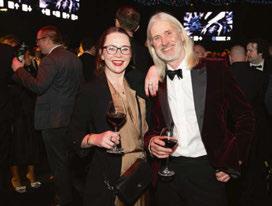
Just before I put pen to paper for this month’s Editor’s Letter, I found myself scrolling through LinkedIn. Even though many nights had passed since we welcomed the industry to Evolution London for the 22nd TPi Awards, it was incredible to see people still sharing pictures from the night and the outpouring of support and love for our annual awards ceremony. I’ve said it many times, but it bears repeating – we are so humbled that the industry chooses our Awards as its annual gathering. This year, we rewrote the record books with our biggest ever attendance, 1,735. You can check out all this year’s winners on p12 as well as our full write-up of the evening including details from the technical suppliers who made the event possible [p14].
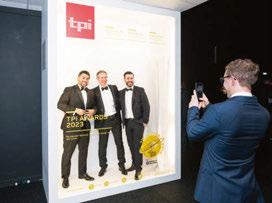
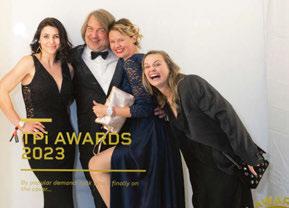
On a personal note, I’d also like to acknowledge the ever-growing team at TPi and the wider Mondiale Media family. I’m still amazed that we managed to wrangle everyone to the front cover booth in the early hours of the morning for this untraditional family photo. A major shout out must also go to Fran Begaj and Alice Clarke for their tireless work on this year’s event. The late nights and long hours truly paid off.

With the dust barely settling on the 2023 event, we’re already thinking about 26 February 2024. As well as throwing around theme ideas, we’re also in the midst of a major rethink of our voting process to ensure our shortlists are more diverse and inclusive. Some of the details have already been released and more announcements are to come. Watch this space.
Between finalising design plans and remembering where on earth I put my bowtie, we’ve also managed to throw together this bumper issue of TPi. In this print edition, we feature two production profiles for two of the UK’s greatest exports at the moment. While Jacob was welcomed into The 1975’s production camp to learn about this ambitious theatre-style set design [p50], I caught up with Lewis Capaldi’s tight-knit crew to hear about their whirlwind past few years with one of the industry’s hardest working touring artists [p66]. Across the pond, Dan Daley was onsite at The Grammys to learn about this year’s audio delivery [p32], while I caught up with the staging team responsible for Rihanna’s awe-inspiring Halftime Show [p38].
We also checked-in with the team from B’in Live to learn about how its company ethos is bringing something different to the table in the Taiwanese live events market [p90]. On the topic of differing business ethos’, we also paid a trip to SMODE HQ in Paris to learn all about its real-time media server offering and how it is looking to expand into different territories [p94]. With another edition of TPi put to bed, we’re busy putting together our 2023 calendar of trade shows and tour dates. It’s certainly looking like a busy year and we can’t wait for it all to get started.
Until next time,
Stew Hume EditorAccount Manager Matilda Matthews
Tel: +44 (0)161 476 8360
Mobile: +44 (0)7413 555978 e-mail: m.matthews@mondiale.co.uk
Account Manager Phil Tucker
Tel: +44 (0)161 476 8360
Mobile: +44 (0)7522 130473 e-mail: p.tucker@mondiale.co.uk
Digital Content Manager
James Robertson
Tel: +44 (0)161 476 8360
Mobile: +44 (0)7725 475819 e-mail: j.robertson@mondiale.co.uk
Marketing and Events Manager
Alice Clarke
Tel: +44 (0)161 476 8360
Mobile: +44 (0)7752 392465 e-mail: a.clarke@mondiale.co.uk
Editorial Director Peter Iantorno
Tel: +44 (0)161 476 8360
Mobile: +44 (0)7763 233637 e-mail: p.iantorno@mondiale.co.uk
Chief Executive Justin Gawne
Tel: +44 (0)161 476 8360 Mobile: +44 (0)7768 850767 e-mail: j.gawne@mondiale.co.uk
Accounts
Lynette Levi / Sarah Miller: ar@mondiale.co.uk
Mondiale Group Chairman Damian Walsh
Graphic Design & Production Dan Seaton: d.seaton@mondiale.co.uk Mel Capper: m.capper@mondiale.co.uk
Cover Photo The 1975
Photo: Jordan Curtis Hughes
Printed By Buxton Press • www.buxpress.co.uk
Annual subscriptions (including P&P): £42 (UK), £60 (Europe), £78/$125 (RoW).
Subscription enquiries to:
Subscriptions, Mondiale Media Limited, Strawberry Studios, Watson Square, Stockport, SK1 3AZ, UK. Tel: +44 (0)161 476 5580 Fax: +44 (0)161 476 0456 e-mail: subscriptions@mondiale.co.uk www.tpimagazine.com www.tpiawards.com
TOTAL PRODUCTION INTERNATIONAL is a controlled circulation magazine, published 12 times a year by Mondiale Media Limited under licence. ISSN 1461-3786 Copyright © 2023 Mondiale Media Limited. All contents of this publication are subject to worldwide copyright protection and reproduction in whole or part, in any form whatsoever, is expressly forbidden without the prior written consent of the Publishers. Every effort is taken to ensure accuracy in

We’ve added more than 200 products and accessories to the AED rental portfolio. Our price list is only accessible to professionals in the AV industry. or

50


A production where conceptual narrative, a positive workplace culture and scarcity breeds creativity.
TPI AWARDS 2023
12 Meet this year’s winners.
14 A detailed review of the production partners behind the industry’s favourite night out.
26 Discover winner and nominees of this year’s Green Award, for the companies and products that have gone above and beyond to promote sustainable practices within the live touring sector.
EVENT FOCUS


34 Dan Daley uncovers the incredible audio intricacies of The Grammys.
40 TAIT and Harlequin help power Super Bowl LVII Halftime Show.
46 Highlights from the t radeshow floor at ISE 2023.
48 Recapping ISE 2023’s Live Events Summit, hosted by TPi Magazine.
PRODUCTION PROFILE
66 LE WIS CAPALDI
A major step-up in production for the Scottish singer’s arean tour.
IN PROFILE
80 4Wall UK introduces Unit 2 at Production Park.
84 Business First Partnership launches sister company, MFP.
86 Martin Professional gives an update on the year ahead.
90 TPi Magazine travels to Taipei, Taiwan to meet the B’in Live team.
94 SMODE Founder Francis Maes discusses the company’s history.
96 LPS Lasersysteme celebrates its 30-year anni versary.
PRODUCTION FUTURES
98 Muhammad ‘Abz’ Abby and Lee Kuhn share their stories.


The global live touring industry once again descends on Evolution London for a record-breaking year for the sector’s favourite annual night out.

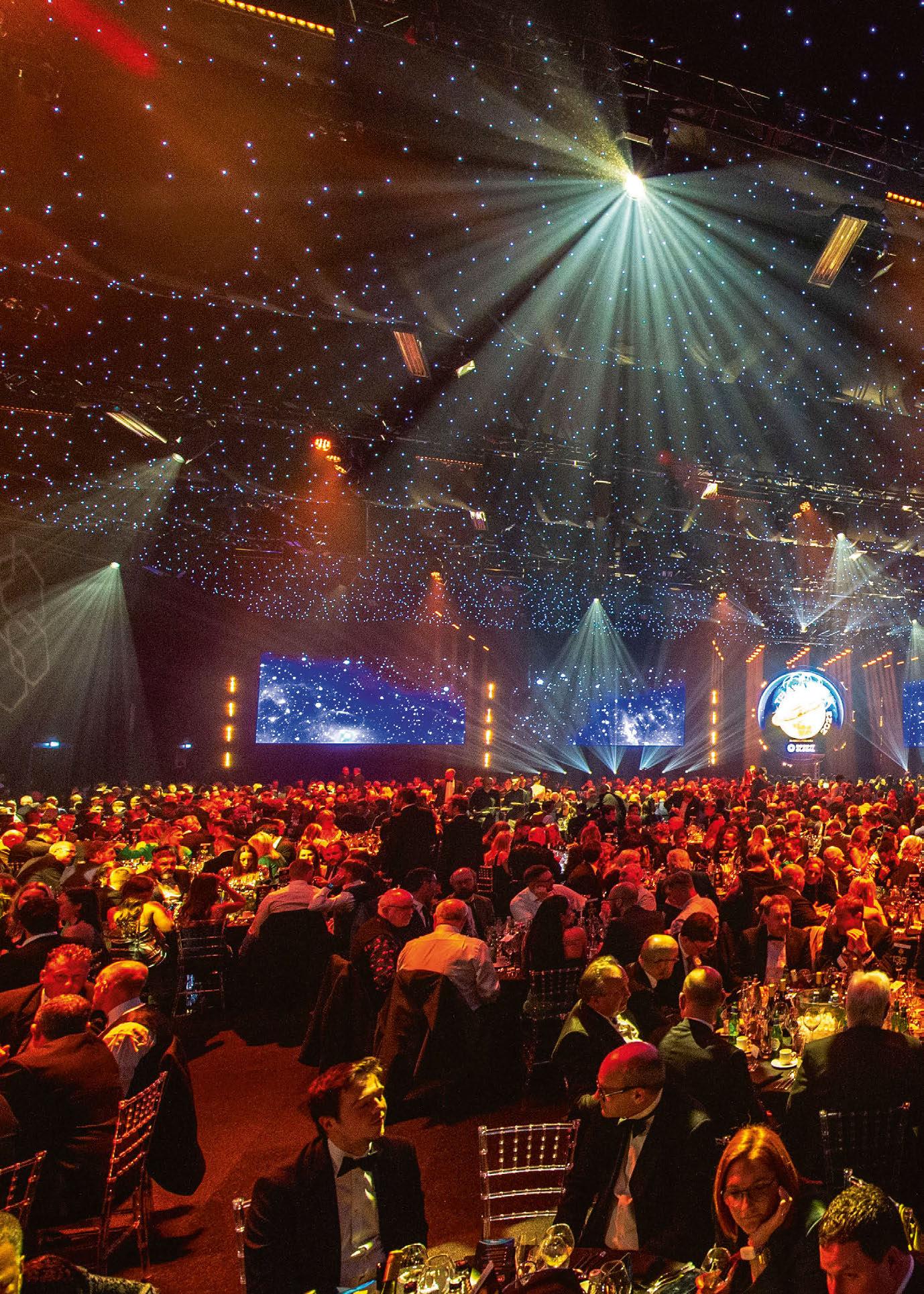

It only seems like yesterday when Team TPi was rocking-up to Evolution London for the 2022 edition of the TPi Awards – truth be told, it hadn’t quite been 12 months since the previous year’s Awards were postponed to May due to COVID-19. However, if you were to think that the shortened gap between the two events would quell the flames of excitement for our annual soirée, you’d be sadly mistaken. With our new headline sponsor, Rock-it Global, the TPi Awards 2023 welcomed a staggering 1,736 people from the multifaceted live touring industry to celebrate the entire global events community.
The evening was a celebration of the global nature of the industry, with airportstyle branding seen throughout the venue. Then in the opening VT content, created by Observatory Studios, we had the ‘TPi Rocket’ shooting across the world to some of the most iconic venues. Content was shown on an impressive video screen supplied by 80six with accompanying lighting visuals from Robe and special effects from Strictly FX.
This year also saw the welcome return of PixMob, who supplied remote LED wristbands to expand the visual canvas into the room. On the stage, first-time supplier AED provided a striking circular truss, which was seen front and centre of the stage, while Sound of Music pumped out the audio via a vast NEXO system.

Also aiding the production was Epson, who once again provided projectors for the main bar area along with Green Hippo, who provided media servers for that part of the venue. On the mezzanine, Blackout was on hand to provide
additional draping elements. TRUCKINGBY Brian Yeardley returned as the Awards’ transport supplier with trucks parked up at the front of the venue. Also aiding in the build-up to the show was Spartan Crew, who supplied 50 team members to ensure the event was all set and show ready for the incoming guests.
When it came to the ceremony, comedy star Suzi Ruffell returned to take on hosting duties. Having done a stellar job in 2022, and getting through the 30 awards in record time, she was back with her high-energy comic flair.
As for this year’s winners, Ed Sheeran and his wider touring family were the standouts of the night. Not only did the +–=÷x Tour win Production of the Year, but Production Manager Helen Himmons, Stage Manager, Matt Caley and Show Designer, Mark Cunniffe all walked away victorious in their respective categories. Unfortunately, those still on the road with Sheeran were unable to attend as they were in Australia on the singer’s world tour – a sign of the health of the industry.
Another noteworthy winner was Phil McDonnell who was honoured with this year’s Outstanding Contribution Award. A stalwart of the live events industry, having worked as Tour Manager for the likes of the Fleetwood Mac, Rory Gallagher and Van Morrison, he went on to form Horizon Entertainment Cargo and CSUK. “I am grateful to all who voted for me,” commented McDonnell. “It’s a great accolade to make sense now of all those years on the other side of the world.”
Another highlight was Adlib, who not only took away Favourite Sound Rental Company,
but two of its representatives – Steve Pattison and Laurie Binns – who each won FOH Engineer of the Year and Monitor Engineer of the Year, respectively. It was also great to bring back the Green Award for the second year running to highlight the ingenuity that the events space is bringing to the wider conversation of sustainability. You can hear from the entire Green Awards shortlist on p26, and the complete list of all this year’s winners is on p12.
The infallible GoTo Live duo of Ryan Esson and Jess Webb headed up the production. Familiar faces at the Awards, they gladly took up the production mantle once again. Alongside the team at TPi – made up of Commercial Director, Fran Begaj, Marketing and Event Manager, Alice Clarke and TPi Editor, Stew Hume – this year the suppliers for the Awards were brought around the table far sooner than in previous years to create a more cohesive design.
“T he event was a success on all fronts,” mused Esson. “From a relationship point of view, it was great to work alongside people who have been part of the team for several years now – and that familiarity helped make the end product stand out. Likewise, it was great to add some new people and suppliers to the mix this year who added a cutting edge, which helps keep the event pushing forward year after year.”
Esson went on to explain that from a production point of view, it’s always a challenge to keep doing something new.
“T his is even more true when the audience is made up of people in the know,” he chuckled.


“However, this year, we made some changes to the approach in the background around design and the collaboration around the design process, which gave us the most cohesivelooking edition of the awards to date.”
Esson closed by giving his thanks to all the talented people who worked on the Awards behind the scenes. “From the suppliers and crew to my team – Jess, Lou, Dora and Linda – I couldn’t do it without your hard work and skill,” he concluded.

80six supplied the staggering amount of LED throughout the venue, with the delivery overseen by Ben Annibal. The video rental company provided screens for the main stage, rear IMAG walls as well as in the bar area.
“We used ROE Visual CB3 throughout,” commented Annibal. “This product is designed for use in large-format screens, so it lends itself well to conferences and awards shows. With 12 LED screens being installed in a short time frame, the CB3 gets the job done quickly with minimal fuss compared to cheaper lowquality alternatives.”
Backstage and powering all the screens were disguise gx 2c servers with processing coming from Brompton Technology SX40 processors. Providing all the live camera footage for the IMAGs were Blackmagic Design URSA cameras and a PPU.

“L ike the LED screens, all the back-end equipment is designed for ease of use and

quick deployment,” Annibal added. “Preproduction and preparation of the kit before arriving on site is key to everything working in unison.” 80six also handled all the video elements within the main bar area, which was sponsored by Stage One. With its own healthy offering of ROE CB3, several Epson Projectors provided immersive textures on the floor.
Ru nning all the content in this section was a Green Hippo Hippotizer Boreal+mk2 media server. A 20-strong team made up the video department, including LED techs, disguise programmers, video director and camera operators. “It was another great success,” enthused Annibal.
“It has been humbling for us to be one of the leading suppliers and sponsors for three years now, witnessing the show grow to its biggest edition to date in terms of attendance and the scale of the setup. The theme was strong and developed successfully via many touchpoints, and the vibrant energy in the room was intoxicating. It’s the kind of night you never want to end – there’s always another interesting person to chat with at the bar.”
Handling all the visual content for the screens was Simon Harris and Ben Sheppee of Observatory. Having been brought in from the early stages and given the ‘around the world’ brief, Observatory created looks for the main room as well as the bar.
The pièce de résistance of their delivery was the opening VT, where the team created a 3D fly past some of the world’s most renowned
venues. “We extracted 3D geometry data directly from Google Earth, which allowed us to recreate accurate representations and topography of each city we visited during the intro,” explained Harris. “Once we had the data, we textured and lit it to align with the TPi Awards 2023 branding themes. Additionally, we added custom elements, such as the TPi rocket, which we developed in-house from a 2D image from the Awards logo.”
For each venue, the team located separate 3D models to showcase more detail than what is available on Google Earth. “Our in-house 3D expert meticulously worked on texturing and developing each venue to ensure that it stands out as part of the intro,” explained Harris.
“T he visual journey culminated at Evolution London, where we spent considerable time adding recognisable elements to the model. We also included sponsor logos on the windows for a polished finish.”
In addition to the intro, Harris was proud of the content on the arrival boards that displayed the nominations, sponsors, and shootouts.
“T he boards were expertly configured to transition each letter automatically through the relevant consecutive letters of the alphabet until it reached the next one required for the next section. We believed that the style of the arrivals board was an exceptional way of communicating the information required as part of an awards ceremony, but in a fresh and engaging way, while remaining faithful to the themes of the brief.” To close, Harris shared


his final thoughts on the project: “This event is undoubtedly the biggest on the industry calendar, making it an honour to be able to work on the show and catch up with friends and colleagues. The opportunity to work on such a prestigious event is always exciting, and we were thrilled to play a part in its success.”
Robe was back on site at the TPi Awards with its longstanding team comprising Lighting Director, Nathan Wan, Associate LD, Andy Webb and Lead Programmer, Jordan Tinniswood. Robe often uses the Awards as an opportunity to showcase some of its latest fixtures and this year was no exception.
Before attendees even entered the venue, they got to see some of the manufacturer’s latest products, with 10 iFORTE – Robe’s latest IP-rated series – setting a cool and dramatic tone for the evening and guest arrivals.
“It was a great opportunity not just to show off the capabilities of the lights, but to light the exterior and complete the picture in terms of visual and lighting presentation,” said Webb.
On t he main stage, surrounding the central circular screen were 10 Robe 360° rotating TetraX fixtures, rigged vertically, which were perfect for achieving the beam effects that helped set the scene and ramp up the excitement for each award.
Wan explained that these were installed as multi-use fixtures, and one of the ideas was to mimic effects in the video content, which was highly successful. “Having worked in this venue
and on this event a few times now, it is always interesting to find original ways of maximising the space with a bit of lighting trickery,” he said.
Twenty LEDBeam 350s were installed above the stage in a grid above the main presentation area, with a further 52 dotted around the room trusses in clusters of four where they could also provide pseudo-ACL beam looks as well as wash the room. Around 24 of Robe’s new PAINTE smaller, brighter, lighter TE LED technology moving lights were deployed in the main room – 14 above the stage and 10 on the stage deck, stage left and right on risers.
A further 30 Tetra1 and Tetra2 moving LED battens were distributed around the room and on the stage. Tetra1s were rigged vertically between the screens and the Tetra2s were distributed across four flown trusses.
Also on these four audience trusses was a combination of 27 FORTEs, positioned, along with the 52 LEDBeam 350s, to light the stage area and as much of the room as possible. Wan noted that it was “essential” to light every part of the room and not just the stage to help create an immersive effect.
Fi ve T1 Profiles on the front truss were used for the key lighting of presenters and award winners, and four FORTE FollowSpots with integral cameras running on four RoboSpot BaseStation systems were used for remote follow spotting.
The desk of choice was an Avolites D9, programmed by Tinniswood and operated by Will Grubb, who was the Assistant LD for the evening and part of the Robe NRG programme,
which gives students a chance to be involved in the action. Seven students joined Wan and Webb, taking on a variety of different lighting production roles – from Associate LD to RoboSpot Operator.
“T he whole experience is invaluable and something I never even thought was possible,” commented Grubb. “It’s fantastic to have on the CV, and I would encourage more students to join NRG and explore these opportunities. The whole Robe team is super friendly and working hard to assist students in connecting with the right scenarios and people.”
Moving into the bar area – 10 FORTEs, 16 LEDBeam 150s with the LEDBeam 350 once again proving its versatility were deployed to keep the visual experience going until 4am.
“We were proud to again be the TPi Awards lighting sponsor and to see Robe’s creative team pushing the boundaries and delivering a brilliant lighting design with some of our latest fixtures adding to the vibe and atmosphere in the room,” commented Robe UK Head of Marketing, Theresa Gibson.
“Coupled with the usual meticulous attention to detail for all aspects of the show, this ensured the scene was set from the moment guests arrived with the new exterior lighting scheme.”
This year the visual show extended into the audience thanks to PixMob, which deployed its famed LED wristbands to coincide with the rest of the lighting rig. Operating the show was


previous TPi Breakthrough Talent Award winner, Cedric Duré.
In total, 1,700 of the company’s wireless LED wristbands were provided to attendees when they entered the venue to include the audience in the overall show design. “The great thing about PixMob is that it adds another layer of immersion for the audience,” enthused Duré who has now worked on several PixMob shows. “It’s a fun way to get the audience more engaged and be a part of the show. I always find when you use this type of technology, there’s an extra level of excitement.”
As well as adding to the overall visual look of the show, the wristbands doubled as a QR code for all the information for the evening, allowing attendees to check out the running order and look up which of the 155 tables each company was sitting at.
Sound of Music and NEXO handled audio duties for the show. Filling the room with a range of speakers from the NEXO range, Sash Pochibko of Sound Of Music walked through some of the highlights of the system.


The main room PA system featured a NEXO GEO-M12 line array configured as two main left and right hangs of six elements, two centre fill hangs of three elements and two delay hangs of three elements. The low frequency was supplemented by 12 MSUB18 in a sub-array under the stage. Additional P10 and P8 front-fill
and out-fill point source covered the tables closest to the stage. The system was powered and processed by NXAMP MK2 amplifiers.
“It’s a constant battle for real estate, both in terms of sight lines and weight loading in the roof at Evolution,” reflected Pochibko, who has worked on TPi Awards for several years. “The GEO-M12 system is very weight efficient and packs a lot of punch per kg compared to a lot of large-format systems. This is the fifth time we have supplied audio for the TPi Awards at Evolution Battersea and we’ve very much got a formula, which works.”
The audio console on site was an Allen & Heath dLive S5000 with a DM48 package with a Dante network ingesting multi-channel audio for stings, VOGs and background music from a main and backup MacBook Pros. NX amplifiers were also fed signal and control from a Dante Network with NEXO NeMo system monitoring from FOH. Backstage monitoring mixes for video control, communications, presenter IEMs and a green room show relay were mixed from an Allen & Heath SQ5 also on Dante.
The main bar area sound reinforcement was covered by four P12s suspended from the lighting trusses, with four ID24s flown above the bar as down-fill. Four L15 sub-bass cabinets provided an abundance of LF extension for the after-show party.
The VIP bar areas had discrete P8 / P10 systems installed on the mezzanine level. Pochibko closed by giving thanks to NEXO










for once again supporting the audio delivery and his team that made this year a possibility: “This year, our technical team consisted of FOH Engineer, Toby Chevis, Systems Engineers, Mike Burwood and Ben Williamson, RF Guru, Ciaron McKenna and Audio Riggers, Joe Turton and Giorgio Labbate.”
Having provided a confetti blast for last year’s Awards, Strictly FX was keen to up the ante for 2023. This year, the team deployed an arsenal of effects from flames to lasers and CO₂ jets. “It was a huge honour to provide lasers and FX for TPi,” commented Laser Designer, Tom Battison.
“My personal highlight was seeing everyone’s reaction. Whenever special effects and lasers turn on, it always fills the room with excitement.”
Strictly supplied six G-flames, four Sparxtar and four PSYCO2 jets. There were also six 15W and four 24W lasers on stage. The SFX specialist also deployed four 80W lasers outside the venue as well as eight Flamebeaux – much to the pleasure of those getting a breath of fresh air in the brisk February evening.
“We had our best team on this,” enthused Battison. “We were lucky enough to work alongside Robe lighting to make sure that everything complimented each other. We achieved that and were able to wow everyone in the room. TPi Awards is always such a great event and to be in the same room with some of the best in our industry is a great honour.”
Ensuring each truck was tipped in a timely manner was TPi Award-winning Spartan Crew. “Starting from the install on Sunday morning to the load out straight after the Awards, we had 50 separate crew shifts,” explained Spartan Crew Commercial Director, Paz Brennan.
With this being the second year Spartan has been involved in the event, Brennan gave his thoughts on how this year compared. “I loved the pyro this year, and the theme of travelling is very relevant as we’ve all now had a full year of working without any travel restrictions. The team also nailed the visuals! I don’t get to go on site as much as I used to these days, so it’s a great time to meet many of my old colleagues and clients as well as those I may have only recently started to work with.”
With the last of the night’s guests finally making their way home at 4am, this marked the end of another successful TPi Awards. Truly cementing itself once again as the industry’s favourite night out following the uncertainty of the COVID-19 years, it was great to see the touring community return on mass and hear the conversations about what we might expect from the next 12 months – and even start to hypothesise about who and which companies might be accepting an award next year.
On that note, a month prior to this year’s event, we announced that for 2024 there will be a significant change to the voting process with the goal of widening the spotlight in terms of the companies and individuals that make the shortlist. More details will be revealed soon but in the meantime, make sure you save the date for next year’s TPi Awards – 26 February 2024.
www.tpiawards.com
www.projoe.photography
www.gotolive.co.uk
www.80-six.com
www.observatory.design
www.robe.cz
www.pixmob.com
www.pahire.com
www.nexo-sa.com
www.aedgroup.com
www.blackout.co.uk
www.strictlyfx.com
www.spartancrew.co.uk
www.brianyeardley.com
www.green-hippo.com
www.epson.co.uk
Precise Dynamic Whites from 2,400 - 8,500K

RGBMA LED Engine Full Color Spectrum Wide Zoom Range from 7° to 53°


To mark the presentation of the Green Award at the TPi Awards 2023, we hear from this year’s winner, ZAP Concepts, along with other notable nominees.

Dekmantel and ZAP Concepts have collaborated since 2017 to optimise and reduce energy consumption and emissions at festival sites. Dekmantel was one of the first festivals running entirely on biofuel (HVO) where the extra costs of the HVO was compensated by massive fuel consumption reduction as a result of ZAP Concepts’ Smart Power Plan.
ZAP Concepts used its new Smart Power Plan tool MyZAP to calculate the maximum power demand and the total energy consumption of the festival, based on a detailed inventory of power consumers. Based on the power profile, ZAP Concepts designed the power supply with minimal emission with Stage 5 generators and batteries. With the festival’s power profile and the way of generating the power, the fuel consumption and NOx emission was calculated.
Amid early design of the site, NOx emissions exceeded the maximum emissions allowed to get a permit for the festival. Along with the festival producer, ZAP Concepts devised strategies to further reduce the energy consumption of the festival and thus reduced the fuel consumption and NOx emission until the calculated values matched the level for getting the required permit. Measures which were taken were decreasing the time period during build and break that power was available. The energy consumption during the show days was reduced by reconsidering the chosen light fixtures and swapping energy-intensive into LED fixtures, among other steps.
The limited NOx emission was converted into maximum energy consumption, which had
to be generated onsite by the best available technology (stage V generators combined with batteries in order to fully optimise the power supply) and this all became a major design spec for the entire festival.
By a complete redesign of the show and the production process, making use of the intelligence of MyZAP and the experience of ZAP Concepts and the latest available technology, the fuel consumption of Lentekabinet dropped from 10,000 litres in 2019 to 4,300 litres in 2022. The NOx emission as a result of the use of combustion engines (diesel generators) was reduced significantly.
Due to the ultra low emission legislation, the festival organisation was forced to reconsider the complete power system of the festival. All disciplines were affected by this, as the time power was available during build and break was very strictly limited, the choice of fixtures was heavily influenced by their power consumption and the power supply was done with new
technology (stage V generators combined with batteries) for all areas.
The governmental organisation (OD NHN) which granted the permit visited the festival during build and show in order to check correct execution of the emission plan, and they were highly impressed by the way all interventions worked out in practice.
In recent months, ZAP Concepts has developed a battery system in collaboration with Noriker and BMW’s power storage application developer, Beck Automation, which powers Coldplay’s Music of the Spheres World Tour. The firm has also developed Smart Power Plans for Ultra Music Festival, Glastonbury Festival, Monegros Desert Festival, The Ocean Race and Mysteryland, as well as setting up shop in the US. “There is never a dull moment,” commented ZAP Concepts CEO, Paul Schurink. “We are incredibly proud to win this accolade at the TPi Awards 2023.” www.zapconcepts.com
This year we’ve made huge progress towards offering sustainable LED wristbands that enhance fan experiences while minimizing our environmental impact. For Coldplay, Music of the Spheres Tour we even launched our 1st compostable plant-based wristband which we reused and refurbished during the tour saving up to 80% of new production!


We are proud of our journey so far, but we know it’s just the beginning. Join us in designing a brighter future.


Claypaky took the first step of understanding, quantifying and analysing its current carbon footprint using the ISO 14064-1:2018 norm and achieving certification via a third-party auditing process.
Developed by the International Standards Organisation, a non-governmental organisation in Geneva, Switzerland, ISO 14064 offers policy makers and organisations a ready foundation of best practices upon which to build a GHG (Greenhouse Gases) reduction programme to address the global environmental challenge of climate change.
Claypaky successfully completed this first part of its initiative and is proud to have become the first company in the entertainment lighting industry to receive certification in the carbon inventory management system.
Claypaky has defined and implemented several projects to reduce the environmental impact of its business activities.
This includes plastic-free packaging, the implementation of a Kanban control system into the manufacturing process to increase efficiencies and reduce waste, investment into green energy and offsetting aeroplane travel. “After intense investigations over the past nine

months, guided by sustainability experts, we now know precisely what our CO2 emission footprint looks like,” said Andreas Huber, Sustainability Manager, Claypaky.
“According to our company philosophy of climate protection and the development of a circular economy, we are committed to an energy-efficient and resource-conserving way of doing business and strive to develop innovative, environmentally-friendly products. We are pressing ahead with the development of a comprehensive sustainability strategy and setting ourselves specific targets with the goal of making our own operations carbon neutral by 2030.”
As its next step, Claypaky is working on the development of a comprehensive carbon management plan with concrete measures regarding how to reach carbon neutrality within its operations by 2030. This will include both the purchase of carbon credits and reduction measures aimed at more sustainable management of various activities linked to operations and product innovation, such as installation of a self-catering photovoltaic system or innovation roadmap for low energy consuming products. www.claypaky.it
Working in collaboration with Peak Oils, KB Event introduced HVO BioFuel – a 100% renewable diesel that is palm oil free – into the fleet. This HVO is a fossil free diesel which is significantly better for the environment than fossil diesel, while maintaining its performance. This non-palm oil HVO eliminates up to 90% of net CO2 and significantly reduces nitrogen oxide (NOx), particulate matter (PM) and carbon monoxide (CO) emissions.
HVO Biofuel is more expensive than traditional diesel and although this increase, taken over the total cost of an event or tour, is not in any way prohibitive, it is, unfortunately still a budget consideration. However, since rolling out the HVO Biofuel to its client base, KB Event has reported more end clients rather than their management, happy to foot the bill for touring in a more responsible way.
In May 2022, KB was given access to funding through the EIC (Energy Innovation and Collaboration – an EU incentive still operational in the UK), to carry out a full audit of its office-based operations with a view to seeking the best sustainable practices at its Head Office premises in Nottingham. KB Event worked alongside Dr Gulcan Serdarogou, Technical Officer from the Energy RND unit at Nottingham University, to identify areas where
even greater improvements can be made. This information will then be used as a base line to monitor and implement best practice, and modes of delivery, across the whole of the KB group of Companies. The final EIC report will be used as the basis for KB’s sustainability policy and targets, from 2023.
In addition, KB Event is collaborating with Event Cycle – which takes unwanted event waste and gives it a second life – delivering repurposed items across the UK.
In 2022, KB Event was the trucking supplier for the late Queen Elizabeth II’s Jubilee Pageant Parade, and, as well as supplying HVO fuelled trucks for the production elements of the concert in London, worked with Iveco to secure IVECO S-WAY Natural Gas vehicles.
KB Event is also going through the process to become an AGF Greener Supplier. KB’s Richard Burnett was recently asked to talk at GEI15 about sustainability in trucking. During his presentation, he reinforced the point that not all HVO is the same and not all diesel alternatives are directly sustainable solutions. It’s important, therefore, for production teams to ask questions about the content of HVO – in particular, palm oil – and to establish whether the product being offered is more secondary off-setting than a primary solution.
www.kbevent.com


Believing that what is not measured cannot be improved, Claypaky took the first step of understanding, quantifying and analyzing its current carbon footprint using the ISO 14064-1:2018 norm and is proud to have become the first company in the entertainment lighting industry to receive certification in the


Coldplay’s Music of the Spheres US tour kicked off in North Texas at the Cotton Bowl followed by dates in Houston and Seattle and continued through mid-June. The band’s sustainability initiative for this tour was to adapt all tour operations to minimise CO2 emissions in line with the best science and practices from set build and travel to freight, power, and sound.
The Coldplay camp had required that the sound system be 50% more energy efficient than their previous tour in 2016-17. With that prerequisite, Firehouse Productions, which has supported Coldplay tours since 2016, decided to deploy d&b audiotechnik GSL and KSL loudspeakers for their efficiency, paired with D80 amplifiers that demand less input power and enhanced energy saving feature.

d& b SL-Series was developed with efficiency in mind, reducing power requirements by up to 50% for equivalent sound pressure output levels compared to former systems.
In addition, precise control of directivity continues to be one of the hallmark features of the SL-Series, keeping the sound exactly where it is needed.
Also, d&b NoizCalc was developed in direct collaboration with SoundPlan for predicting environmental noise pollution into the surrounding areas of an outdoor performance. It can account for topography, buildings, wind speed, air temperature and humidity.
Using d&b ArrayProcessing, refined control
The N-RAY Series takes its name from the word ‘nano’, presenting itself as a range of flexible, lightweight and small systems with the efficiency and power to rival much larger and heavier loudspeaker systems.

Incorporating the latest in driver and system design technology, the range boasts twice the power handling of other systems, significantly increasing lowfrequency output and long-term SPL capability. This means the speaker is lighter, smaller and can be easily set up by one person, meaning also less space on the trucks, less pollution, lower costs, and far less energy consumption. The
of level distribution and tonal balance can easily be achieved. Tony Smith, Head of Audio and Sound Designer for Coldplay, added that ArrayProcessing has become a vital tool not only for regulating sound emissions, but also sound levels within the stadiums.
“T here are some sites where the loudest area of the audience is monitored for audience protection against hearing damage,” he commented. “With J-Series, the local authority was surprised with the uniform sound level across the audience area, and now with SLSeries I am happy to continue this consistency.” Smith sent data to d&b audiotechnik R&D so
they could monitor the power usage.
“T his is very positive and forward thinking. I had a lot of data from Matthias Christner [Head of R&D System Design at d&b] leading up to the tour, so I could pass on our power needs and details as well as to see what d&b was doing to reduce power consumption, which is up to 50% less from our last tour. Production is very happy with our reduced power consumption as well as the improved truck space.”
d& b helped the tour meet its sustainability goal of the sound system being 50% more energy efficient than their previous tour. www.dbaudio.com
products belonging to the N-SERIES family have a front baffle and vents made from aluminium with all drivers mounted into it. These aluminium vents are optimised to maximise airflow, increasing the thermal capacity of the system.
Applying more power increases the airflow in the vents, conducting more heat away from the drivers, and distributing that heat outside the enclosure.
The DAC technology dramatically improves heat dissipation, doubling the power handling and the maximum SPL capability compared to a conventionally cooled system.
www.codaaudio.com/speakers/n-ray


In 2021, PixMob committed to never using new plastic again and offered recycling for free at all shows. For Coldplay’s Music of the Spheres World Tour, the company strived to push itself even further by inventing its brightest wristband to date, using plant-based plastic derived from renewable sugarcane sourced from Thailand.

To reduce the need for raw materials, PixMob also designed the wristband for refurbishing onsite using simple tools. Each wristband does three shows on a set of alkaline batteries made from recycled chemical elements. In addition, PixMob’s ‘living hinges’ transform the hard plant-based plastic into a bendable strap that makes this product easy to sanitise and reuse.
At t he end of the product’s life, the plastic casing is removable and decomposes after two months in an industrial composter or two years in compost. The electronics are sent to electronic recycling centres. In 2022,

over four million fans experienced PixMob’s visual effects using only 500,000 wristbands. PixMob’s touring crew recovered over 85% of the wristbands at each show thanks to a novel recycling methodology.
Pi xMob designs and manufactures internally. The sugarcane feedstock used to make the wristbands captures 1,833kg of CO2 per tonne as it grows. The processed PLA plastic used in the seven-LED wristbands has a carbon footprint that is 400% lower than regular plastic (PET) at 500kg CO2 eq./tonne polymer. At 17g of PLA plastic in each seven-LED wristband,
total emissions for one million units are estimated at 8,500kg CO2 eq. According to the US EPA, this is equivalent to 1.8 cars driven for a year, and can be sequestered by 141 trees grown for 10 years.

Pi xMob has a track record of shipping all its products through ocean freight for world tours, working with a Shenzhen-based shipping company to route shipping containers to each continent for subsequent road transport to the venues. Packaging is also optimised by designing custom recyclable boxes.
www.pixmob.com


As the Grammy Awards celebrates the ‘50th Anniversary of Hip Hop’ Dan Daley is on site at Los Angeles’ Crypto.com Arena to report on the audio intricacies of the show.
The Grammy Awards has weathered its fair share of controversies over the years. Everything from bias challenges in the institution and its own #MeToo moments have put it in the spotlight for all the wrong reasons, yet despite this, it still all culminates once a year in a bombastic evening of music television that keeps people talking for the following 12 months.

In t he house, though – specifically, downtown Los Angeles’ Crypto.com Arena –the week before the awards show was to air on 5 February, there’s no such controversy. A remarkably consistent crew of pro-audio veterans has been helming the Grammy Awards’ technical tiller, some of them for well over 20 or even 30 years. Like the seasoned crew of a sturdy ship, they are more likely to change places than change faces. For instance, the production added a second FOH engineer this year, but that person had previously been one of the show’s regular monitor engineers.
The audio workflow for the Grammy Awards follows the narrative of its stage production. Starting in late 1990s, the show began using a split-stage format, with camera-left and camera-right stage wings flanking a central awards and announcement podium and short thrust. This enables one side of the stage to host one musical performance while the other

is set up for the subsequent performance and so on, alternating throughout the night.
It was an efficient way to get progressively larger numbers of performers and songs into each show – a number that reached 36 performers doing 27 songs, some in duets or larger groups, in 2015, and 40 performers on 24 songs the following year. Though this year’s Grammy Awards saw closer to two dozen performances, the performances have become more complex, culminating this year in the 50th Anniversary of Hip Hop – a free-for-all featuring 26 rappers and nearly as many musicians, which required 52 channels of wireless for a single 15-minute performance.
That’s part of what led this year to having two FOH mixers for the show for the first time, with 20-year veteran Ron Reaves mixing stage-left performances and Michael Parker, who had previously mixed stage-left monitors, handling FOH duties for the stage-right music events. As a result, the house sound workflow now mirrored that of the broadcast mix where alternating songs are mixed between two Music Mix Mobile OB vans – Eclipse and Voyager – parked at the top of the Arena’s loadin ramp, their mixes fed over MADI to the Denali broadcast truck for integration into the final on-air mix.
The show’s monitors have also divided left and right side mix duties since the splitstage format was adopted, but even that neat solution had to be modified for the huge
50-plus-channel hip-hop number, for which Reaves mixed the entire music bed while Parker mixed the three-dozen-plus vocals.
“T he show has been getting more complex, and we felt we could better serve the artists’ mixers, who we consult with during rehearsals with two mixers at FOH,” commented Reaves, both mixing through identical DiGiCo Quantum 7 consoles. The two FOH consoles are using DiGiCo’s onboard effects for virtually all of the show’s effects processing requirements. The only outboard processing used were a pair of Bricasti M7 reverbs, specifically requested by certain artists.
Reaves explained the venue – which has been used for the awards since 1999, save for rare excursions to New York City and last year’s COVID-driven peregrination to Las Vegas – is neither especially good nor bad sounding. Known as the Staples Centre until it was renamed in late 2021, it’s remarkably acoustically tame for an arena that also hosts the sonically bombastic Los Angeles NBA and NHL games, despite a noticeable one-second slapback off the rear wall. More pressing, he said, is the fact that much of the floor seating is filled with the music industry’s top echelons, including more than a few leading producers, engineers, and mixers.
“T he sharpest ears in the business are listening to your mix of their artists live,” he said. “It’s on your mind. You’re getting scrutinised.” Parker also likes the idea of splitting the FOH
duties. “It is getting more complex, because music’s become more complex,” he noted, referring to the increased use of tracks and audio samples, from the backstage Pro Tools station, integrated with live performances and even on-demand, real-time vocal auto-tuning.
Rounding out the raised FOH platform at the back of the house was Jeff Peterson – the live sound production mixer, another longtime Grammy Awards veteran and a staff engineer for ATK Audiotek, which has been the awards show’s sound-reinforcement provider for several decades and still does so now as a division of Clair Global. Clair acquired the company in 2021, as well as Leslie Ann Jones, co-chair of the Recording Academy’s Producers & Engineers Wing and “Grammy Broadcast and House Mix Audio Advisor.”

ATK/Clair Global brought in a new system for the Grammys, which consists of main left and right hang of 14 JBL VTX A12 per side,
13 VTX A12 outfills per side and 12 VTX S28 subwoofers per side. There were also four rear delay clusters comprising eight VTX A12 each side with an additional six side-delay clusters using six Vertec VT4886 each. These were powered by Crown Vrack amps for the main PA and Powersoft K10s for monitors.
Peterson acts as the hub for the house sound, taking the mixes from Reaves’ and Parker’s matching DiGiCo Quantum 7 consoles, combining them with his mix of production elements such as podium speeches and introductions on a Quantum 338 – all linked through an Optocore fibre network – before routing them, over MADI on fibre, to the PA amplifiers. He kept the two sides of the stage separated on the console work surface, opening each just before a performance and keeping the other muted as the next artist is
being set up behind the so-called ‘close-down’ screens that alternately cover one side or the other of the stage as performances progress. “As one side of the stage is doing a show, Mike or Ron might be doing a line check on the other, getting them ready,” he explained.
This year, Peterson pointed to a unique speaker arrangement that they first tried at the Grammy Awards in Las Vegas last year and the Academy Awards in Los Angeles the year before, driven in part by COVID-19 spacing protocols but also by a cool nightclub aesthetic. The first several rows of audience seats have been replaced with round bistrotype tables and chairs, dubbed the ‘Hero’ seating section, occupied by the industry’s elite and lit club-style by table lamps.
Tiny K-Array KT2 Tornado speakers and 125 two-in transducers are used to deliver the production element audio to the tables in the Hero section. “They don’t look like a speaker
£52,000 per annum Permanent Role jobs.royalalberthall.com/vacancies/615/riggingoperations-manager.html

We are seeking to recruit an efficient and capable Rigging Operations Manager within the Production and Technical department.
A key part of this role will be the management and development of the Production and Technical dept. Rigging Apprentice, as well as supervision of the Hall’s rigging contractors and casual employees.
The ideal candidate will have substantial rigging experience, including at least the National Rigging Certificate Level 2 (and be working towards Level 3), experience of line management, strong interpersonal skills and an ability to inspire and lead a team. The successful candidate will be able to demonstrate advanced technical knowledge and
practical experience of all aspects of rigging in a venue (or similar environment), including issues relating to Health & Safety & LOLER.
The role will require significant flexibility of working hours to embrace the responsibilities within the department and the services that it provides. Therefore, candidates must have the ability and willingness to work within a roster and the ability to undertake long shifts when required which could be early mornings, late nights, overnight, week days and weekends.
For more information, please see the recruitment pack.
The closing date for all applications is 24 March 2023 at 12:00
just sitting there, so it’s presentable on camera, but it lets us put dialogue right in the faces of the people sitting right next to the podium mic without having to put it through that portion of the overhead line array at full volume,” Peterson explained. “That way, I can turn down the podium in that bottom part of the line array, which could otherwise have led to feedback at the higher volume, and instead send it right to the table speakers to still get dialogue heard there clearly.”
Michael Abbott, the show’s longtime audio producer, added that the smaller speakers are well suited for dialogue frequencies. “A lot of the awards shows are implementing an intimate-looking setting, and this solves an audio problem for it,” he said.
The lower, full-range boxes of the line arrays are turned back on and the Tornados muted for music performances. “The music is still in the lower line-array boxes to allow for the Hero section to experience the same music/audio dynamic as the rest of the arena.”
The PA audio signal t ransport is over fibre/ MADI throughout the venue, including what’s routed to backstage processing and to stage monitor control racks. Abbott attributes that decision to the wireless microphones experiencing gain-matching issues over Dante in the past and the performing artists’ technicians voicing a preference for the AES format instead, even though some felt that Dante improved the PA system’s highfrequency performance slightly.
“W hen you’re doing a show of this magnitude, you’ve got enough cross patching
and paths of audio being distributed that having a w hole other layer of a different protocol is not necessarily worth it,” he stated.
A major challenge for a production as big as The Grammys is the fast pace – especially in an RF-dense environment like Los Angeles, where only two DTV channels, a17 and 19, are generally available.


Stephen Vaughn from Soundtronics
Wireless has wrangled the show’s wireless for a full decade, and was happy to see that the venue had improved its RF shielding during the COVID-19 interregnum, including via RFshielding paint laden with highly conductive nickel fl akes.
“It’s really helped with the spectrum here and I’m able to do a lot more,” he reported. “Most people think it’s only the audio department and communications that use RF equipment but it’s also cameras and lighting that are using RF devices for triggering and control. Luckily, the Crypto.com Arena has gone through some renovations and has taken measures to reduce the amount of outside RF interference by using RF absorbing paint and well shielded LED panels reducing the amount of electronic radio noise in the air. We also had a multizone antenna system that filtered at t he antenna and equipment side to ensure unwanted interference.” Wireless operations occupied the range from 470 MHz to 600 MHz, as well as gap bands at 614 MHz and 617 MHz, with additional space at 944 MHz to 952 MHz. Wireless intercoms were


between 902 MHz and 920 MHz. Wireless IEMs were allocated to the 1.9-GHz DECT band. The shift from LED screens on the close-downs to projection mapping eliminated a past source of RF interference, Vaughn noted happily. “The main thing to remember is to always have a way to have your analyser in line with your antenna system and an antenna that is out of the system in case some of the frequencies you’re trying to monitor are filtered out completely or reduced,” he concluded.
In monitor world, Tom Pesa and Andres Arango follow the split-stage philosophy of the production, with Pesa covering IEMs and the production’s few wedges for stage right and Arango for stage left, and both on DiGiCo Quantum 7 consoles – the third Grammy Awards show for the desks.

Pesa said the basic currency of monitors for the Grammy Awards is a foundation channel template built on the Q7’s work surface. That then gets copied, customised, and snapshotted for each artist, for quick recall as the show progresses. However, both mixers have to be alert for last-minute changes. He recalled on the 2014 edition of the show when Sir Paul McCartney’s performance was moved from one side of the stage to the other, 30 minutes before soundcheck.
“We had to quickly create a new template for that. You want to have every parameter at your fingertips at all times because you never know when you’re going to have to make a quick adjustment. The biggest challenge is keeping as many options on the table as possible, even
as you’re trying to pare each template down for each artist to keep it manageable. Quantum is a big help for that.”
Like their FOH counterparts, Pesa and Arango had to plot how to handle the big hiphop production, which was going to be their particular Mount Everest to conquer during the show. The segment featured over two-dozen artists, including Missy Elliott, Big Boi, RunD.M.C., Queen Latifah, Method Man, Public Enemy, Busta Rhymes, DJ Jazzy Jeff, and Melle Mel of Grandmaster Flash and the Furious Five, backed by a combination of tracks and the Roots playing live. Ultimately, they mostly mimicked how their FOH colleagues operated. Instead of alternating left and right stages, they’d put all the music tracks on one console and most of the vocals on the other (rather than all, as FOH did), trading them back and forth as needed. “I’m going to mix the entire band and Tom and I are going to jump back and forth between whichever artists are on stage for vocals,” said Arango ahead of the performance. “It’s going to be hectic.” And it was. The 15-minute, Questlove-curated terpsichorean history lesson saw a total of 26 rappers crowd the stage and the spectrum. The only dropouts were due to profanity bleeps.
Over time, the Grammy Awards show has become a well-oiled machine, as slick as many of the records it honours, and where unpredictability is best left to the moment the envelopes are opened onstage. In a business built on disruption, the Grammy Awards show is, ironically, a comforting place to be.
www.grammy.com
www.clairglobal.com
Evolve into a new point of view
 Made in Italy # dts-lighting.it

Although we’re based in the UK and admittedly don’t have the first clue about American football [it’s a bit like rugby, right?] There is one element of the sport that always grabs the attention of everyone in the TPi office: The Super Bowl Halftime Show. This year was no exception, with a small army of dancers joining Rihanna for a performance that not only took over the field but also the vertical space within the stadium.
Using the world’s biggest stage to announce that she was pregnant with her second child, she would have been forgiven for producing a dialled-back performance. However, this couldn’t have been further from the truth, with the singer elevated several feet in the air on automated floating platforms as she blasted through her back catalogue spanning her decade-and-a-half career.
TAIT was brought in at the ground floor to follow through with the audacious design, and Project Manager, Erick Fields gave TPi the lowdown on the project. “We received our first phone call in the last week of October 2022, which then prompted the first of our site visits the following week,” began Fields. “We began creating concepts and we had a full design by mid-November. Fabrication began in early December and it was a race until load out to get everything built and then prepared by our first ship date in early January. It was an extremely tight turnaround given the scope of the project and the holiday season.”
The eventual delivery included seven custom flying platforms and two TAIT Navigator
camera systems. The platforms were rigged at four locations per platform for extra stability. The rigging system fed around seven miles of Vectran rope through a series of diverter pulleys rigged on trusses connected to the stadium roof. From their field positions, the flying platforms were diverted to an array of TAIT 440 winches via an arbor system that routes the 56 lifting lines.
Given the tight turnaround, TAIT required materials that were readily available. Not only that, but the platforms needed to be as lightweight as possible, which led Fields and the team to opt for an aluminium I-beam and C-channel construction with a plywood top, making them lightweight, rigid, and buildable in the timeframe.
Fields continued to discuss the logistical challenges of putting on such a massive production amid the huge sporting event. “It was a rather big challenge for us to overcome,” he stated. “The platforms were in a storage position that was up and out of the field of play for the game. To do this, we had a second automation system that would take these platforms up into their storage position by another counterweight arbor along with a redundant Nav Hoist system.”
With the system living in the stadium prior to the show, this brought along a unique set of coordination challenges. Everything from when the field was coming in and out each day to coordinating the airspace with the Skycam teams for the game meant it was a daily conversation for the TAIT team to map out the
work that needed to be done with the other vendors and the stadium.
Discussing the safety implications of the show was TAIT Control Integrator, David Alfano. “Safety of everyone involved was our number one design consideration. While it may have been hard to see on TV, all performers were tethered to the platforms via a short selfretracting lanyard that restricted motion to the centre of the platform. Even though dancers were tethered, floating, much less dancing 60ft in the air can be a bit unnerving. To make sure everyone felt comfortable, dancers went through an extensive safety on-boarding at rehearsals in LA and then again in Arizona.”
Before every rehearsal and before the game, the entire system was fully inspected. In the event something unexpected were to occur, spotters positioned on the field, in the air, and next to the winches were capable of stopping the system safely.
The TAIT team of 35 that were onsite starting in mid-January and throughout game day oversaw the load-in for the show. The advance team consisted primarily of riggers and automation system experts to install and commission the rig. Teams transitioned to show support and programming two weeks before game day, and riggers and local crew were back on-site for the five-day load-out.
“Finding enough time to program and rehearse for a Super Bowl is always tough,” commented Alfano. “This year was especially challenging due to the precautions in place to protect the turf. We had seven days – around





four hours each day – to run through the whole show on-site. To ensure we made the most of rehearsal windows, TAIT started working with the production team to choreograph the platform and camera movements alongside the dance choreography around two months before game day.” Roughly 70% of the show was programmed and pre-visualised before arriving in Arizona. The team also spent around a week at a rehearsal studio in LA with two rehearsal platforms to carry out dancer safety orientations and allow dancers to get comfortable dancing while flying for a smoother on boarding on-site.
“The scale of this show was massive,” enthused Alfano. “While past shows have used the entire field, few have filled the vertical space above the field to the same extent. Making sure we were able to capture that scale for everyone watching at home was crucial. We worked closely with production to produce high fidelity renders of the platform motion, and our two TAIT Navigator camera systems ensured that we were finding and capturing the best shots.”
One of those key shots was the show’s opening sequence where the camera started 7ft from Rihanna and flew back 100ft to reveal the field. “We worked really hard to get the timing and overall look of that shot just right so that when the camera pulled back, everyone at home would get a sense of just how big this show really was,” stated Alfano. “Key shots like that, or the closing shot for instance, were 100% pre programmed using TAIT Navigator – everything from camera position to zoom – to ensure the shot we refined in rehearsals would look the same come game day.”
Along with bringing their automation experience, TAIT also had to oversee the fabrication of the set. For the surface of the floating platforms, the company opted for Harlequin Hi-Shine silver.

Melissa Chapman of Harlequin gave her thoughts on the project: “Our Hi-Shine silver is often chosen for worldwide live events due to its fabulous reflective, mirror effect. This worked really well in contrast with the white and red outfits worn by Rihanna and her dancers. The installation process of this product is quick and easy and always gives a great overall effect when paired with amazing lighting.”
Chapman explained that although they were not aware in the initial stages what the Hi-Shine was going to be used for, the team was delighted to see the end result and to have been involved. “The Harlequin Hi-Shine silver floor on the platforms was laid perfectly, giving a dramatic effect and tying the performance together nicely.”
“This was one of the most challenging projects I’ve been a part of, but also one of the most rewarding,” concluded Fields. “It was a unique blend of concert touring mixed with a permanent install job, which brought a lot of unique challenges for the team to overcome. I feel extremely honoured to have been a part of this team. From everyone back in the shop who helped us get through design and fabrication to the site team that put in about six weeks of non-stop work getting the platform and camera systems installed including the other vendors and partners as well, it truly became a one team, one dream type of project. This show would not have been possible without the entire team involved.”
www.taittowers.com
www.harlequinfloors.com


After months of build up, The Power of Events – a new platform that looks to bring together the seven sectors that make up the UK event industry – launched its website during an open day in London’s latest venue, HERE at Outernet. Founder, Rick Stainton led proceedings by providing a tour of the platform, which allows end users to explore the UK event industry across all sectors, and provides an access to all the key events industry communities.
The brand evolved from the One Industry One Voice campaign, launched amid the COVID-19 pandemic. As a response to the lessons learned during that time and with the realisation that there was a need to improve the data and research required to support the UK event industry, The Power of Events was established to continue building on the cross-sector collaboration and commitment


to showcasing all aspects of the industry. Stainton and his team have suggested that there are seven core groups when it comes to the UK live events markets; business and brand experiences, bespoke sports events, exhibitions and congress, outdoor events and festivals, music and live performances, public and third sector, as well as weddings and private events. The new online platform will act as a centre point to showcase content from all seven sectors including overview videos, profile industry organisations, post relevant news articles and outline all the key industry events dates calendar.
As well as providing resources, one of the platform’s key goals is to build a community –one that transcends the various factions within the wider events space. “Bringing together leading event businesses and organisations with academic support from ten university
partners has the potential to be a game changer in the way our industry is seen and understood,” commented Stainton.

“Making those connections was the first step – now we strive to curate those relationships to help deliver robust data for the industry and evidence-based research. None of this would have been possible without the fantastic support we’ve had from all of our partners and supporters. We want to acknowledge and thank them for their commitment and belief in this mission.”
With the website now live, a further web insight app will be launched in Spring as well as a four nation-spanning roadshow.
St ainton urged people to explore the platform, share it with others and suggest feedback to help make it as comprehensive, representative and contemporary as possible. www.thepowerofevents.org

A new platform that aims to bring together those in the event sector goes live at a launch event, taking place at London’s HERE at Outernet.Words: Stew Hume Photo: The Power of Events

For those in attendance at ISE 2023, there was no doubt that this was very much a return to normality for the European tradeshow scene. Welcoming 58,107 unique attendees from 155 countries, the tradeshow was certainly busy to say the least. In among the myriad meetings and stand parties, for the second year running, TPi was asked to bring together some of leading experts from the world of live touring to discuss the future of the events industry.
Hosted by TPi Editor, Stew Hume, the Live Events Summit took place on the Thursday of show, off the main show floor on the upper level of the FIRA Barcelona. The event – which was attended by close to 100 visitors – was all part of the wider conference programming, overseen by AVIXA.
The first panel of the day welcomed two representatives from one of the biggest stadium tours of the past few years. Rammstein are known for their larger-than-life productions and to go into the details of the band’s latest show was Lighting Designer, Roland Greil and WICREATIONS’ Koen Peeters. As well as talking about the initial ideas of the tour and how the
creative came together, the duo also talked about what it was like to bring the show back to life post COVID-19.
Next up was Paul Moore of Factory International – one of Manchester, UK’s newest multipurpose venues. Moore walked the audience through the development of the space and some of the considerations made in the build up to its official opening, as well as highlighting some of the things that venue operators need to consider.
For the proceeding panel, the topic was all centred on client expectations. Tackling this issue was Lighting Specialist, Rebeca Sanchez Pastor and Audio Engineer, Valerie Gard. The two experts had their own unique take on the subjects and how they personally dealt with clients in the build-up to the show. Both Pastor and Gard were able to provide valuable insight into their own unique workflows and undoubtedly gave some sound advice to any of the event professionals in the room.
The next panel was the busiest of the day with several representatives from various manufacturers in the video, lighting and audio worlds. With Alexis Skatchkoff of Barco, Markus Kowalewsky of Ayrton, Ryan Penny of HOLOPLOT and Paul Cales of Naostage, there was certainly a wide variety of opinions as they tackled topics including the state of the supply chain and how relationships with customers have evolved in the past few years.
Closing out this year’s Live Events Summit was a panel focusing on the ever-evolving world of video and how new technologies have enabled show designs to extend from the physical world.

Getting right to the point and tackling the buzzwords of AR, XR and VR, we gathered a selection of experts who specialise in this field. From Sarah Cox of Neutral Human, Michael Giegerich of Stage Precision and Lewis Kyle White, all three individuals have been at the cutting edge of the phenomena and had an interesting take on where these news branches of the live events sphere could help expand the live events industry as we know it.
www.iseurope.org/live-events-summit
TPi returns to ISE to bring a conference that discusses the current state of the live events sector and some trends to look out for in the coming decades.Words: Stew Hume Photo: ISE TPi Editor, Stew Hume with WICREATIONS’ Koen Peeters and Lighting Designer, Roland Greil.


A visual round-up of the companies and individuals we caught up with in Barcelona this year.




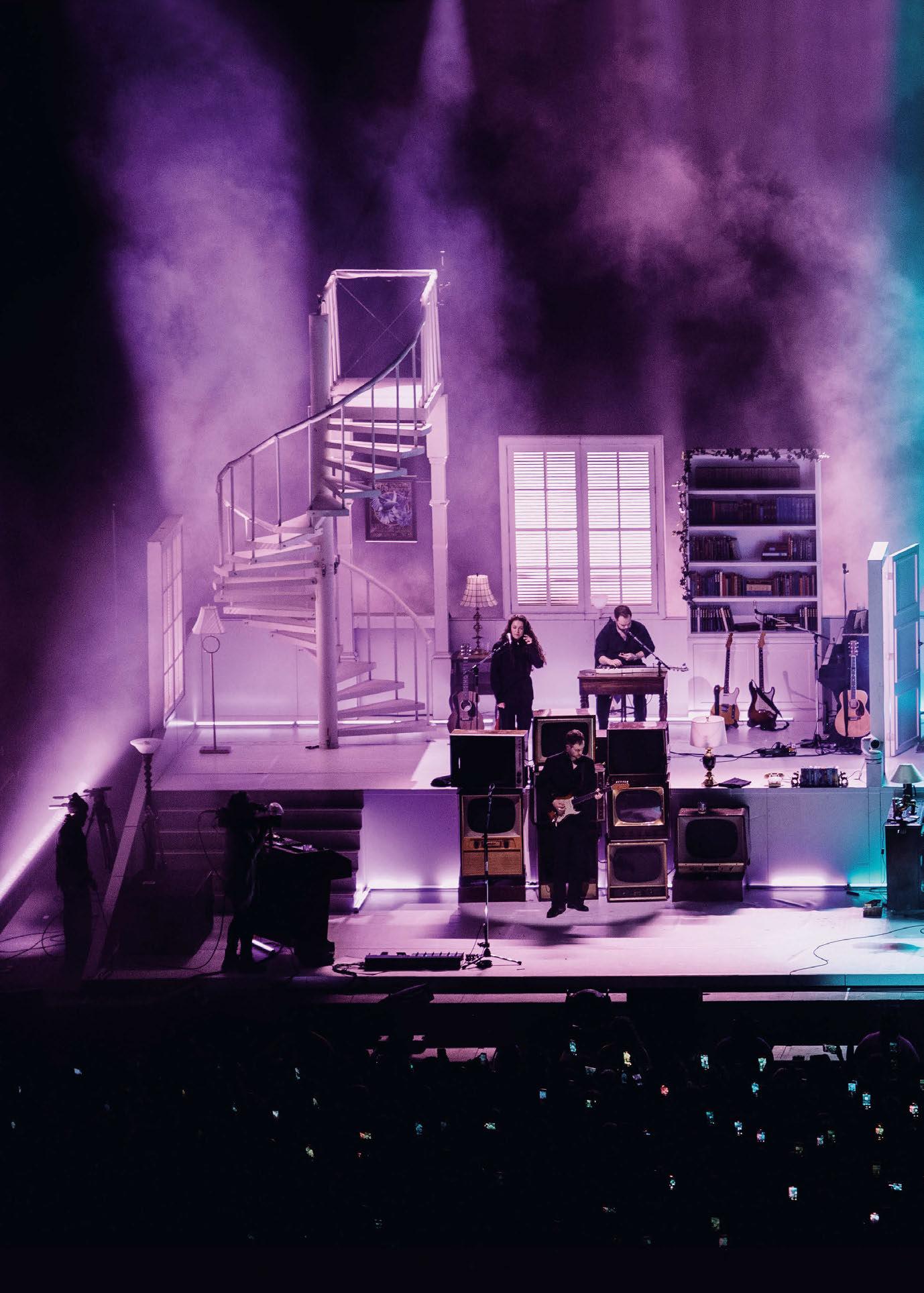
In an industry where scale often trumps concept, The 1975 present a dynamic production where conceptual narrative, a positive workplace culture and scarcity breeds creativity.


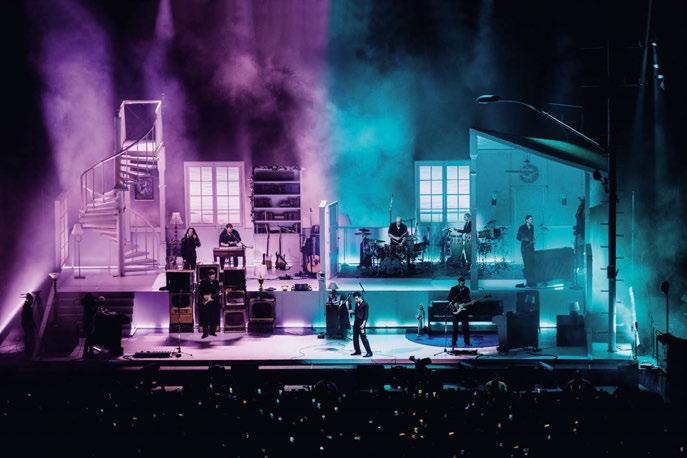
The 1975’s prior touring campaigns have concentrated on the role social media plays in our lives and the weight of technology that we find ourselves under, depicted by monolithic LED walls, floating cubes, and a 11m-wide treadmill. This time around, maximalism has made way for storytelling, as the production spotlights the type of content we consume through these screens and the prevailing confusion between masculinity, sexuality and politics. The 1975: At Their Very Best takes this divisive content, which for the most part is challenging and uncomfortable to acknowledge in person, and places it in front of thousands of live music fans in venues across the globe each night. At First Direct Arena – fittingly a venue based in a city home to The 1975’s first ever live show – TPi went behind the scenes to discover the inner workings of this complex production.
Production Manager, Josh Barnes explained that when the band returned to the touring circuit post-pandemic, they placed an emphasis on being “more live”. He furthered: “The band wanted to break conventions to present an intimate, homely, soft furnished, warmly lit show that entices the connection of the audience.”
In addition to the band, sessions players integral to the recording of 2022s Being Funny
In A Foreign Language joined the fold to create a larger, live show and remove elements from tracks. “This is a jazz-based approach, with no two nights the same. Although we still run tracks with timecode to sync with the visuals, lighting and video, as well as scene changes and cues for click tracks for actions
that happen on stage, there are still gaps and moments within songs where the band can extend an intro of a chorus,” he reported.

Routing is a major challenge for Barnes. “We have a lot of shows with not much time in between them,” he stated. “We’ve also got high expectations for making sure we provide the best show possible for all audiences, so trying to get everything to the right places, on time and on budget as normal, is a big challenge.”
The team solves this problem by working closely with trusted vendors – Beat the Street, Christie Lites, CSE Radiotek, EFM Global Logistics, Eighth Day Sound (a Clair Global company), PRG, Reverb, Road Ramps, SafeTour, Sarah’s Kitchen, TAIT and Transam Trucking with rehearsals at Rock Lititz in the US and LH2 Studios in the UK.
“As we move across all markets, we require global support, so we use vendors who are proven in the market for their networks and share a like-minded ethos,” Barnes said.
Tour Manager, Maarten Cobbaut – who was supported by Tour Assistant, Lien De Lentdecker and Tour Accountant, Seb Satchell – has been with the band for eight years, and shared some of his major challenges.
“T here is much more paperwork involved with Brexit, and as soon as you go to Ireland, there are carnet issues. You have to deal with the same expensive and time-consuming processes that you had to deal with 20 years ago. Everything has risen in price – you can easily add 25% to every pre-pandemic budget. Thankfully, this tour is more sustainable than past tours, and fits with where the band is at creatively.” Barnes – who was assisted by
Production Coordinator, Judit Matyasy and Production Assistant, Kerry Harris – highlighted relationships with account handlers as vital to overcoming the state of play. “One of the new vendors we’re working with on this run is PRG Projects, which created the scenic design. We have a part-purchase, part-rental agreement with them, so we will only ship the custom pieces that we need to and they can integrate into their standard decking on each side of the Atlantic – which has allowed us to make the move from the US in December through to the UK in January efficiently and cost effectively.”
PRG Projects CEO, Frederic Opsomer commented: “In only six weeks, we manufactured a complex yet beautiful design to meet the band’s vision, featuring our newly developed modular platform, Infiniform. This new patent-pending proprietary PRG product can be used across several markets and is one of our new sustainable solutions as each component of the platform is reusable, meaning nothing goes to the landfill.”
Although the routing is fixed, there is an onus on crew welfare. “We ensure there are not too many on a bus and that it is well stocked to accommodate for long drives, and we pre-buy hotel rooms so there’s no waiting in the lobby –these small steps pay dividends on show days. I’m a firm believer that if you look after the crew, you have better show days, and the audience and band have a better night,” Barnes said.
“It’s important to me to work in a safe environment where your voice can be heard. I feel trusted and valued here and that certainly motivates me,” Production Coordinator, Judit Matyasy said, highlighting the amount of work


devoted to making the tour as reasonable and financially comfortable as possible.
“For example, on the UK leg we had busier tour buses but we bought night priors in the hotels so we could get into our rooms straight away after the short drives, maximising resting time and personal space that a tour so often lacks. I love that no two shows are the same with this band, they keep the crew on their toes. My favourite moment of the UK leg was when Taylor Swift was the special guest at The O2. I managed to pop out and watch her from FOH. I love those goosebumps moments when you are reminded how powerful music is.”
During production rehearsals at Rock Lititz, Barnes enlisted the support of SafeTour, which put together a training programme about empowering HODs in reporting and dealing with disagreements within crews, pronoun training, and how to support crew members having a tough time, whether it be with home life, work life or wellbeing.

“We also did a session on respect and inclusion training,” he added. “It’s important to set the tone, at the start of a project, of what will and won’t be tolerated amid production rehearsals, explaining what we stand for. Other sessions on how to look after each other and yourself.” In addition to safeguarding, Barnes and the band are committed to bringing in new talent to the sector. “We work with colleges and initiatives like WILM and 3T to bring in people for shadowing days and walks and talks around
the set. We have a wealth of experience in our team who can provide insight into the inner workings of a show and inspire others.”
One such stalwart is Head of Security, Mark Dawson, who has been touring with The 1975 since 2015. “Although I’ve been touring for 30 years, I learn something different every day,” Dawson said. “I’ve watched The 1975’s live shows grow and I’m proud to be a part of this team. Despite their growth, they have stayed true to their principles and that keeps me coming back.”
Venue Security, Scott Bankier handled the advance and venue security – which, in fitting with the eco-friendly theme, is now paperless – while Dawson ensured the safety of the band on the road.
“We have developed a system to let people in earlier and safely. We fill the barrier with 25 people at a time and we forbid running across the venue to get there. It’s crucial that we are on the top of our game each night because if something goes wrong, it’s the band’s name that is tarnished, so we have to secure them as well as the personal wellbeing of everyone else in the room.”
Dealing with the backbone of the show was Rigging Technician, Peter Bottoms and Head Rigger, Simon Lawrence of Rigging Co, who has been involved in three album cycles with The 1975. “We’ve scaled back with this production –it’s a lot simpler but equally precise. Tolerances in areas are tight, meaning you have to move
tactically, but those can be done in advance, so when we arrive each morning, we know we have enough space.”
The duo typically walks into each venue to mark out around 7am. Within a few hours, all the chains are up in the air, so Lawrence can supervise loads across each department. “We have a Broadweigh load monitoring system on this show,” he pointed out, adding that he hopes that this practice will become commonplace in live touring. “Ideally, I would like to see a load cell on every hoist. With load cell monitoring, we are able to easily create reports to provide venues in advance.”
While this comes at an added cost, Lawrence argues that changing perceptions of load cell shackles is a worthy investment to ensure the safety of complex builds. “The return on investment is evident,” he stated. “While numbers on monitoring screens aren’t quite as tangible as the latest LED and audio technology, it is essential from a safety perspective.”
Lawrence was joined on site by experienced Rigging Technician, Peter Bottoms. “We’re still struggling to get youngsters into rigging,” he shared. “It’s not as glamorous as other departments, and I don’t know whether it’s because, as a society, a university degree is essential, and a shackle isn’t the most glamorous piece of kit. In the UK, we’ve got the NRC, which is an assessment, but you need to have experience in order to undertake it.”


A 1980s-style curtain in The 1975’s album campaign blue with the band’s logo illuminated by a solitary lighting source hides the staging design and concept from eager audiences until a kabuki drop reveals all. The brainchild of this gag and the band’s live shows since 2013, Production Designer, Tobias Rylander, explained the collaborative creative process.
“I usually come to the studio and recording sessions of the upcoming album and I spend some time with the band,” he informed TPi. “For this show, we began discussing what the stage design needed to be and it became apparent that what they were doing musically in line with the record was putting live instrumentation at the forefront of any live show, as opposed to high-tech.”
According to Rylander, initially, it was uncomfortable to get used to developing a show where production values weren’t at the centre of the performance. “We wanted to put a lot of energy and effort into building a theatrical and narrative-driven show, which is where we began to sculpt the house and the scenery around this concept. I start by sketching by hand in the recording studio with the band. I do all my scenography and modelling in SketchUp, and then we move it into and programme the show in Vectorworks and Syncronorm Depence2.”
The staging design drew inspiration from the sitcom, ALF, and transformed over time from modernistic stage and house into a film-style set and environment akin to the white bedroom from Stanley Kubrick’s 2001: A Space Odyssey. The idea is that the set could, theoretically, be anyone’s house, due to the monochromatic nature of the design. “We
spend a lot of time building the architecture of the show but a lot of that expands organically, as we build the storyline and show arc to become a setlist,” Rylander explained. Due to the nature of the house, the team required a natural way of getting guitars on and off the stage, with backline wearing white coats on stage, particularly prevalent during a halftime ‘meta’ monologue by Healy, which knocks down the so-called fourth wall. “The backstage crew needed to be spotlighted as a part of the set and the show, solidifying that relationship between band and crew as equal entities,” Rylander said.
On stage, the biggest change on this tour for Playback Technician, Steve Rodd, was the keyboard housings.
“T he last tour was very stylised; the keyboards were housed in custom black gloss. This time around, the band wanted some vintage kit in keeping with the production design,” he said, joining the conversation.
Before rehearsals, Rodd scoured online advertisements for vintage pianos and organs, which he then gutted and modified to transform into housings for keyboards. “We didn’t see it all together until we arrived at Rock Lititz for rehearsals,” he remarked, noting that while there are tutorials for gutting pianos, those for deconstructing 1960s organs are few and far between. “It’s great to be able to give these incredible pieces of equipment a new lease of life; they are now played in front of more people than ever before.”
Selecting projection surfaces over swathes of LED was a conscious decision befitting the ethos of the band, according to Rylander. “We tried to be environmentally friendly, cautious and consider our footprint when building this
show. When you travel with vast amounts of LED, it requires more trucks. While we don’t have that on this run, we are touring with a house, so we were able to collaborate with PRG Projects to design a modular system that packs down fairly slim and keeps truck space down, while fulfilling the creative brief.”
St age Manager, Jack Dunnett pointed out the challenge of this maiden concept. “When we first got our hands on the set, it wasn’t quite tourable. However, PRG Projects has been very forthcoming with any changes or notes we had, and we’re now on version six. We report back to PRG daily and they have been fully supportive.” Referencing some of his favourite moments within the performance, Rylander highlighted Healy’s journey through a modified TV screen. “It cracks me up every time,” he laughed.
“It’s something the band and I referenced in rehearsals but didn’t foresee becoming a reality, just like the treadmill on the last tour. I Like America, which sees Matty on the roof, is a favourite of mine. I’m really pleased with the high-octane moments of the show, some of which we haven’t utilised yet,” he said in reference to the spiral staircase.
“Everyone I have spoken to seems to be excited and pleased by this concept, if even slightly relieved that this type of show has returned post-pandemic. It was a brave move to create a production design the antithesis of the past campaign in an industry where scale often trumps concept.”
Darren Purves, Lighting Programmer and Director, agrees. “It’s gone from maximalism to an understated theatre show, which is equally impactful despite being the antithesis. The 1975 are consistently evolving their live sound











and the productions fit with where the band is creatively and sonically. They are much more on display with this production design.” The lights are mainly static during the first half of the show, with more scenes from the spotlight as opposed to what Purves dubs “flash and trash”. He stated: “The show is about the IMAG and the stage is lit to replicate a filmic look, while the second half of the set is programmed more like a traditional gig.”
Ry lander said that this show provided him with the perfect opportunity to hide the lighting source rather than showcase it. “The rig is minimal in terms of footprint, but units are placed exactly where they need to be to light the show well. It’s fun how we manage to then take those elements and transform them into light sources that carry enough impact for the ‘greatest hits’ part of the show.”
GLP impression FR10 Bars do most of the work, with a horseshoe design on the floor and flown above, providing silhouette effects for the faux windows and sky within the design. Martin Vipers are used as a spot fixture, providing shuttered and theatrical cues, while SGM Q-10 units provide blinder and ‘big flash’ looks.
Amid the interlude, aptly referred to as ‘consumption’, the frontman crawls through a carefully constructed TV set with Q-10s providing a pixel effect, surrounded by smoke, courtesy of hazebase and MDG ATMe machines. Additional Robe RoboSpots and Astera Titan Tubes are littered throughout the set along with NX1 Bulbs, situated upstage and downstage, built into windows and a doorframe to create a silhouette during the
track, About You. “We were unsure whether it would translate in an arena, but thankfully, it looks beautiful and draws the audience into the theatrics of the show and the track,” Lighting Programmer, Michael Straun, who comes from a theatrical background, said.
“Initially it was challenging but the simplicity of the rig made it less complex. It would have been easy for us to tap into every element of the rig but we didn’t. Ultimately, the band brings the energy and movement to the stage and the lighting underscores that. Above all, it was a pleasure to work alongside Tobias, Darren and the rest of the team to make this show a reality.”
“Venues are a lot less willing to compromise with the trade-off for ventilation and haze,” Purves noted, citing the challenges lighting designers face post-pandemic with venues vastly strengthening their AC systems amid the lockdown. “With the first portion of the set being theatrical, we require haze as opposed to blasting a tonne of smoke.”
Lamps within the set flicker at moments to add realism to the narrative of a homely environment. There are also ‘easter eggs’ embedded within the set, such as names of books on the shelf, photo frames of family members and archival screen content for eagle-eyed fans to spot.

“T he intimate nature of the first half invites the crowd in. There are moments where the band is lit solely by TVs. As the second act starts, the guitarist powers up the set by the lamppost, with Astera Titan Tubes pinging on and off with foley, which is quite fun,” Purves commented, praising the flexible nature of the
design. “This show scales very well; we might lose the spiral staircase or trusses on the sides with trimmed fixtures in one or two venues, but the central focus on the design remains.”
For control, Purves harnessed two MA Lighting grandMA3 full size consoles, operating in MA2 mode with three NPUs for processing, provided by Christie Lites.
“T here is a great moment in the set where Matty climbs onto the roof, which from a lighting perspective is very simple to illuminate with just one fresnel. It’s been a fun show to programme with the added challenge and benefit of special guests like Taylor Swift.”

Head of Lighting, Craig Hancock; Lighting Technicians, Phil Taylor, Lewis Willding, Liam Begley and Craig ‘JR’ Saunders made up the lighting team.
One of the longest serving members of the camp, having come onboard during the band’s first one-truck tour with video in 2014, Ed Lawlor of Visual Certainty oversaw the deployment of the video and communications system. “In terms of video, the tour is much simpler than prior tours. There are no massive LED flying cubes, no automation and masses of power or looms. Instead, we’re focusing on the IMAG, getting some quality out of that within budget constraints,” he explained.
“Everything is more expensive, so the challenge is to create an impactful and engaging show within the confines of the budget. The set pushes the band more to the forefront of the production.”

In keeping with the sitcom design of the show, intro and end credits introduced each member of the band on stage and the crew off stage, triggered by Purves at FOH.
“In some ways, adding those credits to the IMAG to make the show feel like a sitcom is difficult. In TV, you have a caption operator with a dedicated piece of kit, whereas on site, we’re doing that via our Green Hippo media servers, which is what the tour has always been on and is a tool the design team are familiar with and trust,” he explained.
Nine panels of ROE Visual Black Onyx BO3 LED panels were placed in vintage televisions embedded within the set. “This is probably the smallest LED gig in arena touring,” he laughed, explaining the process of fitting the panels into vintage Barco CRT monitors.
One of the larger TV sets was mounted with hinges, which Healy crawls through having gnawed on a giant hunk of raw steak, performed several topless push-ups and been entranced by images of polarising figures from both sides of the political compass, flickering on the TV. “Although they are recycled pieces of set which get battered on tour, they have survived brilliantly,” Lawlor said.
“W hile we have moved away from big swathes of LED panels, the panels we use run on high-intensity output and emit bright colours throughout the show.”
The camera package included Sony HDC-2500 HDs, Panasonic AW-UE150s, and Marshall CV503s. “They are reasonably lowpriced options but offer 3G capabilities and a remote control panel, which permits basic control of gain and colour balance, so we can follow the lighting around,” he explained, citing the choice of Marshall minicameras.
Video Director, Dylan Etherington was responsible for cutting the cameras for the IMAG screens on a Ross Video Carbonite
switcher. “For the first half, we are shooting this halfway between an IMAG and broadcast cut, putting in a lot of wides for the screens, which at first felt counterintuitive but they want to provide perspective of the set and context to the narrative as a whole, which is why the screens are bigger than most projection surfaces used for rock ’n’ roll,” he said, citing the use of Panasonic PT-RZ31K projectors over standard LED.
“Projection provides a softer, crisper image to LED, which makes it look more like a film – especially paired with tungsten light being projected onto these screens.” The video team comprised Crew Chief, Jak Gambino; Camera Operators, Chip Wood and Luke Butler and Projectionist, Richie Jewell.
Shooting the first half of a show like a TV set, sometimes one camera is used for an entire song. “During fallingforyou, there is predominantly one camera in the pit; it’s the same for About You, where Matty is a silhouette. The second portion of the show is shot differently, from an audience perspective, with a much faster pace of cut.”
A Riedel Artist intercom networking system and a Bolero wireless system was the crew’s communications tool of choice. “With a lot of automation on the last tour, there was a need for the system from a safety point of view. As early adopters, we are realising the power of centralised control across communications to integrate the production and make it the best and the safest show possible,” Lawlor stated.
‘THE UNRELENTING PURSUIT OF SOUND’ FOH Engineer, Lee McMahon has mixed Dirty Hit and All On Red acts since 2018, with considerable stints as FOH Engineer with Pale Waves, which was where he first met The 1975, while embarking on his first arena support run. Fast-forward two years, and he

now finds himself mixing his first arena tour with the headline act. “It was a daunting and exciting prospect at first,” he recalled. “I set high standards for myself and care about my job and presenting artists’ work in the best way possible. My pursuit for the best sound is unrelenting; I’m always constantly tweaking things here or there.”
This show, McMahon explains, is more akin to a fader show than most realise. “I’m a firm believer of being hands-on with faders and mixing the show manually. While there are elements of automation going on and snapshots, there is still a lot of fader chasing and responding to the instrumentation of the band,” he explained, referencing the balance of ‘consistency and unpredictability’.
“T he first half of the show is theatrical, which requires a lot of cues, manual calls, and foley, which runs to timecode. This is the first tour that I’ve embraced automation to make things as precise as possible. When the fourth wall is broken in the second half, it also marks a radical departure sonically.”
Having the right tools, McMahon believes, allows him to push the envelope. “I’m a longstanding DiGiCo user, so mixing on an SD7 console was the logical decision for a host of reasons. First and foremost, this band cares about their sound from input to output. Sonically, the SD7 is fantastic and flexible. Its automation is unparalleled, and the surface lends itself to theatre sound with visible feedback from screens and plenty of real estate for faders. I consider it one of the fastest hands-on surfaces of any console on the market – everything I need for the show is here,” he stated.
“I also have a redundant Waves server rig in this system that I’m using for all my effects. The only non-Waves effect I use is an Eventide Eclipse V4 on Matty’s vocal. Most of what I do
through Waves is noise reduction, using primary source expanders on all the vocals, saxophones, percussion and a few guitar channels – trying to manage leakage without it sounding too industrial or mechanical. I use F6 for dynamic EQ.
I treat it as outboard because it is all recall safe.”


McMahon walked TPi through his rack of outboard gear. “When I first got the gig, I wanted to keep it as simple as possible. I put together a list in 2020 and it hasn’t deviated much since then,” he said, pointing out an SSL BUSS+; Kush Audio Clariphonic DSP MKII; distressors; Rupert Neve Designs 4544 for vocals; API 2500+; Kush Fatso for guitar busses and an Overstayer MAS Stereo Analogue Processor for the music buss.
With no amps on stage, each guitarist used kemper profiles. Backline comprised: Guitar Technicians, Matt Vangasbeck and Jack Hughes; Bass Technician, Joel Ashton and Drum Technician, Carl Griffin. Audix, Shure, Sennheiser, Beyer Dynamic and Earthworks were the selection of microphones on stage.
“T he house is reflective, so we’re trying to go for as much direct sound as opposed to indirect on the drums. George Daniel sings into a Telefunken M80-SH short-handle dynamic microphone, while Matthew uses an M80 wired and wireless,” he commented.

The band used JH Audio Roxannes in-ear monitors with a Shure PSM1000 monitoring system and Shure Axient for RF, looked after by Stage Technician, Tom Boothby and Monitor Engineer, Steve Donovan, who mixed on an SSL L550 with L-Acoustics KS28 subs as sidefills and back up X15 wedges.
“T he support from Eighth Day Sound and Clair Global has been integral to getting this show on the road; they have been incredibly patient with last-minute changes and additions. Rehearsing at Rock Lititz in the US with Clair Global next door was perfect,” McMahon said, praising Account Executive, Meegan Holmes.
Eighth Day Sound System Engineer, Grant Cropley and PA Technicians, Chris Hall and Adam ‘Shabby’ Draper oversaw the deployment of a d&b audiotechnik PA system boasting GSL on the main hangs, KSL on the sides, flown and ground stacked SL-SUBs, V12 frontfills and AL60s on the outer stack of subs.
A further 270° hang of V-Series was specified for larger spaces, with the entire system fine-tuned in d&b ArrayProcessing software. The PA is driven by a DirectOut PRODIGY.MP audio processor, which sends Dante to the DS10s and amplifiers to distribute the audio network.
“GSL gives us the frequency response we strive for. The consistency throughout the room is unmatched to any other system I’ve used – every seat gets the same show and there is no need for delays,” Cropley said, praising the system’s intelligibility at distance and the rejection of energy to the rear.

“As an SE, tuning this PA system with cardioid rejection, the results I get through Smaart are impeccable, it tidies up backwash from the back of the challenging rooms and provides an output far more direct and less diffuse, which is a huge plus to Lee.”
McMahon concurred: “There are times I have to remind myself how much of a blessing the design of this system is. Gain structure is
obviously fundamental in audio engineering, but there is a certain element of bending physics that goes on in this show to make it all fit and that is a combination of automation, very clever interactions between microphone choices, processing and the rejection of the PA system makes my job a whole lot easier.”
The wider At Their Very Best touring team featured Band Manager, Jamie Oborne; Styling & Art Director, Patricia Villirillo; REVERB’s Courtney Boyer; Merchandise Manager, Sim Klugerman; Personal Trainer, James Monger; Andy Bews and Phoebe Millard on props; Sarah’s Kitchen Caterers, Vicki Lee, Rebecca Henderson, Pete Mackay, Chris Carter, Alison Jeoffrey and Marianne McLaughlin; Head Carpenter, Jem Nicholson; Stage Carpenters, Darren Davidson, Pete English, Connor Caterall, Stu Farnell and Steve Joy.
With 26 dates in the US and 10 in the UK under their belt, with further visits to Chicago’s Lollapalooza and South America, 2023 will see The 1975 crew traverse the globe.
“We have a busy schedule, which is why it’s crucial to invest in and look after the crew,” explained Barnes, sharing his final thoughts on the tour. “Everything is harder post-pandemic, in terms of putting shows together due to kit and flight limitations, extra visa processes, welfare and making people safe and well while on the road. While everything is more difficult, I also think part of that is more rewarding.”
www.the1975.com
www.jordancurtishughes.co.uk
www.tobiasrylander.com
www.christielites.com
www.prg.com
www.8thdaysound.com
www.taittowers.com
www.radiotek.co.uk
www.efm.global
www.safetour.org
www.beatthestreet.net
www.transamtrucking.com


One of the UK’s biggest breakout stars heads out on a UK and European tour with a production befitting his elevated status in the music zeitgeist.
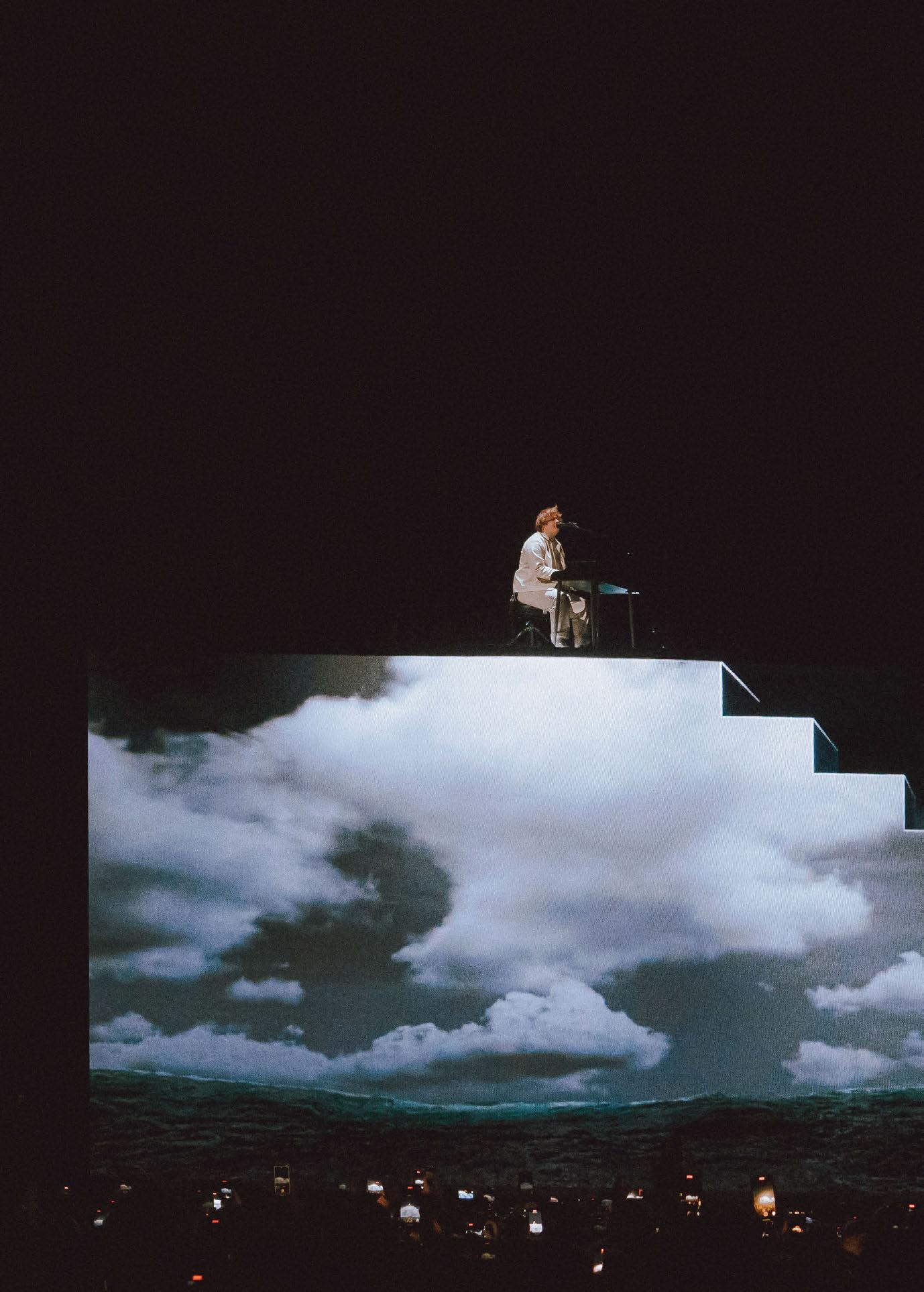

Perhaps it’s because I surround myself with so many self-proclaimed music aficionados, but all too often I find myself in debates about why certain acts have become so popular. However, watching Lewis Capaldi live, it’s quite clear why he has garnered so many fans across the globe. Along with a smattering of catchy hits, Capaldi’s command of an audience with his relatable nature as well as eye wateringly funny comedy segments have proved a winning combination since his breakout years in 2017 and 2018. Yet, despite making it to the big time, loyalty remains a top priority for the singer, with his backing band and core crew having been with him since the beginning.
Throughout TPi’s time at Manchester’s AO Arena meeting the various departments in Capaldi’s team, it became clear how many of the crew were from the singer’s home city of Glasgow, giving a real sense of family and community to this touring party. With a tour that seemed to be fuelled entirely by enthusiasm and Irn-Bru – which almost every interviewee was sipping on during our chats – we learned all about this ambitious production.
Greeting TPi at the venue as the large central video structure – nicknamed the monolith – was being hoisted into position, were Production Manager, Nick Lawrie and Production Coordinator, Amanda Davies, who discussed how 2023 was shaping up.

Having been one of the most toured artists pre-pandemic, the singer came out swinging with an O2 showcase in September of 2022. The arena tour TPi was witnessing in Manchester was a very similar although slightly reconfigured production to deal with the rigours of touring.
“2018-19 was an exhausting time for us all,” laughed Lawrie, as he turned the clocks back on his time with Capaldi. “I’ve been working with Lewis since he started gigging seriously, taking on the role of Tour Manager, FOH Engineer and driver. When things got more hectic, I put forward Scott Smyth as Tour Manager as we had worked on numerous gigs together.” With more demands on Lawrie as the production expanded, he also handed over the audio reins, allowing him to focus on the increased workload associated with the singer’s elevated fame.
“Many might think Lewis’ shows would be a stereotypical ‘singer-songwriter’ type performance, but he is much more of a pop act,” explained the PM. “He listens to a lot of rap and hip-hop and is inspired by the striking stages of that world, and that’s often his reference when we start a project. He is always pushing for clean, bold designs.”
In previous years when there was no creative lead on the production, Lawrie recalled how he, Scott Smyth, Capaldi and his manager used to “make stuff up” – with “varying degrees of success,” he laughed. However, those days are well and truly over, with the team now putting its faith in Cassius Creative for all their show designing needs.
There were several other familiar faces joining the Capaldi family including FE Live for audio, Neg Earth for lighting, and FRAY Studio for video content. New to the project this time round was 4Wall Entertainment, which provided video for the show.
Also on board was The Next Stage providing scenic elements, WICREATION for automation, and All Access for staging. Beat the Street
provided an eight berth star bus for Capaldi and four 16 berths for the crew. Fly By Nite supplied trucks, as well as the use of its rehearsal facilities during the build-up to the tour.
“Dealing with Scott Smyth, Nick Lawrie and Amanda Davies throughout has been a real pleasure,” commented Beat The Streets’ Dan Chitty. “It’s been great to be involved in such a wonderful tour and we look forward to working together again.”
Speaking more generally, Lawrie reflected on his feeling towards touring in 2023. “Everyone is excited to get out and do it properly again,” he stated, referring to the years of inactivity during COVID-19 along with the stop-start nature of 2022. “It’s been nearly three years since we went out and toured properly and everyone on this tour is keen to get stuck in.”
He also highlighted a general change in mindset that people were now bringing out on the road. “There seems to be a greater emphasis on wellness on tour,” stated the PM – a trend he was very happy to see. “I have always put a great emphasis on exercise on tour and fuelling yourself properly,” he added – something for which he was keen to thank the team at Popcorn Tour Catering, which kept the crew and artist fed for the duration of the tour.
“We try to install healthy practices on the tour the best we can; we tour with a gym and have incentives such as a running club where we schedule runs in each city.”
Looking after the FOH mix was Andrew Bush, working alongside System Tech, Ryan Mcilravey. Having started with Capaldi during festival
WE ARE PROUD TO BE INVOLVED

season in 2018, Bush has had a front row seat for the singer’s rise to fame as well as the increased channel count. “When I started with Lewis in 2018, we were handling around eight or nine inputs – now we’re working with around 100,” he chuckled. “That said, the growth has been gradual over time as we increased the size of the band and incorporated more elements.”
Part of this growth saw Bush move onto Allen & Heath as his audio desk brand of choice. Having started with C1500 for both monitors and FOH, as the rooms Capaldi was playing grew, so did the desk size, with the production opting for dLives on both ends.
“We had done so many shows with Allen & Heath, when it came time to increase to a larger surface, the dLive seemed the most natural choice as we’d become very familiar with the system,” he explained.
Bush also complemented the brand as being “one of the few where you’re able to seamlessly mix and match what desk and stage box you are using” – a huge benefit when the size of shows were fluctuating so much during Capaldi’s rocket ship success.
Moving onto the mix, Bush outlined his approach. “I spent a lot of time before the tour working with rehearsal recordings to make sure I was familiar with everything going on and what role each channel was playing in each song, setting up the console, and programming scenes. As the new live set moves through a broad range of sounds and styles, scenes are an important part of my workflow and I have been tweaking and embellishing these as the tour has progressed,” he explained. “The show has become more varied and dynamic and as a result has become even more fun to mix.”
Fans of Capaldi do not come to his shows only for the music, but also for his famed comic
interactions with his audience. During the Manchester set, just a few songs in, Capaldi launched into a long comic-monologue, which had the crowd in stitches. “Obviously, it’s a priority on this show that you can hear his voice loudly and clearly not only when he sings but also when he’s talking more quietly to the crowd, as the spoken parts of the show are just as important,” emphasised Bush.
To complete this task, the audio department put its faith in the new Shure KSM11. “We trialled it in rehearsals earlier in 2022 and started using it over the summer festival season, and both Chris [Smart, Monitor Engineer] and I agreed that it really suited Lewis’ voice,” he explained. “KSM11 gives me what I need to create the final vocal sound. It doesn’t require as much processing as some other mics, and it handles what processing I do require very well.”
KSM11 was not the only Shure product on the rider, with the production also utilising the Axient Digital AD600 as well as the PSM1000 for in-ears. “I am thrilled that FE Live chose the Shure Axient Digital Ecosystem and PSM1000 for the Lewis Capaldi tour – it’s a testament to the versatility, durability and performance of the products,” commented Stuart Moots, Director Pro Audio at Shure. “To be able to give the team the opportunity to deliver the best audio with the KSM11 microphone and back it up with solid RF infrastructure with Axient Digital and the PSM in-ears means the world to us. Shure is honoured to be part of this journey.”

Moving down the chain, Bush provided an insight into what happens to Capaldi’s voice between the microphone and the PA. “Each part of the chain has a specific job and isn’t doing too much heavy lifting. First, is the onboard vocal expander to reduce stage and audience bleed, followed by some dynamic EQ and static EQ to
shape the overall tonality of the vocal. It is then inserted via MADI to the UAD live rack where I apply some de-essing, some small EQ notches, and an Empirical Labs Distressor plugin.
“Occasionally, Teletronix LA2A will follow that, just tickling the vocal. I’ll then send the vocal channel to a group where, if necessary, I’ll tidy things up with some further EQ notches, dynamic EQ or multiband compression, and another more gentle expander at the end of the chain. The input channel tends to remain fairly set from night to night but the group processing might differ, depending on the room we’re in.”
Talking of the PA, the system in question was a d&b audiotechnik KSL provided by FE Live. Walking TPi through the system was Ryan Mcilravey. “We’ve found that the low and mids on the KSL have been great – particularly indoors,” began Mcilravey. “Within the shows there are a lot of big drum sounds, which have been sounding really good out of the system. Although this is very much a pop show, it doesn’t sound like one; it can be quite rocky, musical and dynamic, and the PA has been doing a good job keeping up with this vast canvas.”
The audio team had to find an inventive way of ensuring that the large, automated video centrepiece was not obscured by the PA. “We worked closely with Cassius Creative to find a solution with a lot of 3D models,” Mcilravey said. “As it’s a three-sided cube, we tried to keep the PA as high as possible. Using d&b became very helpful as its ArrayProcessing means you can make a lot of adjustments on the fly.”
When it came to the array, the audio team staggered the whole system – a decision made in the O2 last year and developed during rehearsals. “It’s an 18-deep hang, which with d&b does not take up as much room as a similar box count would with other brands,” reflected


Mcilravey. “We’re also flying five SL-SUBs per side with 12 on the ground. The goal was to make the stage as clean as possible, so the subs are built into the stage. We’ve also formed a shelf from the front fills to create a cleanlooking stage from all angles. It came from the creative team, but there is no real excuse these days to have massive stacks of speakers blocking the stage.”
Along with managing the on-stage mix, Chris Smart had a complex job of dealing with multiple zoned areas for RF and a comprehensive communications setup. “Having such a large video box as part of the set has been tricky,” admitted the engineer. “Especially as it descends during the show, meaning the band are completely surrounded by LED panels.”
During this particular moment, Capaldi is elevated to play a song on top of the video box. “We ended up having two antenna setups –one for the band and one for Lewis to keep a clean RF on stage. I can then switch him onto the different RF system when he’s in this other position,” he explained.
Smart praised Shure Wireless Workbench, which he said made this task less of a headache. “I’ve got the spectrum analyser scanning constantly and I can see if there are any strange RF things going on.”
On stage there were multiple talk-back setups. “Lewis has a shout mic which is operated via a foot switch to speak in everyone’s ears. The band on the other hand have a threeway switch, which means they can talk to one

another without disturbing Lewis while he’s talking to the crowd; one channel to the techs, and another with the band and Lewis.”
With so much audience interaction, it’s not surprising that Capaldi often opted to remove his in-ears. To compensate for this, a selection of wedges were deployed at the front of the stage. There were also two condenser mics either side of the stage to bring in the crowd for his in-ear mix. “We’re only a few dates in at this stage, but I’ve already got a feel for the songs he likes the audience to sing, and I always drop them into his ears,” he reported.
The moulds in question were JH Audio. “Lewis’ mix is close to the album mix and reasonably balanced with his own voice and instruments on top,” stated Smart.
There were some major changes to backline world for this campaign. First was the move on to Neural DSP Quad Cortex for guitars and bass. “It was a change that happened over lockdown,” stated Bush. “Myself, Guitar Tech, Paul Gibson, and Musical Director, Aiden Halliday conducted a shootout and we agreed that the Quad Cortex was more realistic than our previous system, especially in the way it handles the gain stage of an amplifier,” he noted.
Another big change for the production happened in playback, which was explained by Paul Docherty, Playback Technician, who joined the Capaldi team in 2019. “When I started, playback, backing tracks and MIDI were starting to be more involved in the show and were being looked after by the Monitor Engineer,” he recalled. “I was brought in to look after the keys and overhaul the playback to make it a
standalone element to the show.” Docherty ran with the project. “At the start of the campaign, I went to the production and explained that we could be doing things far more efficiently,” he recalled. “For example, during the last run, I would be sending program changes to a Nord keyboard on stage but would have no visual cue that the change had happened.”
With a need for a system that would give Docherty more control and reliability, the production opted to move to a DirectOut PRODIGY.MP as the backbone of his system.
“T he PRODIGY is a modular system which is great for me,” continued Docherty. “We settled for two Dante modules, one for playback and one for keys. My goal was to have redundancy for both backing tracks and keys on the input side. On top of this, the system is somewhat of a Swiss army knife when it comes to outputs. I can run it with MADI SP Out along with 32 analogue channels. So, if I’m in a radio station for example and they can’t accommodate the MADI setup, I can then supply them with analogue lines so we can still run the show.”
The versatility of the PRODIGY clearly made an impression on the rest of the Capaldi production, which invested in three PRODIGY. MP units for the playback rigs and even added a fourth equipped with MADI and SoundGrid modules to place at FOH and provide 64-channel MADI to SoundGrid conversion for recording and virtual soundchecks.
“T he A rig and B rig for playbacks are fully racked in a rolling truck system, mainly for arenas and travelling on the trucks, while the C rig, which we like to call the floater system, will
always be carried by me,” added Docherty. “The fact that I can fit it in a Peli case is perfect. That’s basically what I use during a pre-show or straight after a show, or if we need to go for a radio or TV performance.”
Moving the conversation away from the audio world, TPi turned its attention to the stage show, where design collective Cassius Creative once again followed Capaldi’s propensity for a clean stage.
“He’s a bit of an unconventional pop star,” mused Chris ‘Squib’ Swain. “He categorically did not want a traditional ‘singer-songwriter’ show and in our initial conversations would reference acts such as The 1975 and Stormzy.”
The result was a very clean stage with a curved rear lighting wall and all four of the musicians on floating risers. Then above the heads of the musicians was a three-sided automated video box known fondly among the crew as the monolith.
“A lthough the monolith is a big part of the show, we didn’t want this to be a ‘video show’ with Lewis playing in front of a screen for the entire show. In the setup we have, the content acts as more of a set extension of the main performance.”

Content creation was handled by FRAY Studio.
Adam Young of FRAY Studio talked TPi though the company’s involvement. The company was originally brought in for Capaldi’s MTV VMA’s performance,
All events have one common factor, your equipment must be reliable at all times. There’s no stopping the show, whatever happens. That’s why the LED screens from ROE Visual are not only of the best quality they are also very reliable, quick to build and easy to service. Whether an out- or indoor event ROE Visual LED products provide the solution to maximize the visual experience for your audience. www.roevisual.com

which then turned into conversations about the upcoming tour. “I remember when we started speaking with Cassius about creating content for Lewis and their one note was we’d have to push the content further than we need to,” chuckled Young. “They were certainly right as his songs take on a new dimension when performed live.”
As well as numerous pre-rendered 3D looks, FRAY Studio also produced several Notch treatments for integrated IMAG content, delivering an all-in-one complete package.
Young went on to talk about one of the most ‘hands-on’ moments of content creation during the show, which saw the giant monolith descend to the stage floor with Capaldi appearing above the screen on a raised platform. “We had a rough idea of how we’d achieve this look, but it was something we didn’t really nail down until we were in Fly By Nite and we could make sure the perspective was right.”
Young went on to explain that the company’s adoption of Unreal Engine to create 3D content has been a game changer, providing more flexibility and cutting the rendering time needed when fine-tuning the show. The screen was provided by 4Wall Entertainment.

“T he screen is made of ROE Visual CB5 panels – 200 to be precise,” commented Matt Canter, Video Crew Chief. “I always describe ROE as the Rolls-Royce of LED. It’s a nice touring product and along with the Brompton processors, it’s fairly flawless.” The lightweight airframe touring frame system was also
chosen to assist in speeding up the load-in and out process, with custom corner brackets fabricated to hold the corners in situ, retaining the clean box look.
Video Director, Richard Shipman joined the conversation: “This isn’t just your average IMAG cut show,” he explained. “The ISO camera feeds along with the TX are fed into the disguise servers, which have a pre-programmed look for each show. This means a certain shot is required at a certain point in each track to work. Having the Osprey pedestals on a track in the pit stage left and on stage right offer some great shots, complemented by the elevating auto-pods behind the drummer and the keys.”

Shipman oversaw a camera package of four manned Sony HXC-FB80 camera channels on the show, along with two Panasonic AWUE150 PTZ cameras on Autopod elevation units. One of the manned cameras was out at FOH with another halfway down the room on an angle.


“Having a second camera to the side out front offered a different perspective to the standard front-on shot,” stated Rhodri Shaw of 4Wall, who oversaw the delivery of the show. “Having constant movement on the tracking cameras along with the elevating PTZs really works and helps with the flow of the show.”
At t he back end of the system were disguise gx 2c driving the content as well as the various Notch overlays both for the main screens and the side images – which utilised double-stacked Panasonic PT-RZ21k projectors. “Using Notch to treat the camera shots works well,” Shipman


said. “During rehearsals, we learned which shots worked and which didn’t, so knowing when Notch is being used during the show affects what shots you ask of the camera operators.”

Shaw was pleased to collaborate with the other departments on this integrated production. “Having worked with Neg Earth on numerous projects in the past, 4Wall has a good working relationship with the team. WICREATIONS was brought in to deal with the automation on the tour, which was a first for 4Wall. The show was totally preprogrammed in rehearsals. It is imperative that each department works together closely to ensure the automation system works safely and correctly, and each department work well together to achieve the goal.”
Although at a first glance it might not seem like the show designers had been overly ambitious when it came to the automated design of the show, the process to get this production on the road proved tricky.
Overseeing the automation of the giant video piece as well as elevating Capaldi on top of the screen was WICREATIONS. “We were put forward by Neg Earth following the original performance at the O2 last year,” began Geert Stockmans of WICREATIONS.
Stockmans explained that one of the main reasons the company was brought into the production was due to its WIMOTION system

being one of the few automation options that complies with the new safety regulations brought about by EN17206. “It’s the new European standard that was introduced in 2020 and is now a requirement when touring through Germany and Italy,” he explained. In essence, this new standard imposes greater safety measures and requirements of the equipment used for stage automation – including having all products being SIL3 certified.
The new regulations for certain European countries also required some changes to the screen setup. Originally, the screen was designed as three walls of LED, but this needed to change to be one solid U-shape.
“T his was to avoid any chance of a collision between the moving LED walls,” stated Stockmans, who added that this caused an issue of the crew having to walk around the structure when it was in its lower position.
The automation team was made up of three WICREATIONS crew working alongside a representative from Neg Earth, which supplied the mothergrid.
Keeping the conversation on the stage, Oliver Laight of The Next Stage outlined his role on production. “We’d been brought in to oversee the band risers during Lewis’ O2 show last year,” he began. “The production wanted to have each band member on a floating platform, so we created this cantilever structure. We had multiple conversations with Cassius in the build-up to the structure and even got in touch


Complete range of projectors
Built-in warping and blending software
Automated alignment and recalibration software
Monitoring and control for multi-projector systems
Powerful image processing
Content management and show control
Extended warranties and support
Global partner network
Explore our solutions: christiedigital.com/complete-projection
 Partner: Zhongqing Yingye Group
with the team that did Lewis’ album cover shoot, which inspired the look of the show. We were keen to get a feel of the materials they used and be true to the original look.”
The Next Stage also created an integrated LED perimeter around the main performance area to accompany the clean look of the show. “This project was a real collaboration between each department,” concluded Laight. “It relied a lot on a collective knowledge of what was originally achieved at the O2 last year and a strong focus on what needed to be done to make the show tourable and compliant to the health and safety requirements in Europe.”
Much like the audio department, when Cassius created the look for the show, they had to be conscious that Capaldi’s performance was made of two parts – the music, and audience interactions during his comedic monologues.
“T here will be times during his shows where he’s speaking for 12 minutes at a time,” stated Squib. “We couldn’t just have audience blinders lighting the crowd for these times and instead incorporated two over-audience wash trusses to light the audience in a similar way to how you would in a comedy show.” Each wash truss carried eight Robe BMFLs.
Moving onto the rest of the rig, there was a rear-curved wall adorned with Ayrton Karif. “We wanted a small fixture that was punchy,” explained Squib. “They are versatile and have a lot of different gobos.”
Ot her notable additions to the lighting rig were the Robe Forte and the GLP JDC1s. “The Fortes are amazingly bright, and we’ve also used them as our follow spot for the show. The JDC1s on the rear wall had the advantage that they could turn around. So, we turned them
when they were not being used to hide the white faces of the fixture, making it a cleaner looking set.” Finally, rounding out the rig, behind the video wall were four trusses of GLP impression FR10s, 14 per truss.
Operating the show on the road was Paul McAdams. “This was the first tour I’ve worked on with Lewis, although I have worked with a lot of Lewis production team as well as the Cassius team,” he explained.
“Due to all the automation, there is a lot of work during the day,” he added. “I need to make sure the rig is as high as possible to do my main focus, then with the automation team I need to refocus the fixtures in each of the positions they will be in each of the automation moves.”
McAdams also explained the importance of lighting for the live performance as well as the camera. “There are a lot of Notch and live camera effects during the show, so we constantly have to think about lighting for both the audience and the camera,” he stated. “It is always a big part of the show to make sure he’s lit well for both.”
From his MA Lighting grandMA3 in MA2 mode, McAdams explained his workflow during the show. “The majority of the lighting is on timecode, while I control all the audience lighting manually,” he revealed.
“I often snap the audience lights on and off if a show needs a moment such as a theatrical blackout. The drums are also a big part of the show and they really come alive in the mix. I’ve got to do some manual lighting movements along when he’s doing his fills.”
Adding it’s input to the visual feast was BPM SFX, which provided two huge confetti hits at the start and end of the performance. Looking
after the moments during the show was Jack Webber. “Lewis really likes the confetti hits,” he said. “They are stadium shots with four blowers out at FOH.” He joked that this might not make him the most popular at FOH at the start of the show, but he had bought all the technicians umbrellas to cover their desks.
“We are going through 40kg of confetti per night – all of which is biodegradable,” continued the SFX Technician. “We are also handling the tour in Europe and we source all the confetti locally rather than having it shipped from the UK.” Along with the confetti look, Webber was also heavily involved in the fog that emitted from the artist platforms. “We’re using the new MDG ICE FOG Q, which the guys from Cassius have really enjoyed.”
With the stage set in Manchester’s AO Arena, Capaldi walked on stage to deafening cheers from the crowd – affirmation of just how far he has come since his breakout year of 2018. The people’s pop star in every respect, this multifaceted singer and natural comic is writing his own script of what it means to be an arena act – and with such a solid team working behind the scenes, the future certainly looks bright.

www.lewiscapaldi.com
www.cassiuscreative.co.uk
www.fraystudio.com
www.fe.live
www.europe.4wall.com
www.negearth.co.uk
www.thenextstage-uk.com
www.wicreations.com
www.bpm-sfx.com
www.flybynite.co.uk
www.beatthestreet.net
www.popcorncatering.com


The famous MLT ONE and MLT TWO Pre Rig Trusses get a new member to complete the MLT Series: The MLT THREE.
The MLT THREE has an open head frame as well as an open bottom, allowing you to mount units more easily into the truss. The telescopic legs of the dolly can be extended in several different heights in order to mount complete video modules into the hanging frame. A rail system allows you to mount lighting even at the transition points between 2 trusses and to create seamless transitions between trusses for video modules. The MLT TWO and the MLT THREE are compatible.

In a bid to support the next generation of live production talent in the north of England, 4Wall UK – which recently scooped Favourite Video Rental Company at TPi Awards 2023 –has taken residency in a dedicated large-scale space, Unit 2, at live event facility Production Park in South Kirkby, West Yorkshire. The company has also promoted Darren Poultney, formerly Director of Global Client Strategy, to Managing Director – EMEA.
Poultney has worked as Director of Global Strategy since 4Wall acquired his company, Smart AV in 2020. The Essex-born industry veteran has been instrumental in providing strategic direction and the sales functions of 4Wall’s three UK offices and the launch of Unit 2 at Production Park.
“I am extremely excited to be back in the capacity of Managing Director [formerly MD of Smart AV] heading up the UK and our expansion into other regions,” Poultney commented. “4Wall is extremely well positioned to offer our clients exceptional service and equipment from our different offices.”
Poultney visited the fertile ground that has since been transformed into Unit 2. Following a tour of the vast campus, Poultney, who cut his teeth in the corporate video world, was blown away by the concept. “Immediately, I noticed

there was a gap in the Park for an AV company,” he recalled. “It’s taken a while to get this project off the ground, but we can’t wait to see how it will develop.”
Unit 2 is a purpose-built previs demonstration, R&D, and educational space onsite at Production Park, which will allow 4Wall UK to highlight its support for production designers and the wider industry. The unit features the latest video and lighting equipment suited for creative lighting projects, content creation, interactive set design, and designing and programming stages.
“It’s a varied and flexible space,” Poultney said, as he gave TPi an exclusive tour of the unit – which is equipped with ROE Visual CB5, MKII and Vanish, Unilumin, Ayrton, Elation Professional and CHAUVET Professional equipment, among other technologies.

“We have developed this as a space for students, production designers, manufacturers and local businesses to play with the latest lighting consoles, lighting fixtures, LED panels and previsualisation software as well as host training sessions,” he added.
Unit 2 includes a previsualisation suite, which offers two programming stations for co-programming video and lighting projects, complete with state-of-the-art lighting
consoles, media servers and dedicated platforms running WYSIWYG and Syncronorm Depence2. “This is just the start of our journey,” Poultney reported. “The convergence between video and lighting is closer than ever but it feels like the market is still separate, so it’s about marrying up those two. With creative spaces such as this, we strive to change the narrative of lighting designer to multimedia designer. I believe that is the next step for the industry, and that’s where the strength of 4Wall is –supplying a 360° service.”
Miles Marsden, Head of Industry Partnerships at Production Park, commented on the move: “4Wall UK has taken on reasonably sizeable premises and there are potential collaborations with other companies on site, but I also believe 4Wall is keen for Backstage Academy students to come on site and get hands-on with the latest technologies in the industry. I think this move will prove to be visionary as time goes on because of the momentum Production Park is gathering.”
Clients will be able to visit Unit 2 to see the latest lighting and video equipment, hire the space for demos, testing and preproduction for shows and events, and get the chance to learn more about the service and equipment 4Wall UK can provide globally. “If you look at
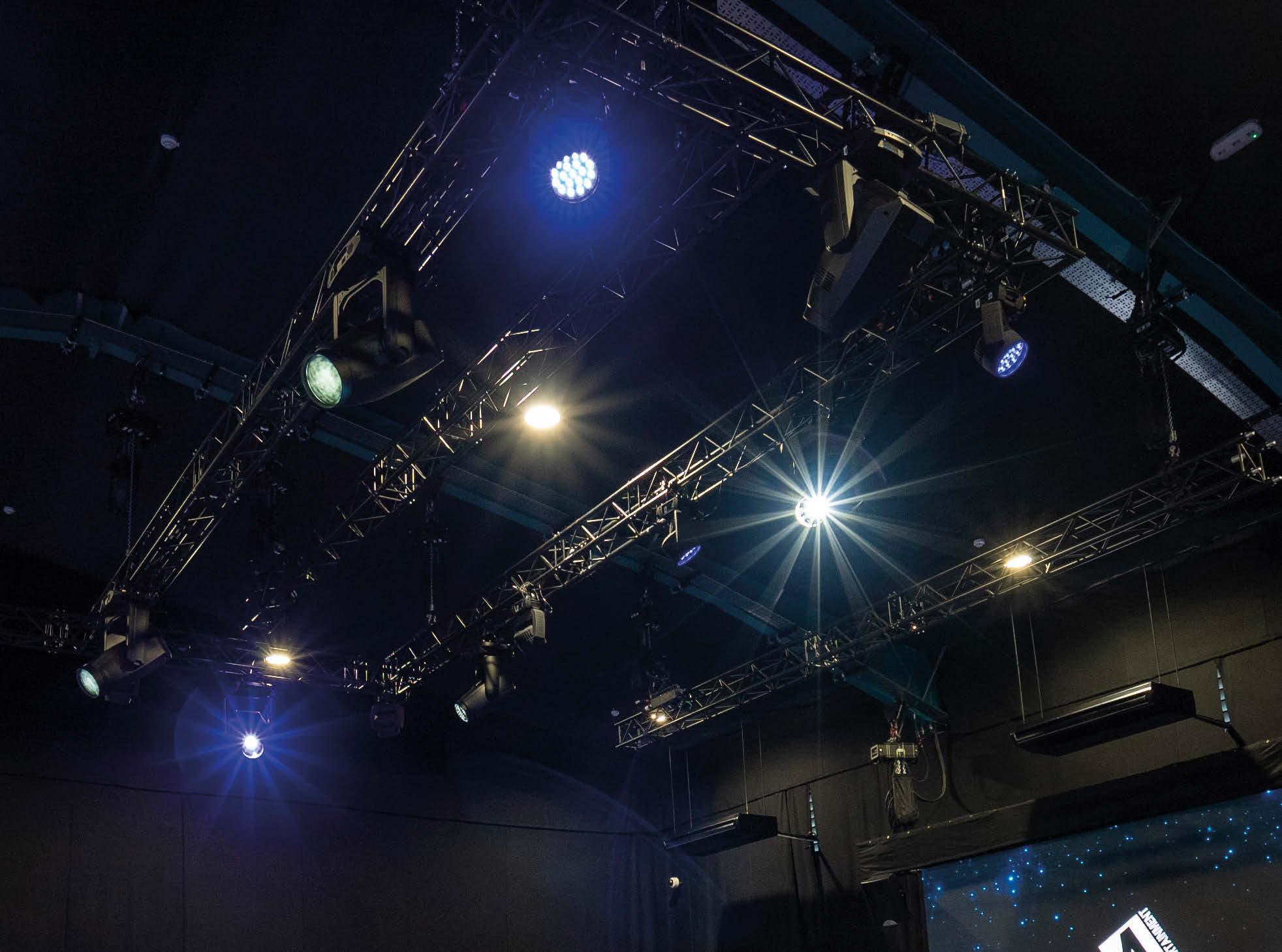



Production Park, regeneration of the area and providing local jobs is important. There are lots of exciting projects in the north of England and we want to play a key role in the region,” Poultney added. “The point of being in Production Park is surrounding ourselves with great partners, so when a tour is coming through, we can work as a team to ensure the client has everything they need.”
4Wall UK will also support Production Park’s onsite community of students and businesses with training, research and more, as well as offering Production Park’s clientele the latest video and lighting equipment.
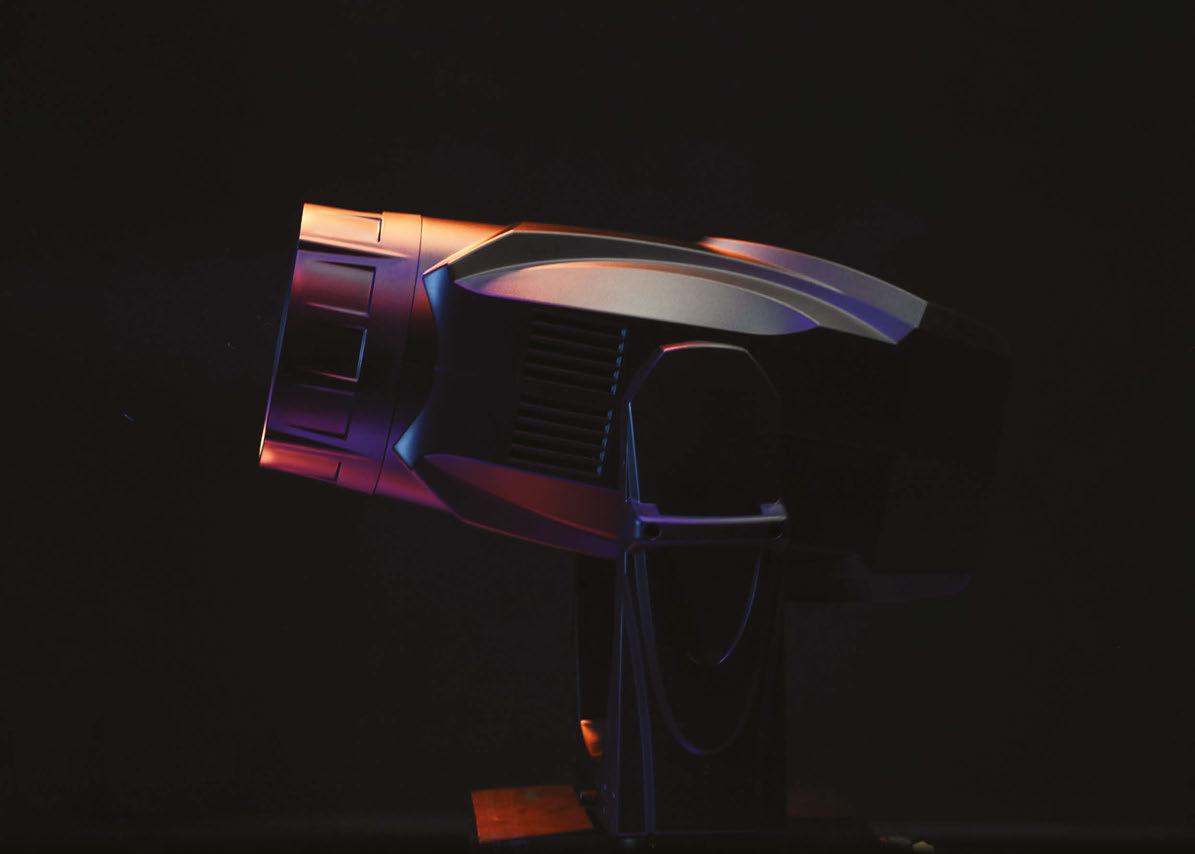

“T his is a great opportunity for 4Wall UK and Backstage Academy,” Marsden said, citing 4Wall UK’s promotion of and willingness to recruit scholars of the sector. “Due to our global connections, there is a great opportunity to share intelligence, knowledge and skills.”
Poultney agreed: “It’s all about giving back,” he said. “We want to add value to Backstage Academy students and invest in the next generation. Maisie Osborne, who graduated from Backstage Academy in September 2022, now runs Unit 2 and we hope she’ll be the first of many alumni to work with us.” www.4wall.com/unit-2


Characterised by high output, precision directivity and a compact, unobtrusive form factor, NEXO loudspeaker systems excel in a range of applications. Installers and services providers enjoy plug and play amplification and processing solutions, intuitive system design software and world-class support from a highly-experienced engineering team. Find out more at nexo.sa.com


Established travel management company, Business First Partnership (BFP) and entertainment travel specialist, Dan Horton (previously of TAG) have partnered to launch Music First Partnership (MFP) – a new service and technology-driven travel management company specifically for global music and entertainment tours.

“T he travel side of the music industry is going through a big period of change,” Horton explained. “A lot of staff left the industry during the COVID-19 pandemic, which other travel companies have struggled to replace, while at the same time seeking other revenue streams to recoup for losses.
“T his has left a gap in the market for the likes of MFP to come in and offer something different to clients or perhaps just bring back service levels that clients are used to but
haven’t been getting.” Nigel Taylor, CEO of Business First Partnership, recognises that the live entertainment industry requires a company committed to significant investment in staff resources and technology, to adapt to the changing demands of each client.
“We have already invested in developing MFP’s own smart software designed around the travel manager and road manager,” he revealed. “Interactive dashboards will display complex itineraries, cost against budget and key ground information on the tour destinations. This investment in technology is so important. It’s not an industry that can afford to be using antiquated systems, it’s a fastpaced demanding environment and MFP’s job will be to wholly support that.”
Of course, technology cannot replace people. Horton’s 15 years of experience in touring travel management and the demands that go with it will be supported by a dedicated service team.
“We want to grow organically and ensure that we can properly resource our clients,” he said. “Service is key and this is what drives us. We don’t want to over promise and under deliver. We like to think of ourselves as an extension of the crew and not just their travel agent,” he commented, going on to sum up the response from the sector at large.
“To reconnect with the industry again and receive well wishes from competitors has been, at times, overwhelming and it demonstrates that there is plenty of business out there for all of us.”
www.bfp.travel/musicfirst
London-based Travel Management company, Business First Partnership, launches a new music and entertainment sister company. Words: Jacob Waite
It’s safe to say that there is an air of positivity within the live events market at the moment. Nowhere was this clearer than at ISE 2023, with hordes of attendees descending on the various stands to talk about the future of the entertainment industry. One stand that certainly had its fair share of visitors during the week was Martin Professional. Sharing a stand with the other branches of the Harman umbrella including JBL and AKG, the lighting specialist showcased some of its latest products including the MAC Aura XIP – the updated version of the famed MAC Aura XB.
A week after recovering from the show, TPi grabbed some time with Director of Lighting for the EMEA region, Ben Payne, alongside Director of Product Management, Peter Skytte, to hear what the company had in store for the year ahead.
This was not t he first t ime t hat TPi has been privy to the inner working of the lighting company’s business, having paid a visit to its Hungarian manufacturing base back in 2019 [see TPi issue 240]. Back then, the Martin team was talking about how since the Harman acquisition, it had been on a mission to consolidate its R&D and development process
to push forward with a clear vision of the company’s future.
Fast-forward to the present, and we’re now seeing the fruits of this labour following the release of products such as the MAC Ultra, Martin’s brightest moving head to-date, the MAC Aura PXL and the latest MAC Aura XIP.
“Compared to some of my colleagues, I’ve been at Martin for the relatively short time of only fi ve years,” began Payne. “ But if you look at our history, I don’t think Martin has ever been stronger, with both the team we’ve got and the current product portfolio.”
Sk ytte concurred. “The future looks good for Martin and our entire product strategy is more streamlined then ever before, so we can really focus on the live event application of our products, which has always been the core of our business. Additionally, we’re developing our architectural segment, leading with the recently launched Exterior Linear Pro, which is the first launch as part of t he f ull renewal of our Ex terior portfolio.”
With the team teasing that there is even more to come in 2023, it seems that this positive vibe is set to continue into the rest of the year and beyond. A go-to workhorse
in the lighting world for over a decade, the MAC Aura XB is certainly a tough act to follow.

“When you have a product that has been so successful, there is always that question of ‘how do you make it better?’” posed Skytte.
“We approached this task by taking the time to speak to designers and ask what they loved about the original product and what they think is missing or c an be added to t he fi xture.”
During this research and interaction with customers, Skytte explained some of the trends he discovered, which he and the rest of the team are looking at implement in the range of Martin fi xtures moving forward.
“One such request was to add our Martin P3 control options,” he explained, w hich fed into the overall demand of the deeper integration of the video and lighting departments being seen as one in the modern live show. “You can still control all these products by DMX or ART NET – something we’ll never take away – but we were keen to add an additional layer of control with P3 that will allow the creativity without restrictions,” he enthused.
Another trend that cannot be ignored within the overall market is the proliferation of IP65-rated fi xtures. “ The IP65 rating has
becoming a big talking point recently and we had multiple customers asking for this in our latest products.”
However, Martin was keen to push back somewhat and not simply follow the status quo. “We found that most who were asking for this IP65 rating were actually in need of a fixture that was equally good indoor and outdoor, with most of them only having their equipment on an outdoor show for a few months a year,” he explained. “This does not necessary mean needing an IP65-rated fixture but a fixture that could be utilised for multiple applications. Our approach with the XIP was to create a fixture that could handle the rigours of the outdoors but at the same time does not have the usual compromise of the full IP65 rating, which means increased size and weight.”
The MAC Aura XIP has already been road-tested in some extreme environments from MDLBEAST SOUNDSTORM in the Saudi Arabian desert [see TPMEA issue 40], to several winter walking trails and a large number of TV shoots and theatre productions. “I thought we might get a bit of a pushback for not having the IP65 rating, but I’ve only had one rental customer come to me since the launch
and when I explained the reason they were satisfied,” enthused Payne. “This fixture would not be ideal to put on top of a building for five years, but that is not what our customers of the MAC Aura XIP will be using it for.”
This subject of getting the most out of the products was something that both Skytte and Payne commented that there had been quite a dramatic sea change within the industry. “Businesses are much more savvy than they were a decade or so ago,” stated Payne. “More people are looking at the analytics of a purchase decision and suddenly ROI has become a major conversation.”
This focus on ROI is something that the Martin team is confident they can deliver. “You just have to look at the previous versions of the MAC Aura – the XB. That is almost a decade old, and we are still selling them as companies know they can still get a return on their investment,” stated Payne. “We don’t bring a new product out every few years and instead our aim is to produce quality fixtures that will last at least 10 or more. So, in a world where companies are being squeezed on budgets, they know that a Martin fixture will last.” Payne went on to explain some of the lessons that he and the
Martin team had learned for the latest MAC Aura XIP launch. “It’s safe to say that the launch of the MAC Aura XIP in September 2022 really changed our thinking for future launches,” he explained. “Back in the day, your only option was to launch a product at a tradeshow as it was the only time where you would see customers en mass. During the lockdown, we launched the MAC Ultra range online, which was hugely successful, and the amount of online traffic we got on the website and socials was incredible. We still want our products to be shown at tradeshows, but it’s now not so critical to launch new fixtures there.”
To close our conversation, both Payne and Skytte were keen to highlight some more ‘big picture’ missions that the lighting brand is aiming to develop. “A major trend within the industry has been a greater degree of focus on sustainability, with more companies – including us – investing a lot more money and resources.”
Martin, being a brand of the Harman Group, has a broader goal of being carbon neutral by 2040, with plans to have all its manufacturing facilities running on renewable energy by 2025. “Our part as Martin in this growing sustainability picture comes down to our product design,”

stated Skytte. “During the development of the MAC Aura XIP, we brought in a third-party company to do a life cycle assessment of the product, assessing the CO2 impact of the fixture. The goal was to get more metrics about sustainability, so we can utilise a data-driven approach for all future products.”
This has already sparked huge conversations within Martin’s R&D department about the use of more sustainable raw materials such as recycled aluminium and recycled plastics. “This also works harmoniously with our overall goal of simply making all our fixtures more efficient,” said Skytte. “We’ve always strived that our products have higher lumens per watt alongside producing more compact fixtures with lower power consumptions. These two missions go hand-in-hand with the overarching sustainability mission.”

Martin is even looking at more sustainable packing options. “In one of the more recent
architectural products, we’re using a full cardboard packing, which has been sourced from the Forest Stewardship Council,” explained Payne.
More announcements are set to be made later in 2023. “I’ve been spending a lot of time speaking to our distributors over the past few months and there seems to be a wave of positivity within the industry,” concluded Payne. “The market is looking strong and there seems to have been a big sea change even from November 2022. People are excited about March and April, with another busy summer ahead of us.”

Sk ytte added: “I only got to spend one day at ISE but even from that, customers were very positive, and we’re excited to be showing even more of what we have been working on at Prolight+Sound where we’ll be in Hall 12.0, Stand C68. It’s going to be an exciting year.”

www.martin.com
www.martin.com/sustainability

For TPi Awards 2022, with events slowly starting to reemerge post-pandemic, we made the decision to include livestream projects within the Production of the Year category. One of the shortlisted performances was Mayday’s Fly To 2021. With their tour temporarily grounded, the Taiwanese band opted to create several online concerts to keep fans engaged – one of which took place on New Year’s Eve and was watched by 29 million fans.
A showcase of the potential reach of online performances, the level of production in these livestreams was on another scale to anything seen before, with the band playing in numerous locations and show design and cinematography clearly high on the priorities list. In fact, TPi was so intrigued by the shortlisted performance that we did some digging to learn about the people behind the scenes of Mayday’s production, which eventually led to us sitting in the Taipei office of Ocean Chou, CEO of B’in Live.
With restrictions lifting in Taiwan in late 2022 and the country opening its borders to travellers without the need to quarantine, we took the opportunity to witness JJ Lin’s headline show at Rakuten Taoyuan Baseball Stadium [see TPi #273] as well as visit the offices of B’in Live. Formed in 2014, B’in Live
was an amalgamation of four companies that were involved in various aspects of the live events industry – from show design to equipment rental and production services.

“A ll four companies had worked together for a long time, but we thought we could have a greater impact if we joined under one banner,” stated Chou.
The CEO went on to explain that the company had two main goals from the outset. The first was to implement better connections between show creators and those deploying the hardware for shows by providing a turnkey solution under one banner. The second was to create a company that had a different model from its competitors.
“Too often in Taiwan, you find companies get passed down to offspring of the owners, but this relies heavily on the children wanting to work in the same field,” stated Chou. “This is how we wanted B’in Live to differ in that everyone working here really wants to be in this industry – it’s a business built on passion.”
From its Taiwanese HQ, over the years the company has built a plethora of services from providing the technical infrastructure for concerts, festivals, galas and award ceremonies to offering design and pre production services. Not only that, but B’in Live has also been heavily involved in IP licencing,
with its own label signing a new boy group. The fact that the company not only provides the infrastructure for live events but also has a hand in creating the pop groups that play them certainly takes the concept of a ‘turnkey solution’ further than ever.
Over the two floors of B’in Live’s main office, we got a small look at some of the various shows the company was working on from original sketches and detailed CAD drawings all the way to people heading out to oversee the in-person deployment of a performance.
“We are the first company in the region to adopt this turnkey solution to our business,” commented Chou. “We’d heard others had tried to replicate what we were doing but they were not successful.”
Although the vast majority of B’in Live’s work takes place within Taiwan, having worked on nearly 10,000 events since 2014, it has also worked on a number of events in China, Singapore as well as a few excursions to Europe, North America and Australia. The company also has bases in Tokyo, Hong Kong and Shanghai as well as three offices in Taiwan. “We employ around 272 people across our two warehouses in Taiwan,” stated Chou. “We’ve made an effort to expand to other regions over the years, but we still want our base to be Taiwan,” emphasised Chou. “We have the
TPi travels to Taipei, Taiwan, to meet the B’in Live team and learn more about its turnkey business model, the ramifications that COVID-19 had on the live events industry in the region and the company’s ambitious plans for the future.Words: Stew Hume Photos: B’in Live
underlying goal to everything we do, to nourish the live events market in Taiwan and get more people into this industry – a mission that has not been made easier due to the pandemic.”

Weighing into the conversation was B’in Live’s Production Manager, Gas Tan. “We’ve expanded our operations a lot since 2014,” he began. “Our warehouse is three times the size from when we started and we went from stocking 500 to 2,000 lighting fixtures. The same goes for our audio offering. In 2014, we only had a system that could cater for one arena show. Now our inventory would be able to run a stadium show and two arena shows at the same time,” he said, noting that B’in Live invested heavily in audio back in 2016 with the purchase of an L-Acoustics K1 system.
Tan continued to describe how the company made its purchasing decisions when it came to new equipment. “We pay a lot of attention to the requests that come via international acts’ rider requests when they pass through Asia as part of a world tour,” he explained.
“We have partners in Singapore that share what international artists are requesting on their riders and from there we have internal discussion about if the equipment will also be a good fit for the Asian industry.”
He used Kinesys as an example of this, which was appearing on numerous riders and
led the company to invest in the technology. “As much as we work a lot with Asian artists, greater investment in technology will only increase the standard of these shows,” added Chou. “This involvement also sends a message to international acts that B’in Live is ready to support their live tours and productions coming through the region.”
One point that’s worth remembering is that the COVID-19 pandemic affected Taiwan on a different timescale to many other countries in other regions around the world. The country made a promising start to dealing with the outbreak, being able to host its first full-capacity live show in 2020. However, in April 2022, the epidemic broke out again, so the performances were postponed one after another, and until August of that year the market gradually return to normal.

Despite this delayed timeline, Chief Business Development Officer, Wallace Wen explained that the business has bounced back quickly, with the company fully booked until well into 2024. “We’re not only busy with live shows, but streaming is still big for us,” he revealed.

However, like many other regions around the world, finding professionals to cooperate with has proved an issue for B’in Live. “Lots of technical people left the industry during the pandemic and it has been hard to bring

them back,” explained Chou. This issue is compounded within Taiwan, as the industry doesn’t have the same wealth of freelancers working as markets such as the US and Europe.
“Due to the lack of unions, we have to employ people in-house to work on events, which is why we employ so many people,” stated Chou. “Thankfully, we were able to hang onto a lot of our staff during COVID-19 with around 24% turnover during this time,” he said, adding that some other companies in the region lost up to 50% of their workforce.
Looking to the future, Chou mused that perhaps adopting a freelance model similar to the one seen in the West would be a more ideal system, as it would share the knowledge and workforce available for shows.
“A lthough we managed to hang onto a lot of our staff, the pandemic has made crewing shows tricky as for each performance, we need A and B teams so the show can still go on even if one camp is infected,” stated Tan.
To compensate for this need for new staff in the industry, B’in Live has launched a new campaign to bring fresh faces into live events, collaborating with the Taipei City University of Science and Technology.
“It’s a big issue that there is no formal schooling in the region for people looking to get into live events,” stated Wen. “We’re joining
forces with the University to allow part timers to get involved with the industry and perhaps even become freelancers – something we’re in need of.” Speaking more generally, TPi asked the B’in Live team how they felt about the recent international success of Asian artists overseas and if they thought that any Mandopop [Mandarin popular music] artist might enjoy the kind of success that K-Pop artists have experienced.
“A lot of the artists we work with – as well as those on our label – would love to play more overseas, but there is still a long road to make Mandopop more popular overseas,” Chou said.
He went on to explain that the Taiwanese government has also aided in this mission recently, sending artists to events in the USA, Canada and Japan. Perhaps this passion for increasing the standard of pop stars singing in Mandarin is why B’in Live has invested so heavily in the IP side of its business. Following
a TV talent search, B’in Live created a brandnew band, ALL IN 5, that then went into an extensive year of training before being debuted to the public. Following the release of their second album Prince in November 2022, the band is looking forward to big shows in Taiwan in March 2023. Leaving the B’in Live office, it was interesting to reflect on this business model. While many companies in the West offer turnkey solutions comprising everything from show design, to audio, video and lighting, B’in Live’s model seems even more all encompassing, helping to even create the talent which will then be looked after and developed as a live artist.


In principle, this streamlined approach could yield great results, and with a team that seems to care so deeply about the work they do, TPi will certainly be following closely to see where the company goes next. www.bin-live.com/en


Showcase your products, services and technology to 10,000+ industry professionals involved in the development of Saudi Arabia's entertainment and leisure market worth over USD 64 billion.


NETWORKING SLS Expo takes the hard work out of business matching, offering unrivalled networking opportunities that make it easy to start a conversation with future business partners.
LEAD GENERATION Exhibiting companies generate on average 80 high quality leads over 3 days at SLS Expo. Benchmark that number against other marketing, advertising and sales initiatives and consider the impact this physical showcase will have on your annual bottom line.
THOUGHT LEADERSHIP Place your brand and its ideas at the forefront of an industry meet-up, share a case study or lead a masterclass or roundtable.

BRAND AWARENESS Build brand awareness in one of the world's most ambitious emerging markets by showcasing your products and services to 10,000+ influential industry professionals.
SLS Expo is co-located with Saudi Entertainment and Amusement (SEA) Expo, the Kingdom's largest trade event for the entertainment and leisure industry.
CAPITALISE ON THE WORLD'S FASTEST GROWING ENTERTAINMENT DESTINATION
The importance of the media server within the infrastructure of the modern live show is undeniable, with LED-clad stages and artists looking for more creative video content than ever before. However, the lack of real-time flexibility compared to, say, a lighting operator who is able to alter visual cues at the drop of a hat, has been a hindrance to the discipline.
Despite real progress being made in the development of real-time rendering options within live video, many productions still operate to a formula of content creators delivering a video, which is then set for the duration of a tour. SMODE aims to address this issue by increasing the flexibility for content creators and video operators with its range of media servers and innovative software.
While it might not yet be a household name internationally, in its country of France, SMODE is among the most well renowned names in the live video market.
Stepping into the company’s Parisian HQ, a stone’s throw from Place de la République, you quickly gain a sense of SMODE’s history. The company is the brainchild of Francis Maes, who was exploring real-time rendering as a student in the early 2000s. “I used to get very frustrated when you’d have a modular synthesiser where you see immediate changes to a musical input, but when it came to changing the parameters of a visual piece, you’d need to modify the code and wait for a cycle that could take minutes,”
stated Maes. It was this frustration that led to the initial foundation of SMODE. His solution was to connect MIDI controllers to his real-time 3D demo-making engine.
What followed was several years of VJing in clubs and slowly realising the potential for realtime compositing while also obtaining a PhD in Machine Learning AI on the side.

Er wan Tehel, Product Specialist at Smode Tech, picked up the story: “The fact that SMODE started in software is what really separates it from other companies. The software was designed for users to create content in a similar way to Adobe After Effects.”
He went on to explain that the implementation of a physical media server was to make it easy for users to use the software, guaranteeing that the system could be used natively. “This means you can assemble all your content within SMODE and therefore manipulate all the parameters and content design on the fly at a live show.”
Tehel explained the scenario of a show operator wanting to alter the content displayed on the LED at a live show. “Using SMODE, in a very short space of time, an operator could alter what is being shown on the screens, creating a much more creative and collaborative experience and without the need for very long render times.”
Tehel shared what he believes are the differences between SMODE and other media
servers on the market. “SMODE is a creative tool,” he explained. “You can create media from scratch and the real-time composition tool is very powerful.”
Maes pointed out the collaborative nature of the company’s output. “I would say we are the only company that provides real time composting for designers as well as the media server delivery process. Our offering is complementary with other options within the market. For example, we’ve found that SMODE works incredibly well with Notch. It all comes down to using the right tool for the job.”
Starting as an internal tool in 2007 at D/Labs – a creative studio for concerts and live TV shows in France – SMODE’s first media server, named Smode Station, was launched in 2016. “It was launched exclusively with French rental company, Alabama Media,” recalled Maes. “They did a lot to promote SMODE across the industry in the early stages and although exclusivity ended several years ago, we owe a lot to their hard work in promoting the brand.”
St arting as a dedicated software company, Smode Tech was launched in 2019 and it has seen a significant uptick in interest in recent years. At the heart of th company’s expansion strategy is training. “We split our training between content creators and live operators,” outlined Tehel. “However, regardless of the

TPi visits SMODE’s Paris offices to learn more about the media server manufacturer and its unique software, which provides an alternative option for content creation for live shows.Words: Stew Hume Photos: Smode Tech
type of training, everyonel speaks the same language in the end.”
While the company has been in existence for a several years, SMODE has been kept at a “human scale,” according to Maes. However, this is starting to change, as the company looks to increase its presence overseas.
Shannon Harvey oversees SMODE’s UK operations, while its Japanese branch is led by Jamie Goodenough, who has helped clients open two new green-screen studios, as well as one large-scale XR studio since the launch of the Asian branch.
“Japan has always been at the forefront of the adoption of immersive and creative technologies, so it is a perfect fit for our realtime compositing platform,” commented Maes. “We can’t wait to work with the talented visual arts community in Japan to help bring their grand designs to life.”
Harvey joined the conversation: “We were drawn to SMODE as an alternative, state of the art platform for visual design,” he commented. “It combines the power of a real-time content engine, compositor and media server in our workflow. The response by the UK video design community has been fantastic and we are excited to see it across installations, festival stages and virtual production studios this year.”
Tehel highlighted some recent projects SMODE has been involved in, from Angèle to Stromae, the latter of which he used as an


was interesting as we had screens that were moved around by robots,” he stated. “We had to adapt the workflow of the system to account for the changing positions of the screens.”
Looking to the rest of the year, SMODE is excited to continue to grow. In early 2023, the company shared a stand with fellow French company, Naostage, at ISE.
“T he mission is to keep getting the word out on what our real-time workflow can mean for live shows,” explained Tehel. “We are speaking more and more with the people on the content design side of the industry and showcasing what SMODE can offer them and providing solutions for XR studios, broadcast as well as live shows.”
The future seems bright for SMODE but there was one element that Maes was clear about. “We want to remain in control of the company because we are concerned about the amount of companies that have been taken over by investors and the focus has moved from creativity to profits,” stated Maes.
“M y goal for SMODE is to expand by creating a network of passionate entrepreneurs who value these principles. SMODE has already established a subsidiary in Japan and partnered with independent companies such as Creative Alchemy One in the UK and Eyesberg in Spain. This collaborative approach ensures that SMODE can continue to grow without sacrificing its values, making it a

Starting as one man’s vision to produce and supply the best and brightest laser sources, LPS Lasersysteme has become a go-to for production teams and festivals across the globe for three decades. “Over the years, we’ve built great business relationships and synergies with partners who we see more as friends,” said owner and CEO, Siggi Ruff.

LPS began with the production, sale and installation of its own laser show systems in live entertainment spaces, nightclubs and bars, and festivals in the mid-1990s. The company took a giant leap forward in 1995 when Ruff’s wife, Martina, joined to take care of advertising and production.
“T he company grew noticeably,” Siggi said, recalling how his better half boosted the company’s international sales.
From 1997, Martina began training young people in the commercial sector, who also wanted to perform laser shows and create show lasers.
“As everyone in this industry can attest, this is not a normal nine-to-five job. New recruits have to be able to grit their teeth, be inventive, and get along with less sleep,” Siggi said, noting that for every year the company expands, the demand for technical progress grows.
“T his fresh impulse from Martina and the constant input from customers and employees were decisive for LPS to quickly become known internationally.”
With the first sale to Asia in 1998 and further sales as far as the Americas in the following year, the company was firmly established globally. Today, the Ruffs can look back proudly on the past 30 years.
“T he fact that we’ve been able to position ourselves so stably and broadly on a global level over the years is also due to the good fortune of being able to work with open-minded and professional people,” said Martina.
The state of play between LPS and its competitors has fluctuated over the years. Laser devices from Asia flooded the market from 2010 onwards, posing a challenge for the company. “These products hardly met
the German safety regulations or the quality requirements, but they were cheap and easily accessible,” he explained.
“Our products are reliable because they are manufactured according to strict internal specifications and put through their paces. Due to restructuring in our pricing policy, we’ve been able to keep up well with cheaper products for years without sacrificing our quality standards for our product.”
Since its release, LPS-BaX series remains a perennial favourite of production designers. The compact laser source is prized for its power and expansive colour spectrum, in addition to LPS’ RGB beam bar, LABB, and scanner bar, LPS-BaX SixSCAN.
With over three decades of memories to fall back on, Siggi highlighted landmark projects in far-flung places such as Black Sea Arena in Shekvetili in Georgia; the Gorakhnath Temple in Gorakhpur in India; Porto Cairo Mall in Egypt; GGE in Dubai, UAE; Seaworld in Texas, USA; and even military installations.
Summing up the past 30 years, the Ruffs were sentimental about the future of the business. “Throughout these three decades in the industry, we’ve been able to liaise, integrate and collaborate with different people, countries, cultures and mentalities. We are shaped by each interaction and are still electrified by what we do,” Siggi said.
“T he world of lasers and show design is changing at a rapid pace as new technologies are brought to the market, and as this shift develops, we will pride ourselves on being at the forefront of progress – providing clients with the level of service and lasers we are famed for.”
www.lps-laser.com
LPS Lasersysteme’s Siggi and Martina Ruff reflect on the highs and lows of producing and supplying laser shows and systems in the ever-changing and challenging live entertainment market. Words: Jacob Waite


Neurodiverse speaker, podcast host and UA92 (university Academy ‘92) Student Recruitment Assistant, Muhammed ‘Abz’ Abby turns challenges into opportunities and is rewarded with a Breakthrough Talent Award at Production Futures ON TOUR.

What first sparked your interest in documentary filmmaking?
I knew I wanted to be a presenter, but I wasn’t quite sure how to go about it. I was aware that I required experience and understanding of the basics. I decided to study Journalism at UA92 to further my interest. I’ve been involved in community radio since the age of 17 but I wanted to take the next step and become more involved in investigative journalism. Reggie Yates, Louis Theroux and Stacey Dooley are inspirations of mine. I find being a part of the whole process, from editing the audio to presenting, hugely rewarding.
When did you decide to create the Bipolar & Me documentary?
“When I was diagnosed with bipolar, having already been diagnosed with ADHD, autism and anxiety, I thought my professional life was over. I began researching to see if I could lead a ‘normal life’. I began speaking with other people
with mental health conditions and I reached out to a physiatrist, and family members affected by relatives with mental health conditions. Using my journalistic background, I decided to make a radio documentary to take listeners on a journey.”
How did you find it being on the other side of the dictaphone?
“I like building relationships and rapport and trust with subjects but I never anticipated how vulnerable I would have to be. It can be quite upsetting, but the whole process was my therapy. If I can share my journey and inspire others by putting myself out there, it makes it worth it. It was daunting at first, but it has taught me a lot. Men are conditioned not to speak out about emotions and the topic of mental health and neurodiversity. There were some times when I didn’t feel comfortable with sharing aspects of my life, but it was rewarding to peel those layers away like an onion.”
How did it feel to win a Breakthrough Talent Award at Production Futures ON TOUR?
“It was a very much welcomed surprise. I first met Production Futures ON TOUR at UA92, and my tutor decided to put me forward for an award based on the documentary and I received great feedback. I was overwhelmed to discover I had won an award. It has spurred me on to create further impactful and thoughtprovoking documentaries. I’d also like to thank UA92 for believing in me and the contributors for sharing their lived experiences that made this a reality.”
What advice would you give to others looking to follow in your footsteps?
I’ve learned to be more resilient and not take ‘no’ for an answer. Ask for help and don’t be afraid to challenge the status quo. UA92 has shown me that despite what others may see as shortcomings, you can use them to your advantage. Neurodiversity is my superpower but I do struggle at certain things.
Have you faced additional barriers or challenges as someone with neurodiversity?
“Growing up neurodiverse, I faced a lot of challenges and adversity. I see neurodiversity as a superpower because I can engage an audience in a way an ordinary person can’t. This was often a hindrance when I was growing up, but at UA92, it has been a blessing to tap into and be the change I want to see. I have gone on to do amazing things with Milk Education as a spokesperson and sharing my lived experiences to inspire others. In the future, I would like to be one of the few neurodiverse presenters on TV as well as creating lots of thought-provoking programmes for underrepresented groups.”
www.productionfutures.co.uk
Sound engineer and musician, Lee Kuhn, reflects on his pathway to mixing FOH for Chris Jansen and monitors for Darryl Worley after recently passing out of The Blackbird Academy in Nashville.
How were you first introduced to a career in live sound?
“Recording and playing music is my passion but I never considered it to be a career until I stumbled across The Blackbird Academy in Nashville. I enrolled in two seperate six-month courses on studio recording and live sound. The latter was based just across the road from Clair Global in Nashville, where I would visit and learn something new every day. I was able to get hands-on with the equipment and start my learning from the ground up. Once I graduated and mixed at a few local bars around Nashville, I began touring and mixing live sound for Chris Jansen and Darryl Worley, which is a testament to The Blackbird Academy.”
How did you land your first gig?
“I owe everything to Blackbird Academy. I cultivated a relationship with my teachers and they trusted me a lot. While studying, I was invited to mix a VIP lounge in GEODIS Park, home of Nashville SC, as well as mixing some bands in bars and clubs in downtown Nashville. Amber Gray [Career Services Manager] at The Blackbird Academy helped me land the Darryl Worley gig.”
What lessons have you learned on the road?
“The number of people you meet on the road is incredible and it’s important to network with those who have a wealth of knowledge and have been on the road for many years. There
is also nothing like a baptism of fire. During my second week on one gig, my production manager broke his ribs and collar bone, and I was thrown into the deep end and asked to mix live sound. You definitely learn from those moments. The thing I’ve discovered and improved on the most is, as simple as it sounds, being able to use my ears more. Mixing live sound is a constant learning process.”
How does Avid fit into your mixing setup?
“I mixed around 27 shows in two months with Chris Janson and we carried an Avid S3 on the road. Despite the fact that it is more compact than many other consoles, it is still powerful and intuitive with VENUE software. You can travel anywhere in the world and find Avid consoles, which is a huge benefit when you’re on the road. They are omnipresent, intuitive and if you need to swiftly load a file to soundcheck for monitors, its consistency is unrivalled – and of course, the backwards compatibility with other models is a huge plus.”
What is the best advice you have received?
“Attitude is 99% of the gig. I start every show with that mantra, and sometimes things go wrong and the hours are long and arduous, but the end result is always rewarding. I would also stress to be humble and know your worth because touring is a huge sacrifice to your personal life. Balancing work and a personal life is important to me and learning that while also cutting my teeth in touring will be a challenge, but I will find a way. Above all, never be discouraged, trust the process, network and ask questions.”
Where would you like to see yourself in the next five years?
“Ideally, I would like to be working consistently as a live sound engineer with the ability to carve out time in my year to be in the studio and record bands operating in the DIY music scene in Florida.”
www.productionfutures.co.uk
 Words: Jacob Waite
What was the idea behind the launch of Proteus Rayzor Blade?
“We wanted to create a powerful IP65 zoom tilt bar that adds additional creative layers and fits well into our other Rayzor LED fixtures that feature our proprietary background SparkLED sparkle effect. For those unfamiliar with SparkLED, it is a background illumination system of 2W white LEDs placed inside the lenses to create an additional layer of effect, depth on stage and fill idle space with something more inspiring. The strobe lines that flank the lenses across the entire length of the fixture was a concept added to offer the designer a unique hybrid of tilt bar and highoutput strobe within the same fixture and same

mounting position. It took about 12 months from initial sketches to the product release.”
Which features will prove popular with production designers?
“The large LED lenses and narrow zoom allow good beam separation as it provides more contrast. Alternating between a real beam versus power strobe hits is also visually very interesting. The warm white SparkLEDS allow an additional subtle layer of creative composition that is unique to this fixture type. There are two versions of the fixture – a Long (L) and a Short (S).
“T he L version with 12 independently controlled 60W RGBW LEDs weighs 33kg and
is just over 1m long. “The S version with six independently controlled 60W RGBW LEDs weighs 17.9kg and is just over 0.5m long. The weight reduction was mostly achieved through the design of the cooling body.”
What does the Rayzor Blade bring to the wider Proteus range?
“There has been no high-power IP65 tilt product in the market so far, and it’s been a big demand from designers to be able to utilise such fixtures in any weather and any stage position. Designers are often looking for something novel that can help them create a more unique show and that’s exactly what the Proteus Rayzor Blade delivers. And it’s IP rated so you can use it in any environment and under adverse conditions.”
Where can we expect to see this lighting fixture on the road?
“The Proteus Rayzor Blade was prominently featured on Bad Bunny’s World’s Hottest Tour by Travis Shirley, who said: ‘I can’t tell you how many shows I’ve done that have linear outdoor lights lining runways, staging, etc. where we’ve run a risk with a non-IP fixture, but now we have a solution. It’s the magnitude of what you can do with the light that is really what makes it so special. This fixture is a game changer in terms of a linear outdoor light.’
“T he Proteus Rayzor Blade has also been used on the Birmingham 2022 Commonwealth Games ceremonies, the UAE’s 51st National Day Celebration, and the Space Needle New Year’s Eve show in Seattle. You can expect to see them on several big tours and live events this Spring and Summer.”
www.elationprofessional.com
“Tascam was an early creator of digital mixing consoles in the mid 1990s and developed a reputation alongside market leader Yamaha through 2000 to 2007. Unfortunately, the device that was used for the core audio processing in DM-24 and DM-4800 went EoL (End of Life) around 2012, and as it was so different to other DSP devices commonly used in digital mixers, it needed a complete restart in R&D, which then major shareholders refused to back. This meant that Tascam was effectively out of the digital mixer market for a decade.
“W hen a major shareholder sold its stake in TEAC Corporation, the company was then able to contemplate a return to the digital mixer market, although previous mixers had been primarily aimed at the studio/recording market. With some penetration in broadcast, the idea behind the Sonicview range was to make a mixer that was aimed at live events and broadcast, but still could be used in a studio/ recording application.
“T his meant we would need an audio networking capability (64x64 Dante is builtin), remote I/O, we have the SB-16D stagebox with 16 mic/line inputs and 16 line outputs with remote control of preamps, plus functionality for remote operation of the console (via our Sonicview Control App).
“O ther features such as ultra-low latency for digital I/O (two samples @ 96kHz) and analogue I/O (0.51mS) were also key targets for the live sound market where in-ear monitoring needs as low delay as possible. One further target was to have extremely high headroom for the inputs, that can handle up to +32dBU without clipping, which provides immunity to spikes that can cause distortion or can even actually make preamps shut down for several seconds.
“A nother driver was the overall visibility, flexibility and workflow that would support
live events applications, and this is where the design with multiple screens and user configurability was focused for VIEW. Also, the internal architecture used is at the forefront of modern audio processing design, which gives us great flexibility, and with 54-bit floating point processing at 96kHz, amazing internal headroom, and incredible latency performance. Our target was to have a small footprint mixing console that would be applicable to smaller live venues, OB vans and live studios in broadcast.
“As a company involved in recording for 50 years, one further point that we could exploit was to offer a recording facility with the IFMTR32 option card that not only could provide for 32-track live recording and playback (with virtual soundcheck etc.), but could also be used for flexible playback of atmospheres and backing tracks, and could also be used as a recording studio type recorder with tracking and overdubbing.
“T he 32 in/out USB audio interface functionality offers use with any DAW and with virtual VST effects racks. As we had an existing range of Tascam format option cards with MADI or AES/EBU I/O, analogue outputs and if needed even more Dante I/O, it made sense to keep this option slot format for Sonicview.”
How does SV24, SV16 and SB-16D fit into the Sonicview family?
“Sonicview24 and Sonicview16 are identical for their internal mixing/processing capabilities and only differ in the size, number of screens, mic/line inputs and channel faders – Sonicview 16 has two touchscreens, 16 mic/line inputs and 16 channel faders, whereas Sonicview24 has three touchscreens, 24 mic/line inputs and 24 channel faders. Sonicview 16 also has 19in rack mounting capability.

“Our existing range of smaller Dante Compact Processors (DCP) as part of the Tascam overall offering for live sound together
with Sonicview 16/24, complement the larger SB-16D stagebox unit which has 16 mic/line I/O. The DCP range provides a more distributed way to connect smaller groups of I/O on a stage rather than having to run multiple mic or line cables all to one location across the stage.
“T hese units each provide up to four input or output channels from the Dante network, for four mic/line inputs (MM-4D/IN), or four line outs (ML-4D/OUT)or stereo mic/line in/out (MM2D) and they can be Powered over Ethernet (PoE), with remote control over the network via the DCP Connect App. Used with a PoE capable network switch at the side of the stage, it then just needs an Ethernet cable to each DCP unit, to connect inputs for say, the backing vocalists, keyboards rig, etcetra, and they can also be daisy chained.”
Which features will end users benefit from?
“Overall visibility of the channels, with flexible channel routing onto any of the custom fader layers. Access to any parameter with a single touch, ability to either spread a channel strip across two or three screens or to work with different functions from different channels simultaneously on more than one screen, metering, sending overviews, effects, and more. The Sonicview Control App can be used to show any function such as meters or other overviews on several external screens as well.”
What has the response been like?
“While we had shown Sonicview under the radar in late 2022 to several of our distributors and resellers, the press releases we issued ahead of ISE 2023 had a major impact on the number of people coming to the Tascam booth to look at and get some hands-on experience with Sonicview. The feedback we received was really great and we are all excited by the initial reaction from the market.” www.tascam.eu
Chris Wright, Vice President of Business Development EMEA, TEAC Europe previews Tascam’s latest series of nextgeneration mixing consoles with multienvironment touchscreens.Where does this latest product sit within the TORUS range?
“Following the runaway success of TORUS cabinets, we decided the next step should be a smaller 8in sibling and hence the TORUS 8 was born. T820 is the official model name, and it is a passive, two-way loudspeaker featuring an 8in neodymium LF driver and two 1in exit, 1.4in voice coil high-temperature polymer dome neodymium compression drivers. Engineered for small to medium-scale applications, it combines impressive output capability, superb sonic performance and a defined 100° by 20° coverage pattern, all from a very compact enclosure that weighs just 14kg.”
How has the popular TORUS 12 system influenced the development of T820?
“When it comes to short and medium-throw applications of typically 15m to 30m, a fullblown line array is not always practical, optimal or affordable. Conversely, a point-source solution may not be able to achieve sufficient coverage with the SPL required. TORUS constant curvature arrays are designed to fill that gap perfectly. TORUS can be configured to
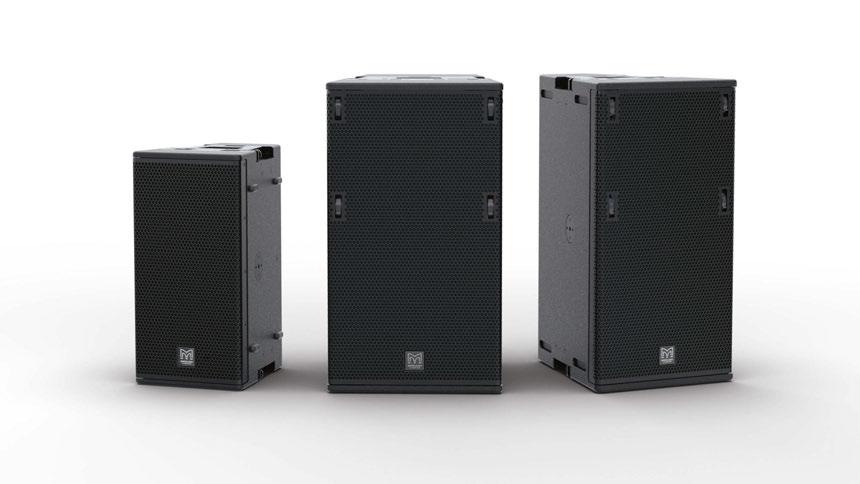
deliver plenty of power over a specified area –combining optimised coverage and SPL profile with cost efficiency.
TORUS cabinets can be arrayed either vertically or horizontally, offering full configuration flexibility to match the coverage and SPL requirements of the venue. TORUS also overcomes issues associated with typical constant curvatures, such as lack of sufficient sensitivity in the mid-band frequency and comb filtering – advancing the constant curvature acoustic concept to achieve new levels of performance and refinement.
“TORUS 12 and TORUS 8 systems feature a phase plug mounted in front of the neodymium LF driver to increase mid-band sensitivity. In addition, they also feature multiple temperature polymer dome neodymium compression HF drivers to deliver greater high-frequency extension with low distortion and better transient response.
“T his combination ensures Martin Audio’s signature sonic performance is not compromised even when driven at higher SPL. They also share similar design and material aspects with plywood cabinets in hardwearing
PU paint and incorporate two pocket handles for easy installation and deployment, as well as fixings for pole-mounting. They are also available in black or white.”
How will the system benefit end users?
“The combination of the phase plug mounted in front of the LF driver and the multiple use of HF frequency drivers – as opposed to a single large compression driver – ensures that the Martin Audio signature sound is not compromised when driven hard. And in the case of TORUS 8, that’s an impressive 126dB peak (crest factor 2) from just a 14kg box.
“T he second aspect is the huge variety in deployment versatility. TORUS 8, with its small size and portability, extends its range of applications from live sound and permanent installations to corporate events, gigging musicians and DJs. It can be used singularly or as a pair, pole mounted, or as an array in vertical or horizontal format with up to six cabinets. It also integrates mechanically with the SXCF115 cardioid subwoofer in flown and ground stack configurations. As such, it can be used as a main PA in small to medium sized events, centre clusters or as sidefills and infills to larger systems. Its flexibility means it’s a box that can be used in multiple applications thereby returning quick ROI for rental companies.
“T here are a variety of rigging hardware and accessories to make every configuration simple to set up. Equally, T820 cabinets also feature an LED indicator that can be illuminated via VU-NET software to identify its location. TORUS 8 has just started to ship and a lot of the early take up has been from rental companies. This means we should be seeing systems on a number of events, tours and smaller stages during the upcoming festival season.”
What has the response been like from the wider live entertainment sector?
“The product was launched at ISE, where we had more than 2,000 people come through our demo room to listen to TORUS 8 in action. The feedback we received from this was overwhelmingly positive, with both the sound characteristics of the box and the flexible nature of its deployment being the two standout features. It meant that we had sold our first four months of production in less than two weeks following the launch.”
www.martin-audio.com
Martin Audio’s Dom Harter lifts the lid on the newest member of the TORUS family…
Some luminaires have the power to transform the ordinary into AYRTON’s latest creation is a luminaire with so many advantages... able to transition from beam to wash light with the greatest of ease. A versatile fixture with amazing, creative effects that makes you want to go even further, to dare, to experiment, to explore... The combinations are endless!
This newcomer to the ZONDA family line comes in an incredibly compact format. Its speed of movement and reduced dimensions increase its dynamic potential. And because of its size, it can be easily used in compositions with light curtains or matrices.

Over the past 15 years, Showforce’s Liverpool office has built a reputation in the live entertainment sector with its key personnel and crew regularly called upon to provide their expertise on global projects.
Previous major events delivered in Liverpool by the Showforce team include Creamfields each year since 2014, Giant Spectacular, Strictly Come Dancing Live Tour, Liverpool International Music Festival, Africa Oye, Neighbourhood Weekender, River of Light, Sports Personality of the Year, Paul McCartney, Stereophonics, UFC, Red Bull Drift Shifters and BBC Radio 6 Festival to name but a few.
This year, Eurovision fever is set to grip the city amid the build for The 151st Open Championship, which will take place at Royal Liverpool in July.

“Geographically, Liverpool is the perfect location to serve the North West and Wales; it’s also in easy reach of the Midlands and Scotland with excellent transport links,” said Showforce’s Senior Account Manage, Becky Meers.

“We’re incredibly proud of our pedigree in the Liverpool office,” she added.
“We have built an excellent reputation and many of our key crew chiefs and crew are regularly called on to assist with projects not just throughout the UK but internationally.”
Showforce Crew Manager, Neil Rodgers has relocated to the Liverpool office and is working alongside Becky Meers. Rodgers will continue to travel to the London office and carry out site visits. Also, joining Rodgers and Meers in Liverpool is Operations Coordinator, Harry McCann. The trio will ensure that the vast swathes of crew required for the upcoming events in the region and surrounding areas will be recruited, trained and prepared for a busy summer season.
A recruitment drive is well underway to ensure that all crew are inducted and receive SPA Health & Safety certification and specific skills training before they are deployed on site.
“As a business, we are completely committed to providing crew from the local area, because not only does it drive local employment while improving skill sets with training and development, but it also reduces the need for transport and reduces our carbon footprint,” Meers reported.
“We are always recruiting for good people; experienced crew chiefs and crew are definitely welcome to apply or anyone who’s looking for a new opportunity. We have an active job board that is updated regularly.”
www.apply.workable.com/showforce-uk
www.showforce.com
Showforce is readying itself for a busy year ahead with the expansion of its Liverpool offices amid Eurovision fever and the build up to the 151st Open Championship.
Max. 20h Wireless DMX App IP65


Beam shaping with six included light modifiers and a large range of mounting options make HydraPanel more flexible than any other product in its class. The full-spectrum Titan LED Engine generates an impressive 1300 Lumen output while running on battery power for 1:45h. All packed into a solid watertight housing of just 600g weight and 166mm length.
17W LED POWER DRAW

WIRELESS + WIRED DMX
Combine units to build a bigger panel

It’s December 2022 and I’ve just done my first full tour of Europe since, to paraphrase the Tories, “Brexit got done.” Spring 2019 was my last one and I was excited. Maybe I’m being a tad whimsical but getting your big winter coat as you head to the truck for load-out, visiting Christmas markets on days off and realising that you didn’t pack any shorts until you’re sweating it out in the reliable warmth of Spain – honestly, you can’t beat it. The good news is, all of that is still there, but there are a few more obstacles we need to avoid – some old, some new.
One thing I will say is – hear me out here –thank goodness for COVID-19. I’m not about to praise the pandemic that completely disrupted our lives and damaged us as an industry. However, I feel that without that unwelcome pause, we would have had an industry hurtling towards a no deal Brexit at full pelt and that could have been potentially disastrous –especially for us touring folk. At least with that unwanted breathing room, we could try to get our heads around it all, even if we are still trying.

One problem is the 90-day rule. No, not a new mind-numbing ITV2 reality show but a damaging regulation that will really affect how we tour mainland Europe. UK citizens can now spend no longer than 90 days in a 180-day period in the Schengen area. The bonus is that it works on a rolling timeframe but as a crew, we don’t really have the option on when shows get booked. Many of us rely on regular EU touring,
and if you end up having a busy European festival season, you can be a victim of your own success and limit your work options for the rest of the year.
From November 2023, the mandatory ETIAS scheme will be introduced for non-EU members. It’s a visa waiver scheme, very similar to the ESTA that holidaymakers need for the USA. This sounds like good news but it will just monetise and legitimise the 90/180 days rule and, I believe, make it easier for authorities to track this. What can maybe be gotten around right now with the use of a second passport may not be possible in a few months. This didn’t affect anyone on my tour but led to many perplexing conversations in catering and worries over future work.
So, what else? As the Beastie Boys might say, “Listen up y’all, it’s a Cabotage.” The rules have changed regarding trucking and for this, the government has resurrected the word “Cabotage” from the 18th Century – or they possibly just overheard Jacob Rees Mogg describing his daily commute. This means UK-registered trucks can now only make up to three stops in the EU before having to return to the UK – a move helpful for only the shortest of tours. Trucking companies have taken steps to register in Europe to get round this but it’s both time consuming and expensive. Of the three trucks on our tour, only one had Irish plates, so we had two Polish drivers until the last show when our UK trucks returned for the journey
home. Previously unnecessary hoops to jump through with increased costs, restrictions for UK drivers and limiting truck capacity.
The return of carnets has been a hot topic since Brexit but, in truth, they never went away. Where in the past, a customs officer may have shrugged when you said you needed your carnet stamping, now that same representative will be certain that you absolutely need a carnet no matter what. They still won’t know how to fill it in properly and will become irate when you point out how to do it, but they’ll be insistent. After a recent trip from Ireland to Barcelona via Heathrow with a couple of Peli cases, I can assure you that trying to explain that the border is actually in the Irish sea to Spanish customs is not worth anyone’s time. Unnecessary stamps filling up blue passports, additional police checks on tour buses and long queues at passport control are new annoyances.
The biggest worry from my recent tour was that no UK-based support band could afford to come and do it. With the increased costs due to Brexit and a cost of living crisis, will it just be the privileged few who’ll be able to afford to do this? It’s clear that the UK music industry needs Europe. Future festival headliners need it to hone their act and crews need it to earn a living. If the past few years have shown us anything, it’s that you can’t write off this industry and these problems may all become the norm, but if it starts affecting new talent coming through, that’s not good for anyone.
Fresh from handling production manager duties on a European run, Duncan Ladkin provides a frank account of the reality of touring the continent post-Brexit.


Juan Jose Vila, Equipson COO, AFIAL President, and BikeFest member, shares his optimism for the future of the live entertainment sector post-ISE 2023.
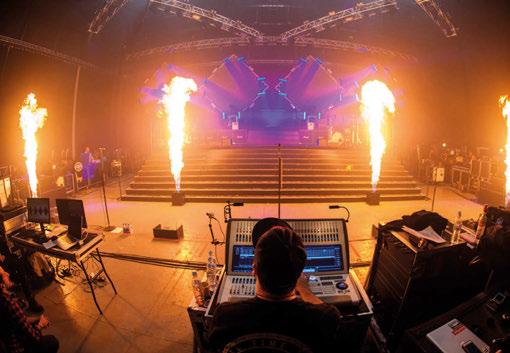

What were some of your goals going into ISE 2023?
“We had several important goals for ISE. These included: Equipson’s new brand strategy. We have been building a strategy based on vertical independent brands (WORKPRO for audio, LightShark for lighting control, FANTEK for lifting and staging, etc.) for some time. At ISE 2023, we were able to highlight the final structure by showcasing the various brands, as well as renewing Equipson’s own brand. We believe these developments and the new image for our WORKPRO brand were well received by our customers and visitors. This revamped image was also received well.
“In addition, we launched the LS-CORE iO, the first lighting console designed for integrators, which received a lot of attention and was even noticed by the King of Spain who visited our booth. The debut of SYNTHEA amplifiers were another draw to our stand as they offer built-in DSP managed by an integrated web server and the new Integra DSP matrix systems, as well as to highlighting the completion of the WORKPRO range of outdoor loudspeakers with IP65-rated subwoofers, and the new NEO Marine for sea waterproof situations.”
How does it feel to have ISE hosted in your home country?
“Obviously, it is very good for us as it is much easier to attend a show in your own country. The only downside is that we attract a lot more visitors, so we need more space on the stand and more staff to cope with that. This year, we brought our entire national sales team, but it was worth it. Of course, having the show in Barcelona was even more special to me because I rode there from Valencia on my bike to raise money and awareness for BikeFest.”
What are your thoughts on the year ahead?
“I believe 2023 will be a fantastic year, particularly for the live events sector, as many rental companies that I have spoken to are saying they are already booked for almost the entire year. However, we also need to address challenges like the lack of components crisis, which is still alive, the effects of the war in Ukraine and the incredible inflation levels that most of Europe is struggling with. There are too many variables to predict what 2024 will be like, but for now at least I can say with some certainty that 2023 is looking good.”
Has this year’s show reaffirmed the importance of tradeshows?
“I have always believed tradeshows are important – that’s why we never stopped exhibiting at ISE, and why we even supported ISE in 2021 when only a few companies and attendees made it to the show. We all know how to have a meeting via video call, but you still need the in-person interaction. I have seen many situations when it takes ages to close a deal until you sit down with the customer face to face – then you close it in minutes. There are things you just can’t do with a video call, and that’s why it is so important to have tradeshows.”


Cesar Caceres, Product Lead at Brompton Technology, looks to the future of LED processing, following the release of the world’s first receiver card capable of delivering 1 million pixels, RGBW and 1,000 frames per second.
Brompton Technology’s release of Tessera G1 is set to disrupt the LED industry. As the first receiver card to support 10Gb fibre connections direct to the panel. The Tessera G1 is also capable of supporting a staggering one-million-pixel capacity for a new generation of ultra-fine pixel pitch panels, or up to 1,000 fps (frames per second) to get the fastest esports experience or to enable slow-motion in-camera visual effects without artefacts. This is made possible by a 20x increase in computing power compared to its Tessera R2+ receiver card.
This innovation marks a major advance in the company’s mission to push the boundaries of what is possible with LED video processing technology. With the G1 receiver card, users can expect an increased level of realistic visual performance. “Video is evolving in many different ways, one of the things we discovered amid the COVID-19 lockdown was that virtual production became really important. By putting a camera in front of LED panels, we could find a lot of less than ideal artefacts happening,” Brompton Technology Product Lead, Cesar Caceres explained. “By fixing this, we have improved processes incredibly and that is now helping other industries like live events greatly – providing even better quality video, dynamic ranges, and more.”
Tessera G1 provides flexibility for creatives to do something new with LED and create immersive experiences. “Now, everything is blending, which is one of the beautiful things about video. Lighting and video, live events and virtual productions are now more closely linked than ever before, to create new immersive experiences,” he added.
With Tessera G1, Brompton Technology is expanding on this concept, by taking new
technologies and making them “bigger, faster, and better” – something Caceres believes is what live entertainment audiences want to see and end users desire.
“We are able to provide end users with an incredible processing power to be able to create projects with ultra fine pixel pitches, and better colour accuracy and targets, to create depth and more immersive experiences for audiences,” he explained, noting its aim of giving end customers choice – and supporting the panels they want to use.
“T here are certain LED brands in the market that offer ultra-high pixel pitch panels. Some of these brands have a closed ecosystem, while others require multiple receiver cards to operate these panels.
“W ith the G1, it will be possible for a much larger number of brands to use these panels and take advantage of their amazing features to enhance their shows.“
Following a successful launch at ISE Show 2022, Caceres emphasises that the company’s Tessera R2+ receiver card is still positioned to deliver performance for a vast majority of LED fixtures. In fact, thousands of projects worldwide continue to use LED panels integrated with R2+ cards with great success. Whereas the G1 is the choice for next-generation panels.
“We are definitely not forsaking the R2+ card and all its impressive capabilities,” Caceres stated. “We are simply recognising the rapid advancements of LED video technology. As a company, we are proactively positioning ourselves to meet and exceed the future demands of our industry.”
Caceres notes that the benefits are not only about the substantial increase in pixels that can be processed thanks to the new card, but that
it will also facilitate the integration of additional calibrated channels, which Brompton defines as RGBW, Red, Green Blue and Whatever.
“We anticipate this to be one of the most appreciated features in live productions. The W in RGBW stands for Whatever, not White. When you ask people what extra emitter they want to put into a panel, each person will have a differing opinion, so we wanted to provide panel manufacturers the opportunity to experiment with what they perceive as the best choice,” Caceres continued.
When it comes to in-camera visual effects, LED panels often contribute to lighting the scene, so having additional light emitters in the LED panel represents a significant leap in colour-rendition accuracy on skin tones and foreground elements blending with virtual environments.
Another pioneering feature of the G1 receiver card is its capability to support a 10 gigabit connection, thus providing tenfold the bandwidth of the current R2+ card and positioning the G1 as a ‘future-proof’ solution.

“I started my career in live sound and somehow stumbled into the world of video because the development never stops. We will always have something new, bigger screens will always take all the headlines, but providing finer pixel pitches and an expanded gamut of colour thanks to RGBW is going to transform live entertainment and bring new and exciting industries into the world of LED processing.
“T hese could be things which we can’t foresee, like simulation, because the potential to recreate reality with LED is going to get more sophisticated as time progresses. If you can recreate reality using LED, then the possibilities are endless.”
www.bromptontech.com
Words: Jacob Waite• Powerful Class D amplification
• High-quality robust build
• Ultimate versatility: DJ sets, live music, speech, studio monitoring
XPRS102 and XPRS122 full-range speakers

4 DSP modes + 16 customizable DSP settings
Accurate audio performance
10" woofer & 2.5" voice coil
12" woofer & 3" voice coil
Outstanding frequency response and SPL
XPRS102: 50 Hz – 20 kHz, 129 dB max. SPL
XPRS122: 48 Hz – 20 kHz, 131 dB max. SPL
XPRS1152S and XPRS1182S active subwoofers
3 DSP modes
Accurate audio performance
15" ferrite woofer & 3" voice coil
18" ferrite woofer & 3" voice coil
Outstanding frequency response and SPL
XPRS1152S: 45 Hz – 120 Hz, 129 dB max. SPL
XPRS1182S: 40 Hz – 120 Hz, 130 dB max. SPL










Founder of Music Industry Therapist
Collective and Editor of Touring and Mental Health: the Music Industry Manual
What was the idea behind Touring and Mental Health: the Music Industry Manual?

“I tour managed Anna Calvi across Europe on the Grinderman 2 Tour in 2010. I realised that I had been sending bands I was managing out on the road and underestimating the toll it might take on them.
“L ate nights, changeable sleep environments, stress, travel and stimulation contributed to sleep deprivation. Quite quickly, I became bored of living off party food, but we had very little money and, as I was stressed, I wasn’t making good lifestyle choices. I was getting ratty. I often think back to our wonderful and very patient sound engineer, Rich Burt – he put up with a lot!
“I met people along the way who missed the children they’d left at home, and I started to realise that *some* of the acting out, excess and withdrawal I’d witnessed for years backstage was a response to the stressful conditions touring people were enduring. As I say a lot when I’m public speaking, even before you consider the stressors touring brings, it takes you away from resources and protective factors like the people, places, and practices that usually help you feel stable.
“After a stint at Metropolis Studios as Events Manager, I made the leap and decided to retrain as a psychotherapist. In 2016, I started to examine the psychological impact of touring as my MA research and I’ve been doing that ever since. The book is a culmination of six years of research and features original interview material with 80 or so touring professionals and artists.
“W hen Michael Rapino at Live Nation offered sponsorship, I brought on board a team of specialists writing on trauma, stress, addiction (including sex and porn), nutrition, sleep science, hearing health, vocal health, sexual health, general health, various forms of anxiety (including performance and fear of flying), exercise, meditation, breathwork, group dynamics, anger management, mindset… You name it – we’ve covered it!”
Hopefully, this book will facilitate conversations about doing things differently and it gives people some suggestions for how to tour in a more sustainable way.
Tamsin Embleton, Founder of Music Industry Therapist Collective and Editor of Touring and Mental Health: the Music Industry.
Do you hope the manual will be referred to by the music industry in years to come?
“Hopefully, this book will facilitate some conversations about doing things differently and provide people with some suggestions for how to tour in a more sustainable way. Maybe it will help people understand that touring can be a wild and fun adventure, and a great opportunity to hone your craft, meet your fans and bring your records to life, while simultaneously being very stressful to mind, brain, body and relationships. It’s not either/ or – it’s both. Cumulative stress takes a toll physically and psychologically.”
Where can people pick up a copy?
“It’s available globally via Amazon. In the UK, you can buy it in Rough Trade, Waterstones and Omnibus Press. If you’re based in the UK, and you’re quick, you can nab a discount via the publisher, Omnibus Press. For 20% off one to five copies, use the code: 5KGX7W839H0Z at checkout. For a 25% discount on orders of five books or more, use the code: ZRMB3XZQXGGM at checkout.”
www.omnibuspress.com
www.musicindustrytherapists.com
Buy from the same batch as AED group’s rental inventory with instant availability


FULL CARBON FRAME CURVING CAPABILITY ±10° MODULAR DESIGN





HANGING & STACKING FRONT & REAR MAINTENANCE 90° CORNERS
FULL TOURING SYSTEM ALLOWABLE WIND SPEED +20M/SEC COLLAPSIBLE WIND BRACING redotled.com

The Adamson Fletcher Machine Remote software offers an easy-to-use yet complete set of mixing functionalities, including EQ, compression, auxiliary sends, and much more. To learn more about the Adamson Fletcher Machine visit our website at www.adamsonsystems.com


Sends on Fader for Speakers, Aux, Reverb and VCAs


Dedicated Page for Solo in Place

Custom Fader Page Mixdown


