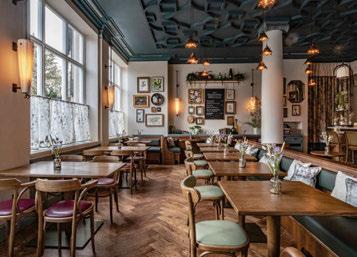
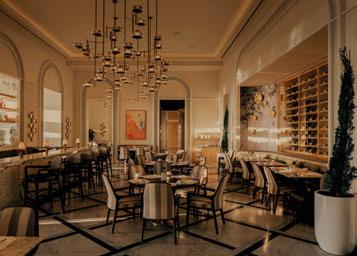
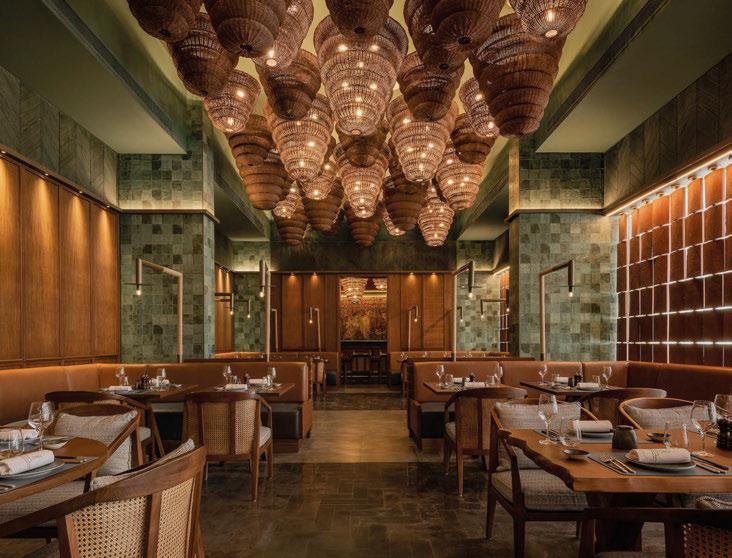
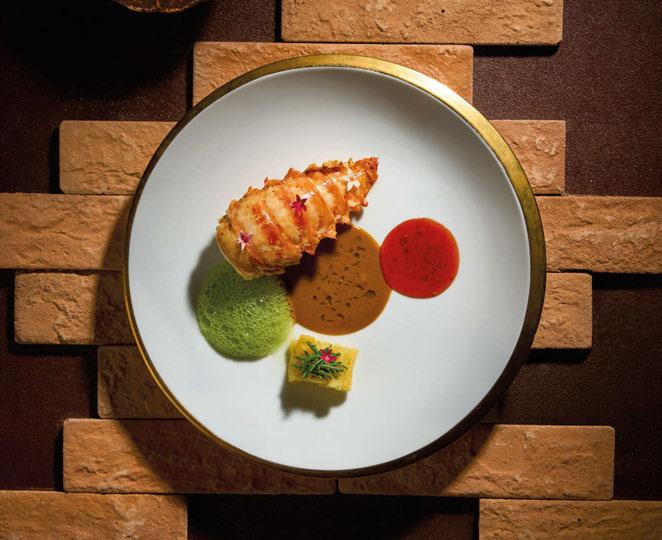
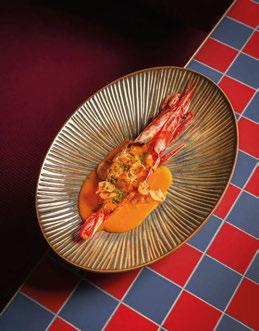
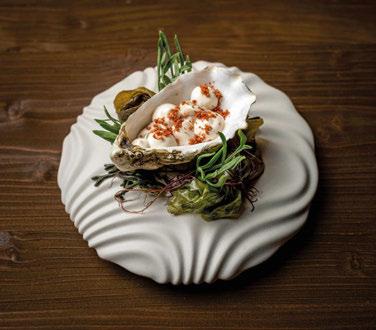
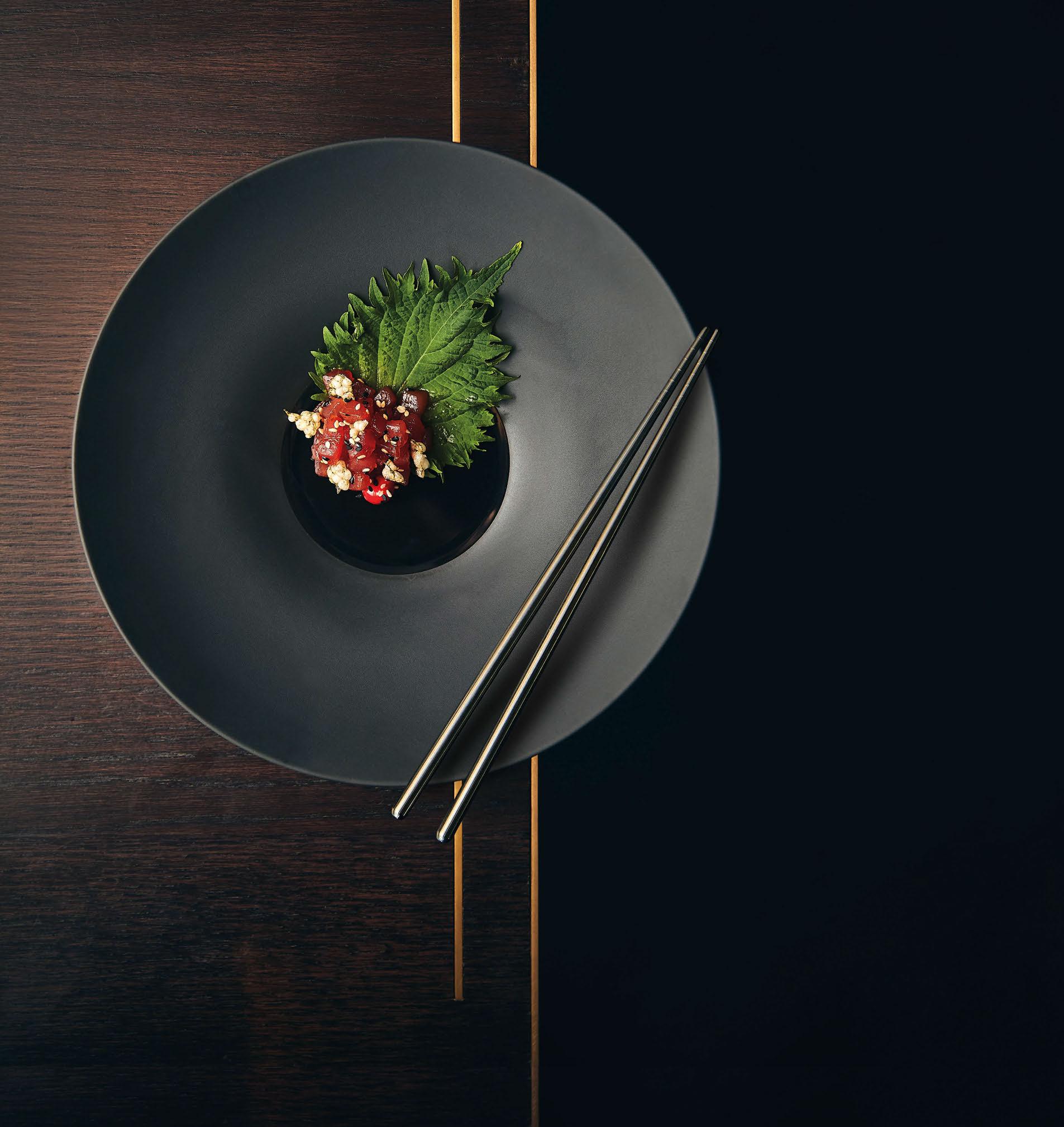
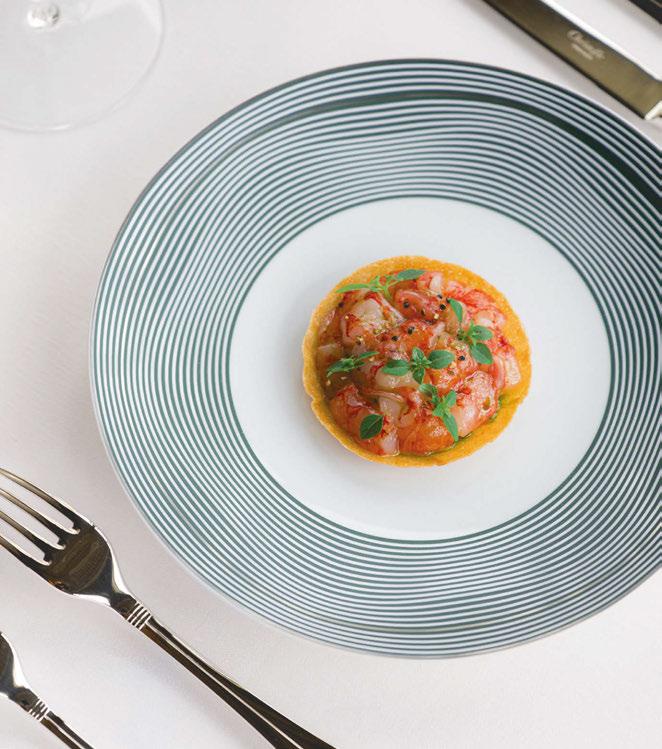
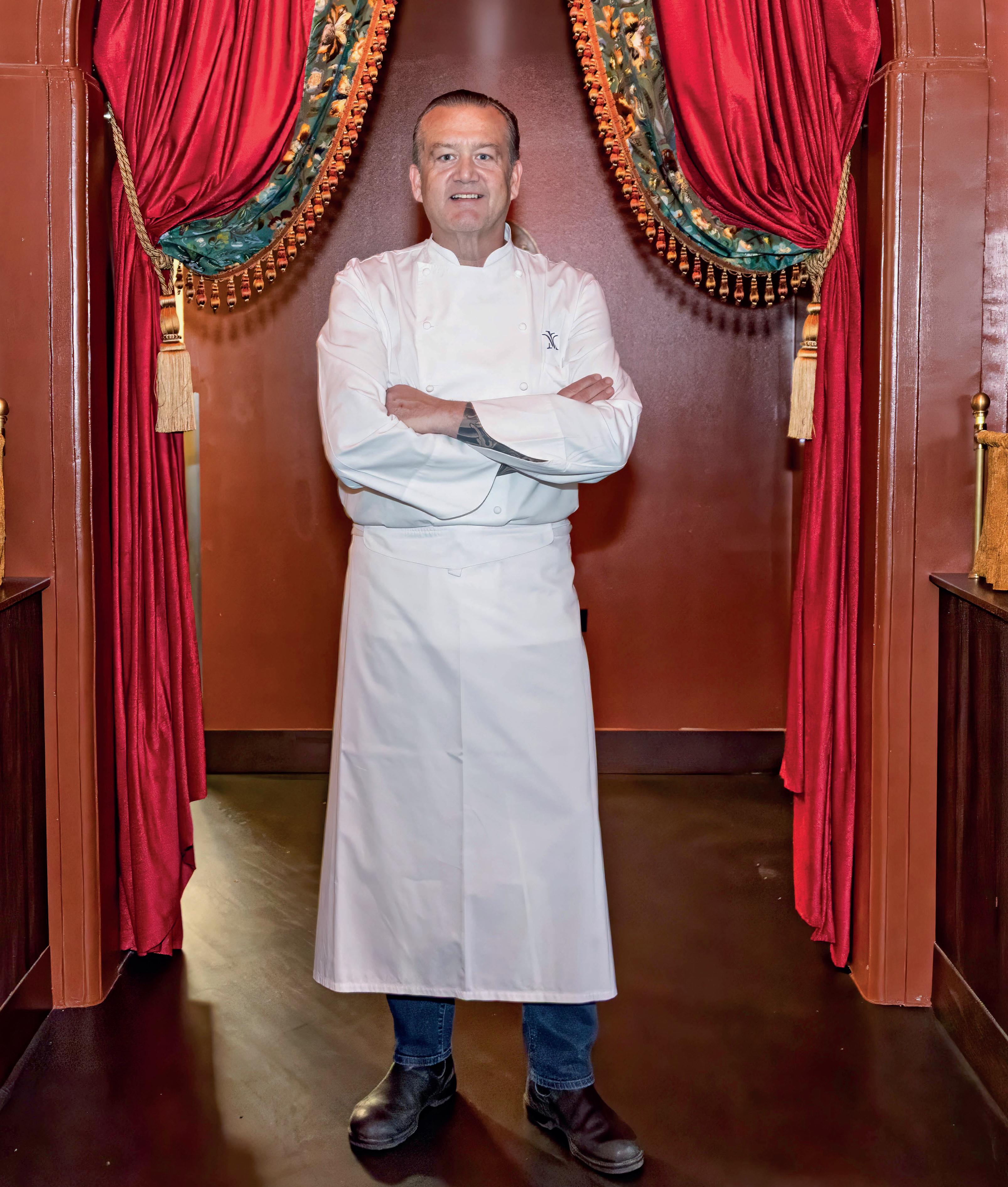
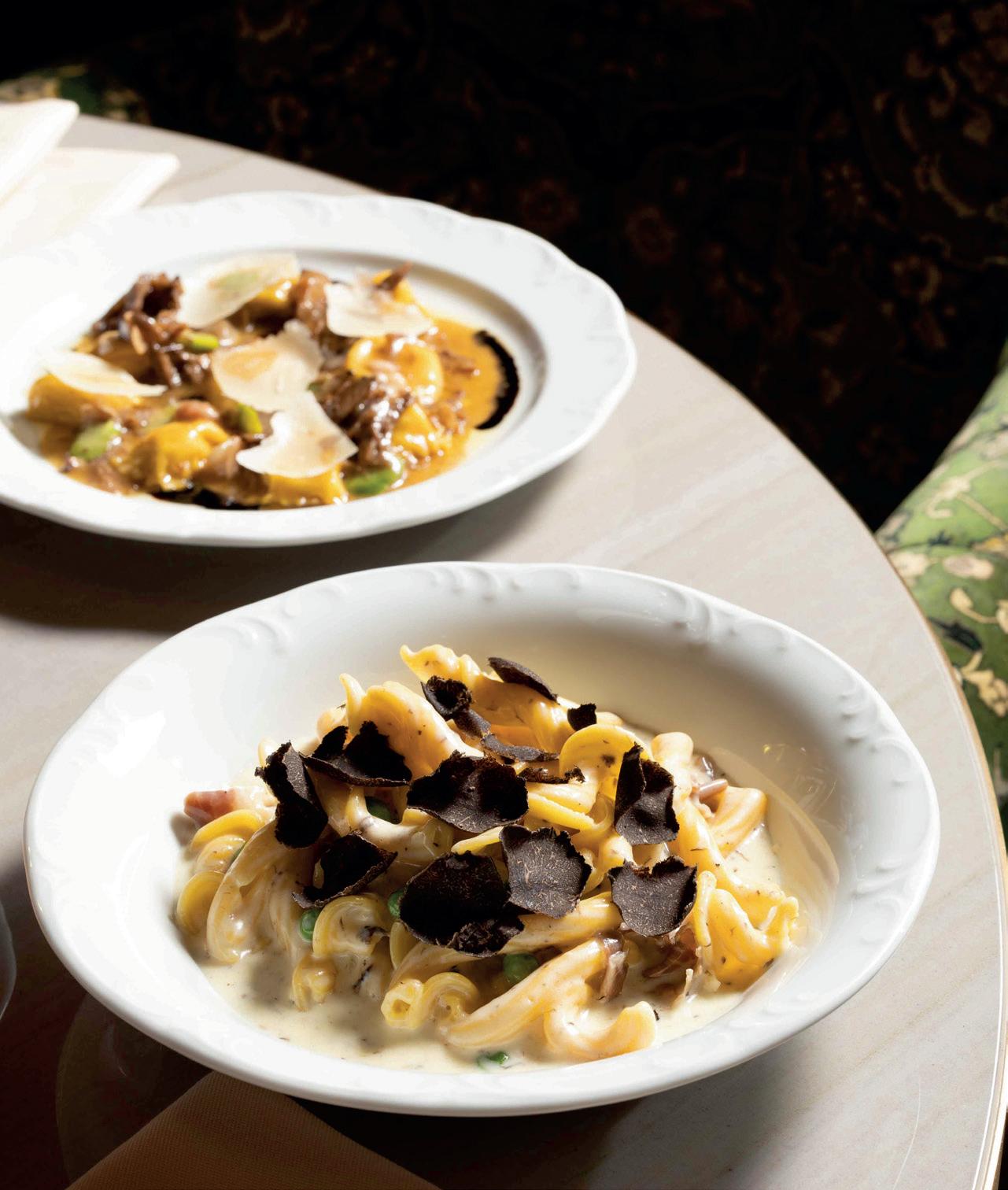
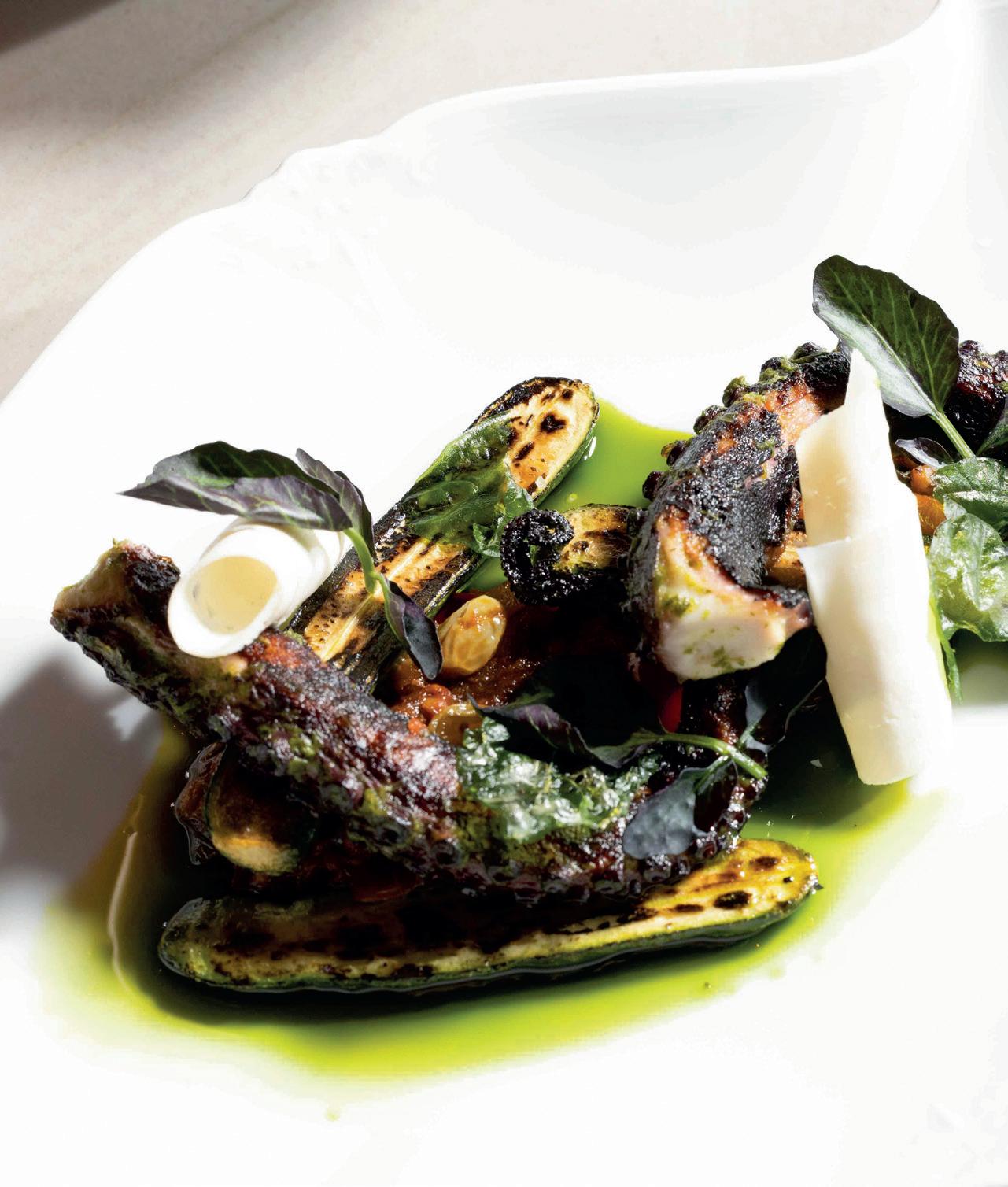
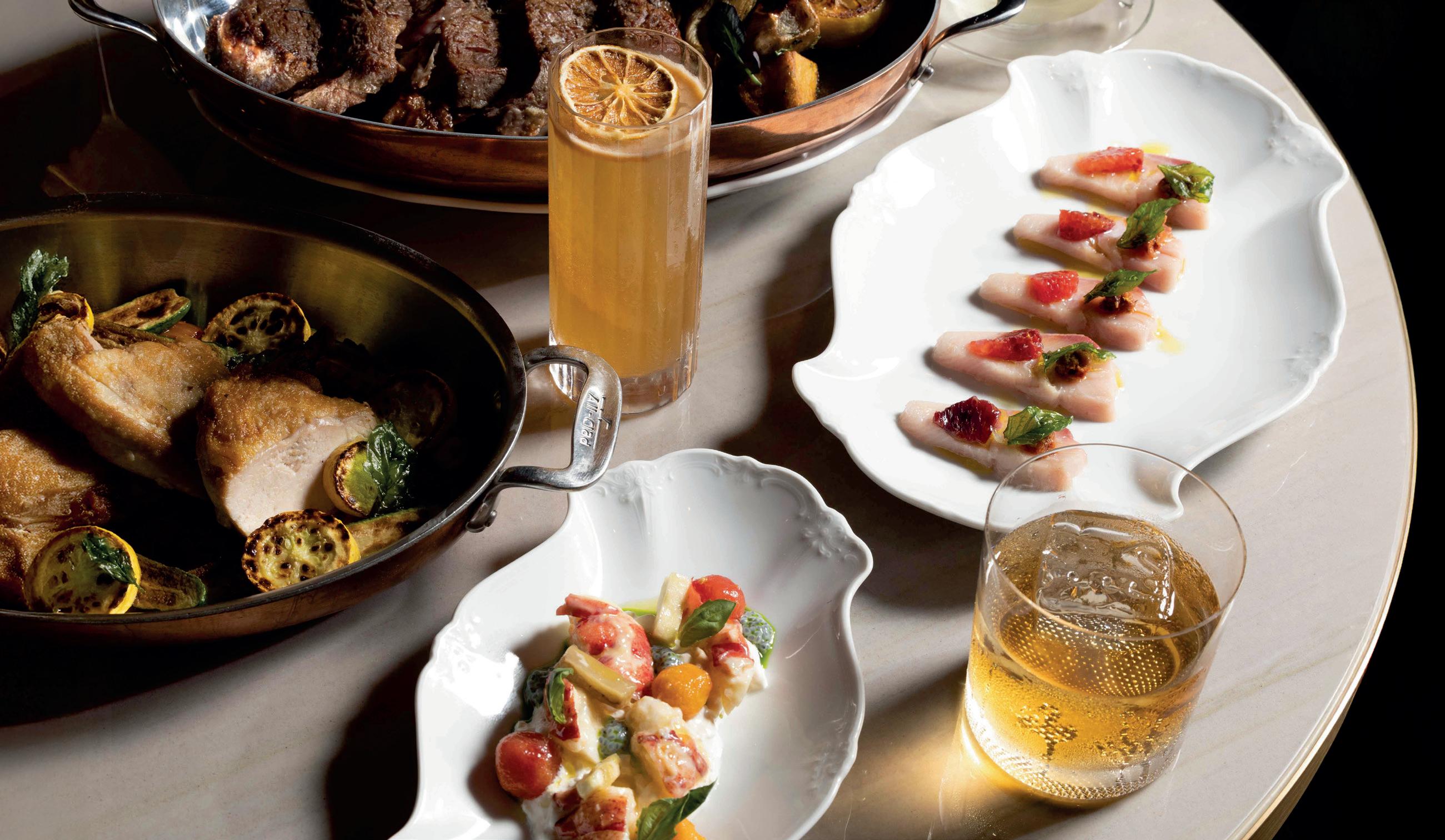
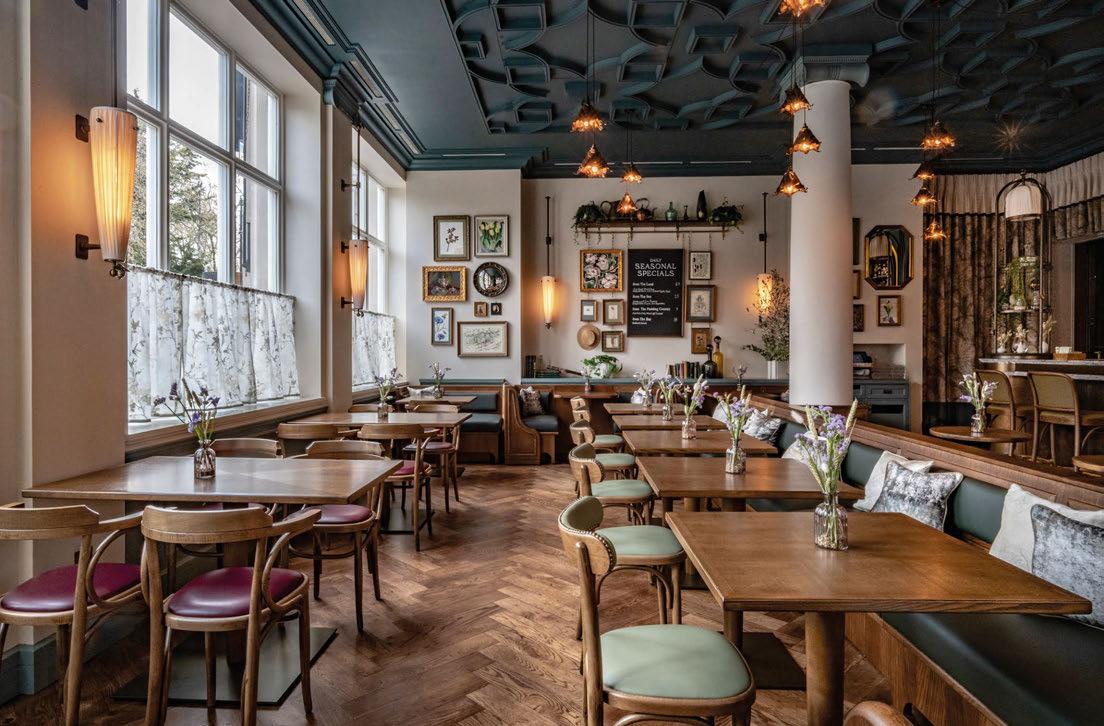
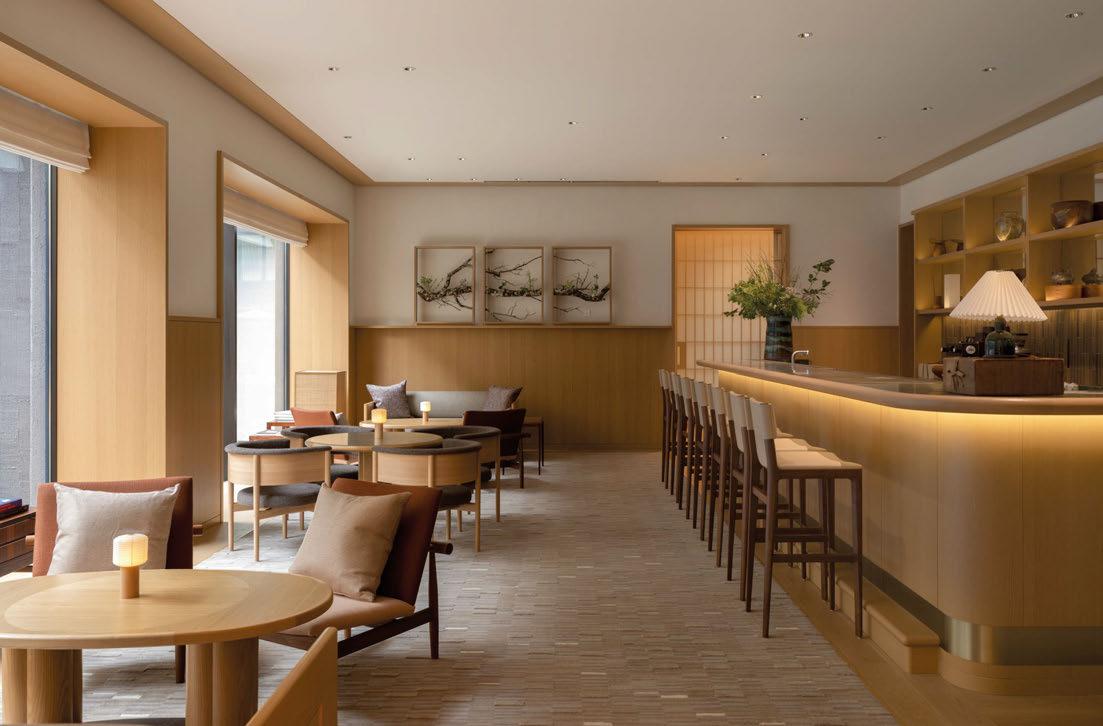
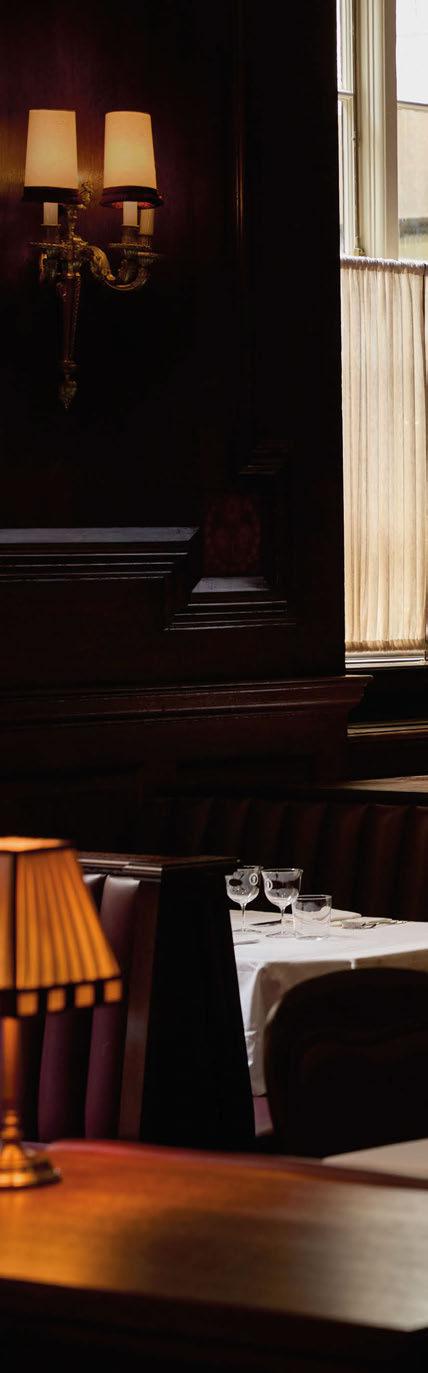
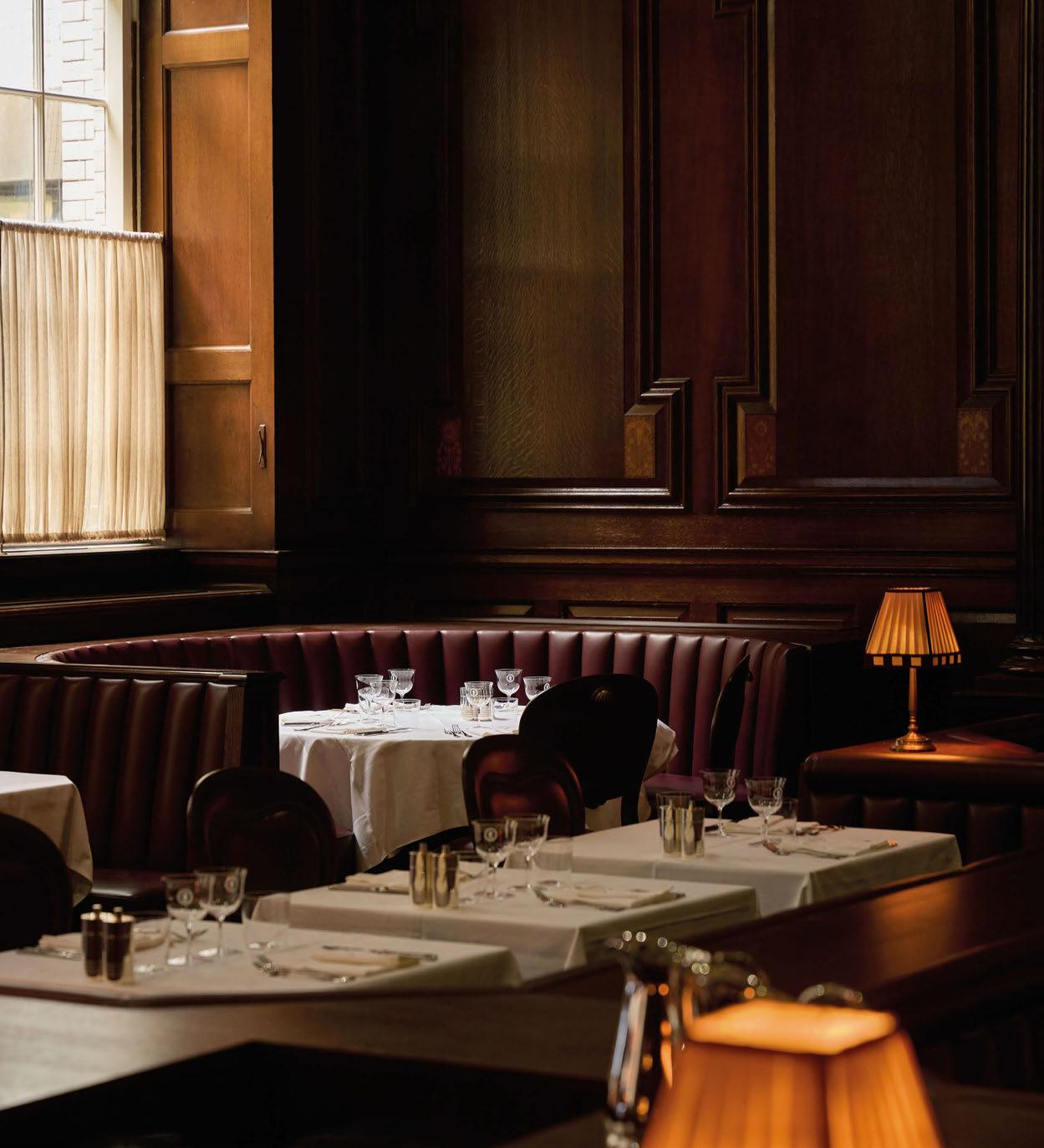
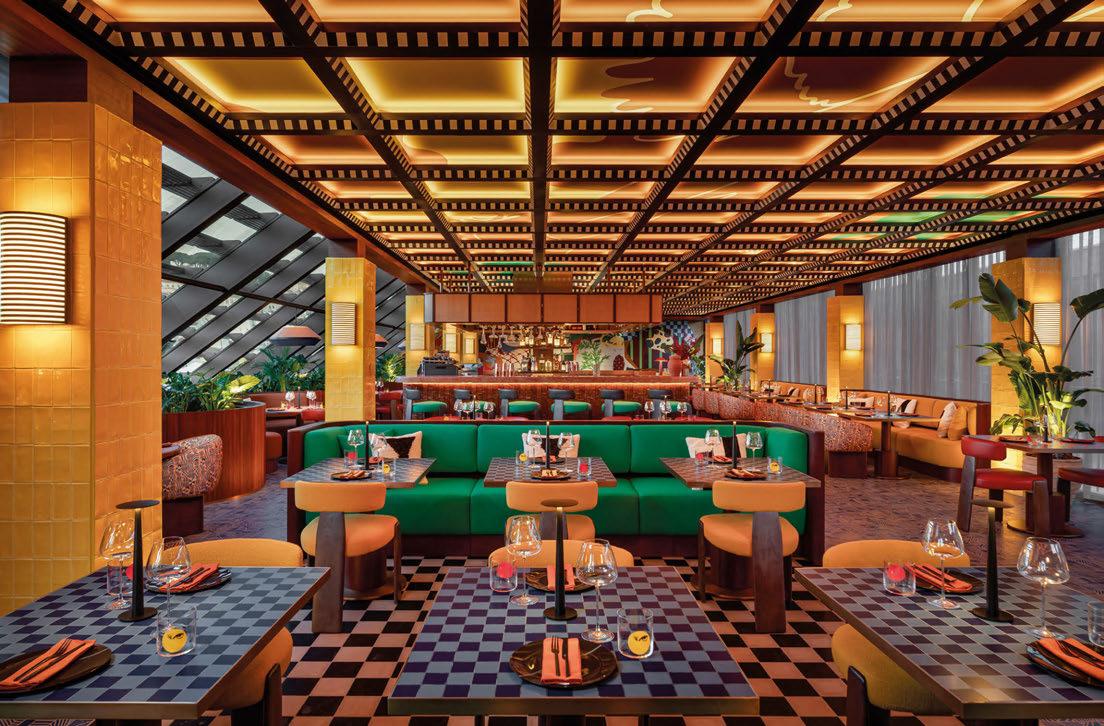
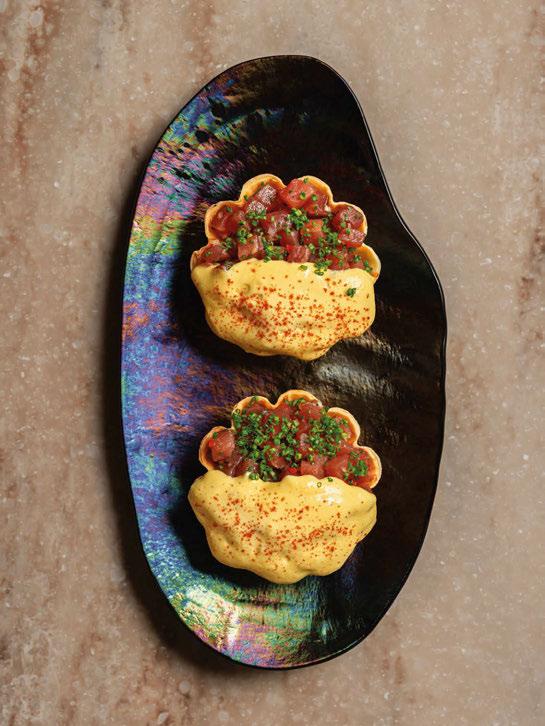
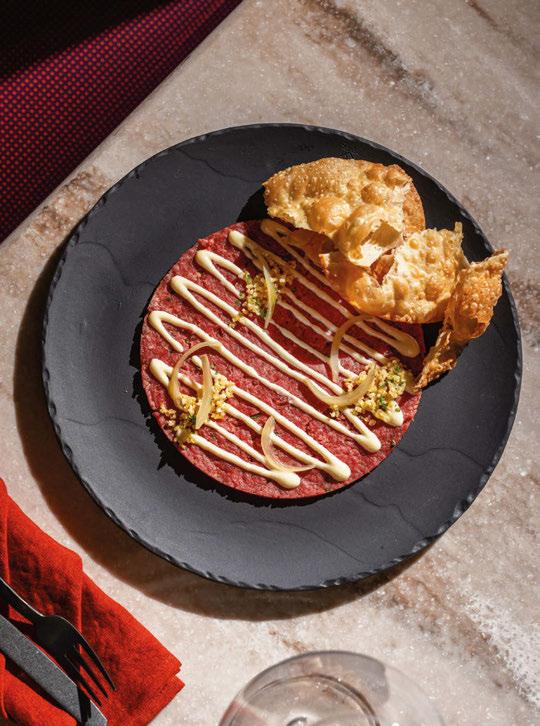
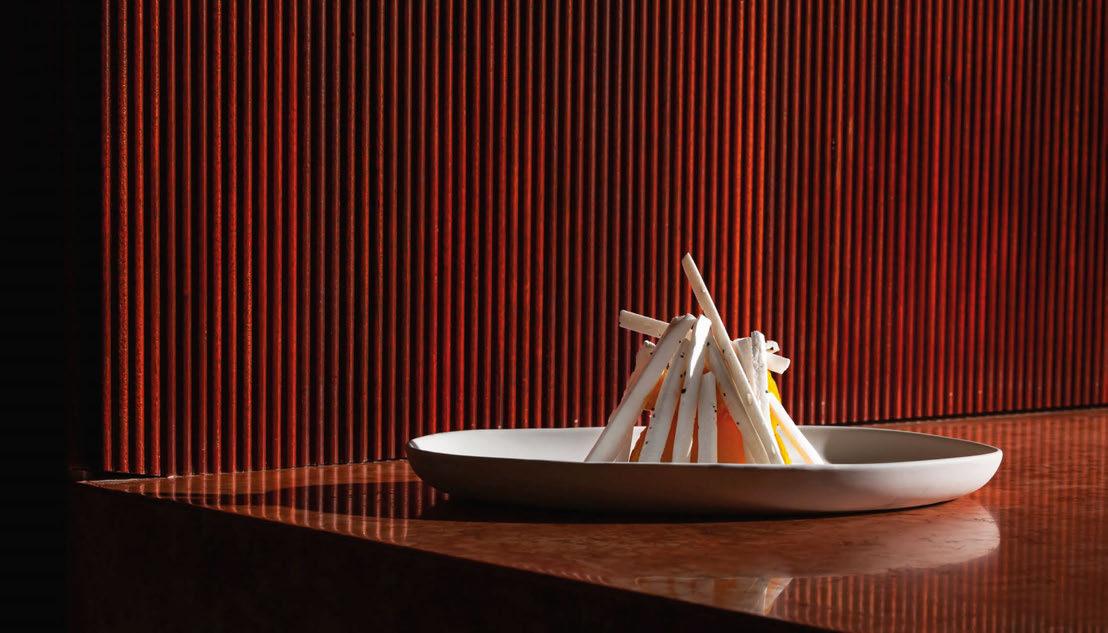
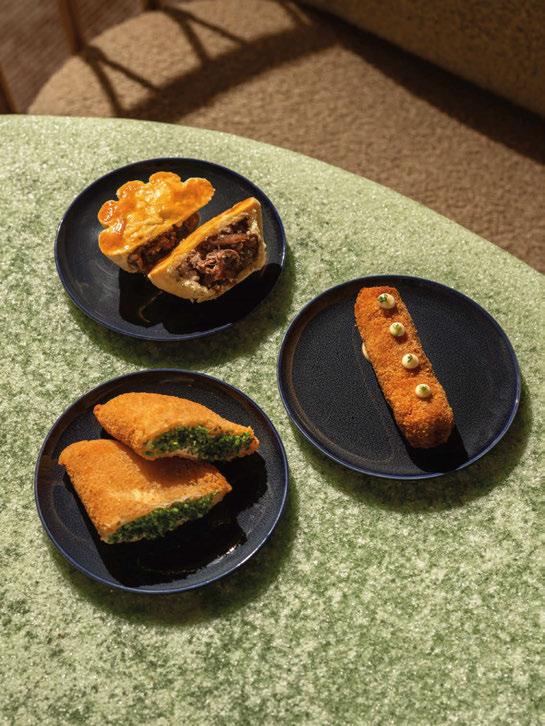
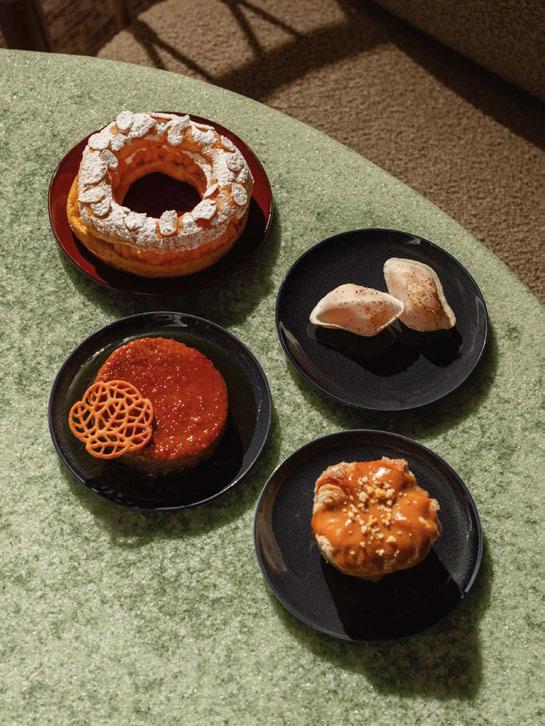
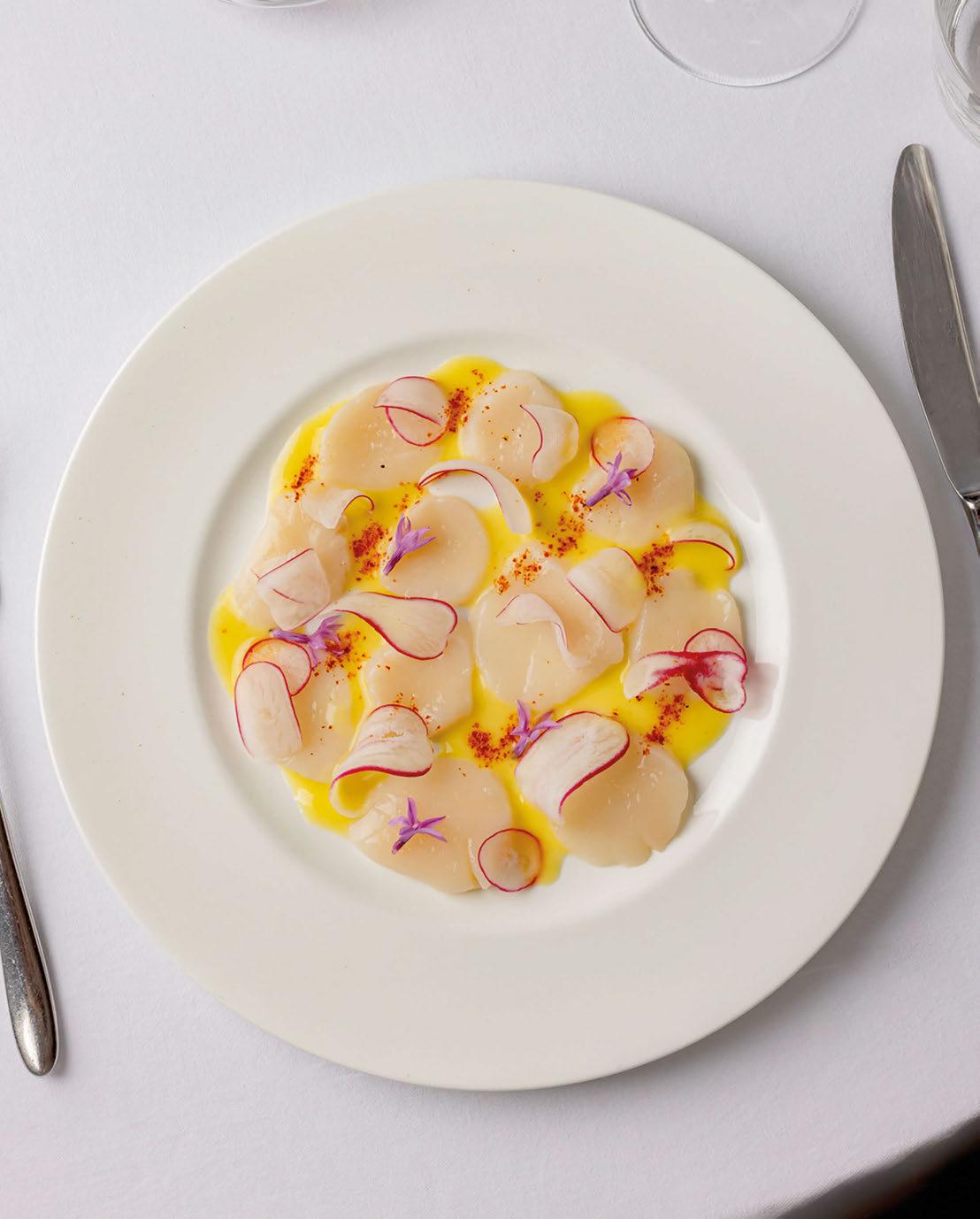
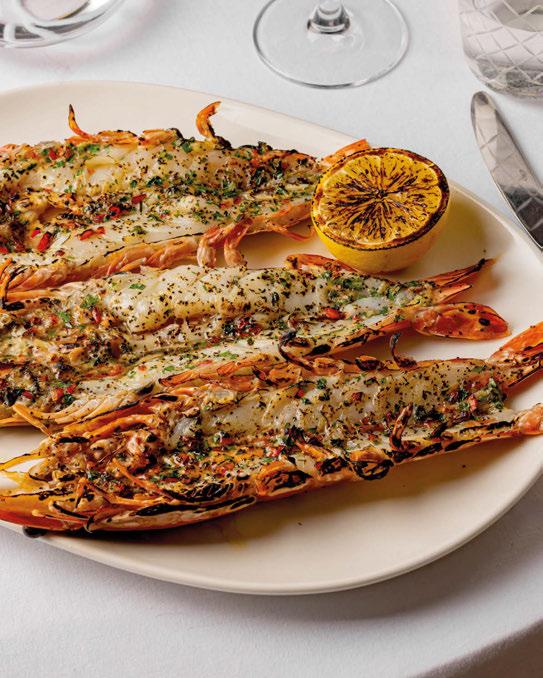
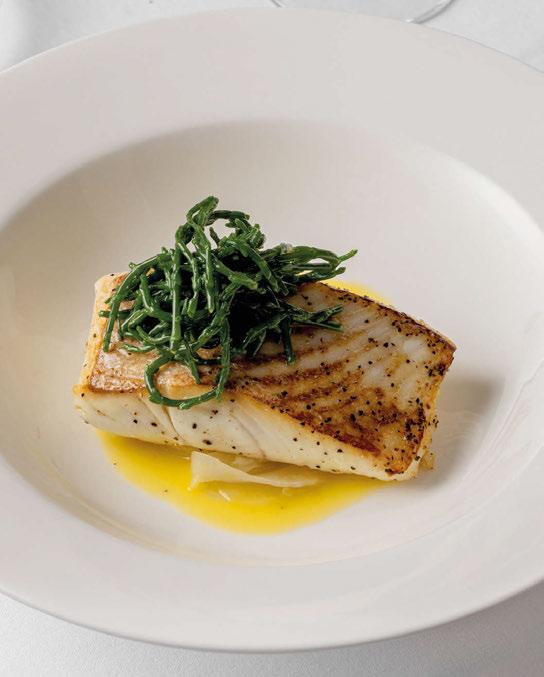
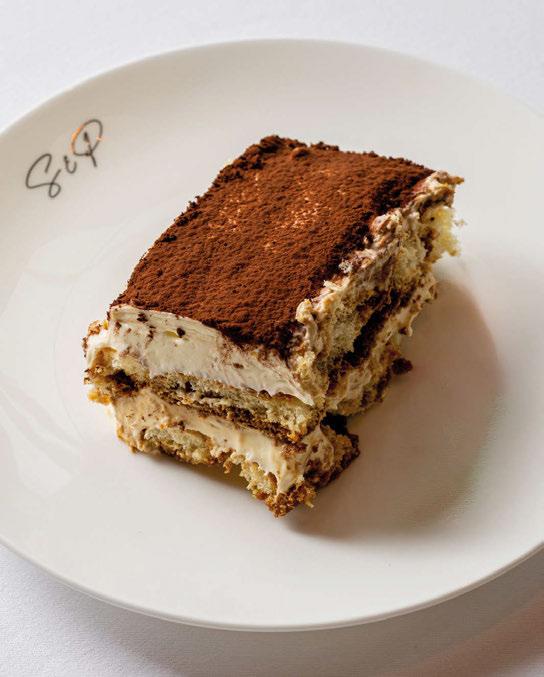
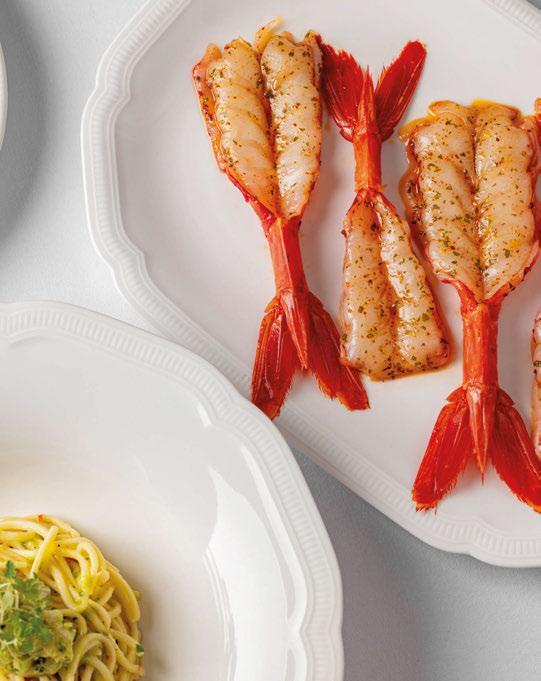
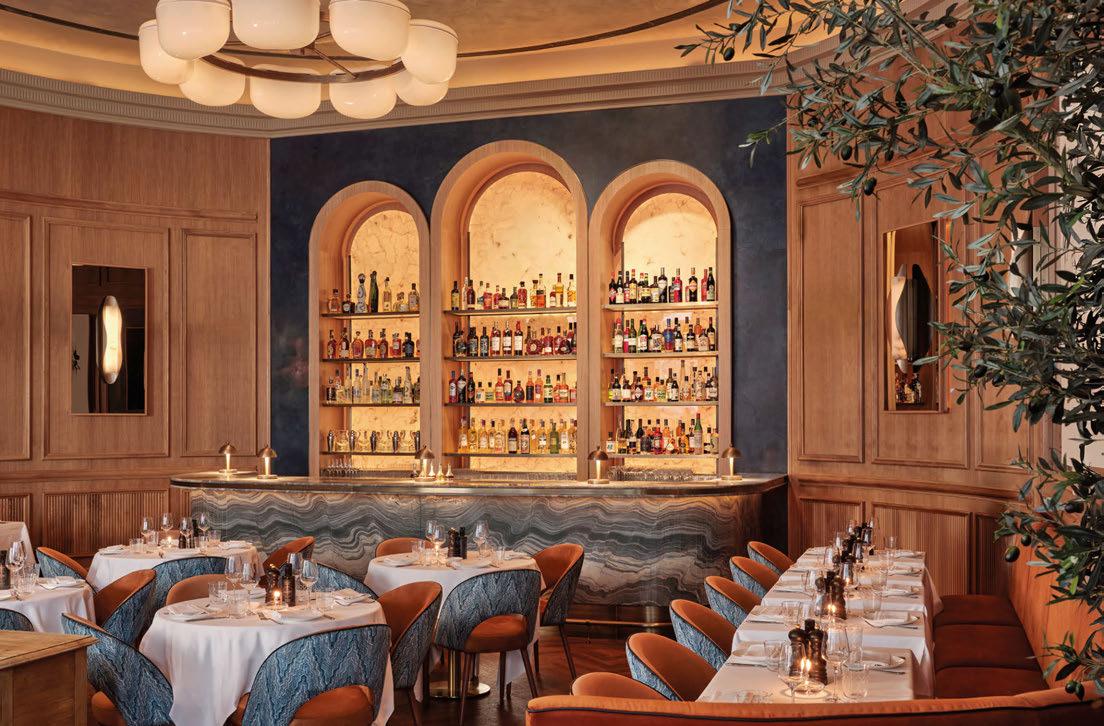
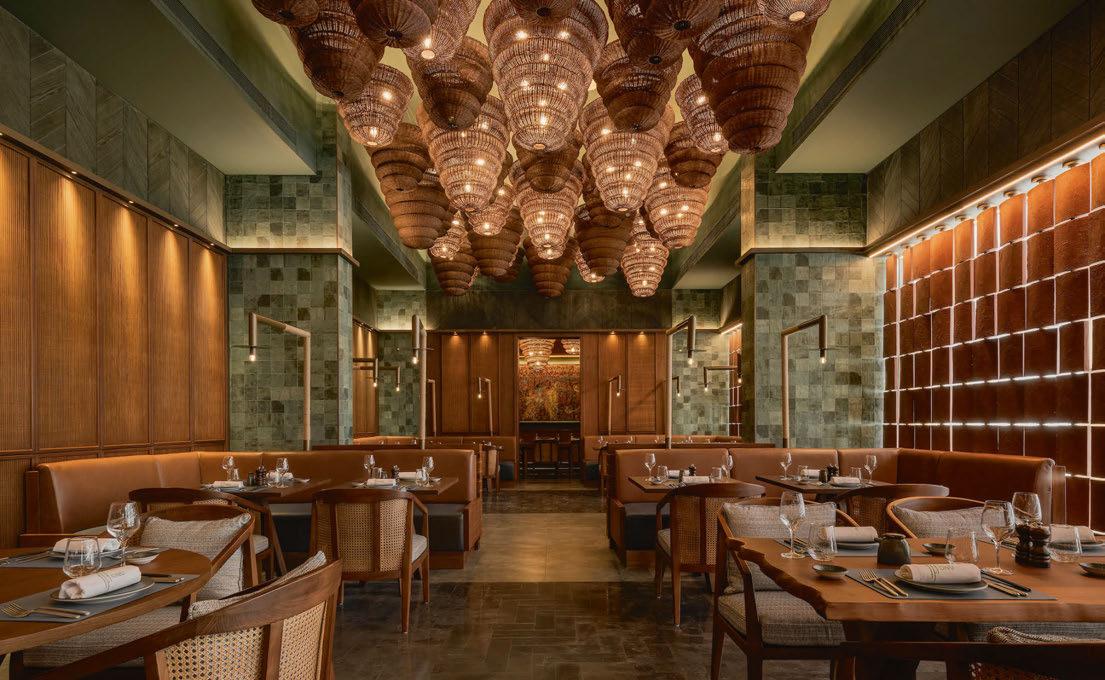
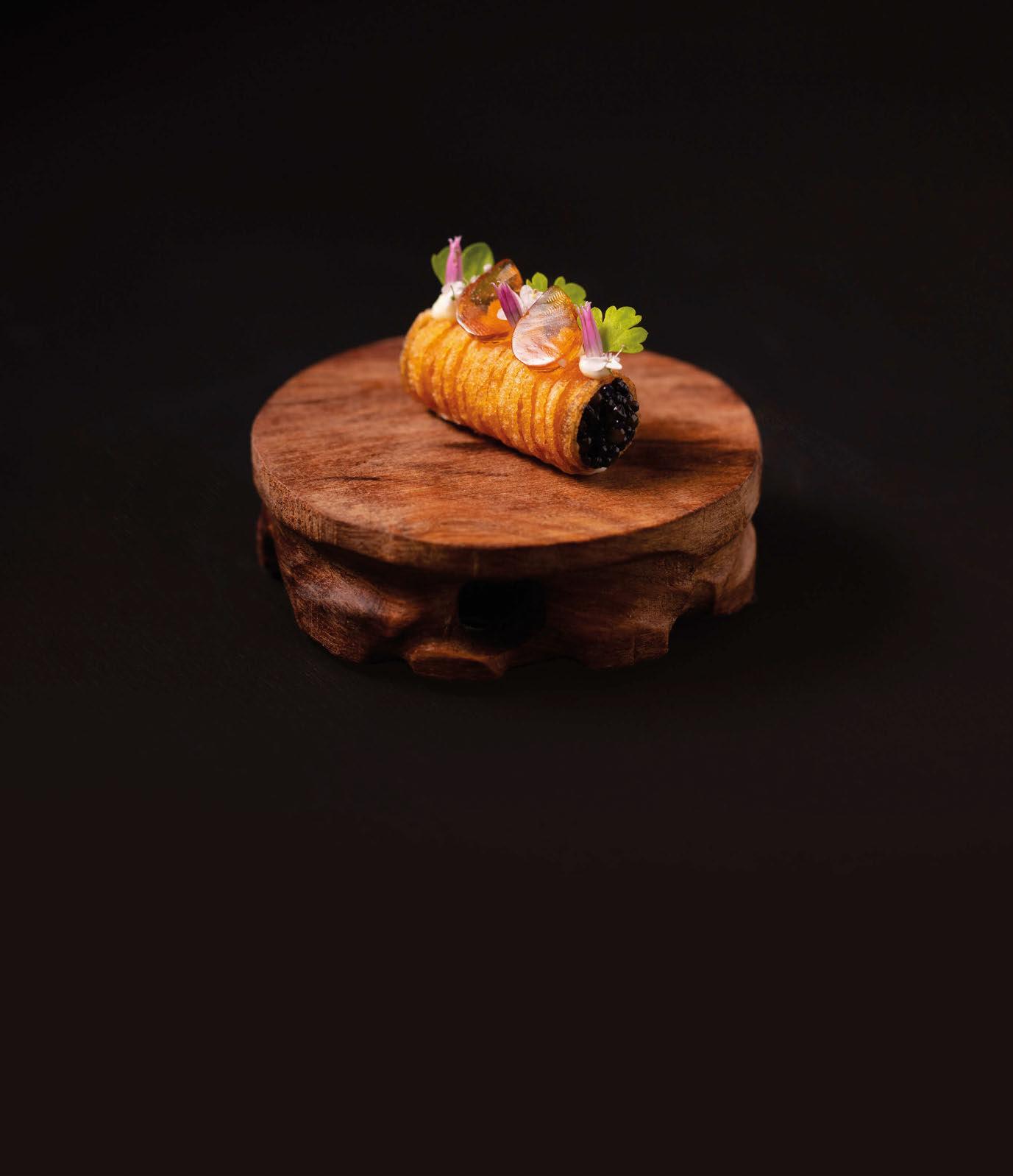
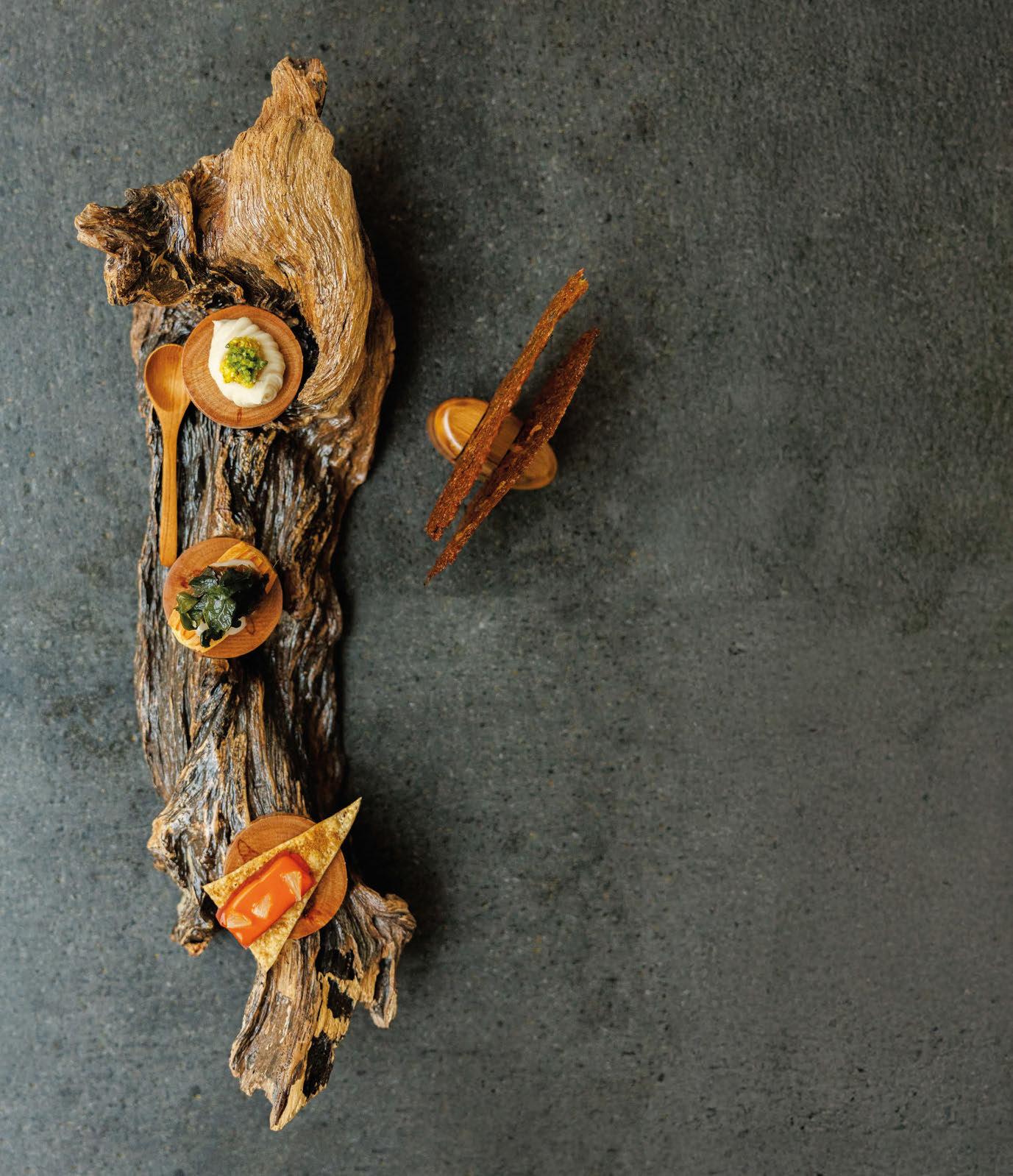
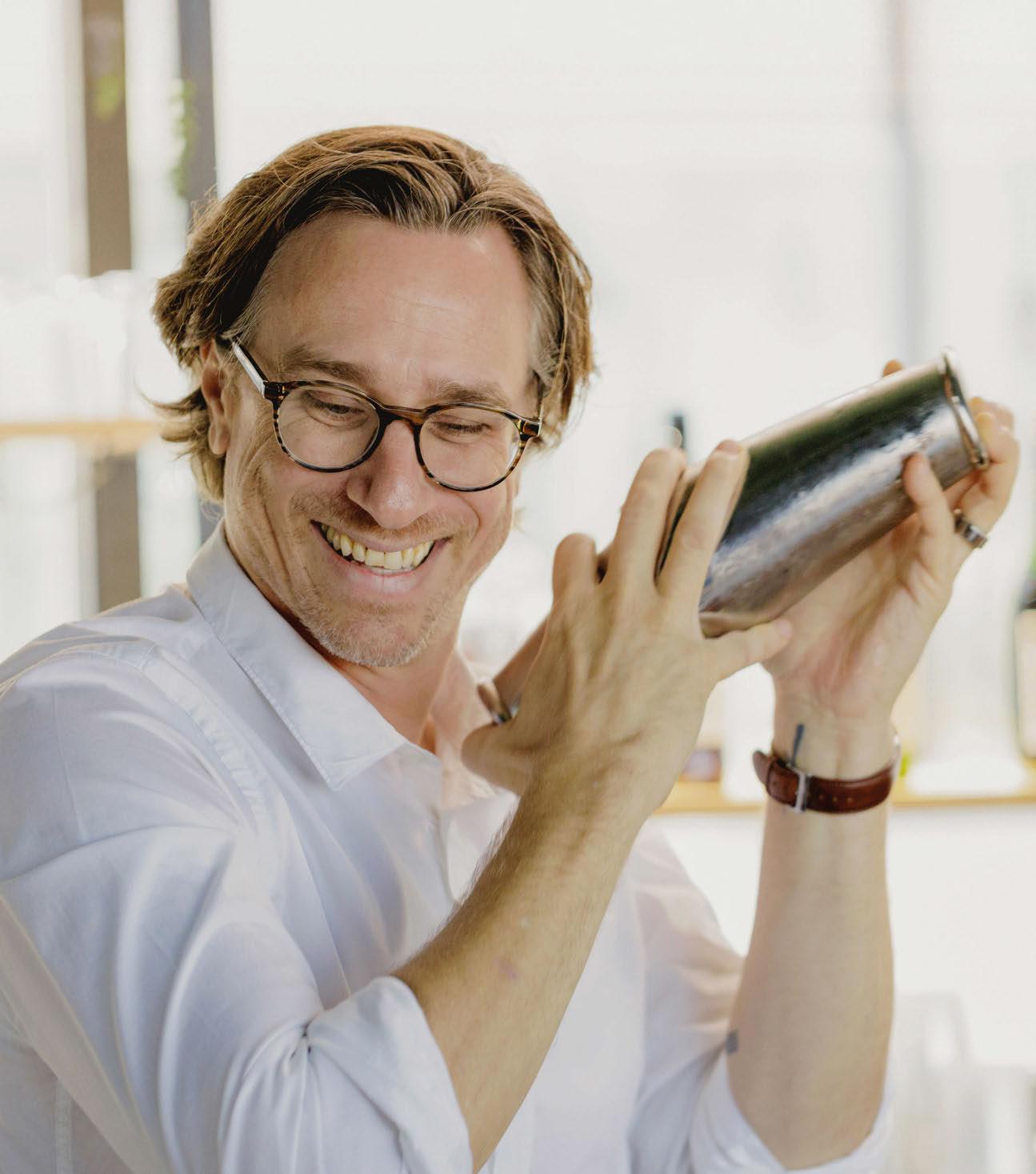
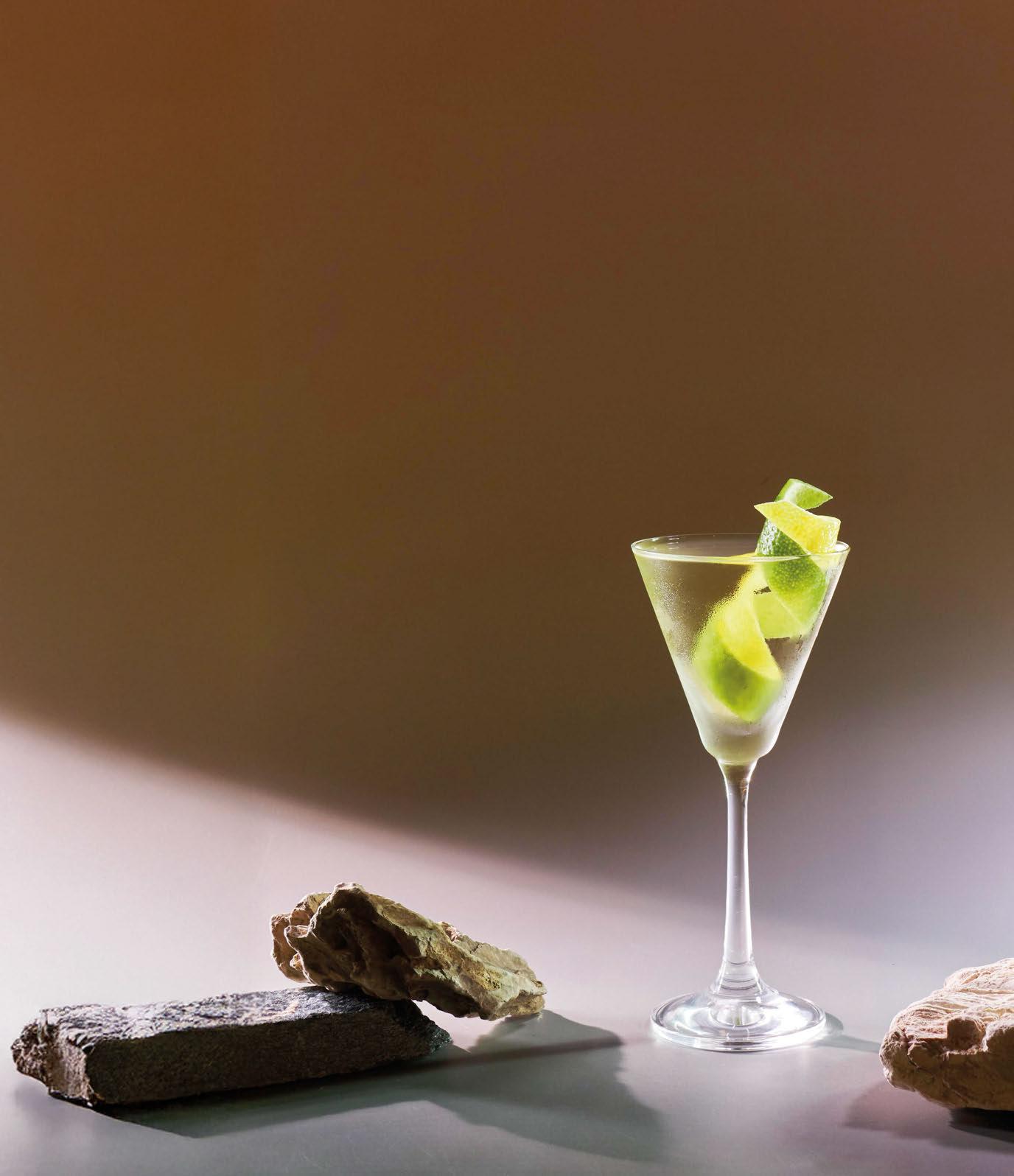
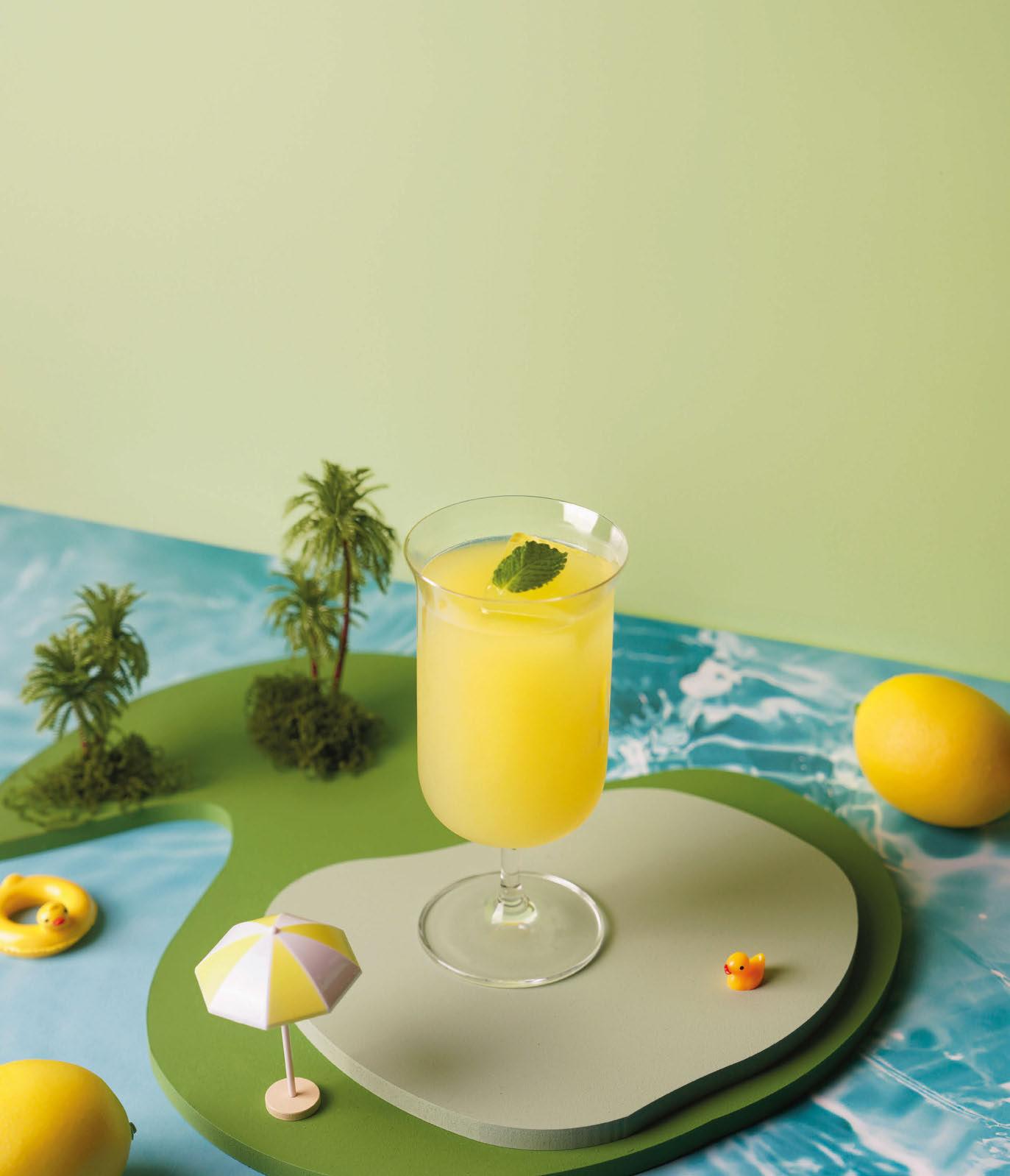
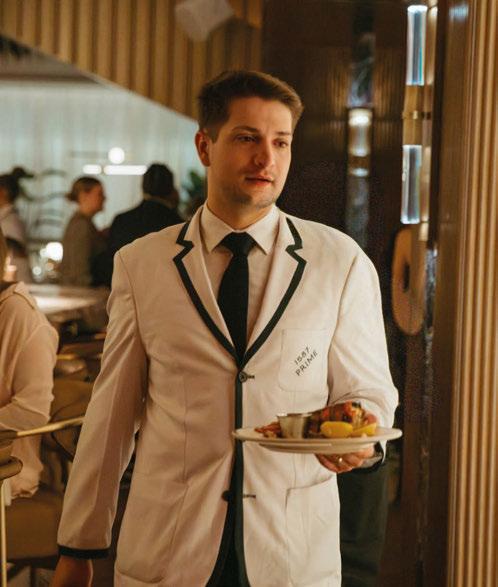
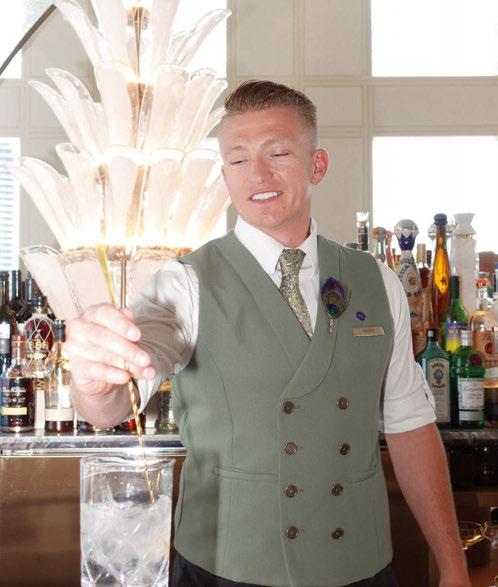
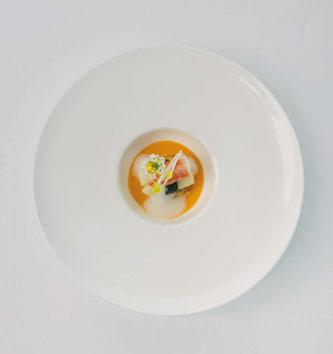
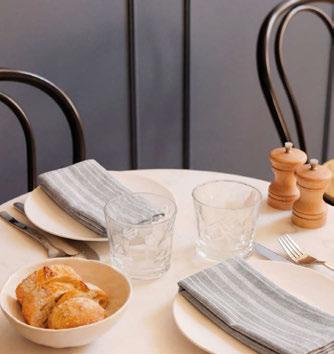
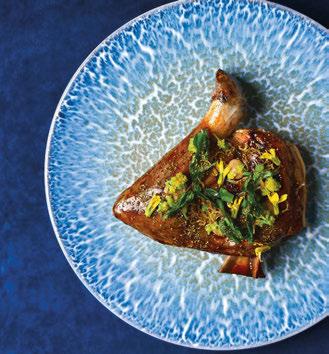
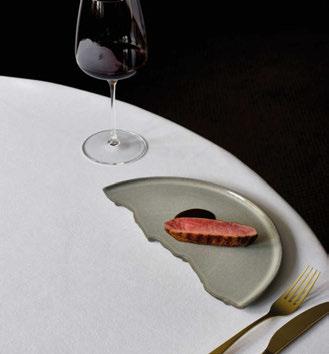
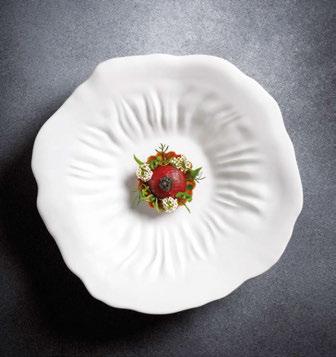
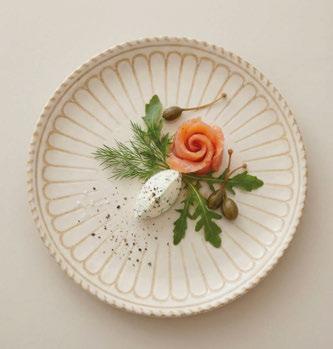
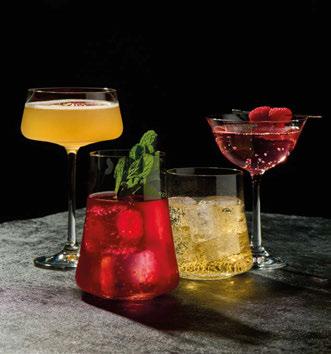
MERCER – MADRID • LUKE NGUYEN • MOUNT NELSON – CAPE TOWN
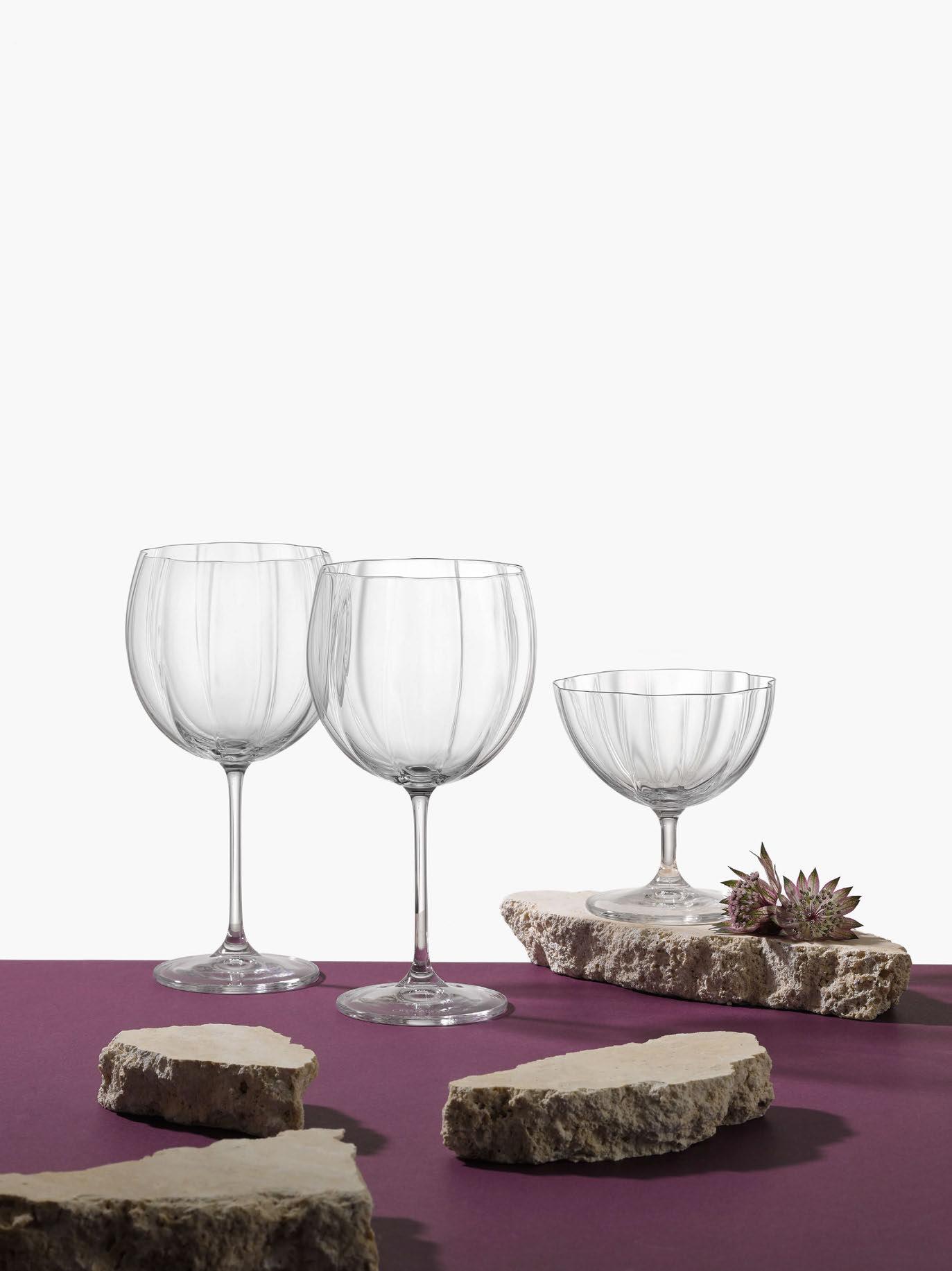
Explore the range: https://distille.co.uk
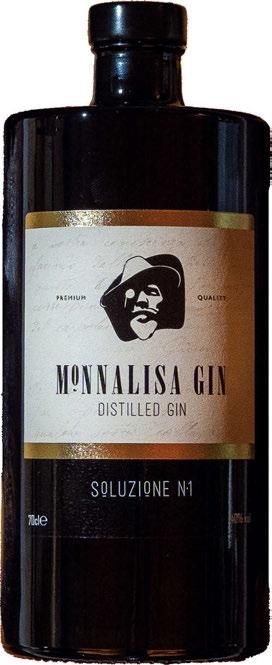
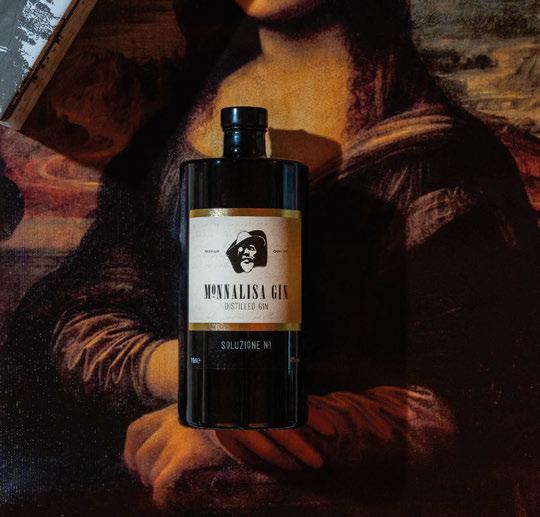
Monnalisa Gin
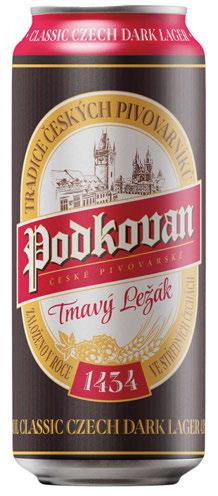
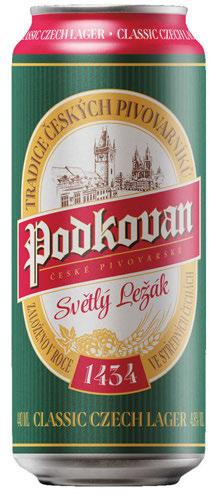
Podkovan Lager
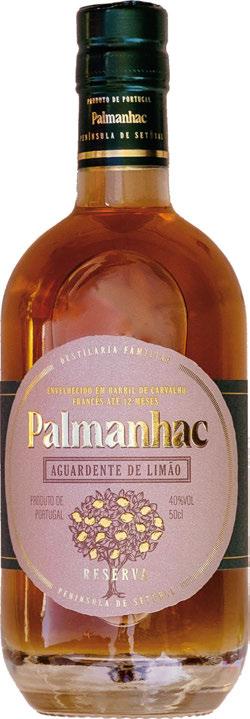
Palmanhac Liqueur
MAIN COURSES
La Sociedad Gastronomika 050
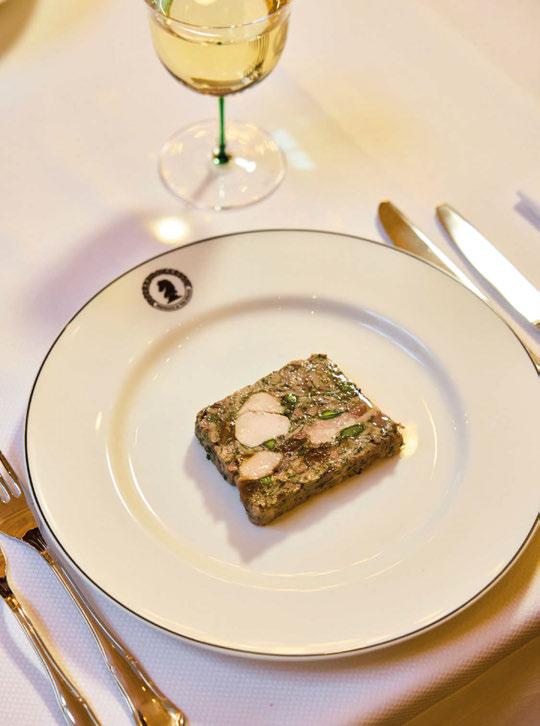
Mercer Madrid
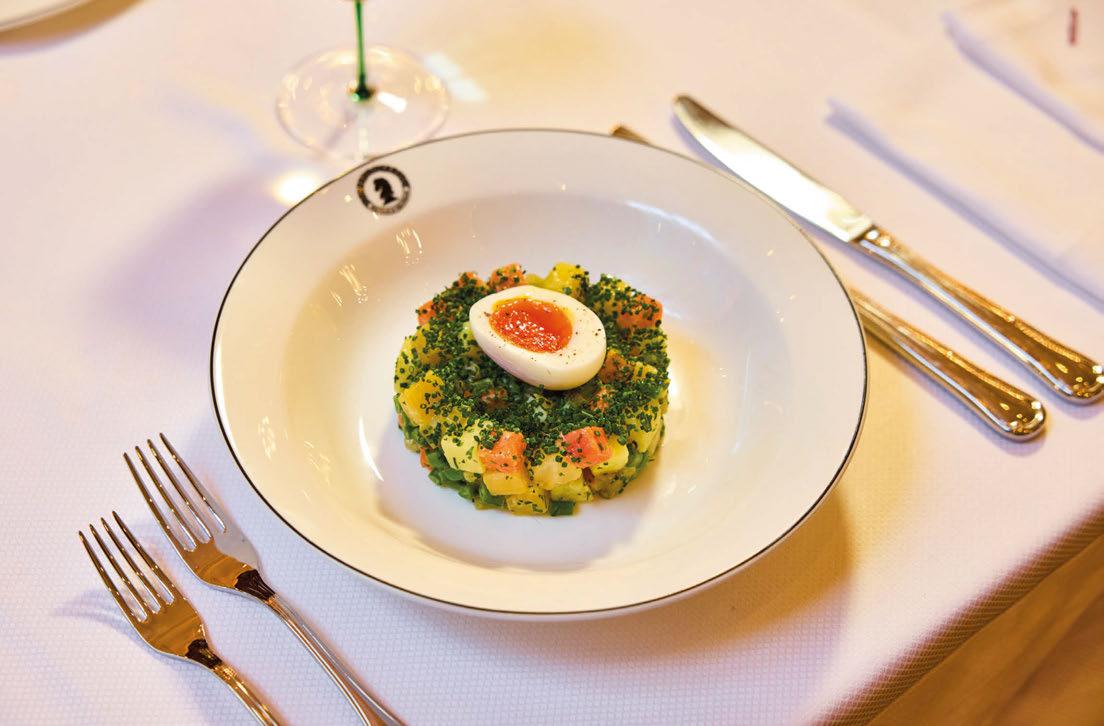
Simpson’s in the Strand 056
The Savoy
London
Amura 062
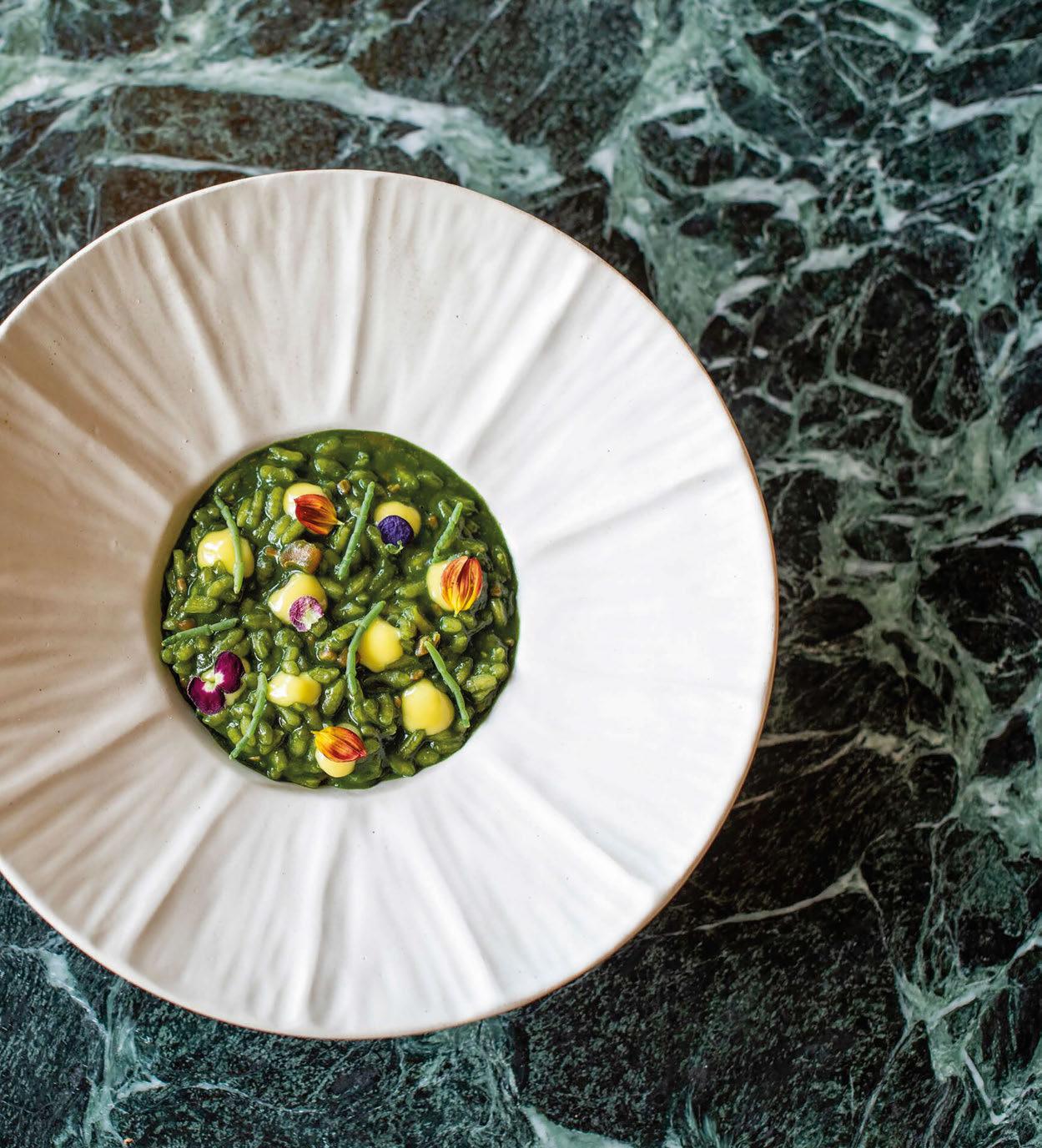
Mount Nelson
Cape Town
Luzzi 066
Andaz
Lisbon
Sale e Pepe Mare 072
The Langham
London
Sonoma by Single Thread
SERVICE
Emperor of Flavour
030
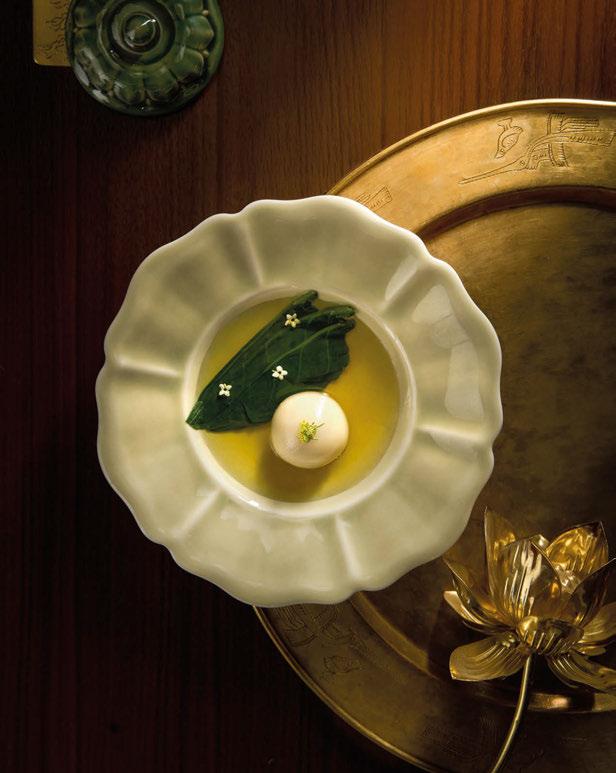
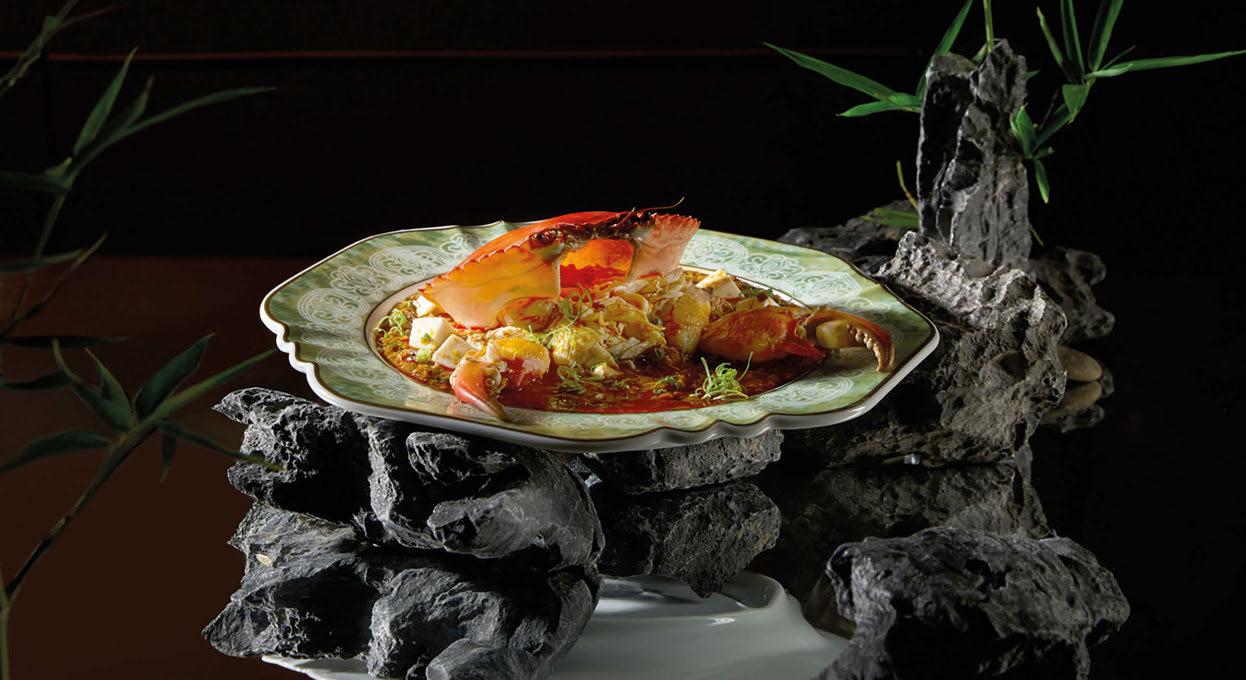
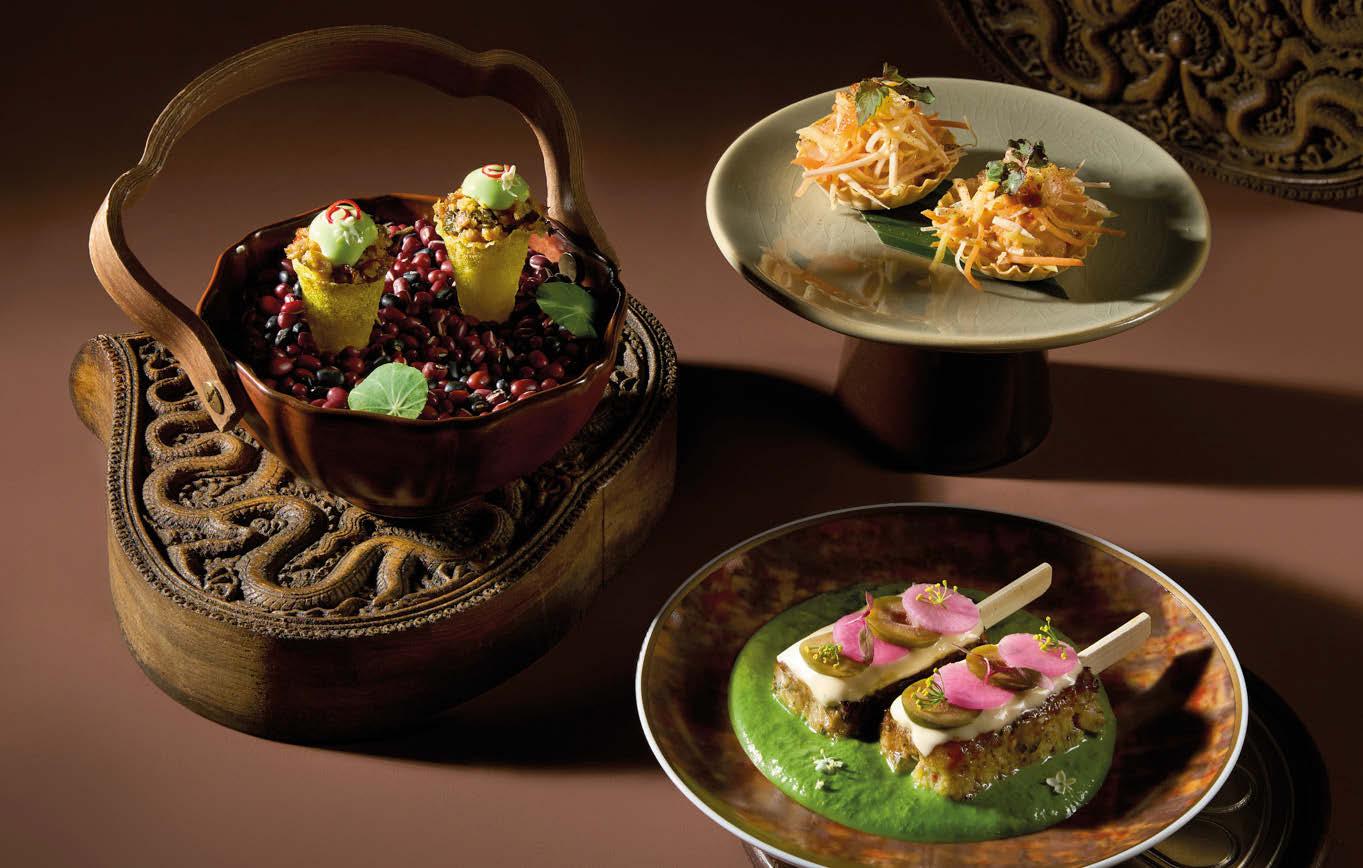
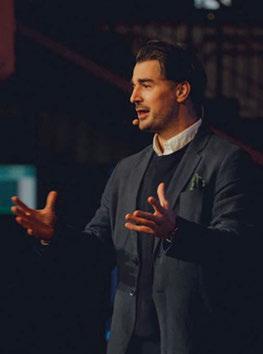
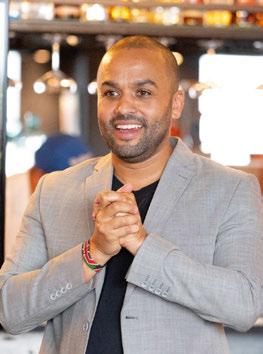
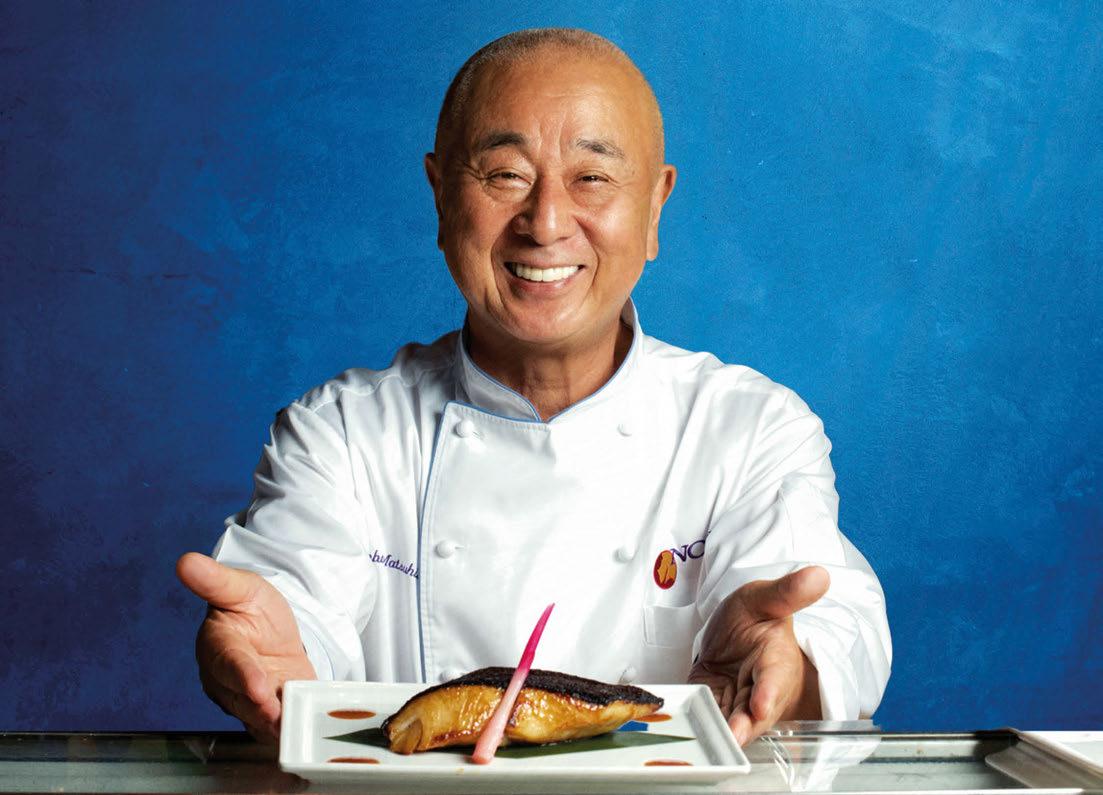
Chef and restaurateur Luke Nguyen celebrates the ancient heritage, culture and complexity of Vietnamese cuisine at Fairmont Hotels & Resorts’ landmark Hanoi opening.
Pasta Titan
036
With a clutch of Michelin stars to confirm his status as a master of contemporary Italian cuisine, Michael White discusses his latest challenge, The Lion’s Den at The Stoneleigh in Dallas.
High Flyer
040
Hospitality comes naturally to Maximilian Scheller, whose storytelling and commercial awareness is shaping the F&B experience at Marriott International’s portfolio of luxury properties.
DINING
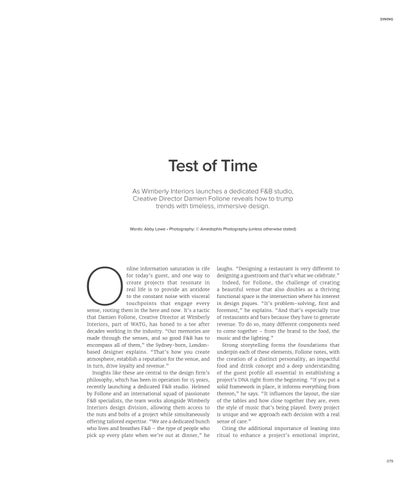
Test
of Time
078
As Wimberly Interiors launches a dedicated F&B studio, Creative Director Damien Follone reveals how to trump trends with timeless design.
SIPPING
Free Spirited
092
Mindful drinking pioneer Derek Brown partners with Tempo by Hilton to redefine the hotel bar experience through inclusive cocktails.
Tribal Instincts
096
Credited with putting the Kenyan cocktail scene on the map, Richie Barrow explains why Hero Bar is just the beginning of his hospitality vision for the country.
Summit Sipping
098
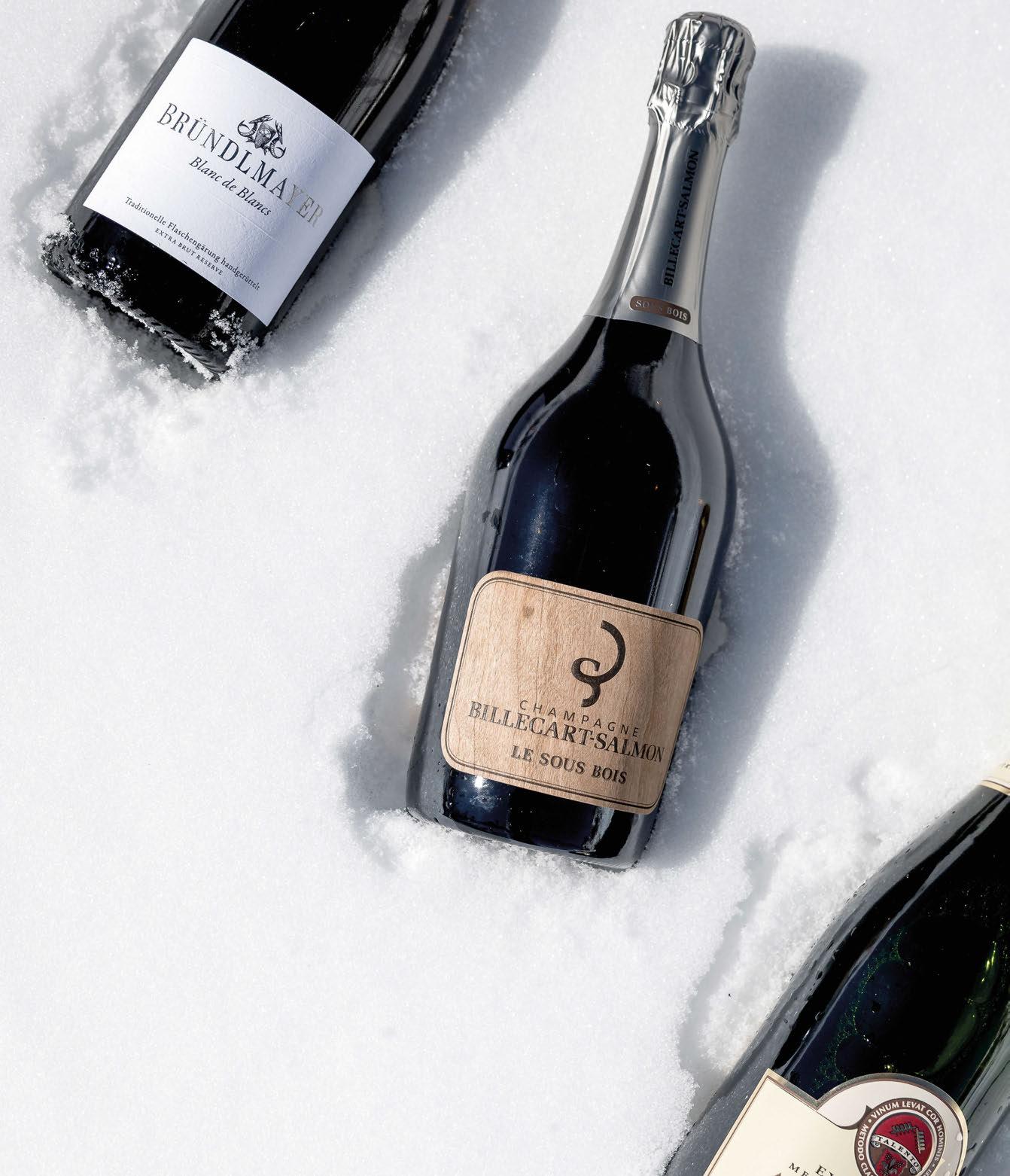
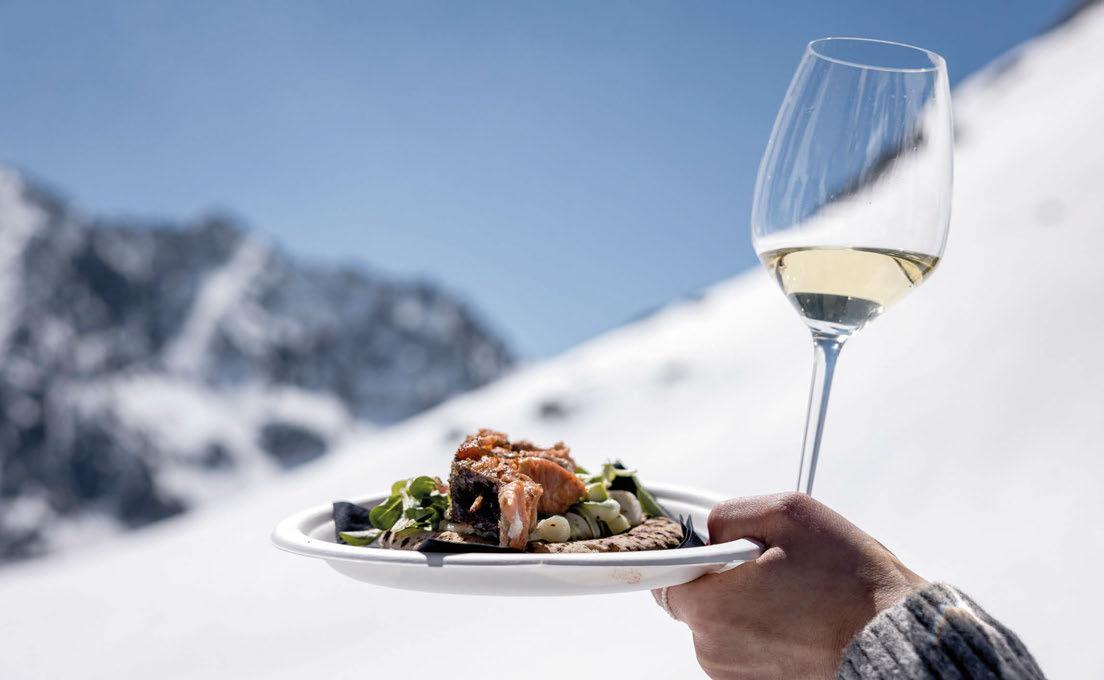
Austria’s Das Central stages one of the industry’s most decadent wine weekends with glacier-side tastings and Michelin-starred cuisine.
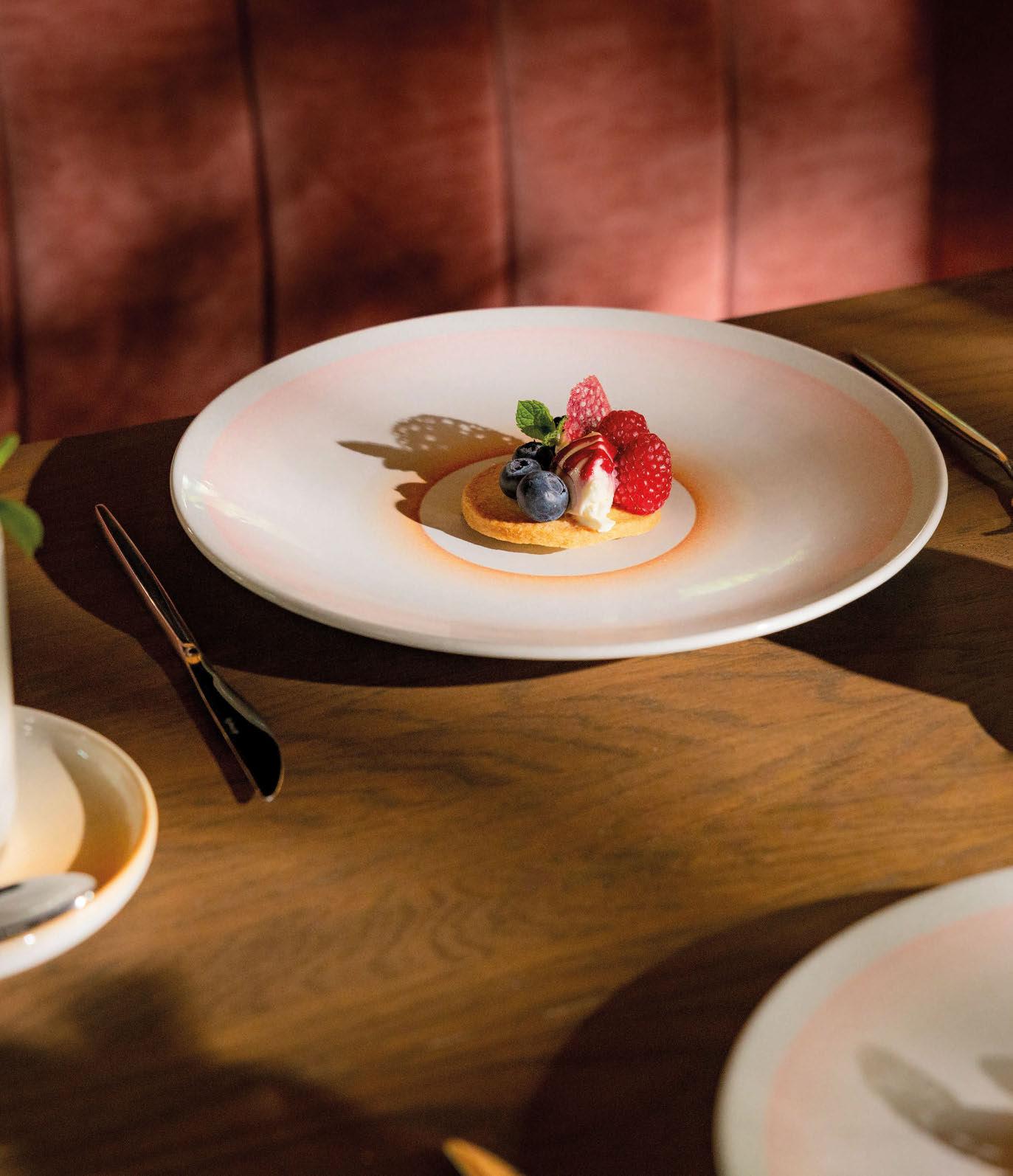
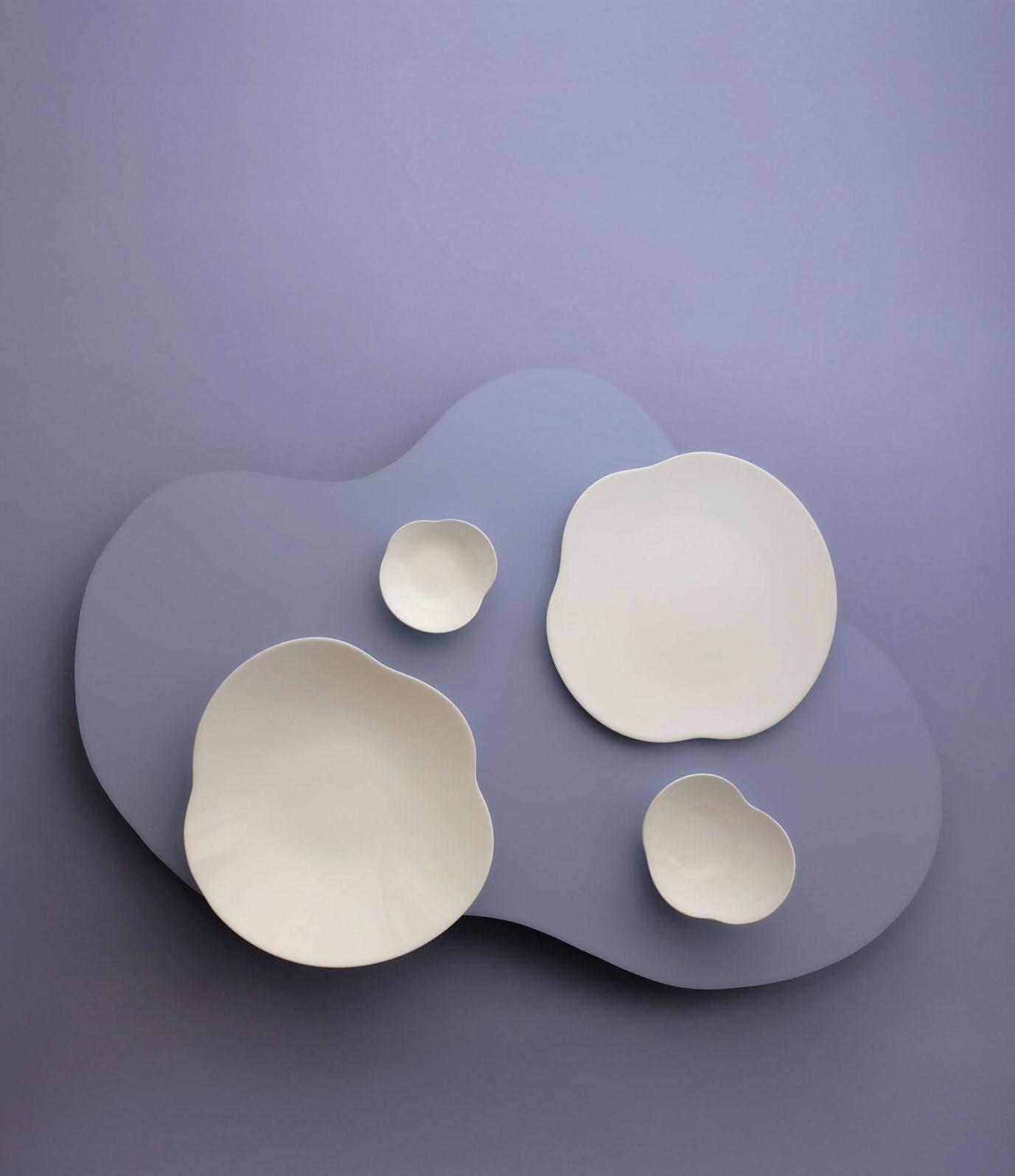
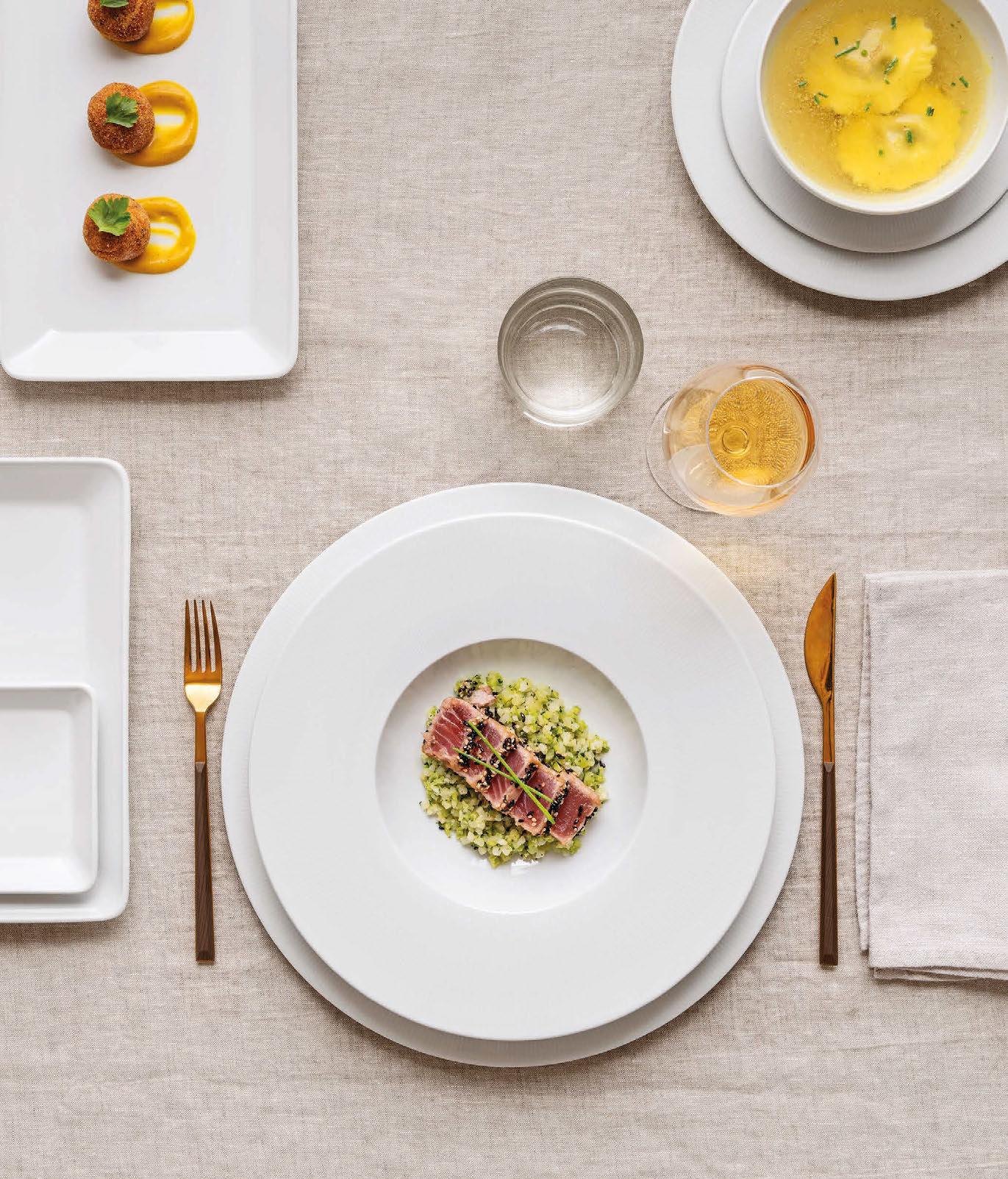
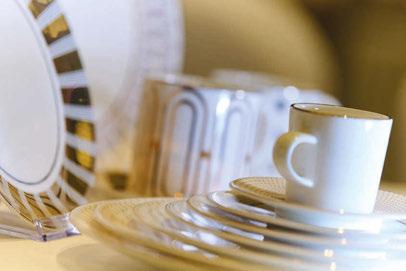
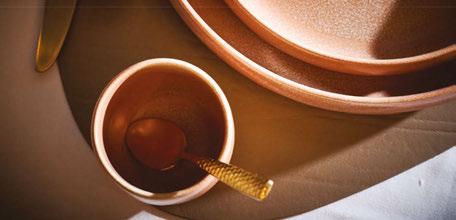
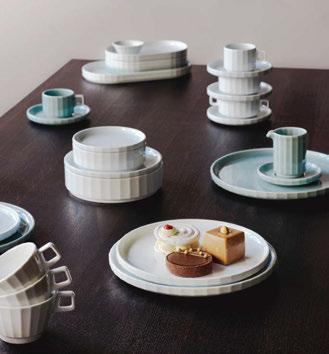
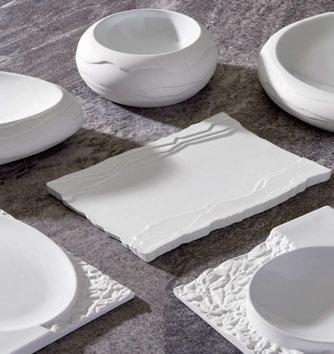
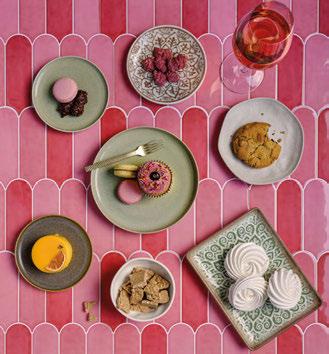
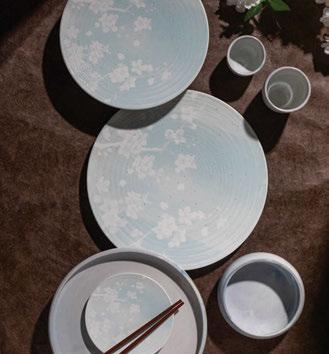
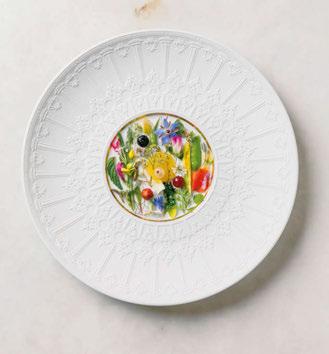
Maastricht Porselein presents Étoile, a new tableware collection designed by Carole Baijings. A refined and contemporary collection where Dutch design meets advanced sustainable craftsmanship. Étoile translates the beauty of landscapes and skies into delicate watercolours, layered colour gradients and subtle patterns that bring a poetic calm to the table.
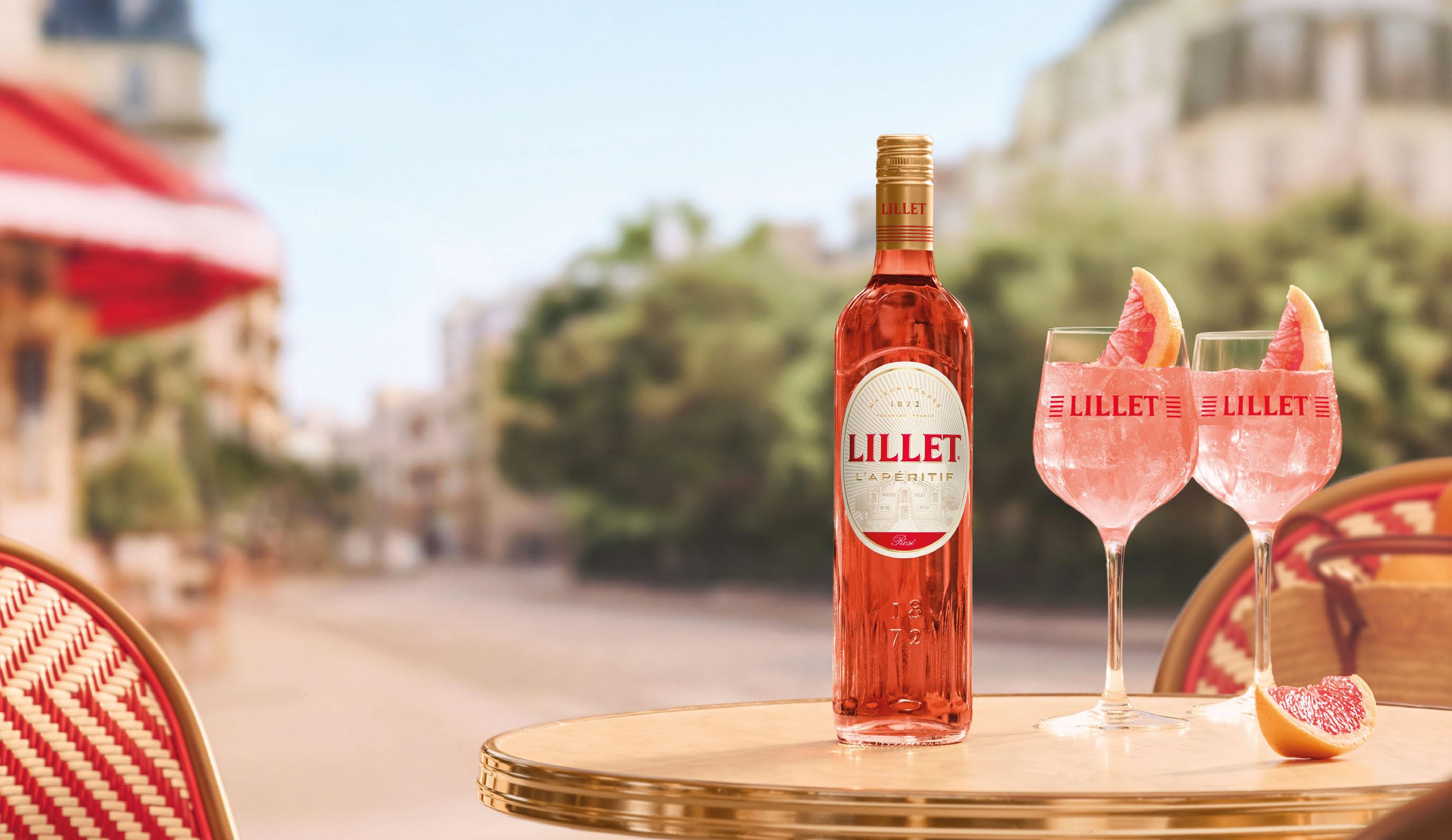
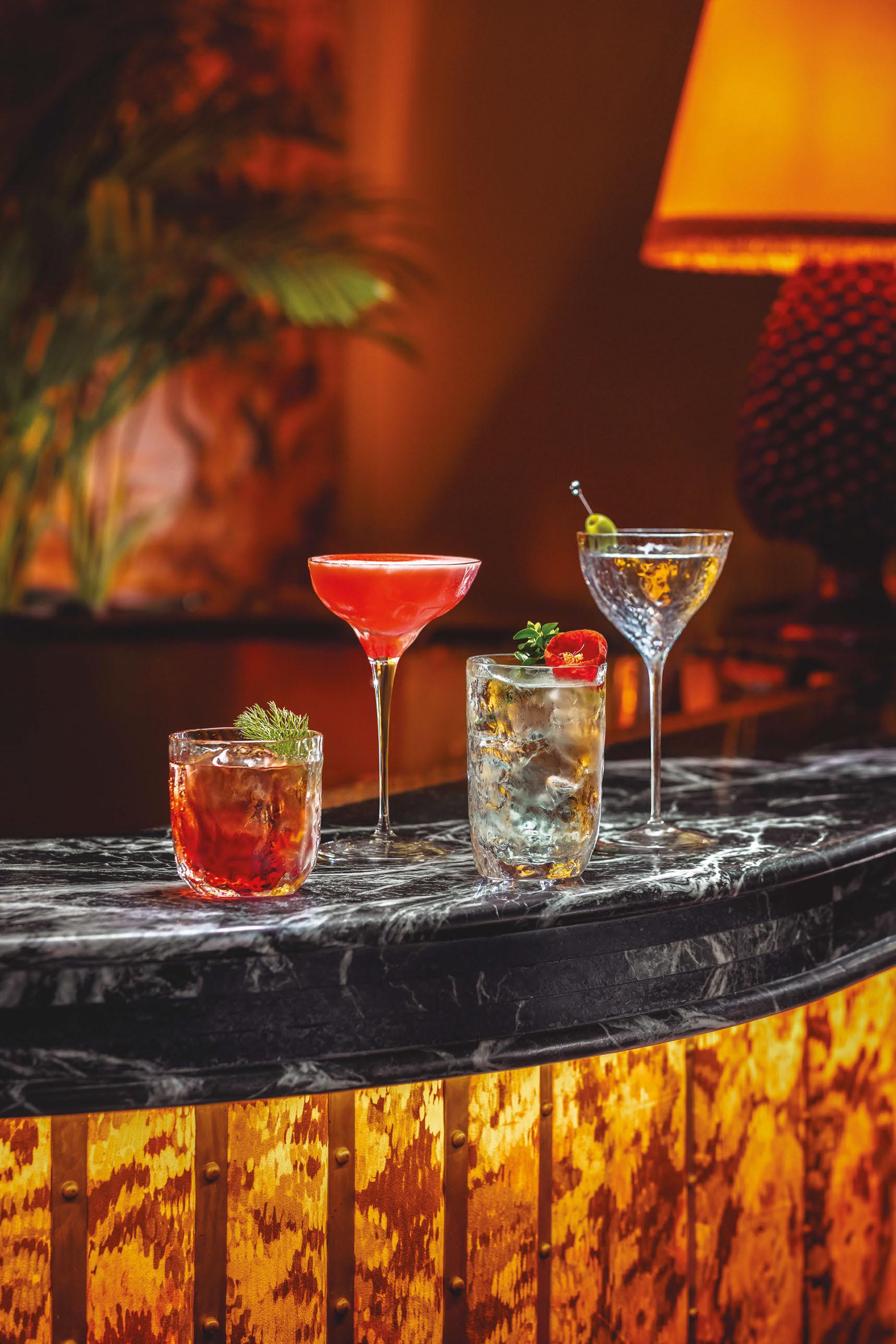
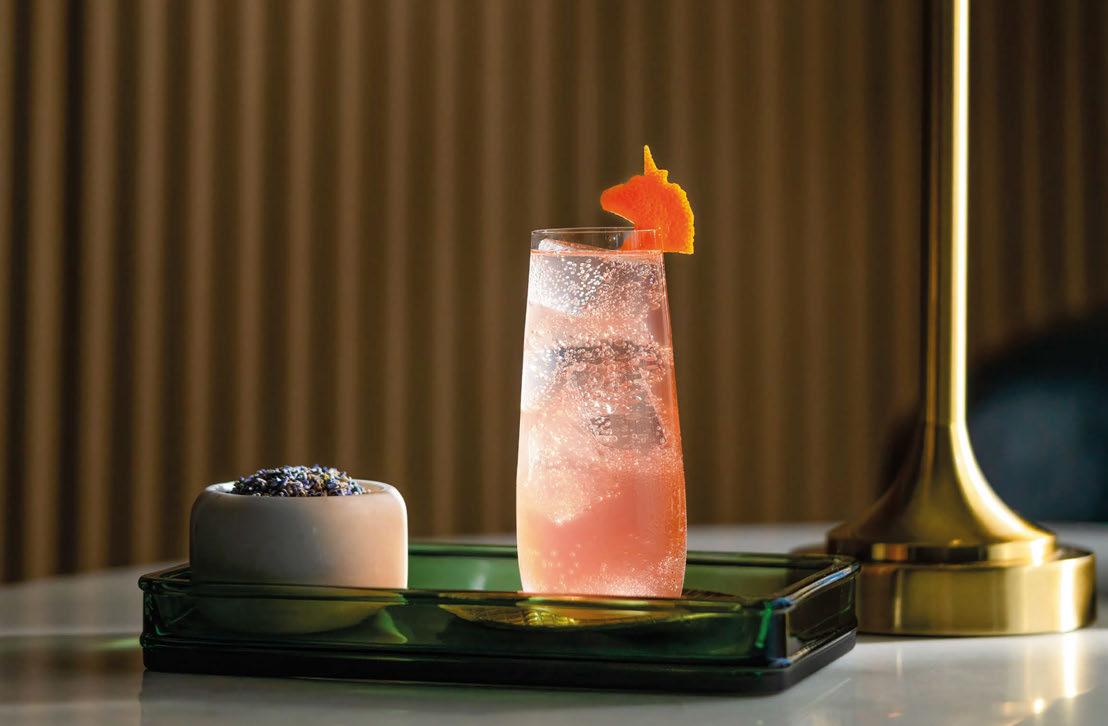
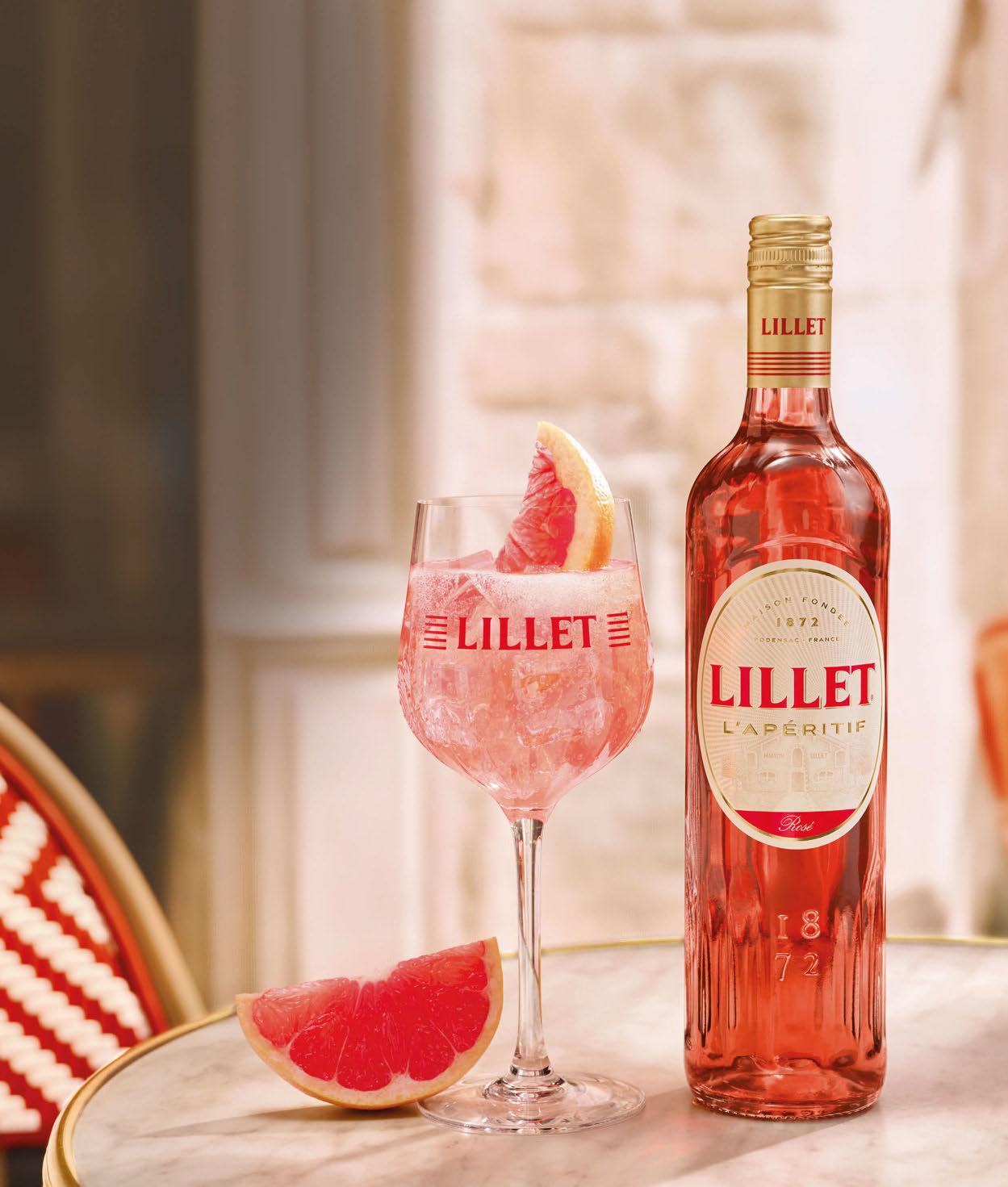
LILLET ROSÉ SPRITZ
1 PART LILLET ROSÉ
2 PARTS GRAPEFRUIT SODA
The Strongest Name in Tableware Made in England, Made for Life, Designed to Inspire.
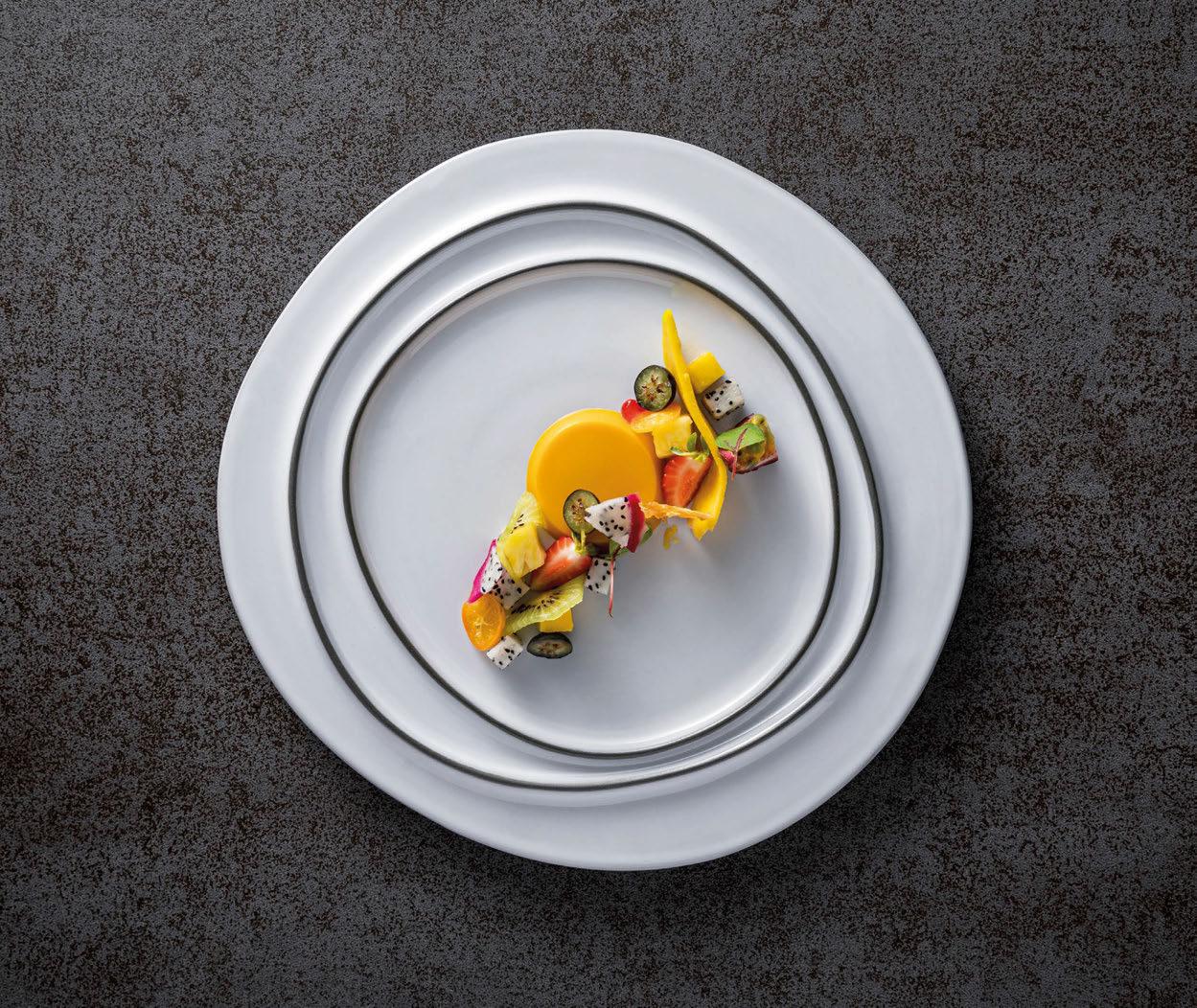
STEELITE PERFORMANCE ORBITA
Introducing Orbita,
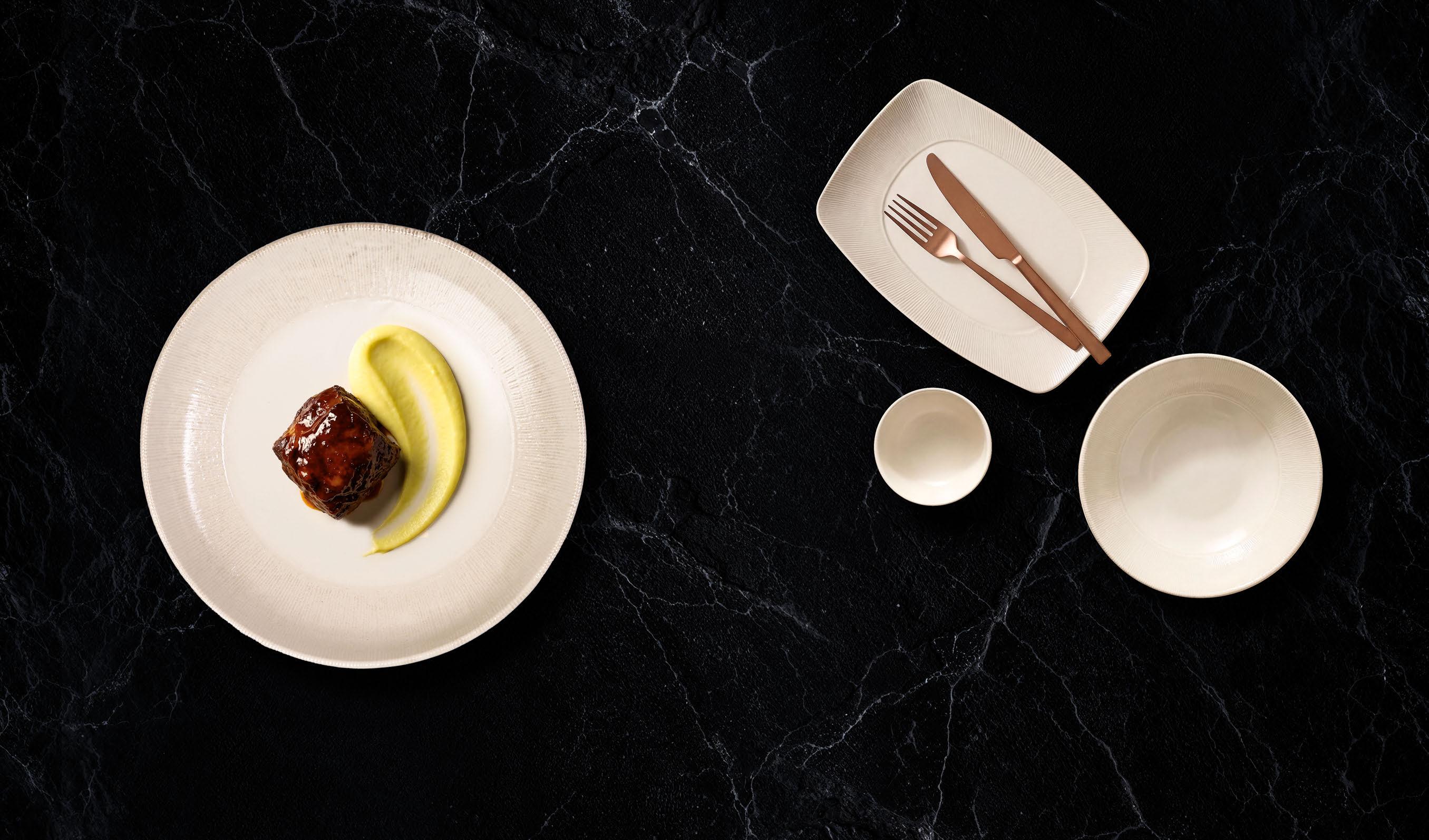
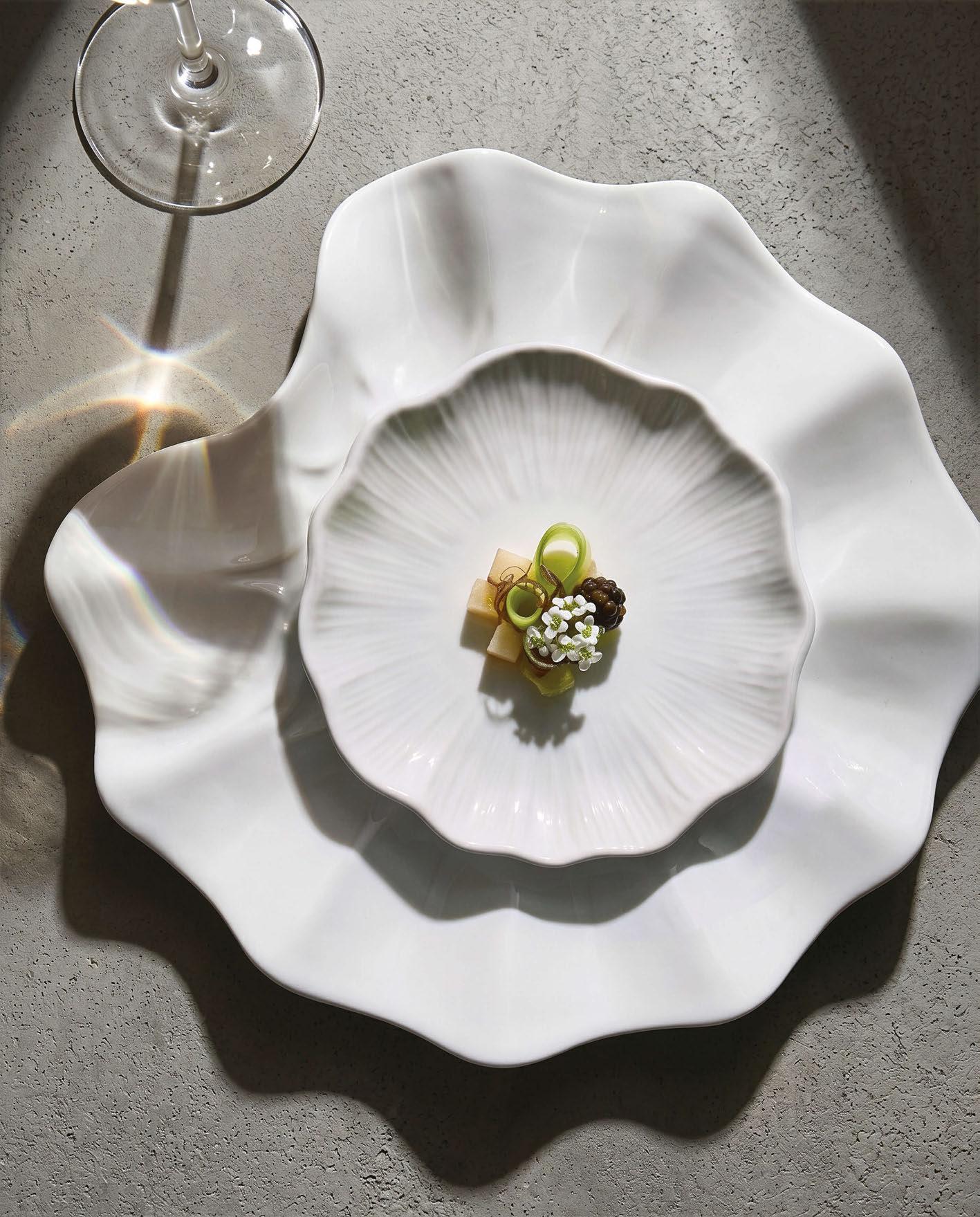
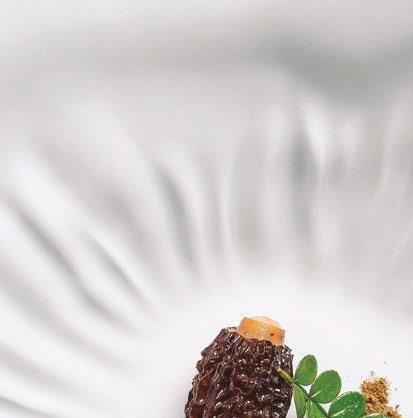
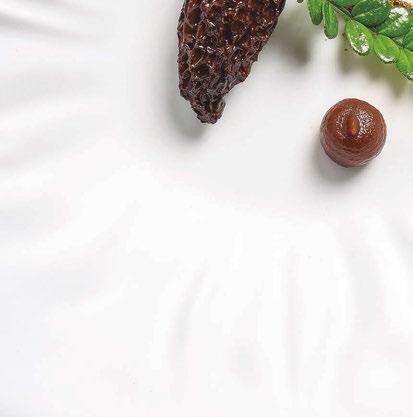
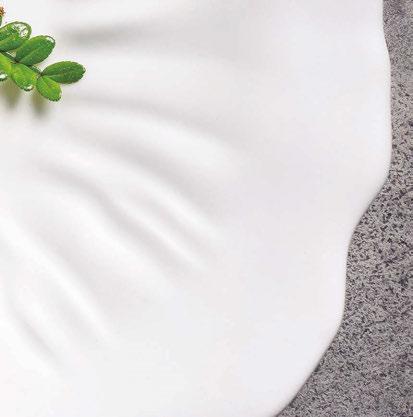
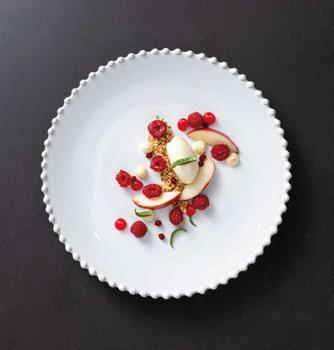
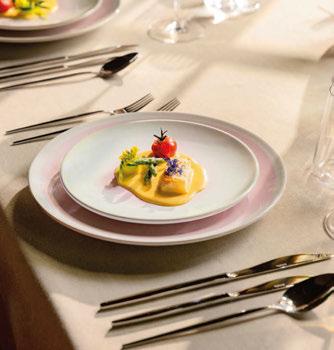
the latest addition to the Steelite Performance portfolio. Characterised by its elegant, flowing circular lines, Orbita naturally guides the eye toward the centre of the plate, providing an ideal canvas for chefs to showcase their culinary artistry.
Its subtly organic, refined rim adds a contemporary, handcrafted sensibility that enhances presentations across both casual and fine dining environments. Available in classic white and three semi-matte glazes.
Next trade shows: Las Vegas Market Summer | July 26-30 | Floor 1, C123
Maison & Objet Paris | September 10-14 | Hall 4 Stand E4 - F3
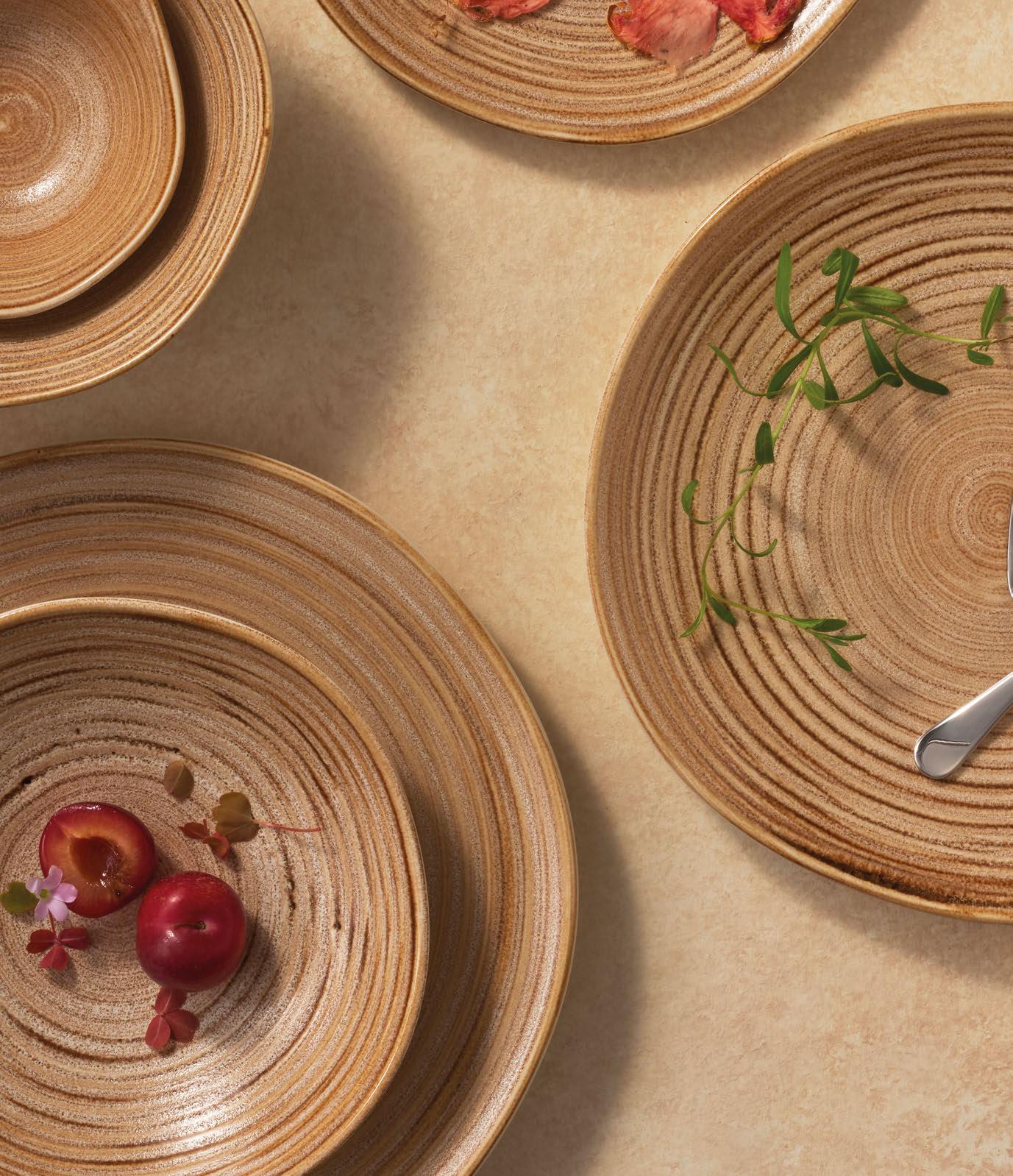
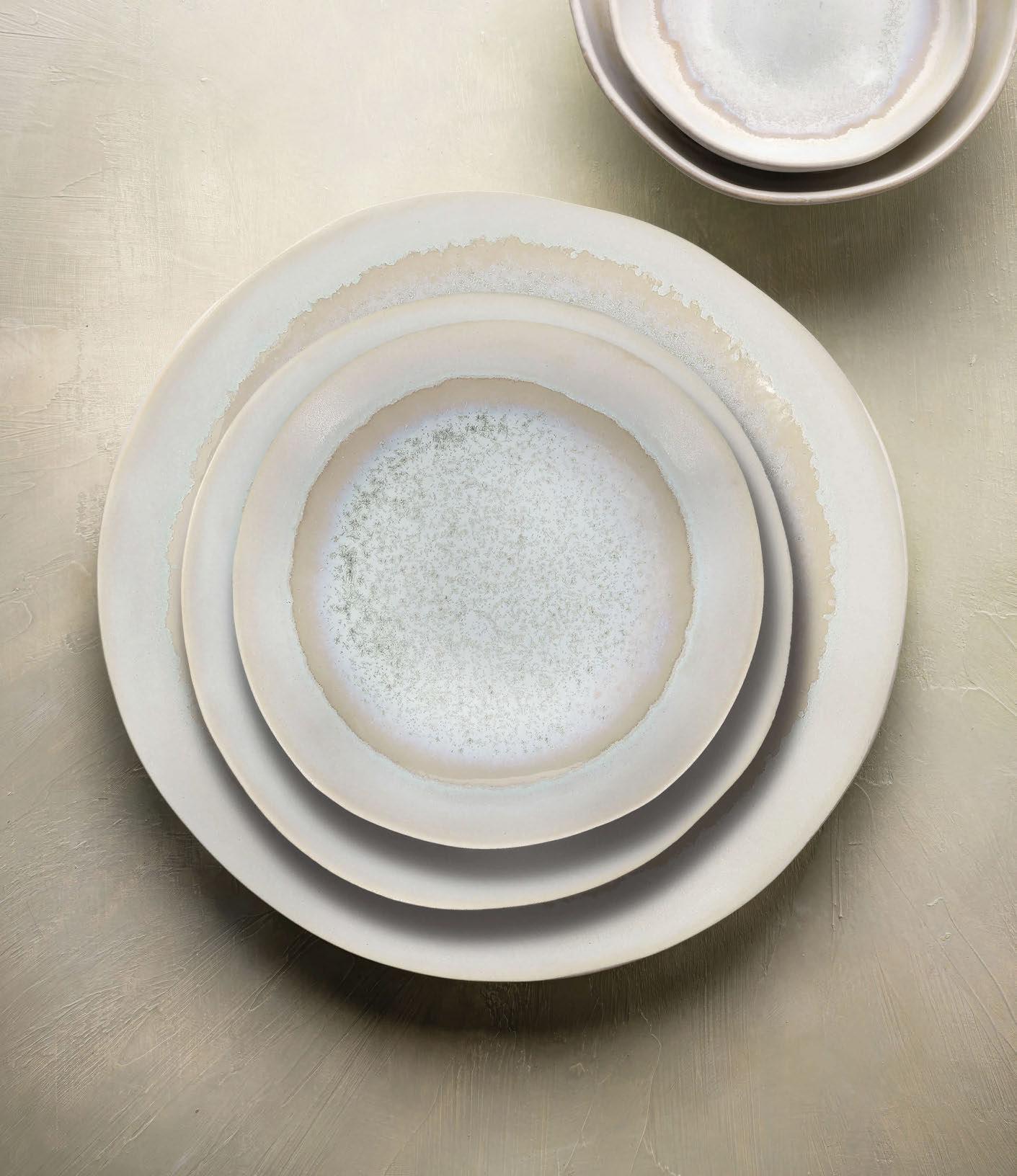
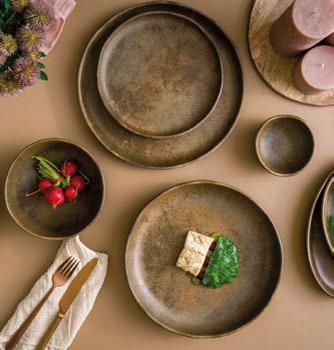
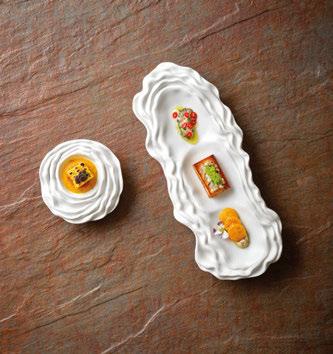
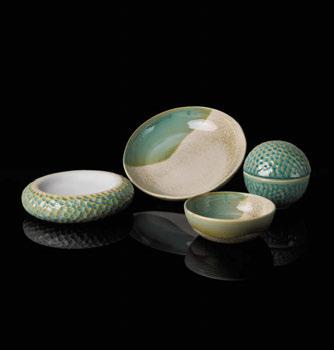
Roda is a simple yet significant collection by Torres Euracini. Its organic lines and exceptional glaze finish make it stand out in professional settings. Designed for adaptability and efficiency, each piece offers the freedom to create minimalist and versatile presentations. Inspired by the Latin word "rota", meaning circular movement, "Roda" symbolizes unity. It reflects the idea of bringing people together at the table to share flavors, experiences, and stories in a circle of connection and joy.
costanovaprofessional.com
Roda collection
ENTRÉE
Built To Last
Trends now have a lifespan measured in hours and days, not months and years. An idea can travel across the globe faster than the seconds it takes to type this sentence, which means usually by the time you’ve discovered something ‘new’, it’s already considered passé by someone, somewhere. This cut-and-paste culture can make it feel like individuality has been swallowed up whole, replaced by a certain blandness that offers variations of the same thing ad infinitum, and neither challenges nor stimulates.
But today’s savvy consumers no longer seem content with the humdrum. They are seeking experiences that whisk them away from the mundanity of reality, and where once-popular fleeting kicks were the norm, now they’re craving connection and deeper meaning – moments that ground them in the present. The solution, ironically, appears to be coming from the past, with tradition presumably providing comfort in a period defined by uncertainty.
It’s a movement that’s already having reverberations across the F&B sector, with heritage projects increasingly coming to the fore. Simpson’s in the Strand, the iconic London venue within The Savoy that’s been revived by Jeremy King Restaurants, is the primary example. Dripping in centuriesold history, its reopening has been met with delight across the generations, a fact designer Shayne Brady attributes to the current desire to luxuriate in a feeling of genuine legacy. I visited the venue back in April to see the restored building in action, and with its palpable sense of storied grandeur, it’s no surprise that foodies have been flocking to dine on its famous roast dinners once more.
Fellow interior designer Damien Follone shared similar insights when we sat down to chat about Wimberly Interiors’ new F&B division, which launched earlier this year. Yes, he
admits, it’s important to maintain an awareness of trends, but when it comes to designing memorable F&B spaces, tapping into the essence of timelessness is a central tenet of every project today. It’s an approach he employs whether working on an intimate members’ club, a glamorous steakhouse or a recent project like Spuntino within Four Seasons Resort & Residences at The Pearl, Doha, which channels the lively spirit of Italian food culture as it evolves throughout the day.
And the shift isn’t just being felt in design circles, it’s present in a growing number of F&B concepts too. Take chef Luke Nguyen’s latest project, Tran Dynasty, located within the newly opened Fairmont Hanoi. The restaurant reinterprets Vietnam’s rich culinary heritage, with Nguyen himself diving into the archives for inspiration, uncovering history thousands of years old that he’s translated into every dish. The result is a fine-dining establishment that avoids gimmickry in favour of a deeply resonant menu representative of his home country’s culinary traditions.
New trends will keep arriving of course, they’re an onlinedriven juggernaut that can’t be stopped, but it’s worth remembering that the real impact will be measured in the years to come. So, the question you have to ask is: what do you want that collection, project or venue to be remembered for 20 or even 50 years from now? Because it’s becoming progressively clearer that the best things are built to last.
Abby Lowe • Deputy Editor
@SupperMag
THE BRIGADE
EDITORIAL
Editor-in-Chief
Matt Turner m.turner@mondiale.co.uk
Managing Editor Catherine Martin c.martin@mondiale.co.uk
Data & Marketing Adam Cymbaluk a.cymbaluk@mondiale.co.uk
DESIGN
Design Manager David Bell
Production Mel Capper Dan Seaton
CORPORATE
Chairman Damian Walsh
Chief Operating Officer
Amanda Giles Accounts ar@mondiale.co.uk
SUSTAINABILITY
Natural • Renewable • Recyclable
Supper is printed by Buxton Press on FSC Mix-certified paper using 100% vegetable-based inks. Magazines mailed from Spatial Global are packaged in FSC-certified wrap that is fully recyclable.
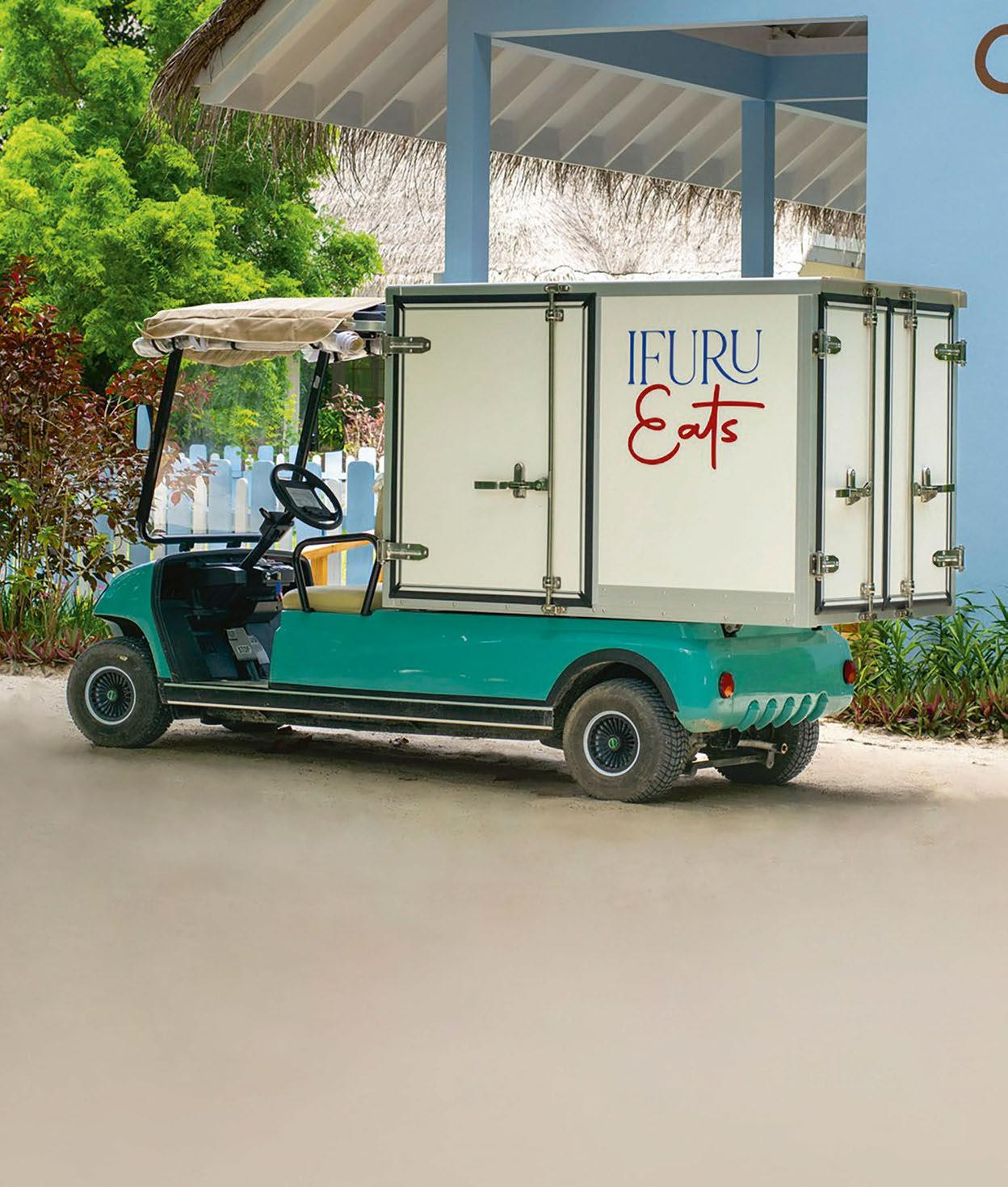
As hotels and resorts look beyond traditional room service to create more personalised guest experiences, Ifuru Island in the Maldives is introducing Ifuru Eats, an overnight dining concept designed to satisfy late-night cravings.
Extending the property’s culinary credentials beyond conventional hours, Ifuru Eats provides an exclusive in-villa dining service offering a selection of snacks and sugary treats delivered direct to the door. Available nightly from 10:30pm to 7:30am and transported via a dedicated Ifuru Eats buggy, the new provision aims to complement the freedom of an island escape, allowing guests to eat and drink entirely on their own schedule - whether returning from an evening under the stars or enjoying a relaxed night in.
The menu has been carefully curated to cater to a variety of
after-hours preferences, with lighter options such as Caesar salad and tropical shrimp rolls, as well as more substantial dishes like Thai prawn curry, pizza and perfectly toasted grilled cheese. For those seeking sweet indulgence, desserts include tiramisu, burnt Basque cheesecake and a selection of homemade ice creams and sorbets.
“Ifuru Eats is our playful answer to late-night cravings,” explains Sindhaan Mohamed, Assistant Director of Marketing & Communications. “With a rotating, instant menu that includes savoury favourites, vegetarian options and sweet treats, guests can enjoy a midnight binge from the comfort of their suite or villa. It’s simple, comforting and very Ifuru, because we believe great island moments should not be limited by the clock.”
Coya the Shots
Arjun Waney’s Peruvian fusion restaurant expands to Ibiza with its first accommodation concept designed by Lázaro Rosa-Violán.
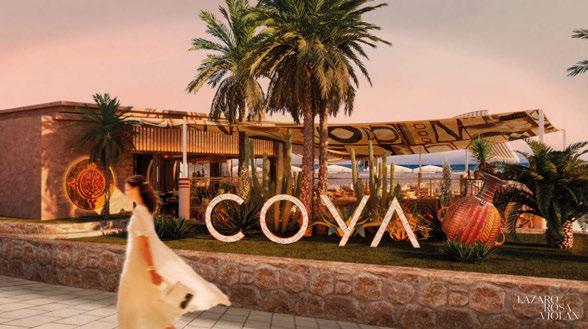
Having already stirred the senses in London, Marbella, Monaco and Dubai, Coya is ready to spice things up in Ibiza this summer, with the launch of its first-ever rooms and suites.
Bringing its signature spirit to the island, the Peruvian dining concept co-founded by Arjun Waney introduces a fully integrated experience with the launch of Coya Beach, a lifestyle destination complete with beach club, restaurant and accommodation.
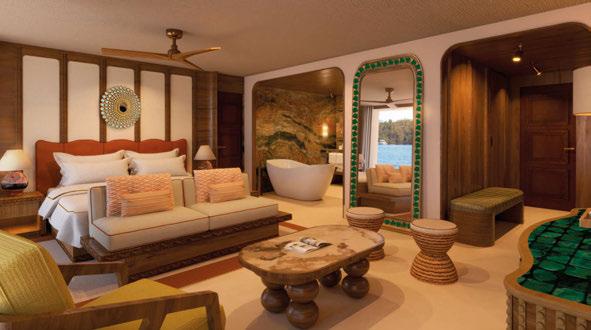
Each guestroom, conceptualised by Lázaro Rosa-Violán, echoes Coya’s distinctive design language, combining natural materials and subtle Latin American influences that sit easily within a coastal setting. Accommodation ranges from relaxed Vista rooms complete with private balconies, to the more secluded Selva rooms, featuring private gardens. The top tier includes the Mirador Suite, offering an elevated experience with a private rooftop terrace, sea views, hot tub and Balinese bed - a secluded sanctuary designed for those seeking the ultimate Ibiza escape.
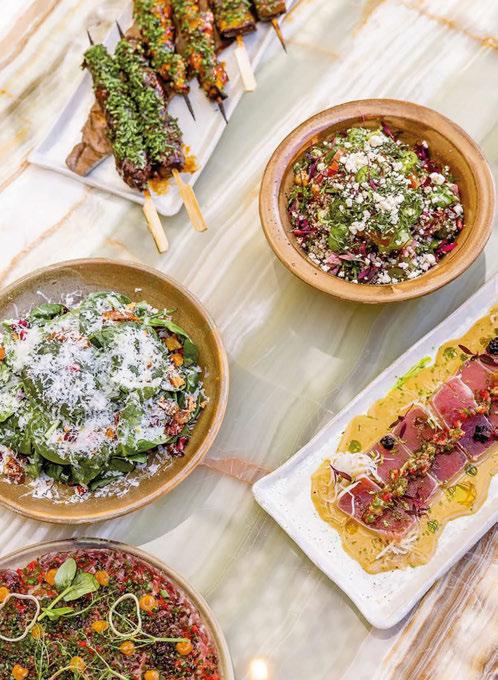
As the closest stay to Coya Beach, overnight guests benefit from exclusive access to the beach club and restaurant, where they can sample signature dishes such as vibrant ceviches and Peruvian tiraditos, beef brisket empanadas, fried calamari and Lomo Alto de Wagyu Chileno; a premium cut of beef from cattle raised in Chile. Desserts include an indulgent salted dulce de leche paired with vanilla ice cream.
The venture is set within The Site Ibiza, a development in Playa d’en Bossa from Palladium Hotel Group. “Ibiza has a unique energy that aligns so naturally with Coya’s spirit. It’s where music, culture, food and connection come together in a way that feels instinctive to us,” says COO Yannis Stanisiere. “It marks an exciting evolution of the brand, allowing us to create an experience that extends far beyond dining. It feels like a natural home for this next chapter of Coya, and a moment we have been building towards as we continue to grow globally as a lifestyle brand.”
A Culinary Journey
French gastronomy meets the timeless art of travel as Yannick Alléno partners with Orient Express to debut his signature cuisine at sea.
For aspiring chefs, success is often defined by establishing a presence in the world’s leading culinary capitals, from Paris or London, to New York, Tokyo and beyond. Yet for those who have already reached the pinnacle of their profession, the ambition evolves. Having built a global restaurant portfolio and earned international acclaim, many are seeking new ways to broaden their culinary footprint, and increasingly, that means looking beyond land altogether.
While some are venturing skywards to put their name to in-flight catering, others are taking to the seas, partnering with luxury cruise lines to elevate the onboard dining experience. Among the latest to embrace this opportunity is Yannick Alléno, whose signature approach to French cuisine is now reaching a new audience of travellers at sea.
Building on the success of Pavyllon Ledoyen in Paris, which holds six Michelin stars across its three restaurants, Alléno has joined forces with Orient Express to serve his delectable dishes on Corinthian – the legendary brand’s debut vessel. “Orient Express embodies travel in its noblest essence, and it is an honour to be able to imprint my reforming vision of cuisine in this iconic place steeped in stories,” the chef explains. “Each menu is an invitation to discover my personal interpretation of culinary heritages from around the world.”
Having set sail on its maiden voyage in May, Orient Express Corinthian is spending its inaugural season in the Mediterranean and Adriatic, before crossing the Atlantic to the Caribbean. The state-of-the-art yacht features 54 spacious suites and a spa by Guerlain, as well as an Art Deco speakeasy, a cabaret theatre and a recording studio, all designed by Maxime d’Angeac to honour the golden age of travel.
Alléno’s role as Culinary Director spans five restaurants and private dining rooms, each with its own identity and cuisine. L’Écrin serves fresh seafood to ocean views, while La Terrasse offers fine dining in an elegant setting. Taking top billing, La Table showcases the chef’s signature blend of French tradition and innovative technique, taking diners on a culinary journey as they sail from port to port. Menus evolve with each destination and are shaped by ingredients sourced along the route, from Rome to Cannes, Valletta to Dubrovnik. Dishes might include Seasonal Ballad – a vibrant display of fresh harvest accompanied by a delicate jelly compote, made using Alléno’s revolutionary extraction method; or Sea Bass Aiguillette, comprising a delicate layer of squid atop melt-in-your-mouth fish, finished with a tangy watercress and sorrel sauce. The result is an experience in which every dish tells the story of a territory, a craft and a contemporary interpretation of tradition.
“This collaboration with Yannick Alléno reflects Orient Express’ ambition to surround itself with the greatest talents to create a unique experience of travel and discovery,” concludes Sébastien Bazin, CEO of Accor. “By becoming the culinary soul of the boat, Chef Alléno brings not only his creativity and his keen sense of innovation, but also a philosophy of gastronomy that he will share in different ways so that each restaurant has its own unique identity. This modern and plural approach blends perfectly with the values of the brand: excellence, sophistication and escape.”
Full Service
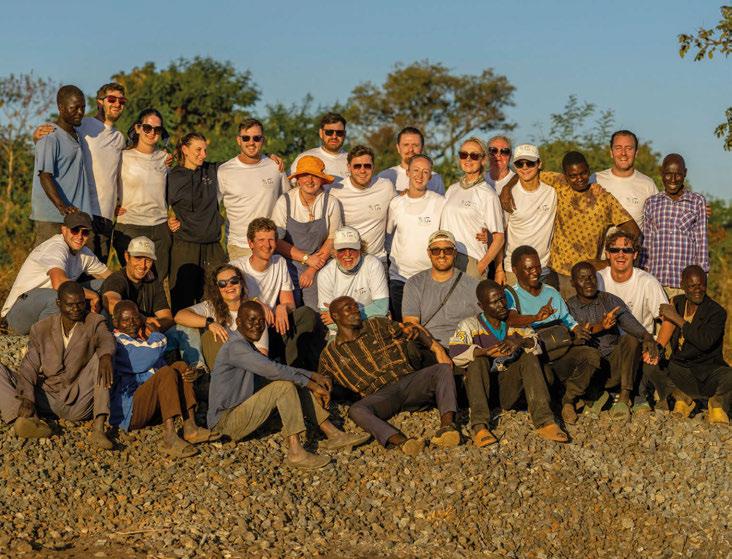
Nine of the UK hospitality industry’s leading figures, including Michelin-starred chefs, a sommelier and a front-of-house leader, stepped away from their kitchens in June, travelling to Malawi to build a school from the ground up, with the journey forming the subject matter of a documentary entitled Chef. Better, Because. Produced by 7Fifty and directed by Rosa Brough, the film is shot in fly-on-the-wall style, covering the fundraising process, the project as it unfolds and the group’s return to their restaurants back at home. Exploring the meaning of hospitality when stripped of its structure, hierarchy and environment, it also features voices from the Malawian community.
Participants included Mark Tuttiett, Head Chef at Da Terra; Ricki Weston, Executive Chef at Whatley Manor Hotel & Spa; Harry Kirkpatrick,
Head Chef at Trinity; April Lily Partridge, formerly of The Ledbury; Luke French, Chef-Owner at Jöro; Stacey French, co-founder at Jöro; Charlie Tayler, Head Chef at Aulis London; Vanessa Stoltz, Restaurant Manager and Sommelier at Pine; and Ollie Bridgewater, formerly of The Gilpin Hotel & Lake House.
Working alongside local families, the goal was to build the community a new school – not as an act of charity, but as an exchange of perspective, values and understanding. “Hospitality means to be hospitable and I think that many people have forgotten that,” Weston says. “In our jobs, we aim to make people happy by regularly delivering for them on special occasions, but this was an opportunity to deliver for someone every day. It was an exchange of perspectives that gave us the chance to realign with who we are and what we are here for.” Bridgewater agreed: “It’s rare to have the chance to do something like this with a big group from the industry, and that’s the beauty of hospitality - it brings people together in a special way. Especially on this occasion, when it was also for a brilliant cause.”
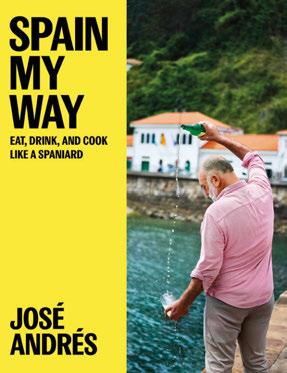
Widely credited with popularising the concept of traditional and avant-garde Spanish tapas in the US, SpanishAmerican chef José Andrés is once again paying tribute to the cuisine of his homeland with his latest cookbook, Spain My Way. Focusing on recipes from Asturias – where he was born – plus Catalonia and Andalucía, with classics from Galicia, the Canary Islands and the Balearics also featured, the book includes a roster of the chef’s beloved favourites alongside new additions that he’s picked up on his travels around the country in more recent years. Dishes range from the semi-mystical gazpacho caliente – gazpacho soup served warm, as discovered by the chef on a trip to Andalucía – or pato con peras, duck with pears, a speciality typically found in the Catalonian region.
As is customary for the irreverent, storytelling chef, every recipe blossoms into a tale, paying tribute to the people who eat, sleep and breathe food and drink, and to the country in which their passion is given the space and constant inspiration required to flourish. “Everything is more interesting, more vibrant, more delicious when there’s food around – especially when I’m in Spain,” Andrés says. “It is where I learned to cook, learned to eat and most importantly, learned to love food.” Homeward
Dining tastes are evolving faster than ever, according to new research conducted by Hot Pickle Innovation Lab – the food division of experiential agency Hot Pickle – and The Staff Canteen, the networking platform for culinary professionals. The study polled 123 UKbased chefs and operators, 20% of whom work in hotel restaurants, revealing a gastronomic scene reshaped by shifting customer attitudes and habits – a change being felt across the hotel sector and beyond.
The headline finding reveals an industrywide challenge: 85% of chefs believe dining expectations are changing quickly, yet nearly a third (30%) admit they are still serving dishes unchanged from five years ago. The reason is
Shifting Appetites
identify the food group as their fastest-growing protein – significantly ahead of the 48% recorded across the wider sample – making hotel restaurants the most fish-forward venue type in the survey. It points to an oceanic flavour direction that feels distinctly of the moment at the luxury end of the market.
Meanwhile, gluten-free has overtaken vegan as the number one dietary request in hotels. More than half (56%) of hotel chef respondents report a strong guest preference for ‘clean’, natural ingredients, with gluten-free the most common expression. This sits alongside a broader shift towards ingredient integrity, with 76% of chefs reporting increased demand for minimally processed dishes.
A new survey by Hot Pickle Innovation Lab and The Staff Canteen reveals the impact changing tastes is having on hotel dining.
straightforward – reliable crowd-pleasers keep the lights on, but guests are requesting more.
At the forefront of changing preferences is an appetite for bolder flavours: pickles, ferments, smoke, chilli and umami continue to gain pace. Chefs across the survey identified this as the trend driving the greatest change on their menus, reflecting a customer who is curious and increasingly willing to step into unfamiliar culinary territory. Hotel chefs are responding accordingly, with 60% now regularly using seaweed and 48% incorporating miso and koji –a clear signal for specialist suppliers.
This lean towards East Asian flavours mirrors the rising influence of Japanese cuisine, another key finding of the study. Hotel kitchens are leading the charge here: 32% draw on the elegance and technique of Japanese cooking for inspiration – a notably higher proportion than the overall sample.
A shift towards fish and seafood is equally pronounced: 64% of hotel restaurant chefs
The research also finds that provenance storytelling is a more powerful differentiator in hotel restaurants than in other venues – reflecting the central role that dining plays in the wider guest experience. The origin of ingredients is now a priority, with growing expectation around local sourcing and transparent supply chains contributing directly to a venue’s perceived value. At the other end of the spectrum, livefire cooking is making its presence felt in hotel settings (36%) – elevating techniques once associated with casual dining into more considered F&B environments. A reminder that a touch of theatre still goes a long way.
“This research shows that hotel diners have not stopped caring about food – if anything, they care more,” says Ollie Lloyd, Head of Innovation at Hot Pickle Innovation Lab. “The businesses winning right now are the ones responding to the shift by leaning into provenance, embracing new flavours, and giving people a reason to choose them over staying at home.”
CHEF’S TABLE
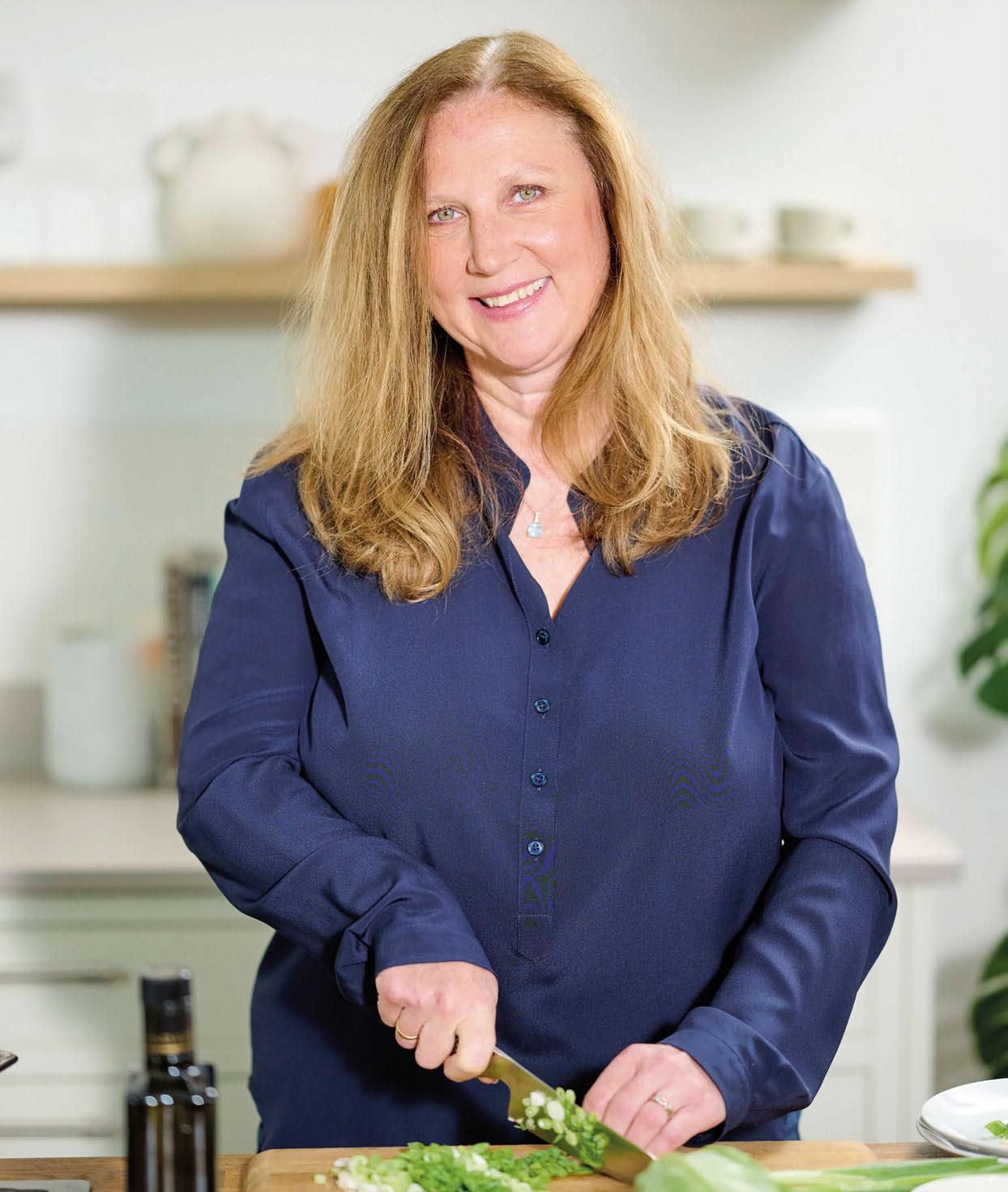
Angela Hartnett
The Michelin-starred chef and co-host of popular food podcast Dish from Waitrose shares details on her favourite places to dine.
When did you first fall in love with cooking?
From an early age – I’ve always loved eating and cooking.
Which chefs have inspired you?
Marcella Hazan was an extraordinary food writer – I love the clarity and confidence in her work. I’m constantly inspired by people around me, too; recently Jess Filby, Nieves Barragán Mohacho and, of course, my husband, Neil, who is also a chef.
Tell us about your most memorable meal. It has to be December 1999, in Italy. We were there as a family for Christmas. My brother was over from America along with my mum and cousins, so we were all together. We went to a local trattoria and ate so well – pasta, roast veal and pork. The evening went late into the night. When we left, it was snowing. It was one of those meals that really stays with you. And, somehow, one of the cheapest, too.
NOTABLE PROJECTS
Hartnett Holder & Co at Lime Wood, Hampshire; Murano, London; Café Murano, London (St James’s, Covent Garden, Bermondsey and Marylebone); Cucina Angelina, Courchevel. Dish from Waitrose is available on all podcast providers. www.angelahartnett.com
What’s your favourite hotel restaurant?
It’s not strictly a hotel restaurant, but I’d have to say Updown Farmhouse, just on the outskirts of Deal, Kent. Ollie and Ruth are doing such a brilliant job.
Who are your favourite people to cook for?
Family and friends – it should be a relaxed affair… in theory.
What’s your favourite dish, and who cooks it? Roast chicken – cooked by Neil.
And to wash that down with? Red wine from Piedmont.
It’s Sunday evening at home: who’s cooking and what’s on the menu?
Either Neil or I cook. More often than not it’s a roast dinner, though sometimes we switch it up and have something like pasta. But it’s always relaxed, never too fancy.
What’s your go-to cooking soundtrack?
I really enjoy BBC Radio 4 or 6 Music at the weekend. Failing that, it’s a playlist of Shazam’ed finds.
Where do you get the creative inspiration for your dishes?
Eating out, first and foremost, and seeing what others are doing. And then just talking to people. I was judging at The Roux Scholarship recently and found it hugely inspiring.
How often do you dine out?
I aim for once a week, but in reality it’s closer to once a fortnight.
Are you an easy-going or a demanding restaurant customer?
Very easy-going.
Which new restaurant are you eager to try?
Tiella Trattoria & Bar on Columbia Road in Bethnal Green, London – it looks exactly how a proper trattoria should.
Which cities are food heaven to you?
Palermo for its street food. And Tokyo – I’ve never had a bad meal there.
Back at home, which cookbooks can we find on your shelf?
Everything and anything to be honest. Nigel Slater and Diana Henry are constants; Rachel Roddy writes beautifully. I also often return to the greats like Alain Ducasse and many other Michelin heavyweights.
Restaurant dining or room service?
Restaurant when I’m with company; room service if I’m alone.
Sweet or savoury?
Savoury.
Healthy dishes or full-fat indulgence?
Healthy these days – at least, I try.
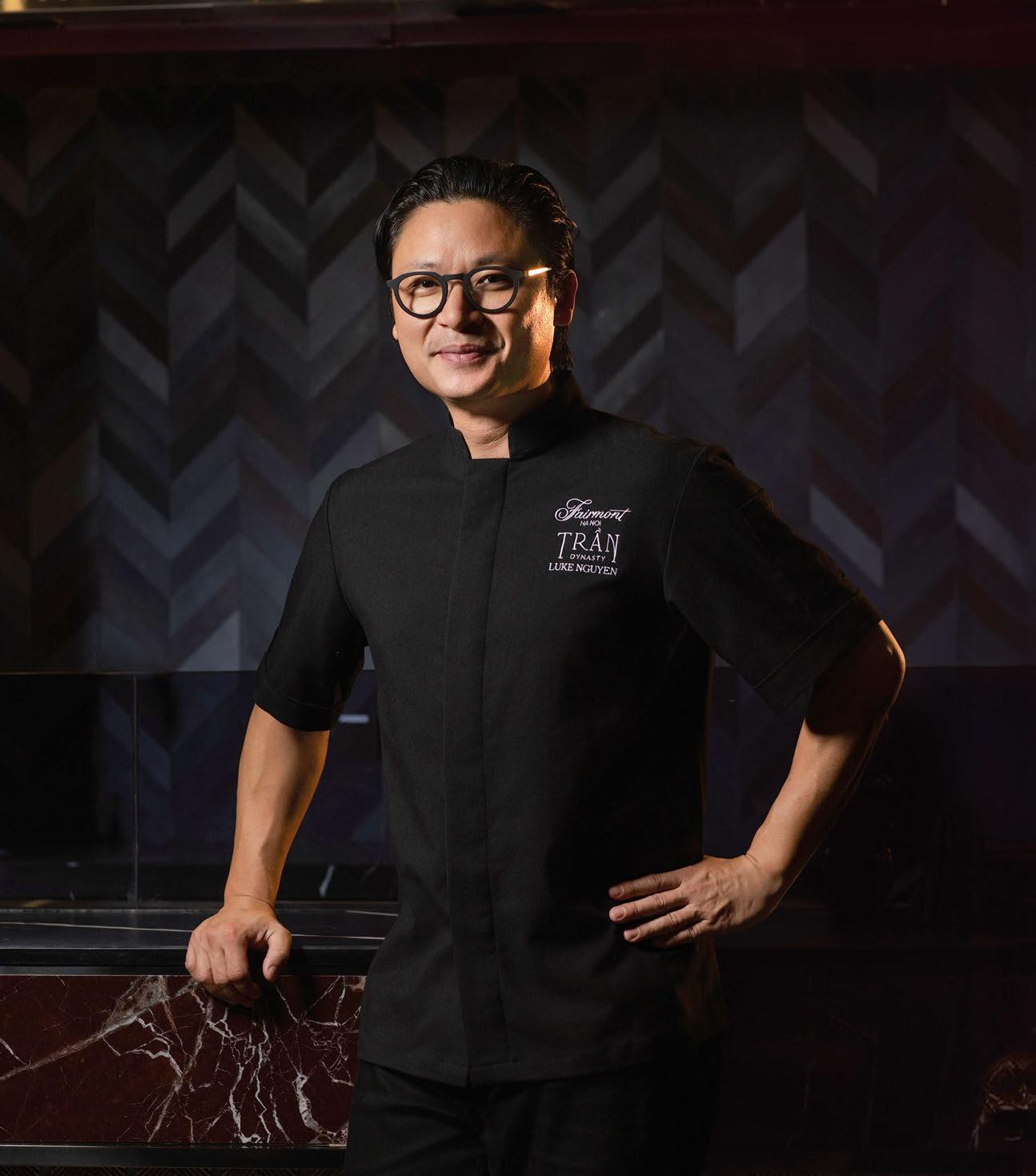
Emperor of Flavour
Chef and restaurateur Luke Nguyen celebrates the ancient heritage, culture and complexity of Vietnamese cuisine at Fairmont Hotels & Resorts’ landmark Hanoi opening.
Luke Nguyen has become a familiar face on screens across Australia and Vietnam, equally at home judging MasterChef as he is running restaurants that straddle the two countries’ food cultures. Ask him to recall how he reached this point, and he goes right back to the beginning: “I’m a boat baby,” he reveals.
Originally from Saigon, Nguyen’s family, like many others, fled by boat during the Vietnam War. His mother was nine months pregnant at the time, and he was born shortly after their arrival on Thailand’s shores. They would eventually settle in Australia, first in a refugee camp in New South Wales and later in Sydney, where in the suburb of Cabramatta, they opened a modest Vietnamese restauranta “hole-in-the-wall” operation that became their livelihood and the foundation for a new life.
“Coming from a poor immigrant family, all the kids had to work in the business before, after and sometimes even during school,” Nguyen recalls. “I grew up in the restaurant and learned everything from my parents: hard work, business savvy and cooking. I didn’t enjoy working at first, I wanted to ride my bike around the block. But by the time I was 11 years old, I had fallen in love with it all.”
Mesmerised by the magic of long-simmered broths, meat slow-cooked over 24 hours and the transformation of simple ingredients into something that kept people coming back, a plan formed. “I knew I wanted to open my own restaurant,” he says. “By the age of 23, I was tired of just
talking about it.” Nguyen turned that frustration into action with Red Lantern, which he opened in 2002 in a converted terrace house seating just 40 people. It quickly became a cornerstone of Sydney’s dining scene, and subsequently one of the world’s most awarded Vietnamese restaurants. “There was so much love, passion and drive there,” he says. “That’s where it all started f0r me.”
But success in the big city didn’t teach him all he needed to know of his home country’s cuisine. “I was raised in Australia and I thought I knew everything about Vietnamese food, but actually I didn’t,” he admits. That realisation sent him regularly back to Vietnam to study regional differences in dishes, ingredients and technique. “The cuisine is incredibly diverse and there’s so much to it that many people don’t realise - that even a lot of natives don’t know yet either,” he continues. “I’ve been able to learn through my travels. For example, dishes from Hanoi are completely different from dishes in Saigon in terms of flavour profile and the herbs and spices used.”
Those trips led to TV work, including Luke Nguyen’s Vietnam, as well as several cookbooks and eventually a judging role on MasterChef Vietnam, before later joining the Australian franchise. “To be a judge, you have to be knowledgeable about the cuisine and the culture,” he says. “So it felt like an opportunity to reconnect with my heritage.”
At the same time, Nguyen opened restaurants in Sydney and Brisbane, including Royal Botanic Garden and Fat Noodle, the latter focused on Vietnam’s vibrant street food scene.
Words: Hannah Currie
His first restaurant in his home country was in Saigon. Vietnam House, set within a French colonial-style building in one of the city’s affluent central districts, showcases traditional cooking with contemporary touches seen in dishes such as duck noodle soup, chargrilled chicken and silken bean curd desserts.
Ten years on, Nguyen is preparing for his latest challenge: a signature Vietnamese restaurant at Fairmont Hotels & Resorts’ first property in Hanoi, where the brief felt entirely different. “I was approached by Fairmont to create a new concept in Hanoi. I thought, ‘wow, the capital of Vietnam’, this is going to be an incredible challenge,” he says. “That’s when Tran Dynasty was born.”
The restaurant’s namesake refers to the highly influential imperial family who ruled the country between 1225–1400, an era celebrated as a golden age thanks to its formidable resistance against multiple Mongol invasions and significant advancements in art, culture and administrative reforms.
From the start, Nguyen’s ambition was to create a signature Vietnamese restaurant unlike anything that had been conceived before. “I’ve opened noodle bars and modern restaurants, but I’ve never thought about a venue that explores the ancient history of Vietnam; exploring what emperors ate and what they commanded from their workers,” he explains.
The resulting menu is as much about this narrative as it is flavour, with every dish designed to reflect the royal dining rituals of the period. “Food and cooking is all about storytelling,” he says. “It’s about the history and the deep meaning behind each dish.” To
“Food and cooking is all about storytelling –the history and deep meaning behind each dish.”
spices, sea bass baked in clay, and mixed pho, all using organic and sustainable produce where possible. “I kept thinking, if I had to cook for the emperor, what dishes would I serve? What proteins would I use? What was available in the waters at that time? The answer came from researching, foraging in the mountains of northern Vietnam and discovering ingredients used by ethnic minority communities,” he explains. “I want to create that sense of surprise on the menu and I hope even Vietnamese guests will say, ‘I’ve never seen that before.’”
bring that to life, the chef immersed himself in extensive research together with the Fairmont team, visiting museums and studying archival materials. “I found stories about emperors demanding that their chefs present 40 to 50 dishes for the whole royal family. They had to be incredibly creative, sourcing the best produce and constantly presenting something new.”
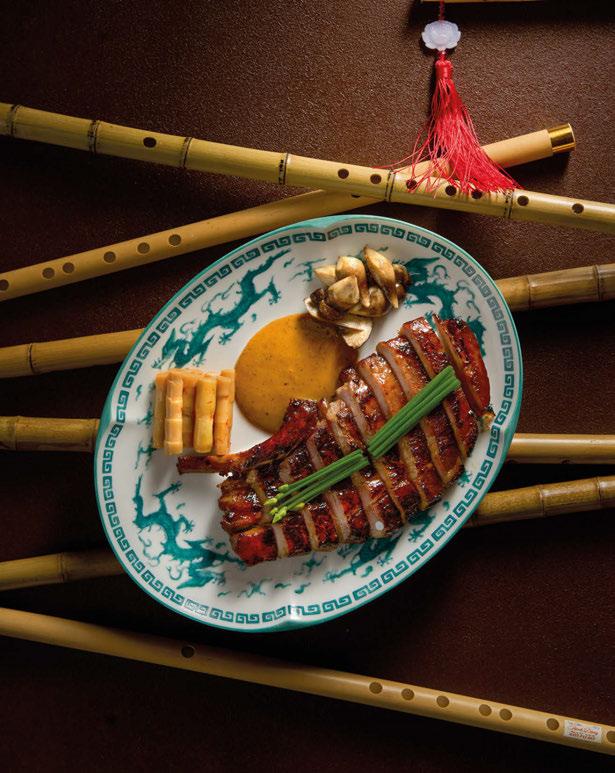
This narrative became the foundation of his menu, which centres on a long progression of small dishes – almost like canapés – paired with Vietnamese-inspired cocktails. Each dish tells a story, from delicate broths to mantis shrimp with Ly Son garlic, Bat Trang clay-roasted pigeon and smoked Wagyu steak tartare. There’s also slow-cooked beef infused with dates and
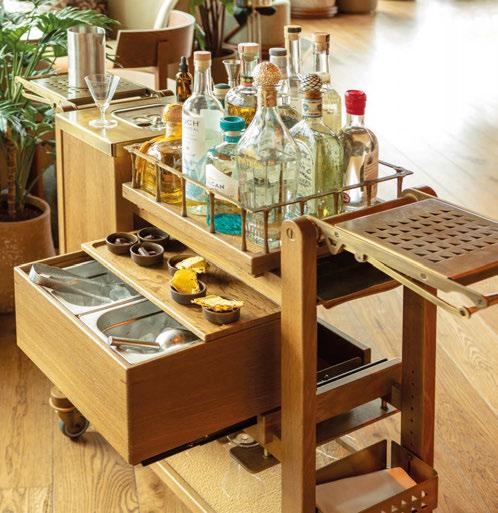
Snippets from the era have also shaped the flow of service. “At the time, there was constant conflict and war between dynasties,” the chef explains. “Rival rulers would often try to poison one another, so kings demanded that chefs prepare dishes directly in front of them.” Naturally, that translates into a large open kitchen at the centre of the space, allowing guests to watch a busy brigade at work, while selected dishes are finished tableside and served from custom trolleys fitted with burners.
Despite its luxury setting, the operation also takes inspiration from Vietnam’s down-toearth culinary traditions. “What I love about food culture in Vietnam today is the street food experience – sitting curbside on tiny stools while cooks prepare dishes right in front of you. You see everything,” he says. “I wanted to bring that element into the restaurant, too. So this is progressive Vietnamese food, but it’s also fun and interactive. I want chefs to come out and chat with guests.” That interplay between historical theatre and contemporary touches extends into the restaurant’s interiors, where Tran Dynasty influences are reinterpreted
Nguyen’s latest menu centres on a long progression of small dishes to echo the service style favoured by the Tran Dynasty
“Since I was a young child, my purpose has been to share Vietnamese cuisine and culture with the world.”
through a modern lens. Guests are welcomed by dark tropical woods, intricate framed screens and lantern-lit spaces, spanning a striking bar, courtyard and rooftop setting. The materials chosen are intentionally opulent, echoing the royal aesthetics of the era with gold-leaf ceilings and elegant skylights.
“It’s my first hotel restaurant, and working with Fairmont has been incredible in terms of design and atmosphere,” Nguyen says, adding that the concept is backed by a local team deeply committed to his ambition of representing their cuisine on a global stage. “Vietnamese people are incredibly passionate about their food, culture and history,” he explains. “So when building a concept like this, everyone is fully invested. There aren’t many five-star hotels in Vietnam with a restaurant like Tran Dynasty, so we’re proud to be among the first.”
Not one to stand still for long, Nguyen has also recently expanded in his second home. “I’ve just launched a new restaurant at the
Sydney Fish Market, the third-largest fish market in the world,” he says, referring to new harbourside spot, Lua. “It’s spectacular. Around 70% of the menu is seafood, and we have live tanks where we select lobsters and crabs before cooking them fresh. So that’s keeping me very busy as well,” he laughs.
Asked what continues to drive him – while tirelessly travelling between Sydney, Brisbane, Saigon and now, Hanoi, Nguyen responds with humility: “I never had plans to build a restaurant empire, but since I was a young child, my purpose has been to share Vietnamese cuisine and culture with the world.”
Tran Dynasty embodies this ambition. “People will come from all over the globe to experience the history of Vietnam through food at Fairmont Hanoi,” he says. “And personally, I’m still writing cookbooks and making TV shows about Vietnamese cuisine, while running restaurants in both Vietnam and Australia. Really, there’s nothing more I need to do.”
Theatre is part of the experience, with selected dishes finished tableside and served from custom trolleys
Gusto collection design by Alain Gilles
Pasta Titan
With a clutch of Michelin stars to confirm his status as a master of contemporary Italian cuisine, Michael White discusses his latest challenge, Lions Den at The Stoneleigh in Dallas.
Words: Ayesha Khan
An Italian immigrant hub since the late 1800s, New York has long been home to innumerable ‘red sauce’ restaurants that serve authentic fare on par with Sicily and Naples. But it wasn’t until the 1990s that the Italian finedining scene in the city truly flourished. Chef Michael White was one of its pioneers, garnering Michelin, New York Times and James Beard recognition and earning the moniker of Pasta Titan – a rare honour for a non-Italian raised in Wisconsin by a Norwegian family.
Perhaps some of the credit for that achievement lies with his parents. “My dad was an avid home cook – he still loves it to this day. And I’ll never forget when my mom went to Paul Prudhomme’s New Orleans cooking school and came back with spices for cooking Jambalaya,” the chef explains.
“People are now into food because of the Food Network, but we were into food way before that! My mother used to read Gourmet Magazine, and I remember looking in the back for ads about restaurants in New York City,” he adds, foreshadowing his own success in the foodie capital.
This early passion led White to the prestigious Kendall Culinary Institute in Chicago and then to Spiaggia, one of the city’s foremost restaurants. Eventually, following a budding interest in Italian cooking, he took a trip to the country, where he intended to spend just a few weeks. Instead, he
ended up staying and recalls a thorough saturation in a culture he knew little about. “It was total self-immersion –nobody spoke English, and of course, there were no language apps, so it was just me and a little Italian book. It was truly a baptism by fire!” he recalls.
White spent seven years under the tutelage of mentors such as Valentino Marcattilii, who helmed the kitchen at the famed Ristorante San Domenico in Imola. “Working under Valentino taught me discipline, restraint and respect for ingredients,” he says. “He had an incredible ability to elevate the simplest products through technique and intuition. He showed me that great cooking isn’t about complexity – it’s about understanding when to do less.”
Many more lessons were learnt, but these came from outside professional kitchens. “I spent countless hours with Italian families, in homes where recipes had been passed down for generations. There was no ego, no performance, just a deep connection between food, family and place. Those experiences taught me that authenticity isn’t something you create; it’s something you preserve. Whether it was a grandmother rolling pasta by hand or a family gathering around a Sunday lunch, I learned that food carries memory, culture and emotion,” he says with fondness. That handson, ingredient-driven approach so embodied by Italian food culture resonated with White, teaching him skills in cooking
and business that eventually amassed recognition for him back home.
In the following years, White worked relentlessly, efforts that came to fruition when he co-founded Altamarea Group, which resulted in a cascade of restaurant openings including the crudo-forward Fiamma, the legendary Central Park South Italian seafood restaurant Marea, a winner of the James Beard Award for Best New Restaurant, and Alto, just off New York’s Madison Avenue, which closed in 2011. After being awarded a total of six consecutive Michelin Stars, White took some time off to re-evaluate his approach to owning and operating restaurants. The decision led to strategic partnerships, enabling him to focus more on culinary creation and the guest experience rather than the commercial side of the business.
One of those partnerships was alongside New York hospitality luminary Bruce Bronster, with the pair founding BBianco Hospitality in 2020. The duo opened restaurants tied to landmark resorts in Miami, Puerto Rico and the sprawling Atlantis Paradise Island in the Bahamas. In a full circle moment, White even came back to the site where Alto once resided to open his flagship, Santi. Here, the BBianco team was able to spend time mastering everything about the guest experience, from design through to service. The multistorey Santi features impeccable interiors, an enviable art collection and an extensive kitchen, complete with its own pasta-making room. White lovingly refers to the restaurant as “the Duomo of Italian food,” in New York and relishes when diners tell him his dishes are better than what they ate on recent trips to Italy.
BBianco’s latest venture is in Dallas, at the historic The Stoneleigh, a hotel dating back to 1923. Lions Den is a restaurant that pays homage to the original design of the hotel at the hands of influential New York decorator and originator of maximalist design, Dorothy Draper. Walls and ceilings are swathed in rich, textural wallcoverings while
“What motivates me is what’s next: the next restaurant, the next menu, the next challenge.”
luxurious pattern-on-pattern upholstery and walnut wood conjure the allure of a bygone era. “We were very conscious not to design it for a Dallas palate, so it’s based more on the fact that this is an effusive Dorothy Draper hotel with old bones. We worked hard to ensure the food also made sense in that setting.”
“The menu is designed with a sense of place in mind,” Bronster confirms, before going on to reel off standout shared dishes from the Supper Club Two Step menu, including a whole Maine lobster that comes split open and accompanied by a truffle pot pie, cauliflower gratin and spaghetti calabrese; and a 45-day dry-aged Porterhouse steak that’s paired with tartare fillet mignon, grilled striploin, bone marrow and baked potatoes, topped with a fried egg. Both dishes are presented with the tableside pomp and circumstance befitting of the setting. Bar Leonessa, the hotel’s lobby cocktail bar, is equally opulent, with signature serves such as a vodka and rum-forward Sicilian Iced Tea featuring notes of tamarind and lemon, and a Venetian margarita with hibiscus and lime.
It’s one of many projects White can look back on with pride, though he doesn’t spend much time reminiscing. “I’ve been fortunate to have extraordinary experiences throughout my career, but to be honest, I don’t spend much time looking back,” the chef says. “What motivates me is what’s next: the next restaurant, the next menu, the next challenge. As long as I feel I’m learning and creating, I’ll continue to have the same passion I had when I first started.”
White’s next culinary venture is at The Ben, an Autograph Collection hotel in West Palm Beach, Florida. Asked about the pressures of building and managing multiple venues at once, White simply shrugs. “I haven’t worked in 38 years,” he smiles. “I still get high on doing the job I do every day. Hospitality is incredibly energising because ultimately, it’s about people. Every service is a chance to create a memory for someone and that responsibility never gets old.”
Elevated seafood and pasta dishes are the pillar of White’s cooking prowess
Maximilian Scheller
F&B Design and Development Director, Luxury, Europe – Marriott International
Coming from a family of scientists, a career in hospitality wasn’t always on the cards for Maximilian Scheller. Nevertheless, a first job as a dishwasher at Hotel de Rome in Berlin blossomed into a passion for the craft that led him to Hotelschool The Hague. From here, he gained additional operational experience at W Hong Kong, before moving to Dubai to head up the creative departments at Forsite Creative (H-Hospitality) and later, hospitality technology company, Eatopi. His latest role sees him leading luxury F&B strategy and experience positioning across Marriott’s luxury portfolio throughout Europe, encompassing brands including The RitzCarlton, St Regis Hotels & Resorts, Edition Hotels and W Hotels.
High Flyer
Hospitality comes naturally to Maximilian Scheller, whose strong storytelling and commercial awareness is shaping the F&B experience at Marriott International’s portfolio of luxury properties.
Maximilian Scheller has always been driven by a keen sense of observation. As a young bartender at W Hong Kong –his first encounter with a Marriott International property – he found himself captivated by the way hotel dining could function as a genuine urban destination, drawing locals and visitors alike in a way that felt absent from European hospitality at the time. But alongside that excitement came a nagging frustration that certain elements could be done better. “W is such an incredible brand,” he recalls. “But that wasn’t translating into practice for the guests in terms of service and experience. I wanted to change that.”
DESTINATION DINING
That instinct – to close the gap between a lifestyle concept’s potential and its reality –has defined Scheller’s career ever since, and now sits at the heart of his role as F&B Design and Development Director for Marriott’s luxury portfolio across Europe. It’s a position that places him at the intersection of owner ambitions, brand strategy, market research, interior design and F&B identities, which all succinctly translates into the creation of hotel restaurants that are destinations in their own right. “F&B is a key focus of Marriott’s luxury portfolio and that’s why it’s so fun,” he smiles. “We can help put a hotel on the map.”
That easygoing acceptance of the challenge is especially pertinent given Marriott’s continued, extensive growth. The group recently celebrated the opening of its 10,000th property, JW Marriott Ranthambore Resort & Spa in India, while also adding 10 new luxury resorts to its roster in 2025, a figure that’s slated to rise considerably in 2026. As Scheller notes, F&B now plays a vital role in the success of each venture. “Marriott began as an F&B business – the empire was born when our founder John Willard Marriott started a root beer stand – so it’s always championed F&B,” he says. “But now the group is more attuned to its importance than ever, and you see that from the top down.”
CREATIVE FREEDOM
This leadership-level sanctioning gives Scheller and his team the freedom to pursue projects with vigour, a degree of creative latitude he admits he relishes. “I like to challenge the status quo until it becomes the status quo – and then challenge further,” he says. “Marriott allows you to do that, and that means everybody’s empowered. We’re all working towards the same goal, and within that, everyone plays a part.”
For Scheller, that looks like working on a live pipeline of around 40 projects simultaneously. When a new hotel is signed, his involvement begins early. The first step is always to
understand the ownership group: its ambitions, market knowledge and tolerance for risk. “We see ourselves as promoters, connectors, facilitators and advisors,” he explains. “We advise our owners on strategy, but we aim to influence with integrity and never ego.”
From here, the team begins to create, first by commissioning detailed market research to secure the hard data that can be translated into comprehensive strategy. Consultants in place, they visit the region to gather first-hand insights, a boots-on-the-ground mentality that’s especially important in emerging markets, allowing Scheller to make informed decisions about what kind of concepts to pursue, whether it’s collaborations with internationally established brands and chefs, partnerships with rising local chefs or co-created restaurant identities. “In destinations like CIS countries you need to be very culturally sensitive,” he explains. “You might have the right concept but it’s too early for the market, so it’s about introducing an idea that’s more realistic.”
ALL ABOARD
Once established, Scheller pairs up with the relevant design team to bring a space to life, while also working closely with culinary specialists on back-of-house design. The process moves from operational logic to guest experience – “building
from the inside outwards,” as Scheller puts it –before homing in on the finer details of identity, branding and finish.
It’s a system that demands a particular kind of mental agility. “To use an analogy, we’re building the plane while we’re flying,” Scheller admits. “I always need to be two or three steps ahead of the general project in order for it not to stall.” That means making essential decisions about space, concept and flow before every variable is settled – sometimes a restaurant’s culinary identity is still being finalised while its kitchen layout is already fixed. “It’s not ideal, but that’s the reality,” he adds.
TALENT SCOUT
Navigating this uncertain terrain is made easier by having the right team in place, with Scheller noting the importance of a clued-in General Manager long before a project opens to guests. “This is crucial,” he affirms. “They’re the captains of the plane we’re flying, so it’s essential to hire the right people at least 12 months in advance. If you don’t, the window for success can be capped, or you might miss opportunities to fully deliver on your vision.” Similarly, he touts the critical role of savvy F&B designers, especially in the creation of venues that sit well within their locations. “Our venues need to feel authentic, like they’re part of their
cities,” he says. “They need to be distinct yet familiar, and this is something that only good designers can do.”
In regard to his own performance, Scheller is candid about the need to prioritise – after all, not every hotel in the portfolio requires a neighbourhood-defining restaurant or bar. Instead, the goal is to create a consistent baseline of well-considered, credible outlets. “We create formulas that ensure certain standards across the board,” he affirms. This leaves space for the showstoppers, where budget, creative vision and potential all align. “We call them halo projects, and they’re what really drive us because it’s where we can make the biggest impact,” he says.
Ultimately, that imprint is measured by revenue, naturally. But there are other factors at play for Scheller. He speaks with warmth about staff retention as a signal of a concept’s success, especially in the face of such high industry-wide turnover, as well as the significance of awards and recognition. “We’re always very proud to receive acknowledgement, in whatever form it comes,” he smiles. Perhaps that’s felt most proudly when a venue plays a crucial role in the formation of local communities. “It’s those special instances where the scene builds itself that we thrive on,” he says. “The moments when it’s organic traffic using the space as intended –that’s the ultimate success.”
apturing the ephemeral essence of a place is always a challenge, but in reimagining Beach Club within The Breakers Palm Beach, the transient spirit of summers spent on the Italian coast have been channelled into every corner of the redesigned space. “We wanted to conjure a feeling, but not in a literal way,” explains Alessia Genova, owner and principal of Tihany Design, the studio behind the project. “So, it’s about the way light hits whitewashed stone in the afternoon, the ease of sitting on a piazza and the sense that a meal could last for hours.”
The venue’s location adjacent to the Atlantic Ocean was also a consideration. “It’s a conversation between two worlds,” says Genova. “The particular elegance of Palm Beach was also a factor.” The balance is visible throughout –from the interplay of natural stone alongside handpainted tiles, bleached oak and brass detailing, to the material palette drawing from earthy terracotta and travertine against marineinspired crisp whites and cerulean blues.
Unfolding as a series of interconnected spaces, a feature fountain sets a serene tone before leading to an enclosed loggia with views of sea and sky. In the dining room, two back-toback bars serve both the loggia and the interior, erasing the barrier between indoor and outdoor living, while an elevated wine room overlooks the scene. Above, custom-designed, modular chandeliers add a sense of theatre to the ceiling plane, while walls are adorned with murals, and sculptures and gallery compositions curated by Kevin Barry Art Advisory complement the warm and poetic nature of the aesthetic.
“The collaboration with Kevin Barry adds another dimension entirely. It rewards attention, and that gives people something to discover on their second or third visit,” says Genova. “But the biggest driver of the atmosphere overall has to be the flow between spaces. You can move from the loggia to the dining room to the terrace without it ever feeling like a different restaurant. That continuity is what makes guests settle in and stay.”
The royal stamp of approval is entwined with every facet of the newly designed Willett’s at The Cadogan, A Belmond Hotel, with Studio Shayne Brady taking its call from the hotel’s Chelsea location in the creation of a British-inspired bistro. “The brief was to make the restaurant feel like part of the locale instead of being connected to a hotel,” Brady explains. “So, we looked at the history of the area and that became our starting point.”
Belmond
Located on King’s Road, named because it was originally built as a private highway for King Charles, The Cadogan now resides in place of market gardens that the monarch used to admire on his travels between palaces. Lined by vegetable patches and beehives, it’s this bucolic scene that was channelled into the refurbishment of Willett’s. “The idea of an abundant playground of produce tied so well into what we were trying to create with the new concept,” Brady says.
Subsequently, each of the three rooms that comprise the restaurant is decorated in a range
of heritage greens, warm neutrals and rich timber stains. Linen café curtains and tactile upholstery soften the edges, while antique mirror and bronze metal finishes introduce a sense of quiet glamour – look out for table lights cast with brass bees in a nod to the beekeepers who tended the swarms. “The colour palette is fresh, but it also feels as though the features have developed over time,” Brady continues. “And the inclusion of hidden details adds a sense of fun and frivolity.”
A central open show kitchen and chef’s counter have become both part of the guest journey and the focus of theatrical dining moments, and lighting plays a key role, with bespoke creations featured throughout. “By day, the front room is flooded with light, and we opted for a contemporary chandelier for added drama, while at night, the lighting dims and the back two rooms become sumptuous, intimate and dark. It’s all very relaxed and approachable – exactly how a neighbourhood restaurant should feel.”
he quiet intimacy and craftmanship associated with Kyoto meets the relaxed warmth of America’s wine country at Sonoma by Single Thread, the signature eatery within Capella Kyoto. As the first international expression of the three-Michelin-starred Single Thread in California, the restaurant comprises a 20-seat lounge bar and a 12-seat counter, with interiors by Brewin Design Office. “We focused on a shared emotional language among key facets including nature, seasonality, tactility and a strong connection to artisanal making,” explains Robert Cheng, founder and Principal of the Singapore-based studio. “The interior language therefore evolved to be natural and grounded, with an emphasis on handcrafted details, textured materials and a residential sense of comfort.”
The lounge is conceived as a living room anchored by a bar – intimate, layered and personal. Working in collaboration with Single Thread, Brewin Design Office furnished the space with a curated collection of objects
gathered from antique stores and local auction houses, emphasising nostalgia and individuality. Meanwhile, the dining room, with its chef’s table-style counter, is designed as an extension of the kitchen, paying homage to Sonoma’s culture of open hospitality. “Visually and spatially, it prioritises immersion and sensory precision, which aligns very closely with the philosophy behind both Single Thread and Capella Kyoto,” Cheng adds.
A key aspect of the dining experience is the gradual transition through the restaurant, with the interiors actively influencing how guests move, interact and emotionally digest the meal. With clusters of low slung seating and floor-toceiling views of the serene courtyard, the living room encourages diners to settle into a slower pace, disconnecting from the outside world before the meal begins. “This more relaxed atmosphere heightens the anticipation,” Cheng concludes. “Then guests move to the dining room, where culinary performance and chef interactions become the focus.”
Sonoma by Single Thread Capella
KYOTO
Glacies is a celebration of the duality between the chill of ice and the warmth of socializing, where each glass contributes to the cocktail’s narrative, awakening the senses and inviting the first sip.
Naked Tomato
Moxy South Beach
MIAMI
Words: Catherine Martin
Photography: Courtesy of Marriott International
Since opening in 2021, Moxy South Beach has built a reputation for its dynamic dining concepts. Ranging from a lobbyside taco stand to a tropical rooftop retreat, the F&B lineup captures the spirit of the location while honouring the core pillars of the brand. Now, in a bid to keep diners coming back for more, the 202-key lifestyle hotel has launched Naked Tomato, a modern Mediterranean eatery from Eyal Shani.
fire-roasted eggplant and charred beetroot to creamy hummus and freshly-baked laffa. A highlight is the shipudim – Israeli-style skewers of mushroom or succulent chicken thigh, served with a colourful assortment of mezze including pickles, roasted peppers and Middle Eastern slaw.
IN A BITE
Operator: Marriott International,
The Good People Group
Interior Design: Jacob Turgeman Design
F&B Consultant: Think Hospitality
Executive Chef: Eyal Shani
www.nakedtomatousa.com
The Israeli chef – who holds a Michelin star for Shmoné in New York City – debuted his ‘naked food’ philosophy in 2022, describing it as a celebration of the ingredient in its most honest form. “At Naked Tomato, we believe creating naked food is an act of courage,” Shani explains. “It means removing the masks and distractions, and standing fully behind the ingredient itself. It requires choosing the very best, understanding its singular character and guiding it gently to its purest expression.”
On the menu, this translates to simplicity, seasonality and ingredient-driven dishes, from
Interiors are equally expressive, created by Jacob Turgeman Design in honour of Shani’s culinary philosophy. The space blurs the line between market, kitchen and dining room, with fresh produce displayed to highlight the journey from land to plate. A palette of worn wood, textured stone and patinated metal recalls Tel Aviv’s industrial past, while splashes of olive and terracotta add Mediterranean warmth.
Table settings are intentionally simple, with a plump, juicy tomato taking centre stage atop a ‘cloth’ of brown kraft paper. Dishes are delivered with animated stories of their conception and sharing is actively encouraged, resulting in a convivial dining experience shaped by flavour and personality.
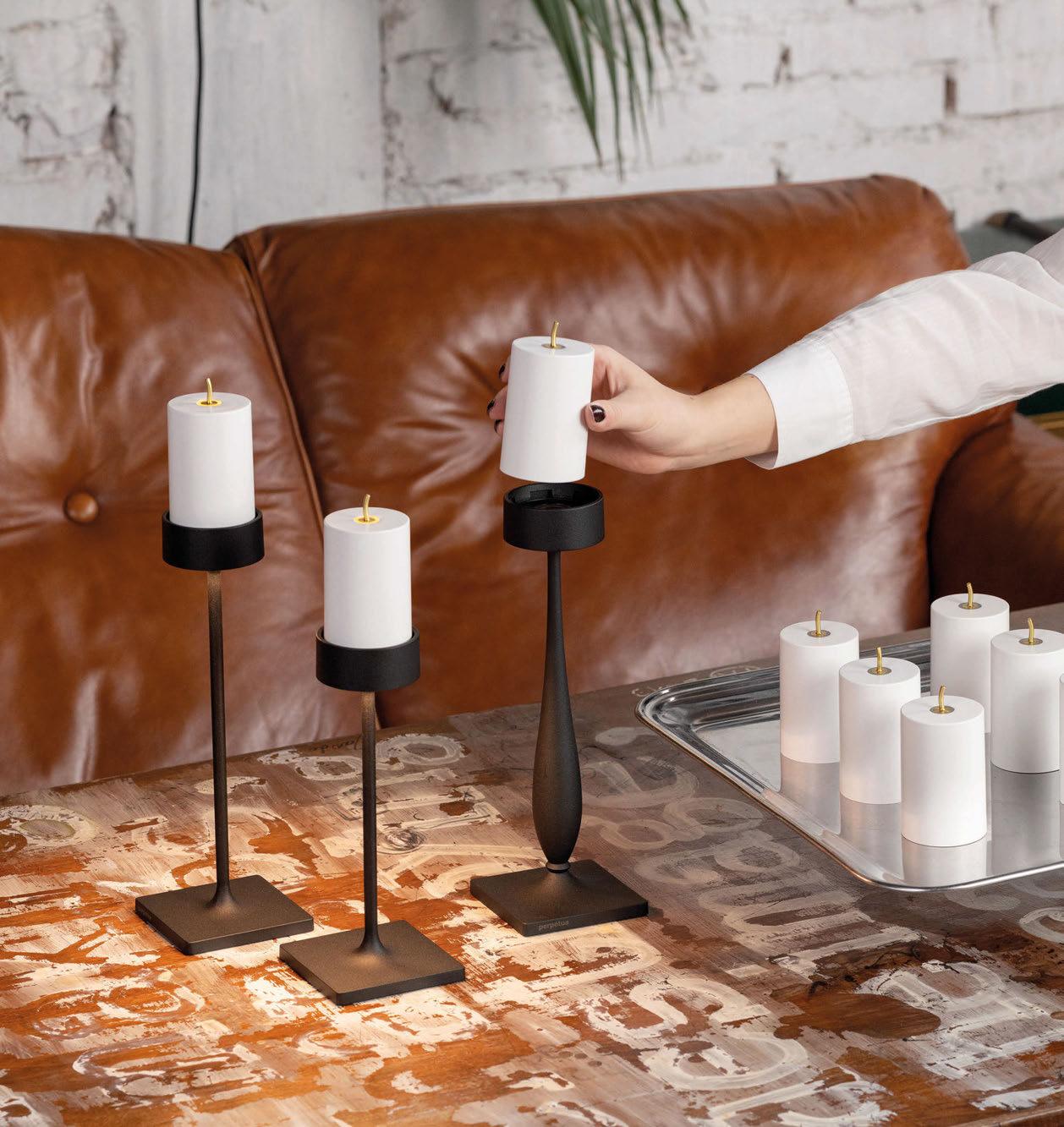
Bespoke products for front-of-house
La Sociedad Gastronomika
Mercer
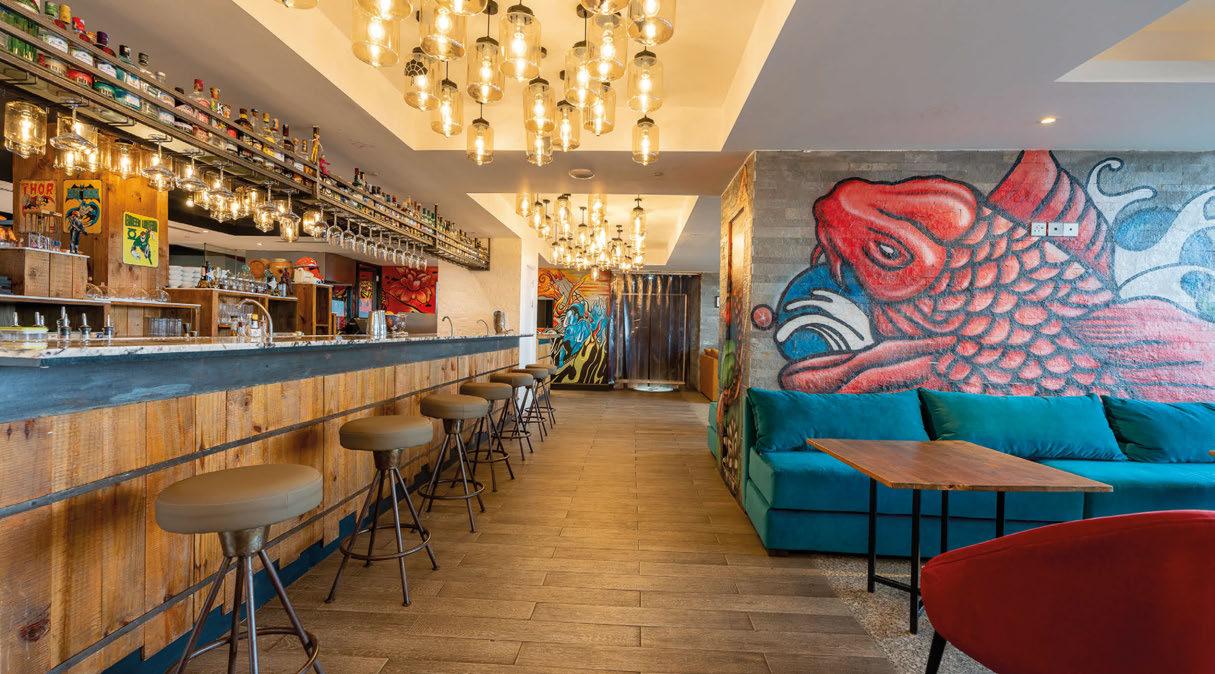
MADRID
Mercer Hoteles opens its first property in the Spanish capital, with three-Michelin-starred Eneko Atxa at the helm of its F&B programme.
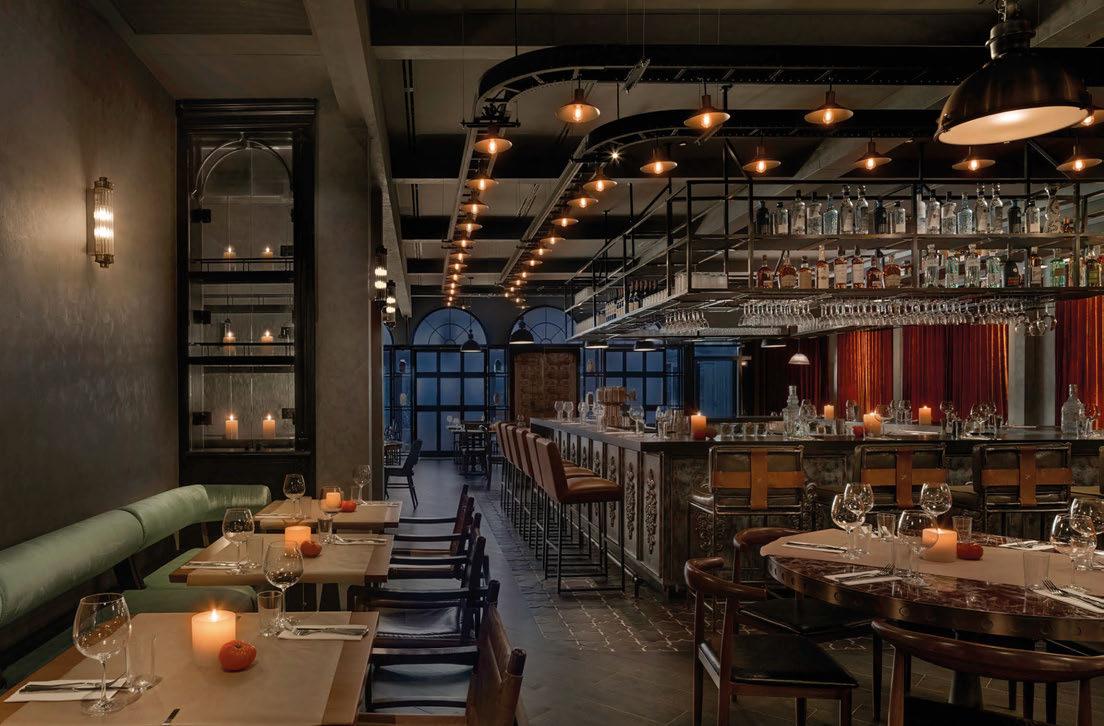
An immense, bulbous lighting sculpture rises from behind the Rosavel granite reception desk of Mercer Madrid. Both are works by Andreu Carulla, the Girona-based designer enlisted to craft the interiors. He says the shape of the structure was inspired by sugar beets, a nod to the history of the building, once home to Sociedad General Azucarera de España, an association of Spain’s sugar businesses.
Whether inclined towards sweet or savoury, guests can indulge their appetites at the hotel’s new restaurant led by Eneko Atxa, the result of a culinary partnership to mark Mercer Hoteles’ debut in the Spanish capital.
Atxa, who is famed for Azurmendi, the threeMichelin-starred restaurant on the outskirts of Bilbao, was born in the Basque Country and grew up inspired by the home cooking of his mother and grandmother. By 18, he was enthused by the world of fine dining, experimenting with tasting menus in the household kitchen. After working with the likes of Martín Berasategui, he opened Azurmendi aged just 27. Creativity,
craftsmanship and precision converge at this establishment - which marked its 20th anniversary last year - a combination that earned the chef a well-deserved position in Spain’s gastronomy scene.
“I remember my trips to London many years ago and finding a world in movement,” says Atxa. “Madrid has a lot of that nowadays. The city is alive with culture, gastronomy and business. It’s effervescent for someone who lives in peace and quiet, surrounded by countryside and mountains.”
The chef is also a familiar name in the city’s hotel scene, having opened Eneko Basque at Radisson Red Madrid in 2022. Here, the offering includes à la carte sharing plates, but his new creation for Mercer is closer to a fine-dining experience, with a tasting menu dishing up a sample of how things work at Atxa’s flagship restaurant in the Basque Country.
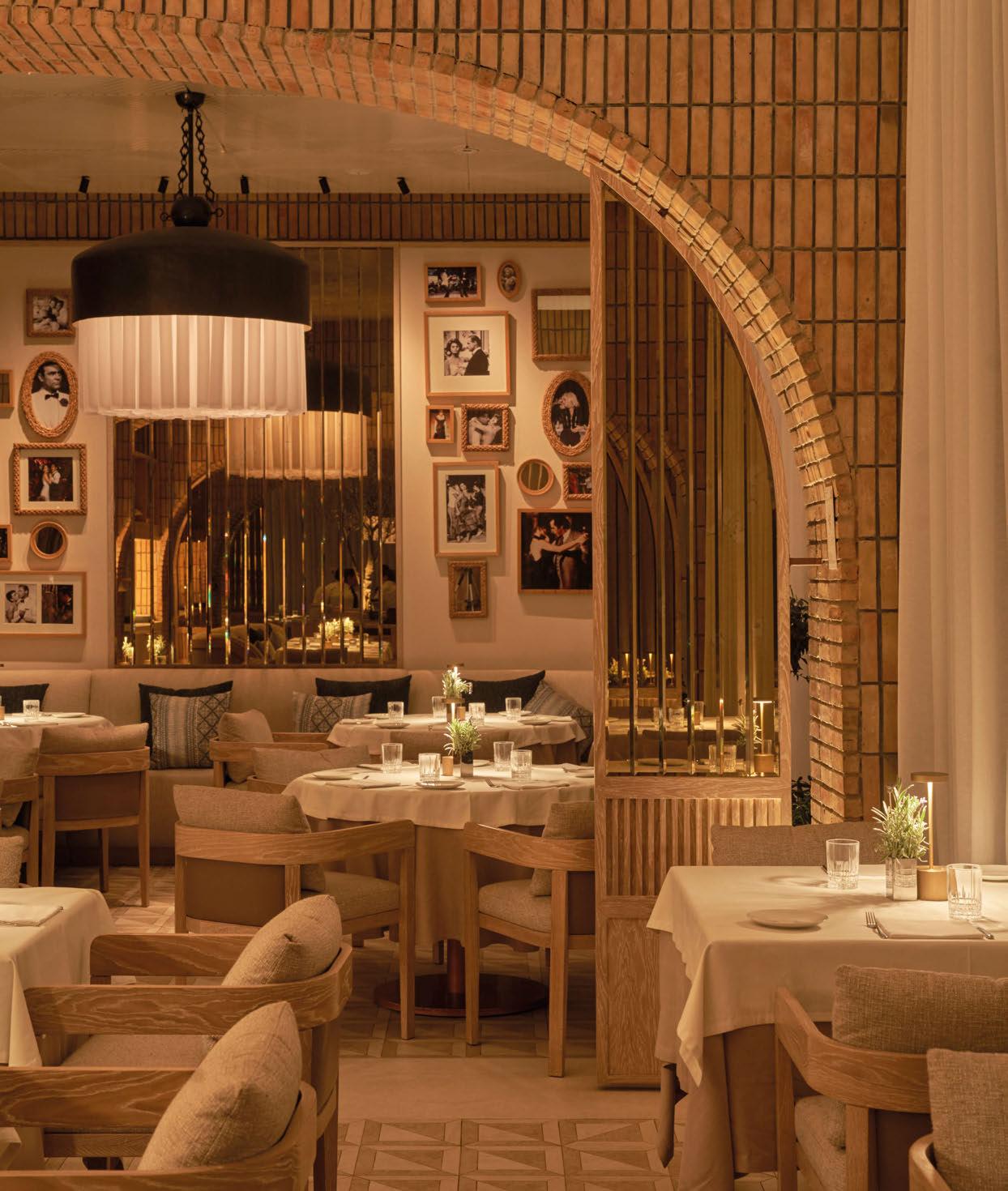
In an intimate space with just 12 covers, diners at La Sociedad Gastronomika observe a culinary team at work in the open kitchen.
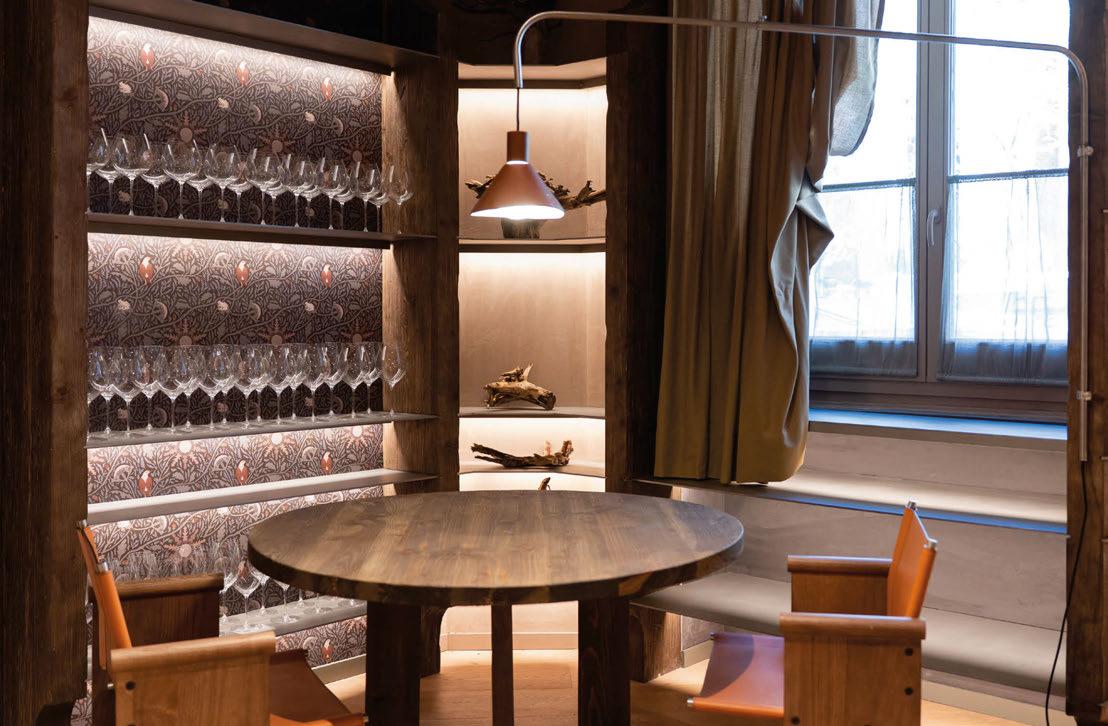
Carulla designed chairs from leather, wood and steel to reflect Basque craftsmanship, which he says has an “elegant, austere, direct and noble character,” while roots gathered from woodland near Azurmendi are used as decorative sculptures. An adjoining lounge seats another 24 diners when required, while a separate dining room with 16-person capacity is rented for private meals.
The restaurant’s name refers to traditional food-focused social clubs known as txokos, which function as local gathering places with restaurant-style facilities, where members can take friends and acquaintances to prepare and serve their own meals in groups. Atxa says he grew up spending time at associations like these with his family, and he continues to frequent the txoko in his hometown today.
The elevated experience at Mercer does not resemble a txoko in the literal sense, however the chef wanted to evoke a certain spirit of his native region’s traditions. “As Basques, we’re inspired by our territory, ingredients and
popular recipes,” he continues. “This spirit, which draws from our tradition, landscape and know-how, is behind the contemporary cuisine that we’re offering in Madrid.”
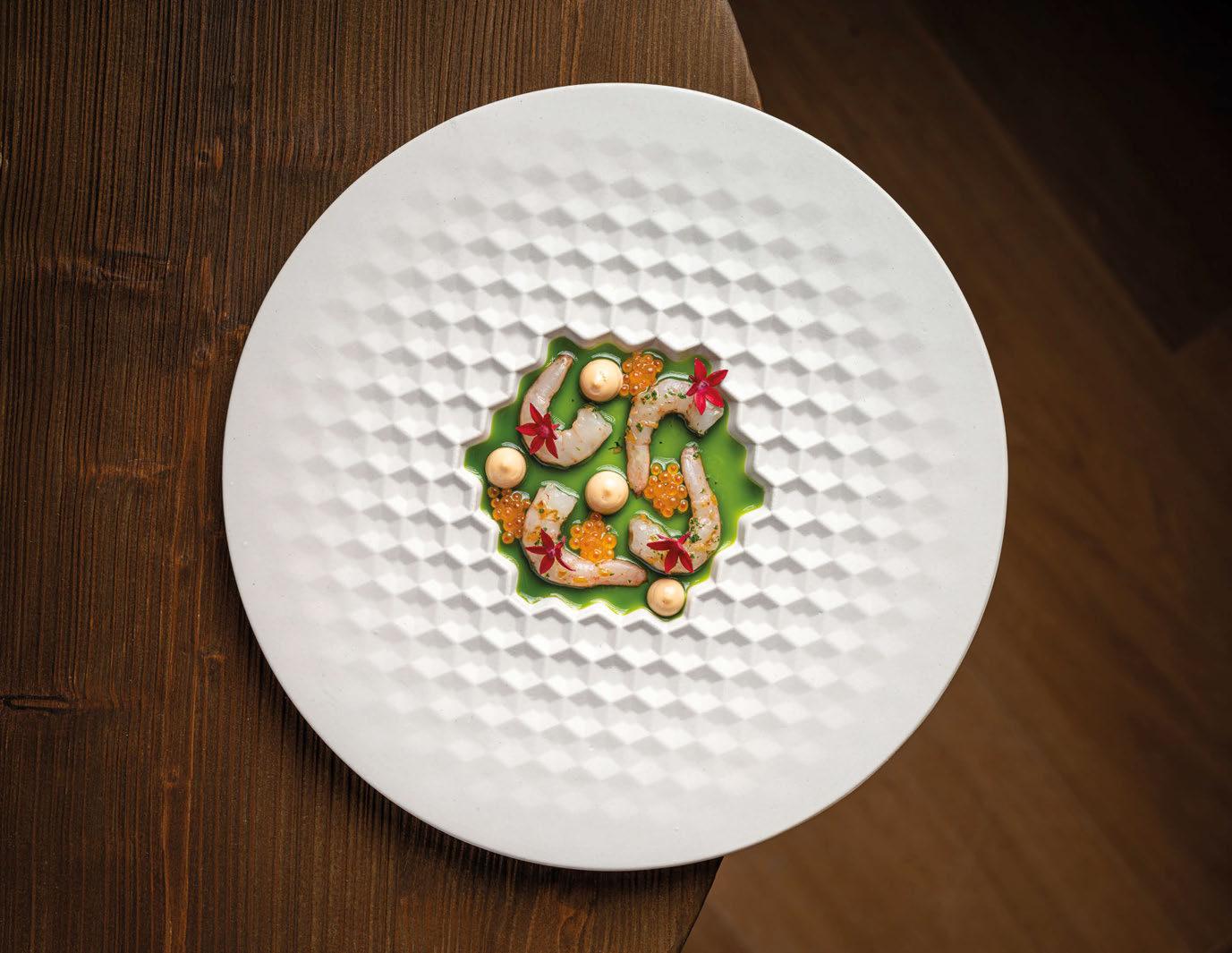
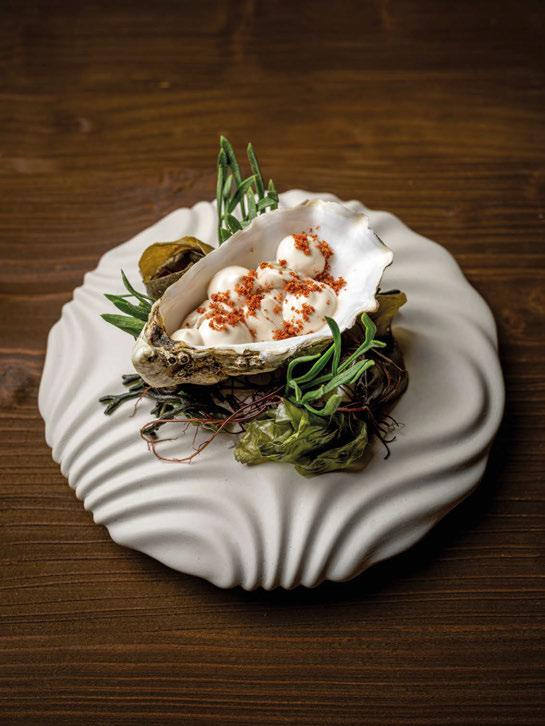
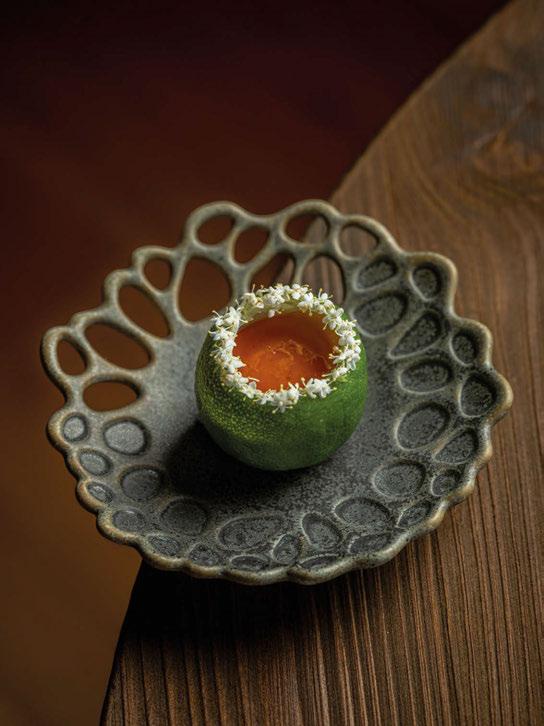
Certain dishes are signature creations from Azurmendi, such as Limón Grass, an unctuous mix of whipped foie gras and sweet lemon jelly, served in the outer casing of a lime and plated with colourful flowers. Asparagus, meanwhile, is served in four states: as a solidified cream wrapped in a crisp coating also made from the vegetable; in two simple yet flavoursome grilled pieces; as a powdery crisp wafer; and as a liqueur to cleanse the palate. Gillardeau oysters are paired with crushed tomato ice, while garlicky prawns from the southern province of Huelva are topped with trout roe and an emulsion of prawn shells.
The main fish course is hake in two parts: kokotxas (cheeks) in pil-pil and loin in tempura, served on a roasted pepper with chistorra sausage sauce. The meat dish is roasted Wagyu beef with noodles made from wild mushroom,
Basque flavours and techniques form the basis of the tasting menu at La Sociedad Gastronomika
accompanied by a truffle macaroon and earthy mushroom reduction topped with boletus froth – created to resemble a tiny glass of Guinness.
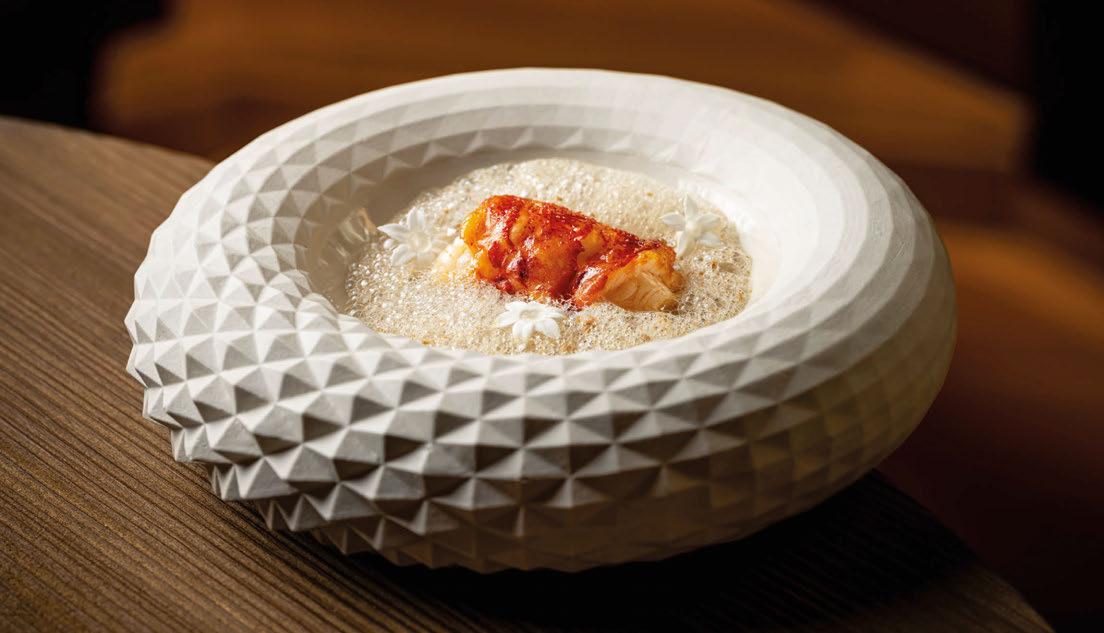
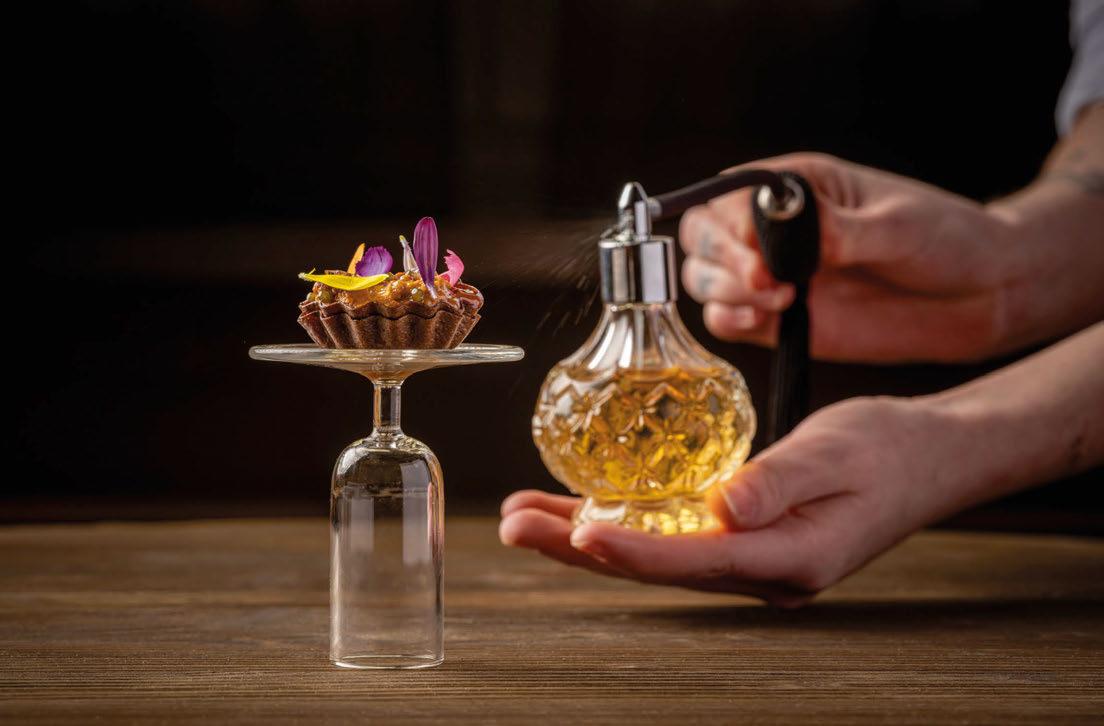
Theatrical touches include a bite of tuna and caviar that is sprayed with Manzanilla wine from a perfume bottle at the table, while foam fanatics also have their fill, from the butterheavy ‘lactic air’ around the roasted lobster, to the honey-flavoured cloud encasing the cuajada (sweetened curd) for dessert. Another pudding is ice cream made from yesterday’s bread, which derives from resourceful homely traditions in which nothing is thrown away. “It’s a memory of how we would use leftovers at home,” explains the chef.
A wine pairing is also available, with Spanish highlights including a chalky white grenache from Priorat, in the province of Tarragona, and a 2022 Palomino from the region of Jerez, by innovative winery Bodegas Cota 45. A fruity Rioja by Artuke is served chilled to accompany the richer meat and fish dishes.
Accompanying Atxa’s restaurant is cocktail
bar Dry Martini, an outpost by Barcelona’s veteran mixologist Javier de las Muelas, whose flagship bar ranked in The World’s 50 Best Bars for seven years consecutively. Beyond the classics, de las Muelas’ drinks list here includes eight signature and five more experimental cocktails, as well as 12 varieties of martini.
Since its founding in 2005, Mercer Hoteles has built a name for contemporary luxury, with its properties typically occupying historic buildings with cultural value. A strong F&B programme is always part of the offer, but according to founder and CEO Pedro Molina, the group only collaborates with chefs who share its way of understanding concepts, with authenticity and respect for place paramount. With his desire to bring the essence of his Basque culinary identity to Madrid in both style and content, Atxa proved himself the perfect candidate. “We connect with his way of understanding gastronomy and emotions,” concludes Molina. “His cuisine has roots, tells stories and generates authentic experiences for our guests.”
IN A BITE
Operator: Mercer Hoteles
Interior Design: Andreu Carulla
Executive Chef: Eneko Atxa
Head Mixologist: Javier de las Muelas www.mercermadrid.com
Simpson’s in the Strand
The Savoy
LONDON
Jeremy King Restaurants and Studio Shayne Brady revive a beloved dining icon, blending past, present and future for a new audience.
It’s June 1851 in a soot-stained London, and two masters of chess – Adolf Anderssen and Lionel Kieseritzky – are in town for the game’s first ever international tournament. The pair sit down for a friendly match between rounds, but what follows goes down in legend as one of the most brilliant games ever enacted. Anderssen’s attacking style of play – he sacrificed his queen, bishop and both rooks to secure checkmate –was so impressive that its legacy reverberated long after it scored him the win. The Immortal Game, as it was later dubbed, transformed the culture of chess and is revered as a mesmerising masterpiece of play even today.
The backdrop to this momentous match was Simpson’s in the Strand, and chess is just one of many cultural threads that has made this storied dining destination, part of the wider The Savoy estate, a London institution. Originally opened in 1828, it’s been central to the city’s culinary landscape for almost two centuries, so
there was a unanimous feeling of shared dismay when it closed in 2020. Nevertheless, collective joy followed suit when renowned restaurateur Jermey King stepped in, reviving the Grande Dame with a fresh approach that’s equal parts homage to the past and vision for the future.
“It is now well over 40 years since I fell in love with Simpson’s in the Strand and over 20 years since I first became excited at the prospect of running it,” says King. “It’s one of London’s last historic restaurants that retains its original décor and features, and the opportunity to restore it to its former glory is the apotheosis of my career. We will cherish the history of this magnificent institution as we bring it fully into the 21st century.”
Long-term Jeremy King Restaurants collaborator Shayne Brady was entrusted with reimagining each of the five distinct yet cohesive spaces within the venue, a job made even more complex by its Grade II-listed status. “It was
Simpson’s in the Strand is home to four distinct dining venues, including a Grand Café-style eatery, a cocktail bar and a late-night drinking den
our job as custodians to ensure that we didn’t tarnish the heritage of Simpson’s, but also to lease new life into it as well,” Brady explains. It was never intended to be a museum to the past – it had to feel relevant to today.”
Necessary nuance was applied from the getgo, a fact palpable from the moment guests enter the building’s enormous foyer, where the floor, columns and panelling are all listed. “We had to figure out how to restore the features without being overly contrived, still giving the impression that the venue had naturally evolved over time,” Brady explains. The solution came with the introduction of a faux green marble aesthetic and Cubist-style paintings of chess players – one of many nods to the building’s history as a hub for the game – ensconced in the nook of the hallway’s dramatic arches. “We kept telling ourselves to be respectful,” he adds. “We knew that by sticking to that mantra, the original features would come shining out of their architectural bones.”
Nowhere was this more important than in the
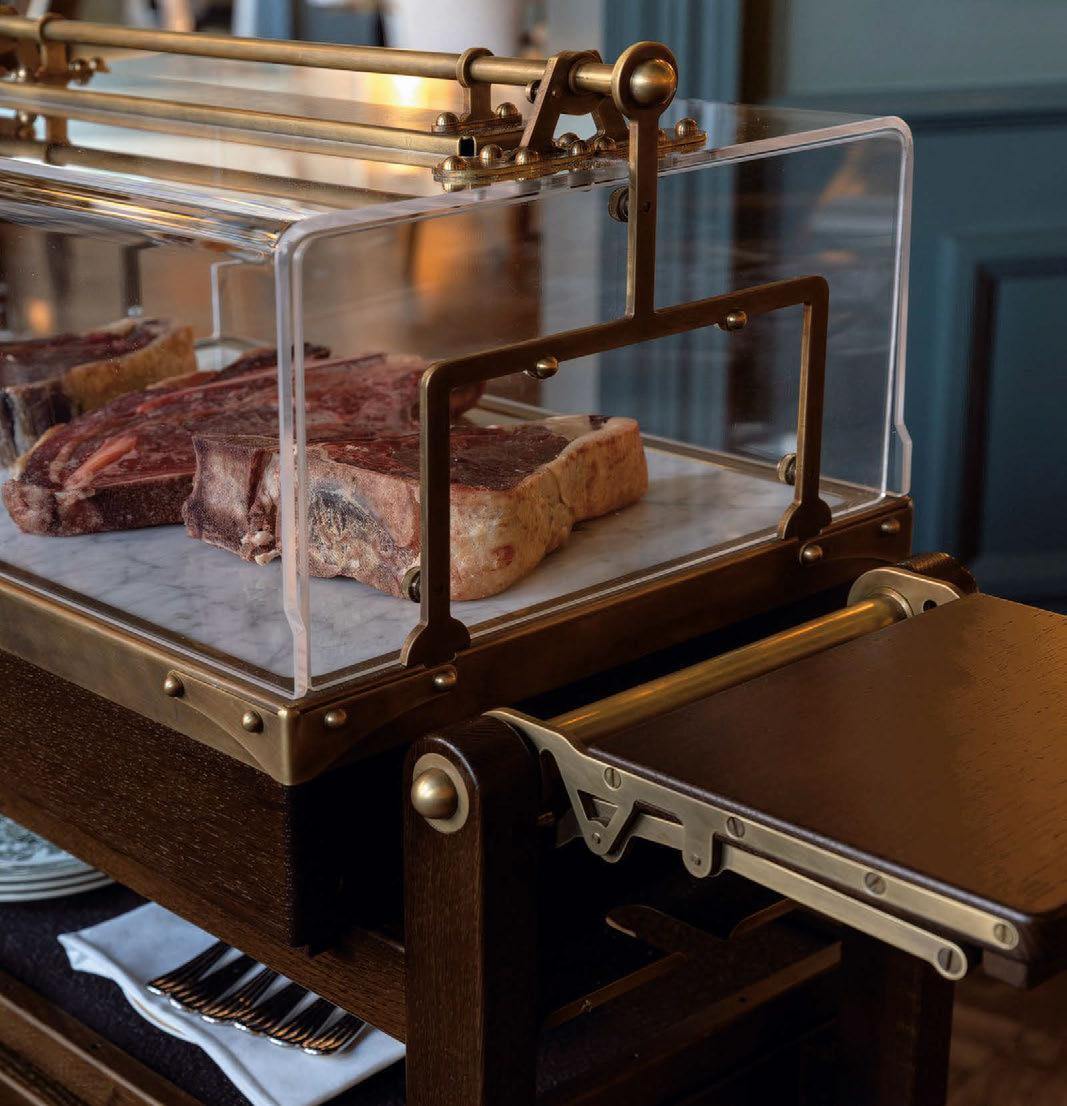
Grand Divan, the quintessential English dining room that rests at the heart of Simpson’s. It’s not hyperbole to call the space iconic – home to all-day roast dinners and tableside carving, it’s where the famed, silver-domed trolleys that weave between diners were first invented, originally as a means of ensuring chess matches could continue uninterrupted.
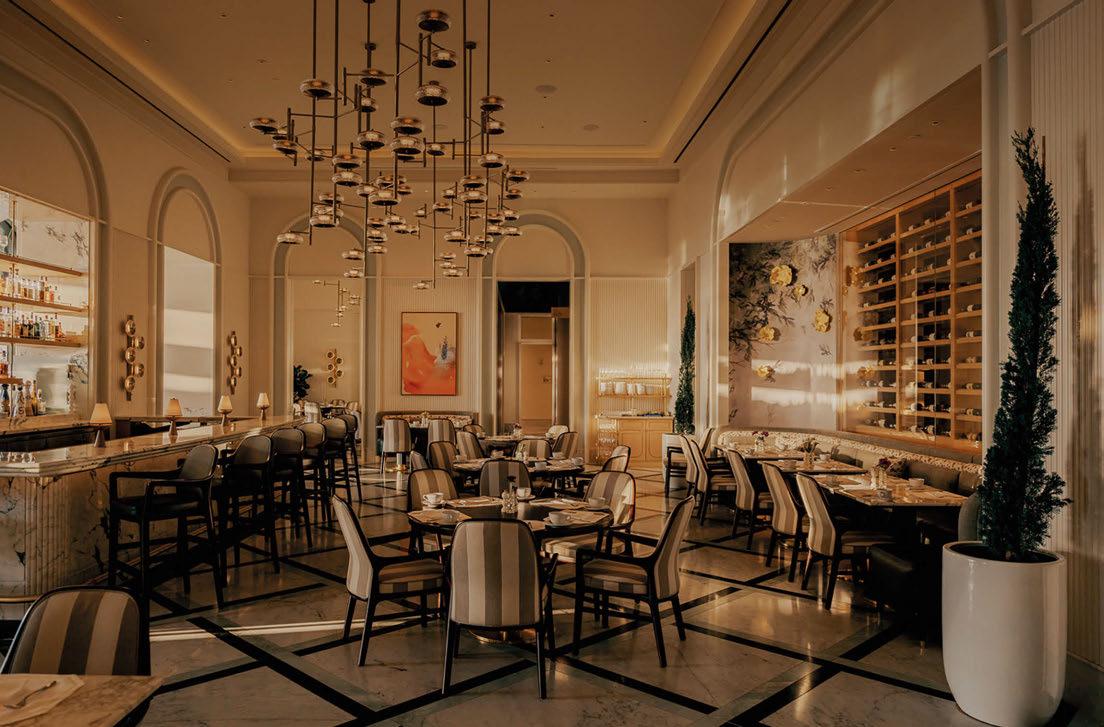
Carefully restored in its traditional Edwardian style, the décor blends timber panelling with marquetry detailing and sets deep red velvet and leather upholstery against hardwood flooring, albeit in a different layout. “We wanted it to feel like it could have been the original décor, just refreshed,” Brady notes. “So, we chose deep burgundy tones to complement the dark timber walls and that gives the room a feeling of real gravitas.” King added the final flourish with updated table plans. “Jeremy has a knack for it,” Brady continues. “Now everyone feels like they’ve got the best seat in the house.”
Customarily for a Studio Shayne Brady project, lighting also played a key role in rejuvenating
how the space transitions effortlessly from day to night. “We want people to sparkle when they visit our restaurants, but any kind of drilling and cable running was problematic because of the listed features,” he says. To overcome the issue, they refurbished existing chandeliers and used custom lighting fixtures manufactured by Atelier Lighting. “It adds a discreet glow no matter the time of day,” he states.
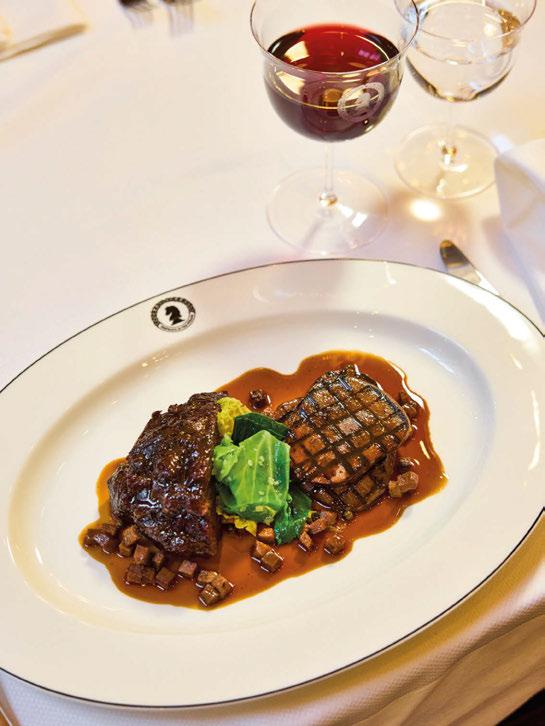
A round-the-clock, vibrant atmosphere is another component of the revived Simpson’s, which serves breakfast from 7am. At this hour, it’s common to see diners with sturdy dispositions and presumably unclogged arteries tucking into the venue’s famous Ten Deadly Sins breakfast, a combination of eggs, Cumberland sausage, streaky bacon, black pudding, lamb chop, devilled kidneys, bubble and squeak, grilled tomato, mushrooms and fried bread. By lunchtime, the classic roast trolley is wheeled into the spotlight, on which roast rib of Devonshire beef is carved tableside and served with a Yorkshire pudding, roast
potatoes, root vegetables, seasonal greens, horseradish sauce and lashings of gravy (don’t forget it’s customary to tip the carver).
According to Executive Chef David Stevens, curating the menu was also a balancing act between past and present. “We worked with archivists and former staff to make sure we got the perfect blend of recognisable dishes,” he explains. “That allowed us to reintroduce classics to the modern menu, though it was key that we gave those much-loved dishes their own distinct identity.”
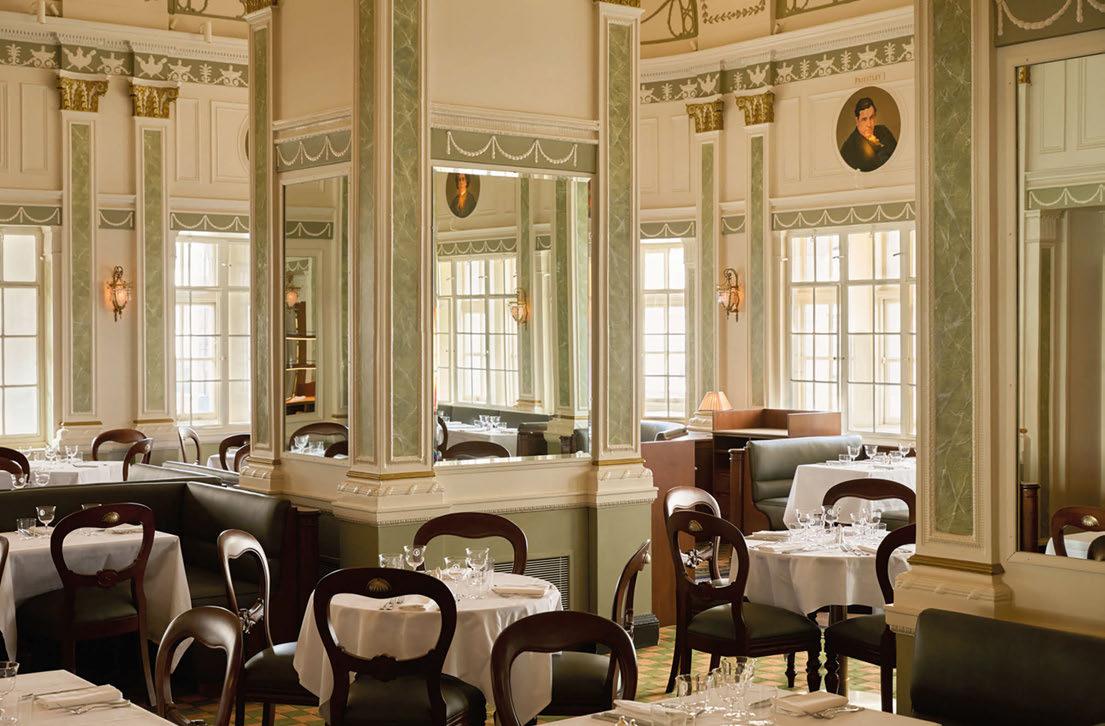
Following a chequerboard carpet upstairs, past a series of painted murals, guests arrive at Romano’s, a light-filled Grand Café-style eatery that sits in contrast to the formality of downstairs. Formerly a stomping ground for London’s artistic set, now it serves as a love letter to West End theatre, at King’s request. Faux marble columns and Wedgwoodinspired friezes sit alongside mirror detailing and green leather upholstery, while portraits of playwrights from the 20th century – some
The menu balances past and present, with Simpson’s classics served alongside new introductions
famous, some forgotten – encircle the room. The menu here is more casual yet still resolutely British, with dishes including pork and herb faggots, beef and ale pie, and a tasty steak and kidney pudding.
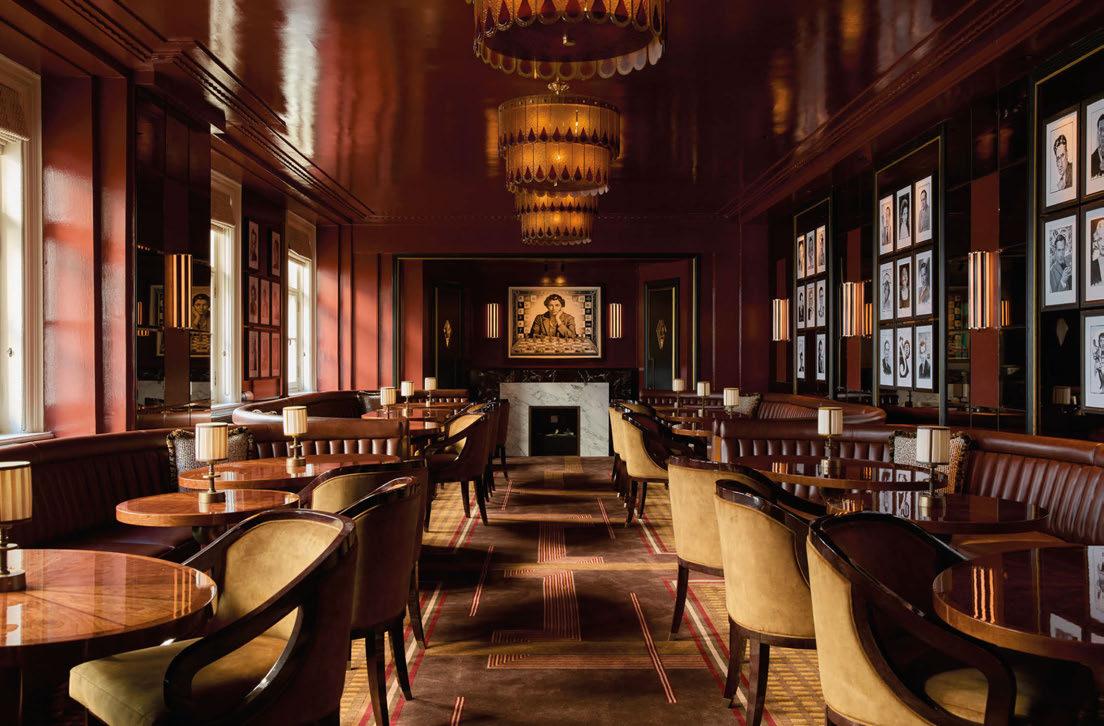
Next door, the diminutive Simpson’s Bar has a glamorous Art Deco slant, with drinks inspired by the best British gins, vodkas, whiskies and sparkling wines. “It’s the kind of place you come for a really wonderful martini,” Brady affirms. A portrait of Vera Menchik, the Russian-born chess champion, sits in lieu of a former fireplace. “Women wouldn’t have been celebrated in the way they should have been during that period,” Brady adds. “So, it’s fantastic to have a woman as the focal point of the room.”
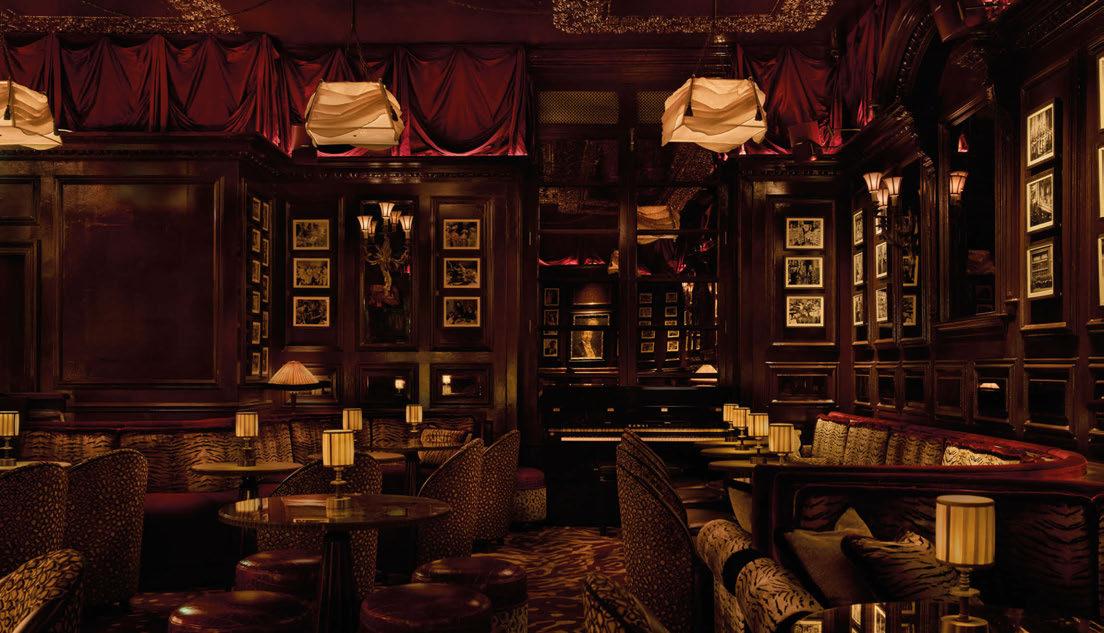
While Simpson’s serves as a great spot for a pre- or post-show cocktail, it’s at Nellie’s two floors below that the party really kicks into gear. “This is where you go late at night for debauched fun and frivolity,” Brady laughs. Swathed in sumptuous fabrics in rich, contrasting prints,
it’s a cocooning space designed to disguise the passing of time. A little decadent, flamboyant even, it’s crowned by a life-size portrait of the opera diva, Dame Nellie Melba. A separate ballroom with high ceilings and large windows has also been restored to host events. “It’s like you enter the world of Simpson’s and within that, there are five different experiences waiting to unfold,” Brady says.
The reopening of this illustrious venue has been met with rapturous applause, in part because of the sensitive restoration of both design and concept, but perhaps more so because of its unashamed authenticity – a word and idea that’s hard to embody today, but that’s felt deeply by diners, regardless of age. “Everything we chose in terms of design feels genuine and true to the space,” Brady agrees. “In the past that might just have just appealed to a certain demographic, but younger generations are now tapping into brands with genuine heritage too. We’re moving away from a fast, speed-driven mentality towards true legacy.”
Belmond transforms the signature restaurant at one of the city’s most iconic properties by teaming up with three-Michelin-starred chef Ángel León.
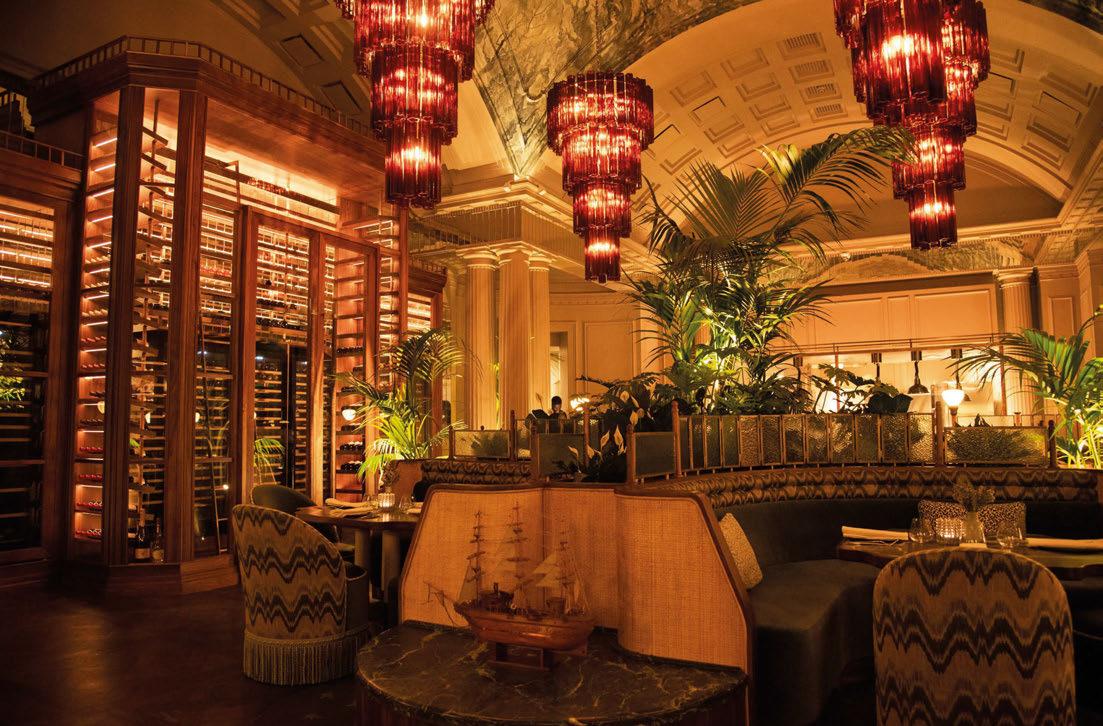
On entering Amura, the eyes are immediately drawn skywards, where the restaurant’s vaulted ceiling has been painted with green-grey tendrils framing a pale, cloud-dappled circle. It gives the impression of sitting at the bottom of a shimmering kelp forest and looking up to the sunlit surface – an immediately recognisable scene for anyone who’s dived among kelp in the seas around Cape Town, only mercifully without the bone-chilling cold associated with the Atlantic Ocean.
The Atlantic is the core theme at Amura, a fine-dining collaboration between Mount Nelson, A Belmond Hotel, and Spanish chef Ángel León, who helms Michelin-starred Aponiente and Alevante, both in Cádiz. With the entire continent of Africa stretched out between them, Cape Town and Cádiz are linked by their lengthy coastline, so it made sense to pay homage to that connection with a seafood restaurant. Translated from Spanish, ‘amura’ refers to a boat’s bow – the part that first cuts through the waves – an additional nod to the maritime concept and to León’s father, who inspired his love of fishing and respect for the ocean.
“Cape Town felt like a place where the spirit of Aponiente could evolve in a different way,” León explains. “So, the menu has been built like a voyage between Cádiz and the Cape. We started with the ocean as the common language and then connected ingredients, techniques and memories
Words: Heather Richardson • Photography: Courtesy of Belmond
from both. It’s not Spanish food in South Africa, it’s a dialogue between two coastal worlds.”
While León is based in Spain, Arlind Harizaj – a former executive chef at Aponiente – heads up the kitchen at Amura. “It’s about trust and constant communication,” León says of managing a kitchen from afar. “We have a strong team on the ground, led operationally by Arlind and the chefs in Cape Town, while we stay deeply involved creatively and strategically from Spain. We are one team split between the two locations.”
Amura occupies what was previously the celestial-themed Planet Room and before that, Cape Colony Restaurant. The Nellie, as Mount Nelson is known locally, opened in 1899 and is probably Cape Town’s most famous hotel. Located in the Gardens suburb, just outside the city centre, and with Table Mountain as its backdrop, the hotel regularly hosts singers, actors and in the past, historic figures including Winston Churchill and Nelson Mandela.
The heritage of the space – grand high ceilings,
archways and columns – was something that South African designer Tristan du Plessis and his team had to take into consideration as they laid plans for the restaurant’s new interiors. “We aimed to celebrate the historical architecture and atmosphere of the space while carefully moving the aesthetics towards a more contemporary and current feel,” he explains.
The reimagined vision is influenced by the diverse underwater world surrounding Cape Town. “We were inspired by the ocean. Not the ocean seen from the beach, but the dark, atmospheric kelp forests beneath the surface that are a cornerstone of local marine life,” du Plessis continues. “That resulted in a palette of moody emeralds, dark browns and flashes of light breaking through – elements that became our design compass.”
The restaurant is separated from the hotel’s communal spaces by a thick velvet curtain, which speaks to du Plessis’ encompassing theatrical vision. “I want our guests to feel as if they are stepping into a completely different
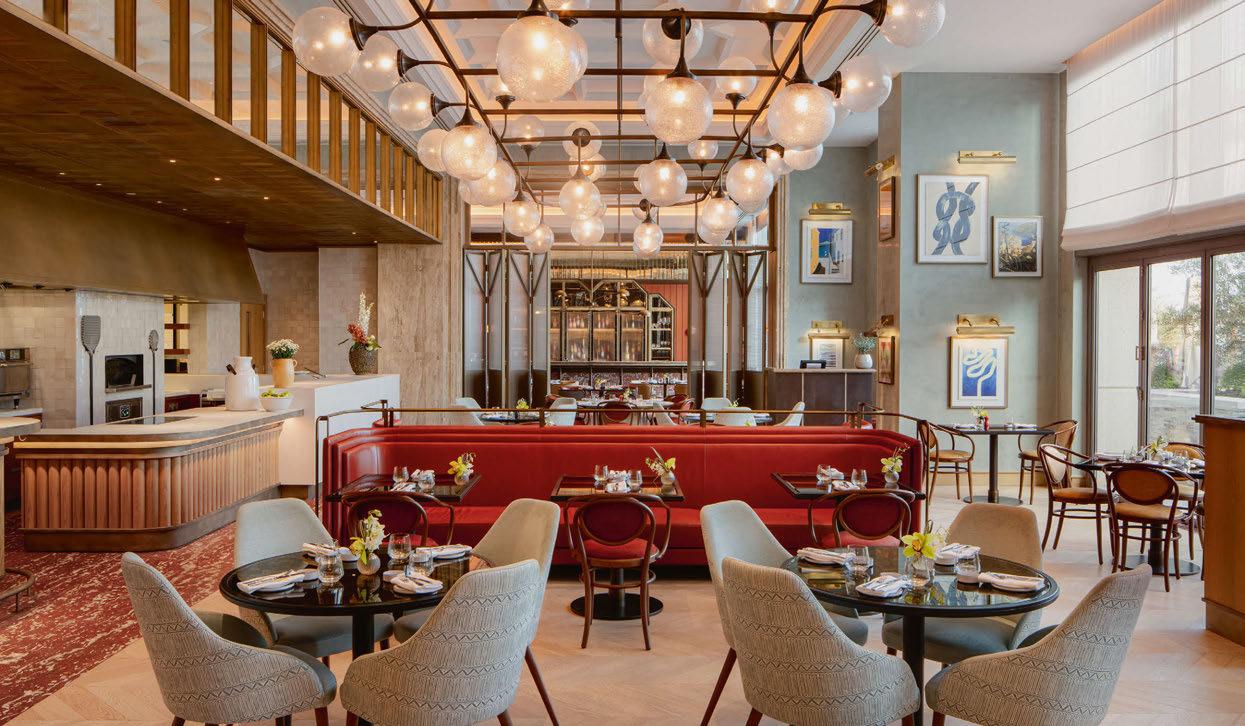
Amura is designed as a bridge between the coastal cities of Cádiz and Cape Town
world similar to a stage production, where the cuisine and its narrative are the stars of the show,” he explains. “It’s a place to dress up and escape for the evening.”
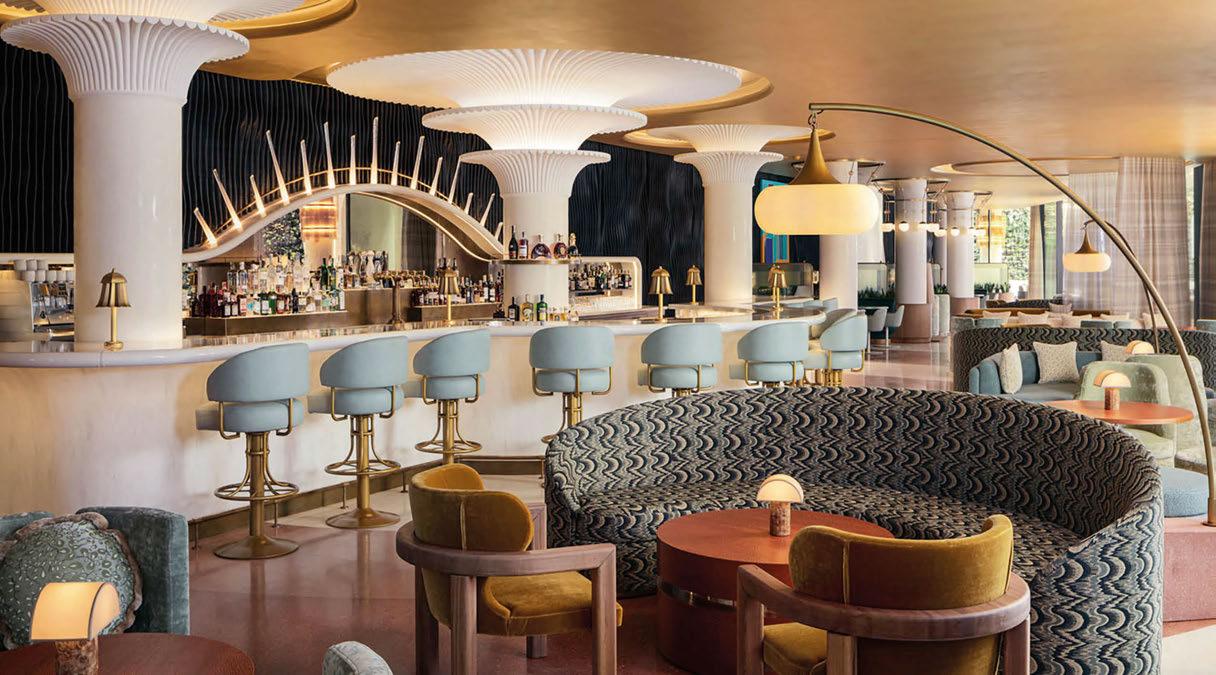
Glass chandeliers the colour of molten amber hang dramatically from the ceiling, casting a warm glow above cosy booths with dark green marble tables and leafy surroundings. The open kitchen and circular shell-encrusted bar add to the immersive ambience, which feels relaxed, despite the bold backdrop.
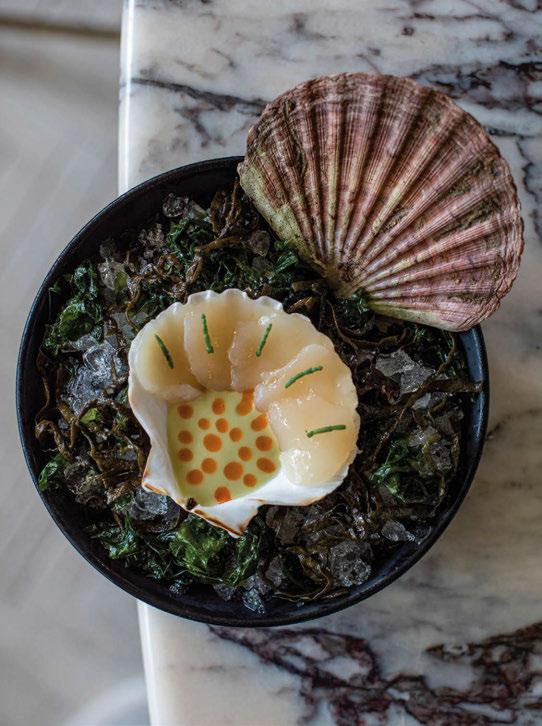
To dine, guests can choose either the Chef’s Journey tasting menu or à la carte plates divided into sections, from Small Waves – described as ‘cold starters, a taste of the shoreline’ – to Final Drift – ‘desserts, the ocean’s calm’. Each dish constitutes produce sourced from local farms and fishermen, or as León describes, “people truly connected to land and sea”.
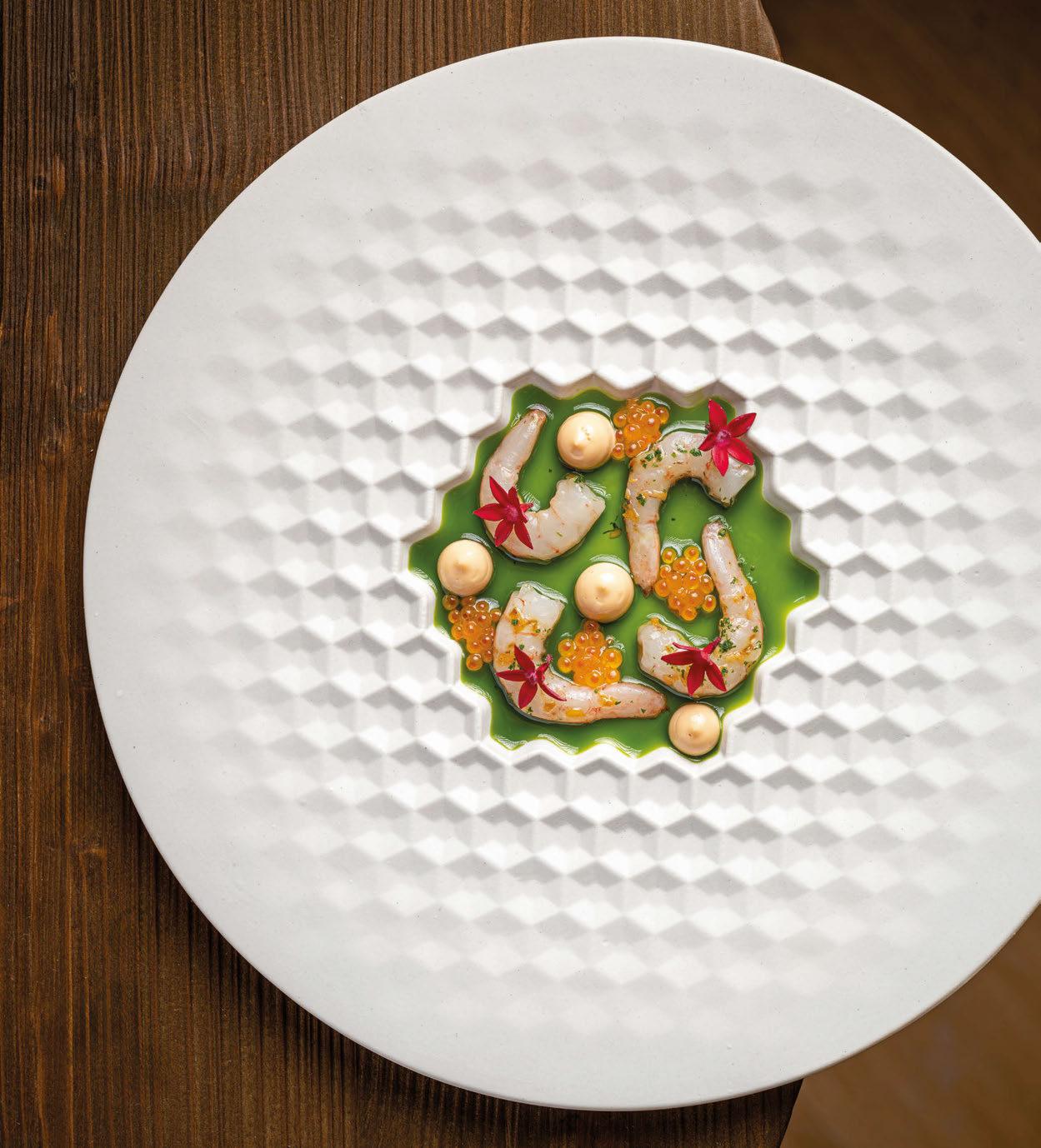
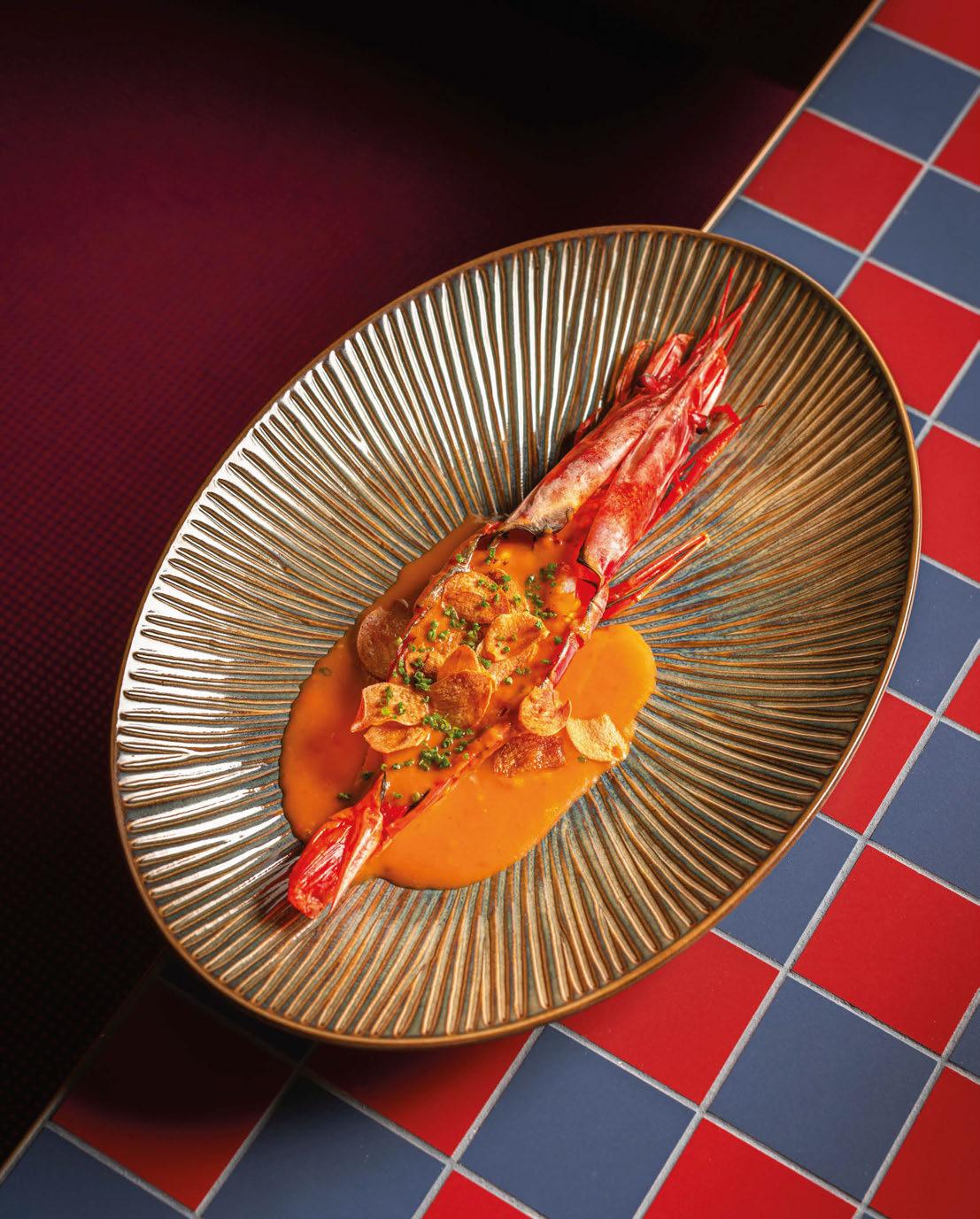
Split into hot and cold options, starters range from yellowtail sashimi with green herb escabeche to squid ink croquettes with aioli and pickled chilli, plus prawn with green curry
and fermented chilli mayonnaise – a favourite among the restaurant’s well-informed wait staff. Meanwhile, mains showcase the sea’s gamut of ingredients, from plankton risotto and hake tail with seaweed meunière to whole fried catch of the day with herb yoghurt, pickled kelp and peri-peri sauce. Desserts include pineapple crème brûlée and flan served with a scoop of spirulina Chantilly – a sweet and salty combination that works brilliantly on the plate.
In homage to the Cape’s bounty, a large proportion of Amura’s wines are local, while cocktails are also rooted in place. Seaweed Martini is made with Cape Saint Blaize gin from South Africa’s Mossel Bay and seaweed-infused olive brine. A Siren’s Call is a medley of Volcán de mi Tierra tequila blanco, buchu (a South African plant with a minty blackcurrant flavour) and galangal cordial, and the non-alcoholic Oceanic Negroni combines Abstinence’s citrus gin, with orange and bitter lemon aperitif. Further proof that the restaurant is brilliantly executed and fully immersed in its theme.
IN A BITE
Owner: LVMH
Operator: Belmond
Culinary Director: Ángel León
Head Chef: Arlind Harizaj www.belmond.com
Interior Design: Tristan du Plessis Studio
Luzzi Andaz
LISBON
Bruno Alves explores the tapestry of cultural influences that have shaped Portugal’s culinary landscape, presenting a fresh take on Lusitanian cuisine.
Brazilian chef Bruno Alves peers through a series of multi-coloured glass vases lining the pass at Luzzi, the signature restaurant housed within the recently opened Andaz Lisbon. He waves his arms enthusiastically as his team moves with calm precision around the open kitchen, while out in the vibrant dining room, soft music and smoky scents sweep through the air, creating a scene that pulses with sensory energy.
Sprawled across the top floor of a six-storey heritage building that once served as the headquarters of Portuguese bank BPI, the restaurant spills into the adjoining Z Terrace, a rooftop lounge with sweeping views over the Baixa district. An arched balcony frames the Arco da Rua Augusta, Praça do Comércio and sparkling waters of the Tagus River beyond, while Lisbon’s yellow trams rattle through the streets below.
Luzzi takes its name from the Portuguese word for light, and its idiosyncratic design by Patricia Urquiola sizzles with the same luminosity. Curved banquettes are tucked between tropical greenery, vaulted ceilings are tiled in burnt orange, and checkerboard floors jostle for attention alongside bright and bold works by local artists, curated by Federica Sala. The setting has already proven a hit with Lisbonites, who gather to eat, drink and dance. “There are no rules here,” Alves says with a smile. “Last week we had a table of nine who only ordered starters and cocktails, but that’s okay because we are not fine dining - we are fun dining.”
This philosophy can be felt throughout every part of Luzzi. The menu of modern Lusitanian cuisine - a representation of the ancient Roman province that occupied modern-day Portugal and part of Spain – draws on the nation’s long history of trade and migration. The mishmash of cultural influences that have shaped Portugal’s culinary landscape over centuries equates to dishes layered with flavours from as far afield as Brazil, Cape Verde, Goa, Macau and Mozambique. The result is a series of thoughtful plates shaped by memory, travel and storytelling.
There are other guiding principles too, including the art of sharing and sustainability, with more than 80% of ingredients sourced locally. “We do not feature salmon on the menu because we have rivers filled with trout here,” Alves confirms. Unsurprisingly then, menus shift with the seasons and the fishermen’s catch. “We serve what the tides bring,” he adds.
This spirit of spontaneity is evident on every plate. Starters are playful and bursting with flavour. A Cape Verdeaninspired tuna pie – the tartare encased in flaky pastry, topped with sweetcorn cream and presented with Japanese precision – is a standout Alves insists guests must try, while shrimp dumplings bathed in a rich fermented cassava broth carry echoes of African and South American cooking traditions. “Our food was never going to be bland,” laughs Alves. “We’re taking inspiration from happy countries.”
Elsewhere, the Bicaya sandwich, a twobite creation of garlicky cheese bread packed with smoked beef and onion confit that’s based on a popular street food favourite, is mandatory, according to Alves. Another of his personal recommendations is the moquecainspired seafood stew that, like most of the menu, refuses to belong neatly to one place or tradition. “Maybe one day people will say, ‘that’s very Luzzi’,” he says.
For mains, the kitchen leans into fire and smoke, with specials such as beef, slow-cooked osso buco-style for four hours. It arrives with Portuguese grits enriched with clams, the tender shank lacquered in a glossy demi-glace that’s been infused with coffee and chocolate. Yet it’s the charcoal-grilled whole fish that best captures Alves’ outlook. “I tell my fishermen: send me what is good – that’s it,” the chef says. As a result, it’s sea bass, snapper or perhaps bream that are frequently spotlighted on the menu, with each grilled atop banana leaves to develop a delicate smokiness and subtle
sweetness, before being finished with herbs like mint, sage, parsley and coriander.
General Manager Cajetan Araujo explains that Luzzi was conceived not simply as a hotel restaurant, but as an independent venue with its own rich identity, a fact underpinned by Alves’ appointment as Director of Culinary. “Chef Bruno was born in Rio and both his multifaceted heritage and exposure to international kitchens and cultures in places like Costa Rica, Italy and Japan made him perfect for this role,” he explains. “Our aim is to bring modern Lusitanian cuisine to the forefront; Portugal carried ingredients and spices around the world during the age of exploration, and as a result, a variety of dishes are woven into our food heritage. Luzzi pays tribute to that past while taking it into the future.”
This notion of global reach is powerfully reflected in Urquiola’s interiors, which meet somewhere between a Lisbon townhouse, a tropical veranda and a North African salon. Traditional Portuguese materials including
Bold pattern and colour combine at Luzzi, where the décor reflects the global nature of the cuisine
Lioz stone, azulejos, cork and wood, which are reinterpreted in contemporary ways, are layered with handpainted murals and lush planting.
“Lisbon is a city where things overlap, whether it’s textures, colours, vegetation or materials,” the designer explains. “Everything is vibrant yet still coherent.” The finished aesthetic, rich in character and depth, still surprises Alves. “When I first saw it, I thought maybe this is too much, but now I absolutely love it,” he explains. “It matches the energy of the food.”
The kaleidoscopic backdrop has the bonus of disarming guests, while extending a noholds-barred welcome that makes everyone feel at home. Consequently, it’s not unusual to see locals brushing up alongside international visitors - making the restaurant one of the city’s liveliest new tables since opening. It’s another nod to Lisbon’s credentials as a culinary capital too, and proof that a celebration of heritage can be dynamic and fun.
Further examples of this can be found on the hotel’s ground floor, where Andaz Lounge
reimagines a different element of the city’s beloved heritage, this time in the form of its historic quiosques (kiosks), with old classics reinvigorated through a contemporary lens. Elevated petiscos include everything from croquettes and bifanas to pastéis de bacalhau (salt-cod cakes) and empadas (Brazilian pies) for quick, authentic bites. Again, Urquiola has taken charge of the interiors, which reference the ships departing Portugal during the age of exploration. “We invite guests to enjoy a true Lisboeta experience here,” says Assistant F&B Manager Sebastião Palma.
Alves has some thoughts on this too: “We want you to feel like you’re at your grandma’s house in Brazil,” he smiles, before pointing to a tattoo on his forearm that’s inspired by kintsugi, the Japanese art of embracing imperfection. “Perfect to be imperfect,” he muses. “I want my team to feel that so that they can take ownership and do things in their own way – that’s how we’re creating the true identity of Luzzi.”
IN A BITE
Operator: Hyatt Hotels
Interior Design: Studio Urquiola
Director of Culinary: Bruno Alves
Barware: XLBoom www.andaz-lisbon.com
Sale e Pepe Mare The Langham
LONDON
Hamilford Design and Thesleff Group evoke the feeling and flavours of the Italian Riviera inside one of London’s original grand hotels.
Founded by Toni Corricelli in 1974, Sale e Pepe has long been synonymous with upscale Italian dining in the UK capital. The restaurant built its reputation on oldschool glamour, with a regular cast of A-listers reportedly rolling through the doors including Rod Stewart, Diana Ross Sir Roger Moore, and more recently George Clooney - all drawn to the Knightsbridge address for plates of perfect pasta and the ever-popular branzino al sale.
When entrepreneur Markus Thesleff and his fast-growing collection of London restaurants and bars, including Los Mochis, Juno and Viajante87, acquired the venue, the stakes were inevitably high. The pressure was also personal for Thesleff, whose parents often took him to dinner there as a child. “We took over Sale e Pepe a few years ago and had to spend time carefully analysing its future,” he comments on the acquisition. “It was important for us to preserve the legacy of the brand and not compromise what has made it iconic over the decades. We were deliberate about when and how to expand, and so it wasn’t about moving quickly, but about finding the right moment, the right evolution and crucially, the right partner.”
That partner became The Langham London, a pairing Thesleff describes as “two icons coming together”. He is careful to stress, however, that the new iteration of the brand was not intended to feel like simply another hotel restaurant.
“It’s not about interpreting the concept for a hotel audience because for us, the hotel is ancillary,” he explains. “But it gave us the opportunity to introduce Sale e Pepe Mare in a way that respects the past while moving the brand forward.”
Replacing the former Roux at the Landau, the new venture captures the original Sale e Pepe but with a looser, more coastal version of Italian dining, which leans confidently towards seafood and balances long-standing signatures with contemporary dishes.
Honouring a lifelong affection for Italy, Finland-born
Thesleff has also used the project to draw on his own familial associations with the country. “My father spent many formative years in Italy and my grandfather was the ambassador to the Vatican, so we spent long summers there, travelling from the south all the way up to Venice,” he continues. “Those memories, stories and flavours have really shaped the concept and menu, resulting in a restaurant that feels both authentic and relevant today.” That connection to the country, he believes, is essential to success. “Italian fare will always be a global staple,” Thesleff asserts. “It’s one of the few cuisines that has a truly universal appeal. It’s hard to find someone who doesn’t connect with it in some way, and that’s what gives it enduring strength.”
The dining experience begins, as so often in Italy, with aperitivo hour, and guests can choose from no less than
five styles of Negroni, each named after Italian coastal cities and poured from glass jugs at the table. The wider cocktail menu blends 1950s nostalgia with premium ingredients, resulting in evolved classics such as the Shaken Dirty Martini tinged with olive, anchovies and smoked brine shards, and a signature Seaside Cosmo flavoured with mirto, lemon and briny Everleaf Marine. Long lunches are accompanied by regional wines; Super Tuscans are a highlight and there’s a dedicated page for the Gaja estates, while the digestif offering boasts an amaro selection that is unusually large for London.
The same Italian spirit can be seen in the kitchen. “The menu is anchored in classic dishes,” Thesleff prefaces. “But rather than a modern reinterpretation in the traditional sense, our approach is more about a lighter style of cooking, inspired by what you see across regions closer to the sea, where dishes are naturally fresher, more delicate and ingredient-led.”
This approach is obvious on the menu. With a growing appreciation among diners for the regional specialities of Puglia, Amalfi and Campania, alongside a renewed emphasis on provenance, the offering traces Italy’s coastline across its cicchetti, crudo, antipasti, pasta and secondi sections.
Sale e Pepe signatures such as linguine all’aragosta – buttery lobster with garlic, white wine and cherry tomatoes – and the popular salt-crusted sea bass still stand, but sit alongside lighter dishes and raw preparations like battuta di gambero di Mazara, a Sicilian seafood delicacy of finely chopped wild red prawns dressed with pink peppercorns and verbena, or there’s the Carpaccio di capesante - scallop gently kissed with citrus and resting in a cool cucumber broth. Elsewhere, delicate pasta dishes include Sardinia’s clam-laden linguine vongole e bottarga and tagliolini al granchio, a delicate egg pasta tossed in Cornish crab, parsley and generous lashings of olive oil popularised in Veneto.
Several global influences are threaded throughout the menu, an approach increasingly visible in Italian
kitchens. For example, there’s halibut crudo served with yuzu kosho and lemon dressing, and otoro tuna on baked brioche with confit tomato and garlic, which illustrate subtle Japanese ingredients and techniques. “We’ve played with a few combinations to bring something unexpected to the menu,” explains Thesleff. “Pairing crudo-style raw seafood with warm pasta might not sound intuitive, but it works incredibly well and adds a new dimension to familiar formats. Alongside that, there are a few standout dishes that express our personality more clearly, from seafood-led starters to more indulgent plates like caviar pomme anna,” he says, referring to a French dish pairing crisp, butter-layered potatoes with salted roe.
Whatever the guest decides upon, every creation is exceptionally fresh and cooked to order. A seafood display at the restaurant entrance showcases the catch of the day, available in a variety of preparations –grilled, salt-crusted or poached acqua pazza-style –while in the kitchen a Josper grill turns out whole turbot, clams and prime cuts of meat à la minute, including bone-in grilled veal chop and Wagyu T-bone. The same commitment to immediacy carries through to the dining room, where dishes such as Caesar salad, bucatini cacio e pepe and risotto ai funghi porcini are prepared tableside, alongside the return of the original dessert trolley, complete with the restaurant’s signature tiramisu. There’s also affogato, vanilla panna cotta and a selection of gelato and sorbetti on offer for dessert.
The interiors reflect the service style, courtesy of Manuela Hamilford, Creative Director at London-based Hamilford Design, whose intention was to avoid overt thematics, instead capturing the authentic warmth and ease of Italian hospitality instead. “Growing up in Italy shaped my understanding of hospitality and how spaces should feel, so the project was quite personal to me,” Hamilford says. “From there, the idea developed around different aspects of Italian culture; the informality of the south and structure associated with the north.”
The menu leans into seafood, balancing longstanding Sale e Pepe signatures with lighter, more modern coastal influences
Her plans for the 5,000ft2 restaurant took cues from the original Sale e Pepe in Knightsbridge, also designed by the studio, before evolving the finer details through a softer, seaside lens. “We looked at qualities associated with the Italian coast such as light, colour and a sense of ease, then translated them through materials and atmosphere,” Hamilford explains. “The sea-glass tones, lacquered blues and the way light moves through the space all contribute to that, but within a structured setting that sits comfortably within The Langham. We kept a sense of familiarity but were also informed by the building itself which has its own rich history dating back to the mid-1800s.”
The balance between heritage and contemporary coastal living is represented throughout the scheme. Framed timber walkways and softly illuminated arches establish a natural rhythm through the restaurant, guiding guests towards the principal dining area. Warm oak and walnut panelling reference the character of a Milanese townhouse, while sculptural glass
chandeliers and layered illumination by DPA Lighting Consultants includes a backlit onyx feature wall, hidden lamps along wall mouldings and halo fixtures that draw attention to bespoke textured artwork without feeling staged.
At the centre of the restaurant sits a 16ft Italian marble bar, serving as the architectural focal point of the space. Marble is used extensively throughout, particularly within the Private Dining Room, where Italian-designed fabrics and a considered use of natural stone evoke the relaxed sophistication of the Riviera.
That sense of ease runs through the entire experience. Despite its celebrity seal of approval and glamorous reputation, the latest iteration of Sale e Pepe resists excess, instead returning to the essentials. “When you strip it back, Italian food is about ingredients,” concludes Thesleff. “Sale e Pepe Mare sits within that shift. It’s rooted in regional coastal cuisine that celebrates the simplicity and integrity of great produce, while still delivering a refined, elevated experience that feels relevant for today’s diner.”
TO THE TABLE MEA 2026 will take place at the Hilton Yas Island Resort in Abu Dhabi. Join us as the industry’s most senior F&B decision makers from prestigious hotel and restaurant groups come together to discuss their latest projects and requirements with the most innovative and capable suppliers. TO THE TABLE MEA 2026 o ers one-to-one meetings, engaging seminars and high-level networking to keep you building meaningful, strategic relationships.
Test of Time
As Wimberly Interiors launches a dedicated F&B studio, Creative Director Damien Follone reveals how to trump trends with timeless, immersive design.
Online information saturation is rife for today’s guest, and one way to create projects that resonate in real life is to provide an antidote to the constant noise with visceral touchpoints that engage every sense, rooting them in the here and now. It’s a tactic that Damien Follone, Creative Director at Wimberly Interiors, part of WATG, has honed to a tee after decades working in the industry. “Our memories are made through the senses, and so good F&B has to encompass all of them,” the Sydney-born, Londonbased designer explains. “That’s how you create atmosphere, establish a reputation for the venue, and in turn, drive loyalty and revenue.”
Insights like these are central to the design firm’s philosophy, which has been in operation for 15 years, recently launching a dedicated F&B studio. Helmed by Follone and an international squad of passionate F&B specialists, the team works alongside Wimberly Interiors design division, allowing them access to the nuts and bolts of a project while simultaneously offering tailored expertise. “We are a dedicated bunch who lives and breathes F&B – the type of people who pick up every plate when we’re out at dinner,” he
laughs. “Designing a restaurant is very different to designing a guestroom and that’s what we celebrate.”
Indeed, for Follone, the challenge of creating a beautiful venue that also doubles as a thriving functional space is the intersection where his interest in design piques. “It’s problem-solving, first and foremost,” he explains. “And that’s especially true of restaurants and bars because they have to generate revenue. To do so, many different components need to come together – from the brand to the food, the music and the lighting.”
Strong storytelling forms the foundations that underpin each of these elements, Follone notes, with the creation of a distinct personality, an impactful food and drink concept and a deep understanding of the guest profile all essential in establishing a project’s DNA right from the beginning. “If you put a solid framework in place, it informs everything from thereon,” he says. “It influences the layout, the size of the tables and how close together they are, even the style of music that’s being played. Every project is unique and we approach each decision with a real sense of care.”
Citing the additional importance of leaning into ritual to enhance a project’s emotional imprint,
Follone points to Spuntino, a restaurant completed within Four Seasons Resort & Residences at The Pearl, Doha. Tasked with creating a venue that mirrors the conviviality of the classic Italian dining setting, the team took inspiration from the Italians’ innate knack for socialising by channelling espresso culture and the traditions surrounding aperitivo. The narrative was translated through regional materials and understated cues like aged metalwork and hand-worked glass, hinting at the illustrious artisanal heritage on display throughout the country.
The space was also designed to embody a range of personalities throughout the day –from a lively café meeting point in the morning, to an interactive dining room at lunch, and finally a vibrant aperitivo bar in the evening, a move directly informed by a multi-layered backstory. “This determined the sequencing of the space,” says Follone. “And that formed the basis for the smells, sounds and colours we used – right down to the smallest detail.” As a result, diners observe sunwashed tones that honour the Mediterranean, nods to craft and energetic open kitchens that infuse the room with life.
And while a sense of experiential immersion plays a key role in every Wimberly F&B undertaking, Follone stresses that it’s a careful balancing act to avoid straying into the territory of thematics. “We’re aware of trends in hospitality, of course, but for us, it’s more about creating vibrancy,” he says. “Timelessness is key to longevity.” This is especially pertinent when tackling projects like Giza Palace Hotel &
“Design is about problem-solving, and that’s especially true of restaurants and bars because they have to generate revenue. To do so, many different components need to come together – from the brand to the food, the music and the lighting.”
Spa in Cairo, where Follone and his team were asked to imagine seven distinct F&B venues within the property, each with its own identity and appeal.
What followed was a strategic exercise in plotting the location and personality of each venue to ensure they complement one another while maintaining enough unique characteristics to offer guests variety. He references Onu, a Vietnam-inspired restaurant, as a primary example of the studio’s approach to the project. “The client requested an Asian restaurant, but that’s a very broad concept,” he explains. “So, we homed in with a narrower lens, focusing specifically on Vietnam.”
An intimate dining room with bold features, including a ceiling installation that riffs on traditional Vietnamese fishing baskets, handcrafted wall tiles and a framed open kitchen, there’s plenty of drama on display within the space. A distinct woven aesthetic carries through different elements too, uniting the seating with the floor lighting and table contours to create that feeling of subtle immersion Follone specialises in. “We wanted it to be a cosy experience that is small in scale yet still vividly alive, which would then serve in contrast to a neighbouring venue like Beefbar, a steakhouse that is naturally larger and more overtly luxurious.”
Establishing context then, is essential, and reaching that point of understanding also comes from collaboration with every stakeholder, from owner to operator to chef, especially in cases where there are cross-cultural reference points
Spuntino was conceived as an ode to Italian dining traditions, showcasing different moods throughout the day
“F&B is so important. It’s how you expose your brand to people on a larger scale.”
Onu
Giza Palace Hotel & Spa in Cairo is a celebration of Vietnamese textures and flavours
to consider. “Sometimes all it takes is a few particular keywords,” says Follone. “And that allows an entire world to unfold.” In the case of Paper Moon within Fairmont Taghazout in Morocco, one of those words was authenticity, in relation to both the cosmopolitan nature of the Paper Moon brand and the rhythms of its new seaside location.
“We set the scene by drawing on Morocco’s heritage, and curating the light and textures associated with the country’s craftmanship, then paired it with the Milanese flair associated with Paper Moon,” he explains. “It was about bringing two worlds together and demonstrating authenticity not only through grounded design, and other essential things like service and conversation at the table, but also through honestly conveying a sense of place.” The result blends warm woods and textured stone with refined metals and tailored upholstery – an interplay between organic and polished elements that reflects the sea-sculpted surrounding landscape.
For Follone, venues such as this represent a kind of escapism that moves beyond the realm of trends, and he expects it to continue to be a defining feature of F&B design in the coming years. “Guests are looking for engagement,” he affirms. “And F&B is a key driver in creating that. Not everyone can afford to stay in the guestroom of a hotel, but it’s likely they can afford to eat at the restaurant, and that’s what makes F&B so important, because it’s how you expose your brand to people on a larger scale.”
He also points to the disappearance of fine dining in favour of more casual, though still high-quality concepts, a focus on smaller, more intimate spaces as a backdrop for deeper connection, and an increase in F&B brands driving the entire identity of a property as trends to watch. “Ultimately, great dining elevates everything around it,” Follone concludes. “And that’s why F&B is going to become the engine of the hotel experience in the future. Culinary excellence is the anchor around which everything else pivots.”
within
Le Meridien Split, Croatia
Join us for TO THE TABLE Europe 2027 taking place at the Le Meridien Split on the spectacular Croatian coast, where senior decision makers from major European hotel groups, cruise lines and restaurant groups will come together to discuss their latest projects and requirements with the most innovative and capable suppliers. TO THE TABLE Europe 2027 will keep you connected in this dynamic industry and forging relationships at the highest level.
Crispy Potato Cylinder
Cedar Tree
Farlam Hall
CUMBRIA
For proof that chefs gain inspiration from each other, look no further than Crispy Potato Cylinder served at Cedar Tree within Farlam Hall. Created by the restaurant’s Chef Patron, Hrishikesh Desai, it was influenced by a dish he tried at the three-Michelin-starred Frantzén in Sweden. “It made me think about the particular flavours and textures of the ingredients,” Desai explains. “We grow our own potatoes in the kitchen garden at Farlam Hall, so I decided to experiment with the concept and develop it into our own signature creation.”
Homegrown Maris Piper potatoes are carved into fine noodle-like strands, blanched in salted water, refreshed in ice, then wrapped around baked feuilles de brick pastry before being deep-fried at 140°C until crisp and golden. To
make the filling, salmon loin is cured and diced, then mixed with fleshy flakes that have been home-smoked on a bed of Earl Grey tea and demerara sugar. The soft tartare mixture is then piped into the potato cylinders. The ends are sealed with King’s Imperial Caviar supplied by Laura King MBE, finished with flavoured crème fraîche gel and maple jelly, and accompanied by onion flower and celery cress garnish.
Showcasing a high level of skill and precision, the snack is served as a precursor to the restaurant’s full tasting menu. “The cannelloni contrasts beautifully with the soft salmon tartare, while the gel adds richness,” Desai says. “The maple jelly introduces sweet and sour notes, all balanced by the salinity and distinctive burst of the caviar.”
Kulhi Kaajaa Kandu Patina
MALDIVES
A staple snack enjoyed by every Maldivian child, Kulhi Kaajaa is a spicy teatime classic that delivers doughbased comfort by the bucketload. At Kandu, the newly opened restaurant at Patina Maldives, the nostalgic bite has been reimagined with refined technique, however, loyalists needn’t worry. “It’s still Kulhi Kaajaa at heart,” assures Chef de Cuisine, Abdulla Rifzan. “Only now with a little more character and curiosity, and a story worth rediscovering.”
The dish is built around a selection of typical Maldivian ingredients. There are curry leaves freshly picked from the resort’s own garden; smoked tuna and fresh skipjack tuna from the southern atolls; rihaakuru – a traditional thick tuna paste from Gemanafushi in Huvadhoo Atoll; and Githeyo Mirus, which brings the heat and character so definitive of the islands’ cuisine.
The first step is to work the dough to achieve ultimate elasticity and consistency. Each shaped piece is then delicately fried for a light, crisp texture, and topped with skipjack tuna sliced sashimi style. Finally, a chilli emulsion is blended to create a refined, stable texture that balances heat, acidity and aromatics into a cohesive expression.
“I remember watching my mother prepare Kulhi Kaajaa for family and friends; it was never just food, but a gesture of warmth, generosity and togetherness,” Rifzan explains. “My version is a dialogue between past and present – a tribute both to where it comes from and a focus on where it can go.”
www.candpceladon.com
RELIC
A quiet trace of time at the table.
With soft contours, a detailed rim and natural tones, Relic brings a calm, lasting and distinctive touch to every presentation.
Few cocktails generated as much spirited debate at London Wine Fair 2026’s Signature Serve theatre – a dedicated stage for live spirits tastings and industry discussion on the future of drinks – as the martini. Once viewed as a classic pour reserved for top-end hotel bars, the libation is now at the centre of a global boom. But as moderation trends and experiential hospitality continue to reshape consumer behaviour, where does it go next?
In a panel hosted by Hawksmoor’s Liam Davy, the discussion brought together Fords Gin founder Simon Ford, The Boatyard Distillery Managing Director and The American Bar at The Savoy stalwart Declan McGurk, and hospitality
Martini Magic
From hotel bar to global phenomenon, the martini comes under the spotlight at Signature Serve within London Wine Fair.
consultant Anna Sebastian. The panelists’ own entry points revealed the serve’s broad appeal. “It started with the porn star martini for me,” Sebastian noted. “Then came the espresso martini and the vodka martini; they were the gateways.” Ford and McGurk, meanwhile, both pointed to formative experiences of drinking at The Savoy. “I wore a jacket for the first time outside of a wedding,” Ford said. “It felt special.”
Asked what’s behind the martini’s resurgence, Ford credited the influence of early-2000s New York cocktail bars such as Milk & Honey and PDT, which revived the culture through research and technique-driven bartending. McGurk added that the explosion of premium gin brands has also elevated the serve, while Sebastian argued the momentum is tied to experiential drinking.
“The martini sits in a unique space between sophistication and chaos,” she said. “And it’s built around ritual. The guest decides their garnish and whether they prefer the drink wet or dry - it all becomes part of an experience.”
As the category evolves, the martini has also become a platform for experimentation. Sebastian highlighted Asian-inspired flavour profiles, including sake and ube variations, as one of the defining trends shaping the category.
Ford pointed to bars such as The Connaught in London as reshaping the martini using innovative bitters, sherry and even champagne vinegar.
“What’s changed is that instead of a standard ‘gin or vodka, olive or lemon twist’ approach, every bar now creates its own house martini with a personal touch or style,” he explained. “It has become a platform for creativity.” Meanwhile, McGurk identified temperature as another emerging obsession within the category. “For
me, a martini should be cold enough to feel almost chewable,” he declared.
Despite conversations around lower ABV drinking, the panel unanimously agreed that the growth of this punchy pour is far from over. “We work with around 400 hotels worldwide and over the past few years demand has consistently grown for the martini,” Sebastian confirmed. “It is now one of the most ordered cocktails globally.” Ford agreed: “If you are going to have one drink, you want it to be strong and well-made.”
The panel’s broader prediction was that the martini’s next phase will be driven less by radical reinvention and more by accessibility, perhaps crossing over into more mainstream channels. “It will be served in pubs,” McGurk forecast, while Ford suggested high-quality convenience formats, even “bag-in-a-box”, could become increasingly mainstream. “As long as it is made well, it will continue to thrive,” Ford said, to which Sebastian concurred: “The martini is going absolutely nowhere.”
Drinks brands are leaning into immersive, design-led spaces that can transform retail into an experience while connecting them more meaningfully with their audiences. Take the new cognac concept by MO Studio for Hennessy at Ningbo’s Mingzhouli Shopping Center, which moves beyond the standard boutique format by using thoughtful design and storytelling to bring the brand’s heritage to life.
From the outset, the creative agency positioned the site as more than a product showcase. In a market building its understanding of the beloved French spirit - one that remains critical to luxury alcohol growth in the region - the brief was to communicate both category and brand. MO Studio’s response is a ‘silent academy’, where visitors move quietly through the room and absorb cognac culture without formal instruction. Rather than work around limitations such as a compact footprint and a fixed structural column, the studio chose to integrate them into the architectural narrative. For example, the
load-bearing column becomes a wooden stake for grapevines, referencing the oak barrel ageing process that shapes cognac’s specific flavour. Spatial circulation, meanwhile, is arranged around the bar, with open bottle displays punctuating the space.
Materiality and lighting play an important role too. At the bar counter, light scenes shift across bespoke wall panels, which taper inwards to guide movement while also concealing storage. Gleaming handmade resin is used across surfaces to evoke the depth of cognac, and a stone floor suggests vines breaking through the earth, with metal inlays symbolising the 24 solar terms of traditional agriculture.
The result is a reframing of drinks retail as an immersive encounter that fosters a deeper connection, in this case to Hennessy’s distinctive craft and provenance. As MO Studio concludes: “The most moving spaces are never just the answer to a problem, but rather, an experience with lingering resonance.”
A Decade in Paradise
Barcelona’s cocktail kingpin Paradiso is raising a glass to 10 years of shaking up the drinks world with the launch of its very first cocktail book, Paradiso: From Dream to Legacy. Curated by founder Giacomo Giannotti and his talented bar team, the book charts the venue’s remarkable journey from Gianotti’s early days mastering flavour in his family’s gelateria and bringing his vision to life in Barcelona, to being crowned The World’s Best Bar in 2022 and expanding with outposts at Five Luxe JBR in Dubai and Pacha Ibiza.
Written in both English and Spanish, the tome takes a spirited journey through Paradiso’s first decade, exploring the groundbreaking menus that helped put the venue on the world stage. Each featured cocktail captures a defining moment in the bar’s evolution and showcases the team’s unrivalled flair for pushing boundaries.
“To see 10 years of passion and hard work on the pages of a book is nothing short of magical,” says Giannotti. “It marks a milestone for us, but is also a testament to the heart, creativity and vision of the team that brought Paradiso to life. The book is filled with dreams and ideas chased with imagination and curiosity. We hope sharing the story of Paradiso will invite others to believe that dedication over time can spark something extraordinary.”
It’s Tiki-Time
When Vogue writes that the tiki bar is back, the tiki bar is officially back. So it’s the perfect time for Omni Hotels & Resorts to relaunch its summer-long cocktail escapade with tiki historian, New Orleans’ Latitude 29 owner and all-round rum whisperer, Jeff ‘Beachbum’ Berry.
At select hotels, Tiki Social will take over indoor and outdoor spaces with poolside pop-ups and full-bar takeovers featuring tropical décor and curated cocktails designed to channel the spirit of paradise. The experience centres on an expanded menu of nine island-inspired serves and two zero-proof alternatives, crafted by Berry in partnership with Omni’s team.
Guests can sip their way to the tropics with the Coconutty Islander, served in a fresh coconut and bursting with platinum rum, passion fruit and macadamia, or spice things up with Omni Zombie, a smooth mix of Jamaican rum, fresh lime and warming cinnamon syrup.
“Tiki is about transporting people somewhere sunny, breezy and far from the everyday,” says Berry. “Working with Omni Hotels & Resorts on Tiki Social allows us to bring that sense of fun to all kinds of spaces, whether you’re lounging at a resort or ducking into a city bar after work. These drinks were designed to make every sip feel like a mini vacation.”
The Brew Crew
Burnt Ends Hospitality Group has turned up the heat with the opening of People People Brewing Co, a new social brewery at Resorts World Sentosa in Singapore. The 9,000ft� working brewhouse is built around the simple idea of bringing patrons together over beer, food and good company.
Helmed by Dave Pynt, chef and founder of Burnt Ends Hospitality Group; Loh Lik Peng, founder of Unlisted Collection; brand builder Pete Thew; and consumer strategist Jason Moy, the project brings together a heavyweight hospitality team. But at its core is the brewing programme, led by Nick Calder-Scholes, a brewer with more than a decade of experience who oversees daily on-site production, from recipe development through to the final pour.
Under his watchful eye, all beers are brewed in-house on customdesigned equipment, with guests able to watch the process unfold from grain to glass. Served directly from five 1,500-litre tanks into bespoke taps, the range spans premium lagers, modern Indian Pale Ales, experimental fruited sours and barrel-aged stouts, alongside limited-edition expressions.
Food plays an equally central role. Rooted in the Burnt Ends approach to fire-led cooking, the menu focuses on shareable dishes designed to pair naturally with beer. At its heart is a wood-fired pizza oven and a Camino open-fire hearth with a central rotisserie and adjustable grills. Expect miso beef short rib pizza topped with tangy tomato sauce and chimichurri; lemon thyme rotisserie chicken basted with herb butter; and salt and pepper squid served with green chilli, spring onion and a dollop of lemon aioli.
The open-plan space reinforces its social ethos. With a capacity of 180 seated and up to 300–400 standing, clear sightlines, open circulation and acoustics allow the venue to scale from daytime visits to busier sessions. “Beer should feel inclusive and easy, but also built on discipline and intent,” says Calder-Scholes. “At People People Brewing Co, it’s about creating something balanced and welcoming that people can share and keep coming back to.”
Free Spirited
Mindful drinking pioneer Derek Brown partners with Tempo by Hilton to redefine the hotel bar experience through inclusive cocktails.
Words: Hannah Currie • Photography: Courtesy of Hilton
He’s been dubbed an alcoholfree mixology wizard and hailed the face of mindful drinking in America, but long before Derek Brown became an author, wellness coach and advocate for healthy drinking habits, he was just another young person growing up in the industry.
“I worked pretty much every hospitality position there was, and then sometime around my mid-to-late twenties, I became a bartender,” Brown recalls. “I loved it immediately. The sociability, the connection and the creativity just seemed to fit me like a glove.” During the next years, he soaked up every part of the industry he could, training as a sommelier and working in fine-dining establishments. “Back then, I never would have imagined that one day I’d become an expert in both wellbeing and cocktails,” he laughs. “Or that one of the largest hotel groups in the world would hire me for its wellness-focused hotels.”
That company is Hilton, which recently enlisted Brown to help shape the next evolution
of Tempo by Hilton’s beverage programme. Building on the success of the brand’s ‘spirited’ and ‘free-spirited’ cocktail menus, he is developing a sophisticated bar offering that centres both alcoholic and non-alcoholic serves with equal intent.
In a previous life, Brown made his name with Columbia Room, the Washington DC institution named Best American Cocktail Bar in 2017. “It was exactly what I wanted from a bar,” he recalls. “This tiny, 10-seat place with incredible tasting menus paired with food became pretty well lauded.” The venue expanded into a larger space before Brown sold the business in 2021. But from the very beginning, the project was experimenting with what would come to define his career. “We quickly understood that nonalcoholic drinks were critical,” he explains. “A guest would inevitably sit down and whisper to the bartender, ‘hey, I don’t drink.’ Eventually we decided we weren’t going to treat those choices like an afterthought.”
At the same time, Brown was facing his own complex relationship with alcohol. “I grew up
“We have to reinvent the drinking experience and create menus that give everyone a seat at the bar.”
in the industry, so I learned a very specific way to drink. When it came time to confront that, it was difficult. I thought: what am I going to do instead, sell real estate?” he jokes. “But after conversations with my wife and friends, I realised I didn’t have to change careers. I could focus on no- and low-alcohol drinks.”
What emerged from that personal reckoning was a philosophy Brown now calls ‘mindful drinking,’ which has become central to his work, not least within his 2022 book Mindful Mixology: A Comprehensive Guide to No- and Low-Alcohol Cocktails. He’s also co-founded the Mindful Drinking Fest with his wife Maria Bastasch, as well as Drink Company, a business dedicated to creating inclusive bar cultures. In 2024, he received the Industry Impact Award at Bar & Restaurant Expo, before being inducted into the Sans Bar Non-Alcoholic Hall of Fame.
Brown says. “The response was far greater than I could have imagined. People genuinely want these options. For example, today in the US, over half of consumers are changing their alcohol intake in some way.” For this reason, he aims to keep the definition of mindful drinking intentionally broad and inclusive. “I define it as drinking, or not drinking, in alignment with one’s values and goals,” Brown explains. “Some people should not drink alcohol at all. Others can incorporate it into a healthy lifestyle. But having that choice is really important to me.”
Crafted in both spirited and free-spirited versions, Brown’s cocktails are designed with a range of guest preferences in mind
“The Covid-19 pandemic gave me time to really think about where this was all going,”
The same philosophy made Hilton a natural partner. Designed for today’s wellnessconscious travellers, Tempo by Hilton offers health-forward amenities, from fitness facilities and wellbeing rooms to a wholesome café-style concept developed by Bluestone Lane. The brand currently operates six properties in the US, and with the demand for this particular style of hotel moving at pace, there are over 70 additional
properties in development globally, including upcoming openings in Belfast and San Diego. “There aren’t many brands stepping up in the space the way Hilton is,” Brown admits. “The team was receptive from the outset, and Tempo promotes so many aspects that I value in my own life. It’s the perfect fit.”
The resulting dual-expression programme sees the creation of drinks that blend functional ingredients and cutting-edge mixology, offering a new way to unwind. The idea is that each libation is both delicious and visually appealing, plus equally enjoyable with or without alcohol. Among the new additions is Pink Grapefruit Club, a citrus forward cocktail that incorporates a salt tincture to sharpen the fruit’s flavour; while Get Figgy With It features caramelised fig syrup and ginger beer, served with or without vodka. Limited-edition serves include Matcha Made in Heaven, mixing the green tea powder with oat milk, toasted coconut syrup and either rum, or 0% white cane spirit to maintain a gentle bitterness.
“It’s about drilling down into flavours people genuinely enjoy and creating combinations that surprise them,” Brown explains. “Alcohol is a magic molecule. You can’t just recreate it with a non-alcoholic spirit.” Instead, the answer lies in texture, balance and technique. “Sometimes a free-spirited version can naturally translate really well, other times I have to spend more time shaping it,” he continues. “I never want anyone to feel like they’ve been handed the kid’s cocktail – they should feel included.”
Executing a hotel beverage programme comes with logistical hurdles - sourcing ingredients across multiple properties chief among them - but Brown believes the concept succeeds because it doesn’t compromise. “There is an image of the hotel bar being a booze-filled place, but actually a lot of people are just here to work or to have a great vacation,” he says. “We have to reinvent the drinking experience and create menus that give everyone a seat at the bar. We are redefining access and inclusivity, and ultimately, what a hotel bar can be.”
Tribal Instincts
Credited with putting the Kenyan cocktail scene on the map, Richie Barrow explains why Hero Bar is just the beginning of his hospitality vision for the country.
Richie Barrow has never considered himself solely a bartender; in his mind, he’s always been a hospitality all-rounder, a fact reflected by his current role as Group General Manager of Food & Beverage for Tribe Hotels Group, a family-run business best known for its acclaimed flagship, the luxury, five-star Tribe Hotel in Nairobi.
In fact, it’s by harnessing every aspect of this position that Barrow has been able to make a notable impact on the bustling city’s cocktail scene, particularly through his leadership at the award-winning, comic-book-themed Hero Bar at Trademark Hotel. Voted The Best Bar in Africa and ranked number 69 on The World’s 50 Best Bars extended list, Hero Bar’s acclaim is owed to its famed takeovers and outstanding drinks featuring indigenous African ingredients.
Today, Barrow oversees a team of 300 across additional venues including Jiko Restaurant within Tribe Hotel and popular standalones including BangBang Thai Kitchen and Mythos Taverna Nairobi. His responsibilities range from planning promotions and guiding menu development to collaborating closely with chefs, managers and bartenders – all skills that he’s honed after years spent working his way up through the rungs of the hospitality ladder.
Before leading the Tribe team, Barrow gained invaluable experience at Ballymaloe House in
Ballycotton, Ireland, and earned a BA in Hotel and Restaurant Management from the Dublin Institute of Technology. He spent his university years working at The Westin Dublin as an F&B server across the restaurant, bar, room service and banqueting departments, and later, worked as manager of the AA Rosette-awarded Santini Restaurant at Sheraton Grand Hotel & Spa in Edinburgh, Scotland. And while he did tend bar back in his youth, for most of his career, Barrow exhibited natural leadership skills that led to management roles. “I like to build teams and culture alongside systems,” he explains.
“Hopefully that helps bring out the best in people, allowing them to push boundaries with flourish and flair.”
HOMEWARD BOUND
After many years spent abroad, Barrow was keen to return to Kenya, where he planned to lay more permanent roots. It was this journey home in 2014 that led to a meeting with Shamim Ehsani, founder of Tribe Hotels Group, who subsequently offered him a consulting gig. When the position ended, Barrow advised on the opening of Bella Luna, an artisan bakery, and J’s Fresh Bar & Kitchen, renowned for its cuisine and live music. But he was eventually coaxed back to Tribe, where he was pivotal in shaping Hero Bar in 2019, marking not only a professional turning point,
Richie Barrow Group General Manager of Food & Beverage Tribe Hotels Group
but also a seismic shift in Nairobi’s cocktail bar scene. “At the time, I couldn’t name a single proper cocktail bar in the city,” he explains. “So, I was very keen to create a concept that was cocktail-focused.”
LOCAL HEROES
According to Barrow, the inspiration for Hero Bar came from imagining a space where leaders, visionaries and even villains could hang out together on their day off. “What would the vibe be? What would the space look like?” he questions aloud. “In the end, we went with a Japanese theme as it’s the cornerstone of so much comic book and superhero tradition.”
Designed as a speakeasy, the space is split by a long, central bar, providing a natural divide between the lively terrace and the more intimate gallery area. Walls are decorated with colourful murals that pay homage to heroes, both real and fictional, while the menu serves Japaneseinspired small plates alongside a selection of original cocktails. The drinks menu, itself a work of art, is categorised by the strength of serve: Heroes (strong), Sidekicks (less strong), and Law Enforcement (0% ABV). An additional category entitled Sensei Sips was also introduced to showcase recipes created for Hero Bar by the travelling bartenders and masters of the industry who have visited for one-off takeovers.
Bridging fantasy and reality, the bar acts as an escape from the busy streets below, while also offering a long overdue alternative to the city’s existing cocktail scene, in which overly sweet, alcohol-forward drinks and expensive classics at luxury hotels were historically the norm. When Hero Bar arrived, it was the first venue to prioritise its cocktail programme, and use indigenous ingredients like African teas, shrubs, botanical infusions and local herbs and spices.
Nevertheless, Barrow remains characteristically humble about its impact. “We undoubtedly stood on the shoulders of others, but we were the first to take our cocktail programme seriously,” he affirms. “We really wanted to focus on ingredients and storytelling.”
It’s a move that paid off, with Hero Bar gaining more momentum and international recognition as the years pass, largely thanks to Barrow and his dedicated crew, who continue to create outstanding concoctions that cocktail lovers cross continents to sip, and locals return to time and again. The menu evolves and development is a collaborative process, so bartenders are encouraged to present their cocktails while working alongside Barrow and Kelvin Thairu, Tribe Hotels Group’s Bars Manager – part of the inclusive innovation that Barrow has always enthusiastically endorsed. “We love team-led collaboration – there’s a lot of pride involved in
seeing your creation on the menu,” he says. “So, we encourage everyone to put their ideas forward as much as possible.”
INTERNATIONAL REACH
With a growing spotlight on Hero Bar, Barrow hopes that the success sparks creative competition in other Nairobi outlets, as well as an appreciation of the wider African cocktail bar scene. He’s also keen to continue supporting the hospitality community with initiatives like Kenyan Bartenders Week, an event he cofounded with the Nairobi Bartenders Association to showcase top talent and encourage the growth of a collaborative network. “Traditionally, the Kenya Tourism Board has been great at promoting beach and bush,” Barrow says. “But with initiatives like this, we’re speaking to a bigger theme: we want people to stay and appreciate Nairobi in the days before or after their safari, because the city is the beating heart of Kenya.” Ultimately, Barrow aims to continue building on Tribe Hotels Group’s legacy. “I want the bar’s identity to stick and to take our customers on a journey,” he confirms. “Then, if we could have another bar included on The World’s Best list, that would be exceptional. We’re already held in high regard across the city and the country, so I hope that continues and we keep seeing real stars emerge from our team. They’re all champions.”
Hero Bar, Tribe Hotel Nairobi
Summit Sipping
Austria’s Das Central stages one of the industry’s most decadent wine weekends with glacier-side tastings and Michelin-starred cuisine.
Everything tastes better outdoors, or so the saying goes. The notion has often been canonised as the picnic principle: the idea that surroundings, fresh air and a certain lack of formality heighten the act of eating and drinking. It feels indisputable while sipping Blanc de Blanc at nearly 3,000m, the late-season snow still crisp beneath ski boots and alpine skies. This is the world of Wein am Berg, the annual wine and culinary symposium hosted by Das Central in Sölden, Austria, which brings together Michelin-starred chefs and Europe’s most revered wine estates for three days of extravagant, high-altitude indulgence.
The event has become something of a cult gathering within the epicurean world; 13 top chefs serve creative menus while guests taste exceptional vintages against panoramic views of the Ötztal Alps. But the origins of the event are more nuanced and, for hotel director Michael Waschl, deeply personal.
“My father, the hotel’s former director, was deeply passionate about Austrian wine at a time when many were still relatively unknown internationally. He always wanted to bring them closer to our guests,” says Waschl.
“At the same time, we kept observing that wines stored and served at altitude seemed to mature differently. Aged vintages came across as surprisingly youthful and fresh, and guests as well as winemakers were fascinated by the specific effect. We wanted to turn that observation into a shared experience, to invite people up the mountain to let them discover wines in this specific alpine environment.”
The defining moment arrived in 1999 when Anton Kollwentz, then president of the Austrian winegrowers association, Renommierte Weingüter Burgenland (RWB), checked into Das Central. The two wine devotees found immediate common ground and, by 2001, Wein am Berg was born. “The vision was never just to create a traditional wine fair. It was always about
curating meaningful experiences and genuine encounters between winemakers, chefs and guests,” continues Waschl. “Back then, there were very few events in Austria that combined fine wine, top chefs and a luxury mountain setting in such an intimate and personal way.”
This year carries added poignancy, as Kollwentz passed away in March 2026, only weeks before the festival’s 23rd edition. In the same month, his son Andi was unanimously elected as the new RWB president.
In honour of its founding principles, the 2026 edition’s proceedings begin inside Das Central at the Vintners’ Fair, where leading winegrowers pour their beloved labels for guests, while sharing vineyard philosophies and harvest conditions with academic gusto.
For those a little hungry after their journey to the resort, the restaurant team from Fisch Peer in Innsbruck carves an entire tuna into translucent sashimi and tartare and there’s the opportunity to graze on goat’s cheese from natural cheesemaker Martin Grüner.
Austrian wine producers are the stars here. Naturally, the RWB presents its benchmark Blaufränkisch, the country’s most distinguished red varietal, alongside whites and specialities from Feiler-Artinger, Gesellmann, Kollwentz, Kerschbaum, Krutzler and Leberl. Elsewhere, Bründlmayer represents Kamptal, Franz Hirtzberger showcases Wachau and later in the evening, Kracher delivers the decadent botrytised wines that made Burgenland famous among oenophiles.
There is also the chance to sample one of the festival’s most eccentric projects: Pino 3000, a cross-border Pinot Noir matured at more than
“The vision was never to create a traditional wine fair. It was always about curating meaningful experiences and genuine encounters between winemakers, chefs and guests.”
3,000m at Das Central’s famous Ice Q restaurant on Gaislachkogl. Since 2011, the one-of-a-kind project has united winemakers Paul Achs, Italy’s Winery Sankt Pauls and Germany’s Dr Heger. The wider lineup is equally intentional. “Over the years, several wineries have become true long-standing partners of Wein am Berg and are now considered almost fixed participants of the event, but we are continuously introducing new wineries each year,” Waschl explains. “We rely heavily on recommendations from our guests, winemaker friends and chefs who are deeply connected to the international scene.”
Properly quenched, guests are introduced to the first wave of chefs responsible for the weekend’s collective tally of seven Michelin stars and 22 Gault & Millau points. Karl Baumgartner of Restaurant Schöneck in South Tyrol sends out a bowl of octopus, mussels and preserved lemon in a rich sauce, which is paired with glasses of Grüner Veltliner Der Ott 2023 from Bernhard Ott and Gustav 2024 by Feiler-Artinger. Stefan Speiser, Das Central’s Michelin-starred Chef de Cuisine, follows with chicken breast, pickled cranberry red cabbage and morels beneath, joined by a rich chicken blanquette with pommes dauphine and spring peas. Dessert is served in the lounge, where pâtissier Andre Siebar and the host kitchen orchestrate a lavish spread of ice creams and petits fours. Neurauter Frisch and affineur Hansi Baumgartner present Alpine cheeses at perfect ripeness, while Schwarz-Brennerei and Reisetbauer Distillery pour premium digestifs.
The following morning, it’s time to be chauffeured in Range Rovers through serpentine mountain roads to the Rettenbach glacier before
clipping into skis alongside former sporting professionals. Then comes the festival’s defining ritual: high-altitude wine tasting at 2,991m above sea level. Champagne flutes fill with Bründlmayer Blanc de Blancs and wines from Europe’s highest sparkling producer, Arunda, while sunlight ricochets off the glacier and guests discuss the effect of the surroundings on their supping. To accompany, Raimund Mrak serves local fish from Längenfeld with molten raclette from Jumi, the smoke and salt amplified by the cold mountain air.
Back at the hotel, guests retreat to the spa, complete with its cryotherapy chamber, seven saunas and 17m rooftop infinity pool overlooking the mountains. And by evening, they’re thoroughly rested for the festival’s Kitchen Party, which transforms the hotel into a roving gastronomic carnival. Among the live plating stations of visiting chefs, the on-site team prepares asparagus praline with miso and nasturtium, while Dennis Ilies, Head Chef at Tannenhof in St Anton am Arlberg, flouts his penchant for seafood with plumped scallops paired with spinach, garlic and furikake. Guests are even invited to step into the kitchens, watching service unfold. “For us, the human component is just as important as the professional credentials,” says Waschl. “Over the course of the weekend, winemakers, chefs and guests spend a lot of time together. That only works when the personalities fit and people are open and curious. One of the most rewarding aspects over the years has been how many attendees have built genuine friendships.”
The conviviality continues on the mountain the next day, before guests ascend to Wirtshaus
“Wein am Berg feels personal and authentic, despite the high level of luxury.”
High-altitude wine tastings at 2,991m above sea level pair Europe’s top producers with far-reaching glacier views
restaurant in Giggijoch valley for an outrageous evening finale: the Big Bottle Party. The gondola opens exclusively for festival guests, with Billecart-Salmon Le Réserve swigged during the ascent. At the top, Andy Beynon, whose London restaurant Behind is known for its fish-led tasting menus, serves a playful interpretation of prawn toast topped with a crunchy Sicilian red prawn head. He follows it with scallop, smoked kippers and pike roe, alongside a refreshing take on a Spanish ajoblanco. Roland Huber of Esslokal in Hadersdorf am Kamp opts for hoisin duck and sesame dumpling, Fabio Birlmair of Restaurant Schwarzfischer in Stams flamegrills golden trout with fava purée and watercress, and for dessert, nearby Hotel Tannenhof’s Janina Trofgisch plates rhubarb compote with an intriguing frozen woodruff popcorn.
The limited edition large-format wine bottles poured throughout the evening are no less decadent, and the international scene is well represented. Château de la Tour & Domaine François Labet brings Clos de Vougeot Grand
Cru bottling, Piedmont’s La Spinetta arrives with Giorgio Rivetti himself, while Bodegas Iberian showcases benchmark expressions from Ribera del Duero, Priorat, Toro and Rioja. Niepoort Vinhos, founded in 1842, pours both extraordinary Ports and some of Portugal’s most progressive table wines.
The weekend concludes beneath a mountainside firework display, while Simon Rabanser and DJ Mac Maya soundtrack the terrace below. At close, Waschl reflects on the festival’s enduring qualities. “Wein am Berg feels personal and authentic, despite the high level of luxury. Guests can ski with winemakers in the morning, enjoy world-class tastings in the afternoon and sit together over dinner. Those kinds of experiences create emotional connections,” he muses. “We see it as the ultimate end-of-season celebration and that identity is something we want to preserve. The future is about evolving carefully; introducing exciting new talent and creating unforgettable experiences in the intimate and celebratory spirit that defines us.”
BLOMMÉ
COCKTAIL
Bloom Martini
Jigger & Pony
Amara
SINGAPORE
The martini’s staying power lies in its adaptability, and while the classic serve maintains its place at the bar, mixologists are increasingly exploring new approaches. At Jigger & Pony within Amara Singapore, Bloom Martini reflects that experimentation with exacting attention to detail.
Created for the venue’s Bloom menuzine, the serve draws on the theme of progression. “The new menu explores growth, transformation and flavours at their most expressive,” says Creative Director Uno Jang, noting that this particular drink is designed to unfold gradually on the palate. “The inspiration came from the idea of a martini that feels simple at first, but then slowly opens up like a flower coming into bloom. It is our way of reimagining the classic through the lens of clarity and precision.”
The build itself stays close to recognisable territory, with Tanqueray No Ten forming the base alongside Cinzano Extra Dry and Cocchi Americano, but the real focus lies elsewhere. “The most important element of the cocktail is citrus,” says Jang. “We use both lemon and lime to create a layered profile, then apply a carbonation-infusion technique to extract the aromatic notes with greater accuracy. In doing so, we also add subtle acidity and brightness, which allows the citrus to feel more vivid without becoming sharp.”
The resulting liquid is rested at subzero degrees to increase viscosity before being stirred à la minute. Delivered in a frosted martini glass with intertwined lemon and lime peel bobbing above the rim, the cocktail’s arrival allows aroma and texture to lead the way. “The garnish is not only about presentation,” Jang adds. “Before each sip, the citrus oils create a bright, floral impression, and the result is a crystal-clear martini with delicate carbonation, layered citrus aromatics and an elegant finish.”
A slew of trips to the Philippines left a lasting impression on Axel Gonzalez, who became captivated by the bright, sharp citrus flavours woven into the tropical region’s everyday drinking culture. Back at Terrible Baby within Eaton HK, the Bar Manager has channelled those holiday memories into the venue’s latest serve, Calamansi All The Way.
At the centre of the libation is, of course, calamansi, also known as calamondin or Philippine lime. A citrus fruit native to Southeast Asia, it’s valued for its vivid colour, divine aroma and distinct sweet and sour taste, appearing in everything across Filipino cuisine, from sauces, marinades and preserves to cooling soft drinks.
“Calamansi All The Way is inspired by calamansi soda, a traditional non-alcoholic drink in the Philippines,” Gonzalez explains. “During my trips there, I really fell in love with the flavour. Like here in Hong Kong, the archipelago has a hot and humid climate, and a refreshing calamansi soda offers a really satisfying way to cool down.”
Given a spirited twist, his version is built on Two Moons Calamansi Gin from a local Hong Kong distillery. Served simply over a block of clear ice in a footed highball glass, the spirit is layered with fresh calamansi, guava and a squirt of honey before being carbonated inhouse for a brisk, soda-like finish. As Gonzalez concludes: “The high quality gin combined with the carbonation system gives the drink a clean, refreshing character that’s just so easy to enjoy.”
HONG KONG
DRINKS
Pernod Ricard - Lillet
Lillet Rosé Spritz
The Lillet Rosé Spritz brings together Lillet Rosé – the classic apéritif crafted from a blend of fine Bordeaux wines and citrus infusions – with grapefruit soda for a bright, refreshing taste. Light and irresistibly fruity, it captures the essence of French apéritif culture with a subtle ‘je ne sais quoi’.
The recipe combines one-part Lillet Rosé with two-parts grapefruit soda, served over ice and garnished with a slice of grapefruit. Naturally elegant and made with no artificial colouring, the serve offers a mindful approach at only 5.7% ABV and 86 calories per glass. A lighter spritz, defined by freshness, balance and refined taste. Et voilà! www.lillet.com
Tequila Kypros
Blanco / Reposado / Añejo / Extra Añejo
Mexican tequila brand Kypros is beginning distribution in 17 London venues including The Donovan Bar, consolidating an international expansion built around luxury, sensuality and experience.
Handcrafted with organic blue agave matured for between six and seven years, Kypros preserves slow and precise processes that prioritise the purity and complexity of the distillate. From cooking in masonry ovens to distillation in copper stills, every detail forms part of a sensory narrative.
Over the past five years, the tequila house has produced more than 10,000 bottles, distributing close to 70% of its total production. In Mexico, it is currently present in 22 venues across destinations including Los Cabos, Mérida, Cancún, Puerto Vallarta and Mexico City. The company is also preparing new expansion projects in Germany and Venezuela
As part of this new stage, Kypros is bottling its next major launch: Tequila Kypros Extra Añejo, an exclusive edition of 1,500 bottles that will begin distribution in July. In parallel, the brand will continue production of its Blanco, Reposado and Añejo expressions, with more than 2,000 bottles destined for regular distribution. www.tequilakypros.com
Distille Limited
Monnalisa Gin / Palmanhac / Podkovan
Distille Limited is introducing three European brands to the UK market this summer.
Produced in Italy, Monnalisa Gin delivers a refined and contemporary drinking experience with delicate citrus aromas, balanced juniper character and subtle floral notes that lead to a smooth, elegant finish. Its versatility makes it suited to a range of upscale hospitality venues seeking distinctive additions to their back bars.
Also joining the portfolio is Palmanhac, a Portuguese producer whose range celebrates regional heritage through vibrant fruit liqueurs, traditional Aguardentes and fortified wines. Rich berry flavours, bright citrus qualities and warming notes characterise these products designed for after-dinner cocktails and experiential drinks menus.
Finally, Czech brewery Podkovan has a rich history that stems from traditional brewing methods that were practiced by monks in the 15th century. Established in 1434, the brand is entering the market through on and off-trade opportunities and has recently launched cans, available at wholesale. www.distille.co.uk
Acosta Tequila Triple Distilled Blanco
“When I founded Acosta Tequila, I never wanted to create just another tequila. I wanted to create a tequila that people would associate with the best moments of their lives.
“We’ve always used the phrase ‘Own the Night’ because some of life’s greatest memories happen after the sun goes down. But this year, I want you to ‘Own the Summer’ too.
“Our new Triple Distilled Blanco has been more than four years in the making. I obsessed over every detail, from the incredibly smooth taste to the crystalline turquoise bottle that reminds me of the ocean, clear skies and everything I love about summer. I truly believe the best way to enjoy it is neat or simply over ice, letting the tequila speak for itself.
“My hope is that wherever you are, in the UK, across Europe, or anywhere in the world, Acosta becomes part of your sunsets, your laughter, your conversations and the memories you’ll look back on for years.
“Enjoy every sip, celebrate responsibly and make this summer one you’ll never forget.” - Frank Acosta, founder. www.acostatequila.com
Nestled in the Sainte-Baume Natural Park in Provence, Domaine Alône is a boutique winery founded by Pascale Jourdan and Christian Ott. Its vineyard benefits from a unique microclimate at 400m altitude, where cool nights and warm days allow for slow, balanced ripening.
Crafted from carefully selected grape varieties adapted to this environment, each cuvée is produced using hand-harvested fruit, indigenous yeasts and minimal intervention in the cellar. Ageing is also thoughtfully tailored, combining stainless steel, Austrian oak barrels, porcelain amphorae and sand eggs.
The rosés, aged for up to one year, stand apart from conventional Provençal styles with their depth and salinity. The reds, often aged for several years and sometimes vinified with whole clusters, reveal layered aromatics and structure.
With an annual production of approximately 30,000 bottles, Domaine Alône prioritises quality over quantity. Each wine is a precise, expressive interpretation of its terroir and an invitation to rediscover Provence through a new lens. www.domaine-alone.com
Domaine Alône Domaine Alône
Well Worn
Tailored to reflect brand identity and a sense of place, uniforms are evolving from simple garments worn by staff into considered collections that play a key role in the guest journey.
First impressions count, and as a key revenue driver, this fact resonates more than ever in the F&B sector, with hotel groups seeking ways to make an immediate impact by drilling into every detail of guests’ dining experiences with growing emphasis. Unsurprisingly, this is pushing the importance of uniform curation to the fore – from a server’s crisp shirt to a bartender’s tailored waistcoat, these aesthetic details set the tone for what’s to come, while also signalling brand integrity, and ultimately, a property that’s fully invested in its F&B offering.
Uniforms have always been important, but the parameters for what constitutes excellence in the field are changing. The industry is moving away from rigid, appearance-only design towards smart, modular garment systems that balance brand image with technical performance. Sustainability is a growing factor too, with groups turning to eco-friendly fabrics such as organic cotton, recycled polyester and bamboo blends. At the same time, high-end properties are replacing flashy logos with minimal, high-quality tailoring, and gender-
neutral designs with stretch-based fits are growing in popularity.
This constantly evolving landscape requires deftness from both buyer and supplier, with solutions that serve guests and staff alike. After all, a uniform that is stylish and functional boosts employee morale by providing comfort and practicality, allowing employees to perform their duties efficiently and surpass guest expectations. For the guest, it’s one element of a seamless F&B experience that will burrow into the memory bank long after they’ve left the table.
The best collaborations are maximising both, redefining what service looks like in the process. “A great uniform is never just what someone wears, it is the concept made visible,” says Maximilian Scheller, F&B Design & Development Director - Europe at Marriott International. “In today’s narrative-led F&B landscape, it gives staff a sense of belonging and that extra layer of confidence. Whether it is a white tuxedo martini moment or something relaxed and contemporary, guests can feel when a uniform is truly authentic.”
Kloth Studio
By merging brand identity, refined aesthetics and forward-thinking innovation, Kloth Studio is redefining the role of uniforms. In luxury hospitality, every detail shapes perception, and staff presentation stands out as one of the most immediate touchpoints - attire a team wears is a visual expression of the brand. Kloth Studio has built its reputation on this understanding, and the belief that uniforms are storytelling tools rather than simple garments. As a result, the studio operates where design, functionality and identity meet, with a portfolio spanning five-star hotels, leading hospitality brands and acclaimed restaurants across North America, Europe and the Middle East. At its core, the brand views uniforms as an extension of a property’s voice, so each piece is designed to reflect the environment it belongs to, whether that’s understated elegance for fine dining or relaxed sophistication for resort settings.
Kloth Studio embraces emerging trends, blending structure with comfort in the creation of elevated casualwear, and also incorporates regional influences, using subtle cues, textures, tones and silhouettes to create a sense of place that feels authentic and contemporary. Performance is equally important, so garments are engineered for durability, breathability and ease of care, often using sustainable materials that support long-term use without compromising appearance. What further distinguishes Kloth is its agile process. From concept to delivery, the studio combines creative precision with operational efficiency, allowing for fast turnaround times rarely seen in bespoke uniform design. www.klothstudio.com
The Uniform Atelier
Specialising in premium and custom uniform programmes for luxury hotels, resorts, private clubs, restaurants, golf clubs and lifestyle hospitality brands, The Uniform Atelier is built on design, storytelling and the belief that what a team wears should carry meaning. This forms the basis of the company’s founding purpose to bring a thoughtful, design-led approach to an industry that is often treated as purely transactional. Identifying an opportunity to help brands move beyond generic catalogue garments, the team creates intentional, elevated uniform programmes. Through close collaboration with hotel operators, F&B leaders, procurement teams and designers, the goal is to create uniforms that balance aesthetics, comfort, durability and commercial value, while simultaneously expressing the spirit of a property and becoming part of the larger guest experience. Each programme begins with discovery, including brand direction, property environment, departmental needs, fit requirements, performance expectations and operational timelines. From here, the atelier develops custom designs, sources uniform-appropriate fabrics, manages inclusive fit across diverse teams, and supports clients with stock reserve programmes, replenishment planning and landed door-to-door delivery. Bridging the role between design and operations, the company helps brands translate identities into polished, durable, comfortable and memorable uniforms that leave a lasting impression on guests, while allowing professionals to work long shifts in demanding environments and still look polished.
www.theuniformatelier.com
PETITS FOURS
MyDrap
Headquartered in Barcelona, MyDrap creates premium single-use textiles in 100% cotton for hospitality settings where atmosphere is defined by the small details.
Guided by a philosophy of understated luxury, MyDrap brings tactility, precision and a quiet presence to the table – whether in fine-dining restaurants, leading hotels, private events or high-end catering.
With a wide range of customisation options available, each piece can reflect a brand’s identity while offering a practical, fully compostable solution. www.mydrap.com
The Coffee Brewmasters
The TCB Process - Liquid Coffee and Tea Extracts
Great coffee is often lost between the roaster and the cup, as temperature, time and inconsistency become barriers to flavour.
The Coffee Brewmasters (TCB) exists to solve that problem – a mission that resonated with visitors at London Coffee Festival 2026. The brand’s process uses a scientifically validated, allnatural liquid extraction technology that captures close to 100% of available flavour solids from coffee beans, using only coffee and water. With no additives, preservatives or alcohol stabilisers, the result is a concentrated liquid extract that is shelf-stable at ambient temperature for up to 12 months, and consistent in flavour, caffeine and brix from the first batch to the last.
Cold brew, iced coffee and espresso martinis can be delivered at a level of precision that in-house brewing cannot replicate at scale. TCB also supplies tea extracts across black, green, white, oolong, herbal and fruit varieties. Available in packaging from 1L to 20L HDPE, bag-in-box, glass bottles, UHT formats and sachets, TCB works with operators to match supply format to service context – whether that’s a high-volume kitchen or a boutique property. Private label and contract manufacturing partnerships are also available for roasting companies and QSR chains.
The Coffee Brewmasters is headquartered in Williamstown, Melbourne and operates a commercial plant in Chicago, USA. www.thecoffeebrewmasters.com
Rewthink Bespoke Products
Bespoke food and drink trolleys by Rewthink are engineered to deliver seamless service, with removable trays, folding servers and integrated storage. Lightweight, compact frames, accessible from both sides, allow for effortless movement between tables, making the trolleys suitable for carving meat tableside or serving aperitifs and desserts. Each piece is made-to-order at Rewthink’s Kent workshop and crafted from a choice of materials including American walnut, Italian marble, Cumbrian stone, stainless steel and solid brass. For operators seeking a distinctive identity, trolleys can be customised with different finishes, branding and logos.
www.rewthink.co.uk
Iced coffee. Made simple.
Barista-level iced coffee – every time. By rapidly cooling freshly brewed coffee, ActiveChill preserves full flavor and ensures consistent quality with every serve. Available now for the New A Line and combined with iQFlow™, ActiveChill ensures premium iced coffee with minimal manual work, empowering operators to meet rising demand for high-quality iced beverages with ease. It’s all about the moment.
ActiveChill
HEAD OF THE TABLE
Supper's annual tableware guide equips decision-makers with key information from market-leading suppliers, assisting in the specification process for new hospitality projects worldwide.
Courtesy of Costa Nova
Bauscher
Renowned for iconic designs that combine timeless beauty with practical usability, Bauscher stands for functionality, classic elegance and lasting quality. Every product is crafted with the highest standards of form, materials and workmanship, effortlessly outlasting short-lived trends. Clear lines, balanced proportions and a subtle aesthetic shape result in a design language that integrates harmoniously into any environment. Bauscher is committed to enduring value and the creation of pieces that embody longevity, functionality and style. This is reflected in features such as highquality hard porcelain for everyday professional use with reduced breakage rates, in-glaze colours tested for long-lasting brilliance, minimal tolerances ensured through strict quality control, and oven- and freezer-safe properties with high resistance to thermal shocks and temperature changes. Bauscher is a reliable partner for aesthetic functionality, quality and style.
IN A BITE
Collections: Edge, Purity, Scope
Projects: DUS Rhein Lounge, TUI Cruises, Siemens Energy
Trade Shows: Ambiente, Frankfurt; Host, Milan
Contact: Marina Selcik
Director Product & Brand Management
marina.selcik@bhs-tabletop.de www.bauscher.com
Bonna entered the gastronomy sector as the new-generation representative of Kar Porcelain, whose roots stretch back to 1983. Passionately dedicated to enhancing the culinary experience, Bonna focuses on premium product performance, authentic design and sustainable practices. Since the beginning, the company's goal has been to provide rich gastronomic experiences that contribute to the overall wellbeing of society and the environment, in turn promoting sustainable economic growth. The company is passionate about growing alongside its business partners, providing a range of high-quality porcelain, vitrified stoneware collections and other tableware complementaries, all brought to life with the latest technology. Bonna is committed to elevating joyful hospitality moments and to enhancing customer satisfaction at all levels by collaborating with communities, chefs and trendsetters to tailor unique gastronomic experiences.
C&P Celadon
Born from clay and conviction in 1999, C&P Celadon is a family-run stoneware factory nestled amid the countryside of Kanchanaburi in Thailand – just a breath away from the River Kwai. For over 25 years, the hands of expert local artisans have shaped each piece with patience and care, guided by a founder whose four decades in hospitality runs deep in every glaze. What sets C&P Celadon apart is not only meticulous craftsmanship, but a detailed understanding of what’s required from each design. The brand believes that a bowl is not merely a vessel, but rather a canvas for the chef's enduring vision, and so it aims to demonstrate with each unique piece that beauty at the table begins before the food has even arrived. With a global network of collaborators and clients and an ever-growing collection of colours and forms, every collection is quietly distinctive and made to carry a brand's story without saying a word.
Assistant Managing Director paul@candpceladon.com www.candpceladon.com
Bonna
Corby Hall
Family-owned Corby Hall has been a trusted partner to the hospitality industry for over 50 years, supplying premium 18/10 stainless steel flatware, bright white European porcelain dinnerware, holloware and buffet serving pieces to luxury hotels, resorts, country clubs and cruise lines around the world. The company has built its reputation on exceptional quality, timeless designs and personalised customer service. Unlike many manufacturers, it never discontinues its flatware or dinnerware patterns, so replacement pieces and expansions remain available for years to come, allowing operators to protect their investment and maintain a consistent tabletop presentation throughout their property. Every collection is curated to balance elegance, durability and functionality, meeting the demands of fine-dining and high-volume banquet service, and creating memorable dining experiences with products that perform beautifully at every service.
IN A BITE
Collections: Onda, Oslo, Raio, Terra
Projects: Atlantis The Royal, Dubai; Four Seasons Resort Orlando; Omni Hotels & Resorts; World Equestrian Center
Trade Shows: ACF National Convention, Michigan; Club & Resort Chef, Cleveland
Contact: Mark Riley Vice President of Sales mark@corbyhall.com www.corbyhall.com
A Portuguese tableware brand that creates innovative stoneware collections, Costa Nova was founded in a small fishing village near the Atlantic Ocean. The brand is inspired by nature and traditional craftsmanship, yet embodies contemporary European design. Produced in Vagos and Ílhavo in Portugal, the brand combines centuries of ceramic expertise with advanced manufacturing technologies to deliver durable, high-performance pieces. Collections are designed to meet the demands of chefs, restaurateurs and hotel operators, offering a combination of functionality, versatility and refinement. Costa Nova’s tabletop solutions are widely used in hotels, restaurants and resorts, enabling operators to create distinctive casual and fine-dining experiences. Sustainability is a core value, with investment in ecoconscious production practices, including the use of Ecogres®, the brand’s innovative recycled clay composed of industrial waste.
IN A BITE
Collections: Âmbar, Friso, Pacifica, Pearl, Resonance, Roda Projects: Four Seasons Hotels & Resorts; Marriott International; Six Senses; The Yeatman Hotel, Porto Trade Shows: Ambiente, Frankfurt; EquipHotel, Paris; FHA, Singapore; NRA, Chicago; Sirha, Lyon Contact: Matt Hullfish matt@costanova.com www.costanova.com
Founded in 1992, Costa Verde is one of the most modern companies in the sector. Based on an innovative philosophy, it invited the main Portuguese porcelain distributors to participate in its share capital and industry. The idea proved successful, strengthening ties with distribution and allowing faster access to products, a move that implanted the brand firmly in the Portuguese market. Over the course of 30 years, Costa Verde extended that reach worldwide and with constant research, and the creation and development of new products and concepts, the brand is now present in more than 50 locations, obtaining 70% of its revenue from the international market. A leader in contemporary stoneware, combining timeless design, technical excellence and sustainable innovation, the brand’s production unit is located in Aveiro, Portugal, with a covered area of 35,000m2 and an available area of over 65,000m2
IN A BITE
Collections: Isola, Onda, Terra
Projects: El Celler de Can Roca, Spain; Lasarte Restaurant, Spain; Mandalay Bay, Las Vegas; Nikki Beach; The Venetian Resort, Las Vegas
Trade Shows: Ambiente, Frankfurt
Contact: Agostinho Silva
Commercial Director agostinho@ costa-verde.com https://pro.costa-verde.com/en/
Costa Nova
Costa Verde
Crystalex
Crystalex is a symbol of the world-renowned tradition of Czech glassmaking and one of the largest manufacturers of glass products in the Czech Republic and beyond. The brand creates exceptional products that embody a unique combination of artistry, expertise, innovation and valuable heritage passed down through generations, with every piece reflecting a passion for craftsmanship, attention to detail and commitment to quality. Located in Nový Bor, the heart of the Czech glassmaking industry, for centuries the region has been synonymous with outstanding glass production, attracting skilled artisans and preserving the techniques that have secured the global reputation of Czech glass. New products come to life here, combining the beauty of tradition with modern vision. By blending time-honoured craftsmanship with advanced manufacturing technologies, Crystalex continues to create glassware that inspires customers around the world.
Fine Dining & Living
Fine Dining & Living is a Belgian hospitality and lifestyle company dedicated to creating memorable table experiences through innovative design, professional quality and a passion for dining culture. With a portfolio of distinctive brands, including Fine2Dine, BonBistro, Chic, Salt & Pepper, Ona, SP Collection and the recently launched Atelier Europe, the company serves both the hospitality and retail sectors across Europe and beyond. From fine-dining restaurants and boutique hotels to contemporary home interiors, Fine Dining & Living offers tailored solutions for every concept and occasion. Driven by product innovation, the company develops collections that combine aesthetics, functionality, durability and sustainability. The brand collaborates closely with chefs, hospitality professionals, designers and retailers to anticipate market trends and create products. Its portfolio spans tableware, glassware, cutlery, serving solutions and decorative accessories.
Projects: Hotel Zaza, Texas; Marriott International; Omni Hotels & Resorts; The Ritz-Carlton Residences; The Savoy, London Trade Shows: Ambiente, Frankfurt; Host, Milan
Contact: Petr Pus, Sales Director petr.pus@crystalex.cz www.crystlexcz.com
Contact: Marlies Vangeel Head of Marketing marlies.vangeel@finedl.eu https://finediningandliving.eu
Founded in 1833, Garnier Thiebaut has been servicing the finest hotels, restaurants and resorts around the globe with premium hospitality linens woven with unparalleled quality and savoir faire for nearly two centuries. The brand’s collections span every touchpoint of the guest experience, from bed and bath to dining room, banquet table, poolside and spa. With hundreds of in-stock products and extensive custom capabilities, they create linen programmes that feel distinctive, cohesive and true to their sense of place. Overseeing every step of production from the selection of raw materials to the cutting, dyeing and finishing, they work closely with every partner to weave linens specific to their venue through an extensive range of bespoke offerings and jacquard services. From chefs, restaurant directors and General Managers, they work with partners to build tailored linen programmes supported by textile expertise, dedicated service and long-lasting performance.
Contact: Jean-Philippe Krukowic President and CEO jp@gtlinens.com www.gtlinenshospitality.com
Garnier Thiebaut
Goodfellow & Goodfellow
Founded by Paul & Valda Goodfellow in 2012, Goodfellow & Goodfellow has evolved from a specialist tableware supplier into a creative partner for premium and luxury hospitality. Recognised for its ability to design and deliver emotional dining experiences that bring people together, the brand is guided by the vision: ‘Crafting the Art of Togetherness’, which sees the team help chefs, hoteliers and operators in the creation of tables that leave a lasting impression. Clients range from Michelin-starred restaurants to luxury hotels and hospitality groups across the world. Whether it is a flagship fine-dining project, a complete hotel refurbishment or a new restaurant concept, the company provides expert curation, turnkey solutions (tableware, kitchen equipment and chefs’ clothing) and a single point of contact. The flagship showroom at 20 Little Portland Street in London has become a destination for international chefs and designers.
Heart&Soul
Heart&Soul brings a fresh, breezy take on modern gastronomy with versatile collections that are trendy and uncomplicated yet still imbued with emotion. The brand stands for colourful, adaptable designs that instantly brighten any table with their eye-catching details, which promise to make a lasting first impression. Ideal for street food outlets, brunch settings or showcasing regional specialties, the brand delivers bundles of cheer on the plate, excelling in tableware variety without unnecessary frills. Each collection embodies natural textures and an array of stylish glazes and playful tones, creating a tabletop atmosphere that supports enjoyment, diversity and sociability, in turn offering a fresh boost for a range of culinary concepts. Quick, easy and designed for those looking to offer their guests more than just good food, Heart&Soul represents genuine emotions and carefree moments. It really is love at first sight.
ID Fine
ID Fine is a porcelain tableware brand created for professional horeca environments, combining design, durability and operational reliability. Dating back to 1972, the brand brings together craftsmanship, advanced manufacturing and a deep understanding of hospitality needs. Guided by its Define Dining philosophy, ID Fine designs collections including ID Fine, Roots by ID Fine and 1972 by ID Fine, to support chefs, F&B professionals and hotel teams in creating distinctive tabletop experiences. The brand also offers a flexible system built around Sustainable Harmony, with collections developed to pair with existing and future ranges, helping professionals refresh presentations without replacing their entire stock. With timeless forms, stackable designs, durable surfaces and a versatile collection architecture, ID Fine acts as a quiet but powerful partner for professionals who define their own dining identity.
Founded in 1901, John Jenkins is one of the UK’s leading designers and suppliers of crystal and glass for the high-end hospitality industry, specialising in practical and stylish glassware that complements both wine and table. The company keeps a large range of both handmade and machine-made products in stock, including wine glasses, cocktail glasses and tumblers, which are available for immediate delivery. An in-house design department also creates exclusive patterns of handmade glassware, tailored according to the specific requirements of clients, which include luxury hotels, fine-dining restaurants, world-class bars and more. John Jenkins also has showrooms in New York, with the US market served by its distribution centre in New Jersey. Each pattern within its portfolio benefits from the latest advances in glassmaking technology, which enhances the clarity, durability and scratchresistance of each glass
Kevala Ceramics
A bespoke tableware manufacturer based in Bali, Kevala Ceramics creates custom ceramics for luxury hotels, restaurants and design teams worldwide, with recent collaborations including Six Senses, Capella and Four Seasons. Rather than working from a fixed catalogue, every collection is built for an intended space or cuisine, with the aim of enhancing interiors and the guest experience. Each piece is handmade by skilled artisans using processes including forming, glazing, firing and finishing by hand. This gives every item its own individuality and exclusivity, while still meeting the consistency and durability required for luxury hospitality use. What sets Kevala apart is full custom development, from the design stage through to production. The team works as a luxury design partner, shaping each project around client specifications, combining strong design capability with manufacturing expertise to bring even the most specific briefs to life.
IN A BITE
Collections: Casablanca, Cru, Havana
Projects: Rosewood London; The Connaught, London; The Savoy, London Trade Shows: Atlanta Gift Show; New York Tabletop Show
Contact: Lisa Gibson-Keynes
Design Director lisa.gibson@johnjenkins.co.uk www.johnjenkins.co.uk
IN A BITE
Projects: Capella Hotels & Resorts, Four Seasons Hotels & Resorts, Gran Meliá Hotels, Six Senses, The Ritz-Carlton Contact: Kevala Business Development Team connect@kevalaceramics.com www.kevalaceramics.com
A pure base allows details to come to life, so that materials, shapes, colours, aromas and tastes can speak for themselves. It's tableware of such exceptional quality that Maastricht Porselein specialises in. Built on timeless Dutch design foundations, each piece becomes the humble base upon which chefs can bring their creations to life. Founded in 2005, the company carries forward the legacy of the renowned porcelain brand Mosa, established in 1883. Just like its predecessor, Maastricht Porselein is celebrated for its iconic designs. Dedicated to creating elegant and memorable tableware, the company combines refined aesthetics with the durability required for professional hospitality environments. Every collection is crafted to enhance presentation while delivering longlasting performance, making them a trusted choice for chefs and hospitality professionals worldwide. Maastricht Porselein is a brand of Wegter Brands, a certified B-Corp.
IN A BITE
Collections: Calcaire, Étoile Universe White Projects: DoubleTree by Hilton Sittard, Corinthia Bucharest, Kempinski Palace Engelberg Trade Shows: Ambiente, Frankfurt; Host, Milan; Hotel Industry Forum, UK; To The Table Europe Contact: Guy Wegter Managing Director g.wegter@wegter.nl www.maastricht-porselein.com
Maastricht Porselein
Playground
Playground provides the stage for culinary creativity. The brand believes that dishes play an essential part of every serving story, and the result is design-orientated tabletop collections that provide the freedom to express personal style while creating a stage for impactful food presentation. With expressive material combinations, innovative shapes and a strong sense for current trends, Playground enables unique presentations that leave a lasting impression on diners. The company pushes boundaries, asking users to rethink conventions and instead bring individual style to the table. Far from being ordinary, every product combines considered aesthetics with authenticity, creating space for experimental, modern food design. Opening up possibilities for new and exciting forms of culinary staging, each product helps turn every dish into a visual, sensory experience. For Playground, there are no limits.
Pordamsa
Founded in Spain in 1975, Pordamsa is a family-owned design house and porcelain manufacturer internationally recognised for its handcrafted tableware and tabletop solutions for haute cuisine and hospitality. Designed and produced entirely in-house, each creation combines artisanal expertise with continuous innovation, balancing aesthetics, functionality and performance. Beyond porcelain, Pordamsa develops complete tabletop collections incorporating glass, borosilicate, wood and stainless steel, alongside bespoke display systems that offer culinary professionals complete creative freedom. Driven by a distinctive design language and an understanding of contemporary gastronomy, Pordamsa's creations are trusted by leading chefs, Michelin-starred restaurants and luxury hotels worldwide. The company contributes to some of the world's most remarkable dining experiences, shaping the visual identity of tables in more than 80 countries.
Porland
Porland, a brand regarded for its innovations in the Turkish porcelain industry, adds value to tables by bringing together aesthetics and functionality, with the primary vision of enhancing living spaces. At its state-of-the-art production facilities, spanning 300,000m2 of open area and 90,000m2 of indoor space, Porland combines years of experience with modern manufacturing techniques to produce high-quality porcelain. Exporting 65% of its production, Porland continues to strengthen its presence in global markets. In addition to 40 stores and more than 200 sales points in Türkiye, the company meets the expectations of the gastronomy industry across four continents, and in more than 80 countries, with a product portfolio exceeding 20,000 items. Each collection features designs inspired by global art forms and created using specialist techniques, ensuring each item serves as a durable work of art, elevating everyday moments.
IN A BITE
Collections: Aura, Muse, Nara Projects: Bar du Port, Dubai; Stoi by Lucki Maurer, Germany
Trade Shows: Ambiente, Frankfurt; Host, Milano
Contact: Marina Selcik, Director Product & Brand Management marina.selcik@bhs-tabletop.de www.playground.de
As RAK Porcelain USA celebrates its 10th anniversary, the company continues to set the benchmark for tabletop innovation. Backed by a globally owned manufacturing operation, RAK combines exceptional craftsmanship with agility to meet the evolving needs of today’s foodservice industry. The company offers a complete tabletop portfolio, including premium porcelain dinnerware, glassware, flatware, polycarbonate drinkware and professional bar accessories, allowing operators and designers to create cohesive, elevated dining experiences across every segment of hospitality. RAK maintains control over quality, innovation and customisation, enabling concepts to move from inspiration to execution with efficiency. Driven by global design trends and craftsmanship, the company is committed to delivering products that balance aesthetics, durability and performance, setting the standard for what a tabletop partner can be.
IN A BITE
Collections: RAK Connoisseur, RAK Poly, Vibe Collection Projects: Partnerships with over 40,000 starred hotels, world class airlines and five-star cruise lines. Trade Shows: Ambiente, Frankfurt; Host, Milan; NAFEM, Chicago; NRA, Chicago
Contact: Tanya Goggans Vice President Marketing tgoggans@rakporcelainusa.com www.rakporcelain.com
Founded in 1892, Rona originated in a region of the Slovak Republic that’s renowned for producing high-quality glass. The company introduced many significant technological improvements for the development of the wider glasswork industry, becoming the first to launch the production of pressed glass in 1893. In 1956, Rona became the first factory in the world to implement the commercial production of handmade stemware using the pulled stem process, a practice widely mimicked today. Rona also introduced the commercial production of machine-made ‘blowblow technology’ pulled stemware - progressive one-piece glass technology that launched the company’s glassware to a completely new level. Rona is a reliable and devoted hospitality partner with a rich history, responsible environmental policy, clear ownership structure and output exceeding 70 million pieces of high-quality crystalline glassware, certified by quality control ISO 9002.
IN A BITE
Collections: Edge, Mode, Linea Umana by Maurizio Filippi, Tribute by Erik Lorincz
Projects: Intercontinental Shenzhen, Canton Hotel Guangzhou, The Leela Palaces Hotels & Resorts Trade Shows: Ambiente, Frankfurt; Host, Milan Contact: Lubor Maly General Sales Manager maly@rona.sk www.rona.glass
Combining inspiring design with a forward-looking attitude, Schönwald brings together creativity, precision and detailed knowledge of what truly matters when it comes to striking tabletop presentation. As specialists on the subject, the brand translates current trends into coherent concepts, resulting in distinctive, characterful designs, pieces that effortlessly evoke emotion and memorable collections that bring tabletop settings to life. With a clear vision and the courage to forge new paths, Schönwald actively shapes the world of tabletop design and is proud of its history as an early adopter, recognising trends before they become mainstream, then transforming that in-depth awareness into products that surprise, inspire and endure. With an international outlook, the brand combines artisanal tradition with contemporary design, essential for any company that knows good design makes all the difference.
IN A BITE
Collections: Create, Kumo, Shiro
Projects: Hôtel Balzac, Paris; Kimpton Main, Frankfurt; Pater Noster, Sweden
Trade Shows: Ambiente, Frankfurt; Host, Milan
Contact: Marina Selcik
Director Product & Brand Management
marina.selcik@bhs-tabletop.de www.schoenwald.com
Schönwald
Rona
Sonja Quandt
Founded in 1860 in Schwäbisch Gmünd, Germany, the Sonja Quandt silver manufactory is a long-established silversmith’s workshop specialising in handcrafted pieces made from silverplated metal, sterling silver 925 and combinations with other materials. Trained goldsmith Sonja Quandt sits at the heart of the business, personally and precisely creating each collection, with every product bearing her signature. The workshop is a hub of craftmanship that supports traditional techniques such as hammering, chasing, guilloché work and engraving. Crafted with care and attention to detail, each silver piece is completely unique, and when combined with glass, stone and wood becomes an example of both timeless and innovative design. This long-lasting appeal imbues every piece with emotional significance, so the products are often gifted to mark special occasions and passed down through generations as beloved keepsakes.
IN A BITE
Collections: Silver and silver-plated cutlery and tableware
Projects: Baur au Lac, Zurich; Fairmont Doha, Qatar; Gleneagles, Scotland; Raffles Doha, Qatar; The Sacher Hotel, Vienna Trade Shows: Ambiente, Frankfurt; Maison & Objet, Paris; Salone del Mobile, Milan
Contact: Gabrijel Marsic Head of Sales gabrijel.marsic@kuehnsilber.de www.sonja-quandt.com
Steelite International is a world-leading manufacturer and supplier of award-winning tabletop, lighting and buffet solutions for the hospitality industry. The company believes that tableware should do more than serve food, instead serving as a vessel for every culinary vision. As a result, the company designs, crafts and curates the very best in tableware for chefs and concepts across the globe. By manufacturing exceptional products, it supports a wide variety of concepts ranging from fine dining to casual hospitality environments. Every item produced by the company is crafted with precision, durability and aesthetic excellence in mind, ensuring that it not only performs under pressure but also enhances the overall ambience. With a deep understanding of the industry’s evolving needs, Steelite International continues to lead through design innovation and unparalleled service, proudly serving customers in more than 140 countries around the world.
IN A BITE
Collections: Distinction Morella, Performance Orbita, Performance Florinne, William Edwards Celestine Projects: Annabel's, London; Cunard Cruises; Four Seasons Naples Beach Club; Queen Elizabeth II Centre, London; The Ritz-Carlton Key Biscayne Trade Shows: Host, Milan; NRA, Chicago Contact: Sam Rowley Marketing Manager Srowley@steelite.com www.steelite.com
The Vista Alegre porcelain factory was established in 1824. Throughout its centuries-long history, the brand has played a key role in Portuguese heritage and cultural life, while also gaining an unrivalled international reputation. The company continues with that tradition, aiming to become the most prestigious brand in the world for tableware, gifts, decoration pieces, porcelain articles for hotels, crystal and glass, while maintaining and investing in its strong links to design and culture. Vista Alegre invests in new shapes to meet market needs and works in partnership with the industry’s best chefs as well as international designers to provide the market with the most innovative products. In the process of producing pieces designed for fine-dining settings, the company has created unique and exquisite collections that combine the primacy of the Vista Alegre design with the creativity and practicality demanded by the highest levels of cuisine.
IN A BITE
Collections: Art.Made, Bordallo Pinheiro Stoneware, Chefs' Collections, Utopia Projects: Conrad Athens The Ilisian, Four Seasons Resorts & Hotels, Grand Hyatt Red Sea Trade Shows: Ambiente, Frankfurt; EquipHotel, Paris; Host, Milan; NRA, Chicago; Sirha, Lyon
A Belgian design brand that has been creating contemporary home and hospitality accessories since 1997, XLBoom is based in Antwerp. The company is driven by a passion for timeless design, quality craftsmanship and functional innovation. Through collaborations with internationally acclaimed designers, XLBoom develops collections that transform everyday objects into meaningful design pieces. The brand offers a range of products including glassware, table accessories, serving trays, wine coolers, ice buckets, vases and decorative objects. Every collection is designed with a strong focus on usability, durability and refined aesthetics. XLBoom works closely with leading hotels, restaurants, retailers, architects and interior designers. The brand’s creations can be found in renowned boutique hotels, luxury resorts, Michelinstarred restaurants and premium bars, where it aims to create memorable moments around the table and beyond.
Contact: Charlotte Ysebaert Hospitality Brand Ambassador info@xlboom.com www.xlboom.com
Through portable lighting, glassware, tableware and lifestyle accessories, Zafferano creates products that help shape contemporary hospitality. The company develops collections designed to elevate the way people gather, dine and connect. Best known for its cordless lamps, Zafferano has redefined the role of light in restaurants, hotels and outdoor spaces. By bringing flexibility, warmth and character to the table, its portable lighting solutions have become a familiar presence in hospitality venues around the world. The company firmly believe that everyday experiences can be enriched through thoughtful design, so whether it is a lamp illuminating a restaurant terrace or a handcrafted glass enhancing a cocktail ritual, every product is conceived to create unforgettable moments. Zafferano is present in more than 70 countries and collaborates with hospitality professionals, architects, designers and retailers worldwide.
IN A BITE
Collections: Lido, Perle, Poldina, SAM Trade Shows: Ambiente, Frankfurt; Bar Convent Berlin; Host, Milan; Internorga, Hamburg; Maison & Objet, Paris; The Hotel Show Dubai Contact: Paolo De Osti Sales Manager Italy paolo.deosti@zafferanoitalia.com www.zafferanoitalia.com
In the tabletop and buffet sectors, Zieher stands for innovative design. Today, the company's main target audience is five-star hotels and world-class restaurants offering experiential gastronomy. Many items within the company's product portfolio, spanning buffetware, catering equipment, serveware, glassware, barware and decorative accessories, are made from glass, stainless steel, slate and porcelain. It's thanks to these high-quality products that Zieher is internationally recognised and called upon by international hotel groups to supply executive suites, lounges and F&B spaces. As a company with the experience to put new ideas quickly into practice, Zieher continues to design and create highgrade product solutions for the hospitality sector. The Vision series comprises glassware that provides maximum aroma and optimum development of wine. Launched in 2026, the Vitron dispenser represents uncompromising quality and timeless elegance.
IN A BITE
Collections: Glow, Scala, Skyline, The Pantry, Vitron Trade Shows: Ambiente, Frankfurt; FHA, Singapore; Host, Milan; Hotelex Shanghai; NRA, Chicago
Contact: Stefan Richard Head of Sales s.richard@zieher.com www.zieher.com
Zafferano
XLBoom
Zieher
ADVERTISING INDEX ISSUE 49
Sushi Show
A new documentary charts the course of one of the all-time sushi greats.
Twists and turns are part of every chef’s career, but few can rival the drama associated with Nobu Matsuhisa’s rise to the top of the gastronomic ladder. Spanning countries, decades and countless acts of unwavering determination, the story of Nobu and the becoming of a global brand has been captured on film in a new documentary.
Now available on streaming platforms, ‘Nobu’ premiered to a rapturous response at Tribeca Film Festival. Offering an intimate portrait of one of the world’s best-known chefs, whose knack for business alongside unrivalled culinary vision has redefined global dining, the film grants unprecedented access to Nobu’s world.
Directed by Matt Tyrnauer and with insight from Nobu’s long-term business partners Robert De Niro and Meir Teper, plus famous devotees including Cindy Crawford and Wolfgang Puck,
the film reveals the alchemy and precision behind Nobu’s signature dishes, and the inspirations behind the innovations that revolutionised tradition-bound Japanese cuisine.
“This film is very personal for me, and Matt has done a great job of telling my story – not just of my journey as a chef, but also as a person,” Nobu explains. “Everything I have built has come from perseverance, passion and the people who believed in me along the way.”
For the director, the opportunity to dive into Nobu’s creative process was one too potent to resist. “I was fascinated by his creativity and ability to innovate, so figuring out how to show that was a very interesting challenge,” he says. “I wanted to understand the art of the sushi chef, the way Nobu practices that art, and what motivated him to reform a very traditional cuisine.”