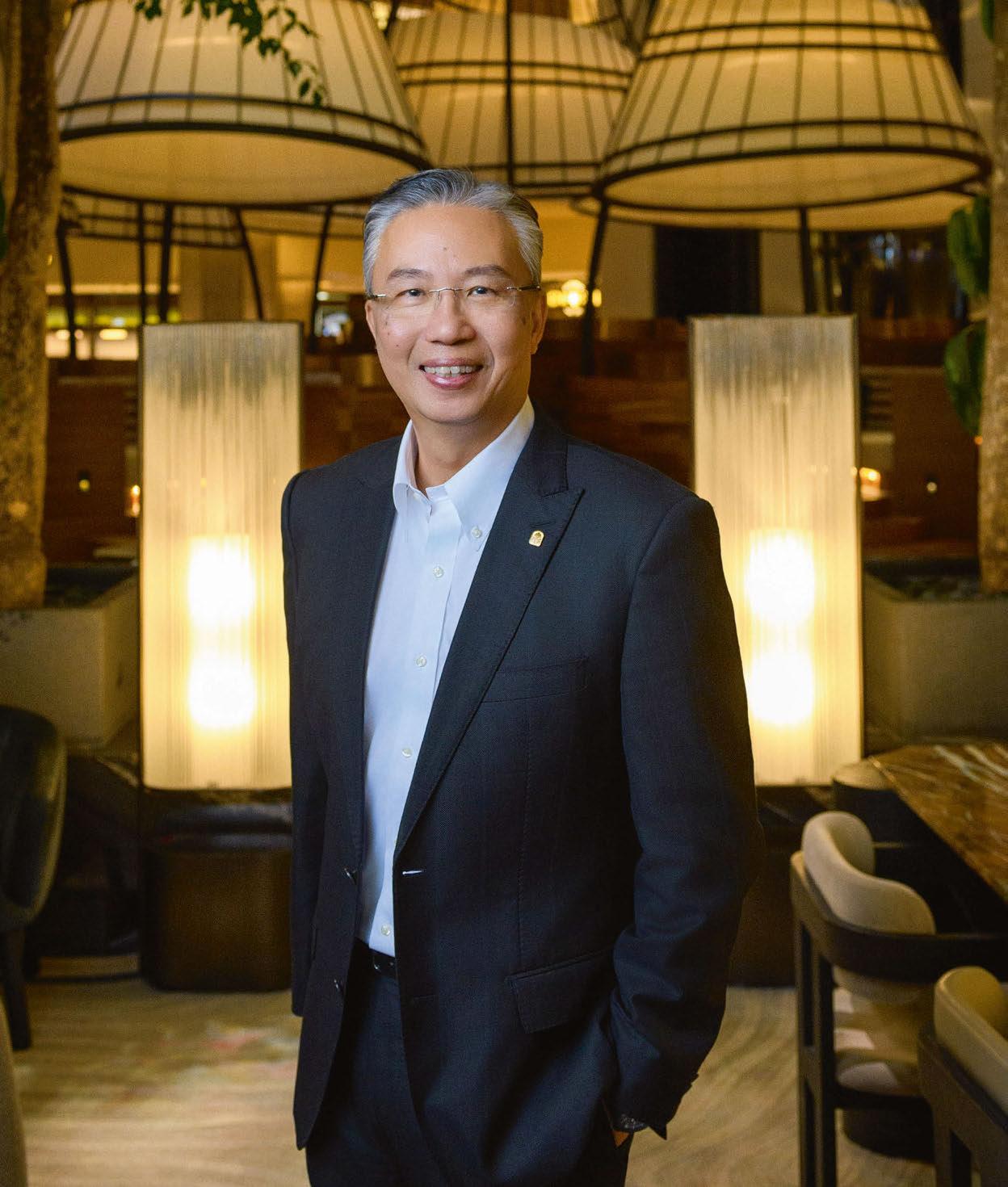
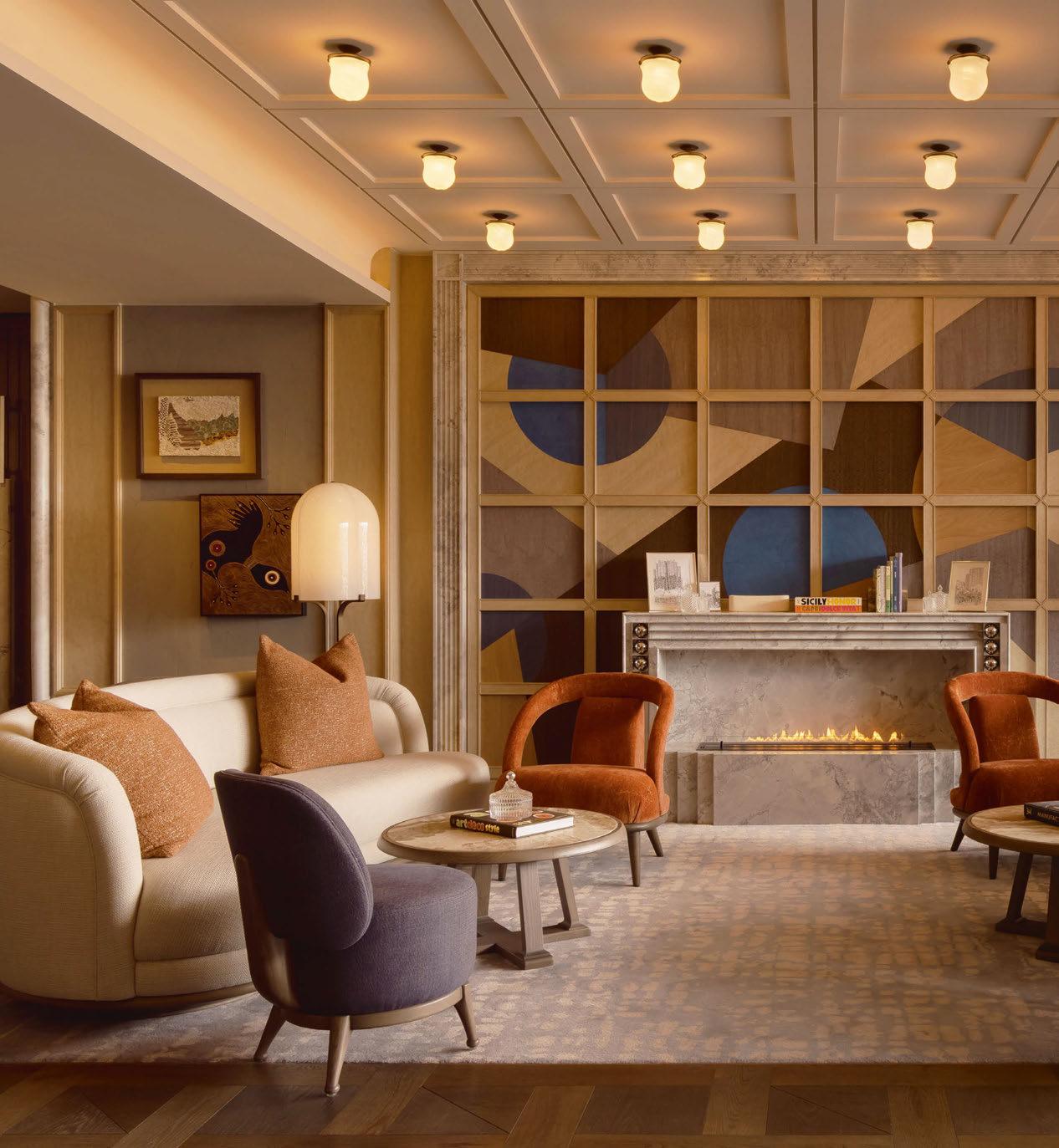
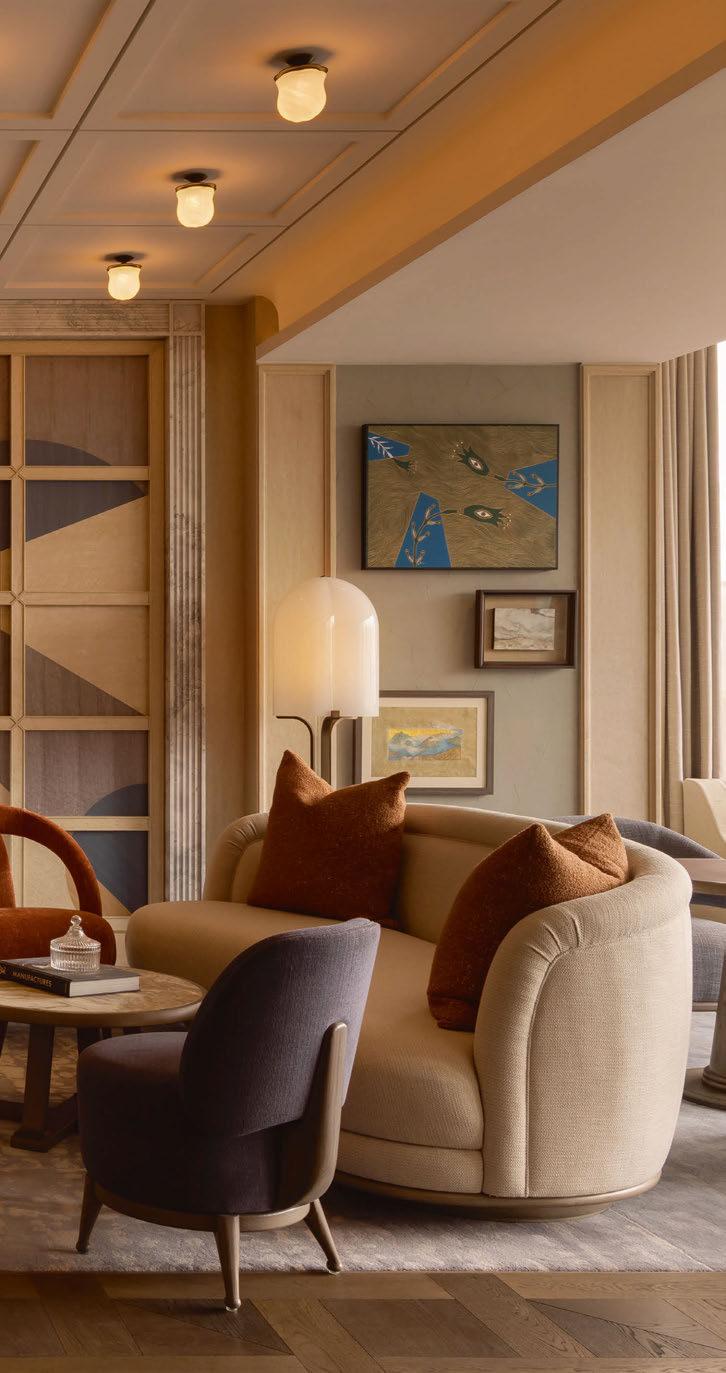
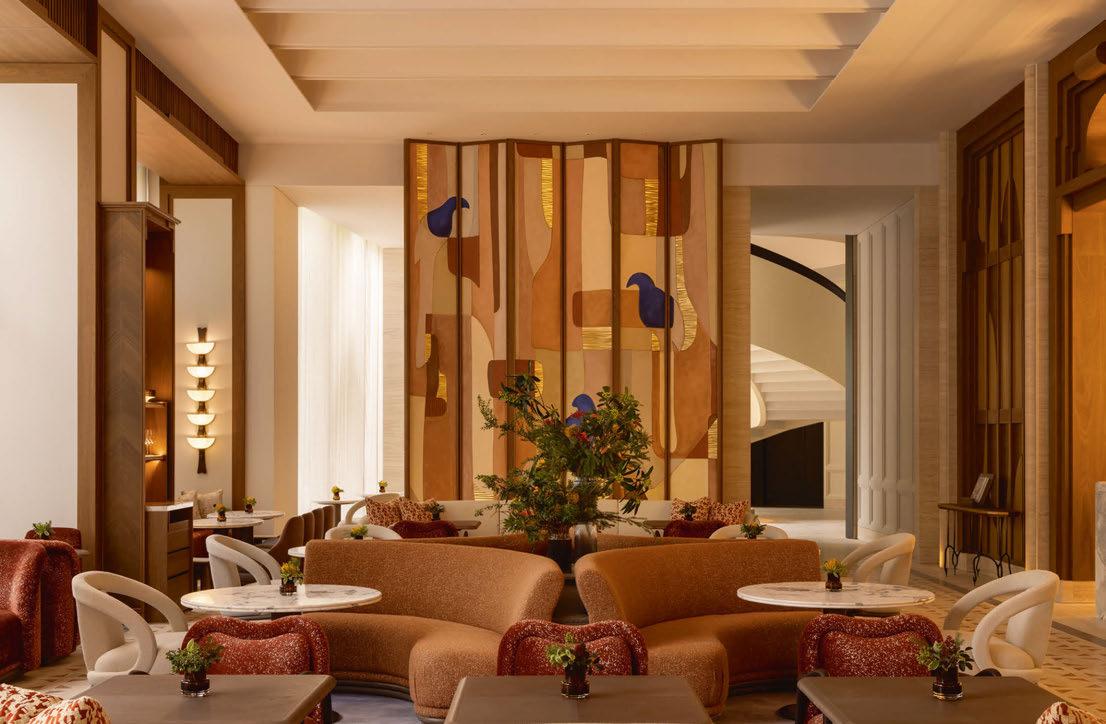
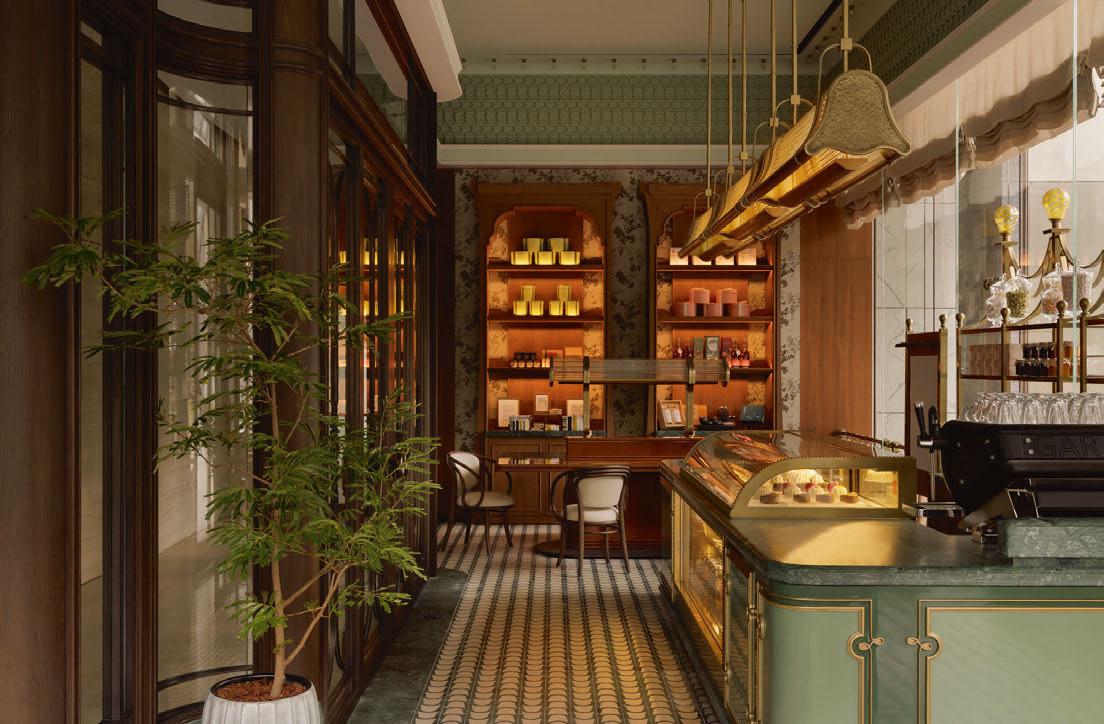
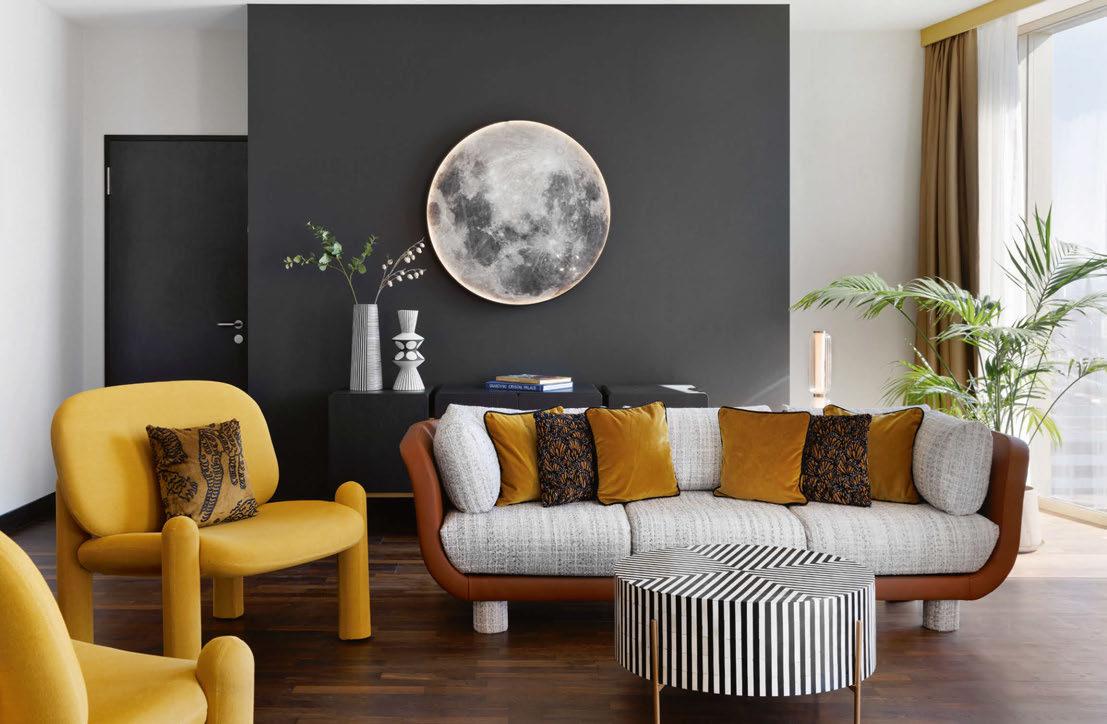
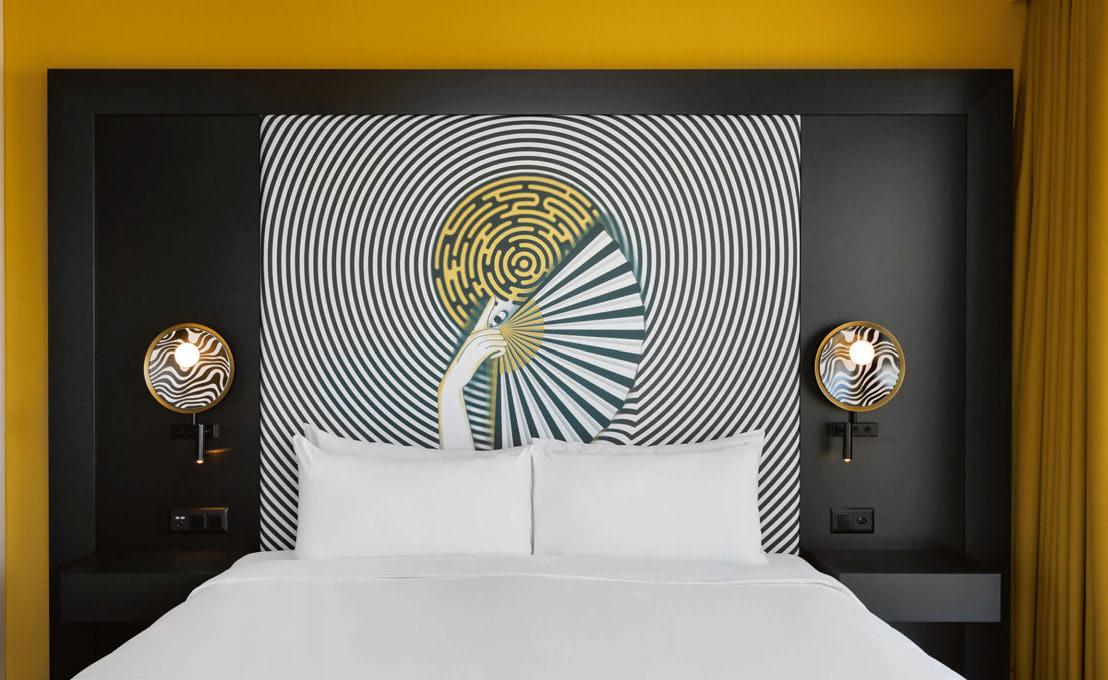
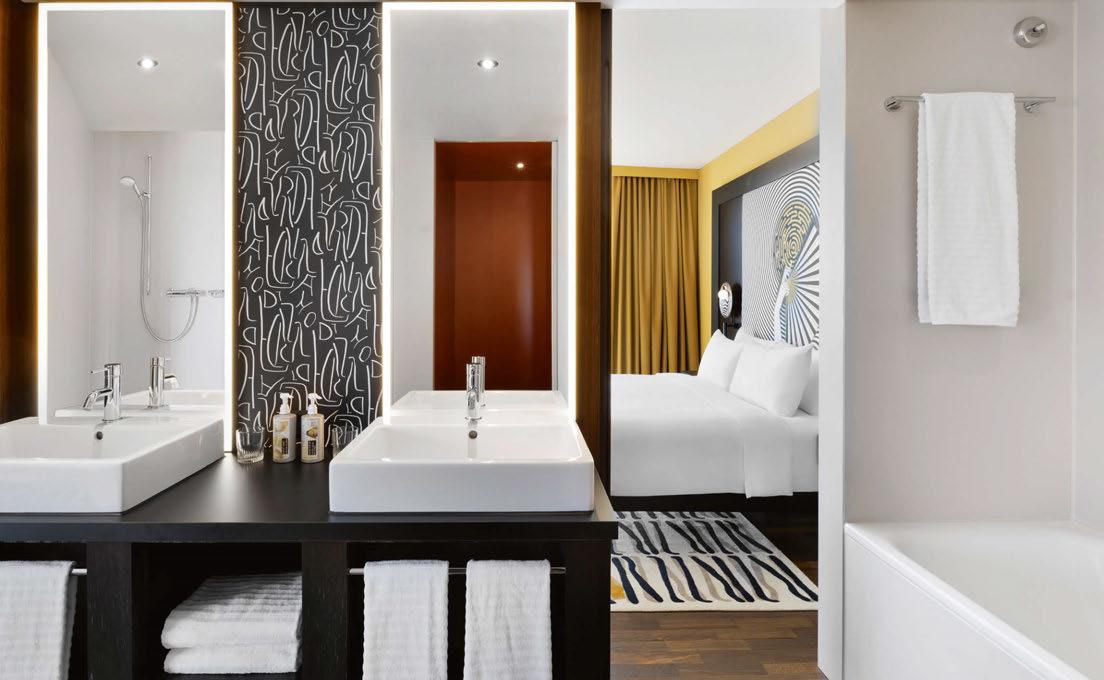
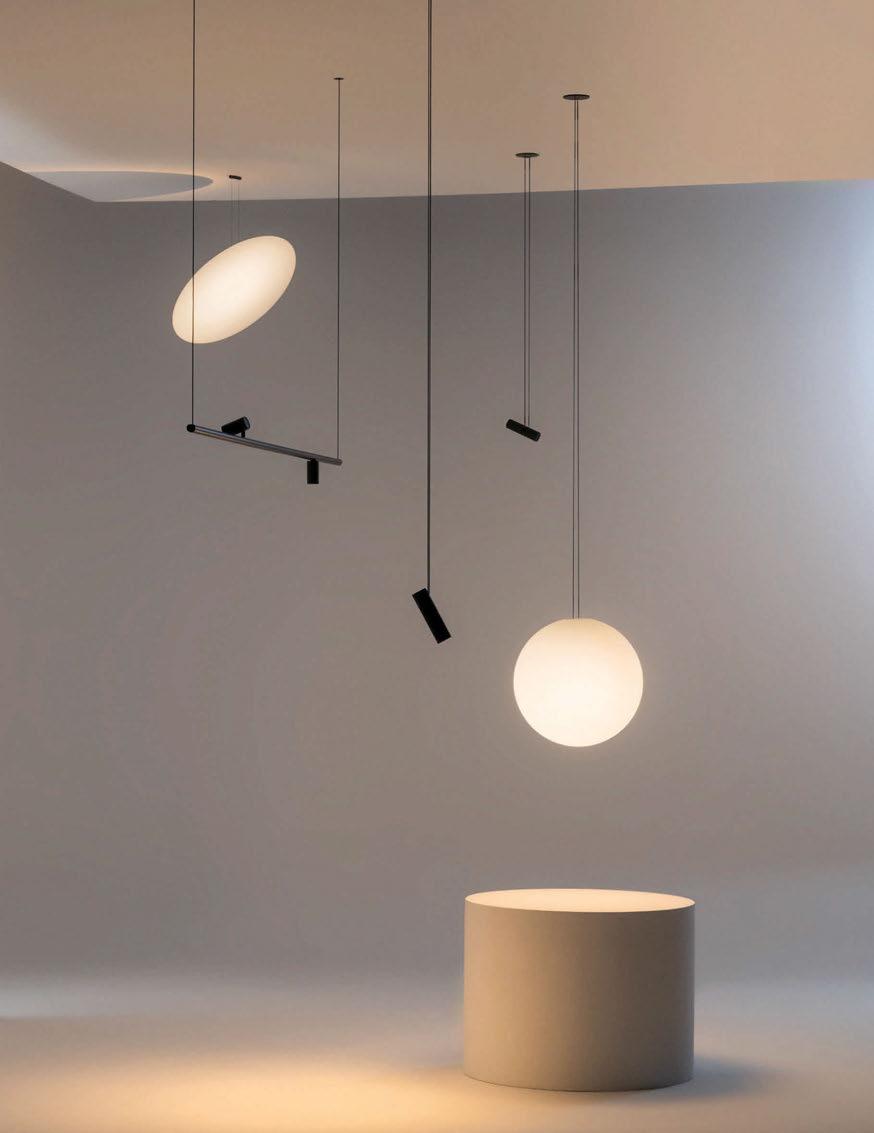
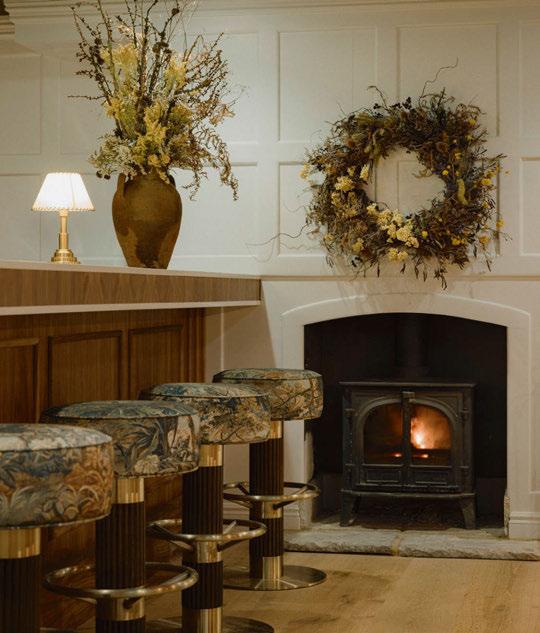
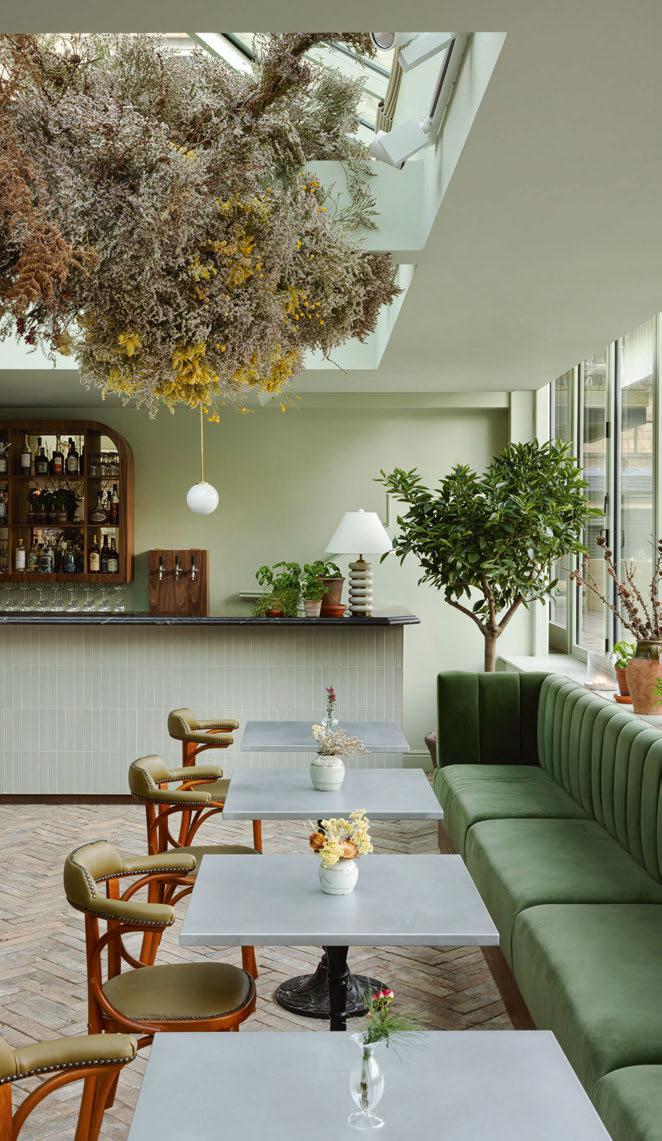
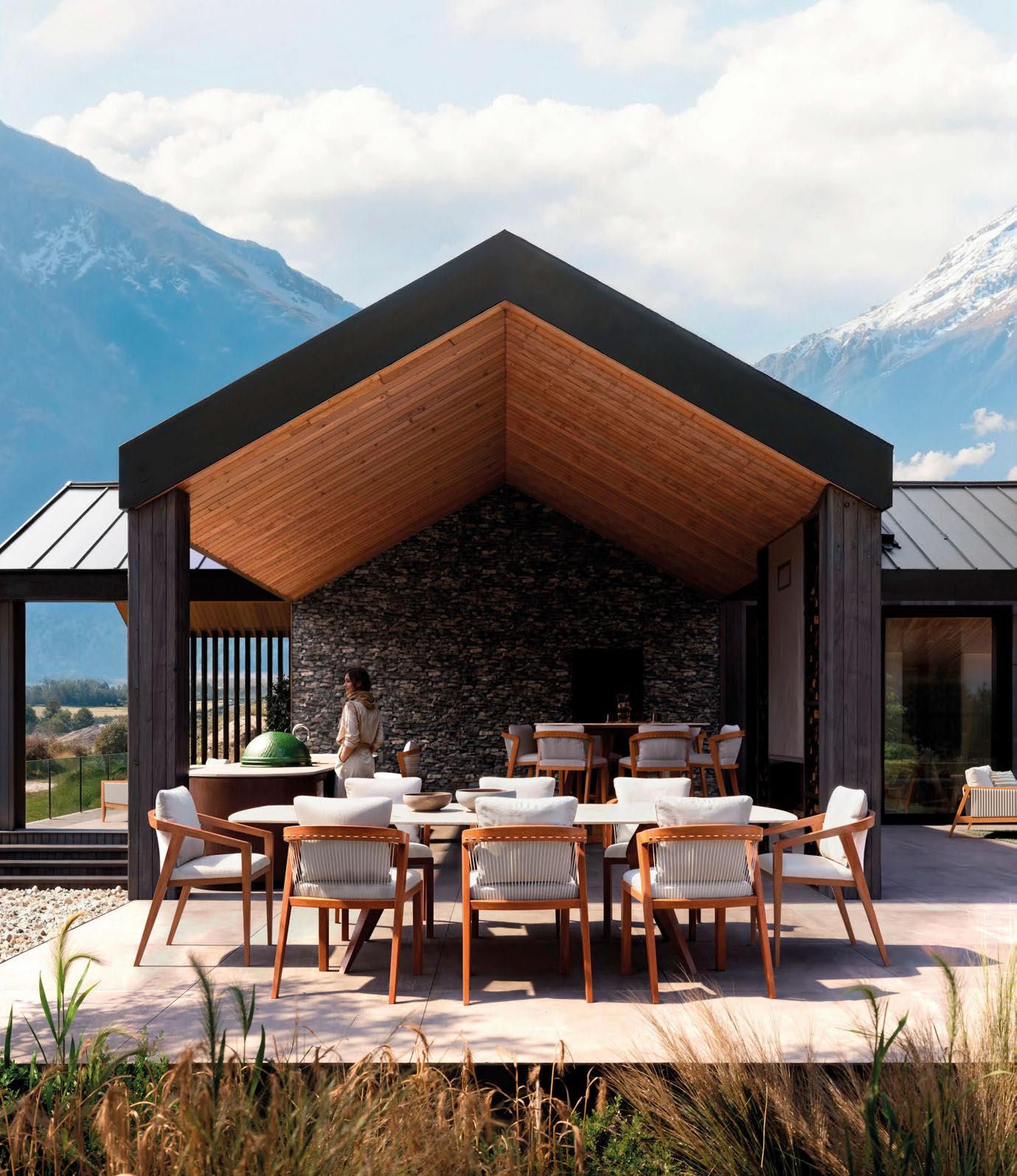
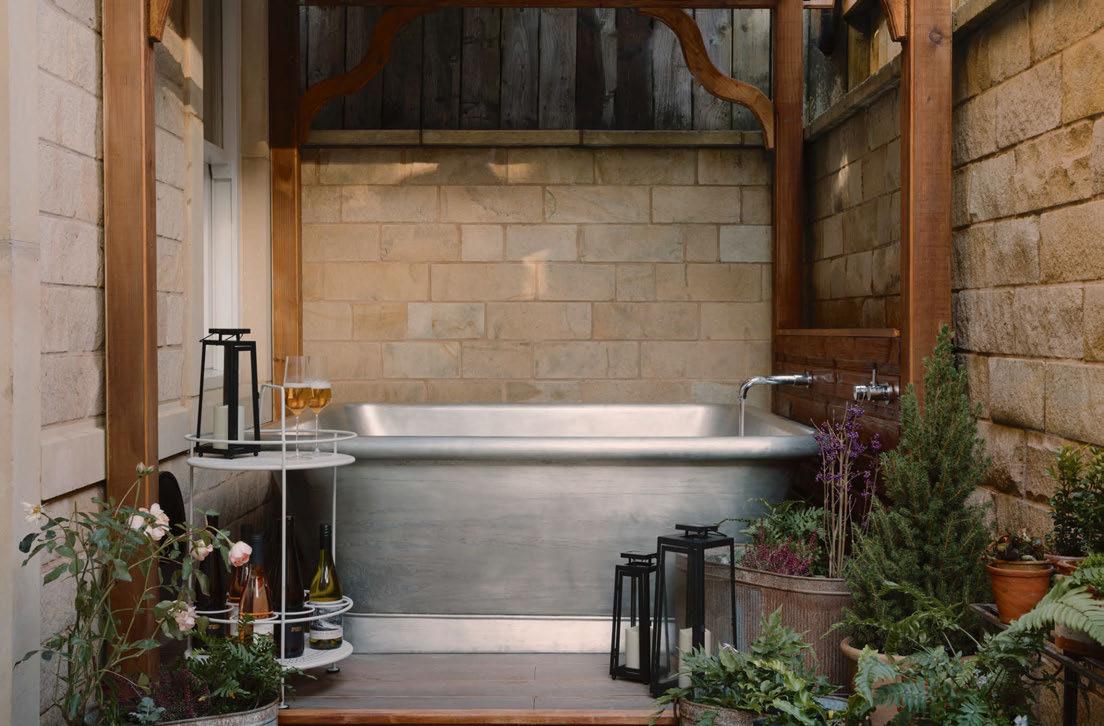
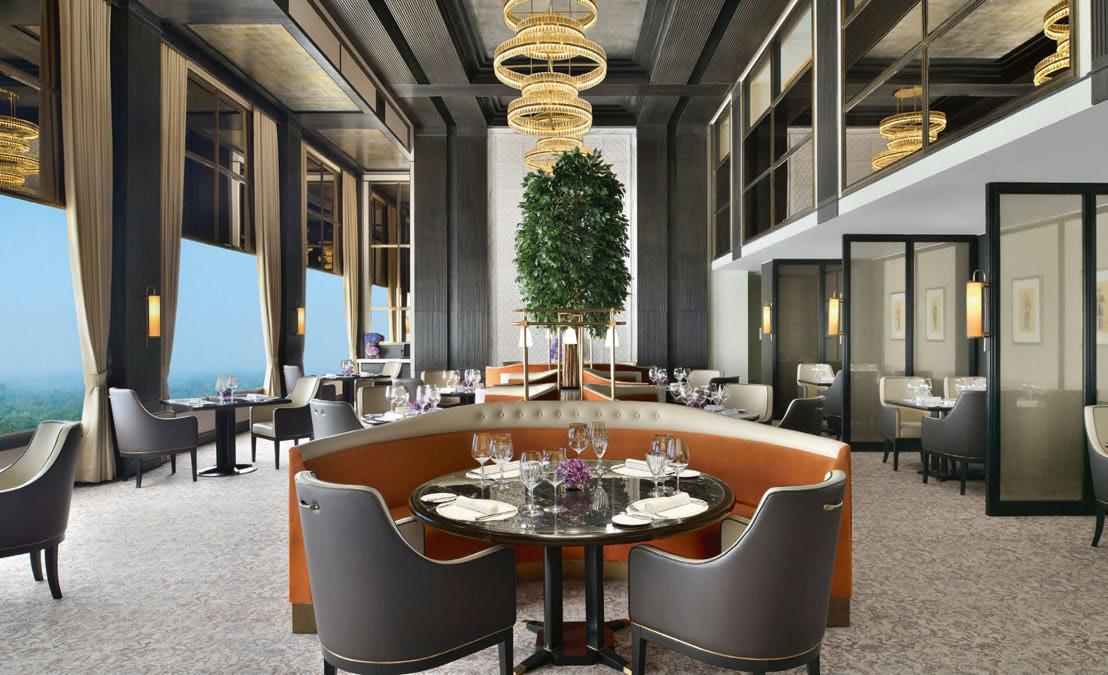
Having taken the reins of Pan Pacific Hotels Group on the eve of a global pandemic, the CEO reveals his ambitious three-tier strategy for global growth.
40 Years of GA Group
044
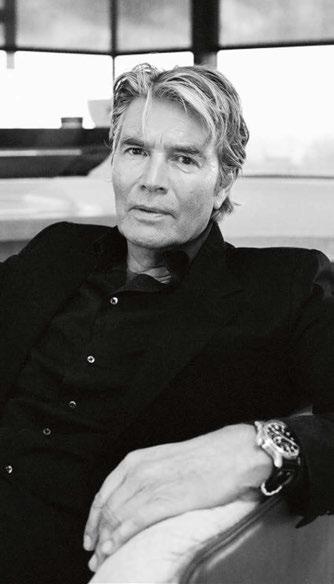
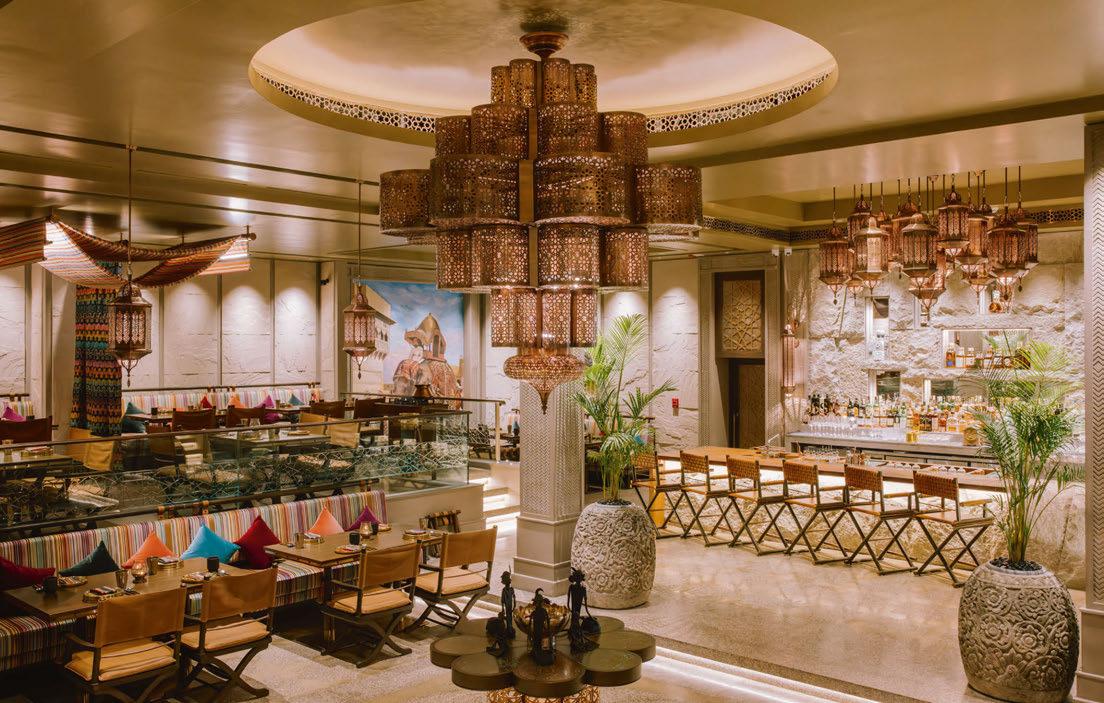
Upon celebrating a milestone anniversary, the Global Executive Design Director of GA Group discusses the past, present and future of hospitality design.
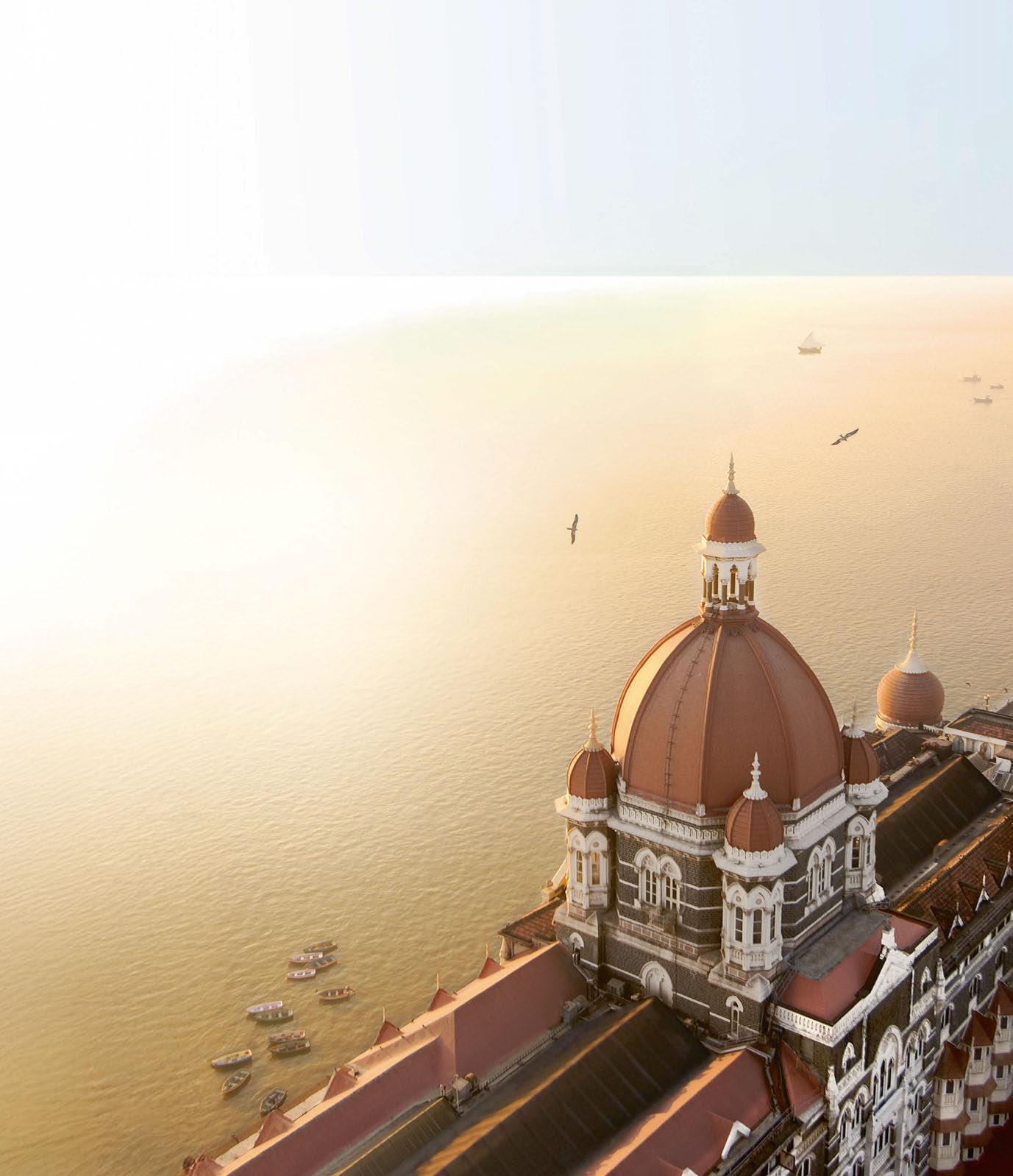
A Touch of Tajness
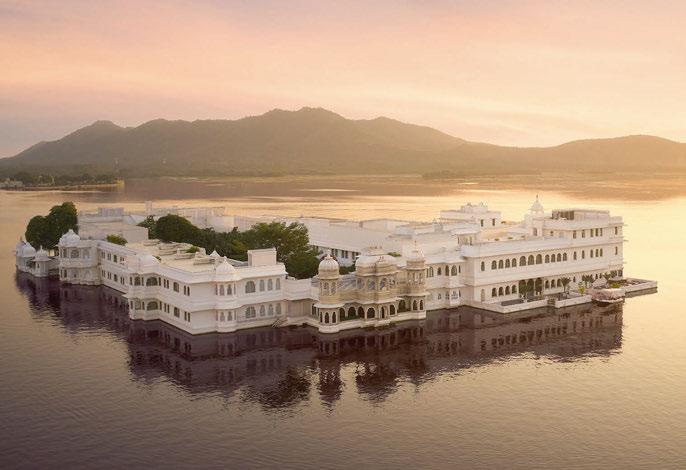
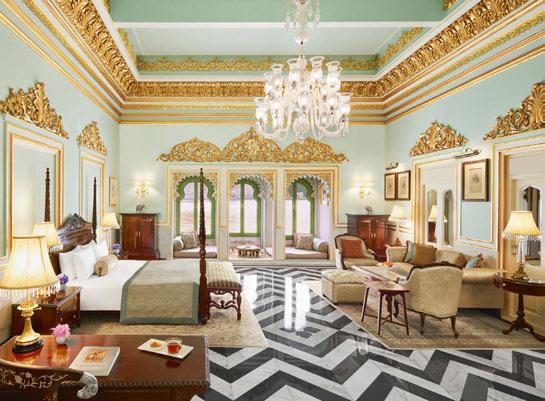
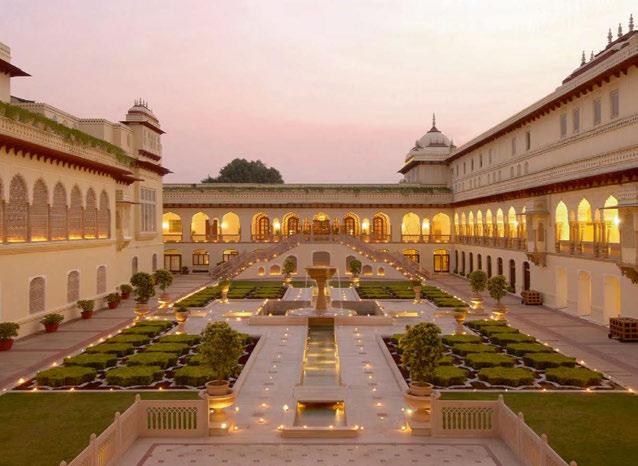
As IHCL charts ambitious growth, its leadership reflects on a greater mission as custodians of Indian hospitality, safeguarding cultural heritage while infusing an inimitable spirit into every experience.
REGULARS
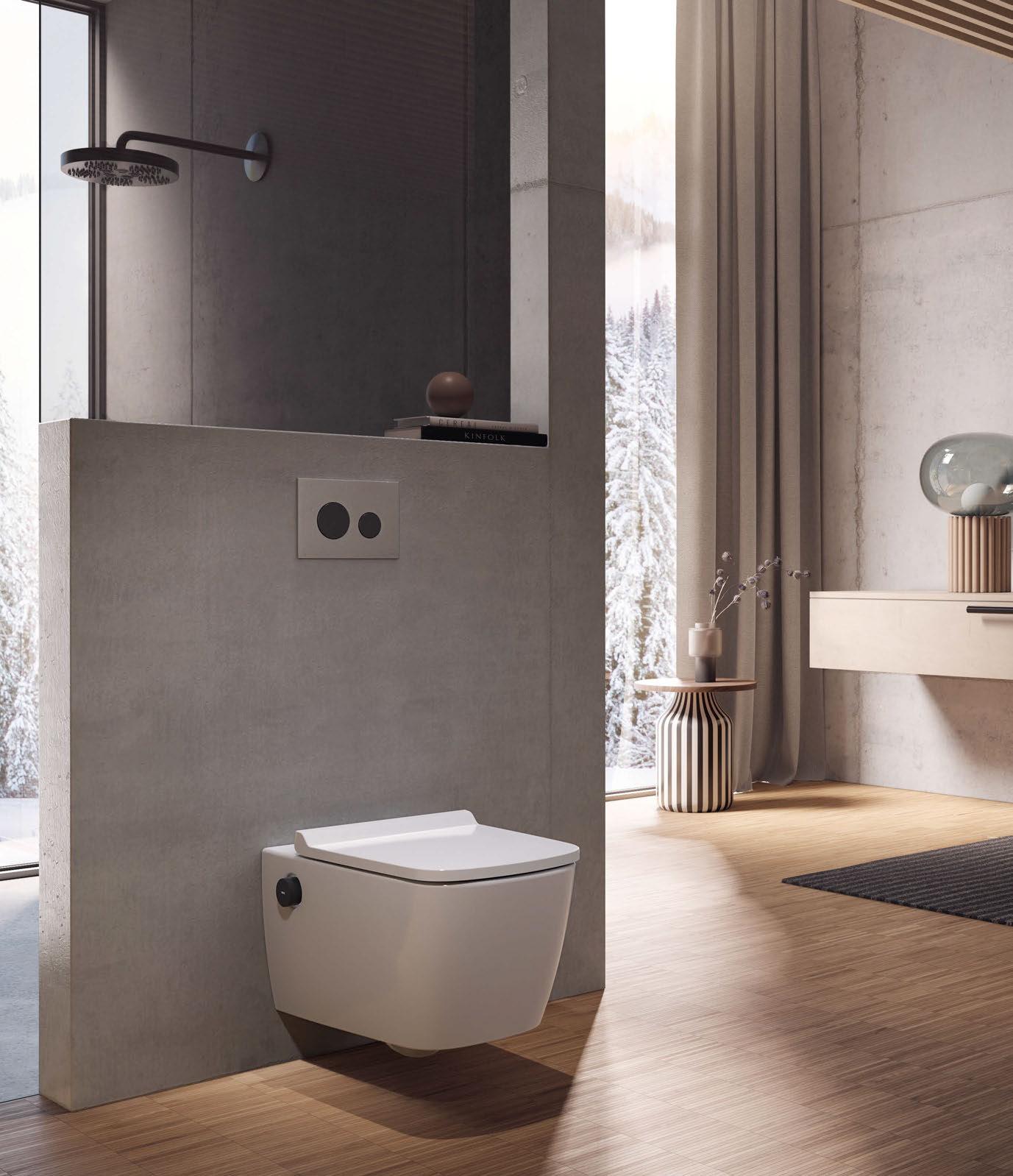
Henry, meet Chronos.
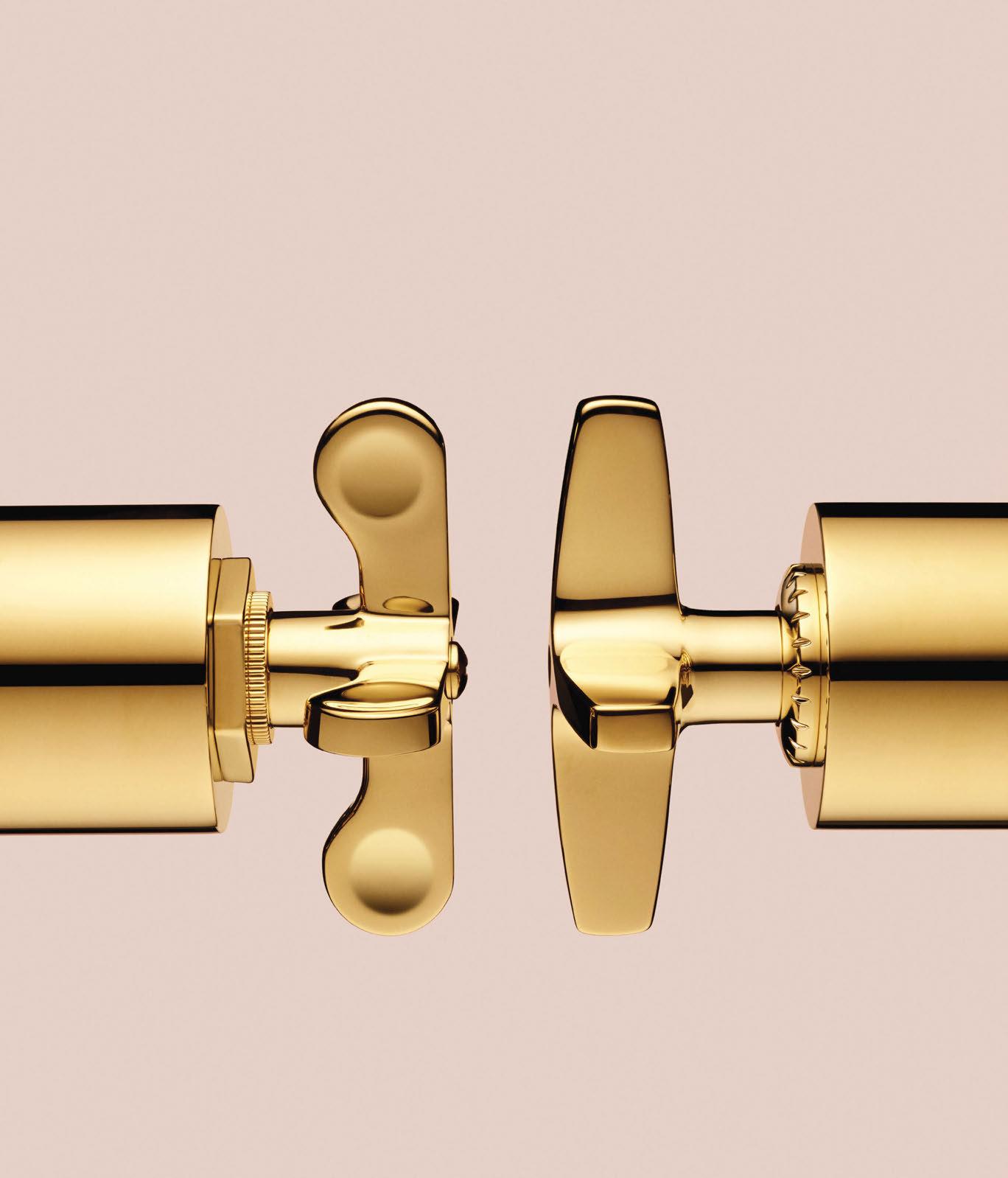
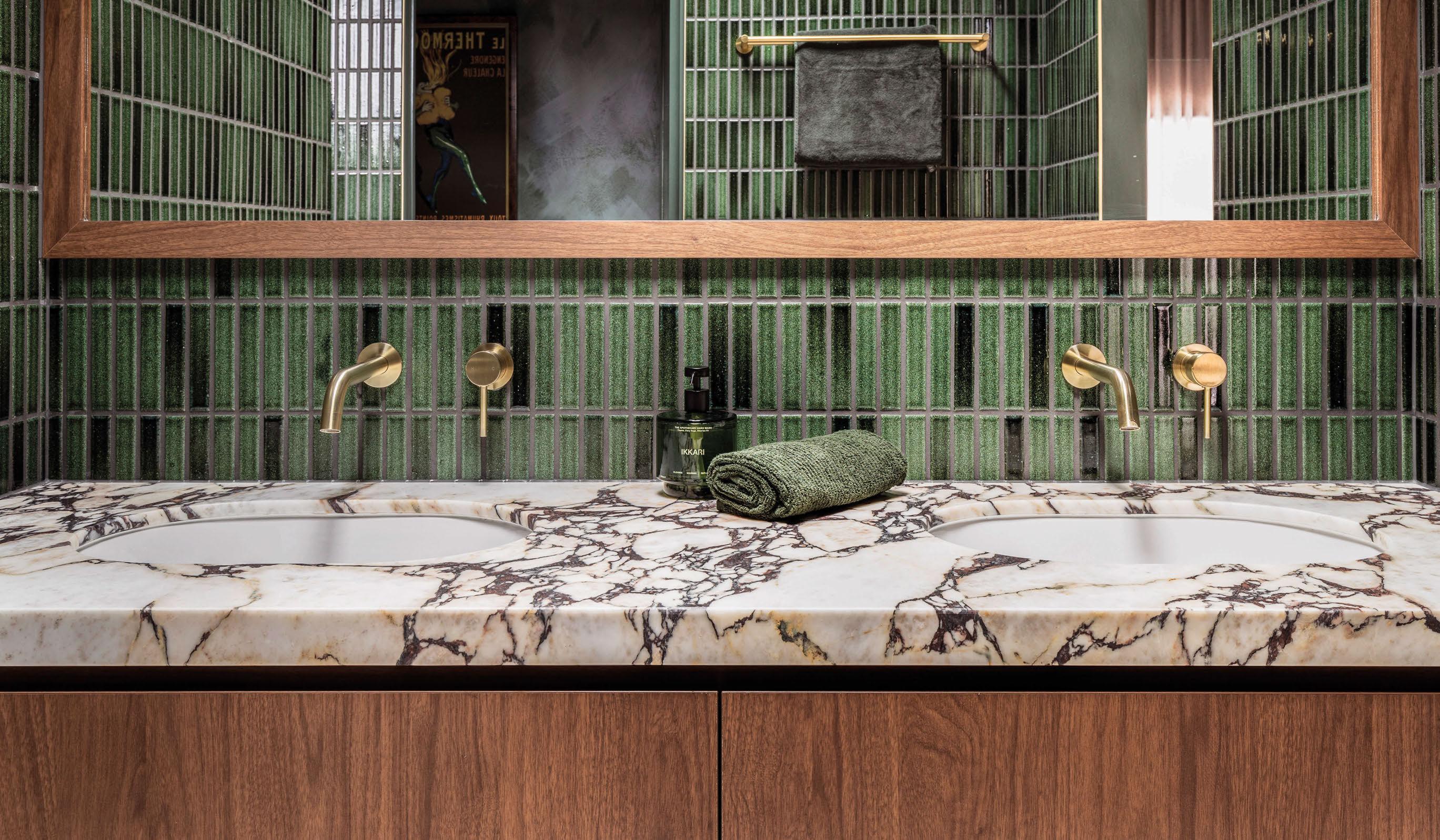
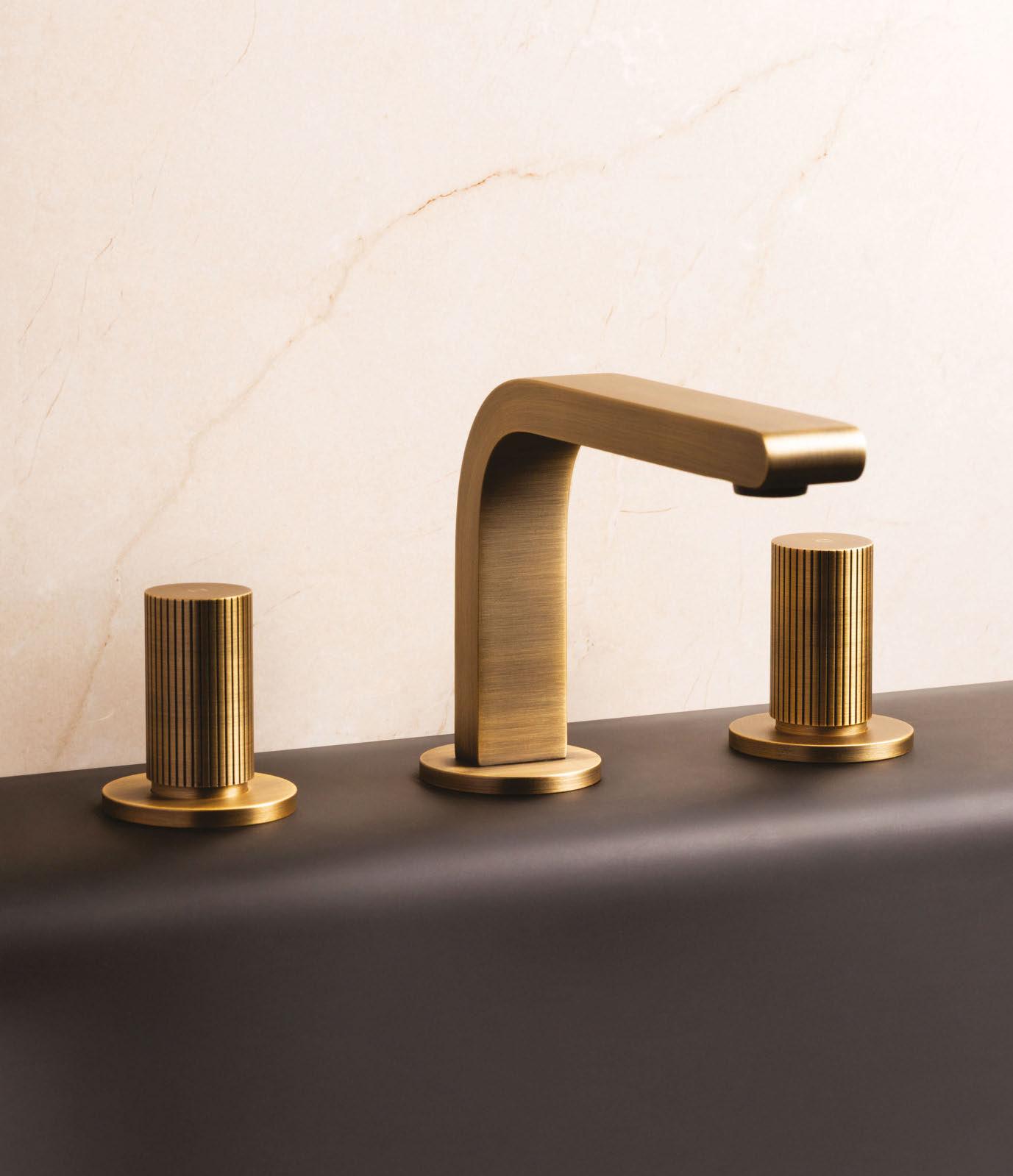
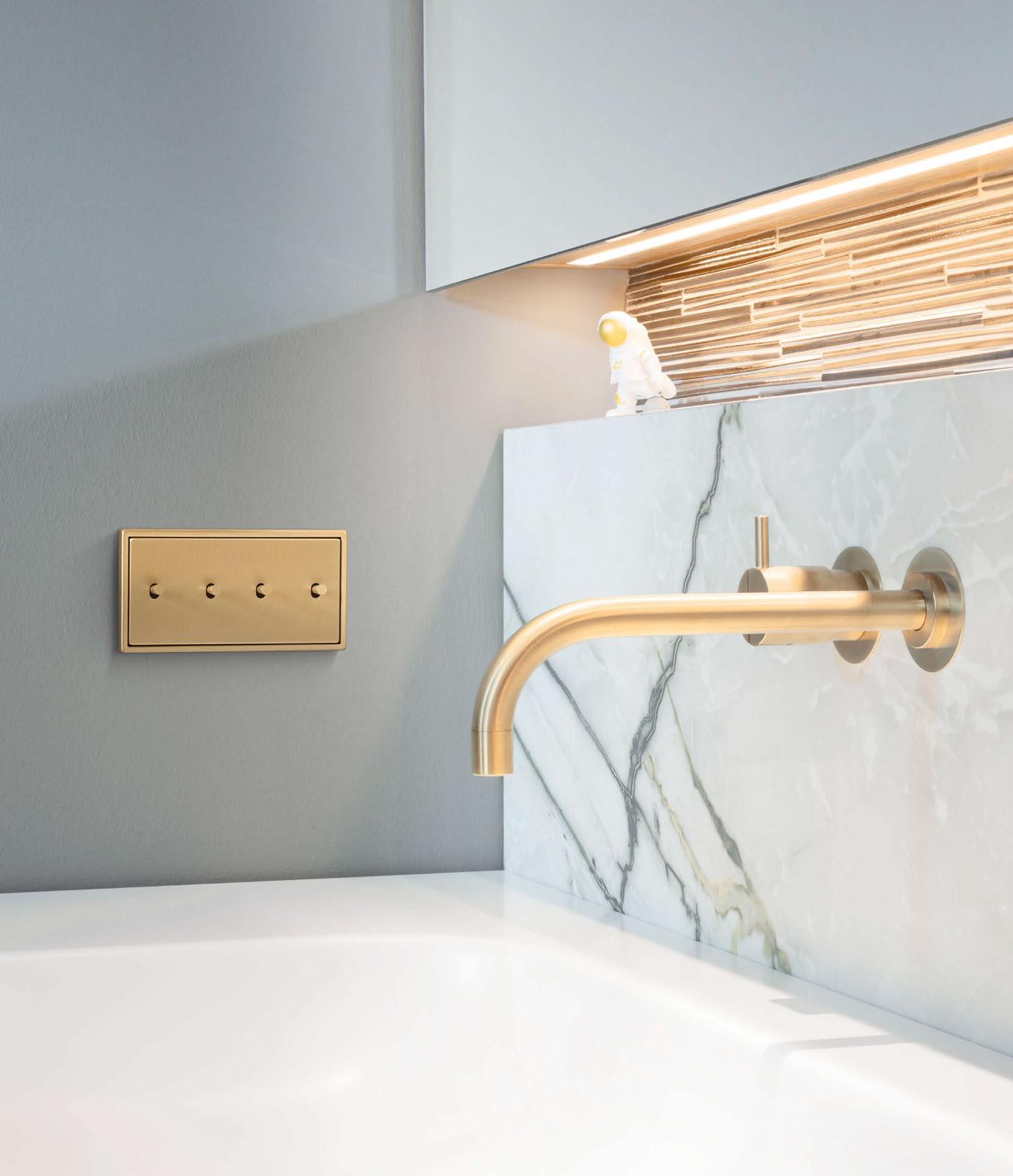
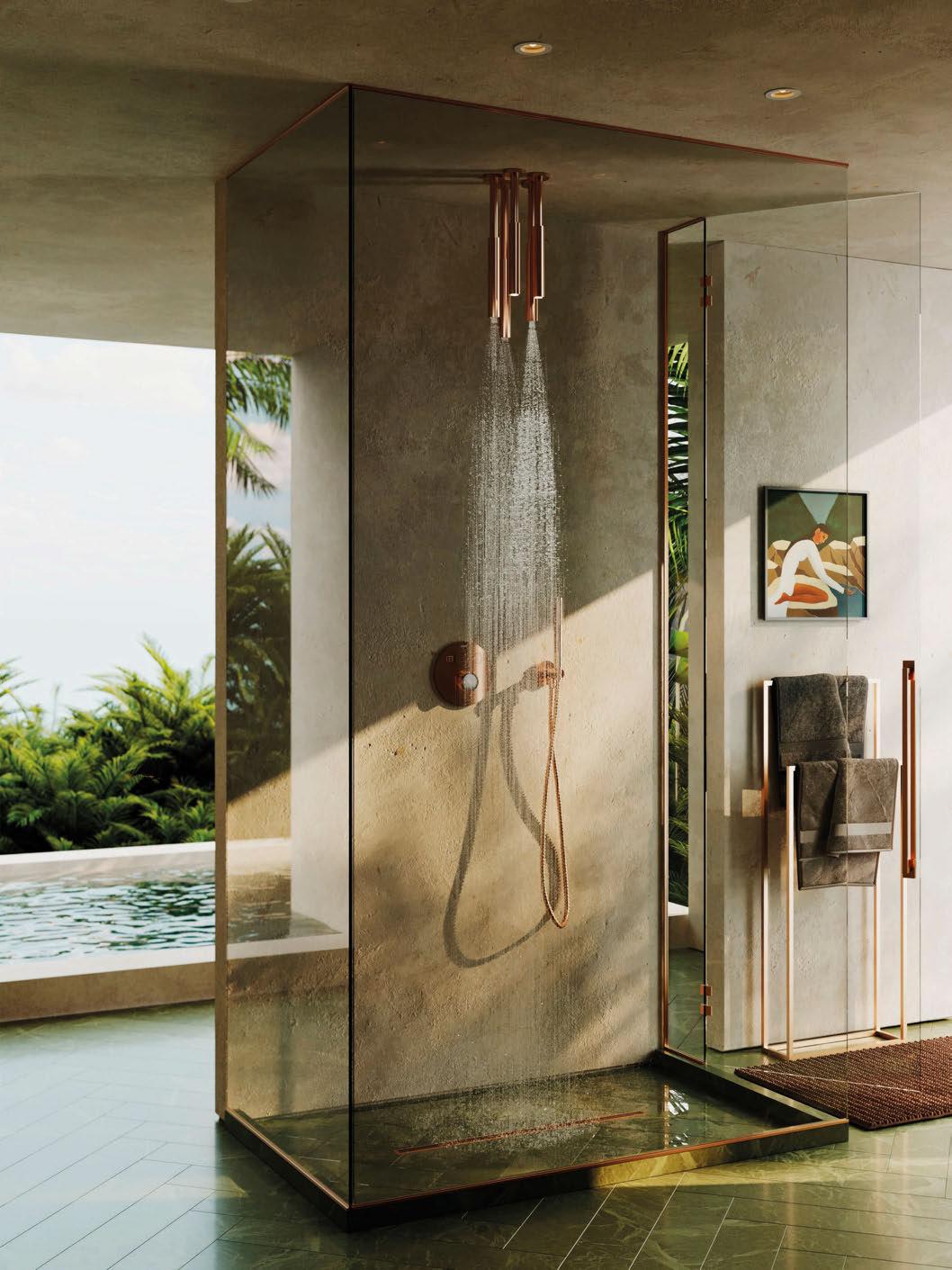
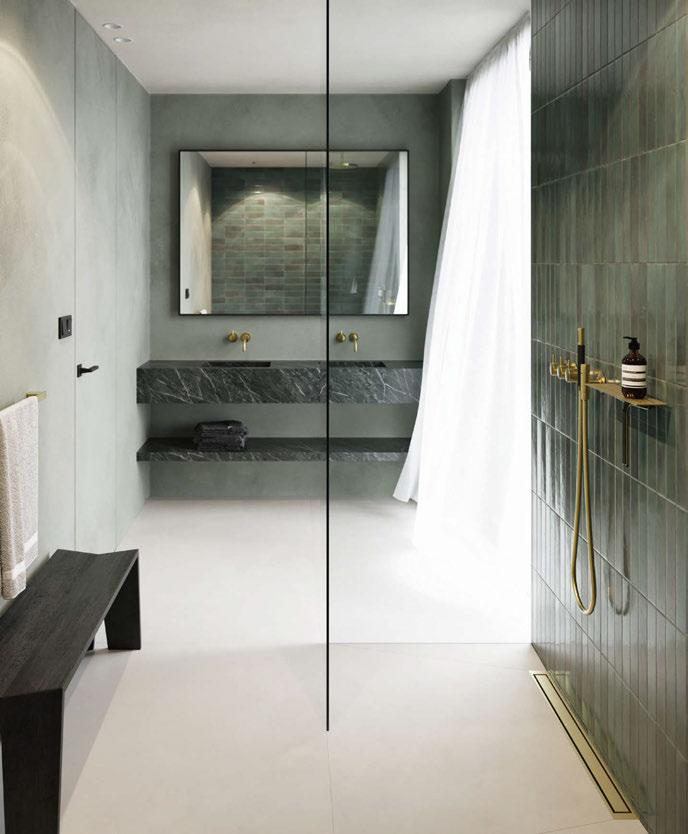
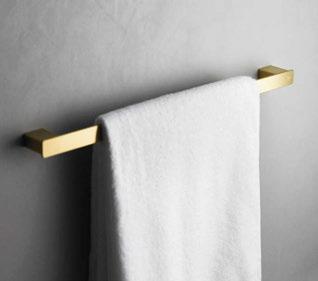
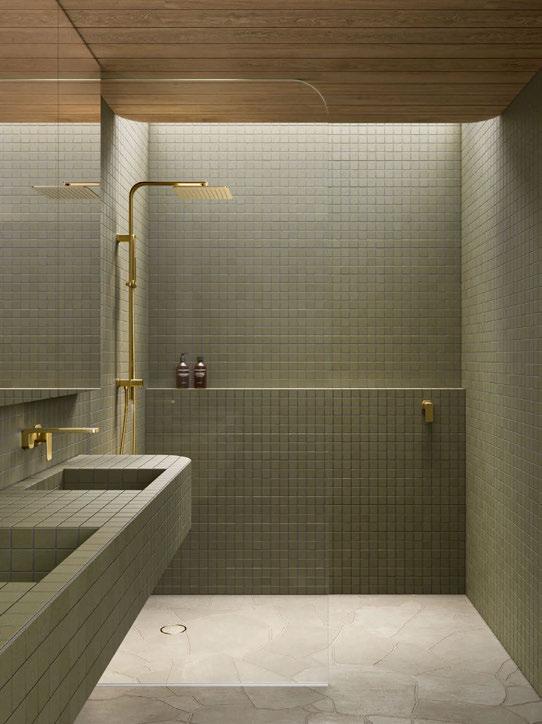
Featuring Elysian Minimal Mixer and Spout Set in Brushed Brass, Elysian Double Towel Rail in Brushed Brass
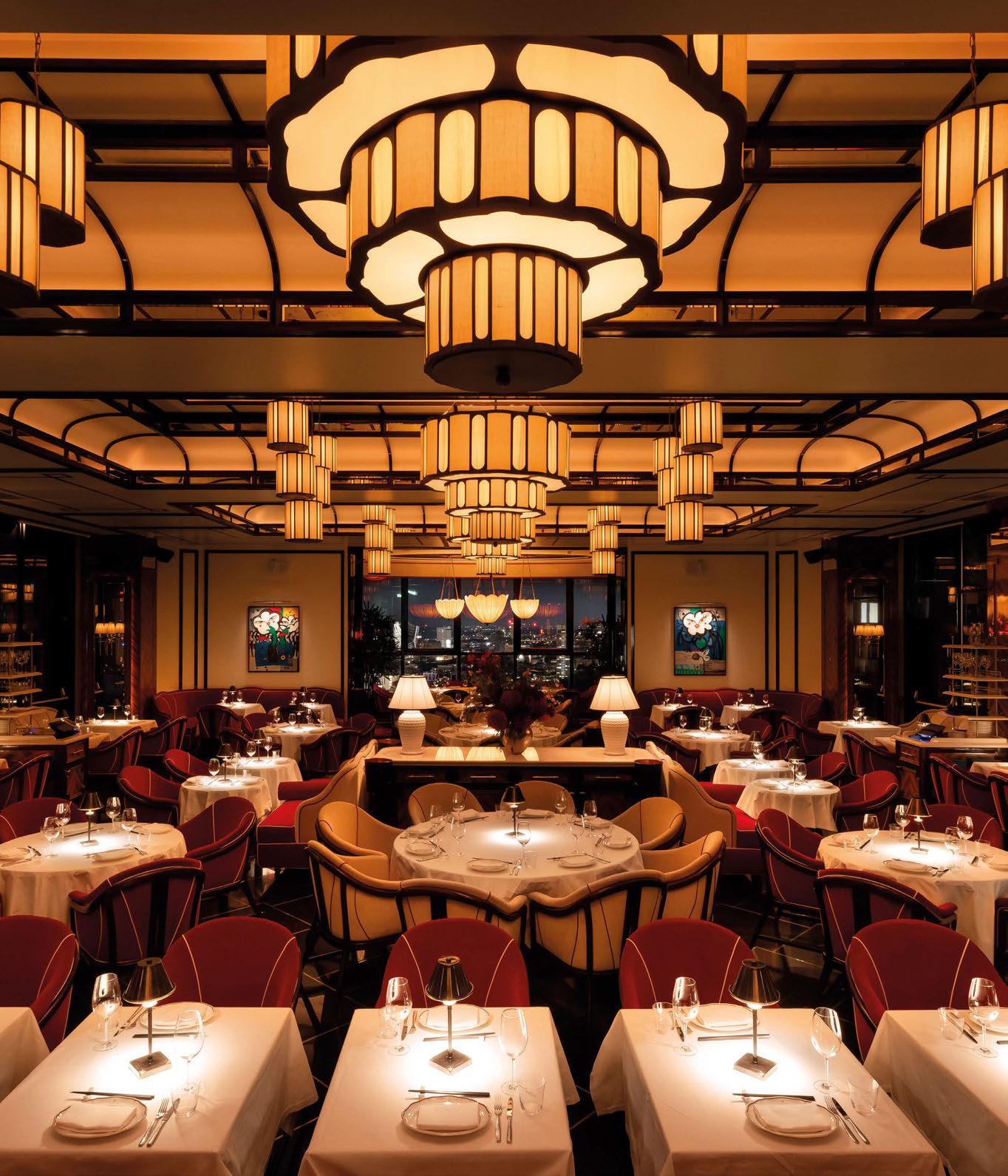
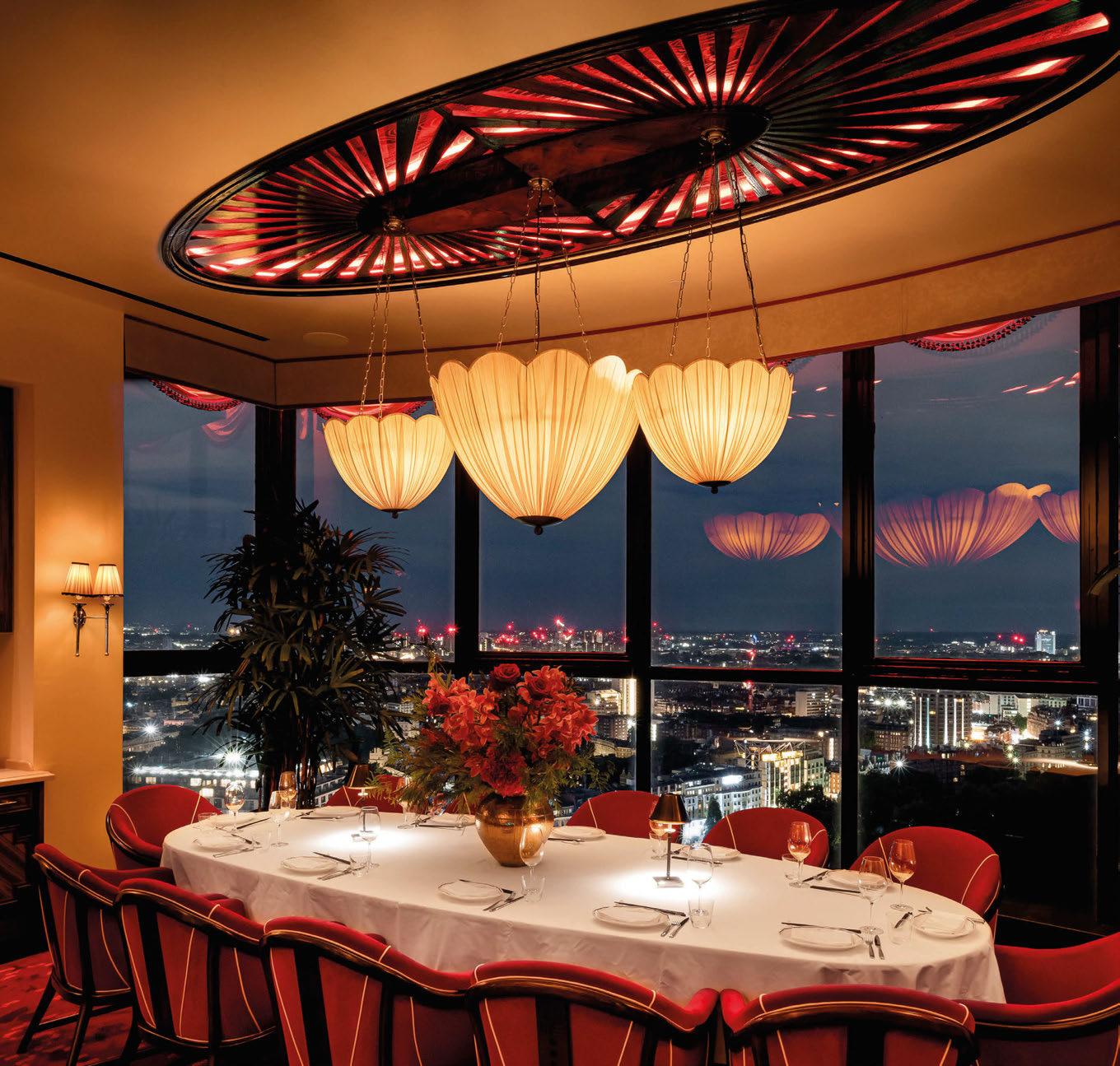
Shanghai Me, London
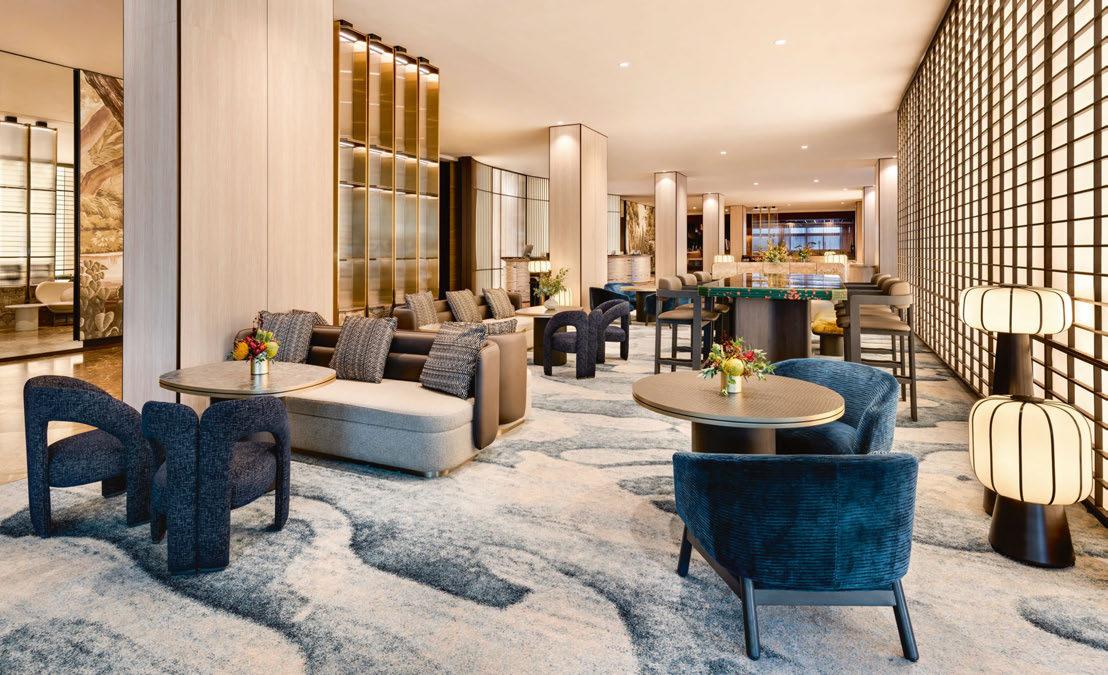
Interiors: First Within Lighting: Northern Lights
10 - 12 March, 2026
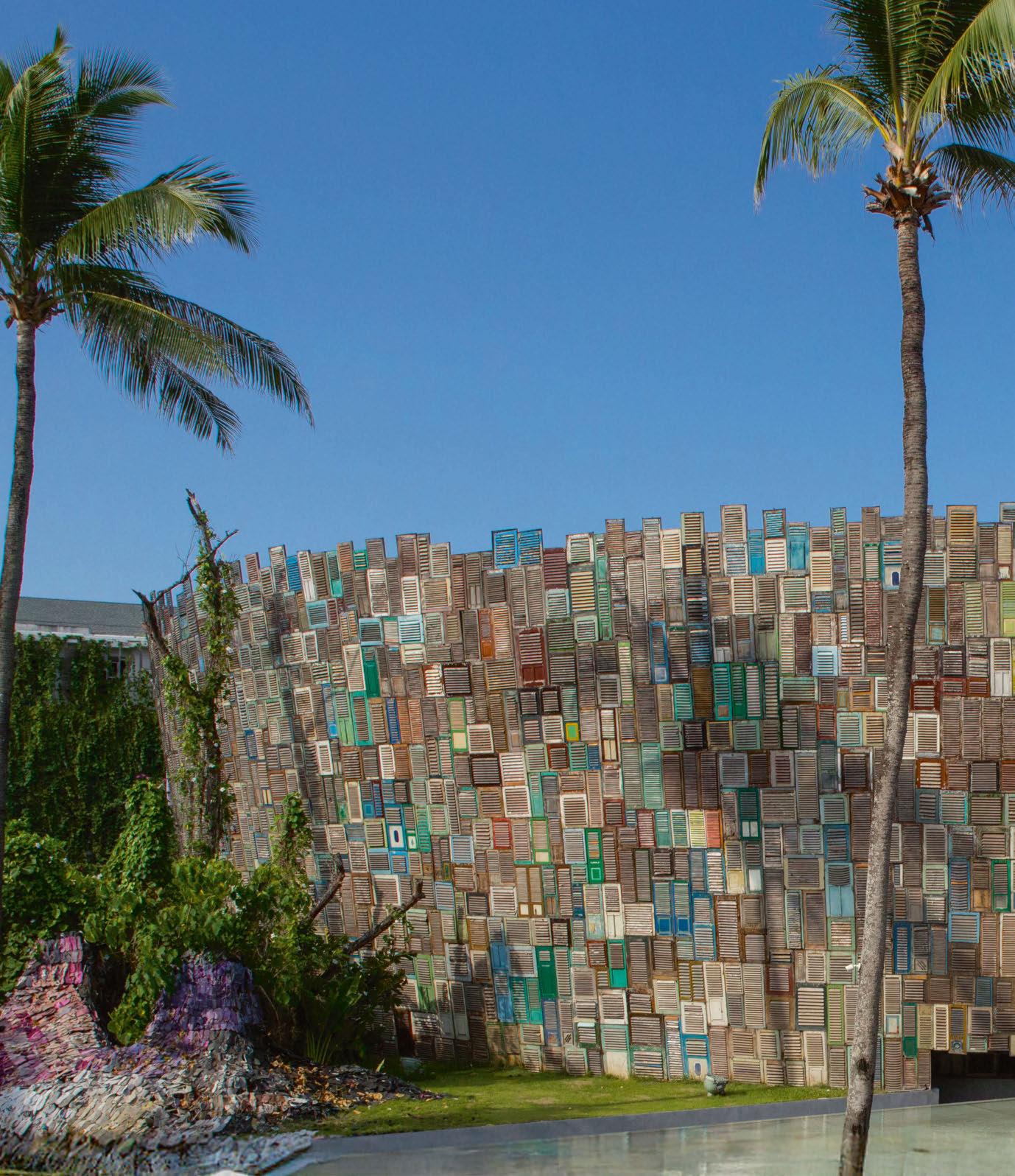
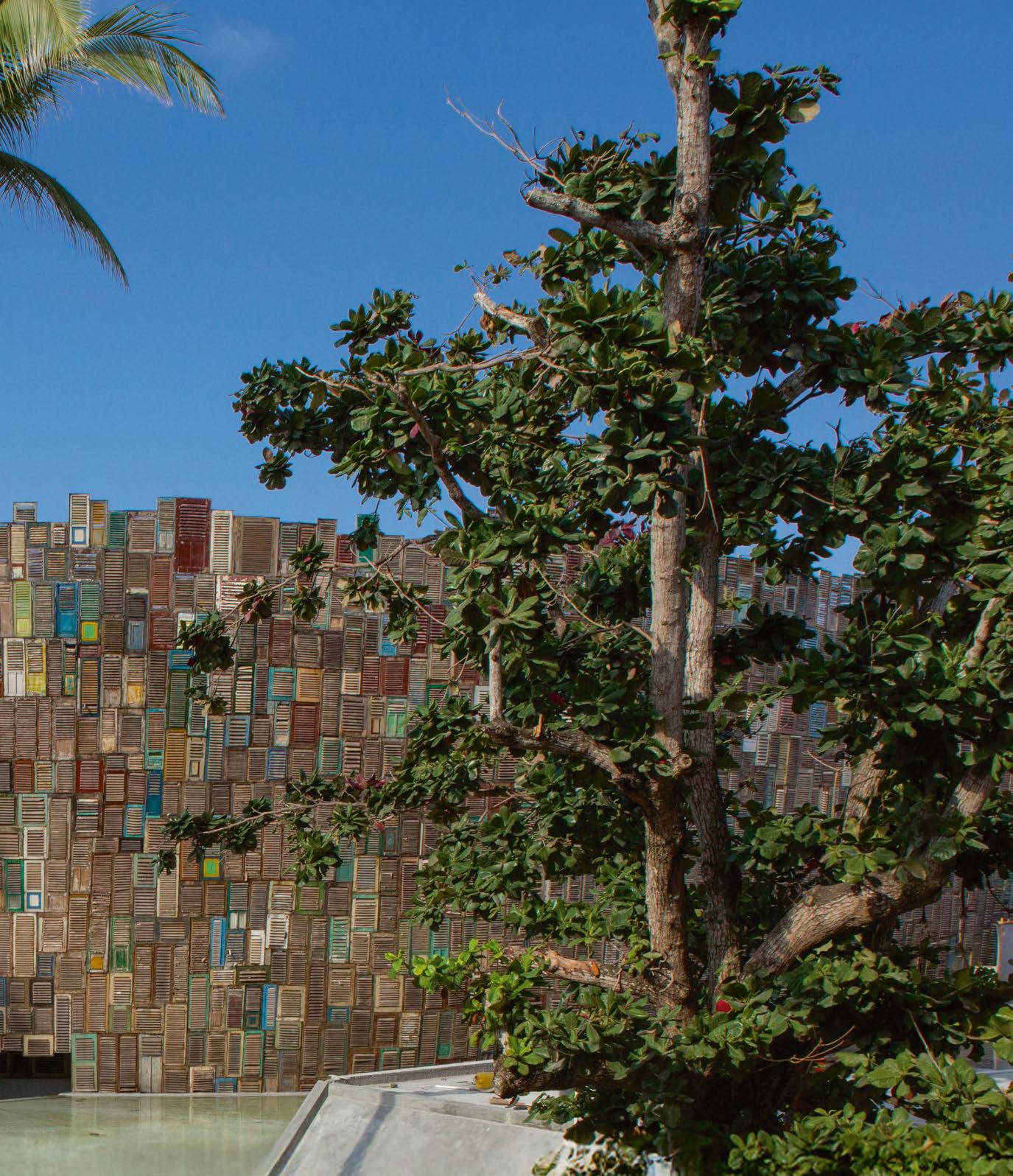
Potato Head – Bali
ligne-roset-contract.com
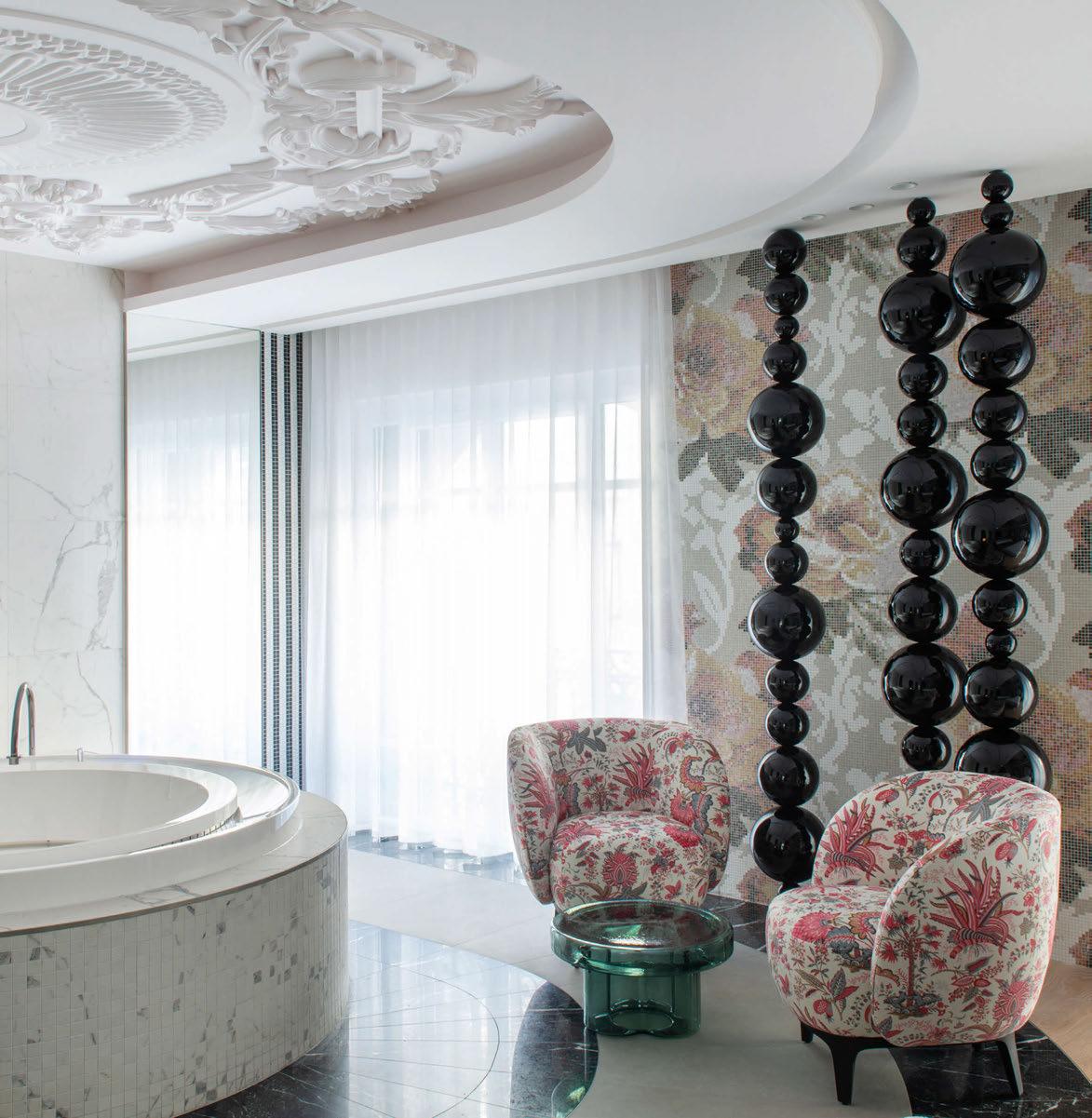
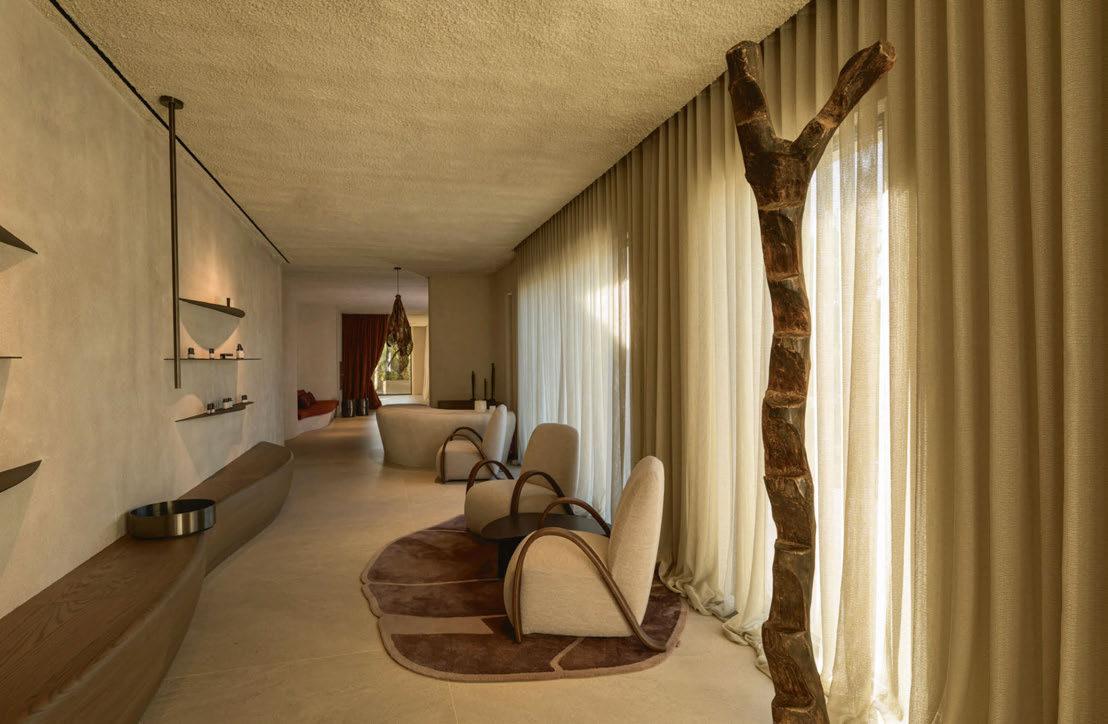
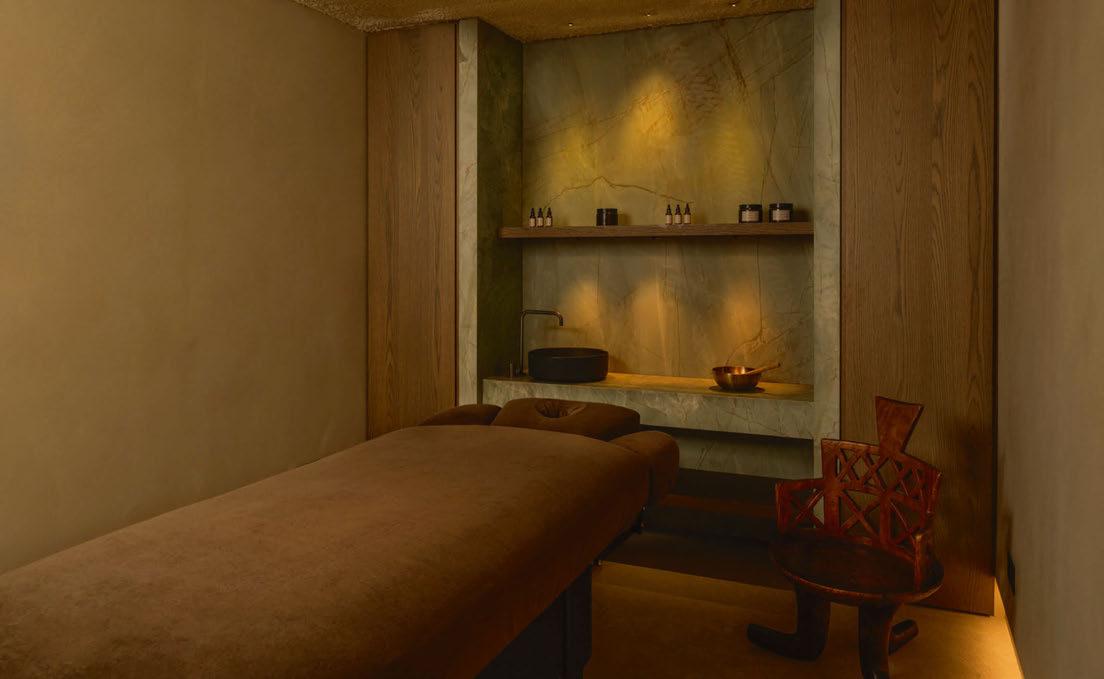
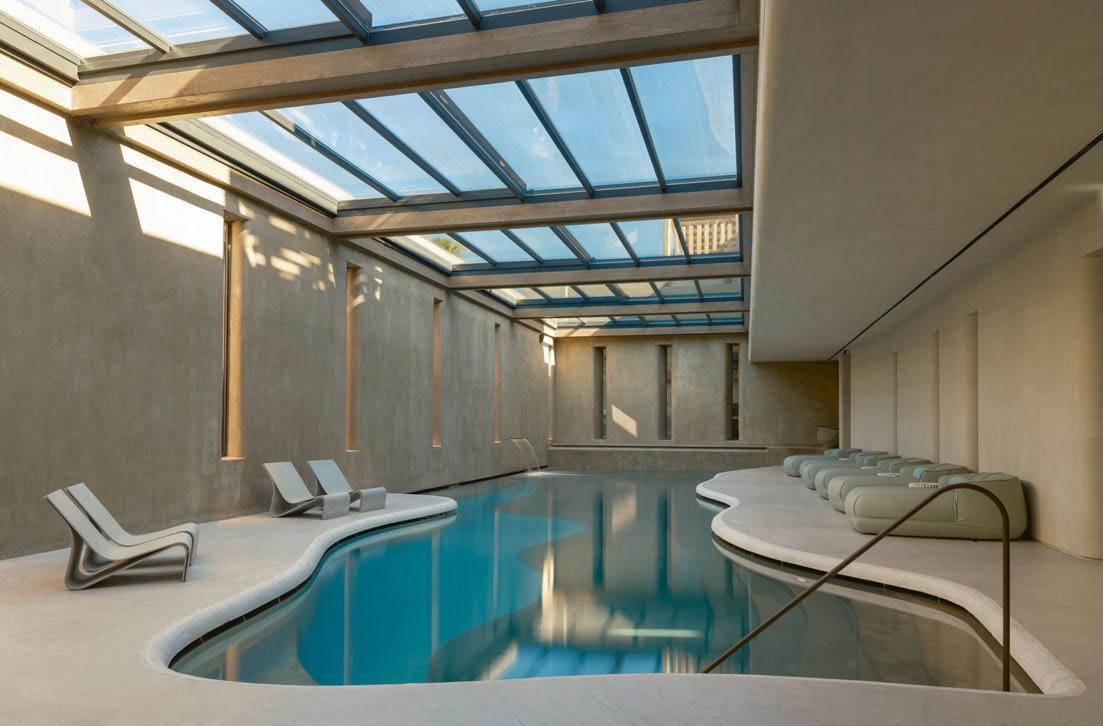
Spa–Hôtel Le Negresco, Jean-Philippe Nuel. Fabriqué en france.
WELCOME
Designing with Intelligence
From warm welcomes to social spaces that encourage conversation, hospitality is fundamentally about people.
So when the likes of contactless check-in, virtual concierges and robotic room service came to the mainstream, threatening the very existence of real-life interactions, it’s understandable that questions were asked over the role of human versus tech.
Now, with the advent of artificial intelligence, this debate has only intensified. AI is being used at the front desk, in housekeeping and F&B, and though typically for mundane or repetitive tasks, it is having a profound impact. Some believe that the use of AI tools frees up time for relationship-driven service, while for others, it’s simply a cost-cutting measure that reduces the number of staff required per shift.
Behind the scenes, AI is playing a role in the design and development of hotels too. Though it may seem counterintuitive to embrace machine-based intelligence for a sector rooted in human connection, architects and interior designers are harnessing technology to influence everything from concept development to the guest experience.
So far, AI has been used primarily to streamline the creative process: generative tools can produce multiple design iterations in minutes; photorealistic visualisations allow for changes to colour palette, lighting and furniture at the touch of a button; and interactive video generators enable clients to ‘walk-through’ a space before ground is even broken, reducing the need for costly revisions at a later stage.
Perhaps one of the most interesting uses of AI is in data-
driven design. Hotel operating systems generate vast amounts of information about guest behaviour, revealing how they move through a space and which areas encourage social interaction. These insights can then be used to inform spatial planning and optimise flow, to develop room layouts and improve comfort.
At Sleeper, we’re seeing more and more examples of AIdriven hospitality – in both operations and design. There’s the recently opened Otonomous Hotel in Las Vegas, billed as the world’s first AI-powered hotel, that uses intelligent applications for everything from check-in to customisable room settings, meaning lighting and temperature is personalised according to guest preferences. And this issue, we preview a property that has been developed through AI-powered research and prompt engineering, resulting in a scheme that translates the abstract ideals of connection, reflection and relaxation into a design language that is woven through interiors.
As AI becomes embedded in the creative process, the challenge will be to balance human presence with technology; when deployed skilfully, it has the potential to deepen rather than diminish human connection. Welcome to the new issue of Sleeper. Enjoy your stay.
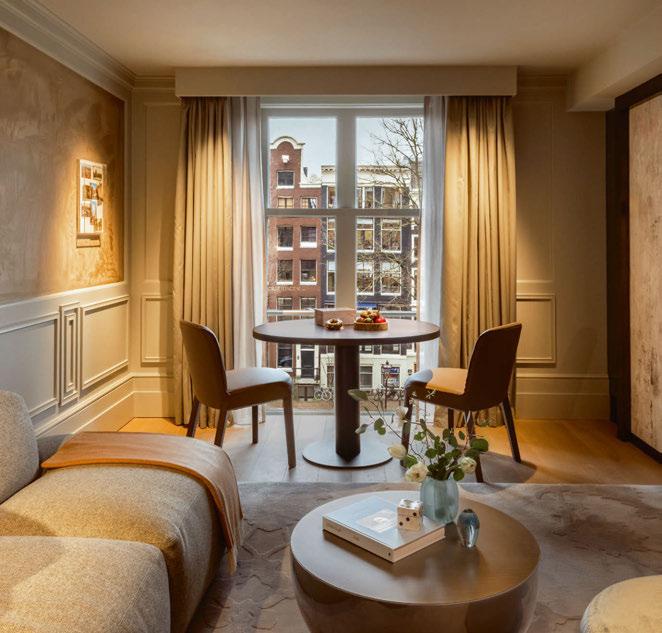
“We wanted every space to reflect Amsterdam’s soul: rich in history, effortlessly elegant and alive with charm. Every detail invites guests to feel at home, immersed in a journey that flows from the timeless beauty of the 17th century to a fresh, contemporary Dutch design perspective,” says Piet Boon of his vision for Rosewood Amsterdam. Specialising in blending exceptional design with local heritage, the Dutch designer describes the task of transforming the historic Palace of Justice as “a dream come true”.
024 Beverly Chen
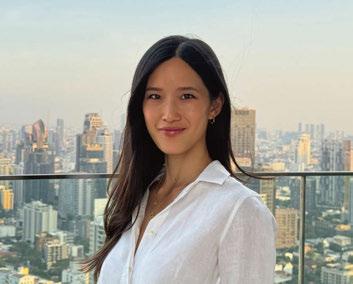
Beverly Chen is co-founder of Cloud Collective, an integrated hospitality studio specialising in purpose-led developments. She recently announced plans for Kaia, a new brand set to redefine the outdoor hospitality sector.
“We are committed to pioneering concepts that not only set new industry benchmarks, but also create lasting value for our guests and the destinations we serve,” she explains. “Kaia embodies this vision, offering a sanctuary where luxury, sustainability and cultural authenticity converge.”
139 Puneet Chhatwal
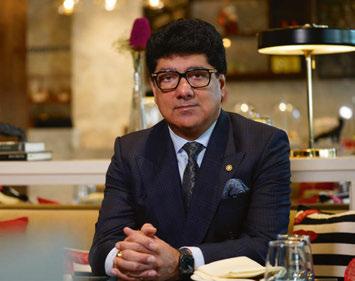
Having spent 30 years in Europe, Puneet Chhatwal returned to his native land in 2017, taking up the role of Managing Director and CEO at Indian Hotels Company Limited. Under his leadership, the group embarked on a journey of reimagination, building on its legacy to achieve sustainable profitable growth. But as outlined to Sleeper on a trip across northern India, there’s a greater purpose: to serve as custodians of Indian hospitality, safeguarding cultural heritage and infusing an inimitable spirit into every hotel.
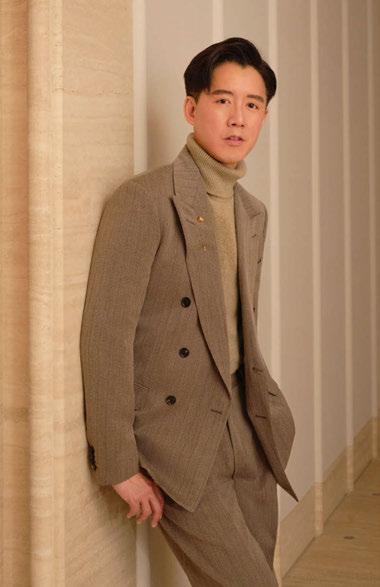
“The spirit of my design philosophy is about provoking new ways of thinking about what luxury means,” states André Fu. Since establishing his eponymous studio in 2000, the interior architect has built a global portfolio of hotel projects that have revolutionised the concept of modern luxury, from The Upper House in Hong Kong and London’s The Berkeley to the recently opened Capella Taipei. In recognition of this, Fu is the recipient of the coveted Outstanding Contribution award at AHEAD Asia 2025.
Visit the online store to subscribe and save across all Sleeper Media magazines.
Subscription records are maintained at Sleeper Media. For address changes, email enquiry@sleeper.media
Sleeper (ISSN: 1476-4075 / USPS: 21550) is published bi-monthly by Sleeper Media Ltd and is distributed in the USA by RRD/Spatial Global. Pending periodicals postage paid at South Hackensack, NJ. Send USA address changes to Sleeper, c/o RRD, 1250 Valley Brook Avenue, Lyndhurst, NJ 07071, USA.
EVENTS
Commercial Lead
Kirsty Studholme k.studholme@mondiale.co.uk
Event Manager
Kayley Johnson k.johnson@mondiale.co.uk
Event Co-ordinator
Charlotte Yiatrou c.yiatrou@mondiale.co.uk
Marketing & Events
Olivia Mavers o.mavers@mondiale.co.uk
Data & Marketing
Adam Cymbaluk a.cymbaluk@mondiale.co.uk
DESIGN
Design Manager
David Bell
Production Mel Capper
CORPORATE
Accounts ar@mondiale.co.uk
Chairman Damian Walsh
Finance Director
Amanda Giles
SUSTAINABILITY
Natural • Renewable • Recyclable
Sleeper is printed by Buxton Press on FSC Mix-certified paper using 100% vegetable-based inks. Magazines mailed from Spatial Global are packaged in FSC-certified wrap that is fully recyclable.
Having recently completed designs for Rosewood, Mandarin Oriental and Belmond, the co-founder of Albion Nord takes a fantasy break at a serene desert island retreat.
Where are you?
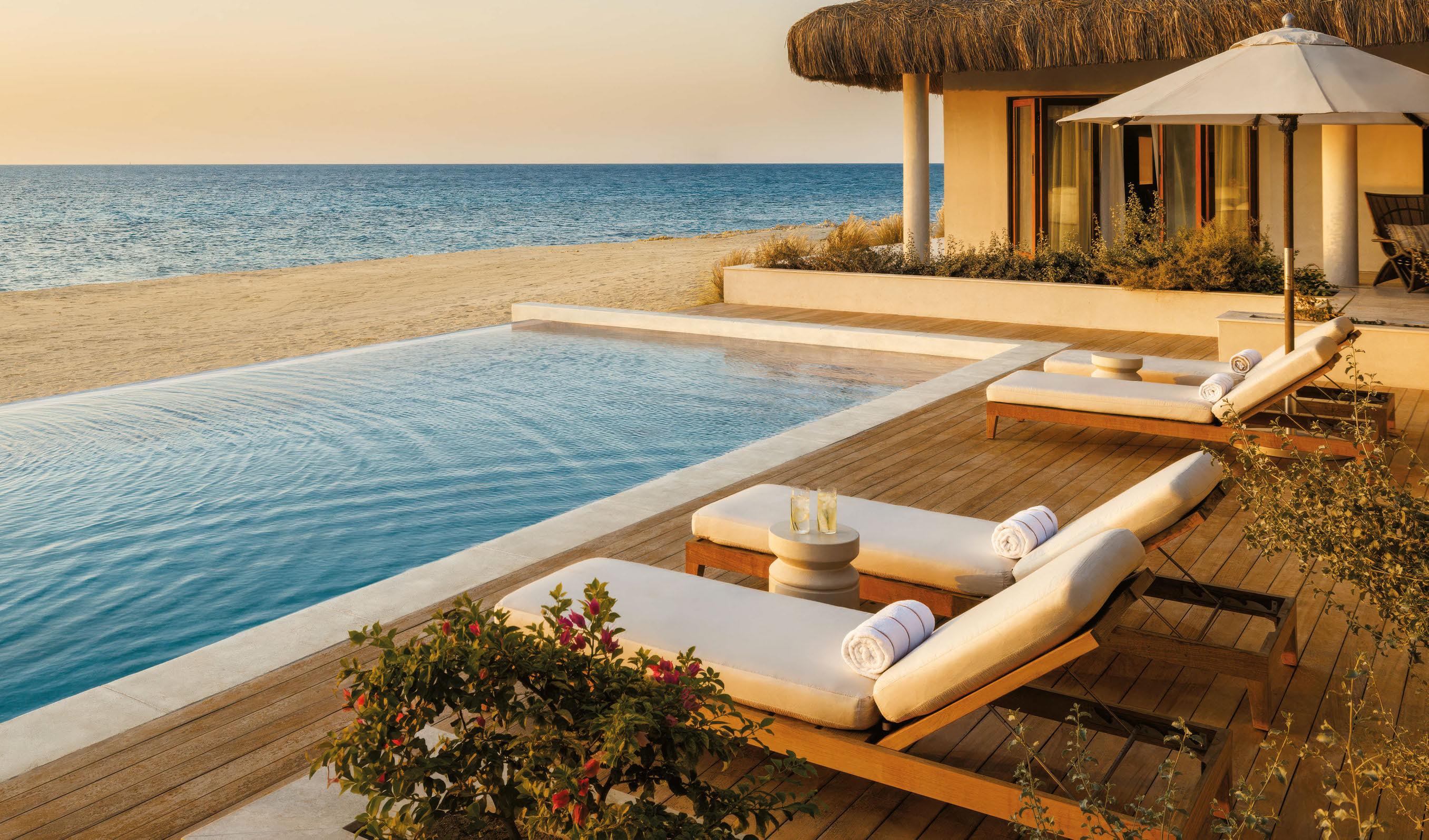
I am beachside. I can walk from my room directly onto the beach within a few steps. So long as the sun is shining, it could be Cornwall or the Caribbean.
How did you get there?
If this is fantasy, I travel by teleportation! In real life, I dislike the stress of airports, so if I could be driven from home directly to the runway, then flown on a private jet, that would be ideal. Presidential-style treatment.
Who is there to greet you on arrival? Elvis.
And who’s at the concierge desk?
Michael J Fox’s character in For Love or Money. I challenge anyone to watch the film and not develop a secret hankering to be a concierge for a day.
Who are you sharing your room with?
My wife.
Is there anything you would like waiting for you in your room?
A wardrobe full of clothes and a bathroom stocked with products. I don’t want to have to think about packing and unpacking.
Describe the hotel, your room and the view... My room looks out to a deserted beach and the deep blue sea with rolling waves, framed by plants and trees. It feels like being marooned on a paradise island.
Who designed it?
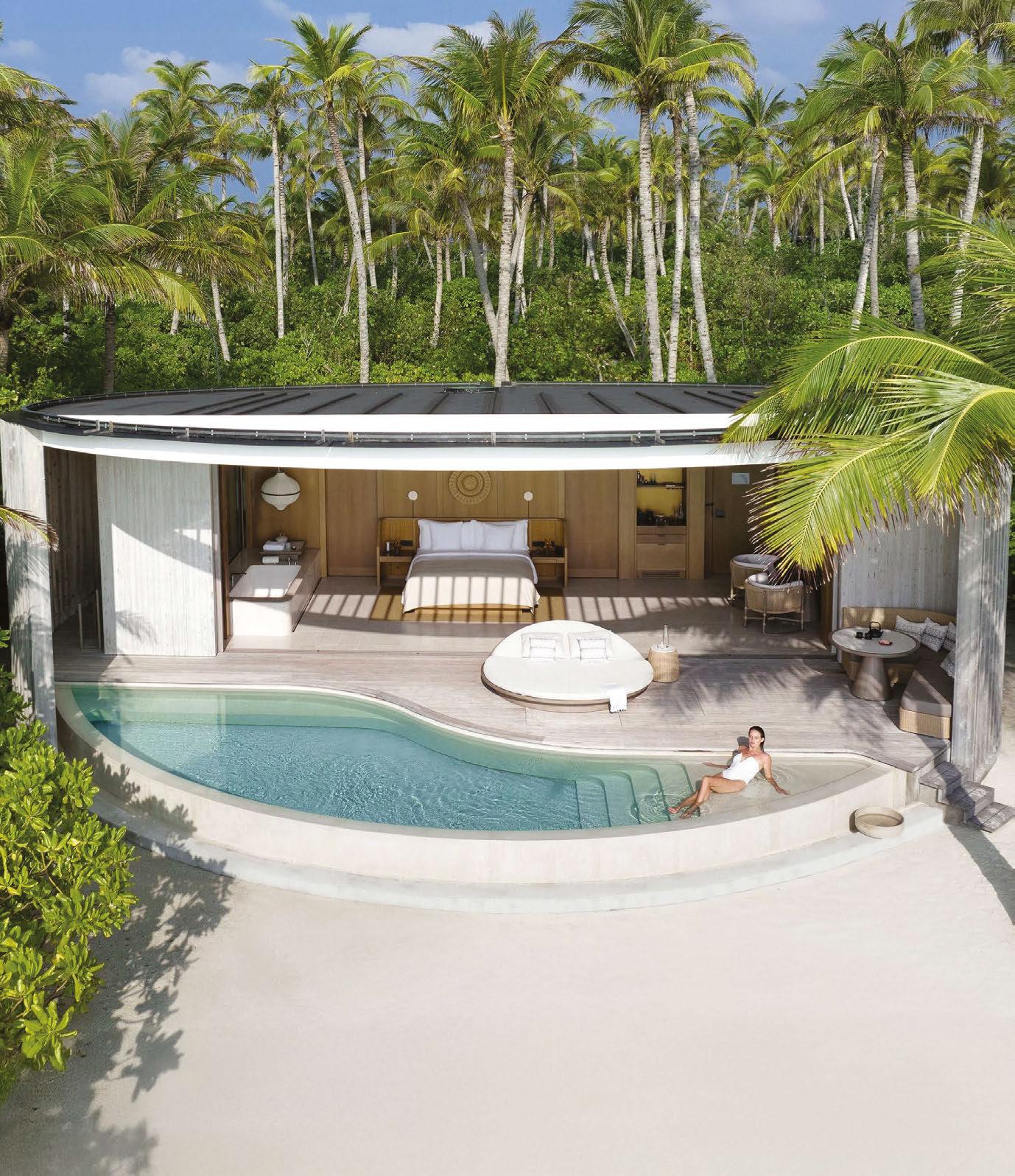
Kerry Hill Architects, the studio responsible for Aman Kyoto. They have created a desert island sanctuary that is architecturally strong yet perfectly at one with its surroundings, with open spaces and warm materials that are immediately calming.
What’s the restaurant and bar like?
I love room service, so a simple table on the veranda would be perfect.
Who are you dining with this evening? My friends and family.
And what’s on the menu? Steak with a smorgasbord of accompaniments
to graze on throughout the evening, finished with a generous portion of tiramisu.
Would you like something to drink with that?
A chilled Diet Coke.
What’s on your nightstand at bedtime?
A cerebral book that I will never actually read.
What’s your essential travel companion? Good headphones. Listening to my favourite music can get me through anything.
Would you like a newspaper in the morning? The Guardian, please.
What toiletries would you like to freshen-up? The entire range of Aesop products.
Early morning alarm call or late check-out? Late check-out.
Bath or power-shower?
Power-shower. I love the idea of a long luxurious bath but somehow I never seem to get round to having one.
Full English or continental breakfast?
Eggs and avocado. A great way to start the day.
Swimming pool, spa or gym?
Too difficult to choose! I would like all three.
The Chancery Rosewood, London; Mandarin Oriental, Venice; The Britannic Explorer, A Belmond Train www.albion-nord.com
DRAWING BOARD
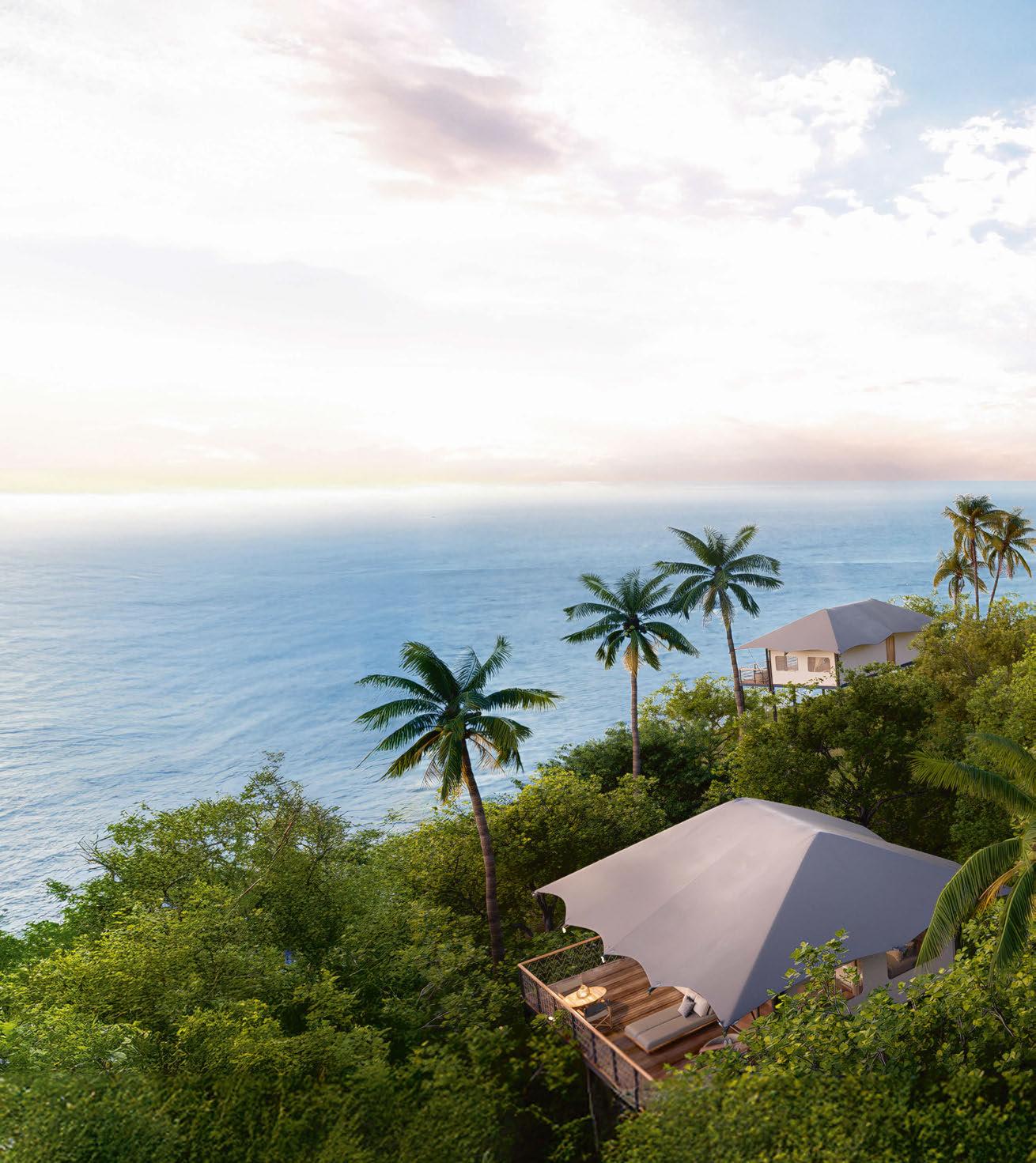
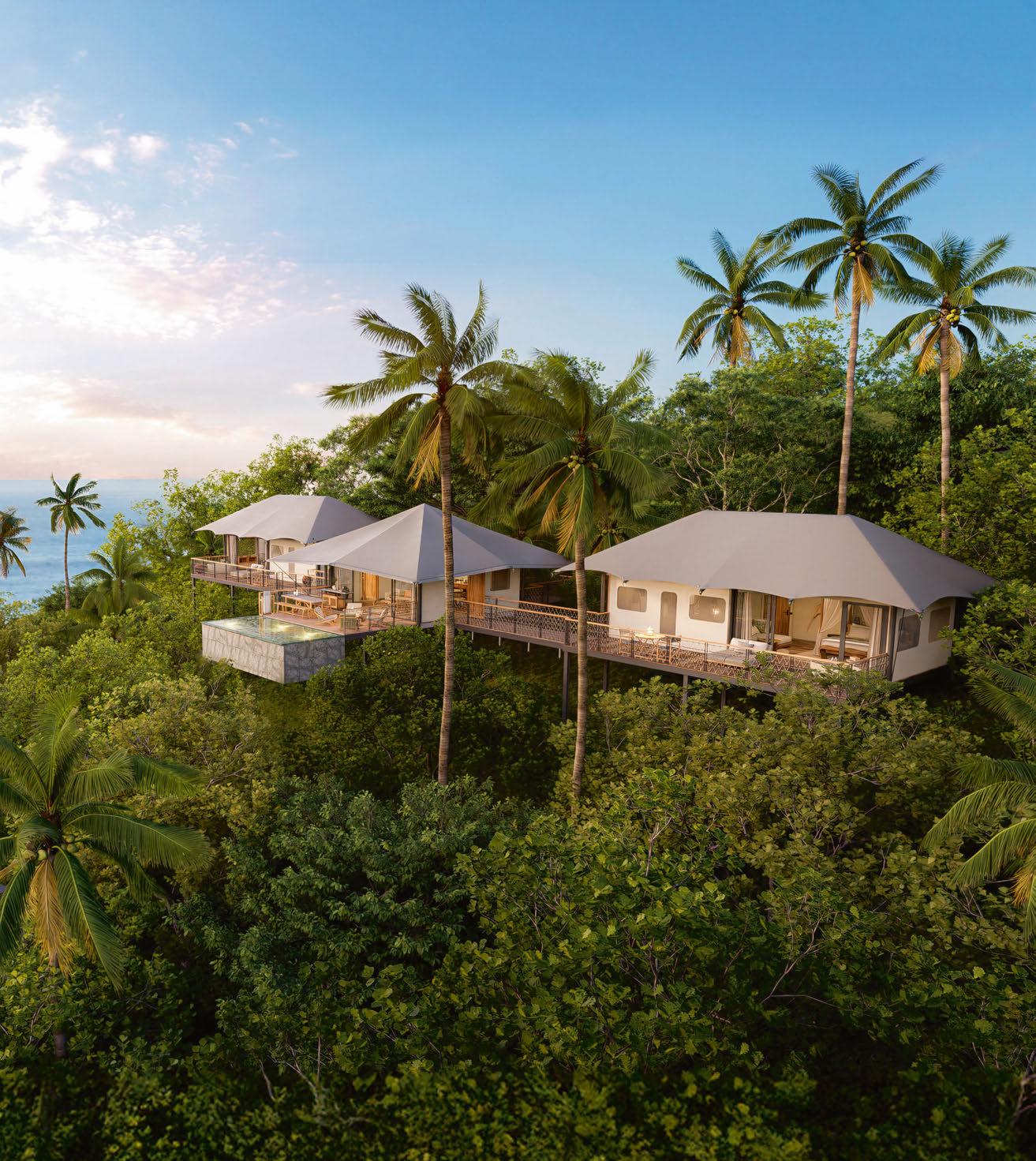
As demand for transformative travel experiences continues to grow, Bound & Beyond and Cloud Collective have joined forces to launch Kaia, a new brand aimed at redefining the outdoor hospitality sector. “Kaia represents a bold step forward in luxury hospitality – one that harmonises refined elegance with environmental and social responsibility,” explains Kamonwan Wipulakorn, Managing Director of Thai investment firm Bound & Beyond. “We believe that true luxury is not just about indulgence – it’s about honouring the spirit of a place and the people who shape it. Through Kaia, we are creating a hospitality model that is deeply rooted in local traditions, craftsmanship and community.”
The brand will debut on Koh Phangan in Thailand at the end of 2025, with 31 tented suites and a clubhouse nestled amongst lush jungle overlooking the ocean. The structures are being manufactured offsite to minimise impact on the surroundings, while responsible practices such as energy-efficient design solutions, local sourcing and community employment demonstrate a commitment to environmental and social sustainability.
Kaia has been conceptualised through Cloud Collective’s expertise in outdoor hospitality and light-footprint development, while interiors are a collaboration with Thai designer, Dao Vichada.
“With Kaia, we are redefining luxury by seamlessly blending immersive outdoor hospitality with a deep reverence for nature and local culture. Each resort is thoughtfully designed to foster meaningful connections – between guests, the land and the community – while upholding the highest standards of sustainability,” explains Beverly Chen, co-founder of Cloud Collective. “We are committed to pioneering hospitality concepts that not only set new industry benchmarks, but also create lasting value for our guests and the destinations we serve. Kaia embodies this vision, offering a sanctuary where luxury, sustainability and cultural authenticity converge.”
Kaia
KOH PHANGAN
EXPRESS CHECK-OUT
Investor: Vivium
Operator: Ennismore
Architecture: Elastic Architects
Interior Design: Lambs & Lions
www.luurahotels.com
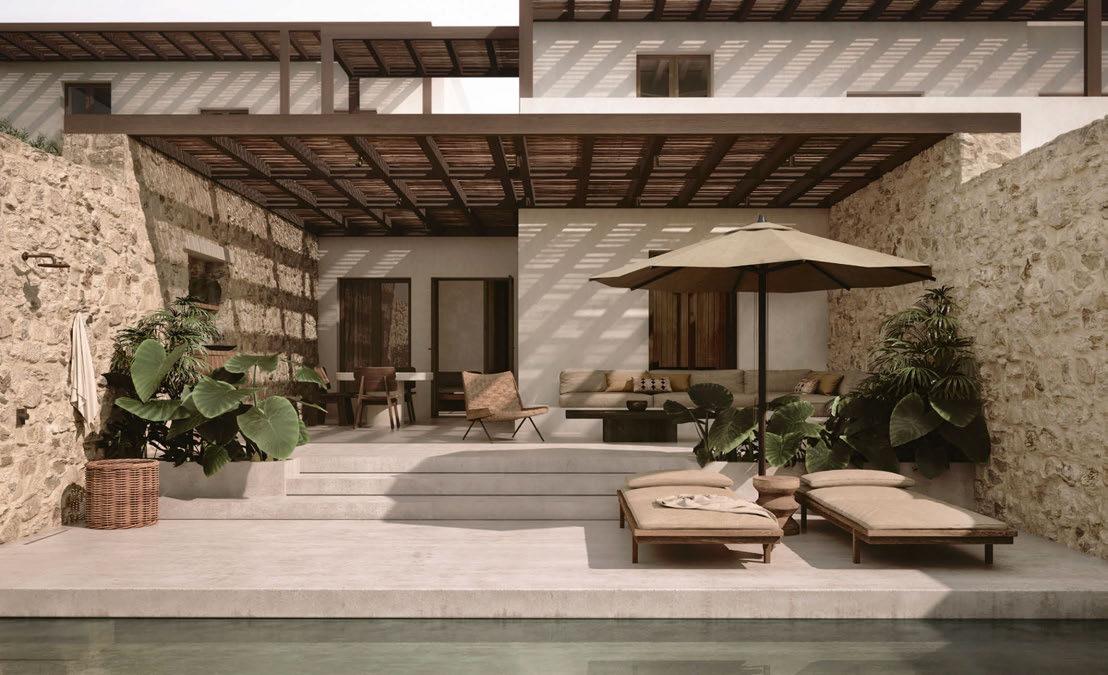
Ennismore has announced the signing of a strategic partnership with Vivium to welcome Luura to Morgans Originals. The two new properties, Luura Cliff and Luura Sand, will debut on the Greek island of Paros in 2026 and 2027 respectively.
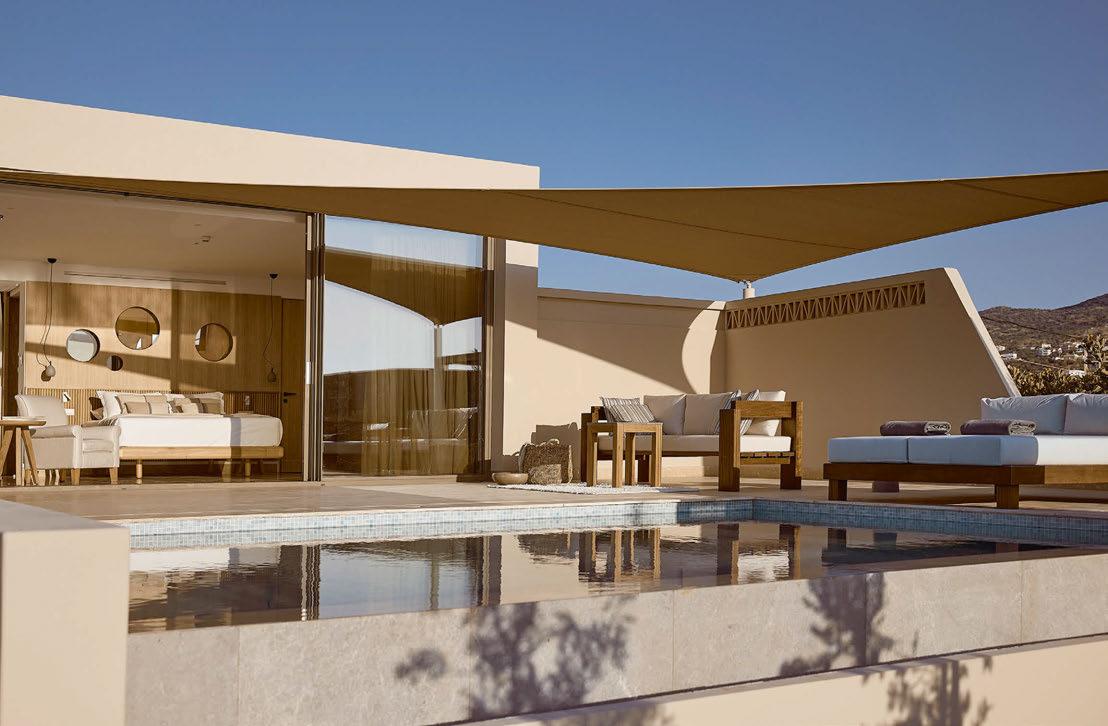
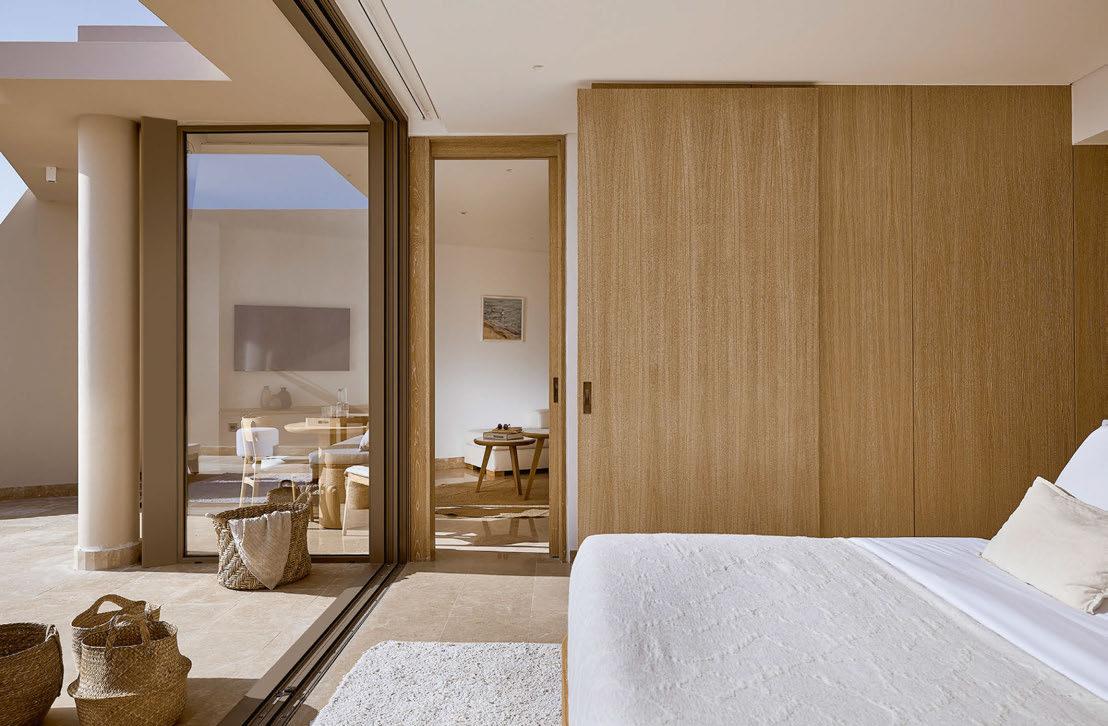
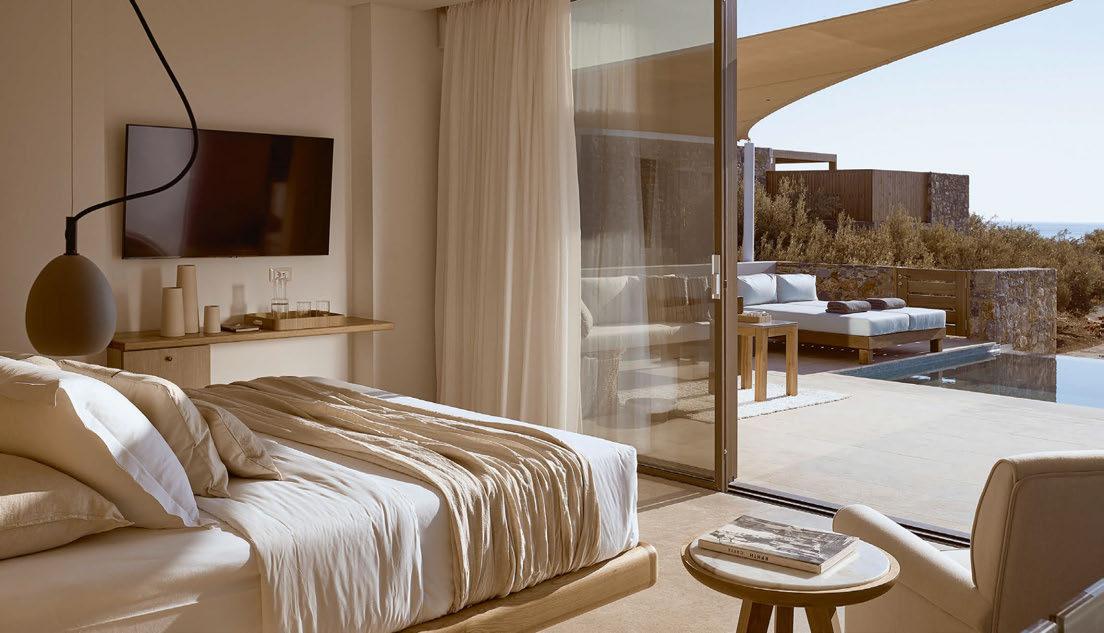
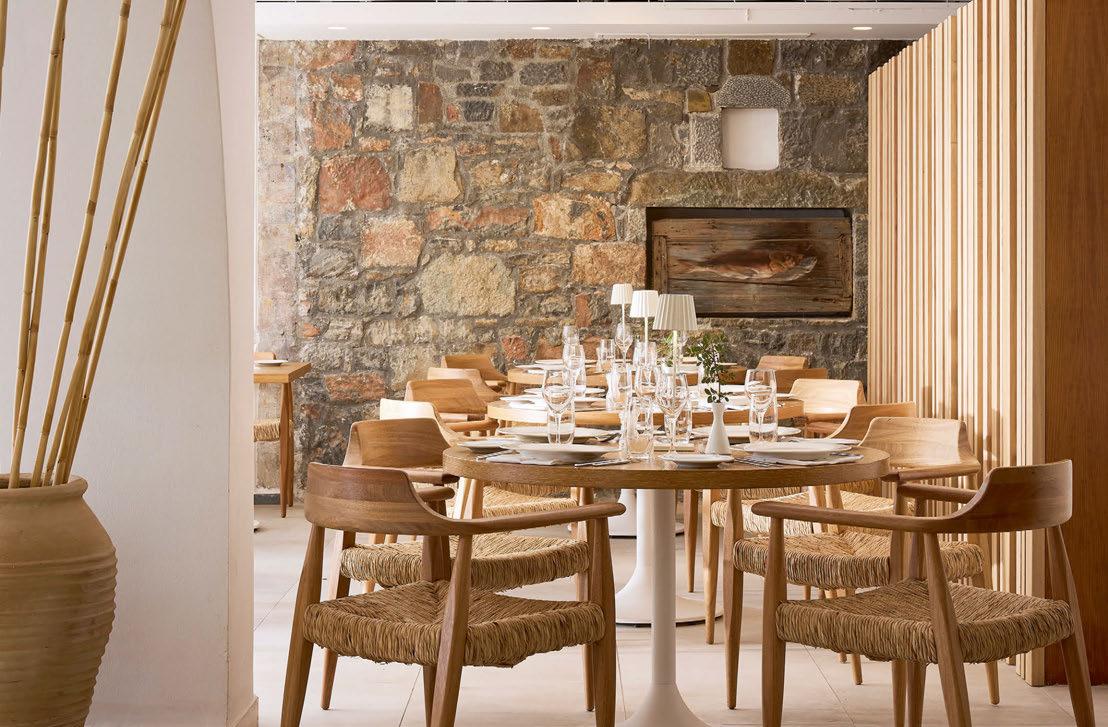
For Luura Cliff, Elastic Architects has been appointed to design the exterior, while interiors by Lambs & Lions will take inspiration from Cycladic style. The 39 guestrooms will be designed for privacy and a sense of calm, gently opening out to shared spaces that foster organic social encounters. Materiality will play a central role too, and in line with the brand’s appreciation for art, Luura will work with curators to build a narrative embedded in the location’s culture and story.
Each hotel will each offer distinct experiences that celebrate the originality and beauty of their location, while introducing Morgans Originals’ social energy to the island.
Founded in 2025 by Vivium, Luura is billed as a curated collection of artful hotels rooted in curiosity and guided by a culture of generosity.
“In Vivium, we have found a partner who shares our values and vision in creating unique and authentic hotels, and we are thrilled to be opening Luura Cliff next year, with several more to follow,” says Louis Abboud, Regional Head of IMEAT for Ennismore and Brand Chief Operating Officer of Morgans Originals.
Sophie Khoury, Head of Hospitality at Vivium, adds: “With Luura, we’re committed to creating the next generation of iconic hotels, places where every element, from design to experience, is shaped by curiosity and crafted with intention. We believe true luxury unfolds as art, design, service and culture come together to tell a meaningful story. Luura is our way of redefining what it means to travel well, inviting guests to explore and connect with destinations in a more personal, authentic way.”
Luura PAROS
Himalayas Resort
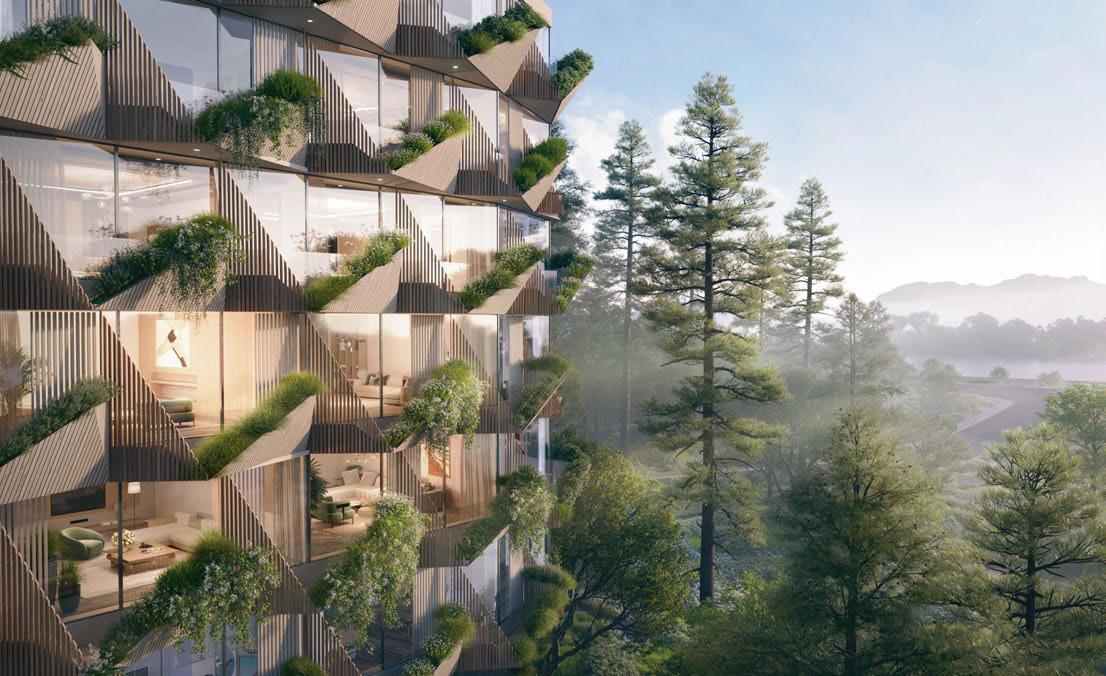
Architecture Discipline has unveiled renderings for an upcoming resort in the Himalayas, designed to leverage the site’s topography to form unique connections with nature.
Set on a 34-acre site in Kasauli, a small hill town in the north Indian state of Himachal Pradesh, the resort will be built as an immersive experience within the landscape, preserving significant portions of the forest.
Facilities – including outdoor breakout zones, multi-functional halls and destination-specific installations such as forest amphitheatres –are spread across the site, linked by elevated walkways and suspension bridges that weave through the trees, transforming circulation into moments of interaction.
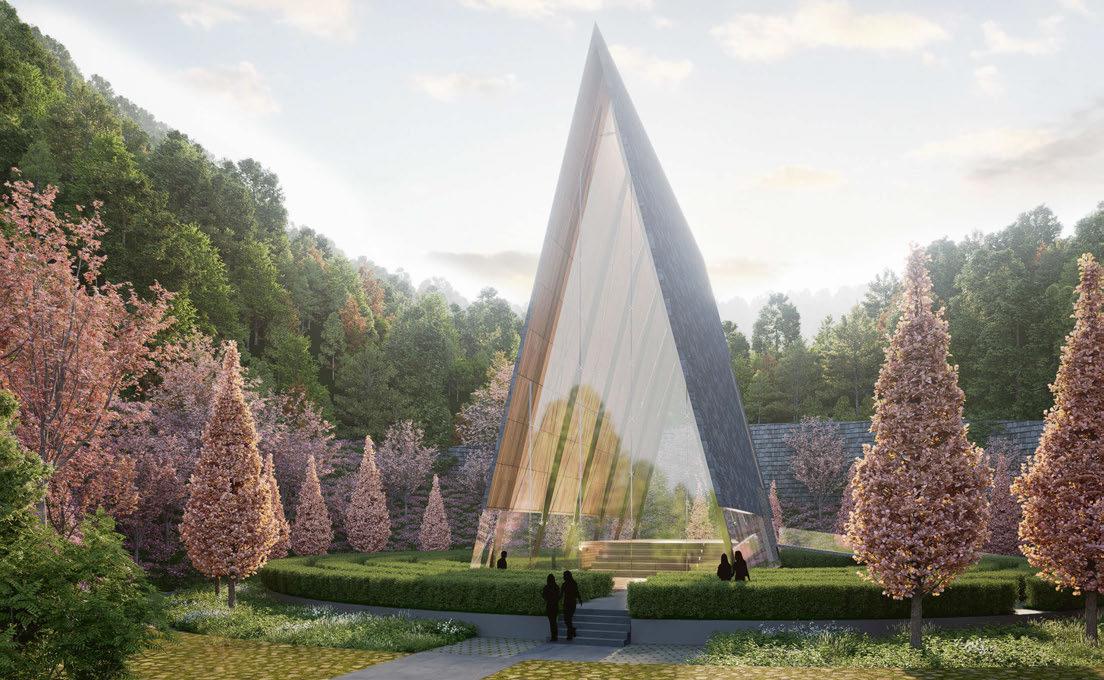
The architecture meanwhile, is shaped by a series of gestures that engage directly with the terrain. The reception is positioned at a relatively flat opening amongst the slopes, its structure defined by a sharp triangular form
inspired by the nearby peaks. The steeply sloped roofs are clad in slate shingles, referencing traditional construction of the region in a distinctly modern expression. Elsewhere, villas are embedded into the topography, grounded, raised or partially subterranean, each anchored around an existing tree and designed to balance privacy with views of the landscape.
Natural materials such as stone, earth and timber will be sourced directly from the site to minimise ecological disruption, reduce the energy expenditure typically associated with transportation, and ground the property within its surroundings, while existing flora – including conifers, flowering species and bougainvillea –will soften the transitions between built and unbuilt spaces.
Altogether, the resort emphasises contextual design, responsive forms and advanced construction systems, reimagining how natural environments can be inhabited.
HIMACHAL PRADESH
Mailena
EXPRESS CHECK-OUT
Developer: Danzante Bay Architecture: Broissin www.mailenawellnessresort.com
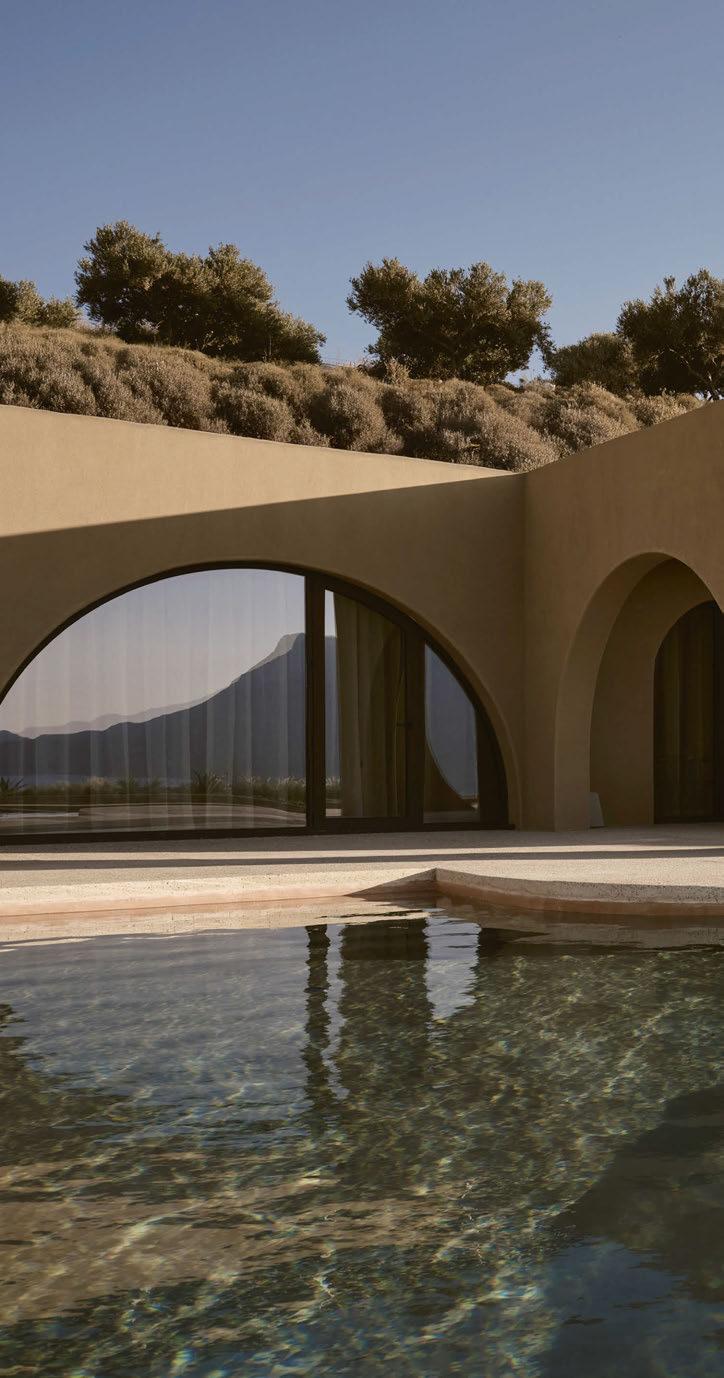
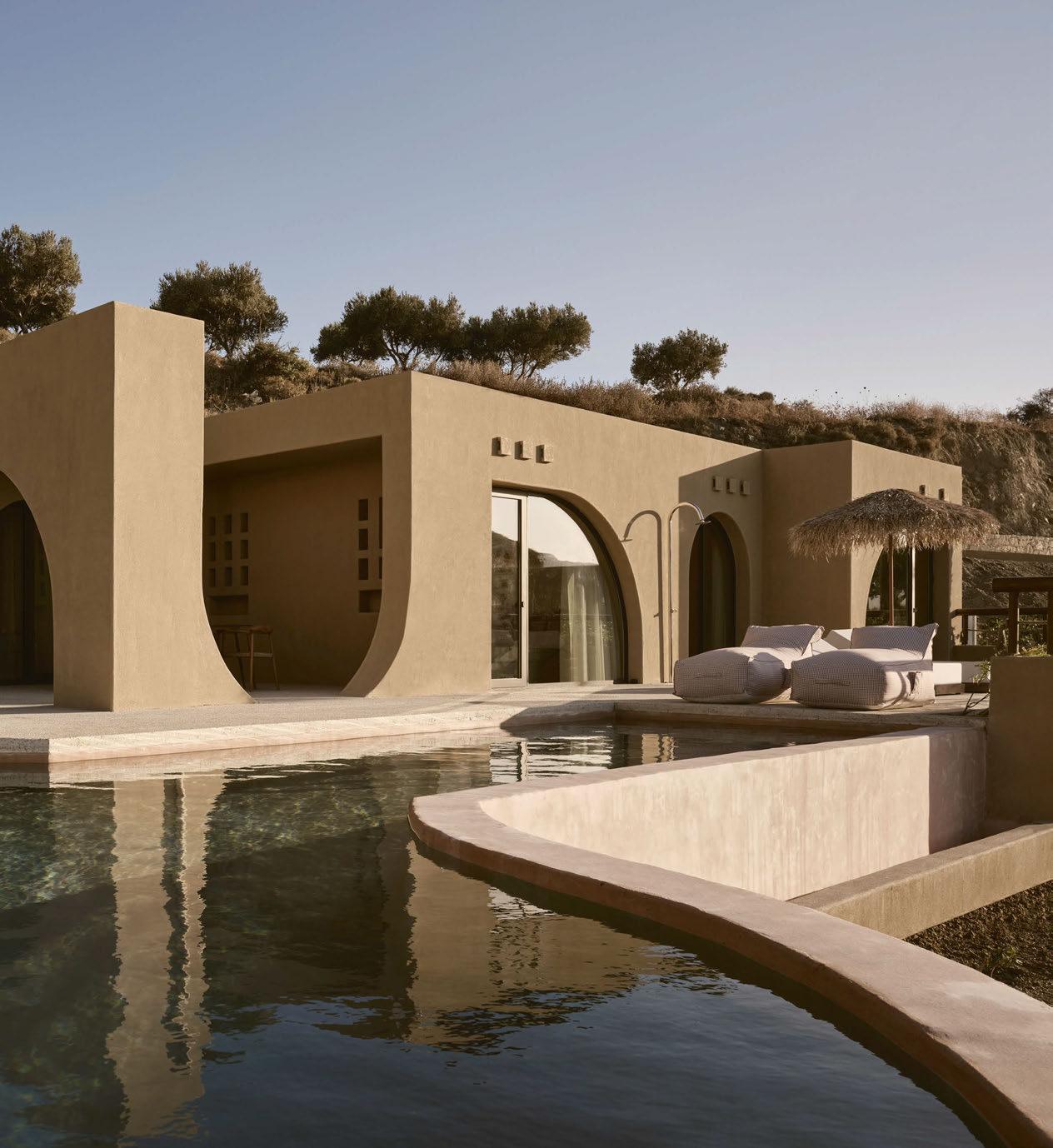
Danzante Bay has unveiled plans for Mailena, a new luxury wellness retreat in Loreto, Mexico, slated to debut in 2026.
Located within a 741-acre masterplanned resort community on the Baja California coast, the boutique beachfront property will offer 96 guestrooms and casitas, various F&B venues, a beach club and golf course access. At the heart of the resort is the Wellness & Longevity Centre, where guests will have access to science-based, personalised wellness programmes, as well as state-of-the-art facilities such as sensory deprivation tanks, biohacking technology suites and a snow room for contrast therapy.
Envisioned by Mexico-based Broissin, the resort’s architecture is rooted in sustainability, drawing inspiration from the landscape and its native vegetation. An earth-toned palette, locally sourced stone and soft wood accents cultivate a calming, organic aesthetic that thoughtfully harmonises with the surroundings.
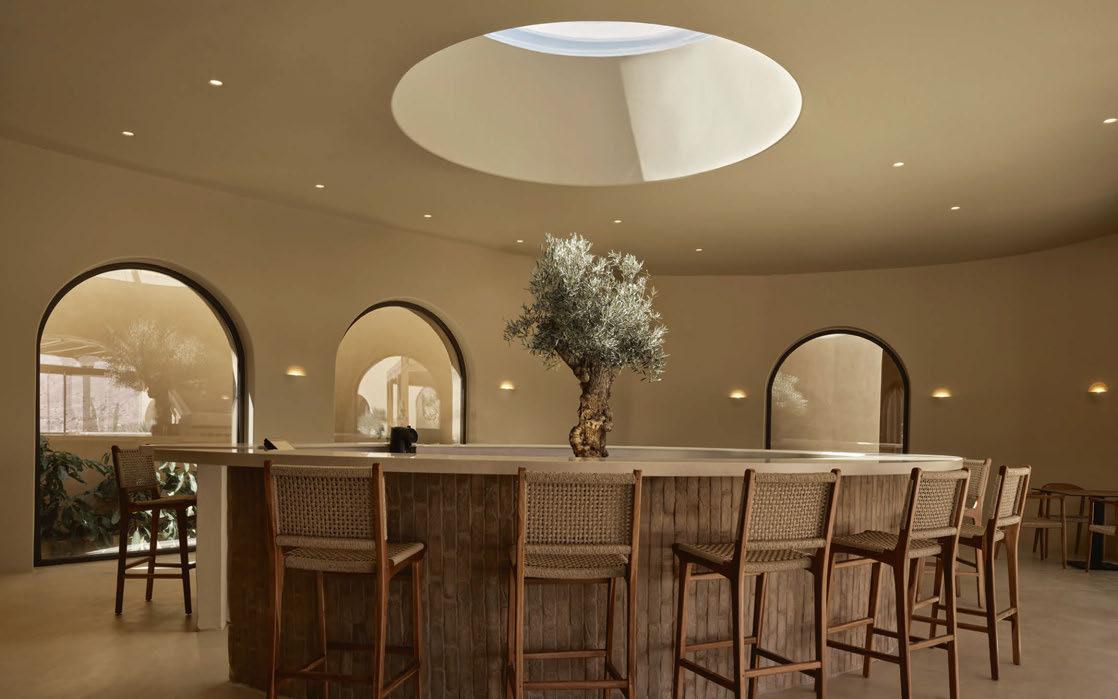
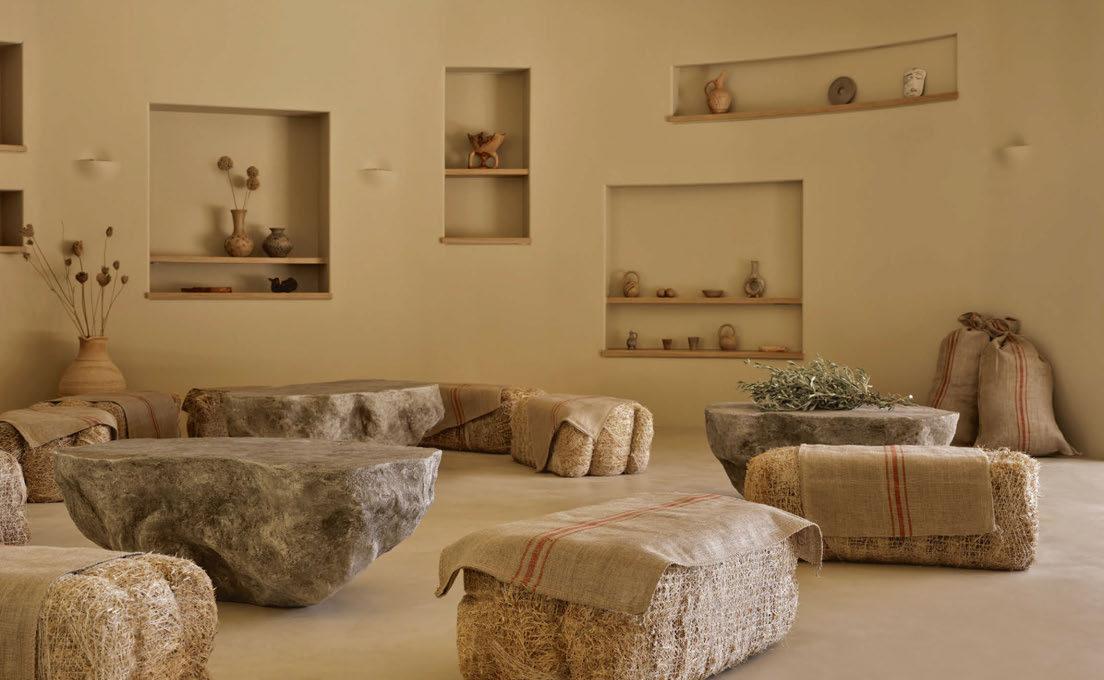
The property comprises three interconnected yet distinct zones, each anchored by a bespoke architectural focal point. The lobby is centred around a living olive tree that symbolises resilience and longevity, while the wellness centre features a cenote-style water element for introspection and renewal. Completing the resort is a panoramic restaurant with an indoor-outdoor pool that blurs the boundary between land and sea.
“Mailena is a place where architecture listens, breathes and flows in harmony with nature,” comments David Suárez, Partner at Broissin. “We were inspired by the mystical relationship between desert and sea in Loreto. The resort is a tribute to the region’s natural contours and undulating topography, with wellness at its core. Every element is intended to evoke a sensory experience that envelops guests in a profound sense of personal reconnection and serenity.”
LORETO
by Brent De Meulenaere
Six Senses
CHECK-OUT
Owner: Narai Hospitality Group
Operator: Six Senses
Architecture: Heatherwick Studio
Interior Design: Bar Studio, Joyce Wang
www.sixsenses.com
Six Senses has signed a hotel management agreement with Narai Hospitality Group to introduce Six Senses Bangkok to Hatai, a mixed-use development in the heart of Silom.
The venture marks a new chapter for the site, which was previously home to the Narai Hotel, a landmark in Thailand’s hospitality scene. Foundation work is already underway, with the project targeting both LEED Gold and WELL Gold certifications, upholding a commitment to sustainable design and construction. Initiatives include the repurposing of the original wooden foundations, set to be woven into the interiors.
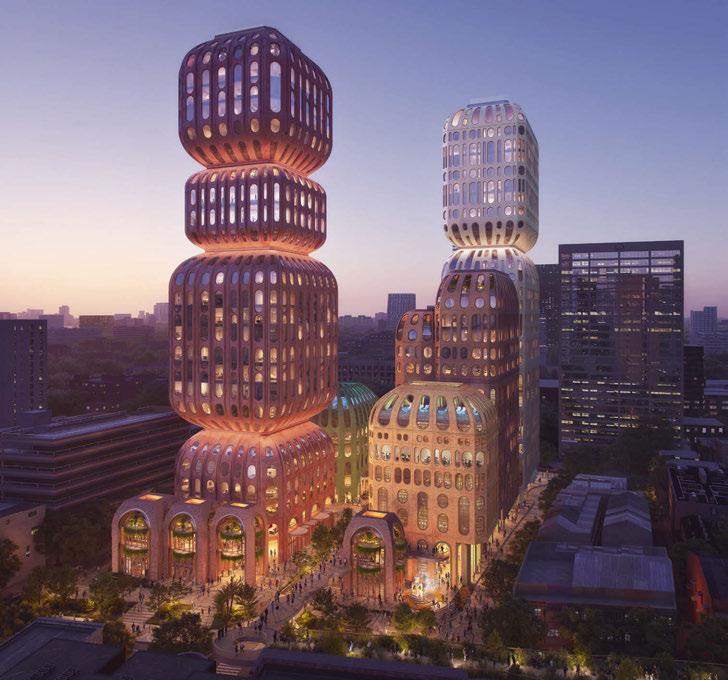
Led by Heatherwick Studio, the architecture draws inspiration from the delicate craftmanship of traditional Thai lanterns. “We wanted to do something that connects with the country’s heritage in a deeper way and builds detail, feeling and story back into the city,” explains Thomas Heatherwick, founder and Design Director of Heatherwick Studio. “We
have designed a series of lanterns stacked on top of one another, collectively forming a softer silhouette on the skyline.”
One of two hotels in the development, Six Senses Bangkok will feature 100 guestrooms, providing a peaceful retreat from the city. Interiors by Bar Studio will complement the architectural vision to include a biophilic sky garden connecting the main restaurant to a sky lobby, while a 700m2 suite and signature restaurant will be designed by Joyce Wang.
“It’s a privilege to honour the legacy of Narai Hotel in such a culturally significant and storied location,” says Neil Palmer, Chief Operating Officer of Six Senses. “Together with Narai Hospitality Group, we’re creating something truly special, a place that respects its history while embracing signature wellness, crafted experiences and sustainable design and operations, all defining characteristics of the Six Senses core ethos.”
BANGKOK
Hygge Hotel
DUBAI
EXPRESS CHECK-OUT
Developer: Kleindienst Group Architecture and Interior Design: HWKN Architecture www.kleindienst.ae
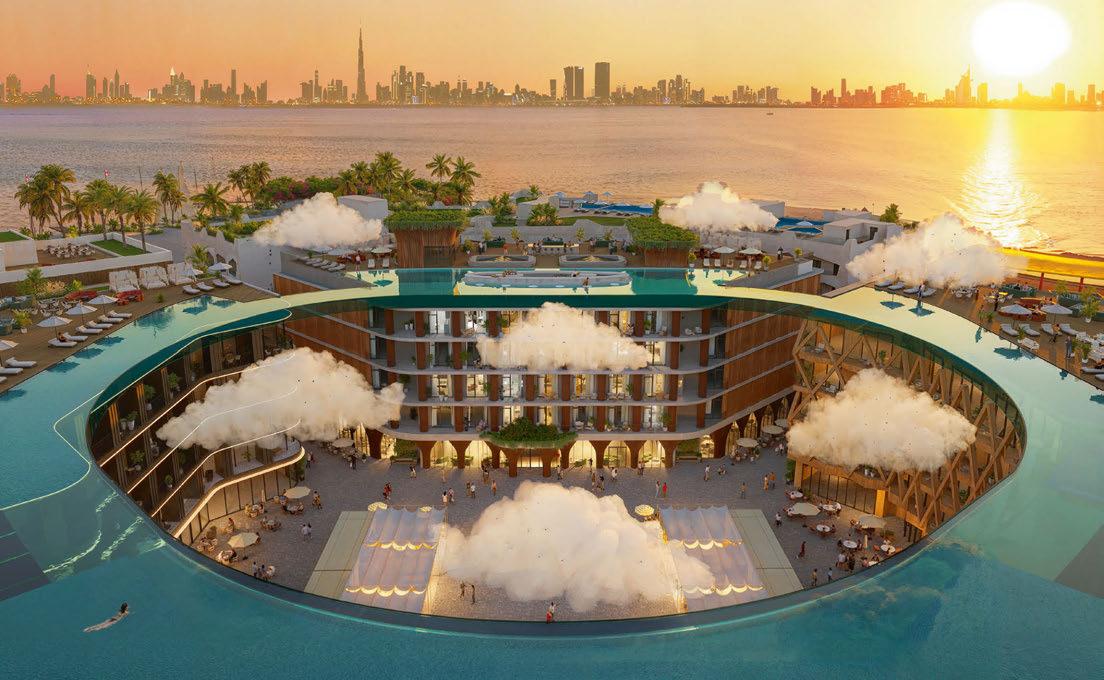
HWKN Architecture has unveiled AI-driven designs for Hygge Hotel, a new destination within The Heart of Europe – Kleindienst Group’s flagship venture at The World Islands.
Slated to open in 2027, the 96-key property is named after the Scandinavian philosophy of hygge - a concept that conveys a sense of contentment, simplicity and quiet joy with everyday life. Using AI-powered research and prompt engineering, the New York-based studio has translated these abstract ideals of connection, reflection and relaxation into a design language that is woven into the resort.
The façade is defined by a rhythm of fluted terracotta columns that branch outwards in treelike forms, setting the tone for an experience rooted in nature. The columns rise to the upper floors to frame outdoor terraces, while a curved pool on the rooftop connects neighbouring hotels. Inside, a spacious lobby serves as both an entry point and spatial connector, with
the layout encouraging social interaction and moments of community – elements that define the hygge lifestyle.
According to HWKN Architecture, the use of AI has been integral to the scheme. Through careful curation of AI applications, the team believe their approach enhances both design quality and the emotional resonance of the experience. Furthermore, it unlocks new potential in the way buildings are conceived, moving beyond traditional methods into a more dynamic, responsive model of design. “When developing the façade and interiors of Hygge Hotel, we were encouraged to approach the property as a distinct cultural story, viewing hospitality not just as a design, but as an emotional journey,” explains Matthias Hollwich, Founding Principal of HWKN Architecture. “We focused on what the future of hospitality will look like and how to create experiences that exceed the expectations of travellers for years to come.”
Haus Da Lat
CHECK-OUT
Developer: The One Destination
Investors: Terne Holdings Singapore, BTS Bernina Private Equity Fund
Operator: IHG
Architecture: Kengo Kuma & Associates
Interior Design: 1508 London, Mitchell & Eades
Lighting Design: Isometrix www.hausdalat.com
Further details have been released for Haus Da Lat, an ESG-focused real estate development hoping to redefine luxury living in Vietnam.
Developed by The One Destination in collaboration with Terne Holdings Singapore and BTS Bernina Private Equity Fund, the complex will occupy a five-hectare estate overlooking Xuan Huong Lake in Vietnam’s Central Highlands. In total, it comprises an all-suite luxury hotel, wellness centre and private members club, as well as a residential component with 68 Sky Villas and Sky Mansions.
Kengo Kuma & Associates has designed the architectural vision in line with the surrounding landscape, with organic forms using local materials and layered textures to mirror the nearby pine forests and hillsides. Lighting, entrusted to Isometrix, will accentuate the architectural elegance by playing with shadows, mist and sunlight.
Interiors will be delivered by 1508 London,
drawing inspiration from the site’s distinctive setting and Da Lat’s blend of urban design and natural beauty. Hamish Brown, Partner at 1508 London, comments: “This project presents an exciting opportunity to bring our diverse, multicultural design expertise to a vibrant new market. We look forward to crafting spaces that offer truly unique and memorable experiences for both our client and their guests in Da Lat.”
Expected to open in 2027, the hotel component will be managed by IHG, providing various amenities including multiple restaurants, a wellness and therapy area, an all-season swimming pool and conference and event spaces for up to 1,000 people.
The project will also include Haus Wellness Centre, the result of a partnership between Chiva-Som and Mitchell & Eades. Additionally, Haus Private Club Da Lat, Vietnam’s first ultraprivate members’ club operated by Copper Beach, is due to open at the end of this year.
Meeting… Peng Sum Choe
Having taken the reins of Pan Pacific Hotels Group on the eve of a global pandemic, the CEO reveals his ambitious three-tier strategy for global growth.
Words: Guy Dittrich • Photography: Courtesy of Pan Pacific Hotels Group (unless otherwise stated)
We want to grow and we want to take care of our people,” says Peng Sum Choe, CEO of Pan Pacific Hotels Group (PPHG). These may be the final words of our interview, but they are clearly two of the most important topics for the Singaporean hotelier. And there is a neat merging of the two in his leadership of this fast-growing hospitality business, a wholly-owned subsidiary of Singapore-listed UOL Group, itself a prominent investor, developer and manager of real estate across the Asia Pacific region.
Choe is a career-long hotel pro. After receiving a scholarship from Shangri-La Group to study hotel administration and management at Cornell University, he spent the next two years working at the former Portman Shangri-La. In 1996, he was hired to launch and lead Frasers Hospitality International as CEO, before being tapped to join PPHG in 2019. And it’s from the 18th level of the group’s flagship, Pan Pacific Orchard, that he dials in. With embedded biophilic features, the striking newbuild – completed by local architects WOHA – is an icon of sustainability and landmark in the regeneration of Singapore’s urban fabric. The hotel scooped three awards at AHEAD Asia 2024, including prizes for its landscaping and events spaces: Claymore Ballroom, the highest pillarless venue in the city, and al fresco Cloud Terrace Lawn are host to the 2025 awards ceremony.
We begin with Choe’s arrival at PPHG, some six months prior to the onset of the global pandemic. Naturally, his ambitious plans for strategic growth had to wait, so initial fears were for the group’s loyal employees. “We had to manage within our means,” he explains of the cuts made, adding that “people are very important to us”. Choe describes them as “family” and it’s a big one, totalling over 6,000 people. “The encouraging thing about many of the team members all over the world was that they said: ‘do what you need to do Mr Choe, so long as I’m still part of the family’.”
And he did. With no-one being retrenched, the group’s recovery was immediate when business eventually restarted. “2022, 2023 and 2024 were the best years for us, because our team members were there,” he notes. A reciprocated loyalty paying immediate dividends. A loyalty not dissimilar to the gold PPHG lapel pin he wears on his suit, like all his staff.
Growing a business is something of a specialty for Choe, having expanded Frasers’ portfolio from two to 150 properties during his two-decade tenure. Since he joined PPHG, the number of hotels has more than doubled, from 27 to 57. “We might not get to 150 but I think we can get to 100,” he muses. Made up of three strands, his vision for growth is clear: acquisition, an Asset Enhancement Initiative (AEI) and an asset-light approach. But before Choe could implement
this strategy, he first had to refine the brands, a process that began during the pandemic. “Consistency was a big issue, so there was a strategic plan to level-up,” he states. “I went to the board of directors and said that with people not travelling, it would be a good time for asset enhancement; thankfully, the money was there, so we went ahead.”
This process has spanned facilities and services. Choe chuckles to himself with the reminder that as competitors were not renovating, contractors were available and labour costs low. He is also at pains to remind me that renovations are still being undertaken today, but with high occupancies of around 90%, some revenues are being forfeited.
The refined brands are now more consistent in their design. At the top is the ‘Asian graceful luxury’ of Pan Pacific Hotels & Resorts, with service excellence to the fore. Next is ParkRoyal Collection: “That’s our green brand,” he explains. “These hotels embrace everything from biophilic design and urban farms to solar panels and low-emissivity glass. It’s not just removing straws and single-use plastics, we do a lot more.” Indeed, sustainability is at the heart of PPHG, as witnessed by the literal planting of hotels such as ParkRoyal Collection Marina Bay and Pan Pacific Orchard in Singapore, as well as ParkRoyal Collection Kuala Lumpur. Completing the portfolio is the locally connected four-star ParkRoyal Hotels & Resorts, differentiated by its passion for people, places and authentic cultures. Having just three brands is of no concern to Choe. “Brand proliferation is not the answer,” he explains, noting that there’s no stopping them looking at other brands.
The first of the new-generation properties was Pan Pacific London with interiors by Yabu Pushelberg and Tom Dixon’s Design Research Studio. Here, designs were double- and triple-checked to ensure they would set the standard for properties that follow. Billed as a ‘harmony of Southeast
“As an Asian company, I want Pan Pacific Hotels Group to be renowned for its service, quality and design.”
Asian accents and quintessential British styling’, the hotel is a great success, with room rates having more than doubled over the past four years and occupancy standing at 90%.
The AEI saw renovations get an overhaul too. Take the three hotels in Australia, a market Choe likes because it has strong local demand, and others in Singapore, Tokyo, Nairobi and Jakarta. Yet reaching the new standard costs money. “We’re very careful in measuring the return on investment of every renovation. We’ve seen growth of 10-30% in both rates and occupancy, so it’s money well spent,” asserts Choe. The polished brands do not mean a formulaic approach. Far from it. “The design has to be different,” he reveals. And there is a strong pedigree amongst the architects and designers with whom they work. WOHA, Yabu Pushelberg, Keiji Ashizawa Design and Norm Copenhagen – the latter of whom had a hand in Pan Pacific Tokyo. A number of HBA’s studios are also in the mix, as are Donovan Soon and Francis Goh of FDAT. All speak of quality. “We welcome different designers,” Choe says, revealing that they’re then given creative freedom. And no doubt Choe is a fan of design himself. At Cornell, alongside core curricular classes, he also spent time studying architecture. “I’ve always had a keen eye for design,” he states. “That’s what really excites me. I love design, I love buildings, I love structures.”
Choe also confesses to a passion for finance and management – the numbers side of the business. When put to him that part of his love of architecture is also the asset class, he has a quick answer: “Hotels have the ability to make money on both ends.” He goes on to describe the revenue from a property’s operations but also the “big bucks” when the asset is sold. Which segues neatly into the asset-light part of his strategy.
“In order to be asset-light, the industry has to believe in our brands,” he quips, noting that the ongoing refurbishment
The group’s birthplace of Singapore is home to two PPHG properties: Pan Pacific Singapore (top) and ParkRoyal Collection Marina Bay (bottom)
strategy has resulted in more owners requesting that PPHG run their properties. “Our hotel management agreements are increasing, so we’re growing from 30% of hotels being managed to about 50% by the end of 2027.”
Given Choe’s experience of serviced apartments at Frasers, how important is this sector of the business? “Big time,” he enthuses. “Even during Covid, our serviced apartments in Singapore, Kuala Lumpur and Jakarta operated at 90% occupancy. And gross operating profit can be as high as 55-60%, whereas most hotels see 40%.” With locations chosen for the vibrancy of their neighbourhoods and local restaurants, it means on-site dining operations are not necessary, except for breakfast. “It’s almost like the rooms division of a hotel, where the profit margin can be as high as 70-80%, so this model works.”
This strong GOP added to the high ROI from the AEI and the funds raised pursuing the asset-light approach, such as the recent sale of ParkRoyal Kitchener for a substantial profit,
all provide plenty of liquid assets for Choe. This also opens up the opportunity for further acquisitions. “If we see a beautiful location in a key gateway city in Japan or Hong Kong and it makes sense on rates, then that’s going to be a potential acquisition,” he states.
All these strategies create a confidence around the business, and growth is focused largely on the Asia Pacific market for the next 5-10 years. “Growth is important because it encourages staff loyalty, and loyalty is important,” confirms Choe. “Hopefully, people believe in a growing company and will stay with us.”
It’s getting late now in Singapore and Choe is eager to head off for his evening plans. A final question as the conversation draws to a close: how would you like to be remembered for your time at Pan Pacific? A considered response follows. “As an Asian company, I want Pan Pacific Hotels Group to be renowned for its service, quality and design; that is what I hope to instil,” he concludes. Great ambitions require strong leadership, and Choe offers exactly that.
As part of its asset enhancement strategy, Pan Pacific Hotels Group has transformed its Perth property with interiors by FDAT Architects
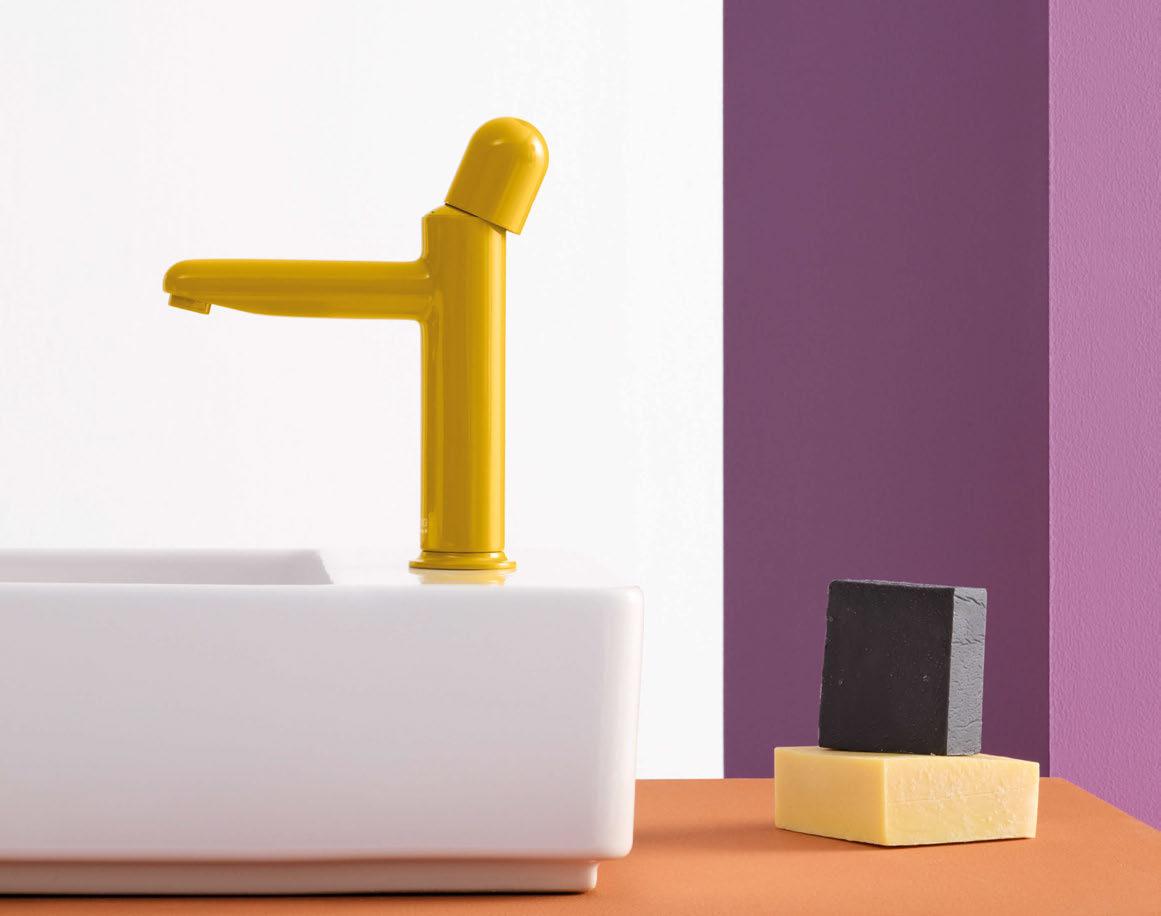
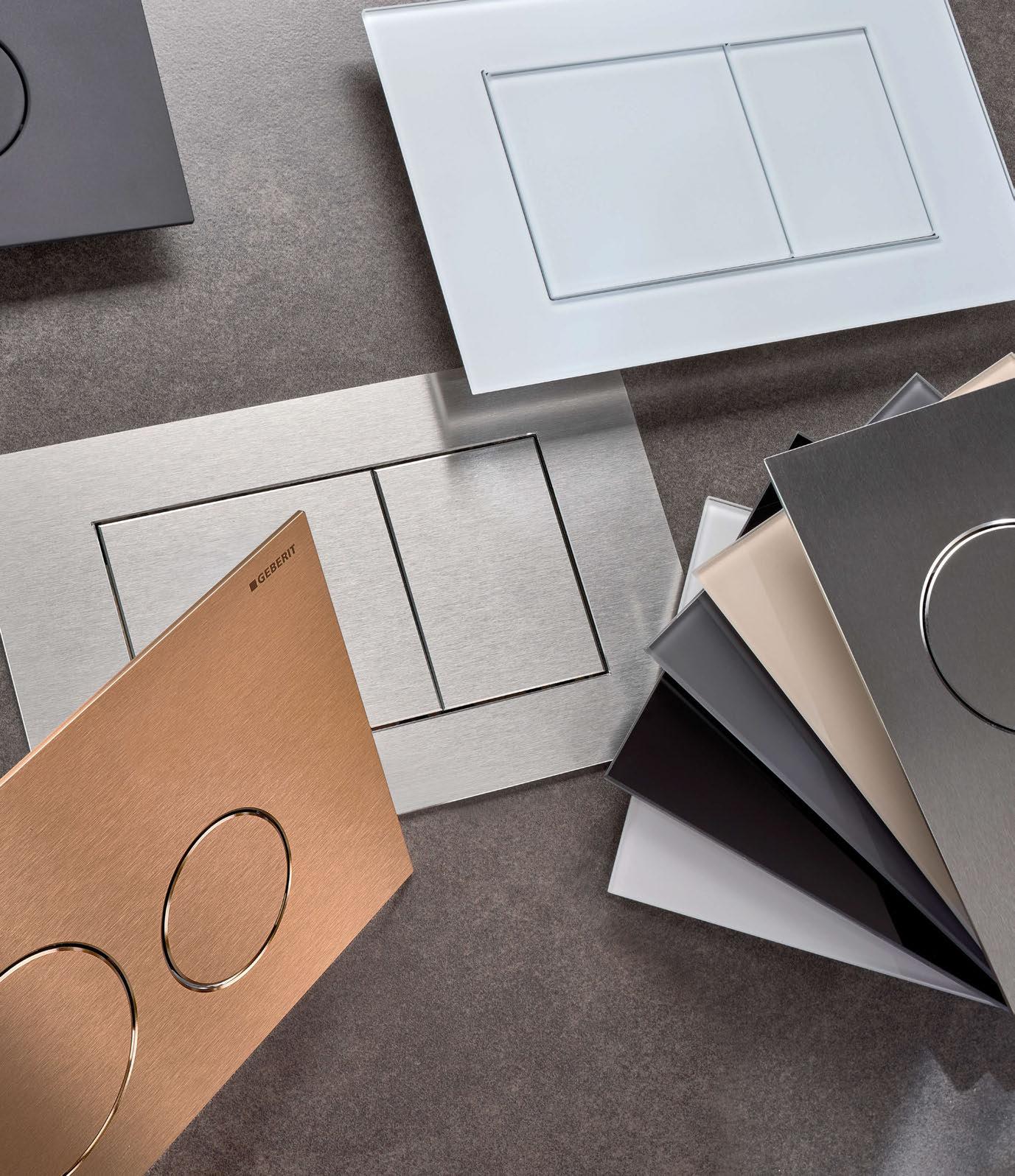
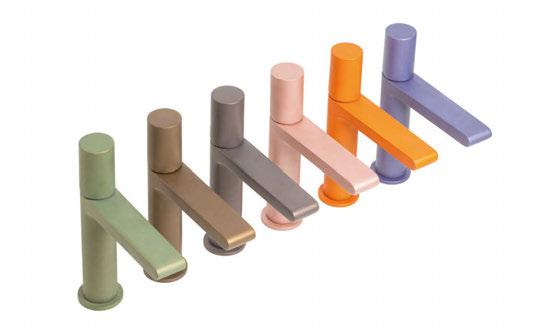
Nu faucets represent a purity of visual expression and a synthesis of essential design elements: form, shape and colour. A collection that strips away the artifice to arrive at the essence of its timeless design.
Founded in 1985, GA Group is a multidisciplinary firm specialising in luxury hospitality design. In 2017, a new senior management structure was implemented to accelerate the growth and diversification of its global business. Now, the company operates out of offices in London, Budapest, Kuala Lumpur and Shanghai.
Key Hotel Projects: Conrad Hilton Tokyo, Japan; W Taipei, Taiwan; Palace Hotel Tokyo, Japan; Corinthia, London; 1 Hotel Mayfair, London; Atlantis The Royal, Dubai; Rosewood Schloss Fuschl, Austria; Corinthia, Rome
40 Years Of GA Group
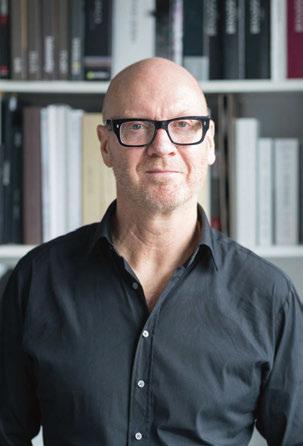
Upon celebrating a milestone anniversary, the Global Executive Design Director of GA Group discusses the past, present and future of hospitality design.
Driven by a philosophy of ‘restless curiosity’, GA Group has made a name for itself by crafting designs that resonate for a portfolio of iconic hospitality projects, from the reimagined refinement of Corinthia London to the captivating contrasts of W Shanghai. As the multidisciplinary studio celebrates its 40th anniversary, Global Executive Design Director Terry McGinnity reveals more about the journey so far.
ON THE INITIAL VISION
GA Group was established in 1985 by two individuals with a background in hospitality. One of the founders, having worked with Marriott, recognised an opportunity to elevate the guest experience through detailconscious luxury design. At a time when the industry was far less diverse, GA emerged as a visionary force, redefining hospitality design with a focus on creativity, craftsmanship and a dedication to excellence. While the landscape has evolved, GA’s ethos remains the same: to craft immersive and memorable spaces that resonate with guests worldwide.
ON ITS EVOLUTION
In the early days, hotels often followed a more uniform, functional approach, largely catering to either just business or leisure needs. Today, hotels are far more layered: a cultural touchpoint, an educator, a contributor to the social fabric of a place. They now carry a sense of purpose and a narrative that speaks to the individual guest, the community and the wider world.
As expectations have evolved and the role of the hotel has expanded, we’ve seen a growing demand for distinctiveness, not just in how a space looks but also
what it stands for. Design must express individuality, respond to its context and reflect the unique story of its setting, whether it’s in the heart of a city or deep in the countryside. Our design has responded thoughtfully and quickly to this shift.
What hasn’t changed, however, is our ethos. If anything, it has deepened over time. We’ve always worked as an atelier: personal, collaborative and design-led. Everyone in the studio actively designs, it’s important to our directors globally. Even as our projects have become more ambitious, this hands-on, deeply involved approach remains at the core of what we do. It’s what allows us to create spaces that feel both considered and genuinely connected to the people and places they serve.
ON MILESTONE HOTEL PROJECTS
Each project marks a moment of evolution, so to single one out feels almost unfair, like picking a favourite child! That said, Conrad Tokyo was a pivotal moment for us as it helped establish our presence in Asia and led directly to W Taipei, which remains very close to our hearts. We were given a great deal of trust that allowed us to craft a more sophisticated design language for the W brand, which was something fresh at the time. The hotel went on to become the most successful W globally, setting a precedent for future properties. We were recently invited back to refurbish the suites and restaurant, which was a privilege.
W Taipei then led us to Palace Hotel Tokyo, a different kind of milestone. Moving from a bold lifestyle brand to a hotel with an understated, refined ethos gave us the opportunity to show the breadth of our thinking. It’s a
“Design today must express individuality, respond to its context, and reflect the unique story of its setting, whether it’s in the heart of a city or deep in the countryside.”
property rooted in the uniqueness of its place. These projects led to defining hotels such as Corinthia London, Rosewood Schloss Fuschl and many more that we hold equally as dearly.
ON CHANGES IN HOSPITALITY DESIGN
We’ve seen a significant shift in the role hotels play, from functional spaces to emotionally resonant experiences that reflect culture, community and identity. In response, design has had to become more narrative-led, more adaptive to location and audience, and more ambitious in what it delivers, not just aesthetically, but in purpose. Client and guest expectations are higher, and rightly so. Hospitality now asks more of design, and we’ve always embraced that challenge with curiosity, flexibility and craft.
ON PROUD MOMENTS
It’s impossible to pick one single moment, it’s more of a collection of moments and events over time. Some are bittersweet, like seeing designers who have grown with us move on to build their own successful studios. Others are deeply affirming: clients returning to us, not just for one project, but again and again. This is a reflection of the trust, collaboration and shared vision we have built together. Ultimately, what makes us proudest are the relationships we’ve built. When former team members succeed, or clients come back, it’s a reminder that the way we work matters.
ON NEW OPENINGS
We’re honoured to be involved in a number of significant openings this year, including the refurbishment of the suites at The Savoy London, as well as Park Hyatt Kuala Lumpur and InterContinental New Taipei Hot Spring. Each represents a unique expression of place, purpose and quiet luxury.
Milestone projects for the studio include (top to bottom): W Taipei, Taiwan; Palace Hotel Tokyo, Japan; Rosewood Schloss Fuschl, Austria
“We hope hospitality becomes more inclusive and collaborative, with hotels acting as connectors, reaching gently into the neighbourhoods around them.”
Looking ahead, our pipeline continues to reflect the diversity and ambition of our studios, with upcoming projects such as Andaz Jakarta Sudirman and Corinthia Rome. We’re also privileged to be working on several yet-to-be-announced collaborations with brands including Shangri-La, Capella and The Unbound Collection by Hyatt. What we’re most proud of, however, is the spirit of collaboration across our global studios. A shared design ethos that continues to evolve as we grow, with new ventures in the US including an exciting project underway in Las Vegas.
ON THE NEXT 40 YEARS
We’re not a studio that measures success by size or scale; for us it’s always been about the quality of the work. In 40 years time, we hope to still be doing what we do best: designing with care, collaborating closely with clients, craftspeople and experts in their fields, and delivering projects that are refined, thoughtful and timeless. Of course, the industry will continue to evolve with new skills, new technologies, new ways of thinking and we fully expect to grow with it. But our core ethos won’t change. If we’re still working with the same passion, integrity, curiosity and depth we have today, then we’ll consider that a success!
ON HOTEL DESIGN IN 2100
Looking ahead, we imagine hotel design becoming even more personal, intimate and closely connected to its surroundings. Rather than growing in scale, we hope to see hotels become more considered in size yet deeply embedded in the fabric of their neighbourhoods. We would love to see design move beyond the walls of the building too, with hotels no longer existing as standalone entities, but as part of a wider local experience. Guests might sleep in the hotel, but live in the city by exploring nearby streets, dining in local restaurants and engaging with the culture in a more meaningful way. Ideally, this would happen through careful, intentional design, where the hotel and its community work together to create a seamless, immersive experience.
We hope the future of hospitality becomes more inclusive and collaborative, with hotels acting as connectors, reaching gently into the neighbourhoods around them. It’s about creating an experience that doesn’t stop at the hotel doors, but continues outward, enriching the guest’s journey and the local context alike.
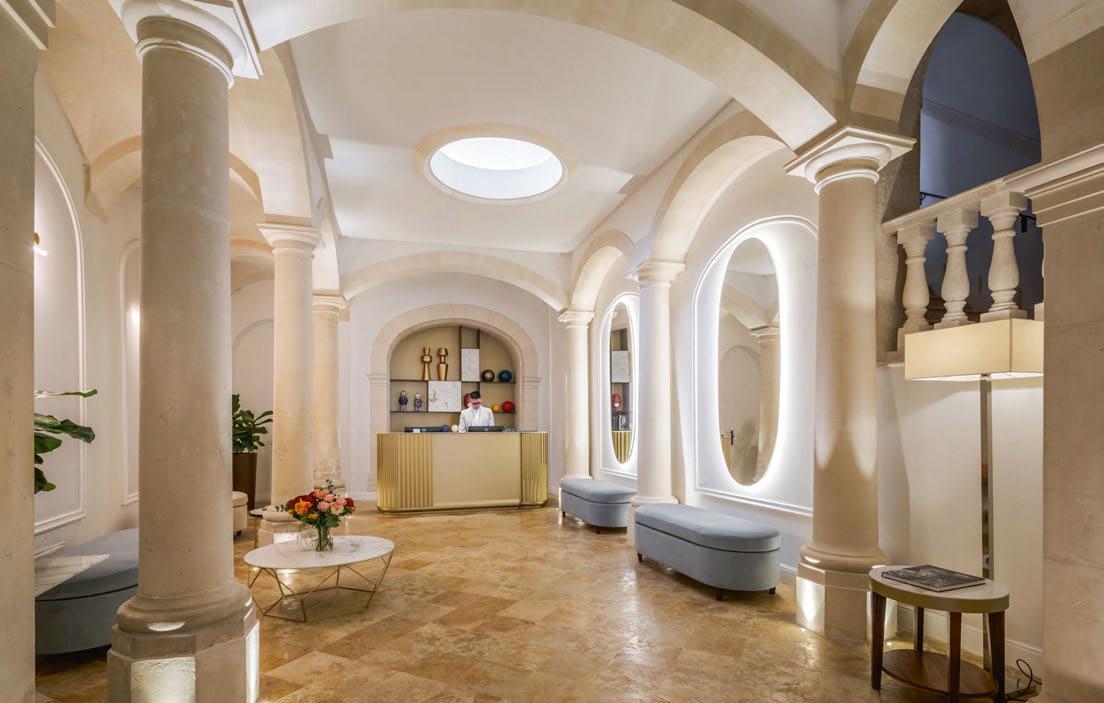
A key forthcoming project is Corinthia Rome, a restored Neoclassical palazzo offering a blend of Italian elegance and contemporary design
The Lana, Dubai.
PRE-FUNCTION AREA RUGS, FOR BANKERS HALL CONFERENCE CENTER, CALGARY, AB, CANADA. WITH KASIAN ARCHITECTURE INTERIOR DESIGN & PLANNING LTD.
TIBETAN WOOL AND CHINESE SILK, HANDKNOTTED IN NEPAL.
CREATIVEMATTERSINC.COM
LABEL STEP PARTNER –IMPROVING THE WORKING AND LIVING CONDITIONS OF CARPET WEAVERS, AS WELL AS PROMOTING ENVIRONMENTALLY FRIENDLY METHODS OF PRODUCTION.
PHOTOGRAPHY BY EYMERIC WIDLING
THE LOBBY
The Sleep Lab
In today’s hectic world of late nights and early mornings, getting a quality night’s sleep can be something of a dream. Fortunately, for those who are growing tired of being tired, Equinox Hotels has a solution, having partnered with Dr Matthew Walker to launch The Sleep Lab – a data-driven experience that transforms slumber into a precision science.
From the comfort of the hotel’s premier king rooms, weary travellers can nod-off with the help of sleep-enhancing technologies and science-backed routines. They can analyse the quality of shut-eye, enjoy relaxing spa treatments and even indulge in sleep-inducing in-room dining.
Every element of the environment – from lighting to sound to temperature – is optimised to improve performance, recovery and longevity. Adaptive mattress technology features personalised zonal control, while the therapy shower transforms into a steam room or ice shower at the touch of a button, preparing the body for rest by enhancing circulation and alleviating muscle tension.
As part of the experience, The Sleep Lab also offers a series of rituals developed by White Mirror – a sensory innovation studio that blends science, technology and art to create transformative wellness experiences.
Each programme combines serene soundscapes and circadian colour meditation, and can be scheduled in accordance with a guest’s daily routine. The evening ritual has been designed to activate the parasympathetic nervous system, reducing stress and guiding the body into a restorative state, while the morning ritual encourages natural wakefulness through light, sound and temperature adjustments, as well as light breath work.
“Sleep is the foundation of human performance, and The Sleep Lab offers guests an unparalleled opportunity to enhance their health, cognition and overall wellbeing,” explains Dr Walker. “Our objective is to bring the rigour of sleep science into the hospitality space, offering an experience that is not only luxurious but also scientifically validated.”
Browsing in The Barn
Open to both hotel guests and the local community, a new hospitality and retail space at Apfelhotel Torgglerhof showcases the best of the region’s produce.
A successful stay is often defined by the memories that guests take home with them, and souvenirs – be it a keyring or a fridge magnet – have long served as a special memento from global travels.
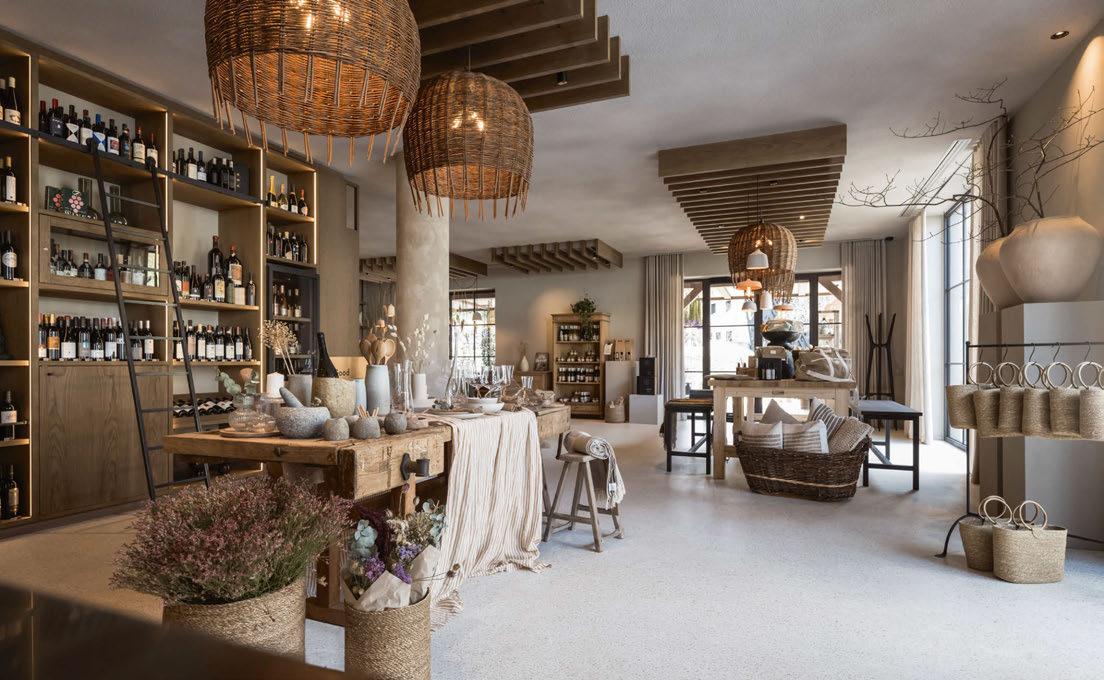
The desire to create lasting memories is one that Apfelhotel Torgglerhof in South Tyrol has keenly observed, and as such, the family-run hotel has opened The Barn – a concept store, workshop and tasting lounge that blurs the lines between retail and hospitality.
Located within a former agricultural building, the hybrid space has been envisioned by NOA –the architecture and design studio responsible for property’s ongoing transformation. Following the refurbishment of suites and public spaces and the development of a new spa, this latest venture further elevates the guest experience. In bringing the concept to life, NOA has deliberately avoided a commercial layout; instead, The Barn is an intimate setting that evokes a lived-in home, where visitors can browse a curated selection of authentic, regional products.
In keeping with the hotel’s bohemian character, interiors feature Venetian terrazzo flooring, warm terracotta surfaces and vintage wooden tables, along with wicker lamps woven in nearby Val d’Ultimo and clay pendants made in Caldaro.
The hybrid experience unfolds in a sequence of zones designed to encourage exploration, from the flower counter and wine display to the tasting bar and workshop table. Shelves are filled with handcrafted design objects and local delicacies, each chosen for its connection to the place it originates from. The Barn functions not only as a showcase for Apfelhotel’s own offerings, but as a platform for regional excellence, which can be experienced first-hand through an evolving programme of events.
Whatever way visitors choose to find value in the space, whether through tastings and masterclasses or the souvenirs they take home, The Barn ensures that lasting memories will be cherished for years to come.
The Accor Design Awards has crowned its 2025 winner, demonstrating how sustainable interiors can elevate the guest experience.
As today’s new talent emerges into a world of climatic uncertainty, the design landscape is shifting once more, resulting in sustainable solutions and innovative interiors that the hospitality industry is only too keen to embrace.
With this in mind, the 9th edition of the Accor Design Awards tasked students with creating an environmentally conscious bedroom that reduces carbon footprint and actively supports the wellbeing of the world’s oceans, all while improving the guest experience.
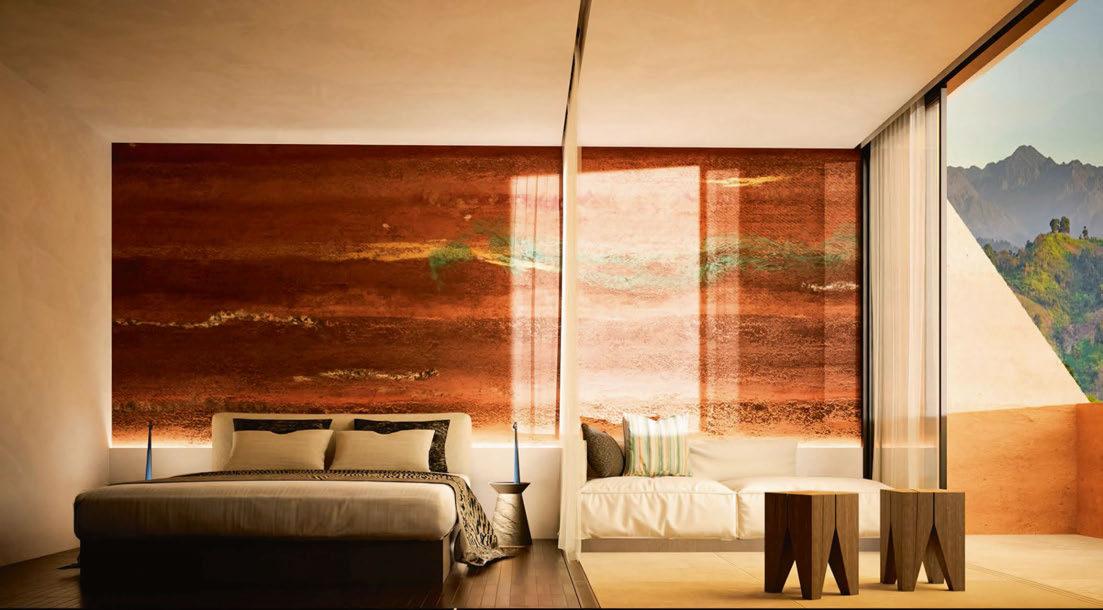
After receiving more than 100 entries, each focusing on the Novotel brand and its partnership with WWF France, the winner was announced at Maison & Objet in Paris. Created by Coline Robilliart and Corentin Rolland from l’Ecole de Design Nantes Atlantique, ‘Polé, Polé’ draws inspiration from Tanzania’s Morogoro region, resulting in a concept that balances local culture with environmental sensitivity.
The elevated structure is built from rammed earth, wengé and doussie woods, while modular furniture is crafted from ocean waste. In creating their concept, Robilliart and Rolland reimagined
how hotels connect with their communities and the world at large. The jury of industry leaders was particularly impressed by the project’s finishes,which transcend aesthetics to raise awareness and enhance the guest experience.
“This year’s student designs beautifully capture the spirit of Novotel and its vital commitment to ocean preservation,” says Jean-Yves Minet, Global Brand President, Midscale Brands, Accor. “The Accor Design Awards powerfully demonstrate how innovative design can shape a more sustainable hospitality sector – an ambition at the very heart of Novotel’s mission.”
Damien Perrot, Global Chief Design, Technical Services & Innovation Officer for Accor’s Premium, Midscale & Economy division, adds:
“Each year, the Accor Design Awards provide a global stage for students to present new perspectives on design innovation. This year’s winning projects demonstrate that outstanding design is both inspiring and impactful. Great design can shape memorable experiences and protect our planet at the same time.”
Suite Sounds
Patricia Urquiola envisions a first-of-its-kind hotel suite dedicated to the art of listening.
Native to Japan, listening rooms first emerged during the late 1920s as intimate settings for audiophiles to meet, drink and listen to music with a quiet reverence. Since then, the audiocentric venues have been embraced by the masses with sites popping up around the world, from Valentino’s L’Atelier Sonore installation at its Madison Avenue flagship in New York, to Giorgio di Salvo’s 330m2 Voce listening room at Triennale Milano.
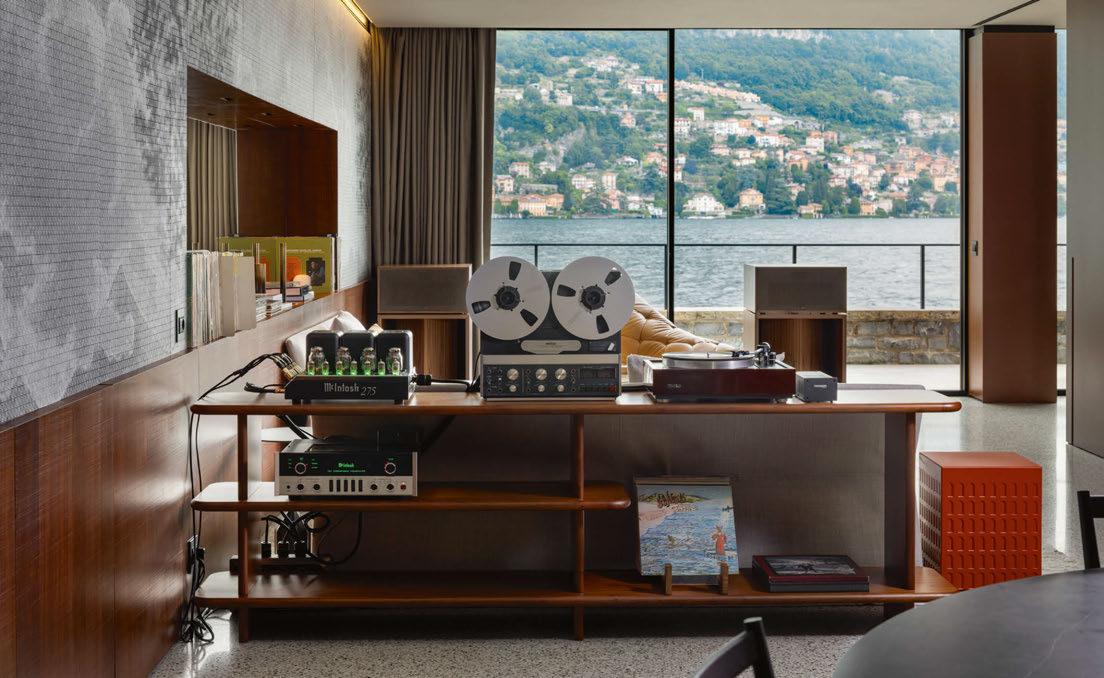
Now, hotels are getting in on the act as Il Sereno on Lake Como unveils The Darsena Listening Suite, an intimate sanctuary where hi-fidelity analogue music and design converge. Conceived by owners Angelica and Luis Contreras and brought to life by Spanish designer Patricia Urquiola, the suite draws on the surrounding lake’s legacy as a source of musical inspiration to set a new benchmark for immersive hospitality experiences by elevating the art of listening.
A 50ft wall of custom-woven jacquard fabric echoes the ripples of water to refine the acoustics,
while bespoke walnut panelling and sculptural bronze fixtures create an inviting, sophisticated atmosphere to enjoy music.
At the heart of the suite lies a state-of-the-art sound system featuring a Thorens 1601 turntable, McIntosh MC275 vacuum tube amplifier, restored Revox B77 reel-to-reel deck and Klipsch La Scala II speakers made from Noce Canaletto wood, which work in harmony to enhance the overall sonic experience and deliver sounds with purity and depth.
Completing the listening experience is a growing collection of 500 vintage vinyls curated by Contreras – a lifelong music aficionado – with guest-requested records set to become part of the suite’s permanent archive.
The suite can be booked overnight, or as an intimate venue for listening salons or private dinners, where each course of chef Raffaele Lenzi’s Michelin-starred cuisine is marked by the ritual of lifting the tonearm and changing the record.
In today’s overstimulated, always-on world, we are not just busy – we are exhausted. Physically. Mentally. Emotionally,” states the introduction to Small Luxury Hotels of the World’s 2025 research report.
It is this observation that forms the basis of The Restless Traveller, a new 15-page trend report that investigates how modern life drains energy and impacts rest, as well as how travel has become one of the most powerful tools to support recovery and meaningful rest. Conducted by OnePoll on behalf of SLH, the quantitative study surveyed 6,000 adults across the UK, US and Australia to explore fatigue and the ways in which travel can support holistic wellbeing across seven dimensions, namely: physical, emotional,
demand for meaningful, comprehensive and genuinely restorative travel experiences in a rest-deprived world.
“These findings are yet another reminder that rest needs to be woven into our lives, especially when we’re balancing family responsibilities and work demands,” says Dominique Antiglio, SLH’s Wellbeing Expert and founder of BeSophro. “Rest isn’t one-size-fits-all, so don’t be afraid to explore different kinds. For one person, it might be a pottery workshop; for another, a three-day walk in the forest.”
In response to the study, SLH enlisted a panel of wellness experts to create the Wellbeing Collection, a curated portfolio of SLH hotels that seek to restore the body, mind and spirit
The Restless Traveller
Small Luxury Hotels launches a Wellbeing Collection in reponse to demand for restorative travel experiences.
mental, social, creative, sensory and spiritual.
Key findings show that 72% of respondents reported feeling tired right now, but that their exhaustion goes beyond the physical, as one participant noted: “We are tired in ways sleep can’t fix.” Among the barriers to meaningful rest, 60% of participants pinpointed modern life as the culprit, followed by family responsibilities (44%) and work demands (40%).
So, what is the solution? According to an overwhelming 89% of participants, travel is effective for achieving holistic rest, from improving mood and sleep, to providing fresh perspectives and evoking gratitude, as well as strengthening connections to nature and boosting creativity. And when it comes to choosing where to stay, 93% believe it is important to prioritise wellbeing and rest. The most restful forms of travel include nature-based trips (49%) and wellness-focused retreats (22%), with culture, adventure and spiritual travel also listed. As the report concludes, there is a genuine traveller
through various criteria such as wellnessfocused facilities, educational workshops, nutritious cuisine, community engagement and environmental sustainability. Each of the 15 hotels are rooted in rest, reconnection and resilience, from blue therapy at Rio Perdido in Mexico, to traditional Vietnamese wellbeing practices at Namia River Retreat in Hoi An, to singing bowl meditation at Hubertus Mountain Refugio Allgäu in Germany.
Richard Hyde, Chief Operating Officer of Small Luxury Hotels of the World, concludes: “Following an increased desire from guests for wellbeing and inner sustainability, we’ve created the Wellbeing Collection by carefully filtering the hotels in our portfolio to spotlight those that offer heartfelt hospitality somewhere peaceful, where they can immerse themselves in naturebased experiences, the local culture, educational workshops and wellness-focused facilities, to feel enriched, unplug from their daily lives and truly relax.”
Capella TAIPEI
For the Taiwanese capital’s first luxury hotel in over a decade, André Fu crafts a modern mansion replete with elegance and artistry.
Taipei might not sit top of mind when thinking of Asian capitals, but perhaps it should. Behind the high-tech gloss and prickly geopolitical status lies a layered city with a one-of-a-kind culture of fantastic food and creative cache. Emblematic of this energy is one of the most compelling hotel debuts in Asia this year: Capella Taipei.
Located in the city’s central, affluent Songshan district, the opening signals that Taipei is ready for its moment in the global spotlight, and for all the right reasons. “It’s the hotel the city has been waiting for,” says General Manager Dennis Laubenstein, who previously held the reins at Capella Hanoi. “It’s been 10 years since the last luxury hotel opening.”
The venture also forms part of Capella Hotel Group’s strategic expansion across Asia, with properties in Macau, Kyoto and Osaka all expected to open this year – each envisioned by a celebrated designer to bridge heritage with contemporary luxury. “Each Capella property is inspired by the soul of its destination,” says Cristiano Rinaldi, President of Capella Hotel Group. “Our expansion strategy reflects three key principles: selecting destinations with rich cultural narratives, partnering with world-renowned architects who understand our vision of cultural authenticity, and
maintaining an intimate scale across most properties to ensure highly personalised service.”
In Taipei, that world-renowned vision comes courtesy of André Fu – a name that speaks volumes in quiet, urbane luxury. The interior architect’s scheme draws inspiration from the hotel’s immediate surroundings. “It is a re-telling of my personal journey discovering Taipei,” shares Fu. “Flaneuring around local neighbourhoods and wandering along the lush tree-lined boulevard where the hotel fondly resides, I was absorbed by the poetic environment – an antithesis to the urbanity one might typically perceive of Taipei. My vision translates a quietly-curated private mansion, incorporating contemporary touches and cultural nuances. Its lushness and sense of visual poetry rooted my personal take on the project.”
Billed as a ‘modern mansion’, the hotel occupies a 17-storey newbuild designed with Japan-based Mori Building Group. The public spaces – including a cavelike spa that would look at home in Santorini – and all five dining venues reside on the lower levels, while the guestrooms perch eyrie-like on floors 14 through 17. Like its siblings, Capella Taipei speaks in a design
language that is on-trend yet rooted in its location, guided by Fu’s desire “to carve the space into a series of intimate pockets – each articulated with design accents yet linked by a thread of shared aesthetics”.
Behind colossal bronze doors, the foyer makes a grand first impression with a panelled tapestry by Taiwanese artist Lee Chen-Lin, depicting the mountain-ringed cityscape. To the left, an arched corridor leads to the lobby, while to the right sits pretty Parisian-style pastry shop Atelier Plume, outfitted in hues of milky jades and deep emeralds with marble mosaics.
Yet the most visually impressive venue among the F&B line-up is all-day lounge Plume, with a large mural by French artist Elsa Rameau, marked with the motif of Taiwan’s blue magpie. The endemic species also appears on the venue’s bar menu, illustrated by local artist Ariel Chi. Plume has already become the place to be in the city; however, an additional three bars, located in a cube-like space just a few steps away from the main building, are slated for a latesummer arrival.
The other restaurants also impress: Ember 28
All-day lounge Plume is anchored by a mural by French artist Elsa Rameau depicting the Taiwanese blue magpie
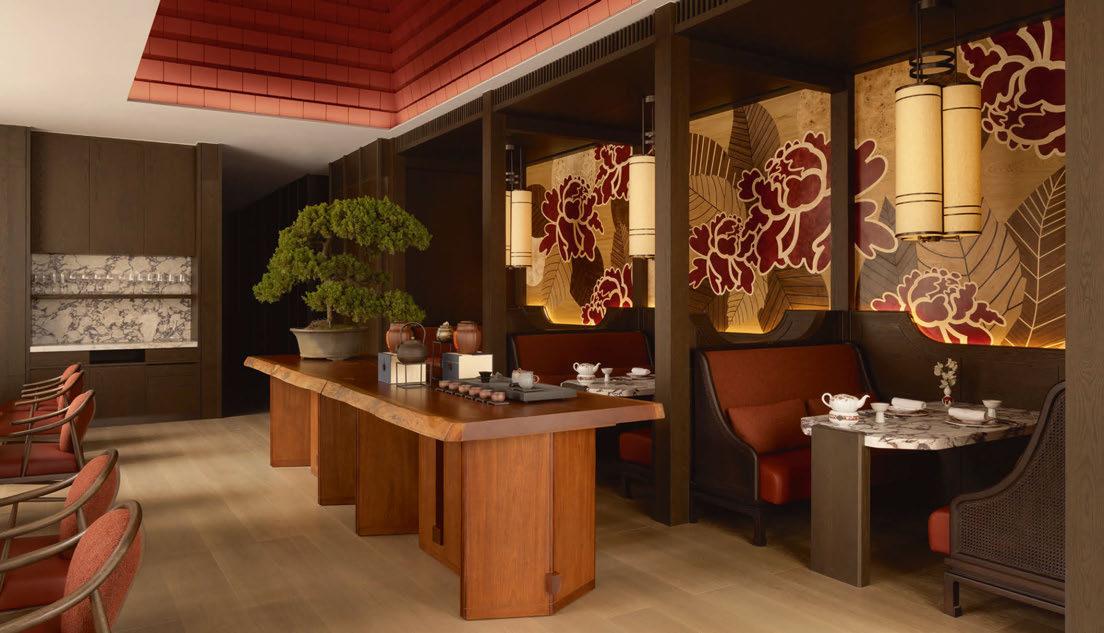
celebrates the ancient art of fire-cooking beneath the gentle glow of Preciosa chandeliers, while a Tokyo-worthy omakase with ryokanlike stylings and superlative service is clearly shooting for the Michelin stars. Then there’s Rong Ju, the signature Chinese restaurant decorated with hanging lanterns, a Chinese juniper bonsai and 8m-high terracottatiled ceiling, which “commands attention,” according to Fu.
These spots are very much open to the community, but on floor 14 the ambiance becomes more intimate. Here, a suave guestonly pool garden frames a skyline of low-laying buildings, misty hills and the cloud-skimming Taipei 101 skyscraper. Dressed in scallopededged parasols and potted greenery with chill beats, it’s a true escape. Inside is the Living Room, where guests are encouraged to help themselves to freshly-baked matcha cookies and snuggle into the plump sofas in front of the bio-ethanol fireplace.
Guestrooms are a high-style delight, many
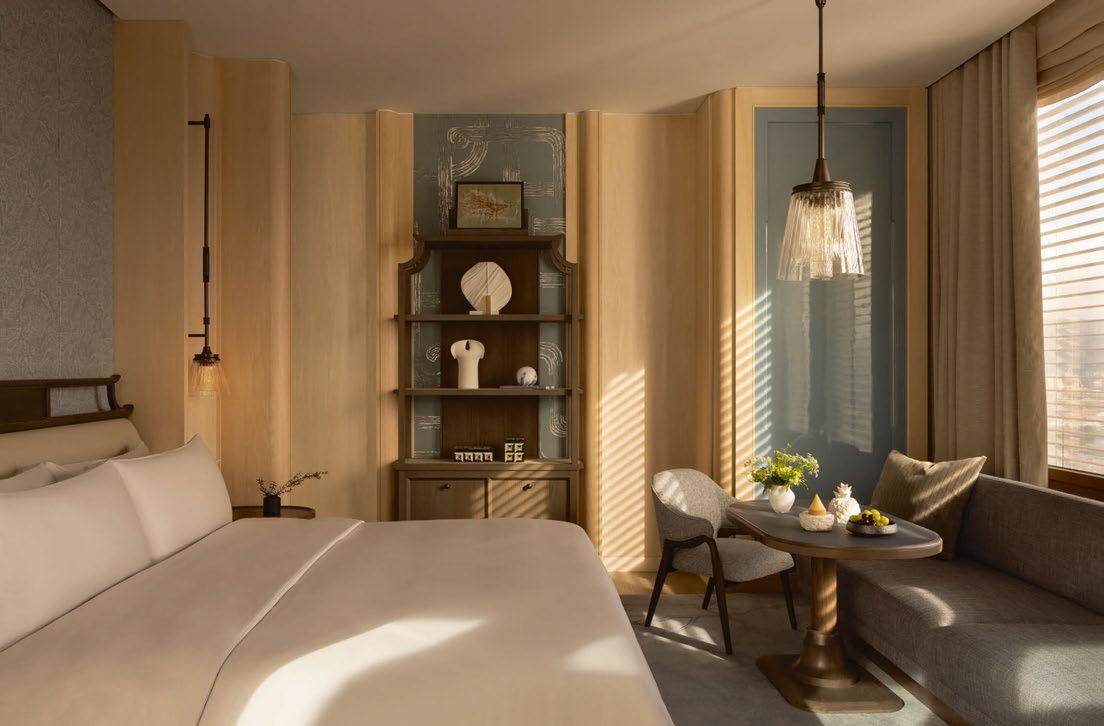
with features rarely seen in luxury hotels in Taipei, such as balconies and private pool suites, of which there are six. From champagnecoloured stone and silk panels to patterned textiles, materials are curated to invite calmness and connection. In-room amenities include Devialet speakers, full-sized Bamford toiletries and complimentary mini-bars filled with sparkling teas and nori-dusted cashews. Aside from these visual achievements, Capella Taipei’s greatest success might be how well it captures the spirit of the city by taking guests beyond its walls: “In many ways, we need to sell the destination as well as the hotel,” explains Laubenstein, adding that a team of ‘Capella Culturists’ lead tours around the surrounding streets. Guests can shop for vintage postcards at local stores, or try oolong tea and pineapple cakes at a local café. Laubenstein describes it as a close-knit community, one that has already accepted the hotel as a welcome resident. The joy is that for an hour or two, guests can feel that way too.
EXPRESS CHECK-OUT
Developer: GPPC Development
Operator: Capella Hotels and Resorts
Architecture: Mori Building Group
Interior Design: André Fu Studio www.capellahotels.com
Rosewood
AMSTERDAM
Following a decade-long restoration, a historic courthouse is reborn as a landmark hotel that fuses architectural heritage with contemporary Dutch design.
As Amsterdam continues to attract record-breaking visitor numbers, the impact of overtourism came under the spotlight once again last summer as the municipality extended its policy to restrict hotel development for both newbuilds and conversions across the historic city centre, as well as the UNESCO-listed canal district.
It is fitting then, that the last new hotel conversion permitted in the city is Rosewood’s much anticipated Dutch debut, situated within the former Palace of Justice along the grand Prinsengracht canal. Built in 1665 as an orphanage, which then functioning as a courthouse until 2013, the Neoclassical structure was acquired in 2015 by CTF Amsterdam, who secured what would be the city’s final permit granted for the conversion of a monument to hotel use. The ensuing decade-long restoration equipped the heritage-listed building with all the mod-cons of a contemporary luxury hotel, while adhering to preservation rules so strict that various interventions were designed to be dismantled at a later date if required. The result is a new hospitality landmark featuring 134 guestrooms, two restaurants and a cocktail bar, five events spaces, as well as an Asaya Spa with a 12m subterranean swimming pool.
The mammoth task of transforming an austere courthouse into an inviting hotel fell to Kentie Architecten, whose role involved incorporating the required MEP, spatial layouts and tender specifications, as well as working with specialists such as DPA on a sensitive lighting scheme, and maintaining close contact with heritage authorities to ensure stringent regulations were met. Particularly impressive are
the structural and environmental interventions that are not immediately apparent to guests. Excavating a two-storey basement in a city built on wooden piles is no small feat, and the project team embraced major sustainability strategies to futureproof the property. “Almost the entire building is insulated, the original timber window frames are fitted with an innovative insulating vacuum glass and an aquifer thermal storage system has been implemented for heating and cooling, with wells drilled in the lane behind,” explains Manon Becking, Partner at Kentie Architecten. During excavations, the site became an archaeological hotspot, where municipal teams uncovered centuries-old objects, some of which are now displayed in lobby cabinets.
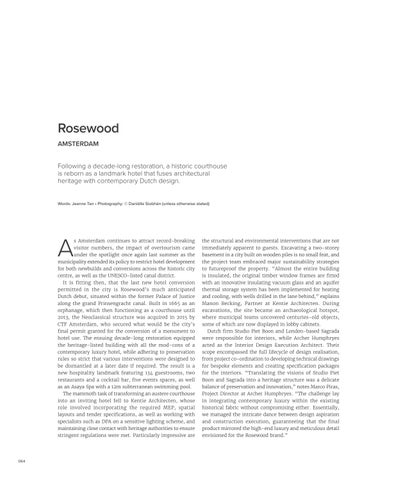
Dutch firm Studio Piet Boon and London-based Sagrada were responsible for interiors, while Archer Humphryes acted as the Interior Design Execution Architect. Their scope encompassed the full lifecycle of design realisation, from project co-ordination to developing technical drawings for bespoke elements and creating specification packages for the interiors. “Translating the visions of Studio Piet Boon and Sagrada into a heritage structure was a delicate balance of preservation and innovation,” notes Marco Piras, Project Director at Archer Humphryes. “The challenge lay in integrating contemporary luxury within the existing historical fabric without compromising either. Essentially, we managed the intricate dance between design aspiration and construction execution, guaranteeing that the final product mirrored the high-end luxury and meticulous detail envisioned for the Rosewood brand.”
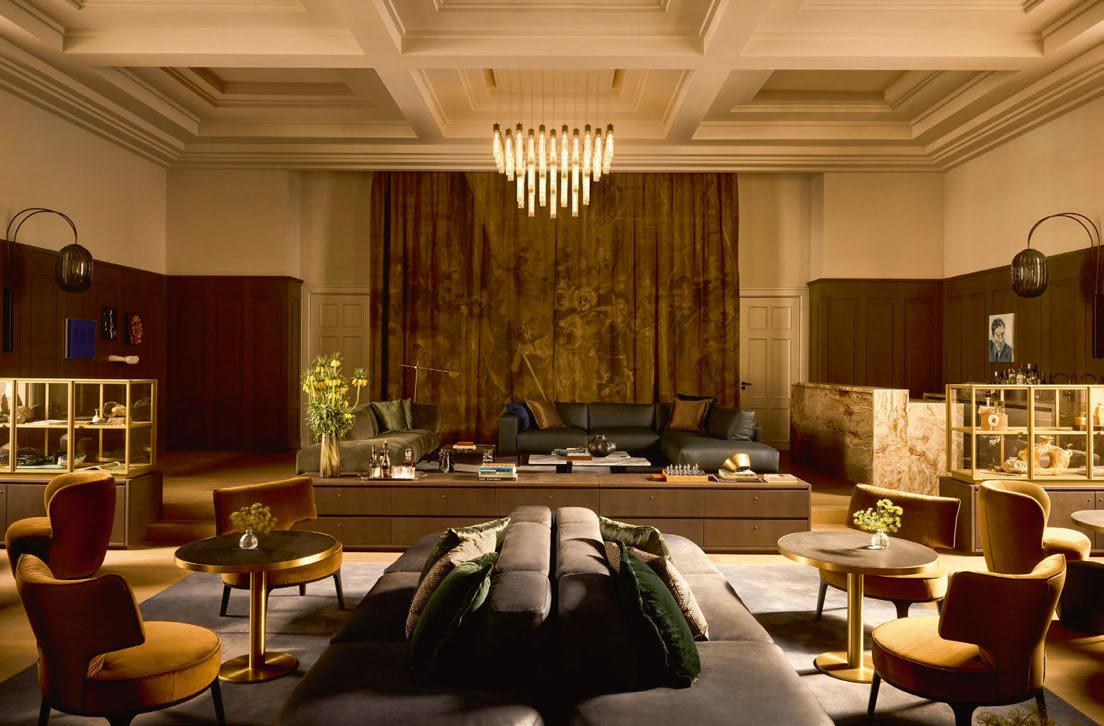
Taking the lead on guestrooms and public spaces, Studio Piet Boon was tasked with capturing the spirit of the city in line with Rosewood’s ‘A Sense of Place’ philosophy. Their approach layers historic architecture – think wide corridors and sweeping staircases – with the artful elegance of a modern residence. “Stepping into Rosewood Amsterdam feels like discovering a hidden gem within the city’s heart – a place where Dutch heritage meets the warmth of modern luxury,” says founder Piet Boon. “We wanted every space to reflect Amsterdam’s soul: rich in history, effortlessly elegant and alive with charm. Every detail invites guests to feel at home, immersed in a journey that flows from the timeless beauty of the 17th century to a fresh, contemporary Dutch design perspective. Rooted in the Dutch concept of gezelligheid – that inimitable sense of warmth, comfort and conviviality – the styling creates interiors that are both elegant and intimately personal.”
Curated artefacts and bespoke furnishings reflect the city’s rich cultural tapestry, though it is art that takes centre stage. With a collection of 1,000 artworks on display, the hotel could easily double as a gallery;
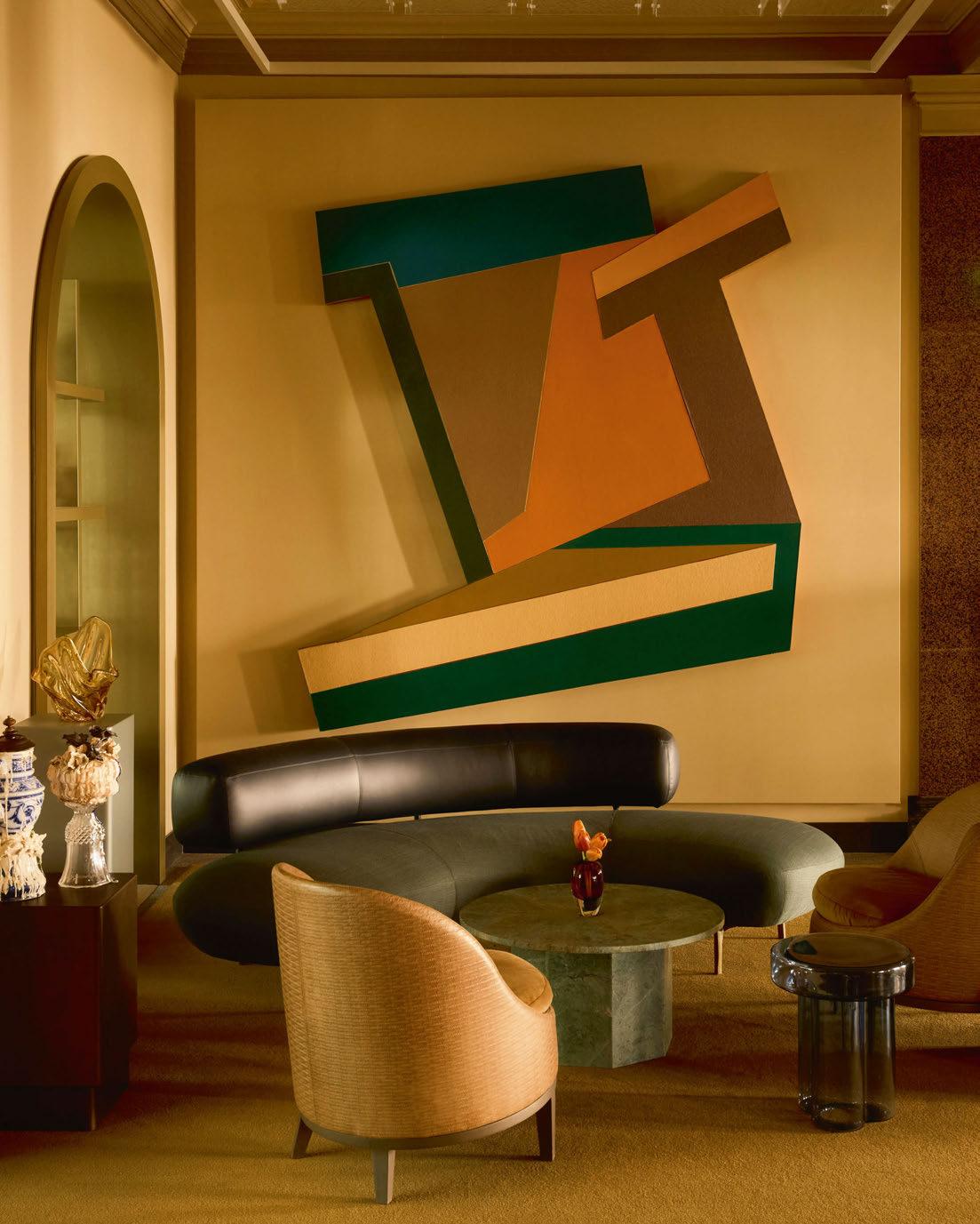
and in a city obsessed with creativity, that says a lot. The lobby immediately sets the tone with geometric reliefs by Frank Stella. The classical backdrop of pink granite columns and terrazzo floors is softened by a warm palette of ochre and beige hues, punctuated by green marble, bronze accents and blue-and-white ceramics. Clusters of plush seating by Studio Piet Boon and a reading table invite guests to linger, whether over morning coffee or a glass of champagne. Arched doorways subtly divide the central space: the check-in desk is discreetly tucked to one side, and on the other is chic lobby bar, The Court, offering casual dining, afternoon tea and a modern twist on classic Dutch pastries. Guests craving a late-night snack may even stumble across the art vending machine by Casper Braat, stocked with Dutch delicacies such as pickled herring and hagelslag on bread. However, they’re not edible, instead they are miniature marble and gold versions – how very Amsterdam.
The upper guestroom corridors are lined with various artworks, from the Grandfather Clock by Maarten Baas to an oversized canvas by Sterling Ruby. Even the doors, handpainted to resemble wood, are a
The Grand Library – once a courtroom – features a tapestry that evokes The Night Watch by Rembrandt
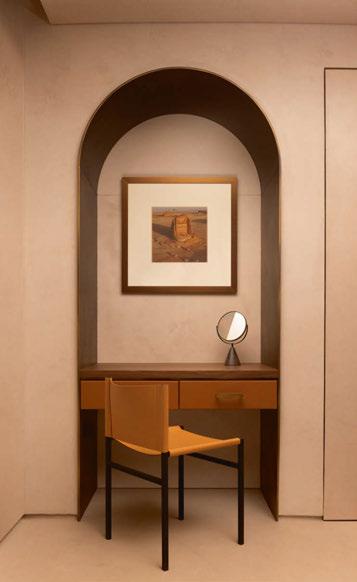
work of art – a years-long process showcasing a dedication to Dutch craftsmanship. Due to the building’s layout, guestrooms vary in size. Timber flooring, plush seating and a soothing palette of warm neutrals, soft greys and blues inspired by Dutch skies create a distinctly residential feel. Pleated headboards reference judicial robes while poetic photographs by Mounir Raji capture abstract glimpses of the building during construction. The bathroom units – featuring black steel-framed showers alongside natural stone and marble sinks – are designed as a box-within-a-box so as not to touch the historic walls. For larger entourages, five exclusive Houses offer full kitchens and generous living spaces. A standout is the Library House – once home to the Palace of Justice’s library – featuring bookcases lined with art and design tomes. Here and across the hotel, procurement for both FF&E and OS&E has been undertaken by Feuring, who took on a varied role from collating samples for the creation of the model rooms to negotiating contracts.
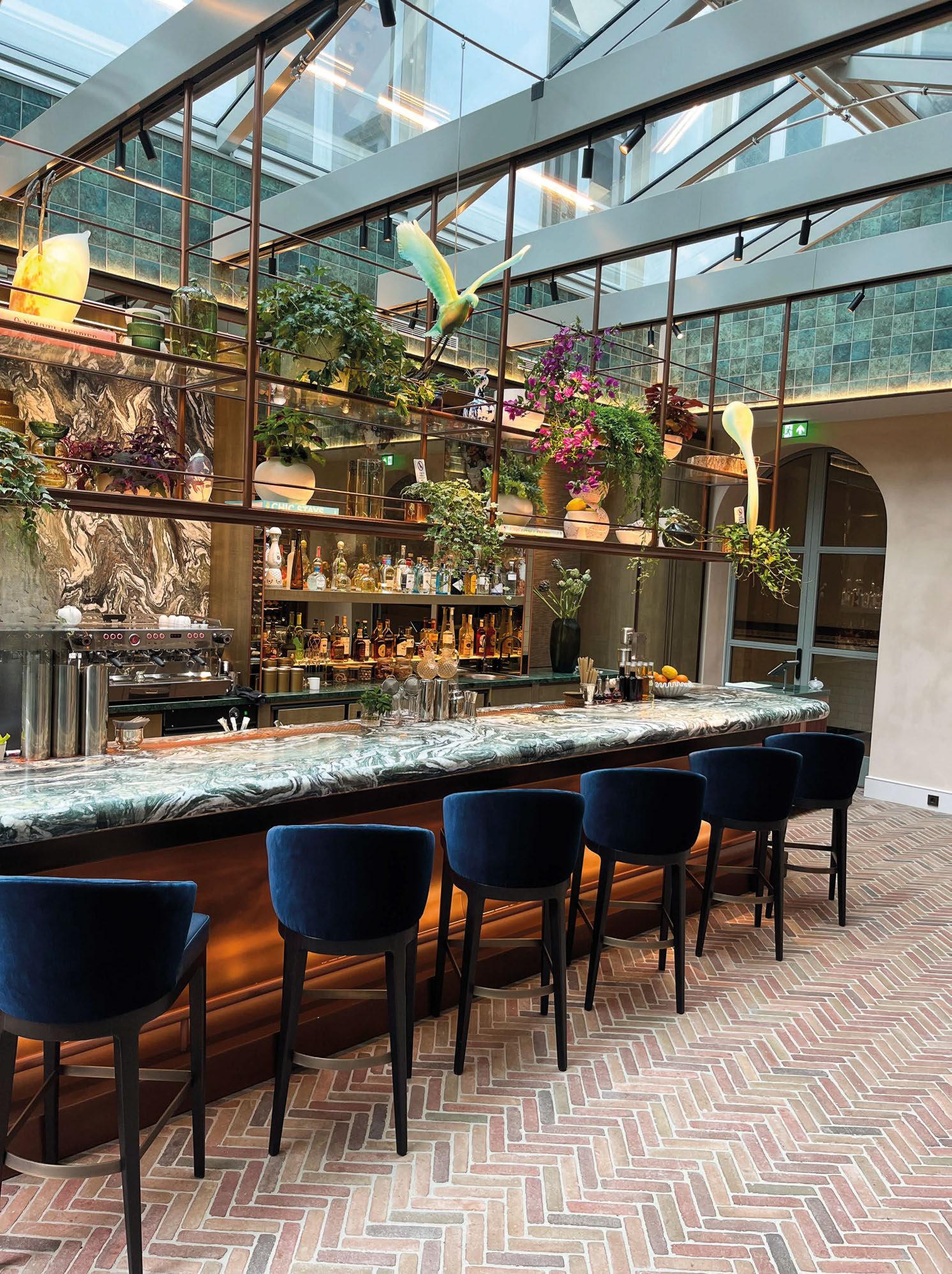
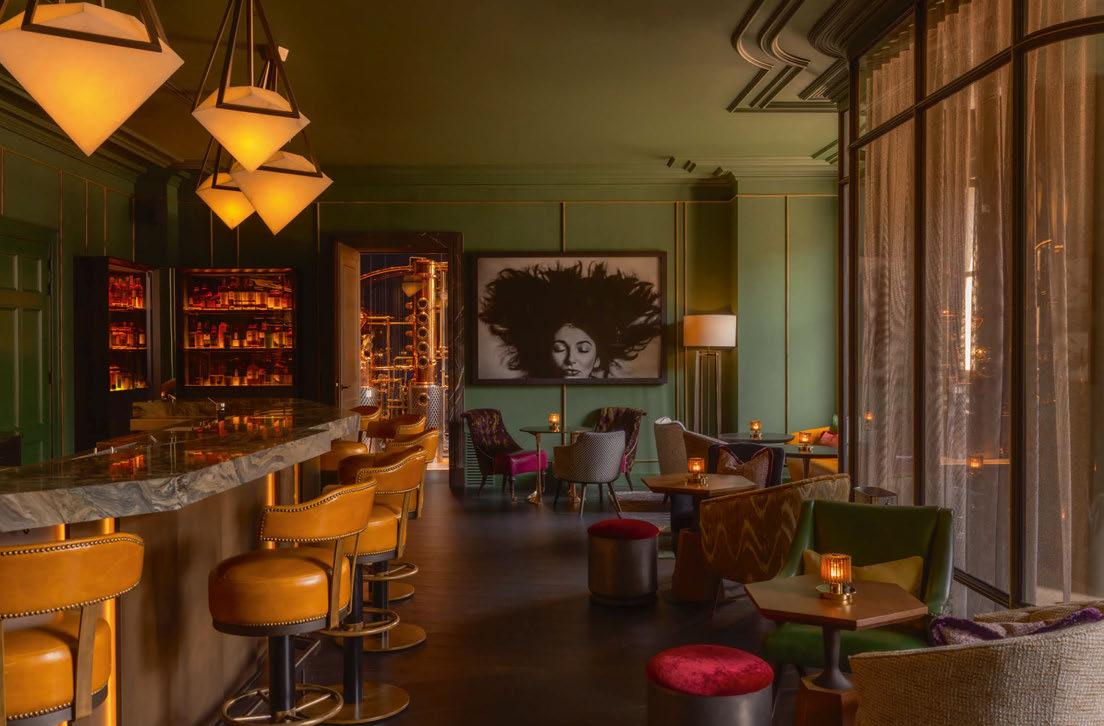
Sagrada’s remit took in botanical brasserie Eeuwen and bold cocktail bar Advocatuur, a nod to the building’s legal past. Guests can choose from three sophisticated spaces in royal blue, olive and burgundy, the latter adorned with Anton Corbijn’s black-and-white photography of icons such as Dutch artist Herman Brood. Tucked inside is a speakeasy-style distillery, where ‘provo’ is crafted in tribute to the Netherlands’ centuries-old Jenever tradition. Despite its central location, the hotel feels surprisingly serene. Hidden within are three courtyards, one of which is designed by Dutch landscape icon Piet Oudolf, of New York’s High Line fame. A winding path through the perennial garden is accompanied by whimsical sculptures from Studio Job, including a cheeky cat hanging from a window ledge by local artist Frankey. “De Tuin is a living, evolving canvas. Each season will reveal something new, allowing visitors to experience the subtle transformations of nature, from the play of light on the Japanese maple to the resilience of perennials,” explains Oudolf.
“I aimed to create a garden that feels both expansive and intimate – a place where guests can momentarily escape the city and reconnect with the calming presence of nature.”
For Rosewood, the challenge lay in balancing the brand’s signature style with Amsterdam’s rich history. “By honouring the architectural legacy of the former Palace of Justice and creating thoughtfully designed spaces, we are not only restoring a cherished landmark for the people of Amsterdam, but also inviting guests to immerse themselves in the heart of this vibrant city,” reflects Thomas Harlander, Managing Director of Rosewood Amsterdam. “It’s a celebration of heritage, innovation and meaningful connections.”
This is a sentiment echoed by Studio Piet Boon. “We’ve crafted a journey through Amsterdam’s storied past and vibrant present,” concludes Karin Meyn, Creative Director of Interior & Styling. “This hotel is more than a place to stay – it’s a living experience that celebrates Amsterdam’s unique charm.”
Sir Richard Branson returns to the birthplace of the Virgin brand to open his first hotel in the British capital.
Words: Matt Turner
Photography: Courtesy of Virgin Hotels Collection
Virgin Hotels’ debut London property – formerly Mondrian Shoreditch and before that, The Curtain – reasse rts the enduring truth of the ‘location, location, location’ mantra that is so often, if ambiguously, attributed to Conrad Hilton.
It rings true for any nascent hotel brand looking to plant strategically critical flags in gateway cities. But for Sir Richard Branson, finding a prime London location for a hotel brand that is – like all his bu sinesses –synonymous with its founder in all but name, had a more significant emotional resonance. This, after all, is the city where the Blackheathborn boy started his entrepreneurial journey in the late 1960s. Where a student newspaper, launched from offices off Bayswater Road, soon morphed into a mail-order record retailer, that then begat an Oxford Street store turned empire, as its founder embarked upon a brand-building odyssey that would travel cross-country, transatlantic, on rail and the high seas, before literally taking off into the stratosphere.
Never one to shy away from a camera-friendly publicity stunt, Branson turned up to check-in for Virgin Hotel London Shoreditch’s opening night dragging a trunk – lacquered in pillar-box red, of course – full of vinyl LPs, proclaiming: “London is where we started Virgin more than 50 years ago, and it feels really special to mark the opening of our first hotel here. Virgin Hotels was built on the idea of doing things differently, and this Shoreditch hotel is a perfect reflection of that spirit.”
“I suspect we should have chosen London 40 years ago when we launched Virgin Atlantic,” he continued. “But we didn’t have the resources to open an airline, film company and hotel brand at the same time. Now we’ve decided to open a number of hotels in London so that passengers who fly on Virgin Atlantic can continue their experience in the way they’ve been looked after on our planes.”
Branson’s connections to both London and the music industry are etched large into Hidden Grooves, the new listening bar that
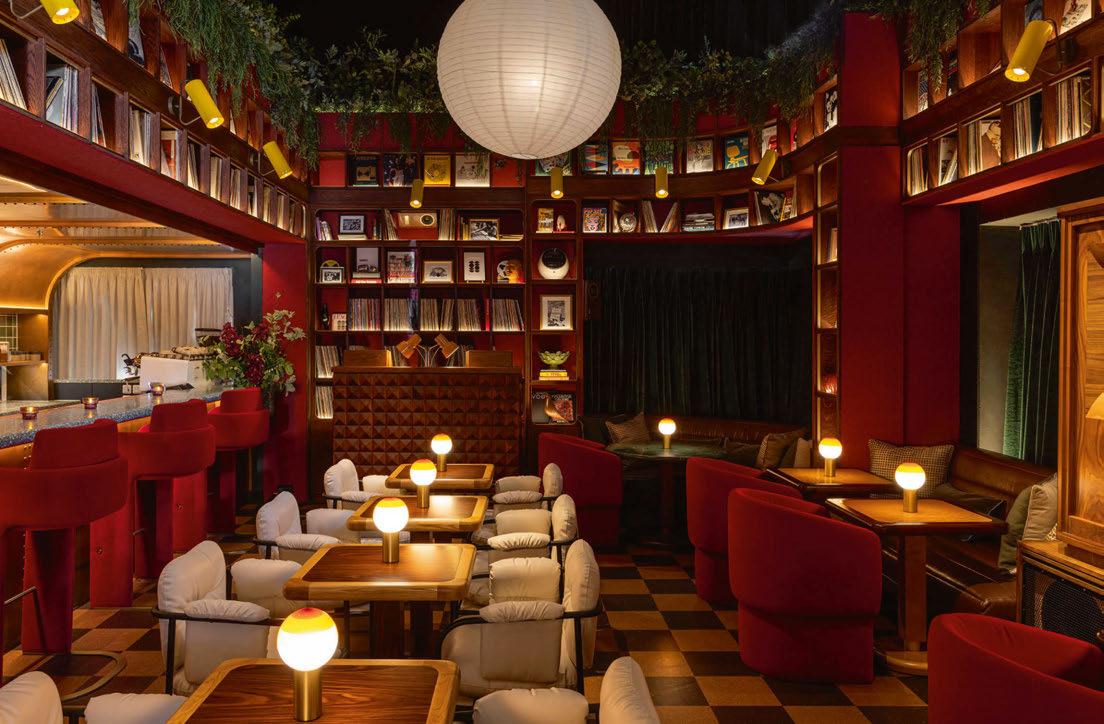
greets visitors on the hotel’s ground floor, harking back to the vinyl era. This 38-cover ‘hi-fi hideaway’, featuring a bespoke sound system masterminded by London-based Project Audio, has been designed to be acoustically and aesthetically pleasing. Towering shelving units reference the history of recorded music, housing retro amplifier units, transistor radios, reelto-reel tapes and Dansette turntables. Red velvet tub chairs, walnut furnishings and glowing globe-shaped table lamps create a late-night lounge atmosphere.
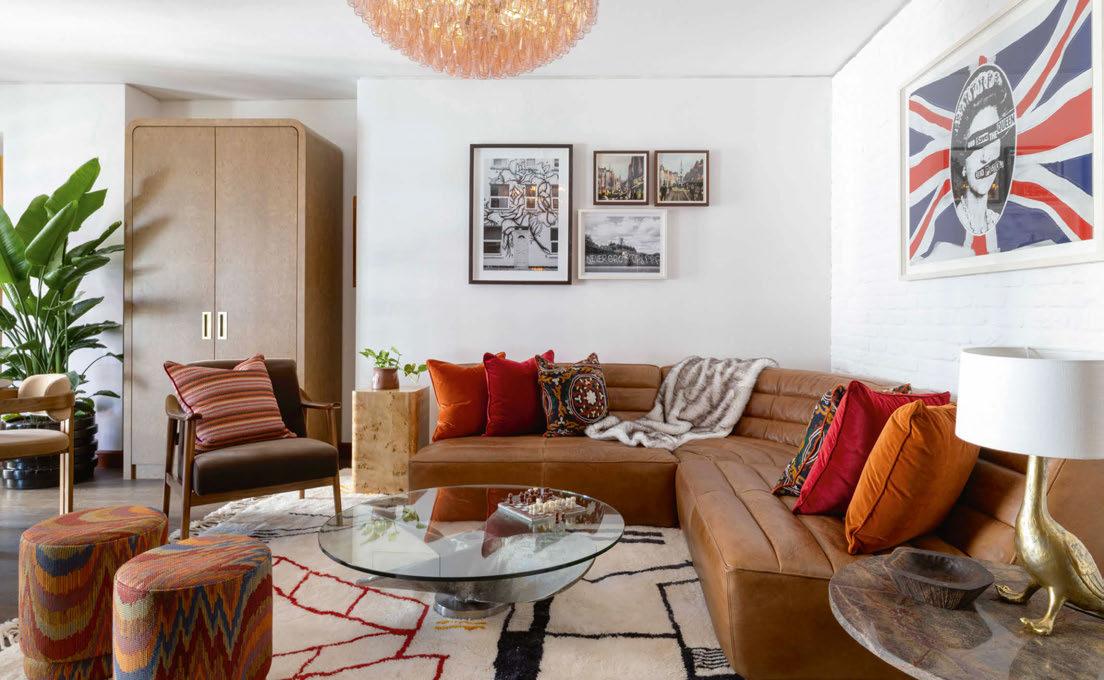
Cocktails are inspired by seminal sounds from the 1970s that shaped Virgin Records’ history, and can be accompanied by headphones delivering the relevant tracks to individual listening stations. Guests are invited to sip on an Oldfield’s Whisper (aged rum, amaretto, white chocolate liqueur and Pedro Ximenez sherry) whilst listening to Tubular Bells. Or get drunk on a Punk Punch (tequila, mango, pineapple lime and chilli agave) whilst blasting the Sex Pistols’ God Save the Queen into their eardrums.
Much of the warehouse styling throughout the rest of the hotel will be familiar to anyone who visited its previous incarnations – the loft-like interiors, exposed brick walls and factory-style windows originally created for The Curtain remain largely intact. Though additional layers of luxury and splashes of colour have been added with bouclé sofas, steam rainshowers, custom-designed burl oak furniture and signature Virgin Hotels beds.
New suites have also been added to the upper floors, conceived by Virgin Hotels’ in-house design team in
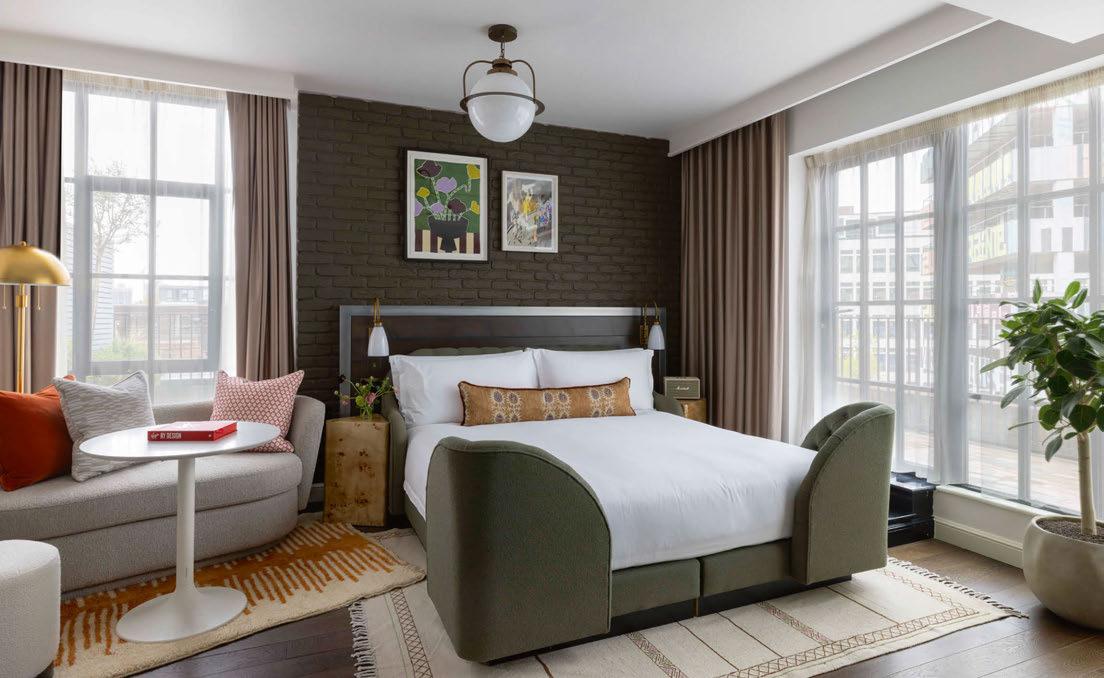
collaboration with Lynne Hunt London. These Premier Suites – and Sir Richard’s Penthouse Flat at the top of the room-rate chart – celebrate the vibrant spirit of the 1970s with a warm palette of rust, olive green, pale blue and cream. Hollywood-style mirrors offer a nod to the backstage and collectible artworks add a playful sense of humour, whilst the painted brick walls in complementary tones create a subtle point of difference to the regular rooms.
The rooftop bar is now Marlin’s on the Roof –bringing a Mediterranean flavour to proceedings thanks to a partnership with Ibiza’s Blue Marlin Group, which is also operating the hotel’s extensive events spaces, co-working, nightclub, gym and spa as private members’ facilities, though the rooftop restaurant and pool remain open to hotel guests and non-members.
Branson admits finding a site in London has been a priority for the group: “Since the inception of Virgin Hotels, we’ve had our sights set on London; a place that so many of our customers either call home, or name as one of their favourite destinations – and of course it’s where Virgin’s story started. We’ve been disrupting the travel industry for more than 40 years, from land to air to sea – even to space. Our success comes from identifying where we can make a difference.” He concludes: “Virgin Atlantic customers have always said that we give them a wonderful experience in the sky, but they don’t have the same Virgin experience when they land. Well, we’ve sorted that in Las Vegas, New York, Edinburgh and now London too.”
Envisioned by Lynne Hunt London, together with Virgin Hotel’s in-house design team, guestrooms and suites pay homage to the vibrant spirit of the 1970s
Aethos
MALLORCA
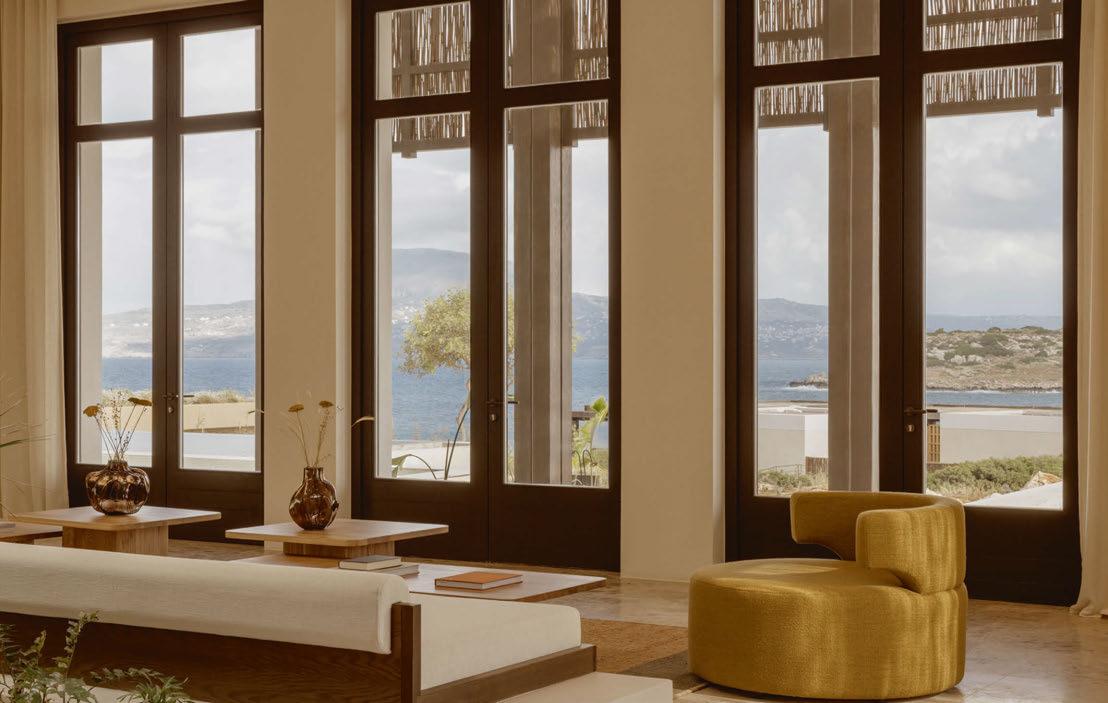
Aethos debuts in Spain with an authentic resort that celebrates the culture and beauty of the Balearics.
When Benjamin Habbel and Jeff Coe founded Aethos in 2018, the goal was simple: to create a collection of hotels that are each a reflection of their local community. At Aethos Ericeira, interiors honour the laidback vibe of the Portuguese surf town. In Milan, it’s the vintage charm of the bohemian Navigli district. And in Mallorca – the latest opening for the fast-growing lifestyle brand –inspiration comes from the vibrant culture and natural beauty of the Balearic Island.
Developed for mindful travellers seeking connection, creativity and community, the Limestone Capital-backed venture has been active in its acquisitions, snapping up assets in coastal, countryside and city destinations across Europe. Following openings in Portugal, France and Italy, this latest addition marks the first of two properties in Spain, with Madrid set to follow in 2026. “Aethos Mallorca represents a significant milestone as our first venture into the Spanish market,” says Habbel. “This property embodies our commitment to creating
spaces that reflect their surroundings, offering guests an experience that is both sophisticated and deeply connected to the destination.”
Located in Paguera on the southwest coast, Aethos Mallorca perches on a cliff over the crystalline waters of Cala Fornells. As with other properties in the portfolio, it is the reimagining of an existing hotel, in this case, one with an enviable location but long in need of an upgrade. Recognising its potential, Limestone Capital stepped in as owner-operator, injecting the funds required for renovation and repositioning.
The hotel’s transformation is evident from across the bay: three-dimensional stone cladding redefines the previously austere façade, while timber louvres frame balconies and new window openings add architectural character. To lead the design, Habbel and Coe enlisted Ballesteros Drusetta, a mother-anddaughter studio based in Palma. Combining experience and youth, and a track record in both hospitality and residential projects, the duo set about channelling the Aethos brand through a
Words: Catherine Martin • Photography: Courtesy of Aethos (unless otherwise stated)
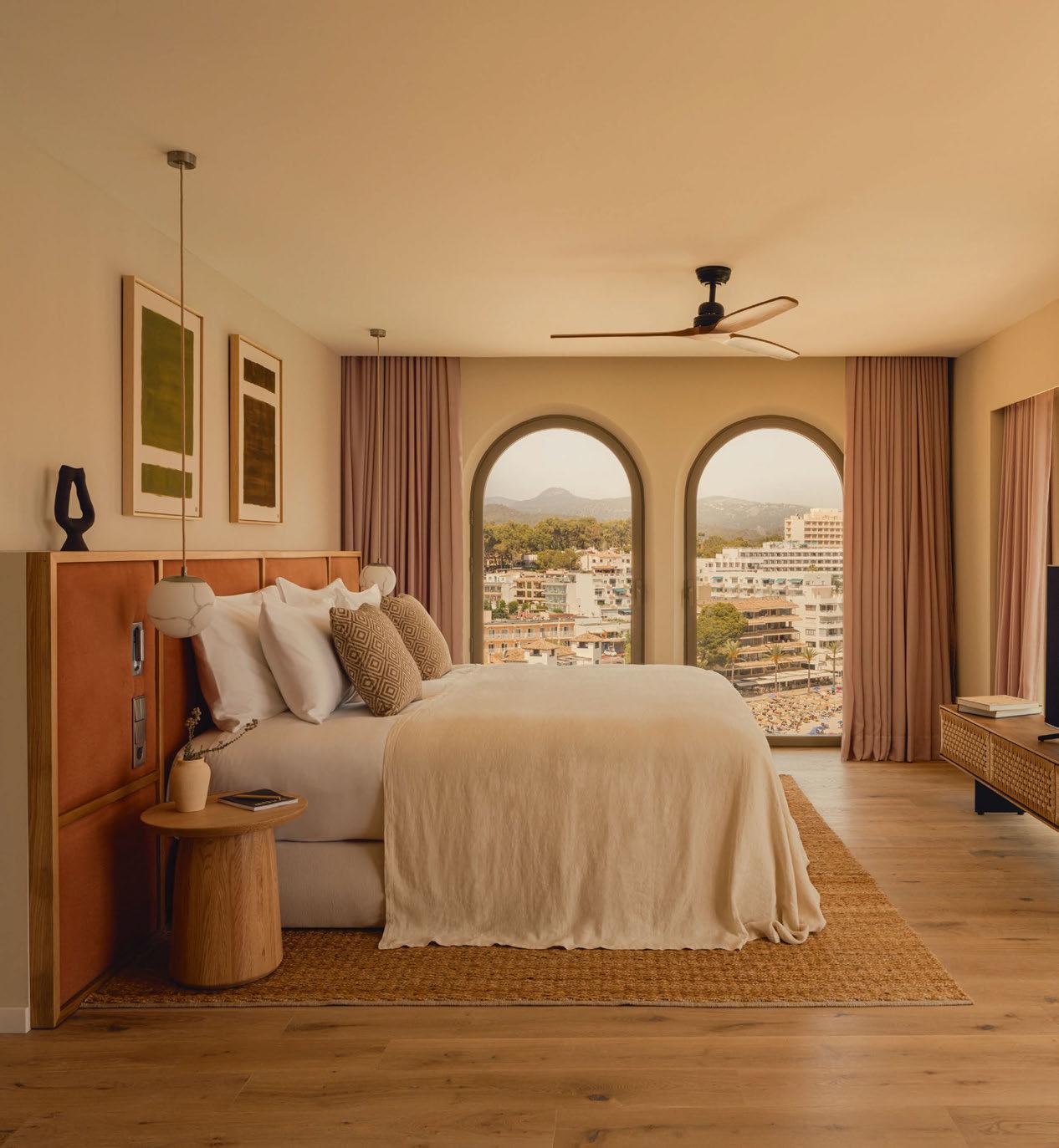
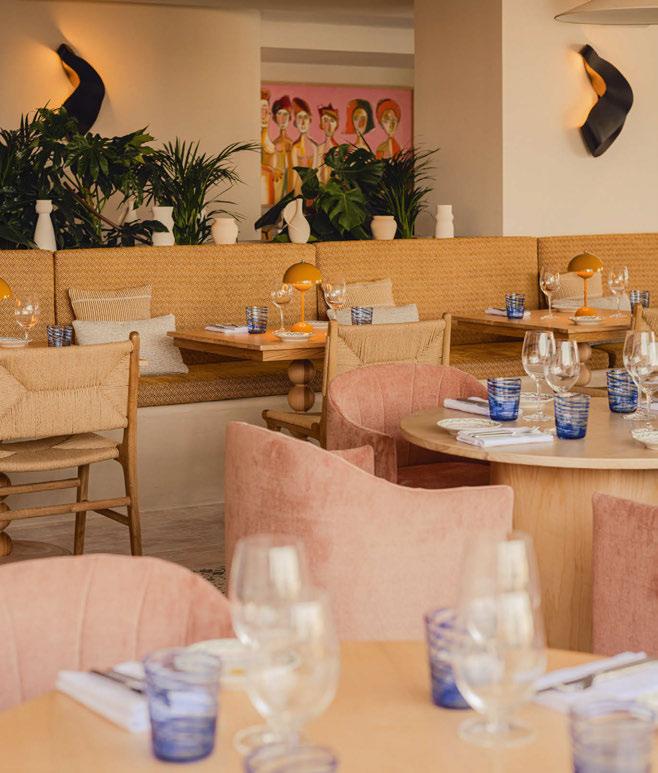
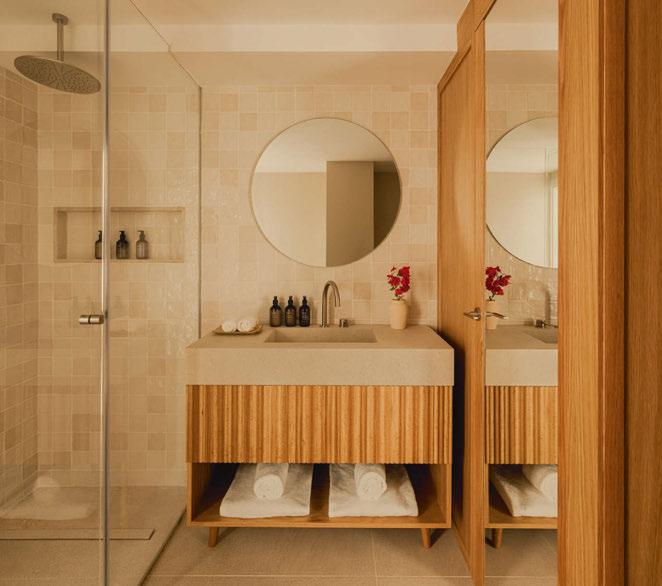
Interiors honour the Mallorcan aesthetic, incorporating woodwork, natural clay tiling and ceramics by local craftspeople
Mallorcan lens. “Aethos is a cross between a hotel and a residence: it has the special touch of hospitality and the comfort of a home you never want to leave,” explains Maru Drusetta, who works in close collaboration with her mother, Beatriz Ballesteros. “Our goal was to create a space where every corner feels meaningful, reflecting the essence of Mallorca.”
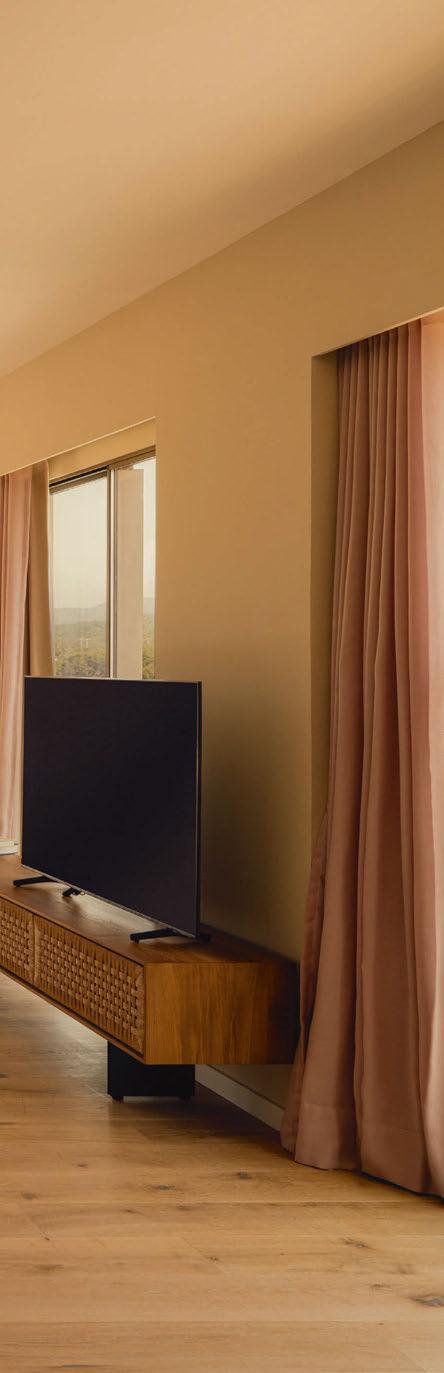
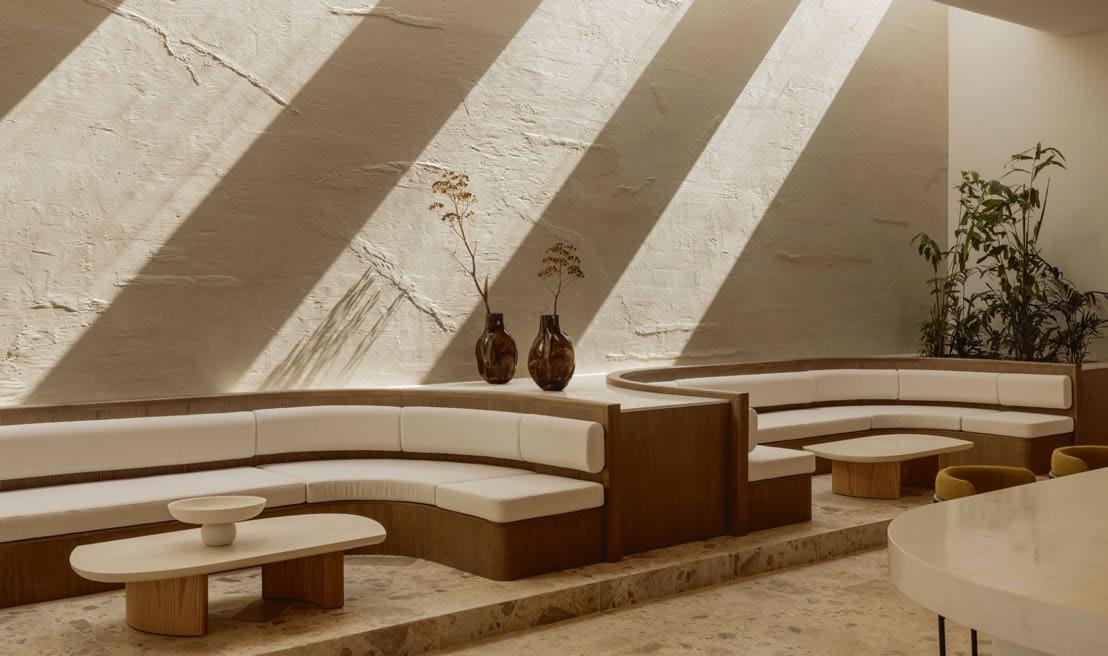
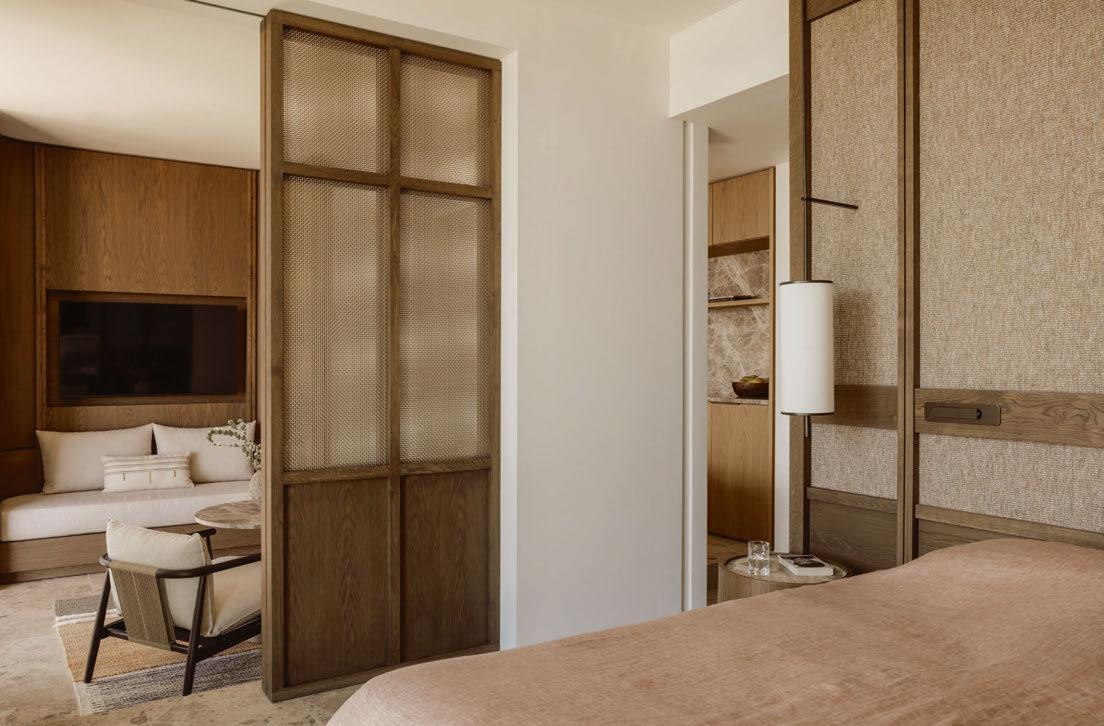
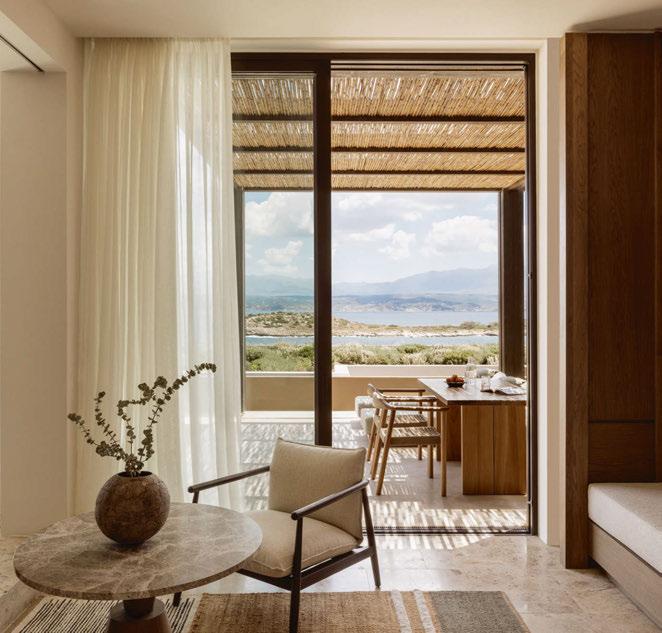
Interiors are characterised by a minimalist luxury that blends elegance, simplicity and an abundance of natural daylight. The material palette is soft and tactile, while colours are drawn from the surrounding landscape, be it the sandy tones of the beach, the olive green of the trees or the pale pink of the almond blossom. “We wanted to bring these colours inside, so that when you close the curtains, you feel Mallorca, and when you open them, you see Mallorca,” the designer explains.
On arrival, the eye is immediately drawn to the terrace and panoramic views of the bay beyond. What was previously a characterless expanse has been cleverly reshaped to create semi-circular seating niches between pathways
and planted greenery – the ideal spot for a morning coffee or pre-dinner sundowner.
The 61 guestrooms occupy the floors both above and below the lobby, with those on the lower levels benefitting from direct access to the sea via a cliffside staircase. Though some offer views of the Tramuntana Mountains, the vast majority face the bay, many with private balconies. The F&B venues also maximise the views, whether from the laidback loungers of Ikat Pool Club or over evening cocktail at Raig Rooftop. Onda, meanwhile, is an all-day dining restaurant serving local cuisine from land and sea, with cosy booths for those seated inside, and a shaded terrace for outdoors.
The beauty of the design however, lies in the details. “We live here and we deeply respect everything around us; not just the landscape, but also the Mallorcan aesthetic and traditions,” says Drusetta, emphasising the importance of cultivating a local connection. As such, walls are constructed using a Mallorcan drystone technique and window shutters are a
reinterpretation of the classic persianas seen on the island’s country estates, while woodwork is crafted by local carpenters and tiling comes in natural clay and authentic designs. Ceramics also play a starring role, and according to Drusetta, “many of the decorative pieces were created by emerging young Spanish artists”, such as Claria Masiá and Sonmo, as well as Portugal’s Studioneves. These are accompanied by FF&E from established brands, including speakers by Loewe, fitness solutions by Technogym, and outdoor furniture from Point’s Kahn and Kubik collections, crafted in innovative TechTeak.
The result is a hotel that reflects the freespirited essence of the Balearics, successfully finding a balance between tradition and modernity for a stay that is deeply rooted in Mallorca. “We’re not just another boutique hotel brand,” concludes Habbel. “Our vision is to create spaces that become an integral part of the traveller’s journey – an immersive and enriching experience that lingers in the memory long after the stay.”
Ascattering of towers climb gently above the low-rise industrial heritage of Zurich’s Fünfte Kreis. One of the most distinct – a 24-storey building rationally-designed by Basel-based Diener & Diener Architekten – is home to Renaissance Zurich Tower. Completed in 2011, the purpose-built hotel – which also includes a residential component on the upper floors – has good bones, plus a quality fit-out that demonstrates how solid wood casegoods and sanitaryware from the likes of Grohe and Duravit can stand the test of time. It is the scene of a notable refurbishment by Checa Woid, the Munich- and Madrid-based interiors studio founded by Patricia Holler and Elisa Rodriguez. All 300 guestrooms, including 48 suites, were transformed in a scheme that is both stylish and sustainable.
The area, labelled the Creative Quarter by Zürich Tourismus, is criss-crossed by old railway tracks, reflecting its industrial past. The hotel rubs shoulders with historic brick and corrugated steel structures now repurposed as
offices. In a similar way, this idea of re-use and upcycling is at the core of the refurbishment. A subsidiary of SV Group, the hotel is managed by SV Hotel under a franchise agreement with Marriott International, and is the largest in its portfolio. A soft refurbishment kicked off in 2019 when elements of the lobby and F&B were refreshed. Marco Meier, Managing Director of SV Hotel, explains that the seven-year cycle as outlined in the franchise agreement was somewhat negotiable, based on guest reviews as well as appraisals of its FF&E conditions. The upgrade was deferred during Covid with further works undertaken in 2023 and most recently, the guestrooms.
From a long list of potentials, Checa Woid made the shortlist of three interior design practices. Their pitch focused on a strong local narrative built around the Dada movement that originated in Zurich immediately after World War I. Anti-establishment, anti-art, in the traditional sense, Dadaism was about expressive, innovative and colourful design, as
well as an irrational and anti-bourgeois sensibility. Adding to this aesthetic vision was the sustainable ethos that would underpin Checa Woid’s work. It was an ethos passionately proposed by Holler who, when faced with budgetary constraints, got creative and challenged the status quo. She argued long and hard for the quality elements of the existing fit-out to be given new life, noting the travesty of the usual “rip-out and throw-away” approach. In achieving this goal, she estimates that the guestrooms have retained approximately 90% of their existing materials. Indeed, she was not supposed to and did not need to alter all fixed elements - the flooring, casegoods, fixed bathroom fittings nor electrical equipment.
The limited budget meant that the pieces to be upcycled had to be chosen prudently as their treatment would cost more financially than throwing them away and replacing them with necessarily cheaper, lowerquality items. The black staining of the existing blonde solid wood casegoods was done largely in-situ –walls had to be taped-off, floors protected and doors removed. The desks had to be dismantled, the metal frames sent away to be powder-coated, and a new softer layer of linoleum added to the desktop. The whole lot was then reassembled. 300 times.
Yet, it was all worth it as the long-term environmental benefit is huge. “We had the right quality in the first place,’’ agrees Meier of their good fortune. Waste was massively reduced. And referring to the added longevity of the ‘new’ items, he notes: “I was convinced by the quality we saw in the recycled product. We did the right thing.”
New are the corridor carpets and door numbering, both to align with Checa Woid’s scheme, whilst the flooring in lift lobbies had to be changed to meet new local regulations. Here, large-format artworks by local graphic designer Martin Wanner line the walls, depicting a menagerie of comedic wildlife often dressed smartly with bow ties and top hats. New additions in the guestrooms are separate toilets repainted in burnt orange, loose rugs and light fittings by 2F Leuchten. It is here that Checa Woid had real fun with their Dadaism theme. These artistic highlights are realised in a simple yet bold, black and white
palette, complemented by a vibrant gold-yellow. The monochrome thread references the gritty reality of the industrial quarter outside, while the yellow represents the gold that flowed from all this productivity, as well as the Swiss penchant for banking.
The trio of colours are seen in various facets of the guestrooms. The casegoods are now stained black. Monochrome rugs by Dansk Wilton feature geometric blocking, swirling shapes or Dada-inspired hieroglyphics – look closely and the first letters of ‘Renaissance’ and ‘Zurich’ reveal themselves. The same pattern is used on high-pressure laminated sheeting to cover the original wall-mounted housing for the desk and bathroom splashbacks.
In the alcove above the mini-bar, a curious comedian peeks out from behind the stage curtain, all in black and white, of course. The wall above the luggage rack sees a variety of art panels that follow a dotted design inspired by the work of Sophie Taeuber-Arp, artist and co-signer of the Zürich Dada Manifesto. Broad brush strokes on a circular fabric shade tops the lamp by F2 Leuchten – an “eye-catcher” for Holler.
Gold appears on various surfaces including a circular maze on the upholstered bed headboards – symbols of Dadaism. Of the maze, Holler comments pithily: “It’s where you are walking but never arrive.” The monochrome rug patterns also include a golden ‘da’.
“We do refurbishments to stay relevant and excite guests,” explains Sophie Buntebarth, Marriott International’s Interior Design Director responsible for the renovation, of their intention to ensure that refurbishments show guests they are valued. “Guests should enter the room and feel the difference. Patricia chose carefully to change only the pieces that would have the most impact.”
The ability to create a new experience within a largely unchanged space is a special skill. Such limitations make Checa Woid’s solution even more magical. Add in too, the reduced environmental impact and the fact that the changes made to existing parts give them more than just a new life, but a sense of joy and fun. “It was not easy but I am really happy with the final outcome,” concludes Holler of a groundbreaking renaissance.
EXPRESS CHECK-OUT
Owner: Mobimo Holding
Operator: SV Hotel
Architecture:
Diener & Diener Architekten
Interior Design: Checa Woid
Lighting Design: Martin Weiser
Main Contractor: M2 Hotelrenova www.marriott.com
Festival of light Circus
Design by Antoni Arola
Saltmoore
Sapin Studios looks to the natural world to design a coast-meets-countryside retreat in North Yorkshire.
In its heyday, the great British seaside holiday was a cherished tradition that, come summertime, would see families flocking to the coast to stay at one of the many guesthouses, B&Bs or grand hotels that lined the shore. More recently, domestic travellers have favoured countryside retreats – the lodges, cabins and stately manors that have become a popular asset class amongst investors too. The UK’s regional hotel market has undoubtedly diversified since the rise of the pandemic-induced staycation, and now, there’s continued demand for experiential hospitality in areas of natural beauty, whether coast or countryside.
Combining the best of both is the aptly named Saltmoore. Perfectly positioned between the Yorkshire Coast and the North York Moors, the nature-based retreat is set within an 85-acre estate close to the seaside town of Whitby. Having changed hands a number of times through the 2010s, the former hotel –known as Raithwaite Sandsend – was in need of investment, both to upgrade the existing
facilities and to realise the full potential of the site. Seizing an opportunity, it was acquired by London-based property developers Galliard Homes and O’Shea Group, who then set about repositioning the asset with a new identity and full redesign. The first phase, comprising 43 guestrooms, a brasserie, lounge bar and spa within Saltmoore House, opened in late 2024, while 2025 has welcomed The Beach House, with 29 guestrooms and a pizzeria.
Interiors across both properties are by Sapin Studios, a creative agency founded by Maddie Sadler; with experience in the residential sector, Saltmoore marks her debut hotel project. The design draws from the picturesque surroundings, weaving together elements of coast and countryside for a distinct sense of place. “The goal was to create a beautiful retreat that welcomes guests seeking a peaceful escape, whether they’re visiting for an extended getaway or stopping by for the day,” Sadler explains. “While this project is a complete renovation, it remains deeply connected to its proud Northern
Featuring a striking headboard upholstered in Sanderson x Salvesen Graham fabric, The Gorse Suite draws inspiration from the vibrant flowers that grow on the moors
heritage, capturing the beauty of the coastline and drama of the North York Moors, paired with the warm and inviting charm that defines Yorkshire hospitality.”
The majority of the facilities are within Saltmoore House, which incorporates the historic Raithwaite Hall and a sensitive newbuild by Holder Mathias Architects. As such, the interiors blend heritage and modernity for a scheme that is attuned to the architectural character. “Saltmoore House draws inspiration from its Victorian roots, with subtle nods to the rich history of North Yorkshire’s industrial milling legacy,” Sadler reveals. “Antiques play a key role in reinforcing this narrative; we embraced the heritage with carefully selected pieces featuring iron, bobbin and barley twist details, many sourced from local dealers to retain an authentic connection to the region.”
The lobby is also a blend of old and new, with traditional flagstones on the floor and a grand staircase leading up to the guestrooms. An antique farmhouse table serves as the check-
in desk, while the centrepiece is a bespoke chandelier created in collaboration with local sculptor Emma Stothard, designed to evoke the gorse flowers that grow on the moors.
To one side, a cosy lounge bar with timber panelling and a cast iron stove continues the aesthetic, and to the other, The Brasserie flows from an atmospheric dining room through to The Orangerie and spacious outdoor terrace. The dining room is characterised by deep, rich colours, while The Orangerie displays a spectrum of greens, from the light honeydew hues of the tiling to the rich pine of the wraparound banquette and handsome olive of the dining chairs – all in harmony with the landscaped gardens. “The Orangerie is designed to bring the outdoors in,” reveals Sadler. “A new roof lantern floods the space with natural light, and we worked with April Rose to create a floating dried flower installation that reflects the local flora, adding an organic and artistic dimension to the room.”
The cuisine also reflects the locale, utilising
Designed to bring the outdoors in, The Orangerie displays a spectrum of greens, and is crowned by a dried flower installation created in collaboration with April Rose
fresh ingredients from across the region, including seafood from Whitby’s fishermen and heather honey from the moors. The seasonal menu has been created in collaboration with Tommy Banks as Consulting Executive Chef, while Adam Maddock, formerly of The Fife Arms in Braemar, brings his passion for innovative British dishes as Head Chef. In addition to The Brasserie, the pair are also developing a finedining concept set to open later this year.
Upstairs, guestrooms come in a range of shapes and sizes, from the intimate Snug to the grander Master rooms. Some feature fourposter beds and rolltop baths, while others have balconies or a private terrace. All are individually designed in a palette inspired by the coast and the moors, with forest green, golden gorse, purple heather and aqua blue selected to evoke the landscape.
For Sadler, a highlight is The Gorse Suite. “This suite draws inspiration from the vibrant gorse and features a striking headboard upholstered in Sanderson x Salvesen Graham fabric,” the designer describes. “The walls are painted in a deep ochre shade by Little Greene,
complemented by striped tiles by Bert & May, and there’s a mix of Victorian and contemporary furniture including an antique iron coffee table and barley twist chairs. It’s playful and fun, encapsulating the hotel’s overall blend of old and new.”
In The Beach House, interiors are more coastal retreat than country house, taking cues from the sand and sea. The standalone property has its own lobby and lounge bar, as well as a new pizzeria that has already proven popular with families. The 29 guestrooms are characterised by calming ocean tones and shiplap panelling, accompanied by soft furnishings displaying textured weaves and nautical stripes. Upperfloor rooms come with a balcony overlooking the surroundings, while some on the ground floor feature a rustic tin bathtub on the patio.
Rounding out the offer is a gym and spa, where interiors have been carefully thought through and facilities go beyond the typical. Limewashed walls and soft-hued tiling create a bright and airy feel, aided by the floor-to-
ceiling windows that filter the sunlight. There’s a swimming pool, hot tub, Himalayan salt sauna and steam room, as well as an ice bath and cryotherapy chamber. Tranquil treatment rooms play host to a range of face and body treatments, and poolside relaxation comes courtesy of elegant chairs and loungers crafted by Coco Wolf. The spa even has its own Wellness Café serving a light lunch, nourishing snacks and fruit smoothies.
Programming plays a role in a stay at Saltmoore too. At the time of Sleeper’s visit, the hotel hosted a movie night out on the lawn, and there are plans for additional activities including summer BBQs, outdoor yoga classes and picnics on the beach – all curated to showcase the natural setting.
Furthermore, Galliard Homes and O’Shea Group have recently secured a £22m loan to fund the next phase of expansion – the development of 179 villas, lodges and cottages – resulting in a new-era holiday resort that hopes to retain the spirit of the great British staycation.
EXPRESS CHECK-OUT
Owner: Galliard Homes, O’Shea Group
Architecture: Holder Mathias Architects
Interior Design: Sapin Studios
Graphic Design: Duzi Studio www.saltmoore.co.uk
Palazzo Artemide
SYRACUSE
VRetreats draws on Greek mythology to reimagine Ortigia’s oldest hotel as a Sicilian sanctuary.
It may be located in what is now known as Sicily, but the island of Ortigia is steeped in Greek myth as much as Italian history and culture. Founded around 734 BC, this city state was once a cornerstone of Greek civilisation, and one of its most significant centres of trade and commerce.
Some versions of classical legend have it that the Greek goddess Leto stopped here to give birth to Artemis, en route to Delos, where she delivered her twin Apollo. The twins’ father Zeus had transformed Leto into a quail to escape the wrath of a vengeful Hera – the word Ortigia meaning quail in ancient Greek, thus giving the island its name.
This Homeric tale has inspired the renaming of Hotel Roma under its new owners VRetreats to Palazzo Artemide, a new identity that pays homage to the goddess protector of the city, whilst acknowledging the palatial splendour of this 19th-century building.
Today, Ortigia has been subsumed into its sister city Syracuse, to which it is connected by three bridges, and effectively now comprises the historic old town. As befits its strategically significant location, Syracuse was a key battleground in the contests for control of the Mediterranean that raged for centuries BC – subsequent generations of Carthaginians, Romans and Frankish invaders besieged the city at various points. Today, its UNESCO World Heritage status celebrates a rich layering of cultural influences from
not just the ancient Greeks, but the Byzantine, Arab, Norman and Spanish settlers who also occupied the island through the ages. Much of its modern architectural beauty exists thanks to reconstruction efforts following a devastating earthquake in 1693.
Cicero described this as “the most beautiful of all Greek cities” and it is hard to argue with that from the modernday vantage point of the terrace at Palazzo Artemide, a prime location overlooking Piazza Minerva, tucked between the cathedral and Archbishop’s Palace.
It is just steps away from Piazza Duomo and the Artemision di Siracusa museum that also takes its name from the Greek goddess of hunting and wilderness. The remains of this Ionian place of worship now sit beneath the modern seat of government Palazzo Vermexio, the temple eventually reopened to the public in May 2024 after many years of delicate restoration, following their discovery by archaeologist Paolo Orsi in the early 20th century, and more recent architectural interventions by Vincenzo Latina.
The reimagining of Hotel Roma as Palazzo Artemide has been a similarly transformational project, improving upon the property’s existing facilities while maintaining the beauty of the original 1880s structure. It now features 40 elegantly furnished guestrooms, a rooftop garden and a transformed lobby with extensive communal spaces.
Its architecture is an ode to Sicily’s rich and varied history. The flair and ornamentation of its exterior – a Baroque vision in dusky pink – complement limestone and doric columns reminiscent of ancient Greece, whilst hidden courtyards nod to traditional Arabic riads.
The Amunì Restaurant occupies picturesque tufa stone ‘dammuso’ vaults inside the hotel, spilling out onto an al fresco terrace on Piazza Minerva. The n ame ‘Amunì’ translates as ‘come’ in Sicilian, and guests are invited to discover Sicilian cuisine with contemporary interpretations of classic dishes such as pasta con sarde, aubergine ravioli with mint and marsala-glazed octopus.
VRetreats’ in-house architects have sensitively renovated and redesigned the ground floor to open up the spaces so that they flow into one another, and out to the city beyond. Original columns and archways are now gently lit, decorative plasterwork has been carefully restored in accordance with local tradition, and ochre marble floors have been stripped
and polished to their former glory. In a further connection to the locale, guestrooms feature newly enlarged doorways and balconies.
The company’s design team are no strangers to handling delicate restoration projects of this nature, having acquired a range of historic luxury hotels across Italy in recent years. An offshoot of Voi Hotels – itself a subsidiary of tour operator Alpitour World – VRetreats launched in 2021 as the group’s luxury collection with Ca’ di Dio in Venice joining existing properties in Taormina and Rome. In 2023, it announced the addition of five properties across the country – including Palazzo Sant’Anna in Puglia; Cala Cuncheddi in Olbia, Sardinia; the iconic Il Tornabuoni in Florence and mountainside retreat Cervino at Valle D’Aosta on the Swiss-Italian border. Its most recent addition, Palazzo Gattini, is located in another UNESCO World Heritage site. This former stately home at the highest point of Matera overlooking the historical Sassi, was once the family seat of the Counts of Gattini, one of Matera’s most notable noble dynasties.
EXPRESS CHECK-OUT
Owner / Operator: VRetreats
Architecture and Interior Design: In-house www.vretreats.com
The Royal Commission of AlUla partners with GHM Hotels to transform an abandoned railway station into a desert retreat within Saudi Arabia’s first UNESCO World Heritage Site.
Words: Nicola Chilton • Photography: Courtesy of GHM Hotels
Nature may be the main architect of AlUla’s dramatic landscapes, where vast tracts of desert meet extraordinary rock formations shaped by millennia of wind and water, but the Nabataeans also made their mark here; the UNESCO World Heritage Site of Hegra is home to more than 111 monumental tombs carved into sandstone by the ancient Arab civilisation some 2,000 years ago.
Since the Kingdom of Saudi Arabia opened up to tourism in 2019, AlUla and the tombs at Hegra have proven to be a major draw for visitors. As such, it has become something of a testing ground for the country’s first wave of design-forward hotels, including Banyan Tree and Our Habitas resorts in Ashar Valley, and Dar Tantora The House Hotel inhabiting a collection of centuries-old houses in AlUla Old Town.
The Chedi Hegra adds something completely new to this ancient destination as the first, and only, property to be based in Hegra itself, offering unrivalled access to the Nabataean heritage sites.
The hotel takes up residence in 15 restored stone buildings that once sat alongside the railway tracks and formed part of Hegra station, a historic junction that connected Damascus and Medina. These abandoned buildings have been brought back to life by the Royal Commission for AlUla and Milan-based architects Giò Forma with their partners Black Engineering, creating a one-of-a-kind property with a setting to match. This wasn’t Giò Forma’s first project in AlUla: the studio had previously worked on the Athr Gallery, the airport’s VIP terminal, and the dazzling Maraya – the world’s largest mirrored structure that shimmers mirage-like against the desert landscape.
The Chedi Hegra’s silhouette blends with its surroundings to an inconspicuous yet significant presence. The original station structures formed the building blocks for Giò Forma’s designs, but founder Florian Boje and his team made one significant change to take full advantage of the setting. All of the original structures had been built facing the railway tracks: “Our
first impression was wow, look over there, not over there,” says Boje, who worked with Black Engineering to ‘flip’ the station buildings to face the extraordinary views, opening up preexisting windows to create doorways. The new perspective offers vistas – ironically referred to as ‘seaside views’ – of an expanse of desert punctuated with the rock formations.
Giò Forma restored and repurposed the original station buildings, adding minimal new elements. One significant addition is the glass box structure that houses the main lobby and connects three existing buildings, incorporating materials that blend into the surrounding environment. “We decided not to use simple concrete, but engineered our own rammed earth,” explains Boje. “It’s not a material that’s native to Saudi Arabia, so it was complicated in terms of quality, load-bearing and testing.”
Following experimentation, the team engineered a mixture of local sand, concrete and different types of binding agents sourced from surrounding areas. “It’s a very rough, textured
material that feels good when you touch it,” says Boje. “Nature played its part here with erosion, wind and sand, so we thought this would be the right solution to go inside the building. It’s a material that somehow creates a dialogue with the rocks.”
In guestrooms, the minimalist aesthetic honours the original form and intent of the structures, incorporating subtle nods to the railway such as lantern-like lamps and leather belt details that resemble luggage straps. The cocooning spaces recall the form of the Nabataean tombs. Colour schemes are neutral and earthy, with tones of sand and stone. Furniture by Poltrona Frau is solid and comforting, reflecting the buildings themselves, while bathrooms are clad in stone by Porfido Pedretti, giving an effect of warmth in winter and coolness in summer. The interiors open out to spacious terraces with fire pits and lowslung Casilda sofas by Talenti, offering views of the surrounding desert. Giò Forma oversaw the resort’s landscaping, referring to photos from
Glass façades have been glazed with ClimaGuard HP Neutral 70 by Guardian Glass for optical clarity and energy efficiency
the 1990s and mimicking the patterns of the plants that had grown there previously.
A number of artworks also draw inspiration from the past, like Monika Sosnowska’s Silent Witness, made from steel rails salvaged from the railway, and Elizabeth Turk’s Echoes of Extinction, featuring sculptural sound columns that echo the songs of endangered birds. Forming a line reflecting the course of the original tracks is the 700m Lamellae art canopy designed by Giò Forma and Black Engineering. Comprising 50,000 metal lozenges that move with the wind, the canopy casts shadows on a connecting pathway, where buggies and bicycles transport guests to their rooms.
One of the highlights of The Chedi Hegra, both from an architectural and guest perspective, is Prima Classe, the hotel’s main restaurant housed in the station’s former maintenance shed. The design team reinvented the once functional space, opening up windows in thick, stone walls, revealing the rails that the trains rolled in on for repairs, maintaining the
chimneys through which vapour would have been released, and creating a light-filled dining room with a high, pitched ceiling and a long, central lantern-like chandelier that harks back to the golden age of train travel. The restaurant’s main feature is the restored Locomotive 964, an engine that ran along the Hejaz Railway until its closure in 1920, and had languished on-site for many decades since. Manufactured by Arnold Jung Lokomotivfabrik in 1906, a year-long restoration process returned the engine to its original state, and today it stands as a handsome testament to the history of the railway and the people who worked and travelled on it.
Still to come are a restaurant housed in the old fort that once protected the station’s vital water supplies, and a spa set around two small mud buildings used by farmers for grazing their herds. Together, they form the next steps in the evolution of a hotel that embraces history and heritage – both natural and human-made – to form part of the continuing legacy of AlUla, a place that has welcomed travellers for centuries.
EXPRESS CHECK-OUT
Owner: The Royal Commission for AlUla
Operator: GHM Hotels
Architecture and Interior Design: Giò Forma
Project Manager: Black Engineering
Landscaping: Concept by Giò Forma
Main Contractor: FMC Construction www.ghmhotels.com
www.talentispa.com customerservice@talentispa.com
DESIGN DETAILS
Paralloge-Dayan Forest Hotel
While the lobby might traditionally be seen as a functional space for checking-in new arrivals, it is so much more, providing a warm welcome that sets the tone for a guest’s entire stay. At Paralloge-Dayan Forest Hotel in Lijiang, China, the awe-inspiring entryway also serves as an introduction to the location - where culture is best experienced through the skilled craftsmanship of trade-worn hands.
On entering the cocooning, timber-clad chamber, guests are immersed in the heritage and traditions of the Naxi – an ethnic group hailing from the Hengduan Mountains in the Eastern Himalayas. The interiors are the vision of Uniarch Design, who opted for a base palette of authentic materials favoured by Lijiang artisans. Spruce, oak, marble and stone are expertly worked into the environment, grounding the
experience in the local geography and cultivating a wholly Lijiang feel, while tales of the Naxi people are reflected in the details. Carvings, woven textiles and handpainted murals cultivate a sense of heritage, as do the equine sculptures that represent the ancient Tea Horse Road.
These traditional crafts provide an invaluable link between the modern people of Lijiang and their ancestors. By incorporating them into the hotel scheme, Uniarch Design is helping to keep the arts alive, enabling craftspeople to continuously hone their skills and guests to experience them in a new way.
In doing so, Paralloge-Dayan Forest Hotel invites visitors from far and wide to get lost in Lijiang’s past, as they embark on an exploration into what the city has to offer today.
LOBBY & PUBLIC SPACES
LOCATION REPORT CRETE
Record tourist arrivals, improved infrastructure and a drive to leverage the island’s natural bounty signal growth for the hospitality sector.
Words: Catherine Martin
As the largest of the Greek islands, Crete has long been a popular destination for European holidaymakers; its sandy beaches and Mediterranean climate appealing to the fly-and-flop crowd, while the national parks, ancient archaeological sites and charming seaside villages are a draw for explorers and culture vultures.
Located some 300km south of Athens, the mountainous island boasts a lengthy coastline –over 1,000km in total – and benefits from the fertile valleys that play their part in the production of olive oil and wine. And though agriculture remains important, tourism is now the main economy, both in Crete and the country as a whole. So much so that, according to the World Travel & Tourism Council, the sector employs 19% of the total workforce, and its contribution to GDP represents 19.4% of the nation’s economy, up 2.1% on 2023.
International arrivals are on the rise too: in 2024, Greece attracted a record 36 million tourists, a 10% increase on the previous year, making it the ninth most-visited country in the world. Growth is projected to continue, and as such, the government has set out key areas for development, ranging from gastronomy and wine tourism to travel for conferences, medical services or sporting events – many of which support the transition from a seasonal destination to being operational year-round.
Improving infrastructure is also on the agenda, and in Crete, a new passenger terminal capable of berthing multiple large cruise ships simultaneously is planned for the Port of Souda, while a recently announced motorway is set to become the primary east-to-west transportation link between Chania and Heraklion –the island’s two largest cities. A new international airport in Kastelli is under construction too; expected to be operational in 2027, the terminal will handle 10 million passengers annually, with capacity to expand to 18 million.
Hand-in-hand with tourists and infrastructure comes new hotel development. The island has welcomed a number of new openings in recent months, taking in newbuilds, expansions and refurbishments. Of the global hotel groups, Marriott International has bolstered its presence through multiple brands:
2025 has so far marked the debut of JW Marriott in Chania, Tella Thera within Design Hotels, and Alai – A Tribute Portfolio Resort. Taking a different approach, the homegrown groups are expanding through niche ventures that add to existing properties: Bluegr Hotels & Resorts has entered the wellbeing sector with the opening of a longevity hub at Minos Palace, while Domes Resorts has added to its portfolio of F&B brands with Zamāna, a new beach club concept located alongside Domes Zeen Chania.
Despite this new supply, performance across Greece remains stable. Data from CoStar shows that for FY2024, the industry reported an average occupancy of 69.9% – a modest gain of 1.8% – though ADR and RevPAR achieved double-digit growth. ADR hit €264.85, up 14.2% on the previous year, and RevPAR rose an impressive 16.3% to €185.04.
And there’s more to come. Greece sits within the top ten most-active hotel development markets in Europe according to data from THP, with 80 projects in the pipeline across the country. Honing in on key hotspots, Athens tops the list, followed by Elliniko, the nearby coastal suburb that will be home to The Ellinikon, an urban regeneration project featuring three hotels along with private residences, shopping malls, office space and sports facilities.
Chania also ranks amongst the nation’s prime destinations, accounting for a proportion of the new development in Crete. In all, the island has 22 projects listed in the THP database, 45% of which are expected to open by the end of 2026. Hilton Worldwide is the most active of the international players, with a Curio Collection and Garden Inn under way in Chania, as well as a 77-key Canopy in Elounda – an upgrade and reflag of an existing property. IHG Hotels & Resorts meanwhile, has signed two properties on the island, a Vignette Collection and a Kimpton, both owned by Gelasakis Group and marking brand debuts. Further properties in the pipeline include a 414-key Ikos in Kissamos, a 1 Hotel in Elounda, and the reimagining of Blue Palace to join Rosewood.
This influx of luxury and lifestyle brands, combined with new travel connections and improved infrastructure, will play an important role in shaping the island’s future.
St Nicolas Bay
CRETE
Architect-turned-hotelier Giorgos Alexandrakis adds to his coastal village retreat with a collection of new suites designed to honour the location.
For Giorgos Alexandrakis, architecture and hospitality are so closely intertwined that it’s impossible to know which came first; did he pursue a career in architecture to showcase Cretan hospitality? Or did he develop a hotel as a canvas to refine his craft? Whatever the case, he has found a way to unite his two great passions.
Located on a peninsula near the port town of Agios Nikolaos, St Nicolas Bay Resort Hotel & Villas has been 40 years in the making, and it’s not finished yet. Opened in 1986 with just a handful of guestrooms, the seasonal resort undergoes refurbishment or expansion every winter, resulting in an open-ended project for Alexandrakis and his design studio, and an ever-evolving destination that keeps guests coming back year after year.
The venture took shape soon after Alexandrakis completed his studies in Athens, having returned to Crete and taken on a fiveacre plot of land owned by his father. “I had just established my own architecture studio
designing homes and guesthouses,” he explains. “At the time, tourism was still very new to the island and so there weren’t many hotels.”
So he decided to create his own. With no client to please nor brand standards to adhere to, Alexandrakis had free rein, yet he wasn’t interested in the grandiose or ostentatious; his ambition was to create an authentic resort modelled on a traditional Cretan village. Over the years, that ambition has remained unchanged, with every new venture built as if an extension to the village. “We have expanded little by little,” Alexandrakis explains. “Slowly, slowly, I bought the land around and now we have over 50 acres.” Across those 50 acres are 137 guestrooms and suites, as well as eight lodgings in the adjacent Thalassa Villas. There’s also a fitness centre and spa, a kids’ club with games room and cinema, and no less than five restaurants and two bars. Casual eatery The Blue Bay perches on the rocks overlooking the beach; The Minotaure offers poolside dining by candlelight, often accompanied by live
music; and The Greek Kafenion serves local fare in a traditional taverna beneath the olive trees. In keeping with the style of the villages on the island, the resort even has its own chapel, which has been a major draw for wedding celebrations. And though its aged steeple and crumbling walls might look as if they have stood for centuries, the chapel is in fact a relatively new structure, having been designed by Alexandrakis himself – the reimagining of a shrine he chanced upon while walking in the nearby mountains, sketched in situ then created for St Nicolas Bay.
All facilities are overseen by ever-present General Manager Alexandros Glynos, who deftly combines Grecian hospitality with a rarely seen management style in which he can turn his hand to anything, from daybreak to nightfall. The front-of-house team are equally attentive: this is a resort where they remember how you take your coffee each morning, or your preferred post-dinner nightcap, and those who return year after year are greeted as old friends. Indeed, there’s a high number of repeat bookings, many travelling in multigenerational family groups and seduced by the resort’s easy-going way of life.
The design undoubtedly plays a role in fostering this laidback ambiance, and that expansion has been organic over the course of four decades brings a certain charm that just isn’t possible in newbuilds. Cobblestone paths meander through the site, their irregularities encouraging an appreciation of the imperfect, while plants grow between cracks and crevices. The buildings feel as if they are a natural extension of the landscape too, set amongst vaulted passageways, arched wall openings and sheltered courtyards that contribute to the Cretan village aesthetic, with earthy materials such as marble and stone. “When I first started building the resort, there were still local technicians to work with the stone,” Alexandrakis reveals. “We collected materials from abandoned villages across the island and used them in construction, for flooring, walls and fireplaces.”
This has resulted in a truly authentic design, and as Alexandrakis points out, helps to preserve an ageold craft and keeps the stories of the former villages alive. Instilling a sense of place continues through every refurbishment and expansion. Following a resort-wide upgrade during the pandemic, the latest
The new Olives & Sea villas blend tradition and modernity, combining local stone with an open-plan layout and generous volumes
addition to St Nicolas Bay is Olives & Sea – a collection of one-, two- and three-bedroom villas. Having acquired more land in 2019, Alexandrakis developed a scheme that would maximise the site without detracting from its natural beauty. The build was a significant undertaking requiring the installation of new mechanical, electrical and plumbing systems, not to mention the construction of private pools and careful relocation of almost 100 trees.
Completed in time for the summer season, the resulting Olives & Sea expansion brings a new style of luxury to the resort, favouring space, privacy and a connection to nature. As the name suggests, the villas nestle amongst olive trees and offer panoramic views of the sea. Planted rooftops ensure integration with the landscape, while the architecture is in harmony with the rest of the resort – a careful balance between old and new. “I like to combine the traditional and the modern, always with a sense of place,” says Alexandrakis of his characteristic style. “For the Olives & Sea villas, my inspiration came from the surroundings – the sea, the landscape, the breeze.”
Tradition can be seen in the use of stone throughout,
while the modern influence comes by way of openplan layouts, clean lines and generous volumes. And there’s a strong connection to the surroundings –both visually and in materiality. Floor-to-ceiling windows face the sea, sliding doors open to spacious outdoor terraces and the material palette comprises stone, timber, cotton and linen. Though there are commonalities in the interiors, each villa is designed with its own bespoke elements – it might be in the form of cocooning vaulted ceilings, the fluted detailing of the headboard, or the vertical timber louvres that separate the bedroom and en suite. All feature vibrant seascapes by artist Tania Dimitrakopoulou, while furniture is designed by Alexandrakis and made by artisans at Kopidakis in Heraklion.
The freedom to design every detail of the resort –from the architecture to the casegoods – is clearly a role that Alexandrakis relishes, a personal passion that isn’t always possible on his client’s projects. As such, the architect is already planning his next phase of expansion – eight more villas set around a multiuse veranda for hosting family events, giving loyal guests a new reason to return.
EXPRESS CHECK-OUT
Owner: Alpha Marin
Affiliation: SLH
Architecture and Interior Design: Alexandrakis Architects
Visual Identity: A3 www.stnicolasbay.gr
Timeless quality, luxury comfort
Hotel Natural Splendour Shown on Plush Navy
Tella Thera CRETE
Organic design fosters a reconnection with nature at an all-suite resort carved into the Cretan cliffside.
It is as if Mother Nature has birthed an amphitheatre straight from the earth. A labyrinth of paths framed by weathered sandstone walls ripple down the olive groveflanked hills in western Crete’s town of Kissamos. “If noone can spot the hotel, we have been successful,” says Loukas Tourkomanis, co-owner of new boutique bolthole and Design Hotels member, Tella Thera. While it may sound counterintuitive to want one’s first hotel venture to go undetected, a consideration for the environment – taking in structures that blend into the landscape – sits at the heart of Tella Thera’s ethos.
Outside Kasteli in Kissamos, toothy cliffs scrunch into ruddy-brown valleys in Trachilos, cicadas thrum with the vigour of a marching band, and olive and orange treetopped farmland is backdropped by the Aegean Sea. “It’s the raw, authentic Crete with unspoilt vistas, mountains, valleys and incredible beaches,” describes Tourkomanis. It was this appreciation for the island’s wilderness, first experienced on childhood holidays, that prompted Athensborn Tourkomanis and his wife Chevon Low to trade their lives in bustling Singapore for Greece’s largest island. A pandemic-enforced pause from their fast-paced jobs saw the pair recognise that they – and many others – were permanently stressed. “As great as technology is, it has
taken us further from what truly makes us happy,” reflects Tourkomanis. “We’ve lost our connection to the environment.”
In response, the couple set out to create a place where people could disconnect from daily life and reconnect with nature. What started as an idea to build two villas in Kissamos developed into a fully-fledged hotel that treads lightly on the land – reflecting Low’s commitment to environmental activism. Upon discovering the bay’s wraparound views and gnarly mountains afforded from the olive grove where Tella Thera now stands, the couple spent nine months wooing its third-generation farmer owners to secure the 15,000m2 plot.
Within two hours of the couple’s move to Kissamos, the local butcher, supermarket cashier and music school owners came to introduce themselves. “That power of human connection is something we wanted to bring to Tella Thera; spending time with one another and being open to the community,” explains Tourkomanis. “We didn’t want to be an exclusive resort in its own bubble.”
In bringing the project to life, a team with shared values were assembled, including Pieris Architects, bioclimatic experts known for their eco-emotional approach and visually striking spaces that foster a connection between people and nature. Along with Cretan developer Hellenic Homes, Agis M Papadopoulos – a mechanical engineering professor at the Aristotle University of Thessaloniki – was also brought on board to develop a sustainability strategy.
The resulting approach permeates the entire property, including its name. Tellus meaning Mother Earth and Thera from theros, meaning harvest, serve as a reminder that in order to thrive, the land must be cared for. As such, approximately 200 olive trees
were removed from the site intact, then either sold, replanted nearby or retained and rewoven back into the site. The handful that didn’t make it were repurposed as sculptures.
Whilst the resort bears a resemblance to an amphitheatre in order to take advantage of natural winds, the buildings also take inspiration from Chania’s architecture. Lead Architect Stella Pieri describes the façade as “a rhythm of full and halfarches – an abstracted nod to tradition”. Eschewing strict, repetitive forms, arches become a playful design thread, seen chopped, stretched and interconnected throughout. The entire project reflects Pieris Architects’ interpretation of future primitivism, a philosophy blending ancient, nature-based wisdom with forward-thinking environmental consciousness. “It merges wisdom of the past with the environmental responsibility of the future,” explains Pieri. “It doesn’t romanticise tradition or glorify technology, but seeks to harmonise, embracing simplicity and connection with nature, yet thoughtfully integrating modern innovation to create an intelligent, serene space.”
To that end, corridors with differing volumes and amorphous openings optimise natural light and air flow. The resort’s centrepiece swimming pool is edged by textured sculptures, created by TechnoArt from sheets of concrete and natural fibre to mirror the locality’s rugged rockscapes. The same technique is employed in the lobby, where local ceramics and weavings are displayed alongside a boulder-like check-in desk.
Sustainability measures range from LED lighting and motion sensors, to energy-efficient glazing and low-carbon emission heating and cooling systems. Despite being energy-intensive, concrete was used for foundational walls due to its durability, while
A soothing palette of earth tones and natural materials is utilised throughout the property
façades are made from low-carbon, lightweight and easy-to-repair cement board. One hilltop villa, decorated in similar style and sleeping six, is fully carbon-neutral thanks to its rooftop photovoltaic panels.
Designed to take advantage of soil’s natural thermal properties and keep habitable spaces cool, suites follow the slope of the land with a cascading stepped structure that partially sinks into the earth so that terraces form the ceiling of the guestroom below. Tunnel-like corridors transition into the back of light-filled bedrooms, where half-moon shaped windows reveal terraces and views out to the bay, creating a moment of wonder on entry.
Inside, spacious suites favour a tranquil, natural palette and have an enveloped-in-thehillside feel. Continuous application of forced screed micro-cement across the ceiling, walls and floor, creates a “seamless flow of space, where soft curves and matte textures conjure a feeling of natural shelter and grounded luxury,” explains Pieri. Any tonal change – cream, sand,
blush and caramel – is dictated by the sunlight, and ambient lighting is moulded into the walls. Cocooning and rich in sense of place, intentionally minimalist interiors are paired with furniture and artwork made by ecoconscious artisans, the majority of whom come from Greece. Oak headboards, desks and built-in cabinetry is handcrafted by Kissamosbased Wrightwood by Karmpadakis Family, while klepsýdra (ancient water carriers) by Rethymno-based Kerameion form functional artworks. Even do-not-disturb signs are onbrand, depicting miniature straw brooms custom-woven by local seamstresses. Lounges see terracotta conical lampshades 3D-printed in ceramic powder by Thessaloniki-based Keramik, hung above another TechnoArt rocklike table. And cavernous bathrooms feature brass rainfall showers by Ideal Standard, accompanied by ginger and magnolia infused biodegradable toiletries from Athens-based Oceanis Cosmetics.
On the garden terrace, biodiversity-enhancing
Suites are furnished with pieces made by eco-conscious artisans, such as conical lampshades by Keramik and a rock-like coffee table by TechnoArt
WHERE HOSPITALITY MEETS CRAFTSMANSHIP – DEFINING LUXURY INTERIORS
We specialise in delivering exceptional hospitality spaces that showcase refined luxury, precision, and lasting quality. With a comprehensive in-house team and a proven track record in complex five-star hotel refurbishments, our attention to detail and commitment to excellence are truly unrivalled.
To speak to us about your next project, get in touch with Vanessa Budd, Business Development Director: vbudd@becklondon.uk
becklondon.uk | hubbuild.uk London | Birmingham | Madrid
native flora, replanted olive trees and seagrasstopped Viotza parasols sprout from the floor. Suite terraces feature semi-circular plunge pools, finished with Diamond Brite microaggregate and terracotta grain. Their position adjacent to the lounge renders sunlight an active artist, throwing rippling water patterns onto walls.
The approach continues in public spaces. At social hub Anemoia, outdoor tables are shaded by a wooden pergola, while an indoor dining space with a terracotta brick-clad bar wraps around an olive tree beneath a skylight in a visual tribute to the land’s history. Chef Markos Marmatakis’ plant-forward menu sees contemporary reimagining of traditional Greek recipes, incorporating low-waste wizardry. Leaning into Crete’s fertile soil and agricultural heritage, 95% of ingredients are sourced onisland from ethical suppliers.
As for wellness, a dramatic overhead opening pierces through the ground with a spiral staircase leading to the cosseting
Thaleria Spa. Here, an indoor magnesium pool, chromotherapy showers, steam room and sauna provide a holistic wellness journey, while stoic philosophy informs rebalancing therapies using natural BioAroma products. Elsewhere, bamboo and spruce yoga shala invites barefoot practise accompanied by sea views, a small indoor gym is stocked with wooden Nohrd equipment, and a 15-seat indoor meeting space adds appeal from an in-the-wild corporate retreat perspective. Elswhere, Tella Thera’s roster of recommended local activities include swims at Falassarna beach and Cretan cooking classes at the nearby Metochi Farmhouse.
Much like nature itself, Tella Thera will evolve. With its owners viewing sustainability efforts as a never-ending journey, the hope is that an off-site solar farm will generate all energy needs, and for newly-planted vegetation to flourish over the coming years, deepening the immersed-in-the-landscape ambience. For now, it’s clear that somewhere rather special has taken root.
EXPRESS CHECK-OUT
Owner / Operator: New Sage Ventures
Developer: Hellenic Homes
Affiliation: Design Hotels
Architecture and Interior Design: Pieris Architects
Over the past decade, Marriott International has steadily increased its presence in Greece, becoming a major player in the country’s rapidly growing hotel market. Boasting the largest market share of the global hotel groups, expansion has been predominantly led by its luxury and lifestyle brands: W Hotels made its debut in 2022 through an agreement with real estate developer Temes; a strategic partnership with Ledra resulted in Domes Resorts in Corfu and Santorini being added to Autograph Collection; and the 2021 acquisition of Design Hotels significantly bolstered its footprint in the country, with the collective now representing 27 properties across mainland and the islands.
Now, JW Marriott has entered the mix, landing on the island of Crete with its inaugural Mediterranean beach resort. Set on a 100-acre site in Marathi, close to the harbour town of Chania, the 160-key property is in keeping with the brand’s ‘Stay In The Moment’ philosophy, an approach that encourages meaningful
connection and invites guests to fully embrace the here and now. As such, the resort is designed to capture the spirit of Cretan coastal living, with architecture and interiors demonstrating a deep respect for the surroundings. It is the vision of Block722, the Athens-based studio founded by Sotiris Tsergas and Katja Margaritoglou, having been appointed by Antonios Vasilakis, a local entrepreneur now expanding into new sectors. “The client approached us with a clear vision: to create a hospitality destination that thoughtfully responds to the spirit of the place,” explains Christina Kontou, Senior Architect and Project Manager at Block722, adding that a shared appreciation for contextdriven architecture set the foundations for a successful collaboration. “Vasilakis emphasised the importance of a profound connection to the Cretan context, including its landscape, light, craft and culture. Our sensitivity to scale, topography and material expression aligned with his aspirations for a resort defined by a quiet dialogue with the land.”
JW Marriott
JW Marriott brand debuts in Greece, with a resort designed by Block722 to capture the spirit of Cretan coastal living.
This dialogue begins with the architecture and spatial planning. “Our approach is rooted in the belief that architecture should emerge from the land rather than be placed upon it,” Kontou reveals. “The masterplan follows the natural contours of the steep hillside and unfolds in an amphitheatrical configuration that is oriented towards the views. Buildings are carefully embedded into the topography to preserve privacy and ensure optimal orientation, while the architectural language blurs the boundaries between interior and exterior.”
On arrival, the eye is immediately drawn to the views from the lobby; framed by towering pillars that rise to support a timber pergola, sightlines lead directly to the rugged landscape and deep blue Aegean Sea beyond. From the main building, the guestrooms, suites and villas occupy terraces of low-rise blocks that cascade down the hillside towards the water’s edge. Each built structure is harmoniously integrated into the landscape through planted roofs, olive groves and carob trees, which will add a new dimension once matured. The landscaping by Doxiadis+ also serves as an extension of JW Garden, a brand signature that is unique to each location and cultivates endemic species – often edible plants that are used in the cuisine.
The architectural materials establish a dialogue with the surroundings too: walls are constructed from stone harvested during on-site excavation works, while concrete incorporates aggregate from the soil to be quite literally born from the land. Between buildings, uncut boulders have been left untouched, their rugged forms juxtaposing the geometric lines of the architecture for another reminder of the natural surroundings. This considered approach ties in with a desire to protect the environment, both in the immediate vicinity and through the implementation of low-impact practices. “Sustainable and regenerative thinking is intrinsic to our methods, and for this project, it was a shared ambition with the client,” states Kontou. “Our site-sensitive planning
Interiors are immediately calming, with textured stone and warm wood creating an atmosphere that is both raw and refined
strategy reflects our desire to preserve and restore the land, particularly following earthworks. We used natural materials with low embodied carbon and made deliberate choices to reuse excavated stone and on-site aggregates throughout the construction process.”
Photovoltaic panels harness solar power, while the strategic orientation of buildings together with deep overhangs and cross-ventilation reduce heat gain and the need for energyintensive air-conditioning. Timber pergolas also provide shading from the Mediterranean sun; made from natural materials, the simple yet effective structures adjoining public spaces and guestrooms form the transition between indoors and out, creating light-dappled verandas from which to take in the panorama.
Interiors are similarly designed to honour the Cretan coastline, with every element selected for its harmonious connection to the land. “Our aim was to create spaces that allow the landscape to dictate the pace of the experience,” Kontou explains, noting that slow living and an appreciation for meaningful experiences shaped every design decision. “Our inspiration came directly from the Cretan landscape and the principles of Mediterranean simplicity. We studied the tactile nature of the materials, the quality of the light and the spirit of the vernacular hillside settlements.”
The resulting guestrooms are immediately calming, with textured stone and warm wood creating an atmosphere that is both raw and refined. Terracotta tiling, rattan furnishings and linen upholstery are complemented by sculptural lighting, while handmade ceramics nod to Crete’s traditional crafts. Many of the soft furnishings, as well as indoor and outdoor rugs, are by Vagenas and come in neutral colourways to harmonise with the natural materials.
Accommodation categories range from the 30m2 deluxe room with a whirlpool on the balcony, to swim-up suites at 60m2. There’s also a collection of duplex villas that span 150m2 and sleep a family of five. All come with sea views
and plenty of natural daylight that makes for a spacious and airy feel. The majority of guestrooms have private pools too, eliminating the need for a large communal facility; instead, a series of smaller swimming pools cater to adults only and family groups. And for a closer connection to the sea, sun loungers nestle between rocky crags at the water’s edge, and there’s a private beach accessed by a boardwalk. The F&B venues are spread across the resort and once again blur the boundaries between indoors and out. All-day dining restaurant Fayi opens out to a large terrace beneath the pergola, and lobby bar Eexis features a sunken seating area surrounded by water. Anoee, set among olive trees beneath strings of festoon lighting, is an open-fire restaurant specialising in Cretan dishes such as keftedes and lamb antikristo; Onalos is a refined sea-to-table eatery serving catch of the day; and Cuccagna offers ovenfired pizzas and Italian fare. The resort is also home to Europe’s first JW Market, a café-retail concept selling produce from Cretan artisans.
In fact, local produce finds its way into every dining and imbibing experience here, whether through ingredients foraged by the head chef Manolis Papoutsakis and his brigade, the fine wines selected by a knowledgeable sommelier, or the mixology programme based on botanicals and herbs from the JW Garden.
Traditional Cretan rituals are found in Anoseas Spa too, where the multi-sensory design draws from the surroundings to bring nature indoors. A signature scent and the trickle of a water feature recall the Aegean Sea, while stone and fluted marble take on sandy tones. Sections of uncut rock give the appearance of the spa being carved into the land, and underfoot, a pathway of pebbles – individually laid by hand – serves as both a decorative feature and a grounding connection to the earth. Facilities include a hydrotherapy pool with various jets and an aromatic sauna by Klafs. The five treatment rooms are kitted out with ergonomic massage tables from Lemi, their memory foam mattresses providing added comfort, and there’s a gym and
outdoor yoga deck, where early morning classes take place to the rising sun.
Much of the programming at JW Marriott Crete is curated for a connection to nature, and according to General Manager Iosif Christakis, there’s more to come. As well as hiking trips, visits to local vineyards and tours of JW Garden, there are plans to utilise the site’s very own cave – a 4,000-year-old formation that could host sound baths, spa treatments and dinners. Ultimately, this is a resort that engages with its surroundings in a meaningful and authentic way, through the architecture and interior design to operations and programming. For Block722, triumph comes from the dialogue with the land. “We’re especially proud of how the architecture integrates seamlessly with the landscape, both visually and experientially. Green roofs, shaded terraces and planted courtyards soften the built footprint, and interior spaces open onto private pools and native vegetation,” concludes Kontou. “It’s a hospitality experience shaped by nature, which makes it feel both grounded and new.”
A revolutionary wellbeing concept opens in Crete, driving a transition from resort to longevity hub.
Ever since George Mamidakis set out his vision for hospitality in Greece, Bluegr Hotels & Resorts has been guided by a pioneering spirit. In the 1970s, the group operated Crete’s inaugural luxury hotel; 1988 marked the launch of the first art hotel on the island; and 2025 has introduced another revolutionary venture – a transformative longevity hub.
Billed as a luxury wellbeing destination driven by an evidence-based approach, Nao is situated within Minos Palace Resort, a 150-key property in Eastern Crete. Though the hotel had operated successfully since opening in 1981, the Mamidakis family sensed a shift towards holistic wellbeing, and sought to differentiate their offer. In the words of Gina Mamidakis, the visionary CEO behind the project: “Nao has naturally emerged as a response to the global call for a happier and healthier world; it is a true embodiment of our deep commitment to care, sustainability, innovation and excellence spanning more than 50 years.”
For some, a new spa or curated programming might have sufficed, but the Mamidakis family had grander plans. In collaboration with a multidisciplinary design studio, an experienced wellness consultancy and a panel of worldleading scientists, Blugr has created ‘The Scientific Journey to Longevity’ – a concept that will gradually forge a new direction for the resort. “The transformation of Minos Palace Resort represents a redefinition of luxury through the lens of wellbeing, longevity and meaningful experiences,” explains Dr Evi Hatziandreou, Scientific Director of Nao, adding that the approach reflects the move towards lifestyle evolution, “where emotional, physical and spiritual renewal become the foundations of a curated resort experience”.
Set across two levels on the site of the resort’s original spa – a compact 150m2 space with limited amenities – Nao is a trailblazing destination dedicated to adding years to life and life to years. With some clever planning, excavation works and new construction, the
Minos Palace
Words: Catherine Martin
Photography: Courtesy of Bluegr Hotels & Resorts
Textured surfaces, organic materials and natural hues set the tone, while a spiral staircase reinforces the journey analogy and corridors undulate like waves, culminating in a lighting feature that mimics the sun
facility now spans 1,300m 2. Its architecture and interiors have been conceived by Athens-based studio Stones & Walls, who worked closely with Bluegr and the scientific board to create a scheme that is both aesthetically pleasing and functions according to medical standards.
Taking inspiration from the Nao concept – as well as its name, derived from the ancient Greek word meaning ‘to flow’ – the design is characterised by freeflowing forms and an earthy palette. “When designing the spaces, the objective was to translate a journey of self-discovery into an architectural language, a metaphorical transition from external exploration to internal reflection,” reveals Dr Hatziandreou. A major challenge, however, came in the introduction of logical circulation flow through a historically rigid building. “Breaking free from this established grid was both a technical challenge and an innovative ambition,” she continues. “For this purpose, we embraced a design logic rooted in flow and continuity, an idea visually represented by the spiral, the resort’s symbol. This gesture introduced organic lines, fluid circulation paths and sculptural forms that dissolve rigidity and reflect the infinite movement of life and nature.”
The journey begins via a shaded walkway from the hotel’s main lobby, where the sound of water gently cascading from above is immediately calming. Once inside, the nature-inspired elements abound, from a carved tree sculpture on arrival to a monolithic boulder that serves as the reception desk. Textured surfaces, organic materials and natural hues set the tone, while furniture is softly curved, not an angle in sight. A spiral staircase reinforces the journey analogy and corridors undulate like waves, culminating in a lighting feature that mimics the sun. There’s a relaxation lounge and vaulted treatment rooms that feel as though they’re carved into the earth, as well as a landscaped garden with four pavilions and a central temple.
The entire concept has been developed in collaboration with Moss Wellness Consultancy, a specialist in bringing together design, programming and guest experience. “We wanted the wellness architecture to be more than just a visual layer; it needed to be a living, breathing part of the experience,” explains co-founder Nigel Franklyn. “The goal was to create a seamless dialogue between space, nature and treatments. Every material, texture and curve was chosen not just for aesthetic value, but to support a specific sensory and emotional response.”
In creating the programming, Moss Wellness Consultancy tapped into a wealth of experience and, guided by Mamidakis’ vision, sought to differentiate from what is fast becoming a crowded market. “With Nao, we wanted to go beyond the conventional spa facility and create a programme with deeper intentionality that respects a guest’s physiology and psychology,” Franklyn continues. “Our intention was to create a wellbeing experience that is purposeful, rooted in longevity, somatic awareness and sensory intelligence. But beyond the science, it had to feel effortless and elevating.”
At the core of the Nao method is a pioneering approach to wellbeing, targeting the ‘12 Hallmarks of Ageing’ – the biological processes that cause the human body and mind to decline. The programme is guided by the four foundational pillars of Nutrition, Sleep, Movement and Self-Mastery, which together, address physical, mental and emotional health and set guests on the path to a longer, healthier life.
The first step of the Nao method is for guests to gain a deeper understanding of their wellbeing through scientific insights and advanced diagnostics. The process begins at home, with detailed questionnaires and initial diagnostic tests. On arrival, further tests and expert consultations provide a comprehensive analysis of health and inform the personalised
journey. This could include brain gym training, cryotherapy and vibroacoustics to red light therapy, neuromodulation and intermittent hypoxia-hyperoxia treatment – all using stateof-the-art equipment. There are also sound baths, pranic healing and meditation, and a wide range of facial and body therapies. And of course, the more traditional spa facilities such as a vitality pool and hydrotherapy circuit, infrared sauna, hot and cold plunge pools and a neuro-sensory experience shower.
The multi-day programmes aim to guide guests in extending lifespan as well as healthspan, an all-encompassing process that considers everything from personal fitness and mindfulness to the surrounding environment and cuisine. This is overseen by Wellbeing Director Anastasia Konstantaros, who explains that the Nao method now operates across the resort. Investment in new mattresses to optimise sleep, for example, came as the initial idea was being developed, and menus display handy symbols to show food groups and nutritional value, so
that guests can select dishes in accordance with their food plan, without the need for caloriecounting. It’s about balance, not restriction, as Konstantaros notes, adding that the guidance across the programme is simple and intuitive, encouraging continuity beyond a stay.
Ultimately, the launch of Nao signals a move from traditional holiday resort to niche wellbeing destination – a transition that will take time to be fully established. For now, Minos Palace is attracting both leisure and wellness guests: some arrive for a holiday and are happily enticed by the new offer, while those coming specifically for Nao can still make use of the resort facilities. That’s the beauty of the concept. “Translating something as specialised as nervous system regulation or circadian alignment into a five-star resort setting, in a way that feels relaxed and comfortable rather than clinical, took careful creative and experiential choreography,” Franklyn concludes. “In the end, it became about doing less, but doing it with intention.”
TECEneo – the intuitive shower toilet for perfect cleanliness.
A Touch of Tajness
As IHCL charts ambitious growth, its leadership reflects on a greater mission as custodians of Indian hospitality, safeguarding cultural heritage while infusing an inimitable spirit into every experience.
Words: Catherine Martin • Photography: Courtesy of IHCL
There are few hotels that hold such iconic status as The Taj Mahal Palace in Mumbai. Standing proud alongside the Gateway of India, the majestic monument is the vision of Jamsetji Nusserwanji Tata, an entrepreneur and philanthropist who dreamt of building the world’s greatest hotel as a gift to the people of Bombay.
Opened on 1 December 1903, the architectural landmark not only transformed the city skyline, but paved the way for global renown.
As the country’s first luxury hotel, it was the go-to for well-heeled travellers, attracting royalty, heads of state and dignitaries, as well as celebrated writers, film stars and rock ‘n’ roll legends. It has been the setting for key moments in history, notably India’s declaration of independence, broadcast from within its walls in 1947. Over the years, it has become an institution for locals too – a destination for weddings, family celebrations and the famed high tea. And so revered is The Taj Mahal Palace that in 2019, it became the first building in the country to be granted an image trademark – an indicator of its architectural significance.
The opening also signalled the beginning of Indian Hotels Company Limited (IHCL). The group was incorporated in 1899 with The Taj Mahal Palace as its flagship – a distinction it carries to this day – and has since built a portfolio of properties that channel the spirit and identity of a nation.
In this special report, Sleeper travels to India to experience the hotels first-hand and speak to leadership on development strategy, design processes and ambitious plans for expansion –all while preserving the nation’s heritage.
A SYMBOL OF INDIAN HOSPITALITY
IHCL is part of Tata Group, India’s largest conglomerate, with interests in the steel and automotive industries, as well as retail and financial services. Over the years, key figures including JRD Tata and Ratan Tata have served as chair, steering the India-centric business to become a global organisation. Today, Natarajan Chandrasekaran is Chairman of Tata Sons, the holding company of all Tata Group companies. At IHCL, leadership is in the capable hands of Puneet Chhatwal, a career-long hotelier who has held senior roles at Rezidor Hotel Group and Deutsche Hospitality. In 2017, after almost 30 years in Europe, Chhatwal returned to his home country to take up the position of Managing Director and CEO, where he set about transforming the company to drive growth, both nationally and internationally. At the time, the portfolio spanned 150 hotels across multiple brands, however, growth was slow and the company had experienced seven consecutive years of losses. Chhatwal believed there were untapped opportunities, and so developed a strategy to streamline the business and scale up inventory. Initiatives included reimagining the brandscape to cater to all segments and price points, and restructuring the portfolio to become more asset-light. Respectful of the past yet with one eye on the future, the approach has been one of heritage and innovation – building on the longstanding legacy of the Tata name while addressing the needs of a new generation of stakeholders and guests; all with the aim of maintaining IHCL’s position as a symbol of Indian hospitality.
THE BRANDSCAPE
In total, IHCL has seven hotel brands operating across various segments, ranging from the
luxury Taj, to the contemporary upscale Vivanta, to the lean-luxe Ginger. Recent ventures have also been added to the brand portfolio: an alliance with Ambuja Neotia Group led to majority shareholder status in Tree of Life, while a strategic partnership with Claridges Hotels has resulted in the newly launched Claridges Collection – a curated set of boutique luxury hotels blending elegance with historical charm. The latest announcements outline controlling stakes in ANK Hotels and Pride Hospitality – doubling IHCL’s presence in the midscale sector – and a distribution agreement with Brij Hospitality for its boutique leisure brand.
At the heart of it all is Taj, the best-known of the IHCL portfolio, with a 135+ hotel footprint across India as well as a growing portfolio internationally. A milestone came in 1982 with the acquisition of St James Court in London, followed by a presence in Maldives in 2001 and New York in 2005. The latest to cause a buzz is the soon-to-open Taj Hotel Hessischer Hof in Frankfurt, marking the brand’s first foray into continental Europe.
ACCELERATE 2030
The successful delivery of Chhatwal’s initial vision, named Aspiration 2022, produced a solid performance, as evidenced by RevPAR growth and strong financial results. To continue the upward trajectory, the CEO has now launched Accelerate 2030, setting out new goals for the years ahead.
Speaking to Sleeper over lunch at The Chambers within The Taj Mahal Palace, Chhatwal describes a strategy that aims to accelerate growth momentum, deliver industryleading margins and double its consolidated revenue while building on its legacy. “IHCL remains steadfast in its commitment to realise India’s tourism potential with its vision of Accelerate 2030, of being the most valued, responsible and profitable hospitality ecosystem in South Asia,” he explains. “IHCL will expand its brandscape with the launch of new brands, tapping the heterogenous market
landscape and taking its portfolio to 700 hotels by 2030.”
Portfolio partnerships and the move to capital-light have so far played a major role in the expansion. A notable increase in conversion requests has further accelerated growth, and as Chhatwal ascertains, it doesn’t take much to convince an Indian owner that “the house of Tata is a good partner”.
As of 31 August 2025, IHCL has a portfolio of over 550 hotels (55,000 rooms) – including 215 under development – across four continents, 14 countries and in over 250 locations. However, it’s not only about the numbers. Chhatwal champions responsible growth and talks of his development vision being “profitable for stakeholders, positive for guests and purposeful for communities”.
PURPOSE BEFORE PROFIT
Matters of people and planet are of utmost importance to the group, not only since ESG frameworks became commonplace, but as a founding principle. “When the group was established 157 years ago, the founder believed that the community is not just another stakeholder, rather the very reason for our existence,” explains Chhatwal. “He coined the phrase ‘purpose before profit’ long before people were talking about it – it’s displayed in all our corporate offices.”
In recognition of longstanding efforts, IHCL formalised its commitment in 2022 with the introduction of Paathya, an initiative that drives positive change through sustainability and social impact measures. It is named after a Sanskrit word that translates as ‘taking the right path’ and spans environmental stewardship, social responsibility, heritage preservation. The practices within each pillar are varied and far-reaching, ranging from conservation efforts and safeguarding fragile habitats to supporting cultural heritage projects and sourcing local produce from small-scale partners. Furthermore, 98 hotels have now achieved Earth Check certification; 69 properties have
The IHCL portfolio is a varied mix of urban newbuilds and heritage palace conversions with properties such as Taj Lake Palace in Udaipur, Rambagh Palace in Jaipur and Taj Mahal in New Delhi
their own water-bottling plant to eliminate single-use plastics; and group-wide, 38.3% of energy comes from renewable sources. Clear and measurable goals have been set for 2030, including 100% of wastewater to be recycled; all hotels to have organic waste-management systems; and skill-building for employability.
“Skilling is very important for us,” Chhatwal reveals. “We have signed 52 skilling centres across the country and are pacing well ahead of our target to skill 100,000 youth by 2030.”
The largest facility of its kind is set to open in Goa, where workshops and training programmes will prepare participants for a career in hospitality, whether front-office roles, housekeeping or food and beverage. There’s a focus on disadvantaged youth and equal opportunities for women, as well as economic empowerment in rural areas, all with the aim of creating talent pools that support families and contribute to the overall growth of the industry.
Though the introduction of Paathya has helped to raise the profile of such ventures,
Chhatwal points out that many of the group’s philanthropic activities go unaccounted, particularly during the pandemic. “I often tell people that my greatest learning was during Covid times through the support of the community,” he explains. “As a company, we delivered six-million meals to frontline workers and hosted 125,000 room nights. It was not the idea of any one of us, it just happened; so when operations restarted, Taj became the hotel of choice – the support came back manifold.”
RECORD PERFORMANCE
Indeed, IHCL is reaping the rewards. “The hotel market is performing very well and profitability is at an all-time high,” reveals Chhatwal. “India continues to be a strong economy with GDP growth north of 6% and in the hotel sector, new supply remains constrained.”
Financial results confirm this. For FY202425, IHCL reported revenues of INR8,565 crores, up 23% on the previous year, while its EBITDA margin hit a new high at 35%. And the latest
Recent projects for IHCL include The Chambers at Taj Mahal in New Delhi (below) and Loya at The Taj Mahal Palace in Mumbai (opposite)
results continue this trajectory. For Q1 FY202526 (to 30 June 2025), revenue grew by 32% year-on-year, marking 13 consecutive quarters of record performance. According to Chhatwal, properties in New York and Cape Town are performing particularly well, though it’s the Taj properties across India that are the stand-outs owing to strong domestic demand.
It’s an impressive achievement, and one that is only possible with a solid team at every stage of a hotel’s lifecycle, from development and design through to operations and marketing.
FROM CONCEPT TO COMPLETION
Headquartered in Mumbai, IHCL employs 44,000+ people globally across its hotels and corporate offices. The leadership comprises Chhatwal, along with executive vice presidents of the various divisions, including finance, operations, commercial and corporate communications. Taking the lead on delivering the group’s expansion initiatives is Suma Venkatesh, Executive Vice President of Real Estate & Development. Having initially started
her career as an engineer before a stint in finance, Venkatesh became enamoured by the hospitality sector and has now spent over two decades at IHCL. Her role takes in the subfunctions of Development, Asset Management and Projects & Technical Services, overseeing a project from the initial site identification through to delivering the design. “Real Estate & Development encompasses everything from identifying an opportunity until the time a hotel is open,” Venkatesh explains. “We have a development team who identify and evaluate opportunities, enter into contracts and get the requisite approvals; they also work closely with the feasibility team on commercials and numbers. Then we have technical services, which includes architects, interior design coordinators and MEP specialists; they identify consultants and oversee the entire design process, from reviewing mock-up rooms to assessing the quality of finish and ensuring every detail is representative of the brand.”
This part of the process is led by Mohammed Rizwan Ali, Senior Vice President of Projects &
Technical Services, whom Venkatesh calls her right-hand man. With a global remit, Ali and his team travel internationally to the various sites, liaising with designers and consultants on execution and delivery.
Then it’s on to pre-opening – sourcing the operating supplies, hiring staff, designing uniforms and working with chefs to curate the menus. The Real Estate & Development division also tracks projects for six months after completion, ensuring the spatial layouts and interiors are fit for purpose from both an operations and guest experience perspective.
At every step of the journey, decisions are made by the Project Review Committee, chaired by Chhatwal and comprising senior executives including Venkatesh; only they have the authority to approve a design scheme. Every amendment and revision must be presented to the committee, though, as Venkatesh reveals, it’s very much an open forum.
As with any project, there are often difficult decisions to be made, particularly those that come with timeline and financial implications.
“IHCL continues to expand into new markets and preserve the rich heritage of Indian hospitality.”
PUNEET CHHATWAL
Venkatesh describes the challenges of Loya, the new restaurant at The Taj Mahal Palace, where she proposed to increase the ceiling height; the decision meant delays and added cost, but ultimately, resulted in a better experience for the guest. “Some of the properties we renovate are 120 years old, they’re complex structures,” she notes. “We have to make difficult calls and consider what is technically possible without losing character. It’s an art and a science.”
DESIGN AND DELIVER
Regardless of whether a project is owned or managed, a newbuild, conversion or refurbishment, it is subject to the same exacting brand standards and scrutiny of the Project Review Committee. The panel are also tasked with selecting the third-party architecture and design studios responsible for the creative vision. For those who are new to IHCL, a brand immersion showcases concepts and ideals, and while some brands are more prescriptive than others, there’s always an element of freedom. “Every brand has its own guidelines, and the OS&E is standardised, but we always allow the designer some creativity,” Ali explains. “Even for Ginger. It’s five years since we launched the concept, so we’re now working on a new vision due to launch later this year.”
FF&E procurement is also part of the process, with designers encouraged to source locally and visit workshops in person to select samples. “The way products are procured in India is very different to Europe or the US,” Ali continues. “There’s not a catalogue to choose from; we provide dimensions and colour schemes, and everything is produced bespoke. We need designers who understand this process.”
From fabrics and furniture to carpets and wallcoverings, India has a wealth of manufacturing facilities and local craftspeople, all of which contribute to the authenticity of a project. And though FF&E is primarily of Indian origin, the designers selected are a mix of national and international names. Studio Lotus from New Delhi, for example, has
worked on a number of projects including Taj hotels in Ranthambore and Kolkata, while JoiDesign from Hamburg took on new ventures for Vivanta and Ginger. Some designers are selected for their vast bodies of work, others for more nuanced reasons – all are well thoughtthrough. For Taj The Trees, Chhatwal opted for the expertise of Conran + Partners, confident that they could deliver to the expectations of the owner. And for The Connaught in New Delhi, it was Lundwall Architects, with Chhatwal citing that a Swede could better maximise the hotel’s narrow window apertures due to the country’s short winter days – an unorthodox thought process that paid off.
HOTELS WITH TAJNESS
This variation in designers, not to mention a diverse portfolio that spans newbuild and heritage properties, in urban and rural destinations, catering to business and leisure travellers across all demographics, means there’s a hotel to suit all guests and situations. Sleeper’s tour of IHCL hotels across Northern India confirms this.
At Taj Mahal in New Delhi, which has recently undergone a full renovation led by Aston Designs, interiors take cues from the architectural heritage of India, with latticework and patterns inspired by the nearby presidential palace. Along with the all-day dining restaurant Machan – where pillars rise in tree-like forms – a highlight is The Chambers, a members-only destination overlooking ‘the lungs of India’.
In Jaipur, the 1835-constructed Rambagh Palace upholds its grandeur for a new generation of guests. Set in beautifully landscaped gardens where peacocks roam, it is a property steeped in history, from the memorabilia-adorned Polo Bar to the Renaissance-style Survana Mahal –the original dining room of the palace. Heritage and culture come to the fore in the preservation of lost arts too, whether it be the bugle horn that plays to signal new arrivals or the native blue pottery gifted on departure.
In Mumbai, Taj The Trees is a contemporary
BRING PERSONALITY AND HARMONY INTO THE BATHROOM
Unidrain Reframe Collection is a series of bathroom accessories grounded in Scandinavian design and quality – which paired with the award-winning HighLine Colour floor drains gives you the opportunity to match all metal details. This is your opportunity of reframing the bathroom experience.
www.unidrain.com
“Our properties are true to their location; we see them as windows to the culture of a destination.”
SUMA VENKATESH
oasis that celebrates India’s industrial past, and in Udaipur, where Taj Lake Palace appears to float over the serene waters, the work of local artisans can be seen in the design details of the suites. “The country is vast and we take pride in the fact that our properties are unique; they’re not cookie-cutter,” states Venkatesh. “While there are commonalities in the way we operate them, the assets themselves have a great sense of place – they talk to the local culture, the local architecture; that’s what drives our designs.”
As a result, there’s variation within the brands too. “In the same way that Taj in New York is different from Taj in Dubai, a Taj in Ranthambore National Park is very different from a Taj in a palace city such as Udaipur,” Venkatesh continues. “Our properties are true to their location – we see them as windows to the culture and heritage of a destination; what binds them is what we call Tajness.”
PRESERVATION AND PIPELINE
This intangible sense of Tajness comes in all shapes and forms and is at the heart of every IHCL property, whether in the showering rose petals of a welcome ritual or the intricate embroidery of a cushion. It can be felt in the warmth of its people too, who take pride in their role as custodians of Indian hospitality. The challenge now will be in continuing to preserve and promote the nation’s heritage across the planned pipeline – a significant undertaking given the scale of expansion.
Fortunately, IHCL are not ones to get complacent. “Our international strategy is about opening in markets where there’s a strong Indian diaspora, so Frankfurt works well for us,” says Chhatwal, adding that there are key destinations earmarked for growth, however it’s only Taj that will venture overseas; the other brands will remain for the domestic market. With a significant uplift in domestic travel, there’s a concerted effort to maintain its market-leading presence on the Indian subcontinent, and the group is currently spending £100 million on upgrades to the existing portfolio. For instance,
our lunch venue of The Chambers is about to undergo refurbishment, a major project that will usher in a new era for the members’ club.
As for the new signings, which seem to come on a weekly basis, there are currently 215 projects in the pipeline, a large proportion of which are newbuilds, while others will migrate to Ginger from the ANK Hotels and Pride Hospitality deals. There are aspirations for Tree of Life to grow to 100 hotels over the next five years, and Taj counts 48 hotels in the pipeline globally. Recent announcements include the signing of a Taj in the Himalayan foothills of Darjeeling; Taj Ayodhya in Uttar Pradesh, to be envisioned by Indian fashion designer Tarun Tahiliani; and the 120-key Taj Naina Tikker, set within a protected forest in Himachal Pradesh. Elsewhere in the portfolio, there are plans for a Vivanta in Jaipur, a Gateway in Pune and a SeleQtions in Goa – the list goes on. A combination of greenfield and brownfield sites across a mix of states. Urban newbuilds, heritage palace conversions and tented camps. Plus, plans to further tap into growing niches such as wellness and wildlife tourism. And while the vast majority of the pipeline is within India, select investments will take the Taj brand to the likes of Bahrain and Kruger National Park in South Africa. “There’s good momentum,” Venkatesh surmises. “Our brandscape is evolving to cater for the needs of the guest, we have increased interest from owners and we continue to selectively invest our own capital. The company is in a strong position.”
For Chhatwal, success will not only be measured by financial performance and growth goals, but in the group’s greater role as custodians of Indian culture. “With a deep commitment to all stakeholders, we focus on creating long-term value while setting new benchmarks through innovation, sustainability and industry leadership,” the CEO concludes. “Guided by a strong sense of purpose and legacy, IHCL continues to expand into new markets, champion responsible growth, and preserve the rich heritage of Indian hospitality.”
SCAN ME
Hotel Construction Pipeline Europe
Maintaining its lead as the most active hotel development market in Europe, the UK has a total of 445 projects in the pipeline according to the latest data from THP, accounting for 59,668 rooms.
While there’s no let up in demand for assets in London, Berlin has scaled the rankings thanks to notable signings including Ruby’s forthcoming debut in the German capital. Slated to open in 2028, the 375-key refurbishment project marks the brand’s first signing since it was acquired by IHG earlier this year.
Elsewhere in Europe, Greece has become a hotbed for development, with 80 projects (14,000 rooms) in the pipeline owing to a renewed focus on resorts from the major players. Starwood Hotels will enter Crete in 2027 with 1 Hotel & Homes Elounda Hills, while Mandarin Oriental has set its sights on the Athens Riviera with plans to open within The Ellinikon, one of the largest urban regeneration projects in Europe.
Portugal is also flourishing as investors see continued opportunities across the country. A number of development projects are underway on the Comporta coastline, the most recent of which is an eco-resort by Six Senses, slated to open in 2028.
In total, Europe has 2,258 projects listed in the THP database, accounting for 338,259 rooms. The region is set to add more than 48,589 rooms to its inventory in 2025, with a further 82,991 due in 2026.
MANCHESTER Projects 24 Rooms 4,513 BUDAPEST Projects 23 Rooms 3,092
TOP COUNTRIES
CONSTRUCTION PHASE
Of the 338,259 rooms in the pipeline, 37% (126,241 rooms) are under construction and 39% (131,473 rooms) are in planning. It is within these phases that interior design schemes and FF&E fit-outs are being implemented.
GROUPS
AND BRANDS
Accor remains the most active group in the region according to the THP database, thanks to a record number of signings in 2024. Much like Hilton, IHG and Marriott, the Paris-based group is actively building its presence in the resort segment.
The intelligence source for the hotel investment community
The billion-per-quarter club
Marriott and Hilton both surpassed the USD1bn mark in adjusted EBITDA during the second quarter of 2025, underscoring the strength of their asset-light, fee-focused operating models in a period marked by economic uncertainty and muted travel demand in key segments.
While system-wide RevPAR growth was modest – Marriott reported a 1.5% increase and Hilton a 0.5% decline – both operators used disciplined cost control, expanding pipelines and brand strength to deliver earnings ahead of expectations.
Marriott reported adjusted EBITDA of USD1.42bn, up 7% year-on-year, while Hilton’s also exceeded USD1bn, a performance CEO Chris Nassetta described as “meaningfully beating expectations even with modestly negative system-wide RevPAR”. Hilton noted that when adjusting for calendar shifts and holidays, RevPAR would have been “modestly positive”, though on a reported basis, it declined 50 basis points from the prior year.
Marriott’s results were bolstered by a 4% increase in gross fee revenue to USD1.4bn, driven by rooms growth, higher ADR and rising co-branded credit card fees. CFO Leeny Oberg highlighted the company’s resilience: “Average daily rate has held up well in most regions, demonstrating excellent revenue management across our system despite short booking windows.” She added that “G&A declined 1% year-over-year, primarily due to lower compensation costs”, contributing to the EBITDA margin expansion.
In terms of segment performance, both companies cited continued strength in leisure travel and weakness in government and small corporate demand. Marriott saw international RevPAR rise more than 5%, with APAC up 9% and EMEA up 7%, while RevPAR in the US and Canada was flat year-over-year, and slightly
positive when adjusting for the Easter shift. “RevPAR growth was again strongest at the high-end, with luxury RevPAR up 4%, and it weakened going down the chain scales,” noted Marriott CEO Tony Capuano.
Hilton echoed this pattern. “Leisure transient RevPAR grew 1% as an elongated spring break window and easier year-over-year comparison supported leisure demand growth,” said Nassetta. “Business transient RevPAR decreased 2%, driven by the elongated holiday schedule, government spending declines, weaker international inbound business and broader economic uncertainty.” Group business was described as “roughly flat”, with corporate meetings performing well but offset by soft convention and social events.
While demand indicators were uneven, both firms saw loyalty metrics and brand penetration strengthen. Marriott Bonvoy enrolment rose to nearly 248 million members at quarter-end, up from 177 million pre-pandemic, with loyalty penetration reaching 69% globally and 74% in the US and Canada. “Delivering exceptional guest experiences helps fuel the growth of our powerful global loyalty programme,” Capuano said. Hilton reported 226 million Honors members, a 16% year-on-year increase, noting that “membership is now evenly split between the US and international travellers”, signalling growing international traction.
Both companies are also benefiting from the high-margin, capital-light economics of their management and franchise businesses. Hilton derived approximately 95% of its adjusted EBITDA from fees in the trailing 12 months, with franchise and licensing fees alone totalling USD745m in Q2. Marriott’s incentive management fees rose 3% to USD200m, with about two-thirds earned by international hotels. “Our luxury and full-service segments are expected to continue to nicely outperform lower-end chain scales,” Oberg noted, adding
that “roughly two-thirds of government revenues are in the select service segment”, explaining the weakness in that area.
Development activity remained a key area of strength for both operators, particularly through conversions and midscale expansion. Marriott’s pipeline grew to a record 590,000 rooms, with 40% under construction. “Even with higher construction costs and the challenging financing environment in the US and Europe, second-quarter deal signings rose 35%,” Capuano reported.
Conversions accounted for nearly 30% of both room signings and openings in the first half of the year. Hilton opened 221 hotels in the quarter, adding more than 26,000 rooms, and is tracking toward 6–7% net unit growth for the full year. “Our conversion-friendly brands continued to gain traction with guests and owners,” said Nassetta, noting that 10 brands were represented in the company’s conversion activity.
Both companies emphasised midscale growth as a key strategic priority. Hilton’s Spark brand now has over 170 hotels open across six countries, with another 200 in the pipeline. “We also debuted the first hotel of our game-changing new extended-stay brand, LivSmart Studios,” said Nassetta, describing it as “grounded in extensive research and a deep understanding of the evolving needs of longstay travellers”.
Marriott, meanwhile, has announced the launch of Series by Marriott, targeting midscale to upscale conversions, with the Fern portfolio in India as its founding member. Capuano said the launch would “further our reach among value-conscious travellers” and offer “more affiliation opportunities and growth for local owners”.
Capital discipline remains a key differentiator. Marriott and Hilton continue to grow room count without heavy corporate capital expenditure,
aided by franchise structures and strong owner relationships. Both maintain low levels of owned assets and rely on third-party developers to fund growth. Hilton disclosed that 80% of total fee income is derived from franchise and licensing fees, and highlighted that “de minimis use of capital” underpins its model.
Despite Hilton’s stronger free cash flow conversion, analysts at Bernstein noted Marriott’s increasing operational resilience. In its Q2 update, Bernstein highlighted that while both firms lowered RevPAR guidance by around 1% since Q1, Marriott’s EBITDA guidance “is effectively unmoved, even outperforming Hilton’s 1% downgrade”. They argue that Hilton’s valuation premium of approximately 3.5 times on EV/EBITDA may be at risk if Marriott sustains its current trajectory. “This should all close that 3.5 turn gap and drive outperformance,” Bernstein wrote.
They also pointed to Marriott’s accelerating midscale strategy, strong pipeline and loyalty growth as tailwinds. Net unit growth accelerated to 4.7% before accounting for CitizenM and Fern, and Marriott added more than fourmillion loyalty members more than Hilton yearto-date. “We are only just getting started on midscale,” Marriott executives said, with Series and StudioRes expected to add meaningful volume.
Outlooks from both firms remain cautious but stable. Marriott projects global RevPAR growth of 1.5–2.5% for the full year, with Q3 expected to be flat to up 1%. Hilton maintained its full-year RevPAR growth guidance of flat to up 2%, with Q3 expected to remain soft due to continued calendar effects. Both expect stronger Q4 performance as demand benefits from easier comparables and major events including political conventions and the Paris Olympics. While macroeconomic conditions continue to weigh on demand from certain segments, the underlying profitability of both operators
remains intact, supported by scalable brand platforms, strong loyalty ecosystems and an increasingly diversified development strategy. As Nassetta put it, “the reinforcing nature of these activities will allow Hilton to outperform the competition”. Marriott, in parallel, continues to lean on its operational scale and owner-aligned growth engine to maintain momentum in a shifting environment.
HA PERSPECTIVE
By Andrew Sangster: Marriott and Hilton are turning into EBITDA machines. While their Q2 and Q3 numbers lag Booking Holdings, there is less volatility in the earnings profile over the year.
The success of the two hoteliers is driven by the focus on fees. And this is enhanced by the ability to keep generating these fees even in the face of macro headwinds. Bernstein captured this picture with its headline ‘Resilience Inn’ for its note on Marriott’s numbers. These companies cannot defy gravity, if the macro picture turns significantly worse then there will be drops in EBITDA, but they are demonstrating the potency of their business models.
It is also worth noting how there are now two clear leaders among the global brand majors, Marriott, top dog, and Hilton, close behind. IHG lags at roughly half the profitability of the two leaders, and Accor is further behind at a quarter.
Accor was celebrating how it broke through the EUR1bn barrier last year, but that only shows how much further it is behind the two leaders when both Marriott and Hilton now deliver that profitability each quarter.
Resorts remain rewarding
Investor appetite for resort hotels continues to strengthen, with a series of high-profile transactions across Europe and the Americas confirming the segment’s appeal.
In Spain, local operator Spring Hotels has
acquired the Mare Nostrum Resort in Tenerife for EUR430m, marking the country’s largest ever single-asset hotel transaction. The beachfront complex, located on the Golden Mile in Playa de Las Américas, comprises three hotels – Mediterranean Palace, Cleopatra Palace and Sir Anthony – alongside a MICE centre for 1,600 delegates, a Hard Rock Café, restaurants and a beach club.
Brookfield-backed Selenta Group had invested EUR56m in a comprehensive refurbishment of the resort, delivering a 91% uplift in RevPAR. The off-market deal, backed by a sustainable loan from CaixaBank, doubles Spring’s portfolio to over 2,300 rooms and cements its position as a leading operator in the Canary Islands.
Spring, founded in 1985 and based in Tenerife, is privately owned and backed by Catalan family offices including Rentamar, linked to the Vidal family, and Norvo, the investment vehicle of the Gómez Aparicio family. The operator reportedly beat a competing bid from Amancio Ortega’s Pontegadea in the final stages of the process. Spring has secured EUR496m in recent financing to support its growth strategy, signalling further ambitions in Spain’s highbarrier resort markets.
In a parallel move across the Atlantic, Hyatt Hotels Corporation has agreed to sell the real estate portfolio of Playa Hotels & Resorts for USD2.0bn. The assets – 15 all-inclusive resorts in Mexico, the Dominican Republic and Jamaica – have been acquired by Tortuga Resorts, a joint venture between KSL Capital and Mexico’s Rodina Group.
Hyatt will retain management of all the properties, with 50-year agreements in place for 13 of them. The hotels will be rebranded under the Hyatt umbrella, enhancing its share of the all-inclusive segment. The transaction reduces Hyatt’s net acquisition cost for Playa to USD555m and is expected to generate USD60–65m in EBITDA by 2027, representing
an earnings multiple of 8.5–9.3 times. The deal supports Hyatt’s ongoing shift toward an assetlight strategy, securing long-term fee streams while releasing capital tied up in real estate.
Meanwhile, AJ Capital Partners has expanded its Marine & Lawn Hotels & Resorts collection in the UK with the acquisition of The Marine Hotel in North Berwick. The 84-room property, overlooking the 16th hole of the West Links, will undergo a full repositioning. The purchase adds to AJ’s existing holdings in St Andrews, Troon and Portrush, and reflects the group’s continued focus on high-end leisure destinations with embedded golf demand and year-round trading potential.
Together, the transactions highlight the enduring appeal of resort real estate to both domestic and international investors. In Europe, operators such as Spring are scaling rapidly with the support of local capital and lenders, while global platforms like Hyatt are prioritising fee-based growth. Whether in Tenerife, the Caribbean or the Scottish coast, investors are pursuing yield, brand leverage and repositioning upside in the leisure-led segment.
HA PERSPECTIVE
By Andrew Sangster: The biggest single-asset deal in the world’s biggest resort market. Spain had almost 94 million international arrivals last year, according to UN Tourism (formerly the WTO), only pipped into second spot by France’s 102 million arrivals.
Spain’s international arrivals are up almost 12% on the 2019 total of 83.5 million. And looking at receipts, Spain moves ahead of France with USD106.5bn versus USD77.1bn.
Among the global brand majors, it is Hyatt that has seized on the leisure opportunity more than its rivals. The acquisition of Apple Leisure Group turned out to be a masterstroke in the post-pandemic lockdown recovery.
The latest deal with Playa looks to continue the trend of sensibly priced acquisitions that significantly
extend Hyatt’s reach into the leisure market. The Playa real estate multiple at under 10 times shows the difference between an asset-heavy business and the appeal of asset-light.
While Hyatt’s trailing corporate EV/EBITDA is below its peers, its forward EV/EBITDA is similar to Marriott’s and just behind Hilton’s. Trailing is around 10 times for Hyatt, 20 times for Marriott and almost 30 times for Hilton. Forward is, in a bull case, around 20 times at Hyatt, about the same at Marriott and approaching 30 times still for Hilton.
There remains a bit of discount in the Hyatt multiples to reflect execution risk but its speedy disposal of the real estate will help boost confidence with stock market investors. And it provides a lesson for Accor as it continues to lag its peers in share price performance.
Hotel Analyst has been proved correct in its bullish take on the business travel recovery, but leisure’s enormously strong run looks set to continue further. As always in Europe, it is a struggle to build meaningful scale that matters, particularly for the fee-based models of the global majors. There remains much value to be unlocked in the sector.
Different takes on hospitality growth
“You can’t create lifestyle hotels with spreadsheets.” So said Serge Trigano, cofounder of Mama Shelter, summing up the thread running through this year’s Hotels Tomorrow conference in Paris: clarity of purpose, not scale, will define the next phase of hospitality.
As investment capital becomes more selective and guest behaviour harder to predict, operators and owners are reassessing the frameworks that have long underpinned hotel growth.
The franchise model came in for robust scrutiny. “Some of our franchised hotels generate less revenue uplift than the fees we
pay,” said Roland Rausch, chairman of Crown Funds and owner of Primestar Hospitality. With a 4,300-room portfolio and a preference for direct investment, Primestar has begun developing its own brand, June Six, as a hedge against dependency on the big flags. “We’re no longer willing to take brand value on trust. We want it measured.”
Black Label Hotels CEO Martin Hendricks was equally blunt: “Show us the brand margin. If it exceeds the franchise fee, we’ll throw money at you.” He revealed that Black Label had returned 15 leases that no longer made sense under current cost structures and argued that franchise deals must reflect operational reality, not top-line assumptions.
Dimitris Manikis, representing Wyndham, turned attention to systemic performance gaps: “You can’t pay for a franchise and not get the system delivery. That’s the reality for some brands.”
Capital strategy took centre stage in a session featuring CEOs from IHCL, Essendi Hospitality and Dorchester Collection. “We sold 360 hotels not because we wanted to, but because we had to,” said Gilles Clavie, CEO of Essendi, describing the firm’s post-Covid restructuring. The result, he argued, is a more disciplined and sustainable business focused on Europe’s midscale and economy segments. ESG has become central to Essendi’s strategy, with half its portfolio now holding green certification and 60% of staff having completed ESG training.
IHCL’s Puneet Chhatwal outlined a different capital approach, rooted in Tata Group’s longterm stewardship model. “Purpose comes before profit,” he said. India’s domestic demand, particularly weddings and food-led events, is a significant driver – worth EUR125bn annually by some estimates. Chhatwal said IHCL properties generate up to 50% of their income from F&B, and the group is targeting 100,000 people for skills training by 2030.
Dorchester Collection’s François Delahaye remained firm on the company’s selective expansion strategy. “We don’t want to be the biggest. We want to be the best,” he said. During the pandemic, Dorchester retained all staff on full pay. “It was expensive, yes, but when the market returned, we were ready – and our guests noticed.” He rejected the idea that size equals strength: “There’s no private equity telling us what to do. We build hotels where our guests want to return.”
A third panel explored the varied paths to scale and control. Patrick Funk, VP Capital Investments at IHG, discussed the group’s recent acquisition of Ruby Hotels’ brand rights as a strategic move to plug a gap in its lifestyle offer. “Ruby is efficient, guest-focused and fits naturally into our franchise structure,” he said. The undisclosed deal allows IHG to roll out the Ruby brand globally, with Ruby Group retaining operational control.
Ruby’s Fabian Zellinger was quick to emphasise independence. “We sold the right to franchise the brand – not the company,” he said. “This was an IP transaction, not a change in control.” The deal gives Ruby access to IHG’s systems and reach, particularly as it enters the US market. “We needed a partner, but not a parent.”
Dimitri Chandogin of Numa Group struck a more cautious note. “The deal is the easy part. Integration is where most acquisitions fail,” he said. Numa has built a portfolio of 5,000 rooms across Europe by focusing on operational efficiency and maintaining direct control. “Our growth is deliberate. We underwrite every site ourselves.”
Xavier O’Quin, president of Edgar Suites, described a EUR100m capital injection from BC Partners that enabled the company to pivot from an asset-light model to vertical integration. “We were delivering value for others. Now we’re doing it for ourselves,” he said. Edgar
has developed 1,400 units in seven years and is preparing to expand internationally with a mix of ownership and management.
Across the sessions, the shift was clear. Asset accumulation is no longer the sole metric of success. Instead, operators are prioritising margin, product-market fit and resilience. ESG is moving from reporting to embedded practice. And franchising is now being dissected deal by deal.
“You need control,” said Rausch. “In a volatile world, that’s the only way to build something that lasts.” The conversations in Paris suggest that investors agree. The future of hospitality will not be won by those with the longest pipeline, but by those who can prove they know what it’s worth.
HA PERSPECTIVE
By Andrew Sangster: These sessions at Hotels Tomorrow 2025 highlighted several clear industry trends. First, strategic partnerships and selective acquisitions, such as IHG’s deal with Ruby Group, will increasingly replace outright mergers as operators prioritise brand integrity and market agility. Second, sustainable profitability and ESG compliance have moved from peripheral concerns to central drivers of investment strategies, as demonstrated by Essendi’s rigorous ESG-focused approach. Third, operational efficiency and technology investments are crucial to managing franchising risks and ensuring long-term profitability, underscored by discussions around brand margins and franchise flexibility.
Lastly, luxury and lifestyle segments remain robust, with significant growth potential in niche markets like India’s weddings and experiential hospitality. Success in these areas requires authentic localisation and targeted digital marketing strategies. Overall, the hospitality industry’s future competitiveness depends on balancing disciplined financial management with targeted innovation and responsiveness to evolving consumer and investor expectations.
Performance benchmarking for the global hospitality industry
1. LONDON
London room rates reached record highs in July, bolstered by three Oasis concerts and The Wimbledon Championships. Performance peaked on Saturday 12 July – the night of the ladies’ singles final – with an ADR of GBP276.72 and RevPAR of GBP262.01, while occupancy remained above 90% on all but three nights of the two-week tournament.
July 2025 (year-over-year % change)
Occupancy 88.6% ( 0.9%)
ADR GBP234.58 ( 2.4%)
RevPAR GBP207.93 ( 3.3%)
2. PARIS
A mix of business and leisure events pushed Paris ADR and RevPAR to all-time monthly highs, according to June data. Occupancy peaked at 94.0% on the night of a Billie Eilish concert, while ADR (EUR595.33) and RevPAR (EUR534.14) topped our during Eurosatory – a global trade show for the defence and security sector.
June 2025 (year-over-year % change)
Occupancy 86.3% ( 9.6%)
ADR EUR514.05 ( 7.3%)
RevPAR EUR443.72 ( 17.5%)
3. ABU DHABI
Elevated performance during Eid al-Adha helped Abu Dhabi’s hotel industry to post its highest occupancy and RevPAR for any June since 2009. Festivities for 2025 included a fireworks display, live music and night markets, culminating in a 5.0% rise in occupancy and 15.5% uplift in RevPAR on the same period the previous year.
June 2025 (year-over-year % change)
Occupancy 71.9% ( 5.0%)
ADR AED496.78 ( 10.1%)
RevPAR AED357.10 ( 15.5%)
4. BRISBANE
In Australia, a series of high-profile rugby matches are credited for driving room rates. All three KPIs peaked on Saturday 19 July, when the British and Irish Lions played the Wallabies: occupancy climbed to 88.6%; ADR reached AUD504.91 and RevPAR hit AUD447.33 – the highest levels on record.
July 2025 (year-over-year % change)
Occupancy 81.0% ( 0.7%)
ADR AUD274.52 ( 17.9%)
RevPAR AUD222.42 ( 18.7%)
STR provides premium data benchmarking, analytics and marketplace insights for global hospitality sectors.
For more information and to subscribe visit: www.str.com
From contemporary newbuilds in urban hubs to sensitive conversions that breathe new life into historic structures, the hospitality landscape throughout the Middle East and Africa is more varied than ever – as shown by the AHEAD MEA shortlist.
After receiving over 125 submissions, the judging panel has now revealed its finalists, demonstrating excellence in hospitality experience and design across the region. Spanning 14 categories including Guestrooms, Lobby and Spa & Wellness, the shortlist spotlights the development hotspots and design trends that are shaping the sector.
Dubai for example, continues to attract worldclass F&B operators to its hotels, with several of the city’s bars, clubs and restaurants making the list.
In Africa, as demand for wildlife tourism increases, investment in the continent’s hospitality sector is on
the rise, resulting in an influx of lodges and tented camps in areas of natural beauty; this year’s entries include ventures in Uganda, Rwanda and Zambia.
And as Saudi Arabia ramps up development in line with Vision 2030, its hotels have a strong presence across the shortlist. Having recently opened a number of properties, Red Sea Global impressed the panel with its architecture and design-led concepts, marking a notable contribution to the Kingdom’s transformation into a leading tourist destination.
In a celebration of the region’s achievements, AHEAD MEA will gather leading hoteliers, architects and designers at Bluewaters Forum, Dubai, on 3 November 2025, where the winners of each category will be revealed. The victors will take home a coveted Lasvit-designed trophy, serving as an enduring reminder of their success.
BAR, CLUB OR LOUNGE
Rose Bar at Delano – Dubai, UAE Dubai Holding / Ennismore / Elastic Architects
Litt Club at Jumeirah Marsa Al Arab – Dubai, UAE ADD Mind / Jumeirah Group / Killa Design / Verhaal
Mercury Rooftop at Four Seasons Resort Dubai at Jumeirah Beach – UAE
H&H Development / Four Seasons Hotels & Resorts / Sundukovy Sisters
Mica Bar at Desert Rock Resort – Tabuk Province, Saudi Arabia Red Sea Global / Oppenheim Architecture / Studio Paolo Ferrari
EVENT SPACES
Canopy by Hilton Cape Town Longkloof – South Africa
Desert Rock Resort – Tabuk Province, Saudi Arabia Red Sea Global / Oppenheim Architecture / Studio Paolo Ferrari
Jumeirah Marsa Al Arab – Dubai, UAE Dubai Holding / Jumeirah Group / Killa Design / HBA
Shebara Resort – Tabuk Province, Saudi Arabia Red Sea Global / Killa Design / Studio Paolo Ferrari
HOTEL CONVERSION
Canopy by Hilton Cape Town Longkloof – South Africa Growthpoint Properties / Hilton Worldwide / DHK Architects / KM2K Architecture & Interior Design / Yes& Studio
Chichele Presidential Lodge –South Luangwa National Park, Zambia Chichele Safaris / Chiawa Safaris / Fox Browne Creative in partnership with Jack Alexander Studio
Sofitel Cairo Downtown Nile – Cairo, Egypt International Company for Touristic Investments / Sofitel / ElGhoneimi International
HOTEL NEWBUILD
Jumeirah Marsa Al Arab – Dubai, UAE Dubai Holding / Jumeirah Group / Killa Design / LTW / HBA / AvroKo
The Lana and The Residences, Dorchester Collection –Dubai, UAE Omniyat / Dorchester Collection / Foster + Partners / Gilles & Boissier
Royal Mansour Tamuda Bay – M’diq, Morocco Primarios / Royal Mansour / GCA Architects / Muza Lab
Waldorf Astoria Doha West Bay – Doha, Qatar Harinsa Qatar / La Jolla Group / Hilton Worldwide / HBA
Jumeirah Beach Hotel & Al Bahar Villas –Dubai, UAE
Dubai Holding / Jumeirah Group / La Bottega
Sheraton Jumeirah Beach Resort – Dubai, UAE Jumeirah Group / Marriott International / M Atelier
Waldorf Astoria Cairo Heliopolis – Cairo, Egypt Gulf Egypt for Hotels and Tourism SAE / United Real Estate Co of Kuwait / Waldorf Astoria / TRDL / Upperworth Studios
Red Sea Global / Oppenheim Architecture / Studio Paolo Ferrari
Rove Al Marjan Island – Ras Al-Khaimah, UAE Marjan Island / EMAAR / MMAC Design Associates
Royal Mansour Tamuda Bay – M’diq, Morocco Primarios / Royal Mansour / GCA Architects / Muza Lab
LODGES, CABINS & TENTED CAMPS
Chichele Presidential Lodge –South Luangwa National Park, Zambia Chichele Safaris / Chiawa Safaris / Fox Browne Creative in partnership with Jack Alexander Studio
Singita Milele – Grumeti, Tanzania Milton / Grumeti Game Reserve / Singita / Hart Howerton / Swain Street & Co / Hesse Kleinloog
Wilderness Bisate Reserve – Volcanoes National Park, Rwanda Wilderness / Nicholas Plewman Architects & Associates / Artichoke Interior Design / Waldman Studios
RESORT
Desert Rock Resort – Tabuk Province, Saudi Arabia Red Sea Global / Oppenheim Architecture / Studio Paolo Ferrari
Nujuma, a Ritz-Carlton Reserve –Ummahat Islands, Saudi Arabia Red Sea Global / Marriott International / Foster + Partners / Wimberly Interiors
Royal Mansour Tamuda Bay – M’diq, Morocco Primarios / Royal Mansour / GCA Architects / Muza Lab
Shebara Resort – Tabuk Province, Saudi Arabia Red Sea Global / Killa Design / Studio Paolo Ferrari
RESTAURANT
Café Boulud Restaurant at Four Seasons Hotel Riyadh at Kingdom Centre – Riyadh, Saudi Arabia Four Seasons Hotels & Resorts / The Dinex Group / Rockwell Group
Maison Revka at Delano – Dubai, UAE Dubai Holding / Paris Society / Ennismore / Accor / Rivas / Laleh Amirassefi
Nyra Restaurant at Desert Rock Resort –Tabuk Province, Saudi Arabia Red Sea Global / Oppenheim Architecture / Studio Paolo Ferrari
Desert Rock Resort – Tabuk Province, Saudi Arabia Red Sea Global / Oppenheim Architecture / Studio Paolo Ferrari
Two Bedroom Villas at The Ritz-Carlton, Ras Al Khaimah Al Wadi Desert – UAE
RAK / Marriott International / H+A / Desert Leisure
Shebara Resort – Tabuk Province, Saudi Arabia Red Sea Global / Killa Design / Studio Paolo Ferrari
SUSTAINABILITY
andBeyond Mnemba Island – Zanzibar, Tanzania andBeyond Travel / Fox Browne Creative in collaboration with Nicholas Plewman Architects
Five Luxe – Dubai, UAE
Five Real Estate / Five Hotels and Resorts / AE7 / Russell Sage Studio / Ashley Sutton Design / Hafezi-Lopez Architects / Grapes Design / Goshá Buro
Turaco Ngorongoro Valley, a Tribute Portfolio Hotel –Ngorongoro Conservation Area, Tanzania Opulent Parks / Opulent Hotel Group
Because true luxury comes full circle.
Cradle to Cradle certified®: over 600 bathroom solutions by KALDEWEI
SPOTLIGHT BATHROOMS & AMENITIES
With designs that span the natural and organic to the bold and extravagant, these are the fixtures and fittings that are transforming bathroom interiors.
Sculptural by design, the Riva Chandelier by luxury bath manufacturer Graff draws inspiration from the fluidity and elegance of water, producing aerated water from sleek tubular shower heads. With innovative water modes and adjustable ambient LED lighting, operated by wireless remote, users can create a tailored overhead shower cluster to meet their preferences. Riva Chandelier comes in 26 handcrafted finishes, including two-tone options such as polished 24K gold and architectural black, and is available with traditional shower plates featuring knurled controls or contemporary plates with flat push-buttons. With different tube lengths, each chandelier can also be configured to suit any ceiling height.
www.graff-designs.com
Graff Riva Chandelier
1. ABI Interiors
Nesso
Both a practical solution and a design statement, Nesso is a sanitaryware collection characterised by a minimalist design with a slim, square profile softened by gently curved edges. Created to fill a gap in the market for square tapware and accessories, Nesso is crafted from lead-free 304 stainless steel, delivering lasting performance and corrosion resistance without compromising on aesthetics. Spanning tapware, showers and accessories, the range is available in five signature finishes – brushed copper, brushed gunmetal, stainless steel, matte black and brushed brass – with adaptable forms to suit a range of design schemes.
www.abiinteriors.co.uk
2. Geberit
Geberit has expanded its DuoFix range with the introduction of Alpha, a concealed cistern solution designed to offer affordable, high-quality installation options for the UK hotel market. Created for projects that demand reliable performance without compromising on quality, Alpha comes in three height options – 82cm, 98cm and 112cm –offering flexibility and compatibility. The flushplate is available in square and round button styles, providing additional choice while being easy to operate, stylish and long-lasting. The range’s materials and finishes are chosen for their durability, ensuring the system performs reliably in high-traffic settings.
www.geberit.co.uk
3. Duravit A bathroom for life
In accessible bathrooms, space to move freely with walking frames and wheelchairs is essential, as is lowering the heights of or removing thresholds and access points. Therefore, shower ranges that are flush with the floor –Sustano and Tempano, for instance – are crucial, as are basins like D-Code Vital, DuraStyle Vital or Starck 3 Vital that allow wheelchair clearance underneath, while contactless faucets such as Sensor 1 make everyday life easier. Duravit’s comprehensive product range encompasses inclusive and attractive bathroom design, combining function, form and emotional impact to support planners, architects and developers. www.duravit.com
4. Villeroy & Boch
Vea
Envisioned by Christians Haas, the Vea tap collection is reminiscent of a perfume bottle, offering a modern interpretation of a classic design. Vea is available in three versions – chrome, chrome with a white alpine glossy ceramic push button, and matte black with a pure black matte ceramic push button – and can be finished with an embedded ceramic inlay for the push button. Comprising mixers and spouts for basins, baths and bidets, the range is equipped with ViPush for fingertip operation, AirPlus to incorporate air into the water jet for a pleasant flow that saves water, and SmartPressure, which maintains consistent flow even during variations in pressure.
www.pro.villeroy-boch.com
Alpha
1. Tece Tecedrainway
Sanitary and installation specialist Tece has introduced Tecedrainaway, a shower channel that combines minimalist architectural design with a narrow drain for maximum spatial effect and unlimited freedom when showering. Available in four colour variants – brushed black, brushed bronze, brushed brass and brushed stainless steel – Tecedrainway facilitates the creation of harmonious tone-in-tone combinations or highcontrast accents to suit individual design preferences. A PVD surface finish protects the shower channel against scratches, while an integrated 3D gradient supports hygiene, as the optimised water flow provides a practical, self-cleaning effect. www.tece.com
2. Toto Neorest
Toto has elevated its premium Neorest collection with new matte white and matte black finishes, both available for the first time. The Neorest toilet with integrated washlet and coordinating washbasins in matte black – an expressive, unexpected colour in such settings – creates an alluring look. Completing the collection is the splashfree automatic faucet, available in matte black or brushed nickel, and the bi-colour flotation tub is the perfect match. The new matte black edition of the Neorest collection provides inspiration for designing high-end bathrooms in darker hues, and is an ideal foundation for staging interesting bathroom spaces. www.gb.toto.com
3. Yorkshire Tile Co Breccia Viola
Inspired by one of Italy’s most dramatic marbles, Breccia Viola is a porcelain tile that combines bold violet veining with subtle tonal movement. Available in a large 1200mm x 600mm format with a refined matte finish, Breccia Viola has the scale and presence to transform highimpact commercial interiors. Combining the wow factor of natural stone with the strength and practicality of porcelain, Breccia Viola is resistent to stains, scratches and heavy footfall, retaining its beauty without the maintenance demands of marble. Its textured surface and varied faces also provide an authentic depth and realism, making it the most realistic Breccia effect available on the market. www.ytc-tiles.com
4. Waterworks Stone Sink Collection
Waterworks has unveiled a new collection of one-of-a-kind stone sinks. Carved from a single block of hand-selected Italian stone, each basin features functional innovations, from sculpted overflows to generous deck surfaces. All sinks are available in two sizes and can be wall-mounted or come with a pedestal base, with a choice of eight stone types to offer creative freedom when creating customised solutions. “Each piece showcases not only the inherent beauty of the material but also the extraordinary skill of our design and fabrication team,” says CEO and Creative Director Peter Sallick. “The results are sculptural centrepieces that feel architectural and special.” www.waterworks.com
2.
1. Apaiser Chameleon
From the archives of Apaiser’s atelier, Chameleon re-emerges as a contemporary evolution of a muchloved form. The collection features a freestanding bath and basins, each handcrafted in ApaiserMarble. True to its name, Chameleon embodies versatility, offering sculptural silhouettes that transform with colour and finish selections to integrate into their surroundings or stand apart as striking centrepieces. Available in various colourways ranging from Fabulous Fuchsia to Marmalade Orange, Chameleon embraces contemporary living and embodies Apaiser’s philosophy of sustainable luxury and timeless architectural expression. www.apaiser.com
2. Tubes JJ
Over the past 30 years, Tubes has transformed conventional radiators into statement interior décor pieces. Designed by Ludovica Serafini and Roberto Palomba, the JJ heating accessory brings together appeal and functionality. Made from recyclable aluminium, JJ features a fluted silhouette inspired by the art of Donald Judd. When switched off, it serves a practical surface for storing neatly folded towels, yet when switched on, it keeps towels warm. Powered at 24 volts, JJ can be installed near water and is available in a variety of sizes and colours, making it suitable for hotels that prioritise guest comfort, tidiness and design. www.tubesradiatori.com
3. Bette Sustainable Solutions
Established in 1952, Bette is a familyowned bathroom manufacturer specialising in products that bridge the gap between the highest architectural standards and technical sophistication. At the intersection of aesthetics, functionality and environmental responsibility, Bette introduces new sustainable bathroom solutions that are fully recyclable, easy to clean and built to last. Manufactured in Germany from glazed titanium steel, each piece opens new creative possibilities for interior designers and hotel operators to realise enduring wellness concepts that unite relaxation, style and environmental awareness, whether a sculptural bathtub or colour-coordinated shower zone. www.my-bette.com
4. Sanipex
Group
Toko Flavours
For hotels wanting to make a bold design statement, Toko Flavours by Bagnodesign is a playful and highly adaptable brassware collection that introduces colour and personality to the bathroom. Toko Flavours builds on the success of the existing Toko range, adding colourful interchangeable handles in finishes such as Blueberry, Mandarin and Lip Gloss. Designers can mix and match these vibrant accents with classic brassware bodies to suit a variety of room styles and themes. Despite its fun appearance, Toko Flavours doesn’t compromise on performance – the collection is finished with Armour Coating, maintaining its bright pops of colour for years to come. www.sanipexgroup.com
1. Groupe GM Compagnie de Provence
French bathroom amenities brand Groupe
GM has launched the Compagnie de Provence hotel line, inspired by the scent of the region’s signature basil. Formulated with up to 98% natural-origin ingredients, the collection features the brand’s patented Ecofill system – a refillable dispenser paired with sealed, traceable pouches that ensure optimal hygiene and product integrity from factory to guestroom – as well as the wall-mounted ghost bottle, with an apothecary-inspired silhouette. Tubes made from plant-based materials and an RSPO-certified soap complete this sophisticated and ecoconscious hotel line that takes guests on a sensorial escape to the South of France. www.groupegm.com
2. Unidrain Reframe
Designed by Kenneth Waaben, Reframe is a curated range of bathroom accessories that blends Scandinavian minimalism with intelligent functionality. The collection features towel bars, hooks, toilet brushes, toilet paper holders and soap shelves, all engineered for durability and elegance. Hidden magnets, anti-drip features and reversible fittings ensure seamless functionality, while PVD finishes in copper, brass, black and stainless-steel offer design flexibility and a unified, highend aesthetic to complement hospitality interiors. For hoteliers seeking to elevate bathrooms with refined, functional design, Reframe delivers a complete solution that is both practical and aesthetic.
www.unidrain.com
3. Roca Ohtake
Roca has introduced two new basins and a bathtub by Rodrigo Ohtake, which honour and build upon designs by his father Ruy Ohtake. The new pieces maintain the original aesthetic of the Ohtake collection, including curving lines and sculptural forms, while introducing fresh perspectives and innovative materials. Inspired by the elegant contours and fluid shape of the calla lily flower, the design process began with hand-sculpted models, allowing the forms to emerge intuitively through material exploration. Basin finishes include white and matte white, matte black, onyx, coffee and beige, while the bathtub comes in white and matte black. A terracotta finish is also available in Brazil and worldwide upon request.
www.roca.com
3.
SPOTLIGHT BEDS, LINENS & MATTRESSES
1. Hypnos Signature Collection
Hypnos has launched three new collections of hospitality beds designed to address a variety of needs for hotels and residences in the UK and abroad. The Signature Collection uses breathable RWS wool, plant-based fibres and responsive natural latex to deliver signature Hypnos comfort with advanced edge support. The Boutique Collection combines layers of eOlus Precision, eOlus Comfort and blended wool, matched with ReActive springs to offer considered sleep solutions with broad appeal and comfortable support in single-sided, turnable and zip-and- link options. Designed for comfort, the Essentials Collection is made with breathable eOlus Precision fibres and ReActive pocket springs. www.hypnoscontractbeds.com
2. Vispring Diamond Majesty Topper
Heritage British bedmaker Vispring introduces the Diamond Majesty Topper, a sleep solution that distils 124 years of sleep expertise into one product. Crafted with nine meticulously layered natural fibres – including hand-teased royal alpaca, premium Shetland wool and luxurious cashmere – all encased in Belgian damask with a distinctive Merino wool border, the signature threechamber box-quilted design delivers 15cm of precise loft, while maintaining breathable comfort. “People spend a third of their life in bed,” says Global Marketing Director Clare Schifano. “A good night’s sleep contributes to longterm wellbeing, so it is well worth investing in the best bed possible.” www.vispring.com
3. Sleepeezee
The Hotel Natural Splendour
As sustainability and wellness continue to play a key role in choosing the right mattress, retailers and hotels are looking for eco-friendly sleep solutions for their guests. Manufactured at Sleepeezee’s UK factory using 100% natural fillings including horsehair and British wool blended with cashmere, The Hotel Natural Splendour pillow top mattress combines up to 3,600 individual Softech and traditional pocketed springs. The premium yet flexible mattress can be tailored to a guests specific needs with a convenient zip-and-link option, as well as the ability to regulate body temperature. Each mattress bears the Royal Warrant, reaffirming Sleepeezee’s premium quality offering. www.sleepeezee.com/hospitality
4. Bellino Greenwich
Established in 1991, Bellino provides luxury linens for the bed, bath and table to the North American market. Epitomising the art of refined living, Greenwich is a collection of bed linens woven from 100% longstaple cotton with a silky-smooth finish and framed by a meticulously applied border in contrasting tones. The range is available in a curated palette of colours comprising azure, Mediterranean green and silver, which complement a range of interiors while lending sophistication to the guestroom. From duvet covers to pillow shams, every piece in the collection is finished with attention to detail, offering both enduring quality and understated glamour. www.bellinofinelinens.com
5. Frette Life of Quality
Italian bedding and home textiles brand Frette has unveiled its Autumn/Winter 2025 collection, comprising textiles for the bedroom and bathroom. Entitled Life of Quality, the launch is divided into two chapters to highlight the handcrafted nature of each piece, celebrating meticulous processes from a bygone era. City Sanctuary highlights bed linens draped with a weighted grace and textures in dusty tones, while Countryside Retreat is characterised by natural fibres, delicate embroidery and an olive palette. Paying homage to refined living, the collection combines the finest materials, legacy-driven techniques and inspirations drawn from intricate design. www.frette.com
6. Naturalmat Narrow Halstock Bed
Retaining the same 1970s-inspired design as its original bestselling Halstock Bed, Naturalmat has unveiled a space-conscious version to achieve the same style statement with a smaller footprint. The Narrow Halstock Bed features slimmer headboard and soft, exaggerated curves with a low-profile plinth base handcrafted from FSC-certified oak. Reflecting the British B Corp-certified brand’s commitment to sustainability, the comfortable base remains free of synthetic fibres and toxic glue, made instead using natural materials, including organic wool sourced directly from local farmers. An extra layer of breathable, recycled denim adds further support and cushioning to the headboard.
www.naturalmat.co.uk
4.
5. 6.
SPECIFIER
Nanimarquina
Alga
Inspired by the constant movement of the sea, Alga is a rug collection that stimulates the senses through a unique composition of hand-spun Afghan wool, New Zealand wool, local wool and jute. The range is characterised by a flowing organic shape produced by a hand-knotted technique and framed by a hand-loomed dhurrie. A layered palette creates depth, with subtle yet deliberate contrasting colours, resulting in an organic distribution that further enhances the rug’s sense of movement. “I feel very comfortable with organic forms; they make us feel good,” says founder Nani Marquina. “And here, it goes one step further: it connects us to what we fear losing.” www.nanimarquina.com
Original BTC Cleat
With a sculptural form inspired by sailing cleats, the Cleat wall light by Original BTC pairs industrial precision with subtle nautical references. Its cast bronze body houses a dimmable LED light source, producing a soft, halo-like glow when on a low setting and bright, functional light once turned up fully. Thanks to its IP44rating, Cleat is an elegant choice for bathrooms, adding depth and character to walls even when unlit. Made in a highly specialised English foundry, the distinctive form of the Cleat luminaire is achieved through investment casting, an intricate process commonly used in both sculpture and aerospace due to its ability to produce fluid yet well-defined shapes.
www.originalbtc.com
Roda Stresa
Designed by Piero Lissoni, Stresa is a new living and dining collection in painted aluminium. Named after the Italian town of Stresa on Lake Maggiore, the range spans various outdoor furniture elements – from armchairs, poufs and a two- or threeseater sofa to coffee tables and a rectangular table in two sizes – offering a complete and co-ordinated look. The sofa features an aluminium slat base that engages with a perforated sheet metal backrest to create a small diamond pattern signature to the collection. With Stresa, Roda continues to explore the dialogue between tradition and innovation, quality and technology, with a constant eye on environmental impact, starting with its choice of materials such as aluminium, which is light, durable and recyclable. www.rodaonline.com
PROFILE
Futa Carpet CFE Carpet Design Awards 2025
Futa Carpet sees carpet as not just a surface, but an art form where ideas take shape. The manufacturer translates each concept into a unique design that reflects expert craftsmanship, attention to detail, refined aesthetics and a bold approach that goes beyond convention. In 2025, Futa Carpet was named Best Carpet in the Modern Design category at the CFE Carpet Design Awards. Born from a journey through colour and pattern, the winning piece is a dimensional carpet that embraces the spirit of the space it inhabits. Each Futa carpet carries boundless creativity, timeless design and exceptional quality.
futa.com.tr/en
CASE STUDY
Villeroy & Boch has supplied washbasins and toilets to Dorothea Hotel, Autograph Collection in Budapest. Envisioned by Milan-based Lissoni & Partners, the project is a marriage of past and present, fusing traditional Hungarian culture with contemporary design. To reflect the overarching narrative, guestrooms are divided into two categories: Contemporary rooms characterised by a clear, modern scheme; while Heritage rooms feature Neo-Renaissance-style windows, cornices and traditional furnishings. Complementing the different room styles, en suites range from elegant and light to stately and dark. The washing areas are decorated with terrazzo tiles and feature functional undercounter washbasins from the Architectura collection by Villeroy & Boch. With clear contours that integrate discreetly in the overall aesthetics, the undercounter washbasins pair well with natural stone or terrazzo and can integrate into a variety of diverse interiors. The range’s timeless-puristic design and clear focus on current market needs offer planning and architectural offices professional design solutions for all kinds of projects on every scale. Beyond the guest bathrooms, Villeroy & Boch collections have also been selected for the bathrooms in the hotel’s gastronomy and event areas. Dorothea Hotel blends cultural heritage with contemporary elegance. This intentional design extends to the bathrooms, where the Architectura, Avento and Collaro collections by Villeroy & Boch cultivate a sense of enduring timelessness. pro.villeroy-boch.com
Villeroy & Boch
Dorothea Hotel, Autograph Collection
See these products and much more on the Elstead Lighting booths this Autumn Decorex - Stand A16 | Light25 - Stand 32 | HIX - Stand 87/89
Cairo 8 Light Chandelier by Alora
Zimmer + Rohde The Landmark London
Working with Alex Kravetz Design, Zimmer + Rohde has supplied fabrics for The Landmark London. Selected for their textures, innovative weaves, and harmonious colour stories, the fabrics give a fresh, progressive edge to the hotel’s timeless grandeur, ensuring the interiors feel contemporary yet deeply rooted in classic luxury. Reflecting on the collaboration, Kravetz notes: “Zimmer + Rohde has been a trusted creative partner to Alex Kravetz Design for many years. The remarkable diversity of their collections and their elegant, refined colour palettes consistently elevate our schemes. Equally, the dedication of the ZR team, working hand-in-hand with AKD every day, ensures fantastic support and truly seamless collaboration – from the first selection through to final installation. It’s a partnership defined by commitment and care: a highly personal process that delivers flawless results on every project we work on.”
www.zimmer-rohde.com
Studio Dado Hospitality Design
Founded in 2016, Studio Dado is a Miami-based boutique hospitality design studio that works with leading luxury and lifestyle brands to create spaces that resonate on an emotional level. The firm approaches each project as a study in how guests connect with their surroundings, guided by the unwavering belief that form follows feeling. The team draws on cultural context, craft and a strong sense of place to shape designs that are both aesthetic and functional. Whether designing a new destination or reimagining an existing one, Studio Dado focuses on the details, gestures and materials that make every space memorable.
www.studiodado.com
Stellar Works
Frank armchair
Stellar Works has unveiled the Frank armchair in collaboration with design group Layan. The versatile piece fuses the purity of natural materials with the precision of contemporary expertise to complement a wide range of interior styles. Crafted from solid timber, the frame is finished to accentuate the natural grain and depth of the wood. Defined by elegant, clean lines and softly rounded edges, Frank features a gently curved backrest to provide ergonomic support together with a lightly cushioned seat. “As long as I have been interested in design and architecture, I have always been drawn to objects and buildings that are timeless and can age with character,” comments Johannes Hart, Managing Director at Layan. “Great design, like great architecture, transcends time. Frank is built to age gracefully, both in form and material.” www.stellarworks.com
Multidisciplinary studio Autoban has crafted interiors for the newly opened ME Malta inspired by the island’s layered cultural identity and the avant-garde spirit of the ME brand. This narrative is shaped through a dialogue with Zaha Hadid’s twisting architectural form – translating its sculptural geometries into a refined language of spatial rhythm, materials and bespoke furnishings. Autoban has developed an elevated yet grounded palette inspired by the island’s natural textures and colours, establishing a seamless visual and emotional connection between the built environment and its setting. The hotel emerges as an artistic and luxurious retreat, offering a new kind of Mediterranean hospitality experience. www.autoban.com
Autoban ME Malta
CASE STUDY
REBEL MINDS WANTED
This November, we’re rewriting the rules of boutique design. Are you in?
Sleeper Magazine readers enjoy a free expo pass with promo code SLEEPER100
*Offer not valid for non-exhibiting manufacturers or manufacturer representatives
Dutch Walltextile Company DWC Acoustics
Dutch Walltextile Company has introduced DWC Acoustics, a range of wall panels that combine luxurious design and acoustic comfort. Measuring 60x278cm as standard, each panel is precisely cut into a selection of decorative patterns and finishes: Limbourg, a coarseor fine-woven Belgian linen in sand and pearl white; Leather, a matte vegan leather in dark green, camel or black; and Wombat, soft matte velvets in shades from sand to deep chocolate brown. Beyond aesthetics, the panels enhance acoustics by absorbing sound waves and reducing reverberation. Within the DWC Acoustics collection, panels can be customised with alternative fabrics, bespoke felt colours and exclusive patterns. All panels are officially tested and certified for their acoustic performance. From luxury hotels to city villas and commercial spaces, DWC Acoustics delivers elegance and acoustic comfort in perfect harmony. www.dwc-amsterdam.com
Talenti Karen
Inspired by nature in Africa, the Karen collection by Ludovica+Roberto Palomba is a tribute to writer Karen Blixen that promotes sustainable design. Emphasising aesthetics, craftsmanship and cultural influences, the range blends comfort and durability with curved lines, FSC-certified teak bases and 100% recycled and recyclable woven fabrics made from PET bottles and other waste. These materials reduce water and energy use, and limit carbon emissions. The Karen collection comprises sofas, armchairs, dining tables, coffee tables and daybeds, all suitable for outdoor settings. “We wanted to transport the strength and beauty of this land into the design by focusing on the intertwined details of the two rings that become armrests,” explains the designers. www.talentispa.com
Martin Chab
Sans
Souci
The CEO and founder of premium lighting brand, Sans Souci, discusses the importance of innovation and how its new nanocoating surface treatment is revolutionising hotel interiors.
How important is innovation in the glass lighting industry?
Innovation is absolutely essential – not just in glassmaking, but in the luxury industry as a whole. At Sans Souci, we aim to take the worry off the shoulders of designers and clients by consistently bringing new, original ideas to the table. In a fast-paced world, innovation allows us to respond quickly with fresh solutions that stand out and truly resonate. It’s the driving force behind our creativity and success.
How is Sans Souci pushing the boundaries of glass design?
We simply refuse to stay in our comfort zone – we innovate. Whether it’s through material combinations, experimental finishes or challenging what glass can actually do, we are constantly evolving. We don’t just repeat what’s been done – we reinterpret it with modern technologies and narratives. Innovation doesn’t always have to mean high-tech. Sometimes it’s about giving old techniques a new voice. Take high enamel, for example – often dismissed for its outdated aesthetic, yet the technique itself is rich with potential. By combining traditional crafts with innovation and strong design direction, we create something entirely new that still respects the story of the space. That’s what defines our work: a careful balance of tradition, technology and design shaped with intention.
What is your Nanocoating Surface Treatment?
The result of many years developing and experimenting, it is an ultra-thin layer applied to glass – but we’ve pushed the limits in terms of colour, finish and transparency. Today, we can create surfaces that are fully reflective, semi-translucent or softly tinted. But it is not just about looks – the coating also adds practical benefits such as improved durability, resistance to humidity and even antibacterial properties.
How does the treatment provide durability? It is completely inert, meaning it resists
moisture, corrosion and wear over time. This is a huge step forward compared to traditional metal finishes. For high-traffic interiors, especially in hospitality, this durability makes a difference visually and practically.
What aesthetic advantages does your Nanocoating technology offer hotel interiors?
Designers are always looking for something new – something that makes a space unforgettable. Our nanocoating creates surface effects that traditional methods simply can’t achieve. From mirror-like reflections to subtle gradients and multichrome finishes, it opens up a whole new creative toolbox. Alongside its visual impact, nanocoating offers durability, easy maintenance and added protection – which is especially valuable in hospitality settings where both aesthetics and performance matter.
What are the environmental benefits?
We deliberately chose to avoid traditional galvanisation because of its environmental impact. Nanocoating uses no water, produces minimal waste and requires only a small amount of material. It’s a far more sustainable process – and that’s something both we and our clients care deeply about.
What’s next for Sans Souci?
We’re evolving from a lighting-focused brand into a broader design studio. That means extending our aesthetic language across entire interiors and creating cohesive solutions for entire spaces. Glass will always be our signature material, but we’re excited to explore new combinations – from natural stone to recycled elements – to better respond to each project’s needs. Whether it’s through modular systems like our recent Switch, dynamic lighting or new materials, we’ll keep blending craftsmanship, technology and imagination to reshape how people experience space. And innovation will always be at the heart of it. www.sanssoucilighting.com
Culture Clash
ADVERTISING INDEX ISSUE 122
Day Dreaming
Surrealist design studio Uchronia teams up with Palet to create a giant four-poster daybed for a Parisian Palace hotel.
There are few Parisian hotels as iconic as Hôtel Plaza Athénée. From its Haussmann-style façade lined with wrought iron balconies and red geranium-filled window boxes, to its Versaillesinspired dining room, the Palace hotel has been the place to see and be seen since it first opened its doors on Avenue Montaigne in 1913. At its heart is La Cour Jardin, a Brittany-inspired al fresco brasserie surrounded by sweeping curtains of Virginia creeper and red awnings. In recognition of its iconic status, as well as the hotel’s commitment to promoting art, French design studio Uchronia has chosen the courtyard as the subject of its latest Day Bed installation. As part of Paris Design Week and running until 11 November, the hotel courtyard will be transformed into a place of contemplation and wonder, where craft, colour and contemporary
design converge. Taking centre stage is a giant four-poster bed that reinterprets the fundamental elements of a bed with playful, maximalist and brilliantly bold details. Created in collaboration with Dutch ceramic tile brand Palet, the tableau is clad almost entirely in verdant green and red glazed tiles that subtly shift in tone throughout the day, mirroring the hotel’s signature colour palette. The elaborate display is anchored by a bed dressed in rich fabrics by Le Jacquard Français, and crowned by a cloud-shaped custom headboard crafted by artisanal manufacturer Tréca. The ensemble is complemented by floral patterned curtains and cushions. With added chrome accents courtesy of Seigneurie to reflect the shifting Parisian light, Uchronia’s Day Bed evokes an imaginary state between functional design and dreamy wonder.