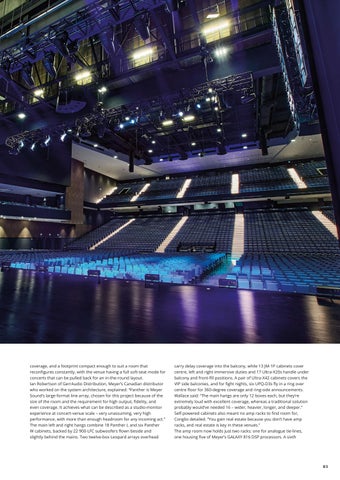
coverage, and a footprint compact enough to suit a room that reconfigures constantly, with the venue having a full soft-seat mode for concerts that can be pulled back for an in-the-round layout. Ian Robertson of GerrAudio Distribution, Meyer’s Canadian distributor who worked on the system architecture, explained: “Panther is Meyer Sound’s large-format line array, chosen for this project because of the size of the room and the requirement for high output, fidelity, and even coverage. It achieves what can be described as a studio-monitor experience at concert-venue scale – very unassuming, very high performance, with more than enough headroom for any incoming act.” The main left and right hangs combine 18 Panther L and six Panther W cabinets, backed by 22 900-LFC subwoofers flown beside and slightly behind the mains. Two twelve-box Leopard arrays overhead
carry delay coverage into the balcony, while 13 JM-1P cabinets cover centre, left and right immersive duties and 17 Ultra-X20s handle under balcony and front-fill positions. A pair of Ultra-X42 cabinets covers the VIP side balconies, and for fight nights, six UPQ-D3s fly in a ring over centre floor for 360-degree coverage and ring-side announcements. Wallace said: “The main hangs are only 12 boxes each, but they’re extremely loud with excellent coverage, whereas a traditional solution probably would’ve needed 16 – wider, heavier, longer, and deeper.” Self-powered cabinets also meant no amp racks to find room for, Conglio detailed. “You gain real estate because you don’t have amp racks, and real estate is key in these venues.” The amp room now holds just two racks: one for analogue tie-lines, one housing five of Meyer’s GALAXY 816 DSP processors. A sixth
83