| Astro
|
Gabriel Scott - Welles Chelsom - Decorative Touchless System Loïe Pendant - Edward Collection One Piccadilly

|
|
Office Lighting | Penta | [d]arc awards 2021
SPRING/SUMMER COLLECTION 2022 Follow @astrolighting | astrolighting.com Edward Collection

Hang-OutCover:Penta-FeatureLightingOffice
Elsewhere, we delved into current projects and products in our Office Lighting feature. The recently completed One Piccadilly by SpaceInvader presents decorative acoustic lighting solutions suitable for a large workspace, which took design inspiration from the building’s rich history in clay mining. Catch this project, plus some manufacturer case studies and products from p.44 onwards.
Sarah Cullen • Editor Welcome


Also celebrating a decade in decorative lighting is Gabriel Scott. I caught up with Scott Richler, Co-Founder, to discuss industry trends, key moments for the studio, and his design influences. Plus, we cover the launch of six new designs of the Welles chandelier commissioned by Richler to celebrate the anniversary. Read more on p.28.
In addition, we look at the collaboration between Mydriaz and Lison de Caunes in our Materials feature on p.37, and the Decorative Touchless System by Chelsom in our Product Focus on p.25. We look forward to seeing you soon at one of the upcoming events – drop us a line if you want to meet up or book a meeting!
Following the [d]arc night celebrations on 31 March, we cover the winning decorative lighting installations and products from the 2021 [d]arc awards. Catch all awards coverage starting on p.58.
We’re at the halfway point of 2022 already. Can you believe it?! And with that, comes a ramp up of industry events, which the darc team is very excited about. Our second edition of [d]arc sessions, this time held in the Middle East at a stunning resort in RAK, was a resounding success, following the [d]arc sessions debut in Mykonos last year. Already, places are filling up for the next event happening in October, back at the idyllic Royal Myconian resort in Mykonos, so get in touch if you want to book your place or visit www.darcsessions.com for more info. Then just around the corner, we will be heading over to New York City for ICFF and Wanted Design, then back to Europe for Milan Design Week in June. We can’t wait to see everyone again and discover all the fantastic new lighting pieces that are going to be launched this season. Inside this issue, we cover an array of new products, designer interviews, and recently completed projects. Aqua Creations celebrates its 10th anniversary this year. I sat down with Albi Serfaty, Founder, to find out more of the studio’s milestone projects and launch of the limited-edition Morning Glory lamp. Read more on p.16.


FLOATING IDEAS MILANO DESIGN WEEK 6−12 JUNE 2022 Six international designers. The Welles chandelier reimagined for Gabriel Scott’s 10th anniversary. KELLY HOPPEN CBE ALESSANDRO MUNGE GUAN LEE MICHELLE GERSON SYBILLE DE MARGERIE DAVID ROCKWELL


STEP INTO THE…
The UK’s only dedicated lighting specification exhibition
22 & 23 November 2022 Business Design Centre Islington • www.lightexpo.londonLondon
087
Clerkenwell Design Week Preview Catch some of the new products that will be on show in London this June. FeaturesProjects #readinginthedarc Proudly Supporting The Magazine Managing Editor | Helen Ankers +44h.ankers@mondiale.co.uk1614768372 Editor | Sarah Cullen +44s.cullen@mondiale.co.uk1614769401 Contributing Editor Matt Waring Media Sales Manager | Stephen Quiligotti +44s.quiligotti@mondiale.co.uk7742019213 Design Artwork | Dan Seaton d.seaton@mondiale.co.uk Editorial | Mel Capper m.capper@mondiale.co.uk Finance Finance Director | Amanda Giles a.giles@mondiale.co.uk Credit Control | Lynette Levi l.levi@mondiale.co.uk Corporate Chairman Mondiale Publishing | Damian Walsh Managing Director [d]arc media | Paul James p.james@mondiale.co.uk Marketing & Events | Moses Naeem [d]arcm.naeem@mondiale.co.ukmedialtd|StrawberryStudios, Watson Square, Stockport SK1 3AZ, UK | Printed by Buxton Press, Palace Road, Buxton, UK | ISSN 2052-9406

45ISSUEINSIDE|008 Contents 062 Focal Point | [d]arc awards | Park Row Structural Lighting Sculpture | UK 0 64 Fo cal Point | [d]arc awards | Kuulas | UK 016 Interview | Albi Serfaty | Aqua Creations 025 Product Focus | Chelsom 028 Interview | Gabriel Scott | Welles 037 Materials Feature | Mydriaz | Loïe 090 In Focus | Astro | Edward Collection 010 Th e Gessner Way of Life's The Gessner is a collection of 164 apartments to rent and guest suites for short stays located in Tottenham Hale, London. Taking inspiration from member's clubs, design studio Fettle Design completed the residential schemes. 044 On e Piccadilly As part of our Office Lighting feature we take a look at interior design studio SpaceInvader's transformation of the previously lifeless One Piccadilly office and retail building in the heart of Manchester, UK, into a vibrant and contemporary bustling hub. The team took inspiration from the city's rich history in clay mining and piccadils to influence colour palettes and fixture choices. 051 Offi ce Lighting We take a look at some of the most recent workspace lighting projects from across the world, as well as our top picks of decorative lighting products suitable for an office setting. 058 [d ]arc awards Winners Following the celebrations of [d]arc night on 31 March, we cover the decorative lighting winners of the 2021 [d]arc awards. 075 Ma nufacturer Case Studies darc covers some of the latest projects produced by brands from across the world.
Regulars

Fettle’s curated design approach for The Gessner spans living spaces
Making A House A Home
GESSNERTHE|PROJECT|010
interior architecture is decidedly neutral to allow residents to put their own stamp on their home or move into a fully furnished space curated in a way they can interpret.
Way of Life’s offering includes full-service, contemporary rental agreements in London and across the UK. It is designed to lay the foundations for renters to make a home, with ready-to-move-in accommodation, no-fuss tenancy management and an in-house team to take care of billing, contracts, and general life admin, with no need for deposits or service charges.
Way of Life's The Gessner is a collection of 164 apartments to rent and guest suites for short stays located in Tottenham Hale, London. Taking inspiration from member's clubs, design studio Fettle Design completed the residential schemes.
A full-service contemporary rental offering for the UK, Way of Life's 164 apartments to rent include a selection of studios, one, two, and three-bedroom apartments with views across London. Tenancies for the apartments start from six months to five years, and all apartments are pet-friendly, with many including private balconies. Amenities include an on-site café, fully equipped gym and full-time concierge and support team on site. Shared spaces for residents include a large rooftop garden with BBQ, communal kitchen and dining room, sitting rooms and lounges with fireplaces. Apartments are available furnished or unfurnished, meaning the

Dedicated guest suites provide opportunities for visitors to experience the Way of Life lifestyle and design, available for a minimum of two nights. Guests can stay in the double bedrooms and gain access to all the amenities and perks enjoyed by full time residents, including the

Following Way of Life’s philosophy, the homes give residents the opportunity to make them their own. Most of the furniture is bespoke and suited to each apartment size, including some signature bespoke
011
lighting pieces for shared spaces. A focus on quality and attention to detail is evident even down to the finer touches across the rooms; a fully equipped kitchen supplied by Borough Kitchen, Buster and Punch ironmongery, Earl of East bathroom products, smart TV from Samsung, equipment from YogaMatters and handmade ceramics from local artisans.
as well as communal areas, which include guest kitchens and dining rooms, lounges, an on-site café and workspace, and a large-scale rooftop terrace. The thoughtful design elements draw on Fettle’s experience with leading hotels, bars, and restaurants across the globe, which is reflected in the mixture of private residential spaces and communal areas, designed to anticipate how residents will utilise different areas throughout their tenure.

GESSNERTHEPROJECT|012
residential feel and a beautiful ambience in the public spaces such as the lobby and shared spaces like the dining and living room. Low level lighting such as table lamps and floor lamps provide additional feature lighting, complemented by wall lights and picture lights which create this layered effect.
same high level of finishes and thoughtful designs throughout. Andy Goodwin, Director at Fettle Design, tells darc about their involvement and approaches to decorative lighting throughout the residential project. “We were approached by Way of Life to design the interiors for The Gessner, taking on both the residential apartments, short stay guest suites and communal areas. Way of Life wanted to create a space inspired by best-in-class hospitality, so our experience working in hospitality - designing for hotels, restaurants, bars and members clubs - was a huge advantage,” he explains.
“Decorative lighting is incredibly important when designing a space. One of the elements we introduced, which differentiates The Gessner from others in the sector, is the layered approach to lighting in the communal areas. We approached the lighting the same way we would for one of our hospitality projects, using a layered approach to create a
“Within the residential apartments and guest suites, we opted for a smaller quantity of lights to create the same effect in these more intimate spaces. Traditionally, apartments in this sector would not feature an abundance of lighting, but we introduced pendant lighting, and even chandeliers in some of the larger apartments, which is relatively unusual. These are complemented by table lights and smaller lights to allow residents to control the lighting in their apartment to suit their changing needs over the course of the day - whether they are working, relaxing, or spending time with friends - and create ambience

Goodwin’s final impressions were that of a renowned success for all involved: “We really enjoyed working with the Way of Life team to deliver The Gessner and have been delighted with the outcome. We utilised many of the same suppliers we use within the members clubs, hotels, and restaurant projects that we work on and believe that this, alongside our extensive experience of these spaces, has created a unique perspective to this residential scheme. We collaborated well with the client team who pushed us to develop a scheme that we feel is totally different to others in this sector and will be an amazing place to reside. We hope the residents enjoy living there as much as we enjoyed designing it.
“From a design perspective, the lighting was one of the areas that we


With the majority of fixtures supplied by Zico Lighting, Goodwin continues describing the importance of decorative lighting and how it impacts the overall ambience and impression of a space, as well as the design choices behind the fixtures used in various spaces: “In many of the communal areas for residents, such as the ground floor guest lounge and 13th floor dining room and resident lounge, we introduced larger bespoke lighting for impact. Ceiling fittings such as chandeliers or semi-flush fittings on the ceiling, create a main focal point within these spaces. We decided on bespoke fittings for the ceiling lights, to maximise the impact and make them a feature in their own right. In both the communal areas and the private spaces, we paired the larger ceiling lights with wall lights to create a sense of depth in the space. For the wall lights, we worked with a long-time collaborator Visual
Comfort, which provided high quality finishes for the lights that align with the wider interior design of The Gessner.”
013 when required.”
Images:www.wayoflife.comfettle-design.co.ukWayOfLife
GESSNERTHEPROJECT|014
Design Details
Taking inspiration from member's clubs, Fettle Designs created residential spaces that were homely and contemporary, yet flexible for residents to make their

The Gessner, London, UK Interior Design: Fettle Design Lighting Specified: Northern Lights, Visual Comfort, Zico Lighting
Usingown. fixtures from Zico Lighting and Visual Comfort, an increased presence of decorative lighting over architectural lighting created a warm abmience in the public spaces. This formed the layered lighting approach the team wanted to create, which emphasises a residential feel across the apartments and shared spaces.
pushed to differentiate from competitors and previous projects Way of Life has developed. We decided to reduce the amount of architectural and down lighting in the space and instead utilised incandescent light from decorative elements, creating a warm and inviting space. As you enter The Gessner and move around the public spaces, the lighting helps to create a sense of welcome, which invites you in and helps residents feel at home. From this perspective, the choice of lighting was a key reason why the project fulfilled the brief and has been so Gavinsuccessful.”Chetty, Creative Director of Way of Life, adds: “With their impressive track record in hotels and hospitality design, Fettle were our partner of choice to bring The Gessner to life. Fettle’s design sets a new standard for stylish, quality yet accessible rentals in London, with high calibre design, which has been considered down to the last detail. Our vision for The Gessner is to raise the bar for hospitality-inspired living in London and create spaces for residents, guests, and visitors to enjoy however they choose. We’re delighted to welcome the first residents and guests to experience this new Way of Life.”
The Secto Design lighting collection is designed by the award-winning architect Seppo Koho. The diligent handwork is carried out by highly talented craftsmen in Finland from top-quality local birch wood.

Built of harmony
www.sectodesign.fi
Designers at Holloway Li create an Industrial Revolution-inspired multi-use retail showroom and co-working space for furniture and lighting brands in London, UK.
COALBROOK'S|PROJECT|000
Industrial Influence
name from the town of Coalbrookdale in the Midlands, the site of the world’s first iron bridge and cradle of the Industrial Revolution. Taking inspiration from this, Holloway Li’s design evokes industrial forms and materiality: the chimneys that towered over the skylines of cities, the searing heat of the furnaces and engine
rooms, and rough chiselled quarries. Blurring the boundary between historicism, decoration and digital process, Holloway Li worked closely with a network of master craftspeople to subvert the materiality of these industrial backdrops, eschewing traditional expectations of a showroom to form a surreal internal Researchinglandscape.thehistory of industrial forms and processes that form Coalbrook’s identity, the studio produced a unique way to engage with the brand’s narrative. The ground floor is designed to
Images: Nicholas Worley
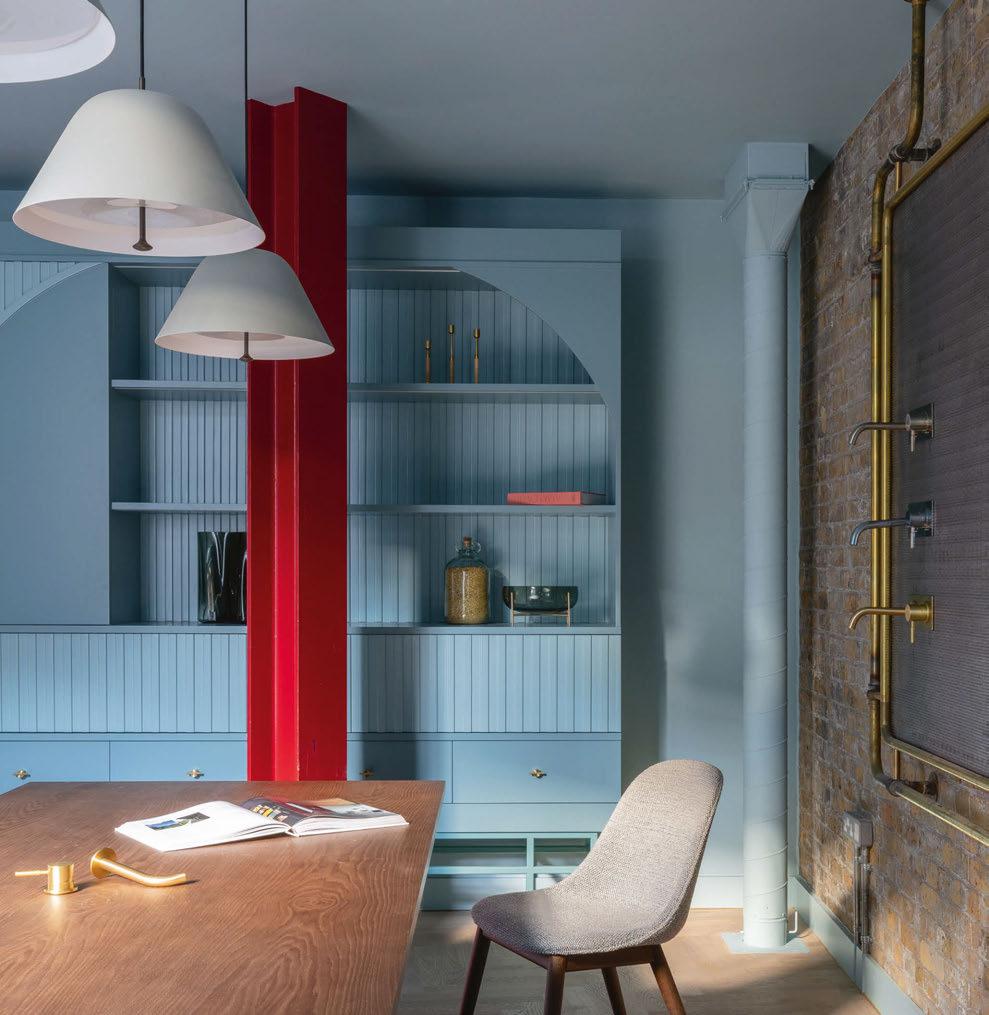
Holloway Li, a London-based design studio, recently completed an experience-led showroom and co-working space in Clerkenwell inspired by the lost forms of the Industrial Revolution for bathroom brand CoalbrookCoalbrook.takesits
000
Looking at the lighting used throughout, Holloway explains how each space had a “particular atmospheric quality and material palette”, and as such, the decorative lighting was chosen in accordance to suit.
Other collaborators-in-residence exhibiting at the space include Danish furniture supplier Menu, lighting manufacturer Phos and The Stonemasonry Company, as well as housing Holloway Li’s own studio. Speaking of their involvement in the project, Co-Founder Alex Holloway tells darc: “We were approached by Davroc, the parent company of Coalbrook, to design a space to consolidate their various brands in a London-based space. The client wanted to communicate their history in British manufacturing in the Midlands, where they still own and run two “Thefactories.spacewas also an opportunity to tell Coalbrook’s story as a brand “Thespatially.design process lasted around four months, and construction took another four months.”
“This allowed us to evolve each of the specialist elements with fabricators, and maintain the integrity of the initial concept," Paranagamage continues. “As mentioned, the project was born out of multiple collaborations, of which each entered into the project at various stages. The brief had to be tailored to suit the desires and capabilities of each as they entered the project.”
Due to the nature of the project and its involvement of multiple collaborators in the shared spaces, it could be assumed that the brief would be difficult to stick by. However, Project Architect Praveen Paranagamage reflects that “unusually, the brief remained relatively fixed from the beginning”.
“The remainder of the work was taken out of the main contract and tendered to specialist fabricators and suppliers, who we established relationships with early on before the main construction contract began. The metalwork display items, resin display panels, cast iron display panels, stone staircase, lighting, controls, mechanical work, and furniture were all taken outside of the main contract.
“For instance, the co-working spaces have a more domestic feel, and

main construction contract was restricted to structural, electrical, plumbing, and decorative works,” she explains.
Telling darc about some of the challenges the studio faced when turning Coalbrook’s brief into a workable project, Co-Founder Na Li adds: “The design was ambitious given the budget, required a number of specialist fabricators and the timeframe was very compressed. To deliver this, the project was procured through an unusual route. The
appear like a landscape of industrial chimneys, with ghostly casts of Victorian bathroom wall panels in piercing orange and amber resin. The basement is a dark, watery space with the atmosphere of a subterranean engine room, occupied by two oversized industrial boilers and wall panels moulded from cast iron.
on how the project differed to their portfolio of designs, Holloway adds: “The project was set up in an unusual way, with

“As the decorative lighting is more visible as objects, we also considered how to draw the eye to particular elements as customers move around the space.”
COALBROOK'S|PROJECT|000
the basement lighting feels more industrial with raw cast and rolled metals,” he says.
“The decorative lighting by Menu on the other hand is used to draw the eye to the lights themselves.”
“The architectural light fittings by Phos were custom-coloured to suit each space. They also light up the display panels in specific ways. For example, in the basement, a hidden, amber-coloured LED strip washes the pavement walls with an orange glow, reminiscent of industrial “Wefurnaces.didnot

Balancing the decorative lighting elements from Menu, the team integrated pieces from Phos for the architectural requirements. Holloway explains further: “The architectural lighting by Phos creates the general atmosphere in the spaces and are also used to light specific design features. They provide more ambient lighting and are not designed to be specifically looked at.
“[At Holloway Li] we often specify both the architectural and decorative lighting on projects, but where project budget allows, we see the benefit to working with a lighting designer. On a project such as The Market Building, where creating a particular atmosphere, as well as lighting the display items in a very specific way was key, our collaboration with Phos was crucial to the success of the lighting
Lighting played a key role throughout the showroom to help define the various spaces and form the ambience in each. “We wanted to create a marked shift between the lighter upper galleries and co-working areas, and the moodier, darker ambience of the basement meeting rooms and boiler room,” says Paranagamage.
Commentingdesign.”
work with a lighting designer specifically. However, we worked closely with the Phos team to specify appropriate lighting fittings to achieve the atmosphere we wanted to create, but also to allow Phos to exhibit a range of different types of light fittings.
“The co-working spaces each have a visual identity, which ties back to the overall concept. While the gallery spaces have a raw industrial feel, the co-working areas feel softer and more domestic, in Robert-Adam style blue and pink. The decorative lighting in the co-working spaces were therefore chosen from Menu’s domestic range and are not specifically suited as workspace lighting.”
Li adds: “The decorative lighting is by Menu Space, which entered the project as another collaborator-in-residence. In addition to the primary function as a showroom for Coalbrook, the space acts as a showcase for Menu’s furniture and lighting.

CREATIONSAQUAINTERVIEW|016 “ THE UNDERWATER LIFE IS AROUND,LITTLEBEAUTIFULINCREDIBLYANDTHEEVER-CHANGINGNATURENEVERFAILSTOINSPIRE.30YEARSAGO,THEREWASVERYORGANICANDSCULPTURALDESIGNSOWEFELTWEHADSOMETHINGVERYSPECIALONOURHANDS.”

017

This January, Israel-based Aqua Creations reached its 30th anniversary. Looking back at some of its iconic designs, darc Editor Sarah Cullen sits down with Founder and Creative Director Albi Serfaty to reflect on their third decade of lighting creation.


The coral reefs mentioned are located in the Red Sea, which Serfaty discovered while on a snorkelling trip. The “underwater life, organic
Born in Jerusalem, Serfaty grew up in a “handy family”, with one brother a watch maker and another a painter. As the youngest, he was keen to assist with the various building projects, which acted as his “formal” education. By the age of 13, he received a dark room and camera as a present from his brothers and became a self-taught Serfatyphotographer.describes his hands-on childhood as one that was “all about problem solving in an aesthetic way”. He continues: “I love the need for the new, but also admire the old. My favourite object is over 200,000 years old; a working tool from the Stone Age, and it is perfectly handmade. Often, I think about the prehistoric person as a designer by need. I never decided to become a designer, I just became one, and I
CREATIONSAQUAINTERVIEW|018
am also a designer by need.” Taking photography into career, Serfaty became a Still Life pro in the advertising world. But eventually his creative disposition found other avenues to explore. “It became boring for me to take photos of tea bags and such. All I wanted was to work and look at cool things. I opened a creative studio named Communication Factory, which was a group of photographers, copywriters, and graphic designers, offering creative services for advertising companies. After a few successful months we merged with an advertising agency, and one year later as creative director I understood three things: The advertising world is not for me. My passion for photography doesn’t get satisfied here, and it is going to be a long race with lots of mistakes and it’s better to have my own “Withcompany.thisinmind, Aqua Creations came to life straight from the coral reefs of north Sinai (Egypt) and up until today I have the opportunity to make wonderful objects and to take their photos.”

“There was a crazy amount of creativity in one place. Also, the Italian companies like Cappellini, Flos, and Luceplan were exploding from creativity. We all felt part of a new design movement. Our contribution in this new world was the use of organic forms, soft materials, and
to their time at Milan Design Week, he adds: “When we first presented our works, the public and art scene loved our designs as much as we did ourselves. The sculptural, organic, and emotional design is what’s still at the core of Aqua Creations’ DNA today.
shapes and natural forms” are what inspired his first collection’s design. “It is incredibly beautiful, and the ever-changing nature never fails to inspire. 30 years ago, there was very little organic and sculptural design around, and we felt we had something special on our
reflects DisplayedSerfaty.atthe
Thehands.”Aqua
CREATIONSAQUAINTERVIEW|020
It was at Milan Design Week 1997 that Aqua Creations was first shown to the design world and general public, rubbing shoulders with the likes of “Ingo Maurer with his endless creativity, Ron Arad with his poetic metals, Droog Design with their ideas - design was also around,”

Creations studio resembles Serfaty’s childhood experience and is led with a strong family ethos, comprised of members of his family and close friends. “We are a family,” he states. “Some have been with Aqua from the beginning. We are a part of each other’s daily lives and major life events such as weddings, and we see each other’s children grow up.”
InterNos gallery, Aqua’s products stood out among very minimalist “white on white” products, as described by Serfaty. “We were with the wrong products at the wrong time, but in the right city. Milan loved us and we were gracefully welcomed. To this day I still feel an appreciation for this city and its elegant and free-minded Furtherpeople.”
“Good product design should include a balance between so many things, but mainly it needs to surprise.”

emotional design – inspired by nature.”


The silks are then dyed in Aqua’s studio using its signature range of 16 colours, or it is digitally printed using its L&LD Live & Let Dye programme, which was developed in-house at the studio. After printing, the silk is hand-pleated and applied to the lamps. When asked about his experience of working with light, it is evident
“Now, I’m working on a new collection, which combines technology and craft in an exciting new way for me. It is a game between 2D and 3D illusion with our signature silk, but in a new and refreshing way.
For the studio’s new limited-edition collection of Morning Glory, the weavers have created Desi silk, a special raw silk that has a unique natural colour that is both beautiful and strong.

021
it is a medium that he has worked with closely for a long time before becoming a product designer. “I’ve worked with light as my main tool in photography, as it is with my design. I make rules and also enjoy breaking them. Light should bring emotions, beauty and of course some light to a space.
Looking back at some of the studio’s most notable projects, Serfaty reflects on the project for Oceanic Park in Valencia, Spain, which they completed in 2000. The team was hired to create a custom-designed centrepiece for the Submarino Restaurant in the heart of the Oceanic Park. However, at the time Aqua didn’t have any light fixtures large
The majority of Aqua’s pieces are created using silk the team has sourced from the same traditional weaver’s village in south India for the last 30 years. The village produces Aqua’s signature Tusser silk using silkworms that live in the forest. Moths are then allowed to emerge from their cocoons naturally before the empty shells are harvested, soaked in boiling water, and softened into silk.
CREATIONSAQUAINTERVIEW|022

enough to fill the space. “After seeing the location, while sitting in a bar we drew up the design on a paper napkin,” he says. The result was an 1800kg, 15-metre diameter light sculpture. In turn, its Stand By family came to life shortly after, inspired by the designs for this project, and has since become one of the studio’s most successful collections.
lighting fixtures are suspended amidst the central stairs, which at the ground floor is surrounded by a Japanese Zen Garden.”
What lies ahead for the studio? Serfaty continues to explore and experiment with designs using natural materials and how they work in collaboration with light, producing lots of new designs in response to and influenced by the world around them. “We love organic materials, but we also love to innovate,” he explains. “My focus at this time is the technical aspect of lighting. We are now working on a new silk collection that is our thinnest design yet. This is a fun challenge for me, which allows me to push the limits of what we thought was possible for Aqua Creations, while still being able to make the design that Aqua is known for.

“We are also currently working on the MakeLight Collection. A range of small and smart lamps that can be controlled by an app, which we are
One of the most frustrating things for Serfaty as a product designer is the time it takes for a design to come to fruition, yet at the same time, its most rewarding aspect is seeing a final design match closely to its original sketches. This was true for the Oceanic Park installation. Another notable project the team recently completed was for car brand Suzuki. “[We] were commissioned by Suzuki Israel to design a centrepiece for the new main branch and showroom in Rishon LeZion, Israel,” says Serfaty. “Three Nana 200’s, in a bright red colour, fan out across two floors, sending a warm glow across the entire space. The
An important factor to include in their continued design journey is that of their role as designers and the wider impacts of creating consumer goods has on the world and its climate. Serfaty is eager to ensure designers design with the purpose of securing a safe future for younger generations to grow into.
Celebrating 30 years of product design, Aqua Creations continues to experiement and push its designs into new Exploringdirections.the integration of new technologies and materials, Serfaty and his studio continue to take inspiration from the world around them, whether that’s through societal situations or the natural environment, to form new lighting designs.

023
And finally, inspired by the Covid-19 pandemic, the studio has created Code 130°. “I felt a responsibility to create a way to light up the future. This is my joyful colorful contribution to elevate our lives; we all need to lift ourselves up.
“Design’s most important role now is to deal with climate change. Most aspects of our life have to do with consuming goods, which are created by us the designers. We must give our children the chance to live on this planet peacefully. I think that design has a huge role in not stealing the future of our children, as said by Greta Thunberg.” aquagallery.com
developing in-house, the first of its kind from our studio. The lamps are made to influence your mood and state of mind. We will share more about this by the end of this year.”

Inspired by a growing demand for fewer touchpoints in hospitality settings, a direct influence of the global pandemic, Chelsom’s latest release is the Decorative Touchless System (DTS).
Chelsom's new Decorative Touchless System allows for contactless control of light fixtures. darc finds out more about the new technology that suits the demands of reduced touchpoints within hospitality environments.
The customised accessory allows users to switch lighting on and off using an infrared sensor that detects the human hand from a distance of five centimetres. The sensor can be built into any of Chelsom's
standard or bespoke lighting pieces, and is most effective and userfriendly in a table lamp or wall light application. The sensor can be mounted within the base of a table or desk lamp, as well as within the backplate of a wall-mounted sconce or reading light.

CHELSOMFOCUSPRODUCT025
“The innovative system has been developed in the wake of the Covid-19 pandemic, as the hospitality and marine sectors have constantly sought
Touchless Technology
The decorative nature of this switch gives both lighting designers and interior designers the opportunity to blend both practical and aesthetic product design needs.
Managing Director, Will Chelsom, comments: “We are fully aware that there is a demand in the market for products that can help to minimise the spread of bacteria and viruses, not least of all Covid-19. Although this switching solution will never totally stop the future spread of such things, it will significantly reduce touch points in places such as hotel guestrooms and cruise ship cabins, where regular light switching can cause multiple touchpoints in a room. We wanted to go further with the touchless technology by making it beautiful as well as practical so that interior designers can get excited about using the system from an aesthetic perspective.” www.chelsom.co.uk
CHELSOMFOCUSPRODUCT026MATERIALS000
The DTS technology can operate across a wide range of voltages, from 100 to 240VAC, and is full compatible with both conventional and LED light sources, making it suitable for global applications.
to reduce touchpoints in hotel and cruise ship accommodation,” says Chelsom. “As with many things that we do in product design, the DTS system fuses the latest technology with striking aesthetics so that function and beauty can co-exist.”
A knurled metal collar encases the sensor and can be plated or powder-coated in an array of finishes to include brushed brass, black bronze, antique brass, brushed nickel, satin black and many others.


WELLES|SCOTTGABRIELINTERVIEW|028

Looking at various design influences over the last decade, particularly within decorative lighting, Richler has observed that around 2012 there was a movement in the US towards independent designers and makers gaining more attention. “I think that in the last 10 years or so we’ve seen furniture and lighting as more of a democratic deployment of creativity. I wouldn’t say that it’s the same for today, entering the market, but I think there was a sweet spot. I think the last 10-12 years has been interesting because trends were introduced into the market that probably wouldn’t have been if it was just up to the likes of Flos or Artemide that dominated. These independent manufacturers for America created more texture.”
celebrate its 10th anniversary this year, Canadian luxury lighting brand Gabriel Scott has launched a specially commissioned range of Welles chandeliers that were reimagined by six selected designers and architects.
In 2014 came the opening of the Gabriel Scott showroom in New York, which was a pivotal moment for obtaining further poignant collaborations thereafter. Notably, a five-storey residential project in the West Village of New York that featured a Welles light fixture in the stairway, which was designed and implemented during construction.
029
Gabriel Scott
“The jewellery and fashion aspect are more of a tectonic influence. The way jewellery works and the way lighting works is similar; you have something shiny, you have a comparison in terms of the parts, and I think one of the most obvious inspirations is the materiality.”
Reflecting on the first 10 years of the Gabriel Scott brand and the work produced by the studio, some of the key milestones have involved collaborations with large international design firms as well as the launching of global flagship showrooms.
After leaving architecture, Richler moved into fashion design, specifically jewellery, accessories, and luxury leather goods in 2006.
“Our first collaboration with an international brand, which came right on the back of the heels of our debut launch, was with Rockwell Group, which is why we chose to feature them as part of our Floating Ideas project. They are big hospitality designers, and we were just kids at the time showing off our new line. We got the Fairmont Le Château Frontenac project with them, which was in Quebec, where we created a custom fixture for over the main bar. I think this was a milestone project because it was a moment of ‘Hey, you can do a collaboration with people outside of our league!’”.
The redesigned pieces of the best-selling and iconic fixture will be presented during Milan Design Week at a formal presentation titled Floating Ideas.
Richler and his small team were surrounded with the “usual suspects” such as Bec Brittain, Apparatus, Lindsey Adelman, and Matter, plus many other American makers, when the brand launched. “At the time, we were very small, and it was really an introduction,” reflects Richler.
Further to this, another key influence for Richler was to create a range that was formed in an OEM, parts manufactured way. He wanted the products to be created bespoke, but without using bespoke artisans in their entirety. He referred to the manufacturing process as being like that of cars: “The parts for a car are made in different factories, so you have to have good engineering throughout the entire design process, and figure out how you’re going to do that. That was important because I wanted to be able to get the lighting pieces out there, have them shippable, exportable, and realistic in terms of cost.”
Inspired by jewellery, the original design for the Welles is an iconic, physical manifestation of Gabriel Scott’s design philosophy – to design and make modular products to custom specifications. Formed of a series of hollowed polygons, which branch out into a modular system of interconnected configurations, the Welles presents a stunning optical illusion. The sculpturally innovative design allows the piece to float delicately, producing a soft light through its multifaceted shapes. Co-Founder Scott Richler speaks with darc Editor Sarah Cullen about his designer background, and the studio’s inception, along with its design influences.
Another “monster moment” for the team was in 2017, when they first showed in Milan. “It was great because that introduced our brand to
To
Richler began his design journey at McGill University in Montreal where he studied a degree in Architecture, graduating in 1998. “I would recommend the degree to a lot of people, but also not. It’s a hell of a lot of work to go through architecture school, and then there’s no real guarantee of getting a job at the end. It does, however, cultivate a lot of your creativity and konwledge of history, and mixes it all together into quite a good education,” he says. “But, I didn’t last in architecture very long. I think it was a year and half after I graduated that I began experimenting with other things. “The truth is, when I went into architecture, I didn’t know how to draw. I had always had a curiosity and appreciation for nice materials, but I didn’t know I was going to end up making things – that thought had never crossed my mind. It was a combination of my then girlfriend, now wife, and myself thinking ‘Why don’t I just try this?’, otherwise I would have probably applied to study medicine. I was equally good at sciences so becoming a doctor would have been the safe option!”
darc’s Editor Sarah Cullen talks with Scott Richler about the studio’s first decade in the decorative lighting market, and the newly commissioned Welles chandeliers.
“We were just hoping to get some attention; our offering consisted of a small number of pieces like the Dean series of side tables and one light fixture. It was very honest.”
“We worked with the architect in order to have this fixture integrated into the build. It was particularly interesting because the fixture sits all the way through the house and has lighting attached all the way through. It was a good introduction and exposure for us to see what we could actually produce and a clear confirmation that the Welles was certainly a very dynamic and flexible piece.”
“Between then and the launch of Gabriel Scott, which was six years later, I was designing bespoke furniture on the side. I had always wanted to return to building a brand that could be exported, distributed, manufactured, and shared with more people. The world of bespoke furniture was just so exclusive that you had a very limited clientele. I wanted to get back into something that resembled fashion in a way. And by that, I mean by something that was appealing to more people and had a brand attached to it.
Turning to more direct influences on Richler’s designs, he explains how “not all influences are aesthetic”.
Growing up in a family with no other designers, Richler surrounded himself with friends that would challenge his thinking, including Guan Lee whom he met doing his architecture degree and remained close friends since.
“I initially tried to launch something in the US in 2009, but that was the worst timing just after the financial crisis. However, this was a lead into Gabriel Scott, which eventually launched in 2012.”
Then came the launch of the London flagship showroom in 2019, where Richler is currently based and building a strong team.
WELLES|SCOTTGABRIELINTERVIEW|030
Naming the Welles as his favourite piece produced by Gabriel Scott, Richler loves its versatility and multiple personalities. “I had a client present photographs of one that was described as more feminine than usual. They had mixed in some frosted colours and put together something we never would have done ourselves. It’s constantly changing and getting reinterpreted by others and continues to surprise, it’s really nice to see.”
In addition to the launch of the new Welles chandeliers, Richler has also revealed that there will be an added capsule collection with various Welles configurations surrounding the six designers’ concepts. Further to the Welles capsule range, the studio is also working on a collaboration with an American sculpture that will be pushing the boundaries of scale for everyone involved. The new piece is due to be launched in the Spring. “They’re pretty epic in terms of proportions!” claims Richler. “He is scaling down and we are scaling up. But I can’t say too much about it for now…”
www.gabriel-scott.com
“I am delighted to be working with such high calibre designers to celebrate our 10th anniversary,” he says. “The designs they have proposed are original and a real testament to the spirit of the Welles chandelier, which is now five years old. The project title Floating Ideas came to mind because, when you float an idea, you want to see what it inspires in others - and how far it can be taken. I think this will be a

To wrap things up, we asked Richler for his advice for budding creatives that want to pursue a career in product design.
“I wouldn’t advise a creative-minded person to be too specific about what they want to do. In other words, I think the thing with creative fields is that you should remain open to the opportunities. For example, if you think you’re going to become a furniture designer and you end up becoming a sculptor, you haven’t gone wrong. So much can happen. You see this in a lot of fields, even in fashion with big creative directors. If they move from house to house and change what they’re doing, I think it’s what needs to be done. You need to keep an open mind and take opportunities to just produce creative work, whether it’s lighting, furniture, sculpture, arts, whatever. At the end of the day, what builds your career is active engagement.”
the greater public. Some of the people we met there and struck up relationships with were key for today.”
really special Milan Design Week for us and we look forward to sharing the show with everyone.”
As part of the 10th anniversary re-vamp of the Welles chandelier, Richler selected six top international designers to create their own creative interpretation of the fixture, still in-keeping with Gabriel Scott’s core design principles: versatile aesthetic, customisable and timeless. In order to ensure the designers produced varied results, Richler provided a specific brief that offered advice on design direction as well as technical execution that guaranteed each piece was a workable and buildable product.

SHARD COLLECTION SHOWROOMS IN LONDON | PARIS | NEW YORK | TAIWAN ORIGINALBTC.COM ORIGINAL BTC Unique Timeless Lighting, Handmade in England Authenticity, attention to detail and an interesting mix of materials are hallmarks of our lights. These are created by skilled craftspeople across our UK-based factories, using the best quality raw materials to ensure the longevity of every light. Discover the complete collection at originalbtc.com


A key consideration the designers took into account was the fixture’s density. “We experimented with different volumes to create a feature chandelier that can dramatically impact an interior’s overall mood and perception,” he explains further.
Sybille de Margerie Founder, Sybille de Margerie

“Whethershapes. the centrepiece of a space or a discrete object, its character expresses itself in a detail, or simply in purity of lines. Decorative lighting is designed for its destination. It is useful, mobile, and yet it can be considered as a sculpture by itself. It sympathises with atmospheres and finds its own place within a space. It brings a final glowing touch in harmony with the decor.” www.sybilledemargerie.com

“At Rockwell Group, our goal is to design environments through craft, technology, unexpected collisions, and the layering of materials. And lighting is one of our most important tools in terms of shaping a space; it adds another layer of texture and ultimately has a dramatic impact on the atmosphere and the perception of Thespace.”final piece uses smoky, textured glass in tones of grey and violet. The hollowed glass polygons act as “metallic light points that come together at varying heights and dimensions to form a floating cluster of gems”.
Growing up in family-owned Parisian palaces, de Margerie took inspiration from the
“I like the balance between tradition and modernity, attention to details, harmony of colours and textures. My vision is to highlight a timeless luxury that transcends trends.” De Margerie’s material choices reflect her “taste for noble materials” and “perception of
“I imagined a gradient composition from emptiness to fullness, with a variation of hollow and plain shapes. I introduced softness with round corners, thus creating new light effects and shadows. Overall, the composition features a nude structure dressed up with refined leather leaves.”
“Details are key in my designs, and I was specifically rigorous in the selection of finishes for this chandelier. I consciously opted for an approach using unexpected finishes like leather.”
“We’ve always admired the architectural yet warm silhouette of the Welles chandelier,” says Rockwell. “We specified a custom metal version of it several years ago for NeueHouse Hollywood. For our latest collaboration, we developed three concept designs celebrating the Welles chandelier’s classic geometric form.”
WELLES|SCOTTGABRIELINTERVIEW|032
Keeping a balance between Gabriel Scott’s brand DNA and her own interior design studio was key to the design process. De Margerie was also concerned with providing a product that fits a gap in the current market. “The Welles’ design is strong and innovative. In my opinion the real challenge consisted in keeping its original identity, its sculptural silhouette, while bringing a twist and feminine touch,” she explains.
“Forluxury”.the main materials we opted for a dialogue between metal and leather. Padding within the leather was added to create a subtle 3D effect. Leather brings a smooth look and feel in contrast with the metal,” she details. “The chandelier has been reimagined as a gradient composition from emptiness to fullness, with a variety of hollow and plain
David Rockwell, Founder and President, Rockwell Group David Rockwell’s reimagination of the Welles chandelier was inspired by “clusters found in nature, such as crystals, chemical compounds, and clouds.” Ultimately, the final design drew inspiration from botanic forms, which create a final installation referencing a bunch of grapes.

Rockwell places this piece in a hotel lobby or entranceway as its most suited environment. “The volume of the Welles chandelier can add a momentary sensation at the entry, which sets the tone for the rest of the experience before even stepping inside. Though short-lived, it’s a memorable encounter that feels elevated.” www.rockwellgroup.com
“My main purpose for the Welles chandelier was to create an elegant, couture-inspired, smooth and warm variation, revealing the feminine part of my signature,” says de Margerie of her design.

“importance of traditions, the finest service and savoir-faire”.

Hoppen visualises this versatile piece will work well in residential dining settings as well as in hotel rooms. Or layering a few pieces together to create a larger statement installation.
Gerson’s inspiration for her reinterpretation of the Welles was derived from the climate and mood brought about by the global pandemic.
Designing a collection of ceramics at the time, Hoppen took inspiration from these materials and textures to create her scaled-down, contemporary yet timeless Welles chandelier in a chalk white finish.

“Craftsmanship is at the core of everything that my KHI team and I do. Every design and detail is a couture, artisanal process, and I often collaborate with external craftspeople on bespoke pieces and exciting “Decorative,collections. statement lighting is everything in my design work. I knew that I would use this piece repeatedly in my future projects so— perhaps selfishly—it’s really designed to align with my taste!” www.kellyhoppeninteriors.com
Michelle Gerson, Michelle Gerson Interiors

“Decorative lighting is not only needed to actually light a space but is also a part of the whole picture and scene. It truly allows a space to feel finished. We think of Gabriel Scott lighting as the jewellery to our homes.” www.michellegerson.com
033
“We wanted the fixture to take on a more organic form while staying true to its geometric roots. All this led us to be inspired by nature, trees, branches, flowers, and leaves.
“My aesthetic is organic yet luxe with a touch of glam and quiet drama. We felt by softening the geometric forms of the Welles and adding a bit of texture it would be a collaboration that could really work,” she Gersoncontinues.chose malleable materials with softer edges that juxtapose the hard, geometric shapes of the original Welles with more “organic and softer textures”.
“We wanted to design something uplifting and joyful, that embodies a sense of artistry,” she says. “We turned to nature, bringing in a floral element to add that lively feel. It was important to us to represent growth and bloom, alluding to how something classic and a decade old could have a re-birth.
“I used matte white clay and satin brass for a classic, understated elegance. Mixing the neutral matte tones with an uplifting brass accent is somewhat of a signature design detail for me and always creates an interesting visual. It’s wonderfully delicate yet maintains that sense of movement that the original design does so well.
“The moment I saw [the Welles] I knew exactly where I wanted to go with my redesign,” she says. Key factors Hoppen considered in the design process were “staying true to the signature, iconic form with a refined, delicate touch, but changing the texture and size”.
“We chose to make the fixture’s arms take on the shape of organic branches, and we added perforated brass leaves to create texture and to show an airy element that could also reflect light in an interesting way.

Kelly Hoppen, Kelly Hoppen Interiors

“The prospect of taking such an iconic existing design and putting my interpretation on it was what drew me in. It’s always exciting working with such inspiring and innovative external teams, too.
“What we love so much about our fixture is how versatile it is and how it can be used in many different spaces. Like many different Gabriel Scott fixtures this one is also modular. You could use a single branch as a pendant over a bedside table or you can use three branches and have it act as a chandelier over a dining table. It could be used over a kitchen island, or you could use 10 branches and use it as a centre hall fixture in a double height space.
“Statement geometric shapes and decorative lighting are two things I just love, so working with the original design and putting my design influence on was an interesting project but for me the texture was imperative,” she adds.
“I imagine this new creation especially in homes, a place that is intimate and generous, in daylight as well as nighttime. The glass Welles accompanies the ones made in black ceramic, lit or not, like hand and glove.” www.grymsdykefarm.com
“Our design process always starts with a multi-faceted immersion where we listen to our partners and analyse the framework we’ll be creating within. In this case, we studied Gabriel Scott as a brand, its beautiful collections, and the original Welles fixture to extract core design principles and the essence that we wanted to preserve during the re-interpretation. We needed to bring forth something unique and drastically different yet remain on brand, relevant to the marketplace, and inherently connected to the iconic Welles.” Munge’s team was inspired by bold fashion references and rhythmic dance elements. “We also highlighted the beautiful jewel-like connecting
Interconnected with delicate branches, the faceted handblown glass globes appear floating in the air, performing a synchronised rhythmic dance.
“Different space typologies require varied solutions, so I wanted this fixture to be highly adaptable. While it will be presented in Milan as a single fixture, I also envisioned it as tiered and layered across ceilings. One of the qualities of this chandelier I’m most proud of is its ability to be specified in residential and commercial settings alike,” Munge concludes. www.studiomunge.com
bracket, making it a hero on the front of the glass,” he says. “While the fixture’s volume is radically different, the modular qualities remain with an ability to extend stems for extra tall ceilings and multiply the globes for larger spaces.”
Lee sees his Welles design as “building blocks that can tesselate together or simply amass to build something new”. Instead of an “orderly tessellation” of the Welles, instead Lee created a freeform amassing of two different types. “My recreation of Welles’ component is made of a material invented by my practice, POLiROCK, a porous black ceramic. This material shadows the shape of the original by literally making a shadow of it. The vision here is about strong contrast and clear integration. Contrast in materiality and integration formally. This is my interpretation of design reciprocity, working the unfamiliar through collaboration.”

“The Welles has such an innate architectural strength, I wanted to preserve its essence and dynamism while juxtaposing the original design with a more delicate feminine sensibility,” explains Munge. “We studied the piece from all angles and decided to celebrate its precise geometry, distinct modularity, and the various components that made it the well-engineered piece we all know.
Guan Lee, Architect, Lecturer, and Director at Grymsdyke Farm Lee’s re-interpretation of the Welles chandelier started with a question: what is ‘Reciprocity’? “I am an architect and academic with expertise in materials and digital fabrication. My background in digital workflows allows me to think through and explore the relationship between geometry and material unique to each project. I combine digital tools with traditional crafts in the design and making process,” explains Lee.

“I took on this project because it is an opportunity for me work with a leading designer and maker in glass, a material I am not familiar with. My piece is also about my friendship with Scott.

WELLES|SCOTTGABRIELINTERVIEW|034
“Welles’ geometry is iconic and materiality in glass a part of its identity. My aim is to capture and explore what is unmistakably Welles as a silhouette by absorbing light instead of letting it through.
Alessandro Munge, Founder and Design Director, Studio Munge Munge’s redesign of the Welles chandelier took a softer approach to counterbalance the geometric angles of the original design.
The “architectural strength” Munge identified in the original design was celebrated with “a thoughtful monochromatic statement”. “The all-black fixture evokes timeless elegance while also exuding a sophisticated sex appeal. The graphic lines and elements are highlighted in a refined fashion, making it a quiet yet confident chandelier suitable for fresh and moody environments alike.”

“Gabriel Scott’s Welles geometry is iconic and materiality in glass a part of its identity. My aim for this project is to capture what is unmistakably Welles with new materiality and design assembly. I want my creation of Welles to work as a distinct silhouette, by absorbing light instead of letting it through.”


“This particular Loïe piece with straw marquetry is part of Mydriaz’s first gallery collection of unique, limited-edition pieces. The collaboration with Lison de Caunes was very instinctive and the dialogue between the techniques felt completely natural. They are two worlds that work well Thetogether.”heating
As part of the new collection, Mydriaz collaborated with Paris-based straw artisan Lison de Caunes to create a limited edition range. darc editor Sarah Cullen sat down with Mydriaz’s Co-Founders Jennifer Midoz and Malo du Bouëtiez, along with de Caunes to discover more about their unique collaboration.
LOEDITIONLIMITED|FOCUSMATERIALS037ÏEPENDANT
signature piece highlights one of the techniques we have elaborated and perfected in our studio throughout the years,” says Midoz.
Opposites Attract
technique referenced by Midoz is one that the studio had used previously for its Mercure light that was extended and adapted into several other forms. This creative process allows the design team great freedoms in their creations, and allowed them to form the “whimsical curves of the Loïe supension light”, which is created by continuously
The brass petal-shaped Loïe pendants from Mydriaz are inspired by artist Loïe Fuller; an American actress and dancer who pioneered modern dance as well as theatrical lighting techniques. Her light and airy dance movements are at the core of influence for the pendant’s flowing shapes.

As part of its 10th anniversary, Mydriaz recently launched a high street collection of Loïe pendants. As part of this collection, a limited edition run of straw pendants were created in collaboration with Lison de Caunes.
“The original Loïe suspension is part of our high-street collection that we launched for our 10th anniversary. Created by heating a brass petal, this
ÏLOEDITIONLIMITED|FOCUSMATERIALS|038EPENDANT

Mydriaz's Loïe pendants use its signature metal heating and bending process to create the flowing, petal shape. Working closely with Lison De Caunes, the team seamlessly blended the straw craftsmanship beautifully with the smooth metal surface to create the unique, limited edition version of the lamp.
Manufacturing Processes


039


“The shimmering of the delicate fabric and the floaty allure of the moving material on [Fuller’s] costume is reimagined onto the brass structure of the light,” he continues. “With the limited-edition version, the straw marquetry represents the rays of light that accompany the Midozdancers.”explains the challenges they faced when creating a collection of pendants suitable for mass production: “The initial challenge was to design a signature piece with artisanal know-how, that could be part of a high-street collection, producing a series of Loïe suspension on a larger scale whilst ensuring the quality of the handmade piece.
“Each sprig of straw is individually applied by hand; as every lamp has a unique shape, the radial straw marquetry pattern is always different from one piece to another.

“Lison de Caunes is an icon and offers a rare savoir-faire.”
ÏLOEDITIONLIMITED|FOCUSMATERIALS|040EPENDANT
heating the metal with a bright flame. This malleable metal is then randomly sculpted into each pendant's unique shape. “The heating technique, which plays with the metal’s property, has become a hallmark of the studio’s collection,” adds du Bouëtiez.

“Once this had been achieved, we decided to collaborate with Lison de
Caunes to create an exclusive and limited-edition version of the Loïe suspension. The aim was to continue the movement of the Loïe petal with the fibres of the straw,” she continues.
“Her workshop is centred around straw marquetry; it is her signature craft. So, working with this atelier was a simple and clear decision. Both of our studios evolve in the same spheres of creation and design, making this partnership even more natural.
Adding of the initial collaboration stages, de Caunes says: “We were immediately captivated by the pairing of straw and metal. We had already worked with wall lights, floor lamps and bedside lamps, but the only thing missing was a chandelier.
Adding on some of the challenges she faced, de Caunes says: “We are more used to working with much larger furniture pieces, with a wooden base or even wall paneling. In the past, we have worked on lamps, including a metal creation by Hubert le Gal (the Serpentine sconces). Each new creation presents a challenge for us. Here, it was creating a marquetry that would fuse well with the curves of the lamp, but also to work with a piece that would be visible from below, which we had never done before!”
041
“The rye straw used in marquetry comes from Burgundy, France. I have been working with it for nearly 40 years; I inherited the craft from my grandfather André Groult, a famous designer from the Art Deco period. I think I can say that I have mastered it after three decades, even if it still surprises me every day.”
“We had to find the best way to arrange the straw according to the shape of the lamp. It was also important to think about how the light would play with our marquetry. To make sure that the colour of the straw matched the colour of the brass metal, we made a prototype.
The first Loïe is the product of 10 years of Mydriaz’s research. “Even though the real work of design and conception only takes a few months, the Loïe carries with it the full history of the Mydriaz studio, through the simple gesture of a brass petal naturally reshaped by the flame,” says du “TheBouëtiez.Loïe, made in collaboration with Lison de Caunes, is a result of a
With the original, all-metal version of the Loïe available to a broader market as part of Mydriaz’s high street collection, the special straw version is an exclusive piece from the studio, that also forms part of a gallery collection. “With the addition of pale gold and straw marquetry,
From left: Lison de Caunes, Jennifer Midoz and Malo du Bouëtiez
complex technical creative process and hours of meticulous work. All the brass elements and the straw marquetry were handmade in both of our Parisian workshops.”

Theversion.directional stripes of straw reflect the light beams breaking through the movements of American dancer Loïe Fuller, who inspired the pendant's shape and name.
www.lisondecaunes.commydriaz-paris.com
Commenting on the final outcome of the sophisticated pendant, de Caunes says: “I love it! I think it looks wonderful; it is light but at the same time gives a real presence in a room. The straw is accentuated by the shape and the perfect design of the lamp. It is an utterly beautiful collaboration that I was delighted to be part of with Mydriaz.”

“Since its creation, Mydriaz has always specialised in working with bronze. Today the primary material remains, and we like combining it with other materials such as glass, ceramics and textiles. It was important for us to honour this in our celebration of Mydriaz’s 10th “Foranniversary.thislimited-edition piece, we were keen to collaborate with an artisan that deals with completely different materials to us, so that we could propose several expressions on the movement of the petal. The straw marquetry adds a new dimension to the reflection of polished brass, as it creates a linear movement to it and perfectly aligns with the hanging of the suspension,” concludes du Bouëtiez.
the elaborate design of the Loïe is both exquisite and striking. It is an exceptional piece that radiates and brings warmth to a room,” reflects Midoz. “We work with light as a material, and this particular Loïe suspension light is delicate, suave and vaporous.”
The Loïe pendant celebrates Mydriaz's 10th anniversary in its first high street collection. As part of its first gallery collection, the original Loïe was adapted in collaboration with Parisian artisan Lison De Caunes to create a unique and stunning straw
ÏLOEDITIONLIMITED|FOCUSMATERIALS042EPENDANT
auralis.lighting

PICCADILLYONE|PROJECTOFFICE044
Originally designed by architects Allies and Morrison, and developed in 2003 by Argent, the building faces into the gardens with an impactful red-brick Comprisedfrontage.ofretail on the ground floor and office space above, SpaceInvader's brief was to design new interiors for the six-storey Grade A office spaces, creating a more inviting, dynamic office that promoted a sense of welcome, wellbeing, flexibility, and collaboration, via a scheme that would match the building fabric in terms of character and presence.
“The transformation forms part of a bid to bring more life and love to this part of the city,” says SpaceInvader Founder John Williams. “Helping to ignite a more vibrant surrounding area with a café culture feel. Legal & General took the decision to invest in the building in order to make a mark and help elevate the overall Piccadilly area.” Senior Interior Designer on the project is Regina Cheng who sat down with darc to discuss the project and SpaceInvader’s design intentions.
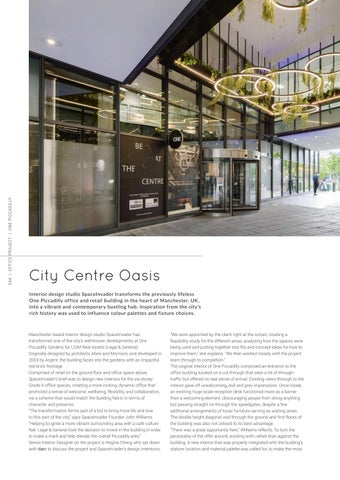
Manchester-based interior design studio SpaceInvader has transformed one of the city’s well-known developments at One Piccadilly Gardens for LGIM Real Assets (Legal & General).

“We were appointed by the client right at the outset, creating a feasibility study for the different areas, analysing how the spaces were being used and putting together test fits and concept ideas for how to improve them,” she explains. “We then worked closely with the project team through to completion.”
Interior design studio SpaceInvader transforms the previously lifeless One Piccadilly office and retail building in the heart of Manchester, UK, into a vibrant and contemporary bustling hub. Inspiration from the city's rich history was used to influence colour palettes and fixture choices.
City Centre Oasis
The original interior of One Piccadilly comprised an entrance to the office building located on a cut-through that sees a lot of throughtraffic but offered no real sense of arrival. Existing views through to the interior gave off unwelcoming, dull and grey impressions. Once inside, an existing, huge-scale reception desk functioned more as a barrier than a welcoming element, discouraging people from doing anything but passing straight on through the speedgates, despite a few additional arrangements of loose furniture serving as waiting areas. The double height diagonal void through the ground and first floors of the building was also not utilised to its best advantage.
“There was a great opportunity here,” Williams reflects, “to turn the personality of the offer around, working with, rather than against the building. A new interior that was properly integrated with the building’s stature, location and material palette was called for, to make the most
045
Lighting formed a central part of the brief, with various needs demanding unique attention, from task lighting and decorative ambience to wayfinding. “We didn't use a lighting designer but worked with Hydrock (M&E consultant) in the early stages to ensure we had the right general lighting lux levels to supplement and support the
Thewayfinding.concept formed by SpaceInvader was centred around the idea of creating a new community culture, featuring a series of attractive spaces for people to sit, relax, meet, and collaborate. Taking nods from the building’s rich history, the design also needed to be timeless with a non-exclusive appeal catering to a wide user and age-range demographic.
SpaceInvader was commissioned by Legal & General for the concept stage of the project and then novated across to commercial interior design, build and delivery specialist ADT Workplace for the construction delivery stage, and the scheme’s project managers were


of the great corner location and views out. This was evidently a wellestablished building with real potential for change.”
“We were inspired both by the terracotta colour of clay and the outer red building façade when it came to creating the design palette,” says Cheng. “Although, as it’s such a strong colour, the terracotta was to be used for highlights only. We also looked at the origins of the word Piccadilly, which comes from a 17th century frilled curved collar known as a piccadill. Roger Baker, a tailor who became rich making piccadills, lived in the area. The origin of the word is thought to be the Spanish “picadillo”, meaning pierced or punctured. Subtle references to this in the form of curves and punctures, especially using light, also formed part of our design language.”
The site dates back to the 18th century when Piccadilly Gardens was a wasteland on the edge of the city and known as the “daub holes”; an area home to a wet pit and ponds from which clay was extracted and used for the construction of wattle and daub structures.
TheParagon.fullscope of works by SpaceInvader covered the entrance, reception and atrium areas, a new upper basement bike store with adjacent changing rooms and shower space, the building’s lift core and circulation areas and a refreshed design for the non-tenanted office spaces on the third and fourth floors, as well as the scheme’s
The new reception area was completely rearranged, with a new, smaller bespoke desk featuring a portable Lee Broom table lamp, linking to other feature pendant lights in the space. Here, highlights of terracotta feature in various furnishings and finishes, as well as a play on ideas of light and dark referencing the concept inspiration of piercing and
PICCADILLYONE|PROJECTOFFICE046

into the atrium, architectural lighting is used in balustrades

The entrance to the building posed one of the greatest design challenges for the team, as a statement needed to be made without changing the external façade. “We re-thought the entrance as a ‘puncture’ within the passageway, changing its hidden nature and making it stand out by the creation of a new, hanging biophilic light installation above the entrance, set within a rectilinear LED light, which extends the full breadth of the passageway and is clearly visible from either direction of approach,” says Cheng. “We then added a new round ‘bus stop’ signage, using the development’s existing ONE logo, where all branding previously had related only to neighbouring retail and hospitality offers. We also increased the presence of the glassfront manifestation. Clear views through now ensure a new era of transparency for the interior, celebrating rather than concealing its existence.”
“The feature lighting choices all stemmed from what we thought complemented our concept and the overall look and feel of the scheme,” explains Cheng. “We chose the Lee Broom Lens Flare pendant and table lamp, for example, for its contrast of two halves (the dark solid against the soft deflected light through a transparent crosscut lens), reinforcing the concept of light and dark.
“The Vibia Flamingo lights offered the soft light, curves and layering that complimented the double height space and the curves within the Movingdesign.”
feature lighting,” explains Cheng. “Once on site, ADT - who delivered the project - brought on Lorne Stewart (M&E Contractor), who worked with Glamox Luxonic to develop the scheme for the general lighting. For the more bespoke areas, such as the external entrance and the atrium, we worked with lighting specialists Studiotech, whose expertise and experience were invaluable to advise on and deliver our vision for the layering of the suspended hooped lighting and the overhead entrance planter with integrated lighting.”
Thepuncturing.firstseating
area close to the reception presents a striking curved nook that houses chestnut leather Gubi Masculo chairs alongside terracotta accents that create a warm and inviting area. A Lee Broom Lens Flair pendant hands over the space with two further identical pendants in the seating area adjacent. The main reception area features four large-scale Flamingo pendants from Vibia.
for wayfinding. A centrally-located box garden pavilion is a focal point, providing a breathing space and a private meeting space for first floor tenants. “This was a key area for our new scheme,” comments Williams. “We saw the potential here to turn the focus inwards and create a real statement space that would serve all the building’s inhabitants, not just the company whose offices were located directly
“Acoustic lights are great for creating intimate spaces set in more
“The science behind acoustics needs to be considered to inform the size and shape of the acoustic light if it’s a noise-sensitive space,” she continues. “It again ties back to location and how that space is being used, e.g., if it is a focused working area within an office space, there would be more need for acoustic treatment to help with work productivity, whereas an open flexible space that can be used for informal meetings or breakout may not need to be as acoustic-heavy. The light output from the fitting needs to match as well so that it's fit for purpose; there needs to be a balance between the two features of acoustics and light.”
047
Aadjacent.”heavyuse of planting along the back wall as well as generous hanging plants creates a feeling of outdoor space as well as added privacy. The integration of biophilia allows the atrium to be an area of retreat, aiding user’s physical and mental wellbeing, as well as acting as providing natural acoustic properties. Fan-shaped circular Buzzispace acoustic lamps are also featured, representing the lace collar reference. Above the pavilion, simple hoops by Studiotech hang at different levels, tying in with the entrance area lighting.

“The BuzziPleat [by Buzzispace] allowed for a functional decorative light, with the acoustic felt finish adding further softness in a hardsurfaced atrium space, whilst also referencing the ‘piccadil’ lace collar that formed part of our concept. The feature rings [from Studiotech] reinforced the circular element and concept of community, whilst the layering helped highlight the verticality of the atrium.
open/transient/busy areas, such as the atrium at One Piccadilly Gardens, so location is a main consideration,” explains Cheng. “For the atrium, there were a lot of hard surfaces in a very high, open environment. Although the pavilion structure incorporated acoustic panels and soft furnishings, suspending the Buzzipleat lights at a lower level added extra intimacy by reducing any sound bouncing between the hard surfaces.
Elsewhere, for main office lighting, the team selected linear lights from Luxonic, either suspended or integrated into the suspended rafts. “[These] gave a good general spread of light for an office floorplate, and provided a simple and elegant aesthetic,” says Cheng. “Simple downlights were coupled with the feature Tricell ceiling in the core
areas where reception and breakout areas are likely to be located by new end-user tenants.”

Images:www.spaceinvaderdesign.co.ukJillTate PICCADILLYONE|PROJECTOFFICE048
Reflecting on the project’s success, Rob Codling, Fund Manager at LGIM Real Assets, comments: “Through long-term investment, we remain proactive in delivering the optimum environment for our occupiers.
When approaching the lighting of an office space, there are various factors that need to be considered in the design stages. Cheng elaborates further: “We first look at the overall space and how it is likely going to be used. We can then start dividing the space into areas that may need to be made into more of a feature zone, and others where it may need to be a question of more generic lighting, e.g., reception and lounge vs. circulation routes and open office spaces.
Design Details
Taking inspiration from Manchester Piccadilly Gardens' history in clay mining and the origins of the word Piccadilly as the 17th century Piccadill collar, SpaceInvader created a contemporary design for the six-storey, Grade A office building. The design promotes a sense of welcome, wellbeing, flexibility, and collaboration, via a shceme that matches the building's fabric and character.
“We also think about what type of ceiling treatment would work best for the space and the types of light fittings that would work together with that. It's important to get the right levels of light according to the end use of the space e.g., lighting in the office area needs to provide sufficient, even lux levels and good overall comfort suitable for working, compared to a reception or lounge/breakout area, where it’s more a question of setting the right mood and where a design choice can be more tailored. This ties in with where feature lighting is best located, and if there is need for more control by the end user, e.g., for floor lamps or table lamps.”
Lighting Specified: Buzzispace, Lee Broom, Luxonic, Studiotech, Vibia
One Piccadilly, Manchester, UK Interior Design: SpaceInvader
LGIM Real Assets has made a significant investment in One Piccadilly Gardens (OPG) – in which SpaceInvader has played a pivotal role. The transformation of the property will not only improve our occupiers’ experience, but, more widely, assist in our drive to be landlord of choice. Aligning with Legal & General’s ongoing ESG agenda, all works undertaken at OPG have the highest ESG credentials, ensuring the building remains fit for the future.”




Stuttgart-based multidisciplinary design studio Ippolito Fleitz Group (IFG) has completed a scheme for the new Schöller SI office in Reutlingen, Germany.
corporate culture is lived and shaped, and where a sense of purpose is created through the symbiosis of different people and disciplines.” This idea helped form the design presentation from IFG for Schöller’s new office. It was important to create a space that felt homey using warm colours, a blend of varied materials and a natural look to define the two-storey office. These concepts not only create a pleasant working environment, but also reflects the core business values of Schöller as a commercial and residential real estate project developer.
Stuttgart-based multidisciplinary design studio Ippolito Fleitz Group (IFG) has completed a scheme for the new office for Schöller SI in Reutlingen, Germany.
Home Comforts
SISCHÖLLER|PROJECTOFFICE|000
Since the global pandemic, working environments have changed for many office spaces. “While concentrated work is possible at home, collective work environments are places where co-creation, collaboration and communication prevail, thereby allowing completely new ideas to unfurl,” says the design studio. “They are places where

a pleasant interior climate. This is also supported in the material and furniture choices as well as in the lighting scheme, which combines natural light, ceiling lights and bespoke desk lamps produced by Peters Leuchten. Pendant lights from Zeitraum, Normann Copenhagen, and Delta Light complete the decorative fixtures used to bring the scheme together and provide task lighting for the 48 workstations. These fixtures, combined with the overall design, provide a sense of belonging and purpose for employees as well as contributing to the

000
The multi-faceted workspace combines tinted glass partition walls, pale curtains, linear storage units and fringed carpets that zone the different areas, giving the space a rhythm that is characterised by overlays, reflections, transparency, but also by density. Accordingly, both open-plan and more intimate sections, as well as different work situations are available; from a classic workbench and large shared tables, to lounge situations and alcove retreats. Lush green planting provides great room acoustics as well as aiding in

residential feel of the office.
ifgroup.org
Interior Design: Ippolito Fleitz Group
Lighting Specified: Delta Light, Normann Copenhagen, Zeitraum
Design Details
Taking inspiration from the migration to working from home during the international pademic, Ippolito Fleitz Group created a residential vibe for the new Schöller SI office in DecorativeReutlingen.lightingplayed a key role in creating this homey-feel as well as providing task lighting for the 48 workstations spread throughout.

SISCHÖLLER|PROJECTOFFICE|000
“It ultimately also has a lot to do with the fact that the team was involved in designing the space: workshops with representatives from all three departments (real estate, administration, renewables) helped determine the table constellations, workplace-proximate exchange and meeting options, as well as the three colour worlds,” explains IFG studio. “The latter vary in tone depending on the field of work, and form a visual unit with carpet, ceiling, and a wall section in the hallway. In this way, employees – at their own workstation, in the direct team area or the office as a whole – are taken on a visual journey where they can create individual connections, discover new things time and time again, make the space their own bit by bit, and identify with it properly.”
Schöller SI, Reutlingen, Germany

WHERE CRUISE DESIGN COMES TO LIFE 30 NOVEMBER – 1 DECEMBER | EXCEL www.cruiseshipinteriors-europe.comLONDON SAVE THE DATE 250 EXHIBITORS | INSPIRING CONFERENCE PROGRAMME | UNRIVALLED NETWORKING OPPORTUNITES SUPPORTING BRANDS
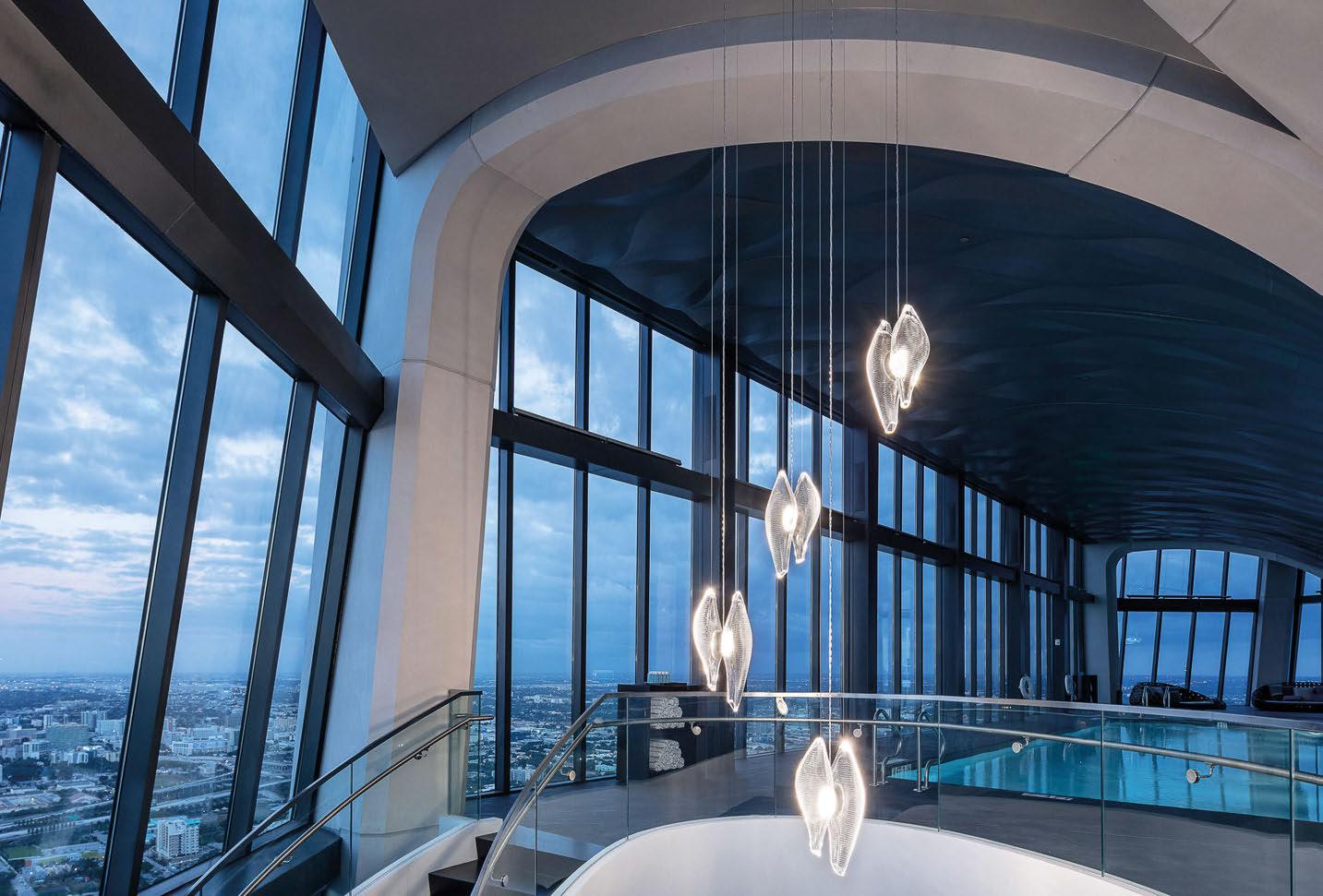


On the outskirts of Helsinki, in the small town of Kauniainen lies the head office of Secto Design.
The office building is of huge significance to the journey and development of Secto Design. It was here that Tuula Jusélius, the founder and Seppo Koho, the designer of all Secto Design light fixtures, met for the very first time in 1995. Back then, the building was Jusélius’ private family home that has since had a major renovation to turn it into what it is today, a unique, fully functional office and
www.sectodesign.fi
darc takes a look at some of the latest workspace lighting projects and top products suitable for the office environment.

Secto Design Head Office Kauniainen, Helsinki
In the winter the office, being a former family house, can easily become a cozy, relaxing space to work with sofas surrounding the fireplace on the upper landing. Among the sofas lie a couple of wooden chairs from some of the very first products of Secto Design that were made back in the 90’s before the company chose to focus solely on lighting. As a tribute to the birth of Secto Design this common space is only equipped with models from the original Secto series. These can be seen hanging from the ceiling, the walls, and the Thefloors.high wooden ceilings create an airy atmosphere, filling the upper level with a feeling of grandeur. Perched above the stairs, one of the more recent models, Kontro, hang in a cluster, adding ambiance to the room with the warm subtle light flooding through the iconic wooden Theslats.company’s principles of ecology shine through the choice and style of design in the office with natural materials dominating the spaces and a well-designed lighting scheme enhancing the natural light that floods in through the large windows.
Fromshowroom.theoutside, it still looks like a family home, situated right next to nature with woodland areas all around. Employees can enjoy their breaks outside in the garden or take a walk on one of the many small paths in woodland areas right outside.
However, as soon as you open the front door you are greeted with a rhythmic group of Kuulto ceiling lamps that look stunning against beautiful wooden knot-free panels. The rest of the hall is decorated in linen textile paneling and cupboards that match the ceiling. From there one can partially see the beginning of the display of the entire Secto Design collection.
The office is not only a space for the employees to do their work, it is also the company’s showroom in Finland. The entire collection is presented on the lower level. The office rooms and workstations are equipped with selected models to fulfill the lighting requirements in the space. Each desk carries one or two Owalo table lamps that can be easily turned to direct the light as needed. The Owalo collection is further presented in the kitchen, with two Owalo pendants above the kitchen island.
Put to the Task
FOCUSLIGHTINGOFFICE|051
In the conference room next to the kitchen, a vintage Alvar Aalto table is placed with three Attos fixtures hanging in a straight row above it. The Atto model works perfectly in conference rooms as it emits more light than many of the other models while still adding to the ambiance of the room.

Images:www.designheure.comJaredChulskiPhotography
For the main office meeting room, the Chandelier 4 Grand Carré Eau de Lumière was proposed in a customised oval layout to suit the elongated meeting table below. Each of the four large square lampshades were orientated in terms of their position to spread light evenly throughout the length of the table and apply a graphic and dynamic viewpoint from all positions around the meeting room. This chandelier was created in custom finishes as well; with a black textile outer and a satin gold interior, with tinted wood panelling at the bottom of the lampshades. The composition provides a striking yet warm touch within the room. These finishes are then continued throughout the other two chandeliers in the adjacent office spaces. Whilst the forms of the shades differ throughout these chandeliers, the aesthetic is continued, which can be appreciated as an ensemble when the meeting room doors are opened between the spaces and the chandeliers can be seen to be aligned along the same axis across the ceiling.
In compliance with the DNA of Designheure, each collection also offers infinite possibilities of colour customisations, providing clients the opportunity to sculpt their interiors even further.
The Eau de Lumière collection is available with different lampshade sizes and forms. Each lampshade has a metal internal structure that is enhanced with an outer fabric finish, housing an integrated LED system inside. The decorative paneling within the lampshade is available in both a wooden or a Carrara marble finish.
As part of its development, The Baelen Group, a renowned investment holding company, took on the lease of an independent building located in one of the most beautiful areas of Western Paris. Throughout the course of this renovation, Kubik has brought this private mansion in the 16th Arrondissement, up-todate by adding a touch of modern decoration throughout all of the office’s spaces. Within five weeks, the renovation was completed in terms of the flooring, wall coverings, fittings, lighting and electrical services. Within each of the meeting rooms and office spaces, the different ceiling heights were considered and the chandeliers were customised in order to suit the layouts. The collection Eau de Lumière by Designheure was chosen thanks to the modern, graphic style with a variety of different lampshade forms.
Working with the designer David Oppizzi, the Eau de Lumière collection takes its inspiration from the world of luxury perfume. From a sculptural aspect, the form was to symbolise the iconic shape of the perfume bottle, the extraction of an essence and playing with volumes that reflect light.
To illuminate the Baelen Group office meeting rooms, Designheure was commissioned by Camille Guillotin, from the turnkey office development agency Kubik, to create a series of three Eau de Lumière chandeliers. Each of which reflect the bold contemporary touch to the spaces as well as meeting the project’s fast turnaround time.
To suit the adjacent office spaces and meeting rooms the Chandelier 4 Moyen Rectangle Eau de Lumière was customised in a larger height emphasising further the


great volumes within these spaces. The rectangular formed lampshades reflect and draw the viewers eye around the various architectural features in the room as well.
The Baelen Group Paris, France
FOCUSLIGHTINGOFFICE052
RINGS by CHELSOM
CHELSOM.CO.UK
EDITION 27 NOW AVAILABLE

Sir Robert McAlpine had previously worked with Dernier & Hamlyn on other complex projects including Quadrant 3, the conversion of the former Regent Palace Hotel, to provide a mix of office, retail, residential and restaurant space and suggested to Foster + Partners that they would be the ideal choice to propose an appropriate custom-made bespoke lighting solution.
The Foster + Partners designed Bloomberg European headquarters in the City of London occupies a 3.2-acre site between the Bank of England and St Paul’s Cathedral. Responding to its historic context, while re-envisioning the future of office buildings, it provides the highest standards of sustainability and wellbeing for its occupants. The intention was to develop an inspiring, innovative, dynamic and collaborative workplace that encouraged teamwork. A key element to achieving this aim is the conference rooms where ideas are explored and shared around the world. The Walbrook dining/meeting room required multiple statement LED light fittings that would not only provide illumination and an aesthetic contribution but would also inconspicuously house the microphones needed.
The original design specified 11 x 1,145mm long vertically hanging glass tubes. However, after analysing the fragility and also the impossible task of making such sections perfectly straight in glass, the Dernier & Hamlyn team recommended high quality acrylic alternatives. It then manufactured a prototype fitting and modelled multiple scenarios for the cabling for the lighting, the microphones and suspension to determine the optimum cable arrangement that would eliminate interference. Once this was agreed, all the cabling was then encased by hand in silk by Dernier & Hamlyn’s finishing team. Months of extensive testing followed, the results of which informed production of perfect custom pendants that met all of the client’s criteria for sustainability, maintenance and technical performance.
dernier-hamlyn.com
Project Director at Sir Robert McAlpine Tim Hare says: “Our previous experience of working with Dernier & Hamlyn gave us confidence wholeheartedly to recommend them for this demanding project. They are much more than lighting manufacturers and their expertise in problem solving came to the fore again here.”
Bloomberg European HQ London, UK FOCUSLIGHTINGOFFICE|405

DESIGN CONTRACT WWW.DESIGNHEURE.COMLIGHTING contact@designheure.com DESIGN : DESIGNHEURE STUDIO COLLECTION MOBULA LED - 3000K - IRC>90 - 1300 LUMENS


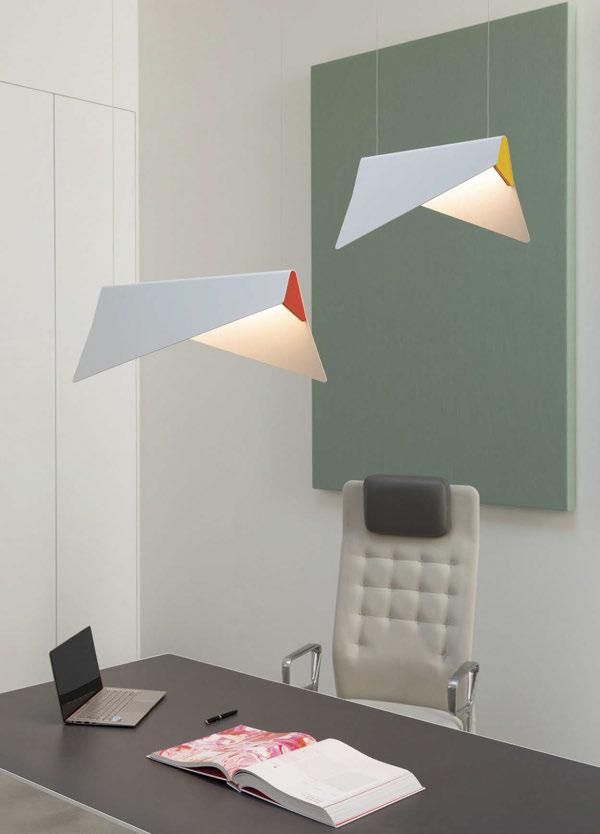


FOCUSLIGHTINGOFFICE|056
PentaHang-Out
FrankliteTL605
Designed by Lucie Koldova, the Mona collection is based on the concept of penetrating forms. The light source boldly traverses the ample volume of smooth handblown glass to reveal the thrilling tension inherent in the design. The collection’s essence, however, lies in its unconventional construction and refined combination of materials. It also boasts dimmable tubular LED light sources, developed by Brokis. The collection is suitable for office lighting, it comprises four sizes and various types of lights (pendant, floor, table, wall). www.brokis.cz
BrokisMona
A horizontal bar, suspended with very thin cables seemingly disappearing into space, releases a diffused light; one or more circular elements, depending on the project, propagate from the lighting body with their geometric purity. Made of natural wood, lacquered in a wide variety of colours or upholstered in soundabsorbing fabric, the panels are architectural details suggesting the aesthetics of the Bauhaus.
A modern matte black desk lamp with a switch and USB port on the base. The USB port provides additional functionality and convenience to the user. Dimensions include a base diameter of 120 x 180mm, a height of 510mm and a projection 485mm. This double insulated desk lamp is supplied with an LED lamp. franklite.co.uk


Editor’s Top Picks Workspace Lighting Products
“Walking through Venice and seeing a cable stretched between houses with washed clothes hanging, we came up with the idea of designing a light”, says Alberto Brogliato and Federico Traverso. This is how the Brogliato/Traverso studio designed the Hang-Out suspension for Penta. pentalight.com

www.zerolighting.com

A pair of Kontur pendants by Sebastian Herkner illuminates this communal office table. Floating within its bold, black frame and fit with a rounded metal diffuser, it hangs low like a table lamp and generates the ambient look of raining light. In an open room with a row of desks, the Kontur pendant helps define each work area. The horizontal volumes unfold across the space with a rhythmic purity that adds design continuity and a feeling of elegant equipoise. www.vibia.com


Static LightArtLinks
VibiaKontur
057
Two functions in one and the same fixture; Slice is nothing less than a light-emitting, acoustic design piece that combines innovative functionality with expressive form. Sustainability was a crucial factor in the development phase, both in terms of materials and socially. Slice creates a better environment, for both the eyes and ears, and adds character with its softly toned colour spectra. Painted metal in black RAL 9005, with sound absorbing slices made of polyester and bi-component fibre, the Slice comes with incorporated LED module or with dimmable LED light source included.
Static Links is a high-performance acoustic lighting system available in configurable, dynamic shapes. The latest evolution of LightArtʼs Static fixtures—which couple acoustic paneling with performance lighting core capabilities—Static Linksʼ central hubs act as a conduit and can be connected and built into hundreds of different configurations and patterns. Its four geometric shapes—named X, Y, T, and L—are standard products, but each configuration makes any installation customisable. These fixtures were also created with the understanding that not every environment is conducive to linear baffles. Static Linksʼ angled fixtures can nestle in corners or create unique wave-like patterns on tiered ceilings. lightart.com
ZeroSlice
ART: WINNER
REVIEW2021AWARDS[D]ARC|058
Notholt Lighting Design collaborated with Axthelm Rolvien Architekten for the interior and exterior lighting design of Donner & Reuschel, a private bank situated in a historical building in the heart of Hamburg, Germany. Located in an exposed panoramic position at the Binnenalster Lake, the outdoor lighting was designed to embed the façade into an elegant, sophisticated unit harmonising with the surrounding historical buildings. The interior lighting was shaped to reflect classy hanseatic restraint and elegance. Skilfully, the lighting sets accents to underline the visual axes. A bespoke light-artwork in the entrance hall completed the overall concept. Project Manager Almut Bagnoli at Notholt, says of the design’s concept: “Since the light sculpture is located in the reception hall of a private bank, the idea was to frame the semi-circular seating area on the round carpet and direct the gaze of the main visual axis to it. It was important to drop the light fibres at different heights and to find the right distance between them to enhance the floating and oscillating effect and to emphasise the conical brass end pieces. The goal was to create a varied play of light from different perspectives. The light object should appear very light and not block the view out to the lake.”
1st Place: Privatbank Donner & Reuschel, NotholtGermanyLighting Design
The floating light sculpture is inspired by a sickle shape of fibre glass elements with conical brass and white glass end pieces, which embraces the inviting lounge area in the entrance hall. Walking down the pavement alongside the historical building, a delightful view of the light installation opens through the window. From inside, the surrounding architecture allows a sweeping view of the scenery, from the lounge area the visitor can peer straight up through the swarm of light. To create the sculpture’s unique shape, it was necessary to consider a complex interplay of architectural conditions and desired visual effects in order to highlight the interior design and set an eyecatcher. The light sculpture is hanging from 0.12-metres below BESPOKE LIGHT INSTALLATIONS

059

REVIEW2021AWARDS[D]ARC|060

the ceiling to 1.70-metres above floor level resulting in a total height of 3.66-metres; the room’s height measures 5.48-metres. The sculpture is anchored to the ceiling with 12 eyebolts. It consists of a four-part metal canopy with a diameter of 4.2-metres on which the 720 fibre glass elements are suspended at 13 different drop heights. “Since the light object is very heavy, static calculations had to be carried out and M10 threaded rods had to be provided for ceiling mounting. The canopy had to consist of four sections, otherwise it could not have been transported and assembled,” adds Bagnoli. Four LED projectors positioned on top of the canopy, each with a

bespoke colour wheel, enable the lighting moods to be changed throughout the day. Sitting down in one of the comfortable lounge chairs, the visitor is magically enfolded in the installation’s swaying Thethreads.project presented interesting design and electrical challenges. Several attempts were required to create the right spaces and heights between the multitude of individual fibre optic cables and finding an elegant way of attaching the conical brass end pieces. In addition, the right projectors and optical fibres had to be selected to ensure that everything lines up perfectly.

Imagewww.notholt.deabove:Marcus Bredt
“Thespell.light object was developed during the overall project of the private bank, which lasted about two years. Month-long agreements between the architectural office, the manufacturer and the client were necessary to achieve an optimal result.”
“The conical brass end pieces were the standard version from Universal Fibre Optics; because they looked very noble, we decided on them. However, in order to create an elegant finish between the end piece and the optical fibre, the usual stainless steel hexagon nuts were replaced by specially made round brass fittings by Universal Fibre Optics. We tested many different light fibres to find out the right light effect. Some of the light fibres shone too brightly, others seemed too dim, and other fibres were either too thick or too thin, or only glowed at the bottom. The metal of the canopy has been coated in the colour of the ceiling so that the canopy blends into the background as much as
061
possible,” explains Bagnoli. Finally, the lighting sculpture floats softly and elegantly in the space, creating a warm, inviting atmosphere and casts you under its magical

2021AWARDS[D]ARC|POINTFOCAL|062
The elongated installation is composed of 25 equally sized discs that are uniformly spaced from top to bottom. Each acrylic disc sits within a circular frame that is attached to a 10.8-metre-long helix metal structure, which was designed and manufactured in modular sections.
Image:www.nultybespoke.co.ukFrench+Tye
2nd Place: Park Row Structural Lighting Sculpture, UK Nulty Bespoke

POINTFOCAL|010
LED tape has been positioned around each disc and then supplemented with felt padding at the top and bottom, which blocks any light bleed and provides a cushion between the frame and acrylic. Each disc has a gradient laser-dot pattern that catches the inward emitting light to create a focal point on the panel that is only revealed once illuminated. In reference to the echolocation frequency of bats, the installation lights up in a dramatic pulsating sequence. Illuminated circles travel up and down the stairwell to create a striking yet mysterious gateway to the glamorous dining space beyond. A black mirrored plinth on the ceiling and the floor adds another dimension to the installation by creating an infinity effect. The pulsating light show has been programmed via a DMX control system that gives the client endless lighting configuration possibilities. Controlling the natural movement of the twisting structure was an exercise in balance and engineering. Detailed fixings were applied to the ceiling and floor to secure the piece, while tension cables were positioned with precision to bring further rigidity to the installation.
Focal Point
A dramatic and sweeping lighting feature was needed for the spiral stairwell of Park Row in Soho – a subterranean restaurant experience inspired by DC Comics. The installation by Nulty Bespoke had to accentuate a Batcave-style ambiance and present guests with a theatrical display of light as they descend the staircase.
063

Taking centre stage at Design London during the London Design Festival in September 2021, Cameron Design House’s Kuulas installation was revealed. For the global unveiling of the Kuulas, the piece was displayed in the main passageway of the building and hung from a dramatic ceiling height to create an immersive installation. The statement sculptural chandelier illuminated the hallway with a vibrant amber glow, captivating the eyes of many visitors. The Kuulas is a one-of-a-kind sculptural chandelier – celebrating a fusion of glass, brass and light. Designed to look good whether on or off, the piece exudes a sense of cultivated elegance with an industrial flair. Made up of glass pearls that were hand blown by artisans, every pearl was individually suspended from husky industrial-style chains. Cameron Design House has become synonymous with unique, contemporary design and refined craftsmanship, with every piece conceived and handcrafted in its studio workshop. Using organic and precisely engineered elements, it creates custom feature installations, which are handmade to a client’s specific requirements, allowing for bespoke sizing, configuration and finish.
3rd Place: Kuulas, UK Cameron Design House
2021AWARDS[D]ARC|POINTFOCAL|064

Focal Point
Image:camerondesignhouse.comSamFrost
POINTFOCAL|010
065

KIT: WINNER DECORATIVE LIGHTING PRODUCT

Coles began working with Shiu Kay Kan creating products using the new MR16 fixture. Coles explains how this “revitalised retail space design”, notably in early Next stores and Terence Conran’s Design Museum in Shad Thames.
Coles then went on to work with Arnold Chan at Isometrix Lighting Design. Here he “experimented with colour mixing using dichroic filters and installed wash lights to Philippe Starck’s St Martins Lane Hotel, creating a simple dial interface to set the mood”.
When designing new products, he highlights that the “light source
1st Place: Fresnel Jonathan Coles Studio
The self-titled Jonathan Coles Studio was established in 2006 in Henley-On-Thames, UK. Founder Coles has a long creative history, starting with completing a degree in 3D Product Design at Middlesex University in 1986. “Creatively it was an explosive time to enter the lighting industry,” he tells darc
“The influx of new technologies fed innovation and ambition, opening up a whole new way of thinking and working with light.”
Later, Coles was pioneering radical new designs using early LED
“All of these experiences gave me a rich foundation to set up my studio. Working alongside lighting designers as a product designer gave me a precious insight and allowed me to move beyond making Whenobjects.”asked what a light should bring to a space, Coles explains that to begin with, you must ask yourself what type of light quality and experience of light do you want to create? “What combination of intentions does the product have - functional, emotional (evocative) and transformative? Consider how the light can work within a space, its scale, aesthetic and materials. All of these are carefully considered to enhance the interior space.”
REVIEW2021AWARDS[D]ARC|066
technology with designer Marc Newson on Ford Motors 021C concept car. “It was the first time indictors, headlamps and side lamps were combined into one addressable LED array,” he says.
“Before setting up my studio I spent a time with the iconic British lighting brand Mathmos, initially developing a Lava lamp with Ross Lovegrove and then a range of rechargeable portable LED products which won D&AD and Red Dot awards.
and its light effect are a central element to the design process”. The studio follows an ethos that products should be designed and beautifully made. “Keep refining a design to reveal its purest form and function,” he continues. “Work with rather than against materials. Engineer and build products so they can be easily maintained to extend their life.
Central to the design is the relationship between the lenticular lenses of the reeded glass, the diffused light core filling the whole form with light. The inner light core houses warm white LEDs complimenting the

The cylinder shade hovers above a solid machined brass base, its form mirrored in negative. Concealed in the base is an integrated, linear, touch-sensitive dimmer to carry the integrity of design throughout the family and to engage a tactile user interaction with the material.
Thelights.lamp is inspired by a fusion of Art Deco and Mid-Century design principles of material, form and function and with a heavy nod to original arc light experiments.
067
“Lighting products should function well, give enough controlled light with no glare and a flattering warmth. Create products that enrich our environments.”
The lights are hand-assembled and finished to order from solid brass parts, designed and engineered with precision at its workshops in Henley on Thames. Features born of the manufacturing process are maintained as delicate detailing; nothing is glued. These lights are made for longevity with each component replaceable.
hue of the brass. High quality and high CRI LEDs are incorporated with a 2400k colour temperature.
Winner of this year’s [d]arc awards' decorative kit category was Coles’ Fresnel table lamp. It is the latest addition to the Fresnel collection, completing the range that consists of a pendant, chandelier and wall
Inspiration for the table lamp came from Victorian lamp engineering. Coles explains further: “It was imagined as a play on early Victorian lamp experiments, such as those by Joseph Swann in the 1880’s (the real inventor of the light bulb!).

“The shade provides a warm glow reminiscent of incandescence
“The solid brass base becomes the plinth of the experiment, and the vertical brass arm with knurled detail references the electrical contact to the carbon filament and vacuum contained within the shade.
REVIEW2021AWARDS[D]ARC|068
“The table lamp was developed over a 12-month period, honing the design through prototypes. This is our first free-standing product, so we’ve learnt a great deal in the process to help future designs.”
“For all LED products, thermal design is important and our internal heatsink draws the heat away from LEDs, which also monitor and adjust their current draw.


A key element to the design was the relationship between the lenticular lenses of the reeded glass. Coles elaborated on this poignant design decision: “The internally reeded glass shade reproduces the ‘Fresnel’ optical effect where the light is refracted, creating depth and filling the shade with light. Invented by the namesake French engineer, the Fresnel optical lens focuses lamps in Lighthouses, so multiple lens could be combined to form a single narrow beam of light. We use the optics in reverse to provide a diffused radiant light in all
“We are excited to show them for the first time at Clerkenwell Design Week in May.
“We have also been developing an inductively charged portable light, which we hope to launch later in the year at Light22.”
“Our light sources have a high CRI to give natural skin tones and incorporating a touch dimmer allows for precise light level control.
www.jonathancoles.co.uk
floating over the machined base with the touch dimmer giving a further nod to the eureka moment!
Thedirections.”choiceof materials is an important one for Coles and his team, with their strong value for the “natural integrity of materials”. He continues: “Solid brass machined parts are waxed or naturally aged, (not plated steel) so the beauty of the materials shines though.

“We thrive on (and are always excited about) the fusion of traditional craft and high technology.”
What should we expect from the studio next? The team has been working, alongside Spears Major on the re-development of Battersea Power Station, on the soon-to-be-completed large-scale site-specific feature chandelier that will be housed below each of the four iconic wash tower chimneys of power station. Furthermore, during the pandemic the studio developed two more exciting products that have not been exhibited before (the Tallow and Meso product ranges).
FosterBloombergBradyWilliams+Partners
WE ARE A BRITISH COMPANY SPECIALISING IN BESPOKE LIGHTING DESIGN, MANUFACTURE AND REFURBISHMENT. +44 (0)20 8760 0900 info@dernier-hamlyn.com www.dernier-hamlyn.com


Bob Bob Ricard City
Aurora
LuxuryWinchBorealisDesignResidenceSHH

They are complemented by an antique brushed brass light fitting (housing a replaceable G9 light light source), with cream twisted silk flex. www.ilukalondon.com

www.mesemestudio.com
With an arresting sculptural yet symmetrical accent, Alma table light is an attempt to reimagine a classic for a contemporary fixture to enhance the extraordinary modern-day spaces. Handcrafted using brass, TIR lens, clear glass and integrated LED source, makes it a well-balanced and adaptable luminaire. With the TIR lens acting as an enlightened rod, Alma offers a glare-free warm tone creating a calm and soothing surrounding.
4th Place: Antoinette Studio Aristotelis Barakos
Launched late November 2021, Alma is the debut product of Meseme Studio, a contemporary lighting and accessories studio based in London. It is designed by emerging and award-winning designer Riya Panchal in collaboration with skilful craftsmen and assembled in the UK. Dimensions: height 420mm, diameter 170mm.
It is made of metal and available in brushed bronze, with the option of copper finish, as well as satin finish in a variety of colours. Dimensions: height 30cm, width 25cm.
www.aristotelisbarakos.com
The light of a circular 12V LED module under the lamp’s top lid is diffused by an opaline bowl, producing a soft downward light. A metal touch dimmer switch on the base provides a tactile on/off function with 10-100% adjustment.
KIT: TOP TEN DECORATIVE LIGHTING PRODUCTS
3rd Place: Alma Meseme Studio
REVIEW2021AWARDS[D]ARC|070
Designed by Daniel and Sarah Bullen-Webb, Iluka London’s Facet Pendant light’s are handmade from a frosted clear resin and Australian red-mallee burr wood. Each pendant is completely unique as the facets are cut at random and finished to a natural matte texture by hand.
2nd Place: Facet Pendant Light Iluka London

With its luxuriant, silky metal finish and the milky light it pours all around it, the Antoinette table lamp is a tribute to the sparkling, golden-hued reveries of generations of champagne drinkers, with a meaningful nod to royal Versailles decadence. Using cutting-edge LED technology and high-quality materials, the signature shape of the shallow champagne coupe is transformed into an elegant table lamp featuring smooth, discreet touch controls.

Transmission is an illuminated wall-mounted sculpture, which creates different effects depending on the use of its integral lighting, external illumination or both. The piece was designed and made in the UK by David Tragen and takes his passion for flowing, curved forms to a new level. It was inspired by the Op Art movement and in particular the curve paintings of Bridget Riley.
codegalight.com
The lamps are also designed according to the principles of neuroesthetics, the scientific discipline that explores the correlation between visual stimuli and neuronal responses.

7th Place: Bottle Lights Holsting Design Studio

The lamp comes from an intense research path, conducted with professional lighting designer Francesco Iannone e Serena Tellini. By recreating the progressive variation of natural light in indoor environments, Serena lamps make light a source of wellbeing. Taking advantage of the disinfectant and germicidal properties of UVC rays, the lamps sanitise surfaces by removing germs, bacteria, and viruses.
different painting methods with glass waste, the studio was able to create a more sustainable product that retains a high finish and quality. Every light is handmade, with imperfections and a uniqueness you can’t get from mass production. These textures are part of the production method and should be considered as something that gives the product its uniqueness and not as a flaw. holstingdesign.com
6th Place: Transmisson David Tragen
071
It is made in cold cast bronze (a mix of resin and bronze) or cold cast aluminium and measures 425 x 425 x 80mm. The light diffuser is cast in semi-translucent resin with a pearlescent finish and the warm white LEDs provide gentle ambient lighting. www.davidtragen.co.uk

Its name comes from the movement of wave energy, flowing out from the centre and then dissipating as it progresses to the edge of the concave surface.
5th Place: Serena Codega
Serena lamps express Italian stylistic tradition with a hi-tech heart, with the aim of positively influencing human biorhythms while sanitising the environment.
In a world where people are becoming more conscious about the environment, we are also seeing a higher demand for greener products. This is an artistic example of how we can make a product more sustainable, but not compromise the design and quality. By using glasswaste, in a way where the shape of the waste is still recognisable, it creates awareness about using waste as a production material. Thereby putting more value into waste material, that otherwise has a very short Bylifespan.combining
Inspired by the concept of "childhood dreams of flying high, paired with jewellery’s gorgeous lustre and organic shapes", the Paopao's name translates as bubbles in Mandarin.
REVIEW2021AWARDS[D]ARC|072
10th Place: Hex Iron Oxide Design

Designed by Ben Hatton, Hex is a decorative pendant family, which uses high quality raw materials and takes inspiration from nature. Iron Oxide Design concentrated on keeping the light source hidden and using refraction from its cut surfaces to create something very different. Hex is available in two diameter variants and a number of lengths. It is available in multiple finishes including gunmetal grey, bronze, chrome, nickel, brushed brass and mirror polished brass. It is constructed from solid brass and is sourced and manufactured entirely in the UK.

The Glowbule columns were designed by Argentine-Japanese artist and designer Adam Nathaniel Furman and Esther Patterson, Founder of Curiousa & Curiousa. Using a low voltage LED system, these dimmable sculptural floor lights marry modern technology with the traditional appeal of free-blown glass. These lamps stand at 1.5-metres tall and house a unique chimney LED cooling system. All made in the UK, each segment is individually free-blown in semi-opaque glass, meticulously ground, married together and stacked, creating a beautiful and continuous linear glow. www.curiousa.co.uk

It offers a standard unit running a mains dimmable GU10 and Mini GU10 lamps but also a Xicato driven CRI95 Chip option incorporating all of the usual BMS dimming and control options. ironoxide.co.uk
9th Place: Paopao Seed Lighting Design
The glass gradually changes colour into crystal, producing a particularly fine yet sturdy finish. With a refined-metal fixture seamlessly continuing the smoothly curved shape of the glass body, the Paopao is embedded with CRI 95 LED and the high-quality light reflects through the layered translucent colour of the glass top, which sets off the finesse of the glass shade and gives a fantastic unique glow inside. seeddesignusa.com
8th Place: Glowbules Curiousa & Curiousa
CP L IGHTING our Sprout + Branch low voltage outdoor collection will even make your weeds look great www.cplighting.com @cplighting +1-414-426-1473 made to order by real people in Philadelphia PA


it’s clear the designers were meticulous and creative, and the result is a welcoming modern environment.”
California-based lighting design studio and manufacturer, Cerno, is used throughout the project. Cerno’s dynamic palette of natural woods, metals, and leatherwork complements CDC’s material
Astella Apartments
San Francisco, USA
“Inspired by the locale and the striking exterior architecture the interiors provide a respite from the busy and energetic vibe of the neighborhood. Layered earth tones, organic textures, and artful accents keep things fresh, finding appeal in the art of the mix,” concludes Stark.
Astella Apartments is located in the heart of San Francisco’s design district. California-based interior design firm CDC Designs’ vision and execution demonstrate its attention to the small details that make a significant impact and impressively tie the entire project together. The project embraces the creative spirit of the surrounding neighbourhood while also feeling authentically Californian.
The layered earth tones, organic textures, and artful accents keep things fresh. The balance of natural glazing and where CDC’s team artfully decided to use light fixtures are in sync.

“Whenselection.itcomes to lighting selections we treat them as an additional piece of art in the spaces we are designing,” says Julie Ann Stark, Partner, President of Design, CDC Designs. “We made several selections from Cerno lighting because of the modern nature of their fixtures and the subtle illumination that highlights the spaces. They are all also sustainable, eco-friendly and made in the USA, which is reflective of the Astella community ethos. “There’s a place for statement pieces in design, but I think the real magic is when a piece of furniture or lighting works so well in a space that it’s not a statement and seamlessly fits with the overall vision,” adds Bret Englander, Co-founder of Cerno. “This project feels resolved;
STUDYCASE|075
Above a full-size white oak pool table is Cerno’s expansive 82-ins Vix linear pendant. “The Vix provides a lot of usable light in an unobtrusive form which is why it works so well in voluminous spaces like the Astella club room,” says Cerno Co-founder and Director of Design Nick “WhenSheridan.designing new fixtures we try to understand how they will be used; although the designer ultimately decides how they will specify Cerno fixtures, we always strive to create beautiful fixtures that emit a significant amount of usable light,” adds Englander. “The designers opted for Cerno’s Imber pendant in a distressed brass finish for the conference rooms. “I think conference rooms should be like a nice designer suit, sophisticated, comfortable, but also suggest that this is space where real work is done. CDC’s team checked all these boxes.”
cernogroup.com
Cerno’s Penna linear pendants hang above a swoon-worthy communal kitchen where the clean lines do not compromise the utility of a fully functional place to cook, gather and entertain with fellow residents.

Leading into the hallway, the Waterfall II big wall lamp adds another level of decorative extravagance.
Luxxu’s brand new apartment is the epitome of the French capital charm and penetrating magic. Created by Luxxu’s experts, the Vivant Parisian Apartment evokes a few French classics. Starting with the opulence of the herringbone parquet floor, from feeling the warm sunlight through the double windows to the elegant signature trumeau on the walls.
In the entrance way, the Waterfall technical wall light features, illuminating the sizable welcome painting, plus the Gala floor lamp provides the ultimate golden touch.
is an ode to plants and nature in general, as it means growth and renewal. Luxxu’s lighting pieces, such as the Pharo floor, the Waterfall XL wall, and the Gamma table lamps, illuminate this dark hue room and make it even more exquisite.
The Mcqueen round suspension foliage merges into the décor theme with their one-by-one hand-hammered leaves.

The Mcqueen family continues through to the bedroom, adding further emotion and drama to the overall design.
www.luxxu.net
Vivant Parisian Apartment Paris, France
In the kitchen, Luxxu’s Darian dining table, surrounded by the Charla II family, is carefully placed under a beautiful skylight with the special presence of the Explosion suspension lamp. Three Liberty small pendants fixed above the marble counter close the room with a golden key. The home office is decorated with the patterned green. This room
STUDYCASE|076
Adding to the dining experience, an audacious client needs an audacious piece of lighting. So, the Babel II suspension, with its metallic shine, flows along with the ceiling.
The emerald green Empire Set I centre table, made with a bespoke marble top, naturally follows the colour palette and ties together, with hints of gold, all of Luxxu’s lighting and furniture pieces such as the Trump II wall, Needle wall lamp, and Empire column display.


Hyphen Luminaires Archiproductsdarmes.ca Milano ICFF_247


Yuu Skin Institute generates a fashionable and stylish atmosphere for its clientele. To bring this feeling to the next level, Tekna’s lford pendant XL was chosen. This pendant light is presented in sateen brass with fitted clear glass inside. The handmade design is characterised by its pure classic and sophisticated appearance, which is part of the Nautic collection: an original combination where simplicity and functionality prevail.

Nautic is Tekna’s iconic collection of authentic luminaires, made from raw materials. Tekna found its inspiration in the world of shipping. The maritime aspect, the charming character of old train sets and the craftsmanship in factories form the basic idea for Nautic’s designs. An original combination where simplicity and functionality are key. The timeless design and choice of materials give the luminaires a harmonious appearance. They are atmospheric and stylish, without unnecessary adornment. www.tekna.be
Yuu Skin Beernem,InstituteBelgium STUDIYCASE078

The choice of white for the exposed globe light source provides an ideal soft 2700k light to illuminate the display racks down the hall. Now the beautifully curated fabrics can easily be seen by discerning Tocustomers.roundthings
When CP Lighting owner Christopher Poehlmann met the principles of the Philadelphia based Commonwealth Proper at a local fundraiser event late last year at the Ritz Carlton, it felt like a perfect fit. Common ground was established in the shared sensibilities of craft, the makers hand, embracing innovation combined with tradition, creating work to order, tailoring to the specific needs of the client, making locally, and serving an international audience.

Talks about commissining a custom suit for Poehlmann morphed into a discussion of custom lighting to address the current needs of the Philadelphia showroom. CMMP commissioned CP Lighting to design and create a centrepiece chandelier for the front showroom and a series of pendants leading customers from the entry stairway through the display racks in the hall to the fitting room and back office. CMMP had inherited a set of crystal pendants that did not fit the aesthetic of the company and provided barely adequate lighting in the hall for viewing the sample suits and fabrics on display. CP’s task was to provide better illumination, and the solution came in with both style and substance.
Beginning with inspiration from the CMMP logo, CP Lighting took the crossed needles as a cue to re-interpret its existing CrossLight series. Instead of the usual slim 30mm profile LED setup, it increased its size up to 50mm to accommodate e26 base sockets. The result of this collaboration gives a stronger vibe with a new line called XLamp. The new XLamp allows for lamping with globe light sources, which play better with the interior elements throughout the showroom and provide some historic reference. The choice of antique bronze finish also enhances the contemporary, yet retro feel of the space.
out, CP Lighting designed and custom built an XLamp chandelier for the main lobby of the showroom. Tailored perfectly for the space, the random but well balanced lines both compliment and contrast the classic yet contemporary lines of the custom clothing at Commonwealth Proper.
The end result demonstrates the ethos of the two enterprises: whether it is bespoke clothing or lighting, attention paid to the customer and the details results in a proper fit. cplighting.com

Common Philadelphia,ProperUSA STUDIYCASE080
Commonwealth Proper (CMMP) takes its name from the original collaborative of Philadelphia tailors who formed a labor union in the 1800s called the Commonwealth. Their chance meeting at the fundraiser was a collaborative event of art, design, fashion, and philanthropy organised by the local arts collective inLiquid.org.
Produced by Emerald X, LLC. at New York City’s Javits Center Trade professionals: Use code DARC22 and your pass is complimentary. May 2022 15-17 Register now at icff.com Your registration also gives you access to WantedDesign Manhattan.
When lit, Articolo’s sophisticated forms cast orchestral movement in an unparalleled play of light, harmonising with the surrounding interior whilst embodying both sculptural and functional purpose, making the Articolo pieces a focal point for this store design. Articolo lighting fixtures were specified for their atmospheric, jewel-like qualities, contemporary linearity, and artisanal elements which marries other punctuations of the design scheme such as luxurious materials, and timeless glamour.
The Robina flagship store features the Fizi Collection throughout - mesmerising with the explosion of bubbles suspended in champagne-esque effervescence. Breathtaking shadow play occurs when the Fizi is lit. Fizi Slab wall sconces frame the dressing room, while custom elongated ceiling to floor Fizi Ball wall sconces beside clothing displays, and a five ball Fizi pendant with spacing bar suspended over the central display console area all add striking focal points.
The Kookai store design team share Articolo Lighting’s passion for the textural spirit of light, contemporary yet enduring aesthetic and the luxurious pairing of materials.

articololighting.com

Kookai is an Australian-owned women’s fashion label, defined by an essence of femininity, confidence, allure, and independent style. The Kookai collection is designed exclusively out of Melbourne and Paris studios through a creative, symbiotic process. Located in Queensland, Australia, Kookai’s second flagship store is a melting pot of innovation and feminist design – a retail environment that accurately reappropriates Kookai’s design values.
The flagship store for Kookai was conceived from the conceptual idea that the store should represent an intimate apartment interior. Representing the lifestyle of the modern woman is seen throughout the store. Kookai has designed exquisite boutiques around the world – with Articolo Lighting gracing the walls and ceilings, highlighting the elegance of European design, and creating an oasis of calm, exuding sophistication, and elegance.
STUDIYCASE082
Kookai Robin Flagship Retail Store Queensland, Australia


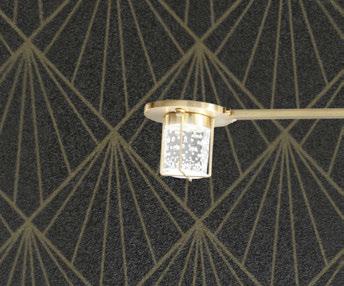


STUDYCASE|000
On Diagonal Avenue in Barcelona, Spain, stands a beautiful and traditional office. The workspace is housed in a modernist building called Casa Sayrach, named after its architect.
Turull-Sorensen Architects completed a renovation of the office to enhance all the small details of the traditional building and restore the parts that needed it. The purpose of the project was to create a motivational, professional workspace with respect for the original details.
The project features the Lute pendant from Ebb & Flow in forest green, golden smoke, alabaster and deep blue. The office rooms have been painted in light colours to brighten up the space and create a focus on the elegant details of the doors, walls, and lamps.


ebbandflow.com Barcelona,SayrachSpain
Casa
Using contrasting colours and decorative lighting from Ebb & Flow, the office is now filled with stunning features. Looking at the colourful Lute pendants from Ebb & Flow through the arched glass doors, create a beautiful focal point and inviting atmosphere. The curves of the building and the organic shape of the pendants create the perfect harmony.
Kirkkonummi Library Fyyri Helsinki, Finland
The restauration of the library in Kirkkonummi, 30-kilometers west of Helsinki, is a unique and interesting project. The impressive building named Fyyri opened its doors to the public in October 2020. By then it had already seen the bankruptcy of its first contractor and experienced a pandemic nobody had planned for. Nevertheless, the archipelago themed building designed by JKMM Arkkitehdit was completed and now boasts a library, youth centre and café, all wrapped up in a striking Indesign.a5000sqm building, located in a very dark part of the world, lighting plays a vital role, especially for the demands of a library. Saas Instruments’ responsibility was to accommodate these solutions through a large amount of bespoke lighting fixtures. From the integrated brass spots along the

50-metre reading table to the powerful ceiling luminaires providing general light, every detail was carefully thought-out by the R&D team at TheSaas.entrances were designed to create an inviting atmosphere in the huge copper façade without the risk of glare. Although most lighting solutions are tailormade, a few familiar Saas products can also be found here. The 15mm spots by the reading stairs and the beautiful brass Sticks are well-recognised Saas pieces. Together, with the freestanding floor lights, the overall ambiance in the library becomes typically Scandinavian while still creating a cosy reading atmosphere. saas.fi

000

HELSINKI FINLAND’S FIRST INTERNATIONAL B2B CONTEMPORARY DESIGN FESTIVAL LAUNCHING 24 25 AUGUST 2022 FIND OUT MORE AND APPLY TO TAKE PART AT designhelsinki.com @designhelsinki designhelsinki.com




Chelsom | Booth 1031
3. Decorative Touchless System

www.beadlight.com
With health and hygiene at the forefront of buyer's minds, Chelsom has released new Decorative Touchless System (DTS) for their Red Dot-awarded LED Eye. A knurled metal collar encases the sensor and can be plated or powder coated. The decorative nature of this switch gives both lighting designers and interior designers the opportunity to blend both practical and aesthetic product design needs. Managing Director Will Chelsom says the product will "significantly reduce touch points in places such as hotel guestrooms and cruise ship cabins, where regular light switching can cause multiple touchpoints in a room."
PREVIEWAMERICAEXPOCSI|SHOWON|085
www.chelsom.co.uk
Among its 300 exhibitors, CSI will present several lighting brands, bringing the latest innovations to the cruise lines and design studios of the cruise interiors industry.
This year’s CSI has been designed with community in mind. Cruise line buyers can request concierge tours where they will be personally connected with the products and companies they need to complete their projects.
2. Alamar Hot Pots
at booths will offer practical advice to suppliers and designers hoping to refine their company’s sustainable knowledge. Cruise Conversations Live will also run on the first day and feature the popular Opening Keynote: Leader’s Debate, and a new session laying bare one of the industry’s biggest pain points: supply chain.
For many guests, the eye-catching public area lighting is a hallmark of the luxurious guest experience they are anticipating. Cristallux’s latest bespoke project for German cruise line Aida Cruises includes the Alamar Hot Pots. These unique lighting fixtures are formed around an exhaust pipe on Aida Cosma’s Sushi House & Hot Pot Restaurant. They were designed using Cristallux’s zero waste, 100% recyclable material Alamar. Cristallux produces Alamar in its own mold shop, so there is no limitation in colour, shape or size, and includes glass-look and natural optics.

The Somnus is a multi-functioning product with a beautiful bone china shaded ambient light and a dedicated stem reading light, which uses its patented Beadlight diffusion technology to provide the perfect LED illumination to read by. The unit also boasts USB charging ports discretely hidden in the base of the mounting plate negating the need for separate charging points. Beadlight products are green by design. They use LEDs making them up to 80% more efficient than standard light sources.

1. BeadlightSomnus| Booth 769
7-8 June, Miami Beach Convention Centre, USA
3
Cristallux | Booth 735
Responsible design is this year's focus, and on the second day the show floor and free conference Cruise Conversations Live will be themed around sustainability. Conference sessions will focus on sustainable stories from cruise lines and designers, while workshops
www.cristallux.com
Cruise Ship Interiors Expo America Preview
Visitors hoping to seek out new or sustainable products will be able to walk two brand-new routes. Here, CSI will be highlighting the companies offering innovative new product launches on the New Products Route, while sustainable products and practices will shine on the Sustainability Route.
cruiseshipinteriors-expo.com
AS A MEMBER YOU WILL RECEIVE: • PROFESSIONAL GUIDANCE • BADGE OF PROFESSIONALISM • CPD SUPPORT • SPEAKING OPPORTUNITIES • NETWORKING EVENTS biid.org.uk THE UK’S INTERIORINSTITUTEPROFESSIONALONLYFORDESIGNERS CONNECT WITH USTel: +44 (0)20 7628 0255 Email: info@biid.org.uk


The hanging version of Gaia lamp, by Marc Sadler, provides versatile lighting for outdoor spaces. A natural, unwired rope acts as a cable, with a magnet at one end stuck to the shade, while the other end can simply be knotted to fix wherever desired. This version also sees the light source built into the polycarbonate diffusor and attached to the shade with a magnet, using a USB charging system with a special magnetic connector.

forbesandlomax.com
3. Hartland CFX Hamilton Litestat Stand E11
32
www.fritzfryer.co.uk
Using a mix of Hereford shades, both large and extra large in ribbed and clear glass, this stunning 24 way cluster chandelier is suspended from elephant grey and bronze twistflex pendant sets, and passes through a very unique circular atrium across three floors, with a drop of over 6.5-metres. A multipendant cluster chandelier is the perfect way to distribute warm light throughout a staircase.
Basaltfinishes.Gray, exclusive to its Hartland CFX collection, delivers a grey base with a neutral cast and subtle bronze hue, providing a warm, nature-inspired finish and is the perfect accompaniment to many earthy colours.

24-26
5. StandEthimoGaiaDF52
The switch plates are now made from 100% recycled perspex. The greencast sheets of perspex are created from the waste and scrap material of manufacturers and fabricators, which would ordinarily end up in landfill.
6. StandForbesInvisible&LomaxE9
1. Ettorino T Catellani & Smith Showroom | EC1R 4SP
PREVIEWWEEKDESIGNCLERKENWELL|SHOWON087
StandHumbleLS215
Hamilton has added two new colours to its portfolio of decorative wiring accessory plate
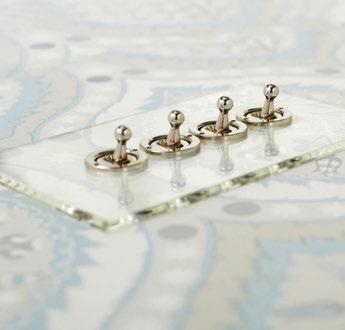

2. Humble One
Ettorino is the new family of Catellani & Smith products that includes the T and Clamp table models, and the F and Big standing lamps. Available in the classic black and white finishes, the colourful versions of the Ettorino lamps feature an elegant combination of primary colours. A signature feature is a functional detail in the shape of a red, dancing figure.

Forbes & Lomax will be presenting its Invisible lightswitch range for the first time at CDW 2022.
Clerkenwell Design Week Preview May, London, UK
www.ethimo.com
www.catellanismith.com
| EC1V 4JB
4. Bespoke Chandelier ShowroomFryer

Humble's newest member of the Humble One family is specially designed for outdoor use. The light source of this cordless table light glows like an old incandescent, but is made out of tiny and efficient LEDs. Fully charged, it produces up to 140 hours of light. Warm earthy tones combined with waterproof characteristics make this light a must have this summer. humblelights.com
6
Fritz
www.hamilton-litestat.com
14
7 - 8 June 2022 (www.cruiseshipinteriors-expo.com)
7 - 12 June 2022 (www.salonemilano.it)
darcLiGHT22CruiseChelsomBrokisBIIDArchiproductsAhead..............................................................................................................8974AstroIFC8627Catellani&Smith.........................................................................................35Cerno953ChristopherHyde83ClerkenwellDesignWeek24CPLighting73ShipUSA506-7subscriptions79 Dernier & Hamlyn 69 Design Helsinki 84 Designheure 55 Franklite 31 Gabriel Scott 4-5 ICFF 36 Luxxu 19 Original BTC 49 Penta ...............................................................................................................43 Saas Instruments OBC Secto 15 SBID 81 Studio d'Armes 77 Tekna IBC AD INDEX
A look ahead to forthcoming design shows during 2022 with a strong lighting element.
CLERKENWELL DESIGN WEEK • LONDON, UK
7 - 12 June 2022 (milano.archiproducts.com)
5 - 11 September 2022 (www.stockholmdesignweek.com)
[D]ARC SESSIONS • MYKONOS, GREECE 18 - 20 October 2022 (www.darcsessions.com)
21 - 24 September 2022 (www.designlondon.co.uk)
24 - 26 May 2022 (www.clerkenwelldesignweek.com)
LIGHT 22 • LONDON, UK 22 - 23 November 2022 (www.lightexpo.london)
Alldatesarecorrectattimeofprinting
ICFF • NEW YORK, USA
LIGHT + BUILDING • FRANKFURT, GERMANY 2 - 6 October 2022 (light-building.messefrankfurt.com)
ARCHIPRODUCTS SHOWROOM EVENT • MILAN, ITALY
WANTED DESIGN • NEW YORK, USA
15 - 17 May 2022 (www.wanteddesignnyc.com)
DESIGN LONDON • LONDON, UK
DECOREX • LONDON, UK 9 - 12 October 2022 (www.decorex.com)
LONDON DESIGN FESTIVAL • LONDON, UK
On Show
SALONE DEL MOBILE • MILAN, ITALY
CALENDARC|088
CRUISE SHIP INTERIORS AMERICA • MIAMI, USA
STOCKHOLM DESIGN WEEK • STOCKHOLM, SWEDEN
15 - 17 May 2022 (icff.com)
24 - 25 August 2022 (www.designhelsinki.com)
DESIGN HELSINKI • HELSINKI, FINLAND
17 - 25 September 2022 (www.londondesignfestival.com)
ALL REGIONS NOW OPEN FOR ENTRIES VISIT AHEADAWARDS.COM FOR ENTRY CRITERIA, JUDGING PROCESS AND DEADLINES

What is the concept behind the Edward Collection? I wanted the Edward range to retain our core Astro DNA but with more scale and visual impact. Not purely minimal but also not overly fussy. Its decorative modern style has a timelessness to suit hotels, hospitality, or high-end domestic interiors with ease.
Tell me about the design process and materials used? I often start with a single detail that holds a design together. In this case it was the simple connecting piece between the base and the stem. Although a small detail, it is hugely important to give the range its unique individual character and visual signature. This is especially true on the desk light where I feel the component almost evokes a feeling of familiarity, a contemporary delivery but with the essence that it could be a repurposed old machine part.
FOCUSIN|090
What makes this range stand out from anything else currently on the market? It is attention to detail that creates good design and what makes an Astro product. On the desk light, although the base has an integral switch it was visually important that the cable exits from the tube rather than the easier route through the side of the base. Seemingly simple but a complication we embraced to ensure the product looks just right. Another important difference with the Edward range was to offer our clients greater flexibility, so for the first time we offer a range of metallic as well as fabric shades. The simple base unit can be paired with either a black or brushed brass metal shade or three fabric shade options, allowing for dramatically different looks depending on the combinations chosen.

The Edward Collection by James Bassant, Founder, Astro In Focus

www.astrolighting.com
Describe this collection in three words? Bold, elegant, simplicity.
How long have you been working on the collection? From concept to completion it was around two years, but as with many of our designs the Edward contains ideas that have been forming in my mind and sketch books for several years; coming back to them, refining them, until there’s nothing I would change.
Tekna lighting meets Italian leather


LIGHTS NORTH OF THE 60 th LATITUDE SAAS INSTRUMENTS / Henry Fordin katu 5 B / 00150 Helsinki / Finland / tel +358 9 6860 610 / info@saas.fi / www.saas.fi ELBOW A GRAVITY CENTERPIECEDEFYINGWITH A SCANDINAVIAN IDENTITY. DESIGN TIMO SALLI.
