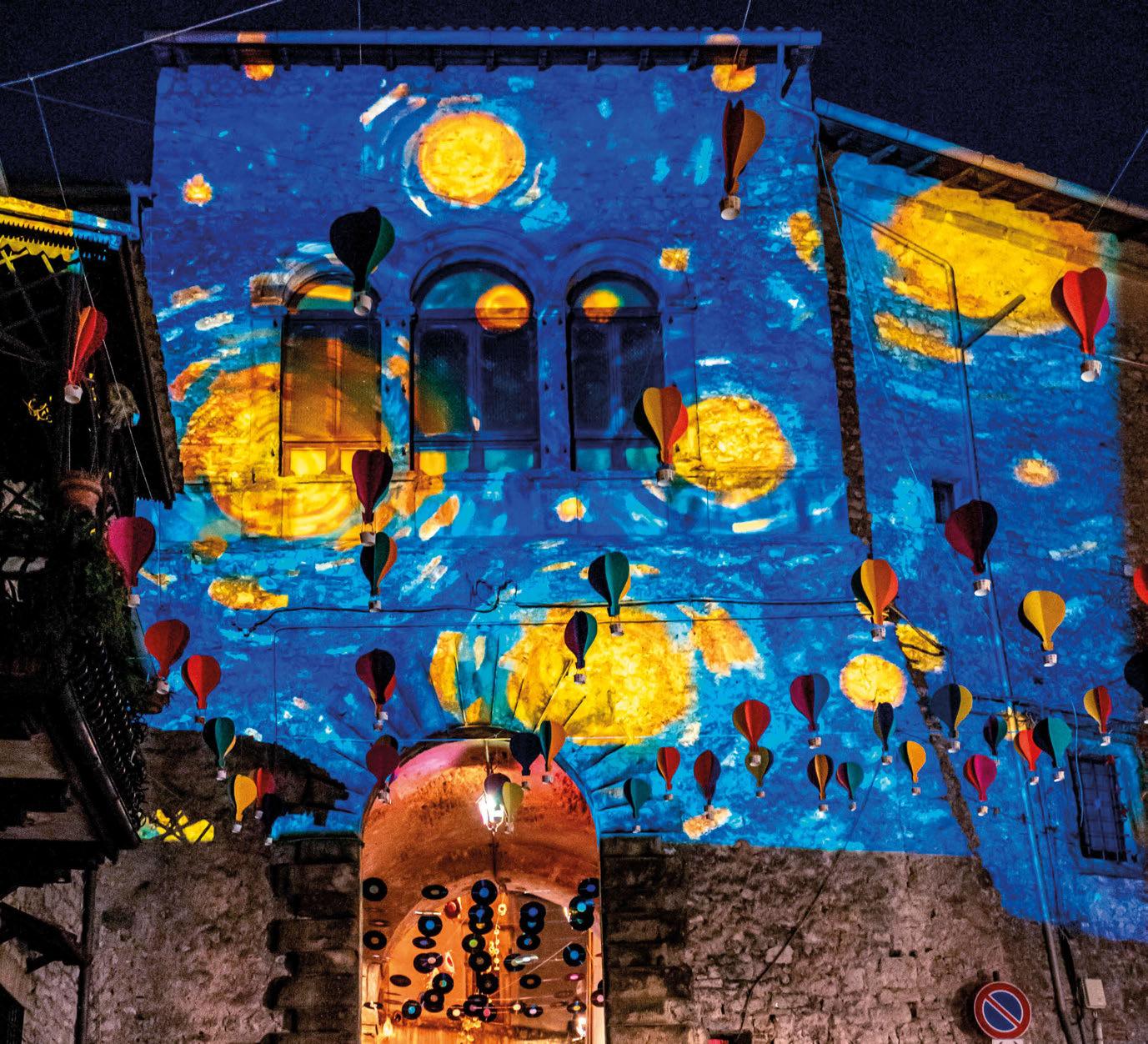
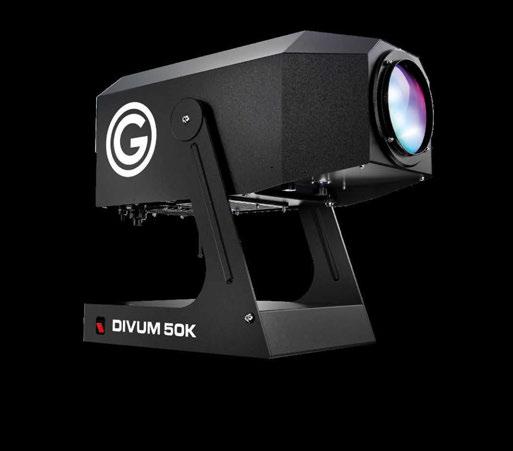
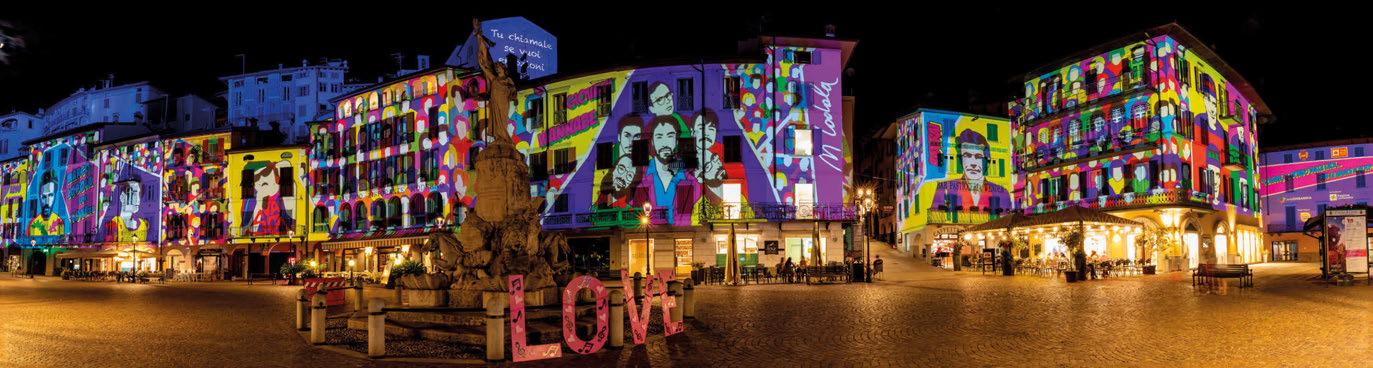
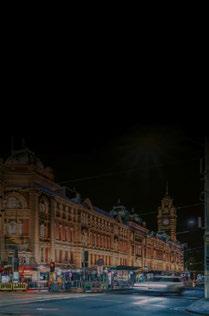
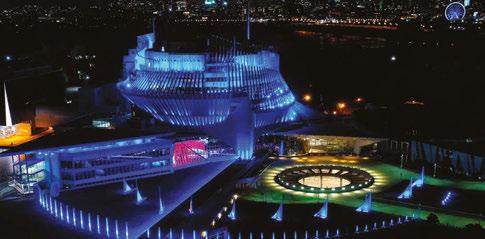
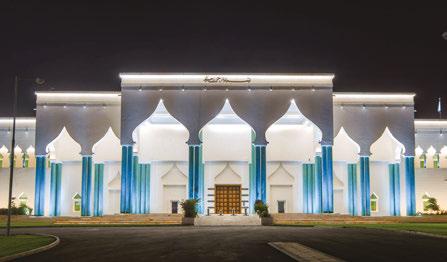
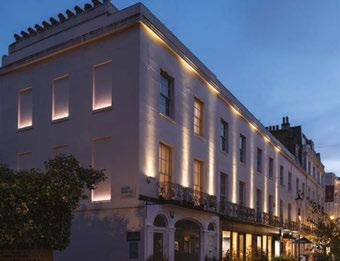
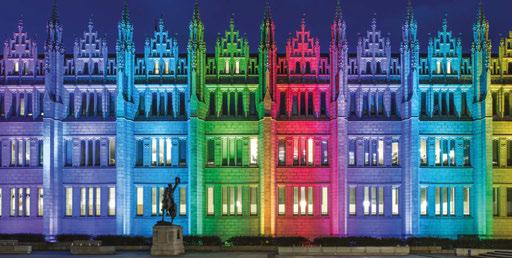
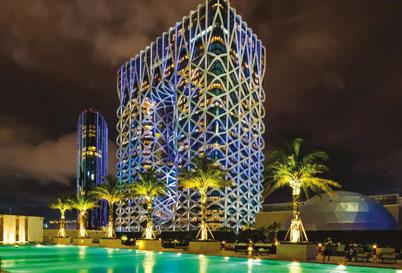
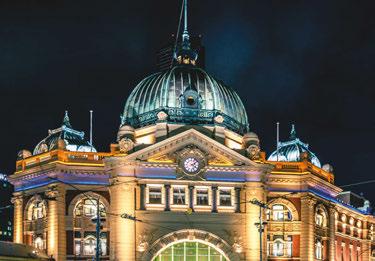
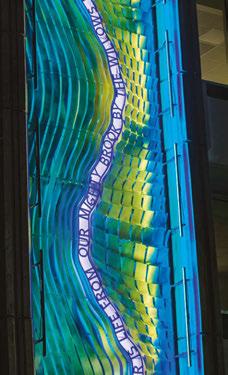
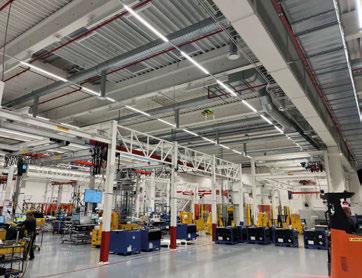
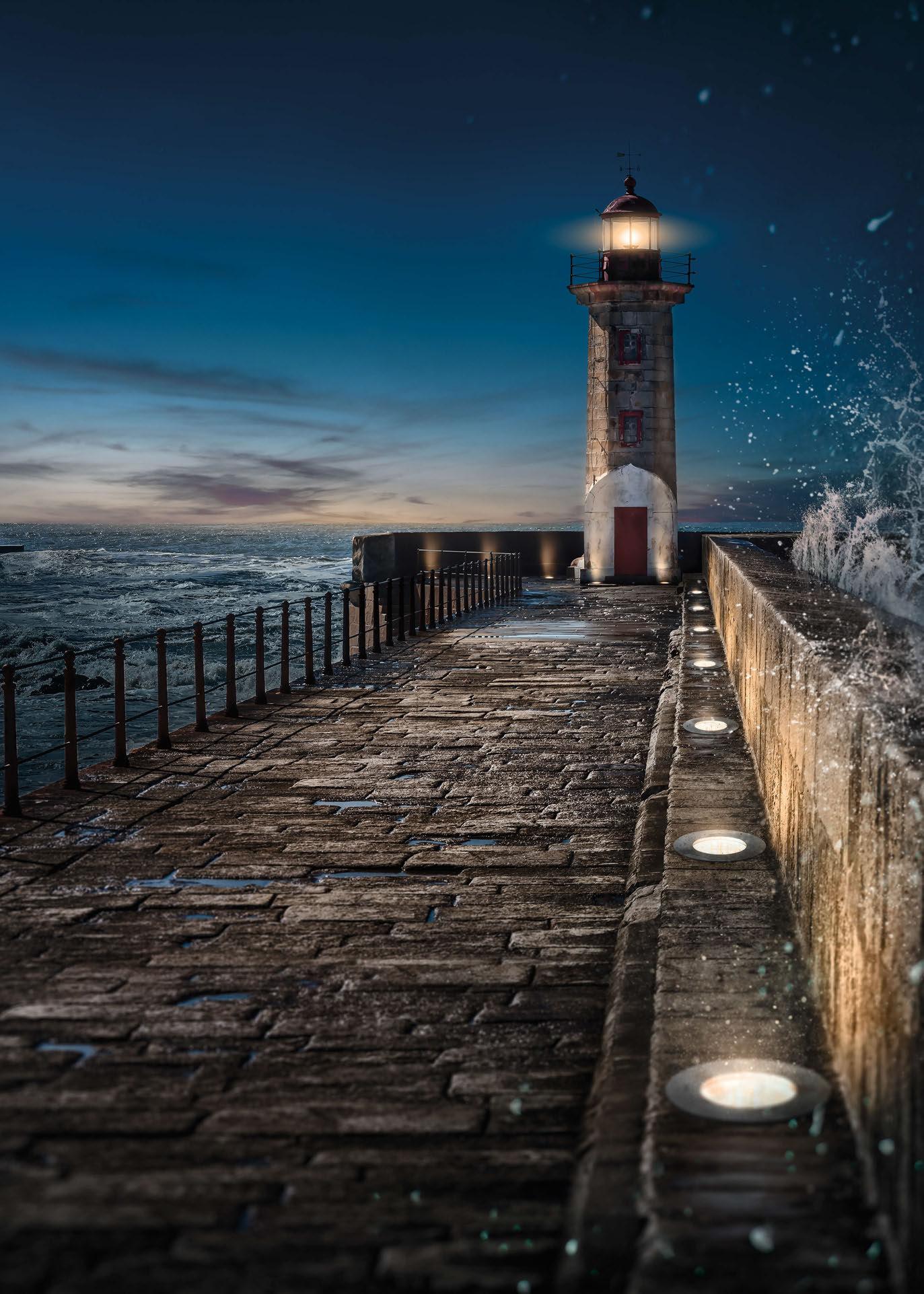
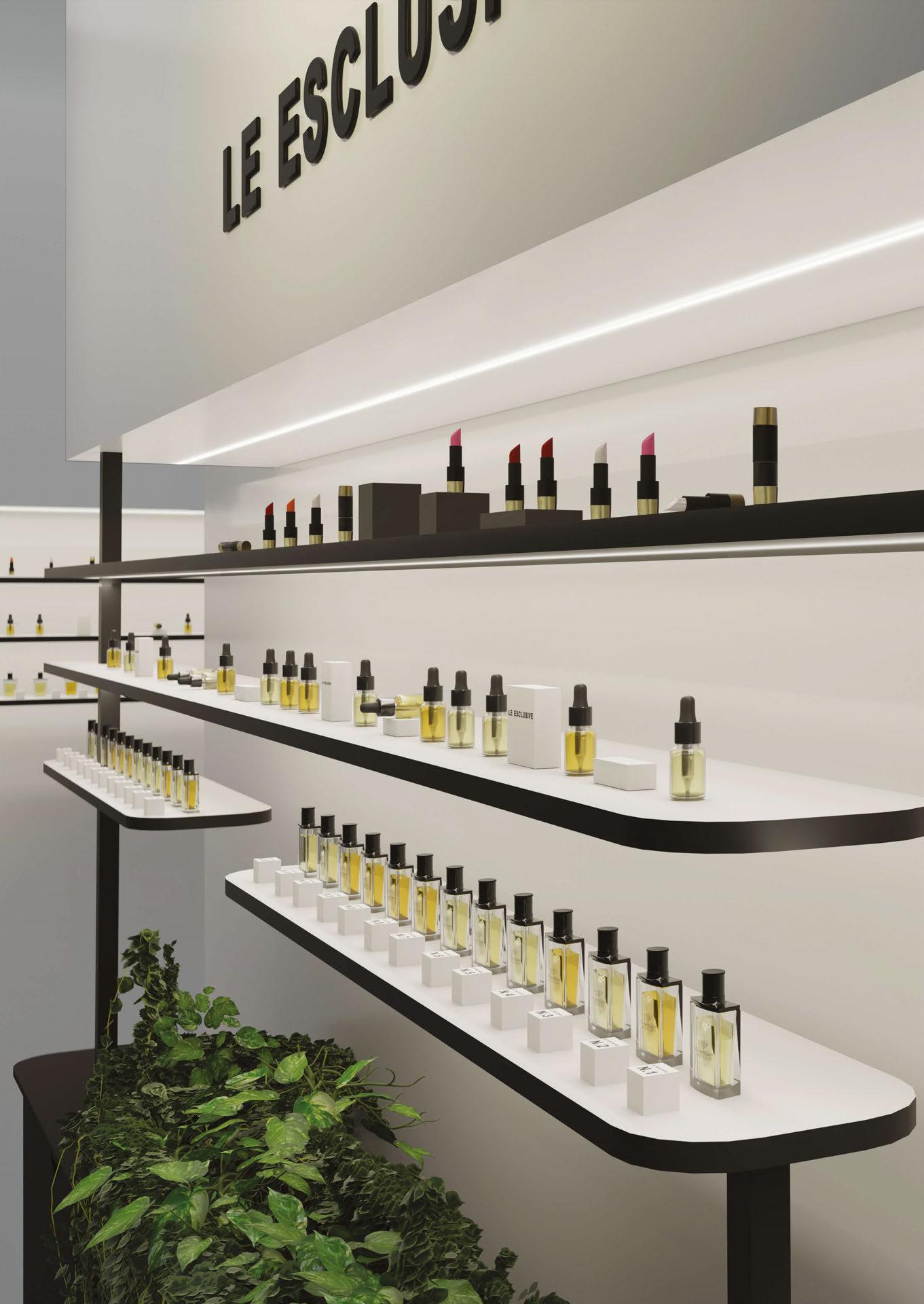
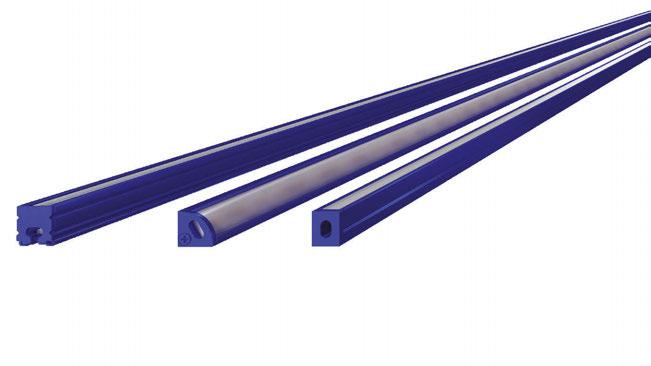
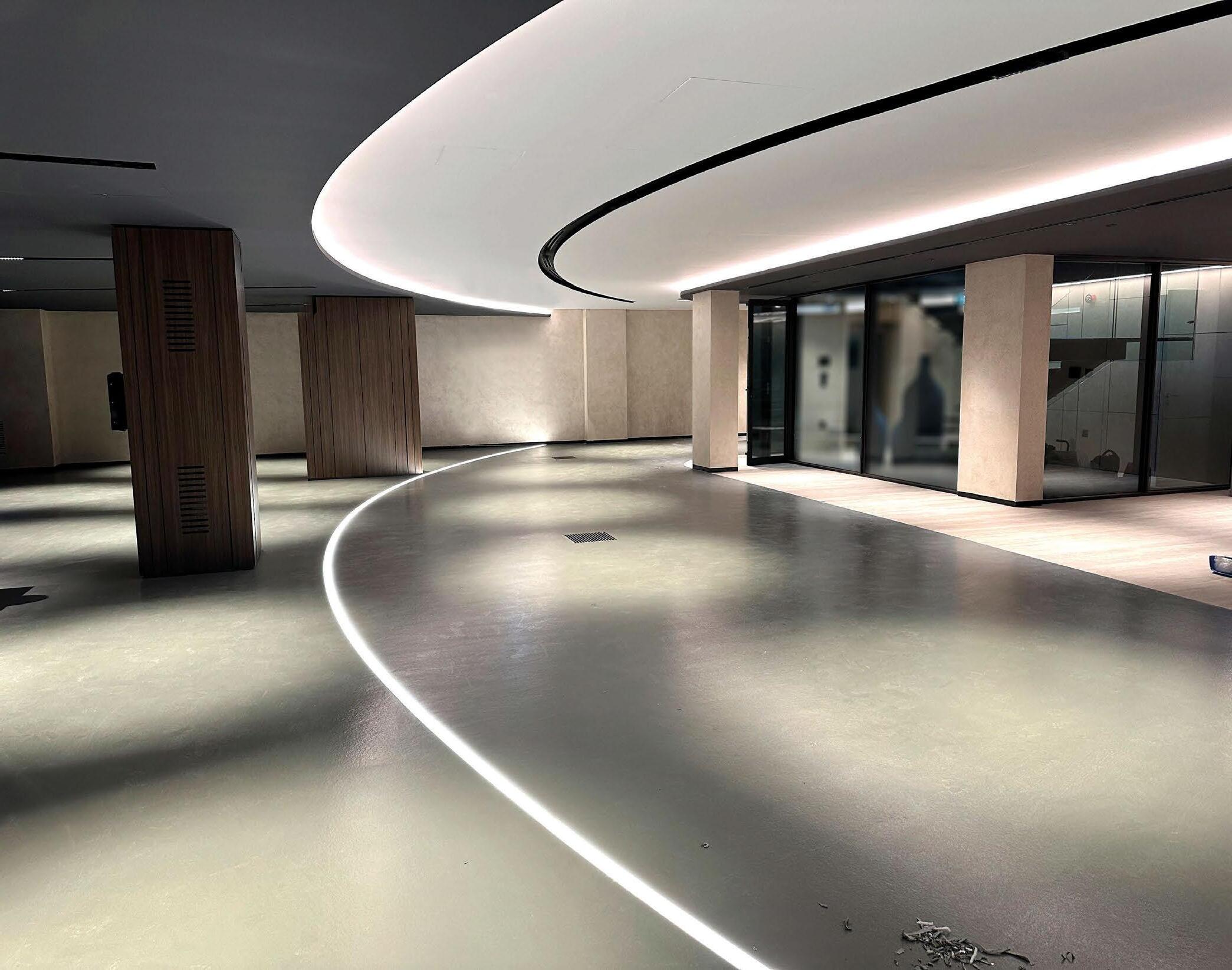
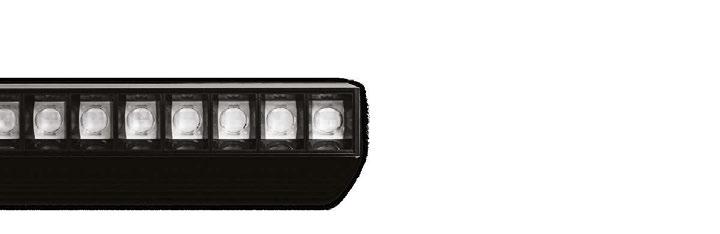
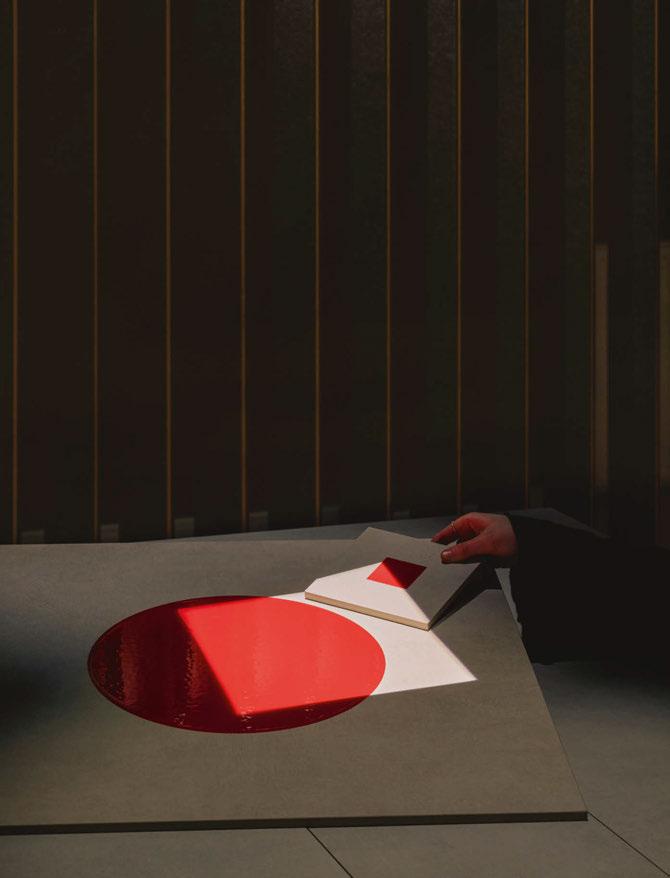
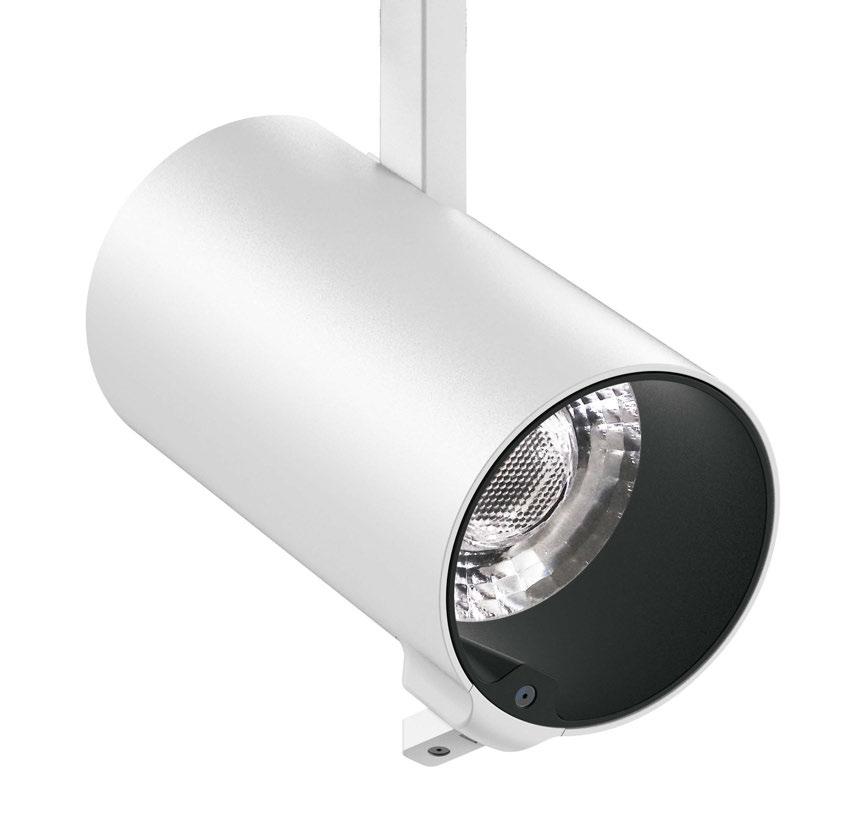
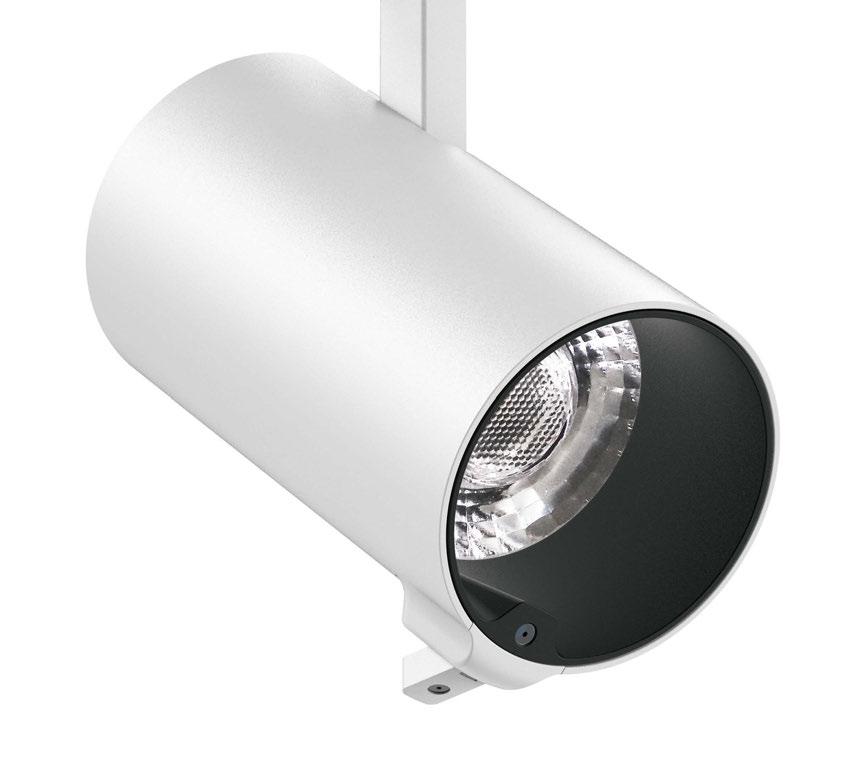
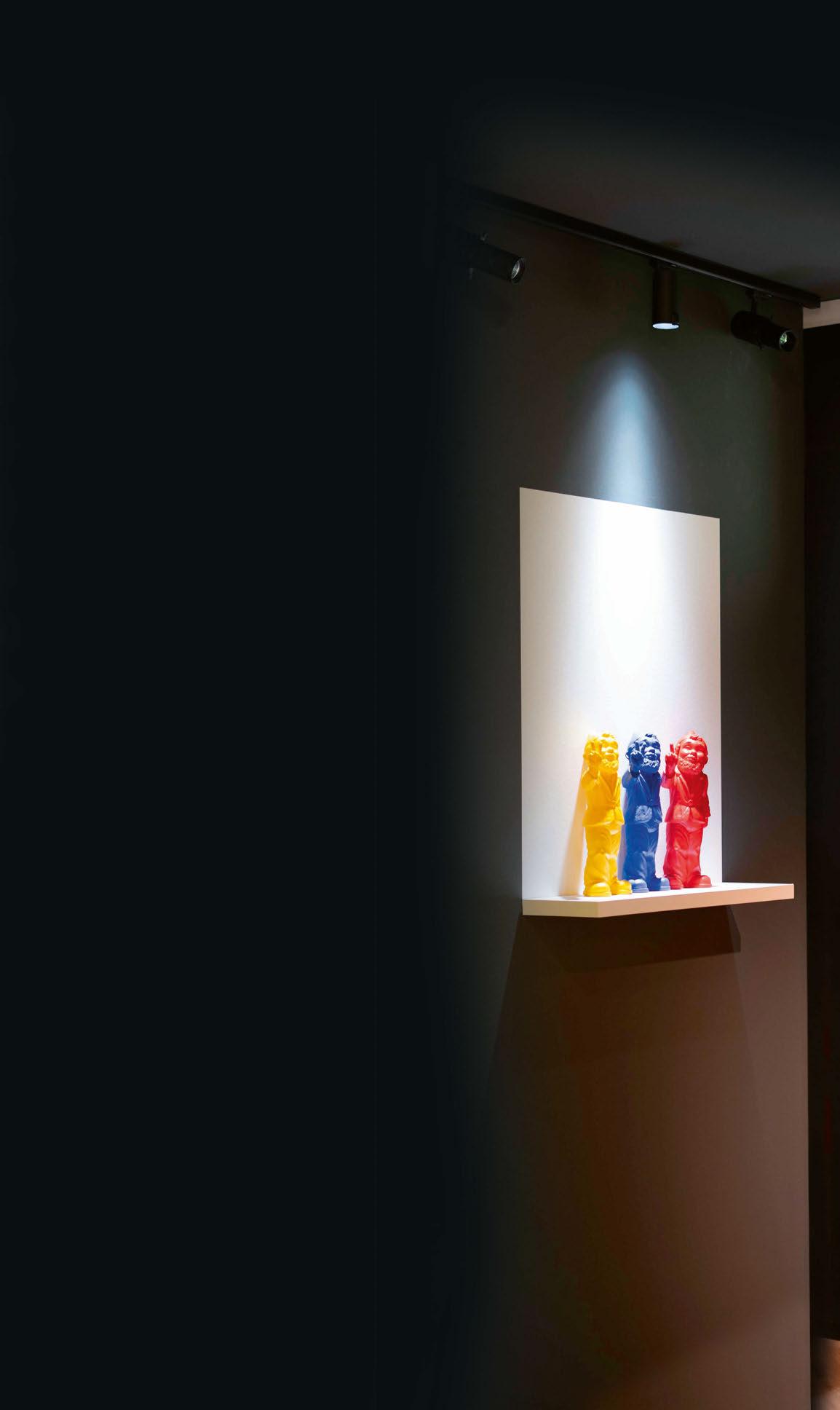
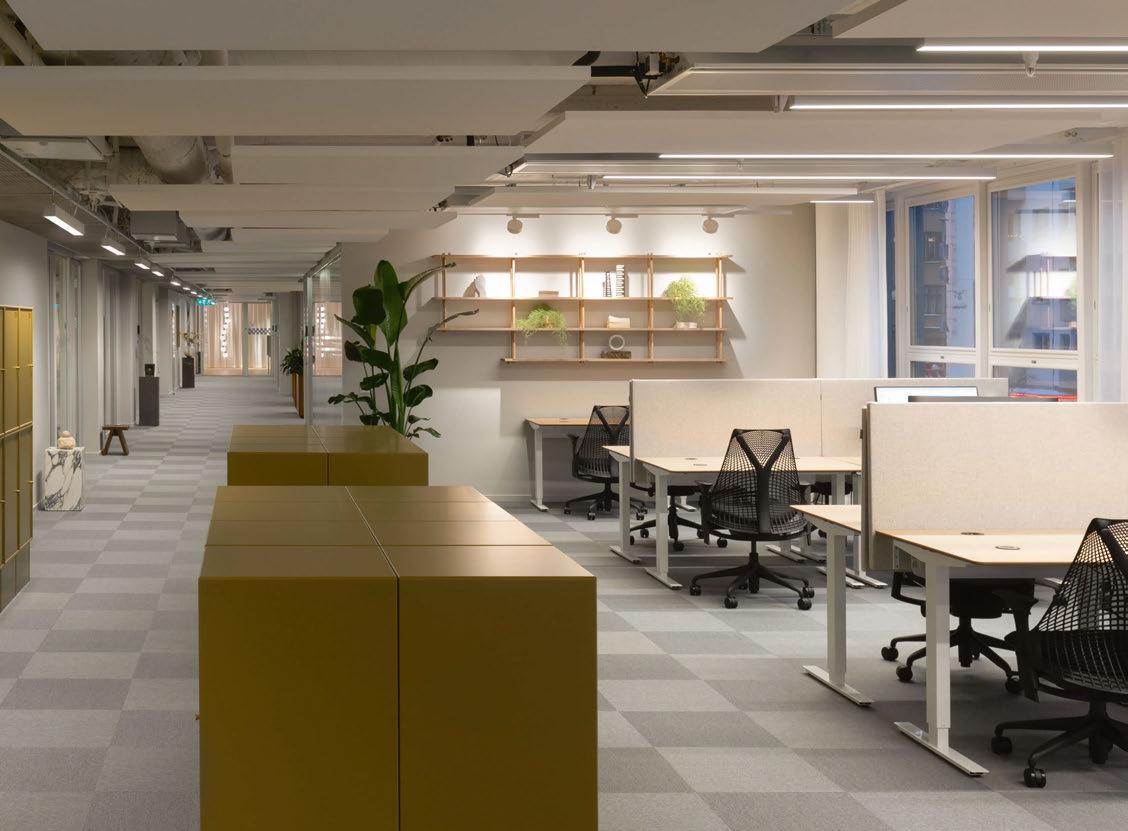
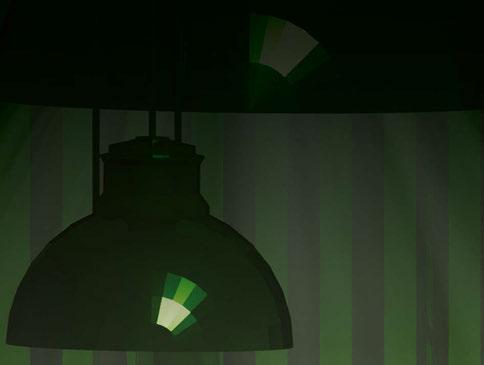
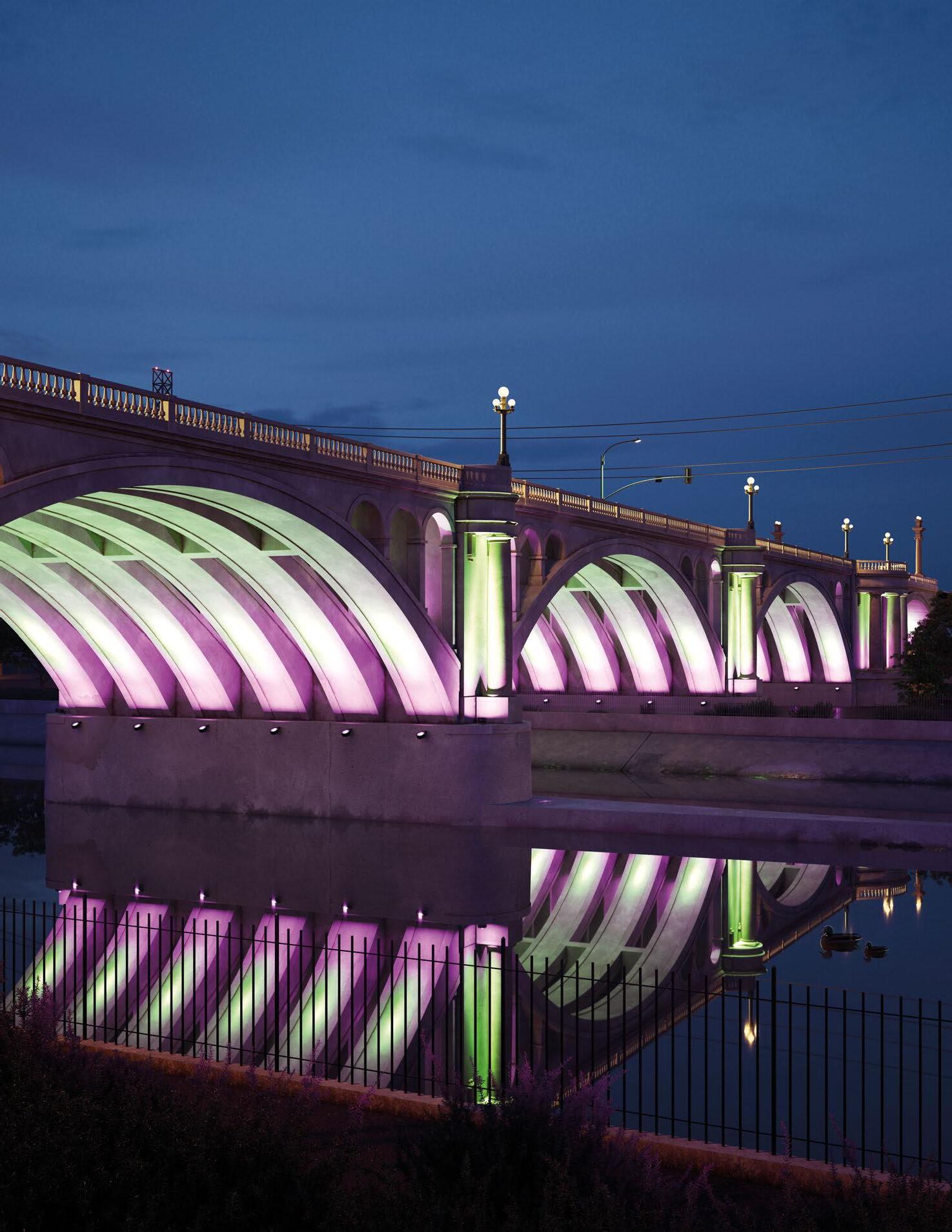
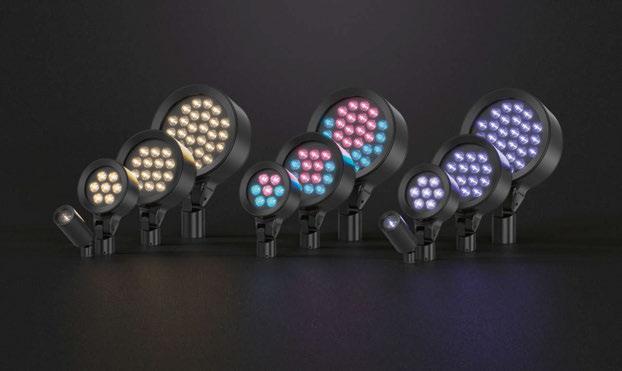
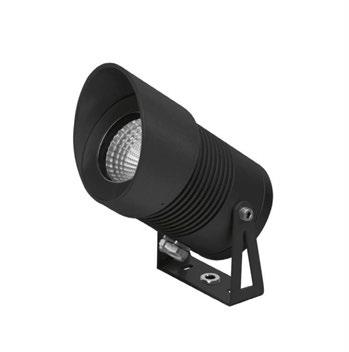
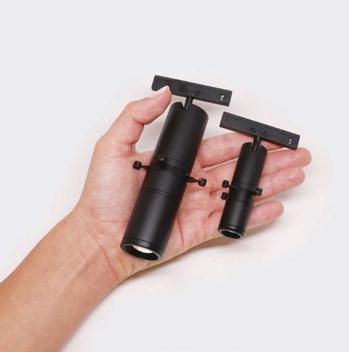
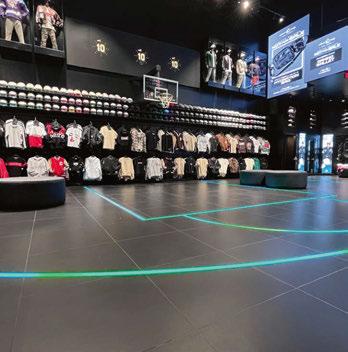
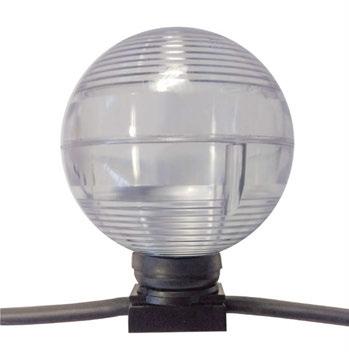
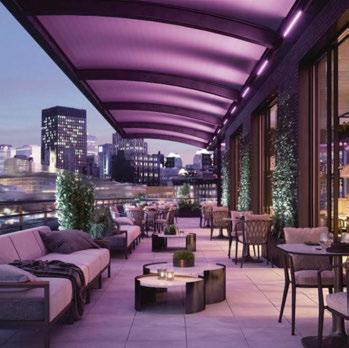
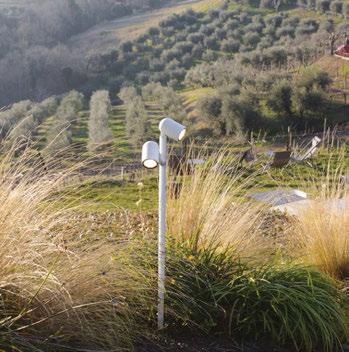
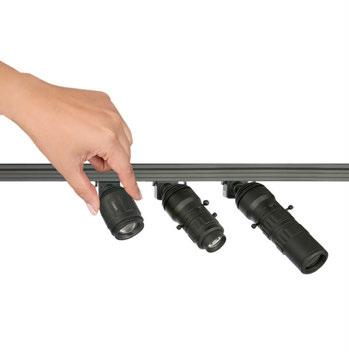
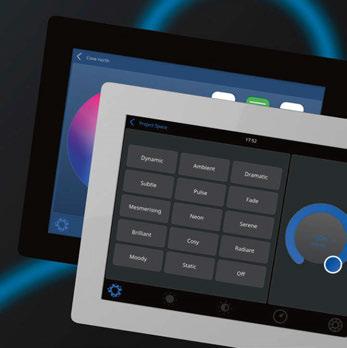
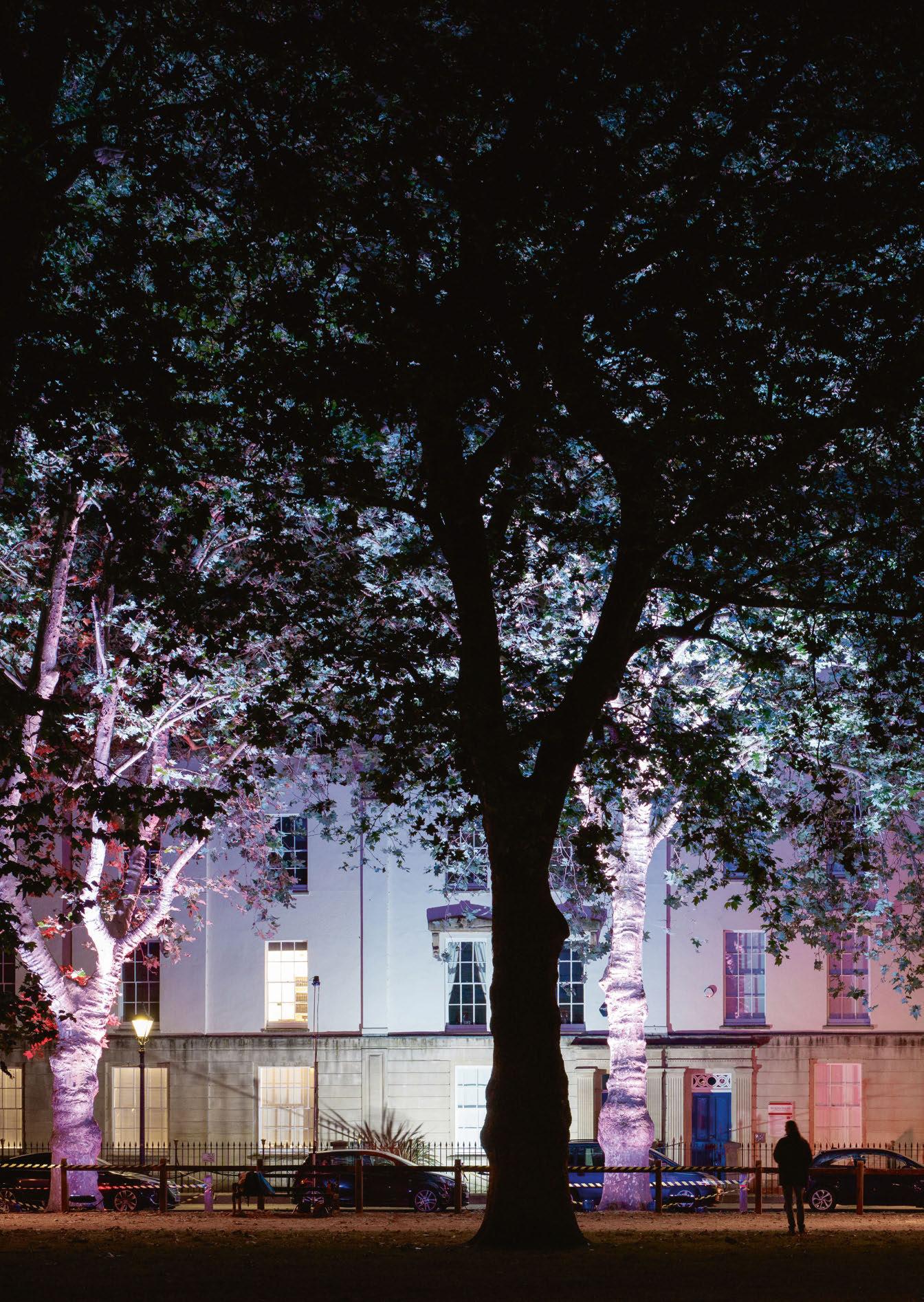
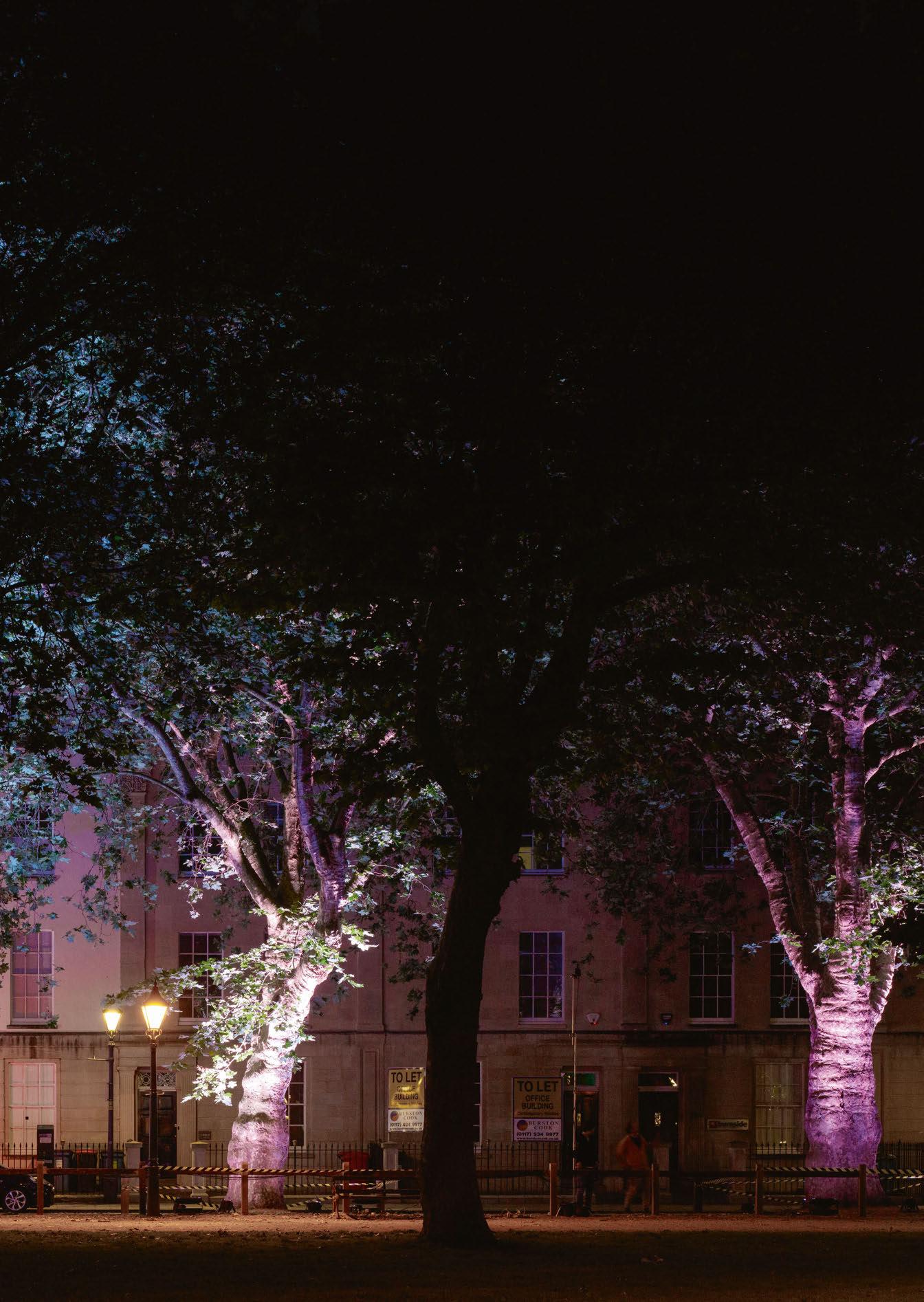
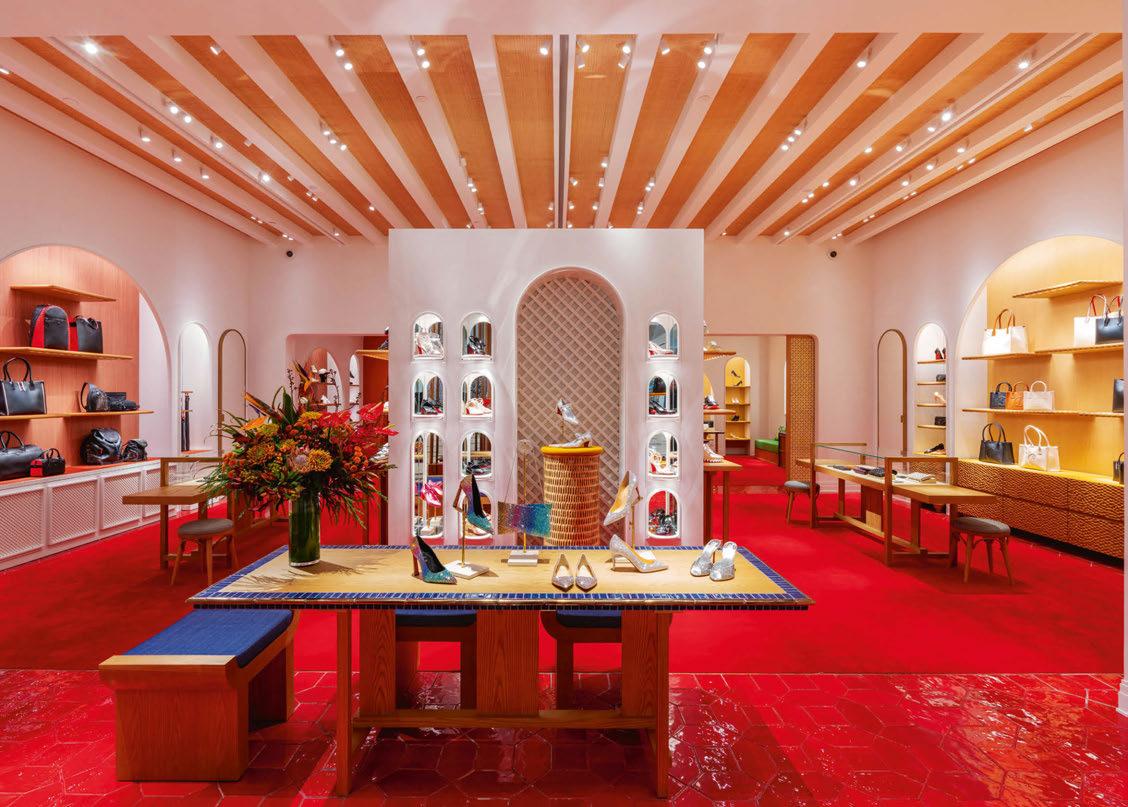
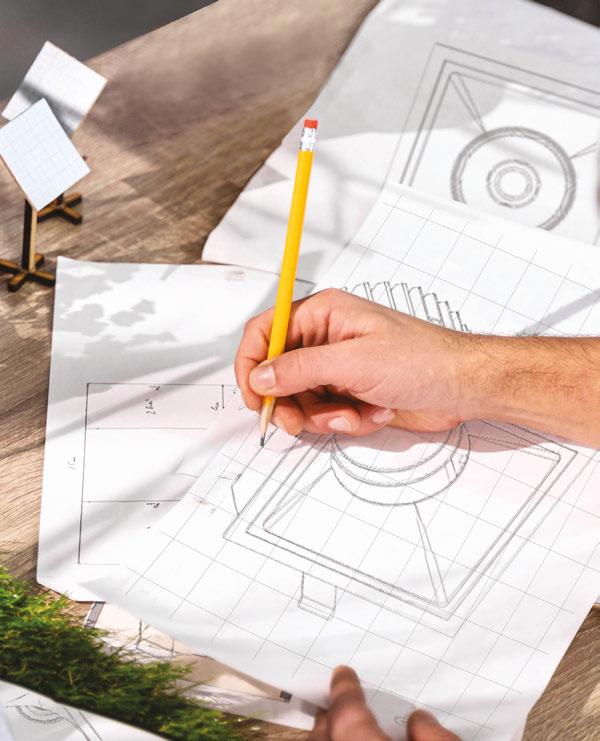
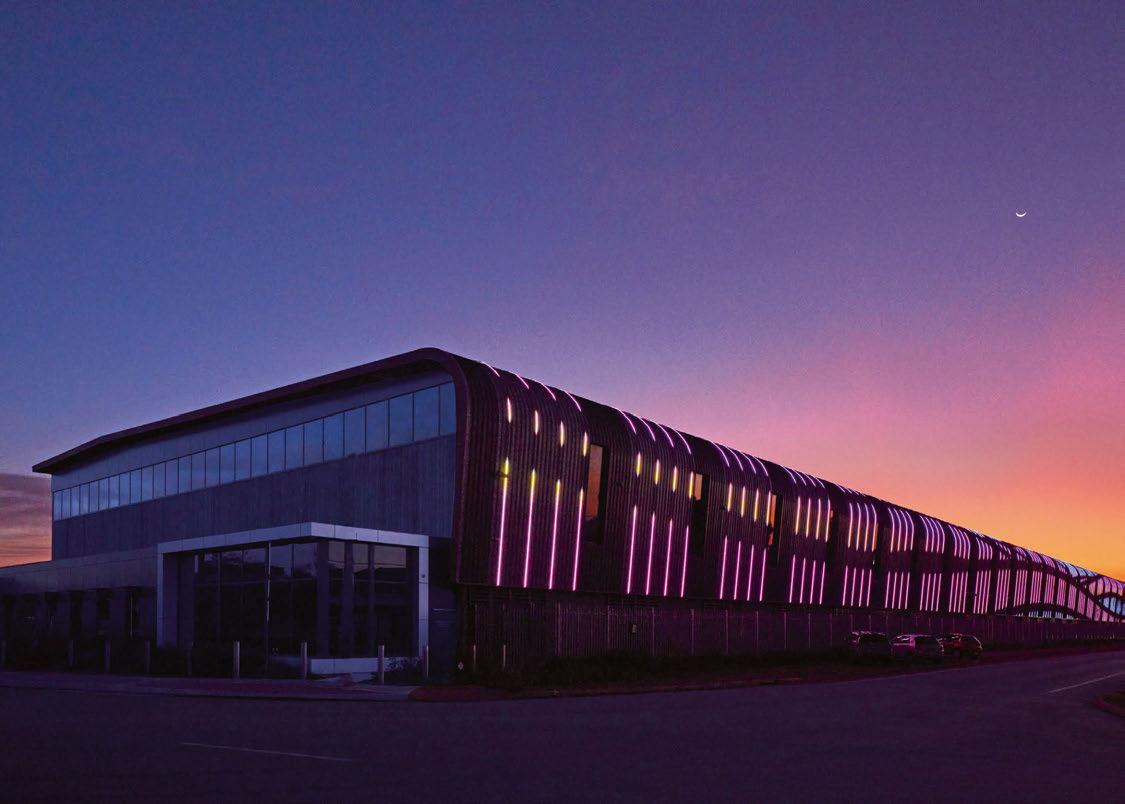
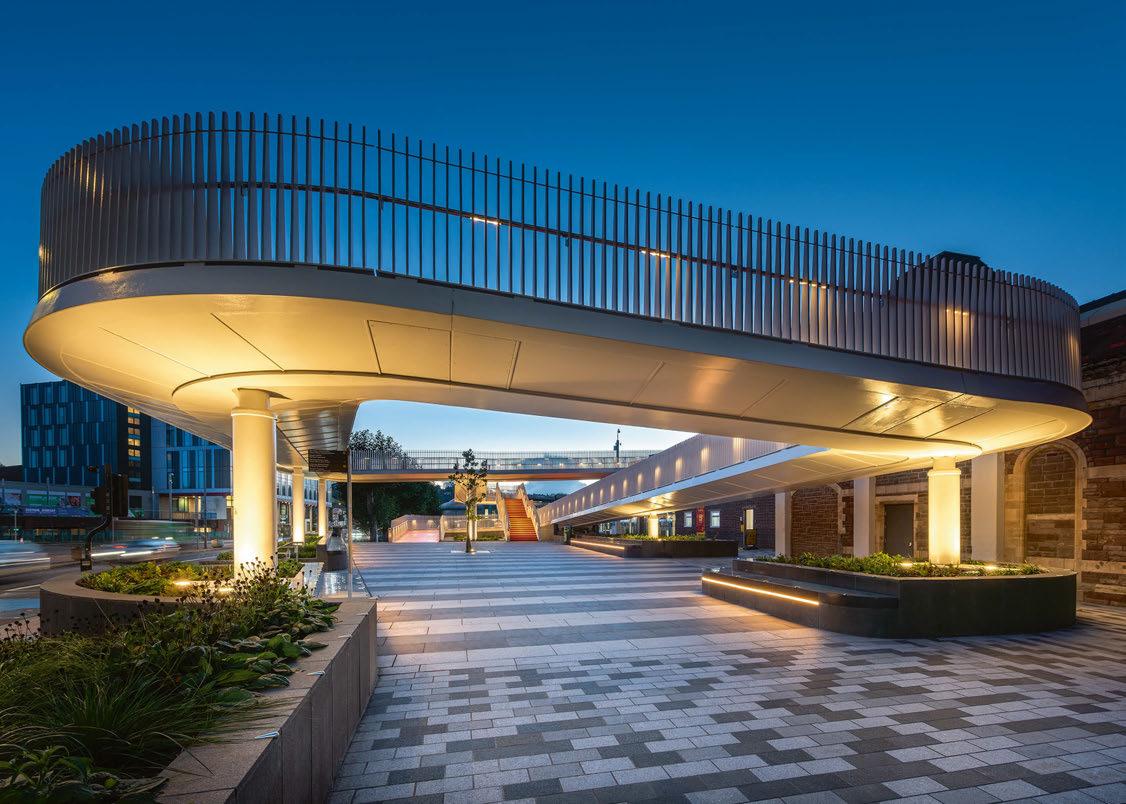
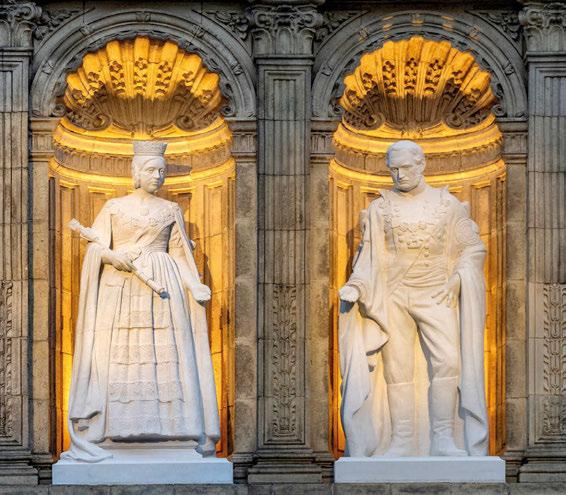
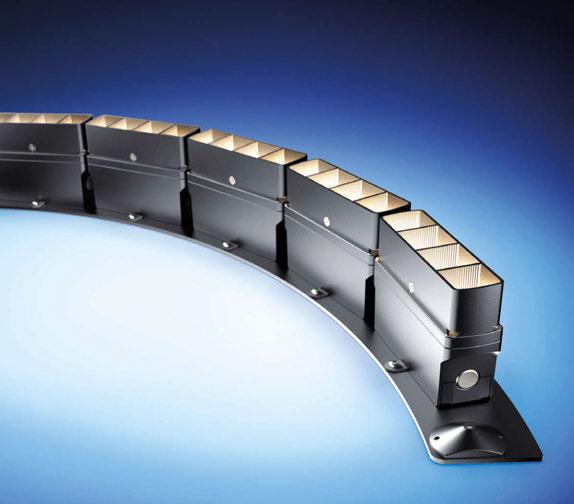
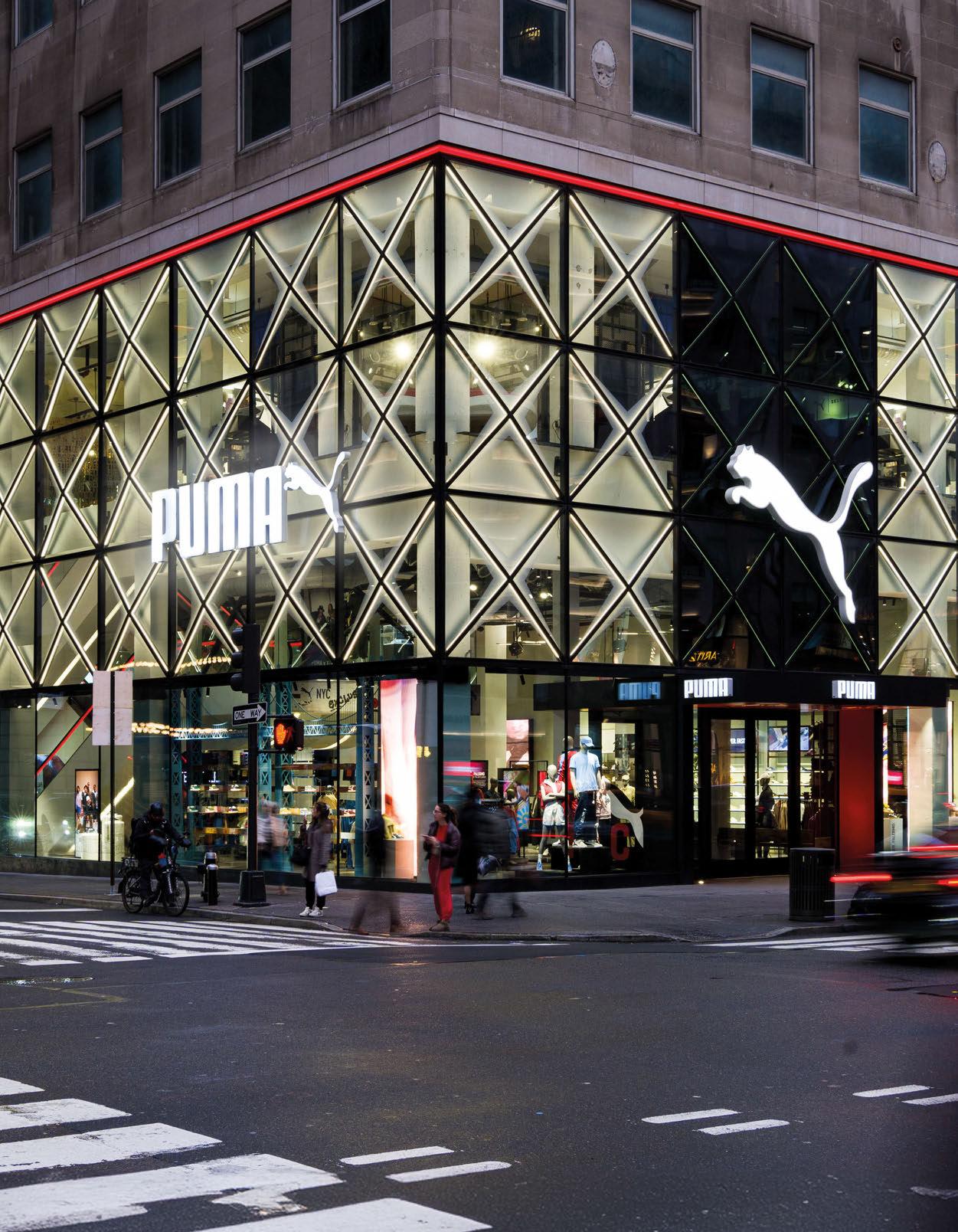
Goboservice, is a trusted manufacturer of custom gobos and low-power, highdefinition projectors that illuminate buildings, streets and businesses. Known for their high performance and impressive brightness, Goboservice’s gobos and projectors are suitable for a wide range of indoor and outdoor use, with the capability to project images, logos, symbols and signals across a plethora of applications.
Sales@lite-ltd.co.uk | www.lite-ltd.co.uk
Illumination that takes your breath away
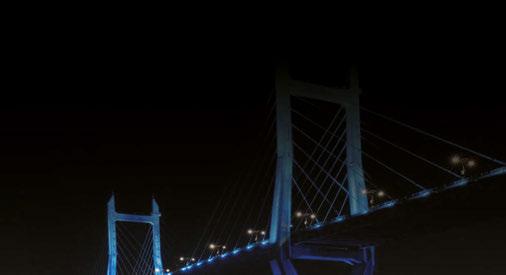
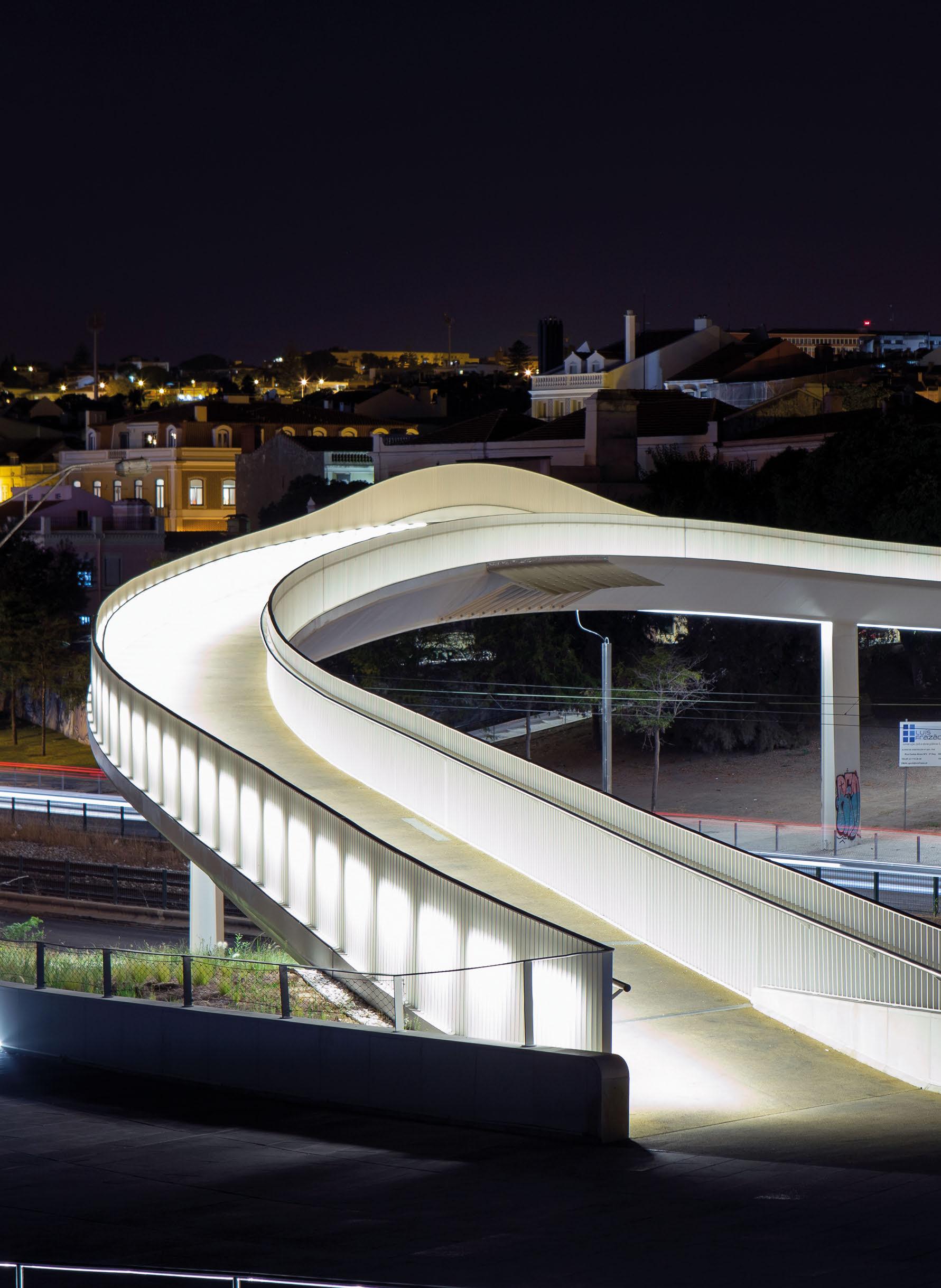
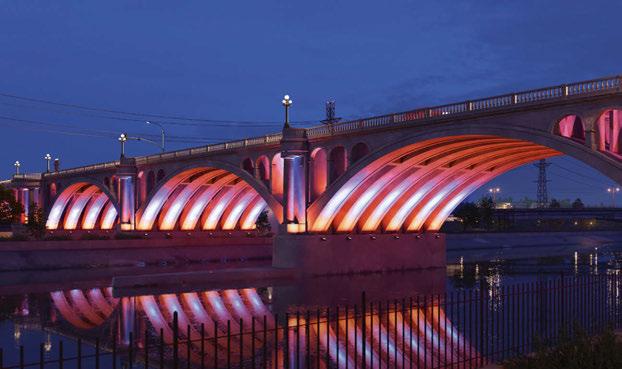
The world’s most iconic architecture deserves premier facade lighting solutions to match. Lumascape is proud to o er a full range of best-in-class luminaires and control systems to transform any building into a dazzling display of performance art with the power of light.
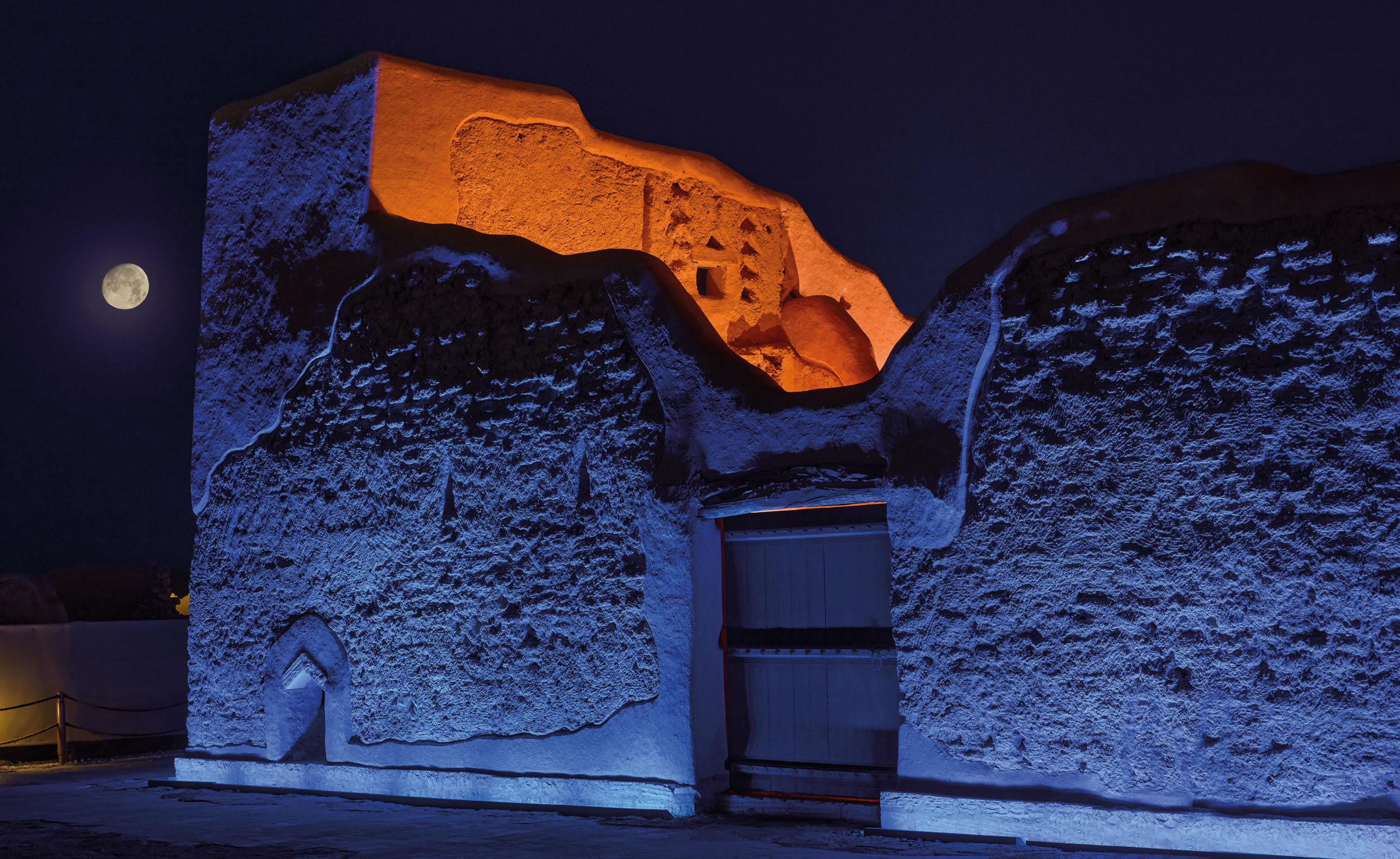
DISCOVER HERITAGE: AT-TURAIF ILLUMINATED BY MARTIN PROFESSIONAL
Lighting design by SPEIRS MAJOR
20 YEARS IN CONTROL
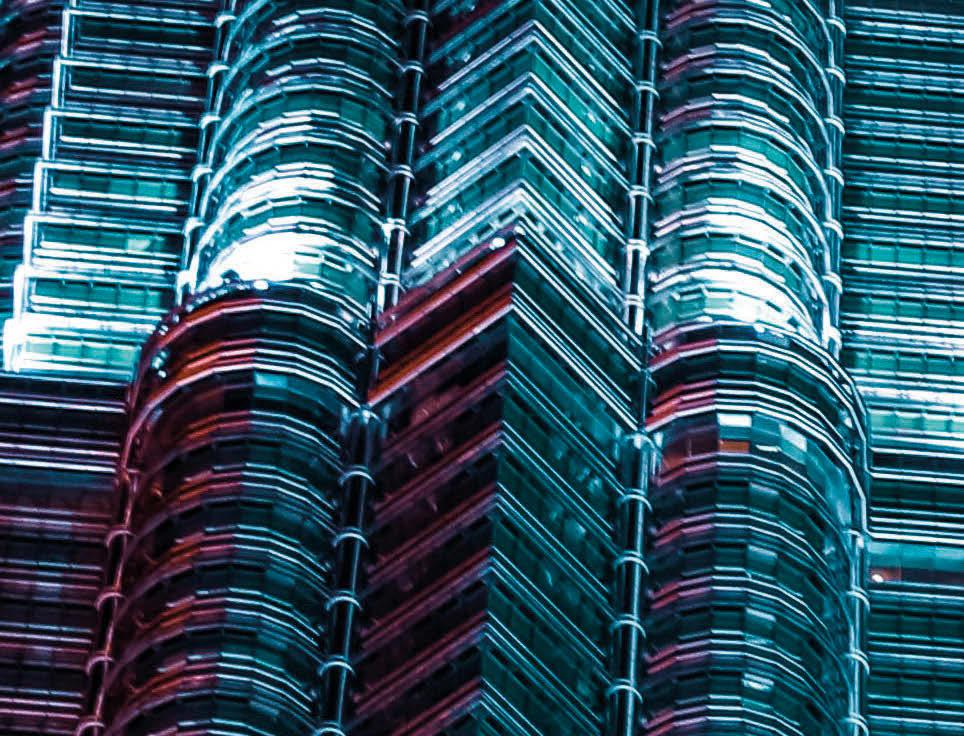
Pharos
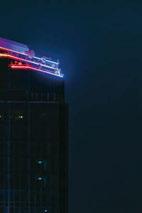
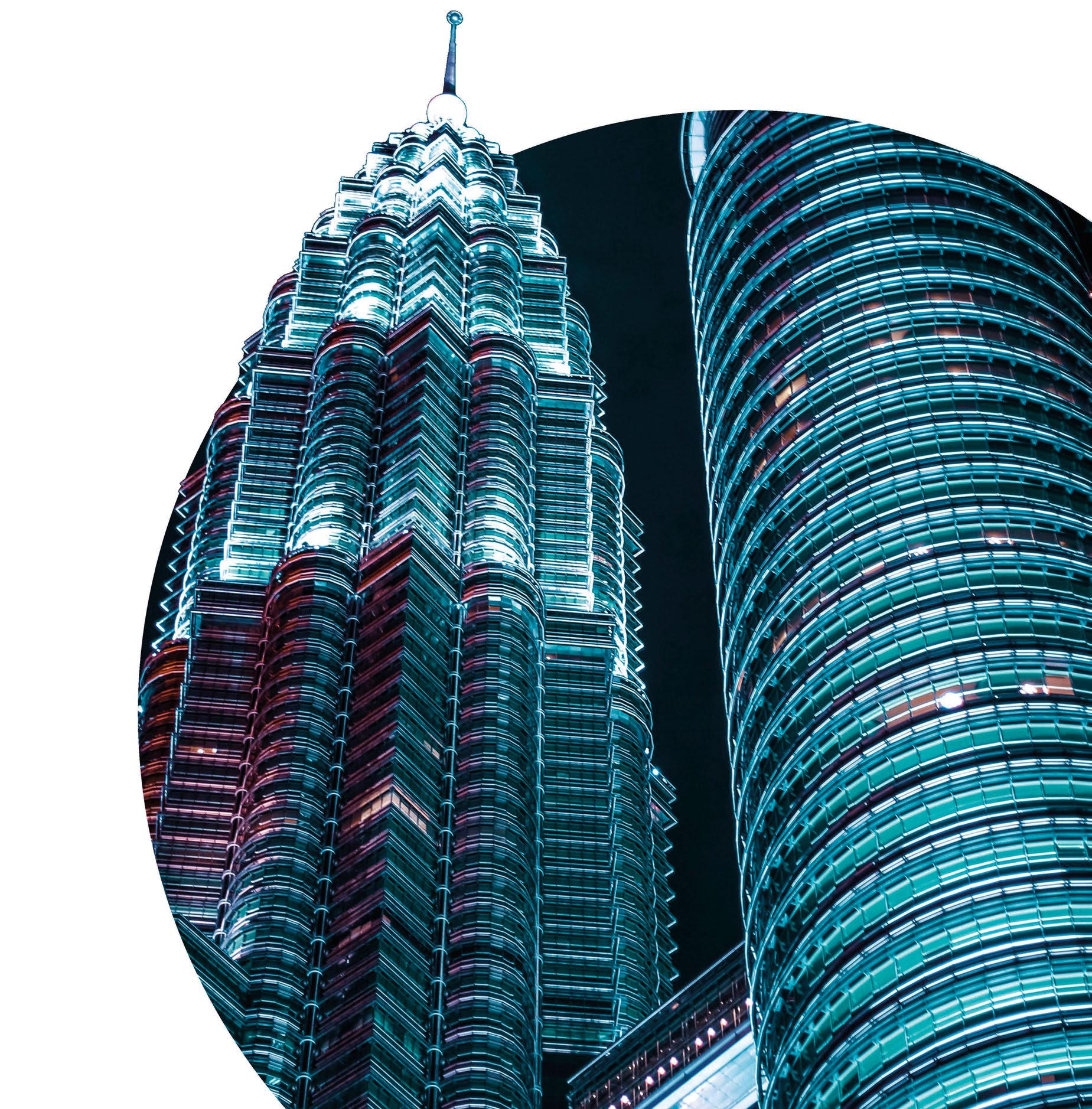
Petronas Twin Towers
Kuala Lumpur 2022
Powered by AI
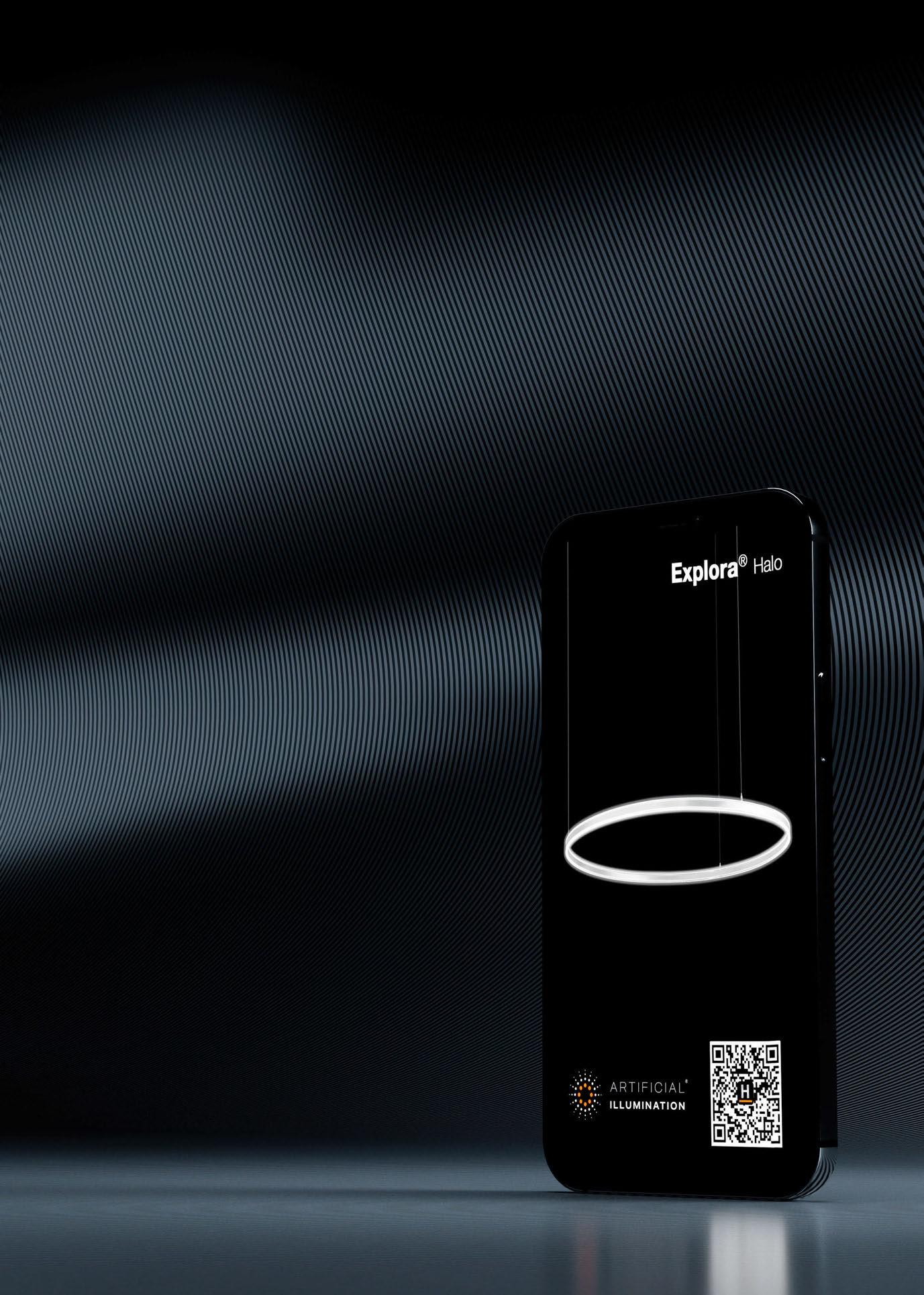
Discover the future of lighting with Hacel’s industry-first Augmented Reality (AR) experience.
Explore our latest light fittings in an immersive, interactive way like never before. Simply scan the QR code below with your smartphone or tablet to start your AR journey and see our cutting-edge designs come to life!
• VISUALISE IN 360º
See products in your spaces now
• FAST DECISION MAKING
Assess scale and suitability of products in situ
• BOOST PRODUCTIVITY
Collaborate more effectively with clients in presentations
• SMART
Simple and easy operation on smartphones and tablets
Brand new. The hero for highly robust architectural lighting.
Timelessly elegance, made for eternity. With outstanding characteristics, this series defies the most adverse conditions.
The next session: 24 – 26 September, 2024 Le Meridien Resort Phuket, Thailand
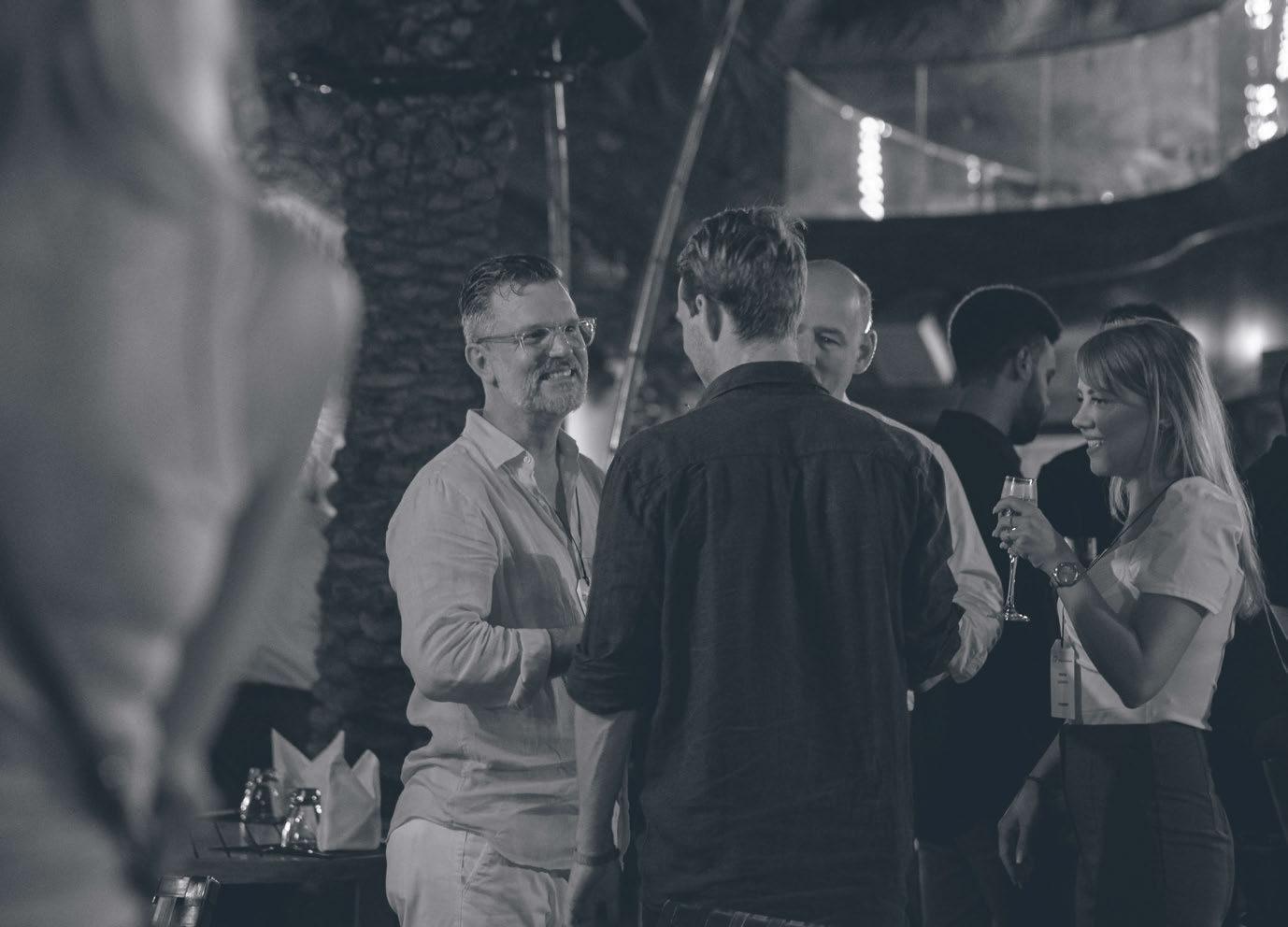
A series of events connecting the very best people creating exceptional lighting projects around the world. For more information contact Jason Pennington: j.pennington@mondiale.co.uk
Welcome
As one of the rare publishing companies in the UK to NOT be based in London, instead hailing from the “Grim Up North” of Stockport, Greater Manchester (up the Hatters), it is very exciting for us when we are presented with an opportunity to shout about some of the amazing local talent up here. This is the very situation that we have found ourselves in for this issue, where you will see our beautiful cover story comes from the amazing designers, and fellow “Stopfordians” (no idea, don’t ask...) at Artin Light.
If you are not already familiar with the spectacular work that Artin Light does, you should definitely check out their work as Luke, Stuart, and Maya have steadily been building an incredibly impressive portfolio of dynamic and very artistic architectural lighting design. Our cover story for this issue, the Solus Ceramics showroom in Manchester, is no exception. Read all about it from page 60.
This project sits as part of our Workspace Lighting focus, where we take a look at some of the most
impressive new projects in this field. As most of us are now back in the office - whether full time or as part of a hybrid model - it is more important than ever to have a well designed workspace, with lighting that supports our wellbeing (both mental and physical), and helps to create a productive, and harmonious atmosphere. It goes without saying that environmental and sustainable considerations are also a major factor, and the projects featured in this issue show how a good lighting design can tick all of these boxes.
Elsewhere, I’m delighted to report back on a very entertaining few days in London for this year’s IALD Enlighten Europe conference. I always look forward to this event, as it is an amazing way to connect with the industry, catch up with friends and peers, and learn A LOT about lighting. You can hear my full thoughts on this year’s edition, as well as those of our wonderful Junior Journalist, Ellie Walton, from page 42 - right after our deep dive with “art engineer” Moritz Waldemeyer, who this year celebrate’s his studio’s 20th anniversary. Next time you hear from me, I’ll be fresh off a month’s parental leave with my soon-to-arrive son, so wish me luck, and I’ll see you on the other side! Enjoy the issue!
Matt Waring Editor
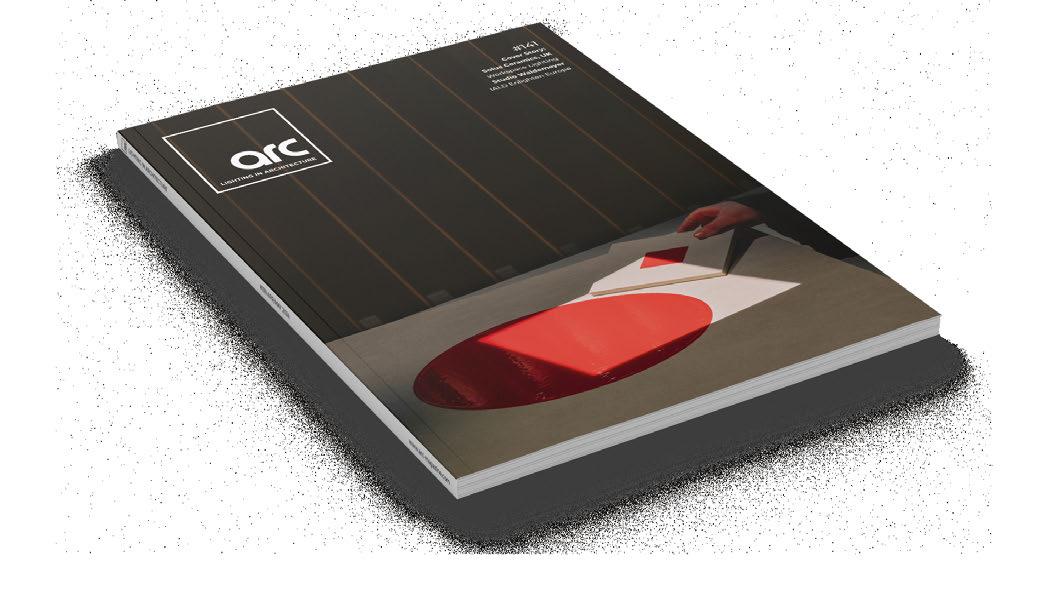
Front cover: Solus Ceramics, UK (Image: Gunner Gu)
Inside this issue
Regulars
Event Diary
Drawing Board
In Conversation
Glenn Shrum tells us about his “Lighting Design Pioneers” project.
Snapshot
Baseline Lighting Design Studio
Marcus Steffen
Why business owners need to “let go” and start delegating.
Silhouette Awards
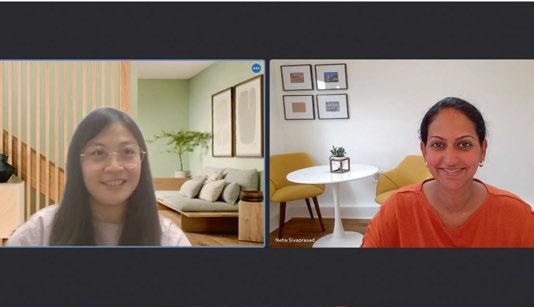
Previous partnerships discuss the value of the mentor/mentee pairing.
GreenLight Alliance
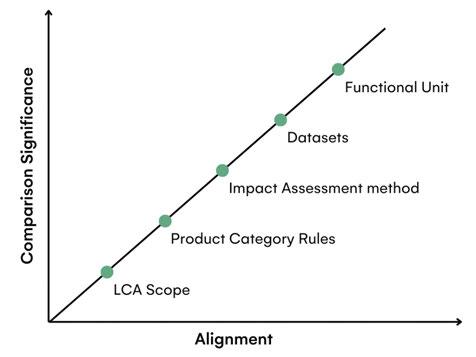
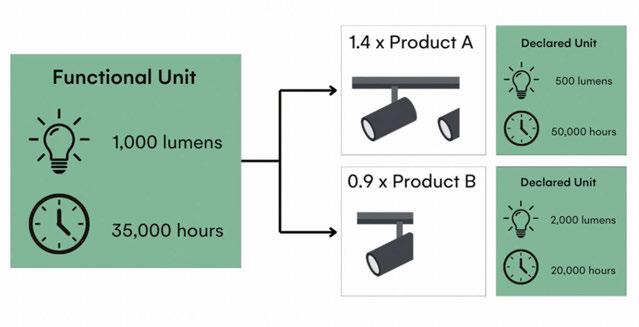
What is meant by “Functional Unit”, and how does it help us?
David Morgan Review Hydrel FLAME
Product Launches
Manufacturer Case Studies
Bucket List
Giovanni Zambri
Eye Openers
Olympic Cauldron
Mathieu Lehanneur
FLOW
Christopher Bauder
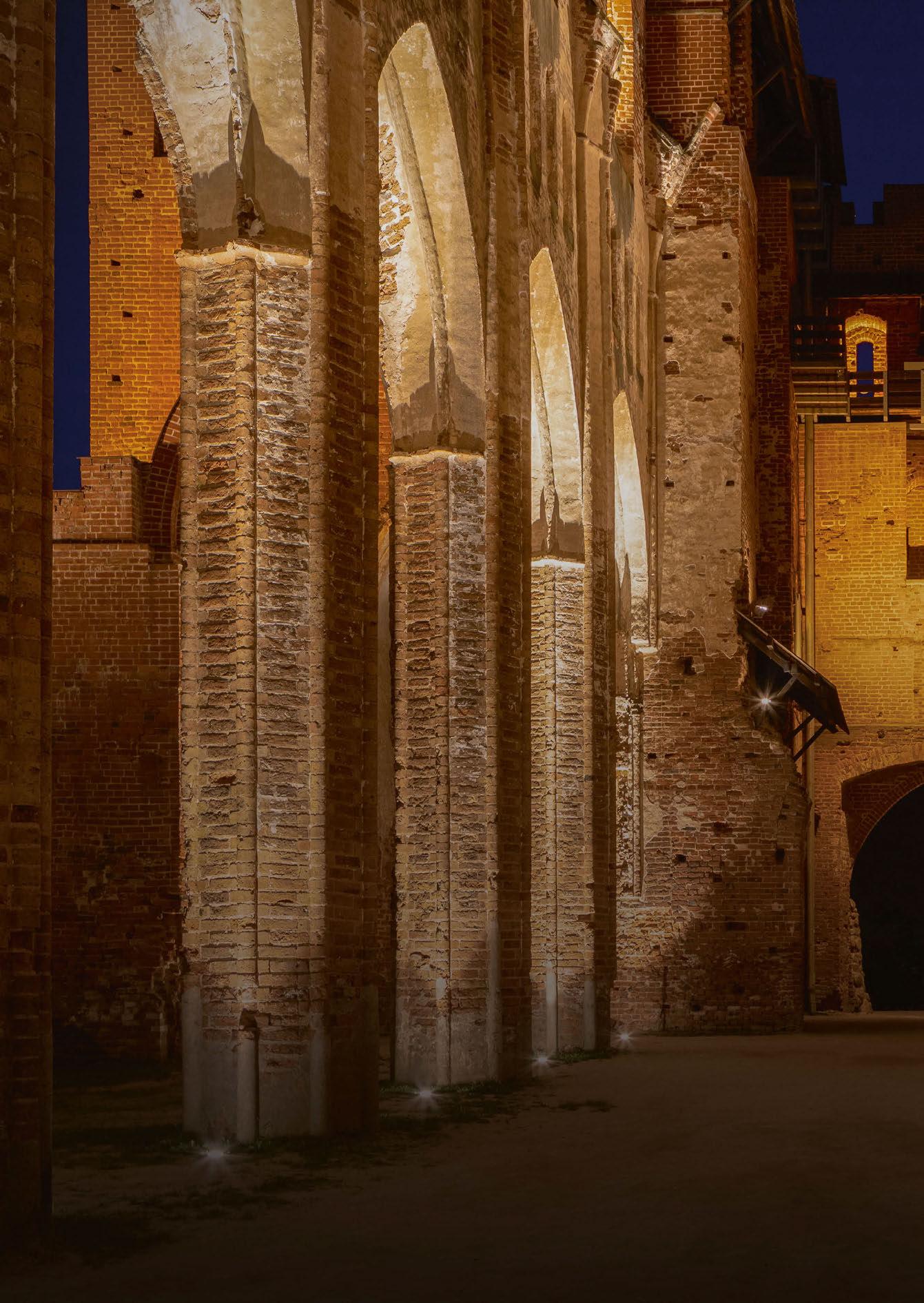
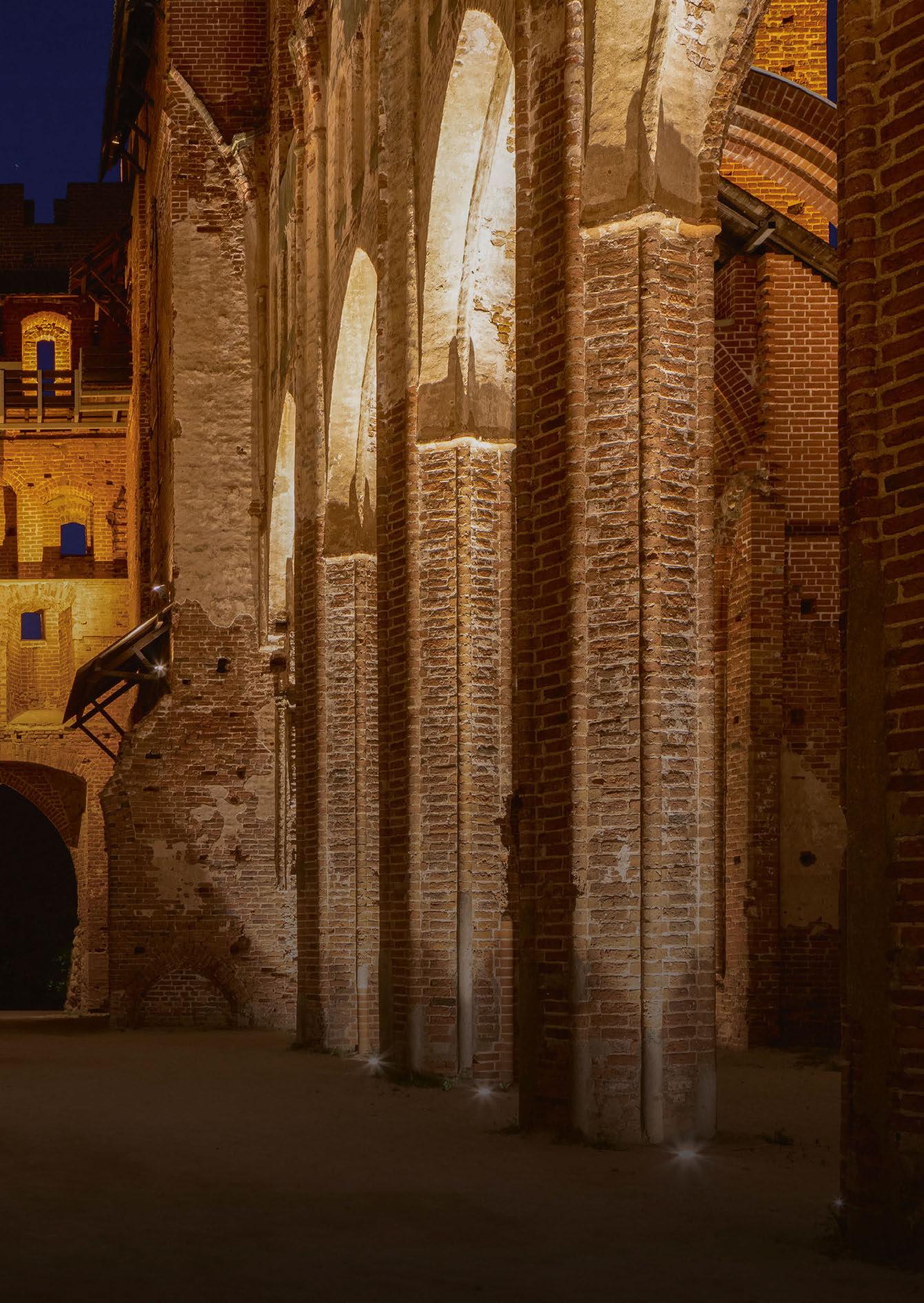
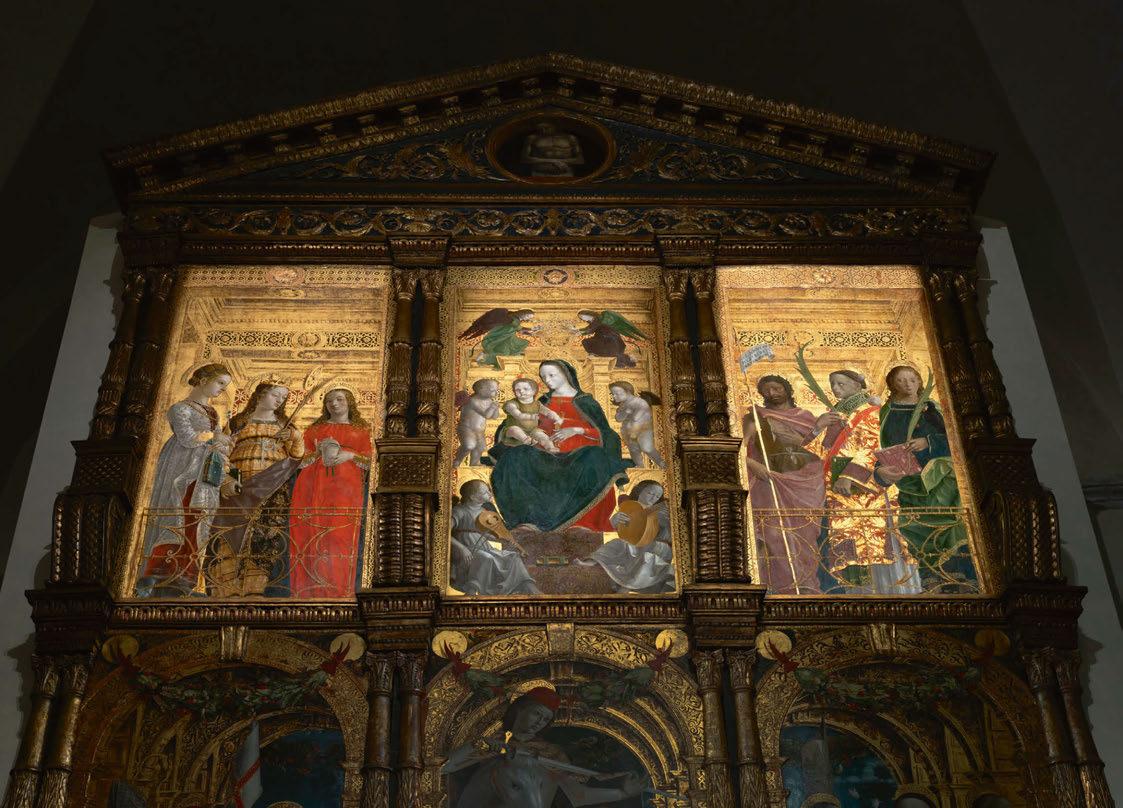
Tartu Cathedral studio light.to.light.design
The Orb Lam Partners
Zoomscape
Jack Wates
Features
Studio Waldemeyer
As his studio celebrates its 20th anniversary, Moritz Waldemeyer talks about his role as an “art engineer”.
IALD Enlighten Europe
arc editor Matt Waring and Junior Journalist Ellie Walton recount their experiences of the IALD conference.
The Future of Lighting Design
Marco Bevolo and Dennis Draeger share findings on their research on AI and lighting design.
70 Chancery Lane
We learn more about WSP’s recent refit of its own London offices.
Jenni Gillard
The CEO of Gillard Group speculates on “Tomorrow’s luminaires and their impacts on lighting designers”.
Projects
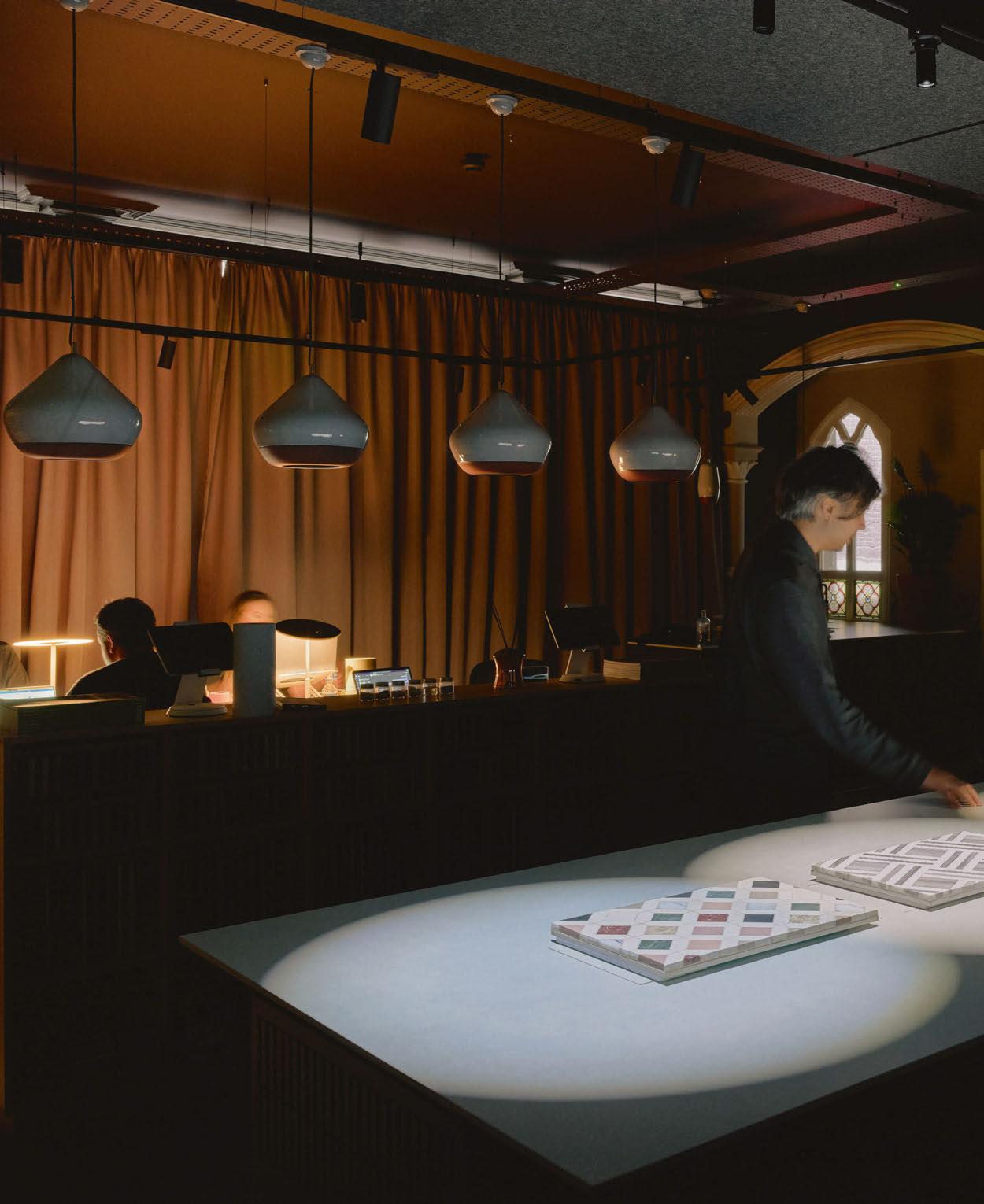
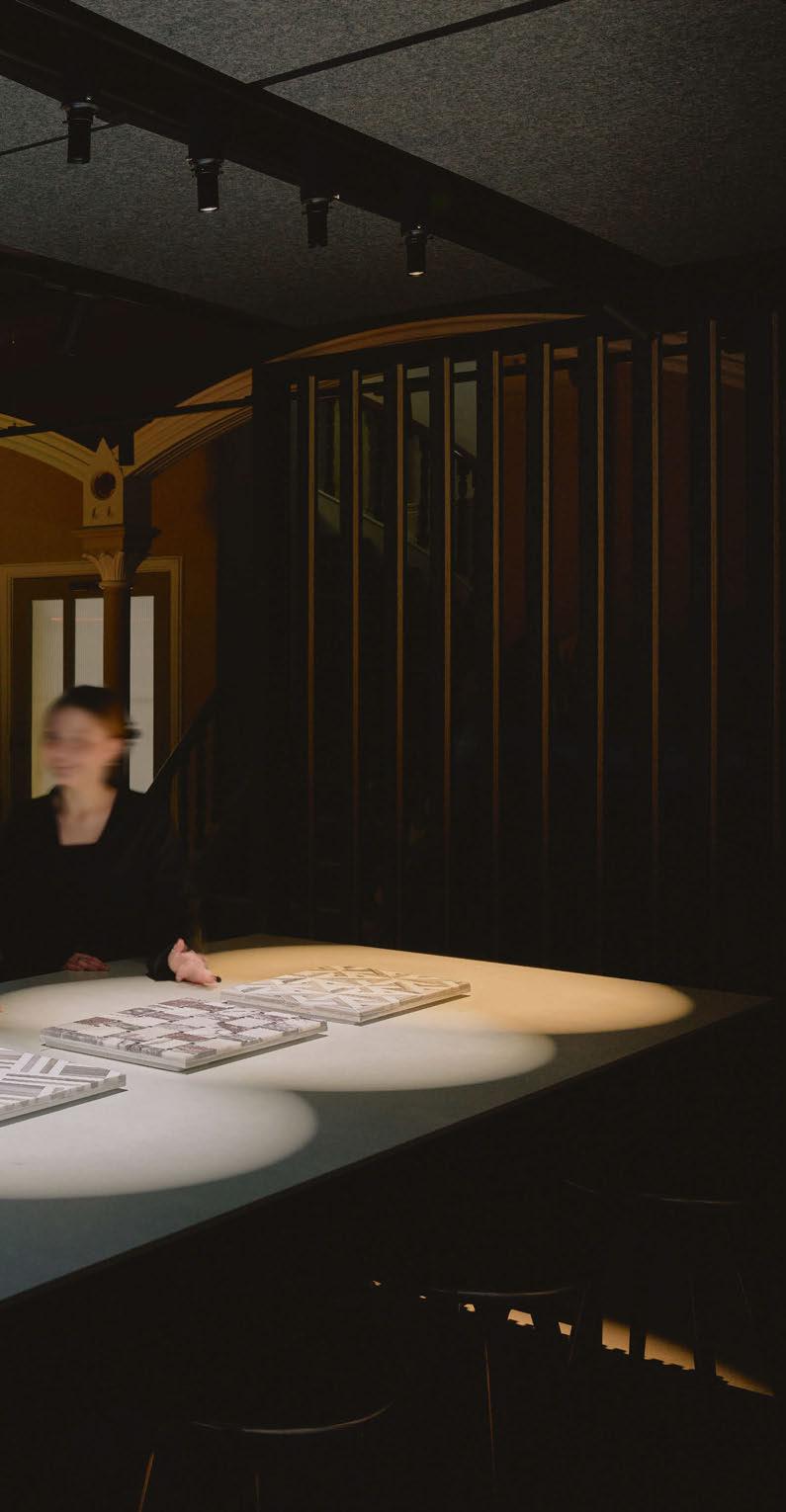
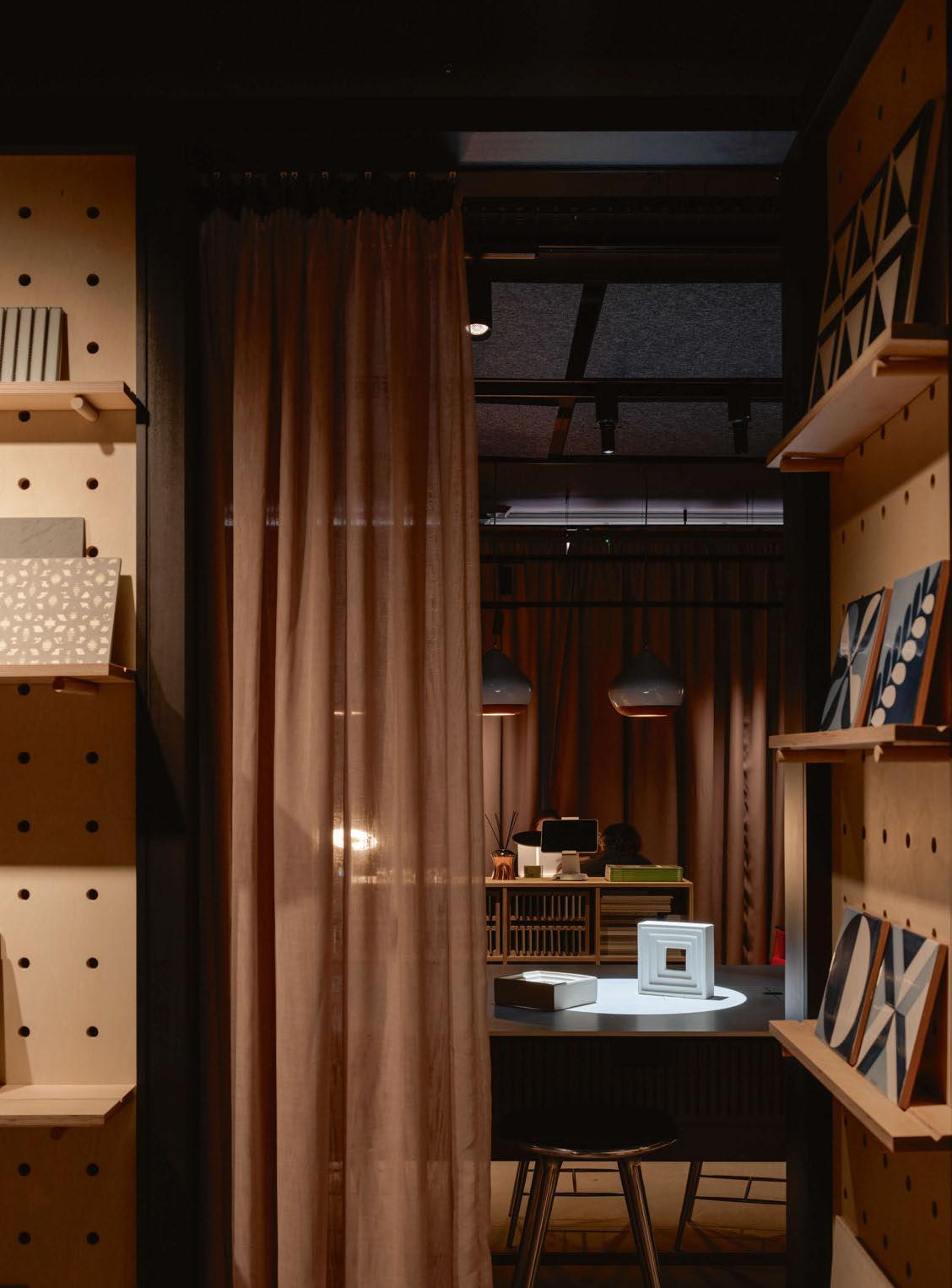
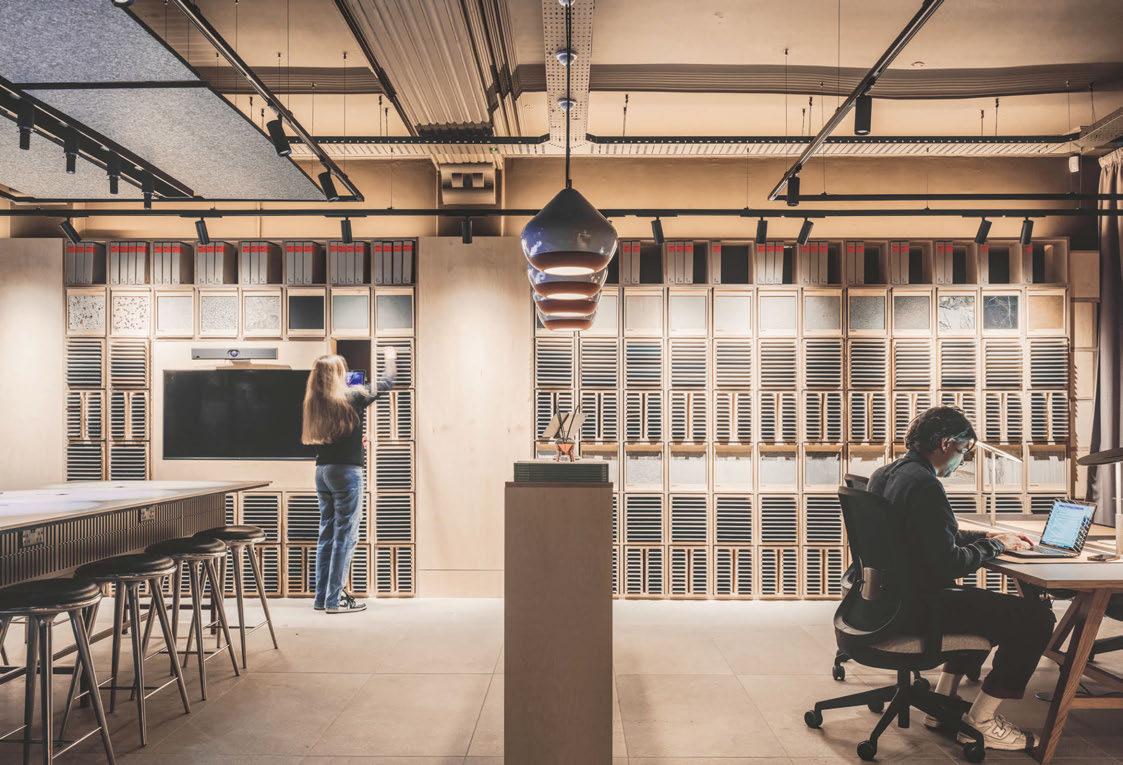
Solus Ceramics
The tile manufacturer’s Manchester showroom has been given a dramatic new lighting, courtesy of Artin Light.
Bromley Old Town Hall
Nulty balanced restored heritage fittings and modern additions in this town hall turned co-working space.
Arena Skrapan
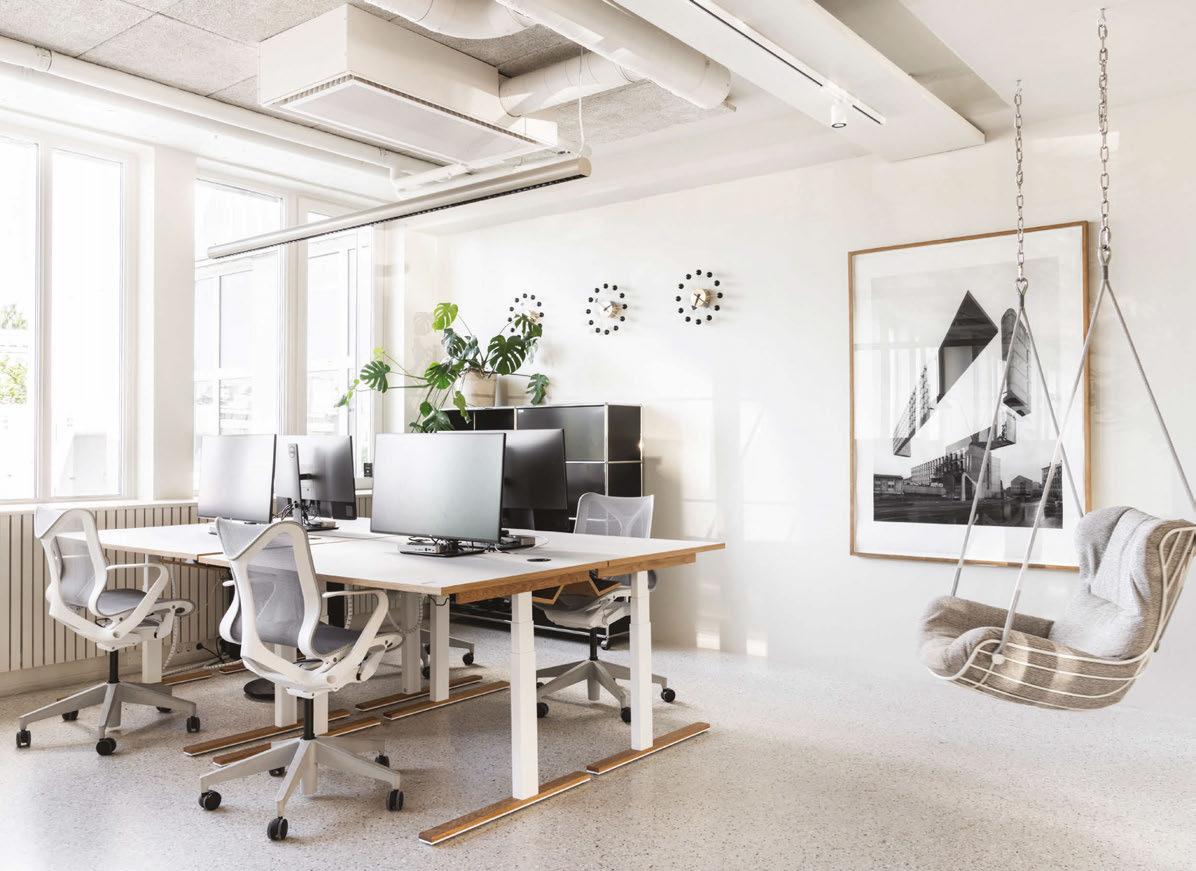
Workspace requirements meet hospitality aesthetic in this Stockholm workspace, designed by Reform Architects.
One Paddington Square
A fluid lighting design from DesignPlusLight merges artifical and natural lighting.
Workspace Lighting Case Studies
A selection of workspace projects from lighting manufacturers.
Events Diary
SEPTEMBER
Plasa 1-3 September London, UK www.plasashow.com
ArchLIGHT Summit 17-18 September Dallas, USA www.archlightsummit.com
[d]arc sessions Asia
24-26 September Phuket, Thailand www.darcsessions.com
Smart Buildings & Sustainability Leaders 26 September Birmingham, UK www.sbsleadersforum.com
OCTOBER
Circular Lighting Live
9 October London, UK www.circularlighting.live
IALD Enlighten Americas 17-19 October San Diego, USA www.iald.org
Light Symposium 20-23 October Kongsberg, Norway www.lightsymposium.org
Hong Kong International Lighting Fair 27-30 October Hong Kong, China www.hktdc.com
NOVEMBER
LiGHT 24 20-21 November London, UK www.lightexpo.london
Festival of Architecture & Interior Designing 22-23 November New Delhi, India www.foaidindia.in
HIX
27-28 November London, UK www.hixevent.com
Light + Intelligent Building Istanbul 27-29 November Istanbul, Turkey www.light-building-istanbul.tr.messefrankfurt.com
JANUARY
Light + Intelligent Building Middle East 14-16 January Dubai, UAE www.lightme.net
FEBRUARY
Surface Design Show 4-6 February London, UK www.iseurope.org
Integrated Systems Europe 4-7 February Barcelona, Spain www.iseurope.org
EDITORIAL
Managing Editor
Helen Ankers h.ankers@mondiale.co.uk
Editor Matt Waring m.waring@mondiale.co.uk
Contributing Editor Sarah Cullen s.cullen@mondiale.co.uk
Junior Journalist
Ellie Walton e.walton@mondiale.co.uk
COMMERCIAL
Managing Director
Paul James p.james@mondiale.co.uk
Head of Business Development
Jason Pennington j.pennington@mondiale.co.uk
Media Sales Manager Andrew Bousfield a.bousfield@mondiale.co.uk
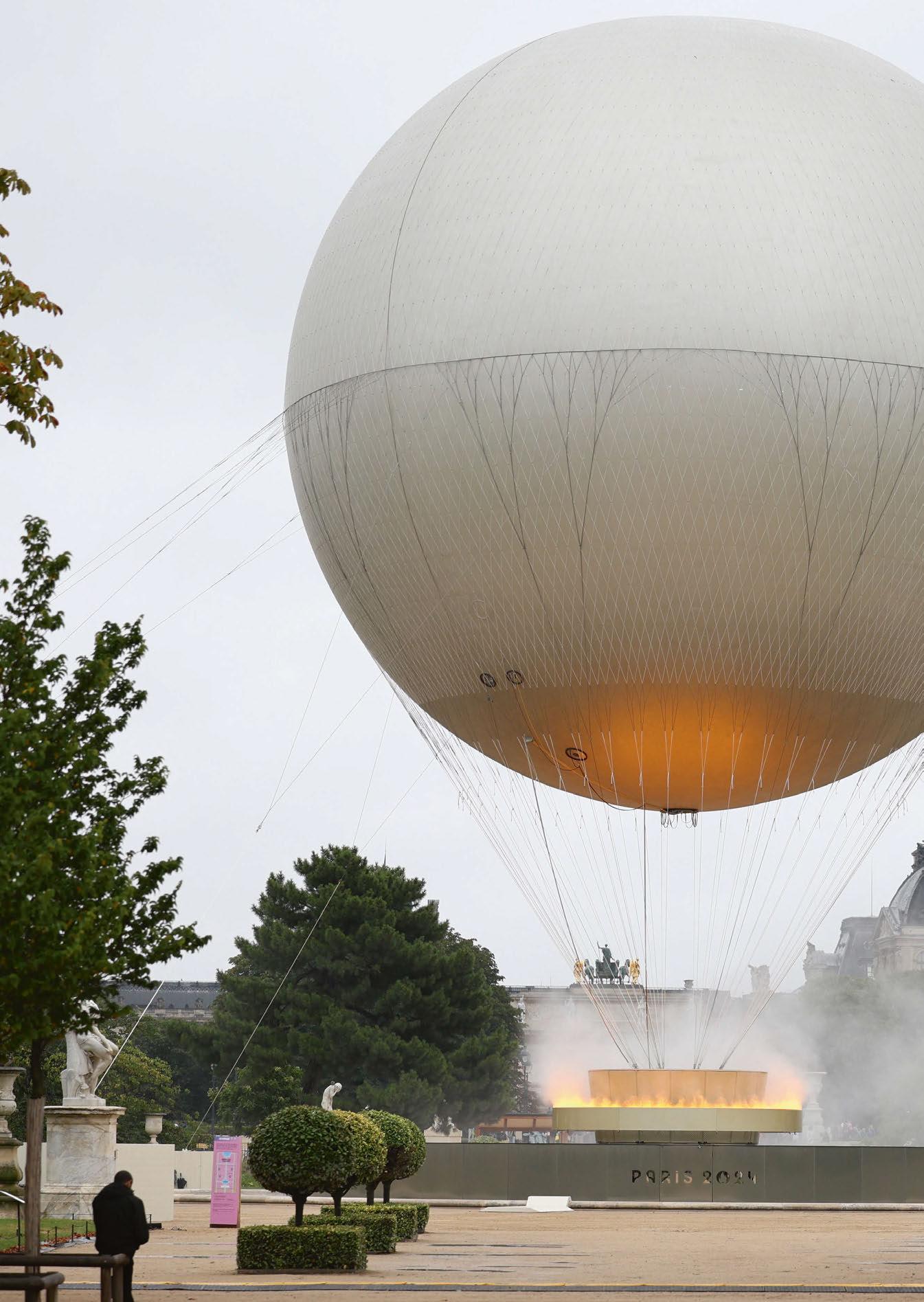
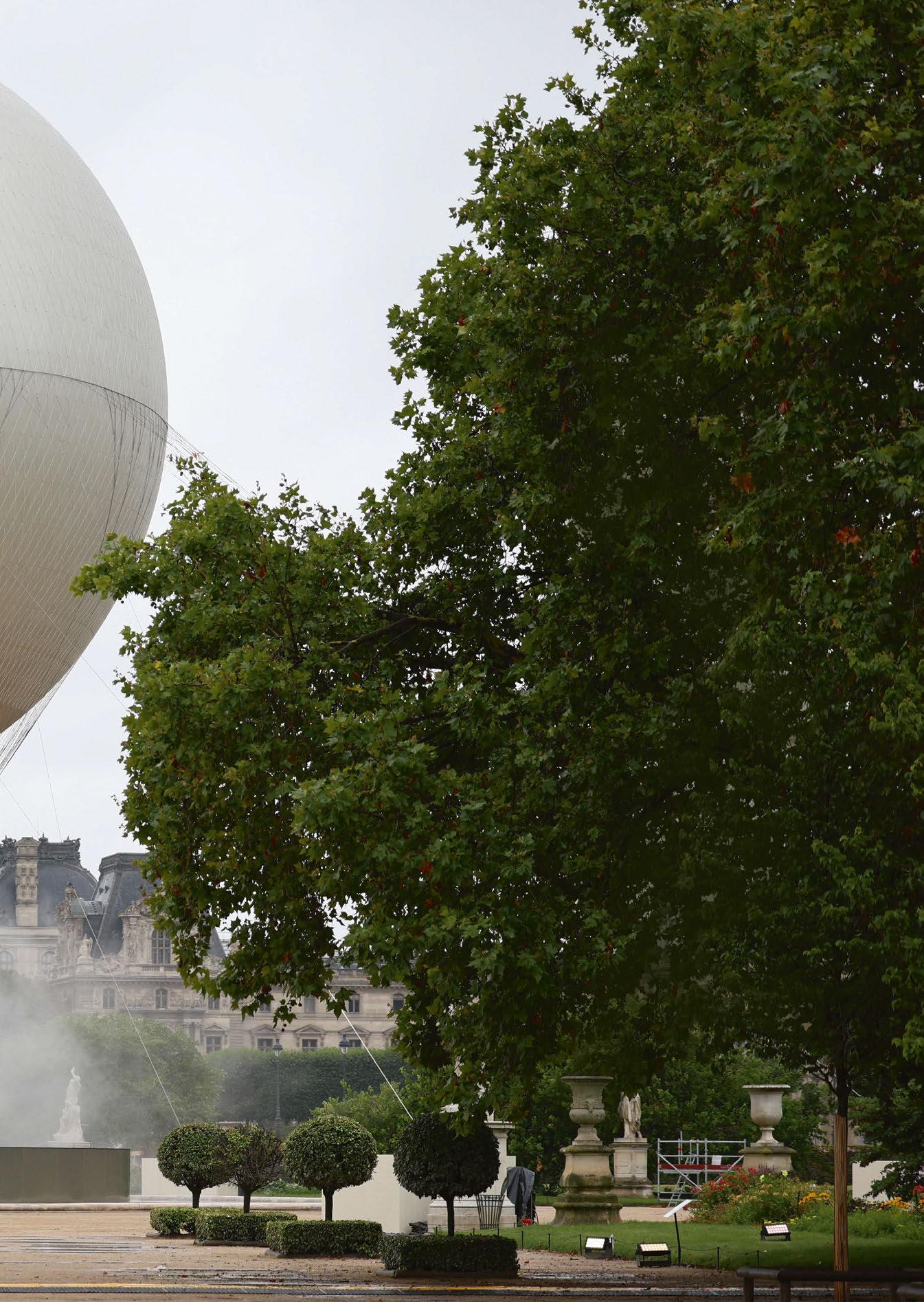
This summer, the Olympic Games took over Paris for 16 days of sporting excellence. The opening ceremony for this year’s games was, in a break from tradition, held across the city of Paris, with boats and performances travelling along the River Seine, before culminating in the lighting of the Olympic Cauldron.
Located in the Jardin des Tuileries, where physicist Jacques Charles’ hydrogen-filled gas balloon took off from in 1783, the Cauldron was designed by French designer Mathieu Lehanneur, who took influence from France’s history of flight and hot air balloons to create a sculpture that he hoped would be “a beacon in the night and a sun within reach”.
The 30-metre-tall cauldron, which referenced traditional hot-air balloons, has a seven-metrediameter ring of fire at its base that was lit by athletes Marie-José Pérec and Teddy Riner to launch the Paris 2024 Olympics.
However, while traditional hot-air balloons are powered by burning fossil fuels, the cauldron was instead lit with a non-combusting “electric flame” composed of 40 LED spotlights that illuminated a cloud created by 200 high-pressure misting nozzles – the first time an Olympic cauldron has been lit with a 100% electric flame.
Speaking of the design, Lehanneur said: “This absolutely unique cauldron represents all the spirit that I wanted to give to the Olympic and Paralympic objects.
“Light, magical and unifying, it will be a beacon in the night and a sun within reach during the day. The fire that burns will be made of light and water, like a cool oasis in the heart of summer.”
The cauldron remained on the ground during the daytime throughout the Olympics, but at sunset, rose 60-metres into the sky, to be visible from afar. The electric balloon was the third piece of design that Lehanneur created for the Paris 2024 Olympic and Paralympic Games, following the torch and the relay cauldron, with the designs all meant to complement each other – each has a metallic colour that was created by mixing gold, silver, and bronze.
“I created the torch, the relay cauldron, and the Olympic cauldron as three chapters in the same story. The cauldron is the epilogue and the ultimate symbol of that story,” he explained. Each design was also intended to symbolise one part of France’s national motto – Liberté, Égalité, Fraternité – with the cauldron meant to reference liberty.
www.mathieulehanneur.fr
Image: Paris 2024 / Raphaël Lafargue
IN CONVERSATION
Following his presentation at IALD Enlighten Europe, arc talks with Glenn Shrum, Associate Professor of Lighting Design and Interdisciplinary Practice at Parsons School of Design, about his ongoing Lighting Design Pioneers research project.
How did you first get into lighting?
I have had an outsized love of lighting for my entire life. I first understood this when William Lam visited my architecture school and presented his work, which combined lighting, architecture, and perceptual psychology.
When and how did you join the New School?
In 2009, I met Derek Porter, and he invited me to join the Parsons faculty part-time. I joined the faculty full-time in 2014. Except for a short break while I was Programme Director, I’ve been teaching the introductory lighting course in the Master’s programme at Parsons since.
What was the inspiration behind the Pioneers in Lighting Design research?
I was initially doing research into the first lighting designers to establish the profession anywhere in the world. I was aware of most of this history but, as I worked on this project, I became aware these early designers founded lighting design practices in very few locations, mostly in western Europe and North America. But that didn’t capture all these other pioneers around the world that were and are helping to establish lighting design as a global creative community. The goal for this project is to have the origin of the field be better understood.
Why do you feel this research is important?
It’s important to understand the history of Lighting Design Pioneers, be it the first designers in the world or the first in a specific region or country, because this knowledge can help us to understand that we’re a part of the longer continuum of effort, inspiration and passion for light. My hope is that this project will encourage everyone to advance the great work that was done by those that introduced lighting design in these different contexts.
How has the experience of looking into the history of lighting design been?
It has been very interesting. It has also been challenging to validate and confirm the specific facts, since there are few existing resources available on this topic. This reveals the importance of this project, but also of having something that is constantly evolving, becoming more accurate through participation and input.
What are some of the most surprising things you’ve learned from it?
One of the most surprising things that I’ve learned is that in regions and countries that have established lighting design practices more recently, the pioneers (as the research project has
it defined) aren’t always aware that they were in that role, that they have that history. I’ve always been raised in a lighting design community that was aware of its history and aware of the founders in a pretty fundamental way. But in some of these emerging communities, the discovery that you’re the first person, is one that really is being made through this project, because there’s not always an awareness of the exact timing. Sometimes there’s more than one person that founded their practice around the same time, but other times it’s just that within the region, there were different initiatives that were happening around the same time.
There were some huge names in the beginning that we all know (Stanley McCandless, Richard Kelly, Derek Phillips), have you discovered any names you hadn’t previously heard of?
In addition to the names you mentioned, this project introduced me to a few pioneers from those early days elsewhere in the world. Most recently, I was made aware of Esther Stiller who was practicing lighting design in the 1960s in Brazil. I’m excited to learn more about her lighting design practice and the influence it has had on designers of today.
Why have you expanded the research to include input from the global lighting community?
I’ve expanded this research to be worldwide and to include more recent pioneers of lighting design in different communities and regions, because I want everyone’s story to be better told than it currently is. I want to use the platform that I have as an educator in a very international school to identify and document this information about the history of our community.
How has the response been, particularly since IALD Enlighten Europe 2024?
The response has been enthusiastic, starting with views of the initial video presentation, “Founding Practice: Originators of Lighting Design” on the VLDC platform, now one of its most viewed videos. At EE24 I connected with colleagues from Beirut, France, Brazil, Iran, Italy, Vietnam, Turkey and others, and they all offered support for this archive.
How can interested designers get involved?
I’m assembling a team to support this project and expect we will set up a specific forum for the pioneers of lighting design project. In advance of that, anyone interested in getting involved can connect with me on LinkedIn and send me a direct message.
www.sce.parsons.edu
GLENN SHRUM
Snapshot Baseline Lighting Design Studio
With a rich portfolio in high-end hospitality and luxury retail across continents, Baseline Lighting Design Studio creates lighting designs with pragmatism and an impactful blend of creativity. They apprehend lighting as a vehicle to leverage atmospheres and enhance customers’ emotions and experience.
Salomon Flagship
Paris, France
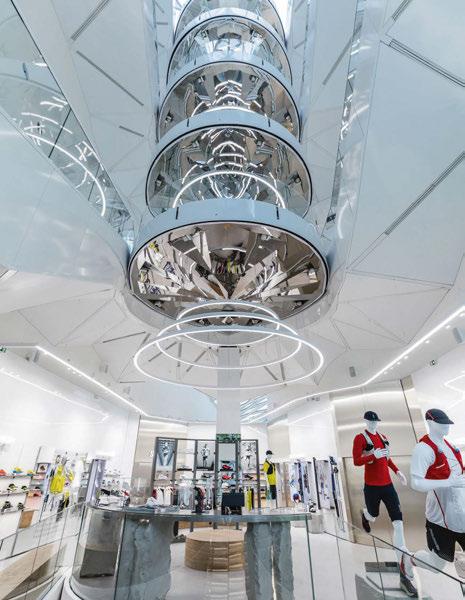
Designing lighting for an iconic location like the Champs Elysees requires a delicate balance. For the new Salomon flagship store in Paris, Baseline Lighting Design Studio wanted to celebrate the existing architectural heritage while addressing the functional needs of the modern retail environment. The existing ceiling did not have enough light points for a retail environment, so the lighting design team developed a custom layered pendant system to provide general illumination as well as highlights for the products. Programmed with a mesmerising “breathing effect”, the circular pendants at the upper levels emphasise the sense of height and grandeur, while the design itself balances the abundant natural light streaming through the transparent façade. The thoughtful approach allowed the team to seamlessly integrate modern lighting that complements Salomon’s brand within the site’s historic architectural context. The result is a harmonious and visually striking retail space that both honours the past and embraces the future. By carefully considering the unique challenges and opportunities of the location, the designers were able to create a lighting design that enhances the overall shopping experience for Salomon’s customers. A great collaboration with Retail 3D and the esteemed sport brand.
Image: Pascal Clausse, Salomon
Louis Vuitton
Shanghai, China
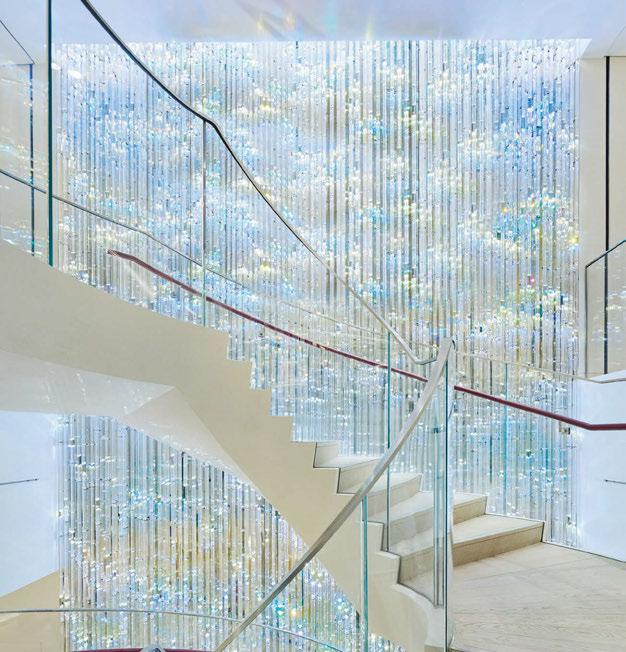
Louis Vuitton’s flagship boutique in Qiantan Taikoo Li luxury mall in Shanghai has two levels and covers 1,200sqm, where customers can enjoy a complete range of the luxury Maison, including leather goods, fragrances, shoes, fashion, and accessories. The interior design of the new boutique was created by the in-house Louis Vuitton Architecture Department, aided by eightsixthree architecture interiors. The focus offers a perfect blend of traditional fashion and dynamic art. Besides the works of art chosen to decorate the boutique, it features a one-of-a-kind wall covering the staircase, making the customers travel around an art piece. Baseline Lighting
Design Studio embarked on this exclusive project from conception to successful implementation, ensuring construction and engineering coordination of the bespoke lighting glass tubes wall. The bespoke wall is made of no fewer than 700 clear glass tubes, covering a surface of 9x6-metres. Each glass tube, shaped as the Louis Vuitton emblem, has a different length and has been placed meticulously to create a unique pattern. A rainbow effect has been applied on the edges, showing different vivid colours of the Maison as you walk on the stairs. They are illuminated by tiny LED bolts, bringing more magic to the bespoke chandelier. A breathtaking project honouring the rich history of the Maison yet embracing contemporary details, shown in this perfectly balanced interior design. Following the success of this piece, Baseline worked with Louis Vuitton to recreate the same bespoke lighting wall in their freshly renovated Pacific Place boutique, in Hong Kong.
Image: Louis Vuitton
Uma Nota Manila, Philippines
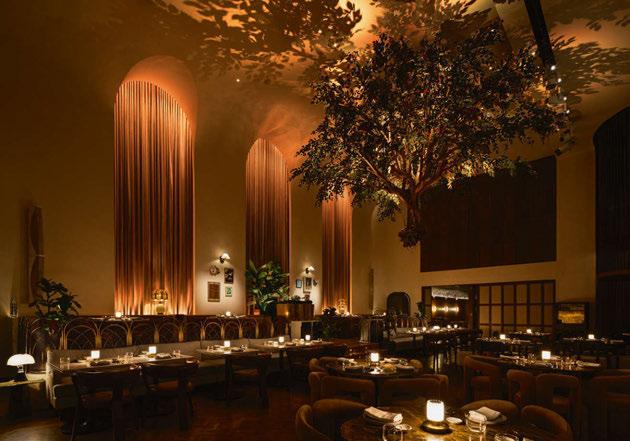
Uma Nota Manila is a unique dining destination that seamlessly blends the rich culinary traditions of Brazil with the elegance of Japanese cuisine. The restaurant’s atmosphere, crafted through a collaborative effort between Baseline Lighting Design Studio and The Odd Duck Studio, amplifies the vibrant energy of the space. The key goal for the lighting design team was to create a versatile environment that could transform from a restaurant to a club-like setting with ease. The lighting designers tackled this challenge by developing a dynamic, theatrical, and sensual lighting scheme that could adapt to the diverse needs of the space. As Uma Nota is located in a basement, the team had to design distinctive lighting scenes to cater to the varying moods and activities throughout the day - from the lunchtime ambience to the energetic cocktail hours and the captivating club-like atmosphere that takes over in the evenings. The use of a hybrid DMX and DALI system allowed the team to seamlessly integrate the architectural and decorative lighting with the club-focused lighting that interfaces with the
DJ and event programming. This harmony of lighting systems brings the space to life, with colourful illumination dancing in perfect synchronisation with the rhythmic melodies that fill the air. The centrepiece of the room is the hanging tree, which, combined with the daytime lighting scenes, creates a sense of the exterior, blurring the boundaries between indoor and outdoor. The club lighting, consisting of an array of moving heads and RGBW projectors, doubles as the sun and moon, casting captivating shadows throughout the main dining area. The result is a mesmerising environment where every detail has been carefully curated to enhance the overall sensory experience for guests.
Image: Sergei Nekrasov
Pullman Park Lane
Causeway Bay, Hong Kong
The Pullman Park Lane reflects the evolution of modern hospitality design. Baseline’s team crafted thoughtful lighting experiences that enhance the property’s key spaces. In the guest rooms, the lighting and its control system allows guests to easily set the perfect ambience, creating a serene sanctuary. The award-winning dynamic lighting in the SKYE rooftop bar is truly remarkable, immersing visitors in a captivating floating atmosphere. Collaborating closely with acclaimed design firm DWP, Baseline Lighting Design Studio has integrated practical functionality with striking visual appeal. Throughout the project, the lighting seamlessly blends modern technology with a human-centric approach. This harmonious balance of design and experience sets a new standard for guest satisfaction. The overall lighting experience underlines the remarkable hotel brand signature.
Image: Pullman
Founded in 2012, Baseline is a multicultural international lighting design studio specialising in high-end hospitality and luxury retail. The lighting experts of Baseline work in harmony with architects, interior designers, hoteliers, and retailers determined to transform initial design packages into multisensorial customer and guest experiences. Through lighting design, the team will illuminate your space, reinforce your brand identity, and beautify your products to create a unique atmosphere. In the hospitality realm, Baseline’s designers use light to craft captivating environments that leave a lasting impression – from the intimate glow of guestrooms to the inviting ambience of restaurants.
Baseline has become a trusted consultant for luxury brands in both hospitality and retail. It is guided by its passion for lighting design and a team spirit that encourages its members – through tailor-made services – to create excellence for their clients. www.baselinehk.com
“A major advantage of combining art and engineering is that our ideas are always feasible, because this practicality is ingrained in our thinking. We’re very efficient in our creativity.”
Studio Waldemeyer
20 years since Moritz Waldemeyer established his eponymous design studio, arc sits down with the German designer, and his partner / Product Designer Nazanin Farahbod, to talk about the growth of the studio, and their unique role as “Art Engineers”.
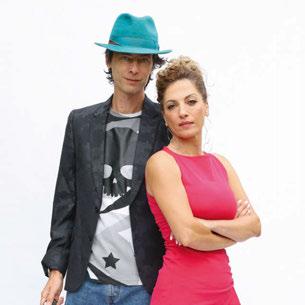
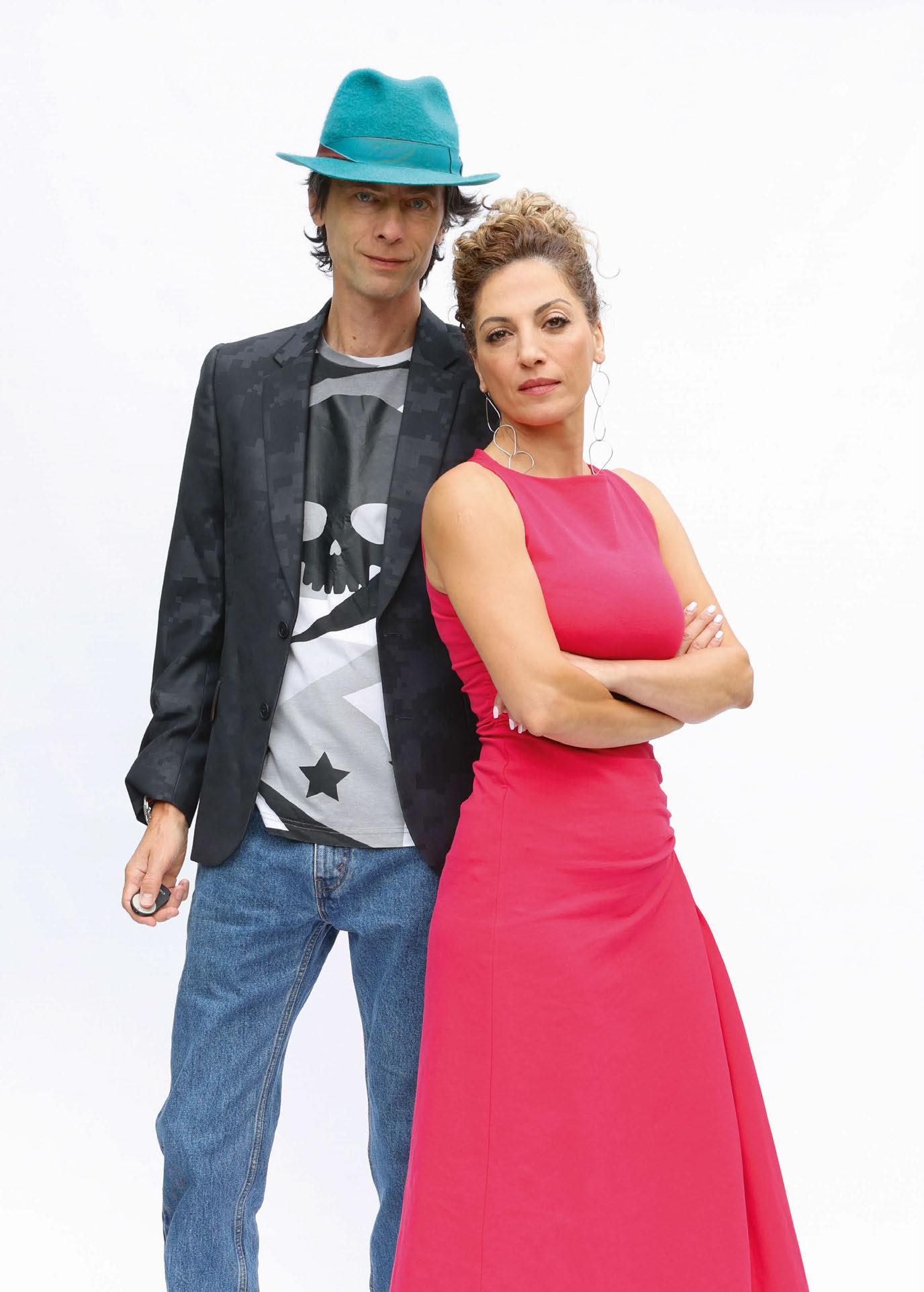
Moritz Waldemeyer and Nazanin Farahbod (All images courtesy of Studio Waldemeyer)
It is often said that lighting design is the meeting point between art and engineering; bridging the gap between creativity, expression, and science – its ethereal qualities bringing together architecture and interiors in the intangible way that only light can.
This fusion, an almost paradoxical marriage, forms the basis of the work of product designer, lighting experimentalist, and self-confessed “Art Engineer”, Moritz Waldemeyer, who this year celebrates the 20th anniversary of his eponymous design studio. Across his extensive body of work, Waldemeyer has crafted bespoke creations for the automotive industry, the fashion world, music and live entertainment, with a client list including such star names as Bentley, Swarovski, Jamiroquai, and the Cirque du Soleil. Each time forging unique pieces that beautifully blend art and technology.
This combination of disciplines is something that Waldemeyer believes has been with him since childhood. Speaking to arc at his beautiful home studio in London, he says: “The story starts best with my upbringing; I grew up in East Germany under communism, which was obviously a very different experience to what we have today. You couldn’t really buy anything, you couldn’t travel anywhere, everything was very reduced. And on top of it, we were very aware that we were on the ‘wrong’ side of the fence, because we had Western TV. But within that, I grew up in an artistic family, so there was always a lot of creativity.
“Throughout my childhood, I knew I had to escape my situation. My uncle, who came to London in the ‘80s to work as a designer and architect, became my role model. Following his example, I packed my bags and came to London to study engineering. This blend of art and engineering forms the foundation of everything we do today.”
Once in the UK, Waldemeyer studied Mechatronics at King’s College – an amalgamation of mechanical and electronic engineering, “with a little bit of computer science thrown in for good measure”, that he believes gave him the most complete understanding of “all the engineering disciplines rolled into one”.
It was during his studies that Waldemeyer first started playing with light, experimenting with early iterations of LEDs. This then took him on a path that, at the turn of the century, led him to Signify (then Philips), where he worked as a Research Scientist.
For a man always looking to push the boundaries of what was possible with lighting technology, he refers to this as “the place to be”. “Philips was very much ahead of the game, looking into the future. I was in the research department, so it was all about futurology, figuring out where it all goes, and researching and doing projects. So, that’s where all of these things came together.
“This marked the beginning of the rise of LED technology, and we already knew it was going to be the next big thing while most of the world was still using incandescent lamps. We had graphs and discussions about a ‘Moore’s Law of LED,’ predicting the doubling of output or halving of price per output over specific periods. We knew exactly where the technology was headed.
“They were also doing incredible work in wearable electronics, which later became a significant aspect of my work. It was probably the best place in the world for that kind of innovation.”
Waldemeyer spent four years at Philips, honing his craft, before making the decision in 2004 to establish his own design studio – a decision made in part thanks to a chance collaboration with a big-name client.
He recalls: “There was a moment when an opportunity came about to start working with Swarovski. So, I had to make a decision – did I want to stay at Philips? My project at that moment was less engaging and this opportunity with Swarovski, working in the design world, was so much more exciting.”
Indeed, this first move into the world of design saw Waldemeyer collaborate not only with Swarovski, but with renowned architect Ron Arad, on a custom, interactive chandelier to which viewers could send text messages.
“I met Ron through a friend who was working for him at the time. My friend said, ‘You should meet Ron, I think he would like what you can do.’ And indeed, he did.
“Suddenly, I had requests and opportunities to work with remarkable people – something I could never have foreseen or even dreamt of. Initially, I was simply following this momentum. Over time, I was able to refine my direction and decide where I wanted to take it and where it would lead.”
Moritz Waldemeyer
Mythos Mozart, Vienna, Austria
“Ron approached me with a project right away, saying, ‘I’ve been asked to make a chandelier for Swarovski. I want to create a text message chandelier. Can you do it?’ I replied, ‘I can certainly try.’
“I had four weeks to complete the project, and it was then showcased at Milan Design Week in 2004.
It was presented right next to Ingo Maurer’s latest chandelier, so I got to meet him, Ron, and Nadja Swarovski – the crème de la crème of the design world. Suddenly, I was in the midst of it all.”
Thrust into the upper echelons of the design world right from the start, Waldemeyer explains that while he was first establishing his own studio, it was opportunity, rather than an over-arching mission statement, that drove him forward.
“In the beginning, it was about following curiosity and seizing opportunities. It was incredibly exciting because I was likely the only person with this unique skillset, and I somehow managed to enter at the top level.
“Suddenly, I had requests and opportunities to work with remarkable people – something I could never have foreseen or even dreamt of. Initially, I was simply following this momentum. Over time, I was able to refine my direction and decide where I wanted to take it and where it would lead.”
Where it did lead was for Waldemeyer to coin the term “art engineer” as a way to better describe the kind of work that he does, while also inspiring the studio’s philosophy.
Nazanin Farahbod, Waldemeyer’s partner, and Product Designer within Studio Waldemeyer, explains: “Our philosophy is to ‘create new emotions’ by developing concepts that tell relatable stories while using new technology in surprising ways. It’s about merging these two elements seamlessly.
“When we call ourselves ‘art engineers,’ it’s because we truly engineer the art. What sets our studio apart is our in-house capability to bring concepts to life without relying on external teams.
“While others may need separate groups to realise their ideas, we handle everything ourselves. We can iterate, prototype, and refine quickly. This ability to control the entire process is why we are art engineers.”
Waldemeyer adds: “A major advantage of combining art and engineering is that our ideas are always feasible because this practicality is ingrained in our thinking. We’re very efficient in our creativity. While we do R&D, we usually conceive ideas with a clear understanding of how to execute them, making the process from concept to presentation quite straightforward with minimal adjustments.
“In our earlier years, we pushed boundaries and sometimes went a step too far. Now, we better understand the importance of aligning with the client’s perspective and expectations. We educate them on what is feasible and what they can realistically expect.”
This is something that Farahbod believes sets the studio apart, although it can sometimes lead to slightly more difficult requests, as she explains:
“For example, in 2017, Cirque du Soleil approached us to create a dress that could change colour without using LEDs. We conceived a dress adorned with flowers that open and close revealing a red blossom on a white background. This allowed for animations that controlled the dress’s colour. The technology was embedded in each flower, but the focus was on evoking emotion.
“Similarly, we recently met with Philippe Starck, who asked us to create something never seen before, trusting us to bring the vision to life.
“Balancing the artistic and engineering aspects is crucial in our work. We undergo extensive R&D to achieve our desired outcomes. It’s a matter of intuition; there’s no set formula for balancing emotion and technology – you just know when it’s right. We aim to avoid appearing too techheavy, instead, we focus on wonder, magic, and storytelling.”
That being said, Studio Waldemeyer does go to great lengths to ensure that it is at the forefront of lighting technology, and fully aware of any new advancements that are emerging.
Waldemeyer continues: “We go to a lot of different kinds of events, not just lighting. We go to electronic fairs; I’ve been out in China to the Shenzhen Market, literally to the source. I’ve been to see the company that we work with that makes the LEDs we use to look at the process and understand how I can use this technology to do what I want.”
Halo, London Design Festival 2023, UK
...it’s all about your preference
— Design distinctive luminaires
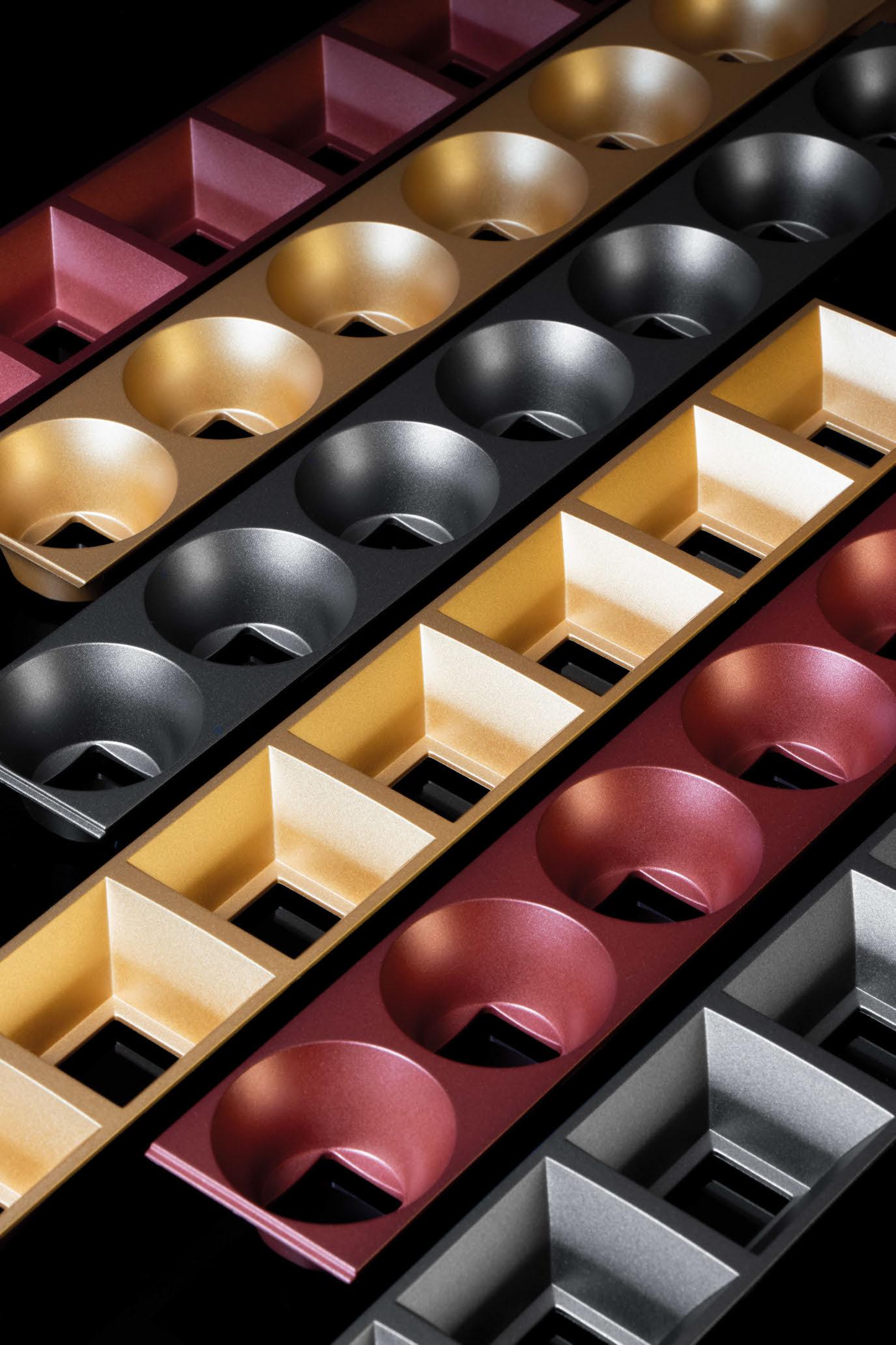
LEDiL DAISY-7X1 Dark Light optics are now available with round opening for unique luminaire designs. For even more variety, choose from new additional colours and make your luminaire design truly stand out.
“Our philosophy is to ‘create new emotions’ by developing concepts that tell relatable stories while using new technology in surprising ways. It’s about merging these two elements seamlessly.”
Nazanin Farahbod, Studio Waldemeyer
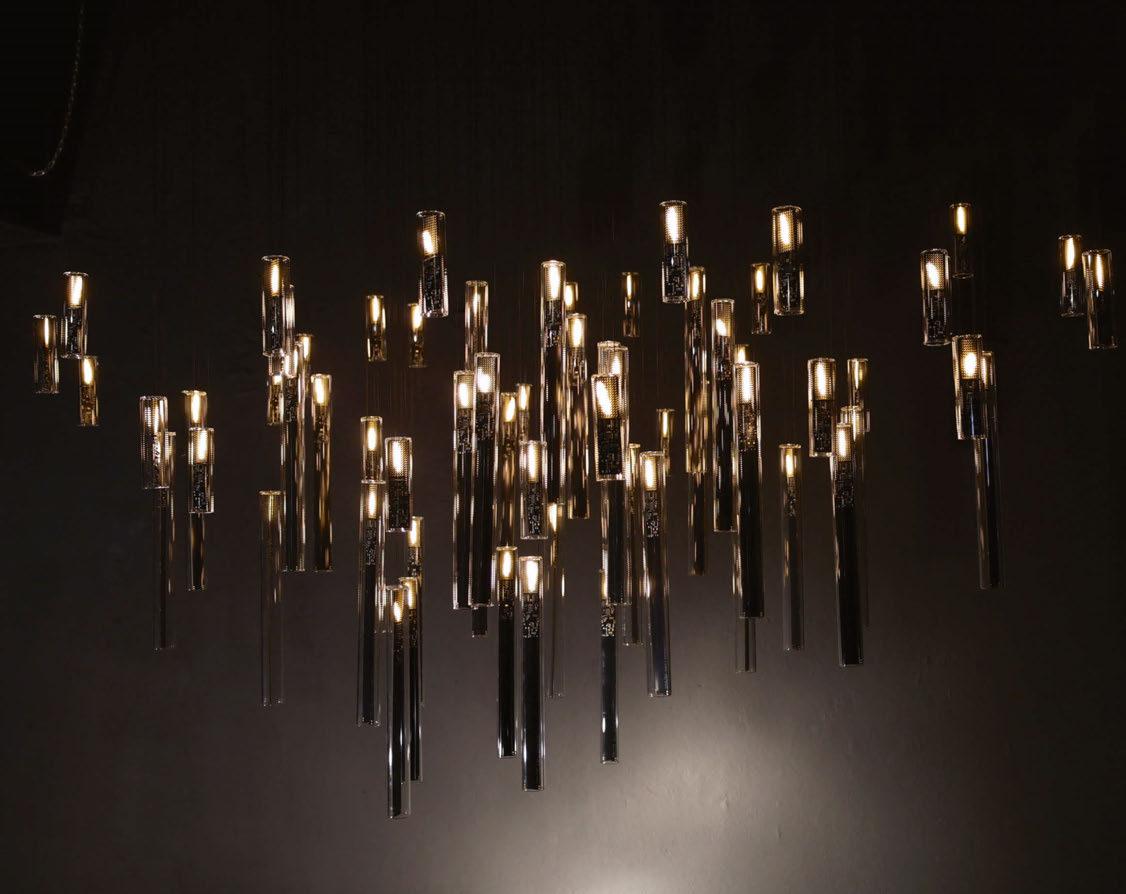
One such example of the studio’s tech-centric approach to design has been in its LED “candles”.
Used to great effect in Waldemeyer’s landmark large-scale installation, Mythos Mozart exhibition in Vienna, the candles produce a strikingly lifelike, flickering flame, composed entirely of LEDs.
“We took apart the LEDs to their bare components, and then reassembled them into the candle module,” Waldemeyer explains.
“It’s a single component, with some chips integrated between LEDs, making them invisible. This dives deep into LED technology. Achieving this is a significant milestone because such technology is typically inaccessible to designers like us. Most lighting designers wouldn’t understand when I mention we’ve created a COB candle – I have to explain the entire process for them to appreciate it.
“Chip on board (COB) technology is gaining traction. It involves working with the individual components of LEDs and reassembling them into new shapes and forms that weren’t possible with traditional electronics.
“This is just one example showing our passion for animated light. Most artificial light has been static since Edison’s time, whereas natural light is always changing. We strive to reintroduce this dynamic quality into artificial lighting and living environments.”
Studio Waldemeyer used 1,500 of these COB candles in the Mythos Mozart exhibition, as part of an incredibly dramatic, and emotionally stirring, light show.
Farahbod explains: “The museum is located precisely where Mozart died. We were given two rooms: one to visualize his brain and the other
to evoke the emotion of his final moments. We installed 1,500 individually controllable candles, allowing us to manipulate their brightness and movement, or even let them act randomly. We created an eight-minute experience that moved viewers to tears. We were told that people sit down, cry, and become deeply emotional during this experience. Our goal is always to use technology to create emotion.”
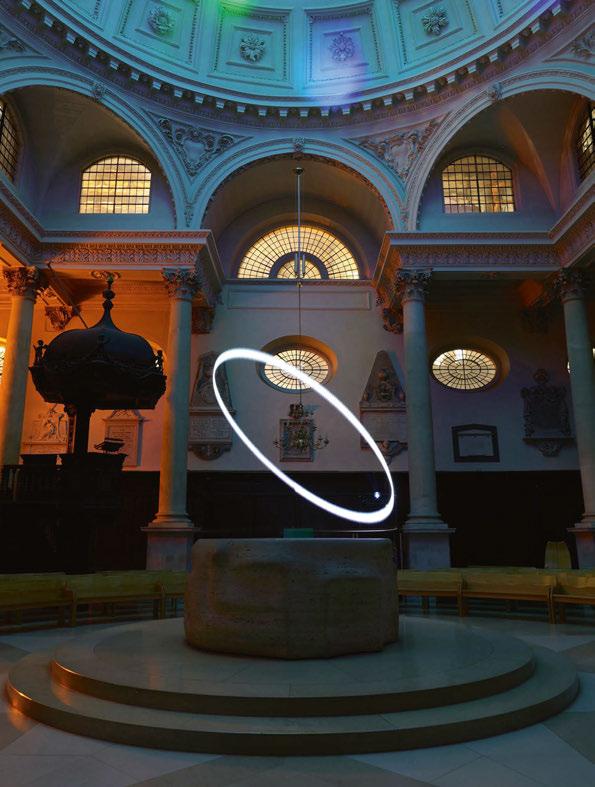
Another emotionally stirring highlight from the studio was a piece created for London Design Festival 2023, entitled Halo. Situated at St Stephen Walbrook Church, the piece was a celebration of the work of Christopher Wren – the architect who rebuilt the city after the Great Fire of London – 300 years after his death. Seen as a precursor to St. Paul’s Cathedral, the St Stephen Walbrook Church is considered by many as Wren’s best work, “because of the scale, and the way it works with the light, and the airiness of the architecture,” according to Waldemeyer. One of its defining features is the circular Henry Moore altar, which sits at the church’s centre. For Halo, Waldemeyer installed a hanging, illuminated pendulum that gently rotates around the circular altar. He continues: “The aim was to put people into a meditative state. The architecture is designed to remove you from your daily experience, encouraging introspection and meditation. We wanted to offer this to everyone, regardless of their faith, providing a new way to experience this architecture.
“The pendulum, thanks to its length, circles slowly, taking about nine seconds for a full revolution. When you sit and watch it, it draws you in, which was our intention. This blend of technology and meditation shows how a pendulum’s swing is governed by pure mathematics. It also reflects how Wren perceived himself – primarily as a scientist, with architecture being a side discipline to his larger scientific interests.”
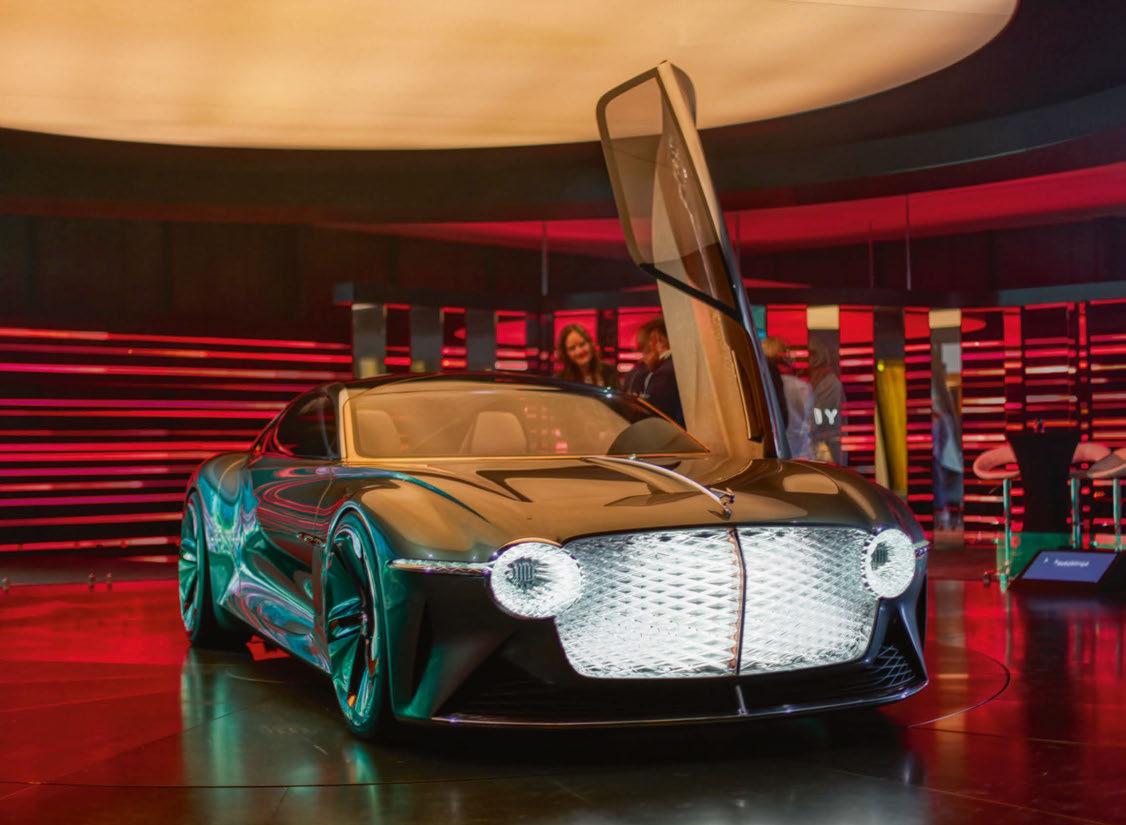
Elsewhere in a remarkable back catalogue of projects, Waldemeyer has worked with iconic fashion brands, big name musicians, and in the automotive industry, working with the likes of Audi, Hyundai, and most notably Bentley, where to coincide with the brand’s 100-year-anniversary, he collaborated on its EXP 100 GT concept car.
As a self-confessed “Petrolhead”, Waldemeyer says that, across his body of work, the automotive projects stand out as favourites. “There are a couple of reasons for it,” he explains. “First, I personally really love the topic. It probably harks back to my upbringing in East Germany, because I grew up in a Trabant [an East German car, colloquially known for its poor design and operation], so it’s a very exciting industry.
“Additionally, it’s a very professional environment. Unlike the fashion or music industries, where things have a quick turnaround, the automotive industry has well-educated expectations and a highly professional way of interacting and collaborating.
“When proposing a complex technical project to an automotive engineer, there’s a precise understanding of what to expect and deliver due to their engineering education.
Bentley EXP 100 GT concept car
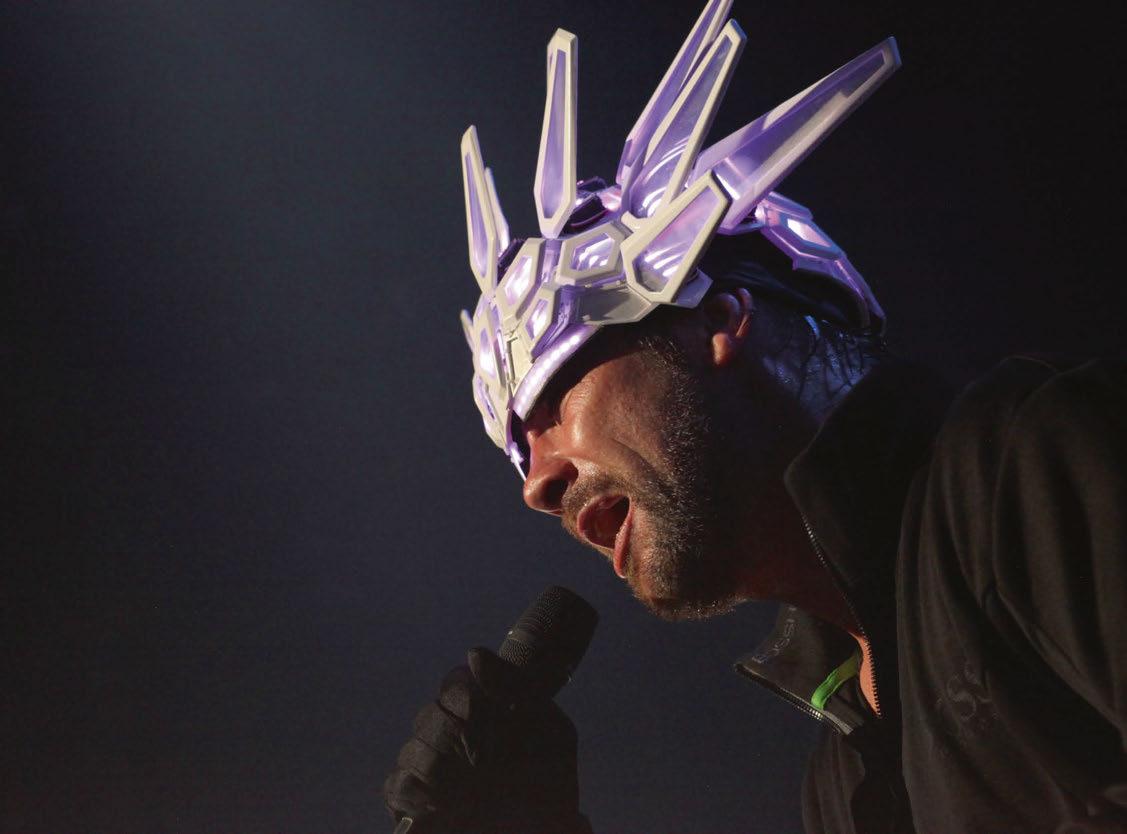
Automaton, headpiece for Jamiroquai, 2016
“In contrast, in the fashion and music industry the expectation of extremely fast turnarounds at very low cost in itself provides a sometimes insurmountable challenge.”
Because of this, although he has a lengthy, star-studded client list, there is one name that Waldemeyer still has on his Bucket List of collaborators.
“Gordon Murray, the South African car designer, is someone I repeatedly mention. We’ve found interviews from over 10 years ago where I still talk about him, but he hasn’t called me yet. He probably never will, as his mindset goes in a very different direction. When we work on cars, we bring drama with light, while he derives drama from the engine and car dynamics, adhering strictly to the principle of form follows function.
I’ve seen him discuss lighting, and for him, it’s purely functional. He prefers round lights for their timelessness. So, a collaboration is unlikely, but I still admire his pure approach, even if our styles don’t really align.”
Similarly in the music world, while he has worked with some huge stars, including creating a custom bass guitar for U2, an animated, moving headpiece for Jamiroqai, and a light-up jacket for
Will.i.am during the Black Eyed Peas’ Superbowl Half Time Show, he is still holding out hope for one act in particular. “I’d love to work with Rammstein. They’re total pyromaniacs!
“The most impressive use of light on stage I’ve ever seen was by their singer, Till Lindemann. He had his cheek pierced to insert a fiber optic light into his mouth, so when he sings and opens his mouth, it’s fully illuminated. That is total commitment!”
While these two examples have yet to come calling, Waldemeyer and Farahbod reveal that the studio has several exciting works in progress at the moment (none of which he can talk about as the studio is “constantly signing NDAs”). Given the extraordinary output from the studio over its first 20 years, expectations are high, but no doubt these expectations will be met, and exceeded.
www.waldemeyer.com
Candles, Studio Waldemeyer’s COB LED candle
PARIS
The City of Light
FLOW
Berlin, Germany
For this year’s Sommerlights event, light artist Christopher Bauder has unveiled FLOW – an immersive play of light and sound in which he has collaborated with Dutch musician Chris Kuijten.
The large format work is on display at the outdoor area of Bauder’s Dark Matter exhibition, running from 31 May to 29 September from sunset.
Speaking of the installation, Bauder says: “The state of FLOW is as easy and natural as breathing. This vague, yet concrete feeling of being in FLOW is what we long for in life. Everything is in perfect balance. We forget time. We lose ourselves. FLOW is a fleeting moment of stillness where everything fits, everything makes sense, and the world is simply beautiful FLOW changes, and yet is so light, so deeply rooted in us, and as simple as breathing.”
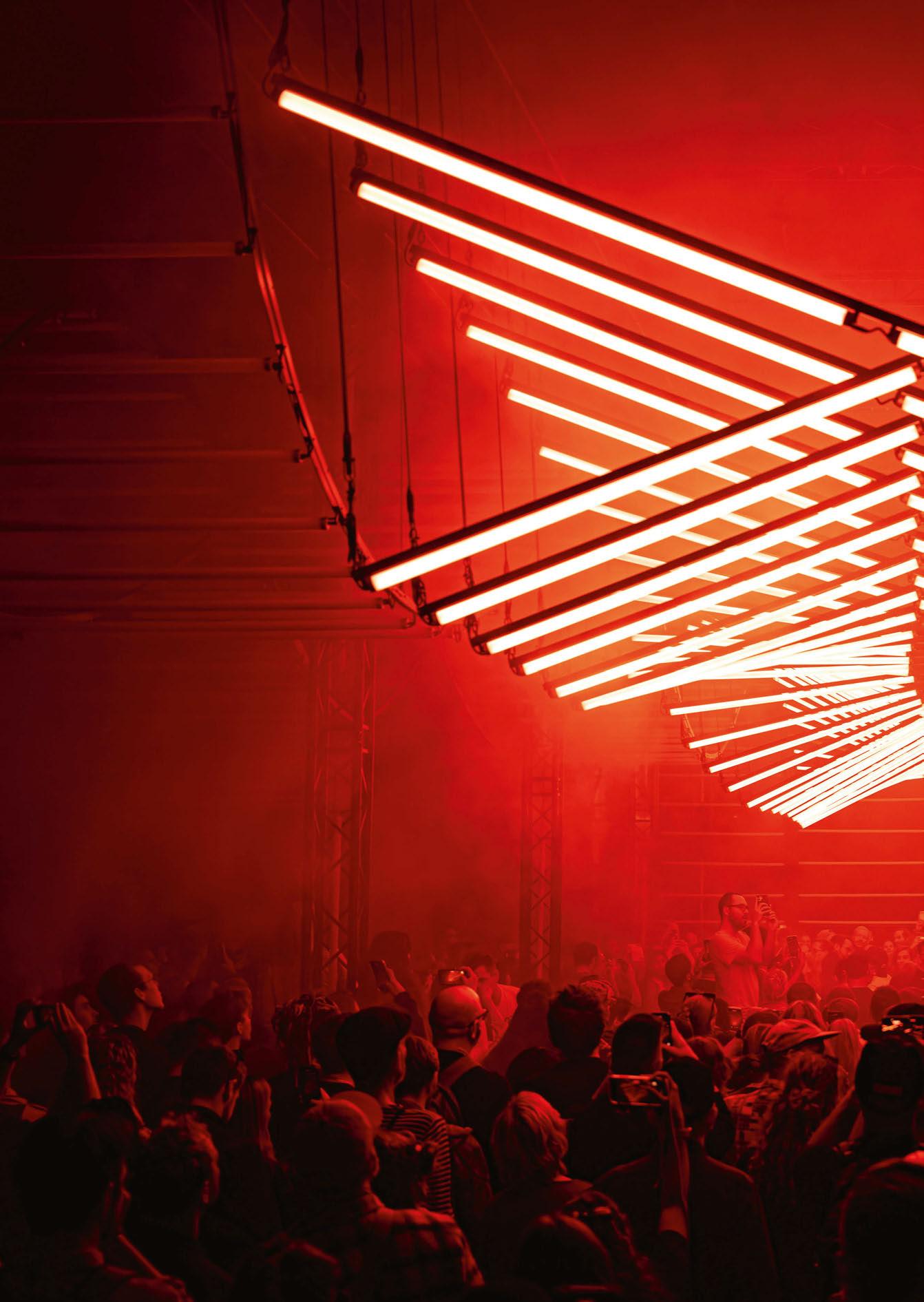
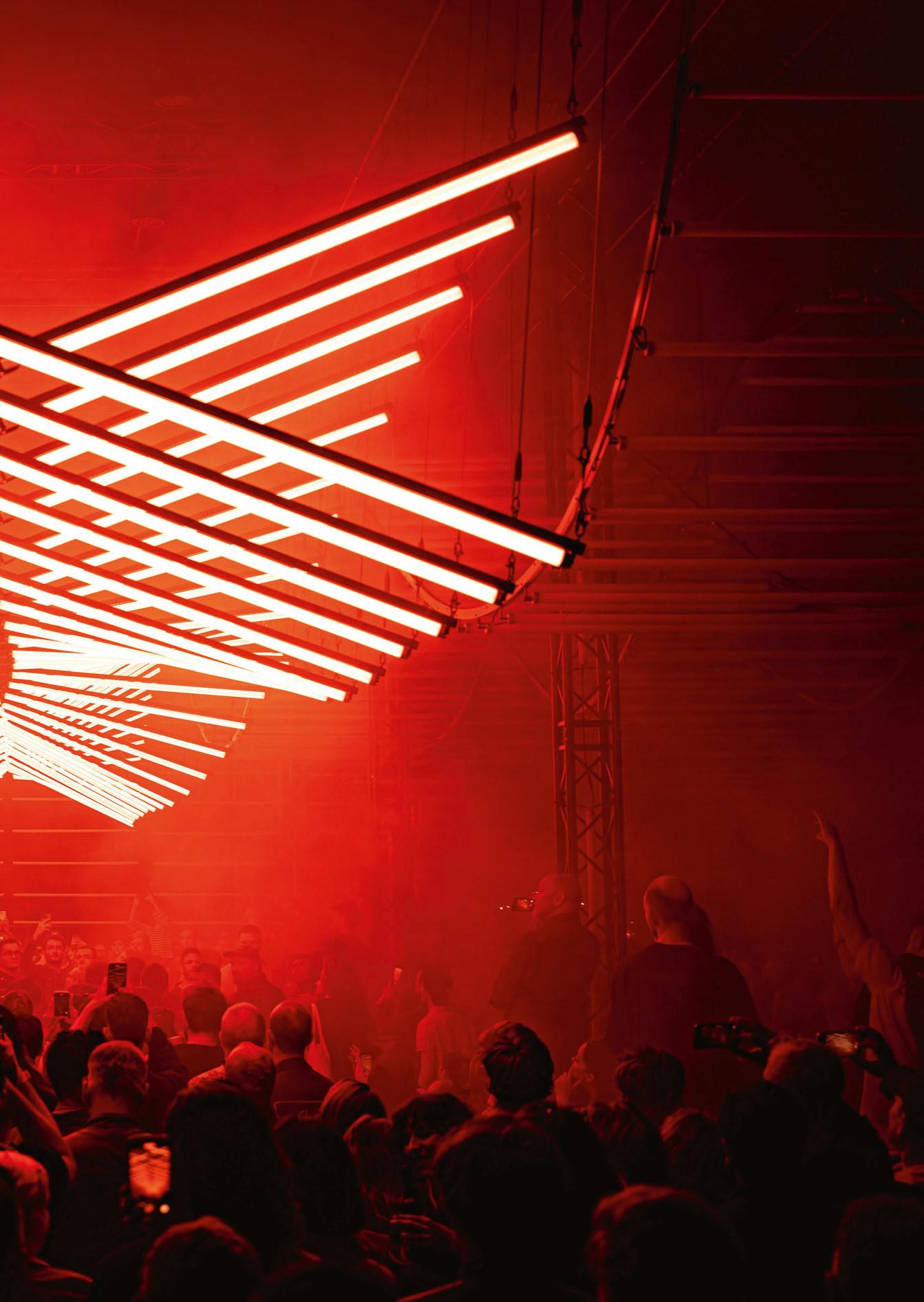
The vast light art sculpture is made up of 1,000 partially movable lights with more than 30,000 individually controllable light points. The computer-generated, floating sculpture glows in infinite shapes and patterns, “as if organically drawn by nature, yet technically perfect”.
“Endless waves breaking on a distant beach, the water moving towards the visitor, then receding, only to approach again with the next wave. A constant up and down, back and forth. Everything is in motion and flux, everything changes, nothing stays the same, and yet in that moment you feel suspended and in FLOW,” Bauder continues.
The light installation consists of a 45-minute show, in sync with Kuijten’s multi-channel, immersive soundtrack, that repeats throughout the evening after sunset. www.christopherbauder.com www.chriskuijten.com www.darkmatter.berlin
Image: Eric Bauermeister
IALD Enlighten Europe
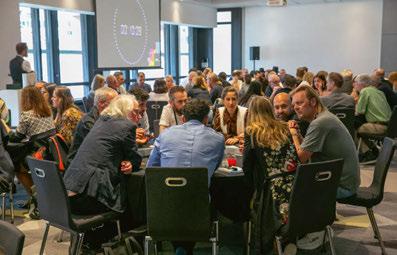
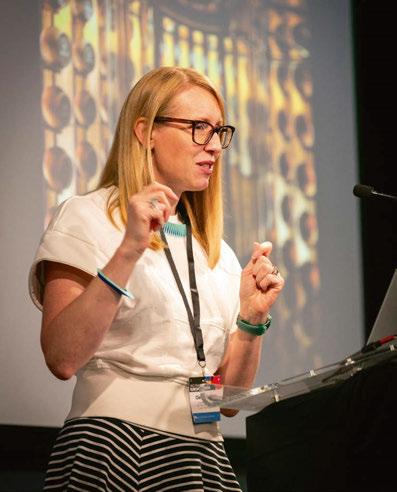
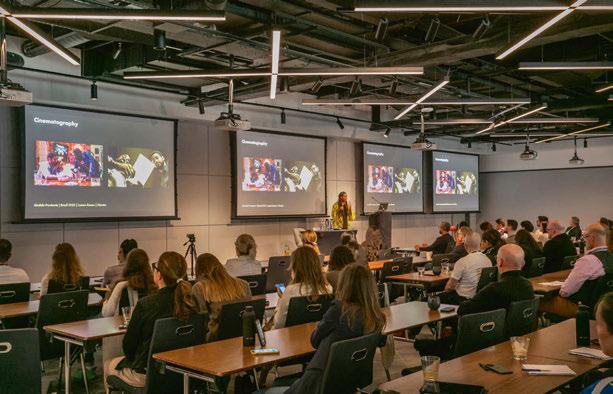
This year, the IALD brought its popular Enlighten Europe conference to London, taking over etc.venues on Bishopsgate for two days of inspiring and informative presentations and discussions. arc Editor Matt Waring, and Junior Journalist Ellie Walton, share their thoughts on the event.
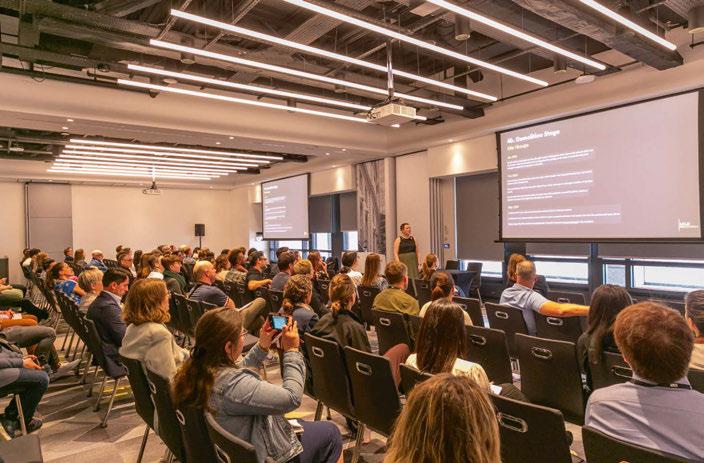
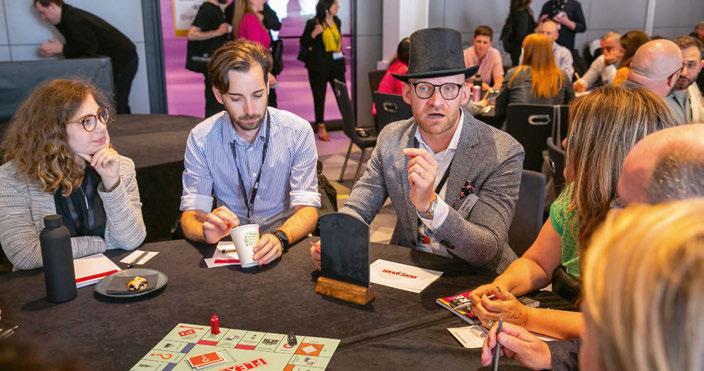
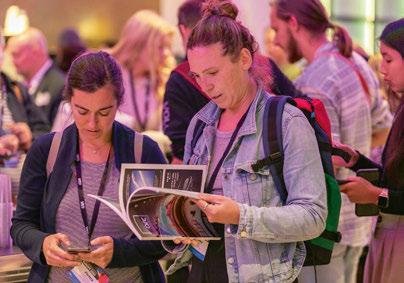
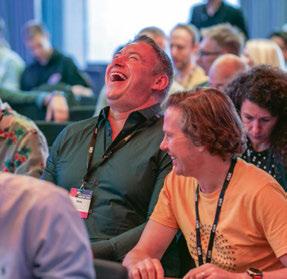
Following its triumphant return in Berlin last year, the IALD brought its popular Enlighten Europe conference to London this summer, bringing the international lighting design community together for two days of inspiring presentations and discussions, peer networking, and social receptions. Held at etc.venues on London’s Bishopsgate on 21-22 June, the conference featured a stacked schedule of more than 30 professional development sessions, all centred around some of the biggest themes and talking points in the lighting sector – from circularity, sustainability, and light pollution, to AI and the future of the lighting design profession.
Enlighten Europe has been a personal favourite of mine on the industry calendar, so I was delighted to see that this year’s edition would be in our own “back yard” (once getting the train from Manchester). Naturally, I registered as soon as I was able, and this time around brought [d]arc media Junior Journalist Ellie Walton along for her first taste of Enlighten Europe action.
I always remember my first conference – the Barcelona edition in 2018, when I was still very new to the industry – as being a very formative event in my lighting journey, where I could learn a lot (which I did), and meet a lot of new people (which I also did!), so I was hoping Ellie would have a similar experience this time around (you can read her thoughts on the event later on).
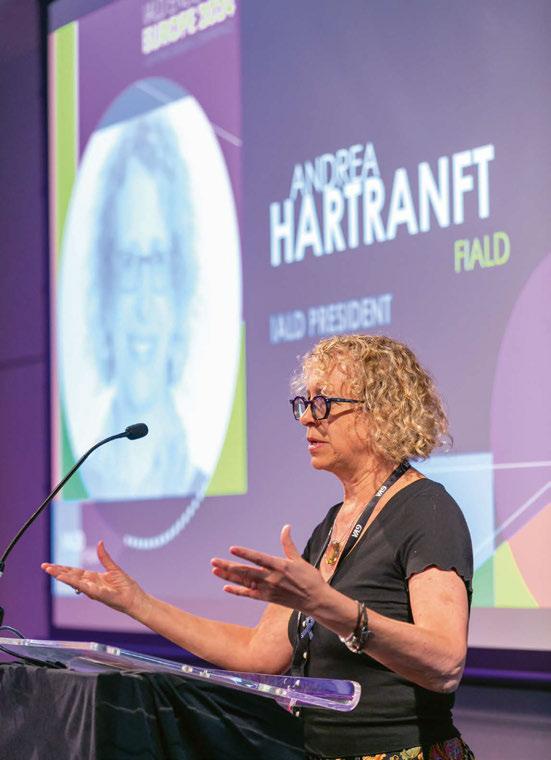
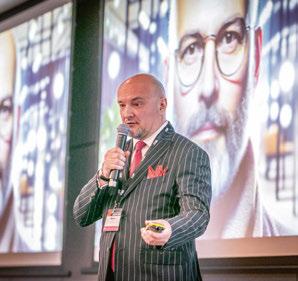
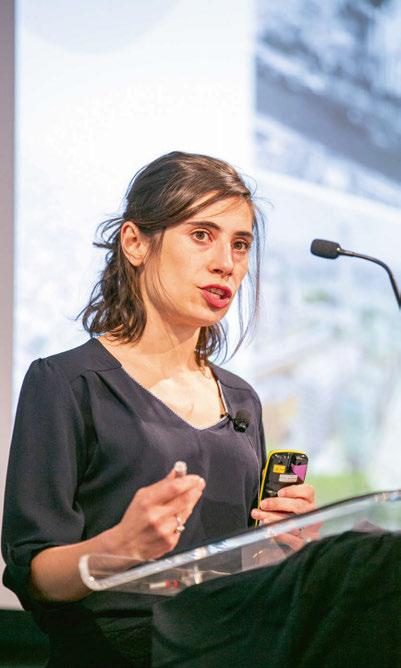
On to this year’s conference then, and after an opening welcome from IALD CEO Christopher Knowlton and President Andrea Hartranft, Dr. Marco Bevolo, Adj Prof. Design Futures, World University of Design, India, took to the stage for the keynote address. Titled “The Future of Lighting Design Beyond Lighting Design”, Bevolo shared the findings of his experimentations with AI – carried out with colleague Dennis Draeger, Research Director of Shaping Tomorrow – examining the ways in which generative AI could potentially be used to “transform
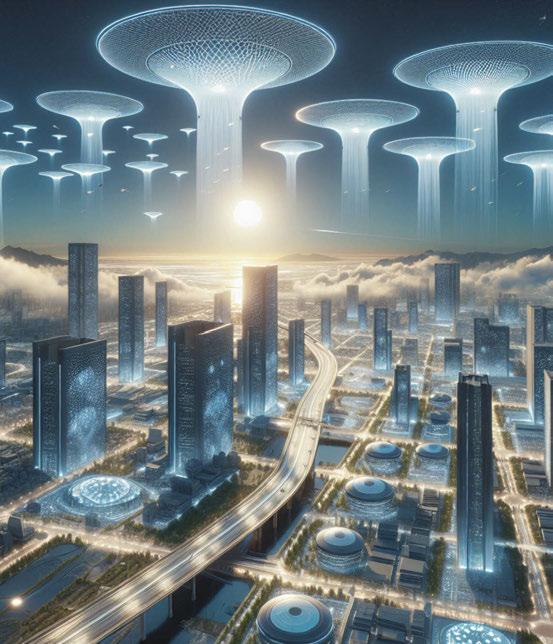
human creativity”. Throughout his presentation, Bevolo shared a series of AI-generated images that speculate on the future of lighting design, although perhaps alarmingly, during his research he found that AI “doesn’t recognise” lighting design as a business. Despite this worrying find, it was a fascinating way to kick off proceedings, and get the audience speculating on where the industry will go in the future. You can read an exclusive follow-on comment piece from Bevolo and Draeger, expanding on their findings, starting on page 58.
Following the keynote, the talks sessions split into three separate tracks, with two separate presentation programmes, and a separate track focused on longer workshops and discussions. Usually, attending this kind of conference becomes akin to a music festival, working out who to see when, and navigating any difficult “clashes” between speakers.
Luckily this time around, with myself and Ellie in attendance, we could split our time accordingly and cover as much ground as possible, which proved very helpful, as this year’s lineup was packed out with amazing speakers and fascinating subjects.
First up for me was Jesper Ravn of Gottlieb Paludan Architects, who shared his take on sustainability in design, namely that we should “build less, and light it better”.
As the only lighting designer at the Danish architects, Ravn refers to himself as a “Light Architect”, and in his session, he spoke of the need for “sustainable architecture” - whether that be building with sustainable materials, or converting and transforming buildings that already exist – and the clear importance of involving lighting designers from the outset of any project. He also gave specific examples to two ongoing infrastructure projects from the studio – Copenhagen South Station, and Oslo’s Skøyen Station.
Next up, Paulina Villalobos took delegates on a “Noche Zero Journey” through design, law, and
Images: courtesy of IALD
the “meaning of words”. During her session, the Chilean designer discussed the need to embrace darkness and the night, as well as some of the discrepancies that she has noticed in the past – namely the Noche Zero event in the Atacama Desert in 2010 – an event raising awareness of light pollution, in which no lighting representatives were present. She also talked about the language that we use when talking about light, and how much of this is meant for engineering purposes; she therefore proposed a range of new terms that can give a more accurate depiction of the look and feel of lighting.
Clementine Fletcher-Smith of Speirs Major Light Architecture led an insightful session on “Creative Resilience”, looking at the need to both imagine and realise positive change in challenging situations, and how to protect your ideas, and also the difficulties of being “resiliently creative”. Sharing some project examples, including the Macallan Distillery and Battersea Power Station, FletcherSmith explained how to “look for the unusual” in projects that may lead you to think differently, while also taking inspiration from context and people to create the most inspiring works of lighting design. She also shared further examples of creative resilience, such as adaptability and agility; understanding capability; digital and environmental resilience.
Building on the notion of context-based work, Kristin Bredal, Director of Zenisk shared three very contrasting project case studies from across her native Norway – a location where she says she works for “the saddest, darkest time of the year”, and how she tackles lighting design in an area that typically favours strong, efficient light that “is not pretty and adds no atmosphere”.
As such, she demonstrated the lighting approach for the World Heritage Space of Geiranger, which focused on community engagement centred around Dark Sky Tourism; the town of Bodø, where the vision was to take a sustainable approach to “take back the night”; and the urban transformation at Lilleakerbyen, where biodiversity and the natural habitat led the lighting design approach.
A must-see speaker on any talks programme, Juan Ferrari of Hoare Lea followed up his excellent session on AI in lighting design at last year’s Berlin event, with a talk on “Illuminating Metrics” – in which he posed the question of how we measure the “value” of light. This is not referring to the monetary cost, but instead something much more intangible and subjective.
During the session, Ferrari asked if we can measure lighting “by its ability to create moments of happiness”, and broke down its various dimensions. These range from the technical and emotional dimension, to other factors such as
health and wellbeing, and an interdisciplinary dimension – lighting’s relationship with other disciplines. He summarised though, by referring to lighting as the “Joker card”, concluding that “the value of light is infinite, it is the essence of existence, and cannot be quantified by a value”. Incredibly well said.
Closing things out, a “Designer x Designer” interview saw Beatrice Bertolini of Equation sit down with Tim Downey, Managing Director of StudioFractal, to talk about his journey through lighting, starting with his early beginnings in the industry, to project highlights, design styles, and what he feels are the “perks of the job”.
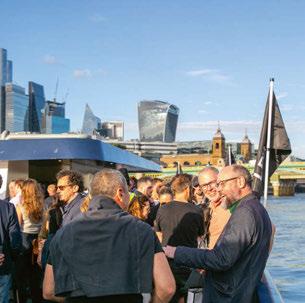
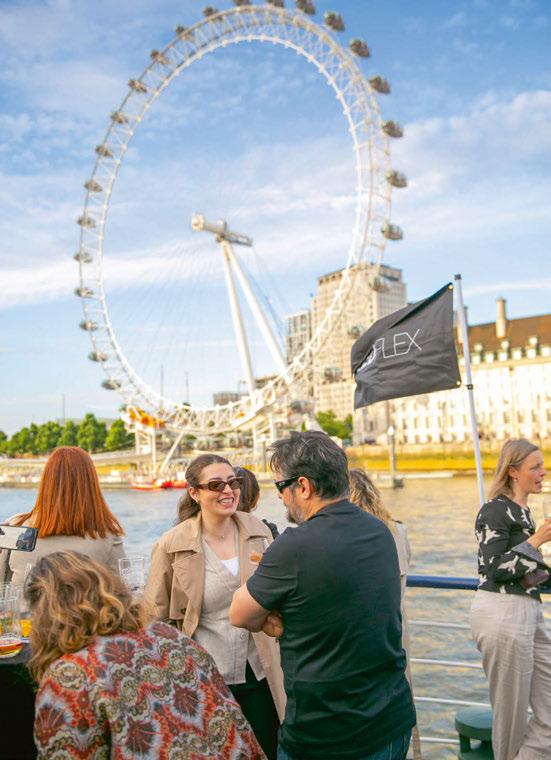
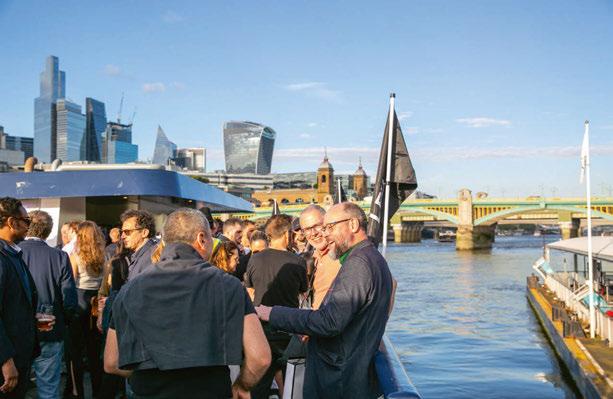
Following the day one talks programme, attendees were invited on a scenic river cruise along the Thames, courtesy of LEDFlex, taking guests past iconic landmarks such as the Houses of Parliament, Tower Bridge, Battersea Power Station, and of course, the Illuminated River bridges. Coupled with a complementary Pimm’s bar and below deck dancefloor, it was a perfect way to round off an illuminating first day.
Day two began for me with a session from Juliette Nielsen and Meike van der Velden of Beersnielsen on the unexpected challenges that the team faced when working on the Paleis Het Loo, a former Dutch royal palace turned museum.
Part of a wider renovation project let by KAAN Architects, the project included a modern addition to the exhibition spaces, with a completely underground entrance lobby that was lit through a combination of artificial lighting, and a vast skylight on the ceiling.
Discussing this new addition, as well as the façade and exhibition lighting, Nielsen and van der Velden talked of the need for flexibility and adaptability to ensure the best possible solutions.
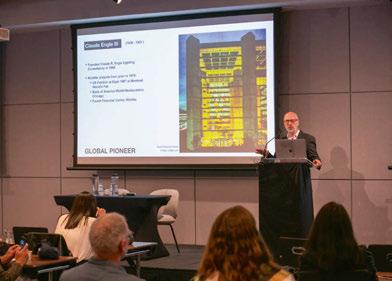
Following this, Glenn Shrum, Associate Professor at Parsons School of Design delved into the Pioneers of Lighting Design, sharing the findings of his research into the origins of lighting design, and how it moved from a subsect of “illuminating engineering”, into an independent profession in its own right. During his research, Shrum obviously learned more about some of the big names – Stanley McCandless, Richard Kelly, Derek Phillips, etc – but also discovered some further names that he was previously unfamiliar with. We spoke with Shrum for our In Conversation feature in this issue, where you can read more about this ongoing research. Check it out on page 26.
Another personal highlight in the talks programme came from Kael Gillam of Hoare Lea, who delivered an impassioned talk titled “Second Chances: Circular Principles in Practice”.
As well as diving into an ongoing case study at 2 Waterhouse Square, where the studio is renovating a heritage space, while also adding new workspaces to the project. Gillam talked about creative re-use, and how if designers are conflicted over designing for beauty or sustainability, “they’re not trying hard enough”. Indeed, given the increasing importance for projects to be more circular and sustainable, Gillam closed her session by emphasising the need for everyone to try harder
on every project, rather than picking up “easy wins” and looking at it next time. Her closing remarks rather succinctly summing this up – “don’t grab the low hanging fruit, climb the f****** tree”. In a relative change of pace, Katie Czub of Fisher Marantz Stone looked to the future of the industry (a common thread across the talks programme), examining the “Lighting singularity” – the exponential growth, in which technology has advanced at an ever-increasing rate, from the early days of oil lamps and gaslights, to the LED revolution and advanced lighting controls. During her talk, Czub spoke of how lighting designers of the past were limited by the tools available to them at the time, whereas now, there is a need to keep pace with ongoing developments in technology. Alongside the ongoing speculation on the future of the profession, a big topic in lighting continues to be the debate surrounding “good” outdoor and public lighting design, and how to best address inequalities and misconceptions in this area. Central to this discussion are Light Follows Behaviour in the UK, and Sighte Studio in the USA. Both aim to inform clients on what “good lighting” actually is, and help communities to develop a sense of ownership of their spaces through ongoing community engagement. In a joint presentation, both practices shared case studies on the subject, detailing the ways in which they have helped bring good lighting design to often overlooked areas, such as social housing and public parks. Closing things out for me was a mind-bending session from Martina Frattura, who coined the term “Neuroarchitecture”, and how lighting, beauty, and neuroscience can “nudge permeability”. Delving into the inner workings of the brain, and our subconscious understanding of our surroundings (a fascinating, yet heavy topic after two days of presentations!), Frattura talked about permeable architecture and the dynamic relationship between the physical environment and the human psyche, and the way that lighting can unconsciously affect the way that we experience a space.
It was an enthralling session – even if it did give me a bit of a headache – and a great way to round off two days of fascinating discussions.
I mentioned at the start of this write-up that IALD Enlighten Europe has been one of my favourite events on the lighting calendar since my first edition in 2018, and it once again lived up to expectations. As well as the intense, inspiring knowledge-sharing from the talks programme, it is always a pleasure to catch up with so many friendly faces from across this amazing community of ours. I know that I can sound like a broken record when talking about this, but it is always a genuine highlight to connect with our extended lighting family, as these events only makes this diverse, vibrant, international community stronger. So, a huge hats off must be given to the IALD for organising another spectacular conference. I’m already looking forward to the next one!
Ellie Walton Junior Journalist, [d]arc media
For my first IALD Europe, there was something nostalgic that was conjured inside of me when I sat down for my first lecture. One aspect of university life that most graduates wouldn’t admit they miss is the act of attending lectures, but perhaps it was two years of attending lectures from bed thanks to the Covid lockdowns that left me feeling robbed of a full educational experience that made me excited to be sat taking notes in my new notepad. However, I soon realised I wasn’t back in my second-year Narrative Theory module, and with only a year of being at [d]arc media under my belt, I felt a little out my depth.
As an English Graduate I’m not quite fluent on the design language as of yet but, one thing I have learned from attending events like these is that the people in the lighting community are passionate about what they do and happy to share some of their precious time to speak. It reminds me of why I wanted to become a journalist, for its people and their passions that fuel the fire in my heart and for sure IALD Enlighten Europe was an event for the most passionate and inspiring people the industry could produce.
To begin with, I joined Matt for the opening welcome from IALD President, Andrea Harntraft, and keynote speaker, Dr. Marco Bevolo. In his keynote address, “The Future of Lighting Design Beyond Lighting Design,” Dr. Bevolo explored emerging industry trends and providing a framework for urban futures and lighting innovation. The topic mostly explored and reflected on the role of AI in generating design. With advances in artificial intelligence moving at lightning pace and affecting a whole host of professions, light design being no exception, it has created many questions on how it will impact humanity’s role in lighting design. Bevolo’s lecture gave a deep dive into the benefits and limitations of how AI can be a comprehensive tool especially generating images and renders of lighting schemes and what the relationship between human and AI technology could look like. With the world changing around us so quickly, so must the lighting industry.
As a rookie and non-lighting professional it would be fair to say the language of light is not one I’m confidently fluent in as of yet, but Bevolo’s talk set a precedence for the following two days. A running theme continued throughout on light’s relationship with the world around us, whether that be on technology advancements, sustainability or poverty. It became clear that the subject of light is not one that is exclusive, how can it be when we all live in a world that turns from light to dark every day? Something that Nathalie Rozot’s talk showed is something some of us may take for granted every day. Rozot, CEO of PhoScope, delivered a presentation on her groundbreaking initiative Light Reach and its programmes in Puerto Rico and Lebanon. Rozot’s presentation highlighted the impact of electricity shortages and economic instability, leaving many communities in darkness. The Light Reach initiative aims to transform these dark environments into safe, well-lit spaces using
cost-effective, solar-powered lighting systems. Emphasising the tagline “Lives in the Dark Matter,” Rozot showcased the flexibility and efficiency of these systems, which include pole-mounted solar streetlights, stationary, and portable solar lights. Rozot stressed the importance of collaborating with local communities and organisations to adapt the installations to specific needs, supporting local economies and ensuring cultural appropriateness. Despite the amazing work they’ve achieved, political instability, economic restraints, and logistical issues often hinder their progress, leading them to pause their work in Puerto Rico in 2020. Rozot finished by outlining Light Reach’s vision to expand by using the same methods and models used in Puerto Rico and Lebanon in places all around the world struggling with light poverty, such as Turkey, which suffered the devastating aftermath of an earthquake in 2021. Her finale established that light quality and best practices are not the starting points in her work, it is establishing the basics with safety and durability in mind; she left on her final note: “First you feed the people, then you add the spices.”
Sustainability always provides valued discussions in any lighting design talks programme and Enlighten Europe was no exception. Maelle Tertrais and Sara Castagne of Concepto gave a case study presentation of their work at the Paris Olympic Village, in which they installed 360 streetlights made from upcycled materials sourced from building sites in the athlete’s village. The project was part of an overall scheme by the Olympic Games authority Solideo to reduce carbon emissions by 47%. Each streetlamp is made from salvaged wood and a crosspiece upcycled scaffolding pole, which supports one or two energy-efficient LED lights. The crosspiece is angled to direct illuminations on the roads at the higher end of the crosspiece, while pedestrians are lit via the lower end of the pole – overall reducing the number of fixtures having to be produced. The lights will remain in the village after the Olympics, which will be regenerated into new neighbourhoods in Saint Denis. The lights proved to be a success for their reduced carbon goals, saving 9238kgCO2e, which equates to 500 days of gas heating.
One of the challenges they faced scrutiny for was the DIY aesthetics, to which they had to ask “does this look bad?”. Tertrais and Castagne concluded, “we must find the beauty in the simple things”. As Matt mentioned, Friday’s lectures drew to a close with visitors being rounded up by the IALD and LEDFlex for the “Twilight on the Thames” boat trip. The evening began with a British version of what was essentially the card game, ‘Snap’. Each guest received a card with a word relating to British culture to which one had to find their matching card, for example Charles paired with Camilla, beans with toast and so on. The game proved to be a little difficult for some of our international visitors to understand, which in turn made me quite painfully aware of how bizarre and niche British culture really is after trying to explain Wallace and Gromit to a group of Spanish lighting
designers. However, the evening went smoothly with a gorgeous sunset on Westminster washed down with some delicious Pimm’s and entrées before finishing with a disco below deck. Thankfully Saturday’s sore heads and tired bodies were met with another delicious breakfast and refillable coffees to start the day’s learning.
A highlight talk for myself was Carla Jardim’s Now You See Me? – a session about how dark skin tones are perceived in lighting design, and how light is key to telling the stories of dark skin. Jardim covered four sections, which included photography, cinematography, stage lighting and architectural lighting. In each section she discussed how light has been used effectively and ineffectively when it comes to dark skin tones and how that effects black perception. She gave a personal anecdote from her partner who interviewed one of his ideals, Black techno DJ from Detroit, Derrick May, who couldn’t recognise himself in a picture due to poor lighting making him unrecognisable. Other studies included cinematography and stage lighting, in which she discussed the work of Raquel Rosildete, an architectural lighting designer who also worked with stage lighting. Rosildete realised that typical stage lighting rules did not work on actors of colour, therefore studied each actor
under different filters as well as the background. Her research then developed into a comprehensive template for combining filters to suit the different types of skin tones for stage production. Jardim’s research showed that the way we choose to light and light the variety of people is a choice, not because we don’t have the technology. She then posed these questions to architectural design: do we consider the variety of skin tones in habiting the space; how can we apply lighting to create more inclusive spaces; is it a great challenge to light a space where every skin tone can exist?
Jardim’s talk offered a unique perspective and social issue in the lighting realm, in which her research will be ongoing. It will be exciting to see how Jardim’s work will change approaches to architectural lighting and wider design.
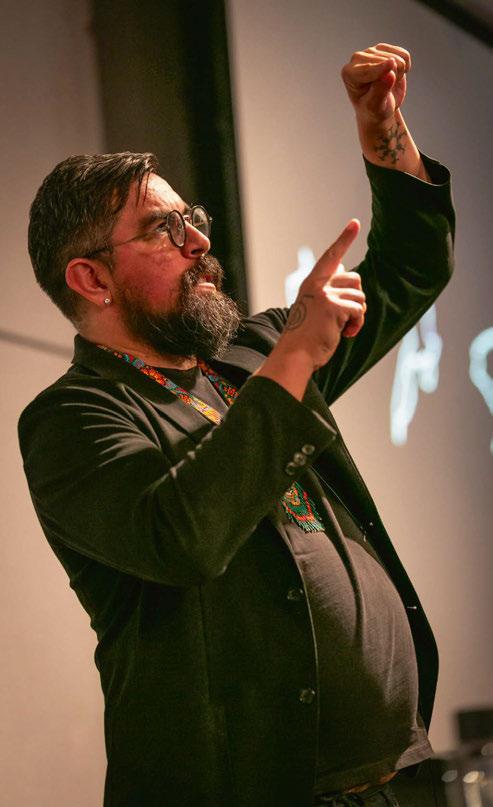
The final lecture I saw was delivered by Tupac Martir, titled “Technology as a Character.” Martir, the creative director and founder of Satore Studio, is renowned for his work on a variety of high-profile projects, ranging from collaborations with fashion icons like Alexander McQueen, Vivienne Westwood, and Moschino to lighting direction for Beyoncé, Danny Boyle, and the Coachella Music Festival. His expertise also extends to exhibitions and installations showcased globally.
Martir launched into his lecture with unmatched energy, the most vibrant of the event. His talk cantered on how technology serves as a crucial storytelling element, much like music, graphics, and costumes. Martir emphasised how innovative uses of light and technology can support and enhance narratives in entirely new ways.
Often hailed as a “lighting magician” and “creative visionary” by publications like Vogue and Wallpaper, Martir’s trailblazing work has consistently pushed the boundaries of technology in the creative arts.
As he blazed through his presentation discussing the epic journey and the creative processes behind his projects there was also a clear message I took away about the confidence to take risks. During the lecture, Martir discussed one of his passion projects from 2018, an extensive installation created for his homeland, Mexico. Mexico City had just emerged from one of the most devastating earthquakes in history, and Martir’s installation aimed to boost morale and serve as a love letter to his country. He and his studio produced 100ft x 45ft projections that could be seen across Mexico City. The digital animation depicted the everyday trials and tribulations of Mexicans as well as performances from ballet dancer Isaac Hernandez. Citizens could also contribute to the piece using social media hashtags to allow people to interact with the piece and integrating their achievements and snippets of their friendships to the projection.
Although the project involved going against the client’s wishes, it proved to be worth the risk, as it deeply resonated with the local community,
especially children. Martir considers this project one of the standout achievements of his career, a heartfelt tribute to his beloved country.
The IALD Enlighten Europe conference proved to be an enlightening and thought-provoking experience, offering a profound exploration of the evolving landscape of lighting design. From the integration of AI in the creative process to the crucial role of sustainability in lighting practices, the event showcased how the industry is responding to rapid technological advancements and global challenges. The presentations and discussions highlighted not only the technical aspects of lighting but also its profound social impact, as seen in Nathalie Rozot’s work in light poverty and Carla Jardim’s research on lighting inclusivity. The conference served as a powerful reminder that lighting design is not just about aesthetics but about enhancing human experience, addressing societal issues, and fostering community.
As the industry continues to innovate, the insights gained at Enlighten Europe will undoubtedly inspire and influence. For myself, I can say my experience at the event has completely altered my perspective on the power of lighting. One of the unexpected parts of my job and attending events such as this is the pleasure to witness the work of lighting professionals and how they push the boundaries of what is possible, creating designs that aren’t just beautiful, but also meaningful. www.iald.org
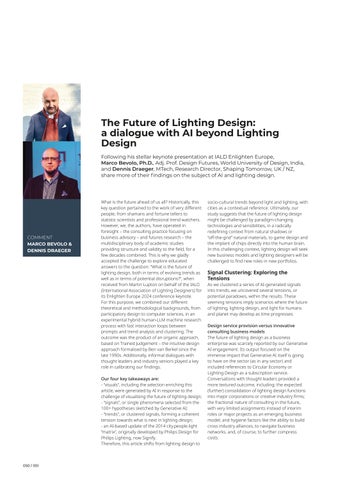
The Future of Lighting Design: a dialogue with AI beyond Lighting Design
Following his stellar keynote presentation at IALD Enlighten Europe, Marco Bevolo, Ph.D., Adj. Prof. Design Futures, World University of Design, India, and Dennis Draeger, MTech, Research Director, Shaping Tomorrow, UK / NZ, share more of their findings on the subject of AI and lighting design.
COMMENT
MARCO BEVOLO & DENNIS DRAEGER
What is the future ahead of us all? Historically, this key question pertained to the work of very different people, from shamans and fortune tellers to statistic scientists and professional trend watchers. However, we, the authors, have operated in foresight – the consulting practice focusing on business advisory – and futures research – the multidisciplinary body of academic studies providing structure and validity to the field, for a few decades combined. This is why we gladly accepted the challenge to explore educated answers to the question: “What is the future of lighting design, both in terms of evolving trends as well as in terms of potential disruptions?”, when received from Martin Lupton on behalf of the IALD (International Association of Lighting Designers) for its Enlighten Europe 2024 conference keynote.
For this purpose, we combined our different theoretical and methodological backgrounds, from participatory design to computer sciences, in an experimental hybrid human-LLM machine research process with fast interaction loops between prompts and trend analysis and clustering. The outcome was the product of an organic approach, based on Trained Judgement – the intuitive design approach formalised by Ben van Berkel since the late 1990s. Additionally, informal dialogues with thought leaders and industry seniors played a key role in calibrating our findings.
Our four key takeaways are:
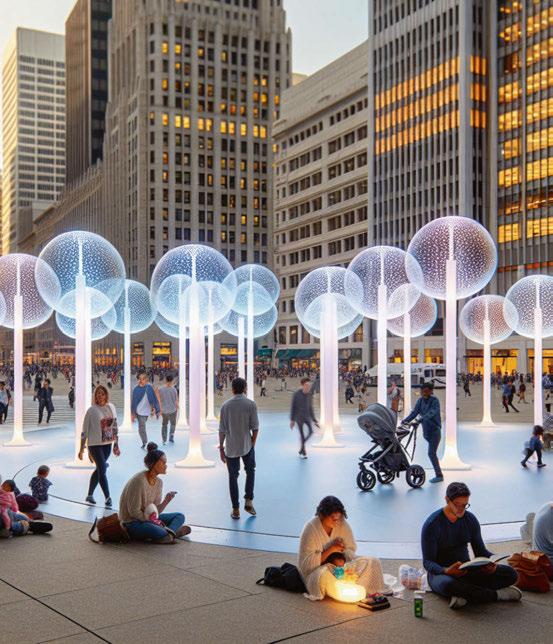
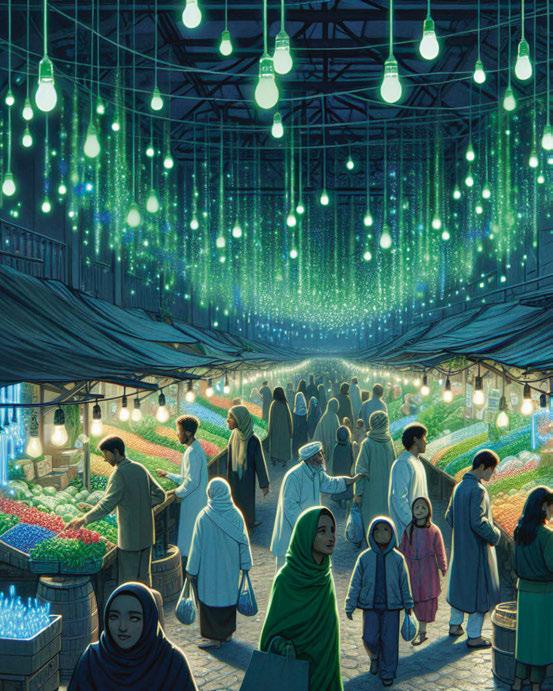
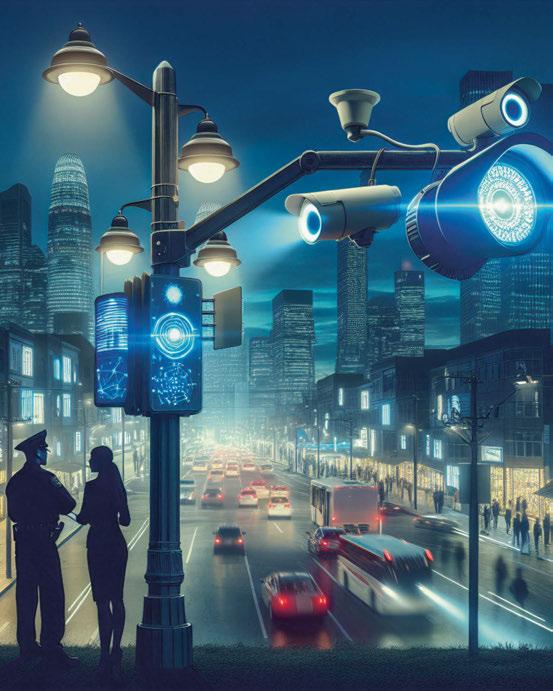
- “visuals”, including the selection enriching this article, were generated by AI in response to the challenge of visualising the future of lighting design;
- “signals”, or single phenomena selected from the 100+ hypotheses sketched by Generative AI;
- “trends”, or clustered signals, forming a coherent tension towards what is next in lighting design;
- an AI-based update of the 2014 city.people.light “matrix”, originally developed by Philips Design for Philips Lighting, now Signify. Therefore, this article shifts from lighting design to
socio-cultural trends beyond light and lighting, with cities as a contextual reference. Ultimately, our study suggests that the future of lighting design might be challenged by paradigm-changing technologies and sensibilities, in a radically redefining context from natural shadows or “off-the-grid” natural materials, to game design and the implant of chips directly into the human brain. In this challenging context, lighting design will seek new business models and lighting designers will be challenged to find new roles in new portfolios.
Signal Clustering: Exploring the Tensions
As we clustered a series of AI-generated signals into trends, we uncovered several tensions, or potential paradoxes, within the results. These seeming tensions imply scenarios where the future of lighting, lighting design, and light for humans and planet may develop as time progresses:
Design service provision versus innovative consulting business models
The future of lighting design as a business enterprise was scarcely reported by our Generative AI engagement. Its output focused on the immense impact that Generative AI itself is going to have on the sector (as in any sector) and included references to Circular Economy or Lighting Design as a subscription service. Conversations with thought leaders provided a more textured outcome, including: the expected (further) consolidation of lighting design functions into major corporations or creative industry firms; the fractional nature of consulting in the future, with very limited assignments instead of interim roles or major projects as an emerging business model; and hygiene factors like the ability to build cross industry alliances, to navigate business networks, and, of course, to further compress costs.
Innovative technologies versus existing technologies
Several maturing technologies like LEDs, lasers, LiFi, internet of things and beams were reported by AI as instrumental to the future of lighting design. Our final selection identified a tension between these current technologies and longer-term future Deep Tech innovation, e.g., nanophotonics, whereby designers might have to design by the nanometre. The current high-tech solutions might not feel very futuristic, but they are the main vectors of the digital and green transitions in Europe and in the world. Indeed, they may still have a significant impact on the future in terms of market demand and penetration opportunities, since they have not reached their full commercial potential. As a conclusion from a first review of generic “signals” generated by AI, one might notice the pervasiveness of technology as the identified driver of lighting design, with sub themes around urban wellbeing and human health.
Functional IoT systems versus aesthetic lighting
The societal impact of urban lighting as a therapeutic opportunity in public places was highlighted by AI, e.g. with serotonergic benefits, by shifting from fine arts to a synthesis between artistic features and citizen wellbeing. Adding to the trend of increased
form and function, the AI presented an apparently odd integration of Light Art with micro-mobility solutions to combine functional benefits with aesthetics. However, we noted that future options might include the further deployment of IoT, sensors and other high tech solutions to make city lights fully customised in real time to increase diversity while anticipating crime through predictive policing. The form and function combined into a contradictory tension of freedom and discipline to both enable a more inclusive urban lifestyle and tools of societal control.
Automated lighting experiences versus human focused light
Both the AI and our expert interviews pointed to “Neuro-aesthetics” as a significant cultural trend cluster. The strong impact of this current convergence of neurosciences with the pursuit of beauty applies the existing business practices of neuromarketing to lighting design as well as of niches like neuroplasticity enhancement through art therapy, with the latter being a theme of interest for various public and private grants. Eventually, neurosurgical intervention for the enhancement of creativity and for the alteration of experiences might be feasible as the trend develops, but Generative AI clearly indicated it as “unlikely” in view of both technical and ethical challenges.
Provision of light versus narrative experiences
The AI also presented storytelling automation as a cultural trend cluster registering hypertextual interactive narratives as derived from gaming and immersive theatre experiences: from the roots in Richard Wagner’s Gesamtkunstwerk, to pioneers like Antonin Artaud or Carmelo Bene, to performance artists like Allan Kaprow. “Immersive Theatre” is a niche within theatre studies, however it has been explored and formalised by scholars like Josephine Machon, offering an aesthetic platform to redefine the relationship between audience, or citizens, and stage, or the city. AI could be used to automate some of the aspects of improvisation that require greater efficiency or simply help to tell stories in new ways.
Artificial light versus bioluminescence
New materials of organic origin could replace some electrically and electronically generated emission using naturally generated bioluminescent lighting such as with algae or bacteria. Adopting biomimicry as an aesthetic grammar, while relying on scientific developers like Paris-based Glowee, for the invention of innovative bacteria-based solutions, could have a significant impact on how lighting designers work.
AI-generated images depicting possible future scenarios surrounding lighting design. The images above show possible examples of “Shade Design” (left), and the use of “Light Therapy” in public spaces (right). (Images courtesy of Marco Bevolo)
Artificial light versus natural darkness AI also highlighted the demand for urban security and safety with the desire of nature-driven solutions, in line with the existing trend of Darkness Design or Shade Design, from initiatives like Globe at Night, the Citizen Science initiative, to the work of lighting design thought leaders like Leni Schwendinger to the world. Here, a “Design Trend” was identified, where awareness exists not only of artificial lights but also of natural light, and the interplay of light and shadow. The primary purpose of increased shade design is to address extreme heat, and lighting designers may have a deeper understanding of how to optimise the natural light while protecting urban dwellers. In general, one might conclude from this Generative AI-based trend study that societies will greatly benefit from a biodynamic approach, or the Life-centric Lighting as eloquently demonstrated by the likes of Amardeep M. Dugar, PhD, which might match the post-human-centric vision of design by thought leaders like Bruce Mau.
Hallucinations as Hypercreativity
Additionally, we examined with great interest what normally would be considered “hallucinations” by the LLM, considering them a liminal phenomenon of potential creativity by the machine. For example, the notion of “Solar Aesthetics” emerged, or a new formal grammar based on solar power generation, as extreme as envisioning “Solar Storms” as potential sources of power in the future. These “hallucinated signals” emerged from the prompt and the processes related to the Urban Futures Matrix, however they were mentioned in the keynote as an example of extreme creativity by Generative AI, for consideration and discussion.
Sensemaking: Updating the Matrix
The next questions we asked ourselves as studying a design domain, are: how to make sense of these signals? How is it feasible to channel trends from analysis to concepting? How to connect sociocultural drivers and trends to design strategies? We turned to the Urban Futures Matrix, as evaluated and validated through more than 20 workshops worldwide as a key tool within the city.people.light programs of Signify. The city.people.light program was further valorised in several seminars and lectures at academic level, and in various conferences, peer reviewed publications and trade articles. Within this tool, the horizontal axis reports socio-cultural drivers, representing the tensions and the directions of evolution of a given sociological universe, e.g., citizens living in advanced economies. The vertical axis reports design strategies, or options to organise said universe, i.e., how to plan cities according to a given urban strategy. What is mission critical in the conception of a Futures Matrix, is the discriminatory quality of its parameters, to be organised in distinguishably focused pairs. For example, in the context of urban future: sociocultural focus on individuals versus socio-cultural focus on groups, or design strategies focusing on time versus design strategies focusing on place. Within each focused couple, the axis should be
further discriminating, e.g., structured according to discriminating oppositions of positives and negatives. Such discriminating capability is key to enable a Futures Matrix to serve both as precoding framework for qualitative research, as well as a structuring framework for the creative process in generating design concepts.
Based on the 1995 city.people.light Matrix, designed by Francesco Morace of FutureConceptLab, Milan, for Philips, we selected the Create the Livable City Urban Futures Matrix published in 2014. We, then, attempted to prompt the AI to generate a new tool with equivalent structure. However, we reached the limits of Generative AI. We experimentally concluded that refreshing the 2014 axes parameters was attainable in collaboration with AI, but the automated creation of an updated version of the tool might require the ability to design discriminatory relationships across the axes, which might be premature at this stage of LLM sophistication. Following this empirical conclusion, we worked collaboratively between ourselves and the AI to redefine both the socio-cultural drivers and the city design strategies within the Urban Futures Matrix.
In 2014, “Socio-cultural drivers” were encapsulated into the individually focused “Identity”, or the pursuit of one’s roots because of increasing complexities within globalisation processes, and “Exploration”, or the conversion of cities into experiential stages according to the principles of themed entertainment. To complete the horizontal axis, two socio-cultural drivers focusing on “groups” were defined as “Belonging”, or the rise of digital networks and regional “tribes”, and “Sustainability”, or the holistic pursuit of personal, social, and environmental balance at planetary and at a local level.
Our 2024 AI-enhanced update recorded how individuals will increasingly consider their “Identity” as a personal sanctuary in the context of an increasingly risky world, leaving space for the creation of Cultural New Roots, in an unexpected postmodern accent within the first socio-cultural driver. In the second driver focusing on individuals, the scope of “Exploration” will increasingly grow from Pine and Gilmore’s experience economy into the new opportunities offered by Generative AI and by neurosciences applied to aesthetics. Shifting from individuals to groups, in the future
“Belonging” as a driver will further evolve into social media bubbles and regional insularity, with an increasing risk of social fragmentation, whereas “Sustainability” as a driver generated generic AI output related to gender equality and ethnic diversity, with a minor reference to the “15-Minute City” concept for environmental purposes.
In 2014, “City Design Strategies” were defined as time-based, with “Acceleration” focusing on enabling economic enterprise by flexibility, and “Memory” focusing on heritage as key urban asset, complemented by two place-focused strategies, namely “Semiotics”, later renamed as “Icons”, focusing on the positive impact of new urban objects, e.g. the Guggenheim Bilbao effect, and “Connectivity”, renamed as “Infra”, focusing on the
anonymous infrastructure activating a city, regionally and globally, e.g. transport hubs or low cost airports.
“Acceleration” is expected to further grow into the direction of agile and responsive flexibility, with cities like Eindhoven, The Netherlands offering a blueprint so far, and with the adoption of AI as an anticipatory tool for future economic growth.
“Memory” as a city strategy might evolve in a less linear fashion, towards better integrated cityscapes where repurposed or restored urban objects might integrate or challenge new developments, with the opportunity to rethink Destination Branding from the viewpoint of cultural time travel. Lastly, the two city design strategies referred to “Place” were both renamed by the authors to enable a more effective and consistent output by the machine: “Semiotics” was renamed as “Icons”, where major new urban objects might be less and less in demand, while micro-semiotic signifiers in the everyday will emerge as places of affection with deeper significance for citizens, e.g. a small garden or even a simple bench, following the notions of “pervasive aesthetics” and Jill Stoner’s “minor architecture”. Concluding, within “Infra”, the micro-economic impacts on talent and markets in regional hubs might rapidly reinforce this strategy, with digitalisation as a major enabler and vector towards the creation of hyper-connected, decentralised hubs.
Open Conclusions
Conclusions are inevitably “open”, given the nature of the future as a subject of study. Several valid points emerged from conversations before and beyond the Generative AI-based trend analysis, including topics and themes like the rising geopolitical complexity of macro-regional developments, e.g. G7 versus BRICS versus Global South or the pursuit of radical change. Also, we identified various disruptions, represented in the context of IALD by initiatives like Light Justice or Women in Lighting. Also, at a level of design, no AI output directly pertained to the emerging fields of AR / VR, while references to Co-design and Participatory Design practices were barely a minimum. The latter is increasingly enabled by the development of digital tools enabling people’s involvement in public lighting design, as pioneered by Eindhoven-based Philip Ross. These themes and topics each represent a potential area of future explorations of the future of lighting design. Ideally, lighting designers might engage in a growth curve shifting their talent from lighting technology to multidisciplinary design, increasingly acquiring competences towards visioning and strategising. Or, considering Generative AI’s suggestions, lighting designers might shift from electricity and electronics to nature and life-centered mindfulness, leapfrogging over Design Thinking into Design Futures. www.worlduniversityofdesign.ac.in
Further AI-generated images, depicting “Biolight” (left), and the concept of “City.Light.Security”, as researched by Bevolo and Draeger (Images courtesy of Marco Bevolo)
Tartu Cathedral
Tartu, Estonia
Unveiled at the end of April this year, the Tartu Cathedral has been bathed in a new, dynamic lighting scheme to celebrate the city’s status as European Capital of Culture 2024.
Part of a programme entitled Toomemägi Revisited, the lighting design for the cathedral was created by an ensemble of designers – Fiorenzo Namèche (team leader and project holder, studio light.to.light. design), Alfred Sa’ (technical advisor), and Chiara Carucci (project manager).
Selected through a lighting competition, the concept for the new scheme was titled Koit ja Hämarik (Dawn and Dusk), and was inspired by a traditional Estonian tale of a young couple, symbolising the meeting of
day and night, as well as the rich, nuanced light of the Nordic sky, the changing seasons, and the light and shadows in the architecture of the building.
In bringing this concept to life, the dynamic lighting design sees the cathedral bathed in a warm light that transitions from 2700k at its “coolest”, to a deep amber and rich red throughout the night.
Namèche explains: “When we first visited the Cathedral, it was October 2022, and we could feel at the end of the day that the sunset was very long, giving some really nice, warm light on the cathedral. This was the base of the colour that we used for the lighting, where we played between warm light and a very reddish tone for the middle of the night,
creating a cycle of light. The Estonian tale that we based the concept off represents the meeting between daylight and the night, because during the summer, they have continuous light, with no night at all. It was a good story to explain the dynamic, changing light throughout the night.”
The warm light appears to emanate from the base of the cathedral, becoming increasingly warmer to the reddish hue at the top, transitioning in a slow, subtle way – the warmth of the light matching the rich red colour of the building’s brickwork. Every fixture is controlled via DMX, which enabled the smooth, almost invisible light change throughout the night, cycling through six different scenes across three
segments – sunset, the middle of the night, and sunrise. And Namèche was full of praise for the lighting programmers, who had to create a system that would consider the ever-changing night cycle in Tartu.
“The length of the night changes a lot, and the system measures the length of the night to schedule precisely each scene, and calculate if it is a short or a long night – in the summer the changes are more rapid, and in the winter the night is very long, so it is a very long step between.”
The main challenges that the design team faced centred around respecting the heritage of the cathedral, making little to no interventions into the building itself, while also preserving the night sky in the parkland
that surrounds it. As such, luminaires were designed to be as inobtrusive as possible, keeping hidden from the public eye, while remaining reusable and dismountable, so as not to damage the cathedral’s brickwork.
The designers also worked with the city of Tartu in amending the public lighting surrounding the cathedral, to maximise the new scheme’s impact.
“We also considered light pollution and lighting according to the surrounding environment; because the cathedral is in a park, there are some species living nearby that are protected, such as bats, etc,” adds Namèche. “But of course, with what we installed, it is fantastic, because it doesn’t bother any insects or animals, because
of this warm, red colour. The intensity and direction of light also makes it very successful from that point of view.”
Since its unveiling earlier in the year, the design team has received a lot of praise for the work, with very good feedback from the public. Namèche concludes: “Of course, I am really happy with this project. It has been really interesting to get the feedback of the university also, as the cathedral is in the middle of the Tartu University campus, and we’ve had very good feedback from the people living there. They love it.”
www.light-to-light.com
COMMENT
How owners prevent their company growing
As a business owner, it can be hard to let go and delegate tasks to your team as your company grows. Marcus Steffen explains how this can damage your business in the long run.
How many times have you had a bad boss? Perhaps they micromanaged you, you had no freedom, or they constantly undermined you? And you think to yourself that when you are a manager/start your own business, you will be different. You are going to do it right. I can tell you that most people will not be able to do it right, and the reason is that people do not like to change. But if you can grasp the steps you need to make to change, then this is where a business can grow and be successful. It is a strange topic to talk about, but I feel that in our industry (as in almost every other industry) it is a major issue. We have all had these experiences, and it is a constant topic of memes across social media, and jokes you share with your colleagues. This is the exact reason that made me curious, and caused me to find out that I had to make some big changes in running my business. But let us take it back to the start with an example: starting your own lighting design consultancy.
Starting Out
You have decided to go it alone, build your own business, and you are going to do it right. You have saved up some money, you have done the work setting up a portfolio website, social media and maybe you have a couple of projects to work on from contacts. You get to work, and you are doing everything – the meetings, CAD, schedules, snagging, making the coffee, doing the accounts, social media posts: everything. This is what it means to start the business on your own. You are responsible for it all, you are making the money, and you are going to grow. That motivation and dedication is what will help you succeed and get to the next level.
A year later, you have a number of projects, you are working 60-70 hours a week and struggling to keep up. Normally it goes in one of two directions here. Either you keep going this way, your marketing drops off, you finish the projects and then have no work. You go into massive peaks and troughs of work, and it is very stressful. The other way is that you hire someone to help you out: a junior designer! This is amazing, since they will be
producing drawings and schedules while you are meeting clients.
Expanding and building a team
If you have gone the second route, and hired someone, this will hopefully continue and you will eventually have a team of designers, and this is where things get difficult. While you have some staff, it is almost certain that you have the same mindset as when you first started: you do everything, you are responsible for it all, and you are worried someone is going to make a mistake. And this inability to delegate and let go of responsibility is what leads to the classic bad boss traits.
As someone builds their business, they need to evolve their mindset from being the worker into being a manager. The skills of a manager are completely different from those of a worker. With management you need to support your team, you need to enable them to do the best work possible, and you need to make sure that they are engaged (dare I say passionate) with the outcomes of this work. This means you need to give them control and responsibility, and accept that there might be mistakes. It also means that you need to let go of your ego, which motivated and drove you through the initial stages of the business and accept that others are going to produce the beautiful designs you create.
How to let go
True delegation of work is essential for any business. While some owners may feel that they want to stay at the core of the company, they are actually doing a disservice to their clients. The fact that they do not have a team who can take ownership and responsibility means that you are putting those clients at risk. If the owner was to fall ill or be unable to work for some reason, then their clients will be let down. On the inverse of this, if they have a team who can deliver the work without relying on them, then there is more redundancy built in, so that no one person becomes a bottleneck.
MARCUS STEFFEN
A lot of owners and managers find it difficult to delegate to employees. They worry about mistakes being made, which may cause problems, angry clients and potential penalties. Realistically, there will always be mistakes made by anyone on a project. The projects we all work on are hugely complex, are going to have errors, and even the owner/manager will make mistakes. No one is perfect. So how do reconcile the fact that we don’t want mistakes to happen, it is making us worried about delegating, but this is preventing workers from doing what they do best?
Ensuring delegation works
The key is putting systems and processes in place to prevent mistakes from happening in the first place, and then having ways of resolving those mistakes when they happen. This is where the difference shows up between someone who is amazing at their job (in our case lighting design) and someone who is building a business or managing a team. These are two completely different skill sets. A business owner or manager is going to want to create systems and processes as a way to ensure that the work is being done to the correct standard. Some examples of these:
• Checklists for what has been produced and issued.
• Guides on how to do anything, from laying out a CAD plan to building a fitting schedule.
• Peer review and checking by others on the team.
• Templates for anything structured, such as CAD, meeting minutes, standard emails, etc.
• Software to automate and remove errors in the design process.
• Standard questionnaires for gathering information and client briefs.
There are many other types of systems than these that can be created. These systems and processes ensure there is a structure to the way projects work. Good managers will be taking this out of their heads and putting ways of working in place that team members can follow. This will allow them the freedom to take ownership and know that what they are working on will be correct. They can feel proud of what they are producing, knowing that it is their own work.
As an example, MSLD prevents potential problems by highlighting very complex details during the concept and development design stages. We will look over a project and look at what is particularly challenging. These are added to a list, and we then ensure that we have a final review before submittal of those details in particular. The other elements I then trust the team to be able to deliver themselves.
Reap the secondary benefits
There are other benefits to having a smoother running design process that doesn’t constantly require a manager/owner’s attention. Empowering your employees to have more control over their work, and not micromanaging them will make them happier. This has been shown consistently in research across the world. This also leads to a better working environment, higher staff retention, satisfaction and reduced recruitment costs. It also helps develop those long-term relationships with clients as teams get to know each other and work well together. In addition, with the time won back, it can be spent on critical tasks such as finding new projects and opportunities, training staff, and planning for the future growth of the company. www.mslightingdesign.co.uk
Image: CoWomen, via Unsplash
Solus Ceramics
Manchester, UK
At the new Manchester studio of tile manufacturer Solus Ceramics, Artin Light has created a theatrical lighting scheme to dynamically showcase the brand’s products.
ile manufacturer Solus Ceramics has opened a new studio, workspace and showroom in Manchester, taking over the ground floor of the Grade II* listed Manchester Law Library.
The refit of this historic space was undertaken by ICON Projects, designed by Incognito, with lighting design spearheaded by Artin Light. Given the heritage of the site, the refit required a high level of sensitivity, with skill, accuracy and attentiveness high on the agenda.
Located on Manchester’s Kennedy Street, the Law Library’s exterior is characterised by three highly ornamented bays, with tall windows in triple section surmounted by geometric mouldings and one heavy, carved oak door. Across the threshold is a small atrium adorned with Victorian terrazzo and mosaic.
On entering the studio, the eye follows a path to a low bar and tea point, while to the immediate left, an opening gives on to the front display area, which is lined with simple birch joinery, displaying the ceramics. These shelves continue through the space, lending the impression of a library and its serene atmosphere.
Working hand in hand with this intimate, cosy atmosphere, the lighting further accentuates the feeling of serenity. Although bright and neutral in its day-to-day setting, ideal for those working within the space, the lighting can take a more theatrical slant for product demonstrations. A central focal point within the space, dubbed ‘the campfire’ features an island table lit by a theatrical lighting rig, where targeted pins of light give visitors the ability to view tiles under different lighting scenarios in a dramatic, yet remarkably effective fashion.
Maya Gribby, Designer at Artin Light, explains the thought process behind this striking design move: “Solus has a slogan, which is ‘Every Tile Tells a Story’, and this is what the campfire idea was created around – a place where you’re telling stories about the tiles, where they come from, the qualities of those places, and the lighting replicates this to enhance that storytelling.
“One of our main concepts was colour grading, and matching the lighting scenario to where the tiles would come from, but also where they are going to go. For instance, if an interior designer comes in, and knows that the tiles will be in a room that is lit at 3000K, they can change the lighting to see how the tile is going to look in that lighting condition. So, it becomes a useful tool for them to have, not just for the storytelling aspect.
“We wanted to be able to shift from a neutral, bright workspace to a super moody, theatrical, almost museum level of dramatic lighting. With the introduction of the campfire table, we looked at how we could combine functional and coloured light.
“When you go abroad, there are different tones of natural light depending on where you are, and Solus wanted to bring that into the concept. For example, if the tile is from Rome, they wanted to be able to replicate the feel of the lighting in Rome. We also talked about whether the light has to be a spotlight, or whether it could have the feel of a shaft of light coming down. Then you have the shadows that cut off the light, and as a result viewers are more tempted to interact, move their hands into the light, and play around with it, getting a feel for the tile and exploring it a bit more. It became very interactive.”
The interactivity and customisation in the lighting was a very important factor in the lighting design, not just for Artin Light, but also for the client, as a means of giving viewers a more accurate depiction of what the tiles may look like in the likely very different lighting scenarios of their homes.
Having a client that was on the same page as the design team is something that was of great benefit to the overall project.
Luke Artingstall, Director and Founder of Artin Light, adds: “It was a collaborative process throughout. We approached Solus with these ideas; we had the initial brief, and we paid reference to the experience we had previously had on their London showroom where everything got quite dramatic, and it was all about taking it down to this one spot.
“From our perspective, we took that and moved it into this new direction. That led onto these ideas talking about how light can feel in different locations. That allowed us to bring tunable white and colour into the mix – this is something that Solus liked because of work that we had done previously, and they wanted to have that capability of bringing that it in as well.
“It was a whole process of experimenting with light, and experimenting with this idea of the campfire. It was a good, collaborative process, and Sam from Solus was very passionate about it – he appreciates lighting, and talks about lighting as a material, understanding that it can have a dramatic impact on everything.”
To create the striking lighting effects, Artin Light used two sets of framing projectors from AlphaLED – one in tunable white, and the other in RGBW. Beyond the Campfire table, the site includes a lower shared working space for the Solus team. All five programmatic entities within the space – the entry path, the bar, the front display, the
campfire, and the workspace – are lit differently but unobtrusively, so that the transition between the areas is subtle, yet deliberate.
With such variation within the space, effective lighting control was imperative. Artin Light worked with Mode Lighting on the controls, to ensure that each scene had the right ambience and theatricality.
Artingstall continued: “We went through and set up a multitude of variations, including tunable white and coloured options, which we preset for Solus to use. We wanted it to be quite experiential so that once they got to the ‘Campfire’ table, everything was dark around them, they can use these controls to fade the light up and down.
“Although it’s not a huge scheme, it has been really successful. Although it wasn’t always straightforward to get to the end point, the result is really good, and I’ve not seen many scenarios like that before, especially in Manchester, that bring this kind of theatricality to a space like this.”
Stuart Alexander, Associate at Artin Light, adds:
“The client really said ‘I’ve never seen anything like this’. It sounds like a joke to say that architects and designers and other people in these industries don’t actually know what 2400-6000K is. But it’s really cool that we could bring that to them and give them the knowledge and information. Now, they can talk about it and have the understanding to use warmer colour temperatures when they want to.
“Seeing from the imagery that Solus is posting on social media, it feels like it has given them a real image too – it has created an atmosphere, and a feeling of warmth and invitingness.”
“I went to a networking event there recently, and they had set a square spotlight onto each tile –these were lined up exactly with the three square tiles on the table, and when people were arriving to the event, it had the drama and theatrics of these glowing tiles on the table that instantly got people talking,” Gribby adds.
Despite the project sitting inside a Grade-II* listed building, the lighting designers said that the heritage aspect of the Manchester Law Library didn’t have too much of an impact on the interior lighting design. Instead, the restrictions that they did encounter were utilised to further enhance the intimate ambience.
“The building is absolutely stunning – it’s a little gem down this back street, and we couldn’t ask for a better building. For the interiors, before Solus moved in, it was used as an office and a showroom, so there weren’t any major restrictions. We couldn’t recess lights into the existing ceilings – everything had to be suspended in with minimal intervention,”
Artingstall explains.
“The Campfire has an acoustic system suspended above it, which added to the whole idea of sucking viewers in. We had coordinated the gobo
Workspace lighting
Office optic
Besides offering numerous lighting profile families, LED Luks developed a wide range of optics options suitable for various environments, tasks, and users’ preferences that require different lighting effects. When looking for a perfect solution for workspace lighting, office optic delivers glare-free illumination thanks to its specially designed lenses. The solution is suitable for VDU workstations according to EN 12464-1: up to 3300 lm/m with <3000 cd/m2 for beam angle >65 deg. Available also with a tunable white (TW) feature.
PLAIN
ORA
CAMALEO
“From a control system perspective, we also worked with Mode Lighting on multiple scenes, where it starts off as a day-to-day operation, but then it allows them to step it down to the point that it’s all focused on that one point.”
Gribby adds: “We added task lighting to the workspaces too, so even if they do have someone going through the dramatics of the presentation while others are working, it doesn’t take away from it by having these task lights on still.”
This combination of lighting elements adds to the overall aesthetic of the site, and indeed the reaction to the space, and in particular its dramatic lighting, since its opening, is something that Artin Light as a team, is incredibly proud of.
Client: Solus Ceramics
Lighting Design: Luke Artingstall, Stuart Alexander, Maya Gribby; Artin Light, UK
projection within that ceiling panel as well – this was all independent from the structure of the building. A lot of what the interior designers did was quite modular – it was more about the joinery elements that they brought into the space. They weren’t necessarily doing anything structural; it was a blank canvas that they then started inserting the joinery pieces into.”
Although the lighting concept has a large focus on the dramatic elements of the showcase Campfire, the team also took great care to ensure that, outside of the theatrics, the space still worked as a functional, comfortable workspace for Solus employees.
Artingstall continues: “From a functional perspective, although a lot of the focus has been on the theatrical elements, we also worked a lot on the day-to-day usage of the space. Away from the Campfire, towards the rear of the building, they’ve got access to a lot of natural light through a wall of floor-to-ceiling windows. These have blackout curtains, so that when they do bring people into the space, they can control the environment and the light in there.
Alexander says: “Something that is very cool about it is that it has invited people to take pictures for their socials – there is a framework built in so that any architect or designer visiting the space can create their own little theatre. When we were there, we were playing with the tiles under the light for ages, it’s quite a powerful thing. To see that Solus has incorporated it into their branding, matching the design of their brochures to the shapes, having been inspired by what we’ve done, is really cool.”
“There’s something very emotional about light, and it’s clear from a lot of Solus’ marketing material, where it is used in such a dominant way, because as soon as you see it, you’re instantly drawn to it,”
Artingstall adds.
“Looking at what we achieved under what was a fairly small budget is quite incredible. Ultimately, the clients are interior designers and architects, and traditionally they would go to a space where they’ll have a look at the tiles in a standard environment. But by taking this next level of approach, it has created a different vibe and elevated it into a complete experience.”
www.artinlight.co.uk
Bromley Old Town Hall
Bromley, UK
By delicately balancing restored heritage fittings with modern architectural additions, Nulty has paid tribute to the history of Bromley’s Old Town Hall, while transforming it into a flexible co-working space.
Agrand testament to early 1900s architecture, Bromley’s Old Town Hall has recently undergone a £20m renovation, through which architecture practice Cartwright Pickard, interior designers Fusion Interiors Group, and lighting design studio Nulty looked to revitalise and restore the architectural and cultural significance of the site.
Originally built in 1907 to house the town hall and courthouse, the Grade II-listed building evolved in 1939, when a new extension was added to incorporate a new council chamber; later, the basement was repurposed to create a nuclear fallout shelter. The new renovation to the building has seen it turned into a flexible co-working space and all-day dining restaurant.
Daniel Blaker, Creative Director at Nulty, talks to arc about the lighting design concept for the restoration, and of how the legacy of the building “shaped our design response”.
“The brief was to restore the original design aspirations of the old town hall, and to reinvigorate the building and give it back to the local community.
“Our role in terms of the lighting design was to honour the historical context by reinstating original light fittings found on site, and to try and unify the heritage story with the modern day demands that go hand-in-hand with a mixed-use workplace and F&B scheme.”
With the building incorporating various areas that each date back to different eras, the lighting design had to, according to Blaker, “knit together the different chapters of history”, and accommodate the complexities therein. How the design team went about this varied from area to area.
As the building lay vacant for several years, it meant that some areas were listed and wellpreserved while others had been taken back to their bare bones. Blaker continues: “In the Grade-II listed 1907 section, where the old courthouse and town hall meeting rooms are located, the original aesthetic was largely intact, so the lighting is primarily decorative and designed to complement period features, such as stained-glass windows, ornate cornices, and panelled walls.
“We studied various source materials to understand the style of luminaires that were originally used, and updated lighting elements to make them appropriate for a contemporary context, with the inclusion of emergency lighting.
“We had a bit more freedom in the 1930s section, where everything was stripped out, as we were less constrained by the heritage. Downstairs in the basement, where we were working with exposed ceilings and concrete slab floors, we were able to relax the rules even further and use light more expressively to improve permeability and add warmth to the raw aesthetic.”
The overriding aspiration for Nulty though, was to create a “synergy between old and new”, meaning that the user experience had to feel seamless across the various spaces. This therefore rested on the designers creating a shared lighting design language – a feat that had an added layer of complexity thanks to the mixed-use nature of the development, with some spaces designed to be entirely decorative, while others had to operate on a more functional level.
The juxtaposition of old and new is evident immediately on entering; in the reception area, suspended glass pendants have been used to create a focal point above the desk and seating area. The composition forms a welcoming path of light, pulling guests through to more architectural significant areas of the scheme, where the traditional lighting begins.
Across the main circulation areas, original decorative fittings were reinstated or replicated to complement period features, such as vaulted domed ceilings, cornices, and archways. In the building’s iconic central hall, artificial skylights were used to flood the space with light and pay reverence to the 1930s skylights that were removed when the floor above was extended.
The backlit ceilings are inherently modern, and provide dynamic white light, accurately reflecting the colour temperature and intensity of external light levels. “It’s a contemporary lighting solution, linked to daylight sensors, but none of this is visible
to the naked eye. What you see is the blurring of architecture and lighting design, and what you feel is a beautiful quality of light,” Blaker adds.
On the attention to detail taken by Nulty to preserve and restore the historic light fittings, Blaker continues: “We prioritised the heritage elements and reviewed archive photos to find the best way to repopulate key areas of the building. Original light fittings were refurbished and reinstated in the more architecturally significant areas, and we tempered the layers of architectural light around them to give precedence to the decorative story.
“In instances where it was not possible to re-establish an original fitting, we faithfully reproduced the luminaire and worked with the same heritage lighting specialist to keep the dialogue consistent. It was a case of having to fight the good fight to deliver authenticity, in the most efficient way possible. The building is an outlier to some extent, so we didn’t have the luxury of a landmark London project budget, and had to be resourceful in places to find the best solution. We focused the budget on the principle historical lighting items, and investigated more cost-effective alternatives when it was appropriate to do so. Some of the lighting elements had less scope for cost reduction than others, so a strong understanding of spend and design development was essential.”
Complementing the attention to detail in refurbishing the traditional light fittings – done in close coordination with Madson Black – the lighting design also had to consider various other restoration challenges, such as repurposing goals, structural constraints, and technical requirements, alongside a need to “protect the sincerity of the aesthetic”.
“You can see this in the more historical areas, where we have concealed the emergency lighting elements within the heritage pieces to make them barely visible. It is also evident in the coworking space, where we used practical, solidstate solutions against the backdrop of the more contemporary areas, to bring the performance of the meeting rooms and workspaces in line with contemporary workplace expectations.”
This new co-working space has been designed to resonate the spirit of the local authority building, while every attempt has been made to elevate the building’s performance to that of a contemporary workplace. LED technology has been integrated in all the workspaces and meeting rooms to deliver the required quality of light for focused work, video conferencing, and face-to-face meetings.
While Blaker adds that integrating LED solutions throughout the scheme was “not without its challenges”, the team balanced the existing repurposing goals with the structural constraints to achieve its goals.
Elsewhere, in the shared Club Lounge, housed in the former Council Chambers, the lighting is unapologetically restrained, to allow the large stained-glass windows, domed soffits, and columns to sing. Bowl pendants were reinstated at a high level, and teamed with discreet uplights that highlight the rhythm of the architecture.
The only space in the building that takes a more outwardly modern approach is the basement. Repurposed to form a new thread of the building, it features a dramatic circulation corridor come bike storage area. To compensate for the lack of natural light in this space, linear profiles were positioned along the length of the corridor to reinforce the curve of the exposed concrete walls and improve permeability by leading occupants along a soft cadence of light.
Indeed, Blaker found lighting this space to be a change of pace to the heritage lighting upstairs. He added: “The basement felt like a whole different story to the levels above. You must listen to the building and, where you can, find ways to nurture a sense of uniqueness that resonates with the bones of the building. As the basement had a lower ceiling, and a rawer brick and concrete materiality, it was felt that wall-mounted lighting was the order of the day – ‘decorative bunker chic’, as it were!”
As for the main spaces within the space, Blaker feels that, although the heritage, restoration elements came with their own challenges, the end result perfectly marries the traditional, restored decorative features, with an added element of modern functionality to create a harmonious, architecturally resplendent, space.
He concludes: “We did everything that we could to take the building back to a higher level, but it couldn’t be elevated as it once was. Municipal buildings have evolved from the days when civic spaces were designed to be ornate and convey a sense of power and status.
“Bromley Old Town Hall has gone through a cyclical journey from decorative to functional, and back again, but this iteration is subtler – the project team has brought it back to its decorative bones, but in a more accessible and inclusive way.” www.nultylighting.co.uk
Client: Castleforge, Clockwise
Lighting Design: Daniel Blaker, Anna Sandgren, Kael Gillam, Matthew Allen-Olivar, Kathrin Nuestro; Nulty, UK
Part of a renovation of Stockholm’s Skrapan building, Reform Architects has designed the lighting for a new co-working space spanning across its first two floors, creating a space that combines workplace requirements with a soft, hospitality aesthetic.
wedish work culture has a reputation as one of the healthiest work-life balances in Europe, if not the world. From wellbeing allowances and generous parental leave, to a bonus in their holiday pay packet, the Scandinavian country has a lot to teach to the rest of the world, and when it comes to workplace design the case is no different. Vasakronan, a Swedish Real Estate firm, embarked on a project to create a unique co-working space in one of Stockholm’s tallest landmarks, Skrapan (Swedish for “skyscraper”), into a new co-working space named Arena Skrapan. The building itself was built in 1959 by modernist architect Paul Hedqvist; today the former tax tower is a beloved landmark containing shops, restaurants, housing and offices with a new coworking space to boot. The extensive renovation spans over two levels, covering 3500sqm, where the gallery floor has been converted into a lounge and workspaces for short to long-term lease, while the second level hosts a revamped office space and an intimate lounge and kitchen area. The space offers an impressive 150 flexible workspaces, 17 office rooms and 35 meeting rooms, with the design concept being “every place is a workplace”.
To bring this concept to life, Stockholm-based lighting design studio at Reform Architects was enlisted. The client’s vision required exceptional lighting that would provide perfect, non-glaring illumination in every part of the space, whether at a desk, in the lounge, or in the kitchen. The main challenge lay in lighting the toplit lounge space, complicated by heritage building protection laws that prohibited any alterations to the walls and structure, including drilling or making holes.
Lead Lighting Designer at Reform, Beata Denton, and her team were brought onto the project, where Denton faced a daunting task with a long checklist of requirements: glare-free working light in every space, a hospitality-like feel, individual adaptability where feasible, sustainable initiatives, all while enhancing the original architecture.
Denton joined the project after being approached by the project manager, tasked with ensuring that the lighting complemented the architectural flow, without drawing focus from the building’s inherent beauty. The main lounge, adorned with marble walls, a granite floor, striking concrete features –such as the roof light lantern – and a metal artwork running along the frieze, presented a significant challenge, due to the structural limitations enforced by the project’s heritage consultants. Consequently, attaching light fixtures to the building’s beams became a viable solution.
Denton observed a recurring “chequered” design motif in the lounge, evident in the distinctive cross roof structure with concrete beams, 140 rooflights, the metal artwork around the frieze, and the chequered stone floor. This motif was “crucial” to integrate into the lighting design, according to Denton. The interior designers also embraced this pattern, using glass, concrete blocks, and glass partitions between some columns, enhancing the cohesive aesthetic of the space.
XAL’s Unico fixtures were mounted at the crosssections of the beams, fitting perfectly and echoing the lantern ceiling and metal plates of the frieze artwork, which brought a sense of unity to the space. The artwork now shimmers after being enhanced with a 10° 2700K LED strip fitted along the bottom of the frieze, creating an eye-catching play of light and shadow on the metal panels for a cleaner look. Due to restrictions against drilling into the marble, the columns were fitted with wall fixtures mounted upside down. All the lights used in the scheme are dimmable, with several colour scenarios available in the back office to adjust the uplights on the columns for that ‘after-work’ feel. Denton says: “We wanted something to frame the rooms and we wanted light on the walls to somehow describe the room. The lights we found work really well. However, when it came to mounting them, we couldn’t make any holes in the marble; so, we turned them upside down so it was attached to the ceiling and had the cabling run discreetly on the side of the column, and just touched it at the top.”
Denton continues: “We wanted uplights on the four columns so, we had to design a little box to put the uplight in, because we couldn’t recess it down into the floor.
We had to do a lot of these things when we couldn’t make holes. It was a challenge but it was really good fun. Maybe at first you think, ‘oh, the heritage consultant is a bit annoying’, but it is an added experience, and you can see their point.”
The biggest challenge was at the perimeter of the lounge with its low, blue concrete ceiling. The 96 downlights were originally fitted with incandescent sources, and later with compact fluorescents. A more distinct lighting with dappled light has been created by using narrow beam LEDs placed in existing recesses. After much testing and dialogue with heritage consultants, Reform replaced the downlights and made 3D-printed, almost exact copies of the concentric louvres, but allowing for a different light distribution from the narrow beam LEDs.
Denton adds: “We wanted really narrow beam LEDs in the fixtures that were previously fitted with horrible compact fluorescent lights, but the heritage consultant was adamant that we keep these diffusers because they’re concentric, which was so characteristic in 1959 when the building was finished. They don’t work with a narrow beam LED, but we found a producer who could make a 3D print of very similar copies, and so that’s how we got the dynamic lighting around the frieze.”
The project entailed a close collaboration between everyone involved, for which everyone was faced with the same expectations and restrictions from the heritage building consultants. Reform and interior design firm Kanozi Arkitekter worked together from the get-go to create a scheme with architectural lighting, task lighting and decorative elements employed as part of the lighting scheme to keep it unified and logistically compatible. Both firms followed the pre-existing architecture as its guide, using the chequered motifs, making sure daylight flows to create a pleasant working experience and working closely to achieve the correct lux levels with decorative lighting choices.
“We always try and do it this way because it has happened previously where we have joined a project very late, they have LED panels and the client then says they want to add their own character, but it’s absolutely impossible to do when you already have this in place,” continues Denton.
“So, you put in an expensive lamp underneath an LED, and it just creates shadow and shades the light from above. It has no effect because it’s already 300-400lx everywhere. So, we worked very closely with the interior designer to avoid this issue on the project. They had strong views on the kind of decorative lights they wanted in the meeting rooms. So, we tested those using Dialux to see whether they would work and give enough light. Some of them didn’t and we couldn’t use those, but the ones that did were really good.”
In order to achieve the idea of “every place is a workplace”, spaces such as the meeting rooms had to have identical lux levels that would enhance user performance and experiences. Denton suggested 300-400lx as ideal as default, to create a learning atmosphere, however, allowing for the possibility of adjusting to as much as 700lx or more is necessary for online meetings to avoid shadows and glaring.
Arena’s design is a fine example of how workplace design is moving more towards a warmer, softer and hospitality style of aesthetic, where the combination of task and decorative lighting is quintessential, to which Denton agrees. In Sweden, she says, there is a “work environment body” that gives recommendations on what work light you should try and comply with. These groups advise against LED panels to avoid glare and eye strain. Denton would argue it is “ergonomically wrong” to be under the same lighting all day. As she puts it: “the eye is a muscle; it needs to be in different kinds of lighting environments during the day.” As well as implementing the best possible light for a comfortable working environment, honouring the architecture of the building was essential for the whole project. However the second floor offered more flexibility, as it was an unlisted, previously abandoned office space. With sustainability in mind, the design focused on making minimal alterations to the spatial structure, while maximising material preservation. Examples of reused elements include luminaires and acoustic ceiling tiles (Denton explains that Swedish office design puts a big emphasis on good acoustics); by re-arranging the luminaires, along with the acoustic panels in a patchwork pattern to then create a more diverse experience. In the open office spaces, the aim was to avoid a uniform lighting scheme where all luminaires face the same direction, perpendicular to the façade. Instead, Reform enhanced the lighting diversity by aligning the reused pendants with the positions of the tables.
In the passageways, the lighting is directed parallel to the wall to create a grazing effect and add wayfinding. However, the character of the light was designed to have a homogeneous feel, with iGuzzini’s Laser Blade placed between the walls and staircase to emit a soft light. The aim was to hide the light source in the walls or through large vast pendants to create a cosy, glare-free space that envelops the occupant.
Client: Vasakronan
Lighting Design: Beata Denton, Maria Vrekou, Ulrika Bergström; Reform Architects, Sweden
Architect: Spectrum
Arkitekter, Sweden
Interior Design: Kanozi
Arkitekter, Sweden
Lighting Specified: Etap, Factorylux, Fagerhult, Flos, Fox Belysning, iGuzzini, LED Linear, L&L Luce&Light, Reggiani, Wever & Ducré, XAL
Photography: Lasse Olsson
“When I first walked around the space – thanks, in part to the interior designer’s choice of colours – it felt like I was in a vanilla bun, because it sort of wraps you in a very soft light,” Denton says.
“We always push against the uniformity norm – it is requested in lighting standard , but we don’t generally approve of this,” she continues. “So, everywhere you look, you have either spotlights, or some pendants or wall lights. We added that on top of all the diffuse fittings just to have this surrounding light that we wanted.”
The final aspect of the project was for the light to be completely customisable and flexible for the individual using the space. As Denton mentioned, the eye is a muscle that is constantly working, and varying light throughout the day can assist productivity. Denton mentions that during the project, a student in Lighting Design at KTH reached out to Reform to assist her thesis on workplace design; the student’s research suggested people were more inclined to choose seating with desk lamps to assist with better eyesight for reading, which empahsises the
importance of having personalised lighting spaces. Lights within the meeting rooms are also flexible, equipped with six scenarios that range from high, medium and low.
All in all, the project has been well received by its clients and occupants, who have reported back to Reform that they feel “cosy’ and “relaxed” in the space, as well as it not being too dark or glaring, despite its hospitality feel.
The Reform team should be proud of the project in which every challenge and restriction that came the design team’s way was resolved with creativity to bring the client’s long list of non-negotiables to life.
Denton concludes: “I feel super happy when I enter this space, I just love it. With this ‘vanilla bun’, soft feeling, it’s so incredibly nice to be in there. And it really shows how you can make a space nicer with light.”
www.reformark.se
www.darcawards.com
One Paddington Square London, UK
Taking over the upper nine floors of London’s One Paddington Square, a new workspace merges natural and artificial lighting, crafted by DesignPlusLight, to create a fluid and invigorating environment.
esigned by Renzo Piano and forming part of the new Crossrail entrance to West London’s Paddington Station, the iconic ‘glass cube’ of One Paddington Square has, since its opening, quickly become a landmark, legacy building for the city.
While the entrance level of the 18-storey building forms part of the Crossrail station and its public amenities, level 8 and upwards now serve as the London headquarters of a major financial institution.
Working alongside architects TP Bennett, DesignPlusLight was tasked with lighting the upper nine floors of the building, creating a scheme that would ensure the food and beverage and break-out leisure spaces on each floor would seamlessly blend on an open plan office floor arrangement with trading spaces and glass-partitioned meeting rooms – all with a panoramic view of London’s cityscape.
TP Bennett designed a bespoke staircase that spanned the internal spaces for the client,
which culminated in the 16th floor “hospitality” level. Here, the lighting designers illuminated its reception area, conference meeting rooms, concierge, entertainment area, juice and coffee bar, and a 150-seat auditorium, complete with state-ofthe-art video conferencing facilities.
Although the 50x50-metre ‘square’ footprint creates what could be considered a ‘regimented’ office floorplan, DesignPlusLight introduced curved lines of light to break up the rectilinear space, leading to the more relaxed break-out spaces.
Suspended acoustic-lined panels add a further layer of softness and texture, bringing a visual anchor to the more informal areas.
Sanjit Bahra, Principal and Founder of DesignPlusLight, explains: “The location is phenomenal; it has fantastic, unparalleled views of London. As this is a corporate space, the palette and finish had to be considered across the entire floorspace. One important challenge was how to make these breakout spaces exciting, but not overwhelming. In achieving that, one has to carefully blend and layer the lighting so that it feels seamless and creates an effortless transition.”
The steel and glass construction of the building provided significant challenges to the lighting design. During the day, the building is flooded with natural light. Automatic BMS systems control the impact of daylight into each floor, while daylight and PIR sensors integrated into the lighting controls enable the management of artificial lighting during the day, to ensure minimal energy use.
The lighting in the office areas, therefore, is lit to 3000K, at between 300-500lx, but is fully dimmable and controllable, and linked to daylight control. In the break-out spaces, lighting levels are a lot lower, although they can also be tuned back up when needed.
“The challenge with extensive glazing is that while it affords a spectacular vista during the day, as night falls, the glass can become a reflecting mirror of the interior,” Bahra continues. “To overcome this, we layered lighting effects to highlight the internal form and structure of each space so that the internal view became the interesting nighttime scene. The push was to use shadow more intentionally to enhance the focal points, be it a floating raft over seating areas or the break-out spaces. There was also an intentional fall off in light levels to the perimeter, so that the impression of the façade was maintained across all floors. All of this had to take into account maintaining lux levels in the working areas.”
Central to the layered lighting effect was the curving, “Scalextric-style” lines of light that navigate throughout the floorplan, bringing a touch of playfulness. Bahra comments: “Each food and beverage outlet on each floor is slightly different – they all have the same theme, but different configurations, different wiggles.”
The meeting room ceilings also have an interesting, stippled metal perimeter to reflect the outside light. DesignPlusLight worked with Formation Lighting here, installing linear elements that would give the required lux levels, but also varying colour temperatures throughout the day.
BESPOKE SERVICE
Combining architectural mastery and decorative innovation, our bespoke lighting solutions are engineered to transform spaces and inspire.
We integrate circular design principles, ensuring that sustainability is at the core of every creation.
Our commitment to quality goes beyond aesthetics; it's a dedication to craftsmanship, responsible sourcing, and enduring value.
“We uplit the exposed ceiling services, which are sprayed, so you’re showing the structure of the building,” Bahra continues. “The lighting wraps around a seating area, and then meanders into the food and beverage space. The lighting connects and defines each space, but also breaks the rigidity of the building footprint.”
The central core of the workspace has been used to house more private meeting rooms, as well as a yoga studio, library, and places for respite. The interior design finishes and indirect lighting here further enhance the feeling of quiet contemplation, in contrast to the active office space outside.
On the 16th floor ‘hospitality’ level, tunable white LED sources were designed to ensure that the lighting married with the changing colour temperature of the outside space and daylight. Specific colour temperatures were selected for the auditorium to ensure the best presentation across all visual material, often to international clients.
The ceiling height was restricted to 2.6-metres in the auditorium. The layered ceiling here helps to create the impression of height, which allowed for the raked seating arrangement. Linear lighting was seamlessly detailed into the panelled ceiling to further enhance the dimensions of the space, and also provide forward facial light to the stage.
A defining feature within the space though, is the bespoke, metallic chandelier that spans the bar and hospitality area. Designed by DesignPlusLight and fabricated by Stoane Lighting, the aesthetic for this piece was driven by the material of the building and the corporate identity of the client.
Bahra explains: “It had to feel robust, create a strong impression, and also work with the ceiling height and span of the space. We took inspiration from the views afforded from this height, and collaborated with Stoane Lighting to produce suspended rods with lit elements. The undulating arrangement gave the impression of floating clouds, and the gentle movement of light evoked a murmuration of birds. This also helped lead guests into the space, while still admiring the magnificent views across London.
“Stoane Lighting produced a white-card model of the mass. Once this was approved, we modelled
the feature in-house on SolidWorks, looked at it all three-dimensionally, with all the different perspectives. We were very precise and deliberate with the lengths and proportion of lit to solid end pieces. It would have been too easy, and gauche, to light every point. There is something quite beautiful in pairing back the lighting effect and using the un-lit elements as part of the feature. It added a sense of gravitas to the overall design, and made the movement of the lit points that much more impressive.”
LED downlights were also integrated within the base plates, so as to shine down between the cylinders which, together with the coffer lighting, reflected and modelled the metal tubes, giving the showcase feature a further “zingy-metallic” effect. Another landmark within the space was the grand internal staircase; designed by TP Bennett, the staircase allows personnel to move between all nine floors, without having to use the central core lifts. Comprised of two sections made of steel, travertine, and glass, the staircase is a feature in its own right. DesignPlusLight continued the indirect lighting approach here, to enhance the curved balustrade and soffit details, giving the staircase a sculptural quality.
Designed to achieve LEED Gold certification and BREEAM Excellent rating, DesignPlusLight has, with One Paddington Square, set the tone for the future of sustainable and elegant lighting within the commercial and hospitality sectors.
Reflecting on the project, Bahra says: “We are very proud of ourselves, and the team, with what we’ve executed.
“What lighting designers excel at, but probably not many other people fully appreciate, is that we have to juggle and balance everyone’s needs and requirements: from performance criteria and lux levels to the subtle aesthetics of finishes and design, while supporting and gently making lighting related adjustments to the principal designer’s vision.
“It can be a very subtle, and sometimes magical art, and I believe, is the key to what one has to do as a lighting designer. This project was a huge challenge, and we’re very pleased with the final result.”
www.designpluslight.com
Client: Capital Group
Lighting Design: Sanjit Bahra, Damon Cook; DesignPlusLight, UK
Sacha Abizadeh, Growth Director at WSP UK, talks us through the innovative and sustainable redesign of the firm’s own London headquarters.
The recent retrofit of WSP’s offices at 70 Chancery Lane is a testament to the power of intelligent design and cutting-edge technology. This project exemplifies how lighting, integrated with smart systems, can transform a workspace into a thriving hub of collaboration, sustainability, and innovation. As the lead lighting designer on this project, I am thrilled to share the journey and outcomes of this ambitious transformation. Our vision for 70 Chancery Lane was clear: create an inviting, energy-efficient environment that showcases WSP’s expertise while enhancing employee wellbeing and productivity. Lighting played a crucial role in this, blending functionality with aesthetics to create a space that is both inspiring and efficient.
Smart Technologies
One of the standout features of our lighting design is the integration of smart technologies. We utilised occupancy sensors and smart building analytics to ensure spaces are used to their full potential. The lighting system adapts to the presence of people, optimising energy use and creating a dynamic, responsive environment. The integration of the lighting system with the Building Management System (BMS) takes this a step further. Meeting rooms and collaborative spaces are equipped with localised controls, to allow for dimming and preset scenes tailored to various activities, such as video conferencing. This not only enhances user experience but also contributes to significant energy savings.
The lighting design at 70 Chancery Lane is a blend of innovative thinking and sustainable practices. Throughout the building, linear LED luminaires integrated within acoustic panels provide uniform, glare-free lighting that enhances comfort and productivity. These fixtures are strategically placed to avoid direct lines of sight, ensuring a comfortable work environment.
Our approach to daylight integration is particularly noteworthy. Perimeter lighting is designed to complement natural light, creating a soft, uniform illumination that mimics daylight conditions, even
on overcast days. This system is programmed to adjust according to seasonal changes and daily cycles, always providing the right level of illumination.
Close Collaboration
We worked closely with contractors, including UK lighting manufacturer DRK, who supported throughout the project. From the initial on-site mock-ups to final commissioning and snagging, we ensured the lighting was set at the right design and met the desired scheme. This close collaboration allowed us to refine our design, to ensure the final installation perfectly matched our vision.
A particularly notable feature is the WSP 3D logo embedded into the wall. We collaborated with lighting manufacturer Fabricate to develop a series of lighting mock-ups for the static red logo, positioned prominently in the ground and firstfloor receptions. This element not only enhances the visual identity of the space but also adds a unique, branded touch that visitors and employees alike can appreciate.
Flexibility in Design
Flexibility was a key consideration in our design. We developed a split HVAC system with two plant rooms for the east and west sides of the building. This allows us to shut down one side when occupancy is low, further conserving energy. The lighting system is also adaptable, with the ability to reprogramme settings for special occasions and corporate events, ensuring the space remains relevant and efficient as needs evolve.
In terms of efficiency, our functional lighting achieves an impressive 5.54W/sqm, and when combined with feature lighting, it totals 7.5W/sqm. This is a substantial improvement from the original Chancery Lane lighting design, which utilised square panels and downlights at 11.8W/sqm. These enhancements underscore our commitment to reducing energy consumption while maintaining a high-quality lighting environment.
Creating an Inviting Workspace
The lighting design goes beyond mere functionality; it enhances the overall work environment. Increased ceiling heights and exposed services create a sense of openness, while strategically placed decorative pendants and feature lighting add a touch of elegance and warmth. The reception area, with its dynamic, reprogrammable lighting backdrop featuring the WSP logo, creates a welcoming first impression. Post-pandemic, the shift towards hybrid working necessitated more collaborative and informal spaces. Our lighting design supports this by creating zones that encourage interaction and teamwork. The central spine of tea points, with its inviting lighting, draws colleagues together, fostering a sense of community. Each floor features open kitchens with decorative Lili lighting and acoustic raft panels, providing perfect spots for informal meetings and breaks.
A Sustainable Office Fit for the Future
Sustainability was at the heart of our project. We reused furniture where possible, donated surplus
items to charity, and meticulously dismantled other pieces for recycling. This commitment to reducing waste underscores our dedication to creating not just a beautiful, functional office, but a sustainable one as well.
The retrofit of 70 Chancery Lane is a showcase of what is possible when lighting design, smart technology, and sustainability converge. The result is a space that drastically lowers energy demand, enhances wellbeing, and promotes productivity. This project has been an incredible opportunity to push the boundaries of lighting design and demonstrate how thoughtful, innovative approaches can transform a workplace into a beacon of modernity and sustainability.
As a lighting designer and as part of the WSP team, this project has been a thrilling challenge and a proud accomplishment. It stands as a testament to lighting design and creating spaces that are not only functional and efficient but also beautiful and inspiring. www.wsp.com
(Images: Andrew Boyd Studio, courtesy of WSP)
Tottenham Hotspur Training Centre
London, UK
Continuing a relationship that began with the Tottenham Hotspur Stadium, Zumtobel has illuminated the Premier League club’s new Training Centre.
The Tottenham Hotspur Training Centre in Enfield, North London, is one of the premier training grounds in the world. It boasts state-of-the-art facilities catering to every aspect of player training and development, from physical conditioning to mental coaching. The facility also serves as a hub for social and educational programmes, enriching the lives of thousands within the local community.
Zumtobel, having already forged a successful partnership with Tottenham Hotspur through the supply of more than 77,000 luminaires for the iconic Tottenham Hotspur Stadium, was once again selected as the preferred lighting supplier for the Training Centre. With a diverse range of luminaires, bespoke product development capabilities, and installation expertise, Zumtobel was uniquely positioned to enhance the Training Centre’s multifaceted environment at the intersection of sports, education, and architecture. Every aspect of training in one place.
To shed the best possible light on all these different club activities, Zumtobel was heavily involved in the concept stage of the project, working closely with F3 Architects, Electro Tech Installations and M&E consultants EDP Environmental.
In order to be able to implement individual changes to the standard luminaires and to supply customised products, Zumtobel put two experienced lighting designers on the team throughout the process to make sure that the lengths and sizes of the luminaires fitted, and all the clients’ and architects’ wishes were realised. Rachel McMurray, Zumtobel Project Manager,
comments: “We focused mainly on helping the architect produce the desired design results. It was all about finding the right luminaire, in a certain product quality and longevity, that also gave the right feeling in terms of aesthetics.”
F3 architects’ concept asked for a modern design approach with an urban, industrial feel that included high ceilings, exposed services, brickwork and much more.
“Especially in the refurbishment part of the project, the overall look became a lot more edgy”, McMurray continues. “Our luminaires reflected that urban, funky look – we used black coatings, opaque optic elements and a completely bespoke, original installation.
“Our luminaires create a nice variety for the players. Each area has its specific look and provides a different inspiration.”
All the luminaires throughout the gym and activation area are ball-proof. The gymnasium has been built completely new and features Slotlight light lines in many different lengths. The architects played with the linear look to give the room a dynamic, urban design. The unique environment is designed to spur the athletes - both professional and junior - on to an even greater performance. To illuminate food and drinks in the best possible way and enhance the modern, edgy design of the restaurant area, Zumtobel opted for Micros and Diamo luminaires. Micros downlights in black feature modern reflector technology and a round shape that encourages social exchange. Various beam angles combined with excellent glare control
make Micros perfectly adaptable to general lighting tasks in every hospitality area. Diamo spotlights complement the lighting concept by creating powerful accents in brilliant lighting quality and Resclite Pro as well as Artsign both ensure the athletes’ safety in an emergency.
For best working conditions in the office areas, Zumtobel chose Mellow Light. With its dynamic lighting characteristics, it is modelled on daylight and has a particularly activating effect on the human biorhythm. Mellow Light can also help to create different moods in the room and is an ideal solution for computer work and VDU work because of its effective glare control. With its minimalist appearance, Mellow Light blends seamlessly into the surrounding architecture.
Academy corridors are lit by Panos infinity LED circular downlights. Resclite Pro and Artsign provide best-in-class emergency lighting throughout all the walkways.
The diverse and complex project with its various applications has been made possible by outstanding teamwork and experienced partners: “From concept to installation: Each stage in the project is critical”, says McMurray. “We received fantastic support from all our partners, so we were able to accommodate the many changes in planning with ease.”
Zumtobel is already working on a follow-up project for Tottenham Hotspur, with a state-of-the-art lighting solution for the extended Media Centre. www.z.lighting
USM
BÜhl, Germany
Furniture brand USM has recently renovated its German head office, utilising Erco fixtures to illuminate the former industrial hall.
The highly-regarded USM brand, an icon of modern furniture design, has redesigned its German head office. Offering “New Work” workspaces, it is also a showroom. The set-up allows for several applications to take place simultaneously in an open space, ranging from concentrated individual work to collaborative exchanges and customer consultations.
Following its update, the multi-space now benefits from flexible Erco track lighting that fulfils all lighting tasks and meets the needs of users.
USM’s furniture systems are characterised by a clear, modular design. The Swiss company’s Bühl-based German head office is located in an industrial hall, whose architecture is distinguished by five-metre-high ceilings and a glazed façade front. The open-plan area of 800sqm on the ground floor is designed for workstations and serves as a showroom. Described by USM as a “show office”, it provides space for 50 employees, and enables customer visits and training for around 240 dealers. Part of a rethink of the design and structure of the company’s working methods, the space provides 37 digitally bookable workstations, with reorganised storage space and living areas, in addition to the showroom.
Just as USM furniture is designed for flexible use thanks to its modularity, the same demands were placed on lighting. Maximum customisable workplace lighting was implemented, which combines spotlights and downlights for track to provide uniform ambient lighting while accentuating the furniture with additional spotlights.
Workplace lighting is provided by Erco’s Jilly track
downlights in two sizes. Well dimmed, they offer a high level of visual comfort. Thanks to the lens system, there is both oval and rotationally symmetrical light distribution. The extra wide flood light distribution creates homogenous ambient lighting, while the oval wide flood light distribution is ideal for directing light onto desks, particularly if they are positioned in a row.
Meanwhile, Parscan InTrack spotlights emphasise furniture and create accents. All luminaires have a light colour of 3500K to highlight the brilliant colours of the furniture.
Elsewhere, Parscan InTrack wallwashers generate vertical lighting, creating a better balance between daylight and artificial light, and ensuring a higher impression of brightness. Control via DALI was another important aspect of the lighting concept, with the programming of a daytime scene and a dimmed night scene.
Axel Stollberg, Head of Modular Interiors and Area Sales Manager at USM, says: “This project allowed us to ideally combine our expertise as interior designers with Erco’s lighting expertise. More employees are returning to the office, which has led to a better working atmosphere. We are very satisfied with the overall result.”
www.erco.com
Image: David Schreyer
WeWantMore Antwerp, Belgium
Complementing the design goals of WeWantMore, Deltalight has provided lighting solutions for its Antwerp office that help to foster a sense of collaboration and inspiration.
WeWantMore is a design studio in the centre of Antwerp, Belgium that specialises in branding and interior design. It believes that a well-designed workspace not only enhances productivity, but also contributes to a positive company culture and overall job satisfaction.
As a design studio, the vision behind its new workspace was to enhance collaboration, inspire creativity, and celebrate their achievements. This new workspace is a testament to its commitment to creating an environment that fosters teamwork and individual focus, while also prioritising the team’s wellbeing.
Deltalight supplied lighting solutions that fit the design philosophy, which centres around three core goals: igniting collaboration, sharing inspiration, and cultivating a sense of pride in their work. The ground floor is the social space where they welcome people, informally interact, have internal events and celebrate wins. The Deltalight Superloop SBL and MDL with Spy 52 lighting solutions add a decorative touch to the space. To enhance the functionality of the space, Soliscape SHHH with Soli 52 SHHHs was installed, adding an extra layer of comfort thanks to its acoustic enhancing qualities.
The new studio layout features open, collaborative spaces that encourage spontaneous interaction and brainstorming between team members. Much attention has been paid to indirect lighting using Femtoline 25 installed in the ceiling structure for a variety of purposes: to highlight the architectural structure of the building, to provide a general lighting base for the entire office, and to make the ceiling appear higher. Combined with dedicated desk lighting using suspended Inform SQs, different lighting scenes can be created to suit different functions and times of day.
Carefully curated design elements, sustainable materials and circular choices reflect the company’s dedication to environmental responsibility, ensuring a healthy and inspiring workplace. In addition to fostering creativity and collaboration, the new office space is designed to support the health needs of the team.
www.deltalight.com
Image: Luc Roymans
HPP Architekten
Cologne, Germany
Housed in Cologne’s former District Hall, the offices of HPP Architekten have been illuminated through a range of ADO Lights luminaires.
The office of HPP Architekten, in the former district hall of the city of Cologne, is an impressive example of the successful combination of old and new. These rooms impressively demonstrate how contrasting elements such as white walls and raw concrete surfaces can create a varied yet harmonious overall picture. Here, historical structures merge with modern lighting design to create an inspiring and functional working environment.
In the open-plan offices, particular emphasis was placed on pleasant acoustics to enable concentrated work. To this end, acoustic baffles were suspended from the ceilings to absorb sound. In the spaces between the baffles, 19 LED Gallago pendant luminaires were installed, which were attached to the ceiling with a 1.2mm steel cable, giving the room a modern and uncluttered appearance. The pendant luminaires are black anodised and fitted with a satin PMMA diffuser, providing uniform, glare-free light. The uniform illumination ensures that every workstation is optimally lit, promoting employees’ productivity and wellbeing.
The same LED Gallago luminaires are used in individual offices but as surface-mounted ceiling luminaires here. Three of these luminaires were installed. They are also black anodised and fitted with a satin-finish PMMA diffuser, which ensures uniform illumination and consistent lighting throughout the office.
In the meeting rooms, the architects have ingeniously combined LED-Linargo surfacemounted luminaires and integrated LED-Luc 60-1 spots to create a welcoming atmosphere for meetings and presentations. One meeting room features a five-metre-long LED-Linargo surface-mounted luminaire with five integrated LED-Luc 60-1 spots, while the other room boasts a six-metre-long version with seven spots. The LED-Luc 60-1 spots, with their magnetic base for flexible positioning, enhance the adaptability of the lighting, especially when the meeting room layout needs to be re-arranged.
HPP Architekten once again showcases its expertise in well-thought-out design and functional aesthetics through innovative lighting concepts and high-quality materials. The office stands as a testament to how architectural and technical elements can be harmoniously integrated by skilled professionals to create inspiring and functional working environments.
www.ado-lights.com
Image: Peter von Pigage
VEN Complex
Amsterdam, Netherlands
In transforming Amsterdam’s VEN Complex into a “nocturnal marvel” lighting designers Rots Maatwerk utilised fixtures from Clear Lighting
Nestled in the vibrant heart of Amsterdam Sloterdijk, the VEN Complex is a masterpiece of modern architecture, boasting a diverse array of facilities, including a convention centre, ballroom, reading and meeting areas, workstations, a restaurant, spa, and casino. This architectural gem has been transformed into a nocturnal marvel by the collaborative ingenuity of Rots Maatwerk and Unlumited Lighting, who employed Clear Lighting’s LED neon flex Aquaglo F22 RGBW to bathe the complex in a captivating dance of colours and patterns.
The project initially faced significant challenges, particularly with the water steps feature, leading to a loss of confidence in the initially installed products. At this critical juncture, Rots Maatwerk turned to Unlumited Lighting for their expertise. This partnership was not just about showcasing superior lighting products but also about delivering long-lasting value. Their combined efforts resulted in a successful mock-up that won approval for the entire refurbishment.
The integration of Clear Lighting’s products from Unlumited Lighting into the existing infrastructure with minimal modifications highlighted their quality and adaptability. Rots Maatwerk’s clever reuse of current power supplies and controls ensured both efficiency and cost-effectiveness, restoring the owner’s confidence in the investment. The Aquaglo F22 LED neon flex, renowned for its flexibility and vibrant hues, enveloped the VEN Complex in a dynamic light display, transforming pathways and creating a welcoming atmosphere for visitors.
Walking through these illuminated pathways, the dynamic colourful lighting underfoot evokes a sense of anticipation and excitement, akin to a redcarpet experience. The meticulous lighting design doesn’t merely illuminate – it narrates a story of sophistication and modernity. As visitors traverse the complex, the building itself seems to engage in a silent dialogue with the lights, reflections dancing off the glass façade, adding layers of depth and dimension to the visual experience.
This project is a prime example of how thoughtful lighting design can redefine architectural spaces, making them not just seen, but felt.
Rots Maatwerk’s strategic placement of lights accentuated the sleek lines of the VEN Complex, turning every corner into a visual treat. The spectrum of hues glowing vibrantly around the VEN Complex sign created an ever-changing canvas, reflecting the dynamic essence of Amsterdam.
The collaboration between Unlumited Lighting and Rots Maatwerk was crucial in overcoming initial challenges and achieving a spectacular outcome.
The VEN Complex now stands as a glowing testament to how innovative lighting solutions can elevate the ambience and aesthetic appeal of architectural spaces, offering a visual rhythm that resonates with the urban beat of Amsterdam Sloterdijk. This project is not just about illumination; it’s about creating an immersive experience that captivates and inspires.
Lighting fixtures from MP Illumination accentuate and showcase the diverse spaces of DIAGEO’s new Athens office.
Located on the second floor of The Orbit building, one of the most iconic buildings in Athens and one of the first truly green office collections in Greece, DIAGEO’s new office has been designed as a contemporary space aiming to embody the company’s purpose of “celebrating life, every day, everywhere”.
Mainly organised on an open plan area with suggested “neighbourhoods” for teams but no assigned seating, the design promotes flexibility and collaboration. Employees can choose between a variety of working setups, from focused and private workspaces to areas that encourage socialising and connectivity.
The office is divided into three distinctive areas, each influenced by different DIAGEO brands and featuring unique lighting designs. The first area, inspired by Johnnie Walker, includes an authentic bar with a dynamic ‘boomerang’ shape. MP
Illumination collaborated with A&M Architects on carefully designed lighting that highlights the bar’s form and rich textures, creating a warm and inviting atmosphere with gold and blue hues.
The second area, influenced by Don Julio, operates as a dedicated work zone. Bright, colourful, and immersive, the lighting here enhances the vibrant colours and playful elements, using both natural light and strategically placed fixtures to create an energetic environment.
The third area is a multifunction room inspired by Tanqueray gin. The adaptable lighting in this space allows for different settings and moods, using dimmable overhead lights and flexible track lighting to accommodate various functions from focused meetings to relaxed gatherings.
Overall, the lighting throughout DIAGEO’s new office has been meticulously planned to complement the specific brand influences and enhance the overall atmosphere, balancing ambient, task, and accent lighting to create a welcoming and productive environment. www.mpillumination.com
Skanska Watford, UK
In a bid to revamp its UK head office, while reducing its carbon output, Skanska partnered with Trilux to implement a new lighting scheme built around refurbishing existing fittings.
International construction firm Skanska has recently relocated its UK head office to Leavesden, Watford, with the goal of creating a smart, sustainable, and inspiring workplace that would serve as an “agile hub for collaboration and digital work”.
Core objectives for the project included reducing the lighting output to be more sustainable for an office working environment, matching the look and type of luminaires within the existing office areas, and introducing lighting controls to enable areas to be adapted to meeting environments.
To realise this, Skanska partnered with Trilux, who sought to engineer a solution to retain the existing fittings where possible, and implement a “Take Back” scheme for the old LC60 linear luminaires. The team took back the linear lengths of luminaires and stripped them down for repurposing and recycling.
This included reusing all salvable material (luminaire housing, terminal blocks, end caps, and even wire suspensions). Refurbished luminaires were updated with energy efficient LEDs and drivers.
The existing linear lighting covering the open plan areas, initially designed for a call centre at 6000K, was too bright and cool in appearance, with the potential to cause headaches after a short period of time. Trilux conducted testing to adapt the colour temperature of the existing fittings.
The process involved filters; the team came to the site with calibrating lighting testing equipment, and a special amber filter was introduced and trialled to render the colour temperature of existing fittings closer to 4000K, giving a warmer appearance, while reducing the light output to suit the lighting requirements. These were fitted to existing
luminaire diffusers to seamlessly adapt the fittings without major work.
By refurbishing 650-metres of lights this way, rather than buying new, Skanska has saved approximately 17-tonnes of CO2e, as fewer raw materials were used. Outside of this figure, additional raw materials and carbon were saved by splitting some existing longer linear lengths of light to repurpose as shorter lengths. In both cases, waste was reduced, as less existing lighting had to be disposed of.
Reece Bannister, MEP Project Manager at Skanska, comments: “Working with Trilux on this project has been a positive experience and has built on our good relationship. They are a company that understands our values and goals. As a result, we were able to discuss how we could achieve our carbon reduction objectives by not stripping out, throwing the luminaires away, and buying new. Working together, we found solutions that gave colleagues a great new office to work in.” www.trilux.com
Image: Andrew Hatfield
114 Western Avenue Boston, USA
One of the administrative offices of Harvard University has a new lighting scheme, courtesy of Bartenbach, that seamlessly harmonises artificial and natural light.
Home of Harvard School of Engineering and Applied Sciences’ Administrative Offices, 114 Western Avenue has been given a new, LEED Platinum-certified lighting scheme, utilising lighting from Bartenbach.
On the building’s first floor, the façade opens onto Western Avenue, emphasising the building’s various functions. These include public spaces, as well as retail and student amenities. The upper floors contain laboratory spaces, which are wrapped in a curtain wall façade that creates a visual tapestry. Depending on the façade orientation, the individual elements are shaped differently, direct sun and glare is reduced, but at the same time, diffuse daylight is directed deep into the space. The optimised façade also ensures reduced cooling requirements.
Despite the large façade, which wraps the building like a cloak, the interior spaces receive sufficient daylight. An intelligent control system automatically adds artificial light as needed on dark days. Glazed atrium spaces allow natural light to penetrate deep into the building. On the garden façade, horizontal light-directing elements help channel daylight into the surrounding office spaces. Sophisticated façade elements on the laboratories let in the desired daylight, while reducing glare and still allowing a view to the outside.
Daylight is hugely important, especially for learning, as it not only helps us concentrate, but also boosts our performance and promotes good health. The main objectives are glare-free light distribution, brilliant light for the best ambience and atmosphere. The choice of materials, the
selected light colours and light distribution create a natural way of walking and give a feeling of safety. The basic concept for the lighting was to develop an integrated solution that responds to the existing conditions. The artificial lighting project is based on the most efficient LED technology available on the market, which has an efficiency of more than 80lm/W, and a high CRI of over 90.
The luminaires were to appear not as foreign bodies, but instead integrated into the architecture without interference or disturbances. The aim of the lighting concept was to support the basic lighting with daylight, especially in the evening and morning hours, to create an attractive space. The lighting is differentiated into the horizontal functional light, and the additional accentuation (structured light) of special objects, such as counter areas and entrance work areas.
Overall, the goal was to make the complex a pleasant place to be, giving users the best possible lighting atmosphere for a state-ofthe-art workplace. This has been achieved through attractive illumination of the space with appropriate light colour and high colour rendering. All areas are designed to be comfortable places to stay and be safe, even in the evening and night hours, while maintaining a visual connection to the outdoor space.
www.bartenbach.com
Image: Brad Feinknopf/OTTO
ECYCLE REPURPOSE REUSE
Recolight is the leading UK WEEE compliance scheme for lighting, taking on responsibility for its members’ WEEE compliance. O ering free integrated Lamp and Luminaire collection and recycling and the biggest UK-wide network of collection points for all WEEE lighting.
Recolight go beyond recycling, by o ering circular economy services, facilitating the reuse of lighting equipment, and helping to avoid unnecessary recycling of surplus new lighting.
Working with the lighting industry, Recolight o er support and services to help their Producer Members transition to a Circular Economy.
cc-tapis
Milan, Italy
Italian carpet designer cc-tapis has called on QU Lighting to provide luminaires for its new Milan headquarters.
Qu oversaw the lighting project for the new cc-tapis headquarters in Milan. The project was spearheaded by Parisotto+Formenton Architetti, in collaboration with Daniele Lora, art director of the brand.
The Italian company, producer of contemporary carpets and strongly devoted to design, is housed in an industrial building characterised by imposing volumes and a skylight that brings natural zenithal light inside both on the main floor, dedicated to the offices, and on the mezzanine above.
The balance and dialogue between natural and artificial light sources is the fulcrum of the cc- tapis lighting project. It is, in fact, a dynamic workspace in which various operational, strategic and convivial activities converge, and as such, where visual comfort and the quality of light are crucial.
For each space, a different type of lighting was therefore necessary, consistent with the functional vocation and mood of the different areas.
The lighting performance of the lighting fixtures was another determining element of the entire project, especially regarding the area dedicated to the creative team who works with nuances and textile materials on a daily basis. Qu proposed lighting systems with a very high colour rendering (>95) which allows for extremely faithful colour reproduction, especially on reds.
In the operating stations, lighting suitable for computer activities has been provided.
A totally different approach was applied to the spaces for extra moments: for example, a very low and soft light was chosen in the relaxation and meditation room, while for the large, shared dining table in the kitchen area, the focus was on
the Dress series Me, designed by 23 Bassi Studio di Architettura, with diffused light suspensions. Colour, in addition to being the dominant material of daily work, is also a connotative element of the entire internal and external project. Inside, two colour schemes coexist and contrast, one coloured and one neutral, also defining the use of the spaces. The colour delimits passage areas, such as corridors, meeting rooms and the kitchen.
Parisotto + Formenton Architetti, after a careful study, selected two dominant colours: pink and blue. Pink accompanies the vertical paths along the stairs, and penetrates towards the more internal areas, while on the main floor there is a clear division between the two areas with a pink and blue total look. In total semantic coherence, each Qu product, such as tracks, suspensions, floor lamps and spotlights, has been customized in colour to better coordinate with the monochrome of the environment.
Neutrality, on the other hand, defines the operational areas in which the cc-tapis team works daily with a wide spectrum of colours.
Outside, a sky blue monochrome completely covers the architectural volume, until it merges with the celestial vault above. www.qu-lighting.com
Image: Pietro Savorelli
The Orb Mountain View, USA
The Orb is a new pavilion designed by Marc Fornes of The Very Many, which serves as an architectural centerpiece at Google’s Charleston East Campus in Mountain View, California. Standing 10-metres-tall, this ultra-thin, self-supported aluminium shell structure features intricate folds and tiny perforations that create a dynamic interplay of light and shadow.
The lighting design for The Orb aims to enhance its organic and twisting shapes, emphasising its visual and structural complexity. Utilising both natural and artificial lighting, the design integrates seamlessly with the pavilion’s perforated surfaces to produce a captivating effect of light and shadow. During the day, sunlight filters through the perforations, casting intricate patterns on the ground and the inner surfaces. At night, strategically
placed LED lights highlight the structure’s contours, transforming The Orb into a luminous landmark.
To develop the electric lighting for The Orb, a detailed 3D model was studied with photometrically accurate lighting. Multiple options were presented to the design and construction teams to determine the best lighting approach within the context of the site. Particular attention was given to the position of the ingrade uplights to effectively illuminate the perforated structure, while minimising glare at entry points into and under the art piece. Once fixture positions were finalised, detailed aiming instructions were given to the installers to achieve the desired lighting results. www.lampartners.com
Image: Younes Bounhair / Doublespace
opener
IALD ENLIGHTEN AMERICAS 2024
17 - 19 OCTOBER · SAN DIEGO, CA, USA
The apex of architectural lighting design’s leading conference series, EA24 is a comprehensive and enriching experience for hundreds of industry professionals from around the world.
This is the season’s best opportunity for you and your colleagues to:
• Gain insight into emerging trends, technologies, and practices.
• Enhance skills and spark creativity with 30+ seminars.
• Collaborate and connect with peers through networking and roundtable sessions.
• Celebrate winners at the 41st Annual IALD International Lighting Design Awards.
Come and shine with the lighting design community’s brightest. Let IALD Enlighten Americas 2024 #SparkInspiration within you. Register today at iald.org/ea24
COMMENT JENNI GILLARD
Tomorrow’s luminaires and their impacts on lighting designers
Jenni Gillard, CEO of Gillard Group, speculates on the future of lighting, how advancing luminaire capabilities could lead to a sea-change in the transfer of information, and what this will mean for lighting designers.
I concluded over a decade ago that there are too many coalescing drivers not to believe that tomorrow’s luminaire will be a critical global technology. Illumination will become a small fraction of the evolving LED luminaires capabilities. What my team and I documented 10 years ago, unfolded and continues to evolve, though we did miss some curve balls. Our early insights prompted significant changes to my architectural lighting design practice, justified more research and development, and produced more in-house papers that subsequently attracted more wealthy investors and technology partners. I thought it valuable to share my views.
In 2020, Mark Lloyd and I pulled these drivers together in a commercial-in-confidence book, the Internet of Light. The book, written for existing and prospective clients, explains the creative destruction of the traditional global lighting industry and new directions, risks and opportunities. The foreword is not by a lighting industry notable, but insightfully, by the Secretary General Asia Pacific Confederation of National ICT Associations and immediate past President of the Australian Computer Society.
Mark, an ICT thought leader and business partner, realised that the fast uptake of LED was also creating a new and critical extension of the world’s global network. In 2017, his presentation in this area at a major tech-conference in Sri Lanka was especially cited by the Information Federation for Information Processing in their closing media release:
“Entrepreneur Mark Lloyd highlighted the vital role commercial lighting is starting to play as an emerging network and integrated application platform.”
Nothing practical in the universe is as useful as the electromagnetic spectrum and in particular, the properties of light to store and transmit data. The world’s demand for instant and plentiful data is insatiable. While electrons and WiFi dominate the early phase of technology, each will struggle to
compete with the capacity and speed of modulated light waves and various photonic inventions. The world will ride and rely on a magic carpet of light-based technologies and near light speed transmission speeds.
Before then, we should recognise that WiFi is an Australian invention (John O’Sullivan, co-workers and CSIRO). The patents (1992-1996) and creation of off-shoot Radiata Inc and its release of the world’s first compliant WiFi chip, is a wonderful Australian success story and a blessing globally. Nevertheless, the way WiFi works, makes it prone to network congestion. The solution has been to bunch signal stations closer together (3G, 4G, 5G). WiFi needs new breakthroughs to deal with wireless data traffic growth. There are big telecommunications players heavily invested in WiFi, 5G and beyond, and reliant on the revenue generated by its use. Nevertheless, all things remaining equal, the superior properties of light, are why LiFi will become the world’s dominant wireless technology in time.
Further, no powered device has the builtenvironment footprint of existing luminaires. No one knows exactly how many of them are installed, but some estimate 40-50 billion. Any night image of the earth shows the ubiquity of luminaires (and artificial light pollution). However, viewed through a tech-lens, the night glow represents the unfolding global network of modulated light waves. A critical first step is well advanced, the rapid uptake of digital-friendly LED.
Last year, the world pulsed about 120 zettabytes of data. It is logical, lucrative and underway to extend this network using billions of smart, interconnected LED luminaires. Tomorrow’s luminaire will become today’s iPhone and its potential slayer.
Harald Haas coined the term LiFi (wireless data from LED lamps) and demonstrated its capacities during a TED Talk in 2011. Haas also founded the company PureLiFi. However, without an international standard, uptake of LiFi remained stifled.
The Institute of Electrical Electronics Engineers (IEEE - headquartered in NY) does many things, including creating and managing global standards, like 802.11, the WiFi Internet Protocol. We stayed in touch with the IEEE working party, creating 802.11bb, the global Internet Protocol for LiFi.
Covid, a major curve ball, delayed IEEE’s release of the LiFi standard until July 2023. Meanwhile, the International Telecommunication Standardisation Sector (ITU-T), headquartered in Switzerland and a specialised unit of the United Nations, gazumped proceedings. In March 2019, the ITU-T approved the world’s first LiFi standard, G.9991.
Unlike WiFi, the world has two LiFi standards. The fracturing of the global marketspace in this vital area was another curve ball, and disappointing.
Signify commenced using G.9991 for lighting products. Meanwhile Apple, and many other US-based tech-giants, long realised the potential of LiFi. Apple iPhones, are apparently LiFi ready - only lacking a light receptor and the mass interoperability from an international standard. US firms are more likely to support the American based IEEE standard.
Two LiFi standards open the door for China. In October 2013, Prof Chi Nan, Fudan University, successfully transferred data from a single onewatt LED to four desktop computers. In January 2021, the Chinese Ministry of Industry and Information Technology released guidelines for building basic security standards for the Internet of Things (IoT). By 2025, 30 industry standards are to be drafted.
The China Standard Plan 2035 is designed to reinforce China’s dominance in areas of strategic relevance, including IoT. China has a good record delivering on national 5-10-year objectives. The US, Europe and China are competing trade blocks. As the industrialist and inventor Werner von Siemens said: “who owns the standards, owns the market” and “who performs best will always take first place”. Like her rivals, China wants to influence and control the Internet. She proposed a New IP regime, now known as Future Vertical Communication Networks. FVCN is backed by Huawei, China Mobile, China Unicom and others and was submitted to the ITU-T in September 2019 for consideration by Study Group 13, focussed on planning for the Internet 2030.
While China adopted 802.11 (WiFi), it may follow Europe’s lead, make its own LiFi standard and try to dominate this unfolding technology. As China hosts half of the world’s LED manufacturers and is an economic power, it is well placed to compete in this space. As a new light-based network via ubiquitous smart luminaires continues, only time will tell whether it becomes the seamless version the world enjoys with WiFi.
Beyond LiFi, natural voice (Siri/Alexa) and time of flight technologies, LED-based UV/IR sterilisation and wireless power combined with cameras, sensors, computer chips and actuators can all be bundled into luminaires and serviced by cloudbased data centres. The smart LED luminaire network becomes a natural extension of the architecture of the internet and using artificial
Fig 1. The world is a fast unfolding magic carpet of light-based networks, ever smarter LED luminaires and circling satellites.
intelligence, creates the potential for national and global coverage and control and surveillance of the built environment. Without policies and safeguards, networked smart luminaires provide the means to watch us like bacteria in a petri dish. Nation states, spy agencies, big firms and hackers appreciate the opportunities unfolding.
The global photonics market is forecast to reach a valuation of $1.6 trillion dollars by the end of 2033 and the US market will accelerate at 5.2% CAGR between 2023 and 2033. If LiFi accelerates and one or more exciting photonic inventions we follow gain traction, then the photonics market will exceed forecasts and the world will accelerate towards a smart luminaire global light-based network. While I have been fortunate to travel the world, meet experts, attend conferences and visit some of the best R&D labs, almost everyone is silent about reconciling the science of light with the art of lighting. At first, I see more dual-use luminaires doing illumination and providing a new service.
A client seeking several services is going to have a busy reflective ceiling plan and more complex control challenges. With time, miniaturisation will see smart LED luminaires packed with services (and tech-based issues). Consequently, rather than buy luminaires, suppliers may offer luminaires on a service-subscription-basis in Lighting as a Service offers.
I hope casualties do not include aesthetic lighting, indirect illumination, quality of light, dark sky initiatives or good-looking luminaires. There is simply a disproportionate investment in light-
tech over light-design. Without relevant training, especially at the intersection of these two domains, we will become targets, marginalised or superseded. For example, ever-smarter networked luminaires will become critical infrastructure and attract bad actors. Expect to see power-stations, apartment complexes, hotels, hospitals and airports subject to denial of service attacks and held to ransom because control over their service rich luminaires has been hijacked. In the aftermath, the owner’s legal team is likely to sue everyone, including the lighting designer(s), and let the courts apportion blame and costs.
The upside of our foresight helped us become global pioneers in Software as a Service for installed LED management, Lighting as a Service and better consultants. The downside, we are still too early to market and expend energy educating clients for limited gain. In addition, Australia lags advanced nations in the lighting domain, local Facilities Managers resist, LiFi uptake stalled and Covid suppressed everything.
Nevertheless, the direction is clear, the speed of adoption remains variable across relevant innovations and the rate of change on the lighting industry will accelerate rapidly relative to the sanguine pace of the last century. As CEO Intel, Paul Otellini recently concluded, the next decade is on track to deliver more innovations than the last three decades. Good luck to us all.
www.gillardgroup.com.au
Top right Boeing Airlines patented next-generation aircraft toilets - illumination, actuators, sensors and UV sterilisation services. Will this increasing complexity be the design purview of Lighting Designers, an evolved role or a new profession?
Right The unfolding light-based global network, light pollution and ubiquitous LED luminaires.
Lighting the Path
As the third season of the Silhouette Awards comes to a close, two mentor/mentee pairings, Neha Sivaprasad and Margareth Sunjoto, and Veronika Mayerböck and Catrinel Sabaciag, reflect on their experiences together, and the value of such relationships.
The beginning of 2024 marked an inspiring moment in the lighting industry, as 20 emerging talents were honoured in the third annual Silhouette Awards. These winning mentees, each paired with one of the programme’s 20 dedicated mentors, have embarked on a journey that promises to shape their careers and the future of lighting design.
Among these mentors is Neha Sivaprasad, an architectural lighting designer with more than two decades of experience and founder of Sol Light Studio in the San Francisco Bay Area. She was paired with Margareth Sunjoto, who had established herself at Studio 29 Lighting in London before founding her own consultancy, Studio 27sebelas. Sunjoto and Sivaprasad have found immense value in their mentor-mentee relationship, as they navigate the complexities of the industry together.
Sunjoto and Sivaprasad share their experience on their mentor/mentee journey since the winning mentees were announced in February.
Sunjoto said: “When I first applied for mentorship, I was in need of guidance to navigate a different environment. Neha, my mentor, kindly shared her extensive experience, not only in the design aspect but also in dealing with the industry, managing clients, and overseeing projects. She provided me with valuable insights, helping me understand and deal with the different nuances of the industry.
“This journey has been a constant reminder not to give up on the things I am passionate about, and she continuously encourages me to use sketching as a tool to communicate and express my ideas. Her unwavering support and guidance have boosted my confidence too. Today, I feel more equipped to handle challenges and more confident in my abilities, all thanks to Neha and the Silhouette Awards.”
Sivaprasad added: “When reviewing the Silhouette Awards applications, I was seeking someone who reminded me of my younger self – someone with
a spark in their eye, a curiosity in their heart, and a thirst for learning. I was delighted to be paired with my first-choice mentee. Mentoring Margareth has allowed me to share my experiences and offer her new perspectives on various situations. Our conversations, enriched by the parallels in our professional journeys despite being at different stages, have provided fresh insights for both of us.
“As a mentor, I have strived to offer what I would have loved to have in the early stages of my career - someone who believes in you, believes you can do more, and boosts your confidence. Ultimately, it has been a rewarding journey for us both, and I hope to remain connected and possibly collaborate in the future.”
The beauty of the Silhouette Awards is the way that it brings members of the lighting community together to inspire, encourage and support one another.
Sunjoto shares how the lighting community has helped her since winning the awards: “The lighting community is not just a platform for business connections or sharing knowledge. My Silhouette Awards journey shows the power of community. It’s heartwarming to experience the support and kindness from like-minded people worldwide, reminding me that there’s no need to be shy or afraid of making mistakes when starting to connect with others.”
While Sivaprasad explains why she gives back to the community in her experience as a mentor: “The lighting community is small and now very interconnected globally thanks to the efforts of several groups, including the Silhouette Awards. This community is unique in that it has people from a very diverse range of professional backgrounds. This diversity enriches the community, fostering knowledge exchange, mutual support, and collaboration. Together, we have the potential to make significant contributions to the built environment and enhance the human experience through great lighting.”
SILHOUETTE AWARDS
The Silhouette Awards also brought together Veronika Mayerböck, a Vienna-based lighting designer and architect, and Catrinel Sabaciag, a multidisciplinary designer with a focus on product design and art installations. Mayerböck, founder of ALLES oder Licht, shared her experience mentoring Sabaciag, highlighting the impressive growth and confidence she has developed over the past months.
She said: “Meeting Catrinel has been an astonishing encounter with an incredibly skilled, smart and determined young professional. Her scope of work is simply impressive, next to her dedication, discipline and courage to invest in her professional career. I was amazed by her enthusiasm, willingness to explore and dive into new experiences, accompanied by realism and humour. Having a mentee with that personality, I was more than happy to observe her within our shared journey, gaining trust in defining her professional self more clearly as an artist and designer, further seeing her explore, define and question different market opportunities, making worthy experiences at several international fairs and gain knowledge in entrepreneurship and business strategies.
“Looking back at these past months, I see now a much more self-confident and highly professional young woman that is more aligned and clearer in her pathway, and I can’t wait to see her beautiful luminaires gain more attention.”
As a mentor, Mayerböck will be providing Sabaciag with opportunities for them to work together to excel her career. She explains: “I would love to animate my mentee to hold design workshops with lighting students, sharing her skills and willingness to explore while accompanying young designers to dive into interdisciplinary creations between light, science and philosophy.”
As a renowned mentor for the Silhouette Awards, Mayerböck was part of the judging panel that selected this year’s winning mentees. She offers
her valuable advice for those looking to apply for the next season of the programme: “Get yourself together, be courageous and try to define where you stand right now. Look over the pond of professional obligation that you are confronted with and question things, be it your professional career, your idea of lighting profession, your personal enthusiasm for light, your dreams, and most importantly what questions and struggles stand in between these topics.
“Dare to reach out, dare to make yourself important enough to raise questions to people who have more experience, who come from very different backgrounds, who can help you widen your horizon and whom you certainly inspire in return with your individual approach, your struggles, your dreams and your passion. Sit down now. Take an hour or two, dare to put down these thoughts you already have in your mind, and apply. “We need a supportive lighting community that helps us to defend the magic of light, the importance of science, research and education within lighting, among all obstacles of daily routine in building business.”
As the third season of the Silhouette Awards comes to a close, the lighting community celebrates not just the winning mentees but also the spirit of mentorship that continues to illuminate the path for the next generation of lighting professionals. The future is bright, and with such a dedicated community, the possibilities are limitless. www.silhouetteawards.com
Left: Margareth Sunjoto and Neha Sivaprasad; Right: Veronika Mayerböck and Catrinel Sabaciag
Functional Unit – What do we mean? How does it help us?
As the way ahead becomes a little bit clearer in terms of sustainability metrics, we start to dive deeper into key features that allow data to be used more easily in a wider variety of scenarios. In this case, the Functional Unit.
The last few articles in this series focused on the definition of Life Cycle Assessment (LCA) and its use as environmental impact quantification methodology, but also on the way we can apply it to lighting products. Considering the complexity of LCA, it is important that common awareness and understanding is built in industrial settings regarding this methodology and how to process the information we obtain from it.
As life cycle thinking and LCA-based reporting are starting to make their way into product information requirements and B2C communication, some questions inevitably arise on the most appropriate use of this information, especially regarding comparing results for products.
It is important to keep in mind that any comparison exercise must be based on results obtained following the same methodology, rules, assumptions and datasets. Research has been carried out showing that variations in LCA results were observed when different Product Category Rules (PCR) [1], databases [2] and assessment methods [3] were applied.
However, when handed over a report containing LCA results, such as an Environmental Product Declaration (EPD), it is generally not possible to know all the detailed methodological choices that led to those results; this is also why it is recommended not to compare EPD results across different EPD programs.
Focusing on EPDs – which are starting to be more
and more adopted in the lighting industry – as described in a previous article in this series, the endorsement by LightingEurope of PEP Ecopassport’s PSR0014 [4] as the most complete and robust PCR for lighting products wishes to achieve a more standardised approach to lighting LCA to produce EPDs. This would reduce and ideally eliminate the result variability associated with LCA rules, thus supporting more significant product comparison exercises.
Included in PSR0014 guidelines is the definition of a Functional Unit (FU) for lighting products. A Functional Unit describes a quantity of a product based on the performance it delivers in its intended application; to explain this concept, let’s consider a simple example:
We would like to define a Functional Unit for the LCA of laundry detergent.
The function of the product is to wash clothes, therefore a valid Functional Unit could be “washing 50 standard laundry loads”.
A less useful Functional Unit would be “one bottle of laundry detergent”.
In the first example, the validity of the FU is connected to the fact that the environmental impacts declared in the EPD can be reported in relation to the use we make of the product, which remains consistent and independent on the characteristics of the product.
Therefore, if the function that one unit of our specific product can fulfil (i.e. the Declared Unit (DU)
GREENLIGHT ALLIANCE
IRENE MAZZEI, PHD.
associated with the product) is, for example: “Washing 30 standard laundry loads”
This means that we will need 1.7 units of our product to fulfil the Functional Unit. The value 1.7 is called Reference Flow and it translates the Functional Unit into specific product flows, by dividing the task delivered by the FU (50 laundry loads) by the task delivered by the DU (30 laundry loads).
Let’s translate this into quantities that are relevant to luminaires. The function to be delivered by luminaires is to emit luminous flux for a prolonged period of time; therefore, the FU for luminaires has been defined as:
“Providing lighting that delivers an outgoing artificial luminous flux of 1,000 lumens during a reference lifetime of 35,000 hours”
But how do we report our product’s Declared Unit in relation to the Functional Unit? Let’s consider two different products:
Luminaire A
Declared Unit: Providing lighting that delivers an outgoing artificial luminous flux of 500 lumens during a reference lifetime of 50,000 hours.
Luminaire B
Declared Unit: Providing lighting that delivers an outgoing artificial luminous flux of 2,000 lumens during a reference lifetime of 20,000 hours.
To find the Reference Flows associated with these products (i.e. how many units of these products are necessary to deliver the function of the FU), we need to calculate:
B
Luminaire A
Luminaire
References
1. F. Konradsen, K. S. H. Hansen, A. Ghose, and M. Pizzol, “Same product, different score: how methodological differences affect EPD results,” International Journal of Life Cycle Assessment, vol. 1, pp. 1–17, Dec. 2023, doi: 10.1007/S11367-023-02246-X/FIGURES/5.
2. M. Kalverkamp, E. Helmers, and A. Pehlken, “Impacts of life cycle inventory databases on life cycle assessments: A review by means of a drivetrain case study,” J Clean Prod, vol. 269, p. 121329, Oct. 2020, doi: 10.1016/J. JCLEPRO.2020.121329.
3. Y. Dong, M. U. Hossain, H. Li, and P. Liu, “Developing conversion factors of lcia methods for comparison of lca results in the construction sector,” Sustainability (Switzerland), vol. 13, no. 16, p. 9016, Aug. 2021, doi: 10.3390/SU13169016/S1.
4. PEP Ecopassport, “PSR-0014-ed2.0-EN-2023 07 13Specific Rules for Luminaires,” 2023.
The values calculated for the Reference Flows suggest that we will need to consider 1.4 units of Luminaire A to express impacts at the Functional Unit Level, because this product is able to only deliver 500 lumens, despite having a longer lifetime available. However, for Luminaire B we will need to consider 0.9 units of product to report impacts at the Functional Unit level, due to this product being able to produce 2,000 lumens, even though its lifetime is lower than the FU lifetime. Naturally, it is not possible to provide someone with “0.9 luminaires”, these values are only used to report the environmental impacts obtained from the LCA of our specific products (Declared Unit level) at the Functional Unit level. So, for example, the Global Warming Potential (GWP) of Product B will be:
GWPFU = GWPDU x 0.9
This series is curated by Dave Hollingsbee of Stoane Lighting, dave@mikestoanelighting.com
The next question is: when is most appropriate to compare impacts reported at the Functional or Declared unit level?
At the very beginning of a project, in order to understand the extent to which environmental impacts will contribute for the entire installation, considering impacts at the Functional Unit level may be the best choice for a designer or a project manager. This way, basing the comparison solely on the lighting levels (the function of the product), it may also result easier to advise decision making. However, at a later stage during decision making on the number of products to specify for a space, or for reporting needs on the environmental impact of the installation, impacts reported at the product (or Declared Unit) level may be more appropriate.
An important thing to keep in mind when looking at Functional Unit-level impacts is to remember that a high value of the Reference Flow does not indicate that a product will have a higher environmental impact. The aim for more sustainable products is to minimise impacts and still fulfil the required function.
Flame On!
David Morgan takes a closer look at the LIT Award winning FLAME from Hydrel - one of the most technically sophisticated exterior architectural lighting companies in the world.
When a company that started life in California in the early 1960s by setting out to develop the best and most reliable underwater lighting system then continues to innovate to this day, in the 21st century by recently creating a novel approach to colour mixing luminaires, I thought that further investigation was needed.
Hydrel, now part of the Acuity Brands group, has grown into one of the most technically sophisticated exterior architectural lighting companies with a wide range of surface mounted, inground, and underwater luminaires. Components are produced and products assembled in-house with manufacturing sites in Crawfordsville, Indiana, and Winona, Minnesota.
One of the latest product developments from Hydrel is the FLAME range, based on the successful SAF range of DMX controlled RGBW projectors. The FLAME range adds separate control of two sets of RGBW light engines to produce novel dual colour lit effects. The range received the LIT award in 2023 for Lighting Product Design of the Year.
case the viewer might get the impression that the effect was caused by a problem with the colour control or optics.
The range consists of three sizes of projector, each with three distributions. The smallest size – the SAF7F RGBW, which I tested – incorporates seven RGBW light engines fitted with 45mm colour mixing lenses. The seven light engines are controlled separately in two groups to produce the unique dual colour lit effects.
David Morgan runs David Morgan Associates, a London-based international design consultancy specialising in luminaire design and development and is also MD of Radiant Architectural Lighting.
It is surprising how sometimes it is the simple ideas that can be the most effective. Who would think that providing a double set of DMX addresses for a single RGBW luminaire would produce such interesting and attractive lit effects?
However, it is interesting to note that Hydrel includes a prominent note on the FLAME micro-site saying that the effects produced are intentional in
The narrow distribution gives a centre beam angle of 10° with three light engines and an outer beam of 30° with four light engines. The two sets of light engines are independently controllable. The wide distribution gives a centre beam angle of 30° with an outer cone of 70°. The third distribution, called Lotus, combines 10° centre beam with 70° for the outer cone, which produces the most obvious colour separation from the two sets of light engines. Hydrel has included a useful and engaging visualiser on the FLAME micro web site where the user can adjust the beam type, adjust each light engine individually, and also show the lit effect from various viewpoints, on different wall surfaces, including white paint, stone, and red brick. Hydrel give lumen output figures for the two groups of light engines separately. The highest output is for the narrow distribution with 823 lumens at the centre and 730 for the outer. This size of luminaire runs at 46 system Watts, giving a
DAVID MORGAN
reasonable overall efficacy for an RGBW luminaire.
The next size up is the SAF14F RGBW with 14 light engines, delivering a maximum total lumen output of 2,699lm with a power consumption of 64.7W.
The largest size in the range is the SAF28F RGBW with 28 light engines, providing a maximum total lumen output of 4,949lm with a power consumption of 165W. The overall diameter of the luminaire body is 406mm and is designed for use on larger projects.
The SAF7F sample I was given to test came with the Acuity Fresco controller, so I was easily able to adjust the colour and intensity of the two sets of light engines. The colour blending lenses worked well and there were no colour separated shadows from each light engine. The industrial and engineering design of the SAF FLAME luminaires is sophisticated and well detailed. A wide range of mounting and glare control accessories is available, and the luminaires incorporate well considered luminaire adjustment locking features. The die cast luminaire components are of high quality with concealed fixings. Two four-channel DMX drivers are housed within the luminaire to give the eight DMX addresses.
According to Chris Sorensen, Senior Director of Engineering at Hydrel, who led the FLAME development team, the motivating idea behind the development of the FLAME range was being inspired by projection art installations while simultaneously feeling tired of saturated RGB
colour chases. The team members challenged themselves to build a new tool with which to ‘paint the night’ in a new way.
Apparently the first FLAME mock-ups were done using Photoshop, where images of two beams were arranged on top of each other so that the colour and blending of the beams could be independently controlled. It is understood that considerable effort was needed to develop the optical system to produce the best colour mixes for each distribution while avoiding disturbing artifacts. A patent is pending for the optical system used in the FLAME range.
I look forward to seeing further developments of the FLAME system and to seeing the projects where the unique lit effects have been used to the greatest advantage.
www.hydrel.acuitybrands.com www.flame.hydrel.com
Product Launches
Dot Me Up Platek
An elegant and noble flower amidst other beautiful flowers; a minimalist creature, for a beauty that has a touch of (almost) invisibility about it. Luminous solution with subtle lines, ready to merge with the surrounding nature. Dot Me Up illuminates the floral world from bottom to top, with a stronger luminous presence, but always with every care for visual comfort. Its stems, in two lengths, adapt to a variety of contexts. www.platek.eu
Swaylux Free Bend In-Ground
Light
Clear Lighting
Swaylux Free Bend In-Ground Light transforms your space into a canvas of light. Dive into a world where design meets durability, flexibility, and continuity thanks to our patented structure. Durable and eco-friendly, each light is backed by a decade-long warranty and adheres to Environmental Product Declarations (EPD). Elevate your environment with Swaylux –where innovation meets your vision. www.clearlighting.com
DRY LEDLuks
DRY is a family of luminaires with an eye-catching effect. The variety in shape and the combination of an illuminated rod with a decorative panel make DRY a decorative and technical luminaire. Its versatility allows you to adapt it for various projects using the same product family throughout your interior, easily adopting it in every office, hospitality, or residential project. High-end materials such as natural leather, solid wood, and genuine marble are used for the decorative panels. www.ledluks.com
Tube 75 Focus MPIllumination
Designed specifically for exterior use, whether you’re highlighting outdoors architectural features, illuminating pathways, or showcasing your beautiful landscaping, this spotlight is up for the task. Crafted with precision, the body and flange of our spotlight are made from solid passivated aluminum, CNC machined to perfection. This ensures not only durability but also, modern aesthetic that complements any outdoor setting. www.mpillumination.com
Zero Framing Projectors formalighting
For galleries and museums, the Zero Framing Projectors 18 and 25 are professional micro spotlights that guarantee exceptional illumination for even the smallest of artifacts. Sharply defined beams of light ensure that displays are shown to their full potential. Adjustable without tools, the luminaires can be easily and swiftly adapted and altered as display spaces change over time. Other benefits include the built-in bidirectional zooming lens, with sharpness adjustability and lens rotation. The spotlights are available for 24v and 48v lowvoltage track, and surface-mounted versions. www.formalighting.com
FortaCast Organic Lighting
FortaCast is a patented, modular drive-over lighting system that simplifies the complexities of inground drive-over lighting with an innovative, proven, and futureproof design. Engineered for simplicity and robustness, it can be installed as easily as standard pavers, with a high durability level, supporting more than 10,000PSI, making it suitable for high-traffic areas. The FortaCast system is illuminated by encapsulated, diffused Aqueon LED, offering options in mono, tunable white, addressable RGB, and RGBW. These LEDs are floodproof, chemical-resistant, and vibration-proof. www.organiclighting.com
Lumera Hacel
Lumera is the new pendant, surface or wall luminaire from Hacel. Designed to elevate every space with its smooth form, Lumera has a minimalist design and superior photometric performance.
Lumera delivers lumen outputs up to 9308lm, efficacies up to 137lm/W and exceptional life expectancy of up to 134,000 hours. Lumera is a smart lighting solution that delivers high-quality illumination with style and excellent efficiency. www.hacel.co.uk
Globe Series
MaxiLED
The MaxiLED Lighting Globe Series provides exceptionally long strands of Globe-lensed LEDs that can be used to outline buildings and bridges or connect architectural features with controllable RGBW lighting or static colours. Each strand is built for permanent installations, featuring rugged, injection-molded outer globes, heavy gauge wiring, and dependable high-end LEDs. These features ensure durability and reliability, making them ideal for various architectural lighting applications. www.maxiledlighting.com
Hyline501 Linear Floodlight
Hydrel
Hydrel has expanded its Hyline501 outdoor linear accent luminaires to include a two-foot and fourfoot linear in Quad Tech RGBW. With Quad Tech RGBW, there is no colour separation or striations. It achieves optimal colour mixing at the surface of the lens, and offers superior near-field colour mixing. Quad Tech RGBW combines with Power Scaling features to ensure no overheating of the fixture or loss of lumen output. And a tighter LED packaging allows for better beam control to place light exactly where intended. The surface mount luminaire is designed for floodlighting, grazing, or washing architectural features. www.hydrel.com
Pivot B L&L Luce&Light
With a compact and minimalist design, the new Pivot B outdoor bollard shines in all its beauty on spikes in three different heights – 500, 800, and 1100mm – that support either one or two lighting fixtures. The poles conceal the fixtures’ power cables and IPS (Intelligent Protection System), which protects lighting fixtures from water infiltration. It offers a wide range of optics, including elliptical beams and very narrow, 8° optics. Pivot 2.9 and 3.9 have elliptical optics that are adjustable through 360° and a manual oom lens, both of which can be adjusted externally. www.lucelight.it
L-MTSP-22 6W Luxam
Luxam’s 6W Micro Spotlight is both focusable 8-56º and dimmable onboard the fixture, at the touch of a finger. The 6W Spotlight can also easily transform into either a 55º Framing Shutter spotlight or a 16-35º Zoom Framing Shutter spotlight. High CRI, flexibility, and ease of use, makes it a great option for low ceilings, galleries, exhibits, and architectural lighting. The spotlight heads are interchangeable and can easily transform from a Zoom, to a Framing Shutter, to a Zoom Framing Shutter spotlight. www.luxam.com
Expert Touch 8 Pharos
The new eight-inch touchscreen is an elegant wall station with a spacious capacitive touchscreen providing user interaction for Expert Control. The seamless, uninterrupted glass front plate provides a beautiful interface for projects that require user interaction. The larger screen provides space for up to 30 scenes, or six faders, per page. Expert Touch 8 provides controls for scene selection, colour and intensity override, tag controls and a graphical schedule overview. www.pharoscontrols.com
Zoomscape
Bristol, UK
Zoomscape was a Playable City commission developed by artist, Jack Wates, and creative technologist, Thomas Blackburn. The work was commissioned through the creative technology programme MyWorld and supported by Watershed, with the final prototype presented in Queen Square in Bristol last year.
The project explored the idea of allowing people to “play” a landscape through their movements. From pedestrians and scooters to cyclists and cars, Zoomscape responds to the many speeds of movement that define the modern city, and allowed visitors to Queen Square to ‘sculpt’ trees with light
through their movements around the trees. A series of infrared cameras were employed as sensors, with optical flow data and frame differencing used to translate movement data into lit effects. The project was conceived as an interactive night time experience in which people were able to use light to bring shape, colour and movement to these slow-moving beings.
In celebrating trees as living sculptures that can actively be transformed by our own movements around them, the work asks us to consider our relationship with the natural world.
www.jackwates.com
Image: Luke O’Donovan
Christian Louboutin
Kuala Lumpur, Malaysia
Lighting designers at Owl Studio have used fixtures from Zeplinn to create a visually striking atmosphere at Kuala Lumpur’s Christian Louboutin boutique.
In the bustling heart of Kuala Lumpur, Christian Louboutin launched its boutique at the Exchange TRX, aiming to captivate discerning shoppers looking for the finest designer footwear and an unparalleled retail experience.
The key to this enchanting new space lies in the careful curation of lighting that seamlessly combines with the boutique’s sophisticated interior design. Lighting designers from Owl Studio employed a masterful blend of narrow beams, high lux levels, and compact dimensions from Zeplinn’s distinctive Axent range to create an inviting and visually striking atmosphere.
The ceiling features a harmonious blend of Zeplinn’s downlight Xena trimless, downlight Maxy Spot, spotlight Visor, and tracklight Elios, each playing a crucial role in creating the boutique’s alluring ambience. Complementing the ceiling, the millwork features the sleek and modern linear Nano Line, miniaturised downlight Nano Spot, and Neon Flex fixtures, further enhancing the sense of sophistication and attention to detail. These strategically placed lighting elements add depth and dimension to the boutique’s overall design, creating a cohesive and visually engaging experience.
All the luminaires are set at a colour temperature of 3500K, giving a warm and welcoming atmosphere. The high CRI of the architectural lighting solutions ensures an accurate representation of the footwear and accessories’ colours, including the renowned red soles.
Zeplinn’s architectural lighting solutions create a retail environment that showcases the brand’s iconic footwear and immerses the customer in a world of refined luxury. The success of this new Christian Louboutin boutique lies in the brand’s commitment to creating an exceptional experience. As the city’s fashion enthusiasts discover this new landmark, they will be captivated by the way light and design have come together to create a truly unforgettable Louboutin experience. www.zeplinn.com
Image: Christian Louboutin
Beyond Boundaries
Venice, Italy
At this year’s Venice Biennale, L&L Luce&Light has illuminated the latest Personal Structures group art exhibition - a series of sculptures in the city’s Giardini della Marinaressa.
For Venice’s Biennale Arte 2024 – from 20 April to 24 November 2024, in the extraordinary setting of Giardini della Marinaressa, L&L Luce&Light has illuminated the Personal Structures group art exhibition, organised by the European Cultural Centre (ECC) Italy.
Beyond Boundaries is the guiding title for the seventh edition of Personal Structures, organised across the ECC’s three venues in Venice: Palazzo Bembo, Palazzo Mora and the Giardini della Marinaressa. The group exhibition brings together more than 200 artists and multidisciplinary creatives from 51 countries, and offers visitors a rich tapestry of artistic narratives. It is presented as a journey that crosses multiple geographical, political, religious and cultural boundaries. While some physical and conceptual limits can mean comfort and safety, the exhibition aims to shift these constraints, to investigate what is beyond in order to see it from a different point of view.
Venice is itself driven by art and history, an openair theatre that offers ever-changing backdrops as its waters reflect the equally changing light of day and night. And, when the sun sets and darkness arrives, light from L&L Luce&Light’s new Reiko projectors lends fresh meaning to the sculptures on show, as does the dialogue between the materials and the Venetian landscape.
Situated between the two main venues of the Biennale Arte – the Arsenale and the Giardini –the Giardini della Marinaressa is located in the Castello district, along the Riva dei Sette Martiri, separated by a building known as the “Marinaressa Veneziana”. These public gardens were built in
the 1930s, at the same time as the Riva dei Sette Martiri. They have recently been restored and brought back to life after years of neglect. During the Biennale, the newly enlivened Levante section of the gardens is transformed into a green space adorned with sculptures. There are 20 artworks, by artists from all over the world, each highlighted by the carefully directed light of the Reiko projectors. Each of the works on display is picked out by the light from Reiko 2.0 and 3.0 projectors. Fitted with a variety of optics, the fixtures were chosen not least because of their high performance and ability to withstand weather and environmental conditions with a high risk of corrosion, such as this salty lagoon setting. The jasper green and cor-ten finishes, the range of optics and the installation accessories, such as the fastener straps for trees and stakes for ground installation, make the fixtures particularly suited to landscape lighting, as they can blend perfectly with the natural surroundings. To complete the project and light the avenue from above, the Ginko 3.0 projector was selected with its shadow-effect filter that recreates on the ground the dappled effect of light shining through foliage. This final touch allows you to stroll freely through the garden and, thanks to the bewitching accent lighting, enjoy the dialogue between the sculptures and the lagoon, between the abstract forms on display and the constantly changing Venetian landscape, reflected in the shimmering waters that surround it. www.lucelight.it
Image: Alessio Tamborini
Bellevue Railcar Assembly Facility Perth, Australia
A large-scale artwork, powered by Pharos Architectural Controls, adds a dynamic element to this new railcar assembly facility.
A new railcar assembly facility in Perth, Australia, has become a canvas for illuminated artwork with the installation of more than one kilometre of LED tube lighting and a dynamic lighting control system from Pharos Architectural Controls.
The assembly and commissioning plant in Bellevue, Perth, is part of the Western Australian Railcar Programme. The project will deliver 246 new railcars for the country’s Metronet as the existing trains are phased out of use. The facility includes a 180-metre-long building with an assembly area, offices, workshops and storage space.
To add personality to the site and make it a more aesthetic part of the landscape, a large-scale artwork has been commissioned for the building.
This has then been illuminated through Light Application, who specified several solutions from Pharos Architectural Controls.
The artwork by Sohan Ariel Hayes is entitled Midnight Express and pays tribute to the return of rail manufacturing to the area. The lighting design element has been brought to life with a 100-universe Pharos Designer VLC (Video Lighting Controller) controlling more than 1,000-metres of PureLED Addressable Silicone Flextube.
The Designer VLC is a highly capable architectural lighting control solution designed for large LED pixel arrays such as bridges and building façades, making it the ideal choice for the Bellevue Railcar Facility artwork project.
The system has been completed with five Pharos Designer EDN (Ethernet Data Node) remote devices, providing economical Ethernet-distributed DMX ports for large control projects, and 93 Pharos
Designer SDI (Serial Data Interface) accessories, providing a powerful solution for converting DMX data to a variety of serial protocols. At the Bellevue site, the SDIs have enabled the lighting control to be a complete end-to-end Pharos system directly controlling the SPI based RGBW LED pixel tubing. Supporting the system is Pharos Cloud, which provides simple and secure remote lighting installation control and management, from any Internet-connected device, at any time, anywhere in the world.
The Pharos system has made it possible for the LED artwork to sweep and curve around the north-facing façade of the facility. Celebrating the rail industry, the dynamic effects encompass movement, transitions and colour changes.
Tony Symms, Regional Sales Manager for Asia Pacific at Pharos Architectural Controls said: “The artwork on the new railcar facility in Bellevue is spectacular. It has transformed what could be a nondescript building into an integral part of the local community, showcasing the opportunities the rail industry is bringing back into the area.
“The system from Pharos Architectural Controls offers everything that is needed to bring this project to fruition with direct control of the SPI based lighting. The complete control system benefits from the renowned Pharos reliability and support. The scale of the lighting effects shows the power of Pharos solutions and what can be achieved through our technology and creative programming.”
www.lightapplication.com.au
www.pharoscontrols.com
Image: Jess Wyld
Polyptych of San Martino Bergamo, Italy
Lighting designers at Studio Switch partnered with Linea Light Group to illuminate Bergamo’s late Gothic Lombard masterpiece.
A late Gothic Lombard masterpiece produced by Bernardo Zenale and Bernardino Butinone between 1485 and 1505, the Polyptych of San Martino, located in the Basilica of San Martino in Treviglio, Bergamo, has been brought to life thanks to a meticulous new lighting design.
The project saw designers Studio Switch use solutions from Linea Light, creating two lines of light to highlight the intricacies and fine details of the Polyptych. The first line, three Pound Shaper profilers and six Pound projector spotlights with diffused filters, is integrated and discretely concealed within the base structure bollard light to illuminate the lower half of the work.
For the upper part of the panels, a second line was added to a tie-rod placed at a height of 6.5-metres. Here, seven Pound Shaper profilers and four Pound projector spotlights fitted with diffused filters, were laid out on a three-phase track fixed on the tie-rod. The DALI-controlled bodies work at an “irregular” angle of incidence, resulting in a blend of profiled and diffused light.
Studio Switch described the challenge of coordinating the lighting elements: “The project met with a series of challenges due to the architectural constraints and predominance of gold shades in the work, which need to be enhanced while maintaining the balance with the other colours. Given the size of the Polyptych, successfully adjusting to the reduced distance between the possible positions of the spotlights and the object to be illuminated was perhaps the greatest challenge of all. Dealing with these constraints and identifying the most suitable
devices proved to be complex. The solution was to choose lighting fixtures that helped to tell the story through the use of mixed profiled and diffused lighting.”
Studio Switch adopted a flexible approach, designing a scheme that would “accentuate the story of the Polyptych and its majesty”.
“We also needed to showcase the architecture of the Polyptych in all its splendour. If we had used only one profiled light, we would have excluded the decorative architectural parts, because the Polyptych is a work of architecture in its own small way. If we had only used more diffused lighting, we wouldn’t have fulfilled the request for profiling each individual panel. The combination of both allowed us to interact with the audio/video guide system, and to ensure the flexibility that the client was seeking. The result was two overlapping layers of light: one very light layer with a softer light that illuminated the entire Polyptych, then overlaid with another layer that allowed the details of each individual panel to be admired,” the studio added. The successful integration of advanced lighting solutions not only highlights the grandeur of the Polyptych and the various exhibition rooms, but also contributes towards creating a dynamic and engaging viewing experience for visitors. Studio Switch, in partnership with Linea Light Group, has achieved a harmonious balance between tradition and innovation, thus ensuring the preservation and enhancement of these historical masterpieces for future generations.
www.linealight.com www.studioswitch.it
Image: Andrea Martiradonna
Newport Station
Newport, UK
Designed to encourage active travel, a new pedestrian and cycle bridge at Newport Station has been illuminated with luminaires from DW Windsor
A new pedestrian and cycle bridge has been built at Newport station in Wales, forming a vital crossing over the Great Western Mainline Railway. The bridge has been introduced to encourage active travel and improve connectivity for local residents and commuters.
Designed by Grimshaw, with additional engineering support from Arup, the 230-metre bridge is divided into several distinct parts, including two dark grey steel sections that span the railway lines, plus stairs and a lightweight stepfree ramp on each side. The whole structure has been unified with continuous orange flooring to create a bold statement and a unique identity.
Lighting was a key aspect of the bridge’s construction, with a particular focus on safety, security, and accessibility. The design called for a discreet handrail solution to illuminate the floor deck while also supporting users with limited mobility. Additional lighting was also specified to enhance the surrounding public spaces. M&E consultant Vitec was appointed to oversee the lighting and approached DW Windsor to fulfil key elements of the scheme’s design.
DW Windsor supplied products from its Garda illuminated handrail range, adapted to suit the project’s unique requirements. For the ramps and stairs, nearly 500-metres of seamless stainlesssteel handrail was installed, fitted with 300mm Garda Classic asymmetric modules. Special attention was paid to how the handrail attached to the balustrade fins, which had pre-drilled holes, meaning a lot of coordination between all parties to ensure everything fitted together on site.
For the main bridge deck, where handrails could not be used for safety reasons, an alternative approach was required. To overcome this challenge, DW Windsor developed a bespoke solution, integrating Garda LED modules directly into the two parapet structures slotted between the vertical ribs. Additional lighting was also supplied for the central section between these structures where, again, handrails could not be used. Here, the designers came up with a solution to vertically mount recessed Ligman Lightalk luminaires between the balustrade fins.
To achieve the required light levels, 3000K LED modules were spaced at approximately twometres across the whole structure. This provided a consistent appearance and ensured the scheme delivered an average maintained illuminance of 30lx and a minimum uniformity of 0.5 to comply with British Standards.
In addition to the bridge lighting, the brief specified that lighting should be integrated into the hard landscaping beneath each ramp, which has been styled into amphitheatre-like areas. To support this, DW Windsor supplied sections of its Vaio linear system, which were recessed horizontally into the granite seating around the perimeter. This offered a point of focus for users while also providing low-level lighting to guide people into the space. Additional Ligman uplighters were also installed into the planters to illuminate the ramp soffits and vertical supports, enhancing the general ambience of the space while having minimal impact on the surrounding areas.
www.dwwindsor.com
Image: Andrew Hatfield
Please contact Radiant for product information, to see demo samples, or for a presentation.
Royal Albert Hall, London. Lighting design by EQ2 Light. 3D LED Flex 25 IP 66 provides wall-grazing within the curved niches on the facade, housing sculptures of Queen Victoria and Prince Albert.
3D LED Flex 25 IP 66 System. 4x high-power LEDs with elliptical beam lenses per module. Exterior, 3D flexible, modular LED lighting system. Custom magnetic mounting plate allows for ease of maintenance. Up to 3,500 Lumens per mtr.
www.radiantlights.co.uk | +44 ( 0 ) 208 348 9003 | david@radiantlights.co.uk | London, N6 5JW | All products designed by
Advertisers Index
Giovanni Zambri Smith Tait
What
The image captures a breathtaking lighting show at a music event in Dubai. Vibrant flames, confetti showers, and dynamic lights create an electrifying atmosphere. This visual spectacle showcases the transformative power of light, emphasising its role in amplifying the energy and excitement of live performances in a culturally rich setting.
Where
Anywhere in the world, but Dubai does them exceptionally well.
How
Designers should plan work trips or quick breaks to attend live music shows at night, immersing themselves in the lighting. This allows them to observe the intricate interplay of light and music, enhancing their understanding of how light can shape emotions and atmospheres in visually stunning environments.
When
There are no limits to when as long as it is dark. These experiences teach the true meaning of light, highlighting its power to transform spaces, evoke emotions, and create unforgettable atmospheres.
Why
Attending live music shows to experience dynamic lighting in action, allows designers to gain inspiration from real-time effects that enhance the audience’s emotional connection. Observing innovative techniques in diverse settings fosters creativity, enriches design ideas, and keeps them updated on trends in lighting technology and artistry.
www.smithtait.com
“In the right light, at the right time, everything is extraordinary.”
Aaron Rose
Image: Giovanni Zambri
Save the Date 20 & 21 November 2024
Join us at LiGHT 24, the UK’s only trade show dedicated to high-end lighting specification.
For those working in design, it’s the best opportunity in the UK to explore new products, access design talks, and network with those across the sector. Now into its third successful year, LiGHT 24 will take place at the Business Design Centre in London. Join thousands of other industry professionals for a fantastic two days of design inspiration.