MODO UCL
M A G A Z I N E
Unmasking Global Luxury JAN 2022
EDITORS NOTE
Dear UCL MODO Magazine readers, I am thrilled to be sharing the incredible work of our writers, models, photographers, stylists, graphic designers and editors who poured their hearts, words and art into this January 2022 edition of MODO Magazine. I chose the theme ‘Unmasking Global Luxury’ to give the MODO Mag team a chance to reflect on luxury fashion and develop their own interpretations. As we continue to face the pandemic, I incorporated the term ‘unmasking’ to comment on luxury in the past, present and future of the pandemic. This magazine embodies a remarkably authentic and diverse mixture of perceptions, ideas and opinions of luxury fashion around the world. Key words which describe luxury in this collection of articles and concept photoshoots include: excess, validity, unattainable, desired, cheating, selfish, self-importance, indefinable, overconsumption, unsustainability and rapid expansion. The content also touches on the modernisation of luxury with the concepts of luxury sneakers, skateboarding’s newfound presence in the industry and how luxury is headed into the metaverse. In every MODO Mag edition, I have strived to publish fashion journalism with an academic twist. I feel this edition captures this objective through the critical thinking and analysis of each writer, model, photographer and stylist as they praised or critiqued the luxury fashion industry. The new working environment fostered for this edition has resulted in a magazine brimming with diverse creative expression. I am incredibly grateful for the Executive Editor team, Rachael, Camilla and Mavi for their teamwork and dedication to this edition. I also want to thank Julia and Jeanmarie for their graphic design contribution. I am so proud of our MODO Mag team and what we have accomplished together! I look forward to our next edition! Sabrina Ciauri
Editor-in-Chief
Sabrina
When this edition’s title - Unmasking Global Luxury - was unveiled, and our team assembled soon after in early November, we could not wait to get started on the work for this term. Throughout the past months, we have had the pleasure of meeting so many of the passionate, talented and creative members of the MODO society, and watching the huge variety of topics covered, and all of the unique interpretations of the title, come together into this first edition of MODO Magazine for 2022 has been a pleasure and a great honour. We hope - we know - you will enjoy this collection of outstanding projects, just like we have, and we look forward to collaborating again in the next one! Rachael, Maria Valentina & Camilla
Executive Editing Team
Rachael
Mavi
Camilla
CONTENTS
4 The MODO Team 5
List of Contributors
6-7
President’s Note
8-13
The Price of Excess (Article)
14-19
The New Normal: Comfort Over Formal (Article)
20-25
Cheating Luxury (Article)
26-29
Genderless Luxury (Photoshoot)
30-33
Brazilian Luxury Fashion (Article)
34-35
Olivia & Pearl (Advertisement)
36-39
Heritage (Photoshoot)
40
Covid Era (Article)
41-43
The Luxury Pandemic (Article)
44-45
The Many Faces of Luxury (Article)
46-47
Spectrum (Advertisement)
48-53
Ordinary Luxury (Article)
54-60
Skateboarding & Global Luxury (Article)
61-63
Luxury in You (Article)
64-65
A Very Luxurious Hangover (Photoshoot)
66-69
Wanting What You Can’t Have (Article)
70-73
Minimalism is Luxury (Article)
74
Spectrum (Advertisement)
75
The Modern Woman (Article)
76-79
Entrance to the Metaverse (Article)
CONTRIBUTORS
The MODO TEAM EDITOR-IN-CHIEF
SABRINA CIAURI
EDITING AND GRAPHIC EXECUTIVE
PRESIDENT
RACHAEL HAWTHORNE
BERNICE NG
EDITING EXECUTIVE
MARIA VALENTINA BEZZI
GRAPHIC DESIGN
GRAPHIC DESIGN
JEANMARIE FISHER
JULIA PODKOLINSKI THOMAS
EDITING EXECUTIVE
CAMILLA MINA
4
CONTRIBUTORS
LIST OF CONTRIBUTORS Writers Camilla Mina Charlotte Bailey Chiara Wolter German Baraev Helena Oh Hiroyoshi Sato Julia Costa Lillian Rowe Maria Velntina Bezzi Murph Zhang Phoebe Veelenturf Portia Geenig Sabrina Ciauri Sarah Mokhtari Sedef Kalkavan Tevin Muendo Zofia Kabalo
Stylists/ Makeup Alina Zhang Angelica Ngai Charlotte Bailey Eugenie Sere German Baraev Juju Greenig Marie Pora Murph Zhang Nevia Schultheiss Nicky Harrington Pabasha Perera Su Wen Liew Tevin Muendo Urte Gumuliauskaite Xintong Wan
Photographers Charlie Bentley (head of photogaphy) Juju Greenig (head of photography) Amber Bennett Dastan Raof Eugenie Sere Jess Young Julia Costa Sabrina Ciauri Songju Kang Sunny Fung Xiuli Hu
PR/Marketing Zhao Rong (head of PR/ Marketing) Phoebe Veelenturf (Marketing Exec)
Brands Spectrum X Lakkaya Palmer Olivia & Pearl
5
Models Su Wen Liew (model coordinator) Alino Rajantie Camilla Mina Carmen Chang Charlotte Bailey Emmeline Brown Hiroyoshi Sato Imrana Pirbay Jai D Mohan Juju Greenig Julia Costa Madeline Mooney Mia Olagbaju Mishael Kusi-Yeboah Murph Zhang Nina Anna Kapalkova Pabasha Perera Portia Greenig Ravleen Kaur Robin Kwon Sabrina Ciauri Steven Charalambides Tiago Costa Urte Gumuliauskaite Wang Zhijing Helena Zayna Mansuri Zey Bautista
UCL MODO SOCIETY PRESIDENT’S NOTE
Dear Supporters of UCL MODO Fashion Society,
If you had concerns over the authenticity of the item you brought home, then look no further! With their unique identifier, NFT’s can reassure you that what you have in hand (or not, ha!) is the real deal. One can easily prove that they have THE original with the creator’s public key. Unlike the abundance of knockoff designer goods in the market, one can never dupe potential buyers of NFTs, as the buyer themselves as well as everyone else can verify that ownership.
As President, I am delighted and proud to applaud for the myriads of talents we have seen amongst the MODO community in the first term of 2021/2022. Even as COVID continues to creep in our lives, our team and members ceaselessly strive for progress, whether in our publications, photoshoots, marketing, events, you name it… I saw immeasurable creativity, flair, hard work and innovation so I must congratulate every one of you. All the articles for this issue most certainly touched my heart and I’m sure it will do the same for the readers – the authenticity of deep reflections, the fathomless care and love for our environment, the sharp understanding of our fast-changing world, and most importantly, the sheer rawness propelled by your passion for fashion.
We know that a crucial driver of the enormous luxury sector is people’s yearning to show the world who they are. As digitalisation becomes more and more integrated with our lives, we look to present our best selves both in the physical realm and the digital world. This is where possessions like digital art come into play. You can mould your online identity with these items, much like how you would have collectables in the physical world.
Across the writing, there is a subtle critique of the industry, a call for change – from concerns regarding overconsumption and sustainability to the fragility of luxury built upon the void of external validation. Despite the heaviness of the subject matter, I could not help but felt a sense of optimism. In your photoshoots and writing, I saw in front of me a group of visionary leaders of our future, determined to contribute to the industry with all your talents and to challenge the world for the better. If I could use one word to sum up the current issue, there would be none but courageous.
Last year, an NFT called Baby Birkin was sold at $23,500. In the form of a transparent Birkin, the animation displays the 40-week process of a foetus growing inside the bag. It is no secret that the Hermès Birkin bag is one of the most iconic and sought-after designer handbags. You might think that the price seems reasonable for a Birkin but what if I told you that the NFT was not authorised by Hermès? Value, in this case, was not derived from the authenticity of the item but backed by the symbols associated with it.
During the lead up to publishing, I spent hours after hours unwrapping the concept of luxury, trying to grasp the humanity behind it. Attention to detail, craftsmanship, quality and revolution came to my mind. Of course, it would not be fair to leave out desire, exclusivity, fabrication and validation. All these ideas are age-old to mankind. The sole reason why luxury can stand the test of time is that the ideology behind it is indestructible.
During my recent visit to the Gucci Garden, a museum dedicated to the mega Italian fashion house, I was struck by the ‘Gucci Collectors’ room. Upon entrance, one is immediately surrounded by 1400 butterflies, 420 Gucci Ace sneakers and 182 cuckoo clocks. The exhibition set out to ‘celebrate the passions and obsessions that drive eccentric collectors’. Reading the extracts from the interviews with the collectors, I thought of the naysayers of NFT’s, who insist that there is no point to NFT’s as one can easily download and view the same file for free. I will end this letter with a quote from the Gucci museum: ‘After all, who are we to prescribe limits to another’s passions when it comes to art or beauty?’
As society advances, we keep coming up with new ways to quench those desires. On the surface, non-fungible tokens (NFT) may seem like a recent invention but digging deeper, you will soon realise that the values and psychology that underpin the success of NFT’s are not so much. If one can comprehend the essence of the luxury sector, then they are sure to understand the point of NFT’s. I would go as far as arguing that NFT’s are the epitome of luxury. Fundamentally, these tokens are meant to be special, as they are one-of-a-kind. What better separates yourself from the rest of the world and satisfies your competitive drive than something that only belongs to you? If exclusivity is central to luxury, then NFT’s undeniably won on that front.
Sincerely, Bernice Ng President, UCL MODO Fashion Society
Bernice 7
THE PRIC
E OF
EXCESS The excessiv e consumpti on of fashio pollution b n leads to w eyond what aste and our planet c necessarily g an sustain, re ater happin excess is un but not ess or satisf deniable, an action. The d it is time p rice of we embrace which are k greener opti inder to ou ons r planet and our society.
BY MARIA VALENTINA BEZZI 8
ARTICLE
9
T
he word ‘luxury’ derives from ‘luxus’ - the latin word for ‘excess’. High fashion has all but traditionally been true to these historical roots: from the production of the most refined fur coats, to the retail techniques involved in distributing such products worldwide, few words can describe the luxury industry as well as opulence. As well as excess.
However, with excess always comes a price. As the word itself suggests, a state of excessiveness will never last forever, and c an not e ve r b e e te r na l ly sust ai nabl e. We are now beginning to breach the point where, indeed, this delicate line is being crossed, with the UN suggesting we may have as little as until 2030 to reduce our CO2 emissions before the damage to our planet from climate change becomes irreversible.
Earlier this year,
Zalando’s Robert Gentz, the cochief executive of Europe’s largest online fashion retailer spoke up regarding the wastefulness of fast fashion. He emphasized how “the fashion industry [ . . .] is part of a global sustainability problem,” highlighting the fact that up to 40% of clothing bought in the west is never worn.
Nevertheless, while the fashion industry has been a beacon of unsustainabilty for years, things are starting to look brighter- with classic brands reinventing their traditional characteristics in favour of more sustainable alternatives, to young up and coming designers and brands ready to build new chapter for the luxury industry, we are now entering the future of sutaina b l e l u x u r y.
Fast fashion - the mass production of cheap clothing, often produced in regions where respect for workers rights is minimal, if not non-existent - has radically changed the way we approach fashion retail in the past two decades. The coming of online retail stores, with their accessibility and worldwide reach, has exacerbated this effect. According to Greenpeace, the textile production is responsible for 1.2 billion tonnes of CO2 emissions, “outweighing the carbon footprint of international flights and shipping combined”.
10
11
12
The production of clothing involves thousands of different materials, some undeniably more sustainable than others. A common assumption is that leather, as a by-product of meat, is a sustainable material to harvest and use in clothing production - better that, it is assumed, than leaving it to decompose in a landfill, and releasing methane in the process. However, it has been suggested by research that the use of chemicals during the process of refining leather to turn it into a wearable material suitable for the production of clothing and accessories is far more environmentally damaging than the creation of an alternative would be. Indeed, the production of fur and exotic skins has suffered similar backlash, not least because of the animal cruelty involved in their sourcing, which directly relates to the unsustainable nature of the facilities where, and the methods with which, these products are harvested.
its Plant Your Pants initiative. The briefs are designed to be cut up into pieces and buried in the ground, so that they can break down into the soil in the span of three months. Kent is not, however, the first brand to design compostable clothing – Swiss bag-maker Freitag and Swedish sportswear company Houdini have both designed compostable articles in 2014 and 2017 respectively. The latter went a step further, using the compost to grow vegetables to serve as part of a fine-dining experience. While composting textiles at a larger scale is still some time away, it is seen as “definitely possible” by composting organisation Earth Matter’s co-founder Marisa DeDominicis. Perhaps then, luxury does not have to be exclusively about luxus. Sustainable practices have been widely recognized as the future of the industry – a future driven largely by young consumers striving for a greener, kinder world.
While it is indisputable that the traditional rhythm at which the luxury industry has been operating is unsustainable, awareness has undoubtedly been increasing within the sector over the years. Fur has steadily been ruled out by landmark brands – with the likes of Calvin Klein and Ralph Lauren vowing against the use of fur over a decade ago, and Gucci being the first Kering brand to publicly pledge to avoid using fur in 2017. Kering’s announcement earlier this year that it would do the same came as a welcome follow-up to that, and Mytheresa and Oscar de la Renta have followed suit within the past month. Burberry, Coach and Micheal Kors have recently committed as well. “Modern luxury is also ethical luxury,” says Marie-Claire Daveu, head of Kering’s sustainability and institutional affairs practice. While the same has yet to be done with regard to exotic skins, PJ Smith, fashion policy director at the Humane Society of the United States, views this as the next step towards more ethical practices – a step driven by consumers. Up-and-coming brands, too, deserve the spotlight for their efforts. Stacy Anderson’s Kent – slogan “soft on skin, gentle on planet” – produces “the world’s first verified compostable underwear,” through
Photography- Sunny Fung Models- Jai D Mohan & Emmeline Brown 13
ARTICLE
The New Normal: Comfort over Formal BY SEDEF KALKAVAN
Photography- Sedef Kalkavan Models- Robin Kwon and Su Wen Liew 14
I wear classic black Converse. Sometimes I wear boots if the weather is cold or if I’m feeling confident. Sometimes I wear high heels if I’m going to a chic or formal event, but most of the time even in those situations, I manage to get by with sneakers because now, that’s the new normal. Different types of sneakers can be worn anywhere by anyone, even Vice President Kamala Harris wears Converse. However, this wasn’t always the case. The transformation of day to day fashion occurred alongside the changing preferences of society. People started prioritising comfort and efficiency over formality, leading the fashion industry to respond. Even the most luxurious brands are producing sneakers to stay on top of the game. Are sneakers another demonstration of status and social acceptance or have they maintained their authenticity?
15
When you go to school, meet up with friends, or go on a date... what pair of shoes do you wear the most?
W
hen they first came out, sneakers were only worn by tennis players. The first shoes to be considered sneakers were plimsolls, made in the 19th century. After plimsolls came the “Keds” made by the U.S Rubber company. However, because of their quiet nature stemming from their soft soles, sneakers quickly became infamous for being the shoes of burglars and sneaks, hence the name “sneakers”. This initial negative connotation makes their prominence today much more fascinating. Basketball was what slowly made sneakers attractive to the world. The first sneakers for basketball were Converse All-Star Chuck Taylors designed by Charles Chuck Taylor, a semi-professional basketball player and a salesman at Converse. The design enhanced comfort and were the first celebrity-endorsed shoes exclusively marketed to sports players, soon to dominate the basketball industry.
The sports industry was, by nature, the first to go through the transformation towards comfort and mobility. In order to win, sports players needed to move efficiently. It is worth noting that this was mostly thought to be valid for men. The first sneaker to ever be designed for women was released in 1925, although a heel was added to the bottom in order for it to not lose its aesthetic beauty and its femininity. Innovative comfort was primarily granted to males, whereas aesthetic norms were harder to break for women. In fact, up until 1982 sneakers were designed for men. Women who wanted to wear sneakers had to find their size in men’s designs like the Nike Cortez, the shoes that appeared in Back to the Future and were worn by Farah Fawcett. Stealth and mobility were important for local sports but also carried a political context universally in the Olympics. The 1936 Berlin Olympics was one of the most relevant occasions demonstrating the political context of sneakers. In the 1920s, the sneaker industry had also grown in Germany. Adi and Rudi Dassler formed the
first athletic shoe company, the Dassler Brothers, which would later become two separate companies: Adidas and Puma. As a result of Adi Dassler’s efforts, in the 1936 Berlin Olympics, an African-American Olympic runner, Jesse Owens, raced in German-made shoes in front of Hitler. This was a very brave move not only for the athlete but also for Adi Dasler, who chose to promote his shoes, regardless of the possible political consequences. However, in a couple of years, winning wasn’t only for sports, winning was for war. Mobility, efficiency, stealth, were required for war and so, sneakers also started being used in training camps.
their political aspect came to the surface. For example, the African-American group, Run DMC started to bring out their cultural aspect. The word “sneaks” is associated with poor African-American communities and therefore, Run DMC wore Adidas shoes without laces as a reference to how laces of the shoes of inmates were taken out in order to prevent them from killing themselves. They even say in their song My Adidas: “I wore my sneakers but I ain’t no sneak.” However, the political context was concealed as people started wearing sneakers more for social status. Modern sneaker culture further developed through the production of Air Jordans by Nike in collaboration with the basketball superstar Michael Jordan. Air Jordans became an indication of high social status, like the Gatorade commercial said, “Be like Mike”. Air Jordans, although less of a social status demonstration, are still viewed as one of the most popular shoes, not because of their political context, nor their athletic element, but for their popularity in terms of social acceptance. In 2019, the Jordan
Hence, the athletic element of sneakers began to develop, but the most prominent entry of sneakers into the fashion and entertainment industries began in the 1950s with James Dean, the rebel without a cause. Other celebrities such as Farrah Fawcett and Mick Jagger also wore sneakers pushing the shoes to become fashion statements. Sometimes, even in entertainment, 17
brand made $3.1 billion dollars in revenue for the financial year ending in May, largely due to the brand’s ability to transform a basketball shoe into daily wear.
found by the NPD group, in 2017, in the United States, women’s sneaker sales went up by 37%, while high heel sales went down 10% in the month after the start of the Me Too Movement. Big companies started making sneakers for women because of the increasing demand. In 2018, Nike released a collection made by 14 female designers: for the first time Air Force 1 and Air Jordan 1 were redesigned for women. Sneakers, now more normalized, are worn by everyone from celebrities on the red carpet, in the office and even in the White House. Their widespread popularity has a long history in
Over time, sneakers were also normalized for women. The 1982 Reebok Freestyle model became the first sneaker to ever be designed for and marketed to women. In fact, the shoe that started its sale with 32.000 pairs, formed more than half of the sales of Reebok two years later, showing the increased demand for comfort in female footwear. Also, according to the data 18
sports, politics, the entertainment sector, and finally the fashion industry as they carved a place for themselves in non-luxurious and luxurious brands alike. Sneakers have shattered social norms as they were made readily available and attractive as a way of expressing identity and even displaying social status. A Gucci sneaker is very different from Adidas sneakers, but they both provide increased comfort than previously popular shoes and they are not very far from the vanity of the past as one might think. However, the comfort and laid back style of sneak-
ers often conceal deeper meanings such as people’s need to showcase where they stand in society. Even Kamala’s converses shout: “I’m not a regular politician, I am one of the people.” Although sneakers are distant from the formalities of the past, we should continue to question their authenticity and sincerity which might have been lost throughout their transition.
19
ARTICLE
CHEATING LUXURY BY GERMAN BARAEV
Photography- Charlie Bentley Models- Charlotte Bailey, Portia and Juju Greenig, Robin Kwon Stylists- Urte Gumuliauskaite & German Baraev
20
“OUR PLANET IS DYING” Yet we view and clamour for the latest fashion fad. We’ve all been guilty of it; one way or another. Our eyes smothered by an endless stream of Insta posts, subtly promoting one brand after another. In an era of limitless consumption, we find our needs and desires never satisfied. The cyclical nature of the fashion industry promotes this feast of consumption; trends set by luxury fashion houses trickle down to your local Zara or H&M stores. A clothing cycle instituted in perpetuity. Luxury fashion works its magic; one day we find skin-tight silhouettes, paired with sharp toed boots attractive and luxurious, the next we observe a lineup of models drowning in oversized garments, normcore fashion and almost ironic clothes gracing the top runways in Paris and New York. Designers such as Hedi Slimane and Demna Gvasalia have made a career turning the old, undesired and unfashionable into the luxurious. It is fascinating how Hedi Slimane manages to still gather crowds who flock to see his new iteration of skinny, heroin-chic models trotting the runway in familiar monochromatic rockstar apparel. While Hedi’s new iteration of skin-tight rockstar clothing doesn’t lack in luxury, it can seem a bit repetitive. If his silhouettes and bone-thin models dazzled at Dior in the early 2000s, it seems like time has lapped the French visionary. However, a rabid and obstinately obsessive cult following backs Hedi and his creations every season. For a fan of Hedi, it doesn’t matter that he designs largely the same clothes every year, what matters is the imprint of a man who shaped the menswear industry to his own image.
21
That image; a skinny, tall, waiflike figure dressed in Mick Jagger’s finest, is not a new or revolutionary concept. Hedi, in the process of creating his signature aesthetic, relied on the lessons of the past. Skinny jeans, cowboy boots and leather jackets are all staples of the 60s and 70s rock scene. As such, clothes inspiring Hedi himself can be found gathering dust in vintage stores and market stalls all across the world. Therefore, if you could attain Hedi’s image but not consume Celine’s new collection, why is there such a desire for his clothing every season?
It is the feeling of luxury, the self-satisfied grin you get when you walk out of a boutique store, the feeling of euphoria that you receive as you pace down the street with a familiar clank of your new wooden-soled cowboy boots. What differentiates Hedi’s contemporary designs at Celine and the clothes that inspired him, is the feeling of self-importance and validation. That you, and others like you, wear luxury designer clothing. This self-imposed sentiment of validation is completely necessary to keep luxury brands at the frontier of the fashion industry.
22
Stylists: Urte Gumuliauskaite and German Baraev Models: Charlotte Bailey, Portia and Juju Greenig, Robin Kwon Photographer:Charlie Bentley 23
The legacy of a brand might promote us to buy into their image, or the work of a particular designer, or a certain piece that is popular. Nevertheless, as the frontier of fashion, the trends luxury houses create will eventually trickle down to your local retailer. For example, Zara parasitically borrows, some might say steals, designs from luxury houses and releases them; 20 times a year. In 2017, Zara had 20 collections in one year. Fast fashion retailers are polluting and killing our planet by encouraging needless consumption and promising a smidge of the self-satisfaction that is received from buying luxury designer pieces, with poor-quality imitations of the real thing. Being inspired by the designs of the past is a natural affliction to many creatives. What really sets apart the great from the good, the influential from the important is the ability to alter trends of history and create new modes of fashion. One designer who excels in turning the old, unfavourable, undesirable to the luxurious, extravagant and decadent is Demna Gvasalia. Demna’s work at Balenciaga and Vetements might seem uncouth to many. Unsophisticated models draped in grandad clothes, ugly, oversized, hideous sneakers paired with unconventional silhouettes and a post-Soviet aesthetic to boot. However, in the same vein as Hedi, Demna traces his designs over the mementos of history. 24
Inspired by a post-Soviet lack of opulence, Demna’s clothing satirises luxury. Concepts that we do traditionally view as luxurious are sold in masses by Balenciaga. Inspired by the motifs of the past, Demna’s work alters and evolves clothing past beauty and to grotesqueness. In Demna’s world, luxury is all that isn’t luxurious; models who walk the Balenciaga runway are more or less regular looking people, not the demigods gracing other runways at Paris.
“Still, Luxury comes at a price.” To possess Demna’s work requires vast resources. To own any designer requires vast resources. Nevertheless, the aesthetics of famed designers can be replicated for a reasonable price. If history inspires our favourite designers, then that history can clothe us too. The second-hand and vintage economy is on a sharp stratospheric rise. A more sensible and eco-friendly way to drape ourselves in the latest trends is just down the road from you. Of course, you won’t always get lucky. Thrifting and hunting for good pieces is just that, a hunt and sometimes you end up hungry. Yet, I promise, finding an incredible piece of vintage clothing among a pile of garbage beats the luxury of the clean-cut, sterile and boring boutique store any day of the week.
25
PHOTOSHOOT
GENDERLESS LUXURY
PHOTOGRAPHED BY SONJU KANG
Stylists - Su Wen Liu, Angelica Ngai Models - Urte Gumuliauskaite, Zey Bautista, Zayna Mansuri
26
The photoshoot is centred around genderless fashion, a trend that has been increasingly apparent in the global luxury industry in recent years. It was inspired by a range of Chinese luxury brands with the likes of Robert Wun, DANSHAN, Pronounce and Samuel Gui Yang, all of which have removed gendered marketing and produced garments which increasingly blur the lines of gender. In particular, I was interested in how newer Chinese luxury brands, often launched by millennial or Gen-Z graduates, have reflected trends and the paradigms within contemporary youth culture.
28
Gen-Z Chinese youth are increasingly rejecting gender binaries, as reflected in the report released by Little Red Book, a popular social media app in China, on 2021 Lifestyle Trend Key words: genderless fashion was ranked as one of the top ten themes on the platform. Su Wen and I also styled the models in mostly second hand clothing. This was done to reflect the increasing importance of sustainability in the manufacturing practices of up and coming luxury brands- a result of younger generations’ awareness of how important corporate social responsibility is in addressing and tackling the climate crisis.
29
BRAZILIAN LUXURY FASHION
Farm Rio
BY SABRINA CIAURI & JULIA COSTA
ARTICLE
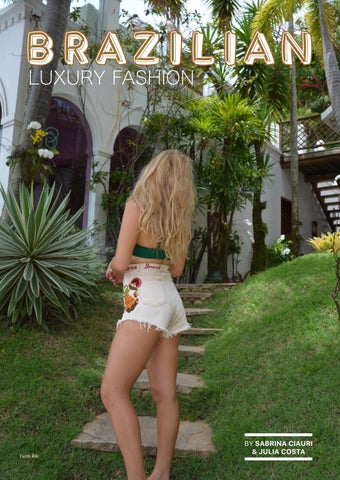
Touch down in São Paulo, a megacity of 12.3 million people, where luxury fashion is on the rise. Ever heard of Lenny Niemeyer, Farm, Osklen or Le Lis Blanc? Most likely not if you aren’t Brazilian. These authentic brands alongside your typical Chanel and Gucci are part of the expanding opportunity in the Brazilian luxury fashion industry which I witnessed firsthand during my trip to Brazil from December 19th - January 7th.
Track & Field
Julia, my boyfriend’s younger sister, and I selected a few of our favourite Brazilian luxury designs to stage photoshoots in two locations: Julia’s family’s house next to the beach between São Paulo and Rio as well as the nearby DPNY Beach Hotel in Ilhabela. Our “prior research” consisted of visiting two malls in São Paulo: Iguatemi, the oldest Brazilian mall and JK Iguatemi, the ‘new temple of Brazilian luxury’. While Iguatemi hosts primarily luxury Brazilian brands, JK Iguatemi has become the new home of foreign brands including Prada, Lacoste, Bottega Veneta, Lanvin and Miu-Miu. I learned that for Paulistas, malls are the equivalent of Rio’s beaches with 20,000 visitors every day in JK Iguatemi. During Covid-19, while the EU suffered from a lack of tourism and a fall in sales for luxury fashion, Brazil saw the opposite effect with people buying locally for the first time. This was unusual as traditionally luxury fashion houses used to see their Brazilian retail presence as a marketing opportunity rather than for sales purposes due to high import taxes, allowing people to browse what they would then go abroad to buy. However, as Vogue has pointed out, ‘revenge shopping’ alongside the weakness of the Brazilian real and instalment purchasing has led to the industry’s recent success. Revenge shopping is when people spend exorbitant amounts after a frugal spending period, particularly on luxury items rather than mid-tier or bargain products to compensate for the lack of luxury experienced during Covid-19. The extended US ban placed on Brazilians forced luxury buyers to look locally and thus, created internal opportunities for both Brazilian and foreign brands. Hugo Boss, for instance, quickly sold out when
Lenny Niemeyer, Farm Rio
31
Lenny Niemeyer
Richards
malls reopened and brands such as Farm Rio, my favourite Brazilian brand, experienced huge growth as people wanted to emanate the happy and lively Carioca spirit during difficult times.
participating in organic cotton growing projects and producing t-shirts made with hemp. According to the World Bank, Brazil ranks worse than the Palestinian West Bank (a conflict-ridden zone) in terms of the Ease of Doing Business Index. Despite this grim picture of political and economic difficulties, Brazilian and foreign brands alike have recognised the vast potential in the rapidly expanding Brazilian Luxury Fashion industry. Be sure to keep an eye out because Osklen and Farm, like many other Brazilian luxury brands, are the future of fashion and not just in Brazil.
Farm Rio is known for their bright colours and tropical motifs, incorporating Portuguese words for fruits like ‘goiaba’ (guava) and ‘cajuzinho’ (cashew fruit) into their unique designs appealing to both young Brazilians and foreigners alike. Farm Rio’s new collections include special edition garments which incorporate handmade embroidery such as the ‘Feito no Brasil’ denim shorts with intricate ‘abacaxi’ (pineapple) designs. For swimsuits Lenny NieMeyer, Richards and Track & Field stand out with their laid back designs often inspired by the beach and surf, a very popular sport along this coast where Gabriel Medina, a world famous Brazilian surfer grew up. The brand Le Lis Blanc Deaux designs complement the Brazilian beachwear aesthetic with lots of stripes and sparkles, perfect for parties at the beach (COVID restrictions permitting). By far the most successful international Brazilian brand both in women and menswear is Osklen. Known for its classic Carioca style t-shirts and shoes and its sustainability,
Le Lis Blanc Deaux
32
MODELS: JULIA COSTA, TIAGO COSTA & SABRINA CIAURI
33
Farm Rio
ADVERTISEMENT
ELEGANT
@oliviaandpearl
TIMELESS
ALLURING
Reinventing the pearl...
MODO’S EXCLUSIVE DISCOUNT CODE:
UCL25 FOR 25% OFF
35
PHOTOSHOOT
HERITAGE PHOTOGRAPHED BY JUJU GREENIG
36
For decades, luxury brands such as Ralph Lauren and Tommy Hilfiger have built their signature style around bringing the country to the city, allowing their wearers to achieve the “old money” style effortlessly. I wanted to explore the root of this aesthetic by using the British countryside as a backdrop and styling looks heavily inspired by these designers. Like many luxury brands, the style emulated in these photos is timeless.
Models- Portia Greenig and Steven Charalambides Stylist- Juju Greenig
37
38
39
ARTICLE
COVID ERA A REVIVAL OF THE CONCEPTION OF FASHION LUXURY? BY SARAH MOKHTARI
The pandemic has plunged the world and society into unparalleled silence, along with it went the world of fashion.
Nowadays, the question of ecological sustainability is increasingly being asked and this health crisis has, more than ever, highlighted the need to opt for more sustainable practices in fashion production and retail. The industry has been pursuing such a goal well before the beginning of the pandemic, through the vision of the Fashion Pact launched in 2019, that unites more than sixty CEOs towards the achievement of three common goals: the preservation of the world’s climate, biodiversity and oceans. Some companies, such as Burberry and Kering (owner of several brands such as Yves Saint Laurent or Alexader McQueen), have decided to put sustainable development at the heart of their post-covid policy. This was characterized in particular by the willingness to adopt online Fashion Week shows, allowing for the limited travel of buyers, air travel and road travel.
For the first time in the modern history of fashion, the world experienced the cancellation of high-profile events such as the Met Gala 2020 or Beautycon. Giorgio Armani was the first to cancel its live display of the fall collection, the first time in 45 years a runway show was canceled. The biggest global health crisis of modern times upset everything in its path, including the world of fashion and luxury. Indeed, according to the Belgian designer Christian Wijnants, “even the financial crash of 2008 had less impact”. Repeated lockdowns and the abrupt economic slowdown presented a new challenge: creating and innovating when the world ceased to operate normally. We are witnessing a transformation of the production lines, to remain an important player in the ongoing fight against the epidemic. For instance, LVMH has redirected its production to supply masks to hospitals, as well as sanitizers, to donate them to Assistance Publique - Hôpitaux de Paris in France. Luxury brands have also had to adapt to the sudden shift in consumer behavior: it is possible to notice a decline in overall spending, due to the numerous ockdowns. Also, as is expected, people have been increasingly opting for online retail options, resulting in brands having to rethink the role of physical stores in the retail process.
History has shown us that we must remain optimistic about the future, whatever the cost, even during the most critical moments. Indeed, the very hard period of the Second World War led to many innovations, such as Christian Dior’s “New Look”, on which the French couturier was able to build his empire in the late 1940s. To recontextualise this period, many fashion houses have collaborated to restore the reputation of French fashion such as Balenciaga, Lanvin and Balmain using fabric scraps and other ‘plain’ materials to create exceptional pieces. Fashion does not suffer from the context in which it is invented, as long as there will always be people present to dare to escape and create. 40
ARTICLE
THE LUXURY PANDEMIC:
IS GRATITUDE THE LATEST FAD FASHION? BY CHARLOTTE BAILEY
41
A
s we mask up once again, it’s safe to say we wouldn’t have come as far as we have without the courageous efforts of those who worked throughout the pandemic. Though everyone played their part in keeping each other safe, it is only fair to honour those who are frontline workers throughout these uncertain and life-threatening times. Their selflessness and sacrifice are immeasurable, and it’s clear to see a 3% pay rise is nowhere near enough to equate to the impact they had on the country’s safe recovery.
Covid-19 saw the world unite against fear and isolation in a way none of us could have expected. Most unexpectedly, luxury fashion houses played an instrumental role in keeping essential workers safe during the first wave of the pandemic. Chanel no. 5 became hand sanitiser, Burberry coats became nurses’ overalls, and Ralph Lauren polos became medical-grade face masks as the companies shifted their factories from fashion to function. Prada even funded two intensive care units, whilst the likes of Victoria Beckham donated a portion of profits to food bank charities with the aim of keeping the nation fed. We must pay credit where it's due, and it’s most certainly due here. But one must question the motives of these brands – particularly upon reflection of their actions since gaining freedom from national lockdowns. Was gratitude just a trend to them? Whilst surely many of the donors acted altruistically or out of appreciation, it’s unclear whether others had ulterior motives. Many moves were tokenistic and self-serving – for example, performatively offering minor discounts to NHS workers who often can’t afford to splurge on unnecessary items. Infuriatingly, this pandemic has proven that luxury brands have the ability to cater for the working people, they just choose not to. Take the Balenciaga Hi-Vis jacket for example – an ess ent i a l item to indust r i a l workers, but because there is a logo it costs more than most earn per month. Of course, luxury is defined as being excessive and 42
unattainable to the masses – of unparalleled quality, history, and price tag. But surely originality can thrive without feeding off the culture of the working class? The fashion industry can often take advantage of working people without acknowledging their input or designing things that truly serve them day-to-day, and that cater to their financial means. It’s easy to forget the importance of the things and people we take for granted. As we ride the future waves of Covid-19 we will again be reliant upon essential workers. It will be interesting to see whether these big brands will adapt once more to the changing demands of the people, or whether gratitude has, indeed, gone out of fashion.
Photography- Songju Kang Models- Urtė Gumuliauskaitė, Mia Olagbaju, Wang Zhijing Helena Stylists- Charlotte Bailey, Urtė Gumuliauskaitė
43
ARTICLE
This article is in no way a scientific or objective study. It should rather be seen as a social experiment concerned with the question of whether luxury, in terms of fashion, is an entirely subjective concept or whether there are certain aspects and elements of its definition that everyone can agree upon.
THE MANY FACES OF
LUX URY
What brands come to mind when thinking about luxury in relation to fashion? Luxury is often immediately associated with high-end designers and fashion shows organized by well-known brands. But which brands in particular spring to mind? The answer is unsurprising: Louis Vuitton, Gucci, Victoria’s Secret, Prada and Chanel all made the list. All of those brands were also mentioned by individuals coming from different backgrounds and age groups. The outcome of the survey, in regard to this particular question, provides some food for thought: is the secret of those brands appealing to people from all walks of life? How do brands like Chanel or Louis Vuitton (which were founded over 100 years ago) still remain relevant nowadays?
BY CHIARA WOLTER
Close your eyes. Picture yourself straying through a lively street in Paris, lined by a myriad of tiny, cosy cafes. The smell of fresh and warm croissants hangs in the air and you can see the brightly lit shop windows from afar as you slowly make your way towards the Champs-Elysées. Now, instead, imagine yourself strolling through the busy streets of Ginza, an upscale shopping district in Tokyo. Look to your right, then to your left and glance into the shops and boutiques. Which clothing items do you see displayed in the shop windows? Which colours, which patterns? Do they differ from the ones dominating the showcases of the Parisian luxury boutiques? What if you had peeked into those shops fifty years ago? Would the items displayed in the showcases in all of those previously described scenarios have been the same?
What items are you thinking of?
I was intrigued by these questions, so I decided to conduct a survey and asked numerous people from different backgrounds and age groups the same three questions.
As you can infer from the charts included below, the answers to the second question are a lot more diverse. In fact, they cover quite a wide range of different clothing items and 44
accessories: from shoes and coats to jewellery and sunglasses. However, the most interesting aspect of the responses is the way in which they were distributed amongst different age groups. Jewellery, for instance, had its fair share of honourable mentions: 70% of the people participating in this survey included it in their list of items they associate with luxury. But while only some people under the age of 50 referred to it, every single person falling within the ‘above 50 years of age’ group listed jewellery as one of their top items. On the other hand, sneakers were only brought up by teenagers or, more generally, age’ group listed jewellery as one of their top items. On the other hand, sneakers were only brought up by teenagers or, more generally, individuals under 50 years of age. This might not be an unusual observation. After all, one need not look far to see that streetwear is gaining immensely in popularity and the prices of sneakers by certainbrands like Nike or Off-White are skyrocketing.
associate streetwear items with the idea of luxury, none of those aged 50 and above did A final distinction between both age groups can also be drawn in regard to the attitude adopted towards the concept of luxury as a whole. Although words like ‘elitist’, ‘white privilege’ or ‘intimidating’ were mentioned by a variety of people, younger individuals generally nevertheless appeared to be more critical of the downsides of the idea of luxury than their older counterparts. What then is the result of this social experiment? Is there one generally accepted definition of luxury? As this survey proves once more, the answer to that question is no. Although the names of important high-end brands are mentioned by individuals from all walks of life, the concept of luxury in terms of fashion (as well as the ideas associated with it) remain subjective and ever-changing. If you look up the definition of ‘luxury’ in the Oxford Dictionary, it will never provide you with a closed list of items or clothes that fall within the category of luxury. There simply is no universally accepted definition. Like a chameleon altering its appearance depending on its surroundings, the idea of luxury itself is rather moulded by our experience, age, socioeconomic background and more broadly speaking by social and cultural norms.
Which adjectives do you associate with the idea of luxury? Finally, the differences between the answers of people falling within the ‘Under 50 years of age’category and those falling within the second category especially shine through theresponses given to the last question. One striking distinction between both age groups was already hinted at beforehand: the classification of streetwear items as luxury items. Thus, while 33% of the people below the age of 50 45
ADVERTISEMENT
Spectrum is an independent, vegan makeup brush and cosmetic brand founded by two sisters, Sophie and Hannah. They are dedicated to colour, quality and creativity. They believe in the beauty of selfexpression, not perfection. Their products are designed with fun and experimentation in mind.
Lakkaya did her masters at UCL (2019-2020) in MA, Gender, Society and Representation. In her free time she dabbles in modelling, styling and working with a number of luxury brands. She modelled and worked for Spectrum in the past, and is now a brand affiliate and would like to share her unique discount code with Modo to save 15% off orders from the amazing Spectrum Collections.
SCCQWS64 FOR 15% OFF
47
48
ARTICLE
O R D I NA RY L U X U RY BY LILLIAN ROWE
The Covid-19 pandemic brought unprecedented change to every industry, including fashion. While Tiktok seemed to encourage overconsumption of fast fashion through “£500 Shein Hauls”, a counter desire for slow fashion grew much more organically with DIY and second hand shopping becoming increasingly popular. Maybe it was a consequence of dwelling on human environmental impact after seeing viral images of “nature healing”. Perhaps, the abundance of time, and financial anxiety of furlough drew people to finding new hobbies to enjoy during particularly dull Zoom meetings. Or possibly, social pressure to become a multi-talented polylingual marathon winner found millions of social media users frantically researching sewing patterns for their House of Sunny knockoff before a New York influencer brands it ‘cheugy’.
Whatever the cause, consumers are purchasing more cautiously and in smaller quantities. In addition to countless protests and social justice movements, this growing demand for a more ethical and sustainable industry standard has led brands to re-examine their values, as consumers meticulously decide who to support with their wallets. With recent climate disasters providing worrying reminders of the little time we have left to reverse the effects of the Anthropocene, sustainability is no longer an option, but a necessity, and fashion must take responsibility, being the second most polluting industry. Glamour and opulence need to be consumed sustainably, not in excess – luxury doesn’t have to cost us our planet.
49
For example, rising couturier Park Sohee looks to the century old tradition of Haenyeo to reinvent couture for the modern age. She marries tradition with innovation by representing the declining practice of female divers with clothes made from recycled materials that won’t damage the sealife. Marine Serre is another leading force on the luxury frontier driving the industry towards sustainability. With a strong emphasis placed on human impact on the environment, the brand focuses on ‘closing the fashion circle’ to create futuristic garments that can integrate themselves into modern life. However, perhaps one of the most important aspects of Marine Serre’s sustainable efforts flies under the radar compared to its BladeRunner-esque campaign videos. A large majority of the brand’s garments have easy aftercare, with their cult classics crescent tops being suitable for a quick 30-degree wash. As fashion becomes more accessible, designers shouldn’t underestimate the significance of the ease of garment care in increasing an item’s longevity and lifespan.
“Sustainability is not just about using recycled materials, but also the methods of production and how an item interacts with its environment.” With luxury fashion looking to increase sales by expanding their client base, they need to consider the lifecycle of their clothes after purchases. While consumers may be able to justify an expensive purchase every so often, elaborate aftercare is often at odds with their busy lifestyles and will deter them from choosing the brand again. Unfortunately, not everyone has the luxury of personal assistants at their beck and call to take half of their wardrobe to the dry cleaning after every wear.
51
Of course, there are many ways luxury fashion can reduce its damage to the environment. Luxury fashion has cultivated its glamourous image on exclusivity and rarity. However, more and more people are beginning to peek through the curtains, and we are moving past the practice of one-time consumers barely wearing an item, keeping it in the box in pristine condition as an ostentatious boast. Perhaps due in part to the rise of second-hand shopping where labels are nowhere to be found, clothes are now fashionable to wear, not just for showing off. Therefore, luxury fashion brands need to consider how their clothes can operate in normal day to day life. Whether that be sitting on the grotty tube seats or perhaps falling victim to the backsplash of a London puddle. Luxury can meet the demand for sustainability with a focus not just on the materials and processes used to create a garment, but what happens after an item is purchased.
52
The industry has the capacity to change and is slowly moving towards accepting a new standard. Once businesses begin to recover from the pandemic, sustainability must be the greatest priority of every sector of the luxury industry to halt the detrimental effects fashion has on the planet - before we run out of time.
Special thank you to “That Nice Laundrette” (3 Crowndale Road, Camden Town, MW1 1TU) for giving us permission to shoot on their premises.
It may be naïvely optimistic to believe that fashion will take responsibility for its contribution to the acceleration of climate change, and then take action to significantly limit its disastrous impact. Unfortunately, we must acknowledge that an industry based on profit will go to any length to achieve economic success, even at the expense of their ethics and morals. However, glimmers of hope within rising creatives, such as Marine Serre and Park Sohee, or changes to the standards employed by legacy brands, leave us excited to see what’s next for the luxury fashion industry. Photography-Jess Young Models- Robin Kwon, Aino Rajantie Styling- Pabasha Perera
53
S ARTICLE
SKATEBOARDING & GLOBAL LUXURY
BY TEVIN MUENDO
Despite the level of influence of the behemoth that is the Western Centric Global fashion industry we see that different cultures and subcultures have their own distinct conceptions of luxury and differ in their purposes for purchasing luxury. The use of luxury is not homogeneous. For example, in the Middle East social position translates into persistent materially different living standards and also civil participation, luxury has a unique and distinct function to represent one’s position in society. Luxury connotes buying power and with it social status, aristocracy and royalty. Interestingly in Western countries such as the UK (where a large proportion of global luxury is headquartered), the function of luxury fashion and in some cases is in stark contrast to that of that in the global east. Crucially, we see that appropriation of luxury is not necessarily indicative of buying power or social status. The purchase of Global luxury here is dictated by two forces, moving in different directions towards the same outcome. The first phenomenon I call ‘buying up’. The second I will call the phenomenon of ‘Dressing down’.
55
A
nd so, against this backdrop, where does luxury fashion locate itself within the subculture of skateboarding? Streetwear brands, which have been popular at the turn of the 2010’s preceded in some way the emergence of skate culture in luxury fashion, for example Kith and Undefeated. However now in the West, and in other notoriously fashion forward nations, such as Japan, we see there has been a decline in the popularity of streetwear and a waning of its influence in propagation of what is considered to be trendy. In a 2019 interview with Dazed digital, the late Virgil Abloh foretold the death of streetwear, suggesting a movement towards a more varied adoption of vintage clothes, such as vintage tailoring, as opposed to sneakers, hoodies and t-shirts.
ry. In this community its purpose is both functional and contains an element of signalling. This differs from the signalling functions we explored earlier, in that they’re not trying to signify the themes associated with luxury: expense, scarcity, rarity and social status to the outside world, but rather within the skate community itself they are partaking in a ritualistic and specific form of signifying. They are sending cultural signifiers to people that can identify them. They are trying to indicate that they understand how this community works, what it respects and doesn’t respect, and that they are very much an insider. There is a big irony that lies within luxury in skate fashion here. Speaking from experience, most skaters are often broke, and part of the charm of the culture is always looking for a cheap or free alternative. The community knows this and in fact thrives off this, it’s a central part of the aesthetic, from sharing cigarettes with friends, to getting the ends of zoots[5], calling ‘dibs’ on your friend’s food and so forth.
Skating, however, has been experiencing an upsurge in its influence within the space of global luxury. One could hardly argue that this is a new phenomenon though, ever since its creation in the 1950’s, skateboarding has experienced fluctuations in its popularity and broader influence. A peak in 1963 signalled the explosive popularity that skateboarding could garner, the fates turned quickly though, as in 1965, it was considered to have fallen out of favour with the ever changing interests of the youth. Important to note is that in these formative years, skateboarding was still considered an outsider’s hobby, a counterculture, and what skateboarders wore was not of importance to those within the sport. This all changed when in a notable resurgence of skating in the 1980’s, crucially the subculture found its place within a rapidly expanding global fashion industry. And so where are we now? If I attempt to locate the present fixation with skateboarding within global luxury, I believe that fashion juggernaut Vogue’s activities in 2016 highlighted the time in which skating once again became ‘cool’. In particular their ‘skate week’ was a significant catalyst for mainstream dissemination of this ‘new’ aesthetic throughout the industry.
So interestingly in the skate community, luxury does not convey wealth per se. The people you skate with are people you’ve known a long time, almost a second family involved in the emotional and draining sport, and thus, they don’t care about wealth. More concern is placed upon your skating ability, and if you can walk the talk. There are certain brands that fall into the tranche of cool skate-able wear, but not actually skated, due to the level of expense, namely Arcteryx, Gucci (loafers), Salomon, Stone Island, Burberry. Others fall into the bracket of skate clothes that are actually skated, and some that fall in-between the two, a key example being the grass-roots skate brand Palace. This highlights the symbiotic relationship between the skate community, global luxury and the fashion industry at large. Largely the pandemic has completely shifted the range of peoples social activities. Outdoor activity has become highly coveted, this can be seen in the rising interest in Gorpcore. The very same mechanism applies to skateboarding, the uptake of new skateboarders,
The subculture of skating, like many others, has its own specific conception of global luxu 56
Stylist- Tevin Muendo Photographer- Eugenie Sere Models- Charlotte Bailey & Camilla Mina
and skaters revisiting has been incredible. Also it is no longer young males rolling around on these four wheels, but an increasing number of females, and adults of all ages. Countless stores such as Slick Willies in the UK reporting stockout and unforeseen online demand. At high street level, brands are constantly observing who they perceive to be as trendy, on the streets, and through digital media, platforms such as Tiktok, Instagram have proliferated this idea of a ‘glamorous’ outdoor lifestyle. Thus, brands in their ever ongoing search for the “next big thing” have identified skating, amongst other things, as being “in vogue”.
exploit a culture for its own gain, without returning dues to the community. Fashionista magazine cites a reason for this disdain for the merge being ‘models and bloggers poaching their style — and receiving praise for being on the cutting edge — when skaters have dressed like this for decades’ The more grass roots brands also benefit as they experience an influx of first time skaters purchasing merchandise. Naturally, their outlook is more positive. For example a KCDC skate shop employee in Brooklyn, called Nathan, when interview by Fashionista magazine claimed those in the community that are annoyed by the association with global luxury are people that are trying to ‘own skateboarding’, and that skateboarding is for everyone to enjoy, not for people to ‘claim as their own’. He does caveat this by saying that it is important for them to get the right people involved in the process, noting that it ‘sucks’, that actual skaters are cut from the conversation for most of the time. For those that do not have a financial stake in the popularity of skateboarding, the reaction has varied from indifferent to rather infuriated. A popular New York skate filmmaker, who had an interview with Vogue during their ‘Skate Week’, conveyed his frustrations during an interview with Fashionista, as they ‘did little more than ask bland, generic questions about skating, making him feel as if they were “brain dead’’ to skateboarding and its culture as a whole.’[8] It’s not hard to see why this group within the community are pissed off, when vogue published articles declaring Thrasher t-shirts ‘every cool models off duty staple’, with Complex magazine calling this ‘dumbfounding’, due to its ‘sheer tone deafness’. Vogue’s ‘Skate week’, an editorial dedicated to the intersection between skateboarding and high fashion, again incensed certain members of the community, articles included ‘2017 Looks and the Skateboards to Match’, and ‘An Ode to Great Skater Hair, From Stacy Peralta to Leticia Bufoni’, ignoring the myriad of ethnicities that constitute the skate community. The cherry on the cake of a great editorial was Vogue claiming that celebrities when clocking off from regular work, like to nail their ‘ollies’ and ‘flip kicks’, a butchering of the Rodney Mullen trick the ‘Kickflip’. It is clear that a strong
What the fashion industry recognises in skating, in the sweaty mess of boys and girls, trying and failing, injuring and landing, fist bumping and swearing, is it’s, A) offline B) Communal and C) AUTHENTIC! The last point being particularly crucial to brands as increase awareness of the dearth of authenticity in their influencer marketing strategies becomes clear. The symbiotic relationship becomes clear, as skaters have indeed moved into modelling in the high fashion industry, with Highxtar magazine stating that pro ‘skateboarders are taking the stage and are becoming the most sought-after models of the last decade’[4]. To the skaters, they gain an extra income that allows them to focus on developing their skating, (which for most can be very hard to sustain a living from solely), whilst for the fashion industry they get to tap into the current social capital that skating exudes for marketing purposes. Notable appropriations of the culture include a Supreme and Louis Vuitton partnership in 2017, this collaboration according to Highsnobiety really ‘opened the flood gates’. This, unlike other Supreme collabs, was not available at ‘Supreme’s brick-and-mortar stores or online’. The response has been varied from those firmly entrenched in the industry, with some welcoming the introduction of global luxury into the subculture, whilst some feel violated, by yet another capitalist venture trying to 59
division exists within the community about the place of global luxury within the skate industry. Needless to say, whatever the future holds for the symbiotic relationship between Skateboarding and Global luxury, some lucidity would not go amiss, on the part of the latter. And as the New York based skate filmmaker advised, the publication should ‘be careful, and not to go about its coverage in a corny way. 60
ARTICLE
LUXURY IN YOU BY ZOFIA KABALO
61
M
any of us dream of luxury. We look around and see white townhouses, towering over us. We pass Selfridges, with models sporting the newest collection of a luxury brand, a constant reminder that we are not a part of that world. Although the vast majority of Gen Y, Z, and Alpha, the less ‘well off ’ generations, seem to adopt a more fluid approach to fashion as they may do with many aspects of their lives, many still see luxury as something to strive for. Luckily, when the student budget doesn’t allow us to spoil ourselves with a Birkin bag, there are other ways of achieving the feeling of luxury. "Fake it till you make it they say”how about faking our way to “the top”? Crashing a Chanel catwalk, posing as a high-end model on the streets, pretending you are a celebrity- all great viral sensations, but not all of us are extroverted adrenaline seekers. There are ways to incorporate luxury in your life without breaking the bank nor going to such extremes. Luxury is more than a sky-high price tag- it’s about how dressing up makes us feel, how it makes us walk with our heads held just a little higher. People buy luxury goods for a variety of reasons; nearly all of them are related to the strong emotions that we attach to the purchase of expensive material goods. What if we detach the price tag and the unavailability of the item to the general public, and focus on other elements about that specific piece of clothing that makes us want it?
Many of the most popular luxurious items are rather simple, whether it is the cut or the material that gives it a sleek and polished look, making it look chic. With a bit of styling, nearly everyone has at least a couple of items in their own closet that will be sufficient to recreate a “casual expensive” look. A simple black dress paired with a statement piece of jewellery is enough to earn a double take on the street. Many luxurious brands have a staple look, like Chanel with their tweed jackets and skirts.The ability to analyse current trends within those high-end brands and trying to find alternatives to fit in with the brand fanatics can be an exciting and educating experience. Research a brand that catches your eye, single out silhouettes that recur the most, and equipped with that knowledge head over to local shops in search of alternatives. It is not about completely changing your style to appeal to what is considered a rich look, it’ is about looking more consciously at your clothes. 62
Photography-Sunny Fung, Xiuli Hu , Dastan Raof Models- Carmen Chang , Nina Anna Kapalkova Stylists- Eugēnie Sērē, Murph Zhang,Marie Pora
People might associate luxury not only with what hype-beasts are sporting these days, but with traditions and vintage pieces that bring nostalgia and historic value to the table. With the overwhelming speed that current trends are changing from season to season, from brand to brand, one might want to escape this whirlwind and resort to safe choices that offer timeless chic looks. For that, it’s worth looking into what pieces, created by the powerhouses of fashion, lasted the standard of time, and are considered a staple in every classy household. A pearl necklace, a tux, pair of sheer gloves, all of those could transport you back in time, to times of ballrooms and waltzes, where being a part of high society was the sole objective for so many. Sporting luxury isn’t a necessity anymore. Since generations have been becoming more and more focused on individuality and expression of your own style, high-end brands might start slowly going out of style. However, for now, many still crave the feeling that luxurious items give their owners. In the age where all the necessary information is within our reach, a little research into what others might perceive as luxurious can give us a head start into creating an illusion of the world that so many dream to live in.
63
PHOTOSHOOT
Hangover... A VERY LUXURIOUS
PHOTOGRAPHED BY JESS YOUNG
Models- Robin Kwon and Pabasha Perera Stylists- Nicky Harrington and Nevia Schultheiss
64
Jess Young
It’s too easy to call out all that is wrong with global luxury. For me, global luxury is about escapism. Be that escaping to a place of camp, decadence, or utopianism; to indulge in global luxury is to indulge in the privilege to dream. Reflecting on this editions theme, ‘Unmasking Global Luxury’,cI found myself inevitably having to confront global luxury’s more immoral side. It was in this tension between escapism and immorality, that ‘a very luxurious hangover’ was conceived. Unsurprisingly, this tension reminded me of my own time living in Venice and the hedonistic afterparties of masked Carnivale balls. Rooms saturated with masked revellers, hiding their own debauchery in the shadows of the early morning. l realised that these afterparties are the epitome of global luxury, simultaneously an escape, an aesthetic, and an impurity. Of course, trying to recreate a Venetian afterparty in a King’s Cross flat is no easy feat but I think the artificiality of the scenario we created only adds to the camp escapism that comes, for me, with Global Luxury.
65
ARTICLE
WANTING WHAT YOU CAN’T HAVE Fashion and the Human Psychology Photography- Amber Bennett Models- Nina Anna Kapalkove, Madeline Mooney Stylist- Xintong Wan
BY HELENA OH 66
The term unmasking suggests a veil or layer on the surface that, once removed, might reveal something that lies beneath. The global luxury industry unmasked discloses a complex yet intentional manipulation of the human psychology that sustains its oplent and lavish exterior image.
67
M
arketing luxury is not the same as marketing fast fashion: below the obvious explanation of simply a difference in the target audience, there lies a clever manipulation of human psychology to lend a restrictive, thus more special undertone, to high fashion. The image of exclusivity is indispensable to the profitable aspect of many brands, and this level of irresistible inaccessibility could be seen as originating from the workings of the Parisian haute couture houses. Only creating hand-made, custom-fitted clothing tailored for one individual client results in solely around 4000 haute couture customers in the entire world. The fashion houses thereby produce an exclusive community that with its ritzy and elegant appearance, market the brand image. It is expected that people are drawn to what they are unable to access.
whether it be Gossip Girl, the overboard high fashion consumption seen in Keeping Up With the Kardashians, or even new reality shows such as Bling Empire. The fascination can again be explained in the same way: people are drawn to what they may lack access to. Due to there being a natural curiosity that is derived from subconsciously wanting to learn what those in powerful circles engage with, a glimpse into the world of those deemed elites could attract an audience and drive fan culture or simply a loyal following. Fashion is a primary mode of expression for many and therefore, an Instagram photo showcasing a new item of clothing or bag from a high fashion brand will result in the feeling, albeit temporary, of being a part of an exclusive group. For many, this emotional reward of feeling important and respected results in luxury fashion becoming a method to prove oneself, which may explain the size and visibility of logos growing larger over time and new designs that stray further from the delicate nature of haute couture houses. The aspiration for inclusion drives desirability, which in turn drives sales.
Human beings psychologically dislike the feeling of being excluded – any type of exclusion feels threatening to reputation, status, and social relationship, which puts consistent pressure upon those who are left out of a circle to find an opening. This opening, for many, might be the purchasing of products from brands that maintain haute couture lines, the name becoming a label for entry into the exclusive group that has been formed.
In recent generations, this manipulation has grown to take on different forms, an example being utilizing the inaccessible yet alluring images of certain celebrities or specific fan cultures for collection drops in order to maintain a high level of following. While high fashion brands usually appeal to a certain niche, many have been experimenting recently with wider target audiences by employing new techniques in their marketing tactics.
Many shows and novels deal with notions of exclusivity – so much of the media revolves around high society or restrictive communities,
68
An example could be the variety in global brand ambassadors that have been hired for different events; at the Met Gala 2021 that celebrated iconic moments in American fashion, YSL’s creative director Anthony Vaccarello brought K-pop girl group Blackpink’s Rosé as his plus one. K-pop fandoms are already infamous for their devotion and commitment in supporting their idols, and this event caused a high amount of enthusiasm: we can tie this back to the original idea of exclusivity in a different manner.
expressing ourselves with clothing we desire to reflect ourselves in an affluent light. However, global luxury thus raises the question of whether what you seemingly are unable to have loses its value once it is attained. How long will this marketing tactic be able to continue, once the mask of opulence is removed to reveal there is nothing behind the door of exclusivity but merely feelings of self-approval?
This new audience already views idols as elusive role models or figures of adoration and associating them with images of high fashion brands turn them into symbols of covetousness, motivating fans to purchase luxury goods. Saint Laurent’s Women’s Brand Fashion Show this summer reached a soaring amount of over 100 million views due to Rosé’s appearance – she “generated a significant engagement”, according to the house, which again illustrates the effect that social media and celebrity impact has on high fashion marketing. Furthermore, different age demographics have also been targeted through new forms of social platforms such as Tiktok, where influencers such as Charlie D’Amelio have been partnering with luxury brands. These influencers or idols have a hold on the younger generation, who admire or look up to them: they create their own versions of exclusive communities that now appeal to younger age groups as well who want to be close to their idols and take part in their fame and glory.
“Fashion is the most powerful art there is. It shows the world who we are and who we’d like to be.”
Underneath the surface exterior of global luxury, there lies a system that is built on and operates within the term exclusivity, as well as the attraction of products that are in limited supply. Haute couture builds a client base by utilizing marketing tactics to enhance scarcity and cultivate aspiration for the product, which triggers the competitive reflex that lies hidden in the subconscious of many. While it may be problematic, the fashion industry, in general, is kept sustained with this idea, since as humans, we seem to value exclusivity more than inclusivity, and in
- Blair Waldorf (Character from Gossip Girl) 69
ARTICLE
Minimalism IS LUXURY BY HIROYOSHI SATO & MURPH ZHANG
70
R
ichard Gregg, an American philosopher, wrote “The Value of Voluntary Simplicity” in 1933 that predicted today’s obsession with cleaning, disconnecting, and slowing down.
new ensembles every day. This unwittingly develops a personal drive to keep up with fastpaced consumption patterns, buying a new purse or garment, even if we do not need it. Two key variables can be blamed for our increasing exposure:
“We think that our machinery and technology will save us time and give us more leisure, but really they make life more crowded and hurried. It is time to call a halt on endless gadgeteering”
To begin with, the number of collections issued has risen substantially in recent years. Whereas biannual displays, i.e. Spring/Summer and Fall/ Winter collections were formerly the norm, practically every major fashion house now provides pre-collection options, such as resort or cruise.
Today this concept is referred to as minimalism. This movement of downshifting has become more popular in recent years as more individuals are seeking meaning and trying to live more purposefully. As these difficulties grow more prevalent, I would like to look at the notion of simplicity, and see if it is compatible with our shared love of fashion, and if minimalism truly can be luxurious.
The second aspect, frequent social media exposure, exacerbates the problem. While we naively gaze at all of these lovely photographs on Instagram, something is almost always being sold, unconsciously developing desire. Minimalism strives to make our lives more simple. Buying less and keeping things simple allows you to focus on the essentials, rather than superfluous items.
You could believe that minimalism and luxury are incompatible since minimalism focuses solely on the essentials, but luxury goes beyond even the most basic need. I believe, however, they can cooperate. In recent years, we, as customers, seem to be continually bombarded with different types of marketing for the current collections, whether it is in the form of real advertisements, influencers, or our friends who we consciously or unconsciously see in
I have yet to meet a fashion minimalist that does not look stunning every time they leave their house. Minimalism allows for endless combinations of garments from the recognisable, sophisticated and classic tones of beige and white to navy, black, and gray. These ultimately neutral and stylish shades work well with accessories — a camel 71
purse and ankle boots, for example, are a match made in heaven. The materials, as well as the style and cuts, are all complimentary so there’s no risk of committing a fashion faux pas. A minimalist lover never fails to enchant, and they probably spend little more than five minutes picking what to wear. Who has time to sit in front of a wardrobe for half an hour when you are trying to make a name for yourself in the professional world or busy having a once in a lifetime experience? People want to appear well, but they don’t want to spend the majority of their day doing so. Minimalism is the polar opposite of time-consuming; it is straightforward and uncomplicated. It is every busy person’s ideal situation, which is why so many people are adopting minimalism as a way of life, not just in fashion. Adapting to a minimalistic lifestyle requires a transformation of your wardrobe. Remember simple is key in terms of colours and materials , and quality over quantity.
Photography- Amber Bennet Stylist- Alina Zhang Models- Mishael Kusi-Yeboah, Murph Zhang, Hiroyoshi Sato, Ravleen Kaur, Imrana Pirbay
72
ADVERTISEMENT
ARTICLE
The Modern Woman BY CAMILLA MINA & PHOEBE VEELENTURF
and socially accepted norms. As a result, luxury brands become ideal solutions, as it is easier to buy what is accepted by others than to develop our own personal styles and tastes (if it even actually exists).
What’s it like being a woman in 2021?
During the past few weeks, we interviewed 20 different women to uncover words they felt best describe their experience of being a woman in 2021. We discovered two main words: “glamorous” and “comfort”.
Comfort
The second word derived from our interviews was Comfort: a word that at first seems opposed to the idea of luxury itself. The women interviewed placed emphasis on clothes that are both comfortable and make them feel confident.
Glamorous
Although we have come a long way from the cliché idea of a glamour woman with blonde platinum hair and a Marylin Monroe look, women still perceive themselves as “glamorous”. Our interviews revealed that the definition of glam has evolved, shaped by the rapid social changes of the past years. For instance, the Me Too Movement has completely transformed the recent perception of women.
Fashion trends have been shown to reflect the current climate. In the 1980s women dressed the part to gain recognition in the world of business, wearing bold, tailored blazers and shape edged heels to navigate the drastic shift in the participation of women in the workforce. Now, the world is changing in regards to the pandemic experienced universally.
An important aspect of glam links to luxury brands. For this reason, we also interviewed the participants based on their personal taste, the high street brands they prefer, why they wear these brands, and most importantly, how the brands make them feel. Women tended to prefer classical brands such as Gucci, Chanel and Dior. The vintage aesthetic of Gucci is reminiscent of the 70’s, with bright and dark beautiful tones of bordeaux and orange, and the unmissable flower patterns… Chanel reminds us of our old but classy grandmothers with their tweed and red nails. We seem to be an incarnation of the dictated preferences and taste of others, with no possible escape to our self image. Most of the interviewees agreed that wearing such brands makes them feel powerful. Being a woman can be difficult, as we are constantly bombarded with images, advertisements
Style preferences for comfort, which have been established during the pandemic, have created a form of “comfort consumerism”. The pandemic has changed the way we dress during lockdowns and working-from-home conditions. We can see mixes of athleisure and high-fashion, fusing style and comfort in recent luxury fashion trends. This trend in luxury fashion can be seen in recent Spring/Summer 2021 runway looks, with classic bar jackets from Christian Dior, which are being restyled as part of comfort wear. With the emergence of a new era of working women, the modern woman wants designs that cater to her home, work, and social life. Is comfort a new branch of luxury fashion? 75
ARTICLE
Deciphering Luxury Fashions'
ENTRANCE TO THE METAVERSE BY PORTIA GREENIG
As luxury fashion prepares for a digital future, its entrance to the metaverse exposes the attitudes of overconsumption plaguing modern culture, which brands must resolve through more than digital garments.
platforms they want to take it into”, Cohen said of her project. Consumers can view Charli Cohen’s collection alongside the likes of Balenciaga, who recently collaborated with Fortnite to offer styles that individuals can wear in real-life or within the game. These campaigns are a testament to the transition of luxury fashion to the digital sphere.
As we ascend the steps to Electric/City, we find ourselves in a rainy, neo-noir-like cityscape resembling New York’s concrete jungle and Tokyo’s bright neon lights. The rain has not dampened the city’s energy as shoppers pour into Central Square, taking photos and chatting with friends. Yet, a particular feature gives this place its unique identity: it does not physically exist.
Periods of lockdown during the COVID-19 pandemic have increased individuals’ desire to express their identities online. Many consider their digital identity an extension of themselves which they can use to curate their desired image. Insight from a Business of Fashion analysis supports this notion; 70% of US consumers now see their digital identity as important - a statistic that many luxury brands seemed to consider in their recent shifts of interest in marketing strategies.
Electric/City is a digital world born from London-based designer Charli Cohen, in collaboration with the iconic luxury retail giant Selfridges. It is among a growing wave of projects using fashion to traverse the metaverse. The metaverse, a concept born in Neil Stephensons 1992 novel ‘Snow Crash’, is an immersive online world where people can interact and socialise via personal avatars or augmented reality (AR). In Electric/City, shoppers can buy physical and digital garments to dress a unique avatar with access to more than 300 virtual spaces across the metaverse. “We can give customers the ability to choose whether they want a physical or digital Charli Cohen garment and, if digital, what
While digital fashion campaigns aim to satiate our need to express a distinct online identity, their growing presence unveils the increasing overconsumption of luxury goods. Although luxury fashion is traditionally associated with craftsmanship, scarcity, and high quality, social media has increased its accessibility to young, digitally native consumers, namely Generation Z and Millennials, who now drive the industry. Social media has considerable influence on their buying behaviour, as they consider trending styles seen on the internet when curating their digital identity. “We have reached the generation 76
Selfridges, Charli Cohen, Pokemon, and Yahoo Ryot Lab, 2021
where people are buying things to post online”, said Ommy Akhe, a creative technologist specialising in fashion-based augmented reality. While this makes it easier for brands to track the interests of the target consumer, individuals’ immediate access to new items is also a double-edged sword, leading many to develop a ‘disposable’ attitude towards luxury items. “One in every ten social media users in the United States buys clothes just to show online”, Akhe said. “Longetivity does not matter as much anymore”.
imagine that everyone will walk around with AR glasses on... Then you’re walking down the street in a black hoodie and some black jeans, you’ve bought a digital fashion garment, and every single person that walks past you wearing AR glasses is gonna see you wearing that garment,” said James Joseph, founder of CYBR magazine. Digital fashion is seemingly compatible with many consumers’ single-use mentality. Individuals can purchase an item relevant to a particular season that they can wear via AR camera filters to post online, without the drawbacks of physical overconsumption. With digital fashion, fewer materials go to waste, and industry figures predict decreased carbon emissions from reduced production and reduced transport of styles to consumers.
One of the critical arguments for the transition of fashion to the digital world is that it is a remedy for the increasing overconsumption observed in fashion retail. On average, individuals are consuming over 60% more than a decade ago, and articles of clothing are worn only 7 times before disposal. The number is even lower in China, despite Chinese consumers accounting for a third of shares in the global luxury market. The impacts of overconsumption are apparent; in the United States, 62% of the 32 billion garments produced a year end up in landfills or incineration, according to a study by ThredUp. Social media spurs on overconsumption via continuous wardrobe updating to ‘keep up’ with trends and attitudes against outfit re-wearing. While, at the moment, fashion’s presence in the metaverse mainly consists of dressing avatars, as seen in Electric/City, experts predict that technological developments will allow brands to push the boundaries further. We may soon be able to use AR immersive technology to purchase and wear garments that do not physically exist, meaning disposal of these styles can be relatively waste-free. “We
Selfridges, Charli Cohen, Pokemon, and Yahoo Ryot Lab, 2021
77
Consumer interest in digitalised luxury is high. Dolce & Gabbana sold a nine-piece digital NFT collection that can be superimposed on smartphone cameras and worn in augmented reality for the equivalent of 5.7 million USD in cryptocurrency (ETH) in their Alta Moda show in September. NFTs (non-fungible tokens) are unique digital artefacts that consumers can transfer to AR and gaming platforms. They are one of the ways luxury brands are beginning to offer digital fashion. This year, Gucci collaborated with AR startup, Wanna, to release sneakers wearable in AR. “Gucci has proved that people are willing to spend money on virtual products and will uphold the same value of a virtual product as a physical one,” said Akhe. Additionally, Electric/ City generated so much public interest that the experience remained in Selfridges for a month longer than originally planned. It is clear that the future of luxury lies in the digital realm, which can allow brands to offer consumers an abundance of products without generating waste. However, digital fashion will not end consumers’ overconsumption of physical products, as a world where fashion has moved entirely to the metaverse would be unrealistic. “The physical store and clothes are always going to be the centre of experience and connection for consumers,” Akhe said. While, in the future, digital styles may become a regular occurrence, there will always be the physical aspect to fashion. The overconsumption of goods is not rectifiable through digital fashion alone. The Ellen Macarthur foundation predicts that, if brands continue catering to attitudes of overconsumption, over 150 million tonnes of clothing waste will clog landfills by 2050. Luxury brands will soon have to face their impact on
the planet, regardless of whether they offer digital products. To combat the effects of overconsumption, they must find ways to encourage and implement sustainable practises. While luxury’s transition to the metaverse is seemingly inevitable, digital garments will never fully replace the physical aspect of luxury fashion. As industry leaders, it is time luxury brands recognise that, even if they offer digital fashion, catering to consumers’ overconsumption is unsustainable. As industry leaders, it is time luxury brands recognise that, even if they offer digital fashion, catering to consumers’ overconsumption is unsustainable.
79
UNXD, Dolce & Gabbana, & German Larkin , 2021
UCL MODO FASHION SOCIETY
FOLLOW US ON:
@uclmodo
Front and back cover photographed by Jess Young