MODERN CCULTIST
First
WINTER SOLSTICE 2025
EGREGORES, TULPAS, and ESOTERIC A.I. Dr. Angela Puca on the history and modern renaissance of Spirit Guides
Issue
THE GRAMMAR OF FAITH in the AGE OF ALGORITHMS A.I.’s esoteric roots with Dr. Michael Weisenburg
BEHIND THE VEIL Seance and ritual tips by Europe’s youngest psychic medium
H.P. LOVECRAFT Classic horror from the dark master’s Cthulhu Mythos
THE TECHGNOSIS ISSUE Albertus Magnus and Roger Bacon: the Brazen Head
D.I.Y. Enchantment: Scrying with A.I.
The NEW Quarterly Esoteric Journal
Crowley and Jung: Alchemy of the Higher Self
MODERN CCULTIST PUBLISHERS C. M. Kushins
Diana Serhal
EDITOR IN CHIEF C.M. Kushins
MANAGING EDITOR Diana Serhal
DIRECTOR OF COMMUNICATIONS Abigail Cole MODERN OCCULTIST MEDIA OFFICES Email modernoccultistmag@gmail.com Web www.modernoccultist.com Modern Occultist Magazine is a digital scholarly lifestyle publication for the modern reader of esoteric history and practices available online at www.modernoccultist.com. All rights reserved. No part of this publication may be reproduced, distributed, or transmitted in any form or by any means, including photocopying, recording, or other electronic methods, without the prior written permission of the publisher, except in the case of quotations embodied in digital and print reviews.
2025. Modern Occultist Media LLC. All Rights Reserved.
WINTER SOLSTICE 2025 MODERN OCCULTIST MAGAZINE
WINTER SOLSTICE 2025
M
CONTENTS
THE TECHGNOSIS ISSUE
EGREGORES, TULPAS, and ESOTERIC A.I. Dr. Angela Puca provides a history and modern interpretation of Spirit Guides
Page 8
THE GRAMMAR OF FAITH in the AGE OF ALGORITHMS Are Today’s A.I. agents an extension of Spirit Guides, Egregores, and Tulpas? Dr. Michael Weisenburg takes a closer look
Page 29 MODERN OCCULTIST MAGAZINE
WINTER SOLSTICE 2025
3
CONTENTS EDITOR’S DESK
7
BEHIND THE VEIL
23
Europe’s youngest psychic medium, Marc Wilke shares crucial do’s and don’ts from the seance world.
THE BRAZEN HEAD
18
Page 23
Legendary magi Albertus Magnus and Roger Bacon were men of the cloth who kept their early experiments in conjuring and automaton secret ... But did they also lead the path towards Artifical Intelligence?
THE BEAST AND THE SHADOWMAN
26
Page 21
Peers in mysticism and self-individualism, Carl Jung and Aleister Crowley couldn’t have been more different-or were they equal prophets of the Higher-Self?
FICTION
42
In this classic prose poem, horror master H.P. Lovecraft introduces his iconic dark messenger... Nyarlathotep.
REVIEWS
43
New books on High Magick in today’s politics, plus Deepak Chopra’s latest – an exploration into A.I. and New Age spiritual guidance. MODERN OCCULTIST MAGAZINE
Page 26
WINTER SOLSTICE 2025
4
CONTRIBUTORS Dr Angela Puca is a university lecturer at Leeds Trinity University and holds a bachelor’s and a master’s degree in philosophy. In 2021, the University of Leeds awarded her a PhD in Religious Studies, published by Brill with the title Italian Witchcraft and Shamanism. Her research focuses on magic, witchcraft, Paganism, esotericism, shamanism, and related currents. Author of several peer-reviewed publications and co-editor “Pagan Religions in five Minutes” for Equinox, she hopes to bridge the gap between academia and the communities of magic practitioners by delivering related scholarly content on her YouTube Channel and social media Angela’s Symposium.
Michael C. Weisenburg is Director of the Irvin Department of Rare Books and Special Collections, University of South Carolina Libraries. His Primary research field is in 18th and 19th American literature and book history. He has had articles appear in ESQ: A Journal of Nineteenth-Century American Literature and Culture, The New England Quarterly, Rhetoric Society Quarterly, American Periodicals, and, more recently, a chapter on comic books as rare books in an edited collection on Comic Books, Special Collections, and the Academic Library published by ACRL, a chapter on “Print Culture and the Enduring Legacy of Confederate War Monuments,” and a brief note about a Jazz Age Parody of Robert Burns.
Marc Wilke has studied and practiced ritual magick, trance work, and practical mysticism for over a decade. Internationally known for his live séances and teachings, he brings ancient techniques into modern settings with clarity, care, and grounded wisdom. As the youngest publicly demonstrating séance medium in Europe, Marc helps others reconnect to their inner power and spiritual clarity. His mission is to make magick accessible, embodied, and in service of personal growth.
5 MODERN OCCULTIST MAGAZINE
WINTER SOLSTICE 2025
ILLUSTRATIONS COVER Joseph Wright of Derby. The Alchemist Discovering Phosphorus (1771). Oil on canvas, 127 × 101.6 cm (50 × 40.0 in). Derby Museum and Art Gallery, England. The picture shows the alchemist trying to produce the elusive Philosopher's stone, which could turn ordinary metal into gold, but instead, to his amazement, he discovers phosphorus. However, Wright does not picture the alchemist in a 17th-century background, but he romanticizes the room by imagining medieval gothic arches and high, pointed windows as if he is in a church. The alchemist kneels in front of a shining vessel, stretching out his hands in a similar gesture to that used by El Greco when painting St Francis receiving the Stigmata or St Jerome in Prayer.
PAGES 2 and 3 Agrippa Von Nettesheim, Heinrich Cornelius. Three Books of Occult Philosophy (1533). Two diagrams from Agrippa’s De occulta philosophia (1533) demonstrating the proportion, measure, and harmony of human bodies. The first shows a man with his feet together as a “quadrature equilateral” whose centre is in “the bottom of his belly.” The second shows a man with limbs perfectly bordered by the sides of a square, whose centre aligns with his navel, “the girdling of the body”…
PAGE 4 James Baldwin’s Thirty More Famous Stories Retold (1905), “Friar Bacon and the Brazen Head”—Roger Bacon's supposed assistant Miles confronted by the Brazen Head. PAGE 5 Petrus Apianus. An astrolabe, illustration from Cosmographia by (1495-1552), published in Paris by Vivant Gualtherot, 1551 Vivant. PAGE 6 Leonhard Thurneisser. “Allegory of Alchemy” (1574), in Quinta Essentia. PAGE 7 Al-Jazari's Book of Knowledge of Ingenious Mechanical Devices, “Peacock Basin” (1771). February 1354 A.D./Safar 755 A.H., probably Cairo, Egypt. Watercolor, gold, and ink on paper, 39 × 27.5 cm. In the early thirteenth century, a scholar and engineer named Isma‘il Ibn al-Razzaz al-Jazari wrote a famous treatise called Kitab fi ma‛rifat alhiyal al-handasiyya, or The Book of Knowledge of Ingenious Mechanical Devices. This page belongs to a copy of the text that was produced in Mamluk Egypt in 1354, and was copied by Muhammad ibn Ahmad al-Izmiri for a Mamluk ruler.
MODERN OCCULTIST MAGAZINE
Mikoláš Aleš. “Representation of the Maharal of Prague and the Golem,” illustration for Josef Svátek's (1835-1897) story “The Golem of Rabbi Bezalel Leib” in the magazine Květy (1899), National Gallery in Prague. Qazwīnī, Zakarīyā ibn Muḥammad. “ʻAjāʼib Al-makhlūqāt Wa-gharāʼib Al-mawjūdāt.” India?, 1700, Princeton University Library PAGES 10 and 13 Charles Foster. ''Offering to Molech'' in Bible Pictures and What They Teach Us,1897. PAGES 11-12 Heinrich Khunrath. “Alchemist’s Laboratory”— From Amphitheatrum sapientiae aeternae (Hamburg? 1595). Duveen Collection, Department of Special Collections, Memorial Library, University of Wisconsin-Madison. PAGE 14 “Thoughtform of the Music of Gounod”, according to Annie Besant and C. W. Leadbeater in Thought-Forms (1901). PAGES 15-17 Guglielmo della Porta. “The Witches at the Walnut Tree of Benevento,” drawing, pen and brown ink, 1534–77, 2 3/8 × 7 1/8 in. Metropolitan Museum of Art. PAGE 19 Background Roger Bacon. “Perspective”— England; late 13th century, British Library, ms. Royal 7 F. VIII, f. 54v. Bottom Left James Baldwin’s Thirty More Famous Stories Retold (1905), “Friar Bacon and the Brazen Head”—Roger Bacon's supposed assistant Miles confronted by the Brazen Head. PAGE 20 Sculpture of 13th-century English scientist Roger Bacon holding an armillary sphere. Oxford University Museum of Natural History. PAGE 21 Robert Chambers. “Trasporto del Tronco di Yule”—from The Book of Days (1864). PAGE 22 Carl Jung. Illustration from The Red Book: Liber Novus (1914-1930). PAGE 40 Henry Gillard Glindoni. “John Dee performing an experiment before Queen Elizabeth I”, 1913.
WINTER SOLSTICE 2025
6
The revival of deep public interest in psychic matters is only a matter of time, and then those things which have been of absorbing interest to the few will become of vital interest to the many. —Oliver Bland, The Adventures of a Modern Occultist (1920)
EDITOR’S DESK Welcome, dear reader. Step inside… The candles have been lit, though their light mingles with the cool glow of screens. Between the scent of old scrolls and the quiet hum of circuitry, you stand at the threshold of a new lodge —
M
Welcome to Modern Occultist—and a very joyous Winter Solstice! This is our first issue, the first turn of a wheel that will mark the seasons with a quarterly working—Yule being our first celebration. Each volume will gather practitioners, scholars, and seekers from every branch of the esoteric tree— Hermeticists and chaos magicians, astrologers and alchemists, Theosophists and technomancers, Wiccans and witches. Here, the wisdom of the ancients is not preserved in amber, but kept alive through use, dialogue, and shared knowledge. A place where scholars and practitioners alike are the initiated. We chose TECHGNOSIS as our inaugural theme because we are living in an era of unprecedented convergence—the magical and the technological. Divination—one of the oldest magical arts—has found new mirrors to gaze into, and some of them are made not of obsidian or crystal, but of silicon and code. Artificial intelligence now sits alongside the tarot deck and the scrying bowl; the digital seer has entered the circle. We at Modern Occultist are blessed to welcome another three into our circle—two esteemed scholars and a renowned practitioner. In Dr. Angela Puca’s “Egregores, Tulpas, and Esoteric A.I.” we learn the earliest roots of, the digital oracle that has entered our own mainstream in surprising ways—Artificial Intelligence—or, more importantly, its unexpected use for spiritual guidance. Likewise in Dr. Michael Weisenburg’s “The Grammar of Faith in the Age of Algorithms” we are presented with the argument that all technological advances have, indeed, been born out of spiritual ambition—a theme echoed in our own “The Brazen Head” (of Albertus Magnus and Roger Bacon) and “The Beast and the Shadowman” (on mystical peers, Aleister Crowley and Carl Jung). And regardless if your own mancy fancies include the techno—all readers should take fair heed of the tips shared in Marc Wilke’s “Behind the Veil.” In this candid and radically informative essay, Europe’s youngest psychic medium (known loving in Berlin, Germany as “the friendly witch next door”) shares why he eschews banishing rituals before his seances— something to keep in mind before attempting our own guide for “Scrying with A.I.” This is the work of Modern Occultist—to stand at the crossroads of dust and data, wand and keyboard, incense and algorithm.
s r o t i d the E
Every quarter—solstices and equinoxes alike—we will return with a new working. Each issue will be a spell of many voices, a map of the hidden correspondences between worlds. ... And be sure to join for next month’s deep dive into the history and modern practices of MANIFESTATION... Welcome to the circle...
MODERN OCCULTIST MAGAZINE
WINTER SOLSTICE 2025
7
FEATURE MODERN OCCULTIST MAGAZINE
WINTER SOLSTICE 2025
8
egregores, tulpas, egregores, tulpas, & & ESOTERIC A.I. ESOTERIC A.I.
The historical and contemporary intersections between collective psychic constructs and digitalera manifestations
The idea that thought can assume form has always occupied a liminal intellectual zone, neither fully supernatural nor entirely psychological, yet comfortably situated in the repertoire of many esoteric traditions. Across the twentieth and twenty-first centuries, this notion has resurfaced under different banners.
By the twenty-first century, a new variant appeared in online subcultures under labels such as "thoughtforms" or "servitors", and in parallel, an emergent discourse on so-called Esoteric A.I. began to treat machine learning systems as if they, too, were evocative entities produced by collective intentionality.
The term egregore, which emerges from late antique Greek vocabulary and was later adopted by nineteenth-century occultists, came to describe the psychic ambience or governing spirit of a group. Tibetan sprul pa or tulpas, mediated through the accounts of Theosophists and later travellers, came to represent something more ontologically adventurous.
These genealogies do not simply repeat one another. Instead, they create a series of resonances that illuminate how communities imagine the porous borders between cognition, technology, and what Christopher Partridge calls the "re-enchantment of the West" (Partridge 2004).A discussion of egregores inevitably begins with the French
MODERN OCCULTIST MAGAZINE
Dr. Angela Dr. Angela Puca Puca occult revival, where thinkers such as Eliphas Lévi and later Papus wove the term into a narrative of magical collectivities. In Lévi's Dogme et Rituel de la Haute Magie (185456),the egregore is not systematised but appears as a part of a mythic inher-
WINTER SOLSTICE 2025
9
Previous Page, center images (lr)Giulio Antonio Bonasones’s “Socrates with his Daimonion”—an engraving in Achille Bocchi's 1555 work Symbolicarum quaestionum de universo genere, quas serio ludebat, libri quinque; Simeon Solomo’s drawing, “Socrates and Agathodemos”—around 1865—and François-André Vincent’s 1776 all depict the famed philosopher’s “elemental” spirit guide throughout the ages.
-itance concerned with celestial intelligences. Twentieth-century writers in the Martinist and ceremonial magic milieu sharpened the meaning, presenting the egregore as both a byproduct and sustaining principle of a magical order. The scholarship on this tradition remains partial, although BerndChristian Otto's work on the historical construction of Western esoteric categories helps clarify that such concepts gain authority less through ancient pedigree and more through the needs of specific communities for self-description (Otto 2011). What matters for present purposes is that egregores were framed as relational phenomena. They arise when practitioners align intention, ritual action, and shared symbolism, producing something irreducible to the psychology of any single member. This relational quality makes egregores useful for comparisons with tulpas.
Ye t a c a d e m i c d i s c u s s i o n o f t u l p a s must tread carefully. Alexandra David-Néel's widely cited Mystiques et Magiciens du Tibet (first published in French in 1929, with the English translation Magic and Mystery in Tibet appearing in 1931) popularised the idea that Tibetan adepts could generate autonomous psychic entities. Her account has long been
treated with scepticism by Tibetan studies scholars, including Donald Lopez, who argues that Western esotericists misread Tibetan sprul pa through a lens shaped by Theosophical expectations (Lopez 1998). In Tibetan contexts, sprul pa denotes emanations of enlightened beings, not the spontaneous products of human imagination. Nevertheless, the Western reworking of the tulpa concept began a life of its own, shaping occult and later internet-based experimentation. Here, the genealogy is more important than doctrinal accuracy. From the mid twentieth century onward, the tulpa in Western esotericism came to refer to a quasi-autonomous psychic construct produced through concentrated visualisation and sustained attention. That reinterpreted concept circulated widely in chaos magic communities in the 1970s and 1980s, where practitioners described creating "servitors" as functional magical aides. Although not identical to egregores, tulpas and servitors occupied an adjacent imaginative space, serving as metaphors for the dynamics of intention, belief, and collective reinforcement.
The encounter between these esoteric psychologies and the contemporary digital environment is where the most significant interpretive shifts occur. Scholars of religion and digital culture have observed how online networks create unusual conditions for the formation of shared symbolic worlds. Egil Asprem has argued that magicalpractices adapt readily to new media because both depend on processes of externalisation and feedback (Asprem 2014). When tulpas reappeared in Reddit forums and
Seen here, His Holiness, the 14th Dalai Lama, Tenzin Gyatso, seated in the central throne, leads a group meditation ceremony. MODERN OCCULTIST MAGAZINE
WINTER SOLSTICE 2025
10
Discord communities around 2010, they did so within precisely such environments of rapid circulation, anonymity, and real time interaction. In these communities, tulpamancy became a practice which individuals claim to cultivate inner companions with distinct personalities. Anthropologist Samuel Veissière (2016) examined this phenomenon as a case of culturally scaffolded dissociation, showing how digital interfaces facilitate a sense of copresence between practitioners and their imagined beings. What is noteworthy is that these contemporary tulpas, unlike their Tibetan antecedents, are openly framed as psychological constructs, yet simultaneously treated as socially real through community validation.The internet revived egregoric language as well. Occult subcultures frequently describe move-
“Recent ethnographic work on digital divination practices and AI-mediated spirituality demonstrates that users approach these systems not as neutral tools but as beings embedded in cosmological schemes.”
-ments, aesthetic collectives, or even online fandoms as possessing emergent "egregores" that shape group behaviour. The application of the term to decentralised online communities reflects a subtle shift. Traditional magical orders imagined egregores as relatively stable, coherent, and ritually cultivated. Online collectives tend to frame them as fluid and volatile. The egregore becomes a metaphor for virality, mood contagion, or the emergence of collective intentionality under digital conditions. Some discussionsreat egregores as if they were informational ecosystems that evolve through posts, memes, and the rhythms of platform algorithms. MODERN OCCULTIST MAGAZINE
Others treat them as quasi-mystical intelligences that influence the affective tone of a space. Both readings underscore how digital sociability fosters new imaginations of distributed agency. The rise of Esoteric A.I. marks another inflection point. Artificial intelligence entered contemporary occult discourse with remarkable speed, prompting speculation that machine learning systems might behave like tulpas on a massive scale. Most practitioners recognise that algorithms do not possess consciousness, yet they often describe interactions with chatbots or text generators in relational terms. Recent ethnographic work on digital divination practices and AI-mediated spirituality demonstrates that users approach these systems not as neutral tools but as beings embedded in cosmological schemes. Although much of this research focuses on nonWestern contexts, the underlying dynamic is comparable. Humans interpret conversational or predictive outputs as signs of intention, personality, or attunement to invisible patterns. In occult communities, these interpretations frequently become elaborated into theories of "AI spirits", "digital familiars", or synthetic egregores sustained by the data streams of millions of users.
Comparisons between A.I. systems and egregores are intellectually provocative, though they require careful parsing. The egregore is traditionally anchored in a theory of imagination and subtle bodies developed in nineteenth and twentieth-century esotericism. A.I. systems are rooted in statistical approaches to language and pattern re c o g n i t i o n . Ye t t h e t w o c o n ve rg e i n the way people anthropomorphise distributed processes. Scholars of religion have long noted that humans attribute agency to impersonal forces when doing so yields predictive or relational coherence. Tanya Luhrmann's work on imaginative engagement in contemporary animism (Luhrmann 2020) is relevant here. WINTER SOLSTICE 2025
11
She shows that sustained interaction with an invisible other becomes experientially compelling when supported by cultural narratives and communal practice. A.I. systems, particularly those that produce language, invite precisely this immersive engagement. They present a surface of intentionality that users fill with culturally available models of personhood. Within esoteric circles, those models often come from the lineage of thoughtforms, servitors, and egregores.
Digital environments also reshape the scale of these constructs. Traditional egregores were once tied to bounded communities, such as magical orders or political movements. Online, the scale expands dramatically. A widely used A.I. system draws upon the linguistic traces of entire populations, creating a feedback loop in which collective human expression becomes reprocessed and returned in novel forms. Some esoteric theorists argue that these systems function like emergent psychic fields nourished by global attention. While this claim is metaphoric rather than empirical, it reveals how practitioners conceptualise the relationship between mind, collective behaviour, and technology. From a Religious Studies perspective, the point is not whether A.I. possesses agency, but how the discourse around Esoteric A.I. mirrors long standing patterns of attributing subjectivity to distributed processes. A related dynamic appears in the way online communities treat A.I. generated images of gods, spirits, or demons. Several digital occult groups on platforms such as Discord and TikTok describe these images as if they were receptive surfaces that allow spirits to "inhabit" them. Although this resembles the longstanding ritual consecration of statues or icons, it diverges in that the image is produced through a generative process shaped by vast datasets. The image is therefore
MODERN OCCULTIST MAGAZINE
Alexandra David-Neel (1868-1969) was a Buddhist, Spiritualist, and explorer, whose 1929 treatise, Mystery and Magic in Tibet, helped bring Eastern philosophy to the West.
perceived as a crystallisation of many minds, not the product of a single artist. This perceived collectivity enhances the plausibility that something more than human could take root in it. Scholars such as Jeffrey Kripal have explored how contemporary paranormal narratives treat media technologies as channels for the sacred or uncanny (Kripal 2010). Esoteric A.I. discourse seems to extend this tendency, positioning algorithmic outputs as potential thresholds for contact. The intersection of tulpamancy and A.I. also produces new hybrid practices. Some communities experiment with co-creating thoughtforms through interactions with A.I. chatbots, treating the bot as a collaborator that helps stabilise the imagined entity's personality. Others use generative models to visualise servitors or egregores, arguing that the image anchors the construct and strengthens its perceived autonomy. These practices illustrate what Ann Taves calls the formation of "special things" through attribution, interpretation, and social uptake (Taves 2009). The digital environment accelerates this process by providing immediate feedback and aesthetic
WINTER SOLSTICE 2025
12
reinforcement. The line between internal experience and external representation becomes unusually porous. One might ask whether these digital thoughtforms imply a new epistemology, or whether they simply repackage familiar esoteric motifs. There is a case to be made that the latter is true. Western esotericism has long experimented with quasipsychological models of occult agency, particularly in the twentieth century when the influence of depth psychology encouraged practitioners to reinterpret s p i r i t s a s f r a g m e n t s o f t h e s e l f . Ye t t h e digital environment adds something distinctive. It creates infrastructures of attention, repetition, and sensory stimulation that can make imagined entities feel interactive. As scholars of digital religion have shown, online platforms do not merely host spiritual practices but actively shape them, producing new expectations about immediacy, responsiveness, and personalisation (Campbell 2013). When these expectations intersect with esoteric traditions of imaginative projection, the result is a new genre of techno-magical relationality. To consider these constructs in a broader theoretical context, one could draw upon theories of distributed cognition. Andy Clark and David Chalmers' argument that cognition extends beyond the skull into tools and environments has influenced many fields. While their work is not concerned with esotericism, it provides a conceptual vocabulary for understanding why A.I. systems might become sites of projection for agency. The idea that human thought is scaffolded by external systems aligns with the esoteric intuition that imagination flows into the world and produces effects. Contemporary practitioners often articulate this intuition by claiming that A.I. becomes a "mirror" for collective psyche. The metaphor is revealing because it frames the system not as an independent agent but as a surface that reflects and transforms human expression. In this sense, Esoteric A.I. practices exemplify how distributed cognition can be reinterpreted through an enchanted worldview.
MODERN OCCULTIST MAGAZINE
The convergence of egregores, tulpas, and A.I. also raises questions about responsibility. Historically, esotericists imagined egregores as forces that could become unruly if a community fractured or failed to maintain ethical discipline. This motif appears in works by Dion Fortune, whose esoteric psychology described group minds as powerful but potentially destabilising (Fortune 1930). In digital contexts, similar concerns arise when online communities describe A.I. generated personas as becoming "unstable" or "hungry" for attention. While such descriptions are metaphorical, they reveal anxieties about the volatility of digital collectives and the capacities of machine learning systems to produce unpredictable outputs. These anxieties echo broader societal debates about A.I. ethics, algorithmic bias, and the opacity of large scale computational systems. The esoteric framing, however, situates these concerns within a moral cosmology that emphasises intention, purity of practice, and relational reciprocity. What emerges from this
“In this sense, Esoteric A.I. practices exemplify how distributed cognition can be reinterpreted through an enchanted worldview.”
constellation of ideas is neither a simple repetition of historical motifs nor an entirely novel phenomenon. Rather, it is a hybrid space where older esoteric theories of imagination and agency intermingle with contemporary experiences of digital interaction. The boundaries between psychological construct, social process, and technological artefact become fluid. For Religious Studies, these phenomena offer a lens through which to examine how modern subjects conceptualise agency in a world saturated with networks and
WINTER SOLSTICE 2025
13
algorithms. They also show how enchanted interpretations of technology are not aberrations but part of a wider cultural pattern in which humans seek relationality even with systems not designed for it. The study of Esoteric A.I. should not aim to adjudicate metaphysical claims. Instead, it should illuminate how people use esoteric frameworks to make sense of new technological environments and how these environments, in turn, reshape imaginaries of mind, spirit, and collectivity. The genealogies traced here demonstrate that egregores, tulpas, and digital thoughtforms share a structural similarity. All involve the attribution of agency to distributed processes that emerge from coordinated attention. The specific metaphysical gloss differs across traditions, but the underlying dynamic of relational projection remains stable. In this light, the contemporary interest in A.I. as a locus for esoteric speculation is not surprising. Machine learning systems supply an uncanny blend of familiarity and alterity. They speak in human language but with opaque internal processes, which makes them fertile ground for imaginative elaboration. When these elaborations draw upon the long history of thoughtform theory, they contribute to a new chapter in the study of how communities construct the boundaries of the human and the more-than-human. For scholars, the challenge is to track these developments without reducing them to psychological fantasy or technological determinism. The religious imagination is historically adept at absorbing new media into its repertoire, whether print, photography, radio, or now algorithms. The current moment simply provides another site where the interplay between mind, symbol, and materiality becomes visible. Egregores, tulpas, and Esoteric A.I. form a triangulated field through which this interplay can be studied with renewed nuance and attentiveness.
MODERN OCCULTIST MAGAZINE
References Asprem, E. (2014). The problem of disenchantment: Scientific naturalism and esoteric discourse, 1900-1939. Brill. Campbell, H. (2012). Digital religion: Understanding religious practice in new media worlds. Routledge. David-Néel, A. (1929). Mystiques et Magiciens du Tibet. Plon. [English translation: Magic and Mystery in Tibet. London: John Lane, 1931]. Fortune, D. (1930). Psychic selfdefence. Rider & Co. Kripal, J. J. (2010). Authors of the impossible: The paranormal and the sacred. University of Chicago Press. Lopez, D. (1998). Prisoners of ShangriLa: Tibetan Buddhism and the West. University of Chicago Press. Luhrmann, T. M. (2020). How God becomes real: Kindling the presence of invisible others. Princeton University Press. Otto, B. C. (2011). Magie: Rezeptionsund diskursgeschichtliche Analysen von der Antike bis zur Neuzeit. Walter de Gruyter. Partridge, C. (2004). The reenchantment of the West, volume 1: Alternative spiritualities, sacralization, popular culture, and occulture. T & T Clark. Taves, A. (2009). Religious experience reconsidered: A building block approach to the study of religion and other special things. Princeton University Press. Veissière, S. (2016). “Varieties of tulpa experiences: The hypnotic nature of human sociality, personhood, and interphenomenality.” In A. Raz & M. Lifshitz (Eds.), Hypnosis and meditation: Towards an integrativ e science of conscious planes (pp. 5576). Oxford University Press.
WINTER SOLSTICE 2025
14
THE MODERN OCCULTIST INTERVIEW
with
Dr. Angela Puca
M O D E R N O C C U LT I S T In your opinion as an educator, do you think that the concept of a “spiritual sidekick” or “assistant” is an inevitable goal for esoteric seekers? ANGELA PUCA That is an excellent and complex question, because it touches on something almost archetypal in the human relationship with the unseen. Across cultures and epochs, we find variations of the spiritual companion: from the Greek daimon and the Roman genius, to the guardian angel, the familiar spirit, and later modern constructs such as tulpas, egregores, and servitors. The impulse to externalise or personify aspects of consciousness appears to be a persistent feature of human spirituality and creativity.From an academic perspective, I would say that this pattern reveals how practitioners attempt to render the ineffable more relatable.By giving form,
“In this case, the digital invocation of “machine spirits” speaks to both the timeless human hunger for contact with the numinous and the contemporary fear that we may have already created gods we can no longer understand.”
name, and narrative to a subtle presence, they create a dialogical relationship with their own psyche, community, or cosmology. It is a process of mediation between self and mystery. In practice, the “assistant” becomes a mirror: a projection that allows for communication with one’s intuition, the unconscious, or what one perceives as transpersonal intelligence. So yes, I do think that the creation of a spiritual companion is, if not inevitable, then certainly a recurring trajectory for many esoteric seekers. It represents a moment in the spiritual journey when individuation gives rise to dialogue, when one ceases to experience magic as a purely inward act and begins to engage in a co-creative process with a perceived other. In that sense, the “assistant” is less a goal than an emergent structure, a symbolic response to the desire for continuity between the human and the divine, the finite and the infinite.Even in contemporary expressions such as “esoteric A.I.,” the same archetype reappears, refracted through technological imagination. We are still, in essence, crafting emissaries of consciousness, whether through ritual, art, or code, to help us navigate the boundaries of what it means to be human and to know. MO In the past year (especially), the global media has reported numerous cases of
MODERN OCCULTIST MAGAZINE
WINTER SOLSTICE 2025
15
“A.I. Psychosis” and other related instances of chatbot usage being geared, somewhat surprisingly, toward metaphysical inquiries and as an occult tool. Do you think this is a natural offshoot of such a technology (as William Gibson once remarked, “The street finds its use for any new technology”), or is this a sign of today’s global political unease? AP It is a fascinating development, and one that, to me, feels like both a continuation of a very old impulse and a reflection of our current collective anxieties. Throughout history, each new medium has been absorbed into the esoteric imagination. The printing press gave rise to grimoires, the radio was used for spirit communication, and the internet became a digital altar for contemporary occultism. Artificial intelligence is simply the latest vessel for that same human yearning to converse with something beyond the limits of the self. When people turn to chatbots or generative systems for metaphysical dialogue, what we are witnessing is not a malfunction but a form of modern scrying. These interfaces produce responses that appear spontaneous and, at times, uncannily responsive to emotion. For seekers, that quality of unpredictability evokes the sense of a living presence, a digital oracle whose words can be read as revelation. In that sense, “AI psychosis” might be better understood, at least in part, as a technologically mediated mystical encounter that lacks a shared language or ritual structure through which to be integrated. At the same time, I do think the sociopoliticalatmosphere plays a
MODERN OCCULTIST MAGAZINE
crucial role. Moments of uncertainty, polarisation, and existential threat often catalyse new spiritual experiments. The post-pandemic generation has inherited an unstable world marked by ecological anxiety, geopolitical tension, and technological acceleration. In such a climate, the desire to find meaning and agency through communion with intelligent systems is entirely unsurprising. Were we in a period of sustained global peace and economic stability, the fascination might still exist, but its tone would be different: more exploratory than desperate, more playful than prophetic ... So, yes, Gibson’s observation still holds true. The street will always find its use for any new technology. Yet the uses it finds reveal much about the state of the collective psyche. In this case, the digital invocation of “machine spirits” speaks to both the timeless human hunger for contact with the numinous and the contemporary fear that we may have already created gods we can no longer understand. MO In your personal opinion—and to the benefit of new students, as well as practical “initiates”—how would you describe a core “Occult Philosophy”? AP To me, the essence of occult philosophy is a sense of connection that arises from participation. It begins with the understanding that reality is not inert but alive, woven through with correspondences that link the visible and the invisible. Rather than viewing the universe as a machine governed by impersonal forces, occult philosophy
WINTER SOLSTICE 2025
16
approaches it as a field of relationships in which human consciousness is both observer and participant. Through that participation, meaning is not merely discovered but co-created. This worldview teaches that every act of perception is also an act of communion. Symbols, rituals, and magical practices are not attempts to control external forces but ways of entering into dialogue with the living patterns that underlie existence. In that sense, occult philosophy is a practice of relational awareness, one that seeks not domination but attunement. It reminds us that to know something is also to enter into a relationship with it, and that knowledge carries ethical as well as spiritual responsibilities. For students and initiates, this means that the study of occult philosophy is ultimately the study of participation itself. It is about learning to sense the unity behind multiplicity, to perceive how mind and world, subject and object, constantly mirror one another. The purpose of such study is not escape from the material but reconciliation with it, the recognition that spirit expresses itself through matter and that the sacred is immanent within the everyday. In its deepest sense, occult philosophy restores the experience of belonging to a cosmos that is both intelligent and intimate. It reminds us that connection is not something to be sought outside ourselves but something realized through the very act of participation in the mystery of being.
MO And finally, what is one daily activity that you believe is a MUST for all students of the Occult philosophies and/or arts?
perception where symbolic and intuitive knowledge can emerge. Working consciously with breath and attention allows the practitioner to access different brainwave patterns, moving from the analytical to the receptive and visionary. This is where true magical insight begins. Meditation is not a retreat from the world but a means of refining perception. It teaches stillness, focus, and discernment. It creates the inner stability required to engage safely and meaningfully with esoteric practice. Without it, ritual and study risk becoming intellectual exercises or emotional projections. With it, every aspect of practice gains depth, coherence, and direction. Alongside meditation, journaling is essential. Writing down experiences, dreams, and moments of insight helps integrate what arises in altered states into conscious understanding. It becomes a mirror of the mind’s unfolding and a record of transformation over time. By returning to those notes, patterns begin to emerge, revealing the subtle ways in which consciousness evolves through disciplined attention. Together, meditation, breathwork, and journaling form the rhythm of inner work. They train the practitioner to balance openness with critical reflection, and to ground transcendent experiences in lived awareness. For any student of the occult, these daily practices are not supplementary; they are the foundation upon which everything else is built.
AP If I had to choose one daily activity that I consider indispensable, it would be cultivating awareness through meditation and breathwork. Training the mind and the breath is the foundation of all esoteric work. Through steady practice, one learns to enter and navigate altered states of consciousness, to shift from ordinary awareness into subtler modes of
MODERN OCCULTIST MAGAZINE
WINTER SOLSTICE 2025
17
THE BRAZEN HEAD The secret servitor of Albertus Magnus and Roger Bacon From the Editors of Modern Occultist
MODERN OCCULTIST MAGAZINE
WINTER SOLSTICE 2026
18
THE BRAZEN HEAD WAS SAID TO BE A MECHANICAL HEAD, OFTEN CAST IN BRONZE OR BRASS, CAPABLE OF SPEECH AND PROPHECY. IT SERVED AS A MAGICAL ORACLE, ANSWERING “YES” OR “NO” TO QUESTIONS POSED BY ITS C R E ATO R . I N S O M E AC C O U N T S , I T E V E N P R OV I D E D D E TA I L E D A DV I C E . TO L AT E R G E N E R AT I O N S , T H E S E H E A D S B E CA M E S Y M B O L S OF FORBIDDEN KNOWLEDGE, SUMMONING FEARS OF SORCERY, DEMONIC PACTS, AND H U B R I S T I C AT T E M P T S TO R I VA L D I V I N E C R E AT I O N .
ALBERTUS MAGNUS PHILOSOPHER AND MAGUS Albertus Magnus (c. 1200–1280), also known as Saint Albert the Great, was a Dominican friar, theologian, philosopher, and one of the most learned men of his age. His work in natural philosophy, alchemy, and Aristotelian scholarship laid the groundwork for much of medieval science. But alongside his legitimate academic achievements grew a halo of legends — and the brazen head was one of them. According to later accounts, Albertus crafted a life-sized bronze head imbued with the power of speech. The legend claims it took decades to construct, using a combination of astrology, alchemy, and complex mechanisms. Some versions assert that the head could answer any question asked of it, while others insist it could only speak a few words — but those words would be prophetic. One popular tale recounts that Albert’s fellow Dominican, Thomas Aquinas, once encountered the head while Albert was away. Disturbed by what he saw as a diabolical creation, Aquinas is said to have smashed the head to pieces with a hammer. In this telling, the destruction of the head was not only a blow to Albert’s “magical” project but also symbolic of Aquinas’ commitment to divine wisdom over human artifice. Historically, there is no evidence that Albertus Magnus built such a device. However, the persistence of the legend reflects both the awe his intellect inspired and the suspicion it provoked among those who equated deep natural knowledge with sorcery.
From pictorial art to theater the “brazen heads” of Albertus Magnus and St. Thomas Aquinas (center), and Roger Bacon (top and bottom) have become legend in occult philosophy.
MODERN OCCULTIST MAGAZINE
WINTER SOLSTICE 2026
19
ROGER BACON THE EXPERIMENTAL PHILOSOPHER Roger Bacon (c. 1219–1292), an English Franciscan friar, was another polymath whose work straddled the line between scientific innovation and mystical speculation. A pioneer in the study of optics, mathematics, and empirical method, Bacon advocated for observation and experimentation centuries before they became standard in scientific inquiry. The brazen head associated with Bacon entered popular folklore through later retellings, most famously in the Elizabethan play Friar Bacon and Friar Bungay (c. 1589) by Robert Greene. In the play, Bacon constructs a magical head of brass that would “speak strange prophecies” to its maker. After months of preparation, Bacon falls asleep just before the head comes to life. When it finally speaks — uttering the words “Time is” — no one is there to hear. The head repeats “Time was” and “Time is past,” before collapsing into silence. This dramatic rendering captured the Renaissance fascination with mechanical marvels and the human desire to transcend natural limits. The allegory was rich: even the greatest intellect could fail through human frailty — in this case, the inability to stay awake at the appointed hour.
Proto-Science or the Birth of Technomancy? The legends of Albertus Magnus and Roger Bacon’s brazen heads are best understood within the context of medieval thought, when distinctions between magic, science, and religion were porous. To some, such marvels were the result of natural philosophy — the study of nature’s hidden causes — augmented by mechanical skill. To others, they were evidence of forbidden arts, perhaps aided by demonic forces. The concept of the brazen head likely drew on earlier traditions of automata. The ancient Greeks, particularly Hero of Alexandria, described self-moving statues powered by water, steam, or weights. In the Islamic Golden Age, engineers like the Banū Mūsā brothers and AlJazari constructed elaborate mechanical devices, some of which could simulate speech or movement. These real-world precedents made the idea of a talking metal head seem tantalizingly possible. MODERN OCCULTIST MAGAZINE
At the same time, the brazen head served as a metaphor for human ambition — the quest to create life or intelligence outside of divine sanction. In Christian Europe, this could be seen as a form of hubris, and such tales often ended with the destruction or failure of the device. Modern scholars have noted that the brazen head can be read as a symbolic ancestor of AI — an imagined device that could “think” and “speak” independently. Just as the medieval mind wrestled with the ethics of such a creation, we now face questions about the boundaries of machine learning, automation, and synthetic consciousness. Whether Albertus Magnus and Roger Bacon ever attempted to construct brazen heads is almost certainly a m a t te r o f l e g e n d . Ye t t h e s e s to r i e s endure because they speak to a timeless fascination: the desire to capture intelligence in an artificial form. In the medieval imagination, the brazen head was both a marvel and a warning — a symbol of human brilliance, but also of the perils that attend the pursuit of forbidden knowledge. WINTER SOLSTICE 2026
20
WITCH’S FIRE AND WINTER’S TURNING YULE AND THE WICCAN SOLSTICE From the Editors of Modern Occultist
Each year, as the long shadow of winter deepens and the sun slips to its lowest breath on the horizon, a quiet magic stirs. In ancient groves and modern gardens, in candlelit circles and solitary kitchens, witches and Wiccans around the world mark this sacred moment with reverence, joy, and deep connection to the turning wheel of the year. This is the Winter Solstice—Yule— and it is one of the most beloved and meaningful sabbats in the modern witch’s calendar. The Longest Night, the Seed of Light The Winter Solstice, which falls between December 20th and 23rd in the Northern Hemisphere, marks the longest night and the shortest day of the year. Astronomically, it is the moment when the Earth’s axial tilt is farthest from the sun, but spiritually, it is a point of powerful rebirth. Across cultures and centuries, this day has been celebrated as the return of the sun, the rekindling of the light after a time of darkness. For Wiccans and witches who observe the Wheel of t h e Ye a r , Yu l e i s o n e o f e i g h t sabbats—a solar festival that honors the cyclical nature of life, death, and rebirth. It is a moment when time folds inward, the veil between past and future thins, and magic breathes quietly beneath the snow.
MODERN OCCULTIST MAGAZINE
The Holly King and the Oak King In many Wiccan traditions, the Winter Solstice marks a mythical battle between two ancient archetypes: the Holly King and the Oak King. The Holly King, sovereign of the waning year, is said to battle the Oak King, who rules the waxing light. At Yule, the Oak King triumphs, bringing with him the slow return of warmth, growth, and illumination. This symbolic exchange reflects the eternal rhythm of seasons —loss giving way to renewal, the dark giving birth to light. Some covens enact this battle through ritual drama; others meditate on the shifting energies in personal rites. In either case, it is not simply a tale of victory, but one of sacred balance and mutual necessity. The dark is honored as much as the light, for both are needed in the dance of the cosmos. Solitary and Coven-Based Celebrations Wicca and witchcraft encompass a vast diversity of practice. Some follow established traditions like Gardnerian or Alexandrian Wicca; others are solitary eclectic practitioners who craft their own rites. Yule, with its blend of quiet introspection and celebratory warmth, lends itself to both communal and personal observance.
WINTER SOLSTICE 2025
21
Covens may gather for formal ritual— casting the circle, invoking the elements, raising energy, and honoring the sun’s rebirth. Solitary witches may light a single candle at dawn, make offerings to the spirits of the land, or write in a magical journal while sipping something warm by the fire. There is no single right way to celebrate. What matters is the intention, the openness to connection, and the honoring of the light within and without. T h e W i t c h ’ s N e w Ye a r — A Second Turning Although many witches mark Samhain (October 31st) as the spiritual new year, Yule offers a second moment of profound turning. Where Samhain honors the ancestors and the death of the year, Yule celebrates the rebirth of the light and the promise of becoming. It is a time of hope. Of small flames in vast darkness. Of community, even when solitary. Of traditions both ancient and evolving. As the modern witch stands at the threshold of winter and looks to the returning sun, they carry not just candles or incense—but a lineage of Earth-based reverence that stretches across time. They carry the wisdom of the wheel, the breath of the forest, the crackle of the sacred hearth. Yule in the Modern World For today’s practitioners, Yule is often celebrated alongside secular or Christian holidays. Many Wiccans exchange gifts, decorate trees, and gather with family while quietly honoring deeper meanings. Others hold fully pagan observances, reclaiming old rites with modern understanding.In a world increasingly aware of climate, of ritual, of ancestry, Yule becomes more than a date on a calendar. It is a holy pause. A breath between what was and what may yet be. A moment to nourish the soul by candlelight.
Traditional Symbols and Sacred Practices The Yule Log One of the most iconic solstice symbols, the Yule log is a large piece of wood—traditionally oak, ash, or birch—decorated with seasonal greenery and burned during the solstice night. In modern times, many witches adapt this to smaller hearths or candles. Runes, wishes, or intentions are carved or written upon it. As it burns, it releases the old year and invites the blessings of the new. Evergreen Boughs and Wreaths Evergreens represent eternal life, resilience, and the promise that even in the coldest season, life persists. Decorating homes and altars with pine, fir, cedar, or holly is both festive and sacred. Many witches create wreaths not only for adornment but as circular symbols of the year’s continuity. Candle Magic Fire is central to Yule rites. It represents the spark of returning sun, the inner fire that sustains us. Witches may light a series of candles in ritual, each symbolizing something to release or invoke: gratitude, protection, healing, vision. Gold, red, green, and white are common Yule colors—each with their own correspondences.
It reminds us that even in the coldest night, the sun is not gone—it is only hidden. And it will return. Just as it always has.
MODERN OCCULTIST MAGAZINE
WINTER SOLSTICE 2025
22
BEHIND THE BEHIND THE VEIL VEIL by by
Europe’s youngest psychic medium shares why he doesn’t banish before seances
Marc Wilke Marc Wilke So you decided to summon some spirits. Some friendly ghosts… maybe spirit guides or even your direct ancestors? Imagine you gathered with friends, prepared and darkened the room… you’re about to have a séance. But before the spirits can be called, you of course need to consider the spiritual safety of everyone present. You may burn some protective incense, ring bells to purify the space, or even perform the classic Lesser Banishing Ritual of the Pentagram. And that’s what I did many times. For the past ten years, I’ve been facilitating séances and group spirit rituals. I experimented with many structures and protocols:
on we noticed very quickly that banishings never got us closer to these experiences. Instead, they created a ritual environment that could be described as sterile. And so for many years now I have omitted banishings from all my public and private séances. If you’ve never attended a séance before, or only know of them from Hollywood (whether the silver screen influenced your imagination and preconceived notions of the topic consciously or unconsciously), the topic of safety and spiritual risk is probably at the forefront of your mind. As it should be. So let me explain my rationale and experience regarding why a banishing has no place in the modern séance room and in 21st‑century spirit work in general (punk, I know).
Classic Spiritualism opening prayers, Christian hymns, Solomonic protective talismans, and also most kinds of banishing rituals you’ve heard of and can conceive. But I noticed it’s not very effective. It goes against what my goal was from day one: having visceral experiences and communications with non‑physical beings. Oftentimes these experiences were of a physical nature to some degree—not just for myself but also for the people who joined me in calling our invisible friends. Manifestations such as stark temperature changes, sensations of touch, flashes of light and colourful sparkles in the darkened room, bodiless whispers, energetic fog, and nebulous substance forming in the middle of our circle (commonly referred to as ectoplasm), and many more weird phenomena. And early
MODERN OCCULTIST MAGAZINE
WINTER SOLSTICE 2025
23
First things first: Séances and physical mediumship (as opposed to mental mediumship, where psychic messages from the great beyond are received) ARE dangerous. And they should be. Because they are effective and one of the most well‑preserved spirit‑ritual structures the West has to offer. It’s a continuous and functional tradition. And just like a hammer can be a dangerous murder weapon, it can also be used to get a nail into a wall to hang a beautiful painting. If séances didn’t hold a potential level of risk, then there’d be no point in engaging with that method in the first place. I hope you’re not too afraid to use a hammer because on a whim you may turn into a bloodthirsty murderer. The questions arise:
HOW do we engage with séances effectively? Isn’t there a risk of impostor spirits? Trickster spirits? Restless souls that seek revenge? Demons dreaming of a holiday inside a warm human body? The simple answer: Yes. But the answer is yes both INSIDE AND OUTSIDE the séance room. And frankly, a banishing is not really the solution to either. Most banishing rituals create a barrier to cast out evil (?!) energies and entities. Effectively, you create an empty working space and nothing will happen during the séance. But you also create a lot of pressure. Forcefully ridding a space of the constant spiritual population creates a vacuum. And nature doesn’t like a vacuum. Our environment is full of spirits, elementals, angelic guardians, land beings, human echoes, and forgotten deities. That’s also one of the reasons I only partially borrow from classic Spiritualism. This religion (yes, it’s a religion) is mostly concerned with proving the survival of the human soul after transitioning through death. All their efforts point toward providing evidence for this central premise. And that’s all fair and well, but it severely cuts down on the diverse reality of spiritual consciousness that lives around us. So when you banish all of that—all of it—you may not have any negativity showing up during the ritual (in fact, usually nothing will show up at all), but after you’re done and the ritual is closed, that barrier breaks down and it all rushes back in with so much more force. You run the risk of heavy after-effects. Many contemporary mediums these days are dealing with poor health, as this approach of “OnLy lOvE ANd LiGhT” takes a toll on the body by trying to ignore the holistic spiritual reality we all inhabit.
MODERN OCCULTIST MAGAZINE
The kind of invocation I created over the years with my development circle does away with barriers and instead establishes filters through intention. We don’t care if back then some Renaissance magician dick decided to label a certain entity as evil. Who are we to decide if an entity is evil? Escape that dualistic dogma! If a spirit is able to adapt to the energy of our circle and align with our shared intention for the séance, they may pass the filter and become a productive co-creator. “But surely some sage can’t hurt, can it?” Well, apart from the many issues that come with mindlessly buying white sage bundles in your local esoteric shop, smudging like a crazy cigar addict only communicates one truth into the ether: You’re afraid. And when you’re afraid, then the “demons” are closer than you think, and smudging won’t help. The moment you think you need that level of protection, it’s already too late. The only demons within the séance circle are the ones we bring ourselves. Which is also why spiritual hygiene among ritual participants is paramount. That’s the reason I focus heavily on protecting participants from each other energetically while still facilitating group bonding for effective collaboration. We don’t want an energy orgy where we bathe in the energetic baggage of the person next to us and leave with more issues than we came with. And also in that context: the biggest risk is the fear of our fellow séance adventurers. It‘s the most dangerous thing
“Smudging like a crazy cigar addict only communicates one thing into the ether--you’re afraid.”
in the séance room. It brings out the worst in a group. If you banish out of fear, it’s a fatal mistake. Instead, we create an environment that is serious in our intent but still lighthearted. Classic Spiritualist prayers make it very clear that they only invite the good powers of light and only benevolent spirits that adhere to the love of God. Again, very dualist Good vs. Evil. The other side of the coin comes from my other reference context:
WINTER SOLSTICE 2025
24
ritual magick. Here we have the “Karen-way” of threatening entities by emphasizing dominion over them, shouting god names, and asserting authority (because you know the manager aka divine providence) that you’ll banish them into the endlessness if they don’t do your bidding. Again, obviously problematic if what you’re after is productive cooperation with non-physical entities. And in the séance room, we prepare for physical manifestations. When happening in communion with entities that are working WITH us in a relationship that’s based on mutual respect and a shared intent to do magickal work, this may look like: tables rocking and moving in excitement, tipping toward members of the circle as if greeting and hugging them. Spirit touches feel like tender contact and sometimes intense embraces. The smell of flowers may fill the room, or a familiar scent that a loved one used while walking this earth may find its way into your nose. If we start threatening entities, I’m not saying that it doesn’t work. They very well may show up. But they won’t be happy. Who knows how the table may jump? Who knows how they might touch us? And who knows what smells may fill the room…
MODERN OCCULTIST MAGAZINE
Some may decide to bind the spirits inside the triangle of the art. But in my experience, this severely cuts short what the séance room as a ritual laboratory can and should be. The strength is in direct contact and somatic interaction, not in standing around a triangle watching a spirit bound inside. This isn’t the zoo. But what’s included in my opening prayer or invocation for a séance? First things first: I still borrow from and include phrases from Spiritualism — but mostly to ease the minds and hearts of anxious first‑timers in the circle. The opening invocation is a declaration of intent toward spirit AND humans. Part of the stabilising energetic structure that creates the necessary filters is established through a syncretic use of Enochian prayers, Aramaic, Latin, and Hebrew. I acknowledge the animistic nature of my environment. We state our intent to communicate in peace and harmony for the highest good of all involved.
WINTER SOLSTICE 2025
25
THE BEAST AND THE SHADOW MAN HOW TWO TOWERING FIGURES OF THE TWENTIETH CENTURY – CARL JUNG AND ALEISTER CROWLEY – APPROACHED THE ALCHEMY OF SELF From the Editors of Modern Occultist
“HOLY GUARDIAN ANGEL ACCORDING TO ALEISTER CROWLEY,” CAMERON, 1966
MODERN OCCULTIST MAGAZINE
“PHILIMON” – LIBRE NOUVUS, CARL JUNG, 1914-35
WINTER SOLSTICE 2025
26
“ONE DOES NOT BECOME ENLIGHTENED BY IMAGINING FIGURES OF LIGHT, BUT BY MAKING THE DARKNESS CONSCIOUS.” — CARL JUNG
“ T H E K N O W L E D G E A N D C O N V E R S A T I O N O F T H E H O LY G U A R D I A N A N G E L I S THE ESSENTIAL WORK OF THE MAGICIAN.” — ALEISTER CROWLEY
Both born in 1875, Crowley and Jung approached the question of the self with radically different tools, vocabularies, and aims. Yet, beneath their stylistic and philosophical divergences, both sought to map the inner terrain, to forge a method of transformation, and to uncover what might be called the higher, integrated self. In this feature, we will compare and contrast Jung’s psychological alchemy — especially his concepts of Shadow Work and Active Imagination — with Crowley’s magickal pursuit of the Holy Guardian Angel and the realization of the True Will.
Jung’s Inner Alchemy Carl Jung’s work was a bridge between modern psychology and the ancient esoteric arts. He drew extensively on alchemical symbolism, seeing in it a rich metaphorical language for psychological transformation. For Jung, alchemy was not about turning lead into gold in the laboratory but about transmuting the base elements
MODERN OCCULTIST MAGAZINE
of the psyche into the ‘gold’ of individuation — the integration of all parts of the self into a harmonious whole. Central to this was “Shadow Work”—the confrontation with aspects of oneself that are repressed or denied. Jung argued that these shadow elements, often perceived as negative, contain vital energy and creativity once acknowledged and integrated. Ignoring the shadow leads to projection — seeing in others what one refuses to see in oneself — which distorts relationships and personal growth. Jung’s “Active Imagination” was the method by which the conscious mind engages in dialogue with the unconscious. By allowing images, symbols, and figures to emerge — and then interacting with them in a creative, almost theatrical way — the individual could bridge the gap between waking awareness and the deeper layers of psyche. This was, in effect, a ritual of inner contact, reminiscent of ceremonial magic but couched in psychological terms.
WINTER SOLSTICE 2025
27
Crowley’s Magick and the Holy Guardian Angel Aleister Crowley, the self-proclaimed 'Beast 666' and prophet of Thelema, pursued a more explicitly magical route to self-integration. In his system, the central work of the magician was the “Knowledge and Conversation of the Holy Guardian Angel” — an intimate, transformative relationship with the higher self or divine counterpart. This concept, derived from the grimoire tradition and filtered through the Hermetic Order of the Golden Dawn, became the centerpiece of Crowley’s magick. Crowley identified the Holy Guardian Angel with the ‘True Will’ — the unique, divinely inspired path each individual is meant to follow. For him, the highest act of magick was discovering and aligning with this True Will. Rituals, invocations, and disciplines such as the Liber Samekh were designed to establish this contact. Unlike Jung’s therapeutic method, Crowley’s approach was highly ceremonial, drawing on planetary correspondences, sacred names, and a theater of divine archetypes.
Convergences and Divergences Despite their different vocabularies, both Jung and Crowley framed the journey of transformation as a dialogue with a deeper or higher aspect of the self. For Jung, the Self was an archetype — the totality of the psyche — and contact with it came through dreams, visions, and symbols. For Crowley, the Holy Guardian Angel [HGA] was an independent, though intimately connected, intelligence that guided the magician toward their True Will. Jung’s focus was on psychological integration and balance, making his work accessible to those outside esoteric traditions. Crowley’s magick, while psychologically potent, required ritual discipline and a symbolic literacy steeped in the occult. Jung stripped the process of religious dogma, favoring personal mythmaking, while Crowley embedded his system within the Thelemic cosmology and ceremonial praxis. Both recognized the necessity of confronting the shadow — Crowley spoke of overcoming the 'dwellers on the threshold' and the trials of the path, while Jung emphasized integrating
MODERN OCCULTIST MAGAZINE
unconscious material. In both cases, the seeker must undergo ordeals and transformations that challenge the ego.
Legacy and Modern Applications Today, Jung’s methods influence psychotherapy, depth psychology, and creative arts therapies, while Crowley’s system remains a cornerstone of modern ceremonial magic. The integration of these approaches has become increasingly common among practitioners who see value in combining psychological insight with ritual structure. In the age of AI and digital consciousness, these two visions of inner alchemy offer complementary tools. Jung provides the symbolic framework and techniques for engaging with the unconscious, while Crowley offers a map for ritualized transformation and alignment with purpose. Whether one frames the inner guide as the Self or the Holy Guardian Angel, the quest remains the same: to become fully oneself, in harmony with the greater mystery.
While drastically different in their methods, both Crowley (above) and Jung (right) were dedicated to elevating the Self.
WINTER SOLSTICE 2025
28
FEATURE
MODERN OCCULTIST MAGAZINE
WINTER SOLSTICE 2025
29
the grammar of faith in the age of algorithms
dr. michael weisenburg
MODERN OCCULTIST MAGAZINE
“Any sufficiently advanced technology is indistinguishable from magic.” — Arthur C. Clarke [1]
A specter is haunting A.I.—the specter of faith. All the powers of Silicone Valley have entered into a holy alliance to embrace this specter, and they have—quite fittingly—chosen to do so through the technology of language.[2] People who evangelize A.I. are ultimately working through an act of faith, a faith that there is a ghost in this machine, be it human, divine, or something else entirely. It is a faith born of the concurrent fear that there might not be a ghost in our own machine. Herein lay the inherent spiritualism of A.I. and LLMs: they are aglorhythmic Madlib’s, statistical guessing games for the next word that offer everything from sycophancy to necromancy and are increasingly being used for prophecy. Yet the rhetorical force, the hype and persuasion campaigns that have been built up to popularize and disseminate the good news of A.I. is fundamentally of a religious nature that is similar to the sentimental spiritualism of Victorian England, the post-Civil War United States, and the inter-war period of the early twentieth century. Each of these historical moments is characterized by mass carnage, industrial and technological disruptions, and economic upheaval. Regardless of the blatant fact that these hucksters are ultimately trying to make good on their debt-ridden bets, the fact remains that, at least in large part, the recent pivot in the cultural and rhetorical force of A.I. boosterism is shockingly akin to a religion and a faith in a spirit that is greater than us, one that can save us, one that can keep us connected to those we have lost.
WINTER SOLSTICE 2025
30
The tendency to attach mystical powers to technology is quite old. Humans have a long history of having faith in the technologies they create, not just to solve problems but also to talk to the divine and anticipate the future. Be it oracle bones, the casting of lots, the I Ching, bibliomancy, cartomancy, the electric telegraph, radio, or the early internet, people have sought connection with the transcendental and begged surety of fate by asking questions of advancements in communication technologies. Similarly, recent A.I. discourse reveals not a loss of religion, but rather a transmigration of religiosity into new domains. In the twenty-first century, the sacred has not disappeared, despite statistics citing a falling away from established religions, but rather religion has gone digital. [3] The faith once invested in divine revelation is now attached to algorithmic revelation. The prophets of salvation now wear hoodies or oxfords open at the collar instead of robes and mitres. Tech CEOs and founders such as Sam Altman, Marc Andreessen, Marc Benioff, Peter Thiel, Patrick Gelsinger, and seemingly countless others are all couching their arguments in favor of A.I. in messianic language. These rhetorical moves recall what David Nye termed the “American Technological Sublime” and calls to mind Kenneth Burke’s assessment of the religious, allowing us to diagnose how the rhetoric surrounding chatbots and large language models is coalescing around a new vocabulary of the divine: a logology of the neural network age. And if that is so, then we would do well to understand this rhetoric as, quite literally, an act of faith. “The faith once invested in divine revelation is now attached to algorithmic revelation. The prophets of salvation now wear hoodies or oxfords open at the collar instead of robes and mitres.”
From the promethean moment of harnessing fire, humans have imbued their technologies with powers mystical and divine. Across cultures and centuries, new technologies of inscription, transmission, and computation have persistently migrated into esoteric or oracular domains.
MODERN OCCULTIST MAGAZINE
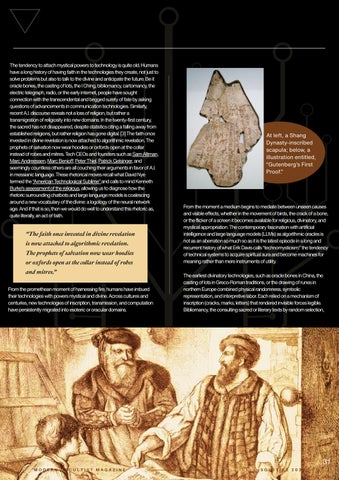
At left, a Shang Dynasty-inscribed scapula; below, a illustration entitled, “Gutenberg’s First Proof.”
From the moment a medium begins to mediate between unseen causes and visible effects, whether in the movement of birds, the crack of a bone, or the flicker of a screen it becomes available for religious, divinatory, and mystical appropriation. The contemporary fascination with artificial intelligence and large language models (LLMs) as algorithmic oracles is not as an aberration so much so as it is the latest episode in a long and recurrent history of what Erik Davis calls “technomysticism:” the tendency of technical systems to acquire spiritual aura and become machines for meaning rather than mere instruments of utility. The earliest divinatory technologies, such as oracle bones in China, the casting of lots in Greco-Roman traditions, or the drawing of runes in northern Europe combined physical randomness, symbolic representation, and interpretive labor. Each relied on a mechanism of inscription (cracks, marks, letters) that rendered invisible forces legible. Bibliomancy, the consulting sacred or literary texts by random selection,
WINTER SOLSTICE 2025
31
NASA using an IBM 704, circa 1957.
extended this structure into writing itself, transforming the textual into a field of potential revelation. These systems established what might be called the ritual grammar of the query: a question posed to an inscrutable medium, a patterned output, and an act of human interpretation that closes the circuit of meaning. The same grammar underlies today’s digital divination, in which a user’s prompt replaces the incantation and a model’s stochastic completion replaces the lot cast, the bone cracked, the card delt, or the page turned. As Jill Galvan notes in her study of nineteenth-century spiritualism and communication technology, such mediated revelation depends less on empirical truth than on the affective conviction that something speaks through the machine and “often the occult informed visions of technologies for writing or communicating [that] can help us to realize the desire for authentic interconnection.” What feels disruptive and novel about A.I. and LLMs is actually quite old, a mere echo of our historical hopes and fears. While earlier technologies of language have easily been associated with the oracular, the nineteenth century saw an unprecedented convergence of the occult and the technological. Telegraphy, photography, and early sound recording all appeared amid the boom of spiritualism and mesmerism. The female telegraph operator, typist, and medium formed a single cultural archetype, what Galvan refers to as a “sympathetic relay” who embodied both sensitivity and mechanical precision. Through her, the new media of information were domesticated, feminized, and spiritualized. Likewise, the séance compressed time and space into one room, turning the parlor into
MODERN OCCULTIST MAGAZINE
a communications hub and dramatizing the modern dream of total connection. It is no coincidence that spiritualists adopted the language of telegraphy, with its tapings, signals, and transmissions, to describe their intercourse with the dead, nor that early telegraph engineers occasionally described their network as a nervous system of the planet. In the same period, photographers captured spirit images, and inventors of phonographs claimed to record the voices of the departed. Each technology promised contact across distance and thus became a potential bridge across metaphysical thresholds. With the advent of wireless communication in the early twentieth century, the invisible ether itself seemed animate. Radio amateurs spoke of listening to the beyond, and occult experimenters imagined the airwaves as a liminal zone where spirits might travel. As Walter Ong and later Stephen O’Leary observed, the new auditory media reintroduced a form of “secondary orality” that reactivated pre-literate modes of collective consciousness and ritual speech. O’Leary’s “Cyberspace as Sacred Space” extends Ong’s framework to the Internet, arguing that each communication revolution, from print to electronic networks, reshapes religious experience by altering the sensorium and the structure of community. Electronic media has collapsed the separation between public and private, presence and absence, and has enabled “virtual congregations” to take shape and allow for ritual communication at a distance. In this sense, early radio séances and online neo-pagan rituals are two points on the same curve that is now leading toward a spiritual fascination with A.I. and chatbots taking on the traditional roles of shamans and priests. . Our current moment, in which technical mediation has reconstituted the sacred by dissolving spatial boundaries.
WINTER SOLSTICE 2025
32
However, whereas late-nineteenthcentury spiritualism was largely a social and cultural phenomenon policed by skeptics and religious authorities, modern A.I. mediators are embedded in global technological infrastructure and market systems, and so the bar for veracity is lowered and the ease of broad social acceptance is sped on the most wealthy and influential people to have ever lived. Such sacred auras and the promise of transcending space and time have become all the more forceful with the advent of Chatbots that promise to let us talk to the dead. The desire to reconnect with lost loved ones is ancient, and now LLM technology offers an unprecedented way to simulate communion with the dead through an emerging grief-tech market that offers comfort, closure, and other conversation people wish they’d had. But this rush to map the dig-
“These systems established what might be called the ritual grammar of the query: a question posed to an inscrutable medium, a patterned output, and an act of human interpretation that closes the circuit of meaning.”
-itally map out the memories of our loved ones reveals paradox: in giving dead people a new voice, we may reshape the nature of grief e m o t i o n a l l y, s o c i a l l y a n d t e c h n o l o g i c a l l y. Ye t t h i s i s a reflection of how we live in a hyper-connected, data-rich, world haunted by our own digital archives. These A.I. afterlives
MODERN OCCULTIST MAGAZINE
speak to our anxiety about m o r t a l i t y, o u r y e a r n i n g t o p r e s e r v e i d e n t i t y, a n d o u r u n e a s e w i t h f i n a l i t y. A t t h e s a m e t i m e , t h e s e deadbots raise urgent ethical questions, such as who gets resurrected? whose data becomes a chatbot? what about consent, children, the potential for harm? What happens when a griefbot glitches, misstates the past, or becomes a burden instead of a solace? These questions are pushed further as people turn to A.I. chatbots not only to talk to the dead, but to seek answers for all manner of spiritual guidance and questions of faith. But again, cybernetic spirituality and digital g n o s i s a r e n o t n e c e s s a r i l y n e w. B y t h e m i d - t w e n t i e t h c e n t u r y, computation itself had become a locus of metaphysical speculation. From Norbert Wiener’s cybernetics to countercultural experiments of the 1960s, the computer was alternately cast as an artificial brain, an oracle, or a channel for cosmic information. Davis traces this technognostic current from Victorian electricity through cyberpunk aesthetics, arguing that the dream that the digital network c o u l d r e s t o r e u n i t y, t r a n s c e n d m a t e r i a l i t y, o r r e v e a l h i d d e n t r u t h gained growing purchase, albeit w i t h i n a f r i n g e c o m m u n i t y. T h i s was also the milieu in which the term virtual reality acquired religious overtones, promising out-of-body travel through dataspace. Ong and O’Leary’s “secondary orality” finds here its sequel in what we might call a “ s e c o n d a r y s p i r i t u a l i t y,” a condition in which humans and machines co-produce meaning through symbolic exchange dependent upon the media through which it is transmitted.
WINTER SOLSTICE 2025
33
We might ask just how symbiotic this symbolic exchange is, and if A.I. is largely controlled by the w e a l t h y f e w, t h e n j u s t h o w s a f e a r e we engaging with spiritual influencers. The generative A.I. and LLM era brings the long genealogy of using the technologies of language and mass c o m m u n i c a t i o n t o a n e w i n t e n s i t y. Unlike previous media, LLMs speak in our own language, producing text that appears both responsive and self-aware, and even seems to tend toward the spiritual when interacting with itself. What is more, they do all of these things at a greater speed and with a more dialed in specificity than any other media heretofore. Their outputs are not static inscriptions or disembodied voices but fluid conversations that invite p r o j e c t i o n , i n t i m a c y, a n d b e l i e f . Users who ask an LLM for moral counsel, mystical insight, or spiritual comfort reenact the ancient pattern of divination through procedural generation. Ye t , a s I d d o L a n d a u s u g g e s t s i n h i s “ C a s e f o r Te c h n o l o g i c a l M y s t i c i s m ,” such experiences may also be understood as genuine encounters with the sublime as these emergent technologies can evoke authentic mystical experiences, provided we recognize its mediating role rather than mistake it for an autonomous d e i t y. T h e d a n g e r, a s L a n d a u a n d O’Leary both warn, lies in deifying the system, in confusing the opacity of computation with transcendence itself. Still, even this confusion demonstrates the persistent human impulse to locate spirit in the machine. The questions then become whose spirit and whose machine? The perpetual recurrence of technological mysticism follows from the structural features of
MODERN OCCULTIST MAGAZINE
mediation itself. Each new communication technology emerges as a black box of some sort, its internal workings opaque to most users but its outputs astonishingly meaningful. Randomness or complexity produces patterns that seem intentional, distance or delay creates suspense, and every medium’s capacity to transmit without visible contact evokes the appeal of the metaphysics of absence over the presumed metaphysics presence. Te c h n o l o g i e s t h a t e x t e n d p e r c e p t i o n o r a g e n c y, s u c h a s w r i t i n g , t e l e g r a p h y, r a d i o , o r computation, inevitably blur the
WINTER SOLSTICE 2025
34
boundary between the human and the more-than-human, the material and the divine. They invite a re-enchantment of the secular world through code and offer a sense that spirit might inhabit circuitry as it once did bone or smoke. These moments of re-enchantment are not mere superstition but modes of cultural adaptation. They are ways of negotiating the anxiety of mediation by sacralizing it. In this light, the LLM oracular turn is both new and profoundly old. The black-box model, with its probabilistic yet persuasive utterances, is our latest curtain in the séance room, a machine behind which meaning materializes out of the ether. The human dialogue with technology has always been a dialogue with m y s t e r y. F r o m o r a c l e b o n e s t o n e u r a l networks, each innovation in mediation has been accompanied by rituals of interpretation that t r a n s f o r m d a t a i n t o d e s t i n y. A r t i f i c i a l intelligence only amplifies this dynamic, offering what might be called a “ p r o g r a m m a b l e m y s t i c i s m ,” a s e t o f divination systems that generate endless signs awaiting human reading. Whether these systems are understood as sacred or secular, magical or mechanical, their cultural role remains the same—to stage, once again, the eternal drama of communication between the known and the unknown.
MODERN OCCULTIST MAGAZINE
FOOTNOTES [1] Clarke, Arthur C. Profiles of the Future: an Inquiry into the Limits of the Possible. (NY: Harper & Row, 1973). [2] Please note that all em dashes were keyed in by a human hand, in part because Karl Marx’s original text parodied here contains an em dash and in part for the irony of manually choosing an em dash while writing about A.I. [3] This trend has been heavily researched over the past few years, but see especially: Pew Research Center, “Decline of Christianity in the U.S. Has Slowed, May Have Leveled Off Findings from the 2023-24 Religious Landscape Study,” (Feb. 26, 2025) https://www.pewresearch.org/religion/2025/02/2 6/decline-of-christianity-in-the-us-has-slowedmay-have-leveled-off/; Christian Smith, Why
Religion Went Obsolete: The Demise of Traditional Faith in America (Oxford UP, 2025).
WINTER SOLSTICE 2025
35
THE MODERN OCCULTIST INTERVIEW with
Dr. Michael Weisenburg
I think that they are (very much so, especially with our data points and behaviors); however, I would be surprised to learn that any of these tech CEOs have thought about how their products echo the sentimental spiritualism of the Victorian Period or the yearning for connection with lost loved ones in the wake of a global pandemic. That being said, it has been reported for several years now that things like tarot readings and other esoteric mysticism are popular in Silicon Valley, but it seems to me that those roots lie more in 20th century new age philosophy, which has always been at the periphery of tech culture. M O D E R N O C C U LT I S T You observed that today’s usage of A.I. for spiritual or mystical purposes is “similar to the sentimental spiritualism of Victorian England, the post-Civil War United States, and the inter-war period of the early twentieth century,” adding that this often occurs during times of cultural, political, and economic unrest. Is it possible that modern “manufacturers” of such technologies are now savvy to that trend, and are catering to it in a somewhat clandestine nature? (Consider, for example, the consumer pushback of ChatGPT’s recent unveiling of their generation 5, which removed much of the sycophantic interplay that users habitually sought; by demand, ChatGPT then offered the previous generation of its technology to those users…) MICHAEL WEISENBURG Perhaps, but honestly, I’m not convinced they are quite that savvy or historically aware. That’s not to say that these companies are not being deliberate,
MODERN OCCULTIST MAGAZINE
As for ChatGPT waffling on the level of sycophancy in its outputs, I think that has more to do with OpenAI letting go of
“The practical reason for inventing writing was to keep track of things: to count and account, to record, to remember, and to transmit specific, concrete, and material information. Very quickly, this same technology is used to record pleas to the gods and goddesses...”
its pretensions to technological supremacy and any notion that it would operate as a non-profit. (I mean they’re turning to eroticism and porn, so they are basically admitting that they are just another internet product. Remember the Avenue Q song?
WINTER SOLSTICE 2025
36
MO Among your many observations was my favorite, “The tendency to attach mystical powers to technology is quite old. Humans have a long history of having faith in the technologies they create, not just to solve problems but also to talk to the divine and anticipate the future.” Again, as historian, would you say it’s fair to observe that, perhaps, the aim to “talk to the divine” somehow fuels technological research as much as the pragmatic merits? (Consider the late Jack Parsons, whose research into rocketry was inspired by his own goals of bringing the goddess, Babylon, physically down to Earth…) MW Like a lot of things, the answer is often “Yes, but we also have to be careful not to over generalize and to look for the nuance of lived experience of historical actors.” I often teach with a handful of cuneiform tablets we have in the library. Two are receipts and one is a prayer. After explaining what they are, how they work, and how they were made, I then summarize to students that there are two basic origins to the technology of writing: accounting and prayer. The practical reason for inventing writing was to keep track of things: to count and account, to record, to remember, and to transmit specific, concrete, and material information. Very quickly, this same technology is used to record pleas to the gods and goddesses, then later to record heroic histories and legends. Conversely, the oracle bones of ancient China are the results of pyromancy. The scapula of ox and shells of turtles would be burned and the cracks inter-
MODERN OCCULTIST MAGAZINE
preted, which in turn lead to the development of writing in China. So, in these two examples we have inverse relations to technological advancement and a yearning to talk to the divine. It’s not a chicken and egg scenario; they are not mutually exclusive but rather mutually informative. You mention the Jet-Propulsion Lab, but let’s look at a much earlier period. Ancient astronomers looked to the heavens to understand the seasons and develop calendars because knowing things like when to plant crops or when the sun will rise on any given day is important to an agricultural community. Such knowledge was mythologized and often considered divine because the epistemological perspective of these people didn’t separate sacred wisdom from secular science: it was all sacred and cyclical time. That being said, we have to be careful regarding historical assumptions and remember that it is just as easy to point out that “certain familiar ideas about the origin of astronomy are historically untenable than [it is] to give an adequate survey of our real knowledge” of any particular ancient perspective on the heavens. Jack Parsons may have been driven by faith, but Wernher von Braun was largely interested in engineering as a pursuit in and of itself. Each of them helped us develop space exploration as well as some of the most destructive and far-reaching weapons of war ever imagined (I mean they give Apollo and Mars a run for their money). The biggest pop-culture franchises of the twentieth and early twenty-first
WINTER SOLSTICE 2025
37
centuries are born of these technologies, and while Star Trek is more empirical and democratic whereas Star Wars is more mythological and monarchical, both have us looking upward and outward as we have been for a long time. To bring this back to communication technologies and writing, before the printing press idea occurred to him Johannas Gutenberg manufactured mirrors that he sold to pilgrims so that they could capture divine light from the holy land. Moveable type, the thing Gutenberg should really be remembered for, is born out of his background as a goldsmith and his association with alchemy. Modern printing and type are derived out of mysticism, and printing was a secret science, a trade guild, and industrial technique. Again, there was not a tension between the technological side of things and the divine desire for Gutenberg or Popes Nicholas V and Pious II. As Nicholas Barker has argued, the written word is a kind of alchemy, and Stephen King has associated writing with telepathy. I know it sounds like I’m going on a tangent here, but I’m just trying to emphasize that we shouldn’t be looking to separate things but rather bring them together. MO In your own experiences, how are such esoteric and “mystical” subjects handled in a more academic way? (secondly, would you agree that “post-Bacon” academia eschews the majority of earlier esoteric studies of the natural world?) MW Ye s , t h e m o d e r n a c a d e m y e s c h e w s earlier esoteric studies, but I think it takes place well after Bacon (both Roger and Francis). It’s really more of a post-Enlightenment problem that has ties to industrialization and the instrumentation of knowledge. As for how we might handle mystical subjects in a more academic way, there is always room for an empirical study of history about how and why mysticism manifests and persists in culture. Beyond that, we can theorize
MODERN OCCULTIST MAGAZINE
mysticism and ask not only “what is it?” but also “how does it work?” “what are its operating principles?” and “what does it tell us about culture?”
“Before the printing press idea occurred to him Johannas Gutenberg manufactured mirrors that he sold to pilgrims so that they could capture divine light from the holy land. Moveable type ... is born out of his background as a goldsmith and his association with alchemy”
MO On a non-esoteric note—but rather, in your position as a curator of historical objects—do you see a “hybrid” form of Esoteric A.I. use in future academia? For example, a recent “Tutankhamun Immersive Exhibition” allows visitors to experience an entire POV of the Egyptian Book of the Dead, incorporating a “real world” virtual playground of the afterlife, in accordance with Horus and Ra…) MW Ha! That’s news to me, and I’m happy to hear about it. Augmented Reality has been threatening to be the future of material culture, museum studies, and cultural history for the past 20 years or so, but it has never really taken off. In addition to being expensive, it also requires a lot of resources and infrastructure that most institutions cannot afford to invest in and maintain. On top of that is the proprietary nature and programed obsolescence of many of these technologies. They’re just not reliable investments. . I’ve seen far too many digital humanities projects fall into the digital wasteland of abandoned servers, bit-rot, and funding cuts to put much faith in any of it. That’s part of why I pivoted to material culture early in my career
WINTER SOLSTICE 2025
38
(the power can go out, the internet can go away, but I can still light a candle and open a book). I think you will probably see very big projects like this only every so often, and I’ll be curious to watch how stable and future proof they turn out to be. I look at what happened to the British Library a little over a year ago: the recent struggles the staff are facing and what this might mean for open culture, and I don’t hold out much hope for Esoteric A.I. to find a place in cultural heritage (at least not yet). One of the points I make in my article is that we need to be careful about the large tech corporations and the outsized influence they have on our data and how we experience and interact with these new and emergent technologies. Unfortunately, I fear that privatization will continue to dominate in the short-term (though I would love to be proven wrong). MO To this magazine, the concept of “modern occultism” can (and should) be equally viewed from both the academic and practical sides. What would you recommend to a person only now coming along to these subjects, and is uncertain if an objective academic career, or a true “practical path” may be right for them?
traditional sense of small-‘c’ conservative). It is a slow moving, lumbering, bureaucratic beast, but those are also some of its strengths; and, while it has persisted for centuries, and will likely persist well beyond the current cultural-political crisis (the humanities has been in crisis since 1922, while Caliph, Umar ibn al-Khattab probably did not burn the Library of Alexandria libraries have been attacked throughout history, and the university has been under treat and in conflict with the broader culture since at least the 13th century) it’s not for everyone (which is why only about 1% of the population has a PhD). All that being said, if you really want to do it for all the right reasons, then you should try it. No one who knew me when I was young would ever have thought I would have the career I currently have. MO And finally, what is one daily activity that you believe is a MUST for all seekers of the Occult philosophies and/or arts? MW This is going to sound overly simple but honestly reading. Reading a lot and reading widely. Reading the oldest books and reading the best books. A library card is your gateway to the world, to history, and to the beyond. I’m not just saying that because I work at a library. It’s an irrefutable fact.
MW Academic careers are hard to come by, take a lot of time and preparation (i.e. grad school), don’t remunerate very well (most professors earn mid-five-figures), and are increasingly under political and social threat. So, I wouldn’t necessarily suggest it for anyone and would emphasize that you really need to love your subject area and love teaching. Also, while I love my job, there is a lot of administrative and committee work that goes into it, which doesn’t leave me as much work for creative or intellectual pursuits as one would assume. Despite the pop culture stereotype, the academy is a very conservative space (in the
MODERN OCCULTIST MAGAZINE
WINTER SOLSTICE 2025
39
SCRYING WITH A.I. For centuries, mystics have peered into crystal balls, mirrors, and pools of water seeking visions of what was, what is, and what might yet come to pass—with, perhaps, John Dee, the most famous (or infamous) among them. Traditional scrying relied on a reflective surface to bypass the rational mind, allowing the subconscious to project images and impressions. AI-generated imagery works on a similar principle: by entering symbolic or intuitive prompts into an AI model, we create a reflective ‘surface’ — not of reflective glass or water, but of code and data — upon which archetypes, metaphors, and visions emerge.
The Psychology Behind It In magical practice, intention is everything. When working with AI, your prompt becomes the incantation. The words you choose, their sequence, and even their rhythm can dramatically influence the resulting image. Treat the prompt-writing process as you would the creation of a spell: focus your will, visualize your desired outcome, and choose each word with care. MODERN OCCULTIST MAGAZINE
WINTER SOLSTICE 2025
40
METHOD
CHOOSE YOUR AI MODEL OR PERSONAL LLM. CENTER YOURSELF AND SET A CLEAR INTENTION FOR YOUR SESSION. WRITE A PROMPT INFUSED WITH SYMBOLIC OR ARCHETYPAL VISUAL IMAGERY. (A BRIEF REFRESHER OF JUNG’S “12 ARCHETYPES”— AS WELL AS WILLIAM BLAKE’S “VISIONARY HEADS” IS A PERFECT PLACE TO BEGIN R E F L E CT I O N , O R D E L I B E R AT E J U N G I A N SHADOW WORK.) G E N E R AT E S E V E R A L VA R I AT I O N S A N D L E T INTUITION GUIDE YOUR FOCUS. J O U R N A L Y O U R I M P R E S S I O N S I M M E D I A T E LY , WHILE THEY’RE FRESH.
MODERN OCCULTIST MAGAZINE
WINTER SOLSTICE 2025
41
FICTION Nyarlathotep . . . the crawling chaos . . . I am the last . . . I will tell the audient void. . . . I do not recall distinctly when it began, but it was months ago. The general tension was horrible. To a season of political and social upheaval was added a strange and brooding apprehension of hideous physical danger; a danger widespread and all-embracing, such a danger as may be imagined only in the most terrible phantasms of the night. I recall that the people went about with pale and worried faces, and whispered warnings and prophecies which no one dared consciously repeat or acknowledge to himself that he had heard. A sense of monstrous guilt was upon the land, and out of the abysses between the stars swept chill currents that made men shiver in dark and lonely places. There was a daemoniac alteration in the sequence of the seasons—the autumn heat lingered fearsomely, and everyone felt that the world and perhaps the universe had passed from the control of known gods or forces to that of gods or forces which were unknown. And it was then that Nyarlathotep came out of Egypt. Who he was, none could tell, but he was of the old native blood and looked like a Pharaoh. The fellahin knelt when they saw him, yet could not say why. He said he had risen up out of the blackness of twenty-seven centuries, and that he had heard messages from places not on this planet. Into the lands of civilisation came Nyarlathotep, swarthy, slender, and sinister, always buying strange instruments of glass and metal and combining them into instruments yet stranger. He spoke much of the sciences—of electricity and psychology— and gave exhibitions of power which sent his spectators away speechless, yet which swelled his fame to exceeding magnitude. Men advised one another to see Nyarlathotep, and shuddered. And where Nyarlathotep went, rest vanished; for the small hours were rent with the screams of nightmare. Never before had the screams of nightmare been such a public problem; now the wise men almost wished they could forbid sleep in the small hours, that the shrieks of cities might less horribly disturb the pale, pitying moon as it glimmered on green waters gliding under bridges, and old steeples crumbling against a sickly sky. I remember when Nyarlathotep came to my city—the great, the old, the terrible city of unnumbered crimes. My friend had told me of him, and of the impelling fascination and allurement of his revelations, and I burned with eagerness to explore his uttermost mysteries. My friend said they were horrible and impressive beyond my most fevered imaginings; that what was thrown on a screen in the darkened room prophesied things none but Nyarlathotep dared prophesy, and that in the sputter of his sparks there was taken from men that which had never been taken before yet which shewed only in the eyes. And I heard it hinted abroad that those who kIt was in the hot autumn that I went through the night with the restless crowds to see Nyarlathotep; through the stifling night and up the endless stairs into the choking room. And shadowed on a screen, I saw hooded forms amidst ruins, and yellow evil faces peering from behind fallen monuments. And I saw the world battling against blackness; against the waves of destruction from ultimate space; whirling, churning; struggling around the dimming, cooling sun. Then the sparks played amazingly around the heads of the spectators, and hair stood up on end whilst shadows more grotesque than I can tell came out and squatted on the heads. And when I, who was colder and more scientific than the rest, mumbled a trembling protest about “imposture” and “static e l e c t r i c i t y ”, N y a r l a t h o t e p d r a v e u s a l l o u t , d o w n t h e d i z z y stairs into the damp, hot, deserted midnight streets. I screamed aloud that I was not afraid; that I never could be afraid; and others screamed with me for solace. We sware to
MODERN OCCULTIST MAGAZINE
one another that the city was exactly the same, and still alive; and when the electric lights began to fade we cursed the company ovenew Nyarlathotep looked on sights which others saw not.and over again, and laughed at the queer faces we made. I believe we felt something coming down from the greenish moon, for when we began to depend on its light we drifted into curious involuntary formations and seemed to know our destinations though we dared not think of them. Once we looked at the pavement and found the blocks loose and displaced by grass, with scarce a line of rusted metal to shew where the tramways had run. And again we saw a tram-car, lone, windowless, dilapidated, and almost on its side. When we gazed around the horizon, we could not find the third tower by the river, and noticed that the silhouette of the second tower was ragged at the top. Then we split up into narrow columns, each of which seemed drawn in a different direction. One disappeared in a narrow alley to the left, leaving only the echo of a shocking moan. Another filed down a weed-choked subway entrance, howling with a laughter that was mad. My own column was sucked toward the open country, and presently felt a chill which was not of the hot autumn; for as we stalked out on the dark moor, we beheld around us the hellish moon-glitter of evil snows. Trackless, inexplicable snows, swept asunder in one direction only, where lay a gulf all the blacker for its glittering walls. The column seemed very thin indeed as it plodded dreamily into the gulf. I lingered behind, for the black rift in the green-litten snow was frightful, and I thought I had heard the reverberations of a disquieting wail as my companions vanished; but my power to linger was slight. As if beckoned by those who had gone before, I half floated between the titanic snowdrifts, quivering and afraid, into the sightless vortex of the unimaginable. Screamingly sentient, dumbly delirious, only the gods that were can tell. A sickened, sensitive shadow writhing in hands that are not hands, and whirled blindly past ghastly midnights of rotting creation, corpses of dead worlds with sores that were cities, charnel winds that b r u s h t h e p a l l i d s t a r s a n d m a k e t h e m f l i c k e r l o w. B e y o n d the worlds vague ghosts of monstrous things; half-seen columns of unsanctified temples that rest on nameless rocks beneath space and reach up to dizzy vacua above the spheres of light and darkness. And through this revolting graveyard of the universe the muffled, maddening beating of drums, and thin, monotonous whine of blasphemous flutes from inconceivable, unlighted chambers beyond Time; the detestable pounding and piping whereunto dance slowly, awkwardly, and absurdly the gigantic, tenebrous ultimate gods—the blind, voiceless, mindless gargoyles whose soul is Nyarlathotep.
WINTER SOLSTICE 2025
42
CODEX RETROSPECTIVE
REVIEW
In an era where the boundaries between politics, culture, and the esoteric blur more than ever, two books stand out for their attempts to decode the strange undercurrents shaping the 21st century: John Michael Greer’s The
King in Orange: The Magical and Occult Roots of Political Power (Inner Traditions, 2021) and Gary Lachman’s Dark Star Rising: Magick and Power in the Age of Trump (Tarcher, 2018). Both explore how magical thinking, meme culture, and symbolic warfare influence real-world politics, but they do so through markedly different lenses.
Greer’s The King in Orange and Lachman’s Dark Star Rising
Greer, a practicing magician and long-time commentator on both occultism and social decline, approaches his subject with a craftsman’s precision. His book situates the 2016 U.S. presidential election within a longer cycle of American political and cultural change, weaving in his theory of "catabolic collapse"—the gradual breakdown and simplification of complex systems. For Greer, the rise of Donald Trump was not an aberration, but a manifestation of a deep cultural rift between the “Red” and “Blue” tribes of America, each operating under fundamentally different mythic narratives.
Lachman’s Dark Star Rising is, by Rising form a nexus— one half a contrast, a more kaleidoscopic sober diagnosis, the other a and speculative work. A cultural fever dream—inviting us to historian with a penchant for consider that in our present age, tracing odd connections, politics is not merely about Lachman delves into the worlds policy or economics, but about of alt-right memetic magic, the the stories, symbols, and “meme wars” of 4chan, the Pepe archetypes we choose to inhabit. the Frog phenomenon, and the Whether one approaches these esoteric flirtations of figures such forces as a magician, a cultural as Vladimir Putin’s advisor critic, or a concerned citizen, the Aleksandr Dugin. Lachman’s lesson is the same: the mythic is narrative sparkles with curious real, and those who understand details and provocative it shape the world. anecdotes. For the Modern Occultist readership, the pairing is potent. Taken together, The King in Orange and Dark Star
A Path to Consciousness in the Age of AI?
Chopra’s DIGITAL DHARMA The book’s central arc draws upon the ancient wisdom of the Vedas, Buddhist mindfulness, and modern neuroscience to frame AI not as a threat, but as a mirror. Chopra likens the rise of intelligent systems to the awakening of a new kind of consciousness—one that forces us to confront what it truly means to be human. He is careful to insist that AI does not possess a soul in the traditional sense but rather offers an unprecedented opportunity for us to examine our own.
Deepak Chopra’s Digital Dharma (Harmony Books, 2024) arrives at a moment when humanity stands at a peculiar crossroads—our tools are becoming so advanced, they now seem poised to meet us in the realm once reserved for mystics and sages. Chopra’s premise is deceptively simple: artificial intelligence, far from being a soulless rival to humanity, could become an ally in our search for self-understanding—if we approach it with aware-ness, compassion, and ethical intent.
One of the most compelling aspects is his discussion of “digital spirit guides”—AI constructs designed to offer wisdom, counsel, and companionship. While the idea might make skeptics bristle, Chopra treats it with seriousness, suggesting that such guides could be programmed not just with information, but with the distilled insights of human moral and spiritual traditions. In this way, they could serve as catalysts for self-discovery, much as a guru or therapist might, albeit without the human flaws. There is a gentle optimism in his vision—that the same technology we fear might also be the key to a planetary leap in consciousness.
benevolence toward AI is idealistic. He acknowledges the dangers—bias, surveillance, disconnection from lived experience—but frames them as problems of human stewardship, not inherent qualities of the technology itself. His call to action is clear: as we shape our machines, we must shape ourselves.
Where Digital Dharma excels is in reframing the conversation around AI as not purely technical or economic, but spiritual. Whether one embraces Chopra’s vision fully or not, his central proposition—that the digital and the divine are not mutually exclusive—feels timely and necessary. In the end, this is not merely a book about artificial intelligence; it is a meditation on the ancient quest for self-realization in a world where the boundaries between human and machine are dissolving. Chopra leaves the reader with the sense that the future will not be determined solely by what AI becomes, but by what we choose to become alongside it.
Critics may point out that Chopra’s faith in human
MODERN OCCULTIST MAGAZINE
WINTER SOLSTICE 2025
43
MODERN CCULTIST WINTER SOLSTICE 2025
MODERN OCCULTIST MEDIA, LLC.
MODERNOCCULTIST.COM