8
Wednesday, July 31, 2019
UMN-based cell research receives grant The Build-a-Cell network received a $1.2 million NSF grant last month. BY GWIWON JASON NAM gnam@mndaily.com
An international research coordination network involving University of Minnesota researchers received a $1.2 million National Science Foundation grant last month to study synthetic cells. The NSF grant for the Build-a-Cell Research Coordination Network, an international collaboration of researchers from 11 countries working together across disciplines, is intended to help build a greater network of researchers who are interested in synthetic cells. A synthetic cell is a “cell of non-natural origin that has been obtained either by modifying a pre-existing cell ... or by assembling compartments that mimic one or more properties of a living cell,” according to an academic review by Cell Press. These cells are also sometimes referred to as artificial cells or protocells.
Fundraising u from Page 1
Mohamed, Zahra Mohamed was a sophomore majoring in global studies and geography with minors in AfricanAmerican studies and environmental studies. “Her first year of college, she used to be home always late,” Aliya Mohamed said, noting it often put her in trouble with their mother. “She was interested in the whole campus — everything going on on the campus. She used to go to all the events.” Along with founding SDMC, Zahra Mohamed, who would often insist on being called “Zahro,” was an active member of the Muslim Students Association,
The researchers will receive the NSF funding over five years, in which they would like to strengthen the network’s internal collaboration. “It can mean anything from building completely artificial organisms, like my lab is doing, all the way to modifying natural living organisms for biomanufacturing, for making drugs and for studying natural biology” said Kate Adamala, an assistant professor in the University’s Genetics, Cell Biology and Development department and the lead investigator for the research coordination network. “The way most of us understand it is that it’s the ability to engineer biological systems with enough precision that we can do what we want with the building blocks that nature gave us.” Adamala said she believes their research will aid public health through studying accurate experimental models of the different cell parts and better understanding disease processes. The Build-A-Cell project has been going on for about two years, according to
Richard Murray, Thomas E. and Doris Everhart Professor of Control and Dynamical Systems and Bioengineering at the California Institute of Technology. Murray is a member of the Build-A-Cell steering committee, which helps to organize the Build-A-Cell meetings that are held every six months. “We have a number of research groups who participate in meetings and are interested in working together to explore ideas around synthetic cells,” Murray said. Because much of the synthetic cell research is conducted by small, individual labs, the research collaboration network will bring the researchers together, improving the study surrounding synthetic cells, Adamala said. “As science has become increasingly collaborative and international, mechanisms for establishing teams like ours have become critical to doing exciting science,” said Aaron Engelhart, a University assistant professor in the Genetics, Cell Biology, and Development department and one of the network participants.
Students for Justice in Palestine and Commuter Connection, said Hanan Farah, one of Zahra’s closest friends. Farah was with Zahra at the time of the accident and sustained severe injuries. Aliya Mohamed recalled hearing her sister dream about working for the United Nations several times. “Her interest in global social justice was inspiring,” Farah said in an email. “She had a way to divert energy towards all the tragedies that are constantly popping up while remaining steadfast in her pursuit to eradicate the constant inequities/ injustices around her.” Farah and Zahra Mohamed met three years ago as volunteers for an
after-school homework help program. When Zahra Mohamed was looking at colleges, Farah gave her her first tour at the University. “I remember we were walking around a building on the Saint Paul campus and we ran into a family social science counselor...” Farah said. This spurred a 30-minute conversation between Zahra Mohamed and the counselor about a shared passion for serving low-income communities. Not long after, Zahra Mohamed would help her own sister navigate her way around campus. “I’m the more reserved type,” Aliya Mohamed said. “She introduced me to everyone ... it’s a huge campus, so I didn’t know anything.”
TONY SAUNDERS, DAILY
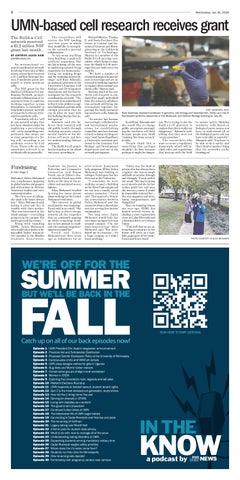
Kate Adamala, assistant professor in genetics, cell biology and development, holds up a vial of fluorescent synthetic liposomes in the Molecular and Cellular Biology building on July 25.
In addition, Adamala said she would like to change public perception surrounding the synthetic cell field, because people may think “making life from scratch” is risky. “People think this is something that perhaps shouldn’t be done because perhaps it might be danger-
“Zahra was the kind of person who has always been a fighter, she was so tough and bold, an activist through and through,” Farah said in the email. “She had a strong set of morals and she let her values guide her and once she was on a course it would be impossible to derail her. ... She was magnetic and witty, funny, compassionate, and thoughtful.” Since its founding almost one year ago, SDMC has hosted several events, including a voter registration event in Cedar-Riverside and a donation drive at Coffman Union. “This well that we are attempting to construct in her honor, will serve as a symbolic aggregate of her work,” Farah said in her email.
ous. We’re trying to use the Build-a-Cell platform to explain that this is really not dangerous,” Adamala said, adding that they were not “crazy scientists.” The researchers also want to create a regulatory framework, which will include rules and regulations that keep up with the field
to ensure safety.“Making synthetic cells based on biological parts means you have to understand all of the biological parts, and you have to be able to control it,” Adamala said. “You have to be able to do it safely, and that’s kind of another thing that the network’s really focusing on.”
PHOTO COURTESY OF ALIYA MOHAMED
SCAN HERE TO START LISTENING
Episode 1 - UMN President Eric Kaler's resignation announcement Episode 2 - Financial Aid and Scholarship Distribution Episode 3 - Proposed Gender Expression Policy at the University of Minnesota Episode 4 - Campus-area crime and WAM art rentals Episode 5 - UMN class designs clothes for girls in Uganda Episode 6 - Bug diets and Morris' tuition waivers Episode 7 - Conservative group's bridge mural vandalized Episode 8 - Women in STEM Episode 9 - Exploring the University's myth, legends and tall tales Episode 10 - Midterm Elections Roundup Episode 11 - UMN responds to football lawsuit, student tenant rights Episode 12 - Gen Z is the most stressed-out generation, study shows Episode 13 - How did the U bring home 'the axe' Episode 14 - Striving for diversity in CFANS Episode 15 - Living with diabetes as a student Episode 16 - The government showdown Episode 17 - Continued tuition hikes at UMN Episode 18 - The bittersweet life of UMN sugar babies Episode 19 - Connecting in Cedar-Riverside over free tea and pizza Episode 20 - The renaming of Coffman Episode 21 - Legacy taking over Morrill Hall Episode 22 - A fierce push for student data privacy Episode 23 - What to do with, how to manage all of the snow Episode 24 - Understanding eating disorders at UMN Episode 25 - Supporting students serving mandatory military time Episode 26 - Cedar-Riverside weighs safety priorities Episode 27 - Where does the U's water come from? Episode 28 - Students run free clinic for Minneapolis Episode 29 - How renaming was rejected Episode 30 - Controversy over pregnancy centers near campus