WHEN THE WORLD CHANGED, SO DID WE
MIT SLOAN ACTION LEARNING
SPRING 2020 REVIEW

MIT SLOAN ACTION LEARNING
SPRING 2020 REVIEW
Teams of students from across the school, supported by world-class faculty members and mentors, immerse themselves for a semester in a management challenge or business opportunity proposed by a host organization. Built on MIT’s mens et manus philosophy, this approach ensures that students apply what they learn in the classroom directly to realworld situations. Perhaps there was never a time in the program’s history when “bringing people together to solve real problems” was more imperative than the spring of 2020.
WHAT UNFOLDED OVER THE SECOND HALF OF THE SPRING SEMESTER WERE STORIES OF AGILITY, CREATIVITY, RESILIENCE, AND COMMITMENT BY EVERYONE INVOLVED.
In March, more than 300 students were engaged in deep classroom discussions and preparing to visit host companies around the world— from India and China to rural Maine and Appalachia, to the greater Boston area. Then COVID-19 turned the world upside down.
With little time to spare, the Action Learning faculty and staff re-envisioned how to best meet the dual goals of student learning and host impact. Remote technology was adopted, curricula were revised, project scopes reframed, some teams reconfigured, and travel plans cancelled. Unprecedented challenges and restrictions notwithstanding, Action Learning provided a path for students to play a role in the global response to the pandemic.
IT IS THE STUFF THAT MAKES US UNIQUELY MIT.
Within days, everyone had to undo plans that had taken more than six months of careful deliberation.
What unfolded over the second half of the spring semester were stories of agility, creativity, resilience, and commitment by everyone involved. It is the stuff that makes us uniquely MIT that made it possible for our community to adapt so quickly and find new opportunities for success, even as the world shifted daily around us. Tackling global challenges together is what we’re built to do. We invite you to read these stories of how Action Learning adapted and what we learned in the process.
URMI SAMADAR DIRECTOR, MIT SLOAN ACTION LEARNING
as we look back at last spring , it is the people of our Action Learning community who stand out—the faculty, students, hosts, mentors, and staff who rallied to adapt and move forward amid extraordinary upheaval and uncertainty.
As the virus became an epidemic—and then a pandemic—it became clear that travel was out of the question, and student teams across all Action Learning labs had serious conversations about whether or not to continue with their projects. This process, guided by adept mentors, turned out to be a valuable learning experience in itself. And the benefit of effective teamwork became immediately evident.
“We had a very open conversation,” said Grace He, MFin ’21, whose India Lab team worked with Sharechat, an Indian regional social media platform. Grace appreciated the fact that everyone on her team was honest in sharing their goals and concerns. Team member Yi Liu, MFin ’20, agreed. “Honesty was definitely very
“We got back to why we were taking the course in the first place, and whether or not we could achieve those objectives given the COVID-19 situation.”
ANUBHAV MOONDRA MBA ’21
INDIA LAB / SHARECHAT
important in these conversations,” he said. In the end, the decision to go ahead with the project or not came down to learning goals.
Despite the challenges they would face, Sharechat and other teams opted to forge ahead, realizing they could still learn valuable skills that they could apply to their careers. Shuqi Luo, MBA ’21, and her team were excited to work on a project for TheMathCompany, an artificial intelligence and machine learning firm in India. Even though they struggled to schedule remote meetings due to time zone differences, she believes the experience was well worth it. “Even if the travel piece is missing,” she said, “know that you will still learn a lot.” Shuqi noted that her team was exposed to a new industry, partnered with a company in a different culture, worked as a team through many challenges, and examined how current events impacted their host.
as the pandemic ’ s impact spread, businesses shut down, nonprofits became overburdened, and governments went into emergency mode. As a result, many Action Learning teams were forced to revise the scope of their projects. Others had to start from scratch, while some found themselves suddenly immersed in COVID-related projects. The agility and resourcefulness on display was impressive.
“A lot of people had to go into some kind of crisis mode,” said David Kaye, MBA ’20, who was part of an Operations-Lab (Ops-Lab) team that worked with McDonald’s. “The main points of contact we had, despite actually having some fairly significant responsibilities in relation to their COVID-19 response, maintained excellent contact with us.”
When the aviation industry came to a sudden halt, Sustainability Lab (S-Lab) host
Gategroup, an airline catering and on-board retail company, had to respond. “It’s hard to imagine a more disrupted service,” said Jason Jay, S-Lab faculty member. And yet, Joyce Wong, MBA ’21, and her team managed to exceed expectations.
The students had planned to study, measure, and make recommendations on how the company— which serves more than 700 million passengers annually—could reduce single-use plastic cutlery waste. In the midst of the pandemic, the team, comprised of two MBA students and two Integrated Design and Management (IDM) students, worked with the host to narrow the scope and deliver a more focused and relevant recommendation. “Because sanitation and hygiene expectations became the highest priority for Gategroup, we realized that plastic waste was not going away any time soon,” said Joyce. In light of COVID-19, we pivoted and completely focused on building out a recycling infrastructure.”
A first-time S-Lab host, Gategroup was thrilled with the detailed pilot proposal. Despite this year’s disruptions, the company plans at some point to roll out the pilot and has expressed interest in partnering with S-Lab again next year.
“The team was resolved to find a breakthrough, and pulled through an outcome that impressed everyone.”
JOHNNY KATTAR CORPORATE DEVELOPMENT DIRECTOR, GATEGROUP
Closer to home, another S-Lab team had planned to work with the Red Sox to measure Fenway Park’s energy use and make recommendations on how to reduce it. Since students weren’t allowed to visit the historic park or meet with employees in person, they shifted to focus on process improvement. Using data collected by the host and remote employee interviews, the team was able to identify energy-use challenges and create an operations checklist for powering Fenway up and down.
Entrepreneurship Lab (E-Lab) experienced similar disruptions.
“The goal of E-Lab is for students to gain experience with fast-paced startup companies and apply their academic knowledge to the problems faced by entrepreneurial firms in a context of uncertainty, extreme time
pressures, and decision-making based on limited information,” said Patricia (Trish) Cotter, E-Lab faculty member. COVID-19 presented all of these factors.
“Our goal remained the same after the pandemic,” she continued. “But the pandemic did bring a lot of challenges. For instance, some startups changed their project scope half way through the semester.” Airworks, a tech firm that supplies aerial mapping services to the construction industry, was one. When construction was halted due to the pandemic, the company realized it was more urgent to find out how the crisis was going to impact their business and which industries they should target when they were allowed to return to work. “Airworks was really happy with what we were able to provide in that short amount of time,” said Joey Khoury El Aramouni, MBAn ’20.
When travel was cut, Ops-Lab teams faced distinct challenges. “Ops-Lab is about seeing processes take place,” said Ops-Lab faculty member Thomas Roemer, who was initially skeptical about Ops-Labs projects moving ahead during quarantine. “I never thought it would


work.” How could teams—one working with an energy company in Brazil, and another partnering with an Amazon fulfillment center— complete projects without being able to be on site? The students on the Amazon team had never even seen a fulfillment center.
Fortunately, Thomas was very familiar with fulfillment centers and could advise the Amazon team. And working with the energy company, the team was able to figure out how to deliver a detailed decision map and a detailed graph of a complex operations problem. “It was a tremendous value to the company,” Thomas said, “an impressive deliverable.”
“The students stepped back and asked a lot of questions. Both students and hosts took advantage of time spent virtually and reframed what they would work on.”
THOMAS ROEMER EXECUTIVE DIRECTOR, LEADERS FOR GLOBAL OPERATIONS (LGO) PROGRAM; SENIOR LECTURER, OPERATIONS MANAGEMENT; OPS-LAB FACULTY MEMBER
Despite project scope changes and the abrupt switch to remote technology, many students and faculty members discovered a range of unexpected positives.
“The first thing I learned was how efficient you can be working remotely,” said Joey Khoury El Aramouni. Like many teams, Joey’s E-Lab team had a rocky shift. In addition to dealing with a dramatic project change at Airworks, the team went from five people to three, and one was a Harvard exchange student who had returned to Germany. But it wasn’t long before the team regrouped.
“We were super productive online. Everyone was home; it was easy to schedule and meet. This surprised me.”
JOEY KHOURY EL ARAMOUNI MBAn ʼ20 E-LAB / AIRWORKS
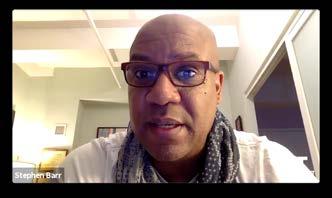
Stephen Barr, EMBA ’20, was similarly surprised. “S-Lab was so seamless,” he said. He and his team of EMBAs were impressed with how adeptly faculty members, Jason Jay and Bethany Patten, and their teaching assistants
handled the remote classroom. And since Stephen’s team was made up of executives working full time from home, the flexibility offered by Zoom accommodated their schedules even better than the traditional course. “I personally would say it was a great experience.”
Joyce Wong was surprised not only by how passionate her classmates were, but also by how dedicated her host, Gategroup, was throughout the process. “Even with the uncertainty that COVID-19 caused for the airline industry, our host was just as dedicated as ever to ensure that they were striving towards sustainability. Moreover, one of the reasons I had chosen to attend MIT Sloan was because of the Action Learning classes, and S-Lab did not disappoint. It was truly a great opportunity that combined mind and hand, to make a real, sustainable impact at an organization.”
r E m O t E b E n E fits
Other benefits of the switch to remote technology included the ability to expand the pool of people who could join conversations and interviews, and the frequency with which teams and hosts could communicate.
Heather Furman, MBA ’20/Harvard MPA, who worked on the McDonald’s Ops-Lab team, found that it was easier to meet with stakeholders virtually.
“Zoom was in some ways almost better, because we got to be face-to-face with people who might not have been on campus at the time. It felt like an easier ask to get somebody to talk to us for twenty minutes on Zoom,” she said.
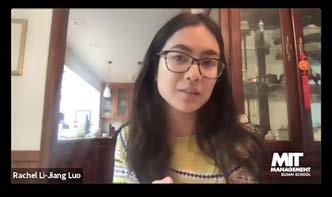
Rachel Luo’s USA Lab team attended GROW NKY board meetings via Zoom “as a fly on the wall,” she said, and also interviewed individual board members. The remote platform allowed the team to speak to multiple stakeholders in the same economic sector at once. “It was interesting for us, especially with the educational partners, to see them talk amongst themselves about what they perceived as strengths and weaknesses of the work-based learning program.” The team probably wouldn’t have had access to this type of enlightening conversation otherwise.
USA Lab students were disappointed they couldn’t fully experience Appalachia. They couldn’t hang out with locals in a pub, visit the library, eat in the local diner, or go to a town meeting, but they conducted far more conver-
Because they were no longer depending on physical site visits, Action Learning hosts were able to forge a more intimate connection with the courses, even attending several class discussions with students.
sations on Zoom than they would have in person, said Barbara Dyer, USA Lab faculty member. One USA Lab host joined four of the class sessions remotely because it was so convenient. “Because we were able to bring our host organizations more intimately into the classroom throughout the course,” she said, “it enabled us to connect the hosts much more to the larger questions.”
Obviously, students missed out on traveling to new places and living together while working on a project, but for many teams, the unexpected challenges of the crisis actually brought them closer than they expected.
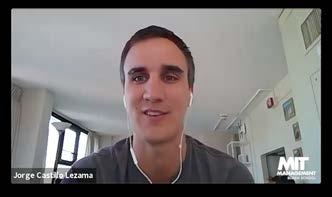
“We built a great team,” said Jorge Castillo Lezama of his Navya India Lab team. “I think the whole roller coaster we all went through helped us bond a lot. I consider my teammates all close friends now.”
Nicolás Peñafiel Prohens, MBA ’21, of TheMathCompany India Lab team, expressed a similar sentiment. “Honestly for me, the thing I looked forward to the most was our weekly team meeting, because we had so much fun before we started working. It was the best part of my week.”
Some Action Learning students found that the quarantine actually gave them the space and time to conceive and develop new business opportunities, and apply their work to their own professional advancement. The applicability of Action Learning courses allowed these enterprising students to pursue independent projects and new ventures that directly advanced their career goals. For example, one EMBA China Lab student applied cases and research material on China’s supply chain to his own company’s need to create a more resilient supply chain in the face of the US/China trade war and COVID-19 Another student, Tomás Herranz Medina, EMBA ’20, was one of a group of seasoned executives who used EMBA China Lab to work on an independent project. After some informative conversations with Chinese industry leaders, Tomás and his team created a business plan for a potential e-commerce venture in the Latin American agricultural industry.
“We are true believers that MIT brings together extraordinary people who really want to change the world. We developed a great friendship, but we also realized the potential that all our backgrounds brought together. We are very excited to see where this will take us.”
TOMÁS HERRANZ MEDINA EMBA ʼ20 EMBA CHINA LAB / PINDUODUO
action learning students , faculty, staff, and hosts learned a great deal last spring — and they will continue to learn . Not everything went smoothly or as planned, but they are realizing now that there were many positive outcomes and opportunities to explore going forward.
“The thing that’s really on my mind is the notion of fluidity and incorporating people over Zoom. Are there forms of Action Learning we haven’t considered because of the old format? Is there more we could do?
JASON JAY DIRECTOR, SUSTAINABILITY INITIATIVE AT MIT SLOAN; SENIOR LECTURER, SUSTAINABILITY; S-LAB FACULTY MEMBER
“Will there be fundamental change or will we go back to business as usual?”
CATHY
IACOBO
LECTURER, GLOBAL ECONOMICS AND MANAGEMENT; OPS-LAB FACULTY MEMBER AND MENTOR
Next spring, EMBA China Lab will likely offer hosts the option to design a remote project from the beginning, and will be more deliberate in specifying the kinds of projects they will accept. Yasheng Huang says they will organize projects around specific themes that emerged during this crisis. He adds that the digital economy and healthcare are also going to be major topics in 2021.
Ops-Lab has been teaching about global supply chain resilience for a very long time. This is not the first or last crisis global companies have had to deal with. “As they scramble to overcome the crisis and cost becomes king again, that’s what will be fascinating to watch,” said Lecturer Cathy Iacobo, an Ops-Lab faculty member and mentor.
Jason Jay is thinking ahead to how remote technology could offer new dimensions to S-Lab. “The thing that’s really on my mind is the notion of fluidity and incorporating people over Zoom. Are there forms of Action Learning we haven’t considered because of the old format? Is there more we could do? Can we expand our definition of who participates in Action Learning—hosts, students, alumni, guest lecturers?”
Barbara Dyer is also thinking about how remote tech can enhance Action Learning. She will invite more outside players and guests into USA Lab classes, and encourage students earlier in the process to conduct more remote interviews. “There are all kinds of things we’ve learned from this,” she said. This year, instead of students presenting their final projects to hosts in person, USA Lab teams and hosts took part in a deep and meaningful group discussion about America and its divides via Zoom. Following that, teams met with their hosts in virtual breakout rooms. “It was just wonderful,” she said, noting that it’s a format she’d like to replicate next year.
“We will use this as a turning point, a milestone, to talk about supply chain resiliency issues in the future.”
YASHENG HUANG CHINA LAB FACULTY MEMBER
COVID-19 confirmed that USA Lab is focusing on the right problems: issues such as jobs, safety, sustainability, climate, equity, resilience, and a new economy.
“Our students have so much skill and so much energy, that they can help move us in a new direction, if we at Sloan provide them even more opportunities to see their role in that larger context. And I think that’s what USA Lab does.”
BARBARA DYER EXECUTIVE
DIRECTOR OF THE GOOD COMPANIES, GOOD JOBS INITIATIVE; SENIOR LECTURER, WORK AND ORGANIZATION STUDIES; USA LAB FACULTY MEMBER
For many students, it is Action Learning that drew them to MIT Sloan. “It’s a chance to really get your hands dirty as you’re going through the program, not necessarily wait to apply everything until afterwards,” said EMBA Stephen Barr. No matter what happens, this aspect of the program will not change. In fact, one thing this crisis has confirmed is that Action Learning is important, perhaps even more so during challenging times.
MIT Sloan Action Learning’s stated objectives— learning in a complex, real-world environment, structuring and solving problems, collaborating effectively in teams, reflecting for personal and
professional growth, and learning to lead—can continue to work in a changed learning environment.
The outlook for the year ahead remains uncertain, but in keeping with MIT tradition, one fact is clear. Our students and faculty will continue to adapt, ask questions, and look for new solutions. The crisis the world endured this year only strengthened Action Learning’s drive to make the world a better place.