
FISHING • HUNTING • ADVENTURE AKSPORTINGJOURNAL.COM


Pay”
have a “No Game,
Call Charles (ranch owner) or314-293-0610Brad314-578-4590highadventureranch.com chal


un


We No thatYoupolicy.can’tgetoutWestoranywhereelse.
A Unique Big Game Hunting Ranch


Nestled in the foothills of the Ozark Mountains in Missouri, High Adventure Ranch offers all of the excitement of western big game hunting without the costs and hassles. Be prepared for a fair chase hunt! With over 3 square miles of prime natural habitat, our ranch provides challenges to even the most seasoned hunter, but our expe rienced guides and “No Game, No Pay” policy practically ensure that you won’t go home empty handed. In addi tion, High Adventure’s hunting season is year-round, allowing ample time to fit the most demanding schedule. While our whitetail, elk, wild boar and red stag hunts top our hunter’s most popular lists, hunters from around the world have visited our ranch, hunting everything from American bison, black buck, fallow deer to Spanish goats and African game. So, whether you desire a 10-point whitetail mount for your trophy room or simply the thrill and challenge of taking down one of our many elusive big game animals, High Adventure Ranch guarantees memories of an unparalleled hunting experience that will bring you back again and again.


We are 8,000 miles closer than New Zealand. We are in Missouri and have red stag. Red Stag Red Stag Wild Boar Whitetail


6 ALASKA SPORTING JOURNAL SEPTEMBER 2022 | aksportingjournal.com PUBLISHER James R. Baker GENERAL MANAGER John Rusnak EXECUTIVE EDITOR Andy Walgamott EDITOR Chris Cocoles WRITERS Bjorn Dihle, Scott Haugen, Tiffany Haugen, Mary Catharine Martin, Dave Workman SALES MANAGER Paul Yarnold ACCOUNT EXECUTIVES Hanna Gagley, Mamie Griffin, Riland Risden, Mike Smith DESIGNER Lesley-Anne Slisko-Cooper PRODUCTION ASSISTANT Kelly Baker WEB MARKETINGDEVELOPMENT/INBOUND Jon Hines, Jon Eske ADMINISTRATIVE ASSISTANT Katie Aumann INFORMATION SERVICES MANAGER Lois Sanborn ADVERTISING INQUIRIES media@media-inc.com MEDIA INDEX PUBLISHING GROUP 941 Powell Ave SW, Suite 120 Renton, WA 98057 (206) 382-9220 • Fax (206) 382-9437 media@media-inc.com • www.media-inc.com CORRESPONDENCE Twitter EmailFacebook.com/alaskasportingjournal@AKSportJournccocoles@media-inc.com ON THE COVER Scott Haugen took his two-bird limit of brant last September in the Aleutians’ Cold Bay. Waterfowlers will get their first chance to hunt birds this month throughout the state with several seasons set to open. (SCOTT HAUGEN) Volume 12 • Issue 4 www.aksportingjournal.com ZER Pistol Bullets and AmmunitionPistol Bullets and Ammunition Zero Bullet Company, Inc. P.O. Box 1188 Cullman, AL 35056 Tel: 256-739-1606 Fax: 256-739-4683 Toll Free: www.zerobullets.com800-545-9376


14900 SE STARK ST. • PORTLAND, OR 97233 HOURS: MON-FRI 8AM-6PM • SAT 9AM-3PM MOTORS MUST BE CAPABLE OF ACCEPTING JOYSTICK APPLICATION. CERTAIN LIMITATIONS APPLY. 503-255-8487 • CascadeMarineCenter.comGoodUsedBoats,RepairParts,QualityService,KnowlegeableStaff SALES • SERVICE • ENGINES 8 and 99 Kicker Motors in stock. Call now! Docking and maneuvering your boat in high winds has never been so easy. Let the Joy Stick do it for you. GPS position hold and heading hold is included. SeastarOptimusSolutionsEPSsteering GETTING YOU THE RIGHT PART THE FIRST TIME Subject to approval by mercury and dealer. Subject to terms. See dealer for details. NO SALES TAX IN OREGON steering Mercury Marine Outboard Promotion HorespowerConsumer Rebate 9.9 Pro Kicker $100 15 Pro Kicker $150 40 & 40 Jet $200 50 $250 60 & 65 Jet $400 75 & 80 Jet $500 90 $600 115 & 115 ProXS$1,000 150 $1,250 150 ProXS $1,500 350 $2,000 400 $2,250


CONTENTS
For the community of Klawock, located on Prince of Wales Island, a once endless run of sockeye salmon has fallen to dangerously low levels. But a group known as Klawock Indigenous Stewards Forest Partnership is one of several local organizations doing what they can to preserve what’s left of the run of reds and improve critical stream habitat impacted by the clearcutting of old-growth forests. Our Salmon State columnist Mary Catharine Martin got an inside look at the work being done to boost salmon returns.
While big game hunting is an understandably big draw as fall arrives in the Last Frontier, don’t forget that September o ers some dynamite waterfowl hunts. Scott Haugen can certainly attest, as he swears by the early days of the season for some of the best-eating birds you’ll shoot. Scott o ers tips for presenting the best decoy spread possible, while his wife Ti any Haugen has your big game menu covered with a Philly cheesesteak with an Alaskan twist.

FUTURE SOUTHEAST’SSTUDYING Southeast Alaska’s varied landscapes, which hold some of the most spectacular, pristine and rich ecosystems in North America, make the region worth preserving as concerns about climate change e ects continue to mount. National Wildlife Federation Outdoors hosted a forum with local outdoorsmen and -women to discuss how fishing and hunting could be impacted in the future. We chatted with NWF Outdoors sta ers about what they saw.
VOLUME 12 • ISSUE 4 FEATURES ALSO IN THIS ISSUE (NATIONAL WILDLIFE FEDERATION OUTDOORS) 11 The Editor’s Note: Experiencing Alaska for the first
and wanting more 13 Alaska Beat: News and notes from
the

17 Outdoor Calendar 55 In praise of .25-caliber bullets
18
28KLAWOCK’S FIGHT TO SAVE SOCKEYE


39THE DECOY DIARIES
8 ALASKA SPORTING JOURNAL SEPTEMBER 2022 | aksportingjournal.com Alaska Sporting Journal is published monthly. Call Media Inc. Publishing Group for a current rate card. Discounts for frequency advertising. All submitted materials become the property of Media Inc. Publishing Group and will not be returned. Annual subscriptions are $29.95 (12 issues) or $49.95 (24 issues). Send check or money order to Media Inc. Publishing Group, 941 Powell Ave SW, Suite 120, Renton, WA 98057 or call (206) 382-9220 with VISA or M/C. Back issues may be ordered at Media Inc. Publishing Group, subject to availability, at the cost of $5 plus shipping. Copyright © 2022 Media Inc. Publishing Group. All Rights Reserved. No part of this publication may be copied by any means, electronic or mechanical, including photocopying or recording by any information storage or retrieval system, without the express written permission of the publisher. Printed in U.S.A.
48THE CALL OF THE CHILD Father of two kids Bjorn Dihle has “survived avalanches, grizzly charges and my wife’s insatiable rage, but none of these things prepared me for the challenges and dangers of being a dad.” You fathers out there can surely relate, and Bjorn’s boys Shiras and Theron are equal parts thrilling and driving their dad crazy as they get introduced to their parents’ love for all things outdoors. Bjorn channels his inner Jack London in a tale of two sons and an eager pop. time around state

Built for Adventure! THUNDER JET • BOULTON • FISHRITE With our motorcompletefromcanandSuzuki,techniciansfactory-trainedforYamaha,Mercury,TohatsuHondamotors,wehandleanyprojectelectronicinstallstoboatandoverhauls. MAXXUM MARINE 1700 Hwy 99 N, Eugene, www.maxxummarine.comOR Toll FreeLocal877-4-Maxxum(877-462-9986)541-686-3572 Need a new motor for your current boat? Best prices around on Repowers!


EDITOR’S NOTE

There are two angler experiences I had abroad that I so would love to do again: catching delicious snapper o New Zealand’s Bay of Islands, and shore fishing amid the beauty of Lake Bled in Slovenia’s Julian Alps. Will I ever get back to either? I’d like to say yes, but there are so many places in the world to visit and only so much time and means; so you never know, right?
For me, this fall’s vacation days will take me back to one of my favorite previous destinations – Prague, in the country now known as Czechia (it was still the Czech Republic way back in 2010). But I won’t feel truly reunited until I’m once again in New Zealand and/or Slovenia fulfilling the destiny to catch those fish I missed the first time around. -Chris Cocoles
Kindle and Mandela van Eeden, NWF Outdoors sporting communications coordinator, headed to Southeast Alaska to dis cuss with locals the e ects climate change will have on hunters and anglers (page 18) in the future. Kindle, who’s based in Colo rado, talked to me about the impact the Last Frontier’s panhandle had on him – “Kind of a combination of awe and fulfilling some of what you think you know and what you didn’t know” – from the scenery to the people’s passion for preserving their lands to how damn good the local delicacies were. Sportswoman and Artemis ambassador Jodee Dixon, a guest on Kindle’s and van Eeden’s podcast, fed her guests a plethora of game meat and other local foods, including huckleberries, blueberries, watermelon berries and salmonberries found along hiking trails.
“It’s interesting that one thing that’s a little di erent from down here, all the best food is in people’s houses. People are so careful and into bringing home wild foods. Some people have fish and some have big game,” Kindle told me. “I thought it was pretty funny how hard it was to find a restaurant to get seafood up there. It was easier in Colorado to find a nice piece of seafood than it was up there.” His short stay only satisfied Kindle’s appetite – literally and figuratively – so much. He’ll be back. “There are so many things up there to do and we just touched a tiny little slice of it. I really want to see the Interior and want to see more of the ocean, and up more to the north I want to see the Brooks Range. The possibilities are endless.”
aksportingjournal.com | SEPTEMBER 2022 ALASKA SPORTING JOURNAL 11

Aaron Kindle (right) and Mandela van Eeden (left) of National Wildlife Federation Outdoors were impressed on their August trip to the Last Frontier, particularly when connecting with locals like Matt Jackson of Southeast Alaska Conservation Council. (NATIONAL WILDLIFE FEDERATION OUTDOORS)
But based on my conversation with Aaron Kindle, National Wildlife Federation Outdoors director of sporting advocacy, you can bet his recent first trip to Alaska won’t be his last. And how could you blame him?


| SEPTEMBER 2022 ALASKA SPORTING JOURNAL 13


747NOTABLENUMBER

The number of coho salmon counted at the Kuskokwim River’s Bethel Test Fishery as of Aug. 14. The far lower than usual total prompted the Alaska Department of Fish and Game to close the coho fishery for the first time ever.

SOUTHEAST ALASKA SALMON FISHERMEN CRY FOUL AL ASKA BEAT


Chinook salmon caught by Southeast Alaska commercial fishing boats have pitted those fishermen and Washington state-based Wild Fish Conservancy, which success fully argued that fish from Puget Sound waters – plus resident southern killer whales that feed on them – are being compromised by the harvest. Alaskans are not pleased by the ruling. (RYAN HAGERTY/USFWS) After Washington state-based Wild Fish Conservancy challenged the National Marine Fisheries Service’s approval of the Southeast Alaska commercial troll fishery for king salmon, a U.S. District Court ruling last month sent the Last Frontier’s panhandle into a frenzy.
The Seattle-based judge, Richard Jones, sided with WFC’s argument that NMFS had failed to take into consideration the number of Chinook harvested in Southeast Alaska waters that originated in the Pacific Northwest states and how their absence a ected southern resident killer whales that feed on them. Those salmon are protected and the orcas are considered endangered. Of course, WFC spokespeople were thrilled with the decision. Director Emma Halverson referred to “decades of unsustainable Chinook harvest management in Southeast Alaska” and said the ruling “marks a watershed moment for the recovery of southern resident orcas and wild Chinook.”
“To date, reducing overharvest on the whale’s primary prey is the only scientifically proven recovery action moving forward that promises immediate access to Chinook for these starving orcas and which will help to recover and restore larger and more diverse wild Chinook these whales evolved to eat, which are fundamental for their long-term recovery,” Halverson added.
On the losing end, Southeast Alaska’s fishing industry disputes the statistical analysis WFC determined about the fish harvested in Alaskan waters. Matt Donohoe, president of the Alaska Trollers Association, told KCAW radio that less than 2 percent of the kings fishermen catch originate from Puget Sound. “We don’t catch Puget Sound king salmon, the whole thing’s absurd. It’s right out of Alice in Wonderland,” Donohoe said in that KCAW interview. WFC alleges that 97 percent of the panhandle Chinook catch originates in Washington, Oregon and British Columbia streams. Fairy tale claims or not, Alaska Department of Fish and Game is certainly not happy with the court’s ruling. “The State of Alaska abides by the terms of the Pacific Salmon Treaty and the Biological Opinion that is tied to it and it is troubling that this ruling singles out our fisheries. We will be looking at our options in the coming weeks. In the meantime, Southeast Alaska salmon fisheries will proceed as normal,” ADFG commissioner Doug Vincent-Lang said in a statement. “Alaska should not be expected to be solely responsible for remedy. What is good for the goose is good for the gander. If this decision sticks, we will be looking at having all fisheries that a ect these salmon being treated equally under the law.”
TWEET OF THE MONTH
aksportingjournal.com
On Aug. 10, Alaskans celebrated the state’s iconic fish on #WildSalmonDay.

-Roman Dial, ecologist at Alaska Pacific University, as quoted by journalist Matt Simon in Wired last month on the alarming colonization of northwest Alaska by white spruce, occuring at a faster pace than other conifer species and a symptom of “Arctic greening,” with implications in terms of changing landscape cover and its ability to retain snow.
FEDERAL
14 ALASKA SPORTING JOURNAL SEPTEMBER 2022 | aksportingjournal.com
THEY SAID IT
FROM THE ASJ ARCHIVES
Remember that the film industry isn’t exactly known as being sympathetic to outdoor sportsmen and –women or much of anything that involves guns or death of wildlife.
Grimm, a longtime hunter whose dad introduced him to the outdoors, and Taylor, who has no background shooting ducks, both don camo gear and put out decoys to capture the perfect image from massive camera lenses that they can base their contest entry on.
It’s that kind of obsession that drew Golden Davis to this project. Everyone seems to have his or her reason for coming back year after year, knowing that just one of hundreds of entries gets picked and simple math says you’re more likely to get knocked out in the first round than contend for the No. 1 spot. It’s a can of mixed nuts group. -Chris Cocoles
K
“We’re going to look in every puddle, every lake, every pond, until we find them,” Taylor says as he and Grimm travel dirt roads in search of canvasbacks, one of the duck species approved for the particular contest featured in the film.
nowing that a large portion of audiences doesn’t hunt, Golden Davis made sure to stick up for the impact the Federal Duck Stamp has because of hunters.
“They’re happy as pigs in poop – they’re just going gangbusters out there in the Arctic tundra and alpine tundra. They’re way ahead. They’re even doing better than the shrubs.”
Filmmaker Brian Golden Davis’ documentary, The Million Dollar Duck, profiled an eccentric group of painters competing in the Federal Duck Stamp Art Contest. (THE MILLION DOLLAR DUCK) –ARTISTS SHOOT FOR A MILLION BUCKS IN DUCK STAMP CONTEST

As one person interviewed in the film says, “You can imagine where this conversation goes: ‘You’re collecting money, for what? ‘For wetlands to preserve waterfowl.’ And then some people say, ‘Wait a minute; you’re a hunter. Isn’t that a contradiction?’ And I say, ‘Of course it’s not a contradiction. Hunters care about the land and care about theThebirds.’”artists care too, and Taylor and Grimm became fast friends after years of submitting paintings. In the film, Taylor visits Grimm’s family in South Dakota and they plan to head out in search of birds to capture on film. (Besides the fact that wild, migrating birds look far more dynamic and healthy than domesticated ducks one might find in a more urban setting, the rules stipulate that paintings of ducks must come from photographs created by the contestants themselves rather than other licensed works.)
SEPTEMBER 2016 ECCENTRIC
“ ”
aksportingjournal.com | SEPTEMBER 2022 ALASKA SPORTING JOURNAL 15


Sept. 1 Bison season opens in GMU 11 (east of the Copper River, south of the Klawasi River and west of a line from Mount Sanford to Mount Wrangell to Long Glacier, west of the Kotsina River)
CALENDAR*OUTDOOR

For more information and season dates for Alaska hunts, go to Note:adfg.alaska.gov/index.cfm?adfg=hunting.main.Checkwithlocalcontactsoneventsthatcould be postponed/ cancelled due to Covid-19 pandemic.
Sept. 1 Black bear season opens in Game Management Units 1 (Southeast Mainland) and 2 (Prince of Wales Island) Sept. 1 Archery bull elk season opens in GMU 3 (Etolin Island) Sept. 1 Moose season opens in GMU 5B (Yakutat)
kenairiversuites@gmail.com www.kenairiversuites.com | (907)262-1992 *Kenai Riverfront Suites *Full kitchens, 2 bedrooms *Jacuzzi Suite *Private River access for Fishing *Open year round Located in the Heart of Soldotna, Alaska on the World Famous Kenai River! 907-260-FISH kingsalmondeaux33126@gmail.com(3474)www.kingsalmondeauxlodge.com • Kenai Riverfront Cabins • Bank Fishing • Over 700 ft. of River Frontage

Sept. 4 Valdez Silver Salmon Derby and Halibut Derby both end (valdezfishderbies.com) Sept. 6 Bison season opens in GMU 11 (drainages of Chitina River east of Chakina River and south and east of the Nizina River) Sept. 13-18 Kenai Silver Salmon (kenaisilversalmonderby.com)Derby

Sept. 1 Black and brown bear seasons open in GMU 6C (North Gulf Coast and Prince William Sound) Sept. 1 Moose season opens in GMU 7 (Seward) Sept. 1 Wolverine season opens in GMU 9 (Alaska Peninsula)
Sept. 15 Brown bear season opens in GMUs 1 and 3 Sept. 15 Brown bear season opens in GMU 4 (Admiralty/ Baranof/Chichagof Islands) Sept. 15 Moose season opens in GMU 3 (Petersburg/ Wrangell) Sept. 15 Deer season opens in GMU 4 (Chichagof Island east of Port Frederick and north of Tenakee Inlet and remainder of unit) Sept. 15 Mountain goat season begins in GMU 6D (North Gulf Coast and Prince William Sound) Sept. 25 Elk season opens in GMU 8 (Southwest Afognak Island)
Sept. 1 Brown bear season opens in GMU 14A (Mat-Su Valley)
Sept. 1 Goat season opens in GMU 14A (south and east of the Matanuska River) Sept. 3-5 Ketchikan CHARR Silver Salmon (ketchikancharrsalmonderby.com)Derby
The community of Kenai hosts its unique Kenai Silver Salmon Derby from Sept. 13-18. Go to kenaisilversalmonderby.com for more information. (KENAI SILVER SALMON DERBY)


aksportingjournal.com | SEPTEMBER 2022 ALASKA SPORTING JOURNAL 17


18 ALASKA SPORTING JOURNAL SEPTEMBER 2022 | aksportingjournal.com PICKING THE BRAINS OF SOUTHEAST ALASKANS ABOUT PRESERVING HUNTING, FISHING HAVING THE CLIMATE CONVERSATIONCHANGE BY CHRIS COCOLES

The gorgeous and diverse ecosystems of Southeast Alaska o er a quintessential test case for analyzing how climate changes can and could impact fishing and hunting. National Wildlife Federation Outdoors sta ers traveled to Juneau, where they connected with concerned locals. (NATIONAL WILDLIFE FEDERATION OUTDOORS) A aron Kindle knew that his fieldwork picking the brains of resident sportsmen and -women had taken him to a special place. Kindle, National Wildlife Federation Outdoors director of sporting advocacy, joined his colleague, NWF Outdoors’ sporting communications coordinator Mandela van Eeden, in Southeast Alaska to get a feel for how the area’s hunters and anglers are bracing for the potential e ects of climate change in what could be North America’s most diverse and fragile ecosystem.
“We spent a day on a commercial fishing boat and spent some time on docks talking to commercial fishermen. We spent time in the woods speaking with hunters. We did roundtable events and brought members of the community that are on some of the advisory councils and are dealing with these issues, like the mayors. The field time was really just talking to individuals who are dealing with this first-hand.” FROM ITS GLACIERS TO its rugged mountains, temperate rainforest to
aksportingjournal.com | SEPTEMBER 2022 ALASKA SPORTING JOURNAL 19
What the visitors took away from their time on the Alaska Panhandle was not only that so many they met will fight to protect these lands, but these same lands are without a doubt worth preserving. “Wespent a lot of time with folks who are witness to this stu . We talked to people who are on fishing boats. People who are hunters and fishers up there and heard about the changes that they’re seeing and what they are concerned about. How their community is talking,” says Kindle, who’s based in Colorado.

spectacular islands – amid the backdrop of 17 million acres worth of pristine Tongass National Forest land, which is about the size of West Virginia – you couldn’t find a more compelling region to study the e ects of climate change. There’s just so much going on ecologically in this corner of the Last Frontier. “I think one of the interesting things to me about Southeast was the isolation in that you're basically on these strips next to the ocean, and then everything from there on up is glaciated or surrounded by the ocean. And there’s very little place to move around, really,” Kindle says. “I’m in Colorado and it’s not too crazy for us to think, ‘Hey, let’s drive 200 miles (somewhere).’ There, I think in Juneau, the road system is something like 45 miles, and around Sitka it’s 12 miles. So just that was really interesting and then, of course, just seeing a temperate rainforest and everything that grows – how green it is. And then the quick transition right up to glaciers and really high country.” In reality, the entire state of Alaska is the quintessential case study. “The further north you go, the more serious and the gravity of climate change you’ll see, because you’ve got Alaska, which has gone up about 3 degrees in the past 50, 60 years, and looking at another couple degrees in the next couple of decades,” Kindle adds. “You’re seeing what that means, and sometimes it doesn’t seem like a lot.”
20 ALASKA SPORTING JOURNAL SEPTEMBER 2022 | aksportingjournal.com


Kindle and van Eeden got a small taste of the landscapes around Juneau, Sitka and the Tongass. They got in some fishing, both at sea for halibut (they didn’t have any luck with the big flatfish) and coho (they did land some silvers) and in the mouths of rivers, where they fly fished for pinks. They also went on hikes, spotting some of the local fauna – bears, mountain goats, “tons of bald eagles” – and took in first-hand views of some spots that could show signs of climate change impacts.
“We saw a lot of cedar die-o in the area I was in. Locals tell me that cedars need a little snow on the ground to protect their root system. When you see a couple of degrees’ di erence, Southeast Alaska is right on that freezing mark a lot of times in the winter,” Kindle says. “So if you’re talking about it’s 30 degrees compared to 32 or 33 and that snow isn’t over those roots because it’s falling as rain or it’s melting out faster, you see things like cedar die-o .”
The nearly statewide struggles of Alaska’s king salmon stocks is also a concern on the Panhandle. Changing
One of the variables that needs to be considered is the increase in temperatures that can sometimes a ect the availability of forage for wildlife like Dall sheep and other herbivores. (NATIONAL WILDLIFE FEDERATION OUTDOORS)


“One thing about being outdoors people is we’re used to living through adversity. What’s most heartbreaking is people who don’t want to acknowledge it. Because that’s the first step to doing something about it. ‘We’ve got some issues. What are we going to do about ocean conditions have meant smallersized kings returning to their spawning streams. Smaller salmon carry fewer eggs and also aren’t able to dig redds as deeply as bigger fish. Kindle also cited Dall sheep losing some of their food sources – like lichen and mosses – that are being iced over rather than snowed upon. Alder is said to have “creeped up the mountainside in what used to be grassland types of areas,” which in turn is restricting the availability of forage for the critters.
“In our line of work we’ve got thick skin. I don’t get too worried about it, but the science is pretty damn clear. We’re seeing these issues, and even for someone who doesn’t want to call it climate change, they know there are problems. And we invite them to be a part of the solution,” Kindle says. “And
(NATIONAL WILDLIFE FEDERATION OUTDOORS)

| SEPTEMBER 2022 ALASKA SPORTING JOURNAL 21
aksportingjournal.com
I think one of the coolest things that we have an opportunity with – and all of us who care about the outdoors – is natural climate solutions and climate resilience work. And I say that because those things improve fish and wildlife habitat. And that improves hunting and fishing.”
ONE OF THE MOST frustrating aspects of detailing the potential consequences of climate change is the skeptics who don’t buy what the experts see and the public at large acknowledges is occurring. Then again, Kindle’s gotten used to the notion that not everyone will be onboard with his opinion that “things are changing.”
The group was able to catch a few pink salmon, but locals told the NWF Outdoors representatives that the silvers were late arrivals. “I’m not going to say the coho aren’t here because of climate change,” director of sporting advocacy Aaron Kindle says. “I can’t do that, but it is indicative of things changing and that just kind of follows the form of what we’re hearing up there.”

Still, some in important positions, such as members of Congress, have refused to or at best not acknowledged that something sinister has accounted for events like increasing wildfires, which in recent years have wreaked havoc in drought-stricken Western states. Blazes have also burned throughout Alaska this summer, including the second largest amount of land scorched in June, which accompanied a record-dry late spring.
“There are things that are pretty hard to grasp on the surface for a regular Joe or Jane,” Kindle says. “There are a lot of di erent variables that are hard to kind of understand. One of the things we tell people is that no matter where we go across the country, the main thing we hear is that things are just a little bit weird. And it’s hard to necessarily put a finger on it, because ecology is complicated. But everyone says things are changing; ducks aren’t doing the same thing and they’re not migrating the same way; vegetation is changing; and precipitation patterns are“Thechanging.”onething about this was it echoed what we heard in other places,” Kindle reiterates about his Alaska trip. “Things are changing.” And not for the better, sadly.
“Incredible people who live it and do it and breathe all this stu . They’re like a lot of people that we get to talk to, fortunately for us. They know what they’re talking about. They spend their time on the landscape,” Kindle says.

“It’s one of the biggest and most productive national forests, and the biggest in the United States. And obviously logging has been part of its history. I think like any of these natural resources decisions, a lot of what people want is certainties,” he says. “They want to know what’s going to happen and they don’t like to flip-flop around. ‘We have to protect this, this year and next year with administrative changes.’”
“They advocate for this stu . They take care of this place. They know animal behavior. And that's what we love about
22 ALASKA SPORTING JOURNAL SEPTEMBER 2022 | aksportingjournal.com A community forum held in Juneau brought together locals who discussed the seemingly subtle changes going on that should be considered anything but subtle (NATIONAL WILDLIFE FEDERATION OUTDOORS) it?’” Kindle says. “And for me, particularly the hunting and fishing communities, we’re out there all the time. We see this stu . We’re the ones who return to landscapes year after year and see how they change over time and how animal behavior is changing – more than people who don’t do this.” “When people are seeing those things and say, ‘Well, things just change,’ even though the science is right next to them saying, ‘Well, things are changing because of this.’ To get folks to kind of accept and then start talking about it and forge solutions with our knowledge, that’s kind of what this is all about.”

FOR KINDLE AND VAN Eeden, who lives in Montana, the interaction between themselves and those commercial fishers and subsistence hunters proved to be worth the trip in terms of getting a perspective on just what’s going on in Southeast Alaska. NWF Outdoors hosted a community forum in Juneau, with sportsmen and -women and those who rely on the natural resources weighing in on issues in theirWhenbackyard. theywere out seeking coho, the talk was that the fish were late arrivals during the usual August run. Kindle is quick to point out that he can’t necessarily blame salmon tardiness on climate change. “I can’t do that, but it is indicative of things changing and that just kind of follows the form of what we’re hearing up there. No matter where we go or who we talk to, it’s that things are o ,” he says. “The timing of migration and when things show up. When plants start budding or when fall comes and the snow comes. All of those di erent timing things are something we hear every time we go (out in the field).”
The sprawling Tongass was also on the minds of the locals. As its old growth is threatened and the Roadless Rule has been under assault to potentially allow large-scale logging, America’s most massive national forest is a hot-button topic in these parts. Kindle got just a small taste of the Tongass, but he called it a “really unique place.” And who could blame any first-time visitor for being in awe of its changing landscape, from the sea up the steep cli s of the high country? It’s the Alaska that Lower 48ers see in their dreams, Kindle included.
Kindle and van Eeden hosted an episode of the National Wildlife Federation Outdoors podcast (nwfoutdoors.org). Joining them were two badass women of Southeast Alaska, Jodee Dixon, an ambassador for Artemis, a sportswomen’s advocacy organization, and Meredith Trainor, the executive director of the Southeast Alaska Conservation Council.

During their conversation with the hosts, Dixon and Trainor both expressed the urgency when it comes to not losing all the gifts Mother Nature provided to Southeast Alaska and the entire state. Preserving that legacy of subsistence hunting, fishing and foraging is a way of life. “Ifeel like the local food circumstance is going to change everywhere,” Trainor told Kindle and van Eeden. “And I hope that local food becomes more and more popular … Things are changing, so if what you would normally fish or hunt changes, we evolve and we start hunting and fishing (for) other local food that is abundant.”
“I would support anyone who feels like they’re just getting into this realm,” she said. “It feels overwhelming, or the changes you feel that need to happen feel insurmountable. You just don’t know where to start. Start with just one thing; pick an organization that you can start to engage with.”
“There are things that are pretty hard to grasp on the surface for a regular Joe or Jane,” Kindle says. “There are a lot of di erent variables that are hard to kind of understand … The main thing we hear is that things are just a little bit weird.” (NATIONAL WILDLIFE FEDERATION OUTDOORS) our opportunities to talk to people like these. They’re incredible and undeniable in their knowledge.” Van Eeden opened the podcast by saying how fortunate she was to be a part of the local community for even a short period of time.
“And to help gather and share some of the storytelling that happens in this part of the world,” she added. “We’ve been sitting around fires for thousands and thousands and thousands of years sharing stories. A lot of times it involves hunting and fishing. And in this part of the world I’m amazed by the abundance here.”
24 ALASKA SPORTING JOURNAL SEPTEMBER 2022 | aksportingjournal.com

Trainor said that harvesting the local fish and game on its own can help combat the inevitability of further shifts in the ecosystem due to climate-related phenomenon. Then there’s challenging politicians on both sides of the aisle to work together to brace for further shifts in theDixonclimate. hoped new climate change warriors would enter the chat and connect with Alaskans like herself and Trainor.

“More than anything, you can’t make
KINDLE RETURNED TO COLORADO and van Eeden to Montana with even more motivation to continue the work of preserving these lands for hunters and anglers of current and future generations.

“I think it’s like I say all the time: With all this privilege we have in this country with our natural resources, we have an so many di erent things are coming down the pipe that can impact our natural resources.” ASJ Editor’s note: For more info, check out the websites of National Wildlife Federation Outdoors (nwf.org/outdoors), Southeast Alaska Conservation Council (seacc.org) and Artemis (artemis.nwf.org). obligation to take care of them and to get engaged. Kind of gone are the days when you can just head out in the field in the fall or wherever you’re fishing and just expect that the landscape you return to every year is going to be in great shape year after year. There are just too many things, whether it’s climate issues, development, energy;

Many Panhandle residents understand the sense of urgency around not losing what they have in terms of the beauty and productivity of the land and ocean and the fish and game they provide for them. “More than any thing, you can’t make pristine habitat,” confirms NWF’s Kindle. “You’re not getting any more of it. So the easiest way to keep these ecosystems healthy is to keep them intact.” (NATIONAL WILDLIFE FEDERATION OUTDOORS) pristine habitat. You’re not getting any more of it. So the easiest way to keep these ecosystems healthy is to keep them intact. So if you have these large intact ecosystems, the best way to take care of them is to let them be,” he says.
26 ALASKA SPORTING JOURNAL SEPTEMBER 2022 | aksportingjournal.com


ALASKA ANCHORAGE Anchorage Yamaha Suzuki Marine 3919 Spenard Rd (907) anchorageyamaha.com243-8343 FAIRBANKS Northern Power Sports 1980 Van Horn Rd (907) northernpowersports.com452-2762

28 ALASKA SPORTING JOURNAL SEPTEMBER 2022 | aksportingjournal.com Rob Cadmus, executive director of the Southeast Alaska (MARYoutsideatonPartnershipIndigenousAboudaraCoalition,WatershedandQuinnoftheKlawockStewardsForestworktogetherrestoringfishhabitatSevenmileCreekjustKlawockLake.CATHARINEMARTIN)


In the early 1990s, when Quinn Aboudara was about 12, he and his father went hunting out a logging road that had just been punched into the oldgrowth forest of Prince of Wales Island. Enormous spruce, hemlock and cedar trees towered all around them, their branches laden with pale green lichen. All around him, he knew, were deer, bears, birds and berry bushes. The creeks were full of salmon. As they walked, his father stopped“Lookhim. around,” he said. “This is the last time you’ll ever see this forest.” Thirty years after that hunting trip, Aboudara is part of the Klawock Indigenous Stewards Forest Partnership (KISFP). Recently, he and his crew were out on a logging road doing stream reconnaissance and mapping – and he realized he was standing on the same road he had walked with his father. “I realized I’ll never see that area be old growth again,” he said. “My grandkids maybe will get to see something that was similar to what I saw. But it won’t be the same forest.” “Our forests are resilient,” Aboudara continued. “But they have to be properly managed. And we cannot repeat the actions of previous generations. We can’t make the same mistakes.”
BY MARY CATHARINE MARTIN
On a recent day, the KISFP crew, as well as a forest partnership crew from Keex’ Kwáan Community Forest Partnership, the team at the Southeast Alaska Watershed Coalition (SAWC), and Alaska Youth Stewards, were out at Sevenmile Creek, just a few hundred feet from where the stream flows into Klawock Lake. The area was clearcut in 1987.
SOCKEYETOGROUPSKLAWOCKWANTBRINGTHEIRHOME
RESTORING DAMAGED CREEKS

“You can see the decline of all the fish populations through the years, how this (clearcut logging) a ected it,” said crew member Jon Carle, who has worked at a mill, in tree thinning, in road-building for logging operations, and as a fisherman.

He is now the Indigenous stewards coordinator with the Prince of Wales
Enormous moss-covered trees as wide as a person is tall lay along the forest floor, left behind after logging. Mosscovered second growth rose into the air, spindly against the girth of massive stumps. And the restoration crew – some of whom are loggers, some of whom are new to the work, and some of whom, like Aboudara, regard their work not just as a full-time, year-round job but as a calling – were using capstan winches, ropes, pulleys, chainsaws and hard work to add logs and wood back into the stream.
aksportingjournal.com | SEPTEMBER 2022 ALASKA SPORTING JOURNAL 29


Back in 1868, the first salmon saltery and cannery in Alaska was built in Klawock Inlet. In the early 1900s, cannery records show a commercial harvest of 80,000 sockeye.
And so we’re trying to replicate that.”
This totem in Klawock’s totem park features sockeye salmon. “The Indigenous people of Klawock are sockeye salmon people,” says KISFP’s Aboudara, and the stewardship coordinator at Shaan Seet Corporation’s Natural Resources Division. “To have these kind of declines … it hurts our spirit. We’re doing our (best) out here to help at least give the sockeye a bit more of a fighting chance so that future generations will know what it’s like to have these fish.”

THE RISE AND FALL OF SOCKEYE
30 ALASKA SPORTING JOURNAL SEPTEMBER 2022 | aksportingjournal.com
In Klawock, people have seen that tie-in first-hand.When he was younger, Carle remembers dipnetting for salmon right o the beach. For a month straight, he said, Klawock would smell of salmon as they spawned, washed downriver and washed up on the beach. “The fish were going through so much” in the creeks, he recalled, “you were able to come here and just snag them, or grab them with your hands.”
(MARY CATHARINE MARTIN)
Tribal Conservation District. “These trees are 40 years old. For 40 years, fish didn’t really have any real cover or anything. It was just a clearcut. There was nothing left on the Afterstream.”aclearcut, there’s an initial boom of berry bushes and other undergrowthtype plants. Then spruce and hemlock regrow all at the same height, locking out light and slowing growth. There is no food for deer or other animals, little to no shade for streams, and there are no branches or trees to fall into a stream, which helps create deep pools, rearing areas and healthy habitat. “If you go to a stream that’s in the old growth, there’s branches as big as some of the trees we’re trying to pull in here that have broken o and fallen in,” said Carle, who was working on the project as a supervisor and mentor attached to the Klawock partnership through the Organized Village of Kasaan. “The stream is just piled with big, large wood.
Fishing and the forest, Carle said, “All ties in. You’ve got to have the forest, so the fish can get up. Once one depletes, you see the other going. It all ties together.”
Last year, about 3,400 sockeye salmon made it up the river, Aboudara said. Even in his lifetime, the Klawock Lake sockeye return has experienced a significant decline. “I remember being able to fish and in a single week we would have enough fish for my family, my community members, my friends, extended family,” Aboudara noted. “Nowadays you could go all season and not even have enough fish for your household.” The community worked together with scientists from Juneau to make a plan to help the fish. This project is one piece of the Klawock Lake Sockeye Salmon Action Plan knowchancegivedoinghurtstheoftheseareprivatecorporation,inEnvironmentaltheSoutheastsalmon-action-plan),.org/2020/02/klawock-lake-sockeye-(alaskawatershedcoalitionauthoredbytheAlaskaWatershedCoalition,NatureConservancyandKaiConsultingServices,consultationwithtribal,Nativegovernment,nonprofitandsectorpartners.“TheIndigenouspeopleofKlawocksockeyesalmonpeople.Andtohavekindsofdeclines,tohavethiskindimpactinmyownlifetime,letalonegenerationbefore,it’sdetrimental.Itourspirit,”Aboudarasaid.“We’reour(best)outheretohelpatleastthesockeyeabitmoreofafightingsothatfuturegenerationswillwhatit’sliketohavethesefish.”

There is another benefit, as well; doing restoration work, said Jon Carle, is a more regular, better-paying job than most he has had.
32 ALASKA SPORTING JOURNAL SEPTEMBER 2022 | aksportingjournal.com

“You’re in your own element, and you’re in your o ce, no matter where you are,” he said as he oversaw the placement of a tree. “The most rewarding part about this particular job is just seeing it all come together. This work keeps the same crew together, keeps everybody employed. Instead of trying to find a new crew and trying to figure out everything every couple of months, it’s like clockwork.”
After decades of old-growth clearcut logging on Southeast Alaska’s largest island – much of it prior to the Tongass Timber Reform Act of 1992, which mandated 100-foot bu ers of trees be left along stream banks on federal lands – there’s also an enormous need for



Cody Ellison, who has experience in the logging industry and is now working for the Klawock Indigenous Stewards Forest Partnership, practices on a stump. The large stump in the foreground is all that’s left of the old-growth forest here after it was clearcut. (MARY CATHARINE MARTIN) Kelsey Dean (left), watershed scientist with the Southeast Alaska Watershed Coalition, and Kaagwaan Eesh Manuel Rose-Bell of Keex’ Kwáan watch as crew members set up tools to drag a log into place. Healthy salmon habitat requires woody debris, typically provided by branches and trees that have fallen into the water. It helps create deep pools and varied stream structure. (MARY CATHARINE MARTIN)
STEADY JOBS
TECHNIQUE SPECIFIC FISHING OPTIMUMDESIGNEDRODSFORPERFORMANCE PROLITERODS.COM @Proliterods@Proliterods Get 10% OFF Use Promo Code NWMAG10 or MENTION THIS AD


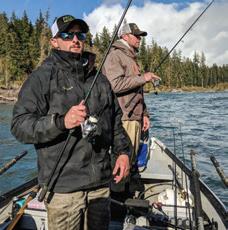



“The logging industry … is not going to get bigger,” Carle said, though added, “there’s always going to be a need for restoration.”Thatneed isn’t just long-term; it’s also“Thingsyear-round.like logging, and thinning, and even surveying skills – they’ve been treated as seasonal employment,” Aboudara said. “So you’ll have people that work three to six months out of the year, and then they get laid o . With the (Klawock Indigenous Stewards) we are doing year-round work, so that we can continue practicing those skills, we can continue keeping those skills ... Instead of going from boom-and-bust economy, we could have a steady economy.”
The Klawock partnership, housed at Shaan Seet Corporation, got its o cial start this April, funded by USDA Sustainability Strategy money. This year, it’s employing six people, all local. Aboudara, who is the stewardship coordinator of the corporation’s Natural Resources Division, hopes that next year the partnership will employ nine.
Kaagwaan Eesh Manuel RoseBell of Kake was on site, training and working his first week as a member of Kake’s restoration crew, Keex’ Kwáan Community Forest Partnership. He likes that they’re out restoring something, as opposed to taking something, he said.


“We use traditional ecological knowledge in our work. We go back into Aboudara works on restoring fish habitat at Klawock’s Sevenmile Creek. “I remember being able to fish and in a single week we would have enough fish for my family, my community members, my friends, extended family,” he recalls. “Nowadays you could go all season and not even have enough fish for your household.” (MARY CATHARINE MARTIN)
“I heard a lot about the work from my brothers, who worked on the crew in the past few years, so I signed up,” he said. “And I’m really glad I did.”
“It’s such a broad vision,” said Xavier Friday, also of Kake. “And it’s brand new. And to be at the beginning of something like this is pretty awesome.”
34 ALASKA SPORTING JOURNAL SEPTEMBER 2022 | aksportingjournal.com Ellison and Aboudara consult on next steps for getting a log into place. The Klawock partnership o cially got o the ground in April with funding from the USDA’s sustainability strategy. (MARY CATHARINE MARTIN) restoration, Carle said. (Bu ers are not always that big; on state and private lands, the Alaska Forest Practices Act requires only a 66-foot bu er, but taking trees from that area was also sometimes allowed.)
The Klawock Indigenous Stewards Forest Partnership is also part of another important transition – ensuring Indigenous voices, and knowledge, are part of decision-making and management in Southeast Alaska.

INCORPORATING INDIGENOUS KNOWLEDGE

aksportingjournal.com | SEPTEMBER 2022 ALASKA SPORTING JOURNAL 35


Klawock Indigenous Steward Forest Partnership partners include Shaan Seet Incorporated, Klawock Heenya Corporation (Sevenmile Creek is on Klawock Heenya property), Sealaska, the Prince of Wales Tribal Conservation District, Klawock Cooperative Association, the Southeast Alaska Watershed Coalition (SAWC), the U.S. Forest Service, and the U.S. Fish and Wildlife Service. ASJ Editor’s note: Mary Catharine Martin is the communications director of SalmonState, an organization that works to ensure Alaska remains a place wild salmon and the people who depend on them continue to thrive. Go to salmonstate.org for more information.
36 ALASKA SPORTING JOURNAL SEPTEMBER 2022 | aksportingjournal.com the historical practices. And we also take lessons from nature every day,” Aboudara said. “And that’s so powerful on so many di erent levels … We need to be voices in the management of our lands. Not to be told two months before they decide to do a timber sale, ‘Oh, hey, do you guys got anything to say?’” The community forest partnership, Aboudara said, brings together the U.S. Forest Service, landowners like Klawock Heenya, Shaan Seet and Sealaska as partners on Klawock’srestoration.partnership with the Southeast Alaska Watershed Coalition, which partners with and trains local crews to lead watershed restoration throughout Southeast, including on this project, has been instrumental, Aboudara said. “Rob (Cadmus, the coalition executive director) and SAWC come in with knowledge and willingness and heart to share it, and once they see we’ve got that knowledge, they go, ‘All right, here's the reins, here’s the steering wheel. Take over,’” he added.
Talking about that decision brings him to tears.“We’d be out there with my dad, and my uncles, and we’d get a set, and we’d pull up to the shore,” Aboudara recalled of his childhood. “And my aunts, and my grandmother, and my mom, and all the younger kids, they’d come down, we’d put the fish up on the shore and start processing it, putting it into the smokehouses, sending it to family all across the state.”
“I really hope that doing this work, hopefully I can fish with my grandchildren, and in the future, pass the knowledge on to my nieces and nephews.”
(MARY
Klawock Lake, “have a tribal crew, and they will, in many ways, implement the project,” Cadmus said.

‘I HOPE THEY RECOGNIZE THESE WATERS AGAIN’ Aboudara believes the restoration needs in the Klawock Lake system require not a silver bullet, but a shotgun approach. He said roads, human tra c, development and commercial fishery management have also contributed to Klawock’s sockeyeUltimately,decline.no matter the reason the creek needs restoring, Aboudara knows what he’s working toward. This year, due to poor salmon returns, his family made the heartbreaking decision not to fish.
All of the watershed coalition’s projects that were funded by the USDA’s sustainability strategy, including This crew representing the Southeast Alaska Watershed Coalition, the Klawock Indigenous Stewards Forest Partnership, Keex’ Kwáan and Alaska Youth Stewards all helped with projects restoring fish habitat and stream structure at Sevenmile Creek, Klawock Heenya property just outside Klawock Lake. The area’s old growth was clearcut-logged in 1987. CATHARINE MARTIN)
“I hope that the sockeye recognize the work that we’re doing,” he continued. “That we’re trying to show them that we’re better people than we were before. And I hope that they come home. I hope that they recognize these waters again.”

aksportingjournal.com | SEPTEMBER 2022 ALASKA SPORTING JOURNAL 37 Show the water who’s boss with the new F200 In-Line Four. Incredibly light, responsive and fuel efficient, it serves up plenty of muscle to handily propel a variety of boats. On top of that, its 50-amp alternator offers the power to add a range of electronics, and its 26-inch mounting centers and compatibility with either mechanical or digital controls give you the flexibility to easily upgrade your outboard or rigging. Experience legendary Yamaha reliability and the freedom of forward thinking, with the all-new F200 In-Line Four. THE ALL-NEW F200 IN-LINE FOUR. FORWARD THINKIN REMEMBER to always observe all applicable boating laws Never drink and drive. Dress properly with a USCG-approved personal intended to be an endorsement. © 2013 Yamaha Motor Corporation, U.S.A. All rights reserved. Follow Yamaha on Facebook® and TwitterYamahaOutboards.com/F200InLine LIGHTWEIGHT. The lightest 200-hp four stroke on the market POWERFUL. 2.8L displacement and Variable Camshaft Timing give it the best power-to-weight ratio of any 200-hp four stroke COMPACT. Nearly 120 pounds lighter than our four-stroke V6 F200 Show the water who’s boss with the new F200 In-Line Four. Incredibly light, responsive and fuel efficient, it serves up plenty of muscle to handily propel a variety of boats. On top of that, its 50-amp alternator offers the power to add a range of electronics, and its 26-inch mounting centers and compatibility with either mechanical or digital controls give you the flexibility to easily upgrade your outboard or rigging. Experience legendary Yamaha reliability and the freedom of forward thinking, with the all-new F200 In-Line Four. THE ALL-NEW F200 IN-LINE FOUR. FORWARD THINKING. REMEMBER to always observe all applicable boating laws Never drink and drive. Dress properly with a USCG-approved personal intended to be an endorsement. © 2013 Yamaha Motor Corporation, U.S.A. All rights reserved. Follow Yamaha on Facebook® and TwitterYamahaOutboards.com/F200InLine WASHINGTON OLYMPIA US Marine Sales & Service 3525 Pacific Ave. SE (360) 455-0788 www.usmarinesales.com





It’s waterfowl season, one of my favorite times in Alaska!
MATCH


Alaska’s September waterfowl season is one of the most overlooked hunting opportunities in the state. Here, author Scott Haugen (left) and a friend, noted guide Je Wasley, took a good mix of ducks, geese and brant, back when the limit was three brant per day. A great waterfowl hunt starts with the right decoy spread. (SCOTT HAUGEN)

aksportingjournal.com | SEPTEMBER 2022 ALASKA SPORTING JOURNAL 39


It’s especially true during the September early season, when ducks and geese are gullible and taste oh so good. I get a lot of questions from fellow waterfowl hunters and love it, because it FIELD forces me to really think before answering. Take this simple question, which came at the end of last season: “What’s your favorite decoy?” That’s all that was asked. I just about wrote back with a oneword reply, assuming they were asking about a brand based on a social media post I’d made with my dog and I and a limit of ducks in a spread of silhouette wigeon decoys. Then I got to thinking; I needed more details. I asked if he was talking about lateor early-season decoys; standing or floaters, silhouettes or jerk cord setups;
DEADLY DECISIONSDECOY YOUR SPREAD TO CORRECT POINT OF SEASON, SPECIES, WEATHER FOR TOP RESULTS

BY SCOTT HAUGEN

*SMOKE FLAVOR GUIDE
A Philadelphia staple, the cheesesteak makes for a guilty-pleasure sandwich. For an Alaskan twist, use game meat like venison or waterfowl breasts and the usual fixins – peppers, onions and provolone cheese – for smoked deliciousness with a taste of the City of Brotherly Love. (TIFFANY HAUGEN)

Four to eight hoagie rolls 2 to 3 tablespoons olive oil Wood chips of choice*


For a mild smoke flavor, use apple or alder wood chips. For a medium smoke flavor, use cherry wood chips. For a stronger smoke flavor, try hickory or mesquite wood chips.
BY TIFFANY HAUGEN
2 to 4 cloves garlic, minced Eight to 16 slices provolone cheese
In a small bowl, mix all rub ingredients until thoroughly combined. Season the venison or birds by rubbing the spices into the meat on all sides. Let meat sit at room temperature for 15 to 20 minutes. Remove seeds and stems from peppers. Quarter peppers and onions and place on smoker racks. Prepare your smoker by filling the pan with wood chips. Make sure clean foil lines the smoker pan to avoid o -putting flavors. Preheat smoker until chips begin to smoke. Place seasoned meat on a smoker rack and put in the smoker. Place vegetables on a separate rack above meat to avoid meat drippings. Smoke 45 minutes, using one pan of chips. Remove ingredients from smoker and place meat in the freezer for at least 30 minutes before slicing (cooling meat down will help you get an ultra-thin cut). Slice onions and peppers into thin slivers. In a large skillet, caramelize onions and peppers in a tablespoon or two of olive oil on medium-high heat, adding garlic during the last few minutes of cooking. Set aside and keep warm. Remove meat from the freezer and slice as thinly as possible against the grain with a sharp knife. In the same large skillet, add more olive oil and brown meat in small batches on medium-high heat. Place cheese slices on top of each meat portion and allow to melt before placing on the bun and topping with onions and peppers. Use condiments of choice on the bun if desired.

One to two thinly sliced onions
SIMPLE RUB 1 teaspoon sea salt 1 teaspoon white sugar 1 teaspoon black pepper


One to two thinly sliced bell peppers
Editor’s note: For signed copies of Ti any Haugen's popular book, Cooking Big Game, send a check for $20 to Haugen Enterprises, P.O. Box 275, Walterville, OR 97489 or visit scotthaugen.com for this and other titles.

40 ALASKA SPORTING JOURNAL SEPTEMBER 2022 | aksportingjournal.com

F or hunters, September in Alaska is hard to beat, as bird seasons are going strong and big game seasons arrive. And there’s still some nice weather, meaning it’s a good time to smoke up some of that fresh game meat. Whether you’re cooking with venison, waterfowl or even upland birds, here’s a recipe everyone’s sure to love. If you’re a fan of cheesesteaks, there’s nothing that compares to the experience of eating one fresh at Jim’s Steaks on South Street in Philadelphia, where this sandwich is sacred. But making your own with a touch of smoke added to a few of the ingredients will have you making this go-to sandwich when serving a crowd. There are no hard-and-fast rules when loading up a cheesesteak, so feel free to add sautéed mushrooms, marinara sauce or another cheese of choice like the more “authentic” Philly staple, Cheez-Whiz. 2 pounds prime venison (or bird breasts) 1 tablespoon black pepper (or simple rub)
A TASTE OF PHILLY IN THE LAST FRONTIER
FIELD
aksportingjournal.com | SEPTEMBER 2022 ALASKA SPORTING JOURNAL 41 In the Shadow of Mt. Shasta 530-598-0943 • clientcare@mmkennels.com www.mmkennels.com MARBLE MOUNTAIN KENNELS WE STRIVE TO PRODUCE DOGS WITH: • Superior intelligence • Terrific personalities • Outstanding hunting desire • Natural pointing instinct • Superb looksCaliforniaNorthernPointingQualityLabsin




42 ALASKA SPORTING JOURNAL SEPTEMBER 2022 | aksportingjournal.com




It’s important to keep adjusting your decoys as the tide rises or falls, something that’s not always easy to do in Alaska’s coastal zones. (SCOTT HAUGEN) ducks or geese; if he was hunting public or private land; puddle ducks, divers or sea ducks. It got my wheels spinning about how my decoy spreads continually evolve with the season, even in Alaska.
While flocks routinely feed into the wind, changes or lulls in wind direction can find them facing any direction at any time. Setting three or four silhouettes within a foot of one another and at 90-degree angles to each other gives an approaching flock of wigeon the illusion that birds are on the move, which quickly attracts them.
What it comes down to is, I don’t have one overall favorite decoy all the time, but I do have preferred decoys at certain times of the season, ones I use in specific weather conditions, when particular duck species are in my hunting areas. It also depends where I’m hunting. Early in the season I like a mix of duck decoys in various shapes and colors, just as you see in the wild as duck numbers build in places. It’s common to see teal, wigeon and pintails dabbling together. I’ll even paint a few old decoys solid black for contrast that can be easily seen from a distance. Olddecoys with mottled paint jobs are OK to include in an early-season spread, as that’s what many earlyseason ducks look like in Alaska. Don’t get caught up in paint jobs having to be perfect in September.
DECOYS FOR EVERY OCCASION

TURN THE TIDE Watch the tides when running silhouette decoys, or any decoys when hunting from land. Alaska’s tides move fast, and you may have to move decoys out further on an outgoing tide, and then bring them in multiple times on an incoming tide. While puddle duck decoys can be situated in a U or X pattern – along with feeding bunches here and there – when it comes to brant, lines are the way to go.
“The key is getting a long line of decoys so that approaching brant can see them from a long way, allowing them plenty of time to set up,” points out Je Wasley, one of Alaska’s most accomplished waterfowl hunters and a top-notch guide (fourflywaysoutfitters.com) based in Cold Bay. “High winds can really move brant around, but once they see a string of decoys, they’ll work hard to get to ’em.”


FIELD

Last season I hunted out on the Alaskan Peninsula. As usual, the pintails and teal headed south early, but wigeon stuck around. That’s when I broke out a few dozen wigeon silhouettes, adding them to two dozen floating duck decoys. I also added some brant silhouettes to theWhenedge. grazing, wigeon are in a tight ball. That’s how I set my silhouettes in the shallow tidewater. I often set them at 90-degree angles to one another, not just side by side or all facing one direction.
PAINT THE TOWN As the season progresses, some birds head south while others stick around in various places where food abounds throughout Alaska. That’s when I swap out the ugly decoys with well-painted ones and add a dozen bright drake pintail decoys to the spread, plus five more on a jerk cord. In October, birds can be wise, but as they color up, having a mix of wellpainted decoys can attract their attention.

Early in the season it’s good to have a mix of puddle duck decoys, and they don’t have to be pretty. But as the birds’ fall plumage comes in and they also wise up to hunters, you’ll want well-painted decoys to attract their attention. (SCOTT HAUGEN)


Brant are coastal geese, and once a flock finds a place to feed, others will soon follow. Wasley has a long rope with a 10-pound weight tied to one end, then clips a brant decoy onto the rope every 8 feet. Each decoy has a 2-foot line attached to it, and a decoy snap clip to the end. This makes for quick and easy setup, adjustments and pickup.
CHANGE IT UP AND BRING BIRDS HOME This season, don’t get caught doing the same things and using the same decoys. Change with the quickly progressing season and arrange decoys in a natural manner. Then get ready to discover just how good one of Alaska’s most underrated seasons can be. That’s how you get hooked on waterfowl hunting.
FIELD
FOLLOWING THE FLOCK
44 ALASKA SPORTING JOURNAL SEPTEMBER 2022 | aksportingjournal.com




“Try and get the decoy line parallel to approaching brant, so birds can see them,” Wasley suggests. “You want the decoys catching the attention of birds on the wing before flocks of live birds do.” Wasley will try to set out two to three dozen decoys, each on their own line, but I’ve had success with only a dozen brant decoys on one line when setting up on points.
ASJ Editor’s note: Signed copies of Scott Haugen’s many popular books can be ordered at scotthaugen.com. Follow Scott’s adventures on Instagram.
HUNT ALBERTA


HUNT ALBERTA Silver Fox Outfitters hunting@telusplanet.net • (800) 899-5064 • silverfoxoutfitters.ca BEAR • MOOSE • ELK • WHITETAIL Member of the Alberta Professional Outfitters Society and is licensed, bonded and insured. We are “North American Hunt Club” NAHC recommended.






HUNT ALBERTA

48 ALASKA SPORTING JOURNAL SEPTEMBER 2022 | aksportingjournal.com

BY BJORN DIHLE

A SLIGHTLY TONGUE-IN-CHEEK GUIDE TO PARENTING FOR THE OUTDOORSY FAMILY
HOW TO RAISE A WILD CHILD
Ihave survived avalanches, grizzly charges and my wife’s insatiable rage, but none of these things prepared me for the challenges and dangers of being a dad. The market is saturated with how-to books on parenting, and all are hogwash, except for Ted Nugent’s books Blood Trails, Blood Trails II and Kill It & Grill It. If you are expecting your first child or already have children and want to be the best parent you can be, I can’t recommend them strongly enough. Still, for sheer bang for your buck, there is no better text to study than Jack London’s The Call of the Wild. If you haven’t read it, I’ll o er a quick summary: It’s about a spoiled dog named Buck; he’s stolen from a mansion in California and sent to the harsh wilds of the north, where he’s forced to live a life of toil and deprivation. Eventually, after befriending a worn and wise sourdough, Buck surmounts all obstacles, becomes inde pendent and fulfills his primordial destiny of becoming the alpha male of a wolf pack.
Author Bjorn Dihle and his young sons Shiras and Theron are outdoor partners in work and play. Pulling in a personal-use set-net isn’t just a chore, it’s part of their parent-child learning curve. (BJORN DIHLE)
aksportingjournal.com | SEPTEMBER 2022 ALASKA SPORTING JOURNAL 49

As far as this family is concerned, a bad day picking salmonberries is better than a good day stuck inside the house. (BJORN DIHLE) We dare you to find two more eager (or adorable) grouse hunting partners. (BJORN DIHLE)


Literary professors say the book is an allegory. Which doesn’t really make sense to me, but if people can be aller gic to bread and milk, I guess I can see how reading might give some the runs or hives. Thankfully, there’s also the option of listening to it on tape. It’s well worth your time. The book is basically a parent ing manual with the end goal of rewilding your child to their right and natural state as an apex predator. It would be more fit ting if it was called The Call of the Child.
Nonetheless, I’m a firm believer in rewilding, even if some naysayers scream that it’s also dangerous for chil

WHILE EVERY RED-BLOODED, SANE parent wants their kid to be the alpha mem ber of the wolf pack, rewilding children scares many. For one, there’s the politi cal connotations of how it will a ect the economic and cultural fabric of society. Some are worried it will cause more ESA listings, partisan division, federal over reach and ammunition shortages. Others are worried for their own safe ty and point out that it’s bad enough to already have dangerous beasts like pos sums and bigfoots infesting our cher ished and dwindling wild public lands. Children running amok in nature will only increase attacks on campers and rabies outbreaks. These people are de manding a zero-tolerance policy and a rigid collaring and culling program for children who misbehave to be put in place before they’ll even consider letting children
50 ALASKA SPORTING JOURNAL SEPTEMBER 2022 | aksportingjournal.com
Thereoutside. issome truth to the danger. My 3-year-old, after watching Disney’s version of The Call of the Wild, has fully invested himself in living by the law of the club and fang. His favorite game is to pretend that I’m Buck and he’s the bad guy with the club who breaks me and then trains me to do his bidding. While I take some comfort in these beatings, knowing that it will prepare the boy for the eat-or-be-eaten reality he’ll enter if preschool ever stops being so uppity and accepts him, it does get tiring always having to look over my shoulder won dering if I’ve done something wrong and when the next blow will come.
IT’S EASY TO BE ddisturbed, outraged and even o ended by other parents’ unnatu ral, coddling approach to their children.

aksportingjournal.com
Theron Dihle admires a tub full of sockeye. “Kids are natural hunters, fishers and gatherers as long as they are in the right environment,” his dad writes. “I recommend, as soon as an infant can squirm around, setting them outside somewhere with a good population of worms and letting them go to work.” (BJORN DIHLE) dren. Sure, some – maybe many in cer tain circumstances – will die. But those who don’t will be stronger, smarter and faster and, hence, more likely to survive events like an alien invasion or zombie apocalypse – which, let’s face it, is bound to happen sooner or later, according to mathematical odds.

| SEPTEMBER 2022 ALASKA SPORTING JOURNAL 51
ONE OF THE MOST valuable things we can do as parents is expose our children to the inner wonders and workings of na ture. There is nothing more comforting than knowing that if you don’t kill, you will be Earlykilled. on,with my older son, I learned he was happiest outside pretty much re gardless of the weather. Before he could walk, he was my grouse hunting partner. As soon as he was mobile, his fascination turned to berry picking. The boy knows the leaves of di erent bushes better than me and is always the first to spot berries when we’re walking in the woods. Then, his fascination turned to fish. At first he’d just stare at salmon spawning in streams, unwilling to leave no matter how much I whined and begged. Next came helping reel in cutthroat trout and Dolly Varden. Then it morphed into constantly asking to go catch and eat a fish. Recent ly, he and one of his best friends got into a full-on fist fight over whose turn it was to pick sockeye salmon out of a set-net. Both sets of parents were proud. These days, he’s constantly asking to go hunting, telling me that he’ll pack out the deer and I’ll pack out the moose. I’m stretching and lifting weights to get ready for hunting season, as I’m worried he’ll club the snot out of me if I’m unable to shoulder a moose. Kids are natural hunters, fishers and gatherers, as long as they are in the right environment. I recommend, as soon as an infant can squirm around, setting them outside somewhere with a good popu lation of worms and letting them go to work. Adopt the teachings of wolves, and when you bring home a kill of your own, allow your child to get hands-on. It can be as simple as tossing grouse and fish heads to your baby instead of a ball. If you bring home a whole deer or other large mammal, babies love nothing more than playing inside body cavities. Perhaps it’s due to being fresh out of the womb. One of the main reasons I like hunting moose is because, hollowed out, they o er enough room for all the chil dren in my neighborhood to play inside. Your baby is going to need as many blood brothers and sisters as possible to increase the odds that they will one day be able to pass on your genetic legacy. Want a pro parenting tip and a way to cut down on costs? Forget plastic toys; kids love playing with bones more than just about anything else. Eyeballs, kidneys and brains are great substitutes for stu ed animals and Play-Doh, but be warned that after a week or so, they lose some of their luster.
Shiras and his Farfar (grandpa) teamed up for a nice Dolly Varden. Shiras’ parents find the outdoors far more educational than any toy store. “Want a pro parenting tip and a way to cut down on costs?” the author writes. “Forget plastic toys; kids love playing with bones more than just about anything else.” (BJORN DIHLE) Most people, however, respond well to being told that they’re bad parents and they should raise their children the way you tell them to. Even better, do some thing generous like o ering to help wean their baby from the boob by dropping them o with brown bears or wolves. Not only will this promote a healthy, or ganic way for a baby to take the first step toward independence, but it will also o er a platform where they can learn invaluable life lessons while being chal lenged to achieve their full potential of becoming a rewilded apex predator. If that seems too much, you can sug gest taking the kid to do something like hunting, fishing, gathering or garden ing. After all, there are few things more haunting than the call of the child. On a surface level the screaming and crying might appear because a child stole an other’s toy, or they didn’t get their way, or they need their diaper changed. But on a deeper level, plain and simple, it’s a call to return to their right and natural state and run with the wolves. ASJ Editor’s note: Bjorn Dihle is a Southeast Alaska writer. His most recent book is A Shape in the Dark: Living and Dying with Brown Bears. Order it at dp/1680513095.com/Shape-Dark-Living-Dying-Brown/amazon.
52 ALASKA SPORTING JOURNAL SEPTEMBER 2022 | aksportingjournal.com



aksportingjournal.com | SEPTEMBER 2022 ALASKA SPORTING JOURNAL 53 Cumberland’s Northwest Trappers Supply, Inc. P.O. Box 408, Owatonna, Minnesota 55060 • (507) 451-7607 trapper@nwtrappers.com • www.nwtrappers.com Over 50 Years Of Service To The Trap & Fur Industry Cumberland’s Northwest Trappers Supply is your one-stop trapping supply headquarters, featuring one of the largest inventories in the U.S. We are factory direct distributors on all brands of traps and equipment which allows us to offer competitive prices. Give us a try. Our fast, friendly service will keep you coming back. Request A Catalog Or Place An Order By Phone, Mail Or On Our Website “Trappers Hide Tanning Formula” in the bright orange bottle. Retail & dealer inquiries are welcome. If you get in the area, visit our store!
CUMBERLAND’S NORTHWEST TRAPPERS SUPPLY


Hide Tan Formula has been used successfully by thousands of hunters and trappers across the U.S. and Canada. No more waiting several months for tanning. Now, you can tan your own hides and furs at home in less than a week, at a fraction of the normal cost. Our Hide Formula tans deer hides either hair-on for a rug or mount, or hair-o for buckskin leather. Tans all fur skins – muskrat, mink, beaver, fox, coyote, raccoon, squirrel, rabbit, etc. It also applies to bear, elk, moose, cowhide, sheep and even snakeskin. Hide Tan Formula is premixed and ready to use and produces a soft, supple Indian-style tan in five to seven days. One 8-ounce bottle will tan one deer hide in two medium-sized fur skins. Bear, elk, moose and caribou require three to six bottles. Complete instructions are included. You’ll be amazed how easy it is! Tanned hides and furs are great to decorate your home or camp and also to sell for extra income. Tanned hides and furs are in demand by black powder enthusiasts, American Indian traders, fly tyers, country trading posts and many crafters. Our products are proudly produced and bottled in the U.S. for over 20 years. Available at Cumberland’s Northwest Trappers Supply in Owatonna, Minnesota.Call(507) 451-7607 or email trapper@nwtrappers.com. nwtrappers.com

GUN CARE All In One Step No product on the market works like PrOlix and we’ve guaranteed it for 35 Years! ProChemCo LLC 800-248-LUBE801-569-2763 www.prolixlubricant.com(5823) New Look Coming Soon! Goes on wet, cleans, bonds, turns DRY! GUN-OIL / GREASE REPLACER DRY LUBRICANT • Improves accuracy • Prevents jamming • Won’t flash off • Will not freeze • Non-hazardous • Reduces fouling • Won’t harm wood, primers, old guns, or stain clothing! • Bio preferred by USDA • Non-petroleum

The .250 Savage was introduced in the Savage Model 99 lever-action, and with bullets in the 100- to 120-grain range, it re mains a potent round for bucks and billies.
aksportingjournal.com | SEPTEMBER 2022 ALASKA SPORTING JOURNAL 55
NEVER OVERLOOK OR UNDERESTIMATE THE .25’S
In the shooting and hunting world, we’ve seen cartridges come and go with regularity; sizzling-hot one day and overshadowed by the newer whizbang development the next day. But there is a family of cartridges that has literally covered all the bases, and the common denominator is that they all launch .257-caliber bullets. They are as re liable today as they were in their heydays, and among them are cartridges capable of bringing down coastal blacktails and moun tain goats, sheep and mule deer, and even caribou and elk with heavier projectiles.
which are known to have sent small game, coyotes and other varmints to hell by the bushel in their day. Today, both are consid ered obsolete. On the higher end of perfor mance, you will find the .25 Winchester Su per Short Magnum, the .25-06 Remington and the .257 Weatherby Magnum. In between, there’s the .250 Savage (still called by old-timers the “.250-3000 Savage” because it was capable of produc ing 3,000 feet per second at the muzzle with an 87-grain bullet back in 1915 when it first appeared), the fabled .257 Roberts and the .257 Roberts Ackley Improved.

6.5MM CREEDMOOR, ETC., ARE ALL
BY DAVE WORKMAN
STILL
The .257 Weatherby Magnum is a blazing-hot dose of flat-shooting nasti ness capable of conking midsize game out to several hundred yards, and its fans will argue it can do anything a .270 Win chester can, an argument in which I’ve THE RAGE, OLD CALIBER GETS THE JOB DONE ON DEER, GOATS, SHEEP – EVEN CARIBOU
A TRIP THROUGH .25 TERRITORY
BUT THIS
I own a .257 Roberts built on a Mauser ’98 action with a Douglas barrel, and I’ve put venison in the freezer with it on both sides of Washington’s Cascade Range.
At the low end of the family tree are the .25-20 Winchester and .25-35 Winchester, Author Dave Workman’s bolt-action .257 Roberts, built on a Mauser ’98 action with a Douglas barrel and Weaver scope. It’s one of the reliable .25s, calibers that are often overlooked but never fail to do the job. (DAVE WORKMAN)
I’ve encountered a few people in the field with Model 94 Winchesters in .25-35, in cluding one old guy who was in the process of notching a tag many years ago. Likewise, the .25-06 Rem. – which is a necked-down .30-06, as the designation implies – can stop North American plains game (ante lope and mule deer) anywhere, and has.
FEDERAL CELEBRATES CENTENNIAL WITH NEW HANDGUN, RIFLE LOADS
Federal also released special packaging with three historic rifle calibers: .30-30 Winchester, .30-06 Springfield and .45-70 Govt. According to a company release, the commemorative packaging takes us back to circa 1963, yet the ammunition inside “o er(s) all the same features and performance of their modern Federal Power-Shok equivalent.”
The .30-30 features a 150-grain bullet, while the .30-06 is topped with a 180-grain pill. The .45-70 o ering has a 300-grain projectile. –DW
When it comes to ballistics, the .25-20 and .25-35 are yawners, which explains why they’ve been consigned to the cemetery. When I did some cursory research for this article, I found two popular loading manuals that didn’t even include data for one or the other, though there is data in the Hodgdon Annual Manual (while you will not find load recommendations for the .300 Savage, which I consider an astonishing omission). Some cartridges go by the wayside, while others have been declared dead so many times, only to be resurrected back into the spotlight, they might be consid
56 ALASKA SPORTING JOURNAL SEPTEMBER 2022 | aksportingjournal.com never cared to participate. That all of these rounds have been somewhat forgotten or upstaged by such cartridges as the .243 Winchester, 6mm Remington, 6.5 Creedmoor, .270 Win chester and so many others I won’t men tion, that does not mean the .25s can’t do the jobs for which they were developed.
FROM YAWNS TO GASPS

This year, Federal has been celebrating its 100th anniversary with a bit of pizzazz, and good for them because hitting the century mark happens only once in a lifetime. The company has also released two loads in .45 ACP in limited edition “throwback packaging.” One load – the Monark Match – features a 230-grain FMJ in a 20-round box that is considered a collectible because it features a box with artwork from a bygone era. The other round features a 230-grain Federal Hydra-Shok JHP bullet, also in a 20-count box. They are pricey.
On the left, the .243 Winchester, next to the .257 Roberts. Both are performers against deer, but the .257 never seemed to get the same attention as the slightly smaller .243. (DAVE WORKMAN)


58 ALASKA SPORTING JOURNAL SEPTEMBER 2022 | aksportingjournal.com ered immortal. (I count among these the .41 Magnum, my personal favorite bigbore handgun round with which I’ve killed three deer.) Some of the newer cartridges truly shine, but a combination of cost, re coil, fickleness and nostalgia will almost certainly bring the .25s back into vogue. The .25 WSSM gave the quarter-inch caliber something of a boost when it was first introduced back in 2003. It quickly de veloped a following, and if it works for those folks, good for them. There isn’t a coyote on the prowl that can outrun this round, which is capable of nudging 3,500 fps with the right powder-bullet combination. The .257 Roberts has proven itself as one of the best mule deer cartridges around, despite it being outhyped by the .243RiflesWin.are still available in all of these calibers, though you’ll have to probably visit older gun shops and cruise the aisles of gun shows to find .25-20 and .25-35 specimens. Any of the calibers ranging upwards from the .250 Savage makes a great first gun for young or smaller-frame hunters, and they can be ridiculously ac curate, as in three-shot groups covered by a quarter. I’ve managed that with my .257 Roberts using 100-grain Speer boat tails or Nosler Ballistic Tip bullets, and I’ve used both pills to put meat in the freezer. Why did I look at the .25s? Because ev erybody else seems enamored with any thing 6.5mm these days, and I say you can be di erent and still be successful. You’ll probably never see them mentioned in the “Top Ten” of anything, but sometimes the best can hide in the shadows. ASJ Editor’s note: Dave Workman is a longtime Washington-based gun writer.
NEW .30 SUPER CARRY B ack in January at the Shooting, Hunting and Outdoor Trade, or SHOT, Show in Las Vegas, a new caliber was introduced for handgunners, the .30 Super Carry, and both CCI Blazer Brass and Speer Ammunition introduced loads. Blazer Brass entered this arena with a round featuring a 115-grain FMJ bullet .313 inch in diameter, reportedly boasting the same muzzle energy as the 9mm Luger car tridge. This load is designated for training. Speer Ammunition offers a load with a 115-grain Gold Dot JHP. This smaller car tridge allows for greater magazine capacity in guns chambered for the round. Federal offers a load pushing a 100-grain HST JHP that leaves the muzzle at an ad vertised 1,250 feet per second. Currently, Smith & Wesson offers four different Shield semiauto pistol models that chamber the new cartridge. –DW Speer is among ammunition manufacturers o ering rounds in the new .30 Super Carry caliber. (SPEER)


