SEPTEMBER-OCTOBER 2026
Jameson Cell: AI-Ready, Future-Ready Flotation
PRECISION DRILLING FOR EFFICIENT BLASTING SMART INNOVATIONS FOR BETTER MINEWORKER HEALTH CORROSION-PROTECTION AND ACID-PROOFING
Every worker. Every shift. Connected. Tracked. Safe. In mining and heavy industries, unplanned downtime, safety risks, and limited visibility across remote operations can directly impact productivity and profitability. Mobile Private Network from Vodacom Business gives you dedicated, on-site connectivity that keeps critical systems, equipment, and teams reliably connected, no matter the environment. With real-time data, ultra-low latency, and full control over your network, you can automate processes, monitor assets instantly, and proactively manage risks before they escalate, helping you protect your workforce, optimise operations, and maintain continuous, efficient production Talk to Vodacom Business today to find out how MPN can transform your operations.
scan to speak to an expert
TOGETHER LET’S BUILD THE EXTRAORDINARY
CONTENTS
MINING BUSINESS AFRICA | SEPTEMBER-OCTOBER ISSUE 2026
EDITOR'S NOTE
TEAM
Time to Translate Editor Nick Barnes
Contacts into Contracts
T
he aftermath of an electrifying Electra Mining Africa can leave an anti-climactic feeling, akin to that postChristmas feeling. That low after the high, if you catch my drift. For exhibitors and visitors alike at the biennial event, this is natural. The question is: What next? It should be business as usual: an opportunity to take the contacts established to the next level, extracting value from them. It is time to translate those contacts into tangible contracts, longterm business relationships or strategic partnerships in product or service supply. For exhibitors, in particular, this approach would ensure a substantial return on the investment made to attend the event. And yes, these events don’t come cheap, not least when you consider the logistics involved. For visitors, too, especially business owners and heads of procurement in mining and associated industries, it is about utilising valuable time from their busy schedules to explore technologies and solutions. This should not be in vain. Hopefully, the event was a springboard for growth for participants. It is important that participation in events is not driven by the fear of missing out (FOMO), but by the value that can be derived from them. Nick Barnes | Editor
editor@miningbusinessafrica.co.za
+27 10 055 3356
Real-time Readiness in Workforce Compliance | PAGE 04
Writers Jimmy Swira jimmy@miningbusinessafrica.co.za
+27 10 055 3356 Thobile Mazibuko Thobile.mazibuko@miningbusinessafrica.co.za
Sales and Marketing Winnie Sentabire winnie@miningbusinessafrica.co.za
+27 83 530 6832/+27 10 055 3356 Angeline Ntobeng angien@miningbusinessafrica.co.za
+27 78 322 5938 +27 010 055 3356 Innovation and Engineering Excellence Recognised at Electra Mining Africa | PAGE 06
Accounts Precious Chirunga accounts@miningbusinessafrica.co.za
+27 010 055 3356 Art Director/Layout Charlene Chigasa Vision X charlenechigasa@gmail.com
+263 782 616 286 Circulation/Sales info@miningbusinessafrica.co.za
+27 10 055 3356 Published By Media Icon Pty Ltd Effective Corrosion-Protection and Acid-Proofing | PAGE 12
Silent Signals: Why Tailings Dams Need Smarter Anomaly Detection | PAGE 28
Media Icon (Pty) Ltd makes every effort to ensure the accuracy of the contents of its publications, but no warranty is made as to such accuracy and no responsibility will be borne by the publisher for the consequences of actions based on information so published. Further, opinions expressed are not necessarily shared by Media Icon (Pty) Ltd. Location: Max Offices Sandton, 145 Second St., Parkmore Gauteng 2196, South Africa
Giving workers a safer way to breathe, talk and work | PAGE 32
COVER STORY
AI-Ready Flotation Begins with Better Circuit Design Glencore Technology positions the Jameson Cell as the future of AI-ready flotation circuit design in African mineral processing plants.
T
here is huge spotlight on the potential benefits that mining companies across Africa can gain from increasing demand for their mineral resources, especially critical minerals, rare earths, and gold. But not much is said about the effectiveness of the mineral processing techniques employed.
Flotation circuits In flotation circuits, for instance, the effectiveness of the design
4
determines the efficiency of mineral recovery. Unfortunately, increasingly, conventional flotation circuits are proving to be out of kilter with the current demands of mineral processing: costs are rising, compliance requirements are stringent, and profit margins are thin. In response, Glencore Technology is promoting a solution that helps mining companies get more value from their flotation circuit designs: the Jameson Cell.
MINING BUSINESS AFRICA | SEPTEMBER-OCTOBER ISSUE 2026
Next-generation mineral processing Glencore Technology is positioning the Jameson Cell as an innovation for the next generation of mineral processing. Through the solution, the company is highlighting how flotation circuit design can unlock the full potential of AI-driven advanced process control (APC). As mining companies explore AI and automation, the focus is on software. However, Glencore Technology says this overlooks where the real opportunity lies: the underlying process and the quality of the data that drives it. Providing more context, Dr Chris Anderson, Principal Metallurgist, Glencore Technology, explains: “AI has enormous potential for mineral processing, but software alone won‘t deliver it. The quality of the control strategy will always depend on the quality of the underlying process and the data available to it. That‘s where we see the Jameson Cell offering a
The greatest advantage of the Jameson Cell is its simplicity. With residence times of just five to ten minutes and a much more compact circuit, you get rapid feedback on process changes. That gives advanced process control systems the opportunity to learn faster, respond faster, and continually optimise the circuit.
genuine advantage.” The Jameson Cell is a reliable alternative to conventional flotation circuits, which have inherent limitations when it comes to meeting the needs of contemporary mineral recovery.
The complexity of conventional flotation circuits Typically, conventional flotation circuits comprise dozens of cells operating across multiple stages, with residence times of several hours between a process adjustment and the resulting metallurgical response. This complexity makes it difficult for both operators and AI systems to rapidly evaluate process changes and optimise circuit performance.
Jameson Cell for future AIenabled optimisation By comparison, the Jameson Cell‘s compact circuit, short residence time, and simplified operating environment provide the conditions needed for effective APC and future AI-enabled optimisation.
Rapid feedback on process changes Highlighting the benefit of the Jameson Cell’s simplicity, Anderson says: “The greatest advantage of the Jameson Cell is its simplicity. With residence times of just five to ten minutes and a much more compact circuit, you get rapid feedback on process changes. That gives advanced process control systems the opportunity to learn
faster, respond faster, and continually optimise the circuit.” Real-time circuit mass balance and direct process measurement Beyond faster response times, the Jameson Cell also creates opportunities for direct process measurement through online analysers, flowmeters, densitometers, particle size analysers, and automated sampling systems. Together, these technologies provide a real-time circuit mass balance and direct measurement of grade and recovery, reducing reliance on inferred measurements such as froth cameras and soft sensors commonly used in conventional flotation circuits. As more mining operations in Africa investigate the application of AI and advanced automation in mineral processing, Glencore Technology believes AI readiness must be considered during flotation circuit
design rather than introduced after commissioning. “If the industry wants to realise the full potential of AI, we first need to move beyond conventional flotation thinking. Simplicity is key. The decisions made during circuit design today will determine how effectively operations can use AI tomorrow,” concludes Anderson. www.glencoretechnology.com.au
Subsidiary of World’s Largest Diversified Miner Glencore Technology is a subsidiary of Glencore Group, one of the world’s largest diversified natural resource companies and a major producer and marketer of more than 90 commodities. The Group‘s operations comprise around 150 mining and metallurgical sites, oil production assets, and agricultural facilities. Glencore has a strong footprint in both established and emerging regions for natural resources. A global network of more than 90 offices located in over 50 countries supports its industrial and marketing activities. Glencore‘s customers are industrial consumers, such as those in the automotive, steel, power generation, oil, and food processing sectors. The Group also provides financing, logistics, and other services to producers and consumers of commodities. Glencore‘s companies employ around 158,000 people, including contractors. Glencore is a proud member of the Voluntary Principles on Security and Human Rights and the International Council on Mining and Metals. It is an active participant in the Extractive Industries Transparency Initiative.
The Leading Provider of Innovative Solutions Glencore Technology is a leading provider of innovative solutions for the global mining industry. For more than 40 years, the company has developed practical, proven technologies that improve the efficiency, productivity, and sustainability of mineral processing, leaching, smelting, and refining operations worldwide. Glencore Technology is the name behind some of the industry’s best-known technologies, including Jameson Cell, IsaMill™, ISASMELT™, IsaKidd™, and the Albion Process™. These brands are recognised globally for their performance, reliability, and ability to solve real-world mining challenges. Glencore Technology’s origins trace back to the demanding environment of Mount Isa Mines in Australia. The complex ore bodies and harsh conditions pushed the company’s engineers and metallurgists to develop innovative technology solutions. This drove its commitment to delivering robust and efficient technologies for the global mining industry. Technologies first developed within Glencore’s own operations are now relied upon by some of the world’s largest mining companies. Every day, the company’s clients benefit from the same processes, innovations, and expertise deployed across Glencore’s global network.
MINING BUSINESS AFRICA | SEPTEMBER-OCTOBER ISSUE 2026
5
2026 ELECTRA MINING AFRICA REVIEW
Innovation and Engineering Excellence Recognised at Electra Mining Africa For Electra Mining Africa visitors, seeing the awards displayed provided an opportunity to identify the winning products and innovations and to engage directly with the companies, engineers and technical specialists behind their development.
They recognise the commitment of manufacturers and technology companies to continuous improvement, engineering excellence and solving the practical challenges faced by industry. Every innovation showcased represents countless hours of research, testing and refinement, and that’s something worth celebrating.
6
MINING BUSINESS AFRICA | SEPTEMBER-OCTOBER ISSUE 2026
I
nnovation, engineering expertise and the drive to find better ways of solving industrial challenges have been recognised at this year’s Electra Mining Africa through the New Products and Innovation Awards. The awards, which are exclusive to Electra Mining Africa exhibitors, highlight new products and technologies that demonstrate how research, development and engineering expertise can be translated into practical solutions for industry. From improving safety and productivity to reducing operating costs and supporting
Bell Equipment was the overall winner under the Category: Innovation - Local Manufacturing – Mining & Construction
more sustainable operations, innovation continues to play a critical role in the evolution of the mining, manufacturing and industrial sectors. More than simply recognising a new product, the awards acknowledge the investment, technical knowledge and commitment behind its development. For manufacturers, they provide an opportunity to put the results of their research and development into the spotlight and demonstrate the quality, reliability and practical application of products developed for demanding local and international markets. This year’s entries included products and solutions submitted by both local and international exhibitors, with each entry assessed by the South Africa
This year’s entries included products and solutions submitted by both local and international exhibitors, with each entry assessed by the South Africa Capital Equipment Export Council (SACEEC), the adjudicators of the New Products and Innovation Awards.
Capital Equipment Export Council (SACEEC), the adjudicators of the New Products and Innovation Awards. The judging process considered a comprehensive range of factors, including innovation, engineering excellence, research and development, product quality, technical knowledge and the value the solution offers to industry. The breadth of these criteria reflects the purpose of the awards: to identify developments that offer more than novelty, and which
demonstrate meaningful advances in technology, performance or industrial application. The rigorous assessment process also provides assurance that the products receiving recognition have been evaluated fairly and consistently. According to SACEEC, innovation and ongoing product development are increasingly important to companies seeking to strengthen their position in both domestic and international markets. Businesses that continue to invest in
MINING BUSINESS AFRICA | SEPTEMBER-OCTOBER ISSUE 2026
7
2026 ELECTRA MINING AFRICA REVIEW developing their products are better equipped to respond to changing customer requirements, adapt to market demands and compete successfully in export markets. “The New Products and Innovation Awards celebrate far more than individual products,” says Eric Bruggeman, CEO of SACEEC. “They recognise the commitment of manufacturers and technology companies to continuous improvement, engineering excellence and solving
the practical challenges faced by industry. Every innovation showcased represents countless hours of research, testing and refinement, and that’s something worth celebrating.” This year’s awards highlight the breadth of innovation and engineering expertise represented at Electra Mining Africa 2026, with local and international exhibitors bringing new products, technologies and solutions to the exhibition. For the companies involved, the
awards provide recognition for the investment and expertise behind their developments, while giving industry professionals an opportunity to see how new solutions are being applied to address real-world challenges. The winners of the 2026 New Products and Innovation Awards were announced on the Thursday during Electra Mining Africa, with exhibitors presented with their awards at their stands. For Electra Mining Africa visitors,
2026 New Products and Innovation Awards Winners OVERALL CATEGORY WINNERS AFROMIX Overall Winner - Category: Innovation - Local Manufacturing Industrial
BELL EQUIPMENT
Overall Winner - Category: Innovation - Local Manufacturing – Mining & Construction
KALTIRE
Overall Winner - Category: Innovation - International Manufacturing – Mining & Transport
MineARC AFRICA
Overall Winner - Category: Innovation - Local Manufacturing – Mining & Safety
MINERAL TECHNOLOGIES Overall Winner - Category: Innovation – International Manufacturing – Mining
AVK VALVES SOUTHERN AFRICA
KROST SHELVING AND RACKING
Category: Innovation - International Manufacturing – Industrial
Category: Innovation – Local Manufacturing – Logistics
AZ-ARMATUREN SOUTH AFRICA Category: Innovation - Local Manufacturing - Industrial
PRESSURE FILTER SPECIALISTS
Category: Innovation - Local Manufacturing - Mining
Category: Innovation – Local Manufacturing – Mining
Category: Innovation – Local manufacturing – General Engineering
Category: Innovation – Local Manufacturing – Mining
Category: Innovation - Local Manufacturing – Mining
Category: New Product – Local Manufacturing – General Engineering
BOSCH REXROTH CONAX MACHINE SOLUTIONS DATCHI
RNE PUMPS
Overall Winner - Category: Innovation - Local Manufacturing Mining
DERRICK CORPORATION Category: Innovation - International Manufacturing - Mining
ABC VENTILATION SYSTEMS Category: Innovation - Local Manufacturing – Mining
Category: Innovation - Local Health and Safety
ALECTRIX
Category: Innovation - International Manufacturing - Electrical
ARCFLOW
Category: Innovation - Local Manufacturing - AI and IT
ASTRA INDUSTRIAL
Category: New Product International Manufacturing General Engineering
Category: Innovation – International Manufacturing – Mining
AZTEC COMPONENTS
Category: Innovation - Local Manufacturing - IT
CATEGORY WINNERS
NLT DIGITAL SOLUTIONS
DROMEX
FABCHEM MINING
Category: Innovation - Local Manufacturing - Mining
FLEXCO SA
Category: Innovation – International Manufacturing – Industrial
HYDROPOWER SYSTEMS Category: Innovation – Local Manufacturing – Mining
IDUBE ELECTRICAL
Category: New Product – Local Manufacturing – Electrical
RAGON INDUSTRIES
S & L AFRICA GROUP
SOTERIA ADVANCED TECHNOLOGIES
Category: Innovation – International Manufacturing – Health and Safety
TENG TOOLS
Category: New Product – International Manufacturing – General Engineering
TESK
Category: Innovation – Local Manufacturing – Industrial
UVEX SAFETY SOUTH AFRICA
Category: New Product – International Manufacturing – Health and Safety
VULKAN
Category: New Product – Local Manufacturing – General Engineering
YEBOTECH
Category: Innovation - Local Manufacturing - Industrial
8
LIEBHERR NEWS SOUTH AFRICA | NOVEMBER ISSUE 2025
seeing the awards displayed provided an opportunity to identify the winning products and innovations and to engage directly with the companies, engineers and technical specialists behind their development. “Congratulations to all the winners of the New Products and Innovation Awards,” says Charlene Hefer, Portfolio Director at Montgomery Group Africa, organisers of Electra Mining Africa. “It is fantastic to see such a strong range of innovative products and solutions being showcased by our exhibitors, and we are proud to recognise their achievements. It is also wonderful to have these companies as part of the largest Electra Mining Africa in its 54-year history, helping to make this year’s exhibition such an important showcase of innovation, engineering excellence and industrial capability.”
The Bell Motor Grader (G140 6X6) that won the award at Electra Mining Africa 2026.
Moving Africa’s Mining Industry with Charter Expertise From workforce movements to critical cargo and executive travel — Air Charter Service delivers tailored aircraft charter solutions across Africa’s most remote and time-critical operations.
Group Charter
Cargo Charter
Private Charter
Flying Mining Teams to Remote Sites
Transporting Critical Mining Equipment
Direct Travel for Mining Leaders
Helping keep your operations moving with planned crew rotations.
Urgent spares, oversize loads, and project cargo delivered efficiently.
On-demand flights for executives and site visits in Africa and beyond.
With 40+ offices worldwide, Air Charter Service operates in Africa from its office in Johannesburg
www.aircharter.co.za
LIEBHERR NEWS SOUTH AFRICA | NOVEMBER ISSUE 2025
9
ADVERTORIAL
GLODUST 1405: DUST CONTROL AND SOIL STABILISATION SOLUTIONS THAT DELIVER RESULTS
Dust generation and unstable soil conditions remain significant challenges across mining, construction, transportation and industrial operations. Unpaved roads, stockpiles, high-traffic areas and earthworks can generate excessive airborne dust, affecting visibility, worker safety, equipment performance and environmental compliance. As industries look for more sustainable and cost-effective methods of managing these challenges, long-lasting dust suppression and soil stabilisation technologies are becoming increasingly important. Gold Reef Speciality Chemicals addresses these requirements with GLODUST 1405, a high-performance styrene acrylic copolymer emulsion developed for effective dust control and soil stabilisation. Designed for versatility across demanding applications, the product forms a durable polymer film that binds fine soil particles together, reducing their ability to become airborne while improving the stability of treated surfaces. This binding action provides benefits beyond immediate dust suppression. By strengthening the surface and reducing particle movement, GLODUST 1405 can help minimise surface deterioration and reduce the frequency of repeat applications compared with conventional water-only dust control methods. This supports more consistent site conditions while helping operators manage maintenance requirements and operational costs.
Proven Applications and Successes GLODUST 1405 has been applied across a range of challenging environments, including: Agricultural Lime Stockpile – Dust control and surface stabilisation for an agricultural lime stockpile, helping to reduce airborne dust and improve material containment. Gold Mine Haul Roads – Dust suppression and soil stabilisation on mine haul roads, supporting improved surface conditions and reduced dust generation in hightraffic areas. Construction Site – Dusty Soil and Erosion – Soil stabilisation at a construction site to control dust and help reduce soil erosion caused by traffic and environmental exposure. Key advantages include effective dust suppression, strong soil stabilisation, durable performance, and resistance to water and alkaline conditions. GLODUST 1405 provides effective particle binding and extended surface protection while offering practical application across large operational areas. It can be applied using standard spray equipment, including water tankers and spray trailers, allowing straightforward implementation without specialised application systems. By reducing airborne dust, improving surface stability and supporting safer, cleaner operating conditions, GLODUST 1405 provides a practical solution for demanding sites. It reflects Gold Reef Speciality Chemicals’ focus on applicationspecific polymer technologies that support improved operational performance, durability and more sustainable site management.
SCAN TO VISIT OUR WEBSITE
GLODUST 1405 is suited to a wide range of applications, including quarry roads, mining haul roads, construction sites, industrial facilities, farm roads and airstrips. Its application flexibility makes it a practical option wherever dust generation, traffic and surface degradation can affect productivity, safety or environmental performance.
DUST CONTROL & SOIL STABILISATION SOLUTIONS THAT DELIVER RESULTS GLODUST 1405 is a high-performance styrene acrylic copolymer emulsion designed for effective dust suppression and soil stabilisation across a wide range of applications.
EXCELLENT DUST CONTROL
SOIL STABILISATION
LONG-LASTING PROTECTION
HIGH PERFORMANCE
Strong binding power captures and suppresses airborne dust particles.
Creates a durable polymer film that binds fine particles and enhances surface stability.
Excellent water and alkali resistance for durable, reliable performance.
Formulated for effective results across a wide range of applications and conditions.
IDEAL APPLICATIONS
UNPAVED ROADS
MINING OPERATIONS
CONSTRUCTION SITES
INDUSTRIAL FACILITIES
AIRSTRIPS & ROAD STABILISATION
danesh.ramchurran@gold-reef.co.za +27 72 569 4795 www.gold-reef.co.za
GR 1265: ADVANCED POLYMER TECHNOLOGY FOR STRONGER, LONGER-LASTING ROADS AND RUNWAYS This helps reduce airborne dust on unpaved roads, access routes and construction areas, improving visibility, safety and surrounding environmental conditions. Its enhanced abrasion resistance also helps surfaces withstand wear from continuous traffic, supporting longer service life and reducing the need for frequent maintenance. GR 1265 is suitable for applications including haul roads, airport shoulders, embankment stabilisation and sub-base road construction. Its versatility allows it to be considered for projects where improved strength, water resistance, dust control and durability are important performance requirements. As infrastructure demands continue to increase, road and runway operators require solutions that can deliver durability, reliable performance and cost efficiency over the long term. From rural access roads and mining haul routes to airport shoulders, parking facilities and construction areas, maintaining stable surfaces under heavy traffic and changing weather conditions remains a significant challenge. GR 1265, Gold Reef Speciality Chemicals’ advanced polymer stabilisation technology, is designed to address these demanding requirements. GR 1265 works by creating a durable polymer matrix that binds soil particles together, strengthening the stabilised layer and improving overall surface integrity. By reinforcing the soil structure from the ground up, the technology helps increase load-bearing capacity and provides a stronger foundation capable of supporting heavy traffic and demanding operating conditions.
Proven Applications and Successes GR 1265 has been successfully applied in challenging infrastructure environments, including: Runway for Light Aircraft – Compounded polymer stabilisation used to improve the strength, stability and durability of a runway surface designed for light aircraft operations. Embankment Stabilisation – Applied to stabilise and strengthen an embankment, helping improve surface integrity and resistance to erosion and weather-related deterioration. By strengthening surfaces, reducing dust and improving resistance to weather and traffic-related wear, GR 1265 helps infrastructure perform more reliably over time. It offers a practical polymer-based approach to building stronger, more durable roads and runways while supporting reduced maintenance requirements and greater long-term value.
Water penetration is one of the major causes of deterioration in roads and other unpaved infrastructure. Excess moisture can weaken soil structures, accelerate erosion and contribute to rutting, potholes and surface failure. GR 1265 improves water resistance, helping treated surfaces retain their structural strength during heavy rainfall and prolonged wet conditions. This makes it particularly valuable for infrastructure exposed to variable or challenging weather. In addition to stabilisation, GR 1265 provides effective dust suppression by encapsulating and binding fine particles within the treated surface.
ROAD AND RUNWAY STABILISATION STRONGER SURFACES, SUPERIOR PERFORMANCE, LONGER LIFE
STRONG FROM THE INSIDE OUT SEALED SURFACE
STABILISED LAYER
GR 1265 is an advanced polymer technology designed to deliver durable, cost-effective performance in all weather conditions.
UNPAVED HAUL ROADS & ACCESS TRACKS
IMPROVED SOIL STRENGTH AND LOAD BEARING
PARKING LOTS & AIRPORT SHOULDERS
EXCELLENT WATER RESISTANCE
RUNWAYS IN DIFFICULT TERRAIN
SUPERIOR DUST SUPPRESSION
IMPROVED ABRASION & TRAFFIC RESISTANCE
ENGINEERED FOR PERFORMANCE. BUILT FOR TOUGH CONDITIONS.
EMBANKMENT & SLOPE EROSION CONTROL
REDUCED MAINTENANCE & LONGER ROAD LIFE
SUB-BASE LAYERS FOR ROAD CONSTRUCTION
danesh.ramchurran@gold-reef.co.za +27 72 569 4795 www.gold-reef.co.za
COMPACTED BASE SUBGRADE
SCAN TO VISIT OUR WEBSITE
ACID-RESISTANT BRICK LINING SYSTEMS FOR URANIUM PROCESSING PLANTS
Effective Corrosion-Protection and Acid-Proofing African mineral-processing projects demand corrosion-protection and acid-proofing solutions that speak to their specific needs in aggressive environments. Responding to this, VERNi brings experience together with modern resin, FRP, acid-resistant masonry and industrial protection technologies. system to address the challenge.
A complete engineered build-up
“An alternative system as a complete engineered build-up must be considered. This must take into account the substrate, membrane or barrier layer, bedding and jointing material, acid-resistant brick or tile, movement joints, penetrations and termination details,” he details, emphasising the importance of considering the effectiveness of the approach.
A system perspective
A mining facility in Rustenburg.
V
ERNi has 46 years of practical experience in the provision of specialist corrosion-protection and acid-proofing for industry. This informs the systems the organisation manufactures, specifies, and installs today for industrial clients in diverse sectors, says Vernon Botha, MD of VERNi. One of the sectors where VERNi is very active is in uranium processing. This is particularly where its knowhow has proved useful, given the complexity of the operations.
Uranium processing – an aggressive combination “Typically, uranium processing can present an aggressive
12
combination of chemical exposure, high temperatures, abrasion, and continuous operating conditions,” Botha spells out, bringing up the challenges faced. In this environment, depending on the process route selected, specifically, containment structures may be exposed to two risks. On the one hand, there is sulphuric acid and other aggressive process solutions. Simultaneously, the structures may be subjected to mechanical wear, temperature cycling and movement within the underlying structure. From a lining perspective, these risks mean that chemical resistance alone is not enough, Botha says, suggesting the use of an alternative
MINING BUSINESS AFRICA | SEPTEMBER-OCTOBER ISSUE 2026
When devising solutions for clients, VERNi approaches uraniumprocessing environments from a system perspective, following meticulous steps. Before recommending a solution, the VERNi technical team looks at the actual operating conditions rather than simply selecting a product from a chemical-resistance chart. Factors such as chemical concentration, operating and excursion temperatures, exposure duration, mechanical loading, substrate condition and the geometry of the area all influence the final recommendation. From the company‘s experience, there are several main factors to be considered in the selection of an acid-resistant brick lining system for application in a uranium-processing operation, explains Botha.
The factors considered in selection The starting point must always be the actual process conditions, Botha states, outlining the process. “The chemical composition and concentration of the process solution are obviously important, but temperature is equally critical,” he points out. “A lining material that performs well at ambient temperature may behave very differently under continuous
elevated-temperature exposure.” On how VERNi finds the appropriate solution, Botha explains: “We therefore consider the full chemical environment, normal and maximum operating temperatures, frequency and duration of exposure, abrasion and mechanical loading, thermal cycling, substrate movement and the required service life of the installation.” Brick selection is just as important. This is because different grades and compositions of acidresistant brick provide different levels of absorption, chemical resistance and mechanical performance, Botha elaborates. Thus, the jointing and bedding mortar must then be chemically compatible with both the brick and the process environment. The membrane behind the brick Besides these factors, the membrane beneath the brick lining cannot be overlooked. Granted, acid-resistant brick provides an extremely durable wearing and chemical-resistant surface. However, the complete lining relies on the underlying barrier system to prevent aggressive liquids from reaching the concrete or steel substrate. “In the end, it is the compatibility
of all three components that determines the performance of the installation,” Botha spells out, justifying the effectiveness of the single corrosion-protection system.
The effectiveness of a single corrosion-protection system VERNi’s technical team does not regard acid-resistant brick, mortar or a membrane as independent products. Rather, they are components of a single corrosionprotection system. In a standard installation, the substrate is prepared and repaired where necessary before the specified chemical-resistant membrane or FRP barrier system is installed. The acid-resistant bricks or tiles are then bedded and jointed using a resin-based mortar selected specifically for the chemical and temperature conditions.
Each layer performs a different function. The brick provides mechanical durability, abrasion resistance and a sacrificial chemical-resistant surface. The resin mortar creates chemically resistant joints and bonds the brickwork into the system. The membrane provides the final barrier protecting the structural substrate should aggressive process liquids
migrate through the lining. Details such as movement joints, penetrations, drains, plinths, corners and interfaces are then incorporated into the design rather than treated as afterthoughts. The advantage of this approach is that compatibility and responsibility remain with one specialist, Botha says. “VERNi can manufacture and supply the materials, assist with the system design and execute the installation. This avoids the risk of individually suitable products being combined into a system that is ultimately incompatible,” Botha says, attributing the success to the technical consultation carried out.
Technical consultation Technical consultation plays a critical role before specifying a lining system. One of the biggest mistakes in corrosion protection is starting with a preferred product rather than starting with the process environment. That is why VERNi strives to do things differently, Botha affirms: “Our first questions concern what the lining will actually be exposed to: the chemicals involved, their concentrations, operating temperatures, maximum excursions, whether exposure is continuous
ACID BRICK LINING SYSTEMS
ENGINEERED PROTECTION FOR URANIUM PLANTS VERNi acid brick lining systems provide proven, long-term resistance to aggressive chemicals and extreme operating conditions in uranium processing environments.
Superior chemical resistance. Long term performance.
ACID & CHEMICAL RESISTANT
BUILT FOR LONG SERVICE EXTREME LIFE ENVIRONEMENTS
MINIMIZED DOWNTIME
PROVEN IN URANIUM APPLICATIONS
Resists concentrated acids, salts and procesing chemicals.
Withstands high temperatures, abrasion and thermal shock.
Fast, efficient instalation by experienced specialists.
Trusted on projects across Africa.
Proven systems that extend plant life and reduce maintenance costs.
Reduced maintenance & downtime. Engineered for safety & compliance.
+27(0) 11 552 8393 | INFO@VERNI.CO.ZA | WWW.VERNI.CO.ZA
MINING BUSINESS AFRICA | SEPTEMBER-OCTOBER ISSUE 2026
13
ACID-RESISTANT BRICK LINING SYSTEMS FOR URANIUM PROCESSING PLANTS And these need maximum attention. “Where required, we work with the client‘s engineers, process specialists and material suppliers to establish the most appropriate system before a specification is finalised,” explains Botha. “Our objective is not to specify the most complicated system available. It is to specify the appropriate system for the actual service conditions and expected design life.”
Installation expertise
Chemically resistant lining system.
Our objective is not to specify the most complicated system available. It is to specify the appropriate system for the actual service conditions and expected design life.
Even the best corrosion-resistant materials can fail prematurely if they are incorrectly installed. So, after a suitable acid-resistant brick lining system has been selected, installation expertise is critical in achieving the intended performance and service life. Highlighting that there is no margin for error, Botha says: “Acidproofing is a specialist trade and there are aspects of the work that simply cannot be learnt from a product datasheet.” In fact, substrate preparation, mixing, application temperatures, membrane continuity, brick bedding, joint dimensions, joint filling, movement-joint detailing and curing all have a direct influence on performance. This becomes important on complex industrial structures where the installer has to deal with penetrations, changes in level, sumps, plinths, equipment bases and interfaces with other construction disciplines. VERNi‘s experience in installation procedures, supervision and training helps ensure the intended performance of the system.
Quality-control measures
or intermittent and whether there are combinations of chemicals that need to be considered.” “We then look at the physical environment: whether the substrate is concrete or steel, its condition and age, expected movement, mechanical and abrasion loads, cleaning procedures, operating
14
cycles and the geometry of the structure.” The detailing is a vital step. Pipe penetrations, drains, construction joints, expansion joints, tank bases and transitions between horizontal and vertical surfaces are often where otherwise successful lining systems become vulnerable.
MINING BUSINESS AFRICA | SEPTEMBER-OCTOBER ISSUE 2026
It is one thing to install a system, and totally another to ensure that it is installed in accordance with expected quality standards. VERNi applies suitable qualitycontrol measures during installation to ensure that the completed system meets the required specification. This covers the substrate, compliance with the approved system specification and the methods statement. For brick
installations, particular attention is paid to bedding, joint dimensions and joint filling.
Unlocking solutions for Africa The technical team at VERNi is keen to help clients in the African uraniumprocessing sector unlock solutions to effectively contain corrosion and acid contamination in their critical structures.
Case study The Verification of VERNi’s Complete Solution in a Project in Central Africa There have been scores of mining projects in which VERNi‘s complete solution was applied to clients‘ satisfaction. A recent one was within the Central African copper-mining and processing sector, where the company was responsible for specialist acidproofing works in an operating hydrometallurgical environment. Finding the right solution for the operation was both an opportunity and a challenge.
Particular attention was given to interfaces and detailing, recognising that the performance of a lining system is determined not only by its large flat areas but also by how effectively it deals with joints, penetrations, transitions and terminations.
Installation and quality assurance The work was executed by experienced specialist personnel under VERNi supervision and in accordance with the approved system requirements and installation methodology. Material control, substrate preparation, application procedures, brick installation and critical detailing formed part of the quality process throughout the works. This allowed issues to be addressed during installation rather
than discovered only during final inspection.
The result
The completed system provides multiple levels of protection between the aggressive process environment and the underlying structure. It combines the mechanical and chemical durability of acid-resistant masonry with the secondary protection provided by the underlying corrosion barrier. For VERNi, this project demonstrates that selecting a single acid-resistant product is not sufficient for effective corrosion protection in hydrometallurgical plants. Instead, effective protection depends on the correct combination of materials, detailing, installation expertise and quality control to create a complete protective system.
The challenge The client required long-term protection of process infrastructure exposed to aggressive chemical conditions. In this type of environment, usually, failure of the protective lining does not simply create a maintenance issue. Once aggressive process liquids reach the structural concrete, deterioration can progress beneath the visible surface and ultimately affect the integrity and availability of the infrastructure. It is also worthy of pointing out that the project also presented the logistical and execution challenges associated with major mining operations in Central Africa. These included coordination with other contractors, restricted work fronts and changing access conditions.
VERNi’s solution VERNi supplied specialist acidproofing materials and installation expertise as a complete solution. The system incorporated chemically resistant barrier protection together with acid-resistant masonry installed using resin-based bedding and jointing materials selected for the service environment.
MINING BUSINESS AFRICA | SEPTEMBER-OCTOBER ISSUE 2026
15
RELIABLE VACUUM AND FILTRATE SOLUTIONS FOR MODERN MINING OPERATIONS
Vacuum That Keeps Mining Filtration Moving How NASH 2BE4 and NASH CL liquid ring vacuum pumps help mineral processors improve uptime, manage carryover, and keep filtration circuits performing in demanding mining environments.
I
n mining, filtration is more than a downstream process. It is the point where recovery, water management and plant throughput often meet. Whether the operation is handling coal, iron ore, copper, phosphate, titanium dioxide, bauxite or emerging lithium concentrates, the ability to separate solids from liquids efficiently can influence product quality, moisture content, transport cost and overall plant reliability. That is why the vacuum source behind the filter deserves close attention. In rotary drum filters, disc filters, belt filters and other vacuumassisted systems, the pump must deliver stable suction while tolerating wet, dirty and unpredictable.
Built for the realities of mineral processing Mining filtration rarely offers ideal operating conditions. Liquid carryover, entrained solids, changing slurry characteristics and process upsets can all challenge vacuum equipment. A filtrate pump failure or soft solids entering the vacuum line can carry slugs of liquid into the system. In these situations, the liquid ring principle offers an important advantage: the pump is inherently suited to handling wet gases and incidental liquid carryover without the same vulnerability found in many dryrunning technologies. Instead of relying on close internal clearances alone, a liquid ring pump uses a rotating ring of service liquid as the sealing and compression medium. This creates a robust, cool-running vacuum source that is well matched to filtration circuits where vapour, moisture and contaminants are part of daily operation. The NASH 2BE4 range: highcapacity strength for large
16
filtration duties The NASH 2BE4 range is designed for large industrial vacuum and compression applications where dependable capacity and rugged operation are essential. In mining filtration, this makes the NASH 2BE4 range a strong fit for high-throughput plants and large filter installations that require consistent vacuum
performance over long operating periods. For mineral processors, the benefits are practical: strong suction capacity for demanding filter areas, tolerance of wet process gas, suitability for harsh industrial environments, and a design philosophy aimed at long service life. Where filtration bottlenecks can reduce plant output, the right NASH 2BE4 selection can support steadier operation, improved availability and better control of moisture removal.
The NASH CL range: classic reliability in tough filtration circuits The NASH CL range has earned its place as a heavy-duty, singlestage liquid ring vacuum pump and compressor series for demanding
For mineral processors, the benefits are practical: strong suction capacity for demanding filter areas, tolerance of wet process gas, suitability for harsh industrial environments, and a design philosophy aimed at long service life.
MINING BUSINESS AFRICA | SEPTEMBER-OCTOBER ISSUE 2026
RELIABLE VACUUM AND FILTRATE SOLUTIONS FOR MODERN MINING OPERATIONS applications. Available across a broad capacity range, the NASH CL series is commonly associated with duties such as paper dewatering and vacuum filtering in mineral ore processing. Its conical porting and rotor configuration are designed to support reliable operation while reducing bearing load during compression. In filtration service, the NASH CL range offers several features that matter on a mine site: high liquid carryover tolerance, options that help reduce erosion wear in solids-laden duties, smooth operation, and the robustness expected in continuous industrial service.
Why NASH liquid ring vacuum matters in mining filtration
For mineral processors, the benefits are practical: strong suction capacity for demanding filter areas, tolerance of wet process gas, suitability for harsh industrial environments, and a design philosophy aimed at long service life.
Improved uptime: Liquid and softsolids carryover are less likely to cause damaging failures, helping filtration circuits recover from process upsets. • Stable vacuum performance: Consistent suction supports effective cake formation, filtrate removal and moisture reduction. • Lower maintenance risk: Rugged construction and fewer sensitivity points can reduce unplanned intervention in harsh environments. • Process flexibility: Compatible seal liquids can be selected to suit process vapours and reduce contamination concerns. • Life-cycle value: Durable liquid ring systems can deliver long service life, reduced downtime and lower operating risk over the full plant life cycle. Local design, manufacture, parts and support services make the 40 year old Vac-Cent Services (Pty) Ltd the best and final choice!
LiqEvac vessel mounted filtrate pumps The LiqEvac filtrate extraction pumps are specifically designed to remove liquids from vessels which operate under vacuum conditions. The LiqEvac model 2x9 and 4x9 are available in standard SGI units or a combination of SGI units with a 316 stainless steel impeller or in full 316 stainless steel construction. Customized MOC options available. The LiqEvac operates on a standard centrifugal principal with a low NPSH ability.
18
MINING BUSINESS AFRICA | SEPTEMBER-OCTOBER ISSUE 2026
pdac.ca/convention | Toronto, Canada
Don’t miss the world’s premier mineral exploration and mining convention
Photo © Anatole Tuzlak
PROSPECTORS & DEVELOPERS ASSOCIATION OF CANADA
32,000 attendees
400 hours of programming
1,300 exhibitors
Delegates from 140 countries
Meet investors & senior executives
Unrivaled networking
Discovery Partner
DRILLING & BLASTING
From Risk to Precision In drilling and blasting, growing safety, environmental and productivity demands are pushing operations towards greater precision, better data and more predictable outcomes. By Thobile Mazibuko
D
rilling and blasting set the conditions for much of what follows in a mining operation. Before ore can be loaded, hauled and processed, the rock has to be broken. The accuracy of the drill-and-blast process affects the stages that follow. So, errors can have serious consequences for safety, productivity and the environment. Small wonder this has increased the focus on controlling the drilling and blasting process and improving the predictability of blast outcomes.
Increasing scrutiny of traditional methods There is increased scrutiny of how drilling and blasting are carried out. A review by the Southern African Institute of Mining and Metallurgy (SAIMM) highlights the changing nature of drilling and blasting. It notes that traditional methods are facing increasing scrutiny because of safety, environmental and economic risks. “Worldwide, traditional drilling and blasting methods are facing increasing scrutiny due to safety, environmental, and economic risks,” says the organisation. The risks are evident in several areas.
Range of risks Blasting involves a range of risks that require careful planning and control.
Safety issues These include exposure to toxic fumes. Toxic gases, including nitrogen oxides (NOx) and carbon monoxide (CO), can be generated during blasting. In underground operations, inadequate ventilation or exposure to blast fumes can create serious health and safety concerns. Dust presents another concern. Blasting and associated rock-
20
breaking activities can generate respirable crystalline silica. Prolonged exposure is associated with occupational lung diseases such as silicosis. South Africa’s history of silica exposure among mineworkers illustrates the long-term occupational health consequences of inadequate control of exposure to respirable silica. Misfires are another significant hazard. When explosives fail to detonate as intended, the remaining charge can create a dangerous situation. This is particularly concerning when subsequent mining activities take place before the area has been inspected and declared safe. The management of explosives therefore requires competent personnel, appropriate procedures and strict controls throughout the process, from storage and transportation through to charging, initiation and post-blast inspection. Other risks include flyrock and excessive vibration.
Productivity and efficiency issues Poor drilling and blast design can affect fragmentation, loading, hauling and downstream processing. In response, mines across the continent, particularly in South Africa, are looking at ways to improve drilling accuracy, blast timing and fragmentation. According to BME Blasting Solutions, this includes the use of data-driven technologies, automation and precision blasting techniques.
Going beyond breaking rock Blasting is no longer simply about breaking rock. Mines also need to consider where the material moves, the size of the fragmented rock and how the blast affects the production cycle.
MINING BUSINESS AFRICA | SEPTEMBER-OCTOBER ISSUE 2026
Technology bridges the gap Traditional drilling and blasting techniques remain widely used, but they have limitations when greater control over blast outcomes is required. Advances in drilling equipment, blast modelling, electronic initiation and digital monitoring are providing more information before and after a blast. Conveniently, this information can be used to refine blast designs and improve control over the results.
Drilling Drilling accuracy is fundamental to the blast design. Accurate drilling helps ensure that holes are positioned according to the planned pattern. Deviations from the design can affect the way the blast performs. Digital systems also allow operators to model different blast scenarios before initiation.
Electronic initiation systems increase control Electronic initiation systems provide greater control over timing. Instead of treating a blast as one simultaneous event, precisely timed initiation can influence how energy moves through the rock mass and how blasted material is displaced. The effect is not limited to fragmentation. Material movement can also affect subsequent loading and handling activities. An article in this edition of Mining Business Africa cites examples of electronic initiation technology being used to address operational challenges. BME’s AXXIS electronic initiation technology was used at Australian coal mines. In the first case, digital initiation was used at an opencast coal mine to change blast movement and reduce the need for dozer push operations. The blast design was modified to direct material towards the production face. This reduced the exposure of personnel and equipment to the dozing activity. In another BME project at an open-cut metallurgical coal mine, the technology was used alongside changes to bench design and
blast planning. The objective was to achieve the required fragmentation while reducing downtime and improving load-andhaul performance. The blast was also simulated before detonation to assess the expected outcome. These examples show how control over initiation timing can be combined with blast design to influence material movement and downstream operations. Consider a blast that produces the required fragmentation but sends material in an undesirable direction. This can create additional work. Inconsistent fragmentation can also affect excavation, hauling and processing.
Data improves blast designs Yet another critical aspect is the availability of operational data, which is opening up new possibilities. Information from drilling, geological surveys, blast-hole
measurements and post-blast analysis can be used to refine subsequent blast designs. The process is becoming more data-driven. Planned blast parameters can be compared with actual results, providing information for subsequent blast designs.
AI-enabled image-processing technologies and geospatial tools There is also growing interest in artificial intelligence-enabled image-processing technologies and geospatial tools in blasting. Imageprocessing systems can be used to analyse fragmentation, while geospatial data can help capture variations across a blast area and support more informed blast planning. These technologies can provide additional information for assessing blast outcomes and identifying areas where future blast designs may need to be adjusted.
The effects transcend the blast itself. Fragmentation affects how efficiently excavators and loaders can dig and load material. It also affects haulage and can influence crushing and milling requirements further downstream, as well as ore recovery and dilution.
Greater predictability What is the gist of the matter? In modern drilling and blasting, the objective is not simply to break rock. It is to understand and control what happens when the blast takes place and what happens afterwards. In an industry where drilling and blasting affects worker safety, equipment utilisation, ore recovery and processing efficiency, greater predictability can have a direct impact on the operation. The focus remains on the fundamentals: accurate drilling, appropriate blast design, controlled initiation and effective post-blast assessment.
Drilling and blasting are fundamental to mining operations.
MINING BUSINESS AFRICA | SEPTEMBER-OCTOBER ISSUE 2026
21
DRILLING & BLASTING
Precision ripping gains traction in restricted mining zones South African contract miner Zizwe Opencast Mining is expanding its use of precision mechanical ripping as stricter blast controls and growing proximity to communities and sensitive infrastructure create new challenges for conventional drill-and-blast operations
M
ining contractors are increasingly adopting precision mechanical ripping technologies as South African opencast operations face growing pressure to reduce the environmental, social and operational impacts associated with conventional drill-and-blast mining methods, says contract miner Zizwe Opencast Mining. The company notes that the trend is being driven by mining operations moving closer to communities, infrastructure corridors and environmentally sensitive areas, where blast-related vibration, permitting requirements and community concerns are becoming more restrictive. The company explains that conventional blasting methods are increasingly constrained by blastvibration monitoring thresholds, blasting moratoriums and proximity exclusion zones, creating production
risks for contractors operating in restricted environments. To address these challenges, Opencast Mining has developed an in-house precision mechanical ripping capability using Xcentric XR82 hydraulic impact ripper units mounted on Caterpillar excavator carriers. According to the company, the ripping technology fractures rock
Picture: Supplied.
Zizwe has developed an in-house precision mechanical ripping capability using Xcentric XR82 hydraulic impact ripper units mounted on Caterpillar excavator carriers.
22
MINING BUSINESS AFRICA | SEPTEMBER-OCTOBER ISSUE 2026
through high-frequency percussion and static force without the use of explosives, making it suitable for intermediate-hardness formations common in South African coal and overburden operations. The company states that the approach supports controlled, layerby-layer extraction while reducing vibration, dust generation and airblast overpressure associated with
conventional blasting. The technology also enables unrestricted night and weekend operations without blast-window scheduling constraints, improving operational flexibility and equipment use, says Zizwe Opencast Mining. The company’s ripping fleet currently operates at sites including Kookfontein and Kookfontein South, in the North West, and Naboom and Spitskop, in Limpopo. Zizwe says a key differentiator of its ripping capability is its internal engineering and boilermaking capability, which enables the company to maintain and repair ripping systems internally instead of relying heavily on original equipment manufacturer support. The company further notes that it maintains critical spare components both on site and at its Middelburg workshop to support plant availability and reduce downtime. According to Zizwe, the company’s
technicians conduct ongoing operational testing, wear-rate monitoring and geotechnical analysis to optimise ripping performance under varying site conditions. The company argues that the reduced reliance on explosives procurement, storage and handling provided by using mechanical rippers
can also lower operational complexity and improve production continuity in restricted mining environments. In addition, Zizwe states that the higher selectivity achieved through layer-by-layer ripping can improve grade control and reduce waste dilution in operations with complex orebody conditions.
MINING BUSINESS AFRICA | SEPTEMBER-OCTOBER ISSUE 2026
23
DRILLING & BLASTING
Precision blasting reshapes mine-to-mill performance AXXIS Titanium combines accurate electronic initiation, digital blast design and data-driven optimisation to improve fragmentation, reduce blast impacts and strengthen mining performance By Thobile Mazibuko
S
afety, environment and community impact are always at the core of any mining operation that deals with drilling and blasting. That is why the overall blasting outcomes are important. According to Hennie Du Preez, Regional Product Support Manager for AXXIS technologies at BME, one of the biggest challenges facing mines is achieving consistent rock fragmentation while controlling vibration during blasting. The AXXIS Titanium electronic initiation system addresses these challenges by giving mining operations greater control over the timing and energy of each blast. “AXXIS Titanium’s accurate timing allows every blasthole to fire exactly when intended, creating controlled rock movement, and distribution of the rock. This produces more consistent fragmentation and better muck-pile shapes that are easier to load. The result is higher productivity, reduced dilution, lower downstream processing costs, and improved overall mine-to-mill performance,” says Du Preez.
Safety and timing What makes AXXIS Titanium stand out is its focus on safety, accuracy and control during the initiation process. The system incorporates dual capacitors and dual voltage, designed to enhance safety during logging and blasting operations. It also provides a 35 000 ms delay timing capability, allowing users to fire multiple blast patterns while maintaining delays between patterns to help reduce vibration. The system can also identify defective detonators before a blast, allowing potential issues to be detected and addressed before initiation.
24
This level of timing precision is particularly important because blast performance extends beyond the immediate movement of rock. Fragmentation and muck-pile shape influence loading, hauling, downstream processing and ultimately the broader mine-to-mill cycle.
Data-driven blast design Digital blast planning is another component of BME’s approach to improving blast outcomes. Du Preez says BlastMap III allows blast engineers to bring together mine design and survey information, while providing costing, energy comparison and simulation capabilities to assess the likely outcome of different blast designs before execution. “BlastMap III is a powerful design
tool that interfaces with mine design codes and survey data to allow rapid transfer of information to the blast engineer. It provides costing information and energy comparison data, and has simulation models, which predict the likely results of blast designs,” he says. The digital workflow continues after the blast, with data collected during the operation available for analysis and comparison against the original predictions. This creates an opportunity for engineers to understand where actual blast performance differed from the planned outcome and use those insights to refine subsequent designs. BME’s Blast Alliance software extends this approach by providing a platform for managing blast information and supporting data-
AXXIS Titanium detonators can be used in harsh environments with reactive ground. They will not cause misfires if used in the correct application, as the downline cable is durable and will initiate at the blasting point. Picture: Supplied.
MINING BUSINESS AFRICA | SEPTEMBER-OCTOBER ISSUE 2026
driven decision-making. Historical blast information can be stored and analysed, allowing previous performance to inform future blast planning.
One of AXXIS Titanium’s notable achievements in Africa was a 5 339hole blast at a manganese mine in the Northern Cape, which was completed without errors or misfires. Whilst this blast does not represent the AXXIS systems largest blast, Du Preez says this particular application also demonstrated the potential for precision initiation to reduce drilling and explosives costs, with the mine able to drill fewer holes while achieving the required blast outcome. The ability to tailor blast designs and initiation sequences is important across Africa’s diverse mining landscape, where commodities and geological conditions present different challenges. “Every ore mined presents different blasting challenges; the common requirement is accuracy of the detonator during the firing time,” says Du Preez. For example, coal operators place greater emphasis on casting overburden and controlling blasting around the coal seam, while copper operations focus heavily on achieving effective fragmentation
Picture: Supplied.
Proven performance in Africa
Breaking records with the AXXIS Titanium product is manageable with the remote allocation option; the system is a reliable and fixable system that can be integrated with many mine applications.
while maintaining a low powder factor. Du Preez says AXXIS Titanium is designed to accommodate these different requirements by providing the timing control needed to optimise individual blast designs.
Reducing environmental impacts Greater control over blast energy and timing can also contribute to reducing the environmental impacts associated with blasting. The combination of AXXIS initiation technology and BlastMap III allows mining operations to predict and control energy usage before a blast, while optimising fragmentation and muck-pile movement. This can help mines manage ore-waste dilution while reducing vibration, fly-rock and air blast.
Towards connected blasting
Hennie Du Preez, Regional Product Support Manager AXXIS. Picture: Supplied.
Du Preez believes the next stage of drilling and blasting will see mines move increasingly towards intelligent, connected and autonomous operations. The focus is shifting from simply initiating a blast to using data and digital technologies to optimise the entire mine-to-mill value chain. “The future of drilling and blasting lies in intelligent, connected and increasingly autonomous operations. We are moving beyond simply initiating blasts to accurately using data, analytics and digital technologies to optimise the entire mine-to-mill value chain. BME is preparing mines for this future
through technologies such as AXXIS Titanium and BlastMap III, which provide precise electronic initiation, digital blast management and the ability to capture and analyse blast data at scale,” he says. The ultimate objective is a more connected blasting cycle in which the performance of one blast becomes an input into the next. “Our vision is a closed-loop process where every blast informs the next one, enabling safer operations, better environmental performance, improved productivity and more predictable mining outcomes,” Du Preez says.
MINING BUSINESS AFRICA | SEPTEMBER-OCTOBER ISSUE 2026
25
CONDITION MONITORING FOR UNDERGROUND MINING EQUIPMENT
Keeping the Drill Turning WearCheck’s predictive maintenance solutions can help underground mines improve drilling reliability and reduce costly downtime
F
ew pieces of equipment are more critical to an underground mining operation than drilling machinery. Whether the task is to drill development ends, production holes or support holes, the reliability of the drill directly affects the ability of the mine to maintain its production schedule. The underground environment presents demanding work conditions for the drilling process. Challenging factors such as dust, water, heat, vibration, heavy loading and long operating hours all place considerable stress on machinery. When a drill suffers an unexpected mechanical failure, the impact can extend well beyond the cost of repairing the component itself. Lost drilling time results in delayed blasting, disrupted downstream activities and diminished productivity of an entire section. Condition monitoring and predictive maintenance play a key role in mitigating these challenges by keeping drilling equipment available and identifying developing problems before they result in failure. WearCheck, a specialist condition monitoring company, provides a range of condition-monitoring services aimed at assessing the health of machinery while it is still operating. These include the company’s core oil and fluid analysis services, which are complemented by an extensive range of Asset Reliability Care (ARC) services such as vibration monitoring, thermography, nondestructive testing and many more. WearCheck also provides lubricationenabled reliability programmes, filtration, on-site laboratory services and hydrocarbon management. WearCheck managing director, Neil Robinson, offers further insight into the company’s analysis techniques that keep drills turning. ‘Predictive maintenance is about giving the mine time to make a better decision,’ he says. ‘If we can identify abnormal wear or contamination while the machine is still operational,
26
maintenance can often be planned around production rather than being dictated by an unexpected breakdown.’
The oil tells a story Oil analysis is particularly valuable on underground drilling equipment because many of its most important systems depend on lubricants and hydraulic fluids. Hydraulic systems, compressors, gearboxes, engines and other oilwetted components can all produce evidence of developing problems long before a failure becomes obvious to the operator. A representative oil sample can reveal wear metals as well as contaminants including dirt, water, fuel, soot and coolant. WearCheck’s laboratory testing can also assess lubricant viscosity, cleanliness, additive condition and acid levels, while additional techniques such as analytical ferrography and oilfilter analysis can provide further information when abnormal wear is suspected.
For drilling machinery operating underground, contamination control is particularly important. Fine dust entering a hydraulic or lubrication system can accelerate abrasive wear, while water ingress can adversely affect lubricant performance and contribute to corrosion. Changes in wear-metal concentrations may provide early evidence that components such as bearings, gears or other internal surfaces are deteriorating. Robinson explains that the real value of condition monitoring lies not simply in finding a high reading, but in identifying changes over time. This is why ongoing testing is far more useful than one-off sampling – it is important to establish a trend. WearCheck’s diagnosticians interpret analytical results against previous samples and equipment history, allowing abnormal trends to be recognised before they necessarily reach a catastrophic level. Reports include an interpretation of the findings and recommendations relating to
A WearCheck laboratory technician processes used oil samples to test for trace elements of contamination
MINING BUSINESS AFRICA | SEPTEMBER-OCTOBER ISSUE 2026
machine and lubricant condition.
Looking beyond the lubricant While oil analysis provides a powerful view of machine condition, it becomes even more valuable when augmented by additional conditionmonitoring techniques WearCheck’s Asset Reliability Care capabilities add technologies such as vibration monitoring, thermal imaging, structural resonance analysis, ultrasonic testing, in-situ balancing and other advanced field services. Used appropriately, these techniques provide different perspectives on equipment condition. Vibration analysis, for example, can help identify problems associated with rotating equipment, including imbalance, misalignment and bearing or mechanical abnormalities. Thermography can reveal abnormal heat patterns, while ultrasonic techniques may provide indications of friction, leakage or other developing defects. On a drill rig, the exact monitoring strategy will depend on the design of the machine and the components involved. Rather than applying every technique indiscriminately, the objective is to select the most appropriate test for the component and combine the findings where this improves the diagnosis. This multi-technology approach becomes especially valuable where one symptom could have several causes. An increase in vibration, for example, may need to be considered alongside lubricant condition, operating history and inspection findings before maintenance action is recommended.
From breakdown response to planned intervention For underground mining operations, the greatest advantage of predictive maintenance is the opportunity to move work away from emergency breakdowns and towards planned maintenance. A developing problem identified early may allow the mine to schedule repairs during a maintenance window, arrange spares in advance and move alternative equipment into position. The same defect discovered only after a machine
stops underground can result in a far more disruptive intervention. Condition monitoring also helps maintenance teams avoid replacing components simply because they have reached an arbitrary number of operating hours. Where condition remains satisfactory, equipment can potentially remain in productive service; where deterioration is detected earlier than expected, action can be taken before secondary damage occurs. This is particularly important when mines are under pressure to improve asset utilisation without compromising equipment integrity. ‘Reliability is not achieved by carrying out more maintenance,’ Robinson notes. ‘It is achieved by carrying out the right maintenance at the right time, based on reliable information about what is actually happening inside the machine.’
Getting information closer to the operation The speed with which condition information reaches the maintenance team is also important. WearCheck currently processes more than 845 000 samples annually and operates a network of laboratories and offices around Africa and beyond, and offers reporting solutions for customers requiring closer integration with their maintenance programmes. The company’s innovations include on-site laboratories and mobile container laboratories situated at mine sites which are off the beaten track. To ensure consistent quality across its operations, WearCheck applies the same technical and quality-control framework to its on-site containerised laboratories as it does across the rest of its laboratory network. Equipment configuration, analytical procedures, calibration practices, workflow controls and reporting requirements are standardised accordingly. Test results generated on site are also fed into WearCheck’s central information systems, where they are captured and managed through the company’s Laboratory Information Management System (LIMS). For mining operations, this creates opportunities to build trusted, reliable condition monitoring data more
WearCheck managing director Neil Robinson believes that machines such as drilling equipment usually warn before they fail. The key is having the right monitoring programme in place to hear the warning.
closely into routine maintenance rather than treating oil sampling or inspections as isolated activities. WearCheck’s extensive historical database also provides an important reference for trend analysis across different equipment makes, models and applications.
Reliability begins before failure Underground drilling equipment will always operate in a harsh environment, and no monitoring programme can eliminate every single mechanical failure. But, what condition monitoring can do is make the failures less surprising. By analysing what is happening in lubricants and fluids, monitoring mechanical behaviour and comparing current findings with historical trends, mines can identify developing problems earlier and make more informed maintenance decisions. For a drilling programme where every lost hour can have consequences further down the production chain, that early warning can be extremely valuable. As Robinson puts it: ‘Machines usually give us warning before they fail. The key is having the right monitoring programme in place to hear what they are telling us, and acting on that information before downtime becomes unavoidable.’
MINING BUSINESS AFRICA | SEPTEMBER-OCTOBER ISSUE 2026
27
OPINION
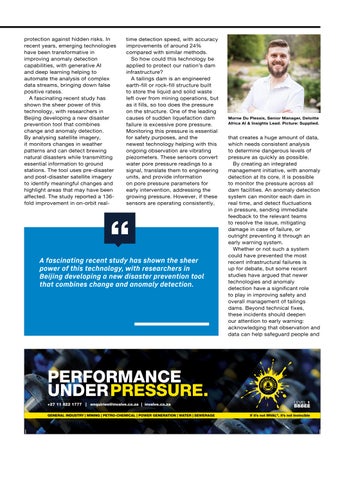
Silent Signals: Why Tailings Dams Need Smarter Anomaly Detection Investigations into historical collapses identified numerous anomalous factors that were the likely cause. Now, mining operators across the country have realised that uncovering anomalies, and predicting them, helps with damage mitigation and even overall prevention of infrastructural issues. By Morne Du Plessis
T
he recent tailings dam collapse in Brits has brought conversations around infrastructural maintenance to the fore, with official investigations into the cause likely to influence how we view structural monitoring going forward. On 13 August 2026, a tailings dam wall at Samancor's Dikwena chrome mine in the North West collapsed, releasing much of the waste and water stored inside. While there were thankfully no lives
28
lost, the slurry ultimately damaged mine infrastructure, the nearby railway and Eskom power lines, also blocking roads, polluting a nearby tributary and leading to widespread power outages. Probes into the cause of the collapse are still ongoing, but Samancor was quick to take full responsibility for the clean-up and working together with authorities on the investigation. However, it is important to note that other operators have also experienced the harsh impact of
MINING BUSINESS AFRICA | SEPTEMBER-OCTOBER ISSUE 2026
tailings dam failure. The Jagersfontein dam collapse in 2022 was caused by a structural failure, the resulting mudslide smothering nearly 200 nearby houses and approximately 1600 hectares of agricultural land, resulting in the loss of three lives.2 As far back as 1994, the Merriespruit partial tailings dam collapse ultimately destroyed the Free State suburb, killing 17 people and causing wide-scale damage. Investigations into historical collapses identified numerous anomalous factors that were the likely cause. Now, mining operators across the country have realised that uncovering anomalies, and predicting them, helps with damage mitigation and even overall prevention of infrastructural issues. The science of anomaly detection identifies rare, unexpected or unusual patterns in data, enabling earlier intervention and better
protection against hidden risks. In recent years, emerging technologies have been transformative in improving anomaly detection capabilities, with generative AI and deep learning helping to automate the analysis of complex data streams, bringing down false positive ratess. A fascinating recent study has shown the sheer power of this technology, with researchers in Beijing developing a new disaster prevention tool that combines change and anomaly detection. By analysing satellite imagery, it monitors changes in weather patterns and can detect brewing natural disasters while transmitting essential information to ground stations. The tool uses pre-disaster and post-disaster satellite imagery to identify meaningful changes and highlight areas that may have been affected. The study reported a 136fold improvement in on-orbit real-
time detection speed, with accuracy improvements of around 24% compared with similar methods. So how could this technology be applied to protect our nation’s dam infrastructure? A tailings dam is an engineered earth-fill or rock-fill structure built to store the liquid and solid waste left over from mining operations, but as it fills, so too does the pressure on the structure. One of the leading causes of sudden liquefaction dam failure is excessive pore pressure. Monitoring this pressure is essential for safety purposes, and the newest technology helping with this ongoing observation are vibrating piezometers. These sensors convert water pore pressure readings to a signal, translate them to engineering units, and provide information on pore pressure parameters for early intervention, addressing the growing pressure. However, if these sensors are operating consistently,
A fascinating recent study has shown the sheer power of this technology, with researchers in Beijing developing a new disaster prevention tool that combines change and anomaly detection.
Morne Du Plessis, Senior Manager, Deloitte Africa AI & Insights Lead. Picture: Supplied.
that creates a huge amount of data, which needs consistent analysis to determine dangerous levels of pressure as quickly as possible. By creating an integrated management initiative, with anomaly detection at its core, it is possible to monitor the pressure across all dam facilities. An anomaly detection system can monitor each dam in real time, and detect fluctuations in pressure, sending immediate feedback to the relevant teams to resolve the issue, mitigating damage in case of failure, or outright preventing it through an early warning system. Whether or not such a system could have prevented the most recent infrastructural failures is up for debate, but some recent studies have argued that newer technologies and anomaly detection have a significant role to play in improving safety and overall management of tailings dams. Beyond technical fixes, these incidents should deepen our attention to early warning: acknowledging that observation and data can help safeguard people and
PERFORMANCE UNDER PRESSURE. +27 11 822 1777 | enquiries@invalve.co.za | invalve.co.za GENERAL INDUSTRY | MINING | PETRO-CHEMICAL | POWER GENERATION | WATER | SEWERAGE
If it’s not INVAL®, it’s not Invincible
MINE HEALTH & SAFETY
Safety Risks for Africa’s Smallscale Miners A series of deadly incidents across Africa is raising three questions in three areas: safety in artisanal and small-scale mining, the regulation of abandoned mines, and what happens when mining operations come to an end. But who is responsible? By Thobile Mazibuko
C
urrently, employmentgenerating opportunities are limited across the continent. For thousands of people across Africa, artisanal and small-scale mining is a source of income. But the work can be so risky that many end up paying with their lives.
incidents has brought the risks into sharp focus. In August, at least 14 suspected illegal miners died after a mine dump collapsed near Rustenburg in South Africa’s North West province.
The miners were reportedly extracting platinum group metals from a mine dump. In the Central African Republic, more than 100 people were killed when an artisanal gold mine at Zamboye, near the border with Cameroon, collapsed in August. The site had reportedly been operating outside the legal framework, and the government subsequently ordered its closure. Then, in September, 37 suspected illegal miners died while in the custody of Nigeria’s civil defence corps in Niger State after being arrested during an operation targeting illegal mining. Authorities initially referred to a suspected disease outbreak, while investigations were launched into
A series of incidents In recent months, a series of
“This Bill seeks to address the challenges that South Africa is experiencing in relation to illicit mining in that, while illicit mining is prohibited, illicit mining and the activities related to illicit mining are not criminal offences.”
Picture: Pexels/@Neneqo Fotógrafo
There are many people in Africa who rely on small-scale mining for survival, but their health and safety is always compromised.
30
MINING BUSINESS AFRICA | SEPTEMBER-OCTOBER ISSUE 2026
the circumstances surrounding the deaths. Granted, the incidents may be different. However, they highlight a broader issue: safety in Africa’s informal mining economy cannot be separated from how governments regulate mining, how abandoned sites are managed, and how communities find livelihoods after formal operations end.
The mine may close, but the risk remains One issue running through many of the above-mentioned tragedies, and many others, is the risk posed by the condition of old, abandoned or closed mining areas. For instance, when a formal operation shuts down, the end of production does not necessarily mean the end of its impact on surrounding communities. Open workings, waste dumps, shafts and other infrastructure can remain long after the mining company has left.
Who is accountable? So, in that case, this raises the question of accountability: Who is responsible for making those areas safe? Someone has to be.
i. The mining company Naturally, the primary focus is on the mining company. Marietjie Reynecke, Discipline Lead: Closure at WSP in Africa, says that, for mining companies, one of the biggest risks is allowing short-term operational and financial pressures to influence decisions that ultimately increase the liability associated with mine closure. “Closure works better when it is treated as part of the lifecycle of the mine rather than something that becomes urgent near the end. This requires more than calculating a closure liability and keeping a plan up to date for regulatory purposes. Mines also need to consider what happens to the surrounding economy, infrastructure, land, and communities as production declines.” Of particular relevance to the issue of illegal mining is what happens to the surrounding economy, particularly to the people
living around a mine once the jobs disappear and the infrastructure is no longer maintained.
ii. Government “Closure cannot rest with the mining company alone. Government has a role in regional development, while communities will live with the outcome long after mining ends. Development partners and investors may also be needed to support economic activity that cannot be funded indefinitely by the mine. “That means engagement has to go further than presenting a completed plan to community representatives and asking for comment. People need a genuine opportunity to help shape what comes next.”
iii. Community involvement “Community involvement will not remove every competing expectation, but it can make those expectations easier to manage when people understand the longer-term direction and have had a role in shaping it,” says Reynecke. What are countries across the continent doing about illegal mining?
Criminalising illegal mining: a South African Case Study Among countries across the continent, South Africa is taking a bold step. The country is looking to strengthen its legal response to illicit mining. In August 2026, Justice and Constitutional Development Minister Mmamoloko Kubayi outlined the General Mining Laws Amendment Bill, which seeks to criminalise illicit mining and related activities. The proposed amendments cover the Criminal Procedure Act, the Diamonds Act, the Mineral and Petroleum Resources Development Act and the Precious Metals Act. The government has proposed significantly tougher penalties for certain offences under the Diamonds Act, including increasing the maximum fine from R250,000 to R100 million and the maximum prison term from 10 years to 30 years. “This Bill seeks to address the challenges that South Africa is
experiencing in relation to illicit mining in that, while illicit mining is prohibited, illicit mining and the activities related to illicit mining are not criminal offences.” Kubayi explained that the proposed amendments affect several pieces of legislation, including: The Criminal Procedure Act of 1977;
The Diamonds Act of 1986; The Mineral and Petroleum Resources Development Act of 2002; and The Precious Metals Act of 2005. “What the CPA does in a nutshell, or the amendment there, it criminalises now illicit or illegal mining, which previously was not a criminal offence. And then the Diamonds Act amendments that are there are increasing penalties. You’ll note there, we are moving from a fine of R250,000 to a fine of R100 million and also moving from 10 years of imprisonment to 30 years of imprisonment in terms of the amendment of Section 82(a) and (b),” said Kubayi.
Strict enforcement only part of the solution Strict enforcement may address part of the problem, particularly where organised criminal networks are involved. But the deaths in abandoned and informal mining operations suggest that enforcement addresses only one part of a much bigger challenge. The sober reality is that, as long as abandoned sites remain accessible, mine closure leaves communities without viable alternatives, and people continue depending on informal mineral extraction for income, the safety problem in artisanal mining activities will persist.
Onus is on mining companies and government At the end of the day, the onus is on mining companies and government. They have a responsibility to ensure that closed mines are made safe, communities have a stake in what happens after closure, and people who depend on mining have safer and legal ways to earn a living.
SMART INNOVATIONS IN MINE HEALTH & SAFETY
Giving workers a safer way to breathe, talk and work Dromex’s award-winning Respiratory Voice Amplification Device tackles a simple but serious problem: workers removing their masks to communicate in hazardous environments. By Thobile Mazibuko
F
rom September 7-11, thousands of industry professionals gathered at the Nasrec Expo Centre in Johannesburg for Electra Mining Africa 2026, where manufacturers, engineers, experts and innovators showcased technologies designed to address some of the challenges facing industry. Among the companies recognised for turning an everyday workplace challenge into a practical safety solution was Dromex, which received an award in the Innovation – Local – Health and Safety category for its Respiratory Voice Amplification Device. The device was developed to address a problem that may appear simple, but can have serious consequences in environments where respiratory protection is mandatory, especially how workers communicate while wearing a respirator. For Reggie Naicken, Dromex’s respiratory specialist and the inventor behind the voice amplification device, the idea came from years of seeing the same problem play out across hazardous workplaces.
32
Naicken has more than 30 years of experience working across industries in South Africa and the Southern African Development Community, including mining, manufacturing, construction, transportation and healthcare. During that time, he says, respiratory protection has remained an area where workers continue to face daily challenges. “The workforce in a hazardous environment must be protected by wearing respiratory protection to breathe clean air. However, most of the time, breathing clean air while in a ‘respirator zone’ is compromised
because of muffled and degraded speech. To overcome this challenge, people will remove their respirator to communicate with others on the shop floor,” says Naicken. “When you also consider the noisy environment, where people may be wearing earplugs and earmuffs, it creates another barrier to communication. Sometimes people remove their hearing protection simply to hear the information or message. Removing the respirator or hearing protection just to understand someone is a non-compliant practice,” Naicken adds.
Every operation has its own filling systems, handling methods, transport conditions and product characteristics," explains Richard Green.
MINING BUSINESS AFRICA | SEPTEMBER-OCTOBER ISSUE 2026
This communication gap is very concerning in mining and other highrisk environments, where workers may be exposed to dust, fumes, gases, mists and other hazardous substances. The consequences of repeatedly removing respiratory protection may not necessarily be felt immediately. However, occupational exposure can accumulate over years, with respiratory illnesses and other health effects sometimes becoming more apparent later in life. For the mining industry, where respiratory hazards remain a significant occupational health concern, ensuring that workers consistently use the correct respiratory protection is important because it ensures their long-term health and quality of life. Naicken says workers can spend decades exposed to hazardous substances, with the effects potentially emerging when they are approaching retirement. “The negative impact of removing the mask to talk or communicate on the shop floor can have serious long-term health effects through prolonged exposure to dangerous and toxic chemicals, dusts, mists and gases. These exposures can accumulate over a person’s working lifetime and the diseases and health effects are often felt as the person approaches retirement.” “The result can be a poor quality of life, severe illness and constant visits to hospitals and clinics. In younger people with underlying conditions, the impact can occur much earlier, resulting in loss of income and, in severe cases, even death due to occupational exposure diseases.” The problem is not just that workers cannot hear each other clearly. Every time a respirator is removed inside a hazardous area, the protection it is intended to provide is interrupted. Naicken uses the example of an employee wearing an FFP3 mask, where the person should achieve a protection factor of 20 when the mask remains properly worn during a 60-minute task in a respirator zone. If that mask is repeatedly removed to communicate, the level of protection is reduced because of
intermittent exposure. According to him, if the mask is removed for a total of 30 minutes during that hour, the protection factor could fall to approximately eight. For Dromex, closing that communication gap became the motivation behind the device. The Respiratory Voice Amplification Device allows workers to communicate clearly without having to remove their respirator. Its benefits is not only about making speech easier to hear. By allowing workers to breathe, talk and work while maintaining respiratory protection, the device is intended to support safer behaviour on the shop floor. “Clear, audible communication on the shop floor is absolutely essential, including when using two-way radio communication. This gap is a challenge affecting everyone who has to wear a respirator to breathe clean air. “It is a daily challenge and a pain point experienced by the mass workforce. It was painful to watch the non-compliance on the shop floor, and that drove me to design and develop a solution. The DromexVoice Amplifier was developed to close that gap so that people can communicate without compromising their health and safety,” says Naicken. The development of the technology was not an overnight process. Dromex says it took two years and approximately 4,000 hours to move from the initial idea to an acceptable pre-production prototype. The company also pursued intellectual property protection, with its South African patent application filed in 2018 and granted in 2019 under patent number ZA201802564. Before Electra Mining Africa, the technology was presented and demonstrated to customers and stakeholders across several industries, including mining, automotive original equipment manufacturers, smelters, forestry, aviation authorities, food manufacturing and ports and bulk terminals. According to Dromex, the response they received reinforced the need for a practical solution to respiratory communication. For a workforce operating in hazardous conditions, that need is
important. Respiratory protection only works when it is worn correctly and consistently. A worker should not have to choose between being able to communicate with a colleague and protecting their lungs from harmful contaminants. That is where the broader value of the innovation lies. Mining remains an industry where workers can be exposed to substances that affect respiratory health over the course of their careers. Protecting workers from that exposure is not only about getting them safely through a shift. It is also about helping them maintain their health long after they leave the mine. Naicken says this is ultimately what Dromex hopes the technology will achieve. “The benefits are about allowing workers to breathe, talk and work safely, with zero need to remove their respiratory protection. It supports clear and audible communication, health and safety compliance and the long-term health and wellness of the workforce. “Reducing exposure to toxic contaminants allows the lungs to recover, reduces fatigue and can improve concentration and quality of life. For the employer, it can mean less downtime from illness, improved quality and efficiency, and greater confidence in the respiratory protection being provided to the workforce. Ultimately, it is about sending workers back home safely to their families.” As a proudly South African company, Dromex says innovation remains central to its approach to personal protective equipment, from head to toe. The recognition at Electra Mining Africa 2026 places its Respiratory Voice Amplification Device among the innovations being developed locally to address real workplace challenges. However, Naicken says the significance of the award goes beyond recognition. The real measure of the technology will be whether it can help workers keep their respiratory protection on, communicate clearly and return home at the end of the day without having compromised their health simply because they needed to speak.
MINING BUSINESS AFRICA | SEPTEMBER-OCTOBER ISSUE 2026
33
SMART INNOVATIONS FOR SAFETY & EFFICIENCY
Turning Bottlenecks into Opportunities the Smart Way Minimising the risk of vehicle-to-vehicle collisions, cutting fuel losses and improving maintenance offer just a glimpse of the value that smart innovations can bring to African mining operations. obligatory. This is meant to mitigate the risks mineworkers face daily in line of duty in their respective operations. One of the high-risk areas is the risk of mobile equipment and vehicle collisions. Recognising this, the Earth Moving Equipment Safety Round Table (EMESRT) framework calls for the adoption of Level 9, the highest level of collision prevention within its nine-layer vehicle-interaction defence model. Level 9 CPS (Collision Prevention Systems) solutions can automatically intervene when a dangerous situation is detected in the event that the operator fails to react. Operators also face the risk of fatigue, which can result in loss of control of a vehicle and hitting an object.
ii. Increasing operating costs (mainly fuel)
A
lot has been made about the high demand for so-called critical mineral resources that are key in the renewable transition and the record-high prices for gold. These resources are found in significant quantities in several regions across the African continent, and there are huge economic gains to be made from them if they are properly explored and developed.
Overlooked bottlenecks What is sometimes overlooked in the conversation is that standing between mining companies and potential high revenues from their resources are bottlenecks of compliance (which relates to safety) and increasing operating costs (which also contribute to thin margins) in this context. This is not necessarily in order of severity. Understanding the nature of these bottlenecks that mines face first makes one appreciate the value that digitisation and automation of critical processes can bring.
34
i. Safety compliance (operator safety) Compliance with regulations relating to health and safety at the workplace (Occupational Health and Safety Act) and, specific to mining, the Mine Health and Safety Act (MHSA), is
MINING BUSINESS AFRICA | SEPTEMBER-OCTOBER ISSUE 2026
Fuel, diesel in particular, is one of the biggest expenses in mining operations. Brent crude is currently trading above US$100 a barrel (as this edition was heading to press). This has become an extra cost burden. Against this backdrop, the last thing mines need is to face the following challenges: fuel loss through welldocumented illicit worker behaviour such as siphoning, refuelling fraud through unauthorised refilling, adulteration, amongst others. Yet another PwC review mentions this as a liability in fleet management in an article titled Unlocking Value Through Resilient Mobility and Energy Systems, published on 4 August 2026. So, it makes business sense to seek sustainable ways of reducing the cost. But how? As you would expect, increasing operating expenses, of which energy – fuel especially – is a major component, can squeeze profit margins. Besides implementing cost-containment measures, mining companies need to increase or sustain their current level of productivity. Productivity can be increased by reducing downtime of critical
machinery. There are tools that mines can use to help with predictive maintenance. The trick lies in finding a way of turning those bottlenecks into opportunities. Not an easy task by any stretch of the imagination, given the many factors at play.
Opportunities in Industry 4.0 There may be many different methods available to mining operators to manage these challenges. However, there is no question that one of the more effective ways is the utilisation of opportunities in Industry 4.0 solutions that enable automation and/or digitisation. This is highlighted in a report titled Ten insights into 4IR in South African Mining 2026, published on 23 July 2026 by PwC South Africa in collaboration with the Minerals Council South Africa. It must be stated that while the PwC report focuses on South African mining, many of the issues it highlights are relevant to mining operations
elsewhere in Africa. The report touches on specific areas where 4IR, specifically AI and digital technologies, can make a significant difference in addressing operational constraints.
Exploring AI and digital technologies Conveniently, mining companies can explore AI and digital technologies in areas as collision avoidance and proximity detection, fuel monitoring and predictive maintenance.
a. Collision Avoidance Systems (CAS) and Proximity Detection There is growing availability of collision avoidance systems (CAS) and proximity detection systems (PDS) for fleet management in mining operations across the continent. Examples of suppliers offering these technologies to the mining sector include Probe IMT, Trysome, Becker Mining and Boyco Electronics. CAS systems that are fitted to mine vehicles can alert operators about
the risk of vehicle-to-vehicle and vehicle-to-object collisions. Fatiguemonitoring systems notify the operator when their level of fatigue may increase the risk of an accident. Providers report that their clients have experienced reductions in vehicle-to-vehicle and vehicle-toobject incidents involving operators.
b. Fuel consumption monitoring In a typical African mining operation, the sequence from fuel delivery to consumption (usage) is: fuel delivery, storage, dispensing, machine consumption and production. The challenge is that these steps are disparate in a conventional fuel management system. This is where a digital fuel-monitoring system becomes handy. Depending on the system, it can connect these stages and provide information such as: fuel received into the mine, tank levels, fuel dispensed, consumption by machine, consumption by shift, consumption against operating hours, abnormal consumption, unauthorised
MINING BUSINESS AFRICA | SEPTEMBER-OCTOBER ISSUE 2026
35
ADVERTISER’S INDEX
Advertiser’s Index Renergen PG3 Air Charter Service
Invincible Valves (Pty) Ltd)
PG 9
PG 29
Wear Check Pty Ltd
PG 36
Zizwe Mining –
PG 23
Glencore Technology
Front Cover
Vodacom Group Limited
PG IFC-1
Gold Reef Speciality Chemicals
PG 10-11
Vac-cent Service Pty Ltd
PG 17
Verni Speciality Construction Products
PG 13
Africa Energy Week
Back Cover
Minetec
PG 35
Resources 4 Africa
INSIDE BACK COVER
Artboard 1.pdf 1 2026/07/09 14:11:06
WEARCHECK ...where analytical precision is an art form
dispensing, possible fuel theft, fuel losses, low-tank alerts, and machine utilisation versus fuel consumption. The data can also provide indications of issues relating to engine condition, operator behaviour, tyre condition, hydraulicsystem performance, machine loading, route conditions and maintenance requirements.
c. Predictive maintenance for equipment availability AI and digital technologies are helping mines move from reactive maintenance practices to proactive maintenance using realtime data gathered from sensors installed in equipment such as crushers, pumps and engines. The data is analysed to provide information about equipment condition and potential problems, helping inform decisions on actions that can be taken to address them. The data covers several aspects such as vibration, temperature, oil quality and component wear. And the gains are immense: by anticipating equipment problems and enabling predictive maintenance, unplanned downtime is reduced. When equipment is available and reliable, mines are able to meet production targets. This translates into revenue on the balance sheet.
From bottlenecks to better performance This is just a glimpse of how Industry 4.0 offers mines practical tools to address vehicle collision-related safety risks, control fuel costs and improve equipment availability. But, evidently, AI and digital technologies can help mine operators use persistent bottlenecks to better performance.
Mining runs on precision and the pursuit of productivity Every minute of downtime can have significant financial consequences, which is why proactive maintenance is crucial in this high-stakes environment. WearCheck’s advanced oil, fuel, and coolant analysis enables you to identify hidden issues before they escalate. By detecting early signs of wear, mechanical stress or contamination, we help you reduce maintenance costs, extend equipment life, and minimise costly delays. Partner with us today — and keep your operation running smoothly.
M
Y
Less downtime. More production.
Y
*Presence in multiple countries
Head Office (South Africa) www.wearcheck.co.za + 27 31 700 5460
Testing and Analysis | Lubricant-Enabled Reliability | Asset Reliability Care 36
MINING BUSINESS AFRICA | JANUARY - FEBRUARY ISSUE 2026
LEAD SPONSORS
7 - 8 OCTOBER 2026 www.joburgindaba.com THE INANDA CLUB, FORREST ROAD, INANDA, JOHANNESBURG
For sponsorship opportunities please contact us on: sponsorship@resources4africa.com
REGISTER TODAY! +27 (0) 11 463 7799 // +27 (0) 78 292 7595// registrations@resources4africa.com // www.joburgindaba.com