up
F E B R U A RY 2 0 2 1
da Ma te rke on ts pa ge
AUTOMATED MILKING SYSTEMS Are they a fit on your farm and in your life?
+
Coverage of Dairy Farmers of Ontario’s first virtual annual general meeting
Publications Mail Sales Agreement No. 40063866
22
SPECIAL OFFER!
Free software license
Why UNIFORM? 4 Free mobile App 4 Local support team 4 Dairy-Trace ready 4 ProAction certified 4 Connects to any on-farm system
Interested to learn more?
Give us a call at 1-866-807-6111 or send an email to Matt Delisle at m.delisle@uniform-agri.com *Limited time only
Vol. 97 No. 2
CONTENTS
PUBLISHED BY DAIRY FARMERS OF ONTARIO 6780 Campobello Rd., Mississauga, Ont., L5N 2L8 EDITOR Jennifer Nevans jennifer.nevans@milk.org
Editorial Editor’s Notes
4
ADVERTISING REPRESENTATIVE Pat Logan pat.logan@milk.org 519-788-1559 CONTRIBUTOR Allison Williams allison.williams@milk.org
Co-ordinated by Dairy Farmers of Ontario’s communications division, Sharon Laidlaw, Manager, Corporate Communications. Subscription rates: $26.88 for one year, $49.28 for two years and $67.20 for three years in Canada (includes HST), $36 per year in the U.S., $36 per year overseas. Single copy: $2.50. Make cheques payable to Dairy Farmers of Ontario. Canada Post Publications Mail Sales Product Agreement No.40063866. Return postage guaranteed. Circulation: 9,500. ISSN 0030-3038. Printed in Canada. SUBSCRIPTIONS IN ONTARIO Change of address notices should be sent to: MILK PRODUCER 6780 Campobello Road, Mississauga, Ontario L5N 2L8 Phone: (905) 821-8970 Fax: (905) 821-3160 Email: milkproducer@milk.org MAILING ADDRESS CHANGES FROM OTHER PROVINCES Contact your respective provincial marketing board directly.
Dairy Research Dairy News
Applied Science
34
UBC Research
38
Ruminations
39
Independent validations
6
Coverage of DFO’s AGM
10
Food bank donation
14
New N Noted
Processor Profile
16
Featured products
Biogas conference
18
DFC Highlights
20
Markets Market demand
44
24
22
Opinions expressed herein are those of the author and/or managing editor and do not necessarily reflect the opinion or policies of Dairy Farmers of Ontario. Publication of advertisements does not constitute endorsement or approval by Milk Producer or Dairy Farmers of Ontario of products or services advertised.
Milk Producer welcomes letters to the editor about magazine content. Websites: www.milkproducer.ca www.milk.org Facebook: /OntarioDairy Twitter: @OntarioDairy Instagram: @ontariodairy
WWW.MILKPRODUCER.CA
Farm Management Timing Matters
28
Mental Health
30
Calf Care Corner
32 MILKPRODUCER | FEBRUARY 2021
3
[
EDITORIAL
STAY CONNECTED—FOR YOUR OWN MENTAL HEALTH AND THE HEALTH OF OTHERS By Jennifer Nevans
EDITOR
L
ast month, people from around the world came together to take part in the biggest conversation around mental health. Now in its 11th year, the Bell Let’s Talk campaign aims to promote mental health education, research and awareness and end the stigma of mental illness. For every applicable text, call, tweet or TikTok video using the hashtag #BellLetsTalk, as well as for every view of the Bell Let’s Talk social media video and for every Facebook or Snapchat video made using the campaign filter, Bell donated five cents to mental health initiatives across Canada. A recent poll conducted by the Angus Reid Institute found that with lockdowns, isolation and social distancing, 50 per cent of Canadians reported worsening mental health since the pandemic began. That’s why it’s important now more than ever to stay connected—for your own mental health and the health of others.
Before the pandemic, about 45 per cent of farmers reported experiencing high stress, according to a national survey of farmer mental health led by Dr. Andria Jones-Bitton from the University of Guelph. Mental health organizations, advocacy groups and the government have recognized there’s a growing concern about mental health in the agriculture industry—even before the virus. Rates of stress, anxiety and suicide are much higher among people who work in this industry compared with the general population.In fact, farmers are 68 per cent more susceptible than the general public to experience chronic stress, which can lead to physical and mental illnesses. Farm Credit Canada’s Rooted in Strength: Taking Care of Our Families and Ourselves lists 14 common stressors on the farm, including finances, workload, volatile markets, machinery breakdowns, livestock well-being and uncertain crop yields, among others. Which of these stressors can you resonate with? According to the Canadian Mental Health Association, the pressures that come with this work often mean producers are putting their farm ahead of their own well-being. The good news is with initiatives like Bell Let’s
Talk, conversations around mental health have heightened in recent years as more people step into the spotlight to share their stories. Last summer, Ontario dairy farmer Courtney Denard shared her struggles with mental health in a June 2020 cover story for the magazine. While the pandemic has added to her stress, mental illness was an issue she struggled with her entire life. The Ontario farmer found relief in advocacy work and speaking about mental health on social media and through the Bell Let’s Talk initiative. “Count your blessings, recognize your emotions, reach out to people when you need to, especially if you are in crisis,” Denard says. “We need to keep the conversation going.” To assist dairy farmers and encourage conversations around mental health, Dairy Farmers of Ontario (DFO) compiles a list of mental health resources producers can access at milk.org/mentalhealth/. The web page includes mental health news, events, resources and help lines. It’s not an exhaustive list of resources, but it’s a start if you’re looking for support. If you haven’t already, DFO encourages you to visit the web page and share the link with family and friends.
We can still be there for each other Even if we have to be apart Make sure your well-being is a priority and talk to somebody if you or someone you know needs help. Agriculture is rooted in strength − the strength to take care of our families and ourselves.
Visit domore.ag #RootedInStrength
4
FEBRUARY 2021 | MILKPRODUCER
WWW.MILKPRODUCER.CA
STIMULATION
TEAT CLEANING
FORESTRIPPING
MILKING
POSTDIPPING
One and done teat cup attachment GEA‘s proven In-Liner EverythingTM technology performs every step of the milking process in a single attachment.
GEA_In-LinerEverything_MilkProd_2021
This uniform, quick and comfortable process, all occurring within the teat cup, is key to harvesting excellent quality milk while maximizing the efficiency of your robotic milking facility. Each step of the In-Liner Everything process is designed to: Besure cows receive the best possible milk let down process
Protect udder health
Deliver a fast, gentle, complete milk-out
Harvest quality milk and deliver it quickly to the milk tank
BRITISH COLUMBIA
ALBERTA
ONTARIO
Pacific Dairy Centre Ltd. Chilliwack — 604 852-9020
Lethbridge Dairy Mart Ltd. Lethbridge — 888 329-6202 Red Deer — 403-406-7344
Conestogo Agri Systems Inc. Alma — 519 638-3022
Performance Dairy Centre Inc. Embro — 519 423-9119
Dairy Lane Systems Ltd. Komoka — 519 666-1404
Wood’s Dairy Source Keene — 705 295-3247
Lawrence’s Dairy Supply Inc. Moose Creek — 613 538-2559
NOVA-SCOTIA
ALBERTA
Kneller’s Sales & Services Ltd. Leduc — 780 986-5600
SASKATCHEWAN
Dairyland Agro Supply Ltd. Saskatoon – 306 242-5850 Regina – 306 721-6844
McCann Farm Automation Ltd. Seeley’s Bay — 613 382-7411
Sheehy Entreprises Ltd. Shubenacadie — 902 758-2002
DAIRY NEWS
[
LACTANET CANADA TO PERFORM PROACTION INDEPENDENT VALIDATIONS STARTING JUNE 2021
D
airy Farmers of Ontario (DFO) has selected Lactanet as the service provider to perform independent proAction validations, after undergoing a request for proposal (RFP) process last year. Lactanet’s experience working with onfarm programs, its competitive bid and its understanding of the realities of dairy farming were some of the factors that went into this decision. In December 2019, DFO’s board announced it was beginning the process of moving toward using independent validators for proAction to further strengthen the program’s credibility with consumers and enable field services representatives (FSRs) to focus on the provincial Raw Milk Quality Program (RMQP). Over the last year, DFO sought feedback from dairy producer committees (DPCs) on the selection criteria for the service provider, as well as elements of the program’s delivery. Throughout the summer, DPCs were updated on the process for the RFP. DFO has now entered into a contract with Lactanet to carry out the work over the next
four years, starting on June 1, 2021. Lactanet will be responsible for activities related to program verification, such as scheduling, conducting and approving proAction validations, among others. DFO will remain responsible for activities related to producer support, such as providing notices and reminders, as well as the penalty application and appeal processes. This change in the delivery of proAction demonstrates an increased transparency to consumers and mitigates criticisms of having self-regulated practices. Producers can direct any questions they have about this process to their FSRs.
FREQUENTLY ASKED QUESTIONS Q: How will it affect my farm? A: Once implemented, you will continue to have your FSR conduct Grade A inspections and be your first point of contact. You will have an independent proAction validator conduct your proAction validation on-farm. Veterinarians will continue to be trainers. From
an on-farm standpoint, the program will remain the same other than who conducts the validations. Q: What will FSRs be doing now? A: FSRs will focus on the RMQP. FSRs are producers’ first point of contact for producer needs. Q: How will this affect Grade A inspections? A: Grade A status will continue to be a prerequisite to proAction. However, inspections will no longer be scheduled with the proAction validation, and they will be unannounced. If your farm’s status is Grade A, your validation will proceed. However, if your farm’s status is conditional Grade A or non-Grade A, your validation will not be conducted or approved until the farm’s status returns to Grade A.
PRODUCERS HAVE UNTIL MARCH 31 TO REGISTER FOR DDPP
C
anadian dairy producers will have until March 31, 2021, to register for the Dairy Direct Payment Program (DDPP). Eligible producers should have received a letter from Agriculture and Agri-Food Canada in mid-January, which includes a special code and details on how they can register for the program, either online or using a paper form. In November 2020, the federal government announced an updated timeline regarding trade compensation for the dairy industry and market access concessions made under the Canada-European Union Comprehensive Economic and Trade Agreement (CETA) and the Comprehensive and Progressive Agreement for Trans-Pacific Partnership (CPTPP). It set a schedule to deliver the remaining $1.405 billion through direct payments to farmers over an accelerated three-year time-
6
FEBRUARY 2021 | MILKPRODUCER
line: $468 million in 2020-21, $469 million in 2021-22 and $468 million 2022-23. The Canadian Dairy Commission (CDC), in collaboration with provincial milk boards, is getting ready to administer payments to producers. Producers eligible for the payment in 2021 are those who held quota on Oct. 31,
2020. Registered Ontario producers are eligible for $447.05 per kilogram based on their October 2020 quota. For more information on the DDPP, visit https://bit.ly/3sWh8JV, email info.direct.p@ cdc-ccl.gc.ca or call 1-877-246-4682 (TTY: 613-773-2600).
SUMMARY OF DAIRY DIRECT PAYMENT PROGRAM • The Canadian Dairy Commission (CDC) will accept registrations until March 31, 2021, which is the end of the government fiscal year; • Registered Ontario producers are eligible for $447.05 per kilogram based on their October 2020 quota; • Eligible producers must register every year of the program to receive a payment; • Eligible producers should have received a mailed letter from Agriculture and Agri-Food Canada in mid-January that contains a special code and details on how to register; • Once producers receive the letter, they will need to register either online or using a paper form. In both cases, producers will need the codes indicated in their letter. Producers should keep the letter in case they need to contact the CDC concerning their program registration at a later date.
■
Inspired
White
by
results
2020 AT A GLANCE • 70,000 herd tests conducted • 5 Million+ milk samples analyzed • 92,000+ GestaLab samples collected for pregnancy confirmation • 23,500+ Mastitis4 samples tested • 24% of customers subscribed to our Mobile DHI app • 100,000+ electronic registrations submitted • Launched DairyTrace for traceability
OTHER DHI ONTARIO & WEST HERD STATISTICS • 50% of DHI cows are managed with DairyComp • 21% of herds enrolled with MUN • 41% of herds tested for Ketosis
THANK YOU TO THE 8,000+ CANADIAN DAIRY FARMERS THAT WE SERVE!
■
C90 M0 Y25 K0
We’re here to help. Find out more at lactanet.ca.
DAIRY NEWS
DFO LAUNCHES MILK MANAGEMENT SYSTEM WITH NEW INDUSTRY LOGIN PAGE
D
airy Farmers of Ontario (DFO) has launched the second phase of its website redesign—an updated industry website, which includes a comprehensive Milk Management System (MMS) for producers, processors, transporters and DFO staff. The new platform, which launched in early February 2021, is a web-based system that uses modern software to integrate all aspects of the milk marketing supply chain, including milk collection, billing, payment, quota exchange and invoicing. It offers more flexibility to help producers effectively access their information online. MMS replaces DFO’s current IT system, including the industry website, login page and producer dashboard. “When you log in to the system, you will still see the important information you have al-
ways had access to, such as test results and milk statements, but it will have a brand new look and feel,” says Murray Sherk, DFO’s board chair in a letter to all producers earlier this year. “We want to reassure you the functionality you have come to depend on will remain in the new MMS, and the platform has been improved to support future growth.” The letter also detailed how producers can pre-register for MMS to ensure continued access to DFO’s online systems. For those who do not have access to the Internet, DFO hosted a telephone town hall meeting to allow DFO staff to explain the login process and features of the new platform. Those who require assistance with MMS can call the support centre at 1-866-517-2326 or email mmssupport@milk.org.
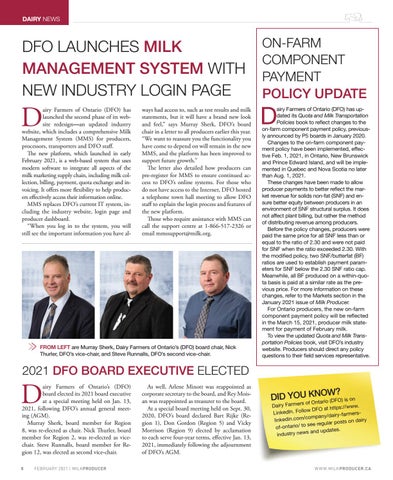
FROM LEFT are Murray Sherk, Dairy Farmers of Ontario’s (DFO) board chair, Nick Thurler, DFO’s vice-chair, and Steve Runnalls, DFO’s second vice-chair.
ON-FARM COMPONENT PAYMENT POLICY UPDATE
D
airy Farmers of Ontario (DFO) has updated its Quota and Milk Transportation Policies book to reflect changes to the on-farm component payment policy, previously announced by P5 boards in January 2020. Changes to the on-farm component payment policy have been implemented, effective Feb. 1, 2021, in Ontario, New Brunswick and Prince Edward Island, and will be implemented in Quebec and Nova Scotia no later than Aug. 1, 2021. These changes have been made to allow producer payments to better reflect the market revenue for solids non-fat (SNF) and ensure better equity between producers in an environment of SNF structural surplus. It does not affect plant billing, but rather the method of distributing revenue among producers. Before the policy changes, producers were paid the same price for all SNF less than or equal to the ratio of 2.30 and were not paid for SNF when the ratio exceeded 2.30. With the modified policy, two SNF/butterfat (BF) ratios are used to establish payment parameters for SNF below the 2.30 SNF ratio cap. Meanwhile, all BF produced on a within-quota basis is paid at a similar rate as the previous price. For more information on these changes, refer to the Markets section in the January 2021 issue of Milk Producer. For Ontario producers, the new on-farm component payment policy will be reflected in the March 15, 2021, producer milk statement for payment of February milk. To view the updated Quota and Milk Transportation Policies book, visit DFO’s industry website. Producers should direct any policy questions to their field services representative.
2021 DFO BOARD EXECUTIVE ELECTED
D
airy Farmers of Ontario’s (DFO) board elected its 2021 board executive at a special meeting held on Jan. 13, 2021, following DFO’s annual general meeting (AGM). Murray Sherk, board member for Region 8, was re-elected as chair. Nick Thurler, board member for Region 2, was re-elected as vicechair. Steve Runnalls, board member for Region 12, was elected as second vice-chair.
8
FEBRUARY 2021 | MILKPRODUCER
As well, Arlene Minott was reappointed as corporate secretary to the board, and Rey Moisan was reappointed as treasurer to the board. At a special board meeting held on Sept. 30, 2020, DFO’s board declared Bart Rijke (Region 1), Don Gordon (Region 5) and Vicky Morrison (Region 9) elected by acclamation to each serve four-year terms, effective Jan. 13, 2021, immediately following the adjournment of DFO’s AGM.
OW? DID YOUofKON on ntario (DFO) is
s Dairy Farmer tps://www. llow DFO at ht Fo . In ed nk Li -farmersompany/dairy linkedin.com/c sts on dairy po see regular to / io ar nt -o of and updates. industry news
W W W.MILK PRODUCER.CA
Protect Your Milk and Your Profits
Choose a Paul Mueller Company milk tower
Cleaner, Easier
The tower’s inner tank incorporates Mueller® Temp-Plate® heat transfer surface to remove more heat from milk in the same amoun of time when compared to other silos
With a clean-in-place system and modular outlet valve assembly, Paul Mueller Company’s Model “OH” milk cooler lets you leave the cleaning to us.
Ultimate product protection enables you to deliver the highes quality milk possible
Milk Tower
Model “OH” Milk Cooler BUCHANAN & HALL Stratford, ON 519-271-4793
LAWRENCE’S DAIRY SUPPLY Moose Creek, ON 613-538-2559
PERFORMANCE DAIRY CENTRE
DAIRY LANE SYSTEMS Komoka, ON 519-666-1404
MCCANN FARM AUTOMATION Seeleys Bay 613-382-7411
WOOD’S DAIRY SOURCE
DUNDAS AGRI SYSTEMS Brinston, ON 613-652-4844
NORWELL DAIRY SYSTEMS
1-800-MUELLER | PAULMUELLER.COM
1-800-MUELLER | PAULMUELLER.COM
Drayton, Woodstock, Lindsay, Brinston 519-638-3535
Embro, ON 519-423-9119
Keene, ON 705-295-3247
DAIRY NEWS
ARRELL FOOD INSTITUTE EXPERT SHARES INSIGHT INTO FUTURE OF CANADA’S FOOD SYSTEM By Jennifer Nevans
EDITOR
T
urning challenges into opportunities was a key theme during Dairy Farmers of Ontario’s (DFO) virtual annual general meeting—a concept Dr. Evan Fraser weaved throughout his presentation as the keynote speaker on Jan. 13, 2021. Fraser, who is the director of the Arrell Food Institute (AFI) at the University of Guelph, provided more than 600 dairy producers, industry partners and guests with insight into some of the challenges the industry will face in 2021 and beyond. He also shared how the industry can turn those challenges into opportunities. From dairy concessions as a result of trade agreements to regulatory changes to supply chain disruptions caused by the pandemic, Fraser says the dairy sector will face several hurdles, but one notable challenge is the change in consumer preference and buying habits. “I’m seeing evidence published in the last 10 months that suggest, at the global level, demand for meat and dairy may not be rising as fast as we expected,” he says, adding the global population is also not rising as fast as expected and will likely decline after 2050 to a level that is lower than today. He says about 70 per cent of the world population is reportedly either reducing meat consumption or leaving meat off the table entirely—and millennials are driving the worldwide shift away from meat. These changes are supported by some dietitians and other professionals and are also reflected in the new Canada’s Food Guide. Couple this with the fact there are new products coming to market, such as bioengineered
or lab-made dairy products, that will compete against traditional livestock products at the grocery store, the dairy sector will face increased competition. “We all have to be prepared for the very real possibility that a company focused on using cellular agriculture to produce dairy proteins will be competing for space in the grocery aisles,” he says. “We have to recognize the fact that at the global scale, we may be approaching peak livestock consumption due to a lower and older population, changing consumer demands and new protein products.” However, where there are challenges, there’s opportunities, he says. AFI and the Canadian Agri-Food Policy Institute (CAPI) took part in a Growing Stronger project that studied how the food system performed during the pandemic. They learned the food system bent but didn’t break—though it came close to breaking a couple of times, especially during the onset of the pandemic, Fraser says. They also learned most of the issues related to the food system, such as labour shortages or food insecurity, were known by the industry for many years, but were publicly brought to light because of COVID-19. AFI and CAPI discovered consumers believe the agri-food industry can and should be a cornerstone of the economy, providing an opportunity for the industry to play a leadership role. In the post-COVID-19 plan, he says the industry should focus on three priorities—shortening the supply chain to make sourcing materials and food easier, embracing innovation and technology and adopting the notion of sustainability as the core identity of the dairy industry. “I really do believe changing demographics, new consumer preferences and alternative pro-
At the global scale, we may be approaching peak livestock consumption due to a lower and older population, changing consumer demands and new protein products. —Dr. Evan Fraser 10
FEBRUARY 2021 | MILKPRODUCER
DR. EVAN FRASER is the director of the Arrell Food Institute at the University of Guelph.
tein products mean demand for livestock may fall this century,” he says. However, with those challenges come new opportunities for the Canadian livestock sector—if the industry focuses on the right priorities.
W? DID YOUofKOntNarOio’s (DFO) annual
Dairy Farmers ch year, the ble online. Ea report is availa erview of provides an ov annual report milk quality ions, including DFO’s operat nsportation, n practices, tra and productio atives, iti marketing in research, new ment relations ns and govern io at ic un m m co ents. The financial statem and complete on DFO’s e bl port is availa new annual re ew.milk.org/ //n site at https: eb w er um ns co al-Report. About-Us/Annu
Editor’s note: Dairy Farmers of Ontario held its first virtual annual general meeting on Jan. 13, 2021. Jennifer Nevans filed these reports.
DFO COMMITTED TO DELIVERING ON PRIORITIES OF 2021
“I
n a year of uncertainty, dairy producers found a way to stabilize and even thrive,” says Cheryl Smith, Dairy Farmers of Ontario’s (DFO) chief executive officer. Smith shared an organizational update and her outlook for 2021 with dairy producers, industry partners and guests at DFO’s annual general meeting on Jan. 13. Last spring, the industry entered into a new world of lockdowns, remote work, school closures, health and safety protocols, supply chain disruptions and grocery store lineups because of the COVID-19 pandemic. “The closure of food service and hospitality early on was not only a blow to our anticipated growth rate for 2020, it was a force producers had to contend with at the farm level and one consumers had to deal with at the grocery stores,” Smith says. However, consumers still recognized the nutritional value of milk and started consuming more dairy at home, resulting in a significant rise in all dairy product sales at retail.
“Knowing market conditions were ripe, we doubled down on marketing, pivoting into digital so we could capitalize on the mass consumer switch to in-home everything,” Smith says. This included the successful launch of the Savour Ontario at Home social media campaign, as well as DFO’s first customer relationship management program. To ensure the organization moved forward in a fiscally responsible way, DFO staff reviewed its processes, budgets and spending priorities last year. Smith says DFO’s business operations have now pivoted from crisis response to a new business as usual, and she acknowledged impacts from the pandemic will follow the industry into 2021 and beyond. Food awareness will remain top of mind in 2021, Smith noted, with consumers continuing to question where their food comes from, and the industry continues to advocate for increasing consumer trust in farmers and renewing the focus on the role of dairy nutrition in health. “We remain optimistic and will continue dis-
cussions with industry partners to make sure we’re ready to go when they are,” Smith says about DFO’s plans for 2021. DFO is focused on growth with work laddering up in five areas: production, pricing, demand, stewardship and organizational effectiveness. “We want to increase the effectiveness of the milk allocation system and look at quota policies to enhance production management,” she says. “We will continue to review internal governance and look at ways to increase productivity through technology. We will maintain high milk quality and take action on sustainability. And, we will promote diversity and inclusion.” Smith says she’s impressed by how Ontario producers and DFO staff have seized the opportunity to prove their agility, demonstrate accountability and show their commitment to producing quality milk. “Everything we do, we do in pursuit of unapologetically supporting our Canadian dairy system,” she says.
COLLABORATION WAS KEY TO INDUSTRY’S SUCCESS IN 2020
C
ollaboration among dairy sectors was key to the industry successfully coping with the challenges it faced last year. “A year ago, we could never have imagined we would be holding our 2021 annual general meeting (AGM) through our computer screens and phones rather than our typical face-to-face gathering at the Royal York in Toronto, Ont.,” says Murray Sherk, Dairy Farmers of Ontario’s (DFO) board chair, in his address during the AGM on Jan. 13. Citing the challenges the industry faced last spring, which strained the agri-food industry and put Canada’s food system in the spotlight, Sherk says from the onset, all sectors played an integral role to address production and demand, absorb the impacts of COVID-19 and form better communication among sectors. “Collaboration was quite spectacular,” Sherk says. “All partners across the food supply chain came together to meet the needs as seamlessly as possible.” This includes producers acting quickly to
WWW.MILKPRODUCER.CA
adjust production in the first weeks of the pandemic, as well as working with transporters and processors to put health and safety protocols in place to protect workers and ensure the industry continued to produce high-quality dairy products for consumers. Sherk also noted how quickly the industry came together to support those in need. This included the $100,000 donation from DFO to support Feed Ontario, along with an additional 200,000 litres of milk donated in partnership with Gay Lea Foods. The donation was on top of the industry’s regular annual program with the Ontario Dairy Council and Ontario Milk Transport Association, which donates more than a million litres of milk to Feed Ontario. “I was very impressed by the desire to help, especially the passion from our dairy producer committees that went over and above by physically helping move product when we were challenged by program logistics,” Sherk says.
While the pandemic brought on many challenges, it also provided some silver linings and highlighted the strengths of the supply management system, Sherk says. Supply management allowed the industry to continue production despite border closures and without government intervention. “Like other commodities, we also experienced losses at the farm level,” he says, in the amount of $300 million in 2020, according to Dairy Farmers of Canada’s assessment, which does not include the second wave and recent lockdowns. “Dairy farmers did not ask for direct financial support to offset these losses. Instead, farmers shared their collective losses, highlighting another strength of supply management.” Looking ahead to 2021, Sherk says there are still many unknowns, but he’s confident the industry can continue working together to be agile and flexible to adapt to changing markets and meet the needs of the coming year. MILKPRODUCER | FEBRUARY 2021
11
DAIRY NEWS
APPLICATIONS ACCEPTED FOR ALBERTA MILK’S NEW ENTRANT ASSISTANCE PROGRAM
A
FROM LEFT are Barbara Paquet, Lactanet Canada’s board chair, and Neil Petreny, Lactanet’s chief executive officer.
LACTANET LEADERS SHARE ORGANIZATIONAL UPDATE AT AGM
W
orking together and adapting to change will be an important part of a successful future, says Barbara Paquet, Lactanet Canada’s board chair. The organization recently held its virtual annual general meeting (AGM) on Jan. 13, 2021, to share industry updates, reflect on the past year and look ahead to 2021. “We have demonstrated by working together, we can overcome all of the issues the industry could imagine as possible roadblocks to partnerships, including language, culture, traditions, regionality and control,” Paquet says about the past year. Lactanet was formed in 2019 as a partnership between the Canadian Dairy Network, Valacta and CanWest DHI to create an integrated suite of dairy services. “This year’s AGM marks not only the completion of the organization’s first full year as Lactanet, but 2021 also celebrates the 40th anniversary of Ontario DHI,” Paquet says. During the meeting, Paquet highlighted three initiatives currently underway, including a new national resolutions process, a collaborative animal improvement initiative and the addition of a second external Lactanet director for enhanced board governance. “I am proud of what we have accomplished in our first 19 months together and look forward to creating a broader vision of our future together with industry partners,” she says, who thanked dairy producers for their support and patience as Lactanet modifies protocols during COVID-19. Neil Petreny, Lactanet’s chief executive officer, highlighted accomplishments for the organization during 2020, such as the launch of eDHI, a bulk 12
FEBRUARY 2021 | MILKPRODUCER
tank fatty acid profile service in Quebec and the introduction of a new selective dry cow therapy tool to support the reduced use of antibiotics. Other significant achievements include the official launch of DairyTrace, as well as a record for DairyComp, which reached 50 per cent of DHI cows in Ontario and Western Canada that are now managed by this on-farm herd management software. Looking ahead, Petreny says a new partnership known as the International Dairy Data Exchange Network (iDDEN) was also formalized with six international milk recording partners. The goal of this collaboration is to develop and standardize a more efficient data exchange process with equipment manufacturers. Petreny also announced the release of the new feed efficiency evaluation with the April proof run. “While this genetic trait will be available for all sires as usual, results will only be provided for female animals to herds using milk recording services,” Petreny says. “Herds not using milk recording services will have to wait until December 2021 to access female evaluation results—and there will be a fee attached.” This new approach is intended to recognize the contribution of individuals who participate in industry programs and introduce a fee-for-service to those who do not—an issue that has been discussed in the industry for many years. “I would like to emphasize that Lactanet is more than milk recording,” he says. “Our partnership means we are now involved in a wider range of dairy herd management activities, including genetics, expanded lab services, advisory services and educational programs. You will see more of this in the year to come.”
lberta Milk is now accepting applications for its New Entrant Assistance Program (NEAP), which helps qualified new farmers enter the dairy industry in Alberta by offering a quota loan at no cost. “The New Entrant Assistance Program is a way for our industry to try to support those coming into the dairy industry in Alberta,” says Stuart Boeve, chair of Alberta Milk’s board of directors. “We continually review the program to make improvements to ensure we can continue to meet the needs of new dairy farms. We’re proud that 22 new farms have entered the industry through this program.” The program works by matching two kilograms of quota from Alberta Milk for every kilogram of quota purchased by the new entrant, up to 25 kg per day at no cost. This loan translates to enough quota to milk about 20 to 25 additional cows. While using the program, new entrants can expand up to 100 kg per day of total quota holdings, or about 80 to 100 cows. The loaned quota usage gradually expires beginning in the 11th year and reduces to zero at the end of year 19, marking the end of participation in the NEAP for the new entrant. Applications will be accepted until March 31, 2021. The process to qualify for the program consists of submitting an application that includes a two-year financial business plan, a 10-year implementation plan, a risk mitigation plan and a signed conditional letter of approval from the applicant’s financial institution agreeing to finance their operation. This year, Alberta Milk’s board of directors sought direction on how to improve the sustainability of the program. All accepted new entrants will now be allowed to use the NEAP loaned quota as equity or security with financial institutions. For more information on the program, visit albertamilk.com or call 1-877-361-1231. In addition to NEAP, Alberta Milk is also continuing to accept applications for its Organic Entrants Assistance Program (OEAP). Similar to the NEAP, the program is designed to encourage growth in organic dairy production in Alberta but has different guidelines. To review the OEAP requirements, visit albertamilk.com. WWW.MILKPRODUCER.CA
All calcium boluses are not created equal
Calcium Bolus Fistula Study
1
0 MINUTES
At Solvet, we create solutions for the challenges of veterinarians and producers. So, we got to work when we were asked to create a bolus that provided rapid availability of calcium for cows to address the challenging demands for calcium after calving. The result was a bolus with three key differences: Cal-Boost is a rapid absorption bolus that increases calcium blood levels during the critical period after calving. Studies indicate that two Cal-Boost boluses are a convenient and effective way to supplement blood calcium levels post-calving.
CAL-BOOST™ 201 g
RUMILIFE 24® 207 g
90 MINUTES
Cal-Boost features a coating so precise that we hired a chocolatiere to oversee its manufacture, resulting in a protective coating that makes the bolus easily administered and rapidly broken down in the rumen. Ask your veterinarian about Cal-Boost, The Unequal Advantage.
CAL-BOOST™ 0g
RUMILIFE 24® 255 g*
90 minutes after administering Cal-Boost, all that remains in the rumen is its protective coating * Weight includes rumen fluid absorbed by the bolus 1 - Data on file
Solvet continues to conduct ongoing research in Canada. For our latest research findings, please contact your veterinarian. * Weight includes rumen fluid absorbed by the bolus. 1-Data is available on file. 2-Dairy Research and Extension Consortium of Alberta, October 2020. Solvet is a subsidiary of Alberta Veterinary Laboratories Ltd.
Solvet.ca
DAIRY NEWS
U OF G LEADING GLOBAL DAIRY FARMING GENOMICS PROJECT
I
mproved human, animal and environmental health is the goal of a $12-million, University of Guelph-led international genomics project expected to revolutionize breeding in Canada’s dairy farming industry. The four-year project will be the first largescale project integrating novel genetic traits for fertility, health and feed efficiency into a national database to help farmers and breeders, says Christine Baes, an animal biosciences professor at U of G who is leading the project. The project builds on the world-class platform created for dairy research at U of G through its partnership with the Ontario Ministry of Agriculture, Food and Rural Affairs (OMAFRA), called the Ontario Agri-Food Innovation Alliance, says Malcolm Campbell, vice-president of research at U of G. Project members aim to identify novel genetic traits for a new selection index for dairy cattle resilience. Baes says the group will develop traits that help animals adapt to changing environmental conditions while maintaining milk productivity, dairy herd health and cow fertility—all in a way that feeds people and protects the environment. Results will directly benefit farmers and cattle breeders, helping them identify superior livestock for breeding. She says the system will ultimately help farmers save $200 million in costs associated with poor cow fertility and disease, as well as animal feed that makes up the largest expense in milk production. “This project can address key challenges the industry is facing, enhance sustainability of dairying and provide a long-term competitive advantage for Canada’s dairy industry,” Baes says, who holds the Canada Research Chair in Livestock Genomics. Baes leads the initiative, along with co-principal investigators at the University of British Columbia, the University of Alberta and Université Laval. Other Canadian partners include researchers at the University of Prince Edward Island and at companies and industry organizations across the country. Continued on page 17
14
FEBRUARY 2021 | MILKPRODUCER
FROM LEFT are dairy producers Dan Aitken and John Werry, along with Emily Fern from Feed the Need Durham and William Kowalcyzk and Lianne McDonald from the Back Door Mission for the Relief of Poverty. Photo courtesy of Bruce Sargent
ONTARIO DAIRY FARMERS SUPPORT FOOD BANKS DURING COVID-19 PANDEMIC By Jennifer Nevans
EDITOR
F
or Ontario dairy farmers, the desire to help their community and those struggling amid the COVID-19 pandemic is the driving force behind some of their recent donations during crisis. “The need has always been there— COVID-19 is just amplifying it,” says John Werry, co-owner of Loa-De-Mede Farms in Oshawa, Ont. “We, as individuals and businesses, need to do what we can to help.” While the dairy industry has had to pivot because of the pandemic, dairy farmers have been fortunate to be able to keep their businesses running, he says. “Many other families and businesses have not been so fortunate—that fact is not lost on our dairy producer committee (DPC),” Werry says. During the onset of the pandemic, the Durham Region DPC reached out to Feed the Need Durham, a charitable organization fighting to end hunger in Durham Region, and asked what dairy farmers can do to help the community during the pandemic. The DPC was told lack of refrigeration space is an issue many food banks struggle with. In response, the DPC loaned two of its own small fridges to the Simcoe Hall Settlement House for its after-school program—but the dairy producers wanted to do more. They wanted to help Feed the Need Durham’s two largest food banks. “We knew we didn’t have enough funds to cover two new, large fridges for the food banks ourselves, so that’s when we approached the local dis-
trict egg farmers to see if they would be willing to help,” Werry says. Together, the groups pooled their resources and purchased two industrial-sized fridges, fully stocked with $2,500 worth of food, donated by Kawartha Dairy. “Kawartha Dairy was thrilled to work with local dairy farmer partners to support those in need in our community,” says Brian Kerr, chief executive officer of Kawartha Dairy. “We are honoured to support the mission with nutritious milk, cream and butter to help put food on people’s tables during these difficult times.” The fridges were donated to the Back Door Mission for the Relief of Poverty in Oshawa, Ont., a group that provides meals to those in need, and the St. Andrews Community Food Bank and Support Centre in Whitby, Ont. Lianne McDonald, program supervisor at Back Door Mission, says there has been an increase in visitors to the food bank since the pandemic started. “This increase in demand has given rise to a need for a capacity upgrade of our food storage facilities,” she says. “Back Door Mission thanks (Ontario dairy and egg farmers) for their donation. We are grateful for this thoughtful gift that will help us serve more than 200 patrons every day.” Werry hopes others who learn about this story will be inspired to give back to their own communities. “Hopefully, our project and future initiatives will encourage other groups and businesses to share in the goodwill,” he says. WWW.MILKPRODUCER.CA
® pl e
ly,
Qu
te ly
G e nt
www.boumatic.com
i c k ly
and C
om
Revolutionary Milking Claw
Flo-Star Xtreme ®
‘Xtreme’ milking performance with unprecedented “Gently, Quickly and Completely” results. • Weighs only 9.5 oz. – Reduces operator fatigue during long milking shifts and allows more of the weight distribution to be in the shell and liner, reducing unit alignment issues. • Low Profile – The Xtreme has a height of only 5.2 inches. Perfect for small breeds and low-hanging udders. • Air Inlet – An air inlet designed into the claw results in a stable vacuum to the claw at all times. This means less bouncing of the claw and a more gentle milking for teat ends.
• Milkability – More stable flow of air out of the claw maintains vacuum stability. The milk quickly exits the claw. Even high producing cows will not flood the Xtreme.
Visit our website for more product information.
A
U. S
n
y
• Patented X-crossed Inlet Design – Small improvements to an already great design; improved “cow fit”; fits wide, narrow, short or long udders and uneven teat placement.
. Co m p a
DAIRY NEWS
DAIRY DISTILLERY RELEASES CANADA’S FIRST LACTOSE-FREE CREAM LIQUEUR By Allison Williams
CONTRIBUTOR
O
mid McDonald, founder and chief executive officer of Dairy Distillery in Almonte, Ont., describes the new Vodkow Cream liqueur as “simple”—but in the best way. “It really shows off the dairy cream flavour and farm freshness,” he says. “It’s not too sweet, and it’s natural and sustainable.” Vodkow Cream, launched in November 2020, is produced using the company’s Vodkow vodka made from milk permeate, a byproduct of dairy processing that’s normally discarded. “We’re proud Vodkow Cream is the first and only spirits bottle to feature the blue cow logo,” McDonald says, adding Dairy Farmers of Canada’s logo is well known to consumers, letting them know the product is 100 per cent Canadian and purchasing it supports Canadian dairy farmers. Instead of buying a cream base from a third party, Dairy Distillery makes it from scratch. “We invested in our own homogenizer and the know-how to do the entire process ourselves,” McDonald says. This has allowed Dairy Distillery to innovate and make North America’s only lactose-free dairy cream liqueur. Vodkow products are sold in old-time milk bottles, referring to its dairy heritage. Chilled, over ice or in cocktails are McDonald’s suggestions for enjoying Vodkow Cream. “The cocktail possibilities are endless,” he adds.
PARTNERING WITH PASSIONATE TASTEMAKERS
THREE LOCAL artisans in Almonte, Ont., collaborated with Dairy Distillery to create new flavours of Vodkow Cream. 16
FEBRUARY 2021 | MILKPRODUCER
DAIRY DISTILLERY founder Omid McDonald stands next to a copper still, which is used to make the alcohol in Vodkow Cream.
Customers have always asked about more flavours, and the right moment arose around the time of Vodkow Cream’s invention. “We are surrounded by passionate tastemakers in Almonte—and we wanted to work with them,” McDonald says. In the newly launched gift pack, the Almonte Friendship Series, three local businesses provide additional cream liqueur flavours and are featured in Dairy Distillery’s short, promotional documentary. Erica Gilmour and her husband, Drew, co-founders of Hummingbird Chocolate, are passionate about helping cocoa bean farmers access sustainable and international markets. Their business uses direct trade, developing relationships with farmers. “It’s been amazing to have Dairy Distillery as neighbours and to create products together,” Gilmour says. She describes the chosen chocolate variety as “buttery and caramel-y” and says it goes well with dairy. Equator Coffee specializes in fair trade, organic coffee beans. President and founder Craig Hall says the company strives to reduce the inequality in the world. “We’re thrilled with the collaboration—it’s been fun.” A cold-brew coffee was chosen for Vodkow Cream. “The dairy industry is important to the Ottawa Valley. (The partnership is) a great way to connect to the rural community,” Hall says. Fulton’s Pancake House and Sugar Bush is an organic, family-run maple syrup business. Shirley Fulton-Deugo is a fourth-generation owner and maple producer, and her son Scott Deugo is a fifth-generation maple producer. Their main goals
are to love the land and use sustainable forestry. “We don’t damage the tree—we tap (trees) conservatively. Maple syrup is a sustainable product,” Fulton-Deugo says. Vodkow Cream uses the darkest, most robustly flavoured grade of maple syrup. “Dairy Distillery is helping the dairy industry and local economy so much,” she says. Fulton-Deugo is especially grateful to Dairy Distillery for donating initial maple cream profits to Fulton’s. The maple cream launched in February 2020, and then Fulton’s was hit hard by COVID-19 closures at the height of sugaring season in March 2020. Now reinventing their multi-generational business under new protocols to maintain its viability, they haven’t forgotten Dairy Distillery’s kindness. “We ended up sharing the donation with the community,” Fulton-Deugo says. “Dairy Distillery is such a generous, upstanding, creative business with values that align with ours.” Along with a strong focus on sustainable processes, McDonald says passion for their work is the other main similarity between Hummingbird, Equator, Fulton’s and Dairy Distillery, calling it a partnership of like-minded Almonte folks. “Passion leads to innovation and perfection,” he says. “Each one of our partners is passionate about their craft. You can taste it.” Vodkow Cream is available at the LCBO or from www.vodkow.com. Allison Williams is Dairy Farmers of Ontario’s communications specialist.
WWW.MILKPRODUCER.CA
U of G leading global dairy farming genomics project, cont’d from page 14 About 40 U of G researchers, including eight faculty members and numerous staff and student researchers from the Ontario Agricultural College and the Ontario Veterinary College, will take part. The U of G researchers will work with the dairy herd at the state-of-the-art Ontario Dairy Research Centre in Elora, Ont., as well as work with cattle at more than a dozen area farms to gather health and feed efficiency data for the national project. Project partners will use that information, along with fertility data from other members and centres across Canada and partner countries, to develop and refine a national evaluation system for individual animals. The system will be run by Lactanet Canada. “Building on previous work, this is the first time that traits for calf health, fertility and feed efficiency will be collectively implemented into a genetic evaluation program for dairy cattle,” Baes says. “This will definitely improve how we breed cattle in Canada.” Besides improving animal health, the project is intended to make milk production more environmentally sustainable. Researchers will study genetic traits for feed efficiency. By improving feed efficiency, Baes says farmers can help limit livestock emissions of methane, a more potent greenhouse gas than carbon dioxide. She says this research may also help reduce the environmental impact of dairy farming by limiting the amount of cropland needed to produce cattle feed. Genome Canada will provide $4 million toward the project, and $3 million will come from regional genome centres: Ontario Genomics, including the Ontario Research Fund, Genome Alberta, Genome Quebec and Genome British Columbia. The project will also receive funding from Lactanet Canada, as well as companies and organizations in dairy genetics and production, including GrowSafe, Allflex, Afimilk, NEDAP and Illumina. The project involves collaborators in the United States, Europe, Brazil and Australia. “The generous support from government and industry partners across Canada will enable U of G researchers to collaborate nationally and globally on projects that will benefit dairy farmers and dairy consumers alike, with phenomenal environmental and economic benefits,” Campbell says. WWW.MILKPRODUCER.CA
MORE THAN
MILK REPLACER
; Quality ingredients ; Hands-on research ; On-farm support Milk replacer, colostrum & supplements for calves
GroberNutrition.com | 1.800.265.7863 | MILKPRODUCER | FEBRUARY 2021
17
DAIRY NEWS
SHARING THE BENEFITS OF BIOGAS IN DAIRY FARMING By Canadian Biogas Association
CONTRIBUTOR
Figure 1: An anaerobic digester breaks down organic matter to produce biogas Source: Farmingbiogas.ca
A
growing need for clean energy, sustainability and climate change, as well as income diversification, has created an emerging interest in biogas and the many opportunities it offers for Canadian farmers. Incorporating a biogas system on a farm can lead to environmental and business advantages and provides a closed loop opportunity for agricultural businesses—extracting energy while recycling valuable nutrients.
WHAT IS BIOGAS? Biogas is a renewable source of methane gas, created when organic matter breaks down in an oxygen-free environment. This biological process is referred to as anaerobic digestion (AD) (Figure 1). The main component of biogas is methane, also the key component of natural gas. Biogas is created from organic materials or carbon sources found in: • Agriculture feedstock – livestock manure and crop residue; • Non-agricultural feedstock – source-separated organic materials from residences and commercial businesses, landfills and biosolids from wastewater treatment.
HOW IS BIOGAS USED? A biogas project can be highly specialized, using one or more carbon sources, or designed as an integrated, multipurpose system accepting and processing multiple materials for a range of energy applications. Biogas produces renewable heat, electricity and pipeline quality gas that can be stored in the pipeline and used for transportation, household heating or industrial, commercial and institutional processes.
BIOGAS BENEFITS Biogas offers significant opportunities for agricultural producers, including: • Reducing a farm’s environmental footprint – Biogas production helps enhance a farm’s environmental stewardship and sustainability. Capturing and using methane through AD can significantly reduce greenhouse gas (GHG) emissions from manure systems, mitigating the impacts of climate change. Biogas also produces nutrient-rich digestate that boosts crop production and transforms lost nutrients into soil amendments, provides a green energy source, such as renewable heat, electricity and natural gas, for farm activities, removes 18
FEBRUARY 2021 | MILKPRODUCER
odorous compounds from raw manure, and reduces pest populations and commercial fertilizer requirements and costs; • A business opportunity for the future of the farm – Converting manure and other feedstock into renewable energy can also help a farm diversify its sources of income and create new opportunities for the next generation. Biogas production can improve a farm’s financial portfolio through energy sales and add revenue through tipping fees from non-agricultural feedstock. It also reduces input costs, such as fertilizer, and mitigates risk as world markets and supply management evolves. Finally, biogas production also supports local agricultural production, reducing food waste in communities and collaborating with neighbouring farms.
WHERE TO LEARN MORE Farmingbiogas.ca is a new go-to resource designed specifically for farm businesses. Developed by the Canadian Biogas Association (CBA), the website is part of an educational campaign to help farmers explore biogas production as an opportunity for their farm. CBA also produces educational resources for agricultural producers. Reports, such as Farm to Fuel – Developers’ Guide to Biomethane and the Current Status and Future Potential of Biogas Production from Canada’s Agriculture and Agri-Food Sector, are of particular value to CBA’s members who are agricultural producers interested in starting a biogas project. CBA can also connect producers to industry experts, consultants, technology providers
and other agricultural producers participating in the biogas sector. Further resources offered by CBA include informative newsletters outlining current biogas developments, pertinent research and projects advancing biogas development in Canada, invitations to upcoming biogas events and more.
UPCOMING OPPORTUNITY TO CONNECT The annual Value of Biogas conferences are hosted by CBA to connect the biogas and renewable natural gas industry and promote learning opportunities for the sector. This year, the conferences are held online to safely connect industry stakeholders in a virtual format. The first conference was hosted in January 2021, and the upcoming conference will take place from April 27 to 29, 2021, and will offer participants value-packed programming, content, pertinent information for developers and updates affecting the biogas and renewable natural gas sectors. The 2021 Value of Biogas Conferences will include: • Acclaimed speakers presenting on key industry issues, including policy development, industry trends, case studies, feedstock, digestate and more; • Virtual exhibitor showcase, featuring diverse services, products and technologies; • Networking opportunities, including virtual faceto-face meetings and group conversations. For more information, sponsor and exhibitor opportunities and to register, visit https://biogasassociation.ca/vob2021/ or email jgreen@biogasassociation.ca. WWW.MILKPRODUCER.CA
We have your back Solutions & support for dairy producers Keeping your animals healthy and productive is your top priority. Helping you do it is ours. From tractors you can depend on, to self-propelled forage harvesters, mowerconditioners, balers, and nutrient tracking technologies, we have it all. So your herd can provide the best production to help your bottom line. And best of all, our unrivaled dealer network provides the support you need, when you need it, which is why no one has your back more than John Deere. Visit JohnDeere.ca/ag or contact your John Deere dealer to learn more.
DAIRY NEWS
REFERENCE MANUAL RELEASED FOR PROACTION ENVIRONMENT MODULE By Dairy Farmers of Canada
CONTRIBUTOR
D
airy Farmers of Canada (DFC) has finalized the requirements and released the Environment Reference Manual for proAction’s environment module, which will come into effect on Sept. 1, 2021. The manual outlines the environment module’s five requirements designed to mitigate risks and promote positive action on dairy farms. As previously announced, the module’s foundational requirement is the environmental farm plan (EFP) or, in the province of Quebec, the agri-environmental support plan (plan d’accompagnement agroenvironnemental, PAA) or PAA-equivalent. This requirement enables farmers to develop and implement individual action plans, evaluating areas of strength while addressing areas with improvement opportunities. The second requirement, the environmental questionnaire, allows farmers to assess the use of on-farm practices related to soil health, greenhouse gas emissions, biodiversity, silage seepage and plastic waste. Through this exercise, farmers can note positive actions they already take while learning about new ideas to consider. The aggregated information will help the industry describe practices undertaken to advance environmental stewardship. The remaining requirements aim to reduce the risk of contamination of soil, groundwater and surface water from wastewater and manure, and make the best use of manure and other nutrients on the farm. Long before they became part of the collective consciousness, environmental protection and animal welfare were fundamental to Canadian dairy farmers’ values. But public perception has not always kept pace due to the rising spread of misinformation about dairy consumption and the production process. As interest grows from industry stakeholders
20
FEBRUARY 2021 | MILKPRODUCER
and society in the environmental sustainability of agricultural systems, farmers have a vested interest in taking their stewardship to the next level under the transparency of proAction. Careful oversight of environmental resources carries benefits, such as the further enhancement of soil health and biodiversity, the preservation of the quality of land and water, the reduction of the carbon and environmental footprint and the ability to provide consumers with the dairy products they love for generations to come.
The Environment Reference Manual is now available at www.dairyfarmers.ca/proAction, along with a variety of fact sheets and other resources. Farmers are encouraged to contact their provincial dairy association for further information. Stay informed with DFC’s Dairy Express Sign up for the Dairy Express e-newsletter. Email communications@dfc-plc.ca to have your name added to the mailing list.
WWW.MILKPRODUCER.CA
c
lu
bv
e to q u i n ol. c
a
IBLE PRODUCT ELIG FOR POINTS
VETOQUINOL. YOUR PARTNER IN THE PREVENTION AND TREATMENT OF BOVINE RESPIRATORY DISEASE (BRD)
BECAUSE YOU CALL THE SHOTS new Vetoquinol is a family-owned animal health company. Just like you, we are passionate about what we do. Our products are backed by years of experience dedicated to quality. Lydaxx® is a tulathromycin that gets the job done. Switch to Vetoquinol. For all the right reasons. Lydaxx® is a chemical equivalent of the brand Draxxin®. Data on file from Vetoquinol.
vetoquinol.ca vetoquinolclub.ca Draxxin is a registered trademark of Zoetis Services LLC.
CONSULT YOUR VETERINARIAN
Tulathromycin injection 100 mg/mL Antibiotic
MARKETS
[
P5 BOARDS ANNOUNCE 2021 FALL INCENTIVE DAYS By Jennifer Nevans
EDITOR
T
o allow producers to maintain their current production level, which adequately responds to the projected market demand, P5 boards have announced fall 2021 incentive days to be issued on a non-cumulative basis to conventional producers. This includes one day in August, two days in September, two days in October, and one day in November. “Forecasts show demand for domestic milk is still growing this dairy year despite our current situation with COVID-19 lockdowns,” says Patrice Dubé, Dairy Farmers of Ontario’s (DFO) chief economics and policy development officer. “As the economy reopens and vaccines continue to roll out, if market demand re-
mains strong, P5 boards could potentially top up fall incentive days later in the year.” Sales at the retail level remain strong for most dairy products. For the four weeks ending Nov. 28, 2020, sales for fluid milk, fluid cream, yogurt, ice cream and cheese increased by 5.4, 14.7, 4.1, 14.4 and 10.1 per cent, respectively, compared with the same four-week period the year before. This was offset by a 0.6 per cent decrease in butter sales, which can be volatile from period to period due to consumers purchasing and storing butter. Total national butterfat requirements for November 2020 reached 1.14 million kilograms of butterfat per day—a 1.05 per cent drop from November 2019. Meanwhile, total P10 milk production in November 2020 reached 1.09 million kg—a 3.49 per cent increase from November 2019.
% Butterfat
P10 UTILIZATION BY CLASS* For October 2020 (kg of butterfat/kg of solids non-fat) 12.57%
1a1 1b 2a 2b4 2b5 3a1 3a2 3b2 3c1 3c2 3c4 3c6 3d 4a 4d 5a 5b 5c 5d
22
*28.71%
26.47%
*8.34% *1.93% *0.91% *1.24% *4.49%
15.61% 14.40%
*15.17% *0.74%
8.08%
*3.38% *10.16%
11.83%
*0.37% 3.41% 5.10%
0.35% 3.05% 2.48% 2.86% 1.35% 1.73% 0.57% 0.20% 0.27%
0%
% Revenue
*4.34%
5.87% 3.37% 0.62% 1.80% 0.11% 1.12% 1.18% 3.69% 4.96%
0.41% 0.40%
*
14.60%
2.80% 2.12%
0.73% 0.96% 2.81% 3.43%
% Solids non-fat
5%
*3.48% 15.54% 13.79%
*10.51% *0.89% *2.10%
9.39%
*2.56% *0.56% *0.11%
10%
15%
FEBRUARY 2021 | MILKPRODUCER
20%
25%
30%
35%
40%
45%
Total butter stock levels reached 24,347 tonnes at the end of December 2020, which is lower compared with the previous two years. Cheese stocks reached 98,900 tonnes at the end of December 2020—an increase of 900 tonnes compared with the previous month. P5 boards are currently forecasting butter stocks to be slightly more than 30,000 tonnes by the end of July 2021, which is below the 35,000-tonne target for the end of the dairy year. Dubé expects butter stocks will remain lower than the July targeted level if P5 production in the spring is not sufficient. “I think butter stocks could be lower than the targeted level considering the food service industry will reopen and the vaccine’s arrival is expected to improve the situation in the coming year,” he says. “We also know imports are not coming in at the same extent we were forecasting. On
Class 1a1 (includes Classes 1a2, 1a3, 1c and 1d for confidentiality reasons) Fluid milk and beverages Class 1b Fluid creams Class 2a Yogurt, yogurt beverages, kefir and lassi Class 2b4 (includes Classes 2b1, 2b2 and 2b3 for confidentiality reasons) Fresh dairy desserts, sour cream, milkshakes and sports nutrition drinks Class 2b5 Ice cream and frozen yogurt Class 3a1 Specialty cheese Class 3a2 Cheese curds and fresh cheeses Class 3b2 (includes Class 3b1 for confidentiality reasons) Cheddar cheese and aged cheddar Class 3c1 Feta Class 3c2 Asiago, Gouda, Havarti, Parmesan and Swiss Class 3c4 (includes Classes 3c3 and 3c5 for confidentiality reasons) Brick, Colby, farmer’s, jack, Monterey jack, muenster, pizza cheese, pizza mozzarella and mozzarella other than what falls within 3d. Class 3c6 Paneer Class 3d Mozzarella used strictly on fresh pizzas by establishments registered with the Canadian Dairy Commission Class 4a Butter and powders Class 4d (includes Classes 4b1, 4b2, 4c and 4m for confidentiality reasons) Concentrated milk for retail, losses and animal feed Class 5a Cheese for further processing Class 5b Non-cheese products for further processing Class 5c Confectionery products Class 5d Planned exports WWW.MILKPRODUCER.CA
AMOUNT WANTED/kg
AMOUNT FOR SALE/kg
Alberta Saskatchewan British Columbia Manitoba
$45,485 $38,500 $36,500 $34,500
375.30 127.00 2,061.14 190.63
86.12 5.00 30.00 248.53
AMOUNT PURCHASED/ kg 49.12 5.00 30.00 45.00
Ontario
$24,000
19,819.39
206.68
206.40
Quebec New Brunswick Nova Scotia Prince Edward Island
$24,000 $24,000
18,362.44 368.96 623.60 3.20 Exchange cancelled 414.70 10.00
368.78 3.20
ONTARIO MONTHLY PRODUCER AVERAGE GROSS BLEND PRICE
Overquota
$85
DFO administration DFO research CanWest DHI Transportation Market expansion
$0.625 $0.050 $0.060 $2.780 $1.400
$0.625 $0.050 $0.060 $2.780 $1.400
$80
Total deductions Average total net
$4.915 $77.940
$4.915 -$4.915
$75
WWW.MILKPRODUCER.CA
Dec 2020
Nov 2020
Oct 2020
Sept 2020
Aug 2020
July 2020
June 2020
May 2020
Apr 2020
Mar 2020
Jan 2020
A total 3,343 producers sold milk to DFO in December compared with 3,387 a year earlier.
P5 AND WESTERN MILK POOL BLEND PRICES* The graph below shows the 12-month blend price for the P5 provinces and Western Milk Pool (WMP).
82 *There is a three-month lag reporting these figures. 80
P5 blend price WMP blend price
76 74
WMP $79.16
Oct 2020
Nov 2020
Sept 2020
Aug 2020
July 2020
June 2020
Apr 2020
70
May 2020
72 Feb 2020
Blend price in $/hL
78
Mar 2020
Source: USDA
$82.86
$70
*These figures are based on Ontario’s average composition for December 2020 of 4.22 kg butterfat, 3.26 kg protein and 5.94 kg other solids, rounded to the nearest cent.
The December 2020 Class III Price, US$15.72 per hundredweight, is equivalent to C$45.74 per hectolitre. This equivalent is based on the exchange rate US$1 = C$1.28162, the exchange rate when the USDA announced the Class III Price. The Class III Price is in $ US per hundredweight at 3.5 per cent butterfat. One hundredweight equals 0.44 hectolitres. Canadian Class 5a and Class 5b prices track U.S. prices set by the U.S. Department of Agriculture.
10.00
**Quota cap price of $24,000 in effect in Prince Edward Island, New Brunswick, Ontario, Nova Scotia and Quebec.
Within quota
U.S. CLASS PRICES
$24,000
*Newfoundland does not operate a monthly quota exchange. Quota is traded between producers.
Jan 2020
For December 2020
PRICE/kg
Feb 2020
ONTARIO DEDUCTIONS, PER HL
PROVINCE
Dec 2019
the production side, a significant increase has been observed in other P5 provinces in recent months, which will help meet P5 demand for the rest of the dairy year.” In addition, new processing investments, such as the fairlife and Feihe plants, help maintain a stronger demand than anticipated, even during a pandemic, Dubé says. If new butter stock projections confirm stocks will be at a lower level than the 35,000-tonne target for July 2021, there will room to put additional milk in the system to rebuild those stocks for the remainder of the dairy year. P5 boards’ primary objective is to continuously monitor the milk market situation and meet demand in the most optimal way. Given these uncertain times, P5 boards will continue to adapt production signals to address market changes, as required.
JANUARY PRICES
MONTHLY QUOTA PRICES ($/kg)
P5 $76.78
MILKPRODUCER | FEBRUARY 2021
23
COVER STORY
AUTOMATED MILKING SYSTEMS Are they a fit on your farm and in your life? By Craig Lester
CONTRIBUTOR
T
hirteen years ago, D.R. Vaandrager was in the process of upgrading his milking parlour at Lavender Farms in Abbottsford, B.C., when it struck him that he could go a different route. He took those plans, set them aside and decided to invest in an automated milking system (AMS). And while he has had a few late nights fixing the AMS, he says he doesn’t regret the decision because it’s changed his lifestyle. “Thirteen years ago, our oldest was six years old,” Vaandrager says. “(Because of our AMS), I was able to put the boys in hockey, and I was able to help coach hockey. It created a lot of flexibility.” There’s been a steady growth of producers across the nation like Vaandrager, moving from a conventional parlour to an AMS. For example, Alberta has experienced steady growth over the past five years, seeing an average of 12 farms per year converting to AMS. Today, there are 114 operations with AMS, meaning about 23 per cent of the approxi-
mately 500 farmers across the province have an AMS, according to Alberta Milk. British Columbia has seen similar numbers, with 30 per cent of the nearly 500 herds in the province using an AMS, according to the B.C. Dairy Association. The same can be said about the number of dairy farms in Ontario. Dairy Farmers of Ontario says operations using the system jumped from 526 to 558 in the past year. There are more than 3,300 dairy farms in the province, according to the Canadian Dairy Commission.
LOOK BEFORE YOU LEAP Long before a farmer opens a sales catalogue or takes in a robotic milking demonstration, experts say they should ask themselves some questions about their operation and establish a plan for the future, so they know definitively where the farm is headed. Richard Siebring, co-owner and public relations and sales manager at Pacific Dairy Centre in Chilliwack, B.C., says it’s imperative to plan accordingly and see what the farm will look like in a year, five years and 10 years. Ed Vandenberg, who handles capital sales with
J&D Farmers Dairy Service in Abbotsford, B.C., points out producers need to realize this is what they will be doing day in and day out and they need to understand how an AMS will be managed. “Most people embrace it, some people learn as they go, and some people are just quick adapters and really enjoy that lifestyle,” Vandenberg says.
CONSIDER THE COSTS Siebring says it’s interesting to see the evolution of AMS since the early 2000s, including the change in price. “They’re not as expensive as they used to be,” he says. Both Siebring and Vandenberg say producers considering a switch to robotics need to remember milking is always happening if robots are in the barn. “At the end of the day, you are looking at less scheduled labour with robotics,” Vandenberg says, adding there are more maintenance costs to consider with an AMS compared with a conventional parlour, but the benefits are cow comfort and increased milk production. Continued on page 26
COVER STORY
AT DAVISON FARMS in Maple Ridge, B.C., a jersey leaves one of two DeLaval VMS V300s after her first robotic milking. Photo courtesy of Brianna Anderson from J&D Farmers Dairy Service
We need a lot more open space around the robots in order for the cows to feel comfortable going through them without feeling crowded or intimidated. —Ed Vandenberg Automated milking systems, cont’d from page 25 On the flip side, Siebring says there are power savings with a parlour, which can be turned off. He says deciding whether to install an AMS comes down to the producer’s management style, and the herd’s size determines part of that management style. Siebring says if the herd is 200 cows or less, it’s a coin toss on which way to go from an economic standpoint. “It becomes a decision for the farmer from a management standpoint,” he says. “What do they want to manage? Do they want to manage a box, or do they want to manage a parlour? Each one of (those options has) pros and cons.”
MANAGEMENT PREFERENCE Those pros and cons should take into consideration the lifestyle the farmer wants and the farm’s current workforce. For Vaandrager, an AMS created the lifestyle he wanted for his family. However, AMS is not for everyone, and Siebring says in some circumstances, it’s just not a fit. “When you are the owner of the farm, you might be doing the milking yourself,” he says. “You’re going to try to make milking as comfortable and easy as possible, so you’ll likely invest in the equipment.” However, if the producer has hired workers, a conventional parlour may be a better fit. He says there are many options for farmers, so they 26
FEBRUARY 2021 | MILKPRODUCER
need to ask themselves what they want. Vandenberg says producers need to enjoy their life no matter which option they choose. “You want to make sure that’s the lifestyle you want,” he says, adding farmers need to think about the long-term future of their farm. According to Vandenberg, if producers are planning to expand, such as building an addition or a new facility down the road, they should take those plans into consideration when choosing their milking system. “You might have to add onto the barn, so ask yourself where will the next robots be installed
five years from now? Maybe you’ll need a whole new barn with robots,” he says.
ADAPTING TO THE CHALLENGE Making the leap from a conventional parlour to an AMS is a big jump. Vaandrager says he has met a few producers over the years who simply didn’t trust an AMS to milk their cows. They would ask him: “How do I just trust this thing is doing its job?” And he would answer: “Well, it’s just simply what it does. You have to change your mindset and allow the thing to do its work.” Siebring says the largest hurdle producers must overcome is forgetting their old process of milking cows and creating new standard operating procedures for an AMS. His conversations with producers often start with them telling him about the challenge of breaking old habits. He says farmers need to understand automa-
tion handles the tasks they have been used to doing every day. With an AMS, producers need to be on their computer, analyzing the data coming in and making decisions based on that information.
ANIMAL COMFORT Whether producers are using an AMS or parlour, comfort is the real key to success, according to Siebring. He has seen firsthand scenarios where a lack of cow comfort has disrupted milk production. “If you throw robots into a renovated barn, you won’t see the same (milk production) numbers—not as much as you would in a new barn.” Vandenberg points out producers don’t have to handle the animals as much with an AMS. “You are not going to the barn two or three times a day, rodeoing cows for milking and filling holding areas with cows.” He says all that activity keeps the cows away from eating, drinking and lying down—crucial components for making sure there is good milk production from each cow. Vandenberg believes AMS is good for cows since it doesn’t take them away from their routine. “They can go on their own to get milked and fed, and they’re not spending so much time away from the basic components they need for comfort in order to produce more milk for the dairy.” He says there have been lessons learned over the years on how robotics can help manage herds. “We need a lot more open space around the robots in order for the cows to feel comfortable going through them without feeling crowded or intimidated,” Vandenberg says. “Foot health is also very important.” Vandenberg adds if the cows are not com-
fortable, not only will they move less but it will impact their overall progress, as well as their health and milk production.
WHERE IS AMS HEADED? Vaandrager says the information provided by an AMS continues to improve, allowing producers to make better management decisions. He says with profit margins shrinking, producers need to shift their thinking to ensure every cow is performing her best. He says this is where precision data come in. Vandenberg echoes that sentiment, saying AMS is going to be the product of choice in the future. However, he believes there will still be producers who choose to go with a Photo courtesy of Mark Wescott, Dairy Lane Systems Ltd., Komoka, Ont.
conventional milking parlour. “These are the producers who like seeing their cows two or three times a day in a milking parlour and who want to expand quickly with a big rotary so they can add more cows to the herd without having to change much to the milking system.”
CONCLUSION Vandenberg says it’s imperative for farmers to ensure an AMS fits their management style before they choose to install one. Siebring believes if some producers don’t see the success they thought they were going to get from a robot, it could be because it didn’t fit their management style. Both indicate the farmer will see positive milk production if they stick to what they are comfortable with. Vaandrager warns robots will not entirely replace producers in the barn. “They’ll give you some flexibility, but don’t assume they’re going to run the farm for you,” he says. “They’re just a machine that’s sitting in the corner.” Vaandrager loves cows but dislikes milking them in a parlour. That’s why installing an AMS worked for him and gave him the lifestyle he wanted.
Craig Lester is a freelancer journalist.
MILKPRODUCER | FEBRUARY 2021
27
FARM MANAGEMENT
[
FROZEN GROUND AND NUTRIENTS DON’T GET ALONG into waterways. To avoid spreading manure in the winter, producers can: CONTRIBUTOR • Build additional storage. Make sure the farm has adequate manure storage capacity for the size of the herd or flock, includhere are various reasons why farmers apply manure in the ing a contingency in case a wet fall or delayed harvest make it winter. Lack of storage capacity or an attempt to avoid soil difficult to get all the manure out before winter; compaction caused by heavy equipment are two common • Cover existing storages. Extend the holding capacity of exmotivators for a practice that has negative impacts on the enviisting manure storage by installing a roof to keep out rainwater. ronment while also attracting added scrutiny to farmers and farmCalculations by Christine Brown, field crop sustainability specialing methods. ist with the Ontario Ministry of Agriculture, Food and Rural AfAs the industry learns more about nutrient losses and how fairs, show, for example, a 115-head dairy barn with a 12 by 145phosphorus moves in the environment, it has become abundantly foot circular liquid manure tank can store up to 121 extra days of clear frozen ground and nutrient application don’t get along. And manure if it is covered; that means farmers should avoid applying manure, whether solid • Add temporary storage. For solid manure, temporary storor liquid, on frozen or snow-covered ground wherever and whenage in field is one approved solution when barn storage is limited ever possible. for bedded-pack manure from cow or Manure is rich in nutriheifer barns, or even calf hutches. The ents and micronutrients that key is identifying the best location that Using manure is a sustainable are important for healthy crop will have minimal impact on water and growth. It can also help build neighbouring properties; agricultural practice, but underground biodiversity and • Make a deal. Look at excess maadd structure that will improve nure as a resource that can help reduce it’s important to manage it the water-holding capacity of commercial fertilizer costs and considresponsibly in order to minimize soil, especially when used with er selling it to other farmers in the area cover crops, minimum till or without livestock; environmental impact, so timing no-till and other practices that • Rotate crops. Adding an extra crop boost soil health. to the rotation is one way to have adreally does matter. Manure applications can alditional options for spreading manure ways be susceptible to run-off over the course of the year. Wheat is and nutrient loss, but winter one of the easiest crops to add for exmanure applications in particular are prone to nutrient losses. That’s panded manure management options, but winter barley, winter because after freeze-thaw events, air pockets in the soil that have canola or even hybrid rye are also options for consideration; filled with water can refreeze to form an impervious, concrete-like • Use technology. Manure application technology is continlayer. That means water from melting snow combined with winter or ually evolving, making it easier to apply manure into crops early spring rains isn’t absorbed into the soil. Instead, it carries maduring the growing season. Not only does this take the presnure and nutrients across this impervious layer and off the field into sure off during spring and fall, but it offers yield-boosting powater courses. tential too. Phosphate can move off the field, dissolved in water or atUsing manure is a sustainable agricultural practice, but it’s imtached to eroding soil particles, and flow into lakes, streams and portant to manage it responsibly in order to minimize environwaterways where it can promote algae growth. As algae die and mental impact, so timing really does matter. More information decompose, they use up available oxygen in the water, which imabout all of these topics is available at https://www.farmfoodpacts aquatic life. careon.org/timing-matters/. Research shows there’s a higher risk manure from winter application will move during spring thaw. In fact, 60 to 80 per cent of sediment and phosphorus loading occurs between November and April, and surface run-off accounts for about 80 per cent of dissolved This article is provided by Farm & Food Care Ontario as part of the phosphorus loss. Timing Matters project. It was funded by the Canadian Agricultural It’s important to remember both solid and liquid manure can run Partnership, a five-year federal-provincial-territorial initiative. off, and even though solid manure might still be visible in the field after application, some nutrients will still dissolve and find their way By Lilian Schaer
T
28
FEBRUARY 2021 | MILKPRODUCER
W W W.MILK PRODUCER.CA
Progress never looked so good. You asked for better visibility. With a redesigned sloped hood and panoramic roof, you can see it all in the 6M—your front loader from low to high, attachments and implements, progress.
The 6M. Reimagined by you. For you. Discover the 6M Tractor at JohnDeere.com/6M or JohnDeere.ca/6M.
FARM MANAGEMENT
LFI is proud to have developed an innovative, robust system that ties right into your robot, feeding the most palatable liquid molasses mix, having your cows coming back for more, time and time again.
> Increases visits which is directly correlated to milk production
> follows your feed table according
to production and / or days in milk
Robolick PRECISION FEEDING
1.800.265.8335 WWW.LIQUIDFEEDS.COM Box #237, Innerkip, Ontario N0J 1M0
YOUR CANADIAN DAIRY SHOWCASE! Get Ready! | April 7-8, 2021 | 9:00 a.m. - 4:00 p.m. EST
FREE REGISTRATION OR DONATE TO 4-H DAIRY! DR. JAN POL
DR. DRIESSEN
Watch world-class speakers from the comfort of your milkhouse!
Tour Virtual Tradeshow. Visit dairyxpo.ca for more information and the latest event details.
PR provided by:
INNOVATION • • EDUCATION INNOVATION INNOVATION EDUCATION INNOVATION ••EDUCATION EDUCATION
30
Virtual partner:
DAIRYXPO.CA DAIRYXPO.CA DAIRYXPO.CA DAIRYXPO.CA
GENETICS • • HOSPITALITY GENETICS GENETICS HOSPITALITY GENETICS ••HOSPITALITY HOSPITALITY
By Workplace Safety & Prevention Services
CONTRIBUTOR
S
hort winter days and cold weather that keeps everyone inside can send people’s moods into a nosedive. According to the Canadian Mental Health Association, up to 15 per cent of Canadians suffer from the “winter blues,” and another five per cent from the more debilitating seasonal affective disorder (SAD). These disorders can affect a farm worker’s health and well-being, as well as his or her functional ability and performance quality, says Krista Schmid, a mental health consultant with Workplace Safety & Prevention Services. “Safety, productivity, engagement and customer service can all be compromised,” she says. Employers can help keep farm workers safe and engaged by taking the following six steps: 1. Open a dialogue to destigmatize depression. Consider bringing in an expert who can talk about seasonal depression and SAD and open the topic up for discussion. “This will help normalize it in the workplace and encourage employees to come forward if they need help,” Schmid says. In place of an expert, distribute information and spell out what help is available to employees; 2. Empower farm workers with personal coping strategies. Lack of light is the culprit behind winter depression and SAD. Treatment for SAD usually involves light therapy for 30 to 90 minutes a day. SAD lights are available for purchase from several sources. Here are other methods employees can consider for themselves: • Spend more time outside during daylight hours; • Eat a balanced diet and get adequate sleep; • Join a group or volunteer. Choose an uplifting activity; • Engage in physical activities to boost energy and well-being and reduce stress; • Seek professional counselling; • Develop a resiliency plan to help them adapt to or recover from adversity; This article was provided by Workplace Safety & Prevention Services. For more information, visit www.wsps.ca. or contact WSPS at customercare@wsps.ca.
W W W.MILK PRODUCER.CA
FEBRUARY 2021 | MILKPRODUCER Milk_Producer_FEB2021.indd 1
HELPING PRO SEASONAL DE
2021-01-12 10:29 AM
ODUCERS COMBAT EPRESSION • Develop a support network—friends, family and doctor—to ease feelings of isolation or depression. 3. Recognize when someone needs help. SAD and winter blues are characterized by a low mood, difficulty concentrating or making decisions, fatigue, faulty memory, irritability, decreased interest and productivity and slow reaction time. Train farm managers, supervisors and the joint health and safety committee members in mental health first aid so they can recognize signs of depression and offer support. “It’s about reaching out when someone is acting differently—not judging,” Schmid says; 4. Provide workplace accommodation. “It’s not about turning the world upside down. It’s a tweak here, an adjustment there,” Schmit says. Accommodation might include access to a SAD light, flexible hours, ensuring people take their breaks or simply moving a workstation
closer to a window. “Ask each employee what would work best for them.” 5. Offer onsite activities to build a sense of community and provide coping mechanisms. Examples include: • Yoga, boot camp or other exercise; • A walking group; • Mindfulness and meditation workshops; • Book clubs on refocusing the mind; • Lunch-and-learns focusing on simple ways to integrate wellness for mental health; • Breathing techniques to reduce stress; • Healthy eating workshops. 6. Provide mental health resources. Make sure employees know what’s available to them through their benefits plan, the company’s employee assistance programs and in the community. For free online resources to help employers create a psychologically healthy workplace, as well as resources for employees, visit thinkmentalhealth.ca.
Puroffoort Pu Bunker Silo Plastic
Ther mo mo Plus Rub u Pu bur erboot Pbe offoort
6 or 8 ml up to 72 ft. wide
% 15
Ther mo mo Plus Rub u be berboot
Early Order Discount $170.000/pair Until March 12, 2021 We also sell:
• JUMBO REELS
bu uy 2 or more
$170.000/pair
• Topseal, side wall plastic
shipping included
• Sandbags empty or filled with *Price washed pea stone subject to t change without notice • Truck Side Wall Tires - NylonPrice and Radials For more information, call
519-615-0125buuy 2 or more
shipping included
S Mary’s , Ontario St. *Price Price subject to to change without notice
For more information, call
519-615-0125 S Mary’s , Ontario St.
we are
partner
YOUR ROBOT HERD
YourRobotHerdPartner.com
WWW.MILKPRODUCER.CA
MILKPRODUCER | FEBRUARY 2021
31
FARM MANAGEMENT
NON-OBVIOUS BENEFITS OF COLOSTRUM AND TRANSITION MILK By Veal Farmers of Ontario
CONTRIBUTOR
A
t the Healthy Calf Conference in November 2020, Dr. Michael Nagorske from the Saskatoon Colostrum Company spoke about the value of colostrum and transition milk. Colostrum is widely recognized as an important source of antibodies, designed to help protect calves against disease and infection. However, research is increasingly showing the value of bovine colostrum extends well beyond antibodies. When bovine colostrum is fed to other species, such as mice, it has been shown to reduce intestinal damage (Filipescu IE, et al., 2018) and enhance immune response to influenza (Wong ED, et al., 2014). This means producers may be unaware of the additional benefits colostrum and transition milk can provide to their calves. Colostrum contains more than 40 oligosaccharides that stimulate gut microflora, which calves lack at birth and are critical to overall health development. In addition, 50 of the more than 500 proteins in colostrum are exclusive to it and not found in whole milk. This makes post-day one transition milk a critical tool in fighting disease, including scours, in calves. Calves are born with underdeveloped intestines—in fact, they are the last organ to de-
velop—with many changes occurring two to three weeks after birth. The first several milkings contain higher levels of antibodies than whole milk that specifically target diseases, such as E. coli and rotavirus. Transition milk also contains colostral fats, and all-natural antimicrobials, such as lactoferrin, lysozyme and lactoalbumin, as well as growth factors and immune stimulants. It may not be a coincidence calves typically scour in the first two to three weeks of life, before their gut is fully functional. Gut development happens on four levels—the microbial barrier (commensal bacteria), chemical barrier (mucus layer), physical barrier (epithelium) and immunological barrier. Bioactives in colostrum and transition milk work synergistically on all four layers of the gut in ways the industry is only beginning to understand. Whether transition milk is from cows on the farm or mimicked using colostrum replacer in combination with milk replacer, research is now putting the value of transition milk in mitigating disease and promoting gastrointestinal health into perspective. A recent study by Dr. Michael Steele’s team from the University of Guelph demonstrated feeding calves transition milk over three days can have a profound impact on the intestinal villi and stimulate development of the gastrointestinal tract. Other studies have recorded an in-
crease of three kilograms total body weight in calves fed transition milk or colostrum replacer with milk replacer for just three days (Van Soest, et al., 2020). Feeding mimicked transition milk has also been shown to have an 85 per cent reduction in scours, 64 per cent reduction in respiratory disease, 79 per cent reduction in depression and 72 per cent reduction in navel abnormalities (Chamorro et al., 2017). Nagorkse suggested a more proactive rather than reactive approach for farmers addressing calf-rearing issues, highlighting the link between calves that get scours and respiratory disease. He points to what could be overlooked—the non-obvious benefits of feeding colostrum and transition milk—to help calves get off to a healthy start and reach their full potential.
Calf Care Corner delivers the latest information and ideas to help you improve the way calves are raised on your farm. If you have any comments or questions about Calf Care Corner, send an email to info@calfcare.ca. Follow Calf Care Corner on Facebook and Twitter @CalfCareCorner, and sign up for monthly e-blasts at www.calfcare.ca.
G. McFeeters Enterprises Inc. 100% Natural Kiln Dried Softwood Shavings
32
FEBRUARY 2021 | MILKPRODUCER
Quality Supplier of Premium Bulk and Bagged Shavings Walking Floor Trailers & Blower Trailer Loads Available for Delivery
1-800-350-8046 | email: sales@gmcfeeters.com Fulton ON L0R 2A0 Canada W W W.MILK PRODUCER.CA
INFO@TRUVITAL.CA
Introducing
226-747-8356
Truvitalyte AN INNOVATIVE NEW CALF ELECTROLYTE
Truvitalyte is a scientifically formulated electrolyte powder with a validated blend of buffers, amino acids, and energy sources, that effectively support sodium and water absorption in dehydrated calves. AVAILABLE FROM
WWW.TRUVITAL.CA
TruVital
OR CONTACT YOUR DEALER FOR PRICING AND AVAILABILITY
ANIMAL HEALTH
Mapleview
Milk Replacers We have been using Mapleview milk replacers for 8 years now. We love how nicely it mixes, both in our calf feeder, and when we hand mix individual bottles. Our calves like the taste and have always grown very well on it! -Lindsey, Tim, Jesse & Peter Hiemstra One Oak Farms
info@mapleviewagri.ca
519-638-3769
www.mapleviewagri.ca
DAIRY RESEARCH DAIRY RESEARCH
[
[
REDEFINING INDOOR, OUTDOOR SPACES New research provides opportunity for more dairy cow movement and reviews best management practices By Shelley Crabtree CONTRIBUTOR
A
ccording to a 2019 dairy cattle survey conducted by the National Farm Animal Council, providing freedom of movement to dairy animals is one of the top five predominant welfare concerns among respondents—43.7 per cent of which were the public. The public generally sees increasing movement and exercise as good for human health. By extension, the same concepts are applied to domesticated animals and production animals in confinement. Growing evidence shows health and welfare benefits for dairy animals, but many questions remain on how dairy cattle can best benefit in the context of existing housing and management practices and why the animals behave in certain ways toward exercise or more movement. New research led by Elsa Vasseur at McGill University, and funded by the Dairy Research Cluster 3 (Agriculture and Agri-Food Canada and Dairy Farmers of Canada), will soon change the industry’s understanding of cow movement and exercise for dairy cattle housed in tiestalls. Vasseur and her collaborators
are rethinking how spaces can be adapted to provide dairy cows the opportunity for more movement and exercise. The research team is in the process of developing, redesigning and testing indoor and outdoor spaces in a tiestall environment to allow cows more movement while minimizing the costs for producers to make changes, as well as minimizing environmental impacts. Their results will serve to develop best management practices that are efficient, cost-effective and sustainable, with beneficial effects for the animals, including improvements to cow comfort and health. The research project is timely given revisions to the Code of Practice for the Care and Handling of Dairy Cattle, 2009, and targets for better animal welfare outcomes are being considered by the industry. Until recently, very little research had been done on the relevant and practical options to provide opportunities for movement or exercise to dairy cattle in tiestall housing systems. Tiestall housing makes up about 70 per cent of the dairy cattle housing systems used in Canada, and were built because of its advantages, such as minimizing competition for feed and lying space and the ability to care
and observe animals individually. But for the public, they are seen as restricting the animal’s natural or normal behaviours. Evidence to date on cow movement and exercise suggests the outcomes can benefit the animals’ health, behaviour and welfare. Some studies demonstrated: • Cows are motivated to access the outdoors when provided the opportunity in both winter and summer conditions when housed in different indoor housing systems, such as a typical freestall barn, deep bedding composted pack, etc.; • Tiestall farms that provided cows with outdoor access had 20 per cent fewer lame cows and 16 per cent fewer cows with hock injuries at the end of the winter—the period during which cows are most restricted to the indoors—than farms providing no outdoor access; • Tiestall cows have fewer hoof lesions (10 per cent less) if access to an outdoor yard was provided.
HOW TO ADAPT AN EXISTING TIESTALL SYSTEM Researchers are examining several options to increase cow movement in tiestall systems. Continued on page 36
RESEARCHERS AT McGill University discovered cows are motivated to access the outdoors when provided the opportunity in both winter and summer conditions. Above are images of experiments researchers conducted related to movement outdoors during March 2019 (left image) and July 2019 (right image). Photos courtesy of Elsa Vasseur from McGill University 34
FEBRUARY 2021 | MILKPRODUCER
W W W.MILK PRODUCER.CA
TRANSITION™ CALCIUM BOLUS
2-STAGE TIP
VETOQUINOL. YOUR PARTNER IN TEAT SEALANT TECHNOLOGY
Two tips
THERE’S
to get rid of the Blues
NO TIME FOR
new
DOWNTIME
VetoSeal
TM
DRY COW INTRAMAMMARY TEAT SEALANT DEVICE
I Two-stage tip allows flexibility
when administering the product
I Non-antibiotic teat sealant
Support freshening cows with TRANSITION™ Calcium Boluses and help them get back to production in the milking herd.
I Helps control mastitis
during the dry period
I Available in a convenient 144-syringe
container and a 60-syringe box
• Highest amount of soluble calcium of any bolus on the market* • Contains additional vitamin D • Patent-pending bolus technology • Easy to administer and swallow with smooth rounded ends • Quick dissolving bolus c
• Room temperature storage • No milk or meat withholding
c
* in Canada lu
bv
e to q u i n ol. c
lu
bv
e to q u i n ol. c
a
LE PRODUCT ELIGIB FOR POINTS
a
LE PRODUCT ELIGIB FOR POINTS
short tip partial insertion is preferable to help reduce the risk of infection long tip use when deeper insertion is required
Visit transitionbolus.com for more product details
vetoquinol.ca
CONSULT YOUR VETERINARIAN
DAIRY RESEARCH Redefining indoor, outdoor spaces, cont’d from page 34
outdoor exercise periods on farmers’ workloads, as well as the effects on air and groundwater quality.
They are measuring the optimal amount and length of time for movement and exercise at different frequencies, observing cows’ behaviour indoors and outdoors, recording the types of activities the cows engage in and observing how active they are during exercise periods. Researchers will also evaluate the effects of providing exercise on cows’ locomotion and on different outcome measures of welfare, such as lying time and injuries, as well as the impact on milk production. An economic and environmental assessment will identify the effects of providing indoor and
WHY COWS BEHAVE IN CERTAIN WAYS TOWARD EXERCISE Researchers note there may be challenges to consider when the opportunity for more movement or exercise is provided to cows. It depends on an individual cow’s motivation to do so. “Perhaps the biggest barrier to the efficacy of outdoor access as a means to elicit increased locomotor activity in the cow is the fact it is largely dependent on the individual cow to engage in activities related to movement when provided this addition to her housing environment,” says
PROJECT DETAILS Principal investigator: Elsa Vasseur from McGill University Co-investigators: Stéphane Godbout from Institut de recherche et de développement en agroenvironnement, Sébastien Fournel from Université Laval, Marianne Villettaz Robichaud from Université de Montréal, Yan Martel Kennes and Pierre Ruel from Centre de recherche en sciences animales de Deschambault Collaborators: Anne-Marie de Passillé and Jeff Rushen from the University of British Columbia, Steve Adam from Lactanet Canada and Doris Pellerin from Université Laval Period: 2018-22 Partners: Agriculture and Agri-Food Canada and Dairy Farmers of Canada, as well as in-kind contribution from Centre de recherche en sciences animales de Deschambault (CRSAD) Budget: $542,525
Elise Shepley, a PhD student working on the research project. “Cows that display higher levels of locomotor activity are likely to do so in any environment in which they are placed and vice versa for low activity level cows. When providing free access to the outdoors, it is necessary to consider the cows’ preference to go outdoors or stay inside.” To download a copy of the project summary, visit https://bit.ly/3ihosKT. References: https://www.nfacc.ca/pdfs/EN_ FinalDairyReport19Sept2019_docx.pdf https://www.sciencedirect.com/science/article/abs/ pii/S0168159120301143?dgcid=rss_sd_all Shepley et al., 2017b; Shepley et al., 2017a Palacio et al. (2017) Desrochers and Daigle (2017) Elise Shepley: The way she moooves: Improving on our understanding of exercise in dairy cows. tps://www.cowlifemcgill.com/post/the-way-shemoooves-improving-on-our-understanding-ofexercise-in-dairy-cows Shelley Crabtree is the communications and knowledge transfer specialist for the Dairy Research Cluster.
Fresh groups all year, whole herd on winter’s coldest days:
“For 8 years, Udder Comfort is the one that pays.” — Bruce Vande Hey
On the coldest days of winter in Northeast Wisconsin, Bruce Vande Hey of Wrightstown says he is glad to have Udder Comfort™ as his go-to for the whole herd. He also uses it year-round for fresh groups. The dairy milks 490 Holsteins and Jerseys making 91 pounds of 130,000 SCC milk. “The whole herd gets Udder Comfort (spray) before leaving the parlor on the frigid days. It’s amazing how it keeps udders soft and teats pliable. That’s what we want to see,” he says.
1.888.773.7153 1.613.652.9086 uddercomfort.com Call to locate a distributor near you. For external application to the udder only, after milking, as an essential component of udder management. Always wash and dry teats thoroughly before milking.
36
FEBRUARY 2021 | MILKPRODUCER
“People try to switch me, but I’m not interested. For 8 years, Udder Comfort is the one that pays. Our fresh groups get it 2x/day (6 to 8 days). We start 2-year-olds 1x/day a week pre-calving.” VANDE HEY DAIRY, Bruce Vande Hey, WRIGHTSTOWN, WISCONSIN 490 Holsteins and Jerseys, 91 lbs/cow/day 130,000 SCC W W W.MILK PRODUCER.CA
ProManure, the manure management solution For Professionals with a little dirt on their boots Professionals can trust GEA SW cable drive units, they work around the clock year after year, just like they did on day 1.
GEA_ProManure-SW_MilkProd_2021
Patented in Canada No 2.934.373
BRITISH COLUMBIA
SASKATCHEWAN
Mountain View Electric Ltd. Enderby — 250 838-6455 Pacific Dairy Centre Ltd. Chilliwack — 604 852-9020
Dairyland Agro Supply Ltd. Saskatoon — 306 242-5850 Regina — 306 721-6844
ALBERTA
Penner Farm Services Ltd. Blumenort — 204 326-3781 Thunder Bay – 800.461.9333
D. H. & P. Supplies & Equipement Ltd. Lacombe Country — 403 782-6473 Kneller’s Sales and Service Ltd. Leduc — 780 986-5600 Lethbridge Dairy Mart Ltd. Lethbridge — 888 329-6202 Red Deer — 403-406-7344
MANITOBA / NW ONTARIO
ONTARIO
Claire Snoddon Farm Machinery Sunderland — 705 357-3579 Conestogo Agri Systems Inc. Drayton — 519 638-3022 1 800 461-3022
County Automation Ameliasburg — 613 962-7474 Dairy Lane Systems Ltd. Komoka — 519 666-1404 Keith Siemon Farm Systems Ltd. Walton — 519 345-2734 Lamers Silos Ltd. Ingersoll — 519 485-4578 Lawrence’s Dairy Supply Inc. Moose Creek — 613 538-2559 McCann Farm Automation Ltd. Seeley’s Bay — 613 382-7411 Brockville — 613 926-2220 McLaren Systems Cobden — 613 646-2062
Melbourne Farm Automation Melbourne — 519 289-5256 Aylmer — 519 773-2740 Silver-Tech Systems Inc. Dunnville — 905 981-2350 ATLANTIC PROVINCES
Atlantic Dairy Tech. Charlottetown, PE — 902 368-1719 Mactaquac Farm Equip. Ltd. Mactaquac, NB — 506 363-2340 Sheehy Enterprises Ltd. Shubenacadie, NS — 902 758-2002 Sussex Farm Supplies Sussex, NB — 506 433-1699
DAIRY RESEARCH
ASSESSING IMPACT: USING THE MEMORY OF D TO IDENTIFY LESS PAINFUL METHODS By Thomas Ede, Marina von Keyserlingk and Daniel Weary
CONTRIBUTORS
H
ot iron disbudding is a common procedure on dairy farms. When no pain medication is provided, calves show a strong and immediate response, including attempts to escape.
Figure 2: Aversion test results showing the amount of time spent in pens where calves had previously received different disbudding procedures. Figure 2a shows calves spent more time in the pen where they experienced sham disbudding versus real disbudding with a local block. Figure 2b shows calves spent more time in the pen where they had experienced disbudding with both a local block and a post-operative analgesic versus disbudding with only a local block.
Figure 1: An experimental apparatus where calves received different procedures in the pens with red squares and blue triangles. During test sessions, gates were taken out, allowing the calf to freely roam between
TAKING CONTROL OF YOUR FEED MEANS TAKING CONTROL OF YOUR LIFE ONTARIO’S EXPERTS IN AUTOMATED FEEDING AND FEED STORAGE TECHNOLOGIES
ONTARIO’S KEENAN MECHFIBER & HIVE AGRICHEF DEALER
(800) 265-8303 | INNERKIP, ON | KEMPTVILLE, ON | ONTARIOHARVESTORE.COM 38
FEBRUARY 2021 | MILKPRODUCER
When a local anesthetic is provided— usually lidocaine, a local block that numbs nerves, preventing pain signals from being transmitted—these immediate pain responses are reduced. Unfortunately, local anesthetics are only effective for a few hours and much remains unknown regarding pain after this local anesthesia wanes. In a series of recent studies at the University of British Columbia’s Dairy Education and Research Centre in Agassiz, B.C., we assessed the impact of this post-operative pain by measuring the calves’ memory of this experience. To do so, we built an apparatus divided in three pens, as illustrated in Figure 1. Two of these pens were mounted with distinctive panels— red squares and blue triangles—making it easier for calves to associate the memory of the postoperative pain with a specific pen. Calves were always sedated using xylazine and given a lidocaine nerve block to prevent pain during disbudding. Calves were then allowed to recover in one of the distinctive pens for six hours—enough time for the effects of the lidocaine to wane and calves to feel the effects of the post-operative inflammatory pain. In one study, calves were disbudded in one of the two distinctive pens, and in the other pen, calves experienced a sham procedure where they were given xylazine sedation but no disbudding. W W W.MILK PRODUCER.CA
DISBUDDING A few days later, the memory of the two experiences was tested by bringing calves back to the apparatus and allowing them to move freely between the two distinctive pens. We predicted calves would avoid the pen where they associated a more negative experience. Consistent with this prediction, calves avoided the pen where they were disbudded, indicating even with a sedative and lidocaine nerve block, calves experienced pain in the hours after disbudding and associated this pain with features of the pen (Figure 2a). In a second experiment, we tested the effect of providing a post-operative analgesic— meloxicam—in addition to the sedative and lidocaine block. In this case, calves spent more time in the pen where they had received the meloxicam versus the pen where they did not, suggesting the analgesic helped reduce postoperative pain, making the experience less aversive to the calves (Figure 2b). These results indicate calves remember the pain they experience after disbudding and associate these painful memories with where the procedure happened. More practically, the results illustrate the importance of providing calves with both a local block and an analgesic, such as meloxicam, to treat the pain that occurs in the hours after disbudding. Alternatively, disbudding can be avoided using polled genetics. Thomas Ede
SORGHUM: AN ALTERNATIVE TO CORN SILAGE FOR DAIRY COWS By Mario Mongeon
CONTRIBUTOR
C
orn is a widely grown crop across Ontario with around 300,000 acres of land devoted to growing corn silage for livestock feed in the province. Whole plant corn silage is widely used by dairy farmers because of its high yield and energy value in feed rations. Although yields and energy values vary from year to year, one can expect harvesting 20 to 22 tonnes of dry matter per hectare. Several reasons may explain the growing interest in finding an alternative to corn as a forage source. The high nitrogen requirement and low nitrogen utilization efficiency of this crop may become an environmental issue to the public. The wide row spacing used for corn can also increase the risk of soil erosion, and with corn being susceptible to dry conditions, the likely increase in the frequency of drought events with climate change may impact yields in the future. A crop rotation program with the goal of breaking the cycle of certain corn pests may also be desirable, and an alternative forage
crop for dairy feed is required. Sorghum is a warm season annual grass that requires soil temperatures above 12 degrees Celsius. It will perform best in years when the growing season has higher-than-average temperatures and will outperform corn when grown in dry years. When corn and sorghum are subjected to similar water stress conditions, corn silage yields can be much more affected than those of sorghum.
YIELDS Corn can generally be planted earlier than sorghum since corn can tolerate slightly cooler soil temperatures. There could be up to a three-week delay between corn and sorghum planting. Although there are cultivars and hybrids suitable for temperate regions, recent tests carried out in Quebec show it takes at least 2,300 corn heat units to grow sorghum successfully. A notable aspect of these studies relates to dry matter yields per hectare, which would be comparable to those of corn silage since yields of between 12.9 and 18.9 metric tonnes of dry matter were measured between 2010 and 2012. Continued on page 40
DAIRY FARM WORKERS AVAILABLE IMMEDIATELY
is a postdoctoral fellow at the University of British Columbia’s animal welfare program. His research focus is reducing pain in young dairy calves.
Marina von Keyserlingk
is a professor in the animal welfare program in the faculty of land and food systems at the University of British Columbia and a Natural Sciences and Engineering Research Council of Canada Industrial Research Chair in animal welfare.
• DAIRY, HOG & POULTRY WORKERS • TRUCK DRIVERS, COMBINE OPERATORS • GENERAL LABOUR & MANY MORE
Daniel Weary is a professor in the animal welfare program in the faculty of land and food systems at the University of British Columbia and a Natural Sciences and Engineering Research Council of Canada Industrial Research Chair in animal welfare.
Specializing in Skilled Job Placements
We will make your hiring process easy and stress free by securing the best workers available that have the experience, skills, qualifications and language requirements to help your business prosper. ATLANTIC JOBS has partnered with farmers for many years to provide excellent results. Call now for information at absolutley no obligation to you.
ATLANTIC JOBS provides you with: • Very experienced dairy farm workers • Workers providing permanent long term commitment to you
1-877-488-4699 or email CLIENTS@ATLANTICJOBS.NET WWW.MILKPRODUCER.CA
MILKPRODUCER | FEBRUARY 2021
39
DAIRY RESEARCH
Sorghum: An alternative to corn silage for dairy cows, cont’d from page 39 A two-year study published in June 2019 reports sorghum average dry matter yields of 18 metric tonnes on a site located west of Montreal, Que., with an average of 3,150 corn heat units. Another site located west of Quebec City, Que., reported average yields of up to 20.5 tonnes of dry matter per hectare during the same period.
Table 1: Average of 2015 and 2016 nutrient concentrations of corn silage and two hybrids of sweet sorghum grown at five sites in Canada. (All plants harvested when the silage corn reached 65 per cent moisture.) Adapted from Alix, 2019. BMR sorghum silage
Conventional corn silage
Acid detergent fibre (ADF)
34.7
26.7
FEED VALUE
Neutral detergent fibre (NDF)
59.2
50
Crude protein levels are similar to corn silage but can be variable. Crude protein content can be affected in part by the amount of nitrogen available to the plant and fertilization regimen. A frequently raised criticism of sorghum silage relates to higher contents of neutral detergent fibre (NDF), acid detergent fibre (ADF) and lignin. However, it appears genetic improvement and the development of new hybrids and cultivars may circumvent these problems. Significant improvement of sorghum fibre digestibility has been achieved through genetic selection for the brown midrib (BMR) trait, which is associated with the reduction of lignin in corn and sorghum plants, among others. Lignin is a fibre component that is considered indigestible. Reducing its content in the plant improves overall fibre digestibility and increases energy values to the point that in vitro true digestibility (IVTD) of conventional corn silage and BMR sorghum are now very similar. In addition, the palatability of BMR sorghum is improved significantly compared with conventional sorghum. Since lignin plays an important role in plant rigidity, some BMR sorghum varieties might have a higher risk of lodging.
In vitro true digestibility (IVTD)
82.0
77.8
Neutral detergent fibre digestibility (NDFd)
70.6
58.9
Total digestible nutrient (TDN)
53.0
54.4
A family-run business for your family-run farm...
De Dell Seeds
Nutrients (%)
It is interesting to note BMR sorghum varieties do not have the extent of yield reduction associated with the BMR trait in corn silage. In 2015 and 2016, a conventional corn silage and two BMR sorghum hybrids were grown in five regions in Canada, including Agassiz, B.C., Lethbridge, Alta., Ste-Anne, Que., St-Augustin, Que., and Kentville, N.S. Average nutritional values are listed in Table 1. Although fibre content differs between sorghum and corn silage, sorghum fibre digestibility is such that the net feed values expressed in total digestible nutrient (TDN) are very similar. Since sorghum silage can have higher NDF levels, dry matter intake can be limited. This is an important point when feeding early lactation cows. When it comes to formulating rations, although corn and sorghum silage have similar energy values on paper, the two feeds behave differently when fed to cows. Simply switching similar quantities of sorghum silage to replace corn silage is not a good idea. A good portion of the energy found in corn silage comes from its high starch content, while most of the energy in sorghum silage comes from the digestible fibre. Starch from corn silage is a rapidly fermentable energy source in dairy cows’ rumen. Well-eared corn silage can easily reach starch values in excess of 30 per cent. On the other hand, sorghum has a much lower starch
De Dell Seeds is a family-owned Canadian seed business founded in 1999, and is dedicated to providing healthy, high-performing, conventionally bred corn hybrids for our environment. Contact us today and make a real difference in your bottom line through better yields, potential Non-GMO cash crop premiums, and a sustainable way of farming!
De Dell Seeds
The Leaders in Non-GMO Corn De Dell Seeds • 7095 Century Drive • Melbourne, ON • N0L 1T0 P: 519-264-CORN (2676) • F: 519-264-2672 info@dedellseeds.com • www.dedellseeds.com 40
FEBRUARY 2021 | MILKPRODUCER
W W W.MILK PRODUCER.CA
content—usually between 10 to 15 per cent— and starch from sorghum behaves differently in the rumen and will degrade at a much slower pace than corn or barley. The layer that surrounds the outside of the seed—the pericarp—acts as a physical barrier to digestion of nutrients contained within the kernel of corn, sorghum and other grains. When grains are ingested whole, they are nearly indigestible. This demonstrates the inability of rumen microbes to efficiently penetrate the pericarp to get to the nutrients inside the kernel. It’s now common practice to crack or split kernels with a kernel processing harvester to improve overall availability and digestibility of starch contained in the corn grain. Corn kernel size can range from 25 to 40 grams per 100 kernels. In comparison, sorghum vary in kernel size—from one to three grams per 100 kernels. Since the sorghum kernels are much smaller, it would take a very aggressive sorghum silage processing to achieve a significant increase of grain cracking. Mechanical processing of sorghum grains during sorghum silage harvesting could prove challenging.
HARVESTING AND STORAGE Forage sorghum is typically wetter at harvest than corn but will ferment well because the plant is rich in sugar. Because of the high moisture level, bunker and heap silos are the preferred storage systems. Tower silos should be avoided since the height of the silage mass would create too much seepage. Ensilability studies demonstrated BMR sorghum ferments well, even if moisture levels are high (Table 2). During the forage fermentation process, lactic acid is the main acid that lowers pH. To ensure good palatability, the lactic acid concentration in the silage should be four times greater than the acetic acid concentration, and acetic acid concentration should not exceed 20 grams per kilogram. Although some differences were observed between sorghum and corn silage fermentation parameters, researchers report both sorghum and corn silage fermented well under similar conditions. The measured concentrations of volatile fatty acids were within the range reported for excellent quality silages. Sorghum silages at both sites had three to six times more lactic acid than acetic acid, and an acetic acid concentration of less than 20 g/kg. The propionic and butyric acid concentrations were very low for corn and sorghum silage despite higher moisture level in the sorghum silage. Continued on page 42 WWW.MILKPRODUCER.CA
How does your dairy farm measure up? To operate your dairy farm successfully, it’s important to compare how your dairy farm measures up to the operations, revenue and costs expended by other dairy farmers. Benchmarking helps you make strategic decisions with confidence.
MNP.ca/ontarioag
800-825-4961 The Dr. Hoof Series II hoof trimming chute works excellent for trimming and wrapping hooves, and can accommodate DA, AI, and PG testing. This chute offers both front and rear leg lifts with the front being a new swing out design that allows for better control and access to the front hooves. It also comes with swing out sides on each side creating a large opening for a large work area to make it much easier to reach those tough to access spots.
www.webersfs.com • sales@webersfs.com
1769 Listowel Road RR# 4 Elmira, Ontario N3B 2Z3
DR. HOOF SERIES 2
• Auto-catch headgate • Wide belly band • Exceptional rear leg control
We Specialize in Barn Washing
Jeni Mobile WashS
ince 1986
Ken Brown Monkton, Ontario 1-877-325-8843
www.jenimobilewash.com
John Mitchell Fergus, Ontario 1-800-361-3637
MILKPRODUCER | FEBRUARY 2021
41
DAIRY RESEARCH Sorghum: An alternative to corn silage for dairy cows, cont’d from page 41 These low values indicate good quality and palatable silages.
TOXICITY CONCERNS Prussic acid poisoning can be a concern in feeding sorghum. As plants mature and plant height increases, the risk of prussic acid poisoning is reduced. Only during times of stress, such as drought or frost, will toxicity remain high in maturing plants. Management practices can reduce the risks
of prussic acid poisoning. It is best not to ensile the forage for three to five days after a killing frost and allow forage to ferment for at least three weeks before feeding. Just like with silage corn, nitrate poisoning and formation of toxic silo gas can also occur. High nitrate levels are only a problem under abnormal growing conditions, such as high nitrogen fertilization and prolonged drought followed by rain. References: Forage yield, nutritive value, and ensilability of sweet pearl millet and sweet sorghum in
Table 2: Average BMR sorghum and corn silage data (2015 and 2016) measured at two sites in Quebec. (All plants harvested when the silage corn reached 65 per cent moisture.) Adapted from Alix, 2019. Nutrients (%) Dry matter content (%) Moisture content (%) Ph Lactic acid (g/kg) Acetic acid (g/kg) Propionic acid (g/kg) Butyric acid (g/kg)
42
FEBRUARY 2021 | MILKPRODUCER
BMR sorghum silage
Conventional corn silage
24.2 75.8 3.8 61 15.75 0.31 0.10
33.5 66.5 3.75 34 11 0.12 0
five Canadian ecozones. Hugo Alix, Gaëtan F. Tremblay, Martin H. Chantigny, Gilles Bélanger, Philippe Seguin, Keith D. Fuller, Shabtai Bittman, Derek Hunt, Francis J. Larney, Surya N. Acharya, and Anne Vanasse Can. J. Plant Sci. 99: 701–714 (2019) Graduate Student Literature Review: Current perspectives on whole-plant sorghum silage production and utilization by lactating dairy cows. C. L. McCary, D. Vyas, A. P. Faciola, and L. F. Ferraretto J. Dairy Sci. 103:5783–5790 (2020) Guide de production du sorgho sucré au Québec. P. Bélanger, O. Lalonde, M-N. Thivierge, A. Vanasse Centre de Recherche sur les Grains. 2018 https:// cerom.qc.ca/publications/2020/07/31/guiderpbq-sorgho-sucre Mario Mongeon is a livestock specialist with the Ontario Ministry of Agriculture, Food and Rural Affairs – Alfred Resource Centre.
This article is prepared by the Ontario Ministry of Agriculture, Food and Rural Affairs livestock technology specialists to provide information producers can use on their farm.
W W W.MILK PRODUCER.CA
bv
e to q u i n ol. c
a
LE PRODUCT ELIGIB FOR POINTS
VETOQUINOL. YOUR PARTNER IN THE PREVENTION OF CLINICAL MASTITIS
Choose the first —and only— Klebsiella mastitis vaccine
c
c
lu
lu
bv
e to q u i n ol. c
a
LE PRODUCT ELIGIB FOR POINTS
VETOQUINOL. YOUR PARTNER IN THE PREVENTION OF SALMONELLA NEWPORT INFECTIONS
Are Salmonella outbreaks sucking away dairy profits?
TM
TM
new
Klebsiella Vetovax SRP ™
®
Keep cows in the herd longer.
Klebsiella mastitis is a troublesome, costly disease. It quickly takes cows out of the production cycle. Klebsiella Vetovax™ SRP® is a new vaccine from Vetoquinol that deploys the innovative SRP® technology against mastitis caused by the coliform bacteria Klebsiella pneumoniae. Choose the first— and only—vaccine against Klebsiella mastitis and keep cows in your herd longer.
new
Salmonella Vetovax SRP ™
Keep milk production flowing.
Salmonella infections are troublesome and costly. They cause losses in productivity. Salmonella Vetovax™ SRP® is a new vaccine from Vetoquinol that deploys the innovative SRP® technology to help prevent Salmonella Newport infections. Take control of Salmonella Newport outbreaks and keep milk production flowing.
® SRP is a registered trademark of Epitopix. All rights reserved.
vetoquinol.ca
®
CONSULT YOUR VETERINARIAN
NEW N NOTED
2021 WESTERN CANADIAN DAIRY SEMINAR TO TAKE PLACE VIRTUALLY FROM MARCH 8 TO 12
T
he 2021 Western Canadian Dairy Seminar (WCDS) will take place virtually from March 8 to 12, 2021. The seminar is geared toward dairy producers, dairy service and supply representatives and technology transfer specialists, allowing them to network and gather the latest information in dairy production and technology advances.
Spread out over five days, the virtual version of WCDS 2021 will give participants the opportunity to hear from speakers presenting on a range of topics, including calf health, nutrition and reproduction. There will also be virtual tours of three progressive dairy farms, a live student research presentation competition and a producer panel. The virtual tradeshow area gives
participants the chance to connect with industry sponsors, as well as discuss the latest dairy-related research in the virtual research 39 38thth Annual Annual poster display section. Registration is $50 and includes all presentations, farm tours and access to the virtual trade show area. The following year will be the 2022 WCDS 40th anniversary celebration, which event hope can be an March 10 –organizers 13, 2020 in-person meeting.
Western Canadian Dairy Seminar Looking Beyond 2020
Virtual. Dairy. Reality.
Cambridge Hotel, Alberta March 8 -Red 12,Deer, 2021 (formerly the Sheraton Hotel)
REGISTRATION IS ONLY $50
Phone: 780-492-3236 Email: wcds@ualberta.ca
Has grooving let you and your cows down? AGRI-TRAC can fix that!
View the Program and Register
www.wcds.ca
1-877-966-3546 www.agritractions.com
As a result of Farm Show cancellations, we are giving away "Discount Coupons”Call to get yours.
Canadian manufacturer of stabling for dairy and beef Manufacturer of all types of milking parlor frames • Parabone • Herringbone • Parallel • Rapid Exit • Tandem style • Also custom orders
Michael Stabling Developments
mpyfferoen@sympatico.ca www.sgate.ca
Aluminum 5-Bar gates in 1 3/4” heavy square pipes. Light, strong, adjustable in length and height.
519-794-3933 FEEDING TECHNOLOGY Specializing in calves
www.romboutsag.com
Celebrating our 25th Anniversary of providing patented TRACTION MILLED™ floors for the dairy industry.
TridentPulsation™ TridentPulsation™ is a new innovative pulsation system offering features unmatched in the industry: Integral control card, selectable rate/ratio, on/off with detach, liner held full open on attach/detach, integral pulsation health monitor, long life/low maintenance integrates with patented positive pressure fresh air system for consistent liner action.
Aceptec LTD Rob Krijnen 516-617-1100 www.TridentPulsation.com Hoof Trimming and Care Course An integrated approach to hoof trimming and care using The Code of Practice for the Care and Handling of Dairy Cattle and CQM.
For further information, please visit: www.vicshooftrimmingcourse.ca
519-425-0206 44
FEBRUARY 2021 | MILKPRODUCER
Contact: Vic Daniel Box 43 Arva, ON, N0M 1C0 519-679-6711 WWW.MILKPRODUCER.CA
IS YOUR SILAGE READY? By Renato J. Schmidt
CONTRIBUTOR
W
hen is silage ready to be opened? Often, it comes down to when producers need feed—not necessarily when the silage is at its peak.
EARLY SILAGE OPENING TIPS 1. The general recommendation is to allow four to six weeks of storage. For corn silage, producers should wait about four months to allow starch to become more digestible. 2. Make the transition gradual—over 10 to 14 days.
3. Limit the opportunity for growth of spoilage microbes by restricting oxygen penetration into the face and top of silage.
STARCH DIGESTIBILITY After several months of storage, the starch in silage is more readily available for microbial fermentation in the rumen. In fact, in vitro studies have shown about a 30 per cent difference in ruminal starch digestibility after four months of fermentation. Therefore, producers should wait until the starch becomes more digestible before feeding new silage, so the cattle can get more out of its energy value. If needed, producers can plan for earlier opening times. They can add a proven silage inoculant containing enzymes if they think they’ll have to open new silage early. This allows the fermentation to be more efficient, and the resulting silage to be more consistent. Inoculants with high activity enzymes help break down plant fibre, which can improve fibre digestibility. The product label should clearly indicate guaranteed levels validated by independent research studies.
TRANSITION GRADUALLY When producers are ready to open the new silage, make the transition gradual—over a 10- to 14-day period—and adjust the ration to balance changes in dry matter and nutrient content. New silage can be introduced as 25 per cent of the silage portion of the ration in the first three days, then 50 per cent of the ration the next three days and so on, until the transition is complete.
LIMIT THE GROWTH OF SPOILAGE MICROBES As silage is opened and distributed, it is once again exposed to air. Oxygen allows aerobic microorganisms that survived the ensiling process—such as bacilli, molds and especially yeasts—to grow. These microbes use key nutrients in the silage, and this activity produces heat. Excessive heat can denature proteins and other nutrients in the silage. Molds growing on the silage may also produce mycotoxins that can reduce animal performance and cause herd health and fertility issues. Continued on page 46
DAIRY FARM WANTED NATURAL ALTERNATIVE FOR SCOUR TREATMENT & PREVENTION
WGS
NATURAL ALTERNATIVE FOR SCOUR TREATMENT & is a multi-vitamin, electrolyte, and ENTION PREVENTION
Family looking to buy an ongoing dairy farm in Bruce, Huron or Grey county. Please contact dairyfarmsearch@gmail.com or call 1-902-978-0010
WGS
polyphenol extract supplement forisgut a multi-vitamin, regulation inelectrolyte calves. te and polyphenol extractt • Use it as a preventiave tool for scours, or double supplement for gut dose for treatment regulation in calves. • UseitWGS resistant scours won’t go away • Use as aon preventative tool ol that for scours,
14,000 GAL QUAD-STEER ARTICULATING TANK
Large capacity steering tank with unbeatable maneuverability and flotation
or double for treatment Scours are dose frustrating, time-consuming and expensive. Administering WGS is quick easy andgo theaway calves • Use WGS on resistant scoursand that won’t
love the taste and aroma. And it works! “Scours are frustrating, time-consuming and expensive.Administering WGS is quick and easy and the calves love the taste and aroma.And it works!”
EASY -SIMPLE-EFFECTIVE
NUHN INDUSTRIES LTD
EASY-SIMPLE-EFFECTIVE
“ Lo c a l l y ow n e d / Fa m i l y O p e ra te d Tr u l y C a n a d i a n ” WWW.MILKPRODUCER.CA
4816 Line 34, Sebringville, ON N0K 1X0, Canada
ADVANCED PRECISION MASSIVE FOOTPRINT ELECTRONIC STEERING LARGE 35.5 x 32 TIRES
FRONT PUMP SYSTEM UNLOADS 3,000 GPM
1-877-837-7323 nuhnind@nuhn.ca www.nuhn.ca
MILKPRODUCER | FEBRUARY 2021
45
NEW N NOTED Is your silage ready? cont’d from page 45
Dairy Farmers of Ontario
Virtual Annual Meeting
Thank you to our industry partners, out-ofprovince guests and producers for joining us for our first virtual meeting. We look forward to connecting with you at future events and meetings, in whatever capacity that may be.
Inoculants including Lactobacillus buchneri NCIMB 40788—like MAGNIVA Titanium forage inoculant—will be more resistant to heating and spoilage since this organism dramatically reduces yeast levels. As well, inoculants can contain high activity enzymes. By including these management practices, producers can be ready to feed silage with success. Renato J. Schmidt is the forage products specialist at Lallemand Animal Nutrition North America.
NEW N NOTED
M
ilk Producer’s special section, New N Noted, offers an opportunity for agribusinesses to inform readers about new and exciting products available to them. To have your new products and services in our issue, forward your information to pat.logan@milk.org (space restrictions will apply). Note: Descriptions of products and services are for the information of our readers only. Publication of this information does not constitute endorsement by Milk Producer.
Are you ready for winter? Dairy Farmers of Ontario is reminding producers to clear their laneways of ice and snow. Why is this important? • creates a safe environment for milk transporters; • ensures timely milk pickup; • reduces DFO’s winter transportation costs; • mandated through DFO’s Farm Yards and Lanes Policy.
Yards and laneways that bulk tank milk graders travel on must be cleared of snow and clearly marked with poles and reflecting markers. Ice buildup should be salted and-or sanded. 46
FEBRUARY 2021 | MILKPRODUCER laneway2020.indd 1
WWW.MILKPRODUCER.CA 2020-10-29 1:26:42 PM
tel y ™
ly,
Qu
p le
G e nt
www.boumatic.com
ic k ly
an
www.boumaticrobotics.com
m d Co
Consistent, even milk-out from quarter to quarter, milking after milking. Visit the BouMatic website for more product information.
Magnum 450TL ™
The Liner with Turbo Action • Transitional Shape – “Hugs” the teat rather than pinching for comfort, results in less squawks and unit kick-offs • Round Shoulder – Low mouthpiece vacuum, less mouthpiece congestion • Tapered Barrel – For optimal teat massage and faster milk-out • Transitional Wall Thickness – Ideal teat placement for a healthier teat end • Lowered Placement of Liner Touchpoint – Keeps teat ends healthy • 2400 Milkings – Fewer liner changes Contact Your BouMatic Dealer Today!
Napanee Moore 5 County Dairy Services 613-354-5516
Tara Partner Ag Services 519-934-2343 877-349-3276
Blumenort Penner Farm Services 800-461-9333 204-326-3781
Lindsay Ron’s Bearings Equipment Sales 705.878.4515
Strathroy-Salford-Dunnville Dortmans Bros 1-800-265-3435
Wellesley Advanced Dairy Systems 519-656-2379
U. S
n
y
Brinston Dundas Agri-Systems 613-652-4844
A
Belle Vallee Optimum Agri 705-647-5040
. Co m p a
Fuel
MELLARY
Fat Boys!
Bardo BENNER
STANTONS
A-Team
Fat 110 kg +.26% Fat & Protein 180 kg GLPI 3433
Parachute PROGENESIS
Fat 101 kg +.83% Fat & Protein 149 kg GLPI 3327
Summerday PROGENESIS
Fat 106 kg +.47% Fat & Protein 177 kg GPA LPI 3455 GEBV & GPA 20*DEC
Fat 82 kg +.15% Fat & Protein 143 kg GLPI 3311
Allday-P DRUMDALE
Fat 89 kg +.04% Fat & Protein 161 kg GPA LPI 3298
EastGen’s “Fat Boys” will maximize your profits with the new milk pricing formula to be implemented in 2021. Our “Fat Boys” deliver breed leading volumes of Fat and Protein while making healthy profitable cows. Contact your EastGen Rep to learn more about our outstanding offering of exceptional Fat & Protein sires.
Fat 93 kg +.53% Fat & Protein 158 kg GPA LPI 3545
www.eastgen.ca
NOUVELLES
[
LES EXPERTS DE L’ARRELL FOOD INSTITUTE DONNENT LEURS AVIS SUR L’AVENIR DU SYSTÈME ALIMENTAIRE Par Jennifer Nevans
RÉDACTRICE
L
a transformation des défis en possibilités était un thème clé lors de l’assemblée générale annuelle de Dairy Farmers of Ontario (DFO) — un concept que le Dr Evan Fraser, conférencier principal a développé tout au long de sa présentation le 13 janvier. Dr Fraser, directeur de l’Arrell Food Institute (AFI) de l’Université de Guelph, a donné un aperçu aux 600 et quelques producteurs laitiers, partenaires industriels et invités présents de certains des défis auxquels l’industrie sera confrontée à partir de 2021 et a expliqué comment elle peut les transformer en possibilités. Des concessions laitières découlant des accords commerciaux aux changements réglementaires visant à remédier aux interruptions de la chaîne d’approvisionnement causées par la pandémie, Dr Fraser affirme que le secteur laitier sera confronté à plusieurs obstacles. Notamment, le changement de la préférence et des habitudes d’achat des consommateurs qui constitue un défi de taille. « Selon les publications des 10 derniers mois, la demande mondiale en viande et en produits laitiers n’augmente pas aussi vite que prévu », dit-il, ajoutant que la population mondiale n’augmente pas non plus aussi vite que prévu et déclinera probablement après 2050 à un niveau inférieur à celui d’aujourd’hui. Il explique qu’environ 70 % de la population mondiale diminuerait sa consommation de viande ou n’en consommerait plus du tout. La génération Y mène ce changement mondial d’abandon de la viande. Ces changements sont soutenus par certains diététistes et autres professionnels et se reflètent également dans le nouveau Guide alimentaire du Canada. Si l’on ajoute à cela le fait que de nouveaux produits arrivant sur le marché feront concurrence aux produits traditionnels de l’élevage à l’épicerie, comme les produits laitiers issus du génie biologique ou fabriqués en laboratoire, le secteur laitier aura une plus grande concurrence. « Nous devons tous être préparés à la très réelle possibilité qu’une entreprise spécialisée en agriculture cellulaire pour produire des WWW.MILKPRODUCER.CA
DR. EVAN FRASER est le directeur de l’Arrell Food Institute de l’Université de Guelph.
protéines laitières nous fasse concurrence sur les tablettes des épiceries », dit-il. « Nous devons reconnaître le fait qu’à l’échelle mondiale, nous approchons peut-être un sommet de la consommation de bétails en raison de la population plus petite ou vieillissante, de changements dans les demandes des consommateurs et de nouveaux produits protéiques. » Toutefois, là où il y a des défis, il y a des possibilités, affirme-t-il. L’AFI et l’Institut canadien des politiques agroalimentaires (ICPA) ont participé à un projet Devenir plus fort qui s’intéressait à la performance du système alimentaire durant la pandémie. Ils ont conclu que le système alimentaire a plié sans se briser, mais qu’il a failli se briser à plusieurs reprises, en particulier au début de la pandémie, explique Dr Fraser. Il affirme qu’ils ont aussi appris que la majorité des problèmes du système alimentaire, comme le manque de main-d’œuvre ou l’insécurité alimentaire, étaient connus de l’industrie depuis plusieurs années, mais ont été
révélés au public en raison de la COVID-19. L’AFI et l’ICPA ont aussi appris que les consommateurs croient réellement que l’industrie agroalimentaire peut et doit être une pierre angulaire de l’économie, offrant une possibilité à l’industrie de jouer un rôle de leadership. Dans le plan post-COVID-19, il affirme que l’industrie devrait se concentrer sur trois aspects - raccourcir la chaîne d’approvisionnement pour faciliter l’approvisionnement en matières et en aliments, s’ouvrir à l’innovation et à la technologie et adopter la notion de durabilité comme identité fondamentale de l’industrie laitière. « Je crois réellement que l’évolution démographique, les nouvelles préférences des consommateurs et les produits protéiques alternatifs entraîneront une diminution de la demande de bétail durant ce siècle », mentionne-t-il. Toutefois, ces défis ouvrent de nouveaux débouchés pour le secteur de l’élevage canadien, si l’industrie se concentre sur les bons domaines. MILKPRODUCER | FEBRUARY 2021
F1
MARCHÉS
LA COLLABORATION AU CŒUR DU SUCCÈS DE L’INDUSTRIE EN 2020 Par Jennifer Nevans
RÉDACTRICE
L
a collaboration entre les secteurs laitiers a été essentielle pour que l’industrie puisse relever avec succès les défis de l’an dernier. « Il y a un an, nous n’aurions jamais pensé avoir notre assemblée générale annuelle (AGA) de 2021 par écran et téléphone au lieu de nous réunir au Royal York de Toronto, » confie Murray Sherk, président du conseil d’administration de Dairy Farmers of Ontario (DFO) dans son discours du 13 janvier lors de l’AGA. Citant les défis auxquels l’industrie a été confrontée au printemps dernier, qui ont mis à rude épreuve le secteur agroalimentaire et mis le système alimentaire canadien sous les feux de la rampe, Murray Sherk affirme que, dès le début, tous les secteurs ont joué un rôle essentiel pour répondre à la production et à la demande, encaisser les effets de la pandémie et améliorer la communication entre les secteurs. « La collaboration était tout simplement spectaculaire, » ajoute-t-il. « Tous les partenaires de la chaîne d’approvisionnement alimentaire se sont
réunis pour répondre aux besoins de manière aussi transparente que possible ». Les producteurs ont dû notamment agir rapidement pour ajuster leur production dans les premières semaines de la pandémie, et travailler avec les transporteurs et les transformateurs pour mettre en place des protocoles de santé et de sécurité afin de protéger les travailleurs et de garantir que l’industrie continue à produire des produits laitiers de haute qualité pour les consommateurs. Le président du conseil d’administration a également souligné la rapidité avec laquelle l’industrie s’est mobilisée pour venir en aide aux personnes dans le besoin. Il fait notamment référence au don de 100 000 dollars de DFO pour soutenir Feed Ontario, ainsi qu’aux 200 000 litres de lait donnés en partenariat avec Gay Lea Foods. Ces dons sont en plus du programme annuel régulier de l’industrie avec l’Ontario Dairy Council et l’Ontario Milk Transport Association, qui donne plus d’un million de litres de lait à Feed Ontario. « J’ai été très impressionné par le désir d’aider, en particulier par la passion de nos comités de producteurs laitiers qui se sont surpassés en aidant physiquement à déplacer les produits lorsque nous
PRIX PONDÉRÉS DU P5 ET DU POOL DE L’OUEST* Le graphique ci-dessous montre le prix pondéré de 12 mois pour les provinces du P5 et le pool de lait de l’Ouest (PLO). *Ces chiffres sont fournis avec un décalage de trois mois
PROPORTION DE MATIÈRE SÈCHE DÉGRAISSÉE À LA MATIÈRE GRASSE (M.S.D.-M.G.) Ce graphique montre la proportion de M.S.D.-M.G. en Ontario pour les 12 derniers mois par rapport à sa proportion ciblée de 2,1722. Proportion de M.S.D.-M.G. en Ontario
Prix pondéré du P5 Prix pondéré du PLO 82
Proportion ciblée de M.S.D.-M.G. en Ontario
2,45
80
FEBRUARY 2021 | MILKPRODUCER
2,25
nov. 2020
déc. 2020
oct. 2020
sept. 2020
août 2020
juin 2020
juil. 2020
2,15
mai 2020
2,2 avril 2020
nov. 2020
oct. 2020
sept. 2020
août 2020
juin 2020
juil. 2020
mai 2020
avril 2020
mars 2020
fév. 2020
janv. 2020
72
2,3
fév. 2020
74
2,1761
mars 2020
P5 76,78 $
2,35
janv. 2020
76
déc. 2019
Prix pondéré à l’hectolitre F2
PLO 79,16 $
Proportion de M.S.D.-M.G.
2,4
78
70
étions coincés par la logistique du programme », explique Murray Sherk. La pandémie a évidemment engendré beaucoup de difficultés, mais elle a aussi fait ressortir quelques points positifs et les atouts du système de gestion de l’offre, constate le président. La gestion de l’offre a permis à l’industrie de poursuivre sa production malgré la fermeture des frontières et sans intervention du gouvernement. « Comme pour d’autres produits de base, nous avons également subi des pertes sur le plan des exploitations agricoles, » dit-il, d’un montant de 300 millions de dollars en 2020, selon l’évaluation des Producteurs laitiers du Canada, qui n’inclut pas la deuxième vague et les récentes mesures de confinement. « Les producteurs laitiers n’ont pas demandé d’aide financière directe pour compenser ces pertes. Ils ont plutôt partagé leurs pertes collectives, mettant en évidence une autre force de la gestion de l’offre ». En ce qui concerne 2021, Murray Sherk ne cache pas qu’il y a encore beaucoup d’inconnues, mais il est convaincu que l’industrie peut continuer à collaborer pour rester flexible afin de s’adapter à l’évolution des marchés et de répondre aux besoins de l’année à venir.
WWW.MILKPRODUCER.CA
LE P5 ANNONCE LES JOURS D’INCITATIF DE L’AUTOMNE 2021 RÉDACTRICE
P
our permettre aux producteurs de maintenir le niveau de production actuel, qui répond adéquatement à la demande projetée du marché, les conseils du P5 ont annoncé les jours d’incitatif de l’automne 2021 qui seront émis sur une base non cumulative aux producteurs conventionnels. Cela comprend un jour en août, deux en septembre, deux en octobre et un en novembre. « Les prévisions montrent que la demande en lait domestique croît toujours en cette année laitière, malgré notre situation actuelle avec les fermetures liées à la COVID-19 », affirme Patrice Dubé, directeur en chef de l’économie et du développement de politiques de Dairy Farmers of Ontario (DFO). « Alors que l’économie reprend et que la vaccination se poursuit, si la demande du marché demeure élevée, les conseils du P5 pourraient potentiellement augmenter les jours d’incitatifs de l’automne plus tard dans l’année. » Les ventes au détail demeurent élevées pour la majorité des produits laitiers. Pour la période de quatre semaines se terminant le 28 novembre 2020, les ventes de lait de consommation, de crème de consommation, de yogourt, de crème glacée et de fromage ont augmenté de 5,4; 14,7, 4,1; 14,4 et 10,1 pour cent, respectivement, comparativement à la même période de quatre semaines de l’année précédente. Ces augmentations sont compensées par une diminution de 0,6 % des ventes de beurre, qui peuvent être volatiles d’une période à l’autre en raison des achats et du stockage de beurre des consommateurs. Les besoins nationaux totaux en matières grasses ont atteint 1,14 million de kilogrammes de matières grasses par jour pour novembre 2020, une baisse de 1,05 % comparativement à novembre 2019. Pendant ce temps, la production de lait totale du P10 en novembre 2020 a atteint 1,09 million de kg, soit une augmentation de 3,49 % comparativement à novembre 2019. Les niveaux totaux de stocks de beurre ont atteint 24 347 tonnes à la fin de décembre 2020, ce qui est plus bas que les résultats des deux anWWW.MILKPRODUCER.CA
nées précédentes. Les stocks de fromage ont atteint 98 900 tonnes à la fin de décembre 2020, soit une augmentation de 900 tonnes comparativement au mois précédent. Les conseils du P5 s’attendent à ce que les stocks de beurre atteignent un peu plus de 30 000 tonnes à la fin de juillet 2021, ce qui est sous la cible de 35 000 tonnes pour la fin de l’exercice laitier. M. Dubé prévoit que les stocks de beurre demeureront sous le niveau cible de juillet si la production du P5 au printemps n’est pas suffisante. « Je crois que les stocks de beurre pourraient être inférieurs au niveau cible étant donné que l’industrie des services alimentaires rouvrira et que l’arrivée du vaccin améliorera la situation dans la prochaine année », dit-il. « Nous savons aussi qu’il n’y a pas autant d’importations que prévu. Du côté de la production, nous avons observé une augmentation importante dans les autres
provinces du P5 au cours des derniers mois, ce qui aidera à répondre à la demande du P5 pour le reste de l’année laitière ». De plus, de nouveaux investissements dans la transformation, comme les usines de Fairlife et Feihe, contribueront à répondre à la demande plus élevée que prévu, même durant une pandémie, explique M. Dubé. Si les nouvelles projections du stock de beurre confirment que le niveau sera inférieur à la cible de 35 000 tonnes pour juillet 2021, nous pourrons ajouter plus de lait dans le système pour augmenter ces stocks pour le reste de l’année laitière. Le principal objectif des conseils du P5 est de surveiller la situation du marché laitier de façon continue et de répondre à la demande de la façon la plus optimale possible. Dans ces temps incertains, les conseils du P5 continueront d’adapter les signaux de production aux changements du marché, au besoin.
PRIX DU QUOTA QUOTIDIEN ($/kg) PROVINCE
JANVIER PRIX
Par Jennifer Nevans
Prix/kg
Montant voulait/kg
Quantité à vendre/kg
Quantité achetée/kg
Alberta
45 485 $
375,30
86,12
49,12
Saskatchewan
38 500 $
127,00
5,00
5,00
Colombie-Britannique
36 500 $
2061,14
30,00
30,00
Manitoba Ontario Québec
34 500 $
190,63
248,53
45,00
24 000 $
19 819,39
206,68
206,40
24 000 $
18 362,44
368,96
368,78
Nouveau-Brunswick
24 000 $
623,60
3,20
3,20
Exchange cancelled
Nouvelle-Écosse Île-du-Prince-Édouard
24 000
414,70
10,00
10,00
*Terre-Neuve n’utilise pas d’échange mensuel de quotas **Plafond de 24 000 en vigueur en Île-du-Prince-Édouard Nouveau-Brunswick Ontario Nouvelle-Écosse et le Québec
MILKPRODUCER | FEBRUARY 2021
F3
FÉVRIER
REVENU BRUT MOYEN EN ONTARIO
Retenues en Ontario
Retenues brutes moyennes par hL, basé sur la composition mensuelle provinciale kg-par-hL.
Pour décembre 2020
Intérieur quota
Excédent de quota
*par hL
*par hL
$85 $80 $75
Administration DFO Recherche DFO CanWest DHI Transport Expansion de marché
0,625 $ 0,050 $ 0,060 $ 2,780 $ 1,400 $
0,625 $ 0,050 $ 0,060 $ 2,780 $ 1,400 $
Total de retenues Total net moyen
4,915 $ 77,940 $
4,915 $ -4,915 $
Prix intérieur-quota Excédent de quota
F4
5%
15,61% 14,40%
0,00 $
*15,17 % *0,74 % *3,38 % *10,16 %
11,83%
*3,48 % 15,54% 13,79%
*10,51 % *0,89 % *2,10 %
9,39%
*2,56 % *0,56 % *0,11 %
FEBRUARY 2021 | MILKPRODUCER
déc. 2020
82,86 $
0,00 $
*8,34 %
25 %
nov. 2020
19,61 $
0,00 $
*28,71 %
26,47%
20 %
oct. 2020
1,58 $
0,00 $
*1,24 % *4,49 %
15 %
sept. 2020
8,49 $
0,00 $
*1,93 % *0,91 %
10 %
août 2020
10,88 $
*0,37 %
1,35% 1,73% 0,57% 0,20% 0,27%
juil. 2020
REVENU *par hL
% Revenu
3,41% 5,10%
0,35% 3,05% 2,48% 2,86%
juin 2020
REVENU par kg de M.G.
*4,34 %
8,08%
mai 2020
A.M.S par kg
% Extrait sec degrasse
14,60%
5,87% 3,37% 0,62% 1,80% 0,11% 1,12% 1,18% 3,69% 4,96%
0%
Protéin par kg
% M.G.
*
0,41% 0,40%
M.G. par kg
En décembre, 3343 producteurs ont livré du lait au DFO comparativement à 3387 l’an dernier.
Pour octobre 2020 (kg de M.G./kg d’extrait sec dégraissé)
0,73% 0,96% 2,81% 3,43%
avril 2020
Pour décembre 2020
*Utilisation par classe dans le P10
2,80% 2,12%
mars 2020
PRIX BRUT ACCORDÉS
Le prix réel du transport pour décembre 2020 était de 2,780 $ l’hectolitre.
12,57%
fév. 2020
janv. 2020
$70
*Ces équivalents par hl sont calculés d’après la composition moyenne ontarienne pour décembre 2020 de 4,22 pour la M.G., de 3,26 pour la protéine et de 5,94 pour les A.M.S., et arrondis au centième près.
1a1 1b 2a 2b4 2b5 3a1 3a2 3b2 3c1 3c2 3c4 3c6 3d 4a 4d 5a 5b 5c 5d
82,86 $
30 %
35 %
40 %
45 %
Classe 1a1 (comprend les classes 1a2, 1a3, 1c et 1d pour des raisons de confidentialité) Lait et boissons Classe 1b Crèmes liquides Classe 2a Yogourt, boissons à base de yogourt, kéfir et lassi Classe 2b4 (comprend les classes 2b1, 2b2 et 2b3 pour des raisons de confidentialité) Desserts laitiers frais, crème sure, milk shakes, et boissons nutritionnelles pour sportifs Classe 2b5 Crème glacée et yogourt glacé Classe 3a1 Fromages de spécialité Classe 3a2 Fromages en grains et fromages frais Classe 3b2 (comprend la classe 3b1 pour des raisons de confidentialité) Cheddar et cheddar vieilli Classe 3c1 Feta Classe 3c2 Asiago, gouda, havarti, parmesan et suisse Classe 3c4 (comprend les classes 3c3 et 3c5 pour des raisons de confidentialité) Brick, Colby, fermier, jack, Monterey jack, munster, fromage pour pizza, mozzarella pour pizza, et autres mozzarellas non couvertes dans la classe 3d. Classe 3c6 Panir Classe 3d Mozzarella utilisée strictement sur les pizzas fraîches par les établissements enregistrés auprès de la Commission canadienne du lait Classe 4a Beurre et poudres Classe 4d (comprend les classes 4b1, 4b2, 4c et 4m pour des raisons de confidentialité) Lait concentré pour la vente au détail, les pertes et l’alimentation animale Classe 5a Fromages destinés à la transformation Classe 5b Produits non fromagers destinés à la transformation Classe 5c Produits de confiserie Classe 5d Exportations prévues
WWW.MILKPRODUCER.CA