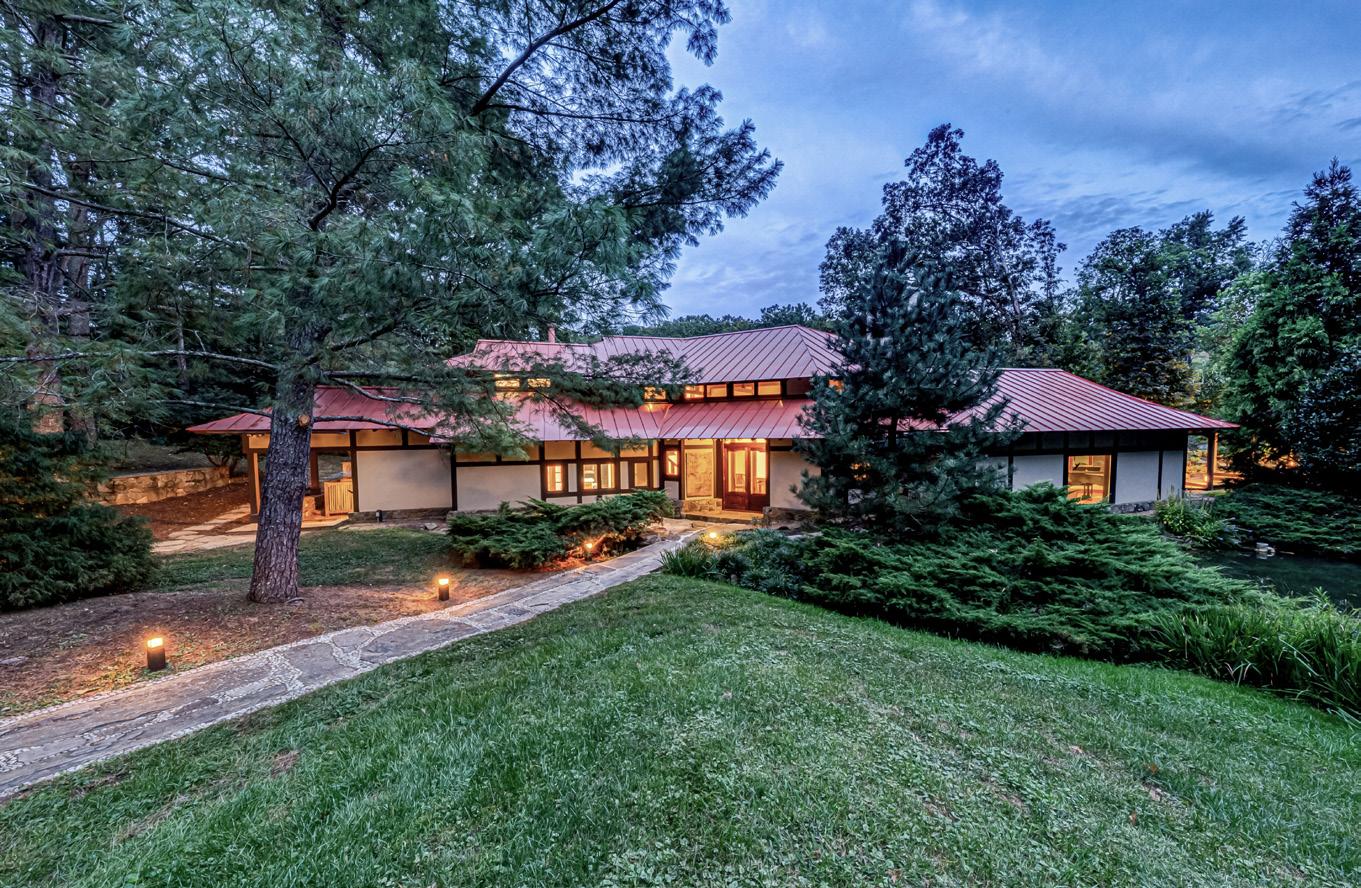
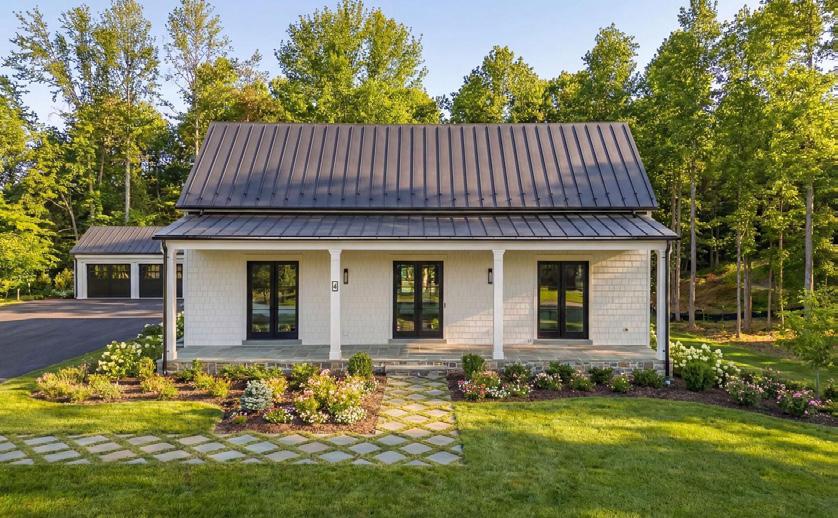
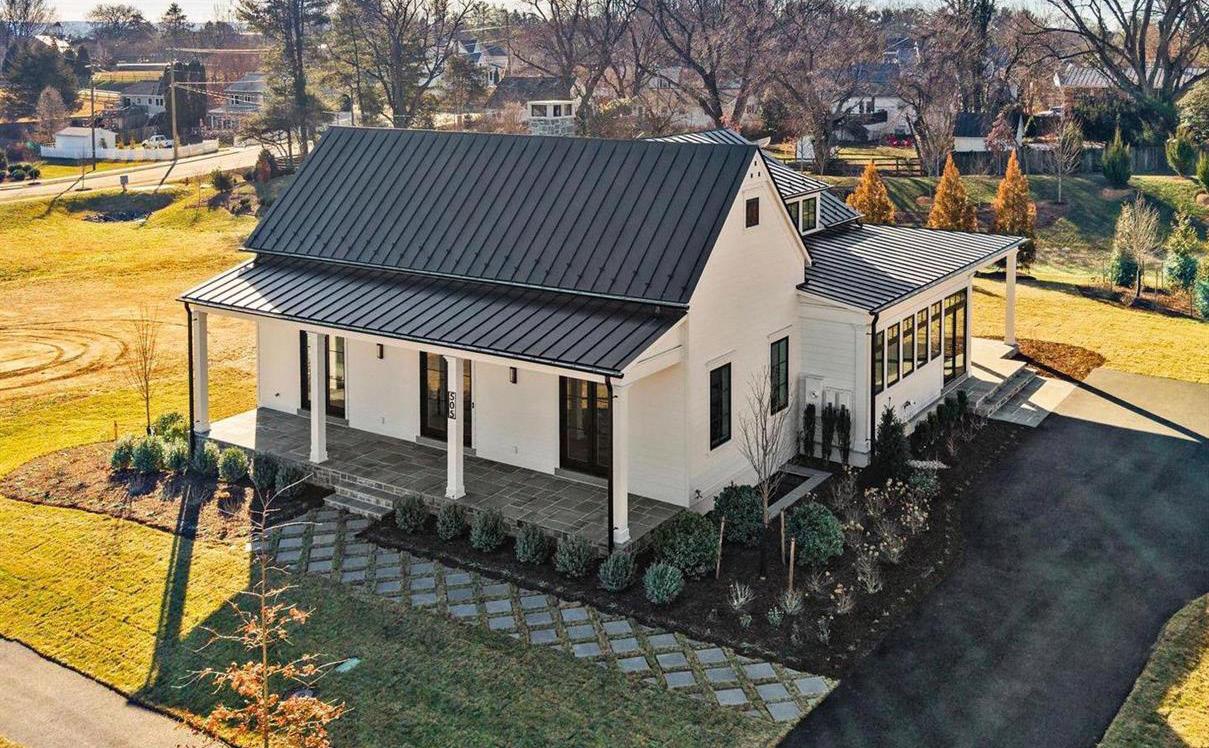
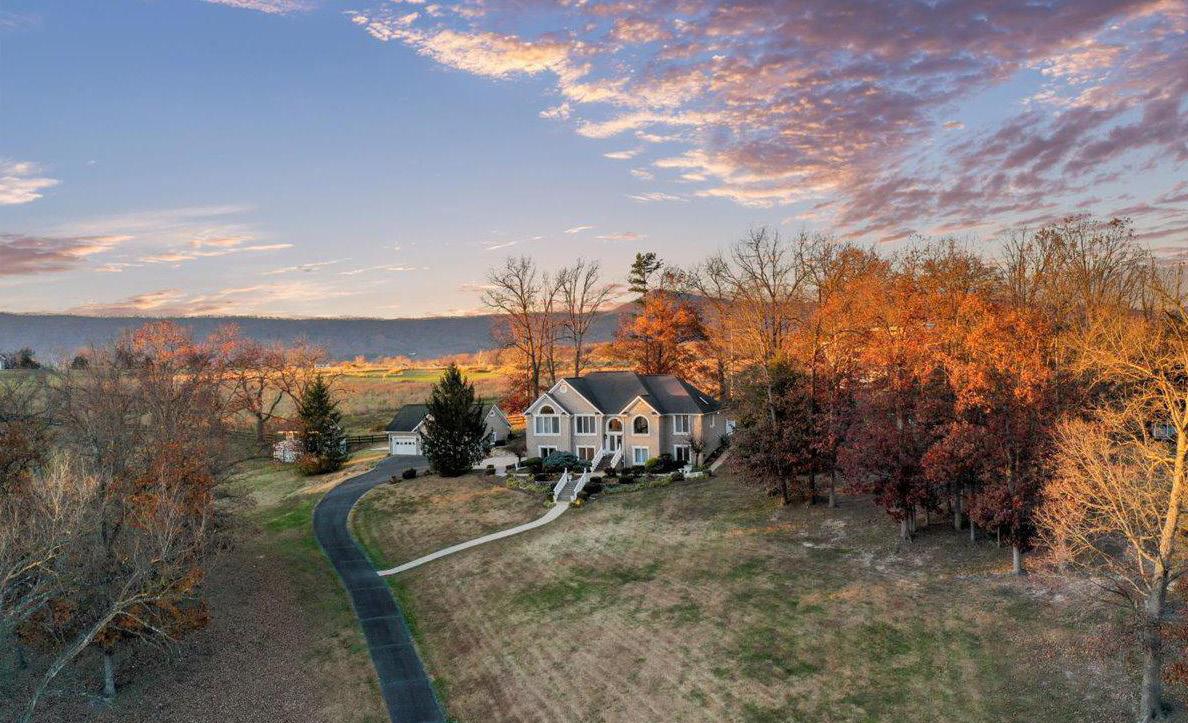
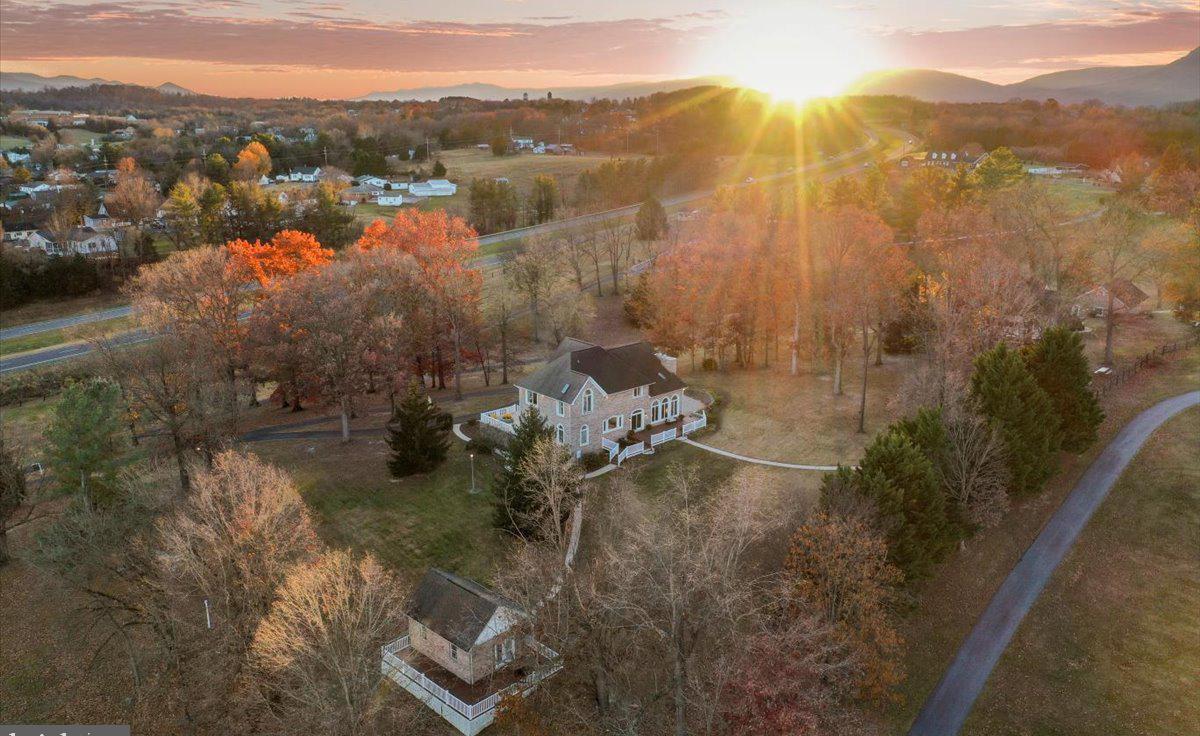
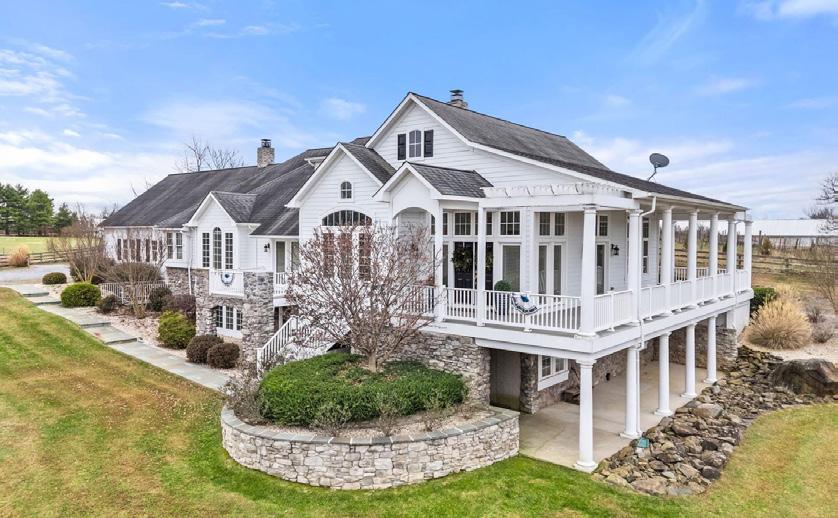
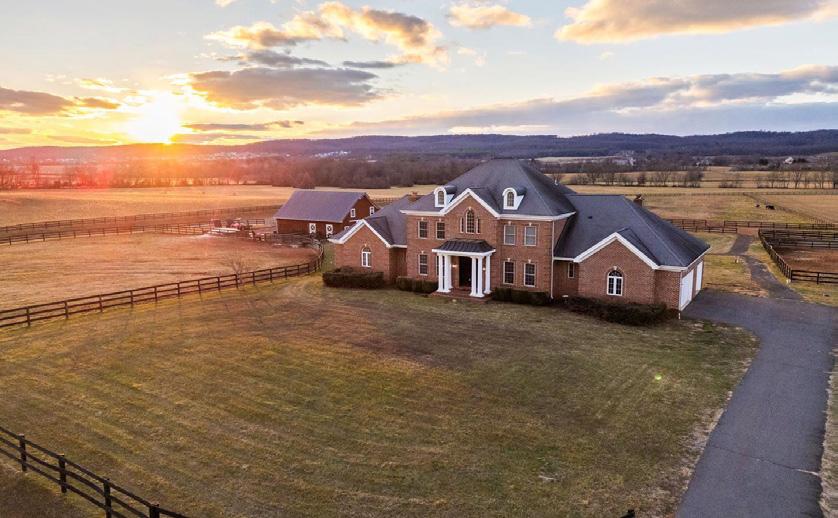
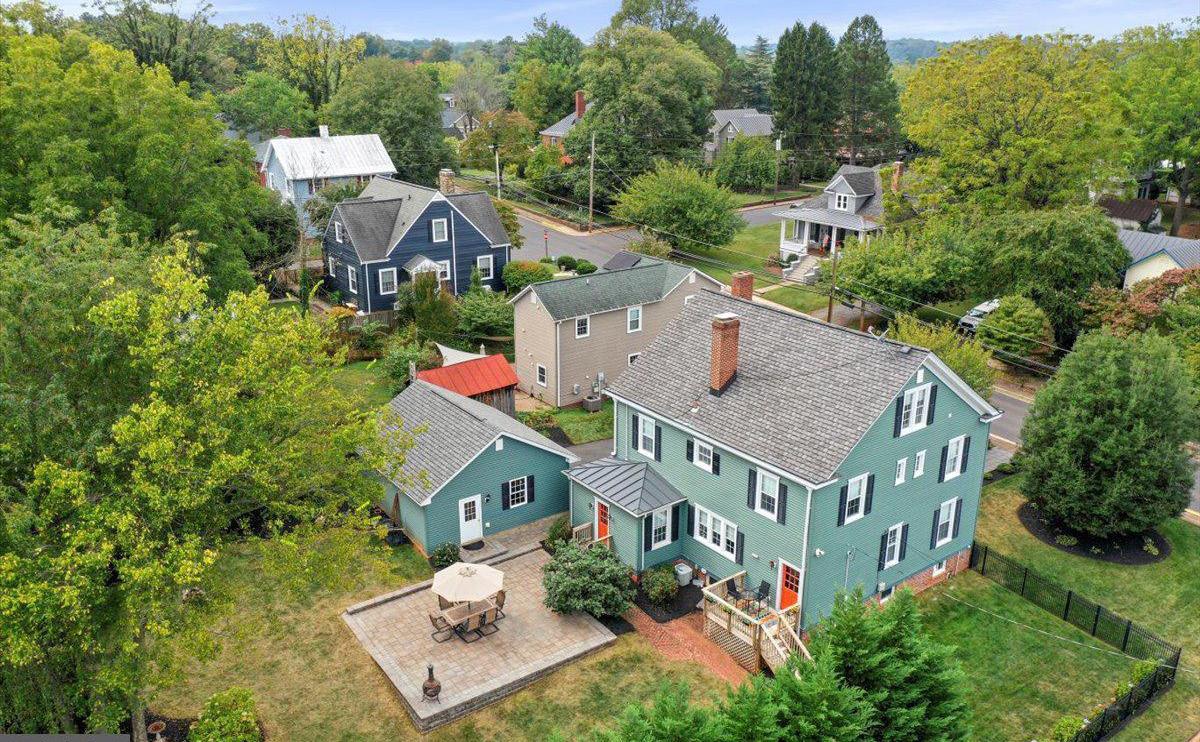
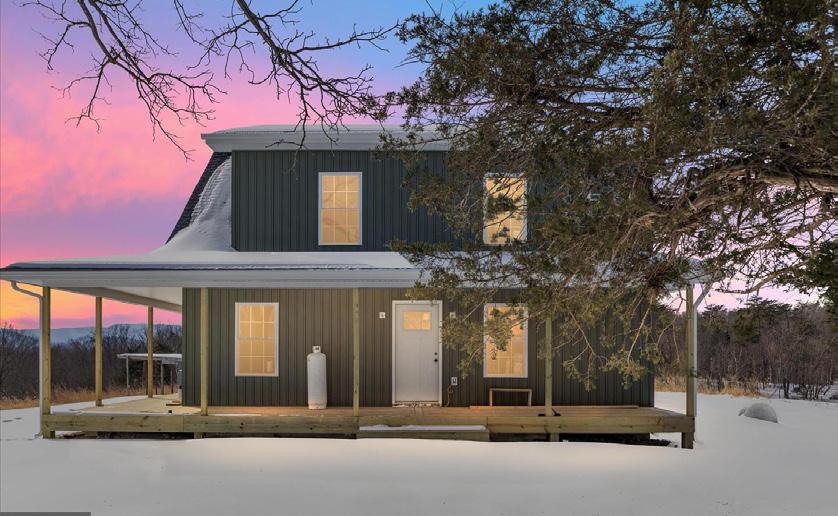
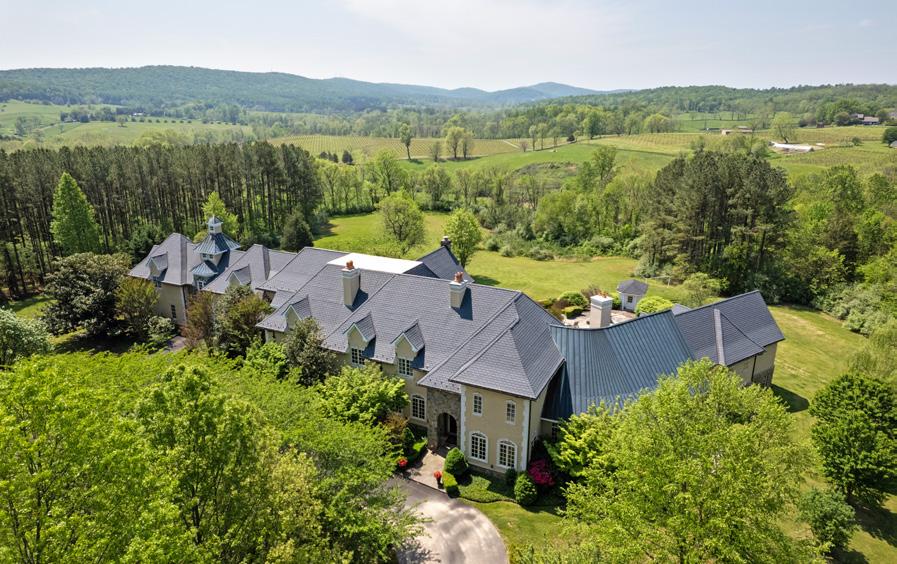
from throughout | | 6 kitchen | cottage lighted stream, acres
ADA ROAD
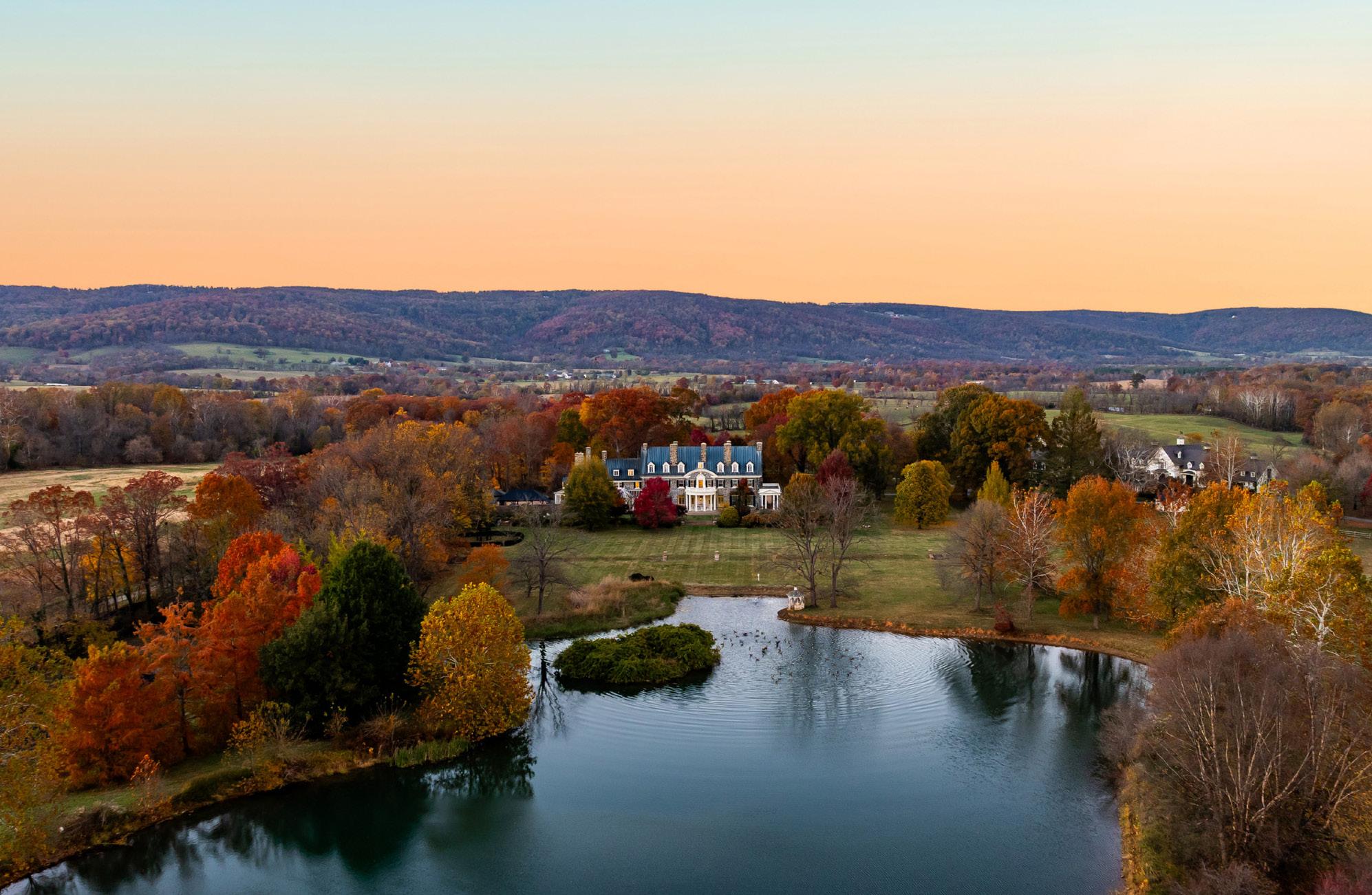
SPRING GLADE
$9,000,000
Paul MacMahon 703.609.1905
MIddLEBuRG, VIRGINIA
Brian MacMahon 703.609.1868
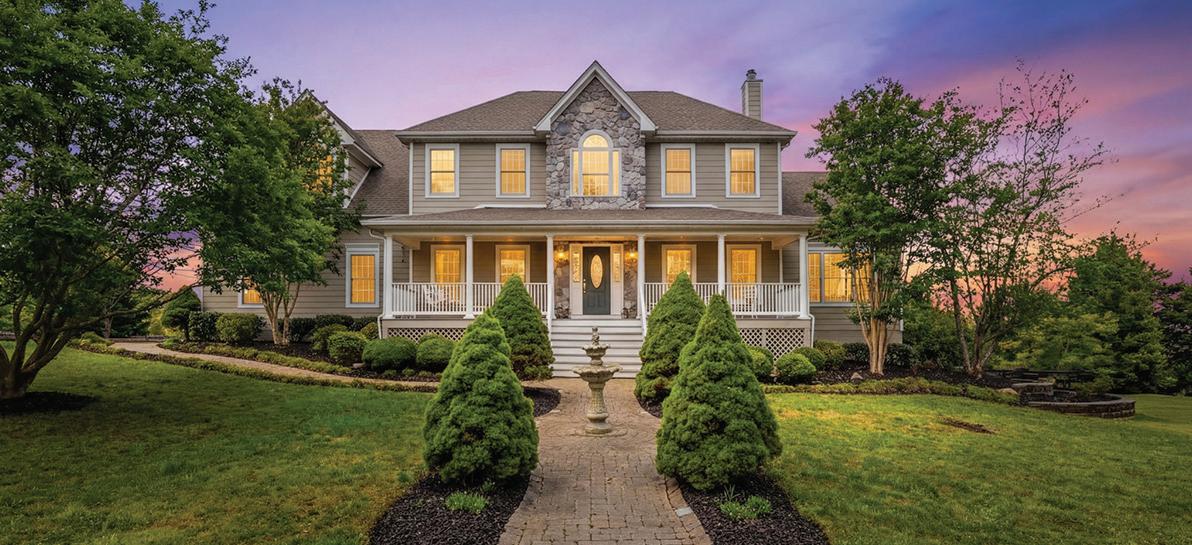
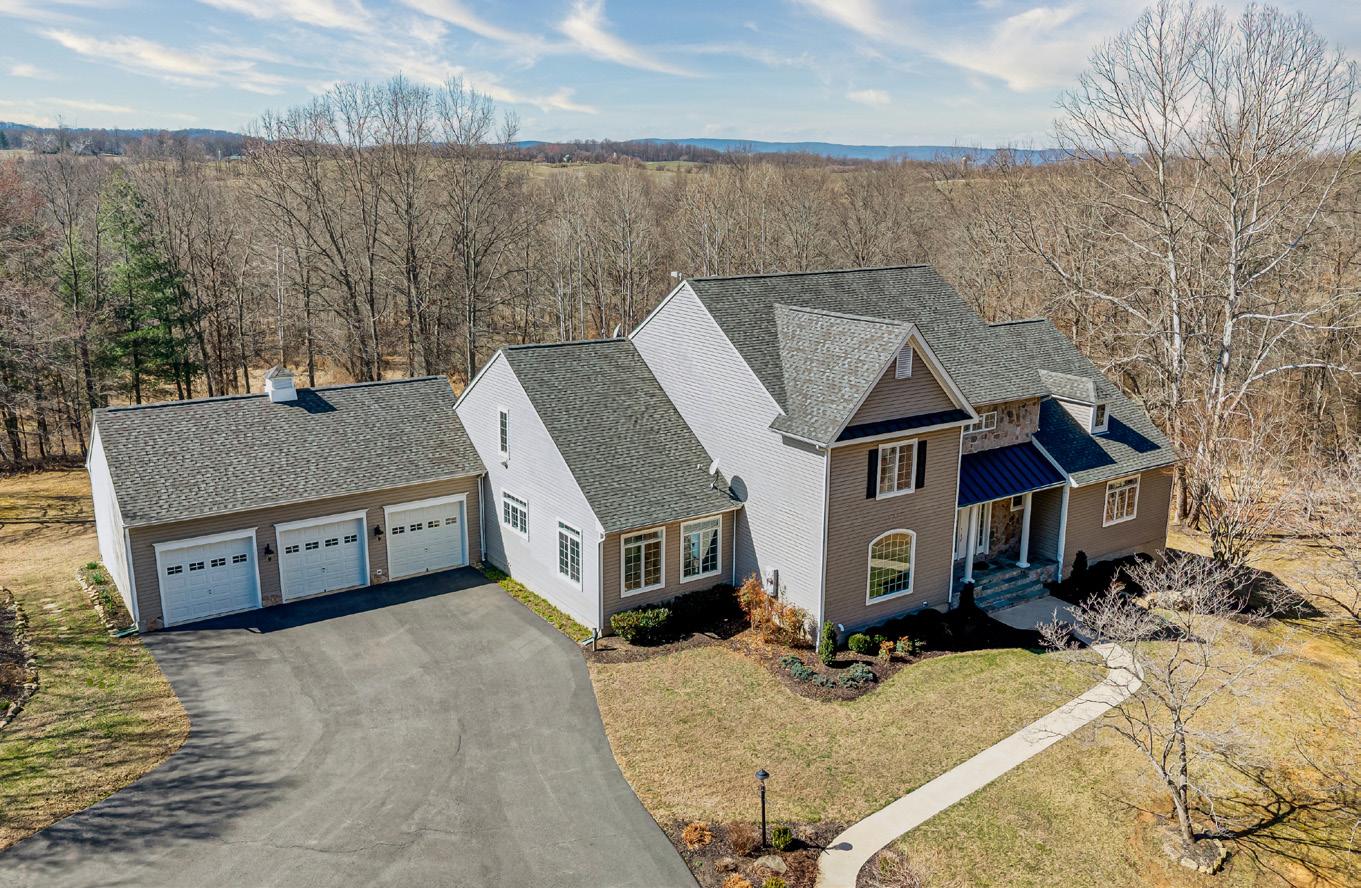
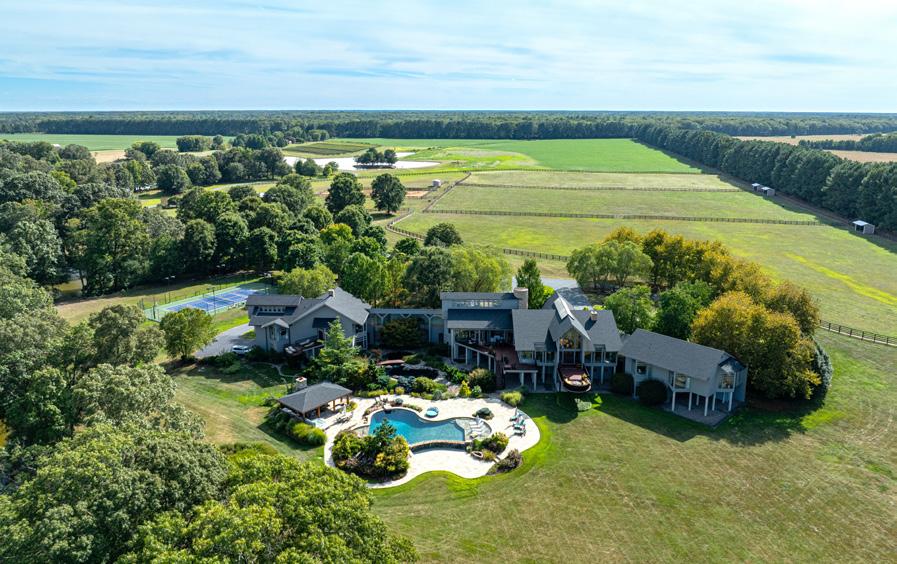
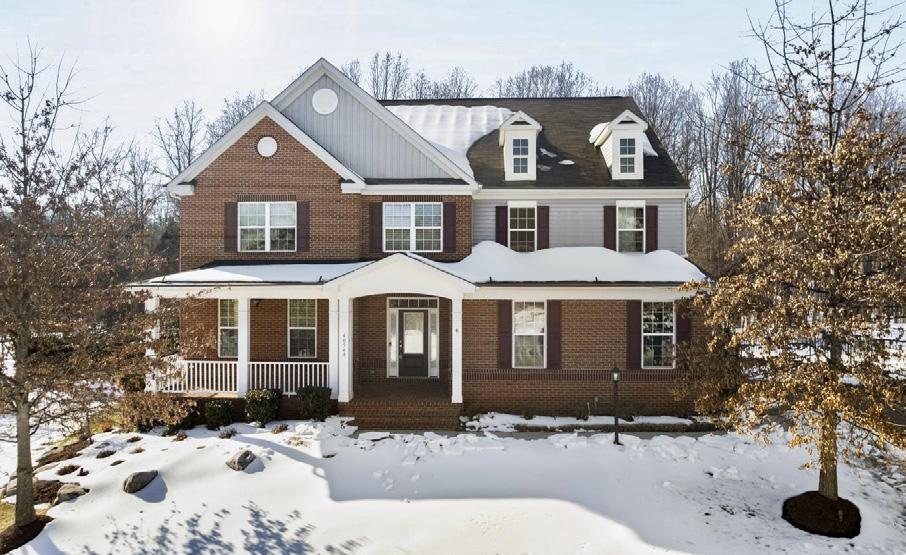
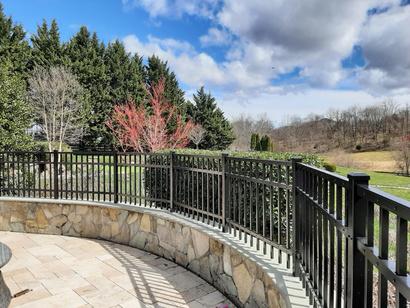
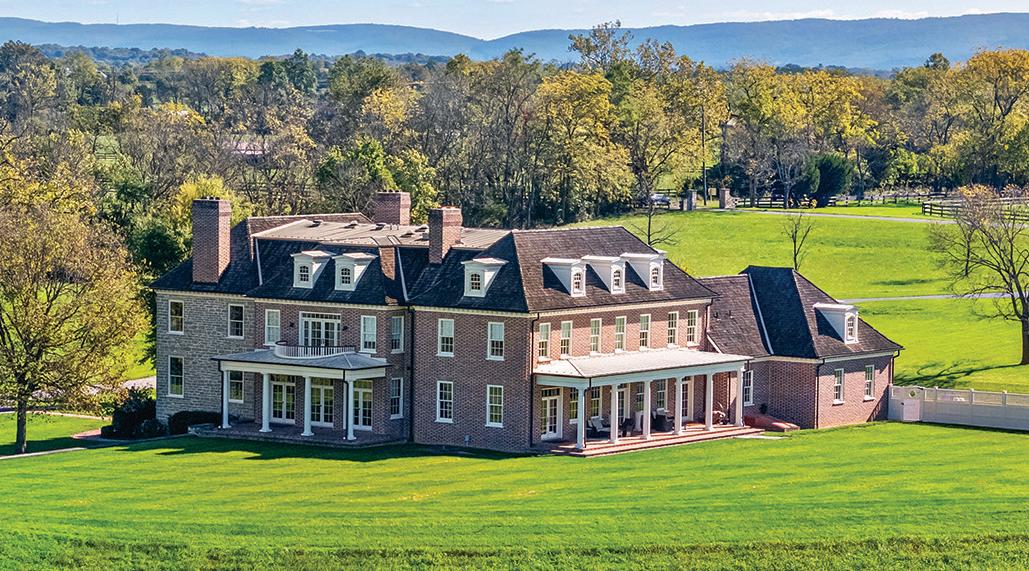
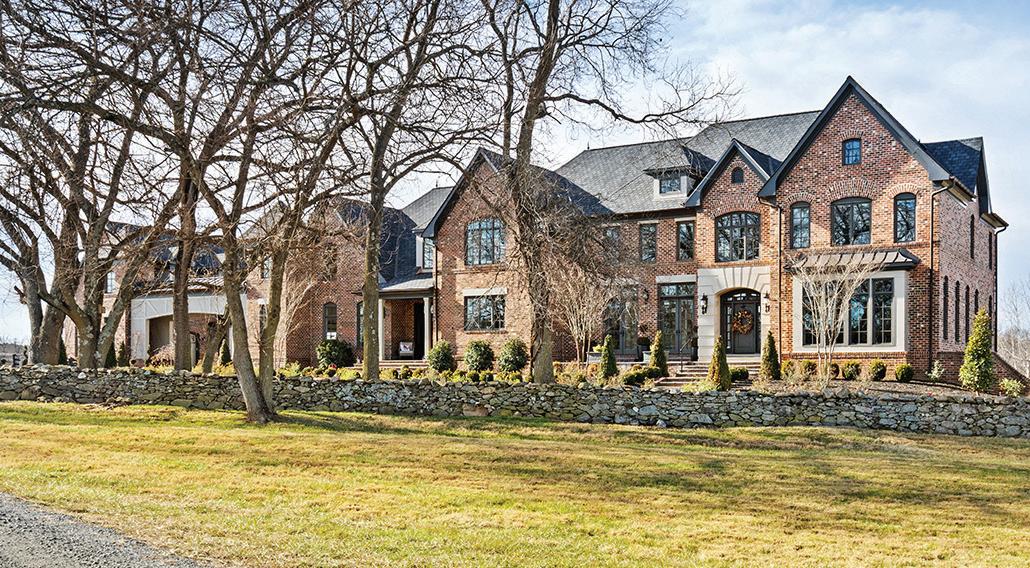
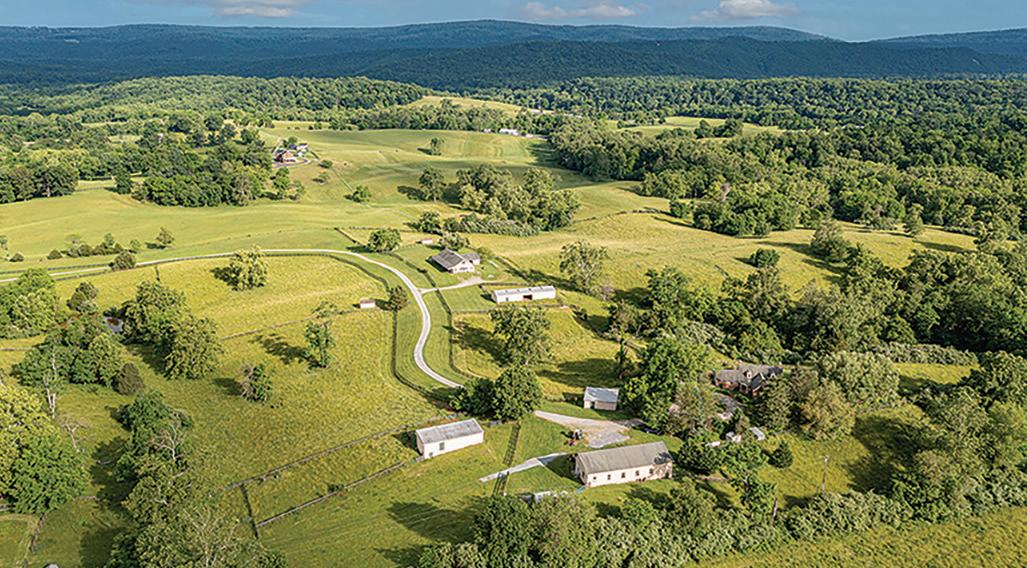
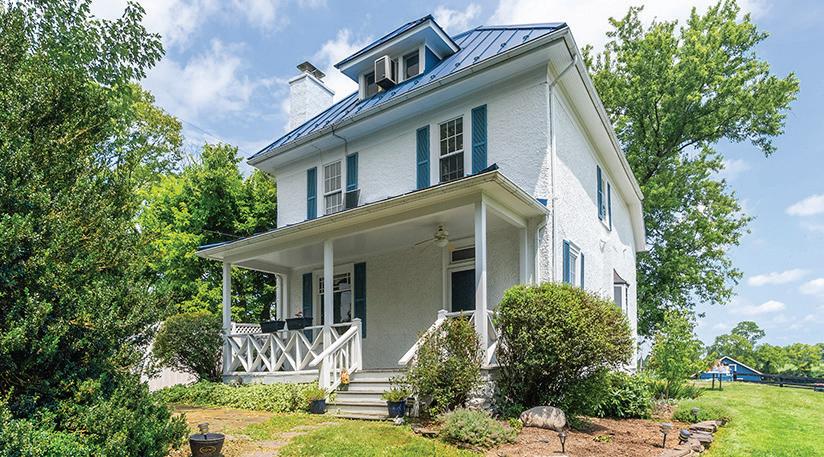
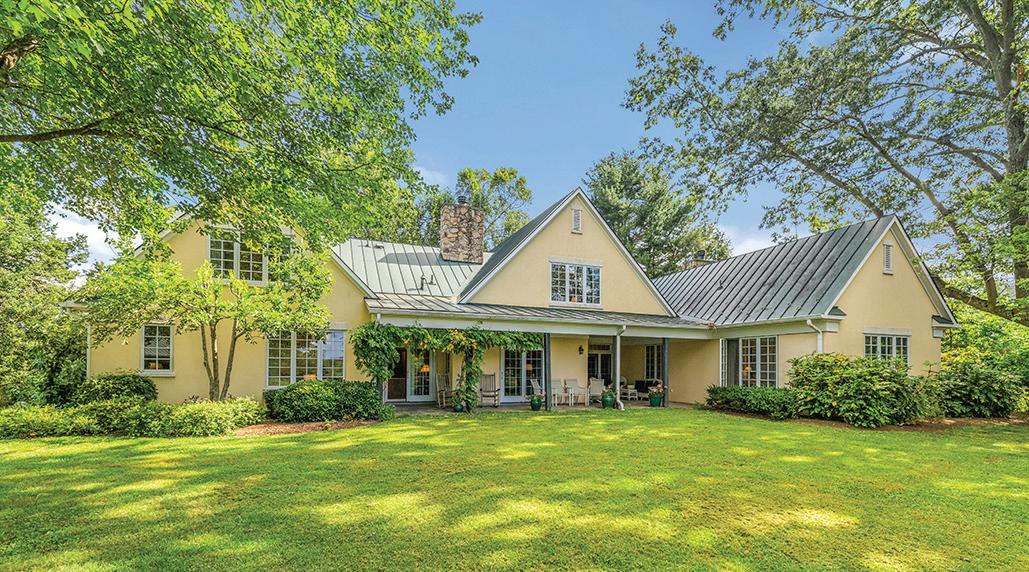
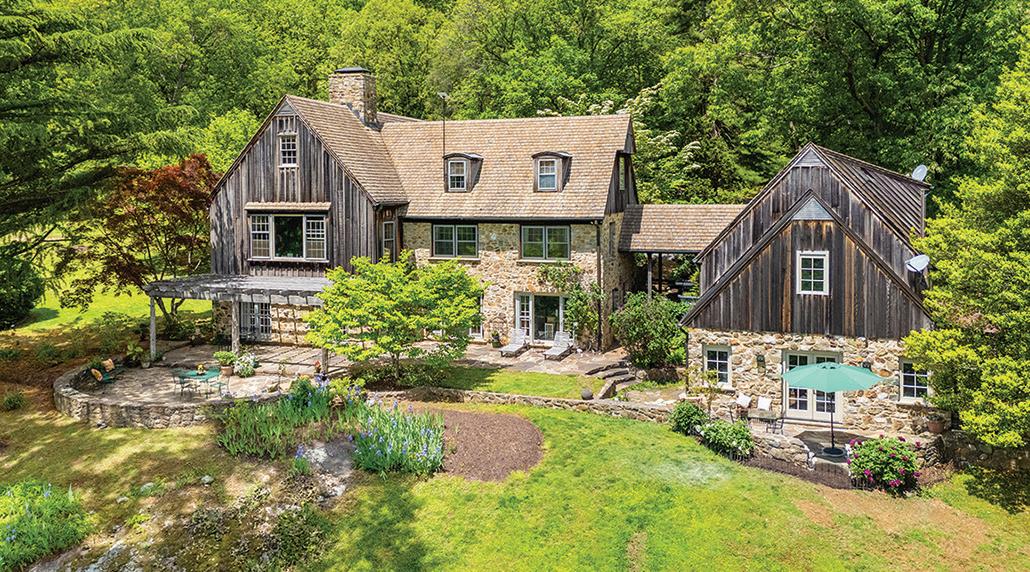
French Country home, with renovations in 1999 & 2017 | 4 BR, 5 full & 2 half BA, 5 FP, hardwood floors, flagstone terrace | Beautiful drive to hilltop stetting overlooking pond, lake & mountains | Im provements include pool, 2-car garage, 2 BR guest house & apartment | Lovely boxwood gardens | Kitchen allowance to be provided | 79.89 acres Paul MacMahon 703.609.1905
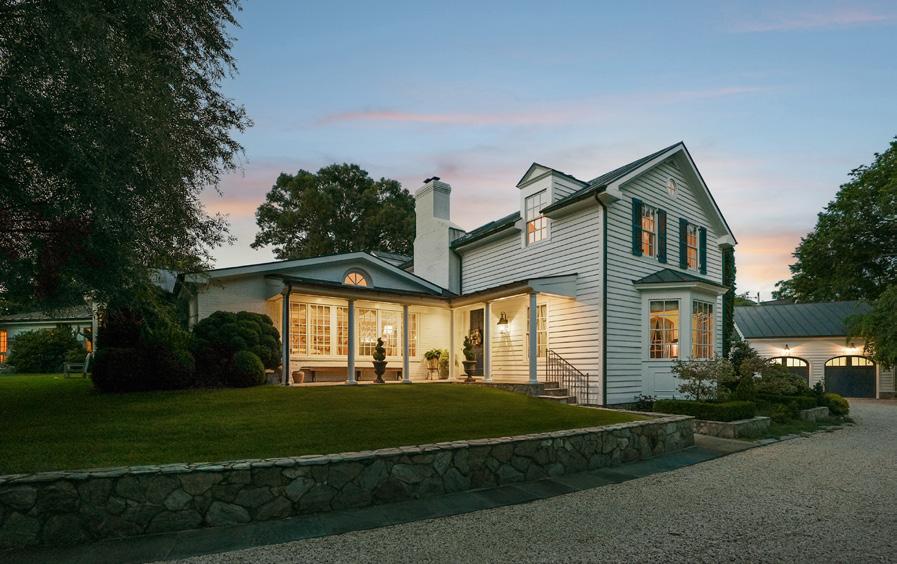
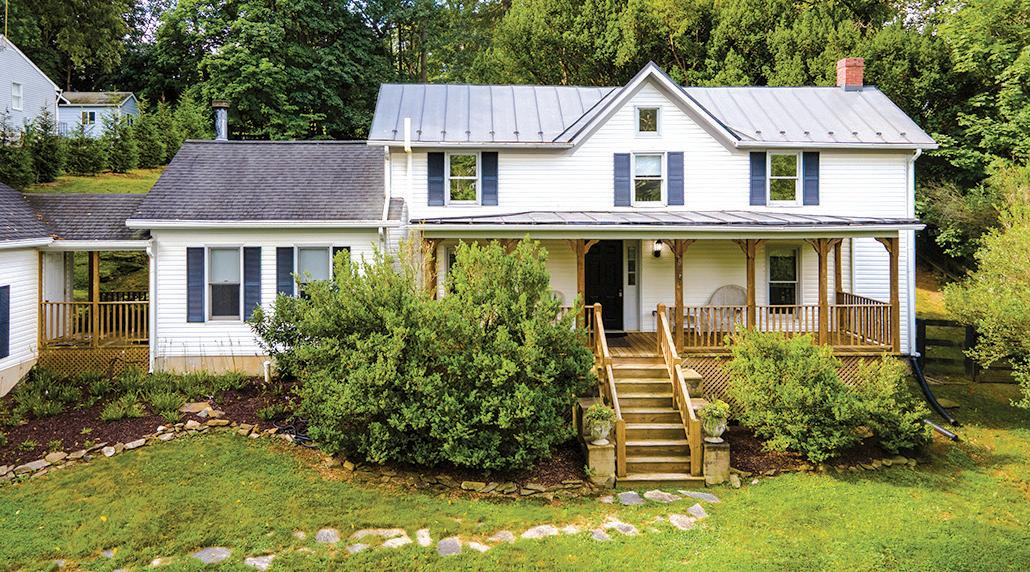
BARBOURSVILLE,
SALEM HILL
MARSHALL, VIRGINIA
$2,500,000
Paul MacMahon 703.609.1905
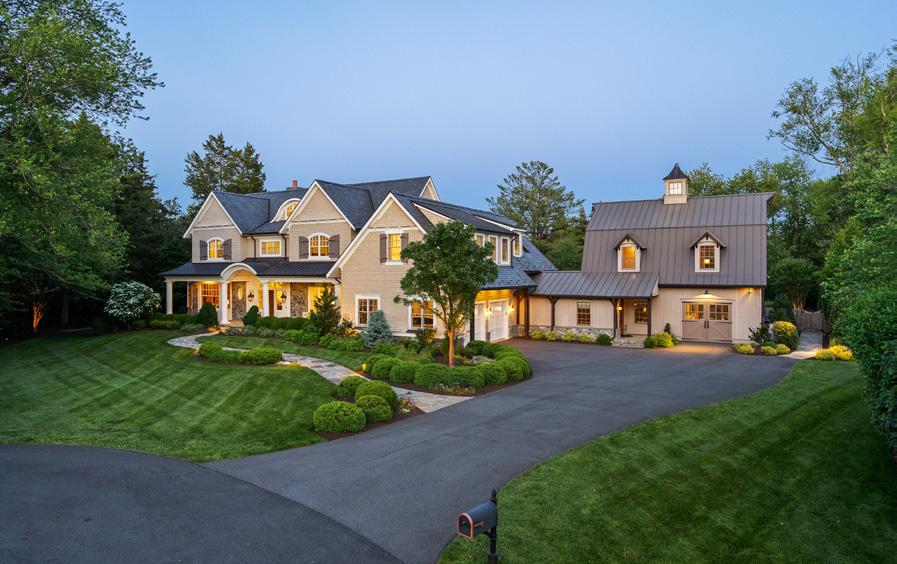
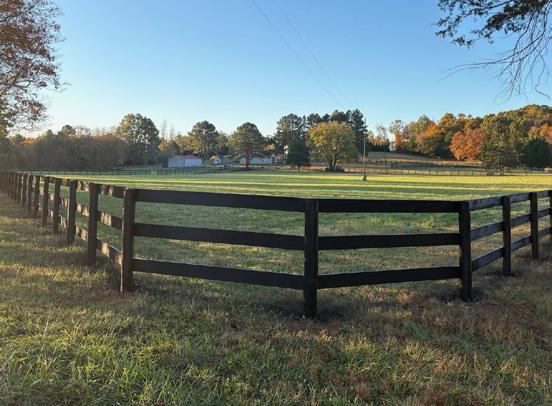
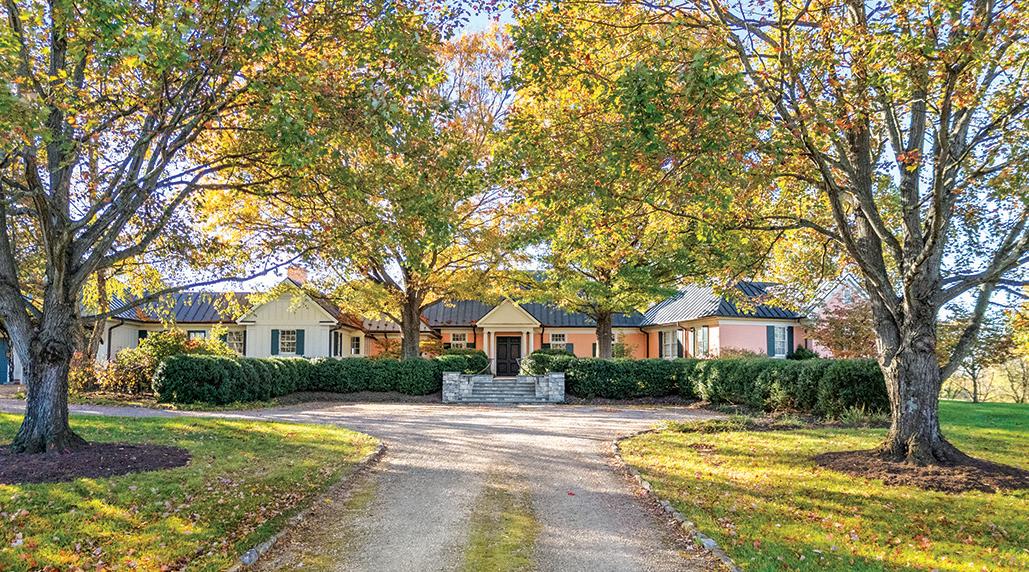
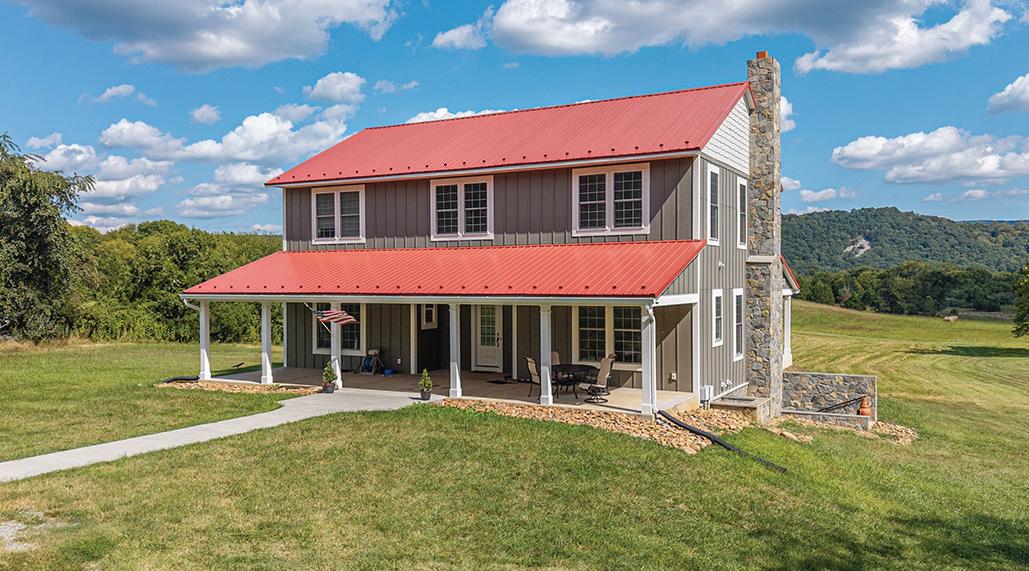
Well protected Fauquier location | 6 bedrooms | 4 full and 2 half baths | 3 fireplaces | Great views | Pool with large flagstone terrace | Large county kitchen | 4-car detached garage with apartment/ office | 9-stall barn | Covered arena | Outdoor ring | 4 stall shed row barn | 51 fenced acres
Brian MacMahon 703.609.1868
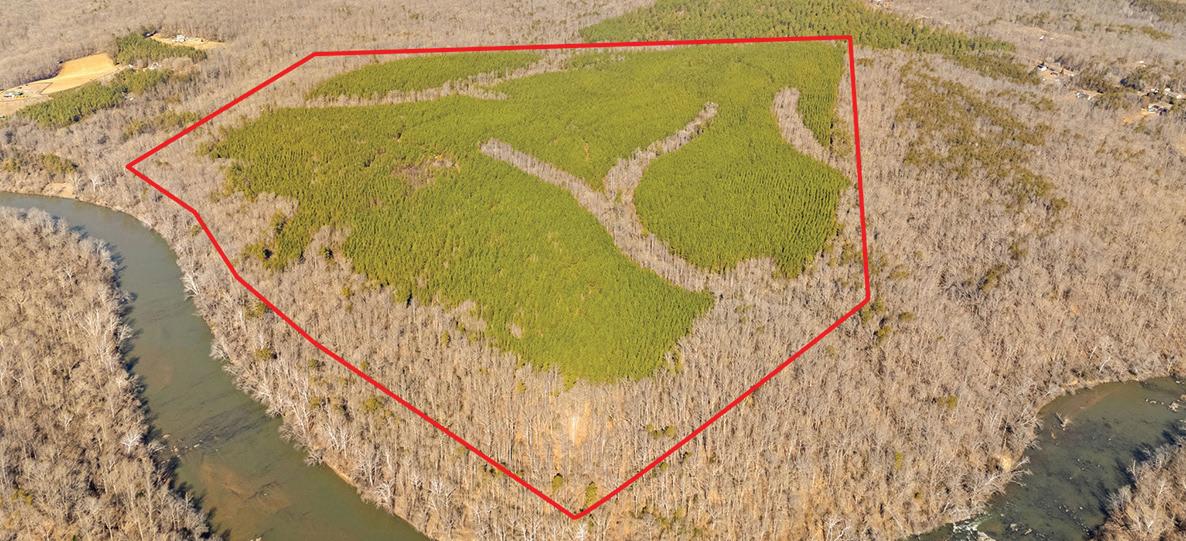
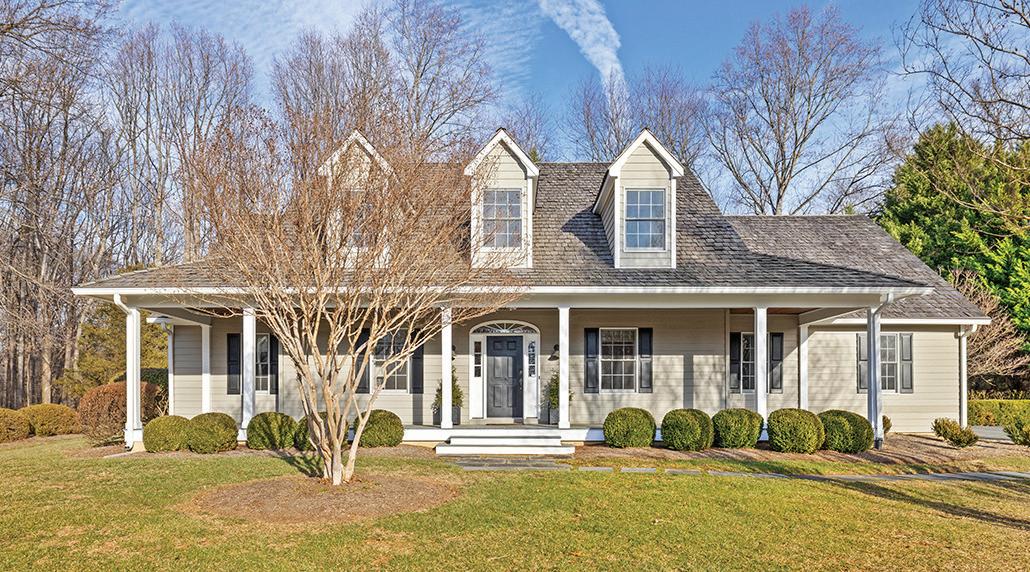
203 acres in River frontage 4 full & 3 1/2 Gunnite pool and private | 5 stall Jim paddocks, pasture | Old d alix Plains | recently
$3,690,000
MacMahon 540.454.1930
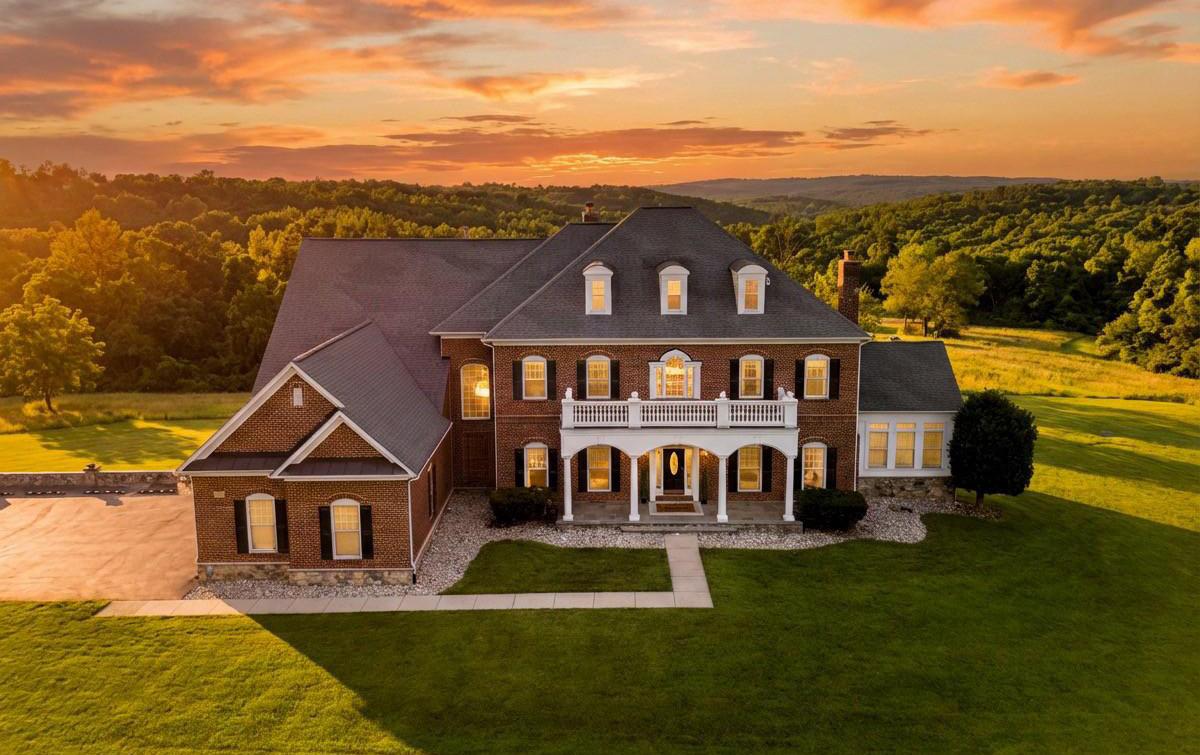
MARSHALL, VIRGINIA
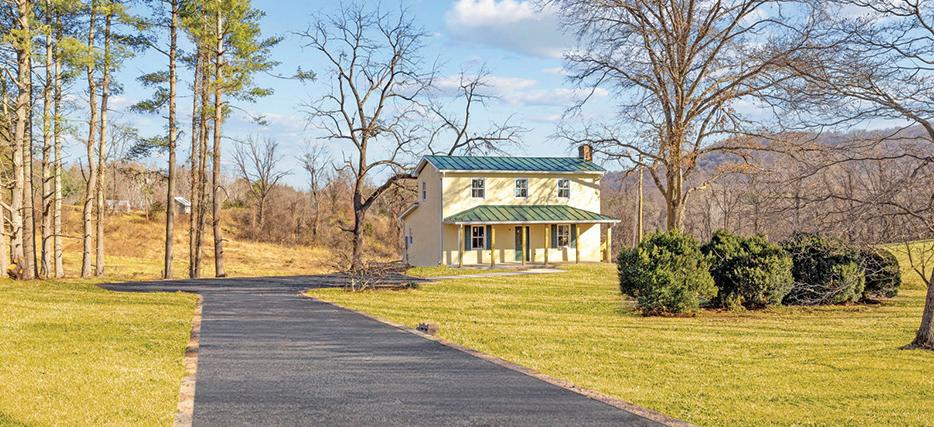
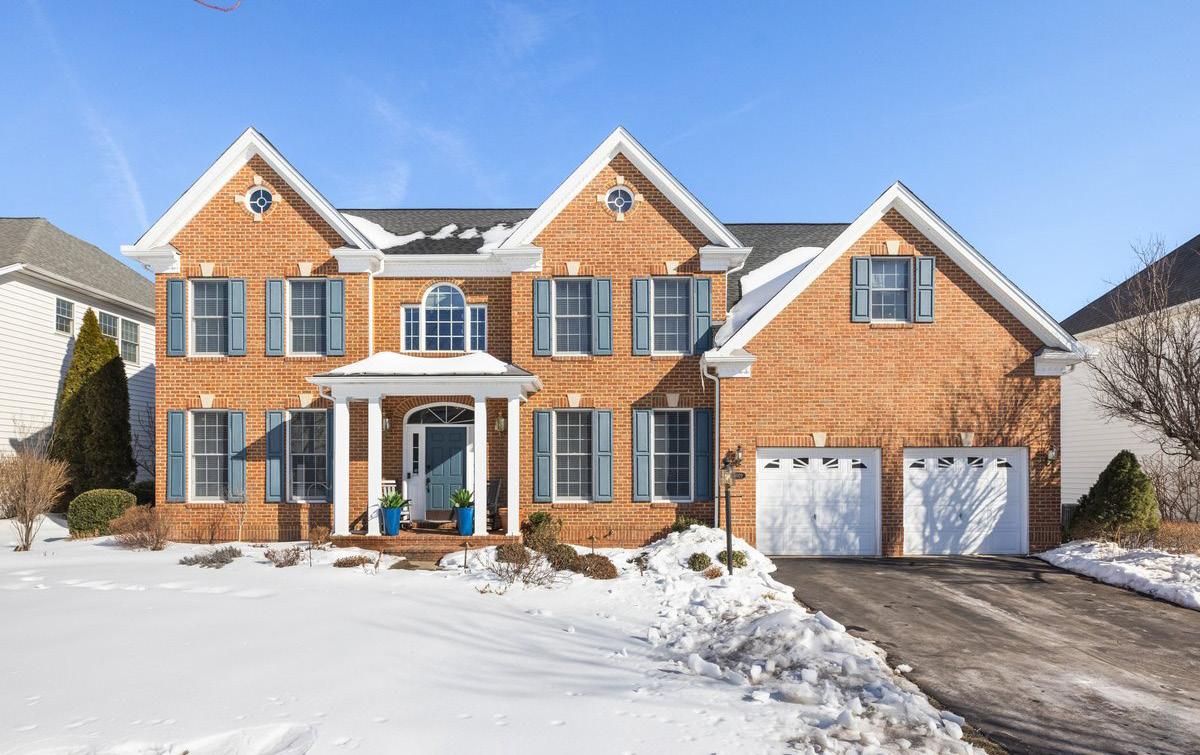
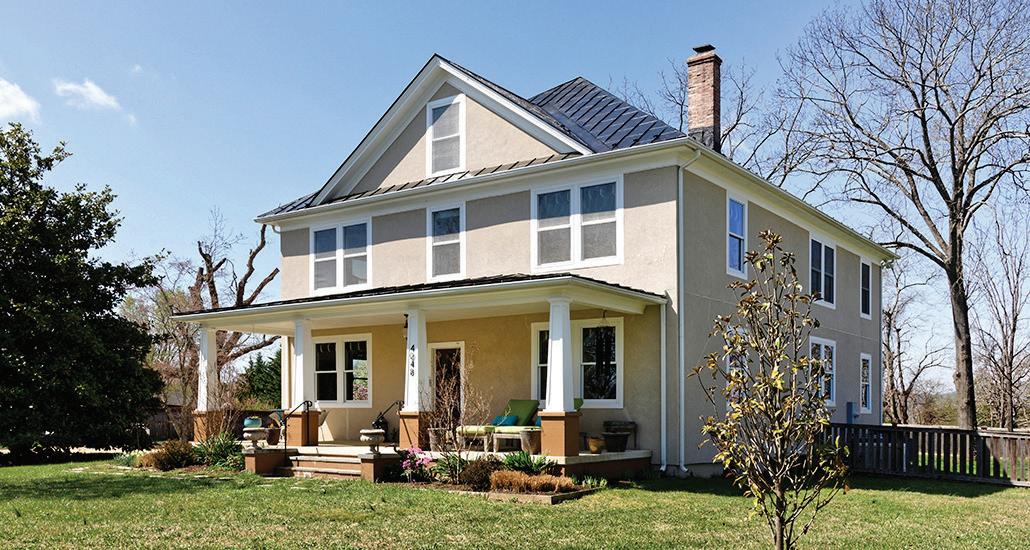
Private 10.92-acre setting with bold Cobbler Mountain views 4BR / 5.5BA well-maintained home | High ceilings, maple floors, stone fireplace | Spacious great room with stone fireplace, large media room Lower-level in-law apartment | Custom deck and 3-season screened porch, fenced back yard Equestrian ready with paddocks, barn, fencing and run-in shed and tack room with water and electric.
$1,375,000
Paul MacMahon 703 609 1905
Brian MacMahon 703 609 1868
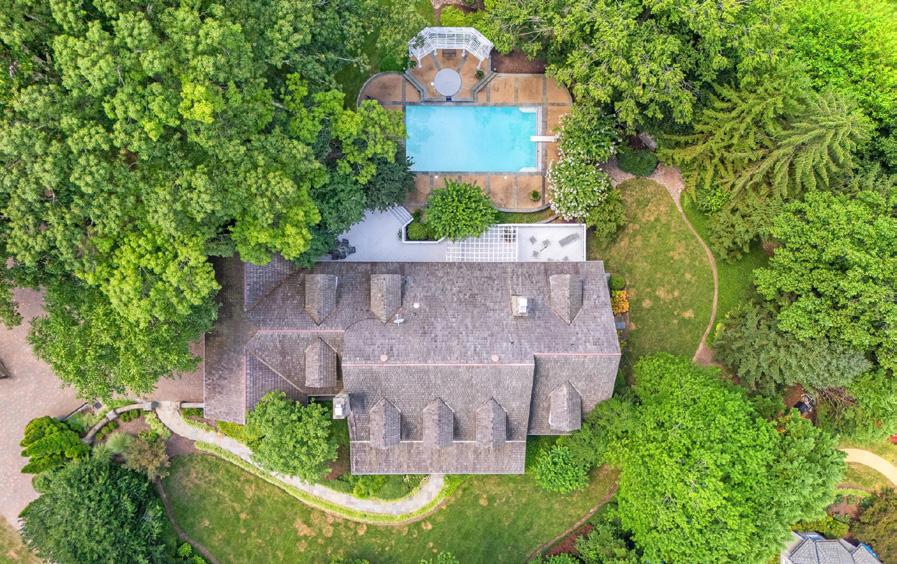
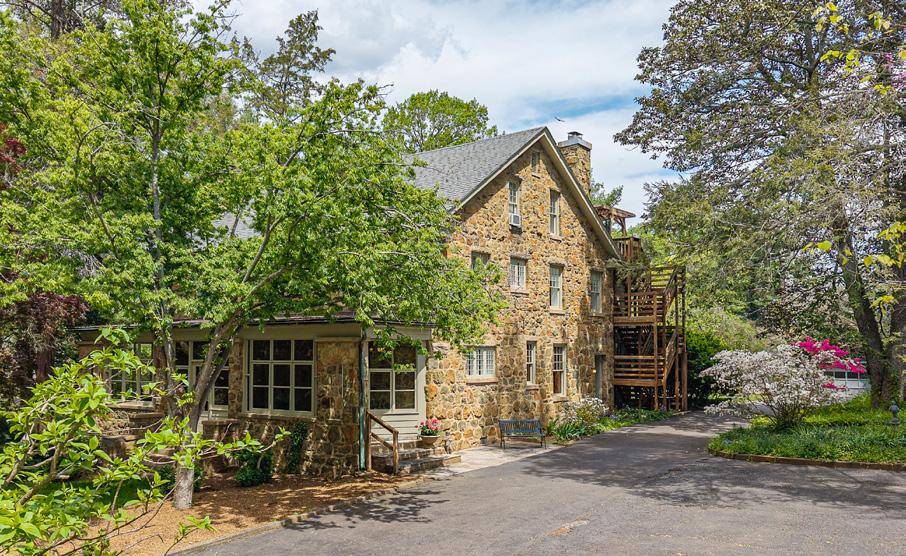
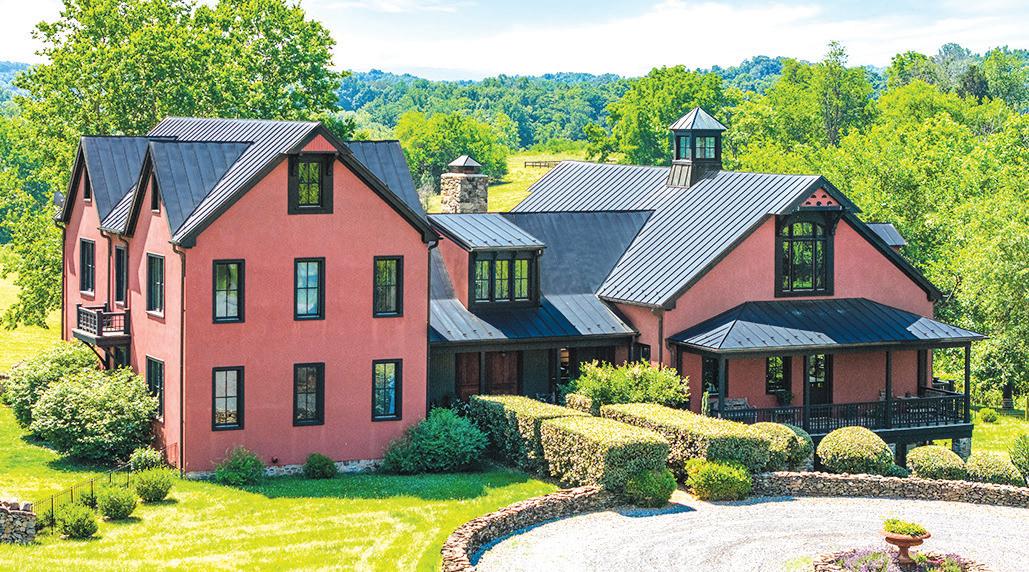
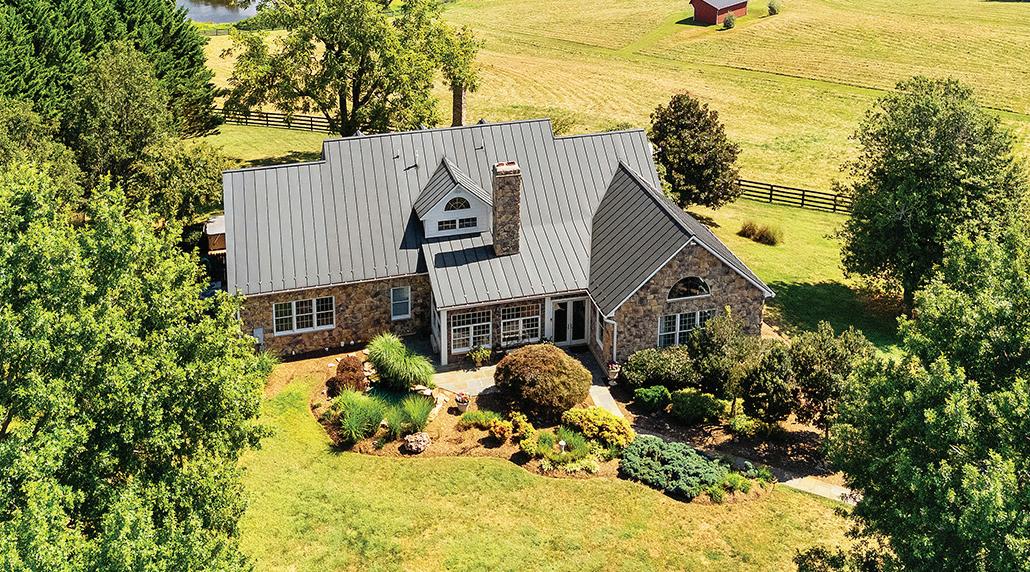
A remarkable property located within a private enclave just minutes from town | Stone and stucco manor house with main level master suite | 7 additional BR | 5 stone FP | Beautiful gardens, terraces, salt water pool,
SPRING MILL ROAD
MAPLE CREEK
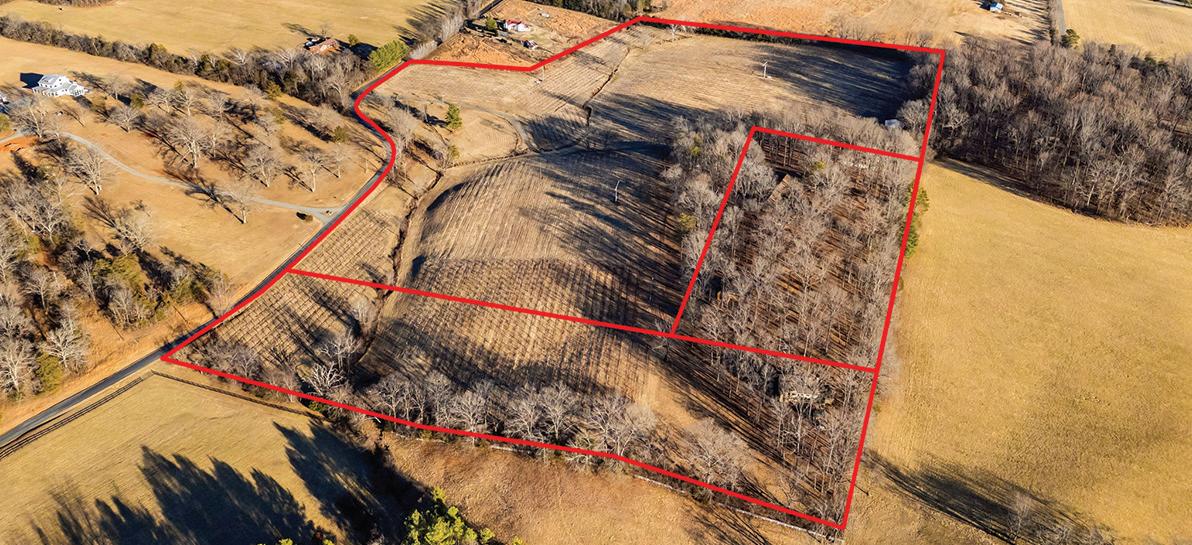
BURNLEY VINEYARDS
CARLETON’S LANE
SNAKE CASTLE ROAD
ADVERTISING SALES
Jamie Null | jamie@middleburglife.com
Jennifer Richards | jennifer@middleburglife.com
Andrea Ryder | andrea@middleburglife.com
ACCOUNTS ADMINISTRATOR
Joanne Maisano
DESIGNER
Elisa Hernandez
PRODUCTION DIRECTOR
Nicky Marshok
ON THE COVER
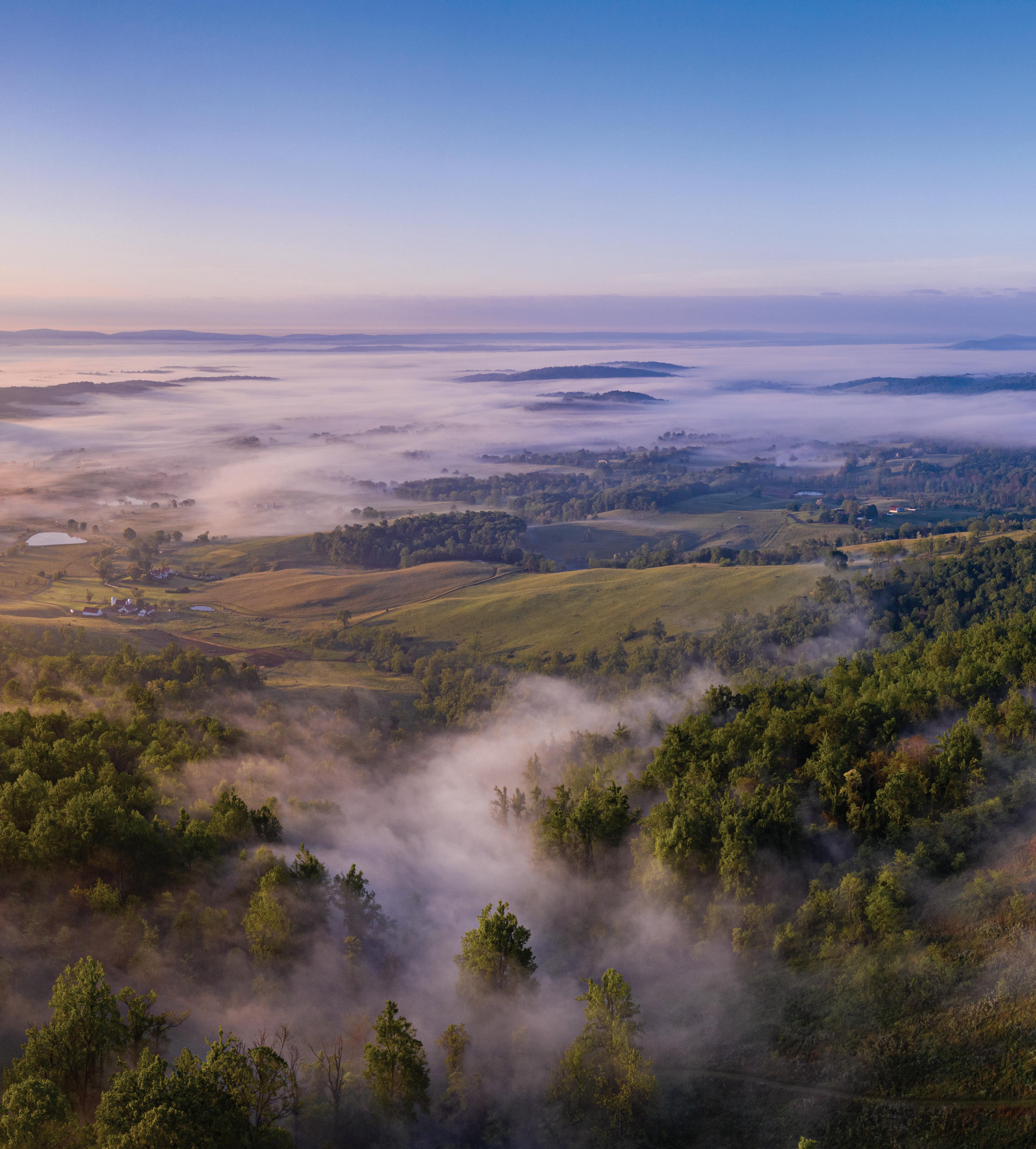
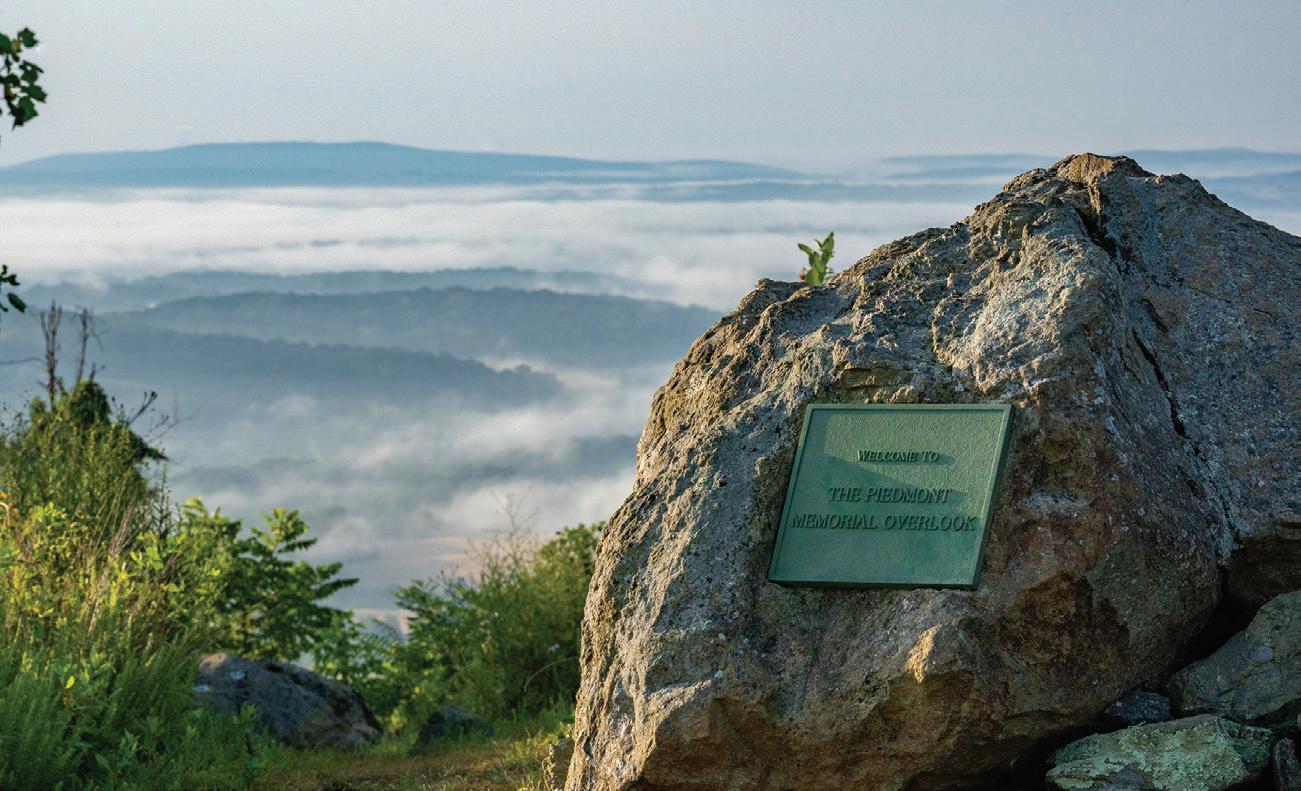
The Piedmont Environmental Council’s multimedia communications specialist, Hugh Kenny, captures the view from the Piedmont Memorial Overlook, using photography as a powerful conservation tool. For more on Kenny’s photography, turn to page 20.
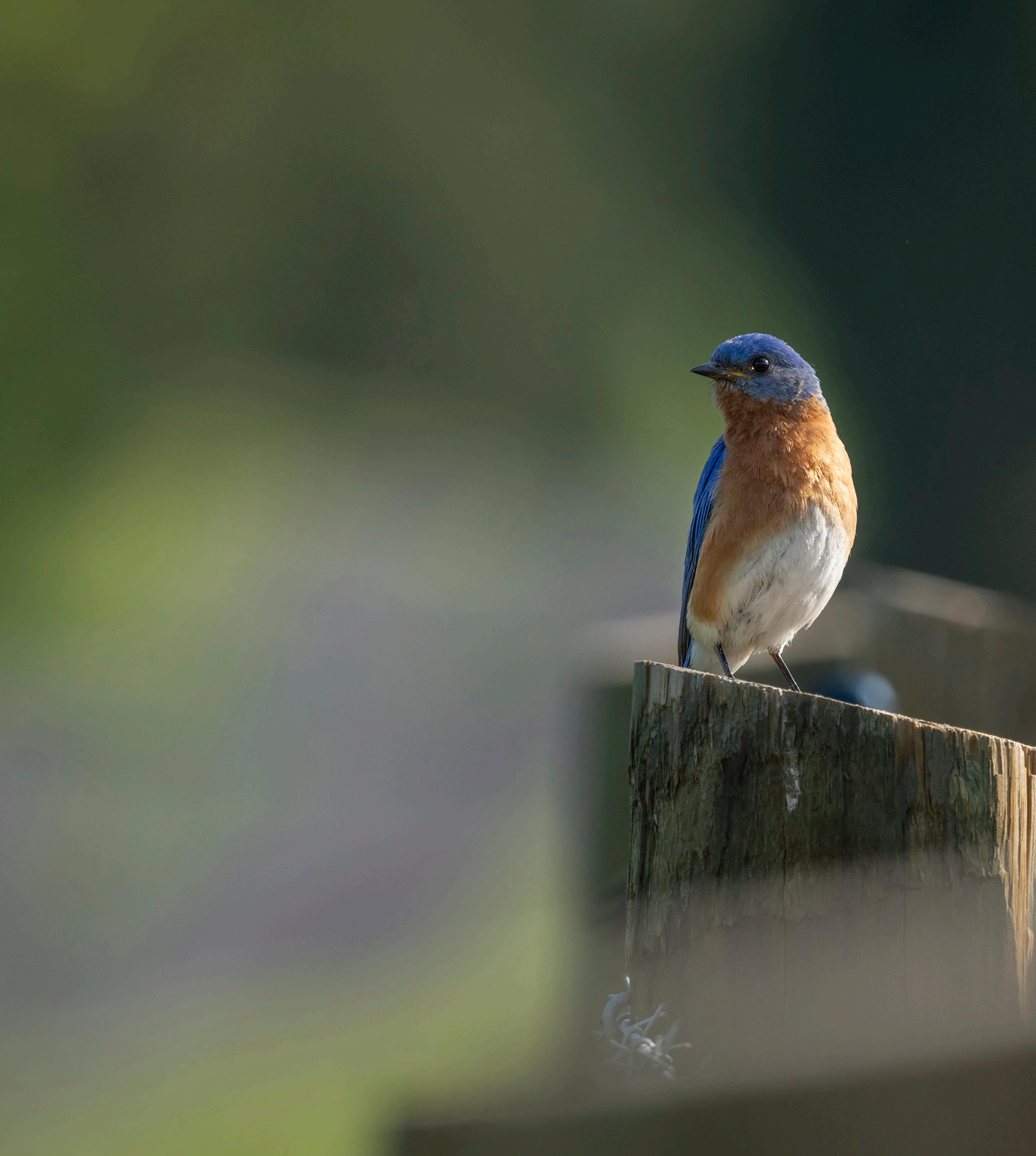
the benefits of cavity nesting birds across farms in Hunt Country and beyond. We caught up with Kinloch Farm, one of the host sites, about the results and why it decided to participate. Turn to page 12 for more. Photo by Brooke McDonough for the Smithsonian.
ADVERTISE IN MIDDLEBURG LIFE
Greenhill Media, LLC
P.O. Box 328 | Middleburg, VA 20118-0328
540.687.5950 | info@middleburglife.com
PUBLISHER: Greenhill Media, LLC
EDITOR-IN-CHIEF
Kaitlin Hill | kaitlin@middleburglife.com
COPY EDITOR & DIGITAL ASSISTANT
Susan Stark
Photo by Hugh Kenny.
ON THIS PAGE
A collaborative study between Virginia Working Landscapes, the University of Maryland’s Department of Entomology, and the Smithsonian’s Center for Conservation Genomics assessed
All editorial matter is fully protected and may not be reproduced in any manner without the written permission of the publisher. All unsolicited manuscripts and photos must be accompanied by return postage; the publisher assumes no responsibility. Middleburg Life reserves the right to reject any advertising. Distributed in Aldie, Alexandria, Boyce, Centreville, Delaplane, Front Royal, Great Falls, Haymarket, Leesburg, Manassas, Marshall, Middleburg, Millwood, Paris, Purcellville, The Plains, Rectortown, Tysons, Upperville, Vint Hill, Warrenton, Washington, D.C., and Winchester.
FIND US
CONTRIBUTORS
Shannon Ayres is a Reston-based freelance photographer. His work has appeared in Arlington, Chesapeake Life, Northern Virginia, Virginia Business, and USA Today magazines. He has an MFA in fine art photography from San Francisco’s Academy of Art University. His editorial work can be seen at sdayres.com
Michael Butcher is the owner of Butcher Photography. Originally from Christchurch, New Zealand, he resides in Springfield, Virginia, with his family. For the past 15 years, Michael has specialized in portraiture, event, and editorial photography. When not behind the lens, he enjoys gardening and swimming. More of Michael’s work can be found at butcherphotography.com
Laticia Headings is grateful to call Middleburg home. She discovered Middleburg by attending the first annual Middleburg Film Festival in 2013 and has come back to the event every year since as a volunteer and attendee. Laticia is the founder of Latitude Media and has 23 years of experience as a producer, writer, and camerawoman for television (Discovery, National Geographic), and for the documentary film “Everest: A Climb for Peace.”
Sarah Hickner is the author of the award-winning Christian memoir “Finding Gideon” and the novel “All the Things That Come Between Us.” A lifelong equestrian and storyteller, she writes about faith, family, and the beauty of life in Virginia horse country.
Sherri Holdridge is a freelance photographer based in the D.C. area. An avid equestrian, she finds herself drawn and connected to the world of equine photography. Though she spends a lot of time with the horses, her portfolio also reflects her love of travel, nature, and portraiture. Sherri’s photography has been published in various magazines and exhibited in galleries around the world. Her work reflects both her passion and commitment to storytelling through the camera lens. More of her work can be found at sherriholdridgephotography.com.
Bill Kent’s journalism has appeared in more than 40 national and regional publications including The Washington Post, Art & Antiques, Philadelphia Magazine, Baltimore Magazine, New Jersey Monthly, and The Hunt. A former correspondent for The New York Times, he taught writing and journalism at the University of Pennsylvania, Rutgers, and Temple universities, and is the author of seven novels, a Fodor’s Guide, and a history of Atlantic City. When not writing, he enjoys walking his westies on Washington Street.
Gracie Savage is a local photographer who grew up in the village of Aldie and has been photographing local weddings, portraits, and events since 2016. Her passion began when she received her first camera in middle school and she continued to study the craft in high school and in college. She was a photographer at Georgetown University for over three years and joined Middleburg Life as a contributor in the spring of 2022.
Heidi Baumstark has been writing for several lifestyle magazines and newspaper publications since 2005, specializing in history-related articles highlighting Virginia’s Piedmont. She has been with Middleburg Life since 2014. Heidi hopes to inspire readers to pause and consider the people, places, and events that have shaped the story of our local history.
Caroline Gray is a D.C.-based conservation and freelance photographer. A Virginia native and MBA graduate from the University of Virginia, her work blends a love for exploration, nature, and horses with her fashion background. When not behind the camera, Caroline enjoys hiking with her Labrador, Captain, visiting her retired horse, Cleverly, and exploring new restaurants in Washington, D.C.
Diane Helentjaris chose Loudoun as her “forever home” in 1990. A former clinical physician and public health administrator, she has returned to her humanities roots. Diane’s latest book, “I Ain’t Afraid — The World of Lulu Bell Parr, Wild West Cowgirl,” is a rollicking biography. Her novel “The Indenture of Ivy O’Neill” won the 2024 Maryland Writers’ Association novel competition in the historical/romance category.
Lia Hobel is a freelance journalist, known for her blog, Uplift Loudoun. In addition to her work for Middleburg Life, Lia writes periodically for online platforms with articles appearing on GOBankingRates, Forbes, Huffington Post, and Yahoo! She is a Loudoun 40 Under 40 honoree and a Certified Tourism Ambassador for the county.
Dulcy B. Hooper and her husband Richard moved to the country from Washington, D.C., nearly 10 years ago. Shortly thereafter, both began writing occasional articles for Middleburg Life. Dogs are a big part of the Hoopers’ lives and several of Dulcy’s earlier articles focused on the couple’s Chinese crested powderpuffs!
Beth Rasin graduated from Middlebury College, where she studied nonfiction creative writing. She worked as a writer and editor at The Chronicle of the Horse for more than 25 years, including 10 years as the president and executive editor. As a freelancer, she’s contributed since 2015 to Middleburg Life, as well as Northern Virginia Magazine, Blue Ridge Outdoors, the former Loudoun Magazine, and many others. She lives in Hume, where she and her husband and daughter run a boarding facility for retired horses. She enjoys running, hiking, and spending time with her adopted dogs and cats.
Shayda Windle is a freelance writer covering the arts, people, and places that make Hunt Country so special. Her work has been featured in Plein Air Magazine, the Fairfax County Times, and several online media outlets. In her spare time, you can find her enjoying the great outdoors and exploring Northern Virginia with her husband and two children.
Also in this issue: Truly Herbert, Hugh Kenny, Joanne Maisano, Brooke McDonough, and Kira Topeka.
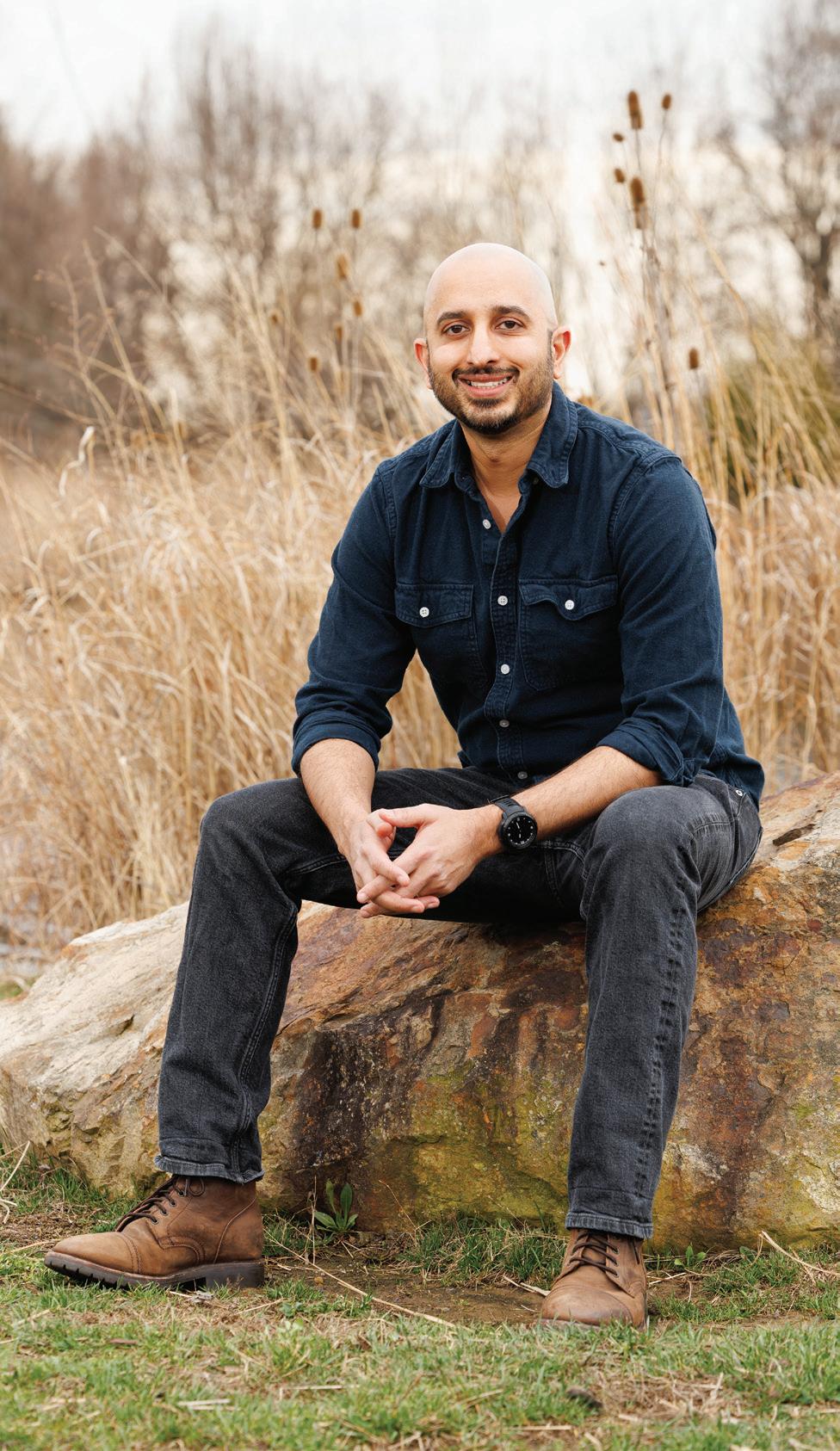
Ashish KApoor WAnts to Meet in the rAdicAl Middle
Written by Bill Kent | Photo by Michael Butcher
Last fall, Ashish Kapoor, the Piedmont Environmental Council’s senior energy and climate adviser, was asked to apply to do a TEDx Warrenton talk. His first response was to sit down and think about it.
TEDx Warrenton is a volunteer-run branch of the Vancouver-based TED (technology, entertainment, and design) nonprofit that asks people with “ideas worth spreading” to make short video presentations that can be seen for free online. Now in its fifth year, TEDx Warrenton videos have come from Marshall’s Field & Main owner Neal Warva (“Why You Should Practice Everyday Hospitality”), Baltimore futurist and astronaut candidate Lisa Alcindor on living in space, D.C. motivational speakers Dr. Willie Jolley and Dee Taylor-Jolley (“How to Never Argue in a Marriage Again”), and Richmond’s Babylon Micro-Farms CEO Alexander Olesen on vertical farming.
PEC President Chris Miller acknowledges that he urged Kapoor to do it. “I encouraged him to incorporate his experience at PEC, especially our focus on bottom-up, grassroots, landowner-led efforts around conservation, restoration, and preservation.”
Since joining PEC three years ago, Kapoor has been the organization’s point person on distributed power generation and agrivoltaics: the combination of solar and agricultural production on the same land.
“I looked at a few TED talks and I began to
write,” Kapoor says. “I connected with a wonderful coach, Devin Marks, who worked with me to develop my idea.”
“The natural landscape that can be so important in shaping your vision of the world, or just providing an interesting place to freely imagine and explore, was gone. It made me ask if a better balance could be found between the natural areas and the community needs.”
– Kapoor
He started with his background. Born in Cleveland and raised in Pennsylvania, New Jer-
Middle | Page 7
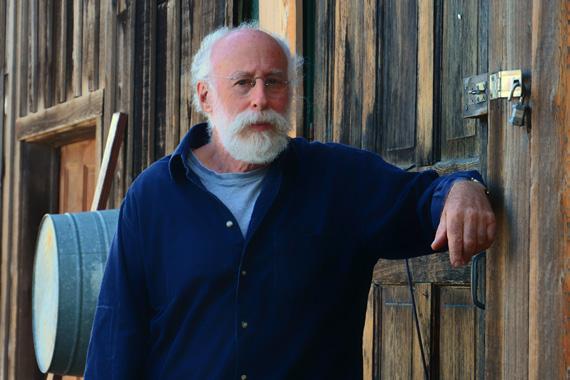
Ashish Kapoor.
sey, and India, Kapoor became an environmentalist when he returned to one of his childhood hometowns for a visit. “It is a small town in western Pennsylvania, and I used to camp around there when I was in the Boy Scouts,” he says. “It was peaceful, beautiful, quiet, and inspiring.”
Years later, as a young adult, he found it “developed, but not in a good way.”
Kapoor adds that while he is not against de-
Susmitha, with their two daughters, Sonali and Saana, left their home in Aldie and drove to an auditorium at Laurel Ridge Community College’s Warrenton campus. In addition to the well-wishers and members of the local community in the audience, there were 11 other speakers who would get one chance to deliver their talks. There would be no retakes.
Kapoor delivered an upbeat, engaging speech about three ways to find the “radical middle”: a
of speaking invitations, including dates at Virginia Tech, James Madison University, Virginia State University, Warrenton’s Highland High School, and his alma mater, Penn State.
“I’ve gotten messages from family, friends, old teachers, and strangers. They were all positive. The response to the concepts has been encouraging,” Kapoor reflects.
Hanover County farmer and Virginia Farm Bureau advocacy specialist Rachel Henley apvelopment, “the natural landscape that can be so important in shaping your vision of the world, or just providing an interesting place to freely imagine and explore, was gone. It made me ask if a better balance could be found between the natural areas and the community needs.”
The notion of a balance, a middle ground between extremes, stayed with him.
A graduate of Penn State and Rutgers University Law School, he
“Ashish has practiced what his TEDx talk preached throughout his time with us. His talk speaks to the need for people to have open minds and hearts, and where we find divides between us, we can look within ourselves for the ways to bridge them.” – McCarthy
argued environmental cases before judges and juries earlier in his career. Though he’d never done a TED talk, or anything like it, he had a story to tell.
As a child of immigrants who moved frequently, he had to “learn to walk between worlds.”
That led to many positive experiences, but a few unexpectedly negative ones, such as being teased for his American accent when his family briefly lived in India. This was among the experiences that would craft his worldview and that he would explore in his TED talk.
On October 25, 2025, Kapoor and his wife,
place for people with opposing views that is safe, judgement-free, and conducive to solving problems. Even if it doesn’t bring an immediate solution, a journey to the radical middle, Kapoor stated in his talk, can create new relationships based on trust and mutual respect.
Near the end, he cited agrivoltaics as an example of how a new idea can get better reception when it is introduced “through the lens” of the radical middle.
“The response,” Miller says, “has been tremendous.” Kapoor has already received a handful
plauded the way Kapoor explained agrivoltaics, especially since she and Kapoor have just finished drafting legislation on the subject. “This is such a complex topic, and I think he explained it well for the common ratepayer to better understand what is happening in the energy space in Virginia and beyond.”
John McCarthy, PEC’s director of strategic partnerships, says, “Ashish has prac-
ticed what his TEDx talk preached throughout his time with us. His talk speaks to the need for people to have open minds and hearts, and where we find divides between us, we can look within ourselves for the ways to bridge them.”
Kapoor has no immediate plans for future talks. He shares that the response “has been heartening, but I never wanted any attention from this. With the talk, I spoke my heart.” ML
To view Kapoor’s talk, visit youtube.com/ watch?v=OCe4dtXlUKI.
4
4
6
IDEAS TAKE FLIGHT: Increasing Bird Populations on Local Farms
Written by Truly Herbert | Photos by Brooke McDonough for the Smithsonian
Farmers invest countless hours, dollars, and buckets of sweat into their operations, and they want to ensure that they’re making the best choices for the long-term health of their farm and its inhabitants.
So when Allison Elizabeth Huysman, University of Maryland Ph.D. candidate, proposed a study that she hoped would potentially reduce agricultural pests, eight livestock and produce farms in the Middleburg and The Plains area enthusiastically agreed. Huysman is curious to discover if increasing bird populations in the region will control pests and reduce the need for pesticides.
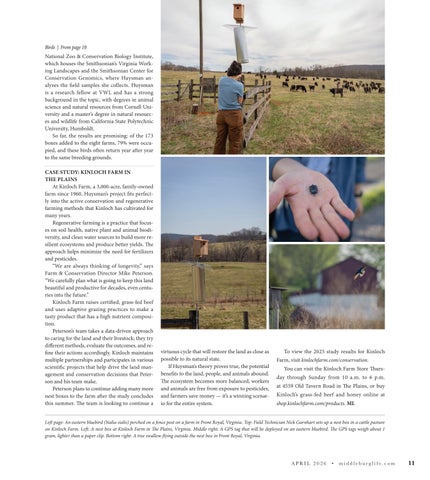
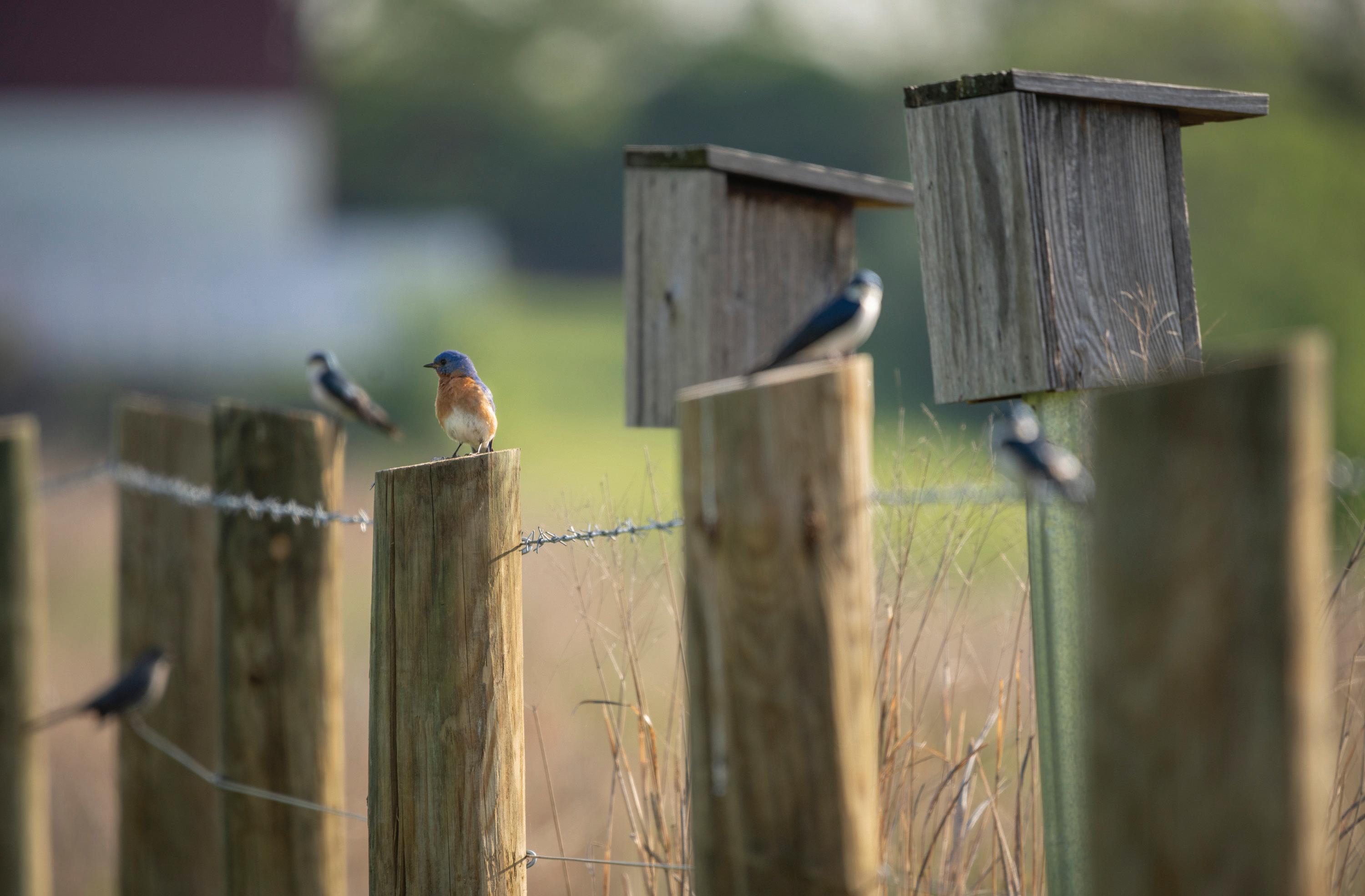
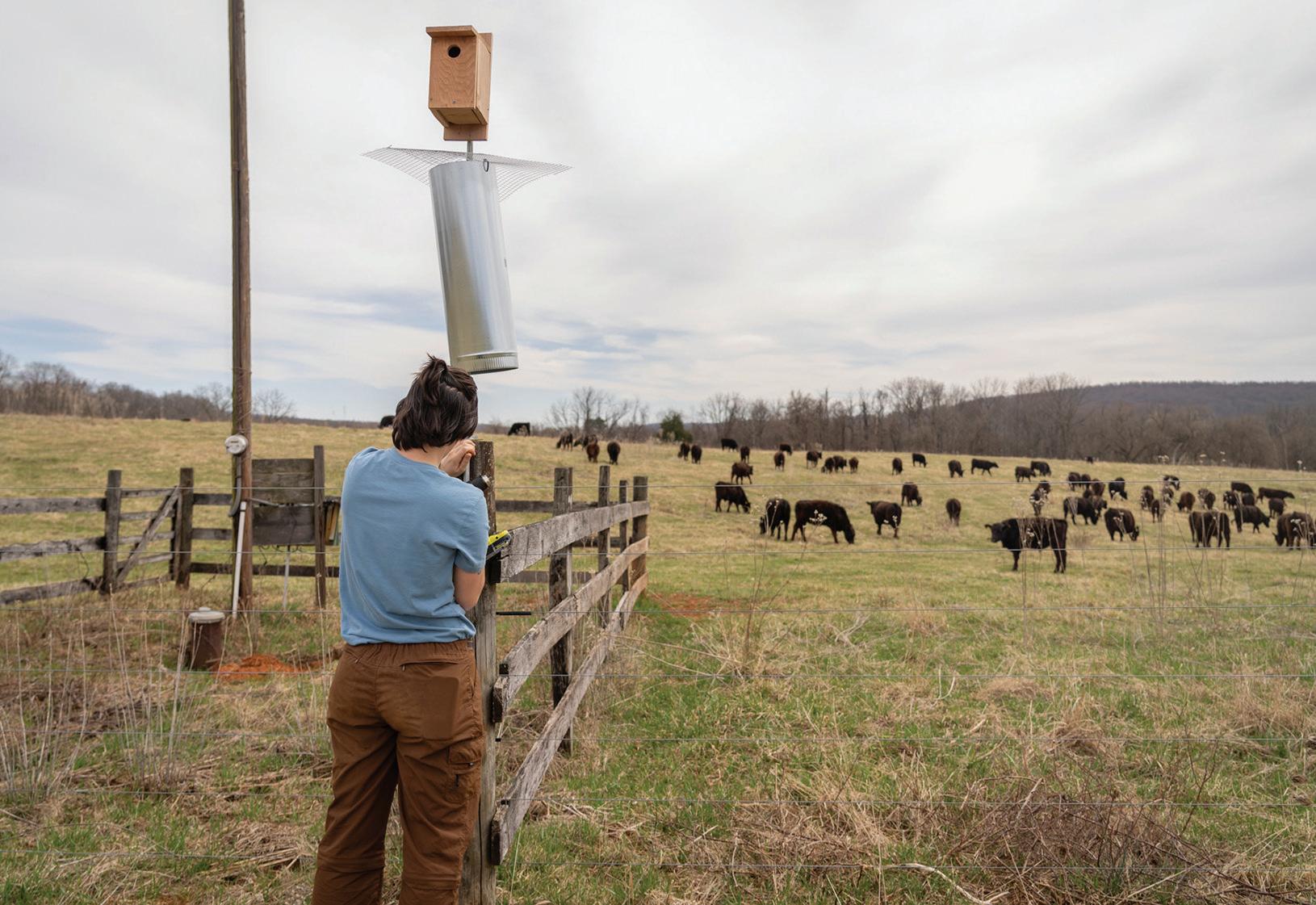
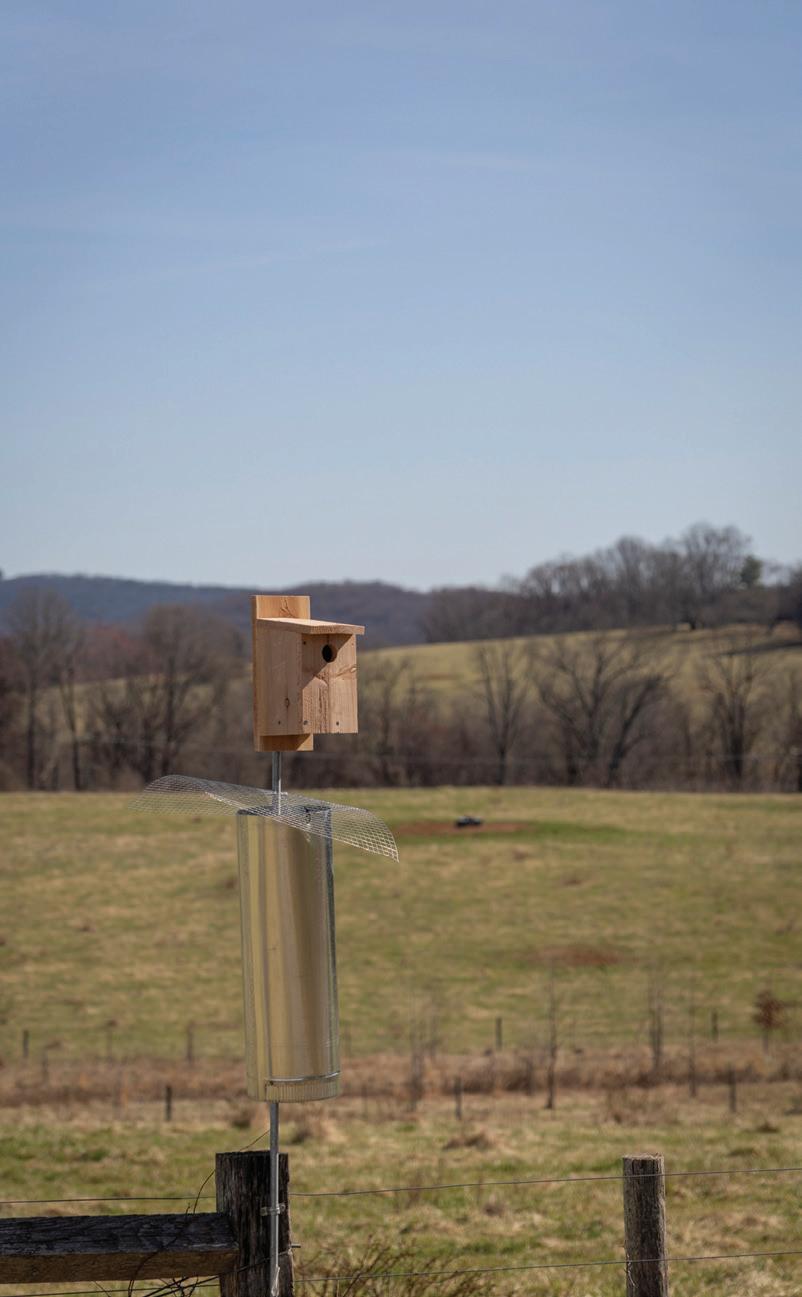
To test her theory, Huysman and her team have installed nesting boxes in a number of ideally situated spots for welcoming more cavity-nesting species like eastern bluebirds, tree swallows, and barn owls. The hope is that making attractive homes for the birds to breed in will increase their numbers and thereby reduce the abundance of agricultural pests. These and other bird species eat various types of flies, mosquitoes, moths, and rodents — pests that can wreak havoc on crops, be a source of stress for livestock, and spread disease.
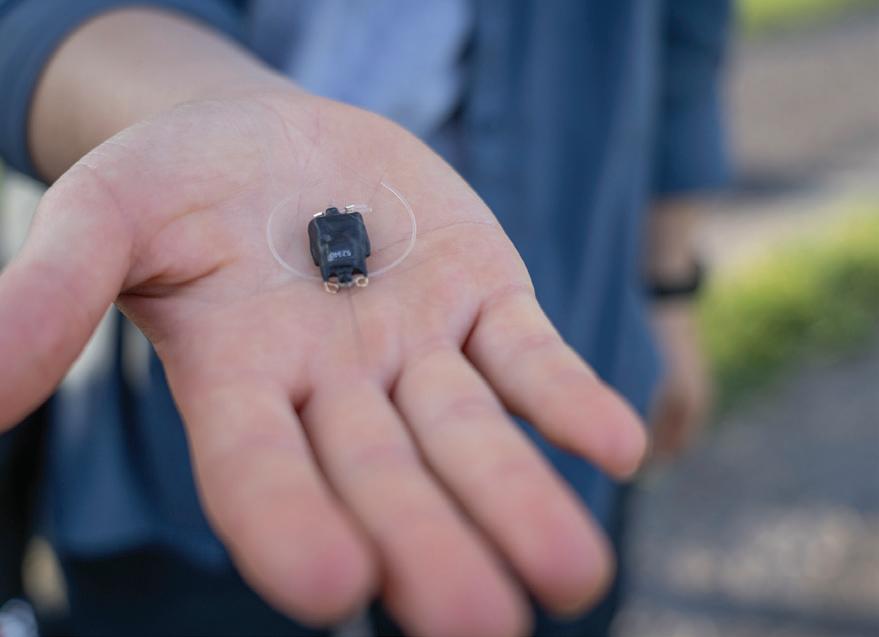
Huysman’s team applies tiny GPS tagging devices on the birds and collects fecal and insect samples to determine where the birds are going and which bugs they eat.
“Birds and insects are declining in our region,” says Huysman, “so any time we can increase numbers and remove harmful chemicals from our environments, it benefits all species, including humans.”
The project is a collaboration between the participating farms, the University of Maryland’s Department of Entomology, and the Smithsonian’s
Birds | Page 11
| From page 10
National Zoo & Conservation Biology Institute, which houses the Smithsonian’s Virginia Working Landscapes and the Smithsonian Center for Conservation Genomics, where Huysman analyzes the field samples she collects. Huysman is a research fellow at VWL and has a strong background in the topic, with degrees in animal science and natural resources from Cornell University and a master’s degree in natural resources and wildlife from California State Polytechnic University, Humboldt.
So far, the results are promising: of the 173 boxes added to the eight farms, 79% were occupied, and these birds often return year after year to the same breeding grounds.
CASE STUDY: KINLOCH FARM IN THE PLAINS
At Kinloch Farm, a 3,000-acre, family-owned farm since 1960, Huysman’s project fits perfectly into the active conservation and regenerative farming methods that Kinloch has cultivated for many years.
Regenerative farming is a practice that focuses on soil health, native plant and animal biodiversity, and clean water sources to build more resilient ecosystems and produce better yields. The approach helps minimize the need for fertilizers and pesticides.
“We are always thinking of longevity,” says Farm & Conservation Director Mike Peterson. “We carefully plan what is going to keep this land beautiful and productive for decades, even centuries into the future.”
Kinloch Farm raises certified, grass-fed beef and uses adaptive grazing practices to make a tasty product that has a high nutrient composition.
Peterson’s team takes a data-driven approach to caring for the land and their livestock; they try different methods, evaluate the outcomes, and refine their actions accordingly. Kinloch maintains multiple partnerships and participates in various scientific projects that help drive the land management and conservation decisions that Peterson and his team make.
Peterson plans to continue adding many more nest boxes to the farm after the study concludes this summer. The team is looking to continue a
virtuous cycle that will restore the land as close as possible to its natural state.
If Huysman’s theory proves true, the potential benefits to the land, people, and animals abound. The ecosystem becomes more balanced, workers and animals are free from exposure to pesticides, and farmers save money — it’s a winning scenario for the entire system.
To view the 2025 study results for Kinloch Farm, visit kinlochfarm.com/conservation
You can visit the Kinloch Farm Store Thursday through Sunday from 10 a.m. to 6 p.m. at 4559 Old Tavern Road in The Plains, or buy Kinloch’s grass-fed beef and honey online at shop.kinlochfarm.com/products ML
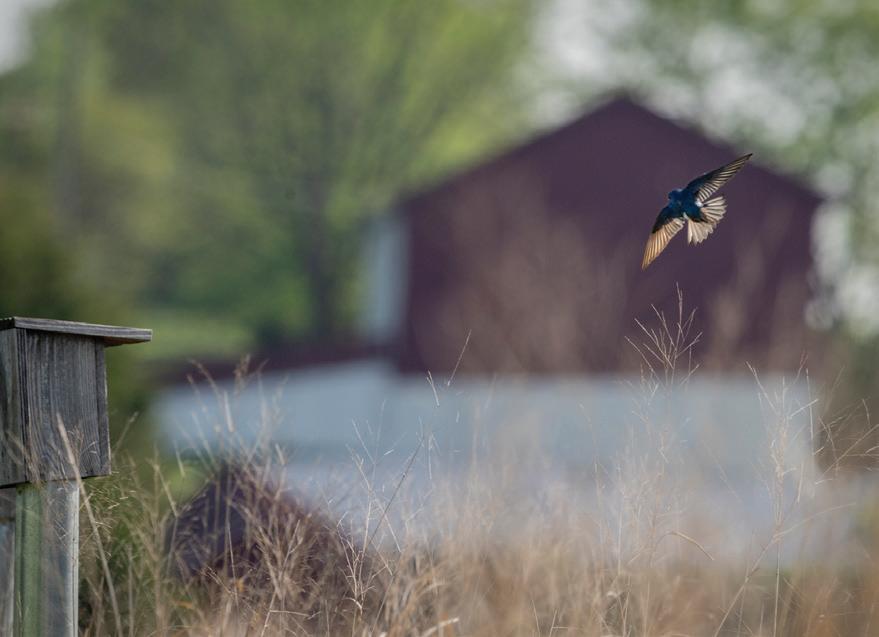
Left page: An eastern bluebird (Sialia sialis) perched on a fence post on a farm in Front Royal, Virginia. Top: Field Technician Nick Garnhart sets up a nest box in a cattle pasture on Kinloch Farm. Left: A nest box at Kinloch Farm in The Plains, Virginia. Middle right: A GPS tag that will be deployed on an eastern bluebird. The GPS tags weigh about 1 gram, lighter than a paper clip. Bottom right: A tree swallow flying outside the nest box in Front Royal, Virginia.
Envision It: Peace of Mind for Your Financial Future.
Imagine a financial plan that puts your mind at ease—backed by the strength of a national network and personalized guidance tailored to your life. Our team brings together investment, tax, estate, and legacy planning in an integrated approach, so you can focus on what matters most. We emphasize long-term objectives when constructing portfolios, rather than short-term market fluctuations. Start building your confident future—schedule a consultation today.
Every Saturday afternoon at Harrimans Grill, delight in seasonal treats, fine teas, and warm hospitality. Whether you’re celebrating a special occasion or simply embracing the art of slowing down, every sip is a moment worth savoring.
Holy Week & Easter Services & Events 2026
Sunday, March 29th - Palm Sunday
8:00am Traditional spoken Eucharist with Passion narrative
10:30am Choral Eucharist with Passion narrative
5:00pm Celtic Evening Prayer & Eucharist
Monday 30th, Tuesday 31st & Wednesday 1st April – each day
12:00pm Eucharist & Holy Week reflection
Thursday, April 2nd - Maundy Thursday
7:30pm Eucharist & Stripping of the Altar, followed by Gethsemane Prayer Vigil, through the night
THERE’S A PLACE FOR YOU
www.trinityupperville.org
Friday, April 3rd - Good Friday
10:30am Stations of the Cross, walking to the Outdoor Sanctuary - for all ages
11:30am Hot Cross Bun Coffee Hour, Cox Hall 12:00pm Seven Last Words: Good Friday liturgy of readings & music
7:00pm A Musical Reflection exploring the events of Holy Week
Sunday, April 5th - Easter Day
6:30am Easter Sunrise Service (walk out at 6:15am to the Outdoor Chapel)
8:00am Traditional Eucharist 10.30am Choral Eucharist
11:30am Family Easter Egg Hunt No evening service on Easter Day
On Rt 50, Upperville, VA, just 15 minutes west of Middleburg. 540-592-3343
B est p r A ctices to p rotect l oc A l W A ter WA ys
Written by Sarah Hickner | Photo by Hugh Kenny
Water carries life, but it can also carry disease and impurities. The primary goal of Fauquier County’s John Marshall Soil and Water Conservation District is to protect the water quality of the Chesapeake Bay watershed and the streams that feed into it. The organization works with local farms, using grants to subsidize conservation efforts that help keep livestock, property, and water sources safe.
That means farm owners can help the environment and their animals with relatively little out-of-pocket cost. District Manager Melissa Allen says, “We are grateful for the opportunity to work with landowners and farmers to improve soil health and water quality. Each site visit is an opportunity to educate and to learn.”
FENCING OFF NATURAL WATER SOURCES
The JMSWCD has a cost-share assistance
program to help farm owners with the expense of fencing off natural water sources. Many landowners rely on streams and ponds to provide water for their animals, but drinking directly from these sources can introduce both short- and long-term health risks.
Diseases can spread through streams due to fecal contamination from wildlife and livestock. Leptospirosis thrives in standing water and can cause miscarriages in cattle and horses. It has also been linked to recurrent uveitis in horses. Bacteria such as salmonella and E. coli can be picked up in contaminated water and spread rapidly through herds. Even equine protozoal myeloencephalitis is caused primarily by Sarcocystis neurona, a parasite spread through feed or water contaminated by opossum waste.
Despite these risks, natural water sources are often seen as assets because they provide animals with constant access to water. The JMSWCD un-
derstands this reality and works with farm owners to find safer solutions.
Grants are available to help landowners offset the cost of fencing off natural water sources from livestock and horses at a rate of $7.50 per foot of fencing. While that amount may not cover the cost of a traditional four-board fence, it can significantly reduce the expense of protecting both animals and waterways. The organization can also assist with installing watering systems in fields where natural water sources have been fenced off.
CREATING A BUFFER
Another way to improve the safety and purity of the local watershed is by creating a natural tree barrier known as a riparian buffer. When rain falls on pastures or cropland, it
Waterways | Page 17
rarely soaks straight into the soil. Instead, it moves across the land, carrying soil particles, manure, bacteria, and fertilizer nutrients such as nitrogen and phosphorus. If there is no vegetation along a stream bank, that runoff can move quickly and directly into the water.
A tree buffer helps slow this process. Leaves and undergrowth reduce the speed of surface flow, allowing the water to spread out instead of channeling toward the stream. As the water slows, sediment settles out before it reaches the waterway.
Tree roots also help filter pollutants and stabilize stream banks. In this way, a riparian buffer becomes a natural filtration system that protects both land and water.
The JMSWCD covers 95% of the approved cost of planting a riparian buffer, and a grant from the Piedmont Environmental Council can often cover the remaining expense. “We are very fortunate for the working partnership with PEC and its staff, and its role in encouraging landowners to plant riparian buffers,” Allen says.
BIN-STYLE COMPOSTING
There are also funds available to help farms in the Goose Creek watershed establish composting
systems. When managed properly, a compost pile becomes its own small ecosystem. The heat generated inside reduces harmful bacteria while destroying parasite eggs and weed seeds.
Over time, manure breaks down into dark, crumbly compost that can be returned to the soil. Instead of washing into nearby waterways during storms, nutrients are recycled into the pasture where they support healthy grass growth.
ROTATIONAL GRAZING IN PASTURES
Pasture management is another important piece of protecting local water sources. When livestock repeatedly graze the same plants before they have time to regrow, the roots weaken and the soil begins to break down. This can lead to bare patches, weed growth, and increased runoff of manure into nearby streams.
Healthy grass with strong root systems helps hold soil in place and absorb rainfall. Overgrazed pastures, by contrast, shed water more quickly, increasing erosion and nutrient runoff.
Rotational grazing helps address this problem by giving pastures time to recover. When animals are moved between grazing areas, the grass can regrow its leaves and rebuild its root system. Stronger roots create more stable soil and help the ground absorb and retain water. “Rotational grazing is the icing
on the cake after infrastructure changes have been made,” Allen says.
The JMSWCD works with farm owners to create plans that allow pastures adequate rest between grazing periods. Landowners can receive $75 per rested acre through this program, and many use those funds to improve fencing or reseed.
Protecting our waterways does not require sweeping change so much as steady stewardship. Fencing livestock out of natural springs and ponds, planting tree buffers along streams, composting manure, and allowing pastures the rest they need are practical steps that make a lasting difference.
Through cost-share programs, technical guidance, and on-the-ground support, the John Marshall Soil and Water Conservation District is helping local landowners strengthen their farms while safeguarding the health of the Chesapeake Bay watershed. In the end, these efforts protect more than water quality; they preserve the soil, keep our horses and livestock healthy, and ensure the long-term resilience of the land that sustains both people and animals.
For more information, Fauquier County residents can contact the John Marshall Soil and Water Conservation District at (540) 422-8490, and in Loudoun County, contact the Loudoun County Soil and Water Conservation District at (571) 918-4530. ML
LIMESTONE FARM
acres | $6,695,000
Boyce – Federal style manor house refinished, updated and expanded. Guest house, restored bank barn, and Opequon Creek complete an estate designed for fine living and equestrian pursuits.
John Coles | 540-270-0094
Boyce – Custom home with spectacular views. 6 BRs / 5 full & 2 half BAs. No details spared. Greenhouse, garage, separate 4-season room. A mix of open pasture and woods. Additional lot available.
Cricket Bedford | 540-229-3201
PENDLETON STREET $2,250,000
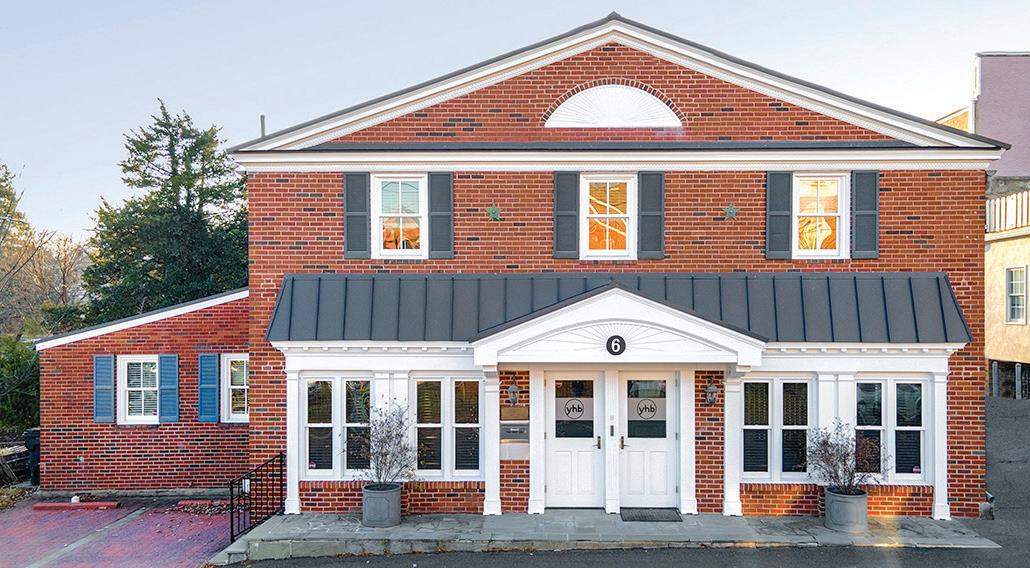
Middleburg – Commercial opportunity in the heart of downtown. Over 5,500 sq. ft. with flexible work areas, conference rooms, 3 half BAs, and large break room. Two parking spaces. Zoned C-2.
Cricket Bedford | 540-229-3201
122+ acres | $4,950,000
Delaplane – Impressive 7,300 sq. ft. of beautiful living space features high ceilings, large windows, and spectacular views. 2 Barns, 100 x 200 arena, Piedmont Hunt territory. Rolling hills w/ miles of trails.
John Coles | 540-270-0094
BELVEDERE 27+ acres | $3,395,000
Middleburg – Rolling countryside, effortless elegance, and Horse Country living converge. A private 8,400+ sq ft sanctuary for grand entertaining, equestrian pursuits, and life’s finest moments. Will Driskill | 540-454-7522
KITTERY POINT 74 acres | $2,200,000
Berryville – Sweeping Mountain views! 5 BRs / 3.5 BAs Brick home on three full levels. 10-stall barn, multiple outbuildings. Blue Ridge Hunt territory.
Maria Eldredge 540-454-3829 | Anne McIntosh 703-509-4499
Boyce – 3 BR / 1.5 BA huntbox. Exterior paint and new roof. Hardwood floors throughout, high ceilings, 2 working fireplaces. Charming, bring your horses! Blue Ridge Mountain views.
Maria Eldredge 540-454-3829 | Anne McIntosh 703-509-4499
overlooking protected land. Open pastures, hayfields and mature trees. Stabling for 10 horses.
Marshall – Meticulously renovated 5,000 sq ft Manor house on prestigious Atoka Road - no details spared. Lush gardens. Mature trees. Pool. Greenhouse. Apartment. Bank barn, paddocks. Pond. John Coles 540-270-0094 | Cricket Bedford 540-229-3201
CHARTWELL 24+ acres | $2,295,000
Marshall – In Bellevue Farms, w/ 30+ miles of trails. Custom 7,700+ sq. ft. stone 5 BR / 5.5 BA house with great views! 1 BR / 1 BA guest house, horse barn w/ barn apt, ring, paddocks & pond. In 2 parcels. Cricket Bedford | 540-229-3201
MELMORE 3 acres | $1,825,000
Middleburg – Pristine 4 BR / 4.5 BA home in the coveted Melmore Community. Desirable one-level living, Chef’s kitchen, new paint, lighting & custom window treatments. 3-car garage. Move-in ready. Rebecca Poston | 540-771-7520
HAYMAN
Round Hill – Fully renovated 3 BRs / 2.5 BAs farmhouse. HW floors, 2-story family room w/ fireplace & kitchen w/ breakfast room. Fresh paint, new carpet & appliances, fenced back yard & garage. Cricket Bedford | 540-229-3201
Since 1967 Thomas & Talbot has represented both buyers and sellers of nearly every significant property in Horse Country. Real estate here has never been about transactions. It’s about relationships, trust, and a deep love for this remarkable way of life. When you’re ready to move, pick the sure thing—Thomas & Talbot.
Photo Credit: Middleburg Photo
LOCAL PHOTOGRAPHERS CHAMPION CONSERVATION CAUSES
Written by Kaitlin Hill
MIDDLEBURG LIFE PHOTOGRAPHER
CAROLINE GRAY GIVES BACK BEHIND THE LENS
Conservation efforts come in many forms, but capturing the beauty of a place is arguably one of the most effective in conveying the importance of preserving natural spaces. For Middleburg Life photographer Caroline Gray, supporting the missions of the Piedmont Environmental Council (PEC) and Saving Gracie Equine Healing Foun-
From a childhood spent outside, Gray shares that her path to becoming a photographer was “not linear,” but did start early. “At 16 years old, I had the once-in-a-lifetime opportunity to travel to Tanzania, Africa, and study large cats with my science teacher and a group of peers. For the trip, my dad bought me a starter Canon camera. The camera never left my hand… Suffice it to say, it was the start of a lifelong obsession.”
Her college years would shift her away from
thriving, Gray suffered a cerebral ischemic stroke. “It took me three months to return to 50% of where I was before my stroke, in terms of being able to do the basics like walk on my own. The lingering effects of the stroke are still with me. Having this near-death experience put my life into perspective,” she shares. She continues, “After I recovered and was able to return to work, the yearning to explore my creative side became an urge I could no longer
dation with the proceeds of her photography was a natural — pun intended — choice.
“The conservation of our natural world and its inhabitants is a cause that I am passionate about for many reasons, but mostly I hope that future generations can experience our planet the way that I had the privilege to. As a child, I grew up spending most of my time in nature: between horseback riding, skiing, and hiking with my family, I was perpetually outdoors,” she explains.
photography to a career in advertising, before she pursued a master’s while working in retail. “I worked at Tuckernuck in a very analytical, business-centric role. At the same time, I was receiving my MBA at the University of Virginia’s Darden School of Business. I had an innate creative, dreamer side that was stimulated by the fashion industry, but my day-to-day was very ‘left-brained’ and numbers-driven.”
About to graduate and her career already
ignore.”
While founding Caroline Jean Gray Photography marked a new chapter in her life, it also brought her back to her passion for horses, photography, and the great outdoors.
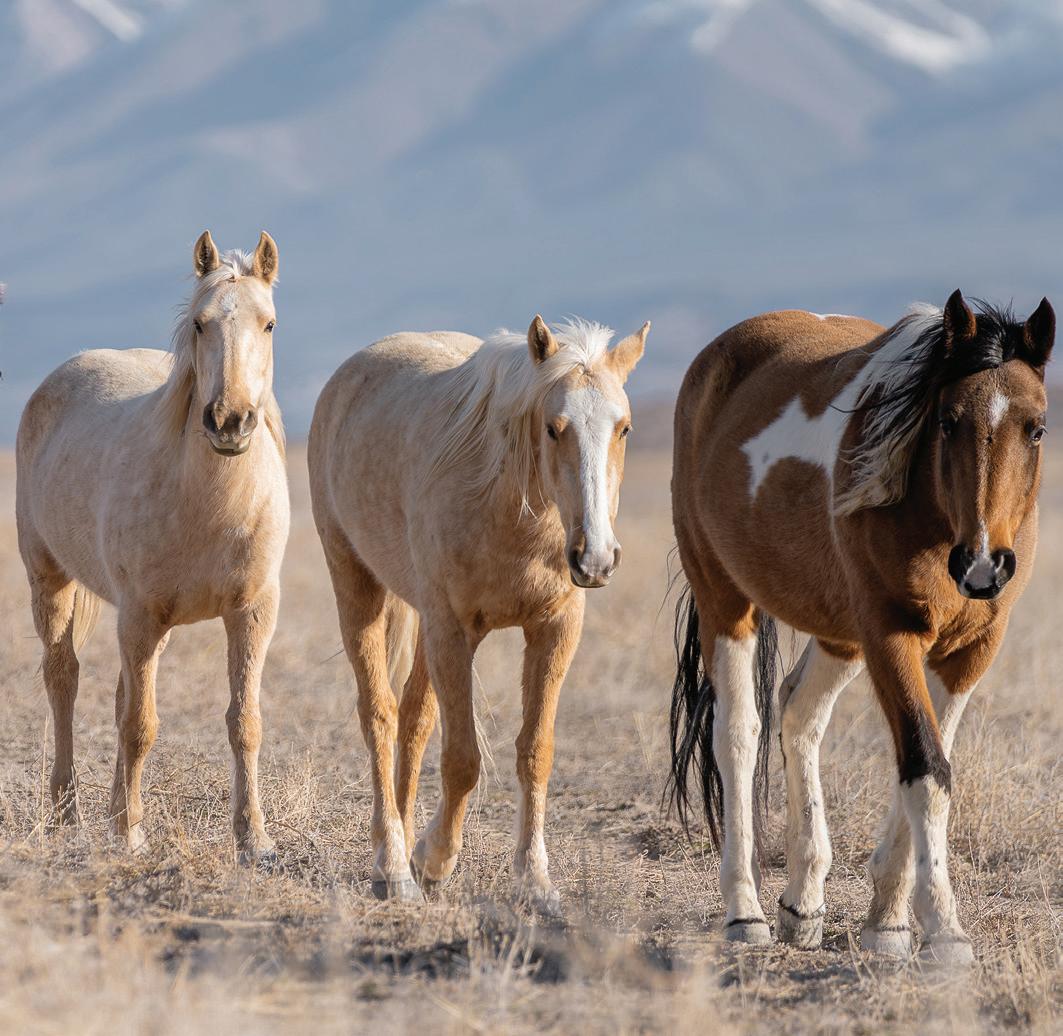
A month after starting her company, Gray was invited to photograph wild mustangs in Utah and recruited by Middleburg Life. “Having grown up
Champion | Page 21
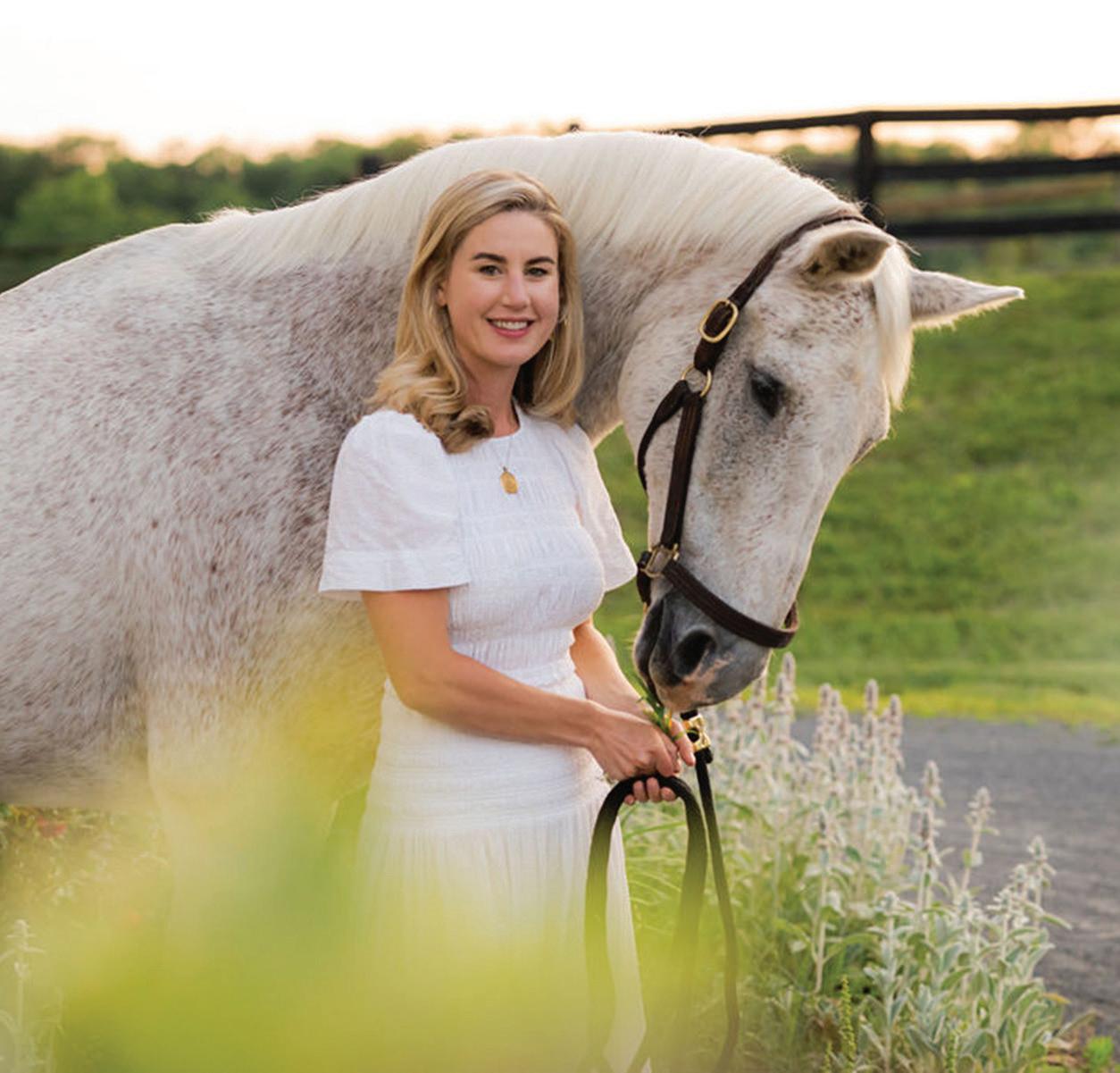
Left: Caroline Gray and her horse, Cleverly. Photo by SAS Equestrian. Middle: Wild mustangs in Utah. Right: A shot of Gray’s Hunt Country Collection. Photos by Caroline Gray.
riding horses since the age of 4, horses and horse country have always been a central part of my life. From the wild horse experience and connecting with Middleburg Life, my photography business has brought me full circle. I am lucky to be living out my dream in Hunt Country, surrounded by horses, with a new lease on life behind the lens.”
And part of that dream is giving back. “Both the PEC and Saving Gracie Equine Healing Foundation are very meaningful to me.” Locally, “The Piedmont region is currently threatened by the explosive and pervasive expansion of data centers and housing developments. The PEC is on a mission to mitigate the risk these developments pose. It is an organization that is very special to me and it works tirelessly to protect the land that I love.”
Further afield, “I love spending time in the mountains. In my time out west, I connected with the Saving Gracie Equine Healing Foundation. Twice, I’ve had the privilege to photograph the Onaqui wild mustangs outside of Tooele, Utah. Seeing wild mustangs in their natural habitat is a surreal experience… Ensuring these horses have space and viable protection to live and roam is important to me so future generations can see with their own eyes the majesty of wild horses.”
She finishes, “Through my work, I have discovered many foundations that are making an impact to protect the natural world. However, given the importance of their work, these two organizations are particularly close to my heart.”
Prints from her Hunt Country Collection and Wild Mustang Conservation Collection are available at carolinejeangray.com and at Castle Gallery in Middleburg. Ten percent of the proceeds will be donated to the Piedmont Environmental Council and the Saving Gracie Foundation, re-
spectively. Gray will also host a pop-up from April 30 to May 1 at Castle Gallery.
SCENIC VIRGINIA PARTNERS WITH THE PEC ON TREASURED VIEWS
Another group using the power of photography to preserve pristine places is Scenic Virginia, whose mission as stated by its website is to “preserve, protect, and enhance the scenic beauty and community character of the Commonwealth, with a particular focus on the preservation of our most significant viewsheds and on educating Virginians about the need to preserve these scenic resources through our Treasured Views program.”
The program uses a science-backed approach and evaluation criteria to “identify, assess, map, and catalogue Virginia’s scenic resources,” all in the name of protecting them. Visitas can be nominated by an organization or community, and central to the nomination process is photographic evidence of how scenic the view is.
In 2025, Scenic Virginia announced its threeyear partnership with the Piedmont Environmental Council. John W. McCarthy, the PEC’s senior adviser and director of strategic partnerships, shares, “PEC has partnered with Scenic Virginia to help them manage the Treasured Views program. We know from polling and surveying the general public that the landscapes of Virginia are integral to their enjoyment of the outdoors, and so the program exists as a way to document those landscapes that are objectively important to us all. We view the Treasured Views program as complementing PEC’s land conservation work and showing that careful analysis can document the values that are held sacred by so many Virginians.”
Warrenton resident and PEC Multimedia Communications Specialist Hugh Kenny captured the stunning view of Piedmont Memorial
Overlook. In addition to serving as our cover image this month, it is one of Scenic Virginia’s Treasured Views. According to Scenic Virginia’s program director, Gillian Grant, the site is as historically significant as it is beautiful. In a letter to Scenic Virginia subscribers, she described the area as “perched high above the Crooked Run Valley” and “a landscape that is both pastoral and majestic.” She continued, “From this elevated vantage point, visitors can take in working farms, forested hills, and a sweeping upland stream valley that winds south toward Goose Creek, a designated Virginia State Scenic River. The Blue Ridge Mountains anchor the horizon, creating a view that feels expansive, peaceful, and deeply rooted in place.
“Historically, the Overlook lies within territory once occupied by Siouan-speaking peoples, whose lands spanned more than half of present-day Virginia. In the late 1990s, this area faced multiple development threats, including a proposed golf course and mountain-side housing. In 2000, the Piedmont Environmental Council (PEC), with the support of local families and foundations, purchased 1,235 acres to protect this extraordinary landscape. Shortly thereafter, nearly 450 acres were transferred to the U.S. Department of the Interior to realign and improve the Appalachian National Scenic Trail and to provide public access to this exceptional viewshed.”
The site was nominated by the Fauquier County Community Development team and, as Grant wrote, “met all criteria.”
More than pretty to look at, the work of Scenic Virginia and its partnerships with local organizations like the PEC is an important piece in preserving the places worth treasuring in Hunt County. ML
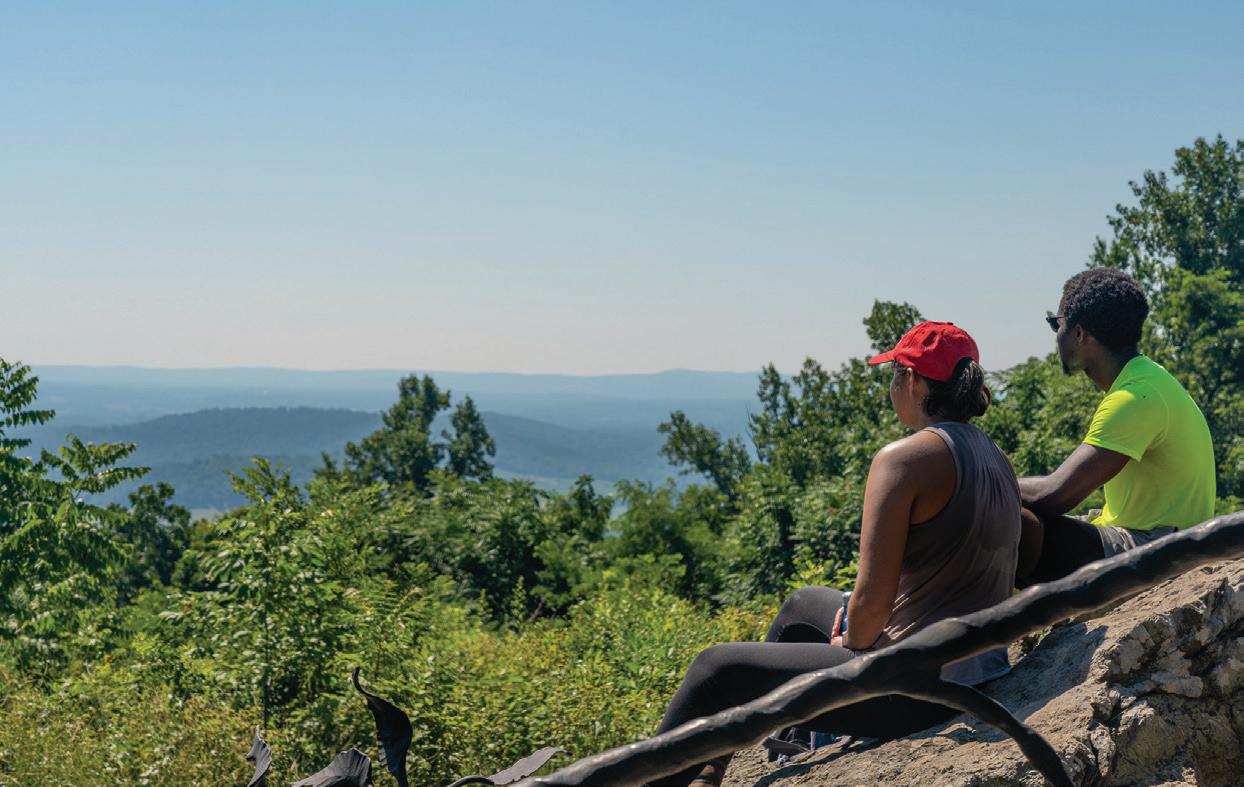
Left: A hiking duo enjoys the Piedmont Memorial Overlook. Right: A plaque marks the spot. Photos by Hugh Kenny.
“the plAy thAt Goes WronG”
Dr. Toby Brings the West End Hit to Wakefield
Under the clear skies and russet leaves of autumn in Georgetown, while other girls fiddled with their dolls’ clothes, a little girl named Toby launched her acting career. The toddler became the youngest extra in the classic horror film, “The Exorcist.”
From her initial foray into acting, Toby Chieffo-Reidway, Ph.D., would grow up to become a theater professional, and one who shares her love of theater with children. “Over the course of more than 25 years teaching theater to young people, I’ve watched countless students discover talents they never knew they had and gain confidence they struggled to find elsewhere,” she shares. “Theater gives children a place to shine, but also a place safe enough to explore who they are and who they are becoming. It encourages skills such as empathy, teamwork, patience, listening, and generosity, which benefit them regardless of their future paths.”
Chieffo-Reidway, nicknamed “Dr. Toby,” earned her bachelor’s in American studies and theater at Georgetown. She next garnered a mas-
Written by Diane Helentjaris
ter’s and Ph.D. in American studies and African American history and culture from the College of William & Mary. While a graduate student, Chieffo-Reidway answered a casting call for the film “Hannibal.” The redhead ended up as Julianne Moore’s stand-in and a card-carrying Screen Actors Guild member. She went on to appear in television shows, commercials, feature films, musicals, and plays.
These days, she shares her love of the arts as a theater educator in Wakefield School’s Performing Arts Department. Wakefield is an independent, college preparatory day school near The Plains, Virginia. More than 300 students, from junior kindergarten through grade 12, study at its bucolic, 62-acre campus.
Each year the older students present a play to the community. This year the play will be “The Play That Goes Wrong,” with Chieffo-Reidway as director. A highly successful British comedy, the show, originally produced in London, has been running since 2012. After a Broadway run from 2017 to 2019, the play continues off Broadway in
Manhattan. Penned by three British writers — Henry Lewis, Jonathan Sayer, and Henry Shields — “The Play That Goes Wrong” has won multiple awards. It also spawned a slew of British television spin-offs, including “Peter Pan Goes Wrong,” “Magic Goes Wrong,” “The Goes Wrong Show,” and, of course, “A Christmas Carol Goes Wrong.”
“The Play That Goes Wrong” showcases a pitiful theater company — the Cornley Polytechnic Drama Society — as it encounters one disaster after another while putting on a murder mystery. Problems are not confined to human foibles. Even the play’s set and props fail to meet their missions in most unfortunate ways.
Chieffo-Reidway says, “‘The Play That Goes Wrong’ is a modern comedy phenomenon. Since its beginnings as a small-scale production that grew into a smash off Broadway hit, it has become one of the most beloved farces of our time. When it is done well, it is relentless, joyful, and utterly hilarious — the kind of show that brings audiences to their knees with laughter… The members of
Play | Page 23
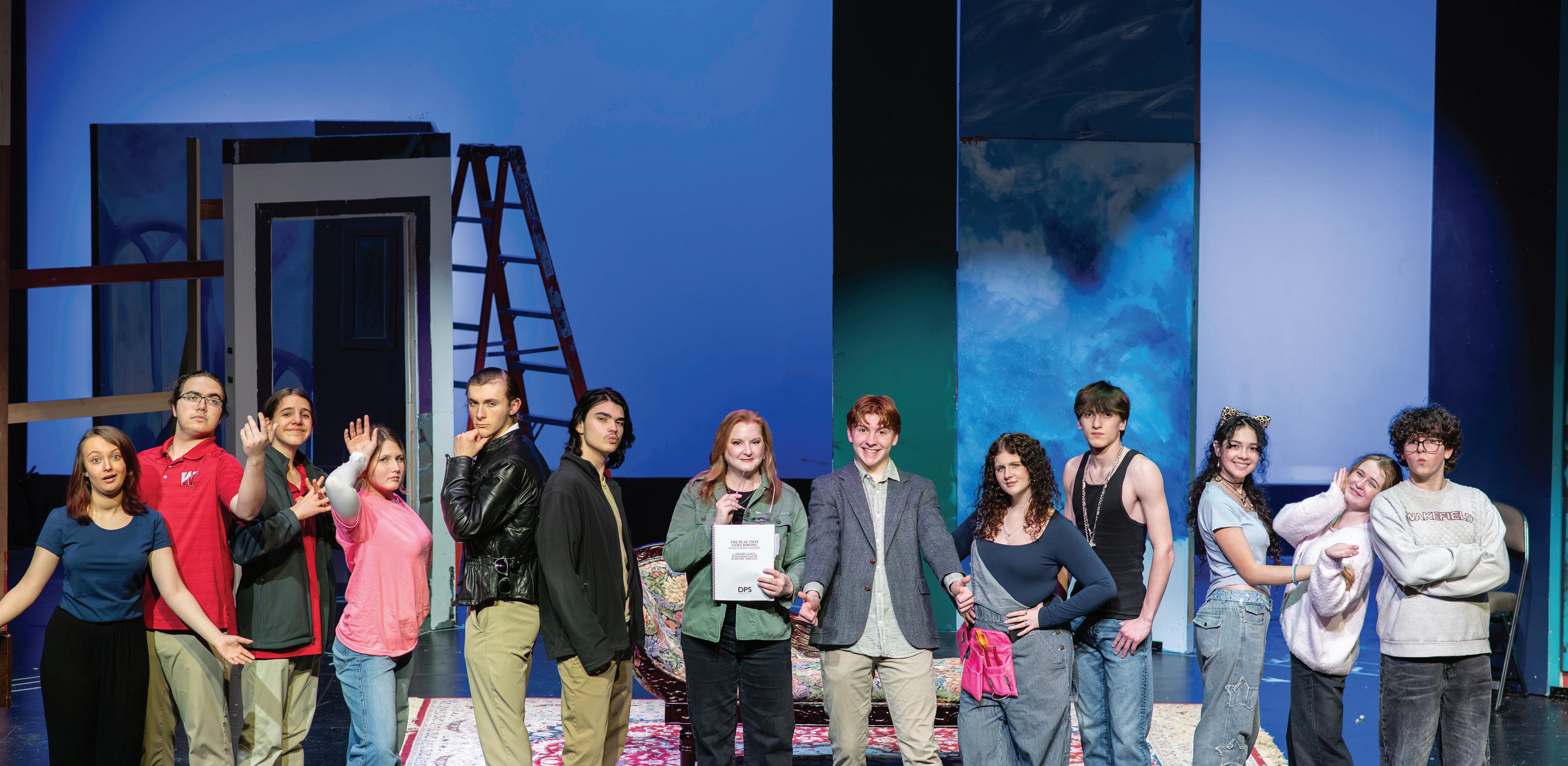
From left to right: Savannah K., Elliot S., Samuel B., Sydney W., Landon N., Lochlan P., Chieffo-Reidway, Patrick R., Avery M., Chase R., Cora L., Rebecca J., and Hayden D. Photo by Gianna Pieracci.
| From page 22
the Cornley Drama Society … are so passionate about putting on a good show that you can’t help rooting for them, even as everything hilariously unravels. It’s not only one of the funniest scripts I’ve ever read, but the heart beneath all the chaos is what I hope people will remember about it.”
The audience at the April 26 Sunday matinee will include a special group of high school students. They are Cappies participants from other high schools in the Washington, DC, region. The Cappies (Critics and Awards Program) is an international NGO dedicated to celebrating high school theater, journalism, and playwriting. It originated in Fairfax, Virginia, in the aftermath of the Columbine tragedy to bring positive attention to teens “engaged in creative pursuits.” The program has grown to include schools from across the United States and Canada.
This group of Cappies have been trained to write critical reviews. They will be competing to have their work published in local media outlets.
The young critics’ reviews will be used to assess Wakefield’s performance for inclusion in the annual Cappies awards. Chieffo-Reidway likens winning a Cappies award to “a Tony for high school students.” Like the Tony Awards, recognition goes to individuals for excellence in performance, technical, and support work. Awards are bestowed and celebrated at the annual Cappies gala.
In addition to teaching and her work with “The Play That Goes Wrong,” Chieffo-Reidway is the CEO and founder of the after-school theater program Acting Out with Professor Toby. She is also the producer of Summer Smash Up, a musical theater camp held at Wakefield School each summer for youngsters aged 7 to 15. “I believe theater offers valuable opportunities for every child to thrive and develop, so I encourage everyone to try it!”
“The Play That Goes Wrong” will be performed April 24, 25, and 26. Tickets may be purchased at wakefieldperforms.ludus.com ML
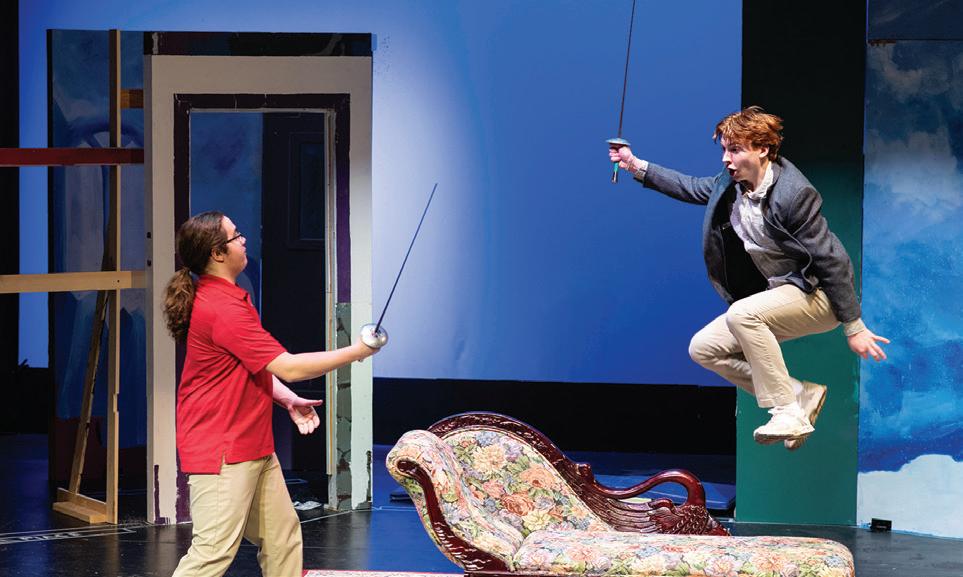
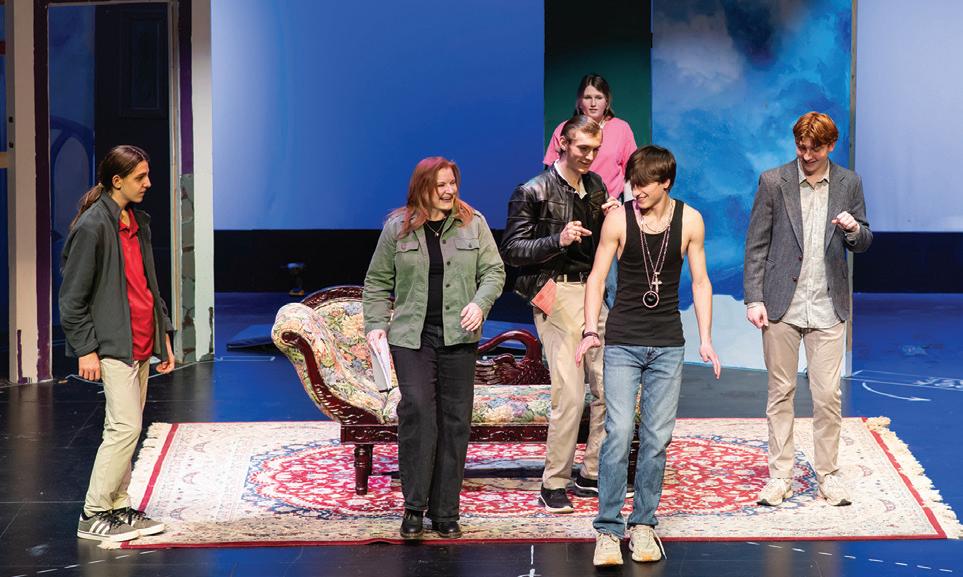
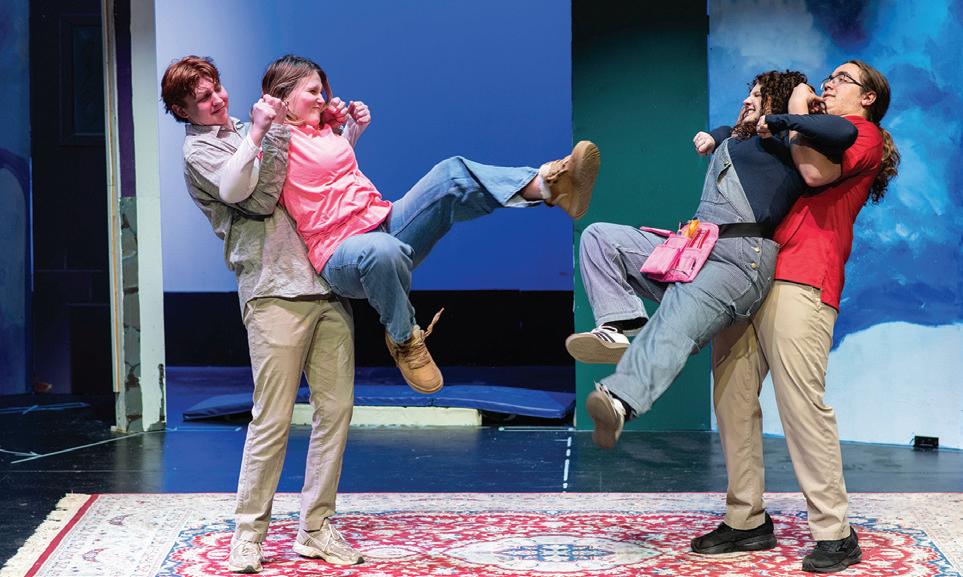
Top: Robert (played by Elliot S.) and Max (played by Patrick R.) spar. Photo by Irish Eyes Photography by Toby. Middle: Chieffo-Reidway teaching Chase R. the Charleston, among other dance moves. Photo by Gianna Pieracci. Bottom: Sandra (played by Sydney W.) and Annie (played by Avery M.) fight over the spotlight while being held back by Max (played by Patrick R.) and Robert (played by Elliot S.) Photo by Irish Eyes Photography by Toby.
“Arunning joke in the family is, ‘In a world of fast fashion, we are slow fashion,’” shares Rodrick Rigden of Middleburg’s Country Classics. The shop, which was started by Rigden’s mother, Diane, 38 years ago, is well loved for its traditional tweeds, elegant silk ties, seemingly endless selection of cuff links, and socks in almost every color — all the makings for a fashionable Hunt Country man or woman. Though, beyond the aesthetic appeal of the shop’s wardrobe offerings, how they source their inventory and where it comes from prove that preservation of the old ways and an insistence on sustaining long-held relationships is a win-win-win for maker, purveyor, and customer.
“We started in Edinburgh, Scotland, and made our way south to London,” Rigden remembers of a January trip to visit his suppliers. “The mill that makes our tweed and the knitwear factory are both in Scotland.” He continues, “Then
rod ABroAd: country clAssics Goes strAiGht to the source
Written by Kaitlin Hill | Photos courtesy of Rodrick Rigden
we hit a few of the cities in the … Midlands to visit the people that make our socks, hats, labels, and meet a new manufacturer of men’s and ladies’ clothing.
“The Midlands,” he explains, “is traditionally the heart of manufacturing in the UK.” He adds, “We then headed further south to our shirtmaker, and finally [we stopped] in London, where we met regarding the silk for all of our scarves, pocket squares, and ties.”
Rigden and his associates make a trip like this “anywhere from twice a year to once every few years,” to check in with the makers of the Country Classics brand, C&D Rigden & Son. Beyond seeing the factory lines, Rigden explains, “we try to visit everyone at least once every two years just to maintain a face-to-face relationship. It is a symbiotic relationship at the end of the day, so knowing each other personally is extremely important to how we do business.”
In an age of fast fashion, where clothes are made of science-experiment-sounding fabrics, ship the next day, are suspiciously cheap, and are demonstrably bad for the environment — contributing to landfills and increasing CO2 and microplastics — Rigden’s UK trek is an example of literally going the extra mile for his business and clientele. The result? “The easy answer is quality,” he says. “The truth of the matter is that not only do all of these makers have the machinery to make a specific type of clothing, they have this multigenerational knowledge that can’t be replicated.” He also notes that their products are made of natural fibers.
Rigden talks through the very intricate, nearly yearlong process that goes into producing the perfect tweed. He explains, “[We] decide on color and size of repeat, how heavy it needs to be, and the final texture. Then [we] start looking at
Source | Page 25
“A running joke in the family is, ‘In a world of fast fashion, we are slow fashion.’” – Rigden
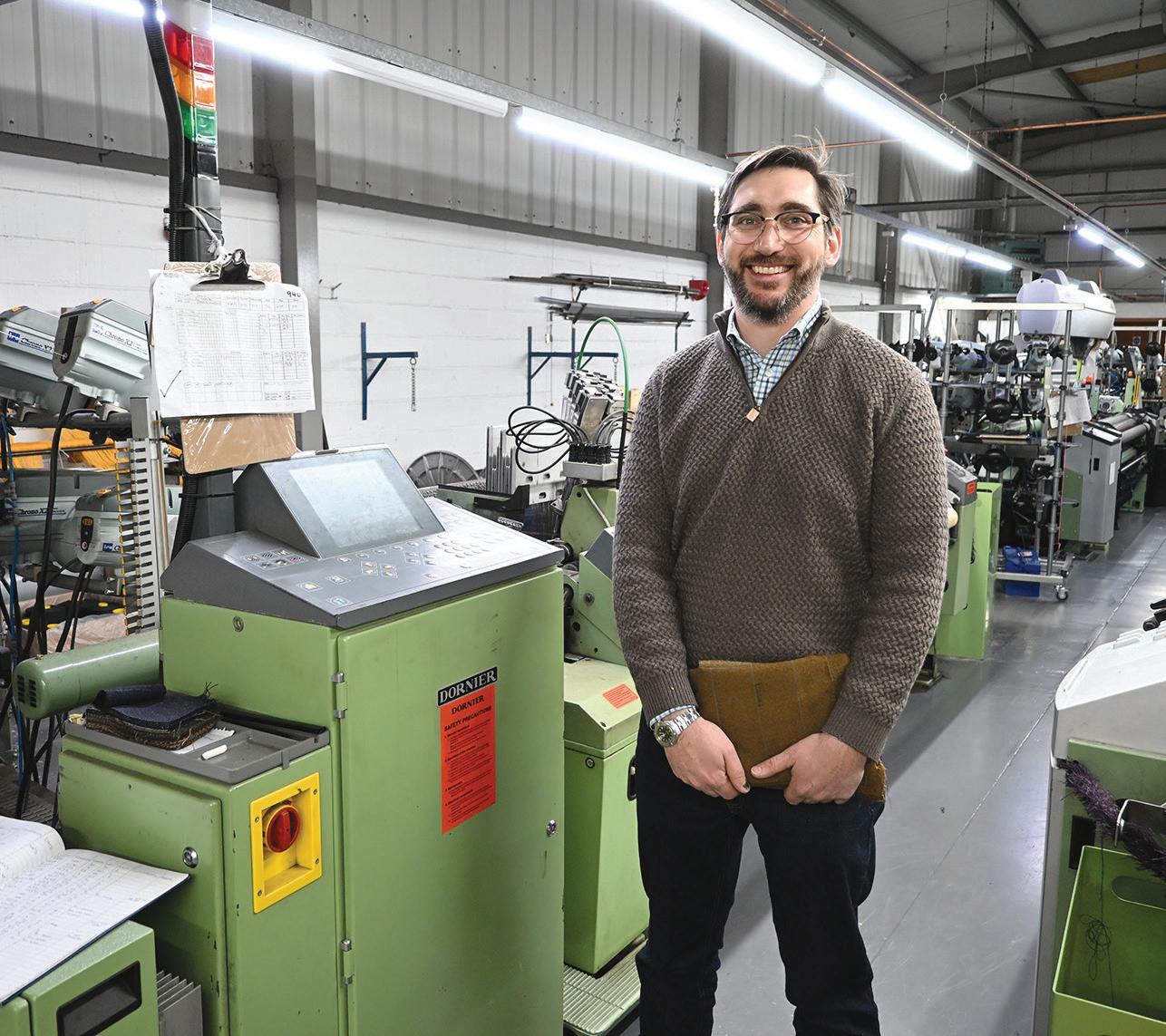
Rigden at the mill in Scotland, where modern technology is a marked change from the wooden framed looms that sat in the same spot over 200 years ago.
Source | From page 24
color samples and playing with different threads. These can be twisted together to create even more options. Once the design has been finalized, the mill goes to work creating the piece of tweed. They start by spinning all the thread needed… The spindles of thread are taken to either a warping or wefting machine. The warp are the vertical threads, whereas the weft are the horizontal threads that make up a piece of cloth. The warp and weft threads are laid out on massive rollers in a very specific sequence. This dictates the pattern of the cloth. It takes an entire day’s work for a skilled craftsman to set up a warp or a weft for a piece of tweed.”
He continues, “The warp and weft are then taken to the loom, where both are woven into one piece of tweed. The modern looms our tweed is currently made on can weave about an inch of tweed a second. If a single thread breaks while weaving, the loom will automatically stop. That thread will need to be rethreaded and attached before weaving continues — a skill that takes years to do proficiently. Once each piece is woven, it goes to a finishing room, where the entire piece will be pulled across a light table and inspected for defects. Finally, the piece is sent off to the finishers, who will wash the entire piece and add a uniform texture if required. That piece of tweed will then be shipped to one of our manufacturers. A piece of tweed makes on average about 25 jackets.”
Rigden notes that Country Classics has partnered with some of these makers since the very beginning. “My mother … started as a rep for a small hat company that made tweed flat caps. I now deal with that man’s grandson. So, technically, the Rigden family has been doing business with that family for 39 years.” He adds, “I should really send them a cake or something for our 40th anniversary.”
Beyond quality, these long-term partnerships result in one-of-a-kind pieces. “As a very small label, we need to work with people whom we trust and enjoy working with. Because we have such long-standing relationships with everyone
“ It is a symbiotic relationship at the end of the day, so knowing each other personally is extremely important to how we do business.” – Rigden
we deal with, they are more than happy to make something unique just for Country Classics.”
More than creating a distinctive product or preserving a traditional process, Country Classics’ partnership with its UK makers sustains families. “These makers are not massive companies that produce the status quo. They’re family
businesses that take pride in producing unique clothing at the highest quality. Like the saying, ‘It takes a village to raise a child,’ it takes an entire village to make a sock, or sweater, or piece of tweed, or jacket, or hat,” Rigden explains. “And there is a whole new generation stepping into
Source | Page 26
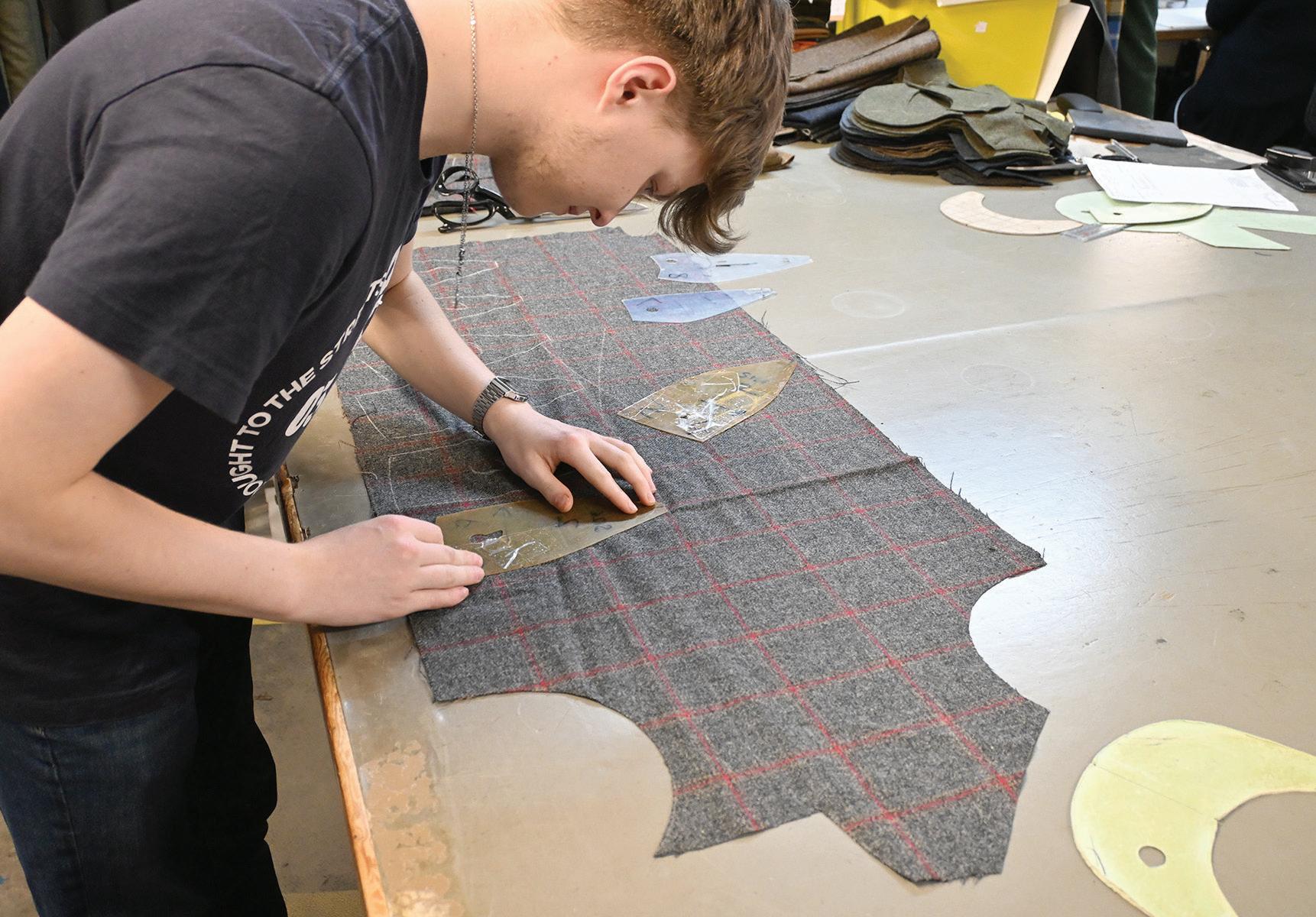
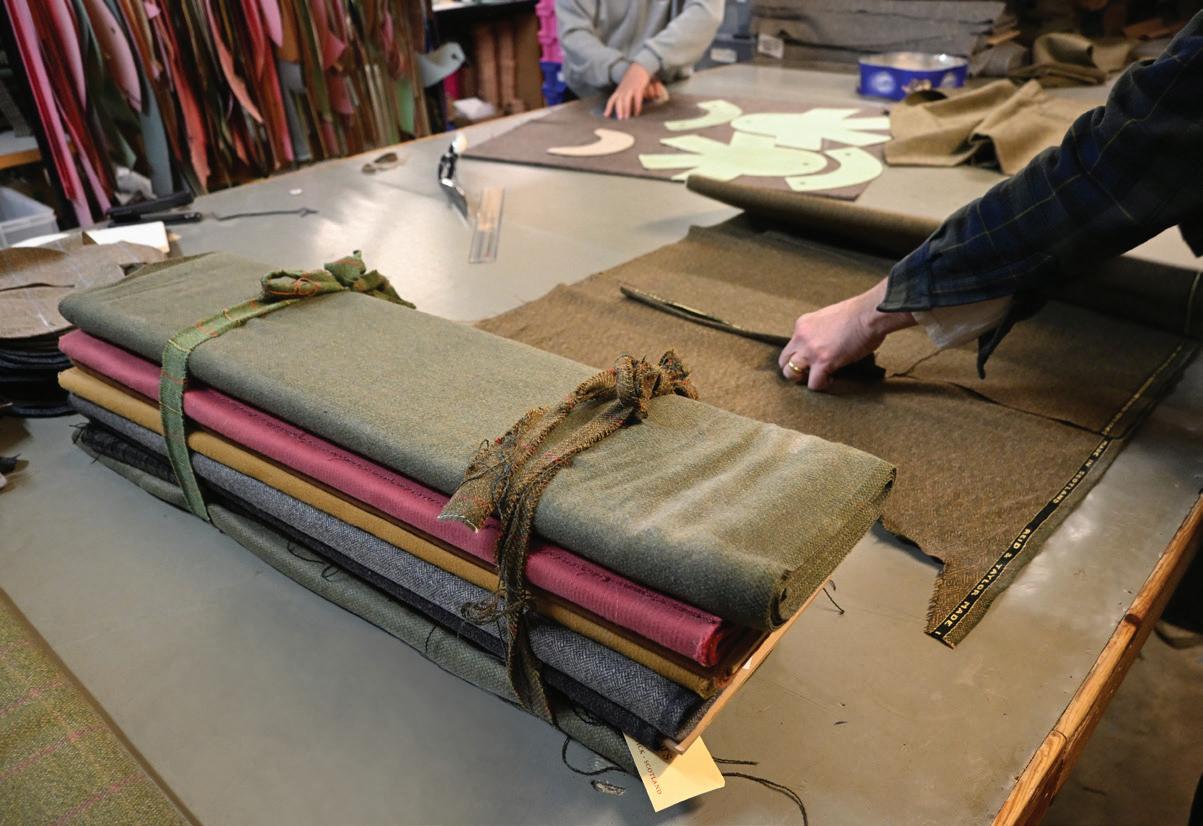
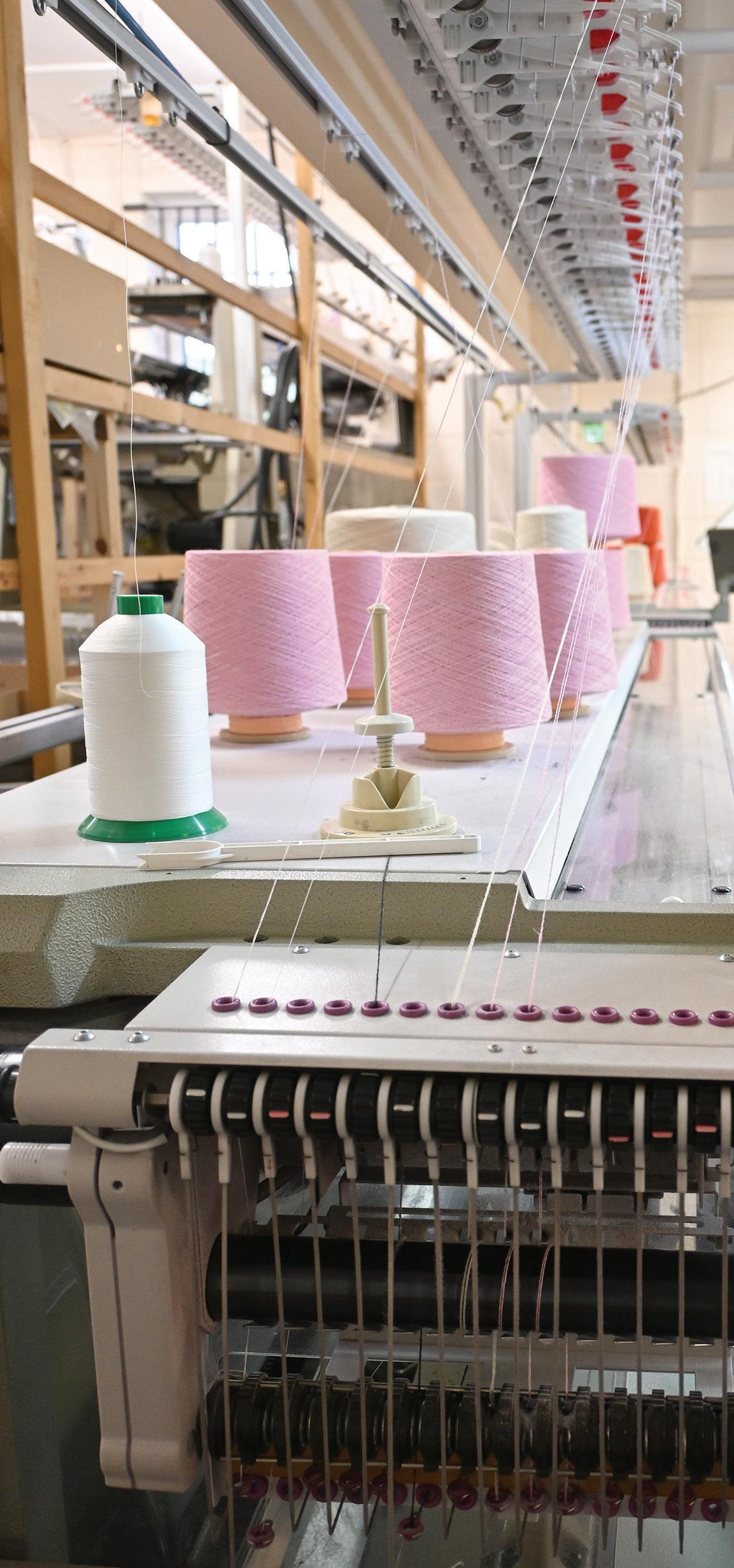
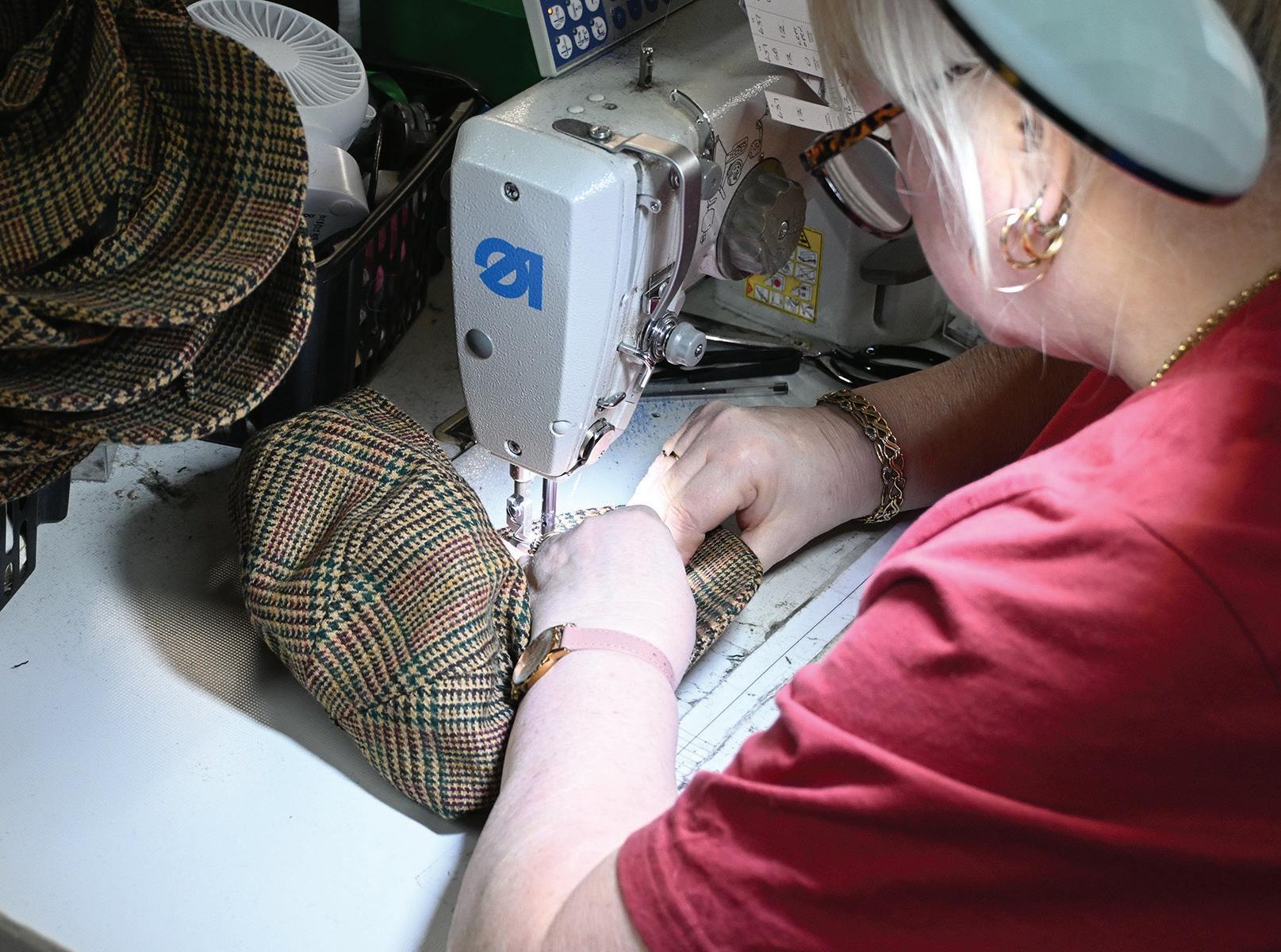
Top left: A young cutter laying out pieces for a hat, one of the most important careers in clothing manufacturing. Bottom left: Pieces of tweed on the cutting table about to be chalked out, cut into pieces, and sewn into hats. Right: A modern weaving machine, making one section of a cashmere sweater at a time.
“Some of these people have become genuine friends over the years. Like any good friendship, you want the best for each other. So, we try our best for each other.”
– Rigden
Source | From page 25
the shoes of the generations of craftspeople behind them and, given the chance, will continue the legacy of manufacturing in the UK. Not only does Country Classics provide me with my family’s livelihood, it contributes to the livelihood of families all over the UK, Italy, and Ireland.”
He finishes, “Some of these people have become genuine friends over the years. Like any good friendship, you want the best for each other.
So, we try our best for each other.”
The best for each other, the product, and the Hunt Country clientele is part of, as Rigden says, the “quiet elegance” that makes Country Classics clothes and accessories so unique. He finishes, “We don’t feel like we have to compete with anyone else or are beholden to fashion trends, because we’re not. Quite the opposite. If we recognize a trend, we do the opposite, because our customer base does not want to look like everyone else.” ML
Welcome to The Kensington Reston, a premier senior living community, privately owned and operated by a close-knit group of founders and partners who are local to Greater Washington. Together, with our dedicated teams, we proudly uphold our promise to love and care for your family as we do our own. From our heart to yours, we invite you to join the Kensington family.
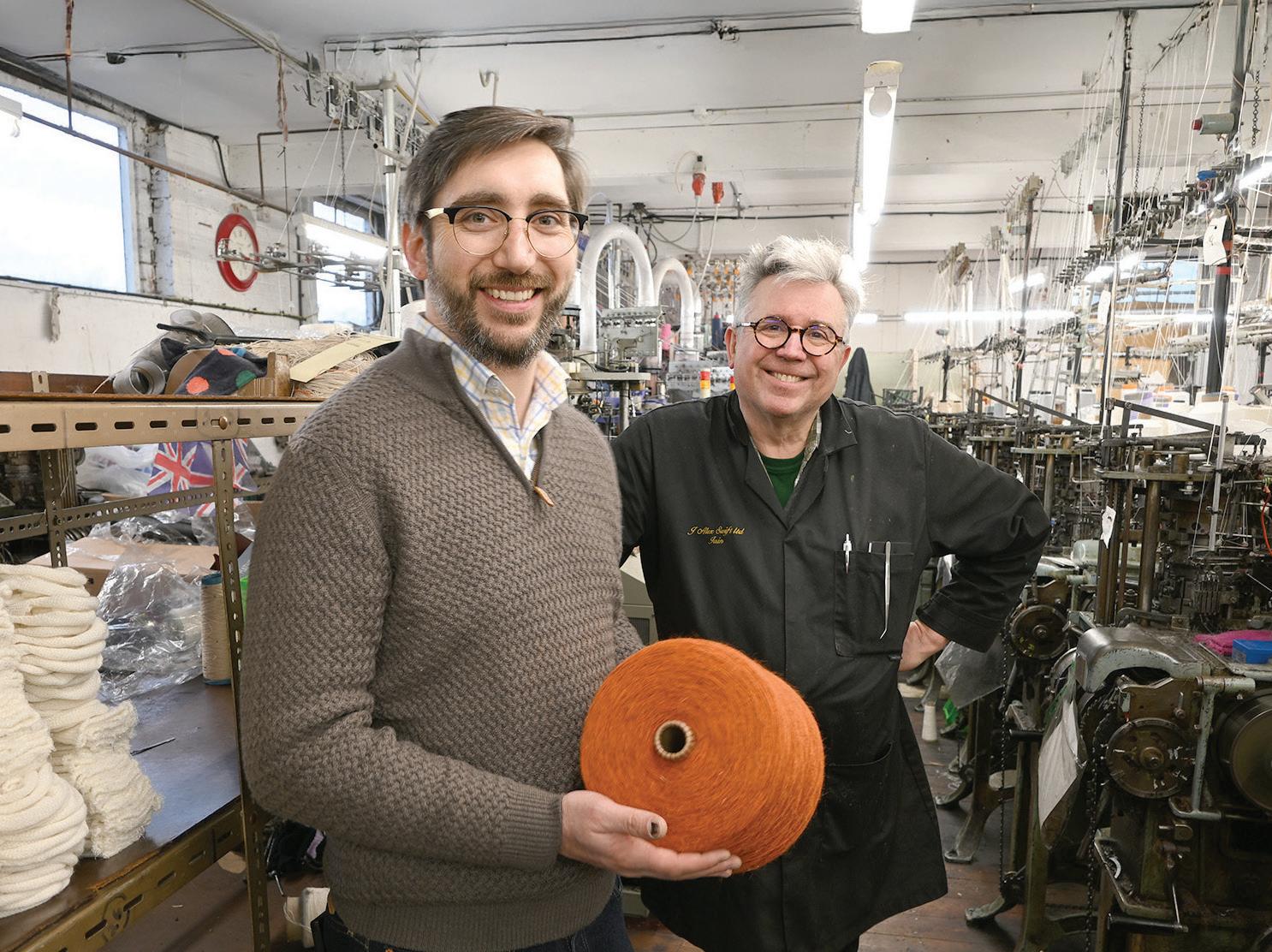
Top: Rigden with his sock maker, whose family has been making socks under the same roof for over 150 years. Bottom: Flat caps being sewn one at a time with the pattern of the tweed running flawlessly throughout the entire hat.
One store. Two shoppes.
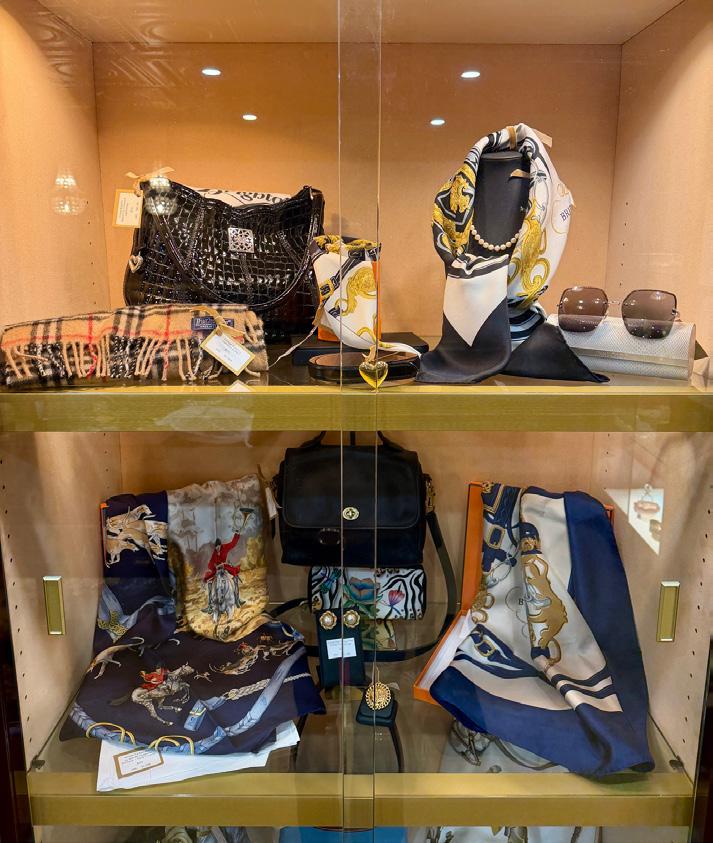
Boutique open March 28 ! th A dedicated sister shoppe for designer and vintage jewelry, purses, clothing, & more! Consignment & Vendor cases available!
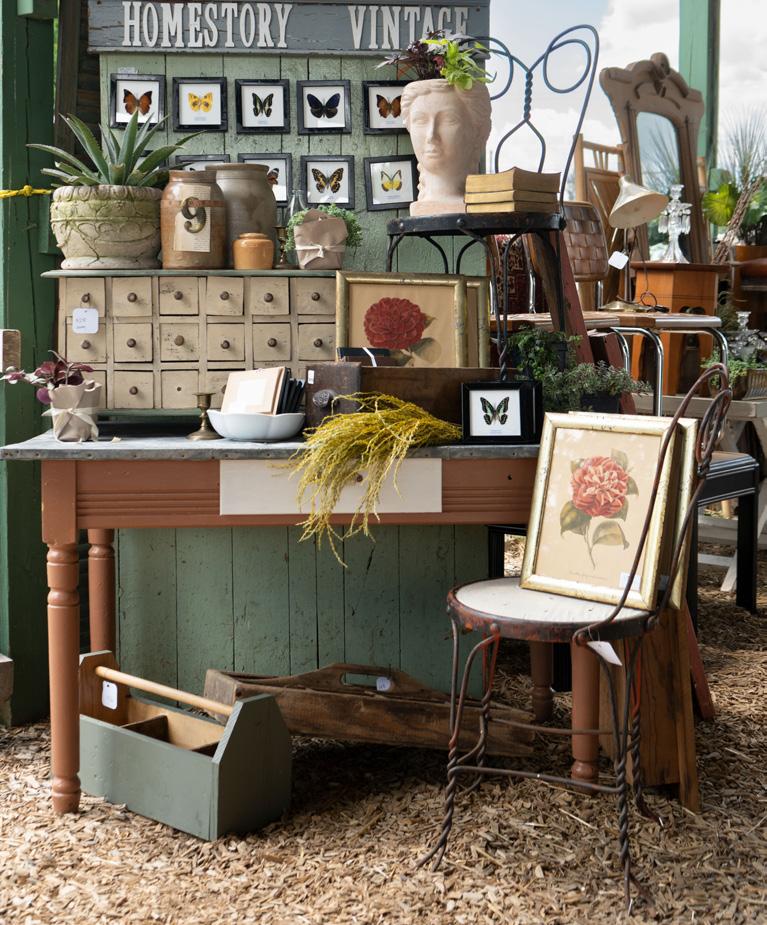
Both located in the heart of historic Middleburg on Washington Street, our two curated spaces showcase a distinctive collection of beautiful pieces. Period furniture, museum quality items, fine antiques, artwork, fox hunting and equestrian decor, gifts, jewelry, and designer accessories. Come discover your next favorite shop, and maybe even find a timeless piece for your home or a one-of-akind gift for someone special.
the return of the irish drAuGht to the upperville colt & horse shoW
Written by Shayda Windle | Photos by Kira Topeka for Erin Gilmore
Since the 18th century, the Irish Draught horse has served as the quiet backbone of Ireland’s countryside. Versatile and durable, the breed would work the farm during the week, pull a buggy on the weekend, and remain athletic enough to carry its rider across the hunt field. Just as important as its ability, however, is its temperament. With a steady, dependable nature, these creatures have long been valued as a trusted family horse.
Irish-bred horses are well represented in hunt fields worldwide. Riders who travel to Ireland to hunt often return home determined to reproduce
those horses’ qualities through selective breeding or direct importation. That sustained demand has significantly influenced contemporary sport horse breeding across multiple disciplines.
In the 1960s and ’70s, tractors replaced working horses across Ireland, and the need for traditional farm animals declined. Purebred Irish Draughts were increasingly crossed with Thoroughbreds and other sport horse lines to produce modern hunters and eventers. While these crossbreeds created many of today’s competitive horses, they all trace back to one essential source: the purebred Irish Draught, now, sadly,
considered endangered.
However, the Upperville Horse & Colt Show, one of the nation’s most famous horse shows, has long recognized the importance of the breed. Irish Draught classes were offered in the late 1990s and early 2000s, but dwindling participation eventually led to a temporary suspension of the category.
In 2024, however, UHCS welcomed them back, sparking excitement among breeders, riders, and enthusiasts eager to see these storied
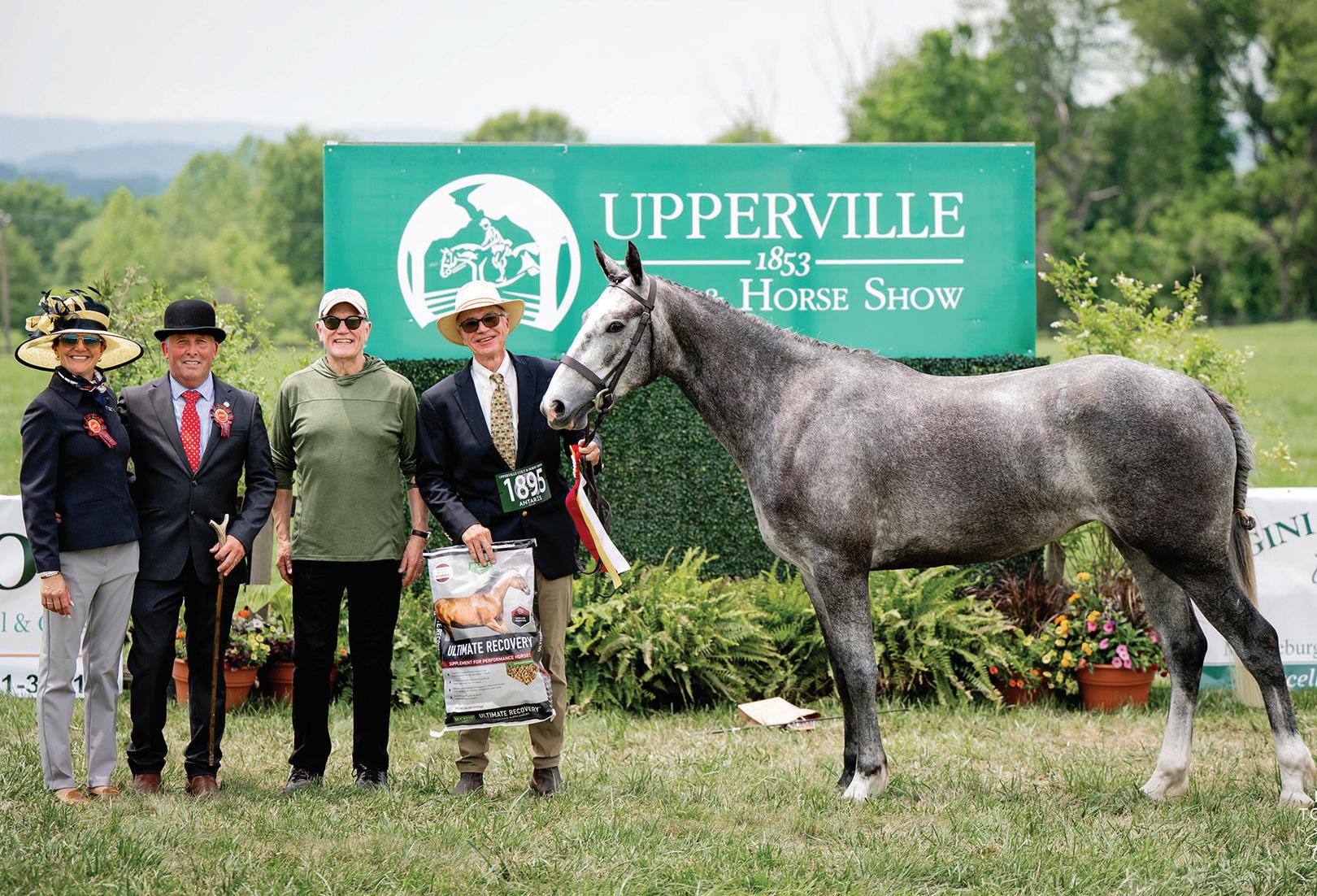
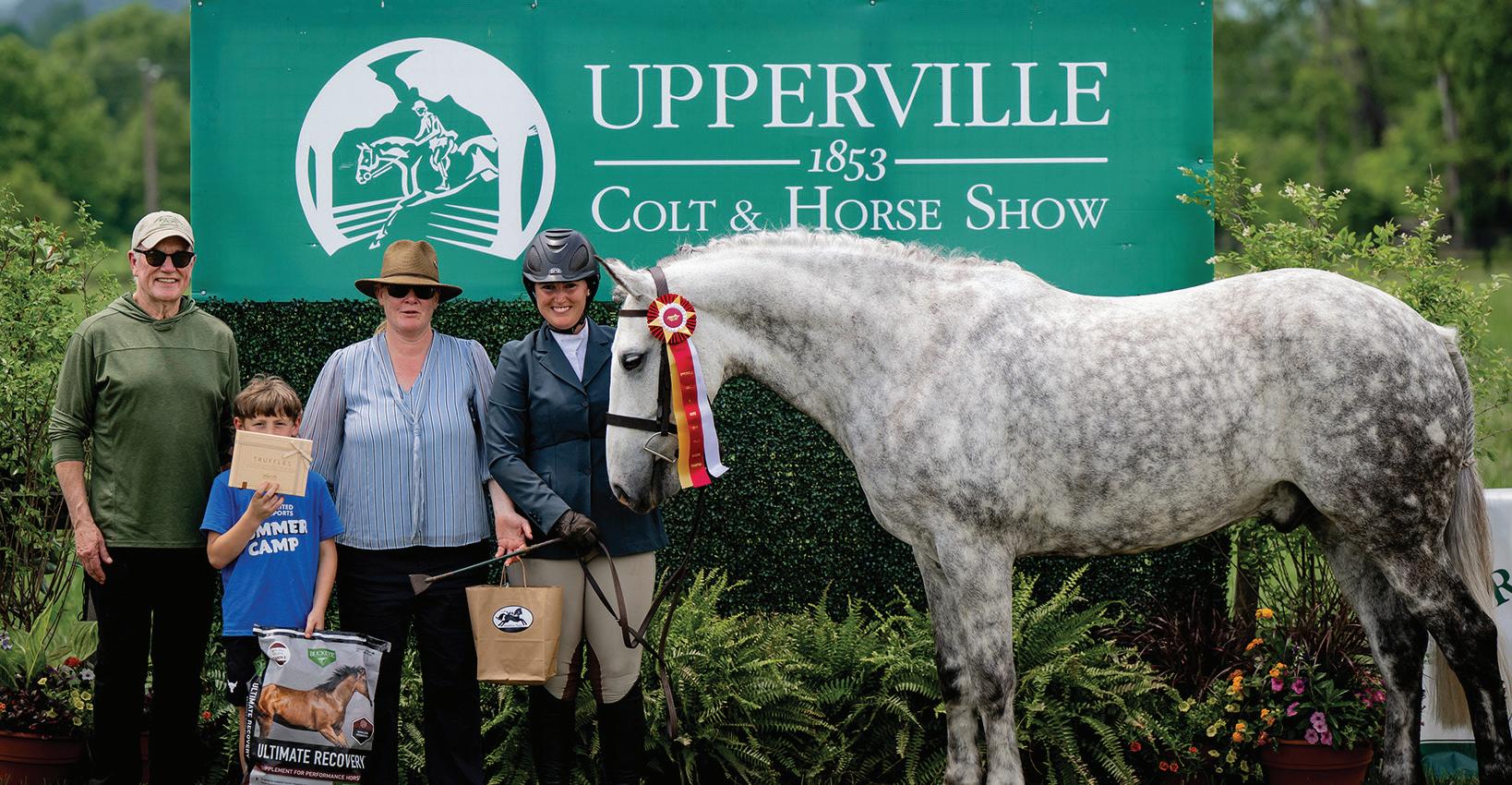
Left: Purebred Handy Hunter over a fence. Top right: Partbred Reserve Champion Ballinas Graphy (1895). Owner Sean McGuinness. Bottom right: Shanagolden Diamond Boy (1884) with his ribbon and cooler. Owner Julie Robards.
horses in action. This year, both purebred Registered Irish Draughts, as determined by the Irish Draught Horse Society of North America, and part-bred Irish Draught Sport Horses with at least one-eighth Irish Draught pedigree are eligible to compete at UHCS, opening the door to a broad range of participants while still honoring the breed’s heritage.
Few people have been as instrumental in preserving that heritage as Brandy Greenwell, owner of Bridon Irish Draughts. Greenwell began breeding Irish Draughts with her mother in the 1990s and would maintain the largest mare herd in North America. Since then, her program has
bred, produced, and imported exceptional Registered Irish Draughts and Irish Draught Sport Horses, earning numerous national championships in both breeding and performance divisions. Today, she is widely regarded as one of the foremost experts on the breed in the United States.
When asked what sets Irish Draughts apart from other breeds seen at Upperville, Greenwell points first to their character.
“Irish Draughts are typically mild-mannered, fun, and amateur-friendly,” she says. “Many of the horses competing in the UHCS upper divisions are suited only for professional riders, but that’s not the case with this breed. At the heart of the
Irish Draught community is a genuine passion for having fun, loving their horses, and supporting one another in a welcoming environment.”
The classes themselves reflect traditions appropriate to the breed. Ridden divisions are judged in a European style rather than the more familiar American hunter format. In Irish hunter classes, spectators will not necessarily see the slow, metronomic canter typical of U.S. hunter show rings. Instead, the pace is forward and purposeful, creating a lively atmosphere that often draws enthusiastic applause.
Upperville’s Irish Draught division also includes classes for young stock and in-hand horses, where judges evaluate entries against the breed standard. These divisions are more than ceremonial; they are essential to preserving the qualities that define the Irish Draught.
That preservation carries broader implications for the equestrian world, particularly within foxhunting, a deep-rooted tradition that defines Hunt Country. Irish Draughts have long contributed to the development of exceptional hunt horses prized for stamina, soundness, and a steady temperament. If purebred breeding programs decline, experts warn, the hunters so sought after worldwide could gradually diminish as well.
The return of Irish Draught classes to Upperville is more than a nostalgic revival; it represents a meaningful step toward safeguarding a rare breed whose influence extends far beyond the show ring. The breed is a living link between agricultural history, sport horse excellence, and the hunting traditions that continue to shape the region.
Spectators and riders alike are encouraged to support the Irish Draught division this June at UCHS, whether by bringing a horse to compete or simply by attending the show. Doing so helps ensure that this remarkable breed, and the heritage it represents, continues to have a place in Upperville for years to come. The division is sponsored by Virginia Equine Imaging, an elite equine sports medicine clinic located in The Plains, Virginia. To enter a horse, eligibility papers must be submitted to Michelle Robbins at kilronan1@yahoo.com no later than May 18, 2026. ML
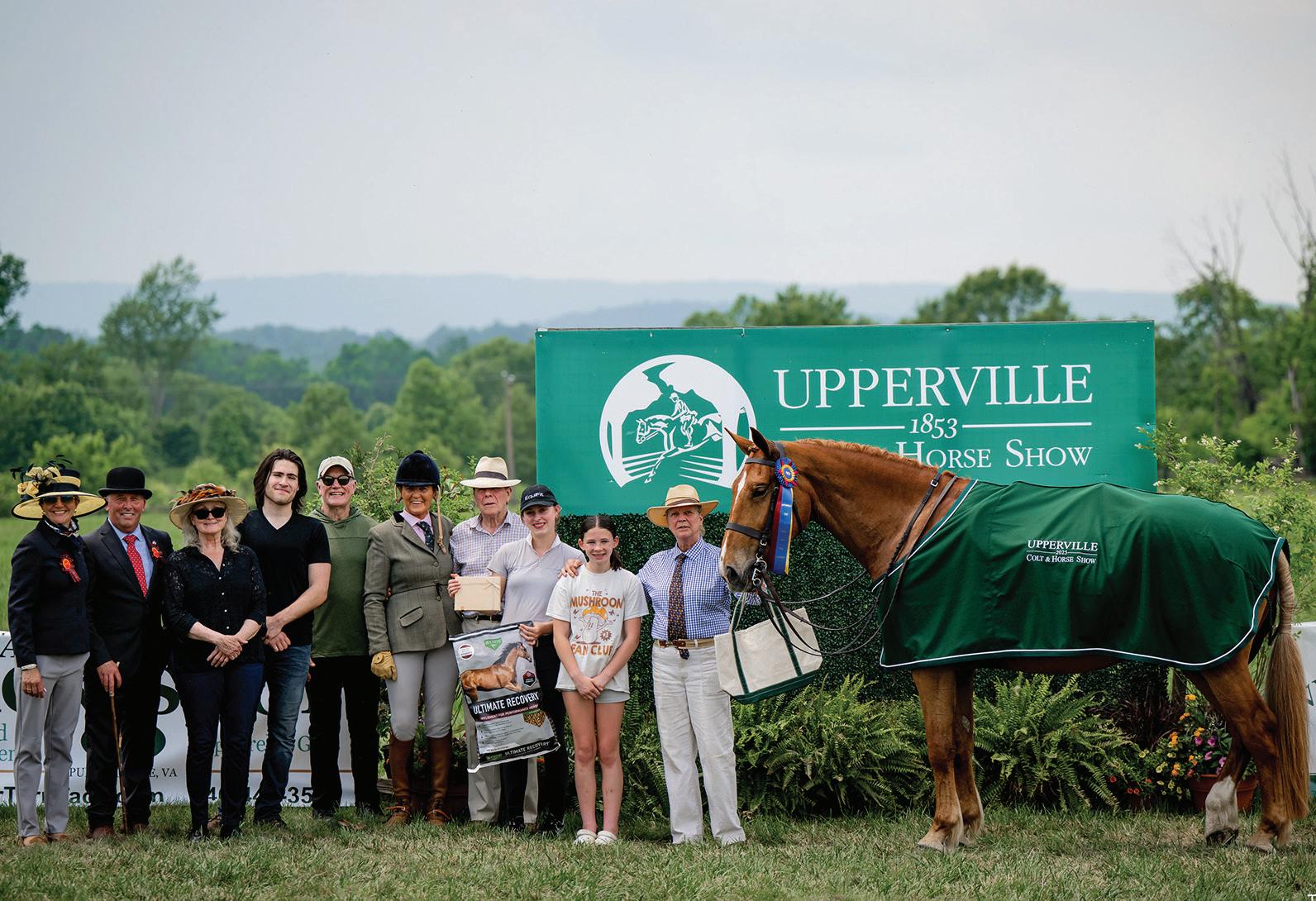
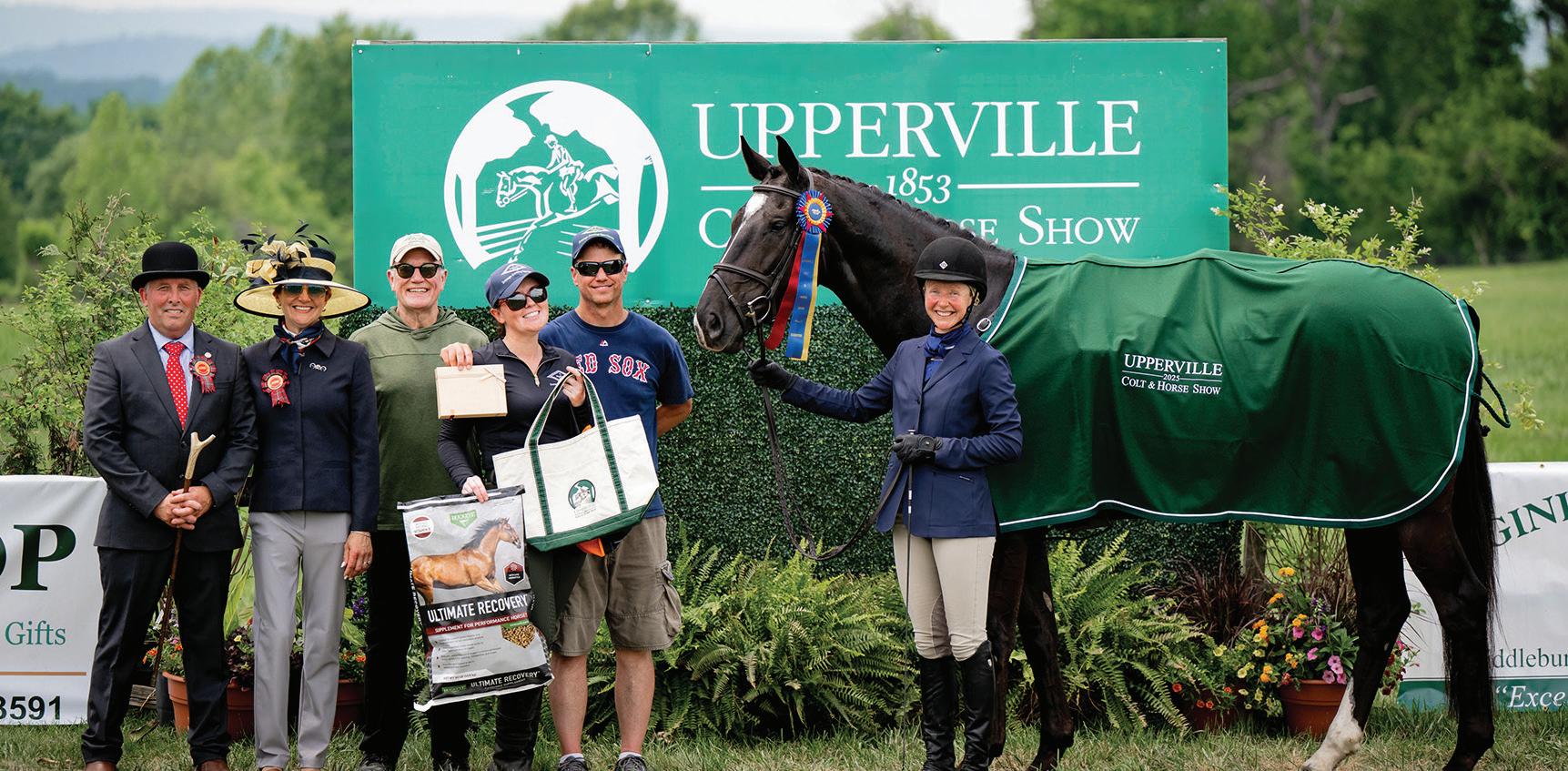
Top: Purebred Reserve Champion Cassanova Rebel (1918). Owner Nancy Danks. Bottom: Partbred Champion TGS Alls Well Mister Perry (1917). Owner Greer Kelly.
While on location in Wellington, Florida, Middleburg Life had the opportunity to catch up with several Foxcroft School students and Middleburg-based show jumper Trish Hurter.
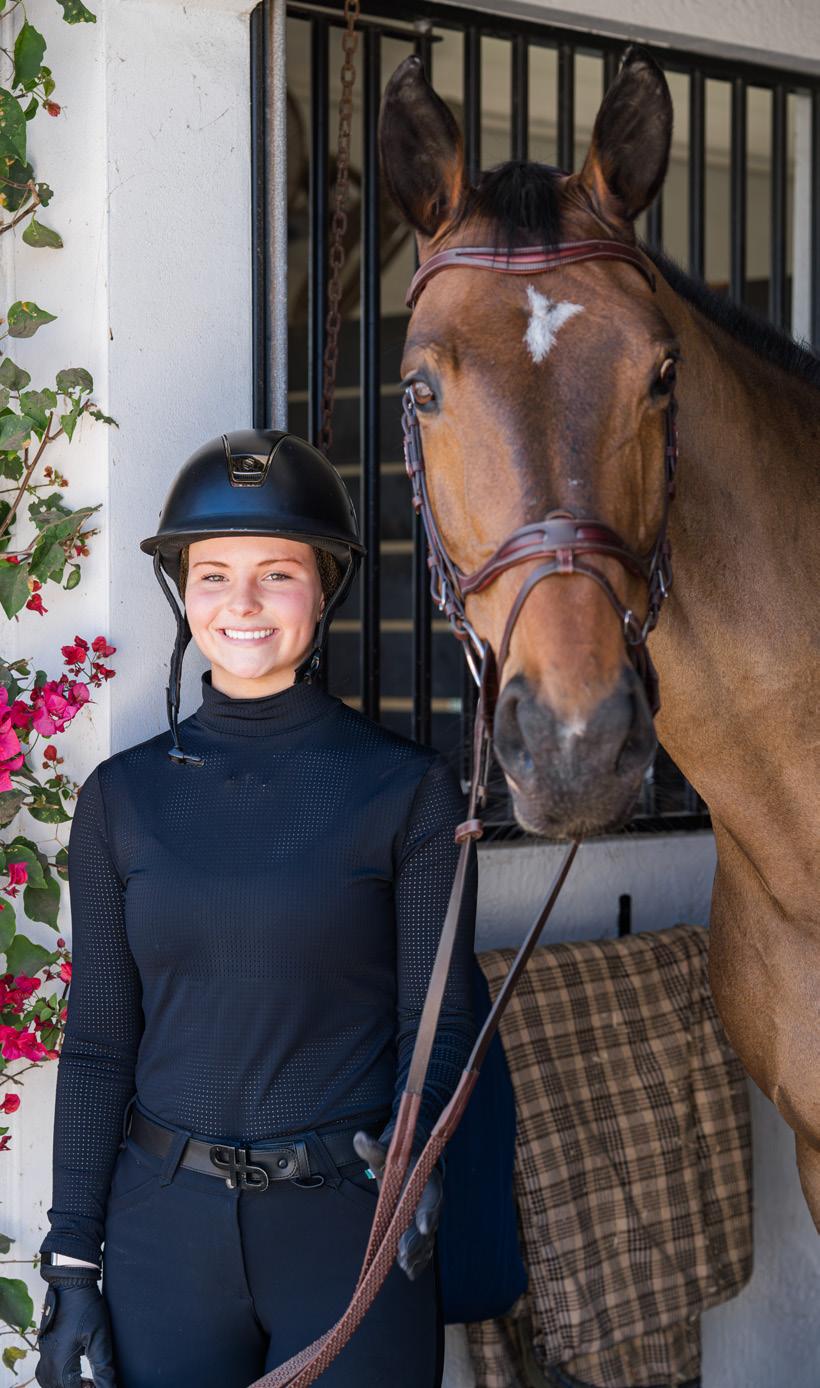
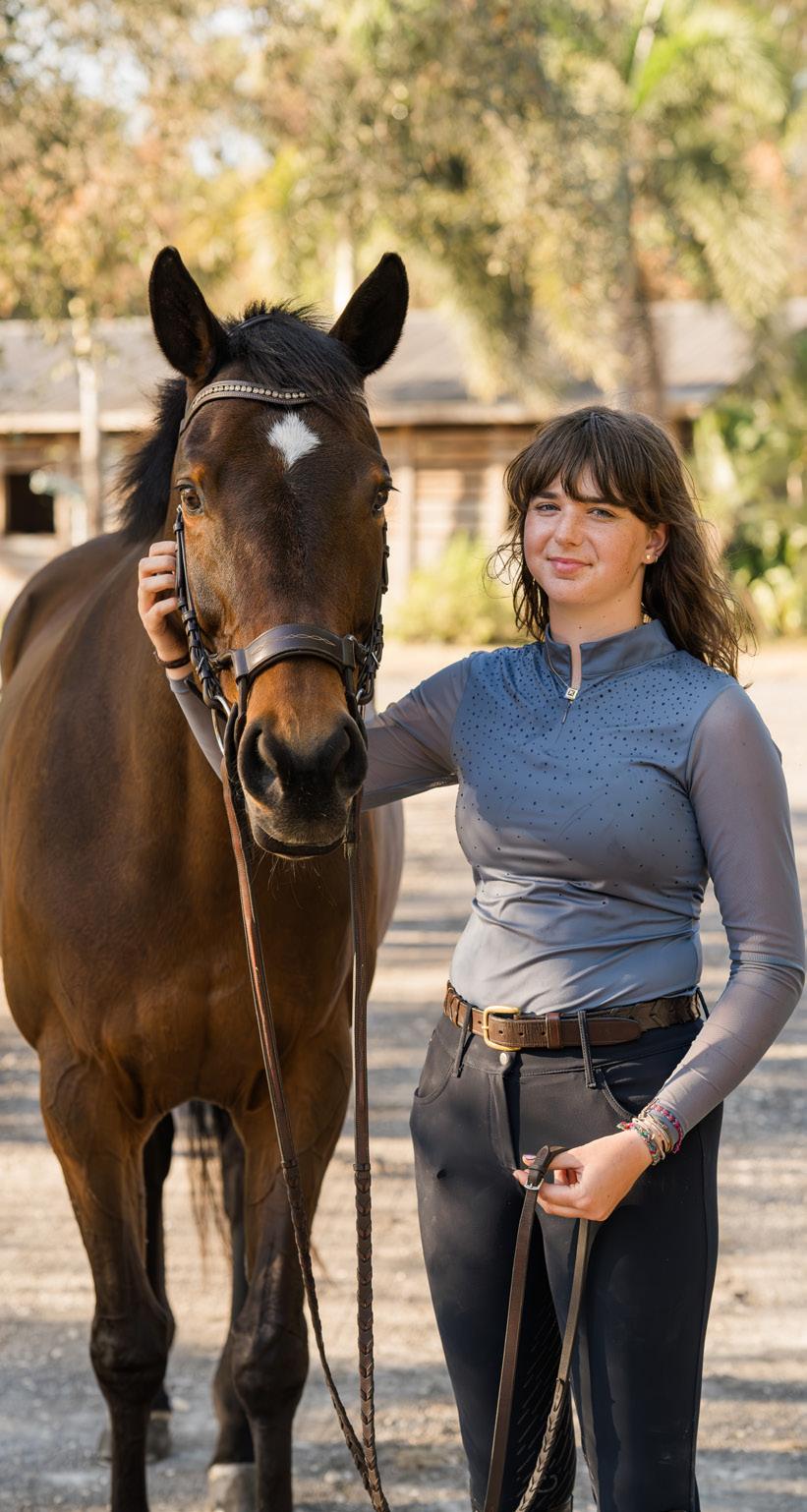
During the winter months, the horse show in Wellington sets the rhythm of daily life and draws riders from across the country, including many from Middleburg and the surrounding areas. This season, that includes Foxcroft students navigating the balance of school and showing, as well as riders like Hurter, whose ties to Middleburg make Wellington feel, in many ways, like an extension of home.
For Foxcroft students Harper Padgett, Michelle Lin, and Ella Harrity, Wellington represents a unique balance of academics and high-level competition. While none of them call Middleburg home, Foxcroft gives them a shared connection to Virginia horse country and a school community that supports serious riding alongside the demands of the classroom.
Harper Padgett, who is competing in the Medium Junior Jumpers with Cocolina V.V., has found a strong rhythm between school and showing. Foxcroft’s structure allows students to continue their coursework while away, making
cAtchinG up in WellinGton
Story by Caroline Jean Gray
it possible to stay on track academically while competing in one of the sport’s biggest winter circuits. She is training with Foxcroft alumna and U.S. professional show jumper Sloane Coles, whose program has helped her feel focused and prepared throughout the season. One of her favorite memories came during a Medium Junior Classic, when the details she had been working on finally started to come together. Walking out of the ring to see her trainer smiling and giving her a thumbs-up was a simple but meaningful reminder that the work was paying off.
Michelle Lin, who competes in both the Low and Medium Junior Jumpers, is showing three horses this season: Mars, Woody, and Lina. For her, the balancing act of Foxcroft and competition has become an exercise in discipline and time management. Because she typically shows later in the week, she front-loads her schoolwork earlier on, staying organized so she can focus once the show week gets underway. Since she lives in Wellington year-round, the end of the circuit does not bring much of a seasonal shift, but her goals remain the same: building consistency, especially in the Medium Junior Jumpers, and continuing to improve step by step. She relies on routine to stay mentally prepared, including daily work from her sports psychologist, and she brings a little personality into the ring as well, with each of her horses wearing a custom bonnet with a character that matches its personality.
Ella Harrity’s experience this season has been somewhat quieter and more reflective. After nine months with her horse Sadie, she is focused less on immediate results and more on building a solid partnership. Her perspective is grounded in patience, something she has learned through years of riding and the daily responsibilities at her
family’s farm, where barn chores and horse care are part of everyday life.
“Horses have taught me that improvement isn’t a straight line,” she says. “Sometimes you have to take a step back to move forward.”
Even when she is not competing herself, she remains deeply engaged in the atmosphere of the show. One of her favorite memories from Wellington this season came from watching a rider she works with reach an important goal on a horse they had spent years developing. In a sport where so much happens behind the scenes, those moments of long-awaited success can feel just as
Then there is Trish Hurter, whose relationship with Wellington has unfolded over decades and whose life in Middleburg gives her a unique perspective.
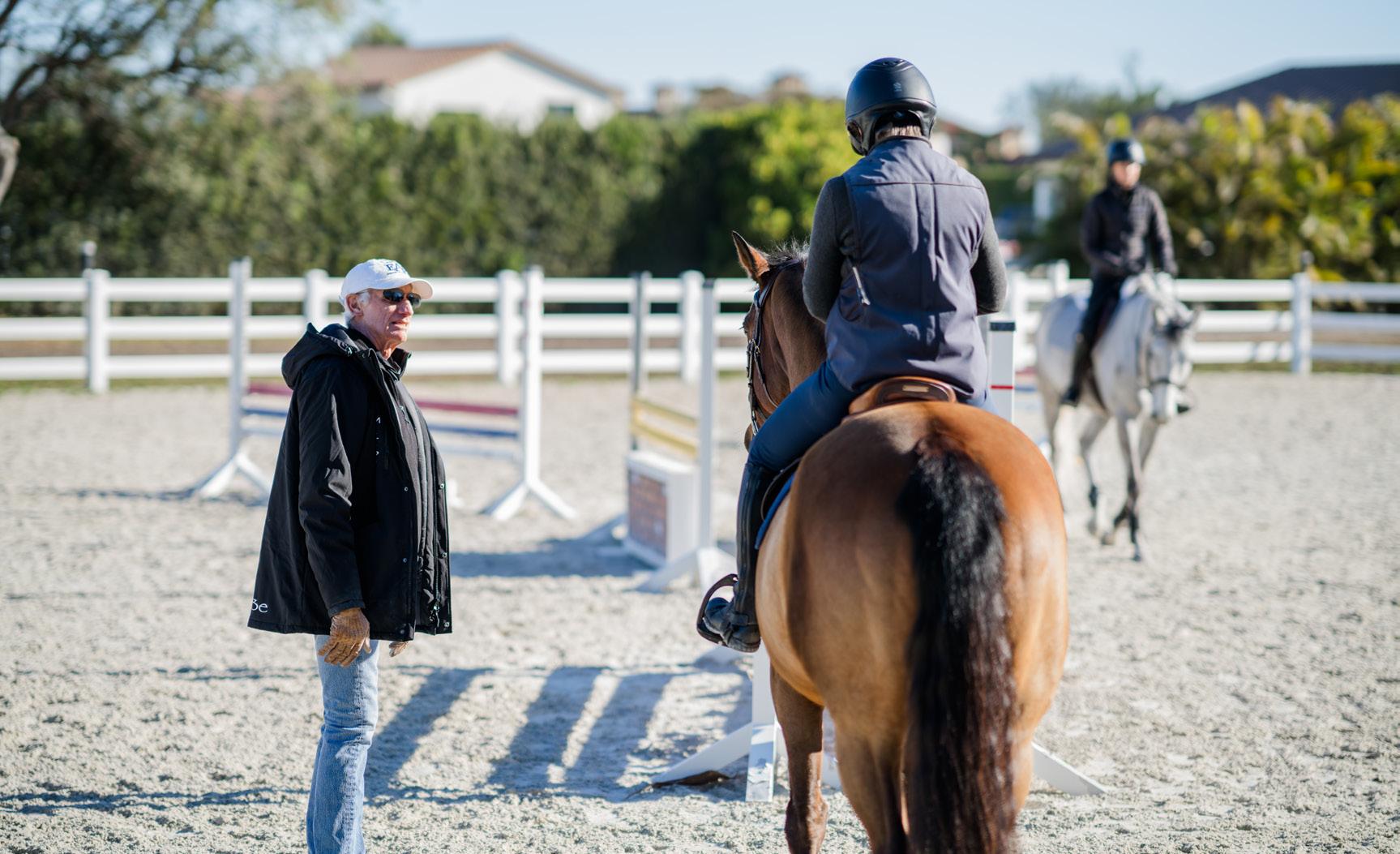
What started as a short trip in 2004 eventually turned into owning a farm in Wellington and structuring winters around the circuit. Now retired, she spends the full season there, riding several horses and building her days around a routine that includes early rides, dressage lessons, and time outside the barn for things like Pilates and Spanish lessons. Hurter’s program is also shaped by her longstanding relationship with her trainer, legendary Olympian Joe Fargis, whom she first trained with nearly two decades ago.
Since moving to Stoneleigh Farm in Middleburg, where Fargis is based, she has been able to work with him throughout the year, something that has brought both continuity and depth to her riding.
Her approach to competition is thoughtful and measured. She spaces out her horses’ schedules, focuses on their longevity, and takes real pleasure in the gradual progress that comes with building partnership over time.
faces in Florida makes the circuit feel even more connected. What might seem like a world away from Hunt Country often feels surprisingly close.
That contrast is part of what makes Wellington so interesting. For students, it can be a period of intense growth, learning how to juggle school, competition, and the emotional highs and lows of the sport. For someone like Hurter, it’s a return to a routine shaped by years of experience and a deep appreciation for both the competition and the lifestyle around it.
What they share, despite being in different stages of life, is the same daily rhythm: early mornings, long days, and the understanding that progress with horses takes time. Whether they are building confidence, developing a partnership, or continuing to refine their riding, each of them is doing the same steady work.
For Hurter, Wellington is also about community. After moving to Stoneleigh Farm in 2021 and becoming part of that close-knit horse world, she has found that seeing familiar Middleburg
leads back to the Virginia shows she looks forward to most each summer, including the Upperville Colt & Horse Show, Loudoun Benefit Horse Show, and Piedmont Jumper Classic. ML For more of Caroline Gray's Wellington coverage visit: MiddleburgLife.com Wellington | From page 30
And while Wellington is the focus in winter, it is only one part of the season. For the Foxcroft students, it represents a chance to keep learning and growing. For Hurter, it’s also a season that
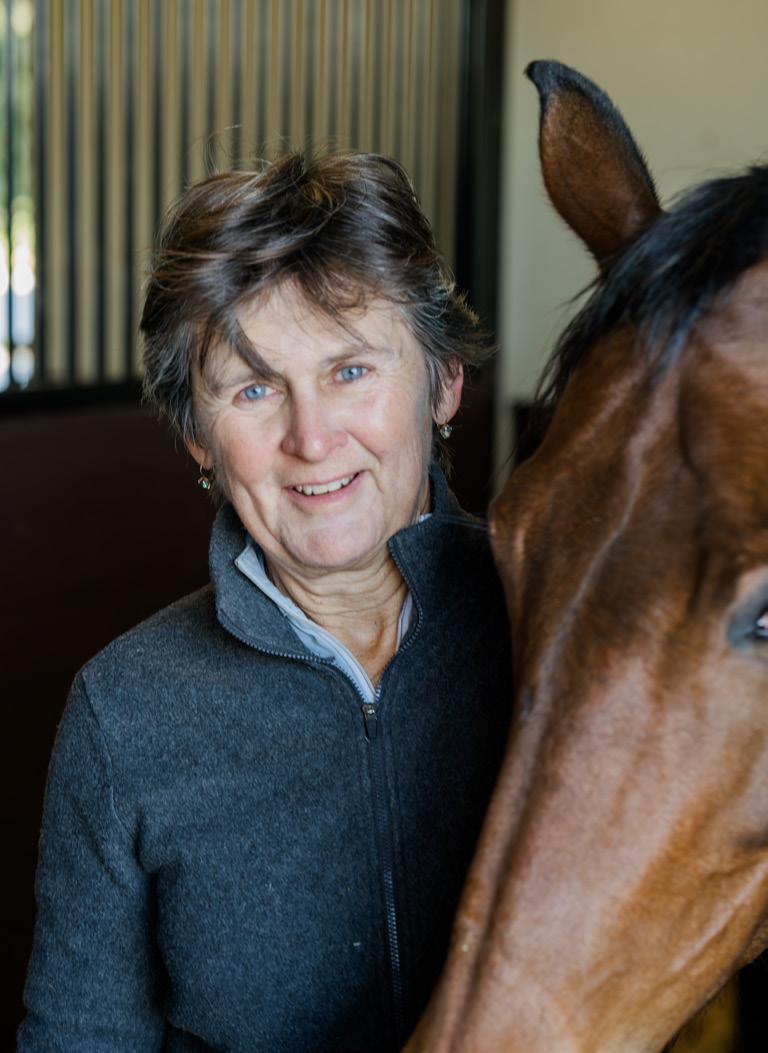
Top left: Michelle Lin. Top right: Ella Harrity. Bottom left: Joe Fargis working with a rider. Bottom right: Trish Hurter.
Our Favorite Local Earth Day-Inspired Gifts
Kantha Vagabond Tote, made from repurposed cotton saris, $92, Available at The Global Local
Cecilia Earrings, plant a tree with every purchase, $36, Available at Brick & Mortar
Furnace
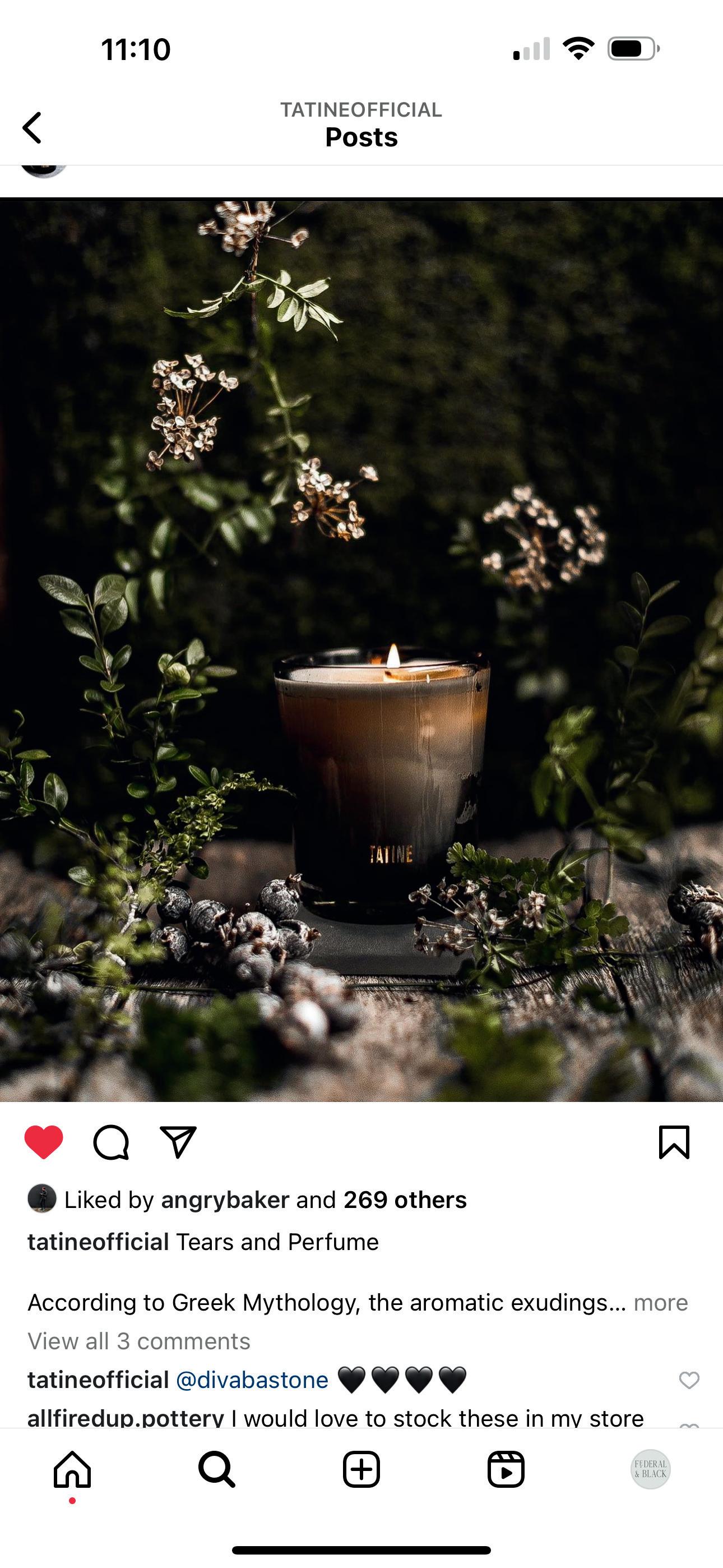
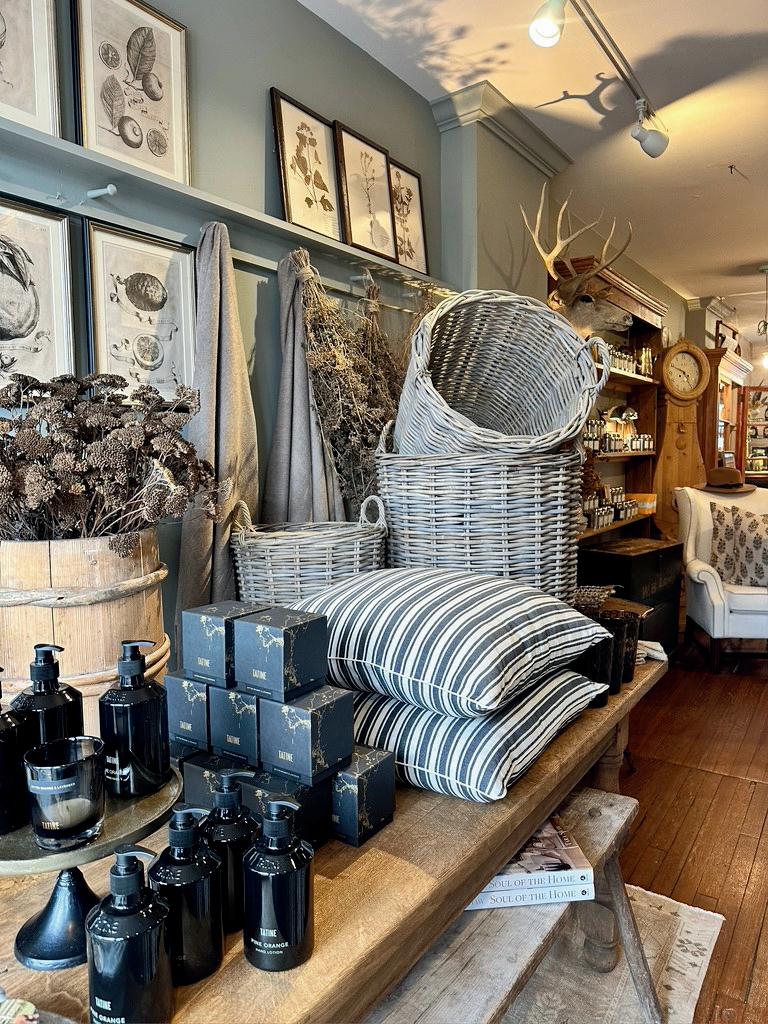
Available at Federal & Black
Butterfly Fine Paper Specimens, $16, Available at Nature Composed
Rainbow Gingham Rethread Throw, made with recycled cotton blend fibers, $16, Available at Latitudes Fair Trade Store Home Grown Growing Lamp, $34, Available at The PLAYroom
Foliage Lumbar Pillow, $112, Available at Loudoun Market
Bon Ton Toys Bunny, made with 100% recyclable filling, $38, Available at Crème de la Crème
“The Wildlife Year,” $22.99, Available at Middleburg Books
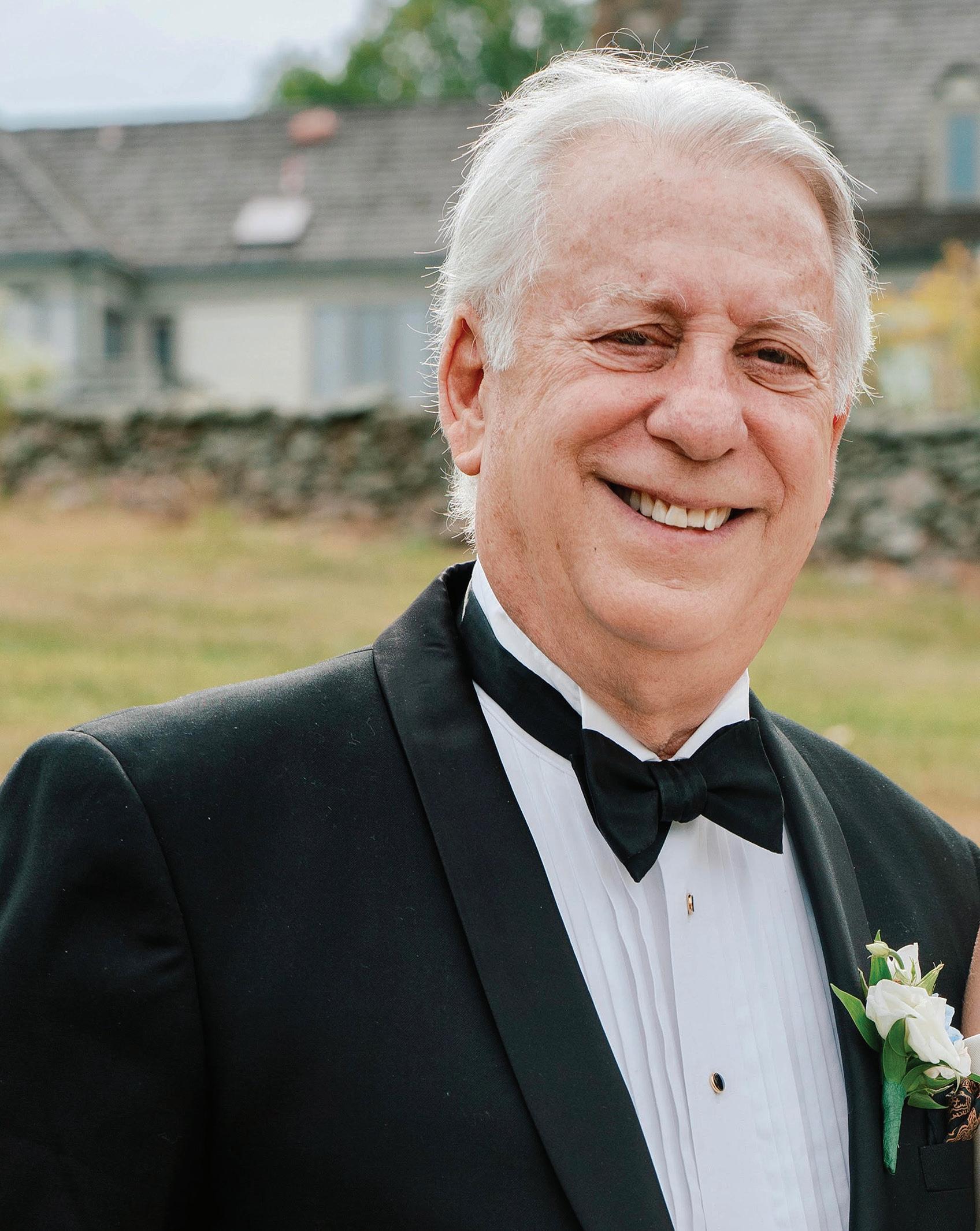
Remembering Stuart Allen Weinstein-Bacal
Written by Middleburg Life Staff | Photo courtesy of Trinity Church
Stuart Allen Weinstein-Bacal of Upperville passed away on Tuesday, February 17, 2026. Son of Marvin, a West Point military officer, and Mae, Weinstein-Bacal was born in Germany and spent his childhood throughout Europe and East Asia before settling in Virginia as a high school student, where he would graduate from Annandale High School.
He later earned bachelor’s and master’s degrees from the University of Virginia before serving in the U.S. Army as an infantry unit commander. Following his time in the military, he earned his Juris Doctor from the University of Miami, where
he met his wife, Holly. Together, they raised three children: Rachel, Max, and Sarah.
Weinstein-Bacal was an educator and lawyer, eventually establishing a law practice, Weinstein-Bacal, Miller & Vega, in Puerto Rico.
Though well traveled, Weinstein-Bacal loved his Hunt Country home of Middleburg and Upperville, where he lived for 26 years and was a familiar face at the Middleburg Tennis Club.
Weinstein-Bacal was a loving son, husband, father, and friend to many, as well as the heart and soul of his law practice. He will be missed by those who had the fortune of knowing him. ML
CALENDAR OF EVENTS
“THE HAPPINESS OF COLOR” AT THE BYRNE GALLERY
April 1 - May 3 | thebyrnegallery.com
Works by artists Anne Manley, Anne Marchand, Anne Stine, Edward Ugo, and Carolyn Marshall Wright will be on display at The Byrne Gallery for the month of April, illustrating the power of color in eliciting emotion and transforming moods.
The gallery will host an opening reception on April 4 from 4 to 7 p.m. as well as two gallery talks: one on April 18 and the other on April 26, both from 2 to 4 p.m. Everyone is welcome and no tickets are required.
“THE SPLENDOR OF SPRING” AT AIM
April 4 - May 3 | theartistsinmiddleburg.org
Celebrate the arrival of spring with The Artists in Middleburg’s April exhibit. The artwork will capture budding landscapes, overflowing gardens, new beginnings, and the vitality of spring. As always, proceeds from the sales of exhibited artwork will support AiM’s mission to supplement
art education in local schools.
UNCLE NEAREST WHISKEY EXPERIENCE
AT SALAMANDER RESORT & SPA
April 10 | 4:45 to 6:30 p.m. | salamanderresort.com
Experience the craftsmanship of Uncle Nearest in a guided whiskey experience. Participants will learn about the brand’s history and whiskey-making process, explore flavor profiles, and enjoy a curated tasting. Tickets are $60.
CONSERVATION AND LAND
STEWARDSHIP AT OAK SPRING GARDEN FOUNDATION
April 11 | 10 a.m. to 12 p.m. | osgf.org
Walk the landscape of Oak Spring Garden while Charlotte Lorick, the foundation’s head of native plant conservation, offers her insights on the principles and practices of land stewardship. The workshop will start with an indoor presentation
followed by a walk through the native wildlife garden and a native meadow planting. Participants should have proper footwear, water, and dress for the weather. Tickets are $15 and can be booked online.
MIDDLEBURG WELLNESS DAY
April 12 | 7:45 a.m. to 2 p.m. | middleburgva.gov
The Town of Middleburg will hold its annual Wellness Day on April 12. The morning will kick off with the 10K, 5K, and Kids Fun Run. After the race, swing by the Middleburg Community Center for the Wellness Day Fair, which will have presentations, demos, great vendors, and giveaways!
STITCHFLIX & CHILL AT LOST BARREL BREWING
April 17 | 6 p.m. | lostbarrel.com
Join the team from STITCH for a needlepoint
Calendar | Page 35
CALENDAR OF EVENTS
Calendar | From page 34
and movie night at Lost Barrel Brewing. Offerings from Lost Barrel’s full bar and delicious food menu will be available for purchase, and STITCH’s Spellbound Stitchery trunk show will be 15% off for participants. While you stitch, enjoy “The Devil Wears Prada” with your friends. RSVPs are required. Email info@stitchvirginia. com to reserve a spot.
MIDDLEBURG SPRING RACES
April 18 | 10 a.m. to 6 p.m. | middleburgspringraces.com
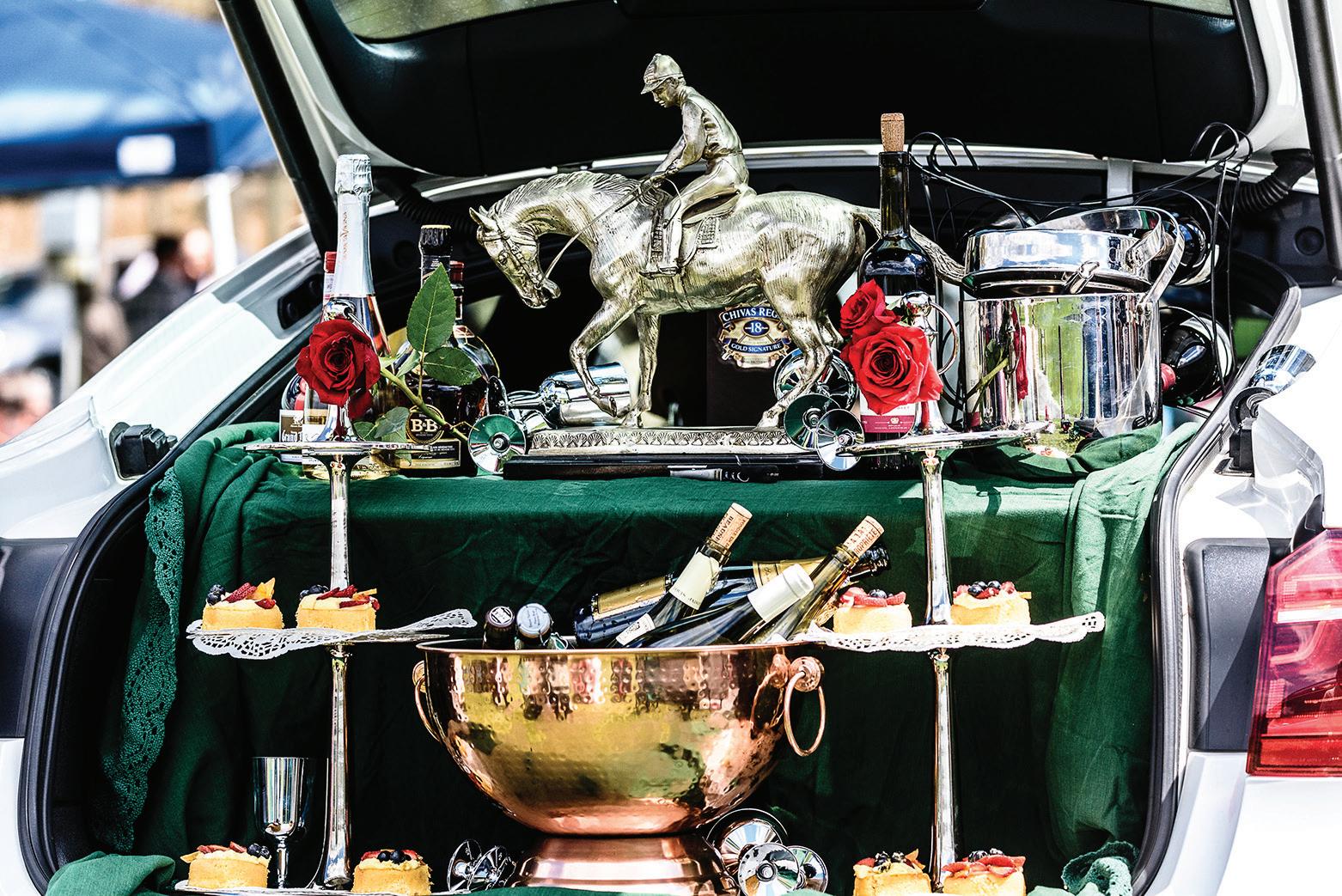
Enjoy a day at the races at beautiful Glenwood Park, complete with food trucks, an expansive vendor village, family fun paddock, hat and tailgate contests, and adoptable dogs. General admission tickets are $25 and can be purchased through the Spring Races website.
BUDBREAK FESTIVAL AT CANA VINEYARDS
April 18 | 11 a.m. to 6 p.m. | canavineyards.com
This year marks Cana Vineyards’ 10th annual Budbreak Festival, a celebration of spring at the vineyard. The event will include the release of its newest vintages of Rosé of Merlot and Rosé of Cabernet Sauvignon, tasting flights, live music, a craft market, and plenty of springtime cheer! Winemaker Melanie Natoli will be on-site offering her Rosé Around the World Tasting, too. Reservations are recommended and can be booked on Cana’s website.
MURDER MYSTERY AT DIRT FARM BREWING
April 24 | 6 to 8 p.m. | dirtfarmbrewing.com
Step back in time to the 1920s for a special speakeasy-themed murder mystery at Dirt Farm Brewing. More than a show, this event will in-
volve active participation through a guided whodunit. Participants will receive their character assignments a week before the event, leaving plenty of time to prepare and get creative with a costume. Attendees must be over 21 and tickets are required.
MIDDLEBURG HUMANE FOUNDATION’S HAVANA NIGHTS GALA
April 25 | 6 p.m. | middleburghumane.org
Support the important work of the Middleburg Humane Foundation and have fun, too, at its Havana Nights Gala. The event will be at The Middleburg Manor and tickets are required. The night will include hors d’oeuvres, dinner, dessert, an open bar, live entertainment, a photo booth, and an auction.
For more Hunt Country events, visit MiddleburgLife.com or scan here: