36
Michigan Gardener | May 2016 | MichiganGardener.com
Shasta Daisy: An American Classic
T
he Shasta daisy (Leucanthemum x superbum) is a hybrid developed by the prodigious American horticulturist and plant breeder Luther Burbank. His efforts began by crossing the common ox-eye daisy (L. vulgare) with the European field daisy (L. maximum). Not satisfied with the results, he continued to refine his hybrids by crossing and back-crossing with two other species of Leucanthemum. His final result, an interspecific hybrid utilizing four species, exhibited the
pure white color, large flower size, and long, straight stems he sought. These original hybrids were introduced in 1901 and called Shasta daisies, in honor of snow-topped Mount Shasta near his home in northern California. His first named hybrid, ‘Alaska,’ is still widely grown today. The Shasta daisy has the longest history of continuous popularity of any hybrid garden flower in America.
How to grow
Karen Bovio
Shasta daisies are dependable perennials for sunny or lightly shaded locations with relatively rich, welldrained soil. They are hardy from zone 4 through 8, but may die out in harsh, snowless northern winters, or after excessively wet seasons with very high heat and humidity. Under those moist conditions, fungal diseases can weaken the
plants. Shastas are susceptible to a number of leaf-spot diseases, many of which cause dark brown to black lesions that may spread over the entire leaf surface. Fungicides can help, but frequent rains will reduce their effectiveness. A thorough cut-back in the fall, along with removal of all dead foliage will go a long way toward reducing infection the following season. Four-lined plant bug may be a problem continued on next page
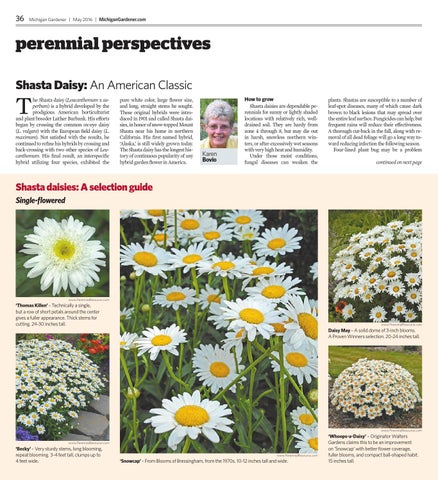
Shasta daisies: A selection guide Single-flowered
www.PerennialResource.com
‘Thomas Killen’ – Technically a single, but a row of short petals around the center gives a fuller appearance. Thick stems for cutting. 24-30 inches tall.
www.PerennialResource.com
Daisy May – A solid dome of 3-inch blooms. A Proven Winners selection. 20-24 inches tall.
www.PerennialResource.com www.PerennialResource.com
‘Becky’ – Very sturdy stems, long blooming, repeat blooming. 3-4 feet tall, clumps up to 4 feet wide.
www.PerennialResource.com
‘Snowcap’ – From Blooms of Bressingham, from the 1970s. 10-12 inches tall and wide.
‘Whoops-a-Daisy’ – Originator Walters Gardens claims this to be an improvement on ‘Snowcap’ with better flower coverage, fuller blooms, and compact ball-shaped habit. 15 inches tall.