W I N T E R
2 0 1 7
TRAINING THE NEXT GENERATION OF CLASSICAL MUSICIANS
World-class faculty, a stimulating, supportive atmosphere and outstanding facilities make the Cleveland Institute of Music an ideal environment for training the next generation of classical music performers.
cim.edu Bachelor of Music | Master of Music | Doctor of Musical Arts | Artist Certificate | Professional Studies | Artist Diploma
12
The Ripple Effect
Former principal violist of The Cleveland Orchestra and CIM faculty member Robert Vernon has former students in nearly 50 orchestras throughout the world. His legacy lives on through their success.
ABOVE Viola department co-head Robert Vernon exemplifies the CIM legacy (story page 12) ON THE COVER Many CIM students regularly perform in the area’s regional orchestras (story page 8)
DEPARTMENTS
FEATURES
4 Noteworthy Students Perform at Carnegie Hall Fall CIM Concerto Competition Winners Alumnus and Concertmaster of the NY Phil Receives Rave Review CIM.edu is Brand New Student Teaches More than Singing at CSA CIM Student Builds Confidence Through Music Cleveland Named “America’s Hottest City”
8
16 Events More Concerts Now Available Online! Spring Opera at CIM
Unexpected Stages CIM students reap the benefits of the area’s regional orchestras; many become contracted members or regular subs and gain valuable experiences before heading into the real world.
12 The Ripple Effect Robert Vernon, co-head of the viola department at CIM and former principal violist of The Cleveland Orchestra, has former students in every premier orchestra in the country, in turn, influencing the musical community at large.
18 Development Donor Profile: A. Grace Lee Mims Broadway in the Circle: A Women’s Committee Benefit 20 Alumni Snapshot Jennifer Ellis 22 Listings Alumni Appointments Prizewinners Faculty W I N T E R 2 0 17
3
Noteworthy Winners this Spring, on Carnegie Hall Stage this Fall CIM senior Rixiang Huang (piano, Pompa-Baldi, Schenly) and professional studies student Kyung Ah Oh (violin, Kwuon) performed solo recitals at Carnegie Hall this fall as a result of winning first prizes at the New York International Artists Competition in May. Huang and Oh are veterans of the competition circuit; however, this was the first major competition at which both had won the top prize. And the award was worth it. “I will be nervous for the first 30 seconds, but then it goes away. I’m actually more nervous when it comes to competitions than performances,” said Huang. Oh entered into the competition on the suggestion of her teacher Joan Kwuon. “I didn’t go into it thinking, ‘I’m going to win this competition,’” she said. “I just thought it would be a good experience.” Huang’s approach is different; he is always on the lookout for the next competition opportunity. For him, it’s a stepping stone toward his goal of becoming a concert pianist. “I really like to solo. I like chamber music too, but my dream is to be a concert pianist,” he said. “I love performing, and I love the feeling of connecting with an audience, so I decided to do a lot of competitions.” Oh is doing a lot of solo work right now, which gives her opportunities to perform, but she’s not dedicating herself to one type of performance just yet. “I’m exploring all different kinds of music right now,” she said. “I just try and learn as much as I can.” Their approaches to performance are also different. Oh flew to New York early to rehearse with her accompanist before her performance. Huang, however, flew out on Friday after school, performed on Sunday, and then returned home immediately after. He explained the rushed schedule with a grin: “I have to get back for the CIM Concerto Competition prelims on Monday.”
Congratulations Fall CIM Concerto Competition Winners!
Congratulations to this fall’s Cleveland Institute of Music Concerto Competition winners! The winners are Beatrice Hsieh (violin, Kwuon), Isabelle Durrenberger (violin, Laredo/Cho) and Huibin Zou (clarinet, Cohen). Daniel Kaler (cello, Kosower) and Rachael Lemna (cello, Kraut) received honorable mentions. The winners have each earned a coveted spot to perform a solo with the Cleveland Institute of Music Orchestra this spring. Zou was pleased and even a bit surprised to have been chosen a winner. “It’s a great pleasure to be selected as a winner,” he says. “To be honest, I didn’t really think I would win! I just wanted to perform well and present my musical ideas.” Zou performed Mozart’s Clarinet Concerto K. 622, the composer’s last completed solo piece. “The Mozart Clarinet Concerto is my favorite piece,” he says. “It’s really beautiful and I’m so proud that I have the privilege to perform his last masterwork.” The competition was judged this year by faculty members Carl Topilow, Joyce Griggs, Stanley Konopka, Dean Southern, Todd Wilson and Anthony Slusser. Congratulations to all the winners! 4
Alumnus and Concertmaster of the New York Philharmonic Receives Rave Review
Just last year, CIM alumnus Frank Huang (BM ’02, Weilerstein) was appointed concertmaster of the New York Philharmonic, succeeding Glenn Dicterow, who held the highly sought-after position for more than 30 years. At just 38 years old, Huang had big shoes to fill and a bright spotlight under which to perform. However, he seems to be adjusting quite well, recently receiving a rave review from the New York Times on his solo performance of Bruch’s Violin Concerto No. 1 in G minor. The Times reviewer remarked that Huang’s “warm, radiant sound has penetrating depth but never turns thick or seems forced.” It went on to say, “in the first movement’s somber prelude, he shaped the quizzical violin lines with affecting restraint, conveying the music’s improvisatory character. The transition into the forceful main Allegro section was so subtly rendered that you almost didn’t notice that the piece had entered moody new terrain.” The reviewer also praised the Spanish conductor Pablo Heras-Casado, but by the end, ultimately assured readers that “the night, though, belonged to Mr. Huang.” Bravo!
CIM.edu is Brand New!
Out with the old and in with the new. CIM’s website, cim.edu, has undergone an overhaul. Be sure to check out all the new features, videos, photos and more on the brand new, beautifully designed site—optimized for your desktop and all your mobile devices. Click around, read and explore the new and improved faculty profile pages, the easily navigable offerings and programs in our Preparatory and Continuing Education Division and the newsroom, which houses the latest accolades and highlights from our CIM community. Perspective students can enjoy descriptions of programs and majors complete with sample courses and options for double majoring and minoring. Pick up your phone and check it out now!
W I N T E R 2 0 17
5
Noteworthy Student Teaches More than Singing at Cleveland School of the Arts CIM graduate student Coraine Tate (voice, Schiller) spent her first year at CIM singing a lead role in CIM’s opera production of The Marriage of Figaro, performing a recital at the Kennedy Center in Washington, D.C., and singing in London for the summer. But she also filled her days at the Cleveland School of the Arts (CSA) coaching voice students. This year she continues teaching every morning in the specialty arts school in the heart of the Cleveland City School District.
Tate started teaching at CSA last year when she was invited to share the story of The Marriage of Figaro. “I found the experience to be incredibly fruitful,” says Tate. “It was very clear that the students wanted the opportunity to learn, the opportunity to find and develop their purpose in life and the opportunity to make the world a better place through their art form.” Tate herself benefited from a dedicated high school teacher who took an interest in her musical studies. “Growing up, my family could not afford to provide private studies for me. Instead, I would often stay before or after school with my public school music teacher to learn more. An opportunity, in hindsight, I am incredibly grateful for.” Tate is a natural teacher, quizzing her students on the correct ways to breathe, running through exercises and warm-ups and tweaking each musical passage with the expertise of someone with a
CIM student Coraine Tate works with high schoolers at the Cleveland School of the Arts.
well-trained ear. “I rarely think of myself as a teacher,” she says. “Instead, I believe in building life skills through the arts. As a result, I see the students persevere by choosing to sing despite difficulties with life at home, academics, social interactions and financial constraints, in addition to the demands the world has on emerging young adults today.”
From Brazil to Cleveland, CIM Student Builds Confidence Through Music CIM student Felipe Brito (trombone, La Rosa) spends his Wednesday afternoons 10 miles down the road at Euclid High School, where he teaches a group of teenagers in the school’s marching band. As Brito snaps his fingers along with a metronome, the brass students work through each of their parts, Brito leading the way. He’s a natural, having been teaching since 2006 in a similar community outreach program in his hometown of Itu, Brazil.
themselves,” he explains. “When you see yourself doing something well, and you’re in control, your level of confidence, how you solve problems, how you achieve something, changes completely. And you can apply that to any aspect of your life. That’s what I’ve been doing.”
Brito started studying music when he was 13, but didn’t start playing trombone until he was 16, which he describes as a “late start.” Brito is in his second year at CIM, participating in the Artist Diploma program, studying with Massimo La Rosa. As a teenager, Brito went from playing in the marching band at his school to playing in a community band, to teaching in the community. “I wanted to give back to the community and to share what I was learning with the community,” he says. He even decided to apply for a grant to do research on community bands in Brazil, which he won, allowing him to dive into this passion for two more years. When Brito came to CIM he wanted to continue that charge, explaining that kids who participate in programs like these can gain confidence. “It’s definitely going to change the way they see 6
CIM student Felipe Brito works with band students at Euclid High School.
Cleveland Makes National Headlines as “Hottest” City
Cleveland is now a championship city, but to the editors of Forbes, we’re much more than that, which is why they’ve named Cleveland “America’s Hottest City.” The Forbes editors explain that “this gritty, ‘underdog’ city is now home to six James Beard award-winning chef-inspired restaurants, a thriving bar, arts and music scene and biomedical and ‘smart’ manufacturing start-ups that are quickly luring America’s youngest and brightest away from Boston, Austin and Silicon Valley.” The article also highlights institutions such as the Cleveland Clinic, which is ranked the second-best hospital in the country; the Cleveland Museum of Art and The Cleveland Orchestra, two of the finest art institutions in the United States; and Playhouse Square, the largest theater district in the United States outside of New York’s Lincoln Center. Together they help bring the city into the national spotlight. The story ends with some wishful thinking, joking that Cleveland might be looking at a 2028 Olympics bid. For now, we’ll settle for some more championships!
Photos: Robert Muller
W I N T E R 2 0 17
7
expected
Un
CIM students regularly sit in as substitutes or contract players with regional orchestras, building professional experience unsurpassed at most conservatories.
Stages
8
Performance is practice. It’s a concept that drives the educational experience at CIM, taking the form of community concerts, solo recitals in CIM’s concert halls, orchestra performances in Severance Hall and performing either on or below stage in CIM’s Opera Theater productions. But CIM students can tap into a performance network that doesn’t exist at all conservatories: performing in the area’s many regional orchestras. Students experience the full spectrum of professional orchestra experience, winning professional auditions, signing contracts, managing payment, performing challenging repertoire, working with respected music directors, expanding their professional networks and, ultimately, growing as musicians. “It’s a real highlight of the conservatory because these orchestras are always looking for quality players,” says Carl Topilow, director of CIM’s orchestral program and music director at both the Cleveland Pops Orchestra and the Firelands Symphony. “Between all the orchestras in the area, there are substantial opportunities for our students to perform. The conductors at all of these orchestras are all very good maestros and our musicians get good experience playing with them.” The list of Cleveland’s regional orchestras is long and includes the Akron and Canton Symphony Orchestras, the Firelands Symphony Orchestra in Sandusky, the Youngstown and Mansfield Symphony Orchestras, the Cleveland Pops Orchestra, the Cleveland Opera Theater Orchestra, the Ann Arbor Symphony Orchestra and the Erie Philharmonic, all within driving distance. CIM students are contracted members or regularly sub in all of the above. This experience is key for young musicians, whether they pursue a career in an orchestra or not: the exposure to new repertoire, the immersion with other high-level professional musicians, the adaptation necessary to work under different conductors. But students also gain beneficial experience in signing contracts, managing workloads, working out schedules and showing up on time; all the things that come with having your first professional job, sometimes, as a sophomore in college.
A Stepping Stone for the Future For master’s student JW Kriewall (bassoon, Clouser), the regional orchestras around CIM were part of the main reason he chose to study at the school. He is currently a contracted substitute member with the Ann Arbor Symphony Orchestra in Michigan and a contracted member of the Youngstown and Firelands Symphony Orchestras in Northeast Ohio. For him, working in these regional orchestras is a stepping stone to eventually landing a position with a renowned orchestra. “You have to start out freelancing. Take up odd jobs and build your career as a freelance musician. Try to get an in with these groups, get your name on a sub list, build up your repertoire and build up your playing ability until you can finally break out of that and get a bigger job that will sustain you,” he says. “And CIM, by far, offered more opportunity to do that than the other schools I was looking at.” In Ann Arbor he enjoys the high level of playing he’s surrounded by in the orchestra. He notes that the ensemble is filled with many area professors who have been freelancing for a long time. “You have what, for me, is a really difficult piece in terms of ensemble, and for them a piece they’ve played a dozen or more times. This elevates my game in terms of what I can do. I don’t have to worry so much about the little things and can focus more on the bigger ideas like my own phrasing or stylistic things I need to work on.”
A Stint in the Real World After just one year as an undergraduate, Julian Maddox (violin, Preucil) is now a contracted member of the Canton Symphony Orchestra. He began as a sub his freshman year. He remembers his first call to sub, a call that woke him from sleep on a Saturday morning. “When I heard, ‘I’m calling on behalf of an orchestra,’ I just woke up immediately and tried to make my voice not sound so groggy!” When year two at CIM began, he decided to audition for a contract spot, a role he landed. “I’m in the first violin section, sixth stand, outside, and as this is just my second year here at CIM, it was a nice little extra boost.”
Top left: Audience at the Ann Arbor Symphony Orchestra. Top right: Student Michael Turkell with friends after a performance with the Erie Philharmonic. Bottom right: Student JW Kriewall performing with the Ann Arbor Symphony Orchestra.
W I N T E R 2 0 17
9
Maddox too strives to eventually win a job in an orchestra when he graduates, and when the time comes to take those auditions, he says he’ll feel more prepared because of this experience in Canton. He explains that auditioning for these regional orchestras is a good middle ground, a manageable role for someone still handling the workload of a college sophomore. “When I take orchestra auditions one day, I will have already gone through that process of preparing excerpts to a really high level,” he says. “It’s a real professional experience. Even though it’s not the same intensive hours, it’s a way to bridge that gap.”
The Intangibles Working in that middle ground is essential for CIM students who still have to contend with regular classes and lessons as graduate and undergraduate students. Regional orchestra gigs build time management savvy, and for Michael Turkell (violin, Kwuon), juggling schedules has become key to handling his workload. Turkell is a contracted member with the Canton Symphony Orchestra and regular sub with the Firelands Symphony Orchestra and the Erie Philharmonic. “The best thing it does for me is help me with time management, which is a very important skill to have now that I’m about to graduate,” he says. “You have to be very smart about how you’re budgeting your time and how you’re still being productive, because obviously taking too many of these little gigs is overkill.” In addition to becoming skilled with time management, students also reap the benefits of building up their repertoire. Just this year, The Cleveland Orchestra played Respighi’s Pines of Rome, a performance Kriewall was able to hear for free as a CIM student. He then played it in Youngstown, and he will be playing it in Ann
Arbor. “My repertoire is just expanding at an exponential rate,” he says. “That’s the biggest benefit. Now I have all these pieces under my fingers.”
Making Connections Turkell is already seeing some benefits in the connections he’s making in taking these gigs. He recalls a time he was auditioning for a Lincoln Center stage program and chatting with one of the judges there. “The judge had also attended CIM and was like, ‘Wow, you played in Canton and Erie? I played in Canton and Erie!’ And I got the audition,” he says. “We at least had something in common, and maybe I played well too, I don’t know,” he says with a laugh. “But at least she was kind of looking out for me and understood where I was.” Maddox agrees. Another highlight of his position is he’s now been inducted into the group of Canton-area freelance musicians, often getting calls to sub in the area. “If there are universities in the Canton area or even all the way out to the edges of Akron where they have, maybe a holiday concert, we will be contacted as freelancers to see if we can fill in for those ensembles,” he says.
The Bigger Picture Sure, a big highlight to landing regional orchestra jobs are the tangibles: extra pocket money, adding a few more bullet points to round out a resume. But in the end, the more playing, performing and practice time students get, the more they’ll grow. They’ll become well-rounded musicians. As Maddox puts it, “there’s nothing better than being a part of that really huge musicianship.”
Student Julian Maddox is a contracted member of the Canton Symphony Orchestra.
10
“The relationship with the Cleveland Institute of Music serves the Akron Symphony so well, and in lots of different ways. Many of our musicians are current students or graduates; many perform regularly on the CIM campus; others teach at the school. We value the mutually supportive relationship we enjoy with the orchestral program at CIM and its director, Carl Topilow. Maestro Topilow has guestconducted the Akron Symphony many times and is always supportive of what we do. In particular, he helps make it possible for his students to audition for us, schedules rehearsals and concerts in coordination with ours, and looks for every possible way to give his students meaningful opportunities with the ASO. We are proud to count CIM as an important artistic partner of this orchestra.”
Christopher Wilkins, Music Director and Conductor, Akron Symphony Orchestra
“Over the course of the last 15 years or so, it has been my
“Playing in the Canton Symphony Orchestra helped me
pleasure to work with students of the Cleveland Institute of
learn how to prepare music quickly, with limited rehearsal
I cannot express how appreciative I am (or any conductor would be) of how well these young musicians are prepared in orchestral literature, or how much I respect the instruction of these young people. For this 2016–2017 Canton Music, as well as its graduates.
Symphony Orchestra season, I have engaged, through a highly competitive audition process, 17 current students of CIM. In addition to those 17 musicians, there are 25 contracted members who graduated from CIM. As you can see, the relationship between CIM and the CSO is a very
time. You have to show up already knowing what to expect. It also exposed me to new and varied repertoire, which definitely made orchestral life easier later! But I think the most valuable thing I got from playing in Canton was leadership experience, and the opportunity to figure out how to balance being a leader with being a member of an
It was incredibly inspiring to watch my colleagues demonstrate their leadership capabilities, and I really learned a lot from them.” ensemble.
Janet Carpenter, CIM alumna and violinist with the St. Louis Symphony Orchestra
important one, not only for these two wonderful institutions, but also for the musicians.”
Gerhardt Zimmermann, Music Director and
Conductor, Canton Symphony Orchestra
W I N T E R 2 0 17
11
THE
12
EFFECT
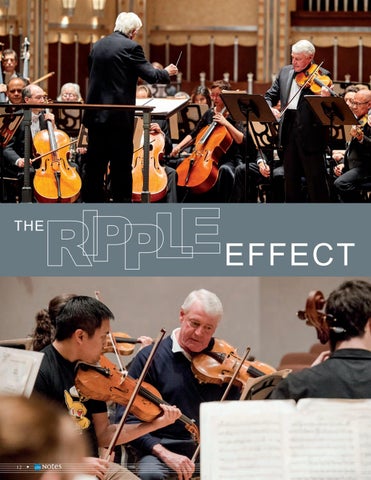
t’s not unusual to look at one faculty member at CIM and find an impressive list of his or her former students doing great things in the music business. But viola faculty member Robert Vernon has a track record that’s hard to beat.
In August 2016, Robert Vernon performed his final concert as principal violist of The Cleveland Orchestra, a position he held for 40 years, longer than any other string principal in the orchestra’s history. And for all 40 of those years, he has taught in CIM’s viola department, currently serving as co-head. His close connection with former students is evident in his TCO career; several of them, eight to be exact, surrounded him in the viola section as his colleagues. Many call him before big auditions or between audition rounds. And some come back for lessons if they’re in town. Around the country, Vernon’s talents as a teacher and mentor are infused in the musicianship of the dozens of his former students who now sit in premier orchestras from coast to coast. Teaching has always been an essential part of Vernon’s career. And his work has paid off—his former students serve in nearly 50 orchestras in Europe, Canada, Asia and the United States, from Boston to Detroit and Chicago and Los Angeles. But for Vernon it’s more than just getting “results” from his students. He cares about them fulfilling their passions, about their well-being, about being successful in any way that works for them. Vernon jokes that it’s his Photos: Left: Roger Mastroianni. Right: Jeff Mancinetti
W I N T E R 2 0 17
13
Collins agrees, adding that if he could sum up Vernon’s teaching on one word, it would be logical. “The bowings, the fingerings, the phrasing ideas—it all just makes sense,” he says. “It’s like, why would I want to do it any other way?”
A
competitive nature that allows him to be so involved in his students’ futures. “The competitive part is something I kind of get a kick out of,” he says. “But the bottom line is that there is nothing in life that is really more important than helping young people achieve their goals and their dreams. And I also get a kick out of that.”
THE
ERNON LEGACY
The Cleveland Orchestra viola section consists of eight former Vernon students led by CIM alumnus Wesley Collins, who was appointed principal viola this fall. Collins too studied with Vernon and says you can recognize a Vernon student even in a blind audition. “It’s amazing to sit behind the screen at a professional, national viola audition, like I did in Boston, and be able to hear the Vernon students,” says Collins. “You can hear his framework and his teaching in the playing. It’s not like he’s putting out robots, because they all have their own individual personalities; it’s just that the framework that surrounds those personalities is always at the standard.” The Boston Symphony Orchestra viola section holds three former Vernon students, all of whom studied with him at CIM. Rebecca Gitter, who sits fourth chair, attributes the success of Vernon’s students to the high technical standards to which he holds them. “Mr. Vernon was incredibly clear and precise in his analysis of my playing,” she says. “Any time I had a technical or musical issue, he was able to immediately pinpoint what I was doing wrong and show me how to fix it. He demands a very high level of precision in intonation, rhythm, musical line and beauty of sound, which I believe is the reason why so many of his students are performing in top orchestras all over the country.”
14
IFELONG MENTOR
One resounding consensus among Vernon’s former students is his commitment to them even after they graduate from CIM. “He’s not just interested in turning out a good student. If you’re willing to work he’s devoted to your growth as a musician and success in your personal life, for decades after you’ve been at school,” says Collins. Vernon is willing to hear his former students play, free of charge, for long after they graduate—a perk many take advantage of. “Mr. Vernon’s dedication to his students’ success is remarkable to say the least, spending countless hours in mock auditions in preparation for the real deal,” says Gitter. “I am forever grateful for the four years I spent under his tutelage at CIM, and for his continued support and encouragement through the years.” The relationship isn’t just one-sided. Vernon too enjoys the connection with his students once they’ve earned their degrees and moved on from CIM. “One of the wonderful things about the relationship I have with my students is, it’s ongoing,” says Vernon. “They come back for lessons, they come back before auditions, and some of them even call me on my birthday, which is really neat! Our family has always opened up our home to students on holidays when they can’t get home, and that’s fun. We’re a close-knit group.”
EACHING FROM EXPERIENCE More than just an encouraging teacher, who describes himself as a “rooting section” for his students when they go off to auditions, Vernon, without question, has the chops. He’s collaborated as a soloist with Valery Gergiev, Pierre Boulez, Georg Solti, Simon Rattle, Lorin Maazel, Franz Welser-Möst and Christoph von Dohnányi, among others. He has appeared as soloist in 17 different works in over 120 concerts in Severance Hall, including three works commissioned for him by The Cleveland Orchestra. He can be heard on solo recordings that include Berlioz’s Harold in Italy, Mozart’s Sinfonia Concertante, Strauss’s Don Quixote and Schoenfield’s Viola Concerto, as well as many chamber music recordings. He’s checked just about every box on the classical music career checklist, and then some. And all of these experiences
are taken back with him to the studio. “Many teachers don’t know anything about orchestral business; they think it can be coached. It can’t be,” Vernon says.
THE RIPPLE EFFECT AT CIM TAKES MANY FORMS: • While at CIM, students often play with faculty on their recitals.
THE
DIFFERENCE
Vernon is able to have such a rich relationship with his students, in part, because the studio sizes at CIM are so small. “We are a very small school and very selective with our students,” says Vernon. “Because of the close association with The Cleveland Orchestra, our students, on a regular basis, go to rehearsals, go to concerts, and their mentors are principals and assistant principals of The Cleveland Orchestra. As one of the great orchestras in the world, that is a wonderful thing to have in your backyard.” And in several cases, CIM students like Collins go on to become members of The Cleveland Orchestra, working alongside, as colleagues, the very musicians who used to be their teachers. While Collins was in school at CIM, he had viola sectionals led by CIM viola faculty Mark Jackobs and Stanly Konopka; both are now his colleagues in the Cleveland Orchestra. “I’m really impressed by the integrity and the work ethic of my colleagues,” says Collins. “I learned so much from them in school, and now I’m making music with them, and it just adds to the awe that I feel of being part of this section.”
• Alumni often work professionally with their former teachers, either within orchestras or on recitals. • Many faculty keep in touch with students long after graduation, offering lessons when they are back in town. • Many faculty help students get jobs after graduation.
Vernon knows this dynamic well, having spent much of his career surrounded by former students. “It was wonderful!” he says of that experience. “They knew what I wanted, they knew what to do instinctively from that association with me and they knew, somehow, that I really loved them,” he says. “It’s an amazing thing to have your former students sitting behind you.” Hear more from Vernon in a feature video at cim.edu
W I N T E R 2 0 17
15
Events Mozart Comes to CIM this Spring! This spring, CIM Opera Theater presents Mozart’s Così fan tutte, the last collaboration of Mozart and librettist Lorenzo da Ponte. It will be sung in the original Italian with a projected translation ensuring audiences don’t miss a minute of the comedy and drama — of which there is plenty.
Beethoven found the production trivial and immoral. The title was politically incorrect even in the 18th century. The Metropolitan Opera ignored the piece for the first 39 years of the company’s existence. And in the 21st century, Così fan tutte is one of the most widely performed operas in the world! The story is one of “fiancée swapping.” Two young men, Ferrando and Guglielmo, are convinced that their girlfriends are perfect models of fidelity. An older man, Don Alfonso, bets that, given the opportunity, the ladies will redirect their affections. The young men pretend to go to war, then return disguised to woo the other’s beloved. The girls’ hearts rapidly turn to the new arrivals,
their sudden change of heart being the source of the title, which translates in English to “That’s What All Women Do.” Don Alfonso has won his bet… for the moment. To be clear, neither Mozart nor da Ponte had the view of women expressed by this work’s title. Mozart was happily married, and da Ponte was a lothario who behaved far more irresponsibly than the ladies in the opera. Under artistic direction by David Bamberger, the production will be staged in a modern setting, bringing the story up to date. The CIM Orchestra will perform under the baton of Harry Davidson.
Mozart’s Così fan tutte March 1- 4, 2017 7:30pm | Kulas Hall $20 adults / $15 seniors and groups of 10+ / $10 students CIM Box Office: 216.795.3211
A reviewer from clevelandclassical.com attended Friday’s performance to capture all the excitement, laughter and heartache. The production was met with praise from the reviewer stating that “The large cast was vocally strong on Friday evening, its many small roles expertly sung.”
Fall Opera Double Bill Receives High Praise
The 2016–17 CIM Opera season kicked off in November with a double-bill from two of the most beloved composers of the 20th century—Puccini’s Sister Angelica and Menotti’s Amelia Goes to the Ball. Artistic Director, David Bamberger, and the CIM Opera Theater took audiences through the contrasting tales of two heroines: Sister Angelica, a nun living a life of anxiety and torment, in desperate need of a miracle; and Amelia, a socialite determined to go to the ball, in spite of a series of hurdles and misadventures along the way. 16
The reviewer went on to praise vocal coach John Simmons, who “melded both the onstage and offstage groups (men and children) into sonorous ensembles,” Bamberger for “scenes that are pleasing to the eye,” the sets and lighting by Dave Brooks and costumes by Inda Blatch-Geib, which “nicely complemented the action,” and conductor Harry Davidson, who “led a well-blended performance of Puccini’s score.” Student Caroline Bergan, who played Amelia, was also complimented, the reviewer stating that “her bright, appealing soprano perfectly suited Menotti’s virtuosic vocal lines.” Bravo to all!
s
s
s
s
Watch it Online!
Watch a live opera performance in your pj’s, or enjoy chamber music all the way from the west coast—CIM has now made the majority of its concerts and recitals available to watch live online!
CIM follows in the footsteps of many of the country’s top orchestras, which offer concerts as online events. “It’s the wave of the future,” says Bise. “Audiences aren’t just found in the concert halls anymore.”
The move to make more concerts available via live streaming helps to spread the talents of CIM students and faculty far and wide. “With over 30 recitals yet to stream this semester, at press time we’ve streamed 50 events, and had over 7,500 viewers, totaling 116,000 minutes watched,” says CIM’s director of Recording Arts and Services, Alan Bise, who spearheaded the initiative. “Viewers have watched from over 77 countries and six continents. If anyone knows any researchers in Antarctica, we are looking for that elusive seventh continent!” The streaming service also enables family members who can’t make it to concerts in Cleveland to watch their loved ones perform.
To find whether an event is available online, visit cim.edu’s concert calendar and click on the event. The link will be available in the detail page for sharing, posting and viewing.
For more information and a complete listing of concerts and events, please visit cim.edu/calendar
“The response has been really amazing,” says Bise, “We’re getting viewers from around the world who are able to see and hear, in exceptional quality, CIM performances.”
W I N T E R 2 0 17
17
Development DONOR PROFILE:
A. Grace Lee Mims Leading a Musical Life
Every Wednesday evening at 10pm, a sweet, low voice comes over the radio airwaves of Cleveland’s WCLV classical radio station. The voice belongs to A. Grace Lee Mims, a household name throughout the Cleveland community, who has been hosting WCLV’s Black Arts radio program, a show that celebrates African American composers and performers, for 40 years. Mims has been a dedicated member of the CIM family for years as a regular donor, belonging to both the Bloch and Opus Societies. She’s also been a member of the Board of Trustees since 1989, serving on both the Academic Affairs and the Governance Committees. But more than being an asset on our Board, Mims is a force within the Cleveland community. Mims has received numerous honors throughout the community for her work with the radio show and as an education advocate—currently serving on the faculty at the Music Settlement as a voice instructor. She received an honorary doctorate of music from Cleveland State University in 1999, was a recipient of the Cleveland Arts Prize in 2011 and was honored in 2006 by former congresswoman Stephanie Tubbs Jones for her “tireless work as a pioneer in presenting classical music by Afro American composers and performers to the greater Cleveland community.” Mims’s past is peppered with achievements, both musical and otherwise. Mims served as the soprano soloist at the Fairmount Presbyterian Church for 20 years, was the soloist with the William Appling Singers and was a member of both the Cleveland Orchestra Chorus and Chamber Chorus. Mims grew up in a musical family; her mother was a piano prodigy who taught music to Mims and her seven siblings. “We had wonderful music in our home all the time,” says Mims. “My mother trained everybody. We had Brahms and Chopin and Bach, as well as spirituals at home. Music was just in me from early childhood, and I kept singing all through my life.” Mims formed a group with her two brothers and sister called the Descendants of Mike and Phoebe, which toured, performed and recorded albums. The jazz-folk ensemble got its name from the children’s great-great-grandparents, Mike and Phoebe, who had been slaves. When Phoebe’s slave owner moved her and her children to Alabama and her husband Mike was still in South Carolina, Mike worked in the evenings, earning his freedom. “He earned his freedom and walked to Alabama and joined the children as a free black man,” explains Mims. “Our grandfather said we should never forget what Mike and Phoebe had done to keep the family together.” It’s with this cultural and musical foundation that Mims charged forth with a mission to preserve the African American spiritual—the oral tradition of Christian songs originally created by African slaves—and to advance classical music education for African American musicians. Mims created a vocal scholarship through the Cleveland Foundation, awarding $10,000 per year for an African American graduate student who wants to work to preserve the spiritual. Mims is always on the lookout to help young musicians, which was one of the draws of her becoming involved with CIM. She enjoys attending the CIM Orchestra concerts in Severance Hall and always brings guests along to join her in her box seats. For Mims, they sound just as good as the top orchestras out there. “They sound beautiful,” she says. “They could be The Cleveland Orchestra!” Mims is the widow of Dr. Howard A. Mims (deceased) who was head of Black Studies at Cleveland State University and a speech pathologist. The two met at Hampton Institute (now Hampton University). CIM has many different ways to provide support for programs in the Conservatory and the Preparatory and Continuing Education Divisions. For more information, visit cim.edu/donatenow.
18
Women’s Committee of the Cleveland Institute of Music
in the
y
d w a o a r Circle
B
Presented by The
Carl Topilow, director of CIM’s orchestra program
An evening celebrating Richard W. and Patricia R. Pogue and benefiting the students of the Cleveland Institute of Music
SATURDAY, FEBRUARY 4, 2017 8PM
Kathryn Brown, head of CIM’s piano department and keyboard division
| Severance Hall
Join us for this gala benefit as the acclaimed Cleveland Institute of Music
Orchestra, led by CIM faculty member and Cleveland Pops Conductor Carl Topilow, and CIM vocalists bring the excitement of Broadway to the Severance Hall stage. Hear music from Broadway classics including An American in Paris, West Side Story, Oklahoma! and Fiddler on the Roof. Performers include pianist Kathryn Brown, head of CIM’s piano Piano department, Department,with withaaspecial specialperformance performanceof ofGershwin’ Gershwin’ssRhapsody RhapsodyininBlue. Blue. Cleveland Institute of Music Orchestra CIM Vocalists Carl Topilow, conductor Kathryn Brown, piano Brooke and Bobby Wesner of Neos Dance Theater Steve Greenman, violin Brian Johnson, baritone
Brooke and Bobby Wesner of Neos Dance Theater | Photo by Mark Horning
Distinguished Service Award
Benefit guests will enjoy complimentary parking, cocktails, a silent auction, gourmet dinner and premier box or dress circle concert seating. Benefit Tickets start at $250. Reserve tickets by calling 216.791.6770 or go to cim.edu/wcbenefit.
Kulas Foundation Mal and Barbara Mixon
Richard and Patricia Pogue have been active members of the CIM community for more than 30 years. Mr. Pogue has been a key member of our board of trustees, while Mrs. Pogue has helped to make the Women’s Committee one of the most treasured aspects of the school. Through each activity, the Pogues have displayed a commitment to the success of our students and championed the work of the Institute throughout the community. It is for their great work on behalf of CIM that they are being honored at Broadway in the Circle. During the event, the Pogues will be presented with the first CIM Women’s Committee Distinguished Service Award. W I N T E R 2 0 17
19
Alumni Snapshot
Breaking down harp stereotypes, alumna
Dr. Jennifer Ellis paves her own way through the
new music world. Jennifer Ellis has a history of being “the first.” She was the first harpist to be accepted to the Bang on a Can Summer Festival, the first harpist to attend the Splice Institute for Electroacoustic Music, the first harpist to be accepted to the Fresh Inc. Festival and recently, she wrapped up a tour with the organization One Beat, where she was, again, the first harpist to be a part of the program. Ellis has paved her way through the contemporary and new music sphere, in an industry where harp stereotypes are abundant. She’s a contemporary performer who, in addition to performing her own harp compositions, has worked with composers to perform over forty premieres. She’s part of a duo with a saxophonist, a trio with a mezzo soprano and flute and a jazz trio with a tabla and a trumpet played without the mouthpiece. She runs workshops on composing for the harp, takes 20
questions from composers via Skype and even reviews composers’ works for harp. And it all started with a movie, a deal made with her mom and a determined five-year-old.
The Deal
Ellis remembers reading the book The Secret Garden as a child and subsequently going to see the movie with her mom. She loved the music in the background and asked, “What instrument makes that sound?” Her mom told her she thought it was the harp. “OK, I want to play the instrument that makes that sound,” she said. Ellis and her mom made a deal. Ellis would start on the piano, and if her mom never had to bug her about practicing, she could eventually play the harp. “The idea was either I wouldn’t practice at all, and that
would be the end of that, or that I would fall in love with piano and we’d never hear another word about the harp,” says Ellis. “Unfortunately, you can tell how well that worked.” After two years of dedicated piano practice, Ellis finally won her mom over. Her mom looked in the yellow pages for the word “harp” and called the first name she saw. That happened to be CIM alumna Jessica Siegel who would become Ellis’s teacher for the next 10 years.
Tasting Musical Freedom
The harp is typically seen as an angelic instrument, soft spoken and unimposing. Ellis rallies against those preconceptions. Her first memorable
exposure to contemporary music was at a summer seminar with another CIM alumna, Alice Giles. “Jessica sent me there with a piece by Sergiu Natra, a contemporary harp piece,” explains Ellis. “I just loved the musical freedom I got with a piece like that–that it wasn’t just about learning the performance history of how a phrase had been played for the past 200 years. There’s just so much room to make contemporary music your own, so much musical freedom, so much musical flexibility.”
From then on she was hooked. She explains that contemporary music not only gives her more musical freedom but also lets her unlock all the characteristics of the harp. “I feel like I’m only getting to use about 10 percent of what the harp can do,” she explains. “I get to use, maybe, two colors of the paint palette. It’s awesome; those colors are beautiful; I can do all these different shadings of both colors and it’s great. But there are all these other colors that I don’t even get to touch in that repertoire. There are all these different timbres and sounds and techniques and skills that I miss. It’s that emotional range that I want to utilize in my playing, and contemporary music gives me the freedom to do that.”
There’s just so much room to make contemporary music your own. So much musical freedom. So much musical flexibility.
Yolanda Kondonassis, head of the CIM harp department, was another draw. Having studied with her at Oberlin, Ellis wanted to continue working with the same teacher, whom she calls “incredible.” However, Kondonassis isn’t just a great teacher; she also invests in her students’ futures. Ellis recalls the mission statement assignment Kondonassis had her students complete at the beginning of every year. “You map out where you think you want to be in five years, ten years, fifteen years, so on and so forth,” says Ellis. “Then you write down everything you need to do while at school to get you there.” This type of student investment is what Ellis was so grateful for in a mentor like Kondonassis. “There’s really no adjective you can use to summarize well enough what an incredible teacher and mentor she is and the impact she’s had on my life,” she says. “It really does leave you at a loss for words. She is phenomenal.”
CIM gave me first and foremost incredible teachers.
In addition to Kondonassis, Ellis also praises the head of the Eurhythmics Department, Brian Sweigart, whom she credits for making her a better musician and helping her tackle the “level of rhythmic craziness that goes on in contemporary music.” She also worked with Diane Urista, theory faculty member, and Chris Haff-Paluck, director of community programs at CIM, both of whom helped her get to where she is today. “CIM gave me first and foremost incredible teachers,” she says. “I was incredibly fortunate.”
To Today’s Young Musicians
Ellis is an advocate for creating one’s own career path. She likes to remind today’s young musicians to be resilient, learn from every experience and “think broadly about the things that make you happy and the ways that those can intersect with music.” She considers herself and her fellow musicians to be lucky to be in such a creative field, and encourages young musicians to take advantage of every path. She reminds them that “Orchestra is a wonderful, wonderful place to be but it’s not the only place to be. So if orchestra isn’t the right fit, it doesn’t mean that music isn’t the right fit. It just means you have to broaden your idea of what a career in music looks like. And, fortunately, it’s a really broad place out here.”
Faculty Who Shaped a Future
After pursuing an undergraduate degree at Oberlin, Ellis was able to continue to hone her contemporary music passions at CIM as a master’s student, noting that CIM is unique for having both wellrespected harp and composition departments. “Composers at other schools aren’t getting those in-the-hallway interactions with harpists, or friendships with harpists; that informal education that you get when you’re able to go to a friend and say, ‘Hey look at this part, does this work?’” Ellis was also impressed by the CIM harp legacy. “Its reputation in the harp world just precedes itself,” she says. “Alice Chalifoux is such a legacy, and the program that she built at CIM is really amazing. There’s just wonderful harp history at CIM.” WINTER 2017
21
a l u m n i n ew s Have some news? Visit cim.edu and find Alumni under the About CIM section. At the bottom of the Alumni Page, see the form to submit news. News is accepted on an ongoing basis and may be held until the next issue.
Alumni Dr. Houston Dunleavy (MM ’91, MM ’99, Erb/Brooks) celebrated his farewell season with the Sydney Male Choir, which was nationally broadcast on Australia’s Channel 7 in November. Luanne (Clarke) Crosby (MM ’95, Rinaldi) was recently featured as soprano soloist in the Haydn Lord Nelson Mass in Budapest, Hungary. She has been invited to perform as soloist in the Haydn Theresa Mass in Barcelona, Spain in June 2018. Crosby is professor of music at Alfred University in Western New York where she teaches voice and directs the choirs. She will spend a sabbatical this spring teaching at the Chinese University of Geoscience in Wuhan, China. Chelsea Friedlander (BM ’10, Schiller) will debut with Dayton Opera on the main stage as Blonde in Die Entführung aus dem Serail. Friedlander will then continue as the 2017 artist-in-residence appearing at numerous schools and presenting musical programs throughout the community. In May, Friedlander will sing Frasquita in Carmen with Dayton Opera. Two other artist’s-in-residence artist-in-residence ininthe theDayton Dayton Opera this year are CIM alumni Elizabeth Frey (MM ’12/PS ’12/PS’15, ’15, Schiller) Schiller) and and Brian Brian Skoog Skoog (MM ’13/PS ’15, Cole).
bass and Justin Hart on drums in December. Available at the concert was Huff’s first solo CD, My Favorite Things: A Christmas Collection, reflecting her diverse influences, especially her love of Celtic and jazz music. Elizabeth Huffman (MM ’03, Preucil) and Adam Moen were married in September in Milwaukee, WI. Huffman is a violinist with the Elgin Symphony Orchestra and Illinois Philharmonic Orchestra and is the assistant director of the Oak Park String Academy, which was founded and is directed by CIM alumna Meg Lanfear (BM ’01/MM ’02, Updegraff). In October 2016, Austin Jaquith’s (BM ’03, Brouwer) work Dracula: Bloodlines was premiered by the Dayton Performing Arts Alliance conducted by Neal Gittleman. The work is a full-length ballet/opera hybrid developed with Karen Russo Burke, artistic director of the Dayton Ballet, who authored the concept and choreography. A signature production, it was commissioned with the purpose of combining all three members of the alliance–the Dayton Ballet, Dayton Philharmonic and Dayton Opera–in a single production. Dr. Timothy Kalil (BM ’74, MM ’76 Podis/ Radunsky) is a member of the Lakeside Society for the Performing Arts and will present the 2016 Cleveland International Piano Mixon first prize winner, Nikita Mndoyants, at Lakeside High School in Ashtabula in May.
Daphne Gerling (MM ’01, Irvine/Ramsey) performed at the International Viola Congress in Cremona, Italy, and was a featured artist and master class teacher at the Brazilian viola congress (II Encontro Nacional de Violistas) in Florianópolis in October. Gerling currently serves as a senior artist teacher of viola and chamber music and associate director of the Summer String Institute at the University of North Texas College of Music.
Eri Nakamura (PS ’11, AD ’11, Babayan/ Pontremoli) is the pianist in a professional classical piano ensemble called the Neave Trio. The trio’s debut album, American Moment, was released in November from UK’s Chandos Records Label. This fall, the trio completed a week-long visiting artist residency at Brown University, where they performed the Beethoven Triple Concerto with the Brown University Orchestra, performed recitals and worked with students in the university’s composition and chamber music departments. Additionally, this past April the Neave Trio gave the world premiere performance of a new trio, Klee Musings, written by celebrated composer Augusta Read Thomas. Also in the 2016-2017 season, the Neave Trio will be working with mezzo-soprano and Metropolitan Opera star Carla Jablonski in a collaborative recording for the Grammywinning Azica record label. neavetrio.com
Liz Huff (BM ’96/MM ’98, Rinaldi) presented an evening of jazz-centric holiday music, including the classics and new takes on old favorites, such as the Jingle Bell Tango, with Marshall Griffith on piano, Tim Keo on upright
Christopher Thibdeau (MM ’11, Topilow) made a 10-day trip to Afghanistan, where he was a guest teaching artist at the Afghanistan National Institute of Music’s Summer Residency program. During his time in Kabul, Thibdeau
22
taught cello and conducting lessons and also had the opportunity to work with the first-ever female Afghan conductor, Negin Khpolwak. Navona Records released pianist Cicilia Yudha’s (BM ’02/AD ’04, Radosavljevich) debut solo CD, Selected Piano Works by Robert Casadesus and Henri Dutilleux, in September. The recording is available for streaming and purchase at iTunes, Amazon, Spotify and Naxos. The CD is dedicated in memory to Cleveland philanthropist Jamie Ireland III, who generously supported Yudha’s studies at CIM. Yudha is currently an assistant professor at the Dana School of Music, Youngstown State University. navonarecords.com/catalog/nv6053/ Misha Vayman (BM ’15, Kwuon) performed the Bruch G Minor Violin Concerto with the El Paso Symphony Orchestra with conductor Bohuslav Rattay in November. A new CD, La Chanson Française, was released in 2016 by Max Frank Music, featuring Terry Vosbein’s (DMA ’95, Erb) jazz interpretations of classic French melodies made famous by Édith Piaf, Charles Aznavour, Charles Trenet and Jacques Brel. A nine-piece jazz band of stellar soloists and memorable melodies are highlights of this swinging set
Appointments Aaron Alon (MM ’05, Webb/Brouwer) is now a full professor of music at Lone Star CollegeCyFair and continues to serve as the chair of the composition program at the American Festival for the Arts. His latest work, a feature film musical titled BULLY (bullythemusical.com), is now in post-production and will be screened for the first time in 2017 in Houston. Learn more at aaronalon.com or bullythemusical.com. Jennifer Arnold (BM ’03, PS ’05, Vernon) was recently appointed The Sphinx Organization’s Inaugural Sphinx Diversity Fellow for 2016-17. She is currently on sabbatical from the Oregon Symphony to participate in this program, designed to transform the career trajectory of those seeking a life in arts administration. Violinist Nancy Violinist NancyDahn Dahn(DMA (DMA’97, ’97,Weilerstein) Weilerstein) has received the prestigious honor of being elected to the Royal Society of Canada. This achievement recognizes her work with the ensemble Duo Concertante, her acclaimed recordings ranging from Bach and Beethoven to JUNO-award-winning Canadian repertoire, and a growing legacy of commissioned works by many of Canada’s finest composers.
Scott Carpenter Janet Hayes (MM(BM ’12, ’11 Wilson) Updegraff/Preucil) became won a section director of music violinist at Allposition Saints Episcopal with the St. LouisinSymphony Church Richmond,Orchestra. VA in February 2016, which is home to the Choir of Men and Boys Shelly Du (MM (established in 1899), ’13/AD a Girls ’16, Choir Kondonassis) and an was appointed Adult Choir. to the Sarasota Orchestra as acting principal harp. Emil Khudyev (BM ’09, Cohen) won the Scott Hayes position of associate (MM ’12, principal Wilson) clarinet became with the directorSymphony. Seattle of music at All Saints Episcopal Church in Richmond, VA in February 2016, whichR. Paul is Kosower home to the (Silberstein), Choir of Men professor and Boys (established emeritus, wasinappointed 1899), a Girls director Choir ofand music an and Adult Choir. organist of Christ United Methodist Church, Rochester, Minnesota, in September. Emil Khudyev (BM ’09, Cohen) won the positionMarenstein Harry of associate principal (MM ’00,clarinet Topilow/ with the Seattlejoined Symphony. Lane) the artistic staff of the Gemini Youth Orchestras as conductor of its Youth Paul R. Kosower (Silberstein), professor Symphony. He has also been named principal emeritus, guest conductor was appointed of the North director Shore of music Symphony and organist of Christ United Methodist Church, Orchestra. Rochester, Minnesota, in September. After an extensive national search, Harry Marenstein (MM ’00, Topilow/ Erik Christian Peterson (MM ’06, DMA ’12, Lane) joined thewith artistic the Gemini Konopka), along his staff wife,of Emily OndracekYouth Orchestras as conductor of itsdirector Youth Peterson, was appointed co-artistic Symphony. HeButte has also beenFestival named(CBMF). principal of the Crested Music guest conductor of thenine-week North Shore Symphony CBMF is a prominent festival in Orchestra. Crested Butte, Colorado, that features symphony, opera, chamber music, jazz, bluegrass, gypsy jazz After an extensive national search, and various other performances. Erik Christian Peterson (MM ’06, DMA ’12, Konopka), along with his wife, Emily OndracekMargo Schwartz-Newton (MM ’00, Peterson, was co-artistic Epperson) is onappointed the advisory board ofdirector Rembrandt of the Crested Butte and Music Festival (CBMF). Chamber Musicians is the pianist for CBMF is a prominent nine-week festival in Congregation BJBE, often performing with Crested Butte, Colorado, thatand features symphony, renowned recording artists composers in opera, chamber jazz, bluegrass, gypsy jazz the field, and formusic, Kol Zimrah Jewish Community and various other performances. Chorus, which presents six to ten programs each season. Margo Schwartz-Newton (MM ’00, Epperson) is on the advisory board ofhas Rembrandt Paul Reynolds (BM ‘95, Vernon) been Chamber Musicians and is the pianistof forviola appointed visiting assistant professor Congregation at SUNY, Crane BJBE, School often of Music. performing He has with also renowned recording artistsfor andthe composers been appointed as director Vermontin the field,Festival, Mozart and for Kol for which Zimrah heJewish wouldCommunity love to see Chorus, some recent which CIM presents graduates six to apply. ten programs Additionally, each season.invention, the Wrist Rascal, for Reynolds’s beginning violinists, is now patented and available Paul (BM Vernon) has been at SharReynolds Products, as well‘95, as many other distributors appointed visiting assistant professor of viola worldwide. vermontmozartfestival.org. at SUNY, Crane School of Music. He has also beenMarguerite Dr. is appointed Richardson as a director for (BM the’82 Vermont Mozart Festival, Cerone, Harada,for Gorevic) which has he would been named love to see some recent conductor of CIM the Civic graduates Orchestra apply.ofAdditionally, Jacksonville Reynolds’s (FL), beginning invention, with the Wrist 2016-17 Rascal, season. for beginning violinists, Richardson is also director is now patented of orchestral and available studies at Shar Jacksonville Products,University, as well as many where other she distributors has been worldwide. vermontmozartfestival.org.
on the Dr. Marguerite faculty since Richardson 2007. In February (BM ’82she Cerone, will travel Harada, to Manchester, Gorevic)UK, has been to conduct namedthe conductor Symphony Piccadilly of the CivicOrchestra. Orchestra of Jacksonville (FL), beginning with the 2016-17 season. Richardson Jason Ikeem is also Rodgers director (PSof’09, orchestral Topilow) studies at the is Jacksonville founder, CEO University, and Music whereDirector she has of been on the faculty Orchestra Noir, since The2007. Atlanta In February African-American she will travel to Manchester, UK, to conduct the Orchestra. Piccadilly Symphony Orchestra. Tenor Eduardo Valdes (MM ’86, Vassos) Jason sang the Ikeem role ofRodgers Messenger (PS in’09, the Topilow) Metropolitan is Opera’s the founder, production CEOof and Aida Music in November, Director of Orchestra marking hisNoir, 600th The performance Atlanta African-American with the Orchestra. Metropolitan Opera. Tenor Eduardo Valdes (MM ’86, Vassos) sang the role of Messenger in the Metropolitan Opera’s production of Aida in November, Ross Gasworth ’06/MM ’07, Aaron/ marking his 600th(BM performance with the Geber) is the cellist Metropolitan Opera.of Trio Céleste, which just released its debut album. Since debuting at number five on iTunes for Best Seller New Release and number 20 on Amazon’s “Chamber Music Albums,” Trio Céleste’s debut album Rebekahworks Efthimiou (MM ’15,Dvorak Kondonassis) featuring of Beethoven, and wonrevolutionary a major grantcollaborative from the Frank Huntington the project Beebe Fund to has spend the nexttoyear studying Constellations continued receive rave harp andfrom researching in the UK. reviews some of the most respected critics in the country. Ross Gasworth (BM ’06/MM ’07, Aaron/ Geber) is the Kim cellist(PS of Trio Céleste,won which just JeongHoon ’11, Kwuon) first released its debut album. Since at prize in the International Musicdebuting Competition number Vittoria five on iTunes for Best in Seller Premio Caffa Righetti Italy.New Release and number 20 on Amazon’s “Chamber Music Albums,” debut album Jeremiah ShawTrio (BMCéleste’s ’02, Aaron) is cellist featuring works of Beethoven, Dvorak and with the Telegraph Quartet, which recently the revolutionary collaborative project won the 2016 Chamber Music Competition Constellations hasCity. continued to receiveQuartet rave held in New York The Telegraph reviews from of the mostBay respected critics hails from thesome San Francisco Area, where in thewere country. they a 2014-2015 ensemble-in-residence with, and fiscally sponsored by, San Francisco Samantha GossardMusic. (MM ’12, was music one Friends of Chamber TheCole) chamber of 15 recipients of the William Matheus prize includes a recital in Carnegie Hall’sSullivan Weill Foundation receiving a $12,000 Recital HallSinger as wellAward, as a commissioned work by grant and theAmerican opportunity to participate in a the eminent composer Robert Sirota. five-year program of continued financial aid for coaching new ’82, roles. Jan Vinciin(MM Sharp) received a Classical Recording Foundation Award Jeremiah Shaw (BM ’02, Aaron) is cellist for “American FluteScape: A Tapestry of with the Telegraph Quartet, whichRecords). recently It Premieres and Classics” (Albany won the 2016 ChamberTINGsha Music Competition features commissions Bom t-Bom held infor New York City. The Telegraph Quartet t-Bom flute and orchestra and Crow’s Nest hails from the by SanJuilliard Francisco Area,Mark where for flute both JazzBay faculty they were 2014-2015 Vinci, andaFlute Poeticensemble-in-residence for flute and piano with, and fiscally by, SanHigdon. Francisco by Pulitzer Prize sponsored winner Jennifer It Friends of Chamber Music. The Hindemith chamber music also includes works by Hoover, prizeGriffes. includesVinci a recital in Carnegie Hall’s Reiko Weill and is assisted by pianist Recital Hall as well as York a commissioned work by Uchida and the New Dream Orchestra. the eminent American composer Robert Sirota.
Prizewinners
Prizewinners
Daniil Trifonov (AC ’13/AD ’15, Babayan) won Gramophone’s Artist of the Year Award.
Faculty
Diane Urista (theory) published a new book, The Moving Body in the Aural Skills Classroom, which Oxford University Press released in September. The book is a guide for Junior Young Artist Program student Hana both teachers and students. Chang (violin, Zenaty) received second
Preparatory
prize in the International Louis Spohr Violin Gramophone magazine CIM faculty Competition in Weimar,praised Germany. members Ivan Zenaty (violin) and Sandra Shapiro (piano) on their debut album, saying, Young Artist Program student Phoenix “It’s clear from their debut recording that they on Avalon (violin, Laredo/Sloman) performed are on the same artistic wavelength. In sonatas Performance Today. by Richard Strauss and Bohuslav Martinů, they breathe as one, shaping phrases with utmost unanimity of purpose and flexibility.”
Faculty
Steven Mark (theory) Kohn (composition) is the Diane Urista published a new librettist for the monumental operatic premiere book, The Moving Body in the Aural Skills of Riders of the Purple Sage with the Arizona Classroom, which Oxford University Press Opera inin Phoenix, AZ, The in February March released September. book is aand guide for of 2017. both teachers and students. Brian Thornton (cello) will be releasing Gramophone magazine praised CIM facultyhis second CD this spring with pianist Spencer members Ivan Zenaty (violin) and SandraMyer, 5/4 Records producer Thomas sound Shapiro (piano) on their debutMoore album,and saying, engineer Michael Bishop of the Brahms cello “It’s clear from their debut recording that they sonatas in E minor and F major. In sonatas are on the same artistic wavelength. by Richard Strauss and Bohuslav Martinů, they This season, Jason Vieaux (head, breathe as one, shaping phrases withguitar) utmostmade his debut at the world-famous Concertgebouw unanimity of purpose and flexibility.” in Amsterdam, joined Curtis On Tour for concerts aroundKohn the world, performed four Steven Mark (composition) is the guitar concertos in two days with the Edmonton librettist for the monumental operatic premier Symphony a glowing review from of Riders ofand the received Purple Sage with the Arizona The Washington Post titled, “Jason Vieaux Opera in Phoenix, AZ, in February and March avoids of 2017.the clichés of classical-guitar concerts.” He also released Infusion, an album with bandoneonist JulienVieaux Labro on Azica, and is This season, Jason (head, guitar) made featured on Ginastera: One Hundred, a his debut at the world-famous Concertgebouw centennial tribute album fromOn Oberlin Music. in Amsterdam, joined Curtis Tour for This spring, Vieaux performs with the concerts around the world, performed four symphonies of ElinPaso, Richmond, guitar concertos two days with theNiagara, Edmonton Santa Fe, West Virginia and Illinois, among Symphony and received a glowing review from many other engagements. The Washington Post titled, “Jason Vieaux avoids the clichés of classical-guitar concerts.” He also released Infusion, an album with bandoneonist Julien Labro on Azica, and is featured on Ginastera: One Hundred, a centennial tribute album from Oberlin Music. This spring, Vieaux performs with the symphonies of El Paso, Richmond, Niagara, Santa Fe, West Virginia and Illinois, among many other engagements.
W I N T E R 2 0 17
23
Notes is published four times a year by the Cleveland Institute of Music. A PDF of the current issue of Notes is available at cim.edu.
Non-Profit Org. U.S. Postage PAID Cleveland, OH Permit No. 1010
11021 East Boulevard Cleveland, Ohio 44106 Address Service Requested
MARGARET HAGAN
Communications Manager / Editor, Lead Writer M O N I C A M C FA D D E N
Graphic Design Manager / Design SUSAN ILER
Director, Marketing and Communications / Editor CLEVELAND INSTITUTE OF MUSIC 11021 East Boulevard Cleveland, OH 44106
P: 216.791.5000 F: 216.791.3063 E: margaret.hagan@cim.edu Preparatory classes at the main building and branches.
| cim.edu
The Cleveland Institute of Music is generously funded by Cuyahoga County residents through Cuyahoga Arts and Culture.
Founded in 1920, the Cleveland Institute of Music (CIM) is one of seven independent music conservatories in the country and is known for superior orchestral, chamber music, composition and graduate levels. CIM graduates play important musical roles in our world as composers producing meaningful new repertoire, as eminent instrumental and vocal soloists, as world-renowned chamber musicians and as members of premier orchestras around the globe. More than half of the members of The Cleveland Orchestra are connected to CIM as members of the faculty, alumni or both. Located in University Circle, Cleveland’s cultural hub, CIM is easily accessible to all music lovers— providing hundreds of concerts annually, most free of charge. Visit cim.edu for more information.
Women’s Committee of the Cleveland Institute of Music
d w a o a r Circle in the
y
and opera programs at both the undergraduate
Presented by The
B
ABOUT CIM
An evening celebrating Richard W. and Patricia R. Pogue and benefiting the students of the Cleveland Institute of Music Join the CIM Orchestra for an evening of classic Broadway including musical selections from: An American in Paris, West Side Story, Oklahoma! and Fiddler on the Roof. Benefit guests will enjoy complimentary parking, cocktails, a silent auction, gourmet dinner and premier seating.
SATURDAY, FEBRUARY 4, 2017
8pm | Severance Hall RESERVE BENEFIT TICKETS NOW Benefit tickets start at $250. Call 216.791.6770 or go to cim.edu/wcbenefit for more information. Concert-only tickets are available at clevelandorchestra.com or 216.231.1111.