Energy Insights 2025
EXECUTIVE SUMMARY
Kenneth B. Medlock III Senior Director, Center for Energy Studies and James A. Baker, III and Susan G. Baker Fellow in Energy and Resource Economics
“The energy landscape is constantly changing.” It is appropriate to begin “Energy Insights 2025” with the line that opened last year’s edition. Shifts in political leadership in the U.S. and around the world have driven home the stark difference between energy choices rooted in economic fundamentals and those rooted in policy support. This has manifest in a litany of commentary centered on “pragmatism” and invigorated discussions about the future of energy from all sides of the debate on the future of energy. Through all the uncertainty, it is important to understand that there is no economic model where adding a constraint lowers cost. Sometimes policy constraints are necessary to deal with non-priced negative externalities, but with every action there is a reaction, so there are always trade-offs. Reality is a binding constraint. This cannot be forgotten in the fervor of trying to exact change through policy. “Energy Insights 2025” opens with a focus on supply chain resilience and how it is crucial for achieving broader energy and national security goals. In “Energy Security and Supply Chain Resilience,” Kenneth B. Medlock III argues that energy security is best framed in terms of supply chain resilience rather than self-sufficiency. Market depth and fungibility, along with the infrastructure required to connect market participants, have historically been the best harbingers of stability. Moreover, supply chain resilience requires diversified trade networks, redundant supply options that include commercial storage from which customers can pull, and regulatory certainty that enables investment. In short, policy should reduce uncertainty, encourage connectivity, and facilitate investment in infrastructure, as resilience — rather than independence — is foundational for energy security.
Energy Insights 2025
02
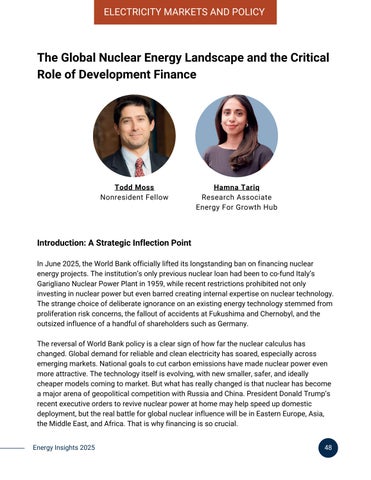
Turning to electricity markets and policy, Peter R. Hartley assesses global electricity demand growth given ongoing developments in technological change, digitalization, and climate policy in “Meeting Future Electricity Needs.” While subsidies and mandates have spurred deployment, he argues that a tax (or price) is the most effective mechanism for reducing greenhouse gas emissions. However, the preferred policy approach over the last couple of decades has been to subsidize certain generation sources, like wind and solar. This has introduced unintended issues related to system cost and reliability, given the intermittency of wind and solar, transmission bottlenecks, and low-capacity factors for subsidized electricity sources. Other low CO2 emission sources, like nuclear and hydro, have a potentially large role to play, but new technologies will only succeed if they can successfully integrate with existing systems. Hartley concludes that energy transitions will be slower and more complex than many policy visions suggest. Extending the discussion on electricity, Medlock examines rising electricity demand from the growth in artificial intelligence and data centers, placing it in a historical context in “AI, Data Centers, and Energy: Oh My!” Intermittency and subsidy-driven distortions in electricity markets have created price volatility and reliability challenges, which have encouraged large load customers to consider behind-the-meter (BTM) generation. Drawing lessons from the Public Utility Regulatory Policies Act of 1978, he argues that data center BTM assets could evolve into a new class of ancillary service providers, supplying the grid during peak stress while insuring their own operations. If market designs appropriately value BTM capacity, data centers could shift from exacerbating reliability concerns to playing a role in alleviating them. Continuing with electricity market and policy, Todd Moss and Hamna Tariq explore the potential of nuclear power in “The Global Nuclear Energy Landscape and the Critical Role of Development Finance.” They note that nuclear power is a reliable, low-carbon source of electricity, with small modular reactors (SMRs) drawing increasing attention. However, project finance remains a critical constraint. Unless the U.S. government and multilateral institutions increase large-scale finance and export support, the geopolitical balance in nuclear power will tilt toward Russia and China because they are already engaged in serious state-led efforts. Shifting to oil markets, in “Outlook for Oil: The Search for Market Balance,” Abhi Rajendran and Skip York explore the market influences of changes in OPEC+ production, geopolitical risks, and evolving demand patterns. Increased OPEC+ production limits the risk of oil price rising, but it also adds uncertainty to future oil prices, which complicates non-OPEC+ production outlooks.
Energy Insights 2025
03
China’s efforts to electrify transportation along with slowing industrial growth signal a looming plateau in global oil consumption, but developments in India and other emerging economies could sustain demand. U.S. production, supply from new oil fields, refining bottlenecks, and tariffs further complicate how market balance may evolve. They conclude that the global oil market faces not scarcity but uncertainty, with rebalancing hinging on the collective outcomes of multiple factors. Moving from oil to natural gas, in “The LNG-enie Is Out of the Bottle,” Medlock recaps the evolution of the U.S. natural gas market, emphasizing how transparent, competitive markets, and infrastructure have been critical for the shale revolution and U.S. LNG exports. U.S. LNG is sold on flexible terms, which has enhanced global energy security, something that was expounded in Europe after Russia’s invasion of Ukraine. However, future benefits hinge on infrastructure and trade, and barriers to investment, permitting, or cross-border flows undermine market resilience. Medlock argues that market depth, liquidity, and transparency will define the long-term future of U.S. LNG. Michelle Michot Foss steps into recent political developments and their implications for energy and materials in “‘Energy and Material Realism’ and Its Discontents.” She critiques the notion of rapid energy transitions, noting that consumer sentiment, material constraints, subsidy dependence, and geopolitical tensions all complicate decarbonization pathways. Recognizing ever-present trade-offs, Foss argues that critical mineral bottlenecks will ultimately slow deployment of renewables, hydrogen, and storage. She concludes that forward-looking policy should prioritize resilience, domestic capacity, and pragmatic timelines rather than aspirational scenarios. Turning to regional energy-related issues, in “The European Energy System’s Conundrum,” Raúl Bajo-Buenestado argues that an energy policy emphasis on renewables and the loss of Russian gas has created a “new normal” of persistently high prices, which has exposed energy system vulnerabilities, eroded competitiveness, fueled social discontent, and triggered political backlash. With EU member states diverging on energy priorities, Europe risks fragmentation of its Green Deal vision. Bajo-Buenestado concludes that Europe should reconcile climate ambition with economic competitiveness and geopolitical reality.
The ongoing attention on energy in Asia has taken a hyperfocus on metals and minerals supply chains through China. In “The China Hangover: Western Market Discipline Meets Mineral Overcapacity,” Ashley Zumwalt-Forbes analyzes how China’s state-backed strategy on minerals production and processing sustains low prices, deters Western competitors, and entrenches market dominance. In contrast, Western firms are constrained by investor discipline, leaving projects stalled despite policy incentives. Energy Insights 2025
04
She suggests several targeted interventions to align market incentives with security needs. Zumwalt-Forbes concludes that without coordinated action, China’s monopolization of critical minerals will deepen, undermining Western energy security and industrial resilience. Gabriel Collins considers the future of nuclear power in the context of renewed U.S.-ChinaRussia competition in “Will Great Power Competition Yield a Nuclear Renaissance?” Globally, 90% of new capacity currently under construction is in Eurasia. The development of small modular reactors (SMRs) could open new markets, but Russia and China already lead deployments. U.S. firms face fuel supply bottlenecks and fragmented support. Collins concludes that proactive policy is critical for the U.S. to compete in a global nuclear revival. Maintaining a focus in Asia, in “Northeast Asia’s Energy Outlook: Potential Through Innovation and Cooperation,” Henry Haggard notes the import dependence of Japan and South Korea for their energy needs, emphasizing the importance of diplomatic ties with the U.S. and a need for a balanced approach. Noting the economic heft of Japan and South Korea, he concludes that each will continue to play an important role in the global energy system. Hence, U.S. firms and the U.S. government should focus on Japan and South Korea as partners in research, investment, and commerce to successfully compete with China while achieving regional security in Asia. Shifting attention to Latin America, Francisco J. Monaldi evaluates the region’s heretofore limited role in LNG markets, despite having substantial gas resources, in “Can Latin America Become a Relevant Player in Global LNG Markets?” Political and regulatory risks, subsidies, and a lack of infrastructure have constrained development, with only Trinidad and Peru emerging as consistent exporters, despite the relative resource abundance in Venezuela and Argentina. Mexico’s new Pacific Coast LNG projects are built on U.S. gas resources, and they offer a competitive route to Asia. Argentina’s Vaca Muerta shale has potential, but investment risks remain high. Monaldi concludes that while the region has opportunities, above-ground constraints will limit its global impact. Turning to mining in Latin America, in “Mining, Governance, and Communities,” Tilsa Oré Mónago discusses the growing demand for copper and lithium, which are essential to electrification and AI-driven data center expansion. The requisite expansion of mining activities in Latin American countries is creating conflicts with Indigenous communities. Weak governance and illegal mining exacerbate environmental harm and social conflict. She concludes that sustainable mining requires partnerships, a recognition of property rights, and capacity building to ensure shared benefits.
Energy Insights 2025
05
Examining Argentina, which is a Latin American economy with tremendous resource potential, Mark P. Jones considers recent political turbulence in expounding on some implications for the Vaca Muerta shale in “Javier Milei’s First Electoral Test and the Implications for Argentina’s Vaca Muerta.” Jones details how political instability, macroeconomic crises, and regulatory uncertainty have constrained development and notes that Argentina illustrates both the promise of resource wealth and the peril of political instability. He concludes that long-term investment depends on fiscal stability and policy credibility, both of which are uncertain. Turning to the Middle East and North Africa (MENA) region, Jim Krane considers the risks and opportunities associated with East Mediterranean gas resources in “Peril or Promise in East Mediterranean Natural Gas?” Krane highlights the complex relationship among Egypt, Israel, and Cyprus, alongside Turkey’s enduring role as transit state and veto player. Despite the promise of resource wealth, unresolved territorial disputes and fragile alliances have constrained energy diplomacy. He concludes that while Eastern Mediterranean gas could underpin cooperation, geopolitical rivalries and structural barriers have limited its potential. In “Progress in Power Grid Interconnection in the GCC and MENA Region,” Salem Alhajraf evaluates the rapid growth of electricity demand in the MENA region and the development of cross-border grid interconnections. He argues that the GCC Interconnection Authority has enhanced regional stability, facilitated trade, and generated billions in savings, and there is potential for further integration. However, technical risks remain significant. Alhajraf concludes that interconnection is critical for energy security and renewable integration, but success depends on effective market design and implementation. Moving away from a regional focus and turning to the future of the transportation sector, in “Fuels: The Intersection of Energy, Climate, Transportation, and Policy,” Edward M. Emmett considers the intersection of fuels, transportation, and climate policy. He notes that transitioning away from petroleum-based fuels presents economic and technical challenges, including high capital costs, fuel infrastructure replacement, and uncertainty in the economic and technical efficiency of alternatives like hydrogen and biofuels. Emmett emphasizes the importance of coordinated policy, supply chain development, and global standards, and he concludes that the future of fuels in transportation will have broad ramifications.
Energy Insights 2025
06
Looking at the future of innovation and policy, Ted Loch-Temzelides highlights the critical role of research and development (R&D) in shaping the future energy and economic landscape in “R&D Funding and Future U.S. Economic Growth.” He argues that breakthroughs in storage, advanced nuclear, carbon capture, and alternative fuels are necessary to meet climate and economic goals. However, Loch-Temzelides stresses that innovation requires stable funding, supportive policy, and public-private collaboration. Absent such collaboration, investment can falter, and transitions risk stagnation. He concludes that R&D is vital for long-term energy transformation and healthy economic growth. On the topic of sustainability and resilience, Rachel A. Meidl traces the evolution of sustainability from visionary ideals to politicized practice in “Sustainability in Transition: From Ideals to Implementation.” She critiques reliance on narrow metrics like carbon footprints, arguing for systems-based approaches that account for full life cycles, resilient supply chains, and trade-offs. Sustainability, she stresses, is not an endpoint but a dynamic balance of economic, social, and environmental imperatives. Meidl concludes that recalibrating sustainability requires realism, accountability, and alignment with long-term resilience. In “An Enduring Emphasis on Resilience,” Medlock and Miaomiao Rimmer reframe the risks associated with climate-related natural disasters through the lens of resilience. They show that damages from natural disasters are an increasing part of the reporting and social media narrative, which drives perceptions, despite the fact that historical data reveal that increasing damages are driven less by disaster frequency and more by population growth and urban expansion. Highlighting case studies and utilizing the “Natural Disaster Resilience” dashboard, they argue for adaptive measures — such as stronger building codes, more diligent land-use planning, and commercially sustainable insurance frameworks — that reduce vulnerability regardless of climate outcomes. They conclude that resilience should complement decarbonization because disasters will persist even in a zero-carbon future. Center for Energy Studies (CES) fellows and scholars will continue to advance research in an effort to elevate discussions about the future of energy. Rarely are things cut and dry, especially when trade-offs are involved. But a solid grounding in data and fundamentals can help to navigate uncertainties and the winds of change that will inevitably blow. To that end, the briefs contained in “Energy Insights 2025” offer a glimpse of ongoing research and CES initiatives.
Energy Insights 2025
07
TABLE OF CONTENTS Energy Security and Supply Chain Resilience
11
Meeting Future Electricity Needs
24
AI, Data Centers, and Energy: Oh My!
35
The Global Nuclear Energy Landscape and the Critical Role of Development Finance
48
Outlook for Oil: The Search for Market Balance
58
The LNG-enie Is Out of the Bottle
69
‘Energy and Materials Realism’ and Its Discontents
79
The European Energy System’s Conundrum
94
The China Hangover: Western Market Discipline Meets Mineral Overcapacity
105
Will Great Power Competition Yield a Nuclear Renaissance?
111
Northeast Asia’s Energy Outlook: Potential Through Innovation and Cooperation
123
Can Latin America Become a Relevant Player in Global LNG Markets?
132
Mining, Governance, and Communities
144
Javier Milei’s First Electoral Test and the Implications for Argentina’s Vaca Muerta
154
Peril or Promise in East Mediterranean Natural Gas?
161
Progress in Power Grid Interconnection in the GCC and MENA Region
174
Fuels: The Intersection of Energy, Climate, Transportation, and Policy
184
R&D Funding and Future U.S. Economic Growth
190
Sustainability in Transition: From Ideals to Implementation
196
An Enduring Emphasis on Resilience
204
Select Publications and Resources
222
SUSTAINABILITY AND RESILIENCE
Energy Security and Supply Chain Resilience
Kenneth B. Medlock III CES Senior Director James A. Baker, III and Susan G. Baker Fellow in Energy and Resource Economics
A Brief Discussion of Energy Security, Research, and Policy in the US The question of how to achieve energy security has been explored extensively by policymakers, academics, and energy analysts, and it has been at the core of U.S. energy policy since at least the early 1970s. The concept of energy security became a centerpiece of energy policy discourse following the oil price shocks of the 1970s. A negative correlation between oil price and macroeconomic performance in oil-importing countries — highlighted by the fact that most recessions in oil-importing countries since World War II have been preceded by a run-up in the price of oil — has prompted interest in designing policies to mitigate any negative impact of rising oil prices. In this context, “energy security” generally refers to the concept of ensuring an adequate supply of energy at a stable and reasonable price, thus leaving us with three basic tenets to achieving energy security: adequacy, stability, and reasonableness.1 While there have been various proposed definitions of energy security, at its core, energy security is about avoiding the macroeconomic dislocations (i.e., economic downturns) associated with unexpected spikes in energy price or disruptions in energy supply. Multiple policy interventions have advanced through the years in attempts to achieve this goal, to varying degrees of success.2
Energy Insights 2025
11
Energy Security and Supply Chain Resilience
Figure 1 indicates the monthly spot price of oil from January 1950 through December 2024, along with National Bureau of Economic Research-indicated recessions in the U.S.3 The causes of past recessions are well-documented, with only a few being explicitly linked to oil prices, but it is inescapable that nine of the eleven recessions from 1950 to 2024 were preceded by an increase in the price of oil.4 This correlation has been the subject of much research, and it has been at the core of broader policy discourse about energy security, especially since the early 1970s. Research on the link between energy price and the economy consistently reveals a negative relationship. Most often, research focuses on oil price as a proxy for energy price. This is typically done because energy prices are cointegrated, so they tend to move together, even with some periodic instability.5 This, plus the simple matter of data availability, global fungibility, and the fact that petroleum product prices are posted publicly on street corners across America, is why oil price is often the focus of both academicians and policymakers. One of the most cited of previous academic explorations is James D. Hamilton’s 1983 study, which presented compelling statistical evidence that oil price shocks are a contributing factor to U.S. recessions.6 Since then, a lot of research has focused on the factors responsible for the link between oil price and the macroeconomy.7 The topic has also been extended to other economies, expanded to include the effects of unexpected shocks and price volatility, and openly debated in the academic literature.8 The continuing interest reflects a topic that remains top-of-mind. The mounting concerns about energy security in the early 1970s that triggered such significant research interests were not arbitrary. Imports of crude oil had steadily increased since the early 1950s and, in 1959, the Mandatory Oil Import Quota Program was established by President Dwight D. Eisenhower to prevent U.S. dependence on foreign sources of oil.9 In 1973, President Richard Nixon ended the program because foreign crude oil had become cheaper than domestic crude oil. But the Arab oil embargo of late 1973 triggered a significant reorientation of policy. Through the 1970s, policy tilted to favor domestic coal, largely because the U.S. held a dominant position with about one-quarter of global recoverable resource and was not dependent on imports. For example, the Energy Supply and Environmental Coordination Act of 1974 required that new power plants be able to use coal,8 and the Energy Policy and Conservation Act of 1975 authorized loan guarantees for new underground mines.10 As might be expected, coal use in the U.S. almost doubled over the following 20 years. Energy Insights 2025
12
Kenneth B. Medlock III
Figure 1 — Monthly Oil Price and NBER Recessions, 1950–2024
Sources: US Federal Reserve Database and National Bureau of Economic Research. Note: to the oil price indicated is West Texas Intermediate (WTI). Policy also pushed for technologies — such as nuclear, wind, and solar — that were considered immune from hegemonic foreign action, and there was action aimed at developing emergency oil stocks with the Strategic Petroleum Reserve. In addition, efficiency mandates with Corporate Average Fuel Economy (CAFE) standards and new commercial building codes were adopted, a ban on oil exports was put in place, restrictions were levied on new natural gas-fired power generation capacity, and there was a push for the development of Arctic resources, which included the construction of the trans-Alaska pipeline. There was also an examination of resource opportunities on the outer continental shelf10 and a revamp of natural gas regulations with the Natural Gas Policy Act of 1978.11 While several of these actions have since been either undone or have become a point of contentious political debate, when they were considered there was widespread support. In fact, in 1987, at the request of the secretary of energy, the National Petroleum Council examined the state of energy markets and encouraged new federal interventions.12 Energy Insights 2025
13
Energy Security and Supply Chain Resilience
The desired end-state? Self-sufficiency. Of course, the story does not end in the late 1980s. Several additional policy interventions have occurred since the late 1980s, highlighted by things such as: Energy Policy Act of 2005.13 Energy Independence and Security Act of 2007.14 American Recovery and Reinvestment Act of 2009.15 Lifting of the oil export ban in 2015.16 Infrastructure Investment and Jobs Act of 2021.17 CHIPS Act of 2022.18 Inflation Reduction Act of 2022.19 Among other things, these policies established renewable fuel standards; increased energy efficiency standards for automobiles and appliances; stimulated domestic oil and gas production; advanced measures to more aggressively integrate wind and solar energy resources; and provided incentives for the development of electricity storage, various low carbon energy sources, and carbon capture and sequestration. Most recently, legislation passed under H.R. 1 through reconciliation (a.k.a. the One Big Beautiful Bill Act [OBBBA]) in 2025 reduced or eliminated the incentives for certain types of energy technologies, such as wind and solar, while enhancing or clarifying incentives for others, such as hydrogen, nuclear, geothermal, oil, gas, and carbon capture.20 While the above treatment is not meant to be exhaustive, it suffices to indicate that there have been numerous policies adopted over the last 50+ years, initiated from both sides of the political aisle, with the intent of providing ample, low-cost energy to households and businesses. Across the board, this is all in the interest of fortifying energy security. While all political interests align on the end goal, disagreements persist on the path to get there. Ironically, this raises uncertainty, which works against the end goal. However, it is useful to recognize that energy security can only be achieved when supply chains are resilient to unexpected disruptions.
Connecting Supply Chain Resilience and Energy Security A supply chain is characterized by coordination across a diverse set of actors to move a raw material through various stages of production in order to ultimately deliver a final product to a consumer.
Energy Insights 2025
14
Kenneth B. Medlock III
Hence, a supply chain generally involves raw material production and processing, intermediate production of components and parts, manufacturing and assembly, marketing and distribution at the wholesale level, marketing and distribution at the retail level, and endof-life management (Figure 2). At each step: Analysis is performed to understand regulatory and economic risk and determine an expected commercial return to an activity. Warehousing and inventory management is integrated to smooth out supply-demand imbalances. Transportation and logistics functions are executed to schedule movement of inputs and outputs and increase the diversification of suppliers and off-takers. Counterparty relationships are managed to strengthen engagement and commitment. New technologies are consistently evaluated in effort to improve operational efficiency in a cost-effective manner. Each of these functions must occur in coordination with each other if the supply chain is to develop and operate smoothly and efficiently. A breakdown at any point in the supply chain destroys value at every point in the supply chain. The various agents along a supply chain understand the outline of Figure 2 intimately because a breakdown of any one of the vital functions can lead to disruptions that compromise commercial viability. As such, firms take steps to ensure the risks of disruption are minimized. Governments can also step into supply chain operations in various ways in an effort to ensure certain risks are mitigated, which can be especially useful if a transaction space along a supply chain lacks transparency, liquidity, and fungibility. But government interventions are typically limited to areas where there is a broader national implication. In general, investments — both public and private — can provide valuable insurance against destabilizing disruptions. At a macro level, understanding supply chains is critical because they are a defining feature of overall economic health. As referenced above, federal level energy policy is often focused on things like expanding domestic energy production, building strategic inventory, or enhancing control of various parts of a supply chain, all in the name of self-sufficiency. But does self-sufficiency equal energy security? No. Security of supply is accomplished by building resilient supply chains.
Energy Insights 2025
15
Energy Security and Supply Chain Resilience
Figure 2 — A Descriptive Supply Chain With Select Critical Elements
Source: Author’s construction.
Energy Insights 2025
16
Kenneth B. Medlock III
This can be accomplished in several ways, including but not limited to greater commercial storage capacity, improved inventory management practices, expanded trading pathways with multiple partners, and increased substitution opportunities.21 Interestingly, there is a common thread that runs through all these pathways. Namely, they all represent arbitrage mechanisms that increase market depth and enhance fungibility. Importantly, greater fungibility allows for more rapid response to unexpected supply chain disruptions. Hence, market depth and fungibility are mechanisms that increase the elasticity of supply, as has been witnessed with the astounding growth of U.S. tight oil and shale gas production, thereby enhancing energy security.22 The U.S. has become a significant exporter of crude oil, petroleum products, and natural gas over the last 15 years, and this new reality is a product of geology and resource endowment, property rights and market institutions, and access to global markets. This has altered the energy security picture in the U.S. But this is explicitly not the same as energy independence or self-sufficiency. Market depth and fungibility have fueled the U.S. role in a new global energy environment, and this has been driven by more connectivity, not less, with multiple trading partners. For long-term growth, there must be mutually beneficial trades that drive investment in infrastructure which, in turn, expands the number of options available to deal with unexpected disruptions. So it is imprudent to separate energy security, market structure, trade, and investment because they are intimately linked. The lesson that commercial actors understand very well — that optionality along supply chains mitigates the risk of coordination failure and brings greater certainty to value creation — translates to broader energy security goals.
Energy Policy Must Evolve The lessons about supply chain resilience are useful for energy policy. As discussed above, the health of a supply chain is linked to market depth and fungibility at each step, and expected commercial returns, regulation, inventory management, and transportation and logistics all play critical roles. Table 1 maps supply chain resilience measures to policy approaches that can enhance energy security. Note that Table 1 provides general approaches rather than specific policies, and is agnostic to energy technology. In application, a specific policy must be designed with the technology in mind. For example, current policy language related to “foreign entities of concern” in the OBBBA directly links to concerns about China’s dominant position in supply chains for solar, wind, and battery technologies.
Energy Insights 2025
17
Energy Security and Supply Chain Resilience
One can argue the effectiveness of the approach, but it is an overt recognition of a need to diversify those supply chains to make them more resilient to potential hegemonic action by China. A similar type of intervention was argued for years with regard to Europe’s reliance on natural gas from Russia, but nothing happened until more recently after the train went off the proverbial tracks. Table 1 — Policy Approaches to Enhancing Supply Chain Resilience
Source: Author’s construction. Applying the supply chain resilience lens to energy security policy can lend important insights into pathways that can transcend politics. Energy security is best accomplished through long-term investments in infrastructure — such as pipelines and transmission lines, as well as rails, roads, and ports — all of which are critical for energy commodity movement between regions. Along those lines, regional policies that effectively segment markets by erecting barriers to trade should also be discouraged. There must also be sustained investment in innovation to drive down costs and increase competitiveness. Ensuring unimpeded opportunities to trade and innovate allows energy producers to capitalize on resource development opportunities, affords consumers access to low-cost energy, and promotes economic growth and prosperity.23
Energy Insights 2025
18
Kenneth B. Medlock III
It is also important to note that uncertainty delays — and can even prevent — investment.24 As such, government actions that exacerbate uncertainty can derail supply chain resilience. Hence, policy must recognize the importance of building certainty into regulation, siting, and permitting as preconditions for long-term sustained investment, just as it must recognize the importance of establishing market designs that promote transparency and depth for efficient market operations. Government actions that introduce uncertainty in either dimension can have long-term, structural implications that, in the worst case, lead to reduced growth, damage the tax base, and put the U.S. in a precarious fiscal situation. For evidence of this, one need only look at how political instability and a lack of institutional fortitude in various regions around the world have created risky investment environments that have helped prevent resource wealth from translating into economic growth.25
Conclusion The U.S. is in an advantageous position in the current global energy picture. It enjoys a prolific wealth of oil and gas resources (and still has the world’s largest recoverable coal resource base), enjoys an abundance of land that is suitable to capturing some of the world’s best wind and solar resource opportunities, is on the forefront of many energy technology frontiers, has relatively well-developed energy infrastructure, foundational legal and market institutions, and is an attractive place to invest. But taking full advantage of these strengths requires, to the fullest extent, a deeper engagement with the tenets laid out in Table 1 or, at the very least, not violating them outright. In sum, markets are deepened, and energy security is improved when policy and regulation allow trade to occur unimpeded, production to expand without inefficient encumbrances, and new technologies to proliferate and increase competition for different end-uses. Moreover, such a setting can create a virtuous cycle because deeper markets de-risk investment in new infrastructure, which further increases trade and competition, thus increasing fungibility and mitigating extreme price movements. The gist of it all can be summed up in one word: “optionality.” When barriers to trade, investment, and innovation exist, optionality is reduced, and all market participants — both buyers and sellers — are more vulnerable to the negative consequences of unexpected market disturbances.
Energy Insights 2025
19
Energy Security and Supply Chain Resilience
Notes Kenneth B. Medlock III, “Can Trade Help Achieve Energy Security,” World Economic Forum, March 3, 2016, https://www.weforum.org/stories/2016/03/could-trade-help-achieve-energy-security/. 2 For an introduction, see Douglas R. Bohi and Michael A. Toman, The Economics of Energy Security (Springer Dordrecht, 1996), https://doi.org/10.1007/978-94-009-1808-5. For a review of a large number of studies with varying points of emphasis, see B.W. Ang and W.L. Choong et al., “Energy Security: Definitions, Dimensions and Indexes,” Renewable and Sustainable Energy Reviews 42 (November 2014), https://doi.org/10.1016/j.rser.2014.10.064. 3 U.S. Federal Reserve Bank of St. Louis, “Spot Crude Oil Price: West Texas Intermediate,” ALFRED, accessed August 2025, https://alfred.stlouisfed.org/series?seid=WTISPLC; National Bureau of Economic Research, “US Business Cycle Expansions and Contractions,” last modified March 14, 2023, https://www.nber.org/research/data/us-business-cycle-expansions-and-contractions. 4 Dave Roos, “13 US Economic Recessions Since the Great Depression — And What Caused Them,” History.com, last modified May 28, 2025, https://www.history.com/articles/us-economicrecessions-timeline. 5 There is a large volume of research, for example, on the link between crude oil and natural gas prices. See Peter R. Hartley and Medlock, “The Relationship Between Crude Oil and Natural Gas Prices: The Role of the Exchange Rate,” The Energy Journal 35, no. 2 (2013): 25–44, https://doi.org/10.5547/01956574.35.2.2. 6 James D. Hamilton, “Oil and the Macroeconomy Since World War II,” Journal of Political Economy 91, no. 2 (1983): 228–48, https://doi.org/10.1086/261140. 7 Lutz A. Kilian, “Oil Price Shocks: Causes and Consequences,” Annual Review of Resource Economics 6, no. 1 (2014): 133–54, https://doi.org/10.1146/annurev-resource-083013-114701. 8 Knut Anton Mork et al., “Macroeconomic Responses to Oil Price Increases and Decreases in Seven OECD Countries,” The Energy Journal 15, no. 4 (1994): 19–35, https://doi.org/10.5547/issn01956574-ej-vol15-no4-2. For an illustration of oil price volatility on the macroeconomy, see J. Peter Ferderer, “Oil Price Volatility and the Macroeconomy,” Journal of Macroeconomics 18, no. 1 (1996): 1–26, https://doi.org/10.1016/s0164-0704(96)80001-2. Hooker and Hamilton had a journal-style debate on the issues, see Mark A. Hooker, “What Happened to the Oil Price-Macroeconomy Relationship?,” Journal of Monetary Economics 38, no. 2 (1996), 195–213, https://doi.org/10.1016/s0304-3932(96)01281-0; and Hamilton, “This Is What Happened to the Oil Price-Macroeconomy Relationship,” Journal of Monetary Economics 38, no. 2 (1996): 215–20, https://doi.org/10.1016/s0304-3932(96)01282-2. A recent summary is available from Apostolos Serletis and Elaheh Asadi Mehmandosti, “150 Years of the Oil Price-Macroeconomy Relationship,” Macroeconomic Dynamics 23, no. 3 (2017): 1302–11, https://doi.org/10.1017/s1365100517000116. 1
Energy Insights 2025
20
Kenneth B. Medlock III
Notes Charles J. Cicchetti and William J. Gillen, “The Mandatory Oil Import Quota Program, A Consideration of Economic Efficiency and Equity,” Natural Resources Journal 13, no. 3 (1973): 399– 430, https://digitalrepository.unm.edu/nrj/vol13/iss3/2. 12 Medlock, “Engines of Change: Innovation and Growth,” Rice University’s Baker Institute for Public Policy, August 22, 2024, doi.org/10.25613/KTWT-6639. Much of that report has been effectively recycled to support new energy initiatives today. See National Petroleum Council, Factors Affecting U.S. Oil & Gas Outlook: A Report of the National Petroleum Council, February 1987, npc.org/reports/reports_pdf/1987-Factors_Affecting_US_Oil_n_Gas_Outlook.pdf. 13 Energy Policy Act of 2005, H.R. 6, 109th Cong. (2005), https://www1.eere.energy.gov/femp/pdfs/epact_2005.pdf. 14 Energy Independence and Security Act of 2007, H.R. 6, 110th Cong. (2007), https://www.congress.gov/110/plaws/publ140/PLAW-110publ140.pdf. 15 American Recovery and Reinvestment Act of 2009, H.R. 1, 111th Cong. (2009), https://www.congress.gov/111/plaws/publ5/PLAW-111publ5.pdf. 16 For details on the issues being considered at the time, see Medlock, “To Lift or Not to Lift? The U.S. Crude Oil Export Ban: Implications for Price and Energy Security,” Rice University’s Baker Institute for Public Policy, March 24, 2015, https://www.bakerinstitute.org/research/lift-or-not-lift-uscrude-oil-export-ban-implications-price-and-energy-security. 17 Infrastructure Investment and Jobs Act, H.R. 3684, 117th Cong. (2021), https://www.congress.gov/117/plaws/publ58/PLAW-117publ58.pdf. 18 CHIPS and Science Act, H.R.4346, 117th Cong. (2021–22), https://www.congress.gov/bill/117thcongress/house-bill/4346. 19 Inflation Reduction Act of 2022, H.R.5376, 117th Cong. (2021–22), https://www.congress.gov/bill/117th-congress/house-bill/5376/text. 20 One Big Beautiful Bill Act, H.R.1, 119th Congress (2025–26), https://www.congress.gov/bill/119thcongress/house-bill/1/text/enr. 21 Any number of articles have investigated factors that contribute to resilience, such as flexibility, redundancy, and collaboration. See, for example, Mansoor Shekarian and Mahour Mellat Parast, “An Integrative Approach to Supply Chain Disruption Risk and Resilience Management: A Literature Review,” International Journal of Logistics Research and Applications 24, no. 5 (2020), https://doi.org/10.1080/13675567.2020.1763935. 22 Medlock, “Modeling the Implications of Expanded US Shale Gas Production,” Energy Strategy Reviews 1, no. 1 (2011), https://doi.org/10.1016/j.esr.2011.12.002. 23 Medlock, “Could Trade Help Achieve Energy Security?” World Economic Forum, March 3, 2016, https://www.weforum.org/stories/2016/03/could-trade-help-achieve-energy-security/. 9
Energy Insights 2025
21
Energy Security and Supply Chain Resilience
Notes This concept has been well researched and documented. For an in-depth exploration that has withstood the test of time, see Avinash K. Dixit and Robert S. Pindyck, Investment Under Uncertainty (Princeton University Press, 1994), https://press.princeton.edu/books/hardcover/9780691034102/investment-under-uncertainty. 25 For a summary of a Center for Energy Studies research project on this topic, see Medlock and Keily Miller, “The Role of Foreign-Direct Investment in Resource Rich Regions: Research Protocol and Executive Summary,” Rice University’s Baker Institute for Public Policy, February 24, 2020, https://www.bakerinstitute.org/research/role-foreign-direct-investment-resource-rich-regionsresearch-protocol-and-executive-summary. 24
Energy Insights 2025
22
ELECTRICITY MARKETS AND POLICY
Meeting Future Electricity Needs
Peter R. Hartley CES Lead, Electricity
Energy Demand and Electrification All energy demand projections forecast continuing global growth. This largely stems from the expectation that more high population developing countries will begin to grow. There is a close relationship between per capita energy demand and per capita income because abundant supply of high-quality energy is indispensable to a modern lifestyle.1 The modernization of agriculture usually begins the process, releasing large amounts of labor to work in the industrial and commercial sectors. Human and animal labor is displaced by machinery that requires energy. Historically, this has been fossil fuels. The production of fertilizers to support expanded agricultural productivity also requires fossil fuels. As people move to cities, the construction of urban and transportation infrastructure, modern housing, and the expansion of manufacturing, further increase the demand for energy. Until recently, energy demand projections also forecast declining, stagnating, or at most slowly growing, energy demand in the most developed economies. At later stages of economic growth services tend to grow faster than other sectors of the economy, and these have traditionally been much less energy-intensive than the manufacturing and infrastructure sectors. Many energy-intensive industries that are also labor intensive also relocate from the developed to the high population developing economies. The spread of new, more energy-efficient technology also tends to reduce the demand for energy despite the potential for rebound effects. Population growth in the developed economies has also stagnated.
Energy Insights 2025
24
Meeting Future Electricity Needs
In the last few years, however, developments in the information technology sector have fostered a reconsideration of energy demand growth, especially electricity demand growth, in developed economies. Data centers have expanded to cope with the demand for continuous access to mountains of information. Serving these demands requires 24/7 data centers with substantial computation and air conditioning needs. The growth in artificial intelligence, and especially large language learning models, has exacerbated this trend. In addition to expanding the need for data centers to serve customer queries, the development of these models is also extremely computer-intensive and requires large amounts of electricity. These trends mean electricity use across the globe will grow. To meet new energy demands, accessibility (having usable energy sources at the desired location) is paramount; without it no other aspect of energy use matters. In turn, storability and transportability are important to ensure reliability and access, and to reduce price variability across time and locations. With the spread of non-dispatchable generation, we are also learning that controllability of energy supply is critical to ensuring reliability and resilience (i.e., the ability of access to be maintained or restored quickly following a disturbance of supply channels).
Policy Interventions There are often large unintended harmful consequences when governments intervene in markets, not least because eliminating market trades also suppresses the sharing of relevant information. Nevertheless, market outcomes generally will not achieve the most desirable outcome when externalities are present. Prices then cease to reflect the true marginal costs of energy use. The main criticism of fossil fuels relates to their emissions, the costs of which are not normally reflected in market prices. Government interventions via modifications to market processes or explicit regulations with fines for noncompliance have incentivized the development and use of various control technologies that have substantially mitigated the problem of conventional toxic flow pollutants. The most successful policies are taxes on emissions. These impose a cost on emitters that raises the price of energy to match the marginal social cost, thereby sending a signal to consumers about the true cost of meeting their demands. The tax revenue also allows a “double dividend” as it can be used to fund the provision of other public goods. Other common taxes, such as those on income or consumption, impose losses by distorting signals to produce or expend income. Emission taxes, by contrast, serve a double purpose of correcting the mispricing in the sector producing the emissions while simultaneously providing a source of revenue. Energy Insights 2025
25
Peter R. Hartley
Capping the quantity of emissions by issuing permits to emit that can be traded between firms are usually a second-best alternative to emission taxes. Although the market price of permits acts like a tax on emissions, such “cap and trade” schemes are usually implemented by allocating the permits to existing emitters. This sacrifices the double dividend feature of emission taxes. The revenue that would accrue to the government under the tax instead accrues to the firms given the permits. To make the cap-and-trade scheme analogous to a tax, the initial permits (and any subsequent increase in their number) need to be auctioned off to the highest bidder. Governments rarely do that because the revenue accruing to incumbent firms when they are given tradable permits lessens their opposition to the policy. In practice, governments often mitigate environmental externalities using a policy called “command and control,” that is even more ineffective than cap and trade schemes and hence also emission taxes. Taxes and tradable permits allow each firm to find (or invent) the least cost combination of methods to reduce emissions, including cutting output instead of, or in addition to, deploying control technologies. Instead, the government specifies that emissions must be controlled by all firms using the same specified technology (often the so-called “best available” control technology). Another type of command-and-control approach involves the government favoring to the point of mandating the production technology. While all command-and-control approaches will be more costly than taxes or tradable permits, they have a political economy advantage in so far as they enlist the producers of the favored technologies as a vested interest supporting their implementation. One argument presented to justify command and control approaches on economic (as opposed to political economy) grounds is that technology development can be associated with another kind of externality. The cost of research and development (R&D) undertaken to create a new technology may remain unrewarded if other firms can freely copy the new technology once it has been invented. Firms then have a reduced incentive to make R&D investments. Patents are one policy used to counter this problem. Another is direct subsidies to R&D, often as direct support to nonprofit institutions such as universities, industry consortia, or government owned-and-operated research labs. Patents are more successful for technologies that are close to market implementation.
Energy Insights 2025
26
Meeting Future Electricity Needs
The present value of monopoly rents from the patent is greater when the time lag to implementation is shorter, while the “market test” of the value of the R&D implicit in a patent is more important for directing applied research activity. By contrast, direct public support of R&D tends to be more effective than patents when the technology is further from implementation. R&D at that stage often has a potentially large number of applications across many industries, each of which is of uncertain value. Monopolizing the fruits of the research via issuing patents will also impose much higher efficiency losses when the R&D has more applications. Direct government support or promotion of technologies deemed to be “winners” is a third approach to countering underinvestment in R&D. This has obvious political economy advantages, but an economic argument for using this approach is that technology development can be affected by a “valley of death.” Direct R&D subsidies may be effective for encouraging basic R&D, and patents for encouraging applied R&D close to market implementation, but there is a middle “valley” of technology development that prevents basic R&D from progressing to the implementation stage. It has been argued that such a valley of death is especially problematic in the energy industry. The underlying argument implies that the phenomenon should be important in any industry that heavily relies on R&D encompassing basic to very applied research. However, it does not appear to be an important problem in the information technology or pharmaceutical industries, for example. I and Kenneth B. Medlock III argued that a major difference between the energy and other industries is that substantial additional investment in infrastructure or supply chains can be required to produce and deliver energy services after the R&D phase.2 This is not true of the information technology or pharmaceutical industries. Once the R&D has been completed, the investment to supply the resulting product is often meager by comparison. New energy technologies requiring an alternative delivery infrastructure or supply chain must compete with existing technologies where comparable investments are sunk. The incumbents merely need to cover short-run operating costs to remain profitable. By contrast, new entrants need to earn a return on new capital investments. This is not necessarily a problem that justifies governments “picking winners” to bridge the valley of death for new energy technologies.3 It does have the practical implication, however, that the most successful new energy technologies are likely to use substantial existing delivery and supply chain infrastructure.
Energy Insights 2025
27
Peter R. Hartley
Challenges With the Electricity Generation Mix in the Years Ahead Current policy in many developed economies — Western Europe in particular — has adopted policies favoring wind and solar supplemented with battery storage as the means of generating electricity, accompanied by electrification of space and water heating, cooking, industrial uses of heat, and the adoption of electric vehicles in the transportation sector as the likely alternative to fossil fuels.4 However, the experience to date with chosen renewables/batteries/electrification alternative paths has not been without technical and economic challenges. First, the average load factor for wind farms is at best around one third, and, at best, around one quarter for utility-scale solar plants, compared to over 90% for nuclear plants and up to 70% for coal plants operated to supply mainly base load as intended.5 Lower load factors and a shorter lifespan for wind and solar plants raise capital costs per MWh of electricity produced. Second, long transmission lines are often needed to get the power from wind and solar generators to market. This is partly because the best resources are distant from load centers. In addition, wind and solar plants require substantial land per MW of capacity and sites with lower land costs are also distant from load centers. Transmission lines from renewable plants also tend to be used at low average load factors, further increasing their costs per MWh supplied. Third, the wide range of realized wind and solar load factors over a matter of minutes, hours, days, or seasons, from zero to above 90%, means that substantial backup capacity, at times enough to meet the entire load, is needed to ensure system operation. In addition, realized wind (and, to a lesser extent, solar) load factors dramatically fluctuate over brief intervals. As unanticipated blackouts are very costly, more quick-start generators are needed to keep voltage, frequency, and reactive power within fine tolerances. Intermittency from solar and wind generation is met primarily by backup thermal capacity unless hydroelectricity based on stored water is available, although battery backup is increasing.6 As backup thermal plants are offloaded when wind and solar plants operate, they are used at reduced load factors, which increases capital and other fixed costs per unit of output. Rapid ramping of some thermal plants can also increase stress and raise maintenance costs.
Energy Insights 2025
28
Meeting Future Electricity Needs
Fourth, in traditional power systems, synchronized rotating turbines with high inertia resist short-term fluctuations in frequency that can threaten grid stability and lead to blackouts. Wind, solar, and battery systems convert DC-generated power into AC using grid-following inverters that rely on the synchronized rotating turbines to set and maintain frequency. Micro-grids have a grid-forming inverter that can be transformed to and from grid-following mode (so the micro-grid can be “islanded”), but it is still unknown whether multiple gridforming inverters can be synchronized into a reliable and resilient system. Fifth, there is doubt that current wholesale electricity markets can operate successfully if all generation is zero marginal cost. If wind and solar output fully meet electricity demand, wholesale prices fall to zero in a competitive market. Thus, wind and solar capacity needs at least some thermal power generation at a positive price to meet demand in order to generate the revenue needed to cover the up-front costs of investment and other fixed costs — this is often referred to as the “missing money” problem. However, the low elasticity of electricity demand (few loads are responsive in real time) can lead to extremely high prices whenever capacity constraints do bind and the highest cost-peaking power plants are called upon. Already, we are discovering that systems dominated by weather-dependent, nondispatchable wind and solar generation tend to be characterized by highly volatile wholesale prices. Capacity markets — auctions to provide extra generating capacity — have been used to try to solve this problem, but it is very difficult to get an efficient outcome. Sixth, although wind and solar generation are emission-free, they are plagued by other negative externalities. These include bird and bat kills,7 thrown ice and broken blade debris,8 costs from vibrations,9 adverse health effects from noise and infrasound,10 and despoliation of vistas.11 Some of these costs are imposed on neighbors not a party to contracts.12 Currently, most of the materials used in wind and solar generators are not recycled.13 Dumping them in landfills can be problematic. Wind, solar, and batteries also require substantially greater mineral inputs than energy supply systems based on fossil fuels and nuclear power. According to a World Bank Report, wind and solar require about 30 times more copper than nuclear per MW of generating capacity; and wind requires about 250 times more rare-earth minerals, about twice the molybdenum and chromium, and 2.3 times more nickel. Solar PV requires 100 times more tin, 60 times more lead, 25 times more indium, and twice the cadmium per MW of capacity than nuclear.14
Energy Insights 2025
29
Peter R. Hartley
The much lower load factors and much shorter life spans for wind and solar generators imply that mineral requirements per unit of energy supplied are on the order of ten times larger. Environmental externalities accompany the mining to supply these mineral inputs with the disposing of the generator components incorporating them at the ends of their lives. Finally, not all uses of energy can be electrified. Prominent examples may include aviation, ocean shipping, long-distance trucking, and many high-temperature industrial processes. Distributed generation in the form of rooftop solar has been touted as an alternative to current bulk electricity supply systems, but it is doubtful that it can fulfill that role. Currently, rooftop solar plus battery storage still requires backup from the grid when solar power is not available. Even in remote parts of Australia, for example, inhabitants that are completely disconnected from the grid retain diesel generators as backup for their rooftop solar systems and batteries. Governments have directly subsidized rooftop solar PV through tax incentives and/or mandated renewable energy targets. Current electricity pricing regimes also mean that other electricity consumers indirectly subsidize rooftop solar. Retail electricity costs contain a variable energy plus losses component and a fixed component to cover capital, network operations and maintenance (O&M), and administrative costs. Until recently, most electricity tariffs included a significant amount of fixed costs on a per kWh basis, implying that consumers who do not draw power for substantial hours each day underpay for network services and other fixed costs. This did not matter when all consumers take power 24/7. However, when some consumers can self-generate for part of the day, the remaining consumers face higher retail prices. The problem is exacerbated under net metering whereby excess rooftop solar power sent back to the grid is rewarded at retail prices that include fixed grid costs as a per kWh charge. Retail prices that do not recoup fixed costs via a fixed monthly fee independent of use are unsustainable. Hence, the tax incentives for rooftop solar and the structure of retail prices will have to change. When it does, rooftop solar generated by PV panels will become much less competitive for many consumers relative to bulk electricity supply. Staffan A. Qvist and Barry W. Brock argue that only nuclear power and hydroelectricity have proved capable of displacing fossil fuels en masse.15 In 2018, I examined strategies for displacing fossil fuels in Texas and found that supplying the Texas 2016 load with wind and storage would be about 28% more expensive than using nuclear and storage.16 Energy Insights 2025
30
Meeting Future Electricity Needs
The explanation is that electricity storage is very costly, and because wind generation is intermittent and poorly correlated with load, it requires 96% more storage capacity. Allowing natural gas to provide backup allowed wind generation with natural gas to be less costly than nuclear with natural gas. However, even moderate increases in the cost of natural gas made nuclear with natural gas backup less costly.
Conclusion As a result of the transmission grid being a natural monopoly, the electricity industry has been characterized by extensive government intervention. In the United States this mainly took the form of rate-of-return regulation of private utilities. In many other countries, electricity was supplied by government-owned utilities. Based on the recognition that markets are the most effective mechanism for revealing information about the costs and benefits and for incentivizing suppliers to minimize costs, wholesale markets and competition were introduced in several regions, along with the privatization of governmentowned entities, in the middle 1980s. The improvements in market efficiency were tangible.17 Moreover, similar approaches began to be implemented around the world. From the early 2000’s, however, there has been a retreat from reliance on market processes as governments intervened on the grounds that reducing CO2 emissions associated with fossil fuel combustion justified mandating alternative sources of generation, such as wind and solar. Rising costs of electricity in countries imposing those mandates have led some to question the wisdom of privatization and deregulation. We have argued instead that the cause has been the use of command-and-control environmental policies as opposed to emission taxes and other economic instruments. Having an inefficient electricity industry is becoming a more important problem as electricity plays an ever-larger role in energy supply. Most analyses of energy market developments over the next few decades see strong growth in electricity demand, not least because of forecast continued economic growth in high population developing economies and the central importance of electricity to economic welfare. After a long period of weak demand growth in developed economies, the rapid development of data centers also is leading to forecasts of higher growth in electricity in those economies. Hence, it will be imperative to design and implement electricity markets that are transparent, promote commercial value for sustained investment, allow consumers flexibility to manage costs, and deliver electricity reliably.
Energy Insights 2025
31
Peter R. Hartley
Notes Kenneth B. Medlock III and Ronald Soligo, “Economic Development and End-Use Energy Demand,” The Energy Journal 22, no. 2 (2001): 77–105; https://doi.org/10.5547/ISSN0195-6574-EJ-Vol22No2-4. 2 Peter R. Hartley and Kenneth B. Medlock, III, “The Valley of Death for New Energy Technologies,” The Energy Journal 38, no. 3 (2017): 33–62, https://doi.org/10.5547/01956574.38.3.phar. 3 Hartley and Medlock. 4 While the energy sources for wind, solar, and hydroelectric generators are renewable, the capital equipment and land resources needed to harvest them are not. 5 Using data from the Energy Information Administration, the average load factor for coal plants in the U.S. has declined from over 66% in 2010 to almost 40% in 2020. Some of this may be due to them being operated as a backup for intermittent renewables, but some of it would also reflect the increased competitiveness of natural gas plants as the revolution in unconventional natural gas production lowered natural gas prices. Also, the advanced age of many coal plants makes them less reliable and less competitive. 6 Utility-scale batteries have proved effective for providing very short-term ancillary services, but they are unsuitable for the longer-term storage cycles needed to support renewables generation. 7 See, for example, Daniel Choi et al., An evaluation of bird and bat mortality at wind turbines in the Northeastern United States, PLoS One. 2020 Aug 28;15(8):e0238034. doi: 10.1371/journal.pone.0238034 8 See, for example, Seifert et al., Risk Analysis of Ice Throw from Wind Turbines, Paper presented at BOREAS 6, 9 to 11 April 2003, Pyhä, Finland and Jonathan Rogers and Christopher Ollson, Simulation Analysis and Safety Risk Assessment of a Wind Turbine Blade Failure Event, Wind Energy, 2025; 28:e70037 https://doi.org/10.1002/we.70037 9 See, for example, Saavedra and Samanta, Noise and Vibration Issues of Wind Turbines and Their Impact – A Review, Wind Engineering, Volume 39, No. 6, 2015 pp 693-702 10 See, for example, Jeffery et al., Adverse health effects of industrial wind turbines, Canadian Family Physician, 2013 May;59(5):473-475 11 See, for example, Palmer, James F. Deconstructing Viewshed Analysis Makes It Possible to Construct a Useful Visual Impact Map for Wind Projects, Landscape and Urban Planning. 225 (104423). https://doi.org/10.1016/j.landurbplan.2022.104423. For criticism if projects affecting national parks in Australia see Devastating Impact: North Queensland’s Destruction of Forests for Wind Farms, at https://www.toolify.ai/gpts/devastating-impact-north-queenslands-destruction-offorests-for-wind-farms-301237 12 Some legal cases are discussed at https://kuiperlawfirm.com/renewable-energy-or-renewablenuisances/ and https://www.har.com/blog_70459_can-wind-turbines-be-considered-a-nuisance 1
Energy Insights 2025
32
Meeting Future Electricity Needs
Notes The Texas House of Representatives passed a Bill HB 3228 in May, 2025 that will “require renewable energy companies to recycle all components that are capable of being reused or recycled. The bill would also require nonrecyclable components to be properly disposed of.” According to a report in PV Magazine, “only a few states had policies requiring recycling or reuse of components at the time of decommissioning or end of life as of 2024.” 14 calculated these ratios using data given in Daniele La Porta Arrobas et al., The Growing Role of Minerals and Metals for a Low Carbon Future, World Bank Group, 2017, http://documents.worldbank.org/curated/en/207371500386458722. Table A.1 in their report gives 1,140-3,000 kg for copper needs per MW in wind turbines and Table A.2 gives 2,194 kg for a mix of solar cells dominated by crystalline silicon. I used 2,000 as an approximation for both. Rare earth minerals in wind turbines are dysprosium, neodymium, praseodymium and terbium with total amounts per MW ranging from 7.6–253 kg. From Table A.5, the only rare earth in nuclear plants per MW is yttrium 0.5 kg. The range of molybdenum in wind turbines is 116–136 kg compared to 20– 71kg in nuclear plants, while for chromium the range is 789–902 for wind turbines compared to 427 for nuclear. For nickel, the range for wind turbines is 557–663kg compared to 256kg in nuclear plants. Using the same mix of solar PV cells, the amount of tin is 463kg, the amount of lead is 269kg, the amount of indium averages about 40kg, and the amount of cadmium is about 1kg (excluding cadmium telluride cells). The comparable amounts for nuclear plants are about 4.6kg tin, 4.3kg lead, 1.6kg indium and 0.5kg cadmium. 15 Staffan A. Qvist and Barry W. Brock, “Potential for Worldwide Displacement of Fossil-Fuel Electricity by Nuclear Energy in Three Decades Based on Extrapolation of Regional Deployment Data,” PLOS ONE 10, no. 5 (2015): e0124074, https://doi.org/10.1371/journal.pone.0124074. 16 Hartley, “The Cost of Displacing Fossil Fuels: Some Evidence from Texas,” The Energy Journal 39, no. 2 (2018): 233–58, https://doi.org/10.5547/01956574.39.2.phar. 17 Peter R. Hartley, Kenneth B. Medlock, Olivera Jankovska, “Electricity reform and retail pricing in Texas,” Energy Economics, Volume 80, 2019, Pages 1-11, https://doi.org/10.1016/j.eneco.2018.12.024. 13
Energy Insights 2025
33
ELECTRICITY MARKETS AND POLICY
AI, Data Centers, and Energy: Oh My!
Kenneth B. Medlock III CES Senior Director James A. Baker, III and Susan G. Baker Fellow in Energy and Resource Economics
Setting the Scene Today’s discussions in energy have become increasingly dominated by the rise of artificial intelligence (AI), machine learning, datacenters, and the electricity requirements to drive it all. This is running headlong into growing concerns about energy costs and reliability, two issues that have increasingly been at top of mind for consumers and policymakers alike. As indicated in Figure 1, the average price of electricity to residential consumers has increased in every state since 2010, with some states seeing much more dramatic price increases (dark green bars) than others.1 In states where total electricity sales (black dots) are less than in-state generation (red X’s), the prospect of data center-driven demand growth is especially daunting for the future of electricity prices.
Energy Insights 2025
35
AI, Data Centers, and Energy: Oh My!
Figure 1 — Residential Electricity Price, Electricity Generation, and Use by State, 2024
Source: Data are sourced from the U.S. Energy Information Administration (EIA). Note: The combined height of the two green bars reflects the average residential electricity price in 2024, with the darker green reflecting the increase in price between 2010 and 2024. “Total In-State Sales” refers to all electricity consumers — industry, commercial, residential, and transportation. To be clear, despite the ongoing political theater, many investors still hold energy choice and climate change as pivotal undercurrents, but they also value commercially competitive returns on investment.2 In the public discourse focused on energy system reliability and affordability, electricity system operators, public utility commissions (PUCs), and policymakers have taken the proverbial wheel. From state-to-state, the path and the destination will inevitably be different, with outcomes having significant ramifications for the cost-of-living for households and the desirability for businesses to expand activities. Does the past carry any lessons that may help to understand what comes next?
Energy Insights 2025
36
Kenneth B. Medlock III
From Yesterday to Today Reset to the 1970s. Energy was a centerpiece of broader conversations about the U.S. economy. The U.S. was reeling from oil price shock triggered by the Arab oil embargo; natural gas was in short supply; coal was prioritized on energy security grounds, largely because it is an abundant energy resource in the U.S.; nuclear energy gained momentum; and research advanced to support the development of wind and solar technologies.3 In fact, energy security concerns drove an array of policy interventions — some successful, some not — aimed at ensuring energy was available and affordable. Much of this manifested through the U.S. electricity system, which began to undergo a significant transformation (Figure 2).4 However, given the long-lived nature of generating capacity, the changes that occurred structurally altered the power system for the next 40 years.
Figure 2 — Generation Capacity Additions and Net Cumulative Capacity, 1960–2024 Capacity Additions by Type, 5yr Increments
Net Cumulative Capacity, 5yr Increments
Source: Data are from EPA NEEDS database and Global Energy Monitor database. Note: “Net Cumulative Capacity” also accounts for retirements.
Energy Insights 2025
37
AI, Data Centers, and Energy: Oh My!
In the late 1970s, concerns about reliability due to load growth and a lack of new generation capacity were mounting. As indicated in Figure 2, very little gas-fired generation capacity was added in the decade of the 1980s, which was a direct result of concerns about the sufficiency of domestic natural gas supply.5 Thus, the decades of the 1970s and 1980s saw the U.S. add a lot of coal generation as well as the build-out of its nuclear fleet. Of course, since 1990, capacity additions to the grid have been dominated by natural gas, owing to abundant supplies and lower costs. And, since the mid-2000s, wind, then solar, then batteries have seen significant growth. Wind and solar capacity additions have been spurred by federal and state subsidies plus declining costs, while battery expansion has benefited from increased intraday price volatility, which has opened an arbitrage window that batteries are very adept at capturing. But this volatility is not attractive to large commercial and industrial consumers, which is driving an ongoing assessment about how they will procure future power needs. In fact, for some large load data center customers, a desire to hedge price and power flow volatility, plus an ability to site facilities more quickly, has contributed to an interest in developing dedicated, onsite generation or so-called “behind-the-meter” (BTM) generation.6 It is also driving discussions about market design and the role of competitive markets. In the 1970s, a similar issue unfolded, and the push was to encourage more flexibility and greater competition by creating a path for non-utility-owned generators to enter the vertically integrated, natural monopoly power market. In 1978, the Public Utility Regulatory Policies Act (PURPA) was passed in the wake of the 1970s energy crisis.7 A primary goal of PURPA was to promote conservation and competition in the electric power sector by disrupting utility natural monopolies in the interest of improving affordability for consumers.8 So the concerns then were similar to the concerns now: reliability and affordability. PURPA designated that utilities must buy electricity from Qualifying Facilities (QFs) at the avoided cost of power to the grid, or the cost of obtaining the power through an alternative means. Small power production facilities (less than 80 megawatts at the time of enactment) and cogeneration plants (facilities that produce electricity and heat or steam, typically for large commercial or industrial use) were designated as QFs, and state PUCs determined avoided costs for their regulated utilities.
Energy Insights 2025
38
Kenneth B. Medlock III
Of course, market structures have evolved considerably since the 1970s, which has led to several revisions of PURPA and the definitions of QFs in an effort to enhance market efficiency. PURPA has also been a subject of significant lobbying, specifically about how QFs are defined, what their role is in the market, and whether they are distorting market signals that other independent power producers (IPPs) need to make investment decisions. The implications of PURPA have been well discussed in the literature, with varying perspectives presented.9 One implication of PURPA was the benefit it provided to smaller renewable generation sources, which was one intent when it was passed in 1978, although the original focus was on hydro.10 It also contributed, throughout the 2000s, to a build-out of cogeneration facilities that were heavily reliant on natural gas (Figure 3).11 Today, natural gas generation units that are identified as cogeneration facilities account for about 8% of the net cumulative natural gas additions in the U.S.12 While that may not sound significant, in some markets it can account for a sizeable portion of cumulative reserve capacity, which is vital for avoiding price spikes and maintaining reliability. Figure 3 — CHP Capacity Additions, 1960–2024 CHP Capacity Additions by Type, 5yr Increments
Net Cumulative CHP Capacity, 5yr Increments
Source: Data are from EPA NEEDS database and Global Energy Monitor database. Note: “Net Cumulative Capacity” also accounts for retirements.
Energy Insights 2025
39
AI, Data Centers, and Energy: Oh My!
The point here is not to argue the merits of PURPA. Whether or not it was the most efficient approach is beyond the scope of this brief. But the experience affords a glimpse of what could unfold across the U.S. power sector over the next few years.
From Today to Tomorrow The current power system is facing a challenge. Almost 50 years ago, PURPA was used to stimulate investment by ensuring avoided cost pricing and guaranteed utility offtake. Hence, it spawned the entry of new market participants into what had previously been a monopoly market. Industrial power consumers benefitted by expanded profitability from capturing the cobenefits of generating heat and power, i.e. cogeneration. This allowed them direct control over their energy fortunes, and, hence, costs. Moreover, when building onsite generation, if designated as a QF, they held a real option to wheel power to the local utility at avoided cost pricing, which could be very attractive. Indeed, the additional financial flexibility made investment in excess BTM generation capacity more attractive, which has the added benefit of providing a form of insurance to cover both unexpected (due to failures) and planned (due to maintenance) outages while abating the need to use grid connections for backup power. Looking ahead, the current power system faces a challenge. Wind and solar generation assets, while reducing emissions intensity, bring challenges of intermittency, which includes increased wholesale price volatility and higher total system costs. This is due to the need for increased redundancy through dispatchable generation assets that must be built and maintained as well as demand for new transmission to sufficiently connect generation resources that are distant from load centers.13 This, of course, creates opportunities for storage, which are being captured, but intermittency also begets an emphasis on adding flexible generation in a cost-effective way while also driving new investment in transmission networks (Figure 2). Geothermal and advanced nuclear technologies can certainly play a role over the longer term, but natural gas offers an advantage in the near term that other sources do not. It is relatively inexpensive, easy to deploy, and very flexible.
Energy Insights 2025
40
Kenneth B. Medlock III
As stated in a previous Baker Institute report, reliability can be enhanced through a portfolio of options, including but not limited to: “Investment in dispatchable forms of generation that can be called upon when intermittent resources are not available while load is high. Investment in storage capacity in utility areas and/or alongside industrial consumers to facilitate a reduction of purchases from the grid during periods of high demand. Investment in production area storage capacity alongside wind and solar generation to allow a ‘smoothing’ of sales from intermittent resources and promote a more efficient use of transmission capacity. Expansion of transmission capacity to alleviate existing constraints, fully recognizing that the frequency and severity of constraints matter for the economic feasibility of the transmission capacity investment. Siting future generation capacity closer to load centers to avoid grid-level bottlenecks.”14 Policy will ultimately influence which options can be profitably exercised. But no market structure can be entirely void of risk because there will always be unexpected incidents and low-probability events that can compromise any system. However, minimizing reliability risks is paramount. Market signals, of course, must be sufficient for capital investment, and avoiding distortionary policy interventions is vital. Arguably, a litany of subsidies — both direct and indirect — and policies over the last 25 years have generated distortions that are contributing to current grid realities. This point is salient for large industrial and commercial loads. Before turning to the topic at hand — datacenters — consider other types of large loads. At a chemical plant, for example, a power outage is not just a profit and loss concern; it is also a safety concern. As these concerns mount, large-load customers may seek insurance in the form of BTM electricity generation capacity, which is effectively a hedge against uncertainty. Anything that can reduce the cost of that hedge, such as an ability to sell power to the grid during times of peak demand when costs are highest, would improve the commercial terms of such a hedge strategy while also providing additional generation to the grid during times of need.15
Energy Insights 2025
41
AI, Data Centers, and Energy: Oh My!
In some cases, policies have been adopted that allow the grid operator to effectively take power from BTM generation if the user is grid connected, such as SB 6 that was recently passed in Texas, but that may not be the most efficient path forward.16 In fact, such approaches can provide incentives for new large loads to investigate not connecting to the grid while installing onsite generation, which allows them to avoid a potentially burdensome regulatory cost. In turn, this could leave potentially valuable generation capacity during times of system-wide peak inaccessible to grid operators. In the end, resource adequacy and reliability are in the best interests of producers and consumers alike and will demand continuing attention to market design and regulation. The projected build-out of data centers and the associated projected growth in electricity demand are only exacerbating concerns about electricity reliability and affordability. So we sit at the precipice of a similar set of concerns as those of the late 1970s: Reliability is threatened, load is growing, and price is rising. Many of the planned data centers are now also adding the BTM options to their development plans because they do not anticipate being able to manage their needs solely from the grid, and they certainly cannot do so with only intermittent power sources. This begs a question: How will the concerns of the day intersect with demand growth from an emerging large-load customer? One option that could emerge is similar to what was witnessed in the late 1970s. As large industrials and data centers push to add BTM generation, it is entirely possible that efforts will emerge to define those assets through the regulatory rulemaking process in ways that mirror QFs under PURPA. If so, it could provide incentive to sell power from these new data center BTM generation assets to the grid during time of peak. Of course, BTM generation assets owned by data centers are not cogeneration assets, but they certainly can provide power from excess installed capacity to the grid during times of need, acting as a new type of ancillary service provider. The wholesale power price typically spikes when reserve capacity becomes scarce, which can make BTM generation assets attractive options.
Energy Insights 2025
42
Kenneth B. Medlock III
It is important to recognize that it is not currently attractive to build new dispatchable IPP assets because intermittent resources that have been added due to subsidy support have distorted wholesale market price signals and compromised profitability for other generation sources. The wholesale price is critical for the profit margins of new generation, not the retail price. This matters because rising retail prices, which reflect overall generation plus transmission plus distribution system costs, does not necessarily translate into greater profitability for generation capacity investments. Data center BTM assets have the potential to overcome this profitability challenge. Data centers require a dedicated baseload power input, and they can insure against disruption by either grid-connecting or installing onsite backup generation capacity. The decision ultimately depends on cost. System-wide reliability issues are typically time of peak concerns. If demand is low, system resources are generally adequate, even if a large number of generating units are down. If demand is high, then all resources are needed and price usually rises. During high demand periods, if backup BTM data center capacity could provide an ancillary service to the grid and be paid the avoided cost, then the net cost of installing that backup capacity would be reduced. Thus, the backup capacity would provide reliability insurance to the data center and to the grid, especially since times of peak demand and system-level resource inadequacy are infrequent. If appropriately recognized through market design, this could provide incentive for BTM generators to install backup capacity, and it allays a need to create nonmarket interventions to ensure adequate power during times of peak system demand. While the devil is in the proverbial details, in a twist of irony relative to the current narrative, this could mean that data centers would not typically pull power off the grid; rather, their BTM generation assets would end up providing power to the grid during times of peak system stress. In this way, they could help to solve concerns about future reliability and system-wide supply-demand balance. As shown in Figure 4, according to announced plans and new construction underway, the vast majority of data center demand will materialize in states with competitive power markets, relatively low power prices, and business-friendly regulatory environments (i.e., Virginia, Texas, Georgia, Arizona, etc.).17 So, price is not the only determinant, and siting decisions are influenced by multiple factors. But an ability to capture value through electricity sales to third parties during peak demand periods using installed BTM generation would provide an additional financial benefit to data centers.
Energy Insights 2025
43
AI, Data Centers, and Energy: Oh My!
Figure 4 — Data Center Expansion and Electricity Price
Source: Price data are sourced from the US Energy Information Administration, and Data Center data are sourced from Aterio.
Conclusion: A Potential Development to Watch? The Devil Is in the Details Until recently, data centers have typically opted for grid-connectivity because it provides access to reliable power flow while avoiding the capital requirements associated with building onsite generation. In addition, for firms with net-zero aspirations, it affords access to a portfolio of low-carbon power. However, moving to BTM generation that is not gridconnected is looking more attractive due to faster development timelines that can avoid arduous permitting and regulatory processes, as well as the ability to ensure reliable power flow needed to increase data processing services. This will ultimately require spare BTM generation capacity to avoid the risks to profitability associated with unexpected outages and scheduled generator downtime. An ability for data center operators to utilize spare capacity and support the grid during periods when reserve margins are stressed (and intraday wholesale market prices are high) would help pay for the spare capacity and provide reliability insurance service to the grid. Of course, the mechanism for doing this will vary by market, just as ancillary service mechanisms vary by market, so the devil is in the details. Regardless, it could provide a path where data centers help solve grid reliability issues, rather than exacerbate them. Energy Insights 2025
44
Kenneth B. Medlock III
Notes U.S. Energy Information Administration (EIA), “Electricity,” accessed September 2025, https://www.eia.gov/electricity/data.php. 2 This has always been true and is an underlying thesis of a lot of Center for Energy Studies (CES) research. See, for example, Kenneth B. Medlock III, “Engines of Change: Innovation and Growth,” in “Energy Insights 2024,” Rice University’s Baker Institute for Public Policy, August 22, 2024, https://doi.org/10.25613/KTWT-6639. 3 This topic has been widely discussed in the literature. While far from exhaustive, two examples include Ana María Herrera et al., “Oil Price Shocks and U.S. Economic Activity,” Energy Policy 129 (June 2019): 88–99, https://doi.org/10.1016/j.enpol.2019.02.011; and Marc Gronwald, “Large Oil Shocks and the US Economy: Infrequent Incidents with Large Effects,” The Energy Journal 29, no. 1 (2008): 151–72, https://doi.org/10.5547/ISSN0195-6574-EJ-Vol29-No1-7. 4 U.S. Environmental Protection Agency (EPA), “National Electric Energy Data System (NEEDS),” last modified June 10, 2025, https://www.epa.gov/power-sector-modeling/national-electric-energy-datasystem-needs; Global Energy Monitor, “Global Integrated Power Tracker,” accessed September 2025, https://globalenergymonitor.org/projects/global-integrated-power-tracker/. 5 The Power Plan and Industrial Fuel Act of 1978 prohibited the use of natural gas in new power plants unless the operator could certify an ability to use coal or an alternative fuel (Powerplant and Industrial Fuel Use Act of 1978, H.R. 5146, 95th Congress [1977–78], https://www.congress.gov/bill/95th-congress/house-bill/5146). 6 See, for example, Drew Robb, “Data Centers Bypassing the Grid to Obtain the Power They Need,” Data Center Knowledge, May 1, 2025, https://www.datacenterknowledge.com/energy-powersupply/data-centers-bypassing-the-grid-to-obtain-the-power-they-need. 7 Public Utility Regulatory Policies Act of 1978, H.R. 4018, 95th Congress (1977–78), https://www.congress.gov/bill/95th-congress/house-bill/4018. 8 Federal Energy Regulatory Commission (FERC), “PURPA Qualifying Facility,” last modified April 10, 2023, https://www.ferc.gov/qf. 9 One well-cited article is Richard D. Cudahy, “PURPA: The Intersection of Competition and Regulatory Policy,” Energy Law Journal 16, no. 2 (1995): 419–39, https://ssrn.com/abstract=2017181. See also EIA, “The Changing Structure of the Electric Power Industry: An Update,” December 1996, https://www.eia.gov/electricity/archive/056296.pdf. 10 See, for example, Manussawee Sukunta, “PURPA-Qualifying Capacity Increases, But It’s Still a Small Portion of Added Renewables,” EIA, August 16, 2018, https://www.eia.gov/todayinenergy/detail.php?id=36912. 11 Arthur M. Mitchell and Lynn N. Hargis, “Effects of PURPA on Cogeneration in the United States,” International Journal of Global Energy Issues 7, no. 3–4 (2014): 171–9, https://www.inderscienceonline.com/doi/epdf/10.1504/IJGEI.1995.063481. 1
Energy Insights 2025
45
AI, Data Centers, and Energy: Oh My!
Notes This is based on a sorted count of combined heat and power (CHP) facilities in the EPA database. See EPA, “National Electric Energy Data System (NEEDS).” 13 See, for example, Robert Idel, “Levelized Full System Costs of Electricity,” Energy 259, no. 15 (2022): 124905, https://doi.org/10.1016/j.energy.2022.124905. 14 Peter R. Hartley et al., “ERCOT and the Future of Electric Reliability in Texas,” Rice University’s Baker Institute for Public Policy, February 7, 2024, https://doi.org/10.25613/EP4G-KW61. 15 This includes storage resources. See Anna Johnson et al., “Enabling Industrial Demand Flexibility: Aligning Industrial Consumer and Grid Benefits,” American Council for an Energy-Efficient Economy, February 22, 2024, www.aceee.org/white-paper/2024/02/enabling-industrial-demand-flexibilityaligning-industrial-consumer-and-grid. 16 In Texas, for example, see S.B. 6, 89th Leg., Reg. Sess. (Tex. 2025), https://legiscan.com/TX/bill/SB6/2025. 17 EIA, “Electricity”; Aterio, “Inventory,” accessed September 2025, https://knowledge.aterio.io/dataproducts/us-data-centers/datasets/inventory. 12
Energy Insights 2025
46
ELECTRICITY MARKETS AND POLICY
The Global Nuclear Energy Landscape and the Critical Role of Development Finance
Todd Moss Nonresident Fellow
Hamna Tariq Research Associate Energy For Growth Hub
Introduction: A Strategic Inflection Point In June 2025, the World Bank officially lifted its longstanding ban on financing nuclear energy projects. The institution’s only previous nuclear loan had been to co-fund Italy’s Garigliano Nuclear Power Plant in 1959, while recent restrictions prohibited not only investing in nuclear power but even barred creating internal expertise on nuclear technology. The strange choice of deliberate ignorance on an existing energy technology stemmed from proliferation risk concerns, the fallout of accidents at Fukushima and Chernobyl, and the outsized influence of a handful of shareholders such as Germany. The reversal of World Bank policy is a clear sign of how far the nuclear calculus has changed. Global demand for reliable and clean electricity has soared, especially across emerging markets. National goals to cut carbon emissions have made nuclear power even more attractive. The technology itself is evolving, with new smaller, safer, and ideally cheaper models coming to market. But what has really changed is that nuclear has become a major arena of geopolitical competition with Russia and China. President Donald Trump’s recent executive orders to revive nuclear power at home may help speed up domestic deployment, but the real battle for global nuclear influence will be in Eastern Europe, Asia, the Middle East, and Africa. That is why financing is so crucial. Energy Insights 2025
48
The Global Nuclear Energy Landscape and the Critical Role of Development Finance
The World Bank’s cautious return, initially limiting support to extensions for existing plants and encouraging deployment of small modular reactors (SMRs) in partnership with the International Atomic Energy Agency, is more than symbolic.1 It is a clear sign to other financial institutions that nuclear power is no longer off-limits. This brief maps the current nuclear energy landscape, including technological advances, geopolitical dynamics, and the persistent financing gap. It argues that unless the United States, alongside multilateral institutions, acts decisively to scale up support, it risks ceding long-term influence to Russia and China.
Renewed momentum for nuclear power The market signals from countries are very clear: Nuclear power is in demand. According to the 2024 nuclear readiness tracker by Third Way and the Energy for Growth Hub, 37 countries are ready today for new nuclear investment or on track to be ready by 2030.2 These countries represent 64% of the world’s population and 82% of current electricity demand.3 We project another 10 countries will be likely ready by 2030 and a further 47 potentially ready by 2050 if they continue to take concrete steps. For many emerging economies, especially in Africa, Southeast Asia, and South Asia, nuclear power is no longer a far-off dream.4 It is a necessity to meet rising energy needs while lowering emissions. In Eastern Europe, many countries such as Poland, Romania, and the Czech Republic see nuclear power as a way to reduce their vulnerability to Russian energy leverage. While France, Finland, and the UK are investing heavily in new reactors and life extensions, even some skeptics in Western Europe are reevaluating.5 Germany, Switzerland, and Italy are holding consultations on the future of nuclear energy as part of their broader energy strategy.6
SMRs: A Game Changer At the heart of this nuclear revival is a new generation of technologies. Traditional nuclear power plants are 1,000 MW or more and require lengthy construction periods and huge upfront costs. SMRs are compact, factory-built reactors that range in size from 1.5 to 300 MW. Their appeal lies in lower upfront costs and flexible deployment, which makes it more suitable for different use cases, smaller markets, or those with grid constraints.
Energy Insights 2025
49
Todd Moss & Hamna Tariq
Dozens of new SMR designs are in development, with several already under construction.7 In the United States, NuScale received regulatory approval in 2025 for its 77 MWe VOYGR-4 design, which can be built solo or in 6- or 12-packs.8 Other U.S. companies, like TerraPower, X-energy, and Oklo, are piloting alternative fuels (e.g., TRISO) and reactor types (e.g., molten salt, gas-cooled). Globally, Russia is already ahead of the SMR game. Rosatom’s Akademik Lomonosov, a floating SMR, has been operational in the Arctic since 2020.9 China’s Linglong One (ACP100) became the world’s first land-based SMR under construction in 2021 and is approaching completion.10 Canada, South Korea, Britain, and Argentina are also advancing SMR programs.11 Which models will ultimately be commercially viable is still unknown, but the sector is undeniably dynamic. For emerging markets, SMRs offer multiple advantages. They require smaller investment commitments, offer enhanced safety, and can be deployed in remote regions or on islands. SMRs could be used for local power utilities, data centers, or for mining and industrial applications. However, the potential of SMRs could be lost if financing does not catch up. The international financial institutions, of which the World Bank is only one, provide lower-cost loans and technical support that enables large infrastructure projects to get built in places where the private sector or purely public investment are not yet meeting needs. Most electricity utilities in emerging markets run at a loss, so they often cannot borrow on their own without public guarantees or other support. This means the primary arena for SMR competition is exactly in the markets that need development financial institutions. While the World Bank has just changed its rules, at least 21 other agencies still have prohibitions in place.12
Geopolitical Stakes: China and Russia Outpacing the US In contrast to Western countries where nuclear development is largely privately-funded and public support is very fragmented, China and Russia offer full-service, state-led packages. Rosatom, Russia’s nuclear agency, offers turnkey build-own-operate models that include financing, technology, training, fuel, and long-term maintenance.13 Examples include the sixreactor complex at Kudankulam in India, the Rooppur Nuclear Power Plant in Bangladesh, El Dabaa in Egypt, and Akkuyu in Turkey. These projects are backed by concessional lending and control over the fuel cycle.14
Energy Insights 2025
50
The Global Nuclear Energy Landscape and the Critical Role of Development Finance
While this package approach is attractive to buying countries, the models are a further geopolitical concern because they create multi-decade dependencies. Russia, which controls 44% of global uranium enrichment capacity, has already shown that it will use its leverage over a country’s energy supply for other purposes, so locking allies into 40-year fuel agreements will greatly expand such vulnerabilities.15 The U.S., by contrast, operates just one commercial enrichment facility and meets only one-third of its own domestic demand.16 Until the U.S. expands its enrichment and conversion infrastructure, including high-assay low-enriched uranium (HALEU), the fuel that most SMRs require, it is unlikely to reliably support its own market, let alone offer a truly competitive nuclear export option. Some progress is underway. The Department of Energy (DOE) has expanded HALEU production contracts, the ADVANCE Act requires investment in domestic enrichment, and the recent Trump executive order mandates expansion of domestic uranium conversion capacity and enrichment capabilities to meet projected civilian and defense reactor needs.17 But significant congressional funding and private investment will be needed to scale quickly. China has adopted a similar approach to Russia, using its Belt and Road Initiative to extend nuclear cooperation to countries like Pakistan, and signing MoUs with Ghana and Kenya.18 In many cases, Chinese loans cover up to 85% of construction costs, reducing upfront burdens on recipient nations while tying them into long-term Chinese technology and service ecosystems.19 Though the U.S. is a global leader in reactor innovation, it is far behind in global deployment. Recent agreements with Romania (NuScale), Philippines (NuScale), and Poland (Westinghouse), for example, are only in planning or preconstruction stages. Export barriers also hinder U.S. competitiveness. Licensing and approvals require navigating over 20 offices across eight federal agencies, creating a byzantine process that deters potential buyers.20 A lack of Section 123 nuclear cooperation agreements with countries like Bangladesh, Pakistan, and the majority of Africa legally block American exports. Another White House executive order directed the State Department to complete at least 20 new Section 123 agreements by 2029.21 Without major new changes, U.S. firms will struggle to match the nuclear packages offered by Russia and China.
Energy Insights 2025
51
Todd Moss & Hamna Tariq
Most of all, nuclear power plants are capital-intensive. For SMRs to meet their promise, costs must become competitive with gas and other alternatives. This means that providing long-term, low-cost financing is unavoidable, especially via multilateral institutions. U.S. EXIM Bank has issued letters of interest for up to $3 billion for nuclear exports in Eastern Europe, and recently approved a $98 million loan for pre-project preparation for a Nuscale SMR in Romania.22 The U.S. International Development Finance Corporation (DFC) lifted its ban on nuclear investments in 2020. It has since issued letters of interest for projects in South Africa, Indonesia, and Romania and is considering financing Poland’s first nuclear power plant.23 However, DFC, the leading government tool for global infrastructure investment, has hesitated to assume risks or finance feasibility assessments due to concerns over project size, equity finance limitations, and commercial risks. Congress can help strengthen DFC’s capacity to finance nuclear by raising its contingent liability cap to enable larger investments, increasing the single project limit to $5 billion to accommodate nuclear projects, appointing a DFC nuclear liaison to communicate between U.S. regulators and private firms, and directing technical assistance grants to be used for nuclear.24 Although the World Bank’s nuclear ban policy reversal is limited to extending existing reactor lifespans and early-stage support for SMRs, this move sends a signal to other potential lenders.25 Regional agencies such as the Asian Development Bank are likely to follow suit, enabling consortia that include both private and public investment.
Conclusion: Nuclear Diplomacy in a Multipolar World The World Bank’s policy shift signals the integral role nuclear power could play in coming decades. The demand for nuclear technology, especially in emerging economies, is skyrocketing. Russia and China are racing to meet this demand by offering turnkey, statebacked packages. The U.S., despite having an edge in innovative new technology, is hampered by its own bureaucratic fragmentation, complex export processes, and limited financing tools. The next five years will determine whether the U.S. leads the nuclear renaissance or cedes leadership to geostrategic competitors. If the U.S. fails to take the helm, it may find itself written out of this chapter of global energy history.
Energy Insights 2025
52
The Global Nuclear Energy Landscape and the Critical Role of Development Finance
Notes Jamie Smyth, “Why the World Bank Embraced Nuclear Energy — and What Comes Next,” Financial Times, June 17, 2025, https://www.ft.com/content/9afff10d-4863-46c7-9918-9e8b9e893513. 2 Alan Ahn et al., “2024 Map of the Global Market for Advanced Nuclear: Future Demand is Bigger Than Ever,” Third Way and Energy Growth Hub, October 24, 2024, https://www.thirdway.org/memo/2024-map-of-the-global-market-for-advanced-nuclear-futuredemand-is-bigger-than-ever. 3 Our World in Data, “Population 2023,” last modified July 15, 2024, http://bit.ly/4nCLEDY; Our World in Data, “Electricity Demand, 2024,” last modified June 27, 2025, http://bit.ly/4naZeif. 4 Hamna Tariq et al., “2025 Update: Who in Africa Is Ready for Nuclear Power?,” Energy for Growth Hub, June 3, 2025, https://energyforgrowth.org/article/2025-update-who-in-africa-is-ready-fornuclear-power/; Beni Suryadi et al., “2025 Update: Who in ASEAN Is Ready for Nuclear Power?,” Energy for Growth Hub, June 30, 2025, https://energyforgrowth.org/article/2025-update-who-inasean-is-ready-for-nuclear-power/; and Tariq, “Which Countries in South Asia Are Ready for Nuclear Power?,” Energy for Growth Hub, January 29, 2025, https://energyforgrowth.org/article/whichcountries-in-south-asia-are-ready-for-nuclear-power/. 5 “France ‘Far from Ready’ to Build Six New Nuclear Reactors, Auditor Says,” Reuters, January 14, 2025, https://www.reuters.com/business/energy/france-far-ready-build-six-new-nuclear-reactorsauditor-says-2025-01-14/; Essi Lehto, “After 18 Years, Europe’s Largest Nuclear Reactor Starts Regular Output,” Reuters, April 15, 2023, https://www.reuters.com/world/europe/after-18-yearseuropes-largest-nuclear-reactor-start-regular-output-sunday-2023-04-15/; and Nina Chestney, “EDF Energy Aims to Extend Life of UK Nuclear Power Plants,” Reuters, January 9, 2024, https://www.reuters.com/business/energy/edf-energy-aims-extend-life-uk-nuclear-power-plants2024-01-09/. 6 Anne-Sylvaine Chassany and Alice Hancock, “Germany Drops Opposition to Nuclear Power in Rapprochement with France,” Financial Times, May 18, 2025, https://www.ft.com/content/e99efa2b-338a-4065-89c6-0683d5759ed7; “Switzerland to Scrap Ban on Building Nuclear Power Stations,” Reuters, August 28, 2024, https://www.reuters.com/world/europe/switzerland-scrap-ban-building-nuclear-power-stations2024-08-28/. 7 Daniel Johansson and Todd Moss, “Which Advanced Nuclear Models Are Likely to Hit Emerging Markets First?,” Energy for Growth Hub, April 30, 2024, https://energyforgrowth.org/article/whichadvanced-nuclear-models-are-likely-to-hit-emerging-markets-first/. 8 Timothy Gardner, “US Approves Nuscale’s Bigger Nuclear Reactor Design,” Reuters, May 29, 2025, https://www.reuters.com/business/energy/us-approves-bigger-nuclear-reactor-design-nuscaledocument-says-2025-05-29/. 1
Energy Insights 2025
53
Todd Moss & Hamna Tariq
Notes Lucy Ashton, “Floating Nuclear Power Plants: Benefits and Challenges Discussed at IAEA Symposium,” International Atomic Agency (IAEA), November 21, 2023, https://www.iaea.org/newscenter/news/floating-nuclear-power-plants-benefits-and-challengesdiscussed-at-iaea-symposium. 10 Alfie Shaw, “Chinese Linglong SMR Internals Put in Place, Reaching Near Completion,” Power Technology, September 5, 2024, https://www.power-technology.com/news/chinas-linglong-smrinternals-put-in-place/. 11 “Canada's Small Modular Reactor (SMR) Action Plan,” Government of Canada, accessed September 2025, https://smractionplan.ca/; Shaw, “South Korea Announces Plans for SMR Industrial Hub,” Power Technology, June 24, 2024, https://www.power-technology.com/news/southkorea-to-build-industrial-hub-for-smr-production/; Department for Energy Security and Net Zero et al., “Rolls-Royce SMR Selected to Build Small Modular Nuclear Reactors,” Government of the United Kingdom, June 10, 2025, https://www.gov.uk/government/news/rolls-royce-smr-selected-to-buildsmall-modular-nuclear-reactors; and Comisión Nacional de Energía Atómica “Argentinian Nuclear Power Plant,” Government of Argentina, accessed September 2025, https://www.argentina.gob.ar/argentinian-nuclear-power-plant. 12 Johansson and Moss, “Which Development Finance Agencies Are Open to Nuclear? (and Which Copy the World Bank Ban?),” Energy for Growth Hub, January 30, 2025, https://energyforgrowth.org/article/which-development-finance-agencies-are-open-to-nuclear-andwhich-copy-the-world-bank-ban/. 13 Marina Lorenzini, “Why Egypt’s New Nuclear Plant Is a Long-Term Win for Russia,” Bulletin of the Atomic Scientists, December 20, 2023, https://thebulletin.org/2023/12/why-egypts-new-nuclearplant-is-a-long-term-win-for-russia/. 14 Sanjeev Miglani and Geert De Clercq, “Russia Signs Pact for Six Nuclear Reactors on New Site in India,” Reuters, October 5, 2018, https://www.reuters.com/article/world/russia-signs-pact-for-sixnuclear-reactors-on-new-site-in-india-idUSKCN1MF217/; “Bangladesh Gets First Uranium Shipment from Russia for Nuclear Power Plant,” Al Jazeera, October 6, 2023, https://www.aljazeera.com/news/2023/10/6/bangladesh-gets-first-uranium-shipment-from-russiafor-nuclear-power-plant; “Putin, Sisi Mark New Phase of Egypt’s Russian-Built Nuclear Plant,” Reuters, January 23, 2024, https://www.reuters.com/business/energy/putin-sisi-mark-new-phaseegypts-russian-built-nuclear-plant-2024-01-23/; and Ali Alkis and Valeriia Gergiieva, “Why Russia May Control Turkey’s Nuclear Energy for the Next 80 Years,” Bulletin of the Atomic Scientists, February 21, 2023, https://thebulletin.org/2023/02/why-russia-may-control-turkeys-nuclear-energy-for-the-next-80years/. 9
Energy Insights 2025
54
The Global Nuclear Energy Landscape and the Critical Role of Development Finance
Notes U.S. Department of Energy (DOE), “Domestic Low Enriched Uranium Supply Chain,” accessed September 2025, https://www.energy.gov/ne/domestic-low-enriched-uranium-supply-chain. 16 World Nuclear Association, “US Nuclear Fuel Cycle,” last modified November 20, 2024, https://world-nuclear.org/information-library/country-profiles/countries-t-z/usa-nuclear-fuel-cycle. 17 DOE, “U.S. Department of Energy to Distribute First Amounts of HALEU to U.S. Advanced Reactor Developers,” April 9, 2025, https://www.energy.gov/articles/us-department-energy-distribute-firstamounts-haleu-us-advanced-reactor-developers; DOE, “Newly Signed Bill Will Boost Nuclear Reactor Deployment in the United States,” July 10, 2024, https://www.energy.gov/ne/articles/newly-signedbill-will-boost-nuclear-reactor-deployment-united-states; The White House, “Reinvigorating the Nuclear Industrial Base,” May 25, 2025, https://www.whitehouse.gov/presidentialactions/2025/05/reinvigorating-the-nuclear-industrial-base/; and Exec. Order No. 14302, 90 FR 22595, (2025), https://www.govinfo.gov/app/details/FR-2025-05-29/2025-09801/summary. 18 Sarah Sobalvarro, “US Inaction Is Ceding the Global Nuclear Market to China and Russia,” Wilson Center, April 2, 2025, https://www.wilsoncenter.org/article/us-inaction-ceding-global-nuclearmarket-china-and-russia; Albert Oppong-Ansah, “Ghana Selects US, China as Vendors for First Nuclear Plants, “ Ghana News Agency, March 27, 2025, https://gna.org.gh/2025/03/ghana-selects-us-china-as-vendors-for-firstnuclear-plants/; and Ministry of Energy and Petroleum, “Kenya Signs MOU on Nuclear Power Collaboration with China,” Republic of Kenya, March 20, 2025, https://www.energy.go.ke/kenyasigns-mou-nuclear-power-collaboration-china. 19 Juzel Lloyd, “MDBs Must Finance Nuclear Power — or Russia and China Will,” Atlantic Council, June 2, 2025, https://www.atlanticcouncil.org/blogs/energysource/mdbs-must-finance-nuclearpower-or-russia-and-china-will/. 20 Jacob Kincer and Sagatom Saha, “Running the Nuclear Export Gauntlet,” Energy for Growth Hub, July 26, 2023, https://energyforgrowth.org/article/exporting-advanced-nuclear-navigating-8agencies-25-offices/. 21 Exec. Order No. 14299, 90 FR 22581 (2025), https://www.govinfo.gov/app/details/FR-2025-0529/2025-09796. 22 “EXIM Support for Nuclear Sector Transactions,” Export-Import Bank of the United States, September 2023, https://www.exim.gov/policies/exim-support-for-nuclear-sector-transactions?; Ken Luongo, “Where the U.S. Government Is Funding Nuclear Export,” Partnership for Global Security, February 23, 2024, https://partnershipforglobalsecurity.org/where-the-u-s-government-is-fundingnuclear-export/; and Darrell Proctor, “US Bank Commits $98 Million Toward NuScale SMR Project in Romania,” Power Magazine, October 4, 2024, https://www.powermag.com/u-s-bank-commits-98million-toward-nuscale-smr-project-in-romania/. 15
Energy Insights 2025
55
Todd Moss & Hamna Tariq
Notes “US Development Finance Corporation Lifts Ban on Nuclear Projects, Expands Low Carbon Energy Options,” Energy for Growth Hub, July 1, 2020, https://energyforgrowth.org/article/us-developmentfinance-corporation-lifts-ban-on-nuclear-projects-expands-low-carbon-energy-options/; U.S. International Development Finance Corporation, “Report on DFC’s Financing Nuclear Energy-Related Projects Overseas,” March 2024, https://www.dfc.gov/sites/default/files/media/documents/DFC%20Report%20%20Civilian%20Nuclear%20Energy%202024.pdf; and “Poland Says It Receives US Interest in Financing First Nuclear Power Plant,” Reuters, November 13, 2024, https://www.reuters.com/business/energy/poland-says-it-receives-us-interest-financing-firstnuclear-power-plant-2024-11-13/. 24 Moss and Tariq, “How DFC Can More Effectively Support Nuclear Technology,” Energy for Growth Hub, March 26, 2024, https://energyforgrowth.org/article/how-dfc-can-more-effectively-supportnuclear-technology/. 25 Max Bearak, “World Bank Ends Its Ban on Funding Nuclear Power Projects,” New York Times, June 11, 2025, https://www.nytimes.com/2025/06/11/climate/world-bank-nuclear-power-fundingban.html. 23
Energy Insights 2025
56
GLOBAL OIL
Outlook for oil: The search for market balance
Abhi Rajendran Nonresident Fellow
Skip York Nonresident Fellow
Introduction The global oil market in 2025 has been being shaped by a combination of demand uncertainties, increasing OPEC+ supplies, and geopolitical flare-ups. Despite the earlysummer Middle East tensions, which triggered price volatility and supply concerns, we think prices are likely to stay in the $60s for most of this year. That price range will keep U.S. production rather flat to slightly down, so moderate-to-normalized global demand growth in 2026 should see the market rebalance in the $70s. The price path depends on OPEC+ production strategy, U.S. shale response to prices, global demand, and broader economic and political factors.
What to Watch The oil market has its head on a swivel, watching a multitude of variables that are pulling it in different and, in some cases, opposite directions. Below are the key themes and trends that we are watching which will be topics of our ongoing research over the coming year.
Energy Insights 2025
58
Outlook for Oil: The Search for Market Balance
Middle East Tensions: Geopolitical Risks to Continue to Simmer At the start of summer 2025, geopolitical tensions rose to the top of the drivers that have been gripping oil prices. The most recent flare-up has centered on rising tensions between Israel and Iran, with the United States also getting involved with targeted strikes in mid-June in an attempt to set back or arrest Iran’s nuclear program. The oil market saw a remarkable move in less than 2 weeks from the start of the conflict, adding over $10 per barrel (bbl) moving from below $70/bbl to over $80/bbl (for Brent Crude) and then seeing the entire amount erased within two days following an end of escalations and a ceasefire between the parties. The oil market’s primary concern was any potential interruption to Middle East supplies. Whenever tensions with Iran, in particular simmer, headlines always flash to the possibility of blockages to the Strait of Hormuz. The Strait of Hormuz is a vital passageway for Middle Eastern Gulf exports and imports of many products ranging from petroleum to gas and LNG to chemicals, fertilizers, and minerals. For oil and petroleum products, roughly 20 million barrels per day (b/d) are transported through the Strait of Hormuz.1 From a seaborne trade perspective, over one third of global flows of oil — crude and condensate — flows through the Strait.2 The likelihood of a closure by Iran, or its ally Yemen, was low given the significant impact to Iran’s economy. Closure by any other actor is also low given the ramifications for key customers relying on the Arabian Gulf, notably China. The de-escalation between Iran and Israel has removed this risk from the oil market’s mind for the time being. The possibility of lingering tensions and further escalations certainly remain and will be monitored by oil market participants. Of note, future assessments of the impact on Iran’s nuclear program, its future intentions from the government, and reactions from the U.S., Israel, and the broader West will be critical.
OPEC+: Timely tapering of deep cuts, but questions remain The OPEC+ group in March embarked on a process of tapering (unwinding) the deep production cuts that it had begun in 2022: with a 2.2 million b/d cut, and followed with two voluntary cuts in 2023 — a 1.7 million b/d cut in April, followed by a 2.2 million b/d cut in December.3
Energy Insights 2025
59
Abhi Rajendran and Skip York
The group is currently in the final stages of a program to return 2.5 million b/d to the market, which was originally planned over 18 months but has been sped up. The unwinding of these cuts has accelerated over the last few months, but the group most recently opted to slow down further supply increases into the winter, although there is currently no pause. The group likely began this process due to a variety of factors — internal compliance issues with production target, in particular with Iraq and Kazakhstan; frustration over losing market share to non-OPEC+ suppliers led by the U.S.; an expressed preference of President Donald Trump for lower oil prices ahead of his visit to Saudi Arabia in the spring; and broader business and security deals, to name a few. Looking ahead, the key factors to watch with the group include: 1. Appetite for ongoing supply additions if oil prices languish below $70/bbl, which is likely given weaker demand seasonality into the winter even though the October addition is quite modest. 2. How member states manage their budgets in a lower price environment, which some would be fine with (namely the United Arab Emirates) but others would struggle with (of note, Saudi Arabia, even with its spending adjustments, as well as the smaller tier producers). 3. Tracking demand, which was holding steady heading into the summer months but still faces headwinds (detailed further below). 4. How Iranian production and exports trend from here and whether this (if there are tighter sanctions and enforcement) offers some room for the broader OPEC+ group to add barrels back into the market. The OPEC+ group still holds a fair amount of spare capacity, which we estimate to be at least 4 million b/d as of September 2025. The group likely will always want to hold approximately 2 million b/d in reserve in case of supply disruptions somewhere in the world, leaving at least another 2 million b/d they can bring back to market. The current tranche that the group is unwinding is the 1.7 million b/d cut from April 2023. Oil prices are likely to have a bit of a ceiling until much of this excess capacity is absorbed by the market.
Energy Insights 2025
60
Outlook for Oil: The Search for Market Balance
Demand Is Global Demand Growth Structurally Slowing (Led by China)? While supply-side questions will persist, the cadence of demand growth will have a significant say on how the oil market and prices shape up. We see a more modest demand growth environment continuing from last year, resulting in an oil market that continues to search for balance over the coming year. Global oil demand grew by 0.7–0.8 million b/d in 2024 and, a year ago, forecasters were bullish on 2025 global demand (1.0 to 1.5 million b/d). However, concerns about the economic impacts of Trump’s trade and tariff policies (detailed in the next section) and the flare-up of Middle East tensions drove down the consensus for this year. Currently the International Energy Agency (IEA) forecasts growth of 0.7 million b/d, the Energy Information Agency (EIA) sees 0.9+ million b/d, while OPEC continues to see higher growth of 1.3 million b/d (Figure 1). Other forecasters had dropped their growth expectations down to as little as 0.5 million b/d or below on tariff concerns. Figure 1 — Global Oil Demand Forecast Changes, July 2024–July 2025
Source: Energy Information Administration (EIA), International Energy Agency (IEA), and OPEC. Note: The left axis’ measurement is in millions of barrels per day.
Energy Insights 2025
61
Abhi Rajendran and Skip York
One of the key overhanging questions for the oil market is the outlook for demand in China. After being the engine of global oil demand growth over the last 15 years, allowing annual global gains to exceed 1 million b/d in most years (in aggregate, China gained over 7 million b/d during this period), Chinese growth was less than 0.2 million b/d last year and is slated to be the same this year. Structural shifts are underway for transportation fuels. Rapidly rising sales of electric vehicles and LNG-fueled and electric trucks are set to transform these respective fleets over the coming decade. New energy vehicle sales account for over 50% of new sales, which will have a permanent impact on oil demand.4 While growth is likely to continue for some oil/liquid segments — jet fuel and petrochemical feedstocks, in particular — there is a growing likelihood of a road transportation fuel consumption peak in the years ahead, followed by a decline. Key demand questions that the oil market will be contending with include: 1. If this is indeed the pathway for Chinese oil demand, which other countries and/or regions could take the lead, and how will India, Middle East, Africa, Latin America be on watch? 2. Are the years of 1+ million b/d annual global growth behind us and, if so, over which time frame could the market be heading towards a peak/plateau (many still see this in the 2030–35 timeframe)? 3. What is the cadence for oil demand in OECD countries, which see limited prospects in general, but when they do, some segments plateau or start to decline? 4. How much growth leadership can jet fuel and petrochemicals take from traditional transportation segments? 5. How does OPEC+ navigate this?
Tariffs: So, About the Old Hot Topic That Hasn’t Fully Gone Away… With recent geopolitical tensions easing (at least for now), we continue to focus on Trump’s trade and tariff policy and its potential ripple effects on the global economic order. Trump’s second term began with a much more protectionist trade policy to cut U.S. trade deficits and promote domestic manufacturing and industries. While many of the reciprocal tariffs during the height of the trade escalation have been temporarily paused, several sectoral and country-specific tariffs remain.
Energy Insights 2025
62
Outlook for Oil: The Search for Market Balance
While these are set to simmer and have disparate impacts on different areas (steel, aluminum, automobiles and parts, etc.) and for different partners (of note China, but Canada and Mexico, the EU, etc.), generally they are likely to lead to price effects, business decision impacts, and somewhat of a drag on trade flows and economic growth around the globe. Oil demand’s tight link to global economic activity, with growth linked more to the prospects for developing economies, is likely to place a ceiling on global oil demand growth over the near term. Some of the downside may be protected by consumption being helped by lower prices from growing supplies (as well as inventory restocking and opportunistic stockpiling — as we have recently seen from China in particular), but the net impact is still slightly negative. In particular, it is worth watching where the negotiations between Washington and Beijing lead to, and whether they can find a mutually acceptable common ground on trade. China will be displeased with recent geopolitical events, which may impact the discussions. The risk of retaliatory and reciprocal tariffs being put back into place likely will simmer for some time. From a U.S. energy perspective, Trump’s tariff policy could increase the cost of projects. Infrastructure such as pipelines, LNG terminals, wind turbines, and transmission lines often rely on imported materials that may not be readily available domestically at scale or satisfy required specifications. As a result, tariffs can inflate construction and equipment costs, delay timelines, and reduce the overall return on investment for both fossil fuel and renewable energy developments. While intended to support domestic manufacturing, the tariffs risk undermining competitiveness in capital-intensive energy development.5
Refining: Global Capacity Is Growing Tight Global refining capacity additions have been slowing since 2012.6 There are growing concerns in the refining industry about the limited number of new projects scheduled beyond 2026. While major projects are being announced in Africa and the Asia Pacific, many are challenged by insufficient development and funding.
Energy Insights 2025
63
Abhi Rajendran and Skip York
Figure 2 — Global Refinery Construction Capacity Increases
Source: Turner, Mason & Company. In Figure 2, the blue bars are actual capacity additions, while the red bars reflect expected capacity additions over the next four years. When adjusted for closures, net refinery capacity additions for 2025–30 could average only 0.3 million b/d, while the IEA estimates global demand growth could average just over 0.6 million b/d.7 On a cumulative basis since 2020, demand growth to 2030 could be up to 2.8 million b/d greater than net capacity additions. The lack of new projects means refiners would need to rely more on increasing the utilization of existing facilities to meet demand growth, which should help strengthen refining margins.
US Policy: ‘Policy, Baby, Policy!’ or ‘Price, Baby, Price!’? Under the Biden administration, the backlog of federal drilling permits surged over 160%.8 Approvals for new Gulf of Mexico drilling permits dropped 34% and approval times rose more than 70% compared to the first Trump term.9 Reforms by the Trump administration to clear these permit backlogs might eventually accelerate U.S. oil and gas production activity but not necessarily increase output during his administration.
Energy Insights 2025
64
Outlook for Oil: The Search for Market Balance
While U.S. domestic policy has the potential to significantly influence the direction of the energy industry, options for materially impacting the market in the near term are very limited. New offshore leases take more than four years to develop, and in most of the Lower 48 states, drilling will continue to be on private lands with access to shale resources and existing pipelines. Simply put, there is not much a U.S. president can do to influence prices of crude oil or refined products in the near term, although the Trump administration’s messaging is set to continue.
US Production: Grow, Hold, or Fade? The other key variable in global oil market balances worth tracking is the cadence for nonOPEC+ supply, which is largely influenced by U.S. liquids production. The prospects for U.S. supply have recently waned, but many still expect over 1 million b/d of total non-OPEC+ supply gains this year. The IEA and EIA are looking at between 1.3–1.4 million b/d of growth, whereas OPEC’s forecasts only point to 0.8 million b/d. On average, this looks to exceed demand growth expectations, although we believe further non-OPEC+ supply growth downward revisions are likely. For the U.S., key questions center on how supply is likely to trend over the course of 2025, and what this means for the outlook for growth or a possible decline in 2026. A range of new forecasts have been introduced from analysts over the last 1–2 months, with many looking at a decline next year including the EIA pointing to a slight drop (13.37 million b/d in 2026 vs. 13.42 million b/d in 2025).10 The recent geopolitical tensions and associated price spike, while short-lived, gave U.S. producers a chance to hedge out more production. While some are looking for an overall U.S. supply decline in the second half of 2025, it is now possible that the forecast looks more flat. Despite how the near term could go — slightly up, flat, or down — the outlook for 2026 looks very different from past years with the likelihood of no growth or a decline for crude and condensate. Producers are reeling from the whiplash of all the different moving pieces over the last few months — trade tensions, geopolitics, economic uncertainties, as well as possible impacts to the cost of production — and are current sitting in a wait-andsee mode. From a price sensitivity standpoint, we think a few key datapoints are worth considering. If wellhead break-evens are in the mid-$50s, companies need to factor $5–8 bbl into their corporate cash flow break-evens to cover equity and debt financing costs.
Energy Insights 2025
65
Abhi Rajendran and Skip York
Therefore, 1) a market in the low $60s and dipping below is likely to lead to some level of output decline; 2) the mid-$60s is more likely a price range to maintain current production levels; and 3) for sustained growth, U.S. producers likely need West Texas Intermediary (WTI) prices closer to or above $70/bbl. Overall, U.S. supply will be a key part of the overall market rebalancing into next year.
Does the Strategic Petroleum Reserve Provide Price Protection? One exception where federal policy has the potential to influence the near-term market is the use of the Strategic Petroleum Reserve (SPR). The U.S. withdrew over 200 million barrels of crude oil from the SPR in 2022. Contrary to the theory that these releases would ease oil prices and, by extension, domestic gasoline prices, research indicates these unprecedented SPR drawdowns might have caused the market to panic and actually contributed to increases in U.S. gasoline prices.11 The U.S. government might use restocking the SPR as a way to provide some downside price protection to stabilize production. However, the One Big Beautiful Bill Act (OBBBA) allocates only $171 million for SPR purchases in FY2026.12
Conclusion: More Questions Than Answers The slate of oil market issues currently in play are impacting producers and consumers on both a global and domestic level. Oil looks to remain an important part of the global energy mix for decades, so policy and investment decisions today will influence the direction of economies and livelihoods. But absent major geopolitical or economic upheaval, oil price spikes or dramatic drops are unlikely in the near term. Still, governments, the oil industry, and scholars need to continue tracking oil market developments with robust analysis based on access to timely and accurate data.
Energy Insights 2025
66
Outlook for Oil: The Search for Market Balance
Notes Candace Dunn and Justine Barden, “Amid Regional Conflict, the Strait of Hormuz Remains Critical Oil Chokepoint,” U.S. Energy Information Administration (EIA), June 16, 2025, https://www.eia.gov/todayinenergy/detail.php?id=65504 2 Florian Grünberger, “Strait of Hormuz — What’s at Stake?,” Kpler (blog), June 18, 2025, https://www.kpler.com/blog/strait-of-hormuz---whats-at-stake. 3 Gary Peach, “How Fast Will OPEC-Plus Unwind Production Cuts?,” Energy Intelligence, June 5, 2025, https://www.energyintel.com/00000197-3d9e-dd1d-ab9f-ffdf16090000 4 José Pontes, “53% EV Share in China! — May 2025 Sales Report,” CleanTechnica, June 21, 2025, https://cleantechnica.com/2025/06/20/53-ev-share-in-china-may-2025-sales-report/; Ryan McMorrow et al., “Rapid Rise of LNG Trucking Pushes China to Peak Diesel,” Financial Times, October 13, 2024, https://www.ft.com/content/301f0161-e9a2-4b3b-bfdc-d838e765aceb. 5 Amid fears of an EU-U.S. trade war, the EU is positioning LNG imports from the U.S. as a bargaining chip to reduce tariffs, though few long-term SPAs have been signed recently. See Rystad Energy, “Trump and Energy: Assessing the Impact of Announced Policies on Energy Markets,” April 2025, https://www.rystadenergy.com/trump-and-energy-special-report-series#report. 6 Brian Graham, “2025 Worldwide Refinery Construction Outlook,” Turner, Mason & Company, Spring 2025, https://www.turnermason.com/wp-content/uploads/2021/04/Spring-2025-WRCOMarketing.pdf. 7 International Energy Agency (IEA), Oil 2025: Analysis and Forecast to 2030, June 2025, https://www.iea.org/reports/oil-2025. 8 Bureau of Land Management, “Applications for Permits to Drill,” U.S. Department of Interior, accessed September 2025, https://www.blm.gov/programs/energy-and-minerals/oil-andgas/operations-and-production/permitting/applications-permits-drill. 9 Bureau of Safety and Environmental Enforcement, “Status of Gulf of America Permits,” U.S. Department of Interior, accessed September 2025, https://www.bsee.gov/stats-facts/bsee-regionstechnical-data/status-of-well-permits-in-the-gulf-of-america. 10 EIA, “Short-Term Energy Outlook,“ last modified September 9, 2025, https://www.eia.gov/outlooks/steo/. 11 Noha Razek et al., “Can U.S. Strategic Petroleum Reserves Calm a Tight Market Exacerbated by the Russia-Ukraine Conflict?” Resources Policy 86, part B (October 2023): 104062, https://doi.org/10.1016/j.resourpol.2023.104062. 12 Ismet Soyocak, “One Big Beautiful Bill Passed by US Congress,” SFA Oxford, July 4, 2025, https://www.sfa-oxford.com/market-news-and-insights/one-big-beautiful-bill-obbb-passed-by-uscongress/. 1
Energy Insights 2025
67
GLOBAL NATURAL GAS
The LNG-enie Is Out of the Bottle
Kenneth B. Medlock III CES Senior Director James A. Baker, III and Susan G. Baker Fellow in Energy and Resource Economics
From Then to Now The North American natural gas landscape has changed significantly over the last five decades, with the market and policy focus on scarcity in the 1970s, abundance in the 1990s, scarcity again in the early 2000s, and back to abundance with the onset of shale. What does the future hold? To answer this question, it is critical to first understand the structural drivers of change, so it is possible to understand the foundation upon which the North American natural gas market is built. The Natural Gas Policy Act (NGPA) of 1978 set in motion a series of changes that transformed and expanded the backbone of the North American market, resulting in it becoming the most transparent, liquid, efficient natural gas market in the world.1 This has stimulated investment in production, midstream infrastructure, and new demands. So go the fortunes of a competitive market. Since market competition was codified, the U.S. natural gas market has continued to evolve. The decade of the 1990s was characterized by abundant domestic supply, low prices, and strong demand growth, which reversed an almost two-decade trend. North American market linkages deepened through pipeline trade, especially between the U.S. and Canada. The U.S. also imported LNG from destination such as Trinidad and Tobago to serve end-of-pipe markets in New England and the Mid-Atlantic, where demands often exceeded domestic delivery capabilities in winter months. Energy Insights 2025
69
The LNG-enie Is Out of the Bottle
The early 2000s saw rapidly rising and volatile prices. In fact, in the early 2000s, U.S. gas prices were among the highest in the world. This triggered responses on multiple margins, as should be expected in a competitive market. For one, there were concerted efforts to develop domestic natural gas resources from frontier unconventional plays that had long been viewed as commercially inaccessible. However, high prices also drove significant interest in proposals to build a pipeline from Alaska to the Lower 48 states, and capital was deployed to develop vertically integrated supply chains to import LNG to the U.S. The market ultimately yielded winners, as upstream innovations unlocked massive investments in shale, an Alaska gas pipeline was not developed, and the U.S. now exports, rather than imports, significant volumes of natural gas by pipeline and LNG. By 2010, the U.S. shale revolution had fully set in. A high international commodity price environment and success in developing shale gas and light tight oil resources brought with it a significant interest in licensing and developing U.S. LNG export capacity and changing policy to allow export of crude oil.2 Since 2016, U.S. LNG and pipeline exports have grown substantially, as have U.S. crude oil exports, and has had a significant impact on international geopolitical discourse. A critical point emerges here: The full impact of oil and gas resource abundance (i.e., the shale revolution) that has been a crown jewel of U.S. energy diplomacy and market presence would not have been realized absent the removal of barriers to trade. It also bears mention that the shale revolution has facilitated displacement of coal-fired generation from the domestic power grid and provided grid-level back-up support for the adoption of intermittent renewable resources, in addition to providing a tangible energy security benefit to the global market. U.S. LNG exports are loaded Free on Board (FOB), thus providing flexibility to the global market. The full benefit of this was witnessed in the aftermath of Russia’s invasion of Ukraine as an expanded global supply portfolio, highlighted by U.S. LNG, helped Europe manage the disruption. If Russia had taken the same steps in February 2015 instead of February 2022, the outcome for Europe would have been very different if not for U.S. LNG.3 Market structure is critical for developing flexible, resilient supply chains. For example, LNG export licenses are options that a developer can choose to exercise; they are not guarantees that a terminal will be constructed and exports will occur. If a project is commercially viable, it will likely move forward. If an LNG export terminal is built, but later turns out to be uneconomic, the terminal owner(s) bears the financial cost, not the U.S. government or U.S. taxpayer.4 The commercial risk is fully internalized by the project developer and its financial backers. Energy Insights 2025
70
Kenneth B. Medlock III
Let the Market Work Since the beginning of 2022, geopolitical tensions and rising retail energy prices have pushed energy security and reliability back to the top of energy policy conversations. While the global energy system continues to evolve, there is an increasing realization that the future energy mix will look different everywhere due to differences in natural resource endowments, physical capital, human capital, and other regional comparative advantages; much like the current energy mix and infrastructure to support it looks different everywhere. So, the current and future role of natural gas is an open question that is often raised. In regions like the U.S., natural gas is likely to remain an important part of the energy mix for decades to come. This owes to its relative cost and availability, as well as legacy infrastructures and market structure. Investment is much more attractive in markets characterized by depth and liquidity because there is generally lower transaction risk.5 Accordingly, the U.S. natural gas market is in an advantageous position in the global landscape because it is competitive, most resources are owned by private landowners, and investments are a function of market conditions and investor preference.6 But policy can be disruptive. The invisible hand of market forces is always present, and it will shape long-term market outcomes. But policy can influence outcomes at the margins, exert significant uncertainties, and drive price volatility.7 Anything that creates uncertainty for investors across energy supply chains — from production to transport to delivery to end-use — will be negative for investment and long-term market stability. In turn, this works against supply chain resilience, which is bad for energy security, energy costs, and economic health.8 So, capturing the full depth of U.S. natural gas resource potential requires policy that avoids creating uncertainties. Enter a legacy of well-designed policy and regulation. The U.S. Department of Energy has commissioned multiple studies since 2012 to evaluate if LNG exports from the U.S. are in the public interest. Each of these studies identified a net macroeconomic gain from trade across a wide range of different scenarios considered.9
Energy Insights 2025
71
The LNG-enie Is Out of the Bottle
Moreover, the net benefits increase with resource availability. While resource availability is often framed in context of a larger resource base with more elastic supply, it also indicates that removing constraints on investment in infrastructure to allow access to markets will increase the net benefit. After all, a constraint on the ability to access the market is akin to reducing amount of supply available at a given cost. Hence, the studies collectively have built-in assessments about what political obstacles to resource development mean for the U.S. economy — fewer impediments to development lead to higher macroeconomic growth. In other words, anything that impedes the development of infrastructure will reduce the net gains from trade. The rapid growth in U.S. LNG exports since 2016 is a clear indicator of the desirability of U.S. LNG supplies to buyers around the world. Allowing markets to work without undue interference has and will bring benefits to the U.S. economy. The expanded access to international natural gas customers has provided support for increasing domestic production. When coupled with the international market access that domestic crude oil producers now enjoy, which has helped drive higher crude oil and associated gas production, the full benefit of open markets begins to come into focus. All of this has allowed domestic natural gas demand to grow, LNG and pipeline exports to expand, and LNG imports to fall, all while seeing domestic prices trend lower (Figure 1).
Energy Insights 2025
72
Kenneth B. Medlock III
Figure 1 — US Natural Gas Consumption, Trade, and Price, Monthly, January 2005–May 2025
Source: Data are from the Energy Information Administration (EIA). Note: The dashed line is based on the best fit of price over time to demonstrate trend and is for illustrative purpose only.
The Future Hinges on Infrastructure and Trade The North American natural gas landscape has radically changed over the last 20 years, and U.S. LNG exports have commanded the spotlight from the market and from policymakers. However, depth, liquidity, and transparency will remain defining features of the North American natural gas market. Depth is fueled by infrastructure and trade. Liquidity is fueled by an abundance of marketable resource development opportunities and market participants. Transparency is fueled by market design. They all feed each other.
Energy Insights 2025
73
The LNG-enie Is Out of the Bottle
Unanticipated shocks will occur, and they will drive price volatility as well as a litany of critiques and investigations of market designs. But flexibility in supply chains — which is fed by depth, liquidity, and transparency — is critical to mitigating the worst impacts of unexpected events. On a global scale, broad goals for economic development, the environment, and energy security will play a major role in defining the future of natural gas and many other energy sources around the world, so some regions will inevitably chart different courses than others. The future of U.S. natural gas is no different, and exports in particular will be heavily influenced by outcomes beyond U.S. borders. But the history of the North American natural gas market has created a legacy and scale that is unrivaled globally, and the entry of various commercial actors as exporters of LNG from the U.S. has already begun to transform global gas trade. Hence, the U.S. is poised to play a leading role in the future of global natural gas markets. To be clear, this does not imply regulations should be lax; regulation should, however, encourage transparency and competition so that value propositions are identifiable to commercial interests. As global energy markets continue a transition to lower greenhouse gas intensity, sources of energy supply that are competitive, accessible, and environmentally favorable will thrive, which is where U.S. natural gas has a comparative advantage. Capturing gains from trade are contingent on lower barriers to entry. Trade is impeded: When infrastructure deficiencies exist. When burdensome permitting and regulatory hurdles exist. When tariffs exist. In short, there are many ways trade can be impeded through structural, regulatory, and cost encumbrances that constrain commercial activity. Such constraints prevent buyers from accessing low-cost supplies and sellers from capturing profitable opportunities. Sustainable profit opportunities only occur with resilient supply chains, and they only arise when the entire supply chain sees positive returns on investment because investors will redirect capital away from unprofitable, low-return activities. Hence, a resilient supply chain is defined by adequate returns on investment throughout, meaning policy interventions must reconcile supply chain resilience with any other objective that may be present.
Energy Insights 2025
74
Kenneth B. Medlock III
It is also paramount to recognize how deeply interconnected the North American market is if regional price dislocations are to be minimized. Pipelines ensure that regional gains from trade are accessible across North America, and there is already expansive connectivity across the continental market. But the geographic distribution of production growth — in particular the Marcellus and Utica Shales in the Mid-Atlantic and the Permian Basin in New Mexico and Texas — has stressed a need for new infrastructure to move supplies to market. Canadian gas resources are also seeing robust growth, and they could play an important role in supporting U.S. LNG exports long-term, as long as trade can occur unimpeded.10 Indeed, the U.S., Canada, and Mexico all influence each other as regional supply-demand balances shift. If anything disrupts the seamless flow of natural gas via pipeline across North America, it could have significant consequences for the long-term commercial viability of U.S. LNG exports by disrupting market balance. This, in turn, would sacrifice the geopolitical gains associated with U.S. energy exports that support broader energy security objectives around the world.
Conclusion When one considers the entirety of the implications of the evolution of the North American natural gas market and the role that LNG exports are playing in global market balance, including its geopolitical ramifications, it is difficult to envision a scenario where policy or regulation shutter market developments. In short, the genie is out of the bottle — and it is likely to stay there.
Energy Insights 2025
75
The LNG-enie Is Out of the Bottle
Notes Natural Gas Policy Act of 1978 (NGPA), H.R. 5289, 95th Cong. (1977–78), https://www.govinfo.gov/content/pkg/COMPS-869/pdf/COMPS-869.pdf. The process of allowing market forces to dictate prices was not completed until the passage of the Natural Gas Wellhead Decontrol Act in 1989. By 1993, all price regulations under the NGPA were eliminated. The NGPA also assigned authority to the Federal Energy Regulatory Commission (FERC) to regulate interstate natural gas movement. Over the next two decades, a series of FERC orders, culminating with Order 636, completed the process of market restructuring. Capacity rights were unbundled from pipeline ownership, and pipeline information was mandated to be openly published to establish transparency to support open market function. See Federal Energy Regulatory Commission, “Order No. 636 Restructuring of Pipeline Services,” last modified August 7, 2025, https://www.ferc.gov/order-no636-restructuring-pipeline-services. 2 Kenneth B. Medlock III, “To Lift or Not to Lift? The U.S. Crude Oil Export Ban: Implications for Price and Energy Security,” Rice University’s Baker Institute for Public Policy, March 24, 2015, https://www.bakerinstitute.org/research/lift-or-not-lift-us-crude-oil-export-ban-implications-priceand-energy-security. 3 For more on the energy security benefits of shale, U.S. LNG, and trade, see Nathalie Hinchey, “The Impact of Securing Alternative Energy Sources on Russian European Natural Gas Pricing,” The Energy Journal 39, no. 2 (2018): 87-102, https://doi.org/10.5547/01956574.39.2.nhin; Medlock, “Could Trade Help Achieve Energy Security?,” World Economic Forum, March 3, 2016, https://www.weforum.org/stories/2016/03/could-trade-help-achieve-energy-security/; Medlock et al., “The Global Gas Market, LNG Exports, and the Shifting US Geopolitical Presence,” Energy Strategies Review 5 (December 2014): 14–25, https://doi.org/10.1016/j.esr.2014.10.006; Medlock, “A ‘Credible Threat’ Approach to Long Run Deterrence of Russian-European Hegemony,” Forbes, March 10, 2014, http://www.forbes.com/sites/thebakersinstitute/2014/03/10/a-credible-threatapproach-to-long-run-deterrence-of-russian-european-hegemony/; and Medlock, “Modeling the Implications of Expanded US Shale Gas Production,” Energy Strategies Review 1, no. 1 (2012): 33– 41, https://doi.org/10.1016/j.esr.2011.12.002. For more on the energy security benefits of shale, US LNG, and trade, see Nathalie Hinchey (2018), “The Impact of Securing Alternative Energy Sources on Russian European Natural Gas Pricing,” The Energy Journal International Association for Energy Economics; Kenneth B Medlock III (2016), “Could trade help achieve energy security?” World Economic Forum; Amy M. Jaffe, Kenneth B. Medlock III, and Meghan O’Sullivan (Dec 2014), “The Global Gas Market, LNG Exports, and the Shifting U.S. Geopolitical Presence,” Energy Strategies Reviews, Vol. 5; Kenneth B Medlock III (2014), “A 'Credible Threat' Approach to Long Run Deterrence of Russian-European Hegemony,” Forbes; and Kenneth B. Medlock III (Jan 2012), “Modeling the implications of expanded US shale gas production,” Energy Strategies Review, No. 1. 1
Energy Insights 2025
76
Kenneth B. Medlock III
Notes Medlock, “US LNG Exports: Truth and Consequence Revisited,” Rice University’s Baker Institute for Public Policy, February 17, 2025, https://doi.org/10.25613/H0B7-6054. 5 One can think of this through the lens of real options. Investing in infrastructure is a real option. One only exercises the option when profitable. In the absence of market liquidity, a liquidity premium exists that renders the option value lower, thus reducing investment. Liquidity increases scale. 6 Medlock III, “The Land of Opportunity? Policy, Constraints, and Energy Security in North America,” Rice University’s Baker Institute for Public Policy, June 2, 2014, https://www.bakerinstitute.org/research/land-opportunity-policy-constraints-and-energy-securitynorth-america. 7 Peter Hartley et al., “Energy Sector Innovation and Growth: An Optimal Energy Crisis,” The Energy Journal 37 no. 1 (2016): 233–258, https://doi.org/10.5547/01956574.37.1.phar. 8 For a discussion of this topic, see Medlock, “Energy Security and Supply Chain Resilience,” in “Energy Insights 2025,” Rice University’s Baker Institute Center for Energy Studies. 9 This is discussed at length in Medlock, “US LNG Exports: Truth and Consequence Revisited,” https://doi.org/10.25613/H0B7-6054. 10 Medlock, “Scenarios for Global Natural Gas Markets to 2050: The Dynamics of U.S. LNG Exports, the Deepening Connection Between Oil and Gas Production, and Shifts in Global Demand,” Rice University’s Baker Institute for Public Policy, March 20, 2025, https://doi.org/10.25613/ZAET-5W61. 4
Energy Insights 2025
77
ENERGY, MINERALS, AND MATERIALS
‘Energy and Materials Realism’ and Its Discontents
Michelle Michot Foss Fellow in Energy, Minerals, and Materials | CES Lead, Energy, Minerals, and Materials
Setting the Scene By mid-2024 a rich array of federal incentives had been put into place for a green energy rush.1 Anticipation remained high in spite of fully evident (and mounting, as November elections neared) economic and government risks and uncertainties. A year and national election later, a change in government has disrupted conventional wisdom on many fronts. The uncorked genie’s bottle is testing the paradigm formed during 12 years of Obama and Biden administrations and hardened by the 26th United Nations Climate Change conference (COP26) and notions of “net zero.”2 “Energy realism” is the new normal. It is a “philosophy,” a search for a more practical roadmap and not just for the United States.3 Energy realism and “all of the above,” a common fallback, are not necessarily the same thing.4 The latter choice of phrasing provides diplomatic cover for alternative energy technologies like wind, solar, carbon capture, and hydrogen seen as useful for reputational management or economic development. Schisms unleashed with energy realism involve long-time competitive tensions like the long-running reliability battles among coal, natural gas, wind, and solar, and end use appliance battles between natural gas and electricity. To have a chance at durability, energy realism must be grounded in policy and regulatory action items over a very short timeframe — in fact, before midterms in 2026. It all makes for a messy context when it comes to energy drivers for minerals and materials.
Energy Insights 2025
79
‘Energy and Materials Realism’ and Its Discontents
So Many Lessons, So Little Time As noted in mid-2024, “The ultimate governor affecting the pace and timing of materialsdependent energy transition policies is likely to be the politics of government budgets and — in the U.S. and Europe — the appetite for growing dependence on China dominated supply chains for wind, solar, batteries, and BEVs.”5 About a gazillion commentators have pointed out how policy directions during the Biden administration and in election campaigning rubbed against voter preferences on energy and the environment. In the long lead up to Nov. 5, 2024, deep dive surveys were revealing marked discrepancies between prevailing campaign priorities and public sentiments that emphasized energy affordability and reliability over environmental tradeoffs.6
Energy Choices and Budget Politics One important lesson to be taken from the last election, and trends observed over the last several years, is that high-level policy arguments that do not internalize shifts in voter sentiment will ultimately manifest in election outcomes (Figure 1).7 When it comes to voters, sentiments largely reflect where they sit (all politics remain local!) and cost of energy options. Exurban and rural voters are more likely to be exposed to energy production facilities directly. Royalties to land and minerals owners and jobs associated with oil, gas, and mining industries have long been vital to political support, especially if support is weak or lacking elsewhere. If employment and other economic benefits are meager (the chimera of green jobs and use of tax abatements being examples) perceptions of projects can worsen.8 One landowner’s rental can be a nuisance to adjoining neighbors. This phenomenon, well-known for pipelines and power transmission, is showing up in wind and solar permitting disputes even in states and local jurisdictions that champion these options.9 As to costs, links between energy preferences, income, education, and location (urban or other) can parallel general shifts in electoral demographics for the U.S. and, thus, partisan divides.10
Energy Insights 2025
80
Michelle Michot Foss
Figure 1 — Pew Research Center Survey: Americans’ views on which sources of energy should see more development in the U.S.
Source: Brian Kennedy et al., “Americans’ Views on Energy at the Start of Trump’s Second Term,” Pew Research Center, June 5, 2025.
Energy Insights 2025
81
‘Energy and Materials Realism’ and Its Discontents
In sum, the political math around energy is as tangled as it has ever been. Many entanglements came into full view when budget reconciliation kicked off on Feb. 25, 2025, and as rhetoric escalated through passage of the One Big Beautiful Bill Act (OBBBA) on the following July 3.11 The OBBBA sausage-making was, as ever, revealing about sharp divisions over priorities and interests, reflecting “a political system that favors indulging voters over prudence.”12 Sharp differences of opinion derive from whether or not to bend economic and engineering rules by having taxpayers and ratepayers cover persistent revenue and reliability gaps for alt energy tech. Wind and solar intermittencies mean revenue intermittencies; who would invest without tax incentives? Intermittency also inhibits amortization of costly transmission infrastructure and places pressure on backup generation and other ancillary services for reliability.13 Since 1978, for the Investment Tax Credit (ITC), and 1992 for the Production Tax Credit (PTC), wind and solar businesses have relied on subsidies for their existence.14 The same economic and engineering critiques could apply when it comes to surviving tax credits for carbon capture, hydrogen, geothermal, nuclear, and other segments of the energy landscape. All are subject to sometimes profound materials constraints. Along with mineral needs in legacy energy systems, much less other aspects of economic life and national security, materials are, indeed, a limitation. Meanwhile, deep inadequacies related to materials potential linger in many IRA tax credits, with work yet to be done.15 These include defining eligible minerals and the ability of processors to claim credits on minerals imports from foreign entities of concern in Section 45X of the Inflation Reduction Act and lack of attention to commercial disposition of carbon byproducts from hydrogen extraction and carbon capture supported by the 45Q and V tax credits in the U.S. Internal Revenue Code. Minerals processing — the environmentallychallenging mining midstream that is hard to find any community willing to host — remains the definitive missing link for any view of domestic sourcing, whether virgin material or scrap and recycled products.
Energy Insights 2025
82
Michelle Michot Foss
In plain speaking, all subsidies are slippery slopes that undermine and create distortions that feed upon themselves. To arguments that tax advantages are needed to launch infant industries, the burden becomes demonstrating how or when those industries should be able to stand alone. Tax treatments are difficult to sunset, in part because increasing capacity in the target industries reduces returns, thus increasing dependence on subsidies while undermining other businesses. The OBBBA campaign raised a new dynamic of butter versus butter as interests competed to retain or expand social and business welfare preferences, defeating the best of intentions on deficit management. Tax credits can be monetized, a strategy that has become essential for making alt energy tech projects palatable and bankable. A good question is whether tax credits themselves have become the value proposition.16
For Any Bipartisan Consensus, Thank China In part, the messiness of policymaking in the U.S. rests on inclinations to use crises to spur legislation. Within the U.S., the rare bipartisan convergence happens around China. Situational awareness has evolved rapidly to recognize China’s dominance of materials supply chains (and willingness to test that influence via export restrictions and other means); its manufacturing prowess; its control of many technology-related goods and services perceived to be crucial for future economic growth and national security; the sheer difficulties faced by the U.S. and other countries when it comes to countermeasures; and the complications created for geopolitical power balances and defense postures (Figure 2).17 China has become a unifying theme for both economic and national security. Trade has become the bookends for industrial policies intended to address domestic shortcomings in materials supply chains and manufacturing. The vagaries of tariffs and protectionism are well-documented. Enormous difficulties lie in trade negotiations with friendly suppliers of key minerals, materials, and other goods that also compete with U.S. industries in various sectors (for instance, metals suppliers that also export dairy products into U.S. markets). Trade negotiations with China intended to rectify imbalances with that country quickly translate into security risks. The choice of trade and tariffs as tools to spur domestic capacity faces the same conundrum as tax subsidies — the burden of demonstrating viability of industries on a standalone basis. Energy Insights 2025
83
‘Energy and Materials Realism’ and Its Discontents
Figure 2 — Big Kahuna (top) to Which All Minerals Roads Lead (bottom)
Source: Center of Energy Studies (CES), “Global Minerals Production Dashboard” and “Global Minerals Trade Dashboard.”
Energy Insights 2025
84
Michelle Michot Foss
Stop, Breathe If wind is out of the sails for green energy deals, at least for a while, it could force a slower deployment of materials-intense alt energy tech. That would be a good thing. Materials intensity dilemmas will not go away. The alt energy tech kit implies an enormous call on materials to close reliability gaps. It is not just a rich nation problem. Energy systems must support current consumption worldwide along with quality-of-life improvements in the Global South. While green energy deals have helped boost ideas about a mining renaissance in the U.S. and opportunities worldwide, materials intensity counters a fundamental principle of dematerialization as technologies and economies improve and mature.18 Don’t we want more from less? Nor is the problem simply one of scale. Energy systems transfer fuels, conduct electricity, must resist heat and corrosion, require strength and durability, and much more. Materials must perform accordingly, which means setting chemical, quality, and other specifications that must be met.
What Next? Forward Into (Less) Fog With OBBBA done, attention can turn elsewhere.
Energy Insights 2025
85
‘Energy and Materials Realism’ and Its Discontents
Signposts A nonexclusive list of possible post-OBBBA to-dos could be the following: Resolving “listmania”: The US and other governments are making policy based on lists of “critical” materials. Conflicting signals are being sent from sometimes conflicting lists and definitions of “criticality”, and for what uses (chemistries are different for different applications). Rather, the focus should be on supply and value chains, and how to optimize recovery and delivery of materials from common footprints. Road mapping to better understand what materials are needed: This includes questions, such as for what purposes, for what end users, with what performance requirements, at what cost, and, critically, where advanced materials can intervene (Figure 3). Improved comprehension of economic, commercial, and research and development would be a boon to decision-making. Addressing a basic question: Does the U.S. need a vigorous domestic mining and processing industry and what does that mean? In all of the arm-waving on U.S. economic and security readiness, persistent issues like labor costs and other costs of doing business that extend cycle times tend to fall through the cracks. These are hard, tough, difficult issues that affect the U.S. economy at large and require focus and commitment. Getting over the hump with “friendlies”: Post-OBBBA calls are already escalating to tone down trade rhetoric toward key allies in order to solidify and harden must-run supply chains. Finding defense-led solutions: The turn toward defense to support materials and many other agenda items has been palpable. If any budget growth happens, it most likely will accrue to national security. Creative ideas appear to be welcomed.19
Energy Insights 2025
86
Michelle Michot Foss
Figure 3 — All the Things We Only Really Know
Source: Compiled by the author based on IMF, Energy Institute, the World Steel Association, International Copper Study Group, International Aluminum Institute, American Chemistry Council, U.S. Geological Survey/National Minerals Information Center, and World Mining Data. All indexed to 1984.
Conclusion: Rinse, Repeat So far, outlooks and scenarios are still not able to accommodate the scope and scale of the endeavor. In all, the complexity explains popularity of the energy realism philosophy.
Energy Insights 2025
87
‘Energy and Materials Realism’ and Its Discontents
As noted in mid-2024: To be clear, long-term outlooks are very cloudy when it comes to the pace of adoption of new technologies and their impact on the energy mix, and this is before considering the usual vagaries in GDP growth, population growth, and the evolution of regional manufacturing and international trade. All of that stated, the pace of energy transitions will very likely be set by the availability of critical minerals and metals. But it is a two-way street: A lack of clear market signals impedes raw materials investments — minerals, metals, chemicals, and more — while constraints in raw materials availability impedes manufacturing and deployment.20 Outlooks can drive distortions. Given that “Energy Insights” is our look ahead, it is important to acknowledge that forward looks can introduce bias just as bias can influence forward outlooks. Ever since the Paris COP21 in 2015, the tendency has been to solve for future energy mix with some combination of energy sources and technologies that yields greenhouse tonnage reductions that are assumed to satisfy the COP21 target range of 1.5–2.0°C.21 “Spreadsheet decarbonization” has contributed bias toward alt energy tech to the exclusion of myriad other and, it turns out, important trade-offs and considerations such as materials intensity relative to energy benefits, reliability, and fully loaded costs.22 Chickens come home to roost.
Energy Insights 2025
88
Michelle Michot Foss
Notes Michelle Michot Foss, “Slicing the Gordian Knot on Energy, Minerals, and Materials Outlooks,” in “Energy Insights 2024,” Rice University’s Baker Institute for Public Policy, August 22, 2024, https://doi.org/10.25613/EZ47-X287. 2 The referenced time period initiated in 2009 with the Obama administration’s American Recovery and Reinvestment Act, and carried through the Biden Administration’s post-COVID policies following the COVID-19 pandemic (“American Recovery and Reinvestment Act,” Office of Social Innovation and Civic Participation, https://obamawhitehouse.archives.gov/administration/eop/sicp/initiatives/recovery-act; Foss, “Slicing the Gordian Knot”). Hardening came via COP26, held in Glasgow, and prior release of the International Energy Agency’s “net zero” report (International Energy Agency [IEA], Net Zero by 2050: A Roadmap for the Global Energy Sector, May 2021, https://www.iea.org/reports/net-zero-by-2050). For a review of those events, see Joshua Rauh and Mels de Zeeuw, “‘Net Zero’ Will Make Wall Street Richer at Main Street’s Expense,” The Wall Street Journal, November 11, 2021, https://www.wsj.com/opinion/net-zero-wall-street-green-renewables-cop26-glasgow-climatechange-global-warming-esg-11636643512. The $130 trillion in COP26 pledges compares with $275 trillion in McKinsey’s analysis of aggregate costs 2021–50 (McKinsey & Company, “The Net-Zero Transition: What It Would Cost, What It Could Bring,” January 2022, https://www.mckinsey.com/capabilities/sustainability/our-insights/the-net-zero-transition-what-itwould-cost-what-it-could-bring#/). Given typical project development cycle schedule delays and cost overruns along with assorted risks and uncertainties (including political and social in nature), aggregate costs could easily increase substantially. The author has casually estimated $500 trillion to fully achieve net zero ambitions as stated based on scrutiny of assumptions and gaps (such as growth in the global vehicle fleet and inadequacies in electric power system capacity in less developed countries), cost escalation and increased cost of capital, and reasonable estimates of cost overruns and failure rates. 3 Anonymous comment, a colleague during a May 2025 meeting in Washington, D.C. 4 Ben Lefebvre, “The ‘All of the Above’ Energy Success That’s Causing Biden Headaches,” Politico, March 27, 2024, https://www.politico.com/news/2024/03/27/bidens-uneasy-energy-empire00147449. 5 Foss, “Slicing the Gordian Knot.” 1
Energy Insights 2025
89
‘Energy and Materials Realism’ and Its Discontents
Notes A Rasmussen study was a widely acknowledged marker for the 2024 election cycle. See Committee to Unleash Prosperity Staff, “Them vs. Us | The Two Americas and How the Nation’s Elite Is Out of Touch with Average Americans,” January 2024, https://committeetounleashprosperity.com/wp-content/uploads/2024/01/Them-vs-Us_CTUPRasmussen-Study-FINAL.pdf; and Roger Pielke Jr. and Ruy Teixeira, “The Clean Energy Transition’s Voter Problem,” American Enterprise Institute (AEI,) October 15, 2024, https://www.aei.org/articles/the-clean-energy-transitions-voter-problem/. Public domain research is broadly consistent that general public support for environmental improvement does not necessarily translate into willingness to pay for energy alternatives. Many contingencies exist around demographics and socioeconomic metrics, partisanship, context (state of the economy and pocketbook viewpoints), strength of commitment (“pro-environment” behaviors), and cross-sections across countries and regions. Many have pinned election results on discernible policy and political miscalculations, including on energy and environment. See Teixeira, “Net Zero is a Net Loser for Democrats,” The Liberal Patriot (blog), June 5, 2025, https://www.liberalpatriot.com/p/net-zero-is-anet-loser-for-democrats; and Teixeira, “Climate Catastrophism Is a Loser,” The Liberal Patriot (blog), February 17, 2022, https://www.liberalpatriot.com/p/climate-catastrophism-is-a-loser. Some have argued that Biden policies did not go far enough. See Lefebvre, “The ‘All of the Above’ Energy Success”; and Marianne Lavelle, “‘We Needed More Time’: As Biden Leaves Office, His Climate Legacy Remains Incomplete,” Inside Climate News, January 19, 2025, https://insideclimatenews.org/news/19012025/biden-climate-legacy-remains-incomplete/. For broader trends in attitudes on energy and environment see the AP/NORC/EPIC results, https://apnorc.org/wp-content/uploads/2023/04/EPIC-factsheets.pdf. 7 Brian Kennedy et al., “Americans’ Views on Energy at the Start of Trump’s Second Term,” Pew Research Center, June 5, 2025, https://www.pewresearch.org/science/2025/06/05/americansviews-on-energy-at-the-start-of-trumps-second-term/. For previous results, see Alec Tyson and Kennedy, “Views on Energy Development in the US,” Pew Research Center, June 27, 2024, https://www.pewresearch.org/science/2024/06/27/views-on-energy-development-in-the-u-s/. Readers can roughly compare Pew survey results with the Center for Energy Studies’ (CES) “U.S. Energy, Environment, and Policy Map” at https://www.bakerinstitute.org/energy-environment-andpolicy-us. 8 Gürcan Gülen, “Defining, Measuring and Predicting Green Jobs,” Copenhagen Consensus Center, February 2011, https://copenhagenconsensus.com/publication/policy-report-defining-measuringand-predicting-green-jobs. Given that employment related to installation and maintenance is limited and, for manufacturing, nonexistent if capacity remains mainly overseas, estimates of green jobs will remain spurious. 6
Energy Insights 2025
90
Michelle Michot Foss
Notes Robi Nilson et al., “Halfway Up the Ladder: Developer Practices and Perspectives on Community Engagement for Utility-Scale Renewable Energy in the United States,” Energy Research & Social Science 117 (November 2024): 103706, https://doi.org/10.1016/j.erss.2024.103706. For related content, see “Large-Scale Wind and Solar Developers Concerned About Social Factors Affecting Deployment,” Energy Markets & Policy, Berkeley Lab, January 24, 2024, https://emp.lbl.gov/news/larg-e-scale-wind-and-solar. Also, see Tyson and Kennedy. 10 See endnote Error! Bookmark not defined. references as examples. The intersection of energy choices and voter demographics is complex and not amenable to generalizations. In the 2024 presidential and congressional elections, Kamala Harris voters were concentrated in urban areas and among college educated voters (although the highly advertised vote split was only five points; the survey margin of error was 1.4–2.8%). It is important to note that plenty of technical professionals reside where oil, gas, coal, and nuclear facilities are prominent. Whether that can predict voting patterns is another matter (CES “U.S. Energy, Environment, and Policy Map”). For full analysis of 2024 election results, see “2024 Presidential Election Results,” Associated Press, last modified June 24, 2025, https://apnews.com/projects/election-results-2024/?office=P; and Hannah Hartig et al., “Behind Trump’s 2024 Victory, a More Racially and Ethnically Diverse Voter Coalition,” Pew Research Center, June 26, 2025, https://www.pewresearch.org/politics/2025/06/26/behindtrumps-2024-victory-a-more-racially-and-ethnically-diverse-voter-coalition/. 11 John W. Diamond, “Macroeconomic Effects of the One Big Beautiful Bill Act,” Rice University’s Baker Institute for Public Policy, July 2, 2025, https://doi.org/10.25613/NZ32-6092. 12 Quote by Ray Dalio drawn from Sam Goldfarb and Justin Lahart, “Wall Street Worries as CrisisLevel Deficits Become the Government’s Default Mode,” The Wall Street Journal, July 3, 2025, https://www.wsj.com/finance/investing/wall-street-crisis-deficits-default-mode-bf1f5940. 13 In a recent brief, my coauthor and I point out that the Texas Competitive Renewable Energy Zones lines in Electric Reliability Council of Texas (ERCOT) carry electric power from any generation source, an important caveat for commerciality if anathema to environmental proponents (Julie A. Cohn and Foss, “‘Trainsmission’: An Old New Idea,” Rice University’s Baker Institute for Public Policy, Center for Energy Studies, August 5, 2025, https://doi.org/10.25613/W78F-Y985). 14 Brian Lips, “The Past, Present, and Future of Federal Tax Credits for Renewable Energy,” NC Clean Energy Technology Center (blog), November 19, 2024, https://nccleantech.ncsu.edu/2024/11/19/the-past-present-and-future-of-federal-tax-credits-forrenewable-energy/. On July 7, 2025, President Donald Trump issued a new executive order aimed at terminating wind and solar subsidies more quickly than provided for in the One Big Beautiful Bill Act (Diana DiGangi, “Trump Seeks Tighter Restrictions on Wind and Solar with Executive Order,” Utility Dive, July 9, 2025, https://www.utilitydive.com/news/trump-executive-order-obbba-wind-solar-48e45y-tax-credits/752559). 15 “Credits and Deductions Under the Inflation Reduction Act of 2022,” Internal Revenue Service, accessed September 2025, https://www.irs.gov/credits-and-deductions-under-the-inflationreduction-act-of-2022#businesses. 9
Energy Insights 2025
91
‘Energy and Materials Realism’ and Its Discontents
Notes DiGangi, see references to the “transferable tax credit market.” For more on trade flows to China of the main commercial lithium-ion battery commodities (lithium, nickel, cobalt, manganese, graphite, copper), see CES, “Global Minerals Production Dashboard,” Rice University’s Baker Institute for Public Policy, accessed September 2025, https://www.bakerinstitute.org/global-minerals-production-dashboard; and CES, “Global Minerals Trade Dashboard,” Rice University’s Baker Institute for Public Policy, Center for Energy Studies, accessed September 2025, https://www.bakerinstitute.org/global-minerals-trade-dashboard. For estimates of China’s market shares of processed minerals and metals, see Foss, “Minerals and Materials Challenges for Our Energy Future(s): Dateline 2024,” Rice University’s Baker Institute for Public Policy, September 20, 2024, https://doi.org/10.25613/ADQN-5D58; and Gabriel Collins and Foss, “Critical Minerals and Materials Geoeconomics: Lessons and Ideas From Past Wars and Strategic Competitions,” Rice University’s Baker Institute for Public Policy, March 19, 2025, https://doi.org/10.25613/084W-XS50. 18 Foss, “Energy and Security — It’s Material, in Energy and Resilience,” in “Energy and Resilience: Policy Briefs 2025,” Rice University’s Baker Institute for Public Policy, June 13, 2025, https://doi.org/10.25613/GEH1-CT50. Larger footprints — more capacity installed — are required to achieve energy outputs equivalent to what can be delivered from legacy systems. 19 Collins and Foss. 20 Foss, “Slicing the Gordian Knot.” 21 United Nations, “The Paris Agreement,” accessed September 2025, https://unfccc.int/processand-meetings/the-paris-agreement. 22 The phrase appears to have been coined by Mark Nelson (@energybants), “To say the very least, this increasing pushback solar and wind experience with increasing pubic exposure is rarely considered in spreadsheet decarbonization.,” Twitter (now X), January 13, 2022, https://threadreaderapp.com/thread/1481534809440665601.html. 16 17
Energy Insights 2025
92
ENERGY AND GEOPOLITICS IN EURASIA
The European Energy System’s Conundrum
Raúl Bajo-Buenestado Nonresident Scholar
Introduction Europe’s energy systems stand at a complex crossroads. In the years leading up to the 2020 launch of the European Green Deal, the continent witnessed a surge in renewable energy deployment, supported by flexible and relatively affordable natural gas generation. But the geopolitical shock following Russia’s invasion of Ukraine disrupted this equilibrium (much like an elephant in a china shop) ushering in a “new normal” marked by persistently high energy prices, which resulted in (further) eroded industrial competitiveness and growing social discontent. This shifting landscape has triggered a fundamental reassessment of Europe’s energy strategy. The emerging roadmap points toward a greater role for nuclear energy and a more pragmatic understanding of the function and structural limitations of renewables. Other uncertainties remain, such as pace of government-directed decarbonization milestones, the role battery storage and hydrogen may play in Europe’s decarbonization trajectory, as well as the challenges imposed by a growing fragmentation in national energy strategies.
Energy Insights 2025
94
The European Energy System’s Conundrum
From the Green Deal to the Energy Crash In 2020, the European Union (EU) launched the European Green Deal, an ambitious policy framework designed to make the EU a net-zero emitter of greenhouse gases by 2050. At the heart of this initiative lay the decarbonization of the electricity sector, with renewable energy positioned as a central pillar. Generation data from around the deal’s launch indicates that this transition was indeed gaining momentum: By 2024, renewables — wind and solar — had become the leading sources of electricity in the EU, with their combined share rising from 19% in 2021 to 29%, while electricity generated from fossil fuels fell from 37% to 29% over the same period (Figure 1).1 Some countries demonstrated particularly rapid progress. Croatia, for example, increased its share of wind, solar, and hydro power generation by nearly 15% within a five-year window around the implementation of the Green Deal, while Austria came close to achieving a fully renewable, zero-carbon electricity mix.2 Figure 1 — EU 2024 Generation
Source: The Union of the Electricity Industry (Eurelectric), “Electricity Generation By Fuel.”
Energy Insights 2025
95
Raúl Bajo-Buenestado
During this period, natural gas — primarily supplied from Russia to northern and eastern Europe, and also from Algeria to Europe’s south-western corridor — played a key role in stabilizing electricity systems, particularly in some countries with high intermittent renewable penetration such as Italy and Portugal. Gas-fired power plants provided a flexible and relatively affordable complement to these renewable sources, serving both as backup and to meet peak demand. This combination of renewable generation with gas-fired generation or some other flexible dispatchable resources, alongside a substantial decline in coal generation across Europe — driven in part by the costs imposed by its pioneering EU Emissions Trading System (ETS) — fostered what many perceived as “green momentum” for the continent.3 Climate ambition and energy security appeared in harmony. In this energy framework, with its renewables rapidly expanding, abundant and affordable natural gas, and coal generation in free fall, nuclear energy increasingly appeared as superfluous. Reflecting this perspective, Germany advanced its nuclear phase-out — urging neighboring Belgium to follow suit — while Spain began shuttering its legacy nuclear plants.4 Meanwhile, France, with its heavy reliance on nuclear power, found itself increasingly isolated in shaping Europe’s energy strategy. At the same time, several Eastern European countries, led by Poland, expressed skepticism about both the pace and design of the EU’s energy transition. This equilibrium was abruptly shattered in the aftermath of Russia’s invasion of Ukraine. The conflict brought an end to the stable and relatively inexpensive supply of Russian natural gas — a disruption compounded by the 2022 diplomatic rift between Spain and Algeria, another key supplier via the Medgaz pipeline. Despite the emergency policy measures implemented by several EU countries, including revenue caps and “windfall profit” taxes, the consequences were immediate and severe. Electricity prices across Europe surged, with wholesale prices on some days exceeding 300€ per MWh.5 Some of the countries that rely heavily on renewable energy, such as Greece and Portugal, were, in fact, among the hardest hit, exposing the persistent dependence of even the most decarbonized energy systems on imported natural gas — which often acts as the marginal fuel in these markets and thus sets the price received by all dispatched technologies. Skyrocketing energy costs fed directly into consumer prices, triggering an inflationary episode unprecedented in the EU’s recent history, with evident social and economic consequences.
Energy Insights 2025
96
The European Energy System’s Conundrum
‘Wreckage’ of an Energy Crisis Although the turbulence of energy shocks has subsided and inflation has gradually moved back toward the 2% target, a closer look at Europe’s energy landscape in 2024–25 reveals a sobering reality: The crisis has given way to a “new normal” marked by persistently high energy costs. These elevated prices are not solely the result of market disruptions, but also other structural factors, such as carbon pricing and the recovery of subsidies for renewables through electricity tariffs. This sustained cost premium not only affects households directly through elevated utility bills, but it also raises deeper concerns about Europe’s long-term economic competitiveness. Average industrial electricity prices in the EU remain roughly two and a half times higher than those in the United States, placing severe strain on energy-intensive sectors (e.g., manufacturing, chemicals, metallurgy, and cement).6 As production increasingly shifts abroad, fears of a (further) gradual erosion of Europe’s industrial base have become an urgent concern, underscored by significant job losses in historically industrialized regions of Germany, the U.K., and beyond.7 This “new normal” is also riddled with contradictions in Europe’s climate and energy policy framework. While the EU continues to profess strong commitments to ambitious climate targets, several member states have seen a resurgence in coal-fired power generation — most notably, Germany and Bulgaria — reversing more than three decades of steady decline.8 Temporary emergency measures adopted in 2021–22, such as natural gas price caps, have become entrenched forms of indirect fossil fuel subsidies. For example, as of 2025, Romania and Slovakia still compensate gas suppliers when market prices exceed their regulated caps.9 Meanwhile, despite repeated pledges to reduce dependence on Russia, EU imports of Russian natural gas are nearing record highs.10 A transition once framed as a pathway toward modernization and resilience is now increasingly strained by a competing tension between long-term climate ambition, short-term economic pressures, and unpleasant geopolitical trade-offs. The post-crisis landscape has also produced evident political and social repercussions. Persistently high energy costs have become a focal point of public discontent, fueling growing skepticism toward climate policy and resistance to further renewable expansion.
Energy Insights 2025
97
Raúl Bajo-Buenestado
This backlash has found clear expression at the ballot box. In the most recent European Parliament elections, Green parties — once vocal advocates for nuclear phase-outs — suffered dramatic losses and were pushed to the political margins in much of the EU.11 Meanwhile, the newly formed sovereigntist bloc Patriots for Europe, known for its broad opposition to the European Green Deal, emerged as the third-largest group in some parts of the EU. Similar trends were visible in recent national and regional elections across the continent, including in Germany and Austria. What began as a primarily technical and economic project —the energy transition pushed by the Green Deal — has now become a contentious issue of governance, legitimacy, and political discourse.
The Energy Roadmap Ahead Europe’s evolving energy landscape highlights two pivotal developments to watch in the months ahead: the emergence of a potential new nuclear era and the growing scrutiny of intermittent renewable generation, especially as concerns about system reliability may be compromised by growing renewable shares. At the same time, deeper structural challenges remain unresolved, such as the uncertain future of battery storage and hydrogen, which is frequently framed as a cornerstone of the EU’s decarbonization agenda, and the growing risk of fragmentation in national energy strategies. A New Nuclear Era? Europe Reconsiders the Atom Long marginalized or actively phased out, nuclear energy is now being reevaluated as a strategic asset, capable of advancing decarbonization goals, stabilizing electricity prices, and strengthening Europe’s energy sovereignty. A key turning point came with the European Parliament’s decision to include nuclear energy in the 2023 EU’s official taxonomy for sustainable investments.12 Under this framework, certain nuclear projects may be classified as “green,” recognizing their potential contribution to climate change mitigation. The decision marked both a symbolic and policy-level shift, but it was far from unanimous, with some member states opposing this inclusion — highlighting the divisions within Europe’s energy discourse. For example, Spain’s then-Minister for the Ecological Transition Teresa Ribera publicly condemned the move as a “big mistake.”13 Ironically, she is now responsible for overseeing the very framework she once criticized as the recently appointed first executive vice president of the European Commission for a Clean, Just, and Competitive Transition under the Von der Leyen Commission.
Energy Insights 2025
98
The European Energy System’s Conundrum
But this shift is not limited to symbolic decisions at the EU level: A wave of national policy reversals is also reshaping the nuclear landscape across Europe. In the U.K., Labourist Prime Minister Keir Starmer has publicly endorsed a major expansion of nuclear energy, unveiling the country’s most ambitious nuclear plan in a generation. The initiative includes a £14.2 billion investment in new nuclear power plants, as well as strategic partnerships with private technology firms to accelerate the deployment of small modular reactors (SMRs).14 Meanwhile, Denmark — a country regarded as one of Europe’s most nuclear-averse nations, having maintained a formal ban on nuclear power since 1985 — is formally considering the possibility of lifting its 40-year prohibition, signaling a growing openness to integrating nuclear technologies into its energy mix. Similarly, in Belgium, the government has extended the operational life of reactors previously slated for closure in 2025, with even the traditionally antinuclear Green Party reversing its position and expressing openness for nuclear extensions.15 Political winds are shifting in Germany as well. Although the country completed its nuclear phase-out in April 2023 under Chancellor Angela Merkel, the arrival of Friedrich Merz in May 2025, despite representing the very same party of the Christian Democratic Union, has brought a notable change in tone. The new government has adopted a position of “technological neutrality,” advocating equal treatment for nuclear and renewable energy sources. The ascendant far-right Alternative for Germany, the second-largest party following the 2025 federal election, has gone even further, calling for feasibility studies on reactivating the three nuclear power plants decommissioned just two years ago. Once politically isolated in its unwavering defense of nuclear power — and often at odds with Germany’s energy policy — France now increasingly stands out as a model of climate-aligned and sovereign energy strategy.16 The prospect of a renewed European nuclear era is evidently gaining considerable momentum across the continent. While this nuclear approach would support Europe’s goals of electricity decarbonization and enhanced system reliability, its effect on consumer bills and overall electricity costs remains unclear: Even systems with a high share of nuclear generation often depend on natural gas to meet peak demand.17 In other words, while nuclear may help slow the pace of future electricity price increases, it is unlikely to significantly reduce either peak or even average electricity prices.
Energy Insights 2025
99
Raúl Bajo-Buenestado
Renewables Under Scrutiny The energy crisis has also triggered a fundamental reassessment of the assumption that a heavily dependence on intermittent renewable generation can deliver a reliable, resilient, and geopolitically secure energy system. While solar and wind remain central pillars of the EU’s Green Deal, the crisis exposed their operational limitations, particularly in systems lacking dispatchable carbon-free backup capacity such as pumped-storage hydropower. In many member states heavily reliant on variable renewables, natural gas continues to play a critical role in stabilizing the grid and meeting peak demand. Under the current marginal pricing mechanism in European electricity markets, this dependency leaves countries vulnerable to price volatility during periods of scarcity.18 This growing view is increasingly reflected in political discourse. In the Netherlands, the manifesto of the ascendant Party for Freedom denounced what it called the “hysterical reduction of CO2” and rejected further expansion of wind and solar infrastructure — although such rhetoric was softened during the 2024 coalition negotiations, with the final agreement ruling out additional national climate measures beyond EU-level commitments.19 In Italy, Prime Minister Giorgia Meloni has restricted the deployment of large-scale solar farms on agricultural land, citing concerns about “food sovereignty.”20 Although her government continues to express support for environmental goals, it emphasizes a diversified strategy that includes natural gas, nuclear, and carbon capture technologies. This emerging skepticism is not limited to political rhetoric. A growing number of energy experts and policymakers are raising concerns that an accelerated push toward an intermittent renewables-dominated model risks outpacing technical and infrastructural readiness. These concerns were amplified by the unprecedented nationwide blackout in Spain and Portugal in April 2025, an incident attributed to a great extent to grid instability amid high levels of solar generation.21 The incident has renewed calls for additional investment in grid modernization and flexibility infrastructure, particularly in regions aiming to achieve high penetrations of variable renewables. This highlights that the integration of solar and wind resources at scale introduces additional system costs that must be accounted for, on top of those related to backup generation.22 As a result, Europe appears to be entering a more cautious phase of its energy transition, with the belief that renewables alone can serve as the exclusive backbone of the energy system now being critically reevaluated by a widening circle of stakeholders.
Energy Insights 2025
100
The European Energy System’s Conundrum
Challenges and Unknowns on the Road Ahead Other forms of power generation and energy storage that could provide carbon-neutral, dispatchable support to variable renewables remain currently unproven. As wind and solar capacity grow, and with the associated challenge of renewable curtailment becoming more pronounced, battery storage is increasingly viewed as a key tool for maintaining supplydemand balance, particularly in regions where pumped hydro is not geographically viable. However, most current battery systems provide only short-term backup, offering limited support during prolonged wind droughts. Prior analyses suggest that achieving the EU’s decarbonization objectives by 2030 will require around 200 GW of energy storage capacity.23 However, progress has been limited. By 2023, only 3.6 GWh of large-scale battery capacity had been installed, which is less than 2% of the target.24 Further compounding this challenge, the April 2025 blackout across the Iberian Peninsula raised questions about the resilience of large-scale batteries, which, like wind and solar photovoltaics (PV), are inverter-based technologies and may therefore be similarly vulnerable to grid stability issues and likely require infrastructure upgrades.25, 26 In addition to its established role as a fuel and industrial feedstock, there are specific hydrogen-based projects for large-scale electricity generation or as a medium to store electricity that deserve attention — see, for example, the Magnum Power Plant in the Netherlands.27 However, even though hydrogen is frequently touted as a cornerstone of Europe’s carbon-free energy strategy, to date, large-scale deployments are in the developmental and pilot stages.28 Major questions still linger over cost, infrastructure readiness, and industrial scalability, particularly given concerns that clean hydrogen will likely be a relatively high-cost replacement for natural gas, raising doubts about its impact on energy bills. Finally, there is also a growing concern that Europe’s energy landscape is becoming fragmented. While the EU continues to provide a shared regulatory foundation, such as its Emissions Trading System (ETS) and the internal energy market, member states are diverging in their policy choices, strategic priorities, and political momentum, driven by domestic interests, economic constraints, and societal expectations.29 This trend could be further exacerbated by the emergence of “energy-ideologically” blocs within Europe — pronuclear, pro-renewables, and in some cases, even pro-coal — that complicate efforts toward collective action. As a result, there is a rising risk that the EU’s energy vision could fragment into a patchwork of national policies that would undermine the ambition of building a coherent and integrated long-term European energy agenda that makes sense. Energy Insights 2025
101
Raúl Bajo-Buenestado
Notes The Union of the Electricity Industry (Eurelectric), “Electricity Generation by Fuel,” 2024, https://electricity-data.eurelectric.org. 2 Raul Bajo-Buenestado et al., “Decarbonization and Electricity Price Vulnerability,” Nature Sustainability 8 (2025): 170–81, https://doi.org/10.1038/s41893-024-01502-8. 3 Sean Fleming, “This Is How Europe Is Paving the Way for a Sustainable, Green Future,” World Economic Forum, November 11, 2019, https://www.weforum.org/stories/2019/11/innovativeeuropean-renewable-energy-projects/; Paul Hockenos, “The EU’s Emissions Trading System Is Finally Becoming a Success Story,” Energy Transition: The Global Energiewende, November 9, 2020, https://energytransition.org/2020/11/the-eus-emissions-trading-scheme-is-finally-becoming-asuccess-story. 4 Caroline Copley and Robert-Jan Bartunek, “Germany Asks Belgium to Switch Off Nuclear Reactors,” Reuters, April 20, 2016, https://www.reuters.com/article/business/environment/germany-asksbelgium-to-switch-off-nuclear-reactors-idUSKCN0XH0U6/. 5 The Market Observatory for Energy of the European Commission, “Quarterly Report On European Electricity Market,” REGlobal, October 13, 2023, https://reglobal.org/report-on-european-electricitymarkets/. 6 Conall Heussaff, “Decarbonising for Competitiveness: Four Ways to Reduce European Energy Prices,” Bruegel, December 5, 2024, https://www.bruegel.org/policy-brief/decarbonisingcompetitiveness-four-ways-reduce-european-energy-prices. 7 Ryan Hogg, “German Fortune 500 Companies Have Announced Over 60,000 Layoffs This Year, But the Biggest Employee Cull Is Still to Come,” Fortune, November 28, 2024, https://fortune.com/europe/article/germany-fortune-500-europe-layoffs/. 8 Eurostat, “Coal Production and Consumption Statistics,” last modified June 2025, https://ec.europa.eu/eurostat/statistics-explained/index.php? title=Coal_production_and_consumption_statistics. 9 Kate Abnett, “EU Warns Romania to Remove Gas Price Cap or Face Legal Action,” Reuters, May 7, 2025, https://www.reuters.com/sustainability/boards-policy-regulation/eu-warns-romania-removegas-price-cap-or-face-legal-action-2025-05-07/. 10 Gabriel Gavin and Giovanna Coi, “EU Devours Russian Gas at Record Speed Despite Cutoff,” Politico, January 16, 2025, https://www.politico.eu/article/eu-devouring-russian-gas-at-recordspeed-despite-cut-off-sanctions-war-ukraine/. 11 Rob Schmitz, “Green Parties Suffered Dramatic Losses in the European Parliament Elections,” NPR, June 11, 2024, https://www.npr.org/2024/06/11/nx-s1-4998512/green-parties-suffereddramatic-losses-in-the-european-parliament-elections. 12 Abnett, “EU Parliament Backs Labelling Gas and Nuclear Investments as Green,” Reuters, July 6, 2022, https://www.reuters.com/business/sustainable-business/eu-parliament-vote-green-gasnuclear-rules-2022-07-06. 1
Energy Insights 2025
102
The European Energy System’s Conundrum
Notes Victor Jack, “Teresa Ribera Faces Nuclear Hurdle to Running EU Green Policy,” Politico, August 9, 2024, https://www.politico.eu/article/teresa-ribera-nuclear-hurdle-run-eu-green-policy/. 14 Jennifer Clarke et al., “How Does Nuclear Power Work and Why Is the UK Investing In It?,” BBC, July 22, 2025, https://www.bbc.com/news/articles/cd9047ggywyo. 15 Marine Strauss, “Belgian Greens Make U-turn to Consider Nuclear Plants Extension,” Reuters, March 7, 2022, https://www.reuters.com/world/belgian-greens-make-u-turn-consider-nuclear-plantsextension-2022-03-07/. 16 “Germany Signals Alignment with France on Nuclear Power,” Power Technology, May 20, 2025, https://www.power-technology.com/news/germany-alignment-france-nuclear-power/. 17 Bajo-Buenestado et al.; Zia Weise, “Why The Dutch Election Result Spells Trouble for Europe’s Climate Efforts,” Politico, November 23, 2023, https://www.politico.eu/article/why-the-dutchelection-result-spells-trouble-for-europes-climate-efforts/. 18 Bajo-Buenestado et al. 19 Weise. 20 Amy Kazmin, “Giorgia Meloni Puts Brakes on Italy’s Solar Energy Rollout,” Financial Times, June 8, 2024, https://www.ft.com/content/130fbd9f-16ca-44f6-8edc-c65d73dee8f1. 21 Bajo-Buenestado, “The Iberian Peninsula Blackout — Causes, Consequences, and Challenges Ahead,” Rice University’s Baker Institute for Public Policy, May 2, 2025, https://doi.org/10.25613/EC9T-QJ89. 22 Nina Chestney, “EU Power Grid Needs Trillion-Dollar Upgrade to Avert Spain-Style Blackouts,” Reuters, May 6, 2025, https://www.reuters.com/sustainability/climate-energy/eu-power-grid-needstrillion-dollar-upgrade-avert-spain-style-blackouts-2025-05-05/. 23 European Association for Storage of Energy (EASE), “Energy Storage Targets 2030 and 2050: Ensuring Europe’s Energy Security in a Renewable Energy System,” June 2022, https://easestorage.eu/publication/energy-storage-targets-2030-and-2050/. 24 SolarPower Europe, “European Market Outlook for Battery Storage 2024–2028,” June 17, 2024, https://www.solarpowereurope.org/insights/outlooks/european-market-outlook-for-battery-storage2024-2028. 25 Bajo-Buenestado, “The Iberian Peninsula Blackout.” 26 Chestney. 27 “Magnum Power Plant, Netherlands,” Power Technology, July 4, 2022, https://www.powertechnology.com/projects/nuonmagnum-igcc/. 28 European Hydrogen Observatory, “EU Hydrogen Strategy Under the EU Green Deal,” June 20, 2025, https://observatory.clean-hydrogen.europa.eu/eu-policy/eu-hydrogen-strategy-under-eu-green-deal. 29 Sebastian Strunz et al., “Towards a General ‘Europeanization’ of EU Member States’ Energy Policies?,” Economics of Energy and Environmental Policy 4, no. 2 (2015): 143–60, https://doi.org/10.5547/2160-5890.4.2.sstr. 13
Energy Insights 2025
103
ENERGY AND GEOPOLITICS IN EURASIA
The China Hangover: Western Market Discipline Meets Mineral Overcapacity Ashley Zumwalt-Forbes Nonresident Fellow
The Overcapacity Playbook Over the past two decades, China has perfected an industrial strategy that the West still struggles to confront: sustained overproduction of strategic materials, financed and protected by state-backed capital and aimed at cornering global supply chains. This is not a new story, but rather its latest chapter, playing out in niche materials like rare earths and graphite, revealing the increasingly dangerous tension between Western market discipline and Chinese policy determination. As of 2023, China accounts for approximately 70% of global rare earth production and over 90% of processing capacity.1 In the first half of 2024, Beijing lifted its rare earth mining quota by over 12%, despite declining prices and rising inventories.2 Meanwhile, it continued to pour capital into graphite refining and anode manufacturing, reinforcing a position that already controls more than 95% of the world’s battery-grade supply.3 These actions are not reactive; they are proactive. China is locking in its dominance of midstream processing before Western competitors get out of the gate. The Chinese state is uniquely capable of sustaining this kind of supply glut. Local governments offer tax holidays, below-market financing, and regulatory clearance. National champions enjoy protected margins through downstream captive demand and centralized coordination. Even when prices fall below production costs, the system keeps going.4 For private capital in the West, this kind of resilience looks irrational. For Chinese industrial strategy, it is simply the price of primacy. In order for Western projects to compete on a head-to-head basis, structural market interventions would need to occur via government policy. Energy Insights 2025
105
The China Hangover: Western Market Discipline Meets Mineral Overcapacity
The Capital Discipline Dilemma Western markets, by contrast, continue to operate under a narrow definition of fiduciary responsibility: minimize risk, maximize near-term returns, and avoid speculative commodity exposure. Mining companies are punished for overextending, and investors demand dividends and buybacks before growth capex or new mines. This discipline may be economically efficient, but it is increasingly at odds with the geopolitical and technological imperatives of critical minerals and the West’s ability to supply its defense and industrial base. This tension came to a head in 2024. Rare earth oxide prices fell sharply, with NdPr oxide declining from over $60/kg to barely $50/kg by mid-year, and terbium and dysprosium falling more than 30%.5 Graphite fared no better, with natural flake prices languishing just above cash cost levels.6 In a vacuum, such pricing would signal a healthy supply-demand balance. In reality, it reflects state-sponsored Chinese surplus capacity meeting a Western private sector unwilling to build into a distorted market. The results are predictable. Western rare earth refiners slashed output. Juniors — or smaller, early-stage companies — delayed or canceled feasibility-stage projects. United States anode and magnet plants, even those with Bipartisan Infrastructure Law or Inflation Reduction Actbacking, struggled to close financing without long-term offtake or price protection.7 Investors were left questioning whether “critical” materials could ever be investable in a world where China controls both supply and price. Even monopoly-level market prices could deter Western entry into mining and processing due to the credible threat that China can simply increase output, drive down prices further, and put the newly built, fledgling competition out of business. Yet despite this headwind, capital discipline is not the enemy. It is simply ill-matched to a market in which one participant does not play by the same rules. If anything, it underscores the need for tools that align market incentives with national security objectives, bringing both sides of an increasingly fractured political landscape together. Price signals alone are insufficient. Intervention is no longer optional — it is overdue.
Energy Insights 2025
106
Ashley Zumwalt-Forbes
Strategic Response: Tools for a Post-Overcapacity World If Western governments and investors want to build credible, China-resilient supply chains, they must recognize that current tools are inadequate to the task. We are not in a commodity cycle. We are in a commodity monopolization. Some policy responses have already begun. The U.S. Department of Commerce’s proposed tariffs on Chinese graphite anodes — up to 721% — represent a dramatic escalation in trade defense.8 The Department of Energy’s $1.2 billion loan to Novonix shows how anchormarket procurement and concessional financing can bring midstream capacity online, even in adverse price environments.9 However, these are isolated efforts and not yet a cohesive strategy. A coherent framework would include four key elements: Price floor mechanisms: Modeled after the U.S. uranium reserve, the government would commit to buying or underwriting critical minerals at a predetermined floor price over the long term. This would create a backstop for projects vulnerable to Chinese price manipulation, enabling financing without permanently distorting the market. Strategic stockpiling with rotation: A rotating strategic reserve, managed transparently and replenished over time, would stabilize demand for key materials and buffer against export disruptions. The government-owned Japan Organization for Metals and Energy Security (JOGMEC) provides a viable template.10 Anchor-market consortia: Western allies could pool demand through coordinated procurement agreements, ensuring baseline offtake for non-Chinese suppliers. This is particularly urgent in high-volume, low-margin segments like graphite and permanent magnets. Concessional capital and de-risking tools: Institutions like the Export-Import Bank of the United States, the U.S. International Development Finance Corporation, and the European Investment Bank must be empowered to co-invest across the full value chain, including separation, refining, and manufacturing, not just mining. Without upstream-todownstream flexibility, public capital will remain fragmented and under-scaled. These interventions are not about protectionism. They are about risk correction. If a critical mineral project is uneconomic only because of foreign state global monopolization or overcapacity, the rational response is not to wait for prices to recover, but rather to mitigate the distortion and build anyway.
Energy Insights 2025
107
The China Hangover: Western Market Discipline Meets Mineral Overcapacity
Conclusion: The Cost of Waiting The mineral overcapacity issue is not going away. It is deepening. China has shown no signs of slowing its strategic buildout. Its levers, export controls, periodic price suppression to deter investment in mines and processing outside of China, and tariff retaliation are only growing more sophisticated. Meanwhile, the West continues to hope that markets will selfcorrect, that markets can be fixed by tariffs in a vacuum, that supply chains will diversify organically, and that new entrants will appear when the time is right. The cost of waiting is now painfully clear: delayed projects, stranded capital, and a widening strategic gap in the most important materials of 21st century U.S. defense and large swaths of U.S. industry. China dominance will not fade on its own. It must be treated with targeted, deliberate, and unapologetic policy action. The year 2025 offers an inflection point. It is a chance to move beyond crisis response and toward a long-term market architecture that rewards reliability, not just low cost. The goal is to outlast distortions, not to outproduce China. This requires a different kind of discipline, one that understands that national security cannot be spot-priced.
Energy Insights 2025
109
Ashley Zumwalt-Forbes
Notes International Energy Agency (IEA), “Critical Minerals Market Review,” in Global Critical Minerals Outlook 2024, May 2024, https://www.iea.org/reports/global-critical-minerals-outlook-2024/marketreview. 2 Ministry of Industry and Information Technology (MIIT), People’s Republic of China, “Rare Earth Mining Quotas for H1 2024,” March 2024; Fastmarkets, “China Issues First Batch of Rare Earths Quotas for 2024,” February 7, 2024, https://www.fastmarkets.com/insights/china-issues-first-batch-of-rare-earths-quotas-for-2024. 3 IEA. 4 Lynas Rare Earths, “Financial Reports, 2024” accessed September 2025, https://lynasrareearths.com/investors-media/reporting-centre/financial-reports/. 5 Argus Media, “Rare Earths,” accessed June 2025, https://www.argusmedia.com/ja/commodities/rare-earths. 6 Benchmark Minerals, “Natural Graphite Data and Reports: Price Assessments,” accessed May 2025, https://www.benchmarkminerals.com/natural-graphite/data-reports/price-assessments (subscription required). 7 Infrastructure Investment and Jobs Act, H.R.3684, 117th Congress (2021–22), https://www.congress.gov/bill/117th-congress/house-bill/3684; Inflation Reduction Act of 2022, H.R. 5376, 117th Congress (2021–22), https://www.congress.gov/bill/117th-congress/house-bill/5376/text. 8 “US Commerce Dept Sets 93.5% Anti-Dumping Tariff on Chinese Anode Graphite,” Reuters, July 17, 2025, https://www.reuters.com/world/china/us-commerce-dept-sets-935-anti-dumping-tariffchinese-anode-graphite-2025-07-17/. 9 Jigar Shah, “LPO Announces Conditional Commitment to NOVONIX to Boost Synthetic Graphite Manufacturing in Tennessee,” Loan Programs Office, U.S. Department of Energy, December 16, 2024, https://www.energy.gov/lpo/articles/lpo-announces-conditional-commitment-novonix-boostsynthetic-graphite-manufacturing. 10 Japan Organization for Metals and Energy Security (JOGMEC), Technical Report: April 2023– March 2024, R&D Activities, March 2024, https://www.jogmec.go.jp/content/300391411.pdf. 1
Energy Insights 2025
109
ENERGY AND GEOPOLITICS IN EURASIA
Will Great Power Competition Yield a Nuclear Renaissance?
Gabriel Collins, J.D. Baker Botts Fellow in Energy and Environmental Regulatory Affairs | CES Lead, Energy and Geopolitics in Eurasia
“The United States knows that peaceful power from atomic energy is no dream of the future. That capability, already proved, is here—now—today.” —President Dwight D. Eisenhower, Atoms for Peace speech, 8 December 19531
Energy Insights 2025
111
Will Great Power Competition Yield a Nuclear Renaissance?
Introduction China, Russia, and the United States are all jockeying for competitive advantage as the world reconsiders nuclear power amid a resurgence of geopolitical tensions and growing demand for electricity.2 From an American perspective, an important question arises: Is it time for an Atoms for Peace 2.0? Providing energy abundance can confer long-term geostrategic advantage.3 But decision-making time is short because the U.S. presently trails its civil nuclear competitors. China and Russia presently have nearly 50 gigawatts (GW) of new nuclear reactor capacity under construction — equivalent to roughly half the total capacity of the current U.S. reactor fleet, the world ‘s largest (Figure 1). Adding other parts of Eurasia brings the total to more than 75 GW of capacity under construction, nearly 90% of the global total, according to data from Global Energy Monitor. Including projects in the preconstruction phase takes the totals even higher and reflects India‘s desire to become a nuclear powerhouse as well. The map and the data underlying it raise several important issues. First, the key nuclear power aspirants fall under the following criteria: 1) are large energy consumers, 2) continue to experience robust energy demand growth, and/or 3) are highly concerned about the reality that “energy security = national security.” Examples include China, India, Russia, and the U.S. among the largest energy users, and Poland and the U.K. among middle powers. The global potential market for nuclear power growth is enormous. Power grids worldwide crave dispatchable power yet, at present, nuclear power only meets a small fraction of power demand growth. Net changes in global nuclear generation capacity are provided in Figure 2.4
Energy Insights 2025
112
Gabriel Collins
Figure 1 — The Global Nuclear Aspirations Map
Source: Database of Global Administrative Areas (GADM), Global Energy Monitor, and author‘s analysis.
Energy Insights 2025
113
Will Great Power Competition Yield a Nuclear Renaissance?
Figure 2 — Global Nuclear Generation Capacity Changes, Megawatts per Year
Source: Global Energy Monitor, Global World Nuclear Association, and author‘s analysis.
Scaling Up by Scaling Down? One of the biggest questions concerns reactor size. The first reactors deployed to generate electricity in the 1950s were small by present standards, but as economies of scale became important, the world moved toward the gigawatt-class units that dominate today‘s nuclear landscape. How might the global buildout evolve in this new nuclear era? How will developers strike a balance between economies of scale (meaning large reactors) and a desire to reduce project risk (and potentially serve more distributed demand sources) with smaller projects?
Energy Insights 2025
114
Gabriel Collins
Small modular reactors (SMRs) and microreactors typically generate 300 megawatts (MW) or less of electricity and are likely to open additional market opportunities. Any location currently hosting utility-scale coal or gas-fired power plants could conceivably host these smaller reactors in the future and thus tie into existing transmission lines.5 Industrial facilities, data centers, and desalination plants are also candidates where large reactors may be too big and costly.6 Multiple countries, including in Africa and Southeast Asia, are candidate markets for nuclear energy to alleviate energy and water poverty and power industrial and digital infrastructure expansion.7 At present, nuclear generation supply is likely a bigger challenge than demand because the only manufacturer globally that is actively building commercial reactors for nuclear projects less than 1,000 MW in size outside its own borders is a Russian company, Rosatom. In an uncertain geopolitical environment with renewed Great Power competition, national leaderships likely fear making a nuclear energy alignment decision that damages their broader relationships with China and the U.S. Countries seeking large-scale reactors have more options given that Korea (APR1400), the U.S. (APR1000), and China (Hualong HPR1000) can, in theory, be exported. But the large reactor options still bring technical and economic risks that smaller countries will likely be keen to avoid.8
The Drive to Deploy Russia and China thus far lead the new SMR era as the only countries that have deployed grid-connected nuclear reactors smaller than 300 megawatts electric (MWe) in recent years (Figure 3).9 Rosatom brought its barge-based twin 32 MWe KLT-40S pressurized water reactors into commercial service in May 2020.10 The reactor barge, named Akademik Lomonosov after a prominent 18th-century Russian scientist, has now supplied power and heat to the Arctic city of Pevek for five years.11 Rosatom is also building two additional floating nuclear plants slated to come online in 2026 and power the Baimskaya copper mine under development along the Arctic Coast west of Pevek.12 For its part, China Huaneng Group brought its 150 MW HTR-PM high temperature gas-cooled reactor into commercial operation in December 2023 and is on track to connect the 125 MW Linglong-1 reactor to the grid in 2025.13 Russia ‘s floating SMR power plants could potentially foreshadow similar deployments at China‘s remote military bases in the South China Sea, which need reliable energy supplies to operate radars and sensors, desalinate water, and potentially, one day power directed energy weapons.14 Energy Insights 2025
115
Will Great Power Competition Yield a Nuclear Renaissance?
Figure 3 — Global Selected SMR Deployment Timeline, 1957–2037
Source: U.S. Department of Energy and Kursiv Media. Note: Red-shaded years indicate actual operation; green-shaded years indicate future operation; and purple-shaded areas indicate U.S. experimental reactors. Energy Insights 2025
116
Gabriel Collins
The New Global Nuclear Map? If President Eisenhower were to deliver the “Atoms for Peace” Speech today, a core line might be, “that capability is here — now — today but who will achieve the scale needed to dominate production and construction”? The Russian nuclear industrial base is already highly mobilized around a handful of existing reactor designs. Rosatom’s Podolsk manufacturing plant currently has 8 RITM-200 SMRs in various stages of production for nuclear-powered icebreakers, floating power plants, and a first-of-its-kind onshore plant in Yakutia.15 The company has already produced 10 such reactors for existing icebreakers. Moreover, it is now building the first of 6 RITM-200 SMRs slated to be sited in Uzbekistan.16 On the higher risk, higher innovation path, Rosatom is also building the BREST-OD-300 lead-cooled fast reactor, a 300 MWe design with a closed fuel cycle and the ability to utilize plutonium and existing reactor waste as fuel.17 This reactor is sized on the upper end of the SMR size range. China‘s nuclear industry is also mobilized. The PRC does not yet appear to be scaling up production of a specific SMR reactor design or designs. That said, based on the experience with the domestic Hualong One large reactor — 1090 MWe, 5 reactors in service, 13 under construction, and 11 planned or approved — once the technological winners are chosen, rapid scaling will likely follow. Once orders come in, the U.S. nuclear industrial base — unlike China‘s and Russia‘s, it is almost entirely privately owned — should also be able to scale up. Fuel for many of the designs is likely to be a particularly important friction point, one likely to require multibilliondollar investments and five-year time horizons even under an aggressive development pace.
Conclusion Indeed, a core intent behind the Trump administration’s recent flurry of executive orders is likely to stimulate nuclear development activities and order book growth that unlocks multiple private dollars for each federal dollar committed. The U.S. Department of Energy‘s Reactor and Fuel Line Pilot Programs signal a new seriousness with regards to accelerating the pace of advanced nuclear power development.18 Henceforth, the pace and trajectory of concrete U.S. federal government actions over the next 12 months will define the development and operational environment for the next five years, and likely, beyond.
Energy Insights 2025
117
Will Great Power Competition Yield a Nuclear Renaissance?
Russia‘s nuclear business model is export-led, although fallout from the Russia-Ukraine war, including sanctions on Russia, has dented Rosatom’s prospects. China and the U.S. are likely to chart a fundamentally different course, first using their massive domestic markets as nuclear power development and deployment hinterlands while secondarily serving export markets. For countries around the world, buying nuclear reactors will be a bit like buying fighter jets: It will not be a “cash and carry” transaction. Rather, the signing will usher in a multi-decade technological partnership. Choosing nuclear power equipment suppliers will likely coincide with or help create broader geopolitical and technological alignments. This dynamic unfolds now in Kazakhstan as it has chosen Rosatom to build its first large nuclear power station but immediately expressed a desire to have China build a second.19 Civilian nuclear exports will be an intensely contested space in coming years but one in which government policy will likely be a critical component of successfully scaling up production and use of advanced nuclear reactors. Given the strategic stakes, our research will regularly cover nuclear energy development in coming months and years.
Energy Insights 2025
118
Gabriel Collins
Notes Atomic Heritage Foundation, “Eisenhower‘s ‘Atoms for Peace’ Speech,” Atomic Heritage Foundation, accessed June 24, 2025, https://ahf.nuclearmuseum.org/ahf/keydocuments/eisenhowers-atoms-peace-speech/. 2 Gabriel Collins, “America Should Lead the Fight Against Global Energy Poverty,” Foreign Policy, March 20, 2025, https://foreignpolicy.com/2025/03/20/america-energy-poverty-china-power/ 3 Collins, “A US-Led Energy and Food Abundance Agenda Would Reshape the Global Strategic Landscape,” Rice University ‘s Baker Institute for Public Policy, April 11, 2024, https://doi.org/10.25613/k0mb-7y09. 4 Rough estimate made using change in annual global electricity generation data and assuming an average capacity utilization rate of 50% throughout the year across generating assets (Energy Institute, “Statistical Review of World Energy,” accessed September 2025, https://www.energyinst.org/statistical-review/resources-and-data-downloads). 5 Argonne National Laboratory, Idaho National Laboratory, and Oak Ridge National Laboratory, Investigating Benefits and Challenges of Converting Retiring Coal Plants into Nuclear Plants, Office of Nuclear Energy, U.S. Department of Energy (DOE), September 13, 2022, https://sai.inl.gov/content/uploads/29/2024/11/c2n2022report.pdf; Office of Nuclear Energy, “DOE Report Finds Hundreds of Retiring Coal Plant Sites Could Convert to Nuclear,” DOE, September 13, 2022, https://www.energy.gov/ne/articles/doe-report-finds-hundreds-retiring-coal-plant-sites-couldconvert-nuclear. 6 Gabriel Collins, “Small Modular Reactors for Nuclear Desalination and Cogeneration in the Permian Basin,” Rice University ‘s Baker Institute for Public Policy, May 7, 2025, https://doi.org/10.25613/M0CA-RR71. 7 Hamna Tariq et al., “2025 Update: Who in Africa Is Ready for Nuclear Power?,” Energy for Growth Hub, June 3, 2025, https://energyforgrowth.org/article/2025-update-who-in-africa-is-ready-fornuclear-power/. 8 I am indebted for Brett Rampal for these points. Any errors in how they are expressed reside with me alone. 1
Energy Insights 2025
119
Will Great Power Competition Yield a Nuclear Renaissance?
Notes Office of Nuclear Energy. “Spent Nuclear Fuel from This Retired Government Reactor Is Getting a Second Life,” DOE, August 31, 2023, https://www.energy.gov/ne/articles/spent-nuclear-fuel-retiredgovernment-reactor-getting-second-life; Temur Djanzakov, “How Is the Construction of the Nuclear Power Plant in Uzbekistan Progressing?” Kursiv Media, October 16, 2024, https://uz.kursiv.media/en/2024-10-16/how-is-the-construction-of-the-nuclear-power-plant-inuzbekistan-progressing/; World Nuclear News, “Russia Starts Building Lead-Cooled Fast Reactor,” June 8, 2021, https://www.world-nuclear-news.org/Articles/Russia-starts-building-lead-cooled-fastreactor; Nuclear Engineering International, “Ontario Approves Darlington BWRX-300 SMR,” May 8, 2025, https://www.neimagazine.com/news/ontario-approves-darlington-bwrx-300-smr/; Jake McMurray, “Kairos Power MSR Workshop Developer Forum,” paper presented at MSR Workshop 2024, Oak Ridge National Laboratory, Knoxville, TN, December 2024, https://events.ornl.gov/msrworkshop2024/presentations/; Paul Menser, “Kairos Power Success Story,” Nuclear Energy University Program, DOE, July 2024, https://neup.inl.gov/content/uploads/14/2024/07/Kairos-Power-Success-Story_Final.pdf; “Билибинская АЭС,” Rosenergoatom, accessed June 24, 2025, https://www.rosenergoatom.ru/stations_projects/sayt-bilibinskoy-aes/; Oak Ridge National Laboratory, “Time Warp: Molten Salt Reactor Experiment — Alvin Weinberg’s Magnum Opus,” accessed June 24, 2025, https://www.ornl.gov/molten-salt-reactor/history; and Nuclear Energy Institute (NEI), “Decommissioning Status for Shutdown U.S. Plants,” accessed June 24, 2025, https://www.nei.org/resources/statistics/decommissioning-status-for-shutdown-us-plants. 10 World Nuclear Association, “Akademik Lomonosov 1,” World Nuclear Reactor Database, accessed June 24, 2025, https://world-nuclear.org/nuclear-reactor-database/details/Akademik-Lomonosov-1. 11 History of Rosatum, “History of Nuclear Power Plants,” accessed June 24, 2025, https://www.biblioatom.ru/core-systems/nuclear-power-plants/; History of Rosatum, “Academician Lomonosov,” accessed June 24, 2025, https://www.biblioatom.ru/core-systems/nuclear-powerplants/pates-aes. 12 World Nuclear News, “Russia Commits to Further Floating NPPs,” July 27, 2021, https://www.world-nuclear-news.org/Articles/Russia-commits-to-further-floating-nuclear-power-p. 13 World Nuclear Association, “Shidaowan HTR-PM 1,” World Nuclear Reactor Database, accessed June 24, 2025, https://world-nuclear.org/nuclear-reactor-database/details/Shidaowan-HTR-PM-1. 14 Edward Jenner, “Combating Climate Change While Promoting Nonproliferation: Addressing New Challenges,” Center for Global Security Research, Lawrence Livermore National Laboratory, October 2022, https://cgsr.llnl.gov/sites/cgsr/files/2024-08/SMR-FNPP-Risk_9.15.22_EJ_FINAL.pdf. 15 World Nuclear News, “Eight RITM Reactors Currently Under Production,” March 12, 2025, https://www.world-nuclear-news.org/articles/eight-ritm-reactors-currently-under-production. 16 AtomInfo, “First Ingot Cast for ASMM in Uzbekistan,” May 13, 2025, http://atominfo.ru/newsz08/a0496.htm. 9
Energy Insights 2025
120
Gabriel Collins
Notes Yu.G. Dragunov et al., “Lead-Cooled Fast-Neutron Reactor (BREST): Approaches to the Closed NFC,” INPRO Dialogue Forum, International Atomic Energy Agency (IAEA) Headquarters, Vienna, Austria, May 26–29, 2015, https://nucleus.iaea.org/sites/INPRO/df10/day3/04.Lemekhov_Russia.pdf. 18 Office of Nuclear Energy, “U.S. Department of Energy Reactor Pilot Program,” DOE, accessed September 2025, https://www.energy.gov/ne/us-department-energy-reactor-pilot-program; DOE, “Energy Department Fuel Line Pilot Program,” accessed September 2025, https://www.energy.gov/ne/energy-department-fuel-line-pilot-program. 19 AtomInfo, “Kazakhstan Has Chosen Rosatom,” June 14, 2025, http://atominfo.ru/newsz08/a0574.htm; AtomInfo, “China’s CNNC to Lead Consortium to Build Another NPP in Kazakhstan,” June 14, 2025, http://atominfo.ru/newsz08/a0575.htm. 17
Energy Insights 2025
121
ENERGY AND GEOPOLITICS IN EURASIA
Northeast Asia’s Energy Outlook: Potential Through Innovation and Cooperation Henry Haggard Nonresident Fellow
Japan and South Korea: Energy Leaders in Years Ahead Japan and South Korea play central roles in the energy ecosystem despite not having any significant domestic energy supplies. They do this by driving technological advances and energy-related innovations out of necessity. In addition to individually remaining central to the global energy market, experts anticipate that the two countries will expand trilateral cooperation on energy with the United States.1 Currently, the two countries import significant amounts of LNG — roughly 113 million metric tons combined in 2024 or 14% of U.S. LNG exports — and are intimately connected with the U.S. energy market given significant imports. Japan and South Korea combined imported 12% of U.S. oil and refined product exports in 2024.2 This has been boosted by the recent new trade deals signed between the United States and each country: July 23, 2025, for Japan and July 30, 2025, for South Korea. Another contributor is the significant Inflation Reduction Act of 2022-facilitated investments during the 2022–24 period in energy-related manufacturing, including semiconductors, electric vehicles (EVs), and EV batteries.3 Thanks to the new trade deals, investment in the United States will continue to grow.
Energy Insights 2025
123
Northeast Asia’s Energy Outlook: Potential Through Innovation and Cooperation
Economic Size Matters Japan’s and South Korea’s economies remain significant, with Japan the fifth largest economy with a GDP of over four trillion and South Korea the twelfth with a GDP of almost two trillion. While neither country will likely experience significant growth given demographic and economic trends — projected growth for Japan is under 1% in 2025 and 2026; projected growth for Korea is 1% in 2025 and 2.2% in 2026 — the two economies will remain significant drivers of the energy economy for decades to come given their significant manufacturing capacity, focused research, continued reliance on fossil fuels to power their advanced economies, and per capita GDP.4
Driving Demand: AI, Energy Evolution, and Beyond Japan and South Korea have placed great emphasis on research and investment in the energy field, both for economic growth and for the need to innovate due to a lack of natural resources. Coupled with the drive to innovate, there will likely be significant electricity demand increases: Japan predicted at 40% and South Korea at 113% by 2050.5 Both countries are investing heavily in AI and related fields and rapidly moving toward the cloud to support their AI industries in addition to working with the major U.S. cloud companies such as AWS, Azure, and, now, in South Korea, Coupang. One of the stipulations for more extensive cloud adoption is server and data center expansion. The number of data centers in Japan is expected to double over the next 3–5 years and quadruple in South Korea by 2029 which will further contribute to the increase in energy demand.6
Energy Diplomacy: Key to Future Cooperation To ensure that the evolution of energy access will meet increasing demand (in addition to these two countries’ climate change and emission goals), active energy diplomacy will continue to play a central role. For both Japan and South Korea, their relationship with the United States is paramount to both energy security and geopolitics. Given the shared energy needs and technical capabilities of Japan and South Korea, the two countries would be well served to increase trilateral energy cooperation. Similarly, bilateral energy diplomacy has a role despite challenges related to Japan’s 1910– 45 colonization of Korea. While there are no current bilateral flashpoints, odds are high that inevitable conflicts will arise over history, especially given the low expectations in Japan about South Korean President Lee Jae-myung, given his past statements.7
Energy Insights 2025
124
Henry Haggard
That said, sending South Korea’s foreign minister Cho Hyun to Tokyo as his first overseas visit on July 29, 2025, relieved tension and could extend the current honeymoon phase between Lee, who entered office on June 4, 2025, and his counterpart, Japanese Prime Minister Shigeru Ishiba. If the two countries can put differences aside and focus on cooperation and partnership regarding energy, there is great potential and opportunity. While the trilateral diplomatic construct has the most potential overall regarding energy policy, the Quadrilateral Security Dialogue (Quad) — the U.S., Australia, India, and Japan — could also play an important role. The Quad just established a Quad Critical Minerals Initiative to boost their supply chains and reduce reliance on China.8 South Korea could also participate in this initiative as an observer and the grouping could serve as a useful diplomatic vehicle. The U.S. could encourage and invite South Korea to play such a role, a logical move given South Korea’s current role as chair of the Minerals Security Partnership.
Energy Sources Civil Nuclear Both Japan and South Korea are already global leaders in the civil nuclear sector, given their production capacity and reliance on nuclear power for energy production. Going forward, the two countries have bet big on small modular reactors (SMRs); have invested heavily in U.S. and U.K. SMR companies, such as between several South Korean companies and NuScale in the U.S., and between the U.K.’s National Nuclear Laboratory (NNL) and the Japan Atomic Energy Agency (JAEA); and look to play a central role in the production of the SMRs globally. Japanese and South Korean companies are set to play a key role in the supply chain to produce the SMRs as well, with Doosan Enerbility and GS Energy working closely with NuScale.9 Nuclear power will contribute significantly to the increase in electricity demand and the two countries could benefit from collaboration in the commercial space and/or with the research and development community.10 Perhaps a trilateral summit, focusing on energy diplomacy or nuclear power specifically, could unlock commitments from the two countries and their leading energy companies to invest in or sign long-term LNG commitments, in potential Lower 48 states and/or the Alaska LNG projects.11 This could also lead to commitments to coordinate critical minerals supply chain efforts and coordinate on civil nuclear production, research and exports, and shipbuilding.
Energy Insights 2025
125
Northeast Asia’s Energy Outlook: Potential Through Innovation and Cooperation
Hydrogen Japan and South Korea both have roadmaps to develop significant hydrogen markets and infrastructure. While progress remains slow, any strides the two countries make in the next 10 years could provide an example for other countries seeking to increase hydrogen production. The two markets are dense enough that infrastructure development to support a hydrogen market could make sense, if prices come down for the fuel and if technology improves so that related infrastructure is less unwieldy and expensive. While the United States remains a global leader in gray hydrogen and a potential leader in clean hydrogen (given low-cost U.S. natural gas), growing trade in clean hydrogen could be another area for cooperation.
Solar South Korean company Hanwha Q Cells invested $2.5 billion dollars in the United States to produce solar panels and offer a non-Chinese option for panels in the United States. Japan has invested in perovskite and titanium technology as well as rooftop solar in order to offer a new tech alternative now that China has captured 80% of global solar panel production.12
Wind Industry Wind is another energy sector where South Korea and Japan are industry leaders. Japan has a vast amount of potential wind power capacity. According to experts, if harnessed, the offshore wind in Japan could produce enough electricity to power Japan. However, there remain significant challenges to harness economically the offshore wind power, transmit it, and resolve the intermittency concerns through battery storage or otherwise. With Japan’s and South Korea’s production capacity, shipping innovation, and vibrant manufacturing sectors, the two countries will likely play a central role in providing a non-China option for countries looking to expand their wind power.
Electricity Storage Batteries For both solar and wind power, if battery technology continues to improve, the storage challenges related to these options could become more manageable. On batteries, there are innovative new companies like Standard Energy in South Korea that have developed advanced technologies to improve energy efficiency in data centers, manage the volatility of AI workloads, and better address the intermittency of renewable energy. Energy Insights 2025
126
Henry Haggard
The vanadium ion battery (VIB) developed by Standard Energy is fundamentally different from traditional vanadium redox flow batteries and lithium-ion batteries. The VIB has already solved the flammability issues associated with lithium-ion batteries while achieving high efficiency, high power, fast response, and ultra-long cycle life. These characteristics could drive significant battery adoption across data centers, indoor energy storage systems (ESSs), urban infrastructure, and public transportation, and Standard Energy is exploring investment and co-investment with U.S. companies.
Supply Chain: Minerals Are Critical The U.S., Japan, and South Korea play central roles in the Minerals Supply Partnership, with Korea chairing the group that seeks to develop more coherent and non-China-based minerals supply chains.13 Japan spearheads the recycling group while both of the countries, with their mining and processing capabilities through their industries as well as their statesponsored entities, are key players in the critical minerals space. The two countries launched more formal bilateral cooperation in February 2025 to cooperate on mining projects in third party countries.14 They both rely on inputs from China, like the United States and most other countries, but to become less reliant on China for rare earths along with processed lithium, cobalt, and other key minerals, Japan and South Korea should play a central role. Both Japan and South Korea have interests in Southeast Asia, Australia, Africa, and South America for mining and processing. There are numerous examples of Japanese and South Korean companies working to develop alternatives to China and to Chinese processing methods. South Korean company POSCO aims to develop an alternative cobalt processing method in the Philippines that would be less environmentally harmful. If the United States opens some of its mining in order to increase domestic production and build a non-China supply chain for critical minerals, Japanese and South Korean companies would likely be involved in the process. One existing example of this is U.S. company Energy Fuels, which is cooperating with POSCO to process minerals from its Utah mine.15
Energy Insights 2025
127
Northeast Asia’s Energy Outlook: Potential Through Innovation and Cooperation
CCUS and Gas Reserves One area for potential bilateral cooperation is an exploration of the Sea of Japan. While there could be some gas, a more likely benefit would come from carbon capture opportunities rather than gas production. But given the overlapping economic zones and the billions of investment required to develop such an opportunity, it would behoove the two countries to collaborate on a plan if either country sees real potential in this area. Similar to the possible Alaska LNG pipeline project that could offer increased energy security to Japan and South Korea if realized — even if the project is not a moneymaker — it may still make sense to explore or even to develop. To advance in the Sea of Japan and develop a viable carbon capture, utilization, and storage (CCUS) capacity, it would require extensive diplomatic efforts, cooperation, and shared investment. Additionally, partnering with an industry leader such as Chevron or Exxon could provide needed experience and expertise as well as capital.
Conclusion: Japan and South Korea Are Key Energy Partners for the US All of these energy trends in Northeast Asia point in one direction — Japan and South Korea will continue to play an outsized role in the energy economy, in the world of energy diplomacy, and in research and innovation as well as in production and manufacturing. The more that U.S. firms and the U.S. government focus on Japan and South Korea as partners in research, investment, and commercial advocacy, the more effectively the three countries could compete with Chinese alternatives and spur significant economic growth over the coming decades as well as cooperating on regional security in Asia.
Energy Insights 2025
128
Henry Haggard
Notes U.S. Department of State, “Joint Statement on the Trilateral United States-Japan-Republic of Korea Meeting in Munich,” press release, February 15, 2025, https://www.state.gov/joint-statement-on-thetrilateral-united-states-japan-republic-of-korea-meeting-in-munich. 2 U.S. Energy Information Administration (EIA), “Petroleum & Other Liquids: Exports by Destination,” last modified August 29, 2025, https://www.eia.gov/dnav/pet/pet_move_expc_a_EP00_EEX_mbblpd_a.htm. 3 Mun Su-bin, “Korea Considers Investment Support for US Similar to Japan’s $550 Billion Initiative,” Chosun Biz, July 25, 2025, https://biz.chosun.com/en/enpolicy/2025/07/25/U3T5QGQBU5H25KUF3OAXYWGYVQ/. 4 Organisation for Economic Co-operation and Development (OECD), “Japan,” in OECD Economic Outlook, Volume 2025 Issue 1: Tackling Uncertainty, Reviving Growth, June 2025, https://www.oecd.org/en/publications/2025/06/oecd-economic-outlook-volume-2025-issue1_1fd979a8/full-report/japan_cc84dbee.html; OECD, “Korea,” in OECD Economic Outlook, Volume 2025 Issue 1: Tackling Uncertainty, Reviving Growth, https://www.oecd.org/en/publications/2025/06/oecd-economic-outlook-volume-2025-issue1_1fd979a8/full-report/korea_0e33c21e.html. 5 “Japan’s Power Demand May Grow by Up to 40% by 2025,” The Japan Times, June 26, 2025, https://www.japantimes.co.jp/business/2025/06/26/economy/japan-power-demand-projections/; Won Young Park, Korean Power System Challenges and Opportunities: Priorities for Swift and Successful Clean Energy Deployment at Scale, Berkeley Lab and NEXT Group, April 2023, https://etapublications.lbl.gov/sites/default/files/korean_power_system_challenges_and_opportunities.pdf. 6 Jayanta Das, Japan Data Center Market: Japan Opportunity Analysis & Industry Forecast, 2024– 2030, August 16, 2025, https://www.nextmsc.com/report/japan-data-center-market; Sung Jun Kwon, “The Rise and Rise of South Korea’s Data Center Industry,” FM, July 9, 2025, https://www.fm.com/insights/the-rise-and-rise-of-south-koreas-data-center-industry. 7 Kenji Yoshida, “Why The Rise of Lee Jae-myung Is Unnerving Tokyo and Washington,” JAPAN Forward, April 25, 2025, https://japan-forward.com/why-the-rise-of-lee-jae-myung-is-unnerving-tokyoand-washington/. 8 U.S. Department of State, “2025 Quad Foreign Ministers’ Meeting: Fact Sheet,” press release, July 1, 2025, https://www.state.gov/releases/office-of-the-spokesperson/2025/07/2025-quad-foreignministers-meeting/. 9 Henry Haggard, “Profit and Power: Opportunities in the US-South Korea Energy Sector,” Rice University’s Baker Institute for Public Policy, February 18, 2025, https://doi.org/10.25613/RB4SE589. 10 Haggard. 11 Alaska LNG, “Project Overview,” accessed September 2025, https://alaska-lng.com/projectoverview/. 1
Energy Insights 2025
129
Northeast Asia’s Energy Outlook: Potential Through Innovation and Cooperation
Notes International Energy Agency (IEA), “Executive Summary,” in Solar PV Global Supply Chains, July 2022, https://www.iea.org/reports/solar-pv-global-supply-chains/executive-summary. 13 U.S. Department of State, “Minerals Security Partnership,” accessed September 2025, https://2021-2025.state.gov/minerals-security-partnership/. 14 Ministry of Trade, Industry and Energy, “Korea and Japan Launch Mineral Resources Cooperation Dialogue,” Korea.net, press release, February 27, 2025, https://www.korea.net/Government/BriefingRoom/Press-Releases/view?articleId=7865&type=O&insttCode=. 15 Energy Fuels Inc., “US-Based Energy Fuels and South Korea-Based POSCO International Forge Collaboration to Create Non-China Rare Earth Magnet Supply Chain,” March 17, 2025, https://www.prnewswire.com/news-releases/us-based-energy-fuels-and-south-korea-based-poscointernational-forge-collaboration-to-create-non-china-rare-earth-magnet-supply-chain302402636.html. 12
Energy Insights 2025
130
ENERGY AND GEOPOLITICS IN LATIN AMERICA
Can Latin America become a relevant player in Global LNG markets? Francisco J. Monaldi, Ph.D. Wallace S. Wilson Fellow in Latin American Energy Policy | Director, Latin America Energy Program
Introduction Latin America has some significant export potential in Argentina, Venezuela, Trinidad, and Mexico (exporting U.S. gas as LNG from Mexican liquefaction terminals), but obstacles remain. Over the past two decades, liquified natural gas (LNG) has become one of the fastestgrowing markets in the energy sector: LNG output has quadrupled; and its share of global natural gas trade has doubled. According to the International Group of LNG Importers (GIIGNL), global LNG trade reached 406 million tons (MT) in 2024, up from 240 MT in 2013. After a price and output boom, fueled by the Russian invasion of Ukraine, growth slowed down to 1% in 2024.1 But prospects look good, with Shell plc predicting growth of more than 50% by 2040.2 Latin America, however, has largely missed the growth opportunity, with its share of global LNG exports declining by 62% in 2013–24. Latin America, at 285 trillion cubic feet (TCF), has 4.3% of global natural gas reserves, much less than its 19% share in oil (Table 1).3 Gas reserves are heavily concentrated in Venezuela, mainly onshore associated gas, which is close to 60% of the region’s reserves. A significant portion of the region’s associated natural gas production is reinjected in oil reservoirs, flared, or vented. Still, some countries like Mexico, Argentina, and Colombia have developed a gas-intensive energy matrix. Energy Insights 2025
132
Can Latin America become a relevant player in Global LNG markets?
Despite its important resources, the region is a net importer of natural gas, producing 19.4 billion cubic feet per day (BCFD) and consuming close to 26 BCFD. In the region, Mexico is the largest net importer, largely of piped gas from the U.S., with 6.3 BCFD in 2024.4 Above ground political and regulatory risks, domestic subsidies and price caps, limited export infrastructure, difficult terrain, and declining production in mature fields in Bolivia and Trinidad have hindered the region’s nonassociated gas production and LNG prospects. Latin America is also a net importer of LNG. It has a 2.8% share of global LNG exports (down from 7.4% at their peak in 2013) and 3.3% of global LNG imports (down from 8.7% at their peak in 2014). There are two consolidated LNG exporters in the region. Trinidad and Tobago leads with 2% of global LNG exports with 7.5 MT, far from the 6.5% share it had at its peak in 2010, while Peru exports close to 1% of global LNG with 3.5 MT from its Camisea Project (down from 1.7% at peak levels a decade ago).5 Table 1 — Natural Gas in Latin America Reserves TCF
Production (BCFD)
Consumption (BCFD)
Mexico
6
3.5
9.7
Argentina
14
4.3
4.4
Bolivia
8
1.1
0
Brazil
12
2.2
3
Colombia
3
1.1
1.3
Peru
9
1.5
1.1
Trinidad & Tobago
10
2.4
1.4
Venezuela
221
3.1
3.1
Other
2
0.3
2
285.2
19.4
26
Total Latin America
Source: Energy Institute, “Statistical Review of World Energy 2025.” Energy Insights 2025
133
Francisco J. Monaldi
Regional LNG imports have been increasing, largely from the U.S., led by Brazil and Colombia. In 2024, the region imported 15 MT (up from 12 MT in 2023). The region has an increasing gas deficit that will have to be partially served by increasing LNG imports. Drivers of LNG import demand are partly related to hydropower issues and increasing droughts, plus the lack of proper market signals valuing the use of hydro and domestic natural gas. Brazil has significant associated gas offshore, which could solve part of the deficit if the correct price signals and regulatory frameworks were provided, but political obstacles are likely to persist.6 As a result, Brazil has the most significant plans for adding new LNG regasification capacity.7 In turn, in Colombia, the hydrocarbon sector’s regulatory environment has worsened, making less likely the development of its offshore gas potential. In contrast, Argentina is importing less and will be part of the solution to the regional deficit, which is discussed below.
Will Mexico’s LNG Projects Become a Relevant Outlet for US Gas? In 2024, Mexico became an LNG exporter with New Fortress’ Altamira floating LNG (FLNG) offshore facility in Mexico’s Gulf Coast, with a capacity of 1.4 million tons per year (MTPA) to export gas coming from the U.S. With it, Mexico becomes a net exporter of LNG, although it still imported about 0.7 MTPA of LNG in 2024.8 More importantly, after some delays and cost overruns, a key project, Energia Costa Azul in Mexico’s Pacific coast, is close to first production.9 Owned by Sempra and Total, it has a 3.25 MTPA LNG export train. This project inaugurates what can become a significant new route for U.S. gas produced in the Permian Basin to reach Asian markets. The RICE World Gas Trade Model is long-term bullish on the ability of LNG projects on Mexico’s Pacific coast to export abundant and price-competitive U.S. gas to Asia.10 Despite the regulatory risks that have characterized Mexico’s energy policy in recent years, LNG export projects have some tailwinds.11 They have robust market fundamentals, relatively low gas diversion risks, and aligned interests with the Mexican government; its state-owned utility, Federal Electricity Commission, is an equity partner. There are two other projects in the pipeline: Amigo (4 MTPA) and Mexico Pacific Saguaro (3 x 5 MTPA trains). Short-term challenges to their final investment decision (FID) approval include concerns about U.S.-Mexico relations and regulatory delays, which have undermined financing efforts. Eventually, these challenges should be overcome, and some projects will reach FID.12 In fact, there are a few other projects under evaluation.
Energy Insights 2025
134
Can Latin America become a relevant player in Global LNG markets?
Argentina’s Vaca Muerta: A Dormant Giant? Argentina’s unconventional shale gas resources offer the most significant opportunity for this type of resource development outside of the U.S.13 If the massive Vaca Muerta was in Texas, it would no doubt be fully developed and possibly become as significant as the Permian Basin.14 Geological risks are low, and wells are attaining productivity levels comparable to U.S. shale.15 In addition, compared to other shale basins around the world, e.g. China and Colombia, fracking in Vaca Muerta has limited environmental impacts. Thus, overall, below-ground risks are low.16 Historically, high above-ground risks, including macroeconomic instability, foreign exchange and export controls, domestic energy subsidies and price caps, as well as a history of contract reneging have limited the development of the hydrocarbons industry in Argentina and, during the last two decades, led to its steady decline. Some of these risks have been improving in the last year under President Javier Milei’s administration, through macro stabilization, lifting of foreign exchange and export controls, reduction in domestic energy subsidies, the Incentive Regime for Large Investments (RIGI) law, and long-term stability of contracts.17 Still, it is too early to tell if these improvements are going to be sustainable. Legislative elections in October 2025 and presidential elections in 2027 will provide some guidance on the reforms’ political viability. Interestingly, in contrast to the protracted decline in investment in conventional oil and gas, shale oil and gas investments have grown in the past four years, even before the Milei reforms. Investment by local and some international firms defied the high regulatory and policy risks. Why? Because shale has lower above-ground risks than high sunk-cost conventional oil production. Shale is characterized by wells with rapid decline rates, lower sunk costs, short-cycle and modular investments, and a manufacturing-like operation. If drilling stops, production collapses within months. That limits the political contract risks for investors, allowing them to invest incremental amounts and obtain quick results. These characteristics also reduce the government’s incentives for regulatory expropriation. If a government opportunistically changes the investment conditions, the government will face a rapid decline in drilling and production.
Energy Insights 2025
135
Francisco J. Monaldi
However, those characteristics tend to skew the development towards liquids production rather than increase natural gas production for export as LNG. Why? Because the lower risks in fracking exploitation do not apply to the high-sunk cost infrastructure to export natural gas. Particularly, large LNG onshore projects like the one that was on the table for the past few years (with a 30 MTPA capacity) are very risky and hard to finance in a country with high costs of capital due to the above-ground risks and greater political risks of an LNG project with 20- to 30-year life spans. The solution has been shifting to FLNG trains. Even though FLNG units have higher unit production costs, due to the lower economies of scale, they have the advantage of having lower sunk-costs and lower above-ground risks. They can be deployed faster and can be moved elsewhere if investment conditions change. Therefore, the recent shift to FLNG appears to be a reasonable development that will make them more viable, in a context where there are still relatively high capital costs and a political risk premium.18 As noted in Table 2, there are several FLNG projects in the works: Golar LNG: Hilli Episeyo (2.45 MTPA, FID in May 2025, scheduled to start operations in 2027) and MKII (3.5 MTPA, FID expected in 2026), with partners including shale producers Panamerican, Pampa, Harbour, and YPF. Argentina FLNG Train 1: (10 MTPA and 580 km dedicated pipelines) a partnership between YPF and Shell (expected FID in 2027). Argentina LNG Train 2: (12 MTPA) a similar project, with partners YPF and ENI, is in an earlier stage.19
Energy Insights 2025
136
Can Latin America become a relevant player in Global LNG markets?
Table 2 — Prospective Export LNG projects in Argentina
Expected FID
Expected Start Year
Capacity MTPA
Hilli Episeyo
2025
2028
2.5
MK II
2026
2028
3.5
ARG FLNG T1
2027
2031
5
ARG FLNG T2
2027
2031
5
ARG FLNG T3
2032+
2035+
12
Project Phase
Source: Rystad, June 2025. The RICE World Gas Trade Model predicts that, despite Argentina’s transportation cost disadvantage to Asian markets, LNG exports are likely to occur in the 2040s, more so in a high LNG demand scenario or in a restricted U.S. LNG supply scenario. In general, projects could have a first mover advantage if they become operational earlier.20 Overall, the prospects of Argentinian LNG developments appear to be cautiously optimistic. Gas, and especially LNG projects, will be relatively harder to pull off than liquid projects, and they might fail if political risks do not continue to decline. But they could have long-term viability in scenarios with high global LNG demand, led by Asia, and politically stable fiscal and contractual regimes in Argentina.
Will Venezuelan Offshore Gas Ever Be Exported Through Trinidad? For the last decade and a half, Trinidadian natural gas production has declined by 40%, although recent exploratory efforts and new upstream projects might partially avert the declining trend.21 LNG exports have fallen even more at –47% in the same period.
Energy Insights 2025
137
Francisco J. Monaldi
In fact, there is significant spare capacity in their Atlantic LNG’s four liquefaction trains (some 4 MT out of the total capacity of 14.8 MTPA).22 Venezuela’s large offshore gas resources next door offer a unique opportunity for the two countries to develop these resources and monetize them using the existing Trinidadian LNG infrastructure. Venezuela has about 21 TCF of natural gas reserves in the waters surrounding Trinidad (versus 10 TCF remaining in Trinidad, at around half of their peak), and while Trinidad became a major LNG exporter (6.5% of global production in 2010), Venezuela has not produced one molecule of that gas.23 The higher above ground risks in Venezuela (particularly compared to Trinidad), the subsidized or capped domestic natural gas prices, and the lack of priority given to develop the natural gas compared to the much more profitable oil resulted in Venezuela lagging, despite the recurrent announcement of major projects. In the late 2000s, PDVSA, the Venezuelan national oil company, started the development of the Dragon offshore natural gas project close to the Trinidadian maritime border, but despite some $800 million in investments, the project was never close to production. PDVSA attempted to find foreign partners, but there was no interest in producing for the domestic market or building an LNG train. In parallel, Repsol and ENI did develop the PERLA offshore natural gas project in Venezuela’s western waters for the domestic market. The fact that PDVSA reneged on the deal and accumulated a massive dollar debt with these European partners, showcased the very high risks of investing in Venezuela. However, by the late 2010s, PDVSA was eager to find some way of monetizing the gas. Enter Trinidad, a country in dire need of gas and with spare capacity to export LNG. There are at least three projects that both countries could develop jointly and monetize through Trinidad. They all have in common: 1) lower above-ground risks because a significant share of the long-lived liquefaction investments can be done on the Trinidadian side; 2) exports and monetization of the gas through Trinidad; 3) use of spare capacity in Trinidadian LNG trains; and 4) limited Venezuela diversion risks, given that there is no infrastructure to take the gas to Venezuela to be sold at below market prices.
Energy Insights 2025
138
Can Latin America become a relevant player in Global LNG markets?
These projects include: The Dragon field (Shell/NGC), with reserves of 4 TCF and estimated production of 300 MCF/day (about 2.5 MTPA in potential LNG exports). The project can use the infrastructure of Shell’s Hibiscus Platform on the Trinidadian side, just building an 18kilometer pipeline. A significant share of the investment can be done on the Trinidadian side. Contract on Venezuelan side is contingent on the U.S. Treasury providing a longterm license and waiving U.S. sanctions to Venezuela. Cocuina-Manakin (BP/NGC), with 1 TCF reserves (67% of reserves in Trinidadian waters, 33% in Venezuelan waters). This project in a unitized field would be developed on the Trinidadian side, monetizing the Venezuelan reserves, and with FID on the Trinidadian side. Contract on the Venezuelan side would be contingent on U.S. Treasury providing a license and waiving U.S. sanctions to Venezuela. Loran-Manatee (Shell/NGC on Trinidadian side, Chevron on Venezuelan side), with 10 TCF reserves (25% in Trinidad, 75% in Venezuela). This project, with a unitized development, could be eventually negotiated. At the request of the Trinidadian government, the Biden administration in 2023–24 approved licenses for the Dragon and Cocuina projects in Venezuela, but they were canceled in April 2025 by the new Trump administration. Secretary of State Marco Rubio decided to increase pressure on the Venezuelan regime and cancel all licenses to foreign companies operating in the hydrocarbon sector, most significantly impacting Chevron, which operates 25% of Venezuela’s oil production. There were some expectations that the natural gas licenses would be spared, given the strategic interest that Trinidad has in them, and the fact that they will not supply significant short-term benefits to the Venezuelan government given the lengthy timeline till first production. In July 2025, Chevron was given a new license by the Trump administration, opening the door for further licenses, including for the projects with Trinidad. A new government in Trinidad with stronger ties to the Trump administration has been lobbying for new licenses.24 Some officials of the Trump administration have advocated for a transactional approach, allowing U.S. firms to do business in Venezuela. It is possible that according to the administration’s “America First” perspective, they would require U.S. companies as partners in the mix. Chevron, which holds the Loran field on the Venezuelan side, seems a likely partner in such a scenario. Of course, regime change in Venezuela could open many more opportunities should sanctions be fully lifted.25
Energy Insights 2025
139
Francisco J. Monaldi
Conclusion Latin American natural gas development has been limited by the same above-ground risks that have hindered the much more profitable oil extraction sector. Investment in LNG export infrastructure, with high sunk-costs and long maturity, is particularly vulnerable to this type of risk. Only two countries, Trinidad and Tobago plus Peru, have been able to develop LNG export projects. It is noticeable that neither is a relevant oil producer, and both are among the best ranked in the region in terms of business climate and policy stability. They have been able to avoid the cycles of resource nationalism and expropriation to the hydrocarbons sector that have been the regional norm.26 There is some significant LNG export potential in three countries: Mexico, Argentina, and Venezuela. All of them have a record of resource nationalism that would make the development of LNG unlikely. But in all three, there are some projects that have structural factors which limit contract reneging and expropriation risks. In Mexico, the fact that the projects will export U.S. gas significantly reduces the above-grounds risks. In Venezuela, the fact that most of the LNG investment and the monetization would occur through Trinidad, also mitigates these risks. In Argentina, the low geological risks in Vaca Muerta, the fact that shale development is less risky than conventional extraction, the lower risks associated with FLNG, and the improving business climate offer some hope that at least some of the LNG export potential will be developed. Overall, the region is unlikely to play an outsized role in global LNG markets, but it has the gas resources to reverse its decade-long decline in its LNG exports.
Energy Insights 2025
140
Can Latin America become a relevant player in Global LNG markets?
Notes The International Group of Liquefied Natural Gas Importers (GIIGNL), GIIGNL Annual Report 2025, accessed September 2015, https://www.giignl.org/annual-report. 2 Shell plc, Shell LNG Outlook 2024, February 2024, https://www.shell.com/what-we-do/oil-and-natural-gas/liquefied-natural-gas-lng/lng-outlook2024.html. 3 Energy Institute (EI), Statistical Review of World Energy, 2025, https://www.energyinst.org/statistical-review. 4 EI. 5 EI. 6 U.S. Energy Information Administration (EIA), “Background Reference: Brazil,” last modified June 14, 2021, https://www.eia.gov/international/analysis/country/bra/background. 7 Christopher Lenton, “Regulatory Uncertainty Said Holding Back Brazil’s Potential Regasification Boom,” Natural Gas Intelligence, March 12, 2021, https://naturalgasintel.com/news/regulatoryuncertainty-said-holding-back-brazils-potential-regasification-boom/. 8 GIIGNL. 9 Statements provided by the author are featured in Richard Nemec, “Importer Facing Quandary over Its Own Vast Supplies,” Pipeline and Gas Journal, August 2025, https://read.nxtbook.com/gulf_energy_information/pipeline_and_gas_journal/august_2025/spotligh t_on_mexico.html. 10 Kenneth B. Medlock III, “Scenarios for Global Natural Gas Markets to 2050: The Dynamics of US LNG Exports, the Deepening Connection Between Oil and Gas Production, and Shifts in Global Demand,” Rice University’s Baker Institute for Public Policy, March 20, 2025, https://doi.org/10.25613/ZAET-5W61. 11 Nemec. 12 Nemec. 13 EIA estimates Argentina’s technically recoverable shale natural gas resources at 802 TcF versus 665 TcF in the U.S. Of course, only a fraction of those are going to become proven reserves and be developed. 14 Radhika Bansal and Andres Villarroel, “Soaring Vaca Muerta Output Drives Argentina Oil Export Revenues,” Rystad Energy, February 12, 2025, https://www.rystadenergy.com/insights/soaring-vacamuerta-output-drives-argentina-oil-export-revenues. 15 W. Schreiner Parker, “Argentina’s Unconventional Wealth Key to Its Hydrocarbon Prosperity,” Rystad Energy, February 27, 2024, https://www.rystadenergy.com/insights/argentina-sunconventional-wealth-key-to-its-hydrocarbon-prosperity. 16 Of course, compared to Argentina, U.S. advantages include the existing and extensive network of gas pipelines to move gas to market; an established domestic oil/gas equipment and service sector; a larger pool of oilfield workers; private landowner mineral rights that provide mutual production benefits to the landowner and producer; and a very liquid and transparent market (e.g., Henry Hub). 1
Energy Insights 2025
141
Francisco J. Monaldi
Notes Ignacio Albe and William Tobin, “What to Know About Argentina’s New Investment Promotion Regime,” Atlantic Council, December 5, 2024, https://www.atlanticcouncil.org/blogs/newatlanticist/what-to-know-about-argentinas-new-investment-promotion-regime/. 18 For a development of these arguments, see Gabe Collins et al, “Shale Renders the ‘Obsolescing Bargain’ Obsolete: Political Risk and Foreign Investment in Argentina’s Vaca Muerta,” Resources Policy 74 (December 2021): 102269, https://doi.org/10.1016/j.resourpol.2021.102269. 19 Rystad Energy, “Shale Solution,” accessed September 2025, https://www.rystadenergy.com/services/shale-solution 20 Medlock. 21 Patricia Garip, “U.S. Scuttles Bet of Gas-Hungry Trinidad on Venezuela,” Gas Outlook, April 30, 2025, https://gasoutlook.com/analysis/u-s-scuttles-trinidads-bet-on-venezuelan-gas/ 22 GIIGNL. 23 EI. 24 Canute James, “New Trinidad PM to Seek Access to Venezuelan Gas,” Argus Media, April 29, 2025, https://www.argusmedia.com/es/news-and-insights/latest-market-news/2683163-newtrinidad-pm-to-seek-access-to-venezuelan-gas. 25 Francisco Monaldi, “Should the United States Prioritize Energy Security in Its Venezuela Policy?,” Wilson Center, July 25, 2024, https://www.wilsoncenter.org/publication/should-united-statesprioritize-energy-security-its-venezuela-policy; David M. Satterfield, host, Baker Briefing, podcast, season 1, episode 59, “Venezuela’s Energy Future Hangs in the Balance,” Rice University’s Baker Institute for Public Policy, August 30, 2024, https://www.bakerinstitute.org/research/baker-briefing-venezuelas-energy-future-hangs-balance. 26 Monaldi, “The Cyclical Phenomenon of Resource Nationalism in Latin America,” in Oxford Research Encyclopedia of Politics, March 31, 2020, https://doi.org/10.1093/acrefore/9780190228637.013.1523. 17
Energy Insights 2025
142
ENERGY AND GEOPOLITICS IN LATIN AMERICA
Mining, Governance, and Communities
Tilsa Oré Mónago Fellow in Energy and Market Design
Demand is Rising As the global trend towards greater electrification continues, which is now augmented by rising electricity demand to support the use of AI technologies, the demand for key minerals such as copper and lithium is expected to grow in the coming years. Copper is essential for electricity infrastructure and data transmission, and it has shown a stable but small rise in demand (at an annual growth rate of 2.3% between 2021 and 2024). Lithium, a key battery metal, whose demand significantly increased (at an annual growth rate of 29.4% between 2021 and 2024). As shown in Figure 1, by 2040, copper demand is expected to at least double, while demand for lithium is expected to increase almost fivefold.1
Energy Insights 2025
144
Mining, Governance, and Communities
Figure 1 — Copper and Lithium Current and Projected Demand
Source: International Energy Agency (IEA), “Global Critical Mineral Outlook 2025.” Note: Asterisks indicate estimates under IEA’s Stated Policies Scenario (STEPS). A greater increase in lithium supply has led prices down since 2023; on the contrary, copper prices have shown an upward trend since early 2025, explained by disruption in copper production, rising capital costs, declining ore grades, and uncertainties introduced by tariff policies (Figures 2 and 3). Additionally, as critical minerals get tied to energy security, countries such as the U.S. — where roughly 45% of its copper use comes from imports — are working on fostering domestic production, aiming to be self-reliant in these resources.2
Energy Insights 2025
145
Tilsa Oré Mónago
Figure 2 — Copper Price, July 2015–July 2025 ($US per lb)
Source: Trading Economics.
Source: Trading Economics. Energy Insights 2025
146
Mining, Governance, and Communities
Local Costs, Indigenous Communities, and Potential Solutions Increasing critical minerals’ demand and prices present challenges and opportunities for producing nations and mining communities. Although metals and minerals mining may significantly contribute to the GDP of mining countries (such as Chile and Peru), it also encounters community opposition due to its environmental, cultural, and ecological damage. This turns out to be more relevant considering that Indigenous peoples, who often depend on primary activities such as fishing and farming and are usually impoverished, tend to be highly affected by extractive industries and big industrial/infrastructure projects. Being historically and largely neglected by their countries’ economies, Indigenous peoples are involved in at least 34% of documented environmental conflicts across the globe over mining projects.3 This, in part, can be explained by the colocation of projects in countries with significant mineral and material resources, where the overlap of mining projects and indigenous lands can be large. In Australia, for example, almost 60% of critical mineral projects are located where these people live.4 According to John R. Owen et. al., around 73% of energy transition mineral and metals projects in Latin America are located near indigenous land.5 A similar pattern is observed in the United States, where above 60% of the minerals reserves and resources lie within 35 miles of Native American reservations.6 Developing mining projects is key to satisfying the demand for metals and minerals, but it is important to develop such projects in a responsible and sustainable way, minimizing negative externalities while sharing the benefits with affected Indigenous communities. Sustainability, in this context, emphasizes the societal aspect, respecting access to health, education, and good living standards. This requires a more comprehensive way of working with Indigenous communities and tribal nations: to move beyond viewing Indigenous peoples solely as “guardians of nature” and instead recognizing their inherent sovereignty and right to self-determination, and agency for their decision-making and pursuit of economic development.7 This shift in perspective would allow for their active participation in codeveloping projects, which goes beyond their free, prior, and informed consent (FPIC) — recognized in 2007 — and transforms them into genuine partners rather than passive stakeholders.8 This requires effective economic governance from countries and states, and native nations themselves. Clear rules and transparency reinforce trust and accountability, strengthening institutions while reducing the likelihood of corruption.
Energy Insights 2025
147
Tilsa Oré Mónago
Governments can significantly improve this dynamic by demonstrating respect for Indigenous communities and their traditional knowledge, fostering their ownership in a project, and empowering their decision-making processes. A gesture, such as the acknowledgement of past wrongdoing and a formal apology by the government, as happened in Canada in 2017, can be a starting point. Most importantly, ensuring clear land property rights, which could also include mineral rights, to Indigenous communities and investing in capacity building are crucial steps to achieving mutually beneficial outcomes. Allocation and protection of property rights are crucial to facilitating market transactions, giving access to credit, increasing bargaining power, and fostering economic development.9 Capacity building, another key step, equips communities with the knowledge and skills to participate in executive and technical positions within mining operations, fostering genuine inclusion and shared prosperity. Fostering STEM education among young Indigenous people can be a game changer to improve their agency and bargaining power. A well-organized and structured Indigenous community, with clear rules and established property rights, such as the case of the Tahltan Nation in British Columbia, Canada, shows a successful experience of effective and mutually beneficial community engagement with the mining industry.10 Tahltans offer high-skilled labor who are constantly trained and educated with part of their share of mining revenues, obtained from their direct agreements with mining companies. Tahltans also actively participate in land-use planning, environmental assessments, and regulation, which allow them to preserve their culture, land, and resources while securing their long-term economic success. Another example of meaningful partnership with Indigenous communities comes from a project equity agreement between TC Energy and an investment partnership involving 75 Canadian Indigenous nations who now have equity ownership in a major gas pipeline project.11 Weak governance, lax regulation, unclear property rights, and a lack of public services, on the other hand, can lead to serious challenges, particularly during high mineral prices as it also spurs corruption. Higher mineral prices make mineral extraction more attractive to small miners, and to impoverished — and successively ignored by their central governments — communities. As economics predicts, people respond to incentives. Poor and desperate people will weigh short-term benefits more than long-term well-being, which can lead to negative outcomes in mining operations that spill over to the surrounding communities.12 Miner safety can be neglected, and environmental damage can increase due to extraction processes that lack appropriate handling of toxic waste.
Energy Insights 2025
148
Mining, Governance, and Communities
Contrasting Examples that Demonstrate the Point As one example, since 2016, small and informal miners in Peru have abused a weak “temporal” program called El Registro Integral de Formalización Minera (REINFO) to operate while their license and formalization are being processed. Despite its unsuccessful formalization rate of 2% and allegations of illegal activities, the Peruvian congress recently extended temporary mining permits until December 2025.13 Gold mining attracts the most illegal miners, with devastating consequences for the Amazon region, not only in Peru but also in Brazil, Venezuela, Bolivia, and Colombia.14 Copper mining, which traditionally has been extracted by large-scale mining companies due to its high capital cost, is now also being extracted by illegal miners, a situation that emerges from many confounding factors: 1. Absence of public services and perceived abandonment of the state in the surrounding communities. 2. Copper price increase and perceived higher profits (Figures 2 and 3). 3. Lack of clarity about rules and confusing legislation. 4. Absence of traceability mechanisms that allow the determination of a product’s origin to improve conditions for sustainable and responsible supply chains.15 In particular, the Peruvian Indigenous community of Pamputa decided to extract the mineral on the land it owns to benefit from its resources, which shows that communities are not opposed to mining but opposed to being excluded from the mining’s benefits. The community now operates a large-scale mine — which produces 30,000 metric tonnes per year — but in an illegal way since the mineral rights have been licensed to the Chinese company MMG Ltd., which operates the nearby megaproject Las Bambas.16 The Peruvian government is now trying to solve the problem, which could have been avoided with clearer legislation, a traceability system in place, better governance and enforcement, a more effective instrument to promote formalization among small miners, and, of course, efforts by the Chinese mineral owners to include Pamputa in ownership and jobs.
Energy Insights 2025
149
Tilsa Oré Mónago
A contrasting example is a successful Chilean formalization program that has limited illegal mining. This program is based on its La Empresa Nacional de Minería (ENAMI), which, since 1960 has actively trained and assisted small-scale miners in formalizing their operations and getting access to credit, within an integral development strategy. This has demonstrated a path towards responsible resource development.17 Still, challenges remain, even for Chile, as illicit mining activities expand in South America, and as Indigenous communities remain passive players in the decision-making process of mining projects.
Energy Insights 2025
150
Mining, Governance, and Communities
Notes International Energy Agency (IEA), Global Critical Mineral Outlook 2025, May 2025, https://www.iea.org/reports/global-critical-minerals-outlook-2025. 2 IEA, “Executive Order on Immediate Measures to Increase American Mineral Production,” last modified May 9, 2025, https://www.iea.org/policies/26840-executive-order-on-immediate-measuresto-increase-american-mineral-production; National Minerals Information Center, “Copper Statistics and Information,” United States Geological Survey, accessed September 2025, https://www.usgs.gov/centers/national-minerals-information-center/copper-statistics-andinformation. 3 Although the first international legal instruments focused on Indigenous peoples was presented in 1957 at the International Labor Organization (ILO) Convention 107 on Indigenous and Tribal Populations, it was focused heavily on integrating Indigenous communities into dominant societies, undermining its purpose to acknowledge Indigenous peoples’ rights. It was only recently, in the late 1990s and early 2000s that some serious advances were made with the declaration of the International Decade of the World's Indigenous People (1995–2004), and later in 2007 — after 20 years of negotiations — with the U.N.’s “Declaration on the Rights of Indigenous Peoples” (UNDRIP), which contains the most important international legal instrument, the Indigenous right to free, prior, and informed consent (FPIC). See Ciaran O’Faircheallaigh and Thierry Rodon, “Realizing Indigenous Rights: Effective Implementation of Agreements Between Indigenous Peoples and the Extractive Industry,” in Mining and Indigenous Livelihoods: Rights, Revenues, and Resistance, ed. Rodon, Sophie Thériault, Arn Keeling, Séverine Bouard, and Andrew Taylor (Routledge 2024), https://doi.org/10.4324/9781003406433; and Nyla Husain, “Global Extractive and Industrial Projects Disproportionately Impact Indigenous Peoples,” American Association for the Advancement of Science, June 9, 2023, https://www.aaas.org/news/global-extractive-and-industrial-projectsdisproportionately-impact-indigenous-peoples. 4 John Burton et al., “Mapping Critical Minerals Projects and Their Intersection with Indigenous Peoples’ Land Rights in Australia,” Energy Research & Social Science 113 (July 2024): 103556, https://doi.org/10.1016/j.erss.2024.103556. 5 John R. Owen et al., “Energy Transition Minerals and Their Intersection with Land-Connected Peoples,” Nature Sustainability 6 (December 2022): 203–11, https://doi.org/10.1038/s41893-02200994-6. 6 Rachel Herring et al., “Decarbonization, Critical Minerals, and Tribal Sovereignty: Pathways Towards Conflict Transformation,” Energy Research & Social Science 113 (July 2024): 103561, https://doi.org/10.1016/j.erss.2024.103561. 7 O’Faircheallaigh, Indigenous Peoples and Mining: A Global Perspective (Oxford University Press, 2023), https://global.oup.com/academic/product/indigenous-peoples-and-mining-9780192894564; Gonzalo Delgado et al., “Minería ilegal y cultivo de coca en la zona de amortiguamiento de la Reserva Comunal El Sira: exploración de sus mecanismos de penetración y sus impactos en la pérdida de bosques,” Consorcio de Investigación Económica y Social (CIES), July 2024, https://cies.org.pe/wp-content/uploads/2023/10/Mineria-ilegal-y-cultivo-de-coca-en-la-la-zona-deamortiguamiento-de-la-Reserva-Comunal-El-Sira.pdf. 1
Energy Insights 2025
151
Tilsa Oré Mónago
Notes Free, prior, and informed consent (FPIC) was formally recognized in 2007 (Department of Economic and Social Affairs, Indigenous Peoples, “Free Prior and Informed Consent — An Indigenous Peoples’ Right and a Good Practice for Local Communities – FAO,“ United Nations, October 14, 2016, https://www.un.org/development/desa/indigenouspeoples/publications/2016/10/free-prior-andinformed-consent-an-indigenous-peoples-right-and-a-good-practice-for-local-communities-fao/. 9 Terry L. Anderson and Kathy Ratté, Renewing Indigenous Economies (Hoover Institute Press, 2022); Hernando de Soto and Bob Souer, The Mystery of Capital: Why Capitalism Triumphs in the West and Fails Everywhere Else (Basic Books, 2000); and Thomas Stratmann, “A Reservation Economic Freedom Index,” Public Choice 199 (August 2023): 213–31, https://doi.org/10.1007/s11127-023-01088-3 10 Tahltan Central Government, accessed September 2025, https://tahltan.org/#. 11 TC Energy, “TC Energy Announces Canada’s Largest Indigenous Equity Ownership Agreement,” press release, July 30, 2024, https://www.tcenergy.com/announcements/2024/2024-07-30-tcenergy-announces-canadas-largest-indigenous-equity-ownership-agreement/. 12 Delgado et al. 13 Mitsue Valencia, “Peru Congress Extends Controversial Temporary Mining Permits Amid Allegations of Facilitating Illegal Activities,” JURIST News, December 1, 2024, https://www.jurist.org/news/2024/12/peru-congress-extends-controversial-temporary-miningpermits-amid-allegations-of-facilitating-illegal-activities/. 14 Special Rapporteurship on Economic, Social, Cultural, and Environmental Rights (REDESCA), “REDESCA Warns About the Impact of Illegal Gold Mining and Urges the Guarantee of a Healthy Environment,” Inter-American Commission on Human Rights, March 18, 2025, https://www.oas.org/fr/CIDH/jsForm/?File=/en/iachr/media_center/PReleases/2025/054.asp; Lucien Chauvin, “Peru’s Illegal Mining Surges … and Destroys,” Global Health Now, Johns Hopkins Bloomberg School of Public Health, April 28, 2025, https://globalhealthnow.org/2025-04/perusillegal-mining-surges-and-destroys. 15 IEA, “Executive Order.” 16 Juan Martinez, “Peru Faces Surge in Large-Scale Informal Copper Mining as Government Confirms $300 Million Operation,” The Rio Times, June 5, 2025, https://www.riotimesonline.com/peru-facessurge-in-large-scale-informal-copper-mining-as-government-confirms-300-million-operation/. 17 La Empresa Nacional de Minería (ENAMI), “About ENAMI,” accessed September 2025, https://www.enami.cl/SobreENAMI/Pages/default.aspx. 8
Energy Insights 2025
152
ENERGY AND GEOPOLITICS IN LATIN AMERICA
Javier Milei’s First Electoral Test and the Implications for Argentina’s Vaca Muerta Mark P. Jones CES Lead, Argentina | Joseph D. Jamail Chair in Latin American Studies
Introduction Argentine President Javier Milei was elected in 2023 after his dark horse candidacy caught fire, allowing him to displace the conventional center-right candidate, Patricia Bullrich, from the runoff in the October first round of the presidential election and defeat the Peronist standard bearer, Sergio Massa, in the November runoff. During the first half of his four-year term, Milei has endeavored to profoundly transform Argentina via a broad set of reforms ranging from deregulation to dramatic cuts in government spending, reforms which have been especially well-received by the energy sector. Questions remain, however, about whether Milei will be able to win a second term in 2027 or even maintain his current policies and level of influence between now and 2027. Milei faces his first nationwide electoral test in the October 2025 congressional midterm elections, the outcome of which will provide a clear signal about the future of his presidency and his ability to maintain, let alone deepen, his reform agenda.
Energy Insights 2025
154
Javier Milei’s First Electoral Test and the Implications for Argentina’s Vaca Muerta
The Vaca Muerta Opportunity Argentina’s Vaca Muerta contains the world’s second largest shale gas reserves and fourth largest shale oil reserves and has long been compared geologically to the Permian Basin.1 However, while the Permian is in the United States, where above-ground risk associated with the political system has historically been modest, the Vaca Muerta is located in Argentina, where above-ground risk associated with the political system has historically been considerable. As a result, investment in the Vaca Muerta, especially foreign investment, is heavily conditioned by who is president and what their policies are vis-à-vis the energy sector and broader economy, combined with how long the president can be expected to remain in power. For many in the energy sector, Milei is a dream come true, with an ideological worldview and policy agenda very much in sync with the sector’s preferences. Under Milei’s leadership, Argentina has dramatically reduced inflation, loosened currency controls, decreased the regulatory burden of the state, and adopted legislation to encourage foreign investment in the energy sector and other strategic areas through the Incentive Regime for Large Investments (RIGI) program. However, in spite of the energy sector’s praise for Milei and his policies, many of the industry’s key non-Argentine players are holding back on investment in Argentina. This is especially true for those investments that have a medium- to long-term time horizon, due to concerns that Milei’s stay in the Casa Rosada (the Argentine White House) may be limited to the end of his first term in December of 2027 or, even worse, that his political power could erode sooner, limiting his ability to maintain, let alone deepen, his reform agenda over the next two years.
A Looming Test Milei’s first major electoral test occurs on Oct. 26, 2025 when Argentina holds its midterm congressional elections, renewing one half of its Chamber of Deputies and one-third of its Senate. The election will serve as a barometer measuring Milei’s popular support, with the better he does, the brighter his prospects for reelection in 2027 and the stronger his power and influence during the latter half of his first term; and the worse he does, the dimmer his prospects for reelection in 2027 and the weaker his power and influence during the latter half of his first term.
Energy Insights 2025
155
Mark P. Jones
Overall, the long-term success of Milei’s economic strategy hinges heavily on a resounding victory in October that would bolster investor confidence in his administration and which would, at least in theory, result in an influx of foreign investment and a lower country risk rating as well as strengthen Milei’s political standing within Argentina and provide him with a much needed veto-proof majority in the Argentine Congress, which he presently lacks. Milei’s Minister of Economy, Luis Caputo, has therefore been using every tool at his disposal (with assistance from the Trump administration) to keep inflation and the peso-dollar exchange rate as low as possible until Oct. 26, knowing full well that this balancing act is unsustainable absent a significant increase in foreign investment. Figure 1 provides the proportion of Argentines who have a positive and negative opinion of Milei, along with the portion who have a neutral opinion of the president and who do not know what their opinion is. During the first 20 months of his presidency, Milei’s positive and negative ratings fluctuated within a relatively narrow band, with at times the proportion with a positive opinion of the president greater than the proportion with a negative opinion and vice versa. However, this past August, the gap between those with a negative and positive opinion of Milei began to widen, reaching a record deficit of 17% in September of 2025 (53% negative versus 36% positive), a little more than one month prior to the pivotal October midterm elections. The release in August of audio recordings of a member of Milei’s inner circle (Diego Spagnuolo, the then director of Argentina’s National Disability Agency) alluding to the receipt of kickbacks by Karina Milei (Milei’s sister and chief political advisor) could not have come at a worse time for the president. The release occurred when Milei’s approval rating was already falling and public confidence in his ability to competently govern the country was in decline, a trend exacerbated by the scandal and the subsequent defeat of Milei’s political party, La Libertad Avanza (LLA), by an unexpectedly large margin in provincial legislative elections held in the Province of Buenos Aires on Sept. 7. Two out of every five Argentine voters live in the Province of Buenos Aires.
Energy Insights 2025
156
Javier Milei’s First Electoral Test and the Implications for Argentina’s Vaca Muerta
Figure 1 — Evolution of the Proportion of Argentines with Positive, Neutral and Negative Opinions of President Javier Milei, 12/23-09/25
Source: Data collected from Inteligencia Analítica2 Public opinion surveys now suggest that Milei’s LLA Chamber of Deputies candidates are deadlocked with those of the main Peronist opposition, whose main factions are at least temporarily united by their shared goal of defeating Milei at the ballot box in October. With a month to go until the October election, the most reliable public opinion surveys project the following vote intention: Milei’s LLA Chamber candidates with approximately 35% to 40%. The Peronist opposition’s Chamber candidates with approximately 35% to 40%. Chamber candidates backed by a league of nonaligned centrist governors from the country’s interior with approximately 5% to 10%. Chamber candidates belonging to far-left parties with approximately 5% to 10%. Candidates from other minor parties with approximately 5% to 10%.
Energy Insights 2025
157
Mark P. Jones
Outcomes and Implications In sum, at the present time, it would appear that the best Milei can hope for in October is a de facto draw with the Peronist opposition. This type of tepid or worse result would do little to bolster investor confidence in the vitality and longevity of the Milei administration and the president’s reform agenda. As a consequence, the influx of investment and improved economic conditions Milei has been counting on to propel him to reelection in 2027 might not be arriving any time soon, if ever. Absent an influx of foreign capital, it is unclear how long the Milei administration can avoid a major devaluation of the Argentine peso and the rising specter of capital flight and economic and political instability. And, unlike Peronist presidents who have been able to count on strong institutional support from a broad network of national, provincial, and municipal elected officials across the country, as well as from the country’s powerful labor unions, Milei can only count on the support of his increasingly closed inner circle and a small cohort of elected officials, only a handful of whom exercise any notable control over territory. As a result, if the economy enters into crisis and social unrest rises, Milei is potentially vulnerable to suffering the same fate as two of the three non-Peronist presidents who have governed Argentina since the return to democracy in 1983, both of whom were forced to leave office prior to the end of their first and only term in office due to social unrest amidst economic crisis (Raúl Alfonsín in 1989 and Fernando de la Rúa in 2001). Argentina is a country where, in politics, long-term often means the next election, mediumterm means this month, and short-term means this week. Therefore, it is always possible that Milei will be able to turn things around economically and politically prior to Oct. 26. That said, the political and economic trends are currently moving in the wrong direction for Milei, with the most likely outcomes on October 26 ranging from a dignified loss by Milei to the Peronist opposition to a technical tie with the Peronists, neither of which is likely to persuade skeptical investors, in the energy sector and elsewhere, that now is a good time to make significant long-term investments in Argentina. And, at the end of the day, it is this type of instability and unpredictability which has given many foreign investors pause about making long-term investments in Argentina’s Vaca Muerta, where fears of political, regulatory, and economic instability and constraints outweigh the deep attraction of the Vaca Muerta’s bountiful geology.
Energy Insights 2025
158
Javier Milei’s First Electoral Test and the Implications for Argentina’s Vaca Muerta
Notes The Vaca Muerta shale investment opportunity is discussed in Gabe Collins, Mark P. Jones, Jim Krane, Ken Medlock, Francisco Monaldi, “Shale Renders the ‘Obsolescing Bargain’ Obsolete: Political risk and foreign investment in Argentina's Vaca Muerta,” Resources Policy, Volume 74, 2021, https://doi.org/10.1016/j.resourpol.2021.102269. 2 See https://inteligenciaanalitica.com.ar/. 1
Energy Insights 2025
159
ENERGY AND GEOPOLITICS IN THE MIDDLE EAST
Peril or Promise in East Mediterranean Natural Gas?
Jim Krane Diana Tamari Sabbagh Fellow in Middle East Energy Studies | CES Lead, Energy and Geopolitics in the Middle East
Introduction The exuberance generated by the discovery of some 80 trillion cubic feet of natural gas reserves in the Eastern Mediterranean has been difficult to miss. The gas fields lie beyond the Middle East’s three major chokepoints and within pipeline distance of the European Union, suggesting, in theory, an ideal replacement to Russian supply.1 Israel is among the new producers. Its supporters have sought to leverage Israeli gas exports to improve moribund relations with surrounding countries. And the potential for a new source of state revenue has been viewed in Washington as a potential catalyst for solving longstanding disputes over maritime boundaries. Resolving the clash over the division of Cyprus, dating to 1974, is seen as the big prize. In some ways, the Eastern Mediterranean gas push has succeeded. Production increases have been impressive. Egypt and Israel have gone from just over 3 billion cubic feet per day (bcf/d) in 2004 to 7.8 bcf/d in 2023, an increase of nearly 150%.2 More gas is scheduled to come onstream in 2025 and 2026, including the first-ever production in Cyprus. A few exported cargoes of liquefied Egyptian and Israeli gas have helped cover the EU’s loss of Russian gas since 2022. Also, “gas diplomacy” has achieved one ringing success: The U.S.-brokered 2022 agreement demarcating the maritime boundary between Lebanon and Israel. Energy Insights 2025
161
Peril or Promise in East Mediterranean Natural Gas?
And Israel has strengthened energy export ties with neighboring Egypt and Jordan, even — unofficially — with Syria.3 These relations appear to be withstanding the 2023–25 Israeli bombardment and incursions into Gaza, Lebanon, and Syria as well as Israel’s large-scale attack on Iran and the subsequent Iranian response. At the time of writing, Israeli offshore production had been temporarily shut-in on at least two occasions, both of which curtailed exports to Egypt. However, most of the hoped for “wins” from East Med gas have not materialized. Gas has certainly not had a calming effect on the region. Near constant warfare since late 2023 has created new risks for investors. And the regional gas producers’ forum that links Cyprus, Egypt, France, Greece, Israel, Italy, Jordan, and Palestine has exacerbated disagreements by ostracizing Turkey for reasons unrelated to energy.4 Finally, visions of an undersea gas pipeline between Israel and the EU have not attracted financing. The project has reached a dead end. At the time of writing, the only export capacity to move Eastern Mediterranean gas outside the region remained the two 20-year-old liquefied natural gas (LNG) terminals in Egypt.
The Allure of the East Med The East Med’s attractions are hard to deny. New discoveries are taking place in countries that are — by oil industry standards — developed, friendly to foreign investors, and endowed with robust legal institutions.
Energy Insights 2025
162
Jim Krane
Table 1 — Proven Reserves in Selected Countries in the Middle East, 2022
Country
Reserves
Qatar
871.1
Algeria
159
Egypt
75.5
Libya
50.5
Israel
20.8
Cyprus
12.7
Syria
9.5
Turkey
0.1
Lebanon
0
Source: Compiled by the author from Energy Institute (EI), “Statistical Review of World Energy 2024”; MEES, 2024; and U.S. Energy Information Administration (EIA), 2024–25. Note: The dearth of proven reserves in Turkey and Lebanon is indicative of a lack of exploration. Figure for Cyprus is based on estimates of discovered fields reported in MEES. This table may not include all recent discoveries since 2022.
Energy Insights 2025
163
Peril or Promise in East Mediterranean Natural Gas?
Table 2 — East Mediterranean Natural Gas Production (bcf/d), 2023
Country
Production
Egypt
5.52
Israel
2.27
Syria
0.29
Cyprus
0
Turkey
0
Lebanon
0
Source: EI, “Statistical Review of World Energy 2024.” Note: Egypt and Israel were the only gas producers of note in the Eastern Mediterranean in 2023. For regional comparisons, Qatar produced 17.51 bcf/d, Algeria produced 9.82 bcf/d and Libya produced 1.58 bcf/d.
Energy Insights 2025
164
Jim Krane
The allure is enhanced by the availability of 12.7 million tonnes per annum (mtpa) of idle gas liquefaction capacity in Egypt. The two Egyptian LNG export terminals sit near the basin’s geographic center and are accessible via Egypt’s pipeline network. Neither has exported significant amounts of gas since 2023, due to shortages in Egypt and war-driven cuts in Israeli exports.5 However, the existence of valuable — and operable — export capacity means that moving gas to market from the East Med requires much less capital investment or financing than comparable opportunities elsewhere. A regional “gas hub” already exists.
Risk Versus Reward in Egypt Egypt, a country of 116 million that is unable to meet its own fast-growing gas demand, is a risky location for establishing an LNG export business. Egypt, a net gas exporter as recently as 2022, saw its gas production crash from 7 bcf/d in 2021 to about 4 bcf/d in Q1 2025. Much of this is due to water breakthrough at its largest field, Zohr, where production, which peaked at 3 bcf/day in 2021, had fallen to 1.4 bcf/d in early 2025. Egypt became a net importer in 2023. In 2025 it had contracted multiple floating storage and regasification units (FSRUs) to import gas.6
Energy Insights 2025
165
Peril or Promise in East Mediterranean Natural Gas?
Table 3 — Egyptian Natural Gas Production
Project Name
Egyptian LNG T1
Location
Idku (Alexandria)
Ownership
Operating
Shell 35.5%, Petronas 35.5%, EGPC 12%, EGAS 12%, TotalEnergies 5%
2005
173
3.751
2005
173
3.751
2005
240
5.203
586
12.705
Egyptian LNG T2
Idku (Alexandria)
Operating
SEGAS LNG
Damietta
Operating
ENI 50%, EGAS 40%, EGPC 10%
Total
Nameplate Capacity (MTPA)
Status
Shell 38%, Petronas 38%, EGPC 12%, EGAS 12%
Start Date
Nameplate Capacity (BCF/Y)
Source: EIA.
Energy Insights 2025
166
Jim Krane
Driving gas demand is Egyptian electricity generation, which has grown by an average of 4% per year since 2010. Here, too, output is being outpaced by demand, with summer power cuts becoming deeper and longer. For East Med producers, pushing gas into the Egyptian network means handing control to the state, which — through its Egyptian Natural Gas Holding Company (EGAS) monopoly — owns the pipelines and holds stakes in Egyptian LNG export terminals. As a result, gas that producing firms may have earmarked for LNG export gets diverted into Egypt’s domestic market when supplies are short. Egypt has a much-improved record of payment for requisitioned gas versus that of a decade ago, but prices on offer — between $4 and $7 per million BTU — are often lower than those available in spot LNG markets.7 Egypt’s position is also being undermined by shut-ins in Israeli gas production. The IsraelHamas war triggered a one-month closure of Israel’s offshore Tamar field in 2023. In June 2025, Israel ordered Leviathan field shut-in after its attack on Iran. Both resulted in export cuts to Egypt, which in turn reduced LNG reexports and highlighted risks of future disruptions.
Opportunity and Risk in Israel The East Med’s No. 2 gas producer behind Egypt, Israel uses gas to generate 70% of its electricity (and to replace coal) and retains a surplus to export. Israeli exports are aided by far lower electricity consumption in the Palestinian territories Israel occupies; just 4,000 kilowatt-hours (kWh) per capita per year, versus 34,000 kWh per capita in Israel.8 Despite the surplus, several barriers constrain Israel’s ability to export gas beyond countries on its borders. Israel’s conduct in its spate of recent wars has deterred foreign investment, while instability and disputes among surrounding states have thwarted opportunities to build pipelines to markets beyond the region.9 These factors have dampened early euphoria about an Israel-EU gas export opportunity. Israel’s integration into political and economic life in the Levant improved upon the 2023 acquisition by Chevron of Noble Energy, which discovered and operates Israel’s offshore gas fields. The deal signaled that international oil companies (IOCs) could invest and operate in Israel without undermining longstanding relations with Arab governments. Such objections weakened after Israel signed Abraham Accords normalization agreements in 2020 with four Arab states, including the United Arab Emirates (UAE).
Energy Insights 2025
167
Peril or Promise in East Mediterranean Natural Gas?
BP also acquired acreage in the Israeli offshore.10 However, Israel’s long-running war in Gaza revived security and reputational risk issues for foreign investors and importers of Israeli gas.11 The wars also caused short-term shut-ins. Chevron’s Tamar platform was shuttered for a month in 2024, while the Leviathan platform closed in June 2025 as a precautionary measure against Iranian attack.12 Further risks arose inside Israel. In 2015, the country’s Antitrust Authority forced Noble Energy to sell off some of the offshore gas assets it had discovered. In 2025, the finance ministry sought to force Chevron into another asset sale to reduce “monopoly” power over Israeli gas supply. The warning was issued despite Chevron’s commitment to production throughout Israel’s wars.13 “Even during this period, we continued our projects, which were very challenging. We had a floating hotel at the Tamar gas field with 400 contractors working on the platform,” said Chevron’s Eastern Mediterranean Managing Director Jeff Ewing. “At the same time, a pipeline was being laid from the Tamar reservoir to the platform, a distance of 150 kilometers — all in the middle of a war.”14
Turkey and the ‘Cyprus Question’ As of 2025, the third most promising hydrocarbon discoveries in the Eastern Mediterranean were taking place in deep water off the southern shore of Cyprus. Cypriot gas discoveries appear large enough to position Cyprus, like Israel, as a modest exporter, but also one with geopolitical challenges. Cyprus’ population of just 1.4 million — including 400,000 in Northern Cyprus — suggests small domestic needs. But investment is hampered by the unresolved partition of the island and disputes with Turkey over maritime and land boundaries. The “Cyprus question” damages the investment environment for the entire region, blocking exploration as well as gas transmission under disputed waters. Other factors include costs of exploring deep water far from shore and of moving discovered hydrocarbons to market. Cyprus’ lack of gas and LNG infrastructure was pushing developers to look to Egypt’s unused liquefaction capacity. But the same uncertainties around Egypt’s domestic market pose risks to Cyprus. By routing sales through Egypt, producers in Cyprus (like Israel) expose themselves to risks of requisitioning by the Egyptian state gas monopoly EGAS.
Energy Insights 2025
168
Jim Krane
Meanwhile, Turkey has repeatedly disrupted Cyprus’ offshore operations. Actions include sending drilling ships and naval escorts into contested waters, and blocking Cyprus’ licensed operators, such as Chevron, Eni, and ExxonMobil, from exploration and development activities. In some instances, Turkish naval forces have physically obstructed Cyprus-contracted vessels.15 Turkish hostility appears at least partly based on its exclusion from the East Mediterranean Gas Forum (EMGF), which one observer suggested was being “weaponized” to put diplomatic pressure on Turkey for unrelated reasons. U.S. diplomatic officials had made clear to EMGF members that Turkey belonged in the gas forum and that excluding it was counterproductive. While tensions over exploration continue, they have diminished relative to the tense situation in 2019–20.16 Turkish officials had previously expressed interest in facilitating gas transit from Israel to Europe via a pipeline from Israel to the Turkish LNG landing facility at Ceyhan.17 For now, however, cooperation and investment are being held back by the lack of clear maritime boundaries, economic questions favoring LNG, and the war in Gaza.18
Looking Ahead More broadly, enthusiasm for East Med gas is tempered by prospects for a forthcoming global LNG glut that could extend into the 2030s. The International Energy Agency estimates that between 2025 and 2030, 290 bcm/yr (approximately 200 mtpa) of new LNG export capacity is expected to come onstream in the largest-ever LNG investment cycle. None of the expected capacity is to be built in the Eastern Mediterranean. In the Middle East, only projects in Qatar, Oman, and the UAE have reached the final investment decision (FID) stage or are under construction.19 Even so, interest in the East Med could be revitalized in the event of protracted war or unrest in the Persian Gulf that includes threats to LNG exports via the Strait of Hormuz. Egypt’s liquefaction capacity and the East Med’s chokepoint-free access to EU ports would contrast favorably with risks elsewhere.
Energy Insights 2025
169
Peril or Promise in East Mediterranean Natural Gas?
At the time of writing, Israel’s ongoing wars were reshaping regional relations in yet-to-beunderstood ways. This insight has focused on potential damage to the energy trade, but favorable breakthroughs were also possible. For example, improving prospects for diplomatic ties between Israel and Syria would boost prospects for Israeli exports to Syria as well as chances for an export pipeline to Turkey’s port of Ceyhan.20 The demarcation of the Israeli-Lebanon maritime boundary has already eased exploration in the Lebanese offshore. For the most part, however, small diplomatic gains from gas discoveries have been outweighed by conflict and risk. Clashes over borders, resources, human rights, and sovereignty have migrated into the energy realm, raising risks and costs. Investors are left to thread a path around the gas shortfall in the Egyptian market, the political and reputational risks in Israel, various regional wars including the long-running Turkey-Cyprus conflict, and a global market that will soon be awash in LNG. Once the realities are tallied, opportunities in the Eastern Mediterranean look less compelling.
Energy Insights 2025
170
Jim Krane
Notes This insight is partly based on Jim Krane, “Natural Gas Cannot Fix the Political Stability Problems in the Eastern Mediterranean,” Anwar Gargash Diplomatic Academy, forthcoming, https://www.agda.ac.ae/. 2 Energy Institute, Statistical Review of World Energy 2024, https://assets.kpmg.com/content/dam/kpmg/az/pdf/2024/Statistical-Review-of-World-Energy.pdf. 3 Unofficial exports by Jordan of Israeli gas to Syria are said to have begun in March 2025. See “Nitzana Pipeline Setback Threatens Israel-Egypt Export Expansion,” MEES, May 30, 2025, http://archives.mees.com/issues/2112/articles/64561. 4 See, East Mediterranean Gas Forum, https://emgf.org/pages/emgf/all_members.aspx. 5 MEES, “Egypt Cuts Gas Flows to Industry as Israel Imports Halved,” May 23, 2025, http://archives.mees.com/issues/2111/articles/64549. 6 MEES, “Nitzana Pipeline Setback.” 7 Egypt remained about $6 billion in arrears on payments going back more than a decade. See Wood Mackenzie, “Getting Ready for a Hot Summer: Egypt Research Trip Key Takeaways,” May 27, 2025, https://www.woodmac.com/reports/upstream-oil-and-gas-getting-ready-for-a-hot-summer-egyptresearch-trip-key-takeaways-150377475/. 8 Data for Israel is for 2023, and 2021 for Palestine. See Hannah Ritchie et al., “Palestine: Energy Country Profile,” Our World in Data, 2022, https://ourworldindata.org/energy/country/palestine; and Ritchie et al., “Primary Energy Consumption per Capita,” in “Energy,” Our World in Data, 2023, https://archive.ourworldindata.org/20250923-095526/grapher/per-capita-energy-use.html. Note that Israel cut all power exports to Gaza in 2025. See Lauren Izso et al., “Israel Cuts Electricity to Last Facility in Gaza Receiving Israeli Power,” CNN, last modified March 10, 2025, https://www.cnn.com/2025/03/09/middleeast/israel-electricity-gaza-intl-latam/index.html. 9 Bad “geopolitical optics” of the Israeli assault on Gaza caused Egyptian firms and Abu Dhabi National Oil Company (ADNOC) to cancel investment plans. See MEES, “Socar Eyes Israel Expansion Following Official Entry Alongside BP,” March 21, 2025, http://archives.mees.com/issues/2102/articles/64342. 10 In March 2023 BP purchased exploration rights in the Israeli offshore with partners SOCAR of Azerbaijan and Israel’s NewMed Energy. 11 BP operates in the United Arab Emirates, Iraq, Oman, Algeria and Egypt. See Alasdair Ferguson, “BP Faces Legal Action for Supplying Israel amid Genocide Allegations,” The National, December 23, 2024; https://www.thenational.scot/news/24814383.bp-faces-legal-action-supplying-israel-amidgenocide-allegations/; and Galit Altstein, “Israel, Azerbaijan Step Up Alliance with Gas Exploration Deal,” Bloomberg, March 17, 2025, https://www.bloomberg.com/news/articles/2025-03-17/israelazerbaijan-step-up-alliance-with-gas-exploration-deal?sref=Q77DYrNe. 12 Alisa Odenheimer et al., “Israel Shuts Its Biggest Gas Field, Halting Supply to Egypt,” Bloomberg, June 13, 2025, https://www.bloomberg.com/news/articles/2025-06-13/israel-orders-temporaryshutdown-of-its-biggest-gas-field?sref=Q77DYrNe. 1
Energy Insights 2025
171
Peril or Promise in East Mediterranean Natural Gas?
Notes MEES, “Israel’s Finance Ministry Seeks Chevron Tamar Ouster,” March 28, 2025, http://archives.mees.com/issues/2103/articles/64364. 14 MEES, “Israel’s Finance Ministry Seeks Chevron Tamar Ouster.” 15 “Measuring Higgs Boson Properties,” workshop presentation, High-Energy Physics Workshop, Geneva, CH, August 15, 2025; “Eastern Mediterranean Gas Monetization Strategy,” workshop series, Middle East Energy Roundtable, Rice University’s Baker Institute for Public Policy, May 2023 and January 2024, https://www.bakerinstitute.org/middle-east-energy-roundtable. 16 Former regional U.S. diplomatic official, interview by Krane on condition of anonymity, February 2025; Krane et al., “Rivalry, Conflict and Opportunity in Eastern Mediterranean Natural Gas,” Rice University’s Baker Institute for Public Policy, April 29, 2025, https://doi.org/10.25613/B52V-2S03. 17 Krane et al. 18 Former regional U.S. diplomatic official, interview by Krane on condition of anonymity, February 2025. 19 International Energy Agency, “Global LNG Capacity Tracker,” last modified June 6, 2025, https://www.iea.org/data-and-statistics/data-tools/global-lng-capacity-tracker. 20 Israeli relations with Lebanon would also need to improve. 13
Energy Insights 2025
172
ENERGY AND GEOPOLITICS IN THE MIDDLE EAST
Progress in Power Grid Interconnection in the GCC and MENA Region Salem Alhajraf, PH.D. MBA Visiting Research Scholar
Setting the Scene Despite being responsible for one third of the world’s daily hydrocarbon exports, primarily oil and gas, many countries in the Middle East and North Africa (MENA) region are experiencing frequent power shortages. This has resulted in scheduled power cuts and common electricity blackouts. Over the past 25 years, electricity demand in the region has surged by 275%, rising from 918 terawatt-hours (TWh) in 2000 to 2,533 TWh in 2024, while the Gulf Cooperation Council (GCC) countries have experienced a remarkable increase of 362%. In comparison, global electricity generation rose by approximately 200% during the same period.1 Factors such as extreme heat, adverse weather conditions, economic growth, and a rising industrial, commercial, and household demand for electricity are driving many countries in the region to expand their electricity transmission networks and enhance crossborder grid interconnections. The development of power grid interconnection in the GCC and MENA regions became essential and has seen significant advancements over the last two decades. Such progress is crucial for enhancing energy security, improving regional electricity trade, and supporting sustainable development across the regions. Efforts have been made to establish a coordinated electrical infrastructure that fosters collaboration among countries, ultimately leading to a more integrated electricity trade market. Such initiatives not only aim to optimize resources but also address energy shortages and promote renewable energy as compatible with electricity reliability. As interconnections continue to evolve, stakeholders are focusing on policy alignment and investment to ensure a reliable and efficient power supply for both domestic and regional needs. Energy Insights 2025
174
Progress in Power Grid Interconnection in the GCC and MENA Region
Regional Grid Interconnection The GCC countries have undertaken substantial endeavors to develop interconnected grid networks, encompassing both grid interconnections within the GCC and connections with neighboring countries, to reinforce energy security, promote economic integration, enhance grid stability, and promote cross-border electricity trade between member states and beyond. Although the idea of GCC power interconnections was born in 1982, it took nearly 30 years to inaugurate the first interconnection line among Bahrain, Kuwait, Qatar, and Saudi Arabia in 2009, then with the United Arab Emirates (UAE) and Oman in 2011. Currently, the Gulf Cooperation Council Interconnection Authority (GCCIA) has developed nearly 1,000 km of high voltage (440 kV) transmission lines connecting the six GCC countries, which are projected to reach 1,600 km by 2030.2 In 2024, the total electricity trade among GCC member countries based on contracts of specified value and duration reached 1.8 TWh, the highest level recorded to date. This exchange reflects bilateral commercial contracts that were agreed upon within clear timeframes and contractual frameworks. Furthermore, the quantities of instantaneous support for GCCIA network stability reached 143 events in 2024 of emergency support, with a total capacity of 4,987 megawatts (MW). This type of unscheduled energy exchange is an effective tool for enhancing the stability and reliability of the individual grid networks in GCC countries. It helps prevent outages by being activated during emergencies, according to interconnection agreements and operational procedures that permit real-time energy exchanges without the need for prior commercial contracts. This integration between contractual exchange and unscheduled exchange highlights the GCCIA system’s capability to meet market needs and respond to crises.3,4 In December 2024, four GCC countries — Kuwait, Qatar, Saudi Arabia, and the UAE — along with Egypt, Jordan, Syria, Iraq, Palestine, Libya, Sudan, Yemen, and Morocco, signed an agreement to launch the Arab Common Electricity Market (ACEM).5 The agreement consists of two parts. The first part is a general agreement that outlines the goals of the grid interconnection market and the mechanisms for its development. The second part is a market agreement that establishes the institutional and commercial framework for a potential regional electricity cross-border market. This includes the governance of operations and cooperation between member states.
Energy Insights 2025
175
Salem Alhajraf
Several current and proposed cross-border grid expansion projects aim to connect the GCC grid with neighboring countries, specifically Iraq, Jordan, and Egypt (Figure 1).6 A recent study published by the King Abdullah Petroleum Studies and Research Center (KAPSARC) projects that the regional power interconnection capacity between the GCC and these neighboring countries could reach 15.2 gigawatts (GW) by 2030. This projection assumes a total installed capacity of nearly 527 GW, with an overall renewable energy share of 36%.7 Most of the installed capacity for electricity generation will be located in Saudi Arabia, Egypt, and the UAE. This development may allow these countries to export surplus electricity on a commercial scale to the regional interconnection electricity grid. While specific monetary values can differ based on pricing models and bilateral agreements, the combined electricity trade market in the MENA region could potentially reach $10 billion annually by 2030.8 This estimate depends on the level of market liberalization and the readiness of the necessary infrastructure. The need for such regional-scale efforts is vital for countries suffering from an underdeveloped power sector combined with growing demand, especially during summer months. Iraq, one of the world’s key producers and exporters of hydrocarbons, has current and proposed plans for grid interconnection with almost all six neighboring countries. Turkey and Jordan have a connection capacity of 300 MW and 40 MW, with plans to expand it to reach 600 MW and 290 MW, respectively. Another 1.5 GW interconnection from Kuwait and Saudi Arabia, connecting the southern and central Iraqi grids to GCCIA, is either under construction or in the early development stages. National power stations heavily depend on gas supplies from Iran.9
Energy Insights 2025
176
Progress in Power Grid Interconnection in the GCC and MENA Region
Figure 1 — Current and Proposed High-Voltage Electricity Transmission Lines and Estimated Maximum Capacity in GCC and Neighboring Countries by 2030
Source: Gulf Cooperation Council Interconnection Authority (GCCIA), and Marie Petitet et al., 2025. Note: Cross-border transmission capacity is based on data from GCCIA and King Abdullah Petroleum Studies and Research Center; the image is based on Google Maps.
Energy Insights 2025
177
Salem Alhajraf
Technical and Operational Issues Integrating multiple power systems into a single, synchronized network can increase the risk of major blackouts that may spread to interconnected regions or lead to inefficient operation of power flow that causes sizable power losses. A recent major example occurred in the Iberian Peninsula (Spain and Portugal) on April 28, 2025, when a significant grid collapse occurred, resulting in a sudden loss of 30 GW of generation capacity within just three seconds.10 Such grid instability incidents raise a high technical and operational risk that can lead to wider economic and social disruption if not properly and efficiently managed. It is crucial to ensure effective coordination among multinational grid operators at both the national and regional levels. To facilitate this coordination, it is essential to establish technical and operational standards, including common grid operation codes, interconnector capacity allocation, and transparent data and information exchange. For the GCCIA and ACME regions, achieving advanced harmonization of technical and operational practices should start with the establishment of minimal requirements that enable integration and market-based trade. These requirements should create sufficient incentives for countries to pursue power sector reforms that will lead to greater benefits from current and proposed grid interconnection projects. The key benefit of regional technical and operational interconnection is the stabilization of the grid during sudden drops in supply or spikes in demand, which can often lead to blackouts. For example, in 2017, a major transmission line that carried approximately one third of Kuwait’s electricity supply collapsed. However, thanks to automatic power sharing from GCCIA, Kuwait’s national grid received a sudden boost of 1,000 MW. Between 2010 and 2023, GCCIA provided assistance to the six GCC member states during 2,652 events, helping to stabilize their national grids in response to sudden drops in supply or to support periods of peak demand. Additionally, GCCIA estimates that the total economic savings for all member states since its establishment amount to $3.6 billion. The annual frequency of these events, along with the associated financial savings, is illustrated in Figure 2.11
Energy Insights 2025
178
Progress in Power Grid Interconnection in the GCC and MENA Region
Figure 2 — Annual Economic Savings and Number of Events Related to GCCIA’s Stabilization of Member States’ National Grids
Source: GCCIA, “Annual Report 2023.” Another example of GCCIA's operational practices is its management and execution of electricity procurement during the peak summer demand months of 2024 and 2025. During this time, Kuwait’s Ministry of Electricity, Water, and Renewable Energy required an average of 1,000 MW of baseload electricity from June to September. To secure this supply, GCCIA implemented a strategy involving multiple procurement batches based on the pricing and availability of surplus generation from exporting countries. In this capacity, GCCIA acted as an intermediary between the buyer and seller of electricity, executing agreements through the GCC interconnection transmission network.
Market Development Issues Effective and efficient cross-border electricity trade requires a well-established market. The GCCIA and ACME need an established, flexible, and transparent structure for buying and selling electricity through an interconnection grid. This includes mechanisms for supply and demand, financial settlement arrangements, and legal dispute resolution.
Energy Insights 2025
179
Salem Alhajraf
These institutions are entrusted by their founders to establish standardized processes and commercial controls that govern the relationships among generation, transmission, distribution, and consumer utilities and service providers. This is done in conjunction with the implementation of network expansion projects within and beyond the geographical borders of each member state connected to the system. Offers to export surplus electricity are usually made by the grid operators of a country, while GCCIA purchases electricity on behalf of the importing country. This process is governed by an agreement signed before the summer, which includes a specific allocation of funds. The price and quantity of electricity available for export can vary each month for each country, depending on factors such as fuel costs, as well as the domestic supply and demand situation in the exporting countries. GCCIA has been working for several years to develop an integrated Gulf electricity market, and tangible, practical steps have been taken in this direction. The bilateral market, or over the counter (OTC) trading, has been operational since 2016, enabling member countries to trade electrical energy on a direct contractual basis between parties, thereby achieving flexibility in negotiation and pricing tailored to the needs of each country. Starting from 2024, exchange operations have experienced significant growth in terms of frequency and flexibility, with some trading operations now conducted daily, reflecting substantial progress in market dynamics and operational efficiency. As part of enhancing this trend, GCCIA is currently working on launching a Day-Ahead Market (DHM) in late 2025 or early 2026, which will represent a qualitative leap in the market’s operational mechanism, through enabling competition, improving transparency, and enhancing efficiency in resource allocation across the Gulf.
Conclusion Connecting the region’s electricity networks is crucial for achieving broader commercial and economic integration benefits among member states. This collaboration can help set aside some of the geopolitical differences and national policy restrictions, paving the way for long-term regional economic and development gains.
Energy Insights 2025
180
Progress in Power Grid Interconnection in the GCC and MENA Region
GCCIA is expected to continue expanding its strategic infrastructure projects, particularly with the completion of the interconnection project with Iraq. This expansion will coincide with the development of more effective and efficient electricity trade mechanisms among member states in the GCC and ACEM regions. The ultimate goal of such development is to liberalize electricity markets in the area and create a competitive pricing environment for independent power producers, whether they rely on traditional power generation, using oil and gas or clean sources, such as renewable or nuclear energy. The newly established ACME is still in its infancy stages, but it has the potential to expedite its development and play a leading role in the regional power markets. The expansion and development of power interconnection networks, especially in remote desert areas, will improve the economic viability of solar and wind power projects. This progress will help accelerate the achievement of carbon neutrality targets established by many countries in the region by 2050 and beyond, while also supporting energy transition strategies. However, a significant challenge for these critical projects is maintaining political will and ensuring that geopolitical differences and conflicts do not hinder their advancement.
Energy Insights 2025
181
Salem Alhajraf
Notes Energy Institute, Statistical Review of World Energy 2025, https://www.energyinst.org/statisticalreview. 2 Gulf Cooperation Council Interconnection Authority (GCCIA), Annual Report 2023, https://gccia.com.sa/wp-content/uploads/2024/09/Annual-Report-2023-English-Arabic.pdf. 3 Marie Petitet et al., “Cross-Border Electricity Trading in the GCC Countries, Egypt, Jordan and Iraq: Hourly Market Coupling or Bilateral Agreements?,” Energy 327 (July 2025): 136320, https://doi.org/10.1016/j.energy.2025.136320. 4 Antonio Sanfilippo et al., “Energy Transition Strategies in the Gulf Cooperation Council Countries,” Energy Strategy Reviews 55 (September 2024): 101512, https://doi.org/10.1016/j.esr.2024.101512. 5 Arab World, “Launch of the ‘Arab Common Market for Electricity’ to Enhance Supply and Reduce Costs,” Union of Arab Chambers, December 3, 2024, https://uac-org.org/en/News/details/7016. 6 Petitet et al. 7 Petitet et al. 8 Ousamane Dione and Paul Noumba Um, “Bridging Borders with Energy: MENA’s Path to Regional Energy Integration,” World Bank Group, December 10, 2024, https://www.worldbank.org/en/news/opinion/2024/12/10/bridging-borders-with-energy-mena-spath-to-regional-energy-integration. 9 Jim Krane et al., “Iraq’s Electricity Shortage and the Paradox of Gas Flaring,” Rice University’s Baker Institute for Public Policy, June 17, 2025, https://doi.org/10.25613/JY66-JT25. 10 Jared Leader et al., “What We Know — And Don’t — About the April 2025 Iberian Peninsula Power Blackout,” Smart Electric Power Alliance, May 9, 2025, https://sepapower.org/knowledge/april-2025iberian-blackout/. 11 GCCIA, Annual Report 2023. 1
Energy Insights 2025
182
TRANSPORTATION
Fuels: The Intersection of Energy, Climate, Transportation, and Policy Edward M. Emmett Fellow in Energy and Transportation Policy | CES Lead, Transportation
Introduction According to the U.S. Environmental Protection Agency (EPA), the transportation sector is one of the largest contributors to anthropogenic U.S. greenhouse gas (GHG) emissions, accounting for 28% of total U.S. GHG emissions in 2022. Within the transportation sector, automobiles and light-duty vehicles accounted for 57% of GHG emissions, followed by medium- and heavy-duty trucks with 23%, aircraft with 9%, ships and boats with 3%, railroads with 2%, and other sources with 6%. Thus, there is a clear intersection of energy and environmental policies and the transportation industry.
The Evolution of Transportation During the 20th century, the world of transportation changed dramatically. The era of steam gave way to the era of petroleum. Ships that sailed the world’s oceans, driven by steam engines fueled by coal, were replaced by ships powered by bunker fuel. Railroads that relied on steam locomotives fueled by coal and wood switched to locomotives powered by electricity or to diesel-electric power units. Horse-drawn wagons and carriages were rendered obsolete by trucks and automobiles with diesel and gasoline engines. Airplanes fueled by aviation gasoline and jet fuel allowed people and goods to move across the country and around the globe at speeds that were unimaginable just a generation before. The 20th century saw the dawn of the petroleum era in all modes of transportation. Energy Insights 2025
184
Fuels: The Intersection of Energy, Climate, Transportation and Policy
Now, transportation modes are entering a new era which will be quite different from the steam and petroleum eras when one energy source dominated across all modes.1 People and governments are seeking lower carbon and more environmentally friendly ways to move goods and people. Unlike the move from steam to petroleum-based fuels, which was based entirely on efficiency and cost of operation, the current move from petroleum-based fuels is more nuanced by environmental concerns, availability of the different fuels, and government policies and subsidies. For almost every transportation mode, operating costs will increase with a switch from petroleum fuel to an alternative. In most cases, switching to a different fuel type will necessitate a major capital investment in new equipment and supply chains. And, a major concern for transport operators is the efficiency of alternative fuels, particularly in terms of energy output, maintenance, and capital costs and availability. Much of the existing transportation equipment is long-lived, and it takes considerable time to turn over that stock to use new power or fuel sources, even if the emerging alternatives are less expensive.
Fueling the Transportation Stock Another significant challenge for all transportation modes contemplating switching to a new fuel source is the likely need to construct supporting infrastructure for fuel delivery that replaces the well-established fuel delivery infrastructure, and the associated supply chains, that has been in place for decades. Legacy fueling infrastructure is typically owned and operated by third parties, so any replacement of existing fuels with alternative fuels will require cooperation between transportation operators and fuel suppliers. Hence, there is a need to develop new supplies and demands simultaneously. For example, the existing fuels sector is experienced in producing hydrogen for use by the refining and chemical sectors and has the technology to create low carbon hydrogen at a higher cost for transportation. However, demand, or offtake, must be present before supply-side investments can be prioritized. Hence, turning over the transportation fuel supply chain is a classic coordination problem.2 In addition to fuels derived from petroleum, such as gasoline, diesel, bunker fuel, and aviation fuel, alternative sources of energy for propulsion are numerous. Electricity is already used to power trains and an increasing number of automobiles and short-haul trucks. Used cooking oils, animal fats, greases, and agricultural products are being refined into renewable diesel and sustainable aviation fuel that can be used in existing diesel and jet engines. Agricultural products are the feedstock for processes that produce lower carbon biofuels, but those fuels require engines specifically designed for biofuels.3 Energy Insights 2025
185
Edward M. Emmett
The next generation of ocean-going ships are being constructed to operate on a multitude of different fuels.4 Liquefied natural gas, methane, hydrogen, and ammonia are just some of the energy sources for the engines on large ships that are coming out of the world’s major shipyards. Nuclear-powered ships have been in service for more than 60 years, and they remain an option for the future. Cruise ships, like railroad locomotives, use diesel-electric systems for propulsion and maneuvering, and hydrogen fuel cell technology that uses hydrogen in either the gaseous or liquid state is being tested to replace diesel as the fuel to generate electricity for the propeller motors. Some automakers and truck manufacturers are investing significant resources in research and development of hydrogen-fueled vehicles based on similar technology.
Fuel Production Pathways Accompanying possible shifts to alternative transportation fuels are a host of technical questions and a wide array of variables.5 Hydrogen can be produced many different ways with widely varying carbon footprints, leading to hydrogen being described by colors.6 The production of green, blue, grey, pink, turquoise, brown, and black hydrogens employ different processes and technologies and vary in their environmental impact. The same is true for ammonia, for which the different production methods result in green, blue, turquoise, grey, and brown ammonia. For all such fuels, which color makes the most sense? Does the answer to that question differ among transportation modes? Renewable fuels such as sustainable aviation fuel and diesel can be produced from used cooking oils, greases, and animal fats. How much of that feedstock will be available and, if it is a limited amount, which mode of transportation will get priority? Biofuels made from agricultural crops have great potential, but will using crops for fuel have negative effects on food sources and prices? The efficiency and environmental impact of electricity vary depending on how it is generated. Will some electricity be more acceptable because of how it is generated? These questions, and others, will have to be answered by not only transportation operators, but also by suppliers and entities that support each mode. Companies that provide petroleum-based fuels now will have to morph also into suppliers of whatever new fuels emerge or be replaced by new suppliers. Truck stops, airports, seaports, and fueling facilities will have to have the infrastructure to accommodate new fueling requirements, and, in many cases, new methods to transport the new fuels to refueling stations will need to be developed. In other words, there are many considerations in this next era of transportation. Energy Insights 2025
186
Fuels: The Intersection of Energy, Climate, Transportation and Policy
Conclusion Impacting all of the decisions made by transportation providers, their suppliers, and supporting entities will be decisions made by governments. Policymakers in countries around the world will influence private sector decisions through tax policy, environmental restrictions, tariffs, and other decisions. Since policymakers are driven by public opinion in most instances, the general public will have more influence over future fuels, both as potential consumers of future fuels and also as voters, than they did during earlier transportation eras. For transportation providers and their global supply chains to be efficient, decisions about fuels of the future will need to be uniform. How those decisions are crafted by science, the fuels and transportation industry, and policymakers will determine how well goods and people will move in the future.
Energy Insights 2025
187
Edward M. Emmett
Notes See Edward M. Emmett, “Fueling Transportation Is Becoming More Complex,” Energy Insights 2024, Rice University’s Baker Institute for Public Policy, August 22, 2024, https://doi.org/10.25613/HZKQ-R264. 2 See Kenneth B. Medlock, III, “Engines of Change: Innovation and Growth,” Energy Insights 2024, Rice University’s Baker Institute for Public Policy, August 22, 2024, https://doi.org/10.25613/KTWT6639. 3 See Julieta Mariano and Edward M. Emmett, “What to Know About Renewable Diesel and Biodiesel,” Rice University’s Baker Institute for Public Policy, August 19, 2025, https://doi.org/10.25613/60K0-AB70. 4 See, for example, “The shipping industry’s fuel choices on the path to net zero,” a report supported by McKinsey & Company, April 2023. Available online: the-shipping-industrys-fuel-choices-on-thepath-to-net-zero.pdf. 5 See Elicio Curcio, “INSIGHT: A Comparative Analysis of Alternative Fuels for Sustainable Maritime Shipping,” Ship & Bunker, Jan 28, 2025, Available online: INSIGHT: A Comparative Analysis of Alternative Fuels for Sustainable Maritime Shipping - Ship & Bunker. 6 See Kenneth B. Medlock, III, “A U.S. Perspective: The Potential of Hydrogen Rests in its Diversity,” Oxford Energy Forum, Oxford Institute for Energy Studies, no. 127 (May 2021): 52-55. https://www.oxfordenergy.org/wpcms/wp-content/uploads/2021/05/OEF-127.pdf. 1
Energy Insights 2025
188
ENERGY INNOVATION AND POLICY
R&D Funding and Future U.S. Economic Growth
Ted Loch-Temzelides CES Lead, Energy Innovation and Policy
Introduction In an era of severe cuts to public research and development (R&D) budgets, it makes sense to ask what the effect of R&D on economic growth in the U.S. This question underlines the importance of R&D investments for long-term productivity, resilience, and U.S. prosperity. Key themes include the role of public R&D and the scope of technological spillovers. Energy R&D constitutes a particularly critical area. As we have experienced in recent decades, innovations in the energy sector can lead to transformative growth and energy independence. The U.S. is currently experiencing dramatic cuts in grants awarded to basic science and medicine by institutions such as the National Institutes of Health (NIH), the National Science Foundation (NSF), and the Department of Energy (DOE). The most recent calls from the Trump administration propose cutting 40%, or $21 billion, from the NIH in fiscal year 2026, one of the largest cuts to any single government agency.1
Energy Insights 2025
190
R&D Funding and Future U.S. Economic Growth
The Impact A careful analysis reveals that such reductions to public R&D will come at great future costs for the U.S. NIH grant money is distributed through competitive grants to labs and research scientists in universities and institutes across the country, fueling life-saving research. The research that will not be undertaken because of the cuts could have potentially led to innovations and cures that would improve the quality of life for millions in the future. Moreover, the U.S. has been an international leader in medical innovation, and these cuts are not a way to maintain that leadership. But how exactly do we measure the return on R&D investments? In the short run, R&Dgenerated patents have been a standard, if imperfect, measure of innovation output. Like scientific peer-reviewed publications, most patents will have little impact on future innovation. However, it is the few that will eventually lead to major breakthroughs that count. Of course, part of the nature of cutting-edge research is that scientists do not know what approach might end up working in the end, or which breakthroughs in basic science will lead to important technological and commercial innovations in the future. Hence the need to follow several different paths in order to identify the most successful ones. A high failure rate is thus unavoidable in frontier research, and this is one of the reasons that it requires large amounts of funding. Patent data indicate a strong correlation between R&D spending and innovation. Reduced R&D would risk compromising U.S. competitiveness, global science, and technology leadership. An analysis of data from the DOE’s Small Business Innovation Research (SBIR) program estimated that for every patent produced by a grant recipient in the U.S., three additional related patents are created by other inventors who benefit from spillovers.2 Furthermore, 60% of these spillovers occur within the U.S.3 Remarkably, they also find that many of the spillovers occur in technological areas substantially different from those targeted by the original grants. This spillover ratio highlights the vast societal value of public R&D. Spillovers are not confined to similar technologies or local regions — they span disciplines and geographies. Traditional patent citation-based methods miss many spillovers. Evaluating funded programs solely on direct outputs can thus underestimate their social value as many benefits accrue outside the funding recipients. This strengthens the case for sustained R&D investment, especially in high-impact sectors like energy and medicine.
Energy Insights 2025
191
Ted Loch-Temzelides
Basic research is often not considered the domain of the private sector because its benefits are diffuse. But it yields substantial returns as its findings are important for applied research that fuels innovation across sectors. In a 2024 working paper, Andrew J. Fieldhouse and Karel Mertens found increases in federal nondefense R&D accounted for roughly 25% of U.S. business-sector productivity growth since World War II.4
Public Sector Investment But why is public investment needed, and why is the private sector not able to undertake a socially efficient amount of R&D investments? Public investment in basic research is essential for a couple of reasons. First, there is often no direct path from basic research to commercial applications. As an example, consider the several nonsurgical, modern medical equipment devices such as MRI, CT-scanners, PET-scanners, ultrasound machines, etc. that are used on a regular basis by diagnosticians today. At the scientific foundation of those technologies lies knowledge created by academic physicists doing basic science research, often not having in mind (possibly not even concerned about) medical applications. The medical applications would not be possible without the initial basic science advancements, which can proceed the eventual applications by several years or even decades. Energy infrastructure has long development timelines. Without today’s investment, tomorrow’s innovation can be severely handicapped. Public R&D, especially in nondefense areas like energy, can trigger innovation across the economy and has been central to economic growth in the U.S. As an example, geologists knew since the early 20th century about the huge deposits of hydrocarbons in source (shale) rocks. At the time, it was believed that these resources were not economically recoverable. In order to address the U.S. vulnerability to oil supply disruptions and rising dependence on foreign oil, President Carter’s administration invested in R&D to extract hydrocarbons from shale in response to the severe 1970s energy crisis. The DOE was established in 1977 and ultimately played a key role in funding R&D programs aimed at unlocking domestic energy resources, such as the vast shale formations in the western U.S. While commercial-scale shale oil production remained economically and technologically infeasible at the time, the Carter administration’s efforts laid important groundwork for future technological developments in successful shale extraction technologies. The shale revolution that resulted since has dramatically changed the energy landscape in the U.S. and around the world.
Energy Insights 2025
192
R&D Funding and Future U.S. Economic Growth
A second reason for private sector underinvestment is that knowledge generated through R&D is subject to spillovers. While patents can capture some of the innovation-related rents, they do not capture the entire flow of profits, as an innovation pushes the technological frontier for several directly and often indirectly related technologies now and in the future. As the total social value of innovation exceeds the present value of the profits earned by the innovator, there will inevitably be underinvestment in R&D relative to the social optimum. Government investment can reconcile the difference between social and private returns, especially when it comes to basic science. One concern about public investments in general is the possibility of crowding out private investment that would have taken place in the same space. However, there is good evidence that public R&D does not crowd out private investment. In fact, public and private R&D are complements, not substitutes. It is estimated that every public dollar spent leads to $0.20 in private R&D.5 Furthermore, R&D generates capital investment in labs and research facilities, creating a broader infrastructure for innovation. Unfortunately, the economic returns of public R&D can take a long time to materialize. In a polarized world, where politicians are mainly concerned about short-term benefits resulting in their reelection and how to score cheap points during budget negotiations, there is little scope for long-term cost-benefit analysis.
Conclusion In short, public R&D investments are essential to sustained innovation and long-term U.S. economic growth. The private sector alone cannot deliver the level or kind of research funding that is necessary to meet national challenges. Public investment delivers not only direct innovation but also large, diffused benefits that enhance productivity, national security, and future economic prosperity. As the global economy shifts toward new technologies and materials, energy R&D becomes a backbone of future competitiveness. Policymakers must resist short-term partisan thinking and embrace long-term investment in public R&D, recognizing and supporting the essential contribution of basic and applied science to the nation’s enduring economic strength and prosperity.
Energy Insights 2025
193
Ted Loch-Temzelides
Notes Richard G. Frank, “The 2026 Health and Health Care Budget,” Brookings Institute, June 27, 2025, https://www.brookings.edu/articles/the-2026-health-and-health-care-budget/. 2 Kyle R. Myers and Lauren Lanahan, “Estimating Spillovers from Publicly Funded R&D: Evidence from the US Department of Energy,” American Economic Review 112, no. 7 (July 2022): 2393–423, https://www.aeaweb.org/articles?id=10.1257/aer.20210678. 3 Myers and Lanahan. 4 Andrew J. Fieldhouse and Karel Mertens, “The Returns to Government R&D: Evidence from U.S. Appropriations Shocks,” Federal Reserve Bank of Dallas, Working Paper 2305, (November 2024), https://doi.org/10.24149/wp2305r2. 5 Fieldhouse, “Federal R&D Funding Boosts Productivity for the Whole Economy — Making Big Cuts to Such Government Spending Unwise,” The Conversation, June 12, 2025, https://theconversation.com/federal-randd-funding-boosts-productivity-for-the-whole-economymaking-big-cuts-to-such-government-spending-unwise-255823. 1
Energy Insights 2025
194
SUSTAINABILITY AND RESILIENCE
Sustainability in Transition: From Ideals to Implementation
Rachel A. Meidl, L.P.D., CHMM Fellow in Energy and Sustainability | CES Deputy Director
Introduction Sustainability has undergone significant shifts, shaped by market forces, policy evolution, and social expectations. In 2025, sustainability stands at an inflection point. Once a visionary goal of harmonizing environmental, social, and economic imperatives, it is now mired in politicization, fragmented metrics, and superficial accountability. As energy and material systems make progress toward decarbonization, a more grounded, representative systems-based sustainability framework becomes essential. This brief explores how decision-makers can recalibrate their understanding of sustainability to reflect life cycle realities, global supply chain dependencies, and the tradeoffs shaping energy, materials, and economic futures. With vacillating policy and market conditions, a reevaluation of the metrics, methods, and misconceptions currently dominating the sustainability discourse and decision-making is needed.
Energy Insights 2025
196
Sustainability in Transition: From Ideals to Implementation
A Shifting Landscape: 2025 Context and Signals The past year has brought a noticeable upheaval in how sustainability is understood and operationalized. The 2024 U.S. elections have disrupted federal priorities around climate, energy, and environmental regulation, including a pullback from international engagement, with many initiatives facing heightened political scrutiny. At the same time, global disclosure frameworks for sustainability are in a significant period of maturation and expansion, though not without controversy, implementation challenges, and shifting political headwinds. The International Sustainability Standards Board (ISSB) has introduced consolidated metrics to standardize sustainability reporting with a strong push for interoperability between ISSB standards and other major frameworks, like the European Union’s Corporate Sustainability Reporting Directive and the Global Reporting Initiative, to reduce the burden of double reporting for companies operating across jurisdictions.1 While the U.S. Securities and Exchange Commission’s (SEC) federal climate disclosure rules are currently in a state of limbo and their future is uncertain due to the withdrawal of the SEC’s defense, key states — most notably California, with its SB 253 and SB 261 laws — are advancing their own rigorous mandates.2 Meanwhile, a backlash against environmental, social, and governance (ESG) investing is unfolding in parallel with continued investor interest in more rigorous, transparent, and decision-useful sustainability information. In the U.S., several states have challenged or restricted ESG-related investment practices, citing concerns over fiduciary duty and politicization.3 Internationally, sustainability frameworks are not losing support; rather, they are becoming more robust, integrating into core business strategies, and broadening their scope beyond climate to include areas like biodiversity, water stewardship, and human capital. Many asset managers are shifting from blanket ESG screening to deeper materiality-driven risk assessments that assess context-specific risks and long-term financial implications. This metamorphic landscape is reshaping ESG language, legal review, and strategy, underscoring the need for sustainability frameworks that are not only scientifically robust and nuanced but also capable of adapting to rapidly shifting regulatory, market, and geopolitical conditions.
Energy Insights 2025
197
Rachel A. Meidl
Metrics, Trade-offs, and the Challenge of Measuring Impact Sustainability is not about utopian ideals, rigid checklists, or a single metric. It is about making informed, practical, and realistic decisions that create long-term, scalable, and adaptable solutions for a world that is constantly evolving.4 While reducing sustainability to narrow metrics or standardized frameworks implies universal applicability, it can create a false sense of progress while perpetuating the fallacy that sustainability is something we can definitively quantify and that has a defined end state. The reality is that meaningful impact requires actions tailored to diverse geographies. Looking ahead, decision-makers must acknowledge that sustainability is not an objective endpoint but a dynamic and negotiated balance of competing priorities. Without accounting for cultural values, regional capabilities, and socioeconomic realities, global sustainability frameworks risk becoming exclusionary and ineffective. Purely numerical models of sustainability are ill-suited for addressing complex global social and environmental challenges, as its multidimensional nature resists simplistic quantification. Attempting to force these aspects into mathematical frameworks that use arbitrary weightings can lead to an incomplete understanding of the breadth and depth of challenges and potential solutions. While quantitative tools in theory can provide valuable insights, they often simplify complex trade-offs and fail to account for full supply chain realities, resulting in investments and policies that misrepresent environmental impact, distort markets, concentrate on a single segment of the supply chain, and overlook a range of economic and social dimensions — ultimately undermining the long-term viability of sustainability itself. Quantitative tools such as life cycle assessments (LCAs) are indeed valuable, but their current application often misrepresents facts and obscures more than it reveals.5 Many LCAs narrowly focus on emissions, use regionally inappropriate or incomplete data, and fail to account for economic viability, supply chain integrity, social impacts, local values, or a broader range of environmental implications. As a result, sustainability decisions based on flawed or overly narrow models risk shifting burdens, outsourcing externalities, and distorting market signals. While LCAs can be valuable tools for climate and emissions disclosures, using LCAs in this capacity is simply an exercise of climate and emissions reporting, not a measure of sustainability.
Energy Insights 2025
198
Sustainability in Transition: From Ideals to Implementation
Unlocking Sustainable Value: The End-to-End Economic Imperative Sustainability requires that every stage of a product’s journey — from raw material extraction to manufacturing to end-of-life recycling — be economically viable for all participants in the value chain. This journey includes raw material suppliers, such as oil and gas, petrochemical, and mining industries that provide essential fuels for homes, businesses, and governments. These suppliers also provide feedstocks to manufacturers that convert these materials into products like semiconductors, batteries, vehicles, solar panels, building materials, medical devices, and electronics for AI and cloud computing. The process also includes the recyclers responsible for managing the end-of-life processing of these products and technologies introduced by upstream businesses. Continuing with shortsighted, climate- and emissions-focused solutions has hindered the ability to address collective, long-term risks and challenges and renders externally impacted communities maladapted, vulnerable, and less resilient.6 Sustainability requires more than selective environmental performance metrics. It demands a collective equilibrium across economic, social, and environmental dimensions where trade-offs are inevitable. Ignoring the full life cycle of products and technologies creates unbalanced market incentives and missed opportunities for long-term resilience. It undermines broader environmental objectives and distorts economic signals and investment priorities. A realistic path forward requires life cycle economics that ensure every actor in the value chain — from material extraction to end-of-use management — remains economically viable, socially accountable, and environmentally responsible.
The Art of Strategic Storytelling: Reframing the Narrative Sustainability reporting today relies heavily on quantifiable metrics like emissions and carbon accounting. This focus can overlook other crucial sustainability dimensions that are qualitative or subjective, such as community well-being (which will be defined by nations reflecting the level of economic development and energy poverty/use), land use, the life of endangered species, ethical considerations, and cultural preservation.
Energy Insights 2025
199
Rachel A. Meidl
Attempting to force these aspects into a purely numerical framework can lead to an incomplete understanding of the challenges and potential solutions. Not all markers of sustainability can be standardized or fit easily into numerators or denominators, so the complexities are often disregarded or edited to make them fit, which results in mischaracterization of the problems and their solutions. Thus, communicating sustainability should support a dual qualitative and quantitative approach that experiments with creative and interactive formats and gravitates away from traditional, data-heavy reports. To establish credibility, efforts can commence with initiatives that yield clear, measurable returns, such as direct cost savings from energy efficiency or shifting among energy resources, water management, waste reduction, employee health and safety, or logistics and fleet optimization. Although not a perfect or comprehensive measure of sustainability, these tangible outcomes help validate continued investment and lay the groundwork for broader measurement efforts. Establishing credible, transparent baselines — even if imperfect — is essential for building momentum, tracking progress over time, and telling an honest, evolving story about current realities and future aspirations. Eventually, organizations can expand their frameworks to capture the indirect and longer-term value of sustainability, including enhanced brand reputation, improved stakeholder relations, and better supply chain resilience to ensure consistent measurement, shared accountability, and greater impact. Still, transparently acknowledging an organization’s current status or position versus its long-term ambitions in the sustainability journey holds significant value, as candid, credible storytelling that highlights both progress and challenges builds trust and reinforces the authenticity of the broader sustainability narrative. A strategic narrative goes beyond standard progress reporting; it actively accelerates initiatives, reinforces business priorities, and engages a broader range of stakeholders. When crafted skillfully and executed effectively, such a narrative deepens sustainability’s integration within a business, enhances brand differentiation, and provides access to new market segments. Tangible progress is rooted in audit-quality data, but truly awakens through real-world examples that feature employees, communities, and partners, making efforts palpable, relatable, and concrete. Impactful messaging should always be tailored: Recognizing that investors and regulators prioritize materiality and measurable results, while employees, customers, and communities resonate with purpose, impact, and authenticity.
Energy Insights 2025
200
Sustainability in Transition: From Ideals to Implementation
Resetting for the Long View For the future of sustainability from 2025 onward, it is imperative to move beyond symbolic gestures and rigid, one-size-fits-all frameworks. True sustainability is not static or prescriptive; it is dynamic, iterative, and shaped by trade-offs. It acknowledges the complexity of modern systems and strives for solutions that are scalable, equitable, and context specific. Sustainability strategies must reflect the diverse responsibilities and decision-making realities of policymakers, industry leaders, and investors. Policymakers should avoid imposing single-metric mandates or technology-specific directives that obscure trade-offs, or prescribing life cycle tools that fail to reflect regional conditions and global supply chain interdependencies. For industry, the focus must shift from performative ESG compliance to genuine supply chain accountability —embedding transparency, traceability, and circularity into procurement, production, and end-of-use practices. Investors, meanwhile, should move beyond binary ESG screens and adopt materiality-focused frameworks that capture systemic risks and avoid misleading sustainability signals. A coordinated, systems-based approach across these stakeholder groups is essential to building credibility, resilience, and long-term value in sustainability efforts. The challenge today is not to retreat from sustainability, but to recalibrate it. The most effective strategies going forward will be grounded in business fundamentals, responsive to shifting political landscapes, and anchored in credible, measurable execution, aligned with informed and economically sensible policies. For sustainability to be a practical and effective guide for investments, corporate strategy, and policymaking, it must be grounded in reality, and recalibrated to address real-world complexities. This means prioritizing substance over symbolism, trade-offs over absolutes, resilience over rhetoric, and pragmatic solutions over political or market-driven ideologies that distort sustainability’s true purpose.
Energy Insights 2025
201
Rachel A. Meidl
Notes Manifest Climate, “CSRD and ISSB Interoperability: A Unified Approach to Transparency and Sustainability,” February 28, 2025, https://www.manifestclimate.com/blog/csrd-issbinteroperability/. 2 U.S. Securities and Exchange Commission, “SEC Votes to End Defense of Climate Disclosure Rules,” press release, March 27, 2025, https://www.sec.gov/newsroom/press-releases/2025-58. 3 Amy Carroll, “ESG a Legal Minefield in Disunited States,” Private Equity International, February 3, 2025, https://www.privateequityinternational.com/esg-a-legal-minefield-in-disunited-states/. 4 Rachel A. Meidl, “Sustainability Reset: Moving Beyond Illusions to Reality,” LinkedIn post, February 25, 2025, https://www.linkedin.com/pulse/sustainability-reset-moving-beyond-illusions-realityrachel-dmjxc/. 5 Meidl, “Sustainability and Life Cycle Assessments: Occam’s Razor Does Not Apply,” Rice University’s Baker Institute of Public Policy, February 20, 2025, https://doi.org/10.25613/ZA56MG53. 6 This paragraph is heavily informed by Meidl, “Sustainability Reset.” 1
Energy Insights 2025
202
SUSTAINABILITY AND RESILIENCE
An Enduring Emphasis on Resilience
Kenneth B. Medlock III CES Senior Director James A. Baker, III and Susan G. Baker Fellow in Energy and Resource Economics
Miaomiao Rimmer CES Research Manager
Perception, Reality, and Where the Two Shall Meet A typical refrain in discussions about the damages of climate change holds that the fre quency of extreme weather events and wildfires seems to be increasing. But data and discourse can sometimes diverge. Take, for example, hurricanes, tropical storms, and other tropical disturbances. In the decade of the 1950s, there were 59 such events, with six major hurricanes (three Category 3 and three Category 4 storms; a major hurricane is anything in the Category 3–5 range). In the 2010s, there were 65 such events, with four major hurricanes (all of which were Category 4 storms). Hence, there were a greater number of overall tropical events, but fewer major hurricanes. This begs a question that is often debated with very little constructive outcome: What is perception, and what is reality?
Energy Insights 2025
204
An Enduring Emphasis on Resilience
Since the 1950s, media coverage of natural disaster events has grown exponentially, as indicated in Figure 1. The number of stories has increased rapidly. The number of deaths and financial costs of damages has also increased, but to the same extent as media coverage. Moreover, the number of natural disasters has not followed the same trends. Nevertheless, the proliferation of media coverage that runs during and after a natural disaster (and even prior to, in the case of tropical disturbances) is undeniable, and it can shape perceptions about frequency and intensity. Of course, the drivers of the trends in Figure 1 are numerous — the expansion of the number of media outlets, the emergence of 24/7 news coverage, the proliferation of handheld devices that can livestream media, urban expansion that carries a growing market segment, revealed consumer preference for specific types of news stories, and more — but exploring what drives exponential growth in media coverage is not constructive for the matter at hand. Why? Because there are pathways that offer solutions to mitigating, and even avoiding, the damages from natural disasters. Yet, discussions are not fully exploring the portfolio of options available. Understanding the entirety and breadth of the data underneath this dilemma is critical for policy to directly address concerns, real or not. When data collection and reporting methodologies change, a structural break in the underlying data series is present.1 While technical exploration of the implications of structural breaks in data is important and should be a central part of understanding the optimal portfolio for damage mitigation, it has no bearing on what is in the portfolio.
Energy Insights 2025
205
Kenneth B. Medlock III and MiaoMiao Rimmer
Figure 1 — US Media Coverage of Natural Disasters by Decade
Source: Data was generated using Perplexity, with a keyword search on natural disasters as defined by the National Oceanic and Atmospheric Administration (NOAA), as shown in the figure key. Note: For the purposes of illustration, Winter Storm/Freeze is the sum of Winter Storms and Freezes, while Severe Storms/Flooding is the sum of Severe Storms and Flooding. The asterisk indicates that 2020–2029 only includes data through 2024. To be clear, the frequency of natural disasters fluctuates, and data collection and reporting techniques has changed over time. Figure 2 indicates tropical cyclones and disturbances tracked by the National Oceanic and Atmospheric Administration (NOAA) by decade since the 1950s, ordered from most to least intense.2 The number of major hurricanes, which are classified on the Saffir-Simpson Scale as Category 3, 4, and 5, did not change much from the 1950s through the 2010s, although the number of tropical storms and other tropical disturbances shows much greater fluctuation. The first half of the 2020s, however, does indicate an uptick in major storms, but the final numbers for the decade are still not in, and there is substantial variation from year-to-year (not pictured) in the historical record.
Energy Insights 2025
206
An Enduring Emphasis on Resilience
Figure 3 indicates the dramatic shift in reporting that occurred in 1996 and resulted in a dramatic increase in the types of events being tracked and reported, moving from three through 1995, with a significant step change in 1996, and expanding to more than 50 event types today.3 Moreover, some of those reported events overlap with a single weather system. For example, hail and tornadoes that occur in a single severe storm, or marine tropical storms that become hurricanes that make landfall, all register as unique events. So, as the number of events tracked has expanded, it should be no surprise that the number of events reported has expanded. Figure 2 — US Tropical Cyclones by Decade, 1950s–2020s
Source: International Best Track Archive for Climate Stewardship (IBTrACS) and National Centers for Environmental Information (NCEI). Note: The asterisks indicates that 2020–2029 only includes data through 2024.
Energy Insights 2025
207
Kenneth B. Medlock III and MiaoMiao Rimmer
Figure 3 — The Recent Evolution of the NOAA Storms Database, 1980–2024
Source: NCEI, Storm Events Database. Note: As noted at the site, “the database currently contains data from January 1950 to May 2025, as entered by NOAA’s National Weather Service (NWS). Due to changes in the data collection and processing procedures over time, there are unique periods of record available depending on the event type. NCEI has performed data reformatting and standardization of event types but has not changed any data values for locations, fatalities, injuries, damage, narratives, and any other event-specific information.” Fortunately, the entire focus need not be on the number of events; rather, damages are the issue. According to the National Centers for Environmental Information (NCEI) at NOAA, from 1980 to 2024 the United States recorded 403 events that each caused at least $1 billion in damages (Figure 4).4 It should be noted, however, that the reported data only indicate events that cost at least $1 billion at the time they happened. Then, they are inflation adjusted. This biases the reported data in earlier time periods and exacerbates the apparent trend. For example, a $265 million storm in 1980, when inflation adjusted to 2024, is a $1 billion storm, but this is not accounted for in Figure 4. Efforts were underway to correct this, but currently, data collection and reporting have been suspended.5 Nevertheless, the presentation of the data in Figure 4 conveys a causal relationship between natural disaster frequency and financial damages.
Energy Insights 2025
208
An Enduring Emphasis on Resilience
Figure 4 — US Billion-Dollar Disaster Events, 1980–2024
Source: NOAA, Billion-Dollar Weather and Climate Disasters, Time Series; and NCEI. Note: Monetary amounts are adjusted per the consumer price index. However, in the case of hurricanes (e.g., labeled as tropical cyclones in Figure 4), a key focus area of research has been on distinguishing between meteorological and societal drivers of hurricane damage, with peer-reviewed research indicating that damage is largely driven by population growth and property value appreciation, rather than increasing frequency or intensity of hurricanes.6 Other peer-reviewed research has investigated the drivers of hurricane frequency and intensity with varied outcomes.7 Suffice it to say, things are not as simple as sometimes portrayed. That stated, in terms of mitigating damages, is this even a relevant discussion?
Energy Insights 2025
209
Kenneth B. Medlock III and MiaoMiao Rimmer
What About Adaptive Resilience? Admittedly, this can be a contentious topic. But as we navigate the perils of debating what the data indicate and what the future may hold, it remains apparent that something needs to be done to address damages, regardless. To that end, if the focus on dealing with damages associated with natural disasters is addressed through a lens of social efficiency, then the concept of resilience comes into view. Social efficiency is typically defined where the marginal cost of damages of an externality (i.e., in the case of climate, the driver of the externality is greenhouse gas emissions) is balanced with the marginal cost of abating the damages. Abating damages can include, of course, reducing the driver of the externality, but it can also include reducing the impacts of disaster events. Of course, attribution of damages to the externality versus other drivers matters, but if the full portfolio of options to abate damages is internalized, policy discourse can be much more constructive (pun intended). Resilience matters. Framing risks associated with natural disasters as an insurance problem allows us to see solutions in a different light. Typically, if the expected losses from an incident exceed the costs incurred to insure against those losses, then the entity bearing the burden of the costs is underinsured.8 A key word here is “expected,” because it indicates a need for assessments of the probability of an incident occurring (i.e., risk) as well as the cost of the incident. If the probability of an incident occurring increases, then, for a given cost, the optimal amount of insurance coverage should increase. Similarly, if the cost of an incident increases for a given probability of that incident occurring, then the optimal amount of insurance coverage should increase. In either case, the insurance coverage should increase. Applying this to the case of natural disasters can be informative. If a region has historically been prone to tropical storms and hurricanes (or wildfires, or floods, or tornadoes) and real estate development in the region expands, then the probability of property damage occurring increases, even if the probability of a natural disaster does not increase, precisely because there is now more property in the affected region. This is akin to shooting arrows at a target while making the bull’s-eye larger; the probability of hitting the bull’s-eye rises with each subsequent shot. Optimal insurance coverage, and hence insurance premiums, should rise for every property in that risk pool, unless there is a policy intervention that prevents it. Similarly, if the replacement cost of property in the affected region increases, which would certainly be the case when property values appreciate with urban expansion, then the optimal insurance coverage, and hence insurance premiums, will be higher. So, both the probability of a loss and the replacement cost matter. Energy Insights 2025
210
An Enduring Emphasis on Resilience
Fortunately, it is possible to visualize risks in relation to urban development patterns in order to better inform policy aimed at mitigating damages. The Center for Energy Studies (CES) has developed a dashboard that integrates disaster and demographic datasets to reveal the intersections between natural disaster risks and urban expansion.9 The dashboard includes interactive layers for hurricane and tropical storm tracks, tornadoes, floods, fire perimeters, county population density, and urban tracts since 1950, as well as various energy infrastructures. Users can explore different temporal combinations of demographics and disasters to see how hazards and growth patterns have evolved. Overlaying hazard layers with demographic and infrastructure layers allows users to see where high‑risk events coincide with dense populations or critical assets. For example, the hurricane layer shows how storm tracks overlap with expanding populations and urban tracts over time; the fire perimeter layer highlights how wildfires align with expanding urban tracts; and more. Case Study 1: California Wildfires and the Wildland‑Urban Interface Consider the case of wildfires and the wildland-urban interface (WUI), as reported by the U.S. Department of Agriculture.10 The WUI increased significantly from 1990 through 2020, exposing a larger number of housing units to wildfire damages.11 In fact, the number and share of housing units in the WUI has increased across the U.S., with some states seeing greater expansion than others (Figure 5).12 California has the greatest number of housing units in the WUI, and its growth has been especially pronounced in certain regions, far exceeding national trends. From 1990 to 2020, the U.S. experienced a 31% increase in WUI area and a 47% rise in housing units.13 Over that same period, several California counties saw much steeper growth. In San Joaquin County, WUI housing surged by 611.6%; Stanislaus County increased by 246.4%; Orange County grew by 99.1%; and Riverside County by 74.1%. In 2020, California had approximately 5.1 million housing units in the WUI nationwide. The next closest state is Texas, at just over 3.1 million, followed by Florida at 2.6 million. In California, the expansion of housing in the WUI presents challenges for resilient communities, especially given the history of wildfires in the region (Figure 6).14 California has implemented several policies aimed at managing real estate development in WUI, though outright bans are rare. For example, the California Wildland‑Urban Interface Code (CWUIC) was first applied in 2008 and later expanded through Title 24’s Chapter 7A.
Energy Insights 2025
211
Kenneth B. Medlock III and MiaoMiao Rimmer
The CWUIC mandates that any new structure in ”very high fire hazard severity zones” or designated WUI areas must comply with defensible space requirements, ignition-resistant materials, and ember-resistant design (roofing, vents, windows, etc.) before final building permit approvals. Compliance with vegetation management is also required prior to permit issuance.15 All of these are examples of insurance, which were discussed previously. Figure 5 — Housing Units and the Wildland-Urban Interface by State, 2020
Source: U.S. Department of Agriculture, “The Wildland-Urban Interface.”
Energy Insights 2025
212
An Enduring Emphasis on Resilience
Figure 6 — Southern California Wildfires and Urban Expansion Population and Urban Tracts in 2020 on Wildfires in the 1950s
Population and Urban Tracts in 1950 on Wildfires in the 1950s
Source: Center for Energy Studies (CES), “Dashboard: Natural Disaster Resilience.” While CWUIC improved the resilience of individual houses, state officials recognized that catastrophic wildfire losses represent a community-wide challenge rather than merely an issue at the individual structure level. Consequently, California officials concluded that a more comprehensive approach was needed, leading the California Building Standards Commission (CBSC) to adopt the 2024 International Wildland-Urban Interface Code (IWUIC). This updated code not only continues to enhance the protection of individual homes but also addresses the surrounding environment and community infrastructure, establishing a multi-layered system of wildfire defense.16 Despite recent policy advancements, California continues to face major hurdles in addressing wildfire risk in the WUI. Current building codes largely apply to new construction, but this leaves millions of older homes vulnerable without mandated upgrades. Although the state’s adoption of a more comprehensive, community-scale code marks an important shift, its effective implementation is constrained by substantial practical challenges.
Energy Insights 2025
213
Kenneth B. Medlock III and MiaoMiao Rimmer
Enforcing broader requirements — such as vegetation management, emergency access, and adequate water supply — demands consistent funding, sufficient inspection capacity, and strong public participation. For many local jurisdictions, these needs present ongoing logistical and financial barriers that hinder the full realization of wildfire resilience goals.
Case Study 2: Tropical Weather and the US Gulf Coast Rapid urban expansion and population growth has been a defining feature of the U.S. Gulf Coast, especially Florida and Texas, over the last 50 years. However, in many places, this rapid development has outpaced resilience in land-use planning. For example, recent research indicates that over one fifth of housing units in Harris County, Texas lie within floodways, the 100‑year floodplain, or the 500‑year floodplain, and more than half a million residents live in affected neighborhoods. Moreover, these neighborhoods often have higher poverty rates and less capacity to recover from natural disasters.17 The devastation of Hurricane Harvey in 2017 revealed significant shortcomings in floodplain management and construction practices. The Greater Houston metropolitan region has significantly expanded into historical sugarcane and rice farming regions west and southwest of the city since the 1970s. This urban expansion can have ramifications for floodplain management. Since 2017, Harris County has strengthened its floodplain ordinance, mandating that all construction projects within the 100-year floodplain obtain permits and be elevated two feet above the 500-year floodplain to reduce flood risk.18 Harris County also has several programs in place to assist residents whose properties are in flood zones, including both voluntary and, in certain areas, mandatory buyouts.19 In addition to local reforms, the Texas Industrialized Building Code Council adopted the 2021 International Building and Residential Codes and others as well as the 2020 National Electrical Code for industrialized housing and buildings, effective July 1, 2024. These updates represent a statewide step toward safer construction.20 Reinforcing this shift, Federal Emergency Management Agency’s (FEMA) “Building Codes Save” study demonstrates that the adoption of modern building codes significantly reduces losses from predictable natural hazards.21 However, delays in updated flood mapping hamper policy response, regulatory clarity, and insurance determinations for affected residents.22
Energy Insights 2025
214
An Enduring Emphasis on Resilience
The widespread flood damages related to Hurricane Harvey are not unique to hurricane events, but they do highlight a consistent weather risk in the U.S. Gulf Coast. For example, the trajectories and wind roses for Hurricanes Milton (2024), Ian (2022), Nicole (2022), and Alex (2022) are indicated in Figure 7, overlaid with Florida’s population and urban tracts in 2020 and 1950. The comparison reveals a striking alignment between the hurricane paths and regions of intensified urbanization. These areas, which were sparsely populated in 1950, have since undergone substantial demographic transformation, evolving into major urban corridors. Figure 7 — Selected Hurricanes and Urban Expansion in Florida Select hurricanes, 2021-2024 Population and Urban Tracts, 2020
Select hurricanes, 2021-2024 Population and Urban Tracts, 1950
Source: Center for Energy Studies (CES), “Dashboard: Natural Disaster Resilience.” As Florida’s population surged into high-risk coastal zones, the need for resilient infrastructure became undeniable — a lesson harshly reinforced by Hurricane Andrew in 1992, which exposed long-standing deficiencies in the state’s construction standards. In response, the state implemented the Florida Building Code (FBC) in 2001, one of the most rigorous codes in the country.23 A study by Kevin M. Simmons et al. found that homes in Florida built after 2000 experience 47–72% less in losses than homes built before 2000.24
Energy Insights 2025
215
Kenneth B. Medlock III and MiaoMiao Rimmer
While the FBC added an average cost of $3,254 to new homes, these homes experienced $10,093 less in damage within 10 years, meaning $3.10 is saved for every $1 invested in adhering to the FBC. So, the investment pays for itself just over eight years through reduced damage and lower insurance premiums.25 Resilience matters. But, despite the demonstrated cost-effectiveness of increased resilience standards, Florida still faces significant ongoing challenges in mitigating damages associated with hurricane risks, primarily due to a large number of older homes. Approximately 65% of occupied housing units were built before the stringent 2001 code was enacted.26 While retrofitting these properties to bring them in-line with current standards would help, the costs can be prohibitively expensive for many homeowners, creating a gap in resilience between new and existing communities.
Conclusion Why focus on resilience? Because disasters will not stop happening if greenhouse gas emissions drop to zero. So, the benefits of investments in resilience today will pay dividends down the road, especially if natural disasters increase in frequency and severity in the future. Population growth, urban expansion, the resulting alteration of landscapes, and increased penetration of the WUI will change floodplains and water flow from rainfall and increase exposure risks to wildfires. This can be very problematic when it occurs in regions that experience dry seasons, hurricanes, intense rainfall, and more. Vulnerability can be particularly high where building codes are insufficient. The increasing human and financial toll of natural disasters underscores the need to rethink where and how we grow. To be clear, this does not necessarily mean that we do not build, but land‑use decisions that allow development in high‑risk areas — such as flood‑prone coastal plains, river floodplains, and wildfire‑prone interfaces — compound risks. Resilience must therefore be integrated into urban planning and building codes and standards. It is imprudent to misrepresent or misprice damage risks (for example, through federal insurance programs that carry a classic moral hazard leading to underinvestment in risk mitigation), even if urban expansion is desired.27
Energy Insights 2025
216
An Enduring Emphasis on Resilience
It is not prudent to place all eggs in one basket. Fortunately, the full portfolio to reduce damages associated with the externality of greenhouse gas emissions is large. A lack of focus on resilience in the built environment and how it connects to the natural environment creates a devil of our own making, one that climate change can exacerbate. A hyperfocus on eliminating hydrocarbon fuels from the energy mix can ignore other pathways that could save lives, property, and billions of dollars. Moreover, this should not be political. Decades of data and analysis point the way. Using the damages from natural disaster to make a political point or to advocate for a single position is meaningless. To be clear, there are solutions, and everything must be on the table. Disasters are local. Climate is global. The evolving landscape of natural disasters is shaped by where and how we build as much as it is shaped by hazard frequency. While local and state efforts — such as stronger building codes and hazard-specific regulations — have improved resilience, their impact remains uneven due to enforcement gaps, aging infrastructure, and persistent social inequities. The insights gleaned from data visualization with a temporal overlay, like those addressed above, are not merely academic. They can inform policies that guide resilient infrastructure investments and inform broader debates about insurance and risk at the national, regional, and community levels. Long-term resilience hinges on integrating environmental realities into urban policy, ensuring that future urban development mitigates, rather than exacerbates, disaster risk.
Energy Insights 2025
217
Kenneth B. Medlock III and MiaoMiao Rimmer
Notes Statisticians and econometricians have long known this cannot be ignored and have explored techniques for identifying and dealing with structural breaks. For a discussion of this topic, see Alexander Aue and Lajos Horváth, “Structural Breaks in Time Series,” Journal of Time Series Analysis 34, no. 1 (2013): 1–16, https://doi.org/10.1111/j.1467-9892.2012.00819.x. 2 National Centers for Environmental Information (NCEI), “International Best Track Archive for Climate Stewardship (IBTrACS),” National Oceanic and Atmospheric Administration (NOAA), accessed September 2025, https://www.ncei.noaa.gov/products/international-best-track-archive. 3 NCEI, “Storm Events Database,” NOAA, accessed September 2025, https://www.ncei.noaa.gov/stormevents/. 4 NCEI, “U.S. Billion-Dollar Weather and Climate Disasters, 1980 – Present,” NOAA, last modified May 12, 2025, https://www.ncei.noaa.gov/access/metadata/landing-page/bin/iso? id=gov.noaa.nodc:0209268; NCEI, “Billion-Dollar Weather and Climate Disasters: Time Series,” NOAA, accessed September 2025, https://www.ncei.noaa.gov/access/billions/time-series/US/cost. 5 As reported on the NOAA’s website: “The U.S. sustained 403 weather and climate disasters from 1980–2024 where overall damages/costs reached or exceeded $1 billion (including CPI adjustment to 2024)” (NCEI, “Billion-Dollar Weather and Climate Disasters: Overview,” NOAA, accessed September 2025, https://www.ncei.noaa.gov/access/billions/time-series/US/cost). In addition, the site previously reported: “More recent feedback from the American Meteorological Society community have suggested that we incorporate smaller cost thresholds into our analysis, to more completely capture the hazard risk space. We are currently developing this more comprehensive scope, by quantifying the total, direct losses for all sub-billion events down to $100 million, from 1980–present. We aim to provide new summary analysis for hundreds of events in late-April 2025, which will more completely describe the weather and climate event frequency and cost distribution over space, time and by hazard.” However, the latest update indicates: “In alignment with evolving priorities, statutory mandates, and staffing changes, NOAA’s National Centers for Environmental Information (NCEI) will no longer be updating the Billion Dollar Weather and Climate Disasters product” (NCEI, “Billion-Dollar Weather and Climate Disasters: Overview”). 6 Philip J. Klotzbach et al., “Continental U.S. Hurricane Landfall Frequency and Associated Damage: Observations and Future Risks,” Bulletin of the American Meteorological Society 99, no. 7 (2018): 1359–76, https://doi.org/10.1175/BAMS-D-17-0184.1; Jessica Weinkle et al., “Normalized Hurricane Damage in the Continental United States 1900–2017,” Nature Sustainability 1 (2018): 808–13, https://doi.org/10.1038/s41893-018-0165-2. 1
Energy Insights 2025
218
An Enduring Emphasis on Resilience
Notes The following list is far from complete, but it provides decent exposure to the topics raised. The depth of literature on the topic is evidence enough of research interest. See, for example, Gabriel A. Vecchi et al., “Changes in Atlantic Major Hurricane Frequency Since the Late-19th Century,” Nature Communications 12 (2021): 4045, https://doi.org/10.1038/s41467-021-24268-5; Karthik Balaguru et al., “Increased U.S. Coastal Hurricane Risk Under Climate Change,” Science Advances 9, no. 14 (2023): eadf0259, https://doi.org/10.1126/sciadv.adf0259; J. B. Elsner et al., “Fluctuation in North Atlantic Hurricane Frequency,” Journal of Climate 12, no. 2 (1999): 427–37, https://doi.org/10.1175/1520-0442(1999)012<0427:FINAHF>2.0.CO;2; Kerry A. Emanuel, “The Dependence of Hurricane Intensity on Climate,” Nature 326 (April 1987): 483–5, https://doi.org/10.1038/326483a0; Morris A Bender et al., “Modeled Impact of Anthropogenic Warming on the Frequency of Intense Atlantic Hurricanes,” Science 327, no. 5964 (2010): 454–8, https://www.science.org/doi/10.1126/science.1180568; Greg Holland and Cindy L. Bruyère, “Recent Intense Hurricane Response to Global Climate Change,” Climate Dynamics 42 (March 2013): 617– 27, https://doi.org/10.1007/s00382-013-1713-0; and T.N. Krishnamurti et al., “The Hurricane Intensity Issue,” Monthly Weather Review 133, no. 7 (2005): 1886–1912, https://doi.org/10.1175/mwr2954.1. 8 For a seminal discussion of these concepts, see Vernon L. Smith, “Optimal Insurance Coverage,” Journal of Political Economy 76, no. 1 (1968): 68–77, https://doi.org/10.1086/259382. 9 Center for Energy Studies (CES), “Dashboard: Natural Disaster Resiliency,” Rice University’s Baker Institute for Public Policy, accessed September 2025, https://www.bakerinstitute.org/dashboardnatural-disaster-resilience. 10 According to an article by V.C. Radeloff et al. featured on the U.S. Department of Agriculture’s (USDA) Forest Service website, “The wildland-urban interface (WUI) is the area where houses and other human development meet or intermingle with undeveloped wildland vegetation” (https://research.fs.usda.gov/treesearch/14912). This zone is particularly vulnerable to wildfires, posing significant risks to lives and property.” See V.C. Radeloff et al., “The Wildland–Urban Interface in the United States,” Ecological Applications 15, no. 3 (2005): 799–805, https://doi.org/10.1890/04-1413. 11 Radeloff et al., “Rising Wildfire Risk to Houses in the United States, Especially in Grasslands and Shrublands.” Science 382, no. 6671 (2023): 702–7, https://doi.org/10.1126/science.ade9223. 12 Miranda H. Mockrin et al., “Understanding the Wildland-Urban Interface (1990–2020),” Forest Service, USDA, last modified January 31, 2024, https://storymaps.arcgis.com/stories/6b2050a0ded0498c863ce30d73460c9e. 13 Mockrin et al. 14 CES. 15 Building Standards Commission, “History of the California Building Standards Code —Title 24 of the California Code of Regulations,” California Department of General Services, accessed July 29, 2025, https://www.dgs.ca.gov/BSC/About/History-of-the-California-Building-Standards-Code---Title24. 7
Energy Insights 2025
219
Kenneth B. Medlock III and MiaoMiao Rimmer
Notes International Code Council (ICC), “2024 International Wildland-Urban Interface Code (IWUIC),” accessed September 2025, https://codes.iccsafe.org/content/IWUIC2024V1.0. 17 John Brannen, “’Vulnerable People in Vulnerable Places’: How Costs and Climate Collide in Houston’s Housing System,” Kinder Institute for Urban Research, Rice University, June 19, 2025, https://kinder.rice.edu/urbanedge/vulnerable-people-vulnerable-places-how-costs-and-climatecollide-houstons-housing-system. 18 “Harris County Approves New Building Regulations Post-Harvey,” ABC13 Houston, December 5, 2017, https://abc13.com/post/harris-county-new-building-regulations-post-harvey-/2743685/; John R. Blount and Loyd Smith, “Regulations of Harris County, Texas for Floodplain Management,” Harris County and Federal Emergency Management Agency, last modified July 9, 2019, https://www.eng.hctx.net/portals/23/fpmregs-effect190709.pdf. 19 Project Recovery, “Voluntary Residential Buyout Program,” accessed September 2025, https://www.harrisrecovery.org/Programs/Buyout/Voluntary-Buyout-Program; Project Recovery, “Post Disaster Relocation and Buyout Program,” accessed September 2025, https://www.harrisrecovery.org/Programs/Buyout/Post-Disaster-Relocation-and-Buyout. 20 “Industrialized Housing and Buildings – Adoption of New Code Editions,” Texas Department of Licensing and Regulation, June 17, 2024, https://www.tdlr.texas.gov/news/2024/06/17/industrialized-housing-and-buildings-adoption-ofnew-code-editions/. 21 Federal Emergency Management Agency (FEMA), “Building Codes Save: A Nationwide Study of Loss Prevention,” last modified April 30, 2025, https://www.fema.gov/emergency-managers/riskmanagement/building-science/building-codes-save-study. 22 FEMA’s revised flood maps for Harris County are essential for accurate flood risk assessment, but they have been repeatedly delayed and are now projected to be released in early 2026. See Rebekah F. Ward, “Eight Years After Hurricane Harvey, FEMA Flood Map Updates for Harris County Delayed Again,” Houston Chronicle, May 2, 2025, https://www.houstonchronicle.com/news/houstontexas/environment/article/fema-flood-maps-harris-county-2026-20305161.php. 23 Vivek Denkanikotte, “The Evolution of Florida’s Building Codes & Their Impact on Multifamily Housing,” Trepp, January 21, 2025, https://www.trepp.com/trepptalk/evolution-of-florida-buildingcodes-and-impact-on-multifamily-housing. 24 Kevin M. Simmons et al., “Economic Effectiveness of Implementing a Statewide Building Code: The Case of Florida,” Land Economics 94, no. 2 (2018): 155–74, https://doi.org/10.3368/le.94.2.155 25 Simmons et al. 26 American Community Survey via Social Explorer, accessed September 2025, https://www.socialexplorer.com/tables/ACS2023. 27 Paul Hudson et al., “Moral Hazard in Natural Disaster Insurance Markets: Empirical Evidence from Germany and the United States,” Land Economics 93, no. 2 (2017): 179–208, https://doi.org/10.3368/le.93.2.179. 16
Energy Insights 2025
220
Energy Insights 2025 Compiled by Kenneth B. Medlock III This material may be quoted or reproduced without prior permission, provided appropriate credit is given to the author and Rice University’s Baker Institute for Public Policy. Flipbook design and layout by Maram Hijazi
Energy Insights 2025
Select Recent Publications and Resources
Select Recent Publications and Resources The following is a curated library of recent publications and resources. More is available by visiting our website at http://www.bakerinstitute.org/center/center-energy-studies
Electricity Markets and Policy 1. ‘Trainsmission’: An Old New Idea 2. The Energy Forum Podcast: Texas Grid Evolution and Its Intersection With Hurricanes, Demand Growth, and Resilience 3. Iraq’s Electricity Shortage and the Paradox of Gas Flaring 4. Technology Transition of the US Power Grid: Opportunities for Federal Engagement 5. The Iberian Peninsula Blackout — Causes, Consequences, and Challenges Ahead 6. Distortionary Effects of Kuwait’s Cheap Electricity and the Case for a Just Reform 7. Baker Briefing Podcast: Accelerating Clean, Affordable Electricity 8. Weigh the Pros and Cons of Texas Grid Integration 9. Prioritize Reforms to Accelerate the Shift to Clean Electricity 10. Baker Briefing Podcast: Energy Market Developments to Watch
Energy and Geopolitics - Eurasia 1. Leading the Fight Against Global Energy Poverty Will Enhance American Security and Prosperity 2. Trilateral Recommendations for Pacific Energy and National Security 3. US Needs More Munitions To Safeguard Seaborne Energy and Goods Trade ??? 4. Profit and Power: Opportunities in the US-South Korea Energy Sector 5. Quantifying Investments in Mexico by China-Linked Entities 6. US-Korea Ties Hinge on Counter China Efforts, Energy, and Shipbuilding Sector Cooperation 7. Shaping the Energy Transition: Gulf-China Collaboration 8. Korean Support for Kyiv Would Transform Ukraine and Korea’s Global Role 9. All-In on the U.S.-Korea Relationship: More Jobs, More Investment, More Prosperity 10. Linking Europe and Asia for the Future: Time for the JUKE Grouping of Japan, United States, Korea, and the EU? 11. Reflect on Germany’s Energy Transition for Future US Strategies
Energy Insights 2025
222
Select Recent Publications and Resources
Energy and Geopolitics - Middle East 1. 2025 Oil Prices and Demand Outlook: OPEC+, Shale, and Global Supply Trends 2. Strategic Role of Sovereign Wealth Funds in the Gulf’s Energy Transition and Economic Diversification 3. The Energy Forum Podcast: The Israel-Iran Conflict and Oil Market Uncertainty 4. Iraq’s Electricity Shortage and the Paradox of Gas Flaring 5. Friction Among Friends: US Diplomatic and Energy Interests in the Persian Gulf 6. Workforce Transitions in Gulf Economies Amid Global Energy Shifts 7. Rivalry, Conflict, and Opportunity in Eastern Mediterranean Natural Gas 8. The Energy Forum Podcast: Exploring the Future of the Middle East Energy Transition (Part 2) 9. The Energy Forum Podcast: Exploring the Future of the Middle East Energy Transition (Part 1) 10. Distortionary Effects of Kuwait’s Cheap Electricity and the Case for a Just Reform 11. Trump’s Maximum Pressure 2.0: US Options and Iran’s Likely Response 12. Ensure GCC’s Energy Future by Reconsidering Joint Nuclear Plant Collaboration 13. Shaping the Energy Transition: Gulf-China Collaboration 14. The Struggle for a Just Energy Transition in a Turbulent World Order 15. Blowback From Gaza: Geopolitics of the Houthi Red Sea Campaign
Energy and Geopolitics - Latin America 1. Hydrocarbons and Mineral Resources in the Western Hemisphere 2. Building Barriers, Blocking Progress: Critical Minerals and Trade 3. Quantifying Investments in Mexico by China-Linked Entities 4. Political Risk and Resource Nationalism in Latin American Mining and Minerals 5. Latin America’s Hydrocarbon Production Is Key to Global Energy Security 6. Baker Briefing Podcast: Venezuela’s Energy Future Hangs in the Balance
Energy Insights 2025
223
Select Recent Publications and Resources
Energy, Minerals, and Materials 1. Energy and Security – It’s Material 2. Building Barriers, Blocking Progress: Critical Minerals and Trade 3. The Energy Forum Podcast: The Future of Critical Minerals and Materials 4. Critical Minerals and Materials Geoeconomics: Lessons and Ideas From Past Wars and Strategic Competitions 5. Building Shared Value Propositions in the Mining Industries 6. Political Risk and Resource Nationalism in Latin American Mining and Minerals 7. The Energy Forum Podcast: Minerals and Materials Challenges for Our Energy Future 8. How Connected Vehicle Regulations May Impact US Automotive Imports 9. Minerals and Materials Challenges for Our Energy Future(s): Dateline 2024
Global Natural Gas 1. Rivalry, Conflict, and Opportunity in Eastern Mediterranean Natural Gas 2. Scenarios for Global Natural Gas Markets to 2050 3. US LNG Exports: Truth and Consequence Revisited
Global Oil 1. Resilient Supply Chains and the Future of Oil Markets 2. The Energy Forum Podcast: 2025 Oil Prices and Demand Outlook: OPEC+, Shale, and Global Supply Trends 3. Oil Will Remain Central in Any Energy Transition Scenario 4. What’s Happening to Oil Market Forecasts?
Energy Technology and Innovation Policy 1. Could the Permian Basin Become America’s Next AI Data Hub? 2. Not So Fast: Efficient New Technology Adoption Policy 3. Small Modular Reactors for Nuclear Desalination and Cogeneration in the Permian Basin 4. Security Concerns Surround AI Vision for US Government
Energy Insights 2025
224
Select Recent Publications and Resources
Sustainability and Resilience Resource: Natural Disaster Resilience dashboard 1. The One Big Beautiful Bill Act and the Future of Clean Energy 2. The Energy Forum Podcast: Can Hospitals Be Sustainable? Rethinking Plastics in Health Care 3. Recalibrate Sustainability 4. Climate Policy: A Balanced Path Forward 5. ‘Capture’ Carbon-to-Value 6. Prospects for Carbon Markets in Africa: Ethiopia as a Case Study 7. The Energy Forum Podcast: The Challenges and Opportunities of Medical Plastic Waste Management 8. Sustainability and Life Cycle Assessments: Occam’s Razor Does Not Apply 9. Small Modular Reactors for Nuclear Desalination and Cogeneration in the Permian Basin 10. Prospective Costs and Consequences of Insufficient Water Infrastructure Investment in Texas 11. The Energy Forum Podcast: Securing Texas’ Future Through Smart Water Investments 12. Testimony to the Texas House Environmental Regulation Committee 13. Trump and Harris Have Clashing Records on Clean Energy, But the Clean Power Shift Is Too Broad for Any President to Control
Transportation 1. What to Know About Renewable Diesel and Biodiesel 2. A Strong Supply Chain Is the Circulatory System of a Healthy Economy 3. The Energy Forum Podcast: The Role of Ammonia in the Future of Fuels 4. The Energy Forum Podcast: The Future of Fuels 5. Houston’s Freeways: Who Was Displaced and Why?
Energy Insights 2025
225