HOLE NOTES Modernizing Maintenance Records Tanner Knudsen, CTEM
Roll it Forward: Mike Redmond
Edwin Budding Recipient Chad Braun
Get to Know Em: Brandon Bergene
MGCSA BOD Candidates Carpenter, Lewellyn, Rootes
Dormant Seeding Andrew Hollman
October HOLE NOTES The Official Publication of the MGCSA V. 61, #5 October 2026
FEATURES
4 10 18 24 2
PRESIDENTIAL PERSPECTIVE JOHN CAMERON, CGCS MODERNIZING MAINTENANCE TANNER KNUDSEN, CTEM GCM: NICE & TIDY HOWARD RICHMAN MGCSA BOD CANDIDATES CARPENTER, LEWELLYN, ROOTES
ROLL IT FORWARD MIKE REDMOND GET TO KNOW ‘EM BRANDON BERGENE UMN: DORMANT SEEDING ANDREW HOLLMAN FROM THE HIGH GRASS CHRIS AUMOCK
Board of Directors President: John Cameron, CGCS VicePresident:JasonScharfencamp Sec/Treas: James Westendorf Ex-Officio: Nikk Dickerson, CGCS Director: Wade Huesman Director: Reed Bohm Director: Dan Ament Affiliate Director: Brandon Young Affiliate Director: Chad Blank Executive Director: Chris Aumock MGCSA PO Box 2028 Maple Grove, MN 55311
34 40 48 56
Cover: MGCSA Champion, Ben Walker, Somerset CC Above: Sunset at the Wee One & Medina GCC
Event Calendar: MEGA Seminar Centennial Celebration Shop Tours GCSAA CTS Northern Green NE Outreach NW Outreach SE Outreach SW Outreach Assistants Pro Forum
12/1-2 12/1 1/12 1/18-21 1/19-21 2/2 2/11 2/16 3/2 3/9
Hole Notes (ISSN 108-27994) is digitally published bi-monthly, 6 issues per year, by the Minnesota Golf Course Superintendents’ Association, PO Box 2028, Maple Grove, MN 55311. Chris Aumock Publisher. Please send any addresschanges,articlesforsubmission, advertisingandconcernstochris@mgcsa.
3
PRESIDENTIAL PERSPECTIVE John Cameron, CGCS North Oaks Golf Club
This edition of Hole Notes officially marks my final Presidential Perspective column as my term expires at our upcoming Annual Meeting. Reflecting on the past year, it’s hard to comprehend how much change has occurred in personal life, professional life and the world itself. I understand this applies to everyone, we all face challenges on a daily basis and understand that a strong community is what keeps us connected, smiling, and moving onward! A highlight of my term was engaging with advocacy 4
and stewardship efforts both locally in St. Paul and nationally in Washington D.C. Meeting so many like minded individuals from our industry is always refreshing, as is interacting with our legislators, allied association, and sharing the good story of golf. Ten years ago, these were events I assumed I would never attend during my career. It felt as though they were meant for someone else to handle. As time has gone on, as life and work responsibilities have increased, and as my own awareness has expanded, it has been wonderful to
attend and experience them in person. I cannot stress how important these efforts are. As mentioned in a previous article this year, even if you do not personally attend, please know your association and its allied partners are working hard on your behalf, and your membership dues help make this possible. Beyond those larger events, some of my favorite moments have simply been connecting with fellow MGCSA members across our state. Hearing your personal stories, learning
about your courses, and seeing firsthand how this association truly benefits our members and their families—whether through educational scholarships, environmental stewardship initiatives, CTS travel experiences, or lifelong professional networks— has been deeply rewarding.
Executive Director throughout the year has been a great experience. Seeing Chris in action, witnessing his deep passion, his care for our industry, and the way he represents our association and interacts with allied groups and legislators reminds me just how well represented It was also incredible to we are. Everyone should attend a First Green event be encouraged to know this past year and watch that we have a fantastic firsthand how this program leader standing up for engages local youth. our association while the Continuing to educate rest of us are back home younger generations on battling localized dry our wonderful industry spots, disease pressure, and all the opportunities traffic damage, equipment that exist within it is vital, malfunctions, and so forth. and I am thrilled to see this momentum continuing to As we look ahead, I want build. to strongly encourage everyone to join us at Working alongside our the upcoming MEGA
Seminar. We are thrilled to return to Bearpath following this year’s UMN Scramble for Research. Even more exciting, this event will officially kick off our association’s 100th anniversary! Complete with top tier education, fantastic networking, a special centennial dinner, and a celebration of our history, this is a milestone you will not want to miss. Bearpath will be an incredible backdrop as we toast to a century of the MGCSA. Special thanks to Jim Snell and company for hosting this gathering. At the annual meeting, we will also be thanking our outgoing Ex-Officio, Nikk Dickerson. I know Nikk’s participation will continue in positive, impactful ways
MGCSA NEW MEMBERS - Sep/Oct 2026
Jared Swanson Cole Noreen Noah Truelson
Rush Creek Golf Club StoneRidge Golf Club Rochester Golf & CC
Class C Class C Class C 5
to better our industry even while he’s not serving on the Board of Directors. We will also be thanking outgoing Board Member, Wade Huseman. Wade served a pivotal role during his time and served as Board Liaison for the Equipment Manager and Assistant Superintendent Committees. Wade’s perspectives were incredibly valuable and just like Nikk, I’m confident he will continue to contribute to our industry in positive ways beyond his BOD
6
terms. These individuals are great examples of why this association has succeeded in the past and will continue to thrive in the future.
close out our 99th year and move into our 100th year, there is no reason we cannot continue this proud tradition so it lasts another century. With the current leadership of a passionate Executive Director and a well rounded Board of Directors representing all clientele and business models, our future is bright, both in the short term and the long term!
Representing all 630+ members of the Minnesota Golf Course Superintendents’ Association has been an absolute honor over the last year. We have a very special group of individuals who make up this Thanks again for association, and I couldn’t everything. See you at be prouder of it. As we Bearpath!
7
8
WIDESPIN™ 1550 BROADCAST TOPDRESSER
What makes us the #1 brand according to the NGF? The 1550 delivers a more even, more consistent spread meaning fewer passes, less disruption and more time for the next job. So easy to use, it gives you the confidence to nail your application every time. It even tells you the exact rate. Ready to up your game and maximize productivity? Nothing tops the 1550 Topdresser.
SEE IT IN ACTION
BOOK YOUR DEMO TODAY 800.679.8201
9
Modernizing Golf Course Equipment Preventative Maintenance
TANNER KNUDSEN, CTEM NORTH OAKS GOLF CLUB Golf course equipment managers are increasingly moving away from traditional pen and paper maintenance tracking practices and adopting online technology to improve their preventative maintenance programs and parts inventory tracking. With today’s golf courses relying on a large fleet of mowers, utility vehicles, tractors, and specialized equipment, accurate maintenance tracking is essential for reducing downtime, controlling costs, and extending equipment life.
10
In the past, equipment managers often relied on paper records, handwritten checklists, and individual knowledge to determine when equipment needed service. While these methods provided a foundation for maintenance programs, they could make it difficult to track service history, keep record of current parts inventory, monitor equipment hours, and ensure preventative maintenance was completed on schedule. Today, programs such as Toro’s
Intelli360, ASB TaskTracker, John Deere’s Operations Center are just a few online-based maintenance platforms that are helping equipment managers modernize this process. These systems provide the ability to track equipment, record maintenance activities, track current parts inventory plus alert you when certain stocked parts are getting low, monitor operating hours, schedule preventative maintenance, and create a more accessible history of each machine. Maintaining accurate records and completing preventative maintenance on schedule also helps keep equipment in better operating condition throughout the season. Regularly scheduled services such as oil and filter changes, lubrication, inspections, belt and bearing checks, and other manufacturer-recommended maintenance can help identify smaller issues before they develop into major
repairs. This proactive approach can improve equipment reliability and help ensure that machines are ready when they are needed most. This also helps equipment managers stay within their operating budget. Digital maintenance tracking becomes especially valuable as the season comes to an end and equipment is prepared for winter storage. EM’s can use maintenance records and task lists to create a systematic winterization process, ensuring that each piece of equipment receives the necessary service before being put away. Outstanding repairs can be identified; parts can be ordered in advance and completed winterization tasks can be documented. Rather than simply parking equipment at the end of the season, the fleet can be prepared for storage knowing that come spring, the fleet is ready to go. With parts tracking of inventory, these
ASB TaskTracker Work Order
11
digital programs can help create large winter stocking orders knowing what and how many parts were used all year long. Creating this can also keep your shelves stocked with a necessary amount of parts instead of too many or not enough to get you through an average year.
more than once if someone happens to miss or take time off from work.
The transition from traditional methods to digital maintenance tracking is more than simply reducing handwritten paperwork. It represents a shift toward a more proactive and data-driven approach The use of online technology also to equipment management. By combining improves communication within the the experience and knowledge of the maintenance team. Tasks can be assigned, equipment manager with tools such as completed, and documented electronically, Toro Intelli360, ASB TaskTracker, John creating greater accountability and Deere Operations Center and other digital reducing the chance that important platforms, golf courses can develop more maintenance items are overlooked. consistent preventative maintenance Historical data can also help identify practices. In return it will keep their recurring problems and determine when equipment in better operating condition, repairs or replacement may be necessary. forecast future budget needs, project Having this information available digitally equipment replacement, enter winter / allows equipment managers to stay on the summer storage periods knowing that the same page as their assistant technicians to equipment fleet is where it needs to be. make sure that machines are not serviced ASB TaskTracker Equipment List
12
Operations Center Map
Setup
Plan
Analyze
Map
North Oaks Golf Club Service Aug 25, 2026
More
New Location History 12:00 AM
11:59 PM
Fields Equipment Search Make
Type
Model
Inactive (3)
Tags Equipment Status
1TC203AFHRR170262
Workman 4x4
XUV gator
Above: John Deere Operations Center Below: Toro Intelli360
Map data ©2026 Imagery ©2026 Airbus, CNES / Airbus, Maxar Technologies, USDA/FPAC/GEO Report a map error
14
15
MGCSA CHAMPIONSHIP
Host Superintendent: Maxton Kelly, Victory Links LOW GROSS: BEN WALKER, SOMERSET CC Low Net: Matt Olsonoski, Edinburgh USA Team Low Gross Low Gross: Bill Honsa, Minneapolis GC Ben Walker, Somerset CC Team Low Net Low Net: Justin Ellison, Brackett’s Crossing CC Matt Olsonoski, Edinburgh USA
16
17
&
Reprinted with permission from GCM magazine from its September 2026 issue. Congratulations to Chad on this well deserved recognition!
tidy
From his ‘meticulous’ nature to his mentoring mindset, Chad Braun is a worthy winner of the Edwin Budding Award. Howard Richman The word “neat” perfectly describes equipment manager Chad Braun, in many ways. It reflects his habits running the golf course maintenance shop at Town & Country Club in St. Paul, Minn. It describes his work area, organized and spotless. And being called a neat freak is fine with Braun. “I am — 100%,” he says. “My dad kept things spotless. I take pride in the appearance of our equipment. Not sure if I’m OCD, but I learned the art of attention to detail.” For all that Braun, a 13-year member of GCSAA, has accomplished in his career, he is the 2026 winner of the Edwin Budding Award, a lifetime achievement honor given annually to “an individual in the turf equipment industry whose actions have helped shape the turf equipment industry.” Let Braun explain how neat this is. “I’m quite shocked. I know a lot of folks who received this in the past, and some were my mentors,” Braun says. “I’m very, very humbled, that’s for sure.”
Towing lawn gear and cars as a teen Braun was born in Fort Riley, Kan., the U.S. Army installation where his father, Ken, was stationed. Talk about a chip off the old block: Ken was a mechanic in the Army, at one point serving in Vietnam and as a tank mechanic. “He is my No. 1 mentor. He made me what I am today,” Braun says. The family moved to West Saint Paul, Minn., when he was 2, and by the time he was a young teen, Braun was driven enough to start his own business, West Lawn Care. “I was a young lad; I had 10 accounts. I towed lawn equipment with my bicycle,” he says.
Chad Braun, the 2026 Edwin Budding Award winner, has made a name for himself in Minnesota and beyond. Photos by Tregg Hagen
09.26 GCM • gcmonline.com
35
Below: Braun has become a household name for equipment managers, sharing his ideas through social media. Bottom: Braun with
equipment operator Jim Crawford, who has been with Town & Country Club for an incredible 54 years, starting in 1972.
At 16, he worked at a local Amoco full-service gas station. One of his duties? Towing cars. “Three hundred to 400 of them,” Braun says. “I only damaged one car, a Pontiac Fiero, that I was towing out of a parking lot that had a steep approach, and I ended up scraping the front spoiler.” Braun learned to love diesel engines, carried a toolbox and developed lofty career goals. His objective: be a fleet manager. “I wanted to run a public works garage for a municipality or county,” says Braun, who enrolled at Dakota County Technical College in Rosemount, Minn. He was later hired by one of the largest commercial lawn care and snow removal companies in the Twin Cities, Henning, Rohde & Associates, spending seven years there. Ultimately, doing snow removal created a path to the golf industry.
From snow to the golf course That snow removal thing wasn’t sustainable. “Snow plowing gave me shoulder troubles,”
Braun says, “and I got upset with the snow removal part of that job.” So he joined Prestwick Golf Club in Woodbury, Minn., staying for 23 years as mechanic and golf course equipment manager for a familyowned club. It’s where Braun established a name for himself throughout the industry, but it didn’t happen overnight. “When I got into golf, I didn’t know a lot about it. I learned,” he says. “I’m the type of person who, if you want to fix something, you’ve got to learn how it functions.” Dave Kazmierczak, CGCS, superintendent at Prestwick and 32-year GCSAA member, testifies to the Braun legend. At Prestwick, Kazmierczak and Braun occasionally tangled. “We butted heads sometimes. Ninety-nine percent of the time, he turned out to be right,” Kazmierczak says. “He has total dedication to the craft, motivated in everything he does, leaves no stone unturned.” As for Braun’s “keep it neat” style … “He’s meticulous, but that doesn’t begin to describe him. He had equipment that may have been 15, 20 years old, but it looked like it had just rolled off the assembly line,” Kazmierczak says. One more thing from Kazmierczak. Make that one real big thing. “In 20 years, we never had an oil leak on the golf course. Not one. Ever,” he says. “That’s dedication.” Braun credits mentors for much of his success. One is Carl Osterhaus, a former certified service manager for The Toro Co. who for many years was an ambassador for equipment technicians and managers. He recalls Braun’s appetite to learn, attending Toro service school. Osterhaus noted how Braun was an early networking proponent: In the 1990s, Braun joined other Minnesota equipment managers in creating a committee that held monthly meetings. At a national level, Braun has participated at the GCSAA Conference and Trade Show, including a Power Hour session, telling the audience, “It’s easier to maintain than restore.” And many equipment managers in this business have likely seen Braun on social media, actively sharing posts or videos as a go-to resource. When Osterhaus visited Braun in his Minnesota shop, the surroundings were impressive. “He believes in keeping things looking good,” Osterhaus says. “He promoted to wash, wax and take the opportunity to look at the equipment. Spot check it because you may see a fastener coming loose. You might see some chafing. He’s into
making the equipment perform well and lasting a long time.” Braun has also served as a mentor, and Matt Hertel, equipment manager at Prestwick and a four-year GCSAA member, explains how he changed his life. Hertel, a drummer, was pursuing a music career, but later was searching for something more. He saw an ad for a job at Prestwick, and Braun hired him as his assistant. “I knew nothing about the turf industry,” Hertel says, but Braun was “quick to provide information, and he does things the correct way. When he left, those were big shoes to fill. I think I have done pretty well, keeping things up to his standards. He planted the seed in me.”
Talk of the Town (& Country Club) When he needed an equipment manager six years ago, Bill Larson, CGCS Retired and a 43year GCSAA member, knew whom to call. Then in charge at Town & Country Club in Saint Paul, Minn., Larson phoned Braun, who was still overseeing Prestwick. Shortly after their conversation, Braun joined Town & Country Club, the oldest private club and golf club in Minnesota, established in 1888. Larson, who retired last year and was replaced by Jared Watters, a 13-year GCSAA member, was ecstatic when he landed Braun. “I knew he was the best, right? He does everything by the book,” Larson says.
Larson admires how Braun operates — for instance, how he expands the equipment arsenal without breaking the bank. “He was looking for a Toro Workman seat,” Larson says, “and Chad found one on eBay for $75. He does that a lot, and, as a superintendent, you like him to be that way. He keeps his equipment second to none. It looks showroom ready, every day. He doesn’t cut corners. His standards are exceptional, and he helps other facilities, loves to share.” Braun is also in tune with city and county agencies for yearly inspections. Plus, he notes potential hazards, in part to prevent potential accidents. Oh, then there’s what Larson calls “a little trick” of Braun’s: “Every (tire) rim, he uses a black Sharpie and puts the PSI on every tire. It’s a timesaver. “Nobody knows equipment better than him.” Now 56, Braun plans to keep working until who knows when. For Braun, his wife, Cheri, son, Gary, and daughter, Rochelle Pastorius, the family getaway is a northern Minnesota cabin at a lake, where he can jump on his snowmobile or ATV. No surprise here: He has a skid steer nearby in his shop. Howard Richman (hrichman@gcsaa.org) is GCM’s associate editor.
Braun, with his dog, Jagger, have a spectacular background of the Twin Cities from Town & Country Club.
Email: turfguys@midwestdeeptine.com Phone: (952) 239-4153
Services: Sand Injection Deep Tine Aerification Topdressing Grinding Reels
22
COMPLETE SOLUTIONS WITH CONSISTENT, RELIABLE SERVICE, EVERY DAY.
new turf technology MTI is focused on driving innovation in the
Maximize the beauty and playability of your course with MTI’s turf solutions. Our comprehensive range of reliable equipment, backed by more than 70 years of industry expertise and support, helps you maintain pristine landscapes. Offering the top brands in the industry, we provide the tools and support you need to create safe, inviting, and sustainable outdoor spaces.
Contact us today for an on-site product demonstration or to learn more.
golf industry by facilitating the adoption of new technology in the market. as technology continues to reshape the golf business, we are investing in solutions that imrpove efficiency, reduce labor challenges, and deliver, consistent, highquality results. contact us today to find out how our dedicated technology team can support your golf course.
MTIDISTRIBUTING.COM I INFO@MTIDISTRIBUTING.COM I 888.537.2484 GOLF, SPORTS FIELDS & GROUNDS EQUIPMENT & IRRIGATION I LANDSCAPE CONTRACTOR EQUIPMENT
23
Online voting opens Friday, November 13 Closes Friday, November 20 24
Tyler Lewellyn Title: GC Equipment Manager Course: Spring Hill Golf Club Years in MGCSA: 4 Years in GCSAA: 4 Qualifications, Awards and other points of interest? Member of the MGCSA as an Equipment Manager, Participated in the Education Planning Committee 2026 and part of the Equipment Manager Committee since 2024. Why are you running for office? I am hoping to join the Board of Directors as the next step in my ever-increasing involvement within the industry as an Equipment Manager. I endeavor to bring light to the Equipment Manager position from within the MGCSA. I have been getting actively involved with the MGCSA and Turf Industry as a whole, ever since I joined the team here at Spring Hill. It started with the initial forming of the EM Committee, and my involvement continues to grow with consistent volunteering. Volunteering opportunities such as First Greens, Career Fairs, Tournament Support and whatever else I can assist with. What are the biggest issues facing the MGCSA today? Member involvement, Membership levels and continuing educational opportunities for all members in the MGCSA Additional comments: Some may say I am overly active in the Turf Industry with what I do and what I strive to achieve. To me, I have just started on this part of the journey. 25
Dan Rootes Title: Golf Course Superintendent Course: Birnamwood Golf Course Years in MGCSA: 8 Years in GCSAA: 22 Qualifications, Awards and other points of interest? With over two decades of expertise as a golf course superintendent, I offer a proven track record of maintaining highquality turf and managing multifaceted clubhouse operations. My career began in 2004 at Ponderosa Butte Golf Course in Colstrip, MT, where I earned my Class A GCSAA certification and spent six years on the board of directors for the Peaks to Prairies GCSA, including a term as president. After serving as superintendent at Eagle Ridge Golf Club in Williston, ND, I relocated to Minnesota. Since 2018, I have managed dual responsibilities as both the golf course superintendent and clubhouse manager at Birnamwood Golf Course in Burnsville, MN. A committed industry professional, I have maintained a lifelong membership with the GCSAA and joined the MGCSA in 2018. Why are you running for office? My decision to run for office is rooted in a desire to mentorship, support, and advocate for newer superintendents as they navigate their careers. I haven't forgotten what it felt like to be a newcomer—standing in a room full of 20-year veterans can be deeply intimidating. Back then, I wondered how they managed such enduring success. Today, I want to use my own 21 years of experience to serve as a bridge. I am running to ensure our association provides a strong support system where insights are freely shared, and mentorship is accessible to every member who seeks it. 26
What are the biggest issues facing the MGCSA today? My top priority is building a more vibrant association by actively increasing and sustaining member involvement. During my time with Peaks to Prairies, I saw firsthand that while a handful of dedicated individuals kept things running, the true strength of an association lies in shared leadership. I want to shift our focus toward proactive recruitment. By encouraging more members to run for board positions, serve on committees, and contribute articles to our publication, we can ensure every region and generation of superintendents has a voice in shaping our future. Additional comments: I want to sincerely thank the nominating committee for reaching out and granting me the opportunity to run for the board. The success of any association relies entirely on the active participation of its members, and I am eager to contribute my time, experience, and energy to our community over the next two years.
27
Chris Carpenter Title: Golf Course Superintendent Course: Mankato Golf Club Years in MGCSA: 18 Years in GCSAA: 13
Qualifications, Awards and other points of interest? I spent 13 years at North Links Golf Course in Mankato and am currently finishing my third year at Mankato Golf Club. Having worked in both public and private golf, I understand the challenges of maintaining quality conditions with limited budgets, as well as the high expectations and standards of private clubs. I currently serve on the MGCSA Education Committee and pride myself on being progressive in my approach to golf course maintenance, always looking for ways to improve efficiency, embrace new technologies, and find better solutions for our industry. Why are you running for office? First and foremost, I feel a need to give back to an industry that has given me and my family so much. I would also love to represent southern Minnesota, where I have spent the vast majority of my life. My experience in both public and private golf gives me an appreciation for the different challenges our members face. I want to help ensure the MGCSA continues to provide valuable education, encourage innovation, and support facilities of all sizes and budgets. I believe in sharing ideas, and continually improving 28
our profession. Serving on the board would be an opportunity to give back, represent our members of the MGCSA, and help move our industry forward here in Minnesota. What are the biggest issues facing the MGCSA today? For our members to feel like they are getting what they paid for, for me thats quality education and research. Additional comments: Thank you all for reading, winter is on its way!
29
30
THE WEE ONE Thank you to our Host Superintendent, Mike Mohn, and the entire team at Medina Golf & Country Club for another successful Minnesota Wee One! This year’s event raised over $35,000 for the Wee One Foundation due to the support from all of our Sponsors and Participants!
32
1st Place - Scott Gilbertson, Kyle Kleinschmidt, Greg Willman, Tom Meier 2nd Place - Chad Blank, Tobias Haugen, Jake Brand, Seth Triplett 3rd Place - Wes Stoneback, Sam Schmidt, Zach Bartlett, Josh Shull Proxy Winners - Wes Stoneback, Josh Eykyn, Adam Lesmeister, Matt Olsonoski
33
MIKE REDMOND MGCSA LIFE MEMBER
34
Ed. note: Mike is leading us into our Centennial year as Roll it Forward will feature stories from our retired membership, looking back further on our industry. My first introduction to the golf industry was caddying at the Watertown, S.D. Country Club in the late 50’s. I joined the grounds crew when
I was 16 years old, in 1964. For those of you that are older, that is where Jerry Murphy got his start. In the second season, a young man that had graduated from Penn State Turf Program was hired as Superintendent. I liked what I was doing & decided to pursue that profession.
I enrolled at Penn State Turf Program in 1966 & graduated in 1968. Between years 1967 and 1968, I took a job at Ravisloe C.C. in the Chicago area...wonderful experience for me. At that time, Chicago area was at the leading edge of the Turf Industry. There were very few chemicals on the market and even fewer
35
Fertilizer Programs. The fairways were POA & Bent Grass. Dollar Spot was a constant problem. There were few fungicides at that time & they were with limited control. The Superintendent would put out a 4x8 sheet of plywood on the same spot to see how good the fungicide applications were. This was a great selling tool to the club, as there wasn’t a budget for fungicide on fairways. The success or failure was easy for the membership to see if the money was worth it. This was a great memory and a lesson I never forgot. After graduating from Penn State in 1969, I took a job at the New
36
Port Beach Country Club in the LA. Area. After a short stay, I ended up in the Mpls./ St. Paul area and went to work at Town & Country Club for Bob Borvansky. After four years, I went to work for the Scotts Company, as a Technical Representative in the Turf Division. My territory was all of MN, parts of South Dakota & North Dakota. By far, my favorite job! What made me successful: “Plan my work- and work my plan!” Also, I was doing demo applications of my products. Most of the time I would have a fertilizer spreader I took to work in my vehicle, and I would make applications so the customer or
prospect was able to see the results firsthand. Very much like the Superintendent in Chicago did with chemicals on fairways. After 28 years at Scotts, the company got out of direct sales & went through distribution. For me that wasn’t my “cup of tea.” I ended my career working for MTI (still in the turf industry). I retired in 2014. I am a member at Blackberry Ridge in the St. Cloud area. The Superintendent, Wes Felanson and I are able to put some of my turf background to the benefit of Blackberry Ridge. In retirement, my
two loves are fishing & golfing. My wife is typing this message, so she has corrected me that there are 3 loves (counting her)!! I enjoy golf & fishing as much as MN weather will permit. In 1988 I realized that drinking had become
a problem. When I had called on two of my clients, they each said: “They weren’t going to do business with me anymore, unless I changed (my attitude & sarcasm)caused by drinking.” I got involved in AA & am now 38 years sober today! I carry the
message of hope into treatment centers, jails, & prisons. I also have been blessed to receive two public service awards, since getting sober. I’m now a person who will help anyone struggling with alcohol or drugs. I’m grateful to God for saving and changing me.
37
PESTICIDE RECERT Our first interactive Pesticide Recertification Event working with the UMN was a success! This new format got great feedback and responses, and will likely return again in 2027! Thank you to Jon Trappe, Dom Petrella, Andy Hollman, Isaiah Harken, Eric Watkins, Ken Rost, and the MDA for helping us get this new idea started!
38
> > > Turf & Golf Course Management
at Anoka Technical College
Make a career out of your passion for golf and the outdoors with affordable options offered fully online.
Turf & Golf Course Management AAS degree
for students looking to develop the technical skills > > > Designed needed to maintain turfgrass environments along with the
Program offered completely online
management and organizational skills necessary to advance your career.
> > > Prepares students with the technical skills to work in several Turf & Golf Course Technician diploma
different areas including, but not limited to athletic fields, golf courses and parks.
Faculty experts with industry experience
Learn More at AnokaTech.edu/TurfandGolf
Make the outdoors your office ©2023 Anoka Technical College, an affirmative action, equal opportunity employer and educator and a member of Minnesota State. Accredited by the Higher Learning Commission. Disclaimer, Non-Discrimination Statement, Student Consumer Information such as graduation rates and median debt, can be found here: anokaramsey.edu/disclosures. This document is available in alternative formats to individuals with disabilities by calling the Minnesota Relay Service at 7-1-1 or 1-800-627-3529. 230057AT
39
GET TO KNOW ‘EM BRANDON BERGENE Golf Course Superintendent Austin Country Club
40
PUBLIC/PRIVATE Private #HOLES 18 FT EMPLOYEES: 3 SEASONALS: 13 YEARS IN THE POSITION: 5 seasons YEARS IN TURF INDUSTRY: 14 CAREER/JOBS: Glencoe Country Club, Somerset Country Club, Cedar River Golf Course TURF SCHOOL: Rochester Community & Technical College ROUNDS PER YEAR: 15,000 GRASS: Greens - Bent Tees - Bent Fairways - Bent Rough - Blue w/Bent MASTER PLAN WANT: The next project could be taking out the bentgrass in the rough and adding fescue areas. We’re taking down alot of trees to create some areas for fescue. We will continue to add drainage in some areas. We’ll also keep trying to finish our bunkers, hopefully in the next year. 41
EQUIPMENT WANT: We’re really looking into the autonomous mowers. We have a relatively large driving range area, so we could cut down on a lot of time on mowing that area once or twice a week. Also, we’re looking at the robotic range picker. We do have a 10 year equipment plan in place to bring in a couple new pieces every year. DO YOU DO ANYTHING UNIQUE We try to be pretty tried and true. The only THAT OTHERS MAY NOT thing maybe, is we take our cores and use them to fill in low spots on fairways, and just work to be efficient and reuse things where we can. When we flooded this year, we had sandrifts that we took and reused around the course. We just try to use whatever is given to us.
42
DO YOU HAVE ANY FAVORITE MEMORY/FUNNY STORIES FROM YOUR TURF CAREER?
WHAT IS A CLASSIC MOVIE YOU RECOMMEND TO OTHERS:
At Someret, they had quite a few apple trees, and we would rake up the apples then start having apple wars driving around on the golf course. You’d have to pick them up again afterwards, or only throw it in certain areas. The Goonies, grew up on that one in daycare.
FAVORITE VACATION SPOT:
We honeymoned in Jamaica, so I could probably choose that. It was my first time getting out of the country.
FAVORITE TASKS:
I like walk mowing. We got away from it a little, but we’ve gone back to doing cleanup passes. I didn’t like the quality, leaving rings on the edge as we have pretty small greens.
43
LEAST FAVORITE TASK: Having to go from a greens mower to tees, all in the same day. I don’t like mowing tees as you have to get on and off all day long. I just like to walk or ride the whole time. HAVE YOU PLAYED ANY I haven’t played any high end courses, FAMOUS GOLF COURSES: except for some in Minnesota, Somerset, Giants Ridge. WHO IS IN YOUR FOURSOME: Have to take my dad, obvious answer is Tiger (current). Probably go with Jack Nicklaus too. WHATS ONE PIECE OF ADVICE Don’t be afraid to try something that YOU’VE RECEIVED IN YOUR CAREER may seem abnormal or test something THAT STILL RESONATES: out that you think might work. You’re going to screw something up eventually, so just go for it, see what works. What works at one place may not work at another, so you won’t know what works best until you try it.
Listen to the full conversation with Brandon on the HOLE NOTES PODCAST! Available on many of your favorite podcast sites!
44
SEPT 1 - DEC 15, 2026 At SiteOne®, we have all the turf maintenance products you need, including top agronomic brands like LESCO®. And if you stock up on game-changing products between Sept 1st and Dec 15th, you can take advantage of Extended Payment Terms, our Partners Program, and our Rebate Program.
Buy Today Visit SiteOne.com/EOP for valid dates & complete terms of offer
THE SCRAMBLE 1st - Jason Lloyd, Dusty Lane, Kris Johannsen, Jack Koenig 2nd - Jacob Dixon, Joe Rolstad, Mike Doyle, Brian Brown 3rd - Jim Snell, Mike Freeberg, Parker Borresen, Nick Peterson* Long Drive - Mike Paape Long Putt - Parker Borresen Closest to Pin #6 - Jared Kaline Closest to Pin #11 - Jared Swanson
46
*Thank you to our hosts and the entire team at Bearpath for supporting this year’s MGCSA Scramble!
47
UMN RESEARCH DORMANT SEEDING Andrew Hollman Senior Scientist Department of Horticultural Science
For many turfgrass managers, changing the species or cultivar of an area might make sense to deal with a problem site or one that requires excessive management. The reality of this change can quickly become a dream when the manager starts adding up the labor, cost of supplies, and the time the site will be out of use while new grass is established. In order to reduce the amount of resources needed to transition an 48
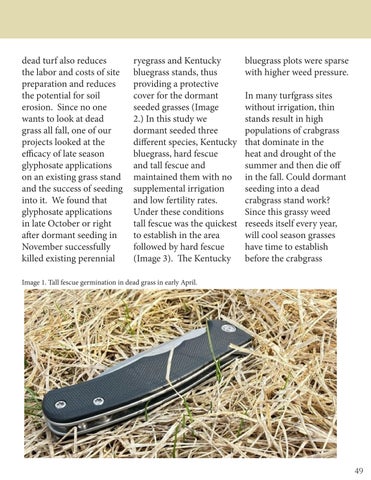
area, the University of situation where soils have Minnesota has been doing plenty of moisture for the work on dormant seeding. seeds to germinate in the spring. One potential Dormant seeding problem with this early involves planting grass germination is that bare seeds in late fall when soil areas can dry out in the soil temperatures fall sites where no irrigation consistently below 40 is present or before degrees Fahrenheit. At systems are turned on in this temperature the seeds the spring. Germination will take up water but do blankets can help prevent not germinate until spring. desiccation, but dead grass One benefit of dormant also acts as a good cover seeding is the reduction (Image 1). of water, since seasonal precipitation creates a Seeding directly into
dead turf also reduces the labor and costs of site preparation and reduces the potential for soil erosion. Since no one wants to look at dead grass all fall, one of our projects looked at the efficacy of late season glyphosate applications on an existing grass stand and the success of seeding into it. We found that glyphosate applications in late October or right after dormant seeding in November successfully killed existing perennial
ryegrass and Kentucky bluegrass stands, thus providing a protective cover for the dormant seeded grasses (Image 2.) In this study we dormant seeded three different species, Kentucky bluegrass, hard fescue and tall fescue and maintained them with no supplemental irrigation and low fertility rates. Under these conditions tall fescue was the quickest to establish in the area followed by hard fescue (Image 3). The Kentucky
bluegrass plots were sparse with higher weed pressure. In many turfgrass sites without irrigation, thin stands result in high populations of crabgrass that dominate in the heat and drought of the summer and then die off in the fall. Could dormant seeding into a dead crabgrass stand work? Since this grassy weed reseeds itself every year, will cool season grasses have time to establish before the crabgrass
Image 1. Tall fescue germination in dead grass in early April.
49
germinates. Are there pre-emergent herbicides that could safely control the crabgrass? We aimed to answer these questions with a research trial dormant seeded into a stand of 100 percent crabgrass followed by spring pre-emergent herbicide applications. We chose a Kentucky bluegrass blend, a tall fescue blend and a fine fescue mixture to look for differences in species and seeded these at recommended rates. Three herbicide treatments
were included to gauge efficacy and safety. They were mesotrione at turfgrass germination, mesotrione at crabgrass germination and dithopyr at crabgrass germination. The herbicide treatments helped, but since these were unirrigated plots, the effectiveness was influenced by the timeliness of the rains after the applications. Tall fescue once again performed very well and provided a thick stand in the fall of the year (Image 4). It did not
eliminate crabgrass from germinating but was able to compete. This was most interesting in the tall fescue plot that did not receive any pre-emergent herbicide but still looked as dense in the fall as the chemically treated plots. The lack of pre-emergent herbicide use led us to carry on an additional trial on the untreated plots in the crabgrass area to see if dormant seeding multiple years in a row could be a valid solution to converting it
Image 2 (left). Dead Kentucky bluegrass in the Spring after applications of glyphosate in October or November of the previous fall. Image 3 (right). Tall fescue and hard fescue from the 2024 dormant seeding glyphosate trial in September of 2025.
50
to turfgrass. After three years of dormant seeding the tall fescue plots are at nearly 100 percent cover (Image 5), the fine fescue plots have over 90 percent cover and the Kentucky bluegrass has consistent coverage and would be better with higher fertility. The success of dormant seeding multiple years in a row led to another question. What is the correct seeding rate when dormant seeding? And with that question led to another trial. We established a seeding rate trial in another 100
percent crabgrass area in 2025. Since tall fescue, hard fescue and Kentucky bluegrass have different seed sizes, we conducted germination tests and did thousand seed weight counts so that plots could be seeded based on pure lives seeds per square centimeter (PLS/cm2). Seven different rates were used ranging from 1 to 4 PLS/cm2. When converted to a weight per area basis, this ranged from 4.3 to 17.3 lbs./1000 ft2 for tall fescue, 2.0 to 7.9 lbs./1000 ft2 for hard fescue and 0.8 to 3.1 lbs./1000 ft2 for Kentucky bluegrass. With
the cooler temperatures in fall, crabgrass goes off color and it is easier to see the success of the seeded turfgrass (Image 6). Tall fescue performed the best with higher seed rates having higher rates of coverage followed by hard fescue with the same seed rate trend. Kentucky bluegrass had very little success at any of the seeding rates. A second year of growth and rating will help decide whether the increased seeding rates correspond to increase plot coverage and weed suppression.
Image 4. Dormant seeding into crabgrass with the use of pre-emergent herbicides.
51
With the success of dormant seeding using minimal site preparation in a handful of trials, we decided it would be worth a demo to see if a putting green could be transitioned to a new cultivar without removing the existing grass. We used glyphosate to kill off a test area of a USGA specified putting green in late October and repeated the application in November. Dormant seeding occurred November 21st and treatments consisted of a Turfco slit-seeder, a Verado seeder, solid tine aeration, scalping or no treatment. After seeding, half of each plot was topdressed heavily with sand to help protect the seed and aid in germination during the spring (Image 7). In spring the plot was also covered to aid in moisture retention. Germination was observed but the quickness of surface drying on a sand green when there was very 52
Image 5. Multiple years of dormant seeding to convert from crabgrass with the use of pre-emergent herbicides
Image 6. Dormant seeding rate study using tall fescue, hard fescue and Kentucky bluegrass.
Image 7. Dormant seeding test on a putting green with different equipment.
little root growth and no irrigation likely led to seedling death and the plots not filling in (Image 8).
Image 8. Bentgrass putting green with poor dormant seeding success.
Although our initial tests on dormant seeding putting greens have not shown the success of our trials in higher cut turf, we will continue to investigate and research ways that dormant seeding might aid turfgrass managers in establishing grasses better suited to their sites.
UMN TURF BLOG Superior Tech Products® Leading Edge Turfgrass Solutions Golf Courses | Sport Fields | Parks
smooth healthy consistent
greens
952-546-3678
www.stproots.com stp@stproots.com
* Liquid & Granular Fertilizers * Organic Fertilizers * Post Patent Pesticides * Aerification Tines & Bedknifes * Natural & Artificial Turf grooming equipment. * Rollers for Cutting units
GolfCo
P O
53
AUSTIN FIRST GREEN Brandon Bergene, Superintendent at Austin Country Club hosted over 50 9th grade students from Austin High School for their first experience with the First Green! Thank you to all of our volunteers for supporting another effort to introduce kids to turf and equipment management!
54
You can’t help them win skins but you can help them clean up.
See our ever-growing line of tools and accessories to enhance your course including Accuform™, HiO®, FusionCast® and Miltona.
ParAide.com © 2022 Par Aide Products Co.
55
FROM THE HIGH GRASS With 2027 approaching quickly, and the beginning of our centennial year, I have spent a lot of time looking backwards lately. Combing through our archives looking for relevant and interesting content. There have been some great finds so far and I enjoy going though these old resources. However exciting it is to celebrate one hundred years, it is also the time to begin thinking about our next 100 years! We cannot forget to look forward even though we are currently focused on looking back. At a recent First Green event, I was talking with the teachers onsite. Each of them said something similar like; “I never even thought of this as a career 56
path!” That is exactly the thought we are trying to elicit. It’s great to hear it from the teachers and when students show some sign of interest, these events become even more rewarding.
thought about turfgrass management. So, when 60 kids leave the site now thinking of, or at least being aware of our industry, that counts as a win in my book.
These efforts, encouraging As we attend career fairs students to get into turf/ and host First Green golf, are just one way we events, our expectations have to look forward. We are pretty low. Do I expect have to prepare for future to get some kids signed up team members while also for turf schools or working working to adapt to other on the host course staff industry changes, such as next year? I wish, that is autonomous equipment. the goal, but we know it’s We all can see that robotic always reasonable. We just equipment is here, and continue to play the long people are adopting it game by simply exposing quicker than I personally kids to new ideas and expected. potential opportunities down the road. It is safe These technological to say that most of the advancements are a benefit students at all of these to our industry, as they events, have never once can help find efficiencies
in all of our operations, including the MGCSA. I have been dabbling with these tools, trying to find improved ways to support our members and handle our necessary processes.
always, water access will continue to be a concern, as we experience more periods of drought. In Minnesota specifically, a lot of the conversations I take part in our now are involving water quality. Back to staffing, how The news will talk about many of those team PFAS in water, but we members will we need with are also starting to see autonomous equipment? Chlorothalonil degradates It may lead to a change in in water, along with those staffing needs, but other chemicals and as many have discussed their degradates. As a often so far, that doesn’t reminder, I am on the necessarily mean a drop Pesticide Management Plan in staff, but potentially an Committee (PMPC), which opportunity for increased is responsible for reviewing maintenance efforts this data annually and through reallocation. providing guidance to the The idea of freeing up MDA Commissioner. We valuable staff time to tackle will continue to monitor small projects, or the fine these issues and being detail work that often aware of any potential gets delayed, is an exiting changes to our future prospect to this former allowable practices will be Superintendent. essential. The future of our maintenance equipment is pretty exciting, as the possibilities seem endless. In other areas, there are more urgent concerns. As
The MGCSA and its members have always been innovative, and that forward thinking must continue. As an organization, we are
continually looking forward, working to head off urgent issues, like the ridiculous MN Plumbing Board stormwater proposals, or plan for the assurances (water, chemicals, equipment, etc.) we will need in the near future. All of these efforts will take every member to do their part, as we have done over the past 100 years, working towards familiar goals. Our mission is to; “Advance the art and science of golf course management….” something we have done for a century so far. The objectives haven’t changed, and still apply, as we will continue to “….promote the welfare of its members and the profession.” This sets a much higher bar for our goals than our First Green event goals, but goals that we have met and/or exceeded for 100 years, and an ideal that we will strive to match for 100 more. 57