
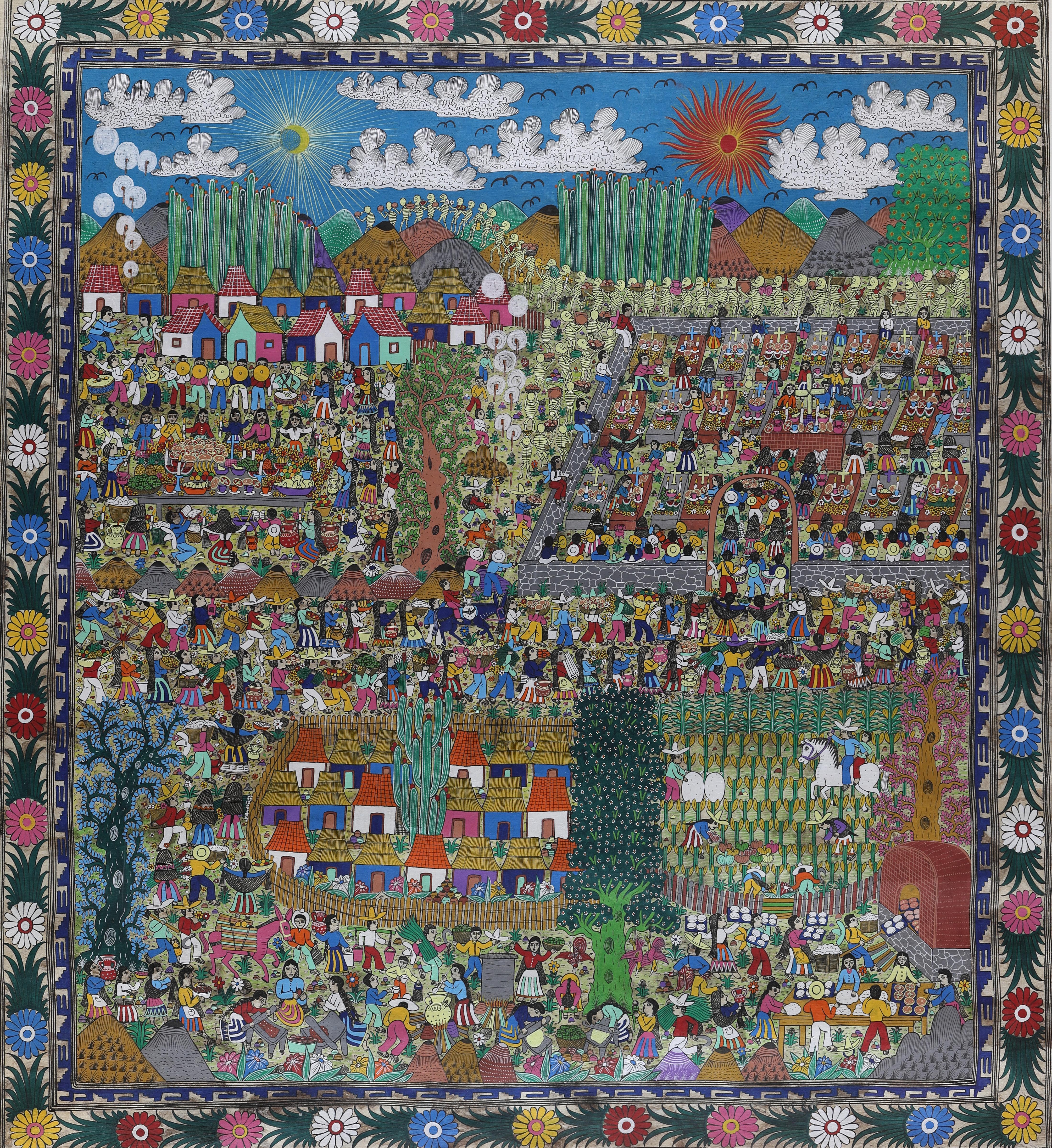
Celebration of El Día de Los Muertos
This particular amate painting depicts the community gathering in celebration to prepare bountiful food and gifts, as the deceased line up to receive their offerings. At the top of the painting, calaveras can be seen participating in the festivities, symbolizing the cycle of life and death. The figures are seen decorating altars and a graveyard to honor the dead with flowers, food, and drink.
Amate is a bark paper that has been used in Mexico since preColumbian times and comes from the Nahuatl word amatl meaning paper. It is a surface upon which many of the famous Mesoamerican codices are painted. The paper is created from the bark of the wild fig tree (xalama), the nettle tree (jonote), and the mulberry tree (moral), each with a different color tone ranging from coffee browns to silvery whites. When the Spanish arrived in Mexico, they banned the production of amate and replaced it with bleached European paper and colored paper from China. The use of amate ceased everywhere except in Otomi communities in the states of Puebla and Veracruz, where it was used for ceremonial purposes. Now, amate is painted, most often, by artists in the southern state of Guerrero.
The illustrations in this guide are an homage to the artists of the State of Guerrero like Cleofas Ramirez Clestino, and a depiction of the true spirit of a traditional Dia de los Muertos celebration. The MexicArte Museum has drawn inspiration from this piece for the illustration of this guide.
Cleofas Ramirez Celestino
Celebration of el Día de Los Muertos in Xalitla, Guerrero, 2001
Acrylic on amate, 41” x 37”
Mexic-Arte Museum Permanent Collection 2005.4.1
Gift of Fran Karttunen
EL
DÍA DE LOS MUERTOS
- DAY OF THE DEAD EDUCATIONAL ACTIVITY GUIDE 2ND EDITION
WRITERS
Paulina Dosal-Terminel
Rebecca Gomez
Richard Guerra
Toni Nelson Herrera
EDUCATION COMMITTEE
Nicolette Diaz
Paulina Dosal-Terminel
Jose Martinez
Natalia Rocafuerte
ILLUSTRATIONS
Diana Garcia
Mitchell Hawley
Sara Palma
Miguel Placencia
Gerardo Silva
Jerry Silva
ADVISORS
Dr. Patrick Hajovsky
Dr. Rachel G. Martin
Sylvia Orozco
Dr. George Vargas
ARTISTS
Sam Coronado
Cleofas Ramirez Clestino
Diego Mireles Duran
Cheraya Esters
Patricia Greene
Monica Lejarazu
Sergio Lejarazu
Jose Guadalupe Posada
Rosa Maria Rivera
Olivia Warner
Alfredo Zalce
TRANSLATION
Paulina Dosal-Terminel
DESIGN
Lead Designer: Sara Palma
Katie Bentley
Yenifer Fuentes
Diana Garcia
Jerry Silva
PHOTOS
Mary J. Andrade
Chris Caselli
Diego Mireles Duran
Cheraya Esters
Sylvia Orozco
ACKNOWLEDGEMENTS
Special recognition to all the previous Mexic-Arte Museum
Staff Members who have contributed to this ongoing project. In particular the creators of the 1st edition in 2009 – Richard Guerra and Toni Nelson Herrera.
419 Congress Avenue Austin, Texas, 78701 (512) 480-9373 mexic-artemuseum.org
2nd Edition
©Mexic-Arte Museum 2020
All rights reserved. No part of this publication may be reproduced, distributed, or transmitted in any form or by any means, including photocopying, recording, or other electronic or mechanical methods without the prior written permission of the publisher, except in the case of brief quotations embodied in critical reviews and certain other noncommercial uses permitted by copyright law. A downloadable version is available for educational purposes.
EL DÍA DE LOS MUERTOS EDUCATIONAL ACTIVITY GUIDE
The Mexic-Arte Museum proudly presents El Día de los Muertos/Day of the Dead Educational Activity Guide (revised 2020 edition), which can be used by teachers, students, researchers, and the general public. Celebrated by Latinx people in the U.S. and communities in Latin America, Día de los Muertos is an important religious and cultural event that synthesizes pre-Columbian traditions with Catholic ritual practices. Originating in Mexico, the annual celebration is increasingly observed in the United States as part of American popular culture. Compiled by our Museum team working with scholars and other experts, this Guide documents the history of Day of the Dead and the diverse cultures and artists that carry on the tradition. We feature art activities that relate to Day of the Dead, for example: how to construct an altar, make a skull mask, and create paper marigold flowers. ¡Gracias a todos!
TABLE OF CONTENTS
A Note from Mexic-Arte Museum
Introduction: El Día de los Muertos
Death and Mesoamerican Cultures: Regional Diversity
Coatlicue: Goddess of Life, Death, and Rebirth
Pre-Columbian Imagery in Mexic-Arte Museum’s Day of the Dead Festival
Camazotz: Bat God of the Underworld


Cultures Collide: Mestizaje
Jose Guadalupe Posada and His Calaveras
The Celebration: Day of the Dead Altars
Ofrendas, Altars and Public Art
Regional Differences in Tradition
Day of the Dead Across Lands and Peoples
Reinventing Tradition: Cultures Crossing Borders
Cartoneria in Viva la Vida Festival
Reconnecting with History
Glossary of Terms
Fill in the Blank: Ancestry Tree
Build Your Own Skull Mask
Color In the Altar/Ofrenda
Build Your Own Altar / Ofrenda
Make a Sugar Skull
Bake Pan de Muerto
Make Paper Marigold Flowers
Cut Out Papel Picado
INTRODUCTION: EL DÍA DE LOS MUERTOS
El Día de los Muertos (Day of the Dead) is a celebratory feast day with a historically rich tradition that integrates both preColumbian and Catholic customs, along with contemporary Mexican culture. Day of the Dead is traditionally celebrated on November 1st and 2nd in connection with the Catholic holy days of All Saints’ Day and All Souls’ Day, but features rituals and customs that can be traced back to before the Spanish Conquest.
Day of the Dead itself is a time to honor and remember the lives of deceased friends and relatives who journey from the underworld (Mictlan in Mexica culture) to visit the living. Families and friends come together in the joy of remembrance, instead of sorrow and loss. It is a celebration of the cyclical nature of life and our eventual transformation from the physical realm to the spiritual. It is during this festivity that the graves of loved ones are decorated, special foods such as mole and pan de muerto (bread of the dead) are prepared, ofrendas (altars) are built to honor the dead in homes and public spaces, and special festivals and processions are held.
The Day of the Dead has its origins in ancient preColumbian cultures that blended with those of the Spanish, who arrived in Mexico in the early 1500s. During the late nineteenth and early twentieth century, Mexican artist José Guadalupe Posada popularized the skeleton images associated with the holiday with his satirical drawings of calaveras, and thereby established a uniquely Mexican style of art. Later, the Chicano Movement embraced the Day of the Dead as a way to recover pre-Columbian and Mexican identities in the United States.
Today, the Day of the Dead continues to be celebrated by Latinx, Mexican, and Indigenous peoples across Mexico and the United States every November.
The first day (November 1st), called “Día de los Angelitos” (Day of the Little Angels), is dedicated to the souls of deceased children, while November 2nd is set aside for the souls of adults. Before these days, families may clean their homes to prepare for the arrival of the souls of their loved ones. Many also visit cemeteries to decorate the graves of the dead with their favorite items and flowers. Graves and ofrendas are decorated with papel picado, photographs, cherished objects, cempasúchitl (marigolds), and calaveras (skeletons made of paper, or clay, or sugar). Food and drink are placed on the ofrendas because it is believed the dead are led back to their family through the smell of ofrendas, and the taste of family recipes.
There are many important foods associated with Day of the Dead. In particular the main dish is mole, which is meat (usually chicken or pork) cooked with a sauce made from chiles, chocolate, peanuts, and other ingredients that vary by region. Pumpkin candies, rice pudding, and tamales may also be offered. Bakeries produce special bread called pan de muerto in the shape of people or bones and decorated with pink sugar. Stores also sell edible skulls made of sugar or chocolate, adorned with names, for children and adults to eat.
FILL IN THE BLANK: ANCESTRY TREE
ACTIVITY ONE
This ancestral tree diagram will help you organize your own family history and map out the past. Talk to different members of your family and fill in the blanks with the appropriate relatives. Take a moment to reflect on what you have learned.
The tropical ceiba tree (ceiba pentandra) is native to Central/ South America, and Africa. To the ancient Maya, the ceiba tree had great symbolic meaning. Its name in the Mayan language is Yax Che (“Green Tree” or “First Tree”). The Maya frequently depicted the importance of Yax Che, which was the epicenter of the universe, therefore the center of all characteristics of Maya life.
The ceiba was the most sacred tree for the ancient Maya, and according to mythology, it was the symbol of connection between the Cosmos, Earth, and the Underworld. The tree signified a route of communication between the three levels. Its roots were said to reach down into the underworld Xibalba; its trunk represented the middle world where the humans lived; and its canopy of branches arched high in the sky to create a pathway to the heavens. The canopy of branches symbolized the upper world, or the cosmos. The Maya heaven was divided into thirteen levels and ruled by thirteen deities, the final level was Tamoanchan - the Mayan paradise.
DEATH AND MESOAMERICAN CULTURES: REGIONAL DIVERSITY
The Maya, Mexica, Toltec, Olmec, and hundreds of other indigenous peoples and their complex societies flourished within Mesoamerica for thousands of years prior to contact with the Spanish invaders. As a region inhabited by millions of people, there was vast cultural diversity based on location, including several hundred distinct languages.
The Earth itself was a force to the Aztec people, who were known as Mexica , constantly demanding to be fed by human life. These societies buried their dead directly under their homes, which kept their ancestors close for veneration Because tombs were not sealed, people often visited the dead and made offerings to them. The lack of separation between the realms of life and death relates a distinct Mesoamerican view of a people’s place in the world.
The Mexica also believed that a person had three souls. Bodies would die and go back to the Earth. A person’s three souls however, could exist in multiple planes at once. Part of the soul could go on to the afterlife, and part of it could stay behind and watch over loved ones.
Mesoamerican peoples developed many rituals to honor the souls of the dead who stayed behind to guide their families. Many of these rituals, such as leaving food for a dead relative, and burning incense are still a part of contemporary Day of the Dead ceremonies today.
An important commonality among Mesoamerican people was their belief about death. Mesoamericans believed that life and death were forces of the Earth and a natural part of the regeneration cycle. Because eating required killing the animal or plant that was to be consumed, death was taken into their bodies, where it gave them life.
Mesoamerica

COATLICUE: GODDESS OF LIFE, DEATH AND REBIRTH

The Mexica in particular worshipped many deities or gods and goddesses. Pictured is Coatlicue, an Aztec Goddess of life, death, and rebirth. The stone statue was excavated in the main plaza in Mexico City in 1790. Officials thought it was a horrible monster. However, the Aztecs (Mexica) would come bring offerings, flowers, and candles to her, which prompted the Spanish to bury the sacred statue.
Pictured at the bottom, is a modern linocut print of Coatlicue by Arturo Garcia Bustos to show how this pre-Columbian belief of an “afterlife” has remained a source of inspiration for Mexican art.
Most Aztec artistic representations of Coatlicue emphasize her deadly side, because Earth, as well as loving mother, is the insatiable monster that consumes everything that lives. She represents the devouring mother, in whom both the womb and the grave exist, an example of the creation and destruction we must all balance in our time on Earth.
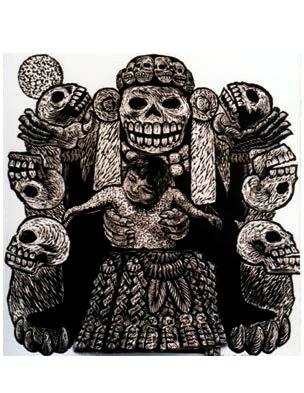
Arturo Garcia Bustos was an acclaimed visual artist who studied under Frida Kahlo and is known as one of “Los Fridos,” one of four students who followed Frida Kahlo to Coyoacan and developed a mentorship with her. Bustos became an artist in his own right and was one of the first artists in the Mexic-Arte Museum Collection in 1983.
Coatlicue Aztec Goddess of Life, Death and Rebirth Andenite Statue
The National Museum of Anthropology Mexico City, Mexico
Photo by Sylvia Orozco
Arturo García Bustos
La Vida y La Muerte (Life and Death), n.d. Linocut on paper, 21 1/4” x 20 1/2” Mexic-Arte Museum Permanent Collection 1984.5.2
PRE-COLUMBIAN IMAGERY IN MEXIC-ARTE
MUSEUM’S DAY OF THE
DEAD FESTIVAL
Mexic-Arte Museum hosts Viva la Vida Festival and Parade every year in downtown Austin, Texas. The parade pays homage to the indigenous roots of the Day of the Dead celebration as well as the new ways people have created to celebrate life and honor those who have passed. It has become an event that promotes Latinx culture and traditions in all the ways it exists today.
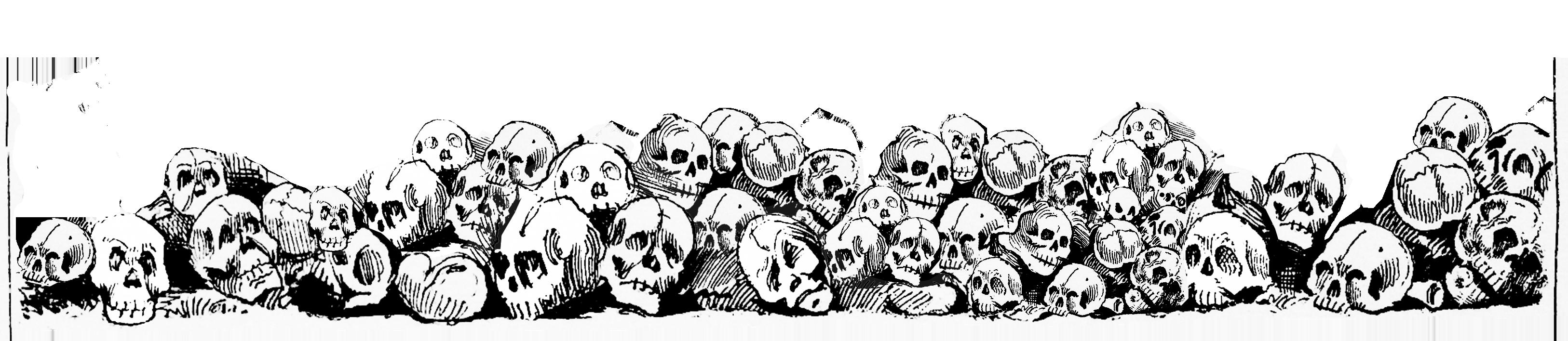
The Viva la Vida Parade has a pre-Columbian section that features a Tzompantli or skull rack. A tzompantli is a wooden rack or palisade documented in several Mesoamerican civilizations, which was used for the public display of human skulls, typically those of war captives or sacrificial victims. That sacrifice would feed the gods, and ensure the continued existence of the world. Death, however, was just the start of the victim’s role in the sacrificial ritual, key to the spiritual world of the Aztec people in the 14th to the 16th centuries. Priests armed with years of practice, and obsidian blades sharper than today’s surgical steel, would perform the ritual.

A Tzompantli can be found in front of the Templo Mayora pyramid with two temples on top- was dedicated to the war god, Huitzilopochtli, and the other to the rain god, Tlaloc.
Eventually, after months or years in the sun and rain, a skull would begin to fall to pieces, losing teeth and perhaps even jaws. The Aztec priests would remove it to be fashioned into a mask and placed in an offering; or use mortar to add it to two towers of skulls that flanked the Tzompantli. For the Aztecs, those skulls were the seeds that would ensure the continued existence of humanity. They were a sign of life and regeneration, like the first flowers of spring. This is where the tradition of using skulls and skull masks in the Day of the Dead celebrations and on ofrendas began.

Created by Community Members
Tzompantli, 2009-2019
Paper mache, 100” x 113” x 21”
Tlaxcala, Mexico, 1521
Mexic-Arte Museum Permanent Collection
Viva la Vida Festival, Austin, TX.
Photo by Chris Caselli
Tzompantli, Muro de Cráneos Procedente de Tecoaque Zultépec-Tecoaque
Photo by Sylvia Orozco

CAMAZOTZ: BAT GOD OF THE UNDERWORLD
In Mesoamerica the bat was associated with night, death, and sacrifice. In Maya mythology, Camazotz was a bat god. Camazotz means “death bat” in the K’iche’ language. The Maya considered him a terrifying god who served death and ruled the domain of twilight. This was likely due to the fact that the bats would inhabit the subterranean caves around the sacred cenotes, or sinkholes of water which the Mesoamericans believed were portals to the underworld. It would be a very chilling sight at dusk when the bats would swarm out of these ‘portals’ and begin drinking the blood of the other animals. The Mexica had a similar bat-god, Xipe Totec
In the beginning, however, bats in pre-Columbian cultures were not associated with evil. They were believed to be powerful creatures, spirits and even gods. For example, in the Tajin pre-Columbian stone sculptures of Veracruz, vampire bats are depicted as gods and are also mentioned in epic myths and in the Maya book of creation, called Popol Vuh. In pre-Columbian codices such as the Codex Borgia, bats (having human form and personality) are depicted as involved in human sacrifice. Among many beliefs of the Tzotzil Maya, an indigenous Maya people of the central Chiapas highlands in southern Mexico, there was one that was especially important because it explained the origin of these people. These Maya used to call themselves “Tzotzil uinic,” which means – bat men.” Their story of origin claims that their ancestors had once discovered a stone bat and considered it as their god. Mayans of Central America believed the bat was the guardian of the Underworld and a powerful force against enemies.
As a deity devoted to the dead and the Underworld, Camazotz makes an appearance in the Viva la Vida Festival leading a procession of parade goers dressed in skull masks.

2014
Paper Mache, 122” x 172” x 61”
Mexic-Arte Museum Permanent Collection
Visiting artist, Dennis McNett created this sculpture in 2014 for the Viva la Vida Parade.
This ceramic sculpture was discovered in 1990, thanks to an archaeological rescue. Experts have dated it back to the year 700 AD.
Dennis McNett Camazotz,
BUILD YOUR OWN SKULL MASK
ACTIVITY TWO
Here is a project that uses mostly recycled materials. Creating a paper mache skull will take you a few days to make, so plan ahead if you want one in time for Day of the Dead.
In pre-Columbian Mexico, masks followed an ancient tradition and were created in a variety of ways and for a number of purposes. Masks were used as ornaments and were sometimes worn as part of a ritual, or in death as a death mask. They usually represented one god or another and functioned to express visually the inner, spiritual identity of the wearer which survives the body.
Masks, called “calacas” or “calaveras,” have been worn on the Day of the Dead for decades to symbolize the nature of the dead. While these masks may look scary at first glance, most depict the dead as smiling or happy with eloquent and natural designs. In the past, participants and dancers used masks to scare the dead away at the end of the festivities. In modern-day celebrations, people wear skull masks or paint their faces to represent a deceased loved one or as an expression of themselves.
MATERIALS:
• Paper plate or thick cardstock alternative
• 1 part flour 2 parts water mixture
• White paint or gesso
• Acrylic paint for color
• Sharpies
• Exacto knife or box cutter
• Newspaper, newsprint, or recycled paper
• Elastic or pipe cleaners for the straps
• Skull mask template
• Masking tape

DIRECTIONS:


Gather materials to create your own mask. Use the skull template provided to make a complete skull image on the paper plate or cardstock alternative.


Cut out eyes, nose, and slits on mask and tape the fold in the center. After folding over slits, tape them to make the mask 3-dimensional.

Make a paper mache mixture out of 2 parts water and 1 part flour in a bowl until gooey consistency is reached. Rip strips of “1 wide newspaper/newsprint.

Paint a base coat over your dried mask with gesso or white paint. When the paint dries, decorate your mask designs, looking to nature and festivals for inspiration. Embellish with glitter, flowers, etc.

Place the individual strips coated in the paper mache mixture over your paper plate. Let dry overnight.
Find the template on the previous page to create your own mask!
CULTURES COLLIDE: MESTIZAJE
Mestizaje is a blending of Indigenous and European cultures and traditions. With the arrival of Spanish conquistadors in the Mesoamerican world in the early 1500s, came the first interactions between Indigenous and Spanish cultures. The Spanish were also a diverse people whose regionally distinct cultures were heavily influenced by the Islamic Empire that ruled most of Spain for nearly 800 years. Many of Spain’s technological and scientific advances in fact were inherited from the Moors. Navigational tools that allowed Spaniards to cross the Atlantic Ocean and reach Mesoamerica were developed in the Islamic world.
When the Spanish arrived in the lands that would later be named Mexico, they saw the expansive Aztec Empire capital city of Tenochtitlan (present day Mexico City). By joining forces with the Tlaxcalans, Indigenous People who opposed Aztec rule, the Spanish took control of the territory for its resources, but the cultures of the region continued. Over a series of wars waged by the Spanish to extend authority over many years in 1821 Mexico gained its independence. What resulted was a new nation with a cultural identity made up of a mix of Indigenous and European heritages.
In the Indigenous communities of Mexico, Day of the Dead is a transit zone between a time of deep scarcity and a period of relative abundance. During this time in the regions of Guerrero, Oaxaca, and Chiapas, the communities turn to the harvest of corn that has been a main source of food since Mesoamerican times. Hence, the feast of the dead was also a harvest festival dedicated to sharing with the ancestors the benefit of the first fruits. The

principles of reciprocity that govern between humankind and their ancestors make the Day of the Dead offerings a symbolic retribution, since the agricultural cycle of corn would be impossible without the intervention of the ancestors. In the Nahua indigenous ritual there were two festivals dedicated to the cult of the dead: Miccailhuitontli or “Feast of the Deceased Young”, and “The Great Festival of the Dead”. Although these two festivals were not originally together on the calendar, some years after the Spanish Conquest during the Catholic feast of “All Saints’ Day”, one could observe indigenous peoples putting out offerings for dead children, and the next day another for deceased adults on “All Souls’ Day” in order to disguise that they celebrated their festivities and pretended to celebrate Catholic ones. Thus came to be the celebration seen today across vast regions and borders known as Día de los Muertos.
During the early 1900s, nearly a hundred years after Mexico won its independence from Spain, the Mexican government began to encourage the celebration of the Day of the Dead as an official holiday. This was done as a way to unite a nation that was unsatisfied with its political leadership. It involved taking bits and pieces of the regionally distinct rituals practiced by indigenous people and centralizing them under the term “Mexican”. Even though it did create a sense of Mexican identity amongst the people, towns and cities continued to celebrate the Day of the Dead with their own specific and varying customs.


José Guadalupe Posada
Gran Mole de Calaveras (Detail from flysheet), 1902
Relief etching on paper, 15” x 10 ¾”
Mexic-Arte Museum Collection 1986.1.4
José Guadalupe Posada
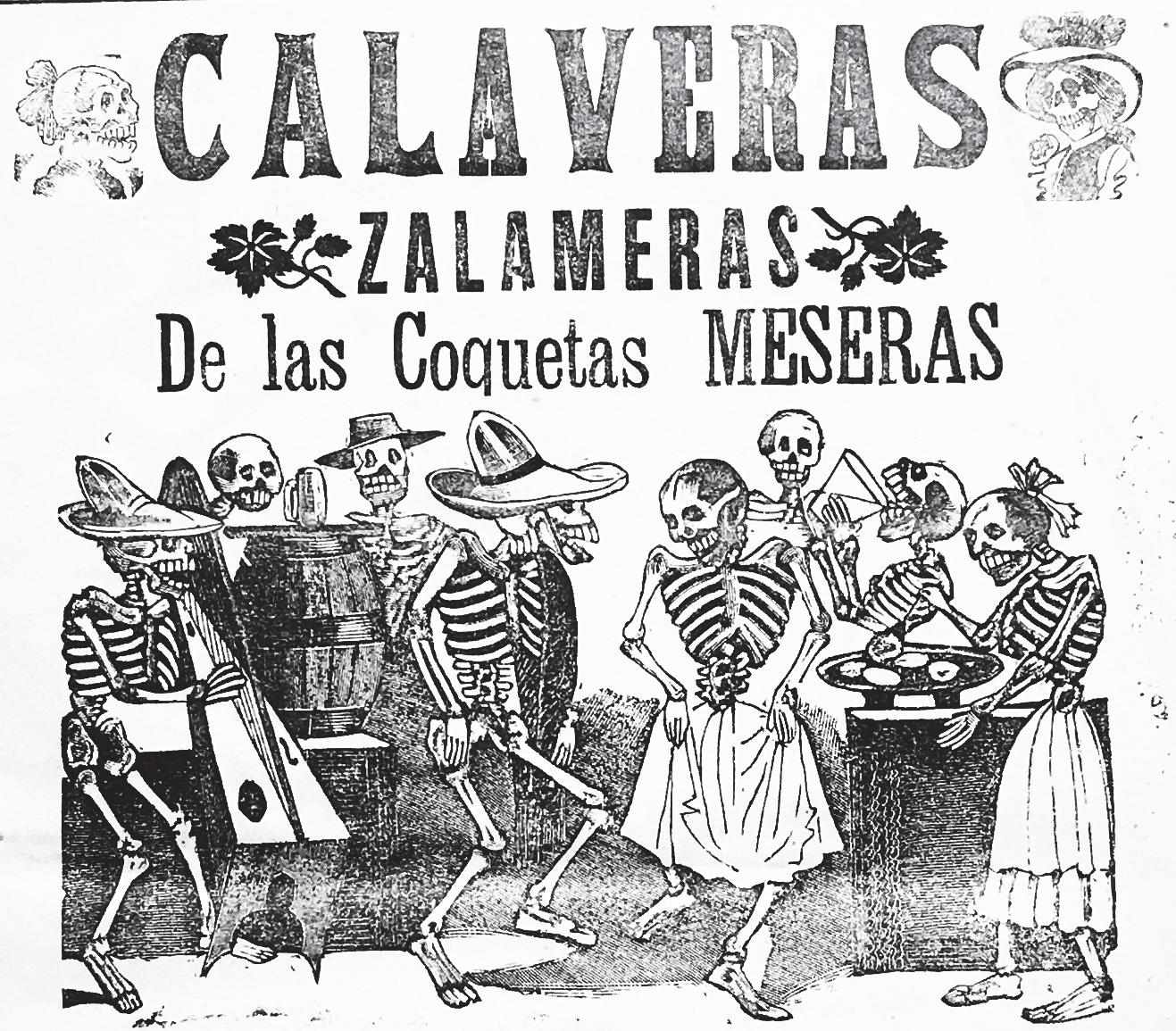
Las Calaveras Pulqueras (detail), n.d.
Relief etching on paper, 13 ¼“ x 10 ¼”
Mexic-Arte Museum Permanent Collection 1986.1.5
JOS É GUADALUPE POSADA AND HIS CALAVERAS
José Guadalupe Posada was born in 1852 in Aguascalientes, Mexico. He apprenticed under and later worked for the master printer Jose Trinidad Pedroza, a wood engraver and lithographer at a shop named, El Esfuerzo (The Struggle). El Esfuerzo was a center where political and social problems were discussed, as well as engraving, lithography, photography, bookbinding, foundry, and blacksmithing. Here Posada began to form his political ideas. Later he began making lithograph prints for a satirical newspaper, El Jicote (The Wasp). Satire is the use of clever or humorous text, pictures, or performance to criticize aspects of society. It can be used to draw attention to societal hypocrisies, shortcomings, and injustices. José Guadalupe Posada began to make satirical prints using calaveras or skeletal imagery. He created powerful calavera representations of people rich and poor, famous and infamous, young and old. He also used his art to poke fun at many politicians.
Posada’s calaveras became widely popular across Mexico. His humorous calaveras appealed to many people’s dissatisfaction with the government while at the same time touching upon the universal idea of death. The Mexican muralist Jose Clemente Orozco stumbled into Posada’s shop as a young man, and credits this visit with “awakening him to the art of painting”. Diego Rivera included Posada’s calavera imagery in two of his most famous murals.
The personification of Death, or “La Muerte”, as a calavera meant humans could interact with fate and was a main theme in Posada’s work. This reveals a deeper understanding about Death in Mexican culture. Posada passed away in 1913 at the age of 61. He was buried in a common grave that was later washed out by storm drains. Today he is celebrated through his collection of work in museums and galleries around the world. The popularization of this unique form of art in combination with Day of the Dead established the holiday as an integral part of the Mexican identity.


Alfredo Zalce
Posada y Sus Calaveras (Calavera of Rivera, Orozco, Mendez, and Dr. Atl), 1948
Linocut on paper, 14” x 20”
Mexic-Arte Museum Permanent Collection

José Guadalupe Posada
La Calavera Catrina, c.1912
Reprint of relief etching, dimensions vary Mexic-Arte Museum Permanent Collection
Although originally conceived by Posada’s contemporary Manuel Manilla, the calavera was popularized by Posada. Perhaps the most famous of Posada’s calaveras is La Calavera Catrina, the skeleton of a high-society lady wearing a large, fancy hat. This figure, in particular, has become an iconic symbol of Día de los Muertos, or Day of the Dead.
This imagery demonstrates that death will come to everyone—young and old, rich and poor. In Posada’s prints, no one lives; everyone is a skeleton. Nevertheless, the human experience of joy, passion, tumult, and transcience goes on. Death is the subject of mockery here. In similar fashion, the ephemeral nature of Day of the Dead art, whether it be a fragile piece of paper or a sugary candy, acts not as a warning of death’s inevitability so much as a reminder to enjoy the sweetness of life.

José Guadalupe Posada Rebumbio de Calaveras (Noisy Assembly of Calaveras), n.d. Relief etching on paper, 14 ¼” x 10 ½” Mexic-Arte Museum Collection 1986.1.6
THE CELEBRATION: DAY OF THE DEAD ALTARS
Day of the Dead altars, known as ofrendas or “offerings”, consist of a collection of objects offered to the deceased to draw their memory and spirit back to earth. Altars vary in size from a small shelf or tabletop to multi-tiered installations that can take up an entire room. Levels of the altars provide a base for the offerings and echo the shape of the pre-Columbian temples, which
correspond to the nine spiritual levels of the Aztec underworld, Mictlan. Ofrendas are personalized by the family, customized to fit the family’s needs and reflect the tradition of that region of Mexico. The following objects have been used for centuries as symbolic offerings:
Candles represent the element of fire. They light the way for the deceased to find their path back to earth. Candles are used in spiritual ceremonies in almost every religion, as they are a way to feel the spirit of the divine, create a wish or intention, and produce light or positivity through darkness.
Copal incense is traditionally used to bless the altar and create a sacred space. Copal is made from tree sap, and its use dates back to pre-Columbian times. The aroma is thought to attract the spirits.
Salt is used as a symbol of purification. It is believed to cleanse the soul and preserve the purity of the spirit as it makes its journey to the land of the dead.
Water or beverages represent the element of water and are meant to quench the thirst of the departed. Families usually offer the favorite drinks of the deceased as well as traditional beverages from that person’s home state, such as tequila or mezcal.
Pan de muerto represents the element of earth and feeds the deceased as they arrive hungry from their journey back to earth. Pan de muerto, or “bread of the dead,” is baked only at this time of year and may be in the shape of a skeleton or bones. Families prepare the favorite dishes of the deceased, like mole or other dishes with corn, beans, and tamales.
Personal items such as photos and other mementos, let the deceased play with items they once treasured during their life on earth. Musical instruments, toys, watches, glasses, or other objects give the dead a cheerful reminder of their time on earth and provide entertainment during their visit. A bowl of water, mirror, or comb may be provided for the deceased to fix themselves up after making the long journey home.
Papel picado are decorative paper banners that are an integral part of the altars. The fluttering tissue-paper cut-outs move with the slightest breeze, representing the element of air or wind. They are made with a chisel that cuts through several layers of paper at a time and hung on the altar to create decorations that remind the viewer of the impermanence of life, highlighting the fragility of the tissue paper, which will eventually disintegrate with time.
Flowers are another beautiful reminder of transcience. They represent love and the cycle of life and death as they grow, die, decompose, and then give nourishment to new life. The Cempasúchil (marigold flower) is the official flower of the dead since its pungent scent and bright gold color draw souls to the altar. Its shape and color are symbolic of the sun that gives energy and light to all life.
Sugar skulls are a popular offering since it marks the sweetness of life and ties back to the pre- Columbian skull motifs. Sugar skulls, are traditional candies molded into skulls and decorated with frosting. Children are often given sugar skulls with their names written on the forehead.
OFRENDAS, ALTARS, AND PUBLIC ART
In addition to home ofrendas, it is also common in Mexico to create elaborate ofrendas in public spaces, such as town plazas, city halls, museums, schools and shop windows. Like home ofrendas, public ofrendas can honor personal friends or family members.
Additionally, public ofrendas often pay homage to prominent community members, important people in history or people associated with significant cultural or political events or movements.
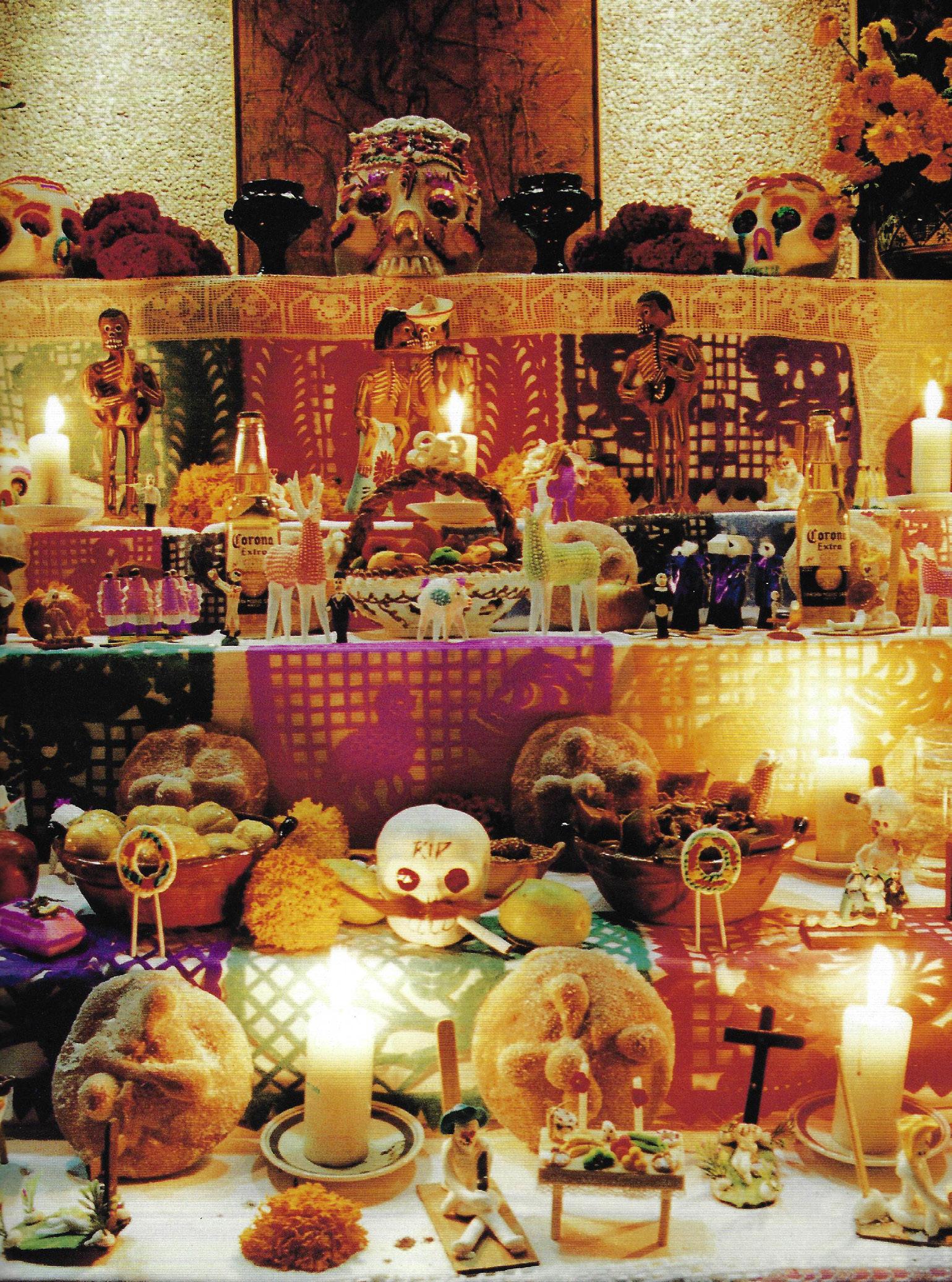
Altar Levels
It is typical to represent all the elements. There must be air (represented by papel picado), water (drinks), fire (candles), and earth (seeds and food items). The altar will have two, three or seven levels. Usually that is decided by regional custom where two levels represent earth and sky. Three level altars represent hell, purgatory, and heaven; although it is said it also refers to the Holy Trinity, an adjustment for syncretism. Altars with seven levels are the most sophisticated: the first level holds the picture of a saint or virgin; the second holds candles and lights for the souls in purgatory in order to help them get out of there; the third holds toys and salt figurines for the children; the fourth holds pan de muerto; the fifth holds the departed’s favorite food and drinks, their tequila or mezcal; the sixth holds pictures; and the seventh holds crosses and rosary beads, preferably made out of seeds. The cempasúchil flowers will guide the dead with their perfume and a salt cross shall work as a compass, to allow them to reach this point where they can meet again those who long for them.
Mary J. Andrade Altar with offerings.
Hotel Radisson Mexico City, Mexico
“Day of the Dead in Mexico: Through the Eyes of the Soul: Mexico City, Mexquic & Morelos” 1996.
REGIONAL DIFFERENCES IN TRADITION
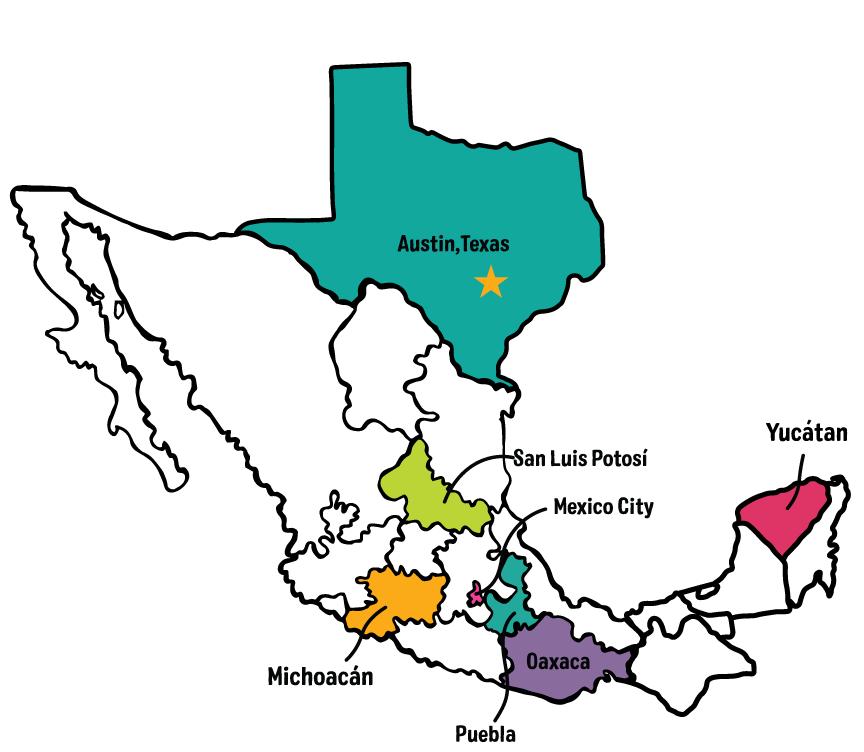
Each region has its own nuances and unique customs of the celebration; altars visually highlight regional and cultural differences among the various Mexican states.
DAY OF THE DEAD ACROSS LANDS AND PEOPLES
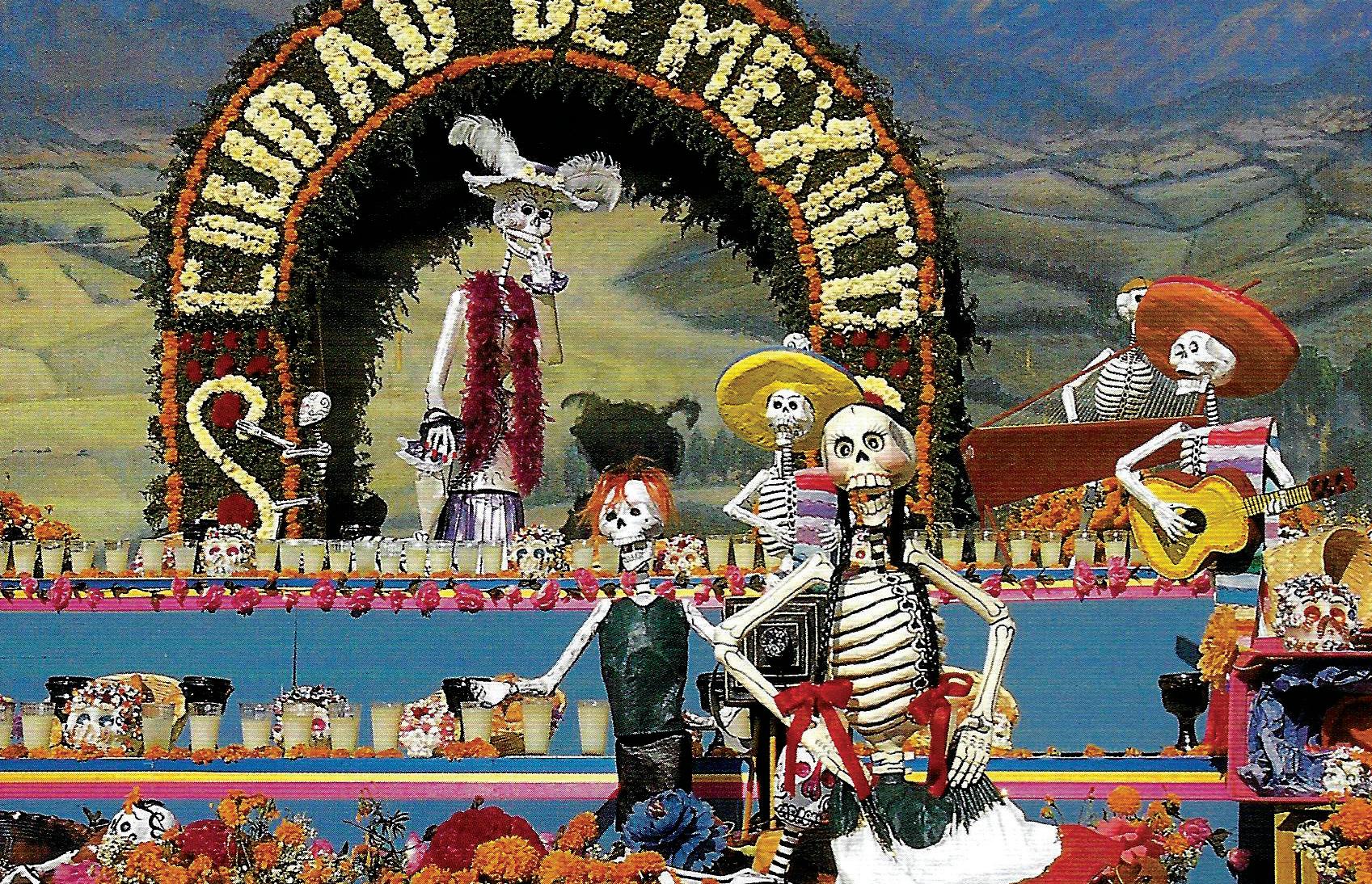
Mexico City
Small, ancient towns that preserved their indigenous traditions predominantly had rituals for Día de los Muertos. In recent years, the City has strived to keep the traditions of the people alive, which are usually passed down from family members.
In modern urban centers like Mexico City, skeletons and sugar skulls, which are pre-Columbian representations of the spirits of the dead, are combined with a repertoire of figures taken from popular culture.
Mary J Andrade Altar. Offering of the Millenium of Mexico City Mexico City, México “Day of the Dead in Mexico: Through the Eyes of the Soul: Mexico City, Mixquic & Morelos” 1996.

Oaxaca
The state of Oaxaca is located in the southwestern part of the Mexican Republic.There,communities begin to make altars in the home and community on October 31 and finish on November 2. To the Tehuanos, indigenous descendents of the Zapotecs, death is not a reason for mourning. Many people in this region hold fast to the Zapotec tradition of having the biquie in place of the pyramidal altar. The biquie is an offering or cross made of flowers and fruit that is decorated with pan de muerto.
Mary J. Andrade
Zapotec altar with traditional Biquie’ Altar Tehuantepec, Oaxaca
“Through the Eyes of the Soul, Day of the Dead in Mexico: Oaxaca” 1996.
Puebla City, Mexico
The capital city of Puebla is 75 miles from Mexico City. Cholula located four miles away from Puebla, is home to the largest pre-Columbian monument in Mexico. In Puebla, however, Día de los Muertos has been greatly influenced by Catholicism. Tall altars with white cloth and pillars are constructed here, duplicating the design for memorials erected during the Eucharist in Baroque Catholic churches.

Mary J Andrade Monumental Altars Huaquechula, Puebla “Day of the Dead in Mexico, Through the Eyes of the Soul: Puebla, Tlaxcala, San Luis Potosi, Hidalgo” 2001.

San Luis Potosí, Mexico
The Xantolo celebration is considered to be a sacred time that allows individuals to keep one of the most beautiful traditions alive. It represents the communion between human beings and nature, and between one and God. It is the link that joins one to their ancestors and projects them as a link between the present and future generations. The Huasteca is traversed by many rivers and very high mountains and contains part of the Sierra Oriental coastal plains of the Gulf. The region covers the southern part of the state of Tamaulipas, the extreme northern part of Puebla, and eastern part of the state of San Luis Potosi.
Mary J Andrade
Altar los Arcos, Huasteca Potosina San Luis Potosí, México “Day of the Dead in Mexico, Through the Eyes of the Soul”
Santa Fe de la Laguna, Michoacan
In the Santa Fe de la Laguna cemetery the vigils are enhanced with rose and violet tones of the sunset. Families gather to remember their loved ones. In this cemetery, offerings in honor of the children are more prominent than offerings in honor of adults. The offerings for children are represented by small chapels of tiny altars called “Amazon.” The structure is made out of wood with colored paper. Parents leave different kinds of fruit on the altars, while the Godparents leave pan de muerto.

Mary J. Andrade Altar and offerings in memory of the priest Jose de Jesus Martinez in Santa Fe de la Laguna Altar Santa Fe de la Laguna, Michoacán “Day of the Dead: A Passion for Life” 2006.

Mayan Altar during Celebration of Hanal Pixan
The Mayans celebrate the Day of the Dead, translated as Hanal Pixan, which means food, nourishment for the souls and spirits.
The Mayans said: “We came into the world to learn as apprentices of life.” People fear death because they do not understand it. They maintained that in order to die, one must learn to live; to be born, the seed must fall and die. This concept is corroborated in the adage: In dying, the power of death is annihilated for all eternity. They were not referring only to physical death, but to death in a mystical sense, with the transformation of the ego, of sin, of the dark part we carry inside. For the Mayans, it was critical to transform negative feelings, where at last, death becomes authentic. For it was death to the ego, to the “I” that held transformation.
Meditation in front of a Mayan altar
The altar is the center that consolidates an inspired memory: signs from one’s self; embroidery and food that adorn the abyss to honor the custom of the deceased soul.
The altar is the finished table and shares Mayan, Christian, and Aztec imagery in common syncretism of an ancestral afterlife that offers to death the dream of life.
Mary J. Andrade Style of altar in the celebration of Hanal Pixan Altar Mérida, Yucatán “Day of the Dead in Mexico, Through the Eyes of the Soul: Yucatan” 2003. Page 65
COLOR IN THE ALTAR/OFRENDA
ACTIVITY FOUR
Can you identify the offerings for this altar? Test your knowledge of the Day of Dead terminology by referring to the list of clues and labeling each offering you see in this altar. After identifying the objects, color in your altar.
Candle
Copal incense
Marigold flower
Pan de muerto
Papel picado
Photograph
Salt
Sugar Skull
Water
BUILD YOUR OWN ALTAR/OFRENDA
Now that you know what it takes to make an Ofrenda, the following activities will help you build your own altar at home or in a public space. First you must decide whom you want to remember or celebrate. Do you know someone who has passed away?
there anybody you want to celebrate?

Remember when building your ofrenda that it is special to you and who you choose to honor. You can make it as creative or unique as you like.
1. Find something to use as a base, like a table or boxes to add more levels.
2. Place a photo or drawing of whom you are honoring.
3. Use the list on page 33 to help decorate your ofrenda with flowers, drawings, favorite foods, special items that remind you of who you are honoring.
Created by Rebecca Gomez Altar in Memory of the Texas Farm Workers, Community Altars Exhibit, 2016 Mexic-Arte Museum
MAKE A SUGAR SKULL

ACTIVITY FIVE
Sugar Skulls - Molded from sugarpaste, sugar skulls (calaveritas) are made for Día de los Muertos to decorate ofrendas. Some can be eaten as treats when they are made as candy, and often they have names written on them in colorful icing.
INGREDIENTS:
• 2 1/2 cups sugar
• 1 egg white from an extra large egg, or 2 from small eggs
• 1 teaspoon light corn syrup
• Cornstarch, about a half cup, for
• powdering surface
• Colored sprinkles
• Food coloring
• Fine paint brush
• Colored icing
DIRECTIONS:
1. Sift sugar into a large mixing bowl.
2. In another bowl, mix the egg whites, corn syrup and vanilla.
3. Slowly pour the liquid into the powdered sugar. Mix with your hands until a sandy dough forms.
4. Form dough into a ball. At this point you can continue or you can refrigerate dough for later use.
5. Lightly dust surface with cornstarch as well as your hands. Pinch off a heaping tablespoon of dough and shape it into a skull.
6. If you’re using them, lightly press colored sprinkles into the soft candy.
7. Let the candy dry overnight.
8. When candy is dry, use the paint brush with food coloring to decorate the skulls. Or you can use frosting (one that will dry hard) with a fine tip to decorate them.
9. Hand them out as is, or wrap in a small cellophane bag tied closed with a small ribbon.
Mary J Andrade “Day of the Dead: A Passion for Life” 2006.
BAKE PAN DE MUERTO
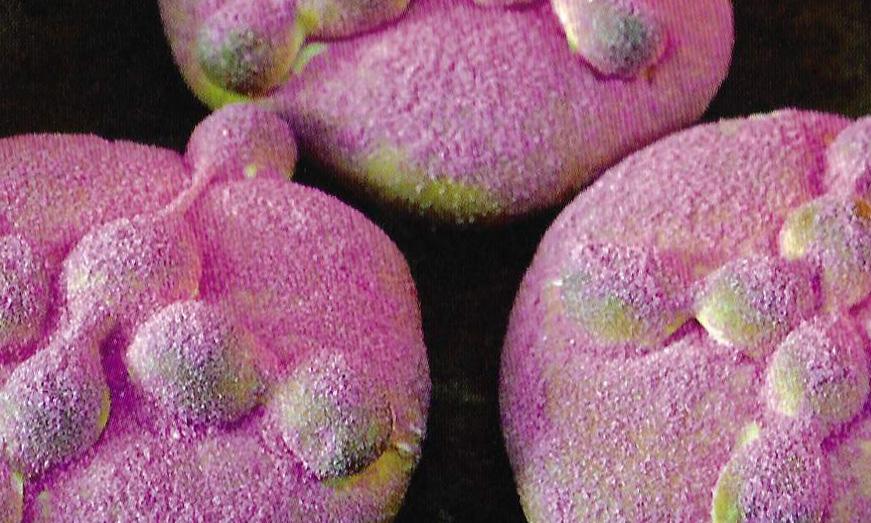
Pan de Muerto, also known as “dead bread,” is a soft sweet bread shaped into a round bun with bone shapes on top.
INGREDIENTS:
• 1/4 cup butter
• 1/4 cup milk
• 1/4 cup warm water
• 3 cups all-purpose flour
• 1 1/4 teaspoons active dry yeast
• 1/2 teaspoon salt
• 2 teaspoons anise seed
• 1/4 cup white sugar
• 2 eggs, beaten
• 2 teaspoons orange zest
• 1/4 cup white sugar
• 1/4 cup orange juice
• 1 tablespoon orange zest
• 2 tablespoons white sugar
DIRECTIONS:
1. Heat the milk and the butter together in a medium saucepan, until the butter melts. Remove from the heat and add warm water. The mixture should be around 110 degrees F (43 degrees C)
2. In a large bowl combine 1 cup of flour, yeast, salt, anise seed and 1/4 cup of the sugar. Beat in the warm milk mixture; then add the eggs and orange zest and beat until well combined. Stir in 1/2 cup of flour and continue adding more flour until the dough is soft.
3. Turn the dough out onto a lightly floured surface and knead until smooth and elastic.
4. Place the dough into a lightly greased bowl, cover with plastic wrap, let rise in warm place until doubled in size (about 1 to 2 hours). Punch the dough down, shape into large round loaf. Reserve enough dough to shape a round knob and bone shapes on top.
5. Place onto a baking sheet and loosely cover with plastic wrap. Let rise in warm place for about 1 hour or until about doubled in size.
Bake in a preheated 350 degrees F (175 degrees C) oven for about 35 to 45 minutes. Remove from oven let cool slightly then brush with glaze.
To make glaze: In a small saucepan combine the ¼ cup sugar, orange juice, and orange zest. Bring to a boil over medium heat and boil for 2 minutes. Brush over top of bread while still warm. Sprinkle glazed bread with remaining white sugar.
Mary J Andrade “Day of the Dead: A Passion for Life” 2006. 37
MAKE PAPER MARIGOLD FLOWERS
ACTIVITY SEVEN
Marigold or cempasuchil flowers are said to guide the spirits to their altars using their vibrant colors and pungent scent. Marigolds, or flowers in general, also represent the fragility of life. Here we will make paper marigolds to add to your altar or to flower crowns.
MATERIALS:
• 6-8 sheets of colored tissue paper, 10”x14”
• Scissors
• Chenille stems/ pipe cleaners cut in half
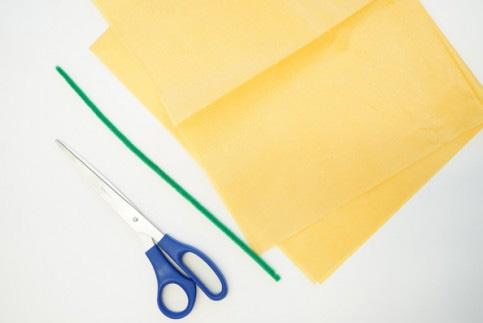
Gather materials. Fold the 10”x14” sheets of tissue paper in half.

Cut the pieces along the fold and stack them.

Fold over about one inch at one end of the tissue paper.

Repeat back and forth until you create an accordion fold.

Cut a half-circle shape from the each end. (You could also cut a point or zig-zag)

Wrap a pipe cleaner around the middle of the paper to hold it in place. This will also act as the stem.

Fan out the paper.

Gently separate the first layer of paper from the rest, and move it up to form the top layer of petals.

Gently separate each consecutive layer of the paper petals. Fluff out your flower.
CUT OUT PAPEL PICADO
ACTIVITY EIGHT
The first colored papers reached Mexico via Spain from Asia in the 17th or 18th century. Since then Mexican artisans have found dozens of ways to use paper for decorations and objects. Papel picado is a form of folk art, which means that it is a popular traditional art form handed down from generation to generation. These delicate strings of paper can be seen hanging as banners in the streets during Day of the Dead and many other
MATERIALS NEEDED:
• Three 8 1/2” by 11” sheets of colored tissue paper
• Thicker paper (loose-leaf or copy paper)
• Scissors
• A yard of string
• Glue stick
• Straight pins


DIRECTIONS:

Photocopy the provided template on the right hand side of a sheet of paper (8 ½ “x 11”).

Cut three sheets of tissue paper to 8 ½ “x 11”. Fold the three sheets of tissue paper in half lengthwise and pin the pattern to the tissue pack.

Cut template in half.

Carefully cut out your design. Make sure to leave a little space (about an inch) on the top of your design so that you can attach a string there.

Now remove the pins, unfold your paper carefully and lay the tissue paper out horizontally next to each other, about 1” apart.

Lay your string horizontally across the top of the paper. Fold the top of the paper over the string and glue it down so that it stays in place.

Lift up your banner by either end of the string and find a place to hang it!
Find the template on the previous page to create your own Papel Picado!
REINVENTING TRADITION: CULTURES CROSSING
In our modern world, people often try and make distinctions between folk art and fine art and artisans and artists respectively. Popular art is an expression of the world’s traditional cultures. Popular art is rooted in traditions that come from community and culture – expressing cultural identity by conveying shared community values and aesthetics. The difference between the two types of art is the cultural aspect. Fine art focuses more on “aesthetic” and is taught through rigorous formal instruction and training while popular art encompasses one’s culture in a
WHAT IS CARTONERÍA?
BORDERS
“deeper” manner. In popular art, artists are mostly self-taught or learn through family apprenticeships.
However, the case could also be made that there is no real distinction other than what society elevates as art. Culture is more complex and dynamic than we are taught to recognize in our daily lives and experiences. It is shared within and beyond communities regardless of national boundaries that are drawn between them.
Cartonería is the name for fanciful props that brighten the fiesta or celebration. They are constructed of paper, cardboard, and paper-mache: paper stuck together and hardened with wheat-flour paste. Paper-mache was introduced into Mexico around the 17th century as a way to make objects for churches with its use most developed in central Mexico.The dried surface is painted with festive colors.
Traditionally figures are produced in multiples and meant to withstand only the specific holiday event. They are often broken, burned, or discarded after the festival and replaced with fresh ones the following year.


In a way, the story of Carmen Caballero represents that of many of Mexican artisans, past and present… who toil away in anonymity, often making products that are of high quality and/or unique, but never getting the recognition they deserve. Caballero worked with her mother selling fruit in the market. When she was 18, a cartonero by the name of Gregorio Piedrasanta taught her the basics of the craft, but she went on to develop her own style, by dramatically simplifying the forms. Caballero eventually moved to Mexico City, where she made a living selling fruit and making seasonal cartonería items in the market. Carmen was exceptionally poor. It was in the market that none other than Diego Rivera discovered her work in 1955, buying the first of many Judas figures, 2.5 meters high, with a frame of over 150 strips of cane. By the time Caballero died at the age of 58, she left behind one of the largest collections of cartonería objects in the world at the time. Although she likely made thousands of Judas figures, only dozens survive. She never signed her work, as this was not custom for artisans.
WHAT IS AN ALEBRIJE?
Pedro Linares (1906 - 1992), a renowned indigenous Mexican artist, first created vividly colored paper-mâche sculptures called alebrijes. During the 1930s, Pedro Linares made piñatas, carnival masks, and religious figures from papier mache that were sold in mercados throughout Mexico City. When he began using paper and cardboard to craft large, vivid, ethereal creatures that no one had ever seen before, he caught the attention of a prominent gallery owner who marketed the pieces. This garnered so much recognition for Linares’ work that Diego Rivera and Frida Kahlo began commissioning alebrijes by Linares. Alebrjies became celebrated throughout Mexico and abroad. Thus, Linares was equipped to take a popular art tradition in a new direction.


Alebrijes de Papel: As the story goes, Linares became very ill when he was 30 years old. Not having access to medical attention, he laid in bed and lost consciousness. Linares dreamt of a bizarre, peaceful place that resembled a forest. His physical pain was gone and he felt happy as he walked along trails through the dense foliage of his dreamworld. Suddenly, the clouds, rocks, and trees began to transform. The land features around him shaped themselves into animals that were familiar and yet like nothing Linares had ever seen before. There were mules with dragonfly wings, roosters with antlers, creatures that resembled gryphons and dragons, just to name a few. They had unnatural colors and patterns swirling over their bodies.
Linares returned home to his native Arrazola in Oaxaca and shared his designs with artisans in his village. Sculptor Manuel Jimenez (1919-2005) was the first to create the brightly colored creatures out of copal wood instead of paper mache by incorporating Linares’ visions into the pre-Columbian woodcarving tradition that already existed among the indigenous Zapotec culture of that area. Descendants of Pedro Linares as well as Manuel Jimenez’s family continue to carve and paint various alebrijes to this day. Entire families and villages have dedicated themselves to honing their woodcarving skills. They elevated the craft to a fine art that is prized around the world and built a unique economy based on artistic supply and demand.
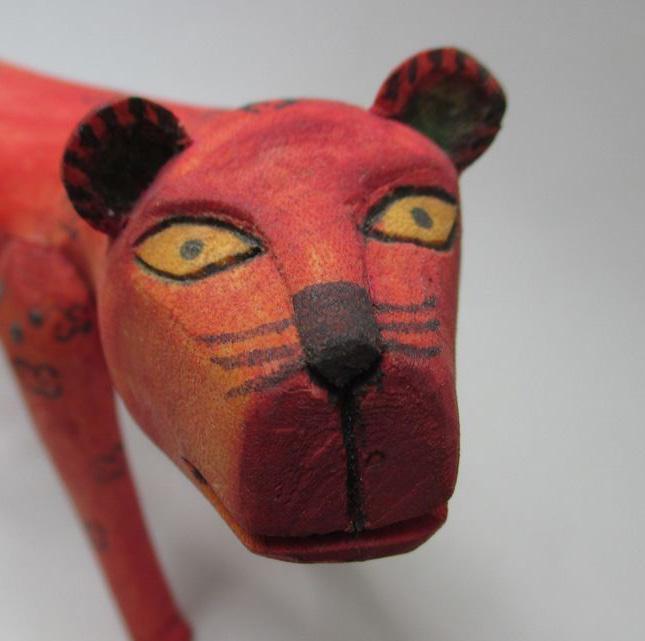
Felipe Linares Alebrije, 2000-2004 Paper mache, 27” x 25” x 32” Mexic-Arte Museum Permanent Collection 2015.41.36 Gift of Priscilla Murr
CARTONER Í A IN VIVA LA VIDA FESTIVAL
Mexic-Arte Museum works with local Texas and Latinx artists who make large cartoneria sculptures for the parade that pay tribute to the idea of Mestizaje and a modern Mexican national identity.

Selena
Sergio Lejarazu Selena, 2019
Dress by Maria Rosa Rivera
Paper mache, 147” x 29” x 20”
Mexic-Arte Museum Permanent Collection

La Catrina
Patricia Greene
La Catrina, 2017
Paper mache, 109” x 42¾” x 21”
Mexic-Arte Museum Permanent Collection

Coco’s “Dante”
Sergio and Monica Lejarazu
Coco’s “Dante”, 2018
Paper mache, 54” x 42” x 22”
Mexic-Arte Museum Permanent Collection
These alebrijes created for Mexic-Arte’s Viva La Vida Parade were inspired by the folk art of Pedro Linares and his visions of fantastic, chimeric animals. The float was designed and created by Diego Mireles Duran, Olivia Warner, and Cheraya Esters.
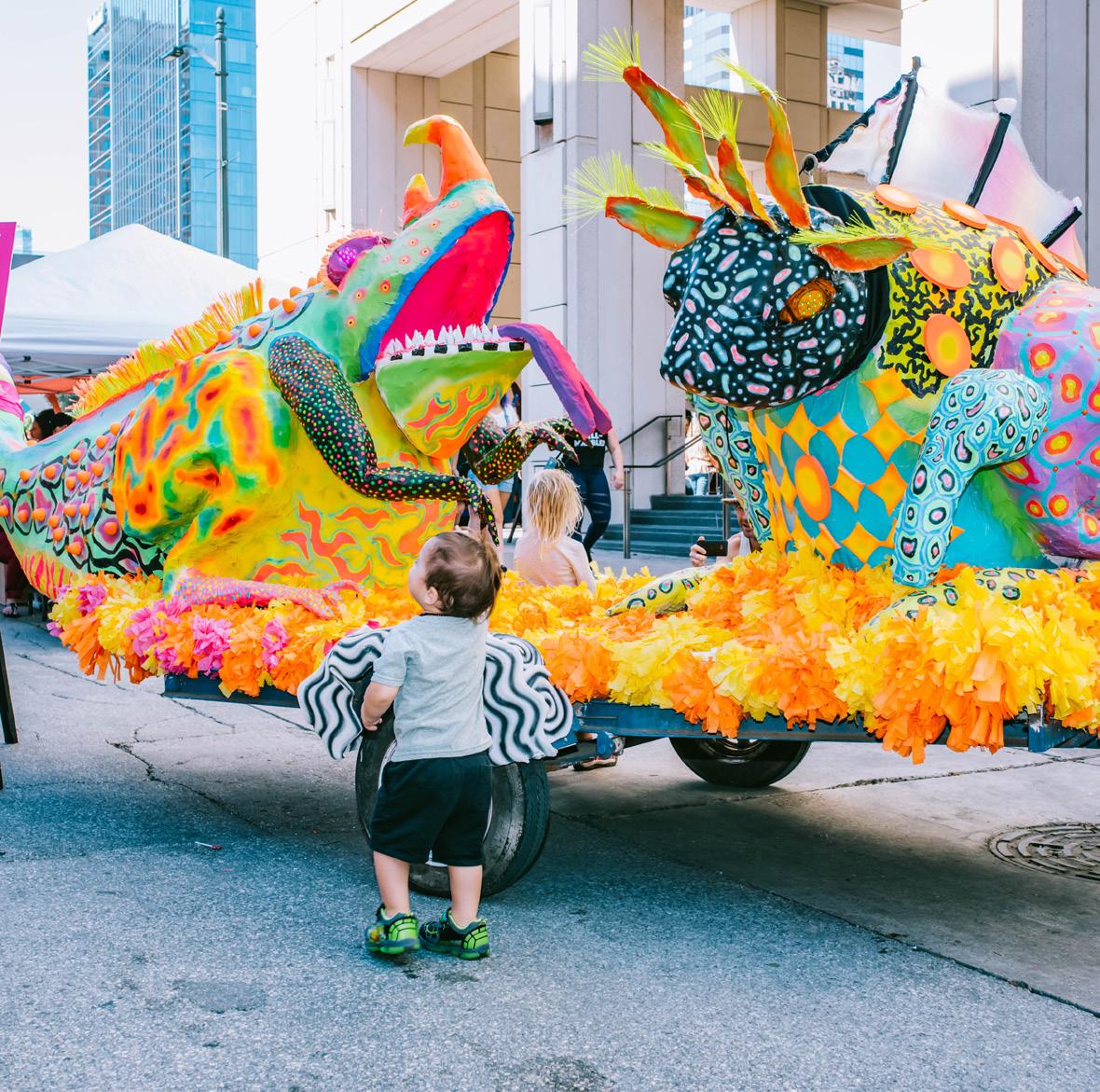
Alebrije Dreams
Diego Mireles Duran, Olivia Warner, and Cheraya Esters
Alebrije Dreams, 2018
Paper mache and float
RECONNECTING WITH HISTORY
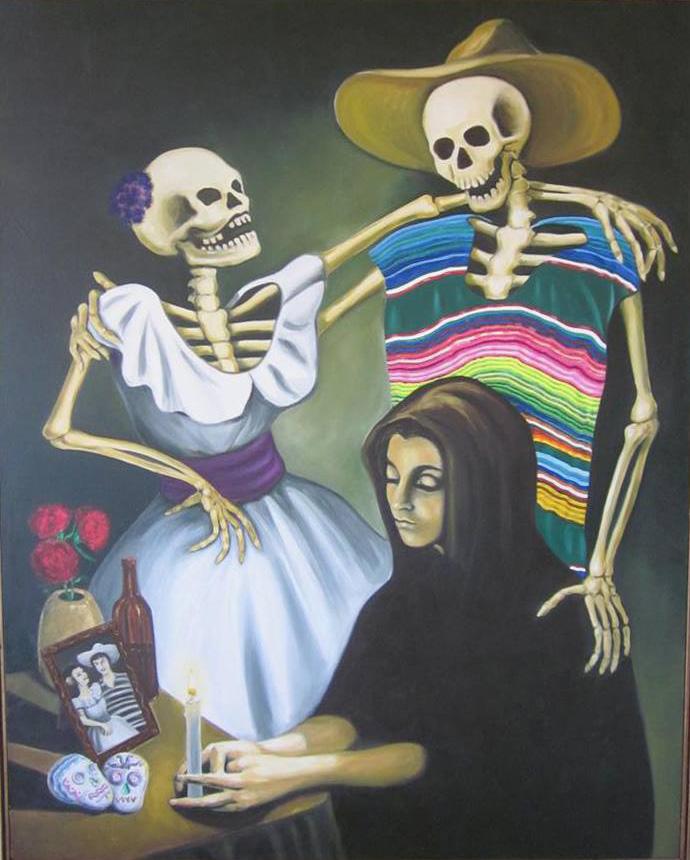
For the three artists; Sam Coronado, Sylvia Orozco, and Pio Pulido, who founded Mexic-Arte Museum in 1984, Día de los Muertos provided a means to share the rich cultural and artistic traditions of Mexico with the entire community of Austin, Texas. The festival encourages the community to interpret and add to the captivating cultural tapestry that has been woven into Día de los Muertos. It connects people in the present with long held practices that bring the past to life. Along with the festival, Mexic-Arte Museum has an annual Día de los Muertos exhibit that showcases community altares as public art, contemporary prints, and paintings from the collection.
Sam Coronado Muerte; Celebración, 1984 Oil on canvas, 61 ¾” x 49 ½” Mexic-Arte Museum Permanent Collection 2018.20.1.1 Gift of Pamela and Michael Reese
VIVA LA VIDA FESTIVAL AND PARADE

Mexic-Arte Museum’s Viva La Vida Festival represents the Museum’s 37 year quest to educate the public about the Day of the Dead’s significance. During this time, a marvelous transformation has occurred—what was historically a religious holiday has become an expressive commemoration of family and a celebration of Mexican and Mexican American life and culture in Austin. Mindful of the day’s historical roots, Mexic-Arte Museum has helped transform the celebration by mixing modern with traditional materials, and personal with social issues. The traditional sense of commitment to honor the deceased has remained, but the public expression has evolved into a voice for the Latino/a/x community and beyond.
GLOSSARY OF TERMS
Alebrije – Brightly colored Mexican art sculpture of fantastical (fantasy/mythical) creatures.
Amatl – The Nahua word for paper.
Aztec – A Mesoamerican culture that flourished in central Mexico in the post-classic period from 1300 to 1521.
Calavera – A representation of a human skull.
Calavera Catrina – A popular etching by Mexcian printmaker Jose Guadalupe Posada. Created in 1910, her image is now a festive symbol of Dia de los Muertos. Posada’s Catrina was a spoof on the Mexican elite who would imitate European lifestyles.
Camazotz – The Mayan Bat God, or “death bat”.
Cempasúchitl – The name given to Mexican marigold flowers (Tagetes erecta). The word “cempasuchitl” comes from the Nahuatl (the language of the Aztecs) word zempoalxochitl which means twenty-flower: zempoal, meaning “twenty” and xochitl, “flower.”
Cenote – A natural pit, or sinkhole of water. The Mesoamericans believed cenotes were portals to the underworld and were sacred places used for rituals and sacrificial offerings.
Chicano Movement of the 1960s – Also called the Chicano civil rights movement or El Movimiento, was a Chicano or Mexican American grassroots movement that wanted equal rights in education and employment.
Coatlicue – An Aztec Goddess of Life, Death, and Rebirth whose name means “Serpent Skirt”.
Codex Borgia or Codex Yoalli Ehecatl – A Mesoamerican ritual and divinatory manuscript.
Copal – Copal incense is used in ceremonies. The word comes from the Nahuatl language word Copalli, meaning incense.
“Día de los Angelitos” – (Day of the Little Angels), November 1st, this day is dedicated to the souls of deceased children.
Día de los Muertos (Day of the Dead) – A celebratory feast day with a historically rich tradition that integrates both preColumbian and Catholic customs.
Deity – A supernatural being considered divine or sacred. The Oxford Dictionary of English defines deity as “a god or goddess (in a polytheistic religion),” or anything revered as divine.
Huitzilopochtli – Name meaning “Blue Hummingbird on the Left,” was the Aztec god of the sun and war.
Indigenous – The people who are originally native to a certain place. For example, the Aztecs are indigenous to Mexico.
José Guadalupe Posada – A Mexican political printmaker who used relief printing to produce popular illustrations. His work has influenced numerous Latin American artists and cartoonists because of its satirical humor and social engagement.
K’iche’ – Mayan people indigenous to the northwestern Highlands of Guatemala. The K’iche’ language is a Mesoamerican language in the Mayan language family and written records of K’iche’ history and mythology are preserved in the Popol Vuh.
Linocut – A printmaking technique, a variant of woodcut in which a sheet of linoleum is used for a relief surface.
Maya Civilization – A Mesoamerican civilization developed by the Maya peoples, and noted for its logosyllabic script— the most sophisticated and highly developed writing system in pre-Columbian Americas—as well as for its art, architecture, mathematics, calendar, and astronomical system.
Mesoamerica – Refers to both the many cultures, and a vast region that existed in North, Central, and Northern Costa Rica long before the Spanish arrived.
Mestizaje – A term that refers to the blending of Indigenous and European cultures and traditions.
Mexica or Mexicas – A Nahuatl-speaking indigenous people of the Valley of Mexico who were the rulers of the Aztec Empire.
Miccailhuitontli – The “Feast of the Deceased Young.”
Mictlan – The underworld in Aztec mythology. It was said that most people who died would travel to Mictlan, the lowest level of the underworld in an arduous four year journey through nine distinct levels.
Mole – A traditional sauce originally used in Mexican cuisine, as well as for dishes based on these sauces.
Nahuatl – A member of a group of people native to southern Mexico and Central America, including the Aztecs.
Ofrenda – An essential part of the Day of the Dead celebrations. The word ofrenda means offering in Spanish. It are also called altares or altars, but it is are not for worship.
Olmec – A member of a prehistoric people inhabiting the coast of Veracruz and western Tabasco on the Gulf of Mexico ( c. 1200–400 BC), who established what was probably the first Mesoamerican civilization.
Pan de Muerto – Also called pan de los muertos in Mexico, is a type of pan dulce traditionally baked in Mexico during the weeks leading up to the Día de los Muertos, which is celebrated from October 31st to November 2nd.
Papel picado – Decoratively cut paper for festivities in Mexico.
Popol Vuh – A text recounting the mythology and history of the Kiche people, one of the Maya peoples, who inhabit the Guatemalan Highlands northwest of present-day Guatemala City.
Pre-Columbian – Relates to the history and culture of the Americas before the arrival of Christopher Columbus in 1492.
Syncretism – The amalgamation or attempted amalgamation of different religions, cultures, or schools of thought.
Tlaloc- The Aztec god of rain and thunder, Tlaloc brought earthly fertility, water, and delivered life and sustenance.
Tajin- A pre-Columbian archeological site in southern Mexico, it is one of the largest and most important cities of the Classic era of Mesoamerica.
Tenochtitlan – Also known as Mexica-Tenochtitlan, was a large Mexica city-state in what is now the center of Mexico City. The exact date of the founding of the city is unclear, but the most commonly accepted date is March 13, 1325.
Toltec – A member of an indigenous people that flourished in Mexico before the Aztecs.
Tzompantli – Or skull rack is a type of wooden rack or palisade documented in several Mesoamerican civilizations, which was used for the public display of human skulls, typically those of war captives or other sacrificial victims.
Tzotzil – Mayan people indigenous to the central Chiapas Highlands in southern Mexico.
Veneration – Is the act of honoring a saint, a person who has been identified as having a high degree of sanctity or holiness.
Xipe Totec – A Toltec and Aztec deity also known as “Our Lord the Flayed One”. Xipe Totec was considered the God of agriculture, spring, vegetation, and the inventor of war. Xipe Totec was also associated with death and represented as the Aztec Bat God.
Yax Che – The “Green Tree” or “First Tree.”