





THE FUTURE Summer 2024 AXEL OLSON Signs of Life University of Michigan
Top
of 2024
DESIGN
Dreams from the
A&D Students

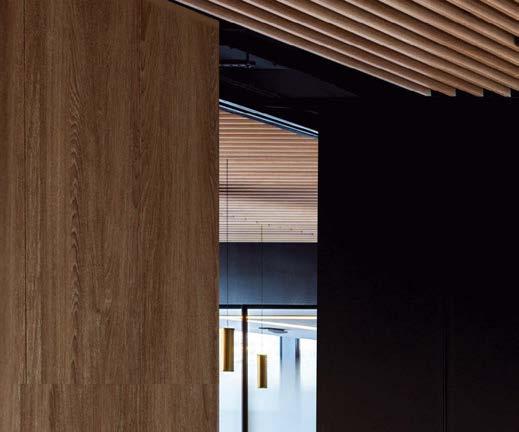


Wood. This Isn’t Wood.


Get it fast.


ThisThis is Fortina.
Fortina that with surface. Available in over 100+ wood profi Now 12" Quick
Fortina is a remarkable architectural system that looks and feels like real wood, but is made with aluminum and a hyper-realistic non-PVC surface. Available in over 100+ wood and metal finishes and 50+ profiles for interior and exterior applications. Now with integral lighting, larger, up to 2" x 12" profiles, and quicker delivery with Quick Ship.





www.BNind.com 800.350.4127 Fortina


Know New Plastic
Our signature architectural resin now incorporates a revolutionary molecular recycling method, allowing us to utilize an even larger range of plastic waste — including synthetic fibers from clothing, carpet fibers, and more dense plastics — to produce a 100% recycled material without sacrificing quality or optical clarity.
We’re rediscovering plastic, not as a problem, but as a pioneering solution.

3-form.com/know-new-plastic
Kolo Pod
Available in five sizes and an ADA-compliant model, the Kolo Pod makes it easy to find the right solution for working, learning, and healing environments. Designed to offer a quiet setting in an open environment, it’s ideal for focused work or meetings with up to eight people.


LEARN MORE kimballinternational.com
Imagination Meets Innovation

For 25 years, we’ve crafted comfort like no other. Softness that envelops, endurance that lasts. Indulge your senses and experience the difference.
ultrafabricsinc.com

COURTESY ALKEMIS PAINT Contents 24 Contributors 26 In This Issue 28 3 Sustainability News Updates for Q2 2024 32 The Rise of Sustainable Interiors 36 VR Pioneer Adipat Virdi Helps People Build Empathy 38 A Creative Design Challenge for the Design Leaders of Tomorrow 42 Designed Landscapes Are Surprisingly Carbon Intensive (They Don’t Have to Be) 48 Sustainability Is the New Luxury 52 This First-of-Its-Kind Paint Promotes Wellness 54 Passive House Design Makes This Brooklyn Townhouse More Livable 62 These Products Can ShapeShift to Fit Your Project 66 5 Architectural Products for Higher Education Projects METROPOLIS® (ISSN 0279-4977), Summer 2024, Vol. 44, No. 2 is published quarterly plus Products issue printed in June by SANDOW LLC, 3651 FAU Blvd., Boca Raton, FL 33431. Periodical postage paid in Boca Raton, FL, and at additional mailing offices. POSTMASTER: Send all UAA to CFS; NON-POSTAL AND MILITARY FACILITIES: send address corrections to METROPOLIS, PO Box 808, Lincolnshire, IL 60069-0808. Subscription department: (800) 344-3046 or email: metropolismag@omeda.com. Subscriptions: 1 year: $32.95 USA, $52.95 Canada, $69.95 in all other countries. Copyright © 2024 by SANDOW LLC. All rights reserved. Printed in the USA. Material in this publication may not be reproduced in any form without permission from the publisher. METROPOLIS is not responsible for the return of any unsolicited manuscripts or photographs. 68 Designed for Research and Built to Perform 74 OMA Designs for Circular Cooking 78 The Denver Art Museum Explores Nature’s Eternal Sway over Architecture and Design
52 METROPOLIS 10 SUMMER 2024
As one of the few Cradle to Cradle Certified paints in North America, Alkemis Paint is designed to help people breathe easier.








teknion.com




NeoCon ® is a registered trademark of Merchandise Mart Properties, Inc. (1.1) June 10–12, 2024 THE MART Chicago neocon.com


COURTESY JENNY H. COOK Contents 82 The Future100 90 Jack London Freedman 92 Students Imagine New Ways to Deepen our Connection to Our Environment 96 Axel Olson 100 How Can We Take Adaptive Reuse to the Next Level? 104 Kathryn Webb 100
candidate Jenny H. Cook transforms Milan’s Magazzini Raccordati transit station in her project LUCID Transparency. ON THE COVER: Signs of Life by Axel Olson, master of architecture student at the University of Michigan Taubman College of Architecture and Urban Planning 106 For These Students, New Technologies Unlock Ageless Construction Materials 110 Meixi Xu 112 Young Designers Shape the Future of Water 116 Qing Yin 118 Three Proposals Practice Empathy in Communal Design The students featured in this issue represent the cream of the crop graduating this year from North America's architecture and design schools. Meet the METROPOLIS Future100. METROPOLIS 14 SUMMER 2024
SCI-Arc's MArch

500 brands of summer.
Sample hundreds of leading brands. One box. One site.
Order by midnight.
Samples by 10:30 a.m.
Free for design professionals.
materialbank.com


The London-based architect keeps both her design process and her built projects fluid and ever-changing.
An Architecture Office of the Future
Studio RAP in Rotterdam is a combination of a design studio and robotic factory.
Studio RAP combines computational design, digital fabrication, and design strategy. They write, "Together with our robots we challenge the traditional way of building and rethink the architectural profession."
COURTESY STUDIO RAP/RICCARDO DE VECCHI 122
Open-Ended
Farshid Moussavi’s
Architecture
132
142 Sources 144 Index Contents
132 METROPOLIS 18 SUMMER 2024


EDITORIAL
EDITOR IN CHIEF Avinash Rajagopal
DESIGN DIRECTOR Tr avis M. Ward
SENIOR EDITOR AND PROJECT MANAGER Laur en Volker
SENIOR EDITOR AND ENGAGEMENT MANAGER Fr ancisco Brown
ASSOCIATE EDITOR AND RESEARCHER J axson Stone
DESIGNER Rober t Pracek
COPY EDITOR Benjamin Spier
FACT CHECKER Anna Zappia
EDITORS AT LARGE Ver da Alexander, Sam Lubell
PUBLISHING
VICE PRESIDENT, SALES John Cr osby
VICE PRESIDENT, MARKETING & EVENTS Tina Brennan
ADVERTISING DIRECTOR
Tamara Stout tstout@sando wdesign.com 917.449 .2845
ACCOUNT MANAGERS
Julie Arkin jarkin@sandow design.com 917- 837-1344
Meredith Barberich meredith.barberich@sando wdesign.com
Ellen Cook ecook@sando wdesign.com 423.580.8827
Gr egory Kammerer gkammer er@sandowdesign.com 646.824.4609
Laury Kissane lkissane@sando wdesign.com 770.791.1976
Julie McCarthy jmccarth y@sandowdesign.com 847-567-7545
Colin Villone colin.villone@sando wdesign.com 917.216 .3690
PRINT OPERATIONS MANAGER Olivia Padilla
SENIOR MANAGER, MARKETING + EVENTS
Kelly Allen kkriwko@sando wdesign.com
SOCIAL MEDIA COORDINATOR Zoya Naqvi
GRAPHIC DESIGNER, CREATIVE SERVICES Paige Miller
METROPOLISMAG.COM
@metropolismag

THIS MAGAZINE IS RECYCLABLE.
recycle when
done with it.
all in this together. METROPOLIS 20 SUMMER 2024
Please
you’re
We’re


SANDOW DESIGN GROUP
CHIEF EXECUTIVE OFFICER Erica Holborn
CHIEF OPERATING OFFICER Michael Shavalier
CHIEF DESIGN OFFICER Cindy Allen
CHIEF GROWTH OFFICER and EVP, CLIENT STRATEGY Bobby Bonett
EXECUTIVE VICE PRESIDENT + DESIGN FUTURIST AJ Paron
VICE PRESIDENT, DIGITAL Caroline Davis
VICE PRESIDENT, HUMAN RESOURCES Lisa Silver Faber
VICE PRESIDENT, BUSINESS DEVELOPMENT Laura Steele
EXECUTIVE DIRECTOR, FINANCE & OPERATIONS Lorri D’Amico
DIRECTOR, VIDEO Steven Wilsey
SANDOW
CHAIRMAN Adam I. Sandow
CONTROLLER Emily Kaitz
DIRECTOR, CORPORATE FINANCE Jake Galvin
DIRECTOR, INFORMATION TECHNOLOGY Joshua Grunstra
METROPOLIS is a publication of SANDOW
3651 FAU Blvd. Boca Raton, FL 33431 info@metropolismag.com 917.934.2800
FOR SUBSCRIPTIONS OR SERVICE
800.344.3046 customerservice@metropolismagazine.net


SANDOW was founded by visionary entrepreneur Adam I. Sandow in 2003, with the goal of reinventing the traditional publishing model. Today, SANDOW powers the design, materials, and luxury industries through innovative content, tools, and integrated solutions. Its diverse portfolio of assets includes LUXE INTERIORS + DESIGN, INTERIOR DESIGN, METROPOLIS, and DESIGNTV by SANDOW; ThinkLab, a research and strategy firm; and content services brands, including The Agency by SANDOW, a full-scale digital marketing agency, The Studio by SANDOW, a video production studio, and SURROUND, a podcast network and production studio. SANDOW is a key supporter and strategic partner to NYCxDESIGN, a not-for-profit organization committed to empowering and promoting the city’s diverse creative community. In 2019, Adam Sandow launched Material Bank, the world’s largest marketplace for searching, sampling, and specifying architecture, design, and construction materials.
Zelle™ Acoustic Wall Panels ©modularArts, Inc.
Slater™ Acoustic Wall Panels ©modularArts, Inc.
m d . m 206.788.4210 m d h USA d A AuralScapes® A METROPOLIS 22 SUMMER 2024
Flo™ Acoustic Wall Panels ©modularArts, Inc. Flo™ Acoustic Wall Panels ©modularArts, Inc.


Alice Bucknell is an artist and writer based in Los Angeles. Working with game engines and speculative fiction, Bucknell explores interconnections of architecture, ecology, magic, and nonhuman and machine intelligence. In 2021 they founded New Mystics, a digital platform merging magic and technology. Their work has appeared internationally at Ars Electronica, the 18th Venice Architecture Biennale, and Serpentine in London, among others, and they contribute to art and design publications including e-flux Architecture, Frieze, and Harvard Design Magazine They are a previous resident of Somerset House Studios in London and a faculty member at SCI-Arc in Los Angeles. Bucknell penned this issue’s profile on Iranian-born, London-based architect Farshid Moussavi (p. 122).

Designer Laurence Carr is the founder of New York–based Laurence Carr Inc., a multifaceted regenerative design firm specializing in interiors that embody sustainability and healthy living. She also leads Studio Laurence, a sustainable luxury home-goods brand focused on zero-waste product design. Additionally, Carr is on the advisory board of the United Nations Fashion and Lifestyle Network, a sustainability ambassador for Maison & Objet, and executive producer and host of Chez Laurence, an EarthxTV original docuseries. In this issue Carr challenges the misconception that conscious choices mean compromising beauty in “Sustainability Is the New Luxury” (p. 48).

MANU VALCARCE
Manu Valcarce is an award-winning documentary photographer and filmmaker. Merging activism, art, and storytelling, his work delves into subjects like the LGBTQ+ community in Honduras, migration routes in Mexico, and extrajudicial killings in Kenyan settlements. It has been exhibited in shows around the world and has been screened at venues like Tate Modern and the ICA in London. His films have also earned recognition at international film festivals, including Leeds International Film Festival, Atlanta Docufest, and Long Beach International Film Festival. Valcarce’s photographs of architect Farshid Moussavi are featured in “Farshid Moussavi’s Open-Ended Architecture” (p. 122).


COURTESY THE CONTRIBUTORS 24 CONTRIBUTORS
ALICE BUCKNELL
LAURENCE CARR
Finest selection of contemporary European wood and gas stoves and fireplaces Eco 90 Cook-stove Range 914.764.5679 www.wittus.com


MOBILE SURVEILLANCE





Invisible Security
Security Design is currently based on restricting access and protecting perimeters. Invisible security in contrast foresees free access.
Invisible security uses data, technology and design to secure places. Everywhere and at any point in time.
While putting security at its core, it respects public acceptance, privacy and convenience, in order to make physical spaces not only safe, but also frictionless, trustworthy, and liveable.


CONTINUOUS AUTHENTICATION


VIRTUAL PERIMETER




BEHAVIORAL ANALYTICS






CONSENT-BASED IDENTITY MANAGEMENT



Learn More

The Built Environment Evolves
“ARCHITECTURAL PRACTICE IS NONLINEAR,” London-based architect Farshid Moussavi reflects in “Farshid Moussavi's OpenEnded Architecture” (p. 122). “The project evolves along the way—and constantly evolves. There is no way an architect has all the answers on day one.” Moussavi, who is also a professor in practice of architecture at Harvard University’s Graduate School of Design, has spent her much-feted career examining both the function of buildings and the forces that shape them. Her conception of architecture, construction, and design as slow-moving and open-ended processes is still radical to an industry that prides itself on handling big money, big influence, and hard realities. Yet marrying the two ideas—that design is both tangible in its means and mutable in its outcomes—is absolutely critical to meeting the crises of today and tomorrow.
Doing that opens the door to technological change, obviously, of the sort that Rotterdam-based Studio RAP is ushering in with its experiments with robotics (“An Architecture Office of the Future,” p. 132). But as writer Timothy A. Schuler reports in “Designed Landscapes Are Surprisingly Carbon Intensive (They Don’t Have to Be)” (p. 42), it is also encouraging professionals like landscape architects to question old assumptions about their work and grapple with a new understanding of their impact on the world.
One vital way professions change is through the values and concerns that every cohort of new professionals brings with it. METROPOLIS’s Future100, a program now in its fourth year,
surfaces the perspectives of the brightest new minds in architecture and interior design.
“I try to approach projects from the mindset that if I’m in school the project is inherently a conceptual project. I might as well lean into that a bit,” says Axel Olson (p. 96), a master’s candidate at the University of Michigan’s Taubman College of Architecture & Urban Planning. His Self-Storage project, for example, conceives of temporary structures as “warehouses” of cast-off construction materials, keeping them in use till they find more permanent homes. This kind of comfort with mutable, changeable purposes for buildings runs through the Future100 portfolios. School of Visual Arts interior design student Meixi Xu (p. 110) reimagines an entire New York neighborhood as an ecosystem where people’s livelihoods and lifestyles change with the buildings they live in—bringing intentionality to the subtle forces that already bind us to buildings. “I’m trying to create something that is not buildable now because what we can build now is not enough,” she says. “I want to create something beyond ‘now.’”
I am excited to see how ideas like these and the dozens of others showcased in this issue’s Future100 stories, all incubated in the classroom, will evolve over many encounters with the construction site in the years to come. Social, political, and economic forces, themselves ever changing, will undoubtedly hone and select the fittest of these to create the built environment of the future. I hope it will be one that we will all be able to live and thrive in. —Avinash Rajagopal, editor in chief
MANU VALCARCE FOR METROPOLIS
IN THIS ISSUE METROPOLIS 26 SUMMER 2024
Farshid Moussavi runs her practice, Farshid Moussavi Architecture (FMA), out of her east London studio, where she is pictured here. The architect is known for innovative work deeply rooted in critical research, which she carries out through FunctionLab, the research branch of FMA.


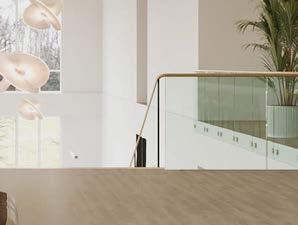










non-vinyl resilient plank
warm, soothing neutrals
to gate,
Proxy Collection I Wood Andara Oak PRX204 Proxy Collection
Create supportive spaces with the Proxy Collection. PVC-free, this
and tile flooring offers comforting wood and stone visuals in
that support a sense of wellbeing. Declare Red List Free and 105% carbon offset cradle
Proxy helps create a better environment, indoors and out. manningtoncommercial.com
Two Sustainability News Updates for Q2 2024
The building industry makes vital moves toward standardization and transparency on energy efficiency and social impact.
By Avinash Rajagopal
01 Net Zero
The U.S. Federal Government Sets the Bar
IN THEORY, IT SEEMS IT WOULD BE SIMPLE to define what a net-zero building is—a building that uses no nonrenewable energy. But in practice, it turns out to be a bit trickier: If a building is an energy guzzler compared with others in its region and category, but uses solar energy for all its needs, does that really serve the cause of climate-friendly design? Also, how often should a building’s net-zero status be verified, to make sure it’s performing as planned?
The federal government has stepped into this situation to try to clarify what a net-zero building is. Last September the White House proposed a definition that focuses on a building’s energy use (thereby addressing its operational carbon emissions).
The definition, which was open for comments, data, and information from January 9 to March 6, 2024, says that a zero operating emissions building is one that is:
• HIGHLY ENERGY EFFICIENT: For existing buildings, this means their energy efficiency is in the top 25 percent of buildings with similar uses. New buildings would need to use energy at levels 10 percent lower than the latest IECC or ASHRAE 90.1 model code and have an ENERGY STAR score of 90 or higher.
• FREE OF ON-SITE EMISSIONS FROM ENERGY USE: The building’s direct greenhouse gas emissions from energy use equal zero.
• POWERED SOLELY FROM CLEAN ENERGY: All the building’s energy is from carbon-free sources (which can include on-site generation and off-site sources).
When this definition goes into effect, it will help level out policies that currently vary from state to state—giving existing building emissions legislation in California and New York, for example, a baseline to align their goals with.
The Department of Energy has indicated that other factors implicated in carbon emissions, like embodied carbon or refrigerants, will be addressed in future updates to this definition.
EQUITY AND ACCESS | ESG | NET ZERO AND NET POSITIVE
Read the full draft definition here: METROPOLIS 28 SUMMER 2024

02 Social Impact
An Existing Certification Gains Legitimacy and a New Tool Debuts
THE SOCIAL IMPACT OF THE BUILT ENVIRONMENT is extremely complex to measure. Currently different aspects of social impact—the diversity of design firms, equity in awarding contracts, the well-being of workers in product supply chains, or the safety of workers on construction sites—are addressed by a mosaic of guidelines, policies, and certifications (see METROPOLIS’s Design for Equity Primer, metropolismag.com/equity).
Recently there have been a few significant developments in this area. SEAM (Social Equity Assessment Method), a real estate certification that launched in 2023, released Version 1 of its standard in February and was then recognized by GRESB as a green building certification scheme, joining the ranks of popular existing certifications like LEED, WELL, and the Living Building Challenge. For the 150 institutional and financial investors as well as 3,000 real estate and infrastructure funds, companies, and asset operators around the world that rely on GRESB, this means that SEAM certification now counts toward their ESG reporting.
Meanwhile, an important new tool for transparency around social impact launched in Europe at the end of last year. A quarter century after the first Environmental Product Declaration (EPD) was published, EPD International has published the first Social Product Declaration (SPD). Created to declare the social impact of rolling stock used by Hitachi Rail, it follows a methodology similar to EPDs and Health Product Declarations (HPDs): First a committee was formed to develop Product Category Rules for measuring the social impact of rolling stock, and then Marzia Traverso of RWTH Aachen University in Germany used these rules to conduct a social life cycle assessment of the product. The results were published in the SPD.
EPDs and HPDs have become mainstream in the building industry thanks to decades of advocacy and adoption by manufacturers, sustainability consultants, and A&D firms alike. The addition of SPDs brings another vital dimension to how we assess the supply chains of buildings.
EQUITY AND ACCESS | ESG | NET ZERO AND NET POSITIVE
Read more about SEAM here: METROPOLIS 30 SUMMER 2024

RESIDENTIAL STYLE. COMMERCIAL CAPABILITIES. roomandboard.com/business 800.952.9155
The Rise of Sustainable Interiors
New research reveals how firms are putting sustainability into practice.
By Amanda Schneider
As climate change poses unprecedented challenges, the interior design industry is stepping up, embracing sustainability not just as a trend but as a necessity. New 2024 research shared by INTERIOR DESIGN magazine and analyzed by ThinkLab reveals a significant growth in sustainabilityfocused projects, with design fees for the top 100 Interior Design Sustainability Giants coming in at $2.4 billion in 2024, up from $1.8 billion the previous year.
CARBON CONSCIOUS
A key aspect of this transformation is the industry’s increased attention to embodied carbon. Firms like AECOM are at the forefront, leading the charge in the number of projects scrutinizing their carbon footprint. And industry-wide, the number of projects tracking embodied carbon rose from 5 to 7 percent between 2022 and 2023.
LEED AND WELL HOLD STEADY
Leadership in achieving certifications like WELL and LEED is becoming a badge of honor among firms, but the percentage of clients achieving these certifications has remained unchanged year after year. The rate of staff holding LEED or WELL AP accreditations also remains steady at 24 percent, reflecting a robust yet unchanging commitment to expertise in sustainable design.
Firms like Partners by Design and Clark Nexsen lead the pack in these areas, showcasing the industry’s dedication not only to healthy buildings but also to the health and well-being of those who occupy them. And remarkably, nearly half (48 percent) of furnishings and finishes are now chosen for their sustainability credentials, highlighting a broader industry shift toward materials and products that support a healthier planet.
CERTIFICATION HESITATION
However, the journey toward sustainability is not without hurdles. While more projects align with sustainable principles, there’s a noticeable rise—from 27 to 37 percent—in clients who are reluctant to foot the bill for certifications. Despite this, firms such as Perkins&Will are making notable strides, with an impressive 90 percent of their projects tracking to sustainable fees, demonstrating that commitment to sustainability can indeed coexist with financial viability.
CLIENT DEMAND & ESG
Twenty-nine percent of clients consider environmental, social, and governance (ESG) goals as pivotal to their design projects, a figure that holds steady from the previous year. This interest in ESG underscores a growing consensus on the importance of sustainable design principles in meeting broader societal goals, but also remains lower than most practitioners would hope to see.
CannonDesign’s bold assertion that “shaping a more sustainable world may be the greatest challenge of our time, and we are ready for the fight,” encapsulates the industry’s resolve. Firms across the board are not just adapting to sustainability; they are redefining their practices around it.
As the industry’s efforts show, the path to a more sustainable future is not just possible but is already under way—one space at a time. M
Amanda Schneider is the founder and president at ThinkLab, the research division of SANDOW DESIGN GROUP. At ThinkLab we combine SANDOW Media’s incredible reach in the architecture and design community through brands like METROPOLIS with proven market research techniques to uncover relevant trends and opportunities for the design industry. Join in to explore what’s next at thinklab.design/join-in.
METROPOLIS 32
2023 - $1.8 billion 2024 - $2.4 billion
$2,400,000,000
Significant growth in sustainability-focused projects, with design fees for the top 100 Interior Design Sustainability Giants coming in at $2.4 billion in 2024, up from $1.8 billion the previous year.
EMBODIED CARBON | HEALTHY MATERIALS
SUMMER 2024 33

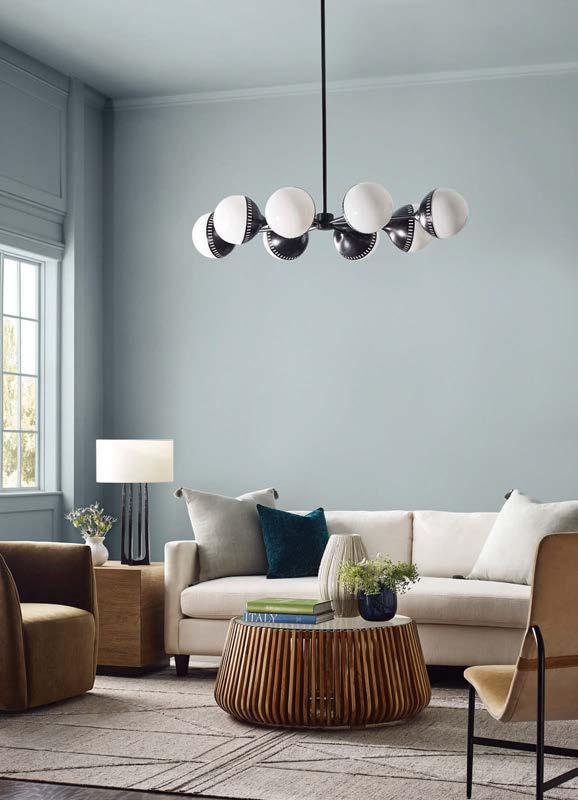
Anthology: The Evolving Colors of Colormix®
For 2024, Sherwin-Williams introduces Anthology: Volume One, a biennial color trend report organized by color family. This essential color reference reveals what the future holds for four featured color groups.
BLUES AND GREENS
“For 2024 we’re predicting an update to the traditional pairings of blue and green,” says Sue Wadden, Director of Color Marketing at Sherwin-Williams. “This group, especially the tonal variations of green, is potentially the defining color family of the 2020s.”
REDS AND PURPLES
Since 2020, our forecasts have included an abundance of mineral reds ranging from deep to midtone in value, with scene-stealing and energyboosting corals and pinks. This hue group is likely to evolve with more muted and soulful clay pigments, pink-beige neutrals, true purples, and nostalgic brights taking the lead.
DARK COLORS
Deep tones are likely on the rise as a result of rapid societal change, and their ability to produce a comforting, cocooning effect will be instrumental in creating modern spaces that soothe. This value range will help to balance the increasing radiance of bright tones in 2024 and beyond.
WHITES AND TINTS
This paradigmatic color family plays a pivotal role in contemporary designs, offering a starting point for designers as they seek the perfect foundational white or near-white for their projects. In 2024 we’ll see the emergence of more richly nuanced and affective whites and tints.
SPONSORED CONTENT
Billiard Green SW 0016 (left) and Stardew SW 9138 (right) from Colormix® Anthology: Volume One.

Introducing Anthology: Volume One, a biennial color trend report that explores directional shifts in the landscape through a collection of 48 hues organized by color family. Explore the forecast and order color samples now at swcolorforecast.com
© 2024 The Sherwin-Williams Company
Wild Currant SW 7583, Gloss (doors) Intuitive SW 6017, Flat (walls)
VR Pioneer Adipat Virdi Helps People Build Empathy
The immersive storytelling expert has been using his understanding of mixed reality to grapple with difficult experiences of war, migration, and identity.
By Elissaveta Brandon

MUCH INK HAS BEEN SPILLED on the virtues of virtual, augmented, and mixed reality technologies. And with the Apple Vision Pro now available to consumers, countless use cases have been made about how the $3,500 headset might revolutionize gaming, retail, live events, the workplace, and so on.
But for Adipat Virdi the question isn’t which sector XR is most likely to transform. The question, in fact, transcends categories and touches on something much more fundamental: How can XR help us tell stories to create social change?
Virdi has been steeped in what he calls “immersive storytelling” for two decades. Most recently he was the creative product lead for VR at Meta and the global metaverse lead at Charlotte Tilbury. But it is social change that he is most passionate about.
Later this year Virdi is launching an immersive production company with an entertainment arm, as well as consultancy and training. But the path to get to where he is today has been nothing but straight. “My [Indian] parents were like, ‘Architecture, medicine, or law, what would you like to do with the rest of your life?’ ” he says. The first
option appealed and appeared to be “the least terrible option,” so Virdi studied architecture, and then he studied screenwriting.
Since then, he has built a career designing immersive spaces—sometimes with technology, sometimes without it. In 2015, as millions of Syrians were fleeing their country to seek refuge in Europe, he co-developed an immersive experience to help people understand—and empathize with—the horrors Syrian refugees might be going through as they escaped. The experience, which still exists online and is called Syrian Journey, didn’t involve any XR, but it informed how he embedded XR experiences in future projects.
For an immersive story world called Killing Honor, he wrote a screenplay about the horrors of honor crimes, then developed a VR film, an immersive theater experience,
and an AR-enhanced exhibition where people could learn from ten women who have survived such violence.
For I Am, Other—a forthcoming immersive theater experience that seeks to answer the question, why is it not okay to be different?—he is using virtual reality headsets to help you inhabit a story that revolves around guests at a dinner table.
The underlying idea behind all his projects is that VR can be a phenomenal tool to engage people. This could be a client stepping into a VR rendering of his own house for the first time, or a theatergoer stepping into a story, then deciding where to turn next. It’s like a supercharged Choose Your Own Adventure–style book where you’re not even told which page to flip to. “Fundamentally,” says Virdi, “it’s about giving agency back to the audience.” M
COURTESY ADIPAT VIRDI
I Am, Other is an immersive theater experience that uses VR headsets to give people fresh insight into identity. Virdi, whose likeness is part of the promotional image for the experience (above) has spent years helping brands like Meta, Charlotte Tilbury, and the BBC navigate mixed and virtual reality.
CALCULATORS, SOFTWARE, AND PLUG-INS | DIVERSITY AND REPRESENTATION METROPOLIS 36 SUMMER 2024


THE FUTURE rulonco.com
CRAFT
Judy Genshaft Honors College
Location: University of South Florida | Tampa, FL
Architects: FleischmanGarcia, Morphosis
Architects: Wood Products: Flat Panels, Grilles, Aluratone Wood
Xtreme LA was a three-day design charette held at Cal Poly in San Luis Obispo, California, from January 30 through February 1, and hosted by Landscape Forms and the Landscape Architecture Foundation, in collaboration with the university’s landscape architecture department.

A Creative Design Challenge for the Design Leaders of Tomorrow
Students at Cal Poly San Luis Obispo leverage traditional ecological knowledge and community engagement to vision a future for Morro Bay, California.
By Jaxson Stone
“HOW CAN RESILIENT DESIGN for the future address reparative actions for past and current generations?” This was the question that outdoor site furnishings manufacturer Landscape Forms and the Landscape Architecture Foundation posed to the participants in the tenth iteration of Xtreme LA, “A Creative Design Challenge for the Design Leaders of Tomorrow.”
Held at Cal Poly in San Luis Obispo, California, from January 30 through February 1, in collaboration with the university’s landscape architecture department, the intense three-day design charette deeply
COURTESY XTREME LA
CLIMATE ADAPTATION AND PREPARATION | COMMUNITY ENGAGEMENT | DECOLONIZING DESIGN | OUTDOOR AND PUBLIC SPACE METROPOLIS 38 SUMMER 2024


considered the past and future of nearby Morro Bay and the sacred Indigenous site of Morro Rock, an ancient volcanic plug that guards the harbor.
On the first day of the challenge, I hopped on a bus and enjoyed the quick scenic drive to Morro Bay with the eager group of designers and undergraduate students for a site tour led by Lauren Hackney, lecturer at Cal Poly. The university sits on the traditional lands of the yak tityu tityu yak tiłhini Northern Chumash Tribe, which has had a documented presence in the area for over 10,000 years. We were heading to meet tribal member and secretary Kelsey Shaffer, to hear about how the tribe has stewarded its ancestral lands, and how landscape designers can learn from this traditional ecological knowledge.
When we arrived, we were greeted by cool winds, rough waves, kayakers paddling out to the dunes, otters playing in the bay, and of course, the commanding presence of the 581-foot-tall Morro Rock. “Lisamu, or Morro Rock, is a place where tribes from all over would come to gather, and it’s important for us to have fire together, share food, songs, and give gifts together. It’s a place of prayer,” Shaffer explained. “People come here to seek healing and have a sense of peace, and you don’t have to be Indigenous to feel this.”
As we walked around the rock, we met Bill Roschen, chairperson of the Morro Bay Planning Commission, who explained it from a planning perspective. “This was a World War II site, and the war impacted the development of the whole harbor,” he said.
For one, it’s not naturally a harbor at all but an estuary. The shallow harbor was dredged during the war, and the rock was quarried from 1889 to 1969 to provide material for the breakwater.
For the participating students, Xtreme LA wasn’t just a course requirement but a unique professional development opportunity. Over the next two days they worked under the guidance of prominent landscape architects Sarah Kuehl, partner and cofounder of EinwillerKuehl Landscape Architecture, and Maura Rockcastle, principal and cofounder of TEN x TEN Landscape Architecture, to devise conceptual overviews, plans, and schematic designs, followed by public presentations of their solutions.
The projects exhibited careful attention to environmental stewardship that elevates Indigenous voices, prioritizes habitat conservation and restoration, and considers future impacts such as shoreline alteration and flooding brought on by climate change. When asked how this exercise would inform their professional careers, a student named Marie spoke up: “It emphasized how much this profession is about collaboration, coming together, and having a hard conversation.” M
COURTESY XTREME LA
CLIMATE ADAPTATION AND PREPARATION | COMMUNITY ENGAGEMENT | DECOLONIZING DESIGN | OUTDOOR AND PUBLIC SPACE
Following the site tour of Morro Rock, two design teams of 11 young landscape design professionals and students were paired with landscape architecture mentors
METROPOLIS 40 SUMMER 2024
Sarah Kuehl, partner and cofounder of EinwillerKuehl Landscape Architecture, and Maura Rockcastle, principal and cofounder of TEN x TEN Landscape Architecture.

Elevating Meetings Everywhere
From breakout spaces to boardrooms, the Meeting Collection elevates gatherings with ergonomic excellence and aesthetic refinement. Available now in an expanded textile range that includes the Humanscale + Kvadrat Global Partnership.
humanscale.com/meeting-collection
Designed Landscapes Are Surprisingly Carbon Intensive (They
Don’t Have to Be)
Because urban landscapes often include hardscape made with materials that, depending on where and how they’re manufactured, can have significant carbon footprints.
By Timothy A. Schuler

In an interview earlier this year, Thomas Heatherwick described his vision for 1,000 Trees, a mountain-size shopping center that opened in Shanghai in 2022. Waxing rhapsodic about the mall’s namesake trees, most of which are perched atop soaring concrete columns, some as tall as 200 feet, Heatherwick casually noted that the trees will “absorb tons of carbon dioxide every year”—the subtext being that this would somehow offset the CO2 emitted by the 675,000-square-foot building. In reality, the trees probably won’t sequester even a fraction of the CO2 produced by the columns alone.
Heatherwick’s statement speaks to a broader cultural assumption that because vegetation can sequester carbon, in the right circumstances, designed landscapes are inherently less carbon intensive than buildings—that parks and other green spaces are automatic allies in the race to reduce the emission of greenhouse gases into the atmosphere. This is far from the truth, says Chris Hardy, a landscape architect and senior associate at Sasaki.
“I’ve come to the realization that landscape architecture can be just as carbon intensive as architecture on a per-unit area basis,” he says. This is because urban landscapes often include plenty of hardscape—manufactured pavers or precast concrete, materials that, depending on where and
COURTESY LAMDA DEVELOPMENT / SASAKI
CALCULATORS, SOFTWARE, AND PLUG-INS | EMBODIED CARBON | OUTDOOR AND PUBLIC SPACE
METROPOLIS 42 SUMMER 2024
The carbon emitted in the production of a construction material is known as embodied carbon, and until recently, there wasn’t a good way for landscape architects to measure it. Luckily, there are now new tools that help landscape designers reduce the carbon footprints of their projects. Carbon Conscience is a free tool developed by Chris Hardy, landscape architect and senior associate at Sasaki, and it allows designers to quantify the carbon emissions of various design choices, from land use to materials.

OCEAN MASTER MAX CRESCENT TUUCI.COM ONE OF A KIND.

how they’re made, can have significant carbon footprints.
NEW TOOLS FOR CARBON ACCOUNTING
The carbon emitted in the production of a construction material is known as embodied carbon, and until recently, there wasn’t a good way for landscape architects to measure it. (Building-carbon calculators such as Tally don’t include landscape and site infrastructure, Hardy says, and they often assign a generic value that underestimates the true figure.) However, the past few years have seen the emergence of several carbon calculators aimed at helping landscape architects both reduce the carbon footprints of their projects and increase their carbon sequestration potential.
Among them is Carbon Conscience, a free tool developed by Hardy that allows designers to quantify the carbon emissions of various design choices, from land use to materials. Pathfinder, created by Pamela
Conrad, the founder of Climate Positive Design, works similarly, but where Carbon Conscience is geared toward the earliest stages of design, Pathfinder is better suited to later phases. Conrad and Hardy both say the goal is for the tools to eventually integrate with one another, so that a project started in Carbon Conscience can be seamlessly imported into Pathfinder.
Conrad launched Pathfinder in 2019, along with the Climate Positive Design Challenge, which establishes carbon targets for designed landscapes, as measured by the time it takes for them to sequester more carbon than they emitted in construction: 5 years for parks and green spaces, 20 years for streetscapes and plazas. Since then, nearly 2,000 projects in 183 countries have been uploaded to the database.
Conrad’s former firm, the San Francisco–based CMG, was among the first to use Pathfinder to set embodied carbon targets. One project, a new tech campus for an unspecified tech company in San Bruno,
California, was completed earlier this year. Corbett Belcher, an associate principal at CMG, says that carbon reduction strategies drove nearly every design decision, including a commitment to reuse 100 percent of the almost 600 eucalyptus trees that had to be cut down to make way for the campus expansion. (The trees had been planted on existing building entitlements.) The resulting timber became the raw material for custom retaining walls and terraced seating areas. As a replacement for concrete, Belcher says, every piece of wood represented a little more carbon sequestered and a little less emitted. The reuse of salvaged wood ultimately helped avoid 250 metric tons of carbon dioxide emissions.
DECARBONIZATION IN CONTEXT
These sorts of numbers and their apparent exactitude are understandably seductive, and designers who have used Pathfinder and Carbon Conscience describe them as compelling tools for engaging clients on the
COURTESY SASAKI
Sasaki’s Ellinikon Park is an urban redevelopment project in Athens, Greece, that aims to transform the former Athens International Airport site into one of Europe’s largest coastal parks. Strategies for ecological restoration include use of native species, in situ tree preservation, reuse of removed trees as landscape features, and biomass management for fire protection, among others. The plan also involves the adaptive reuse of Eero Saarinen’s terminal building (one of three Saarinen airport buildings in the world).
CALCULATORS, SOFTWARE, AND PLUG-INS | EMBODIED CARBON | OUTDOOR AND PUBLIC SPACE
METROPOLIS 44 SUMMER 2024


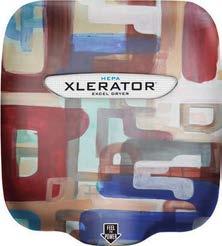
Excel Dryer recently collaborated with the teen artists at Artists For Humanity to create custom covers for XLERATOR® Hand Dryers and XChanger® Combo Kits. AFH provides teens with opportunities to work on paid art and design projects while they prepare for college and their careers.
Much like the talented individuals at AFH, we can’t wait to see what amazing things architecture and design students in the Metropolis Future100 will go on to create. Congratulations on this major accomplishment. Join us for an event celebrating our partnership with Artists For Humanity at their state-of-the-art headquarters in Boston.
JUNE 27 5:30 - 8PM EDT

TIME
SCAN QR CODE TO RESERVE YOUR SPOT TODAY
877.784.3369 EXCELDRYER.COM SALES@EXCELDRYER.COM
TO THROW IN THE TOWEL®

environmental impacts of design decisions. But they also belie the messy nature of attempting to manage living systems. For the tech campus in San Bruno, for instance, CMG needed to fit 500 trees into three acres to hit its carbon sequestration targets. The landscape architects devised a mechanically successional planting strategy in which trees are planted more densely than is typical, with faster-growing trees providing a burst of carbon sequestration early on, then harvested to make room for the slower-growing oaks and buckeyes.
“The strategy is a good one if we can get the maintenance to work,” Belcher says. “We need to remove the trees and keep them whole so that we don’t just release the carbon.” And yet design teams have little control over site maintenance, much less what it looks like in 30 years: Will the same tech company own the property in 2050? Will the company even exist?
The drive toward quantifying landscape performance can also overshadow other critical considerations, like immediate
environmental justice concerns or communities’ cultural associations with a site. Ross Altheimer and Maura Rockcastle, the founders of Minneapolis-based landscape architecture studio TEN x TEN, say they’re excited by the potential of carbon calculators and hope to integrate them into their practice. But they also see a need to place the question of decarbonization within larger issues of governance, power, and justice. “How does [decarbonization] intersect with what communities actually need, and is this supporting larger conversations about justice and equity?” Altheimer asks.
Rockcastle points to TEN x TEN’s work at Minneapolis’s Fort Snelling, a historic 19th-century fort at the confluence of the Minnesota and Mississippi Rivers. The designers worked with a council of Dakota elders to reclaim as much of the site as possible for a restored native prairie made up of culturally significant plants. Native prairies happen to be remarkable carbon sinks, but Rockcastle says that any ecological functionality is “the outcome of a strategy that was
In its revitalization of Historic Fort Snelling at Bdote, landscape studio TEN x TEN created Wokiksuye (Place of Remembrance), a circular memorial space surrounded by healing and protector plants such as red-twig dogwood, sweetgrass, white sage, echinacea, and white cedars. This is the site where two chiefs, Medicine Bottle and Shakpedan, were executed in the aftermath of the U.S.–Dakota War.
about honoring the ground and honoring community and rebuilding relationships between the Dakota people and the land.”
It’s all but certain that the adoption of carbon calculators will shift behavior and gradually reshape the look and feel of outdoor spaces. This will be particularly true if more and more cities begin to regulate the embodied carbon of public projects, as Toronto recently did for city-owned buildings. Civic spaces, like parks and plazas, are probably next, Conrad says, which is an opportunity for designers to challenge their conception of what urban landscapes are—and what they’re for.
“Anytime a project comes up and somebody says, ‘We want a plaza,’ we need to ask the question ‘Why do you need a plaza? Can it actually be a forest in the city? Can it be a park?’ ” Conrad says. “I think there’s a really interesting juxtaposition that’s possible when you start thinking about how cities need to evolve in that way—to think about what’s actually best for the city? What’s best for the planet?” M
COURTESY BRANDON STENGEL / FARM KID STUDIOS
CALCULATORS, SOFTWARE, AND PLUG-INS | EMBODIED CARBON | OUTDOOR AND PUBLIC SPACE METROPOLIS 46




SUMMER 2024 47

Sustainability Is the New Luxury
Conscious choices can lead to peace of mind, and there is so much beauty to be found in regenerative materials.
By Laurence Carr
THE EARTH’S SYSTEMS AND PROCESSES have been irreversibly influenced by human activity, and the consequences are being felt across the globe. Societies must learn to rethink their current way of operating and strive to live within the planetary boundaries to maintain a safe space for humanity.
Architects and interior designers in particular face a crucial task: reconciling human wellness with environmental preservation while maintaining a commitment to beauty and delight in the built environment.
One prevalent misconception is that sustainability compromises beauty and luxury. However, our experience reveals the opposite: Sustainable materials and practices often yield exquisite and healthful design solutions. Innovations in biomaterials and fabrication processes offer boundless possibilities for sustainable luxury.
Too often luxury is associated with excess. Luxury without a conscience is finally being replaced with conscious consumerism in the collective economy, but it’s been a core value of my personal and professional practices for years now. I have always led from the link between sustainability and wellness, because when we live in alignment with our values, we experience more authenticity and comfort in ourselves and our surroundings. Conscious consumerism offers peace of mind. When there is an alignment of values, luxurious experiences are not to be underestimated.
COURTESY KELLY MARSHALL
HEALTHY MATERIALS | REGENERATIVE DESIGN METROPOLIS 48 SUMMER 2024
The furniture and materials in Laurence Carr's own New Jersey home were selected to be healthy and sustainable, including zero-VOC Benjamin Moore Aura paint and Roche Bobois Mah Jong sofas.


MASTERPIECE? NO, MARKERBOARD! Introducing our exclusive Elite Reveal markerboard.You won’t believe your eyes. And ASI offers the most comprehensive selection of high-end your Visual Display Products on the market. Visit asi-visualdisplayproducts.com to explore the new standard for basis of design in markerboards.
In Carr's home, smart-home technologies and water-saving fixtures keep energy and water consumption low.

That’s why I launched Studio Laurence, where luxury transcends mere opulence and marries sustainability with aesthetic appeal. Our mantra, “Beauty from the Inside Out,” underscores the intrinsic connection between sustainability and wellness. I’m thrilled to see similar ethos being adopted by other luxury brands as well. The more we normalize these new standards, the more readily we professionals (and our clients) can adopt them.
To prioritize these principles, designing for longevity is paramount. Timeless styles, durable materials, and multifunctional pieces
not only minimize waste but also ensure that residential spaces evolve gracefully with their inhabitants. As we go through different seasons, facilitating a longer life cycle for each item we select for our interiors is crucial.
Mat erial consciousness is also key. Opt for healthy selections such as renewable, recycled, or upcycled materials when possible, and choose natural fibers like organic cotton, hemp, or bamboo for textiles whenever possible.
The paradigm shift toward regenerative living signals a profound transformation in the industry. It's not merely about reducing
our environmental footprint; it's about actively restoring and enhancing the ecosystems we inhabit and living in harmony with nature. Architects and designers hold the power to shape a future where sustainability is synonymous with luxury. This practice honors the planet and enriches the human experience. Together we can redefine beautiful living for a more sustainable world.
Sustainability is the new luxury. M
COURTESY KELLY MARSHALL
HEALTHY MATERIALS | REGENERATIVE DESIGN
Laurence Carr is the founder and CEO of Laurence Carr Inc., a regenerative, multifaceted interior design firm, and the founder of Studio Laurence, a sustainable luxury home goods brand that specializes in zero-waste product design.
METROPOLIS 50 SUMMER 2024
form + function + feel good


Whether the design calls for learning, healing, hipness or happiness, REGUPOL recycled rubber flooring offers performance, sustainability and uncompromising aesthetics. Letting you LEED - everywhere you go.


800.537.8737 REGUPOL.US/MET
This First-of-Its-Kind Paint Promotes Wellness
By Joseph P. Sgambati III

ALKEMIS PAINT PROVES that pigment is the next frontier in conquering safe and sustainable formulations for responsible interior spaces. A proprietary amalgam containing a clear quartz base, artist-quality crystalline pigments, and earthen raw materials has earned the women-owned small business a Cradle to Cradle Certified designation for its architectural wellness paint—the world’s first, circa 2023.
Helmed by Wall Street veteran Maya Crowne and entrepreneur Price Latimer, the young company concocted a core collection comprising 119 unique colors in a velvet-matte finish, as well as an interior mineral primer, using renewable potassium silicate while eschewing synthetic and toxic elements, hazardous organic pollutants (HAPs), plasticizers, preservatives, biocides, and alkylphenol ethoxylates (APEs). Not to mention, its U.S.-based manufacturing process is 100 percent emission-free, and its steel paint cans are recyclable in perpetuity. Also noteworthy is the product’s inclusion in Parsons Healthy Materials Lab’s Healthier Building Products Collection for interior paints.
Crowne and Latimer seek to synthesize typically superficial specifications with technical acuity. When compared with synthetics, the inclusion of organic matter in the wellness pigment results in improved interior air quality, neutralizes what would otherwise be an unpleasant, nay potentially hazardous odor, and promises to lift mood thanks to neuroaesthetics underpinning the natural color compositions. Its antistatic properties make it not only easy to maintain but cleanable without succumbing to burnish. The robust, UV-stable formula also boasts water repellency and durability. M
COURTESY ALKEMIS PAINT
HEALTHY MATERIALS METROPOLIS 52 SUMMER 2024
Alkemis Paint provided wall color (Quetzal (92) shown here) for R & Company's The Gilded Ghetto, artist Roberto Lugo’s first New York solo exhibition, on view last fall.


Register at icff.com NORTH AMERICA’S SINGULAR PLATFORM FOR INTERNATIONAL DESIGN.
JAVITS CENTER NYC
MAY 19-21 2024
METROPOLIS READERS: YOUR PASS IS COMPLIMENTARY WITH PROMO CODE: DAPMMETROPOLIS
Passive House Design Makes This Brooklyn Townhouse More Livable
The certification standard helped Ingui Architecture upgrade the quality of a historic home, opening the door to a host of other benefits.
By Sam Lubell
MUCH OF THE WORK NEEDED to achieve Passive House standards is invisible. And that’s a benefit. The technical work remains in the background, creating seamless architecture that is not just energy efficient but filled with light, fresh air, and healthy living. This phenomenon is exemplified by Ingui Architecture’s townhouse in Brooklyn, New York, for Chad Dickerson, executive coach and former Etsy CEO, and his family. The four-story, historic brick house
appeared healthy when seen from the street but required substantial alterations within. Air and water leaked, floors were out of level, cracks emerged, energy costs were high, and winter freezing was making it much worse. The architects’ response was intensive, although its manifestations were subtle.
“I don’t even think about the fact that we live in a passive house until we get our energy bill every month and I feel good,” jokes Dickerson.

COURTESY ADAM KANE MACCHIA
AIR QUALITY | NET ZERO AND NET POSITIVE | RESPONSIBLE RENOVATIONS METROPOLIS 54 SUMMER 2024
A Meshmatics chandelier from Moooi anchors the living room of this renovated and updated Brooklyn townhouse.
solid surface sinktop in matte white with ADA-compliant vanity in azure mirror wth brushed brass frame electronic trio: soap dispenser, faucet, and hand-dryer in matte black

&5($7,1*�%($87,)8/�%$7+52206
0$'(�,1�7+(�86$

&86720�352-(&76�:(/&20( /$&$9$ �FRP
KUBITOP METALLO ZOOM

Ingui Architecture and its team of contractors and consultants removed the entire roof, repaired it, and re-insulated it with exterior rigid foam boards with inboard dense-pack cellulose. Now the only evidence of this intervention is large skylights, which flood the house—particularly its curving, open central stairway—with natural light. “It’s subtle, low-key stuff, but it makes such a huge difference,” notes Michael Ingui, president at Ingui Architecture.
For the residence’s walls, the team rebuilt and sealed crumbling brick masonry, installed triple-pane windows, inserted dense-pack cellulose and mineral wool insulation, and eliminated thermal bridges by holding jambs off the wall and replacing galvanized steel tiebacks with wooden joists. The team installed a multistory addition in back and lowered
the cellar’s concrete slab three feet, insulating it with rigid foam.
As a result, the home has a quiet, serene feel, accentuated by subtle changes like larger thresholds, freer-flowing plans, and sizable windows. With its tight, efficient envelope and rooftop solar panels, it has achieved Passive House certification. And its excellent energy performance, says Ingui, opened the door for more ambitious changes. “Once you see that you don’t need that much heat, you realize you don’t need a boiler. The next question becomes, am I okay with an induction stovetop? Or can I get enough hot water for my family with a heat-pump hot-water heater?” He sums up: “Once you’ve built the better box you can do a lot of new things.”
Dickerson, who says his family uses the heat only for about five or six hours each winter (the steady temperatures help
COURTESY ADAM KANE MACCHIA AIR QUALITY | NET ZERO AND NET POSITIVE | RESPONSIBLE RENOVATIONS
A multistory addition at the back of the home created the space for a secondary kitchen in the family area and access to the backyard. The home is all-electric, so the oven here and the range in the primary kitchen from Fisher Paykel don’t run on gas.
METROPOLIS 56 SUMMER 2024


Jun 5–8 conferenceonarchitecture.com Join us in Washington, D.C. at the premier AEC industry event to explore what it means to design a better world now, together. AIA Conference on Architecture & Design 2024
Two Rivers Public Charter School, Washington, D.C.
Architect: Studio Twenty Seven Architecture
Photo credit: Hoachlander Davis Photography

This super-sustainable home has some delightful secrets—like this bookcase that is actually an entryway into the bar and entertainment space in the cellar.

COURTESY ADAM KANE MACCHIA AIR QUALITY | NET ZERO AND NET POSITIVE | RESPONSIBLE RENOVATIONS
METROPOLIS 58 SUMMER 2024


Interior Designers Need to Address Carbon Emissions
Interior renovations are a significant contributor to the embodied carbon emissions of any building. As new policies for embodied carbon reporting go into effect, your clients will need your help to comply and meet their climate commitments!
Creative Strategies for Low-Carbon Spaces
The Climate Toolkit for Interior Design is a living resource to aid interior designers in incorporating decarbonization into their practice.

EXPLORE
his several guitars stay in tune, he adds), eventually opted to go all-electric, including an induction range, an electric ERV filtering system, a heat-pump water heater and dryer, and a VRF HVAC system. He also committed to reusing joists and employing low-VOC materials and mostly water-based paints. Dickerson is especially pleased with the home’s contribution to his family’s health and well-being. They seem to get sick less, he notes, and when smoke from Canadian wildfires blanketed the city in the summer of 2023, the interiors registered virtually no change.
“It blows my mind just how good the air is in the house all the time,” says Dickerson, who calls himself a “numbers guy” and likes to check the data on air quality and energy savings regularly.
The one exception to the home’s seamless, subtle changes is the cellar, which is now a kind of speakeasy music venue, accessed from above via a swinging bookcase. It has a moody, intimate vibe, with dark-gray walls, a timber bar, accent lighting, exposed brick and wood surfaces, and musical instruments collected in an informal stage performance area.
Ingui, whose firm has worked on several passive house projects, founded the Passive House Accelerator, a platform for sharing ideas in Passive House design and construction. He says his “secret sauce” is close collaboration with clients, and in this case his team met with Dickerson every week. “No matter how well we draw these, we are always tweaking things,” he says. “As long as the client is on board, we can pull it off.”
For Dickerson, choosing a passive house was easy once he learned more about the program. Because he already had to perform a gut renovation, the difference between passive and conventional in terms of cost and time was negligible. But the difference in quality of life has been exponential. “Once we committed to Passive House it didn’t affect our lifestyle at all except in a positive way,” he says. M

Ingui Architecture was able to maximize the daylight throughout the home through generous windows and other openings, both within the original structure and in this addition at the back of the home (left). The rooftop photovoltaic panel (below) is another way that the home relies on the sun for both its efficiency and comfort—it provides most of the home’s energy.

COURTESY ADAM KANE MACCHIA AIR QUALITY | NET ZERO AND NET POSITIVE | RESPONSIBLE RENOVATIONS
See page 142 for product sources and project credits
METROPOLIS 60 SUMMER 2024
Congratulations to the top 100 architecture and design graduates of 2024! Your talent and creativity are recognized. We look forward to your contributions to the industry.
WHITNEY WELCH | VICE PRESIDENT COMMERCIAL SALES, DALTILE CORPORATION
Congratulations to the outstanding Future 100 winners! Your innovative spirit and dedication inspire us all. Thank you for your remarkable contributions to shaping a brighter tomorrow. The Formica® Team celebrates your success and looks forward to witnessing your continued impact on the world.
AMY GATH | VICE PRESIDENT OF MARKETING AND STRATEGY, FORMICA
Keilhauer is honored to be a three-time sponsor of this wonderful program. Congratulations, Future100 Class of 2024, we can’t wait to see where your careers take you!
MEGHAN SHERWIN | PRESIDENT, KEILHAUER
Sherwin-Williams is proud to support future interior designers as they continue to showcase the power of design through their work.
SUE WADDEN | DIRECTOR OF COLOR MARKETING, SHERWIN-WILLIAMS
In partnership with We can’t wait to see what the future holds for the Future100 Class of 2024!


swcolorforecast.com
Featuring Colors from Sherwin-Williams Colormix® 2024 Anthology: Volume One
DESIGNTEX
DIGITAL STUDIO
It’s time for just-in-time custom textiles! Digital Studio connects designer and factory through an online app with the tools of mass production to create something unique and artful. Digital design and production at Designtex’s Portland, Maine, facility equals no need for inventory, lowering everyone’s carbon footprint. Samples in five days, products in 14, with a ten-yard minimum. designtex.com
These Products Can Shape-Shift to Fit Your Project
Through a huge variety of color and finish options, customization possibilities, or modular design, these solutions can adapt to both immediate and future needs.
By Kenn Busch, Material Intelligence
THE FABRIC OF REALITY is woven with the threads of change. Adapting to the constantly evolving expectations placed on workspaces and gathering places is a challenge that’s here to stay. Technology waits for no one, so designers are tasked with creating environments flexible enough to keep up without further fraying human connection. On-demand designs are one radical new response—Designtex’s Digital Studio, for example, allows anyone to select patterns, scale, and color for upholstery, wallcoverings, or multiuse textiles, see samples within five days, and have their custom product in two weeks. But even with the more conventional solutions, the possibilities and speed that manufacturers offer today is mind-boggling. With apologies to David Byrne, the future of interior design is…the same as it never was.

COURTESY THE MANUFACTURERS
METROPOLIS 62

B+N GIRA
B+N asked CEOs, HR leaders, facilities managers, and employees at a host of companies what makes them the happiest and most productive, whether they work hybrid or in the office. Answer: Gira. Drawing from 30 years’ experience designing solutions for everything from retail to hotels to offices, Gira’s intelligent modularity allows you to create spaces that spark creative collaboration while honoring individual work styles. bnind.com

CAMBIO
MAGNETIC WALL PANELS
Magnets hold these panels to a lightweight rail system that lets you easily rotate, move, and interchange them at will, no tools required. They’re adaptable to combine various sizes and materials to meet evolving design and functional demands because they can be switched out at will, at any time. Once installed, Cambio is a zero-waste product, the company says. cambio.design

SCHIAVELLO
CLIMATE WORKSTATION
Designed with the ideal of complete workspace flexibility, Climate enables organizations, teams, and individuals to shape and reshape their work environment to suit changing needs. Housing electronics, shelving, and panels in a channel program independent of the worktable, Climate is a unique workplace platform that evolves with businesses. schiavello.com
HEALTHY MATERIALS | RESPONSIBLE RENOVATION
SUMMER 2024 63
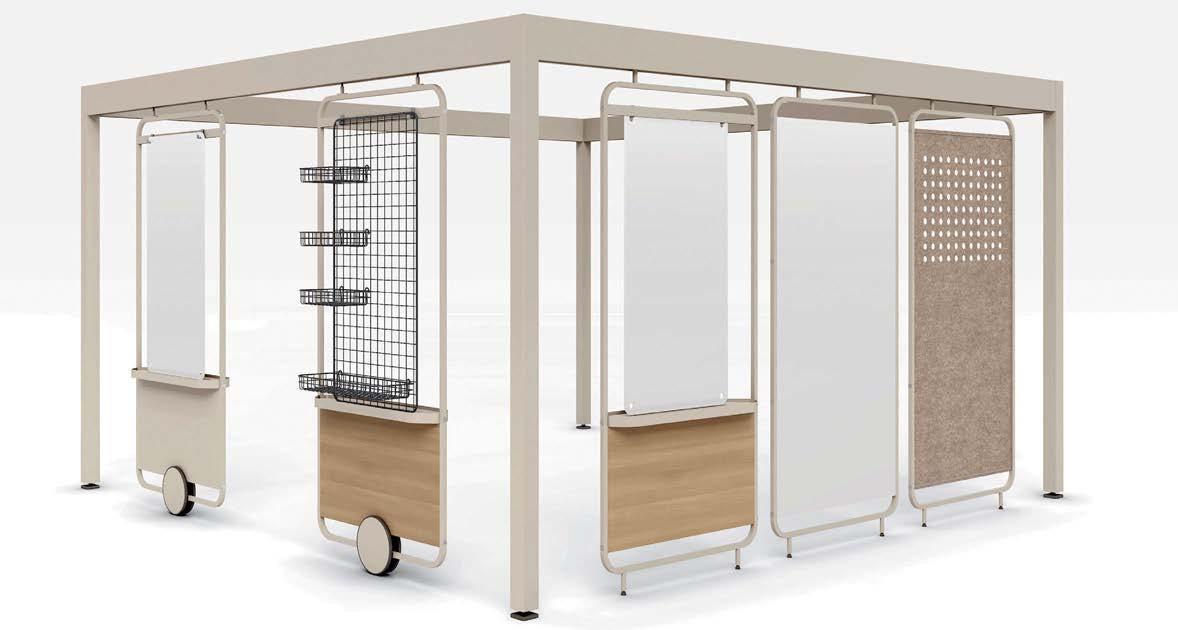
OKAMURA CORPORATION
LIVES POST + BEAM
Even loosely defined spaces within spaces can inspire creativity, focus, and collaboration. Okamura’s Lives Post + Beam concept makes it easy to create enclaves for brainstorming, workshopping, coffee, and even space to chill. Form your function with movable and fixed panels for whiteboards and monitors, 20 frame color options, and more. okamura.com


UNIKA VAEV
ARTISAN ACOUSTIC WALLCOVERING
Artisan Acoustic Wallcovering integrates Ecoustic Panel multilayered products in a new and unique way, allowing clients to choose from a large selection of well-known Wilsonart digitally printed patterns and Instyle’s On Country collection designed by Amanda Hinkelmann. Clients may also provide their own images, graphics, or logos to fully customize projects. unikavaev.com
COURTESY THE MANUFACTURERS HEALTHY MATERIALS | RESPONSIBLE RENOVATION
METROPOLIS 64

PATCRAFT
MATERIAL EDIT
Exploring design through rediscovery and connection, the hugely versatile and easy-to-adapt Material Edit collection is the product of two design minds: Amanda Hopkins and Erin Helm. Hopkins designed the commercial carpet tile collection, Helm the LVT, both inspired by reconnecting with artistic techniques from their past work, and access to Patcraft’s Maker Space. patcraft.com

FLOS
MY CIRCUIT
Add drama and dimension to your projects with this revolutionary flexible track lighting system designed by Michael Anastassiades. My Circuit offers both diffused ambient and sophisticated accent lighting using a rich portfolio of luminaire designs, ranging from discreet to eye-catching. Extreme simplicity, playful modularity, and Bluetooth control add to its appeal. flos.com
SUMMER 2024 65

5 Architectural Products for Higher Education Projects
From mass timber to twisted sunshades, these new materials are positioned to be rst choices on university campuses.
By Francisco Brown

FACING A GROWING STUDENT population, universities in the United States just keep expanding, with more and more campuses opening across the country and buildings populating existing college towns. With such growth, environmental impact and resourcefulness have become key concerns for educational facilities, and schools are now leveraging sustainable design principles to minimize their ecological footprints. From energy-efficient mechanical and lighting systems to solar-savvy construction materials, the following products are designed to lower a building’s overall carbon emissions, and new campuses opening up have an opportunity to integrate these innovative solutions from the ground up. M

COURTESY THE MANUFACTURERS
02 01 METROPOLIS 66


01 SKYLINE DESIGN
SDX3 SMARTVIEW FILM-FREE SWITCHABLE GLASS
This new film-free switchable glass design utilizes liquid crystal technology applied directly to glass, getting rid of the usual 7 to 11 percent visual haze that is typical of smart glass products. SDX3 also consumes less energy than a 25-watt light bulb per panel, making it ideal for multiuse labs and classrooms. skydesign.com
02 KINGSPAN DESIGNWALL 2000 PANELS
Designwall 2000 panels are made to encase buildings in a thermally efficient, weatherproof skin with R-values of up to seven per inch. The system is designed for quick installation and highly compacted staging spaces, and the panels can be oriented horizontally and vertically for windows and door allocation with four different finishes. kingspan.com
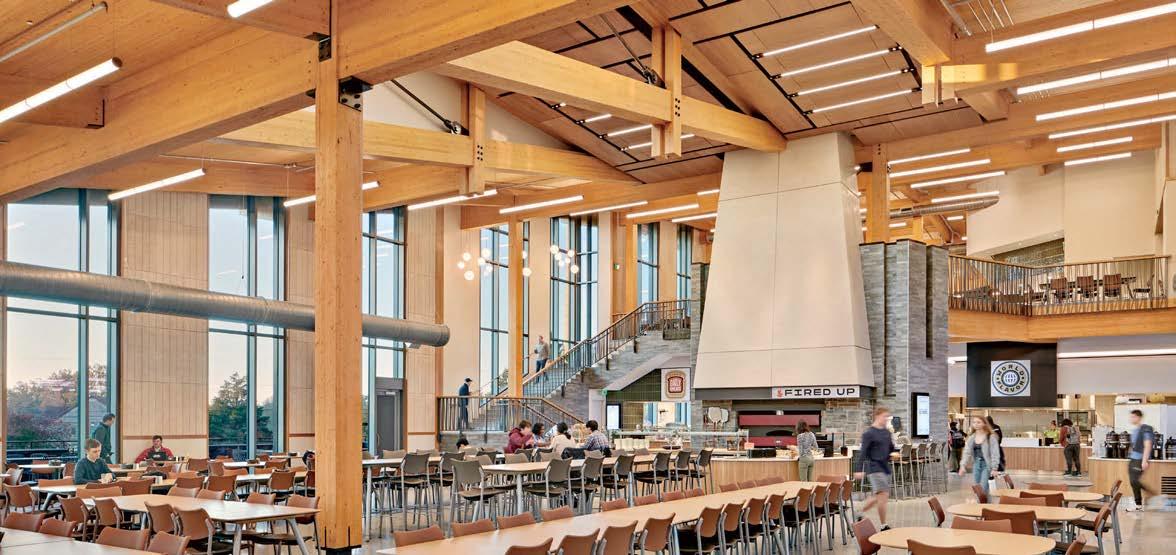
03 MID-ATLANTIC TIMBERFRAMES
MASS TIMBER
Mid-Atlantic Timberframes recently completed a new structural solution for the Dining and Community Commons building at Pennsylvania’s Swarthmore College. Designed by DLR Group, and constructed out of mass timber, the roof has a sweeping curvature achieved with laminated deck boards that reach as long as 32 feet. matfllc.com
04 KALWALL SKYLIGHTS
Kalwall's translucent skylights optimize the performance of traditional glass skylights by diffusing light deep into spaces without glare. In addition, the skylights reduce solar heat gain while maximizing thermal performance, and are rugged enough to handle extreme weather for university atria and learning spaces. kalwall.com
05 CONSTRUCTION SPECIALTIES TWISTED SUNSHADES
Construction Specialties’ new sunshade system reduces glare and allows filtered light to create ambience within the building. The sunshades, which come in two sizes, also minimize solar heat gain, meaning lower energy costs for university buildings to meet increasingly demanding energysaving standards. The fixed facade barrier also enhances the overall safety and security of the building. c-sgroup.com
03 05 04 CONSTRUCTION MATERIALS | HEALTHY MATERIALS | NET ZERO AND NET POSITIVE SUMMER 2024 67
Designed for Research and Built to Perform
How Northeastern University is fostering exploration through insightful design
By James McCown
NORTHEASTERN UNIVERSITY IN BOSTON is an institution in a hurry. Decades ago, it was dismissed as a commuter school. However, over the past couple of decades its reputation has risen, and it is now ranked as a top-tier research school by the Carnegie Classification of Institutions of Higher Education. According to U.S. News & World Report, it admits a paltry 7 percent of the people who apply. Under the aggressive leadership of President Joseph E. Aoun, a Lebanese-born scholar in linguistics, the school is using architecture to advance its standing, especially in engineering, relative to local competition like Massachusetts Institute of Technology and Boston University. Nowhere is this more evident than in a new 600,000-square-foot, two-building engineering and science complex designed by Payette.
“With these two buildings Northeastern wants to announce its presence as a major research university,” says Kevin Sullivan, who oversaw the design of the buildings and also serves as Payette’s president and CEO. The district’s first phase was the Interdisciplinary Science and Engineering Complex (ISEC), which opened to great acclaim in 2017, winning the Boston Society for Architecture’s coveted Harleston Parker Medal. EXP, a 350,000-square-foot building that completes the ensemble, opened in fall 2023.

COURTESY WARREN JAGGER PHOTOGRAPHY
METROPOLIS 68

EXP is located in Boston’s Roxbury and Fenway neighborhoods, right across from Payette’s Interdisciplinary Science and Engineering Complex, which opened in 2017.
NET ZERO AND NET POSITIVE | EMBODIED CARBON SUMMER 2024 69

EXP is not a shy building. It has curved massing and striking facades of horizontal stainless-steel bands. “The stainless steel reflects light and color,” says Sullivan’s colleague Wesley Schwartz, who led the design of the building’s envelope. Its come-hither look has had an impact—President Aoun liked the building so much he moved his office there.
The lower levels are mostly what Sullivan calls “makerspaces”— teaching labs for studying robotics, drones, and other kinds of industrial design. “Aoun was keen on having ‘science on display,’ that is, glass partitions that give a sense of the activity taking place within,” Sullivan says. Details, both cheeky and practical, abound. If you look closely at the terrazzo flooring, there are nails, bolts, and
screws embedded in the mix. A central stairway seems to float weightlessly, its hanger rods fully visible. Virtually all wall space is whiteboard, which can be commandeered for spontaneous classes and other student/faculty interactions.
The upper reaches of EXP are more luxurious and formal. The highest floor is reserved for the president’s office and the faculty dining room. Both look out onto a green roof terrace, open to all, with extensive plantings and views of the Boston skyline in multiple directions.
The building had an aggressive sustainability agenda and is designated LEED Platinum. The horizontal stainless-steel shading helped achieve a 78 percent decrease in energy use compared
COURTESY WARREN JAGGER PHOTOGRAPHY NET ZERO AND NET POSITIVE | EMBODIED CARBON
METROPOLIS 70

The interiors were designed to be highly versatile so that any of the labs can be converted from a dry lab to a wet lab to a computational lab as needed.

SUMMER 2024 71

COURTESY WARREN JAGGER PHOTOGRAPHY NET ZERO AND NET POSITIVE | EMBODIED CARBON METROPOLIS 72
with the baseline Architecture 2030 Challenge, Sullivan and Schwartz explain. This “solar veil,” they continue, affords a 78 percent reduction in solar heat gain and a 62 percent reduction in cumulative solar radiation. Furthermore, the use of stainless steel led to an embodied carbon reduction of almost one million tons as opposed to the use of aluminum.
EXP and ISEC form a powerful connective urban precinct bestriding the border between Boston’s Fenway district and its Roxbury neighborhood. A bridge connects to Northeastern’s main campus and spans various local and Amtrak rail lines. The bridge, designed by Payette, is composed of large sheets of thick Cor-Ten steel arrayed in a playful pattern, interspersed with glass panes to allow peeks at the activity below. The firm worked with landscape architect Stephen Stimson Associates to craft the space between the buildings. Peppered with trees and benches, it fronts on Columbus Avenue.
“It’s the setting for major announcements and gatherings for the university,” Sullivan concludes. “It’s not a sequestered campus quadrangle but resolutely a part of the city. That was very intentional and a directive from the boss.” M
See page 142 for product sources and project credits
 The recently constructed Pedestrian Crossing establishes a physical connection between the EXP building and the broader Boston campus.
SUMMER 2024 73
OMA Designs for Circular Cooking
For its design of a dining hub in an upmarket part of Singapore, OMA focused on circular flows of food, people, and materials.
By Akiva Blander

IT CAN SOMETIMES FEEL as if going out for food or drinks is the easiest route to a place’s local history and built legacy. In Singapore’s Dempsey Hill, the recent repurposing of a nondescript Modernist building as a food-centered “circular campus” has allowed visitors to glimpse more than a few local vignettes—depending on how hard they look.
Dempsey Hill, a grassy knoll northwest of Singapore’s downtown core, was originally developed as an army barracks
in the 19th-century British colonial era. In 1971, in the postindependence period, the young city-state added a humble, twostory rectilinear volume whose flat white roof set it apart from the complex’s pitched red roofs. Catering less to military needs and more to a rapidly growing multicultural society in search of a new national identity, the Modernist building contained the Dempsey Clubhouse, where state civil service workers could socialize and play sports.
COURTESY KRIS PROVOOST
METROPOLIS 74
Located on Dempsey Hill near downtown Singapore, the OMA-designed AIR Circular Campus and Cooking Club is a restaurant and dining destination (owned by low-waste hospitality brand Potato Head) that centers conversations on circularity, food, and the environment. The 40,000-square-foot campus consists of a renovated 1970s Modernist building surrounded by green lawns, edible gardens, and outdoor event spaces.


AIR’s architecture sits within a lineage of regional Modernist structures whose aesthetically incongruous elements were actually quite climate dependent: The hunkered-down volume hides within the shade of the tree canopy, and ribbon windows and operable
facades maximize the cooling of a slow breeze. At the rear of the building, OMA installed a cylindrical steel frame to support new staircases that serve the building’s updated program of open kitchens, research spaces, a fermentation lab, and cooking-school rooms.
That use lasted just a few years, however, and in 1975 the clubhouse relocated. The building was only intermittently occupied, with extended spells of disuse, until Jakarta, Indonesia–born hospitality entrepreneur Ronald Akili and global architecture firm OMA decided to reimagine it. (OMA and Akili’s lifestyle brand, Potato Head, have nurtured a decadelong, ongoing collaboration, working on projects that advance a more conscious, contextual form of luxury.)
AIR Circular Campus and Cooking Club, as the 40,000-square-foot complex is called, gathers an array of food-centric functions in the matlike building—restaurant, open kitchen, open-air bar, cooking club, and fermentation lab—that looks out onto a well-tended lawn and small agricultural space with a compost shed. By uniting and making legible the intertwined processes of food production, consumption, and waste, AIR aims to educate visitors about how principles like circularity can help create what ends up on their dinner plates.
The project was, in essence, one of gentle refurbishment and reorientation, with a handful of small yet consequential design moves that serve to embed AIR within its surroundings—climatically, spatially, and even experientially. “The biggest architectural move we’ve done is to turn the front and the back around,” says David Gianotten, partner at OMA, who, with associate in charge Shinji Takagi, led the design. Now the building faces the neighborhood’s main thoroughfare, while in the rear OMA introduced an orange-framed, glassed-in staircase that connects the two levels and opens out toward Dempsey Hill.
ADAPTIVE REUSE | CIRCULARITY IN PRODUCTS
SUMMER 2024 75

COURTESY KRIS PROVOOST ADAPTIVE REUSE | CIRCULARITY IN PRODUCTS
METROPOLIS 76
The fixtures and furniture used inside the building were designed by Andreu Carulla using recycled timber and plastic bottles (HDPE) sourced from a former OMA art exhibition, adding another layer of circular thinking when it comes to materials.


AIR advocates for a “new approach to hospitality,” where luxury meets sustainability and where production and education are prioritized over consumption. Ronald Akili, cofounder of Potato Head, explains in a press release: “AIR is more than just a place to dine, it’s a platform for change. Whether through a delicious meal, cooking classes, farming or ongoing research, this food campus embodies a passion to create awareness and make an impact through the power of food.”
The intervention’s other parti was the creation of a winding 328-foot path that brings visitors from the downhill parking lot across the lawn to the building, offering an escalating approach. “It also cuts through the building,” Gianotten notes, where it links up with the back stairs, helping cohere AIR’s functions and create a relaxed seamlessness. Through decades of sporadic use and disuse, the building buckled under Singapore’s tropical climate—and its full glazing and a lack of air-conditioning exacerbated the problem, sealing humidity in and keeping fresh air out. “When we found it, the interior was completely deteriorated,” Gianotten recalls. Singapore allowed a full-scale demolition, but “that would have obviously been against the sustainability approach of Potato Head,” he added. So the design team decided to preserve most of the structural elements and just allow the space to be opened up a bit instead, to take advantage of what Gianotten calls “the preferred winds” of Dempsey Hill—among the breeziest in Singapore. The entire ground-floor dining area can be opened up, and the second floor, home to the cooking club and more formal dining area, has a balcony along the east elevation, with a full-length ribbon window that faces the lawn. While the rehabbed campus certainly reflects bits of Singapore’s and Dempsey Hill’s transformations from military outpost to upscale global destination, it also distills aspects of contemporary dining culture, where circularity, sustainability, and education are increasingly the watchwords. At AIR, after fresh ingredients are picked on-site, they may be prepared in the open kitchen, jarred up at the fermentation lab, used in a demo for the cooking club, or included in a basket for picnickers. “It’s related to bringing the conscious mind onto society,” Gianotten says, “but also allowing people to have a good time.” M
SUMMER 2024 77
Amsterdam-based studio Drift’s site-specific kinetic sculpture Meadow is inspired by how flowers open during the day and close at night. Advanced robotics create a field of blooms in perpetual motion, creating a meditative rhythm that encourages reflection about the world around us.

The Denver Art Museum Explores Nature’s Eternal Sway over
Architecture and Design
Biophilia: Nature Reimagined brings together 70 works that explore the relationship between nature and creativity.
By Adrian Madlener
Transcending passing fads, nature is one of the most potent sources of inspiration for architects and designers. Expanding on American biologist Edward O. Wilson’s theory that humans remain inextricably linked to nature regardless of their ongoing evolution, Biophilia: Nature Reimagined is a comprehensive survey exhibition presented at the Denver Art Museum (DAM) this summer. On view May 5 through August 11, the thematic show brings together 70 speculative and applicable works—everything from preparatory drawings, research videos, and material samples to finished pieces—by a roster of renowned contemporary talents including the Campana Brothers, gt2P, Iris van Herpen, Studio Gang, PELLE, and teamLab.
COURTESY ORIOL TARRIDAS
METROPOLIS 78

Jessica Rosenkrantz’s Nervous System light is created out of 3D-printed nylon that translates the cellular growth patterns of branching leaf veins and ruffling flower petals into complex computer algorithms. The resulting chandelier casts intricate shadows that envelop the user.
COURTESY NERVOUS SYSTEM ART AND CRAFT | BIOPHILIA
SUMMER 2024 79
“The concept of biophilia is especially relevant today due to the increasingly urban and digital world we live in and our consequent detachment from the natural world,” says Darrin Alfred, DAM curator of architecture and design. “As tragic as the COVID-19 pandemic was, it dramatically increased public awareness of the profound human need for nature and added a greater sense of urgency to connect our communities with nature.”
Colorado’s dramatically varied landscape and the museum’s extensive
decorative art and design collection serve as the perfect backdrop for this exhibit. The show is divided into three subsections addressing nature’s influence on patterns— even in a digital context—inherent processes, and its ability to define our emotional connections to place.
Presented in the “Natural Analogs” section, Nervous System’s Floraform Chandelier takes its shape through differential growth. On view under the “Natural Systems” banner, Studio Drift’s famous kinetic Meadow
sculpture evokes the budding of flowers. In the “Topophilia” section, Terrol Dew Johnson—a Tohono O’odham artist—teamed up with design studio Aranda\Lasch on Desert Paper. The project distills the rich material history of the Sonoran Desert as a manifestation of the links between land, resources, and Indigenous know-how. Overall, Biophilia: Nature Reimagined reveals the scope in which nature’s impact on the creative process is continually harnessed and reinterpreted. M

Tohono O'odham artist Terrol Dew Johnson crafts experimental baskets using the Sonoran Desert's natural materials. Rooted in millennia-old Indigenous heritage, the Tohono O'odham Nation embraces traditions, stories, and sustainable practices tied to this sacred land.
COURTESY PELLE ART AND CRAFT | BIOPHILIA
METROPOLIS 80
In the exhibition,
since

COURTESY VOLUME GALLERY
SUMMER 2024 81
PELLE, a Brooklyn-based design studio
2011, showcases the Nana Lure Chandelier (2021), crafted from painted cast cotton paper, patinated steel, and LEDs.
Each year, METROPOLIS sets out to designate the top graduating architecture and interior design students in the United States and Canada through its Future100 program, this year sponsored by Daltile, Formica, Interface, and Sherwin-Williams. The 100 students featured on the following pages represent some of the most extraordinary young designers from the class of 2024. Their portfolios are awash with beautiful spaces and buildings, but beyond their visual prowess they demonstrate a deep understanding of their responsibility to make an impact through design. With empathy and maturity, they address community, culture, inclusivity, and sustainability through detailed research, fresh methodologies, and innovative materiality—establishing their rising star status and proving their merit as they embark on their careers.

COURTESY WIN AUNG
METROPOLIS 82
THE URBAN ACTIVATOR Win Aung University of Southern California
SHIVA ABBASZADEH
City College of New York
Undergraduate Architecture
NOMINATOR: Marta Gutman, Dean of the Spitzer School of Architecture, City College of New York
“This very talented designer has developed an exceptional body of work during her time as a student. Shiva represents all that the Spitzer School has to offer the profession—she’s a Spitzer star.”
ZEINAB ALBUSHARIF
University of Nebraska–Lincoln
Undergraduate Interior Design
NOMINATOR: Lindsey Bahe, Interior Design Program Director, University of Nebraska–Lincoln
“Zeinab’s design superpower is her sensitivity and thoughtfulness. She has a clear passion and drive to approach design through the lens of place and culture—and has a particular global sensitivity that sets her work apart from her peers.”
HELIA AMINI
Marymount University Graduate Interior Design
NOMINATOR: Jessica Bonness, Assistant Professor, Marymount University
“Helia’s design concepts are rooted in superb technical knowledge and a strong research foundation. She is smart, diligent, and creative. Her work ethic, engagement, and potential are all truly impressive.”
WIN AUNG
University of Southern California Graduate Architecture
NOMINATOR: Alvin Huang, Associate Professor, Director of Graduate and Post-Professional Architecture, University of Southern California, School of Architecture
“Win is a truly unique and ambitious student who has displayed exemplary leadership and organizational skills. He is an analytical designer, adept at conceptual, visual, relational, and practical elements, and is also remarkably ambitious and forward-thinking.”
EMILY BIGELOW
Lawrence Technological University Graduate Architecture
NOMINATOR: Scott Shall, Associate Professor, College of Architecture and Design, Lawrence Technological University
“Emily has demonstrated an acute ability to wrestle with complex questions and offer grounded, creative, and well-considered responses. She is a diligent, committed, and hardworking person, capable of producing exceptional results in a very short period of time.”
SKYLAR BILLINGSLEY
Suffolk University
Undergraduate Interior Design
NOMINATOR: Anna Gitelman, Associate Professor of Interior Architecture, Suffolk University
“Skylar’s studio projects consistently stand out for their thorough research, unwavering commitment to ethical considerations, a wealth of iterative explorations, thoughtful spatial and volumetric organization, and meticulous drawings, renderings, analyses, and documentation.”
LARI BITTMAN
Marymount University
Graduate Interior Design
NOMINATOR: Doug Seidler, Director, School of Design + Art, and Professor, Interior Architecture + Design, Marymount University
“Lari has consistently demonstrated a remarkable combination of raw talent, technical ability, and perseverance. This is most evident in her ability to design across projects, from a playful fantastical world in Dragon Land Daycare to Clarity, a thoroughly planned and meticulously designed multiuse refuge community center.”
LYDIA BLUES
University of Cincinnati
Undergraduate Interior Design
NOMINATOR: Savanah Lee, Senior Interior Designer, AvroKO
“As a dedicated interior design student intern at AvroKO’s New York design studio, Lydia consistently contributed unique and creative solutions, speaking up as a valuable team member. Her exceptional 3D modeling skills, coupled with flexibility and a fast-learning aptitude, demonstrate her outstanding potential for future success in the field.”
BROOKE BOWER
The University of Texas at Austin Graduate Interior Design
NOMINATOR: Igor Siddiqui, Interior Design Program Director, Associate Professor of Architecture and Interior Design, and the Gene Edward Mikeska Endowed Chair, The University of Texas at Austin
“Brooke has the imagination of a visual artist and an embodied understanding of space one may expect from a classically trained dancer. She has developed a portfolio of projects reflective of an interior designer with an inspiring point of view poised to positively impact the built environment as well as the greater integrated whole.”
MOROCCO BRANTING
University of Washington Graduate Architecture
NOMINATOR: Richard Mohler, FAIA, NCARB, Professor and Chair, Department of Architecture, University of Washington
“Through woodworking in hand with architecture, I shape and enrich human environments, advocating for the significance design thinking has on the quality of our lives and the well-being of our environment,” writes Morocco.
KIRAH CAHILL (P. 92)
University of Pennsylvania Graduate Architecture
NOMINATOR: Andrew Saunders, Acting Chair of the Department of Architecture; Director of the Master of Architecture Professional Degree Program; Associate Professor of Architecture, Department of Architecture, Weitzman School of Design, University of Pennsylvania
Kirah’s work explores relationships— between the natural world and built environment, between materials, between technology and our cities—with imaginative and provocative proposals that demonstrate fresh methodologies and attention to detail.
JOHN CASARIA
University of Central Oklahoma
Undergraduate Interior Design
NOMINATOR: SeonMi Choi, Professor, Interior Design Program, School of Design, College of Fine Arts and Design, University of Central Oklahoma
“John is a very creative thinker, a hard worker, and one of the most talented interior design students. He has consistently produced high-quality work outcomes through solid research and in-depth problem-solving processes.”
ELISA CASTAÑEDA (P. 112)
Mississippi State University
Undergraduate Architecture
NOMINATOR: Karen Cordes Spence, Director and F. L. Crane Professor, School of Architecture, College of Architecture, Art and Design, Mississippi State University
“Elisa has approached her education in a way that allowed her to learn both design excellence and political agency. She does not shy away from the tough problems but prepares herself to engage in them. She is determined to be an agent of change.”
TIFFANY CHANG
Kent State University Undergraduate Interior Design
NOMINATOR: Britta Bielak, Assistant Professor, Kent State University, College of Architecture & Environmental Design
“Tiffany’s design work emerges from a robust intersection of complex conceptual narrative, thoughtful detailing and assembly, and exceptional sensitivity to user groups. Her parallel interests in human geography and architectural studies accentuate her use of empathy, historical and social narratives, and rigorous analysis in her design process.”
EMILY CHEN
British Columbia Institute of Technology Undergraduate Interior Design
NOMINATOR: Tiia Manson, Program Head, Bachelor of Interior Design, British Columbia Institute of Technology
“Emily ’s competencies include concept development, programming, space planning, modeling, and building code analysis. She is hardworking, diligent, and willing to go the extra distance on her projects.”
SUMMER 2024 83
SOOJEE CHOI
California College of the Arts
Undergraduate Interior Design
NOMINATOR: Margaux Schindler, Assistant Professor; Chair, Interior Design Program, California College of the Arts; Cofounder and Director, SIZL Studio
“Soojee continuously challenges herself to develop complex design solutions, exploring the possibilities of a project at multiple scales. She has the dedication, motivation, and passion to be a leader within the community.”
JI YONG (JACOB) CHUNG
The Cooper Union
Undergraduate Architecture
NOMINATOR: Hayley Eber, Acting Dean, The Irwin S. Chanin School of Architecture, The Cooper Union
“Ji Yong (Jacob) is an independent intellectual thinker with high levels of rigor and persistence. He has demonstrated immense growth in modeling, filmic, and representational skills, as well as the ability to craft and deliver an argument consistent with his analytical approach.”
JENNY COOK (P. 100)
Southern California Institute of Architecture Graduate Architecture
NOMINATOR: Elena Manferdini, Graduate Programs Chair, Southern California Institute of Architecture
Jenny’s portfolio is a playful and imaginative exploration of the relationship between medium and narrative. Her interest in the technology’s role in design is evident in proposals like SYN-Biotech World headquarters.
LIBBY COUTURE
Kansas State University
Graduate Architecture
NOMINATOR: Otto (Adulsak) Chanyakorn, Assistant Professor, Department of Architecture, College of Architecture, Planning and Design, Kansas State University
“Libby is one of the most gifted architectural students that I have met in the past decade as an educator. Her artistic creativity, design sensibility, prolific work ethic, and personality make her the most deserving of this honor and recognition.”
SYDNEY CRAWFORD
Kent State University
Undergraduate Interior Design
NOMINATOR: Tina Patel, Assistant Professor of Interior Design, Kent State University
“Sydney distinguished herself with her capacity to critically analyze design issues, effectively articulate design concepts, and sensibly comprehend the context and users’ needs. She approaches each design challenge with enthusiasm.”
MEISAM DADFARMAY
Pennsylvania State University Graduate Architecture
NOMINATOR: Rahman Azari, Associate Professor, Department of Architecture; Founding Director, RE2 Lab; Affiliate Member, Hamer Center for Community Design; Associate Professor, Department of Architectural Engineering; Affiliate Member, Stuckeman Center for Computation Design; Co-funded Faculty Member, Institute of Energy and the Environment (IEE), Pennsylvania State University
“Meisam’s design demonstrates a fusion of creativity, functionality, and performance. His projects reflect a keen understanding of spatial dynamics and transform concepts into tangible spaces that meet programmatical requirements and evoke a sense of inspiration.”
JIMMY DAY
Colorado State University
Undergraduate Interior Design
NOMINATOR: Jain Kwon, Professor, Colorado State University
“With a keen interest in health care and commercial design, Jimmy expresses his passion for creating environments as an opportunity to serve humanity and create ripples of change that positively impact the world.”
ADAM DEMIEN
Maryville University of St. Louis Undergraduate Interior Design
NOMINATOR: Darlene Davison, Interior Design Program Director (2007–2023) and Adjunct Professor, Maryville University of St. Louis
“I have been impressed with Adam’s aptitude for both abstract and technical concepts. He is a student with strong characteristics: a strong design sense, a strong work ethic, strong conceptual development, and research skills that produce strong project work.”
TORI DUNSTON
University of Nebraska–Lincoln Graduate Architecture
NOMINATOR: David Karle, Director of Architecture Program and Associate Professor, University of Nebraska–Lincoln
“Tori is seeking to intertwine her design education with her passion to impact her community significantly. Her yearlong design thesis work acts as a catalyst for change, positively acting to design and redevelop equitable urban spaces that honor diverse communities’ unique cultures and histories.”
CHRISTA E. GORMAN
Kansas State University Graduate Interior Design
NOMINATOR: Kendra Kirchmer, Assistant Professor, Kansas State University
“Christa is an intensely creative student who engages fully in an iterative and tangible design process, endeavoring to produce designs that are singularly responsive to each issue, focusing on creating thoughtful and complete solutions.”
ANGELIQUE ELIA
Florida International University Graduate Architecture
NOMINATOR: Mark Marine, Assistant Teaching Professor, Florida International University
“Angelique approaches learning with an intense attitude and appropriate level of dedication, allowing her to create and understand projects with a clear set of assumptions and a highly thought-out level of sophistication.”
ZAYNAB ELTAIB
Tulane University
Undergraduate Architecture
NOMINATOR: Adam Marcus, Associate Professor of Architecture, Tulane University School of Architecture
“Zaynab’s work is remarkable for its sophisticated blend of advanced representational techniques with a deep understanding of tectonics and materials. Her projects engage complex and contested sites with thoughtful and critical proposals.”
JACK LONDON FREEDMAN (P. 90)
Southern California Institute of Architecture Graduate Architecture
NOMINATOR: Elena Manferdini, Graduate Programs Chair at Southern California Institute of Architecture; Principal, Atelier Manferdini
“Jack has proved that he is able to excel in any academic environment, because of his determination, design skills, and intelligence. He is an intelligent, capable, and personable designer, and has demonstrated leadership and maturity uncommon for his young age.”
HALEY GIROUX
Rochester Institute of Technology Undergraduate Interior Design
NOMINATOR: Kelly Jahn, Adjunct Professor, Rochester Institute of Technology
“Haley has a spark and curiosity about her that is infectious. Her passion for design is evident in her work, her professional demeanor, and positive attitude. She approaches design challenges thoughtfully and holistically.”
SANJANA GOPALAKRISHNAN (P. 112)
The New School, Parsons School of Design Graduate Interior Design
NOMINATOR: Jennifer June, Adjunct Professor, Interior Design, School of Constructed Environments, Parsons School of Design
“Sanjana possesses a rare and admirable sensitivity towards playful design while remaining steadfastly committed to circular economies. Her enthusiasm and passion for creating innovative and purposeful spaces create an infectious energy, inspiring those around her to engage more deeply in the creative journey.”
HENRY HAMMES
Kansas State University Graduate Interior Design
NOMINATOR: Michelle Wempe, Professor of Practice, Kansas State University
“Henry is a talented, motivated student who is able to create carefully choreographed solutions that fit the needs elegantly and creatively. He delves deeply into the initial phases of project research and concept development as he strives to create designs uniquely responsive to each problem.”
METROPOLIS 84
MARTINA HANNA
New Jersey Institute of Technology
Undergraduate Interior Design
NOMINATOR: David Brothers, Senior University Lecturer, Interior Design Program Coordinator, School of Art + Design, Hillier College of Architecture and Design, New Jersey Institute of Technology
“Martina’s designs express an unmistakable joy and pleasure that can only come from a sincere love of the discipline and a commitment to the work that’s necessary to realize them. Her brave use of bold colors and dynamic patterns is not typically seen among students at her level.”
CAITLIN HERNDON
University of Kentucky
Undergraduate Interior Design
NOMINATOR: Patrick Lee Lucas, Professor, School of interiors, College of Design
“Caitlin dwells seamlessly between the two worlds of interior design and scene design. Her captivating graphics bring new dimensions to our understandings of elements and the spaces she shapes with them.”
NEGAR HOSSEINI (P. 112)
California College of the Arts Graduate Architecture
NOMINATOR: Negar Kalantar, Associate Professor, California College of the Arts
“One of Negar’s most noteworthy attributes is her passion for customizable designs. She has a deep-seated desire to create designs that empower users to make changes based on their comfort and personal preferences.”
KILE HOTCHKISS
New York School of Interior Design Graduate Interior Design
NOMINATOR: Hans Galutera, Professor, New York School of Interior Design
“Kile exemplifies great promise as an interior design professional, showcasing meticulous research and an insightful approach to design. His ability to integrate architectural details, coupled with a clever interpretation of history and research, sets him apart.”
MATT HUCKENPOEHLER
Pratt Institute Graduate Architecture
NOMINATOR: Alexandra Barker, Chair and Adjunct Associate Professor, Pratt Institute
“Matt is adept and versatile with techniques and technologies of representation and fabrication and has a confident yet open-minded and collaborative approach to working that is productive, inspiring, and inclusive to others in his class.”
OLIVIA HUFFER
University of Florida
Undergraduate Architecture
NOMINATOR: Judi Shade Monk, Instructional Assistant Professor, University of Florida
“Not only does Olivia exhibit an exceptional intuitive design intellect, she is willing to take risks. She works iteratively and beyond what is requested of her as she is constantly striving to better herself and her work.”
RITIKA IYER
Northeastern University Undergraduate Architecture
NOMINATOR: Lynn Burke, Senior Co-op Coordinator, Northeastern University
“Ritika’s ability to think critically and analytically is complemented by a keen aesthetic sense. Her design portfolio is a collection of academic and personal works, represented in a cohesive design style that emphasizes her love for color, whimsy, and imagination.”
PAVITRA JAIRAJ
University of Oregon Graduate Interior Design
NOMINATOR: Cory Olsen, Professor, University of Oregon
“In each of Pavitra’s projects there is a clear connection to the client and user experience, grounded in research and precedent as well as empathy. It is her grasp of human context that gives her work a welcome sensitivity across scales and environments.”
ROSHAN JOSE (P. 112)
Clemson University
Graduate Architecture
NOMINATOR: David Allison, Alumni Distinguished Professor and Director, Graduate Studies in Architecture + Health, Clemson University School of Architecture
“Roshan has consistently demonstrated a passion for the design of health-care environments and the role the built environment plays in impacting human health and well-being. He has an inquiring mind and seeks out opportunities to expand his knowledge and experience.”
RYAN JOSE
Cal Poly Pomona
Undergraduate Architecture
NOMINATOR: Anton Schneider, Principal, Schneider Luescher Architects; Lecturer, Department of Architecture, College of Environmental Design, California State Polytechnic University, Pomona
“Ryan’s talent is only matched by his relentless work ethic. His ability to express architectural ideas and thoughts through drawings, collages, models, and photography shows an exceptional level of maturity.”
CHIZUMI KANO (P. 106)
California College of the Arts
Undergraduate Architecture
NOMINATOR: Antje Steinmuller, Associate Professor and Chair, California College of the Arts
“All of Chizumi’s projects develop through a meticulously documented process of iteration and experimentation, culminating in renderings that depict human experience of light and space with exquisite care and attention to detail.”
YAU WAI LAM (P. 112)
University at Buffalo Graduate Architecture
NOMINATOR: Annette W. LeCuyer, Professor of Architecture, University at Buffalo, School of Architecture and Planning
“Yau Wai (Eddie) brings an important multicultural outlook to his work. He has established himself as a leader in our graduate program and is poised to make significant contributions to the profession.”
ANGELA LE
University of Nebraska–Lincoln Undergraduate Interior Design
NOMINATOR: Lindsey Bahe, Interior Design Program Director, University of Nebraska–Lincoln
“In each project, Angela demonstrates a sensitivity to design for people with diverse culture, needs, and values. Her design philosophy is ‘to use design as a tool to enhance everyday life through the little details, celebrate the human experience, and transform individuals, communities, and institutions alike.’”
PINGTING LI (P. 100)
UCLA Graduate Architecture
NOMINATOR: Yara Feghali, Lecturer, UCLA Architecture and Urban Design
“Pingting is a disciplined and refined architect and designer whose meticulous attention to detail and methodical approach consistently yield beautifully executed projects. Her dedication to creative ideas and unique approaches, combined with a joyful spirit, makes her an invaluable asset to any team.”
MCKENSIE LONG
University of Florida
Undergraduate Interior Design
NOMINATOR: Roberto Rengel, Professor and Chair, Interior Design Department, College of Design, Construction and Planning, University of Florida
“Mckensie’s designs are insightful and user-centric with sophisticated architectural forms, strategic use of lighting, careful attention to movement and sequence, and a creative use of architectural materials such as steel and concrete, juxtaposed with softer and textured interior finishes.”
VICTORIA LOPEZ
Louisiana State University
Undergraduate Architecture
NOMINATOR: So Jeong Jo, Assistant Professor, Louisiana State University
“During my classes, Victoria has demonstrated her competitive research and design skills. I would rate her amongst the top students of my classes and recommend her without reservation with the highest level of confidence.”
SUMMER 2024 85
MALIK LOVETTE
University of Oregon
Graduate Interior Design
NOMINATOR: Linda Zimmer, Associate Professor, College of Design, School of Architecture & Environment, University of Oregon
“Malik brings a combined background as a college athlete and artist to his design work. He is a fantastic graphic communicator and a natural collaborator. He is an all-around designer who examines spaces at multiple scales.”
DANIEL LUTZE (P. 100)
University of Pennsylvania Graduate Architecture
NOMINATOR: Andrew Saunders, Acting Chair, Department of Architecture; Director, Master of Architecture Professional Degree Program; Associate Professor of Architecture, University of Pennsylvania
Daniel’s work—from his high-density housing project Mercury to his interactive pavilion design for Nostalgia—demonstrates his passion for how physical, mental, and emotional experiences overlap in our surroundings.
JESUS MACIAS FRANCO
California College of the Arts
Undergraduate Architecture
NOMINATOR: Antje Steinmuller, Associate Professor and Chair, California College of the Arts
“Jesus (Guillermo) has developed a distinct creative voice—one that recognizes and translates community needs in times of urban transformation and climate change into playful, yet thoughtful spatial experiments.”
MADINA MASIMOVA
The New School, Parsons School of Design Graduate Interior Design
NOMINATOR: Michele Gorman, Director, MFA Interior Design Program; Assistant Professor of Interiors, Objects, and Technologies, The New School, Parsons School of Design
“From Azerbaijan, Madina brings a global perspective to interiors and technology and understands that the boundaries are fluid between our disciplines. She leads with optimism and joy on the future of design within the context of AI, design, and belonging.”
ADAPTIVE REUSE MIXED-USE HOUSING
Madolin Mast Rensselaer Polytechnic Institute

MADOLIN MAST
Rensselaer Polytechnic Institute
Undergraduate Architecture
NOMINATOR: Matthew J. Lopez, Lecturer, Rensselaer Polytechnic Institute
“Maddie is a dedicated and talented designer. She consistently delivers compelling work that is visually striking, technically precise, and conceptually sophisticated. She is a force within our program and will undoubtedly succeed as an architect.”
ANASTASIA MATZAKOS
The University of Texas at Austin Undergraduate Interior Design
NOMINATOR: Allison Gaskins, Assistant Professor of Practice, The University of Texas at Austin School of Architecture
“Ani approaches every design challenge with unparalleled rigor and poise. She possesses an innate curiosity, pushing the boundaries of surface, materials, and assemblies. She excels in blending the familiar with the unexpected to create innovative interior environments.”
VICTORIA MCMILLAN (P. 118)
Colorado State University
Undergraduate Interior Design
NOMINATOR: Dr. Jain Kwon, Assistant Professor of Interior Architecture and Design, Colorado State University; IDEC, ASID Educator
“In addition to the aesthetic and practical aspects, Victoria’s designs are appealing in storytelling throughout the spaces in varying scales. She gives great attention to the impact of environmental colors and visual and tactile materiality on the end-user experience.”
YUAN (ALICE) MENG
The Cooper Union
Undergraduate Architecture
NOMINATOR: Hayley Eber, Acting Dean, The Cooper Union
“Alice is extremely facile across all media necessary to navigate the design process. Her thesis project is engaged in urban markets across the globe, straddling the intersection of food ecologies, pedestrianization, and commerce, and demonstrating independent thinking with high levels of rigor and persistence.”
ASHLEY MILLARD
Virginia Polytechnic Institute and State University
Undergraduate Interior Design
NOMINATOR: Melahat Kucukarslan Emiroglu, Professor, Virginia Polytechnic Institute and State University
“Ashley’s portfolio represents a combination of talent, dedication, and a forwardthinking approach to interior design. Her work brings an infectious enthusiasm reflecting not only a precision and neatness beyond technical prowess, but also creating spaces that uplift the spirit.”
SIMON NEEDHAM
University of Cincinnati
Graduate Architecture
NOMINATOR: Edward Mitchell, Director, School of Architecture and Interior Design, DAAP, University of Cincinnati
“Simon combines a playful formal sensibility with close attention to detail and a high degree of resolution that has made his work among the most outstanding in the school. He has mastered several scales of work from memorable urban designs to inventive building types.”
COURTESY MADOLIN MAST
METROPOLIS 86
EVA NERI
Florida State University
Graduate Interior Design
NOMINATOR: Yelena McLane, Assistant Professor and Director of Graduate Studies, Florida State University
“Eva is a bright, free-spirited, and talented designer. She weaves a diverse array of research interests—including ambient sound, music, and video—into multilayered designs that focus on physical and emotional well-being.”
AXEL OLSON (P. 96)
University of Michigan Graduate Architecture
NOMINATOR: McLain Clutter, Architecture Program Chair and Associate Professor, University of Michigan, Taubman College of Architecture and Urban Planning
“Axel is a careful thinker and an extremely talented designer with an eye for detail and emerging design sensibilities. He is among the most talented designers in his class, and among a small handful of the most talented students I have had in my 14 years at the university.”
LACEY OXFORD
University of Arkansas
Undergraduate Interior Design
NOMINATOR: Michelle Boyoung Huh, Assistant Professor, University of Arkansas
“Throughout Lacey’s projects, she demonstrates a good understanding of diverse users and thoughtful design based on in-depth consideration of the impact of interior design on their lives.”
SOPHIE PACELKO (P. 92)
University of Michigan Graduate Architecture
NOMINATOR: McLain Clutter, Architecture Program Chair and Associate Professor, University of Michigan, Taubman College of Architecture and Urban Planning
“Sophie is thoughtful, inquisitive, and among the most talented students in her class. Her work is spatially and aesthetically exuberant, while addressing critical environmental and social issues that define our societal moment.”
RON PATANAVIN
California Polytechnic State University, San Luis Obispo
Undergraduate Architecture
NOMINATOR: Thomas Fowler IV, Director, Graduate Architecture Program, and Distinguished Professor of the ACSA, Cal Poly College of Architecture and Environmental Design
“Ron is a one-of-a-kind student, and he definitely ranks at the top 1 percent of students that I have had the pleasure of working with during my long teaching career. As his teacher, I was able to learn quite a bit from his diligent design process.”
ISABEL PROVISOR LEMERY
University of Arkansas
Undergraduate Interior Design
NOMINATOR: Marjan Miri, Assistant Professor, University of Arkansas, Fay Jones School of Architecture and Design
“Isabel consistently delivers excellence with a meticulous approach. Her passion for pushing design boundaries is evident in her innovative solutions. Her proficiency extends seamlessly between spatial and graphic design, showcasing a versatile skill set that sets her apart.”
KINAMEE RHODES
UCLA
Undergraduate Architecture
NOMINATOR: Simon Kim, Visiting Professor, UCLA Architecture and Urban Design
“Kinamee is a new generation of architect that presents a revitalized wilderness. For him, architecture is a receiver and container of a synthetic nature that upbraids classical notions of interior and exterior, and human occupation and nonhuman-centric organization.”
ANDREA RUBERO (P. 106)
Rice University
Undergraduate Architecture
NOMINATOR: Jesus Vasallo, Associate Professor, Rice School of Architecture
“Andi demonstrated talent, dedication, and capacity to work independently, ranking very high within a very competitive and diverse group of students. She not only showed great capabilities for design and representation but also displayed true potential as a team leader.”
DOMINIC SAMORAJ
University of Utah
Graduate Architecture
NOMINATOR: Timothy O. Adekunle, Interim Chair of the School of Architecture and Associate Professor, School of Architecture, College of Architecture + Planning, University of Utah
“Dominic showcases an in-depth knowledge and understanding of developing design concepts, building systems, and structural integration. He is a team player, a good communicator, and he builds his arguments logically.”
KATIE SECOR
University of Oregon
Undergraduate Interior Design
NOMINATOR: Cory Olsen, Interior Architecture Professor, University of Oregon
“Katie’s work stands out for her ability to harmoniously blend sophistication and playfulness, resulting in evocative and memorable experiences. A bold use of colors paired with timeless materials is a thread consistent in her projects.”
NESREEN SELIM
Marymount University
Undergraduate Interior Design
NOMINATOR: Susan Hergenrather, Continuing Professor, Marymount University
“Nesreen’s work frequently pushes the boundaries of what we expect to see. There is a willingness to push color, spatial envelopes, and old and new architectural language. She is an artist.”
KOSTA SEVIC
Tulane University
Graduate Architecture
NOMINATOR: Ammar Eloueini, Director of Graduate Architecture, Professor of Architecture, Tulane University, School of Architecture
Through a comprehensive and integrated approach, Kosta’s proposals address resilience and sustainability through high-level strategies down to design details and material choice communicated with in-depth diagrams and visualizations.
KARTIK SHARMA
University of Illinois Urbana-Champaign
Graduate Architecture
NOMINATOR: Francisco J. RodríguezSuárez, Director and Miers Professor, School of Architecture, University of Illinois Urbana-Champaign
“Aside from being a talented and committed leader, Kartik’s academic potential is laudable, and his maturity clearly advanced in comparison with other peers. He truly shares an academic preoccupation with the state of architecture today and the possibilities of the discipline in today’s challenging environment.”
ANNA SHOEMAKER
University of Tennessee
Undergraduate Interior Design
NOMINATOR: Greg Terry, Owner, GSTerry Design Studio, University of Tennessee; and Rana Abudayyeh, Associate Professor and Robin Klehr Avia Professor of Interior Architecture, University of Tennessee
“Anna quickly stood out as a premier student, showcasing her passion for design, her confidence in defending projects, and her leadership within the class. She is an impressive young designer who is always searching for ways to go beyond status quo.”
TASHA SINGH (P. 118)
Drexel University
Graduate Interior Design
NOMINATOR: William Mangold, Assistant Professor, Department of Architecture, Design and Urbanism, Antoinette Westphal College of Media Arts & Design, Drexel University
“I have been extremely impressed with Tasha’s skill, enthusiasm, and consideration for people and place. She has noteworthy design talent, working both digitally and by hand, and she combines this talent with an outstanding work ethic and alacrity for research.”
KRISTA SMITH
Iowa State University
Undergraduate Interior Design
NOMINATOR: Kim Daejin, Assistant Professor of Interior Design, Iowa State University
“Krista’s approach to design is characterized by a relentless dedication and meticulous attention to detail. Her ability to tirelessly refine and perfect her projects is a clear indicator of her commitment to excellence in design.”
SUMMER 2024 87
ANJELICA SOESANTO
Drexel University
Undergraduate Architecture
NOMINATOR: Jacklynn Niemiec, Assistant Professor of Architecture, Drexel University
“Anjel is a positive force and consistently sets the example for design excellence, design justice, collegiality, and visual representation among her peers. She is constantly curious and questioning how to raise the bar, whether it is to be more sustainable, more human-centered, or just to consider a new point of view.”
NIHITHA SREENATH
Drexel University
Graduate Interior Design
NOMINATOR: William Mangold, Assistant Professor, Drexel University
“Nihitha has a deep set of talents allowing her to work smoothly and effectively to communicate her ideas in a variety of mediums from hand-drawing to digital. Her design work likewise shows a strong material sensibility as well as a sensitivity to people and their needs.”
MARLA STEPHENS
University of Florida Graduate Architecture
NOMINATOR: Judi Shade Monk, Instructional Assistant Professor, University of Florida
“Marla possesses a strong intuitive design intellect; she is willing to take risks, work iteratively, she capably identifies next steps when navigating unfamiliar processes, and is constantly striving to better herself. As a result, she is a pacesetter among her peers.”
MADISON SVOBODA
Kansas State University
Undergraduate Interior Design
NOMINATOR: Michael Dudek, Associate Professor, Kansas State University
“Madison is one of the most well-rounded emerging designers I have had the pleasure of guiding. She is an intuitive, curious, and thoughtful designer. She has always impressed me as older and wiser than her age.”
CHI YAN (JACK) TAM (P. 100)
University of California, Berkeley Graduate Architecture
NOMINATORS: Dan Spiegel, Continuing Lecturer in Architecture, University of California, Berkeley; and Richard J. Wood, Managing Director Asia, Snøhetta
“Jack is an active contributor. He is hardworking, competent, and participatory. He gives full commitment and will undoubtedly make a valuable addition to any ambitious architectural practice.”
HUIYING TAN
University at Buffalo Graduate Architecture
NOMINATOR: Gregory K. Serweta, Visiting Adjunct Instructor, University at Buffalo
“Huiying is an enthusiastic student, exhibiting leadership and fearlessness in her architecture classes and peer tutoring. She demonstrates a passionate work ethic, as well as a keen interest and a deep curiosity in her design studio work.”
BRIANNA TOUSSAINT
School of Visual Arts
Undergraduate Interior Design
NOMINATOR: Dr. Carol Bentel, Department Chair and Professor, School of Visual Arts
“Brianna has a powerful voice and can move others to listen to deeply relevant messages. She is that rare, extraordinary student who thinks deeply about her design work and its effect on others. She is incredibly hardworking, dedicated, and has unparalleled determination.”
THANH TRAN
California Polytechnic State University, San Luis Obispo
Undergraduate Architecture
NOMINATOR: Stephen Phillips, Professor, California Polytechnic State University, San Luis Obispo, Department of Architecture
Proposals like Interconnected, a Boys and Girls Club in Detroit, and Emergence, a museum for climate change in Manhattan, demonstrate Thanh’s thoughtful consideration of culture, community, and sustainability in his designs.
TERESA UHL
Rochester Institute of Technology
Undergraduate Interior Design
NOMINATOR: Mary Golden, Interior Design Program Director, Rochester Institute of Technology
“Teresa demonstrates an unusually advanced level of design thinking and graphic capability relative to her academic experience. Devising unique, innovative concepts and preparing remarkably well-executed ideas are her strengths.”
MELIDA VALERA
New York School of Interior Design Graduate Interior Design
NOMINATOR: Richard Todd Class, Assistant Dean, New York School of Interior Design
“Melida is a bright individual who is passionate about the design industry. She has a deep respect and appreciation for how things work and is diligent about learning and consistently strives to think outside of the box.”
VANNY VAQUERANO
Virginia Tech
Undergraduate Interior Design
NOMINATOR: Mel Kucukarslan Emiroglu, Associate Professor, Virginia Tech
“Vanny stands out with compelling and innovative work, and a remarkable blend of creativity, dedication, and a keen sensitivity to spatial planning. Her portfolio showcases a mastery of spatial aesthetics, thoughtful design solutions, and a diversified awareness of the evolving dynamics in interior spaces.”
OLIVIA VERCRUYSSE
Tulane University
Undergraduate Architecture
NOMINATOR: Emilie Taylor Welty, Architecture Program Director and Favrot Professor of Practice, Tulane School of Architecture
“Olivia is an outstanding designer and one of the best in class at Tulane School of Architecture. When I asked our faculty for their recommendations, they responded with a resounding vote for her. I look forward to following her trajectory.”
NICOLLE VILLA
Boston Architectural College
Graduate Interior Design
NOMINATOR: Laura Tomlinson, Instructor, Boston Architectural College
“Nicolle is an attentive, detail-oriented student. She has fantastic interpersonal skills and a great eye for design and materiality. Her presentations always have a professional quality to them and represent her personal brand.”
KATHRYN WEBB (P. 104)
University of Tennessee
Undergraduate Interior Design
NOMINATOR: Rana Abudayyeh, Associate Professor, Robin Klehr Avia Professor of Interior Architecture, University of Tennessee
“Coupling advanced computing and technology with social advocacy, Kathryn’s work is characterized by an exceptional ability to tackle complex social issues while employing diverse material palettes and an innovative spirit of formal experimentation toward developing vibrant, forward-thinking settings.”
SARAH WEBER
Rensselaer Polytechnic Institute Undergraduate Architecture
NOMINATOR: Ryosuke Imaeda, Lecturer, Rensselaer Polytechnic Institute, School of Architecture
“Sarah's projects employ highly crafted physical models to assess the relationship between form-making and its environmental impact. Weber is a dexterously creative and intellectually curious thinker, brilliant at conceiving and making the most intricate and variegated projects.”
ELECTRA WHITE
California College of the Arts
Undergraduate Interior Design
NOMINATOR: Margaux Schindler, Chair of Interior Design Program and Interior Design Assistant Professor, California College of the Arts
“Electra continuously creates thoughtful and inventive design strategies for each project. She has the dedication, motivation, and passion to be a leader in design innovation within the interior design professional community.”
METROPOLIS 88

GRACE WHITTINGTON
Washing ton University in St. Louis Graduate Architecture
NOMINATOR: Georgia (Gia) Dasklakis, Associate Professor, Sam Fox School at Washington University in St. Louis
“Grace consistently produces thoughtful and beautiful work with acute attention to context and detail, and her drawings reflect the experiential spaces she aims to create. Her history in interior design and architecture has given her strong insights in understanding how users may experience her designs.”
JOSIE WILLIAMS
University of Idaho
Undergraduate Interior Design
NOMINATOR: Dr. Rula Awwad-Rafferty, Professor and Department Chair, Interior Architecture and Design Program, Department of Design and Environments, College of Art & Architecture, University of Idaho
“Josie authentically, appreciatively, and innovatively interrogates design problems with an eye for wholeness of perspective, weaving stories of places and people in every design she creates. Josie’s work is rich in its contextual narrative, place sensitivity, and active engagement with stakeholders as storytellers and story makers.”
JESSICA WILSEY (P. 92)
The University of Texas at Austin Graduate Interior Design
NOMINATOR: Lysa Janssen, Adjunct Assistant Professor, The University of Texas at Austin
“Jessica is an outstanding graduate student whose work has been awarded repeatedly for its design excellence. She brings a remarkable sensitivity to her extensive design research and to the study of human behavior to produce innovative, beautiful interiors.”
SAMUEL WYLIE (P. 106)
University of Oregon
Graduate Architecture
NOMINATOR: Justin Fowler, Director, Portland Architecture Program; Co-Director, Graduate Studies, Department of Architecture, University of Oregon School of Architecture and the Environment
“In pursuing both an MArch and an MS in historic preservation, Samuel has sought not only to bridge disciplines but to position each in a critical dialogue on issues of pressing concern. He is an enthusiastic, intelligent, and supportive presence.”
MEIXI XU (P. 110)
School of Visual Arts
Undergraduate Interior Design
NOMINATOR: Carol Bentel, Chair of SVA Interior Design: Built Environments Department, School of Visual Arts
“Meixi’s designs are highly imaginative and capture the essence of the culture and site, and they engage our imaginations for what could possibly be realized. She also strives to make a difference and to create behavioral change with design.”
QING YIN (P. 116)
UCLA
Graduate Architecture
NOMINATOR: Max Kuo, Lecturer, UCLA Architecture and Urban Design, and Partner, ALLTHATISSOLID
“Qing is a complete visionary, exploring her creative impulse both within her academic architectural pursuits as well as extracurricular interests beyond. This interdisciplinary grounding allows her to challenge the status quo in architecture by turning each problem on its head.”
LINXI ZHANG
Syracuse University
Undergraduate Architecture
NOMINATOR: Daekwon Park, Undergraduate Chair and Associate Professor, Syracuse University School of Architecture
“Among her various attributes, Linxi’s ability to construct architectural tectonics and forms from thoughtful consideration of urban context and user experience is notable. Her impressive work consistently shows her commitment to social, cultural, and environmental sustainability.”
MINGMING ZHAO (P. 118)
Savannah College of Art and Design Graduate Interior Design
NOMINATOR: Challie Schafer, Professor of Interior Design, Savannah College of Art and Design
“Mingming has chosen interior design to create beautiful and functional living environments that positively impact individuals and communities. Her design philosophy, rooted in cultural context and locality, aims to instill a sense of belonging and identity in users.”
YILIN ZHENG
Louisiana State University
Undergraduate Architecture
NOMINATOR: Soo Jeong Jo, Assistant Professor of Architecture, Louisiana State University
“Yilin has demonstrated her competitive research and design skills. I would rate her amongst the top students of my classes and recommend her without reservation with the highest level of confidence.”
ALA ZUCHNIAK (P. 106)
Toronto Metropolitan University Undergraduate Interior Design
NOMINATOR: Jonathon Anderson, Director, Design + Technology Lab at The Creative School, and Associate Professor of Interior Design, Toronto Metropolitan University
“Ala immediately stands out as a person with great integrity who understands the value of collaborative relationships where she routinely takes initiative. Her design work is thoughtfully grounded in research and reframes the bounds of the project in surprising ways.”
ISAIAH ZUERCHER
University of Cincinnati Graduate Architecture
NOMINATOR: Edward Mitchell, Program Director, DAAP School of Architecture and Interior Design
“Isaiah has been one of our most outstanding students. He has excelled in the areas of building design and urban design. He combines a thoughtful conceptual approach with a high degree of architectural resolution that makes him a young architect to watch in the coming years.”
COURTESY ELECTRA WHITE
PETALS
SUMMER 2024 89
Electra White California College of the Arts
Jack London Freedman
This multidisciplinary designer aims to balance timelessness with timeliness.
By Anna Elise Anderson
Jack London Freedman is an optimist.
Hyperaware that the current climate makes it “increasingly easy to fall into a dystopic vision for the future,” the Los Angeles–based photographer and multidisciplinary designer thinks the biggest challenge facing future generations may be a loss of hope. “I think it’s important that a positive vision of the future be shared among the design community,” he says. Freedman’s innovative adaptive reuse projects, which often leverage older postindustrial sites “built to last far longer than most contemporary construction methods,” earned him two Architizer Vision Awards in 2023.
Freedman received an MArch 2 from the Southern California Institute of Architecture in 2023, after earning a BS in ar chitecture at Washington University in St. Louis. He learned, while honing his body of work, to balance timelessness with timeliness. “Are you designing something that is of the moment, or are you designing something meant to transcend the time and place in which it was created? For me, there’s a little bit of both in every project,” he says. Freedman currently serves as an adjunct design faculty member at SCI-Arc, where his frequent collaborations with students demonstrate his conviction that “the best creative work comes from cross-pollinating ideas of different perspectives, backgrounds, and contexts.”
Photography plays a critical role in shaping Freedman’s focus on composition, visual storytelling, and leveraging light and shadow in designed spaces. But it’s a deep
interest in human psychology that drives most of his work. This translates into a design philosophy that stresses the critical importance of letting people fill spaces with themselves: “their energies, perspectives, and feelings.” His belief in the value of other people stems from his belief in the power of originality itself: “It has taken a long time for me to convince myself that the way I see the world and the way my brain works, deficiencies and all, is what makes me a powerful creative force.” M


COURTESY JACK LONDON FREEDMAN
METROPOLIS 90


BLOOM
In this short speculative film (opposite), Freedman tells a story that explores anthropogenic mass-migration, adaptation, resilience, and optimism in which the ocean is leveraged for its carbon-sinking potential.
TEMPORAL WILDFIRES
In this film (above), Freedman and Kaustubh Kulkarni envision a "civilization long lost in time and space" as it "wrestles with a collapsing reality... leaving what's recognizable ruined, and carving a path to a new reality."
FYTOSI
Designed in collaboration with hospitality management students Andrew Bialosky, Kristi Wadler, and Anthony Wilson, FYTOSI (left) is an innovative food hall rooted in sustainability and adaptive reuse.
ADAPTIVE REUSE | SPECULATIVE DESIGN SUMMER 2024 91
Students Imagine New Ways to Deepen Our Connection to Our Environment
Three
Future100 students
seek to expand our limited understanding of what the built environment is, and what else it could be.
By Anna Elise Anderson
From bringing the nonhuman world to life through myth to engaging with the wild animals that exist at our cities’ edges and designing multifaceted sensory experiences, this year’s crop of METROPOLIS Future100 architecture and design students are challenging and inspiring us to make room for more meaningful interactions with the larger world around us. Three speculative design projects reorient humanity by suggesting new ways to embrace the interconnectedness of things.
For her project Demeter’s Amnion, Sophie Pacelko, graduate architecture student at the University of Michigan, draws on her background in environmental and soil science to explore the marine phenomenon known as red tide. Compelled by its “temporality, movement,
toxicity,” she looked to myth to wrap her mind around the issue’s amorphous boundaries. “The amnion metaphor links how we create life and how the earth creates life,” she says. “It’s important to think of systems as full, interconnected, and related. The red tide doesn’t emerge in Florida because of Florida alone. It’s a result of a range of larger forces, including capitalism, industrialization, and the constant extraction [of precious materials] from the earth.”
Using the tale of Persephone’s descent to the under world of Hades to illustrate the red tide’s power to destroy natural cycles, Pacelko’s design weaves spiritual, mythological, scientific, and artistic thinking into a multifaceted system of interconnected maps, charting a sailing embassy that follows the toxic tides. By

COURTESY SOPHIE PACELKO
METROPOLIS 92
DEMETER'S AMNION
In this project Sophie Pacelko draws on her background in environmental and soil science to explore the marine phenomenon known as red tide. “A repercussion of rising ocean temperatures, red tide moves along coastlines, creating barriers between the sky and the depths of the sea, land, and the vastness of the ocean,” she says. Her proposed embassy moves as the blooms do, wandering the world’s interconnected oceans to repair the damage.

BIOPHILIA | CLIMATE ADAPTATION | SPECULATIVE DESIGN SUMMER 2024 93
Speculative
anthropomorphizing natural phenomena, she hopes to accelerate a broader cultural awareness of the rights and laws of nature. University of Pennsylvania graduate architecture student Kirah Cahill also turns her attention to the nonhuman world.
Latrans Cohabitator portrays an elegant, detailed example of what our world might look like if humans shared their homes, harmoniously, with wild coyotes. The imaginative design for the multispecies dwelling helps tell the story of how coyotes have coexisted, mostly unseen, at the edges of human civilization for centuries. Modeled on the way coyotes build dens in the wild, the Latrans Cohabitator addresses the problem of isolation from the inside out: Its craggy, boulderlike form is laced with functional hidden tunnels organized in a system that accounts for both creatures’ daily needs and cyclical movements. Cahill wants to dismantle the mental barriers that block humans from understanding plants and animals as living creatures. It’s about challenging the cultural norm that “nature is seen as a separate, often threatening entity that must be carefully controlled.” By imagining a built environment that serves and protects two species simultaneously, the Latrans Cohabitator offers a new way forward: What if we extended our sense of safety and comfort to the other forms of life surrounding us?

LATRANS COHABITATOR
Kirah Cahill's Latrans Cohabitator gives an example of what our world might look like if humans shared their homes with coyotes. “It was important to provide a structure that would simulate the denning instincts of the coyotes,” says Cahill. “I also wanted the structure to be immediately identifiable to people as a symbol of the environment, and of the human connection to nature.”
COURTESY KIRAH CAHILL
METROPOLIS 94

NOTES + NOTIONS
Embracing the more ephemeral aspects of interior design, Jessica Wilsey’s Notes + Notions highlights the interplay between two primary senses, smell and sound. Her project embraces a moving, multisensory narrative that feels both vivid and immersive—“akin to the complex layers of a symphony or a richly composed fragrance,” says the University of Texas at Austin graduate interior design student. Her Notes + Notions “Fragrance Lab,” designed to foster and celebrate the symbiotic relationship between two lesser-used senses, plays with the rich synesthetic and emotional links between smell, sound, memory, and imagination. “I find the synchronicity between smell and sound to be profoundly rooted in their ability to evoke memories, emotions, and sensations without the confine s of visual or tactile boundar-
ies. Both can transport us to different times and places, evoking a sense of atmosphere and mood that is ethereal and deeply personal,” says Wilsey.
The design demonstrates how different senses interact to inform and inspire not only how we feel but also our sense of space (i.e., how we feel in a particular environment at any given time). Notes + Notions uses the acidic sweetness of citrus and the dry heat of burning cedarwood to evoke sultry southwest Texas heat, offering visitors a multifaceted examination of feeling and place, where internal and external connections can inspire new ways of creating.
Each project offers a new way of embodying and moving through the built environment by paying close attention to the interplay of the senses and experiences of all beings. M
Jessica Wilsey's Notes + Notions Fragrance Lab is designed to foster an understanding and appreciation of the symbiotic relationship between fragrance and music. Users will explore how fragrance compositions can be likened to musical compositions, with different notes either blending or clashing in a "symphony of scents."
COURTESY JESSICA WILSEY
BIOPHILIA | CLIMATE ADAPTATION | SPECULATIVE DESIGN
SUMMER 2024 95
Axel Olson
Breaking barriers and crossing disciplines comes naturally for this University of Michigan master's candidate.
By Sam Lubell
For as long as Axel Olson, a master’s candidate at the University of Michigan’s Taubman College of Architecture & Urban Planning, can remember, he’s been straddling the line between disciplines, be it architecture, film, industrial design, or digital art. Especially drawn to the creation of feature films and music videos in high
school, he completed his undergraduate BFA at the School of the Art Institute of Chicago, where he explored a wide range of art disciplines. He was able to hone a challenging conceptual approach that has served him well in his architecture projects, which are as much about narrative, blending, and cultural questioning as they are about structure.
SELF-STORAGE
This temporary dwelling (below) is made for the reclamation and dispersal of domestic things. The project suggests a Maison Dom-ino of stuff caught between owners, in a state of ephemeral use.
THAT'S A WRAP
Facing their impeding demolition, the existing buildings are restructured into an "exquisite corpse" that resurrects the location's short life into a film base camp (opposite).

COURTESY AXEL OLSON
METROPOLIS 96

CONSTRUCTION MATERIALS | SPECULATIVE DESIGN SUMMER 2024 97
Axel Olson
“I try to approach projects from the mindset that if I’m in school the project is inherently a conceptual project. I might as well lean into that a bit,” he says. “Sometimes it’s just about changing the way you look at something just a quarter of the way, so it presents itself as something new.”
Perhaps he’s gone more than a quarter of the way with the previously referenced Self-Storage, a project that grew out of his part-time work as a mover for 1-800-Got-Junk in high school. “We had to figure out where all this stuff would go. Nine times out of ten it goes to the dump,” he explains. This project allowed him to open up an alt ernative: a temporary structure built out of cast-off things that would otherwise go to waste. Solid items like furniture or strong cardboard boxes could serve as the frame, and other items could be infill. And his strength in narrative and digital design (Olson is also working toward a certificate at Michigan’s Digital Studies Institute) helped shape this vision into a dramatic reality. “Tell more and say less,” he notes of his visual approach, which can fit a whole story into one image.
Olson’s interest in the intersection of digital and physical has shaped most of his endeavors. In That’s a Wrap , he activated a postindustrial site as a film base camp, with strategic placement of green screens and props that allow users to stage the space both physically and digitally in creative ways. “The image of the building becomes what people want to imagine it as,” he says. In Signs of Life, zones for urban construction or maintenance at Ann Arbor’s Nichols Arboretum are enlivened by signage, which is then organized and monitored via a digital platform.
His approach helps him use this balance between digital and physical to tackle larger issues, usually in unexpected

ways. Before the Bright Shadow scoops out or “redacts” part of the U.S. embassy in Havana to create a zone for community internet connectivity. And Some of This Is That, a group project, suggests new typolo gies for collective living.
After graduation, Olson hopes he can continue to work on projects that exist beyond the typical physical realm of architecture, be it embedded digital applications, new interfaces, or things that haven’t been thought of yet. “There’s always a chance to rethink uses, building types, and reality,” he says. M
COURTESY AXEL OLSON
METROPOLIS 98
SIGNS OF LIFE was developed as a scalable system (opposite) that employs standardized products used by maintenance staff to activate temporary architecture.
BEFORE THE BRIGHT SHADOW
The U.S. embassy is reimagined as a black box of communications (this page) that contests the opacity of government and civilian relations in the United States and Cuba. CONSTRUCTION

MATERIALS | SPECULATIVE DESIGN SUMMER 2024 99
How Can We Take Adaptive Reuse to the Next Level?
While mainstream architectural practices leverage existing building stock, these students imagine much more radical approaches.
By Sam Lubell
As adaptive reuse solidifies its place as one of the world’s dominant forms of architectural intervention, designers are growing more creative with its execution, using it to create vibrant hubs of activity that integrate culture, community, sustainability, and a good deal of whimsy.
Jack Tam’s (MArch candidate, UC Berkeley) Agri-topia tackles urban regeneration by transforming rooftop spaces into a network of co-farming gardens, connected by meandering paths
and bridges and resting on top of both new housing and existing structures. Different farming approaches help create various levels and experiences, creating variable conditions filled with undulation and surprise. All surfaces slope down to a water retention lake, which redistributes water to the project.
The notion of change and flexibility above and below the urban realm is exploited to an even more extreme extent by Jenny H. Cook (MArch candidate, SCI-Arc), who in LUCID Transparency

AGRI-TOPIA
Jack Tam’s project is designed for a coastal neighborhood near a farmers market in Oakland, California, where agricultural wholesale businesses have the area bustling at night but empty in the daytime. Tam wants to convert some existing buildings to housing with rooftop farms.
LUCID TRANSPARENCY
The genesis of this ambitious adaptive reuse of Milan’s train tunnels, cocreated by Jenny Cook with fellow SCI-Arc student Hannah Park under the guidance of Elena Manferdini, was artificial intelligence. The students used Midjourney to generate personas and patterns that inspired a new identity for the space.

FROM LEFT: COURTESY JACK TAM; COURTESY JENNY COOK
METROPOLIS 100

ADAPTIVE REUSE | CONSTRUCTION MATERIALS | CULTURAL ANALYSIS SUMMER 2024 101
Adaptive Reuse
proposes transforming Milan’s abandoned Magazzini Raccordati transit station, with its 28 tunnels, into eclectic coworking and design hubs connected via a steel tube–supported long-span walkway that reaches both above and below the existing train tracks. Contrasting materials, colors, and patterns, along with temporary walls and transparent structures, the project creates both flexibility and dynamism, spurring the imagination of designers. “The tunnel is no longer a dead building but is transformed into a living space,” Cook writes.
Literally digging into the life span of buildings, Daniel Lutze (MArch candidate, UPenn) proposes Resolve Eternal Structure, in which a “permanent” structure of south-facing marble blocks is woven with a north-facing stepped brick assembly. While the marble is meant to weather over time, the bricks provide a simple surface to promote plant life growth and further building. In creating a “skeleton for any kind of temporary condition to be constructed above, beside, and between,” writes Lutze, “we create a shrine to ecology within the city.”
Perhaps the most radical proposition of all is MAGA Hotpot, by Pingting Li (MArch candidate, UCLA), which seeks to repurpose an abandoned U.S. consulate building in Chengdu, China, by drawing on both food and architecture. For Li, the project presents a chance for China to assert itself culturally. “China is special and strong enough to become a new authority. But unfortunately, most of the public are still eager to match American guidelines.” So while the base of the building, with its thick columns and classical massing, represents American authority, over it Li has placed an eclectic series of structures, including a forestlike roof incorporating conelike structures (which act as rainwater collectors, oil fume purifiers, and hot air conveyors while also incorporating local bamboo weaving) and an eating area incorporating symbols, and even overscale representations, of double-flavor hot pot, bringing together the flavors of China and America harmoniously. The result is a culinary and recreational space that not only revitalizes the building but also pays homage to its cultural context. M

RESOLVE ETERNAL STRUCTURE
“How do we express permanence through materiality and form?” asks UPenn grad student Daniel Lutze in this collaborative project (left) with Roxanne Zhou. Exposure to the sun will weather the marble, for instance, but might encourage moss and other plants to grow on the brick.
MAGA HOTPOT
Structures inspired by bamboo forests form a canopy over eager hot pot enthusiasts in this project (opposite) by UCLA graduate student Pingting Li. Some contain solar panels for energy and some collect rainwater, while others whisk away heated air and purify oil fumes from the dining area.
COURTESY DANIEL LUTZE
METROPOLIS 102

COURTESY PINGTING LI ADAPTIVE REUSE | CONSTRUCTION MATERIALS | CULTURAL ANALYSIS SUMMER 2024 103
Kathryn Webb
This University of Tennessee, Knoxville undergraduate designs for social impact.
By Laura Feinstein

SCHOOL FOR THE DEAF
Webb's proposal for this micro-school (left) creates a safe space for deaf and hard-of-hearing children to learn. The school's program includes a sensory garden, an open classroom, a quiet room, and a courtyard playscape, among other inclusive and interactive elements.
SUNSPHERE
Originally built during the 1982 World's Fair, Knoxville, Tennessee's Sunsphere was an attraction that displaced 1,500 residents during its development. Here, Webb rethinks the program of the structure (opposite) to give back to the community.
By the time Kathryn Webb entered architecture school at the University of Tennessee, Knoxville, as an undergrad, she was already seasoned at exploring new spaces. “My mom’s job took my family to many states—Florida, Kentucky, Indiana, New Mexico, Illinois, Tennessee—which allowed me to experience new things and practice adaptability at a young age,” she explains. In high school Webb also completed a pivotal homestay in Germany through her region’s German American Partnership Program (GAPP), which opened up the world and her ability to become attuned to the nuanced design of a structure or gathering point. “I’m fascinated with people watching; I love seeing people interact with each other
and their surroundings,” she says, noting that she has always been drawn to depicting rich scenes that “speculate and propose captivating narratives.”
In Webb’s standout project Sunsphere she transforms remnants of the 1982 World’s Fair in Knoxville into a “community-involved urban farm” and research lab that benefits local residents. In her School for the Deaf design proposal, Webb imagines a sensory garden and inclusive learning environment realized through playful details like floor cubbies and a futuristic courtyard space with integrated stepping stools. “These two projects were my favorite to design,” she admits, explaining that they most strongly align with the types of work she someday
hopes to do full-time. “My professor for both projects, Rana Abudayyeh, pushed me to explore form through computational software, such as Grasshopper and Houdini, and fostered a studio environment that allowed me to investigate meaningful programs,” says Webb, adding that elements discovered through her exploration with form and research inspired the concepts and materials for each project.
“I’m interested in projects that work toward social impact,” she says. “My mom is in the mental health field, and my dad is an alcohol and drug counselor,” Webb elaborates. “Growing up, I saw their passion for the people they serve and their positive impact on others’ lives, and I aspire to do that through design.” M
COURTESY KATHRYN WEBB
METROPOLIS 104

CALCULATORS, SOFTWARE, AND PLUG-INS | COMMUNITY ENGAGEMENT SUMMER 2024 105
For These Students, New Technologies Unlock Ageless Construction Materials
Drawing upon references to indigenous knowledge, history, and nature, the next generation of architects and designers is reimagining how we build and what we build with.
By Sam Lubell
Natural building materials like wood and stone have been employed for millennia. However, architecture and interior design students are finding inventive ways to apply them, imagining a new generation of sustainable and culturally attuned projects that frequently partner with new technologies.
In response to the devastating 2021 Dixie Fire in Greenville, California, Chizumi Kano (BArch candidate, California College of the Arts) devised a new lodge and community center that incorporates mass timber throughout, responding to the area’s long history of logging, ranching, and hospitality, while proposing a new breed of fire-resistant, sustainable materials. C-House Connected Community offers a Welcoming Center (containing a library and museum), short-term rental units, dining, and a makerspace organized around a communal courtyard. The structures incorporate CLT for roofs, panels, structural grid, columns, and mullions. To leave a trace of the site’s recent history, the ruins of fire-scorched brick walls are preserved in places, merged with wood blocks. To achieve openness and ventilation, glass walls would open to the interior courtyard.

C-HOUSE CONNECTED COMMUNITY
In response to the 2021 Dixie Fire in Greenville, California, Chizumi Kano and his partner Suvin Choi devised C-House (left), a postfire recovery proposal aimed at establishing a collective space for both tourists and local residents.
BAFFLED!
In Samuel Wylie's proposal for this all-wood building (opposite), cross-laminated timber acts as both structure and finish within a flexible space, challenging CLT's typical planar and hybrid applications.
COURTESY CHIZUMI KANO
METROPOLIS 106

COURTESY SAMUEL WYLIE BIOBASED MATERIALS | CONSTRUCTION MATERIALS | DECOLONIZING DESIGN SUMMER 2024 107
Construction Materials

The ability to push traditional materials to perform new functions, with new levels of performance, was a through line in several other Future100 projects.
Samuel Wylie (MArch candidate, University of Oregon) conceived Baffled!, which challenges the typically planar usage of cross-laminated timber, engaging it in layered and angled configurations that build thickness, strength, and fire resistance. In some cases the structure removed the need for beams while creating a unique visual differentiation. Other projects explore combinations of natural and synthetic elements. For Mahama Refugee Shelter, a series of two-story emergency shelter modules for the Mahama Refugee Camp near the eastern border of Rwanda, Andrea Rubero (BArch candidate, Rice School of Architecture) drew from the umiak, an Indigenous kayak supported by a wooden frame, held together in tension with animal skin. Rubero’s concept employs a frame of wood joists and bulkheads infilled with lighter, more malleable polycarbonate panels, coated fabric
partitions and surfaces, and tensioned cables to produce shelters with private sleeping areas and public cooking and congregation zones. Each shell cantilevers over the other, introducing ventilation and natural lighting while also offsetting the shelters slightly to open them up more to the public spaces.
Ala Zuchniak (bachelor of interior design candidate, Toronto Metropolitan University) developed research for Rock Skin, an ongoing design research project of Studio Pararaum’s Linda Zhang and Meng Li, aiming to form an “empathetic connection between sourcing and consumption.” Rather than continually drawing resources from Switzerland’s mountainous regions through mining, the proposal takes latex skins and lidar scans bearing the textures of Swiss mountain caves, using these to produce bioplastic re-creations via 3D printing and vacuum forming. The result is fascinating, beautifully diverse objects that can further inform bioplastic design via a large array of colors, patterns, and typologies—from hanging pendants to table luminaires. M
Andrea Rubero's design proposal (above), developed with her Rice University peers Lauren Ma and Preston Branton, for emergency shelter modules for a refugee camp near the eastern border of Rwanda uses skin-on-frame watercraft technology for durability, deliverability, and functionality.
ROCK SKIN
Ala Zuchniak generated these forms (opposite), along with fellow Toronto Metropolitan University students Joelle Poitras and Georgia Barrington, using a combination of AI, lidar scanning, and hand-sculpted clay models.
COURTESY ANDREA RUBERO
MAHAMA REFUGEE CAMP
METROPOLIS 108

COURTESY ALA ZUCHNIAK BIOBASED MATERIALS | CONSTRUCTION MATERIALS | DECOLONIZING DESIGN SUMMER 2024 109
Meixi Xu
The School of Visual Arts interior design student believes that design should enhance ones quality of life.
By Laura Feinstein
Meixi Xu, a senior interior design student at New York’s School of Visual Arts, loves to sketch.
“Drawing helps me better understand the relationship between spaces and moments,” she says, noting that her design inspiration often comes from everyday observations, including attention to what a space may intuitively lack in community or belonging.
In her project Hydroasis, Xu reimagines Manhattan’s postindustrial Chelsea neighborhood as a water-efficient urban utopia, with buildings outfitted with hydroponic stairs and water-screened elevators. Inspired by Renzo Piano and Richard Rogers’s Centre Pompidou, and the literary works of Italo Calvino, she imagines her buildings as living organisms capable of enhancing their inhabitants’ quality of life.
“People can engage with the building by learning and practicing sustainable energy and harnessing natural resources for the betterment of the planet,” Xu says. Hydroasis also includes


an educational component empowering residents to learn skills in urban organic food cultivation, composting, and responsible waste management.
“Over half the world’s population has come to live in cities. Urbanization has moved to the center of the environmental debate,” she explains, noting that her past experiences as a student working on social design challenges for groups like Gensler and Champalimaud Design have ultimately influenced her decision to pursue architecture at the graduate level—with a focus on built environments and sociology. “I’m trying to create something that is not buildable now because what we can build now is not enough,” she asserts. “I want to create something beyond ‘now.’” M
METROPOLIS 110
HYDROASIS
"Like a lost traveler in the desert who longs for an oasis, Hydroasis is an idyllic utopia," Xu writes in her portfolio. The project "supports the users through metaphysical and emotional dimensions in a journey of water."

COURTESY MEIXI XU
REGENERATIVE DESIGN | WATER SUMMER 2024 111
Young Designers Shape the Future of Water
Using the centrality of water to life and climate resilience as a common theme, these architecture and interior design students have designed life-sustaining environments on Earth and other planets.
By Stephen Zacks
This year’s contingent of Future100 architecture students displays a distinct tendency to design around water’s central importance to humans and other species. Their projects imaginatively address water conservation, filtration, and flood protection and depict natural and human habitats sensitive to water shortages, including architecture imagining life 100 years into the future and on Mars.
In Aqua-Haven, for instance, a project by California College of the Arts master’s in architecture student Negar Hosseini, the San Francisco–Oakland Bay Bridge becomes a place of shelter in the year 2083. Humans live in podlike bubbles suspended across San Francisco Bay. The pods are constructed of a mesh material inspired by desert-dwelling Namib beetles, which capture moisture from the air and convert it into drinkable water. Of course, since this is San Francisco, Hosseini extrapolates from today’s terrible homelessness and climate crises, and injects a holy trinity
of dystopian techno-solutionism into the future. Robots assemble living pods in an iterative process, while drones are programmed to collect excess water and exchange it as an alternative currency with drought-stricken regions.
Equally inventive is a project by Clemson graduate architecture-and-health design student Roshan Jose, who also takes cues from insects to model an ecological response to water pollution and stormwater management. Based on the science around water’s inherent health benefits, Pooling is a community hospital and health campus with extensive on-site water retention ponds. A natural filtration system composed of native plants and sediments is populated by endangered Carolina heelsplitters—mussels that clean fresh water—offering the center’s users and local residents a large recreational swimming pool. Jose’s imagination of an integrative multispecies ecosystem, limiting structures on-site to provide habitats and a healthy environment for people and other species, would be a fantastic

METROPOLIS 112

AQUA-HAVEN
Because of global warming and water pollution, California anticipates a severe drought in the future. Negar Hosseini's project (left) addresses this by proposing an innovative water production solution in the form of water collectors and housing pods attached to the San Francisco–Oakland Bay Bridge.
POOLING
Roshan Jose's community swimming pool project (below) "represents an attempt to embrace the healing power of water and create a space that offers respite and a sense of community where people of all backgrounds can experience its therapeutic benefits."

FROM TOP: COURTESY NEGAR HOSSEINI; COURTESY ROSHAN JOSE
BIODIVERSITY | SPECULATIVE DESIGN | WATER SUMMER 2024 113
Waterprinciple to adopt in building and zoning codes more generally.
Similarly, Elisa Sofia Castañeda’s Gulfport Lagoonas project for an undergrad Mississippi State architecture studio looks at the role of shoreline ecologies and wildlife for climate resilience. Supported by a grant from the National Academies of Sciences, Engineering, and Medicine, the studio participated in the Gulf Research Program to research resilient, sustainable solutions for the region. Castañeda reimagines the shoreline as a series of blue lagoons that improve stormwater protection and water quality, and promote ecotourism. Here too, oysters, fin fish, and other marine species gain new habitats through installation of specially designed breakwaters that also prevent soil erosion.
Like Roshan Jose’s Pooling, SUNY University at Buffalo master in architecture student Yau Wai Lam’s One Riding Center makes a point of limiting the built-up area in the design of an equestrian center adjacent to the Kensington Expressway. Lam’s design weaves in underground retention tanks, wetlands, a rain garden, a septic tank for horse manure, permeable pavement, and landscaping to filter stormwater, balancing the effect of architecture on the natural environment. The equestrian center structure itself forms a sound barrier to the highway, and landscaped ponds step down to produce a calming white noise for horses and visitors. The environment even takes into account fine granular details such as thermal comfort for the horses, softness of the ground for their foot joints, easy drainage of manure, and remediation of odors for the community.
And if we don’t succeed in keeping Earth inhabitable, Oripods by Parsons interior design master’s student Sanjana Gopalakrishnan hedges bets and gives us two options. The modular habitat system is imagined as deployable on Earth and on Mars. Composed of a central core with greenhouses fed by freshwater reservoirs

ONE RIDING CENTER
Yau Wai Lam's equestrian riding center focuses on the users' experience while also featuring a set of passive design strategies to promote site water management and thermal comfort. Lam writes, "As a result of these features, it creates a calm and magnificent space to attract visitors from all around the city of Buffalo."

ORIPODS
and filtration tanks, it orients comfortable living spaces around a closed-loop system in which families can survive in unusually harsh conditions. It’s sobering that Gopalakrishnan’s context is this world’s heavily polluted Hindon River in Uttar Pradesh, India, as well as life in the otherworldly parched craters of the Red Planet. But through her injection of plant life and origami-inspired forms, she makes the conditions appear potentially attractive, even if the edible plants produced in the algae-and-turmeric biomass have a slightly radioactive quality. M
Combining the "humid riverbanks of northern India and the parched craters of Mars," Parsons interior design graduate student Sanjana Gopalakrishnan has designed a closed-loop modular habitat system (above) with the help of algae and turmeric biomass.
GULFPORT LAGOONAS
Elisa Sofia Castañeda's design for Lagoonas (opposite) came out of a research studio in collaboration with the Gulf Research Program sponsored by the National Academies of Science, Engineering, and Medicine. The project redesigns water management systems, develops building typologies, and incorporates solar energy practices.
FROM ABOVE: COURTESY YAU WAI LAM; COURTESY SANJANA GOPALAKRISHNAN
METROPOLIS 114

COURTESY ELISA SOFIA CASTAÑEDA BIODIVERSITY | SPECULATIVE DESIGN | WATER SUMMER 2024 115
Qing Yin
In designs for projects like the Material Research Center in Sant a Monica, California, Qing Yin uses convincing firstperson drawings to articulate architectural concepts.
By Stephen Zacks

The torqued, bubble-infused Material Research Center by Qing Yin with studio partner Mingxi Cao takes a nondescript Santa Monica, California, warehouse and repurposes it as a place to showcase and test new building materials. Using ETFE as a lightweight plastic outer skin, the third-year UCLA MArch students designed a warehouse extension that preserves the original structure while opening the interior to public views.
Two volumes rotate around the existing warehouse, one lightly touching the ground at one corner, the other touching the ground on one facade. Yin and Cao worked with engineers at UCLA to develop a double facade system that would allow the interior bubble to maintain its form without outside support, then wr apped it in a translucent steel-andETFE lattice through which the inside bubble would be exposed—especially when lit up at night.
The desire to exhibit the structure’s interior may be related to Yin’s passion for storytelling. Before switching to architecture for her master’s, she had been an undergrad art student at Tsinghua University in Beijing, where she produced a series of remarkable studies of rooms. In A Piano Piece on the Sea,
comic-like sketches illustrate the concept of a cruise ship that gives spatial form to Chopin’s Nocturne in C-sharp Minor. In her Botanical Garden Design for a 2022 UCLA studio, colorful hand-drawn perspectives evoke the experience of visiting a scalloped, biophilic building that overflows with plant life.
“Architecture, for me, every project is a story,” says Yin. “What we want to achieve is to tell this story well. The comics communicate to people who don’t have an architecture background. It’s like a storyboard in film design: to show them as a first person how you step up into the space to the final stage.”
Yin completed two internships in Los Angeles, exploring different building scales and types, from small residential projects to larger commercial ones. She’s already had the chance to work on a skyscraper during an internship last summer. “It was interesting for me,” she says. “I’m not sure what scale of building I’m comfortable with, so I want to explore more to find out what I feel best in.” M
COURTESY QING YIN
A PIANO PIECE ON THE SEA
In this project Yin designs a Carnival Cruise ship space based on Chopin's Nocturne in C-sharp minor. Considering rhythm and mood, Yin divides the space into three sections based on the emotions evoked by the music. Her design transforms musical notes into spatial form.
METROPOLIS 116


MATERIAL RESEARCH CENTER
"The Material Research Center focuses on the exploration and implementation of lightweight construction materials and showcases cutting-edge materials such as ETFE and bendable steel plates," Yin writes.
BOTANICAL GARDEN DESIGN
In her design for a botanical garden (left) in Los Angeles, Yin designs a building that features a number of indoor and outdoor rooms surrounding a double-height atrium filled with diverse plantings. The project features education facilities, a research center, and a cafe.
BIOPHILIA | CONSTRUCTION MATERIALS SUMMER 2024 117
Three Proposals Practice Empathy in Communal Design
These students draw up concepts for more resilient, connected communities.
By Joseph Sgambati III
Well-functioning societies are underpinned by their empathetic communities, those that support a wide array of fundamental human needs and aspirations—belonging, well-being, safety, shelter, self-actualization. And this year’s cohort of graduating architecture and interior design students are acutely aware of their future role in cultivating connection. Through thorough anthropological research and thoughtful consideration of culture and context, these students embrace challenges as opportunities, proposing spaces that rethink and celebrate the ways place can bring people together.
 URBAN KNOT
METROPOLIS 118
Mingming Zhao's mixed-use prototype is aimed at supporting "floating people" in regaining place attachment and self-identity in China's metropolises.

COURTESY MINGMING ZHAO COMMUNITY ENGAGEMENT | EQUITY AND ACCESS | OUTDOOR AND PUBLIC SPACE SUMMER 2024 119
Communal Design
One such challenge is reconciling a flourishing job market with real estate inventory and local connective tissue. Savannah College of Art and Design graduate interior design student Mingming Zhao addresses China’s burgeoning cities that have experienced a proliferation of informal housing absent thoughtful programming that would otherwise socialize the influx of “floating people” attracted by economic growth. Inspired by the ritual of hot pot and its tabletop geometry, her Urban Knot prototype proposes a scalable solution for the roughly 12 million migrants in Shenzhen. Bowls become community spaces peppered throughout a two-story, five-building, campus-style complex—nestled underneath affordable apartments—while dining accoutrements inform circulation and visual continuity. Interior treatments showcase a rich material palette reflective of v arying cultures through texture, color, and pavement form.
But the beauty of these choices is well beyond skin-deep. “Design, to me, is not just about aesthetics,” says Tasha Singh, an interior architecture graduate student at Drexel University. “It’s a powerful tool to weave stronger, healthier communities.” Labour Welfare Facility by Singh explores design’s ability to imbue public space with dignity and encourage self-worth through informed choices on

form and finish that anticipate the end user. Through a variety of topographical activations–steps, terraces, seats, and floors–the design embraces natural posture and celebrates it to incorporate a sense of belonging as if the public realm is made for the everyman. Clusters of layered elements consider ergonomics and facilitate small-group socialization in positions native to those engaging with it. The proposed structure’s flexibility enables adaptation for a variety of programming and customization to compose a unique local visual vernacular.
For Colorado State University student Victoria McMillan, the solution to digitization’s exacerbation of social isolation and alteration of society’s engagement with brick and mortar is not to reject it but to converge with it. Something like a me gablock, the undergraduate interior architecture and design student’s Hello Mall is a roughly 91,000-square-foot, four-story social complex that affords users the opportunity to engage, with increased social activity as visitors move upward from small talk in spaces like markets and stores to communing over a meal in an upper food court. Each floor also addresses four basic social desires—conviviality, religion, the arts, and politics—with programming distributed in radial patterns forming their own unique palm print. “Connection has never been more imperative as we move into a contactless society,” McMillan says. “All spaces are designed to facilitate community, but we need spaces that facilitate connectivity.” M
LABOUR WELFARE FACILITY
Exploring the power of design to "create dignified lives," Tasha Singh designed this community facility (left) "for safe and healthy interaction, facilitating mental stimulation, and empowering women."
HELLO MALL
A decline in social interaction and engagement among younger generations inspired Victoria McMillan's redesign of the traditional mall (opposite), which includes an event space and floating lounges.
COURTESY TASHA SINGH
METROPOLIS 120


COURTESY VICTORIA MCMILLAN COMMUNITY ENGAGEMENT | EQUITY AND ACCESS | OUTDOOR AND PUBLIC SPACE SUMMER 2024 121
Farshid Moussavi’s Open-
The London-based architect keeps both her design process and her built projects fluid and ever-changing.
ended Architecture
By Alice Bucknell
ACADEMIC RESEARCH | CULTURAL ANALYSIS | REAL ESTATE AND INVESTMENT METROPOLIS 122
Photography by Manu Valcarce

SUMMER 2024 123
Architect Farshid Moussavi at her east London studio
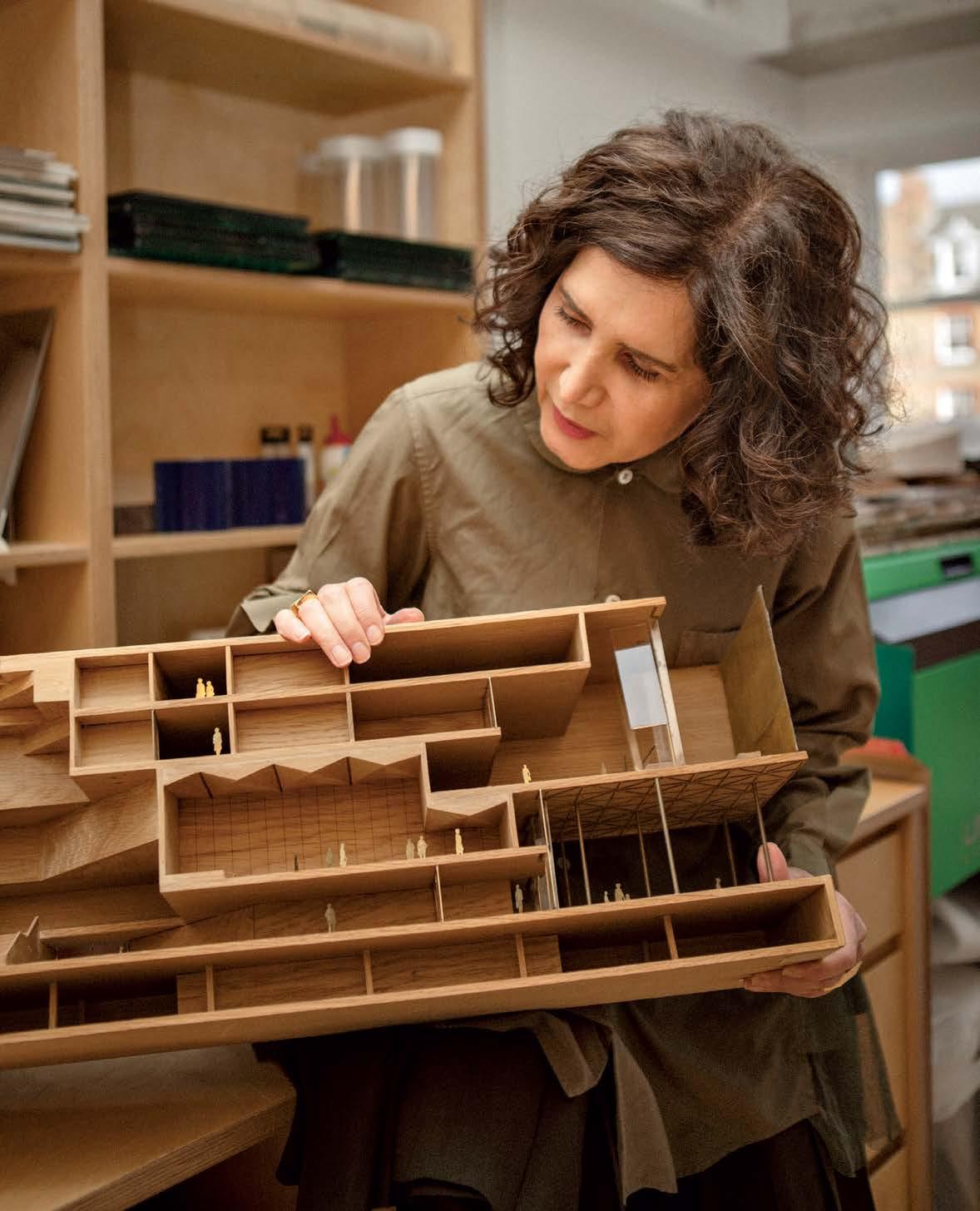
METROPOLIS 124
Moussavi holds up a model of the Ismaili Center Houston, a religious space for Ismaili communities. The center is currently under construction and expected to open in 2025.
In her ecological horror novel Paradise Rot, author Jenny Hval viscerally blurs the boundaries between building and body; a similar intrigue in the affective and embodied experience of architecture drives the work of Iranian-born, Londonbased architect Farshid Moussavi. Moussavi has run her eponymous practice, Farshid Moussavi Architecture (FMA), out of east London since 2011. With projects spanning a flaneur-friendly port terminal in Japan, a shimmering cloud-shaped housing complex in France, and a soon-to-be-completed cultural and religious center in Houston, the architect is known for her innovative work that blends theory, politics, and practice.
Prior to establishing FMA, Moussavi— an elected member of London’s Royal Academy since 2015, a professor in practice at Harvard Graduate School of Design (GSD), and a recipient of the 2022 Jane Drew Prize for women in architecture—ran a collaborative practice called Foreign Office Architects (FOA). Earlier works completed in this partnership, like the Yokohama International Port Terminal (2002), reveal both a striking material sophistication and a deep understanding of the aliveness of architecture, qualities that have flourished in her later practice.
Speaking over Zoom from her studio in London, Moussavi describes this aliveness in two phases—the design process, in which “chaotic flows of desire” like financial constraints, client expectations, and social conditions must be mapped together; and the “micropolitics” that play out after each project’s completion. Moussavi defines these as nuanced and evolving relationships between users and the building.
The architect’s latest publication—an almost-600-page monograph titled Architecture & Micropolitics (2022)—highlights four key projects pursued over the past decade of practice, and includes a brief text by French philosopher Jacques Rancière, who examines the subversive role of the user in FMA’s projects. Moussavi, for her
part, draws her work into dialogue with the rhizomatic theories of Deleuze and Guattari, as well as the open-ended wanderings of experimental literature like that of Walter Benjamin. FMA projects channel the Arcades Project, for sure, but are also reminiscent of the player-led lore-making of an open-world videogame.
When considering a building as an open-ended, multiauthored system, multiple clichés from the history of architecture can be offloaded. First up: the building as a product of the so-called “master architect.” If architecture can be understood as an assemblage of “actants”—defined by Moussavi as the architect, building, and user—it can also be seen as something of a hive mind. For Moussavi, this distributed agency of the building is precisely the point. “Architectural practice is nonlinear,” Moussavi reflects. “The project evolves along the way—and constantly evolves. There is no way an architect has all the answers on day one, when a project takes six to ten years to come to fruition.”
While one can read certain values across FMA projects—flexibility, transparency, scalelessness, stacking, and reflectivity among them—these qualities shape-shift across each building. Hence there is no trademark “style” that is intrinsically
FMA-coded; it’s less about a signature material output than a mood. For Moussavi, this affective capacity of the architecture is at the heart of a building’s micropolitics, which can be more intricately defined as the small-scale encounters or details of a building that trigger necessarily unpredictable reactions from its users, who in turn extend the life of the building by interpreting and utilizing it in their own ways.
In that spirit, it seems fitting to embark on a nonlinear tour through some of Moussavi’s architectural worlds, beginning with two French housing projects completed a year apart: Îlot 19 in La Défense (2016) and La Folie Divine in Toulouse (2017). Îlot 19 appears like a great slab of glass and dark metal; horizontal screen-laden loggias and open balconies run the length of the building, alternating across its 11 floors, which are composed of mixed private and student accommodation, retail units, and public space. Its four lobbies are shared among all its diverse residents; each apartment’s unique layout allows for continuous customization as the residents’ needs change. Meanwhile, the bright La Folie Divine—its curvaceous design defined by rippling corrugated aluminum—likewise blurs indoor and outdoor space across its nine floors. The building offers its residents panoramic, unobstructed views of its
ACADEMIC RESEARCH | CULTURAL ANALYSIS | REAL ESTATE AND INVESTMENT SUMMER 2024 125
garden surrounds from generous balconies lined with billowing curtains. Both projects advocate for a kind of universal luxury, with modifiable floor plans that enable residents to develop their own worlds while nestled inside a larger built ecosystem.
Gleaming like a gnarled block of silica, the Cleveland Museum, completed in 2012, shores up haphazardly on its axial boulevard as if dropped from outer space. The building’s prismlike form is composed of two rhomboids and six triangles; the acrobatic gemstone contorts from a hexagonal base to a rectangular rooftop. Clad in black metal paneling,
with thin strips of diagonal windows running along its flank like a rib cage, the building’s reflective surface dynamically picks up its surroundings.
“The building’s cladding was originally going to be a champagne-gold aluminum,” Moussavi shares. “But a prompt from a donor at a meeting triggered a big color change some four years into the project.” The museum’s final plate and form—a reflective black-mirror stainless steel exterior, with a royal-blue metal gallery overhang interior and an origamilike twisted staircase hovering above the lobby—ditch the white-cube formalism
endemic to museum design for something much more interesting.
FMA’s first project in the United States—the Ismaili Center in Houston, initiated in 2021 and due to complete in 2025—offers a whopping 150,000 square feet for the architect to put micropolitics into macroscale practice. Commissioned by His Highness the Aga Khan, the imam of Ismailism, and conceived as an “ambassador building” to bring Islamic faith into dialogue with other cultures and communities, it is also the first Ismaili center in this country. Moussavi’s design features intricate stone tile cladding with


THIS PAGE AND OPPOSITE: COURTESY STEPHEN GILL/FMA
The recently completed Îlot 19 is the first new housing project to have been built in France's La Défense business district in 30 years.
METROPOLIS 126
La Folie Divine represents the initial installment of two apartment complexes commissioned by the City of Montpellier that follow the 18th-century tradition of opulent residences set amid expansive gardens.
“Architectural practice is nonlinear,” Moussavi reflects. “The project evolves along the way—and constantly evolves. There is no way an architect has all the answers on day one, when a project takes six to ten years to come to fruition.”

ACADEMIC RESEARCH | CULTURAL ANALYSIS | REAL ESTATE AND INVESTMENT
SUMMER 2024 127
The Museum of Contemporary Art Cleveland is clad in mirrored black stainless steel and features a compact hexagonal base that transitions to a rectangular roof. Moussavi's design features a public square with landscaping by James Corner Field Operations, and visitors can enter through four entrances, which highlight the museum’s flexible design.
The Ismaili Center in Houston was conceived as an “ambassador building” to bring Islamic faith into dialogue with other cultures and communities.

ACADEMIC RESEARCH | CULTURAL ANALYSIS | REAL ESTATE AND INVESTMENT
METROPOLIS 128
A model and facade study of the new Ismaili Center Houston is on display in Moussavi's London studio.

COURTESY FMA
SUMMER 2024 129
The stepped structure of the central atrium, adorned with ceramic screens, pays homage to the ancient cupolas that exerted influence over both the architectural styles of the Sasanian period in Persia and the Christian edifices of the Byzantine Empire.
Persian detailing, a large veranda supported by thin columns, and three interior atria. Set within ten acres of gardens designed by Nelson Byrd Woltz Landscape Architects, the building offers a combination of mixed-use social spaces alongside more private pockets including a Jamatkhana for worship. “The building is designed to be very porous and open, responding to the local ecology and weather patterns of Texas,” explains Moussavi. “The larger the project, the more can be done with its micropolitics.”
In addition to FMA, Moussavi maintains a robust pedagogical and
research practice. This includes FunctionLab, the research arm of FMA, and a housing-themed studio at Harvard GSD since 2017. Prior to her new monograph, Moussavi published The F unction of Ornament (2006), The Function of Form (2009), and The Function of Style (2014)—a trilogy of texts that analyze architectural affects and propose new means of conceptualizing the flows of material, ideology, and agency within built systems. FunctionLab unites Moussavi’s material and theoretical practice, enabling the built projects to feed into research and vice versa,
ouroboros-like, tending to an everevolving ecosystem of ideas.
Moussavi’s keen attention to the sense-making of sensory experience, matched by the architect’s commitment to framing architecture as an ongoing and collaborative act, distinguishes her approach and output from many contemporary practitioners. For Moussavi, it’s never been about imprinting the practice on the project, but each project shaping the practice according to its needs. “When the architect goes, the building remains,” reflects Moussavi. “The key is always keeping the system open.” M

METROPOLIS 130
Farshid Moussavi and her team members are currently in the process of reviewing material samples for a project under way at FMA studio.
FunctionLab unites Moussavi’s material and theoretical practices, enabling the built projects to feed into research and vice versa, ouroboros-like, tending to an ever-evolving ecosystem of ideas.
 Apart from her architectural practice, Moussavi established FunctionLab as a platform for FMA to engage in collaborative research endeavors, yielding publications such as books, interviews, and pamphlets.
ACADEMIC RESEARCH | CULTURAL ANALYSIS | REAL ESTATE AND INVESTMENT SUMMER 2024 131


Two robotic arms
3D-printing façade ceramic tiles at Studio RAP in Rotterdam. Each tile is glazed in pearl
An Architecture Office of the Future
Studio RAP in Rotterdam is a combination of a design studio and robotic factory.
By Florian Heilmeyer
COURTESY STUDIO RAP/RICCARDO DE VECCHI
CONSTRUCTION MATERIALS | EMERGING TALENTS | PREFABRICATION AND AUTOMATION SUMMER 2024 133
white with highlights in yellow by Royal Tichelaar.
Looking at Dutch Studio RAP might reveal the architecture office of the future. Lucas ter Hall and Wessel van Beerendonk met at the Delft University of Technology, and following their graduation in 2014, launched their own practice with the goal of bridging the gap between digital design and physical construction. In school, says ter Hall, they learned how to create complex designs with the computer. But there wasn’t much about how to transfer these designs into reality. “Back then, only a few architects were doing parametric design, and even less knew about digital or robotic fabrication methods.”
As a start-up, the team got an office space in Rotterdam’s Makers District, and in the beginning, they rented a robot. “We don’t have rich parents and we didn’t get any funding, so at first we took any commission we could,” remembers ter Hall. By making models for other architects, museums, or artists, they learned what the robot could do.
In 2020 the studio shaped the acoustic walls for the main auditorium of Rotterdam’s new Theater Zuidplein, using their parametric design skills to shape 6,000 aluminum panels painted in a bright red (the same color as the auditorium chairs).

COURTESY STUDIO RAP CONSTRUCTION MATERIALS | EMERGING TALENTS | PREFABRICATION AND AUTOMATION METROPOLIS 134
Together with Arup, and commissioned by the City of Rotterdam, Studio RAP designed 6,000 uniquely shaped accoustic panels in the interior of the main theater hall.



COURTESY SCAGLIOLA BRAKKEE


A few years later the firm received international attention for New Delft Blue and Ceramics house, two projects that make use of innovative 3D-printed ceramic tiles. In Delft the studio got the commission to upgrade two gateways leading into the large inner courtyard of a newly built, rather conventional housing block. “We had absolutely no experience with clay or ceramics,” says ter Hall. But the city of Delft is known worldwide for its specific tinglazed earthenware that has been produced in the region since the 1600s, otherwise known as delftware or delft blue. Connecting to this tradition, Studio RAP developed an algorithm that generated a 3D leaf pattern for both gateways in the iconic hue, and translated it into 3,000 ceramic panels.
The other project is located on one of Amsterdam’s busiest shopping streets, where they clad the facade of a future commercial space with a new structure of three-dimensional tiles that “echo the tripartite order of the old brick facades in the neighborhood,” explains ter Hall. “But we also took inspiration from the structures of knitwear.” So ter Hall and van Beerendonk found themselves analyzing stitch patterns, interwoven yarns, and creases, translating these lightweight structures into fired ceramics.
To produce both projects, Studio RAP collaborated with a centuries-old, traditional producer of Dutch ceramics, Royal Tichelaar. Ter Hall and van Beerendonk set up 2 one-armed robots directly in the factory. “As the hollow
COURTESY STUDIO RAP/RICCARDO DE VECCHI
CONSTRUCTION MATERIALS | EMERGING TALENTS | PREFABRICATION AND AUTOMATION SUMMER 2024 137
By merging 3D clay printing, computational design, and artisanal glazing, this project offers a reinterpretation of the renowned decorative features and design language of Delft Blue porcelain.


clay forms are very fragile before they are fired,” says ter Hall, “it was easier to place the robots directly near the large [kilns] instead of transporting the clay.”
In a fully digital design process, the architects send their codes to the robots, which print the clay forms. These are then fired and glazed by Royal Tichelaar before being sent to the architects for testing. “It took us more than three years of testing and readjusting the production process again and again,” remembers ter Hall. “But I think it was worth the effort.” They are currently working on all types of projects using robotically produced prototypes made in-house. It is this combination of design studio, workshop, and factory that turns Studio RAP itself into a prototype for the architecture office of the future. M
The design of the façade showcases elaborate layers reminiscent of textiles, with an organic, undulating quality that transforms as observers view it from various angles. As the line of sight shifts, fresh elements within the custom ceramic tiles gradually reveal themselves.
COURTESY STUDIO RAP/RICCARDO DE VECCHI
CONSTRUCTION MATERIALS | EMERGING TALENTS | PREFABRICATION AND AUTOMATION METROPOLIS 138


Showcase
METROPOLIS partners offer creative solutions for architecture and interior design projects. These new releases are tailored to your specification needs, designed to help you create beautiful, healthy spaces.
For a digital version, go to metropolismag.com

Joining like the clean edges of a beveled sculpture, Bevva offers a highend form that is crisp and intriguing. The thoughtful angle of the backrest makes Bevva comfortable and inviting while the chiseled aesthetic and visible diagonal side seam create visual interest. Bevva is a functional piece that welcomes social encounters while intelligently dividing settings in your space.
@DauphinAmericas | dauphin.com

Kirei
Stop disruptive sound waves in their tracks with EchoScreen®, made of acoustically absorbent PET containing at least 60% post-consumer recycled content. With Kirei EchoScreen, it's simple to reduce sonic and visual overstimulation to create healthier, more productive spaces. Protect your client's privacy and peace with EchoScreen.
@kirei.design.materials | kireiusa.com
Dauphin
SPONSORED CONTENT
Product
METROPOLIS 140

Resol
The Bini collection, designed by Joan Gaspar, offers lightness in its airy structure, enhancing airflow and casting evocative shadows. Echoing Spain's iconic cane chairs, it modernizes in form and material. Stackable and comfortable, it features two styles: a low armchair and an upright chair, available in six attractive colors, blending tradition with contemporary elegance.
@resol_furniture | resolusa.com

Tarkett
Rubber flooring is durable and easy to install, but what about sustainable attributes? Through material optimizations, Tarkett’s Johnsonite rubber tile collection has upgraded from Bronze to Cradle to Cradle Certified® Silver. It’s made with 100% renewable energy and an Environmental Product Declaration (EPD) shows its cradle-to-gate carbon footprint is up to 20% lower than equivalent products. Made Right Means Johnsonite.
@tarkettcontract | commercial.tarkett.com

Kawneer Company, Inc
Kawneer’s 1620UT SSG Curtain Wall System delivers thermal performance, versatility, and reliability A complete and versatile system, the Kawneer 1620UT SSG delivers high thermal solutions and seismic functionality. Recently certificated by DECLARE and is Red List Free.
@kawneer_na | kawneer.com

Whiting & Davis LLC
Whiting & Davis offers architects and designers a strong and beautiful alternative to the traditional. With its flexible and collapsible nature, our standard panels and custom drapery are as versatile as the applications. Visit our website to request your updated samples, or quote for a project. Studio and engineer services are now available.
WDMesh.com
SUMMER 2024 141
Sources
Discover the people, manufacturers, and suppliers behind the projects featured in the Summer 2024 issue of METROPOLIS.

COBBLE HILL TOWNHOUSE
(“Passive House Design Makes This Brooklyn Townhouse More Livable,” p. 54)
Design architect: Ingui Architecture (Michael Ingui)
• Interiors: BIA Interiors
• Developer: Kleen Construction (contractor)
• Consultants: BldgTyp (passive house consultant)
• Engineering: Brooklyn SolarWorks, Gamill Engineering (filing rep), RJD Engineering (mechanical), Celin Munoz Consulting Engineer, P.C. (structural)
INTERIORS
• Accessories: Kohler, Watermark
• Bath fittings: Toto, Kohler, Duravit, Watermark
• Flooring: Graf Brothers
Kitchen products: Gaggenau and Café by GE (garden-floor kitchenette), Miele dishwasher, Sub-Zero Refrigerator, Fisher & Paykel induction range (parlor-floor kitchen)
• Kitchen surfaces: Aurora Stone Epitome
• Paint: Benjamin Moore
EXTERIORS
• Doors: Zola Windows
• Windows: Zola Windows
• Other: Lamilux FE (skylight)
BUILDING SYSTEMS
• HVAC: Mitsubishi City-Multi
• Other: Zehnder (ERV)

EXP
(“Designed for Research and Built to Perform,” p. 68)
• Design architect: Payette
• Interiors: Payette
• Engineering: Arup (MEP/FP), Arup (facades), Arup (code), LeMessurier (structural), Vanderweil (TD/security), Nitsch (civil), SGH (waterproofing), RWDI (wind/air quality)
• Graphics: Roll Barresi/Bluebird Graphic Solutions
• Landscaping: Stimson
• Lighting: Arup
• Other: Soden (LEED/sustainability), Van Deusen (elevator), Vermeulens (estimating), Colburn & Guyette (food service), Red Thread (AV)
INTERIORS
• Accessories: Bobrick
• Bath fittings: Porcelanosa, Sloan
• Bath surfaces: Corian
• Ceilings: Armstrong, USG
• Flooring: Bentley Mills Carpet, Roppe Flooring, Vermont Stone, Kaswell Wood Floor
Furniture: Davis, Herman Miller, OFS, Hightower
• Kitchen products: Monogram, GE, Fisher & Paykel, Summit, Blodgett, Hobart, Pitco, Rational
• Kitchen surfaces: Corian, Stainless Steel
• Lighting: Beulux, Bega, Leucos,
Prescolite, Insight, Finelite, Sattler, Lindsley, Zumtobel, Litelab, Lumenwerx
• Paint: Sherwin-Williams
• Textiles: Maharam, Knoll Textiles, Ultrafabrics, Arc-Com
• Upholsteries: Maharam, Knoll Textiles, Ultrafabrics, Arc-Com
• Wall finishes: Carnegie Xorel, Knoll Textiles
Other: Kewaunee (lab casework/ducted fume hoods), Labconco/Erlab (ductless fume hoods), Clark Door/Zahner Architectural Metal (vertical lift door)
EXTERIORS
• Cladding /facade systems: Island Exterior Fabricators (custom unitized curtain wall with triple glazing and stainless steel sunshades)
• Doors: Tubelite, CRL
• Glazing: Tvitec triple-glazed IGU
• Lighting: Selux, MP Lighting, Lucifer Lighting
• Windows: Refer to cladding/facades
OUTDOORS
• Furniture: Janus et Cie, Plust, Landscape Forms
Lighting: Selux, MP Lighting, Lucifer Lighting
BUILDING SYSTEMS
• Conveyance: Otis/Delta Beckwith
LEFT: COURTESY ADAM KANE MACCHIA; RIGHT: COURTESY WARREN JAGGER PHOTOGRAPHY
METROPOLIS 142 SUMMER 2024
School
Showcase
The METROPOLIS Future100 studied at some of the finest architecture and interior design programs in North America. Here are some of those educational institutions for you to consider for your own learning journey.
For a digital version, go to metropolismag.com

College of Art and Architecture, University of Idaho Design a Better World at the University of Idaho’s CAA. Our integrative, hands-on, professional, accredited programs in Art & Design, Architecture, Interior Architecture & Design, Landscape Architecture & Environmental Design, and Virtual Technology & Design prepare graduates to lead professionally, environmentally, and socially while producing human-centric designs that safeguard sustainability, economic resiliency, cultural vibrancy, and the common good, locally and globally.
@uidahocaa | uidaho.edu/caa

California College of the Arts
Congratulations to California College of the Arts’ five outstanding students on being selected for the METROPOLIS Future 100! At CCA we believe Architecture and Interior Design are critical cultural practices. Our master’s and bachelor’s degree programs challenge conventional ideas at every turn and exemplify our innovative culture of making and social action. CCA students draw inspiration from studying at a worldclass art and design college in the heart of San Francisco.
@cca_arch_div | cca.edu/architecture
SPONSORED CONTENT
METROPOLIS 143 SUMMER 2024
Learn more about the topics you’re interested in as you explore the Summer 2024 issue of METROPOLIS.
SUSTAINABILITY, WELLNESS, AND EQUITY
ADAPTIVE REUSE
74 OMA Designs for Circular Cooking
90 Jack London Freedman
100 How Can We Take Adaptive Reuse to the Next Level?
AIR QUALITY
54 Passive House Design Makes This Brooklyn Townhouse More Livable

PEOPLE AND PRACTICE
ACADEMIC RESEARCH
122 Farshid Moussavi’s Open-Ended Architecture
ART AND CRAFT
78 The Denver Art Museum Explores Nature’s Eternal Sway over Architecture and Design
COMMUNITY ENGAGEMENT
38 A Creative Design Challenge for the Design Leaders of Tomorrow
104 Kathryn Webb
118 Three Proposals Practice Empathy in Communal Design
CULTURAL ANALYSIS
100 How Can We Take Adaptive Reuse to the Next Level?
122 Farshid Moussavi’s Open-Ended Architecture
DIVERSITY AND REPRESENTATION
36 VR Pioneer Adipat Virdi Helps People Build Empathy
EMERGING TALENTS
132 An Architecture Office of the Future
OUTDOOR AND PUBLIC SPACE
38 A Creative Design Challenge for the Design Leaders of Tomorrow
42 Designed Landscapes Are Surprisingly Carbon Intensive (They Don’t Have to Be)
118 Three Proposals Practice Empathy in Communal Design
REAL ESTATE AND INVESTMENT
122 Farshid Moussavi’s Open-Ended Architecture
BIODIVERSITY
112 Young Designers Shape the Future of Water
BIOPHILIA
78 The Denver Art Museum Explores Nature’s Eternal Sway over Architecture and Design
92 Students Imagine New Ways to Deepen Our Connection to Our Environment
116 Qing Yin
CIRCULARITY IN PRODUCTS
74 OMA Designs for Circular Cooking
CLIMATE ADAPTATION AND PREPARATION
38 A Creative Design Challenge for the Design Leaders of Tomorrow
92 Students Imagine New Ways to Deepen Our Connection to Our Environment
DECOLONIZING DESIGN
38 A Creative Design Challenge for the Design Leaders of Tomorrow
106 For These Students, New Technologies Unlock Ageless Construction Materials
EMBODIED CARBON
32 The Rise of Sustainable Interiors
42 Designed Landscapes Are Surprisingly Carbon Intensive (They Don’t Have to Be)
68 Designed for Research and Built to Perform
EQUITY AND ACCESS
28 Two Sustainability News Updates for Q2 2024
118 Three Proposals Practice Empathy in Communal Design
ESG
28 Two Sustainability News Updates for Q2 2024
HEALTHY MATERIALS
32 The Rise of Sustainable Interiors
48 Sustainability Is the New Luxury
52 This First-of-Its-Kind Paint Promotes Wellness
62 These Products Can Shape-Shift to Fit Your Project
66 Architectural Products for Higher Education Projects
NET ZERO AND NET POSITIVE
28 Two Sustainability News Updates for Q2 2024
54 Passive House Design Makes This Brooklyn Townhouse More Livable
66 Architectural Products for Higher Education Projects
68 Designed for Research and Built to Perform
REGENERATIVE DESIGN
48 Sustainability Is the New Luxury
110 Meixi Xu
RESPONSIBLE RENOVATIONS
54 Passive House Design Makes This Brooklyn Townhouse More Livable
62 These Products Can Shape-Shift to Fit Your Project
WATER
38 A Creative Design Challenge for the Design Leaders of Tomorrow
110 Meixi Xu
112 Young Designers Shape the Future of Water
TECHNOLOGY AND RESEARCH
BIOBASED MATERIALS
106 For These Students, New Technologies Unlock Ageless Construction Materials
CALCULATORS, SOFTWARE, AND PLUG-INS
36 VR Pioneer Adipat Virdi Helps People Build Empathy
42 Designed Landscapes Are Surprisingly Carbon Intensive (They Don’t Have to Be)
104 Kathryn Webb
CONSTRUCTION MATERIALS
66 Architectural Products for Higher Education Projects
96 Axel Olson
100 How Can We Take Adaptive Reuse to the Next Level?
106 For These Students, New Technologies Unlock Ageless Construction Materials
116 Qing Yin
132 An Architecture Office of the Future
PREFABRICATION AND AUTOMATION
132 An Architecture Office of the Future
SPECULATIVE DESIGN
90 Jack London Freedman
92 Students Imagine New Ways to Deepen Our Connection to Our Environment
96 Axel Olson
112 Young Designers Shape the Future of Water

LEFT: MANU VALCARCE FOR METROPOLIS RIGHT: COURTESY STUDIO RAP/RICCARDO DE VECCHI 132
Index
122
METROPOLIS 144 SUMMER 2024

Visit Versteel Made in America It’s not just a project for us - for us -

In workplaces outfitted with Turf acoustic solutions, the values we want to inspire are quite literally in the air. Learn more about Linear at turf.design
Linear Ceiling and Wall Scapes, image by Imperfct*
