January/Feb 2020
Doctors Metro MetroDoctors THE JOURNAL OF THE TWIN CITIES MEDICAL SOCIETY
Obstetrical Services Today
In This Issue: • • • •
What’s New in Obstetrics? Your Voice — An Editorial Charles Bolles Bolles-Rogers Award Luminary of Twin Cities Medicine
“Your patients will thank you for referring them to Dr. Crutchfield.”
A FAC E O F A M I N N E SOTA DE R M ATOL O GIST Recognized by physicians and nurses as one of the nation’s leading dermatologists, Charles E. Crutchfield III MD has received a significant list of honors including the Karis Humanitarian Award from the Mayo Clinic, 100 Most Influential Health Care Leaders in the State of Minnesota (Minnesota Medicine), and the First a Physician Award from the Minnesota Medical Association, for positively impacting both organized medicine and improving the lives of people in our community. He has a private practice in Eagan and is the team dermatologist for the Minnesota Twins, Wild, Vikings and Timberwolves. Dr. Crutchfield is a physician, teacher, author, inventor, entrepreneur, and philanthropist. He has several medical patents, has written a children’s book on sun protection, and writes a weekly newspaper health column. Dr. Crutchfield regularly gives back to the Twin Cities community including sponsoring academic scholarships, camps for children, sponsoring programs for children with dyslexia, mentoring underrepresented students from the University of Minnesota, and establishing a Dermatology lectureship at the University of Minnesota in the names of his parents, Drs. Charles and Susan, both pioneering graduates of the U of M Medical School, class of 1963. As a professor, he teaches students at both Carleton College and the University of Minnesota Medical School. He lives in Mendota Heights with his wife Laurie, three beautiful children and two hairless cats.
AES
THET I C
L OF APPROVA L SEA
CRU TCHFIELD DERMATOLO GY
CRUTCHFIELD DER MATOLOGY Experience counts. Quality matters. Mayo Clinic Medical School Graduate | University of Minnesota Dermatology Trained Top Doctor Minneapolis St. Paul Magazine | Best Doctors for Women Minnesota Monthly Magazine Team Dermatologist for the Minnesota Twins, Vikings, Timberwolves and Wild 1185 Town Centre Drive, Suite 101, Eagan | 651.209.3600 | www.CrutchfieldDermatology.com
CONTENTS VOLUME 22, NO. 1 JANUARY/FEBRUARY 2020
3
Obstetrics Today
By Robert R. Neal, Jr., MD
4
PRESIDENT’S MESSAGE
The Twin Cities Medical Society: Your Home for Physician Activism
By Ryan Greiner, MD
5 6
Page 32
IN THIS ISSUE
TCMS IN ACTION By Ruth Parriott, MSW, MPH, CEO YOUR VOICE
No “In-Office” Dental Treatments Offered Here
By Charles E. Crutchfield III, MD
7
OBSTETRICAL SERVICES TODAY
• The Overall Incidence of Maternal Mortality—State, National and Worldwide
By Stephen Contag, MD
10 • Colleague Interview: A Conversation with Elizabeth Palma Elfstrand, MD 13 • Advancing Maternal-Fetal Medicine Care By Marijo Aguilera, MD 15 Page 24
• The Rapid Decline of Hospital-Based Obstetric Services in Rural Areas
By Alexandria Kristensen-Cabrera, BS
17 • Why Doctors Should Engage with Midwife-Led Care Models By Steve Calvin, MD and Amy Romano, CNM 20 • What’s New in OB/GYN Training at the U By John R. Fischer, MD
24 •
From Postpartum Depression to Two-generation, Integrative, Trauma Healing—The Redleaf Center for Family Healing Offers a New Model of Care By Katie Thorsness, MD and Helen Kim, MD
27 • Amma Parenting Center By Gwen Martin Page 5
29 • Environmental Health — The Impact of Increased Extreme Heat Events on Pregnant Women By Federico Rossi, MD 30
• ’Twas a Night on OB
By Carolyn Erickson
Page 5 MetroDoctors
31 32
LUMINARY OF TWIN CITIES MEDICINE
John Leyland McKelvey, MD
33
Charles Bolles Bolles-Rogers Award Goes to Co-Recipients
In Memoriam/Career Opportunities
The Journal of the Twin Cities Medical Society
January/Feb 2020
22 • Top Medical Liability Issues in OB/GYN and Strategies to Address These Risks By Alethia Morgan, MD
Doctors Metro MetroDoctors THE JOURNAL OF THE TWIN CITIES MEDICAL SOCIETY
Obstetrical Services Today
In This Issue: • What’s New in Obstetrics? • Your Voice — An Editorial • Charles Bolles Bolles-Rogers Award • Luminary of Twin Cities Medicine
There are many new developments in the care and treatment of obstetrical patients including prenatal care, new delivery options and programs available to assist with postpartum care. Articles begin on page 7.
January/February 2020
1
Doctors MetroDoctors THE JOURNAL OF THE TWIN CITIES MEDICAL SOCIETY
Physician Co-editor Peter J. Dehnel, MD Physician Co-editor Thomas E. Kottke, MD Physician Co-editor Robert R. Neal, Jr., MD Physician Co-editor Marvin S. Segal, MD Physician Co-editor Richard R. Sturgeon, MD Physician Co-editor Charles G. Terzian, MD Medical Student Co-editor Zineb Alfath Medical Student Co-editor James Pathoulas Managing Editor Nancy K. Bauer
TCMS Officers
President: Ryan Greiner, MD President-Elect: Sarah Traxler, MD Secretary: Andrea Hillerud, MD Treasurer: Rupa Polam Austria, MD Past President: Thomas E. Kottke, MD At-large: Matthew A. Hunt, MD TCMS Executive Staff
Ruth Parriott, MSW, MPH, CEO (612) 362-3799; rparriott@metrodoctors.com Nancy K. Bauer, Associate Director, and Managing Editor, MetroDoctors (612) 623-2893; nbauer@metrodoctors.com
Production Manager Sheila A. Hatcher Advertising Representative Betsy Pierre Cover Design by Annie Krapek
Kerry Hjelmgren, Executive Director, Honoring Choices Minnesota (612) 362-3704; khjelmgren@metrodoctors.com
MetroDoctors (ISSN 1526-4262) is published bi-monthly by the Twin Cities Medical Society, Broadway Place West, 1300 Godward Street NE, Suite 2000, Minneapolis, MN 55413. Periodical postage paid at St. Paul, Minnesota. Postmaster: Send address changes to MetroDoctors, Twin Cities Medical Society, 1300 Godward Street NE, Broadway Place West, Suite 2000, Minneapolis, MN 55413.
Lynn Betzold, Program Coordinator, Honoring Choices Minnesota (612) 362-3703; lbetzold@metrodoctors.com
To promote its objectives and services, the Twin Cities Medical Society prints information in MetroDoctors regarding activities and interests of the society. Responsibility is not assumed for opinions expressed or implied in signed articles, and because of the freedom given to contributors, opinions may not necessarily reflect the official position of TCMS.
January/February Index to Advertisers
Annie Krapek, MPH, Program Manager (612) 362-3715; akrapek@metrodoctors.com Amber Kerrigan, Program Coordinator (612) 362-3706; akerrigan@metrodoctors.com
Clinical Scribes, LLC.......................................... 6 COPIC..................................................................26 Crutchfield Dermatology...................................... Inside Front Cover Lakeview Clinic..................................................31 MedCraft..............................................................23 Minnesota Community Care........................... 2 PrairieCare............................................................19 PrairieCare PAL..................................................16 PSP/LifeBridge.................. Outside Back Cover Schuster Clinic for Endocrine & Metabolic . Disorders...................................................28
Kate Feuling Porter, Program Manager (612) 362-3724; kfeuling@metrodoctors.com
At Minnesota Community Care, we believe in health for all.
Send letters and other materials for consideration to MetroDoctors, Twin Cities Medical Society, Broadway Place West, 1300 Godward Street NE, Suite 2000, Minneapolis, MN 55413. E-mail: nbauer@metrodoctors.com. For advertising rates and space reservations, contact: Betsy Pierre phone: (763) 295-5420 e-mail: betsy@pierreproductions.com
That’s why we provide comprehensive primary health services to everyone regardless of age, financial situation, access to insurance, language or immigration status. While our name has evolved, our purpose has remained the same over the past 50 years - to serve the health needs of our community.
MetroDoctors reserves the right to reject any article or advertising copy not in accordance with editorial policy. Advertisements published in MetroDoctors do not imply endorsement or sponsorship by TCMS.
Together, we are Minnesota Community Care.
Non-members may subscribe to MetroDoctors at a cost of $15 per year or $3 per issue, if extra copies are available. For subscription information, contact Nancy Bauer at (612) 623-2893.
mncare.org | 651.602.7500 2
January/February 2020
MCC_6.10.19 Ad_English_5x5_r4.indd 2
MetroDoctors
10:31 AM The Journal of the Twin Cities9/10/19 Medical Society
IN THIS ISSUE...
Obstetrics Today
M
edicine, as a whole, has made great progress in the last 20-30 years; detailing these developments has been our major endeavor with this publication. This issue of MetroDoctors provides an update on how Obstetrics has changed since I retired from my OB practice over 20 years ago, where I saw the development of the perinatal and reproductive sub-specialties, increasing cesarean delivery rates, very low birth weight survivors and consolidation of practices to name a few. I am deeply indebted to Beth Elfstrand, MD, chair of the MN section of ACOG, for not only agreeing to be our Colleague Interview but also for being a great resource on the content of this issue. Her responses to our questions provide great insights into today’s practice patterns. Maternal Mortality has been hotly discussed nationally in the last 10 years since the US rate began to rise around 2,000. It is sad and embarrassing that the US is the only country in the developed world (and almost the only country) to have a continuously rising maternal mortality rate. The complexities of this subject are nicely discussed by Stephen Contag, MD, a current member of the Minnesota Maternal Mortality Committee. The subspecialty of Perinatology has continued to expand its horizons especially in the areas of prematurity and maternal morbidity. Marijo Aguilera, MD provides a good overview of the progress in these areas including developments in genetics and fetal surgery. The problems associated with providing quality obstetrical care to rural mothers is well outlined by Alexandria Kristensen-Cabrera. She provides an excellent list of solutions for the declining facilities and providers, many of which will require state or federal legislation and funding. Steve Calvin, MD’s co-authored article on non-hospital maternity centers illustrates how physicians and hospitals can integrate care with Nurse Practitioners and Midwives to provide more comprehensive obstetrical care and lower overall costs. John Fischer, MD, Professor and Chair of the Department of OB/GYN at the U of MN, discusses some of the new modalities being used to train tomorrow’s obstetricians. By Robert R. Neal, Jr., MD Member, MetroDoctors Editorial Board
MetroDoctors
The Journal of the Twin Cities Medical Society
It is interesting to note the turn away from forceps use, vaginal breech delivery and episiotomy toward more cesarean deliveries. The black cloud of possible litigation follows all of us in the medical profession. An article by Alethia Morgan, MD, Physician Risk Manager at COPIC, summarizes the leading causes of malpractice lawsuits and provides an excellent review of “best practices.” Most of us who are parents can easily recall the anxieties encountered with our first child’s entry into our lives. I was surprised, however, to learn from the article provided by Drs. Helen Kim and Katie Thorsness, perinatal psychiatrists, of the extent of anxiety/depression problems among postpartum patients. The authors also discuss how adverse childhood experiences are related to early brain development. We are fortunate that Dr. Kim and her associate Jesse Kuendig, LSW established one of the first Mother-Baby programs in the country in Minneapolis to address these problems. Their clinic has now become the Redleaf Center at Hennepin Healthcare and offers even more related services. One of the regrets I have as I look back on my practice days was not being able to help new parents with postpartum infant challenges, particularly the mother with her hormone changes and lack of sleep. Amma is an independent center organized to provide prenatal and new parent education. Gwen Martin, co-executive director, notes how their center has grown in scope and recognition. Our Environmental Health Task Force outlines how global warming effects Obstetrics. Tis the season so we couldn’t resist reprinting the poem, “Twas a night on OB” reprinted from the April 1961 issue of the HCMC Bulletin. As usual, Marv Segal has provided us a great Luminary segment, a remembrance of John McKelvey, MD. And, don’t miss Dr Greiner’s informative and motivating message about our society. Happy New Year! January/February 2020
3
President’s Message
The Twin Cities Medical Society: Your Home for Physician Activism RYAN GREINER, MD
A
s 2019 comes to a close, I have never been prouder of the work of the Twin Cities Medical Society and its physician members. Our CEO, Ruth Parriott, has performed beyond expectations and is delivering on our advocacy mission by solidifying our partnerships across the Twin Cities, expanding our reach into new public health initiatives, and inaugurating our critical commitment to physician well-being. The staff of the Society are some of the most motivated and devoted professionals we have had the honor of working with. Our board of committed physicians has been one of the most engaged cohorts to date and has continued to lead the advocacy work that drives the passions of our members and partners. As I reflect on this last year, the significance of this organization to the physicians of the Twin Cities cannot be overstated. With nearly 60% of Minnesota’s practicing physicians in the metro area and almost 2,000 medical students and residents/fellows training alongside them, the Society has become the gateway to engaging with their communities in ways that their day-to-day work does not afford. Be it the advance care planning work of Honoring Choices, tackling modern day public health issues like vaping, advancing programs like Physicians Serving Physicians and LifeBridge for the mental health of physicians, and providing a training ground for University of Minnesota Medical School student activists, there is something for everyone at the Twin Cities Medical Society. Why has the Society continued to be so relevant in the changing landscape of physician practice? How has the Society remained connected to each new generation of practitioners? How have we remained purposeful within the diversity of physician interests and passions? Stated simply: our mission is you — the physician activist. The Society works to translate your passion and aspirations into practical, effective, and expansive initiatives and programs that impact your practice, your patients, and your communities. With the ongoing gun violence epidemic, the pervasive assault on science and fact-based policy development, the increasingly local health impacts of climate change, and the need for ongoing healthcare delivery reform, physician activism is increasingly seen as an inextricable part of physicians’ professional duties. In a recent survey of medical students from seven US institutions, nine out of 10 indicated a professional responsibility to engage in health policy. As published in my column in the November/December edition of MetroDoctors, the newly inaugurated University of Minnesota Medical School class professed their commitment to be a positive change agent in the face of systemic discrimination and healthcare inequities. This time in our history could not be more primed for the voice of medicine to delineate a path forward. As physicians, we inherently hold the public trust. We have earned this faith through the rigors of our training, the heavy responsibility of our work, and the lifelong commitment we make to our profession. To restrict that trust to the parameters of our work day leaves so much of it unused. We can be a major catalyst for change in our communities — change that opens the door for improving health and well-being, diminishing inequities, and improving quality of life for the communities we serve. Our opportunity sits before us — we must only step forward and grab it. As we enter the 10th year of the Twin Cities Medical Society, formed in 2010 following the merger of the East and West Metro Medical Societies, commit with us to furthering the physician advocacy mission that has formed the foundation of our work for the last decade. Bring your friends and colleagues to this table to deliberate, work and celebrate with us. We are committed to being the home for physician activism for the next decade and beyond.
4
January/February 2020
MetroDoctors
The Journal of the Twin Cities Medical Society
TCMS IN ACTION RUTH PARRIOTT, MSW, MPH, CEO
Tackling Inequities in Obesityrelated Disease
The statistics from the Minnesota Department of Health are grim: three out of four Minnesota students consume at least one sugary drink per day, yet one 20-ounce soda contains three times the recommended amount of daily sugar for children. American Indian/Alaska Native children consume over 500 sugary beverages per year, compared to over 400 for African American and Hispanic youth, and under 200 for white youth. African American children are twice as likely to be exposed to advertisements for sugary beverages than white children, and outdoor ads for sugary beverages are significantly more prevalent in low income neighborhoods. The obesity epidemic is upon us and is only expected to worsen as these youth become adults. Disproportionate burdens of disease and death by income, race and ethnicity inevitably follow.
tobacco sales to 21, TCMS’s physician advocacy network is launching a new initiative focused on reducing consumption of sugary beverages and increasing access to healthy, culturally-appropriate foods. In consultation with Minnesota Doctors for Health Equity, TCMS convened a panel of concerned physicians in December to develop tools to educate physicians on public health policy options related to sugary beverages and healthy food access. Inequities in obesity-related disease is a big problem to tackle and we anticipate a years-long effort, as with tobacco addiction. We are confident that our physicians are up to the challenge, and we’re thankful to Blue Cross Blue Shield Center for Prevention for the additional resources necessary to expand our physician advocacy network. Watch our social media accounts as the campaign rolls out in 2020 and don’t hesitate to contact akrapek@metrodoctors.com for more information. Sharing Wellness Strategies
Building upon the effectiveness of training and mobilizing physicians to advocate for restrictions on flavored tobacco products and increasing the age of
MetroDoctors
The magic of the TCMS medical student advocacy fellowship rests in the informal relationships between medical students and practicing physicians, and on December 3rd the fellows were treated to a special dinner discussion focused on personal wellness within the stressful practice of medicine. TCMS board members Drs. Zeke McKinney, Cora Walsh, and Ryan Greiner shared their own experiences balancing full-time practice with family responsibilities and community advocacy. In a free-flowing exchange, the students heard specific examples of career decisions based not just on professional goals, but also parenting
The Journal of the Twin Cities Medical Society
needs and partner careers. The physicians explored how their public health activism, while oftentimes consuming and challenging, can also provide great personal fulfillment and family pride. The addition of a wellness component to the fellowship program is thanks to the generous support of the national Physicians Foundation, which promotes burn-out prevention and treatment as part of its physician leadership initiative.
From left: Riley Shearer, Maggie Flint, Dr. Ryan Greiner, Sruthi Shankar, Dr. Cora Walsh, Megan Crow, Dr. Zeke McKinney, Megan Robinson Lucas, Sami Gibson, and Aaron Rosenblum.
2020 TCMS Officers
You will continue to see Dr. Greiner’s smiling face on the President’s message in 2020. Exercising a new element of the recently revised bylaws, the TCMS Board voted to extend by one year the terms of President Ryan Greiner, MD, President-Elect Sarah Traxler, MD, and Immediate Past-President Tom Kottke, MD. The Board does not intend to extend officer terms on a regular basis, but given several multi-year activities, the Board felt that board officer continuity was important.
January/February 2020
5
YOUR VOICE
No “In-Office” Dental Treatments Offered Here My medical practice will not be conducting dental examinations, filling cavities, or otherwise engaging in dentistry of any kind. This decision is irrevocable and effective immediately. Recently, several patients have told me, in horror, that their dentist has offered them Botox injections administered by a dental assistant while still in the dental chair. The allure of practicing in an area that a professional, or the professional’s staff, have no training or experience can be tempting to make a quick buck, but I believe we owe it to our patients and our professions to perform procedures for which we are competent. Society’s limitation of practicing medicine to licensed professionals, like doctors and dentists, is based on the belief that a license equates to training in that area. Even as more professionals, like, say, dentists — or worse yet, their assistants — perform medical treatments like Botox that are well outside their training and licensure, real professionals will suppress any greed reflex and focus their practice on areas they know. We have very talented nurses and medical assistants. I know they would have no trouble reviewing some YouTube videos and
practicing on friends and family to conduct basic dental exams and treatments. In fact, a few might even do orthodontics to make some extra cash. However, ethically, we are not going to do that. What if they miss something major causing severe damage to a patient’s dental health? This question is the same concern with dentists and dental assistants performing skin treatments like Botox with no training or licensure in the physiology and treatment of skin. While my position is one of ethics and integrity, it may also be a matter of law. Under Minnesota Statutes, the practice of medicine is clearly defined to include injections like Botox, just as dental care is limited to dentists. We have never considered whether physicians and their assistants performing dental procedures is illegal because we would never expose patients to risk from procedures we do not specialize in. Does this ethical stand on patient safety make me a hero? I do not think so. Any competent, ethical professional would do the same. Charles E. Crutchfield III, MD Charles E. Crutchfield III, MD is a graduate of the Mayo Clinic Medical School and a Clinical Professor of Dermatology at the University of Minnesota Medical School. Dr. Crutchfield is also a member of the ‘Doctors for the Safe and Ethical Practice of Aesthetic Medicine’. For more information, please visit the website www.dpseam.org.
Love documentation? We do.
Whether it’s improving note quality, seeing more patients, or just getting home earlier, having scribes in your clinic will change your life! Email us at admin@clinicalscribes.com or check out our website for details:
www.ClinicalScribes.com Improving the lives of healthcare providers 6
January/February 2020
MetroDoctors
The Journal of the Twin Cities Medical Society
Obstetrical Services Today
The Overall Incidence of Maternal Mortality— State, National and Worldwide
T
he death of a woman during pregnancy, at delivery, or soon after delivery is a tragedy for her family and for society as a whole. Maternal mortality is considered an important reference of a country’s health care. In January 2016, the Ending Preventable Maternal Mortality (EPMM) program was initiated with support from the World Health Organization (WHO) and its partners to reduce the global maternal mortality ratio (MMR) by 2030.2 The MMR is defined as a ratio of maternal deaths per 100,000 births and is the rate reported by the US National Center for Health Statistics for comparison with other countries.1 In the early 1900s between 300 and 1,000 women per 100,000, died from complications of pregnancy.1 In 2019, the maternal mortality rate in most high-income countries was 1 to 20 per 100,000 while in low-income countries it was between 200 and 400 women per 100,000 deliveries. The goal is to reduce global MMR to less than 70 per 100,000 live births by 2030.3 Maternal mortality is reported as being either pregnancy related or pregnancy associated. Pregnancy-related death is defined as the death of a woman while pregnant or within 42 days of delivery (early maternal death), or within one year of the end of a pregnancy (late maternal death). This is regardless of the outcome, duration or site of the pregnancy from any cause related to or aggravated by the pregnancy or its management, but not from accidental or incidental causes.4 Targets for mortality reduction are important, but accurate measurement of By Stephen Contag, MD MetroDoctors
maternal mortality remains challenging. While significant progress is being made in defining maternal death, there are many parts of the world with significant underreporting.3
WHO states that maternal mortality is unacceptably high and that approximately 295,000 women died during and following pregnancy and childbirth in 2017. This is equivalent to approximately 810 women dying every day from preventable causes related to pregnancy and childbirth.7 The global MMR in 2017 was estimated at 211 maternal deaths per 100,000 live births, representing a 38% reduction since 2000, when it was estimated at 342.3 The latest available data suggest that in most high income and upper middle-income countries, more than 90% of all births benefit from the presence of a trained midwife, doctor or nurse. However, fewer than half of all births in many low-income and lower-middle-income countries are assisted by trained individuals.2 (Continued on page 8)
Maternal mortality ratio (MMR): Number of maternal deaths (listed under ICD 10) resulting from conditions directly related to pregnancy or worsened by pregnancy during a given time period per 100,000 live births during the same period.5 Pregnancy related mortality rate (PRMR): Number of maternal deaths (from any source) resulting from conditions directly related to pregnancy or worsened by pregnancy during a given time period per 100,000 live births during the same period.1 Adult lifetime risk of maternal death: The probability that a 15-year-old woman will eventually die from a pregnancy or childbirth.6 The proportion of deaths among women of reproductive age that are due to maternal causes: The number of maternal deaths divided by the total deaths among women aged 15–49 years.5
The Journal of the Twin Cities Medical Society
January/February 2020
7
Obstetrical Services Today The Overall Incidence of Maternal Mortality (Continued from page 7)
Trends in the United States
Sadly, about 700 women die each year in the United States as a result of pregnancy or delivery complications.4 The Center for Disease Control (CDC) initiated the Pregnancy Mortality Surveillance System (PMSS) in 1986 because information that is more clinical was needed to fill data gaps about causes of maternal death and this was not provided by review of vital records, death certificates, and limited by the restrictions of the ICD (International Classification of Disease) definitions. The Pregnancy Mortality Surveillance System (PMSS) is a collaboration between The American College of Obstetrics and Gynecology (ACOG) and the CDC, which collaborated with the state health departments to establish the Maternal Mortality Study Group. This group recognized the need to incorporate the complex continuum of events that lead to maternal morbidity and mortality.1,8 While maternal mortality has been decreasing around the world, the number of reported pregnancy-related deaths in the United States steadily increased from 7.2 deaths per 100,000 live births in 1987 to 16.9 deaths per 100,000 live births in 2016.9 Although the reasons for the overall increase in pregnancy-related mortality are
unclear, identification of pregnancy-related deaths has improved over time with the use of computerized data linkages, changes in the way cause of death is coded and the addition of a pregnancy checkbox to the death certificate.10 Most other developed countries have also implemented these changes.1,11 Demographic factors may have a greater effect on increasing maternal mortality with rates 2-3 times higher for non-Hispanic black and American Indian women, compared to Hispanic and non-Hispanic white women.12,13 Clinical factors include a greater proportion of women delaying childbearing to their late 4th and 5th decades of life, cardiovascular comorbidity, and obesity.1,8,12-17 Trends in Minnesota
Minnesota Vital Records from 2011 to 2017 show that US born black women are 2.8 times, and American Indian mothers are 7.8 times more likely to die during pregnancy, delivery, or the year post-delivery than non-Hispanic white women.18 Although the maternal mortality ratio for Minnesota is approximately half the national average,19 data from Minnesota Vital Records shows that each year during pregnancy, labor and delivery, or during the year after delivery, of the approximately 70,000 deliveries that occur, 20-35 women die and 3,000 women experience severe morbidity.18
US Pregnancy-Related Mortality Ratio per 100,000 Births
8
January/February 2020
Main Causes
The CDC estimates that more than half of the reported pregnancy-related maternal deaths in the US would have been prevented by early diagnosis and treatment.12 The major complications that account for nearly 75% of all maternal deaths are severe bleeding (mostly bleeding after childbirth), infections (usually after childbirth), high blood pressure during pregnancy (preeclampsia and eclampsia), complications from delivery, and unsafe abortion. Comorbidities that exist before pregnancy can worsen during pregnancy, especially if not managed as part of the woman’s care.4,9,14 The CDC determined that among 60% of all pregnancy-related deaths between 2011-2015 from 13 states, preventability did not vary by race/ethnicity or by timing of death.15 By identifying contributing factors and implementing prevention strategies at the community, health facility, patient, provider, and system levels such as improving access to, coordination and delivery of care, future deaths can be prevented regardless of race, age or location.15 The prevalence of chronic health conditions such as hypertension,16 diabetes,15,20,21 and chronic heart disease have increased in the population.16,17 These conditions may put a pregnant woman at higher risk of pregnancy complications. In the United States, health conditions aggravated by pregnancy and childbirth have increased by 75% in the past decade.22,23 While the contribution of hemorrhage, hypertensive disorders of pregnancy (e.g., preeclampsia, eclampsia) and anesthesia complications to pregnancy-related deaths have declined, the contribution of cardiovascular, cerebrovascular accidents, and other medical conditions has increased.16 In Minnesota, leading causes of maternal mortality from 2011 to 2017 are obstetric complications, unintentional poisoning, violence, non-obstetric complications, motor vehicle crashes, and suicide. Obstetric complications include but are not limited to obstetric hemorrhage, unanticipated complications of obstetric management, hypertensive disorders
MetroDoctors
The Journal of the Twin Cities Medical Society
of pregnancy, and pregnancy-related infections. Approximately a third of the maternal deaths in Minnesota resulted from suicide, unintentional poisoning (drug-overdose), or violence. In Minnesota, most deaths occurred between 43 days and 1 year post-delivery (43.6%), while during pregnancy (24.5%) and within 42 days of delivery rates were slightly lower (21.3%).18 While Minnesota-specific rates are not available, recent summary data from 37 states that include Minnesota reported that relative risk of homicide is 1.5 to 3 times greater among younger, less educated non-Hispanic Black women, and 5.6 times greater for non-married compared to married women.24 Suicide rates remained similar among groups by ethnicity, age, race and level of education. The trends appear to be true for Minnesota which has also reported increases in substance abuse related deaths. In summary, worldwide there has been a downward trend in maternal mortality over the past 20 years. This trend is observed in high and low income countries. Meanwhile, in the United States, we have observed a gradual increase in maternal mortality, ranking our country well below the high standards achieved in most developed nations. Despite this increase, which is most evident on the East Coast and Southern regions of the United States, Minnesota has levels of maternal mortality that are comparable to most developed countries and are approximately half the national average. Although encouraging, there is still work to be done in certain areas of the state where minority populations have decreased access to health care. More information on Minnesota’s Infant and Maternal Health Mortality is available at: http://bit.ly/MaternalMortalityReport. Dr. Stephen Contag is an Associate Professor in the Division of Maternal-Fetal Medicine at the University of Minnesota. He received his MD from the Central University in Quito, Ecuador, then relocated to the US in 2001. He completed a residency in Obstetrics and Gynecology at Mayo Clinic, Rochester, MN and subsequently a fellowship MetroDoctors
in Maternal Fetal Medicine at Wake Forest University in Winston-Salem, NC. Prior to coming to the University of Minnesota, Dr. Contag worked at Sinai Hospital of Baltimore, and most recently at the University of Maryland in the division of Maternal Fetal Medicine. He can be reached at: scontag@ umn.edu. References: 1. Neggers YH. Trends in maternal mortality in the United States. Reprod Toxicol. 2016;64:72-6. 2. World Health Organization and United Nations Children’s Fund. WHO/UNICEF joint database on SDG 3.1.2 Skilled Attendance at Birth. 2015 [Available from: https://unstats.un.org/sdgs/ indicators/database/]. 3. World Bank. Trends in maternal mortality 2000 to 2017: Estimates by WHO, UNICEF, UNFPA, World Bank Group and the United Nations Population Division [Report]. 2019 [updated 2019/09/19 cited October 23, 2019]. Available from: http://documents.worldbank. org/curated/en/793971568908763231/Trendsin-maternal-mortality-2000-to-2017-Estimatesby-WHO-UNICEF-UNFPA-World-Bank-Groupand-the-United-Nations-Population-Division. 4. Centers for Disease Control and Prevention (CDC). Pregnancy Mortality Surveillance System. 2019 [October 23, 2019]. Available from: https://www.cdc.gov/reproductivehealth/ maternalinfanthealth/pregnancy-mortality-surveillance-system.htm. 5. Alkema L, Chou D, Hogan D, Zhang S, Moller AB, Gemmill A, et al. Global, regional, and national levels and trends in maternal mortality between 1990 and 2015, with scenario-based projections to 2030: a systematic analysis by the UN Maternal Mortality Estimation Inter-Agency Group. Lancet. 2016;387(10017):462-74. 6. Wilmoth J. The lifetime risk of maternal mortality: concept and measurement. Bulletin of the World Health Organization. 2009;87(4):256-62. 7. World Health Organization, (WHO). Fact Sheets: Maternal Mortality 2019 [cited: October 23, 2019]. Available from: https://www. who.int/news-room/fact-sheets/detail/maternal-mortality. 8. Creanga AA. Maternal mortality in the developed world: a review of surveillance methods, levels and causes of maternal deaths during 2006-2010. Minerva ginecologica. 2017;69(6):608-17. 9. Center for Disease Control (CDC). Maternal Mortality 2019 [October 23, 2019]. 10. Baeva S, Saxton DL, Ruggiero K, Kormondy ML, Hollier LM, Hellerstedt J, et al. Identifying Maternal Deaths in Texas Using an Enhanced Method, 2012. Obstet Gynecol. 2018;131(5):762-9. 11. Carroll AE. Why Is US Maternal Mortality Rising? Jama. 2017;318(4):321. 12. Petersen EE, Davis NL, Goodman D, Cox S, Mayes N, Johnston E, et al. Vital Signs: Pregnancy-Related Deaths, United States, 20112015, and Strategies for Prevention, 13 States, 2013-2017. MMWR Morbidity and mortality weekly report. 2019;68(18):423-9. 13. Petersen EE, Davis NL, Goodman D, Cox S, Syverson C, Seed K, et al. Racial/Ethnic Disparities in Pregnancy-Related Deaths–United
The Journal of the Twin Cities Medical Society
14.
15.
16.
17.
18.
19.
20.
21.
22.
23.
24.
States, 2007-2016. MMWR Morbidity and mortality weekly report. 2019;68(35):762-5. Admon LK, Winkelman TNA, Moniz MH, Davis MM, Heisler M, Dalton VK. Disparities in Chronic Conditions Among Women Hospitalized for Delivery in the United States, 20052014. Obstet Gynecol. 2017;130(6):1319-26. Albrecht SS, Kuklina EV, Bansil P, Jamieson DJ, Whiteman MK, Kourtis AP, et al. Diabetes trends among delivery hospitalizations in the U.S., 1994-2004. Diabetes Care. 2010;33(4):76873. Kuklina E, Callaghan W. Chronic heart disease and severe obstetric morbidity among hospitalisations for pregnancy in the USA: 1995-2006. BJOG: an international journal of obstetrics and gynaecology. 2011;118(3):345-52. Lima FV, Yang J, Xu J, Stergiopoulos K. National Trends and In-Hospital Outcomes in Pregnant Women With Heart Disease in the United States. Am J Cardiol. 2017;119(10):1694-700. Minnesota Department of Health. Maternal Morbidity and Mortality: disabilty, poor health outcomes, or loss of life that occur during pregnancy, labor and delivery, or the postpartum period. In: Child and Family Health Division TVMaCHNA, Minnesota Department of Health, editor. Minneapolis, Minnesota 2019. Statistics NCfH. National Center for Health Statistics, final natality data. 2019 [updated October 23, 2019]. Available from: www. marchofdimes.org/peristats. Correa A, Bardenheier B, Elixhauser A, Geiss LS, Gregg E. Trends in prevalence of diabetes among delivery hospitalizations, United States, 1993-2009. Matern Child Health J. 2015;19(3):635-42. Deputy NP, Kim SY, Conrey EJ, Bullard KM. Prevalence and Changes in Preexisting Diabetes and Gestational Diabetes Among Women Who Had a Live Birth–United States, 20122016. MMWR Morbidity and mortality weekly report. 2018;67(43):1201-7. Firoz T, Chou D, von Dadelszen P, Agrawal P, Vanderkruik R, Tuncalp O, et al. Measuring maternal health: focus on maternal morbidity. Bulletin of the World Health Organization. 2013;91(10):794-6. Human Resources & Services Administration. Maternal Morbidity & Mortality 2019 [October 23, 2019]. Available from: www.hrsa.gov/ maternal-mortality/index.html#about. Wallace ME, Hoyert D, Williams C, Mendola P. Pregnancy-associated homicide and suicide in 37 US states with enhanced pregnancy surveillance. American journal of obstetrics and gynecology. 2016;215(3):364.e1-.e10.
January/February 2020
9
Obstetrical Services Today
Colleague Interview: A Conversation with Elizabeth Palma Elfstrand, MD
E
lizabeth Palma Elfstrand, MD, received her medical degree from the University of Minnesota and completed an internship and residency at Feinberg School of Medicine at Northwestern University in Chicago, IL. She is board certified in Obstetrics and Gynecology and practices at Haugen OB/GYN in Minneapolis, MN. Dr. Elfstrand is a member of the American College of Obstetrics and Gynecology (ACOG) and currently is serving as chair of the MN ACOG. For the past 10 years she has occupied a seat on the Minnesota Department of Health’s Maternal Mortality Task Force and she also serves on the Perinatal Quality Collaborative for the State of Minnesota. Dr. Elfstrand has served as the OB Medical Director, Mother Baby Center at Abbott Northwestern Hospital, and formerly chaired the OB/GYN Department at Abbott Northwestern and the Pregnancy Care Council for Allina Hospitals. Dr. Elfstrand has actively participated in quality initiatives including induction labor guidelines, postpartum hemorrhage, sepsis, opioid reduction and fetal monitoring.
How have OB practice patterns changed in the last 20 years? Twenty years ago more residents chose private practice and fewer an HMO or hospital affiliate, and even fewer chose a subspecialty. Now there are more options, including hospitalists, and small groups really don’t exist. Small or medium groups like mine have joined with other small groups to form larger organizations. More groups have become closely affiliated with hospitals and work for one of the large hospital systems in the state.
How have outside organizations limited Obstetrical practice methods? Well where should we start? We always seem to have multiple issues that come up annually at our state legislature from interference in the patient–physician relationship, reproductive choice, surrogacy, access to contraception, doula coverage, etc. It seems we have several hot topics that many people want to weigh in on. Physicians feel they have less input and more layers of mandates being imposed on everything from state regulatory practices, hospital 10
January/February 2020
systems mandates, and our professional organizations require so many hours of medical education and modules to complete that sometimes it seems difficult to meet all the demands that come at us from every angle.
How has your practice of Obstetrics changed over the years? I have been in practice for 26 years at John Haugen Associates now shortened to Haugen OB/GYN so, yes, even our name changed, and we became part of a larger entity called OB/GYN AssociatesOGA which is now part of Infinite Health Collaborative-IHC. Others have joined with hospitals or have chosen to work solely in hospitals. For my first 10 years in practice I took all of my own calls Sunday afternoon through Friday afternoon, therefore, if a patient went into labor at night, I was at the hospital with them. Now we have a first-call physician and a back-up physician; we rotate call and have nights not on a pager. We still cover our own patients during the day. We rely on several nurse practitioners to fill in if we have to leave the office for a delivery and to offer more urgent type appointments. MetroDoctors
The Journal of the Twin Cities Medical Society
How well have OB hospitalists been accepted by OB practices? Many hospitals now have physicians present 24/7 which can help with unanticipated emergencies, such as a patient presenting with a precipitous delivery or an eclamptic seizure. Our group still appreciates having a primary physician cover our laboring patient, but it certainly is helpful to have another physician for the difficult cesarean section or if a patient delivers before we can get to the hospital.
Any issues with your practicing in two competing systems? It is seldom a problem, however when it does occur, it is because we can’t be in two places at the same time. It does mean that we have obligations of being part of two medical staffs which can require certain requirements like simulation, fetal monitoring courses to name a few. The hardest part I believe is having to cover the emergency room for gynecologic and sometimes obstetrical patients who are unassigned patients and present for care requiring we drop something else we are doing and constantly prioritize what to do first.
Please discuss the fourth trimester concept. This has been a key initiative of ACOG the last couple years recognizing that this is a very vulnerable time for women who may be at risk of postpartum depression. It can be very difficult to adjust to the demands of being a new mother and women often need extra support. We see the rate of suicide and drug overdose increase in the weeks and months postpartum. We also recognize hypertension and cardiovascular disease as well as other diseases may have a significant impact as women who may have been seen weekly the last few weeks of pregnancy may not be seen until six weeks postpartum. Initiatives have been put in place recently for patients with hypertensive disorders, both gestational hypertension and preeclampsia, to have very close follow-up within a few days of discharge and again at two weeks to catch evolving problems before it is too late. Many of the cases we review in maternal mortality occur in the six to eight weeks postpartum. The other key conversation that needs to begin during pregnancy, but has a more urgent need postpartum, is contraception. We know 50% of pregnancies are still unplanned and that only 40% of women come in for their postpartum visits. Many of the cases we see in maternal mortality review committee are patients who, due to serious health conditions, should not get pregnant again, e.g. women with cardiomyopathy, a patient that has a severe chronic disease, or those that have had so many MetroDoctors
The Journal of the Twin Cities Medical Society
cesarean sections that they have been told to not get pregnant again but do so anyway. Contraception can be a lifesaver. Since pregnancy can be an important window for future health it is an important time to counsel women regarding their health risks such as severe preeclampsia having a strong correlation for heart disease and gestational diabetes for Type 2 diabetes in the future.
How does the individual OB provider deal with the flood of genetic developments in our age of Crispr. The biggest change for our patients is having so many choices for genetic testing, such as noninvasive prenatal screen and also carrier testing. For our well-women exams we screen for possible hereditary links and discuss screening for BRCA or Lynch; testing has now expanded to gene panels and it has gotten a lot more complicated.
What progress has been made in the management and outcome of preeclampsia? Research supports the trend that gestational hypertension and preeclampsia has increased 25%. The experience at our clinic concurs as we now treat blood pressure on a daily basis mostly in our postpartum patients. There are now very comprehensive recommendations which really aim at treating hypertensive emergencies within 30 minutes of severe range blood pressure reading and following these patients to avoid possible complications like stroke, seizure and abruption which can cause death for fetus or mom. We are very familiar with the various medications and the urgency of getting blood pressures under control to try to avoid catastrophes. ACOG has excellent resources and Allina Pregnancy Care Council and now the Perinatal Quality Collaborative for the state have all worked on rolling these protocols out and setting the standards. We have learned to put patients who had preeclampsia before, or other patients with chronic hypertension or multiples, on low dose aspirin to try to decrease risk of developing preeclampsia in current pregnancy.
How has the use of episiotomy and operative Obstetrics changed? Episiotomy is fairly rare; however small lacerations are quite common. Vacuum and especially forceps use is low — approximately 5% of births. Many residents coming out of training are not totally comfortable with forceps or breech extraction of second twins. (Continued on page 12)
January/February 2020
11
Obstetrical Services Today Colleague Interview (Continued from page 11)
What is the current direction and argument for lowering the Cesarean section rate? We have seen the cesarean section rate rise dramatically over the last 20 years. There seems to be many reasons for this such as advanced maternal age, decreased operative deliveries and some would believe higher induction rates. But the biggest reason for a cesarean is a previous cesarean since fewer physicians are offering vaginal birth after cesarean (VBAC) than a decade ago. Since physicians have to be readily available for VBAC some practices are not offering this as an option for their patients which limits the patient’s choices for route of delivery. I think we need to keep the patient front and center and provide counseling on an individual basis allowing the patient to have input and options. We have created protocols and teams around the morbidly adherent placenta at some of our high volume centers. This is, of course, one reason to try not to have that first cesarean section. The more cesarean sections one has the higher the risk for placenta accreta. As far as labor management, there is now data being gathered about C sections called NTSV for nulliparous/term/singleton/ vertex as a way for the Joint Commission and others to measure one hospital system against another and compare C section rates for those coming in for delivery. This doesn’t account for other factors such as advanced maternal age, post-date pregnancies or obesity which may all increase the chance of a C section. The mostly arbitrary number that has been chosen is 30%. This data may be public soon and will not tell the whole story.
Are Associate Care Providers an answer to the non-metro OB/GYN shortage? I do think mid-level care providers including nurse practitioners, midwives and physician assistants could be very helpful for access and continuity of care. I am in agreement with the concept of right place, right people at the right time. If there is collaboration with physicians in person, or through telehealth, this could be tremendously helpful. Fifty percent of the counties across the US do not have an OB provider and this is no exception in Minnesota; therefore, women may need to drive 200 miles for delivery. We need to continue to strategize moving forward on how we get care to people where they are; utilizing associate care providers could help.
Do all Associate Care Providers have a relationship/ affiliation with licensed OB docs? If not, should they? Not all have a relationship and, yes, I think they should because in obstetrics the clinical situation can change quickly. If there is not a designated back-up there can be precious time wasted in 12
January/February 2020
getting the right personnel to the right care. Again, when putting the patient first we want to make sure we provide a smooth transition for the patient and get them the expertise they need as soon as possible.
During the past two-plus decades, how has the gender of physician clinicians changed in the practice of OB/ GYN and what are, in your opinion, the reasons for these changes? The gender of physicians has changed and now 82% of OB/GYNs finishing residency are female. I think patients are choosing female providers at a higher rate. I know many male physicians who have very full practices and are highly sought after. Proportionately more male residents choose subspecialty practices.
Are GYN sub-specialists, e.g. Surgical/medical oncologists, becoming a more prominent portion of GYN practice? More residents are choosing a subspecialty now than ever before. Thirty percent are going into a subspecialty vs. 10% in 1990 which then changes the primary OB/GYN’s role. If there is someone specifically trained, has more expertise, and they are readily available in your institution, you are apt to refer to that subspecialist.
Closing comments. I think the one issue we have not discussed are the patients. They are more informed and misinformed than ever. They want to direct their care and sometimes think if they read it online or hear it from friends it is the truth and may believe that over what their nurse or doctor is telling them. It can make it hard to dispel these beliefs and can promote mistrust. Childbirth is a natural process but, unfortunately, there are a lot of potential risks inherent in the process. We need to be culturally sensitive and also follow standard guidelines of medical management to help reduce the risks of infection or poor neonatal outcomes. Another example would be women wanting hormone testing even when there is no evidence that this practice is helpful. This practice is not endorsed by our national women’s health organizations like American College of Obstetrics and Gynecology ACOG or North American Menopause Society NAMS. Yet, women are seeking nonexperts in women’s health to do unindicated expensive testing and then using an array of agents such as bioidentical hormones and pellets, which is some cases has led to surgery for abnormal bleeding and even cancer. We need to restore some trust and keep trying to promote standardized and top-notch care to help our Minnesota women to be the healthiest they can be. MetroDoctors
The Journal of the Twin Cities Medical Society
Advancing Maternal-Fetal Medicine Care
M
aternal-fetal medicine (MFM) specialists (also known as perinatologists) are subspecialists within obstetrics that care for women experiencing a high-risk pregnancy. This scope of care includes patients who have preexisting conditions or a history that may increase the pregnancy risk, or patients who have developed a complication of pregnancy with either the mother or the fetus. Historically, maternal-fetal medicine is a relatively new and evolving specialty that emerged in the 1960s as advancements allowed both the recognition (and sometimes treatment) of fetal complications prior to birth. For example, the development of ultrasonography, fetal heart monitoring, and glucocorticoids (for lung maturation) resulted in improved outcomes. Today, there are advanced fetal procedures available that are able to reduce not only mortality, but infant and childhood morbidity for certain conditions. However, while the past two decades have yielded profound advances in fetal diagnosis, intervention and perinatal care for the infant, maternal mortality, severe maternal morbidity and pregnancy complications have been steadily increasing in the United States. Available statistics by the Center for Disease Control and Prevention (CDC) underscore the need for improved access and care for women during pregnancy. While it is not entirely clear why complicated pregnancies are increasing, the CDC cites changes in the overall health of women giving birth as
By Marijo Aguilera, MD
MetroDoctors
likely contributory. For example, women are entering pregnancy with increased maternal age, obesity, and have preexisting chronic medical conditions (e.g., diabetes, chronic hypertension, heart or kidney disease, etc.). This balance of optimal care for both mother and fetus is challenging but imperative for the best overall outcomes. Increasing Availability of MFM Care for Patients
As pregnancy complications continually increase and more women are facing a high-risk pregnancy, improved access is essential. Notably, minority populations are identified to have increased rates of pregnancy adverse outcomes. Specific to HealthPartners, obstetric care includes >50% racial minorities. Racial disparities in care has thus become a priority. In fact, the Centers for Medicare and Medicaid Services (CMS) awarded HealthPartners the 2019 CMS Health Equity Award for their work in improving care disparities and healthcare access. One aspect of both
The Journal of the Twin Cities Medical Society
reducing racial disparities for maternal and fetal outcomes, in addition to improving access to MFM care, was to create its own maternal-fetal medicine department. This care model within the obstetric department allows patients to receive a more cost-effective, seamless transition of care and improved access for complex pregnancy care. Large health systems are also utilizing technology in telemedicine type models of care to reach smaller clinics and hospitals, and especially in rural settings where patients may need access to more advanced care services. For example, our organization has created e-consults to expedite and simplify certain communication and clinical questions for providers. An obstetric provider can send an e-consult to the MFM provider and obtain quick expert advice for their patient without the need for a formal in-person patient consult. Telemedicine opportunities also include remote sonographic image reading and even telehealth patient visits. The continued expansion of telehealth services provides new partnerships and better patient care. Improved Screening for the Fetus
Technological advancements have resulted in the ability to obtain excellent quality ultrasound images and as a result, more accurate prenatal diagnoses are made. Whereas 50 years ago, imaging capabilities of the fetus were quite limited, many fetal abnormalities can be detected prenatally today. Furthermore, the capability for earlier (Continued on page 14)
January/February 2020
13
Obstetrical Services Today Advancing Maternal-Fetal Medicine Care (Continued from page 13)
sonographic screening has arrived. First trimester ultrasound images can exclude nearly half of major fetal malformations including some cardiac abnormalities. Ultrasound can also raise suspicion of genetic abnormalities in some instances. Overall, genetic screening and diagnosis options have multiplied. Parents are now able to choose between various blood draws, ultrasound screening, and diagnostic testing techniques. Non-invasive prenatal screening is the newest screening option that is available, and the capabilities of this test continue to advance. The American College of Medical Genetics and Genomics (ACMG), the American College of Obstetricians and Gynecologists (ACOG), the Society for Maternal-Fetal Medicine (SMFM), the American Institute of Ultrasound in Medicine (AIUM), and the National Society of Genetic Counselors (NSGC) all have opinions and guidelines on how to approach genetic screening and testing in pregnancy. Clearly, this can lead to confusion and misunderstanding with patients and providers. Which is the “best” test? Do we screen only for aneuploidy? Do we include other single gene mutations? What about testing for known familial mutations? What happens when there is a mutation of “uncertain clinical significance” that is found? Fortunately, there are genetic counselors that specialize in perinatal genetics available to guide us through the options and results. Patients benefit from a consultation with a certified genetic counselor when facing any known genetic risk (ie. advanced maternal age, family member with a genetic abnormality) or there is a concerning ultrasound finding that may increase the genetic risk. The availability of a specialized genetic counselor within MFM clinics has accordingly improved care. Prenatal Diagnosis and Fetal Care
As previously mentioned, substantial advances in prenatal imaging allows for 14
January/February 2020
more accurate prenatal diagnosis of fetal abnormalities. Magnetic resonance imaging has also emerged as an adjunct to fetal diagnosis and may add to the predicted prognosis for the infant. Concomitant with improved diagnosis, fetal therapy has developed to correct or treat certain prenatally diagnosed abnormalities. For example, identical twins that share a placenta (monochorionic twins) may develop a potentially fatal disease called twin-twin transfusion syndrome (TTTS). In-utero (fetoscopic) laser treatment is now available to treat the disease and potentially save the fetuses. Historically many of these twins did not survive. Surgeries are also available to reduce the morbidity of open neural tube defects (spina bifida). Oftentimes in-utero treatment is not an option, although preparing for postnatal evaluation and treatment can still improve outcomes. Planned delivery at a hospital with all necessary resources and specialists for the baby can reduce mortality and morbidity. Prenatal diagnosis has additionally been shown to reduce anxiety and global distress scores for the parents. Improving Care for Mom
While the number of women entering pregnancy with risk factors continues to increase, MFM and obstetric providers work to halt the alarming increase in pregnancy complications and maternal morbidity and mortality. One aspect includes more thorough screening and guideline development. For example, screening all women for their risk of developing preeclampsia when they first enter pregnancy care and initiating aspirin treatment at the appropriate time has been shown to decrease preeclampsia. Guidelines for care of patients with pre-existing diabetes is another example that may decrease adverse outcomes. Guidelines on both screening and management during pregnancy assist obstetric providers in providing consistent, evidence-based care for all patients. Hospital systems have created practice management bundles at a facility level. For example, hospitals will have pathways for the standard management of postpartum
hemorrhage or checklists to screen for early perinatal sepsis or thromboembolism risk. At a higher level, The Minnesota Perinatal Quality Control Group has formed workgroups to improve care across MN (e.g., hypertension in pregnancy or preterm birth groups). The aim is to provide provider (multispecialty) and patient education on guidelines and management so all patients will receive optimal care. Quality and outcome metrics are assessed, and specific areas for improved education can be identified. Another important aspect of optimal maternal care is addressing different levels of care. Similar to regionalized neonatal care, specialty maternal care is now recognized as a factor in decreasing maternal mortality and morbidity. Women with complicated high-risk conditions may benefit from delivering in a hospital with additional resources and specialists. ACOG and SMFM have created a consensus statement on a classification system for levels of maternal care. These levels include details on the availability of: blood components, advanced imaging, interventional radiology, ICU, nursing leaders, and physician specialists. Concentrating the care of women with the highest complexity pregnancies at regional centers requires ongoing interdisciplinary work but its implementation is vital to achieve optimal maternal outcomes. MFM Today
Any woman who enters pregnancy has the potential to require the care of a maternal-fetal medicine specialist at some point, as unforeseen complications have become more common. MFM and obstetric providers partner together to improve care as ongoing technological advancements and innovative research emerges. The specialty of MFM will work to continually grow and change with the increasing complexity of maternal and fetal needs. Marijo Aguilera, MD is a maternal-fetal medicine specialist at HealthPartners. She can be reached at marijo.aguilera@healthpartners.com.
MetroDoctors
The Journal of the Twin Cities Medical Society
The Rapid Decline of Hospital-Based Obstetric Services in Rural Areas
A
ccess to obstetric care, particularly in rural areas, is declining. According to research from the University of Minnesota Rural Health Research Center, over 170 rural counties lost hospital-based obstetric services in the United States in a 10-year period (2004-2014),1 which has resulted in over half of rural counties lacking these services. Counties without hospital-based services were more likely to have lower household income, a higher percent of non-Hispanic Black women, and fewer obstetricians and family physicians per capita.1 Hospital-based maternity units cited financial challenges of maintaining an obstetric service line, workforce challenges, and low delivery volume as reasons for closures.2 In communities that lost access, women must travel an average of 29 miles farther to intrapartum care.3 This has led to an increase in transfers which may increase the risk of severe maternal morbidity and mortality (SMMM).5 Rural counties non-adjacent to urban counties that lost these services had higher rates of preterm birth and out-of-hospital births relative to similar counties with continuous services.4,5,6 Similar trends are seen in Minnesota’s 60 rural counties. As of 2014, two thirds of rural counties in Minnesota had obstetric services (higher than the national average). However, from 2004 to 2014, eight of these counties lost hospital-based obstetric services and since 2014, several more have lost their services. The loss of services mainly occurred in more remote areas or “rural non-core counties.�7 Not suprising, a 2018 survey showed patient anxiety regarding transportation to the hospital increased ten-fold from 1990 to 2016 in rural Northern Minnesota.8 By Alexandria Kristensen-Cabrera, BS
MetroDoctors
There is also a shortage of care in some urban areas. In the United States, over one million women live in an urban area or large metropolitan area maternity care desert with no obstetric providers.9 In these 125 counties, one in eight women lack health insurance (higher than the national average).9 Racial disparities in birth outcomes persist in both rural and urban areas. NonHispanic black and Native American pregnant patients face maternal mortality rates three to four times greater than their white counterparts.10 Institutional racism, or the systems and processes that create and reinforce disparities among race and ethnic groups, is a key factor contributing to these disparities.11 In Minnesota, there is also a need to provide perinatal care to meet the needs of our diverse communities. Interviews with clinicians who worked at or closely with an African American-owned birth center in Minneapolis identified several key themes including the importance of acknowledging the cultural identity of their patients and a commitment to racial justice, agency and cultural humility.12 Like other birth centers and hospitals, this center faces challenges related to current care payment models and low Medicaid reimbursement.
The Journal of the Twin Cities Medical Society
Opportunities to improve access to care, especially in rural areas, include expanding access to telemedicine and focusing on provider recruitment for areas of high need. Telemedicine has been utilized for high-risk newborns and low-risk pregnancies in Minnesota. Mayo Clinic found that emergency telemedicine consultation reduces unnecessary neonatal transfer and improved patient safety and/or quality of care.13 Reliable technological infrastructure is needed for this program. Telemedicine opportunities for obstetric care, for example telehealth prenatal visits and home monitoring, are also being explored. Mayo also examined reduced office visits paired with home monitoring for pregnant patients in a model called OB Nest. No difference in maternal or fetal outcomes was observed.14 In another study, telemedicine for low-risk pregnancies resulted in cost and time savings for patients.15 Furthermore, the number of family physicians who provide obstetric services in rural and urban areas is declining.16 Reasons for this decline include inability to keep up skills, malpractice costs, hospital changes, provider isolation, and work hours.17,18,19 Potential solutions to address shortages in these areas include rural residency tracks, increasing utilization of nurse practitioners and midwives, and loan repayment programs.20,21,22 In addition, providing incentives and support for providers to stay in these underserved areas include: focusing on reimbursement rates (especially for Medicaid, which funds a larger percentage of all births); focusing on scope of practice laws (e.g., for midwives and mid-level clinicians); providing additional training (e.g., through simulation exercises) for low-volume settings; training first responders; and finding ways to (Continued on page 16) January/February 2020
15
Obstetrical Services Today Hospital-Based Obstetric Services in Rural Areas (Continued from page 15)
American Psychiatric Association
2019 Community Gold Award!
9.
support families where obstetric services have been lost (e.g., transportation and housing subsidies for traveling to give birth). In summary, access to obstetric care is declining in rural areas which is putting rural moms and babies at greater risk. However, there are several opportunities to improve access to care in rural Minnesota through incentives and support. In addition, there is also a need to provide culturally-centered care to meet the needs of our diverse communities. If you would like to learn more about rural health research being conducted at the University of Minnesota, please visit rhrc.umn.edu. Alexandria Kristensen-Cabrera, BS is an MDPhD Student in Health Services Research, Policy and Administration at the University of Minnesota Twin Cities. She can be reached at krist106@umn.edu.
Your Link to Mental Health Resources
855.431.6468 mnpsychconsult.com Available Monday-Friday from 8am-6pm 16
January/February 2020
(Endnotes) 1. Hung P, Henning-Smith CE, Casey MM, Kozhimannil KB. (2017). Access to obstetric services in rural counties still declining, with 9 percent losing services, 2004-14. Health Affairs. 36(9). https://doi.org/10.1377/hlthaff.2017.0338. 2. Minnesota Department of Health. (2013). Rural health advisory committee report on obstetric services in rural Minnesota. https:// www.health.state.mn.us/facilities/ruralhealth/ rhac/docs/obrpt.pdf. 3. Hung P, Kozhimannil KB, Casey M, Moscovice IS. (2016). Why are obstetric units in rural hospitals closing their doors? Health services research, 51(4), 1546–1560. 4. Kozhimannil KB, Hung P, Henning-Smith C, Casey MM, Prasad S. (2018) Association between loss of hospital based obstetric services and birth outcomes in rural counties in the United States. JAMA–J Am Med Assoc. 2018;319(12):1239-1247. doi:10.1001/ jama.2018.1830. 5. MN RHRC (2018). Association between loss of hospital-based obstetric services and birth outcomes in rural counties in the United States, JAMA, 319(12): 1239–47, ruralhealthresearch. org/publications/1172. 6. Kozhimannil KB, Hung P, Casey MM, Lorch SA (2016). Factors associated with high-risk rural women giving birth in non-NICU hospital settings, J Perinatology, 36(7):510-5. doi: 10.1038/ jp.2016.8. 7. Hung P, Kozhimannil KB, Casey MM, Henning-Smith C. (2017). State variability in access to hospital-based obstetric services in rural US counties. University of Minnesota Rural Health Research Center Policy Brief. http://rhrc.umn. edu/2017/04/state-variability-in-access-tohospital-based-obstetric-services-inrural-u-scounties/. 8. Pearson J, Siebert K, Carlson S, Ratner N. (2018). Patient perspectives on loss of local obstetrical services in rural northern Minnesota. Birth. 45(3):286-294. doi:10.1111/birt.12325.
10.
11.
12.
13.
14.
15.
16.
17.
18.
19.
20.
21.
22.
March of Dimes. (2018). Nowhere to go: maternity care deserts across the U.S. https:// www.marchofdimes.org/materials/Nowhere_ to_Go_Final.pdf. Creanga A, Berg C, Syverson C, Seed K, Bruce C, Callaghan W. (2015). Pregnancy-related mortality in the United States, 2006-2010. Obstetrics and Gynecology. 125(1): 5-12. doi: 10.1097/AOG.0000000000000564. Hardeman RR, Murphy KA, Karbeah J, Kozhimannil KB (2018). Naming institutionalized racism in the public health literature: a systematic literature review. Public Health Rep. 133(3):240–249. doi:10.1177/0033354918760574. Karbeah J, Hardeman R, Almanza J, Kozhimannil KB. (2019). Identifying the key elements of racially concordant care in a freestanding birth center. J Midwifery Womens Health. 64(5):592597. doi: 10.1111/jmwh.13018. Fang J, Collura C, Johnson R, Asay G, Carey W, Derleth D, Lang T, Kreofsky B, Colby C. (2016). Emergency video telemedicine consultation for newborn resuscitations. Mayo Clinic Proceedings. 92(12): 1735-1543. doi: https://doi. org/10.1016/j.mayocp.2016.08.006. Bulter Tobah Y, LeBlanc A, Branda M, Inselman J, Gostout B, Famuyide A. (2016). Obstetrics and Gynecology. 127:7s-8s. doi: 10.1097/01. AOG.0000483637.05137.18. Barbour KD, Nelson R, Esplin MS, Varner M, Clark E. (2017) A randomized trial of prenatal care using telemedicine for low-risk pregnancies: patient-related cost and time savings. Supplement to January 2017. Am J Obstet Gynecol. Cohen, D., & Coco, A. (2009). Declining trends in the provision of prenatal care visits by family physicians. The Annals of Family Medicine, 7(2): 128-133. Avery Jr, D. M. (2014). The Declining Number of Family Physicians Practicing Obstetrics: Rural Impact, Reasons, Recommendations and Considerations. American Journal of Clinical Medicine, 10(2), 70-78. Anderson, B. L., Hale, R. W., Salsberg, E., & Schulkin, J. (2008). Outlook for the future of the obstetrician gynecologist workforce. American journal of obstetrics and gynecology, 199(1), 88-e1. Anderson B, Gingery A, McClellan M, Rose R, Schmitz D, Schou P. (2019). Access to rural maternity care. National Rural Health Association Policy Brief. https://www.ruralhealthweb. org/NRHA/media/Emerge_NRHA/Advocacy/ Policy%20documents/01-16-19-NRHA-Policy-Access-to-Rural-Maternity-Care.pdf. WWAMI Rural Health Research Center. (2012) Rural residency training for family medicine physicians: graduate early-career outcomes. Policy Brief. Seattle (WA): RHRC; 2012. Available at: http://depts.washington.edu/uwrhrc/ uploads/RTT_Grad_Outcomes_PB.pdf. Barnes H, Richards MR, McHugh M, Matsolf G. (2018). Rural and nonrural primary care physician practices increasingly rely on nurse practitioners. Health Affairs 37(6): 908-914. state scope of practice laws and outcomes? Yang Y, Attanasio L, Kozhimannil K. (2016). State scope of practice laws, nurse-midwifery worforce, and childbirth procedures and outcomes. Womens Health Issues. 26(3):262-267. doi: 10.1016/j.whi.2016.02.003.
MetroDoctors
The Journal of the Twin Cities Medical Society
Why Doctors Should Engage with Midwife-Led Care Models
T
he role of midwives on maternity care teams is growing along with the increased use of advanced practice providers across the healthcare system. Collaborative practice between physicians and midwives takes many forms. In some, the system entry point is an OB/GYN physician who delegates routine or lower-complexity care to midwives. In other models, the point of entry is a midwife, who screens for patients who need consultation, collaboration, or referral, but who maintains primary responsibility for patient care unless and until that responsibility is handed off to a physician. The latter type is known as midwife-led primary maternity care models. Such models include birth centers, critical access clinics, midwife laborist teams and home birth practice. Few physicians have experience with such midwife-led models, but substantial evidence suggests growth is afoot. Research shows these models have a high potential to deliver on the “triple aim� of better outcomes, better experiences, and lower costs to the system, and that they can help address problems related to a shrinking obstetric workforce. As a result, payers and policy makers are interested in scaling up midwife-led care. These trends may seem threatening to physician practice and profitability, but midwife-led models can enhance physician practice and provide new opportunities for revenue and professional growth. This article will review some of the maternity care trends that are driving heightened interest By Steve Calvin, MD and Amy Romano, CNM
MetroDoctors
in reform, the evidence supporting midwife-led care as a high-value model, how and why physicians should engage with these models and future directions for collaborative practice. The Problem with the Status Quo
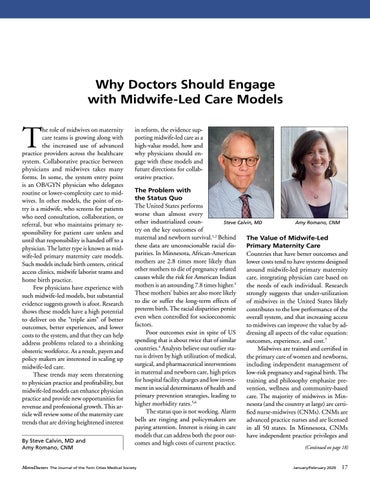
The United States performs worse than almost every other industrialized counSteve Calvin, MD Amy Romano, CNM try on the key outcomes of maternal and newborn survival.1,2 Behind The Value of Midwife-Led these data are unconscionable racial disPrimary Maternity Care parities. In Minnesota, African-American Countries that have better outcomes and mothers are 2.8 times more likely than lower costs tend to have systems designed other mothers to die of pregnancy related around midwife-led primary maternity causes while the risk for American Indian care, integrating physician care based on mothers is an astounding 7.8 times higher.3 the needs of each individual. Research These mothers’ babies are also more likely strongly suggests that under-utilization to die or suffer the long-term effects of of midwives in the United States likely preterm birth. The racial disparities persist contributes to the low performance of the even when controlled for socioeconomic overall system, and that increasing access factors. to midwives can improve the value by adPoor outcomes exist in spite of US dressing all aspects of the value equation: spending that is about twice that of similar outcomes, experience, and cost.7 4 countries. Analysts believe our outlier staMidwives are trained and certified in tus is driven by high utilization of medical, the primary care of women and newborns, surgical, and pharmaceutical interventions including independent management of in maternal and newborn care, high prices low-risk pregnancy and vaginal birth. The for hospital facility charges and low investtraining and philosophy emphasize prement in social determinants of health and vention, wellness and community-based primary prevention strategies, leading to care. The majority of midwives in Minhigher morbidity rates.5,6 nesota (and the country at large) are certiThe status quo is not working. Alarm fied nurse-midwives (CNMs). CNMs are bells are ringing and policymakers are advanced practice nurses and are licensed paying attention. Interest is rising in care in all 50 states. In Minnesota, CNMs models that can address both the poor outhave independent practice privileges and comes and high costs of current practice.
The Journal of the Twin Cities Medical Society
(Continued on page 18)
January/February 2020
17
Obstetrical Services Today Midwife-Led Care Models (Continued from page 17)
prescribing authority. Another pathway to midwifery is as a certified professional midwife (CPM). This non-nursing pathway does not allow for hospital privileges in Minnesota, but CPMs may work in birth centers or home birth practices. Research consistently demonstrates that prenatal care in a midwife-led model is associated with reduced rates of preterm birth.8,9 In labor, studies show midwifery care is associated with reduced use of cesarean and instrumental vaginal birth, reduced incidence of episiotomy or severe tear, and equivalent newborn outcomes.10,11 A midwife-led care model backed by particularly strong evidence is the freestanding birth center model. Birth centers are designed for low risk labor and birth, with eligibility requirements based on national standards. Birth center safety is supported by health system integration, a rigorous national accreditation program and, in most states, licensure regulations.12-14 Minnesota is a national leader in ensuring high standards for birth centers and midwives. The State of Minnesota Department of Health has licensed birth centers since 2011. Licensure requires accreditation by the Commission for Accreditation of Birth Centers (CABC). There are seven accredited birth centers in Minnesota. Four are in the Twin Cities and three in greater Minnesota. An estimated 1,000 births occur each year in these practices, just under 1.5% of the nearly 70,000 yearly MN births. In 2018, the Center for Medicare and Medicaid Innovations released results of a four-year national study of over 45,000 Medicaid beneficiaries in three different enhanced prenatal care models. Compared with the other models and traditional care for people with low-risk pregnancies, the birth center model had the lowest rate of preterm birth and cesarean delivery, fewer infant emergency department visits and hospitalizations, and an average cost savings to Medicaid programs of over $2,000 per pregnancy.9,15 Research shows other 18
January/February 2020
midwife-led care models result in similar savings.16 As seen in previous studies of midwife-led care,8 Strong Start (an initiative of the Center for Medicare and Medicaid) participants reported positive experiences of care, especially in the birth center and group visit models (group visit models are commonly midwife-led).17 Women particularly valued factors like having longer visits and getting support and education as part of their care. Because of these very promising results and in response to the persistent poor outcomes and high costs of current care models, healthcare payers and purchasers are increasingly engaged in efforts to scale up midwife-led care, especially those models that incorporate a birth center option. Emerging value-based payment models are
likely to incentivize outcomes that midwife-led care can strongly influence, such as prevention of preterm birth, appropriate cesarean rates in low-risk pregnancies, and a positive experience of care. Physician Engagement with Midwife-Led Models
ACOG workforce studies warn of a looming shortage of OB/GYN physicians. Even if midwife-led care models didn’t demonstrate superior care, physician engagement with such models will be necessary and inevitable. But it can also be satisfying for both parties, and contribute to better outcomes for our patients. Physicians can focus on medical and surgical care planning and diagnostic procedures while midwives focus on education, wellness,
support, and risk screening, and oversee uncomplicated births. A common, but largely false, impediment to collaboration with midwives is the physician’s fear of vicarious liability. The reality is reassuring.18 Strong collaborative practice protocols, interdisciplinary training, and attention to quality assurance are protective. There are multiple ways physicians may engage with midwife-led models, and a range of revenue sharing arrangements. Physicians can serve as consultants and collaborating providers for midwives, providing billable services such as ultrasound and cesarean section. Physicians may also be employed by the birth center or the hospital/health system that owns the birth center. To fully integrate clinician services in a more direct and seamless fashion, physicians may also choose to own or co-own a birth center or other midwife-led practice. This model was used for the founding of the Minnesota Birth Center (MBC) in 2012. The MBC welcomed the first of more than 2,300 births in June 2012. It is staffed by CNMs with RN birth assistants. Midwives accompany mothers to nearby Allina hospitals in Minneapolis and St. Paul in the 15% of situations where transfer is necessary. Most transfers are non-urgent and still end in a midwife-attended birth. If necessary, collaborating physicians perform operative vaginal deliveries or cesarean sections. The low risk mothers who choose the birth center are aware of the potential need for an increased level of care and are prepared for the possibility of transfer. Maternal and newborn outcomes are positive and in line with national studies. (See www.theminnesotabirthcenter. com for statistics.) The MBC and other accredited centers are independent midwife-led units designed to maximize chances for a safe physiological birth within the context of an integrated obstetrical safety net. Birth centers are satisfying for patients and providers and, if adequately reimbursed, provide a desirable high value option for the mothers seeking less intensive maternity care.
MetroDoctors
The Journal of the Twin Cities Medical Society
Future Directions for Collaborative Practice
In August 2019 the American Congress of Obstetricians and Gynecologists (ACOG) and the Society for Maternal Fetal Medicine (SMFM) released an updated consensus statement on levels of maternal care.14 The stated goal was to reduce maternal mortality and morbidity by providing risk-appropriate care specific to maternal health needs and preferences, including a birth center option for low-risk birth. Collaborative relationships were encouraged between differing levels of maternal care. This shift to an integrated, regionalized system and team-based care across facilities is a major shift from the status quo, but the shift is necessary if we are going to address our persistent challenges and reverse our troublesome trends in maternity care. When physicians and midwives respect each other and recognize their unique strengths, everyone benefits, especially mothers and babies. That has been the Minnesota Birth Center (MBC) experience, and it is now time to scale up access to similar models. Steve Calvin, MD is board certified in OB/ GYN and Maternal-Fetal Medicine. He is the founder and medical director of the Minnesota Birth Center. He has served on the Minnesota Board of Nursing APRN advisory committee and is beginning a four-year term on the US HHS secretary’s advisory committee on infant mortality and maternity care. He can be reached at steve@theminnesotabirthcenter.com. Amy Romano, CNM is a nurse-midwife and consultant, specializing in the design and implementation of midwife-led and team-based care models, quality management systems, and patient engagement programs. She previously led the design of clinical, education, and wellness programs for Baby and Company, a multi-state network of freestanding birth centers integrated with regional health systems. She can be reached at midwifeamy@ gmail.com. References 1. Kamal R, Hudman J, McDermott D. What do we know about infant mortality in the U.S. and comparable countries? https://www. healthsystemtracker.org/chart-collection/in-
MetroDoctors
2.
3.
4.
5. 6.
7.
8.
9.
10.
11.
12.
13. 14.
15.
16.
17.
18.
The Journal of the Twin Cities Medical Society
fant-mortality-u-s-compare-countries/#item-. Updated 2019. Neggers YH. Trends in maternal mortality in the united states. Reprod Toxicol. 2016;64:7276. doi: 10.1016/j.reprotox.2016.04.001 [doi]. Minnesota Department of Health, Child and Family Health Division. Maternal morbidity and mortality. 2019. The Economist Data Team. A typical american birth costs as much as delivering a royal baby. https://www.economist.com/graphic-detail/2018/04/23/a-typical-american-birth-costsas-much-as-delivering-a-royal-baby. Updated 2019. Truven Health Analytics. The cost of having a baby in the united states. 2013. Jolivet RR, Corry MP, Sakala C. Transforming maternity care: Key informant interview summary. Womens Health Issues. 2010;20(1 Suppl):S79-80. doi: 10.1016/j.whi.2009.11.010 [doi]. Renfrew MJ, McFadden A, Bastos MH, et al. Midwifery and quality care: Findings from a new evidence-informed framework for maternal and newborn care. Lancet. 2014;384(9948):1129-1145. doi: 10.1016/S01406736(14)60789-3 [doi]. Sandall J, Soltani H, Gates S, Shennan A, Devane D. Midwife-led continuity models versus other models of care for childbearing women. Cochrane Database Syst Rev. 2016;4:CD004667. doi: 10.1002/14651858.CD004667.pub5 [doi]. Jolles DR, Stapleton SR, Alliman J. Strong start for mothers and newborns: Moving birth centers to scale in the united states. Birth. 2019;46(2):207-210. doi: 10.1111/birt.12430 [doi]. Souter V, Nethery E, Kopas ML, Wurz H, Sitcov K, Caughey AB. Comparison of midwifery and obstetric care in low-risk hospital births. Obstet Gynecol. 2019;134(5):1056-1065. doi: 10.1097/ AOG.0000000000003521 [doi]. Sandall J, Soltani H, Gates S, Shennan A, Devane D. Midwife-led continuity models versus other models of care for childbearing women. Cochrane Database Syst Rev. 2015;9:CD004667. doi: 10.1002/14651858.CD004667.pub4 [doi]. Woo VG, Milstein A, Platchek T. Hospital-affiliated outpatient birth centers: A possible model for helping to achieve the triple aim in obstetrics. JAMA. 2016;316(14):1441-1442. doi: 10.1001/jama.2016.11770 [doi]. American Association of Birth Centers. Standards for birth centers (revised 2017). 2017. American College of Obstetricians and Gynecologists and the Society for Maternal-Fetal Medicine. Obstetric care consensus: Levels of maternal care. https://www.acog. org/Clinical-Guidance-and-Publications/Obstetric-Care-Consensus-Series/Levels-of-Maternal-Care?IsMobileSet=false. Updated 2019. Center for Medicare and Medicaid Innovations. Strong start for mothers and newborns evaluation of full performance period (2018): Findings at-a-glance. 2018. Attanasio LB, Alarid-Escudero F, Kozhimannil KB. Midwife-led care and obstetrician-led care for low-risk pregnancies: A cost comparison. Birth. 2019. doi: 10.1111/birt.12464 [doi]. Hill I, Cross-Barnet C, Courtot B, Benatar S, Thornburgh S. What do women in medicaid say about enhanced prenatal care? findings from the national strong start evaluation. Birth. 2019;46(2):244-252. doi: 10.1111/ birt.12431 [doi]. Booth J, Breedlove G. Vicarious liability: Addressing barriers to midwifery practice. 2019.
at PrairieCare Medical Group is now offering integrated mental health services at Ridgeview Medical Center!
Free
Needs Assessment now being offered at: Ridgeview Medical Center 560 S Maple St Waconia, MN 55387
Call today! 952.903.1351 MENTAL HEALTH SERVICES
Innovative Online Screening
Psychotherapy Psychiatry Intensive Outpatient Program
Care Coordination
January/February 2020
19
Obstetrical Services Today
What’s New in OB/GYN Training at the U
T
he residency program at the University of Minnesota has an illustrious 131-year history of excellence in patient care and medical education. Many of the graduates of the program stay in Minnesota helping the University to fulfill our obligation as a land-grant institution to improve the quality of life of the women in the state. We continue to train fellows in Maternal Fetal Medicine and Gynecologic Oncology and have recently expanded our Urogynecology program. Our faculty are nationally recognized for their expertise and serve on national level committees in The American College of Obstetricians and Gynecologists, the American Board of Obstetrics and Gynecology and many more. There are many things that have occurred over the last 20 years that have changed the paradigm of “see one, do one, teach one,� the mantra that formed the curriculum for surgeons from the time of Halsted. Increased minimally invasive surgical techniques as well as improved medical treatments have decreased the number of surgical procedures that are done. In the past, abnormal uterine bleeding was one of the leading indications for hysterectomy. Increased efficacy for medical treatments such as the levonorgestrel containing intra-uterine system in decreasing bleeding as well as endometrial ablation have both decreased the need for hysterectomy for this indication. Decreased use of episiotomies has led to a By John R. Fischer, MD
20
January/February 2020
reduction in the number of obstetrical anal sphincter injuries. This in turn has led to some residents graduating with little experience in the repair of third- and fourth-degree lacerations. How do we as surgical educators ensure that residents gain needed experience and complete their training with confidence and skills to safely care for their patients? Ten years ago, The American College of Surgery developed the Fundamentals of Laparoscopic Surgery (FLS) program to establish a standard set of didactic information and manual skills that would serve as a basic curriculum to guide surgical residents, fellows and practicing surgeons in the performance of basic laparoscopic surgery. It consists of three components, a web-based didactic curriculum, hands-on manual skills using the FLS Trainer Box, and a two-part assessment consisting of written exam and skills test. The American Board of Obstetrics and Gynecology now require that all graduating OB/GYN residents complete and pass the FLS knowledge and skills assessment in order to be eligible to
sit for their written boards. Dr. Samantha Hoffman, Residency Program Director, and Dr. Colleen Rivard have instituted an intensive curriculum to ensure that all University of Minnesota OB/GYN residents have the opportunity to practice the manual skills assessment. To date, their efforts have paid off with a 100% pass rate on both the FLS manual skills and knowledge assessments. The increased use of simulation has not been limited to high fidelity systems that can provide a realistic experience to the trainee for a particular surgical procedure. Trainees can gain valuable experience through relatively simple simulations, such as the use of the beef tongue model to teach residents how to repair third- and fourth-degree obstetrical lacerations. Poorly repaired obstetrical anal sphincter injuries can place a woman at significant risk for fecal incontinence. The model uses segments of beef tongue along with segments of turkey legs and skin to simulate the perineum, external anal sphincter and rectal mucosa to provide a remarkably realistic experience for the trainee in the repair of obstetrical anal sphincter injuries. Trainees gain knowledge of the pertinent anatomy through construction of the model with the various components and then valuable skill in the correct repair of the laceration. This simulation has become an annual event in the surgical curriculum and provides valuable experience for the residents in the repair of these complex lacerations. The use of simulation to teach other obstetrical skills and procedures has also
MetroDoctors
The Journal of the Twin Cities Medical Society
increased. The number of operative vaginal deliveries has declined for many years but is still a vitally important skill for the practicing OB/GYN. Additionally, it is a marker that the OB/GYN RRC of the ACGME uses to assess how well a program is doing in training their residents. Twenty years ago, residents gained the needed skills and experience in operative vaginal deliveries by placing the vacuum or forceps as the baby’s head was crowning while under the supervision of a more experienced resident or faculty. Operative vaginal deliveries have declined dramatically as more women opt for a cesarean section in the setting of an arrest of labor or concerning fetal heart tracings. This is especially true for forceps deliveries, which are rarely done in this area. Vacuum delivery, however, is an option to attempt to quickly deliver the baby while preparing for cesarean section. In order to provide residents with the needed skills and experience in operative vaginal deliveries, Dr. Hoffman has developed an operative vaginal delivery simulator and curriculum to teach residents the necessary skills to safely perform vacuum-assisted deliveries. This curriculum was developed as a part of her participation in the Association of Professors of Gynecology and Obstetrics Academic Scholars and Leaders Program. This 18-month intensive program is designed to help promising academic OB/ GYNs develop their teaching and administrative skills. This simulation can also be adapted to teach residents how to safely perform forceps deliveries. Appropriate and constructive feedback is one of the most important components to successful education. Therefore, the department has begun a program of faculty development to assist in honing their feedback skills so that needed information is conveyed to the trainee in easily-learned components. Dr. Nancy Gaba, the Chair of Obstetrics and Gynecology at George Washington University and an expert in feedback in surgical education, presented a grand rounds on the topic this past spring. We have also given MetroDoctors
seminars on how to give feedback at our affiliate institutions to improve resident experience. Our residents get broad exposure to the specialty. In addition to working at the University of Minnesota, they have clinical rotations at HCMC, Children’s, Methodist, Regions, and the Minneapolis VA Medical Center. This broad base of institutions provides our residents exposure to a variety of educators and patient populations. This helps to ensure that there is no one “University of Minnesota way” of doing things. Instead, the residents get to practice evidence-based medicine in a variety of different settings. Each site has a different patient population that they care for, giving our residents the opportunity to develop culturally sensitive care. The majority of the medical students we interview for residency positions here feel that this exposure is a positive program attribute as they have the opportunity to see different styles of practice, and different patient populations. The obstetrics rotation at the University of Minnesota Medical Center on the west bank provides our residents with experience in caring for complex obstetrical patients from around the upper Midwest. Working closely with the Maternal-Fetal Medicine faculty and fellows the residents provide tertiary care for over 10,000 deliveries. There has been a decrease in the number of rural hospitals in Minnesota and around the country that offer obstetrical services. There are many reasons for this, from concerns about safety and currency of the physicians and staff, as well as difficulties in recruiting physicians to these areas. The University of Minnesota has an elective rural obstetrics rotation in Alexandria, MN that gives the residents exposure to practicing in a rural setting that does not have the close proximity to subspecialty and tertiary care that one sees in the Twin Cities. It also demonstrates that one can have a successful and fulfilling practice in a rural location. Recently, one of our residents who completed
The Journal of the Twin Cities Medical Society
the rotation accepted a position in the sponsoring practice further solidifying the relationship. Global medicine is becoming a more important part of resident education. We have a long-standing relationship with the Dodoma Christian Medical Center in Tanzania. Here, residents learn teambased obstetrical care in a low resource setting. This further enhances their cultural sensitivity and gives them experience in problem solving and caring for women with complex obstetrical issues in a low resource setting. Prior to 2017 the only experience the residents had in Urogynecology was through a rotation at Methodist Hospital. I was brought to the University at that time to start a Division of Female Pelvic Medicine and Reconstructive Surgery (FPMRS) within the department. We have partnered with Drs. Cynthia Fok and Nissrine Nakib, two female urologists in the Department of Urology to build a collaborative pelvic floor practice to care for women with complex pelvic floor disorders. We have hired an additional Urogynecologist, Dr. Rahel Nardos from the Oregon Health Sciences University and there are plans to develop a Pelvic Floor Center with access to specialists in FPMRS, Colorectal Surgery, Physical Therapy, Nutrition, and state of the art diagnostics such as urodynamics, cystoscopy and ultrasound. This new Center will give residents greater exposure to FPMRS during their training. The University of Minnesota OB/ GYN Residency is on the forefront by increasing the use of simulation to improve resident education and experience and ultimately improved patient outcomes. The residency program at the University of Minnesota remains a vibrant and exciting place to train outstanding clinicians to care for the women of Minnesota. John R. Fischer, MD is the Professor and Chair, Dept. OB/GYN at the University of Minnesota. He can be reached at johnf@ umn.edu; (612) 626-5939. January/February 2020
21
Obstetrical Services Today
Top Medical Liability Issues in OB/GYN and Strategies to Address These Risks
A
ll medical specialties share some similar medical liability risks that fall into broad categories such as failure to diagnose, poor documentation, or medication errors. However, each specialty comes with its own unique risks that physicians within that specialty should recognize and understand. For obstetricians and gynecologists, there are specific challenges that represent a majority of the medical liability lawsuits which arise within this area of practice. COPIC, a leading medical liability insurance provider, uses claims data to analyze common areas where lawsuits emerge from, and with this, we develop educational activities and resources designed to generate awareness and reinforce proactive, preventative practices. For OB/GYN, we looked at claims data alongside medical trends and other research and information. This assessment allowed us to create an at-a-glance summary about OB/GYN risk areas and offer some suggested ways to mitigate these risks and enhance patient safety. This article uses two case studies to provide some real-world examples and then identifies common areas of risk and guidance on how to address them. Case Study #1 A 28-year-old G1 P0000 female presents in active labor after an uncomplicated pregnancy. She progressed adequately in labor, getting an epidural at 6cm dilatation. After delivery of the fetal head, the head partially withdraws back into the birth canal (turtle head) and this was By Alethia Morgan, MD
22
January/February 2020
immediately noted. A modified McRoberts maneuver was done with suprapubic pressure without success. This was followed by a Woods’ corkscrew maneuver. Ultimately, delivery of the posterior arm was successful with delivery of the shoulders and trunk of the infant. The infant was noted to have brachial plexus palsy which was ultimately found to be permanent. Because it was a very difficult delivery, the physician wrote a quick note and went to the nursery to check on the baby. Unfortunately, the documentation by the physician did not include the procedures that were done and in what order, and did not mention which shoulder was anterior. Case Study #2 The patient is a 76-year-old Caucasian female with a history significant for hypertension. In Nov. 2005, she was diagnosed with a pelvic mass measuring 10x9x8cm and uterine fibroids. On Dec. 15, 2005, she had an open total hysterectomy and bilateral removal of ovaries, fallopian tubes and pelvic mass. This surgery was thought to be uneventful. Over the next four days,
the patient progressed but remained without flatus or bowel movement. She was given Milk of Magnesia/Dulcolax. On Dec. 19, she complained of constipation, but had minimal flatus and a small bowel movement. She was moderately distended and a three-way X-ray revealed “moderately extensive free intraperitoneal air,” presumably secondary to the surgery. The patient’s condition did not improve significantly and CT scans of the pelvis, abdomen, and chest were done. Ultimately, the patient was diagnosed with a perforated bowel with peritonitis and sepsis. She was hospitalized for two months due to additional complications. These two cases show common challenges seen in the OB/GYN setting. Almost half of all dollars paid out for defense and indemnity for OB/GYN physicians are a result of care in labor and delivery. Unfortunately, poor documentation can make it difficult to tell if the standard of care was met as illustrated in the first case. To support documentation, a delivery note addendum checklist may have helped in this case. This would have captured the chronological details of what happened during the procedure to support the decisions made. Related to the second case, slightly more than 25% of dollars paid out in OB/GYN medical liability cases relate to technical performance and complications of gynecologic surgery with the most common being failure to rescue. See chart on next page — COPIC Specialty Focus: OB/GYN — Guide to Common Areas of Risk and how to Address these Errors.
MetroDoctors
The Journal of the Twin Cities Medical Society
Alethia Morgan, MD joined COPIC as a physician risk manager in 2007, after serving on COPIC’s Board of Directors for 12 years. Prior to joining COPIC, she practiced full time obstetrics and gynecology for 27 years in Texas and Colorado. Dr. Morgan earned her medical degree and completed her residency KEY AREAS FOR ERRORS AND LITIGATION
at the University of Texas Medical Branch in Galveston, Texas. She remains active in her community, serving as a volunteer physician at Doctor’s Care, sitting on the Board of Directors for Florence Crittenton Services, and participates in the Colorado Women’s Forum. She can be reached at: lmorgan@copic.com. STRATEGIES TO REDUCE ERRORS
MEDICAL SPACE
FOR LEASE
Prenatal care • • • •
Antenatal diagnosis of fetal anomaly Genetic screening Group B strep Prematurity management
1) 2) 3)
Document discussion of appropriate fetal anomaly screening and diagnostic tests/procedures and either completion or informed refusal Document discussion of appropriate prenatal screening & either completion or informed refusal Transmit results to patient and L&D
Technical performance and complications of gynecologic surgery •
Injury to internal organs, sepsis/ infection/abscess, mesh erosions, or unexpected/poor results
S M C Edina, MN
1) Document good indication for procedure, informed consent, and patient specific risks 2) Document pros/cons of the procedure and alternatives 3) Early recognition of complications 4) Utilize preoperative checklist for every procedure
Diagnosis and treatment of non-obstetric conditions, usually in the office setting •
Delayed diagnosis of malignancy, severe infectious disease, and severe medical illnesses
1) 2) 3) 4)
Risk specific screening and document completion or informed refusal Standardized tickler/tracking systems Once there is an incidental finding, track it through the process Systematic work up of symptomatic findings
R M B Burnsville, MN
Labor and delivery •
Improper interpretation of FHR tracing
•
Failure to respond to an abnormal FHR tracing in a timely fashion
•
Complications of TOLAC (Trial of labor after cesarean)
•
Complications of operative vaginal delivery
•
Administration of oxytocin, magnesium sulfate and misoprostol
•
•
•
Neurologically impaired infants
Shoulder dystocia
General guidelines
1) 2) 3) 4) 5) 6) 7) 8) 9) 10) 11) 12) 13)
14) 15)
MetroDoctors
Assure that you and your team are well trained in FHR interpretation Periodic FHR tracing course for all team members Assure good communication among the team, including anesthesia Document the thought process when the decision is to continue labor Document informed consent in the prenatal chart, including any facility specific risks Written informed consent form as well All members of the team should be in-house Checklist to assist in the documentation of the indication, patient counseling, the procedure and post-procedure assessment Standardized orders and checklists for administration and monitoring Document indications and patient counseling Send cord gases when there is a depressed newborn and as indicated Send the placenta to pathology when there is a depressed newborn and for specific indications such as shoulder dystocia, sepsis, twins, etc. Checklist to assist with documentation when shoulder dystocia is encountered including which shoulder was anterior and that no fundal pressure was used Briefs and huddles while patients are in labor to assure good communication amongst the team Debrief, particularly when there is an adverse outcome of any type such as neonatal compromise, maternal hemorrhage, or shoulder dystocia
The Journal of the Twin Cities Medical Society
2800/2828 M B Minneapolis, MN
Leased By: ®
MIKE FLEETHAM
(952) 7672842
MFleetham@MedCraft.com
JOLENE LUDVIGSEN
(952) 8387126
JLudvigsen@MedCraft.com
Owned By:
medcraft.com/leasing
January/February 2020
23
Obstetrical Services Today
From Postpartum Depression to Two-generation, Integrative, Trauma Healing— The Redleaf Center for Family Healing Offers a New Model of Care
P
erinatal depression and anxiety are the most common complications of childbirth1 affecting one in seven mothers2 and one in 10 fathers.3 Despite this prevalence and increased risk of maternal and infant mortality and morbidity, families struggle to receive the help they need. In fact, it is estimated that 50% of mothers with symptoms of depression and anxiety do not seek mental health treatment.4 In efforts to respond to this profound need, Dr. Helen Kim and Jesse Kuendig, LICSW founded the Mother-Baby program at Hennepin Healthcare in 2013, Minnesota’s first parent-child partial hospital program and the fourth program in the nation. To date, this successful program has served over 600 pregnant and parenting mothers and families, and has had over 3,000 callers to the HopeLine, a phone line for mothers, families and providers. Through this work, the urgent need to enhance the approach to healing for families through holistic and community/ family-centered interventions was identified. The mission for the Mother-Baby Program was subsequently enriched to reflect this need and conceptualized the Redleaf Center for Family Healing. Through a transformative gift from the Lynne and Andrew Redleaf Foundation, The Redleaf Center for Family Healing will expand the current mental health services of the Mother-Baby Program and
By Katie Thorsness, MD and Helen Kim, MD
24
January/February 2020
create a new model of care to heal families through two-generation, trauma-informed mental health services for pregnant women and families of children 0-5 years old. The Center will expect to support more than 6,000 families a year. Through the Redleaf Center’s unique collaborative model, families will have access to care from multiple programs Katie Thorsness, MD Helen Kim, MD of Hennepin Healthcare, all within one location. These services incause toxic stress, or prolonged and perclude: psychiatry, integrative health, pesistent stress in the absence of protective diatrics, nutrition, family medicine, and relationships. Repeated exposure to toxic OB/GYN. The Center will be located on stress, such as experiencing abuse, witthe Hennepin Healthcare Minneapolis nessing domestic violence, or living with campus, an institution well-poised to dea parent with mental illness, negatively liver care to all families who need it, with impacts the brains and bodies of children. completion expected in 2020. Seven out of the 10 causes of death in the US are connected with childhood toxic Mission: To support young children, parstress.5 By focusing on early childhood ents, and families by nurturing the mental brain development and parent mental and health and parenting capacity of families emotional well-being, the Redleaf Center expecting a baby and parenting young chilwill help parents heal from their own emodren. We will advance healing through tional wounds, with a focus on underlying family-centered, trauma-informed, incauses that can undermine both health tegrative approaches grounded in lived and resilience, so they can become the experience, social justice, and research. protective and supportive caregivers their Babies can’t wait. They need emochildren need. tionally stable parents for healthy brain Services will specifically focus on endevelopment. Perinatal depression and hancing adult capacity and mental health anxiety coincide with a critical window in addition to nurturing healthy relationof rapid brain development in children ships between parents (or preferred careand rob parents of joy when their children givers) and children through the following need it most. In addition, research shows programming: that adverse childhood experiences (ACEs) MetroDoctors
The Journal of the Twin Cities Medical Society
Clinical Services: Fostering mental health, supportive relationships and parent capacity for families expecting a baby or parenting children ages 0-5 years old. Core clinical service elements will include expanded programming for mothers, fathers, and new models of care to address the needs of specific populations of pregnant and postpartum mothers such as those struggling with addiction.
bring heart into medical practice by infusing it with compassion, the arts and sciences, as well as the stories and disparate voices of patients, families and healthcare providers.
On-Site Childcare Services: The Center will provide Integrative Health Services: The Redchildcare for children of Henleaf Center for Family Healing will offer nepin County Medical Center Drop-in childcare will be offered for families being supported by the Redleaf Center for Family Healing, as well whole-person and family support through patients and staff through: integrative healing modalities to focus on • Drop-in childcare for as parents with appointments in the downtown campus. self-care and healthy relationships along children ages 6 weeks to literature to significantly rewrite approachwith mind, body, spirit practices that are 10 years old whose parents are in the es to child and family well-being. Emergency Department or attending culturally meaningful. This will include: • A nutrition and food program that appointments at Hennepin HealthTrauma-Informed Care Learning Lab will promote healthy adult relationcare’s Clinic & Specialty Center. and Resource Hub: The Redleaf Center • Back-up childcare for Hennepin ships with food and positive feeding will be surrounded by a new network of practices between parents and chilHealthcare staff when their regular engaged partners from within and outside dren. The space will include a comchildcare is unexpectedly unavailable. of Hennepin Healthcare. Through this munity meeting and eating space, shared Learning Lab and Resource Hub, Training and Research: The research as well as a teaching kitchen. Here, we will create the potential for leveraged team will contribute to the best pracCenter staff and rotating professionals impact and offer the potential to “raise tice literature and training for the next from a variety of disciplines will work all boats” by: generation of providers. Since opening collaboratively to provide opportu• Raising consciousness and underin 2013, the Mother-Baby Program has nities to nurture participants both standing of historical trauma and engaged in preliminary training, research physically and emotionally. structural racism in order to revise polactivities, and multidisciplinary training • Yoga and meditation classes will be icies and practices that re-traumatize. rotations. By combining an innovative offered to women, children, and • Creating and piloting new models and ground-breaking model for two-genfamilies. of trauma-informed health care that eration, integrative, trauma-healing with • A Healing Arts Program, led by Syl focus on patients and families as well coordinated training and research activiJones, will incorporate storytelling as the wellbeing of staff. ties, the Redleaf Center for Family Healing and other healing arts in the ongo• Sharing best practices and providing has the potential to influence hundreds of ing support of patients, families, and technical assistance in adoption and providers and staff as well as inform the staff. The Healing Arts Program will implementation of trauma-informed best practices. • Through community partnership, developing policies and practices that shift towards and invest in new models of health care based in community. • Creating a learning community so that programs have peers in this critical work. • Fostering cross-referrals where needed to ensure that people have access to culturally meaningful resources. The Redleaf Center is committed to improving the long-term health and well-being of all children and families, Teaching Kitchen: The Kitchen Table will foster healing and nurturing through the power of food and nutrition education.
MetroDoctors
The Journal of the Twin Cities Medical Society
(Continued on page 26)
January/February 2020
25
Obstetrical Services Today Redleaf Center for Family Healing (Continued from page 25)
particularly those most impacted by disparities. By empowering parents to nurture and protect their children and by creating trauma-informed policies and practices that help more and harm less, the Redleaf Center is making a long-term investment in children, our communities, and Minnesota’s shared future. What could be more important? Parents, families, and providers can refer for care at the Mother-Baby Program via the following ways: • Calling 612-873-6262 (MAMA). • Filling out the online referral form: https://www.hennepinhealthcare.org/specialty/psychiatr y/ mother-baby-program/. • Call 612-873-HOPE, a free telephone support service for pregnant women and parents of young children. One of our mental health staff members will talk with you, answer questions, and help you find the support you need. You may be asked to leave a message. If so, one of our mental health staff
26
January/February 2020
members will call you back within two business days. For more information about the Redleaf Center for Family Healing, visit: https://www.redleaffamilyhealing.org/. Dr. Katie Thorsness specializes in perinatal psychiatry. As a member of the Mother-Baby team, she practices medicine in the context of a multidisciplinary team who helps support both mothers and families through the framework of attachment-based, psychodynamic, family system, narrative, and mindfulness practices. Dr. Thorsness provides medical care with a whole-person approach encouraging patients to consider how movement, nutrition, connection, purpose, and sometimes psychiatric medication, can relieve suffering and foster emotional wellbeing. She has additional expertise in physician trainee mental health. Dr. Helen Kim is the co-founder and director of the Hennepin Healthcare Mother-Baby Program and Redleaf Center for Family Healing and Assistant Professor of Psychiatry at the University of Minnesota. She is a
perinatal psychiatrist who is committed to empowering women and providing outstanding mental health care for all, particularly those most impacted by trauma and discrimination. Following psychiatry training at Massachusetts General Hospital, Dr. Kim has been a leader in advancing new models of integrative, two-generation (parent-child) healing that address root causes that undermine wellbeing, such as childhood trauma, toxic stress, poverty, and discrimination. References: 1. NPA Position Statement 2018, Perinatal Mood and Anxiety Disorders, National Perinatal Association. 2. Wisner, K., Sit, D., McShwa, M., Rizzo, D., Zoretich, R., Hughes, C., et al (2013). Onset timing, thoughts of self-harm, and diagnoses in postpartum women with screen-positive depression findings. JAMA Psychiatry, 70:490-8. 3. Paulson JF, Bazemore SD. Prenatal and Postpartum Depression in Fathers and Its Association With Maternal Depression: A Meta-analysis. JAMA. 2010;303(19):1961–1969. doi:10.1001/ jama.2010.605. 4. Centers for Disease Control (CDC). (2008). Prevalence of self-reported postpartum depressive symptoms—17 states, 2004–2005. Morbidity and Mortality Weekly Report, 57(14), 361–366. 5. Root of the Root: Translating the Science of Toxic Stress to Transform Health Surgeon General, State of California May 20, 2019.
MetroDoctors
The Journal of the Twin Cities Medical Society
Amma Parenting Center
G
iving birth is one of the most joyful and exciting times in a woman’s life. For many women, however, pregnancy, delivery and the months postpartum can also be overwhelming and isolating. Social media and conflicting information available on the internet can contribute to this deflating and confusing time. Mothers are looking for a trusted source of guidance they can rely on, especially as the rates of postpartum depression and anxiety are on the rise. One of the surest ways to mitigate confusion and angst is through education, support and being part of a community. Over the last 13 years Amma Parenting Center has become the go-to authority for prenatal and new parent education and, in the process is credited for building lifelong bonds between its participants. With eight locations across the metro, Amma offers an array of classes ranging from preparing for childbirth, lactation support, baby CPR, New Mama groups and even Grandparent classes. The course curriculum is vetted by the staff of industry professionals and kept up-to-date reflecting current prevailing evidence-based information. The Amma leadership team and instructors have extensive backgrounds as prenatal nurses and lactation experts with a combined team experience of 250 years. This deep experience and perspective allows Amma to be able to distill down the sea of messaging that can be so confusing for new parents to understandable and actionable items so new parents feel By Gwen Martin
MetroDoctors
confident in their abilities to maneuver newborn challenges. Research confirms that a more educated mother will experience less complicated and less expensive deliveries, and will recover faster. In addition, mothers who feel supported with a community of peers experience lower rates of postpartum depression and are more likely to be more confident either staying at home or returning to work. In 2018, the American College of Obstetricians and Gynecologists (ACOG) designated the fourth trimester as the most important women’s healthcare issue: “The weeks following birth are a critical period for a woman and her infant, setting the stage for longterm health and well-being. During this period, a woman is adapting to multiple physical, social, and psychological changes. Optimizing care and support for postpartum families will require policy changes. Changes in the scope of…care should be facilitated by policies that
The Journal of the Twin Cities Medical Society
support the postpartum. Perinatal depression, which includes major and minor depressive episodes that occur during pregnancy or in the first 12 months after delivery, is one of the most common medical complications during pregnancy and the postpartum period, affecting one in seven women.” As the world is becoming more fast paced and ever more complex, the awareness of how a woman prepares for and recovers from childbirth needs to keep pace. Mental health and women’s health issues are white hot. A study led by Rada K. Dagher, assistant professor of health services administration at the University of Maryland School of Public Health, examined the link between postpartum depression and healthcare costs and found that women who suffer from postpartum depression incurred 90% higher healthcare expenditures than women who didn’t suffer. This is a burdensome expense for employers and individuals. One company (Clear Communications, NZ) calculated that filling replacement roles for new mothers who didn’t return after their maternity leave cost them on average $75,000. Ernst & Young estimates that replacing a new mother’s position costs them 150% of her salary, based on the median US salary of $44,000. A condition called “presenteeism” can exist when a new mother returns to work and is physically present but is unable to focus because of anxiety over leaving her child at home or daycare. Presenteeism can be even more costly to (Continued on page 28)
January/February 2020
27
Obstetrical Services Today Amma Parenting Center (Continued from page 27)
a company than a mother not returning from leave as it’s harder to detect and can result in missed deadlines and opportunity costs. Many corporations are taking note. With the low unemployment rate and tight recruiting market (Minnesota is currently at 1.0% unemployment, the
lowest in over 10 years), companies are looking for ways to attract and retain talent and be seen as an employer of choice. When a company offers Amma classes as a benefit to employees not only can they show they are investing in talent, a company can also experience lower insurance claims with less complicated deliveries and higher employee engagement as mothers are able to return
THE SCHUSTER CLINIC FOR ENDOCRINE AND METABOLIC DISORDERS −and−
THE THYROID CENTER
www.schusterclinic.com
to work after a maternity leave feeling supported and confident. One of Amma’s cornerstone offerings, the New Mama class, is a fantastic opportunity to build a network with other new mothers. Each class is comprised of 8-10 new mothers and their newborns. Over a six-week period the group gathers once a week for education on a variety of topics from newborn sleep and feeding to adjusting to relationships with the new baby. In addition, each week the group is required to meet up once outside the classroom. The bond that forms over the six weeks is very tight and the support and friendship extends well beyond the newborn stage. Some New Mama groups continue to depend on each other throughout their child’s grade school years. As Amma class offerings are expanding to more corporations, the company is investing in new channels for content delivery to reach employees outside of the Minnesota market. Online learning is equally as effective as an in-person classroom experience. Amma currently offers online courses and is investing to expand that offering to include more of its core classes. To stay relevant to the technology savvy generation mothers, Amma is testing a digital version of the New Mama group which will enable participation regardless of location. The hope is that the bonding and support imbued in the “in person” class will translate online, and mothers will feel a sense of community and a “tribe” they can turn to. It is our vision that Amma Parenting will continue to be the trusted educational and community building resource for new parents, evolving to meet the needs and staying abreast of topical information in an everchanging and sometimes overwhelming world. For more information about the programs and services available through Amma, visit our website at www.ammaparentingcenter.com. Gwen Martin, is Co-CEO of Amma Parenting Center. She can be reached at gwen@ammaparentingcenter.com.
28
January/February 2020
MetroDoctors
The Journal of the Twin Cities Medical Society
Environmental Health —
The Impact of Increased Extreme Heat Events on Pregnant Women
T
he World Health Organization warns us of a number of ways that climate change will adversely affect patients worldwide, and pregnant women and their unborn children are no exception. Climate data reveals that over the last 50 years the number of hot days, hot nights, and heat waves has significantly increased, and as the climate crisis escalates, these trends are predicted to accelerate.1 This increase in extreme heat exposure is expected to adversely impact pregnant women. Epidemiological studies have linked low birth weight, pre-term births, and stillbirths to extreme heat exposure during pregnancy.2,3,4 The physiological explanation remains unclear. Some researchers have suggested that maternal dehydration associated with heat stress may harm the fetus by decreasing blood flow to the placenta. Likewise, maternal dehydration has been linked to premature uterine contractions leading to a higher incidence of pre-term birth and still birth. Researchers have also found a correlation between maternal heat exposure in the first trimester and the development of congenital heart defects.5,6 The mechanism underlying this association is unclear but researchers suggest that maternal heat stress may lead to a fetal heat-shock response leading to the fetal cell death responsible for congenital heart defects. The fetus is especially vulnerable to these developments during By Federico Rossi, MD MetroDoctors
the critical embryological development of the first trimester. Recent work has focused on the predicted rise in temperature related to climate change in the coming years, and its impact on congenital heart defects in the United States.7 Researchers predict a rise in congenital heart defects across the country with its most significant impact in the Midwest where greatest temperature variations are noted. These findings have significant implications on the projected increase in demand of medical care for newborns and children. Educating both clinicians and the public about this growing public health threat may be our best tool to mitigate its worse impacts. As extreme high temperatures and heat waves become more frequent, pregnant women will be more vulnerable. Similar to our patients with cardiopulmonary diseases, this patient population should be advised to be especially cautious during extreme heat events and seek shelter sooner rather than later. Federico Rossi, MD is a member of the TCMS Environmental Health Task Force. References: 1. McCoy D, Hoskins B. 2014. The science of anthropogenic climate change: what every doctor should know. BMJ 349:g5178, doi: 10.1136/bmj.g5178. 2. He J-R, Liu Y, Xia X-Y, Ma W-J, Lin H-L, Kan H-D, Lu J-H, Feng Q, Mo W-J, Wang P, Xia H-M, Qiu X, Muglia LJ. Ambient temperature and the risk of preterm birth in Guangzhou, China (2001–2011). Environ Health Perspect. 2016; 124:1100–1106. 3. Strand LB, Barnett AG, Tong S. Maternal exposure to ambient temperature and the risks of preterm birth and stillbirth in Brisbane, Australia. Am J Epidemiol. 2011; 175:99–107. 4. Lawlor DA, Leon DA, Smith GD. The association
The Journal of the Twin Cities Medical Society
5.
6.
7.
of ambient outdoor temperature throughout pregnancy and offspring birthweight: findings from the Aberdeen children of the 1950s cohort. BJOG. 2005; 112:647–657. Auger N, Fraser WD, Sauve R, Bilodeau-Bertrand M, Kosatsky T. Risk of congenital heart defects after ambient heat exposure early in pregnancy. Environ Health Perspect. 2017; 125:8–14. Lin S, Lin Z, Ou Y, Soim A, Shrestha S, Lu Y, Sheridan S, Luben TJ, Fitzgerald E, Bell E, Shaw GM, Reefhuis J, Langlois PH, Romitti P, Feldkamp ML, Malik S, Pantea C, Na S; the National Birth Defects Prevention Study. Maternal ambient heat exposure during early pregnancy in summer and spring and congenital heart defects—a large US population-based, case-control study. Environ Int. 2018; 118:211–221. Zhang, Wangjian, et al. “Projected Changes in Maternal Heat Exposure During Early Pregnancy and the Associated Congenital Heart Defect Burden in the United States.” JAHA 8.3 (2019): e010995.
Search for Twin Cities Medical Society on Facebook and follow us on Twitter @TCMSMN
January/February 2020
29
Obstetrical Services Today
‘Twas a Night on OB
’Twas a night on 68 and all through OB Not a creature was stirring, every moment was free. The delivery rooms were ready, the doctors were there, In hopes that the baby soon would be there.
But the baby popped out, while no one was looking, Suspended by cord, it hung there a-swinging. “Quick, clamp the cord, and where are those scissors?” (This is the part that gives students the shivers.)
The doctors were nestled all snug in their beds While visions of precipitations danced in their wee little heads. With Lyon in lab coat, and Miller asleep, And Augenbaugh looking as if he hadn’t slept for a week. Scherek was tucked in the top bunk with care And Meeker was sprawled between the bed and the chair.
His eyes how they twinkled, his dimples how merry, As he screamed bloody murder, face red as a cherry. “He has outside machinery and water works too,” Meeker exclaimed, the cord cut in two.
The patient in labor was one centimeter; The coffee pot was cooking its fifth or sixth liter. At 3 A.M. gathered the clan in the kitchen From icebox and cupboard the food they were snitching. The patient progressed and began bearing down I looked at her bottom — the head soon to crown!! More rapid than eagles, the litter it flex As we dashed to the delivery room, the baby in view. On prep-her, on draper, on linen pack opener — Hey, there, you student, with what are you soapin’ her? Stop dancing, stop prancing, and get to your scrubbing, This young babe’s ears on the perineum are rubbing. The little old doctors, so lively and quick Flew to the sink and were scrubbed in the nick — of time. They said not a word, but went straight to their work The episiotomy was done with a snip, rip, and jerk. When out of the womb there arose such a splatter — The doctors expressions were wetter and sadder. The next time you have a good hard contraction Push and bear down — there’s only a fraction — more — to be delivered.
By Carolyn Erickson
30
January/February 2020
Everyone was looking at the baby so sweet When all of the sudden, popped out a repeat. The commotion how noisy, and confusion how wild To discover that mother had a second small child! Placentas delivered, but one job not done Ten centimeter episiotomy to sew — what fun!! Augenbaugh began a stitchin’ and sewing When what to his wondering eyes should appear But a third little bundle, presenting his rear...end. Well — you can imagine what happened, the rest, The doctors all betting on which was the heaviest — The nurse unobserved had fainted to the floor When she realized the delivery “times” she had completely ignored. And if you ever think that OB is wild Why — any night compared to this, would certainly be mild! On behalf of those doctors, one final plea, Things have been worse, like when one baby was three.
Originally published in The Bulletin, Hennepin County Medical Society, April 1961. At that time the author, published as Miss Erickson, was a senior in the University of Minnesota School of Nursing. The physicians named in this poem have been identified as: John Augenbaugh, Fred Lyon, and Henry (Hal) Meeker. We were unable to confirm the full identity of Dr. Miller. MetroDoctors
The Journal of the Twin Cities Medical Society
In Memoriam FRANK BONELLO, MD, passed away on November 5, 2019. A St. Paul physician, Dr. Bonello practiced general family medicine. He joined the medical society in 1954. JOHN DELANEY, MD, passed away on November 20, 2019. Dr. Delaney was a faculty member and researcher at the University of Minnesota in the Department of Surgery; he specialized in the treatment of endocrine and breast cancer. ARNDT DUVALL III, MD, passed away on October 28, 2019. Dr. Duvall was a professor and surgeon at the University of Minnesota. He joined the medical society in 1965. MARVIN GOLDBERG, MD, passed away on October 7, 2019. A Minneapolis native, Dr. Goldberg was a radiologist at Mount Sinai Hospital, and a Professor of
Radiology at the University of Minnesota, specializing in Nuclear Radiology. He joined the medical society in 2006. JOSEPH HAMEL, MD, passed away in September 2019. Dr. Hamel practiced OB/GYN, delivering over 10,000 babies throughout his 50-year career. He joined the medical society in 1955. DAVID LARSON, MD, passed away on November 11, 2019. Dr. Larson, a radiologist, specialized in neuroradiology at Metropolitan Medical Center and Abbott Northwestern Hospital. Dr. Larson joined the medical society in 1975. MERLE MARK, MD, passed away on September 27, 2019. Dr. Mark practiced Family Medicine. He joined the medical society in 1961. WILLIAM E. PETERSEN, MD, passed away on September 10, 2019. An internist, Dr. Petersen served as the Vice President for Medical Affairs at Abbott
Northwestern Hospital and was instrumental in establishing the University of St. Thomas Physician Leadership Program. He joined the medical society in 1967. LAWRENCE POSTON, MD, passed away on September 3, 2019. Dr. Poston practiced Family Medicine and was a member of Hennepin Faculty Associates and the University of Minnesota Family Practice Department. He joined the medical society in 1967. ELMER “SULLY” SALOVICH, MD, passed away on November 19, 2019. Dr. Salovich was an Orthopedic Surgeon specializing in hand surgery. He joined the medical society in 1998. MARTIN WEISBERG, MD, passed away on October 7, 2019. Dr. Weisberg practiced OB/GYN in the Twin Cities. He joined the medical society in 1967.
CAREER OPPORTUNITIES
Recruit With
MetroDoctors!
Lakeview Clinic has what you are looking for! Join an independent, physicianowned group of 50 providers in the SW Metro. Be a part of a collaborative work environment in a primary care group of family physicians, internists, pediatricians, general surgeons and OB/GYNs. • 4-day work week with 32 contact hours achieving excellent work/life balance • Excellent compensation with a 2-year partnership track to earn in the top 10% in the state
Rates starting as low as $175—call today! Options for website listings available as well. www.metrodoctors.com
Betsy Pierre, ad sales (763) 295-5420 betsy@pierreproductions.com
MetroDoctors
The Journal of the Twin Cities Medical Society
• Outstanding benefits including 100% paid family health insurance and dental insurance, 401K and profit sharing • We have 4 sites in the southwest metro: Chaska, Waconia, Norwood, and Watertown
Due to retirements and growth, we are currently looking for: ◦ Internal Medicine ◦ Pediatrician
ContaCt: administration@lakeviewclinic.com phone: 952-442-4461 ext. 7215 web: www.lakeviewclinic.com
January/February 2020
31
LUMINARY of Twin Cities Medicine By Marvin S. Segal, MD
JOHN LEYLAND McKELVEY, MD The mid-20th century was witness to major advancements in medicine and specifically in obstetrics and gynecology (OB/GYN). These included: the expansion of knowledge of antibacterials, Rhiso-immunization awareness with resultant improved fetal salvage, judicious analgesia/anesthesia use in labor and delivery, newfound expertise in the vaginal approach of pelvic surgery, enhancement of uterine malignancy detection and diagnosis, and a striking drop in maternal mortality. Our Luminary witnessed and presided over many of these advancements, and in doing so left his indelible mark on them while setting the stage for future growth. Dr. John McKelvey was born and educated in Ontario, Canada. He received both BA and MD degrees from his beloved Queen’s University where he additionally captained a championship rugby team, starred in hockey, won the intercollegiate heavyweight boxing championship, led a productive undergraduate college society and met his future wife who would become the mother of his three sons. Queens later expressed their mutual love for him by bestowing an honorary LLD degree some 30 years after he left college. His early post university years were spent in OB/GYN education and in gaining international clinical, teaching and administrative experience. Residency, fellowship and staff positions were assumed in Montreal, Baltimore’s Johns Hopkins, England, Germany, Austria and China. McKelvey’s time at Peking’s Union Medical College immediately preceded his appointment as Chairman of our U of M Department of OB/GYN. Dr. McKelvey began an amazing stint as the U’s first full-time OB/GYN head in 1938. While here, he first created and then nurtured a milieu of excellence: excellence in patient care, excellence in investigation, and — perhaps most importantly — excellence in the art of education. He was a man of firm convictions and his powerful personality was able to convert meaningful concepts to enlightened “take-aways” for medical students, residents and his associated colleagues. Whether he was extolling a newer treatment approach for ovarian carcinoma or perhaps explaining the mechanism of cervical effacement during labor, he was unwavering in his resolve to have his message delivered loud and clear. As was recently stated by one of his former chief residents, “Boy, he could really teach!” Another of his residents said, “His expectations were high; he really ‘hammered’ us, but in a respectful manner.” 32
January/February 2020
In doing so, he demonstrated and thereby taught his students in turn to be understanding to colleagues and patients alike. The good doctor was very formal and externally “tough as nails,” though was possessed of a wry and witty sense of humor. Thousands of his disciples went on to successful clinical practices and top-notch academic positions. Dr. Reuben Berman (Luminary 2012) once stated, “The judgment of a teacher lies in the quality of his students” — a truism Courtesy of University of Minnesota Archives, University of jointly exhibited by Dr. McKelvey Minnesota–Twin Cities. and his scholars. One of his more cherished teachers from the University of Berlin, Dr. Robert Otto Meyer, often referred to as “the father of OB/GYN pathology,” was “relieved” of his German professorship by the Nazi government and was made to flee that country, because of his Jewish heritage, just before WW II. John McKelvey obtained needed support and developed a position for him as a learned, respected and integral research faculty member in the U of M OB/GYN department until Dr. Meyer’s 1947 retirement and then death at age 83. Dr. McKelvey demonstrated his undeterred loyalty and wise management skills by arranging and welcoming Dr. Meyer into his safe and productive academic fold. Though lauded and acclaimed worldwide because of his prodigious contribution to the OB/GYN fund of literature knowledge and fruitful teaching methods, John McKelvey, a great physician of proud Scottish ancestry, modestly served our community and his department with honor for 25 great years. Quite a feat; quite a gentleman; quite a Luminary. Many thanks to Drs. Charles Carlson and Robert Diamond for contributing to this tribute. This last page series is intended to honor esteemed colleagues who have contributed significantly to Twin Cities medicine. Please forward names of physicians you would like considered for this recognition to Nancy Bauer, Managing Editor, nbauer@metrodoctors.com.
MetroDoctors
The Journal of the Twin Cities Medical Society
Charles Bolles Bolles-Rogers Award Goes to Co-Recipients The 2019 Charles Bolles Bolles-Rogers Award has been awarded to two giants exemplar: one in medicine — Scott F. Davies, MD, an internist and pulmonologist; the other in surgery — David A. Rothenberger, MD, a colon and rectal surgeon. SCOTT F. DAVIES, MD completed medical school, a residency in Internal Medicine and a Pulmonary Medicine fellowship all at the University of Minnesota. He is board certified in Internal Medicine and Pulmonary Medicine. His academic appointments include Professor of Medicine, University of Minnesota Medical School and Vice-Chairman, Department of Medicine, University of Minnesota Medical School. Dr. Davies served as the Chief, Department of Medicine, Hennepin County Medical Center from 2002-2017, and continues today as a faculty member in the Division of Pulmonary and Critical Care Medicine at Hennepin Healthcare. He is a past president of the Minnesota Thoracic Society and served on the American College of Chest Physicians: Governor for the State of Minnesota. Dr. Davies is recognized nationally as an expert in pulmonary fungal infections and has contributed to more than 75 journal publications and 80 books and book chapters. Celebrated as an outstanding medical expert, Dr. Davies is equally lauded as a compassionate servant leader. Teaching and listening, personally connecting with his patients, and modeling the same respect to medical students, residents and colleagues, ensuring that they know their well-being matters, too. Dr. Davies is credited with bringing curiosity back to medicine and MetroDoctors
throughout his career has sought to not only diagnose his patients, but to ensure they feel seen and heard as well. He is also noted as a champion of equitable access to care, advocating for those from diverse backgrounds with the highest needs and fewest means. A humble leader with “a great soul,” a mentor, an outstanding clinician, and role-model extraordinaire, the Twin Cities Medical Society Foundation is honored to recognize Scott F. Davies, MD with the Charles Bolles Bolles-Rogers Award recognizing his career as a Physician of Excellence.
DAVID A. ROTHENBERGER, MD, a native South Dakotan, earned a BA degree from Princeton University and an MD degree from Tufts University School of Medicine. He completed an internal medicine internship and general surgery residency at St. Paul-Ramsey Hospital followed by a Fellowship in Colon and Rectal Surgery at the University of Minnesota (UM). In 1979, Dr. Rothenberger joined the UM Medical School faculty as a clinical instructor in the Department of Surgery (DOS) and Colon and Rectal Surgery Associates, a private practice group that administered the highly regarded UM colorectal surgical fellowship training program. His numerous academic achievements including over 200 peer-reviewed articles, numerous editorials and book chapters coupled with his widely acknowledged clinical skills and numerous leadership roles led to his promotion to the rank of Professor of Surgery with tenure in 2000. He was simultaneously named the inaugural holder of
The Journal of the Twin Cities Medical Society
the John P. Delaney, MD, Chair in Clinical Surgical Oncology. Dr. Rothenberger has earned a reputation as a highly effective, collaborative physician leader who has repeatedly been recruited to resolve conflicts among and within professional organizations. He listens well, respects differences of opinion and leads with empathy, humility, and grace. Local leadership roles include serving as the Chief of the Division of Colon and Rectal Surgery (1992–2005), inaugural Chief of the Division of Surgical Oncology (2000–2004), interim DOS Chair (2005–2006), Deputy DOS Chair (2006–2013) and the Jay Phillips Professor and Chair of the DOS (2013–2017). He was on Dr. John Kersey’s team that developed the NCI-designated comprehensive Masonic Cancer Center at UM serving as its first Associate Director for Clinical Research and Programs (1997– 2007) and co-leader of its Translational Research Program (2000–2007). He was past Chief of Staff and member of the Board of Trustees of the UM Medical Center and Vice Chair of the Board of UMPhysicians and its Sr. Vice President for Leadership Development and Clinical Mentorship. National leadership positions included being president of the American Society of Colon and Rectal Surgeons (ASCRS), the American Board of Colon and Rectal Surgery, and the Research Foundation of the ASCRS. He is co-founder and co-director of the Emerging Physician Leaders Program for the UM Medical School (recently renamed the Rothenberger Leadership Academy in his honor by the Medical School). In 2018, Dean Jakub Tolar appointed Dr. Rothenberger as “Senior Advisor for Physician Wellbeing.” The Twin Cities Medical Society Foundation is honored to present this Charles Bolles Bolles-Rogers Physician of Excellence Award to David A. Rothenberger, MD.
January/February 2020
33
Physicians Serving Physicians
Confidential Peer Support for Physicians with Substance Use Disorders Physicians Serving Physicians (PSP) is a discrete program that provides free peer support, mentoring, and referral to physicians, their families and colleagues who are affected by substance use disorders. For 35 years, PSP has supported physicians through recovery and successful return to practice through one-on-one counseling, serving as a liaison between clients and treatment centers, and offering a monthly support group to participants. We welcome you to join us at our confidential monthly meetings which are held by a community of physicians (only) to offer mutual support, education, and discussion of issues that are unique to physicians in recovery.
Confidential Peer Support and Consultation for Individuals & Organizations: 612-362-3747 • www.psp-mn.com
Free Confidential Wellness Resources for Minnesota Physicians & Their Families LifeBridge provides a safe harbor to empower and equip you with the tools you need to take care of yourself as well as your patients. Minnesota physicians, residents, medical students, and their immediate family members qualify for four free, confidential counseling sessions to address stressors like: • Depression and anxiety • Relationship issues • Loss and grief • Financial concerns In addition to counseling services, LifeBridge offers a comprehensive, web-based resource with a rich library of interactive tools and information about wellness and other everyday life issues. Physician Wellness Resources: 866-440-5825 and mention PSP • www.psp-mn.com/wellness