Drs. Rohit C.L. Sachdeva, Takao Kubota, and John Lohse discuss the non-surgical correction of open bites in Class 3 and Class 2 patients Introduction The successful management of a patient with an open bite requires both the selection of an appropriate treatment occlusal plane and controlling its level and cant.1 In this paper, the non-surgical correction of open bites in patients with two distinct skeletal patterns, namely, a skeletal Class 3 and Class 2, is described.2-4
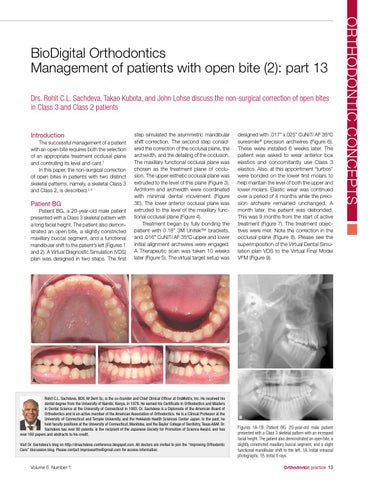
Patient BG Patient BG, a 20-year-old male patient presented with a Class 3 skeletal pattern with a long facial height. The patient also demonstrated an open bite, a slightly constricted maxillary buccal segment, and a functional mandibular shift to the patient’s left (Figures 1 and 2). A Virtual Diagnostic Simulation (VDS) plan was designed in two steps. The first
step simulated the asymmetric mandibular shift correction. The second step considered the correction of the occlusal plane, the archwidth, and the detailing of the occlusion. The maxillary functional occlusal plane was chosen as the treatment plane of occlusion. The upper esthetic occlusal plane was extruded to the level of this plane (Figure 3). Archform and archwidth were coordinated with minimal dental movement (Figure 3E). The lower anterior occlusal plane was extruded to the level of the maxillary functional occlusal plane (Figure 4). Treatment began by fully bonding the patient with 0.18" 3M Unitek™ brackets, and .016" CuNiTi AF 35ºC upper and lower initial alignment archwires were engaged. A Therapeutic scan was taken 10 weeks later (Figure 5). The virtual target setup was
Rohit C.L. Sachdeva, BDS, M Dent Sc, is the co-founder and Chief Clinical Officer at OraMetrix, Inc. He received his dental degree from the University of Nairobi, Kenya, in 1978. He earned his Certificate in Orthodontics and Masters in Dental Science at the University of Connecticut in 1983. Dr. Sachdeva is a Diplomate of the American Board of Orthodontics and is an active member of the American Association of Orthodontics. He is a Clinical Professor at the University of Connecticut and Temple University, and the Hokkaido Health Sciences Center Japan. In the past, he held faculty positions at the University of Connecticut, Manitoba, and the Baylor College of Dentistry, Texas A&M. Dr. Sachdeva has over 80 patents, is the recipient of the Japanese Society for Promotion of Science Award, and has over 160 papers and abstracts to his credit. Visit Dr. Sachdeva’s blog on http://drsachdeva-conference.blogspot.com. All doctors are invited to join the “Improving Orthodontic Care” discussion blog. Please contact improveortho@gmail.com for access information.
Volume 6 Number 1
designed with .017" x 025" CuNiTi AF 35ºC suresmile® precision archwires (Figure 6). These were installed 6 weeks later. The patient was asked to wear anterior box elastics and concomitantly use Class 3 elastics. Also, at this appointment “turbos” were bonded on the lower first molars to help maintain the level of both the upper and lower molars. Elastic wear was continued over a period of 4 months while the precision archwire remained unchanged. A month later, the patient was debonded. This was 9 months from the start of active treatment (Figure 7). The treatment objectives were met. Note the correction in the occlusal plane (Figure 8). Please see the superimposition of the Virtual Dental Simulation plan VDS to the Virtual Final Model VFM (Figure 9).
Figures 1A-1B: Patient BG. 20-year-old male patient presented with a Class 3 skeletal pattern with an increased facial height. The patient also demonstrated an open bite, a slightly constricted maxillary buccal segment, and a slight functional mandibular shift to the left. 1A. Initial intraoral photographs. 1B. Initial X-rays Orthodontic practice 13
ORTHODONTIC CONCEPTS
BioDigital Orthodontics Management of patients with open bite (2): part 13