Life In Colour
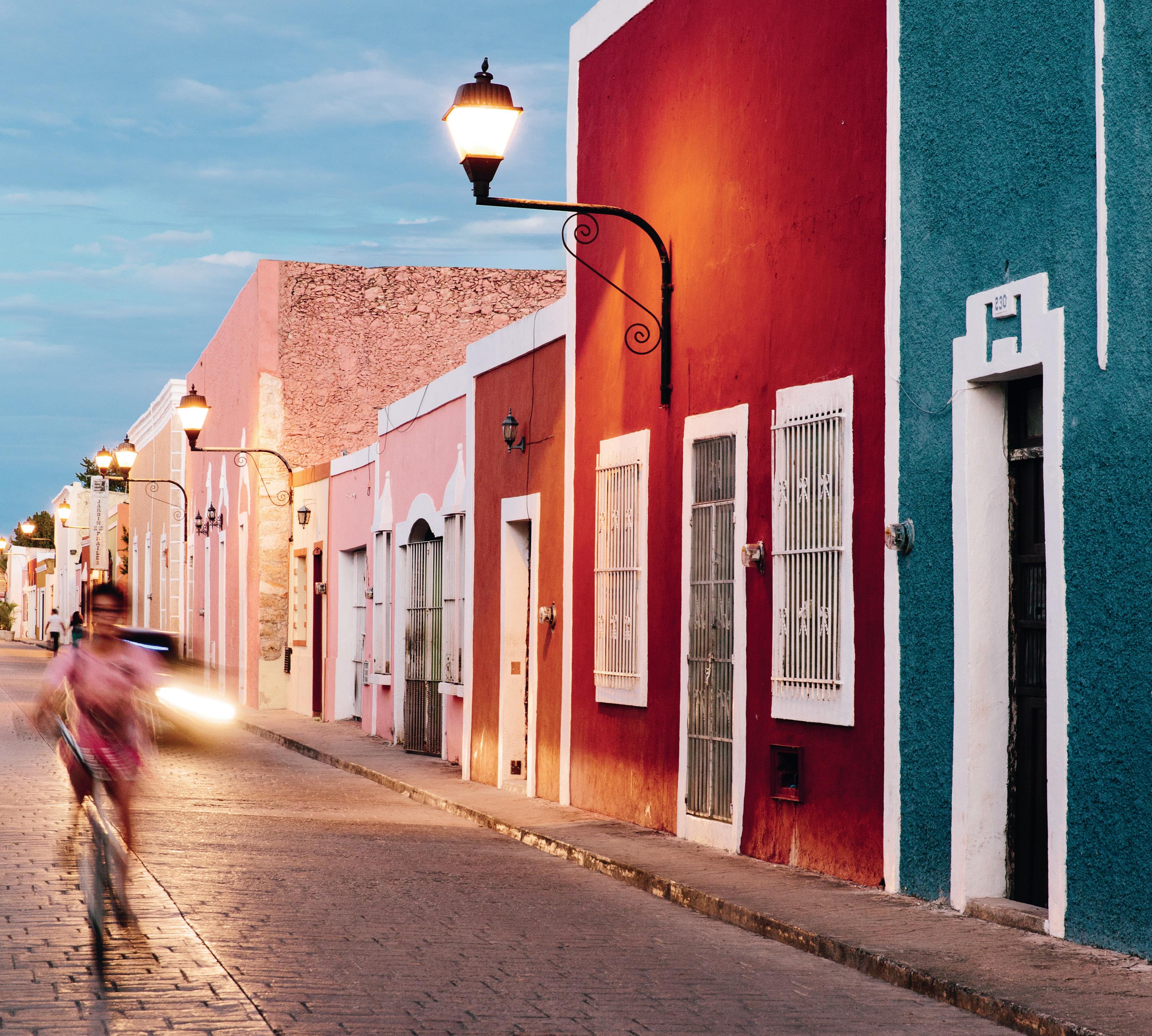
Yucatán Peninsula, Mexico



BANG RELOADED















































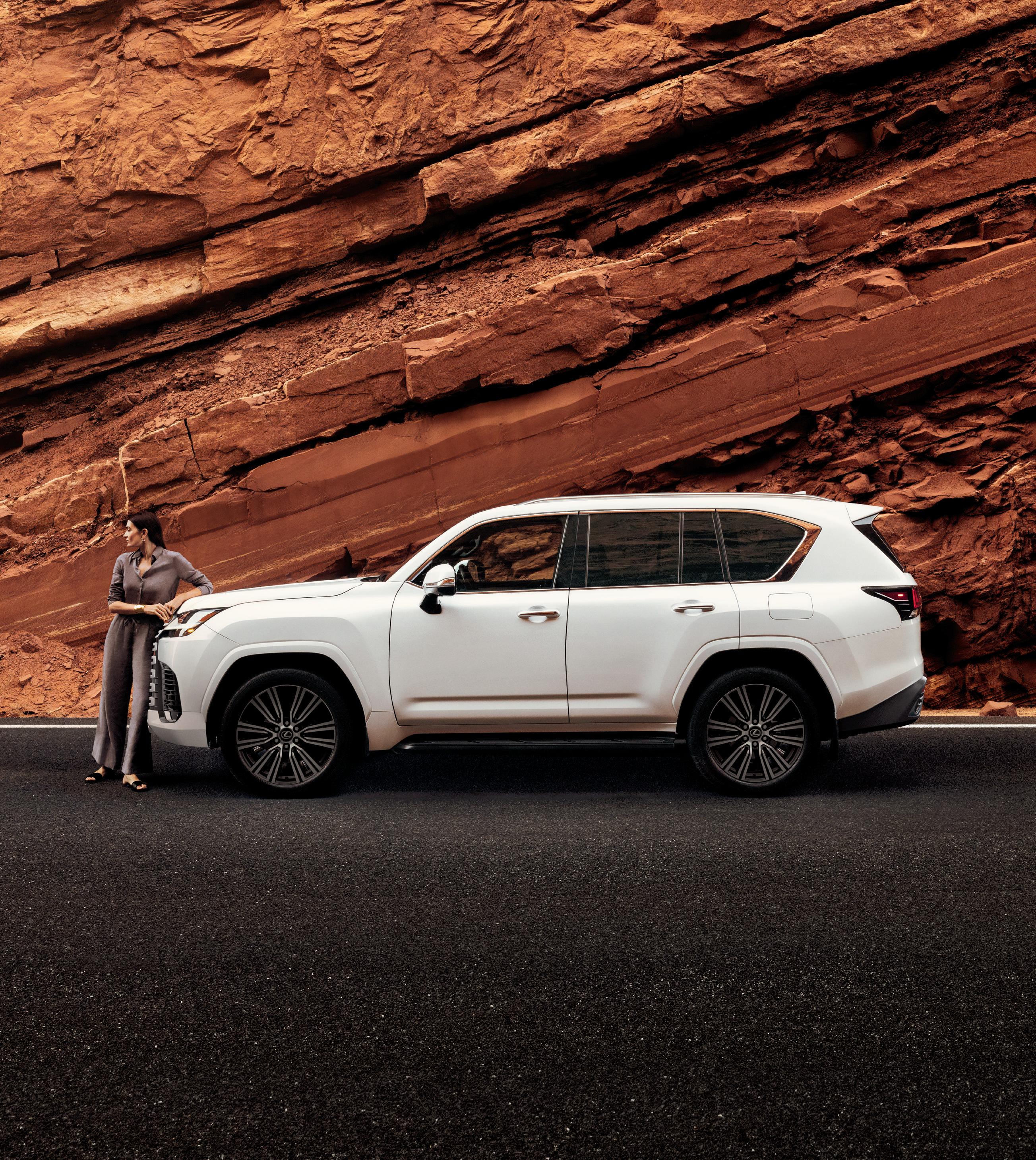
INTRODUCING THE LX 700h: THE LUXURY OF CHOICE
Quietly commanding. Elegantly smooth, with the power to turn heads, while turning any drive into an adventure. The LX 700h is the most powerful Hybrid to join the Lexus range. It combines 20 years of luxury hybrid innovation with standout style and a rugged 4WD spirit, giving you the luxury of even more choice when exploring your next vehicle.







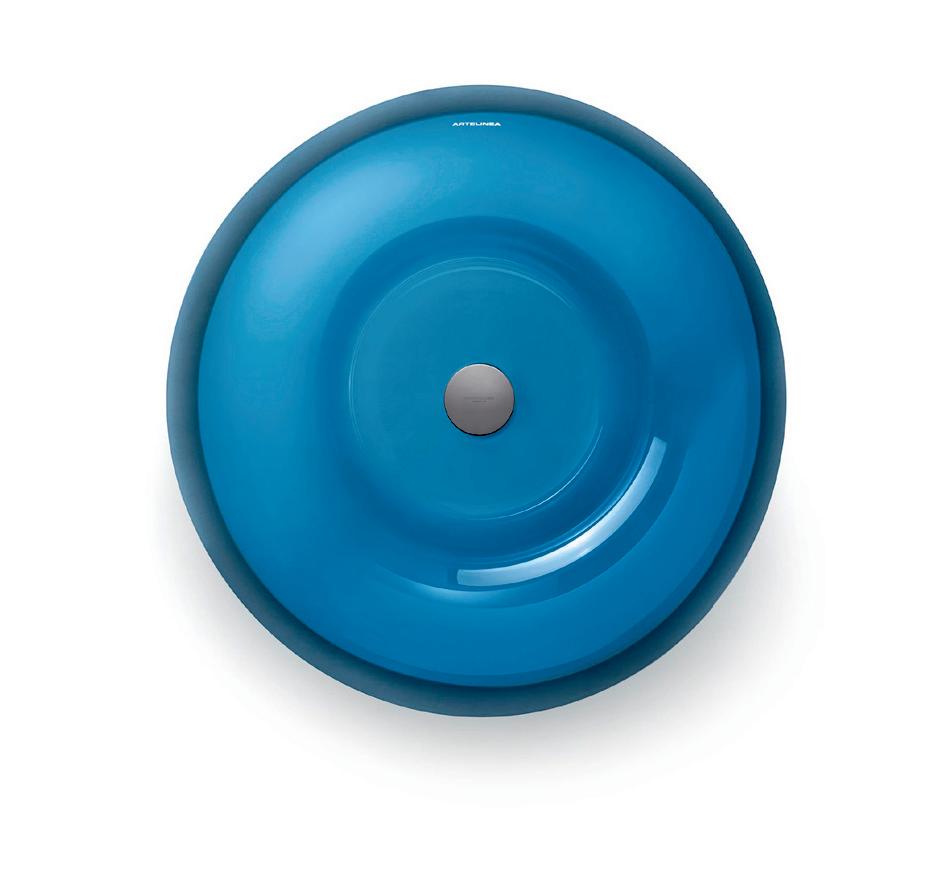
Designed by Giulio Cappellini



by PARISI
Through a combination of tradition and innovation, Giulio Cappellini, in collaboration with Artelinea, brings his vision to life by exploring the expressive qualities of glass and developing cutting-edge collections.
Partnering with global leaders in design, Esclusivo represents the pinnacle of luxury and exclusivity in modern bathroom innovation.
Editor-in-Chief Genevra Leek
Content Director Katrina O’Brien
Associate Director Helen Martin
Branded Content Lead Alice Jeffery
Copy Director Rosemary Bruce
Deputy Copy Director Sandra Bridekirk
Copy Editor Pippa Duffy
Digital Managing Editor Christina Rae
Digital Editor Edwina Hart
Senior Social and Digital Producer
Hollie Wornes
Head of Sales, Travel and Luxury Tony Trovato +61 404 093 472
National Sales Manager, Travel Callum Bean +61 404 729 224
Senior Account Managers, NSW
Crystal Wong +61 420 558 697
Anthony Sullivan +61 408 447 148
Samantha Pan +61 411 844 120 Sales Manager, Qld, WA and SA
Nicola Timm +61 424 257 527
Senior Account Manager, Victoria Miranda Adofaci +61 410 387 707
Digital Sales Director
Mike Hanna +61 402 640 095
Digital Campaign Manager and Product Specialist
Anna Delgado +61 404 855 041
INTERNATIONAL REPRESENTATIVES
Greater China and Japan
Peter Jeffery +852 2850 4013
peterjeffery@asianimedia.com
South-East Asia and the United Kingdom
Nick Lockwood +65 9776 6255 nick.lockwood@pharpartnerships.com
The United States
Ralph Lockwood +1 408 879 6666 ralph.lockwood@husonmedia.com
For advertising inquiries, contact qantasadvertising@mediumrare content.com
Creative Director Tony Rice
Art Directors Kate Timms, Nick Clark
Visual Director Jo Bainbridge
Production Manager Michelle O’Brien
Head of Content, Travel, Business and Membership Kirsten Galliott
Head of Design, Travel and Business Tony Rice
For editorial inquiries, contact qantaseditorial@mediumrarecontent.com
COMMERCIAL STRATEGY AND PARTNERSHIPS
General Manager, Growth and Commercial Strategy Paulette Parisi
Head of Rare Creative Mark Brandon
Associate Content Director
Katrina Holden
Senior Partnerships Editor
Caroline Clements
Copy Director Kylie Matthews
Creative Director Philippa Moffitt
Art Director Katrina Mastrofilippo
Designer Frida Lindstrom
Group Commercial Strategy Director
Jane Schofield
Senior Commercial Strategy and Solutions Manager Adriana Hooper
Commercial Campaign Analyst
Sara Choudhry
Qantas Senior Partnerships Manager
Sophie Malouf
Qantas Partnerships Manager
Emily Ryan
Qantas Partnerships Campaign Executive
Kellie Hammond
Content and Events Campaign Manager
Jessica Manson
For Commercial Strategy and Partnerships inquiries, contact rarecreative@mediumrarecontent.com
Managing Director Nick Smith
General Manager, Operations and Partnerships Teagan Barr
General Manager, Creative Production
Chantelle Love
Head of Social Sarah Macrae
Head of Digital Production and Operations Hana Jo
Head of Finance George Thompson
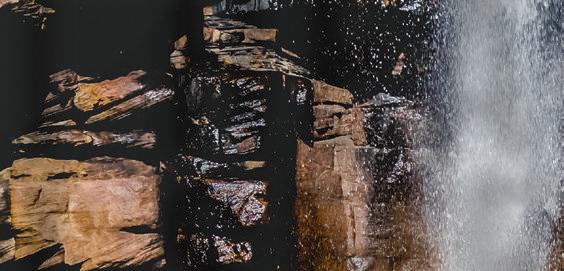
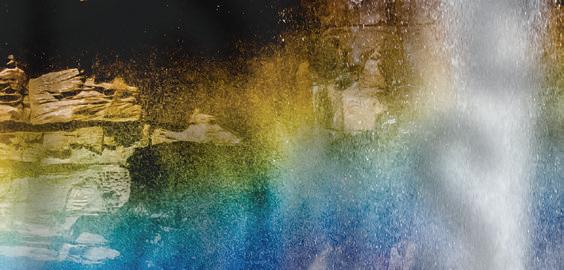
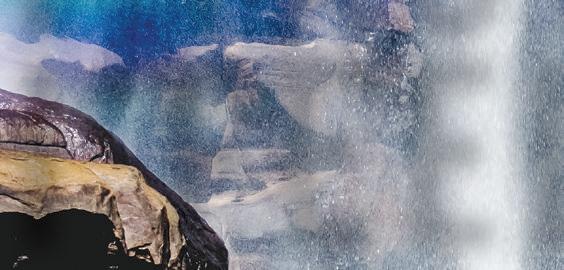
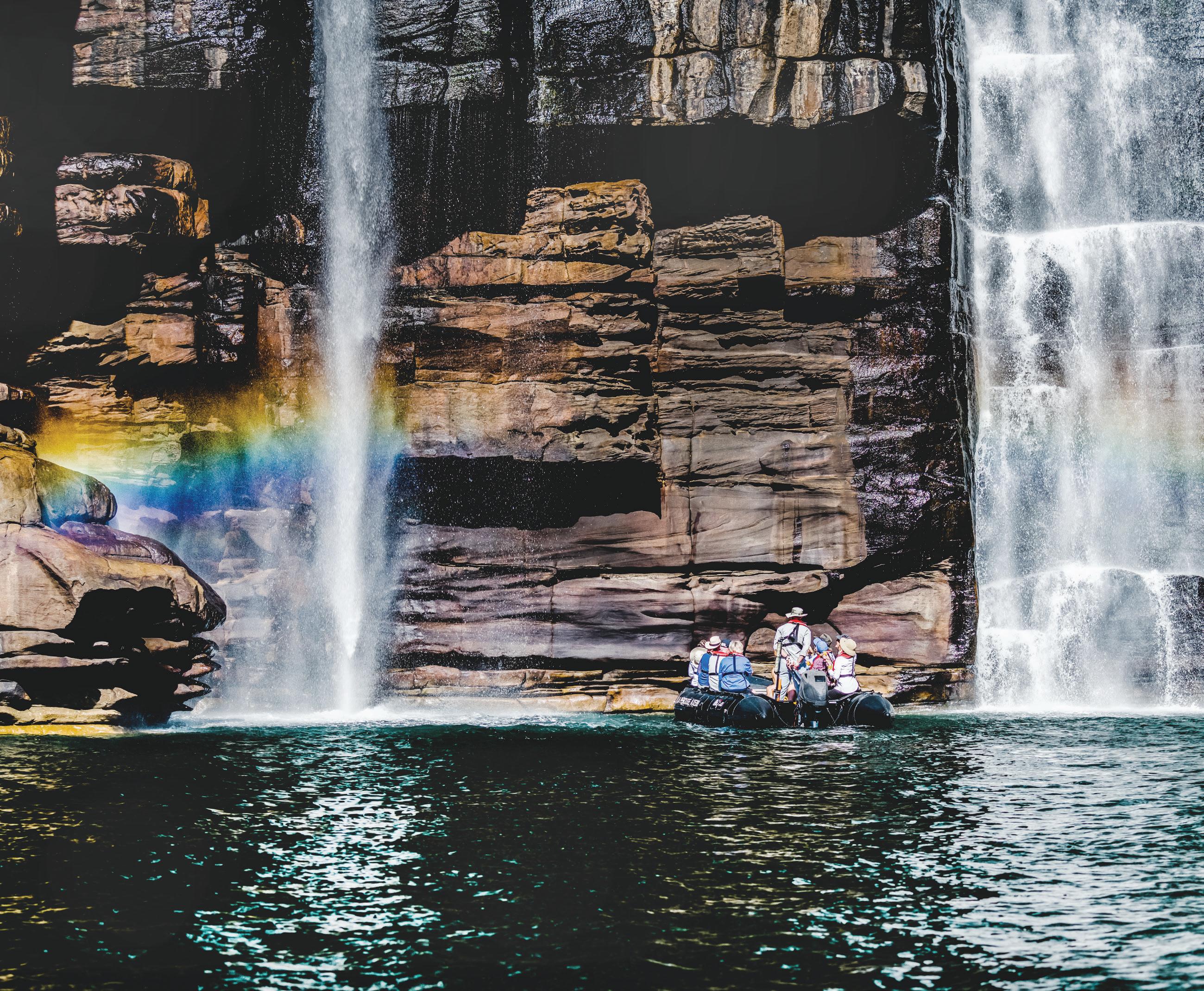
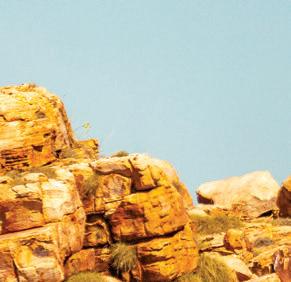
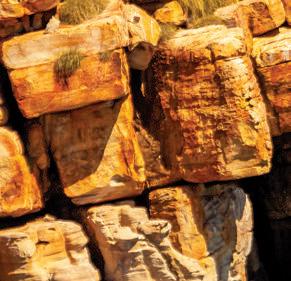
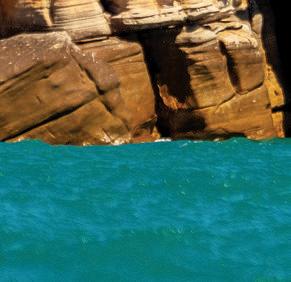
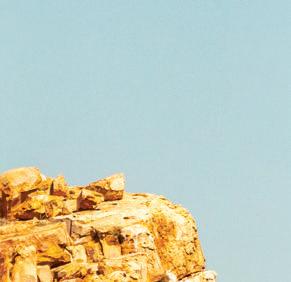
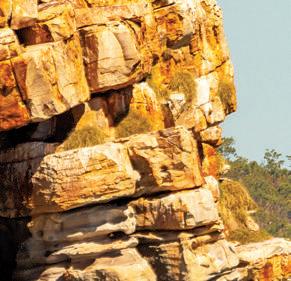
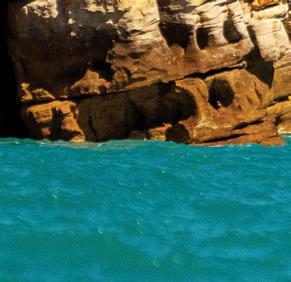
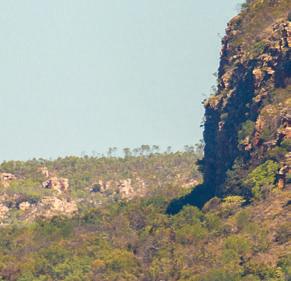
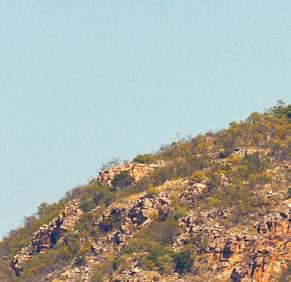
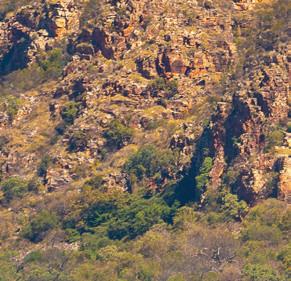
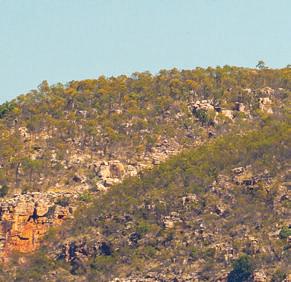
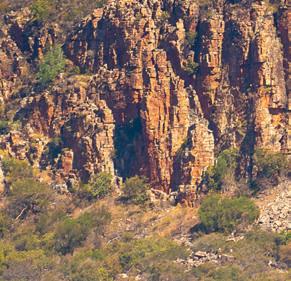
THE OCHRE LANDS OF THE KIMBERLEY
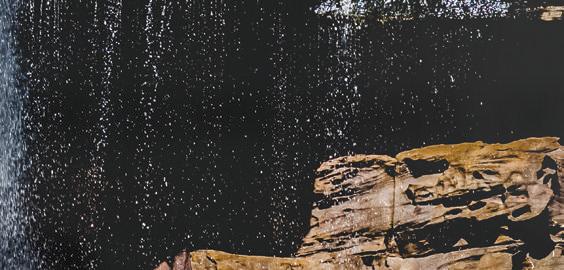
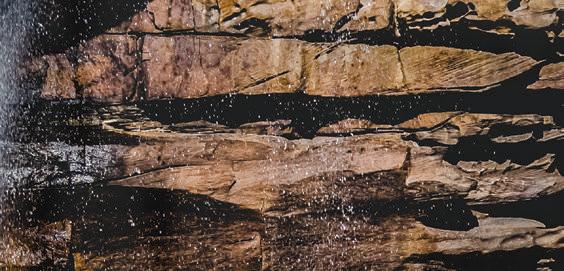
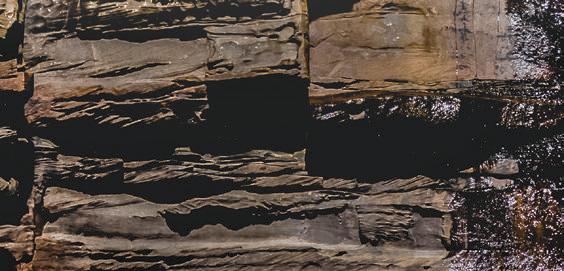
THE THUNDER OF KING GEORGE FALLS
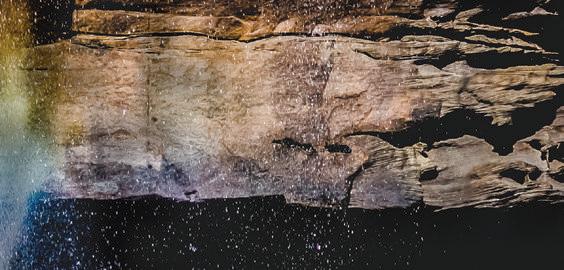
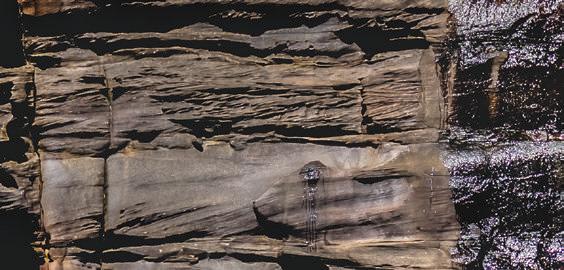
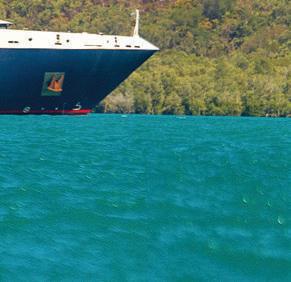
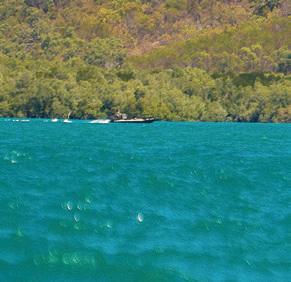
THE SPRAY OF MONTGOMERY REEF
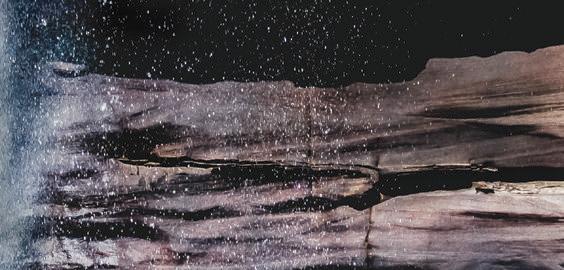
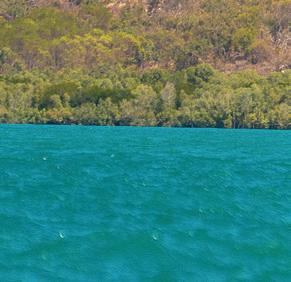
THE VAST OPEN SPACES OF THE COAST

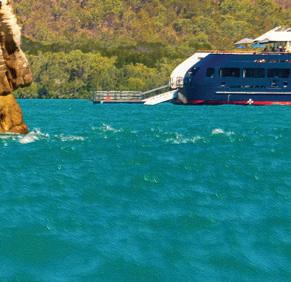

THE CONNECTION TO ANCIENT CULTURES
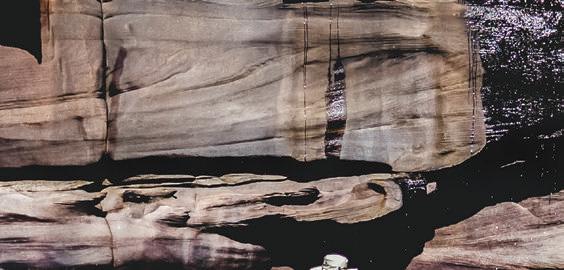

YOU ARE THE DESTINATION

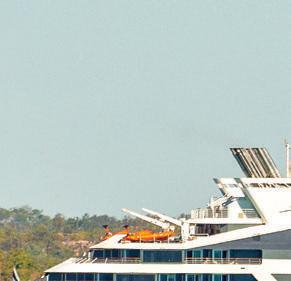








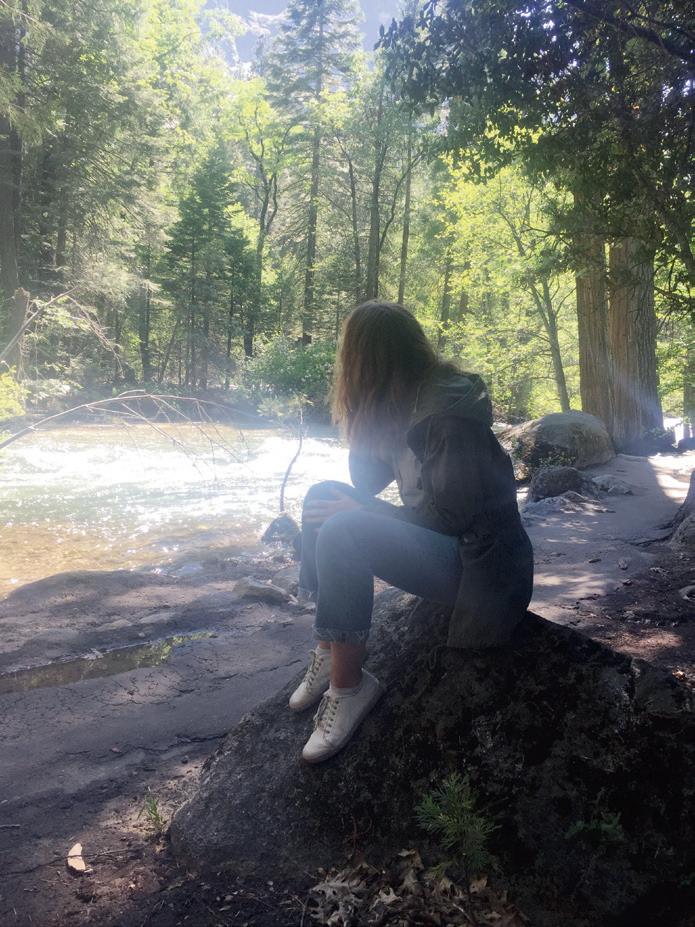
Getting out in nature is a balm for the soul. And the mental and physical benefits are well documented –reduced stress and anxiety, improved mood, concentration, memory and creativity. Research has shown that as little as 20 minutes outside can boost immune function, lower blood pressure and energise the mind. Observing wildlife and spending time with animals is also an elixir for our emotional wellbeing.
So if just a few minutes can have a meaningful impact, imagine what an extended holiday spent in a restorative environment could do. Heading into the Canadian Rockies on horseback (page 86). Watching time stall alongside the sloths in Costa Rica (page 74). Traversing the moss-covered hills of New Zealand’s Stewart Island/Rakiura (page 98). Slowing down. Reconnecting with
ourselves and what’s important, in locations that remind us that nature is, after all, the most powerful force there is on Earth.
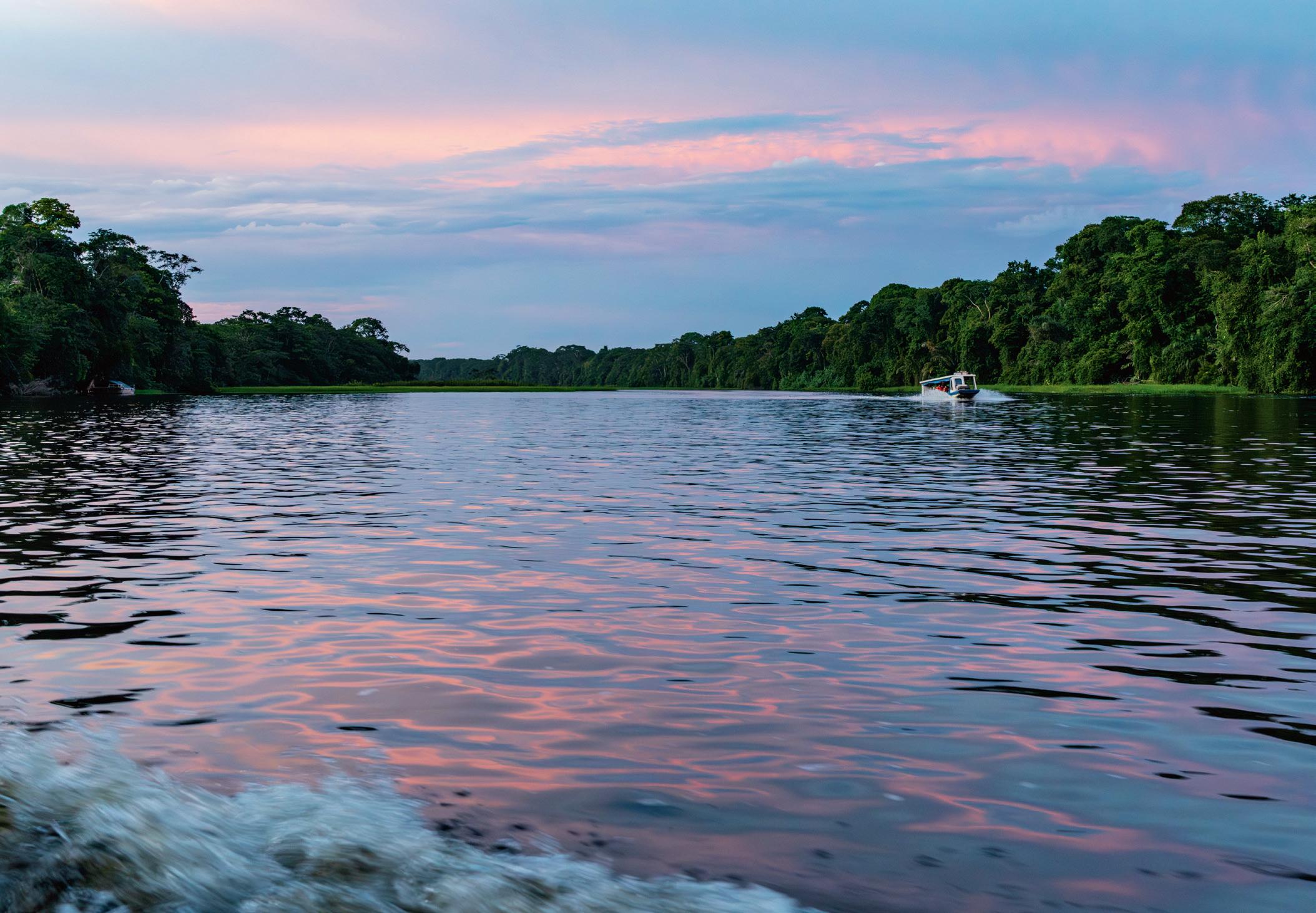
And to tide you over between trips, it’s comforting to know that scientific studies indicate even short, passive exposure to nature scenes, such as the beautiful travel photography in the following pages, can trigger relaxation responses in the brain. The lush greens of a tropical forest after rain. The soft pink hue of a sky welcoming dusk. The vivid blue of glass-still water. Now more than ever – live life in colour.
Genevra Leek Editor-in-Chief qftravelinsider
Our writers are not armchair travellers. Rest assured any assistance we accept from the travel industry in the course of preparing our stories does not compromise the integrity of our coverage.
The world is full of uncertainty. As an airline we will always have to navigate short-term challenges, but we’re also just as focused on what’s ahead. And right now, there’s plenty to look forward to.
As an airline founded in Outback Queensland, we know how much local communities depend on strong connections to the rest of the country and the world. This month we opened applications for our 2026 Regional Grants program, now in its fourth year, providing $2 million to not-for-profit organisations across regional Australia. Since the program launched, we’ve provided millions in grants, flights and marketing support to nearly 130 organisations, whether they’re delivering essential services, creating opportunities or helping people through difficult times.
May also marks a milestone for our A321XLR fleet, with two more next generation aircraft entering service and bringing improved comfort to all those travelling on our domestic network. Later this month we’ll be unveiling a very special livery on our seventh XLR, dedicated to one of the natural wonders of the world. This striking new livery will celebrate the Great Barrier Reef and the marine life that call it home.
And the anticipation for Project Sunrise continues to build. Our first Airbus A350-1000ULR is on track for its first major test flight this month, bringing us another step closer to launching non-stop flights between the east coast of Australia and London and New York. We know there is incredibly strong demand for pointto-point travel between Australia and these major global cities, which has never been possible before.
Since our very first aircraft was built in the 1920s, every Qantas fleet has carried names that mean something, from iconic Australian cities and regional towns to pioneering figures of Australian aviation. Naming a fleet is one of those traditions that connects us to who we are and where we’ve come from. So choosing the right names for our Project Sunrise A350 fleet matters, and I think we have landed on something very special. One that connects to one of the most remarkable chapters in our history.
During the Second World War, Qantas’ Catalina flying boats operated the legendary “Double Sunrise” flights, so long that passengers watched the sun rise twice. These aircraft were named after the stars used for navigation across the Indian Ocean. It’s fitting, then, that our A350 fleet will carry those same star names into the future. The idea was originally suggested by some of our own pilots and was then chosen by a record number of votes from our incredible staff, which makes it even more meaningful. The pioneering spirit of those flying boat crews will now live on.
As our new fleet begins to take shape, our teams are working incredibly hard to make this new era of travel a reality.
Thank you for choosing to fly with us.
Vanessa Hudson CEO, Qantas Group
Qantas would like to acknowledge the Traditional Custodians of the local lands and waterways on which we live, work and fly. We pay our respects to Elders past and present.

Captain Ben Holland Head of the Integrated Operations Centre
Qantas Reservations 13 13 13 qantas.com
Qantas Holidays Ltd 13 14 15 (ABN 24 003 836 459; Licence No. 2TA003004)
Qantas Club and Frequent Flyer Service Centre 13 11 31 From overseas +61 3 9658
The Integrated Operations Centre (IOC) runs 24 hours a day, seven days a week. We monitor Qantas flights in Australia and around the world and have 180 staff working at any one time on flight planning, security, engineering, weather and customer support. The IOC’s work goes on behindthe-scenes so you won’t even notice it. We plan for and respond within minutes to disruptions, whether that’s due to natural disasters, global conflicts or bad weather.
Our network of nearly 400 daily flights seems huge. The secret to managing it successfully is to break it down. Our flight planning system models thousands of routes over millions of data points to find the best flight paths. Every flight relies on the same 10 to 15 steps – a plane ready at the gate, flight crew, customers, cleaning, catering and baggage coming together. On a given day, that can add up to about 4000 steps to coordinate. But we focus on nailing the fundamental elements every time to ensure our customers get to where they need to be.

Get the best hotel, restaurant and destination recommendations when you follow Qantas Travel Insider.

Scan the QR code to follow @qftravelinsider
Or visit qantas.com/ travelinsider for help planning your next holiday

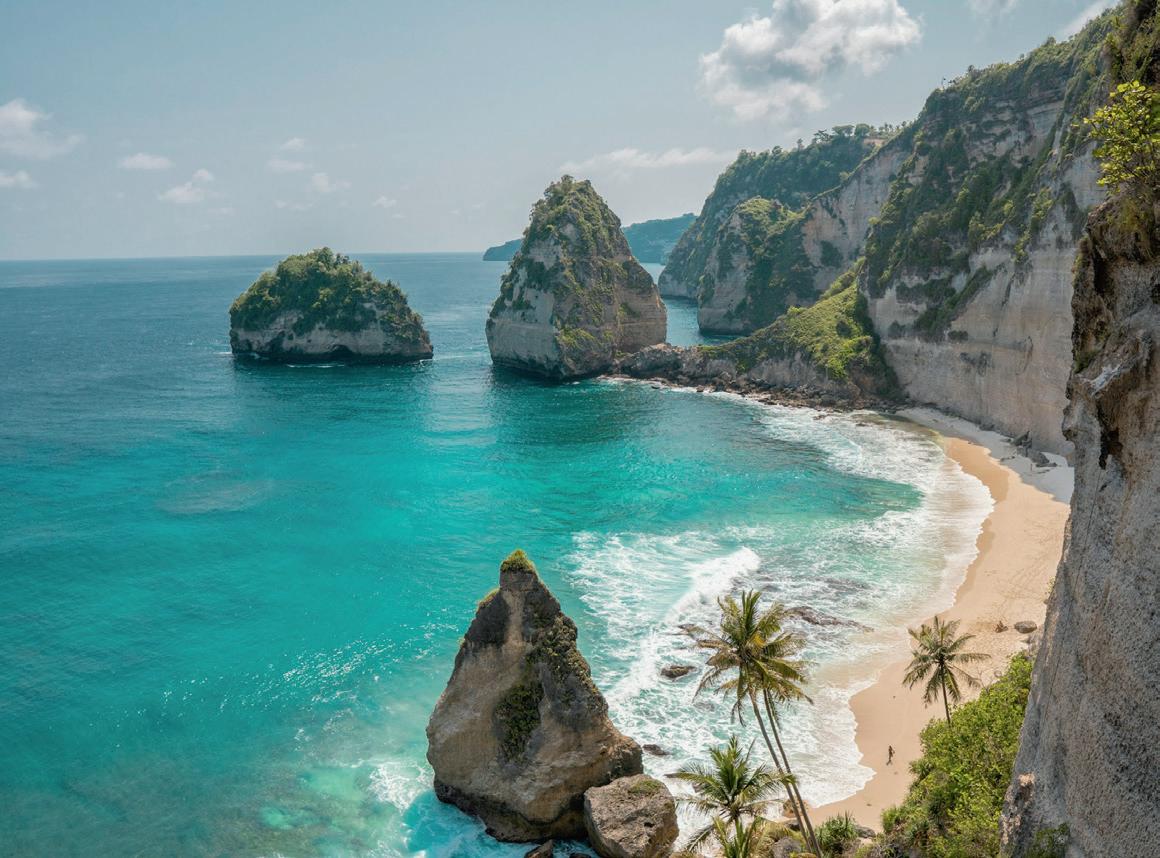
Whether you’re dreaming of an island escape or ticking off the icons, there’s a new way to discover reward seats to the world’s most in-demand destinations, including in premium cabins.
The new search tool at flightrewardfinder.qantas.com gives Frequent Flyers a quick view of seat availability by region, allowing you to search multiple destinations, travel periods and cabin types all at once.
So if you want to escape winter and head for a tropical island, this tool can help you discover Classic Flight Reward seats to all of the most popular spots (think: Bali, Fiji, Hawaii, Phuket, Vanuatu and more) from all available Australian airports, across all available dates, all cabins and all partner airlines – all in one place. Or if a trip to Europe is calling, view reward availability to many of the major cities (London, Paris, Rome, Amsterdam, Madrid and more) at a single glance.
You can see availability as a list or choose a calendar view to see the volume of availability across each cabin – Economy, Premium Economy, Business and First. Click a date to see the available reward seats on Qantas, Jetstar and 30 partner airlines in a single, easy-to-navigate view. Once you’ve found the flights that suit, click “Check availability”, then book as usual.
Visit Points Insider, the new home of Qantas Points tips and tricks, at qantas.com/pointsinsider



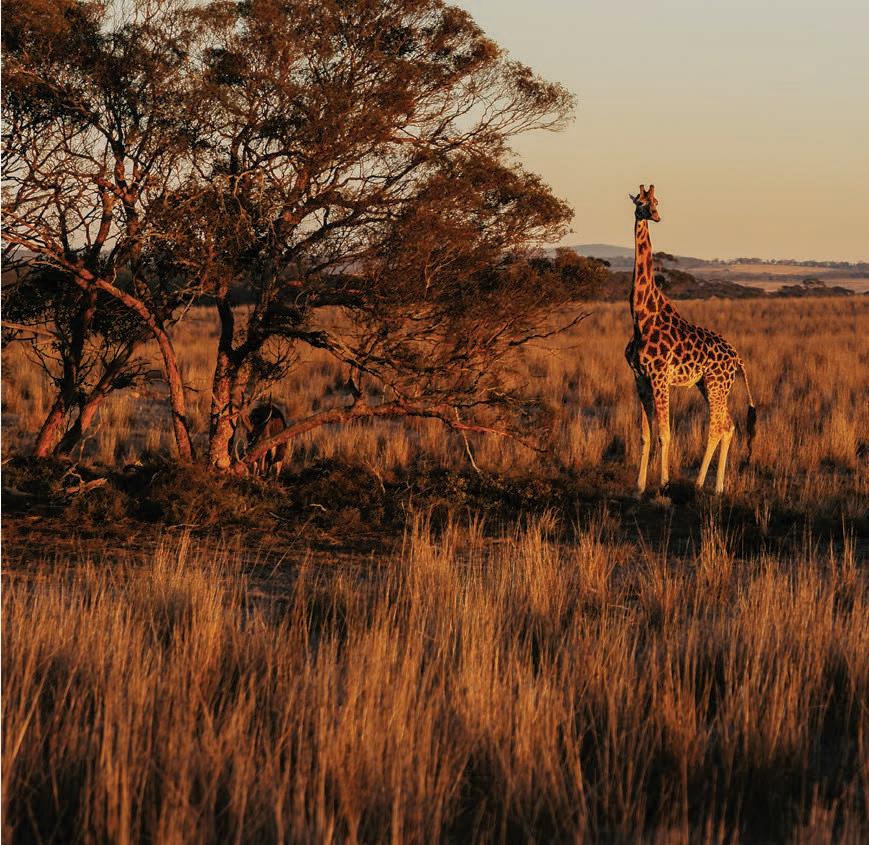
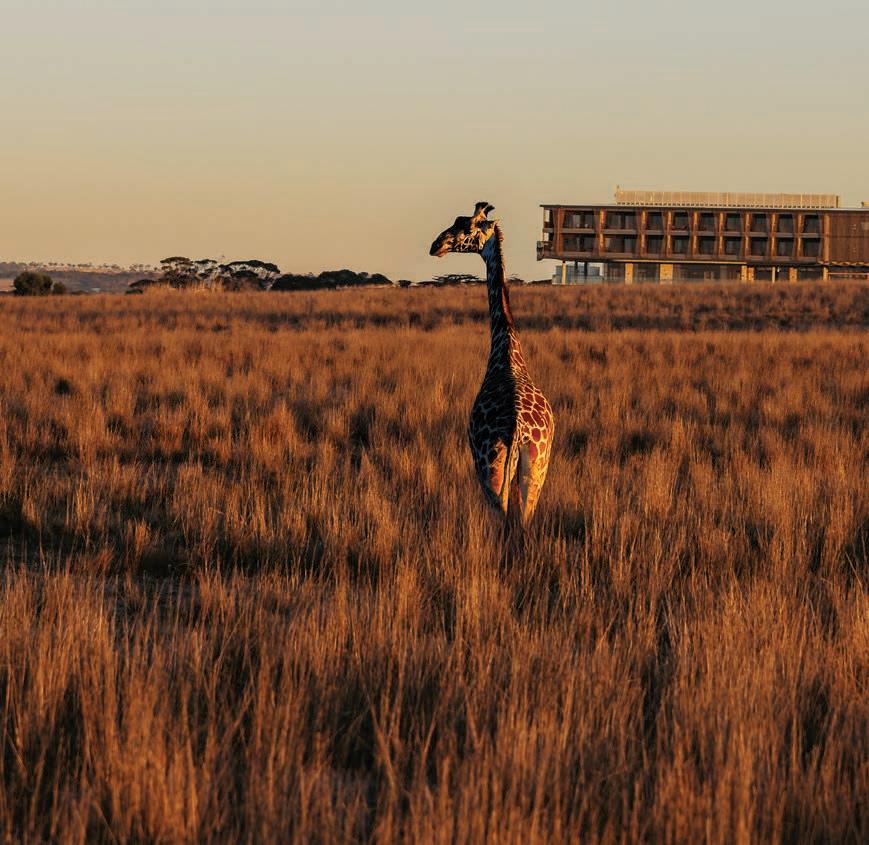
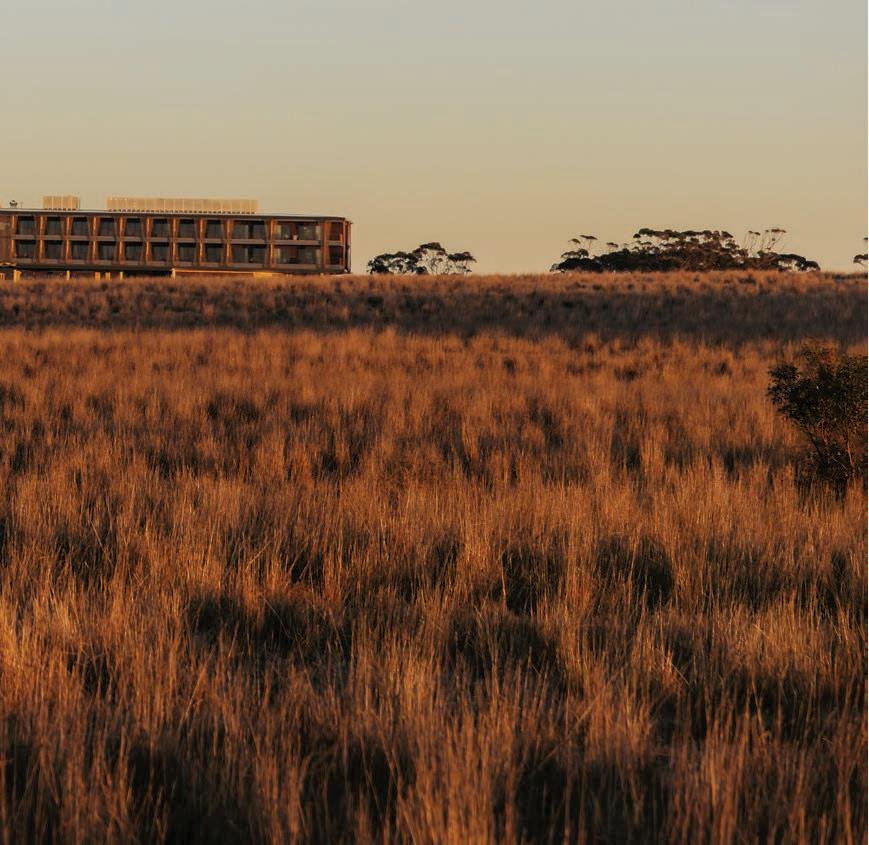
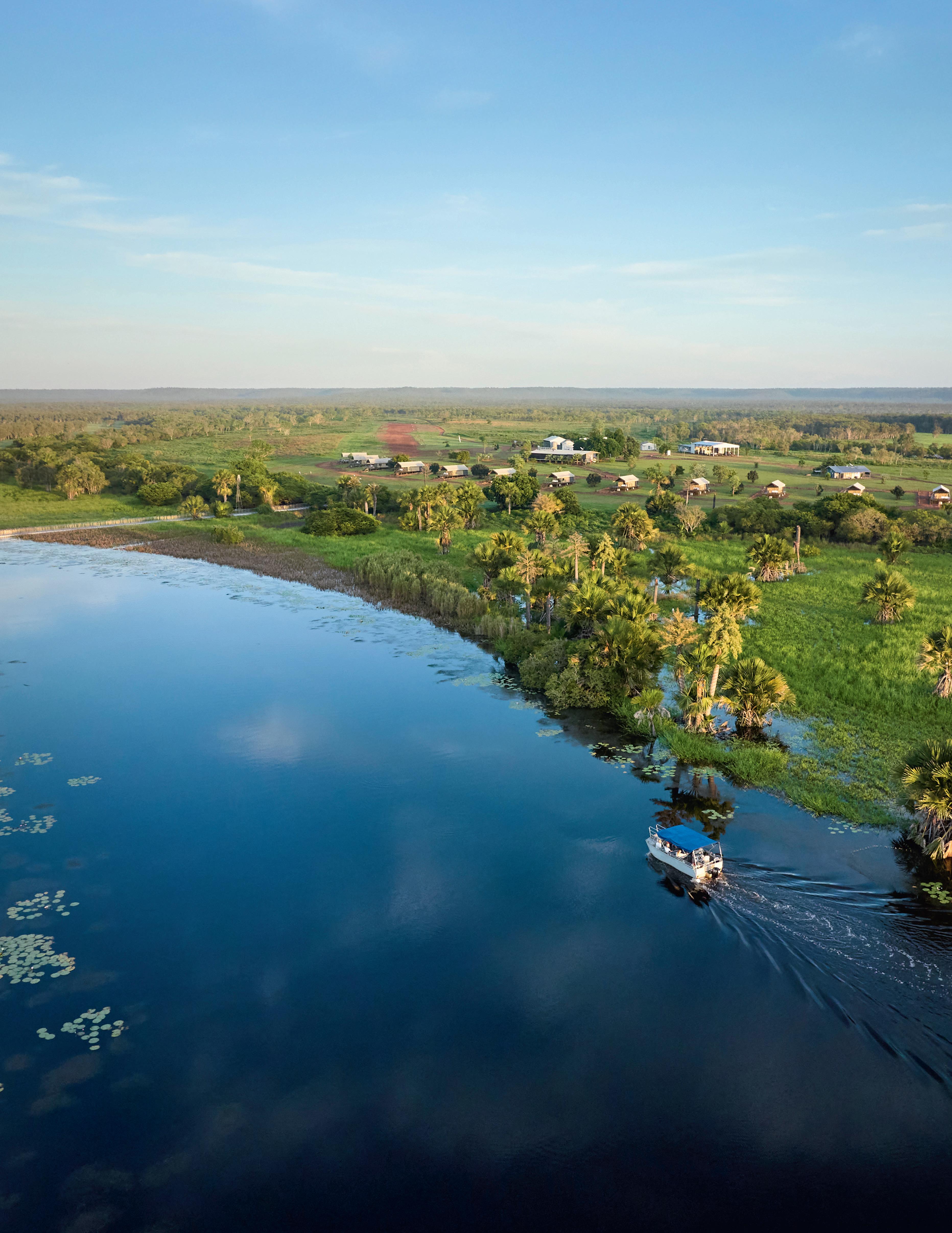
Escape from the everyday with premium accommodation, indulgent dining and a luxurious spa. Get exclusive access to special experiences. Watch as the animals gather at the hotel’s waterhole. And become totally immersed as you connect with the wild environment on a deeper level.
Just an hour from Adelaide, experience what happens from dusk ‘til dawn, when everyone else has gone home.
monartosafariresort.com


It’s no wonder free-ranging birds feel right at home in this hotel, which appears to spring from the bedrock.
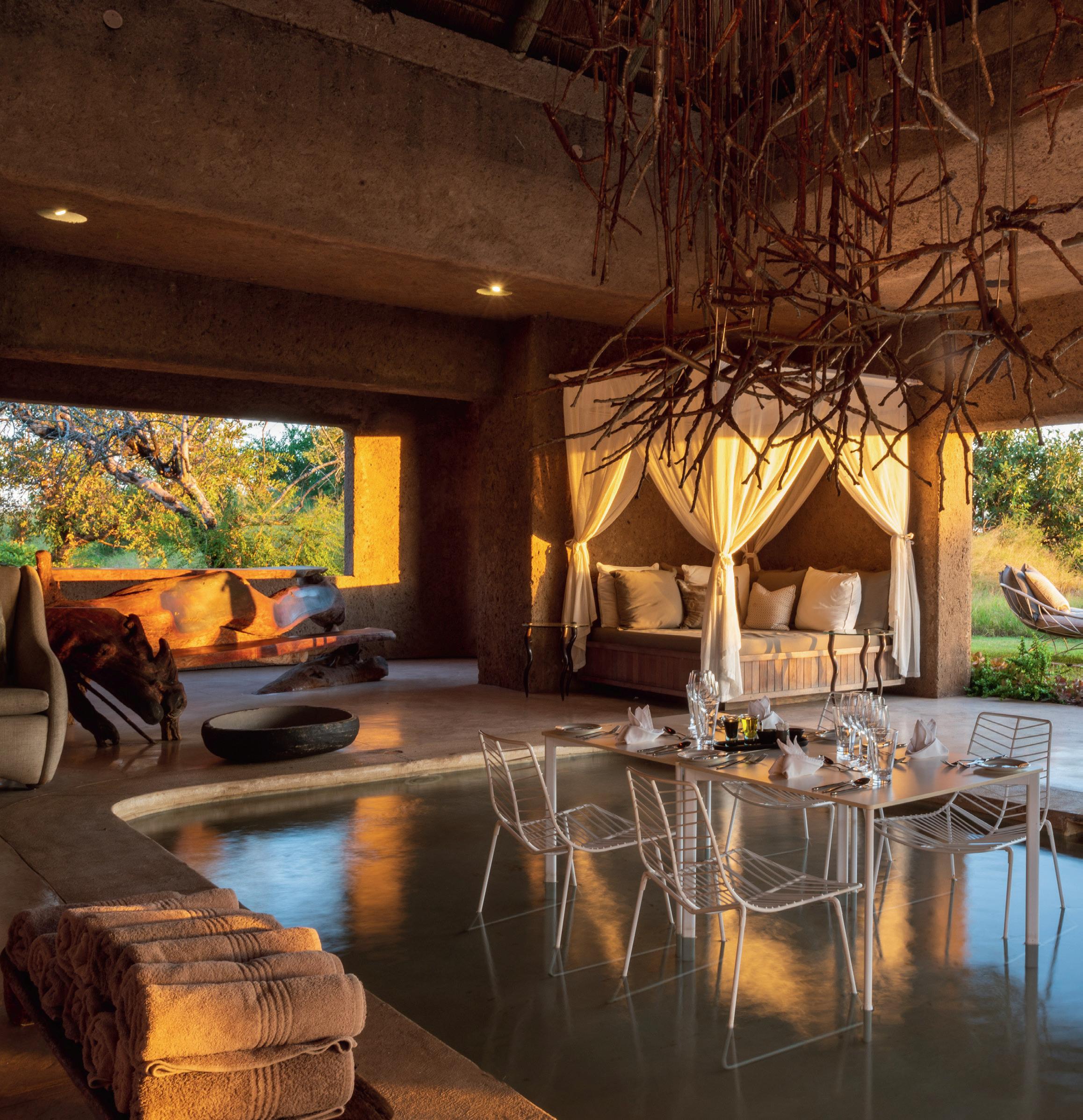
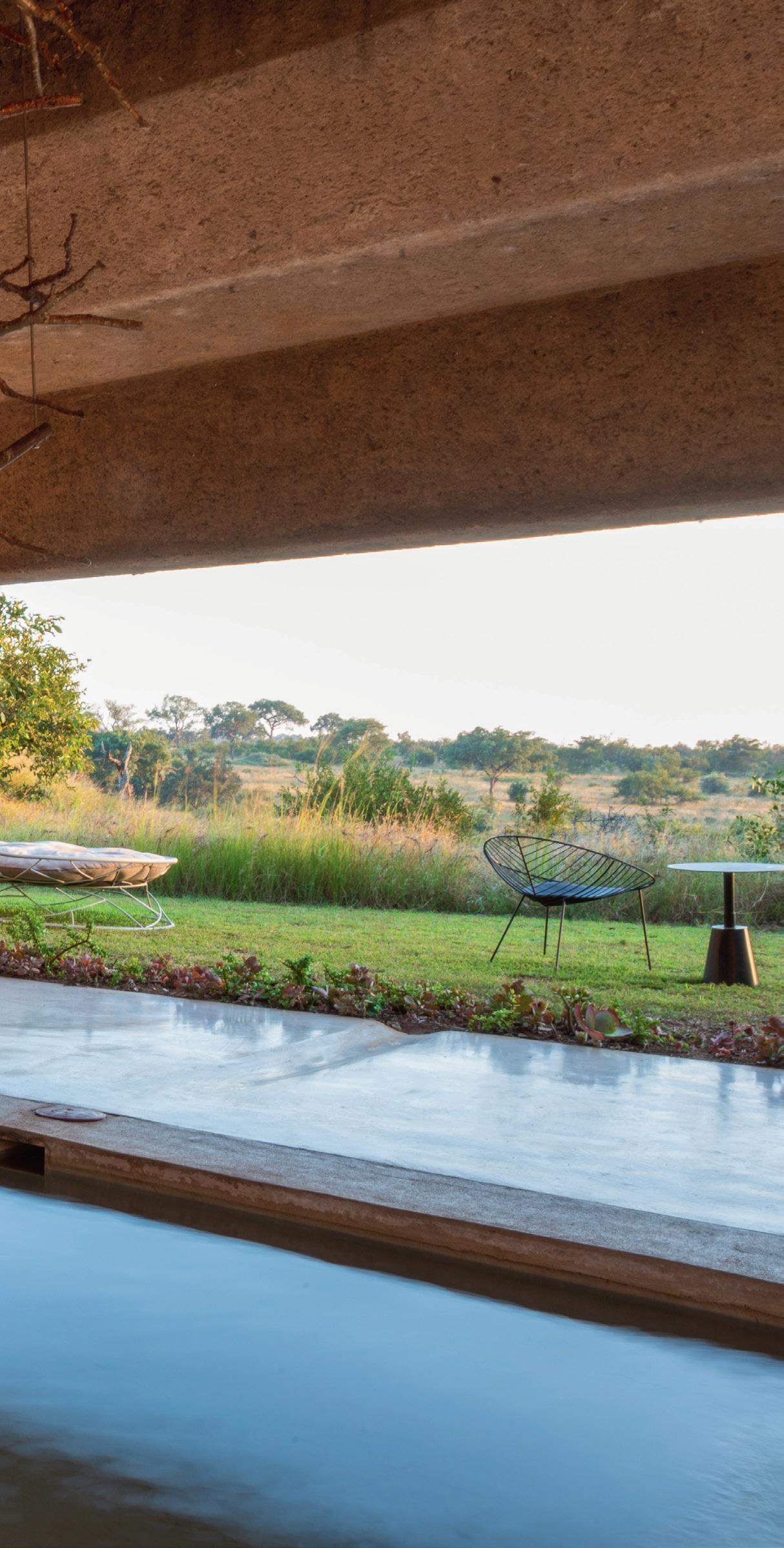
The wild inhabitants of Sabi Sabi Private Game Reserve in the Greater Kruger National Park might mistake Earth Lodge (sabisabi.com) for a burrow, a termite mound or even an oversized nest. Emerging organically from the ground, the 12 suites for two and the family-sized Amber Villa (the lodge’s most recent addition) pose no hindrance to hippos passing by on their nocturnal wanderings, waterbuck grazing beside the private plunge pools and elephants occasionally sampling succulents outside the Amani Spa or peering quizzically into the cave-mouthed lobby. Recently, swallow chicks hatched in the central lounge area. Now part of the (plush) furniture, they perch like puffball ornaments on a mobile sculpture wrought from reclaimed wood and pipe their falsetto chirrups through breezeways rammed with a pulp of river stones and yellow thatching grass. The sound of hippos squabbling in a nearby waterhole reaches guests enjoying a breakfast of biltong omelette or eggs with chakalaka (a specialty African relish) and they’re still going after dark, when the boma fills with woodsmoke and the succulent scent of braaing meat on the grill.
The journey to this primordial outpost is as swift as the swallows’ flight: an hour by plane from Johannesburg to Skukuza Airport and another hour by road to the lodge – not accounting for wildlife stops en route. “This part of South Africa is well known for leopards,” says ranger Viviane Ladner. “If they all congregated in Sabi Sabi, we’d see about seven. That doesn’t feel like a lot but they’re solitary and all have their own space.” Such seclusion is cherished by guests, too – notably in the redesigned villa, which sleeps up to four and comes with its own pool, mini-gym and private safari vehicle.
Nature’s artistry, which blooms beyond the villa’s terrace lounge, is replicated indoors: splashes of preciousmetal colour; stone basins and quartzite pebble floors; and a standout matumi timber headboard in the main bedroom on which a reclining leopard would not look out of place.
Story by Alexandra Carlton | Photography by Jessie Prince
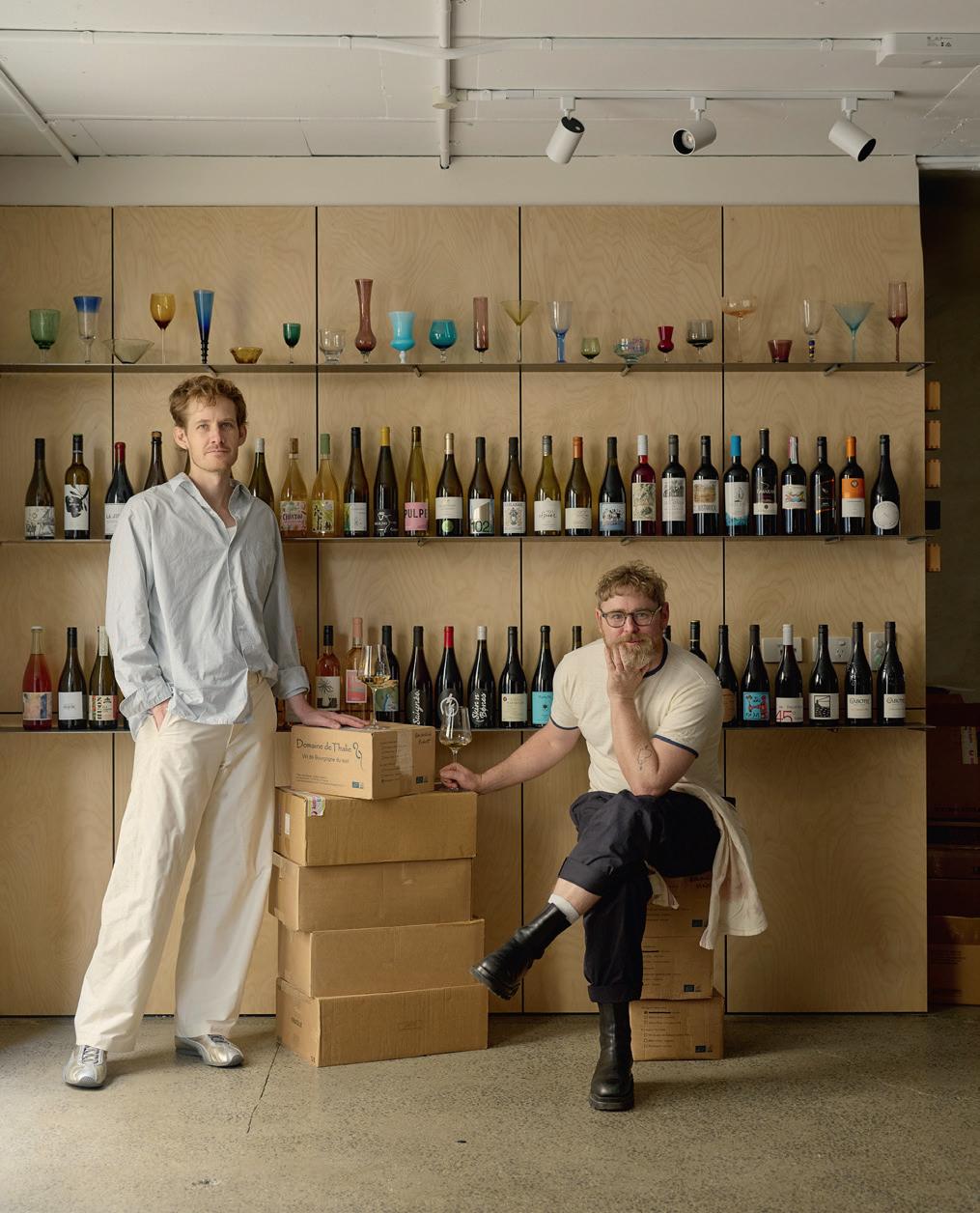
Wines, good times and a little bit hard to find: that sums up the offering at this tucked-away wine shop/bar hybrid in Newstead. Think of Fountainhead Winehouse (fountainheadwinehouse.com) like a wine exploration cave, where friends and wine wizards Chris Banham and Dan Wilson (above right, with Banham) can help you select the perfect bottle for any occasion (and, crucially, at any price point). Keep an eye out for masterclasses and collaborations designed to deepen the experience.
There’s nothing quite like a good old-fashioned Aussie fish and chipper. Bronte Road Fish (bronteroadfish.com), which has risen from the bones of the more formal Bronte Road Bistro in Sydney’s east, is exactly that. The menu looks like it stepped out of a grainy 1980s soap set by the sea, in the best possible way – fish burgers, potato scallops, tabouli salad and soft serves. Grab your pocket money, hop on your BMX and get into it.
The Odd Culture Group (oddculture.group) – which runs an eponymous pub in Newtown and The Old Fitzroy Hotel in Woolloomooloo – has unveiled two new venues on York Street in Sydney’s CBD. Bar Bruno is inspired by the Italian-style osterias you’d find in Bay Ridge or Williamsburg in Brooklyn, while the neighbouring Razz Room is a playful daiquiri bar harking back to New York’s gritty disco clubs (complete with a sunken dancefloor).
One of Melbourne’s oldest restaurants (florentino. melbourne) is entering its fifth era under the stewardship of Rebecca Yazbek, the force behind Sydney and Melbourne’s Nomad, as well as Melbourne’s Reine & La Rue. The reborn Italian
stalwart – most recently known as Grossi Florentino – gives diners a choice of three-, five- or seven-course menus led by Michael Greenlaw and executive chef Brendan Katich. The food is classic Italian accented with poise and polish: housemade pastas, local seafood and truffle risotto. Fans of the restaurant’s chocolate souffle and tiramisu will be thrilled to see they remain firmly on the menu.
There’s another reason to head to Melbourne’s Prahran Market, with the opening of a clutch of delicious new food venues, including a taqueria and burger joint. The latest, Matsuyama (matsuyama. com.au), grills up sizzling yakitori and slings sandos and Japanese beer. Somehow it all tastes better eaten fresh and hot, perched on an upturned milk crate.
The laidback beach town of Yanchep, on Perth’s northern coastline, has new culinary energy with the arrival of Yanchep Beach Club (yanchepbeachclub.com.au). Stop by after a surf for an early-morning coffee and brekkie wrap from the kiosk then wander back for a parmie or pizza for lunch or dinner.

Story by Natalie Reilly
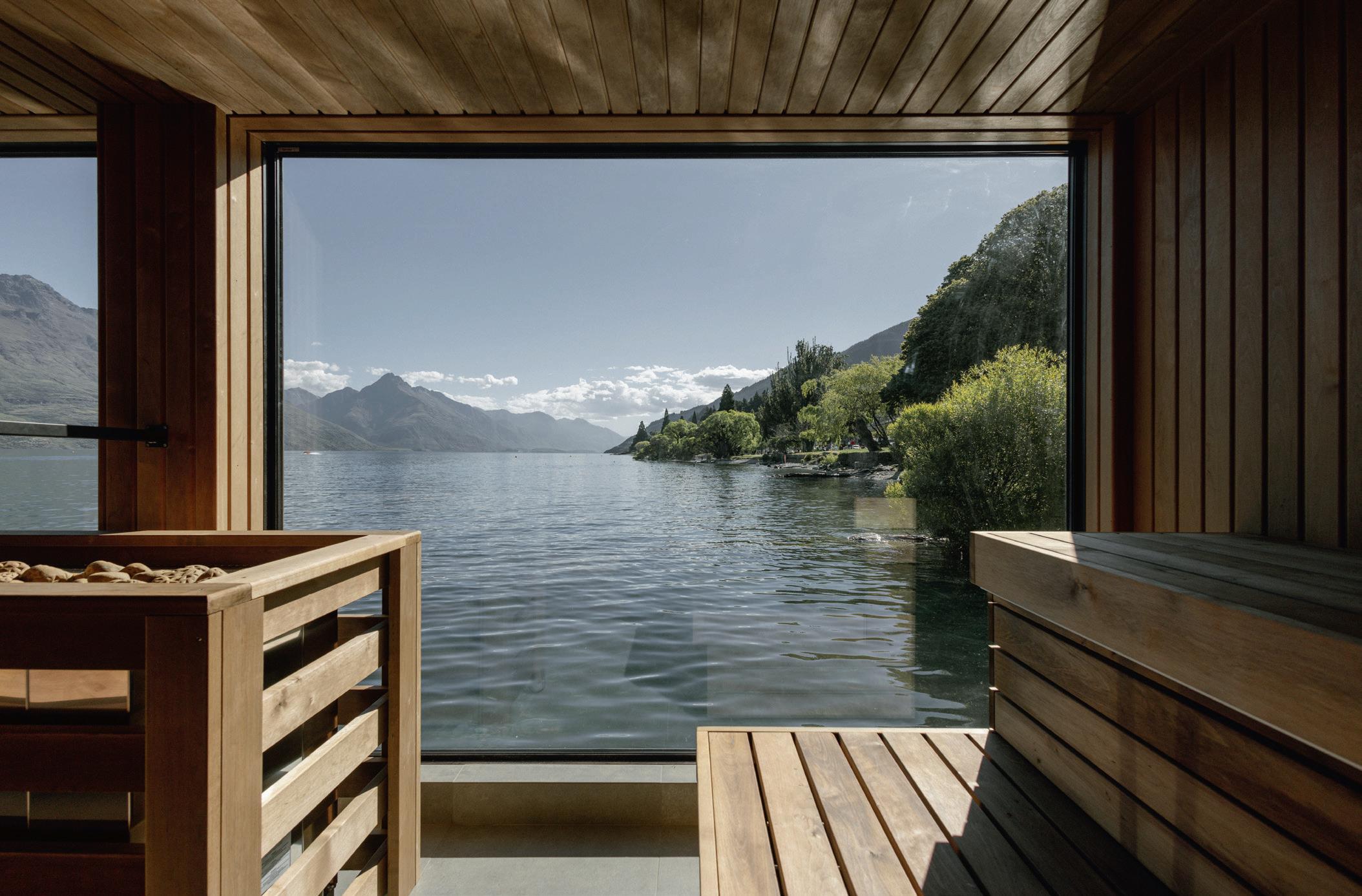
While the Nordic tradition of heat and cold exposure dates back centuries, it’s recently gained a large global following. Once a gym afterthought, the sauna has been reimagined as a high-design cornerstone of modern wellness and an elusive “third place” in our digital world for genuine human connection.
This connection is one of the central aims at Queenstown’s Watershed Saunas (watershedsaunas.com), New Zealand’s first floating sauna where you can choose between private and group sessions – the latter being encouraged. Launched at the end of 2025 on the gin-clear waters of Lake Whakatipu, this understated pontoon sits just steps from the cobblestone pathways of the CBD but inside feels like a wilderness retreat.
The true magic lies in the view, out over the lake and across to the Hector Mountains, transforming some of the discomfort of heavy heat into a type of meditative awe. The traditional Finnishstyle timber and glass enclosure produces a dry heat of 80°C so you will sweat before jumping into a plunge pool that connects directly to the glacial lake. That thermal shock, from sauna to ice-cold water that at this time of year sits around 10°C, triggers a massive endorphin release. Then it’s back into the sauna to do it all again.
This contrasting routine has been proven to enhance immune support, boost circulation and accelerate muscle recovery – a major draw for Queenstown’s skiers, though operations and brand
manager Esther Cronin says a mix of people come through every day. “You’ll have ultra-marathon runners and firsttime cold plungers sitting side by side. Some guests come weekly, others have flown in from overseas just to try it. ”
Across the ditch, the portable woodfired saunas of The Salty Finn (thesaltyfinn.com.au) can be found at various beachside locations in South Australia between April and November, while the Håut Hutt (hauthutt.com.au) in the Victorian Alps invites guests to take part in the “bask and soak” ritual “practised by our ancestors”. Between them they offer something all-too-rare in the era of feverish biohacking: a chance to slow down, connect and recharge in the natural world.
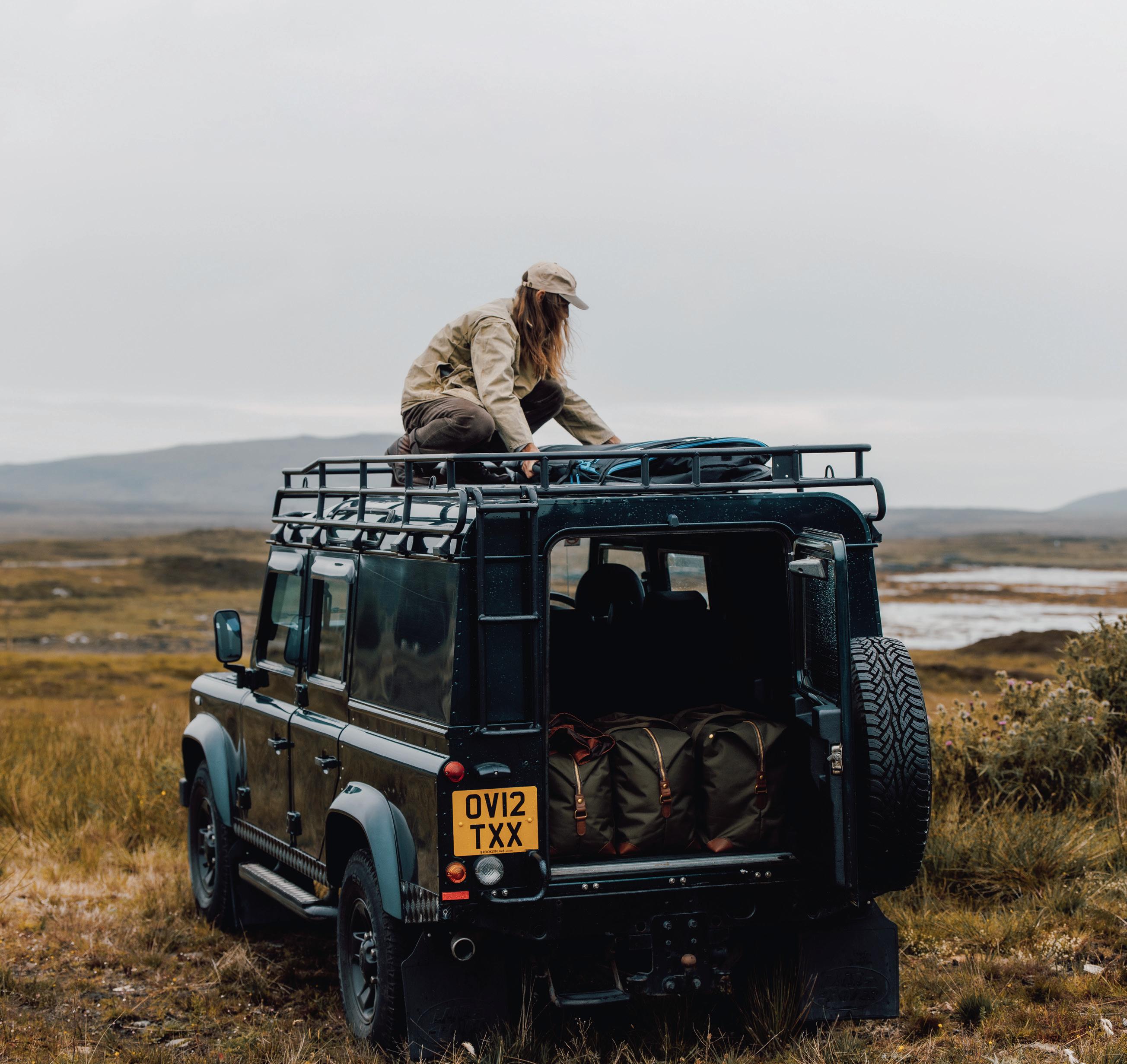
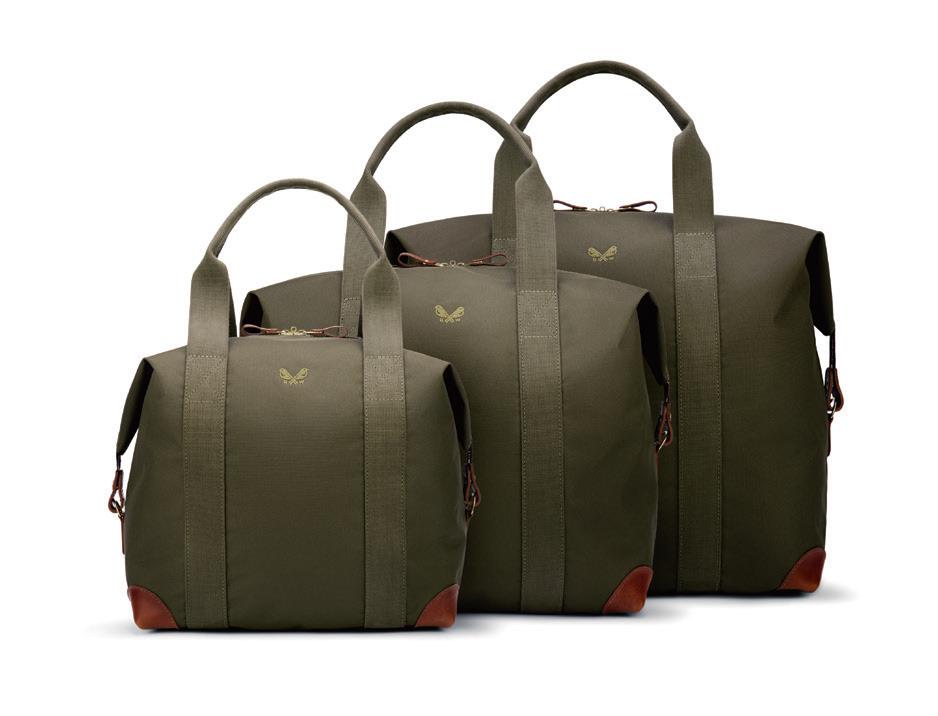
Every good adventure needs a rugged support crew. Handmade in England from high-performance waterproof nylon, the Bennett Winch Cargo Range is a set of large capacity touring holdalls designed to take you into the wild with a little more order. Military grade cotton webbing, Tuscan leather trim and solid brass hardware are built to last a lifetime, whilst a 600-denier nylon construction makes each bag as lightweight as it is hard-wearing. When the essentials pile up, leave nothing behind. Good adventure comes to those with the capacity for it.
Story by Bek Day

The glittering history and enduring legacy of Cartier takes centrestage in Melbourne when the NGV International (ngv.vic.gov.au) plays host to the largest exhibition of the maison’s pieces ever staged in Australia. Celebrating a selection of creations worn by monarchs, movie stars and musical icons – from the “red fire” of Elizabeth Taylor’s ruby necklace to the diamond brooch Princess Margaret wore to her sister’s
coronation – the collection features more than 300 treasures, tracing Cartier’s evolution from a small Parisian workshop to a global symbol of refined glamour.
12 June to 4 October 2026
Don’t miss: The tiara display, including the Scroll tiara, commissioned in 1902 by the Countess of Essex. This masterpiece of the “Garland” style was famously worn by Clementine Churchill at the coronation of Queen Elizabeth II in 1953 and pop star Rihanna for a magazine cover in 2016.

diamond, gold and silver Scroll tiara, 1902
“No two people have the same experience at Dark Mofo,” says artistic director Chris Twite. “You might find yourself staring up at a pyramid of tables held aloft by 36 men and their teeth. Or wandering into an abandoned warehouse to see performance art from an artist who’s never been to Australia before.”
Organised by Nipaluna/ Hobart’s Museum of Old and New Art (MONA), the 12th chapter of the provocative midwinter festival (darkmofo.net.au) promises American rapper Princess Nokia and Norwegian electronic artist Sassy 009, plus mainstays such as the Night Mass, art installations and the burning of the Ogoh-Ogoh effigy.
11 to 22 June 2026
Don’t miss: The Winter Feast, with delights from Italian chef Floriano Pellegrino, including an amuse-bouche of limoncello foam designed to be kissed off a mould of his wife’s lips.
Celebrating Australian storytelling in the landscape that often inspires it, Hollywood comes to Winton. The Vision Splendid Outback Film Festival (visionsplendidfilmfest.com) offers a chance to watch premieres and classics at The Royal Open-Air Theatre, one of only two such venues that remain in the country. But the fun isn’t just the
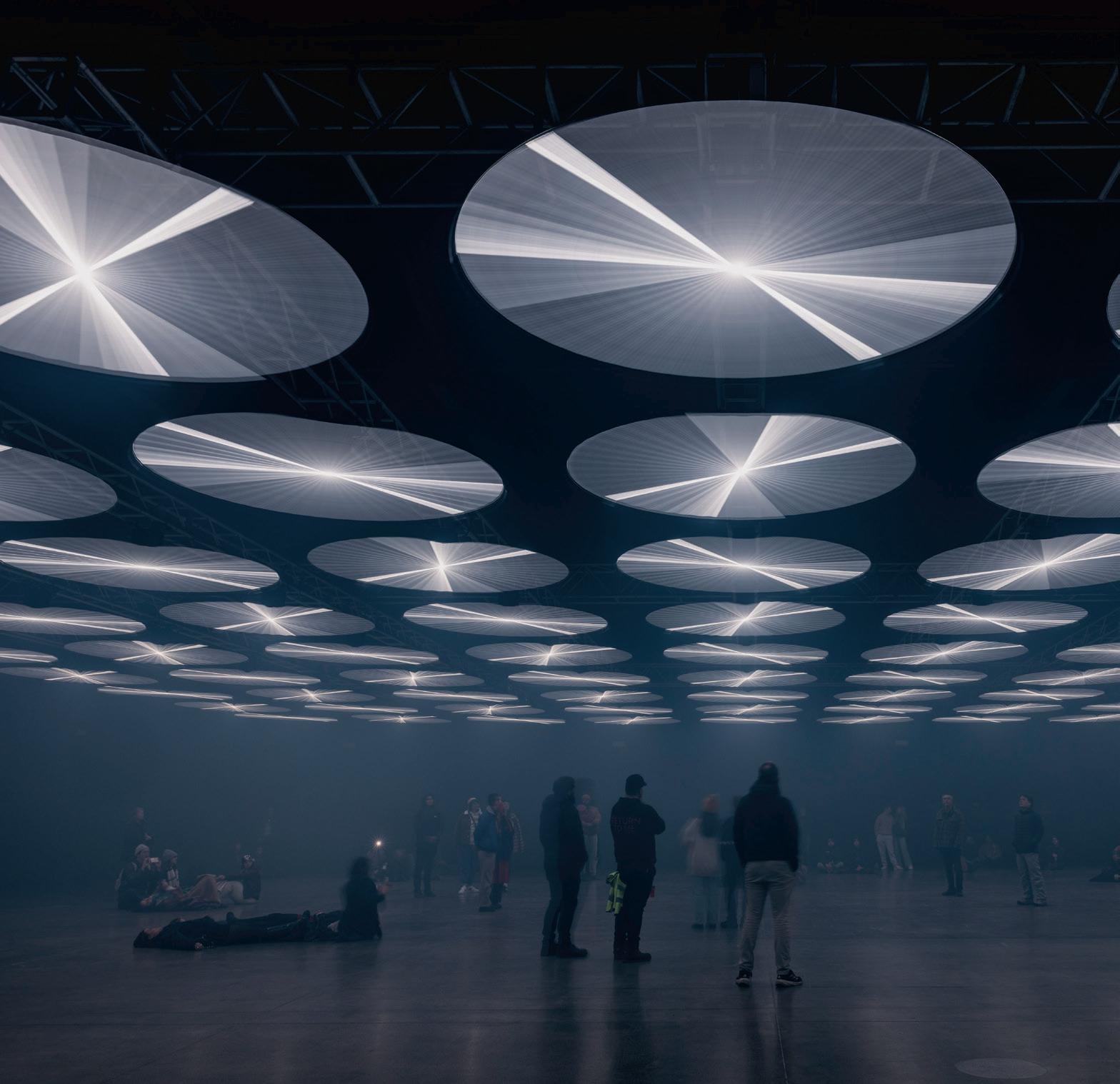
nocturnal kind. By day, there’s mingling with makers at events like Breakfast With the Stars, film set tours and workshop panels before settling in for cinematic experiences under the Milky Way.
26 June to 5 July 2026
Don’t miss: After the festival, make a trip to the Qantas Founders Museum (qfom.com. au), two hours down the road in Longreach, to trace the story of Australia’s national carrier.
Marking its 50th birthday in 2026, Alice Springs’ Finke Desert Race (finke desertrace.com.au) has evolved into a high-octane extravaganza and one of Australia’s most gruelling
off-road motorsport races. What began in 1976 as an endurance challenge for a handful of local riders today attracts elite competitors who push their bikes, cars, and buggies to the limit across 460 kilometres of unforgiving corrugations. Thousands of spectators join the “camp-out” culture, setting up makeshift settlements along the track and transforming the usually empty desert into a festival of outback camaraderie.
5 to 8 June 2026
Don’t miss: The Scrutineering, held on the Friday night at the start/finish line, where spectators can get up close to the machines set to race and meet the drivers braving the track.
Interview by Victoria Pearson | Portrait photography by Michael Buckner
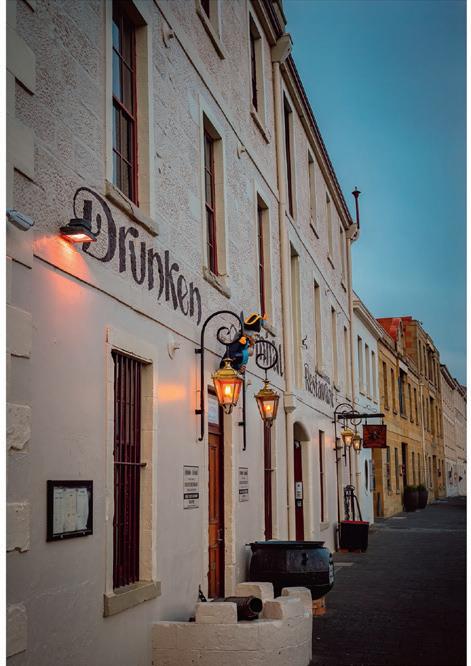
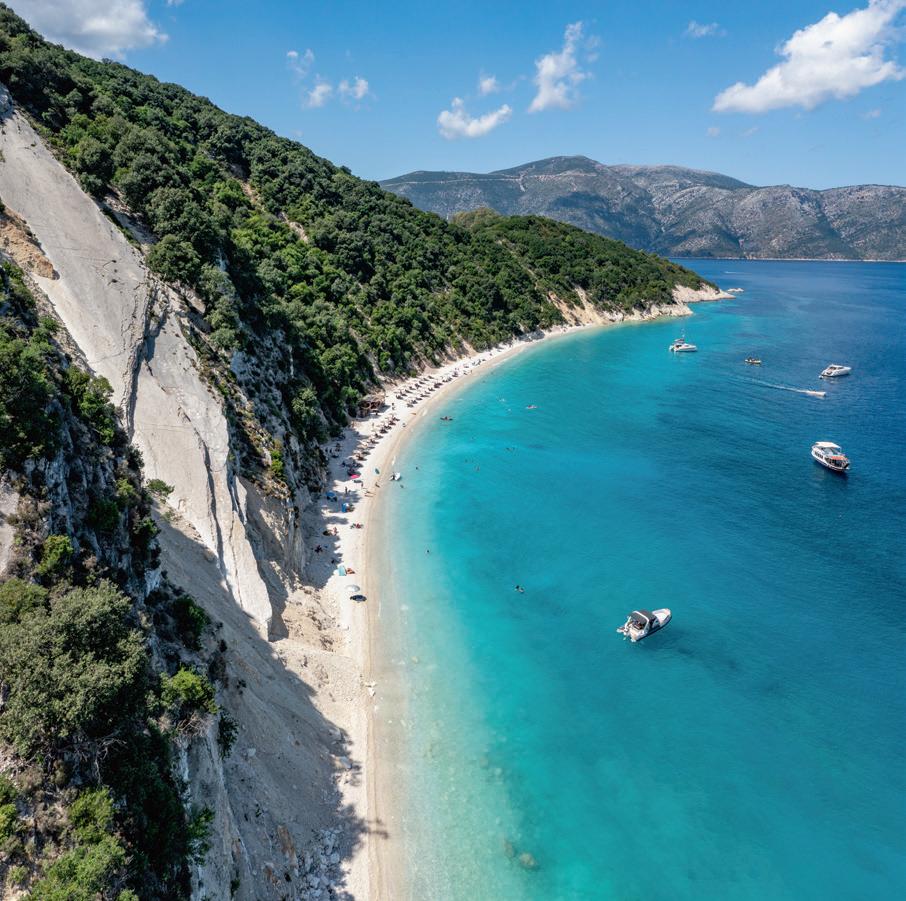

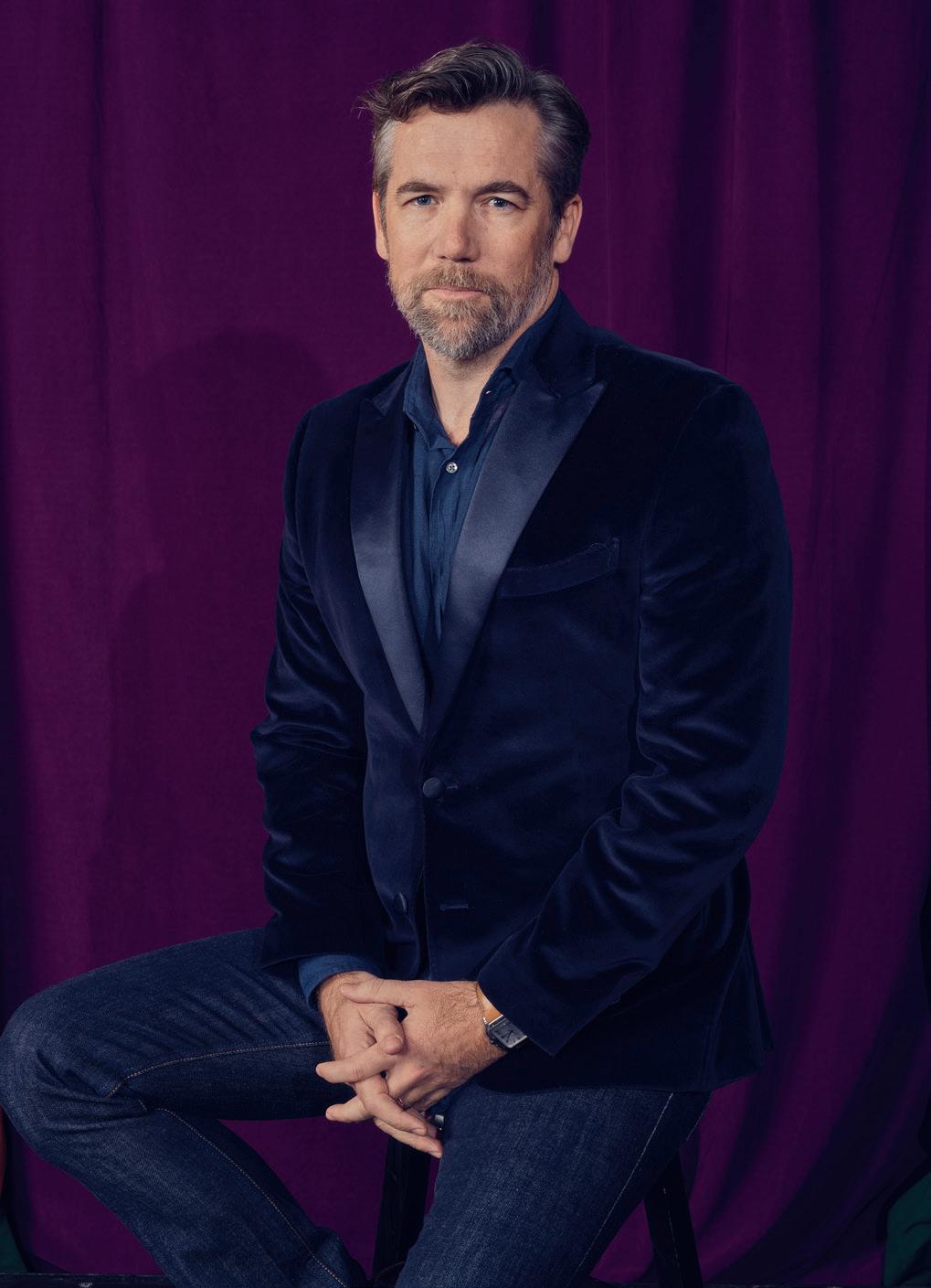
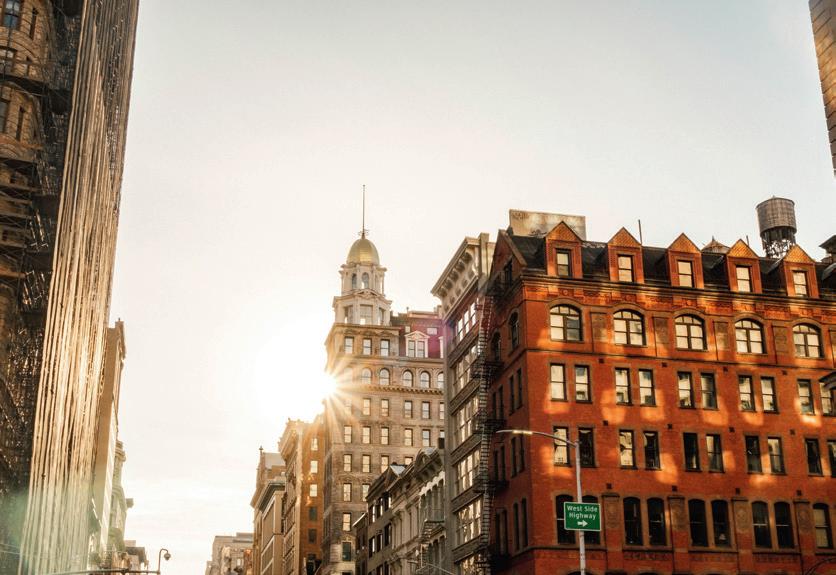
Where’s your favourite place? New York City (bottom centre). To go to New York and not just experience the thrum and energy of that city but to do it as I’m working is an incredible privilege. The place is just so alive with stuff and texture and noise.
What’s the first thing you pack? Sony noise-cancelling headphones (bottom left) for a long-haul flight.
A film or show that takes you away? Mrs. Brown from the ’90s, with Judi Dench and Billy Connolly. It takes you to the wilds of Scotland immediately.
Your must-listen holiday song? Long Train Runnin’ by The Doobie Brothers. I’ve just dated myself and then some. You can start any holiday with that song and it’s going to kick it off with the right note.
If you could eat anywhere, where would it be? The Drunken Admiral (top left) in Hobart. Super-fresh seafood – it’s unbelievable.
Which place tops your bucket list? The Greek island of Ithaca (far left). I love The Odyssey by Homer – years ago, I fell in love with the story and that area.
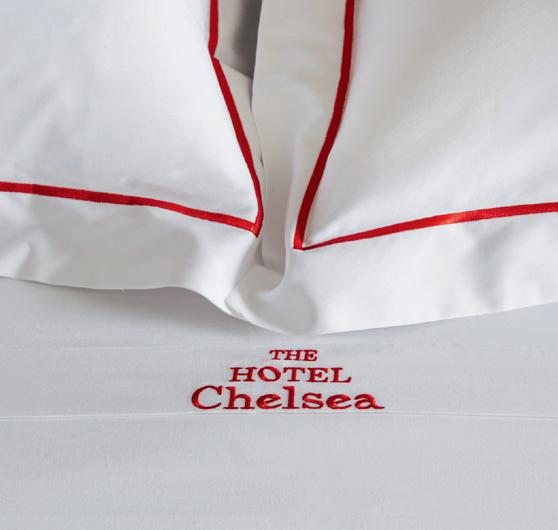
The hotel you’d return to in a second? The Hotel Chelsea in New York. It’s cool and luxurious and decadent – it was nice to live that life for a couple of nights. The place is steeped in recent cultural history. I couldn’t get Leonard Cohen out of my head all weekend.

Our pick of the page-turners worth your time this month.
Story by Michael Williams
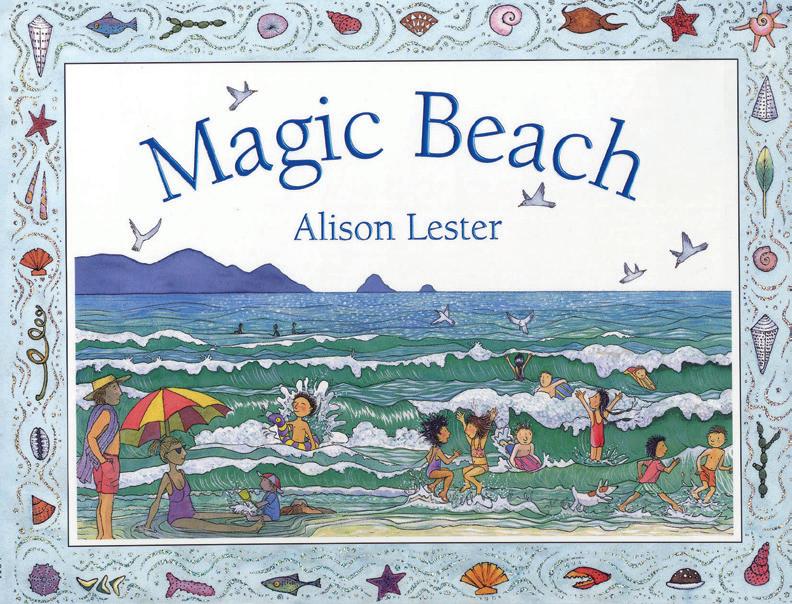
In a recent national poll, readers voted Alison Lester’s Magic Beach, published in 1990, Australia’s best children’s picture book. It’s a classic for a reason. Toggling between imaginative play and appreciation of a beautiful stretch of coast, the repeated refrain “At our beach, at our magic beach…” will echo through your home. And with Robert Connolly’s 2024 film adaptation, it can also be enjoyed onscreen.

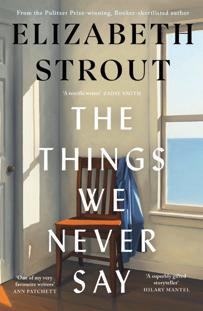

Is an Elizabeth Strout novel not set in Maine and without her two recurring heroines still an Elizabeth Strout novel? Apart from its Massachusetts setting, The Things We Never Say retains Strout’s hallmark elements: a buttoned-down protagonist, the silences and fractures in a marriage, revelations of long-denied stories. Delicious – and utterly Elizabeth Strout.

Journalist Stan Grant has never shied away from difficult conversations. He’s in a more reflective mood in When Words Fail Us: Truth Beyond Time, drawing on personal, philosophical and historical models of ways to be effective in the world. From Plato to Radiohead, Grant examines how we speak to one another in an age of angry shouting and miscommunication.

Martin McKenzie-Murray’s The Speechwriter won the Russell Prize for humour but Sirens: Inside the Shadow World of First Responders finds him in journalistic mode. Across three intimate portraits – a paramedic, a police officer and a firefighter – he explores the impulses and qualities that drive first responders. This is a powerful and, at times, devastating read.
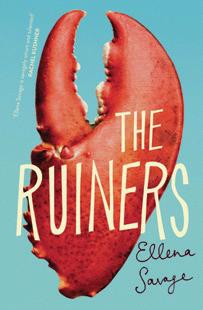
Ellena Savage’s long-awaited debut novel, The Ruiners, comes after years of literary journalism, essays and the nonfiction Blueberries. And it does not disappoint. Pip, working in a Melbourne restaurant, is stuck until inherited money and a beguiling young scholar open up possibilities. A rundown house on a Greek island sets the scene for the ensuing drama.






Story by Bek Day
At Japan’s Azuma Farm Koiwai (azuma farms.com), with its sweeping views of Mount Iwate, the landscape outside each of the 24 cypress-and-red pine villas unfurls like a scroll. Here, famed hotelier and Aman founder Adrian Zecha’s talent for quiet luxury meets the Japanese art of satoyama (coexisting with nature), where guests can wake up to the tang of damp soil mingling with volcanic air and dine on hyperlocal cuisine sourced from the eight-hectare estate.
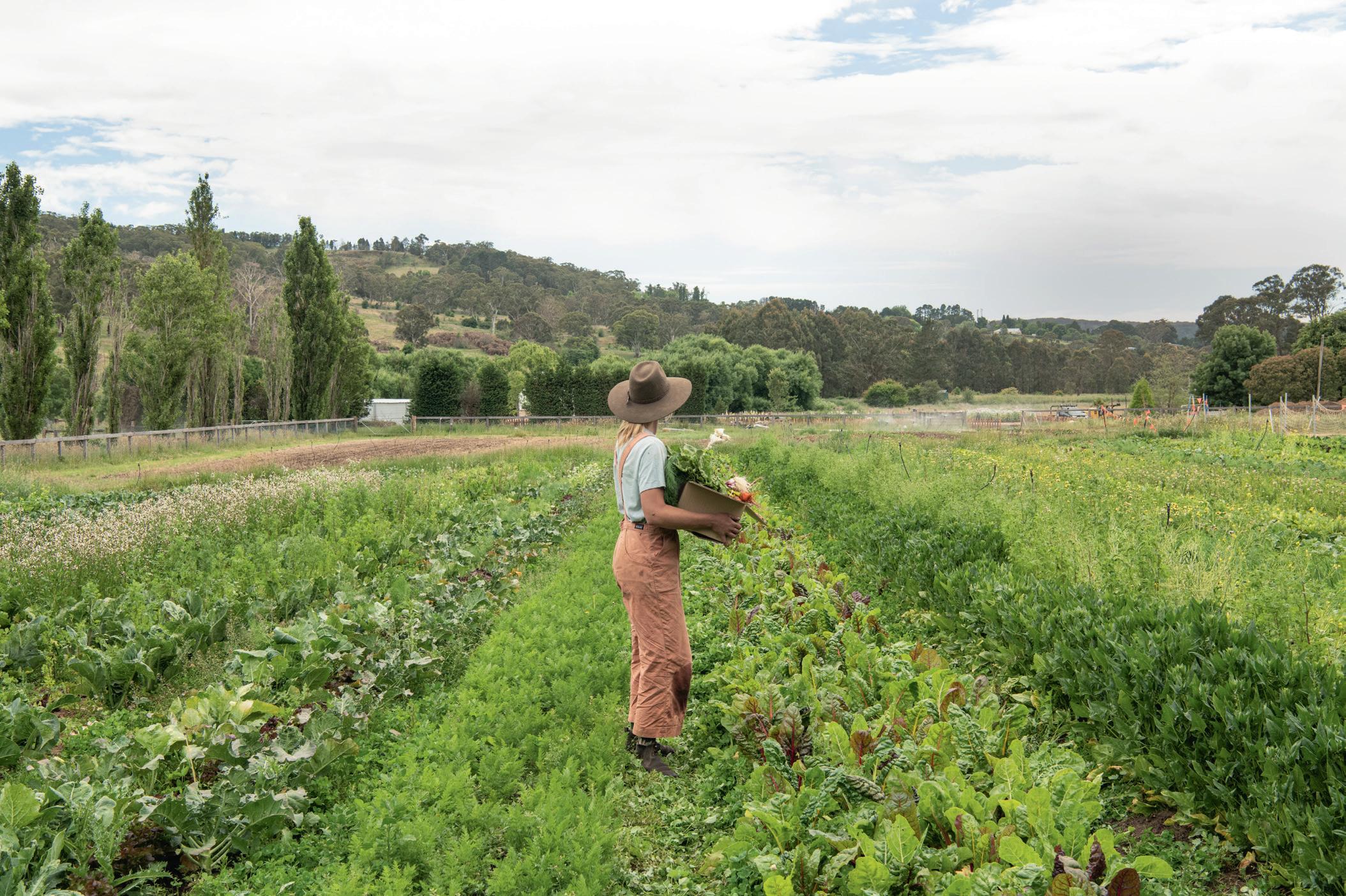
It turns out that, in 2026, the prescription for what ails us is as simple as it is effective: get outside and touch some grass. It’s a directive travellers are taking literally on a global scale. Once niche, the farmstay – where guests switch hotel keys for the warmth of
a freshly laid egg in their palm and happy hour for lungfuls of crisp country air at sunrise – has ploughed its way into the mainstream. Agritourism was worth US$9.81 billion last year and is set to reach US$23.38 billion by 2034.
In the United Kingdom, guests at Suffolk’s Restaries at Paradise Farm (restaries.com) can spend the morning with the resident kunekune pigs, pygmy goats and alpacas before retreating to the refined comfort of the 16th-century thatched-roof Farm House, with its five bedrooms, 12-seater dining table, log fires and vistas of rolling fields.
Back home, travellers are also dipping their Blundstones into rural experiences, with the arrival of Three Blue Ducks at Burradoo Park Farm
(burradooparkfarm.com) in the NSW Southern Highlands, which marries the restaurant group’s “real food and wine” ethos with a working regenerative farm. On Queensland’s Sunshine Coast, there’s the newly updated Sixty6 Acres (sixty6 acres.com), which has boutique quarters, magnesium plunge pools, on-site dining and encounters with miniature sheep, donkeys and horses.
In the absence of self-imposed hustle, the farm life movement is about tuning in to the forgotten rhythms of nature. It’s a reminder that not only is the grass greener exactly where you’re standing but that one of the true measures of luxury is having dirt under your fingernails and a glass of vintage small-batch shiraz in your hand.



It’s the spiritual heart of this country and we’ve worked with Traditional Owners to plan an exclusive travel route that takes you deeper than anyone else. Here you will explore untouched natural wonders, spot native wildlife, stay in exclusive camps and lodges and experience the oldest surviving culture in human history. Now, it’s time to find your Outback Spirit. 2027 adventures now selling. Earlybird fares available. 13 days from $11,290 * pp.
Story by Faith Campbell
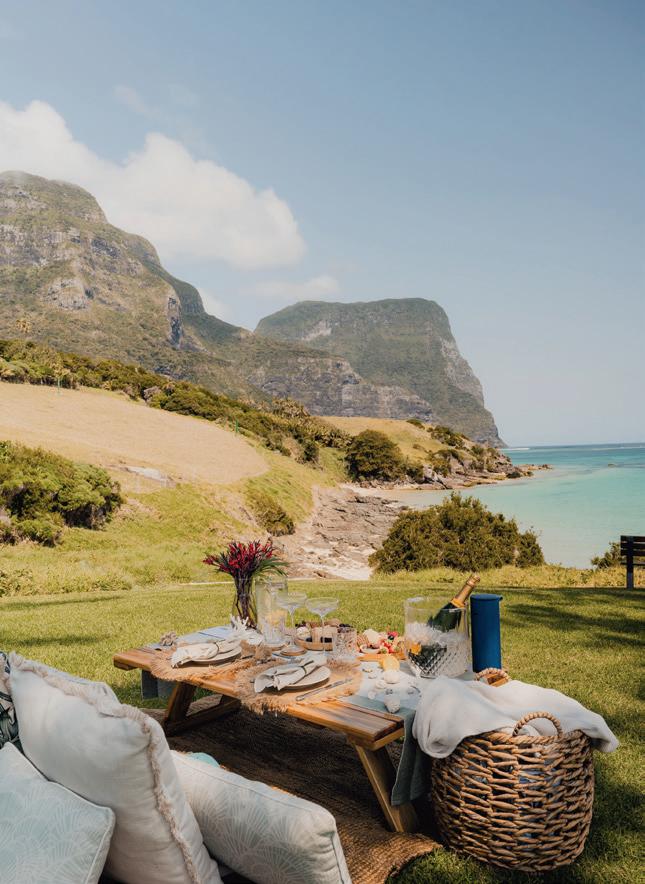
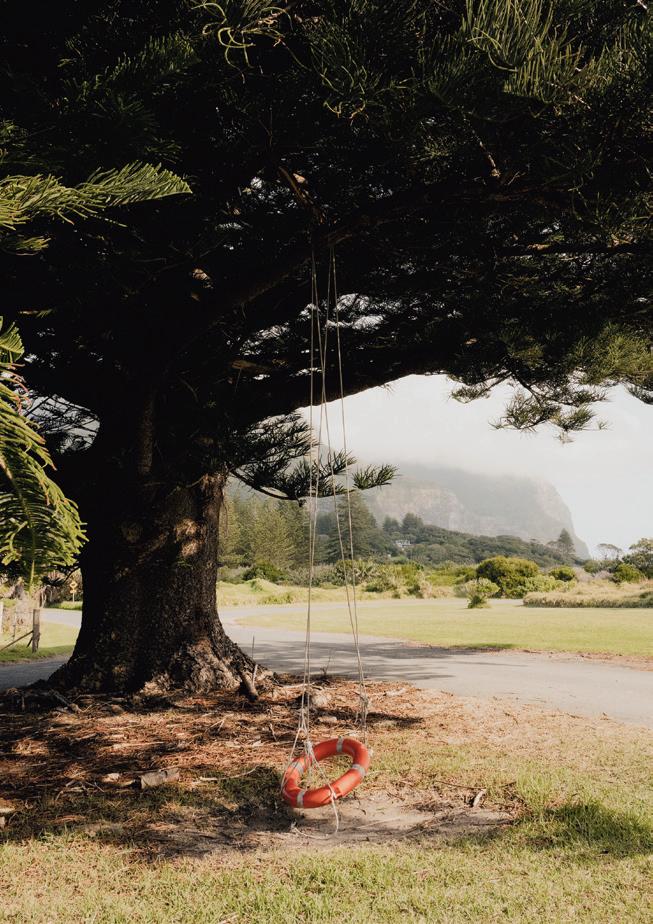
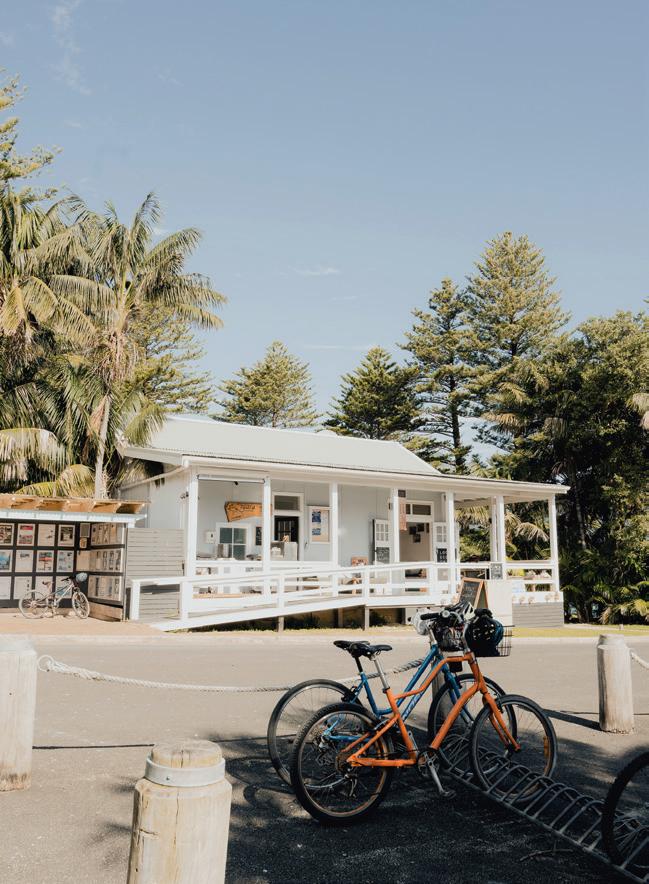
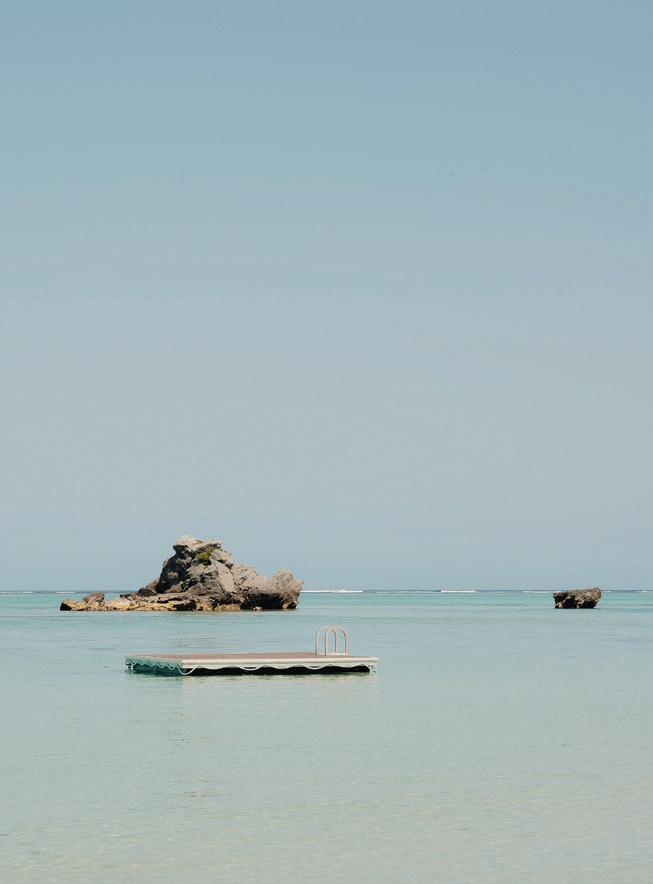
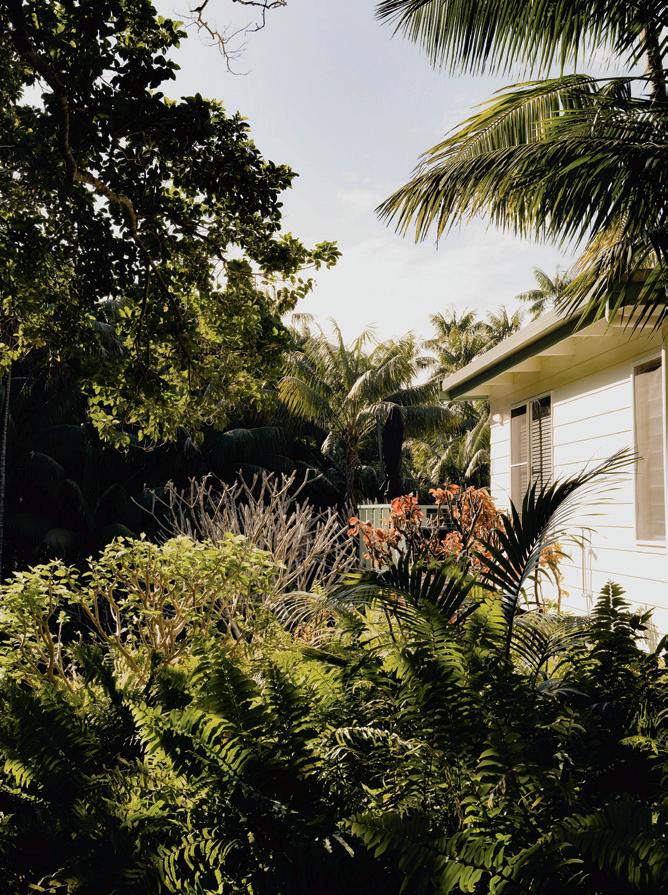
“Everyone waves at everyone,” says Lord Howe Island local Jessie on the drive from the airport. A two-hour direct flight from Sydney, this sanctuary offers the kind of holiday you’ll never forget – friendly, laid-back and spent by the beach. “You can swim anywhere,” Jessie adds. “There are no stingers or poisonous creatures.” Plus, it’s small enough that you can hear the ocean wherever you are.
The two adjoining escapes at Admiralty Apartments (admiraltyapartments. com.au) near Ned’s Beach are all beachy-chic, from the king-sized beds with white linen to the hints of palm print and blonde timber. Ideal for couples, the light-filled stays suit a young family just as well, thanks to full kitchens, generous bathtubs and travel cots (on request). There’s a complimentary breakfast hamper of bread, eggs and other treats, along with towels and sun shades to tote down the sandy path from the backyard to the beach, where colourful fish greet you in the shallows.
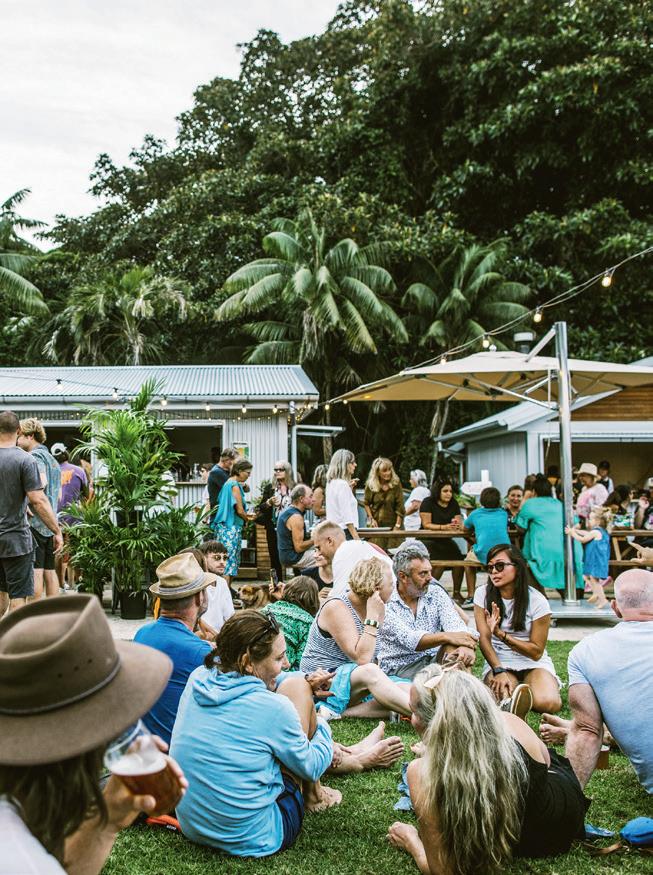
Kids tumble around on the grass under festoon lights at Lord Howe Island Brewery (lhislandbrewery.com.au).
The beer garden’s woodfired pizzeria – open Thursday and Saturday evenings, like the brewery – serves up classics including a margherita, plus a pork sausage version with kale, parmesan and fresh basil. Match either with the signature lager, made with rainwater and island honey. To try fresh local fish, make an early reservation at Anchorage restaurant (anchoragelordhowe.com.au), an elegant yet relaxed spot with lagoon views. If kingfish is the catch, a sashimi entree and grilled main with veggies might make the menu.
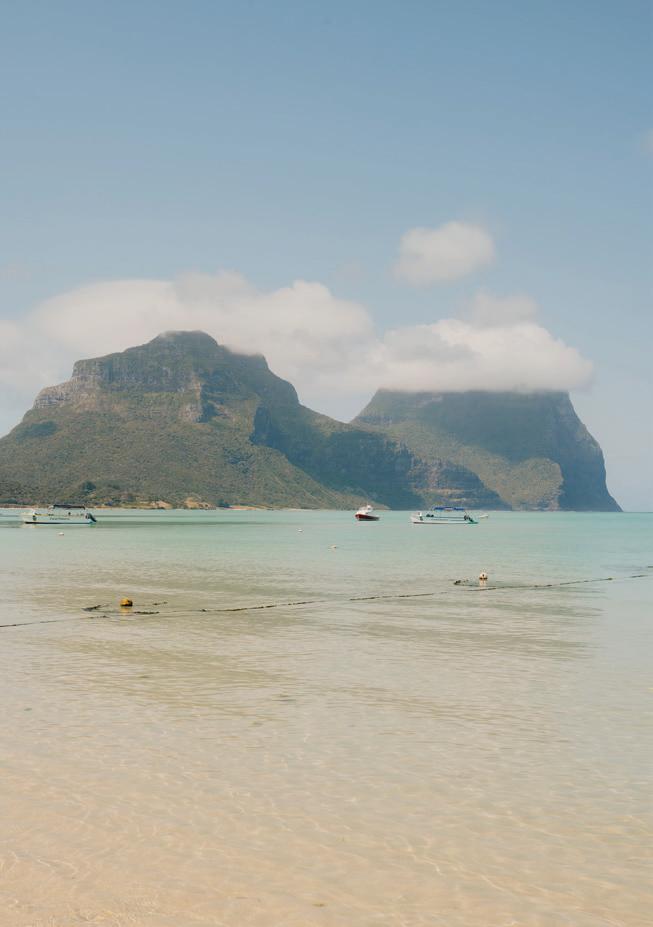
Stop by The Crooked Post (thecrooked post.com.au) for sundowners on the back deck and watch shadows fall
across Lord Howe’s imposing twin mountains, Lidgbird and Gower. Cocktails might include The Garden – featuring gin, triple sec, lavender and “what’s in the garden” – and a refreshing bergamot spritz. At the charming shed headquarters of Lord Howe Island Distilling Co. (lhidistillingco.com.au), Anthony Riddle hosts tastings of his small-batch spirits twice a week. The sixth-generation islander has a permit to forage endemic botanicals such as melaleuca, coastal juniper and sea grapes, a seaweed that he says tastes like “bottling a bit of the ocean”.
From your apartment it’s a flat 15-minute stroll through town to the Lord Howe Environmental Tours boatshed (lordhoweislandtours.com), facing the crystalline waters off Lagoon Beach. On the two-hour glass-bottom boat tour, you might spot turtles, Galapagos reef sharks and species such as the McCulloch’s anemonefish – look for Nemo dressed in black and white.
At many beauty spots around the island, including Ned’s and Lagoon beaches, public barbecues offer unbeatable views. Grab a lunch or dinner pack from The Crooked Post (they’ll provide gourmet sausages, steaks or fresh fish). If you’re too relaxed to cook, let Love Lord Howe (lovelordhowe.com.au) put together a grazing platter of cheeses, charcuterie and more.
From carving turns at Whistler to sitting rinkside at an ice hockey game, these Qantas Frequent Flyers share their Vancouver highlights.
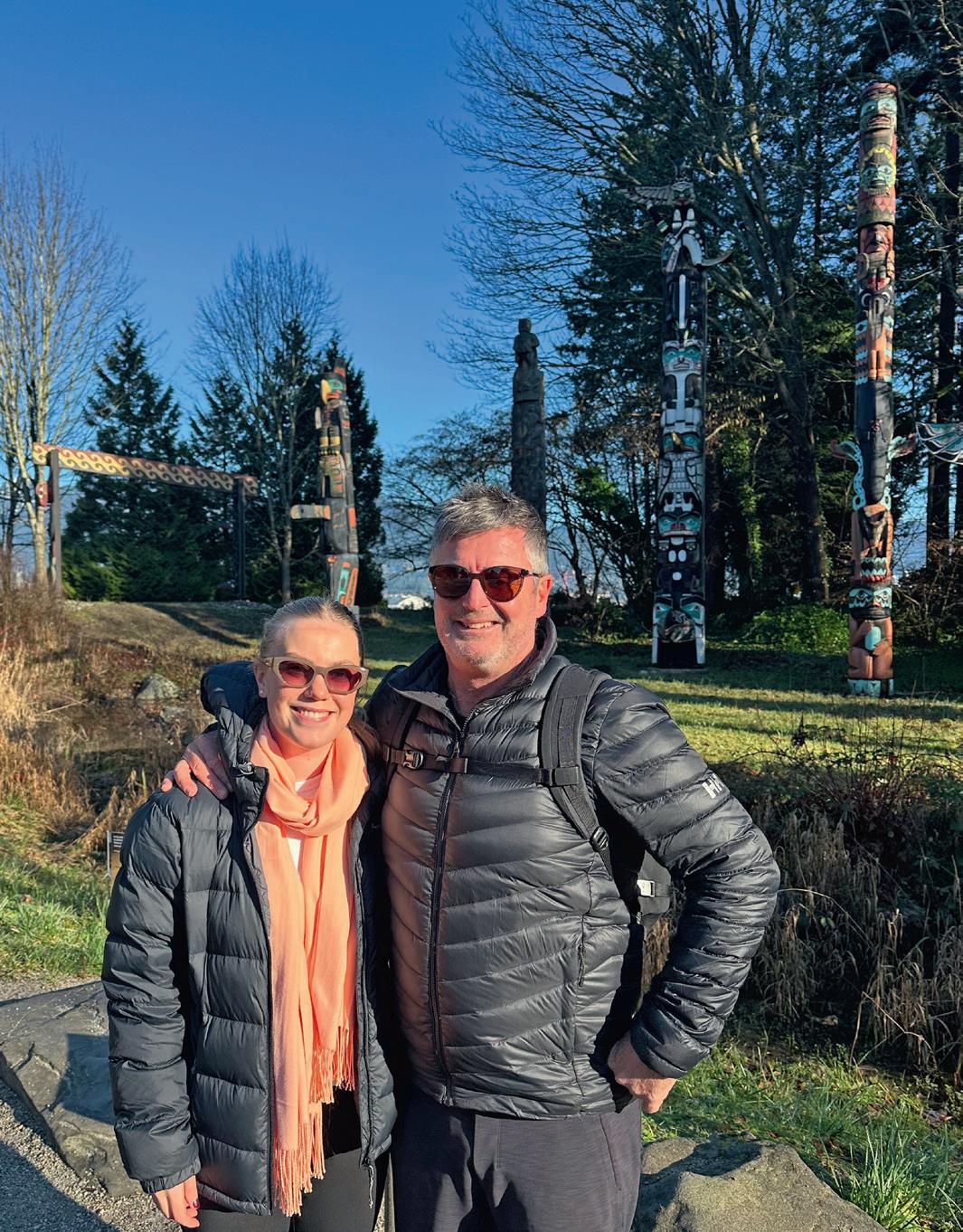
Cycling, brunch and cheering the ice hockey
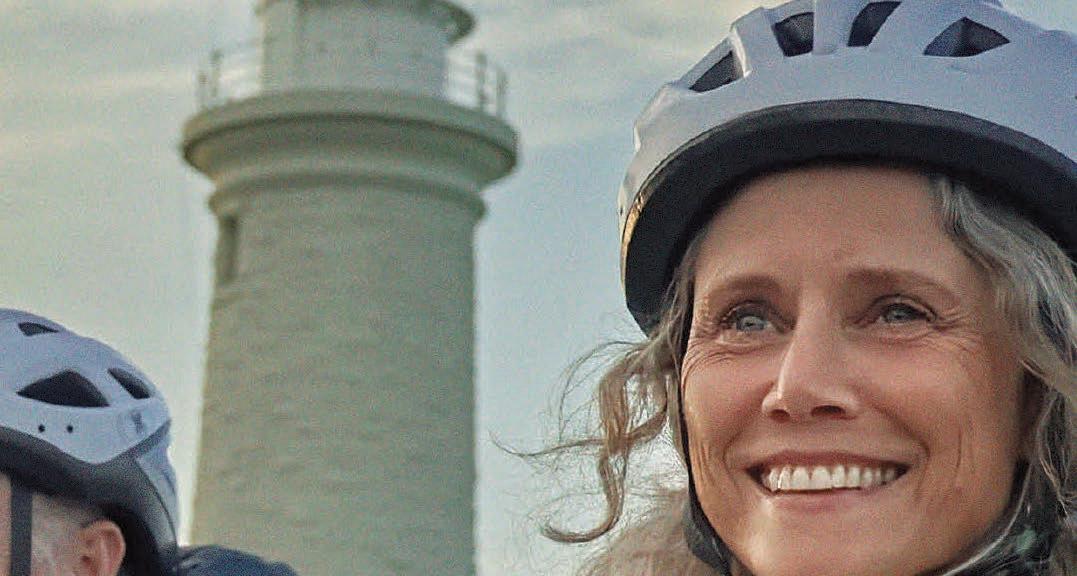
“I had three days in Vancouver in January with my family, including my father [pictured], before a ski trip. It was very cold but that didn’t stop the locals – or us. We stayed in the West End on Robson Street, a great base for shops and restaurants with an open-air ice rink down the road. We hired bikes and followed the seawall around Stanley Park, spotting seals just offshore. Later we walked to Rogers Arena to watch an ice hockey game with the Vancouver
Canucks. The game itself was intense, loud and very Canadian. Gastown’s cobbled streets are made for wandering, especially if you’re into vintage shopping. Back at the West End, we queued for waffles at Nero Belgian Waffle Bar –I had berries and pistachio crumble on top and it was worth every chilly minute.”
Lucia Curtin
Bronze Frequent Flyer
Flew Sydney to Vancouver
Heli-skiing at Whistler
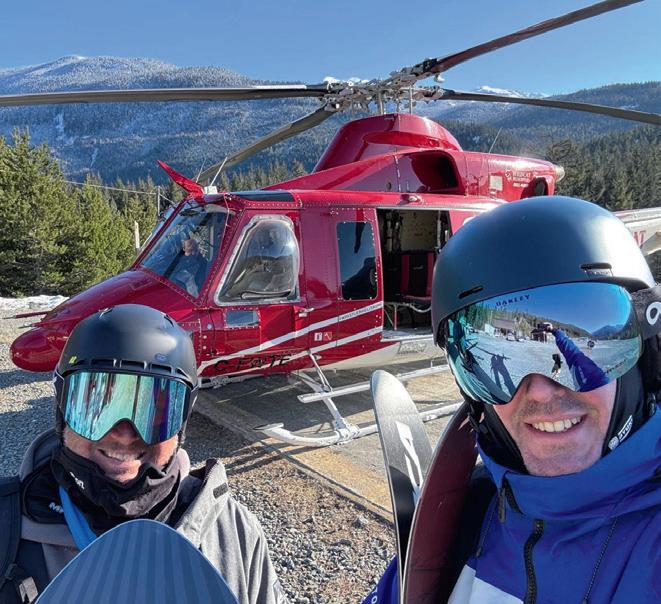
“I flew to Vancouver with my girlfriend, sister and brother-in-law to chase the snow at Whistler – and it delivered. We arrived to a big dump of snow, which set the tone: cold air and perfect conditions. At Whistler Blackcomb, I loved runs like Flute Bowl, Seventh Heaven and Jeff’s Ode to Joy but the highlight was an adventure with Whistler Heli-Skiing [below]. Within minutes of lifting off we were deep in the back country. I rode alongside my brother-in-law, dropping through wide-open alpine faces and massive glacial landscapes on runs averaging about 500 metres. Carving turns with just your own small group is hard to beat. It was like the mountain was ours alone and was unforgettable.”
Steven Walker
Bronze Frequent Flyer
Flew Sydney to Vancouver

Après-ski drinks and Michelin-starred dining
“You haven’t really visited Vancouver until you’ve spent some time in the mountains. On my last trip I went snowboarding at Mt Seymour, which is a 30-minute drive from Downtown. It’s the quietest of the three nearby hills and the one locals tend to keep to themselves. Returning to the city, I made my way to Main Street in Mount Pleasant, which has a relaxed, creative energy with independent shops, small
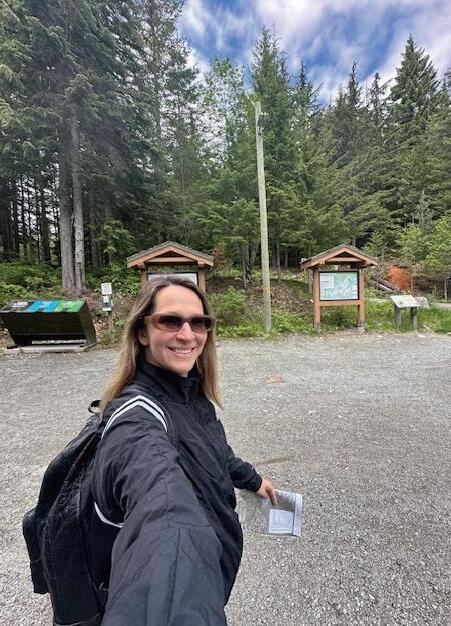
bars and restaurants. I stopped at Brewhall for an après pint of local IPA in its lively, timber-lined hall with soaring ceilings and a long communal table. I then settled in for dinner at Michelinstarred Published on Main, known for its inventive seasonal plates that hero foraged and locally farmed produce.”
Karla Courtney Qantas magazine travel expert
Choose your own adventure in the city
“Vancouver is a walkable city and I can easily rack up 30,000 steps a day. Winter brings snow sports, roaring fires and mulled wine, while summer is all about hiking, bear-spotting and warm evenings. I’ve done a seaplane ride, whale-watching and crossed the Capilano Suspension Bridge lit up at Christmas. The best coffee is at Breka Bakery & Café and for shucked-to-order oysters, try Rodney’s Oyster House. Whistler is worth the visit any time of year. For pure relaxation, try the silent Scandinave Spa Whistler for steaming pools surrounded by a serene old growth forest and the mountains.”
Amanda Skerman Qantas cabin crew
Flights
Fly direct to Vancouver from Sydney year-round.
Hotels
Choose from over 100 hotels in Vancouver.**
Points make it possible Use Qantas Points to book flights and request upgrades to over 1,300 destinations, including Vancouver.~
Discover more at qantas.com or on the Qantas App.
For your chance to be featured in the magazine, email travel@mediumrarecontent.com
Story by Genevra Leek
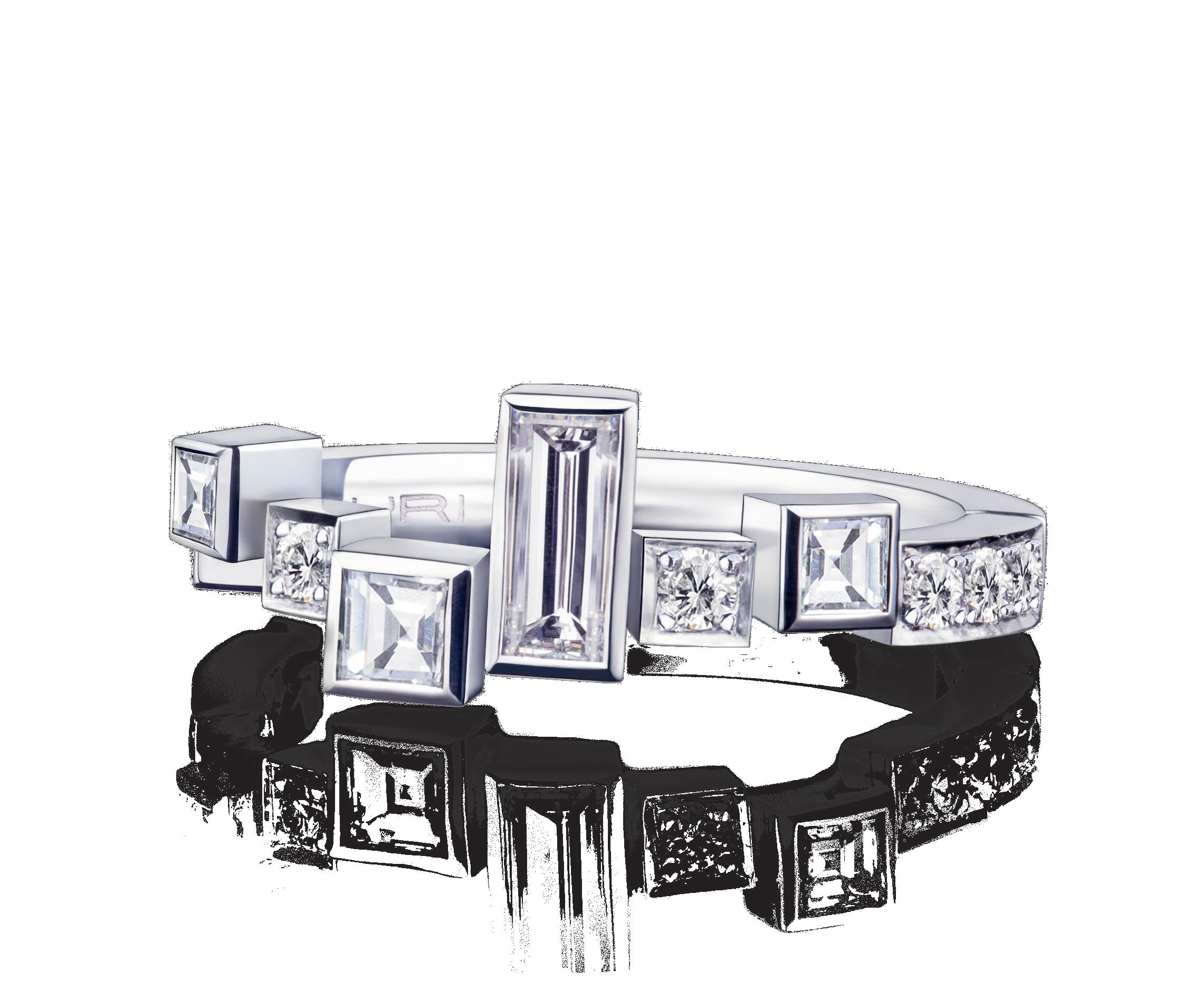
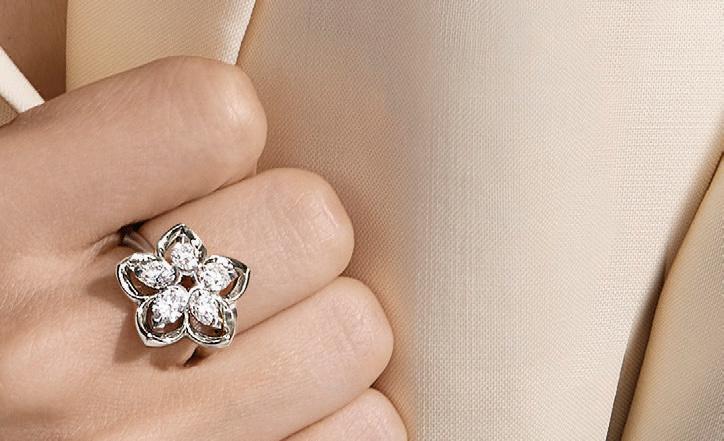
This showstopper feels familiar. That’s because it’s the newest addition to Canturi’s Cubism collection. Inspired by the early 20th-century art movement, Australian designer Stefano Canturi launched the bold, structural designs close to three decades ago yet the appeal is super-modern. It looks more delicate, somehow. The ring is designed to grace the pinky finger, worn alone or stacked. It’s still architectural in form but the rise and fall of the natural diamonds – individually bezel-set baguette, carré and round brilliant – is elegant at the same time. And is that white-gold? Yep. It comes in 18-carat white-, yellow- or rose-gold and is priced from $7000. Available through Canturi boutiques and online at canturi.com.
Story by Noelle Faulkner

What’s new here? It turns out that Australia loves a plug-in hybrid and the demand behind the technology has prompted Lexus – a marque that prides itself on choice and has almost 20 years of experience in battery tech – to add a second PHEV variant to its mid-size SUV RX line-up. This latest model blends Lexus’ signature Japanese comfort, reliability and refinement with the flexibility of an electric-assisted drivetrain, meaning it’s well set up for city commutes and longer journeys that won’t need a charge. Australians really like hybrids that much? We do. According to Lexus, petrol-electric powertrains last year made up 85 per cent of RX and almost 80 per cent of NX deliveries. And what’s powering this new variant?
A 2.5-litre four-cylinder petrol engine, working alongside two electric motors and an 18.1kWh battery, resulting in a combined power of 227kW. In pure EV mode, the RX 450h+ Luxury can cover up to 85 kilometres, which is plenty for daily city cruising. But the car is great for weekend getaways, too – it’s all-wheel-drive so the system can shift torque from front to back as needed for grip and stability. How’s the charging? Pretty easy. If you’ve got a 32A singlephase connection in your home, the car’s 6.6kW AC charger will fill the battery in about 2.5 hours or 7.5 hours on a regular 10A outlet. When the battery is low, it can switch to petrol power. What’s on the inside? The interior is full of light and space, with high-end craftsmanship throughout. A 14-inch touchscreen handles infotainment, plus wireless Android Auto and Apple CarPlay, five USB-C ports, a wireless phone charger and Lexus Connected Services, which gives you more control and information about the car via an app. Expect heated and ventilated eight-way power front seats with driver-seat memory function, three-zone climate controls, a panoramic sliding roof, head-up display and keyless entry all as standard. Sounds great for the family. How much is it? $105,350, plus on-road costs. lexus.com.au
Story by Felix Scholz
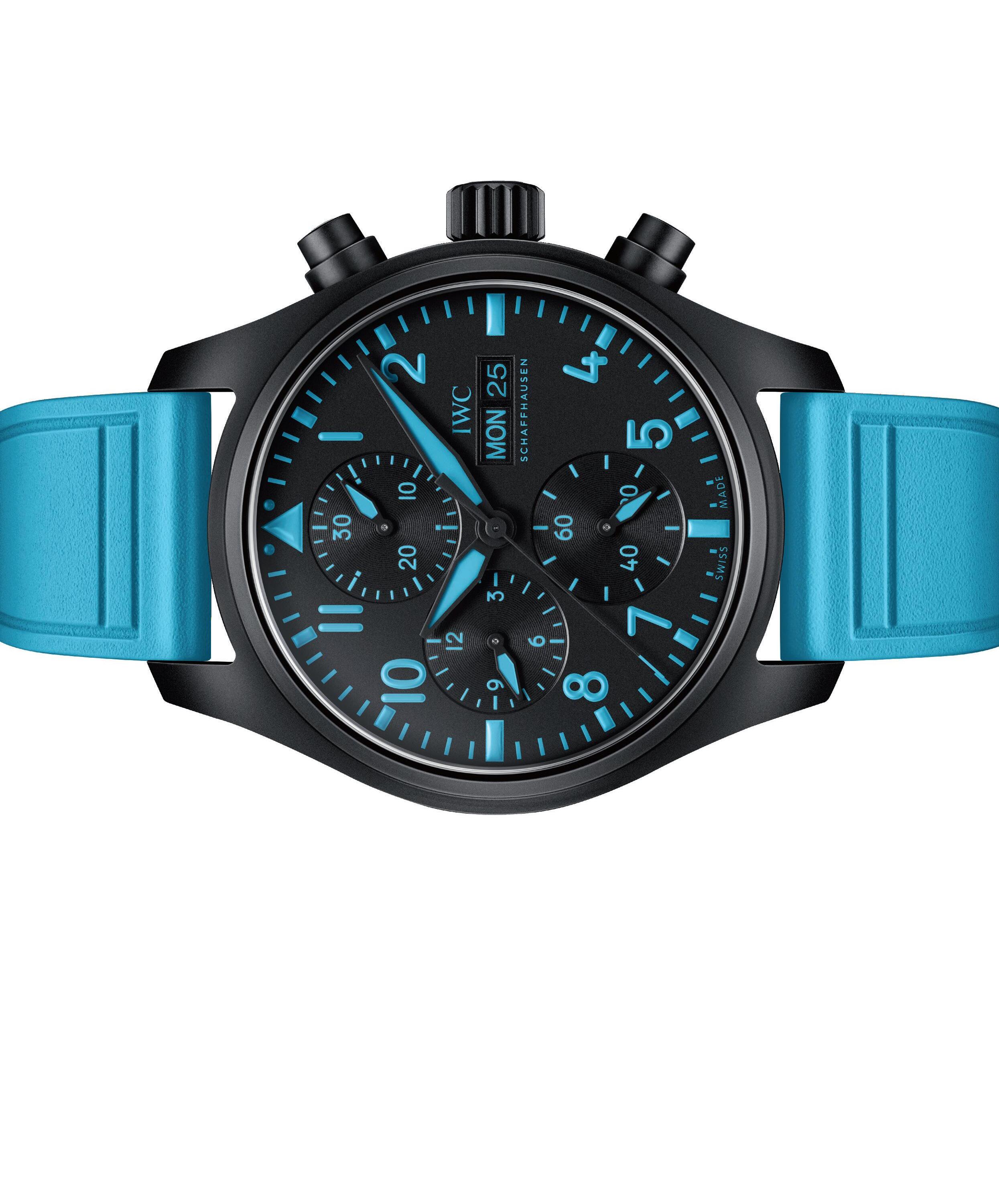
WHAT DO YOU GET WHEN A FORMULA 1 DRIVER TAKES ON A WATCH? A SLICK TIMEPIECE IN AN UNMISTAKABLE PALETTE.
How does this watch relate to F1?
George Russell, one of the drivers for the Mercedes-AMG PETRONAS Formula One team, worked closely with sponsor IWC to create two watches – an automatic and this chronograph model. This is definitely a winning colour combination. It’s a striking watch, with a black case and blue livery inspired by Russell’s helmet. Any other Easter eggs for F1 fans? The titanium caseback is engraved with “63”, Russell’s starting number, and
each model is limited to 1063 pieces. The 41.9-millimetre case is zirconium oxide ceramic, an ultra-hard, heatresistant material that’s also commonly found in F1 car components. Will the watches help to improve your driving skills? No guarantees there but the matching blue rubber strap will certainly help you to look the part and the IWCmanufactured 69380 chronograph calibre will keep you on time. And the price? $19,000. iwc.com
Story by Laura Agnew
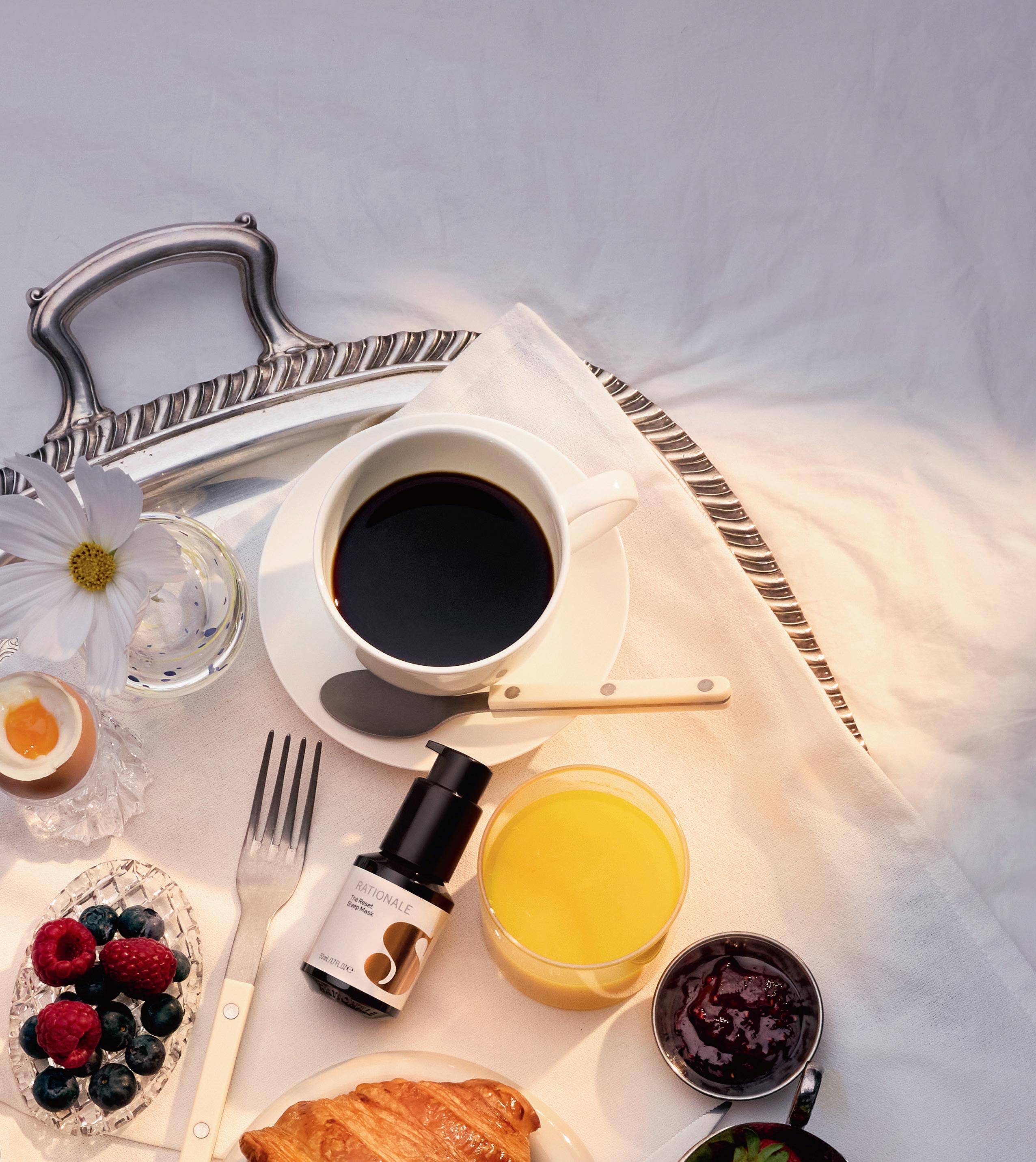
What’s the good news? You’ve now got another reason why you should aim for eight-plus hours of shuteye. This intensive mask works overnight to deliver a science-backed boost of peptides and hyaluronic acid that’s said to brighten, calm and hydrate tired skin. Very handy for long-haul flights. But will it make a mess? No need to worry. One precise pump will deliver the required amount of this rich gel-like serum, which goes on clear and can be rinsed off with warm water when you wake. Is this Australian brand worth the hype? It’s got cult status but it’s no one-hit wonder. Rationale was launched in 1992 by cosmetic chemist Richard Parker, and now has four flagship stores in Sydney and is available at David Jones. It recently expanded into Harrod’s in London and is infiltrating the skincare market in the United States. Is it made locally? Research, development and manufacturing all happen at Rationale’s Kyneton HQ in the Macedon Ranges, Victoria. The mask comes in a pouch from Melbourne label Deering. How much? $198. rationale.com
remara.com • 1300
Story by Peter Bourne
Chardonnay from the Orange wine region is outstanding. What’s the comparable red? Pinot noir is chardonnay’s red alter ego. Both are grown for prestige sparklings as well as Burgundianinspired table wines and both thrive in Orange’s cool climes. While chardonnay cemented its place from the early days, pinot noir has been a slow burn here – but bear in mind the Orange region was only created in 1997. Why a “slow burn”? Earlier pinots from Orange could be a little clunky and stern, whereas the current wave tends to be slinky and subtle, enticingly perfumed and highly drinkable. The evolution has been driven by a new generation of growers with extensive (often international) experience and an eye to styles that appeal to savvy sommeliers. What makes pinot noir work so well here? Elevation is key: the region’s lowest point is 600 metres, with some vineyards above 1000 metres. Mount Canobolas peaks at 1395 metres. The higher sites can be up to five degrees cooler, which suits pinot noir. Add the continental effect – warm days, cool nights and cold winters, plus low humidity – and you have textbook terroir for pinot. Got it. Some names, please? A number of the region’s pioneers have stepped back, with new faces elevating the scene. Murray Smith sold Canobolas-Smith to Jonathon Mattick, who has revitalised the vineyard and opened a super-smart cellar door. His 2025 Canobolas Wines Pinot Noir is a cracker. Tom Ward moved his family’s Swinging Bridge brand from Canowindra (at less than 350 metres and quite hot) to the 900-metre-high Hill Park vineyard, planted in 1998, and his 2023 Caldwell Lane Pinot Noir is a gracious beauty. Any menu advice? Order duck in all its guises, salmon and tuna, juicy lamb cutlets, pork and fennel sausages or a mushroom risotto.
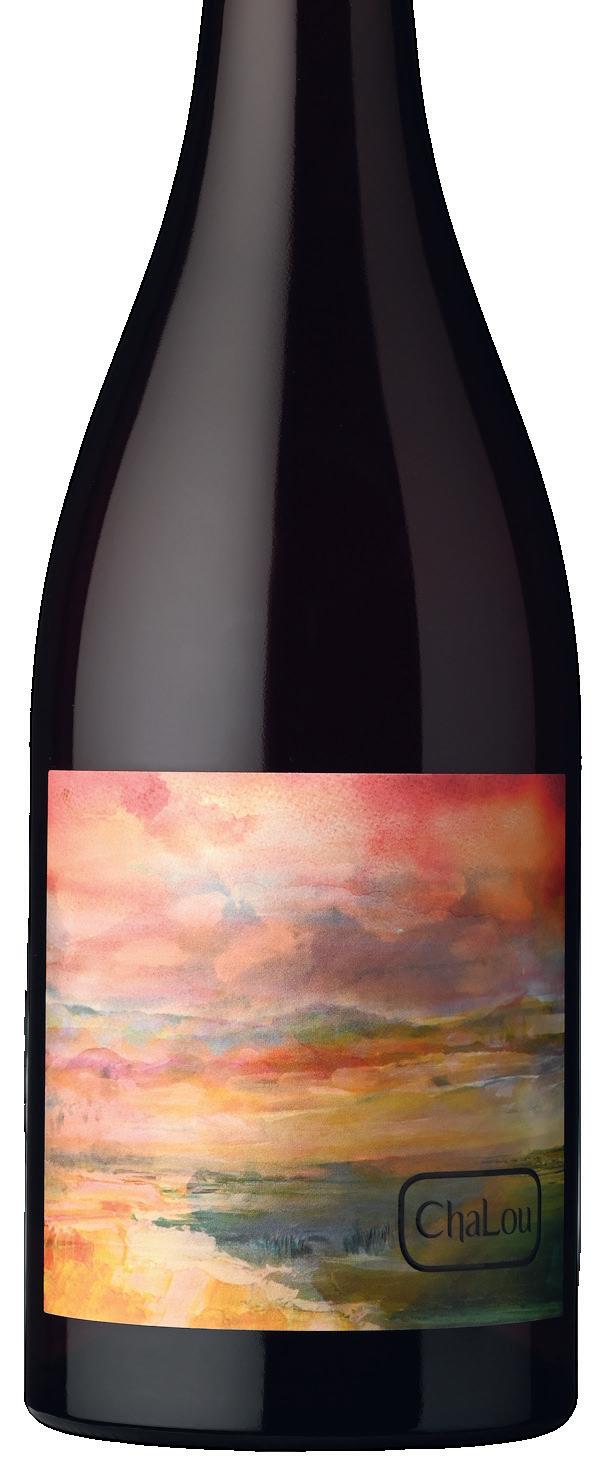

CHALOU PINOT NOIR
Steve Mobbs and Nadja Wallington are the region’s cool kids and sustainability is their mantra. This fresh, bright, pale-garnet red has sweet perfumes of strawberry, redcurrant and wild violet, juicy red-berry flavours and a fine, acid-etched profile. It’s the perfect match for Peking duck.
2024 / Orange, NSW / $42
BYRNE FARM PINOT NOIR
Canadian-born Jeff Byrne cut his winemaking teeth in the Hunter Valley before planting his Glenidle vineyard in 2020. Depth and breadth come with intense cherry and cranberry flavours, the tannins and acid in complete harmony. It’s long, lithe and absolutely charming.
2024 / Orange, NSW / $45
TO
RIKARD BLACK LABEL PINOT NOIR
William Rikard-Bell also decamped from the Hunter Valley to Orange, where his Nashdale vineyard sits at a lofty 1040 metres. Damson plum and red cherry are matched by silken tannins and a lasting finish. There’s concentration here, along with energy and structure.
2023 / Orange, NSW / $75
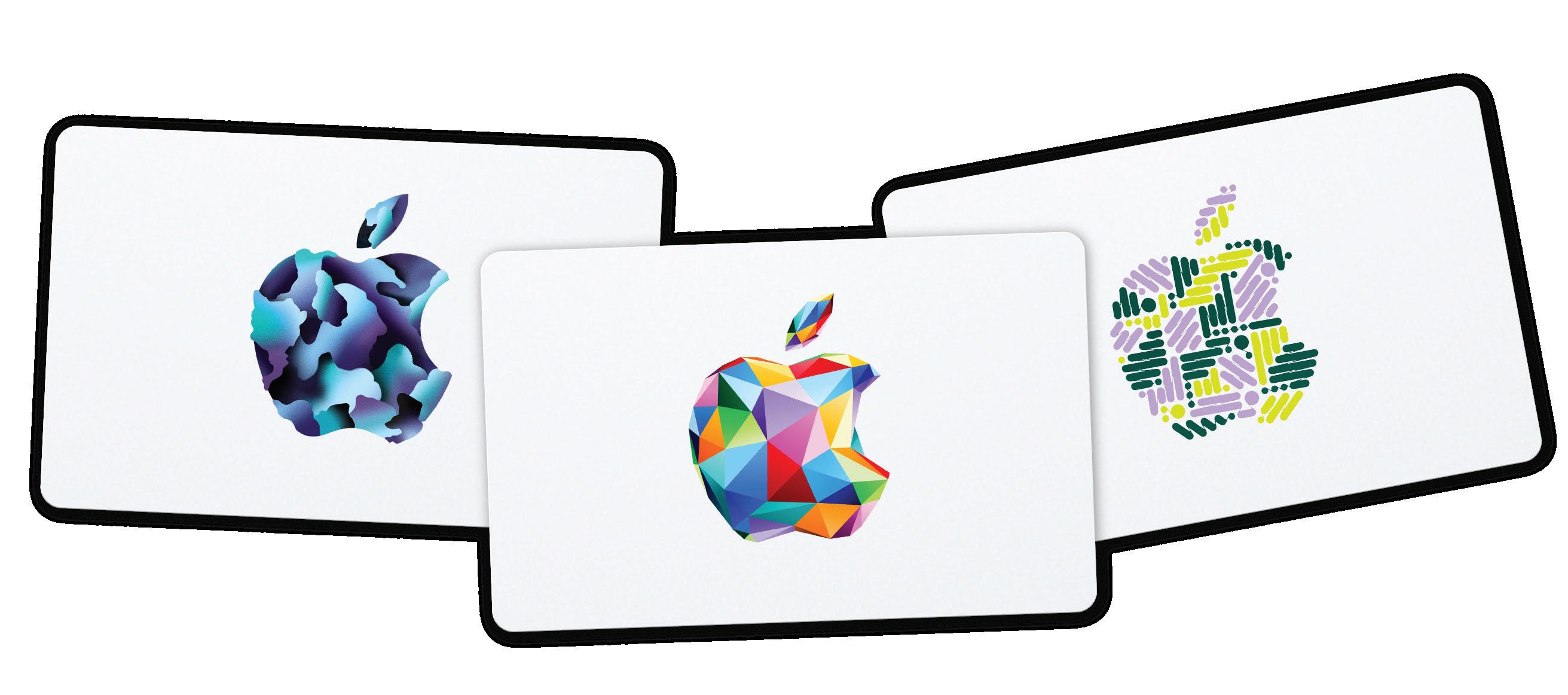
Give games, shows, products and more.
Earn 3 points per $1 spent or use points on Apple Gift Cards at Qantas Marketplace














Story by Alexandra Carlton
If you’ve ordered a plate of scrambled eggs at any local cafe in the last few years, there’s a good chance the kitchen dropped a little purple Insta-friendly viola flower on the top as a garnish. But lately Australian chefs and mixologists are recognising that edible flowers are much more than a pop of colour: they’re flavourful and textural components of dishes and drinks in their own right.
In Melbourne (Naarm), spears of torch ginger flower accent a dish of marinated prawns at the city’s temple to everything Australiana, Yiaga (yiaga.au), and just last month, the team behind
Rockpool Bar & Grill opened 21-seat Bar Ferdinand (bar-ferdinand.com.au) in the CBD above steakhouse 7 Alfred. Here, the list takes guests through a “fictional garden” where cocktails, such as the Australian bush-scented Eucalypt Garden, are defined by floral components and seasonal botanicals. Elsewhere, elderflower honey lends a delicate floral note to the wood-roasted eggplant with pistachio and mint at Meletos (meletos. com) at Coldstream in the Yarra Valley, while marigold vinegar contributes brightness and subtle complexity to baby gem lettuce with green goddess dressing. “I regularly use confetti blends of cornflower, calendula and marigold to add natural vibrancy and to lift dishes without overpowering them,” says head chef Maxwell Parlas.
Spanner crab churro at Norté, Gold Coast




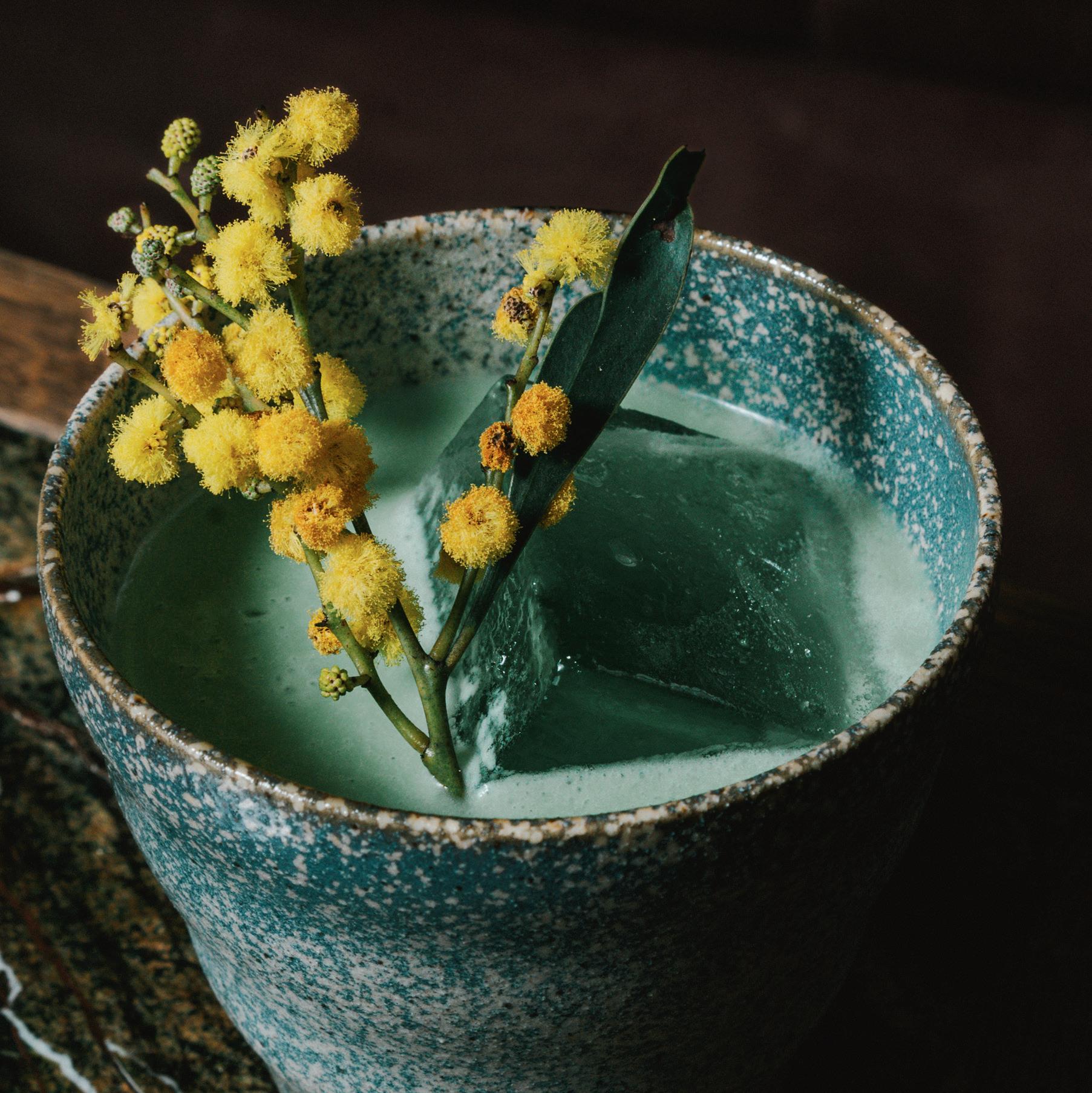
Malted Bali cocktail with wattle blossom at Caretaker’s Cottage, Melbourne
Jocelyn Cross, founder of Yarra Valley-based edible flower supplier Petite Ingredient (petiteingredient.com.au), says the case for floral flavour is strong. “Lemongrass, ginger and basil are not the only things that create flavour,” says Cross, who supplies restaurants such as Bennelong and Saint Peter in Sydney (Warrane) and Melbourne’s Etta with culinary florals. “Rosella flowers give this amazing tang. Borage flowers taste like cucumber and oyster. You should smell our kitchen when we’re drying fennel pollen – it’s pure licorice.”
Flowers as an ingredient are nothing new for Rodolfo Malinverni, head chef of Norté and Sueño (norte. restaurant) on Queensland’s Gold Coast. “I remember going to my nonna’s garden back home in Italy and she always had so many flowers,” he says. “My brother and sister and I would pick crimson coral fountain flowers and suck out the syrup.” Today, he uses florals regularly in the South American-style cooking at both his restaurants. “At the moment
we’re doing a prickly pear cactus salad, which we pickle and cook over charcoal.” It’s served with a sunflower seed tarator then layered with sunflower petals.
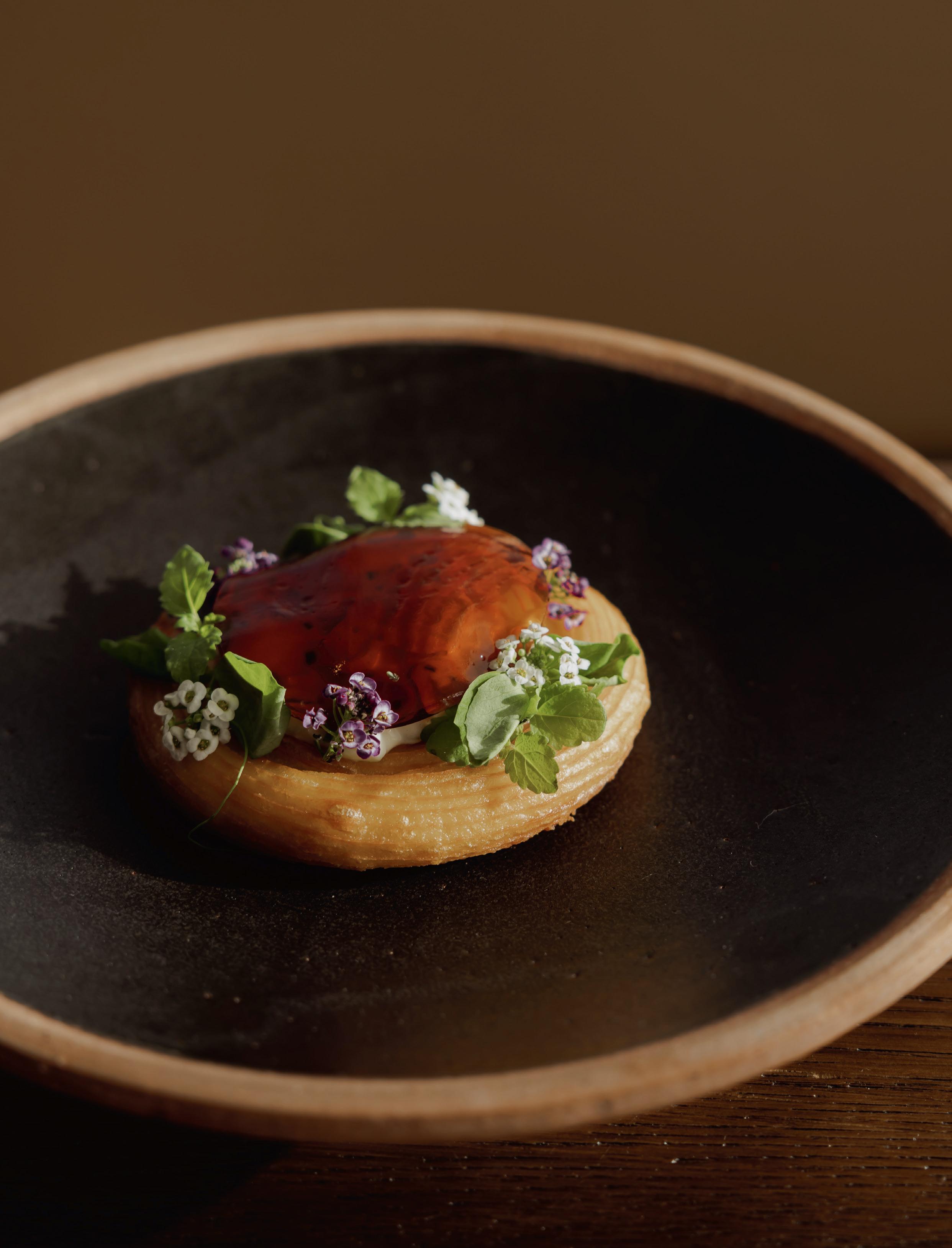
Malinverni next plans to pickle the sunflower bulb and use it for future creations. Purple and white alyssum flowers also add mustard-like notes (“a similar taste to broccoli leaves”) to the restaurant’s spanner crab churro. And pea mole chulapas, a Mexican masa snack, incorporates cornflowers to bring mild notes of clove and pepper. Malinverni is so keen on edible flowers that he forages for garlic flowers and nasturtiums around the restaurant. “People sometimes stare at me and ask, ‘Are those edible?’ I say, ‘Of course!’”
The Petite Ingredient’s Cross says the current floral moment in restaurants is more than fleeting and that flowers aren’t “just a little thing you put on the plate. It’s really exciting seeing more chefs acknowledging these amazing flowers and giving them the respect they deserve. They’re here to stay.”
The team at this awardwinning Melbourne bar (caretakerscottage.bar) regularly use Blak Brews native Australian teas by husband-and-wife team Troy and Cerisa Benjamin in their cocktails. The Red Centre blend adds aromas of rosehip, hibiscus, quandong and strawberry gum to a non-alcoholic spritz, while the Desert Sunrise tea with calendula flowers flavours an Old Fashioned-style drink with rye whiskey and peach rum.
Rosewater, dried rose petals and orange blossom water play leading roles in the Armenian/Lebanese cuisine at this hip Collingwood restaurant in Melbourne, with many of the products sourced directly from Lebanon (zareh.com.au). You’ll find rosewater in the pistachio mafroukeh dessert, while orange blossom boosts baklava and muhullabeya, a Middle Eastern milk pudding.
“Flowers are used a lot in Chinese culture due to their association with longevity, wealth and prosperity,” says Moondrop co-director Steve Chan of their prevalence at his new, Chinese-inspired cocktail bar in Melbourne’s Fitzroy (moondrop.bar).
Head chef Jacob Muoio forages for three-cornered
leek flowers, while osmanthus adds a subtle floral note to the quince paste on a cheddar tart and chrysanthemum leaves provide a hint of grassiness to a pork dumpling.
Chef Jason Barratt is a big flower fan, with pickled and preserved torch ginger blossom making regular appearances in dishes at his pan-Asian Brisbane eatery (brisbane.supernormal.net. au). Zucchini flowers are common on all kinds of menus but unusually, Barratt sources male flowers, which are larger and more robust than female ones. Recently, they were served fried as part of a tempura lobster dish.
Deep-purple banana blossoms are a staple of Thai cuisine. At Same Same (anyday.com.au) in Brisbane’s Fortitude Valley, they’re the key ingredient in a salad with coconut chilli jam and cashew. Head chef Arté Assavakavinvong says the flavours – sweet, sour and spicy – remind him of his mother, who was patient and “quietly powerful”.
Locally foraged and sourced flowers add colour and energy to many of the dishes at this Huon Valley taphouse (lostcaptain.com.au), most prominently as part of the colourful “wildflower butter” served alongside housemade focaccia.
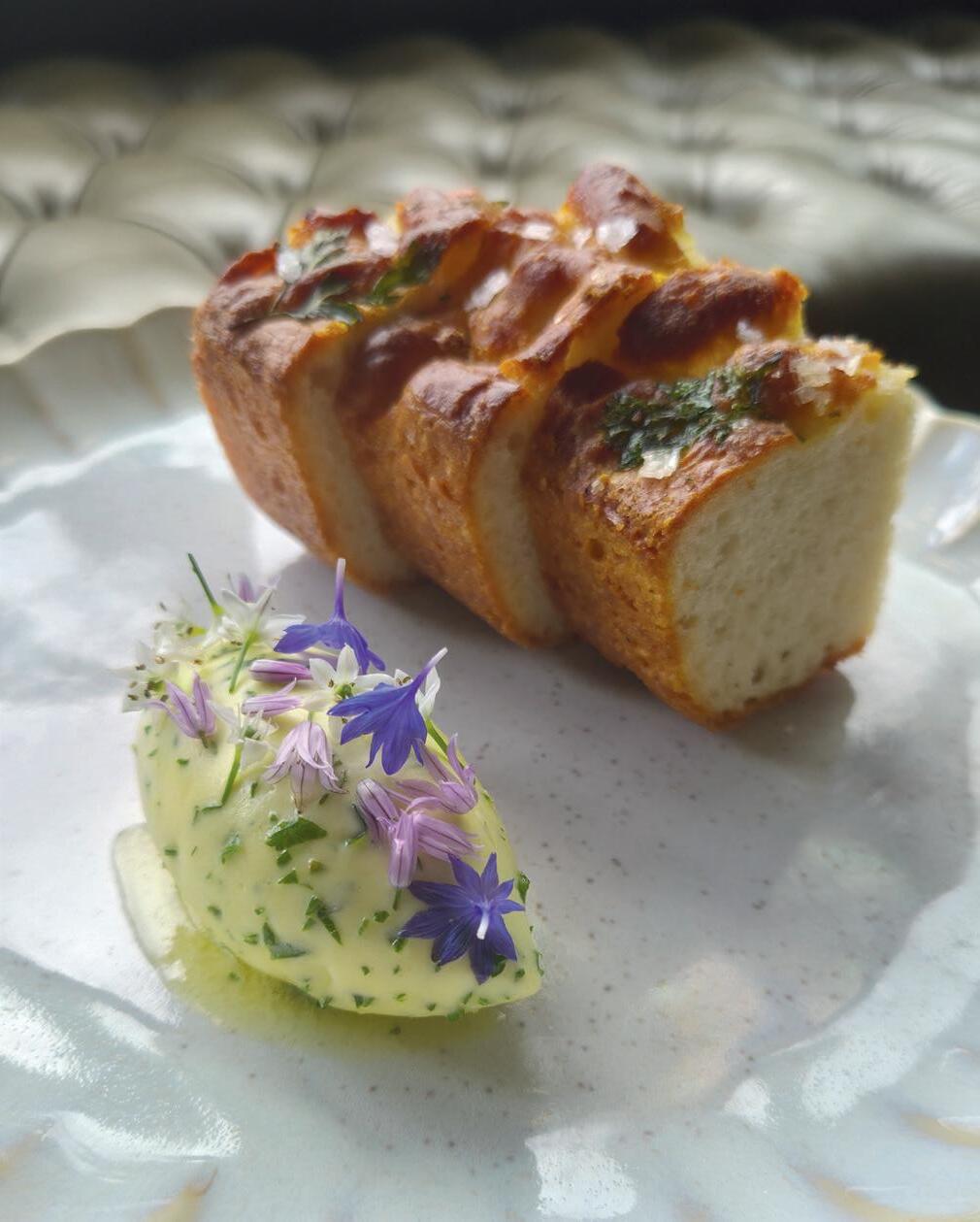
Wildflower butter and housemade focaccia at Lost Captain, Huon Valley (above); fresh curd with peach, young almonds and rose at Esmay, Adelaide (below)
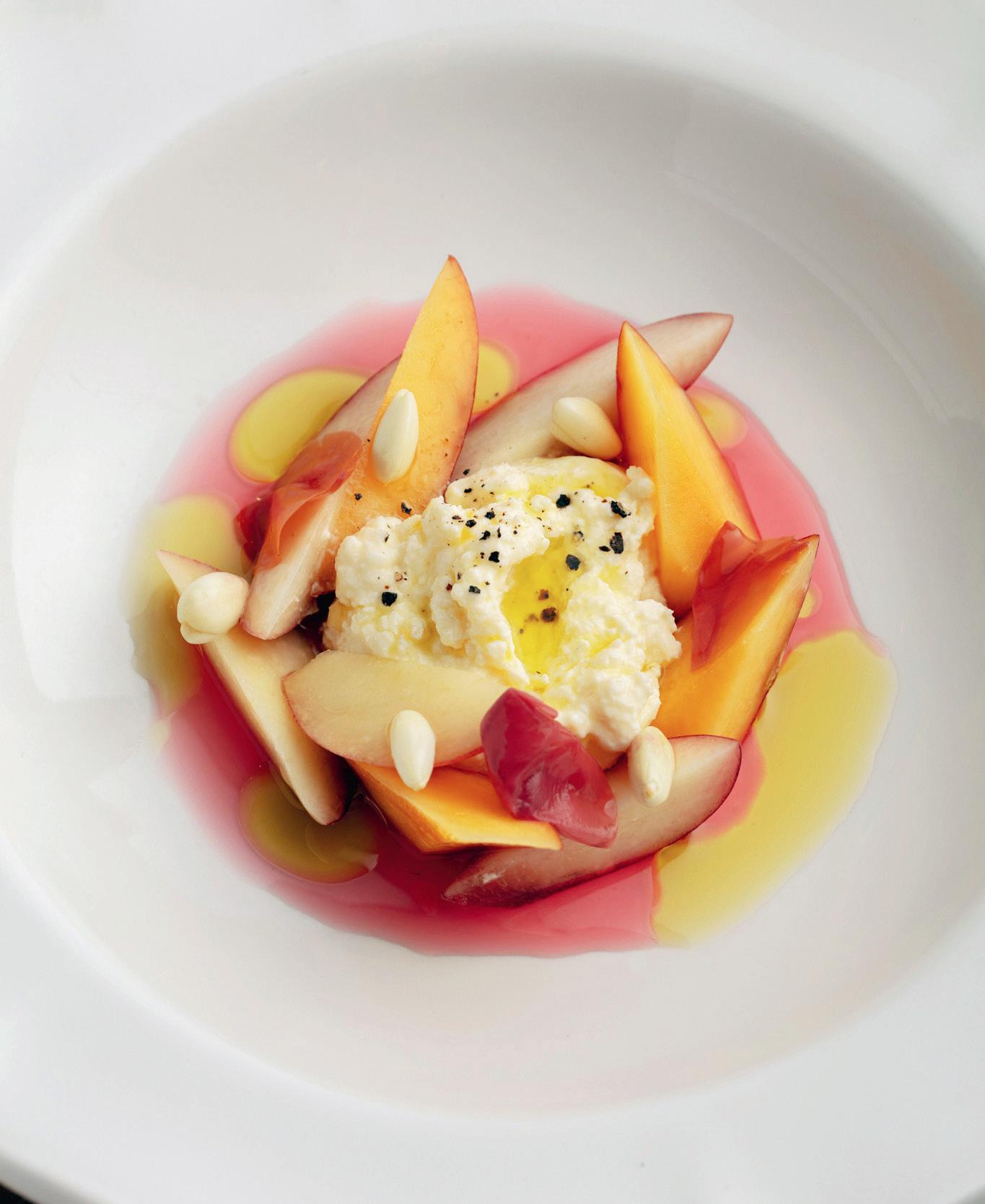
Much of the produce at Alanna Sapwell-Stone’s serene new restaurant in the northern Adelaide suburb of Hackney is found locally, including the soft-pink rose petal vinegar used in an entree of fresh curd, peach and young almonds (esmay.com.au). The rose lends a gentle sense of florality edged with sharpness that never tips into pot pourri.
Everything’s bright at this retro-cool pink and yellow pan-Asian restaurant that sits footsteps from Perth’s Cottesloe Beach (tigerfish. com.au). A splash of black vinegar – which gets a distinct floral note from the addition of foraged Geraldton wax – brings its own kind of brightness to a pork potsticker dumpling.
Hearthe cafe and bakery (hearthe.com.au) in Stanmore in Sydney’s Inner West is the latest project from Christopher Thé, the man behind the famous strawberry watermelon cake pioneered at his former bakery, Black Star Pastry. The original contained rosewater as a tribute to Thé’s love of Persian flavours but he recently evolved the recipe to include Australian native florals, such as rose myrtle and wattleseed, giving the cake a nutty, coffee-like aroma.
(riverlandwinecentre.com.au). We wanted to help visitors look past the old reputation for bulk production and see the advantages of our Mediterranean-style climate.
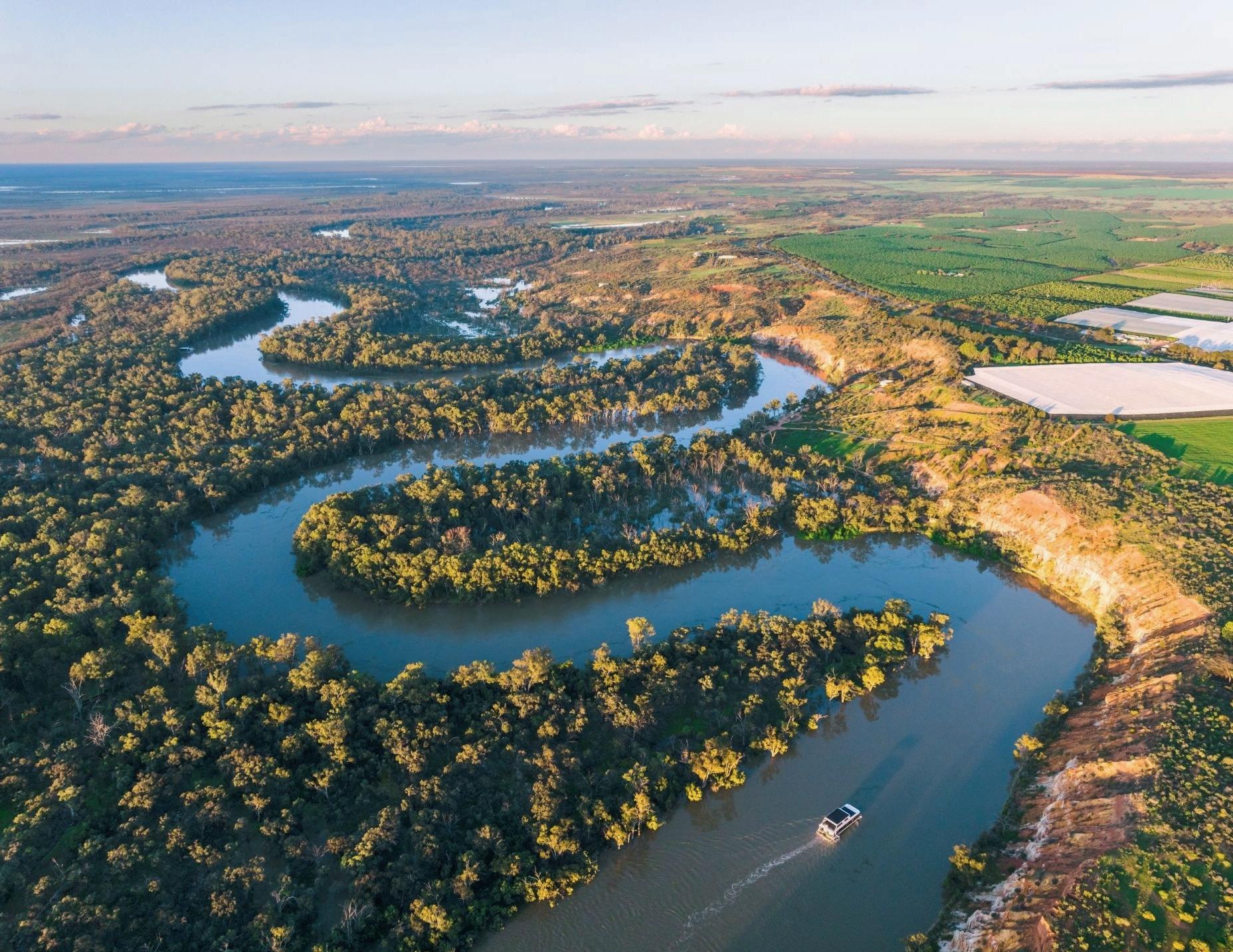
Beyond the vines Hugging the curving leviathan of the Murray, South Australia’s Riverland region – about three hours’ drive north of Adelaide and 90 minutes west of Mildura – is impossible to forget. For Riverland Wine Centre co-founder Andrew Caire, it’s the place he calls home and one that’s full of discovery.
“The minute you crest the clifftop or drive onto the ferry and see that river drifting by, a sense of peace just settles over you. My wife, Bronny, and I were teachers when we found an old, rough shearing shed at Pike River and converted it into a B&B 20 years ago. Later, we bought the property next door, built high-end clifftop villas and launched the Riverland Wine Centre
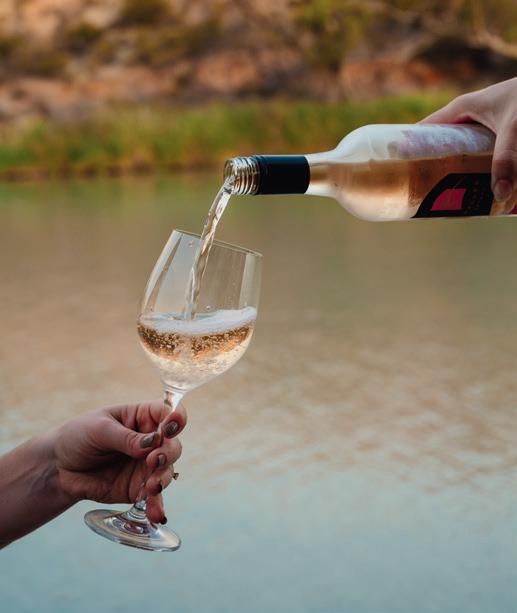
Because we get such consistent heat, Riverland grapes are incredibly fruitful. Unlike the big, high-tannin bodies you might find elsewhere, our wines offer an easy, silky drinking style that makes them ideal for the table. We’ve become a global leader in climate-resilient, alternative varieties, such as luscious montepulciano, fiano and nero d’avola. We even showcase a Georgian variety, saperavi, which has won global first place for the best of its kind.
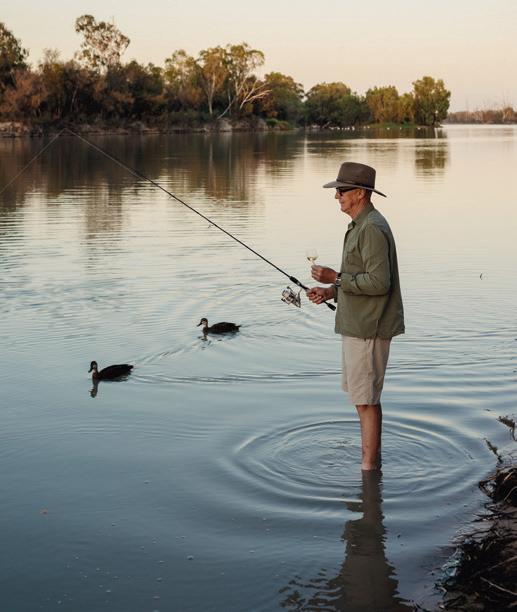
Sitting on the clifftop deck at Riverland Wine Centre, looking out across the savannah-like view, tasting a dozen wines over a few hours in the most stunning setting … to me, that’s what it’s all about.”
See the spectacular Bookpurnong Cliffs at sunrise from your dawn kayak tour with Canoe Adventures. (canoeadventure.com.au)
Snack on oxtail marmalade with roasted bone marrow and salsa verde or Murray cod with wasabi leaf at Berri’s Earth Restaurant. (earthrestaurant.com.au)
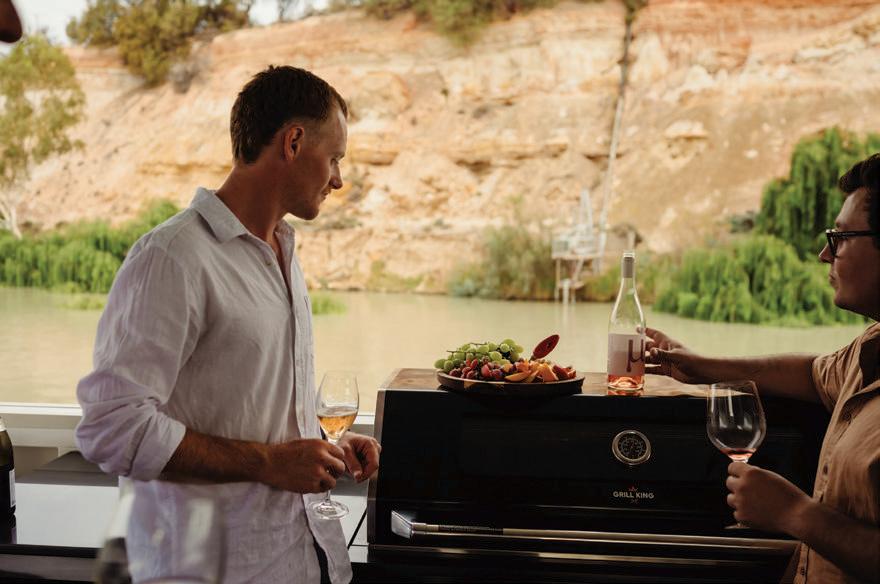
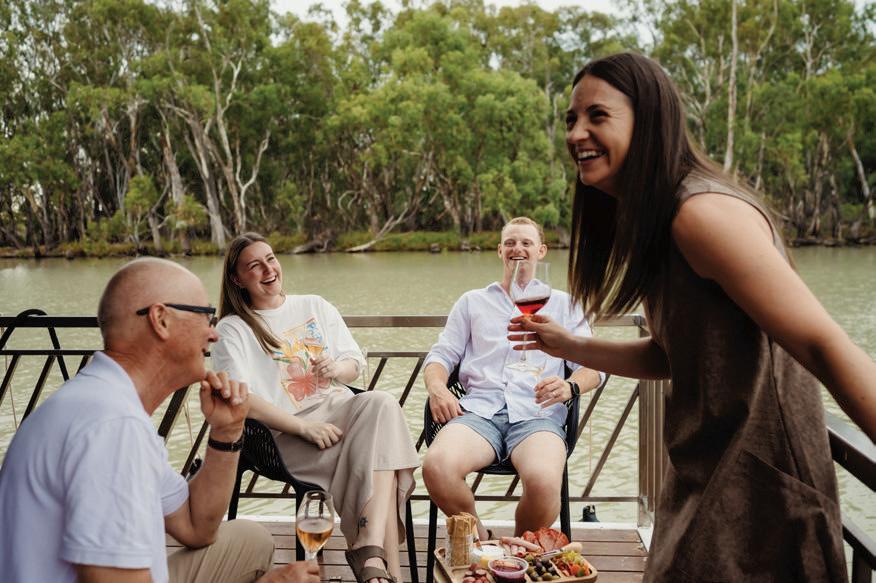
Sleep aboard The Odyssey, a luxury houseboat in Renmark that allows you to skip the ordinary and wake up to the ebb of the water beneath you. (odysseyhouseboat.com.au) For more information, go to visitriverland.com.au



Story by Alexandra Carlton | Photography by Leilani Bale
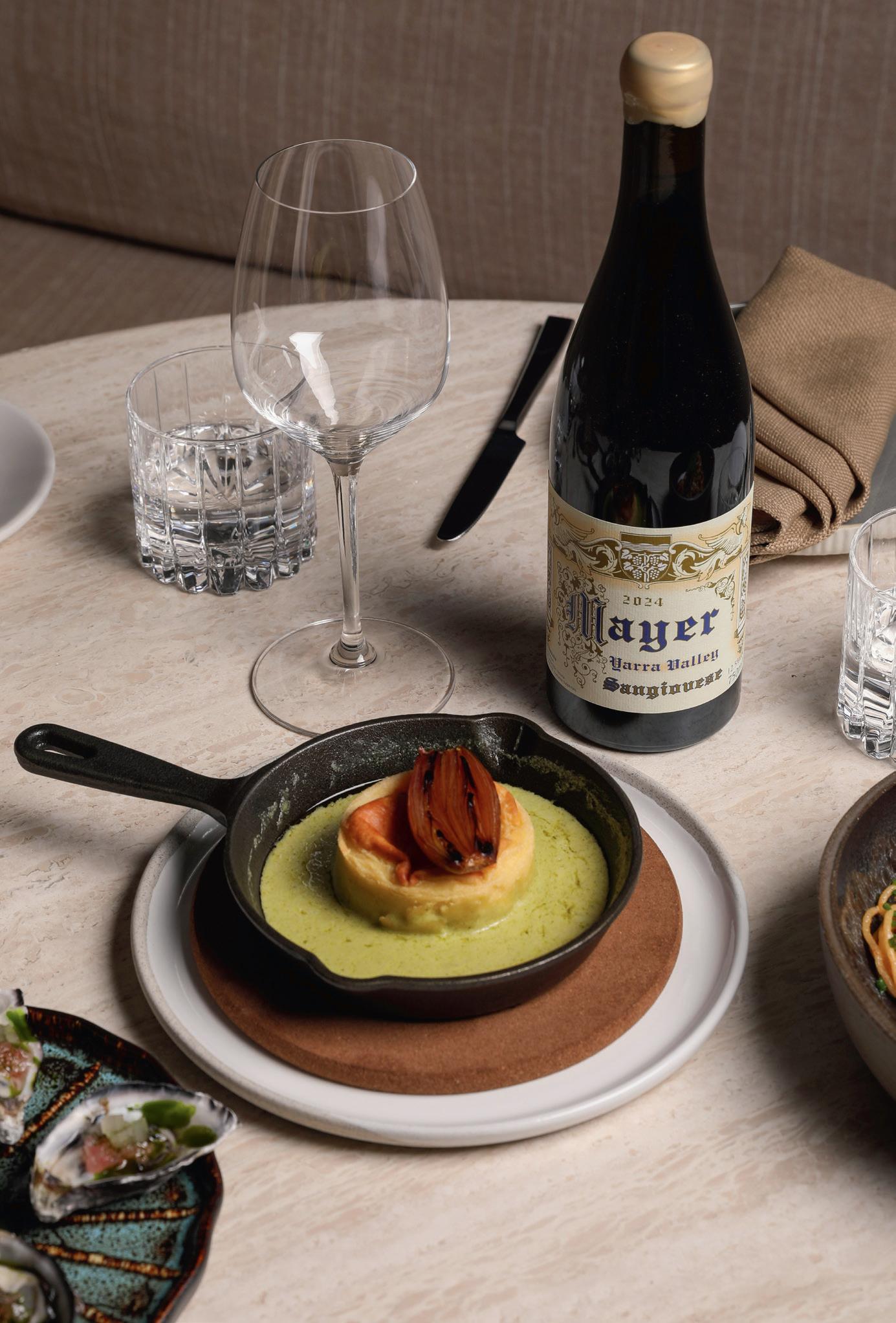
At first glance, it might look like a regular cheese souffle. But in fact, this warm, golden, fragrant entrée has some serious culinary lineage. “It traces back to Melbourne icon Stephanie Alexander,” says executive chef Mike McEnearney, who serves the dish at his namesake restaurant, From Here by Mike, on the ground floor of 1 Hotel (1hotels.com) in Melbourne’s Docklands. McEnearney first encountered the famous Australian chef’s version – made with Meredith Dairy goat’s cheese – when he spent time training in Alexander’s celebrated restaurant Stephanie’s in the early 1990s. “I just remember loving that flavour of the cheese,” he recalls.
His own take on the dish – which includes a sweet onion or shallot glaze and rosemary cream – has been on the menu in all the Sydney restaurants he’s helmed, from Rockpool in the mid-2000s to Kitchen by Mike in 2012. “We’ve made some tweaks over the years and today we use different onions or shallots depending on what’s available but it generally stays the same.”
One non-negotiable: it must be served with bread to mop up the sauce (here, it’s sourdough from Collingwood’s To be Frank bakery).
The souffle is now such a signature Mike McEnearney dish that it has its own fan club, including one member who’s willing to cross state lines to sample it. “There’s this beautiful man, the artist Scott Wright, who’s followed me since my Rockpool days. He loves the souffle and he notices every change.”
McEnearney thinks the souffle’s new home represents a full-circle moment. “It’s a real Melbourne dish and whenever I eat it, it feels like it’s in the right place at the right time. It has this beautiful Victorian cheese, the local rosemary and, of course, it’s my tip of the hat to Stephanie.”


















Story by Alexandra Carlton
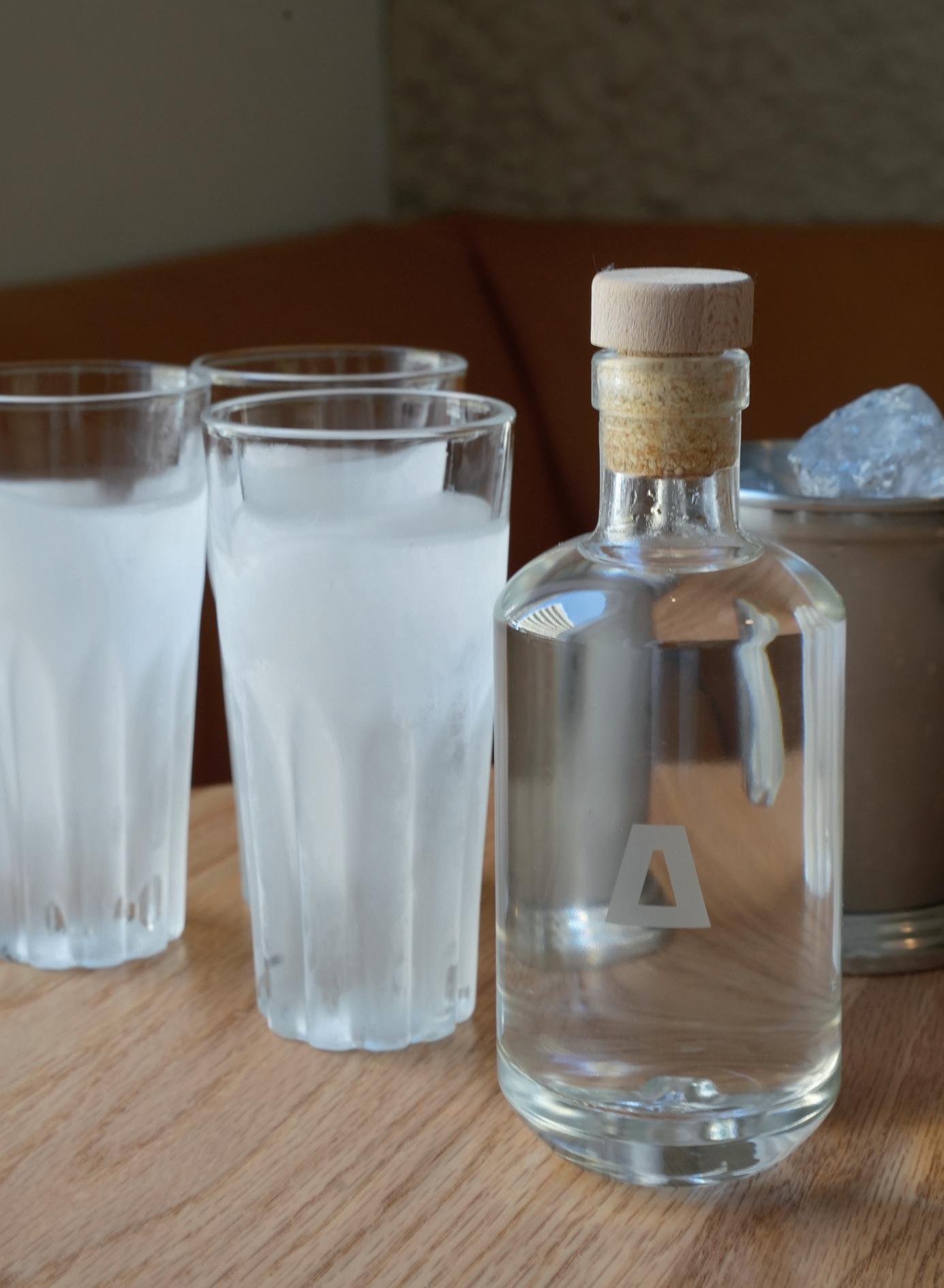
Ouzo is a “pillar of Greek life”, begins the blurb on the drinks menu at newly opened taverna Omada (omadabargrill. com.au). “Here in Adelaide we tend to throw ouzo back like a dare but ouzo deserves respect, filotimo even.” It’s an inviting challenge and one that tempts diners to order the restaurant’s housemade aniseed spirit (right), even if it’s not technically an ouzo since it isn’t made in Greece. Beverage manager Tom Hoff suggests pouring it over crushed ice and topping it with a splash of water so it turns cloudy. Then sipping it with all the filotimo – that’s honour and dignity – you can muster.
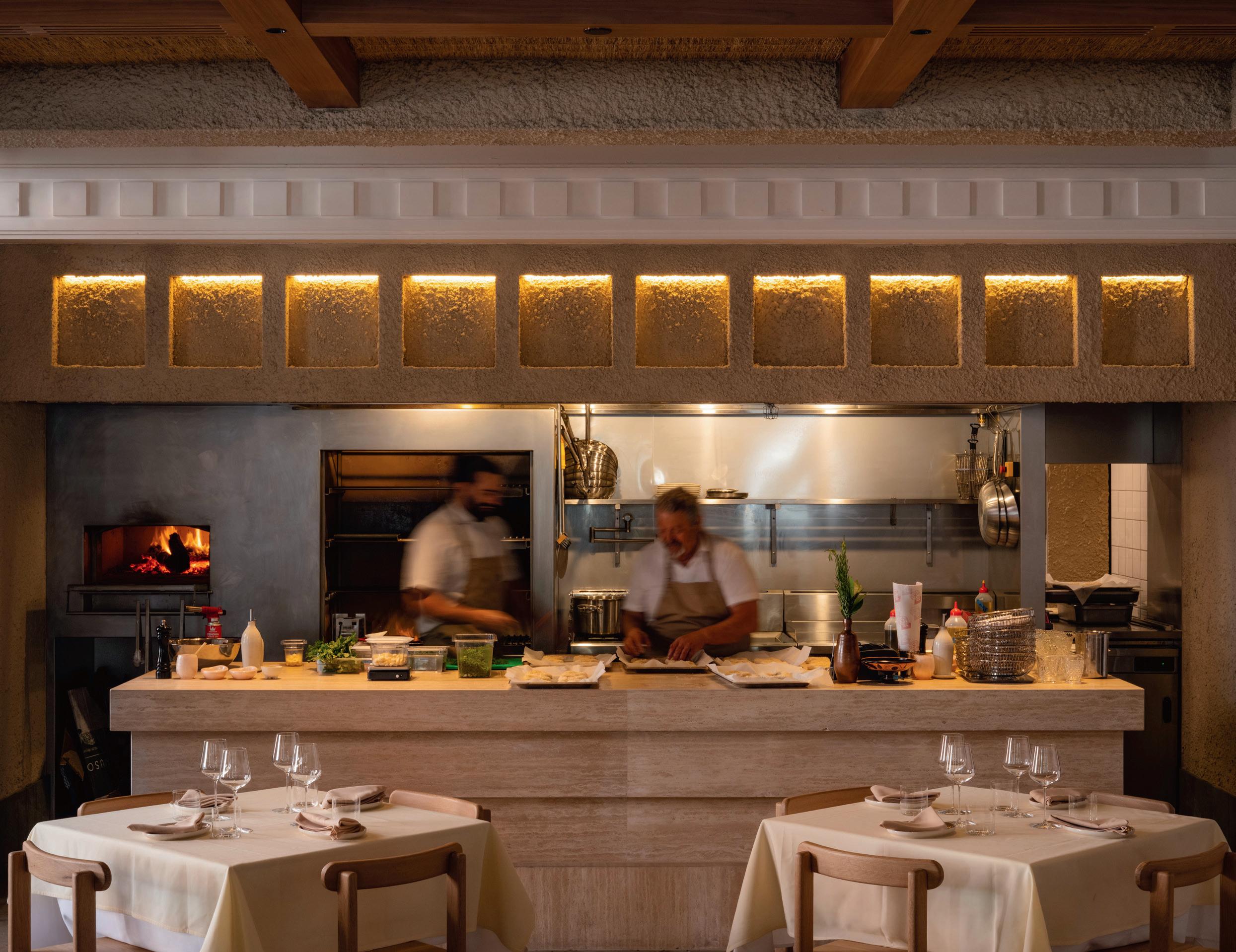
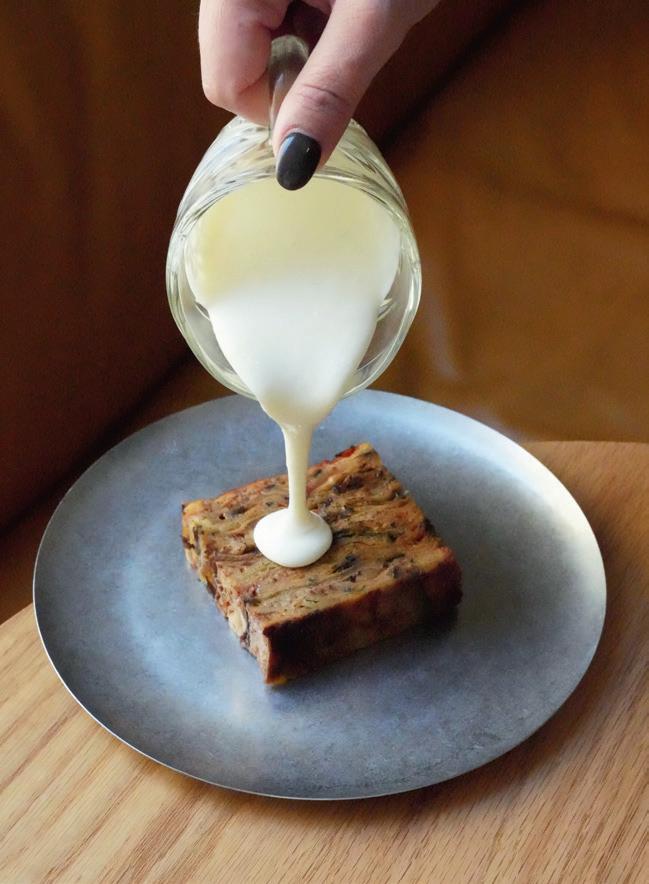
The ouzo ritual is just one reason this lively Greek-style eatery, set inside a dining room the colour of a Mykonos sunset, is livening up Adelaide’s dynamic Greek dining scene. Another party-starter is the tableside moussaka terrine (below right). The meat layer in head chef Andrew Ferrara’s version is almost Italian in character but with Greek flavours, while the vegetables are cooked slowly to draw out their natural sweetness. It’s finished with a warm drizzle of bechamel poured from a crystal jug in front of diners.
Then there’s the freshly made pita bread – rich with butter, olive oil and milk – which took Ferrara months to perfect. Topped with salt and handfuls of oregano, it has become an instant customer hit. “We sell close to 1000 portions of pita each week and the team won’t send one out unless it hits the perfect balance of crisp, fluffy and well-seasoned,” says Ferrara.
The menu is packed with plenty of other classic Greek hits: a generous dolmade stuffed with beef and doused in avgolemono, huge plates of lamb, chicken and a whole stuffed fish. And an approachable wine list – from Greece and beyond – helps dinner turn into a truly filotimos feast.
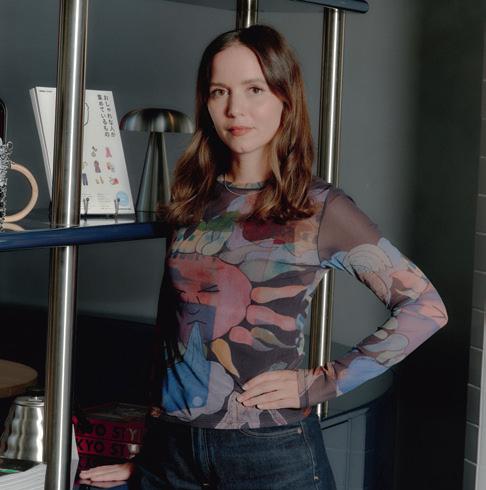
As told to Pat Nourse
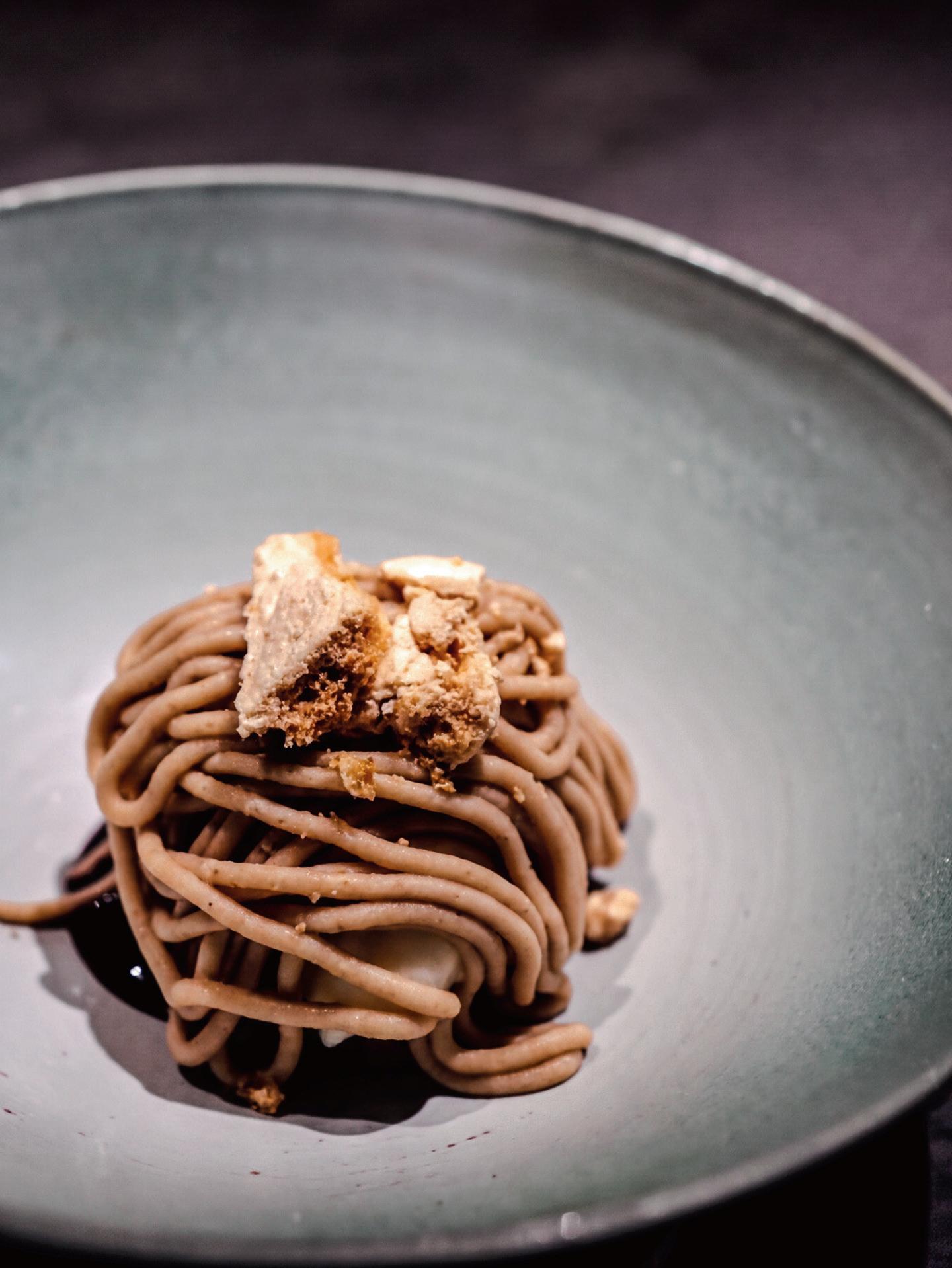
“The thing that struck me about Kermis was its intimacy. I visit Japan regularly for work – it’s a touchstone for how I think about restraint, clarity and hospitality – and I’m no stranger to restaurants with just 10 (or even fewer) seats but even in this context, a meal at Kermis is an unusually personal experience. Yuko and Yasunobu (Nobu) Namiki do everything themselves and their focus gives the experience an intensity that feels singular and very thoughtful.
I can so readily recall Nobu’s calm, economical movements; the soft crackle of charcoal; the scents of toasted nori and grilled pork; the twang of Yuko’s New York-accented English and the ceramics they’ve obsessively collected from small studios around Japan, all shining under the dim, industrial-style lights.
And the food. Nobu’s signature is an unagi spring roll, the freshwater eel wrapped in an exceptionally fine sheet of winter nori that is crisp, aromatic and barely sweet, the nori underlining the smoke and salt of the eel rather than competing with it. On our last visit, Nobu served Japanese parrot fish, popular for its shellfish-like taste. He’d grilled it over charcoal and garnished it with green beans, carrot purée, wasabi and dill then changed things up with whitebait and green pepper folded through handmade tagliolini, served cold in an unexpected but welcome twist. His Mont Blanc dessert (left) was another highlight, the chestnut both earthy and elegant.
When I look back now to dining here, I think of how grounded and present it made me feel. And it was a reminder, too, that the most powerful hospitality often comes from doing fewer things with greater clarity, all the more generous for its restraint.”
Kermistokyo
108-0072 Tokyo, Minato City, Shirokane, 6 Chome-2-4 Nazare Heights 101; +81 80 9067 9887; @kermistokyo
Suupaa
Shop 1, 65 Dover Street, Cremorne, Victoria; suupaa.au









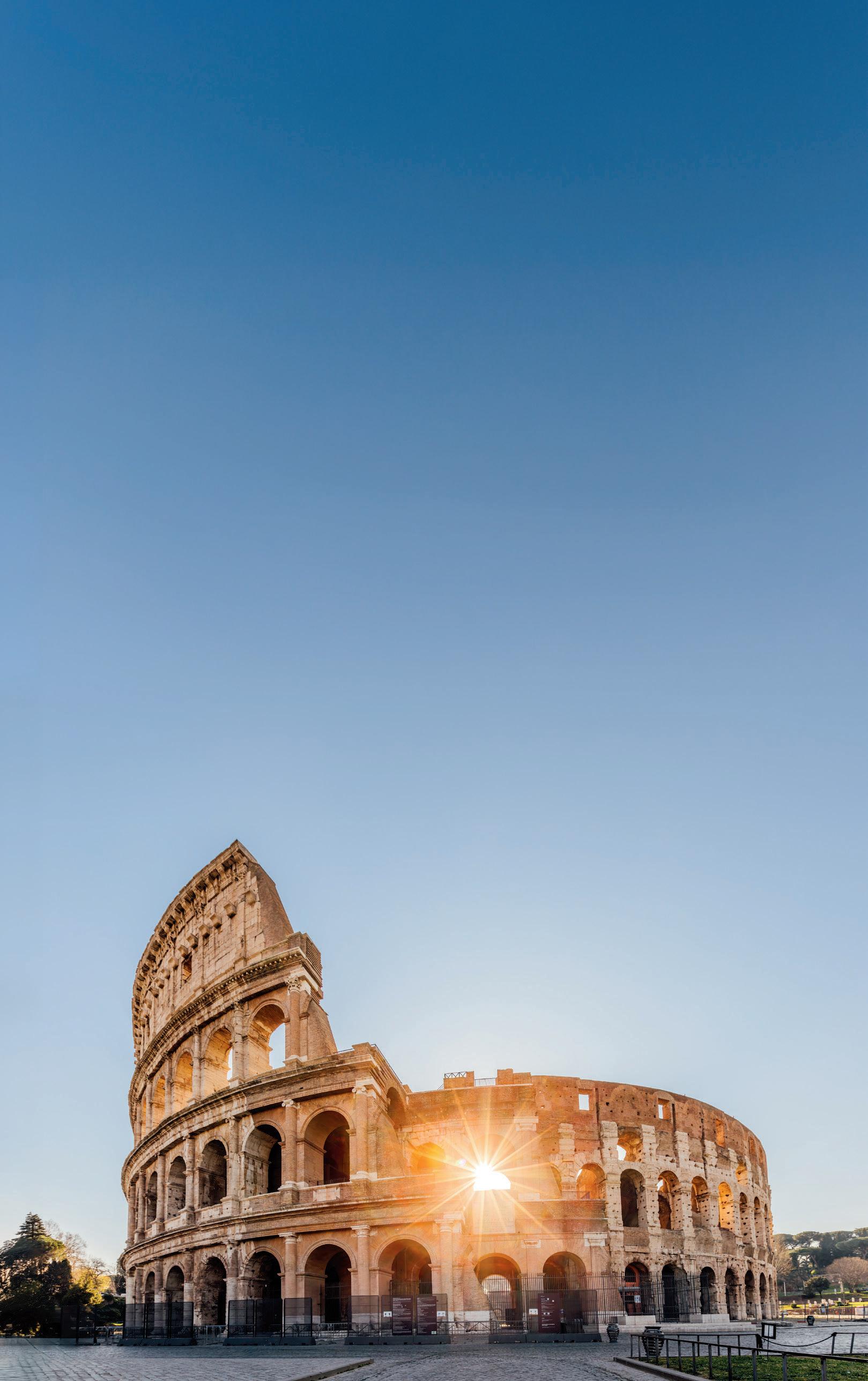












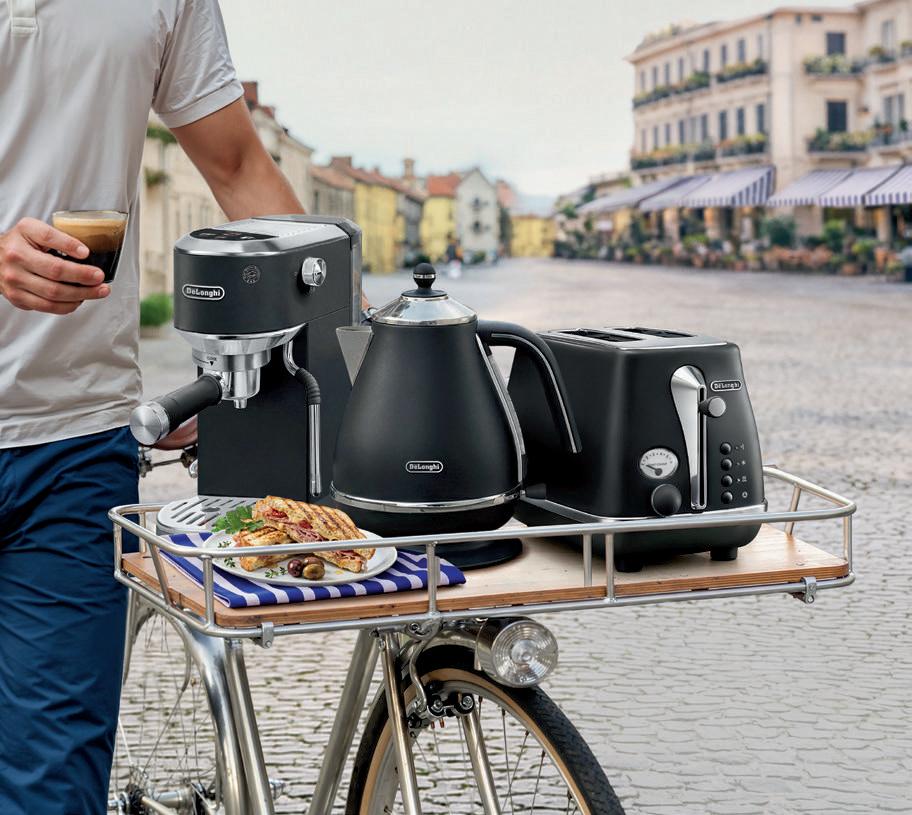
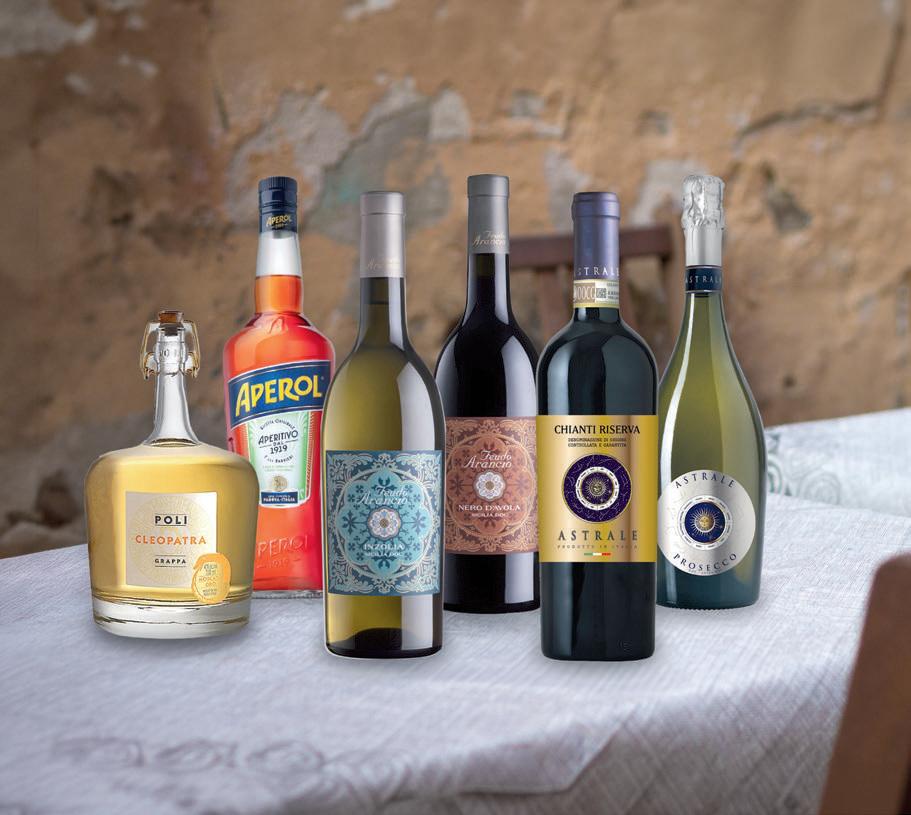
As told to Stephanie Wood
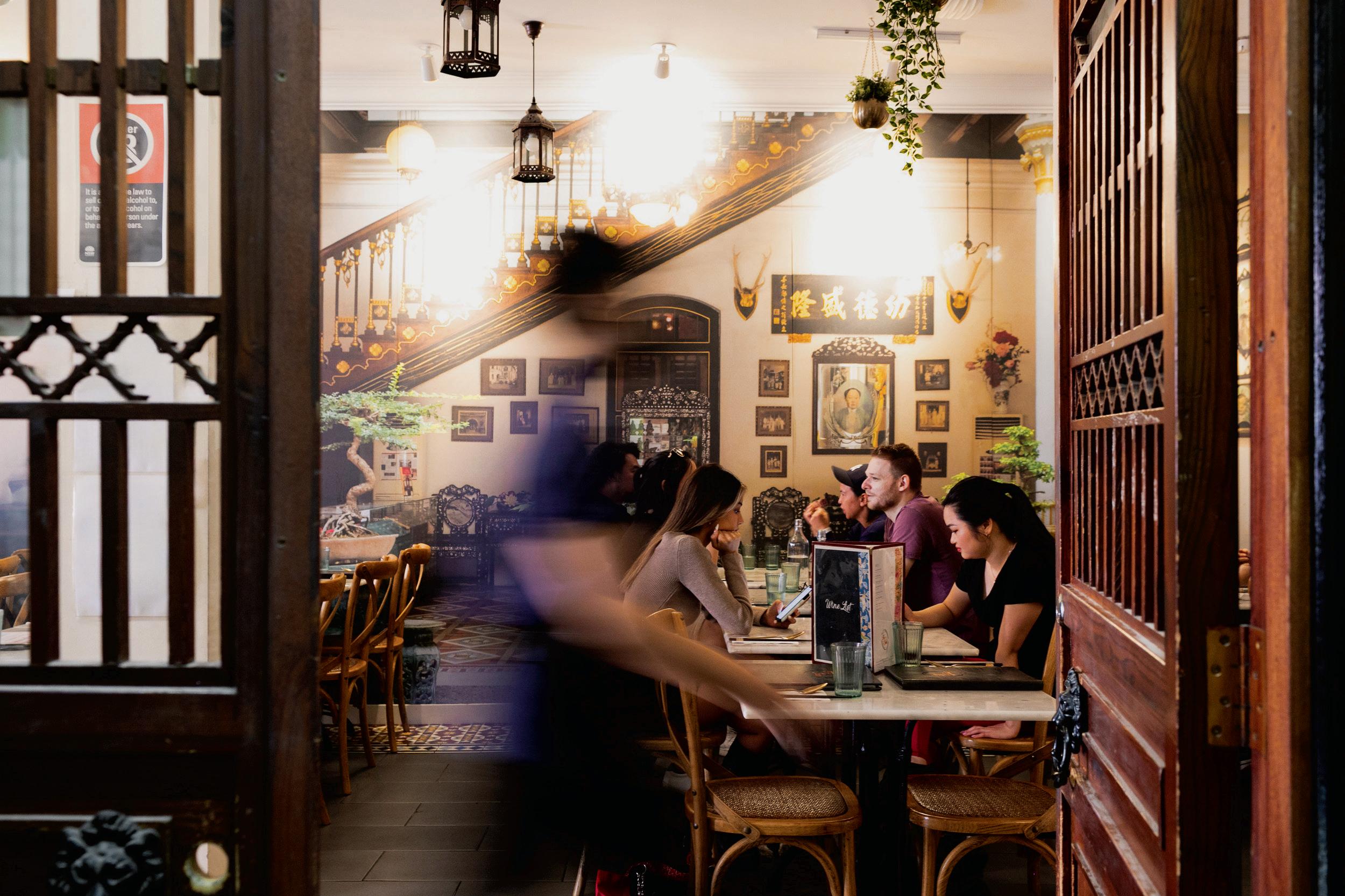
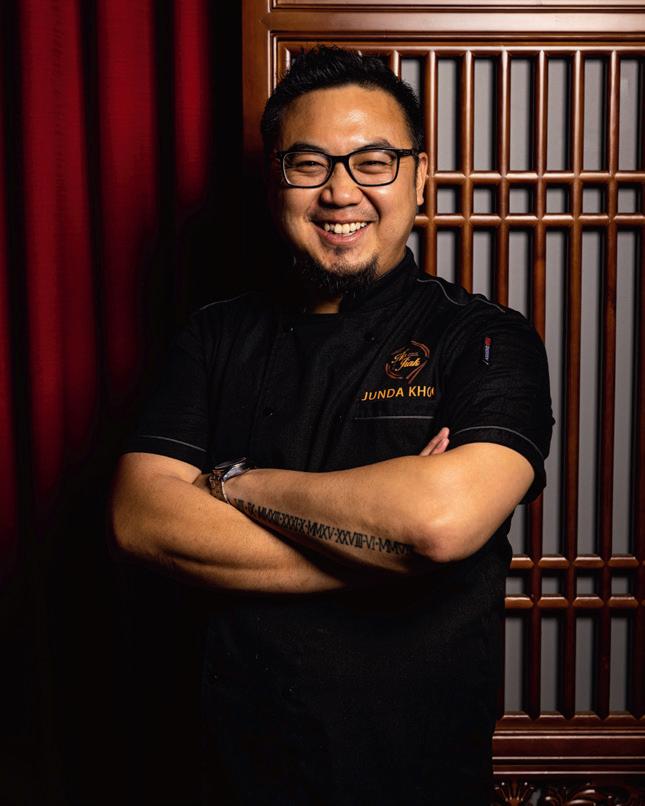
It was the roaring popularity of their char koay teow that helped propel Penang-born chef Junda Khoo and his business partner, William Xie, from their first Ho Jiak restaurant in a Strathfield food court to a dining empire. In the past year, they’ve added a three-storey Melbourne operation and a Sydney Fish Market outlet, where Khoo serves a “surf-and-turf”
menu. “We’re constantly evolving and each restaurant reflects that,” he says. But it’s the Haymarket Malaysian eatery (above; hojiak.com.au) that shows where the chef has come from. Paying tribute to his grandmother, the menu includes indomie goreng, laksa and, of course, that famous char koay teow. These are some of Khoo’s favourite local spots.
1. HAPPY CHEF FOR NOODLE SOUP WITH PIG’S BLOOD
“A Sussex Centre food court institution, this place (@happy_chef_sussex) serves pure comfort food that reminds me of home. Other chefs go there for the laksa or dried egg noodles but for me it’s all about the clear soups. The combination noodle soup with extra pig’s blood jelly is my ultimate pick-me-up.”
2. SPICE WORLD FOR CHICKEN AND FISH MAW BROTH
“This hotpot place (@spice worldaustraliaofficial) is part of a massive Sichuan chain and a great place to share a meal with my team. It’s a bit crazy – they do Wagyu draped like a dress around toy dolls and have a hotpot in which a stock block shaped like a Labubu figure dissolves into the broth – but they use quality ingredients and it feels like a feast. What I really go for is the chicken and fish maw [swim bladder] broth for the textural quality of the fish maw.”
3. BANCHŌ BAR FOR A JAPANESE WHISKY
“It’s always a good time at this whisky specialist (banchobar.com.au) and it’s walking distance from our Town Hall and Haymarket restaurants for after-service drinks. I usually get a Nikka whisky but many of the cocktails use Asian spirits so it’s like a celebration of this part of Sydney.”
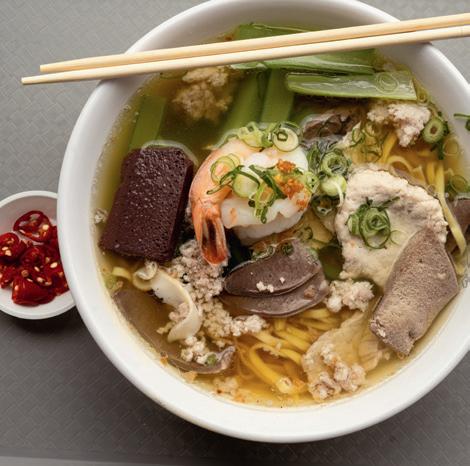
4. TAN VIET NOODLE HOUSE FOR CRISP CHICKEN WITH EGG NOODLES
“Before Tan Viet Noodle House (tanviet.com.au) opened in Haymarket, I used to drive an hour to their Cabramatta branch just for this dish: chicken roasted and deep-fried, served with noodles and broth on the side. It’s what I ate through my 20s and now it’s a two-minute walk from work – life-changing!”
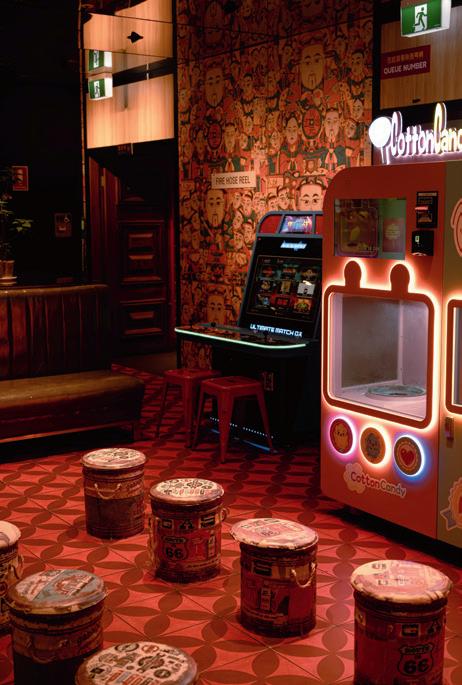
“Meng Fei, or Grandpa Meng, is the host of a hit Chinese dating show and this restaurant is named for him (Market City, Level 3, 9-13 Hay Street, 02 9211 6045). I love the spicy noodle variations, which are packed with flavour and have a range of toppings from pork mince to stewed beef. Quick, easy and perfect for a bite between services.”
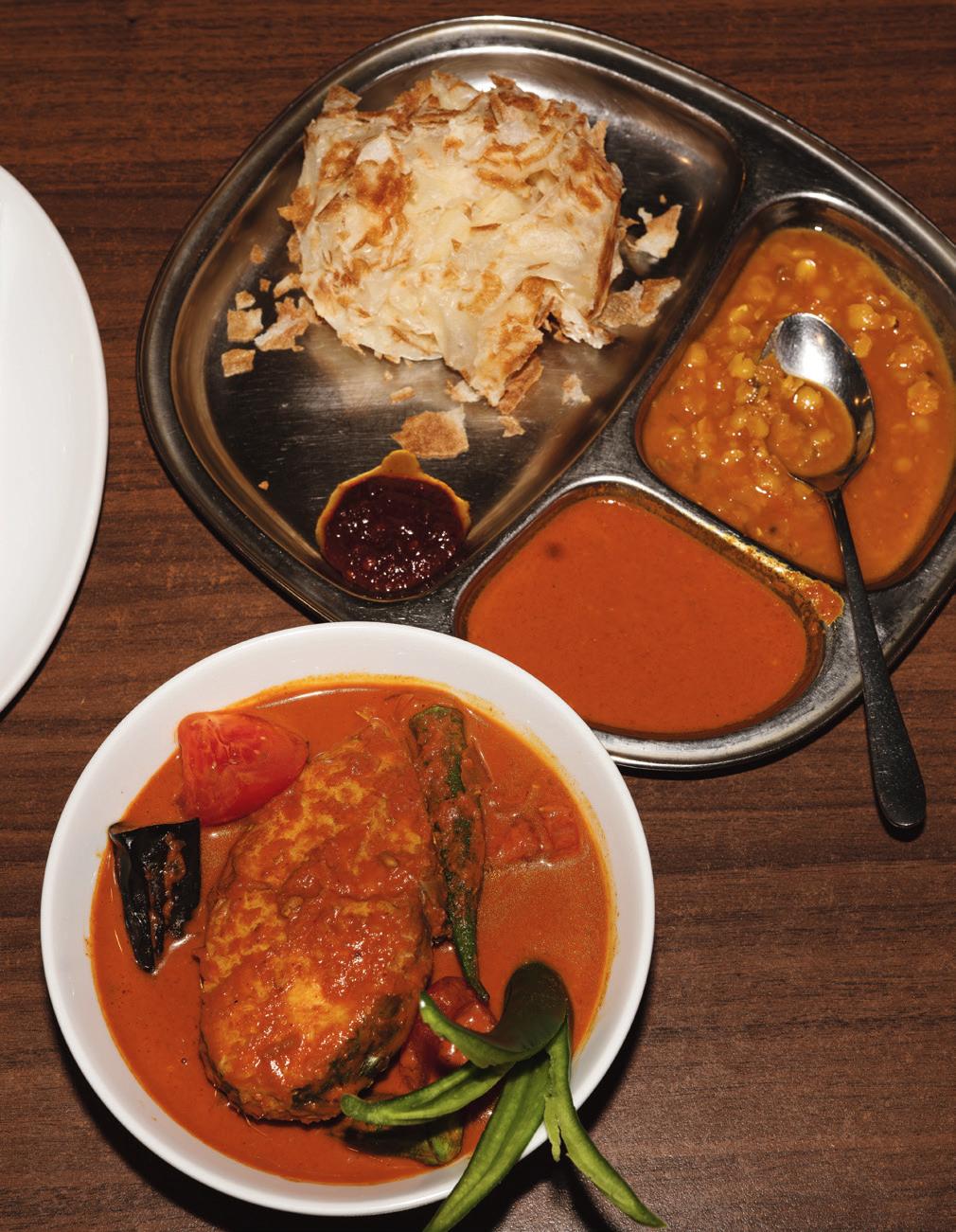
“I’ve been eating here (mamak.com.au) since my uni days and no-one else does roti like they do – people queue up for it. I always order the roti planta, which uses a special Malaysian margarine and is served with two curry dips and a sambal sauce. I like to add the kari ikan – fish curry with tomato, okra and eggplant.”
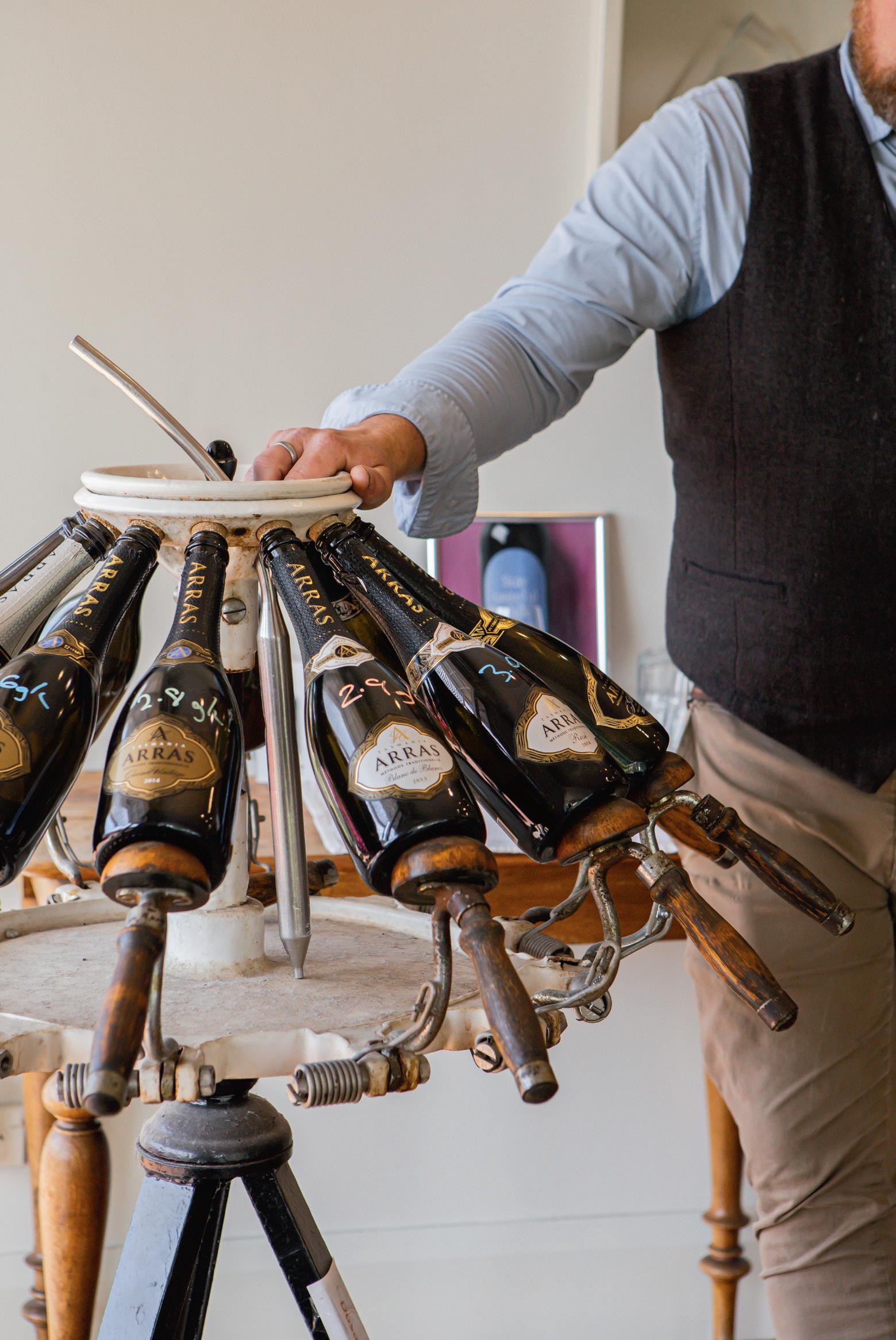
The cool-climate Tamar Valley region is revered for producing the closest thing to champagne outside of Champagne and, judging by the trophies groaning on vignerons’ mantelpieces, it’s snapping at the heels of the Old World. Beyond its standout sparkling you’ll find other award-winning varieties – pinot noir, chardonnay and riesling, for starters.
Base yourself in Launceston at the valley’s southern end, where an exciting dining scene has been awarded UNESCO City of Gastronomy status, and head out to explore the region’s 30-plus cellar doors with the experts at Tamar Valley Wine Tours (tamarvalleywinetours.com.au).
Story by Larissa Dubecki
Ed Carr has been putting a Tassie spin on méthode traditionnelle at his Pipers River winery since 1995 (left; houseofarras.com.au).
Australia’s most decorated sparkling winemaker meticulously sources fruit from seven pristine Tasmanian sub-regions chosen for their varying terroir. “Within the vineyard, each block is managed to create a specific style,” says cellar door manager William Doggett. Join him – and friendly winery pup Flinders – for a masterclass exploring the nuances of the award-winning wines or take a guided tour of the estate followed by a wildlife-spotting ramble along the riverbank, glass of sparkling in hand.
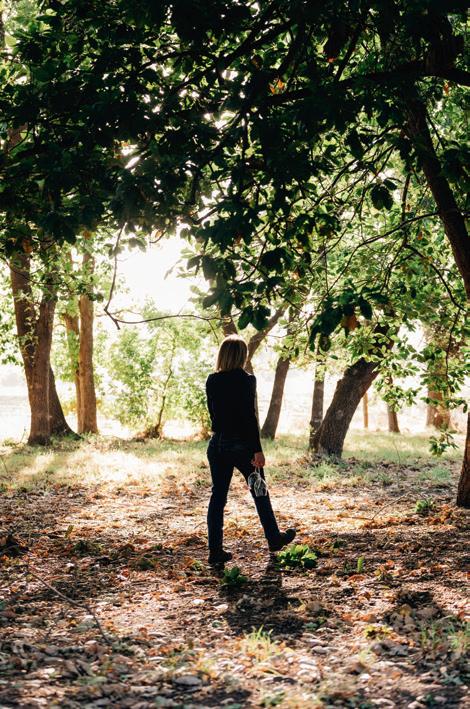
Dig deep into the complexities of cool-climate pinot noir at this bucolic estate outside the town of Rowella, where about 50 per cent of the vineyard is planted with the notoriously delicate yet plush red grape. Named after its century-old oak tree grove, it’s run by winemaker Rebecca Duffy and her viticulturalist husband, Tim (holmoak vineyards.com.au). Take a seat by the cellar door’s crackling fire or on the terrace for a tasting flight of five estate pinots, including the beautifully complex 2021 Hot Shot. Still pining for sparkling? The brand’s party-ready moscato is just the ticket.
A 175-year-old riverside mill turned into a leading Launceston restaurant, Stillwater (stillwater.com.au) has an impressive Tassiehearted wine list and a contemporary-minded menu bedded in the state’s bounty. Executive chef Craig Will barbecues wallaby with a gochujang glaze, marries charry Stanley octopus with udon noodles in lemon dashi and brown butter, and dishes up a comforting lamb rump with lemon confit potato. Seven suites upstairs continue the expression of Tasmanian pride via their artisan-made furniture, artworks and selection of wine, spirits and beer.
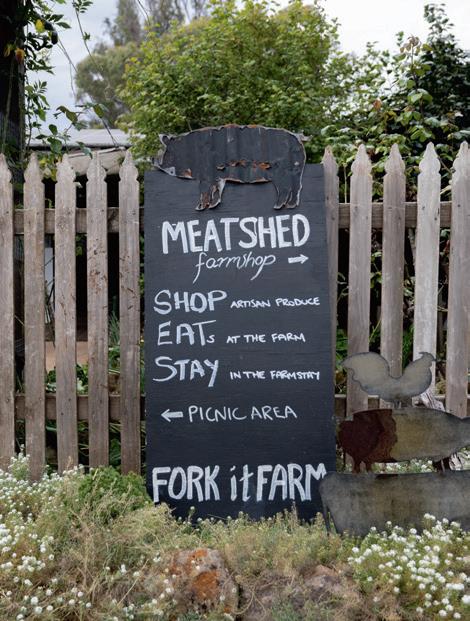
Take a seat at Fork It Farm’s (forkitfarm.com.au) rustic al fresco tables for lush prosciutto, crunchy pig-skin crackle and gently smoked tongue with housemade cucumber pickles. In the green hills outside Lebrina, ethically raised heritage Berkshire porkers are turned onsite into all-natural smallgoods that are sought after by Tasmania’s top chefs. Sip locally made heritage cider with your snout-to-tail feast and swing by the shop to take home bacon for breakfast in the morning.
Start the day with a flaky croissant or oozing kimchi toastie at this trio of artisan bakeries (breadandbutter tasmania.com.au) in the heart of Launceston, where
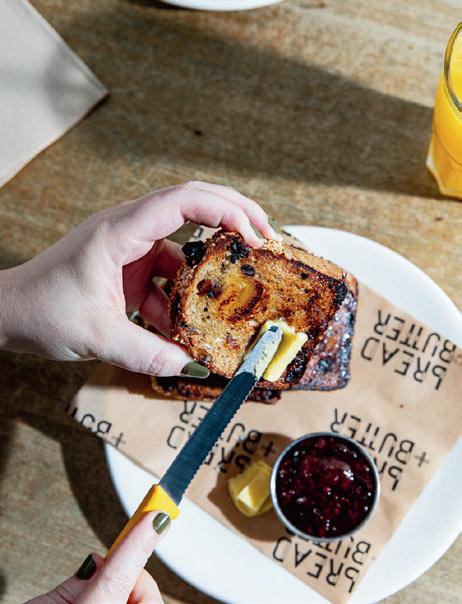
the counter displays offer an overwhelming choice of baked goods. Whether you opt for a cardamom pretzel, brioche cinnamon scroll or morning bun, it’ll go perfectly with coffee from Sydney’s Single O.
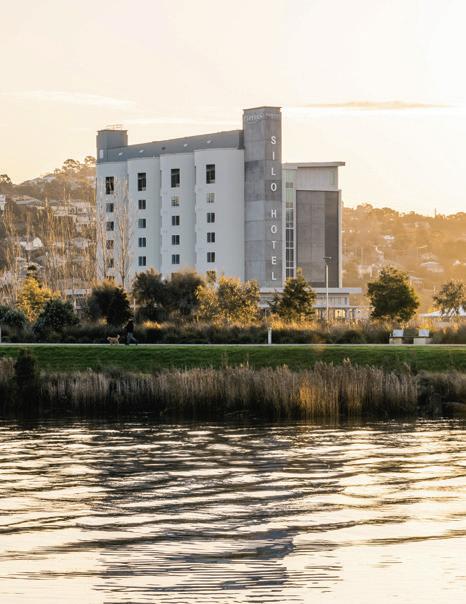
A clever reinvention of Launceston’s landmark grain silos has created the city’s contender for a Grand Designs-style transformation. Deftly mixing old and new, the striking 108-room hotel (qantas.com/hotels/ pepperssilo) has a heritage wing where curved walls of rugged concrete evoke the agricultural past and earthy hues reference the landscape. Sitting proudly on the Tamar River waterfront a 15-minute walk from the CBD, its in-house restaurant Grain of the Silos flies the Apple Isle flag with dishes such as a golden-crumbed abalone fritter with a dab of caper aioli and Cape Grim scotch fillet packed with local grass-fed flavour.










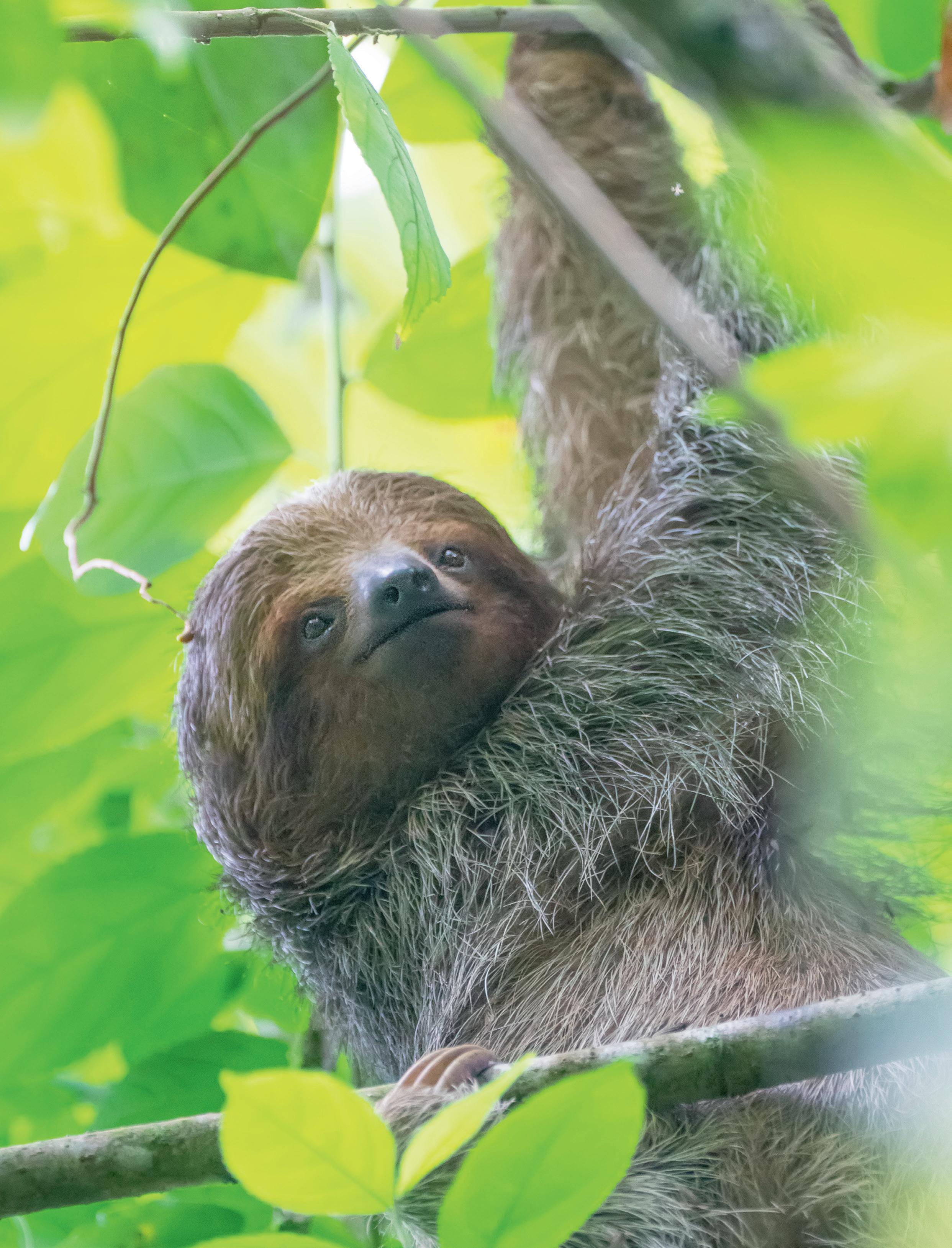
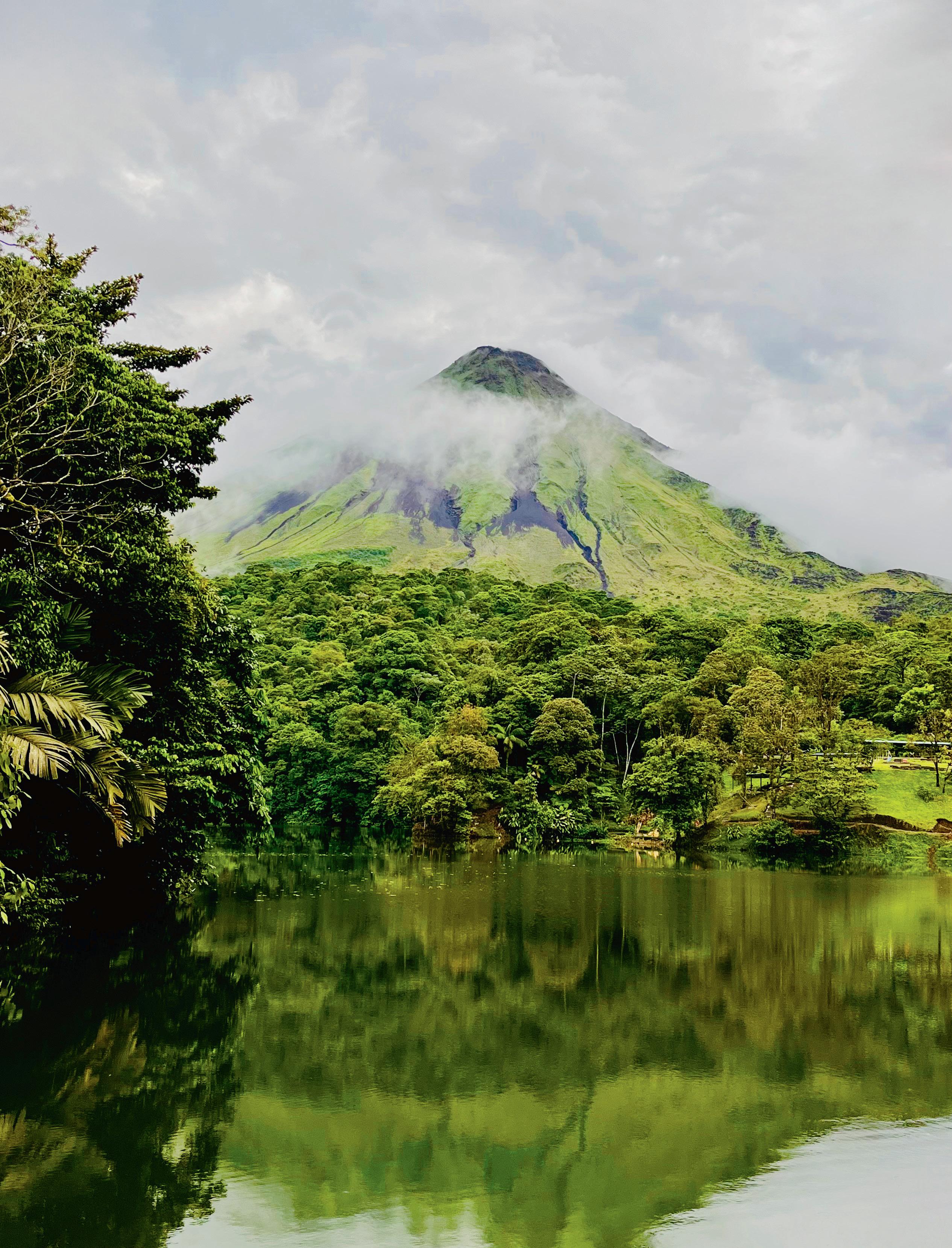
Joy is at every turn on a journey through Costa Rica, a country focused on good vibes and a flourishing future.
Story by Dilvin Yasa
II’m desperate for this moment to be filled with birdsong and poetry, something best captured by prose about the sharp metallic din of the three-wattled bellbird echoing through the forest. But the reality of seeing my first sloth is this: a tumble of leaves, the creak of a branch and the unmistakable cry of a fellow traveller: “Oh my God, he’s scratching his butt! John, look at his butt!” Binoculars, it seems, are not required. Just 90 minutes into our 12-day Costa Rica: A World of Nature tour (gocollette.com), sloth one and, within minutes, two and three move slowly into position right above our heads, their furry faces acknowledging us with dopey grins. I don’t know who
John is but I’m so thrilled to see them that I start squealing, too. There’s always a risk that the highlights come too soon on trips like this, but happily, our expedition’s itinerary, which covers five of Costa Rica’s seven provinces, reads like the script of a Hollywood action film – all volcano trekking, whitewater rafting and cloudforest ziplining. Travelling with 13 other explorers in a roomy, air-conditioned coach, our Costa Rican adventure spans the Caribbean Sea, the Pacific Ocean and the mountain ranges, tropical rainforests, dry forests, rivers and plantations sandwiched in between. At the helm? Juan Carlos Arrieta, a former biologist, now our
charismatic guide, who underpromises and overdelivers like a piano virtuoso claiming he can play a “note or two”.
As we drive past banana, coffee and cacao plantations, the 25-year tourism veteran stands at the front and rattles off facts. The Central American nation spans just over 51,000 square kilometres, yet holds six per cent of the world’s biodiversity. It’s home to 10 Holocene (active or potentially active) volcanoes – six of which are “very active” – and more than a quarter of the land is protected. “Much of the wildlife you’ll see gave up their migratory lives and stayed in Costa Rica for the weather – and the good vibes,” says Arrieta, smiling. Here, pura vida, a phrase
expressing gratitude and optimism, seems to apply as much to the wildlife as it does to the people.
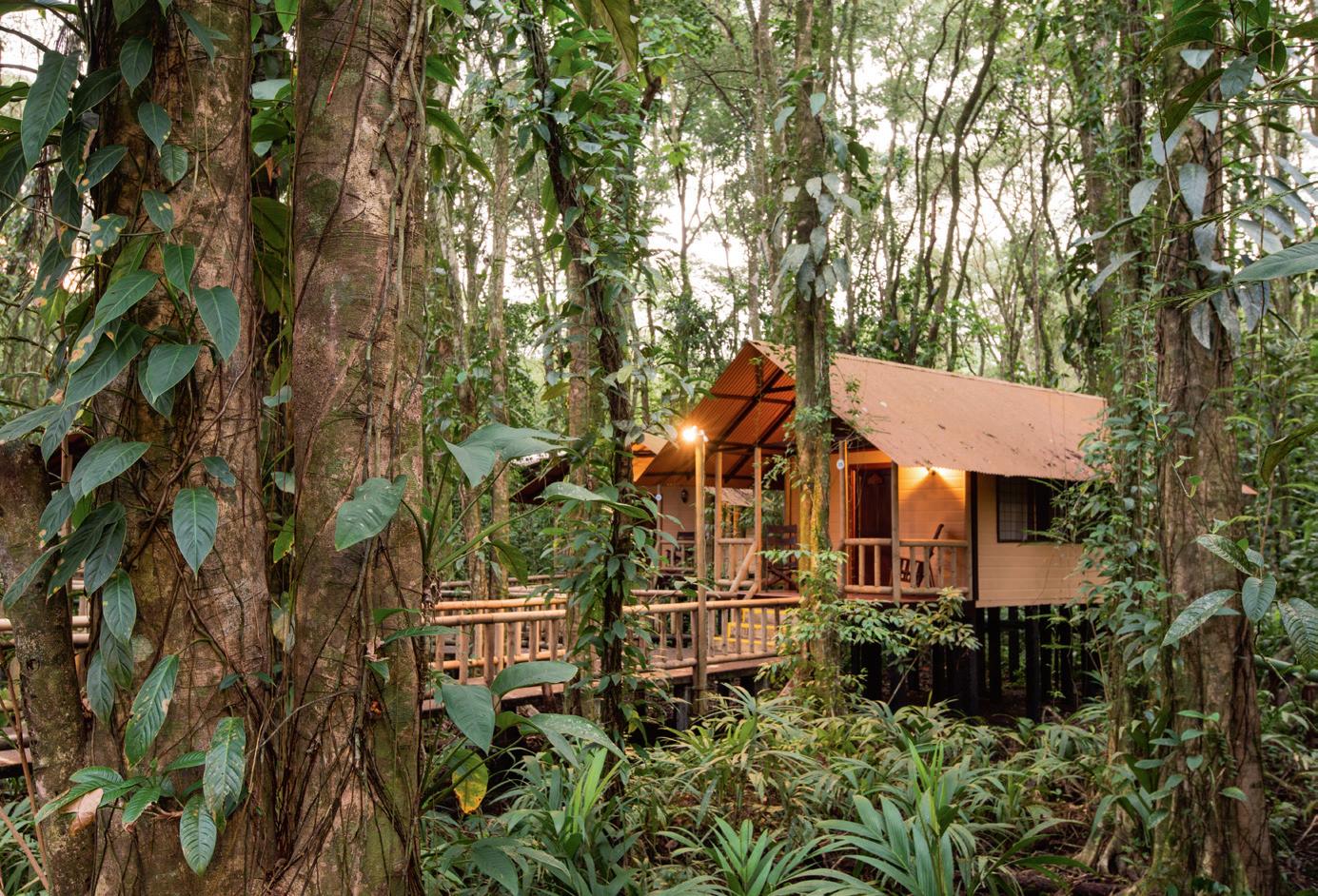
I’m exploring Costa Rica at a pivotal moment. Renowned for successfully reversing deforestation, the country is now aiming for a net zero emissions economy by 2050 and regularly ranks in the top five on the Happy Planet Index, largely due to its deep connection with nature. After driving north-east from the capital, San José, to the jungle wilderness of Tortuguero National Park, that environmental commitment becomes tangible on arrival at Evergreen Lodge, a remote property accessible only by boat or air. Out here, thick humidity curls my passport and there’s no air-
conditioning to disturb the feathered, furry and scaly locals (fans and netted windows mean breezes take the edge off the heat for visitors). Instead, howler monkeys patrol the pool area like lifeguards and white-faced capuchins take a hands-on approach to recycling by helping themselves to the contents of rubbish bins.
It’s no different at Tilajari Eco Resort, a sprawling retreat on the banks of the San Carlos River, where a portion of its organic waste is donated to local pork producers and used cooking oils are collected to make biodiesel. The impact of sustainability initiatives here has been significant, says local guide Kevin Navarro. “Once we installed solar
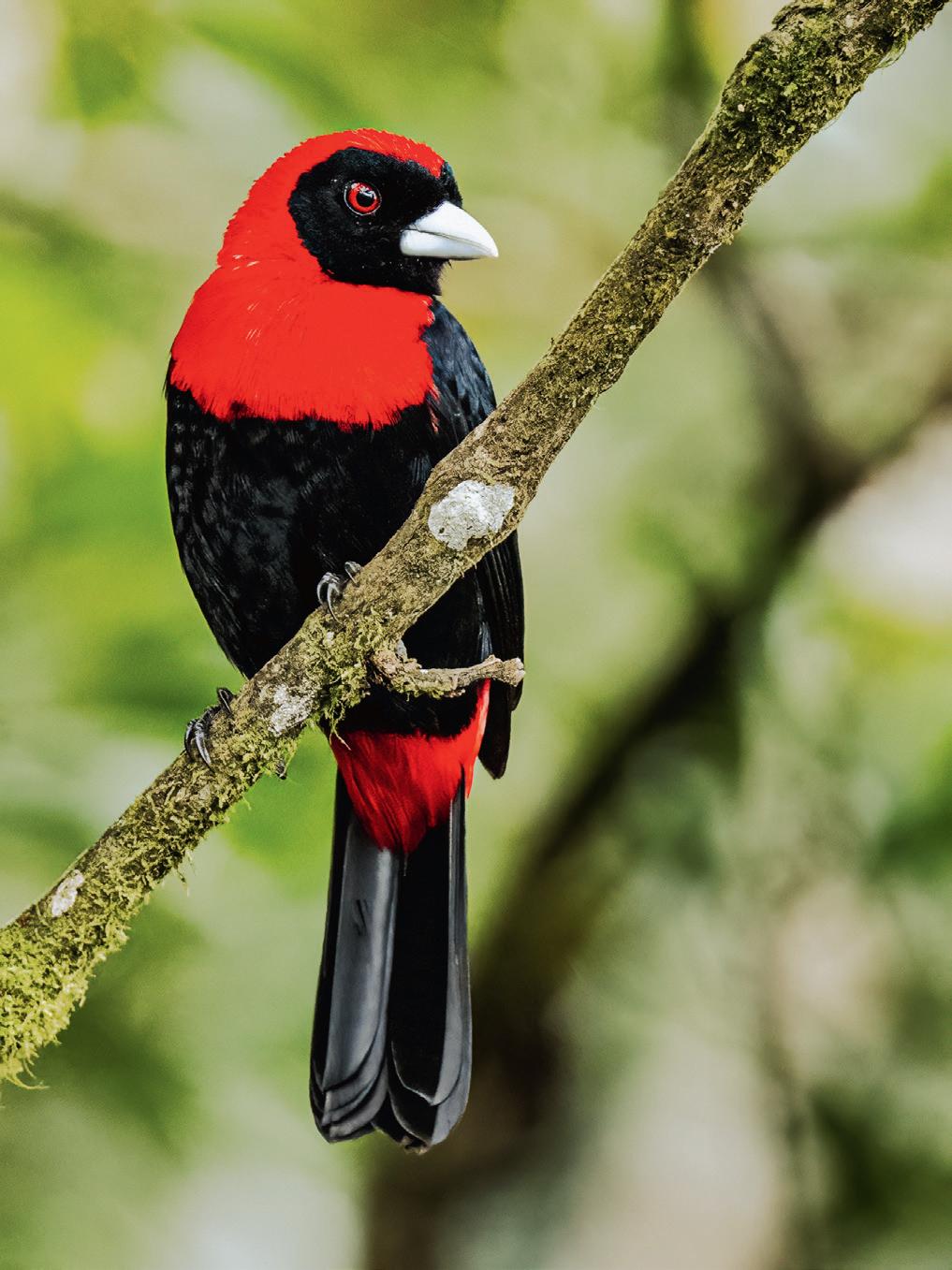
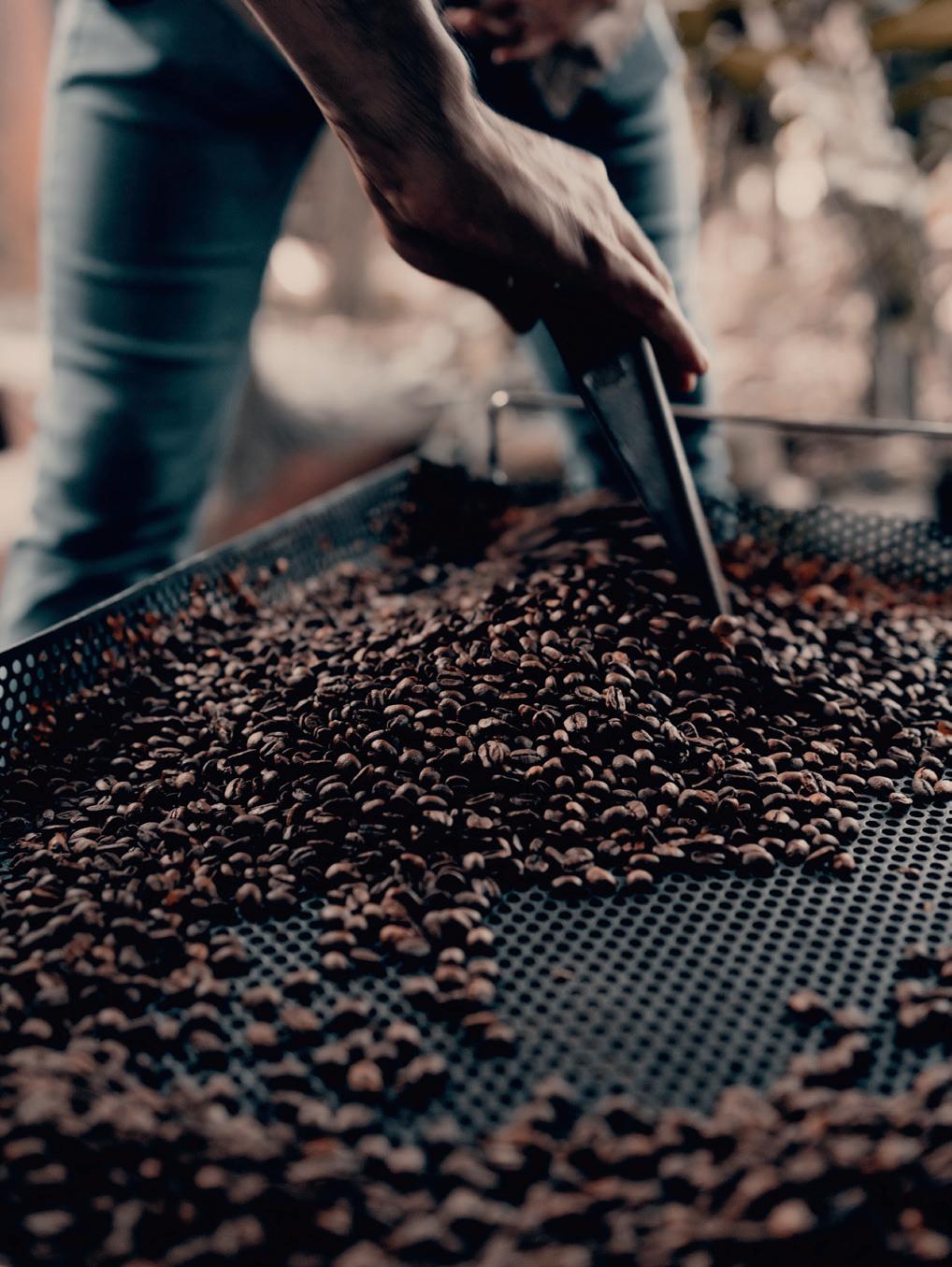
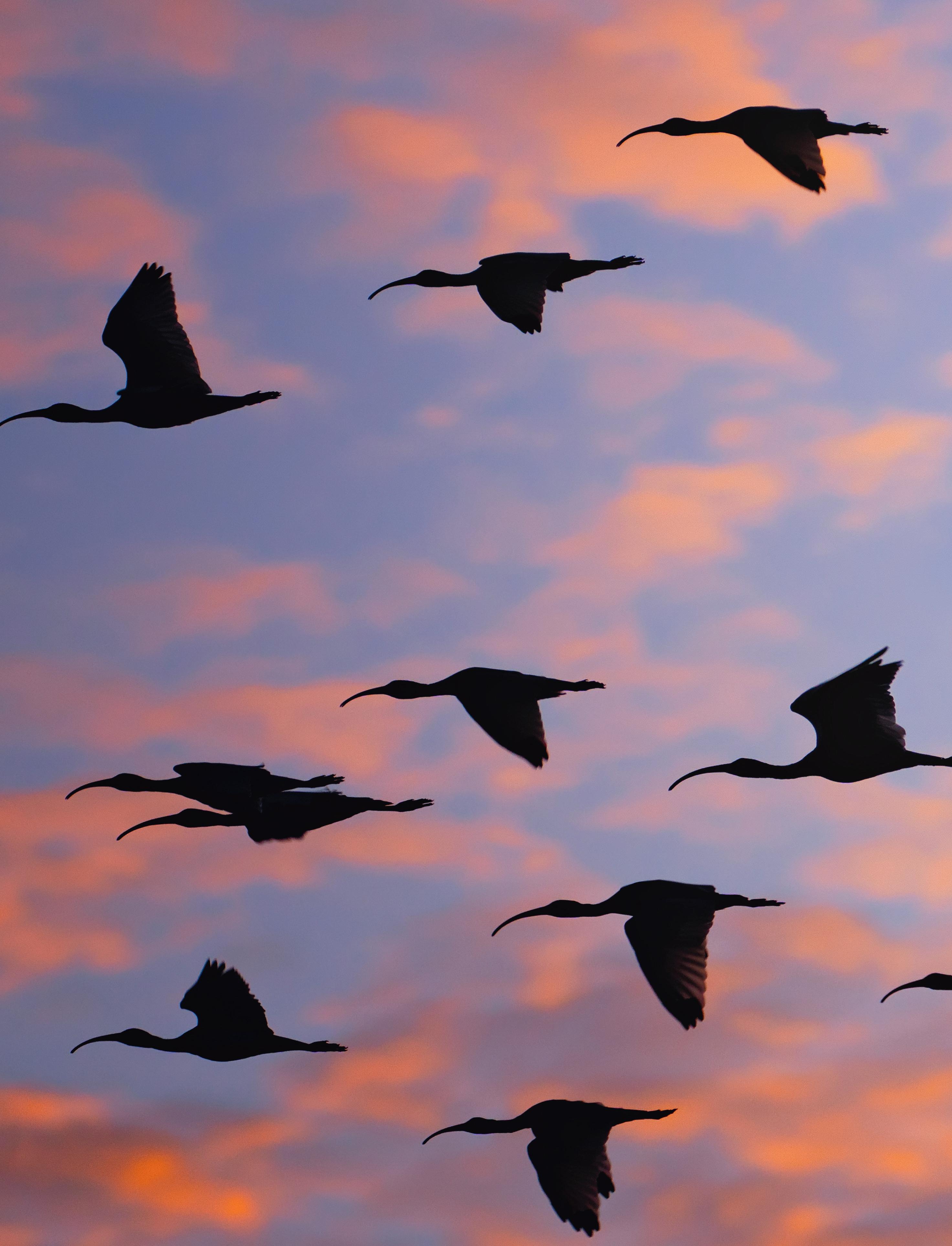
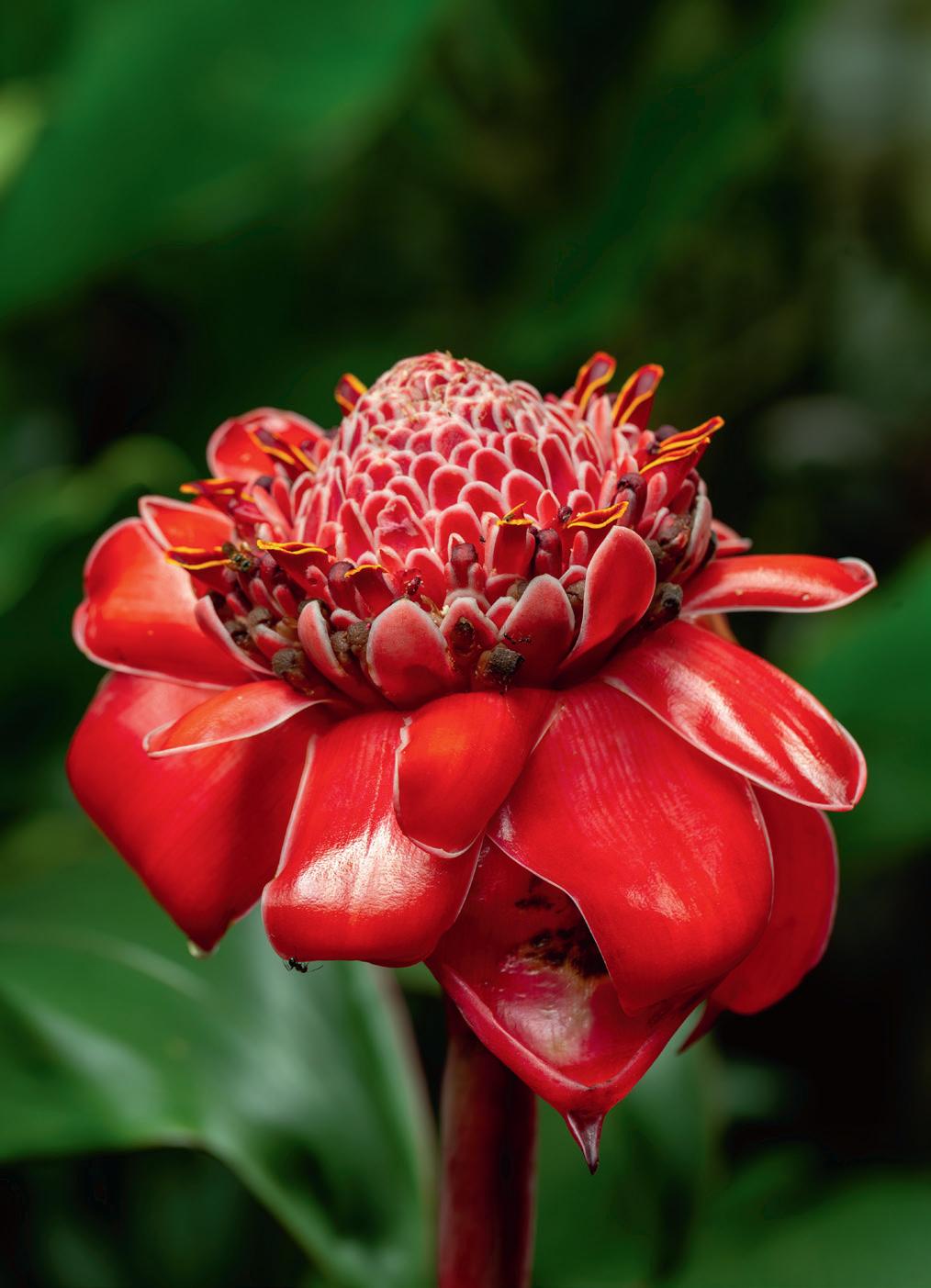
(From above) Crimsoncollared tanager; coffee beans after roasting; torch ginger flower
panels and removed the electricity cables, all the sloths and monkeys returned. Now they’re everywhere.”
At every step of the journey, there are visual reminders of what Costa Rica is working to protect. I watch northern jacanas stride delicately across lily pads on a Peñas Blancas River safari and spot common basilisk lizards sprinting across water with improbable ease. At Mistico Park, sloths, iguanas and spectacled owls observe us from the lush canopies, while at Manuel Antonio Park, capuchin monkeys relieve us of snacks and dignity on pristine white-sand beaches. Over our meals, heavy on beans, rice and caramelised plantains, we’re surrounded by flashes







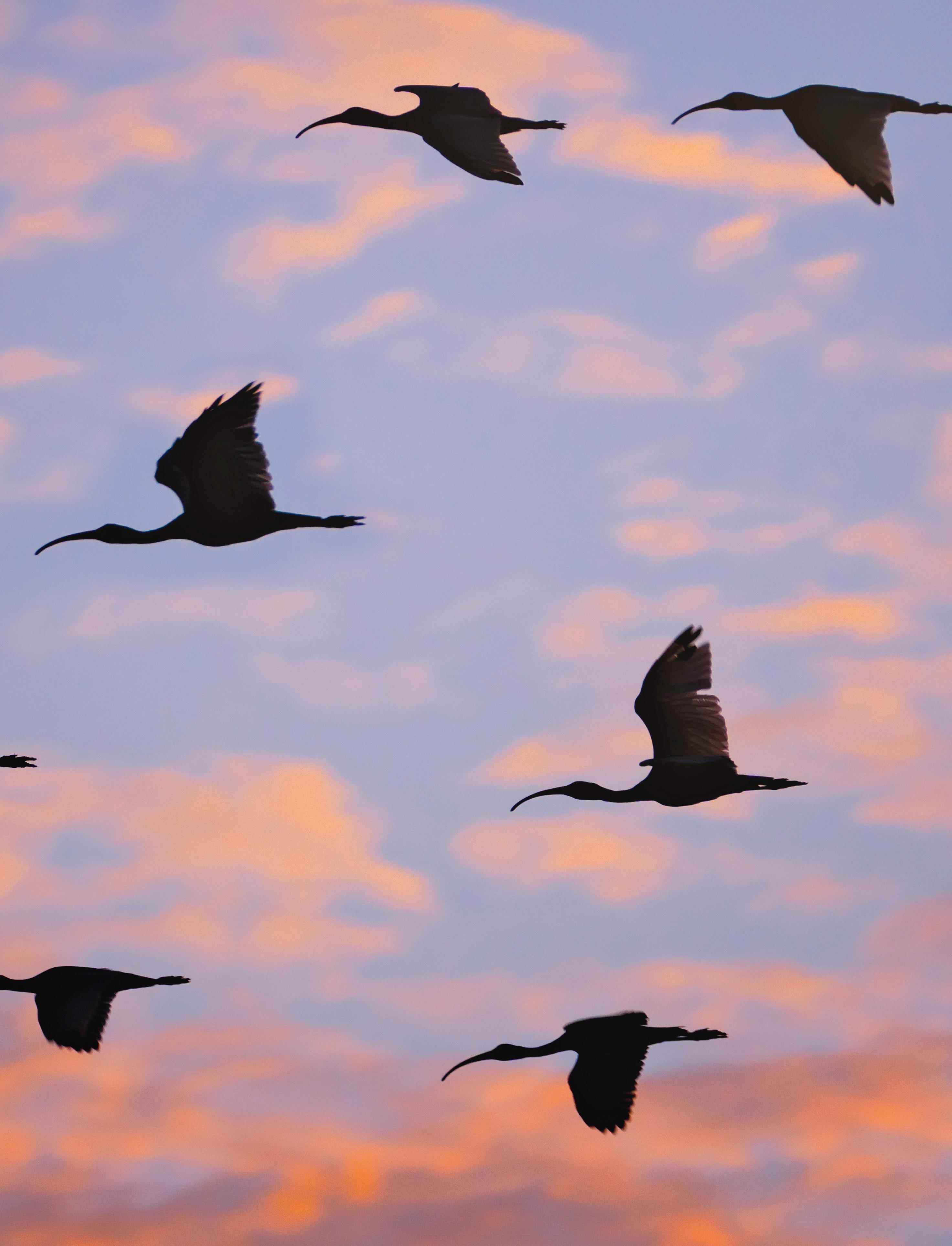
of colour from tanagers, hummingbirds and other birds.
Still, if there’s any doubt about who really runs the show here, a visit to Arenal Volcano quickly puts us in our place. Rising above the bustling adventure hub of La Fortuna, where billboards trumpet ziplining, rafting and canyoning tours, the conical volcano is impossible to miss. Arenal erupted without warning in 1968, burying three villages under lava, ash and rock. Today, it looms quietly, smoke and cinders billowing from its crater despite being in a “resting phase”. While half our group opts to zipline, I’m drawn to the idea of hiking rocky trails carved by ancient lava flows. Taking the uneven footing in my stride,
I’m amazed at the resilience of Mother Nature and the creeping pines and eucalyptus trees, as Arrieta fights to be heard over an orchestra of cicadas. “You used to be able to see the red lava glowing at night, which was quite magical,” he says. “Then about 10 years ago, it suddenly stopped and no-one knows why.” Our walk back is noticeably faster.
As the tour winds down, a fellow traveller, Donna from Canada, twirls slowly in the pool and marvels at the sumptuous landscape around our lodge. “Wow, just wow,” she says. “The sky is bluer here than anywhere else I’ve been and I don’t think I’ve ever seen so many vibrant shades of green. It’s just so much prettier than anything on paper. I wish everyone could see this.”






















From Kakadu’s floodplains to Ikara’s ancient gorges and Budj Bim’s volcanic wetlands, join Traditional Owners on small-group journeys rich in stories, culture and connection to Country.
Hike to secret locations
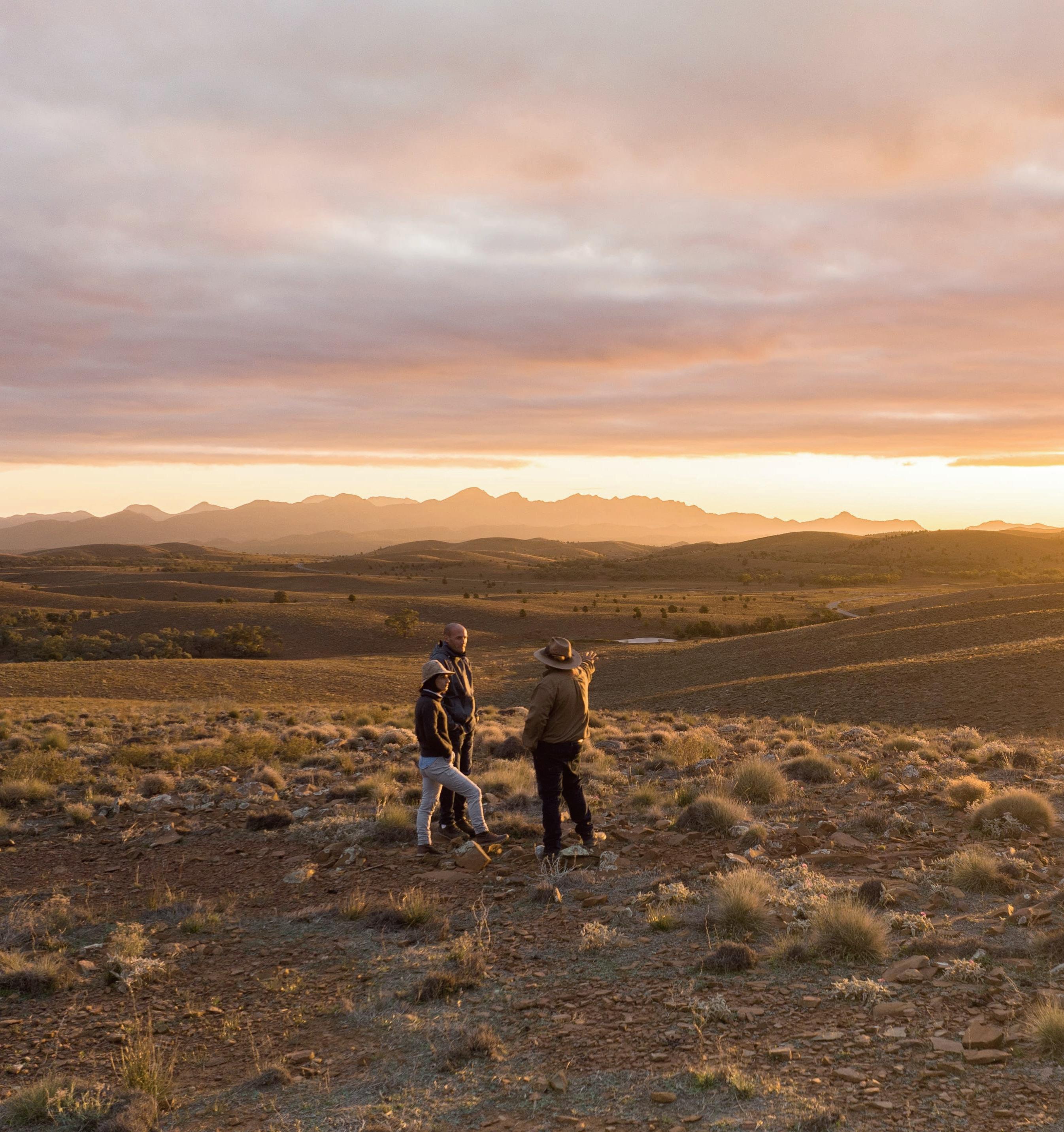
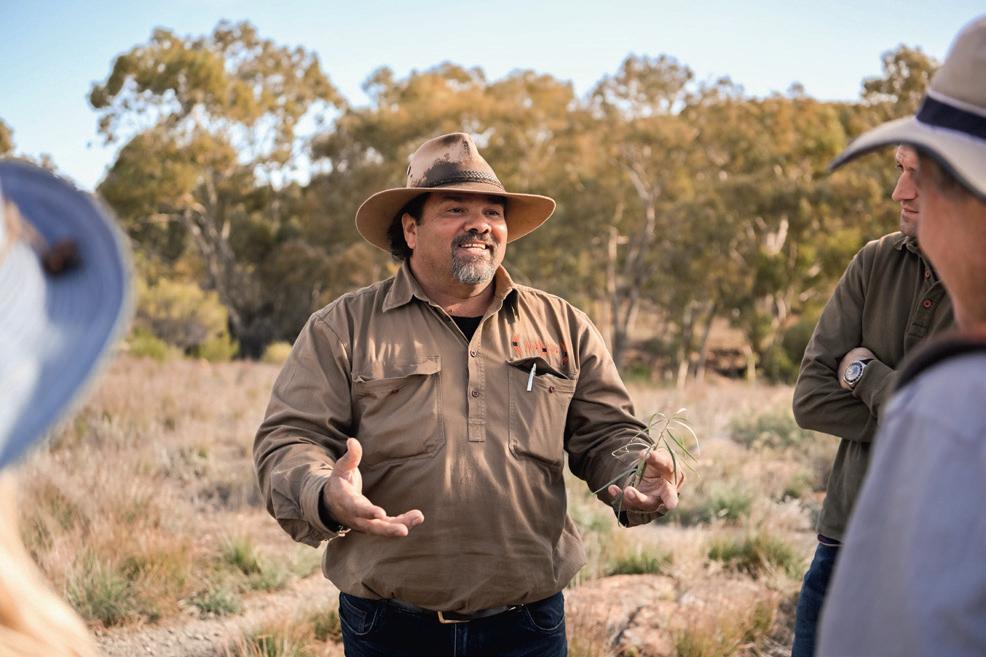
“I get quite emotional when I go to certain Adnyamathanha sites. People see circles and lines but I see lessons my Elders left behind to teach me about the land – where to find water, the seasons. People’s minds are blown when they realise my Elders lived alongside megafauna,” says Kristian Coulthard (left), owner of Wadna Culture Tours (wadna.com.au) in the Ikara-Flinders Ranges region of South Australia.
About a five-hour drive north of Adelaide, the land opens into an ancient amphitheatre of weathered ridgelines, ochre escarpments and dry creek beds lined with river red gums. This is Adnyamathanha Country – vast, elemental and layered with knowledge carried across generations. It’s here that Coulthard guides his Wadna experience, leading visitors into a deeper understanding of Country.
Raised by his grandparents and senior Elders, Coulthard’s connection to this landscape was shaped early. As a child, he walked these gorges with his father, who documented sacred
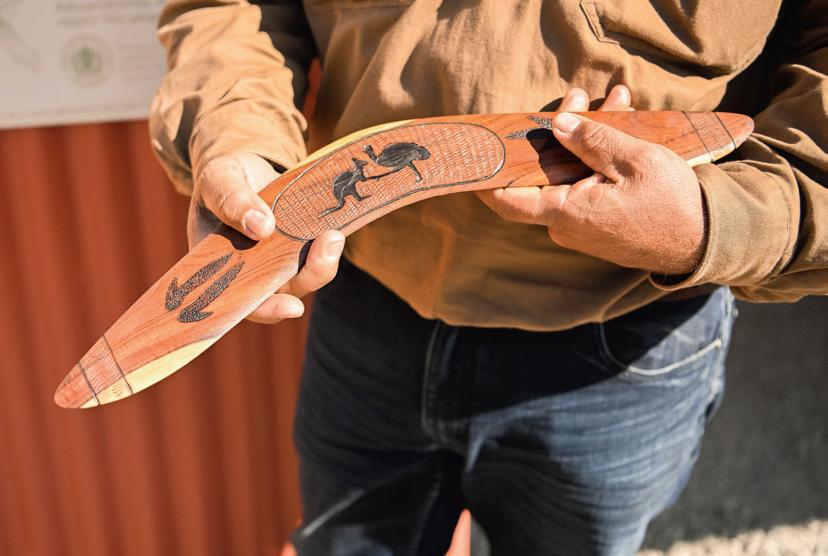
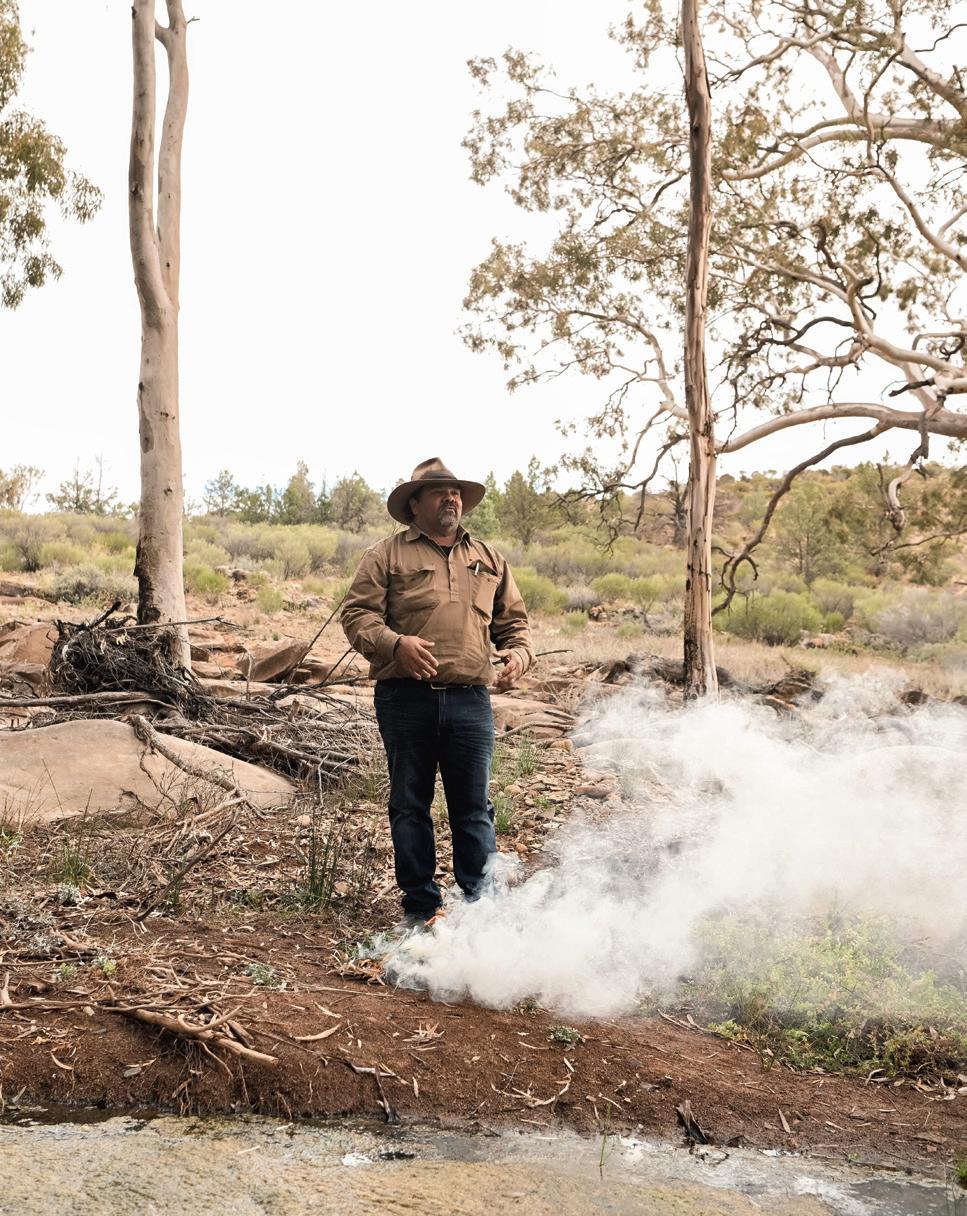
rock art sites while sharing the stories, seasonal rhythms and meanings etched into stone. “It’s special to my heart. I went to these places with Dad when he was recording sacred sites with Elders. We have a private parks lease that means we can go to secret spots. We have an agreement with pastoralists and take a limited number of people around. It’s not ‘cookie cutter’. And we have the language that goes with the art.”
Today, those same pathways form the backbone of Wadna tours, including the Sacred Canyon experience, where thousands of ancestral inscriptions ripple across sandstone walls. “Every place has a different story. It’s about learning those stories so you understand the Country a little more.”
Back at Wadna’s headquarters, the experience continues through art in a gallery and cultural space where Coulthard’s practice as a wood-carver comes to the fore, alongside works by other artists.
“We’re passionate about what we do and are always evolving. We love supporting artists, no matter who they are. Many of our artists are non-Indigenous – we’re all about embracing local and Australian.” That sense of continuity carries into the next generation. “My granddaughter is 13 and she loves to sit with me and carve. I love the look on her face when she makes something. There’s a lot of interest in Indigenous culture and traditions from the next generation. That’s so important and positive.”
WESTERN AUSTRALIA
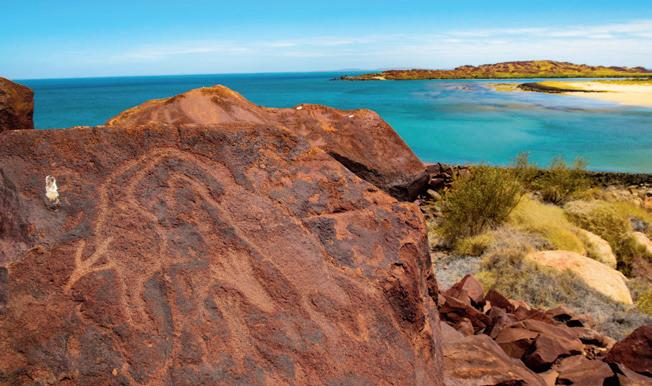
Discover rock art in the Pilbara
Uncover ancient petroglyphs and listen to cultural stories on an accessible and high-impact 700-metre, ranger-guided walk at Nganjarli, a 30 minute drive from Karratha in Murujuga National Park, with Murujuga Aboriginal Corporation Rock Art Tours (murujuga.org.au).
NORTHERN TERRITORY
Experience wildlife encounters
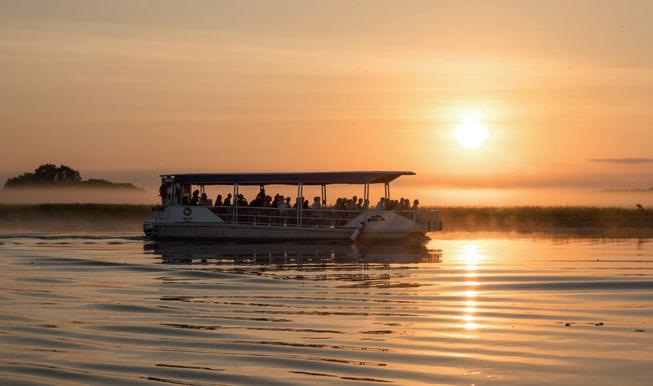
Drift across the Ngurrungurrudjba / Yellow Water Billabong in Kakadu National Park with Kakadu Tourism (kakadutourism.com) and witness saltwater crocodiles and magpie geese thriving in this dramatic landscape, which has been shaped over millennia.
Trace the flow of fire and water
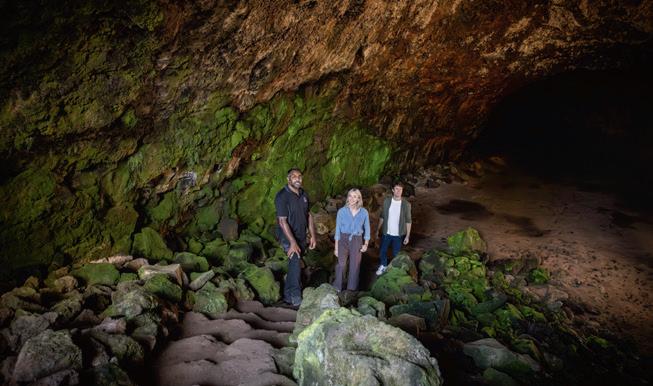
At south-west Victoria’s Budj Bim Cultural Landscape (budjbim.com.au), Gunditjmara guides lead visitors through this UNESCO World Heritage Site, which was carved by water and lava flows from the now dormant Budj Bim volcano.
In the Canadian Rockies, humans and horses join forces for an exhilarating trail ride above the clouds.
Story and
photography
by Karla Courtney
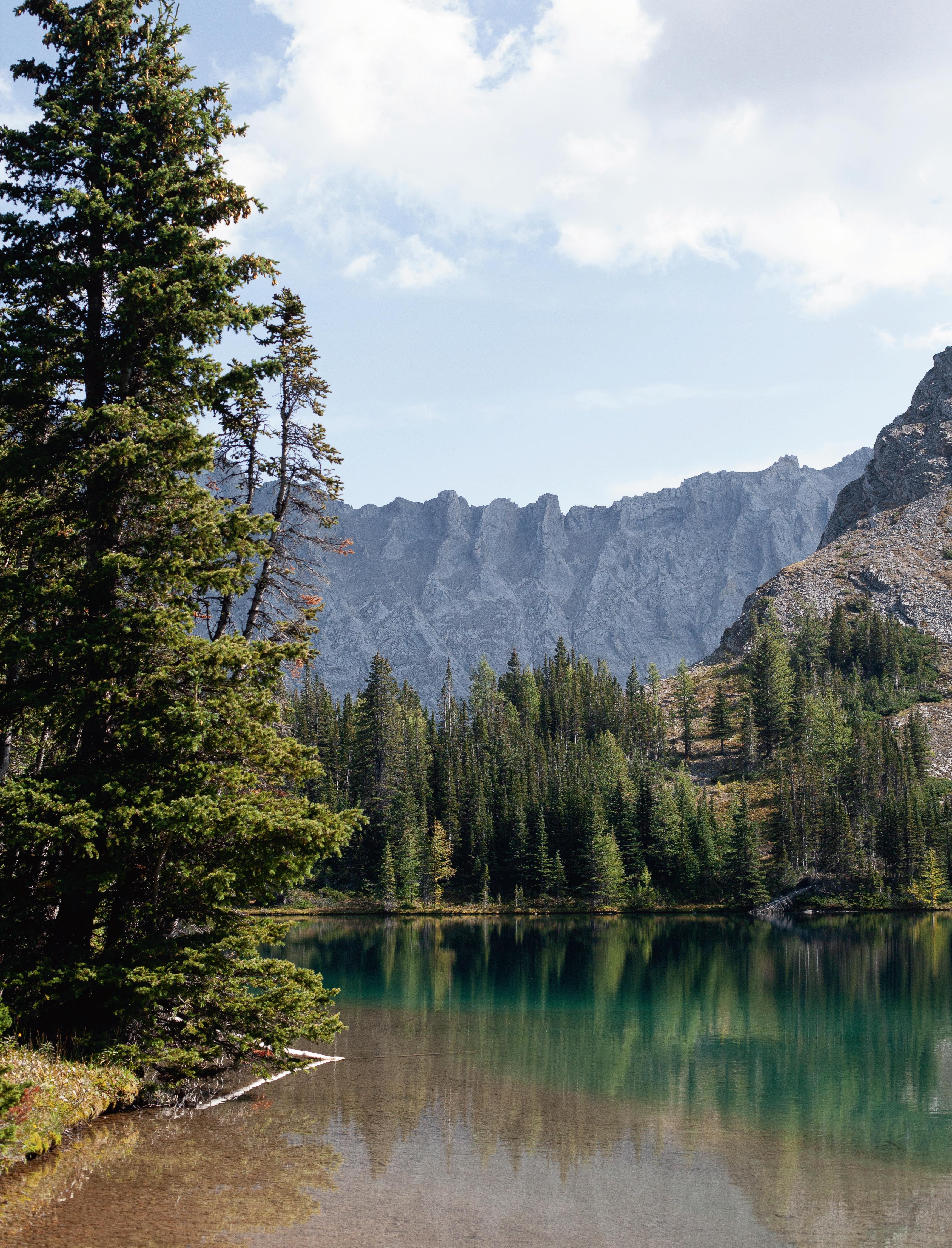
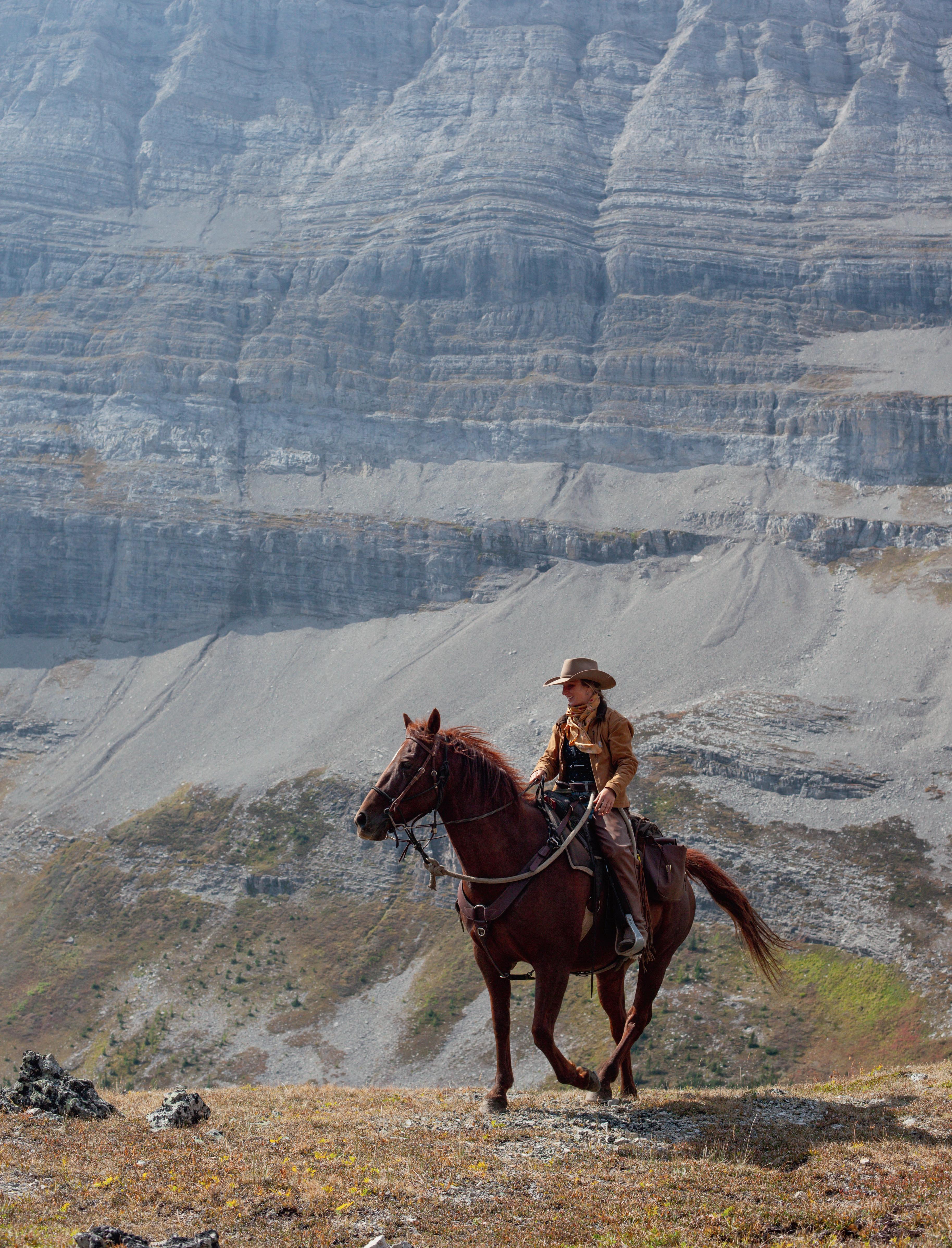
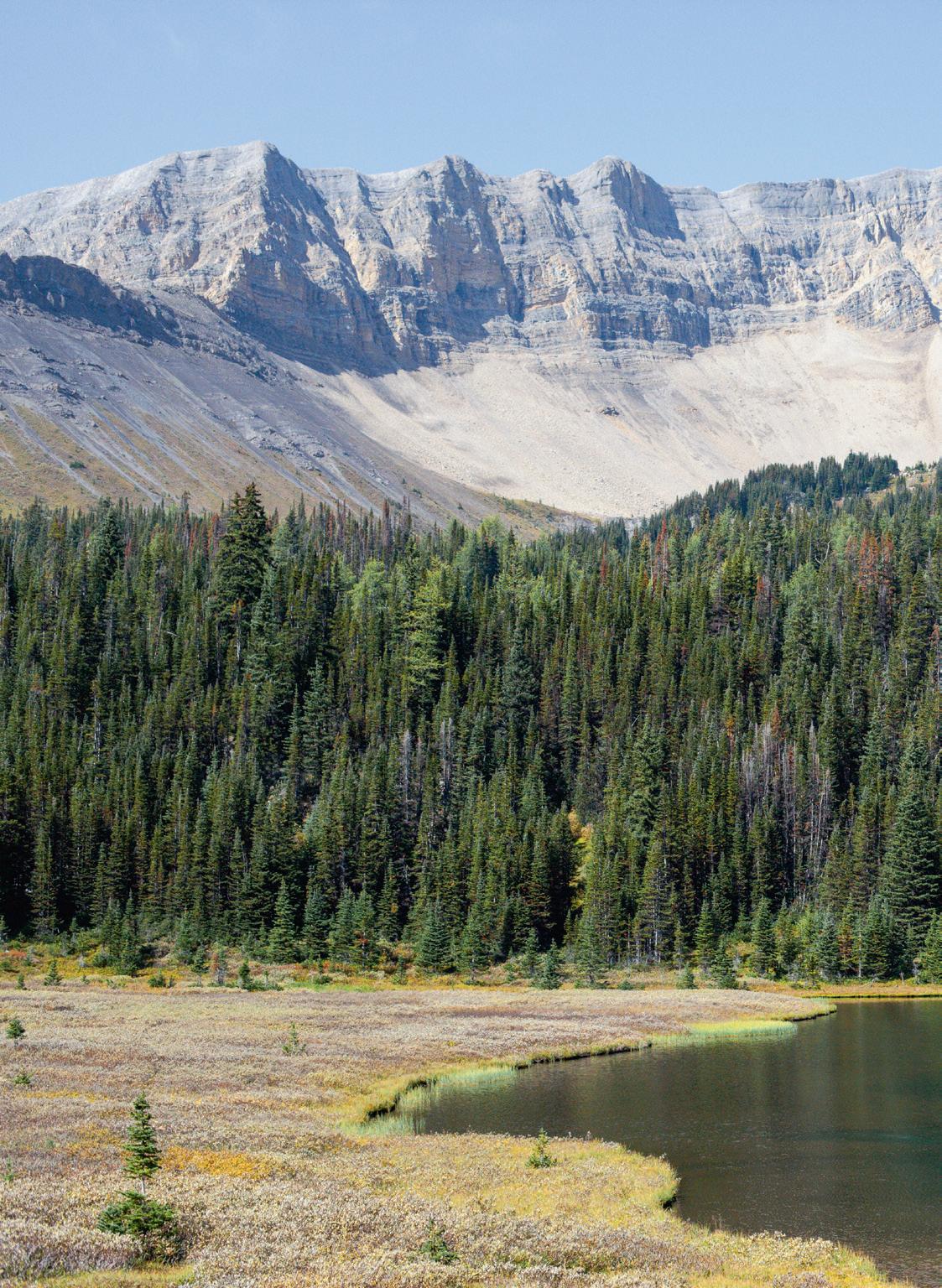
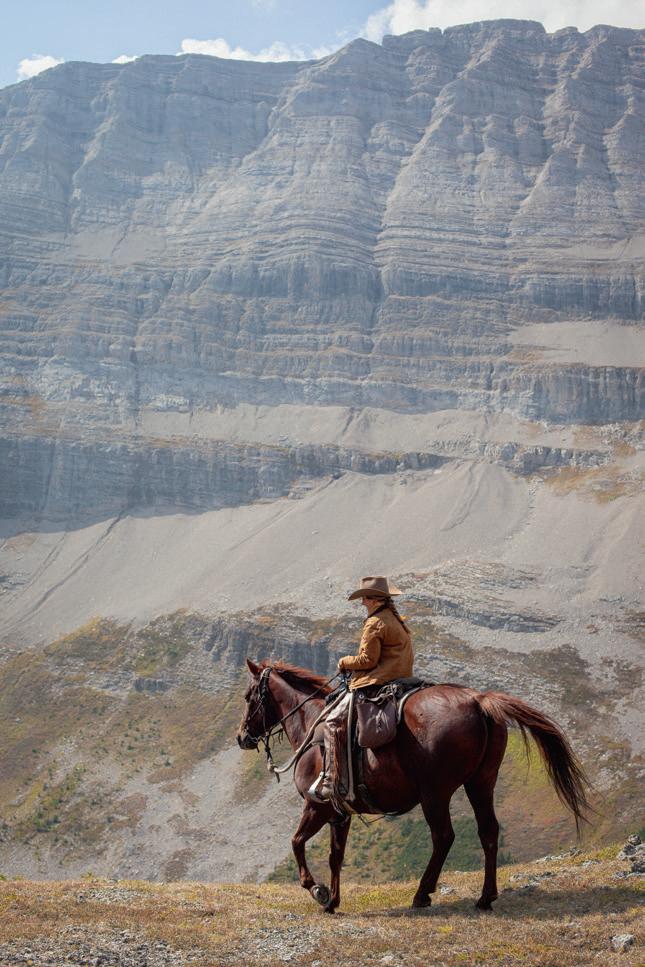
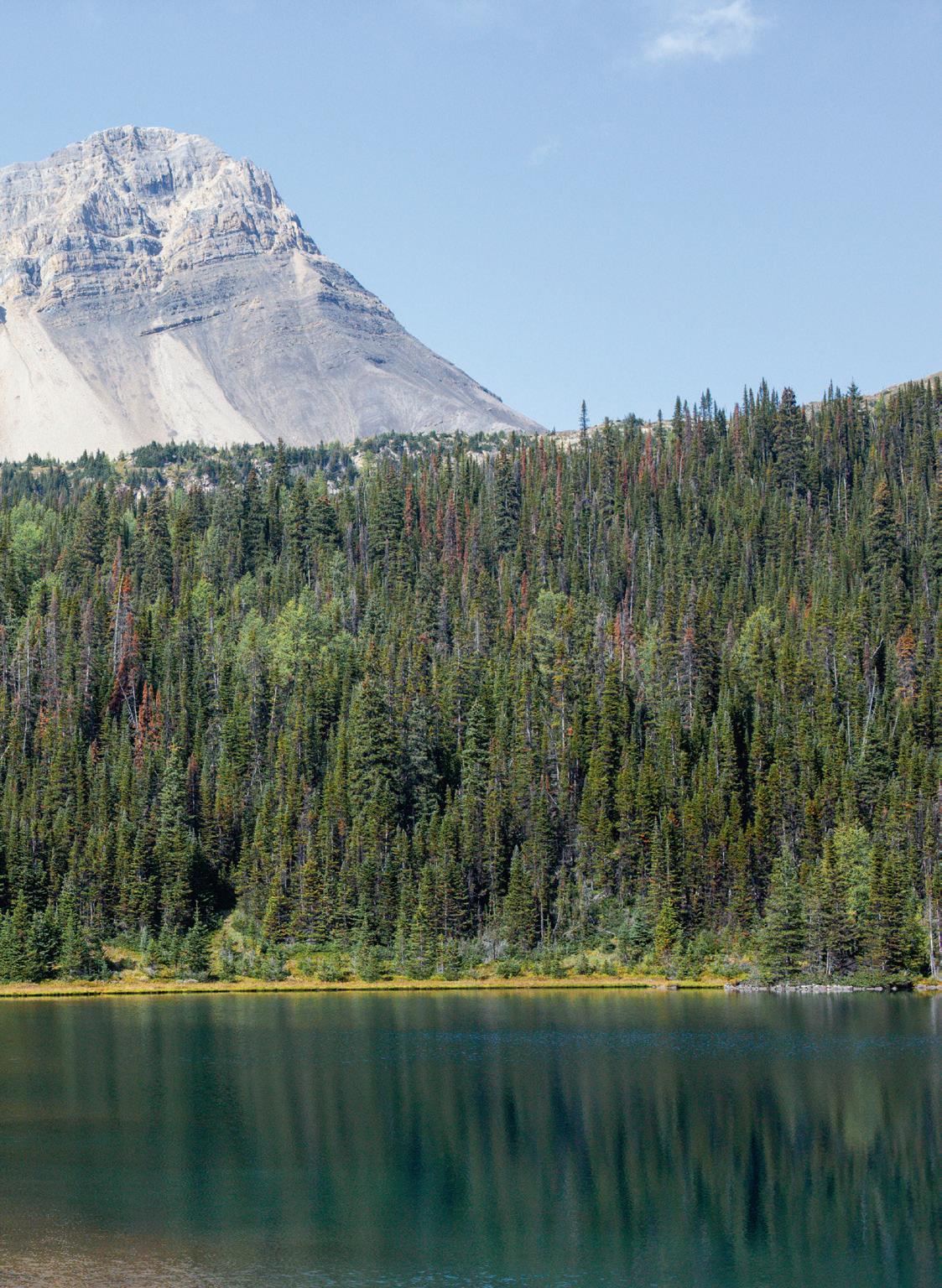
H“Horses need to walk on the edge to see it,” says my guide, Sarah Gillies, all leather and calm. She tosses the comment over her shoulder as if she’s reminding me to zip my jacket. We’re on horseback, picking our way across a tilted band of shale where the trail narrows to a single track, high enough that the mountain seems to fall away in a sheer drop. My horse eases outward and lowers his head, reading the ground with his feet. I hold my breath.
It’s day three of a six-day lodge-tolodge trek in the Canadian Rockies with Banff Trail Riders (horseback.com),
following the spine of the Sundance Range, south from Banff and back again – roughly 80 kilometres return. There are 13 of us, including five human guests – a mother and daughter who ride regularly, a married German couple (one of whom was an equestrian vaulter) and me, the newbie – guide Gillies, six horses and Bugsy the mule, who carries the day’s supplies, pausing now and then to scratch his rump on a branch or leave a steaming punctuation mark on the trail.
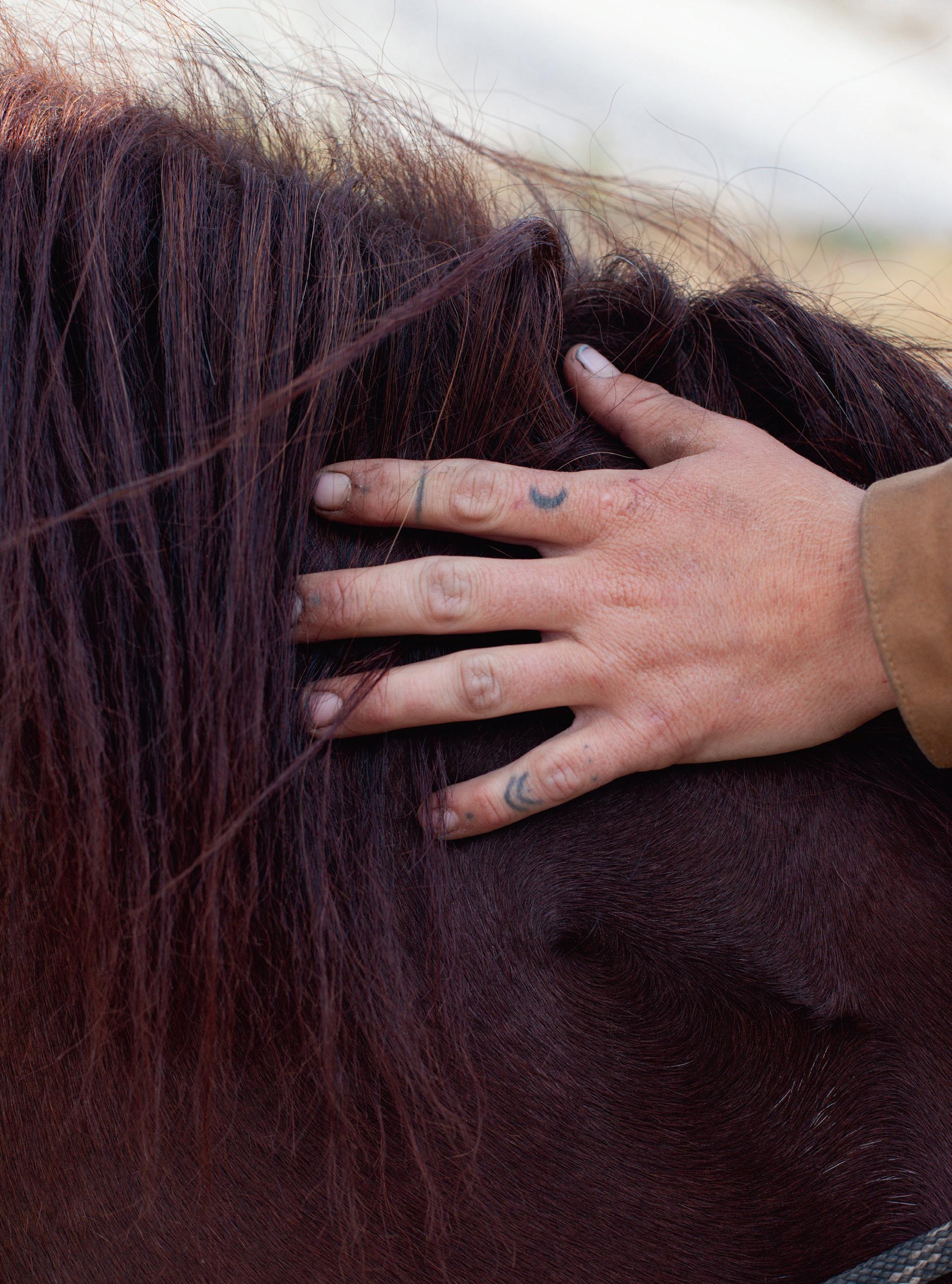
Banjo (above right) is my ride and companion: milky-white with a gentle face and solid understanding of how to
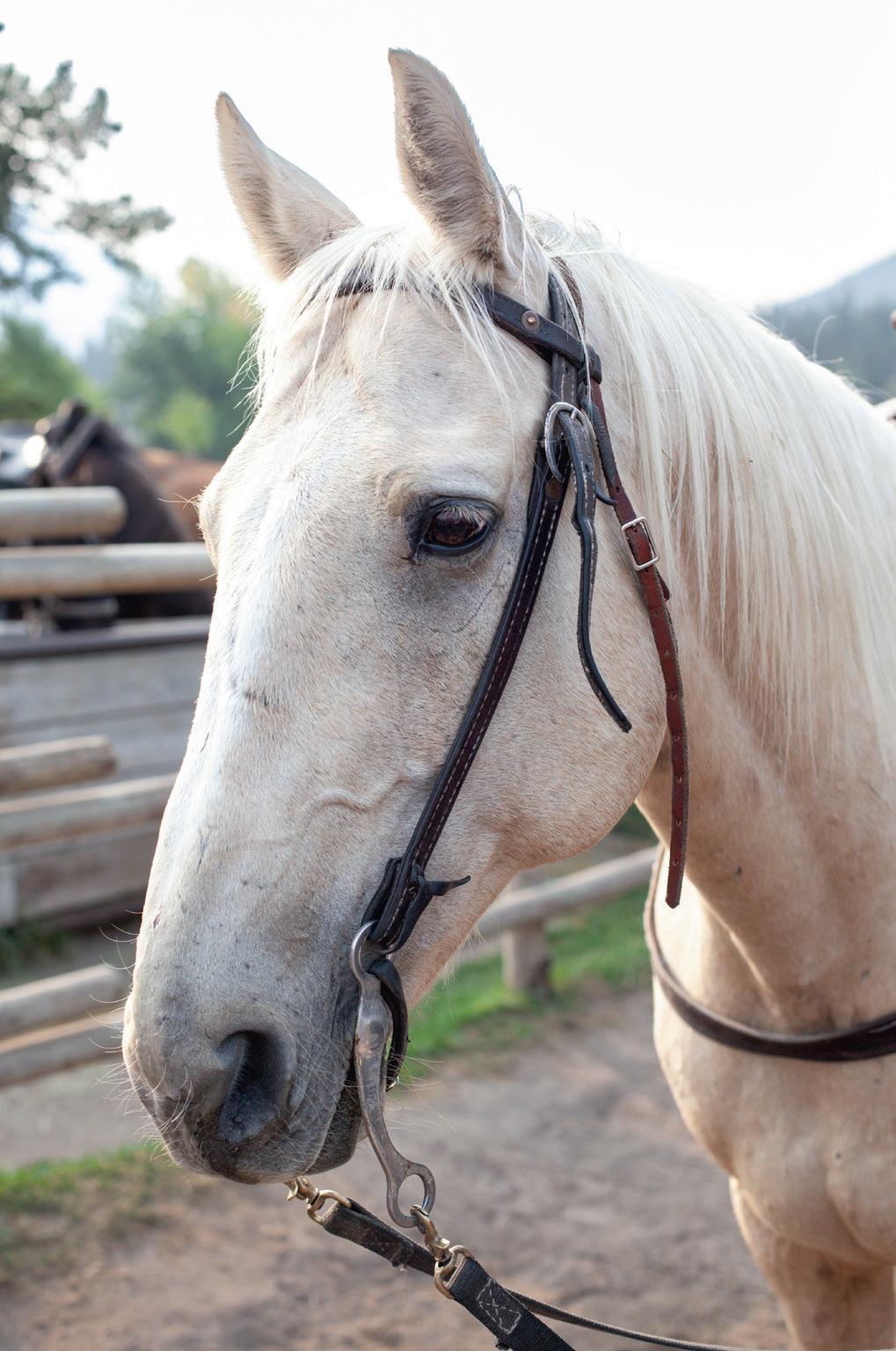
leverage a snap-happy novice. Day one, we leave Banff and are immediately flanked by the glacial-blue Bow River, with dramatic peaks rising behind it like they’ve been set there on purpose. I lift my phone, which serves only as a camera as there’s no mobile reception or wi-fi. Banjo drops his head into the grass for a snack. We fall behind and the others coax me forward with friendly advice to look where I’m going and pay attention to my horse.
Our first water crossing arrives early. Banjo makes it a performance, kicking his legs, splashing, refusing to
drink. Soon after, as we reach a narrow wooden bridge with a steep ramp, he stops and plants his feet. I realise that if Banjo decides we’re not doing this, I can’t change his mind. “He responds to the pressure of your legs,” calls Gillies. “Give him a squeeze.” I do as she says and to my relief he surges forward in one clean motion. “Banjo knows when you aren’t connected to him,” Deirdre, the sage, straight-shooting mother from the mother-and-daughter duo, tells me. “You’re always having a conversation.”
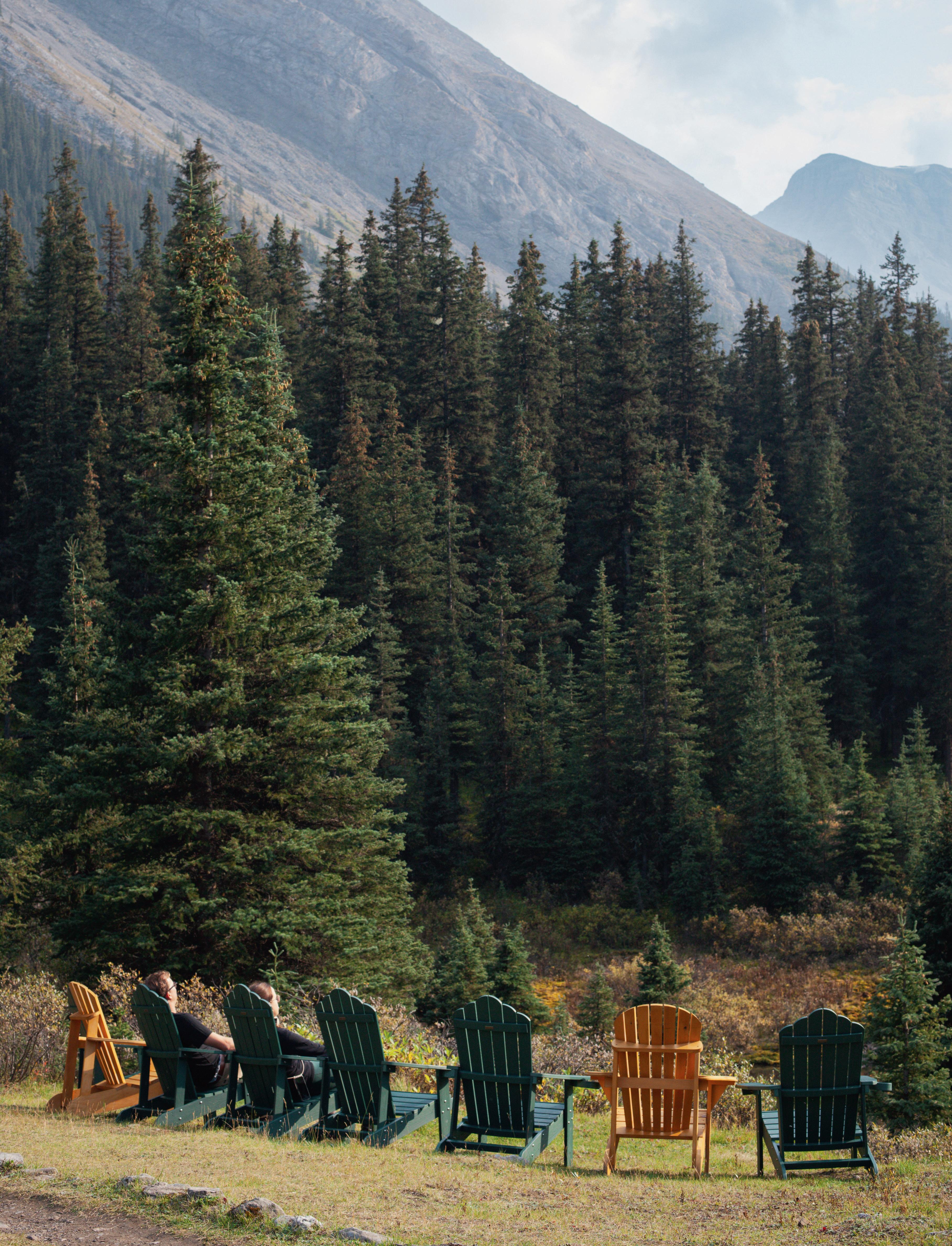
By the late afternoon we reach Sundance Lodge, a haven in the woods,
where the scents of woodsmoke and bread reach us before we even get our boots off. Nearby sits the original TenMile Cabin, built in 1923 as a rest stop for weary riders. Sundance itself is newer and larger but it sits in the old tradition, where everything has travelled here the hard way. The bedrooms upstairs are cosy and private, with wooden furniture and thick quilts. Mine faces the creek so I leave the window open to the sound of water rushing through the dark.
First Nations people once used these valleys as routes and hunting grounds; later, pioneers and packers
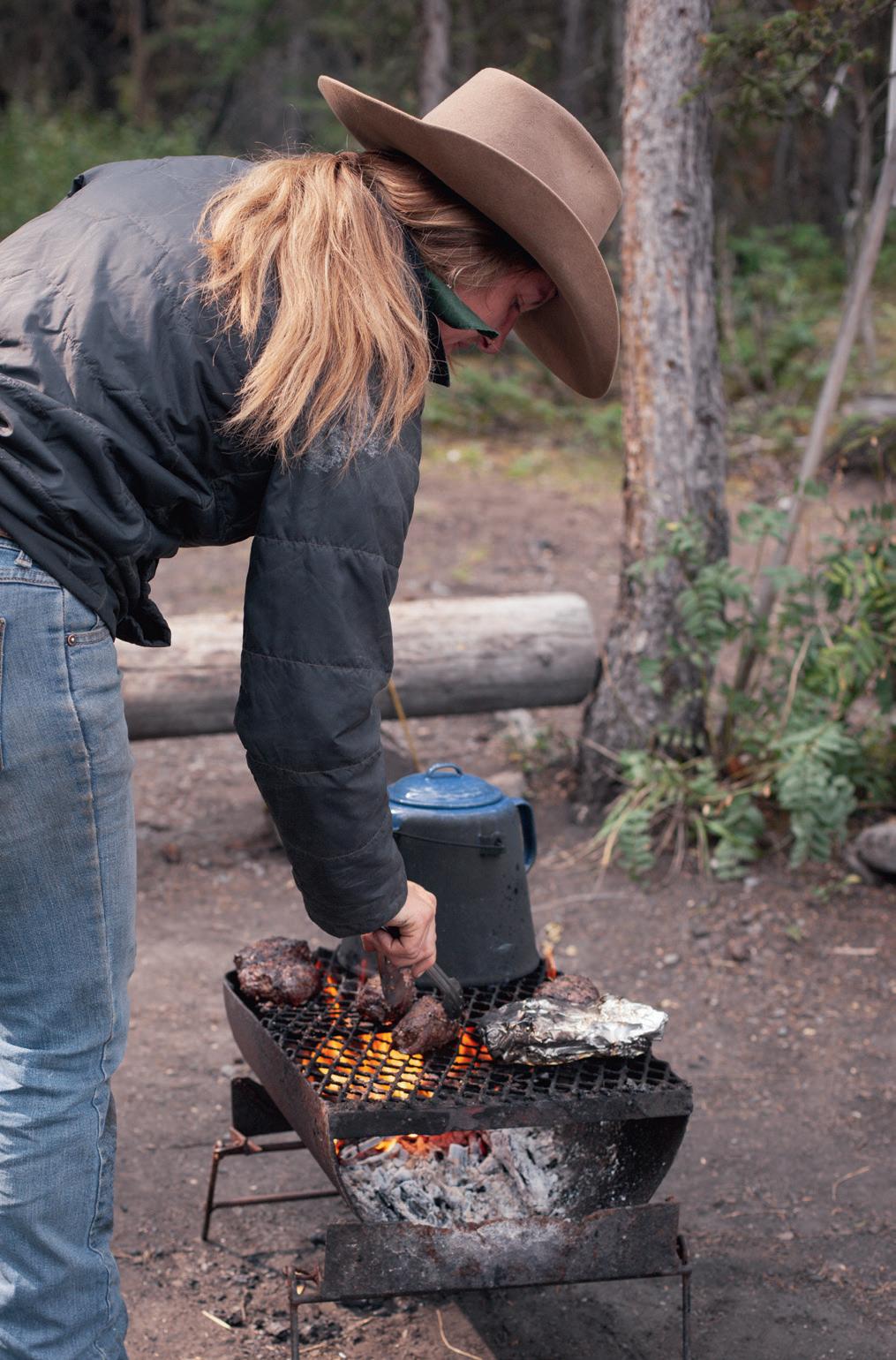
followed the same natural corridors. Even today, everything moves on hooves, with packers urging trains of mules back and forth, carrying the infrastructure of comfort: food, fuel, clean linen, beer. Chefs work on shifts, staying at the lodges operated by Banff Trail Riders for days at a time, feeding whoever rides in hungry with hot meals, including steak, ribs, fresh bread, sweet potato mash, roast turkey and molten chocolate cakes, which seem impossible when the closest shop is more than 16 kilometres away by foot or horseback.
Resident chef Matt hums Wichita Lineman while he prepares breakfast in a kitchen filled with timber and lamplight – coffee brews, bacon crackles in the pan and buns rise under towels. “You know, back in towns and cities there’s just… so much complexity to everything and so much happening all around. But out here, things are very simple.” Further into the mountains is Halfway Lodge, our second home, where we spend three nights, affording us one day for a long climb and another for the horses to rest while we hike to
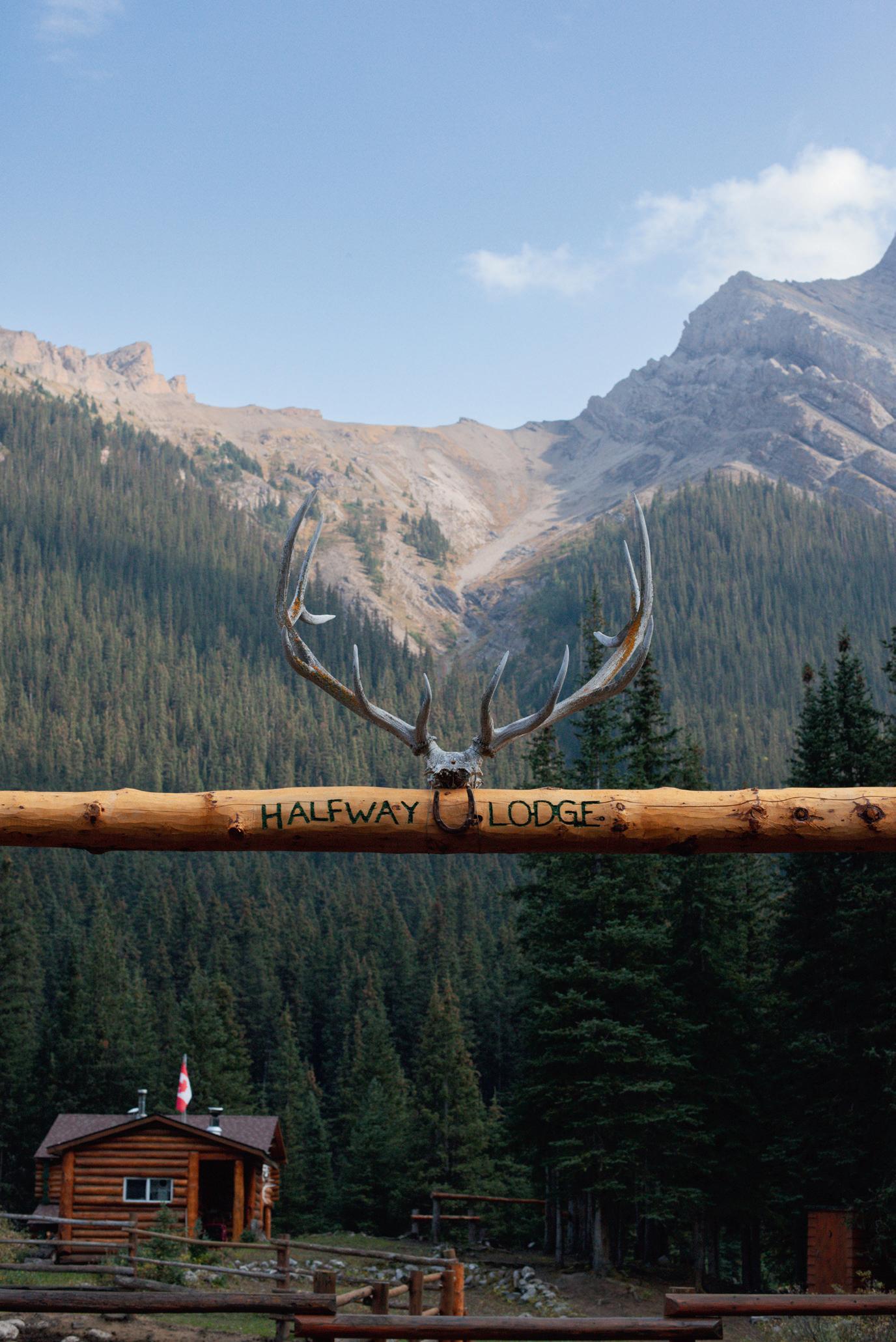
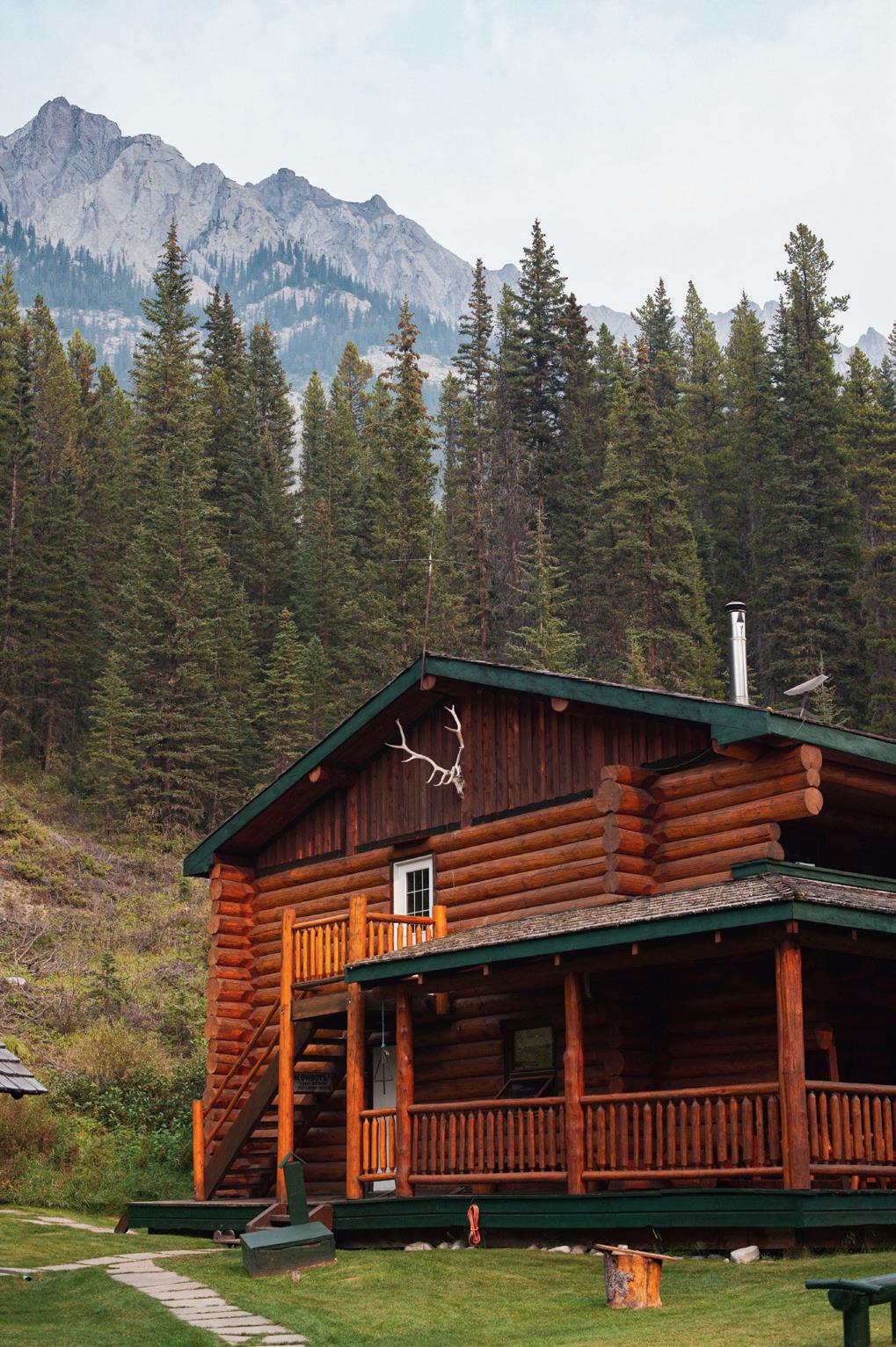
a secluded lake. Halfway Lodge has been a stopping point since the 1920s and the cabin, which is on its original foundation with one storey added, is kept deliberately simple and snug. Inside, a wood stove heats candlelit rooms and warms the kettle, while outside among the trees there’s the ultimate luxury of a heated shower, the water pulled up from the nearby stream as the mountains glow pink in the late light.
The ride to Allenby Pass on the third day promises a view described in Biblical proportions. But the price of
admission is a steady ascent to nearly 2500 metres above sea level, taking that narrow trail with the steep drop. Only a handful of people make it up here each year – the groups on this trip and some intrepid long-distance hikers. The switchbacks stack up in tight, steep turns that keep you climbing when the mountain won’t give you a straight line. My hips start bargaining with me and I stop thinking big ideas and start contemplating small ones: breathe, loosen your shoulders, don’t look down, trust the horse.
We arrive and it’s more than a view. It’s the sensation of being on top of the world – above the tree line, above the routes, above whatever we thought was “high” before. The ridges out towards Mount Assiniboine ripple into the distance in every direction, valley after valley, like the land is unfolding. Gillies helps us dismount and ties off the horses to rest. Everyone naturally drifts to their own outcrop but even spread out, there’s a strange, wordless connection between us – humans and horses. We’re here together, strong and present.













































































Here’s how you can supercharge your points-earning capacity with Uber and Uber One. Turn up the Qantas Points on every step of your journey – from Uber rides to Uber Eats orders.
Link your Qantas Frequent Flyer and Uber accounts
To start earning Qantas Points, link your accounts via the Qantas App or via the Uber or Uber Eats App. Once the accounts are linked, you’ll be able to earn up to 1 Qantas Point per $1 spent on Uber rides to and from eligible Australian airports, including Melbourne, Sydney, Hobart, Adelaide, Darwin, Townsville, Gold Coast, Ballina/Byron Bay and more.
2


Join Uber One to unlock even more benefits
From early May 2026, linked Uber One members can earn even more Qantas Points while still earning on eligible airport trips. You’ll continue to receive Uber One benefits like $0 Delivery Fee on Uber Eats, five per cent Uber One credits on eligible Uber rides, with the added benefit of earning Qantas Points on eligible Uber rides and Uber Eats restaurant delivery orders over $20. Join Uber One today at uber.com/ uberone to unlock these benefits.

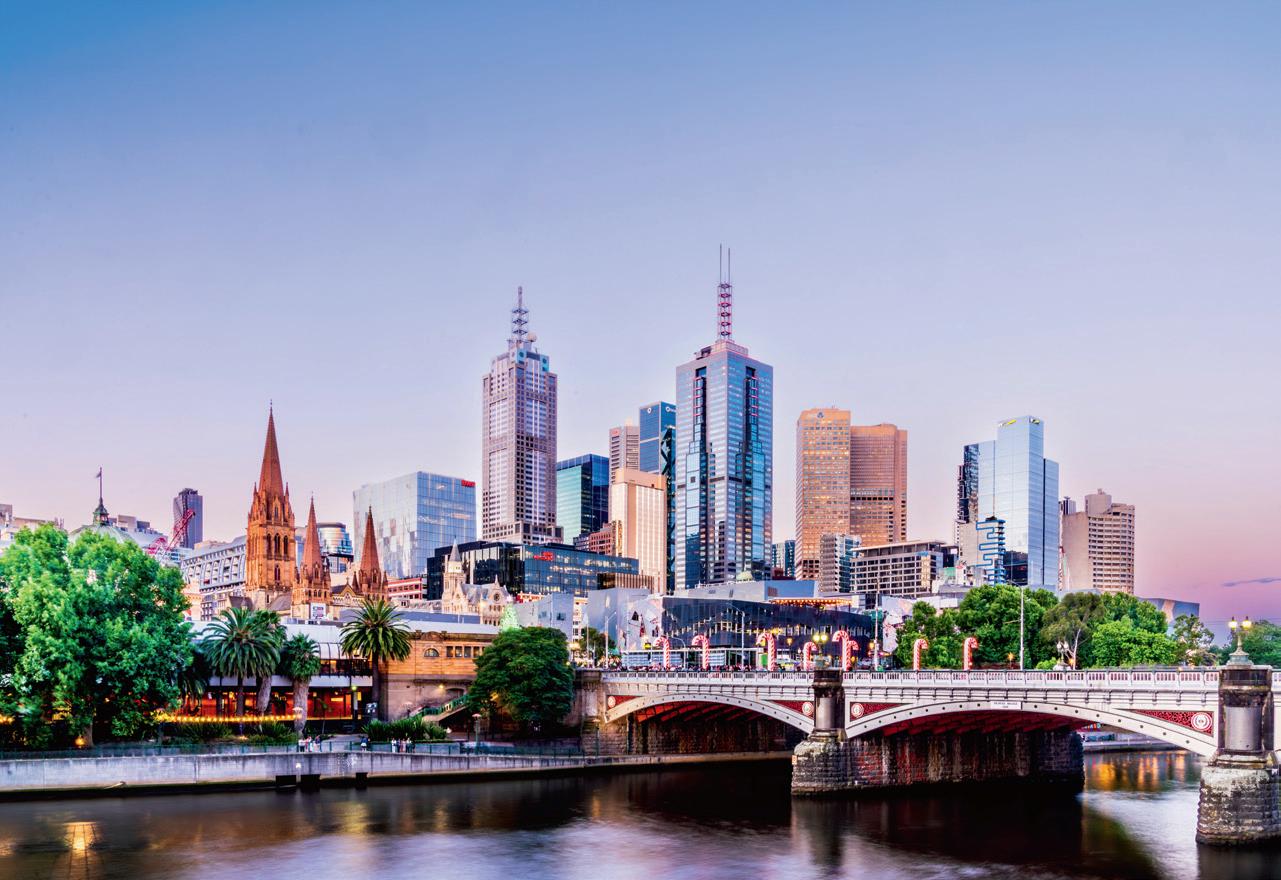
Here’s how Uber and Uber One can help you to enjoy a points-earning weekend in Victoria’s capital.
Earn Qantas Points on eligible Uber rides with Uber One
Getting around town on everyday rides is now even more rewarding for Uber One members. Whether you catch an Uber to return home after a night out or to meet up with friends for brunch, from early May 2026, Uber One members can earn 1 Qantas Point per $1 spent on Uber Comfort, Comfort Electric and Black rides whenever and wherever they go.
You’ll start earning Qantas Points as soon as you’re on your way to the airport. Book your Uber Reserve ride the night before for peace of mind to earn double the Qantas Points. Earn 1 Qantas Point per $1 spent with Uber Reserve to and from eligible Australian airports or 1 Qantas Point per $2 spent on all other eligible airport trips.
Head straight to the designated Uber pick-up zone Kerbside for the drive into the city. Drop your bags off at your hotel and don’t waste a second. As an Uber One member, take an Uber Comfort ride to hidden bar Eau De Vie Melbourne in Malthouse Lane to enjoy a cocktail before visiting the National Gallery of Victoria to view an exhibition. Earn 1 Qantas Point per $2 spent on eligible airport trips. Plus, Uber One members can earn 1 Qantas Point per $1 spent on Uber Comfort, Comfort Electric and Black rides.
After a day of exploring, it’s time to kick back. Whether you’re staying at the Ovolo Melbourne, South Yarra or QT Melbourne in Russell St, as an Uber One member, order Uber Eats and feast on dumplings from city favourite Fortune Alley or signature double-beef patty burgers from 300 Grams in the comfort of your room. Uber One members can earn 1 Qantas Point per $2 spent on eligible restaurant delivery orders over $20.
Uber Eats with a side of Qantas Points with Uber One
Whether you’re tapping the Uber Eats App for Friday night dinner or lunch at your desk at work, from early May 2026, as a linked Uber One member, you’ll earn 1 Qantas Point per $2 spent on eligible Uber Eats restaurant delivery orders over $20
Learn more about all the ways to maximise your Qantas Points-earning potential with Uber and Uber One at qantas.com/uber
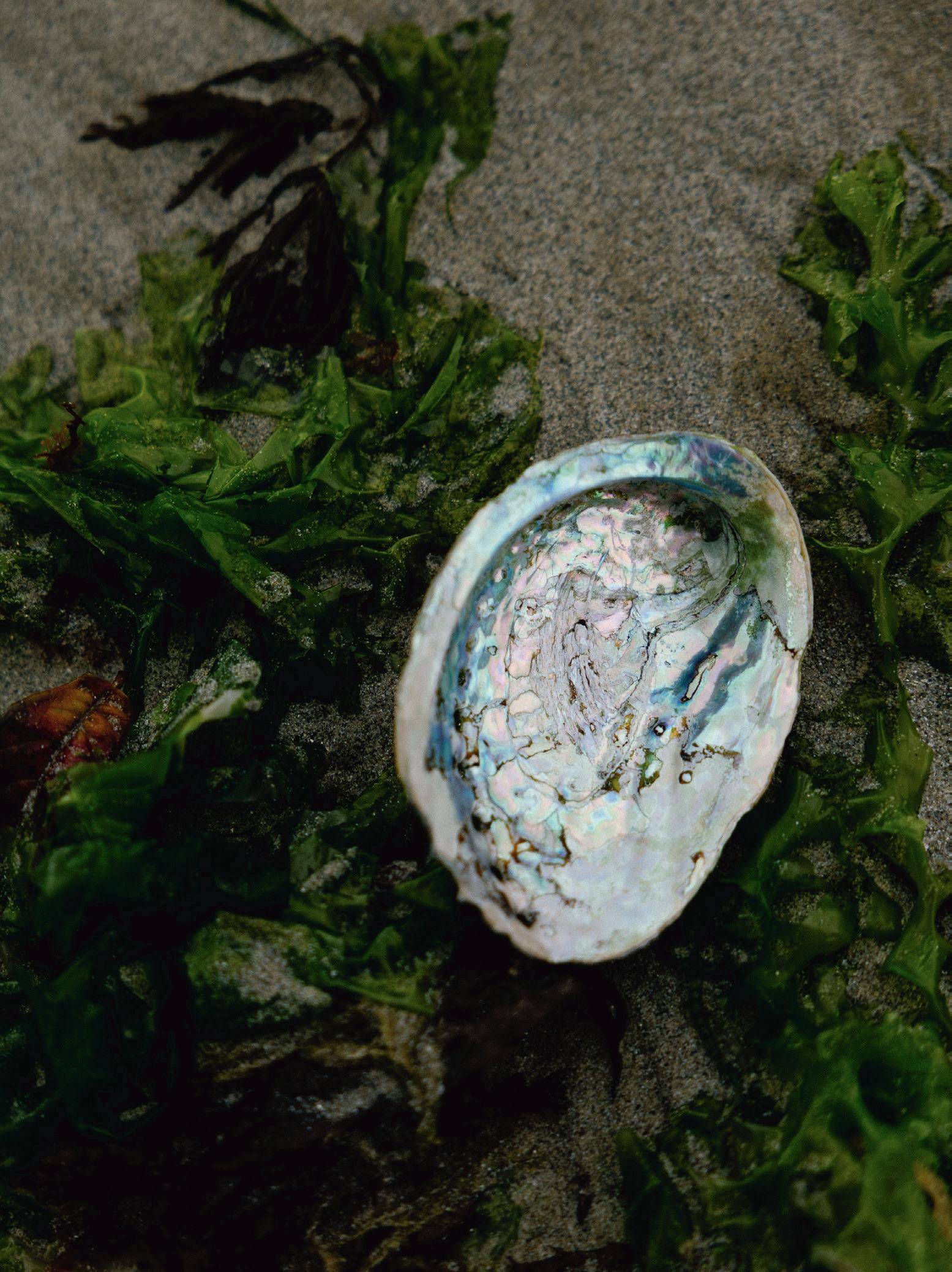
On the untamed shores of one of Aotearoa New Zealand’s remotest points, a windswept adventure celebrates nature’s awe.
Story by Jacqui Gibson Photography by Kelly Shakespeare
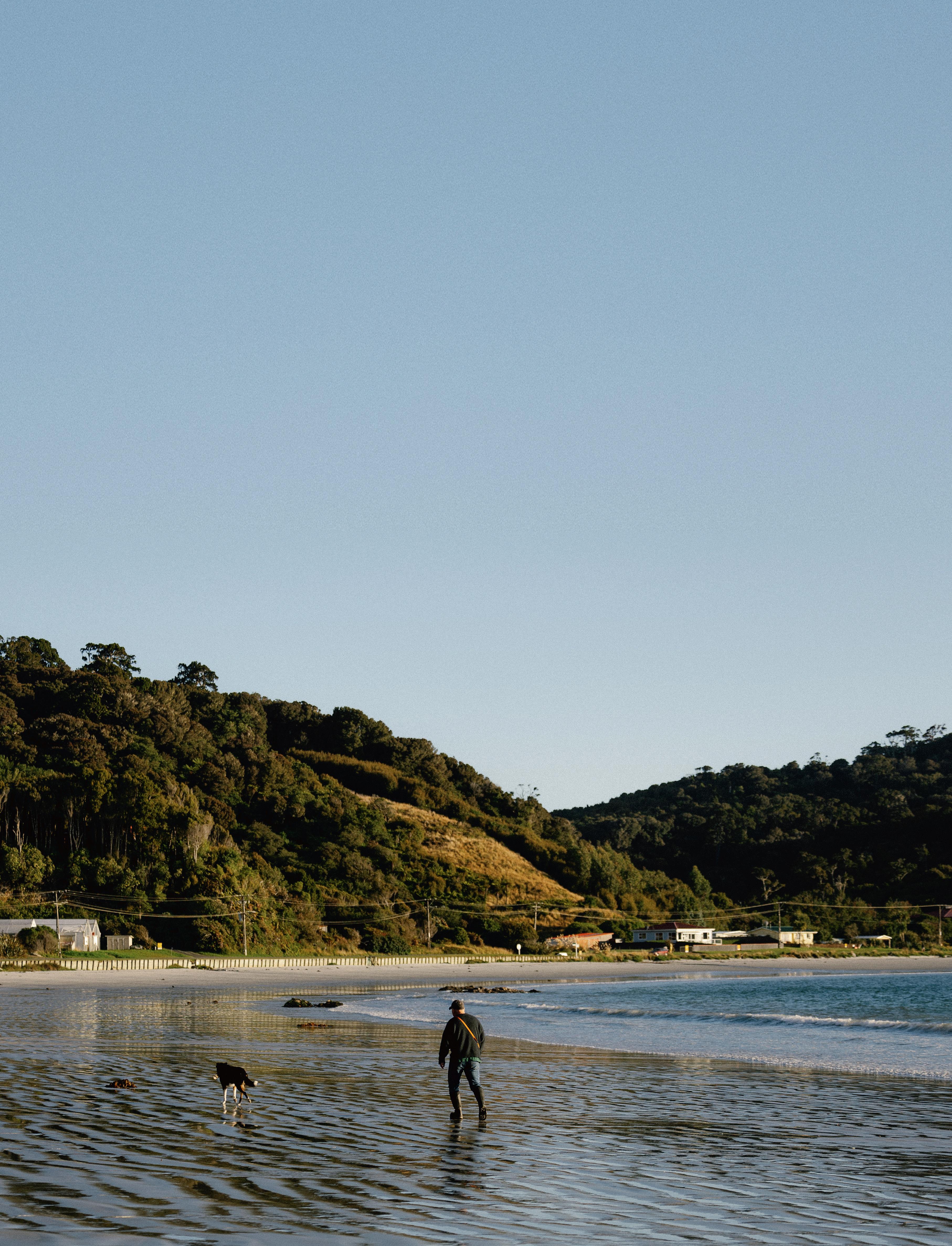
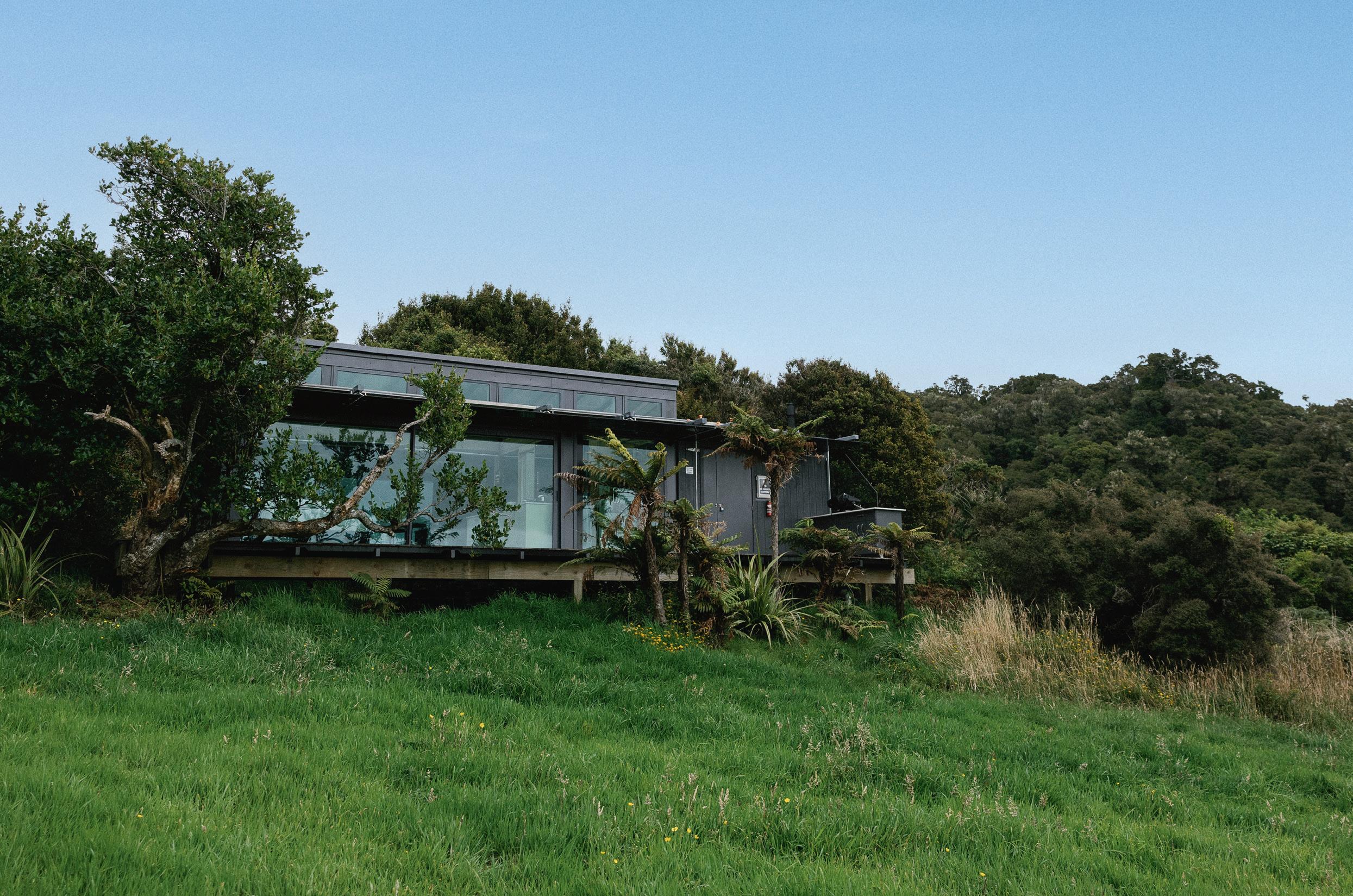
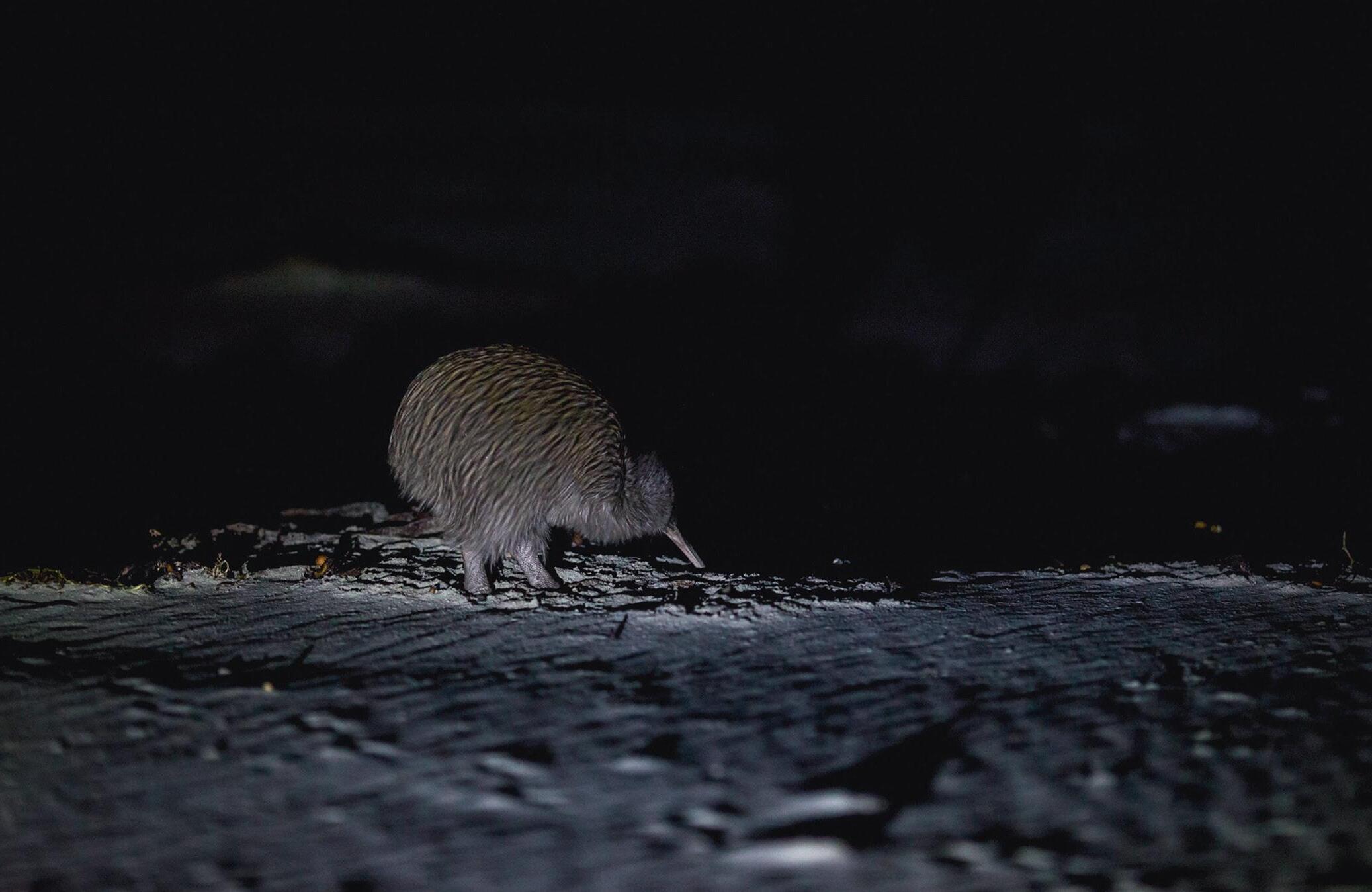

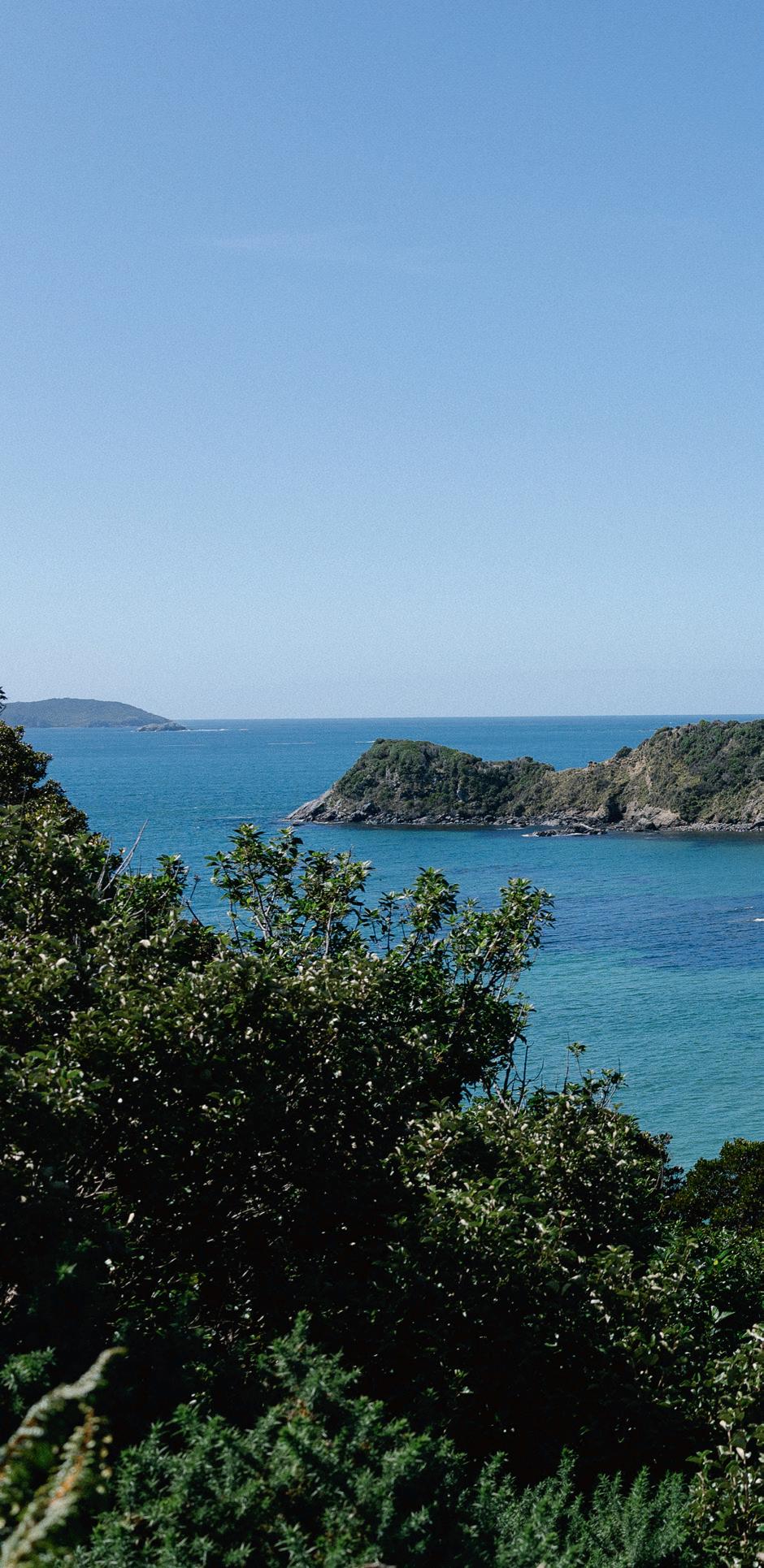
“Can you hear that rustling?” whispers guide Emma Jenkinson, as we trek through two square kilometres of coastal reserve surrounded by a predator-proof fence at Mamaku Point, on the northeast tip of Stewart Island/Rakiura. The sixth-generation islander and nature guide from Ulva’s Guided Walks (ulva. co.nz) keeps her voice low as she shines kiwi-friendly red torchlight on a thicket of twitching grass. The spring air is chilly enough to wear jackets and beanies.
I shadow Jenkinson’s careful movements in excited anticipation. “Look,” she says as the pear-shaped creature strides into the light. “There she is.” It’s a fully grown female kiwi,
almost knee height, and Jenkinson reckons she’s about three kilograms. “Because it’s breeding season, it’s possible she’s carrying an egg.”
The chance to see kiwi, like this ghostly feathered figure, in a biodiversity hotspot for native birds and marine animals is the reason I’ve travelled to New Zealand’s third largest island, south of Queenstown and right in the path of the fierce Roaring Forties winds. To get here, I overnighted in Invercargill –the southernmost and westernmost city in the country – and caught the ferry across the Foveaux Strait from Bluff.
Stewart Island/Rakiura is wedgeshaped – 1746 square kilometres of
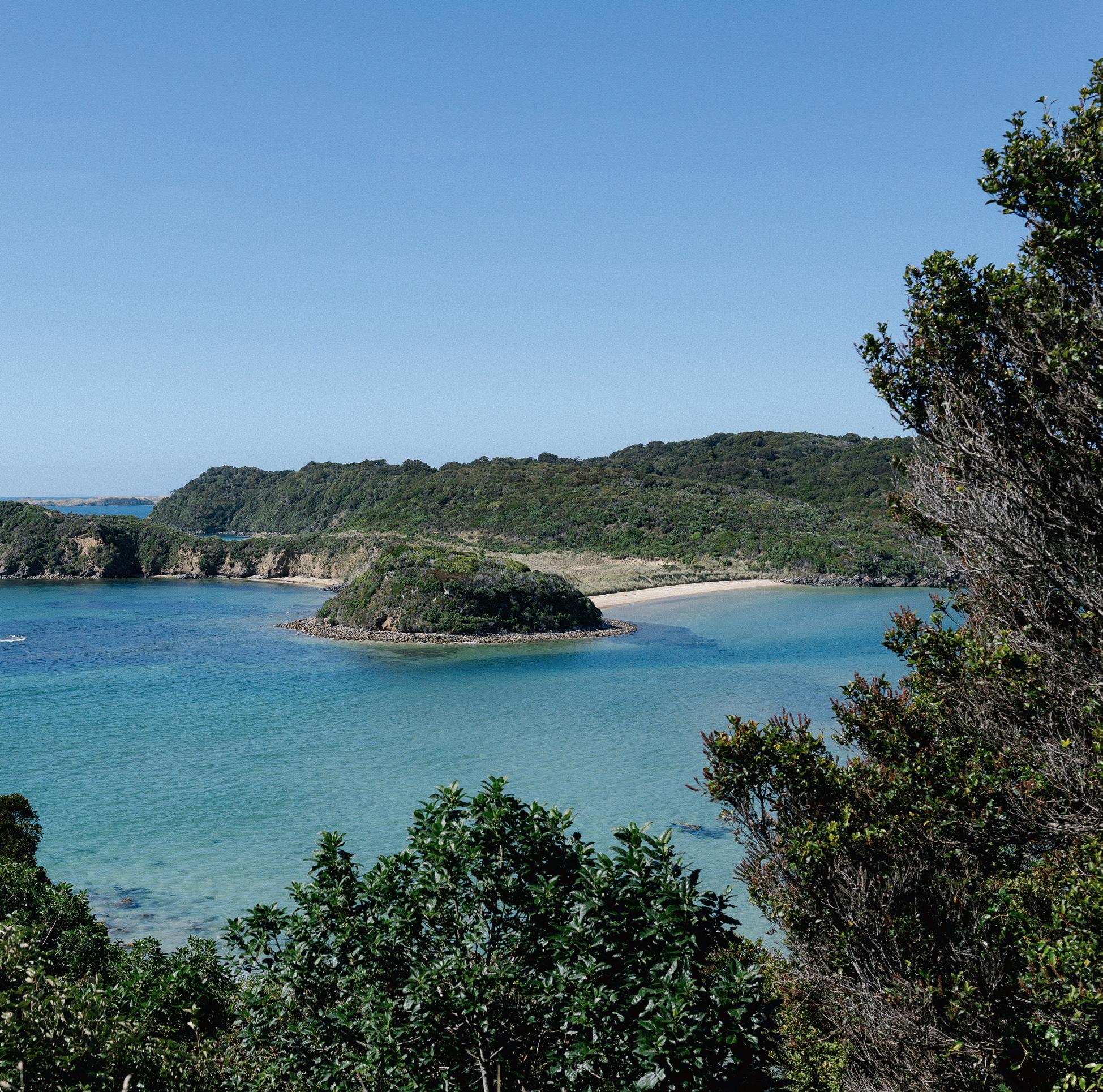
bush-clad hills, salt-licked inlets, windswept dunes, brackish swamps and edgy granite outcrops. And it’s the land of the kiwi. I’m told the estimated kiwi population outnumbers the 500-or-so human residents by a ratio of 30:1. The flightless bird faces fewer predators here compared to the mainland (notably absent are stoats and ferrets), though it’s still vulnerable to cats, rats and possums. And while the headland at Mamaku is a safe haven and nesting ground for the endangered southern brown kiwi, this elusive national icon turns up in the most unexpected places. “There were two at the golf course last night,” says local stargazing guide Alasdair Burns.
I’m on a three-night kiwi-spotting, nature-exploring, stargazing expedition – Stewart Island/Rakiura was accredited as an International Dark Sky Sanctuary in 2019 – and staying at Tokoeka PurePod (purepods.com), a glass cabin within the Mamaku Point Conservation Reserve. As well as kiwi, the reserve is home to mature podocarp forest and wildlife such as yellow-eyed penguins, smalleared skinks and long-tailed bats.
The two PurePod bungalows help fund kiwi conservation on the headland (along with community grants and donations) and are the furthest south of the collection of New Zealand off-grid boltholes. Each sleek modern space
features floor-to-ceiling glass walls, a glass roof and complete privacy. You can bring supplies with you or order a breakfast and dinner hamper (the chef’s steak and salad is recommended). Travellers can cycle, walk or catch a taxi to the reserve entry then it’s just a short stroll to the cabin.
There’s something other-worldly about watching for rare birds in a Dark Sky Sanctuary from the comfort of your king-sized bed. Late at night, I peer through the walls, focusing on the lawns outside, but find myself constantly distracted by the views of the moonlit ocean beyond and the luminous galaxies unfurling overhead.
On the eastern coast of the island lies Halfmoon Bay and the small town of Oban, about four kilometres from my stay. It’s where the twice-daily ferry from Bluff docks and the 28-kilometre road network begins. And it’s the location of the waterfront South Sea Hotel (southsea hotel.co.nz), where I dine on blue cod and chips. The rest of the isle is wilderness.
“How’s your wildlife spotting going?” asks Greg Everest of Aurora Cab Co. (auroracabco.co.nz) when he picks me up in the morning. Five kiwi and one ruru (morepork owl) on my hike with Jenkinson, I tell him, and little blue penguins in Halfmoon Bay. More is still to come: tiny forest birds, native parrots and seabirds on a gentle half-day guided walk of Ulva Island, another wildlife sanctuary a short boat ride from Golden Bay. And on RealNZ’s newly launched guided tour of Oneke (The Neck; realnz. com), I walk past sea lions on Lowrys Beach and learn more about Stewart Island/Rakiura’s human history.
Before sealing and whaling took off in the early 1800s, the island was known by Ngāi Tahu, the main Māori
iwi (tribe), as Rakiura (Land of the Glowing Skies) to honour the aurora australis. Later, it was named Stewart Island after Scottish sealer Captain William W. Stewart but since 1998, it’s been known as Stewart Island/Rakiura as part of the iwi’s Waitangi Tribunal treaty settlement.
During my stay, I mentally plan a return trip so that I can tackle the 32-kilometre Rakiura Track, one of New Zealand’s 11 Great Walks, and a tour of the night sky with Burns and his partner, Jennifer Ross, who run Twinkle Dark Sky Tours (fb.com/ twinkledarkskytours). The couple use a portable telescope and have a knack for spotting the Southern Lights. “Last night’s aurora was a blue haze,” says Burns. “Sometimes there’s a pink tinge and at their strongest and most exciting, you’ll see the lights move across the sky.” Yet, as I step onto Gravity, a fishing boat docked at Main Wharf, I’m relishing the chance to see the white-sand inlets and steep rocky headlands of this island from another viewpoint – the water.
It’s a morning of gentle breezes and constant sunshine in a soaring blue sky and third-generation Ngāi Tahu fisher Nate Smith and guest chef Amber Rose are my hosts on a hook-to-plate trip with Gravity Fishing (gravityfishing. co.nz). The experience has been designed to give guests an understanding of kaitiakitanga (guardianship) of the ocean by diving for, humanely dispatching and eating local seafood, taking only as much as we need. On the menu for later, providing all goes to plan, will be line-caught blue cod and handpicked crayfish and pāua (abalone).
“Let’s start by getting you kitted out for a dive,” says Smith, setting anchor and handing me a wetsuit, snorkel and flippers. Foraging for pāua in crystal-clear water, it’s a thrilling realm of swishing kelp and rocks dotted with vivid anemones and starfish. Suddenly, my heart bolts. I look beneath me and there – as agile as my feelings are at this moment – is the unmistakable shape of a metre-long sea lion. I’m here, at the bottom of the world, exhilarated and living wild.

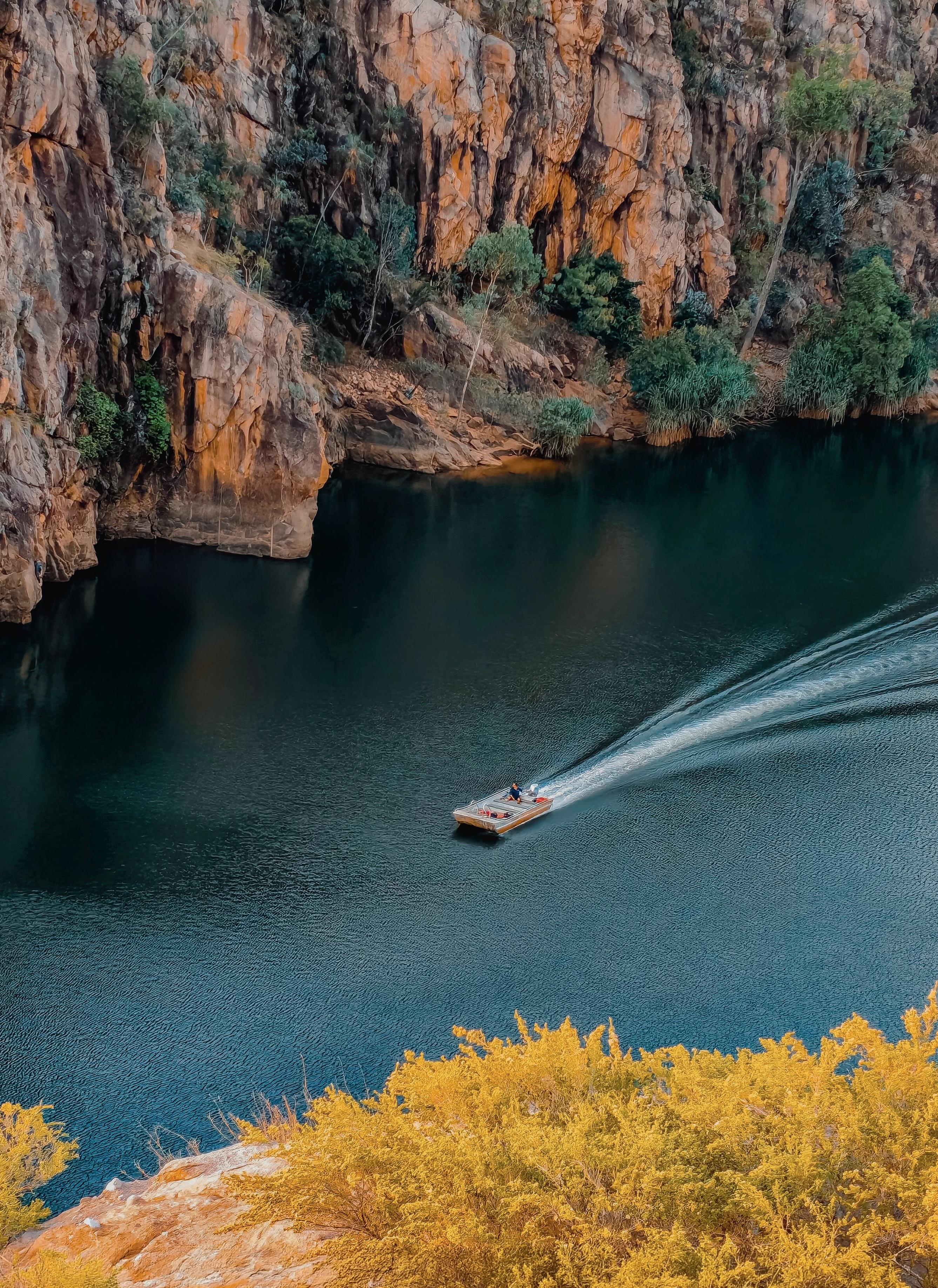
The Northern Territory is Australia at its most unfiltered, shaped by dramatic seasonal change and open landscapes. In 2026, with a line-up of experiences and festivals, the Territory is offering exciting new ways to connect with the world’s oldest living cultures and explore this extraordinary region.
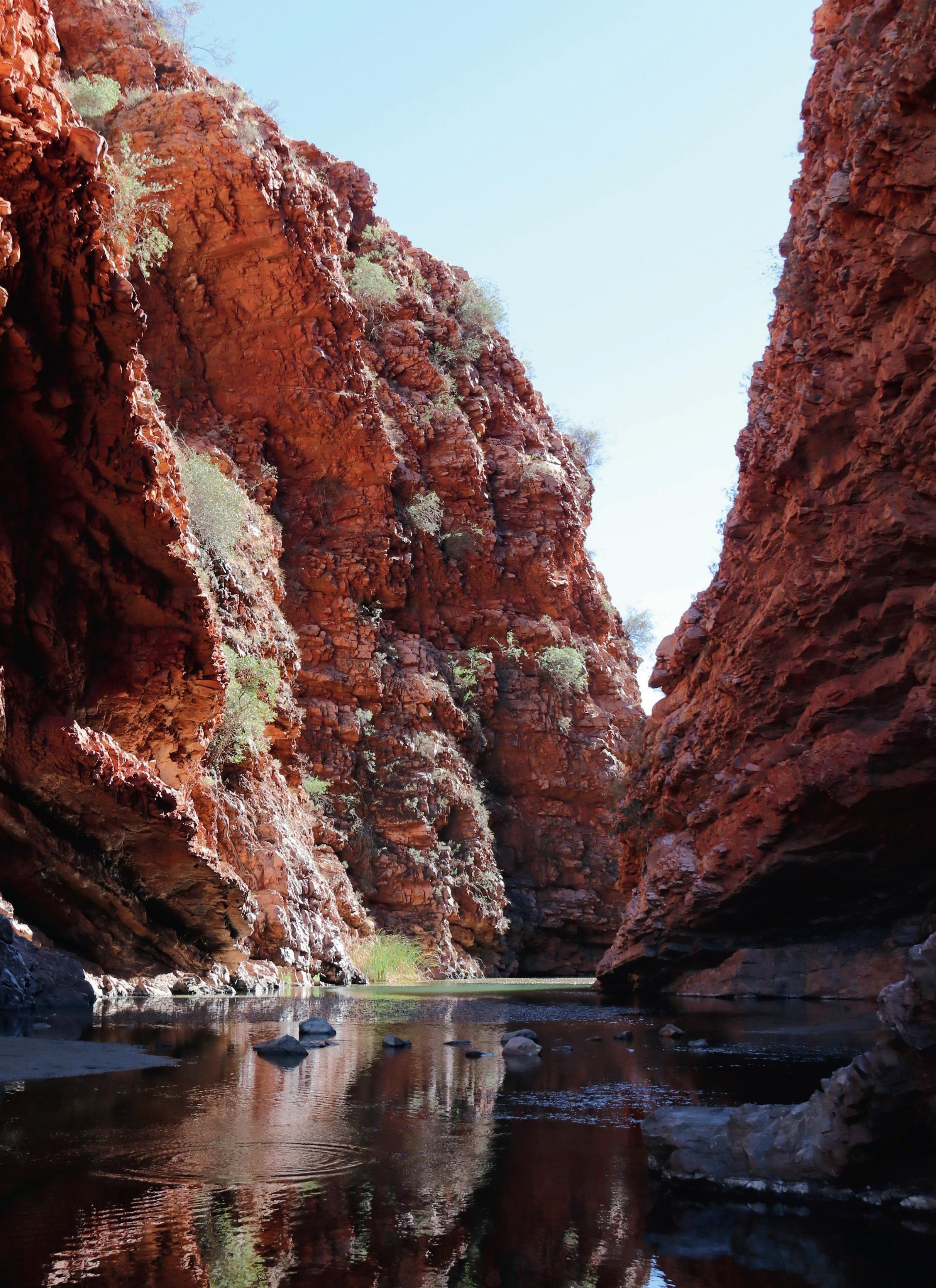
In an age of constant connectivity, Australia’s Red Centre encourages visitors to slow down and explore a land that is both legendary in scale and deeply spiritual. Visitors can now experience Uluru like never before on a new multi-day guided trek.
Every morning the rising sun transforms Australia’s most recognisable icon from deep purple to a brilliant burnt orange. For thousands of years, Uluru (right) has been a site of shelter, sustenance and profound spiritual importance for the Anangu people, whose stories are embedded in every riverbed and ridgeline of the desert. There’s good reason why Uluru has been named one of Condé Nast Traveler’s ‘Best Places to Go in 2026’.
Between May and September, mild, cloud-free days give way to crisp desert evenings. In the warmer months, from October to April, visitors enjoy less crowded vistas and occasional summer storms that send ephemeral waterfalls cascading down Uluru’s cracks and gullies.
In the still before dawn, Sunrise Journeys (ayersrockresort.com.au) warms guests with mugs of hot tea as they watch the desert floor illuminate with projections of Anangu artworks. Then, as cool evening winds blow across the red sand, Wintjiri Wiru (ayersrockresort.com.au/wintjiri-wiru) recreates important Creation Stories using lasers and 1200 choreographed drones, accompanied by Pitjantjatjara chants and clapsticks. Across the desert to the west, the weathered red domes of Kata Tjuta rise over spinifex-studded dunes like ancient sentinels sheltering a hidden world of gnarled desert oaks, bloodwoods and delicate wildflowers. Traverse between Kata Tjuta and Uluru on a new five-day, 54-kilometre Signature Walk (auswalkingco.com.au), featured among National Geographic’s ‘Best of the World 2026’. Three-day tours with Emu Run (emurun. com.au) also visit both rock sites before continuing to Watarrka / Kings Canyon, where the six-kilometre Rim Walk follows the edge of a 100-metre cliff to a shaded oasis with
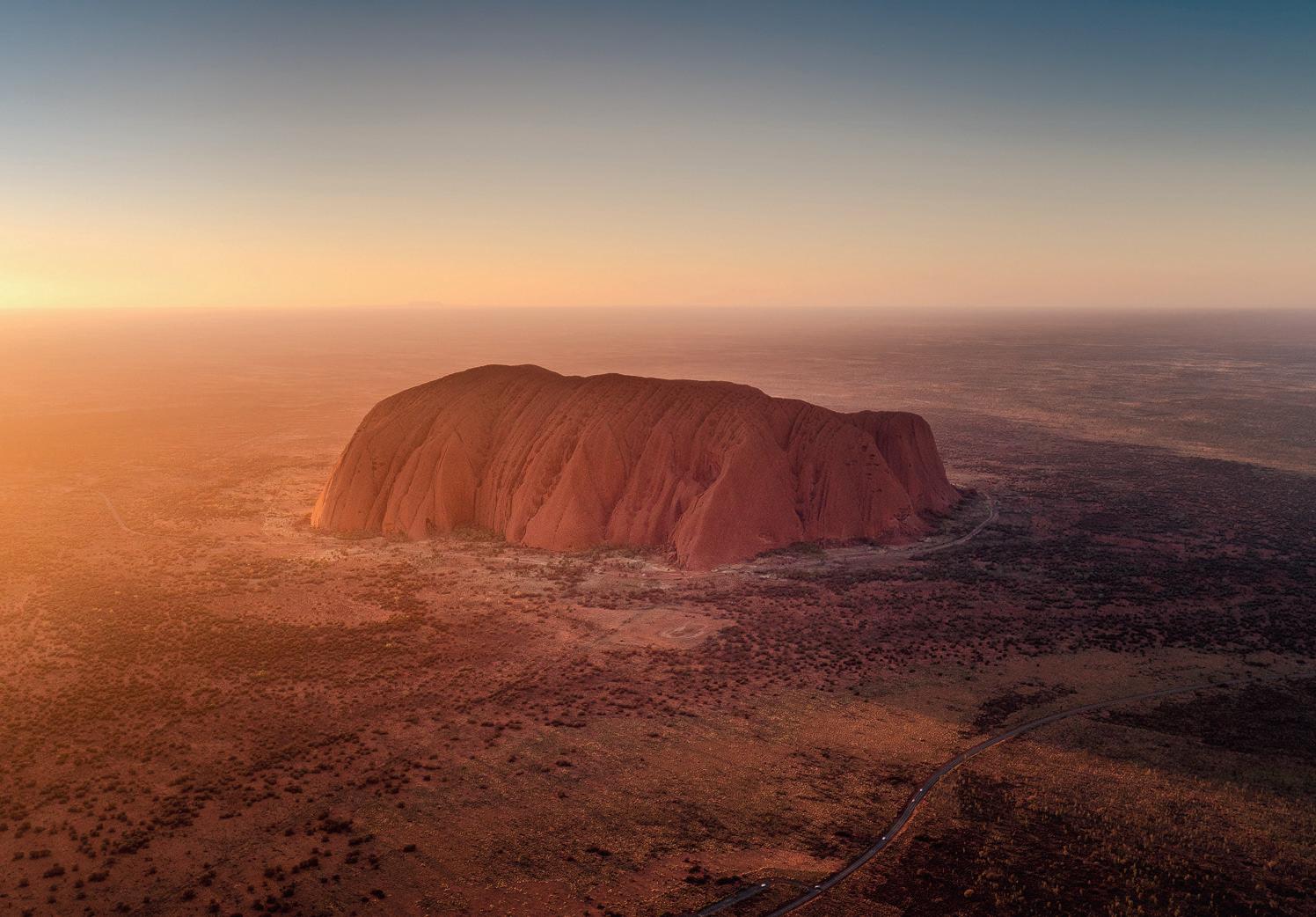
a permanent waterhole. In the evenings, Bruce Munro’s Light Towers installation at Discovery Resorts – Kings Canyon, illuminates the surrounding landscape.
Further west, Intrepid’s (intrepidtravel. com/au) six-day Larapinta Trail Trek is led by First Nations guides. The experience combines highlights of the 230-kilometre trail with stories of how remote mountaintops, gorges and waterholes were shaped by ancestral spirits.
In Mparntwe / Alice Springs, similar traditions are shared every April at Parrtjima (bottom right; parrtjimaaustralia.com.au), which transforms the 300-million-year-old Tjoritja / MacDonnell Ranges into an open-air gallery featuring light works, musical performances and cultural workshops.
Discover artworks from top Aboriginal artists across a diverse range of styles and traditions at Yubu Napa gallery (yubunapa.com). At the nearby Araluen Cultural Precinct, Araluen Arts Centre (araluenartscentre.nt.gov.au) hosts regular
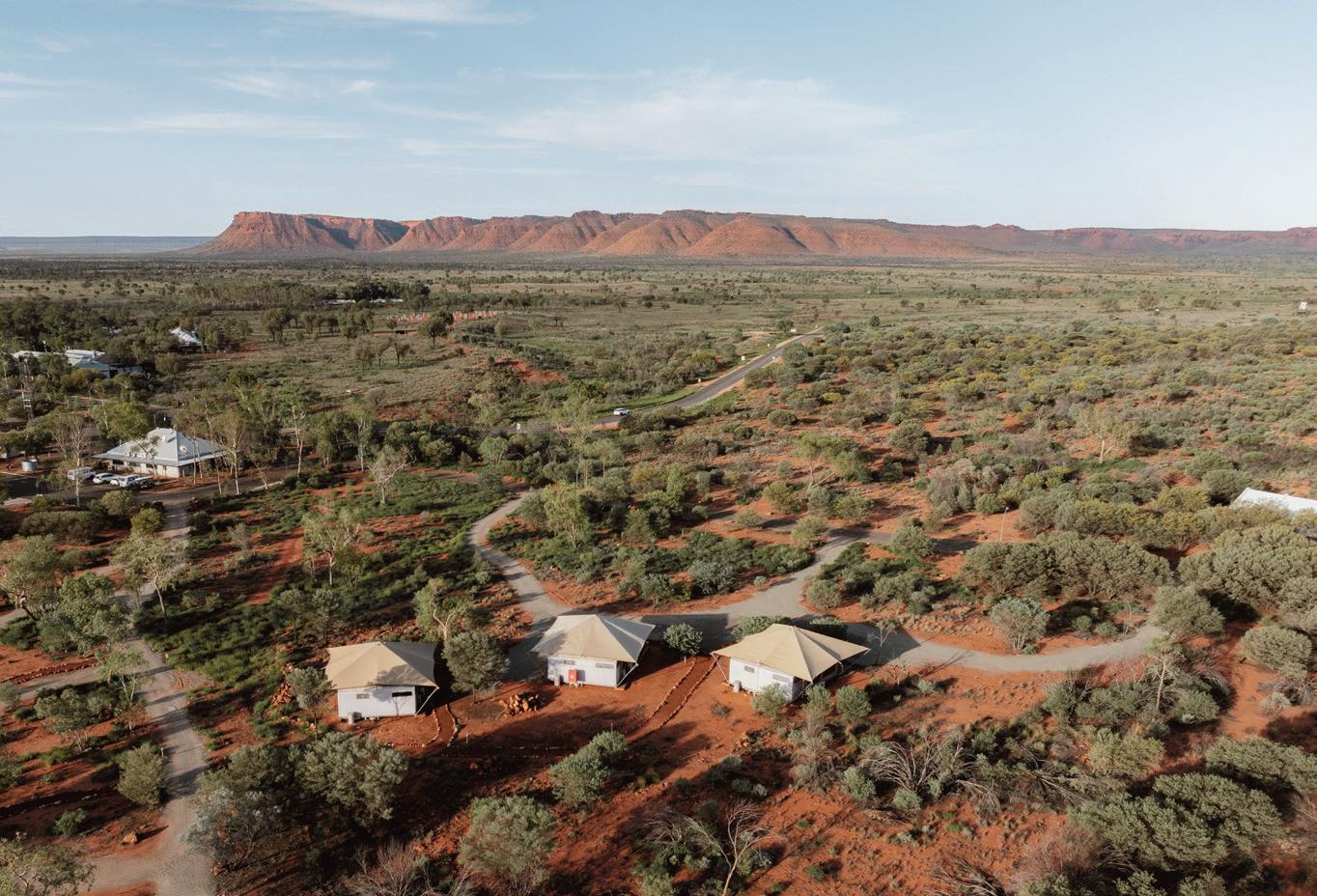
exhibitions, such as Desert Mob (desertmob. com), which celebrates local culture with an annual art show, artist talks and a marketplace from mid-September to late October.
Just 20 kilometres from Uluru, Sails In The Desert (qantas.com/hotels/sailsinthedesert) features an inviting pool and Anangu art.
Stay in the heart of the Red Centre at Crowne Plaza Alice Springs Lasseters (qantas.com/ hotels/crowneplazaalicespringslasseters).
Camp, caravan, glamp or relax in a resort room at Discovery Resorts – Kings Canyon (bottom left; qantas.com/hotels/kingscanyonresort).
Qantas flies direct to Uluru / Ayers Rock from Sydney and Cairns.
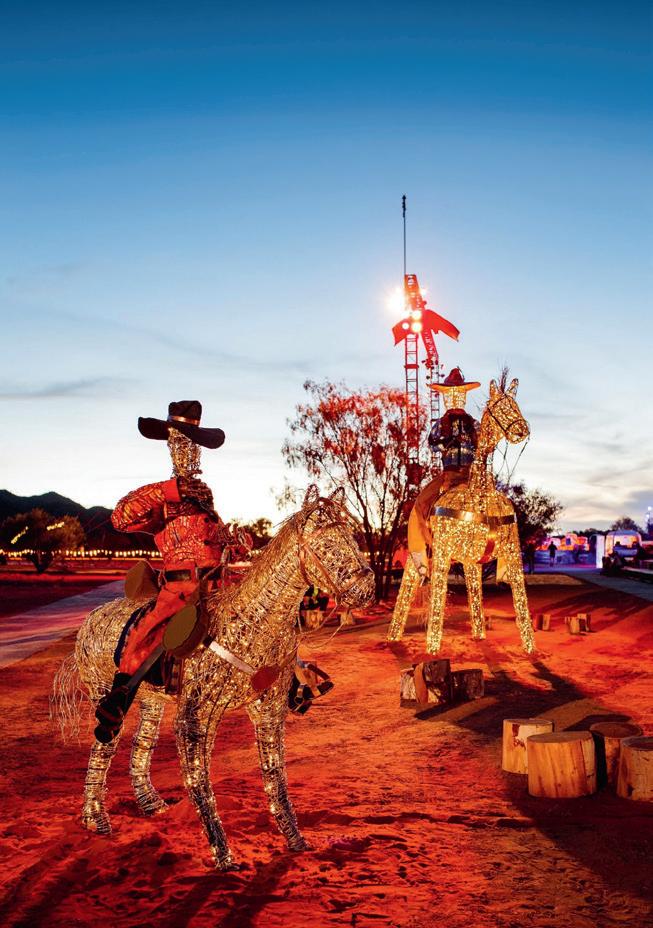
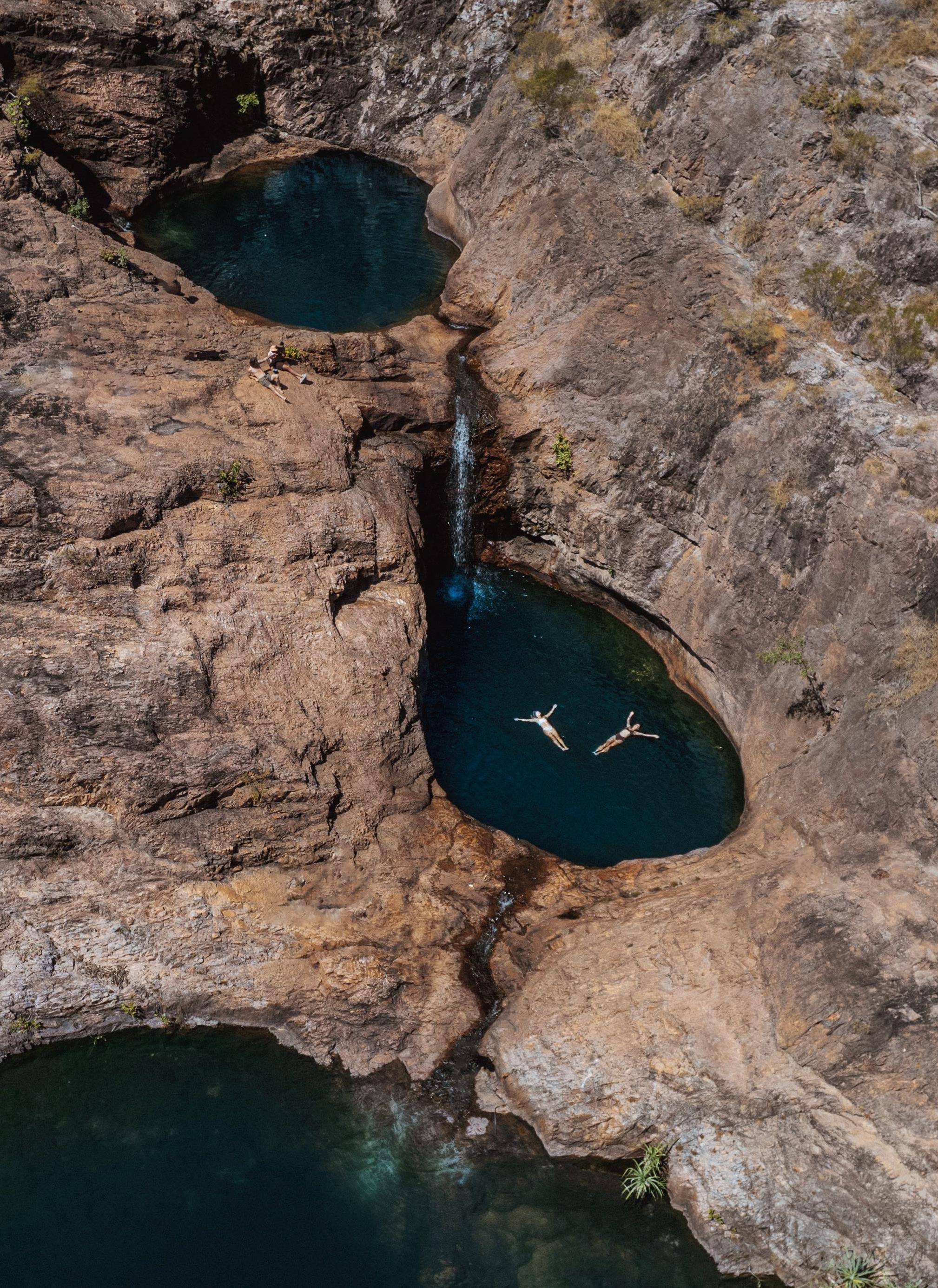
TOP END
Nature and culture collide as water cascades down rugged sandstone cliffs and stories passed down over generations are shared in the shifting ochre sands.
Top End travellers can enjoy the million-dollar views from natural infinity pools atop waterfalls.
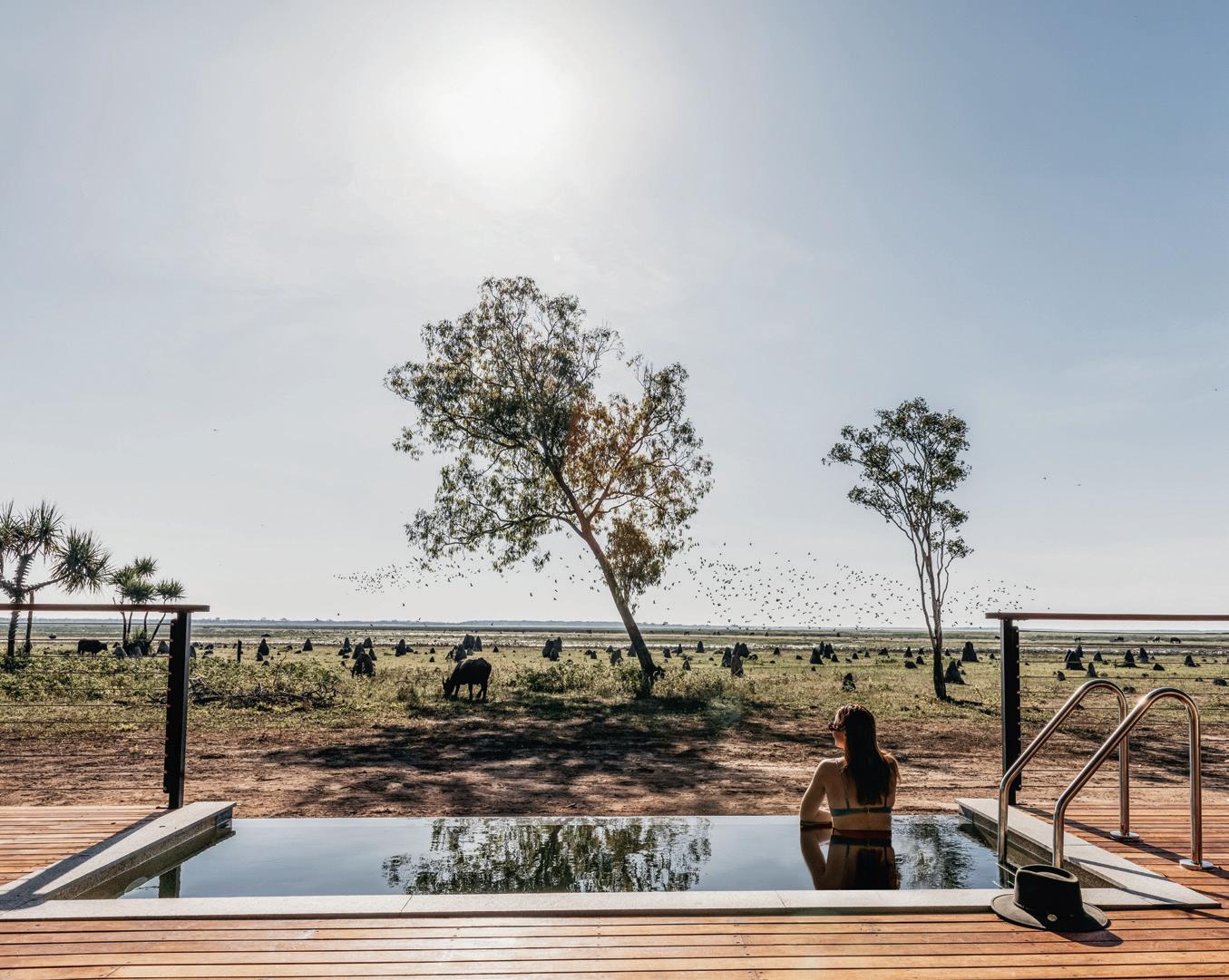
Australia’s Top End is a land of contrasts, where prehistoric rock art reveals an unbroken connection to Country and seasonal floods transform the landscape every wet season. Water also shapes how visitors experience the region, as monsoonal rains fill billabongs and turn waterfalls into raging torrents from October to April before receding to reveal an explosion of green. The colour then fades between May and September, when dry days push wildlife towards swimmable waterholes.
Nowhere captures this mix of natural beauty and cultural significance better than Kakadu National Park, where you’ll find solitary black wallaroos grazing on rocky outcrops, 25 different species of frogs and more than a third of Australia’s bird species. Beneath rugged sandstone ridges, more than 5000 rock art sites feature animals alongside ancestral creator beings.
Bininj guides from Yibekka Kakadu Tours (top right; yibekka.com.au) share the importance of these paintings, which represent more than 65,000 years of connection to Country. Animal Tracks (animaltracks.com.au) tours demonstrate how the park’s abundant flora and fauna continue to provide food, medicine and shelter, and culminate in a campfire dinner featuring foraged foods like snake, magpie goose and bush apple.
Across the park, billabongs offer blissful relief from the tropical heat of the dry season. At Maguk, butterflies and honeyeaters hover over a deliciously cool waterhole fringed by monsoon forest. Ninety minutes south, Kakadu’s famous tiered infinity pools above Gunlom Falls have been listed by The New York Times as one of the ‘52 places to go in 2026’. They’ve recently re-opened for visitors to take a dip.
Swimming is strictly off-limits at Ngurrungurrudjba / Yellow Water Billabong, where wildlife is abundant amid the wetlands. Spectacular sunrises and sunsets see the
area blush in infinite colour – best experienced with local guides from Yellow Water Cruises (kakadutourism.com).
In Nitmiluk National Park, the Katherine River winds between walls of sandstone through an impressive 13-gorge system. Nearby is a seasonal waterfall at Southern Rockhole and a series of crystal-clear rockpools above Leliyn / Edith Falls. Sunset cruises with Nitmiluk Tours (below; nitmiluktours.com.au) combine Jawoyn storytelling with canyon views and a candlelit three-course dinner. Fortyminutes south in Katherine, Dalabon Aboriginal Cultural Experience (dalabon.com.au) shares traditional skills, including spear throwing, didgeridoo playing and cultural storytelling.
Closer to Garramilla / Darwin, Northern Territory Indigenous Tours (ntitours.com.au) offers day tours of Litchfield National Park.
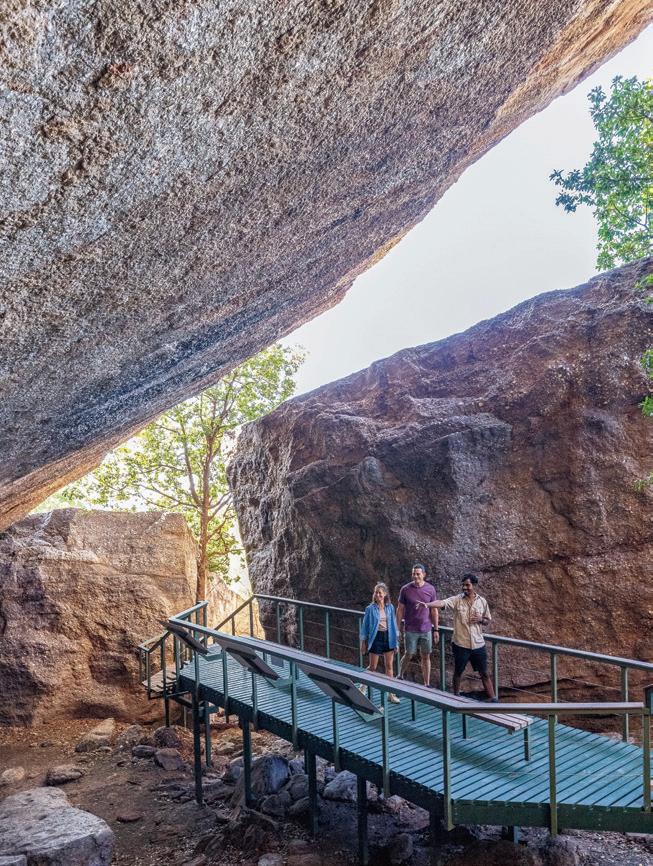
Bamurru Plains (top left; qantas.com/hotels/ bamurruplains), has safari-style bungalows overlooking floodplains inhabited by wildlife.
Cooinda Lodge (qantas.com/hotels/ cooindalodge) is located in the bush beside Ngurrungurrudjba / Yellow Water Billabong.
Nitmiluk’s Cicada Lodge (qantas.com/hotels/ cicadalodge) opens onto bushland filled with flying foxes and wallabies. Sample native dishes at the lodge’s in-house restaurant.
Qantas flies direct to Darwin from Sydney, Melbourne, Brisbane, Perth, Adelaide, Cairns and Alice Springs.
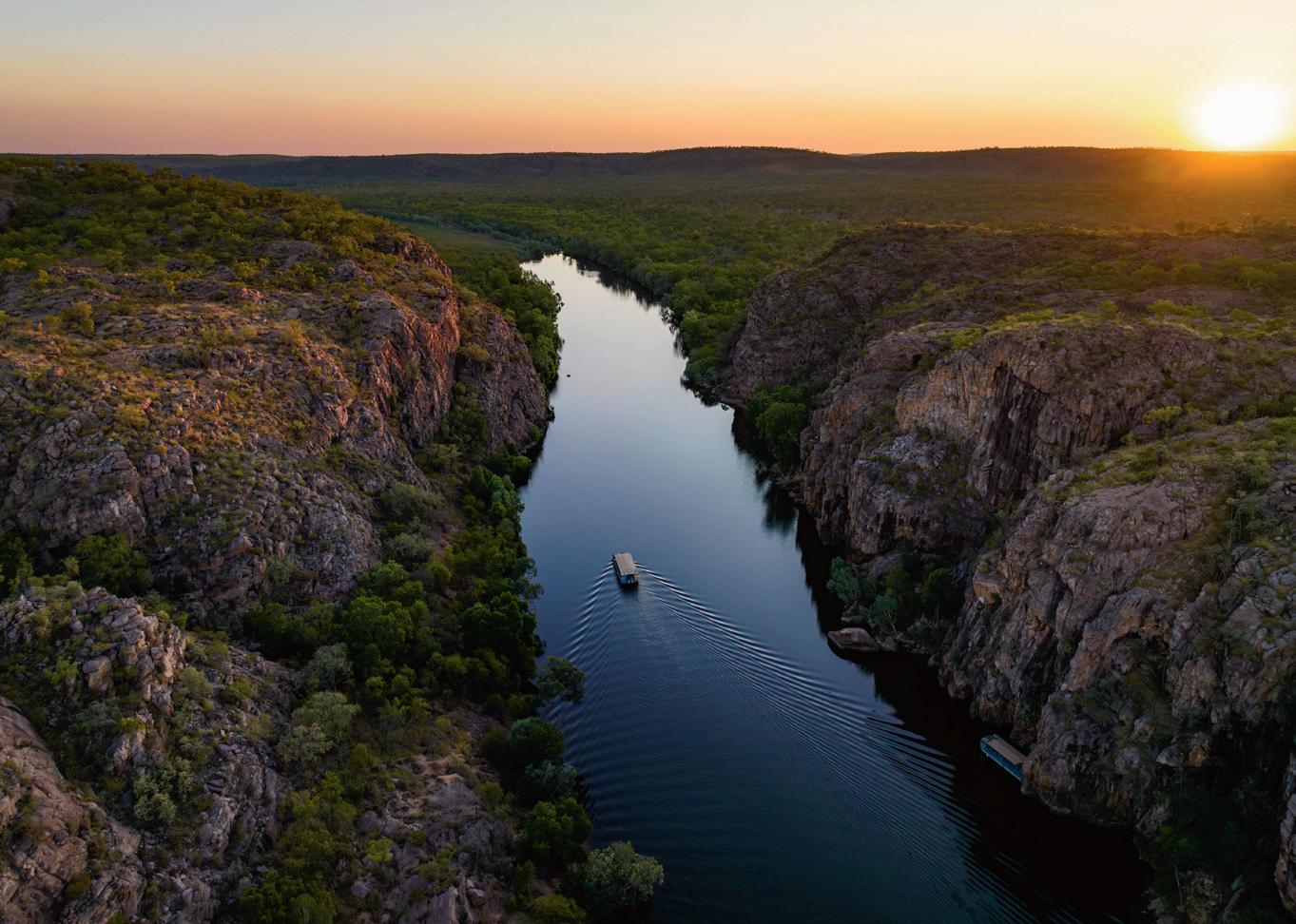
Darwin, the Northern Territory’s capital, is a multicultural hub. Sunny days and balmy nights from May to October coincide with a packed event calendar, while the months from November to April bring skies illuminated with light and fiery tropical sunsets.
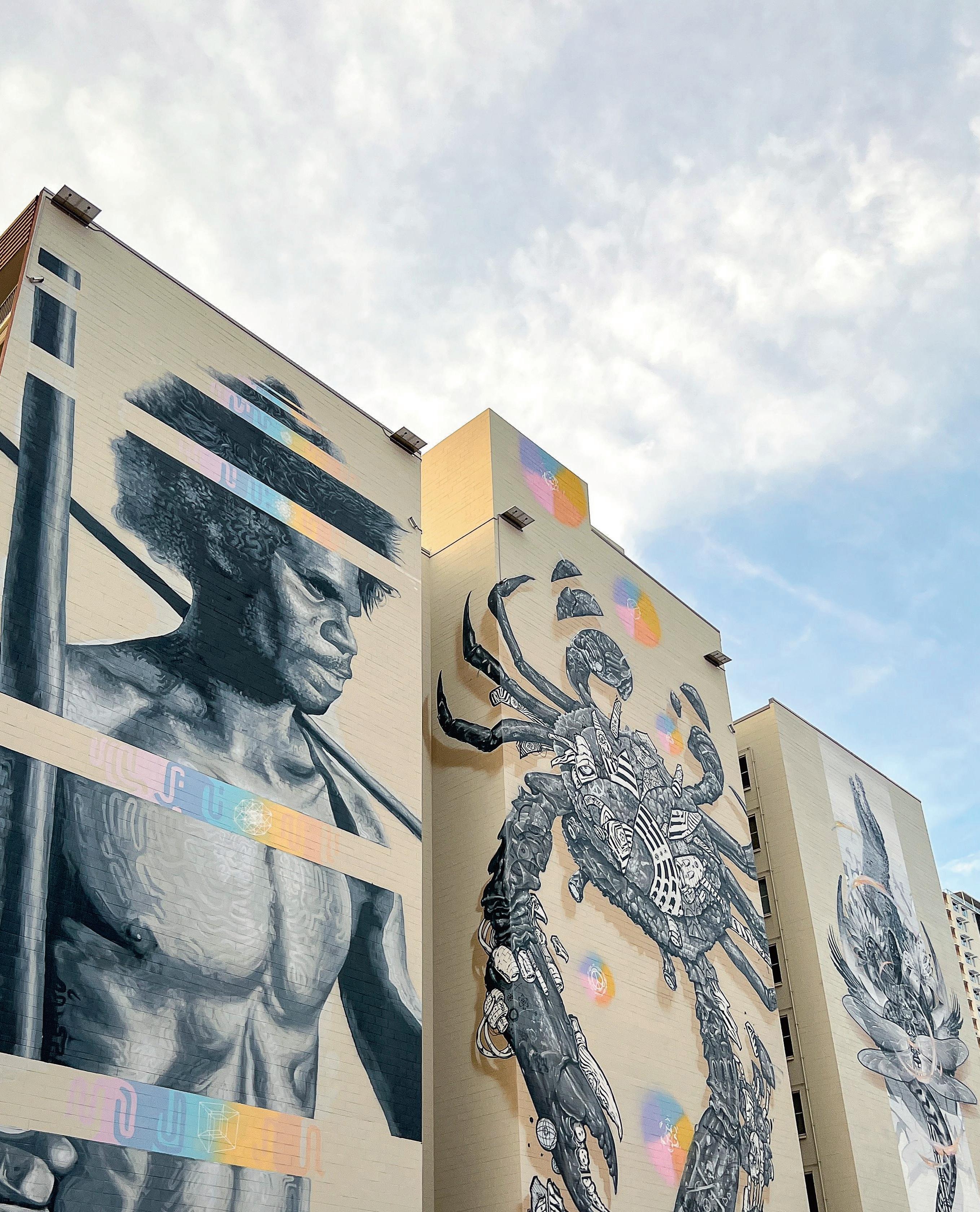
Darwin’s vibrant culture is on display yearround, especially through its food scene. From breakfast laksas and Singaporean-style coffee at Kopi Stop to Ella by Minoli’s (elladarwin. com.au) spice-laden modern Sri Lankan, which features curry leaf and cumin snapper with finger lime pearls and green chilli.
In the evenings, Charlie’s of Darwin (charliesofdarwin.com.au) pairs punchy Szechuan pepper crocodile dumplings with cocktails featuring green ants, torch ginger petals and bush tomatoes.
Darwin’s bustling markets offer a feast for all the senses and Rapid Creek Markets (rapidcreekmarkets.com.au) sees stalls piled high with electric-pink dragon fruit, giant banana flowers and aromatic
makrut lime leaves. Meanwhile, Parap Market (bottom left; parapvillage.com.au) dishes up fiery laksas and tropical fruit smoothies next to Laundry Gallery (below; laundrygallery. com.au), an Aboriginal-owned creative hub in a converted 1970s laundromat.
Most famous of all are the twice-weekly Mindil Beach Sunset Markets (mindil.com.au), where aromas from 60 food stalls mingles over street performers as crowds watch the glowing red sun sink below the Timor Sea. The city’s streets will come alive with colour for the Darwin Street Art Festival (opposite; darwinstreetartfestival.com.au), 22 May to 5 June, with 149 large-scale murals, painted by some of the most accomplished street artists in Australia and the world.
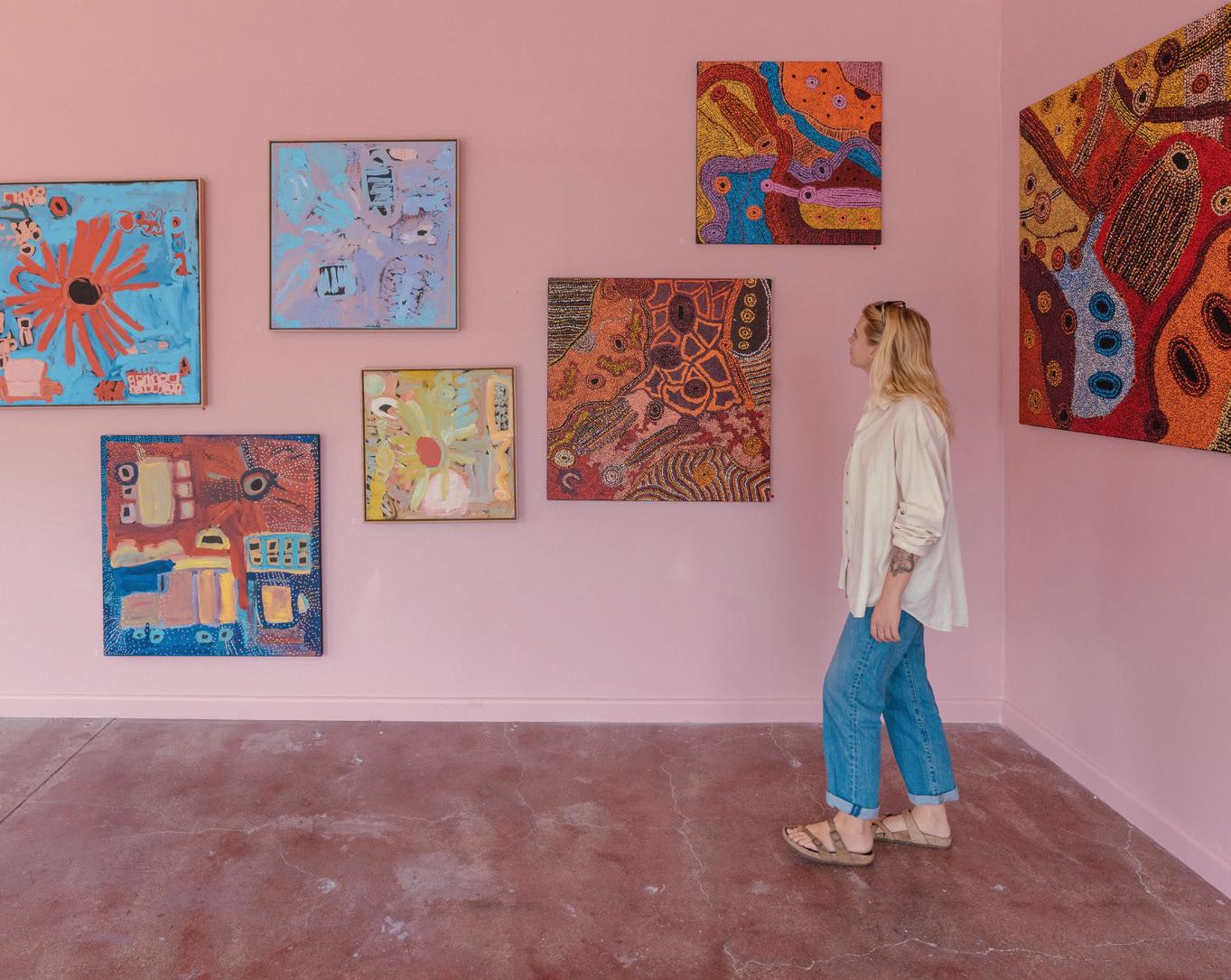
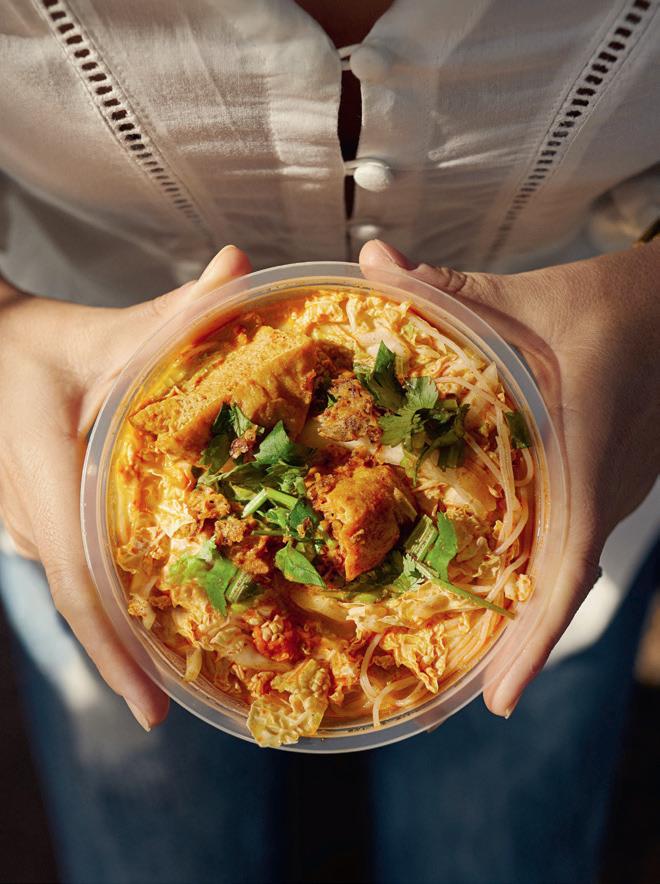
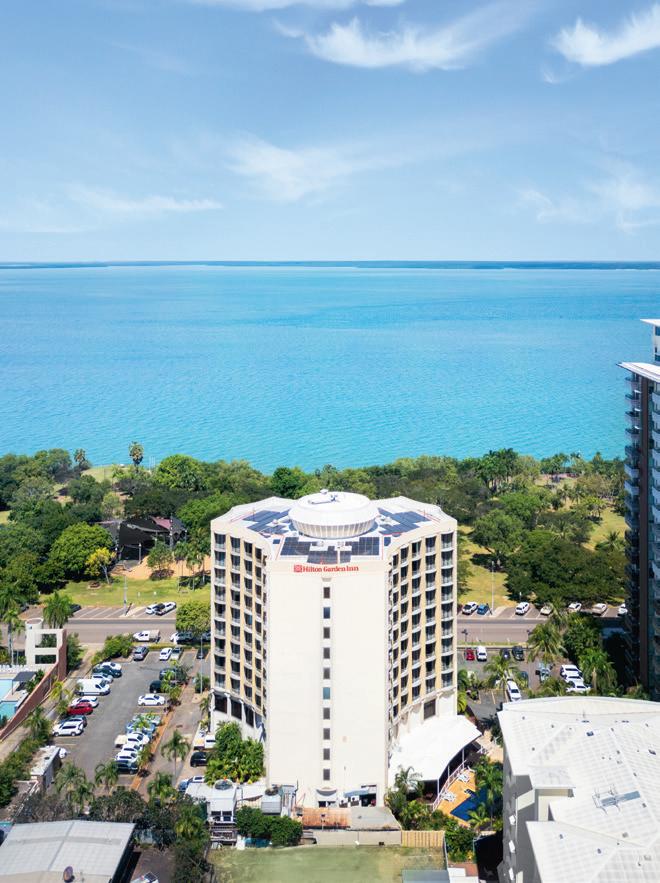
Hilton Garden Inn Darwin (bottom right; qantas.com/hotels/hiltondarwin) is on The Esplanade, with balcony rooms that look onto Darwin Harbour and Mitchell Street.
Steps from an inviting lagoon and beach, Adina Apartment Hotel Darwin Waterfront (qantas. com/hotels/adinaapartmenthoteldarwin) is near lively cocktail bars on the revitalised Darwin Waterfront, which beckons at sunset.
Qantas flies direct to Darwin from Sydney, Melbourne, Brisbane, Perth, Adelaide, Cairns and Alice Springs.
Darwin Festival
Every August, Festival Park transforms into a lantern-lit wonderland as open-air venues host theatre, music and cabaret from across the country. A strong international presence reflects Darwin’s multicultural identity, as does the scent of street food that lingers in the tropical air. After dark, pop-up nightclub Club Awi heats things up with high-energy DJ sets. (darwinfestival.org.au)
Darwin Aboriginal Art Fair
Coinciding with the start of the Darwin Festival, this event brings together more than 1500 artists representing 70 Indigenous-owned arts centres around the country. Part marketplace part cultural gathering, it showcases an array of artworks representing the breadth of First Nations culture in Australia. Visitors can meet the artists to learn about their creations and purchase handmade souvenirs. (daaf.com.au)
Darwin Laksa Festival
Darwinites take their laksa seriously and the most popular stalls inspire fierce loyalty. But ultimate bragging rights go to the winner of this innovative laksa festival, which takes place throughout October and sees restaurants across the city serving inventive creations. Those who can’t make it can visit Kopi Stop to see why their creamy, made-from-scratch broth won the coveted Golden Bowl in 2025. (darwinlaksafestival.com.au)
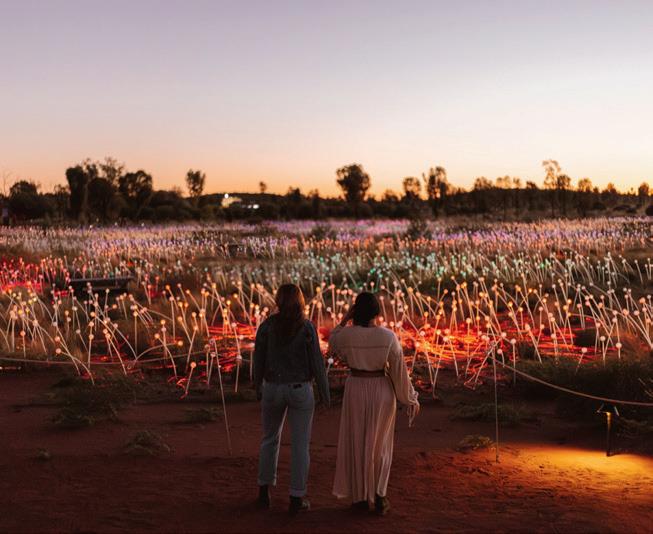
Field of Light, Uluru
Witness 50,000 glass bulbs light up the red sand in a now iconic desert light show.
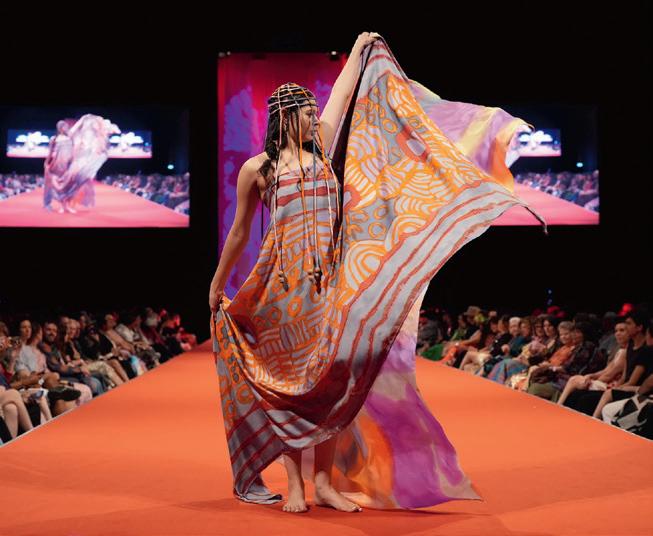
Country to Couture, Darwin
Observe colourful garments by Aboriginal designers on the runway this August.

FOR THE OUTDOOR ADVENTURER
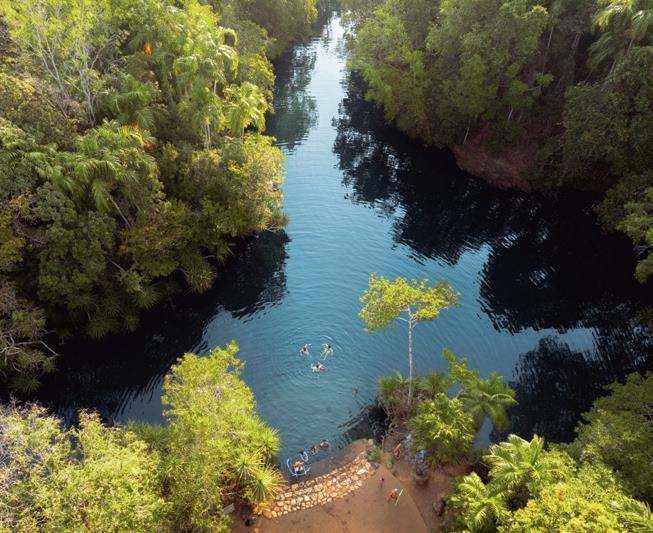
Berry Springs Nature Park
Swim in shady pools in the dry season, which are easy to access and great for snorkelling.
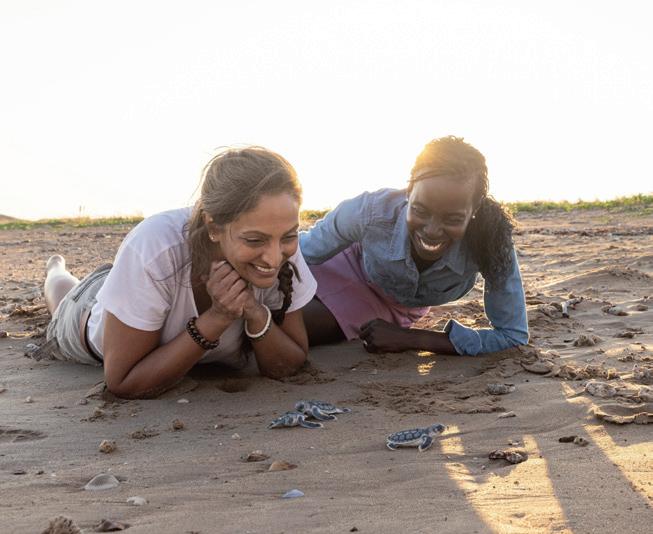
Take a boat ride from Darwin to visit Bare Sand Island’s
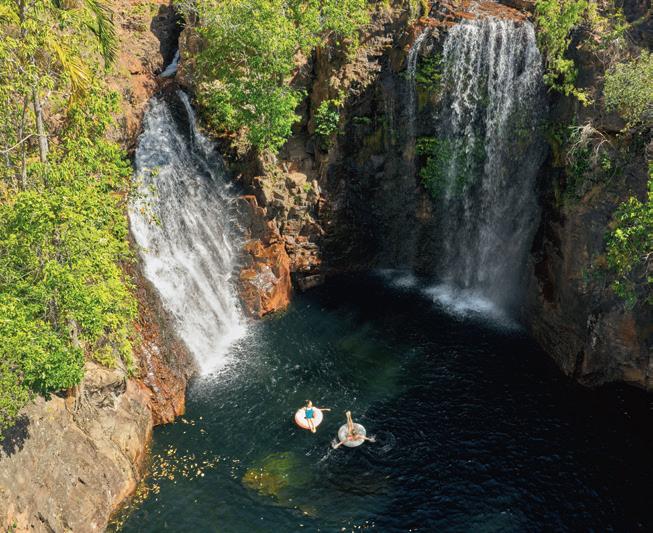
Plan your trip around your interests. Here’s a selection of diverse experiences to suit every kind of traveller.
FOR THE EVENT ENTHUSIAST
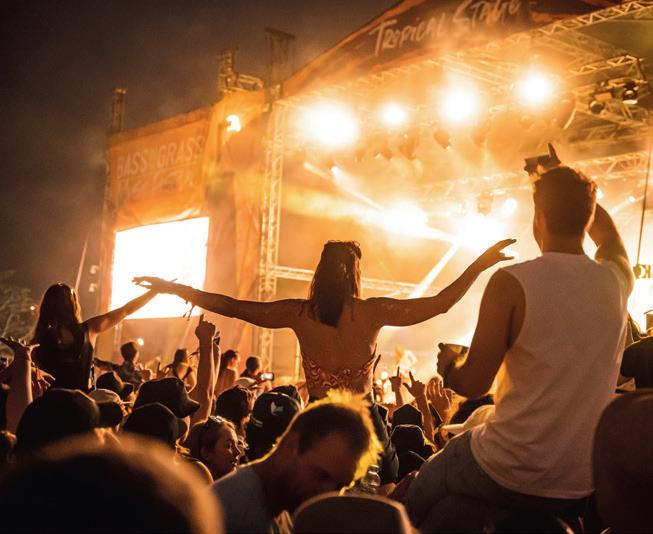
BASSINTHEGRASS
Dance to electronic, pop, indie and hip-hop at Darwin’s high-energy music festival each May.
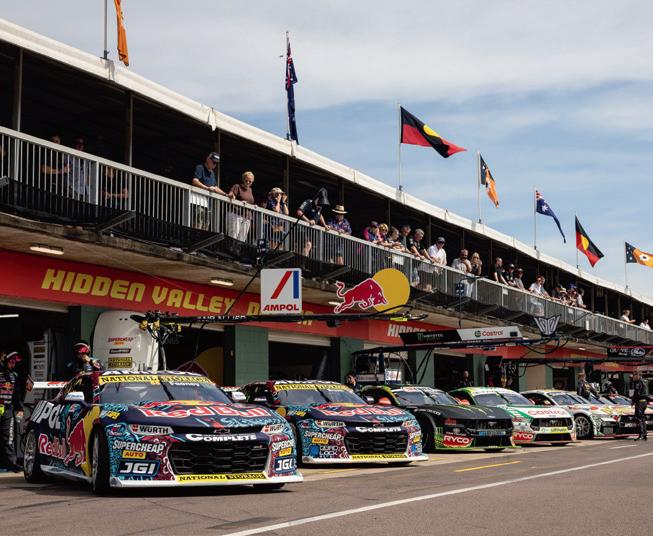
betr Darwin Triple Crown
Gear up for this annual three-day super car event in June at the Hidden Valley Raceway.
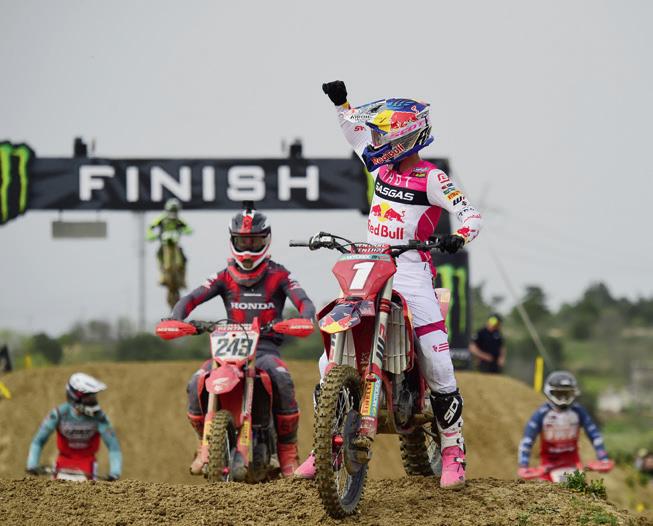
Watch the final round of the off-road
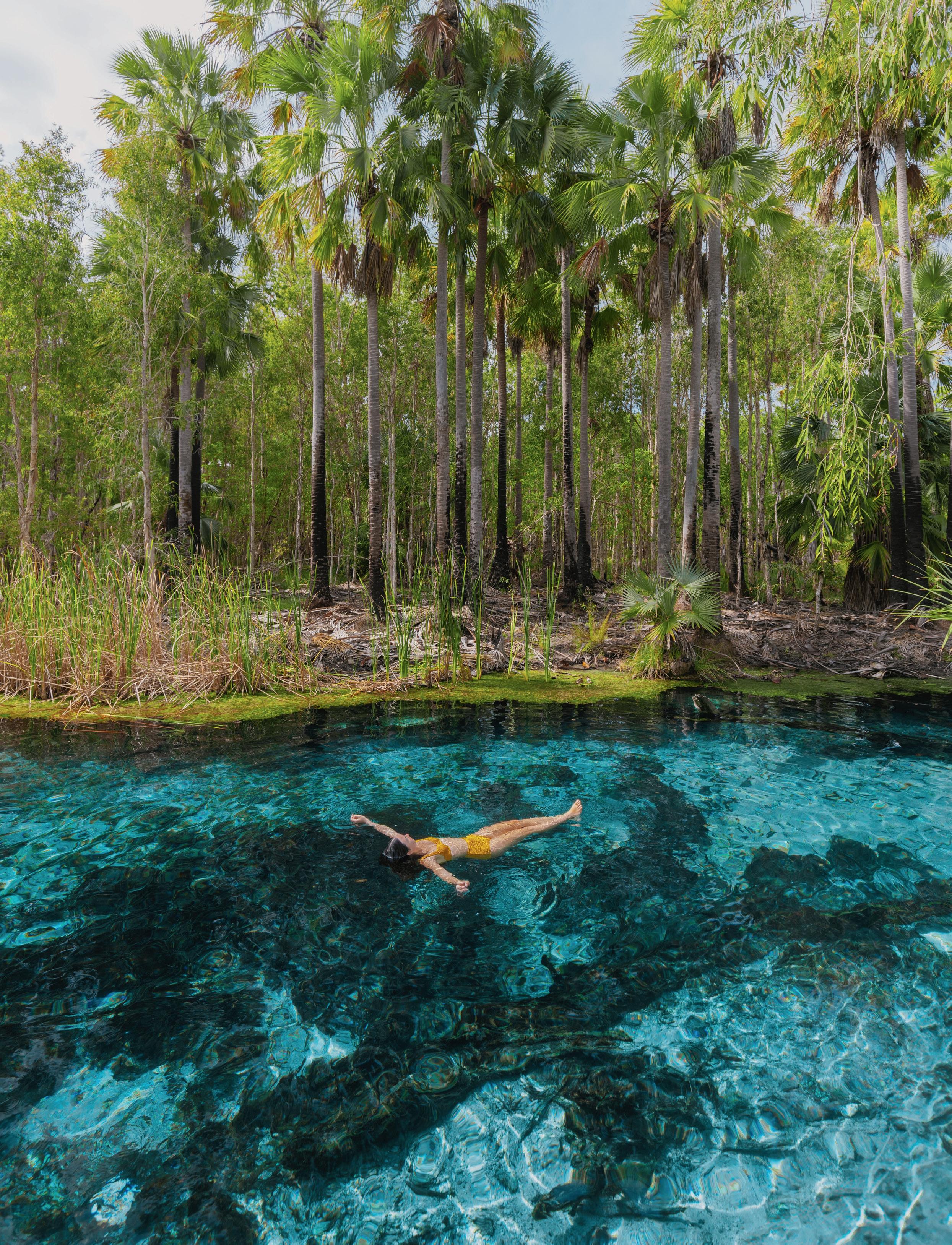

An immersive brain enhancement retreat in the lush forests
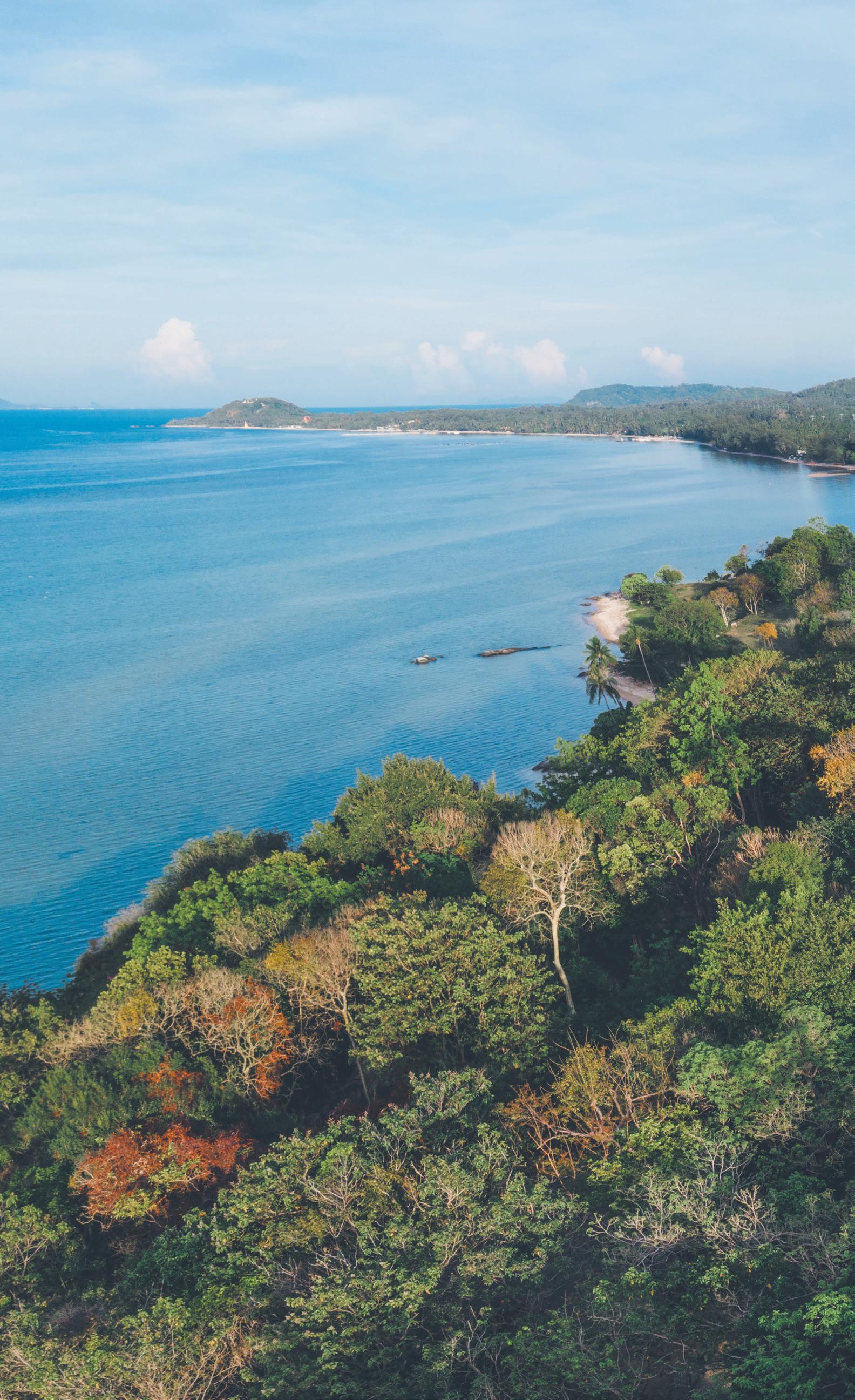
Story by Alice Jeffery
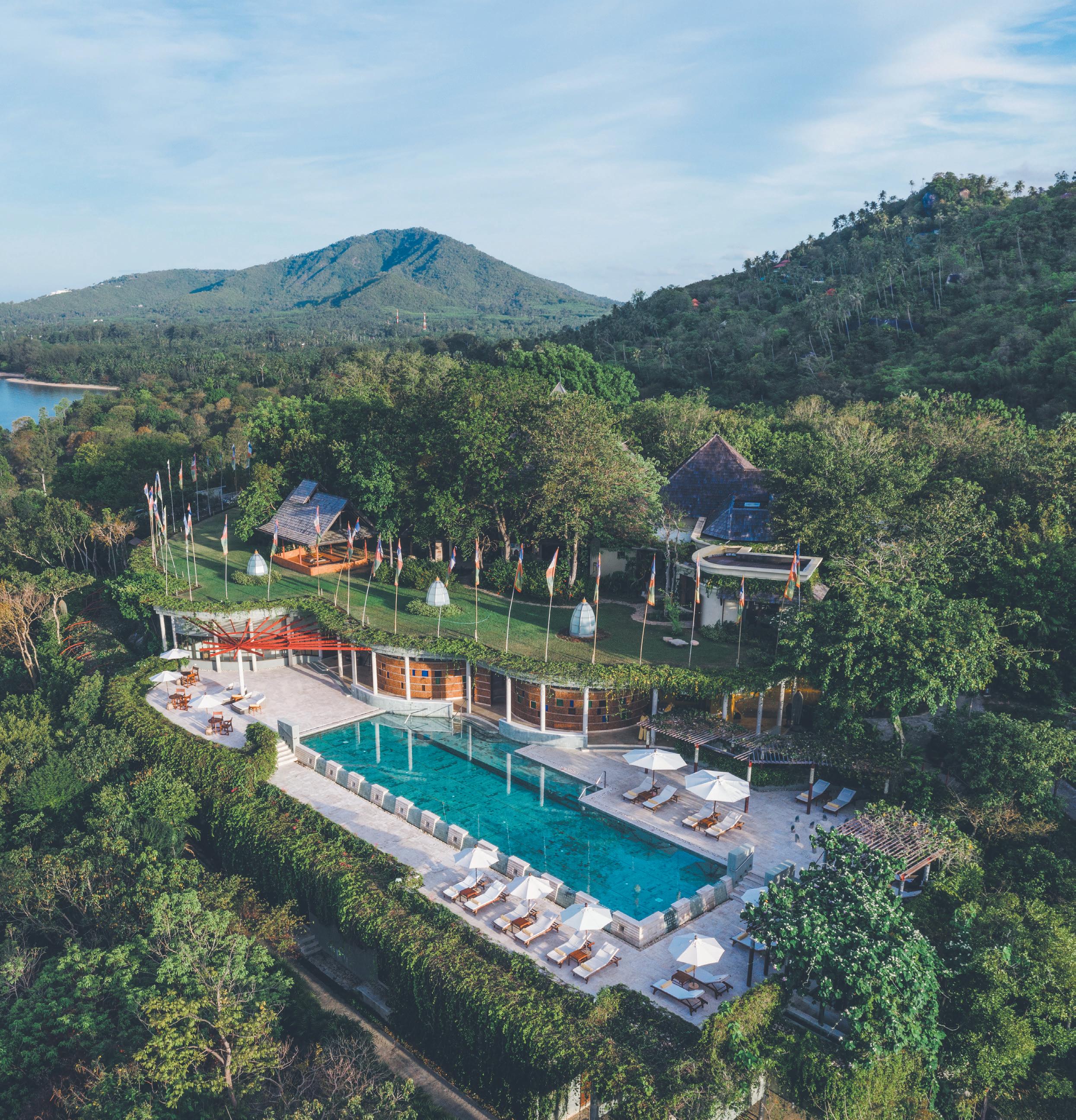
II’ve underestimated the island humidity after my morning swim and I’m now barefoot and blow-drying my hair as a nurse prepares an electrode-studded cap that’s about to be placed on my head. Some people come to Koh Samui, just over an hour’s flight from Bangkok, in search of palm-fringed beaches and fiery Thai cuisine; I’ve checked into Kamalaya (kamalaya.com), an award-winning wellness retreat in the island’s southern corner, for an eightday brain enhancement protocol. The promise? To leave with optimised brain function, a calmer nervous system and improved emotional resilience.
The program, introduced mid last year and put together by Gopal Kumar,
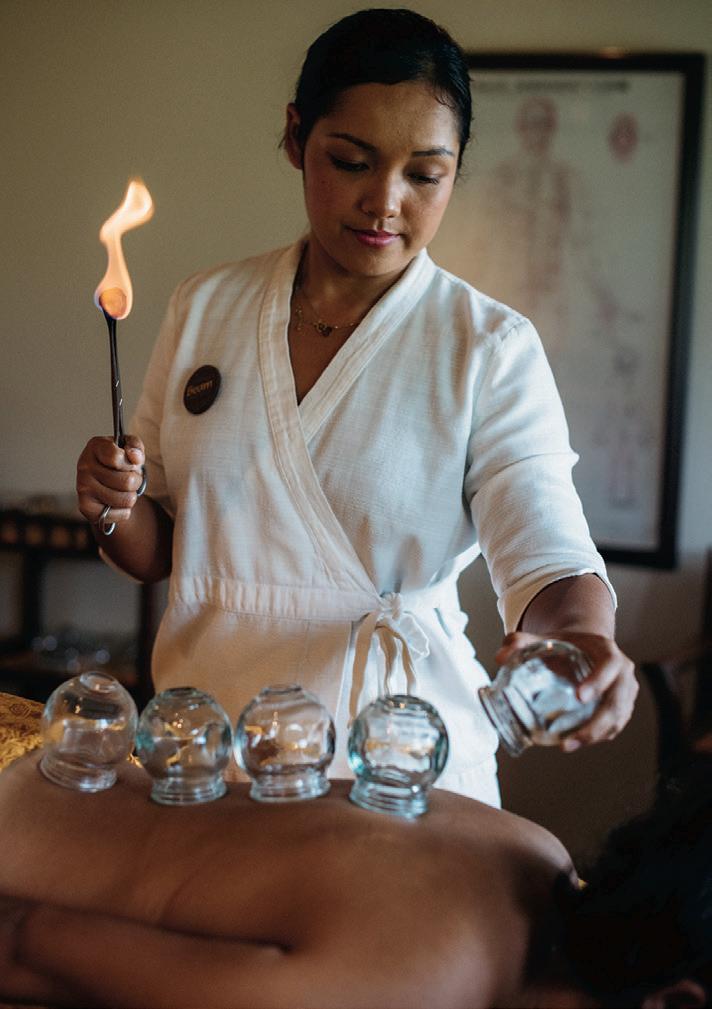
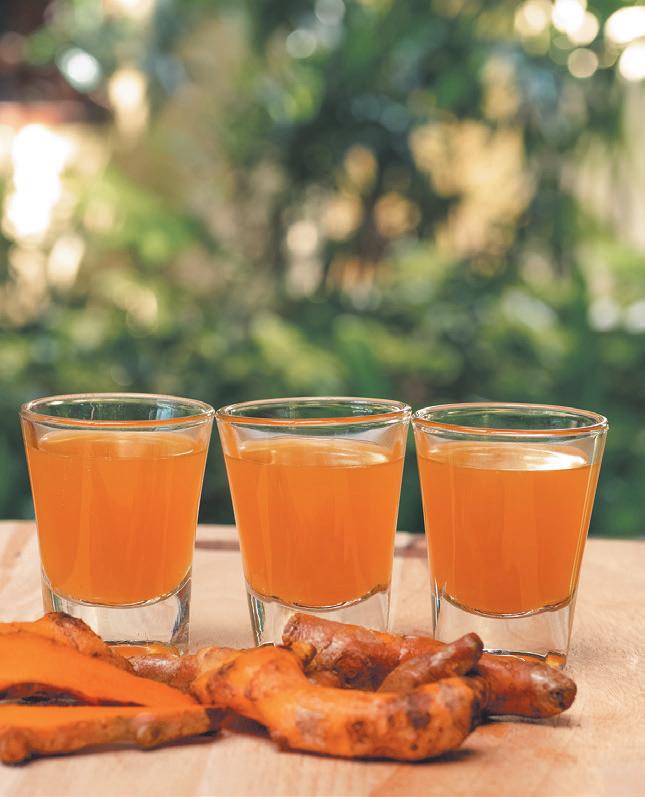
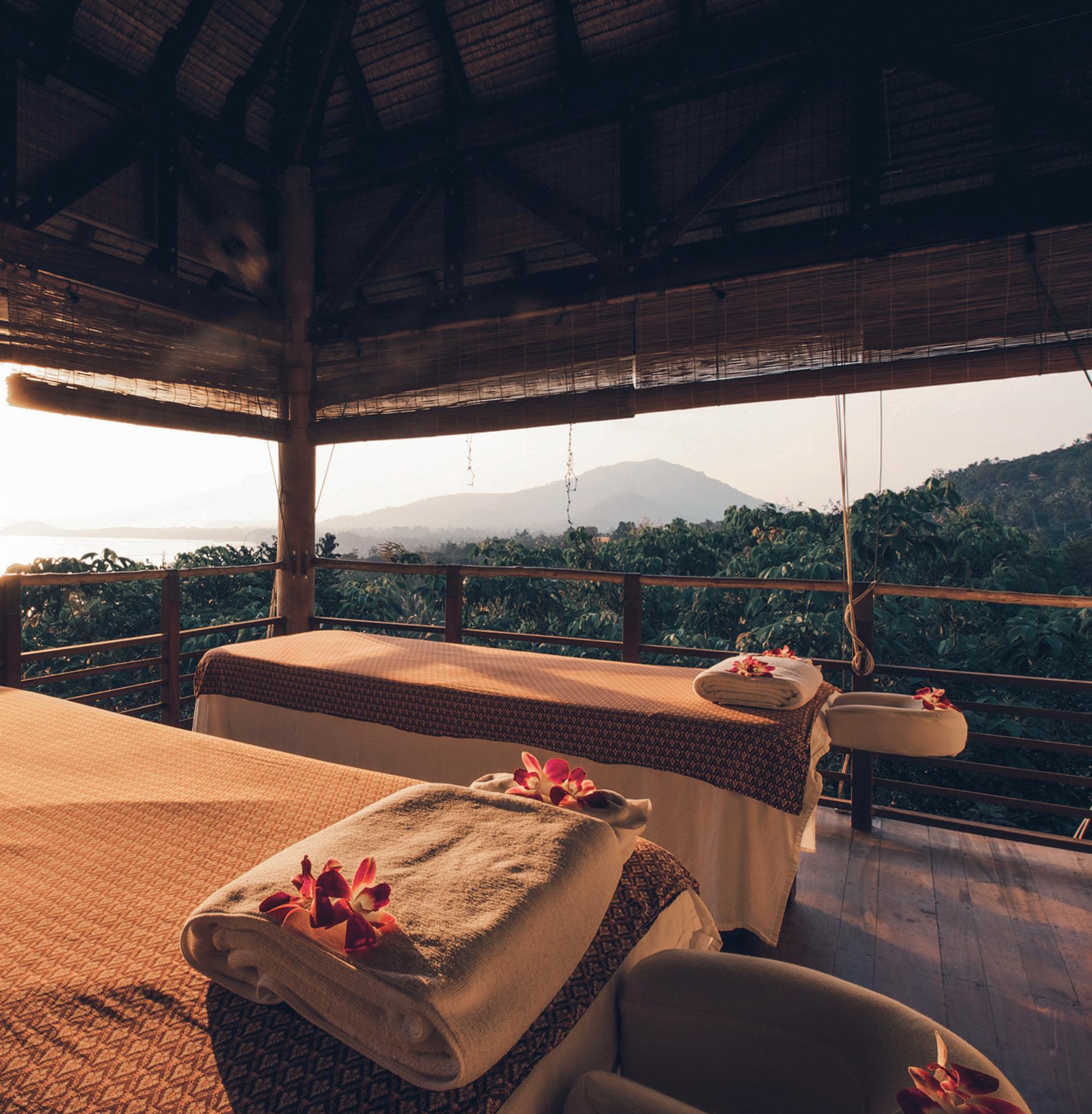
Kamalaya’s general manager and director of wellness development, was inspired by the number of guests arriving with symptoms of burnout and mental health concerns. My schedule includes 19 appointments, a mix of neurosciencebacked testing and treatments, as well as massage therapies, traditional Chinese medicine and fitness training.
During my initial 90-minute EEG test, Udo Schweizer, a neuro- and biofeedback therapist (with a background in nursing and psychology) at Kamalaya’s Cognitive House, explains how the cap I’m wearing measures and maps the frequency of delta, theta, alpha, beta and gamma waves in my brain to report back on which parts are working the
hardest. While hooked up to the monitor, I undergo assessments that challenge my focus, cognitive ability, creativity, sensory processing and calmness. Some are like video games, others draw on elements of the Stroop Effect Test as I’m tasked with reading words that appear on the screen in various colours to gauge reaction time and attention. At the end of the session I’m given a surprisingly decadent chocolate truffle-like snack with lion’s mane mushroom and a glass of electrolytes. I’m genuinely exhausted.
I decline the offer of a golf buggy escort and walk through the lush, jungle-like grounds back to my Sea View Suite – one of 76 rooms and suites on the property, which hosts a maximum of
120 guests at any time – and fall into my cloud-like king-sized bed for an afternoon nap. While there are no strict rules at Kamalaya, guests are encouraged to be offline and are asked to refrain from using phones in common areas. Throughout my stay, my laptop remains untouched and my phone stays on donot-disturb mode. Keeping on schedule for my treatments – and mealtimes – is the only real mental load I have. Although caffeine and alcohol are available, I opt to avoid both. On my first morning I indulge in the Daily Elixir – a set of four vibrant “shots” filled with gut-enriching ingredients. One is torture, one is tolerable and the other two fall somewhere in between so I’m
not game to make it part of my daily routine. Instead, for breakfast at Soma – one of two onsite restaurants – I load up my plate with organic yoghurt and housemade granola topped with bee pollen and goji berries. On other days I enjoy an omelette or soft-boiled eggs with pickled vegetables on the side or bowls of congee and dumplings.
At lunch, sometimes served in one of the overwater huts at Amrita cafe, which looks out on the resort-like leisure pool and private beach, I eat organic and seafood-forward takes on classic Thai dishes like squid larb and som tum (green papaya salad). Grilled sardines, tuna tataki, poached snapper, tom kha gai and steamed Asian greens are on offer when I return to Soma each night and I order the beetroot-rich chocolate souffle for dessert more than once. I comment on my increased appetite at my midweek check-in with one of Kamalaya’s wellness consultants, who says it’s most likely my body’s response to moving into “rest and digest” mode. While my body is certainly feeling the change, some aspects of my mind are a little more stubborn. During an acupuncture appointment, traditional Chinese medicine practitioner Bernie Schulte asks if I struggle with worry, overthinking and brain fog. “Who doesn’t?” I think. He assesses I have weak spleen qi, which can lead to too much rumination and not enough spontaneity. I start taking his prescription of Chinese medicinal herbs alongside the program’s robust supply of naturopath-prescribed vitamins and supplements designed to support brain health, which include ashwagandha, omega-3, lion’s mane, 5-HTP and lithium orotate, as well as pre- and probiotics.
Not everything I experience during my time at Kamalaya is diagnostic in nature. One afternoon I find myself nestled in a large leather armchair that vibrates and inverts to lift my feet above my heart. I’m given
an eye mask while binaural beats play through noise-cancelling headphones. This is Kamalaya’s take on neuro-sync sound therapy, which draws on rhythmic audio to synchronise brainwave patterns to help you reach a state of deep relaxation. I emerge 60 minutes later feeling like I’ve had a full eight hours of sleep. I also have the best foot massage of my life in an open-air treatment space and an acupressure session that seems to undo years of rounded shoulders.
The results of my initial and subsequent EEG tests reveal a high level of mid-beta waves, particularly when my eyes are closed during testing. Schweizer says this indicates increased mental arousal, anxiety and the inability to fully disengage and relax: things that aren’t uncommon in a modern world but are worthy of addressing. He highlights the importance of consistency with the basics – quality sleep, balanced diet and regular physical and mental exercise – and as the week comes to a close, there’s no doubt my brain (and body) is feeling better than when I arrived. My final EEG test scores also lift across the board, with results for calmness, cognition and sensory processing all making significant jumps.
On my final evening, I’m sitting in the couch-studded Alchemy Tea Lounge with my journal and a pot of mulberry green tea as a tropical storm rolls across the island. I’ve spent my last moments of sunshine jumping between the hot-and-cold plunge pools that overlook the archipelago. Kumar spots me on his way home for the day. He tells me not to try to recreate the experience after I leave but to simply take three manageable things to add to my mental wellness tool kit. I return home with a playlist of delta-wave music for nights when I can’t sleep, a revived love of Sudoku and a commitment to eat fish at least three times a week. I’ll be clinging onto this mental clarity for as long as I can.
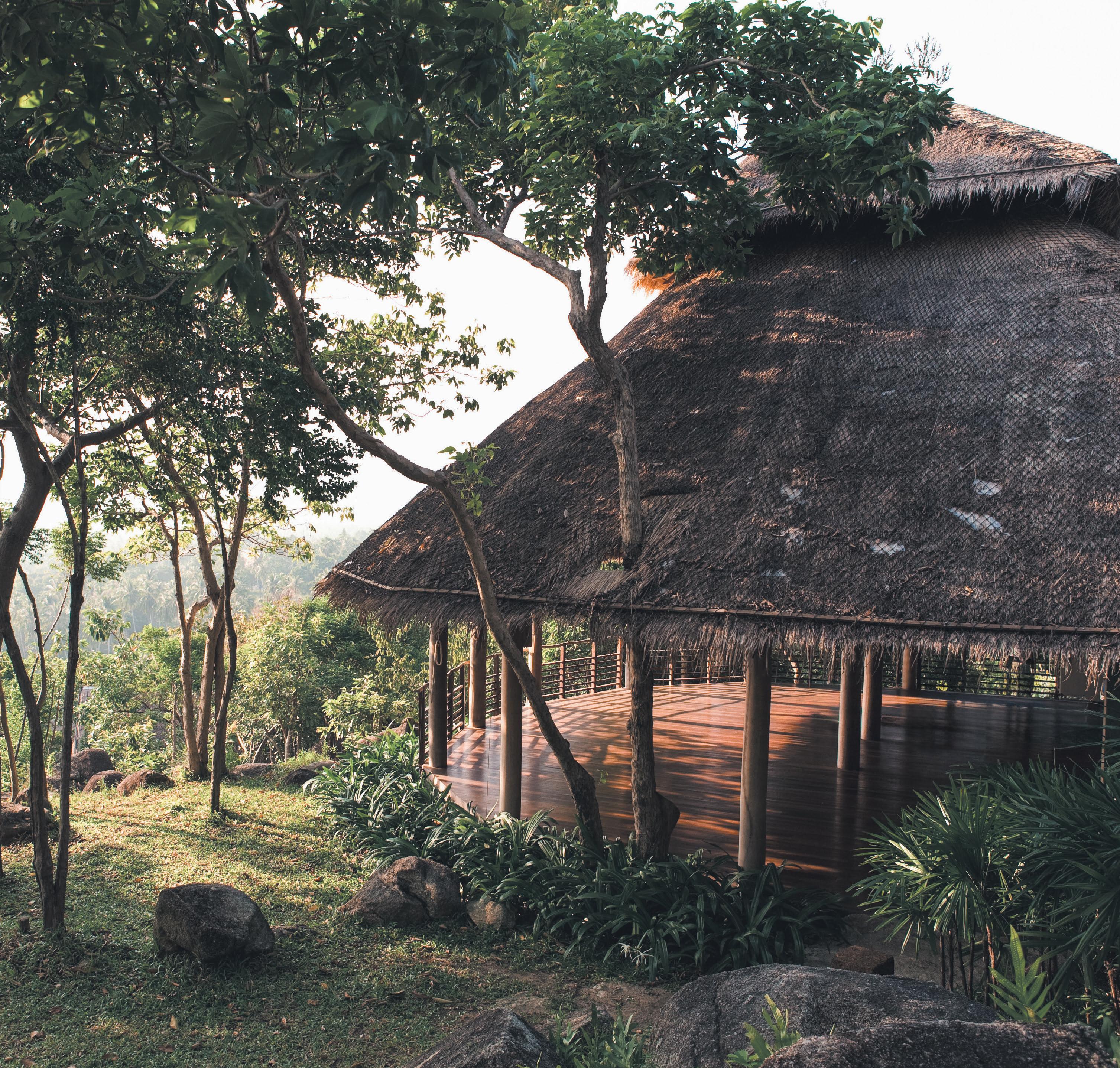
From mineral baths to jungle healing, these serene getaways show why every stay is better with Qantas Points.
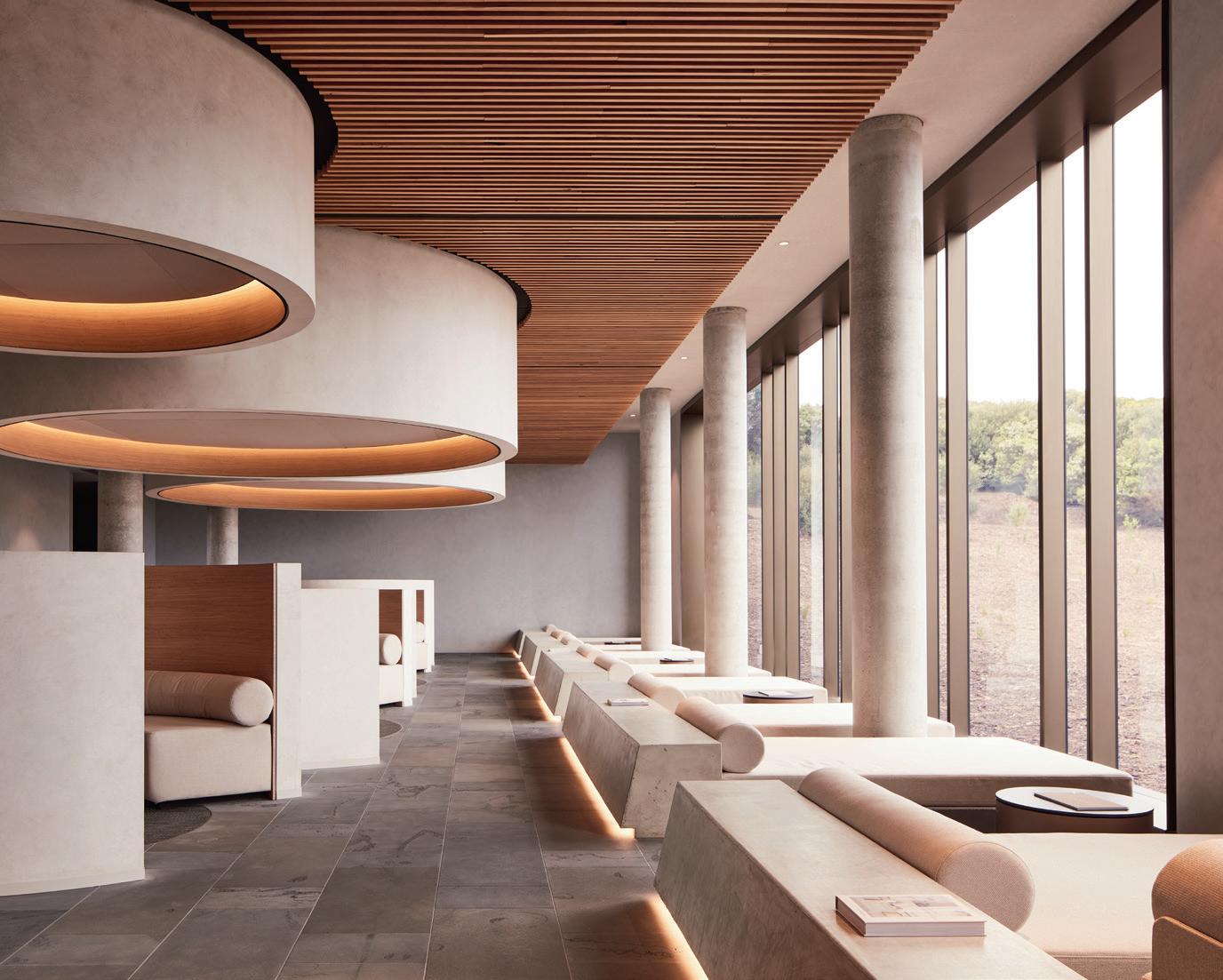
Situated on Victoria’s Mornington Peninsula, Alba Thermal Springs & Spa is just 100 kilometres south of Melbourne’s CBD. Stay in luxury rooms featuring premium amenities and choose from 31 mineral-rich pools plus saunas, steam rooms and a day spa. Your stay includes breakfast at Thyme with a menu created by award-winning chef Karen Martini, an upgrade to a private pool and complimentary minibar.
BOOK NOW: 2 guests • 1 night from $1,150 or 151,255 points. 2
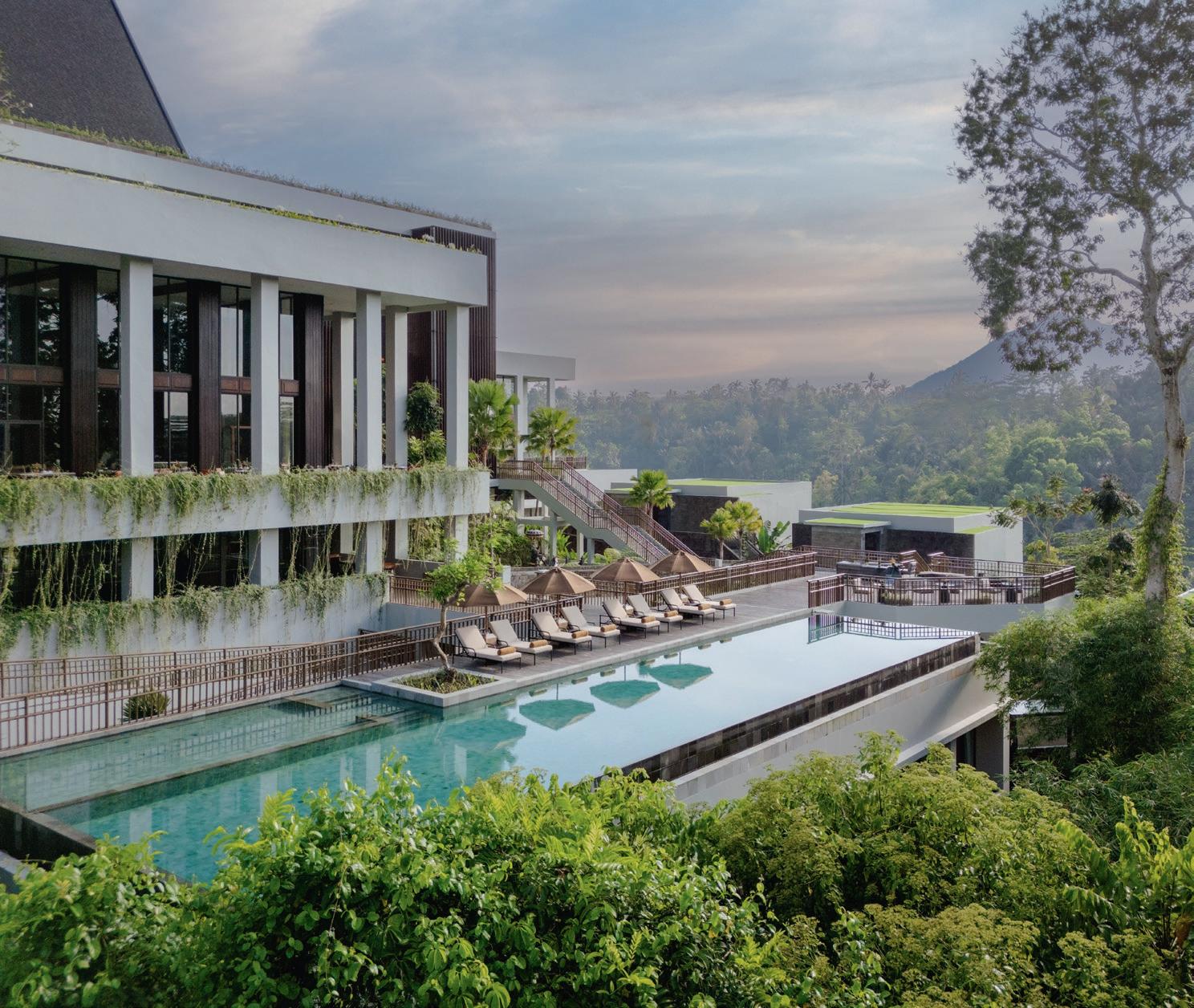
Nestled in Bali’s lush Payangan region is a mountaintop retreat surrounded by emerald rice paddies and tranquil temples. Spacious villas offer sweeping views over Mount Batur, while wellness extends beyond the spa to temple rituals, healing sessions and early morning waterfall bathing. Book with Qantas Luxury Holidays for breakfast, choice of lunch or dinner and a cocktail daily, plus a room upgrade and one-time couples massage.
BOOK NOW: 2 guests • 3 nights from $1,921 or 180,521 points. Offer ends 31 May 2026.¹
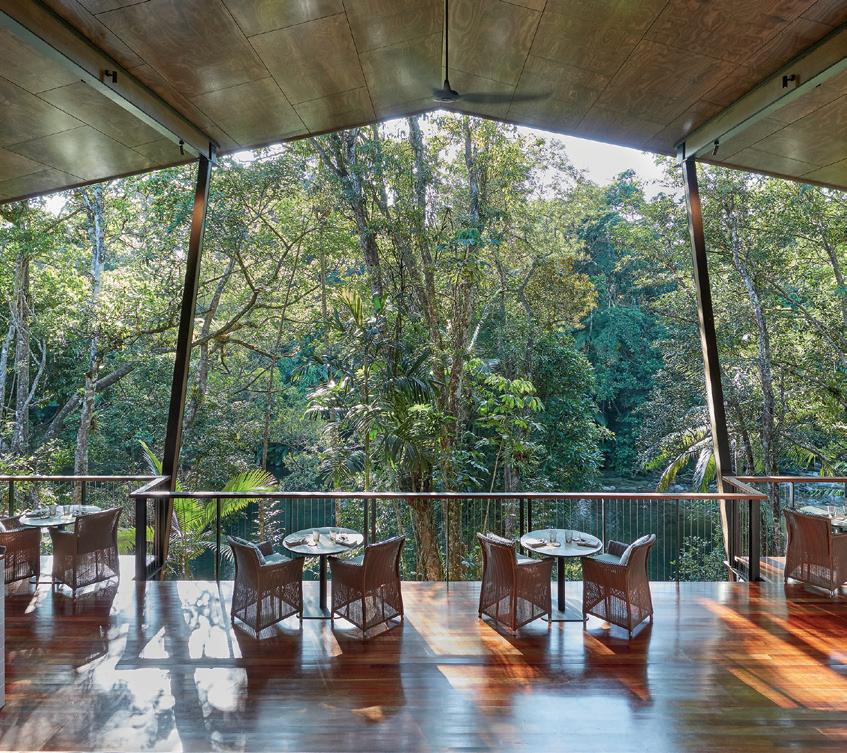
RAINFOREST RESET
This stunning Queensland eco lodge sits above the Daintree’s Mossman River, with a soothing soundtrack of birdsong across its 40 breezy rooms and open-air restaurant. Explore with river safaris, guided tours and visits to the Great Barrier Reef, then unwind at Healing Waters Spa. Book with Qantas Luxury Holidays for daily morning yoga, breakfast and dinner, sunset drinks and a $100 spa credit.
BOOK NOW: 2 guests • 3 nights from $3,360 or 304,913 points. Offer ends 31 May 2026.³











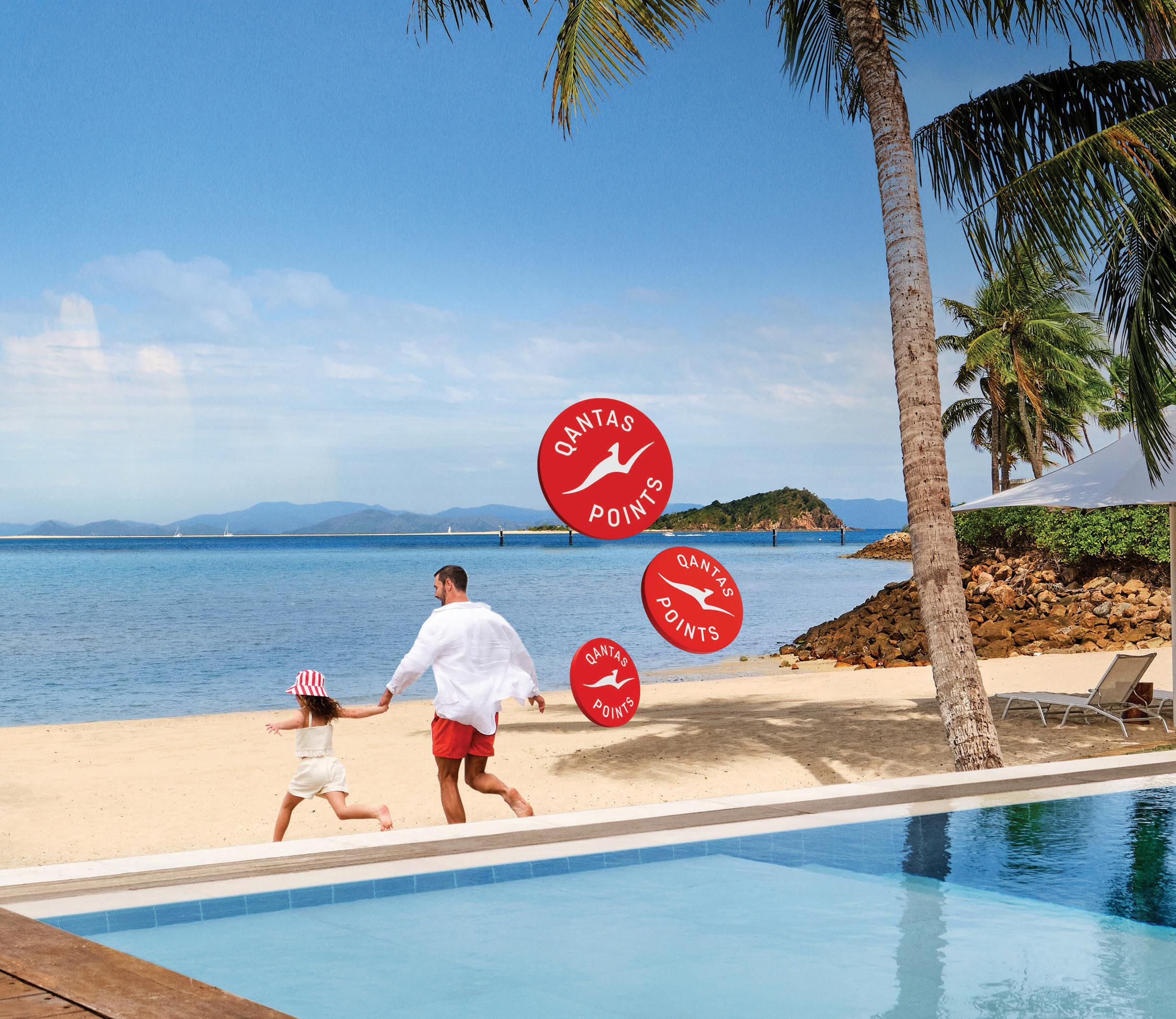























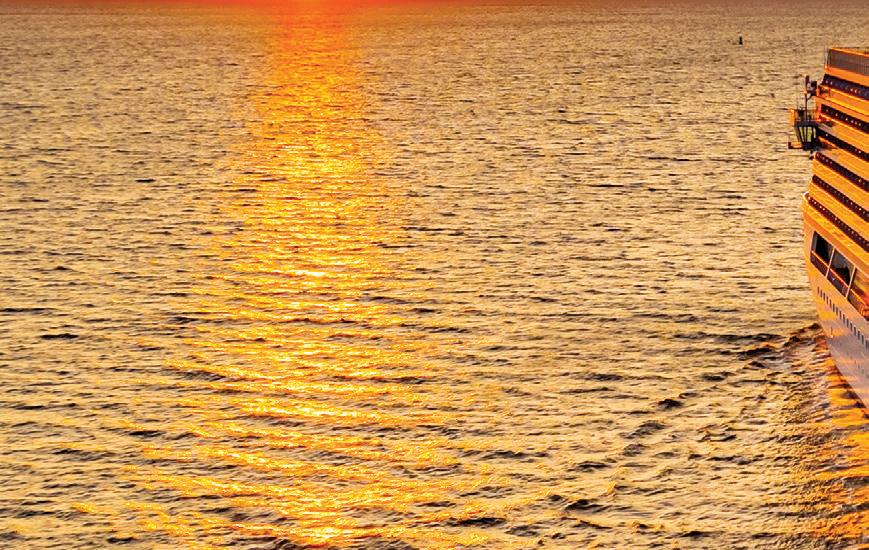


















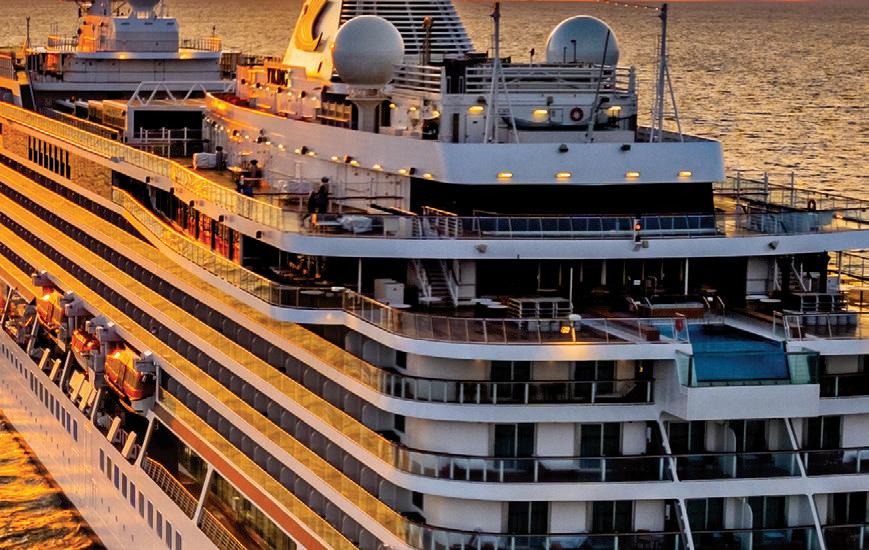
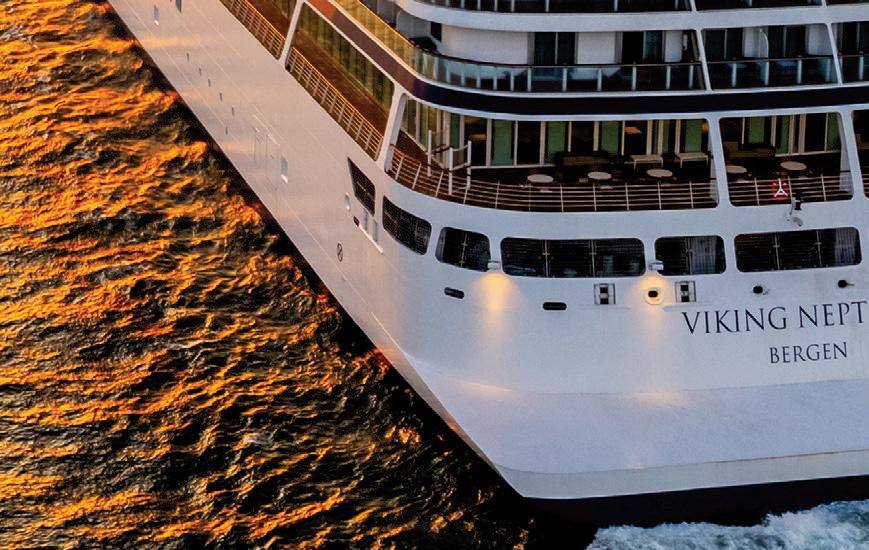







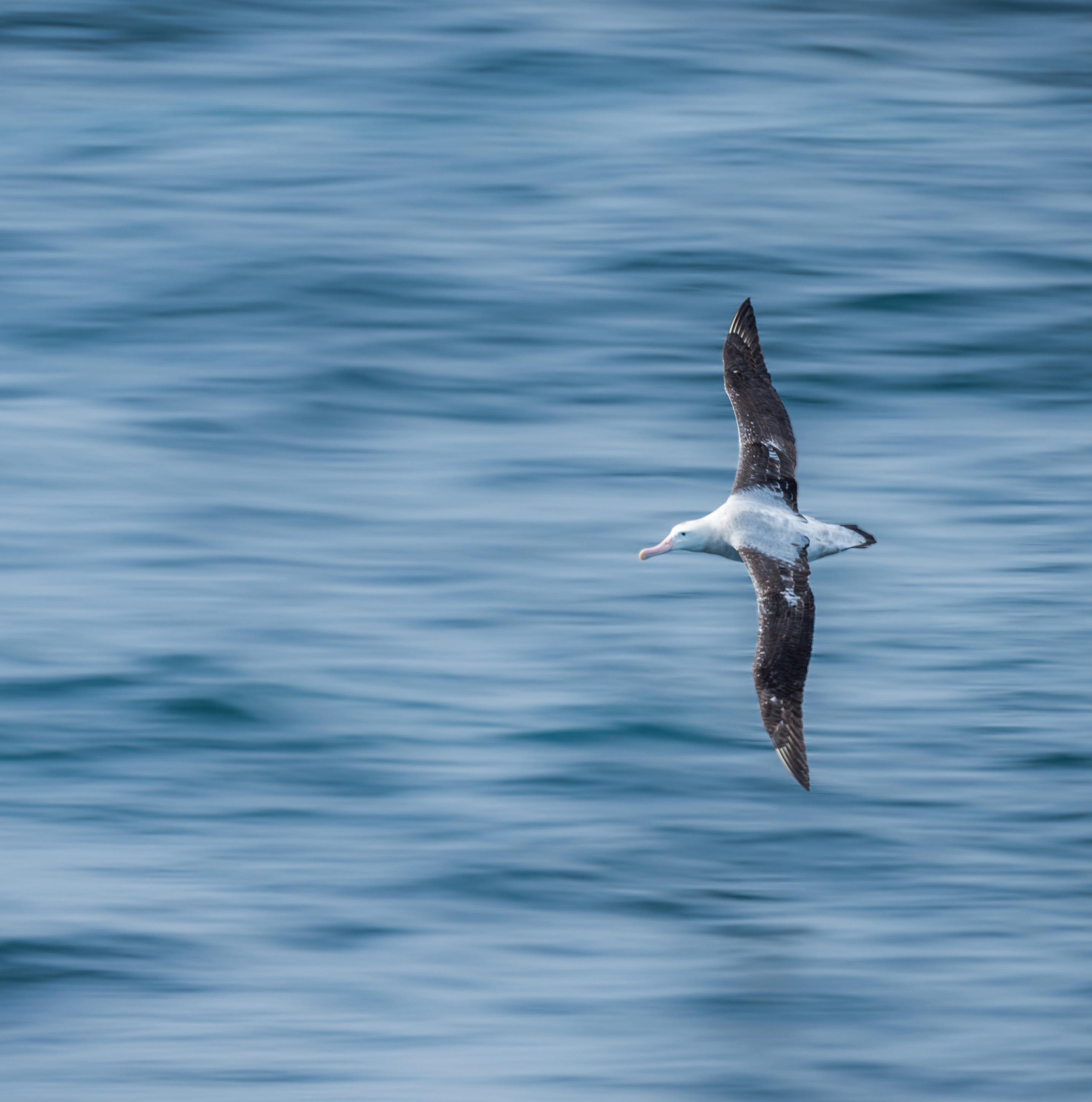
Story by Andrea Black | Photography by Alexis Cuzon
I’m perched on a rust-red rocky outcrop, admiring the milky aquamarine waters of Freshwater Cove (Wijingarra Butt Butt) in Western Australia’s Kimberley region when Worrorra guide Neil Maru clocks my gaze and issues a friendly warning. “‘Snappy’, ‘Nibbles’ and ‘Hellboy’ are the names my nephews have given them,” says Maru of the three resident crocodiles lurking nearby. Even though these waters look deceptively alluring on this hot afternoon, no-one dares to dip a toe in. “If I see one, I’ll throw my hat at it to distract it,” he says. “Or run up a tree.”
Luckily, Maru is leading us inland and before long we’re scrambling up a rugged hillside among cotton flowers, bottlebrush and wattle to Cyclone Cave. I’m on Ponant Explorations’ (ponant. com) 11-day Australia’s Iconic Kimberley voyage from Darwin (Garramilla) to Broome (Rubibi) and this two-hour rock art walking tour run by Aboriginalowned family company Wijingarra Tours is just one of the highlights. Earlier, we were greeted on the beach with a dab of ochre and a Welcome to Country ceremony before being invited to explore ancient caves and rock art sites. Under the overhanging sandstone,
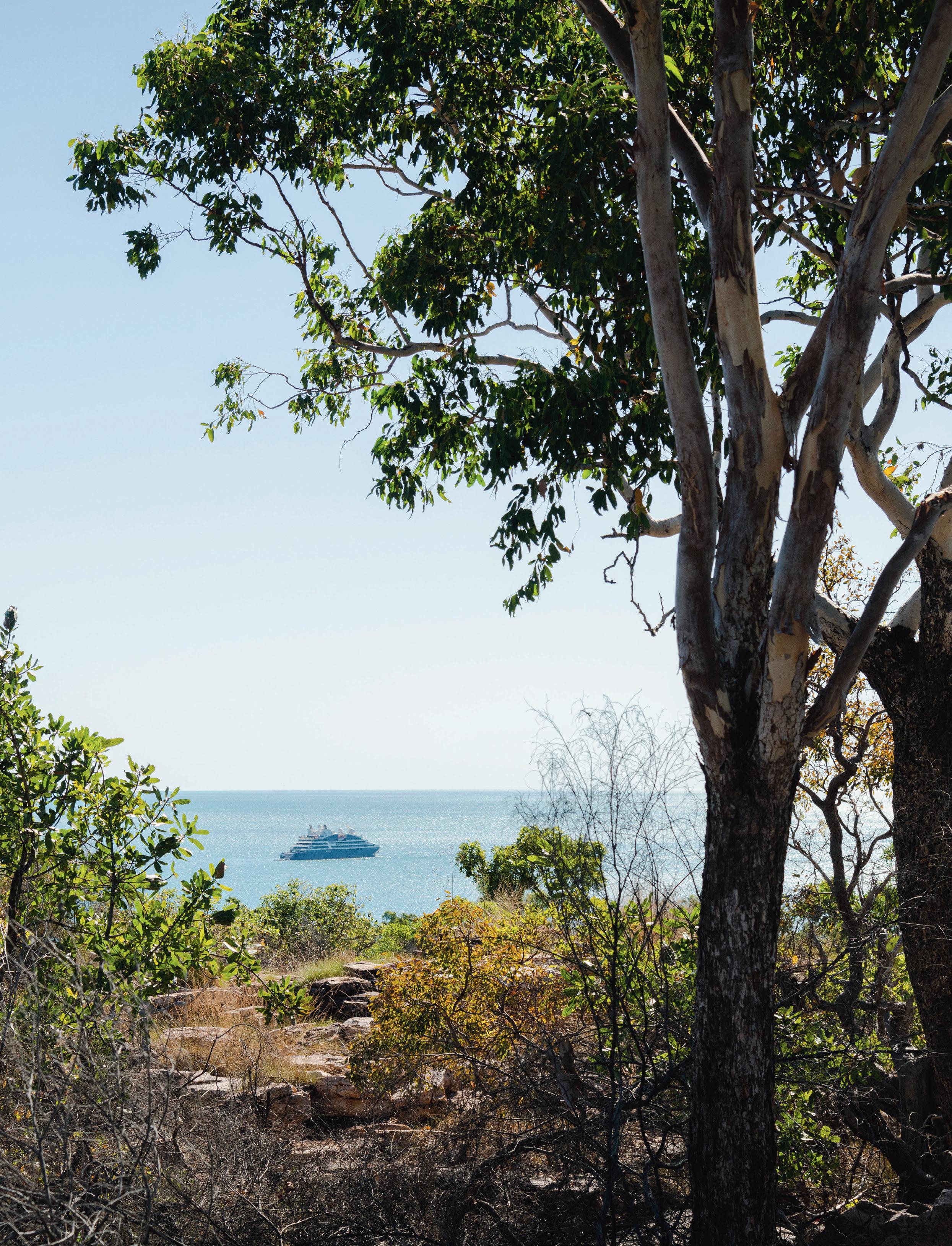
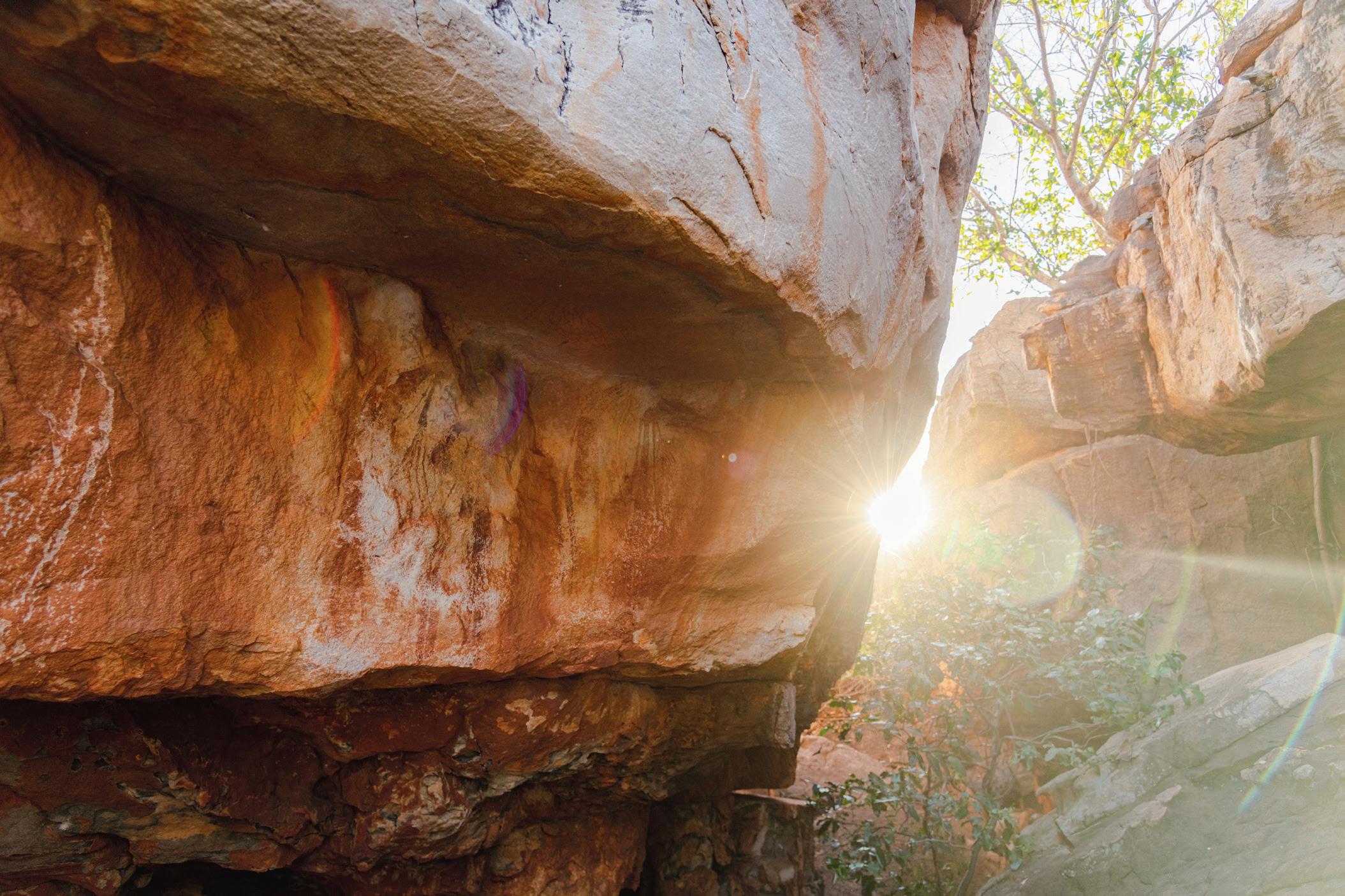
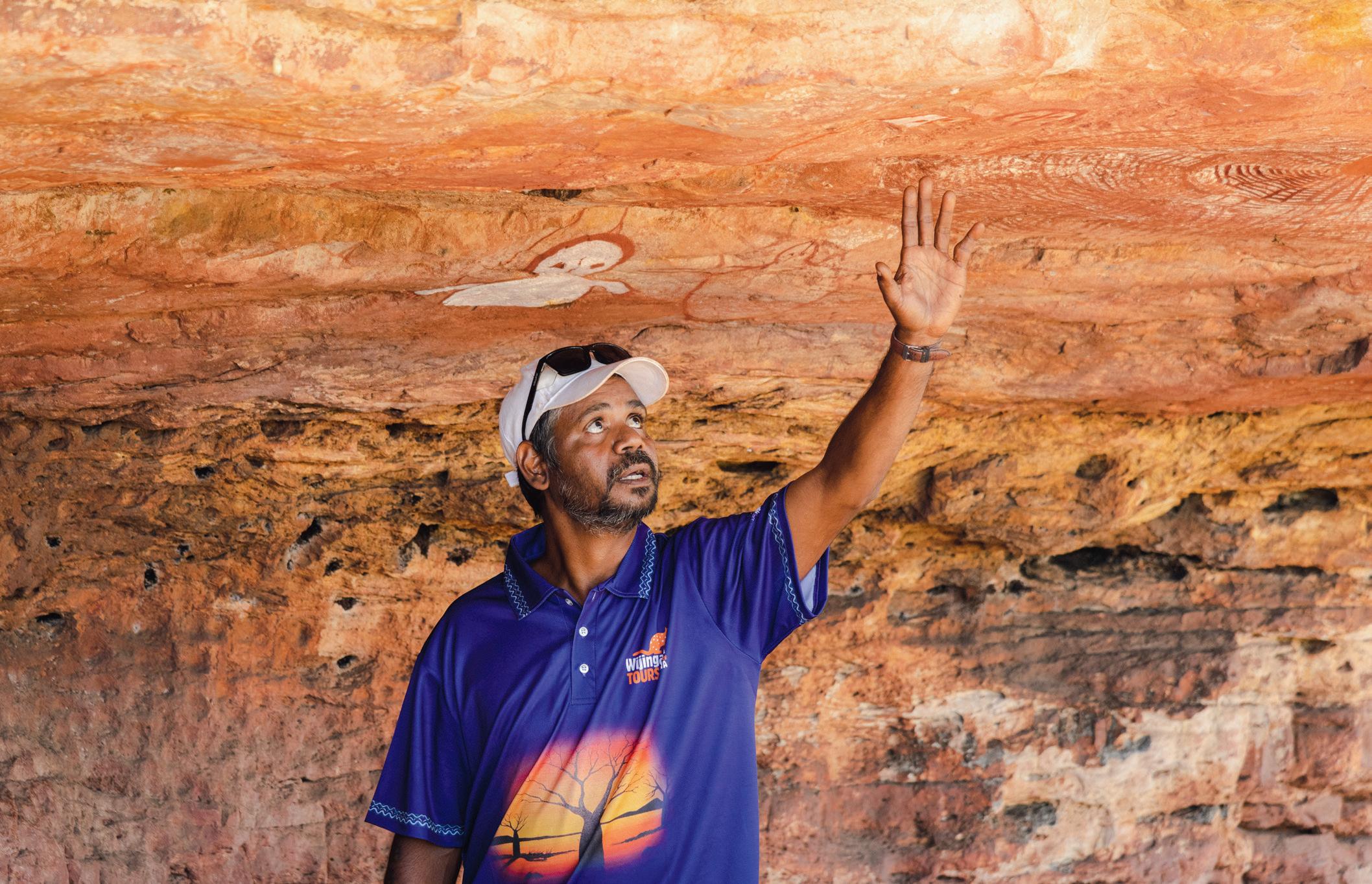
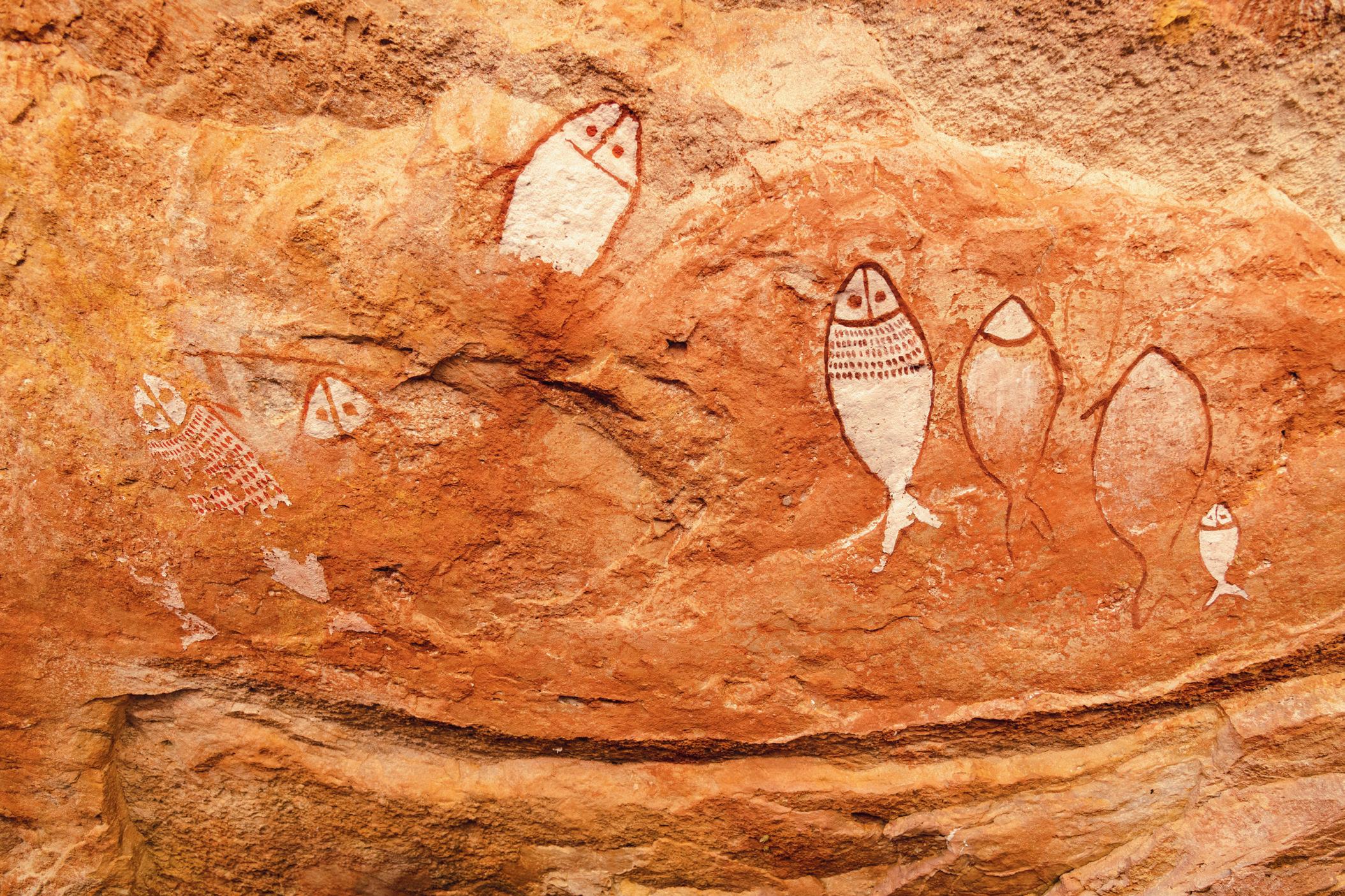
Maru points out depictions of stingrays, whales, turtles and dugongs and tells of rich cultural and spiritual connections. The proud Worrorra man from the Arraluli clan teaches his nephews the same stories that he once learnt, the stories his ancestors told their own children thousands of years ago. “We keep our stories alive,” he says.
This open-air gallery is one of the many ancient sites we visit, each displaying exquisite artwork and tales of the world’s oldest continuous living culture. On another day we venture to one of the Wandjina rock art galleries at Swift Bay. At Vansittart Bay (Banjal) on Jar Island (Ngula-Jar), we view galleries depicting human figures in the Gwion Gwion style.
Standing on the beach at Freshwater Cove, we’re cleansed in pine and gum tree smoke for a safe journey before heading back onboard the 92-stateroom Le Jacques Cartier. The French-flagged
expedition vessel features seven decks of vantage points from which to take in the ever-changing Kimberley Coast. I move between the elliptical windows of the underwater Blue Eye Lounge to the wraparound Observatory Lounge that doubles as a library on Deck 6. Most mornings I enjoy the view from my room’s balcony, where a room service breakfast of omelette, baguettes, viennoiseries (breakfast pastries) and fruit salad is delivered.
My days are spent on excursions led by naturalist guides, taking in the region on a Zodiac – the magnificent sandstone gorges and single-drop falls of the King George River one day, the cascading waters of Montgomery Reef, the world’s largest inshore reef system, the next. During an expedition along the Hunter River, all eyes are on the mangroves in Porosus Creek. There’s complete silence save for the calls of kingfishers and mangrove robins.
Expedition naturalist Thijs slows the vessel as amphibious mudskippers periodically leap and pirouette out of the water. Up ahead is a giant crocodile basking in the sun, mouth agape, fangs bared (a relative of Snappy or Nibbles, perhaps?), its eyes slowly following us. Along the muddy banks we spot more crocs while others track just below the surface of the calm waters.
Back on the ship, afternoon tea sees me sampling fruits givrés (frosted fruits) and macarons from Maison Pierre Hermé before returning to my suite, which has an interior design by French firm Studio Jean-Philippe Nuel, filled with natural woods, soft blues and greys. Mealtime discussions at either Le Nemo grill or the French-leaning restaurant Le Nautilus inevitably centre on the day’s wildlife encounters, shared over dishes such as barramundi fillet, saffron potato and green peas paired with Moulin de Gassac Guilhem Blanc.
Late afternoons are spent in the lecture theatre. Here, I’m told the four, low-lying Lacepede Islands north-east of Broome are home to one of the largest colonies of the brown booby on Earth and that up to 40,000 whales make their annual migration to the Kimberley coast. “Every day you learn something different that adds a piece to the puzzle and that’s what makes the Kimberley so special,” says expedition leader and
marine biologist Fran Coleman, who divides her year between the Kimberley, the Arctic and the Seychelles. “It doesn’t matter how many times I’ve done this Kimberley cruise, the tide is different, the sun is different.”
It’s a glorious Western Australian sunset on the Observatory Lounge’s outdoor terrace and I’m sitting with the cruise’s guest speaker, poet Rupert McCall OAM. I ask him to lay down some poetry. “Nothing rhymes with Zodiac,” he says, laughing. It’s his fourth cruise with Ponant and he’s a crowd favourite, the guests often lining up to have a drink and a yarn with him. He’s already recited verses on NRL legend Arthur Beetson, his home state of Queensland (in which he manages to rhyme Mal Meninga with Powderfinger in the style of REM’s It’s the End of the World as We Know It) and a poem about the sweeping shores of Broome. But sailing through the narrows of Talbot Bay (Garaanngaddim), flanked by layers of twisted and folded sandstone, he’s lost for words.
“Meeting Indigenous Traditional Owners, hearing their stories, all those layers of history, and we’re given the honour and privilege of standing on that ground,” says McCall later over dinner. “You walk away feeling uplifted and it lends itself to being inspired to write. I have pieces of paper everywhere with thoughts and ideas.”
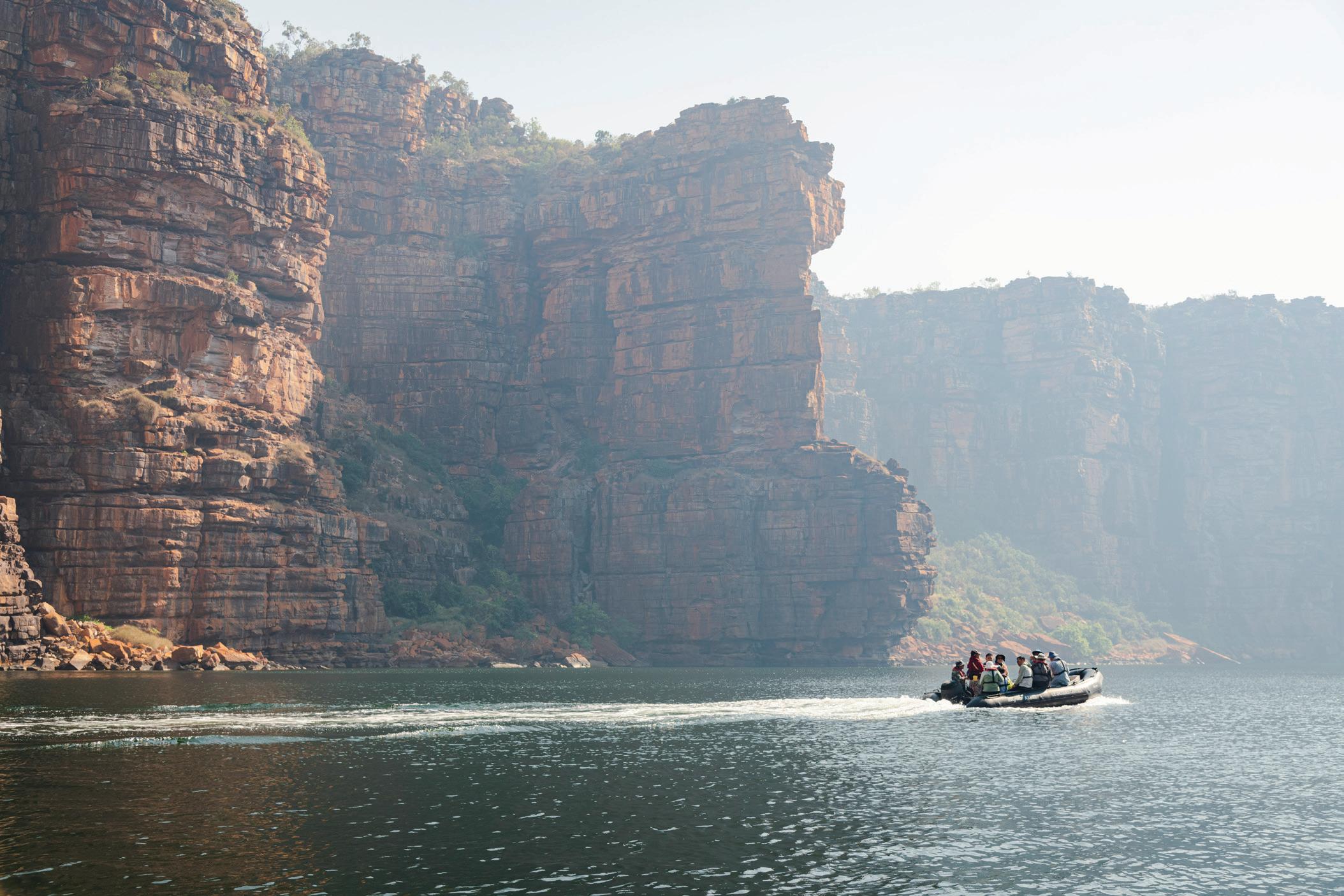
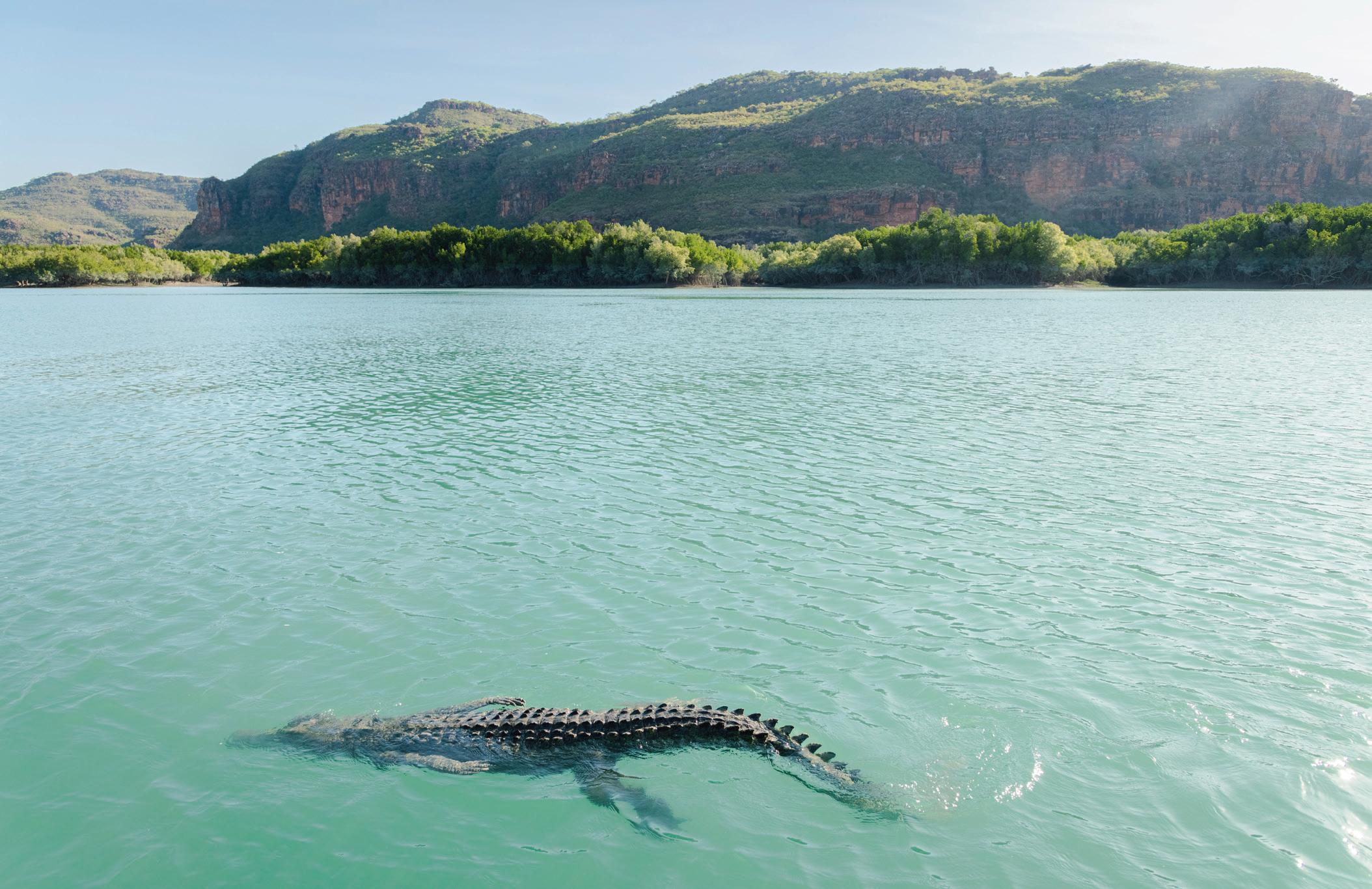

With expert guides, onboard science facilities and adventures galore, expedition cruising lets you explore the world’s most epic environments in comfort – fine food and wine included.
Story by Faith Campbell
Quiet blankets the Norwegian Arctic, suffusing the most northerly reaches of Europe with a sense of calm. On the five-night Tromso, Bear Island and Svalbard itinerary with Aqua Expeditions (aquaexpeditions.com), just 30 guests will revel in windswept islands, polar bears and beluga whales.
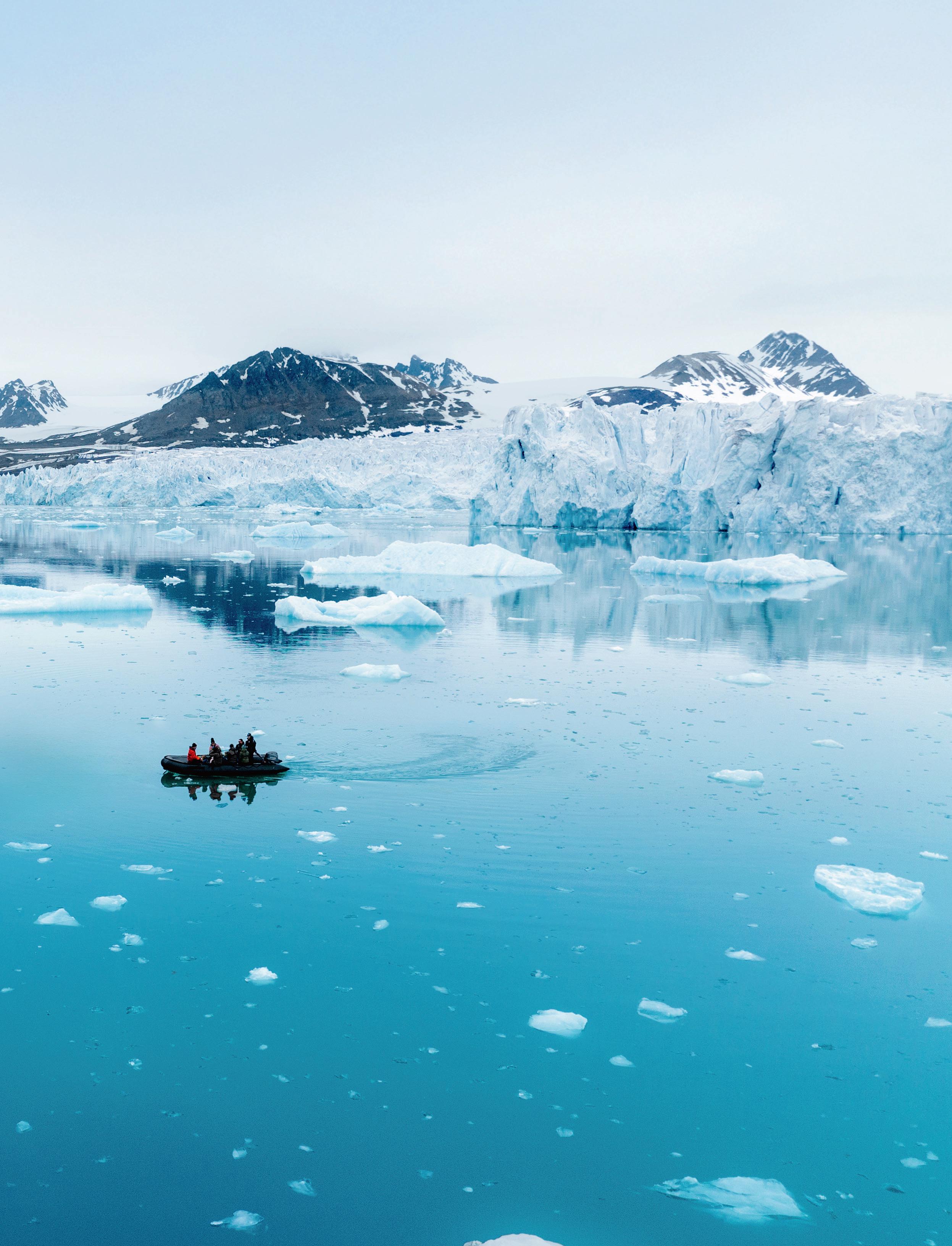
With a one-to-one crew-to-guest ratio, the Aqua Lares experience is intimate and elegant. After a blustery tender ride beneath the tall cliffs of Bear Island on day four, warm up in the sauna before cocktails and canapes. Learn about Indigenous Sami culture on remote Reinøya island and walk with a naturalist guide to discover geological formations such as raised beaches. Take in the scope of the vast and untamed sea from the ship’s plush indoor lounge.
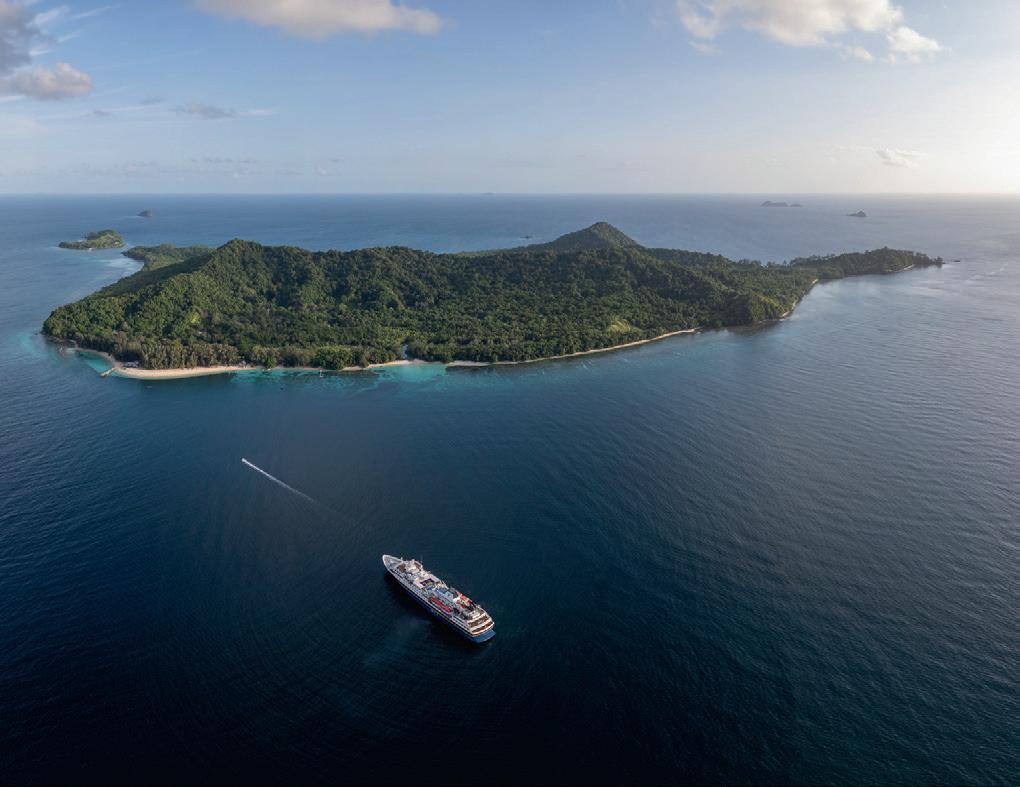
In Malaita, Solomon Islands, the Kwaio people continue a traditional way of life on their ancestral lands, only welcoming visitors by invitation of Chief Esau. On day 11 of Heritage Expeditions’ 18-day Discover the Secrets of Melanesia: Papua New Guinea, The Solomon Islands and Vanuatu adventure (heritageexpeditions.com), that exclusive invitation may well extend to witnessing a rarely seen sacred dance. It’s just one extraordinary
moment for the 140 guests on the Heritage Adventurer There’s also a trip to rainforested Tetepare Island, breeding site for endangered leatherback turtles, a Zodiac ride along Papua New Guinea’s biodiverse Sepik River and snorkelling safaris through spectacular reefs. Ship life reflects the familyowned line’s onshore efforts in conservation and connection, with lectures by naturalists and comfy shared spaces that encourage camaraderie.
Amid Patagonia’s cinematic landscape of jagged mountain ranges, broad plains and luminous glaciers, the details are equally thrilling: Isla Pingüino and its rare colony of rockhopper penguins, orcas at Punta Pirámides nature reserve and leopard seals in the
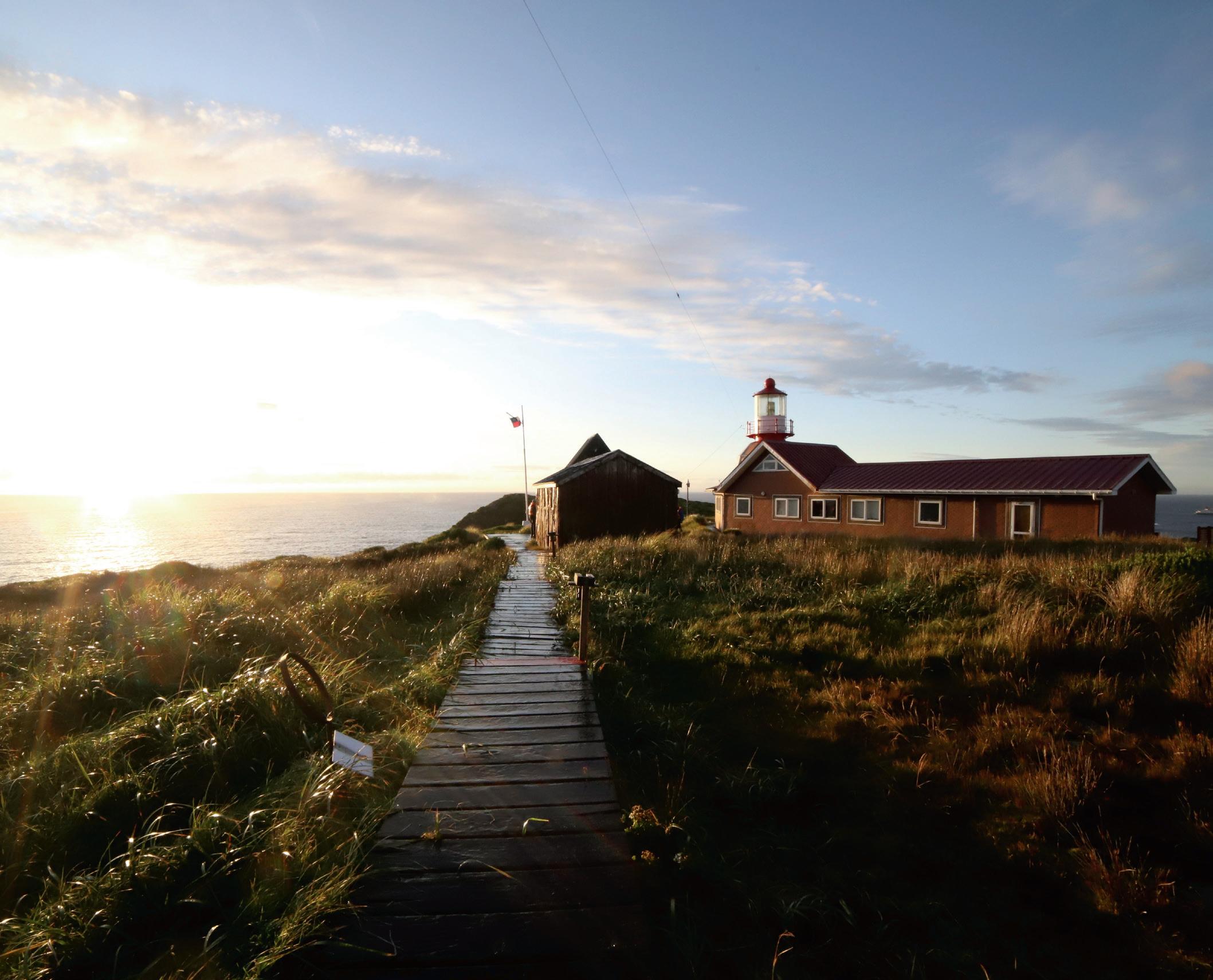
protected waters of Admiralty Sound. Scenic’s (scenic.com.au) Patagonia & the Chilean Fjords sailing spends 17 days in the region, with a maximum of 228 guests taking in these destinations, Cape Horn, the southernmost tip of the Americas, and more from the elegant comfort of the Scenic Eclipse II During expeditions in kayaks and on Zodiacs, through the sky and below the surface – the state-of-the-art
vessel is equipped with a helicopter and a submersible – a Discovery Team of historians, archaeologists, naturalists, photographers and other experts impart a deeper understanding of the environment and its inhabitants. Yet it’s Mother Nature who always leads the way, revealing and concealing her many riches so that every voyage is unique.


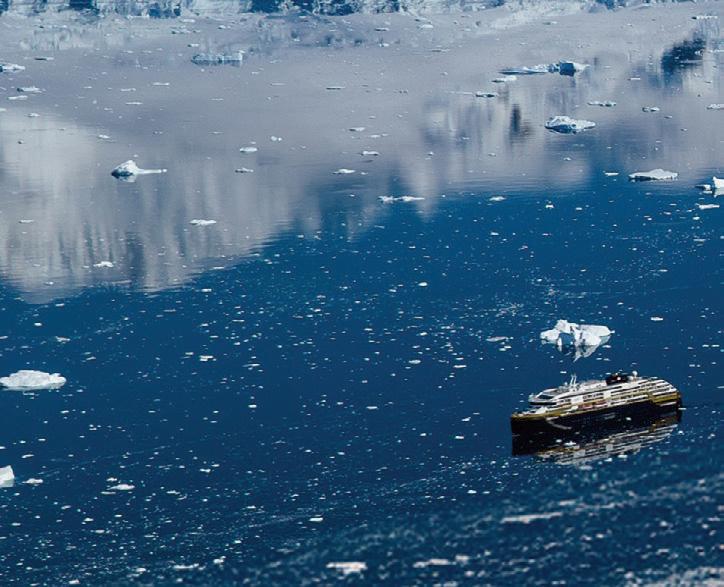


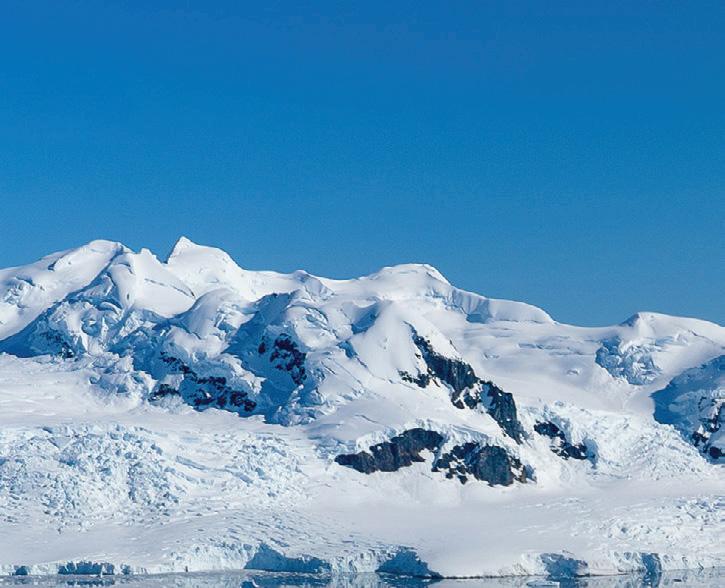












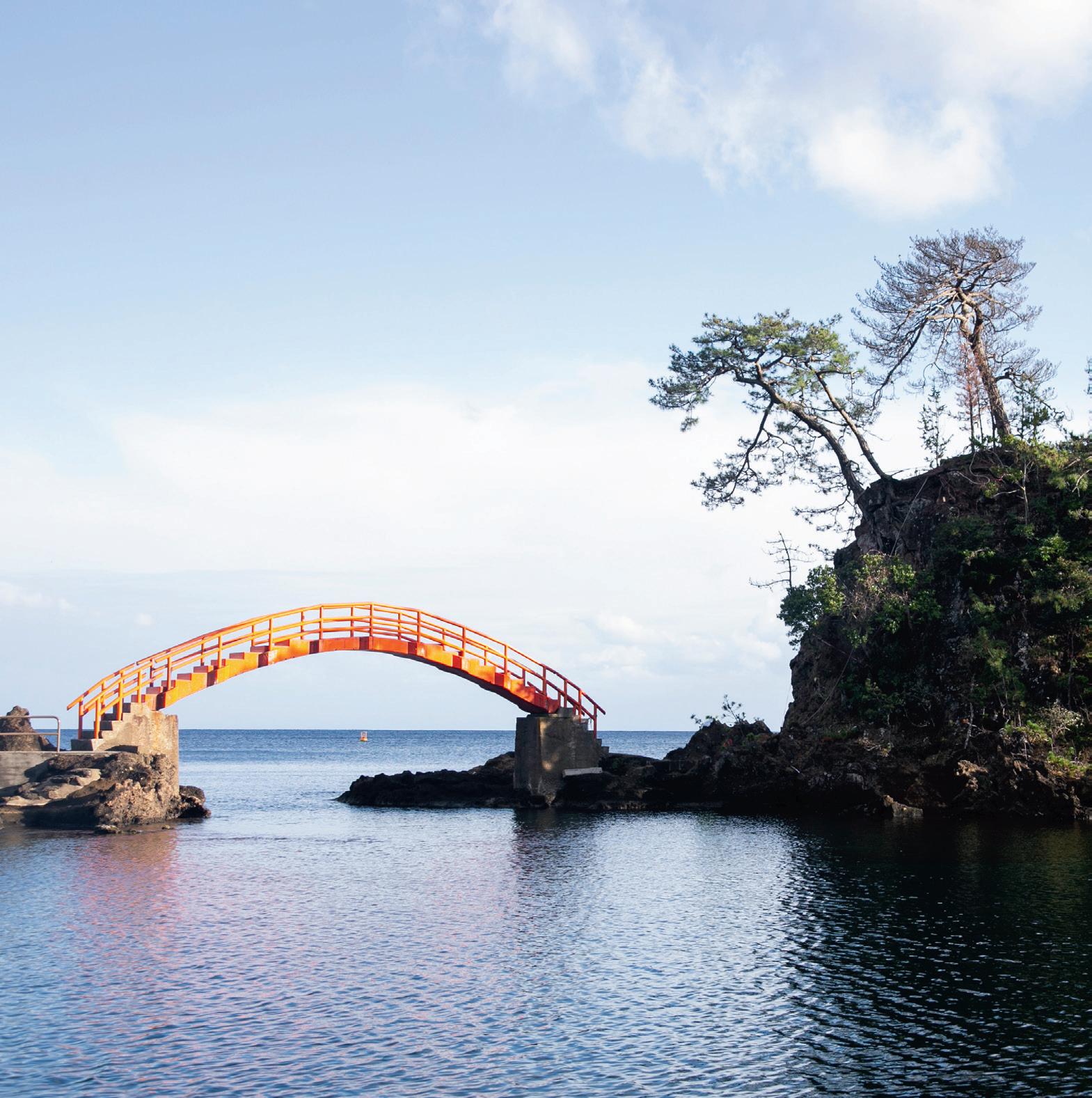
Considered one of the world’s great sailings, the Northwest Passage wends its way through the Arctic Archipelago, a wintry world of thick shelf ice, polar bears, sprawling tundra and resilient First Nations communities. Seabourn (seabourn.com) plies the fabled Canadian corridor on the 20-Day Northwest Passage & Baffin Island Expedition, spending six days in the area and treating guests to Zodiac excursions, nature hikes through rarely visited territory and a stop at Devon Island, known as “Mars on Earth”. The 264 passengers aboard purpose-built Seabourn Venture (with two submersibles and eight dining options) are guided by the 23-strong Expedition Team who share their expertise at daily lectures in the ship’s Discovery Center and bring this remote and rugged region to life.
Immersed in dense subtropical forest, wandering among mossy rocks and the twisted trunks of 1000-year-old cedar trees, you might feel as though you’ve been transported to Tolkien’s Middle-earth. But this green-drenched landscape is on Yakushima Island, Japan’s first UNESCO World Heritage site and the third port of call on Silversea’s (silversea.com) Kobe to Otaru (Hokkaido) voyage. Across 12 days, up to 254 guests on the luxurious expedition ship Silver Cloud (with its four dining options and photo studio) will tap into Japan’s wild side, from tracing the coast of a volcanic island by kayak to encountering native serow on the Shirakami-Sanchi Forest Trek excursion in Noshiro. Far from the bright lights and Michelin stars of Tokyo, you’ll discover places that recall the ancient past and revere the rhythm and rule of the natural environment.
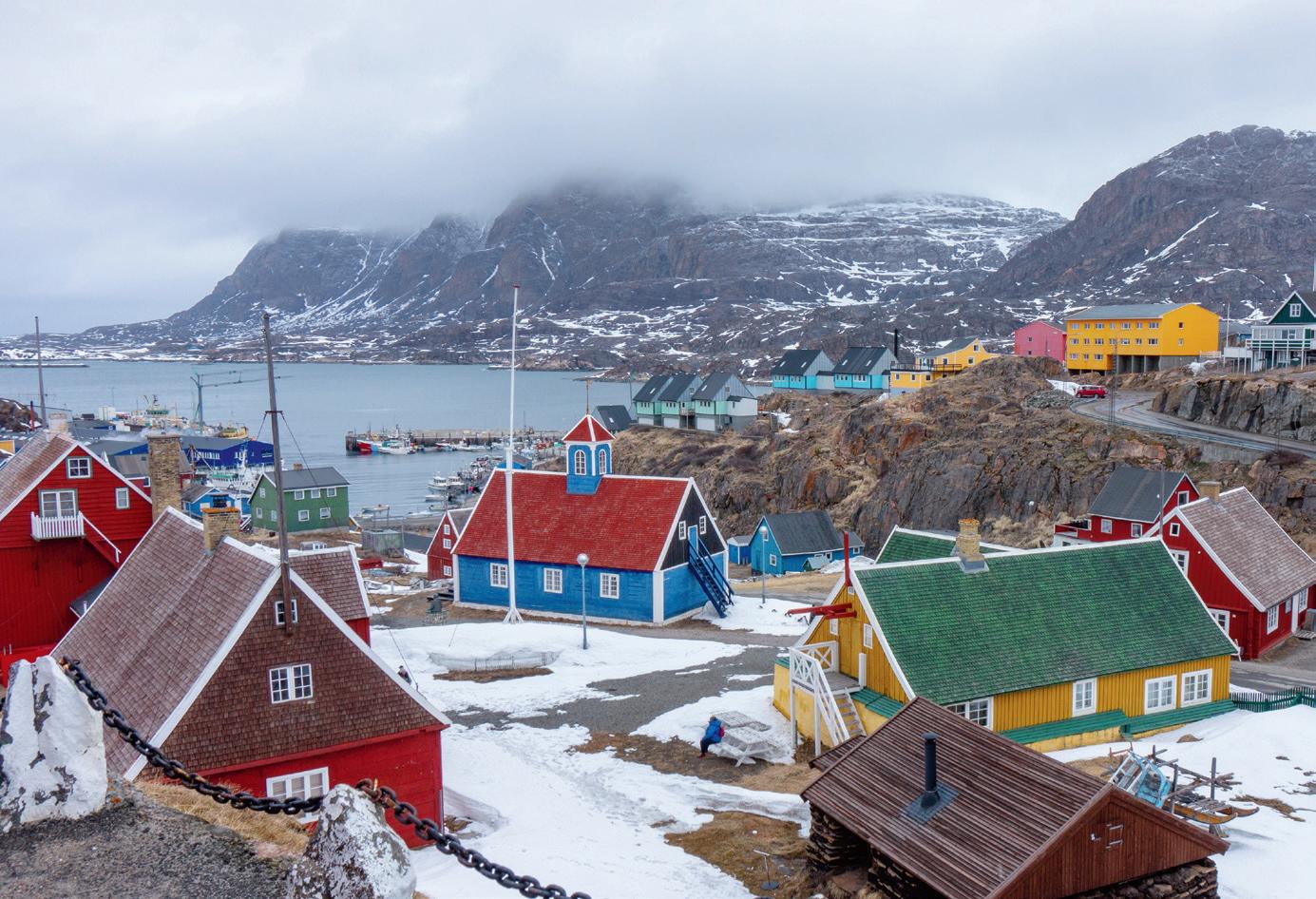
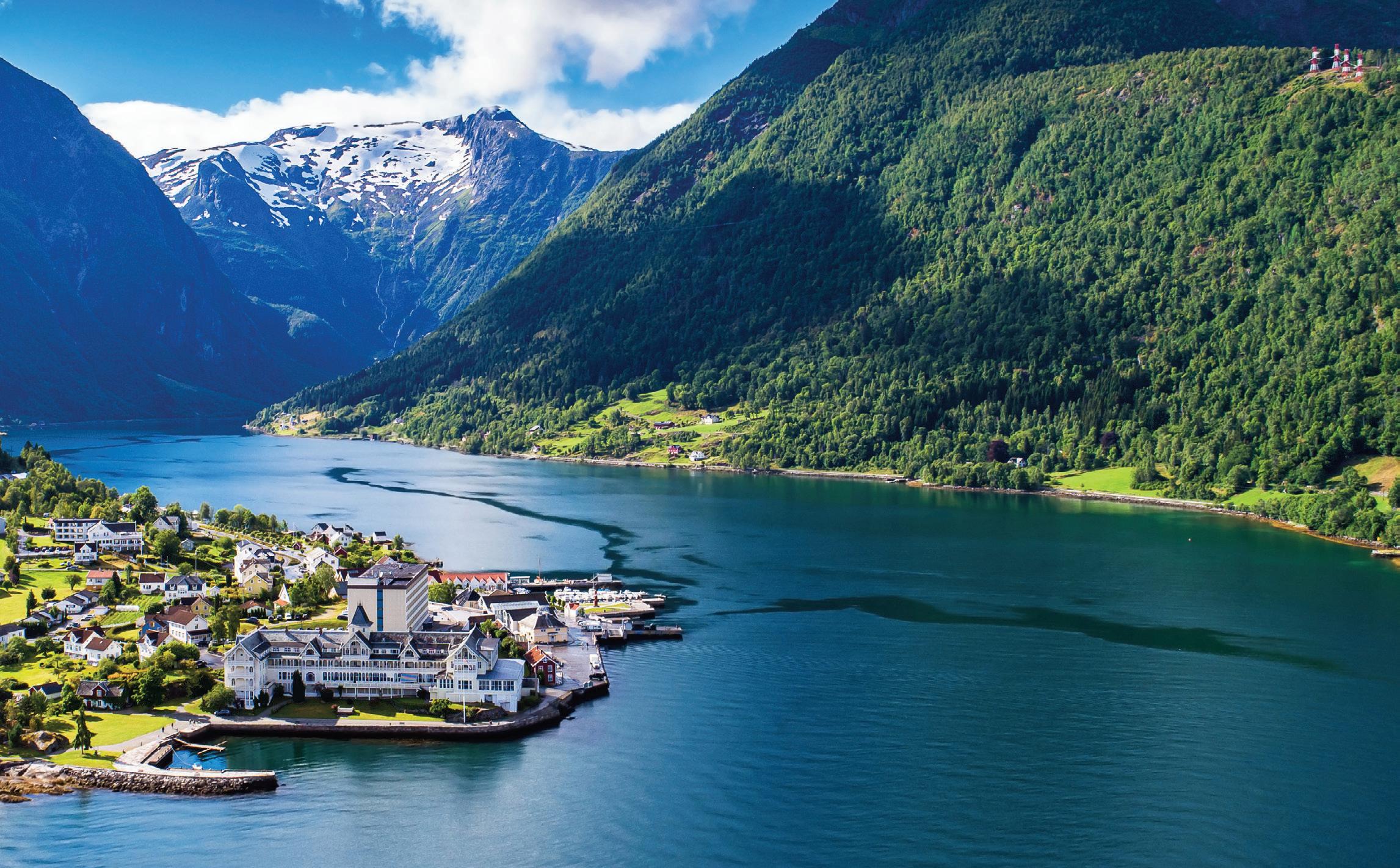
AMSTERDAM TO COPENHAGEN 18 MAY 2027 – ONE DEPARTURE ONLY
Incredible Experiences
• Visit Gamle Logen, one of Oslo’s most treasured cultural landmarks, for a captivating musical performance that brings to life the story of Edvard Grieg, Norway’s greatest composer.
Inclusions
• 10 nights aboard the ultra-luxury Seabourn Venture with spacious all-veranda suites.
• All-inclusive world-class dining, plus complimentary premium spirits, champagne and fine wines.
APT has partnered with ultra-luxury cruise line Seabourn to offer unrivalled opulence at sea. Embark on an exclusive APT cruise through Northern Europe aboard the state-of-the-art Seabourn Venture.
With only 132 suites on board, the ship features all-veranda accommodation, 24-hour in-suite dining and personalised minibars, alongside eight exceptional dining venues that rival the finest restaurants on land. Discover the epitome of indulgence at sea in effortless luxury.
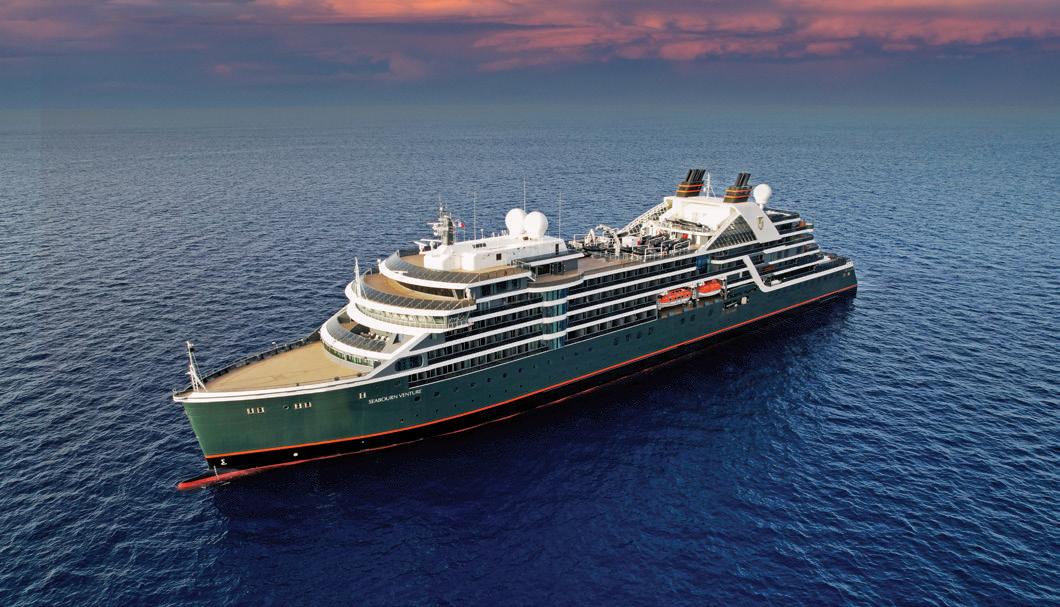
Even though you glide through this paradise on the water, it’s impossible to resist what lies beneath: kaleidoscopic schools of fish, manta rays that dwarf pygmy seahorses and coral
reefs thriving unlike anywhere else on Earth.
True North’s (truenorth. com.au) Raja Ampat Uncharted itinerary wastes no time getting its guests (maximum 36) into the
big blue, stopping at pristine Kofiau island on day two, where orcas might make a rare appearance. There are plenty more chances to explore these protected waters – such as snorkelling off the coast of an active volcano – as well as the opportunity to help their conservation: onboard
marine scientists invite guests to help tag manta rays and whale sharks for satellite monitoring. After long days of saltwater, sun and tropical heat, retreat to True North or True North II (picture a boutique hotel that floats), where stories are swapped over gourmet meals and sundowners.

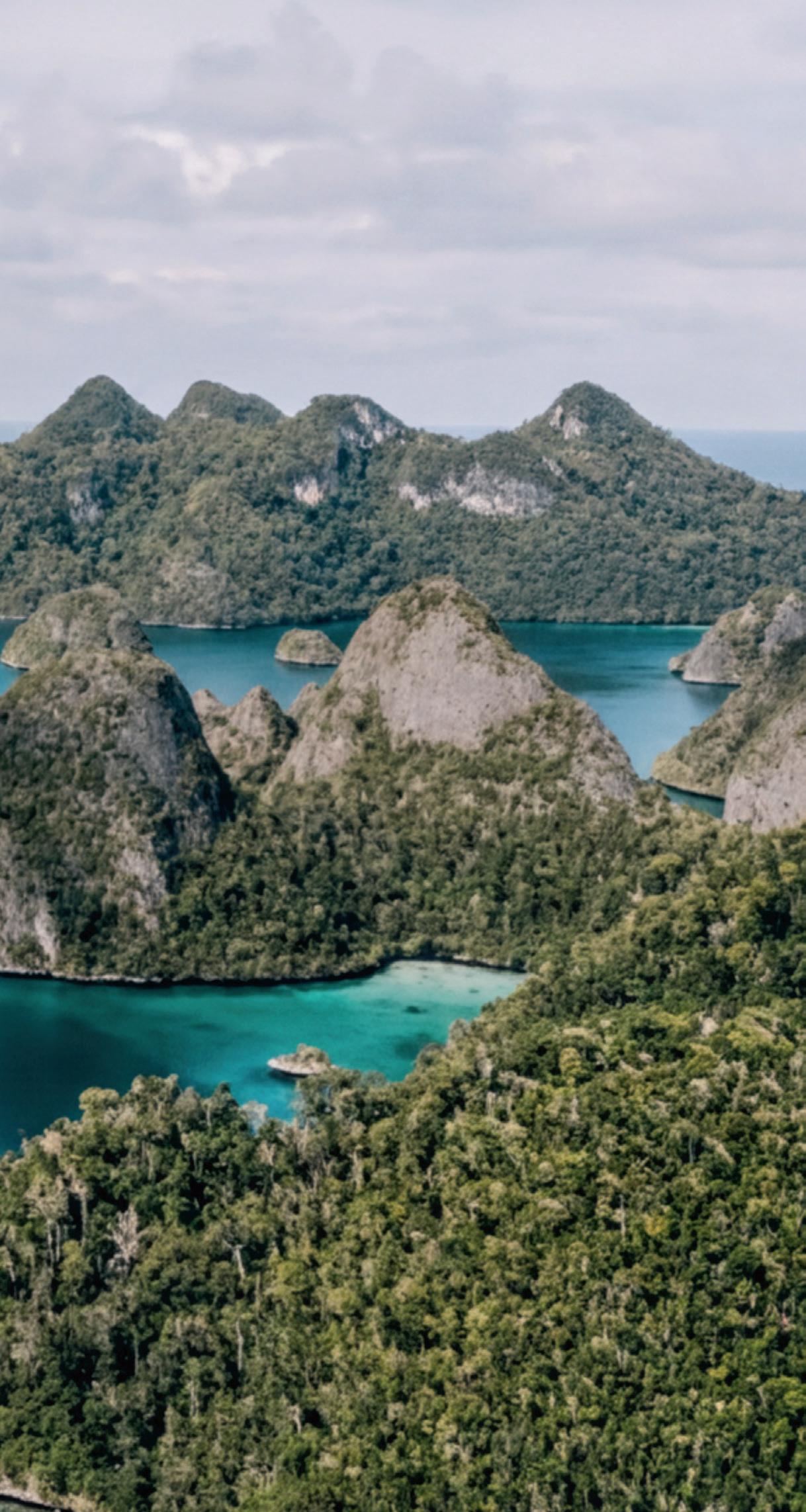
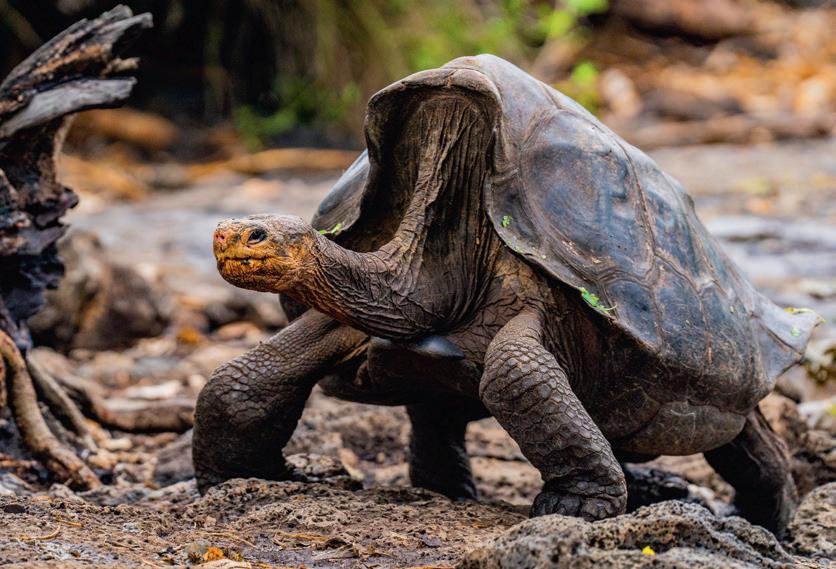
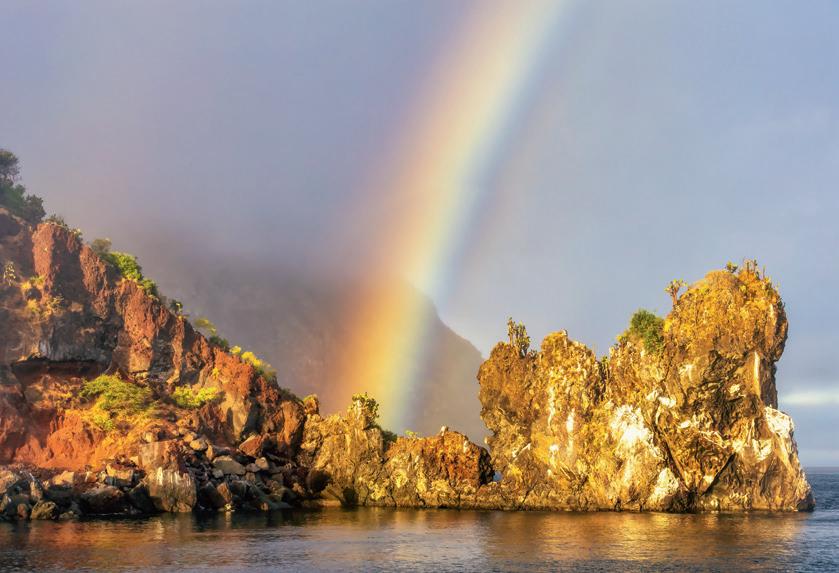
Look up and a waved albatross glides high, while a blue-footed booby bird dives headfirst into the sea. Keep watch from the sky deck of HX’s MS Santa Cruz II (travelhx.com) and witness fur seals posing on rocky outcrops, dolphins frolicking and hammerhead sharks cruising below. In the Galápagos Islands, wildlife and wonder are everywhere. Sailing on the carbon-neutral In Darwin’s Footsteps (Eastern Route) voyage, up to 90 guests (the ship has 36 connecting cabins for families) will spend nine days in the enchanting archipelago, visiting five of its islands and spotting countless endemic animals and plants along the way. Join workshops and meet visiting researchers at the onboard Science Centre then take your knowledge to shore on small-group (maximum 11) excursions with a team of local experts. Off Santa Fe, with its striking giant prickly pear trees, explore the vivid turquoise waters by kayak, glass-bottom boat or simply by jumping in. The verdant island of Santa Cruz offers a once-in-a-lifetime experience on day seven: checking out the Charles Darwin Research Station and seeing the iconic giant Galápagos tortoises up close.
Stepping onto the frozen continent has retained its almost mythical significance since the first explorers arrived in the 19th century. Each year, Aurora Expeditions (auroraexpeditions.com) honours those historic early endeavours on the In Shackleton’s Footsteps itinerary. While Sir Ernest Shackleton and his crew spent 497 days in the icy Weddell Sea, your 20-day round trip from Ushuaia, Argentina, is all highlights (along with technology
and onboard pleasures the pioneers could only have dreamed of). Led by a specialist Expedition Team, up to 130 guests can head out on Zodiac cruises, brave a polar plunge, attend lectures and join citizen science projects such as seabird surveys and collecting of microplastics on shore. The ultimate brag? The Shackleton’s Crossing excursion: a small group (alpine trekking experience is required) can complete a three-day camp and hike on South Georgia island, which Shackleton was the first to cross on foot in 1916.
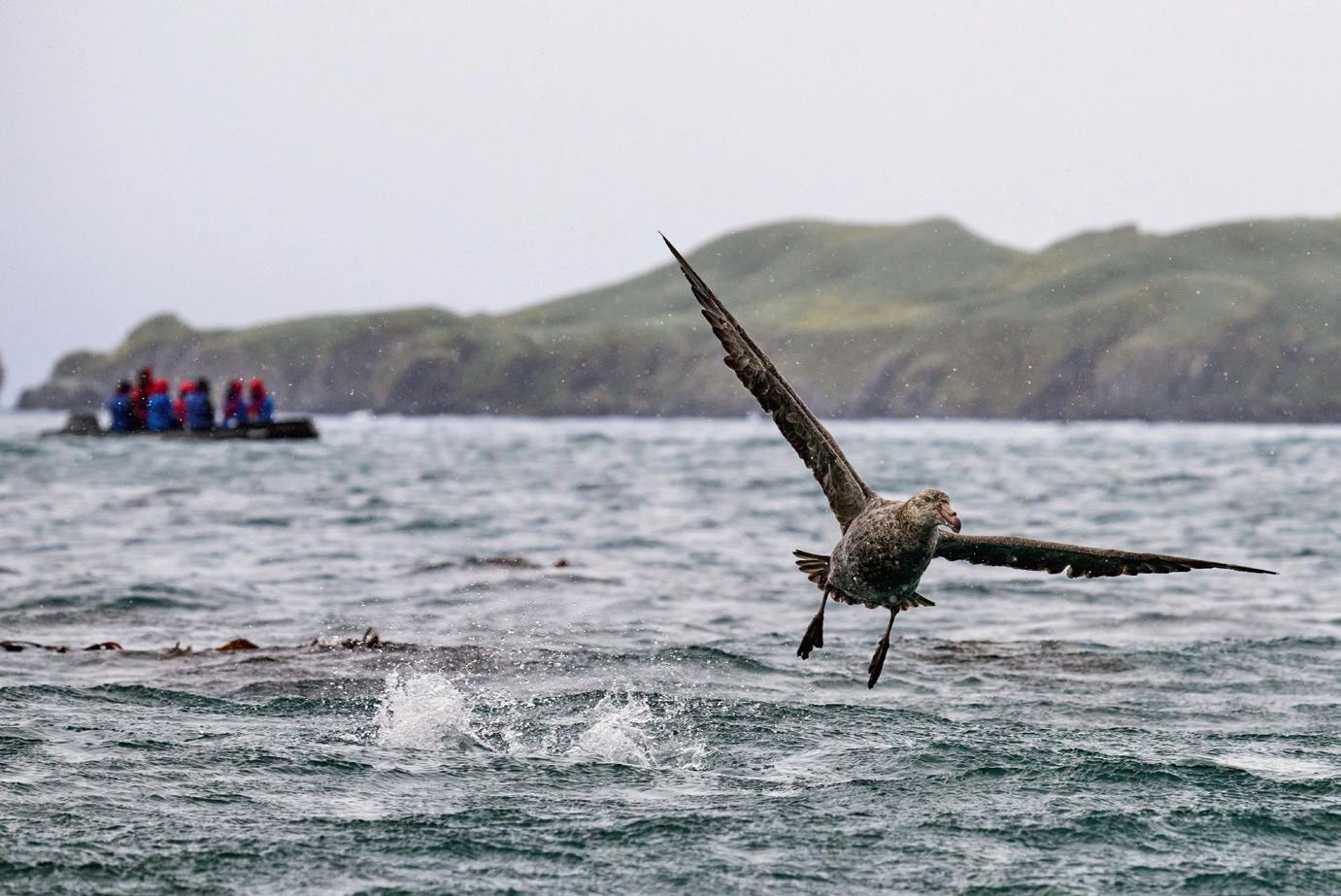
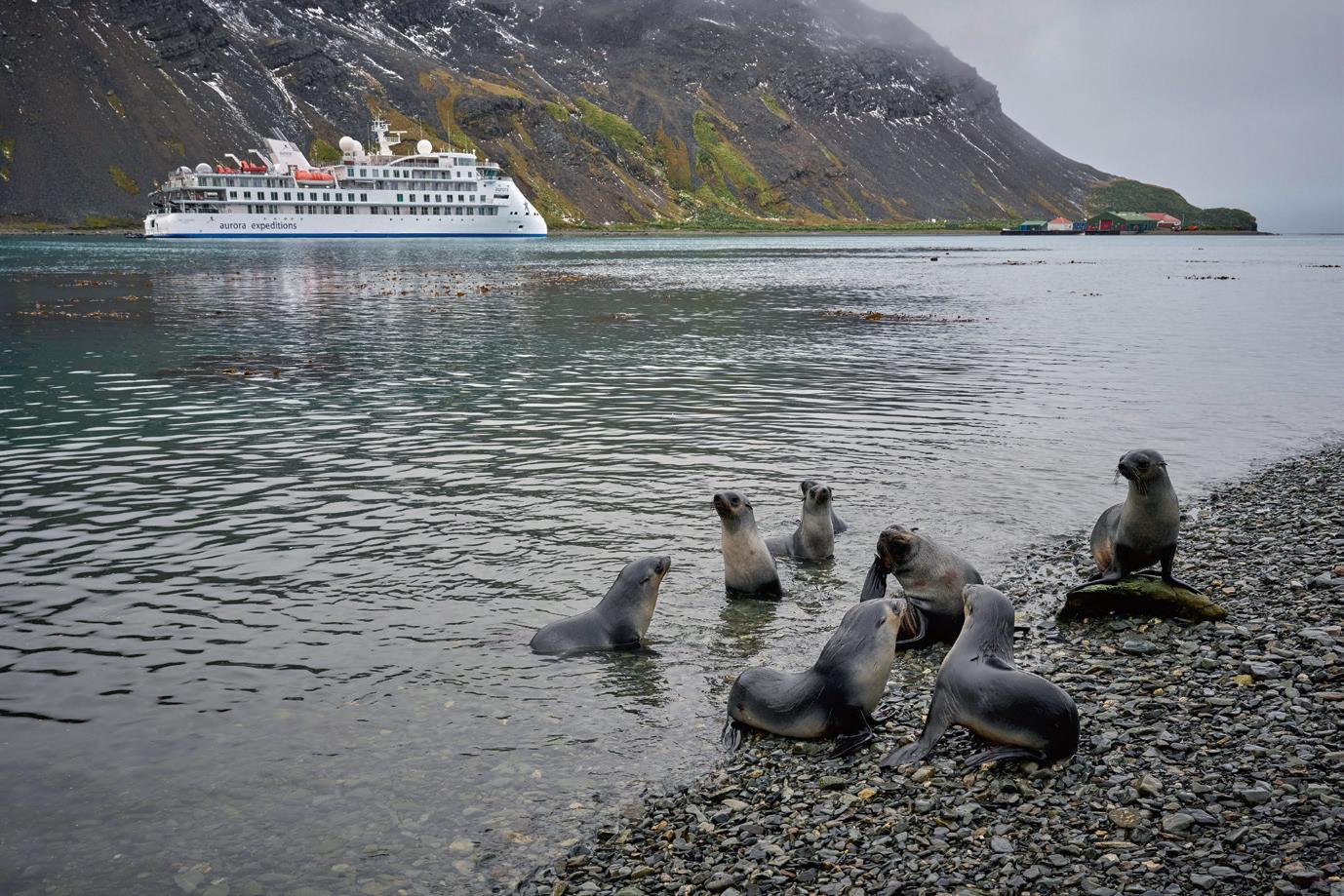
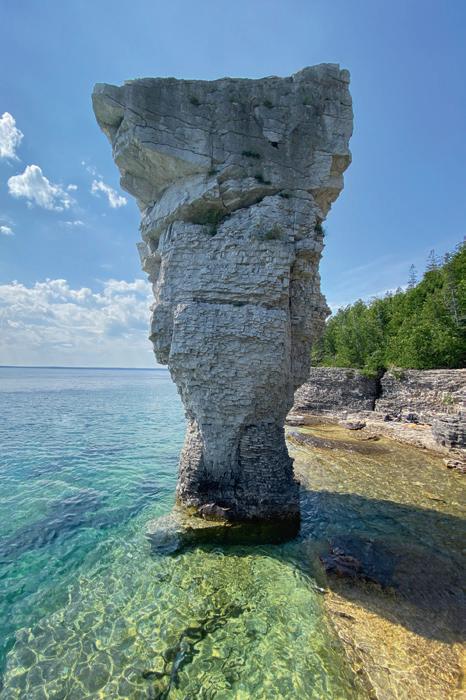
As you peer into the underwater world of Canada’s Fathom Five National Marine Park from inside a submarine, the mysteries of the deep just beyond the glass are waiting to be revealed. Up on the surface, fellow guests (up to 378) on Viking’s (vikingcruises. com.au) Great Lakes Treasures voyage are kayaking the crystal-clear waters of Georgian Bay, while others are joining in research projects at Viking Polaris ’ working Science Lab – and that’s just day five. The Polar Class 6 vessel, with an in-ship marina and 138 Nordic balcony suites, navigates lakes Michigan (about twice the size of Belgium) and Huron (the fourth-largest lake in the world), making stops in three American states and Ontario, Canada. Over 10 days, the largest freshwater system on Earth reveals pink granite cliffs, wildlife such as bald eagles and native turtle species, sunken shipwrecks and the ongoing stewardship of First Nations peoples.
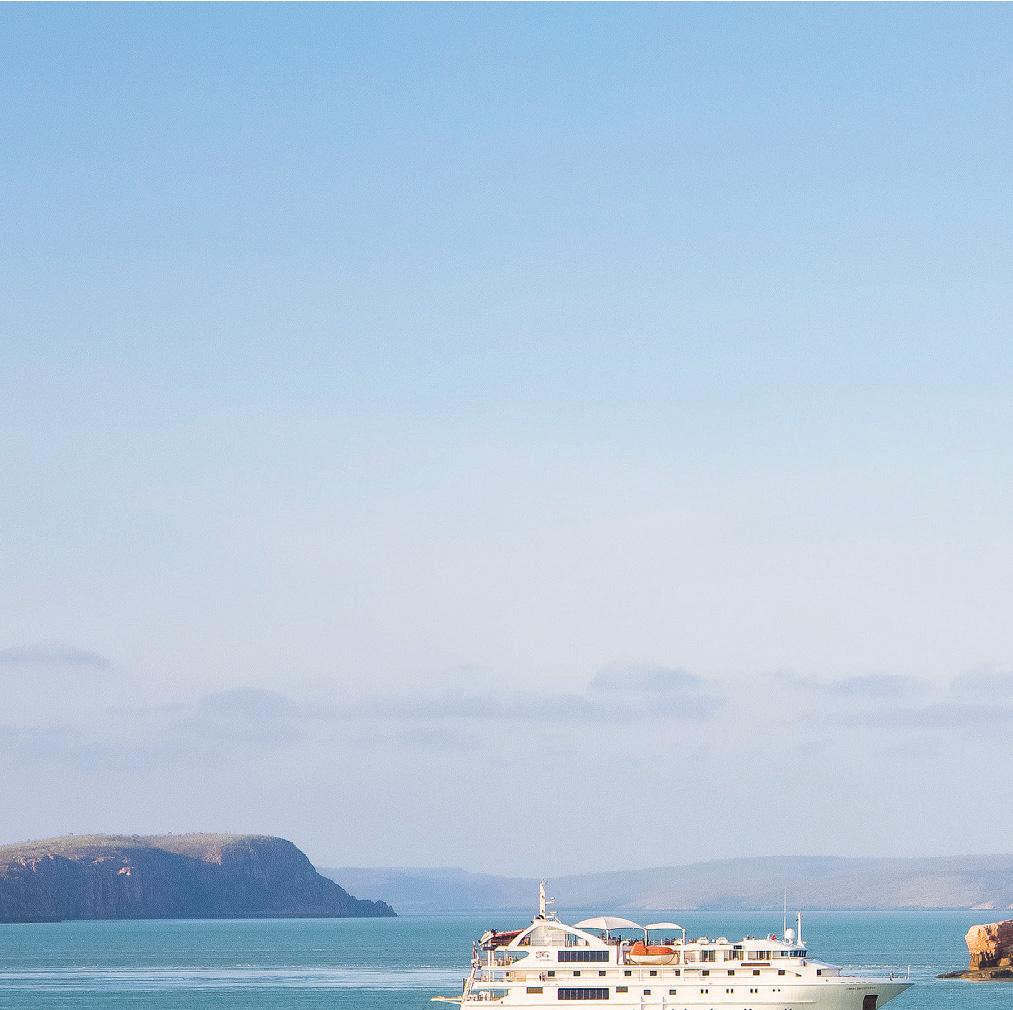
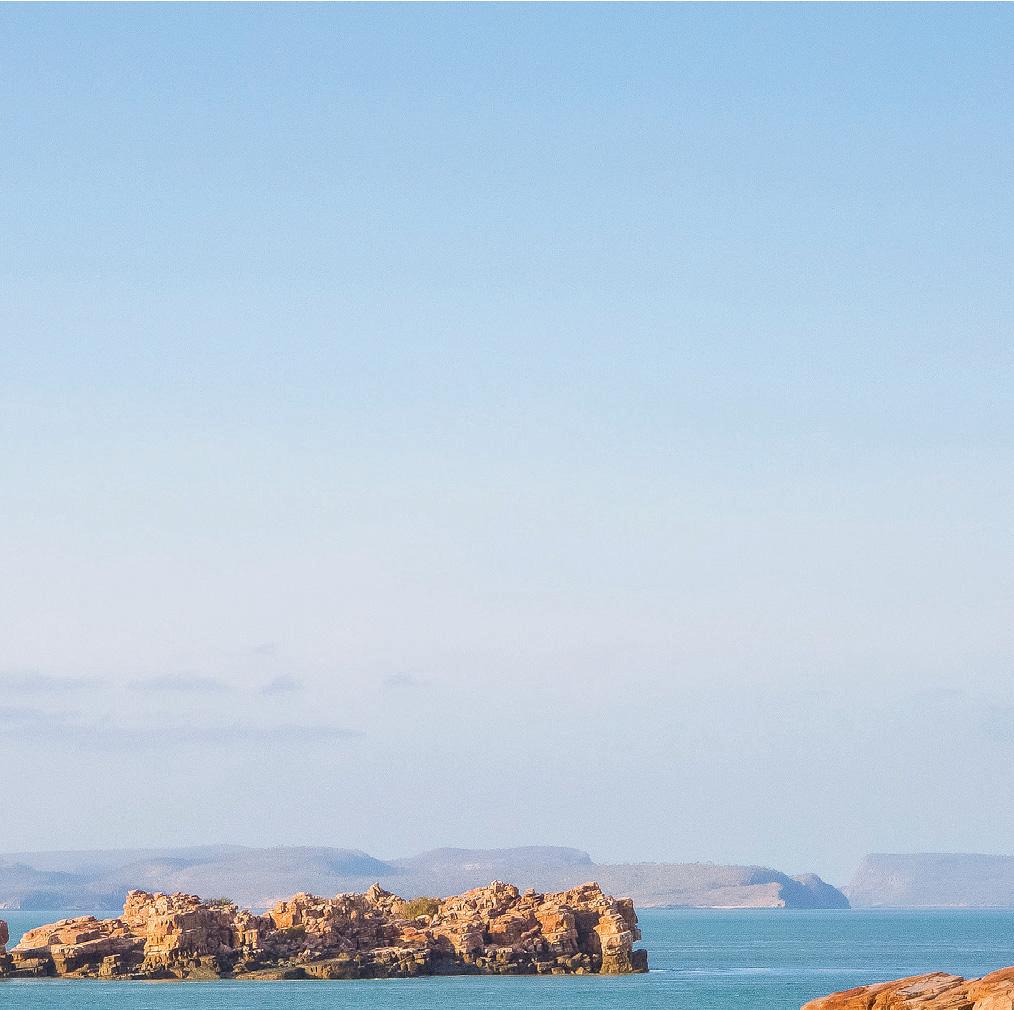
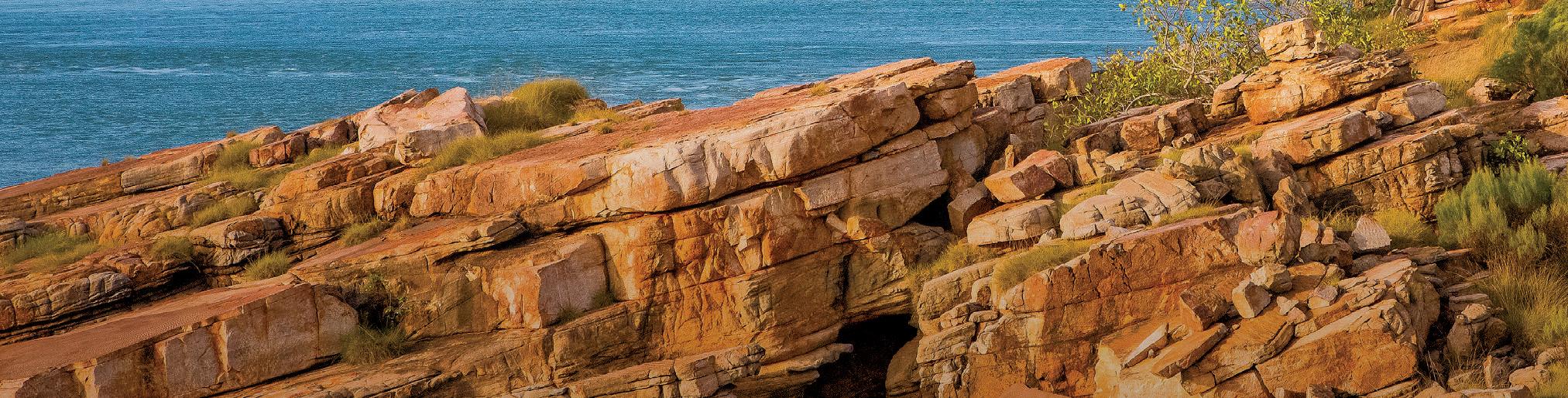
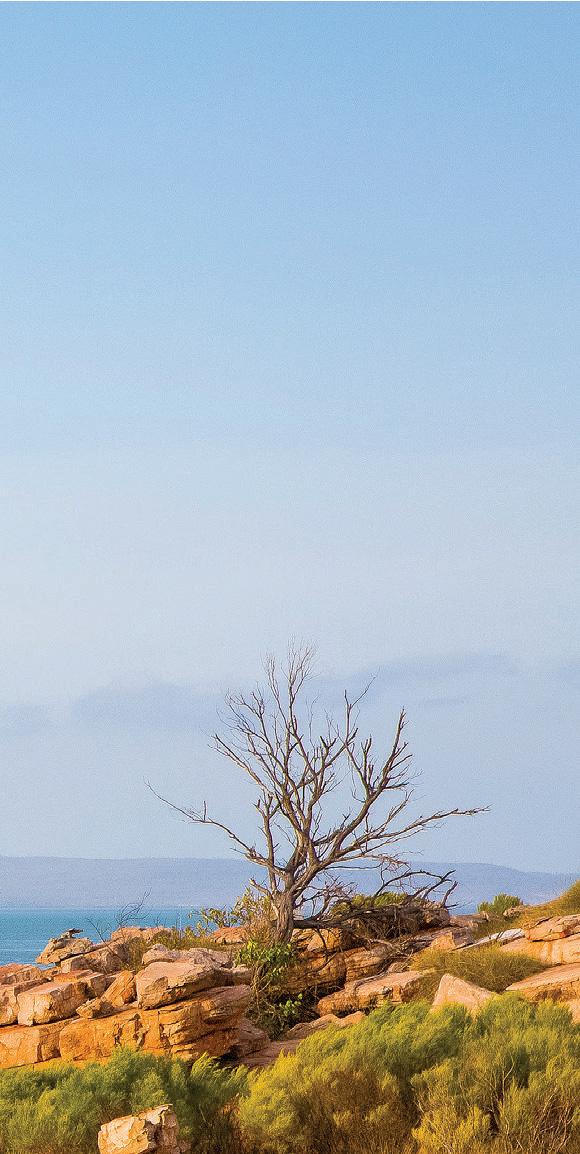

Coastal escapes shape holiday memories around Australia. Airbnb and Surf Life Saving Australia are committed to keeping beachgoers safe, offering education and advice every day of the year.
Life by the water is part of being Australian – residents make more than 600 million coastal visits each year. From barefoot holidays in quintessential beach towns to off-grid escapes backdropped by sweeping ocean views, a seaside break offers a chance to unwind, disconnect and find a moment of calm.
For travel booking platform Airbnb Australia and New Zealand and Surf Life Saving Australia (SLSA), ensuring that holiday plans can be enjoyed safely is a priority.
Community comes first
The wellbeing of our coastal communities is a credit to the tireless efforts of SLSA’s volunteer surf lifesavers and professional lifeguards. According to the SLSA’s latest Summer Coastal Drowning Report, during the 2025/2026 summer season the SLSA supported 3989 rescues, 17,221 first aid treatments and 994,946 preventative actions.
These are estimated to have saved 697 lives and prevented 418 critical injuries, with services valued at more than $4 billion to the community.
Understanding the risks is key to beach safety. For Airbnb, its partnership with SLSA is about making sure expert advice is visible at the right moment.
“Australia’s beaches and waterways are central to so many people’s holiday experiences but they can also be places of real risk,” says Susan Wheeldon, Airbnb’s country manager for Australia and New Zealand.
“Through our partnership with SLSA, we help to make safety a core part of the travel planning experience, not just an afterthought.”
Know the risks
Distance from help is one of the major risk factors, with beach distress and drownings more frequent in unpatrolled locations.

Airbnb is committed to sharing critical safety messages before people go into the water – especially at more remote beaches.
The guidance from SLSA is built on a simple framework: always swim between the red-and-yellow flags. “The flags exist to provide a supervised and safe swimming area for those attending the beach,” says SLSA’s coastal safety manager, Michael Bonnici. “We identify the safest stretch of water, mark it clearly and have trained personnel watching.”
How to be beach safe
In the history of Australian surf lifesaving, no-one has ever drowned while swimming between the red-and-yellow flags. The message is stop, look and stay alive.
STOP before entering the water and check for risks.
LOOK for the red-and-yellow flags, safety signage, rips and changing conditions.
STAY ALIVE by swimming between the red-and-yellow flags, checking conditions and being honest about your swimming ability.
Airbnb shares SLSA guidance with guests, including links to the Beachsafe app (beachsafe.org.au), which offers up-to-date information about every Australian beach. Users can find details on patrol status, facilities and hazards as well as weather, swell and tide information.
Plus, beachgoers are reminded that they can always speak with a lifesaver or lifeguard on duty if they’re unsure about the current conditions.
Airbnb also provides safety support for its community within the platform itself. Guests have access to a 24/7 hotline that offers urgent assistance. Launched last year, Airbnb also offers a dedicated in-app feature that shares water safety tips when a stay has a pool or is located near a body of water. The platform also suggests questions guests can ask hosts about water safety protections and considerations for individual listings.
Through its partnership with SLSA, Airbnb is working to embed trusted resources into the travel experience – so safety is front-of-mind before anyone sets foot on the sand.

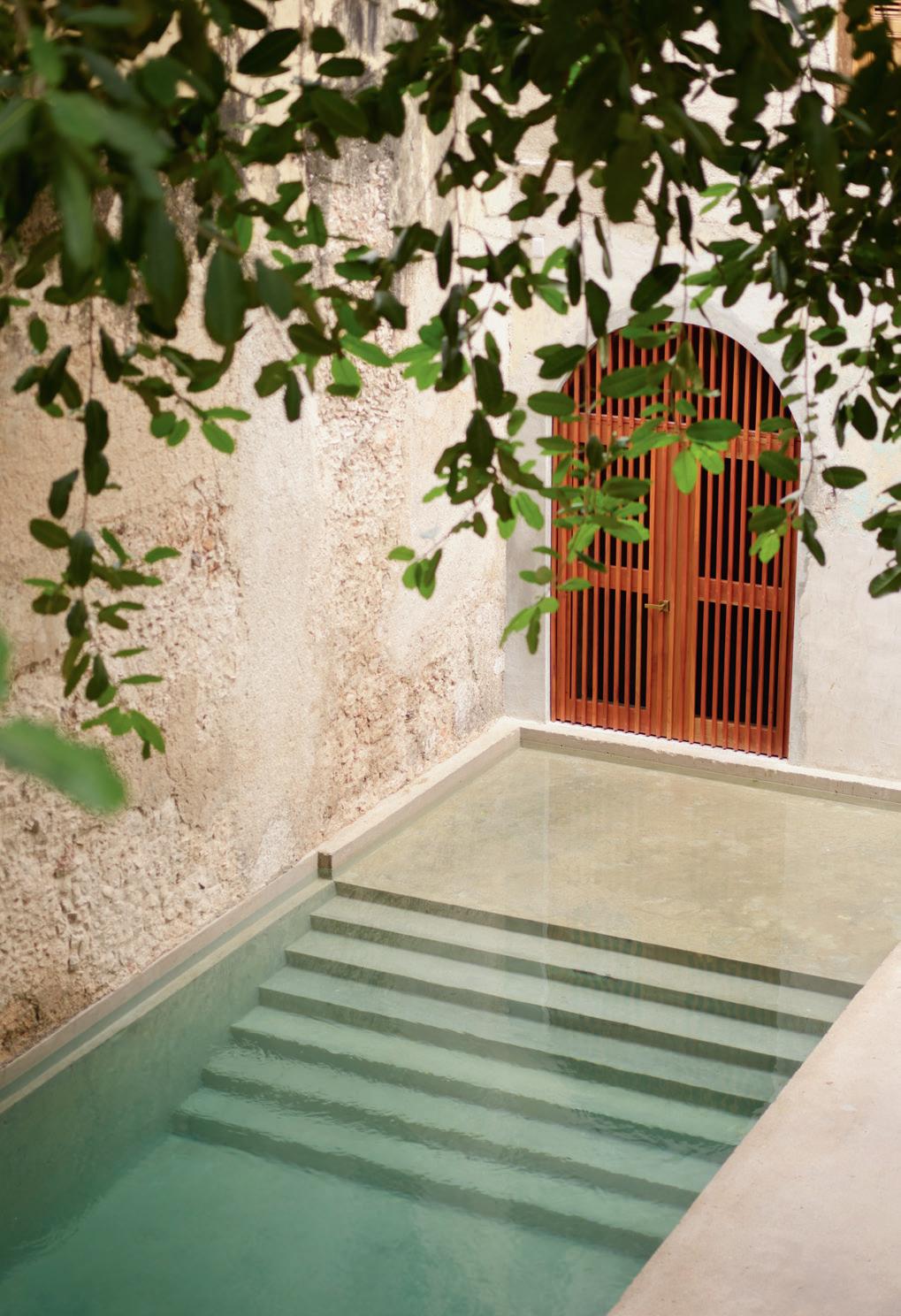

Story by Kate Hennessy
This First Nations artist and surfer from Sydney calls on multiple mediums, including ceramics and painting, to explore his family’s story.
It’s Dharug artist Billy Bain’s first solo show in four years and his first at the Art Gallery of NSW but that’s not stopping him from presenting a bold blend of installation, sculpture, painting, woodwork, ceramics, weaving and soft sculpture for By the River (AGNSW; 4 July to 8 November). “I love trying new things and finding synergy between practices,” he says. “I’ll use whatever works to tell the story I want to tell.”
That story is Bain’s connection to Dharug Country, using the Dyarubbin/ Hawkesbury River as a metaphor. He grew up on Sydney’s Northern Beaches on Garigal land, competed as a professional surfer and later enrolled in art school. “I was the first in my family to go to university but I’d always drawn and my mum taught me to paint.”
Bain, whose family had been displaced from their traditional lands at the top of the Hawkesbury River, had grown up feeling disconnected from Dharug Country. But his love of surfing led him to realise that the Broken Bay estuary behind Palm Beach is where Dyarubbin meets the sea. “That water flows upriver to where my family is from. I grew up surfing those beaches and playing in the mangroves. The Dharug see that waterway as a living entity and I’d always been part of it. This exhibition is about a journey back upriver.”
Best known for his figurative sculptures, Bain was influenced early on by graphic art, cartoons and surf magazines. “I considered doing illustration but I don’t like following briefs; I like figuring it out for myself.” He didn’t study ceramics at art school, either. Instead, “I did some work experience with ceramicist Ramesh [Mario Nithiyendran] and then went hell for leather into it.”
Now, promise beckons in several directions. In 2025, Bain was an Archibald Prize finalist for Rona and Pig at Palm Valley, a portrait of Aranda
artist Rona Panangka Rubuntja and her dog that was acquired by the Art Gallery of NSW. Appreciation of its landscape aspects saw curator Erin Vink encourage him to explore his painting practice, the results of which can be seen in By the River. “I’d never done landscape painting at this scale before,” he says. “It’s an interesting space to try new things. But why not?”
In 2023, Bain and two kilns moved into a studio in Rydalmere, in Sydney’s north-west. “It opened up my practice so I could go big and be ambitious.” His first sculptural work there, Dog Walker (Plan B), was a self-portrait as “an imagined reality where I took up dog walking as opposed to art”. It’s fortunate he never did so in reality – the piece was acquired by the National Gallery of Australia in 2024 and “I became the first Dharug artist in its collection”.
Awards:
Finalist Archibald Prize 2025
Finalist Wynne Prize 2023, 2024, 2025
Finalist Sulman Prize 2023
By Design:
Story by Julie Lee
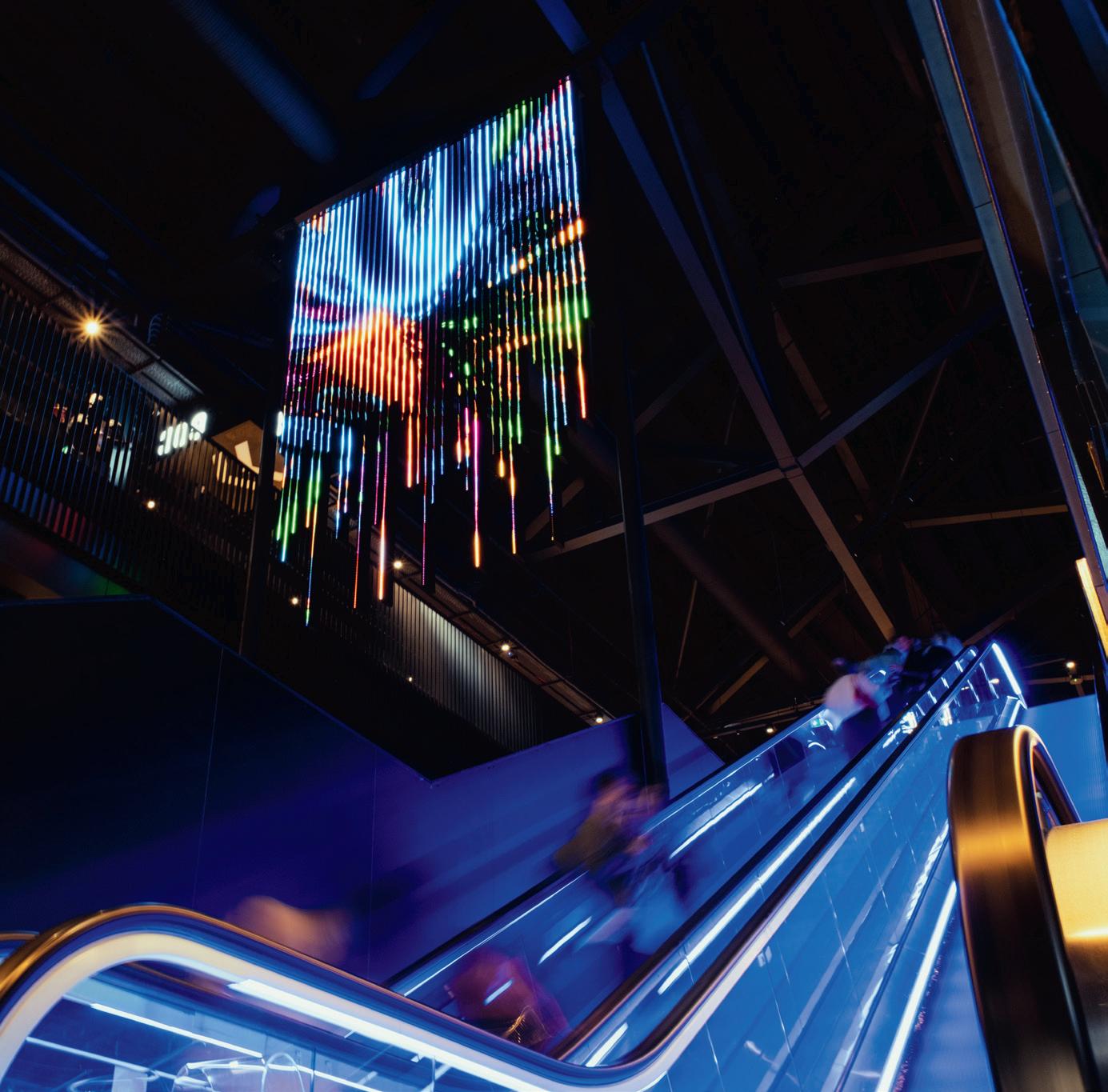

In Northern England’s premier music hub, light, colour and sound are being used to shape how people move through the city.
The CityLink Walking Route is a creative fix for a modern problem – how do you encourage people to go to concerts on foot rather than drive? Connecting central Manchester with the Co-op Live arena, the pathway uses art and light installations to propel crowds forward.
Designers at Leeds-based creative studio
Newsubstance took a stretch of underutilised land and transformed it into a 25-minute pedestrian pathway filled with vibrant hues and sound. “We wanted to make this on point for Manchester, celebrating its past, its culture and its identity,” says chief creative officer Patrick O’Mahony. “When we were designing it, we were thinking in terms of colour, simplicity and social media, as well as different heights and scales.”
The trail has 11 installations, which act as wayfinders towards the arena. “Near the start of the trail, we’ve got big light antennas, which act as two beacons,” says O’Mahony. “They’re tall and are like a sign to say you’re heading in the right direction.”
At the midway point is a mural by two well-known local artists, which solved another problem. “It was a really tricky area of the route because it came around a bend and was pinned by the railway line on one side. We had to figure out how to keep people going to get to the next piece of art.
“We worked with Stanley Chow, an amazing illustrator from the area, and street artist AKSE P19 to bring the visual narrative together. It was great to put these breadcrumbs along the trail – whenever you go past a piece of art, you can always see the next one.”
On a sustainability front, the design team partnered with The Climate Pledge and the penultimate installation on the path is The Climate Pledge Arch. “ There’s a counter on top of the arch with information like how much carbon has been saved from everyone walking.”
When you arrive at the arena, you’re greeted by the giant neon-lit Big M (right) to mark the route’s end. “It’s purposely positioned so that even if you’re not [renowned photographer] David Bailey, you can stand under the Big M and your friend can get a picture of you framed by the arena.”
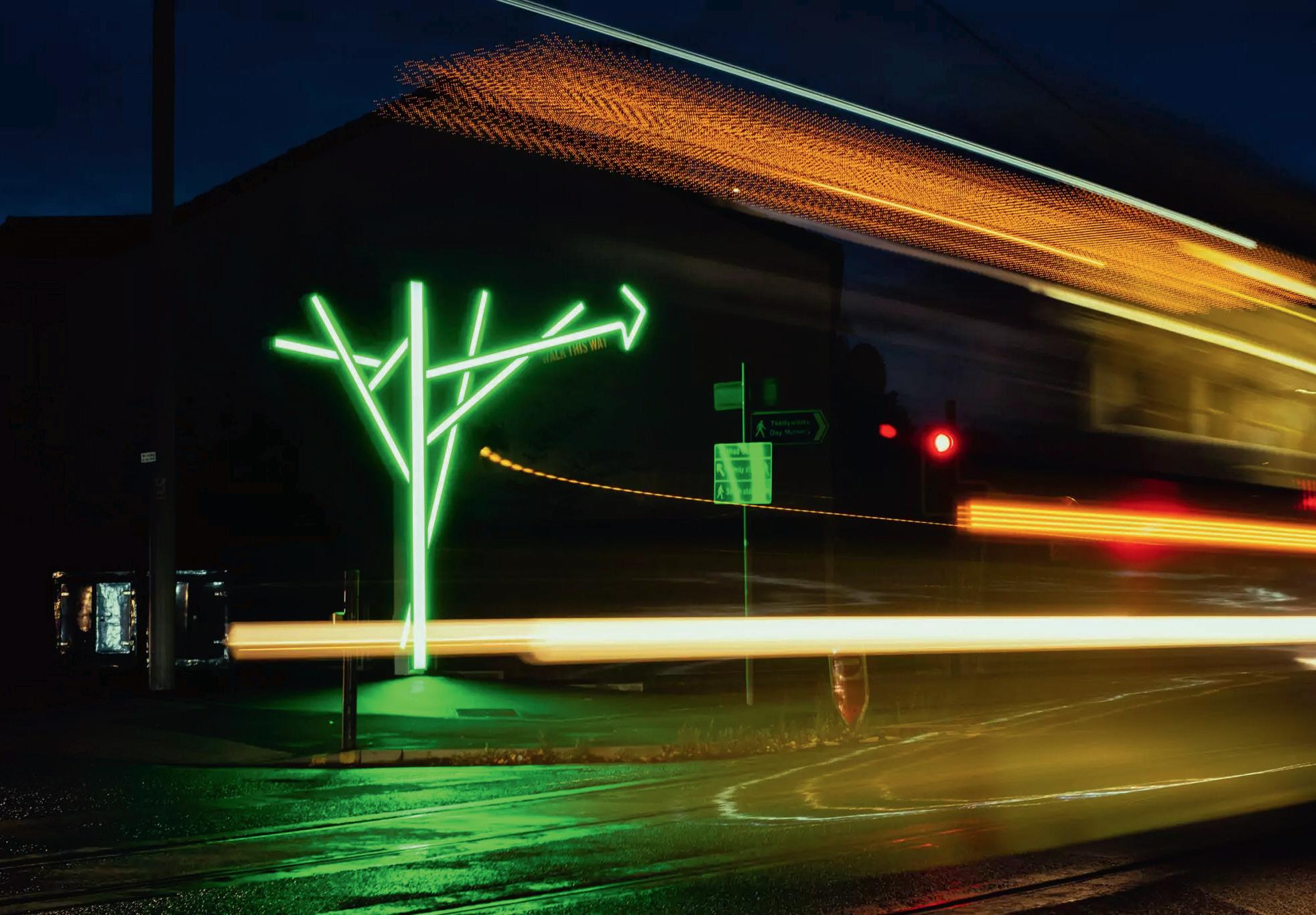

Story by Kendall Hill
Photography by Fernando Marroquín
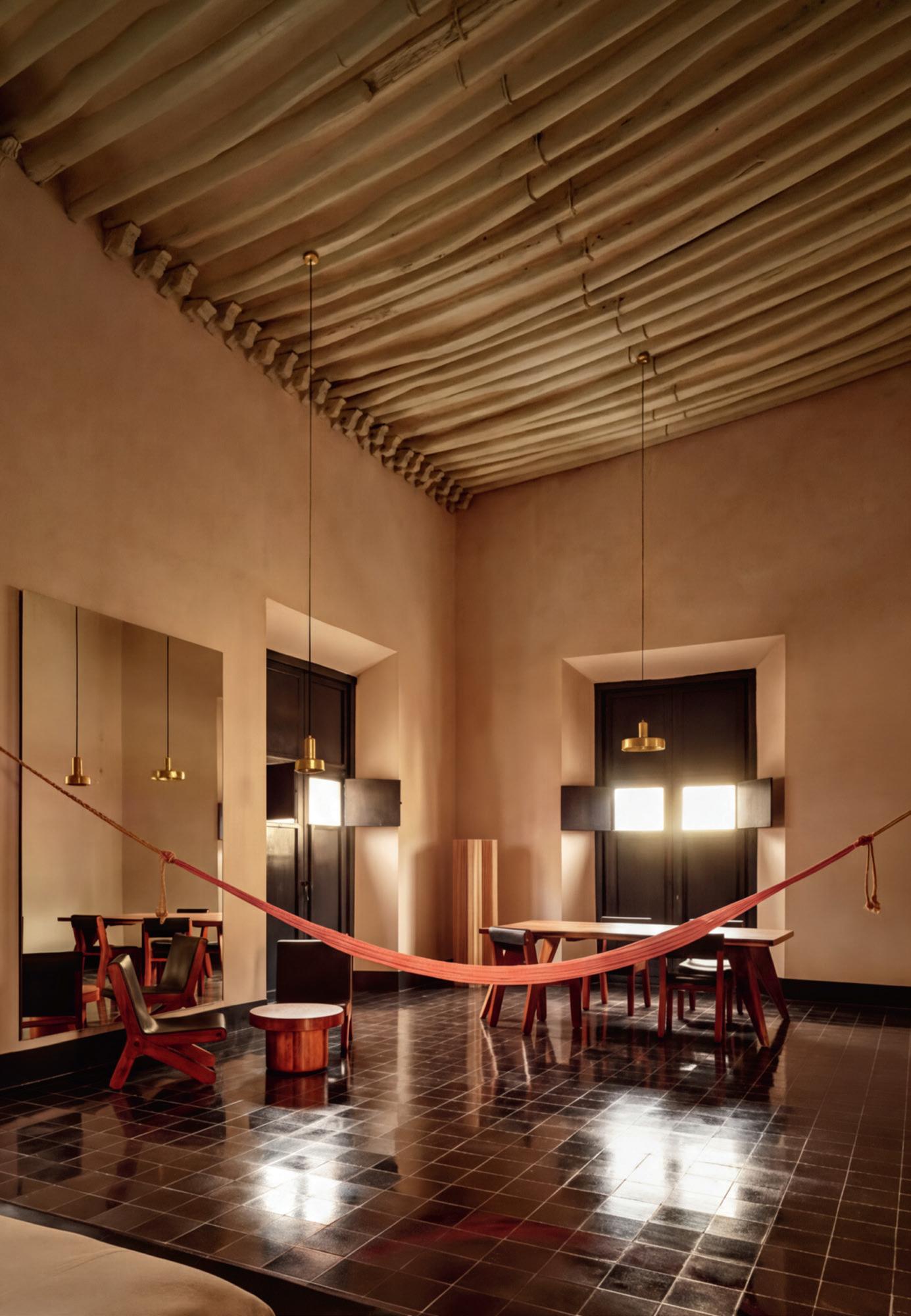
A classic Yucatecan mansion is rejuvenated for a new life, with one eye on traditional materials and the other on modern luxury.
When architects Ingrid Moye and Christoph Zeller first visited this decrepit 16th-century casona (colonial mansion) on Mexico’s sunbaked Yucatán Peninsula, “we just fell in love with the charm of the ruinous building,” says Moye. The Berlin- and Mexico Citybased founders of Zeller & Moye (zeller moye.com) strove to preserve the “beauty of the decay” while carefully restoring the listed monument during its eightyear transformation into the 21-room Hotel Sevilla (hotelsevilla-merida.com).
The latest outing from hip Mexican hoteliers Grupo Habita, the Sevilla’s top accommodation is the Historic Patio Corner Suite, its 5.6-metre-high ceilings buttressed with original rollizos (trunks) of zapote wood and floors clad in polished black pasta tiles, typical of Yucatecan haciendas.
The centrepiece of the 60-squaremetre space is the hammock – a musthave accessory in Mérida’s sweltering summers – woven from henequén, the native agave fibre dubbed “green gold” for the wealth it brought the region in the late 19th century. Restored cedarwood doors regulate light and heat via clever postigos (shutters), smaller inset doors that can be opened for ventilation while retaining privacy through lamella louvres. The custom furniture, locally made from tzalam (Mayan walnut), gleams with transparent wax and black leather finishes that capture the luminous spirit of the interior.
Edited by Katherine Green
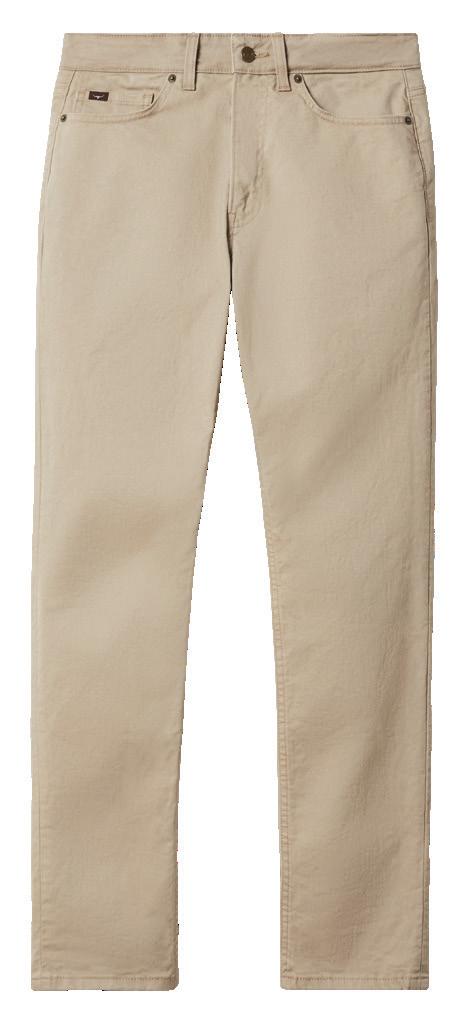
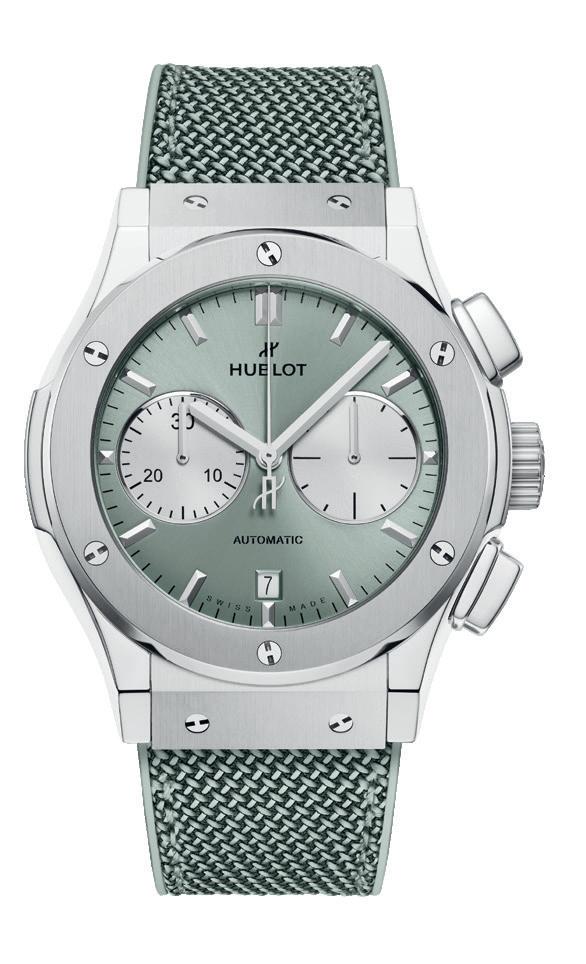
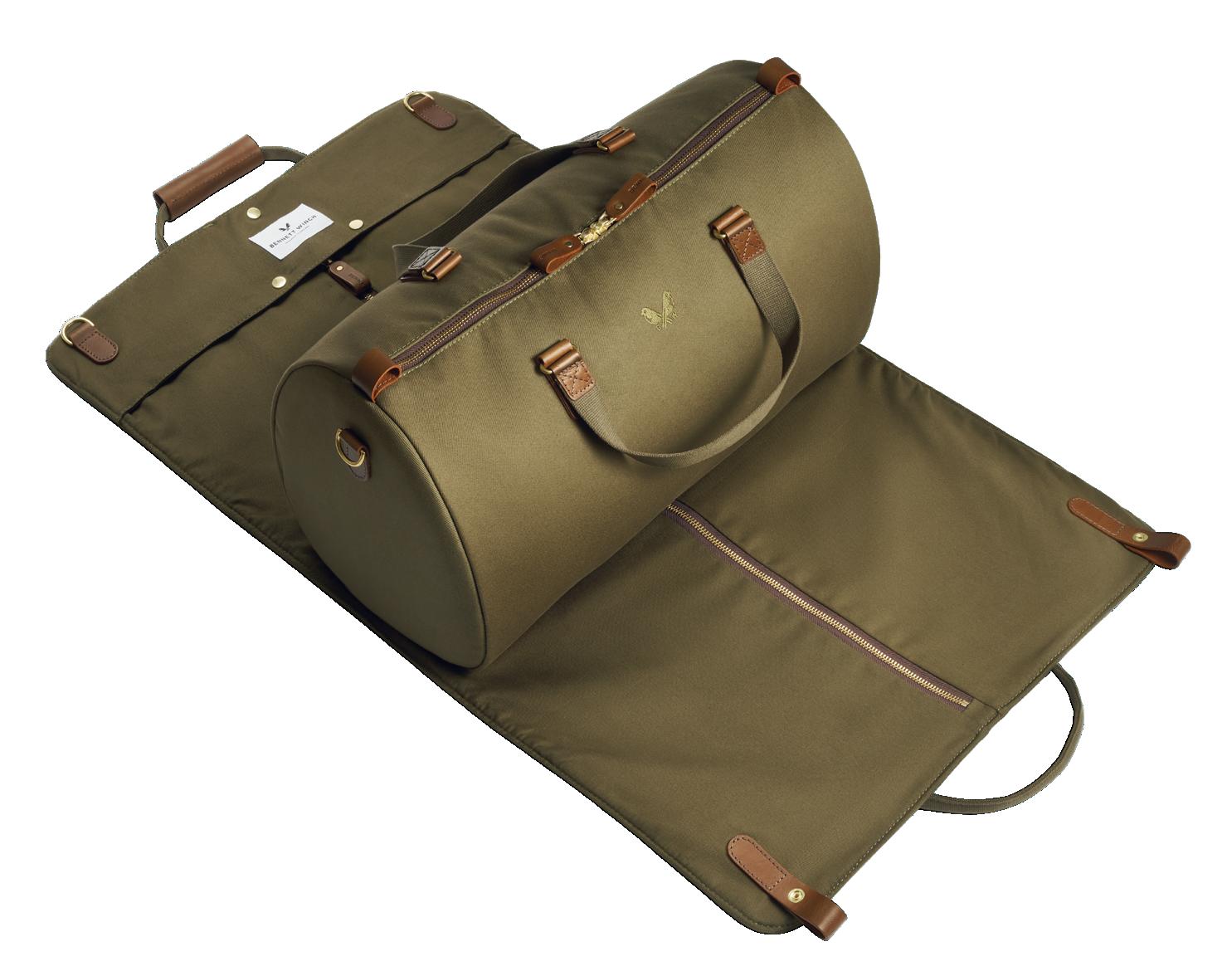


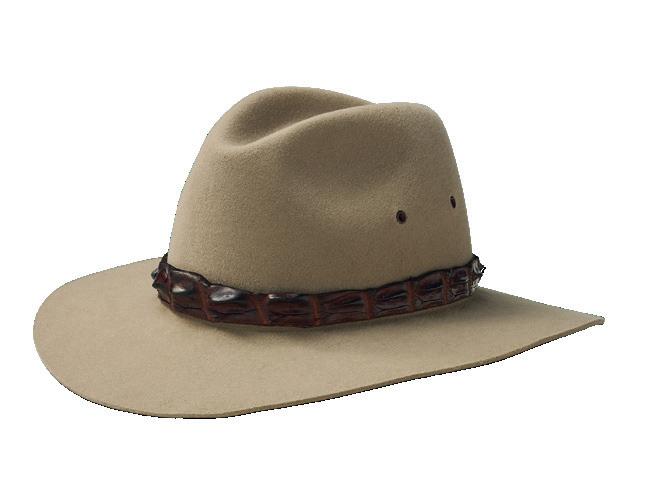
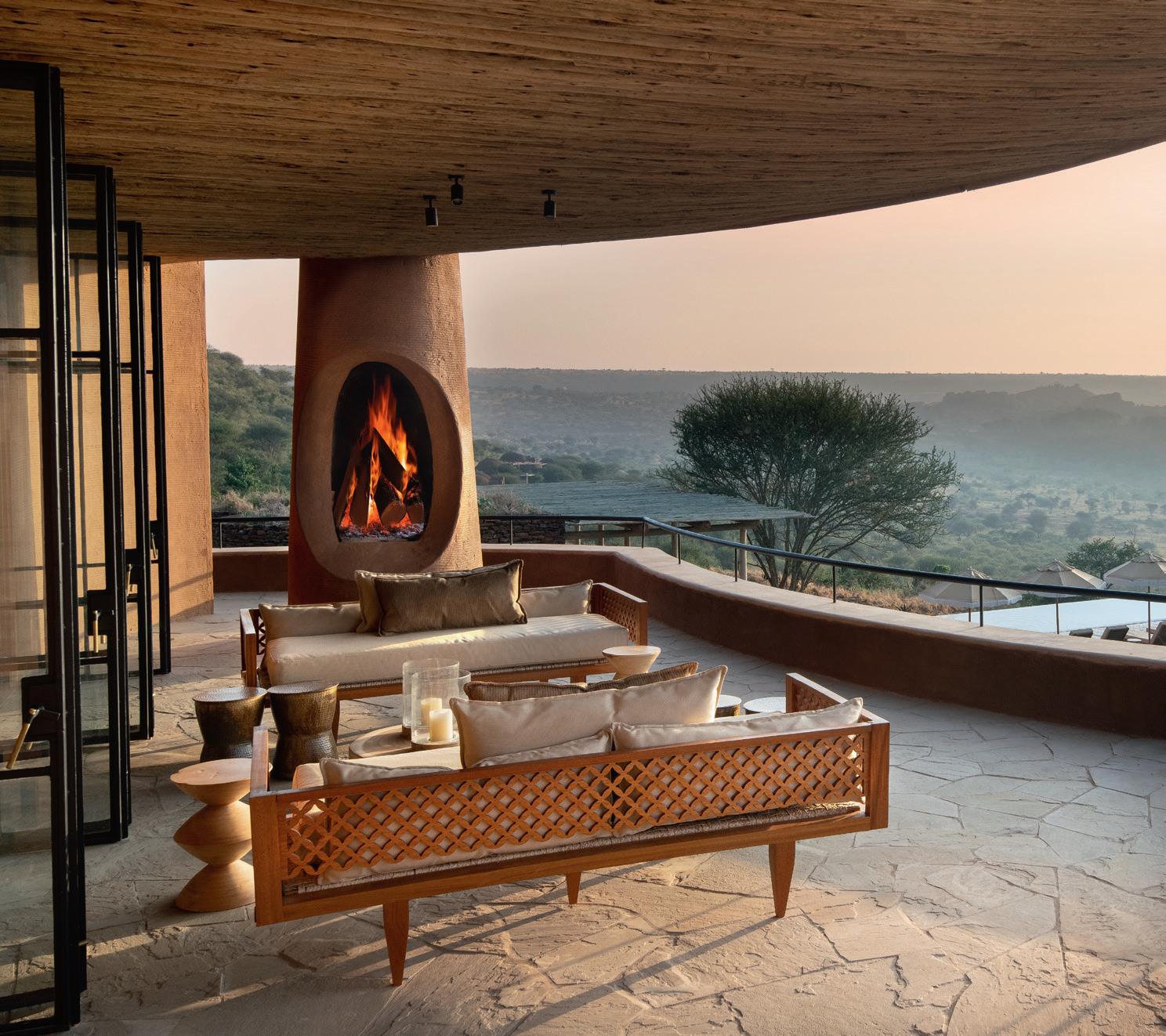
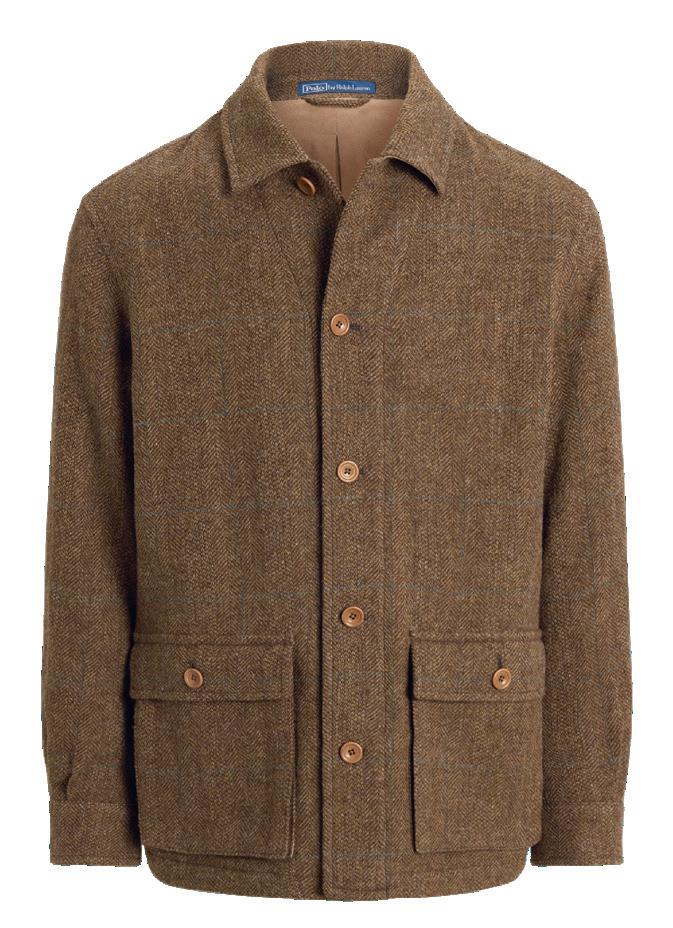

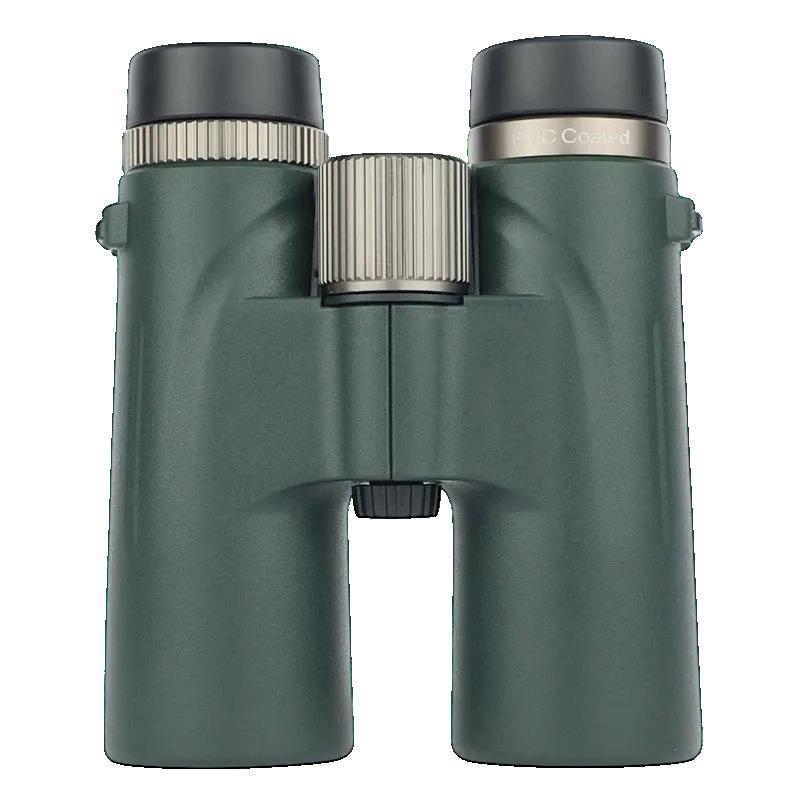
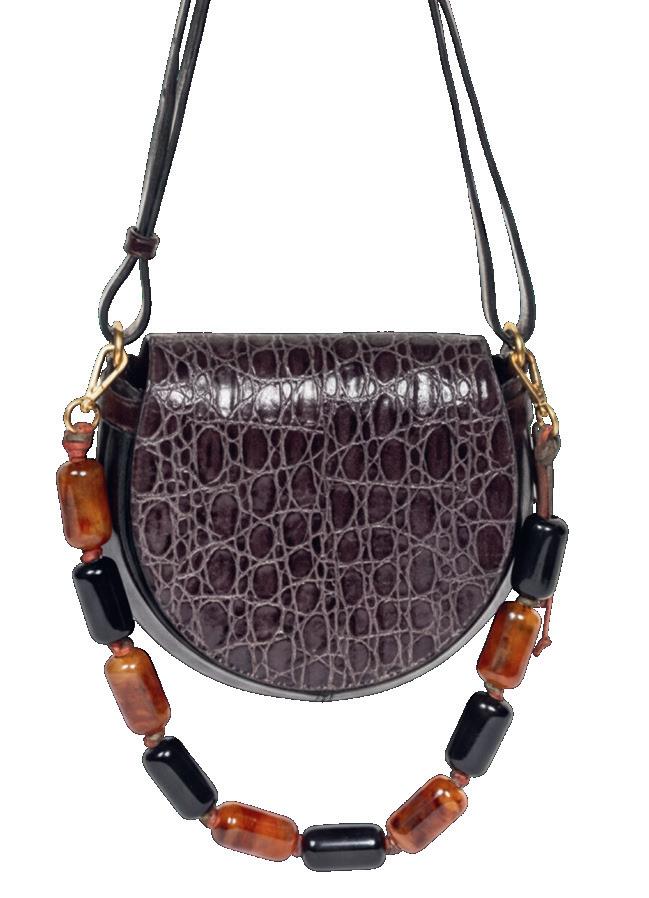
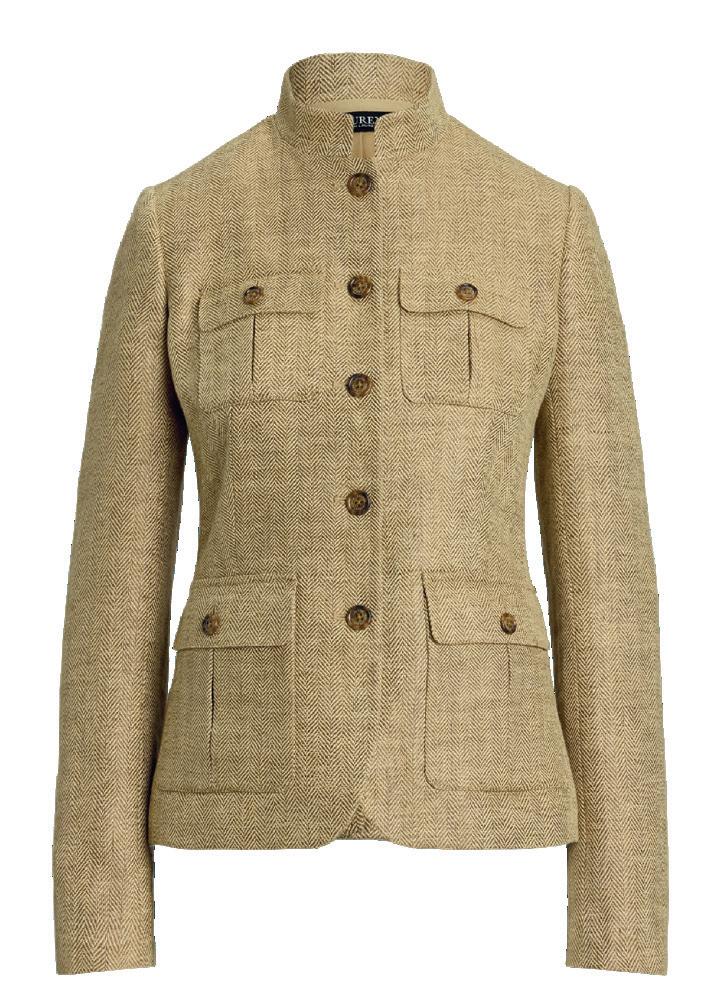
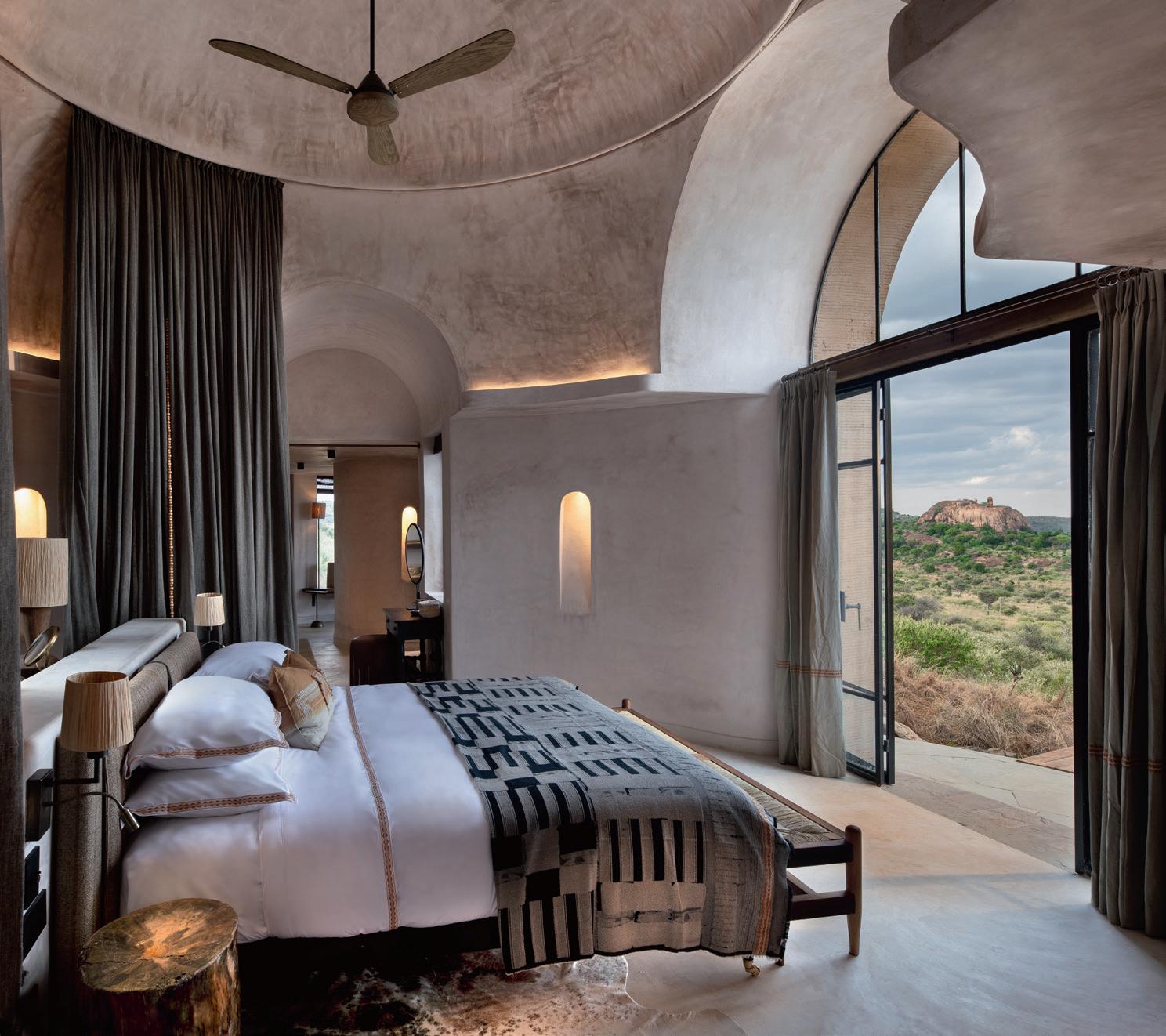
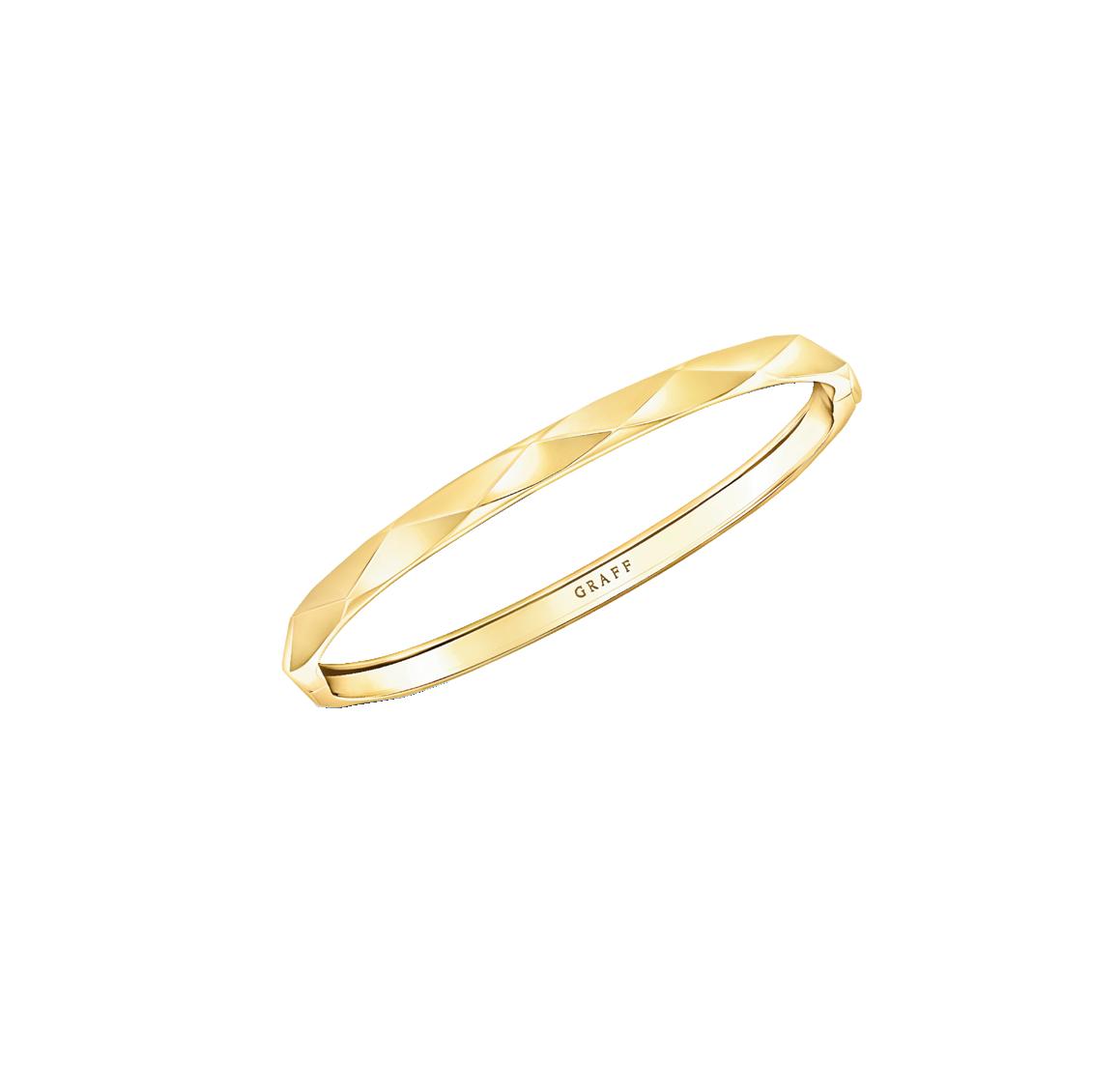
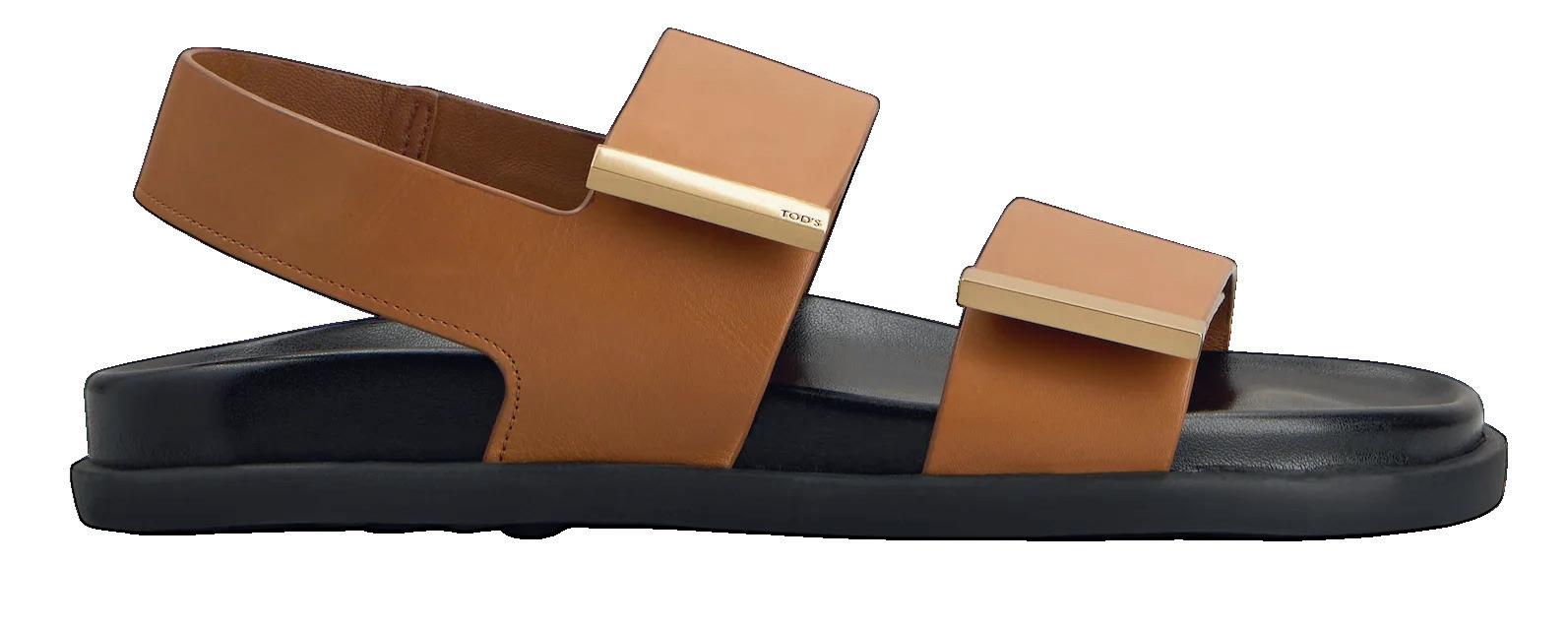
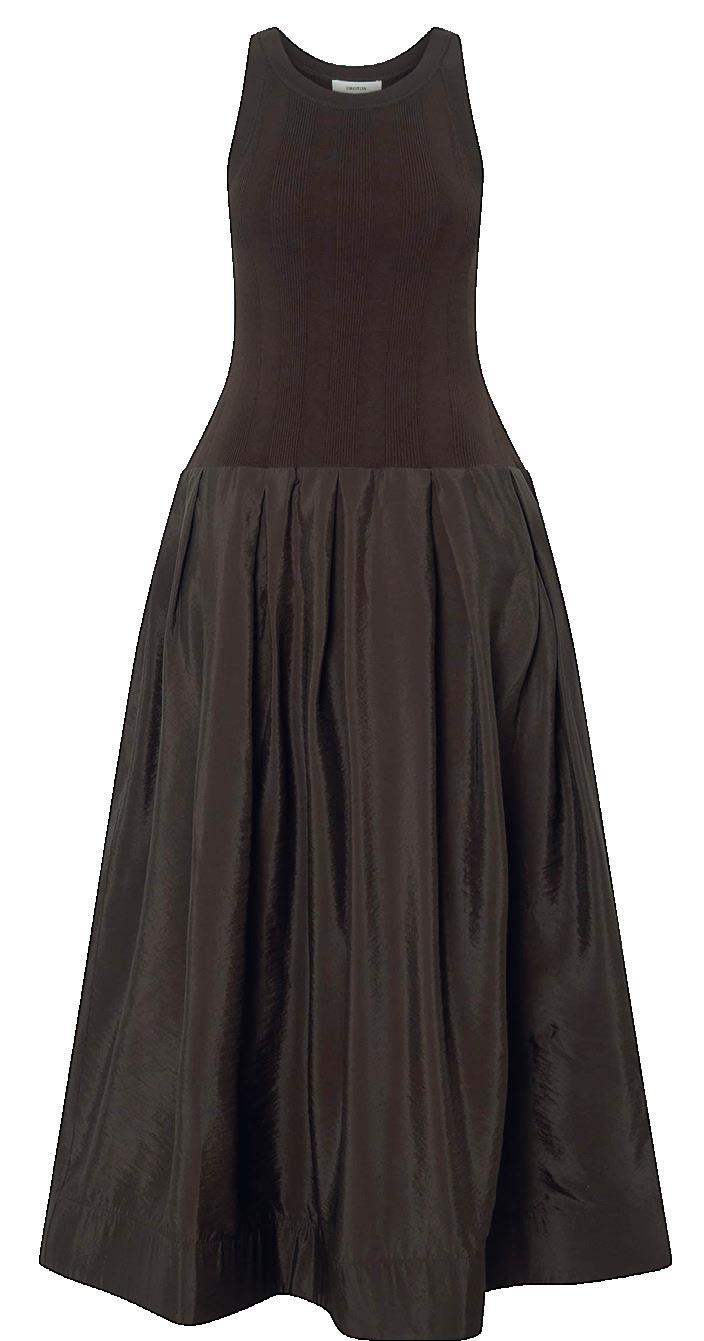
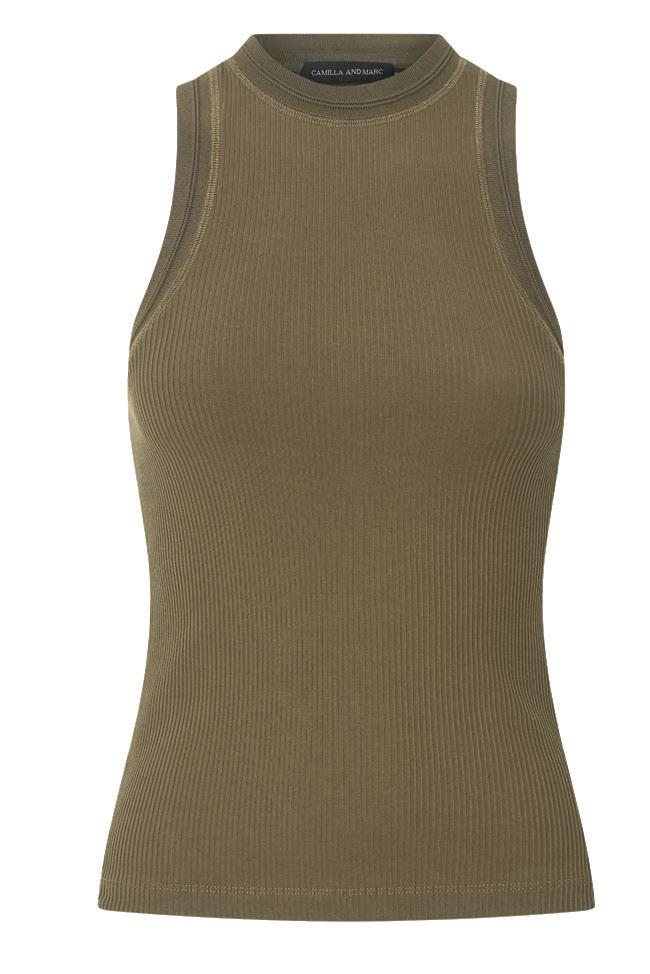
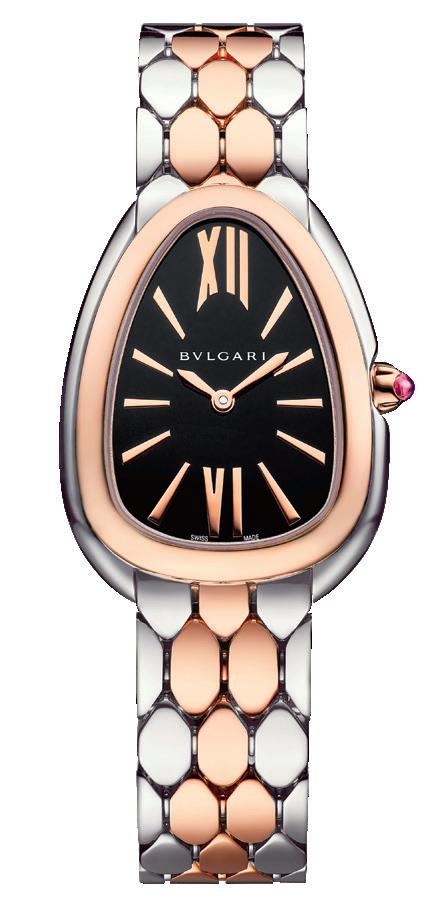
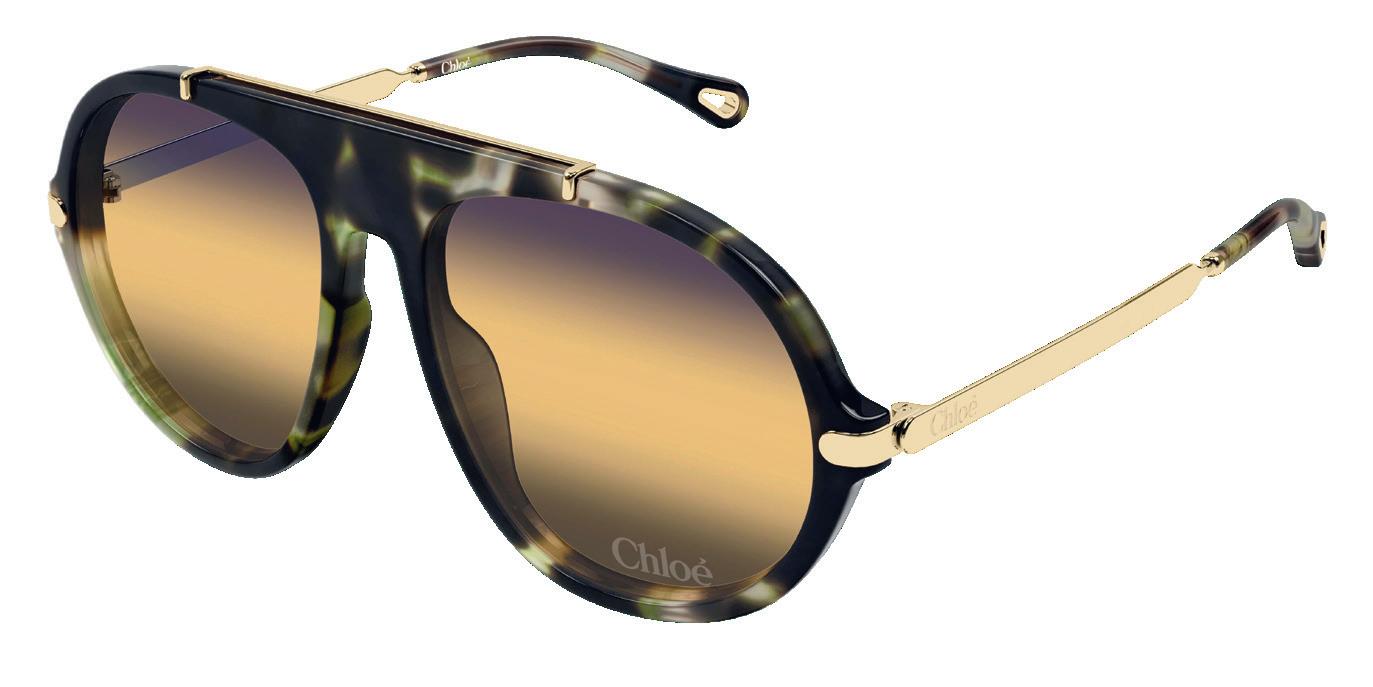
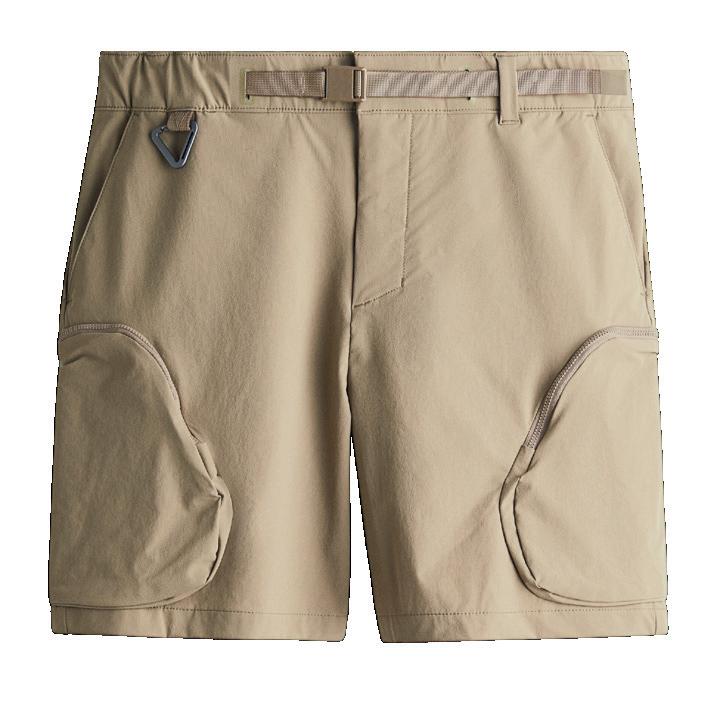
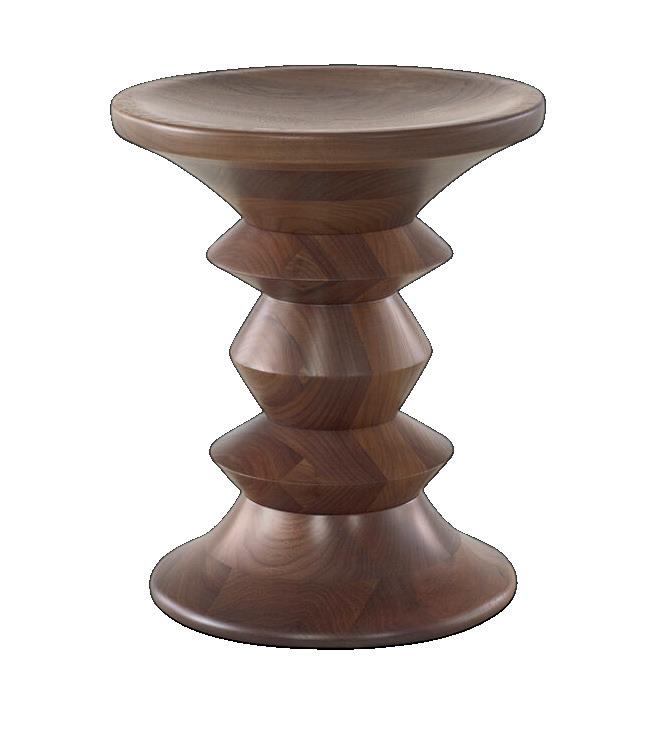
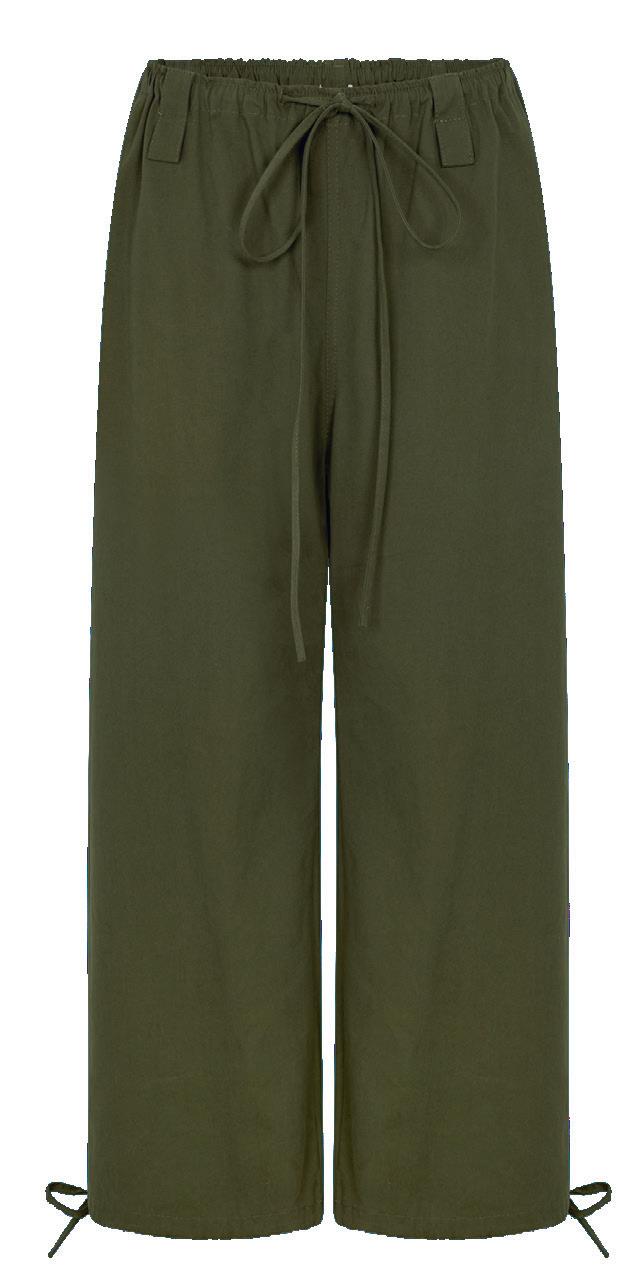

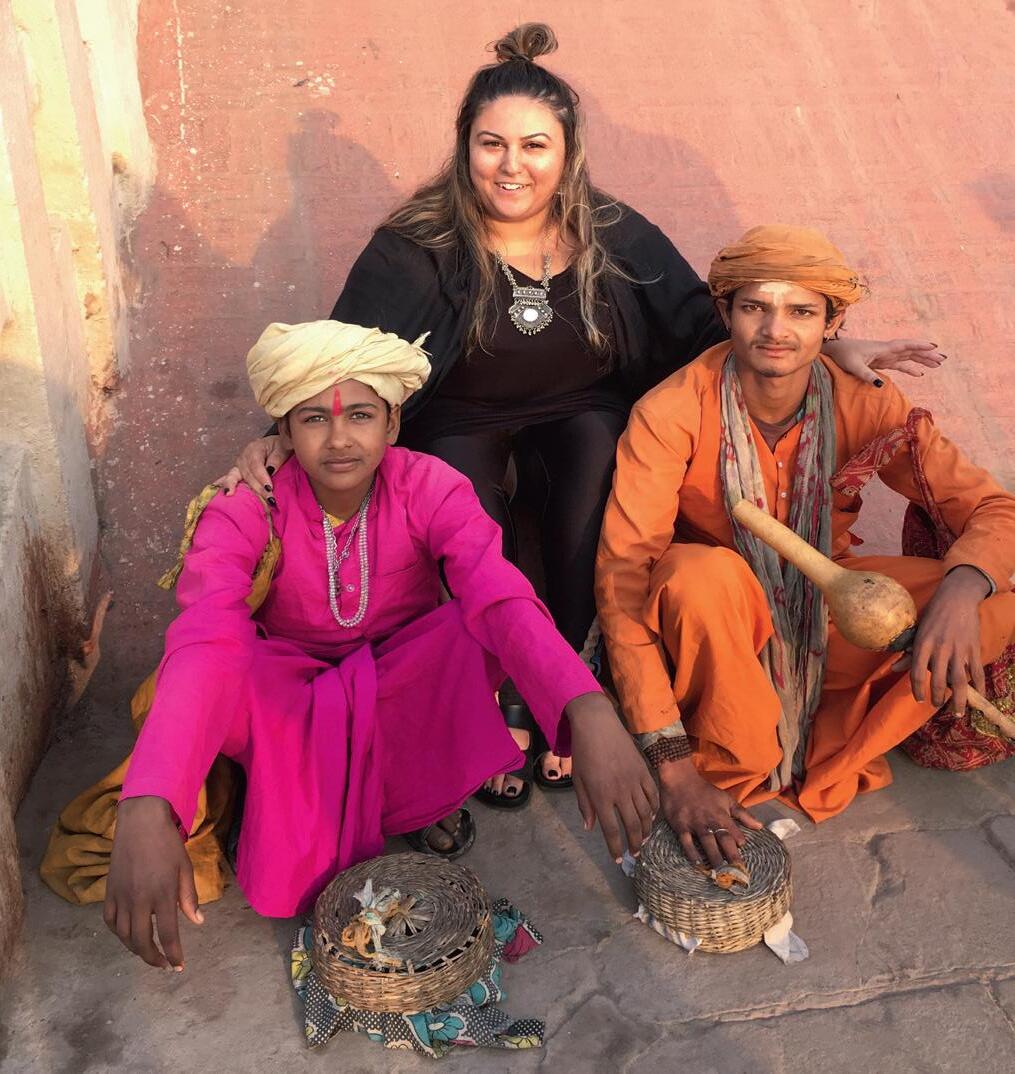
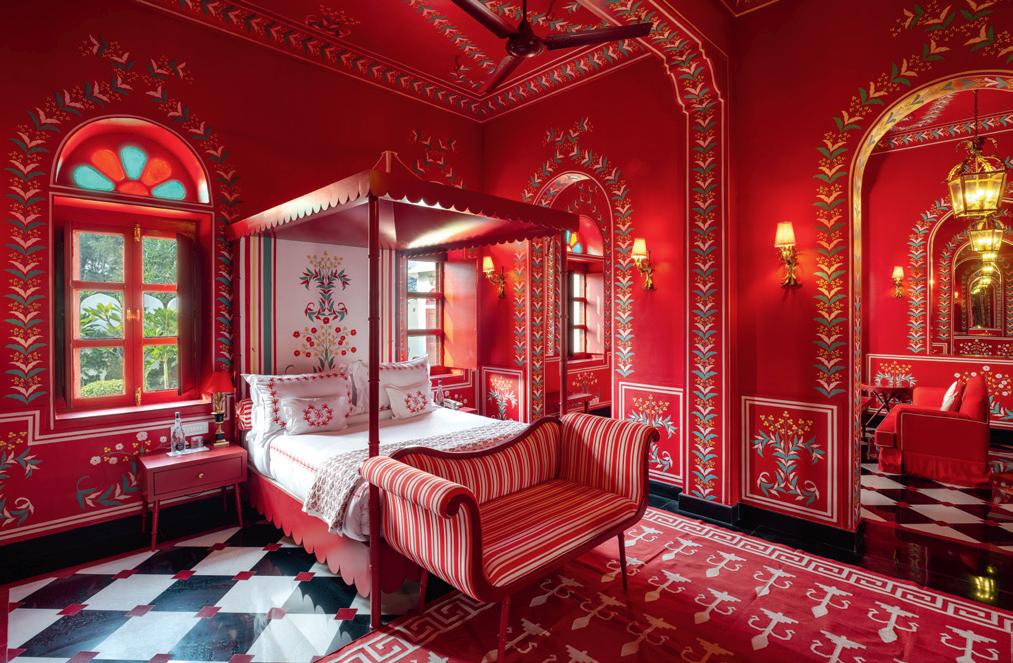
JAMAVAR JAIPUR
“This dining room, in the Leela Palace hotel, is lit by dozens of candles. The mainly vegetarian dishes arrive in a set series from savoury to sweet – it’s like eating a puzzle.” theleela.com
DOSAKA
After a business stop in Delhi, the Sydneybased prêt-á-couture designer heads to the Pink City, which she describes as one continuous, vibrant work of art.
BAGH JAIPUR
“We love to stay here for the grand maharajah vibes – it’s just so incredibly luxe. The hotel is like its own precinct with amazing gardens and pools. If I were hosting a party or doing trunk shows in Jaipur, this is where I would hold them.”
“It’s a cheap-and-cheerful restaurant in the C Scheme district that serves dosa, a thin rice pancake stuffed with mashed potato, lentils, peas and veggies. I finish every meal with a cold Coke to combat the richness.” dosakaindia.com
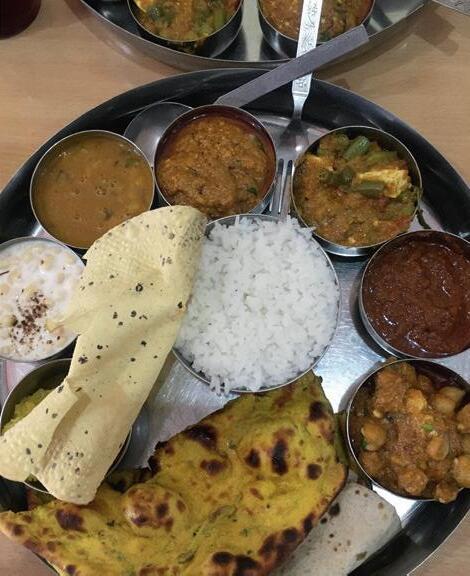
DRINK BAR PALLADIO
“For aperitivo, nab a blueand-white cabana and order a negroni with no salt.” bar-palladio.com
STAY
VILLA PALLADIO
“An Indian wonderland [top right], this hotel is a feast for the eyes – the rooms are so beautiful. It’s about 25 minutes by car from the centre of Jaipur, which makes it feel like you’re in the countryside. And for all its glamour and luxury, the Villa Palladio is very reasonably priced.” villa-palladio-jaipur.com
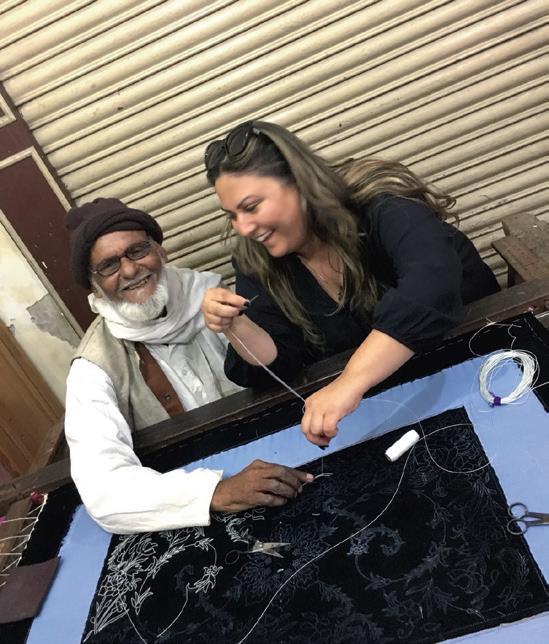
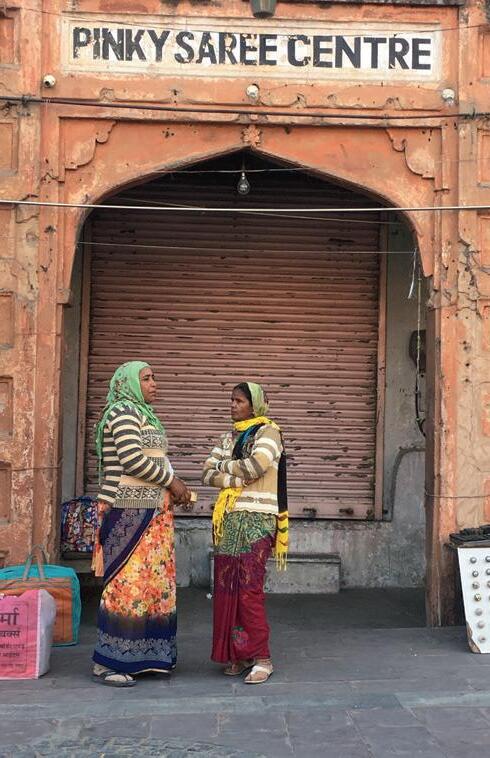
SHOP BAZAARS
“My top three are Bapu, Tripolia and Sireh Deori markets. They’re full of handbags, fabric and saris.” jaipurmc.org
SEE CITY PALACE MUSEUM
“Walk in the grounds of this historic building to admire the filigree. I love the statues of elephants at the entrance.” citypalace.org





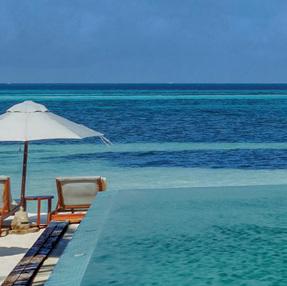


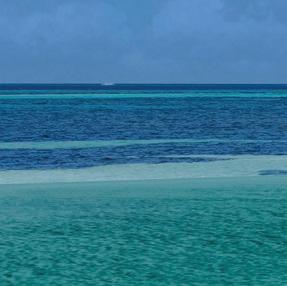













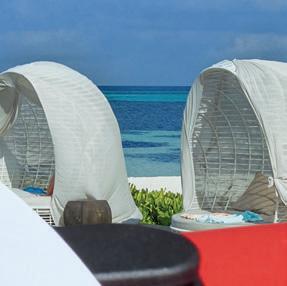






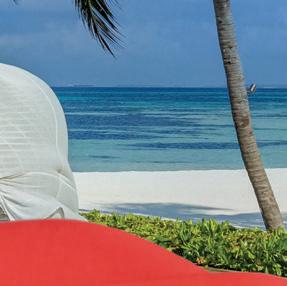
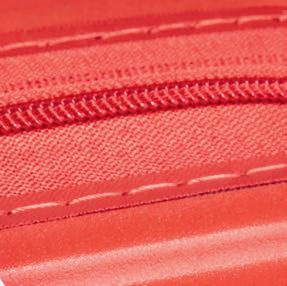



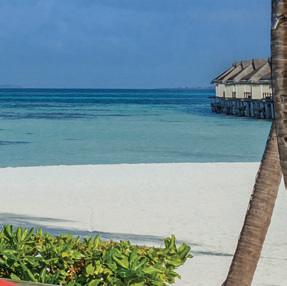







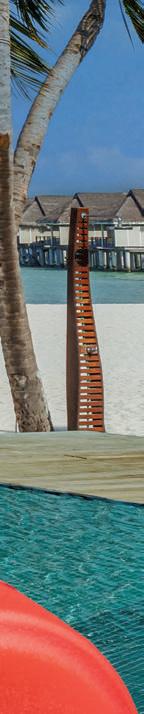
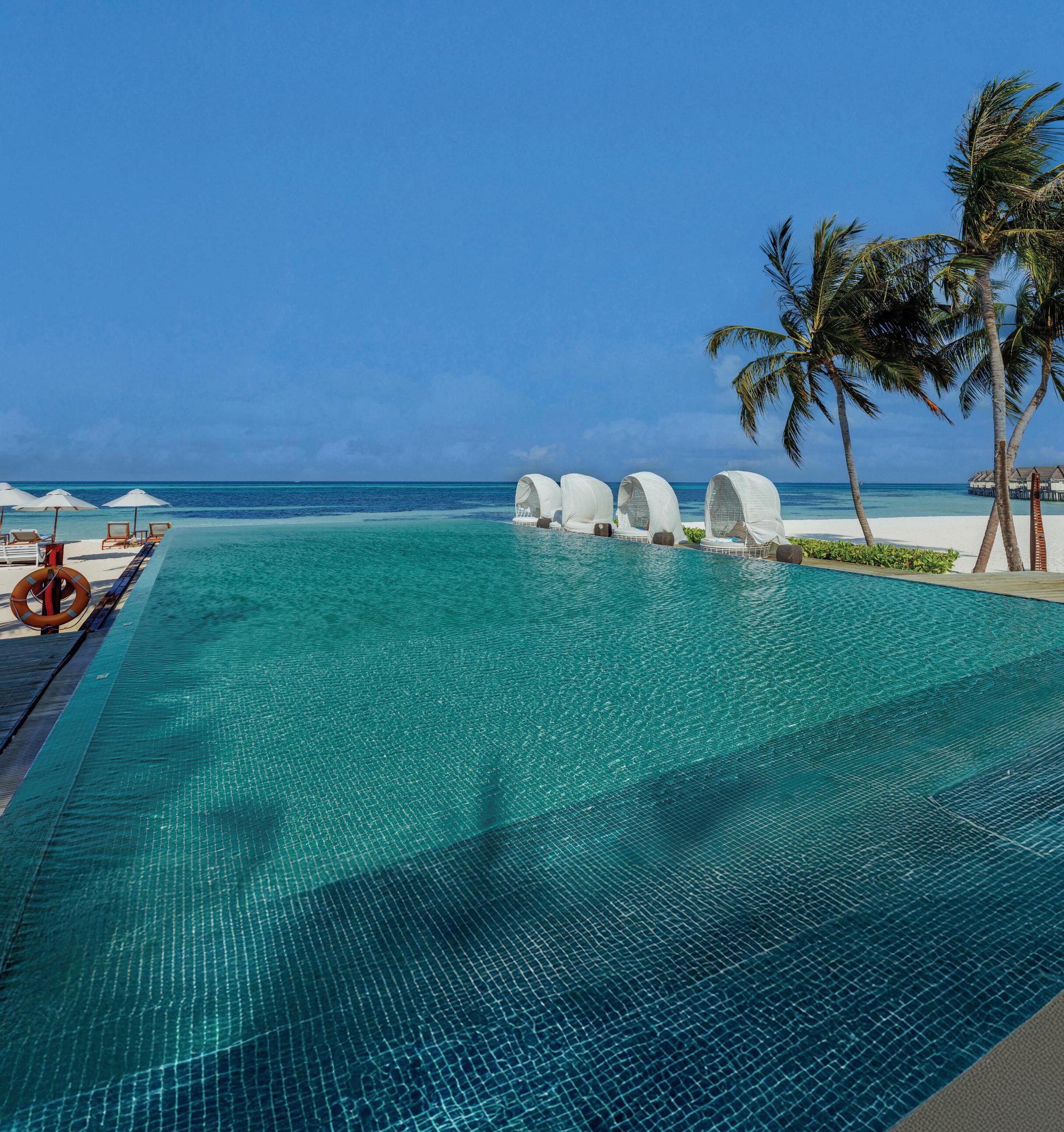



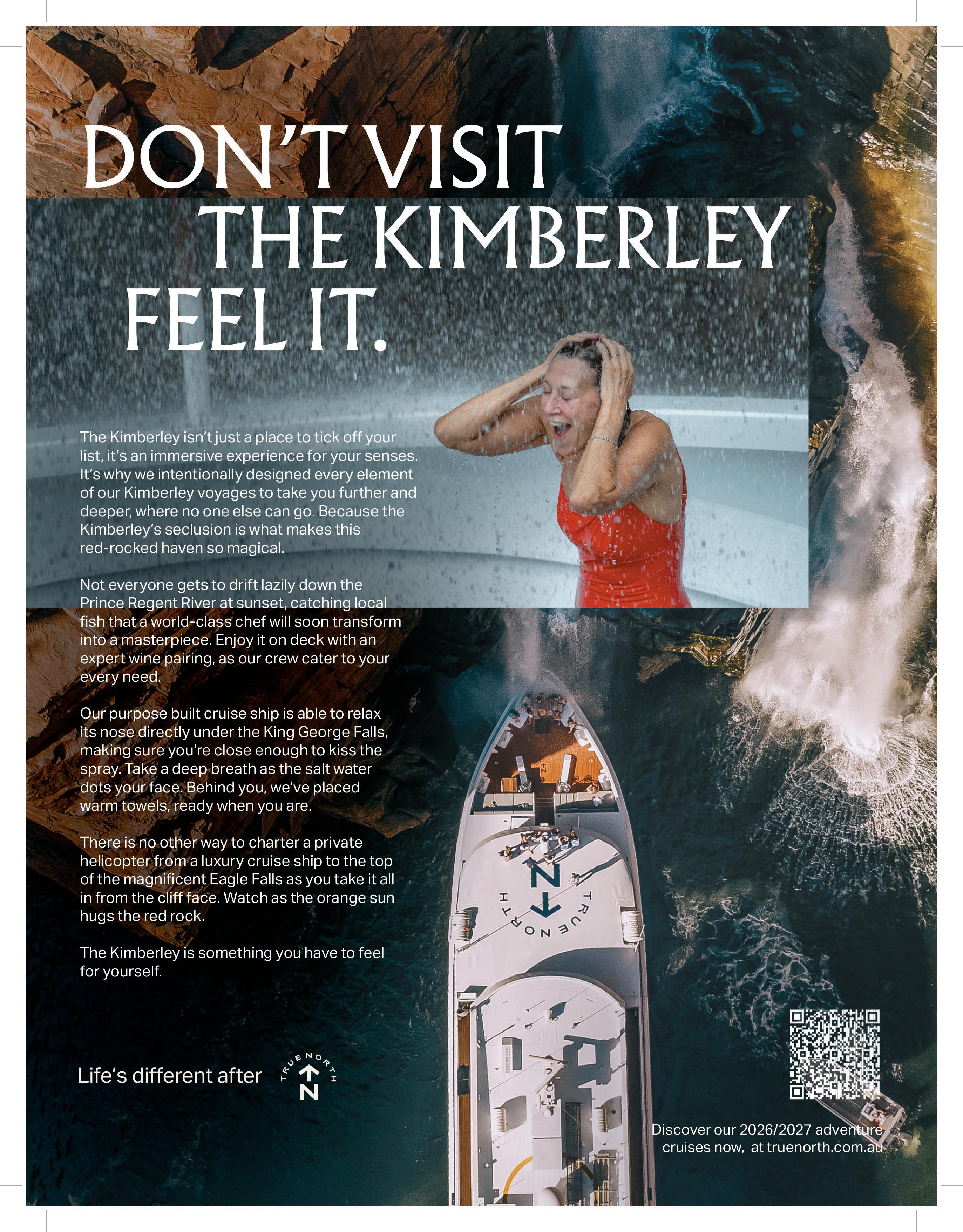
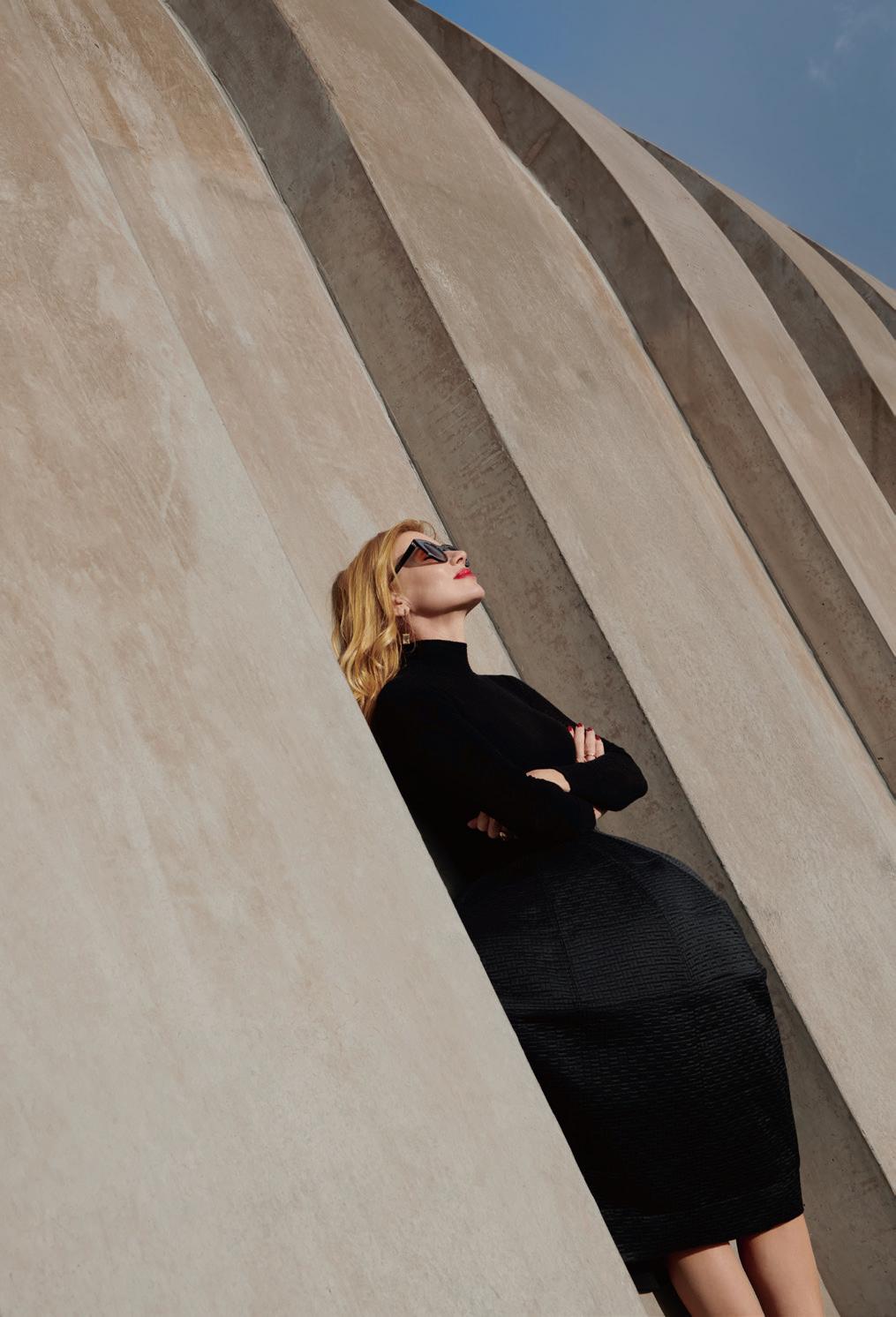
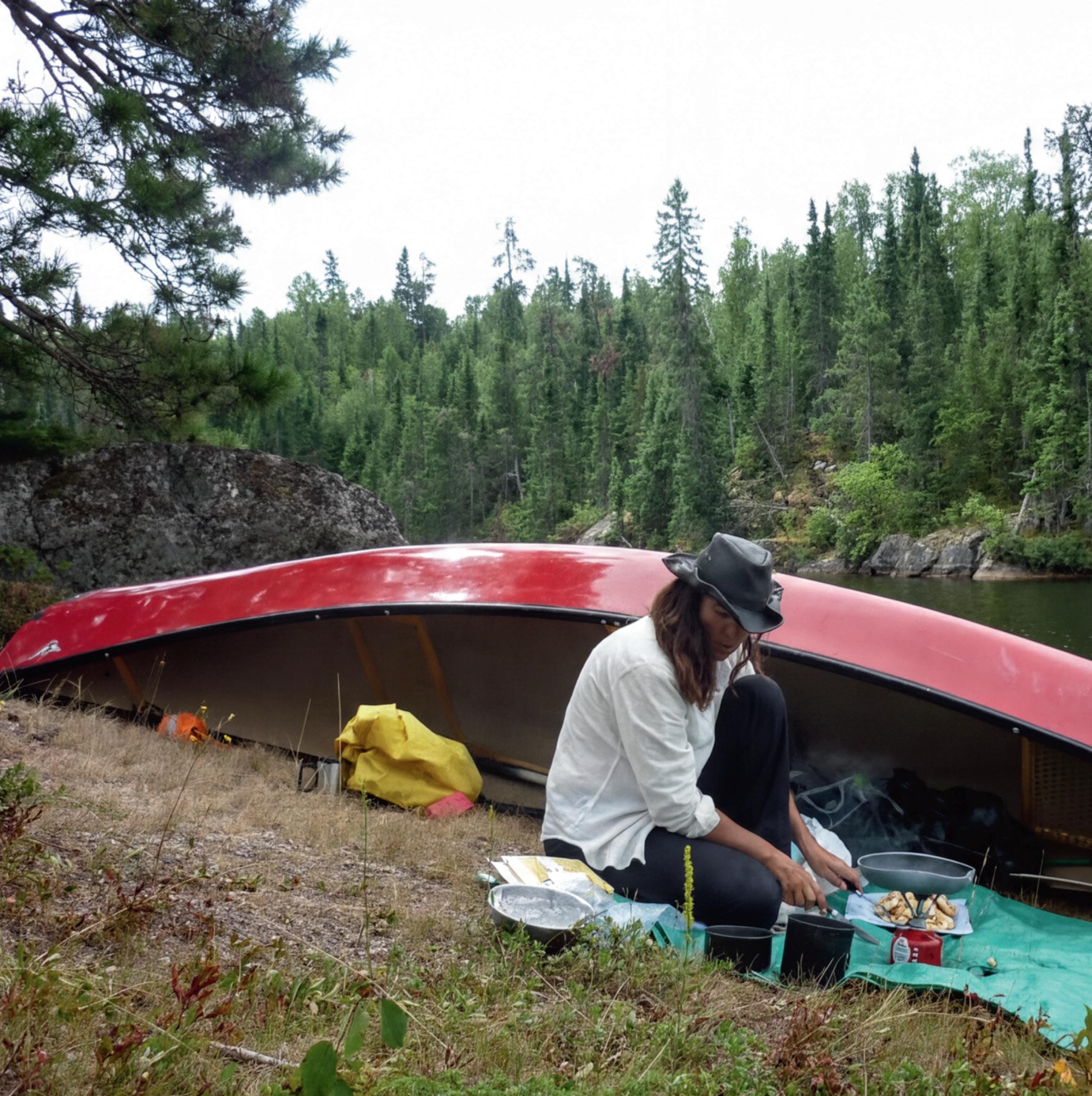
Story by Jane Nicholls
Their paths couldn’t be more different: a yearslong trek across Canada, a remote Antarctic posting and triumph against the odds in the Paralympics. Shaped by extremes, these three leaders are defined by stories of endurance, courage and quiet humility. Here, they distill their hard-won lessons and what it takes to lead when circumstances demand everything from you.
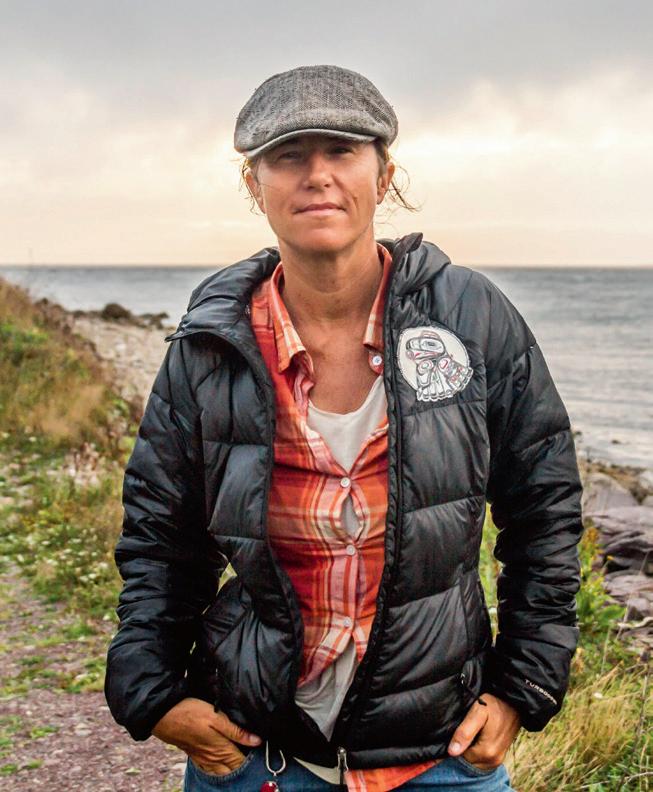
The filmmaker, photographer and author’s documentary 500 Days in the Wild tells the story of being the first person to complete every section of the world’s longest trail by foot, canoe and bicycle. Whelan was 50 when she set out from St John’s, Newfoundland, in 2015. In the end, it took her six years.
“I’d made films on Mount Everest and in the high Arctic and was in each of those places for about 40 days. While 500 Days actually took me 1862 days, the principle is the same: to make big goals attainable, they need to be broken down into very small steps. Nobody climbs Everest by focusing on the top – you literally have to put one foot in front of the other. The 24,000 kilometres of the Trans Canada Trail is made up of 487 different trails and had never been done. I started with goals but after 10 days, I hadn’t even travelled as far as I thought I could do in one.”
Sleep on it
“At first I berated myself [for not reaching her goals]. Then I remembered the words of my mother: ‘Whenever life gets overwhelming, don’t make an impulsive decision, sleep on it.’
So on day 11, I decided, ‘It’s simple – I need to burn this plan.’ I had to let go and respond to what was actually unfolding. It isn’t about finding the fastest way, it’s about finding the most meaningful way and breaking it down into manageable portions. In business, it’s more important than ever to find that meaning. You need both passion and purpose to motivate people. Leaders should be thinking about storytelling and what distinguishes them from others doing the same thing. That’s your narrative.”
Look after yourself for the long haul
“The most important thing is self-care. If you get up and say, ‘I don’t have time to eat breakfast, I need to go now,’ that’s self-sabotage. You won’t be able to sustain it. It’s like the fable of the tortoise and the hare. I needed to channel the tortoise.”
Conquer self-doubt
“When you’re looking at where you want to go, there are infinite paths to take you there. But if you can imagine yourself looking back from where you want to be, it’s quite easy to see a path. Many of these challenges are psychological. When I’m afraid, if I feed that fear, it’ll become panic, which is very ungrounding. In the wild, panic is what gets you killed. It’s about emotional regulation.”
Eschew individualism
“I grew up as a fierce individualist but one of the lessons I had on the trail is that you can’t succeed as an individual. I had to ask for help to continue my journey. We’re like trees – it looks like each tree stands alone but beneath the surface the roots are interconnected. So, too, are we. The ability to collaborate with a team gives you an advantage.”
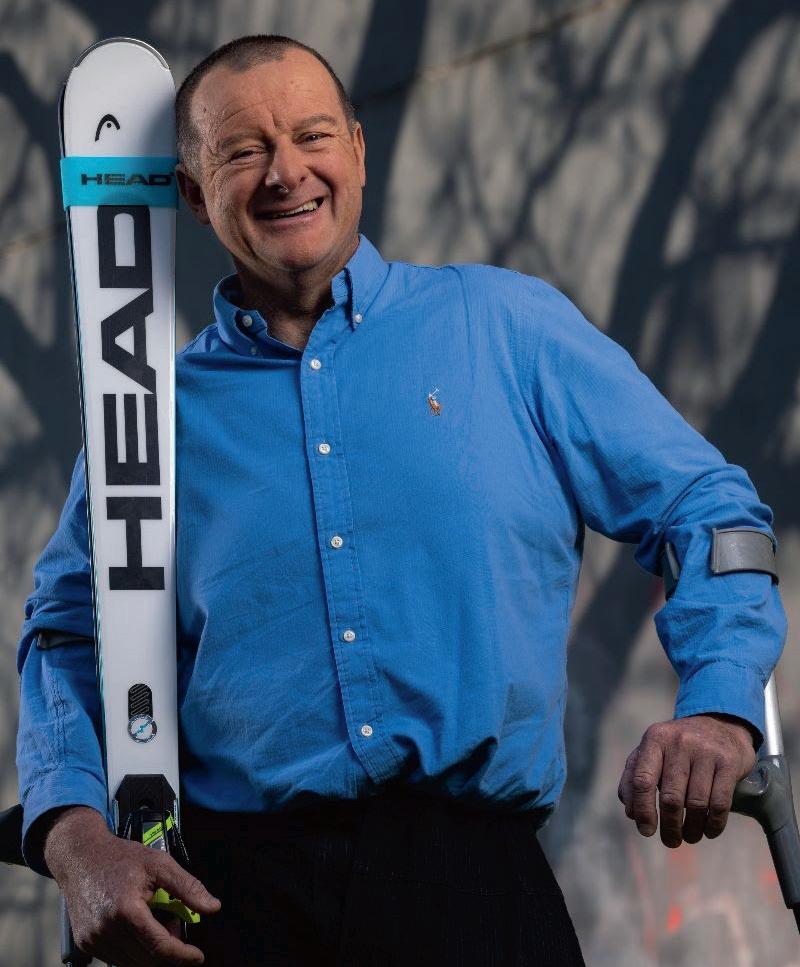
Milton was the first Australian Winter Paralympian to win gold, in 1992. An amputee, he has skied on one leg in six Winter Paralympics (so far) – the first in 1988 at Innsbruck and most recently at Milano Cortina 2026, 20 years after he “retired” from ski racing and three weeks after surgery on a broken femur. Milton has won 11 Paralympic medals, including six gold, and was a track cyclist at the 2008 Beijing Summer Paralympics. The three-time cancer survivor owns the Quizzic Alley Harry Potter store in Fyshwick, Canberra, with wife Penni.

Visualise your dream
“I was nine years old when a doctor told me, ‘Okay, you’ve got cancer and we have to amputate your left leg.’ I asked if I’d still be able to go skiing on one leg and the answer was on a VHS videotape showing a guy doing just that. Through the worst times of my childhood cancer I’d ask my mum to put on that video. I’d watch it, close my eyes and imagine skiing on one leg. The power of that dream was very positive in terms of overcoming some significant odds against me.”
See stubbornness as a positive “My wife, Penni, would call me stubborn, though in business
we’d use the term ‘persistent’. I certainly have a level of toughness and resilience after coming back from pretty low points, particularly from a physical point of view… I probably have my best ideas when I’m running, rollerblading or riding my bike because, in some ways, they take your body out of the equation and give your mind a boost. I think I’m at my smartest when I’m exercising.”
Continue challenging yourself
“One of my big motivators has been ‘Can I do this?’ and there’s only one way of getting the answer. Often the catalyst is somebody saying that I can’t. One of our staff walked the Kokoda Track and said, ‘I don’t think you could do that on
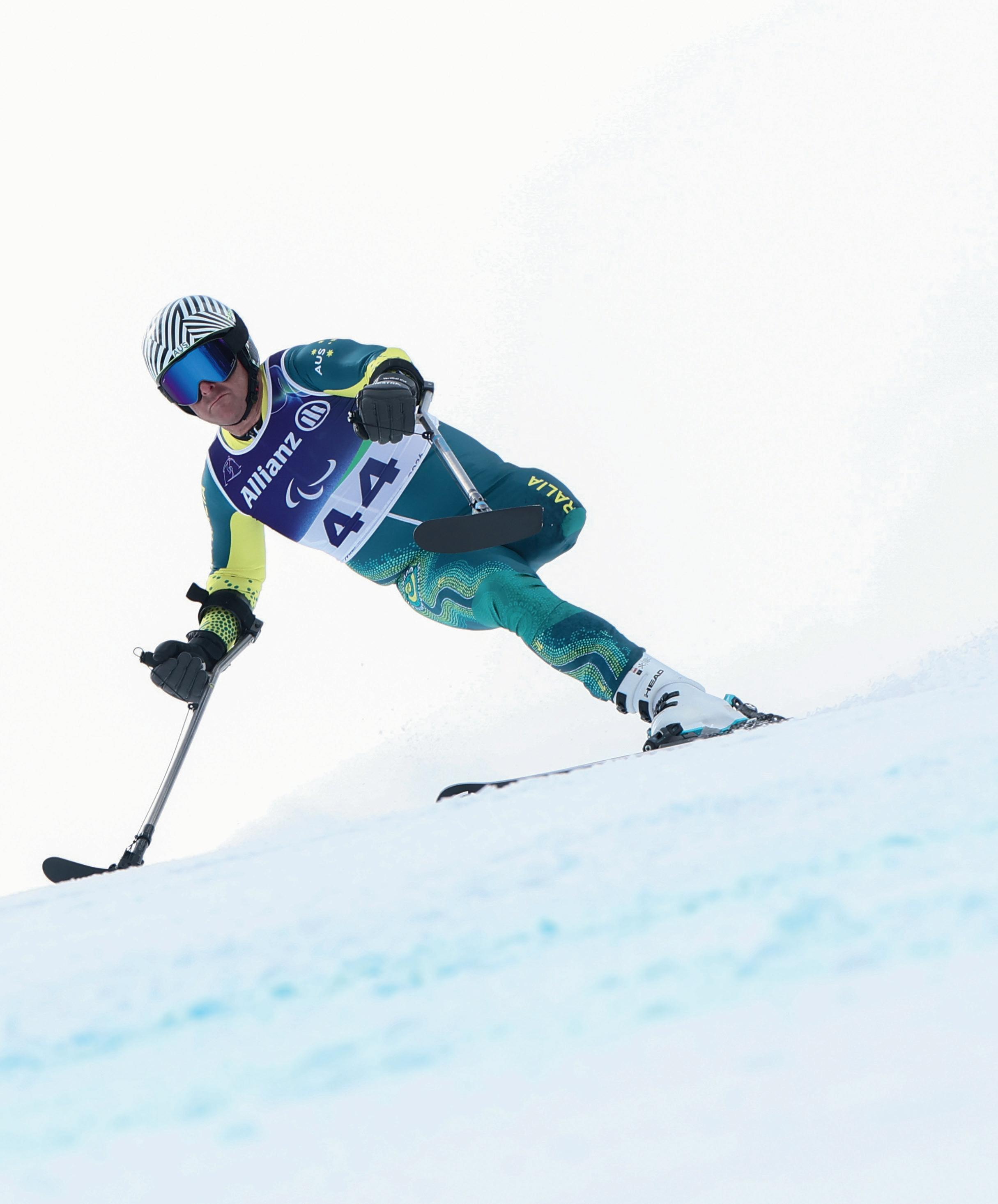
“I always go into things with a problem-solving mentality. I’ll try things then evolve, improve and continually evaluate to make sure that I’m performing at the maximum.”
crutches.’ That was a red rag to a bull [Milton has completed the Kokoda twice and summited Mount Kilimanjaro once]. My life has largely been about testing my limits. That was part of this year’s Paralympic campaign for me – could I still do it? I didn’t know the answer so let’s see.”
Hone your problem-solving mindset
“At a basic level, human beings learn by copying others. One of the great parts about having a disability is you go through a problem-solving process and work out your own way of doing things, whether that’s pushing a shopping trolley or carrying a pair of skis. I always go into things with a problem-solving mentality. I’ll try things then evolve, improve and continually evaluate to make sure that I’m performing at the maximum. It’s the elite-performance mindset.”
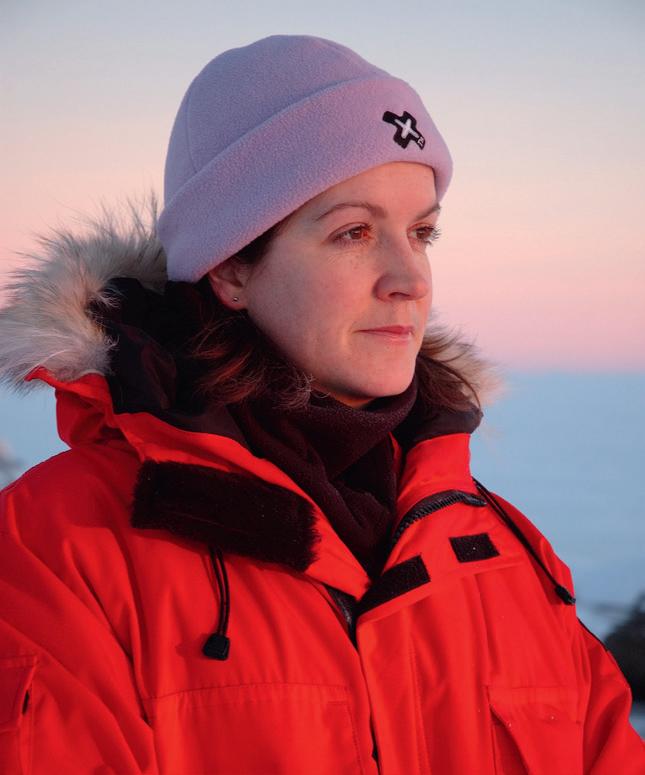
In 2005, Robertson became only the second woman and, at 35, the youngest person to lead the annual expedition to Davis research station, Australia’s southernmost Antarctic base. On duty all day, every day, for 12 months, she was younger than the majority of her team of up to 120 in summer and 17 in winter. She has drawn on this intense experience to become a globally recognised speaker and an author on leadership and collaboration.
Find a peer to confide in
“The hardest thing for me was the scrutiny of the leadership role and that I never knocked off. Even on a Sunday, when we weren’t working, I couldn’t take off my leadership hat. What kept me resilient was my friendship with Graham Cook, then leader at Mawson Station, about 600 kilometres away. To be able to pick up the phone and talk to someone who got what it’s like to lead in that really tough environment was gold. You’re living with your staff through months of darkness, boredom and homesickness. I’d say to Graham, ‘They’re fighting about who put the milk jug back in the fridge without milk in it.’ He’d say, ‘Mate, we had that fight last week. This week, they’re fighting about who made up the orange juice concentrate
incorrectly.’ He validated that it wasn’t about my leadership but human nature in that environment. Graham and I offered each other a fresh perspective and a shortcut to making sense of it.”
Shut down triangles
“I mistakenly thought my job as a leader was to listen to people vent. After about two months of that, I was exhausted. I called them together and said, ‘Let’s build trust in this team and have a rule of no triangles – I don’t speak to you about someone else. If we have something to say, we go directly to that person.’ They all agreed. So the next time someone came to tell me about something that someone else had done, I said, ‘And what did they say when you spoke to them about it?’ As soon as I brought in ‘no triangles’ the team were talking to each other rather than running to me. It freed up so much energy for me to lead them. It was a game-changer.”
Know your “why”
“Why people work in Antarctica varies but for the majority of us, it’s to experience Antarctica.
Whenever I was feeling homesick or overwhelmed I’d come back to my ‘why’ and go outside to photograph the aurora australis or penguins making their nest. Today I travel a lot for work and if something happens, I come back to why I’m doing this. When times are tough, knowing why you have the job you do makes it a lot easier.”
Actively reflect on your decisions “Before I left for the station, I caught up with Diana Patterson, the first woman to lead Davis, and she told me, ‘Keep a journal.’ I groaned internally, ‘Who’s got time for a journal?’ but it became an important leadership tool. When I got stuff right or wrong, I’d reflect on what I’d written in the journal. My usual style is collaborative and democratic but that won’t fit every scenario. It’s about a risk assessment of the implications if you do get it wrong – if it could lead to someone being injured, end up in the media or making the stakeholders unhappy, you have to consult. If it’s an internal issue, come back to the values of the team and step in if you need to.”
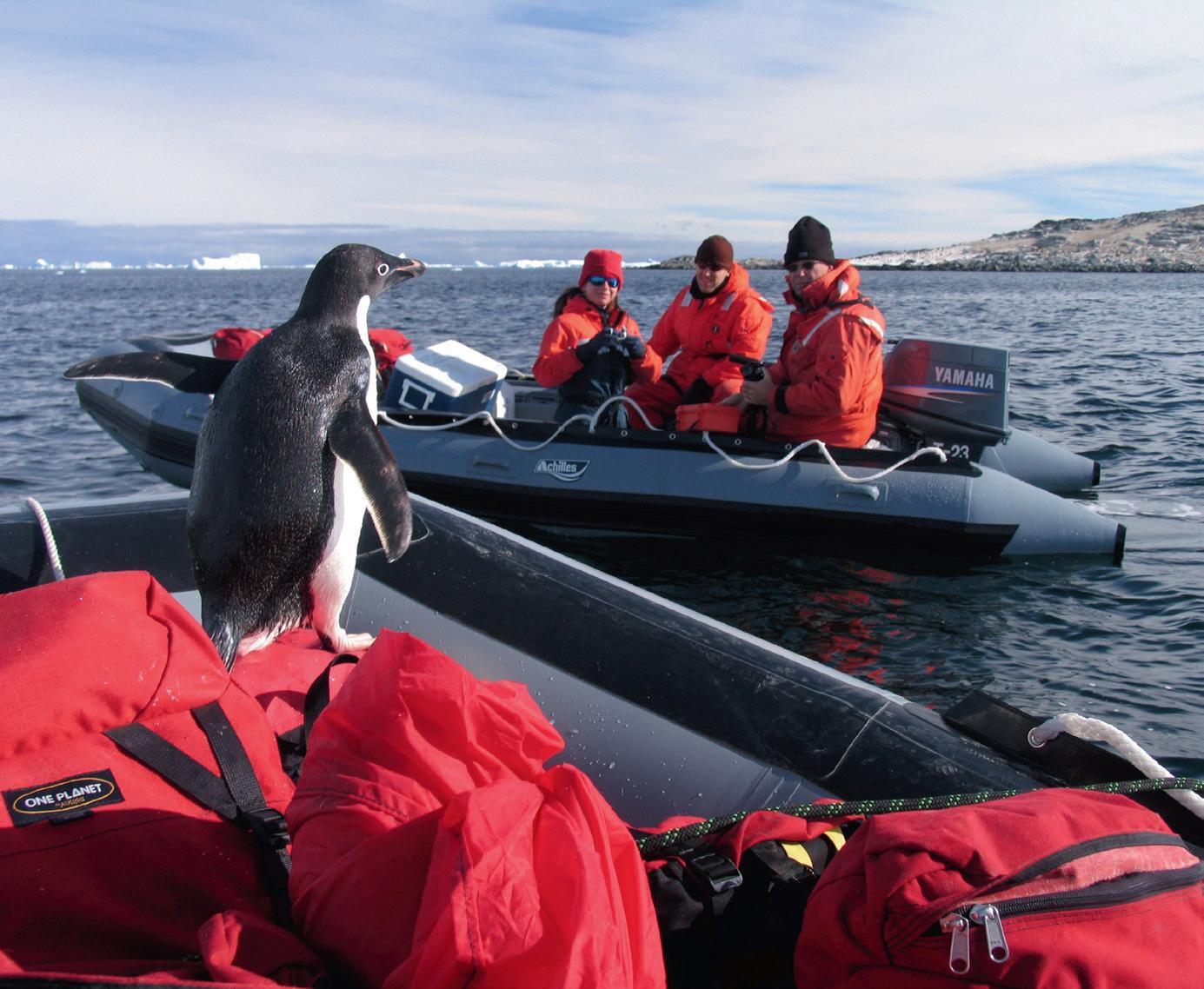

Earn more Qantas Points for you and the business. It’s as simple as adding your Frequent Flyer number and the business ABN to every flight booking.
Fancy Films produces video content for corporate, government and not-for-profit clients around Australia. Founder Keryn Nossal flies up to 100 times a year, booking flights through her Qantas Business Rewards Account to unlock member savings and exclusive offers.
“The points and flight savings we receive with Qantas Business Rewards
help us fund future travel,” says Nossal. “We get discounts of up to 10 per cent on flights [excluding taxes, fees and courier charges] and can nominate a staff member for a Gold Accelerator, which fast-tracks them to Qantas Frequent Flyer Gold status to enjoy benefits such as lounge access.
“While we earn Qantas Points for the business on every flight, our staff appreciate that they’re also earning points for their own personal Qantas Points balances when travelling for work.”
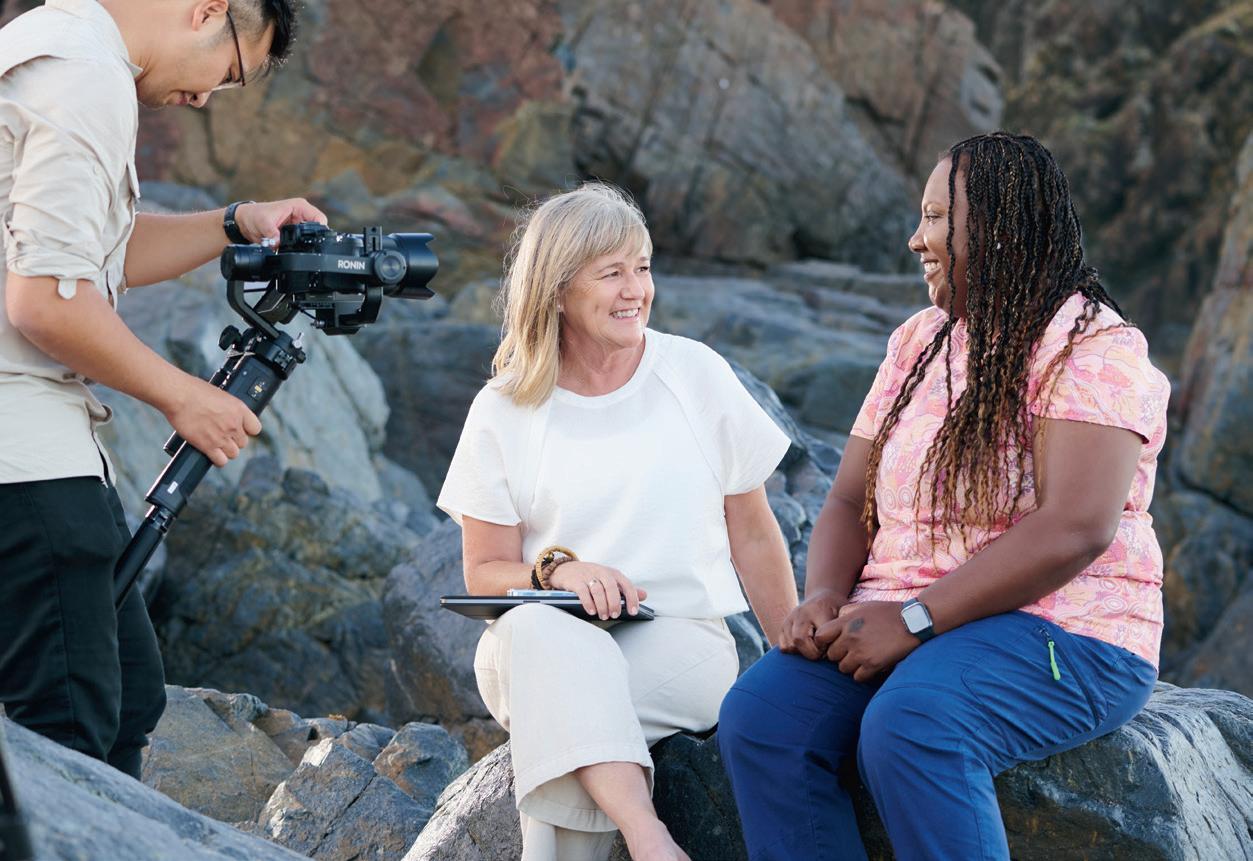
Read more tips and member success stories at qantas.com/businesspassport
Earn more points and save on flights with Qantas Business Rewards.
Earn more Qantas Points Qantas Business Rewards works together with Qantas Frequent Flyer so both the business and traveller earn Qantas Points for the same trip. It’s a win-win.
Access flight savings
Enjoy up to 10 per cent off the base fare (excluding taxes, fees and carrier charges) on selected flights as well as exclusive offers. Look for the blue star icon in your Business Account.
As a Qantas Business Rewards member, you and your travellers are eligible for up to 30 per cent off Qantas Club membership.
It’s not either/or – it’s both. Adding an ABN and a Qantas Frequent Flyer number means the business gets its rewards and the traveller earns theirs.


The new head of the Australian Federal Police says she’s always prepared for anything and relies on five foundational leadership skills to help her do her best.
Interview by Kirsten Galliott
Illustration by Marc Némorin
Current role
Commissioner, Australian Federal Police
Tenure
Six months
Previous roles
Deputy commissioner, National Security; assistant commissioner (AC) of Counter Terrorism and Special Investigations; AC Southern Command
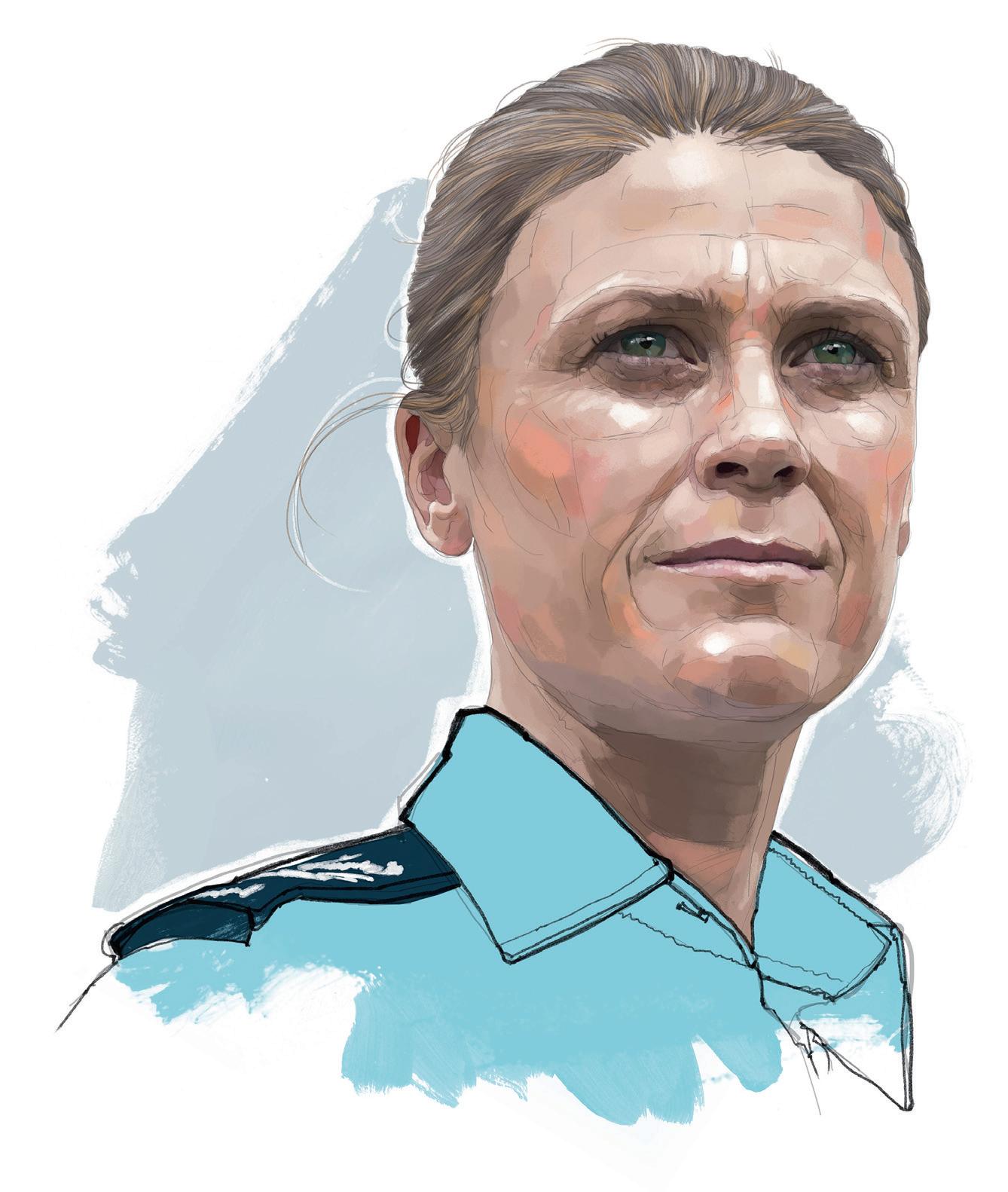
How do you define good leadership? I often talk about strength and vulnerability. It’s really important that my workforce sees me as someone who is willing to be open, transparent and a little vulnerable but also to give them the confidence that I have the strength to make the hard decisions. You’ve also got to have integrity. That gets tested a lot, particularly under high pressure, but my values are the guiding light. You have to go high when others go low.
The police force used to promote a command-and-control style of leadership but that doesn’t resonate anymore, does it? It’s not what the workforce wants. There are certainly critical incidents where command and control will always be what’s required. But it doesn’t mean you have to do that at the expense of having some compassion. People want to be able to see that you’re human –not a robot – and things do impact you. We have some really open and frank conversations about how tough the work is. I can say to them, “I’ve walked the walk that you’re all walking. I get it. I’m with you and we’re all in it together.”
You’ve been described as a listener, a doer and a straight shooter. Is that an accurate summary?
[Laughs] It probably is. I was asked yesterday about how I walk into a room when I know I’m going to have a tough conversation. I always walk in prepared and with a plan. What do people stand to win or lose in this conversation and how do I get to my end point? My workforce expects me to go in there and represent them and get the outcome we need. That’s a responsibility and a privilege.
You’ve spent more than 25 years in the AFP. Where did that desire to serve come from?
I was a uni student on a 12-week placement and at the end of it, I just didn’t want to leave. They literally had to escort me out of the building. There’s something so inherently rewarding about working for an organisation
that is delivering every day for the community. Keeping people safe and doing the hard work to protect our way of life is fundamental.
You could have been a lawyer. You were one mark off getting into law school and that devastated you at the time. How did that early setback shape you?
I don’t think I would have been a good lawyer in hindsight. I think I landed exactly where I was supposed to land. I got some very frank advice from my school counsellor at the time. He was like, “You know what? You’ve just got to suck it up and get on with it. Make the best of the situation that you’re in.” That first knock can derail you a bit but that’s life, isn’t it? Bouncing back, finding another pathway, building that resilience.
At the AFP, you’ve worked in everything from counter-terrorism to organised crime. How have those very different experiences informed your leadership?
In my early years with the AFP, I worked in general duties. That’s where you craft your leadership because there’s nowhere to hide when you’re out on the road in a frontline role and you’re responding to people who need you – a lot of them on their very worst day. Leadership skills that I rely on every day are the foundational skills I learnt on the frontline. Negotiation, problemsolving, nuanced communication, emotional intelligence and quick decision-making. I’m forever grateful that was my entry into policing.
You took on the commissioner role in October. What was your plan for the first 100 days?
I didn’t want a 100-day plan because I didn’t want to set a time frame. But I did want to achieve very clear goals and priorities. Reece Kershaw [the previous commissioner] had just exited the building when I gathered our senior executive together to say, very clearly, “This is what I expect from you as my leadership team.” October is a very bad
“There’s nowhere to hide when you’re out on the road in a frontline role and you’re responding to people who need you – a lot of them on their very worst day.”
How do you measure your impact? It must feel like it’s a bucket that never empties.
month to take over because you’re close enough to Christmas that you know people are tired and you haven’t got a whole heap of time to do something before everybody goes off and has a welldeserved break. But it’s also too long to do nothing. So I said to the team, “Let’s sprint to the end of the year.” And then, of course, 14 December happened.
How destabilising was the Bondi terror attack for you? It’s obviously not something you could have expected so early in your tenure. No, it wasn’t. But I’d come out of national security as the deputy and as the assistant commissioner before that so I was grateful that it was me sitting in the commissioner role to lead us through Bondi. I had that contemporary knowledge, experience and awareness. Did I expect Bondi? I don’t think anyone expected something of that scale. But as an organisation, we’re always prepared for the worst. And I saw my people kick into gear within minutes. The agency did exactly what it needed to do. For me, it was making sure that I had strong, calm leadership so the teams at the operating level could get on and do what they needed to do.
That’s the challenge we all lament. It goes back to having a very clear mission and very clear priorities. For an agency like the AFP, we have key performance indicators that we publicly put out there in terms of accountability. But that only tells part of the story. Community satisfaction, formally and informally, is a huge measure of how we’re perceived and what we’re achieving. How much confidence does the government have in our ability? Partner feedback is an important one for me. Are we a good partner? Are we putting the right things first in terms of how we engage with our partners? And do people actually know how much the AFP does every day? There’s so much amazing work that our members are achieving at an individual and a team level every single day and we have to be able to tell that story.
Your role comes with an incredible amount of scrutiny. How are you dealing with that?
Bondi really sharpened that for me. If you wear a uniform, you’re used to being subject to scrutiny. But Bondi was such an emotional event, with very strong views and positions. And of course, I was standing up almost daily with the prime minister in those early days. I always put a lot of thought into the words and language I use when I speak publicly because I’m talking to multiple audiences. I try to play a very straight bat in terms of the factual information the community needs to know. But inevitably, people will have different opinions about what I’m saying. For me, it’s always about holding true to my values and doing the right thing. It’s also about not indulging myself, thinking this is about me as an individual. I have to think of the agency.
It must be so hard, though, especially when it feels so personal. It absolutely does. You’ve got to have trusted people around you. In the days after Bondi, I would pick out
a comment and my chief of staff would say, “Why are you even reading that?” I’d say, “Well, I need to get the sentiment of what people are saying.” And she’s like, “We can give you the sentiment. You don’t need to read through every single comment and get them in your head.”
What have you learnt about yourself in moments of crisis?
When the pressure is on and people around me are either a bit shellshocked or panicked, my calm comes in. I remember it even as a young sergeant on the road. We had one particularly confrontational job but I felt very calm in the most high-pressure situation. It’s not that you ever get used to it but I think you know you have to take control. A lot of that is about being calm, composed and having a clear view of what we need to do next.
What’s your number-one rule when it comes to crisis management?
Focus on clear, calm and concise communication. It’s also about playing a long game. In a crisis, everybody wants to jump in. We get people turning up saying, “I just want to help.” And that’s
I generally get up at 4.30am or 5am. I need to exercise – that’s when I feel sharp and switched on. I’ve been doing some weightlifting, which I avoided for a long time, but I found a great group of women who I really enjoy weightlifting with. We’re all in there early in the morning, half asleep and trying to be the best people we can be.
great – it means you have a really healthy culture. But crises can sometimes go on for a long time. So it’s about saying, “We need to make sure we have sustainability, that we’re not burning out, that we aren’t getting tired and making bad decisions.” Longevity and continuity are really important.
Your workforce deals with things we can’t even imagine. How do you look after your people as best you can?
Of course, we have formal support structures – our Shield program is world-leading in terms of the mental and physical health support that we provide our members – but the messaging has to be loud and clear: “You are my most important asset and resource. And if you’re not healthy and you’re not looking after yourselves, we aren’t a healthy, prosperous organisation.” I have the responsibility of role modelling that for our members so they can see I’m walking the talk. I drop little things into speeches about my kids or my exercise routine or “I’ve just come from the gym and actually did a PB on my bench press this morning.”
We don’t talk about work and I don’t have to be the commissioner; I’m just Krissy. When I get into the office, the first thing we do is look at what’s happened overnight. We’re a 24/7 agency so it’s a check-in to see what’s burning and what we need to do.
There probably isn’t a day that goes by when I’m not having some sort of engagement with a partner agency or a stakeholder, whether that’s a community
Your predecessor left the post early, saying it had impacted his family life. How do you protect yours?
I’m very disciplined about my family and I have some fairly basic rules. I don’t have email on my phone because I know I’ll be tempted to have a quick check when I’m with the kids. I don’t want to be distracted when I have the opportunity to genuinely engage with my family. I also carve out time in my calendar to take my daughter to school one morning a week and pick my son up from school one afternoon a week. Just those little things where I can feel like I’m a mum first.
What advice would you give a brand-new CEO?
A trusted team is non-negotiable. You have to be able to rely on the people around you. You’ve got to know what you stand for. Where are your red lines? You’ll get pushed really close to your red lines. How are you going to manage that? And back yourself – you’re there for a reason. By and large, people want to see you succeed. So take that as an opportunity and use it to optimise what you can do.
leader or government. You watch these highprofile stakeholders from a distance and then all of a sudden, you’re the commissioner in the room with all these people who you’ve been watching and looking up to through your career. In the beginning, that can be a little daunting but it’s so important to take the time to invest in getting to know them, building trust and the ability to pick up the phone and say, “Hey, we need to talk about this.”
If I don’t have an event at night, I like to be home for dinner. We put the phones down and talk about the day. If I’ve got something on, I still try to duck home and see the kids after school, even if it’s only for half an hour. Otherwise, it’s a long day and it’s really important to decompress. I still wash and iron all my uniforms. My mum says, “Why don’t you get someone to iron your uniforms?” But I like having that balance in my life.




Lead in the digital age with our new, highly interactive online MBA. Master disruptive technology, pioneer new business models, and drive positive social impact – all while learning from industry experts.

Join our online information session to learn more
sydney.edu.au/ mba-technology-digital-strategy






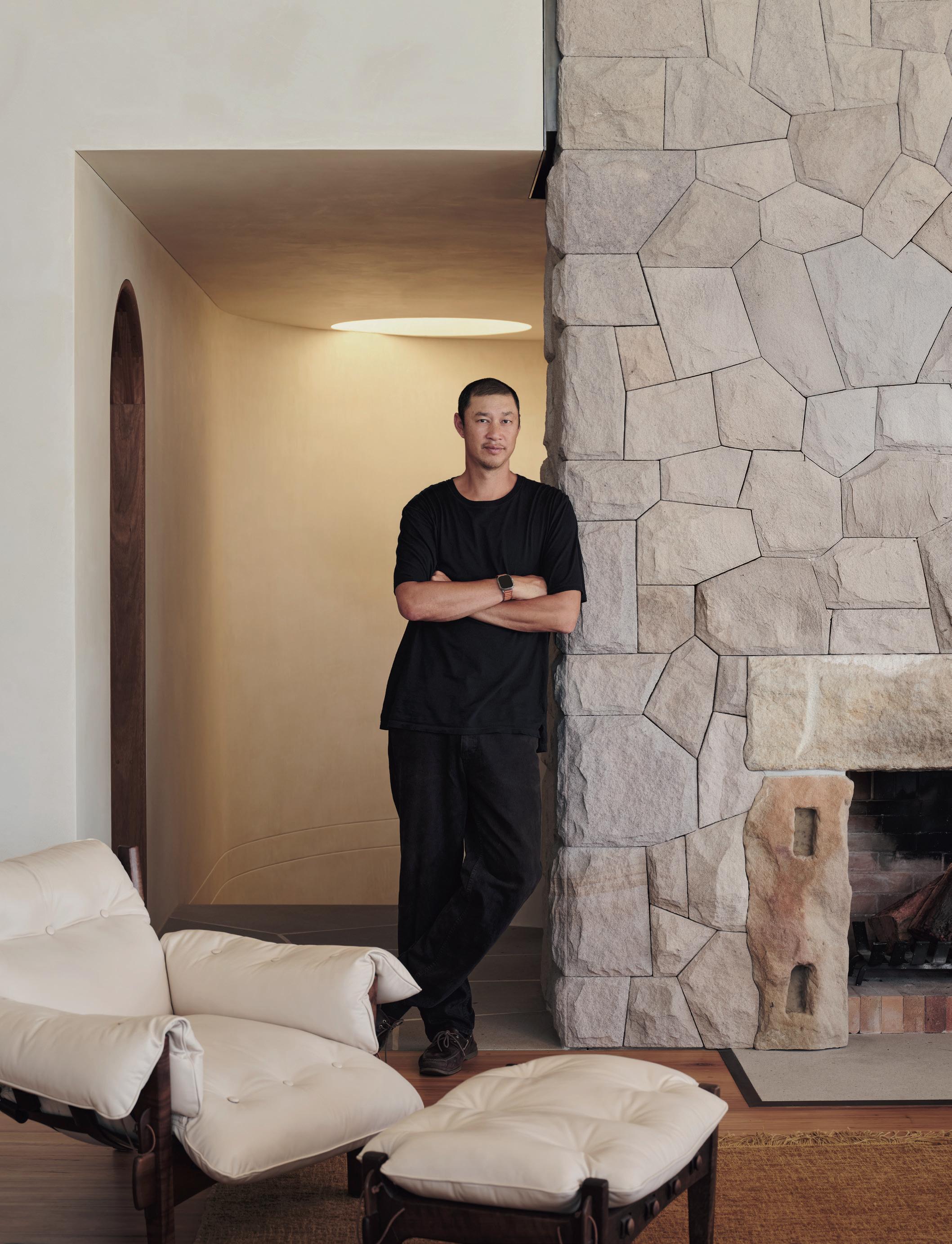
From the half-pipes of his youth to the heights of Australian retail and hospitality, architect Kelvin Ho has built a career on the beauty of the background.
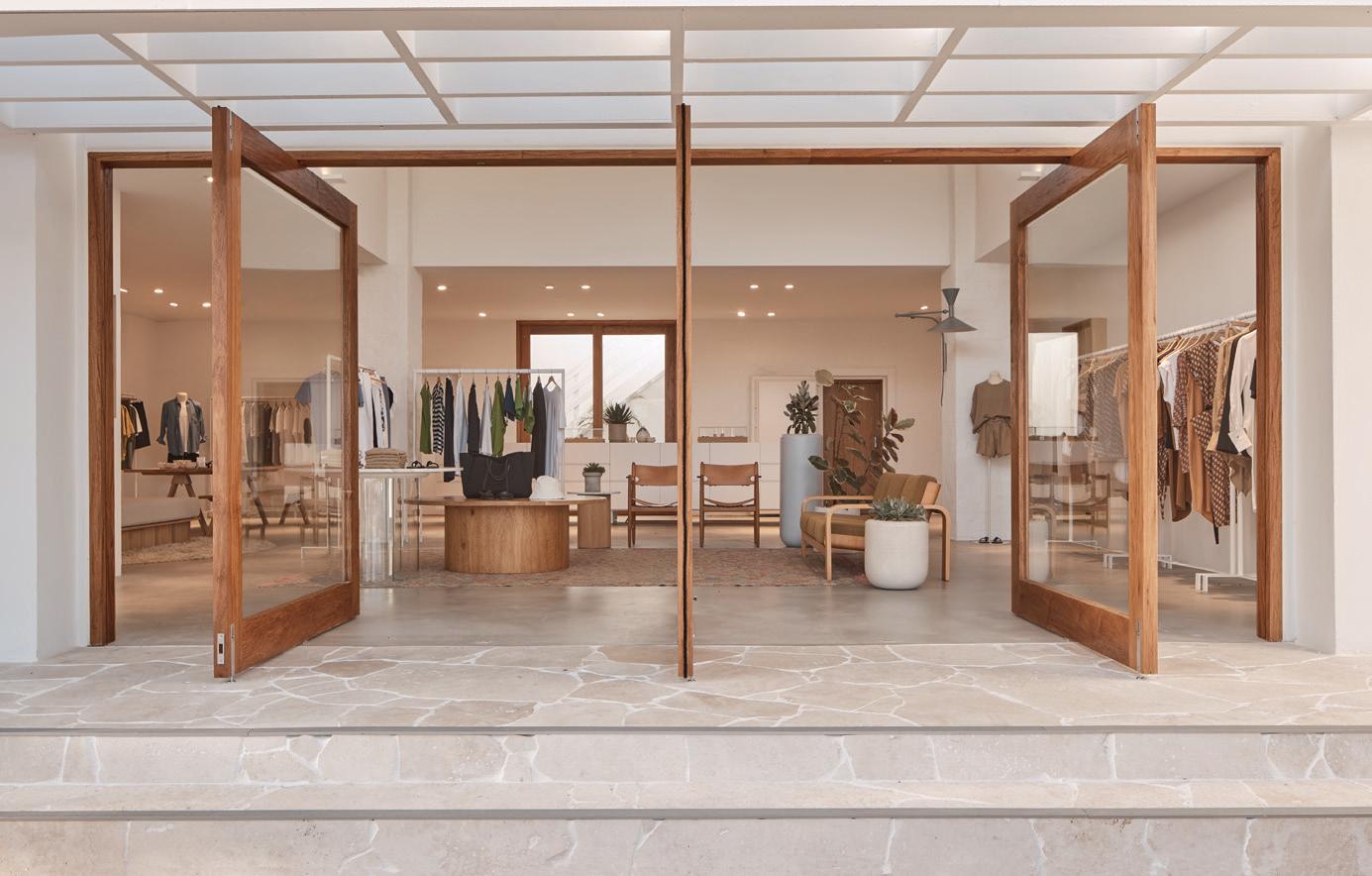
Kelvin Ho doesn’t want you to notice his work. “The perfect space is one you don’t remember,” explains the architect and founder of Sydney-based architecture and interior design firm Akin Atelier. It might seem an odd philosophy from a man who has made a name for himself as the go-to collaborator in Australia’s elite fashion and hospitality sectors. Ho has created fitouts for flagship fashion stores, such as Camilla and Marc and Bassike, partnered with Merivale on multiple bar and restaurant projects, including Sydney’s Totti’s, Bert’s and Coogee Pavilion, and has also worked with Qantas. It’s precisely this quiet understanding of design’s purpose that makes his expertise so sought after.
In Ho’s world, good design doesn’t have main character energy; instead it forms a high-quality, neutral canvas that recedes into the background to allow the spotlight to linger on life as it unfolds. “Our work isn’t just about choosing nice colours. It’s focused on creating social hubs that transform people’s sense of community. The environment you’re in should really just be the backdrop that sets the scene but doesn’t overpower.”
This egalitarian approach harks back to Ho’s youth, when the passionate skateboarder spent his time reimagining the public areas of Sydney’s CBD into his own personal skate park. “A set of stairs is an opportunity in skateboarding but it’s up to the skater to create that experience. Growing up in this world of
interpreting and shaping experiences, skating through the cities, it’s something that has been with me forever. And it’s how I look at architecture as well.”
Ho, who wrote his master’s thesis on authorship and the parallels between skateboarding, literature and architecture, says these art forms rely on narrative and intention. “Are you designing it with a narrative that allows only one interpretation? Or are you designing something that can be interpreted and experienced in multiple ways?”
The idea of allowing space for things to flourish on their own is an approach that seeps into Ho’s leadership style. “I believe my role as a leader is to foster opportunities, experiences and environments where people can succeed and fail in a constructive way so that they can then become better leaders in themselves. It’s about empowering other people, which sometimes means stepping out of their way.”
Ultimately it’s about holding things lightly. Whether skateboarding or creating a new retail space, Ho’s goal is to always keep things enjoyable. In a world that can feel noisy and increasingly automated through AI and tech innovations, the founder believes it’s important to harness the power of these tools to support design but without defining it. “I always tell the team that we’re so lucky to have careers where we get to create things.”

The Range Rover SV Black celebrates a sense of timelessness. Meticulous in its details and all-black specification, this model delivers stealth design inside and out. Reinforcing the vehicle’s form and presence, the exterior is finished in Narvik Gloss Black and complemented by a tonal grille, bonnet lettering and 23-inch alloy wheels.

The interior takes on soft, satin finishes, from the Near-Aniline Ebony leather seats to the ceramic gear shifter. Moonlight Chrome detailing brings a jewellike touch to complete the cabin with a design geared for everyday life. rangerover.com
Whether she’s creating a “forest congress” to get conservationists and loggers talking or sparking global headlines with her Ladies Lounge at MONA in Nipaluna/Hobart, the artist and curator does not do “quiet”.
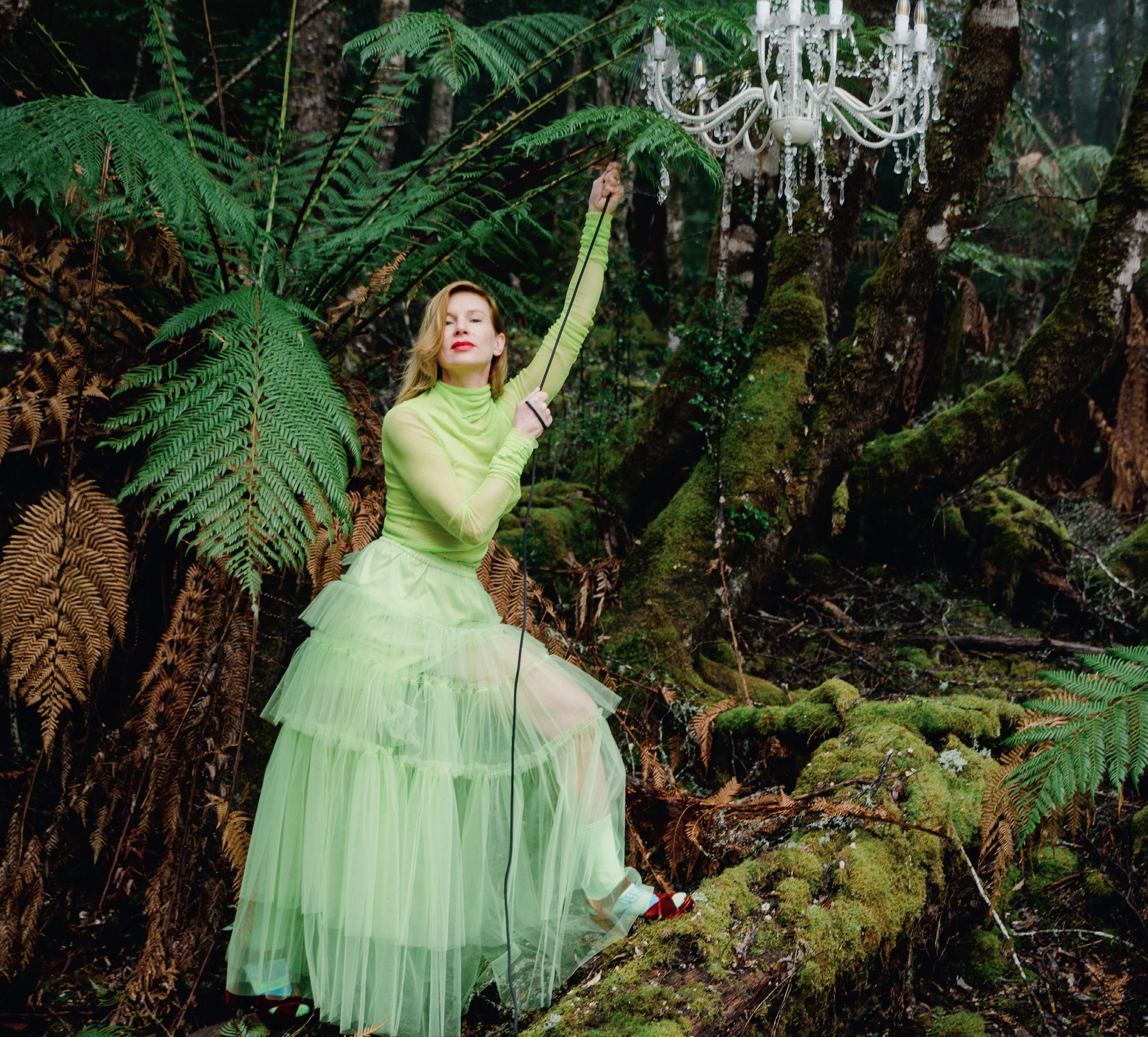
As told to Kirsten Galliott
Photography
by
Marissa Joye Peden
Be bold… but be ready to ruffle some feathers
I’ve had to deal with repercussions that were uncomfortable and unpleasant. Take the “Picassos” in the Ladies Lounge [which were fakes, painted by Kaechele but passed off as the real thing]. Not everybody liked that. It pushed a lot of buttons and I had to pay for that in a way. In some ways I was punished and ostracised. But look through the history of art and who wasn’t? Sometimes you just have to accept the fallout.
Get to the heart of a problem
My dad taught me to go to the centre of the problem. How is this problem an opportunity? How is it a benefit? How are things more rich, more interesting? It’s a matter of shifting your perception and also the context. When I moved here, it was very hard to go from having my own identity in the art world to suddenly being arm candy [as the wife of MONA founder David Walsh]. It was weird to be subsumed by someone else’s identity. But it also came with enormous benefits, such as not having to struggle over how I was going to fund my non-profit [24 Carrot Gardens, a food education program that connects young Tasmanians to healthy food]. What an enormous gift.
Embrace the “enemy”
I think very carefully about how to communicate with someone who’s different to me. I don’t want it to result in a shutdown. I had a meeting last night with someone I was afraid of and I spent the first 30 minutes trying to create rapport and warm banter. I was afraid to get to the point. There’s always that moment when it’s like, “Okay, are we ready? Let’s dive into this unresolved space.” If you step out of the culture wars and you play and are welcoming, and you’re actually asking people what they really want, you generally find that the assumptions you held were wrong. If you come out at the so-called “other” with an attack, what do you expect to receive? My meeting went so well and it happens again and again when you take the risk.
Surround yourself with the right people I’m not a finisher and I’m not a maintainer. I’m an opener. So if I don’t have the right team, there won’t be success. There’s such power in knowing what your role is and what you need to do. An art practice like mine is unwieldy and has many facets. I’m managing a lot of strands at one time. So I need someone who thinks like me on my team. But because we’re so similar, a big lesson for me is not to feel threatened – that’s very hard. I have to put on the big-girl pants and accept that this person is a genius and deserving of credit. It can be a tricky dynamic but the outcome is so much better.
Guiding Growing Minds and co-host of the Pop Culture Parenting podcast, says it’s not
a good company that looks after parents, it’s a smart one.

As
told to Genevra
Leek
Photography by Meagan Harding
How parents are at home impacts how they are in the workplace and vice versa. I meet families every day who say their home life stress contributes to burnout at work. It’s 60 to 70 per cent of parents in the workplace experiencing this. Improved outcomes for businesses can occur pretty quickly when they better
support parents. The ability to function well at home means people have more capacity to pay attention, to be on task, to be present and to be focused at work. There’s also a big long-term impact as well. Our kids’ productivity and experience of success at work is being determined now. We know that the adult lifetime mental health risk is nearly 50 per cent and we know that 50 per cent of adult mental illness starts before the age of 14. So if we can improve the trajectory of these kids, that destiny is not being set.
Flexibility, where families end up always working, doesn’t actually benefit the ability to balance work and family life. It’s about leaders genuinely supporting teams, listening to them and looking at outcomes instead of time worked and asking questions like, “How can we help?” It’s about understanding that this isn’t a kindness or generosity; it actually improves performance. It’s like the student in school – when we address an underlying difficulty a parent is having, we see this upstream benefit. The child just functions so much better.
One of the big critical windows that often gets missed is actually before the child is born. Antenatal and postnatal depression sits at about 20 per cent. That’s clinical depression and it can be because of reasons such as, “I’m having a child, how am I going to still have a career? How will I balance this?” It’s a really important time to be proactive. Big transitions are important to recognise as well: starting childcare, starting school, transitioning to new places. Then there are the unpredictable moments when a child is struggling, especially for parents who have a child that’s going through a developmental assessment or therapy.
Thinking that it’s your sole responsibility to raise your kids to be good humans is an awful way to live in the world. It’s wonderful to be a parent. It’s a wonderful opportunity for businesses to support you, build the future community into a healthier one and improve that future workforce in terms of a child’s capability to succeed and contribute. It is not your sole responsibility; it is the collective community. And that’s what we’ve lost.
Corporations can exist beyond their own four walls. Investing in community programs allows all our kids to have a much healthier outcome – our future workforce will be more productive and more engaged. That’s my big ask of corporates: to step up and say, “This is for our benefit.”
guidinggrowingminds.com
Volunteer today at redcross.org.au/emergencyvolunteer



Aussie farming ingenuity came to the fore when a quest to breed sheep that don’t need shearing resulted in lamb now served on some of the world’s top tables. Co-founder Graham Gilmore explains.
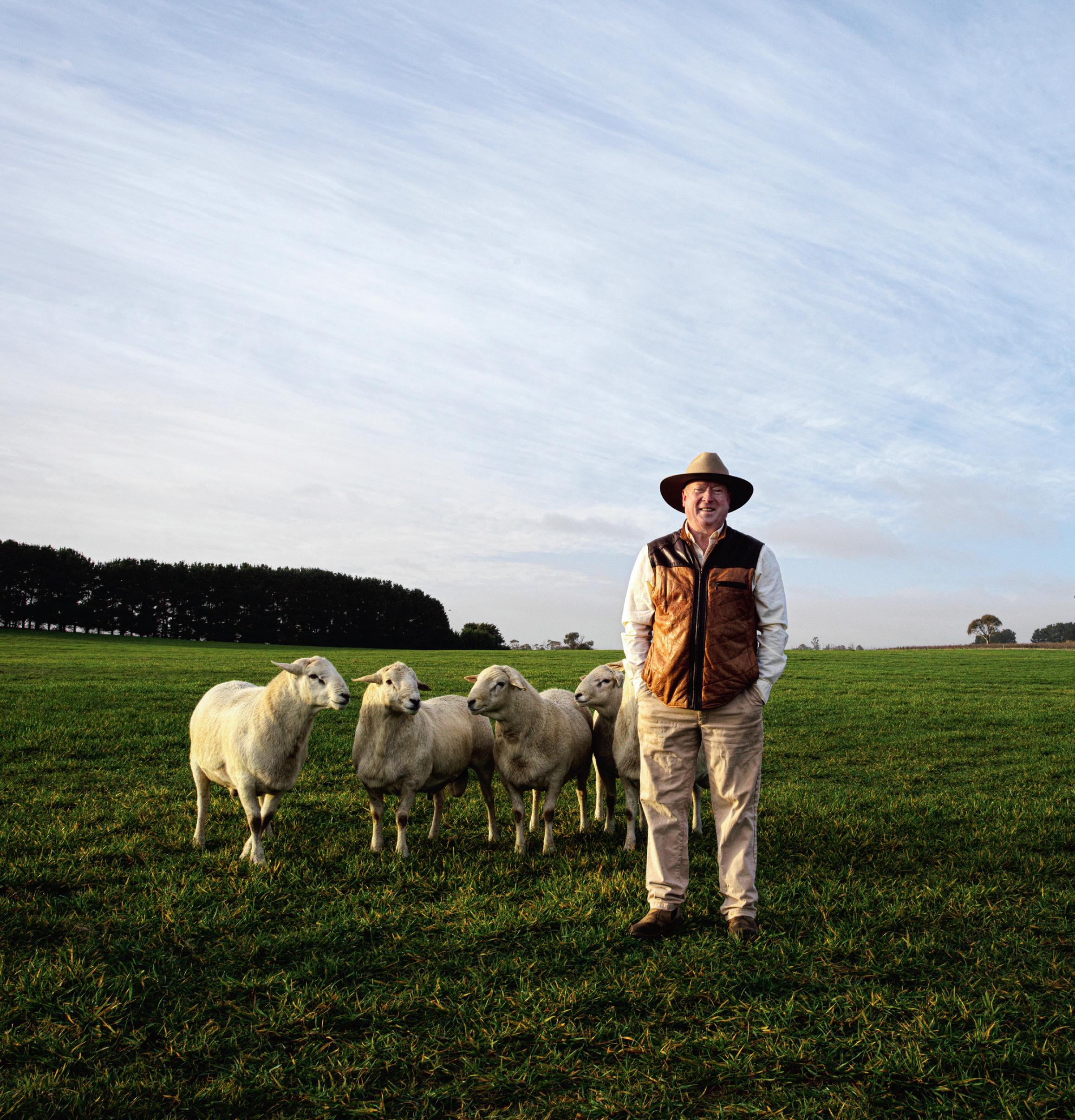

Interview by Jane Nicholls
Photography by Jason Loucas
Founders
Graham Gilmore, 66, and Tim Leahy, 42, co-founded and own Margra Lamb. Gilmore also co-founded the Tattykeel Australian White sheep breed with his brother Martin, who died in 2018, aged 52.
Investors
Owned by the Gilmore and Leahy families.
Headquarters Oberon, NSW
Number of employees
Six
What is it?
“Margra Lamb (margralamb.com) was born from breeding haired sheep, Australian Whites, that have unique eating qualities. There are differences in the meat itself, specifically regarding its low fat-melting point. Chefs describe the experience as feeling like you have olive oil in your mouth rather than waxy lamb fat.”
Why do it?
“Our family has been in the meat sheep industry for several generations and there was no answer to the spiralling costs surrounding wool. Good meat and good wool don’t really go together but you have to shear. Our business is producing meat – take the wool away and we’d be in a better financial position. My lightbulb moment came in the early 2000s when I saw haired sheep, which shed their coats naturally, in Brazil. Some of the genetics from our Tattykeel Poll Dorsets had been used in Brazil and I thought we could cross the other way and get rid of the wool.”
How did it all start?
“The breeding program for the Australian Whites began in 2007. We sat down and decided which traits we needed to hold
from different breeds. I couldn’t import those specific South American genetics to Australia because of biosecurity so I sourced hair-sheep breeds that were already here – mostly from South Africa – and began crossing them with our own genetics.”
How does it work?
“We used a technique called linebreeding that locks in the preferred characteristics, to ensure that every animal is consistent. When we found the eating quality and the low fat-melting point, we started testing to work out why those traits were there. The research found our lamb contains long-chain omega-3 fatty acids at levels three times above normal lamb. It’s red meat that offers the omega-3s people take fish oil tablets for.”
How did you grow?
‘The Margra Lamb brand came about because chefs told us we had something really different and we formalised that in 2019 when Tim came on board. By getting rid of the wool, we lowered our labour and input costs significantly. We are seed-stock producers at Tattykeel and there are now Australian Whites in the United States, Canada, China and New Zealand. For Margra to maintain quality, we only buy lamb back from farms we know are well-run and where the lambs are finished properly on grass. Margra Lamb is now served in top restaurants around Australia, including Shell House and Icebergs in Sydney, as well as in the US, Singapore and the Philippines.”
What’s next?
“We’re working on other products such as salami and prosciutto. Because of the low fat-melting point, we can make these without using any pork fat, which brings a whole new group of people to the table who don’t eat pork. We’ve even developed a lamb hot dog. My goal is that one day when people walk into a restaurant, in the same way that they ask for Kobe rather than Wagyu beef, they don’t just ask for lamb, they ask for Margra.”


Earn Tier points on all eligible oneworld flights
Access to Business Class priority check-in
Access to preferred or pre-reserved seating
Priority on waitlists and when on standby
Access to Qantas Club and International Business lounges
Priority boarding
Extra baggage allowance
Priority baggage handling
Access to First Class priority check-in
Access to First lounges
Fast track at security lanes
Access to preferred or pre-reserved seating is in accordance with the individual policy of the oneworld member airline operating the flight. First and business class check-in desks and lounges are not available at all airports. Fast track is not available at all airports. Priority baggage handling is not available on flights operated by British Airways. Extra baggage allowance benefits differ for Sapphire and Emerald tier members. oneworld benefits are available only to passengers on scheduled flights that are both marketed and operated by a oneworld member airline (marketed means that there must be a oneworld member airline’s flight number on your ticket). Alaska Airlines, American Airlines, British Airways, Cathay Pacific, Fiji Airways, Finnair, Iberia, Japan Airlines, Malaysia Airlines, Oman Airways, Qantas, Qatar Airways, Royal Air Maroc, Royal Jordanian, SriLankan Airlines and oneworld are trademarks of their respective companies. Some limitations and exceptions may apply. Qantas Frequent Flyer membership and the earning of points are subject to the Qantas Frequent Flyer program Terms and Conditions, visit https://www.qantas.com/au/en/frequent-flyer/discover-and-join/terms-and-conditions.html. For more information, visit www.oneworld.com/travel-benefits. For detailed information on the oneworld Lounge Access and Eligibility policy, visit https://www.qantas.com/au/en/ qantas-experience/at-the-airport/airport-lounges/qantas-lounge-access-eligibility.html.
Kick back and catch up on the latest releases.
“Wuthering
Heights”
A classic in the truest sense of the word, Emily Brontë’s only novel, Wuthering Heights, set Victorian hearts aflutter when it was first published in 1847. Now, having been read by generations and adapted for the screen in a host of ways, the dark fable of destructive passion appears in this latest version, directed by Emerald Fennell (Saltburn). The story of rural gentry Catherine (Margot Robbie, above) and orphaned foundling Heathcliff (Jacob Elordi) plays out against the Gothic backdrop of the wind- and rain-lashed Yorkshire moors. The star-crossed pair may have roamed this landscape together as
children but their obsessive love is futile against the class and social strictures of the time. Cathy’s decision to marry a wealthy squire to boost her family’s standing causes Heathcliff to stalk off in high dudgeon, only to return a wealthy man with vengeance in his heart. This film doesn’t pretend to be a faithful interpretation of the novel (hence the double quotes around the title), with its contemporary soundtrack and 21st-century sensibilities. Yet the jealousy, cruelty and betrayal that ultimately destroy the lovers in this almost 180-year-old cautionary tale would be recognisable in any era.

Little is known about playwright and poet William Shakespeare, apart from details gleaned from official records and myriad interpretations of his work. In this film, the iconic play Hamlet is

reimagined as the displacement of Shakespeare’s grief after the death of his 11-year-old son, Hamnet. We’re first taken to a forest, where Agnes (Oscar-winner Jessie Buckley) wanders alone among the trees, free in her own world. Young William (Paul Mescal, left, with Buckley) sees her and is instantly smitten. Despite the disapproval of their families, they marry and soon a daughter then twins, a boy and girl, are born. They’re happy but there are omens of the tragedy to come when Agnes says, “Autumn is coming and the children will fall ill.” A performance of Hamlet ends the film, the famous lines given another layer of meaning by the story we’ve just been told.
Table tennis may seem an unlikely subject for a black comedy but it’s the game’s frenetic pace and timing that inform this caper. It’s 1952 and Marty Mauser (Timothée Chalamet, above),
a young guy working in a New York shoe shop, has plans of becoming a world-beater in the then burgeoning sport. But Marty isn’t some clean-cut kid who realises his dreams through hard graft and sacrifice; he’s a hustler, always on the lookout for his own advantage, grabbing it then speeding on to the next thing. His personal life is chaotic – an affair with his married childhood sweetheart, Rachel (Odessa A’zion), and an infatuation with older-and-wiser Kay (Gwyneth Paltrow). In the midst of this tangle, Marty gets to the championships in London but it doesn’t follow the script and his audacious showmanship is turned up a notch for a rematch.
Enjoy unlimited access to theaustralian.com.au, afr.com.au and nytimes.com when you are connected to Qantas Wi-Fi onboard and in Qantas lounges

It’s Brazil in 1977, a time of military dictatorship and corruption. Marcelo (Wagner Moura, above), a widower with a young son, is fleeing the consequences of standing up to extortion. He’s given refuge and a new identity by a group of dissidents, who get him a job in a government department that issues IDs – a case of hiding in plain sight. In this taut thriller, wrongdoing becomes an unavoidable everyday routine at all levels and Marcelo must outsmart its perpetrators to find a way out.
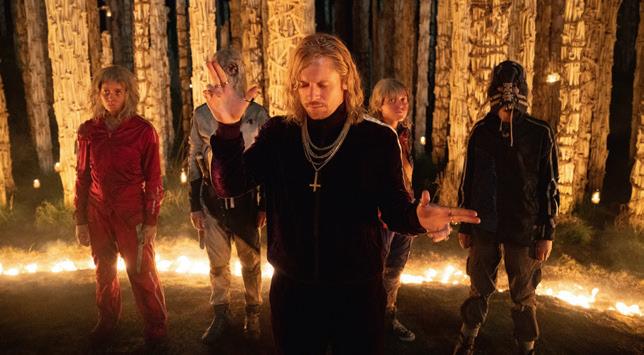
The fourth chapter in this zombie apocalypse series continues where 28 Years Later left off. The teenaged Spike had gone to the infested mainland in search of Dr Ian Kelson (Ralph Fiennes) in a quest to help his family. Yet Spike discovers there’s a greater danger than the undead – the Jimmies, a gang of uninfected thugs led by the self-styled Sir Jimmy Crystal (Jack O’Connell, above centre).
The best shows to binge this month.
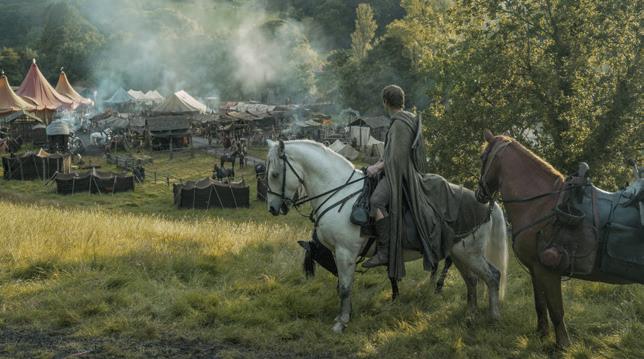
A century before Game of Thrones, we meet Ser Duncan the Tall (Peter Claffey), a lofty hedge (non-noble) knight, and his diminutive squire, Egg (Dexter Sol Ansell), as they seek a noble mentor for “Dunk”. The growing friendship between our mismatched duo is the crux of this underdog tale.

American Harper Stern (Myha’la, above) has nabbed an entry-level role at a London investment bank. Now she must pit her wits against her colleagues to prove herself in the high-powered world of global finance. They’re all looking to climb the corporate ladder but some have the advantage of calling on the old boys’ network.
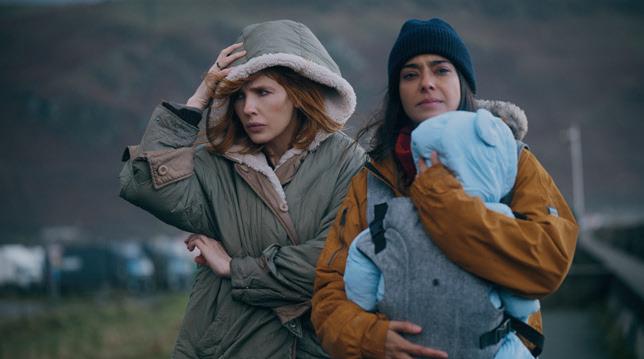
Three years after her niece’s disappearance, teacher Jackie Ellis (Kelly Reilly, above, left) discovers the body of one of her pupils near her home in Wales. Detective Eric Bull (Rafe Spall) arrives to investigate the death and its possible connection to the earlier case but the secrets he unearths threaten to rip the community apart.

A fresh intake of cadets has arrived on the starship-cum-campus USS Athena, along with a new chancellor, ex-captain Nahla Ake (Holly Hunter), who’s not your typical skipper. She has history with one of the newbies, Caleb (Sandro Rosta, above, far right), and must protect him and the academy from the ruthless Nus Braka (Paul Giamatti).


Once onboard, connect your own device to Qantas Free Wi-Fi on Wi-Fi enabled aircraft in three simple steps to access the internet and Qantas Entertainment App.
Step 1
Enable Aeroplane Mode and select the “Qantas Free Wi-Fi” network in your Wi-Fi settings.
Step 2
Follow the prompts on the “Welcome Onboard” screen to connect.
Step 3
Once you’re connected, you’re now ready to access the internet and the Qantas Entertainment App.
Having trouble connecting? Make sure you’re connected to the “Qantas Free Wi-Fi” network and go to wifi.qantas.com in your preferred browser to start exploring.
Inflight entertainment varies by route and aircraft. Voice calls are not permitted inflight.
Across
10. Argue (6)
11. Abrade (5)
12. Cyberspace persona (6)
13. Sports boundary (8)
14. Wiped out (10)
15. Banish (6)
16. Port-working vessel (3)
18. Expelling air (8)
19. Intrepid (8)
21. Taken aback (10)
24. Book leaf (4)
25. Kneading (9)
27. Overall strategy, master ... (4)
28. Breath freshener (10)
31. Twisted (delight) (8)
33. Vacationers (8)
36. Centre of storm (3)
37. Diagram (6)
39. Glass slipper wearer (10)
41. Breaks into tiny pieces (8)
42. Man or woman (6)
43. Guitar string material (5)
44. Syndicate (6)
01 Dainty (6)
02. Ascot or Epsom (10) 03. Demean (8)
04. Laboratory workers (10) 05. Stardom (4)
06. Wickedly enjoyable (8) 07. Disappear (6)
08. Stories with a moral (8) 09. Subterranean chamber (6)
17. Ensure (9)
20. Elude (capture) (5)
22. Scold (3)
23. College finals (5)
25. Spoil (3)
26. Wowing (10)
27. TV hosts (10)
29. Idyllic place (8)
30. Disrespectful (8)
32. Investigate (8) 34. Gave one’s view (6)
35. Become smaller (6)
38. After-hours travel ban (6)
40. Unite formally (4)
Across
10. Beat Ed badly at formal discussion (6)
11. Rub and scratch a feline’s midsection (5)
12. Aggravates by removing eggs for movable icon (6)
13. Where linesman stands with his secondary income (8)
14. Completely eliminated date I cared about (10)
15. Expatriate some rude porters (6)
16. Yank boat (3)
18. Somehow align hex while breathing out (8)
19. Daring to presume less (8)
21. After alarming start, dishonest characters are stunned (10)
24. Quiet, mature attendant (4)
25. Rubbing out Siam gangs (9)
27. Intend to make architectural drawing (4)
28. Sweet flavouring made from condiment in pristine condition (10)
31. Each stanza of poetry is twisted (8)
33. Holidaymakers see suitor wandering around street (8)
36. They even include a facial feature (3)
37. Roughly draw up comedy routine (6)
39. Erin called, upset – the poor, neglected girl (10)
41. Destroys the star’s preparation (8)
42. Appear as noun alternative for individual (6)
43. Any long core fibre (5)
44. Controlling group had vehicle permit sent back (6)
01
Very small pet has a lot of bite (6)
02. Track the development of orca rescue (10)
03. Be left title about rubbish (8)
04. They experiment with ways to prop up insect I injured (10)
05. Loud Mae became celebrity (4)
06. Morally deteriorating for ten years – not disheartened (8)
07. Clear off with varnish right away (6)
08. Religious stories involving Abel’s rap (8)
09. Can clergyman be going back inside grotto? (6)
17. Agree aunt made promise (9)
20. Dave goes up to the East to escape (5)
22. Horse or badger? (3)
23. “Tests egg!” Sam’s announced (5)
25. Damage broken arm (3)
26. I’m doing the ironing triggering a most favourable response (10)
27. The queen’s after a gift for comperes (10)
29. A padre is about to reveal heaven (8)
30. Ten lions used to be rude (8)
32. Fact-finding mission might scare her (8)
34. Some cop in Edinburgh spoke out (6)
35. Recoil from psychiatrist? (6)
38. Vicious dog with hardly any restriction at night (6)
40. Everyone with a ponytail is a friend (4)
Create as many words of four letters or more as you can using the given letters once only but always including the central letter. Don’t use proper nouns or plurals ending with “s”. See if you can find the nine-letter word using all letters.
Work out the missing part of these famous artists’ names and remove them from the grid of letters. The remaining letters will spell out an aphorism attributed to Matisse. Jackson
Dürer
Andy Monet
Degas
Manet
Edvard
Hopper
Egon de Goya
Frida
O’Keeffe
Klimt
Henri de -Lautrec
Matisse
Johannes (Jan)
Marc Marcel Pablo
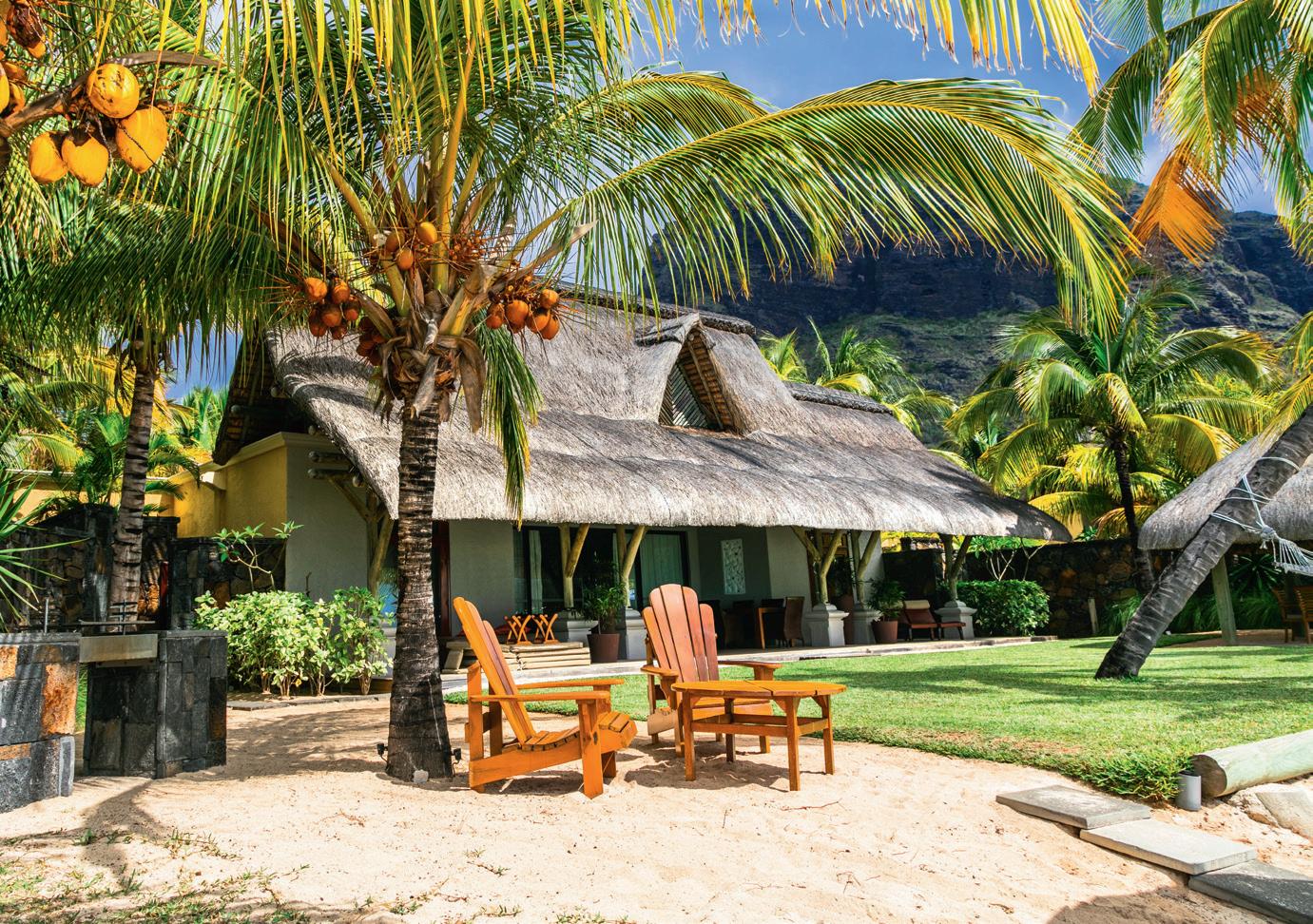
Can you spot the seven differences between these two images? Circle what’s changed on the image below.
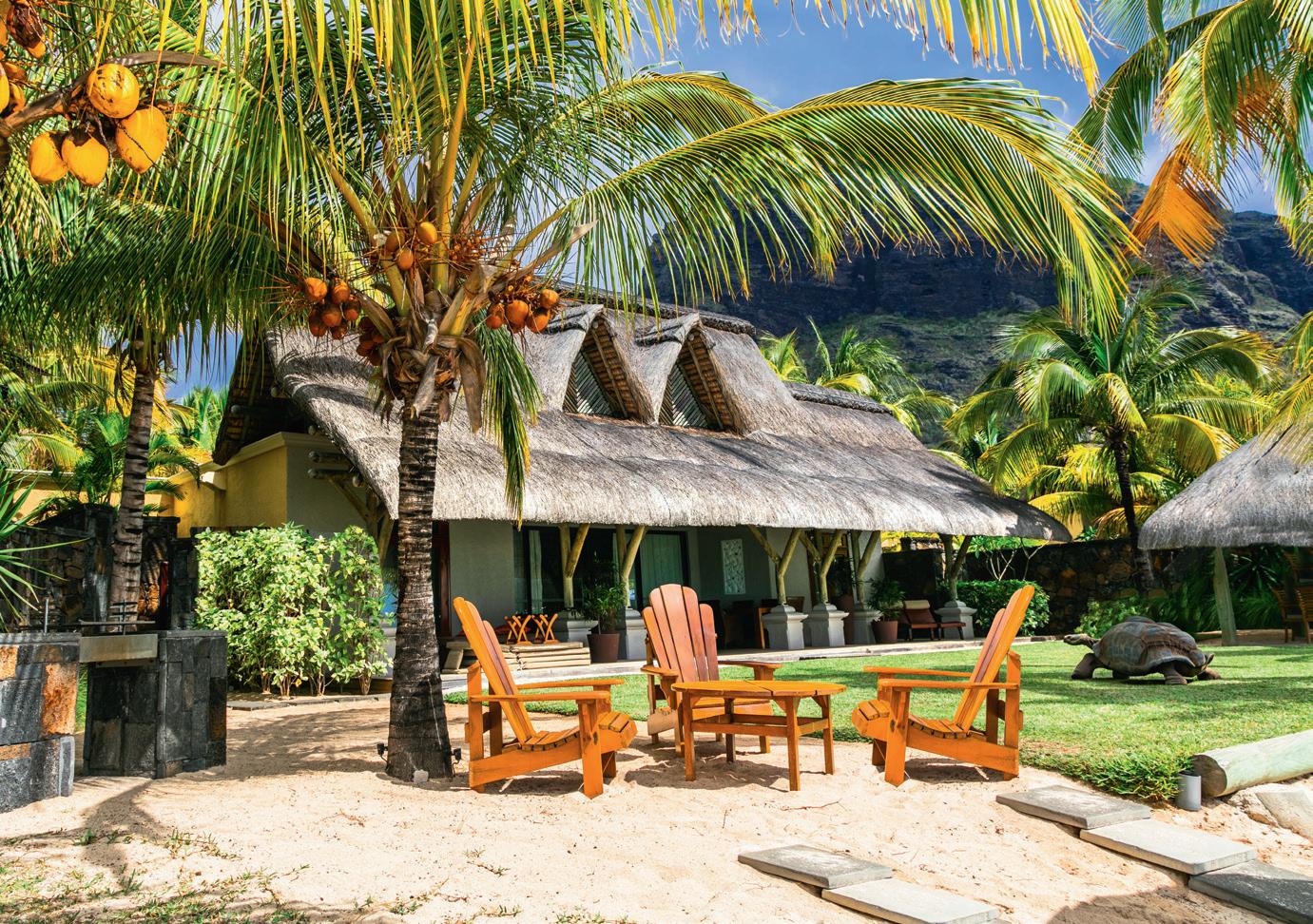
01. Which Italian cheese has microchips in the rind to prevent counterfeiting?
02. The Monte Rosa Massif is part of which mountain range?
03. What was Alexander the Great’s mother’s name?
04. El Yunque National Forest is on which Caribbean island?
05. Which carmaker introduced the first moving assembly line in 1913?
06. Which author co-wrote the screenplay for 1968’s Chitty Chitty Bang Bang ?
07. Who composed the operas Rigoletto and Don Carlos?
08. In what country is the Plain of Jars?
09. Kratos is the main character in which video game?
10. The painting Freedom From Want is by which American artist?
11. Hayao Miyazaki, Isao Takahata and Toshio Suzuki founded what Japanese animation studio?
12. Which chemical element is named after the creator of the periodic table?
13. Groote Eylandt is the largest island in which Australian gulf?
14. Name the violinist who is music director of Academy of St Martin in the Fields.
15. “I’m bored with it all” were reportedly the last words of which former British prime minister?
16. Formed by a volcanic eruption in the 1960s, Surtsey Island is in which country?
17. Which Ancient Roman ruler introduced the leap year?
18. Name the driver who won the 2025 Spanish Grand Prix?
19. What is the highest single-drop waterfall in Australia?
20. What does impignorate mean?
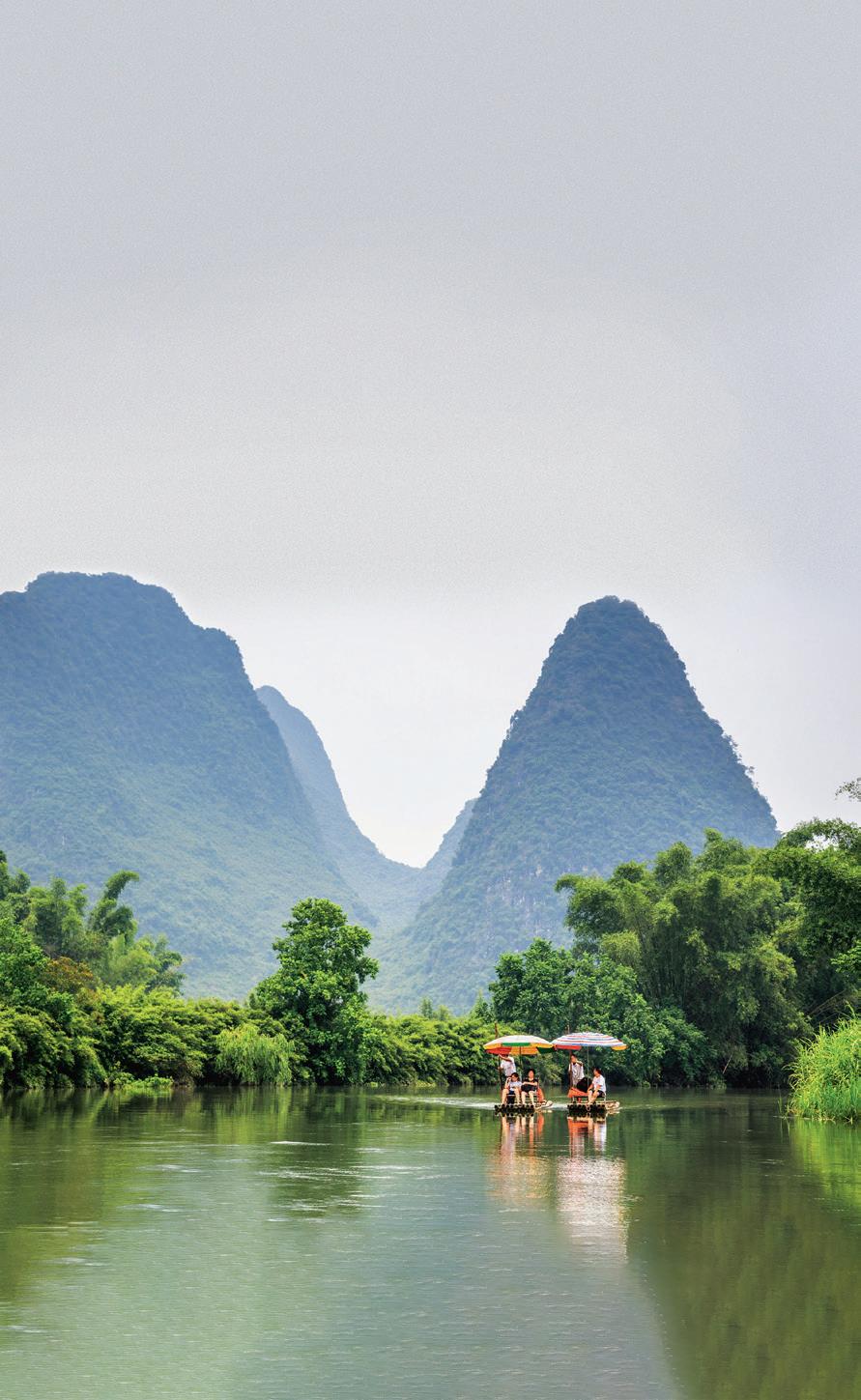
Scan the QR code to follow @qftravelinsider
Or visit qantas.com/ travelinsider for help planning your next holiday
If you’ve filled in the answers, please take the magazine with you so the cabin crew know to replace it with a new copy.
Alee, Aril, Earl, Lair, Lame, Late, Leer, Liar, Lime, Lira, Lire, Mail, Male, Malt, Meal, Melt, Mile, Rail, Real, Reel, Rial, Rile, Tail, Tale, Teal, Tile, Tilt, Alert, Alter, Atilt, Elate, Elite, Email, Lamer, Later, Latte, Litre, Metal, Miler, Realm, Relet, Relit, Tiler, Title, Trail, Trial, Latter, Letter, Litter, Mailer, Mettle, Rattle, Relate, Remail, Retail, Retile, Atelier, Emailer, Retitle, Literate, Materiel, Remittal Nine-letter word: ALTIMETER Spot the difference
01. Extra window
02. Extra porch pylon
03. Giant tortoise on grass
04. Tree trunk removed
05. Extra chair
06. Extra pavers
07. Higher hedge
Albrecht Dürer, Andy Warhol, Claude Monet, Edgar Degas, Édouard Manet, Edvard Munch, Edward Hopper, Egon Schiele, Francisco de Goya, Frida Kahlo, Georgia O’Keeffe, Gustav Klimt, Henri de Toulouse-Lautrec, Henri Matisse, Jackson Pollock, Johannes Vermeer, Joan Miró, Leonardo da Vinci, Marc Chagall, Marcel Duchamp, Pablo Picasso, Paul Cézanne, Peter Paul Rubens, Pierre-Auguste Renoir, René Magritte, Salvador Dalí, Vincent van Gogh, Yayoi Kusama
Solution: Creativity takes courage
Quiz
01. Parmigiano Reggiano 02. Pennine Alps
03. Olympias 04. Puerto Rico 05. Ford Motor Company 06. Roald Dahl 07. Giuseppe Verdi 08. Laos 09. God of War 10. Norman Rockwell
11. Studio Ghibli 12. Mendelevium 13. Gulf of Carpentaria 14. Joshua Bell 15. Winston Churchill 16. Iceland 17. Julius Caesar 18. Oscar Piastri 19. Wallaman Falls 20. To pledge, pawn or mortgage
These exercises are designed to provide a safe way to stretch and enjoy movement in certain muscle groups that can become stiff as a result of long periods of sitting. They may be effective at increasing the body’s blood circulation and massaging the muscles. We recommend you do these exercises for three or four minutes every hour and occasionally leave your seat to walk down the aisles. Each exercise should be done with minimal disturbance to other passengers. None of these exercises should be performed if they cause pain or cannot be done with ease.
01
Start with both heels on the floor and point feet upwards as high as you can.
Ankle circles
Lift feet. Draw a circle with toes, moving one foot clockwise and the other counterclockwise at the same time.
Reverse circles. Rotate in each direction for 15 seconds. Repeat if desired.
Knee lifts Lift leg with knee bent while contracting your thigh muscle. Alternate legs. Repeat 20 to 30 times for each leg.
Neck roll
With shoulders relaxed, drop your ear to your shoulder and gently roll your neck forward and back, holding each position for about five seconds. Repeat five times.
Knee to chest Bend forward slightly. Clasp hands around left knee and hug it to your chest. Hold for 15 seconds. Keeping hands around the knee, slowly let it down. Alternate legs. Repeat 10 times.
Mobile phones and electronic equipment: All transmitting electronic devices, including mobile phones, tablets and laptop computers, must be switched to flight mode* prior to departure. Smaller devices such as mobile phones, e-readers, electronic games, MP3 players, iPads and other small tablets may be held in your hands or stowed in a seat pocket. Unless otherwise directed by the captain, these devices may remain switched on and used in flight mode during take-off, cruise and landing. Larger electronic equipment such as laptop computers may only be used from when the aircraft seatbelt sign is extinguished after take-off until the top of descent. After landing, the cabin crew will advise when flight mode may be switched off.
Headsets: Do not use a personal single-pin audio headset in the Qantas inflight entertainment system unless it is supported by a two-pin airline headset adaptor. Personal headsets that connect via a cable
to a handheld device can be used at any time from boarding until arrival. Headsets and other devices that connect via Bluetooth must be switched off for take-off and landing but can be used during cruise.
*Flight mode enables you to operate basic functions of your mobile phone or personal electronic device while its transmitting function is switched off, meaning you cannot make phone calls or send an SMS.
Your wellbeing is our priority. Our Fly Well program brings together a number of measures to give you peace of mind during your flight.
Cabin air: Our aircraft air conditioning systems are fitted with hospital-grade HEPA filters, which remove 99.9% of all particles including viruses. The air inside the cabin is refreshed every few minutes, ensuring the highest possible air quality.
02
Put both feet flat on the floor. Lift heels high, keeping the balls of the feet on the floor.
03
Repeat these three stages in a continuous motion and at 30-second intervals.
Forward flex
With both feet on the floor and stomach held in, slowly bend forward and walk your hands down the front of your legs towards your ankles. Hold for 15 seconds and slowly sit back up.
Shoulder roll Hunch shoulders forwards then upwards, backwards and downwards in a gentle circular motion.
Inflight: The aircraft configuration, including the seats and galley, act as a natural barrier, and people are not seated face to face. The direction of inflight airflow is ceiling to floor.
Enhanced cleaning: Our aircraft are cleaned with a disinfectant effective against coronaviruses, with a focus on the high contact areas of seats, seatbelts, overhead lockers, air vents and toilets. Our people are trained in the latest hygiene protocols.
Your inflight health: When flying, passengers can be seated and inactive for long periods of time. The environment can be low in humidity and the cabin pressure equivalent to an altitude of 2440 metres above sea level. The following advice helps you stay healthy during your journey.
The importance of inflight blood circulation and muscle relaxation: When walking, the leg muscle action helps return venous blood to the heart. Sitting in the same position for a long period of time can slow
this process and, in some people, leads to swelling in the feet. Some studies have shown that immobility associated with travel of longer than four hours (by air, car or rail) can also lead to an increased risk of deep vein thrombosis (DVT), or clotting in the legs. Personal factors that increase the risk of DVT include:
Age over 40 years
Personal or family history of DVT or pulmonary embolus
Recent surgery or injury, especially to the lower limbs, pelvis or abdomen
Cancer
Inherited or other blood disorders leading to clotting tendency
Pregnancy
Oestrogen therapy (oral contraceptive pill or hormone replacement therapy).
There are a number of ways to help reduce the possibility of DVT, including the following:
Avoid leg-crossing while seated
Ensure adequate hydration
Minimise alcohol and caffeine intake before and during your flight
Wear comfortable, loose-fitting clothes
During your flight, move your legs and feet for three to four minutes per hour while seated and move about the cabin occasionally
Do the light exercises we recommend here (see above) and through the inflight entertainment system.
If you have concerns about your health and flying, or you feel that you may be at risk of DVT, Qantas recommends that you talk to your doctor before travelling. Additional measures such as well-fitted compression stockings or anti-clotting medication may be recommended for high-risk individuals.
Jet lag: Unlike other forms of transport, air travel allows for rapid movement across many time zones, which can disrupt the body’s biological clock. This is commonly known as jet lag. This disruption can affect various body rhythms such as the sleepwake cycle and the digestive system, leading to symptoms such as tiredness and lack of energy and appetite. In general, the more time zones crossed, the more disruption of the body clock and the more symptoms experienced after the journey. We recommend the following to minimise the effects of jet lag.
Before your flight:
Get a good night’s rest
During your flight:
Eat light meals
Wear loose, comfortable clothing and sleep when you can
Stay hydrated – drink plenty of water and avoid excess tea, coffee and alcohol
At your destination:
If possible, give yourself a day or two after arrival to adjust to the new time zone
Go out in the daylight and do some light exercise
Try to eat meals and do other social activities at appropriate destination times to adjust to the new time zone
Cabin humidity and hydration: Humidity levels of less than 25 per cent are common in the cabin, as the outside air that supplies the cabin is very dry. The low humidity can cause drying of the surfaces of the nose, throat and eyes and it can irritate contact lenses. If normal fluid intake is maintained during the flight, dehydration will not occur.
We recommend:
Drink water and juices frequently during the flight
Drink coffee, tea and alcohol in moderation
Remove contact lenses and wear glasses if your eyes are irritated
Use a skin moisturiser to refresh the skin
Cabin pressurisation: During flight, aircraft cabin pressure is maintained to a sufficient density for your comfort and health. As the aircraft climbs, the cabin may reach the same air pressure as at an elevation of 2440 metres above sea level. Cabin pressure does not pose a problem for most passengers. However, if you suffer from obstructive pulmonary diseases, anaemias or certain cardiovascular conditions, you could experience discomfort at these altitudes. These passengers should seek medical advice before flying, as some may require supplementary oxygen. Qantas can arrange this but requires at least seven days’ notice before travelling. The rate of change in cabin pressure during climb and descent is also carefully maintained and does not usually cause discomfort. However, children and infants, and adults who have sinus or nasal congestion, may experience some discomfort because of pressure changes during climb and particularly descent. Those suffering from nasal or sinus congestion because of a cold or allergies may need to delay travel. The following advice may assist:
To “clear” your ears, try swallowing, yawning or pinching your nose closed and gently blowing against it. These actions help open the Eustachian tubes, equalising pressure between the middle ear chamber and throat. If flying with an infant, feed or give your baby a dummy during descent. Sucking and swallowing help equalise pressure in an infant’s ears. Give children something to drink or chew during descent.
Consider using medication such as nasal sprays, decongestants and antihistamines 30 minutes prior to descent to help open up your ear and sinus passages.
Motion sickness: Air travel, especially if turbulence is experienced, can cause motion sickness, as it leads to a conflict between the body’s sense of vision and its sense of equilibrium. Maintaining good visual cues (keeping your eyes fixed on a non-moving object) helps prevent motion sickness. When the weather is clear, you should look out at the ground, sea or horizon. If the horizon can’t be seen, closing your eyes and keeping your head movements to a minimum will help. While over-thecounter medications are available, we recommend you consult your doctor about the appropriate medications. More information can be found:
At qantas.com.au/info/flying/intheair/ yourhealthinflight
Through the onboard entertainment system On our information leaflet available from Qantas or your travel agent
Smoking: Government regulations prohibit smoking on all flights operated by Australian-registered aircraft. The use and charging of all e-cigarettes and other personal vaporisers are not permitted on board an aircraft. There are smoke detectors in all toilets and penalties for regulation breaches.
Travelling with children: Please ask cabin crew for help if required. Baby food and nappies (diapers) are available on most flights, while some washrooms are fitted with baby change tables. Please dispose of nappies etc. in the waste bins.
Leaving flights: On international flights, the cabin crew will distribute the necessary Customs and Immigration forms. If you are stopping en route, you will need your boarding pass to re-board the aircraft. If you’re travelling as a domestic passenger on an international flight within Australia, retain your boarding card with the large D sticker. This will be required to clear Customs at your destination.
Transferring from Australian domestic flights numbered QF400 and above to international flights: At check-in you will be issued with your international boarding pass. Your international boarding pass and baggage will be tagged through to your final destination. There is no need to claim your baggage or attend check-in at the transfer airport. Follow the signs for international transfers passengers to the complimentary transfer bus (not necessary in Melbourne and Darwin).
Transferring from international to domestic flights numbered QF400 and above: On arrival at your Australian transfer port, go through Immigration and collect your luggage. Proceed through Customs and follow the signs to the domestic transfer area to re-check your luggage. A complimentary transfer bus (not necessary in Melbourne, Adelaide and Darwin) departs at regular intervals for the domestic terminal for your connecting Qantas flight within Australia. If your connecting domestic flight is numbered QF1-QF399, there is no need to clear Customs and Immigration. These flights depart from the international terminals. Customs and Immigration clearance will be completed at your final destination.
Transferring to a Jetstar domestic flight: If your next flight is with Jetstar (JQ) or a Qantas codeshare flight operated by Jetstar (QF5400-QF5999), you will need to collect your baggage and follow the signs to the Jetstar counter to check in for your flight and re-check your baggage.
The Qantas Group has a zerotolerance policy for any passenger who fails to follow crew directions, is intoxicated from alcohol, or is found smoking or vaping on board. Inappropriate comments, behaviour, or actions, whether inflight or on the ground, will result in denial of boarding or off-loading. Qantas will not accept inappropriate comments as “jokes”. It will seek to recover all costs incurred, including diversions as a result of security incidents, from those involved.
Security screening is subject to the laws and regulations of the country of operation. The Qantas Group ensures that its passengers, staff and aircraft are safe and secure through an outcome-focused, risk-based approach to security management. Qantas security standards apply across the business, including QantasLink and Jetstar.
A dedicated operations centre monitors global security events 24 hours a day.
Pack your own luggage
Do not carry any items for another person
Carry valuables, approved medication and keys in your carry-on baggage
All knives, sharp objects or cutting implements must be in checked baggage
Security measures can include random frisk search after consent is obtained. Passengers may request privacy and must be searched by a screener of the same gender
Important note: Security screening is subject to the laws and regulations of the country of operation.
On all international flights to and from Australia: Each container of LAGs in your carry-on baggage must be 100ml or less
All 100ml containers must be placed in a single transparent one-litre plastic bag
Plastic bags containing LAGs are to be screened separately from other carry-on baggage
All powders must be screened separately with restrictions on the carriage of inorganic powders over 350ml (350g)
Passengers may still carry prescription medicines or baby products sufficient for the flight
If departing, transiting or transferring on an international flight at an Australian
international gateway airport, duty-free powders and LAGs must be sealed, with receipt, in a security tamper-evident bag issued at the time of purchase
The Australian federal government has introduced full-body scanners at international gateway airports: Sydney, Adelaide, Brisbane, Cairns, Darwin, Perth, Melbourne and the Gold Coast
The Australian Federal Government has commenced introducing full-body scanners at major domestic airports: Adelaide, Brisbane, Cairns, Canberra, Darwin, Gold Coast, Hobart, Launceston, Melbourne, Newcastle, Perth, Sunshine Coast, Sydney and Townsville
At international gateway airports passengers refusing to pass through the scanner will be banned from entering the sterile area or boarding an aircraft for 24 hours
Exemptions apply for people with serious medical conditions, infants and small children, and people in wheelchairs
As per advice, the energy exposure is comparable to that from a mobile phone several metres away
There are no known safety concerns for people with pacemakers and metal implants or for pregnant women
Common items used every day may seem harmless but on an aircraft they may become dangerous. When the aircraft changes altitude, variations in temperature and pressure may cause items to leak, create fumes or catch fire.
Items that are forbidden on aircraft or have carriage restrictions include lithium batteries, other battery types, camping stoves, fuels, oils, compressed gases, aerosols, household cleaners, matches, lighters, paints, explosives (including flares, fireworks, sparklers and bonbons), emergency position-indicating radio beacons, radioactive material, biological and infectious substances and fuel-powered equipment. This list is not exhaustive so please carefully consider what items you pack for your next flight.
If you’re unsure about an item in your baggage, ask a member of our friendly cabin crew.
For further information, go to qantas.com or email dg@qantas.com.au.
Qantas is a partner in the Australian government’s Charter for Safe Travel. Travellers may obtain the latest travel advice for their destination by visiting smartraveller.gov.au.
Several countries are introducing automated immigration clearance procedures to cope with growing air-travel numbers. The goal is to provide a faster, smoother immigration experience to eligible passengers without compromising border security. Countries providing facilities across our network:
Australia SmartGate: e-passport holders of Australia, Canada, China, France, Hong Kong, Ireland, Japan, Korea, Macau, New Zealand, Singapore, Sweden, Switzerland, UK and US
China e-Channel: citizens of China
Hong Kong e-Channel Residents: citizens and residents of Hong Kong
Hong Kong e-Channel Visitors: frequent visitors that are visa-exempt, including Australians
Indonesia Autogate passport gates: citizens of Indonesia
Japan Speedy Immigration: citizens and foreign nationals with re-entry and special re-entry permits
New Zealand SmartGate Plus: e-passport holders of Australia, New Zealand, UK and US
Singapore enhanced-Immigration Automated Clearance System (eIACS): citizens, permanent residents, work permit holders and APEC cardholders
UAE eGate: UAE citizens and residents
UK ePassport gates: e-passport holders of UK, Switzerland and European Economic Area (EEA)
USA Global Entry system: US citizens and permanent residents, Dutch citizens, South Korean citizens and Mexican nationals. Canadian citizens and residents with NEXUS membership
USA Automated Passport Control: for US, Canadian and Visa Waiver Program passport holders
Fee applies
Pre-enrolment required
The Qantas Group is undertaking a historic fleet renewal with 214 new aircraft on order (as at 30 June 2025), bringing quieter and more comfortable cabins. But new aircraft don’t just arrive and fly. Years of preparation come first, from new simulators and ground training equipment to aircraft cabin mock-ups and training for the pilots and cabin crew. The Qantas team undergo rigorous training programs, with safety the number-one priority for every flight. For Qantas’ Airbus A321XLR program alone, more than 240 pilots each do up to 60 hours of simulator training, while around 2000 cabin crew undertake extensive preparation and training. Customers will notice the benefits of flying in the new aircraft, such as the A321XLR, with wider and higher cabins, and overhead lockers that fit about 60 per cent more bags than 737s.




*A330 fleet includes two wet-leases and two dry-leases from Finnair










subtypes in fleet are not shown Number of aircraft as at 31 December 2025