


www.mechanicalbusiness.com Joey Votto: Canadian Slugger PM #41536047 SEPTEMBER/OCTOBER 2023 $6.95 Booster pump troubleshooting tips What is inverter technology? Hints on resolving backed up main drains Know your options: Control valves Assessing ductwork for heat pump installations Biomass: a renewable resource with promise CIPHEX WEST 2023 SHOW GUIDE October 18-19, 2023 Calgary, AB BMO Centre at Stampede Park


© 2023 General Wire Spring JM-2900® MADE IN U.S.A. • Economical gas jet is great for maintenance work • 389 cc (13 hp) engine with low oil shut off • 3000 psi, 4 gpm pump with Vibra-pulse® • 200 ft. capacity hose reel with reel brake • Rides on two at-free foam core tires and heavy-duty frame • Made in U.S.A. Call the Drain Brains ® at 800-245-6200, or visit www.drainbrain.com/jetters I ABSOLUTELY LOVE THE (JM-2900) JETTER! IT’S A DEFINITE GAME CHANGER FOR DRAIN CLEANING!” - Mary-Anne Bowcott, Westcom Plumbing and Gas Ltd., The Lady Plumber “ See Mary-Anne’s pro le in the Sept/Oct 2021 digital edition of Mechanical Business at mechanicalbusiness.com/the-lady-plumber GPC/General Pipe Cleaners.
Joey Votto: Canadian Slugger
50COVER STORY
Drafted by Cincinnati in 2002, Votto played his first MLB game with the Reds in 2007 and is in his 17th year with the team. He is known for his prowess at home plate and first base, and more recently his social media persona
 Kerry Turner
Handing over the keys: Setting expectations for performance and maintenance
80HYDRONICS
As an industry, we are great at putting systems together. We do an excellent job of selecting quality products and components that provide comfort and energy savings. However, we are not so great at properly handing over the keys to the homeowners.
 Cliff McNeill
The fine balance of energy retrofits and IAQ
Focus on health: 88
INDOOR AIR QUALITY
There can be a direct consequence for IAQ as buildings are tightened or sealed to reduce energy loss. One contaminant in particular, radon gas, appears to be especially affected by energy retrofits.
Anne-Marie Nicol
CIPHEX West returns to Calgary
53
CIPHEX WEST 2023
The largest western trade show returns to the BMO Centre at Stampede Park with educational sessions and opportunities to see the latest product and system technologies. Interact with manufacturers, suppliers and other industry members, all in one location. Schedules, seminar descriptions, exhibitors list and products are available here.
the cover: Joey Votto would like to be a one-team player for his entire career. Cover Photo: Courtesy of the Cincinnati Reds
Mechanical Business 10.23 CONTENTS TABLE OF
On
68ROAD WARRIOR: Kenneth Larsen: Mentoring a new generation
Carolyn Cooper
74EMBRACING THE PAST
We have come a long way
It seems inconceivable that wood was used as gas pipe but trees were plentiful and cheap
Kerry Turner
76JOBSITE JARGON
Test your knowledge of heating terminology for a chance to win

78CLIMATE CHANGE
Canada launches National Adaptation Strategy
Carolyn Cooper
78PLUMBING
Cross connection fixes

Bad and Ugly contest winners announced
92HYDRONICS
Pressure testing PEX and PE-RT tubing systems


It is sometimes difficult to test systems using water − can you use compressed air or inert gas




Lance MacNevin
Breaking up is hard to do
104HUMAN RESOURCES


What to do when it’s time to move on.


Sue Sodek
CONTENTS TABLE OF TROUBLESHOOTING TIPS FOR COMMON ISSUES


96PUMPS
Booster pump systems are critical to maintaining the pressure and flow demands in modern high-rise buildings.
Tom Stephan
INVERTER TECHNOLOGY OFFERS EMISSIONS AND EFFICIENCY BENEFITS
44HEAT PUMPS
The inverter heat pump has numerous benefits for commercial buildings.

Rob Landes and Will Ward
Know your options: Control valves Part I


46HYDRONICS
An incorrectly applied control valve can cause problems with heating and cooling systems, and occupant comfort.
Rick Mohammed

FEATURES
DEPARTMENTS 8Editorial 10-27News, Movers & Shakers, People 94Events 108The Info Page 109In the Next Issue 110By the Numbers PRODUCTS 32-37Heating Product Showcase 58-66CIPHEX West Product Showcase 102Stuff You Need
4 Mechanical Business 10.23
Still specifying Oversized, Inefficient Commercial Water Softeners?
Our multi-tank systems (MTS) will take your project to a higher level of treated water quality and efficiency.

� Proven performance in the field
� Industry-leading efficiency: 40-50% less salt and regeneration water
� Continuous soft water at all flow rates

� Our professional engineers provide drawings and specification language for every job
www.canaturewg-cied.com/eng-mts
See how our multi-tank softeners work


Canature WaterGroup™ is one of North America’s leading manufacturers and distributors of residential and commercial water treatment solutions.
CONTENTS
28 HIGH-PERFORMANCE HVAC
Assessing ductwork for heat pump installations
Gord Cooke
Remedial action is sometimes required to correct or overcome any barriers that would disqualify a home for a heat pump installation.
40 HYDRONICS
Biomass: a renewable resource with promise


Bob “Hot Rod” Rohr
Can we, or should we, pursue this energy source on a cleaner and larger scale?
70 PLUMBING
Drains, drains everywhere: But where do we begin?
Fred Bretzke


I don’t know how many times I’ve had to look for cleanouts to access the main drain in a finished basement. Here are some hints on where to start if you have a backed up main drain.
84 REFRIGERATION
How to diagnose reciprocating compressor problems and failures − Part III

Phil Boudreau
Oil condition can hugely impact performance if it is not monitored.

100 MARKETING
What is a reasonable marketing budget for your business?
Doug MacMillan
Instead of throwing money at marketing hoping some of it sticks, careful use of your budget is essential, with solid KPIs and analysis to consistently adjust the program to yield the best results.
Simplify Ice Management with The Established Technology of Sensori-Integrated OLPP™

You can only manage it – if you know what’s going on.
Sensori™ is a holistic, fully integrated management solution for ice temperature performance & energy efficiency in chiller systems.

Built-in modeling and analytical tools assess & optimize performance, tailoring refrigeration to each facility’s dynamic needs. Technicians easily manage brine levels, flow, temperature, pressure, and scheduling via userfriendly interfaces with remote access for enhanced flexibility and efficiency.

Gain transparency, redefine efficiency, & maintain system stability with one complete system.
6
If you're seeking superior ice management, the technology you need is already here with the OLPP™ with Sensori™
MB SPECIALISTS
Oxford Energy Solutions
TABLE OF
Navien NCB-H combi-boilers


Unmatched heating and DHW performance, all in one compact unit
• Heating up to 150,000 BTU/h and DHW up to 210,000 BTU/h
• Up to 80% smaller than floor standing boiler and tank water heater
• Optimized DHW priority with mixing valve and water adjustment valve to provide consistent DHW temperatures and industry leading flow rates
• Dual stainless steel heat exchangers for heating and separate SS heat exchanger for DHW
• Built-in controls for 3 zone pumps or 3 zone valves
• Heating TDR up to 11:1 and DHW TDR is 15:1
To learn more about the best-selling combi-boilers in North America, visit navieninc.com.

THE LEADER IN CONDENSING TECHNOLOGY
Tear out that wasteful tank and boiler mess...
...and hang up the breakthrough in high capacity combis
Navien
Content Media Group Inc.
2 Campbell Dr., Suite 807
Uxbridge, ON L9P 0A3 Tel: 905.465.2919

www.mechanicalbusiness.com
September/October 2023 Issue
Published 6 times per year.
For All Subscription Inquiries
Shila Naik
Circulation Director
905-272-4175
shila.naik@mechanicalbusiness.com
Editor: Kerry Turner, C 416-435-1193 kerry.turner@mechanicalbusiness.com

National Sales Manager: Kyle Badder, C 416-735-1375 kyle.badder@mechanicalbusiness.com

Operations Manager: Caroline Bexfield, C 647-217-2076 caroline.bexfield@mechanicalbusiness.com
Contributing Editor Carolyn Cooper editorial@mechanicalbusiness.com

Art Direction: Fourteen Orange Graphic Design Inc. davem@fourteenorange.com
Controller: Liz Mills liz.mills@mechanicalbusiness.com
Publisher: Bruce Meacock, C 416-457-9563 bruce.meacock@mechanicalbusiness.com
PM:41536047
ISSN 1916-0674 MB (Print)
ISSN 1906-0682 MB (Online)
We acknowledge the support of the Government of Canada.
Submissions: Copyright in material submitted to the magazine and accepted for publication remains with the author, but Mechanical Business and its licensees may freely reproduce it in print, electronic or other forms. Mechanical Business also reserves the right to edit said submitted materials to suit the editorial needs and mandate of the publication.
Notice: Mechanical Business is published for owners, managers and decision makers with mechanical contracting firms and the sector’s supply chain partners in Canada. While every effort is made to ensure the accuracy of the information, Mechanical Business, Content Media Group Inc., its staff, directors, officers and shareholders (‘The Publisher’) assume no liability, obligation or responsibility for advertised claims, for errors and/or omissions, or for the results obtained from the use of this information. Manufacturers’ instructions take precedence over published editorial. The publisher reserves the right to publish a printed correction in a subsequent issue for editorial errors, omissions and oversights. Subscriptions are available for $90 plus taxes in Canada and the U.S. Single copies are $15.00. Outside Canada and the U.S., the rates are $150.00 (annual) and $25.00 (single copy).
© Copyright 2023. The contents of this magazine may not be reproduced in any manner without prior written permission of the publisher. Proud members of:
Yet another lost opportunity
Every now and again I like to check out model homes, primarily to enjoy the look of shiny appliances, polished floors and sparkling fixtures. Living in an older, largely unrenovated home gives one an appreciation for “new.” Beyond that, I like to see what builders are doing in terms of IAQ, heating and cooling, and bath and kitchen design.
A few years ago, a development launched in a small town we frequently visit and I went into the sales office. The plans for the attached bungalows looked attractive enough and the location on the Trent-Severn Waterway was appealing so I asked a lot of questions, including what the heating and cooling systems would be. Surprisingly, the sales staff didn’t know. I found that odd but perhaps most potential buyers didn’t worry about that sort of thing then. Fast forward to August of this year when the same developer had finally opened a model home. Guess where I spent my Saturday morning? The sparkly new thing was impressive until I ventured into the mechanical room where there was a gas furnace and traditional air conditioning equipment –not a hybrid or heat pump system. There was an ERV, thankfully.
I asked the salesperson, who as it happens is also part owner of the development, why heat pumps weren’t selected for the heating and cooling system. He inferred that people of a certain age (I tried not to take offence) would be wary of unfamiliar technology. “Gas is something everyone is familiar with and comfortable with,” he said.
While that might have been true as few as two years ago, certainly today heat pumps have passed the tipping point. Heat pumps of all sorts are featured regularly in mainstream media and promoted by all levels of government, including significant rebates – you would have to be living under a rock to not be aware of the technology and its benefits. He went on to talk about how there are also plans for several developments in the immediate area, including a condominium. I was about to say that they should consider a district energy system given the size of the projects and proximity to water when another less annoying customer appeared in the kitchen and I was dismissed with a “Have a nice day.”
Several weeks later I read an interesting article in the Toronto Star addressing the gas versus electrification scenario (Enbridge natural-gas promotion sparks outrage (Toronto Star), September 9, 2023). Heat pumps are on consumers’ radars. It is other options that are drawing the questions.
Correction
In the July/August 2023 feature The Art of Sink Selection the pedestal sink description noted that “the unique design requires the plumbing’s waste pipe go through the floor …” It should have read: The drain for a pedestal sink would be the same as most other sinks. The p-trap is hidden by the pedestal leg and enters the wall directly below the pedestal top.
8 Mechanical Business 10.23
EDITORIAL
Proudly created and printed in Canada.
Kerry


Get the full story bradfordwhite.com/innovations-can Microban® antimicrobial product protection helps prevent the growth of bacteria, mold and mildew that may affect the product. The built-in antimicrobial properties do not protect users or others from disease-causing organisms. Microban® is a registered trademark of Microban Products Company. ©2023, Bradford White Corporation. All rights reserved. BWMBUS0923 Only Bradford White comes standard with Vitraglas® tank lining featuring Microban® for superior tank protection THE NEW STANDARD IN TANK LINING PROTECTION
Bradford White
CHAR Technologies announces sustainable energy project in BC
Toronto, ON-based CHAR Technologies Ltd. has received $1.43 million in funding from Natural Resources Canada’s Clean Energy Fund to build a sustainable energy project in Terrace, BC. CHAR will use the funding to conduct a comprehensive feasibility study, including an assessment of the engineering and design work needed to build the facility. The Terrace, BC facility will convert wood waste into renewable energy – green hydrogen or renewable natural gas – and biocarbon. For more information on wood waste as an energy source, see Bob Rohr’s article on page 40. chartechnologies.com
Feds invest $1.37 million in NWT projects
The government of Canada is investing up to $1.37 million to support six initiatives that reduce greenhouse gas emissions as part of the Northwest Territories (NWT) Greenhouse Gas Grant Program. The initiatives are for electrification, solar, wind and biomass heating. Organizations receiving funding are:
• Borealis Development Inc. for the NEST project;
• NWT Brewing Company Ltd. for its carbon capture and utilization project;
• Dehcho First Nations for the Edéhzhíe solar project;
• Łı́ı́dlı̨ı̨ Kų́ę́ First Nation for its On-the-Land Camp solar and wind project;
• 6133 NWT Ltd. for the revitalization of the Yellowknife post office building; and

• Department of Industry, Tourism and Investment for electrification of the North Arm Territorial Park Campground. Funding for the program comes from the Low Carbon Economy Fund. canada.ca

Noble event celebrates 30th anniversary
Noble recently held a customer appreciation BBQ and trade show event at its Concord, ON location as part of its 30th anniversary celebrations. The event ran for three hours, attracting more than 1,200 attendees, and included an autograph and photo session with the NHL great Wendel Clark, tours of Noble’s new AutoStore, exhibitor booths, an ice cream truck, games and a barbecue lunch. noble.ca

Home Heating Oil Transition receives additional money
The federal government is investing up to $87 million to help fund Newfoundland and Labrador’s Home Heating Oil Transition program, and other provincial initiatives supporting Canada’s net zero emissions goal. The investment comes through the federal Low Carbon Economy Fund and the Oil to Heat Pump Affordability Program. Newfoundland and Labrador is contributing up to $70.3 million towards the initiatives. The Oil to Heat Pump Affordability Program helps eligible homeowners receive up to $10,000 in federal funding, including funds from the Canada Greener Homes Grant, to install a heat pump. canada.ca
The Terrace, BC facility will convert wood waste into renewable energy.
Mechanical Business 10.23 10
(L-R) Wendel Clark, Rita Woodley, Noble division manager – plumbing, Stephen Del Duca, mayor of Vaughan, ON, and Stan Liberty, Noble division manager – HVAC.
10.23 News www.mechanicalbusiness.com
Virtual, in-person
NWT Brewing Company Ltd. is receiving funding for its carbon capture and utilization project.
or hybrid? Check out mechanicalbusiness.com for the latest information on industry events.
Women in Cooling unveils new website

The International Network for Women in Cooling (INWIC) has launched a website, which will be a hub for the organization and its members, and a networking platform for women working in cooling. INWIC is a global community of organizations that promotes the role of women in the air conditioning, refrigeration, and heat pump sectors. The group encourages women working in HVAC/R to join as members, and other individuals interested in supporting the initiative as affiliates. Associations with a role in women’s career development can apply as partners, and other businesses can apply as industry supporters. The organization was established in 2022. inwic.org


Ontario funds free preapprenticeship training at Fleming College


The Ontario government is investing $834,690 for two projects at Sir Sandford Fleming College in Peterborough, ON designed to boost pre-apprenticeship training and to help more people train in the skilled trades. The funding is part of the province’s $1.5 billion investment in its Skilled Trades Strategy. The project at Fleming College will provide more than 36 people with the skills and experience they need to get a job as a carpentry or plumbing apprentice with a local employer. flemingcollege.ca ontario.ca
Ontor marks 75 years in business


Toronto, ON-based Ontor Ltd. is commemorating 75 years of business. The familyrun company began in 1948 by importing Delavan nozzles into Canada from the U.S., a product it still sells. Today Ontor provides a broad selection of HVAC component parts to manufacturers and wholesalers across Canada, as both a master distributor and sales agent. The company also acts as a logistics warehouse for some of the lines it represents. ontor.com
■ Upgrade to one of 13 special QuickTrim® finishes in minutes (including Matte Black, Brushed Gold and Champagne Bronze)
■ Installs over existing bathtub drain

■ No need to remove tub drain and risk cross-threading


■ Includes stopper and high-flow Innovator® overflow faceplate

Mechanical Business 10.23 11
WATCO QUICKTRIM ®
Rough-in with chrome… …trim with special finish 816.796.3900 ■ watcomfg.com Always a step ahead Upgrade a plain drain in minutes. New Brushed Gold finish! Watco
Manitoba social housing projects to receive $67 million
The government of Manitoba has announced it will invest more than $67 million in 89 Manitoba Housing projects across the province. The projects include exterior retrofits, fire and safety equipment upgrades, mechanical, structural and security improvements, interior renovations, as well as exterior repairs. The funding will also go towards building a six-family housing complex in Winnipeg. The province has a bilateral agreement with the federal government under the National Housing Strategy to repair and upgrade 5,470 community housing units by 2027/2028. Manitoba has already repaired and renovated more than 12,000 units to date.
manitoba.ca
Immigration program to fast-track newcomers with skilled trades training
The Government of Canada has launched a categorybased selection process for newcomers to Canada that will invite candidates with specific skills training to apply for permanent residency. This year the category-based selection invitation will focus on candidates who have work experience in in-demand professions, including plumbers, contractors, welders and carpenters, as well as science, technology, engineering and mathematics (STEM) professions. The first round for category-based selection opened in early August, and focuses on trades experience. The selection rounds will continue throughout the year.
canada.ca

Trades & Tech Truck mobile training program grows

Skills Ontario has received $5.4 million in funding from the provincial government for additional mobile learning units under its Trades & Tech Truck program. The funding, from the Ministry of Labour, Immigration, Training and Skills Development, will go towards creating three additional trailers by summer 2024. The trailers, which are pulled by trucks, will travel throughout Ontario to schools, conferences and other events to provide hands-on learning opportunities to youth interested in a career in the skilled trades. The program began in 2022 and has provided more than 45,000 students with learning experiences. With the additional units the program will be able to reach up to 20,000 more participants annually.
skillsontario.com
Women in the skilled trades initiative receives a boost

Build a Dream has received $2.3 million in federal funding for its Building Supportive Networks and Inclusive Workplaces for Women in the Red Seal Trades program, through the federal government’s Women in the Skilled Trades Initiative. The program is aimed at the challenges women in the skilled trades face that often limit their success in apprenticeship. Build a Dream has developed a national retention strategy that focuses on approaches to supporting women in the trades and increase apprenticeship completion rates.
webuildadream.com
Mechanical Business 10.23 12 10.23 News www.mechanicalbusiness.com
Projects in Churchill, MB include furnace conversions and interior upgrades at multiple sites.
The funding received by Skills Ontario will go towards creating three additional trailers by summer 2024.


COME SEE ALL WE HAVE TO OFFER ABS PRO Cements ® The right product for the job The newest addition to our trusted water supply line-up Supply Lines SOLVENT CEMENTS Specially formulated for Canadian professionals, by professionals Quadtro Washing Machine Outlet Boxes ONE DESIGN FOR EVERY INSTALLATION ® FREESTANDING TUB DRAIN Booth 817 Oatey
CIPH honours commitment to the industry

Joe Rogers has received CIPH’s 2023 Joseph K. Seidner Award. Rogers is building code coordinator at the Nova Scotia Office of the Fire Marshal, Department of Municipal Affairs & Housing, and is currently co-chair of the Canadian Board for Harmonized Construction Codes (CBHCC). The award was established to honour industry leader Joseph K. Seidner’s legacy in the standards community.

Lance MacNevin was recently recognized with the Canadian Hydronics Council Award of Merit for 2023. MacNevin is the director of engineering – building & construction for the Plastic Pipe Institute, and has been in the industry since 1993. He is also a contributor to Mechanical Business. Thanks to Sean Giberson of Taco Comfort Solutions for the photo.

Michael Saragosa (L), director of procurement at Noble and president of CIPH’s 2023/2024 Ontario Region board, receives the Outstanding Service Award from Matt Robinson.


Richard Dumoulin, who is retiring as district sales manager of Cambridge, ON-based WaterGroup, received the Lifetime Service Award.


CABA changes name to ASHB
The Continental Automated Buildings Association (CABA) has changed its name to the Association for Smarter Homes & Buildings (ASHB), pronounced Ashbee. The association says the new name better reflects today’s smart home and building industries, and its vision for the future. The international, not-for-profit association supports the smart buildings and homes market, with a mandate to “empower connectivity among people, spaces, and technology to deliver a more livable, sustainable, and efficient connected world.”

ashb.com

RSL employees recognized for HR acumen
Burnaby, BC-based Refrigerative Supply Limited (RSL) is celebrating the company’s wins in the 2023 Canadian HR Awards. Dermot Strong, CEO of RSL, was recognized as an awardee for the CPHR Canada Award for HR Champion (CEO); Aman Malhi, director of people and culture, was named an excellence awardee as Canadian HR Leader of the Year; and RSL’s people and culture team has been honoured as an excellence awardee for the Canadian HR Team of the Year (Fewer than 500 Employees category).
rsl.ca
Mechanical Business 10.23 14 10.23 News www.mechanicalbusiness.com
(L-R) Sean Kelly, vice president and general manager at EMCO Corporation, receives the Outstanding Service Award from past chair of the board, Matt Robinson.
1 4 3 2 5 6 1 2 3 4 5 6 2023 Heating Product Showcase Mechanical Business has the latest in heating! Featured on pages 32-37
(L-R) Terry Canning of Robinson Supply and CIPH Saskatchewan Region president, presents Lifetime Service Awards to Dean Dalrymple and Rhonda Boege of Canature WaterGroup. ciph.com
West Vancouver Memorial Library goes hydronic

The Governments of Canada and BC are investing more than $950,000 in the West Vancouver Memorial Library to upgrade the heating and ventilation system. The funding will allow the library to replace its natural gas heating system with hydronic baseboard heating, reconfigure its ventilation system, and upgrade its electrical system. The upgrades will reduce greenhouse gas emissions and improve the building’s energy efficiency. The library is one of the most frequented in the province.
infrastructure.gc.ca
westvanlibrary.ca
Eliminate excessive chiller cycling, poor temperature control and erratic system operation.
Custom-designed Chilled Water Buffer Tanks


Properly-sized buffer tanks add water volume to maximize chiller system efficiencies.

• Standard pressure rating 125 psi with 150 & 160 psi options available
• Capacity ranges from 100-1,000 USG
• ASME certified vessel
hotwatercanada.ca
FortisBC offers heat pump service rebates

FortisBC is offering rebates for customers who sign up to have their heat pump and gas appliances serviced annually. The utility provider says that regular maintenance ensures equipment is operating safely and efficiently, while extending the lifespan of heat pumps and appliances. Most appliance manufacturers also require regular servicing to maintain warranties. FortisBC is offering a $50 rebate when customers have their heat pump serviced by a qualified contractor by December 31, 2023.
fortisbc.com
Mechanical Business has the latest Stuff You Need products Check out page 102 Mechanical Business 10.23 15
Chill out! AO SMITH
Skilled Trades Ontario to issue certificates of qualification and wallet cards

Skilled Trades Ontario has announced it will begin issuing certificates of qualification and wallet cards to apprentices and certified skilled trades workers. Up to 17,500 certificates of qualification will be mailed out to professionals who received their certification after Jan. 1, 2022. In early September 2023, an agency representative noted that “Skilled Trades Ontario is completing a careful quality assurance review to ensure that our Certificates of Qualification are formatted correctly for print. We anticipate that newly certified journeypersons will begin receiving their certificates in early Fall, with an initial 3,000 certificates to be mailed out in the coming weeks.” The certificates prove that an individual
QUALITY, SATISFACTION, DELIVERY.

Precision Plumbing Products offers the quality and selection you need. Make us your OEM Partner for Manifolds.


PPP has been manufacturing in Portland, Oregon since the 1960s.


is qualified to work in a particular skilled trade in Ontario, and have passed their certification exam. Starting this fall the agency will also begin issuing more than 200,000 wallet cards to apprentices and certified compulsory and non-compulsory skilled trades professionals, which can be carried while working on the job. Skilled Trades Ontario already provides online verification of the status and licence details of apprentices and journeypersons on its online public register. Skilled Trades Ontario is an agency of the Ministry of Labour, Immigration, Training and Skills Development responsible for apprenticeship and skilled trades certification in Ontario.

skilledtradesontario.ca


Our Manifolds are:


• Factory ISO 9001
• ISO 14001 certified-green
• Every Manifold Pressure Tested


• OEM Special Orders
• With a Multitude of Fitting Choices and Custom Sizes
All parts are 100% tested. www.pppinc.net
Mechanical Business 10.23 16 10.23 News www.mechanicalbusiness.com
SHOWN: PPP Manifolds
PPP/Precision Plumbing
Skilled Trades Ontario CEO and registrar Melissa Young awarded one of the first two certificates of qualification issued to Matthew Culbert, general machinist at Linamar Corporation.


Viessmann Viessmann’s commercial offerings for new construction and retrofit applications Superior Performance for Mission Critical Installations More information viessmann.ca smart heating solutions made easy Download Viessmann‘s ViGuide app today + Compact, floor-standing boilers with zero clearance to combustibles + Intelligent self-calibrating combustion control ensures consistently optimal combustion efficiency + High operational reliability and long service life with Viessmann’s corrosion-resistant, stainless steel Inox -Crossal and Inox-Lamellar Heat Exchangers + Perfect for Variable Primary Systems with no dedicated boiler pump required + Remote monitoring for ease of commissioning and maintenance + Exceptional warranties Vitocrossal 200 CI2 Vitocrossal 300 CA3B Connectivity Ready Visit us Oct 18-19 at CIPHEX West, Booth #123
HRAI conference focuses on net zero

The Heating, Refrigeration and Air Conditioning Institute of Canada (HRAI) held its annual conference and AGM in Montreal, QC from September 17 to 19. The event attracted more than 240 industry professionals to hear speakers discuss topics such as future HVAC trends and new technology, electrification, heat pumps, and workforce development. During the conference Tara Smith, owner and operations manager of Winnipeg, MB’s Mr. Furnace Heating and Cooling, was named chair of the HRAI national board of directors. In addition, Ralph Suppa, president of the Canadian Institute of Plumbing & Heating, was recognized with the Presidents Award for his contributions to the industry. hrai.ca
BC Building Code proposal to reduce risk of overheating in homes
The Government of BC is proposing overheating provisions be added to the BC Building Code in advance of similar changes to the National Building Code designed to limit the risks associated with overheating in new homes. The proposed changes would establish a summer design temperature that a residency must be able to maintain through mechanical cooling or by passive design measures. BC has had record heat waves of over 40⁰C this summer and in recent years. In 2021 the province recorded 619 heat-related deaths as a result of heat waves. According to the BC Coroners Service review panel, most of those deaths were in housing without adequate cooling such as air conditioners or fans. In addition, the BC Centre for Disease Control noted that people were in the most danger when indoor temperatures were 26⁰C during the heat wave.
gov.bc.ca
ASHRAE calls for abstracts for 2024 annual conference

MEET RS-70.
RS Cool’s line-up of refrigerants are designed to eliminate guess work in earth-friendly replacements. Looking for a replacement for R-22? Look no further. RS-70 is your lowercost solution, offering true drop-in compatibility and the lowest GWP of any R-22 drop-in replacement on the market. Get to know RS-70.

ASHRAE is now accepting abstract submissions for its 2024 annual conference, taking place June 22 to 26 at the JW Marriott Indianapolis in Indianapolis, IN. The program tracks for the conference look at the challenges and opportunities in responding to changes to the built environment, including legislative initiatives, electrification, artificial intelligence and other technological and social forces. Abstracts of 400 words or less are due November 22, 2023. If accepted, final conference papers of eight pages maximum are due March 15, 2024. Technical papers of 30 pages maximum are also due November 22, 2023. All accepted papers will be considered for publication in ASHRAE’s research journal Science and Technology for the Built Environment.
ashrae.org

14
10.23 News www.mechanicalbusiness.com
Mechanical Business 10.23
www.rscool.com Refrigerant Services Inc. 1-866-999- COLD Talk to us today.
The Lowest GWP R-22 Drop-in Replacement on Earth.
RS COOL QUARTER PG 08.22.indd 1 2022-06-27 9:37 AM
Keynote speaker Ken Dryden discussed climate change and the role of government and industry in achieving net zero.
With Canada’s With Canada’s Greener Home Grant, Greener Home Grant, and Luxaire’s qualified Heat Pump, and Luxaire’s qualified Heat Pump, E E verybody wins. verybody wins.


Your customers save money, Your customers save money, while you grow while you grow your business. your business.

Luxaire Central Heat Pump Luxaire Central Heat Pump SKU: SKU: HMH72B341S HMH72B341S High efficiency in heating and cooling seasons • High efficiency in heating and cooling seasons • Multiple furnace system matches available • Multiple furnace system matches available • 36% quieter operation sound • 36% quieter operation sound • In stock today at Desco • In stock today at Desco • Contact Desco’s Heating Team for a Contact Desco’s Heating Team for a
of applicable G.H.G
of applicable G.H.G products Learn more Learn more about Luxaire’s about Luxaire’s Central Heat Central Heat Pump at Pump at DESCO.CA DESCO.CA
list
products list
DESCO
Caleffi doubles warehouse footprint
Caleffi North America, Inc. has broken ground on an expansion of its Milwaukee, WI headquarters that will double the warehouse footprint. The expansion will allow Caleffi’s production capacity to nearly triple. The facility will include photovoltaic panels that will provide more than 80 per cent of the building’s electricity demands, while lighting fixtures will have individual integral motion sensors to minimize electric demands caleffi.com
Duravit to build world’s first climate-neutral ceramic plant
Hornberg, Germany-based Duravit AG is building the first climate-neutral production facility for sanitary ceramics in Matane, QC. Production of ceramic sanitary ware products, including toilets and washbasins, is scheduled to begin in early 2025. The facility, which will create 240 jobs, will use entirely renewable energies, including an electric roller kiln powered by electricity from hydropower. The use of this technology will reduce CO2 emissions in production to zero, saving approximately 11,000 tons of CO2 per year compared to a conventional ceramic factory. The plant will be Duravit AG’s first North American production site, and will supply the North American market. duravit.com
EMCO to open plumbing profit centre in the GTA
EMCO Corporation has announced it will open a new plumbing profit centre at 60 Shorncliffe Road in Etobicoke, ON during 2023 Q3. The location will feature a U-Pick plumbing counter including a Milwaukee REDZONE tool area, and the Ensuite Kitchen & Bath Showroom. emco.ca

Watts Water to acquire Bradley Corporation
Watts Water Technologies, Inc. has announced it is acquiring Menomonee Falls, WI-based Bradley Corporation. Bradley manufactures washroom and emergency safety products for the commercial, institutional and industrial markets. The transaction is expected to close in Q4 of 2023. bradleycorp.com watts.com

A-Gas expands in Canada with new reclamation facility

A-Gas has expanded its Canada operations with its first refrigerant recovery and reclamation facility in Hamilton, ON. Used refrigerant from the local market will undergo chemical analysis at the facility’s laboratory and will be cleaned and reclaimed to AHRI-700 standards. The facility is expected to begin operations in 2023 Q4. A-Gas in Canada is based in Toronto, ON.

agas.com
Viega announces $70-million expansion plans
Viega LLC, a subsidiary of The Viega Group, has announced it will invest more than $70 million in its North American facilities, beginning with a $14-million investment in its McPherson, KS facility to increase production capacity. The one million-sq. ft. facility will be expanding to add new ProPress equipment and is expected to be in production by end of 2023 Q3. Further expansions are planned for 2024 and 2025. The company also has distribution centres in Reno, NV and Carlisle, PA.
viega.ca

20 Mechanical Business 10.23 Movers & Shakers www.mechanicalbusiness.com 10.23
Based in North Andover, MA, Watts offers plumbing, heating and water quality products worldwide.
(L-R): Caleffi executives celebrating the groundbreaking of the Milwaukee facility include CEO Mark Olson, Fabio Rossi, export area manager, chairman Marco Caleffi, Sergio Casarino, commercial director, and CTO Mike Schreiner
Johnson Controls purchases M&M Carnot

Johnson Controls has announced the acquisition of M&M Carnot, a provider of natural refrigerant solutions with ultra-low global warming potential (GWP). Based in Annapolis, MD and Trois Rivières, QC, M&M Carnot designs and manufactures industrial refrigeration equipment and controls that use CO2, including heat pumps and tailored solutions for data centres. johnsoncontrols.com mmcarnot.com
New Heat-Flo distribution in Western Canada
Uxbridge, MA-based Heat-Flo, Inc. has announced distribution partnerships with three companies in Western Canada. The company has partnered with Port Coquitlam, BC-based Pro-West Sales Ltd. to distribute Heat-Flo products throughout BC; with Calgary’s Kadin Sales Ltd. in Alberta; and with Regina, SK-based Westcan Mechanical Sales for distribution throughout Saskatchewan and Manitoba. Heat-Flo offers a range of stainless steel tanks for hydronic heating and domestic hot water applications. heat-flo.com
Oatey expands European footprint

Cleveland, OH-based Oatey Co. has acquired Eijsden, Netherlands-based Lansas B.V., a manufacturer and distributor of underground pipe and disc plugs. The acquisition expands Oatey’s footprint in the European waterworks market. Oatey already has a presence in the North American waterworks pipe plug market under its Cherne brand. oatey.com lansas.eu
Armstrong opens new, larger German sales office

Toronto, ON-based Armstrong Fluid Technology has relocated its German sales office from Mannhiem to a larger facility in Frankfurt as part of its European expansion. The company has had a German sales office since 2018, after it acquired the Circulator Pump Business Unit of HALM Circulators. Armstrong says it has outgrown that office and is moving to a larger site in order to facilitate its expansion across Europe, where it is experiencing increasing demand for products in sectors such as district energy and data centre cooling. armstrongfluidtechnology.com
RSL announces additional Edmonton branch
Burnaby, BC-based Refrigerative Supply Limited (RSL) opened a branch in West Edmonton, AB at 11260 – 184th St. NW in August. The company has branches in Edmonton South and North, and recently celebrated the grand opening of its branch and distribution centre in East Calgary, AB. rsl.ca
GE Appliances teams up with Marcone Group

GE Appliances (GEA), Air & Water Solutions, has teamed up with Marcone Group to distribute its water heating solutions across Canada and the U.S. St. Louis, MO-based Marcone Group will distribute the full GEA portfolio of water heating products, including electric, atmospheric gas, tankless and point-of-use water heaters through its nearly 200 locations across North America.

geappliancesairandwater.com
marcone.com

Mechanical Business 10.23
Armstrong’s German team celebrates the opening of the company’s new Frankfurt, Germany office.
21
Wholesaler finds opportunity in EV transition
Bartle & Gibson Co. Ltd. has announced a regional partnership to distribute ABB’s E-Mobility division of EV chargers in Western Canada. Zürich, Switzerland-based ABB offers electric vehicle charging solutions, including compact AC wall boxes, DC fast charging stations with connectivity, heavyduty truck charging and on-demand electric bus charging systems. Bartle & Gibson has also announced a partnership with Barrie, ON-based Continental to distribute Continental HVAC product solutions in Western Canada. Continental HVAC products include gas furnaces, central air conditioners, heat pumps and air handlers. Edmonton, AB-based Bartle & Gibson has 30 branches throughout Western Canada, and three main distribution centres.

bartlegibson.com
Visionary Sales to rep Velocity Boiler Works in Ontario
Etobicoke, ON-based Visionary Sales is now representing Philadelphia, PA-based Velocity Boiler Works in Ontario. Velocity Boiler offers residential and commercial condensing boilers, as well as stainless steel indirect water heaters and buffer tanks. Visionary Sales represents manufacturers in a variety of industries, including the HVAC, design/build, engineering and architecture markets.

velocityboilerworks.com
visionarysales.ca

22 Mechanical Business 10.23
Shakers www.mechanicalbusiness.com 10.23
Movers &
The only CANADIAN water heater manufacturer
Giant
IT’S WHAT YOUR CUSTOMERS WANT!
TOTO is a brand that people trust and rely on with a reputation for comfort and innovation in the bathroom. With the inclusion of toilet features such as modern and sleek designs, heated seats, self-cleaning technology, and more…


Available at NEXT has an exclusive and wide selection of high-quality TOTO bathroom products in stock, with good pricing, fast delivery and a team of experts available to help you. Contact us and ask to speak to one of our TOTO experts for more information. nextsupply.ca


 Nexus 1 piece GO Faucet
Aquia Arc
Drake with C5 WASHLET+
Global Shower Set
Aquia IV 1 piece
Nexus 1 piece GO Faucet
Aquia Arc
Drake with C5 WASHLET+
Global Shower Set
Aquia IV 1 piece
NEXT/TOTO
Ultramax II 1 piece
People in the news
Viega LLC has promoted two employees: Alex Osieru is now technical sales manager – Canada West. Osieru has been with Viega for more than four years, most recently as district sales manager based in Vancouver.

David Minnis has been promoted to regional sales manager for Johnstone Supply, based in Oakville, ON.

Matt Cameron has been promoted to marketing supervisor at Mississauga, ON-based Desco Plumbing and Heating Supply. He will oversee marketing efforts for Desco, The Water Closet and PMF.


Burnaby, BC-based
Burlington, ON-based WeilMcLain Canada has hired Cyril Koval as regional sales manager in southwestern Ontario.


Etobicoke, ON-based Independent Mechanical Supply Inc. has made several employee changes. The company has promoted Jesse Grant (1) to sales operations manager, and Paul Lefebvre (2) to branch manager for its Scarborough, ON location. New hires include Jay Doyle (3) as head of sourcing; Dave Nakashima (4) as a business process manager; and Matt Nykamp (5) as PVF product manager.
Grant has been with Independent Mechanical Supply for nine years, most recently as Scarborough branch manager. Lefebvre joined the company eight years ago and was formerly assistant Scarborough branch manager.

Annandale, MN-based Malco Products has hired Rebecca Talbot as vice president of marketing. Talbot replaces Nancy Gunnerson, who has retired after a 34-year career at Malco.


24 Mechanical Business 10.23
Satinder Chera has been named CEO of the Canadian Institute of Plumbing & Heating (CIPH) by the association’s board of directors.
Chera will replace outgoing CEO Ralph Suppa, who is retiring in December 2023. He will work with Suppa, CIPH staff and the board of directors during the transition period.
Len Hardy is now Canadian national sales manager for Mifab Inc.
1 2 3 4 5
Viessmann North America has promoted Miranda Gettling to academy manager, North America.
www.mechanicalbusiness.com 10.23
Refrigerative Supply Limited (RSL) has hired Brendan Finnigan as technical support and trainer based in Edmonton, AB.
INTERNATIONAL PRODUCT OFFERING
Fire Protection Valves

Dry Barrel Fire Hydrant
Fire hydrants are the work horse of any fire department, delivering water to the fire fighters right where it is needed most.
• 6” (ND150) ASME B16.5 Class 150
• UL Listed, FM Approved for Fire Protection Roadside Service
• Ductile Iron Body, Steel Stem and Bronze Seat
Y-Strainers
Y-Strainers are used to prevent particulates from traveling into a fire protection system and becoming lodged in a sprinkler head, restricting flow and reducing the effectiveness of the system.
• Size Range 2” - 12”
• UL Listed
• Ductile Iron Body
Angle Hose Valves
Angle valves are used in many places on a fire protection system. The connection points are for the firefighters to tap into the water supply anywhere in a building.
• Sizes Range 1-1/2” or 2-1/2”
• UL Listed, FM Approved
• Forged Brass with Cap and Chain or Polished Chrome
Double-Door Check Valve
The fast-closing twin disks shut just as the reverse flow begins to eliminate or reduce the water hammer effect.
• Size Range 2”- 16”
• UL Listed, FM Approved
• Ductile Iron Body, Standard Stainless Steel Trim
Swing Check Valve
Swing check valves are automatically operated to prevent backflow of water in a system.
• Size Range 2”- 12”
• UL Listed, FM Approved
• Ductile Iron Body, Bronze Body Seat
Butterfly Valves
UL/FM butterfly valves are for on/ off operation. Typical service is for in-line fire protection control. As a standard, NIBCO® fire protection valves are made to the highest quality standards in the industry.

• Size Range 2” - 12”
• UL Listed, FM Approved
• Ductile Iron Body
DURABLE. DEPENDABLE.
W
International Fire Protection New Products Catalog
+1.574.295.3221 | nibco.com
NIBCO
People in the news
Jay Ramkumar has been promoted to executive director, national sales, for Grandview, MO-based Ruskin. In his new role Ramkumar will focus on growing and strengthening customer relationships in Canada and the U.S.

Granby Industries welcomes Paul Gharghoury as vice president of sales.


Daikin Comfort Technologies North America has welcomed Jeff Graham (1) to its training department as a full-time trainer for Canada. Graham will be supporting Daikin’s customers and internal team. Charles-Antoine Lalancette (2) has also joined the company in Quebec City, QC.

Boucherville, QC-based The Master Group has promoted Bruno Ladouceur (1) to director of inside sales solutions in Eastern Quebec. Ladouceur has been with Master for more than 25 years, most recently as strategic building solution manager for Eastern Quebec. The company has also hired James Smith (2) as counter sales representative in Mississauga, ON.

Johnson Controls has hired Darcy Preston as technical team lead, based in Victoria, BC.


Matt Pirrotta has been named national sales manager for Edmonton, AB-based infraAIR. Pirrotta has been with the company since July 2021 as business development manager – BC and Alberta.


Vishal Singh is the new president of BrassCraft Manufacturing Company, a subsidiary of Masco Corporation.
Burlington, ON-based Wolseley Canada Inc. has appointed Alex Nahvi (1) as general manager for Ontario. Nahvi is responsible for overseeing parts of the company’s operations in Ontario, including organizational planning, budgeting, cost control, and sales. In the west, Tara Swaren (2) is now area showroom manager for the BC interior at Wolseley Canada Inc.
Toronto, ON-based Rinnai Canada has hired Daniel Zrubak as general manager. He will also be a member of Rinnai America Corporation’s senior leadership team.
Fernox Ltd. has hired Michelle Hulett as sales director Americas. Hulett will be responsible for domestic and commercial heating market sales in Canada and the U.S.
WAJAX has hired Murhaf Al Abboud as a technical sales representative for pumps and filtration systems in the southern Alberta region.

26 Mechanical Business 10.23
www.mechanicalbusiness.com 10.23
1 1 1 2 2 2
Ryan Powell has been promoted to assistant branch manager for Calgary, AB-based James Electric Motor Services Ltd., a member of the Wolseley Group.
Toronto, ON-based Canadian General Filters Ltd. has named Corey White senior account manager for GeneralAire and Second Wind IAQ products.
Fort Wayne, IN-based Franklin Electric Co., Inc. has named Greg Levine vice president and president, global water.

Canature WaterGroup has named Rick Steenwyk regional sales manager for Eastern Ontario.



Rideau Supply has promoted Rick Pettit to director of sales. He will continue his current responsibilities as business manager for the pump and tank division. Pettit has been with the company for more than 15 years.
Bartle & Gibson has named Marco Canosa branch manager in Port Coquitlam, BC. Canosa has been with the company for more than seven years, most recently as branch supervisor.


To have your company’s personnel announcements included, free of charge, in an upcoming edition of Mechanical Business, simply send a note and a few details, to kerry.turner@mechanicalbusiness.com.

Visit mechanicalbusiness.com


Mechanical Business 10.23 27
JUST Annoucement HIRED
Hired someone lately?
Maximum comfort with automatic refueling and cleaning of the boiler Maximum cost reduction with A+ efficiency Maximum flexibility with remote control New contact information: Hargassner North America Inc. 2100-181 University Avenue, Toronto, ON M5H 3M7, +1 (437) 837 2300, office@hargassner-northamerica.com Social Media The future of sustainable heating hargassner-northamerica.com YOUR EXPERT FOR PELLET | WOOD LOG | WOOD CHIP BOILERS Lowest emissions, highest efficiency and longevity characterize the biomass heating manufacturer Hargassner. USIPA Miami Beach, October 16 – 18, 2023 Visit us Versatile Powerful Compact Hargassner
Piyush Kumar has joined Watts Water Technologies as sales manager – Water Quality and Leak Defense.
ASSESSING DUCTWORK FOR HEAT PUMP INSTALLATIONS

Everyday more and more compelling support and resources are available to help the HVAC industry to move as many buildings as possible toward heat pump focused space heating and cooling. Let’s focus our attention in the residential sector where, according to the 2021 Statistics Canada Census, there are almost 15 million private dwellings in Canada.
Sixty-four per cent of those are single detached, semi-detached or row houses. In that same census, approximately 51 per cent of households reported they had a forced air furnace for primary heating. Thirty-eight per cent of all households reported they had a central air conditioning system, and only six per cent reported they had a heat pump. This represents a tremendous opportunity for the HVAC industry. Certainly, there are barriers or challenges in many of those applications, some perhaps daunting enough to exclude a small number of homes for heat pump consideration. However, it is important for all professional HVAC contractors and their supply chain partners to do thorough assessments in each potential application and, if needed, take remedial action to correct or overcome any barriers that would disqualify a home for a heat pump installation. One of the potential barriers could be the existing distribution system having shortcomings that could lesson the overall effectiveness of a heat pump.
Gord Cooke
Remedial action can often correct or overcome any barriers that would disqualify a home for a heat pump installation
Existing distribution systems
The introduction of a heat pump into a distribution system that has served a natural gas or oil furnace is facilitated by these basic measurements: the external static pressure on the return and supply side; the pressure drop across the filter currently preferred by the homeowner; the airflow of the existing furnace; whether the furnace will remain in place at its range of fan speed selections; and the temperature rise and fall across the furnace and evaporator coil in heating and cooling speed.
If the existing furnace is to stay in place as the air handler and back-up heating source for a new “add-on” heat pump, the pressure and airflow measurements

Gord Cooke is a professional engineer who has spent 35 years helping builders and HVAC contractors implement innovative technologies into high-performance homes. Gord has particular expertise in IAQ and air flow management in houses, and can be contacted at gordc@buildingknowledge.ca

28 Mechanical Business 10.23 HIGH-PERFORMANCE HVAC
Photo Aeroseal
Accurate pressure and airflow measurements help ensure proper heat pump size and the best match up for the indoor coil.
Photo The Energy Conservatory
Inverter technology means comfort.

Goodman’s® high-efficiency GSXV9 air conditioner and GSZV9 heat pump, with inverter technology, provide premium solutions with efficiencies of up to 22.5 SEER2 and 8.2 HSPF2. Goodman inverter systems provide an ideal solution for customers who demand more for less. Ask your Goodman sales professional about exclusive training and finance programs.
• High-efficiency, smart savings

• Consistent indoor comfort
• Enhanced indoor air quality

• Proven reliability
• Works with any 24V thermostat
For more information, see product details:
Additional Information:
Before purchasing this appliance, read important information about its estimated annual energy consumption, yearly operating cost, or energy efficiency rating that is available from your retailer.
Goodman
help ensure the proper selection of the heat pump size and the best match up for the indoor coil. If a new heat pump air handler or even a new fuel fired appliance acting as the air handler is to be installed, these same pressure and flow measurements indicate the current capacity of the duct system and would indicate if there is a need for modifications or additions as required.
Static design pressure
In my experience the most commonly used total static design pressure across the air handler has been 0.5 in. of water column (w.c.). New furnaces and air handlers are capable of delivering their design airflows at static pressures approaching 0.7 in. w.c. If the measured static pressure across the existing furnace or air handler duct work is less than 0.7 in. w.c. the higher airflows required of larger capacity heat pumps can often be accommodated without major duct modifications. However, you will encounter distribution systems that will need modifications to accept the higher flows and meet the higher comfort expectations of homeowners.
For example, the supply air temperatures off heat pumps is typically lower than what customers were used to with their fuel fired appliance and the airflow delivered to individual rooms may need to go up to deliver adequate heating. This prompts action on at least two fronts. First, duct leakage studies indicate that even in properly installed sheet metal duct systems 20 to 30 per cent of the total system airflow is lost through duct work leaks before reaching supply outlet grilles and as much as 50 per cent of return airflow is drawn through duct leaks rather than from the return grilles.

In the heat pump switch we are most concerned by the supply side losses. You want more efficient and precise delivery of air to rooms and spaces. By applying the aerosolized duct sealing technology you can expect supply side duct leakage to drop to under five per cent. This is a helpful enhancement to ensure the best possible air distribution for the new heat pump system.
Care should also be taken to ensure adequate delivery of air to individual rooms. In your initial assessments of a home’s readiness for a heat pump, after completing the pressure and flow tests at the furnace, measure the supply airflow to critical rooms such as the primary bedroom, kids’ bedrooms, kitchens, and rooms over garages. Specifically measure flows in rooms that homeowners have identified as not meeting comfort expectations.
Upgrading individual supply registers to a commercial grade airfoil type can increase flow and improve the air flow delivery pattern to a room.
Duct modifications
There will be some applications where more extensive duct modifications are required to accommodate the additional air flow of heat pumps. Use the initial pressure measurements noted above and then take additional measurements along any accessible ducts to indicate significant pressure losses of fittings or transitions to focus on.
Duct distribution challenges are one of a number of possible barriers to the widest possible adoption of forced air heat pump systems in existing homes. Professional HVAC contractors will use simple pressure and flow measurements to diagnose and resolve these issues so as to not miss out on this opportunity to reduce greenhouse gas emissions.

30 Mechanical Business 10.23 HIGH-PERFORMANCE HVAC Cont’d from pg. 28
Total External Static 0.6 in. w.c. 0.15 in. w.c. Pressure (resistance) of Return duct (A) Pressure drop across filter (A to B) Pressure drop across AC coil (C to D) Pressure drop of supply duct (D) 0.20 in. w.c. 0.17 in. w.c. 0.08 in. w.c.
Figure 1
Photo Nailor Industries
For example, the existing furnace is found to be delivering at the highest fan speed setting 900 cubic feet per minute of air (CFM) and at that speed the total external static pressure across the system, including evaporator coil and the current filter in addition to the supply and return ducts, is found to be 0.6 inches of water column (in. w.c.) or 150 Pascal (Pa). In order to maximize the heat capacity of the heat pump, you would like to install a three-ton heat pump system. The nominal airflow requirement for this system would be 1,200 CFM and there is a legitimate concern about the ability of the distribution system to handle that extra 300 CFM of flow. A closer look at static pressure measurements reveals that the supply air duct side is only responsible for a pressure of 0.08 in. w.c., while the return duct is 0.15 in. w.c. and the filter has a pressure drop of 0.20 in. (as shown in Figure 1). The filter and the return duct account for 0.4 in. w.c. or almost 60 per cent of the pressure drop across the whole system, while the supply side of the duct system is well below a typical design pressure of 0.15 in. w.c. It’s always easy to blame the filter choices made by homeowners, but let’s recognize the filter aisles at the big box stores are dominated by filters with excellent filtration efficiencies but really high pressure drops.

“The equivalent length” of common return air drop elbow configurations. Note the low resistance of long sweep elbow A and the turning vanes in fitting C.
Look too at the location and size of the filter and the return drop. A 16” x 25” filter has a surface area of 2.8 ft2 and is best suited for up to 1,000 CFM of air. The new 1,200 CFM heat pump is better suited to a 20” x 25” filter to keep the face air velocity of the filter below 350 fpm. Relocate the filter to the drop and create a filter cabinet that accepts a 20” x 25” by at least four-inch-thick pleated filter. Your material supply partner can find you a MERV 8 or better filter with a starting pressure drop of approximately 0.1 in. w.c. As you re-make the return drop, use a long sweep elbow (A) to connect to the air handler return or if space is a constraint install turning vanes in a squared off elbow (C) to reduce the pressure loss at this critical location. By remediating the return side of the system, you can reduce the pressure loss by as much as 0.15 in. w.c. in this example and that static capability now becomes available for increasing the flow through the supply side.

Mechanical Business 10.23 31
*E&OE, some conditions apply. See website for details. NEED APPRENTICES? Up to $20,000* in help is available right now! Eligible small and medium-sized businesses can apply for support from the Canadian Apprenticeship Service. In addition to the grant, build your future workforce with: • free access to employer-apprentice matching services; • free access to mentorship programs; and • free access to diversity and inclusion training. Apply for your grant at ApprenticeSearch.com/CAS File Name CCA_CAF_16227_MechBus_7x4.875 Colour CMYK CCA_CAF_16227_MechBus_7x4_875.indd 1 2023-05-08 1:10 PM CAS/ Canada Apprenticeship Services
Case in point A B C D
Heating Product Showcase

Gas furnace
The high-efficiency Rheem Endeavor Line Classic Plus Series R962V gas furnace is ENERGY STAR certified and EcoNet enabled. The unit offers a 40 to 115 kBTU input rate, with four-way multi-position configuration, two-stage heating and a constant CFM motor. Built-in Bluetooth connectivity makes it fast and easy to install and service. The R962V operates with the EcoNet Smart Thermostat that can be controlled through the EcoNet App, with alerts sent straight to to a phone. rheem.ca

Heat pumps
The Amana S-series split-system heat pumps are engineered for traditional ducted applications with heat pump, gas furnace or dual fuel connectivity. Only 4 in. of clearance is required, making it suitable for small backyards and zero-lot line applications. The series is available in 1.5- to five-ton sizes, and can use existing line sets, connecting up to 100 ft. of pipe for typical installations. High-performing inverter compressors deliver efficiencies of up to 8.6 HSPF2. amana-hac.com


Hydronic manifolds
ARM Supplies Ltd. introduces IVR stainless-steel heating distribution manifolds suitable for radiant and/or radiator heating systems. The manifolds are available with two to 12 circuit ports and come with visual flow gauges, equipped with valve actuators for each circuit, supply and return headers with air vents and drainage valves, and red and blue supply and return shutoff valves with temperature gauge. armsupplies.com

Hydronic boiler
The CAMUS Hydronics Avenger Series ll (5000/6000 MBH) two-pass, counter flow fire tube boilers are equipped with patent-pending technology that can fire and control the boiler with a 40:1 turndown ratio using a single burner. This technology provides seamless high turndown and burner control across the boiler’s entire firing range. Its fully welded stainless steel pressure vessel is suited to variable primary and secondary hydronic systems, including systems with varying-flow or low-flow conditions. The boilers feature a proven rifled tube technology and a low-emissions pre-mix burner that offers up to 99 per cent efficiency with ultralow NOx emissions, available to less than 9 ppm. camus-hydronics.com
Wi-Fi Thermostat
The SunStat CommandPlus Wi-Fi thermostat is the latest addition to SunTouch’s Smart & Connected thermostat line. Features include glass front and touch screen, remote access using the Watts Home mobile app, and programmable sevenday schedule. The thermostat can be connected to a home’s Wi-Fi system to add features such as automatic clock setting and warm weather compensation and shut down. suntouch.com

High-efficiency boilers
EX Series high-efficiency condensing boilers from IBC feature express setup with remote monitoring and diagnostics, precise burner modulation control, and multi-boiler communication for network applications of up to 24 boilers, making them suitable for large residences and buildings. With high-grade 439 stainless steel construction, the boilers work with either natural gas or propane, and offer a 10:1 turndown ratio and up to 97 per cent thermal efficiency.
ibcboiler.com

32 Mechanical Business 10.23
2023
• Hisense, founded in 1969, is a fast-growing consumer electronics and appliance manufacturer that offers high-quality cutting-edge TVs and home appliances.

• Hisense has a global network of centres, 29 industrial parks, and 90,000 employees across 55 subsidiaries more than 10,000 engineering and personnel.


• Hisense was an official partner and of UEFA Euro Cup 2016™, FIFA World and UEFA EURO Cup 2020™.
• Hisense is an Official Sponsor of Qatar 2022™.

On/off Normal Inverter Hisense Inverter

Super Cooling And Heating
-25ºC (-13ºf) Lowest Ambient Temperature
For Heating, -10ºC (14ºf) Lowest Ambient

Temperature For Cooling. 100% heating -15ºc (5ºf), 70% heating -25ºc (-13ºf).
Super Cooling And Heating
Super Cooling And Heating
Heating at -30ºC
-25ºC (-13ºf) Lowest Ambient Temperature
Being able to provide heat in -30ºC ambient is supported by our preheating technology and electric heating chassis technology. -30ºC (-22ºf)
For Heating, -10ºC (14ºf) Lowest Ambient Temperature For Cooling. 100% heating -15ºc (5ºf), 70% heating -25ºc (-13ºf).


Lowest Ambient Temperature For Heating, -10ºC (-14ºf) Lowest Ambient Temperature For Cooling. 100% Heating -15ºC (5ºf), 70% Heating -30ºC (-22ºf)
Universal Indoor Unit For Single And Multi Systems

Long Piping Compact Design Leakage Detection -22 -4 14 32 50 68 86 104 122 140 158 32 95 415059687786 Temperature Of Indoor ( ) Temperature Of Outdoor ( ) 5 No Attenuation On/off Normal Inverter Hisense Inverter
(-13ºf) Lowest Ambient Temperature For Heating, -10ºC (14ºf) Lowest Ambient Temperature For Cooling. 100% heating -15ºc (5ºf), 70% heating -25ºc (-13ºf). Super Cooling And Heating • World Class Brand • Complete Product Line • Wi-Fi Control • One Button – Auto Clean! • 9th Generation of Inverter Compressor Technology NEW IN CANADA! Multi Zone Systems 50Hz/ 60Hz Long Piping Compact Design Leakage Detection Hi-MULTI Xtreme 03 -22 32 95 415059687786 Temperature Of Indoor ( ) Temperature Of Outdoor ( ) 5 No Attenuation On/off Normal Inverter Hisense Inverter -25ºC
For Heating,
Temperature For Cooling. 100% heating -15ºc (5ºf), 70% heating -25ºc (-13ºf).
Cooling And Heating Universal Indoor Unit For Single And Multi Systems 50Hz/ 60Hz Long Piping Compact Design Leakage Detection 32 95 415059687786 Temperature Of Indoor ( ) Temperature Of Outdoor ( ) 5 No Attenuation On/off Normal Inverter Hisense Inverter -25ºC (-13ºf) Lowest Ambient Temperature For Heating, -10ºC (14ºf) Lowest Ambient Temperature For Cooling. 100% heating -15ºc (5ºf), 70% heating -25ºc (-13ºf).
Cooling And Heating Universal Indoor Unit For Single And Multi Systems Long Multi-Zone Model Voltage,Frequency,phase Cooling Heating Maximum SEER2 HSPF2 Outdoor *Due 1996 1997 2004 INVERTER EXPERT HISENSE IS CELEBRATING 10 YEARS IN 2005 2009 2014 2020 Hisense Introduced inverter technology and entered the AC industry Hisense launched China’s first inverter AC Hisense achieved new world record for energy-saving
-25ºC
(-13ºf) Lowest Ambient Temperature
-10ºC (14ºf) Lowest Ambient
Super
Super
Hisense Inverter tech. has undergone 9 generations of updating First enterprise in China to win the Asian Quality Excellence Award Launched China’s first 360° sine wave inverter AC Launched China’s first 180° sine wave inverter AC WARRANTYGARANTIE YEARS ANS 01 WHO IS HISENSE Long Piping Compact Design Leakage Detection -22 -4 14 32 32 415059687786 Temperature Of Indoor ( Temperature Of Outdoor ( 5
Universal Indoor Unit For Single And Multi Systems Toll Free 1.866.765.3265 coolestate.com Dealer Program: We’re Looking for the Best! Universal Indoor Unit For
Systems
Single/Multi Zone
HEAT PUMPS 50Hz/ 60Hz Long Piping Compact Design Leakage Detection -22 -4 14 32 50 68 86 104 122 140 158 32 95 415059687786 Temperature Of Indoor ( ) Temperature Of Outdoor ( ) 5 No Attenuation
Inverter
Distributed By
On/off Normal Inverter Hisense
Heating Product Showcase
Single-stage heat pump


Allied Air Enterprises introduces the 4HP17L singlestage heat pump under the Concord and Ducane brands. The heat pump meets the Canada Greener Homes Initiative across a wide range of applications (from 1.5- to four-tons, excluding two-ton models). The unit features Omniguard all-aluminum tube and fin coil design with brass-to-copper line set connections. Its Quiet Shift defrost equalizes system pressures before shifting into defrost to reduce noise. alliedair.com
Hybrid solution
As a standalone system without a furnace Napoleon’s Premium Cold Climate Air Source Heat Pump with inverter technology is designed to maintain a comfortable condition in winter even when the ambient temperature is -15⁰C. The heat pump can also be integrated into the existing gas and/ or electric system. The BTU range is 24,000 to 54,000 and the heat pumps have a cooling efficiency of 17 SEER2 and a heating efficiency of 9 HSPF2.
napoleon.com
Fire tube boiler
The 97.5 per cent thermal efficiency NFB-C series commercial fire tube boilers from Navien include top and bottom piping connections for installation flexibility. An advanced 7-in. colour touch screen display has intuitive navigation for setup, troubleshooting and operation. The built-in circuit board allows connections for a boiler pump and three zone pumps using dry contact relays, and includes a DHW priority zone. The NFB-C series offers up to a 15:1 turndown ratio and low NOx levels. Low exhaust gas temperatures allow the NFB-C to be installed using multiple venting options including PVC, CPVC, polypropylene and stainless steel. NFB-C can be installed with 3-in. venting up to 60 ft. or 4-in. venting up to 150 ft. navieninc.ca

Thermostatic operators
Danfoss Climate Solutions introduces the Aveo, its updated series of mechanical thermostatic radiator valve operators replacing the RA2000 series of valve-mounted thermostatic operators. The valve operator includes Danfoss’ gas filled thermostats. Suitable for multi-tenant buildings, the operators are available in tamper-proof versions with an anti-theft plug-in accessory. Builtin temperature limitation options allow building managers to limit room occupants from changing the thermostat temperature. A clickconnection enables a fast and toolfree installation.
danfoss.com

Compact baseboard

Stelpro’s Prima High-End Compact Baseboard is suited to applications where the ruggedness and durability of a commercial baseboard is not required. It features a single tubular, stainless steel sheathed element with boxed aluminum fins for improved heat dissipation. The element is securely fastened at its centre, floating in nylon sleeves at each end, eliminating expansion and contraction noises during heat cycles. Options include wattages from 500 W to 2,000 W, voltages from 120 V to 347 V, with or without integrated controls.
stelpro.com
34 Mechanical Business 10.23
2023
Incredible Temperature Control and Quiet Performance
Efficient and Powerful with No Hassle
Ion™ 98 Variable-Speed Modulating Gas Furnace
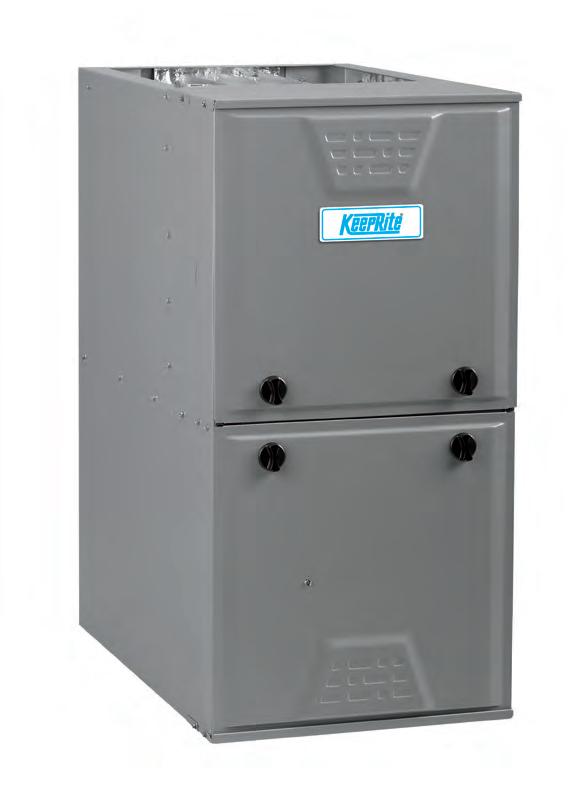
• Up to 98% AFUE
• 60,000 – 120,000 BTUh
• Lifetime Heat Exchanger Limited Warranty+
• 10-Year No Hassle Replacement™ Limited Warranty+
• Dual fuel capable with a compatible heat pump and thermostat for energy-saving heating performance +
Pair it with a compatible air conditioner for full functionality and a full communicating system using the Ion™ System Control.
ICP/Keeprite

Please see warranty certificate for further details and restrictions available on www.gokeeprite.com
Model G97CMN
Check out our full product line-up at www.gokeeprite.com
Heating Product Showcase


Digital air tracer
Poppy introduces BreatheScore Certify, a digital air tracer particle system for buildings allowing them to measure and verify the delivery of clean air per occupant, and comply with ASHRAE Standard 241 to reduce the spread of airborne diseases. The system measures the effectiveness of all natural and mechanical ventilation, purifiers and filters with a 20-minute test, and provides actionable data showing target occupancy levels, ventilation blindspots and areas for HVAC energy optimization. poppy.com

Fan convectors


Smith’s Profile series fan convectors are surface mounted units with a base skirt which allows them to be wall mounted or floor mounted. Units feature a two position max-off-min switch with internal aquastat for individual heater control. A BTU/hr range from 3,000 to 40,000 BTU/hr provides an efficient way to heat a room while using a minimum of wall space. The high-grade, light grey paint finish can be field painted, wall papered or marbleized. smithsenvironmental.com


Low NOx burner
The Industrial Combustion SBR-30 series burner is designed for a variety of boiler types including fire tubes and water tubes. Capable of less than 30 ppm NOx emissions without FGR, the burner’s firing head is designed to achieve controlled combustion leading to low emissions with three per cent O2. An advanced combustion air fan wheel uses less horsepower with less noise. If application condition is satisfied, it can be operated with 15 per cent excess air across the operating range when firing natural gas. ind-comb.com

36 Mechanical Business 10.23
Superior I.A.Q and Climate Control Clean, Comfortable Air with No Hot & Cold Spots! HE-Z Series Zoning Air Handler 1, 2, 3 or 4 Supply Collars Small Diameter Flexible Duct Filtration, UV-C Purification, Catalytic VOC Reduction 3-Stage HEPS In-Duct Air Purification System CUBE Series (1-2 Tons) HE-P Series (10 Tons) Now Available! Our Smallest and Largest Capacity Air Handlers 1-888-652-2219 www.hi-velocity.com Proudly Serving Canada since 1983! Hi-Velocity 2023
Heating Product Showcase

Air source heat pump


Air curtains


Berner International has added the Architectural Icon 8 and Icon 10 to its line of air curtains. The units’ 1/5 hp (Icon 8) and 1/2 hp (Icon 10) PSC motors and refreshed cabinet design deliver low operating sound and harmonic dB. EC motors are optional and equally quiet. Units are available from three to 10-ft. (Icon 8) and three to 12-ft (Icon 10), with anodized aluminum cabinets or optional stainless steel and powder coats in dozens of colours. berner.com

Continental’s Cold Climate Air Source Heat Pumps are side condensing units and are low-profile for flexible placement. A heat pump will heat the home during colder days and cool it on warmer ones with a wide range of operational temperatures, and can achieve 100-per cent heating capacity at -20°C and 100 per cent cooling at 46°C. ENERGY STAR rated, the central heat pump ensures efficient and worry-free heating and cooling. They offer two to five tons of heating and cooling capacity. continentalcomfort.com
Condensing boilers
U.S. Boiler Company introduces the Citadel and Citadel XL condensing boilers and volume water heaters. The Citadel is available in five capacities (399 to 1,000 MBH) and the Citadel XL is available in 1,250 and 1,500 MBH capacities. AHRI-certified and rated up to 97 per cent thermal efficiency (98 per cent for water heaters), the Citadel is available in either a natural gas or propane configuration. The Citadel can be stacked two-high without the need for accessory racking systems, while the Citadel XL can be stacked with a rack system. usboiler.net
Mechanical Business 10.23 37
TESTED. TRUSTED. SINCE 1992.
Thermo
2023
Revolutionizing Comfort: The Maestro Pro Inverter 12 Heat Pump
Sienna
Living is a leading senior living community in Ontario and is committed to providing the highest level of comfort and care to its residents. In line with this commitment, Sienna Living has recently installed 2,400 Maestro Pro Inverter heat pumps from Olimpia Splendid across 17 of its locations..


Solving the Cooling Challenge
The project’s primary goal was to enhance resident comfort on hot days by providing cooling solutions for in-suite spaces. Modern Niagara explored three cooling options: central cooling with chiller cooling towers, VRF systems, and heat pump standalone units. After careful evaluation, heat pump units emerged as the ideal choice due to their unique advantages.
Advantages of the Maestro Pro Heat Pump
The Maestro Pro Inverter 12 Heat Pump offers numerous benefits perfectly tailored to Sienna Living’s needs. These standalone units require no outdoor components, delivering a clean and aesthetically pleasing solution for in-suite cooling.
Additionally, these units operate efficiently using 115-120 AC voltage, reducing electrical modifications and eliminating breaker tripping issues. This streamlined installation, making it hassle-free and minimizing disruptions for residents.
The true marvel of the Maestro Pro lies in its inverter compressor technology, allowing units to adjust cooling output based on room temperature. This intelligent feature saves substantial energy while maintaining resident comfort. Furthermore, these units double as heat pumps, providing heating during shoulder seasons, optimizing energy use year-round.
The number one advantage [of Maestro Pro Heat Pumps] is that there’s no outdoor unit, it is a standalone unit in the room, there’s no outdoor unit to deal with.” – Doug Wilson, Business Lead, Technical Services, Modern Niagara
Project Execution: A Coordinated Success
Retrofitting approximately 2,400 units across 17 locations within a year posed logistical challenges. However, with collaborative efforts from Olimpia Splendid, Modern Niagara, HTS, and Cool Estate, the project unfolded seamlessly. Constant communication and collaboration ensured a smooth process from planning to completion.
Positive Impact and Resident Satisfaction
The project’s impact has been profound. Both residents and staff appreciate the comfort and whisper-quiet operation of the Maestro Pro Inverter 12 Heat Pump. Efficient cooling and heating capabilities have created a consistent and enjoyable living environment, elevating residents’ overall quality of life.
Experience the Maestro Pro Difference
The Maestro Pro Inverter 12 Heat Pump not only exceeds expectations but also delivers substantial energy savings, promoting sustainability. Join Olimpia Splendid in revolutionizing comfort with this innovation and witness the remarkable difference it makes in providing personalized comfort and energy-efficient climate control. Together, let’s redefine comfort and care for residents across Canada.
“Olimpia Splendid was happy to provide a comfort solution to the residents of Sienna Living with the Maestro Pro Inverter 12 HP. The NO outdoor unit sold the job, along with low sound levels, easy installation with minimal maintenance. It is not everyday that a 2,400 unit project comes along but this is a great testimonial to the Maestro product.” – Diego Stefani, Executive Director Sales & Marketing, Olimpia Splendid
Sponsored Profile
Inverter 12 HP Industry leading inverter compressor technology provides unparalleled comfort in heating and cooling for both residential or commercial applications NEW
Features:
• Inverter Compressor and Variable Speed Motor
• Heating & Cooling Capacity up to 11,600 btu/h


• Installation Versatility: Low and High Wall
• Easy Installation & Maintenance
• Remote Control (standard)/ Wall Thermostat (optional)
• 115V/230V 1 Phase Power
• Whisper Quiet Operation
• Wireless Wall Mounted Thermostat Accessory (optional)
• Wi-Fi Compatible - Download the Maestro APP for FREE
&
Pump with no outdoor unit!
A/C
Heat
NEW ELECTRIC HEAT MODELAVAILABLENOW
HYDRONICS
By Bob “Hot Rod” Rohr
Biomass: a renewable resource with promise


What the heck is Biomass?
Biomass is a renewable organic material that comes from plants and microorganisms. Chemical energy is stored in the wood and plants, in part from the photosynthesis process. So, thank the sun once again for this energy source.
Biomass can be converted to energy in a number of ways: combust it or via chemical and thermochemical and biological conversions − think about generating biodiesel or gas from garbage decomposition. Truth be known, up until the mid-1880s, biomass was the primary fuel source for heating buildings. For this article, we will stick with the combustion conversion or burning stuff that lights off easily including wood, forest byproducts such as sawdust, chips, beetle kill timber, grass, and so on. Perhaps the simplest of all heating methods is to start a fire and stand by. Or put the fire inside a steel or cast-iron stove to make the process a bit more civilized inside. There is a pretty good supply of wood available for cheap or free. I see dumpster loads of framing lumber scraps going into the landfill in my area on a daily basis. This kiln dried lumber is a great fuel source. You don’t even need to wait for the moisture levels to drop.
Wood and coal burning got a bad rep mainly due to the emissions and related health concerns. Burning green, wet, or oxygen-starved fires leads to all sorts of problems for the planet at large.
I’d imagine we have all witnessed a smoldering wood fire, inside or out, blanketing the downstream residents in a cloud of smelly smoke. I know many have experienced this with the wildfire season in full swing in North America currently. Can we or should we, pursue this energy source again on a cleaner or maybe larger scale?
High fuel content grass
Travel to the ISH show in Germany and you will see several halls dedicated to biomass equipment. This equipment ranges from a basic parlour wood stove to a more sophisticated pellet-burning, automatically controlled boiler. On my last trip to ISH, I even spotted a “stove” large enough to swallow a large round bale of hay or grass such as those you see in farmers’ fields.
The manufacturer claimed fast-growing high fuel content grass is grown to feed the behemoths. Load the beast once a day with a tractor equipped with a bale spike, throw in a match and away you go.
Bob “Hot Rod” Rohr has been a plumbing, radiant heat and solar contractor and installer for 30+ years. A long-time columnist, Bob is involved with training and education at Caleffi North America. You can reach him at bob.rohr@caleffi.com.
Wood chip fuel for a biomass boiler.
40 Mechanical Business 10.23
Elevate your Home
Filtro Water System


We believe that everyone should have access to high-quality, energy-efficient equipment without the burden of high upfront costs. We are committed to providing exceptional customer service, yearly maintenance, and reliable equipment that meets the needs of our clients. Our goal is to be the leading provider of rental equipment in Ontario, helping builders and homeowners save money, reduce energy consumption, and enjoy the comfort of their homes year-round.


A highly effective point-of-use water filtration system
• Heating • Cooling • Air • Water • Leak Detection • Sub Metering • Smart Technology • EV Chargers • Solar Panels • Generators
Visit Us At: www.elevatehs.ca Office: 905-634-5333 Toll-Free: 1-833-669-0715 radianthydronics.com Thermal Hydronic Supply Ltd. 101 Sharer Rd. Woodbridge ON L4L 8Z3 Tel: 905-265-1527
Quattro® www.vulcanoair.com
The ultimate hybrid condensing water heater
At the other end of the spectrum, you may see residential pellet heaters not much larger than a small suitcase for small homes or living room spot heating. Over the years the authorities in charge have clamped down on the emissions from burning biomass.


Equipment manufacturers stepped up their game and developed gasification equipment to burn cleaner and more efficiently. Basically, gasification involves forcing additional oxygen into the combustion chamber, raising the temperatures to 1400⁰F to 1700⁰F, to essentially burn more biomass. This reduces the emissions and squeezes an additional amount of energy conversion.

You may see dozens, perhaps hundreds, of gasification wood and pellet burners for residential applications at the ISH show. This equipment is a bit more finicky to operate. Dry wood is required, and cleaning and ash removal is a constant task to keep them running efficiently. This market is driven by rural areas in Europe which have a fuel source nearby, such as a forest.
Feed multiple homes and buildings
With today’s hectic lifestyles, burning wood coal or pellets may not be in store for the masses. Dense population areas frown on solid fuel burners, and limited access to the wood or pellets in a city setting may also make the numbers look not so great. I’d venture that most people want to hit a button and have reliable and accurate heat appear.
My thought is to take biomass to a much larger scale. A district system can feed multiple homes and buildings. This is not a new concept. As an example, the district energy system in use in Copenhagen, Denmark was initiated in the 1920s. Scaled biomass systems are gaining popularity again as fossil fuel prices continue to climb. Fuel shortages get one’s attention quickly, also. So, in areas where a fuel source is readily available, and you can easily pipe a heated fluid through the streets of a town, this could be a big win.
I visited a few district systems in Italy a number of years back. One involved a large thermal solar array, a biomass burner and a few oil-fired boilers as back up. So, it is a triple fuel system. This was in an apartment complex that was under construction. Insulated underground PEX tubing was the umbilical cord connecting the various buildings to the “powerhouse.” This project was well within the scope of a typical hydronicsavvy plumbing/heating company, anywhere in North America.
District energy systems exist already in some of the larger cities for transporting steam, heated or chilled water. Toronto, for example, pulls water from the lake for cooling downtown buildings. Infrastructure is in place to possibly share with heating input.
Biomass was selected for the Burnaby Mountain District Energy Utility to meet the capacity and higher temperature requirements of Simon Fraser University’s Campus district energy system. The Renewable Energy Centre utilizes locally-sourced wood waste, such as wood chips, shavings, urban and clean construction wood waste that has been banned from Metro Vancouver landfills since 2015. The 13.5 MWt biomass boiler provides an estimated 85 per cent of annual energy demand for the system with natural gas boilers providing peaking and back-up.

You could think locally and design and build a biomass-fueled system for your own buildings, your neighbourhood, your town, or … well, the sky is the limit.
Growing willows for energy
FACT: A planted willow cutting will start growing roots and shoots in the first three to five weeks. By week 10 the plant will be 30cm to 70cm tall and by week 15, it can reach heights of 160 cm to 200cm+. Bionera Resources
HYDRONICS Cont’d from pg. 40
Solid-fuel boiler with pellet-fuel in bolier room
42 Mechanical Business 10.23
Photo Corix Utilities
EXPERIENCE OUR EXTENSIVE AND EXCITING PRODUCT RANGE


CIPHEX West 2023
OCT 18th & 19th
Showcase Products will include:
PTAC, Side Discharge, Endeavor, Maximus,
CRTGH Condensing Tankless, Triton Light Duty, Proterra, HPX-5

Rheem.ca Visit us at BOOTH #431 & #414 to see our full range of products.
Learn more about the Rheem® Maximus™ Rheem
HEAT PUMPS
By Rob Landes and Will Ward
INVERTER TECHNOLOGY OFFERS EMISSIONS AND EFFICIENCY BENEFITS
As the impacts of climate change become more apparent, corporations and regulators are doubling down on efforts to decarbonize. For business leaders and building operators looking to make a difference, it is imperative to explore innovative and energy-efficient HVAC systems. Enter the inverter heat pump: a solution that offers numerous benefits for commercial buildings.
At their core, heat pumps work in much the same way as an air conditioner, using refrigerants to move heat from one place to another. But instead of moving heat out of the building and into the air, heat pumps do the opposite, capturing heat from the air and moving it into the building. Heat pumps have been used successfully for decades, but up until recently, their use in commercial buildings has been limited in North America
Natural gas-powered packaged rooftop units are a good fit for inverter heat pumps.

GAINING EFFICIENCY WITH INVERTERS
Traditional air conditioners and heat pumps operate on a fixed-speed compressor system, which means they run at a constant speed regardless of the heating or cooling requirements. Inverter heat pumps, in comparison, use variable-speed compressors and can adjust the output to match the specific needs of the building, resulting in enhanced efficiency during part-load operation. Since heat pumps (and most HVAC equipment) spend the majority of their time operating at part-load conditions, enhancing efficiency yields substantial results.
In addition to energy efficiency, inverter heat pumps have other benefits for commercial buildings, including increased comfort, temperature and humidity control, and noise reduction.
ELECTRIFYING ROOFTOP UNITS
Given their prevalence, natural gas-powered packaged rooftop units (RTUs) − the most frequently used applied HVAC equipment − are an ideal fit for inverter heat pumps.
Although roof curbs and electrical feeds may need to change, most inverter heat pump RTUs can fit into the same physical space as traditional gas-fired units. This offers an easier path to conversion.

There is one notable challenge in moving from natural gas to heat pumps, however, and that is cold climate operation. As it gets colder outside, the ability of a heat pump to deliver heat is reduced while the building’s heating demand increases. Eventually, the heat pump reaches a “crossover point” where the heating demand is greater than the system’s available capacity and some form of auxiliary heat must be used. Often, this supplemental heat comes in the form of electric resistance heating, which is more energy intensive.
Inverter heat pump RTUs do have an advantage in these situations, though. The compressor can be ramped up to higher maximum speeds to improve capacity, which aids in moving the crossover point to a lower ambient temperature.
Although inverter heat pumps often have a higher upfront cost compared to traditional heat pumps due to their advanced technology, the energy savings and efficiency gains can lead to a quicker return on investment, especially in regions with higher utility rates.
44 Mechanical Business 10.23
Inverter heat pumps use variable-speed compressors.
CONTRIBUTING TO DECARBONIZATION
By electrifying a building’s heat source, inverter heat pumps reduce direct carbon dioxide (CO2) emissions at the facility level. But the efficiency at which the heat pump becomes more carbon friendly varies when both the building and grid are considered.
Figure 1 shows an example of this effect. It approximates the emissions for both natural gas and electricity for a non-specific electrical grid assuming a grid emission factor of 387 grams per kilowatt-hour, which describes the overall cleanliness (the carbon emissions tied to creating electricity) of the electrical grid. CO2 emissions of heating with natural gas are plotted in orange. In grey, we see the emissions of electric resistance heat. Comparing the two, we see that electric resistance heat has higher CO2 emissions than direct natural gas heating due to the fossil fuels used to generate the electricity. We then add the heat pump emissions in blue, which vary as the efficiency of the heat pump varies. In conditions where the heat pump can run with a higher coefficient of performance (COP), the emissions can be less than natural gas. As the outdoor ambient temperature drops and the COP of the heat pump drops below approximately 1.8, the emissions increase above natural gas. Of course, the actual value will vary depending on the specific electrical grid.
By increasing the overall efficiency of the heat pump and improving the low-ambient performance, inverters improve the average efficiency of the unit and make it more advantageous from an emissions perspective.
Just as there is a crossover point for carbon emissions, the same is true if we map out energy costs, as shown in Figure 2. Depending on the location and corresponding cost of electricity and natural gas, as the heat pump COP improves so do the operating hours where the heat pump is less expensive to operate. It is important to note that the COP crossover point for operating costs may be different than the crossover point for emissions. Design goals become important in determining what level of COP should be specified.


Overall, the more efficient the heat pump is, the greater the number of applications and locations it can provide an emission and/or energy cost advantage. Inverters serve a double benefit of improving efficiency and improving operation during cold conditions, which is when HVAC performance often tends to decline, lessening the operating hours for more costly electric resistance backup heat.
CONSIDERATIONS FOR INSTALLERS AND DESIGNERS
Adopting inverter heat pumps requires careful and practical attention to a range of factors.

• Design Goals: Design is important to specify equipment that will meet the site needs and efficiency standards. Questions to ask: Are there regulatory drivers or corporate carbon emissions targets at play? And do those targets apply at the building level or include indirect grid emissions as well?
• Sizing and capacity: Accurate sizing is essential when considering inverter heat pumps. It is important to assess the building’s heating and cooling loads, and ambient extremes when selecting a unit. As ambient temperatures drop, the benefits of inverter compressors become pronounced versus fixed-speed units, though even mild climates can benefit from the efficiency of inverter technology.


• Maintenance and service: As with any HVAC equipment, regular maintenance is key to longevity. Contractors should establish a consistent maintenance schedule to clean filters, inspect coils and verify refrigerant levels. Many inverter systems also feature advanced diagnostics that empower proactive maintenance and prevent costly disruptions.
Rob Landes is the director of HVAC systems applications at Daikin Applied. He has been with the company for 15 years, working in both product management and engineering roles. Will Ward is a product manager for Daikin Applied’s air handler equipment.
Mechanical Business 10.23 45 Cont’d from pg. xx
FIGURE 1
CARBON EMISSIONS COEFFICIENT OF PERFORMANCE (COP) HP EMISSIONS NATURAL GAS EMISSIONS ELECTRIC RESISTANCE HEAT EMISSIONS Heat
ENERGY COST COEFFICIENT
PERFORMANCE (COP) HP ENERGY COST NATURAL GAS ENERGY COST ELECTRIC RESISTANCE ENERGY COST
FIGURE 2
Pump Carbon Emissions vs COP
OF
Heat Pump Energy Cost vs COP
By Rick Mohammed
Know your options: Control valves Part I
Controlvalves appear in many industries, from nuclear, oil and gas, and pharmaceutical to name a few. Control valves have adapted to manage the flow of liquid, pulp, and even sewage. For the purpose of this article, we will focus on control valves used in hydronic applications.
TYPES OF VALVES
There are three main types of control valves you will typically find in any hydronic system. They are known as characterized ball valves, globe valves, and butterfly valves. In addition, there are pressure independent control valves and six-way valves that are based on the basic ball or globe valve design.
CHARACTERIZED BALL VALVE
The characterized ball valve was introduced to the HVAC market in 1999 and it is an innovation of the standard ball valve used for isolation or shut off purposes. The ball valve operates in a quarter turn motion to open and close the valve. When the ball is in the closed position it has an ANSI class VI rating defined as bubble tight. This means there is no leakage of flow when the valve is fully closed.
Introducing a characterized disc in front of the ball, as shown in Figure 1, transformed the shut off ball valve into a game changing modulating control valve which can be used in most hydronic applications. There are versions of the characterized ball valve that can be used for 15 psi steam applications too.
GLOBE VALVE
Before the characterized ball valve gained popularity, the globe valve was the standard control valve used on coils in air handling units, VAV reheat coils, and perimeter rads. Globe valves operate in a linear motion to open, close and modulate the flow. The plug, as shown in Figure 2, moves up and down and is driven by an actuator. For applications with high inlet water pressure, the actuator size gets bigger and adds cost to the overall valve and actuator assembly. As a result, the close off pressure of a globe valve must be considered during the selection process. Globe valves can be used for water applications and steam as high as 50 psi. They are available with an

Characterizing Disc

What are ANSI Leakage Rates?
There are six classes rating the amount of leakage a valve has when fully closed. Class I being dust tight and Class VI being bubble tight.
ANSI class leakage rating of Class III or IV. This means when the globe valve is fully closed it will pass 0.1 per cent or 0.01 per cent of the rated flow. If a globe valve is too large for an application it can remain at a minimum position during low load periods for an extended amount of time. This creates a high pressure drop and high velocity through the valve causing excessive wear on the plug, and eventually the valve will leak when closed.
Valves come with an ANSI Class body pressure rating. This is the maximum pressure a pipe or valve material can handle based on temperature of the medium.
46 Mechanical Business 10.23
HYDRONICS
Isolation Valve
Figure 1
Control Valve
Figure 2 Globe Valve

CIPHEX/CIPH
Ghost flow: when your valve is closed but you are reading a temperature change. It must be a leaky valve, BOO!
BUTTERFLY VALVE
The BFV (butterfly valve) works in a quarter turn motion like a ball valve. Unlike a characterized ball valve and a globe valve, a BFV offers a large opening for applications that require high flow in a short time. The face-to-face dimension is very small compared to other valve types making it a compact control valve. They can be used for modulating duty between the 0⁰ to 60⁰ range of the stroke. Between 60⁰ to 90⁰ of the stroke there is little change in flow. Like the ball valve, BFVs provide a Class VI close off. A close off pressure of 200 psi is commonly offered but to save cost a 50 psi close off is available when pressures are lower.

BFVs come with an EPDM seat also known as a soft seat as shown in Figure 3. EPDM stands for Ethylene Propylene Diene Terpolymer. It has good resistance to heat and cold, and its elasticity property helps provide a tight seal when the valve closes. When selecting a BFV the velocity of the fluid should be considered. The velocity limits are 12 FPS for standard BFVs and 32 FPS for high performance BFVs. Exceeding these velocities
PERFORMANCE IN DIRTY WATER
Characterized ball valves are versatile because they come with a high close off pressure rating and they can be used in any hydronic application. Unlike globe valves, the characterized ball valve doesn’t rely on the actuator to achieve its close off pressure rating. One relatively small actuator mounted to a ½ in. valve will provide 200 psi close off, and 100 psi close off on a four-inch valve. Another advantage of the characterized ball valve is its ability to operate with dirty water. The quarter turn action cuts away at the debris found in many hydronic systems. Other factors to consider when selecting a control valve are the body pressure rating, the close off pressure rating, actuator type, height of the valve and actuator assembly, open/close or modulating duty, NEMA 4 enclosure for the actuator if outdoors, and a Canadian Registration Number (CRN) to name a few.
FLOW CHARACTERISTICS
A flow characteristic curve is created when a valve travels from fully closed to fully open. There are two main types, linear and equal percentage. It is important to select the correct flow characteristic for the application to establish good control of the flow. A linear flow characteristic will give you 30 per cent flow when the valve is 30 per cent


What is an ANSI flange connection?
It is a standard that defines the bolt circle, number of bolts and bolt size for a flange.
Try selecting a BFV with an actuator that closes on torque instead of position. Over time the position setting may change as the EPDM seat wears.
48 Mechanical Business 10.23 HYDRONICS Cont’d from pg. 46
Figure 4
Figure 5
Figure 3 Butterfly Valve
open, and 50 per cent flow when it is 50 per cent open as shown in Figure 4. This is suitable for perimeter rads that have a linear heat output response. For devices that have coils such as an air handling unit, reheat coil, or fan coil unit a valve with an equal percentage flow characteristic is preferred as shown in Figure 5. When the valve is at 50 per cent open the flow is approximately 12 per cent. The equal percentage flow curve is created by the shape of the characterized disc in the ball valve and by the shape of the plug in a globe valve. When we compare the equal percentage flow curve to a typical curve created by the power output of a coil, we can see they are a mirror image of each other. These two curves are shown in Figure 6 with the resulting linear line in the middle. The linear line represents the resulting relationship between flow and coil output power. When the valve is at 50 per cent open, the coil cooling or heating power is also at 50 per cent. This is why we always choose an equal percentage control valve when controlling flow to a coil.

MORE TO COME

An incorrectly applied control valve can cause problems with your heating or cooling system and occupant comfort. Correctly sizing a control valve, as well as balancing of the system flow, are areas worth discussing in detail. In upcoming issues, Part II of this series will focus on sizing and selection of control valves, followed by Part III, hydronic system balancing and the effects of low Delta T.

Mechanical Business 10.23 49
Rick Mohammed, A.Sc.T., is a regional application consultant with Belimo. He can be reached at rick.mohammed@ca.belimo.com.
6 Offering a PRIME Extended Warranty can make all the difference. PRIME Just ask any one of the thousands of Prime Warranty customers whose HVAC buying decision was influenced by the warranty coverage offered through their local dealer. To get the edge... Get in touch. (855) 595-6302 info@primewarranty.ca primewarranty.ca Prime Warranty
Figure
By Kerry Turner
Canadian Slugger Joey Votto:
Cincinnati
Reds’ first baseman Joey Votto says he is at his best when he is serious, but for fellow players and fans his more affable moments add to the fun and energy of the game. From donning a mascot outfit or Viking costume and parading about, to posting Instagram videos of himself driving a school bus, the Canadian slugger has endeared himself to fellow players and fans alike.
Drafted by Cincinnati in 2002, Votto played his first MLB game with the Reds in 2007. He remained a very private person until he appeared on social media during the pandemic. After finding the isolation and quiet challenging, he stepped outside the box and with his quirky sense of humour and self-effacing style Votto has attracted a loyal following.

On the surface there appears to be two Vottos − the intense ball player with an incredible career and stats who is a contender for the Hall of Fame, and more recently, the Joey Votto who seems to delight in entertaining others, plays chess at Toronto’s Annex Chess Club, studies Spanish, and grows his social media presence. In answer to why, he says, “I wanted to share more of myself and show more of my personal side. Chess takes my mind off work. It is also quite social, which I love.”
As for learning Spanish, he “wanted to be able to speak to my teammates, to develop a new skill and to open up travel options down the road.”
What will down the road be for Votto? He is in the final year of his 10-year contract extension with a team option for the 2024 season. It’s been a tough year for Votto. He had surgery to repair tears in both his rotator cuff and biceps in his left shoulder in August 2022 and returned to play in June. Remarkably, Votto hit his 350th career home run on July 18, becoming the second Reds player to reach that mark ever.
In terms of Canadian players, he is second only to Larry Walker who amassed 383 home runs in a 17-year career. But Votto is modest about his achievements, “There are plenty of very good Canadian baseball players. It’s an honour to be in this group.”

Prior to his being on the 10-day injured list in August, he had 355 runs under his belt. In true Votto style, he
returned to play on September 10, his 40th birthday, and hit a 437-foot home run, the longest across all of the MLB on that day.
Looking ahead
Votto’s determination and focus have served him well in the past. “I focus all of my energy on the next day. I try to maintain the habit of only looking forward. Two reasons, first, I owe it to the fans. I owe them my very best now and beyond. Second, the game is terribly difficult and only gets more difficult as one gets older. I want to dedicate all of my concentration to keeping up with the league as it is.”
He is committed to giving every last bit of himself to the game and toward that end follows a strict regime and depends on routine. “I try to make sure I am prepared to the maximum each game I play.” That routine was disrupted somewhat with the “MLB at Field of Dreams” game in Dyersville, Iowa, next to the historic filming site of the 1989 baseball movie Field of Dreams, in August of 2022. It was an emotional event for Votto, who lost his father in 2008. Father and son would play catch daily and young Votto was instilled with a love of the game, not unlike the final scene of Field of Dreams. “I am dead set on routine but I could accommodate it [the game] because it was pretty special.”
In the long-term, Votto shares that he wants to “complete my degree in Spanish, possibly pursue a chef degree/licence, travel and spend time with family.” But there could be some surprises − to hear Votto tell it, you may see him driving a big yellow school bus.
In an online post Votto asks viewers to give him a thumbs up if they think driving a bus is cool.
FAST FACT: As of July 2023, 188 MLB players have played their whole career with one team.

COVER STORY Photos courtesy of the Cincinnati Reds 50 Mechanical Business 10.23
After hitting his 350th home run, Votto, sporting the team’s postrun Viking garb, shares a moment with teammate Elly De La Cruz.
@joeyvotto
Votto is a six-time MLB All-Star, a seven-time Tip O’Neill Award winner, and two-time Lou Marsh Trophy (now called The Northern Star Award) winner as Canada’s athlete of the year. In 2010, he won the National League (NL) MVP Award and the NL Hank Aaron Award.

Mechanical Business 10.23 51
NTI’s GF150 merges its popular TRX Combi Boiler with an ECM driven air handler to provide forced-air heating, domestic hot water and hydronic capabilities. Using GREEN FURNACE Technology®, it delivers up to 95% AFUE and reduced temperature swings, fuel consumption, costs and emissions when compared to standard furnaces.


Integrated Wi-Fi for remote monitoring & troubleshooting.
COMBINATION FURNACE BOILER / WATER HEATER

NTIBOILERS.COM
Meet the GF150 NTI
CIPHEX West returns to Calgary


CIPHEX West returns to the BMO Centre at Stampede Park (previously known as the Roundup Centre), Calgary, AB on October 18-19, 2023 with educational sessions and opportunities to see the latest product and system technologies. Interact with manufacturers, suppliers and other industry members, all in one location.
Produced by the Canadian Institute of Plumbing & Heating (CIPH), CIPHEX West is aimed at contractors, wholesalers, engineers, builder managers, and other industry professionals looking for leading edge systems and equipment. More than 200 exhibitors from Canada, the U.S, and around the world will be in Calgary for the two-day event.
Exciting complimentary educational sessions are planned with topics such as plumbing codes and standards, trends in heating, plumbing, ventilation, air conditioning, refrigeration, and emerging technologies on the schedule.
Once again, the New Product Showcase will feature the latest product innovations.


CIPHEX West will open with the Calgary Region’s welcoming Industry Dinner on Tuesday, October 17 at the White Diamond Conference Centre. Two local entrepreneurs, Jaeson Cardiff, CEO of CleanO2, and Lisa and Mark Watts, owners of HubTown Brewing Co., will speak to their trials, tribulations, and successes with moving their businesses forward.
ciphexwest.ca



Show hours
Wednesday, October 18 10:00 a.m. − 6:00 p.m.
Thursday, October 19 10:00 a.m. − 4:00 p.m.
For more CIPHEX West 2023 information see:
• Seminars and Workshops pg. 54
• List of Exhibitors pg. 57
• Product Showcase pg. 58 Come visit us at Booth #333
Discover why
Mechanical Business 10.23 53
CIPHEX West returns to Calgary after being held in Vancouver in 2021.
PROFESSIONALLY
TRUSTED. DRIVEN TO CONSERVE.
Contrac is the preferred choice of Canadian plumbers, with our top-tier residential and commercial vitreous china fixtures. Don't miss the opportunity to experience plumbing excellence firsthand by visiting Booth #633 at CIPHEX West
FGI/Contrac
SEMINARS
The state of net zero in Canada and implications for the mechanical industry


Wednesday, October 18
Time: 10:15 a.m. – 11 a.m.
Updates for reclaimed water systems


Wednesday, October 18
Time: 11:15 a.m. – 12 noon
Selecting and installing reverse osmosis equipment, evaluating how water quality impacts pipe corrosion
Wednesday, October 18
Time: 12:15 p.m. – 1 p.m.
FOG fundamentals
Wednesday, October 18
Time: 1 p.m. – 1:45 p.m.
A snapshot of the movement to net zero in Canada and its impact on the mechanical industry. Have you wondered what is happening across the country to address the climate change emergency? This session will explore what is happening, not only in Alberta, but across the country. How are other parts of the country impacting what is happening in Alberta?
Presenter: Dave Hughes, Canadian Institute of Plumbing & Heating
There is new code language in the 2020 NPC to use as well as enabling standards to reference and apply to create best practices for water reuse, rainwater harvesting and enhanced code applications.
Presenter: Kevin Wong, Uponor
A review of the membrane process on reduction of total dissolved solids, the benefits of reverse osmosis water versus high mineral water, and the effect of corrosion on plumbing materials due to water quality with corrosive characteristics.

Presenter: Tyler Gamble, Canature WaterGroup
Facts about acoustics in high-rise condos
Wednesday, October 18
Time: 2 p.m. – 2:45 p.m.
A review of the basics of what FOG is, the history around the development of grease interceptors and the science behind how FOG is separated from water. How did the different methods for grease interceptors come about? What are the factors that influence grease separation? Why is FOG important to municipalities? Attendees will learn which factors can influence performance.
Presenter: Adam Toutant, Canplas Industries Ltd.
The purpose of this presentation is to use recent data on in-situ DWV systems to highlight how layout and contact with walls and floors are more important for acoustics than pipe material; DWV noise is one of the lower-rated sources of disturbance for occupants relative to HVAC and outdoor noise; and ASHRAE noise level criteria is a more practical performance benchmark than either/or selection of pipe material.
Presenter: Cory Norman, IPEX Inc.
Air to water heat pump design considerations
Wednesday, October 18
Time: 3 p.m. – 3:45 p.m.
The seminar will highlight the six most important design considerations when designing a new A2W HP installation or a retrofit installation: sizing, heat loss/heat gain, balance point, safe operating parameters, DHW loads, supplemental heat options and load flow rates. Other topics include the importance of maintaining minimum flow volumes under all conditions; determining the correct buffer tank configuration for the load; the importance of sizing the HP correctly to maximize the potential efficiency while maintaining reliable operating conditions and maximum system life.
Presenter: Gary Milligan, Thermal Environmental Comfort Association (TECA)
Incorporating hydronic heat pumps into hybrid designs


Wednesday, October 18
Time: 4 p.m. – 4:45 p.m.
Join us for an insightful journey where we explore the future of hydronics in a heat pump world.
Moderator: Jerry Leyte, Viessmann Manufacturing Panelists: John Goshulak, Weil-McLain; Mike Miller, TACO Comfort Solutions; Michael Ridler, Eden Energy; Roger LeBeuf, Nortec Plumbing & Heating; John Wiehler, Wiehler Mechanical; and Dave Hughes, CIPH Canadian Hydronics Council
54 Mechanical Business 10.23
SEMINARS & WORKSHOPS
Location CIPHEX West 2023 Seminar Theatre *Seminars as of press time, subject to change


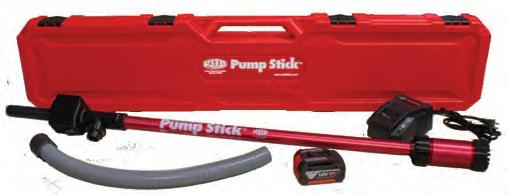
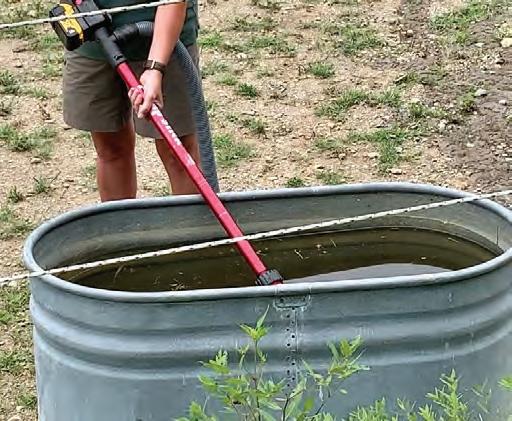

SUCK IT UP • Pumps up to 15 gallons/minute • Fits DeWalt®, Makita®, Milwaukee ® and Bosch® 18V-20V batteries* • Secure, magnetic hose connection • Aluminum body for durability • Multiple screen/filter options CP15-38 PUMP STICK ® CORDLESS WATER TRANSFER PUMP Reed Manufacturing • Erie, PA USA reedsales@reedmfgco.com • www.reedmfgco.com * With optional battery adapter plate Reed
Smart restrooms for smart cities
Wednesday, October 18
Time: 5 p.m. – 5:45 p.m.
How can IoT technology improve sustainability and customer experience? IoT exchanges data through the internet and allowing design professionals to make better decisions. In this workshop, we discuss how IoT works and how it can help design professionals create sustainable buildings and improve occupant experience.
Presenter: Bhavik Patel, TOTO
Innovative solutions for a new world of smart building performance

Thursday, October 19
Time: 10:15 a.m. – 11:00 a.m.
A description of the path towards reducing Greenhouse Gas emissions in order to meet Canada’s 2030-2050 targets. By accelerating the pace of innovation and upgrades to the heating and cooling equipment in buildings Canada can reduce and optimize the operating costs of new and existing buildings, while addressing emissions targets. Innovative technologies that can help achieve those targets will be illustrated and attendees will learn how energy optimization for the lifecycle of the system helps avoid performance drift that erodes the potential benefits of newer technologies.
Presenter: Roberto Bosco, Armstrong Fluid Technology
What’s behind your test kit results
Thursday, October 19
Time: 11:15 a.m. – 12 p.m.
Attendees will gain a better understanding of how analog and digital backflow test kits measure by taking a look at the engineering and science behind test equipment. We’ll examine what makes up a test kit, cover best practices for maximizing the precision and accuracy of measurements, and share tips to help avoid costly repairs to test kits.
Presenter: Demian Mendez, Cameron Instruments Inc.
Heat pump water heaters: optimal solution for decarbonization


Thursday, October 19
Time: 12:15 p.m. − 1 p.m.
Various options, from monobloc to hybrid tank-type heat pump water heaters for residential and commercial applications, will be reviewed in-depth. Topics include application challenges and solutions for installers to ensure peak performance and reliability, optimizing operating range based on geographical location, controls review for natural gas and electric hydronic heating back-up set-point, building management systems and a sampling of available rebates.
Presenters: Martin Rego & Karl Fernandes, Rheem Canada Ltd.
Let’s talk radon
Thursday, October 19
Time: 1 p.m. – 1:45 p.m.
The 2015 National Building Code requires a Level 1 rough-in to be installed in new construction, allowing for future radon mitigation systems to be connected to if post-occupancy testing shows elevated levels of radon concentrations in indoor air. This rough-in is incomplete and is the bare minimum to address radon levels in a home or building. Radon mitigation is a life-safety application that can have severe consequences if inadequate products are used. In the absence of a performance standard specific to radon mitigation products are being used.
Presenter: Fadi Basmaji, Ipex Inc
An affordable, green hydronic heating and cooling system


Thursday, October 19
Time: 2 p.m. – 2:45 p.m.
A reduced cost piping system design manages the domestic water temperature to fan coils as an HVAC fixture reducing installed cost and improving comfort. Topics to be discussed include IPS OnDemand, an approach to decarbonization and electrification in hotels, dormitories, condominiums, assisted living, or government housing. The system concept may also be used to add heating or reheat to parts of buildings and offers additional LEED opportunities.
Presenter: Monte Kartchner, Williams Comfort Products
Come and visit Mechanical Business at Booth #333
56 Mechanical Business 10.23 SEMINARS & WORKSHOPS
SEMINARS Location CIPHEX West 2023 Seminar Theatre *Seminars as of press time, subject to change
*As of press time. Companies in red have ads appearing in this edition of Mechanical Business
Mechanical Business 10.23 57
A. O. SMITH 515 A.M.T.S. Limited 628 Aalberts IPS 101 Aimco International 730 Alltemp Products 535 Altatech Agencies 309 Amtrol 428 Aqua-Tech Sales & Marketing 810 Armstrong Fluid Technology 427 Arthur J Gallagher Calgary 328 ASPE British Columbia Chapter 608 Attersall Marketing 835 Axiom Industries 423 Barclay Sales 217 Bay Industrial 133 Belanger 914 Belimo Aircontrols (CAN) 734 Bibby Ste Croix 1026 BMI Canada 815 Boshart Industries......................................................836 Bradford White Canada 135 Brady 717 Calefactio 235 Cameron Instruments.............................................828 Canadian Institute of Plumbing & Heating 204 Canadian Water Quality Association 506 Canature WaterGroup 527 Canplas Industries Ltd 107 Cascade Flow Control Solutions 826 CB Supplies Limited 833 Centrotherm Eco Systems 117 Chemfax Products 736 CM CANADA 307 Cool Estate 609 DAB Pumps 804 Daikin North America 1004 Delta Electronics (Americas) 543 Eastern Foundry & Fittings 728 ECCO Manufacturing..............................................430 ecobee 539 Ecowater Systems 410 Enercall Sales and Service 212 Engineered Pump 831 Equipco 926,927 ESAB Group Canada.................................................917 Evergreen BioHeat....................................................507 Express Radiant 315 Fabco Plastics Western 715 Fairview 532 Fernco Connectors 639 FGI Canada 633 Fieldboss 231 Flexmaster Canada 614 Fluidmaster 641 Franklin Electric (Little Giant) 326 Franklin Water Treatment Canada 630 Fresh Aire UV 537 Fujitsu General America 727 Gateway Mechanical Services 713 GE Appliances 806 Giacomini Canada 520 Globe Union North America Group 323 GLP Canada 707 Goldstone HVACR Inc 809 Granby Industries 201 Gripple Canada 530 Grundfos 735 HBX Control Systems 732 Heat-Flo 407 HeatLink Group..........................................................738 Hometech Development 834 House of Rohl 904 HPAC Magazine..........................................................127 HVAC Xchanger 534 Hydronic Systems Canada 223 InfraAIR 131 InSinkErator 908 IPEX 723 IPS - International Power Systems 227 J.M Hasick & Associates 533 Kane Canada/UEi Test Instruments 623 King Heating Products 528 Klass Mechanical Sales 404 Liberty Pumps 636 Lixil 905 Loue Froid 409 Lyncar/Waterline 743 M.A. Stewart & Sons 232 Mainline Backflow Products 400 Masco Canada 632 Master Group 617 Mechanical Business Media 333 Mechanical Contractors Association of Alberta 509 Mechanical Equipment Sales 1032 Megapro Tools 511 Mehta Canada 807 Mifab Manufacturing 739 Milwaukee Electric Tool 523 Mitsubishi Electric Sales Canada 330 Moen 322 Morris/Lee 226 Navien Canada 416 NCI Canada 814 NTI 417 NUPI Americas 705 Nu-Trend Industries 610 Oatey Canada 817 OS&B 435 Pentair Canada 434
EXHIBITOR LIST
Perfect Aire 541 Plumbing & HVAC 209 PremierOne Products 1016 PRIER Products, Stern Williams, FIAT Products...............................................................631 Ratech Electronics 334 RectorSeal of Canada 207 Reed Manufacturing Company 840 REHAU 233 Reliance Worldwide Corporation (Canada) 722 Resideo Technologies 210 Rheem Canada 414,431 Ridgid 306 RLS LLC 304 Robinson Supply 811 Roth Industries 531 Ruck Air Movement 432 Sanuvox Technologies 710 Schwank Group 720 Security Chimneys International 643 ServiceForge 329 ServiceTitan..................................................................412 SFA Saniflo 912 Simpro Software 529 Sinclair Supply Ltd 830 Sioux Chief Manufacturing 640 SJE - Rhombus 838 SpacePak 403 Stanley Black & Decker 310 Stringer Sales 741 Taco Comfort Solutions 821 Tamas Hydronic Systems 733 Taylor Walraven 606 The Mee Group 711 Thermal Environmental Comfort Association (TECA)....................................................827 Thermo Manufacturing 111 Thryv 1030 Toto USA.......................................................................805 Unik Pro B Inc 331 Uponor 503 UV Dynamics 504 Victaulic 627 Viega LLC 426 Viessmann Manufacturing Company 123 Weil-McLain Canada 522 Wesmech Sales Prairies 829 Westlake Pipe & Fittings 300 Williams Comfort Products 1028 Wilo Canada 616 Wolseley Canada 729 Xylem - Applied Water Systems 513 Zoeller Canada 920 Zurn Industries Limited 921
PRODUCT SHOWCASE
Combi boiler
The EPIC Fire Tube combi boiler from Lochinvar is available in three wall-mount models and three floor-mount models from 110,000 to 199,000 BTU/hr. The units have a 10:1 turndown ratio, Smart Control Enhanced Operating System, and DHW delivery of up to 4.8 GPM. A backlit, LCD display provides diagnostic information and system status in real words rather than codes, making it user friendly. aquatech.com

Water control
The EB25 PLUS from RWC brings state-of-the-art water control technology to pressure regulators for the commercial, high-rise and institutional markets. The accurate flow control and pressure regulation eliminates costly multi-valve installation. The single cartridge design can be installed vertically, horizontally or inverted, and servicing can be performed with the valve body in place in minutes. With a 10:1 pressure reduction capacity, it reduces the footprint of multi-valve installations and automatic control valves. cashacme.com

Smart thermostat


The Ecobee Premium Smart Thermostat has an integrated speaker and microphone enabled voice assistant capabilities. Beyond temperature, it measures VOC and CO2 levels, with the ability to set thresholds that trigger ventilation or air conditioning. Users receive alerts, actionable tips, and convenient air filter change reminders. Acting as a home monitoring hub, the Ecobee Premium features smoke alarm detection, advanced sensors that send alerts during unusual events, and freeze detection to avert burst pipes. ecobee.com

Stainless steel coupling

The Husky 4000 Series is a super-duty stainless steel coupling for joining No-Hub cast iron soil pipe and fittings, with extra width for lateral support and additional sealing clamps for better load distribution and a more positive seal. The coupling features 304 stainless steel heavy-duty construction, and meets ASTM C-1540 standard specification for super-duty shielded couplings. anaco-husky.com
Compact heat pump


The Daikin Fit inverter heat pump or air conditioning systems for ducted homes is less than 14 in. wide, making it a compact, energy-efficient and quiet solution for homeowners who want to cool their homes without sacrificing outdoor space or peace and quiet. Using adaptive inverter technology, the system uses up to 30 per cent less energy compared to traditional air conditioners, and allows the heat pump to adapt its performance based on real-time demand. Daikin Fit systems are available as a cooling-only central air conditioner or as an all-electric heat pump, and can be configured for dual fuel heating of either gas heating or electric heat pump heating from the same system. daikinfit.com
Supply lines
Oatey Supply Lines are designed to quickly and easily connect the water supply to fixtures and appliances. Constructed of durable, corrosionresistant material, the connectors bend freely
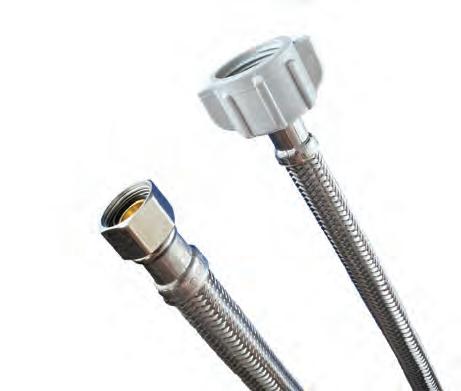
58 Mechanical Business 10.23

Taco
2 NEW LOCATIONS

IN WESTERN CANADA NOW OPEN NOW OPEN

EAST CALGARY
UNIT 10 – 5543 72 AVE S.E. CALGARY, AB
T2C 3C4

(825) 807-6522
WEST EDMONTON

11260 184 ST N.W. EDMONTON, AB

T5S 2S6
(587) 332-9940
Scan the QR code below to view all 18 branch locations


Polymer fittings


TotalFit from Uponor is a professional-grade, engineered polymer, push-to-connect fitting solution for residential projects. Designed for use with PEX, PE-RT, CPVC and copper piping systems, TotalFit is suited to service repairs, maintenance, remodels and retrofits for potable hot- and cold-water distribution piping systems in singlefamily homes and apartments. The fittings are available in 33 of the highest volume push-to-connect fittings in sizes from ½ in. to 1 in. uponor.com
Cellular core pipe
Westlake Pipe and Fittings’ NAPCORE PVC drain/waste/vent cellular core pipe, a co-extruded cellular (foam) core pipe, consists of inner and outer skin layers and a foamed core. Foaming agents, added to the PVC material, create the lower-density, closedcell core. The final product is a cost-effective DWV pipe, which can be used for low-rise combustible residential construction. westlakepipe.com
Press system
Apollo SmartPress is designed for joining ½ in. to 2 in. ASTM A-312 (304/304L and 316/316L) schedule 5/10s stainless steel pipe. Apollo SmartPress fittings and valves offer end users a complete solution with maximum coverage of applications requiring HNBR, EPDM or FKM sealing elements for operating pressures up to 500 psi and temperatures to 392⁰F. Features include colour-coded press indicators, patented sealing elements and silicone-free production. apollovalves.com


60 Mechanical Business 10.23
PRODUCT SHOWCASE
Refrigerative Supply Limited/RSL
EVEN better under pressure
The new patented SharkBite Max fittings give you double the burst pressure, while only requiring half the insertion effort to push onto the pipe.

So when you need stronger and faster, there’s no substitute for the Shark.
THE BURST PRESSURE
THE INSERTION FORCE
STAINLESS STEEL REINFORCED COLLAR AND PATENTED TECHNOLOGY
RWC/Sharkbite/Reliance
PRODUCT SHOWCASE
Fresh air supply fan
The digital Grundfos ALPHA pump boasts automatic self-venting, dry-run protection, robust startup capabilities, and troubleshooting aid with alarm and warning lights, along with improved wiring and a toolless power connector. The pump incorporates a touch user interface, system air venting and detection, trend data, and firmware updates, all controlled through Bluetooth connectivity. The enhanced AUTOADAPT feature on the pumps allows for easy setup and optimizes residential energy efficiency. grundfos.com

The Delta BreezFresh FRS200 is a fresh air supply fan, offering quiet and energyefficient performance from 30 to 200 CFM. The fan is engineered for three ventilation functions: supply, balanced, and filtration. It can be paired with an optional MERV13 filter. There are five mounting options. Its ECM motor is designed to run continuously for at least 70,000 hours. An insulated housing minimizes noise and condensation. deltabreez.com

Barrier-free sink

Contrac’s Barrier-Free Hygienic commercial sink is crafted from robust fine fireclay and has an acrylic shroud. Featuring no overflow hole and a single hole faucet deck, the Pro Guard Glaze repels germs, mould, mildew, and stain-causing bacteria. The offset drain redirects water flow and the sink is engineered with slanted ledges and drain to prevent pooling. Certified by IAPMO cUPC, ASME, CSA, and compliant with ADA and Barrier-Free standards, this sink is a healthcare essential. contrac.ca
Premium gaskets
Master Plumber premium elastomer gaskets are available in bowl to floor, tank to bowl and urinal gaskets. This sticky elastomer material ensures a tight seal and compresses up to 50 per cent for a custom fit. Gaskets are stackable, flexible and repositionable to help with any adjustments during the installation process. The elastomer material will not break or become brittle, and will not melt or loosen. Gaskets are available in a variety of thicknesses, and with an installation kit with extensions and bolts. mascocanada.com

Mini UV light
The Fresh Aire UV Mini UV LED is a system designed specifically for mini-splits and similar limited space applications. The Mini UV LED’s light strip is crafted to sterilize surfaces, while being safe for plastic materials. Features include compatibility with mini-split and ceiling cassette A/C systems, a UV LED spectrum that is safe for eyes and plastics, a flushmount nighttime power switch, a customizable adhesive LED strip, a 120-277 VAC power supply, and a 50,000+ hour expected LED life. freshaireuv.com

Business management software
FIELDBOSS is a scalable business management software solution built specifically for HVAC contracting companies. The software consolidates financial, operational, and field service management into an all-in-one system. From field to finance, the software lets users see and act on all aspects of their business. The centralized, intuitive system is designed to streamline and automate operational management. fieldboss.com
62 Mechanical Business 10.23


For more info visit daikinfit.com 2023 AVAILABLE FOR AIR CONDITIONER, HEAT PUMP, AND DUAL FUEL APPLICATIONS! 1.5-5 Ton Up to 17.5 SEER2 | Up to 8.5 HSPF2 | Up to 97% AFUE ADDITIONAL INFORMATION Before purchasing this appliance, read important information about its estimated annual energy consumption, yearly operating cost, or energy e ciency rating that is available from your retailer. At less than 14"
FIT
DAIKIN
wide, the Daikin
makes indoor spaces comfortable and outdoor spaces feel spacious.
Sensor range

Belimo room sensors accurately measure temperature, humidity, dew point and CO2 in a surface-mounted streamlined design with or without an ePaper touch display. They are maintenance-free and provide longterm reliability. Integrated with Near Field Communication, the sensors can be quickly set up or adjusted using the Assistant App, which allows easy data access, field adjustability, commissioning, and troubleshooting, even without power. The sensors without display are viewed through the Room Display App, which turns a smartphone into a remote display. belimo.com

Electric furnace

The Conforto electric furnace line from Granby has a QuietComfort feature which allows continuous recirculating air from the furnace to be preheated at low energy. The function is automatically deactivated at night when night temperature setback is activated, and reactivated automatically when heat demand is required. The furnace can be combined with add-on central heat pump or air conditioning systems. When converting existing LOWBOY oil furnaces the KLE model adapts to the existing ventilation ducts of the oil furnace in place.


granbyindustries.com
CARING FOR WATER. WITH PASSION.

From big to small, we’ve got it all!
With optimized and innovative energy-saving features, we deliver the future of pump technology to your doorstep.

Smart motor
Turntide Technologies’ Smart Motor System incorporates remote energy monitoring, facilitating comprehensive measurement, site management, and energy savings. The patented high rotor pole switched reluctance motor is available for 1 to 15 HP. The controller helps the variable-speed motor work at optimized efficiency across a range of speeds, control customized sequences of operation or application-specific functionality, and protects the system from damage or failure.


turntide.com

64 Mechanical Business 10.23 PRODUCT SHOWCASE
A WILO BRAND A WILO BRAND WILO BRAND
Pumps & Systems Ad - May 2022_Potable Water.indd 1 5/9/2022 10:09:24 AM
WILO
Know What You’re Buying — Not
all
PEX F1960 Fittings are the Same
Ifyou’ve been told all PEX F1960 cold expansion fittings are the same because they all conform to the same fitting standard, it’s important to understand there are real differences that can make or break your business.
In truth, not all fittings conforming to the ASTM F1960 standard are the same. Manufacturers and suppliers that claim their fittings are compliant to ASTM F1960 feel that, in their opinion, they meet the standard. However, there is no third-party agency to confirm that compliance.
Certification Difference
Uponor ProPEX fittings are a highly engineered product certified by third-party agencies — NSF and the Canadian Standards Association (CSA) — to ensure the raw materials, manufacturing process, and resulting product accurately meet the ASTM F1960 standard.
In fact, the companies that mold ProPEX EP fittings are partners that are integrated into the codes, helping ensure the highest-quality product. ProPEX fittings also undergo internal quality testing that extends beyond the ASTM F1960 standard requirements to provide customers with the strongest value available on the market.

“It’s important that installers are aware they need to ask for the Uponor brand name from distribution and make sure they are getting what they are paying for in ProPEX fittings,” says Bradfield Craig, director of Marketing at Uponor. “The differences are far beyond just the brand name. Uponor testing on generic F1960 fittings has exposed various manufacturing design and quality inconsistencies, and some fittings can’t even pass the ASTM F1960 standard requirements. This is putting projects at considerable risk for failures and potentially voids the associated system warranties.”
Identifying ProPEX
So, how can you tell if you have a real Uponor ProPEX fitting? The easiest way is to look for the Uponor logo. Other indicators include thicker tube stops and thicker sealing barbs. The thin tube stops on the generic, low-quality F1960 fittings are especially problematic as the expanded PEX pipe can extend past the stops and cause leaks.
If you are purchasing fittings that are not in Uponor packaging and are loose in a bin, be sure to take a close look at each part to ensure you’re getting Uponor ProPEX and not a generic product.
To learn more about the quality and 25-year warranty that accompanies the Uponor system as well as the risks of low-quality F1960 fittings, visit uponor.com/askforuponor.


Sponsored Profile
Cold climate heat pump


SpacePak’s Solstice R32 cold climate air-towater heat pump comes pre-charged with R32 refrigerant factory-sealed outside the occupied space. The unit is available in three sizes. Capacities range from 5,323 to 78,472 BTU/hr. Full inverter-driven operation combined with EVI compressor technology produces heating in outdoor temperatures as low as -22°F (-30°C) while delivering reliable water temperatures surpassing 130°F (54°). The unit is equipped with flexible intelligent controls, precise load matching, and app-based Wi-Fi functionality for remote monitoring and adjustments. mestek.com
Backwater valve

The Top-Check Fullport backwater valve from Mainline Backflow Products offers protection and minimal maintenance, with a top suspended gate that stays clean and automatically closes during a backup. The clear top with built-in main sewer cleanout allows for visual inspection and easy access for rodding of the sewer. Users have the option to manually close the valve. The unit offers an alarm to alert building owners when valves activate during a sewer backup. backwatervalve.com

Mini split
The Perfect Aire Model HyperTek Heat universal indoor unit is designed for both single-zone and multi-zone mini-split systems, operating at 230V. The unit features 360-degree air control and includes a temperaturesensing remote that acts as a portable thermostat. Key features include turbo operation, sleep mode, golden fin, low ambient kit, and self-diagnostic function. It has a cooling and heating capacity of 12,000 BTU and covers an area of up to 250 sq. ft. perfectaire.us


66 Mechanical Business 10.23
PRODUCT SHOWCASE
See the difference you get with the KANE CARE 10-year Warranty! KANE3300 Accuracy: ±0.03 < 3 inchH2O, ±1%rdg > inchH2O Resolution: 0.001"(-9.999 to +9.999 inchH2O), 0.01" Functions (< -10, > +10 inchH2O) Features • HOLD MIN/MAX/AVG • Capture • Ambient temperature measurement • Backlight • Auto Power off • Low Battery Indicator • 1-Year limited warranty Hi-Res Differential Manometer w/ Wide Measurement Range KANE458S KIT Residential/Commercial Combustion Analyzer Kit w/ Printer Calculates: Differential Temperature, Efficiency (Net & Gross), Excess Air Measures: CO (10,000ppm H2 Compensated), CO2, Differential Pressure, Flue and Inlet Temperature BOOTH #623 Join us at CIPHEX West! Includes • Flexible Transparent Tubing • Brass Fitting (2) • Step connector w/ 3.15” tubing (2) • Soft case • Manual NEW! Kane
W-series Clamps


taylorwalraven.ca The Value of smart Scan the QR-code for our complete offering Simply smarter. Simply difficult. Simplicity. Reinvented.
The new alternative to the strut and cushion clamp. One piece design, installs with one hand No assembly required to fix pipe One clamp for both indoor and outdoor use CIPHEX West Booth# 606 Visit us, test your skills and compete for prizes! Taylor Walraven
Road Warrior
By Carolyn Cooper
Name: Kenneth Larsen
Company: Maxwell Mechanical

Job Title: Refrigeration technician
Born in: North Grimsby, ON
Live in: Salmon Arm, BC
Age: 64
Spouse: Dorte Daughter: Jessica
Pets: Four flat coated retrievers: Rex, Luna, Ella and Mylie
Kenneth Larsen: Mentoring a new generation
Kenneth Larsen retired for the first time more than five years ago, but a love for the trade and a drive to mentor a new generation of apprentices keeps him on the job.
“I’ve trained quite a few apprentices over the years,” says Larsen, a refrigeration technician at Kamloops, BC-based Maxwell Mechanical. “It’s something I really like to do, because I think we, the older generation, can add a little bit more to the training. A lot of times now, I find that it’s very much off the books or [relying on] technical support. But you can do a lot more than you think you can, if you just know how to use the resources that you have within yourself.”
Larsen was born in Canada, but his family moved back to Denmark soon after. It was there that he first became interested in the skilled trades, and completed an apprenticeship in refrigeration. When he returned to Canada in 1992 Larsen settled in BC and joined Polar Industries as a refrigeration technician.
After spending “a lot of time on fishing vessels, travelling to Alaska and up and down the coast,” Larsen decided it was time for another move. “That was really good, but I felt I needed some more training for heat pumps and air conditioning.” Larsen joined Werner
Smith Mechanical, where he worked for a decade, before running the refrigeration department for Neutron Factory Works and then Uptime Industrial. He retired in 2018, but continued to work for himself and Uptime in the Okanagan region, until joining Maxwell Mechanical this year.

Today Larsen works on a range of HVAC equipment for residential, commercial and industrial projects, including heat pumps, something he says has become a significant part of the company’s business. “There’s still a lot of people who say they just want AC. It’s easier now to explain to them what a heat pump can do for you, and that it can do so much more than in the early days.”
Larsen says learning about the new technology has been a satisfying challenge. “I didn’t think I would enjoy it, but I do. I have to think a lot more than just doing my routine refrigeration that I’ve been doing for so long, because it’s a new aspect. And the new heat pumps are so much more efficient, and controlled by so much internal technology that you really have to know what’s going on, which makes it interesting for me, it challenges me more, which is good no matter what age you are and what experience you have.”
Photo
credit: Kelly Funk, Kelly Funk Photography
68 Mechanical Business 10.23
Not surprisingly, troubleshooting is one of his favourite aspects of the job, especially when solving issues for less experienced employees. “A lot of times what I tell [the technician] is just go out to your truck, sit and talk out the problem. You can often solve the problem just by hearing what step you’re missing. Take some time and see if you can find out yourself before you call tech support or call the other journeyman.”
Larsen currently works with two apprentices, and is encouraged by the young people he sees entering the trade. “I’m just so happy that we’re getting more and more apprentices into the trade. And the young people that are coming in are really smart. And I know the trade is paying really well, but it’s not so much the money that is drawing the young people in anymore, I think it’s more the interest in the trade, what they can become when they become a refrigeration technician. They can go into controls, they can be engineers, the door is open so wide, because you have broad knowledge in the refrigeration trade. I find that very refreshing.”
In the mechanical industry since: 1976
Schools and programs: Apprenticed in Denmark
Best advice you’ve ever received: Always have strong ethics
Advice for young people considering entering the trades: Keep your eyes and ears open – never miss opportunities
Service area: BC Interior
Favourite part of the job: The challenge of solving problems

The most useful tool in your toolbox: Refrigerant gauges

Favourite performer: Bruce Springsteen
Best concert you ever attended: The Rolling Stones
Favourite place to be: RVing

Favourite magazine: Anything with Formula 1 car racing
Favourite TV show: Deadliest Catch
One place in the world you would like to visit:

Finish these sentences:
My rule of thumb is ... never go to bed mad.
If I had a million dollars … I would share it with friends and family.
When I was a kid I wanted to be a … soccer star.
If I had a super power it would be … to be able to fly.
Mechanical Business 10.23 69
PLUMBING
By Fred Bretzke

DRAINS, DRAINS EVERYWHERE
BUT WHERE DO WE BEGIN?
Back in the day, I don’t know how many times I had to look for cleanouts to access the main drain in a finished basement. This article is dedicated to pointing out different hints on where to start if you have a backed up main drain.

I’ll start with the more uncommon drains which would be the rural houses out in the country. If clients have a plugged sewer in the country, I would suggest you find out if they have a septic tank and/or septic field. This is usually the case in rural situations. In Canada, if the sewer is exiting the basement wall about five or six feet from the basement floor, it is likely a septic tank. The main cleanout or building drain and building sewer exit the house at about two to three feet below the outside ground and then enter the septic tank. In this case most of your drain service work will probably involve the septic tank or field.
RESIDENTIAL MAIN BUILDING DRAIN OR SEWER
For urban plumbing or in the city, let’s discuss the servicing of the plumbing drains. It tells us in the 2015 and 2020 National Plumbing Code (NPC) in 2.4.10.1. 6) that Building drains shall be provided with a cleanout fitting of NPS 4 or larger that is located as close as practical to the place where the building drain leaves the building. (Note A-2.4.7.1. 6).) from the Appendix notes, under the title Cleanouts for Drainage Systems. To accommodate the limitations of sewer cleaning equipment, the cleanout should be located as close as possible to the exterior wall of the building, either inside or outside, and be accessible for sewer cleaning equipment. This is a clearer definition of 4” cleanout placement for building drains than in the previous code books.

One interesting difference is this code clause says the main cleanout can be inside the
building or outside the building as long as it is accessible. I’m not sure how logical it would be to put a main cleanout outside of the building as it may induce some frost closure. Either way this main cleanout is located on the main building drain in order to access clearing a stoppage in the building sewer outside.
Fred Bretzke is a full-time pipe trades instructor with Calgary’s SAIT Polytechnic. He was the 20202021 Innovation of The Year Award Winner: SAIT for digitizing the project-based learning approach apprenticeship training is known for. Fred can be reached at fred.bretzke@sait.ca.
70 Mechanical Business 10.23
Typically, main sewers in the city can be clogged with grease or tree roots.
Photo General Pipe Cleaners
Take Your Time Back With American Standard
American Standard values your time. Our Flash™ Shower Rough-In Valves are built to install quickly and easily into a variety of work spaces. From tight spaces to thin wall applications— and everything in between—the Flash™ Shower Rough-In Valve has you covered. Because in your business, time is money.
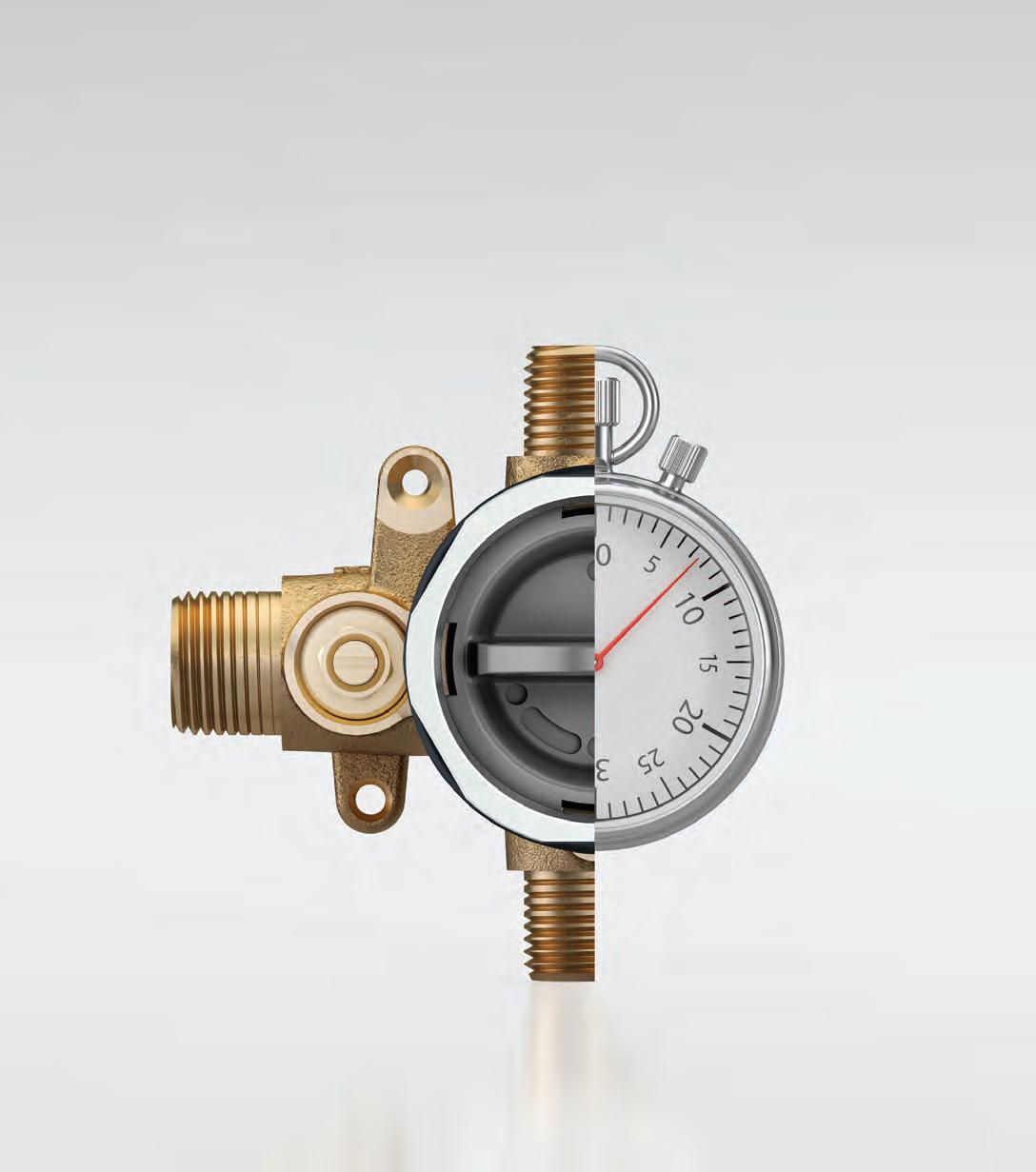
American Standard/Lixi
Learn More at americanstandard.ca/flash
If your main floor drain backs up in the basement, which is usually the lowest drain in the house, it will most likely be plugged in the main building drain or main building sewer outside of the house. Typically, main sewers in the city can be clogged with grease or tree roots. These types of plugs can be cleared with drain cleaning augers, jet augers or steel tapes from the main cleanout.

COMMERCIAL DRAIN SERVICE

Another famous commercial drain cleaning service call is a main drain plugged in a mall. There are usually two reasons for a clogged main sewer in a mall. You only have to look at two kinds of places. One is the hair salons and the other is the restaurants.
Hair salons
The thing I like most about getting my hair cut is sitting in the hair salon chair, leaning back and getting my hair washed and the scalp massage. While this is happening, some hair gets washed down the sink … and some people lose more hair than others (like me). Every hair salon sink must have a drum trap that works like a hair interceptor. This is stated in 2.2.3.1. 5) of the 2020 NPC. A drum trap shall not be used as a fixture trap unless required to serve as an interceptor and access for servicing is provided.
I once had to unplug a main building drain in a mall and as I was inserting the cable down the drain it got hung up on what seemed like something big. It was like fishing and catching a whale. As I struggled pulling it back to the end of the cable, out came a 30-ft snake of twisted rotten hair the full 4-in. diameter of the main building drain. Sure enough, the hair salon sinks had the improper p-traps on them instead of drum type hair interceptors.
KITCHEN STACK
Let’s talk about one of the most common backed up drains in the actual house. Some people are not aware that they should not pour frying pan grease down the kitchen drain. Even if you don’t do that, eventually the kitchen drain does tend to have grease build up over the years from rinsing plates and so on. The letters Y,X, and V in Figure 1 represent a wet vented kitchen stack. Typically grease accumulates when a drain turns from vertical to horizontal under the floor in this case (downstream of cleanout at Y). There must be a cleanout at the base (Y) of every stack as it states in 2.4.7.1. 7) a). It is always nice if they upsize the cleanout to 3 in. instead of the minimum 2 in., this allows for cleaning downstream of the basement floor drain as well. When this drain is being cleaned it’s very important that you run the cable back and forth several times while running hot water and then slowly adjusting it to warm then cool water. This helps move the greasy water through the drain and pushes it into the bigger 4 in. building drain and then the building sewer. One can also use pressurized water to help remove the grease with a jet system.
The main idea is not to just run the snake quickly through the drain, clear the plug, and leave. The grease will usually coagulate again and reclog the drain. In my opinion, drain cleaning companies that charge a flat expensive rate to clean a main drain or especially a greasy kitchen drain, incentify the drain cleaner to quickly clear the plug, collect their money and leave.

Properly-installed
I still believe it’s more fair to both the customer and the company to charge cost plus to clear drains. This way the customer gets what they paid for. If the drain cleaner spends several hours cleaning a greasy drain then they charge several hours. If the drain cleaner gets the job done quickly, the customer should know that it’s cheap only because they wanted the pricing to be fair.
Cont’d from pg. 70 PLUMBING 72 Mechanical Business 10.23
Figure 1
SINK
Hair salon sinks must have a drum trap
drain trap
CIPHEXVISITUSAT WEST#627
EVERY DAY, ON EVERY PROJECT, WE WORK FOR YOU.

QuickVic™ System: Potable Water: Motion Control: Modular Construction:
• Unmatched ease of installation and enhanced visual verification
• Faster install with one-touch tightening
• Built in safeguards against over torquing and over tightening
• 3x more rigid joint
• Outstanding value in a lighter, more efficient design
• Wide range of joining and flow control solutions for domestic water piping systems in any environment


• New potable water product offering centers around its next generation Grade P gasket material
• Unique Housing Colour to denote use in Potable Water
• Market leader in system design
• Products inherently deal with system movement
• Carbon and stainless steel anchors, riser movement fittings, and anchor outlet fittings are engineered products
• Designed to direct piping movement and for fast and easy modular assembly

• High quality construction in a controlled environment
• Greater efficiency and productivity onsite
• Minimize onsite labour, crane lifts, and site congestion
• Tighter equipment footprints with optimal pipe fittings and supports
• Increased level of safety; less hot works and working at heights

AD 19368 REV A 09/2023 © 2023 VICTAULIC COMPANY. ALL RIGHTS RESERVED.
Victaulic
Restaurants
2020 NPC reference: 2.4.4.3. 1) Where a fixture discharges sewage that includes fats, oil or grease and is located in a public kitchen, in a restaurant or in a care or detention occupancy, it shall discharge through a grease interceptor
Another main reason for main building drain plugs is too much grease in the system due to poor grease trap maintenance. The whole grease trap business is changing due to environmental reasons. For years


restaurant grease traps would have to be sucked out − typically by vacuum trucks at the source. The grease would be removed and then disposed of as contaminated fill. Companies would charge for this service. However, it seems now there are some environmental companies removing the grease free of charge as they are reclaiming the grease into a useful substance. This may literally clear up many commercial grease problems due to its cheap removal.
E MB RACING the past
WE’VE COME A LONG WAY
After spotting a LinkedIn post by Randy Hughes, Ontario territory manager with Ward Manufacturing, curiosity got the best of me. This piece of hollowed out wood is actually a wooden gas main removed from a location in Barrie, ON in 2008. The main was installed in the 1800s and appears to be in reasonable condition considering the length of time that has passed.
It seems inconceivable that wood would be used for that purpose when steel was available, but trees were plentiful and cheap.
You wouldn’t expect that wooden pipe would attract the attention of the likes of comedian and social commentator Bill Maher but it did. In a September 14, 2010 interview on CNN’s Larry King Live, Maher brought up wooden pipes in the context of a tragic gas explosion and the need for new infrastructure. “Do you know that we have pipes carrying natural gas in this country that are made of wood? I’m not joking,” said Maher. There is nothing to substantiate his inference that wood pipe caused the blast but his comment did create a stir. Wood pipes may still be in the ground where they have been left behind as gas pipelines were replaced.
By Kerry Turner
After the war of 1812, Barrie began to export its local resources including trees, which were plentiful. Trees, some nearly two hundred feet tall, were logged and shipped out, serving as masts for British ships and railway ties. Some of those trees apparently ended up underground, serving as pipe.
According to the Canadian Gas Association (CGA), Canada’s first transmission pipeline was built in 1853. The 25-km pipeline was made of cast iron and moved natural gas. At the time, CGA notes that it was the longest pipeline in the world. Despite extensive research, there is little information on the use of wood to move gas in Canada. In the U.S. there is more information available and an online article from the Distribution Contractors Association titled When Pipelines Grew on Trees is a great read if you too are feeling curious.

74 Mechanical Business 10.23 Cont’d from pg. 72
PLUMBING
Too much grease in systems is generally due to poor grease trap maintenance.
UV Systems Built for the Professional Channel


Features:
k 8, 12 and 20 gpm systems


k Combination UV / Filtration rack systems

k IAPMO Certified to NSF/ANSI 61 (for material and structural integrity only) and CSA B.483.1


k Integral lamp life monitor with digital display


k Audible and visual lamp life indicator

k Patented lamp pin connection protects replacement revenue
k Assembled in Canada
Between July 1 - November 30, 2023, purchase any water softener, whole-house filter or specialty system and enter to win a $5000 travel voucher.


...You choose the destination!
Contest details and entry form available @:
TRAVEL VOUCHER!
...
A $5000
Fix The Water That Broke It
to WIN!
Novo/Canature
JOBSITE JARGON
Match the terminology you hear in the field to the correct definition or function by November 8, 2023 and enter for your chance to win a KANE3300 hi-res differential manometer. This contest is open to Mechanical Business subscribers in Canada. Send your answers to kerry.turner@mechanicalbusiness.com or enter online at mechanicalbusiness.com.

JOBSITE JARGON
A) Heat pump component where the vaporized refrigerant captures the ambient warmth from the heat source
B) Component in a heat pump that controls motor speed to increase the system’s energy efficiency
C) The heat pump uses a supplemental system such as a furnace or boiler
D) Temperature as measured without the consideration of humidity
E) Device used to collect heat from the source in geothermal heat pump systems
F) Technology that allows cold-climate heat pumps to improve performance in cold temperatures by allowing increased refrigerant flow into the evaporator coil
G) Temperature below which the heat pump does not have enough capacity to meet the building’s heating needs on its own
H) It is a measurement unit of power for refrigeration and air conditioning typically used in North America
I) A furnace with an intake on the top and an air discharge at the bottom
J) The heat pump component that decompresses the fluid refrigerant allowing it to vaporize in the evaporator
K) Device used to collect heat from the source in vertical geothermal heat pump installations
76 Mechanical Business 10.23
1) Collector
2) Evaporator
3) TR
4) Vertical probe
5) Downflow Furnace
6) Expansion valve
7) Thermal Balance Point
8) Hybrid Systems
9) Dry Bulb Temperature
10) Inverter
EXAMPLE:
5) Downflow Furnace I) A furnace with an intake on the top and an air discharge at the bottom.
Answer 5,I
Ainsley Cipperley of Venture Mechanical Systems is the winner of the July/Aug contest.
Come see us at booth #617 at CIPHEX West, October 18 and 19, 2023

WHEN YOU’RE UP HERE, RELIABILITY AND PERFORMANCE MATTER MOST.
Exclusively at Master*
Premier power and dependable design mean our equipment will never let you down.


You face enough challenges out in the field. Worrying about the performance of your equipment shouldn’t be one of them. At the end of the day, you need dependable technology that can deliver for your customers in any environment. Step up to Fujitsu General and get today’s most powerful lineup of mini-split and VRF solutions… along with ultimate peace of mind.

Visit master.ca for more info
Calgary, Alberta Master
*except
in Ontario
CLIMATE CHANGE | Carolyn Cooper
Canada launches National Adaptation Strategy
The federal government has introduced the first National Adaptation Strategy, a whole-of-society approach to building climate-resilient communities.
The five-year initiative is the result of two years of engagement with provinces and other stakeholders. It includes a framework to reduce the risk of climate-related disasters, improve health outcomes, protect biodiversity, build and maintain resilient infrastructure, and support a strong economy.
Canada’s Adaptation Action Plan also includes 73 actions that outline how the federal government will contribute to achieving climate change adaptation goals. The federal government will work with provinces and territories in coming months to advance bilateral action plans as steps to implementing the strategy, and will work with First Nations, Inuit and Métis through the Indigenous Climate Leadership Agenda which supports self-determined Indigenous climate actions.
In addition, the ministry of natural resources has launched a call for proposals for project funding through the Climate Change Adaptation Program, which supports the National Adaptation Strategy, with up to $15 million in available funds. Proposals are welcome for cost-shared projects of more than $150,000 that
PLUMBING
CROSS CONNECTION FIXES
address climate change adaptation, including adaptation skills, economics, emerging issues and natural resource sectors. The call is open to individuals and organizations, including academic institutions; non-governmental organizations; industry, research, and professional associations; companies and businesses; Indigenous communities or governments; community, regional and national Indigenous organizations; and provincial, territorial, regional and municipal governments and their departments and agencies.
canada.ca
The Western Canada Section of the American Water Works Association (WCSAWWA) Cross Connection Control (CCC) Committee has announced the winners of its 2023 Bad and Ugly contest. The annual contest is intended to increase awareness of cross connections and to educate water industry representatives in the field. Backflow prevention testers and inspectors are asked to submit images of the “bad and ugly” cross connections they’ve seen on the job. The first winning submission was from Joey Schuster, with his picture captioned “Interesting choice for a boiler fill station.” Schuster explained: “I went into the mechanical room to test the main line double check valve assembly (DCVA). I immediately spotted the garden hose cross connection between the hot water supply and the boiler. After testing the DCVA (it passed) I removed the hose and called the building owner. I explained to them the dangers of a cross connection and gave them the option to build an auto fill that included a Watts RP. They agreed to the fix on the phone, but I took the hose with me just in case.” Schuster received a Watts Test Kit for his submission.
The second winner was Tayte Southerland, who received a gift card from the WCS AWWA Committee for three images he submitted of a cross connection before and after. “To correct this, the DCVA must be relocated downstream of the by-pass and outside of the meter setting,” says Southerland. “This relocation will provide proper isolation of the water supply.”

The contest deadline is April 30 each year, with winners selected in May and prizes awarded in June. wcsawwa.net

78 Mechanical Business 10.23
Dylan Gerlack, WCS AWWA CCC Committee past chair, and Robert Caudron (R), WCS AWWA CCC Committee chair, present Joey Schuster with a Watts Test Kit.
Tayte Southerland is presented with a $100 gift card from Dylan Gerlack WCS AWWA CCC Committee past chair.
WHENEVER PIPING IS INVOLVED
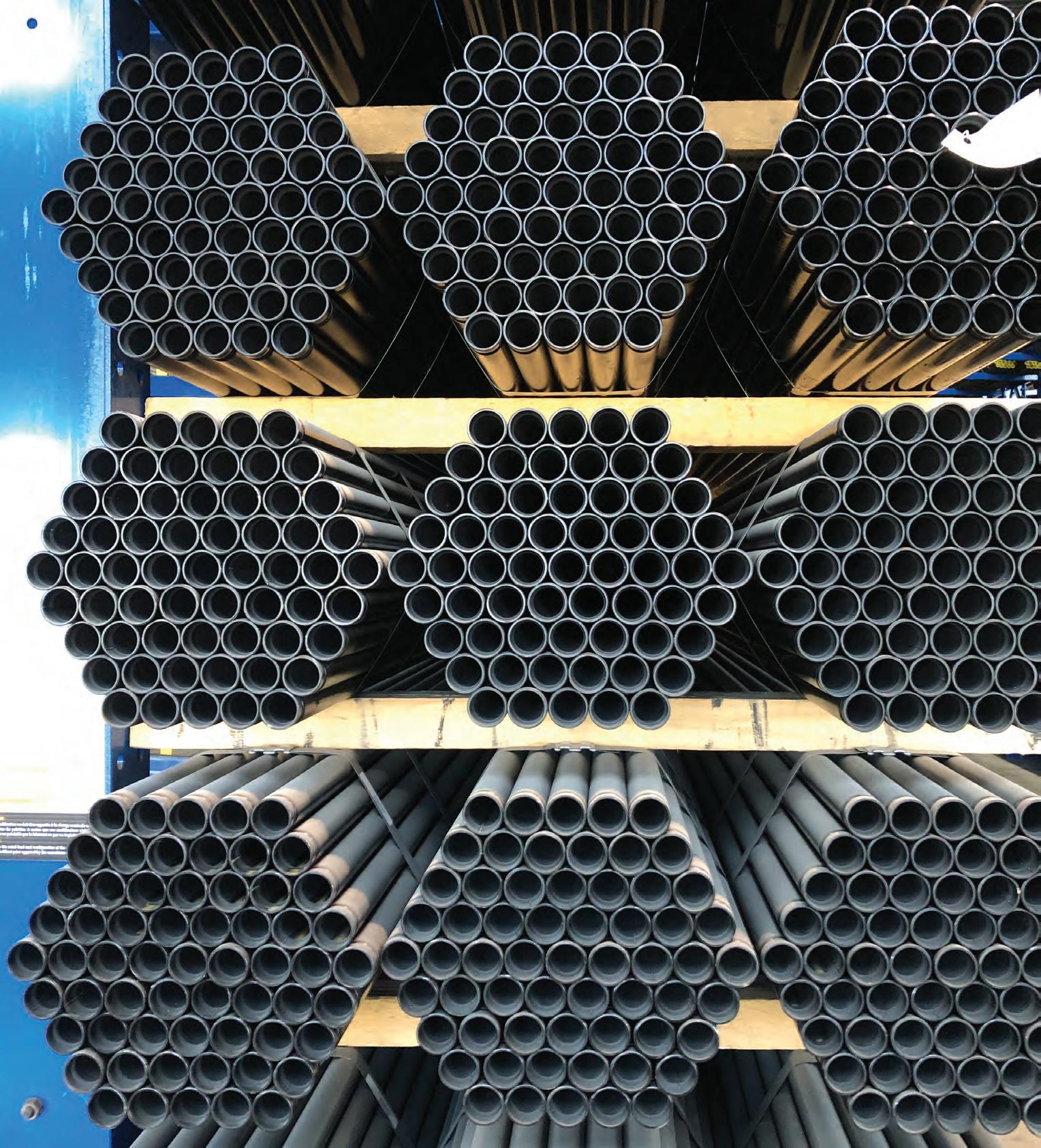
FLOCOR
CUSTOMER SERVICE
By Cliff McNeill
Handing over the keys: Setting expectations for performance and maintenance
Asan industry, we are great at putting systems together. We do an excellent job of selecting quality products and components that provide comfort and energy savings. Whether it be a hydronic heating system, on-demand water heater or air conditioning system, we provide a wide range of systems and equipment.
However, we are not so great at properly handing over the keys to the homeowners.
We typically struggle with setting expectations around the performance of the system and articulating the frequency and necessity of maintenance. As equipment becomes more and more sophisticated, regular maintenance becomes increasingly important.
A classic example of setting expectations around performance and maintenance is the homeowner that moves from a traditional hot water heater to an on-demand water heater. From the homeowner’s perspective, they have been sold a dream of energy savings and endless hot water by marketing firms. This is not untrue, but we do need to set realistic expectations.
When it comes to maintenance, the homeowner’s expectations are that it is the same as their previous hot water system. It should live in the basement, out of sight, out of mind for years without worry. Wait for it to fail and then replace it. Annual maintenance? Who said anything about annual maintenance.
In our industry, manufacturers are great at writing technical manuals with a “Maintenance” section at the very end of them. As installers, we leave the manual onsite in the off chance the homeowner will find this important document, and then will take the time to read it, understand it and schedule their own maintenance per the manufacturer’s recommendations. Hopefully they will schedule that maintenance with you, the one who installed the system.
Over the years of attending jobsites, one of the most common questions I hear from homeowners as we are finishing up is, “What type of maintenance do I

need to do?” They ask because they want to be able to look after their home. Quite often I hear vague answers such as, “It should be good for quite a few years …”, or “if you start to notice that you’re not comfortable, give me a call.” I have yet to be on a jobsite where someone picks up the manual, opens it to the “Maintenance” section and walks the homeowner through the manufacturer’s recommendations.
A big part in handing over the keys to the homeowner is letting them know what they can expect from their system and how to properly look after and maintain their system. At the very least, we need to become an industry which schedules that first and most painful maintenance appointment. After that first one, they become easier and easier.
At the end of the day, equipment maintenance is a revenue opportunity that continues to grow and with the type of equipment that dominates the current market, fewer and fewer homeowners are willing or capable to do their own maintenance. Homeowners are relying on us to maintain the systems in their homes. We need to let them know what needs to be done, when and by whom.
Cliff McNeill is with Equipco Ltd. in outside sales for Southern Alberta. He is also Equipco’s in-house technical specialist in hydronic heating and engineer-focused products. McNeill can be reached at cmcneill@equipcoltd.com.
80 Mechanical Business 10.23
NOW AVAILABLE
With the latest innovations & long-lasting reliability, it’s the trusted Indirect Water Heater . Contact your local distributor today.

Sizes: 30, 40, 50, 60, 80, 100, 120 Gallons
1” Side Boiler Connections
Top DHW Connections
3/4” (30-60) & 1” (80-120)
Factory Included: T&P Valve, 1/2” Drain Valve, Aquastat
Acid Pickling for Increased Corrosion Resistance
Scan the code now to learn more.
 Stainless Steel Coil Tank
Triangle Tube
Stainless Steel Coil Tank
Triangle Tube
STEPS TO TAKE
Although most people don’t enjoy paying to have their equipment maintained, they are willing to do it because they know that it will save them money and headaches in the long run. Just like none of us enjoy paying the bill to have the oil changed in our vehicle, we know that we have to do it in order to make sure that our vehicle will operate worry free for as long as possible.
An easy first step is to leave the homeowner with a one-page maintenance sheet. Make a couple of copies and give one directly to the homeowner or include it with their invoice. Attach another copy to the equipment that you just installed or in a visible place close by. This can be as simple as copying the manufacturer’s recommendations from their manual.
The next step that you can take is to make your own custom maintenance sheet or check list. Always include your company name and contact information. Include the date the equipment or the system was installed and note after each item how frequently it needs to be done. The first time is always the hardest and takes the most effort. However, if you use a piece of equipment regularly or install a specific type of system, you can reuse it every time that you install the same system or piece of equipment. Now you have set the expectations for the homeowner about how to properly maintain their system. And in the event that it does not function properly or needs additional maintenance, they have someone to contact – you.
Today there are so many tools available to take us to the next level in being able to help homeowners stay on track with maintenance. There are tools that have been developed specifically for our industry and a number of tools that can easily be adapted to the task at hand. Some are free to use while other ones that are a bit more sophisticated will have a cost.
A SYSTEM WITH TEETH
Maybe we need to take a page from our local dentist. The dentist will typically send you an email a week before an appointment, a text message two days before an appointment, and then after the appointment they will schedule the next one for you before you leave their office. During each of these steps, they will include additional information about how to make changes to your appointment and if there is anything you may need to do. All of this is done from a system where they just enter your contact information, the date of your appointment and what type of appointment you have. If you are looking for ideas, the next time you visit your dentist, ask them what app they use.
Many of these tools will allow you to provide the homeowner with additional information and reminders. The reminders can include information for the homeowner about what they can do themselves. Simple tasks such as a visual inspection for leaks, checking the level of fluid in a glycol fill tank, changing an air filter, checking that there is nothing blocking the intakes or exhaust, or changing their humidifier from summer to winter or back again. The reminder can also let them know what they will need a professional to do, such as checking the concentration of glycol or the pH in their system, checking the flame sensor and ignitor, inspecting and cleaning the heat exchanger, testing the relief valve and servicing their condensate neutralizer.
82 Mechanical Business 10.23
HYDRONICS Cont’d from pg. 80
Make your own custom maintenance sheet or check list set the expectations for the homeowner about how to properly maintain their system.
CUTTING-EDGE
INNOVATION IN TEMPERATURE MIXING


Caleffi mixing valves lead the way. From 3/8" under-sink scald protection valves to 3" flanged digital master mixing valves, a full selection is available for residential and commercial plumbing and hydronic applications. Over 60 years of innovation and global experience assure high quality and proven reliability. A wide selection of double union connection types work with copper, iron, stainless steel and non-metallic pipes. Approvals include compliance with U.S. and Canadian plumbing codes. CALEFFI GUARANTEED.

www.caleffi.com
Caleffi
DIAGNOSING RECIPROCATING COMPRESSOR PROBLEMS AND FAILURES - PART III

In the July/August 2023 issue (available at mechanicalbusiness.com), we concluded with some discussion of oil failure control trips. We will continue the discussion in this article, which covers the topic of the oil condition.
Evaluating the appearance of the oil can provide some insight as to what is happening inside the compressor. For example, a dark black colour can indicate the presence of copper oxide and/or high discharge temperatures.
Copper oxide is formed as a byproduct of brazing copper tubing when the copper combines with oxygen. This occurs when a low-pressure supply of dry nitrogen is not passed through the tubing during the brazing process. This copper oxide exists as a powder and/or flakes, and can plug up orifices, pilot ports, strainers and suction screens. Also, this contaminant can interfere with the lubrication system and reed valve operation.

High discharge temperatures can be the result of operation outside the compressor envelope, excessive unloading, lack of auxiliary cooling, and so on. It is highly advantageous to utilize the benefits that a discharge sensor offers. It will shut the compressor down if the discharge temperature increases above the limit established by the compressor manufacturer.
Oil that appears to be grey in colour likely contains metals such as steel, iron and aluminum. The presence of these metals in oil is an indication the compressor has experienced irreversible damage. The main reason why this would occur is a lack of lubrication.
If the oil seems to have a milky appearance, this is typically an indication that moisture is present in the system. The source of the moisture could be from improper service practices, but may also be due to a failed heat exchanger.
Acidic oil
Moisture plus oxygen and heat inside a system can produce acids, which then circulate throughout the system. This acid then dissolves copper from the internal surface of copper tubing. As this solution is circulating throughout the system, the copper will be deposited on hot surfaces inside the compressor. It is important to note that acid is also harmful to the motor windings inside the compressor. Over time, the dielectric properties of the motor winding insulation will
A dark black colour inside copper tubing can indicate the presence of copper oxide and/or high discharge temperatures.
be reduced to the point where the windings will short together, and/or the windings will short to ground.
Oil testing is the best way to determine the condition of the oil. This is accomplished by sending an oil sample to a qualified testing lab. It is recommended to obtain the original oil testing data from the compressor manufacturer or the oil producer. This information should then be supplied to the testing lab.


84 Mechanical Business 10.23 REFRIGERATION
Phil Boudreau Phil Boudreau is responsible for special projects, training and technical support for Bitzer Canada Inc. He can be contacted at pboudreau@bitzer.ca.
Oil colour/condition
Oil testing by a qualified testing lab is the best way to determine the condition of the oil.
Photo Apex Oil Lab


EFFICIENT * COOLING NOW POSSIBLE WITH SOLSTICE®N40 (R-448A) Solstice® N40 (R-448A) is a refrigerant of choice for more than 60,000 supermarkets as a lower-GWP, nonflammable and higher efficiency retrofit alternative for R-22, R-407A, R-404A and R-507A. Scan this QR code or visit hwll.co/N40 to get in touch with our sales team and benefit from the Solstice® N40 (R448-A) advantage for your low- and mediumtemperature refrigeration systems. * 67% lower GWP and 5-15% energy efficiency gains in comparison to R-404A Canadian Refillable Cylinders Available. Honeywell
Terminal plates can fail in situations when moisture condenses inside the terminal box. Moisture will form whenever the temperature of the terminal plate drops to or below the dew point of the air surrounding the compressor. This moisture can then pool on the terminal plate and/or insulating block. Arcing between the electric terminals can then occur. When this happens, it is common for metal to transfer from one terminal to another.
Condensation and overheating can cause terminal plate failures.

In some cases, the insulating block itself will be damaged, due to the metal tracking that can take place. Before condemning a compressor due to a shorted motor, be sure to disconnect the motor leads from the terminal plate and retest the insulation resistance of the motor windings. If they check out okay, then it is very likely that the terminal plate has failed. In this case, a new terminal plate and gasket can be installed.
Terminal plates can also fail due to overheating. Poor connections, due to insulation being pinched between wires and wire lugs add a considerable amount of resistance to the connection. Also, poorly terminated wires at terminal lugs can cause hot spots. In some cases, the potting material between the terminal and terminal plate can overheat and fail. When this occurs, a leak may also develop and allow refrigerant and oil to escape the refrigeration circuit.
Compressor vibration
Compressor vibration may be the result of one or more broken connecting rods, worn wrist pins, discharge line resonance, forced piping, etc. Insufficient lubrication will increase the wearing process to the point where bearings can fail. As the aluminum connecting rods fail, they sometimes reach a point where there is so much heat and mechanical stress formed, that the aluminum begins to transfer to the crankshaft journals. This produces even more wear. As this process continues, the connecting rods can reach a point where they lock to the journals. As the crankshaft continues to rotate, the connecting rods become twisted and can easily be sheared off at the bottom of the cylinder walls.
Broken suction and discharge reed valves can also result in compressor vibration since they can break off and drop into the cylinder area, where they become lodged between the piston and the cylinder and/ or they rest on the top of the piston. Broken reed valves can cause a lot of damage to the piston and cylinder walls and will place added stress on the connecting rod and crankshaft every time the piston approaches top dead centre.
Discharge line vibration is often misdiagnosed as compressor vibration. When piping is forced in place and the piping and fittings become stressed, discharge line vibration can occur during compressor operation. Incorrect mounting methods can lead to this also.
The piping should be installed such that there is no stress on the fittings, service valves or piping. Not only will this often result in vibration, but sometimes results in fractured piping, fittings, and service valves.
Discharge line vibration may also take place when the natural frequency response of a particular section of discharge line matches the pulsation frequency of the discharge gas. In this case, you can contact your compressor manufacturer or system manufacturer for assistance.
Incorrect VFD parameters can also result in vibration. If the parameters are correct, it will likely be necessary to contact your VFD supplier for help on skipping the frequencies that are causing the resonance.
Incorrect VFD parameters can also result in vibration.
REFRIGERATION Cont’d from pg. 84
Terminal plates
86 Mechanical Business 10.23
Discharge line vibration


Join us in Chicago for the latest updates on: AI & Controls Decarbonization Solutions Plumbing & Hydronics Heat Pumps Refrigerants Workforce Development Application & Practical Learning Business & Professional Growth Are you ready for what’s next in HVACR? Register for free at ahrexpo.com AHR
By Anne-Marie Nicol
Focus on health: The fine balance of energy retrofits and IAQ

Prevalence of Radon in Canada
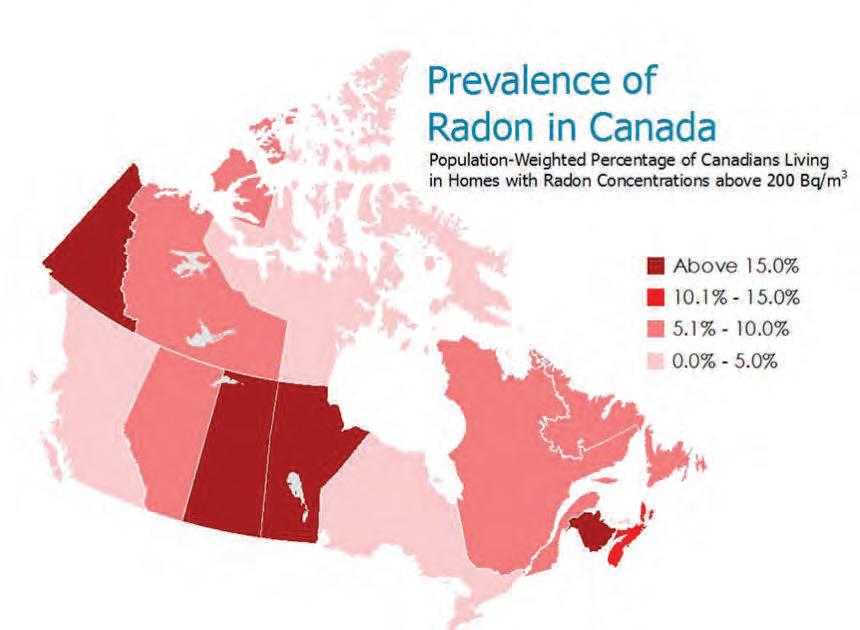
Population-Weighted Percentage of Canadians Living in Homes with Radon Concentrations above 200Bq/M³
Above 15.0% 10.1% - 15.0%
5.1% - 10.0% 0.0% - 5.0%
cent of annual greenhouse gas emissions (GHG) and transforming our building stock is now a wellrecognized priority for meeting globally agreed upon GHG reduction targets. Building new and more energy efficient buildings will help, but renovating our existing housing stock is seen as one of the cheaper and more achievable ways to meet climate targets. Energy renovations often change a home’s ventilation patterns, as buildings are tightened or sealed to reduce energy loss. This can have a direct consequence for indoor air quality (IAQ). One contaminant in particular, radon gas, appears to be especially affected by energy retrofits.
Radon is a soil gas released as a part of the uranium decay process. It is a carcinogenic gas that can enter buildings through cracks in the foundation, sidewall, or areas around pipes and drains. Radon is an odourless, colourless, and invisible gas, and is the second leading cause of lung cancer and is therefore a serious health concern in Canada where many regions are known to have elevated levels.
Radon was first identified as an indoor airborne hazard in residential homes in the 1980s through research supported by the United States Department of Energy (DOE). This agency examined homes built to different standards and found from testing that energy efficient homes tended to have higher levels of radon. At the time it was recognized that efforts to prevent warm air from escaping homes also served to trap gases and other pollutants indoors, thus allowing levels to build up over time and increasing cancer risk for occupants.

88 Mechanical Business 10.23 INDOOR
AIR QUALITY
Measurements with a laser ruler in the basement as a part of the radon mitigation system installation.
Photo Statistics Canada
In the late 1980s and 1990s, researchers in the UK and Europe began studying indoor radon and found that airtight homes and those with fewer air exchanges were more likely to have higher levels of radon. Different methods have been used to study this phenomenon, including modelling how energy renovations contribute to elevated radon levels, and using existing databases to examine radon levels and efficiency efforts. Both approaches reached similar conclusions: increased radon was found by (i) reducing natural ventilation; (ii) sealing cracks; (iii) adding more efficient windows, doors, or insulation. It was estimated that energy efficiency efforts increased radon levels on average by 56 per cent and would contribute to an annual excess of 278 lung cancer deaths in the UK.
CONSIDERATIONS ON RETROFITS IN APARTMENTS AND TOWNHOUSES
Energy retrofit research has been conducted mostly in single family homes, which generally have ground contact or basements. However, many people live in more densely designed housing. To date, only a small body of research on multi-unit residential buildings (MURBS) retrofits and radon has been conducted. UK research on building design has determined that apartments tend to have lower levels of radon than row houses or detached homes due to a lack of ground contact from where the radon is emitted.
Energy efficiency research and radon research in MURBS conducted in North East Europe and Russia show mixed results, with some retrofit efforts increasing and others having no impact on indoor radon levels. Caution is noted for these results as this work has been done in buildings with considerably different materials and design in comparison to Canada. More research is needed to better understand how retrofits may impact radon levels in Canadian MURBs.
U.S. RESEARCH HOLDS IMPORTANT INSIGHTS

The most relevant research on the association between energy efficiency retrofits and radon levels for Canadians comes from the United States where construction materials, practices, and standards are similar. The DOE’s 2020 Building Assessment of Radon Reduction Intervention and Energy Retrofits Expansion (BEX study) synthesizes extensive research on radon levels pre- and post- weatherization efforts (sealing of cracks, and replacement of leaky doors and windows). The BEX study is comprised of U.S. research
showing simple strategies that reduce energy costs increased radon levels by 22 per cent on average. This relationship was more pronounced in states with higher radon levels.
To overcome the problem of increased radon after weatherization, U.S. scientists studied options to help offset increased radon levels. These included adding mechanical ventilation, sealing sump pump covers, and adding plastic over dirt floors, if present, during energy retrofits. These interventions did prevent radon from increasing on the ground floor, although levels in basements could increase when adding ventilation on the upper floors. The BEX study strongly recommends non-exhaust ventilation options (balanced systems or those with air intakes) be added to weatherization efforts to prevent increased radon. Adding ventilation to the basement may be warranted, particularly if it is used for sleeping or is the lowest living area.

Importantly, the BEX authors noted the added precautions during retrofitting only prevent radon levels from increasing. These techniques do not reduce levels if home radon levels were high prior to retrofits. Homes with elevated radon still require radon mitigation systems (sub-slab depressurization) to safely remove radon from the indoor environment.
The BEX study strongly recommends nonexhaust ventilation options (balanced systems or those with air intakes) be added to weatherization efforts to prevent increased radon.
HOW RADON GETS INTO HOMES
Mechanical Business 10.23 89
Graphic Natural Resources Canada
RADON LEVELS IN NEWER, MORE ENERGY EFFICIENT HOMES
Many newer homes are designed to be more efficient and use less energy and this may increase the average radon exposure over time for their occupants. This has been shown in Canadian research that found radon levels in new builds are steadily increasing over time. Russian and UK research confirm this increasing trend in their own housing stock. An evidence review on the topic of radon levels in European homes built after 2010 suggests that efficiency measures create more of a radon problem in regions with higher soil gas concentrations, particularly if mechanical ventilation is not part of home ventilation systems.
Research of homes built to higher energy performance standards (such as Passive homes) found that these designs may be less likely to draw radon into homes, due in part to better foundation sealing, the use of heat pumps and balanced ventilation systems. While promising, these types of high-performance homes are not typically built on a large scale in Canada.
OTHER CONTAMINANT LEVELS ALSO IMPACTED
Radon is not the only indoor air pollutant influenced by increased home airtightness as Volatile Organic Compounds (VOCs) and other contaminants can also increase after renovations. A review of indoor air quality and energy retrofit research conducted in 2020 found that increased radon gas was the clearest and more consistently elevated pollutant measured after retrofits, but that other IAQ parameters such as formaldehyde levels could also be impacted.

BALANCING HUMAN HEALTH AND CLIMATE GOALS
Canadian governments are increasingly promoting energy retrofits to homeowners through awareness campaigns, grants and subsidies. These efforts are important as incentives for saving money for residents and helping to address climate change. Now is also the right time to start talking about IAQ, particularly contaminants that are sensitive to sustainability efforts. Analyses done by the BC Lung Foundation found that radon levels were not addressed within most energy efficiency programs across Canada.
Change is happening in other parts of the world around the linkage concerning health impacts from increased exposure to radon and other indoor air contaminants and sealing of homes tightly for energy efficiency. Some European grant programs are finally making the connection between radon and energy retrofits, an example being Germany’s Radon Handbook. In 2021, the EPA issued its “Energy Savings Plus Health” guide, which flags radon as a contaminant of concern when undertaking home energy renovations. This guide advocates for pre- and post- retrofit radon testing and adoption of the precautionary measures put forward by the DOE’s radon research, particularly added or balanced ventilation options that don’t aggravate radon levels. It also clearly states that energy retrofits are not substitutes for radon mitigation systems and that basement living or sleeping areas are vulnerable to increased radon.
indoor humidity are not addressed
retrofits.
VOCs and other contaminants can also increase after renovations.
It has been 40 years since the first signal emerged that energy efficiency efforts could increase indoor radon levels. Canadian public health professionals can help by advocating for IAQ within energy efficiency programs, particularly those offering grants and financial incentives for renovations. They can also raise awareness in the building trades about the problem of radon post-renovations and continue to encourage radon testing in all homes regardless of property age or configuration. Testing for radon and then mitigating it is the best way to reduce the morbidity and mortality associated with indoor radon exposure over time.
Anne-Marie Nicol is an environmental health and knowledge translation scientist at the National Collaborating Centre for Environmental Health (NCCEH). The NCCEH is one of six National Collaborating Centres funded by the Public Health Agency of Canada to foster linkages within the public health community. Nicol can be reached at anne-marie.nicol@bccdc.ca.
INDOOR AIR QUALITY Cont’d from pg. 89
90 Mechanical Business 10.23
PROTECT the HOMES You BUILD with RadonX™


Radon gas is a colourless, odourless gas that occurs naturally from decaying uranium in the soil. Over time, it can seep into a home through cracks and openings in the foundation and, if not adequately vented, potentially pose a serious health hazard.
The RadonX™ Soil Gas Venting System from IPEX is a complete piping solution designed to improve air flow and consists of a solid vent pipe, perforated gas collector pipe, standard fittings, termination accessories, and solvent cement. It’s easy to install and to identify, and it features a permanent joining system along with an exclusive rain cap.

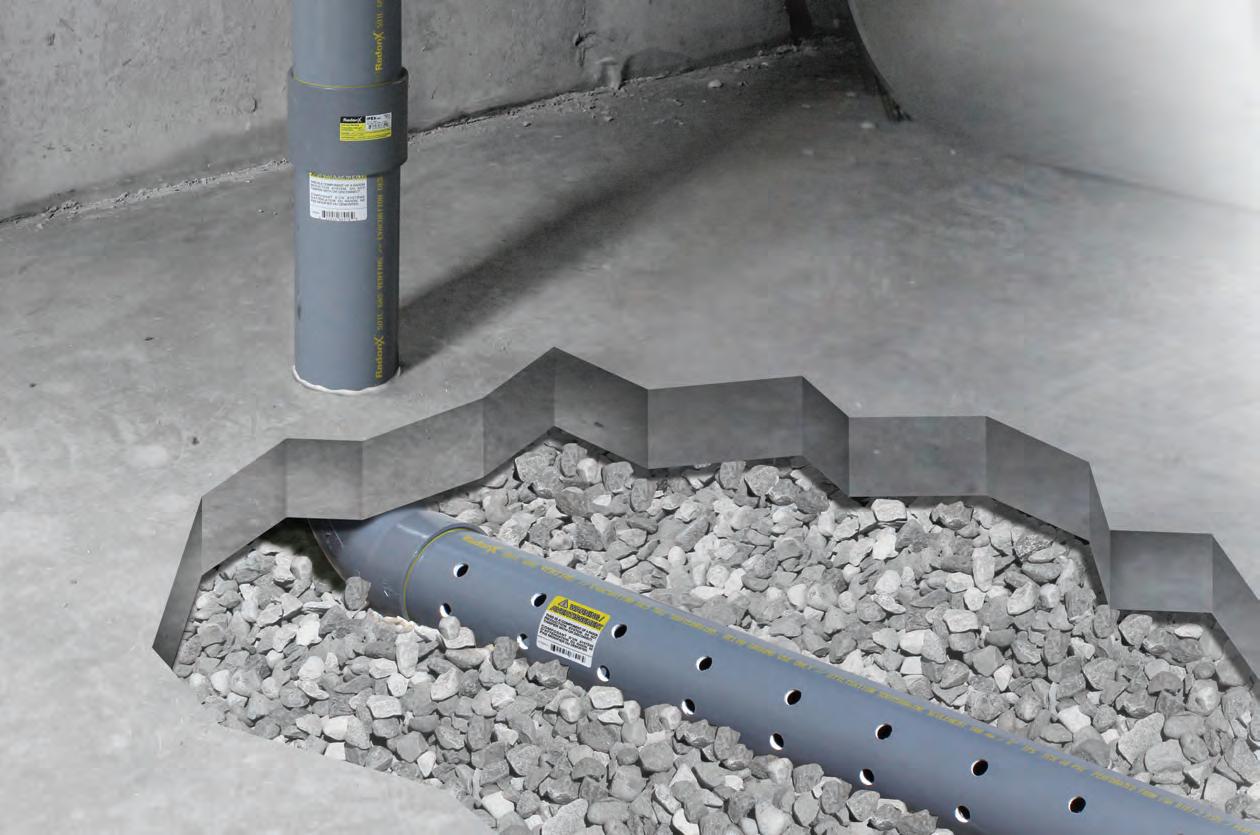
As a contractor or home builder, building safe homes for families is your first priority. Reduce the risk of radon gas exposure with RadonX™ Soil Gas Venting.
Did you know… Exposure to radon gas is a growing concern and is a preventable risk. Check with your building authority to confirm what your local requirements are when it comes to radon gas mitigation.
Open your IOS or Android device and scan here for more information
RadonX TM and Peace of Mind from the Ground UpTM are trademarks used under license. Peace of Mind from the Ground-Up™
RadonXTM Soil and Gas Venting ipexna.com | 1-866-473-9462 FOLLOW US IPEX by Aliaxis Learn more at CIPHEX West Booth #723 IPEX
By Lance MacNevin
Pressure testing PEX and PE-RT tubing systems with compressed air or inert gas

Pressure testing of a completed piping system is typically required by local code regulations and the pipe or tubing manufacturer to ensure pressure-tightness. In the construction of piping systems such as hot- and cold-water plumbing distribution, fire protection, water service, hydronic heating and cooling, and snow and ice melting systems, it is sometimes difficult to test systems using pressurized water because of freezing conditions, insufficient water supply, or insufficient water pressure. In these cases, pressure testing using compressed air or an inert gas such as helium or nitrogen is a preferred solution.
While some types of plastic pipe and fitting materials are not suitable and not permitted to be tested with compressed air or gas, crosslinked polyethylene (PEX) and polyethylene of raised temperature (PE-RT) are flexible tubing materials and not subject to brittle failure. These tubing materials are stronger than most would imagine, with minimum short-term burst strength of 3,275 kPa at 23°C (475 psi at 73°F) according to industry standards.
Therefore, it is the recommendation of The Plastics Pipe Institute (PPI) that PEX tubing systems produced in accordance with ASTM F876, ASTM F3253, AWWA C904, or CSA B137.5 and PE-RT tubing systems produced in accordance with ASTM F2623, ASTM F2769, or CSA B137.18 be permitted to be tested with compressed air or inert gas, provided that the manufacturer’s instructions are followed and that all testing is performed in accordance with local codes and regulations.
This is supported by the National Plumbing Code of Canada which permits the use of air pressure tests unless “…a manufacturer states that an air pressure test is not recommended.”
TEST PRESSURE
PPI’s generic recommendation is for the test pressure to be at least equal to the expected working pressure of the system, not less than 345 kPa (50 psi) and not greater than 1,103 kPa at 23°C (160 psi at 73°F), or as recommended by the tubing manufacturer.
However, keep in mind that CSA B214-21 Installation code for hydronic heating systems states “System piping and components shall be tested to withstand 420 kPa (60 psi) or 1.5 times the operating pressure, whichever is greater, for at least 1 hr with no loss of pressure.” When following this test requirement, be sure to not exceed the pressure rating of any tested component.
For systems that incorporate plastic fittings, valves, or manifolds, air testing shall be in accordance with each component manufacturer’s instructions. If the manufacturer of any pressurized component does not recommend air pressure testing at the required pressure, then that component must be isolated or removed from the system prior to an air pressure test.

92 Mechanical Business 10.23
HYDRONICS
It is sometimes difficult to test systems using pressurized water.
In some cases pressure testing using compressed air or an inert gas such as helium or nitrogen is a preferred solution.


817.335.9531 | lyncbywatts.com/aegis
Cleaner
to Heat
1.0
commercial heat pump water heaters use electricity and natural, non-toxic CO2 (R744) refrigerant to produce domestic hot water up to 170°F all year round with no need for supplemental heat.
The
Way
Global Warming Potential of
Aegis
Aegis® Electric, CO2 Heat Pump Water Heaters Lync/Watts
Available in air and water sources, as well as a unique hybrid air source with cool recovery, The Aegis is one of the cleanest, most efficient and environmentally friendly ways to heat domestic water. Learn more at lyncbywatts.com.
SAFETY FIRST
Compressed air or inert gas used for pressure testing has high potential (stored) energy. Any uncontrolled release of that energy can present serious safety hazards, such as an unsecured fitting being shot across a room at high speed.
Here are several recommendations to ensure safety when testing PEX and PE-RT tubing systems with compressed air or gas:
• Because of the flexible nature of PEX and PE-RT tubing, failure or separation of the tubing from a fitting or restraint may cause unrestrained tubing to whip or lash about as the energy of the suddenly decompressing air or gas escapes. Tubing must be properly restrained to prevent or limit whipping in these cases. All fastening and securing requirements of the PEX or PE-RT tubing manufacturer and local codes must be followed.
Tester for residential and commercial pressure testing of gas, air and water lines.

Tubing must be properly restrained to prevent or limit whipping.
• Any incomplete or unrestrained fitting could become a projectile during pressure testing. Therefore, all fittings must be installed correctly and inspected before testing.
• Only authorized people should be in the proximity of the tubing systems during the testing procedure and must be wearing the appropriate personal protective equipment.

• Tubing systems which are being tested with air or gas should be labelled as being under pressure to indicate that air pressure testing is underway.
• PEX and PE-RT tubing systems must be depressurized before any work is performed on any portion of the system, such as adjusting or inspecting a fitting or adding additional restraints to the tubing.

PPI recommends strictly following the PEX or PE-RT tubing manufacturer’s published instructions for pressure testing with air or inert gas, as well as the published guidance regarding other components of the tubing system, such as fittings or manifolds.
PPI Recommendation F addresses this topic in detail and is online at www.plasticpipe.org/buildingconstruction.

COMFORT DONE RIGHT
Lochinvar has long been an industry leader in commercial boilers—and now we’re bringing that engineering excellence to residential boilers.
The wall mount EPIC® boiler you know and trust is now available in floor standing models.


HYDRONICS Cont’d from pg. 92
94 Mechanical Business 10.23
What Makes EPIC a superior choice? · Easy To Install, Set Up and Service · Delivers Hot Water Faster · Display Screen Uses Text, Not Codes
Better Technical Support and Training · 10:1 Turndown Ratio
Floor and Wall mount available · Advanced Electronic Control
Lance MacNevin is director of engineering – Building & Construction Division with the Plastics Pipe Institute. He can be reached at lmacnevin@plasticpipe.org.
·
·
Lochinvar.com Aqua-tech
THE BEST IN FIRETUBE TECHNOLOGY



Avenger
Two pass fully condensing stainless steel boiler & water heater Models ranging from 1,000 MBH up to 4,000 MBH

Turndown of up to 25:1
• Up to 95% thermal efficiencies









Valiant-FT



Fully condensing stainless steel boiler (for floor or wall mount) Models ranging from 80 MBH up to 399 MBH

Turndown of up to 10:1


Up to 97% thermal efficiencies


www.camus-hydronics.com for more info
• • • •
Visit
•
Camus
BOOSTER PUMPS
By Tom Stephan
TROUBLESHOOTING TIPS FOR COMMON ISSUES
Booster pump systems are critical to maintaining the pressure and flow demands in modern high-rise buildings such as hotels and office structures so water pressure on the top floors is as good as that on the ground level. Given the importance of booster pumps in multi-storey buildings, it’s essential to keep these systems in good working order. There are many different things that can go wrong with booster pumps, from leaks to motor breakdowns.
Here are some guidelines for troubleshooting pump performance and steps to take to ensure maximum performance and avoid future problems.
Electrical issues
Booster pumps vary in terms of how much power they need, depending on the head and flow conditions required to meet the application. Ensuring a booster pump system operates within the minimum and maximum flow rate as close to the best efficiency point as possible will provide the longest product life.
With regard to incoming power supply, most motors are rated to handle +/- 10 per cent of the motor nameplate voltage. In some cases, such as with the use of a variable frequency drive (VFD), up to 15 per cent voltage variation may be possible, depending on the VFD. However, if the voltage is outside of the product’s recommended range, you risk excessive heating of the motor windings, which can greatly reduce the life of the motor. Both high voltage and low voltage to the motor tend to increase amperage. High amperage means high heat which is one of the most common failure modes in motors. Proper training and use of a meter for troubleshooting are beneficial, as is an understanding of key properties such as voltage, amperage, frequency, resistance and capacitance.


Mechanical Problems
Few people consider how water gets to the top floors of multi-storey buildings for everyday living purposes, such as drinking and bathing, and mechanical uses, such as cooling towers and supplying HVAC equipment.

A common mechanical issue is malfunctioning pressure switches. When low or inconsistent water pressure occurs, the solution often involves adjusting or replacing the pressure switch, as well as ensuring there is no blockage in the pressure line to the switch. The switch signals the system to start or stop pumping, depending on the pressure in the water system.
Another common mechanical problem is check valve failures. When the check valve is stuck open, the pump can spin backward causing additional wear and significant stress on the pump and motor if it was energized while spinning backward. The empty pipe and zero-pressure differential between the suction and discharge can lead to an upthrust condition on startup, causing considerable damage. When the check valve is stuck in the closed position, the pump will deadhead, adding significant energy to the water inside the pump. The result is excessive heat and no cooling flow for the motor, which can damage both the motor and the pump.
Other warning signs
Sometimes, problems can be attributed to improper system sizing, rather than a defective or broken component.
Pumps equipped with VFDs are designed to operate within a range of speed, and operate close to the best efficiency point which tends to be near the centre of the curve. With optimum conditions, pumps can operate trouble-free for decades. But indicators of a booster
96 Mechanical Business 10.23





WOODFORD MANUFACTURING 800.621.6032 • www.woodfordmfg.com Always. Look for the oval handle! x WILL NOT BURST. 5-YEAR WARRANTY GUARANTEED*. WOODFORD MODEL 19 ANTI-BURST FAUCET * If installed correctly Woodford
pump that has been improperly sized or incorrectly installed can appear sooner than that. These warning signs typically arise as deterioration increases.
Noise: Pump performance problems in the form of noise, humming or rattling may be due to insufficient water supply (possibly caused by suction issues). It may also be internal parts causing the problem, or the need for motor maintenance, such as lubrication, new bearings or cleaning.
Vibration: Feeling a pump during maintenance inspections can detect minor vibrations before the situation escalates. Make sure the mounting is sufficient, and if possible, reinforce the attachment. Additionally, booster pump systems can be equipped with sensors to automatically feed vibration data to condition monitoring equipment.
Heat: Whether coming from the motor housing or the pump itself, heat is another sign of friction, wear, pressure or out-of-tolerance issues. Sensors are also available to monitor temperature.
Low water pressure: Low water pressure can be attributed to many different issues. But, most of the time, it’s an issue with the suction. Suction issues on booster pumps are often due to clogged filters if pumps are not properly maintained and filters are cleaned infrequently. Another issue that can cause suction problems is a leak somewhere in the system. Or, it could simply be that a valve isn’t opened completely.
Pressure is too high: Booster pumps are meant to boost pressure, but they should stay within the maximum working pressure of the pump. Since most booster pumps are centrifugal pumps, any pressure on the suction is added to the pressure from the pump itself. It’s critical to keep this in mind when sizing the proper pump.
Recognizing the symptoms of common problems in booster pump systems can ultimately help contractors identify their causes and select the appropriate course of action before significant damage to the booster pump and motor occurs.
TROUBLESHOOTING TIPS AT A GLANCE

Most problems with booster pump systems can be divided into two categories: electrical or mechanical.

Electrical problems
• Ensuring a booster pump system operates within the minimum and maximum flow rate as close to the best efficiency point will provide the longest product life
• If the voltage is outside of the product’s recommended range, you risk excessive heating of the motor windings, which can greatly reduce the life of the motor
• Low-voltage conditions may result in a no-start situation

Mechanical problems
• Low or inconsistent water pressure could be the result of a malfunctioning switch or blockage in the pressure line to the switch
• Water pressure problems can also mean a bad check valve, which can cause additional wear and significant stress on the pump and motor
Other challenges
• Improper sizing or incorrect installation can also cause problems in booster pump systems
Short cycling: The phenomenon of booster pumps turning off and on within seconds or minutes is known as short cycling. Frequently, this is due to a leak in the system somewhere that needs repair. It could also be due to a waterlogged hydropneumatic tank in the system.
• Warning signs such as noise, vibration, excessive heat, unusually low or high water pressure, or short cycling all point to the need to determine the root cause prior to failure
BOOSTER PUMPS Cont’d from pg. 96
Tom Stephan is the training manager for Goulds Water Technology Factory School.
98 Mechanical Business 10.23
Condition monitoring allows for predictive maintenance.
THE DESCO THE DESCO EXCLUSIVE EXCLUSIVE


MADEIN CANADA
THAT YOU NEED TO KNOW THAT YOU NEED TO KNOW
AND
UNITS AND MORE A A CANADIAN-OWNED CANADIAN-OWNED DISTRIBUTOR DISTRIBUTOR SELLING PREMIUM SELLING PREMIUM CANADIAN-MADE CANADIAN-MADE BOILERS BOILERS
QUIET OPERATION • EXTREMELY QUIET OPERATION •
100,000, 140,000
•
100,000, 140,000
• LOCAL TECH SUPPORT AND PARTS AVAILABLE • LOCAL TECH SUPPORT AND PARTS AVAILABLE • 2-YEAR ‘NO QUESTIONS ASKED’ PARTS WARRANTY • 2-YEAR ‘NO QUESTIONS ASKED’ PARTS WARRANTY • 94% AFUE RATED WITH A DYNAMIC COMPACT DESIGN • 94% AFUE RATED WITH A DYNAMIC COMPACT DESIGN • LEARN MORE ABOUT LEARN MORE ABOUT ECO-KING! ECO-KING! ECO-KING SUPREME BOILER ECO-KING SUPREME BOILER Desco
HEATING AND HEATING AND DOMESTIC DOMESTIC BOILERS, BOILERS, ELECTRIC WATER ELECTRIC WATER HEATERS, GAS HEATERS, GAS UNITS
MORE
EXTREMELY
COMES IN
& 200,000 BTU
COMES IN
& 200,000 BTU
What is a reasonable (and effective) marketing budget for your business?

Even if you’re an expert, there’s no doubt that marketing your business has become more complex and expensive than it used to be. While staying on top of all of the options – and related costs – may feel like an uphill battle, we can look to the age old “work smarter, not harder” to achieve success. Instead of throwing money at the marketing wall hoping some of it sticks, careful use of your budget is essential, with solid Key Performance Indicators (KPIs) and analysis to consistently adjust the program towards the expenses that are yielding the best results.
KPIs can be identified by first defining your business plan and goals. What do you want for your year or two ahead?

Maintain status quo?
Overall growth, or growth in certain areas? Will you launch a new product or service that requires more budget to get off the ground? By asking yourself and your team these questions, you can determine where it’s most logical to invest your time and budget.
Rule of thumb
Once you’ve outlined the “where,” you’ll need to determine the general rule of thumb in your industry for the “how much.” B2B-based organizations typically invest two to four per cent of overall revenue into marketing; for B2C, it’s more like four to eight per cent. But like most things, it’s not always that black and white. Consider how competitive your market is, your current level of brand recognition within it, and those goals noted above.

DO: Recognize and properly approach the
If you’re a well-known player in the market, you may already have a name within your customer base. Are these one-time customers, or does your line of work support regular follow-ups?
If you’re brand new to the game, you
might consider those same questions, but add to the list how you can set yourself apart from other players who may already have historical advantage or long-time ties to your market. Onetime events, sponsorships or related investments can add a surge of awareness to get you on the field. When establishing your budget, you’ll also want to highlight and define any one-time marketing “capital” investments that may be needed in the next year: rebranding, costs of an upcoming move that’ll change up your signage and stationery, new vehicle graphics, websites, folders/brochures, a sizzling new video − anything considered to be more of a one off than an ongoing marketing cost.
Mechanical Business 10.23 with DOUG
Marketing
The Letter
To
MACMILLAN
Doug MacMillan is president of
M Marketing in Guelph, ON.
reach him, email doug@letterm.ca.
100
Time to prioritize
Once you have established your budget, look at the baseline ongoing must-have expenses. These would be considered a regular spend, but ones that might slip your mind or seem to pop up if you fail to incorporate them into your regular budgeting. These include services such as website hosting, subscriptions and memberships, current advertising contracts, and ongoing sponsorship commitments.

Then, it’s the wish list of good to have ideas. A head-turning mailer, radio ads with a sports celebrity spokesperson, a magazine … it’s important to let your mind run wild to land inventive and effective ideas.
Now that you’ve got a running list, it’s time to prioritize. Assign an order of importance system to all items, with one-star items being nice to have, and five-star items as non-negotiable. Time to move the list into Excel and sort the budget by this column to establish priorities and draw the line somewhere near the middle to bottom depending on how much money you feel you can comfortably spend.
TIP: With the pile of one-star “hope-to” items, flesh out the details, ideally drawing from a marketing plan. Put the work into researching to understand the actual costs of these items, rather than just allocating an amount and hoping it’s enough.
Your last call to action with this organized list is to establish if you have the capacity to successfully get it all done. Consider your human resources; will these activities be staff-led, or do you need an agency, freelance writer, or social media expert to help successfully execute them? If you require help, but outsourcing isn’t in the budget, ask yourself why. Is there a little too much on this plate? Are all your five-star items really non-negotiable? Don’t be afraid to re-evaluate once it’s laid out. You might take a look at your list and realize a, d, and f aren’t necessary right now, or the paid help you need outweighs a few of those three-star plans.
Digital marketing is easier to measure, of course, but it can’t be all you do. Rely on intentional anecdotal measurements. Ensure you ask how customers know about your business. Encourage employees to share the random stories they hear:
“I see your trucks everywhere” or “We all talk about how clever your rink board ads are.” These are important pieces of
Now that you’ve got a solid marketing plan and the accompanying costs, here are a few tips to stretch those dollars as far as they can go:
Consider partnerships and collaborations with other businesses that want to reach the same
Pulse your campaigns – consider periods of time where you can dial back on occasion to save some money without making a serious dent in presence/profile.
Look at donations of service/product to charity auctions and community events. They’re often a more affordable way to get brand presence.
• Invest in customer maintenance and stewardship. Put the work into keeping those relationships strong. Keeping an existing customer is always cheaper to finding a new one.
• Co-op students are win-win and they teach us things too.
Finally, do your best to set aside an “if needed” budget to allow for surprises and pop-up opportunities. We can always do our very best to plan, but if life teaches us anything, it’s that being prepared means preparing for the unexpected such as a sponsorship opportunity or a necessary vehicle replacement.
When in doubt, try the 70/20/10 rule: 70 per cent of your budget to activities with proven results for your business; 20 per cent to efforts that could be effective but aren’t as certain; and 10 per cent to new and untested activities. We don’t grow by staying the same, but we certainly can when we have faith in the evidence in front of us.
Back to the KPIs
Mechanical Business 10.23 101
STUFF YOU NEED
Tool backpack
KNIPEX Tools introduces the Modular X18 backpack, able to handle up to 33 lbs. of tools and supplies. The backpack features 21 retaining loops, 37 pockets, and a removable tool board, allowing users to customize how they pack supplies. Front and back panels fully hinge to allow for easy access to tools, and the waterproof moulded bottom is made of impact-resistant plastic to keep the bag in an upright position. The backpack also includes molle straps on the inside and outside and a magnetic Fidlock connector.

www.
knipex-tools.com
Hand towels
SCRUBS in-a-Bucket hand cleaner towels offer an advanced cleaning formula with a strong, dual-textured towel to clean hands and surfaces. The citrus-scented formula loosens and dissolves industrial soils, including oil, grease, dirt and lubricants, without making hands dry, sticky or irritated. After using the towels hands don’t require rinsing, meaning employees need fewer trips to handwashing stations.

www.
itwprobrands.com

Safety knife
The Secupro Merak from Martor USA is a squeeze-grip safety knife with fully automatic retractable blade, ergonomically friendly trigger mechanism, and a durable body made of polycarbonate plastic. The lightweight knife has a nine-mm cutting depth, and is suitable for general cutting tasks, with easy, tool-free blade change.

www.
martorusa.com
Headsets
Plant-Tours provides one-way and two-way communication headset systems that provide clear audio in large and loud environments. Ideal for use in employee training, the headsets are manufactured for long life in rugged conditions, and are ready to use out of the box and easy to set up. The headsets can be bought or rented, and free demo kits are available.

www.
plant-tours.com
Drain cleaner
General Pipe Cleaners’ hand-held Power-Vee drain cleaner with automatic feed features a quickchange cable cartridge for fast cable changing. It can feed up to 16 ft. of cable per minute to unclog sinks, tubs and laundry drains from 1 1/4 in. to 3 in. in diameter up to 50 ft. long. The Flexicore cable is kink resistant and comes with one-year protection against breakage. The optional Handy-Stand turns the Power-Vee into a countertop or floor machine, while the optional Uni-Stand securely supports the unit and reduces arm fatigue in tight workspaces.
www. drainbrain.com

102 Mechanical Business 10.23


LEARN MORE AT www.amana-hac.com and connected. Combining the Amana brand S-series and the smart thermostat is smart thinking inside and out. The Amana brand S-series system wouldn’t be complete without a smart thermostat to support control and comfort. The new Amana brand smart thermostat does just that! The range of intuitive functions offers homeowners control from almost anywhere via the Amana home app or voice control with compatible Amazon and Google smart devices (with Wi-Fi). AMANA
Breaking up is hard to do
What to do when it’s time to move on


By this point in your life, you have likely been on one side of the table or the other, either as an employee resigning from a job or as a manager hearing an employee tell you they are going elsewhere. Read on to learn how to navigate these conversations professionally and legally while protecting your reputation, safeguarding your business, and ideally, maintaining work relationships going forward.
There are any number of reasons why someone may decide to move on from their current role. Those who have been in the same role for some time may feel as though they have reached a stagnation point where they both no longer have anything to learn, nor is there any compelling reason to share what they know. They may be unable to see a path forward if they’ve reached the top of the pay range in their current role, and promotion is unlikely due to the size of the company or the tenure of higher-ranking employees. Or perhaps they have disagreements with their current supervisor or the style of management in place. Whatever the reason, the grass has shown itself to be a particularly fine shade of green elsewhere, and the decision has been made to resign.
If you find yourself thinking this describes you, there are some steps you can take before and during your notice period to ensure your exit is professional. And if you are the manager on the receiving end of the dreaded two week’s notice, you should have a process in place to ensure all exits are smooth ones.


Giving notice –as an employee


The first and genuinely most important point to make here is if you are going to quit your job, ensure you have a signed employment contract in place prior to informing your current employer you intend to leave. If you don’t have it in writing – you don’t actually have the job. Once you have locked down all the details, it’s time to have the talk. While some managers will take resignations verbally, best practice is to write your intentions down. A handwritten letter or an email are both acceptable. Keep a copy of anything you provide. Use straightforward, clear language that details your intended timing and thank the company for your time with them. This is not the place to air grievances or settle scores – keep it brief and polite. A typical notice period is two weeks, but employment contracts vary. Check to see if your agreement has any termination language or if your company has a resignation policy in place. Remember, leaving on good terms leaves a pathway open for you, whereas leaving on bad terms jeopardizes your future marketability and will prevent you from having a place to bounce back to if the new role does not work out.


Mechanical Business 10.23
HUMAN RESOURCES 104
By Sue Sodek
Getting notice –as a manager
No one likes to hear they are losing a star player and it can be tempting to skip the process and rush into worrying about back filling the role. But when one of your employees says they are leaving, take your time and follow the proper steps. Firstly, insist on a written resignation letter that is dated and signed. Should there be future disputes, this will be the first piece of evidence a lawyer or mediator will request. Next, you’ll need to decide how long you want this person to stay. Whether to allow someone to work out their notice period or ask them to leave immediately varies greatly depending on the circumstances and every exit is different. If they are likely to cause disruptions or discontent amongst those staying behind, you may want to offer to pay out the notice period (if necessary) and have them finish immediately. If it’s possible that given this notice time, they may walk off with clients or other staff, or if they were already on your radar as an underperformer, wish them all the best and hustle them on their way. If they are likely to continue to contribute effectively and you don’t have any concerns around clients or staff poaching, have them work their notice period. And finally, leading up to the worker’s final day, you’ll want to ensure you’ve booked an exit interview and retrieved any company property including keys, passwords, tools, phones and credit cards. You should develop a checklist to this effect in advance that includes materials, access points, passwords and any other security measures that may need reviewing when someone leaves.
The Stay Interview
A Stay Interview is similar to an Exit Interview, in that the goal is to probe for information on what you can be doing better as an employer. The difference here is you can use this information now in the hopes of keeping your staff engaged, happy and in their roles longer, instead of just learning what went wrong after the fact. The benefits of asking what might be pushing an employee to look elsewhere for work before they actually give notice are obvious. By knowing what they want, you’ll retain more of your key players and save yourself the time and cost of recruiting and training new workers. Stay Interviews can be conducted at any time.
To conduct a Stay Interview, start by setting your employee
at ease by letting them know you are planning to have conversations with all of your strong performers, just to find out how things are going. Ask open ended questions, and this is key, actually listen to what they have to say. It doesn’t sound all that difficult, but in practice we are so often locked into problem solving mode while at work, it can be really tough to pipe down and let someone tell you where they think you are going wrong. And it’s even harder not to interrupt and start offering solutions and promises, but remember your goal in the Stay Interview is just to gather information.
Once you’ve compiled and reviewed the employee feedback, look for commonalities. Is there a skills deficit that can be solved with more training? Are employees under stress due to wage rates, hours or working conditions? Is there a supervisor that consistently receives negative feedback? The issues raised should become action items. Let the Stay Interview become an ongoing process; when you’ve made a change, take the time to find out if it’s had the desired impact. A Stay Interview need only last 15 to 20 minutes. Or to put it another way, investing the time it takes for an average coffee break could save you thousands of dollars in recruitment and training costs, shore up employee relationships and cement your reputation as an employer that cares. In today’s job market, this could be just the thing you need to avoid that messy breakup.
Exit Interviews
Employee Retention
Ideally, there shouldn’t be surprises in the employment relationship, even when it comes to the end. If you are regularly checking in with your staff you should have a good grasp on how things are going. Still, when a separation does occur, someone on their way out the door can provide excellent insights into how your business is running and what it’s like to come to work for you on a day-to-day basis. Take the time to talk to employees who are leaving, so you’ll be in a better position to keep the ones that are staying happier.
Mechanical Business 10.23 105
Exit as an employee
If you are an employee and you’ve been invited to participate in an exit interview, proceed with caution. As your mum likely taught you: if you can’t think of anything nice to say, don’t say anything! If you have genuinely constructive feedback that might have a positive impact on those you’re leaving behind and you feel the person on the other side of this conversation is open to hearing it, by all means, share it with your manager. Be polite, be specific and avoid painting the company in a fully negative light. You are under no obligation to tell your current employer any details about the new position. As an example, if you are asked about your reasons for going and you dislike your supervisor or the pay is terrible, you could say you feel the new place has a more positive management style and the pay is more in line with the current market. If there are specific, actionable items such as better equipment, specialized training, perks or benefits that would have kept you in your role, let management know. However, if you feel that any information you share may be misconstrued, or reflect negatively on you, it may be best to keep your insights to yourself in the interests of protecting your reputation or future opportunities.
Exit as a manager
Whenever possible, speak to each and every person leaving, regardless of the length of time they work for you or the reasons they give you for leaving. Quite often, staff wait until the exit to be completely honest with their employer and what they have to share may help you uncover potential problem areas. Aim to meet in a neutral location, close to the end of their notice period. Using broad, open-ended questions, probe for what went well, what should have gone differently and what they suggest you do to change.
If they are leaving for a new role and are open to sharing information about where they are going, ask about pay rates, location and other perks; this can help you understand if you are still competitive in your marketplace or act as a warning that you’re likely to lose more staff for the same reasons. While non-compete clauses are now unenforceable in most of Canada, the exit interview is an excellent time to remind departing staff of any non-disclosure clauses in their employment contracts. And one final note, this is not the time to make a counter offer – exit interviews should be done only when all else has failed and their final decision has been made.
Sue Sodek has over 20 years of human resource and consulting experience across a variety of businesses, and currently manages HR for UCEL Inc. in Uxbridge, ON. She can be reached at sue.sodek@gmail.com.
2023 CALENDAR OF EVENT S
CIPHEX West 2023
October 18 – 19
Calgary, AB ciph.ca
MCA Canada Annual National Conference
October 18 – 21
Napa Valley, CA mcac.ca
European Heat Pump Summit 2023
October 24 – 25
Nuremberg, Germany hp-summit.de
Dreamer Day
October 25
Toronto, ON webuildadream.com
NEBB Annual Conference
October 26 – 28
Monterey, CA nebb.org
2024
AHR Expo
January 22 – 24
Chicago, IL ahrexpo.com
IAQA Annual Meeting & Expo
February 6 – 9
Tampa, FL iaqa.org
NADCA Annual Meeting & Expo
March 4 – 6
Las Vegas, NV nadca.com
EIA National Conference & Expo
March 15 – 21
San Diego, CA eia-usa.org
Habitat for Humanity Gala
March 19
Toronto, ON ciph.com/page/CIPHCharity
CMPX
March 20 – 22
Toronto, ON cmpxshow.com
ASHRAE Annual Conference
June 22 – 26
Indianapolis, IN ashrae.org/conferences/2024-annualconference-indianapolis
2025
MCEE
April 24 – 25
Montreal, QC mcee.ca
Unless specified otherwise, events are in-person. For an expanded calendar and the most current information regarding event status visit mechanicalbusiness.com.
Mechanical Business 10.23 106
HUMAN RESOURCES Cont’d from pg. 105


Up to 15.2 SEER2 and 8.5 HSPF2 Up to 80 % Heating Capacity at Outdoor Ambient Temperature of -30 °C Integrated 24 V Control Logic for Easy Installation Combination now eligible for government grants with ANY 3rd party furnace ! UNIX SERIES HIGH-EFFICIENCY CENTRAL HEAT PUMPS WITH CASED COILS HEAT PUMPS DESIGNED FOR CANADIANS UP TO $ 5,000 ! Greener Homes Initiative Stock now available in BRAMPTON, Ontario Join the GREE Canada team ! Contact us to become a certified dealer. BENEFITS Local sales and after-sales support Frequent sales and technical training Largest inventory of GREE products and parts in Canada APPLY TO BECOME A DEALER HERE : Replaces conventional top discharge heat pumps GREE CANADA


108 Mechanical Business 10.23 www.ahrexpo.com www.americanstandard.ca www.drainbrain.com www.goodmanmfg.com www.gree.ca www.hisense-canada.com www.hargassner-northamerica.com www.hi-velocity.com www.nibco.com www.keeprite.com PAGE# 66 www.camus-hydronics.com www.canaturewg-cied.com www.ciphexwest.ca www.contrac.ca www.hotwatercanada.ca www.amana-hac.com www.aquatech-canada.com www.bradfordwhite.com www.daikincomfort.com www.flocor.ca www.ipexna.com www.kanetest.ca www.giantinc.com www.caleffi.com www.navieninc.com PAGE# 63 PAGE# 94 PAGE# 19 PAGE# 79 PAGE# 22 PAGE# 2 PAGE# 29 PAGE# 107 PAGE# 27 PAGE# 33 PAGE# 36 PAGE# 85 PAGE# 53 PAGE# 87 PAGE# 103 PAGE# 83 PAGE# 95 PAGE# 5 PAGE# 47 PAGE# 35 PAGE# 93 PAGE# 7 PAGE# 23 PAGE# 25 PAGE# 75 www.oatey.ca www.ntiboilers.com www.novowater.com PAGE# PAGE# 52 PAGE# 9 www.honeywell-refrigerants.com PAGE# 91 PAGE# 71 www.desco.ca www.nextsupply.ca 13 PAGE# 77 PAGE# 99 www.lyncbywatts.com www.master.ca







PAGE# 147 # # # PAGE# 93 # PAGE# 61 PAGE# 139 Mechanical Business 10.23 109 FEATURES -Cooling Capacity -Heating Capacity (BTUs): - Installation Versatility: - Easy installation: just a few minutes - Rotating Flap: Provides total air diffusion for consistent temperature throughout the space. - Backlite Display: On-board touch control - User Control Options: Multifunction remote (Standard) Wireless Wall Mounted Thermostat (Optional) - 24 hour Timer - Sound Transmission: Best in Class STC snd OITC FUNCTIONS Dehumidification Mode: Controls humidity during mild ambient conditions for increased comfort Fan Mode: Variable speed motor maintains a consistent temperature throughout the conditioned space. Economy Mode: Allows for energy saving by automatically optimizing the unit’s performance Auto Mode: Adjusts comfort settings based on ambient conditions Sleep Mode: Gradually increases the temperature setpoint ensuring whisper quiet operation, greater comfort and energy savings while you sleep. Silent Mode: Allows the user to set the system to minimum sound level. MAESTRO PRO INVERTER 12 HP AB C Weight 35.6"8.5"20.5"86 lbs Maestro Pro1 technology heating and cooling applications B SILENT MODE Maestro Pro is designed so the inverter compressor and variable speed fan motor operate maximum acoustical comfort down to 32 dBA power). All enclosed in a sleek Italian designed cabinet by Matteo Thun and lined with state-of-the-art sound reducing material. PRO POWER The use of inverter technology provides a capacity boost up to 11,600 btu/h VARIABLE SPEED FAN (ECM) The fan motor has a variable frequency drive technology installed to control motor speed and torque (V PRO). Designed to eliminate swings in temperature resulting in reduced energy consumption while providing REMOTE CONTROL Fully Digital” remote control allows functions such as dehumidification, silent mode, sleep mode and ventilation mode. 72 $ www.olimpiasplendidusa.com PAGE# 67 PAGE# 37 www.watts.ca www.primewarranty.ca www.viessmann.ca www.pppinc.net Join us for the November/December issue: • Trends in commercial plumbing • Building controls • District energy systems • Commercial Truck ReportPart 2 NEXT ISSUE IN THE Inquiries welcome: Sales: Kyle.Badder@mechanicalbusiness.com | 416.735.1375 Editorial: Kerry.Turner@mechanicalbusiness.com | 416.435.1193 www.sharkbite.com www.rscool.com www.rsl.ca www.reedmfgco.com SEE YOU AT CIPHEX WEST MB Booth #333 PAGE# 16 PAGE# 49 PAGE# 41 PAGE# 55 PAGE# 60 PAGE# 43 PAGE# 18 PAGE# 61 PAGE# 81 PAGE# 65 PAGE# 73 PAGE# 11 PAGE# 112 PAGE# 64 PAGE# 97 www.tacocomfortsolutions.com www.thermopan.com www.taylorwalraven.ca www.osb.ca www.radianthydronics.com PAGE# PAGE# 6 E# 38 PAGE# 59 OXFORD ENERGY SOLUTIONS INC. www.oxfordenergy.ca www.uponor.com www.watcomfg.com www.woodfordmfg.com www.victaulic.com www.wilo-canada.com www.rheem.com PAGE# 17 111 E# 39
TAKING ACTION ON CLIMATE CHANGE
10 billion
Dollar amount the federal government has invested since 2015 to keep communities safe from climate change, including disaster relief.
73
Number of actions and initiatives included in Canada’s Adaptation Action Plan, part of Canada’s new National Adaptation Strategy on climate change. That includes initiatives related to wildfires, heatwaves, thawing permafrost, rising sea levels, flooding, freshwater, supply chains and security.

ACCIDENTS HAPPEN
11
Average number of days away from work due to injuries in the construction sector according to Procore.
65.5
Percentage of deaths Procore says occur in construction from four incidents: falls, slips and trips – 35 per cent; struck-by incidents – 17 per cent; electrocution – 7.6 per cent; and caught incidents – 5.8 per cent.

42.2
23,000
Number of electric vehicle charging ports in more than 9,100 public places across Canada as of August 2023, according to a database maintained by Natural Resources Canada (NRCan).
12
Percentage of charging ports that are in Montreal; 10 per cent are in the greater Vancouver area.
52,000
Number of charging ports NRCan estimates Canada will need by 2025, when onefifth of all new cars sold will be electric.

100
Percentage of new cars sold in Canada NRCan estimates will be electric by 2035. That will require up to 499,000 charging ports.
GOING ELECTRIC CYBERCRIME ON THE RISE


1 in 5
Number of Canadian businesses that say they have been the victim of a successful ransomware attack in the past year, based on a 2021 Canadian Internet Registration Authority (CIRA) survey.
69
Percentage of businesseswhich paid ransom demands.
61
Percentage of businesses surveyed that have created training materials to improve security awareness internally. Fifty-nine per cent now have cybersecurity insurance coverage as part of their business insurance; 44 per cent conduct phishing simulations; and 20 per cent have a cybersecurity-specific policy.
56
Percentage of businesses that say cybersecurity requirements in contracts with third-party vendors are now more common.
Heat in Celsius reached at the Lytton, BC climate station in mid-August, as reported by the Canadian Press. There were 48 daily heat records set in BC that month, as the southern part of the province experienced a prolonged heat wave.
Mechanical Business 10.23 .
BTN Compiled by Mechanical Business BY THE NUMBERS
110



Introducing our testable Bath Waste system. Designed by Plumbers. For Plumbers. To view our complete Bath Waste assortment, visit: www.osb.ca Your job just got easier.® Testable Rough-ins available in PVC and ABS models, with and without Condensate option. Styles include: Offset and Direct, in 16”, 20”, Kit and Half Kit. SlideOn™ Faceplate (choice of Bell, Square or Round) Closure mechanism (choice of Clicker® or Lift&Turn) New! Special finish Trim Ring w/adhesive back (Shown in Matte Black. Available in Brushed Nickel, Venetian Bronze and Matte Black Trim Kits only). ++ Trim (sold separately). Rough-in Thread-in Test Plug w/metal post Thread-in Test Plug. Must be removed for Faceplate installation Polished Stainless Steel Strainer Thick foam overflow gasket with adhesive back Overflow head featuring an integrated 6 degree angle Aggressive threads for a quicker and tool less installation Angle Adapter included. Use optional. Use is optional. Offers up to 6 degrees of angle in any direction. Can be used in multiple fitting locations (i.e. Overflow Tee, Waste Arm, Tee Outlet). 7030TDRI-16 Rough-in Shown OSB/OS&B


Take Control of Home Water Quality Scan to Learn More 1 (888) 208-8927 | Watts.ca Help Your Customers Protect What Matters Most with the BB-S101 Thousands of Canadians struggle with long-term drinking water advisories. Empower customers to keep their water supply safe with the Big Bubba® BB-S101 – the whole-home filtration system offering best-in-class PFOA/PFOS, lead and cyst, and chlorine taste and odor reduction. The BB-S101 comes standard with our Water Quality Monitor. Text and email alerts notify homeowners when to change the filter to keep sparkling clean, great-tasting water flowing. Watts
