The local brands rejecting fast fashion
Our interview with the political comedian coming to town
Meet the man behind Bristol’s most unusual place to stay
Tune into the creative ways students will learn this school year
Tommy Shelby on stage, like you’ve never seen him before




10 MY BRISTOL
Meet Vanessa Kisuule, former Bristol City Poet, who is releasing a new book this month
16 WEAR IT, REPAIR IT
Forget fast fashion, we bring you the city’s best sustainable clothing brands
24 NISH KUMAR INTERVIEW
Expect debonair, outraged conviction and a quota of political commentary
26 HOT OFF THE PRESS
Our friends at Gloucester Road Books share new releases that are sure to excite
What’s occuring in the city this month?
34 BLINDED BY THE LIGHTS
Peaky Blinders creator Steven Knight talks about the hit stage show coming to town
38 POLAR OPPOSITES
Two extraorindary swimming doctors are going to the ends of the earth, literally, for charity
40 HEY, BIG SPENDER
We chat to musician and YouTuber Mary Spender ahead of her special September homecoming show



42 ART & EXHIBITIONS
Films, paintings, open exhibitions and more to feast your eyes on this month
54 PLANE SAILING
Johnny Palmer on entrepreneurism, owning a Boeing, disruptive activism and mental health
62 THE SOUND OF MUSIC
Children across Bristol will have better access to creative education. Find out how...
66 2024 SCHOOLS DIRECTORY
Our annual, essential guide to selected schools
76 BRIDGING THE GAP
Andrew Swift embarks on another adventure
88 GRASS IS ALWAYS GREENER
Elly West confesses her love of ornamental grasses
On the cover
Reuse, repair, recycle. It’s Sustainable Fashion Week this month, and who better to champion its values than local brand Wear My Wardrobe Out. Find out more on page 16. (Image credit: Maria Loria, wearmywardrobeout.com)









What are you wearing right now? As creepy as that sounds, I’m genuinely interested, as are lots of other people around the city this month, which sees the return of Sustainable Fashion Week. I’m currently typing in an outfit I scored at the quarterly clothes swap I do religiously with friends. These usually happen because someone’s moving house, or having a baby, but they’ve become habitual, and bring a bit of balance – and light relief – to the rest of the year’s dopamine-rich spending on shiny new things to wear.
After speaking with a couple of experts on the subject, Sustainable Fashion Week’s founder Amelia Twine and local pre-loved fashion influencer Ellen Urquhart (whose efforts just so happen to have been picked up recently by both BBC Radio Bristol and The Times), it turns out that clothes swaps are a great way to keep your wardrobe fresh. They shared some of their favourite local brands who are keeping the city glad-ragged in ways that are a kinder to our planet from page 16.
I’m full of that ‘new term’ feeling, despite not having actually started afresh in September for about 15 years. But rather than shake it off and count the days until December (don’t…), we’ve gone all out now that school’s back in. We hear all about the roles cultural stalwarts Bristol Beacon and Bristol Old Vic will play in the creative education of our city’s young minds thanks to new programmes, status and funding on page 62, and our annual school directory makes its triumphant return on page 66.

We obviously can’t ignore the aircraft patiently waiting at the top of this page, either. But rather than spoil the fun, flick to page 54 in order to find out more about the man behind one of Brislington’s more unusual places to hang out, and discover what he’s got to do with disruptive activism, male mental health, free creative art spaces, and Warleigh Weir (plus the occasional drum ‘n’ bass rave).
Publisher Steve Miklos
Email: steve@thebristolmagazine.co.uk
Financial Director Jane Miklos
Email: jane@thebristolmagazine.co.uk
Editor Rosanna Spence
Tel: 0117 974 2800
Email: rosanna@thebristolmagazine.co.uk
Assistant Editor/Web Editor Maria Robinson
Email: maria@thebristolmagazine.co.uk
Production Manager Jeff Osborne
Email: production@thebristolmagazine.co.uk
Advertising Sales Liz Grey Email: liz@thebristolmagazine.co.uk
For advertising enquiries please contact us on: 0117 974 2800 Email: sales@thebristolmagazine.co.uk
The Bristol Magazine is published by MC Publishing Ltd. An independent publisher.
Every month The Bristol Magazine is hand delivered to more than 15,000 homes in selected areas. We also deliver direct to companies and businesses across the city. Additionally there are many places where we have floor-stands and units for free pick-up:


The Bristol Magazine Tel: 0117 974 2800 www.thebristolmagazine.co.uk

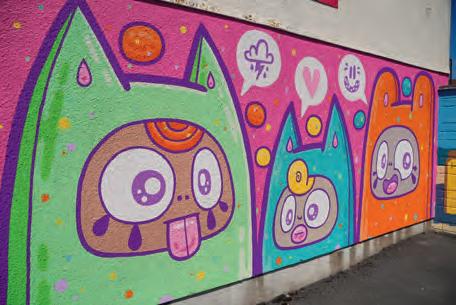
Returning to the seafront, Weston Wallz is set to make a splash in Weston-super-Mare until 15 September, in its fourth year of street art activity. In partnership with Superculture and supported by Weston Town Council & Arts Council England, the 2024 edition of Weston Wallz is introducing brand-new artworks, as well as workshops for art lovers to get involved in. Adding to the existing 46 murals, this year expects to see 18 new large-scale artworks pop-up across Weston, from a talented range of local, national and international artists.
Info can be found at superculture.org.uk

Bristol Cocktail Weekend is back with a bang, which will see the city’s finest mixologists shake and stir creations from 26-29 September. There are special drinks and food deals to be enjoyed across the weekend, and you can even vote for your favourite tipple to win an award. bristolcocktailweekend.co.uk
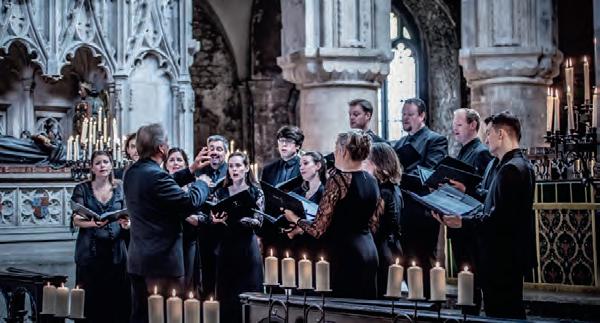
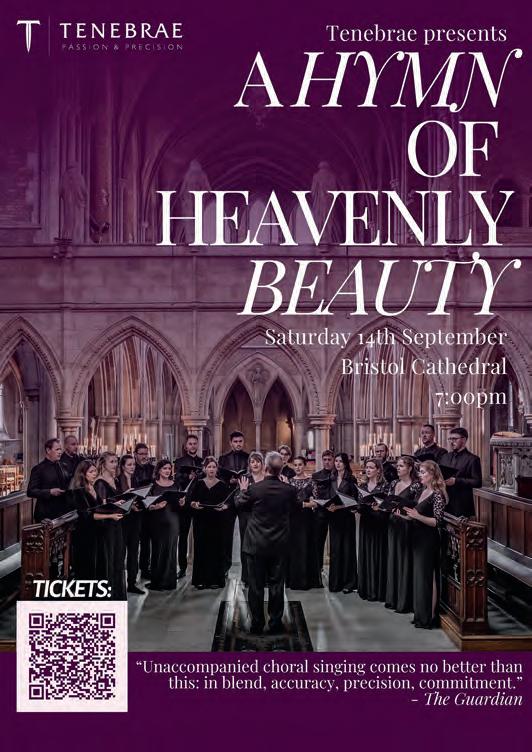
Internationally-renowned choir Tenebrae is thrilled to be giving its first ever performance in Bristol Cathedral on 14 September, 7pm, when it will be performing one of its favourite programmes, A Hymn of Heavenly Beauty. Ranging from Allegri’s haunting Miserere mei, Deus to Holst’s resplendent Nunc dimittis, the programme showcases the soaring contrapuntal lines of the late Renaissance, as well as beautiful, intimate settings by some of today’s most talented composers. Nigel Short will also be running a Tenebrae Effect Workshop on the morning of the concert, and you can join him in the Chapter House of Bristol Cathedral to discover what makes Tenebrae's choral sound so unique. Workshop attendees are entitled to 10% off tickets for the concert that evening.
tenebrae-choir.com
Once again, local shantymen High and Dry bring you the free Bristol Shanty Festival on 21 September. All participating venues are along the Bristol harbourside, mostly overlooking the water or floating on it, including the main stage in Brunel Square, as well as Underfall Yard, the MV Balmoral, The Junction, Arnolfini’s harbourside bar, M Shed and The Shakespeare. There are 50 performances planned, and expect some charity collections across the day. Time to start warming up your vocal chords, m’hearties! bristolshantyfestival.com

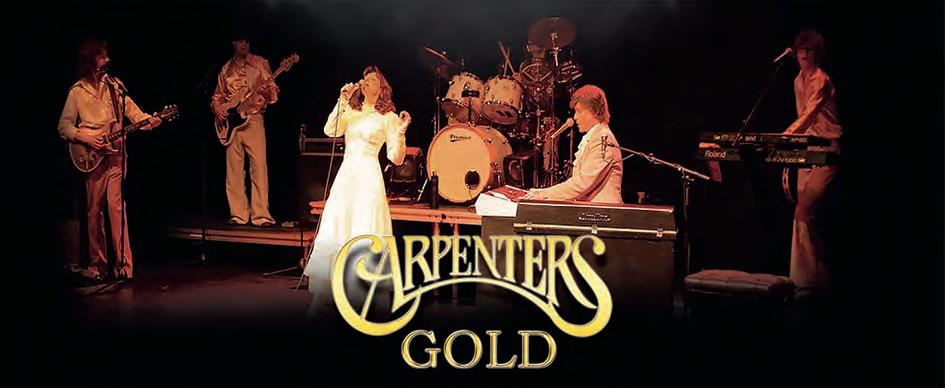
Carpenters Gold authentically performs the iconic band’s greatest hits, such as Goodbye to Love, Solitaire, We've Only Just Begun, Top of the World, Yesterday Once More, Superstar, plus many more; recreating the look and sound of the worldwide 1970 tours, including a special highlight where 'Karen' plays the drums with her full live backing band. Carpenters Gold will be at the Redgrave Theatre on 27 September at 7.30pm. A must for fans of Karen and Richard. redgravetheatre.com


Vanessa Kisuule: local poet, writer/author and performer
Photo by Jon Aitken
I came here for university in 2010 to study English Literature and I loved it so much that I stayed. It’s the only place that’s felt like home and over the 14 years I’ve lived here Bristol manages to retain a level of infinite novelty while feeling familiar and homely.
Stoke Park is my go-to place when I’m deep in the midst of a writing project. It’s wide and sprawling, with open fields and little bits of woodland, the perfect place to get my scatty thoughts to coalesce. I also really enjoy that there are goats randomly grazing up there.
Bristolians I’m admiring at the moment include Travis Alabanza, who is the most stunning writer, performer and artist. They know how to pack a political punch, but also be fun and cheeky with it. Their book None of the Above is not only fantastically written, it completely changed my relationship to notions of gender. Tom Sastry is one of our best poets: subtle, moving, a dry wit and an ability to break your heart without a whiff of sentimentality. Any musical endeavour that DJ and singer Ngaio Aniya is involved with is sure to be sublime. I’m really enjoying Holyseuss Fly’s trajectory as a musician, she’s really come into her own recently. And Kirsty Jones is a brilliant upcoming poet who everyone should keep an eye out for.
If I could change one thing about Bristol, I’d make housing affordable for all. The escalation of rents and the continued prevalence of short-term lets/Airbnb properties when so many people are struggling to find places to live is abhorrent.
Being in a city full of other artists has definitely bolstered my creativity. It’s a city full of character and contradictions, which makes it ripe for poetry. It also feels like a city unafraid to wear its politics and moments like the Edward Colston statue felling have deeply informed me as a writer. The poem I wrote after that moment definitely took my career to a new level.
I have this quote from Toni Morrison in my mind often: “Love is divine only and difficult always. If you think it is easy you are a fool. If you think it is natural you are blind. It is a learned application without reason or motive except that it is God”. It reminds me that love in all its forms (and for me, I think of it most in the communal and platonic sense) is a verb and an ethic. I take God to mean something divine, not necessarily a god from any formal religion. I just think it’s the most bracing and wise thing I’ve ever read about what it means to care for our fellow human beings. And of course it came from Toni, who was one of the wisest human beings to grace the Earth.
I’m very proud of myself for finishing my latest book, Neverland. Regardless of the reception, which I of course hope will be positive, I am just relieved and amazed that I finished, because over the four years it took to write it there were many moments where I didn’t think I would...
Neverland: The Pleasures and Perils of Fandom by Vanessa Kisuule is out on 12 September (£18.99, Canongate); vanessakisuule.com


Witness Charles Dickens’ timeless Christmas classic come to life in the night sky for a captivating new animated drone light show at the Seat Unique Stadium (BS7) on 19 and 20 December, booking tickets now before they sell out.
A Christmas Carol, the drone light show, presents the very latest in creative entertainment with a magical celebration of the Christmas spirit. Witness famous characters brought to life in the sky as you’re taken on a heart-warming narrated journey through the immortal tale of miserly Ebenezer Scrooge on Christmas Eve and his ghostly visitors who lead him to profound transformation. Have an unforgettable time with your friends and family. Enjoy magic in the sky, festive favourites in the food village and a world-class stadium experience where every seat is a front row view to the world’s biggest stage – the sky. The 45-minute experience will comprise an 18-minute pre-show and a 27-minute drone light show with captivating narration and soundtrack. There was also be a Food village and refreshment stalls from independent traders. Tickets are available via yuup.co/a-christmas-carol/bristol

Tim ‘Avicii’ Bergling was one of our time’s most celebrated and beloved musical visionaries, and his legacy is ever evolving. Stockholm’s Auktionsverk is honoured to present The Avicii Collection – A charity auction. On 1 October, 267 lots of Tim Bergling’s personal items will go under the hammer in Stockholm. No reserve, no commission. All proceeds from the charity auction will benefit The Tim Bergling Foundation in their work for the mental health and well-being of young people. The auction will be published from 6 September auctionet.com and stockholmsauktionsverk.com

Estate agency Boardwalk has teamed up with Bristol animation legends Aardman for a city-wide school art competition. The Big Draw art competition is live now, and runs until 25 October, in primary schools across Bristol. The concept, devised by Boardwalk and Aardman, asks children aged 4-11 to recreate their favourite Aardman character as their entry into the competition. All art forms are welcome and the only rule is to have fun! A winner will be selected by Aardman director and graphic design lead Gavin Strange, and will receive an Aardman model making workshop, along with £200 towards their school's art department.
Boardwalk is delighted to partner with Aardman, the worldfamous, Academy Award-winning animation studio, for the competition. The studio gave life to family favourites Wallace & Gromit, Shaun the Sheep, Chicken Run, Morph and many more. Aardman is a shining example of Bristol's creative spirit and the power of storytelling.
Aardman’s equality, diversity and inclusion (ED&I) project lead, Eva Poliszczuk, says: “We are thrilled to support Boardwalk on their initiative which helps fuel creativity throughout Bristol. As part of our ED&I commitment and outreach, we want to help inspire the next generation within our community to harness creativity by offering unique experiences such as these. We are so looking forward to seeing what wonderful creations come back!”
Boardwalk is on a mission to drive creativity in Bristol, providing opportunities for local artists and businesses to ignite communities’ imaginations. The Big Draw aims to inspire the next generation of creatives and encourage primary school pupils from across the city to harness their imagination.
Tom Lack, Boardwalk’s creative director, states “Boardwalk is thrilled to team up with Aardman to get more kids having fun and getting creative. In a world full of algorithms and AI, Bristol stands out as a bastion for creativity and innovation. What better way to inspire the city’s next generation than with some of the world’s most original and inspiring characters!”
thebigdraw.uk



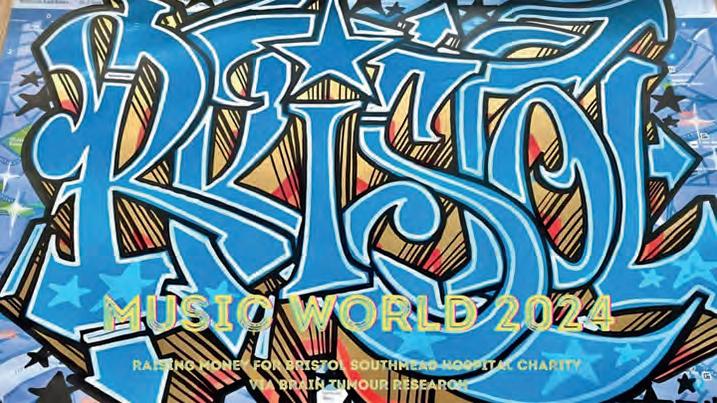
Brain tumour survivor and singer Harriet Annabell has rallied local musicians and artists to collaborate on a new album called Bristol Music World 2024, to give thanks and raise both awareness and funds to support brain tumour research at Southmead Hospital Charity (where Harriet received lifesaving medical care during an emergency operation in 2021).
Bristol Music World 2024 will be celebrated at a special launch party at The Mount Without on Thursday 26 September from 7pm until 11pm, with performances by participating artists on the album in the iconic main hall, followed by DJs and celebration drinks in the crypt afterwards.
“All the artists have very kindly donated their tracks, and Inkie has donated his fabulous graffiti artwork, which Bristol is well known for, to put on the album cover [pictured below],” Harriet says. “It's been an incredible journey and we would love everyone to help us raise money to make this an incredible, memorable event.” CDs of the album will available to purchase (launched officially from 1 October), as well as products on Etsy, sales of which will go to the charity too, and there is a donation fund set up that anyone can contribute to. The jumpers, T-shirts, cups, bottles and mouse mats will all be online until the end of the year. Details of the fundraiser, as well as links to buy tickets and more information can be found online via linktr.ee/bristolmusicworld

Local charity Friends of Morazan has joined forces with former Mayor George Ferguson to launch a fundraising drive to build a much needed preschool in Bristol’s twin town of Puerto Morazan in Nicaragua. George has agreed to match the first £2,500 donated, pound for pound, and then Bristol Link with Nicaragua will match the second £2,500, up to £5,000. In May of this year, George (pictured above, centre) spent a week in Nicaragua, including visiting Puerto Morazan and meeting the parents and children who will benefit from the planned ‘Jose Montealegre’ preschool.
Tom Hore, a trustee of Friends of Morazan, says: “We have built 10 preschools in Puerto Morazan so far and have an excellent working relationship with our partners there. The local mayor’s office has offered the land for free and has cleared it. The regional Ministry of Education has confirmed it will pay the teachers’ salary. And the local community will be involved offering their labour and hosting the building team for two to three weeks.”
George adds: “At the moment, the children are having to use the crowded library room in the primary school nearby, which is not fit for purpose. If we can build this new school it will not only benefit the 40 or so children currently registered, but it will last for at least 30 more years and benefit hundreds of local children. And we will add an appropriate latrine and small educational garden. Finally, we will fund a local mural artist to work with the children to create a large peace-themed mural on one side of the school to mark World Peace Day in September.”
fundsurfer.com/nicaragua
Chris Brown has produced a chilling conspiracy thriller for the modern age. Chicken City, the sequel to Guilty Tiger, is 1984 meets The Girl with the Dragon Tattoo in a frightening tale of morality and slavery against the backdrop of the migrant crisis in post-Brexit Britain.
Tony Lee Moral is an expert on Alfred Hitchcock, and has drawn from his extensive research on the director’s style of storytelling to write fiction novel The Passion of the Cross, set in Italy’s iconic cities – this is one for fans of Dan Brown, Lee Child and James Patterson.
Richard Perceval Graves’ memoir A Very English Family (1945-1954) will hold special significance for fans of Robert Graves, offering exclusive insights and unpublished details about the famous poet and author. It should appeal to both older readers who lived through the postwar era and younger audiences curious about a world without modern technology, offering a nostalgic journey for some and an educational experience for others.
The Habit I Cannot Break by Susan Tennyson, follows Jacob and Leo as they navigate the challenges of love, acceptance, and staying true to themselves. Will they overcome the obstacles that stand in their way? You’ll have to dive into the pages of this suspenseful and heart-warming story to find out.




Bristol‐born initiative Sustainable Fashion Week takes place this year between 20‐29 September, and it’s bigger than ever before. So, we asked the campaign’s founder Amelia Twine and local sustainable fashion influencer Ellen Urquhart, featured recently in the The Times and on BBC Radio Bristol – who both wear their heart on their sleeves when it comes climate ‐friendly clothing – about their top wardrobe tips and to share their favourite Bristol brands who are shunning the world of fast fashion...
left: This limited-edition Vienna Dress is available to rent from wearmywardrobeout.com. Model wears a size 10. Designed and created at her Bristol Studio by Maria Loria, customers can order this one-of-a-kind design in a limited edition print, made from vintage upholstery materials for £75. (Image credit: Maria Loria)
Cropped Shirt, made using a second-hand, .goose-printed table cloth, £46.75. Bottom image: Examples of. Rhubarb Jumble items in stock
Sustainable Fashion Week (SFW) is an event that began life in Bristol dedicated to bringing communities together to take collective action and promote sustainable practices in the fashion industry. Running from 20-29 September, with a Community Fringe from 12 September to 12 October, SFW 2024 will feature 17 UK Hubs and three international Hubs, bringing together innovators, designers, and consumers to champion the cause of sustainable fashion. “I’m always on the lookout for brands that embody the spirit of conscious fashion,” says Amelia Twine, SFW founder. “These are the brands I personally love and believe in as each one brings something unique and essential to the world of sustainable style.
“For me, these brands represent the future of fashion; one that values the planet as much as it values style. They offer a meaningful alternative to the fast fashion industry, proving that ethical choices don’t have to mean compromising on quality or beauty. As we continue to push for change in the fashion industry, brands like these give me hope and inspire me to keep advocating for a more sustainable world. There’s no easier way to show off your true authentic style than with bespoke or one-of-a-kind pieces, and there’s no chance of showing up in the same outfit as anyone else – which is always a bonus!”
“When I think of fashion that truly aligns with sustainability, Wear My Wardrobe Out instantly springs to mind. They go beyond the basics of resale with their sister website, Couture to Your Door, which offers rental services and even made-to-measure and made-to-order pieces. I had the pleasure of featuring one of their stunning designs on the cover of our 2024 programme, and it perfectly captured the essence of what sustainable fashion can be: beautiful, thoughtful, and completely unique.”
Worn to Threads worntothreads.com
“I’m continually inspired by the work of Izzy at Worn to Threads. Her approach to fashion is nothing short of art. By using upcycled fabrics, she crafts pieces that are not only environmentally friendly but also tell a story. Each garment is a labour of love, blending sustainability with creativity in a way that’s rare and truly special. Izzy’s pieces are a reminder that fashion can be a powerful medium for change.”
Rhubarb Jumble @rhubarbjumble
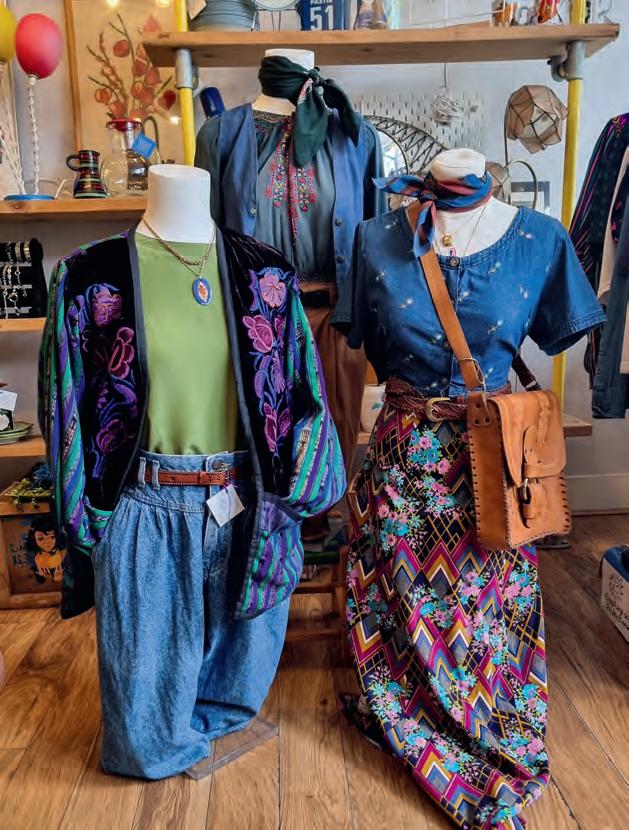
“As someone who cherishes the charm of vintage and the joy of discovery, Rhubarb Jumble is a personal favourite. Nestled on North Street in Bedminster, this shop is a treasure trove of carefully curated finds. The atmosphere is warm and inviting, making every visit an adventure, and the team is super friendly and always on hand to help you find what you’re looking for, and even encourage you to try on the pieces you’ve been eyeing up for ages! What I love most is how they manage to combine nostalgia with modern sustainability, offering pieces that are both timeless and eco-friendly.” 56 Gloucester Road, BS7 8BH
If you’re keen to keep the conversation going beyond the event, SFW will also be teaming up with presenter Louise Gookey to launch a podcast series this autumn exploring our relationship with fashion, and how we can positively reconnect with how we buy, wear, care and dispose of our clothing. sustainablefashionweek.uk



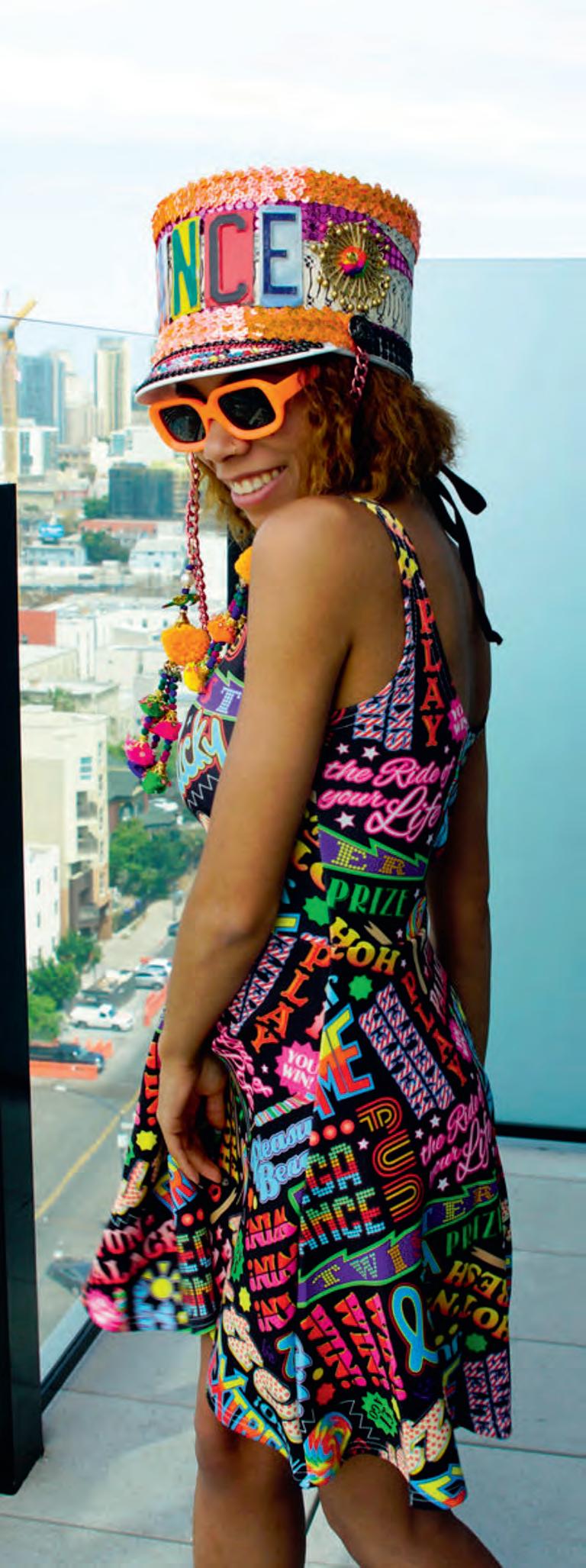
Friends, Orange Logo T-Shirt, £12, yesfriends.co0


Ellen Urqhuart, founder of Bristol Glad Rags (@bristolgladrags) was recently featured in a round-up of the UK’s best secondhand fashion influencers in The Times (and you may have also heard talking recently about what she does on BBC Radio Bristol). Ellen personally sources, thrifts, repairs and resells clothes on her social media platforms, sending bundles of second-hand threads to a loyal following after previewing exclusive ‘clothes drops’ online – along with very honest reviews about sizing and fit – then sending them to the first bidder/commenter. She even creates a small circular economy by gifting credit to people who donate clothes to her, so that they too can then bid on her special clothes bundles for future outfits.
“One way to keep your wardrobe as sustainable as possible is to shop via re-sellers, like me!” she explains. “You will get a hands-on personal service and a real feel for the items, it also stops you having to wade through endless charity shops! And you're supporting slow. Some of my customers pop round to try things on, it’s fab.
“If you have an item in mind that you’re looking for, just look for that item when charity shopping so you don't get overwhelmed. For example if I want jeans, my eyes just look for the denim, if I find something else while I'm browsing the great but I'm not spending hours looking through clothes I don’t need or want this way. You could also find local clothes swap events and switch up your wardrobe for free! Or meet with your friends and create your own clothes swap.
“Think about whether you can change some of the items you already have. For example, I change unflattering tops by using a hairband to tie them up into crop tops, or cut off old jeans to make shorts. You don't need to be a seamstress to make small alterations to make your current clothes more flattering. Don’t forget you can usually borrow clothes from friends and family. We all have way too many, so do you really need another new dress for a wedding you’ll attend for half a day?”
Ellen reached out to her thousands of loyal followers on Instagram to discover their favourite eco-friendly local fashion brands, and here’s what they suggested...
“These are organic children’s clothes, made using bright prints and colours and so beautifully made. I have actually shopped with them for my son.” It’s worth noting that many of the harem pant-style rompers have extra material around the ankle cuffs, meaning that the legs can be extended slightly as your baby grows.
“The team runs a solar-powered factory and sells simple, but well-made items from Fairtrade organic cotton. My followers love them as they ask their customers what they’d like to see in future releases. This again prevents an oversupply of unwanted items.”
“I have to give a shout out to That Thing. This colourful gem is filled with lots of independent designers, most from Bristol. Many of their designers use second-hand materials or create upcycled products. They reuse packaging as much as possible, make their own eco bricks from smaller plastic waste they can’t repurpose, use a reneweable energy supplier, and so much more (check out the ‘sustainability’ page on the website. They also support the creative scene in Bristol. Fab!”
45-47 Stokes Croft, BS1 3QP
Experience salon-worthy hair at home with our expertly chosen selection of luxury hair care products and styling accessories. Guaranteed to lift your hair care routine, our curated collection of nourishing shampoos, conditioners and natural hair products will bring the salon experience to the comfort of your own home. Bursting with brands that will transform any mane into sleek, luscious locks, style your way to the top with a little help from the likes of OLAPLEX, Color WOW and TypeBea. All products are available at Harvey Nichols Bristol or online at harveynichols.com

Brazilian Glossy™
Nourishing Anti-Frizz Hair Oil, £33
Sol De Janeiro’s Brazilian Glossy™ Nourishing Anti-Frizz Hair Oil fights frizz, adds shine, provides heat protection and locks in your style while moisturising and repairing dry, damaged hair. This nourishing hair oil is scented with the delicious, gourmand Cheirosa '62 fragrance (from the cult-favorite Brazilian Bum Bum Cream) that has notes of vanilla, salted caramel and pistachio.
G•1 Overnight Boosting Peptide 100ml, £43
The G•1 Overnight Boosting Peptide by TypeBea is a fast-acting scalp serum for hair growth and less shedding. It’s the ultimate overnight growth serum to revive your roots for longer hair. The lightweight, non-sticky formula works hard while you sleep to help deliver thicker, healthier hair. For every hair type.


OLAPLEX® No.4P Blonde Enhancer™ Toning Shampoo
250ml, £28
OLAPLEX® No.4P Blonde Enhancer™ Toning Shampoo cleanses tones and repairs while keeping hair hydrated from roots to ends. This highly concentrated sulfate-free shampoo forms a rich lather to neutralise brassiness and boost brightness after one use. Suited for all blonde lightened and grey hair – natural or stylistcreated root-to-tip or balayage – this non-drying formula can be rotated into any hair maintenance routine as needed for your best blonde yet.

Raise the Root
Thicken and Lift
Spray 150ml, £21.50
Experience all-day root lift and volume with Color Wow’s Raise the Root. To be used on both wet or dry hair, this thickening and lifting spray contains heat protection and proprietary elastomers that form a ‘spring’ at the roots to deliver major root lift without feeling sticky or stiff.

AUGUSTINUS BADER
SISLEY Hair Rituel
Revitalising Fortifying Serum
For The Scalp 60ml, £170
Hair Rituel by Sisley's Revitalising Fortifying Serum for the scalp slows hair loss and contributes to stronger and denser hair. Highly concentrated in plant-based extracts, proteins, vitamins and minerals, this fortifying serum energises the hair bulb to help keep the hair anchored, making it more resistant and protecting its natural colour.

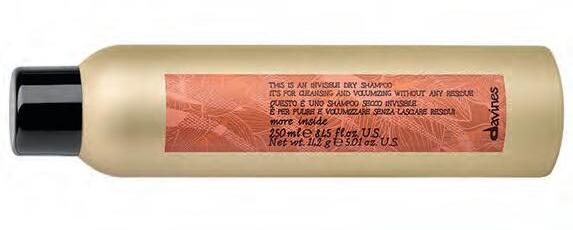
250ml, £26.75
Davines’ volumising dry shampoo invisibly absorbs excess oils in hair between washes, extending the lifespan of the blow dry and refreshing hair style. After use, hair is volumised, oil-free and natural looking.
SLIP New In Silk Assorted Scrunchies, £34
Traditional hair ties can tug on delicate hair, which can lead to damage and breakage. Slip scrunchies are made with slipsilk™ the same silk used in the award-winning Slip pure silk pillowcase. Specially commissioned and made to exacting standards, slipsilk™ has been developed and refined for over 10 years to provide the ultimate combination of shine thickness softness and durability. Its wide surface area and high-grade silk means the Slip scrunchie is designed to be gentle on your delicate hair and to reduce those annoying ridges caused by regular hair elastic.

The Leave-In Hair Treatment, £66
Apply to clean dry or towel-dried hair using your fingertips or a comb and work through the length of hair, focusing on the hair ends. Leave to dry naturally or blow dry for an enhanced finish. Use two-to-three times per week as needed.

BDK PARFUMS
New In
Gris Charnel Hair
Perfume 50ml, £58
Woody, spicy and powdery, Gris Charnel is inspired by a Parisian urban sensuality, which it expresses through sandalwood and vetiver. The hair perfume delicately perfumes, gives softness to the touch and a silky effect. The formula is composed of silk proteins, which improve the hydration and elasticity of the hair while giving it a glossy finish. Silk has long been known in Asia for its benefits in hair care. Nicknamed the ‘princess’ of fibres, it provides a crystalline structure that enhances the hair’s hold.
















...That’s the name of Nish Kumar’s new tour, but there’s just no need because he has got our city sussed –Bristol is a place designed by and for disgruntled leftists...*shrugs shoulders*. What more do you need to know? The post-electoral honeymoon may have dissipated by the time he performs at the Beacon, but expect debonair, outraged conviction and a quota of political commentary. Just don’t throw any bread rolls. Words by Emma Clegg
Ifeel nothing but sympathy towards anyone who saw me perform before about 2015”, says Nish Kumar. The stand-up comedian, television presenter, political commentator and podcast host has been performing on stage since 2006, so that’s quite an induction.
“I’ve been doing stand-up professionally since 2013, but it’s really only from 2015 onwards that I can stand by a lot of the work that I did. Much of what I did in my twenties was dubious at best… The funny thing about being a comedian is that you have always been going five years longer than people think, and that’s a good thing.”
Some over-dramatisation may be at play here, although it’s true that Nish first became well known in 2017 as the host of satirical comedy The Mash Report, later Late Night Mash. He has also presented BBC Radio 4 Extra’s topical comedy show Newsjack, the Comedy Central series Joel & Nish vs The World (with Joel Dommett), BBC Radio 4’s The News Quiz and is the co-host of the political podcast Pod Save the UK. He also appeared in Series 5 of Channel 4’s Taskmaster
“ I was smuggled into comedy clubs from when I was around 15 by my uncle ”
I ask if Nish was the sort of child who would show off in the classroom to make his friends laugh. “You have asked two different questions there”, he says in his distinctive sardonic drawl. “Was I trying to do that, and was I successful? I’ll say yes and no. I think I was practising trying to do it for a long time. Whether I was successful or not I’m afraid that is simply not for me to say. I have friends who I knew from school who are not surprised at my current career. Maybe the only surprise is the relative level of success.”
Nish was immersed in the comedy world as a child. “I loved going to stand-up when I was a kid and I really was a big fan of various sit coms and sketch shows like Goodness Gracious Me and The Fast Show. So I was a huge comedy fan and I was smuggled into comedy clubs from when I was around 15 by my uncle. I was just impressed with the idea that it seemed like the funniest thing to do. It’s just a hobby that got out of hand.
“I think I get closer to the style of comedy I imagine every year. Around 2014 I started to do stuff that felt as if it was narrowing the gap between intention and execution. It’s also the kind of stand-up I do – as I get older what I do on stage is changing. That’s interesting, but it means that you’re always chasing something that you might never catch up to. Part of doing stand-up for a long time is realising that I’m actually doing OK. But chasing down the dream is what makes it interesting.”
Nish is known for the political commentary within his material, which isn’t always a safe way of winning people over. “Using politics definitely opens yourself up to a different type of criticism. Comedy, if you don’t enjoy it, is in itself a deeply frustrating experience. In comedy an audience will not say ‘that’s bad comedy’, they will say ‘it’s not comedy’. So you start from a position where if it doesn’t work it frustrates people. If you then layer political references on top that they don’t agree with you are adding fuel to the fire. And then if you super-charge your stand-up with the broad tension of Brexit and the 2019 election, that’s when it happens.”
The allusion here is to a charity gig in December 2019 where Nish was heckled by the crowd and had a bread roll thrown at him when he was
making jokes about Brexit during the Lord's Taverners’ Christmas lunch at Grosvenor House in London, and was eventually booed off stage. “In my defence, it was only one bread roll and it missed me,” Nish says.
“I had become a lightening rod for somebody else. A focal point for anger with a particular group of people – and it got out of hand. The thing that was strange was the fallout and why it was so much in the press the following day. The pressure was enormous and with the benefit of hindsight that feels absurd.”
Absurd is definitely a recurrent motif for Nish. When he appeared on Taskmaster – which specialises in absurd tasks – he never won an episode, but did excel on his prize choices, including bringing in 14kg of curry in a giant wok for ‘most awkward item to take home’. Nish says, “The sort of impact of Taskmaster globally has been unreal. James [Acaster] and I have both found that the number of people that come to see our standup as a result is incredible.
“James and I also believe we are the only competitors that have been taken away from the set to have a personal telling off by [presenter] Greg Davies. Greg said to me, ‘you’re not a bad guy Nish’, and then took me off the set to bollock me. And the same thing happened to Acaster. I think James was trying to get told off and he was very jealous that I got a specific bollocking. I guess we both hold the distinction of being two spectacularly bad contestants. Not even bad, but bad with flair.”
“Eighty minutes of sweet vibe killing”
Nish: Don’t Kill My Vibe – “The title is a Kendrick Lamar song and is the stand-up I do where the subject itself is not intrinsically funny. But hopefully the jokes are!” – is Nish’s new show and the content is indeed politically charged. There are likely to be jokes about climate collapse, income inequality and the emotional sensation of being a British Indian man who wouldn’t vote for a British Indian Prime Minister. “It’s 80 minutes of sweet, sweet vibe killing”.
Nish prepares most of his material well in advance: “I like to have a 6070 minute chunk that is solid, and then I leave 20 minutes open for rewriting and reworking whatever is going on when I’m touring.”
“ Bristol was the first gig I did after the Colston statue was plunged in the water and that was... electric ”
Expectations are high. “You are going to stand there on your own with your stupid f*****g opinions so you’ve got to make sure it’s good and that it works. But one of the things I like about stand-up is that there are no rules and you can find an audience and work out how you get from point A to point B where they laugh.”
Nish has often performed in Bristol and says it’s always a big night on the tour circuit. “Bristol has always been an exciting place for me to perform because it’s a city designed by and for disgruntled leftists. And I’m very excited because I’m going to do the Beacon and it’s my first time performing in the newly-renamed Colston Hall. Bristol was the first gig I did after the Colston statue was plunged in the water and that was exciting... electric.” n
Nish Kumar – Nish, Don't Kill My Vibe, comes to Bristol Beacon on 26 September, 7.30pm; bristolbeacon.org
This month, our friends at Gloucester Road Books share new reads they’re particularly excited about...
Anote from the team: “Our primary aim is that the shop be a fascinating place to explore. We have a significant focus on titles published by small independent presses. There are lots of really brilliant small publishers putting out incredibly exciting books, and we want to help get these out into the world.” Visit the website for more details on book launches, talks and other events at the shop. gloucesterroadbooks.co.uk; @gloucester_rd_books; 184 Gloucester Road, Bishopston, BS7 8NU.
Open Monday and Tuesday 9.30am-5pm; Wednesday to Saturday 9.30am-6pm
Romy Gill’s India: Recipes from Home, by Romy Gill, Hardie Grant Books, out 12 September
The acclaimed chef, writer and broadcaster serves up an unmissable selection of more than 70 of her beloved family recipes. Straightforward and easy-to-follow instructions alongside easy-to-access ingredients ensure the book’s focus on home cooking is at the forefront throughout. Gill will be discussing the book at Boston Tea Party, Gloucester Road, on 3
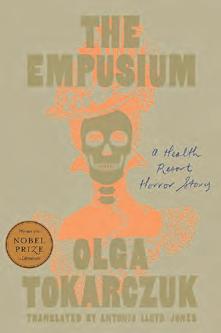






The Empusium: A Health Resort Horror Story byOlga Tokarczuk (translated by Antonia Lloyd-Jones), Fitzcarraldo Editions, out 26 September
Continuing in the vein of her hugely successful novel Drive Your Plough over the Bones of the Dead, Tokarczuk’s virtuoso storytelling uses myth, horror, and humour in a feminist parable of Thomas Mann’s The Magic Mountain. In 1913 in Western Poland, an allmale cast retreat to a health sanitorium where, medicated on hallucinogenics, they sit about and discuss the events of the day. Meanwhile, a disturbing chain of events is taking place in and around the health resort.
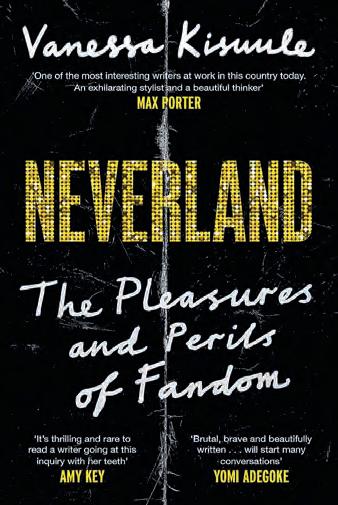
Neverland: The Pleasures and Perils of Fandom by Vanessa Kisuule, Canongate Books, out 12 September
The legendary Bristol poet brings her trademark dynamism, humanity and wisdom to her first non-fiction title. In refreshingly honest and illuminating prose, Neverland seeks to understand the knotty dilemmas idolising artists produces and what impact it has on one’s personality, relationships and understanding of oneself, particularly when that artist does terrible things. The book will be launched at The Station (BS1 2AG) on 13 September.
Intermezzo by Sally Rooney, Faber & Faber, out 24 September
Early readers of Sally Rooney’s forthcoming book are already claiming it to be her best yet.
Intermezzo follows two brothers, Peter, a competent and successful lawyer, and Ivan, a sociallyawkward competitive chess player. This novel looks to be an expansive story on grief, ageing, and desire, told with Rooney's masterly skill at unpicking the most subtle of power dynamics within relationships.




Muslim Cowboy by Bruce Omar Yates, Dead Ink Books, out now
The musician and songwriter’s much-anticipated debut novel is set in the chaotic, debris-strewn landscape of the Iraq war’s aftermath. Wandering through this terrain is an Iraqi man, a fan of Western movies, and someone in search of home and meaning in extreme circumstances. A cinematic, absorbing reading experience, which Yates will be discussing at Gloucester Road Books on 17 September.


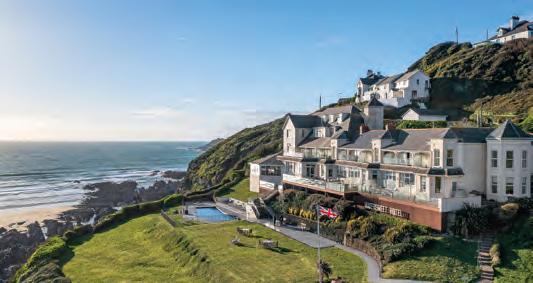


The Watersmeet Hotel in Woolacombe, voted Best Waterside Hotel for UK & Ireland by Conde Nast Johansen’s 2024.
Our 4 star Coastal Hotel could not be better located on the water’s edge.
Luxury Balcony, Terrace Rooms & Suites all have private outdoor seating & sun loungers.
Our 2 Rosette Restaurant offers dramatic sea views. from our unique cliff top location. Indoor and outdoor pool & spa.
Ramblers Package
• 3 Nights in a Deluxe Sea View Room
• Dinner, Bed & Breakfast
• Devon Cream Tea for 2 £1100 inclusive.
Late Availability offers
Check our website for ‘Offers’ and ‘Late Availability’ offering a generous rate discount and room upgrade where possible, subject to availability.




Our guide to some of the best things to see, do and experience in and around Bristol this month

Soul Sipping at The Granary Club
n Every Friday, 9pm-1am
51 Queen Charlotte Street, BS1 4HQ
Head to historic late-night cocktail bar The Granary Club for Soul Sipping – an evening of sophisticated drinks served alongside soul, jazz, funk and rare groove tunes from DJ Paul Alexander. Entry is free and no booking is required. The bar’s mixologists work with the chefs upstairs in The Granary restaurant to find innovative ways to integrate surplus ingredients and byproducts into the drinks menu. thegranaryclub.com
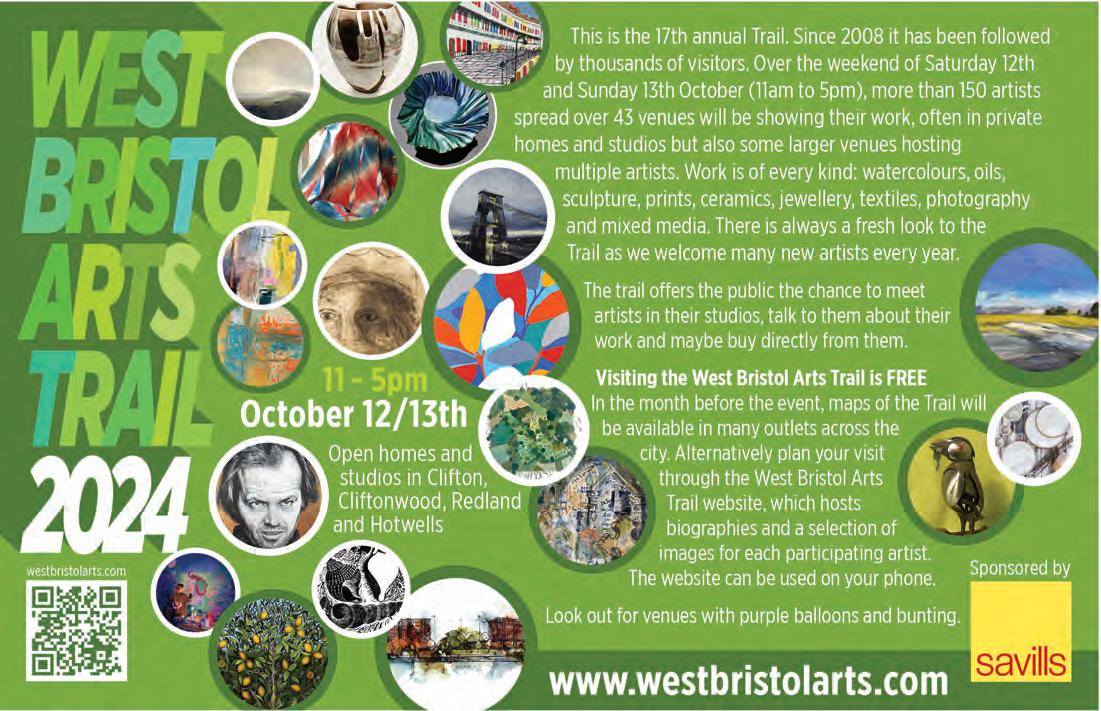
BS5 Art Trail
n 7-8 September, 11am-5pm
Across the BS5 postcode area
Celebrating creativity across the BS5 community, the BS5 Art Trail is back for its fourth event, with a wide variety of artists and makers exhibiting in community venues, studio spaces and homes. Boardwalk estate agent has sponsored the event and supported by placing display boards and banners at venues to help visitors find their way around the trail. Map brochures are available for collection from Easton Community Centre, Born in Bristol and more. bs5arttrail.co.uk
RNLI volunteer drop-in session
n 7 September, 10am-1pm
Portishead Lifeboat Station, Eastcliff, Portishead, BS20 7EA
Learn about volunteer roles with RNLI Portishead in an informal drop-in session. The team is looking for fundraising, shop, water safety, lifeboat station visits and community presenter volunteers. Head along for a friendly chat about volunteering for any of these roles, plus enjoy a cup of tea and a slice of cake, too. Please note, the team is not currently recruiting for lifeboat crew roles at the station.
portishead-lifeboat.org.uk
Altered State: The truth isn’t out there –the era of conspiracy theory
n 11 September, 7.30pm
Hen & Chicken, North Street, BS3 1JF
We need to talk about conspiracy theories... So join Brent Lee, former conspiracy theorist; Sian Norris, author and senior investigative reporter at openDemocracy; and Dr Alessandro Miani from the University of Bristol School of Psychological science, for an informative discussion alteredstate.org.uk
Bristol Film Festival presents March Of The Penguins
n 18 September, 6.15pm-8.45pm 1532 Bristol, Elton Road, BS8 1SJ
Bristol Film Festival is screening the Oscarwinning March Of The Penguins at 1532 theatre, the heart-warming and breathtaking story of one of the most epic animal ‘pilgrimages’ on earth. With an industry guest speaker also explaining more about the techniques required to capture such stunning footage, this is a must-see. bristolfilmfestival.com
Stitching4All Show
n 19-21 September, 10am-5pm
Bath & West Showground, Shepton Mallet, BA4 6NS
As well as top fabric (Liberty), haberdashery supplies and craft traders, Stitching4All is brimming with 100+ exhibitors and over 100 sewing workshops, including embroidery, dressmaking, crochet, knitting, felting and more. £11/£10 concession and under-16s go free. Book in advance to receive £2 off the ticket price. craft4crafters.co.uk

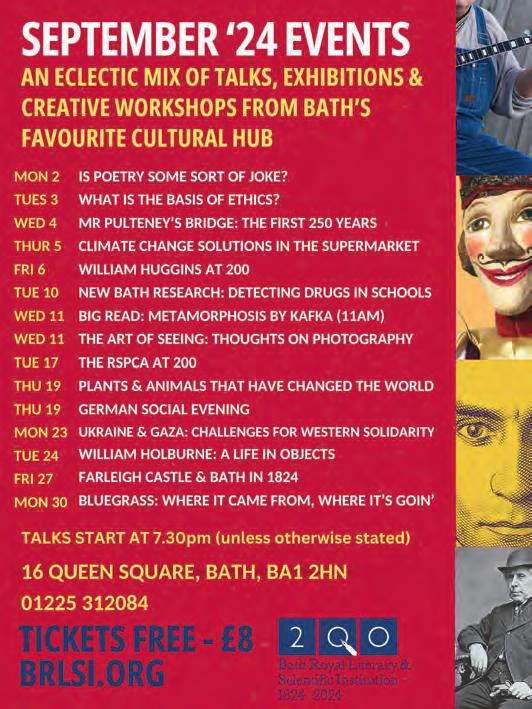

Wake The Tiger: After Hours n 20 September, 7pm-11pm 127 Albert Road, BS2 0YA
Got a mate or a date and looking for something a little more bonkers for your next evening get-together? That's exactly what you'll find at Wake The Tiger: After Hours... The ultimate immersive art installation amazement park in Bristol. Arrive anytime from 7pm, last entry to Meridia is 9pm. The cafe and fullylicenced bar will be open throughout the evening, with last food orders being taken at 10pm. wakethetiger.com
The Long Run at Tobacco Factory Theatres n 25 September, 7.30pm Raleigh Road, Southville, BS3 1TF
When Katie’s mum is diagnosed with bowel cancer her life grinds to a stop. But when she meets an elderly man in a radiotherapy waiting room corridor – everything changes. Created by writerperformer Katie Arnstein and directed by New Diorama Artistic Director Bec Martin, The Long Run is a tender, emotionally rich –and frequently hilarious – story about human connection, cancer diagnosis and long-distance running. tobaccofactorytheatres.com
Exultate Singers – Celestial Concerts n 28 September, 7pm Clifton Cathedral, Clifton Park, BS8 3BX
Exultate Singers and the Baldock Choir with world-renowned trumpeter Crispian Steele-Perkins conducted by David Ogden. Music from across the ages exploring man’s enduring fascination with angels, sung in the striking setting of Clifton Cathedral with its resonant and awe-inspiring acoustic. £16 for adults, £8 students in full time education, £2 under-18s available from the website. exultatesingers.org
Be a TV Writer for a Day! workshop at the RWA n 28 September, 10am-1.30pm Youngwood Room, Royal West of England Academy, Queens Road, Clifton, BS8 1PX
Ever dreamed of creating your own TV show? This workshop gives you hands-on experience in transforming your ideas into captivating stories for the screen. This workshop is perfect for anyone interested in learning new writing skills, whether you’re a complete beginner or have some experience under your belt. With limited spaces available, be sure to book your spot soon (£60)! strongstory.org/workshops
Looking ahead...
Antique, Vintage and Collectables Fair n 6 October, 10am-3.30pm Ashton Court Mansion House, BS41 9JN
Discover fine jewellery, gold and silver, china, militaria, books, prints, paintings, vinyl, vintage clothing and accessories, furniture, watches, toys and lots more. Over 40 stalls will be trading, all set up inside mansion house itself, while the café will be serving teas, coffees and cakes. £2 entry price, and under-16s go free.


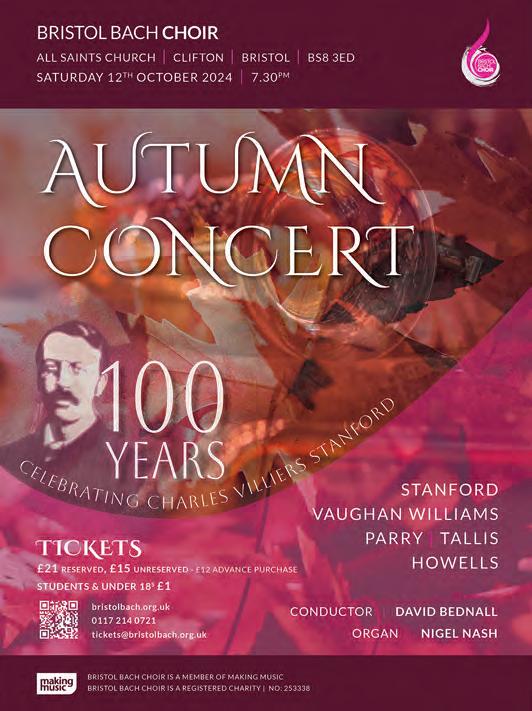

Here’s our pick of the best things to see and do with the little ones this month

Whirligig Festival of Outdoor Arts
n 7 and 8 September
The Italian Gardens, Weston-super-Mare, BS23 1AJ
Whirligig returns with a continental flourish to the Italian Gardens. A two-day, free family programme of amazing circus and outdoor arts shows from the UK and Europe will fill the Italian Gardens. An eclectic mix of acts and high-octane performances, topped up with a vibrant, seaside energy is set to enthral audiences from near and far. Whirligig Festival takes place each day from midday to 6pm. superculture.org.uk/listings/whirligig24
Fantastic Feast Toddler Takeover
n 13 September, 10am-3pm
We The Curious
We The Curious’ special event for under 5s and their families. This one is all about food, so roll up your sleeves and get ready for a day packed with activity: chop, crunch, nibble! Create and eat a tasty fruit and vegetable salad in the kitchen. Search out and collect a bumper shop in the toddler supermarket. Thread, weave and create with different food shapes in the new ‘Atelier Penne’. Join Ursa and Leo for Mud, Slugs and Scarecrows storytime. Take a trip to the stars in the Spin the Spaceship Planetarium show, especially for children aged 5 and under. wethecurious.org
Dinosaur Dance Party
n 14 September, 1 pm-2.15pm or 2.30pm-3.45pm
Pavey House, Waterloo Street, Clifton
Step into the prehistoric world at the Dinosaur Disco Family Fun Party! Perfect for ages 2 to 6, enjoy a day filled with drama, games, dressing up, crafts, and a roaring disco, all packed with dinosaur fun. Don’t miss this dino-mite adventure! Sponsored by Clifton BID. Parents must stay for the duration of the workshop. Spaces are limited. dramawithhannah-rose.com/workshops
‘The Big Draw’ Art Competition
n 14 September, 2pm – 5pm
The Snug, Tobacco Factory
Boardwalk Property Co will be hosting a super creative, craft-fuelled session at Tobacco Factory as part of the South Bristol Arts Trail. Join in and get crafty recreating your favourite Aardman characters. Free seesion for kids aged 4-11.
boardwalkpropertyco.com/the-big-draw
Bluey and Bingo n 14 and 15 September, every hour 10am-3pm
SS Great Britain
See Bluey and Bingo at intervals throughout the day and take photos of them in the dockyard. Plus, experience hundreds of sights, sounds and smells across two interactive museums, a historic dockyard, a mesmerising dry dock and the iconic ship itself. Must be booked online in advance.
ssgreatbritain.org
The Nose Dive Assembly - Birds of a Feather n 25 September - 6 October, performance times vary
The Revel Puck Circus, Dove Lane, St Pauls, BS2 9HS
East London’s award-winning circus is returning to Bristol with an exciting new show under the Big Top. Expect highwire walkers, teeterboarders, bespoke apparatus performance, stunts and lots of laughs. Action packed fun from this world-class circus. revelpuckcircus.com
Kiota Kids - How Lightning Came To Be
n 29 September, 2pm
Wardrobe Theatre
Based on Khasi folklore, from the North-Eastern Indian state of Meghalaya, this is the story of U Pyrthat, U Kui, the Lynx and many other animals. We discover how lightning came to be. Devised and performed by Deepraj Singh and Aisha Ali, expect movement, music and a lot of silly voices! This is a show for families with children aged 5+ brought to you by the Kiota Collective – Performance Artists from the Global Majority. thewardrobetheatre.com






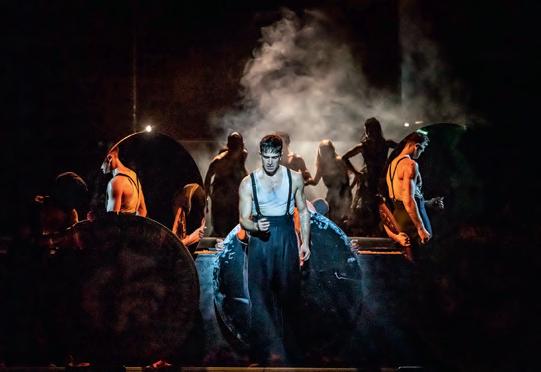
Britain’s oldest dance company Rambert presents Peaky Blinders: The Redemption of Thomas Shelby, written for the stage by Peaky Blinders’ creator Steven Knight. The show, which comes to Bristol Hippodrome 24-28 September, has been choreographed and directed by Rambert’s Artistic Director Benoit Swan Pouffer. We hear from Knight himself about this reimagining of the Shelby family’s story…
All images by Johan Persson
Opening in the trenches of Flanders, a personal story unfolds in post-war industrial Birmingham as the Shelby family navigate the decisions that determine their fate and Tommy is intoxicated by mysterious newcomer, Grace. While Tommy is building his empire, Grace is operating as an undercover agent for Special Branch on a mission to get close to the heart of Tommy’s gang.
As the story unfolds, hearts are broken, and revenge is sought. This spectacular dramatization and breath-taking dance is heightened by a live on-stage band performing specially-commissioned music by Roman GianArthur and iconic Peaky tracks from Nick Cave and The Bad Seeds, Radiohead, Anna Calvi, The Last Shadow Puppets, Frank Carter & The Rattlesnakes and Black Rebel Motorcycle Club.
How did you become connected with Rambert?
It was a gradual process because someone at the BBC suggested that we meet when we talked about doing a 12-minute dance piece as part of a Peaky Blinders festival. Rambert were brought on, and it was brilliant.
I was writing series five of Peaky Blinders at the time and so I wrote a scene where Tommy Shelby invites Rambert to his house, because in the 1930s Rambert used to tour the country and do shows under the ethos of bringing dance to the people. In Peaky Blinders, the music, the way people move and the way they dress is really important so I think it really lends itself to dance.
Rambert's Artistic Director Benoit Swan Pouffer and I noted that we could create a full show together. I was shocked when the company asked me to write it, but I imagined the set and the stage and wrote what I thought would be good for that.
Benoit and I started working together and it began to snowball. We brought in some great collaborators and got really good music for it. I saw the show in rehearsals and couldn't believe how great it was. I first saw it performed to an audience in Birmingham and it raised the roof with standing ovations, and now it's going all over the place.
How does the work of Rambert make you feel?
I didn't realise how direct the relationship between dance and the audience is. I work with dialogue and plot within scenes where people act the roles, whereas in dance it feels more subtle in the execution but more direct in the effect. An interaction between two people can be very stylised but you get to see that very quickly, and the music continues to amplify that.
How did you meet both inspirations and visions during the collaboration process of making the work?
I wrote the script as though it was a long script without dialogue, with slight inclusion of narration. I started off with WW1 and soldiers coming out of a tunnel, and imagined how they would look and move, while
thinking about how that would make them feel too. The way I tend to write is quite instinctively so I write whatever comes into my head at the time so I just wrote it whilst imagining it through dance and music. I wrote it almost like a dream rather than a script. It felt dreamlike, not like forcing the imagination, but writing what comes to you at the time.
How did it feel trusting another creative with the keys to Peaky Blinders?
When there's somebody as good as Benoit, it's a relief. It's like giving the script to a good director as you know they are going to take what you've done and enhance it. I'm a firm believer in doing things that you haven't done before otherwise it's boring, so the idea of telling people that Peaky Blinders will be presented through dance is great.
Do you think you learnt anything from Benoit or Rambert, and the art of storytelling?
Yes. I think it teaches you that sometimes words cause a jam. Instead you can present something quite quickly in dance, and it teaches you the power of a look. The thing about dance is that all of us are experts in it because we all live our lives in a dance.
For example, if someone walks into a room - you can tell if they are in a good or bad mood because of their body language. Dance takes that and puts it to music.
“ I’m proud that Peaky Blinders isn't high brow or it isn't of a particular class - it's a cross section of people from different backgrounds ”
How did you come to decide that there would be a live band on stage?
The music is central to the TV series and music is the stepping stone between the TV series and the dance piece too. Roman GianArthur, who did the score, absolutely got what Peaky Blinders was about. It isn't exactly a particular style of music as it can be folk or heavy metal, but it does need to have a certain swagger or a certain attitude to it. In terms of the style of music, and in the words of Cillian Murphy: 'There is music that is Peaky, and there is music that isn't Peaky. You can't always define it but you can tell when you hear it.'
Is it exciting to be bringing in a new audience?
It really is, and it is one of the reasons why we decided to do it. I’m proud that Peaky Blinders isn't high brow or it isn't of a particular class - it's a cross section of people from different backgrounds, and so it does appeal to different people too. People may not always walk through a door marked 'dance' but they may walk through a door marked 'Peaky Blinders', and so it's the idea that you can connect with new audiences by welcoming them through that setting.
Saying that, the BBC's most popular TV show across all demographics is Strictly Come Dancing, so audiences love watching people dance. It isn't like it's restricted to certain people of a level of education or income, as people have been dancing for 10,000+ years.
Isn't it great that something like this can work, and it challenges the idea that there are these rigid barriers between class and entertainment?
Do you think Peaky Blinders: The Redemption of Thomas Shelby is an accessible show?
Absolutely. It's very accessible. The story is clear and we aren't planning on baffling people. We are being as clear as we can about what's going on and that, in itself, is quite mysterious.
It ties into what Rambert's original remit was in the 20s and 30s of taking dance to working class people who love dance. That doesn't come with a clause of being patronising but I think this show does that in the true spirit of Rambert. For me, you're getting to see what human beings can do; the way the dancers move and the way they interact, as they throw

themselves into it. I think it's incredible that you can see human bodies pushing themselves to the limit to tell a story - it's brilliant.
If you could describe the show in three words, what would they be?
Romantic, tragic and uplifting.
What do you want audiences to feel when they engage with the dance theatre show?
It's a live experience and that’s one of the things that I really like about it as, in comparison, television isn't a communal experience. What tends to happen is that people watch Peaky Blinders, and then they get on social media so the communal experience happens on screens.
If you get people in a room together, and you get them all in the same space listening and watching to the same things, it's just totally different. For me, it's more satisfying I suppose because audiences get their reactions out of their system.
If you go into a room and watch the work, and you hear the music, and you are part of a standing ovation, you have a beginning, middle and end to that experience. You can then take it out into the cold and talk about that experience together. n
Peaky Blinders: The Redemption of Thomas Shelby is at Bristol Hippodrome from 24-28 September; tickets available from atgtickets.com/bristol


Charlie, a former Clifton College pupil and school Swimming Captain, together with her husband Adam are travelling –quite literally – to the ends of the earth to take on the Archipelago Yachts Polar Swim Challenge; swimming an official ‘Ice Kilometre’ at both Poles. Only 10 men and two women have ever swum a kilometre at both poles; to put this into context just 12 people have walked on the moon.
The swims are taking place in September and November in the frigid waters of both the Arctic and Antarctica and will be ratified by the International Ice Swimming Association.
Ice water is considered to be temperatures lower than 5°C and in the first three minutes of the swim they will have to overcome cold water shock. In addition to being at risk of hypothermia they will need to be aware of polar bears, leopard seals and orcas which all frequent the waters.
Despite temperatures as low as -1°C, the Association rules dictate that they may only wear a standard swimming costume, cap and goggles.
The duo are no strangers to extreme challenges to fundraise for charity having previously completed a 3,000-mile Atlantic row, followed a few months later by a 1,683-mile partial circumnavigation row of Great Britain. They also recently became Guinness World Record holders for participating in the longest static cycling class with Worle Spinners.
They hope this challenge will raise £20,000 for their chosen charities, Weston Hospicecare and Ocean Conservation Trust.
Weston Hospice provides expert palliative care to people with life-limiting illnesses. Adam, a Specialty Doctor in Palliative Care at the hospice said, ‘I’m passionate about helping people overcome the enormous challenges they may face and I am immensely proud to be part of the team at Weston. We currently have many projects running at the hospice but I would like any money we raise to go towards renovating the in-patient rooms.’
Drawn to water and sport as an outlet to stress relief, Charlie and Adam have a strong bond with the sea. They were attracted to the Ocean Conservation Trust by its ethos of wanting to connect people with the water. This south west-based global conservation charity will use any funds raised to support their experiences, which encourage behaviour change and ocean advocacy alongside habitat restoration projects. n For more info, visit the website emergenseaduo.com
“ Despite -1°C temperatures, rules dictate they may only wear a standard swimming costume, hat and goggles ”




Singer-songwriter, guitarist and YouTuber extraordinaire Mary Spender, is re-writing the rule book when it comes to managing her musical career. She speaks to Rosanna Spence ahead of a homecoming show at St George’s on 25 September celebrating the release of her independently released debut studio album Super. Sexy. Heartbreak.
How are your DIY skills? Before you make a dash for your toolbox, hang on a minute. Because I’m talking about a different type of self-build project altogether; an independently-assembled musical career, built fan by fan, track by track, gig by gig. No middle managers. No big label contracts. University of Bristol music alumna and former resident Mary Spender has been doing just that, embracing some elements of our digital age, but combining them with efforts to recapture the original value of music by prioritising physical releases – and choosing to build a meaningful, engaged audience rather than chasing streamed plays that usually fail to properly compensate artists.
Mary’s DIY approach to a viable music career has paid off so far. She’s had more than 94 million views of her YouTube channel (@MarySpender) – via which her 744,000+ followers watch her thoughtfully created videos that cover everything from industry musings (think swear words in music to exploring ‘ageing out’ of the sector in your mid-thirties), technical gear deep dives, interviews with major artists and (of course) her own musical releases. It helps that her smoky, jazz-influenced voice paired with confessional lyrics and intricate finger-style guitar technique have created a successful catalogue of tunes combining blues, rock, folk and Americana seasoned with a distinctly British flavour that’s proved popular with her dedicated fan base.
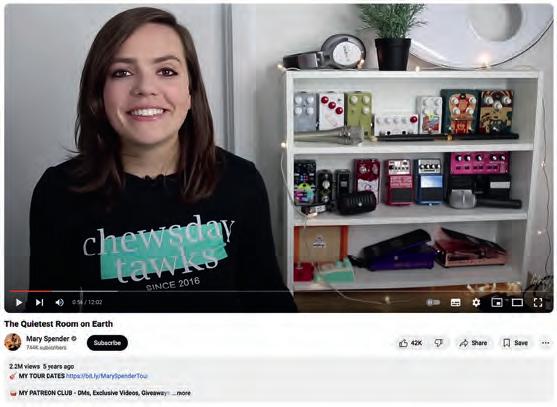
YouTube can be a brash, noisy place to explore, but Mary’s slightly longer, nuanced, calming videos (like the one pictured above) feel like a real antidote to the ultra-quick content consumption we’re all far too used to online these days.
When I tell her this, she laughs: “We always joke about trying to make me the Nigella Lawson of music. For example, if I’m talking about a guitar being built, it’s ‘Ooh, look at those wood shavings, they look just like chocolate’. To be honest though, it’s all about having people around me who really care about the quality of everything.
“I now have a full-time editor, a producer who can write and research with me, and I’ve recently hired a videographer/photographer who’s always in the studio. We’re almost like a band making YouTube videos, and I’m just the front woman. It’s really cool, because I’ve always collaborated within music, whether it’s string quartets, orchestras or rock bands. It’s so incredible to be able to make music and videos – there’s nothing else I’d rather be doing. Getting to have these people around me who really care about how creative and innovative we can be is a very unique opportunity.”
Mary’s career has seen her settle into a space that she refers to as a “middle class” for musicians – plugging the huge gap often seen between the “infamously penniless musician stereotype who’s been working on their craft but can’t figure out the business side of it… And artists like Taylor Swift.”
Part of Mary’s USP is her radical transparency online, where alongside her popular original releases and song covers she also publishes videos detailing precisely how much artists like her need to earn in order to survive, how much it actually costs to be a YouTuber, and the facts, stats and figures behind certain musical releases.
Remaining fiercely independent as an artist means Mary retains the freedom to write about what she wants, as well as having complete control over what she shares on her social media platforms, too.
“We’re trying to be journalistic in a way,” she explains. “We have to keep hunting for stories. I have information about my analytics, for example, which other artists might not see if it’s hidden by a record label. I’m not signed to anyone, so I’m able to ask permission of myself… ‘Do I want to share how many CDs I’ve sold?’”
For Mary, this approach is mirrored within her creative output: “I’m pretty open and transparent about where I’m at in my life in my songs. I do like the James Joyce quote: ‘In the particular is contained the universal.’ No matter what your story is, someone will relate to it, as long as it’s open, honest and really specific.”
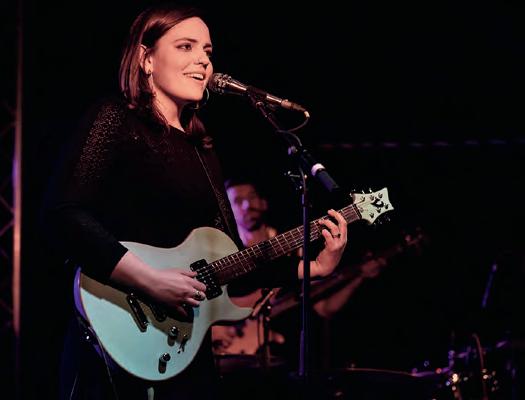
Speaking of specific, Mary follows Wired co-founder and author Kevin Kelly’s principle of ‘1,000 True Fans’ (which she admits she should probably get tattooed somewhere). This is an alternative path to success other than supreme stardom, focusing instead on a smaller, yet utterly dedicated following who will loyally buy your music, travel out of their way to your gigs and consistently engage with your career.
“If you only release your album on Spotify, you’re probably not going to do as well as you hope, and that’s okay,” Mary acknowledges. “However, if you’re thinking about your ‘1,000 fans’, then maybe you could sell 1,000 CDs. It turns out, my audience has CD players.”
She’s right. A quick browse of comments on the YouTube videos of her debut studio LP Super. Sexy. Heartbreak. reveals that as well as helping her tunes quickly reach tens of thousands of views (which she released track by track each month until its official independent release in July this year), her followers (read: true fans) have also been excited about being able to play the album on CD, cassette and a much-anticipated vinyl release. Yes, these processes take longer when you’re not signed to a label and doing everything yourself – but good things come to those who wait.
Thankfully, Bristolians won’t have to wait too much longer to see Mary’s return to the city for a special homecoming gig, playing St. George’s on 25 September as part of her Super. Sexy. Heartbreak. tour. It’ll be a particularly poignant performance for Mary, who once worked at St. George’s as a part-time finance assistant.
Living in our city for the best part of a decade had a profound impact on Mary’s life, from an iconic Clifton café inspiring her song Primrose, to its rich and vibrant gigging scene forming the early years of her professional career. During our chat she recalls fond memories of sitting on her roof watching the Balloon Fiesta pass by each summer, of playing four-hour cover sets on King Street at the weekend, gigging everywhere possible, and of going from supporting other acts to selling out The Louisiana for the first time in 2016. As Mary puts it, Bristol was “literally my heart” and like many other artists drawn to its creativity and community, once you’ve lived here, I don’t think its essence ever really leaves you. n
Mary Spender’s show is at 8pm on 25 September 2024, tickets £20, stgeorgesbristol.co.uk; Super. Sexy. Heartbreak. is out now and available to purchase from Mary’s website maryspender.com


Dawn Sidoli – A Celebration at Lime Tree Gallery; 12 September until 11 October
Dawn painted for the love of it, right into later life, so she left a wide variety of topquality work, some of which had been shown at the Royal Academy, The NEAC or the RWA, but much of which had never been exhibited commercially. The paintings are those of a natural talent, who has been able to accommodate a formal training into her work, without compromising a freshness of approach and a lively imagination. Together with her family, Lime Tree has selected a representative cross section of her work from the 1970s through to this century. Dawn was a brilliant painter of people, but was probably known more for her landscapes, and especially for her still life work. Most of the paintings in this exhibition are for sale and present a terrific opportunity to add a piece or two by one of the finest West Country painters of the last several decades to your collection. limetreegallery.com; 84 Hotwell Road, BS8 4UB
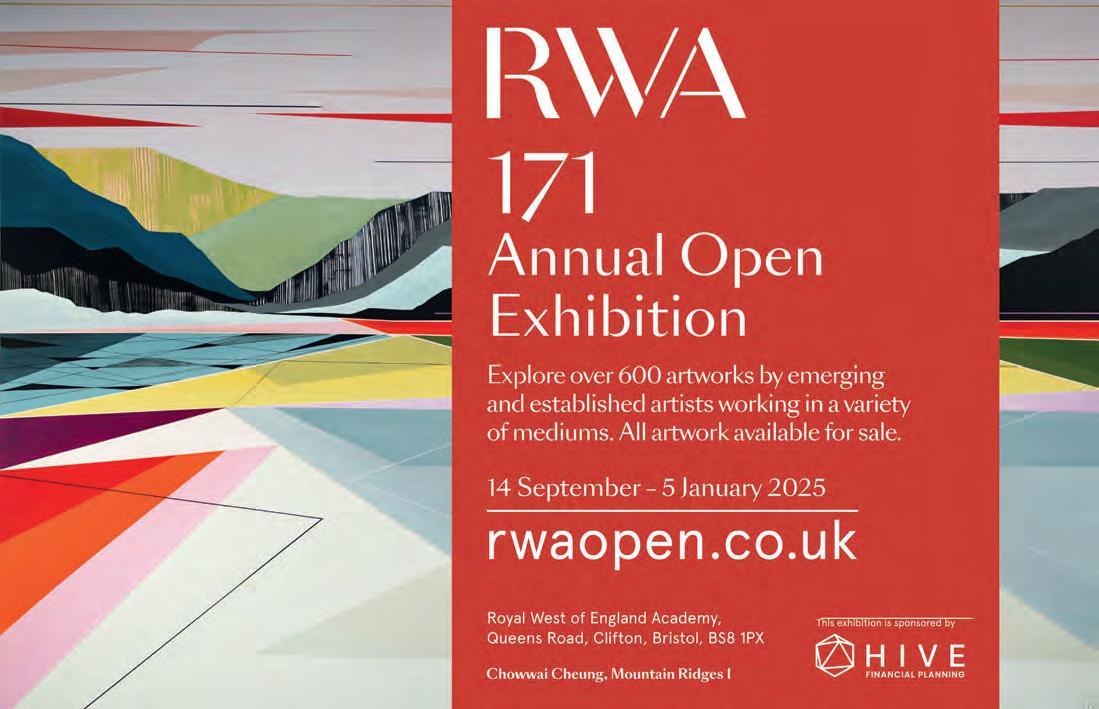
Annual Open Exhibition at the RWA, 14 September to 5 January 2025
The RWA Art Gallery has announced its Annual Open Exhibition. The event, now in its 171st year, will take place in the RWA galleries, showcasing a diverse array of contemporary art from both established and emerging artists. The exhibition also provides an opportunity for art lovers to purchase original works both online and in the gallery. Prices for the artwork range from £10 to several thousand, making this an accessible opportunity for both seasoned collectors and those new to acquiring art. This year, the exhibition received 4,277 submissions, with 603 pieces selected for display by a panel of judges. The artworks span various mediums, including painting, sculpture, photography, printmaking, mixed media, textile art, architecture and video. rwa.org.uk; Queen’s Road, Clifton, BS8 1PX
Images: Left, Ceci n’est pas un chien (part deux) by Alli Eynon;


Adventures in Art, Activism and Accountability, Led By Donkeys at 17 Midland Road, 12-15 September

The first ever exhibition by political accountability collective Led By Donkeys will coincide with the publication of their new book ADVENTURES IN ART, ACTIVISM AND ACCOUNTABILITY, the four-day exhibition –a co-production between Led By Donkeys and 17 Midland Road – will take place across three floors, exclusively showcasing behind-the-scenes work, including largescale photographic documentation, material from their installations and film screenings. The exhibition will celebrate and explain for the first time some of the most radical and memorable political interventions. 17midlandroad.co.uk; 17 Midland Road, Old Market, BS2 0JT
Image: Stay Alert © POW, Westminster Bridge Road, London
Somerset Art Weeks, across the county, from 21 September to 6 October
The annual Somerset Art Weeks event, where artists across the county exhibit their work in a series of free exhibitions, returns for 2024 with the theme of Landscape: Flux and Flow. Artists of every medium, from painting to performance, will be joining the festival to form part of this celebration of Somerset’s exciting creative voices in over 100 group exhibitions and events. Find out more by going to the SAW website to view a copy of the full guide, or by downloading the official Somerset Art Weeks 2024 App. somersetartworks.org.uk
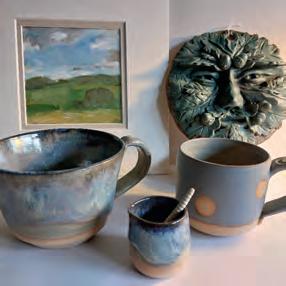
Work shown: Sharon Bradford and Neil Jones
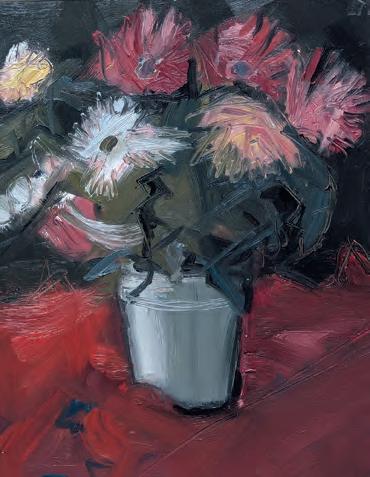

GREG GRIFFITH: NEW PAINTINGS at The Mount Without, 5 September to 2 October
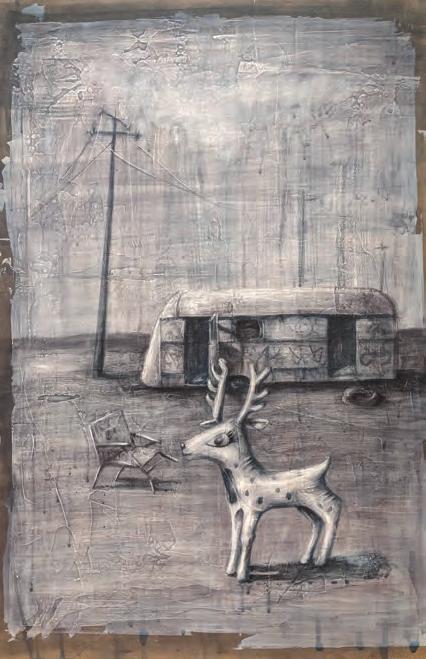
Throughout September, the Mount Without will be introducing Clevedon-based fine artist Greg Griffith to its crypt for a solo show; displaying an array of haunting works which emerge beautifully from the venue’s etched walls.
themountwithout.co.uk; Upper Church Lane, St Michael’s Hill, BS2 8FN
Image credit: Greg Griffith
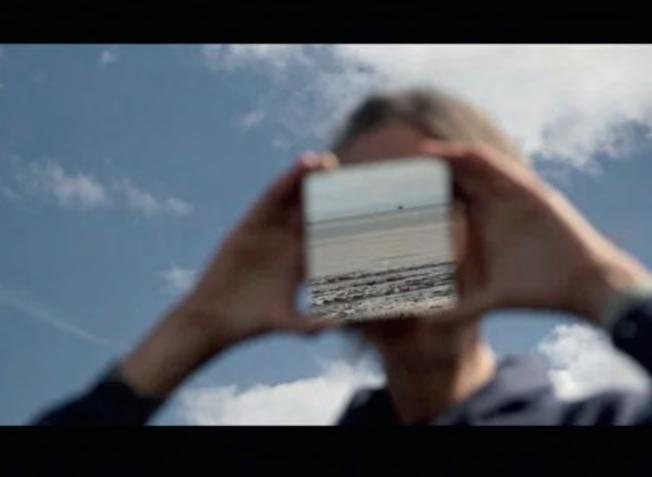
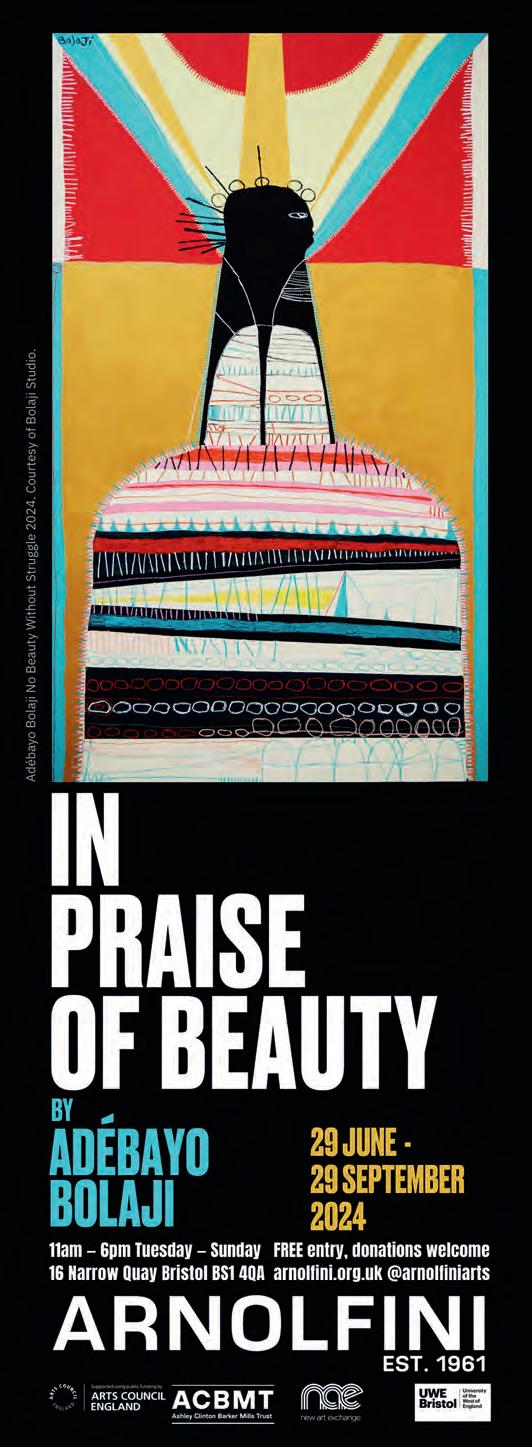
Visual artist Angela Charles shares her story of unexpectedly losing her sight, in the Liberty Smith film What Are You Looking at? and her experience of ‘coming out’ as a blind artist after years of hiding it as the self-proclaimed ‘Queen of Bluff’.
Multiple voices weave narration and description: Angela’s iPhone (Daniel), a philosophising Audio Describer (Christopher Flowers) and Angela’s mentor, the artist Bedwyr Williams. Over the course of the film they interact and respond to Angela as she explores notions of seeing, as she navigates a new creative path, and questions our preconceptions in asking us, ‘What are you looking at?’
The film will then be shown on loop across the weekend, 11am to 6pm, and there will also be a preview event with the opportunity to meet the artists on Friday 13 September, 7pm to 8:30pm. Both events are free, and more information, with instructions on how to book the preview, can be found on Arnolfini’s website.
arnolfini.org.uk; 16 Narrow Quay, BS1 4QA
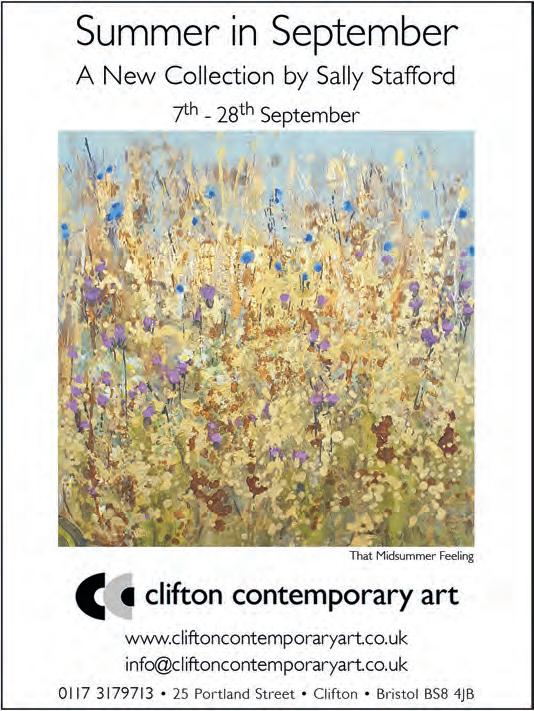
Summer in September: A New Collection by Sally Stafford at Clifton Contemporary Art, 7-28 September
As the rhythms of summer slow and flow into autumn, Clifton Contemporary Art is celebrating the sensory beauty and energy of the warmest months, through Sally Stafford’s subtly dynamic, deeply evocative meadow paintings. The tones, textures, movement, sounds and smells seem to radiate from each canvas, drawing you into a world of perpetual change and immersing your senses in its natural cycle. With Sally’s newest collection, you’ll linger in the longest days – savouring the emerging life and teaming energy of summer.
To complement Sally’s work, the gallery is also showing atmospheric new landscapes and riverscapes by Anna Boss and Sarah Brown, plus a diverse selection of Chris Buck Bronze sculptures.
cliftoncontemporaryart.co.uk; 25 Portland Street, Clifton, BS8 4JB
Image: Quiet Corner by Sally Stafford, mixed media on canvas

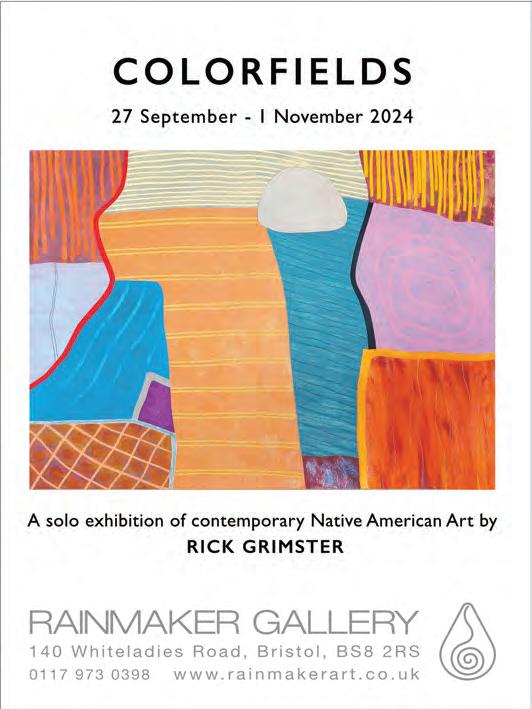
COLORFIELDS at Rainmaker Gallery, 27 September until 1 November
Rainmaker Gallery welcomes back Native American painter Rick Grimster (b.1945) who burst on to the art scene last year with two sold out shows. COLORFIELDS, his third solo exhibition, presents his latest works on paper alongside earlier works on canvas. Together they reveal the subtle progression of his paintings through a gradually shifting palette and sense of belonging. The canvases are rendered in vivid colours with expressive brushstrokes that make for charged and dramatic landscapes. The new works introduce a mellower and more playful palette evoking a sense of serenity. His unmistakable Indigenous colour sensibility and mastery of texture is ever present as is his enduring love of the land.
rainmakerart.co.uk; 140 Whiteladies Road, BS8 2RS
Image: Rick Grimster, Hay Bales

Past and Presence; paintings, drawings and prints by Christopher Binding at That Art Gallery, 18-24 September (11am to 6pm)
Flat colour fields exploring their response to each other, these works are a thing in themselves rather than offering a window upon the world, the surface marks physical evidence of a life experienced rather than representation of something seen. An element of duality –contrast and division, tension and balance, strength and fragility –are themes that recur within the paradoxical complexity of the simple geometry. These are works with a sense of stillness and silence while offering a depth and interest that only slowly reveals itself.

2 Upper Maudlin Street, Bristol, BS2 8DJ thatartgallery.com
Image credit: Chris Binding




Since its beginnings as grafitti tagging by gangs in the back streets of Philadelphia and New York, street art has come a long way and is now the fastest‐growing art genre for amateur buyers, collectors and investors, write the experts at FIZZ Gallery in Clevedon
here is much debate about where street art started. Some say it started with the work of New York gangs in the 1920s and ‘30s, others grant the artist Cornbread with the accolade, tagging the streets of Philadelphia during the late 1960s. A pionner of modern street art, American artist Keith Haring started creating his iconic graffiti-style artwork in the streets of New York City in the 1980s and he played a significant role in popularising the art form. Soon after, street art moved from being the work of vandals and vandalism into galleries and the global art market – earning its place in the contemporary art world.
The street artists of today
Undoubtedly inspired by the origins of graffiti, the spray can remains the iconic tool of the street artist. Some have even turned their spray cans into sculptural art pieces – the ultimate in 21st-century upcycling while putting the tools of the artist into the hands of the buyer.
While Banksy remains the most popular global art brand of our time, with his works changing hands for eye-watering sums of money, there are many more that attract global collectors. Dondy White, Invader, JeanMichel Basquiat, Lady Pink, Keith Haring and Shepard Fairey are regularly acknowledged among the top 10 Street Artists in the world.
Mr Brainwash: a rising star
Exploding onto the scene when he starred in Banksy’s documentary Exit Through The Gift Shop, Mr Brainwash (Thierry Guetta, pictured above, centre) is the fastest growing street artist of our time.
Drawing inspiration from art history and the works of great masters, combined with the boundless energy of the street, Mr Brainwash creates uplifting works of art that celebrate culture, positivity, creativity and colour. His collaborators and collectors include Madonna, the Beckhams and Banksy.
Mr Brainwash’s original artworks and limited editions make a spectacular addition to any contemporar y art collection, and many are looking to his work for investment as well as enjoyment. Look out for his upcoming exhibition at Fizz Gallery on 26 October (details opposite).
Of course, Bristol is synonymous with street art. The early ‘80s saw the the arrival of tagging on its streets, and in 1983 the first street art mural appeared in Hotwells, created by 3D – widely acknowledged as the pionner of Bristol’s street art scene. Since then, the city has attracted and embraced a host of talented street artists, home not only to Banksy, but to Inkie, Nick Walker and Upfest, Europe’s biggest Street Art and Graffiti festival.
From unknown artists to global brands street art offers the everyone the opportunity to invest in something unique in a growing market. But the market is full of fakes, so buyer beware. Do your research. Find out all you can about the artist, make sure you are buying from a reputable source, check the provenance and authenticity of the piece, inspect its condition, and don’t be afraid to ask questions. But remember to enjoy the process; buying art is fun, especially street art!
For professional advice on buying Street Art, FIZZ Gallery (just 20 minutes from Bristol) represents a diverse collection of street artists, including Mr Brainwash. A contemporary gallery established for over 20 years, it is widely recognised as one of the top galleries in the South West for contemporary art. n

Mr Brainwash Exhibition at FIZZ Gallery
Saturday 26 October, 12pm to 4pm
FIZZ Gallery is located just 20 mins from Bristol, via the M5 (J20) fizzgallery.co.uk | 26 Hill Road, Clevedon, BS21 7PH | 01275 341141 chat@fizzgallery.co.uk
Scan to find out more and secure your ticket!


From
The art world is filled with the fruits of human artistic endeavour; from ancient Greek pottery to Damien Hirst’s pickled shark, via George Stubb’s horse paintings and Faberge’s eggs. Amongst this illustrious roll call who, however, amongst us would expect to find a monkey band?
Creating an orchestra of monkey musicians might seem like a questionable artistic choice, but monkeys tended to be a surefire hit in Europe’s Age of Enlightenment. Anthropomorphized monkeys engaged in silly or mundane—but always thoroughly human—pursuits were one of the most popular subjects in sculpture and painting at the time, particularly in France and Germany.
I should at this juncture point out that the monkey orchestra in question was not composed of real apes but porcelain ones. In 1733, the sculptor Johann Kändler became the chief modeller at the Meissen
porcelain factory in Germany. One of his most admired designs were the monkey bands, witty examples of 18th-century singerie: subjects in which monkeys literally “ape” the behaviour of humans. The full orchestra is composed of twenty-four musicians and a conductor, all realistically modelled and fashionably dressed in 18th century attire.
In addition to a conductor and two female singers, the orchestra consists of musicians playing wind, string, and percussion instruments. There are also two instruments that were associated with rustic rather than courtly music: the bagpipe and the hurdy gurdy, in which the sound is produced by turning a hand crank that rotates a wheel that bows a set of strings. One of the most celebrated and eagerly collected of all the creations of the Meissen factory, the monkey orchestra was an instant success, especially after French fashion leader Madam de Pompadour ordered a set.
Our ceramic Simeon friends certainly hit the right note at auction. Five figures from a later edition of the orchestra were recently the focus of some spirited bidding at Clevedon, selling for a tuneful £1,400.

Staying with the musical theme, I’m delighted to announce that very shortly Clevedon Salerooms will be teaming up with the renowned St George’s Bristol, combining fine art and world-class music in an exciting new partnership. ■
clevedonsalerooms.com; @chrisyeo_antiques (Instagram)


Recommendations by
Tom Bleathman
As summer draws to a close, there’s no better way to savour the season’s final moments than with a glass of wine. The Great Wine Co. has you covered, with a fantastic selection of summery wines to help enjoy the last of the lighter evenings. Here are my three standout options. Discover more at greatwine.co.uk
Known as ‘The King Of Chenin’ in South Africa, Ken Forrester’s reputation for the grape variety is world-renowned. His Old Vine Chenin Reserve 2023 is bursting with dried apricot and pineapple, hints of vanilla and some typical Chenin honey notes with a long-lasting finish. This wine is currently part of the South African promotion at GWC which runs throughout September. £18.85–£16.60
Saint-Roch are a fifthgeneration family estate based in the heart of the Roussillon. Brand new to GWC, the winery offers a fantastic range of wines which are excellent value for money. The SaintRoch Corbarol Rosé 2023 is no exception, it is wonderfully light with gorgeous notes of pear juice and raspberries. This fresh style is perfect as an aperitif or a great accompaniment for light salad dishes. £13.30

One of the icon wineries of Sicily, Planeta produce exceptional, organic wines using a range of native varieties and the Planeta Frappato Vittoria 2023 highlights their brilliance. A beautiful light ruby red colour in the glass, it’s packed full of cranberries, strawberries and raspberries, finishing on a slightly smoky note. Great summer sipping. £19.95

The team at The Granary has created an inaugural two-hour bottomless brunch event on Saturday 14 September from 1pm, with a line-up of tasty dishes, drinks and live music.
The special brunch is a two course affair where you get to choose a dish from course one and then a main dish from the second course. The menu is seasonal and sustainable with hand selected dishes from the kitchen’s brunch and all-day menus. Plates include include chorizo flatbread with ricotta and hot honey; almond milk-soaked oats, roasted stone fruit, macerated betties and coconut yoghurt; sesame buttered spinach with two poached eggs, cider hollandaise and a buckwheat waffle; and a 6oz Devon red sirloin steak with two beef fatfried eggs, chermoula and flatbread.
The fun doesn’t stop at scrumptious two courses, as guests can also enjoy 90 minutes of bottomless drinks, including a Bloody Mary using Bristol Distilling Co Triple 8 Vodka, Peach Bellini, Mimosa Fizz, Elderflower Sparkling from Bristol Syrup Co., a selection of fruit juices – and of course wine, beer and Prosecco. The brunch will be soundtracked with live music from Luisa Santiago, accompanied by sax from Nene Fernandez, playing everything from Latino to disco classics.
The Granary has recently been featured among Bristol’s top restaurants in The Times, The Telegraph and Condé Nast Traveller. Tickets are available via Eventbrite and are priced at £42 per person. granarybristol.com; eventbrite.co.uk
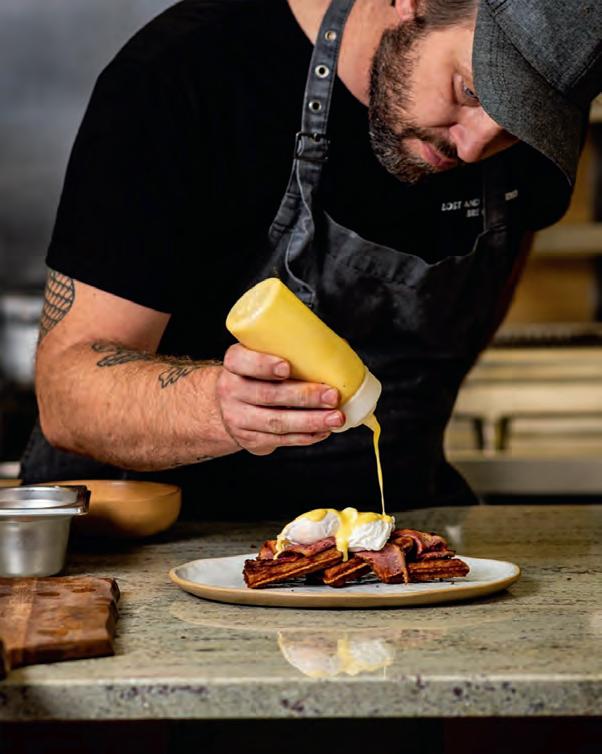
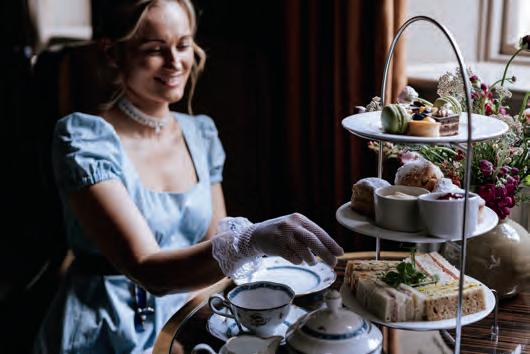
Calling all regency-era obsessives, fans of Jane Austen, Bridgerton devotees and all those curious to learn more about local history… The Gainsborough Bath Spa has launched an afternoon tea that celebrates the south west city’s heritage in a way like no other. With so many afternoon tea offerings around, it can be tricky to find a completely new experience that doesn’t feel gimmicky and retains a refined approach, but The Gainsborough Brasserie strikes gold with its History & Heritage Afternoon Tea – served daily from 3pm until 5pm (an ideal way to round off an indulgent day spent relaxing at its Spa Village, perhaps…).
This unique experience lets you sample delicious treats while enjoying captivating stories that offer a fascinating glimpse into Bath's past. Expect fresh finger sandwiches, home-baked scones with Devonshire clotted cream and homemade preserves, a selection of delicate pastries and cakes and nine carefully-sourced global teas to choose from (we picked the special Gainsborough Bath Spa Blend of Assam and Darjeeling from India). As well as all the quintessential elements of a British afternoon tea, the chefs also prepare warm savoury snacks inspired by tea-growing countries and paying homage to the owning group YTL Hotels’ Asian roots: a bamboo steamer basket conceals treats like crispy Malay curry puffs, spiced barbecue chicken pies and prawn sesame toast.
While you’re tucking into your delectable nibbles, the immersive experience gets underway, with characters dressed in their finery paying tables a visit to share their knowledge on all kinds of historical topics.
Let’s not give too much away, so you can find out for yourselves, but as a teaser we learnt about the 10,000-year-old minerals that supercharge Bath’s thermal waters, the complex but fascinating fan language used by debutantes during their season in the city all those years ago, and how afternoon tea as we know it came to be.
The History & Heritage Afternoon Tea is priced at £40 per person/£75 for two, but Champagne upgrades are also available (from £59) if you’re looking to add a little sparkle to your experience, including one specially-selected from the hotel’s sommelier.
Housed in a duo of stunning Grade-II Listed buildings from the 1800s, The Gainsborough Bath Spa’s original Georgian and Victorian architecture is only a few minutes’ walk from the train station, meaning this new afternoon tea is merely a quick hop from Bristol – yet feels worlds away.
thegainsboroughbathspa.co.uk




Sunday 29 September, 9.30am
£35 per person and includes a professional Barre Class, a main course from the brunch menu and a superfood smoothie
Join Harvey Nichols for an exclusive Barre Class, followed by a delicious brunch at the Second Floor Restaurant.
Hosted by experienced instructor, Tyla-Amber Spieth, the Barre Class will take place from 9.30am – 10.15am, on Womenswear.
Barre is a fusion workout embodying the fundamentals of yoga and Pilates, designed to sculpt the body and build strength in the legs, glutes, arms and core. Following the session, head to the Second Floor Restaurant to enjoy a main course from the Barre brunch menu, alongside a superfood smoothie to finish off a refreshing morning.

To book: Simply scan the QR code to book online as well as see a line-up of other exciting events.


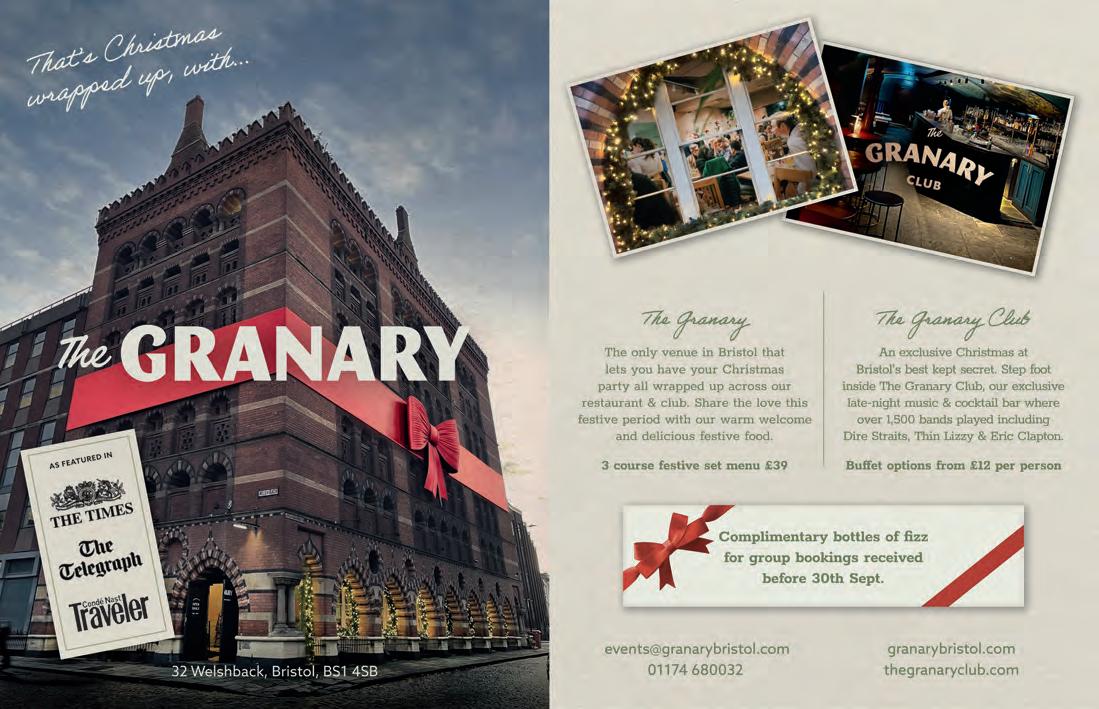




Johnny Palmer, the straight‐talking businessman behind Brislington’s worst kept secret (clue’s in the headline), has proved that making a viable business out of a disused aircraft can be way more than just a flight of fancy. He talks to us about making a base for local creatives, disruptive activism and entrepreneurship as a way of life

Words: Rosanna Spence

It’s not every day you find yourself sitting on a kitsch 70s-era redesigned Japan Airlines Boeing 727 airliner being offered peanuts from a golden pineapple by a Tasmanian entrepreneur on one of the hottest days of the year… But rather than being a scene from the latest glitzy Netflix series, beyond the portholes was an everyday scene of an industrial estate in Brislington.
You may already be familiar with the aforementioned entrepreneur –who, by the way, taught me a thing or two about my assumptions of his trade during our chat. You might know him as the chap who bought Warleigh Weir island, but after seeing a Bristol-based plane popping up time and again in articles for national media listing the UK’s most unusual Airbnbs – I wanted to know more about the man piloting this venture.
It turns out that there’s so much more to this aircraft, and the man who bought it, than simply being a place to book to stay overnight (though I’ll definitely be doing that ASAP too, as there’s a hot tub and cockpit laden with buttons and switches to keep you entertained).
Reaching fever pytch
Johnny Palmer heads up PYTCH at Skyline Park, in an unassuming industrial estate in BS4 that’s home to this must-see craft. PYTCH is Johnny’s live event production and creative media solutions (among many other things) company, calling a couple of large warehouses and yard space home. As an aside, it was also the first commercial premises in the UK to obtain an AAA EPC rating; in 2018, his team designed and built the world’s first completely off-grid deployable energy generator for events. They technically produce more energy than they consume.
But back to that Boeing, which now sits elevated on shipping containers painted to look like cloudy skies, along with a terrace and that hot tub. Its bodywork is now adorned with colourful artwork from local creatives HazardOne, Hasan Kamil and Curtis Hylton. There’s plenty of background info to be found easily online (PYTCHAir, as it’s known, has its own handy YouTube channel, plus there's an informative board on site for passers by).
“ You couldn’t do this in the middle of Clifon or Redland. But you can do it in a scuzzy industrial estate ”
Here’s a potted history of the Boeing 727... Originally flying in 1968 with Japan Airlines, the aircraft was converted into a VIP private jet in the 1970s with various owners and passengers, including Middle Eastern royalty. After its final flight in 2012 to Filton Airfield, it was moved to Kemble Airfield, where it remained until 2020. Johnny Palmer discovered the aircraft in 2018, envisioned its potential and after securing planning consent purchased it in 2020. In February 2021, the 727 was transported to Brislington, making headlines worldwide and changing this little pocket of our city. But why this spot?
“Generally no one cares about the aesthetics in industrial estates,” he says. “That’s not a problem for me, that’s an opportunity. If no one cares, and treats it badly, you can do anything to it. So if you want to stick street art everywhere, or put a wind turbine up, put an aircraft in, people say, ‘whatever’. You couldn’t do this in the middle of Clifon or Redland. But you can do it in a scuzzy industrial estate. Then guess what? The estate starts becoming a bit cool, it creates better jobs, better income. Some people call that gentrification... I hate that word.”
The interiors are a 70s-era kitsch wonderland. The aircraft is home to a dining room, salon, accommodation suite, kitchen, toilets, shower and original cockpit. Johnny had a vision that this aircraft was the missing centrepiece for PYTCH HQ. It has since become an amazing space for creativity, inspiration, communication, fine dining and fun. It’s hosted music videos, family film sessions, professional dinners, corporate meetings, drum ‘n’ bass raves, countless Airbnb guests and more. In a world that can often feel more than a bit glum and depressing, this feels like rocket-fuelled hub of joy. What’s more – Johnny’s happy to hire the space out for local creative use for absolutely nothing.
“There are people out there like me who have a space or resource that they want to share,” he explains. “The problem is, a lot of Bristol is bought up by people who only want the money. But there are loads of little guys out there like me, who want to do cool stuff. We want and need to have a business, but we also want to create spaces and make them available like this, because it enriches our city.”
He promises that if anyone’s got a non-commercial, progressive artistic, practice they want to use PYTCHAir for, he’s always happy to help: “We love Bristol because it has that artsy vibe. Anyone who can contribute to that in some way, should.”
Even when the plane is wearing its commercial pilot’s hat – as paidfor accommodation – he offers it for a cost-price on Wednesdays, encouraging families and friends to book the plane who might not be able to otherwise afford such a unique getaway.
When asked the age-old question of: ‘why are you doing all this?’ alongside being an entrepreneur-cum-landlord, he responds simply. “The philosophy is, ‘I’ll be dead soon’... Well, hopefully in 40-50 years of course.
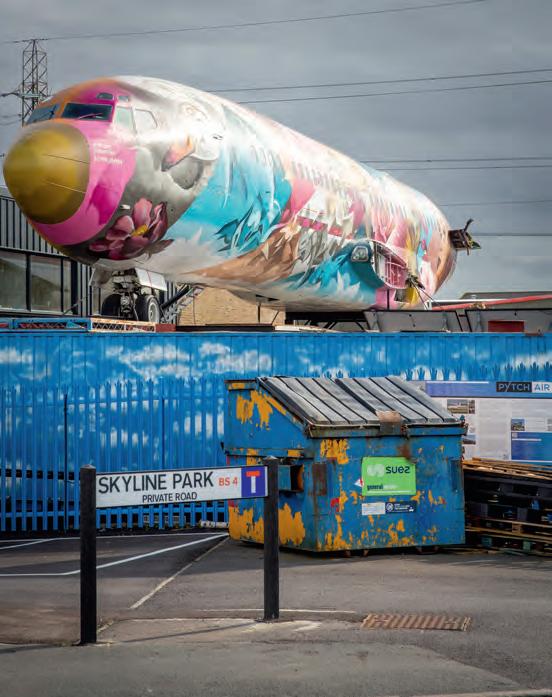


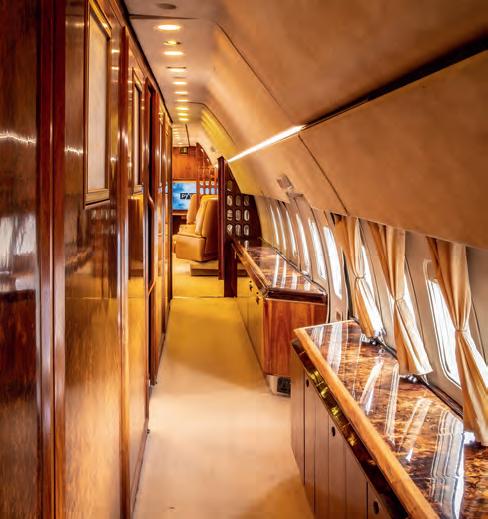





So how do I want to live my life? I want it to be full of funny stories, spending time with people and doing some crazy stuff. I want to have some successes and have some things that don’t work. Life and business can be pretty hard, but this is the life I want to lead.”
I’m curious to know what day-to-day life looks like for an entrepreneur with this approach to life. He tells me it varies. “Across my group of companies there is a lot going on – properties to maintain, a busy events schedule, regular media demands, a lot of staff, finances to manage and various fledgling opportunities that need nurturing. It might look exciting from the outside, but what people dont realise is that entrepreneurs and founders are often spending most of our time dealing with the toughest stuff. We have the responsibility to deal with the things that others cannot, or that do not have optimal outcomes. Every day there is a puzzle solve or some other form of challenge, but when things are going smoothly life gets boring.”
Johnny’s extroverted lifestyle that’s seen his professional life peppered with commercial ventures and passion projects (check out his whiskey brand D.B. Cooper made with Wales’ Penderyn Distillery for starters) had humble beginnings. Though he’s spent the majority of his life here –his first Bristol business was about 22 years ago, he reckons – he was brought up “dirt poor” on a Tasmanian farm. His love of audio and soundsystems (no wonder he ended up in Bristol) saw him embark on a successful DJ career, which ended up with him investing in our city’s property. But as well as wanting to be a well-meaning, good landlord who improves buildings and their surroundings, social and environmental activism is central to his purpose.
In recent years, Johnny became something of a spokesperson on local water quality, river pollution and wild swimming. He was central to the original campaign to get people swimming in the Bristol Floating Harbour again too (“I want to live in a world where I can swim in my harbour – it’s my harbour, it’s your harbour, it’s our harbour”). His special skill is being able to draw attention to things via disruptive activism, even if he doesn’t know how to execute the minutiae of the cause. “I did some research and nicked the play book from Extinction Rebellion, who I helped out a lot in the early days. The aim is to be disruptive, be fun, be obnoxious, be divisive, deliberately try and get an antagonistic debate going on. But most important is talking about the issue.”
Take his involvement with Warleigh Weir, for example. In 2017, the beauty spot was having big problems with parking, litter, and bad behaviour. Johnny purchased the river island and surrounding land in the hope it would encourage people to use the area more responsibly. He then launched the ‘Warleigh Weir Project’ to keep the site open, fix the issues,
and make sure everyone could still enjoy it – though at first, he caused a bit of a stir by threatening to close the site to the public if the litter problem wasn’t sorted out.
“Every single person is p*ssed off with the way things are in some regard, right? What you need to do to change things is literally disrupt them in some way; shake them up. Usually a bit of cage-rattling goes a long way. The issues of river quality, sewage and harbour swimming really matter to me a lot. Being disruptive and antagonistic in the case of activism really works.” Then Johnny chuckles: “It’s not so good in business when you have to work with people more. That’s a different mindset and yeah, sometimes they’re at odds with each other. Balancing those two parts is a question of integrity.”
Despite sitting surrounded with retro indulgence, all this talk of activism wasn’t exactly the course of conversation I’d expected with an entrepreneur plane-owner. Then again, I don’t spend much time with entrepreneurs and have probably been misled by Dragons’ Den-esque stereotypes. He’s keen to see local entrepreneurialism celebrated more in the city. “There are little people like me trying to change culture, but Bristol is often not pro-entrepreneurship. Young entrepreneurs are probably running off to Manchester or Dubai. I think entrepreneurs are a bit like artists, in that they just ‘do what they do’, if you're a painter, no matter where you are, what you do, you’ll find a way of drawing and painting. They don’t think about it. They just do. I believe true entrepreneurs are like that: we just do what we do. We’re not actually trying to make money. We need to make money to do more of ‘it’, but it’s not our objective. I think it’s more about curiosity, answering questions, experimenting with something or just for fun. A lot of these things don’t make money. The process is just trying to affect change in the world.”
Johnny’s involvement in Bristol’s rivers neatly segues into the next issue he wants to address: male mental health. As well as his disruptive activism, Johnny also helps organise the Bristol branch of a men’s wild swimming and cold dipping group called Icebreakers, which sees a group of 10-15 men meeting to swim regularly and explore positive masculinity, opening up. “The thing I’m seeing as the biggest problem in the world right now is damaged men. Most of the world’s problems can be routed back to messed up blokes. And many of them lead back to a lack of positive male role models. That’s my theory, and that’s the area I want to work on now, I’m not sure how, but we definitely need more positive masculinity.” n
For more information about PYTCHAir, visit pytch.co.uk/pytchair. The plane can also be found on Airbnb, and has two open days held each year – keep an eye on the main website for future dates.

LOCAL BUSINESS AND COMMUNITY ORGANISATION UPDATES

The Wave in Bristol has received B Corp status –making it the first surf park in the world to receive this hard-to-achieve accreditation. It joins more than 2,000 other B Corps in the UK, around 120 of which are in Bristol, that have also completed the rigorous process. Unlike traditional business models that focus on profit, B Corps subscribe to the triple bottom line framework, which considers not only financial returns but also social and environmental outcomes.
The certification recognises the work The Wave has done to date and – most importantly – helps the team to identify where it can continue to improve going forward. The announcement coincides with the release of The Wave’s latest Impact Report for 2023-2024. Key achievements over the last year, among others, include supporting 150 individual para-surfers booking throughout normal channels; building and switching on the solar array, delivering sunshine-powered waves; and running four sixweek surf therapy courses with The Wave Project. thewave.com
Grassroots charity
Your Park Bristol & Bath has announced National Grid Electricity Distribution as the first key partner for its recently-launched Reimagining Parks campaign. Alongside corporate sponsorship, some of the National Grid’s Bristol team will go out into the city’s green spaces and get stuck into supporting some of the charity’s work on the ground to transform local parks and make them accessible for everyone to enjoy. The partnership will run until Spring 2025, and the first of three scheduled employee volunteering days took place at Ashton Court. yourpark.org.uk
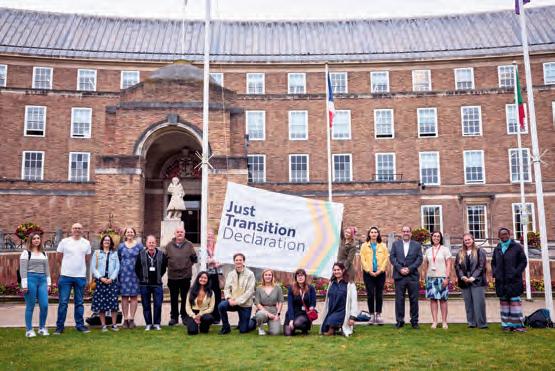



Twelve Bristol organisations recently raised a flag outside of City Hall to celebrate becoming Just Transition declaration early adopters. Signing up to the declaration is a commitment from organisations to actively work towards combatting climate change and protecting nature fairer for workers and marginalised communities. The declaration is a set of 10 principles that any organisation can use to design their action on climate change and nature in a just way. It aims to encourage organisations to understand that just transition is a journey and to celebrate continual progress over perfection. It was written by four climate activists representing marginalised communities across Bristol, Emma Geen, Rachel Moffat, Olivia Sweeney and Kirsty Tait.
The organisations were the Watershed, Bristol & Bath Regional Capital, Triodos Bank UK, Bristol Energy Network, Bristol Energy Cooperative, ACH, Praxis Research, Wellspring Settlement, Bricks, Bristol Labour group, and Bristol Green Councillor Group. They join Bristol City Council, which formally adopted the declaration in 2023. The flag raising also celebrated the translation of the declaration into seven of the most commonly spoken languages in Bristol, as well as an Easy Read version and a BSL video. To join the scheme, organisations had to deliver a statement of intent about how they plan to work towards all or several of the principles in the coming year. Some examples of work being undertaken include Bristol & Bath Regional Capital committing to train staff to ensure a just transition with every investment opportunity, the Watershed committing to integrate sustainability into their procurement strategy, and the Wellspring Settlement expanding its projects to tackle food poverty through community growing projects and developing a local food strategy.
bristolclimatehub.org/just-transition


Compounding entails generating returns on your accumulated returns from previous periods.
If you take a long-term approach, you could reach the “compound investment tipping point” – the point at which your returns exceed your total investment.
Compounding returns build over time Reinvesting your returns could potentially enhance your long-term growth.
If you invested £10,000 that yielded 5% returns each year, after one year, your investment would have grown to £10,500. The following year you would generate a further 5% on both your initial £10,000 investment and the additional £500.
Compounding returns could help you reach the compound investment tipping point
If you continue reinvesting, you may eventually reach the compound investment tipping point.
For example, if you made a regular £250 monthly contribution with 5% growth over a 30-year horizon, by the 26th year, your contributions would total £78,000, and your investment growth would be £82,229. You would have reached the compound investment tipping point.
The following steps could help you reach the compound investment tipping point:
• Understand your risk profile
• Diversify your portfolio
• Review your investment costs and fees
• Set clear goals and stick to your plan
• Speak to a financial planner
To speak to a financial planner, get in touch.

If you would like a review of your pensions and investments and whether you are on track to achieve your financial goals, please contact us for a free consultation.
Bristol has emerged as the best city in England for apprenticeships outside of London, according to a report from Best Apprenticeships using recent 2024 gov.uk data. The report, which evaluates the best and worst locations across the country for apprenticeship opportunities, highlights Bristol as a prime destination for both the number of available roles and the quality of pay offered to apprentices. Strong ties to the defence sector, including employers like the RAF and Babcock helped to boost Bristol to the top spot, with this industry supplying lots of high paid roles across the engineering category. Our city is the best in England for well-paid apprenticeship opportunities, with 70% of roles offering wages significantly above the minimum wage.
The full report can be found at bestapprenticeships.com
The inaugural UK Padel Schools and School Alumni Championships will be held for the first time on 28 and 29 September, at Rocket Padel in Bristol. Each school team consists of four to six players and there will be running girls, boys and mixed events. Thanks to the support of sponsor Evelyn Partners, children from any secondary school in the UK will be able to take part for free and experience playing padel at the club and event.
“We are so pleased that Evelyn Partners shares our vision for getting children active through sport. Together we want to use the impact of the UK Padel Schools and School Alumni Championships to help to lift up the awareness of padel as an easy to pick up, fun, dynamic and social sport and contribute to having a significant positive impact on the physical health and mental wellbeing of a broad cross section of the UK,” says Nick Baker, CEO at UK Padel. To register your school’s interest in competing, visit ukpadel.org/schools-championships

Excalibur Academies Trust is delighted to announce the appointment of its new CEO Nick Lewis, who is taking up his new position from September. Nick is no stranger to education in Bristol, having grown up in the city. He has previously successfully led Fairfield High School as Principal before taking up his most recent role in Excalibur as Director of Secondary Improvement. Prior to that he took the role of Interim CEO of Gatehouse Green Learning Trust in the critical year leading to a merger with Excalibur Academies Trust in September 2023, growing Excalibur into a family of 20 academies running along the M4 from Bristol to Reading and providing excellent education to over 10,000 young people. With leadership experience across all three key stages, Nick has also worked to support school improvement in a range of settings, whether helping to champion employability with The Careers and Enterprise Company, or in his role as former Chair of Schools of Tomorrow.

Nick describes himself as an “unashamedly optimistic and values driven leader”. Following the appointment Nick said “I am incredibly happy and proud that I will be leading such a wonderful organisation, working with and for so many incredible young people, and with an exceptional team of professionals who are focussed on providing the best opportunities possible for our students. As a family of 20 academies, we are already achieving so much. Our trust has grown in Bristol, and we now have even more opportunity to provide an inspiring and life-changing education for our students, and professional growth for our staff team”. excalibur.org.uk
Trinity Community Arts has secured funding to deliver a two-year arts-based learning programme – designed to address pre-existing gaps to arts access and educational inequalities. The ‘Cultural Alliance’ launches in September, and is delivered in partnership with three inner-city primary schools: Easton Primary, St Nicholas of Tolentine and Hannah Moore Primary. This new programme, funded by Paul Hamlyn Foundation, is a first-of-its-kind in the local area and has been co-designed to meet the needs of each school. The Alliance will utilise a tailored arts-based curriculum focused on dance and drama in partnership with locally-rooted creative partners ACTA and Movema. By addressing the detrimental effects of limited arts-education, the ambition is to support children's overall development and empower them to thrive in their learning journey. Alongside the programme, teachers will be offered ongoing support in their practice, offering them the creative tools and resources to provide the best opportunities for each student to flourish within their unique situations and learning environments. trinitybristol.org.uk


















































Bristol’s world‐leading music venues and theatres are working with more schools than ever thanks to support and funding from government‐ and charity‐led programmes helping the region’s creative young souls remain best in class
The beginning of the new school term in September is an incredibly busy time for teachers in Bristol, and Bristol Beacon is busier than ever as it launches a new partnership that will see its education programmes have a wider impact across the West of England.
The Beacon currently runs the Music Hub for Bristol, where it coordinates and enables high-quality musical activities for 92% of schools in the city, encouraging more than 30,000 children and young people a year to pick up an instrument and express themselves.
As of September 2024, Bristol Beacon becomes one of the first music charities based in a concert hall to become a Music Hub Lead Organisation. This funding of £1,933,874 from the Department of Education (and delivered by Arts Council England), means the Beacon will be able to connect its artistic programme to children and young people across the whole of the West of England region (Bristol, South Gloucestershire, Bath & North East Somerset, and North Somerset), enabling them to get involved with the music industry directly through encounters with professional musicians and performances.
To do this work, Bristol Beacon will operate in partnership with West of England Music and Arts (WEMA) which is responsible for the current music education provision in the areas surrounding Bristol.
WEMA will continue to deliver music education services to these three areas under the new hub arrangement.
Adam Kent, Director of Creative Learning and Engagement at Bristol Beacon, who leads the team devising and delivering this work, is enthusiastic about the impact this new partnership will have on the children and young people in this wider area, because the Beacon’s Musical Schools programme has been such a success in their home city.

“I started working at the Beacon in 2022, so as a relatively new arrival in Bristol it has been a huge pleasure to see how the Beacon’s work with schools in the city has grown and developed,” he says. “Our Musical Schools Membership programme supports all schools in the city to bring music to life in their classroom through the curriculum. We also support teachers in the best ways of creating engaging, exciting and professional music lessons in their schools, and I love getting to see first-hand how much children and teachers get out of these lessons. To be able to roll out this work across the West of England means more children engaging with music at a young age, and hopefully creating a new generation of musicians and music lovers.”
Schools at all levels are able to become members of the Musical Schools programme, gaining access to whole class tuition workshops led by Bristol Beacon’s experienced music leaders, the chance to take part in massed singing and playing events at the Beacon, and access to workshops and concerts run by some of the Beacon’s partner orchestras – including the world-renowned London Symphony Orchestra and the BBC – one of the benefits of being a Hub attached to a concert venue. For example, in November 2023 students from 22 primary schools took part in a day of music making and performance at the Beacon, curated by the Benedetti Foundation, and led by celebrated musician and music education advocate Nicola Benedetti. Thirteen of the schools, who learn music through the Beacon’s innovative Earthsong schools programme, learnt about pulse, rhythm, pitch and harmony with talented young musicians from across the region.
One of the most exciting aspects of the Beacon's work is their commitment to providing access to music for all. The Beacon runs a whole host of orchestras and ensembles including the Bristol Youth Orchestra and their young Jazz Ambassadors. Their most innovative
and groundbreaking ensemble is the Bristol National Open Youth Orchestra Ensemble (NOYO), an inclusive group where 11-25 year old disabled and non-disabled musicians rehearse and perform together. Many of the young people involved use assistive technology such as the Clarion instrument which can be played through eye movement, enabling talented musicians of all abilities to make music together, unlocking ambition and potential for all.
Adam says: “We know that some of our NOYO participants say they have never fitted into or been a valued member of an orchestra before. These young people have so much talent and potential, and with the rise of professional integrated orchestras such as Paraorchestra, who are the Beacon’s Associate Artists and are based in Bristol, there are many more opportunities for disabled, d/Deaf and neurodivergent young people to explore careers in music.”
The Beacon has ambitious targets for the reach and impact of this work. They aim to deliver 68,000 lessons this coming academic year across Bristol, loaning out over 2,000 instruments to schools and individuals, and inviting over 10,000 children and young people to inspiring massed events at Bristol Beacon and other venues right across the city.
Adam is looking forward to the new term and the work of the expanded Hub. “The whole Beacon team are looking forward to working in partnership to integrate our programmes more widely across the region alongside WEMA. We truly believe that music can help everyone to thrive socially, educationally and personally, as well as being a chance to express yourself creatively and joyfully, and it is a real privilege to be able to bring music into the lives of all children across the region.”
Bristol Beacon isn’t the only leading cultural venue to be supporting the creative development and artistic education of our city’s young people.
Bristol Old Vic announced at the end of July that is was one of 11 venues selected nationwide to receive a share of music charity Youth Music’s £1.5million Energiser Fund.
The fund was launched to support the creative development of Early Years children, and is dedicated to helping vital preschool activity –allowing chosen venues to accelerate change in this age group. Youth Music believes that babies and toddlers should have the opportunity to influence the organisations and activities they are involved in.
However, the Early Years sector is in crisis, with practitioners reporting an increase in the number of settings closing down, staff

shortages and ongoing retention issues, as well as the de-prioritisation of creative education when it comes to policy and resource allocation.
Create Space is a Bristol Old Vic project, in partnership with Redcliffe Nursery School. With the help of Youth Music, this project will see the theatre’s Engagement team will be working with a core group of children aged 2-4 years to co-create playful spaces within the theatre. Redcliffe is a culturally isolated area yet it’s only a 10-minute walk from Bristol Old Vic theatre, a leading cultural venue in the city. With Bristol Old Vic’s resources, Redcliffe Nursery’s Early Years expertise and lead artist Edwina Bridgeman’s experience of co-creating, the teams will foster an environment where the children can explore and take ownership of their local area.
“ All children have the right to access the arts to progress their wellbeing, confidence, and communication skills ”
Lucy Hunt, Bristol Old Vic
“We are very happy to have secured funding from Youth Music to continue to grow our Early Years work,” says Lucy Hunt, Bristol Old Vic’s engagement director. “Creativity is crucial for young people’s development and all children have the right to access the arts to progress their wellbeing, confidence, and communication skills through participation in theatre. Our engagement programme for young people aged 5+ has developed over years of learning, developing, and refining. We want to do the same with our Early Years’ programme working with valued partners at Redcliffe Nursery and local artist Edwina Bridgeman. As a producing theatre which makes shows for this age range, it is crucial to focus on developing our work, spaces, and programme with Early Years children and their families.”
“Investing in Early Years is a matter of equity and inclusion, and with reports from early years practitioners that the suggested measures from the government feeling inadequate, it’s clear that work needs to be done to support the creativity in this age group,” adds Matt Griffiths, Youth Music’s CEO.
“We’re really excited by the progressive work happening at these projects already, and can’t wait to work with them to change the creative landscape for early years children nationwide over the coming years.”
It’s certainly positive to see proactive support being directed to the city in terms of essential funding that will create more opportunities for creativity to thrive no matter where children live – the holistic benefits of which are far-reaching for our local community.
These recent funding announcements, and the projects they will help enable, further highlight just how essential creative spaces and cultural venues are to our city (many of which are under threat). Let’s hope that their success sends a clear message to our new government that everything must be done to ensure their legacy benefits Bristol for generations to come. n
youthmusic.org.uk/energiser-fund; bristololdvic.org.uk; bristolbeacon.org; artscouncil.org.uk/musiceducationhubs
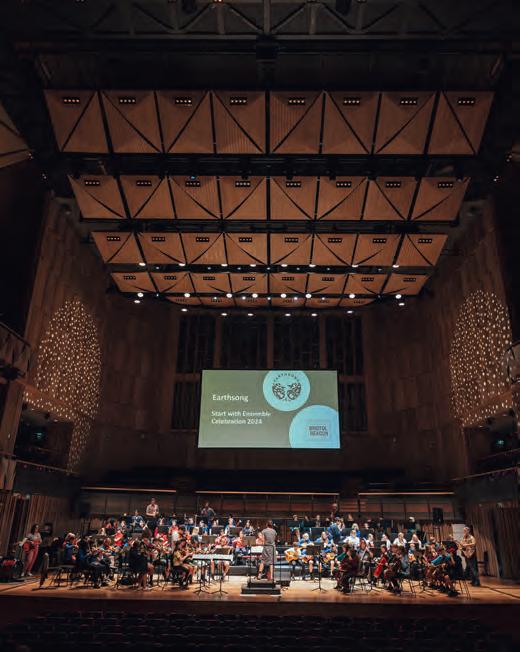


Mrs Jessica Miles, Head at Badminton School:
It is a privilege and joy to be the Head at Badminton - a vibrant environment with outstanding teaching and learning where the girls achieve excellent results because they are nurtured and encouraged within a calm and supportive community that promotes selfconfidence, self-belief and a can-do attitude.
Academic excellence is a given, but we also give individuals the opportunity to shine in extra-curricular achievements. Your daughter will have the opportunity to explore music, art, drama and outdoor pursuits, with a vast array of concerts, theatre performances, expeditions and trips running throughout the year. She will have the freedom to take personal responsibility, to think for herself and to understand service to the community as we prepare her for an exciting future.

Badminton is a daily reminder that a good school can embed the attitudes and attributes for a fulfilling future. I would encourage you to visit us and gain a first-hand impression of the school and its spirit all the wonderful things that take place here. www.badmintonschool.co.uk
There is no other school like us in Bristol – we are truly unique! We have broken the mould of adhering to the traditional entrance exam, GCSE, A Level pathway; we recognise that a one size fits all approach does not suit all pupils. We are a mainstream school, which continues to offer a rigorous education and by providing the International Baccalaureate Middle Years Programme we encourage our pupils to become creative, critical and reflective thinkers. This enhances our pupils with the skills of communication, cultural understanding and global engagement: all of which are essential for navigating this fastchanging world and which are actively sought by universities and future employers.
Cleve House International School believes in a partnership between school, pupils and parents and knows that this tried and tested approach achieves excellent results. www.clevehouseschool.com ABOUT US

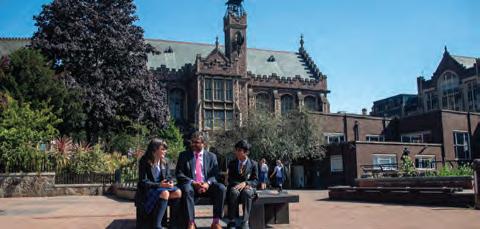
Bristol Grammar School, the longest serving independent school in the city, continues to guide pupils not just to academic success but to develop young adults of integrity and character, ready to make a real and lasting difference in the world that awaits them.
Ranked ‘Excellent’ in our May 2023 ISI inspection BGS is a supportive space for well-being, with nurturing staff, a wide range of subjects and courses - including the IB diploma - and exceptional facilities. BGS is a place where learning becomes an adventure; beyond the classroom, there’s a world of opportunity, from sport to creative and performing arts and everything in between.
Our doors are open wider with our means-tested Bursary Awards worth up to 100% of fees - ensuring everyone can be part of our diverse community.
Join us and find your place at Bristol Grammar School. www.bristolgrammarschool.co.uk
Established in 1862, Clifton College welcomes boarders from across the UK and the world who join with our day pupils from the vibrant and diverse city of Bristol.
From Preschool through to Sixth Form, we pride ourselves on providing an education where character is as important as capability. Through expert teaching, a wealth of co-curricular activities and strong pastoral care, we ensure that every pupil is supported, encouraged and driven to achieve their very best.
We aim to develop open-minded young people with a real understanding of the world around them, fully prepared for their future in a rapidly changing modern world. www.cliftoncollege.com



MESSAGES FROM THE HEAD
Mr Jeremy McCullough MA (Oxon), Head, Collegiate School
What makes a Collegiate education so special? We value the benefits of a broad and holistic education. Our students excel academically, but they also recognise that there is much more to life than exam results. We are fortunate to have all our facilities on-site meaning students can seamlessly combine academic studies and sporting, musical and dramatic pursuits. Our main aim is for students to be happy at school. Happy students will work hard, play hard, and will become the best version of themselves. Join us at one of our open events, or get in touch to arrange a tour, and discover for yourself the unique benefits a Collegiate education can offer your child. www.collegiate.org.uk

FULLY CO-ED FROM SEPTEMBER 2024
Haberdashers’ Monmouth School
Haberdashers’ Monmouth School, nestled in the picturesque Wye Valley, offers co-educational learning for children aged 3-18, across a 60-acre campus. Founded in 1614, our school blends a rich heritage with a forward-thinking approach, inspiring students to become pioneers and leaders. We are renowned for nurturing talented young people with a strong sense of community and grounded values. Our exceptional facilities, including swimming pools, sports pitches, and Performing Arts Centre, support an extensive range of co-curricular activities. We offer flexi boarding options for busy families and alongside The Haberdashers’ Advantage, we provide unparalleled support, ensuring every student excels. With significant investment into the school, we urge you to come and see for yourself what all the excitement is about. www.habsmonmouth.org

MESSAGES FROM THE PRINCIPAL
Mr Edel Cronin
Principal of Fairfield High School:
At Fairfield, we are committed to fostering an inclusive and dynamic learning environment where every student can thrive. As Principal I see my role as leading our community to ensure we provide a high-quality education that inspires and empowers our students to achieve their full potential
Our dedicated team of educators is passionate about delivering a broad and balanced curriculum that not only meets the highest academic standards but also promotes creativity, critical thinking, and a love for lifelong learning. We believe in nurturing the unique talents and abilities of each student, ensuring they are wellprepared for the challenges of the future.
Our ‘We Are Fairfield’ values are woven into the fabric of our school culture, guiding our students to become responsible global citizens. www.fairfield.excalibur.org.uk

MESSAGES FROM THE HEAD
Mr. Ross Wolverson, Head of QEH Junior School
It is with excitement that I take my place as Head of QEH Junior School; QEH is a much beloved and historical part of our great city, it has been at the centre of Bristol life for over four centuries and continues to serve our city’s vibrant and diverse community. The Junior School is exceptional not because of its award-winning facilities but the QEH community that it serves, which was recognised in our recent Values-based Education accreditation. We are proud to be the first independent school in the region to have been awarded this. We offer the boys who attend our school the space, time and opportunities in which to celebrate their successes and failures in equal measure; it is a privilege to be entrusted by families to walk this journey with their sons as they grow into becoming ‘gentle-men.’ www.qehbristol.co.uk


This year Redmaids’ High School celebrates 390 years of excellence in girls’ education. Formed from a merger in 2016 of The Red Maids’ School (est. 1634) and Redland High School (est. 1882), it now operates as an independent day school for girls aged 7 to 18 years. As the oldest surviving girls’ school in the country, centuries of experience help shape and deliver an exceptional education for young women. The School provides a diverse curriculum and a wide range of extracurricular activities, that are supported by its unique Athena Development Grants which provide all students with the opportunity of an individual grant to aid their personal development. Students are known and valued on their own terms, and with exceptional pastoral care, they are supported to aspire to great things. As the School celebrates this milestone over the next twelve months, Redmaids' High continues to look forward to nurturing the next generation of trailblazing women. www.redmaidshigh.co.uk
The Downs Preparatory School
A leading independent day preparatory school for children aged 4 to 13, The Downs Preparatory School is set in sixty acres of idyllic parkland. The expanses of peaceful nature, state-of-the-art facilities and our historic buildings – enhance every aspect of learning. Just five miles from Clifton, Bristol.
A school where tradition meets vibrancy and an environment where children have the freedom to explore, the confidence to express and the ambition to excel.
To succeed in the 21st Century workplace requires collaboration, resilience and perseverance. We look to encourage these qualities, interweaving them throughout our curriculum and everyday school life. Our children excel academically, but that alone isn’t enough. They leave our school with the values, drive and resilience to be themselves, and make bold, courageous choices to explore the world around them.
www.thedownsschool.co.uk

At Sidcot we are justifiably proud of our students’ academic record, but we are equally proud of their social skills, their emotional intelligence, their resilience and their determination to make a difference in the world. It’s our experience that curiosity and the confidence to enquire fearlessly - to live adventurously, as our Quaker philosophy puts it - leads children to be better motivated and more at ease with themselves as thinkers and learners. We don’t cram children at Sidcot, because we don’t have to. This is a kind, purposeful place where we educate the whole person for a life of active, responsible citizenship. As the independent reviewer from the Good Schools Guide recently put it, “Open, curious, inspired by their education and calmly confident in their ability to make a difference is how Sidcot pupils come across”.
www.sidcot.org.uk

Tockington Manor School,
Tockington Manor School and Nursery is a very special place where boys and girls aged 2 – 13 can flourish in a tranquil countryside setting. Situated in one of the nation’s few private arboretums, the school has an outdoor ethos where wellies are part of the uniform and weather is a learning opportunity rather than a deterrent. This is where small seeds become mighty trees!
Headmaster Stephen Symonds aims to encourage a love of learning to last a lifetime. This is achieved through small classes led by passionate teachers, stimulating sports, performing arts and extracurricular activities, and by allowing children to be children for as long as possible, while still being prepared with the attitude and aptitude for senior schools and beyond. At Tockington Manor, we’re more than a school. We’re a family.
www.tockingtonmanorschool.com




“The school aims to develop confident, resilient pupils with a positive attitude to learning in an environment that is full of joy, empathy and opportunity”



Office@clevehouseschool.com
T: 0117 9777 218
SECONDARY SCHOOL PLACES FOR YEAR 7 2025FILLING FAST! • Secondary School Open Experienced and Dedicated Staff • Non selective; No exam • Specialist & Dynamic Teaching 1:10 ratio • Hardworking mainstream school both calm and fun! • Offering International Baccalaureate Middle Years Programme • Latin, Swimming, Forest & Farm School, Padel Tennis • Happy Environment for Pupils aged 2–16 years • Limited Places Available •

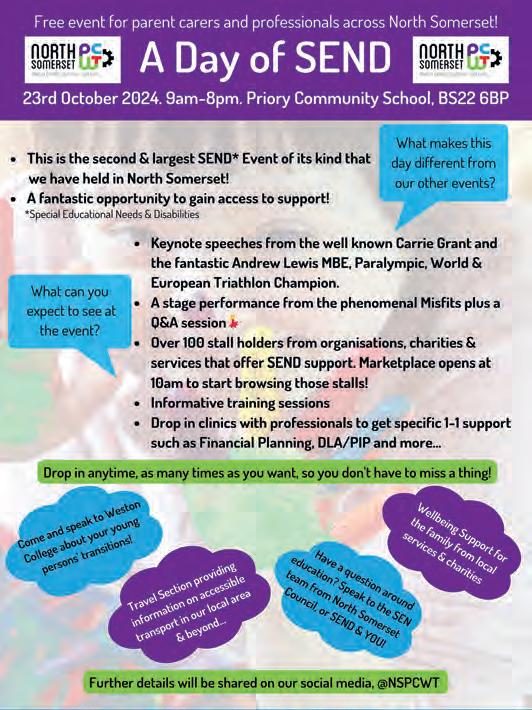





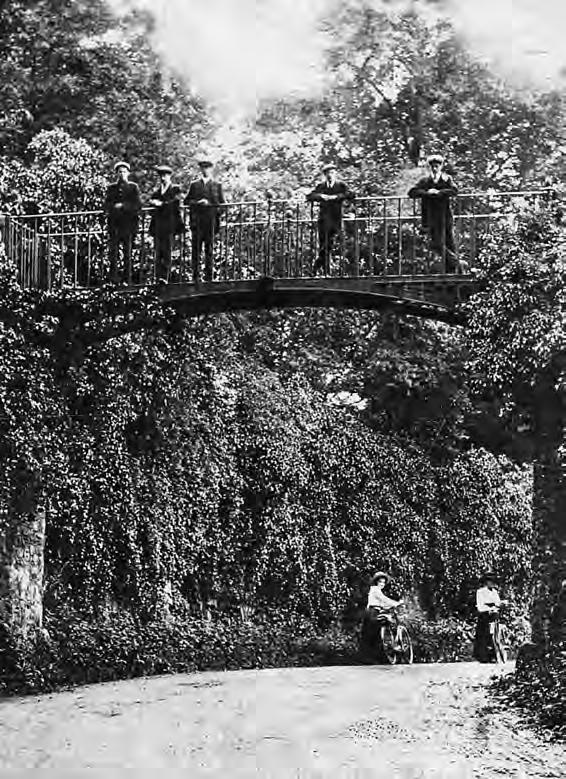
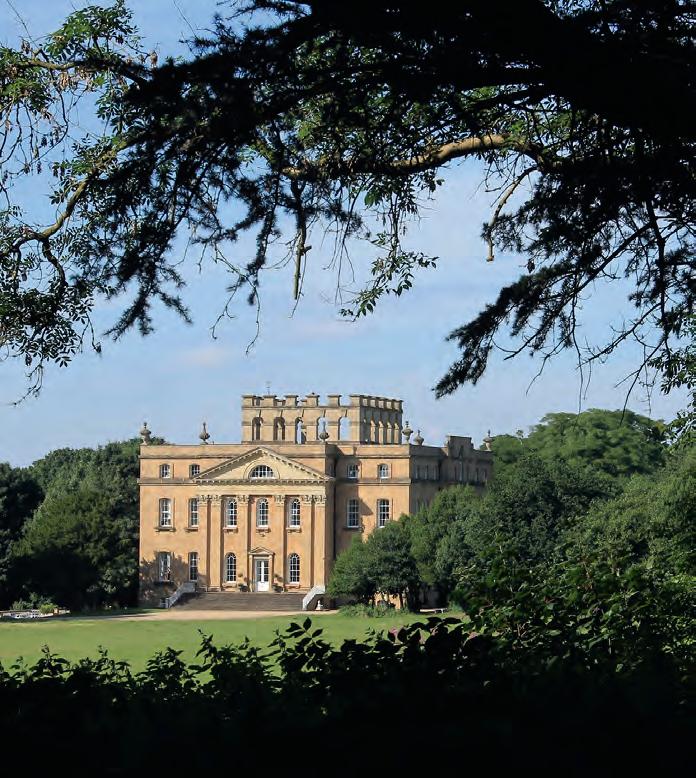


Andrew Swift takes advantage of the recent reopening of a once notoriously closed iron bridge, to explore the lost gardens of Kings Weston and discover one of the most historic tracts of land found in our city
In November 2015, a footbridge spanning Kings Weston Road, built in 1821 to link the two parts of the Kings Weston Estate, was struck by a lorry, declared unsafe and closed. Despite vociferous calls for its speedy reinstatement and the formation of a Save the Iron Bridge campaign group, not until 2023 did work to restore it get under way. Finally, though, on 8 July this year, Kings Weston’s iron bridge – now raised a metre higher to keep it out of the way of errant lorries – was formally opened.
This seems an opportune time to take advantage of the reopened bridge to explore the lost gardens of Kings Weston, on a three and a half mile walk through one of the most historic tracts of land in Bristol, and one where nature now runs largely unchecked amid the rambling ruins of the past.
The starting point – which you can get to either by car, bike or bus – is Shirehampton Park Car Park on Shirehampton Road (ST540771; BS11 0EA). Buses running past it include services 3, 4, 41 (First Bus) and 11 (Stagecoach West) – ask for the Penpole Lane stop.
At the far end of the car park you will find an information board as well as a leaflet dispenser. The leaflets not only provide loads of information on the history of the estate but also feature a useful map.
A few metres further on, turn left along a broad path into Penpole Wood. After passing a cricket ground on the left, you are confronted by
a choice between three paths. Take the middle one, continue in the same direction and, when you come to the edge of the escarpment, bear left along it. Eventually, as the path leads into the open, you pass a ruinous wall on the left. This is all that survives of an ornamental lodge, built around 1723 and demolished in 1952. Ahead, on Penpole Point, is a compass dial and navigation marker, probably dating from the 17th century, which once enjoyed unrivalled views over the Severn estuary –views which, like so many others on the estate, are now hidden by trees.
From here, turn to head back past the ruined lodge. Just beyond it, turn left down rudimentary steps to follow a steep and narrow path, beset with fallen trees, diagonally down the escarpment. After negotiating a zigzag and a few broken-down stone steps at the bottom, turn right along a path through a grove of laurels. With tall trees above and below, and fern-hung rocky outcrops adding a note of mystery, this precipitous enclave is a magical spot.
After passing an area of recently cleared woodland, you come to a deep hollow on the right from which the stone to build Kings Weston House was quarried. It was later planted up as a romantic dell, with paths leading to a viewing mound from which its beauties could be surveyed. Over 250 years later, nature’s reclamation of this sequestered retreat is total.
A little further on, you come to a stony path. Turn left along it, and after a few paces you emerge from the woods to be confronted by the imposing facade of Kings Weston House ahead and – finally – a view of

industrial Avonmouth and the Severn estuary to your left. Carry on, past a dog totem pole surmounted by a squirrel, along the north-west front of the house, where there is a cafe in the basement. Follow the drive as it curves right and then left past the Brew House to emerge through a gateway on Kings Weston Lane. There is a tricky road crossing here, as you want to head along Napier Miles Road. The best option is to stand well to the right of the gateway, which will give you a clearer view of traffic from the left – but you will still need to be patient.
A little way along Napier Miles Road are Kings Weston’s former stables, on the left, and an overgrown lily pond, flanked by two lodges, on the right – all dating from 1763. Carry on along the road for another 50m, before following a footpath sign through a kissing gate on the left. When the path emerges into a field, turn right along a grassy track running parallel to the road.
At the end, continue along a narrow track, and, at the road, turn left past one of Kings Weston’s former lodges. Carry on along the pavement for 100m, and, when you come to a footpath sign on the left, cross the road to go through a gap in the hedge on the right, passing a sign for Blaise Horse Riding Trails. The path leads into Evergreens Wood, planted in the early 19th century. After a few paces, when the path forks, bear left into deep woodland. When, after 400m, you come to a broader stony track, turn right along it. When another path cuts diagonally across, carry straight on, and a little further on you will emerge into the wildflowerrich meadowland of Kings Weston Hill.
Turn right to follow a rough track through the meadow for around 1000m. After passing a mast, erected in 1966 to bring BBC2 to Bristol, a stony track leads through a kissing gate. Just beyond it, on the right, is the former Kings Weston Inn, built around 1724 to provide refreshment for visitors to the estate. After it closed in the mid-19th century, it was substantially rebuilt and served for a time as a tea room but is now a private house.
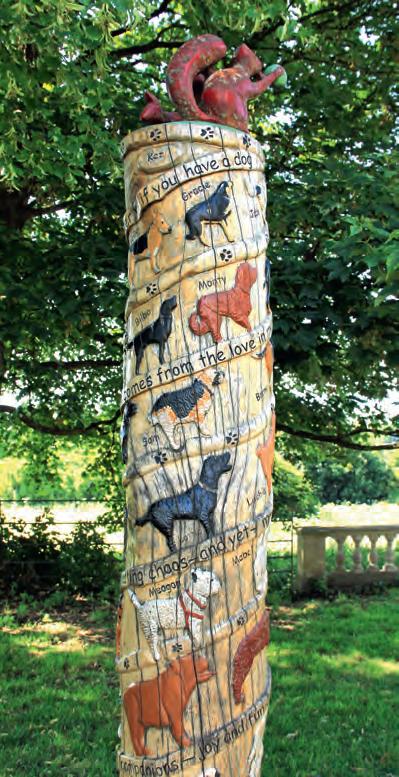
Carry on across the newly reinstated footbridge and on the far side turn right up steps onto an elevated terrace built to command views westward over Shirehampton Park and the green hills of Somerset. Before turning left along it, carry straight on to discover what lies on the other side of the high wall ahead. This is the Echo, a banqueting loggia built shortly after the house, not only to close the view but also apparently to take advantage of a naturally occurring echo.
As you retrace your steps to the terrace and head west along it, occasional glimpses of distant vistas through the trees give an inkling of the sweeping panoramas 18th-century visitors would have enjoyed. Compensation for their loss comes a little further along, as the trees on the right part to reveal superb views of the house across manicured lawns – a fitting climax to this stroll around the lost gardens of Kings Weston. A few metres further on, a left turn leads back to the car park. n
akemanpress.com
All photos provided courtesy of Andrew Swift
Length of Walk: 3.5 miles
Approximate Time: 2.5 hours
Terrain: Some rough and steep paths; two main road crossings; several flights of steps
Facilities: Sir John Vanbrugh Coffee Shop in the cellars of Kings Weston House, open daily 8.30am to 4pm
Dogs: Welcome on the estate Map: OS Explorer 155
For further information, visit the Kings Weston Action Group website kwag.org.uk

The Redland Road Dental Practice is celebrating its centenary year, having been first established by Mr Norman Simmonds. The practice can be found advertising in the Western Daily Press newspaper in July 1924. Back then, the phone number was 1070 and the last three digits are still used today: 0117 9246070.
“Times have changed,” the practice said in a statement. “One hundred years ago, around 50% of the population would lose all their teeth in their lifetime, clinics were basic and anaesthetic was rarely used.
“We’ve grown over the years and now have 10 dentists, four hygienists and 20 support staff offering treatments from family check ups, clear aligners and whitening to facial fillers and orthopaedic orthodontic techniques. Although we encourage trainee nurses to learn with us, we are also proud that many of our team are long standing, with the two practice owners and practice manager having worked at Redland Road for more than 30 years.”
redlanddental.co.uk
Alma Physiotherapy in Redland now has four physiotherapists who are all musculoskeletal- and pelvic health-trained, and can also provide scar therapy, massage therapy, yoga, pilates, life coaching, trauma support, acupuncture and hypnotherapy.
One in three women has pelvic floor dysfunction in their lifetime, but most do not seek help. Symptoms such as leaking urine on jumping, running or weightlifting are common, but they are not normal. Most pelvic floor issues can be fixed with simple education or a holistic approach to treatment. Alma supports women through pregnancy and the menopause, and can help with chronic pelvic pain conditions such as endometriosis or bowel dysfunction. almaphysiotherapy.co.uk

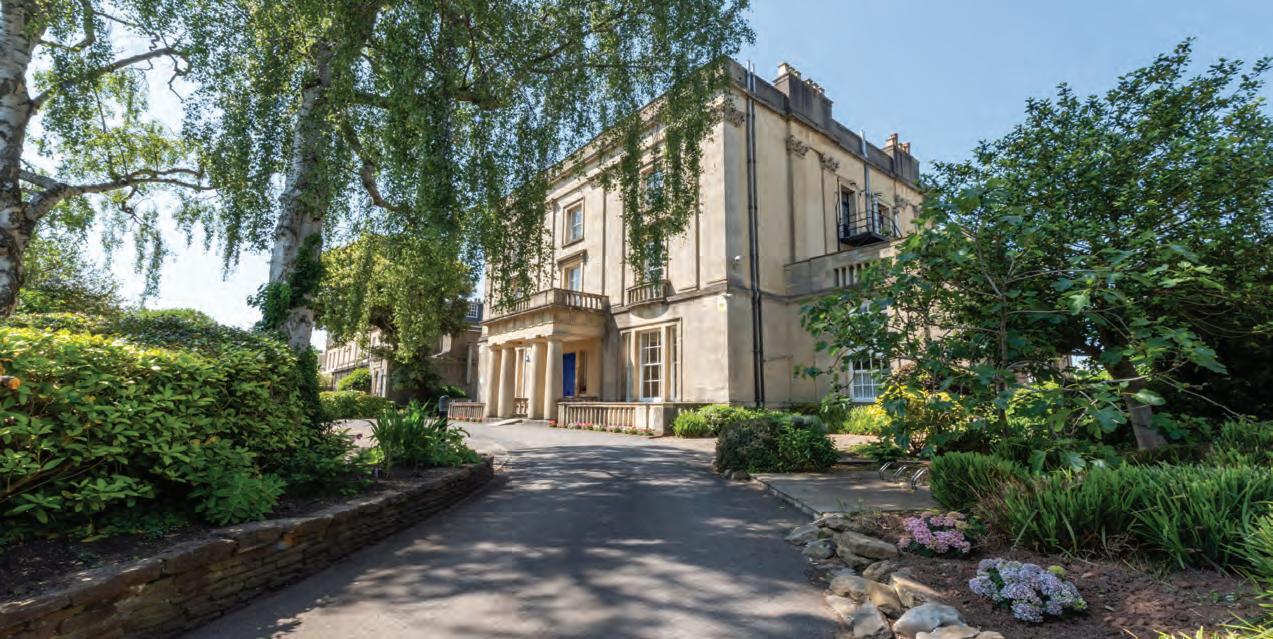

As September brings a fresh start, and those back-to-school vibes, we’re thrilled to share some exciting news from The Chelvey Clinic! In our ongoing commitment to providing exceptional care, we’re expanding our services to better support your health and well-being. Introducing our Women's Health GP Appointments, led by our exceptional doctors, Dr. Kuki Avery and Dr. Laura Flexer.
At The Chelvey Clinic, we understand that women's health is multifaceted. While we founded Chelvey Menopause to address the critical need for quality menopause care, we’ve listened to our patients and recognised the growing demand for broader women’s health services. From “well woman” appointments to diabetes care, sleep concerns to sexual well-being, diet management to hormone health— our patients have voiced their need for comprehensive support, and we’re here to provide it.
Our dedicated Women's Health GP Appointments are designed for all women, whether you're new to the clinic or a familiar face. These appointments are available to women of all ages, addressing a wide range of medical concerns. Everyone is welcome!
You can choose to meet with Dr. Avery or Dr. Flexer in-person at our convenient Litfield House clinic in Clifton, Bristol (with parking available), or opt for a virtual consultation from the comfort of your own home, anywhere in the country. Each 25-minute Women’s Health GP Appointment gives you the time and space to discuss any aspect of your health, with a focus on personalised, compassionate care.
To make our services as accessible as possible, we’re offering these women’s health GP appointments at an introductory price of just £95.
The Chelvey Clinic is a small local Bristol clinic with a big mission; to provide you with the best in women’s healthcare. Easy and fast booking, late notice appointments, continuity of care, more time to discuss your concerns, feeling listened to and taken seriously and having a choice of doctor are just some of the reasons to book an appointment with The Chelvey Clinic.
With over 35 years of combined clinical experience within the NHS and
a background in both hospital medicine and general practice, Dr. Avery and Dr. Flexer are well placed to address a wide range of women’s health concerns. With the focus on evidence-based, personalised care, they place the individual at the heart of their practice, tailoring treatments to meet each woman's unique needs.
“Easy and fast booking, late notice appointments, continuity of care, more time to discuss your concerns, feeling listened to, and having a choice of doctor are just some of the reasons to book an appointment with The Chelvey Clinic.”
Chelvey Menopause: Continuing to provide gold standard menopause care
Our specialist menopause service, Chelvey Menopause, continues to be committed to empowering women during menopause. We offer a full range of treatments, including hormone replacement therapy, testosterone, coil insertion, and natural options, such as cognitive behaviour therapy for menopause.
Our doctor-delivered menopause care is provided only by British Menopause Society (BMS) Accredited Menopause Specialists, ensuring high-quality, personalised, and evidence-based support tailored to each woman's unique journey.
Appointments are open for booking! Simply visit thechelvey.com or email us at hello@thechelvey.com for more information. Your health deserves the very best, and we’re here to provide it.
Take control of your health and well-being—book an appointment at The Chelvey Clinic today!



Over the last 7 years we’ve been using MBST to help patients with arthritic conditions, bone conditions, acute injury and professional sports injuries. Proven at cellular level to reset, resynchronise and regenerate damaged cells, numerous outcome studies on NMRT (nuclear magnetic resonance technology) are indicating very positive results from applying this therapy. In addition to the existing evidence at cell and cartilage level, new study data is indicating very good results in several new areas:
• Improving post operative outcomes in total knee replacement
• Improving bone density and quality leading to reduced fracture risk in Osteoporosis patients.
The most common conditions we help patients with are:
• DISC INJURY AND SCIATICA •
• LOW BACK AND NECK OSTEOARTHRITIS •
• OSTEOPOROSIS •
• PERIPHERAL JOINT OSTEOARTHRITIS (Hips - knees - ankles/feet - shoulders - elbows - hands) •
• TENDON AND LIGAMENT INJURY •
Due to our newfound knowledge on exactly how MBST influences cells, it’s advisable to address the tissue damage as soon as possible. Whilst we get great results with long term problems, early intervention makes more sense. 90% of our patients significantly improve after this non invasive treatment. Just as with MRI, there are no known side effects.
If you’re interested in looking into this technology, call /email us.

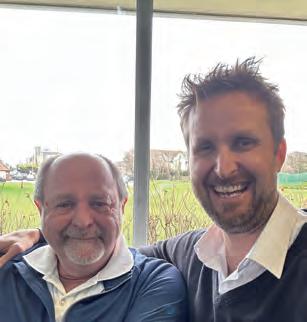




Richard Higgs, Chartered Independent Financial Planner
Harold Stephens is proud to be joining forces with hundreds of charities, professional advisers, and partners across the UK to celebrate Remember A Charity Week (9th – 15th September).
As proud Campaign Supporters, throughout the week we will be raising awareness of the option of giving to charity from your Will, alongside taking care of loved ones.
Offering generous tax incentives and providing essential funding for vital services across the country, this form of charitable giving is on the rise. In fact, around £3 in every £10 donated to charity comes through gifts in Wills.
James Kenward, Independent Financial Adviser at Harold Stephens said: “We’re delighted to be part of this year’s Remember A Charity Week. We know that leaving a gift in this way can not only be an important way of supporting good causes, but it’s such a rewarding way for our clients to give back. During the week, we’ll be sharing information about how ‘Willanthropy’ impacts local charities as well as highlighting the potential inheritance tax benefits of giving. If you would like to book an appointment to discuss updating your Will, or any estate planning needs, please don’t hesitate to get in touch with us.”
Thanks to the generous acts of everyday people, the UK ‘Willanthropy’ movement continues to grow - with around 100 people a day across the UK now choosing to leave a gift to charity in their Will. By working together with Remember A Charity, we hope to inspire even more clients to consider what they wish to be remembered for.
Call 0117 3636 212 or email office@haroldstephens.co.uk to book your complimentary estate planning review.
We record regular video updates on a range of later life financial topics - search ‘Harold Stephens IFA’ on YouTube.


50 High Street, Westbury on Trym, Bristol BS9 3DZ. Find out more at www.haroldstephens.co.uk
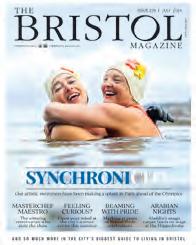



Thinking about creating additional space in your garden? Here are two examples of garden structures provided by local specialists Garden Affairs – a mini garden office and a self‐contained living space for generating extra income
This commission for a mini-office came from Karen, a garden designer with a passion for plants and organic and sustainable gardening. Having previously worked from her living room, the new wooden garden room gives her a dedicated work place within her small city garden.
The client, who chose Garden Affairs’ Mini Garden Office (1.8m x 2.4m) liked the contemporary style of long windows and double glazing, allowing plenty of light, the fact that it is insulated for all-year-round use, and has secure locks. The small size was important because Karen’s garden is only 4.5m x 13m and already had a shed and wood store. The height of the office also had to fit within planning restrictions as it was to be placed close to the boundary.
Karen’s garden design expertise meant that she was able to redesign the rest of the garden around the new office, creating a rill, new shaped borders and a patio to maximise the space. She loves the fact that the office is surrounded by plants and especially likes working there in the summer with the door open. As an organic garden designer and environmentalist, Karen was delighted to see that within a year solitary bees were using the gaps between the wood horizontals as their home.
The office space houses Karen’s drawing board and computer so that she has everything organised and to hand. The further benefit is that the house is not cluttered with work and being based in the separate office allows her to be more focused and not distracted by household chores.
Karen says: “What I love most about my garden office is that its my space – and the dog’s of course as she loves to join me in the office! I call it my ‘Cube’ and being a plants person I had to plant up on the roof as well. It is also a space where clients can see where I work and create their gardens. In my office I feel connected with the environment and when the door is open I am only a few feet away from visiting birds!”
In search of an additional source of income, Sue reached out to Garden Affairs with the intention of setting up a log cabin mobile home as an Airbnb at her home in Frome. She wanted to create a warm and cosy cabin-style building with amenities for overnight stays and an outdoor seating area to allow her to rent the space out.
The result was the multi-room Log Cabin (7m x 3.5m), to which Sue requested the addition of a two-metre canopy to give protection from the elements. She decided to leave the building untreated and stain it herself, and asked for the windows and doors to be painted a dusty grey at the factory. The unit was delivered and installed in just over a week.
The family made use of the annexe even before listing the property on Airbnb because during a house renovation, Sue’s four teens stayed in the cabin to avoid the disturbance of the construction. Sue then turned her attention to furnishing the annexe. She wanted to ensure that her guests would have all the comforts they needed during their stay and the
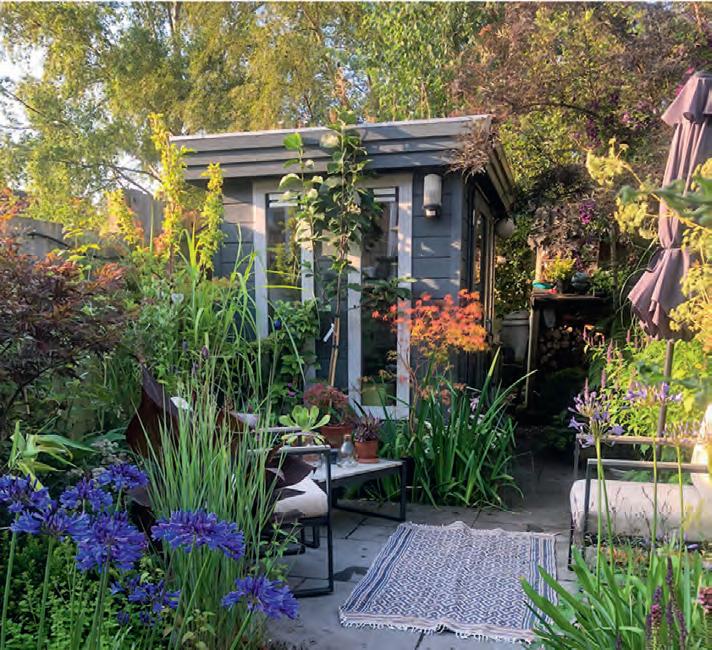
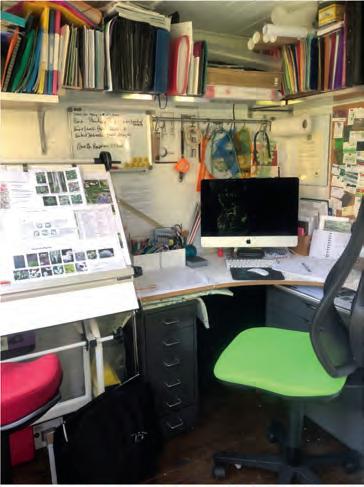
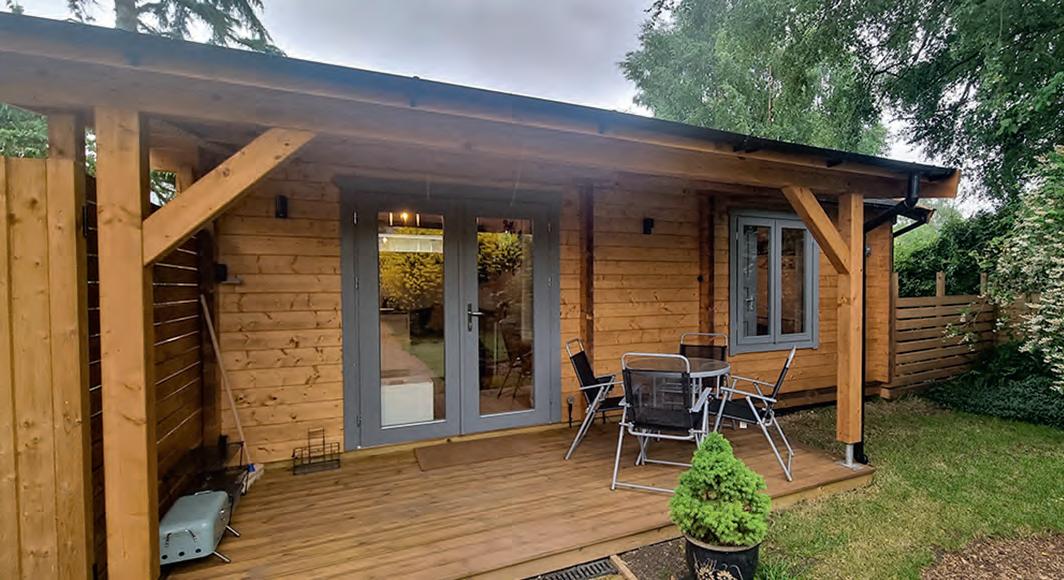
centrepiece was a large, luxurious bed with high-quality linens and pillows. Sue painted the interior walls in a light colour to fill the space with reflective light and the ceilings were left unpainted to emphasise the rustic log cabin aesthetic.
The bathroom has a Velux skylight in the roof, strategically placed to allow natural light to enter, creating a bright and airy atmosphere. This is particularly beneficial in a bathroom, as it helps to prevent the build up of moisture and odours. The skylight also eliminates the need for additional windows or fixtures.
The compact footprint of sleeping area, kitchenette, bathroom and garden allows a self-contained space with its own entrance and outdoor area. From offering temporary lodging for family to generating income, this offers flexibility beyond a fixed extension.
Garden Affairs has distributed and installed garden buildings across the UK for over 20 years, and offer a quality product and an efficient, stress-free process from start to finish. The company gives clients the freedom to be as involved as they want (or not!) in the process, from order to installation, and are always there to give advice during the build. n
Visit the Garden Affairs showroom at Trowbridge Garden Centre, 288 Frome Road, Trowbridge, BA14 0DT; gardenaffairs.co.uk
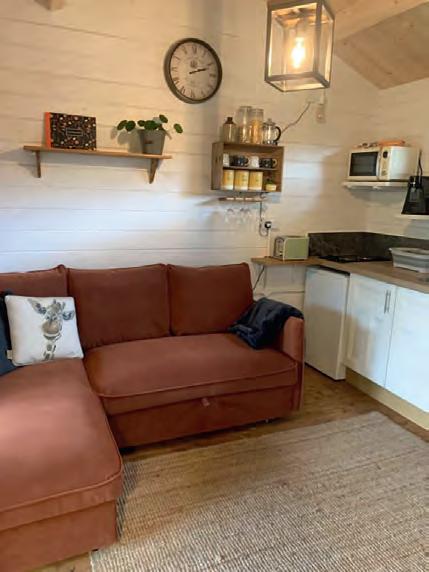
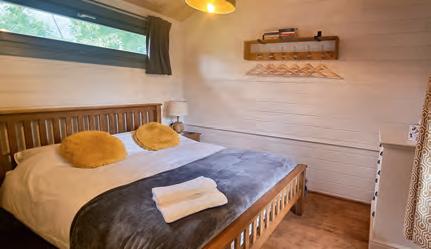


The fresh zing of summer is making way for more sultry colours in the garden, writes Elly West, who says that it’s now and into autumn that ornamental grasses really come into their own
Theversatility of ornamental grasses means they suit formal and informal garden styles, with a huge range of sizes, textures and colours to choose from. There really is a grass for every situation. Dotted through a flowering border, they act as a great foil for other plants, opening up a colourful planting scheme to prevent it from becoming too ‘busy’, adding movement, texture, and repetition.
Many are evergreen, or are at least semi-evergreen, providing longlasting interest into winter with their seed heads and frost-covered stems. I like to use grasses to define edges and mark out lines in the garden without that same sense of rigidity or permanence that a hedge would have. They are great for softening hard landscaping and blending with other airy plants such as Verbena bonariensis. Smaller varieties are also good for container displays, adding structure and architectural form to fellow flowering perennials and annuals.
Grasses boomed in popularity around 20 years ago, mainly due to the development of prairie-style planting, pioneered by Dutch designer Piet Oudolf. His approach uses grasses and perennials planted in bold drifts, to create naturalistic borders with a sense of wildness and spontaneity. Plants are selected for their seasonal appeal, including how they age and their winter structure.
Grasses are often used as the structural backbone in his schemes, with varieties such as molinia, miscanthus and calamagrostis providing height and vertical interest to create a framework around which other plants are arranged. His innovative style has remained popular and shaped gardens and landscapes around the world, from the High Line of New York, an elevated park built on a disused railway line in Manhattan, to much closer to home in the Oudolf Field at Hauser & Wirth in Somerset.
Oudolf’s gardens and ethos fit well with our drive towards more ecological planting, embracing sustainability and biodiversity over formal,
controlled designs. Grasses help us to appreciate the beauty of plants in all stages of their life cycle, from the fresh growth in spring, to the golden rich colours of autumn and the stark winter seed heads. Most grasses are low maintenance, and once established just need occasional trimming and tidying. They are pest free, tend to be resistant to rabbits and deer, and can cope with periods of drought. Their fibrous roots help prevent soil erosion, and they are good for wildlife, offering food and shelter to various insects, birds and small mammals, all contributing to a healthier garden ecosystem.
There are many varieties to choose from, so it’s about choosing the right grass for the right spot. Although many like an open and sunny site, some will tolerate shade. Evergreen sedges, carex, luzula and the Japanese forest grass Hakonecholoa macra will be happy in shadier, damper spots, while pennisetum, stipa, fescue and miscanthus fare better in full sun.
Size is also going to be an important factor when choosing what grasses to use. Smaller grasses can be tucked along the base of taller plants, or in containers, rock gardens or used as edging. Ophiopogon planiscapus ‘Nigrescens’, or black mondo grass (though strictly speaking not actually a grass, but a type of lily) is one of my favourites for groundcover in dry shade or partial shade. It makes a good edging at the front of a border or along a path, with its striking black strappy leaves and summer flowers followed by dark berries.
Liriope muscari is another grass-like plant that is good in shade and for a low-growing edging or under trees and shrubs, and has spikes of purple flowers in late-summer and autumn. Blue fescue and Carex ‘Evergold’ are also useful low-growing grasses that look good as an understorey beneath taller shrubs and trees. Medium-sized grasses are great for punctuating a border, adding rhythm, some order and focal points among the flowers, and extending the season after the flowers have faded. Stipa tenuissima and Anemanthele lessoniana are my go-to varieties.
Both are around 60cm in height, with the stipa having a lighter, softer look, with light-green leaves and blonde flower heads, while the anemanthele forms larger clumps of arching bronze leaves, and airy sprays of red-brown flowers in late summer.
Of the taller grasses, Calamagrostis ‘Karl Foerster’ is one of the best in my view, as it forms neat clumps of upright feathery plumes reaching around 1.5m, and beautiful bronze-tinted flowering panicles that fade to pale gold. It can also be used as an informal screen, although it is deciduous so will die back in winter and reappear in spring. I recently saw some grown with the late-flowering Allium ‘Summer Drummer’, which made a stunning combination, with the allium ball-like flowers the tallest I’d ever seen, popping up above the grass at around 2-2.5m high. Definitely one to try in my garden next year!
Stipa gigantea, or golden oats, is another firm favourite, as although the flower stems are huge (up to 2.5m), they are airy and open in habit, and grow from a low mound of grassy leaves, so add height and structure without blocking out other plants.
Most grasses are easy to grow and require little attention once established, although you may need to water them in the first year after planting if the weather is dry. After that, simply cut back deciduous grasses in late winter or early spring, before the new growth appears, and wear gloves to ‘comb out’ the dead leaves of evergreen types. Make new plants by dividing clumps every few years, in either spring or autumn, or sowing seeds.
Now is a great time of year to see grasses in all their glory at the beautiful gardens at Hauser & Wirth, near Bruton, open Wednesday to Sunday from 10am-5pm. Visit hauserwirth.com for more details. n ellyswellies.co.uk

Stipa tenuissima, as previously mentioned, is one of my favourite grasses and seems to find its way into a large number of my border designs, with its soft feathery stems, neat and compact habit, and fine leaves that wave in the slightest breeze.
The flower heads are soft and beautifully tactile; it’s hard to walk past a plant in summer without reaching out a hand to stroke through the pale, tufty panicles. Also known as Mexican feather grass, it looks good in swathes through a border, or in a sunny gravel garden or container. It reaches around 60cm in height and likes well-drained soil. Grow it in sun or partial shade, and it will produce arching feathery flower panicles through summer that ripen to golden brown in autumn and winter, creating a useful food source for finches and other seedeating birds. Good companions are summerflowering perennials such as achillea, geum, echinacea, rudbeckia and sedum.





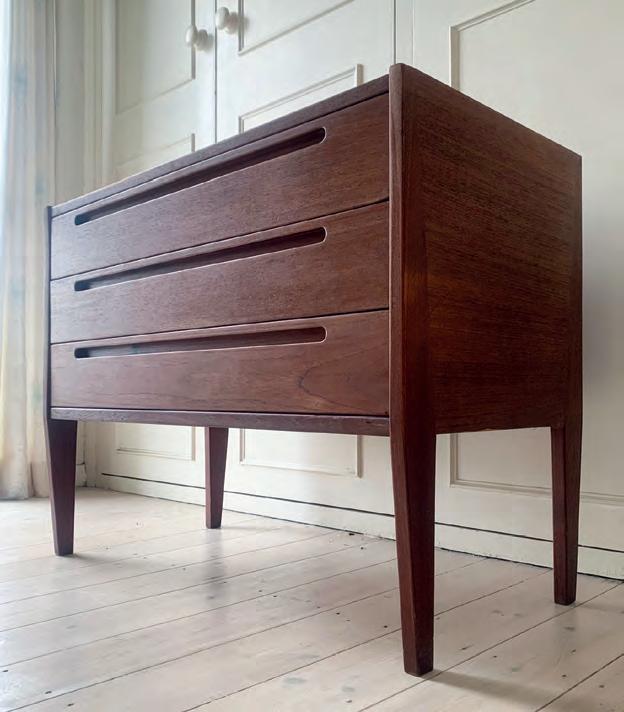

Whiteladies Road, Clifton
1,027 sq ft (95.41 sq m)
A ground floor retail shop with glazed frontage prominently positioned at the top of Whiteladies Road, benefitting from basement storage and one parking space. Would suit a range of alternative
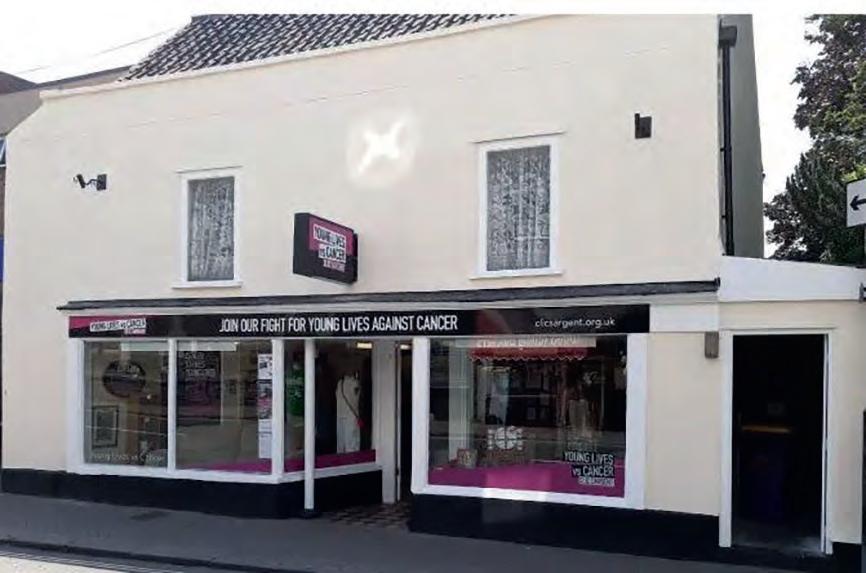
High Street, Shirehampton
1,968 sq ft (183 sq m)
A recently refurbished ground and first floor Use Class E property with a rear courtyard on the busy Shirehampton High Street. The unit is prime for retail or office space and is available from
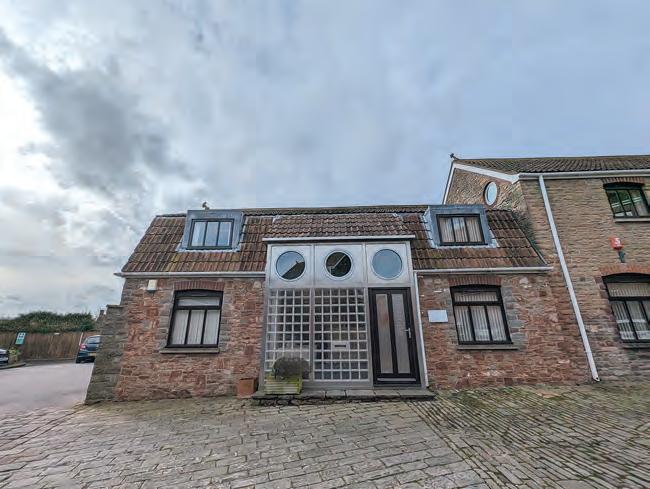
The Old Brewery Business Park, Pill
1,243sq ft (115.5 sq m)
A unique office building located within the popular Old Brewery Business Park comprising open plan space over two floors which is due to be newly refurbished and benefits from 8 car parking spaces, and on-site gym and shower facilities.




Whiteladies Road, Clifton
1,860 sq ft (173 sq m)
A three-storey office building due to be redecorated throughout to provide modern, attractive accommodation. Previously occupied for medical use the property could suit a range of uses within planning Use Class E.




Keep up-to-date with our latest news, deals, testimonials and market comment at our website: www.burstoncook.co.uk





High Street, BS1 TO RENT - POA
3,243 sq ft (301 sq m)
A large ground floor office with attractive shop frontage prominently located on the High Street, close to St Nics Market. Currently configured to offer reception, open plan working space, meeting rooms, and basement storage.
Amberley Hall Day Nursery, BS8 FOR SALE – £750,000
3,091 sq ft (287.16 sq m)
An exceptional freehold opportunity in the heart of Clifton, just a short walk from Durdham Downs offering a prime business location or opportunity for residential conversion subject to planning consent.
The Sanctuary, Pill FOR SALE (MAY LET) - POA
1,804 sq ft (168 sq m)
Strategically located just 2 miles from J19 of the M25, the property provides an open plan office with useful meeting rooms in situ. There are 9 car parking spaces, and the suite is available to purchase with vacant possession.
Whiteladies Road, BS8 TO LET - £12,500 pax
600 sq ft (56 sq m)
A light and airy studio office to rent, comprising two interconnecting rooms with own kitchenette. Prominently located on Whiteladies Road. New lease available.

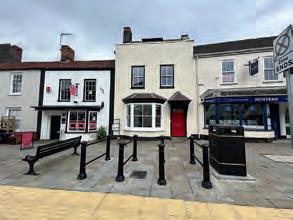
Lower Park Row, BS1 TO LET - £21.50
1,404 sq ft (130 sq m)
A well-presented office, conveniently located close to the BRI and Christmas Steps providing modern, open-plan accommodation with useful meeting rooms already in situ and 1 car parking space.
Whiteladies Road, Clifton TO LET – £17,750 PAX
1,027 sq ft (95.44 sq m)
A ground floor retail shop with glazed frontage prominently positioned at the top of Whiteladies Road and next to Clifton Downs benefitting from basement storage one parking space.
High Street, Thornbury TO LET - from £17,000 PAX
1,630 sq ft (151.41 sq m)
A recently refurbished three storey commercial property with basement storage. Situated on the popular High Street, this property is suitable for retail or office use and ready for occupation.

Whiteladies Road, Clifton TO LET - £23.75 psf pax
1,860 sq ft (173 sq m)
A three-storey Use Class E building prominently positioned on Whiteladies Road and due to be redecorated throughout to provide modern, attractive accommodation.
Stute House, Clifton FOR SALE - POA
2,783 sq ft (286 sq m)
An attractive coach house currently in use as offices providing accommodation over two floors. The property benefits from double garage and offers potential for a range of alternative uses (STP).


Whiteladies Road, Clifton TO LET – POA
1,276 sq ft (119 sq m)
A spacious Class E unit on a popular pitch bordering Redland and Clifton. The property is positioned amongst bustling shops and restaurants with high footfall and is an exceptional site for either retail or office use.

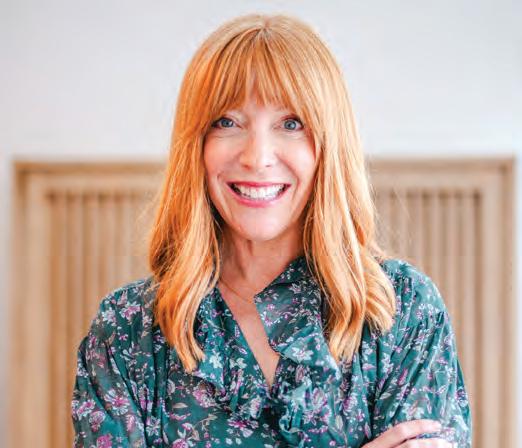
September presents a promising time for prospective buyers in the Bristol property market. The city’s appeal continues to grow with its vibrant culture, strong employment opportunities and excellent transport links. As is reflected in analysis such as Rightmove re-evaluating the house price index from -1 to +1 for this year, we are predicting a robust September for the housing market. Let’s consider the key factors affecting the market, and tips for those of you looking to move this Autumn: -
Political stability is the key factor in there now being a lot more positive sentiment in the market. We are coming out of six months during which there was a great deal of hesitation and uncertainty on the part of both buyers, and sellers, as they tried to navigate the possible impact that a new Government would have on their lives and finances. In a city with some of the country’s leading Independent schools, we are already seeing signs of the impact of the imposition of VAT on private school feels with many families selling to release some equity, and buyers focussing on what will be an evershrinking catchment area for state schools
The downward trend in inflation and what economists predict to be a downward trend on interest rates will continue to play a positive role in the property market dynamics. Buyers are also closely watching some mortgage lenders taking an early lead on offering competitive deals over the past few weeks which will further add to the sense of stability and positive predictions around the Autumn property market.
All indications are that the supply of properties in Bristol is set to improve in early Autumn with stock coming on that was due to come on in the traditionally busy late spring/early summer market, though put on hold due to the calling of the General Election. Demand will remain strong for good family homes with gardens in Clifton and Redland, as well as the much sought after downsizer properties, particularly in Clifton.
Whilst the velocity of transactions is expected to increase in the next quarter, with more buyers entering the market, this doesn’t mean prices will increase. An increase in transactions will add to this positive sentiment, with more sellers then also having the confidence to come to market, though the market is likely to remain price sensitive. With the broader economic conditions being more positive in terms of buyer confidence, the right houses, in the right areas, priced sensibly, will have strong demand.
If you are hoping to move this year, here are some practical tips:-
1.Get your Finances in Order
It is always recommended to have a clear understanding of your budget and financing options. Speak to a mortgage advisor early on to secure the best possible rates. Having a Mortgage Agreement in Principle will show the selling agent/seller that you are a motivated buyer.
Whilst economists predict interest rates will continue to fall, be cautious about continuing to wait for further cuts: waiting could mean you miss out on your perfect home, or the level of interest in it from other buyers hots up as the cost of borrowing improves.
2.Keep an Eye on Local Market Conditions
Whether it’s a regular trawl of Rightmove or chatting to local agents, buyers should keep a close eye on the local market to understand which areas and types of properties are seeing the most activity and those of which you might have more negotiation power.
3.Be prepared to Act Quickly
Desirable properties in the right location, priced sensibly, can still sell quickly. If you find the property that meets your criteria, be prepared to act decisively. Focussing a buyer’s mind at this time of year is always that strong driver to be “in before Christmas”; to allow time for conveyancing in reality means finding that new home by the end of September/early October.
4.Be Open Minded to ‘Old Stock’
Whilst buyers are eagerly awaiting the new listings September will bring, I would also advise being open minded to properties that are yet to sell. Given the challenges over the past 6 months, there are many examples of beautiful homes in Bristol that haven’t sold, that may well have been snapped up in a different market. Just as buyers have the incentive to be in their new home before Christmas, often sellers are keen to avoid the thought of going into a long winter with their home still on the market. It is always worth getting a sense from the selling agent as to the seller’s current position and motivations to sell.
Whatever stage you are at in the search for your perfect home or investment property, we’d love to chat.
Lili Oliver
Oliver Roth Property Consultants T: 0117 9877 828 | E: home@oliverroth.co.uk




Bristol | Guide Price
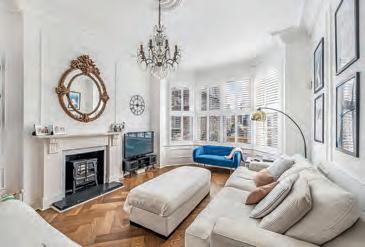
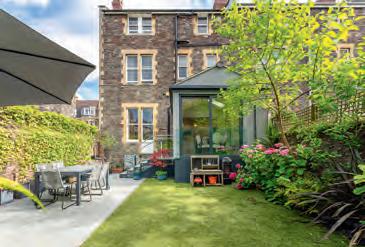
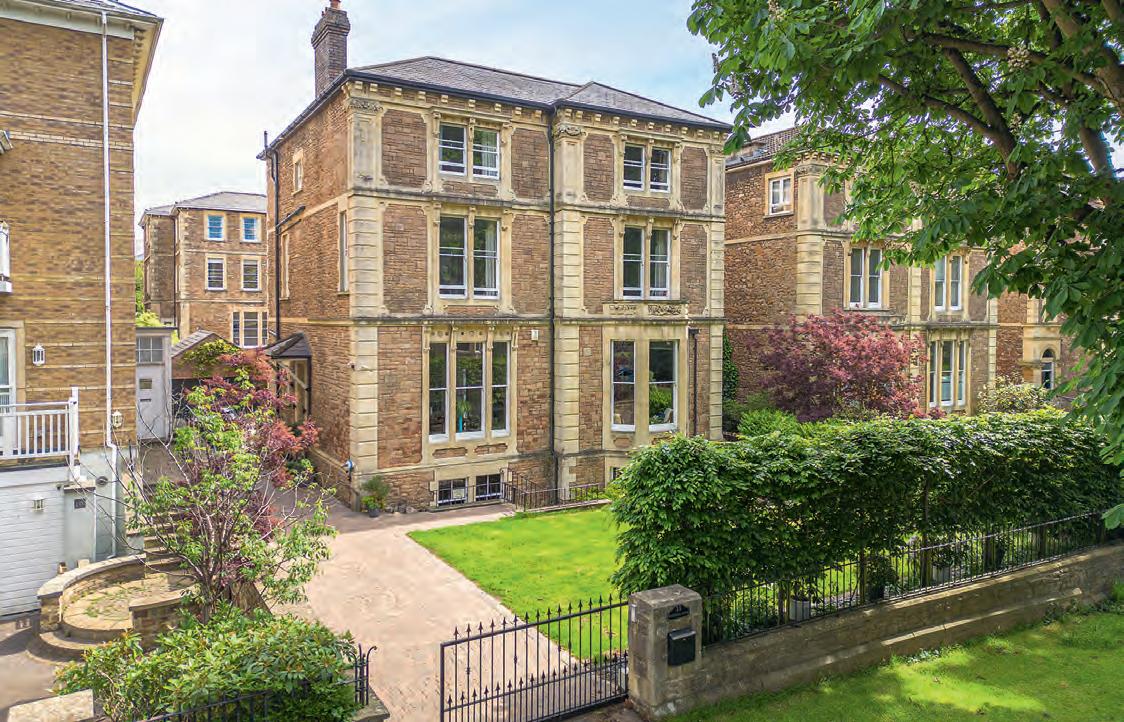


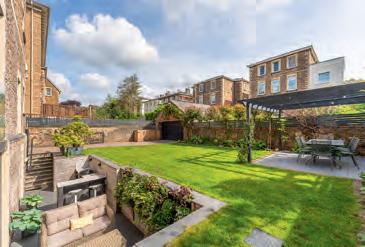
Clifton, Bristol | Guide Price £3,500,000 A stunning detached house on a favoured road close to Clifton College, beautifully refurbished by the current owners to create a superb family home. Exquisite circa 4800 sq ft family home with a gated drive and mature gardens | Six double bedrooms and four bath / shower rooms | Circa 40’ full depth family kitchen, snug and breakfast room | Four further reception rooms and a gym | Separate utility and two further cloakrooms | Landscaped front and rear gardens | Sunken courtyard and outdoor cooking and seating area | Gated drive with parking for several vehicles | Detached 300 sq. ft